You internet speed is slow. Switch to text view mode

Switch
epaper logo
ST

Last Login:
Logout
+
Page 1
HOME PAGE

Monetary policy reins in credit expansion to control inflation
Most of the credit issued went into import financing which contributed to a ballooning balance of payments deficit and decrease in foreign exchange reserves, officials say.
- PRITHVI MAN SHRESTHA

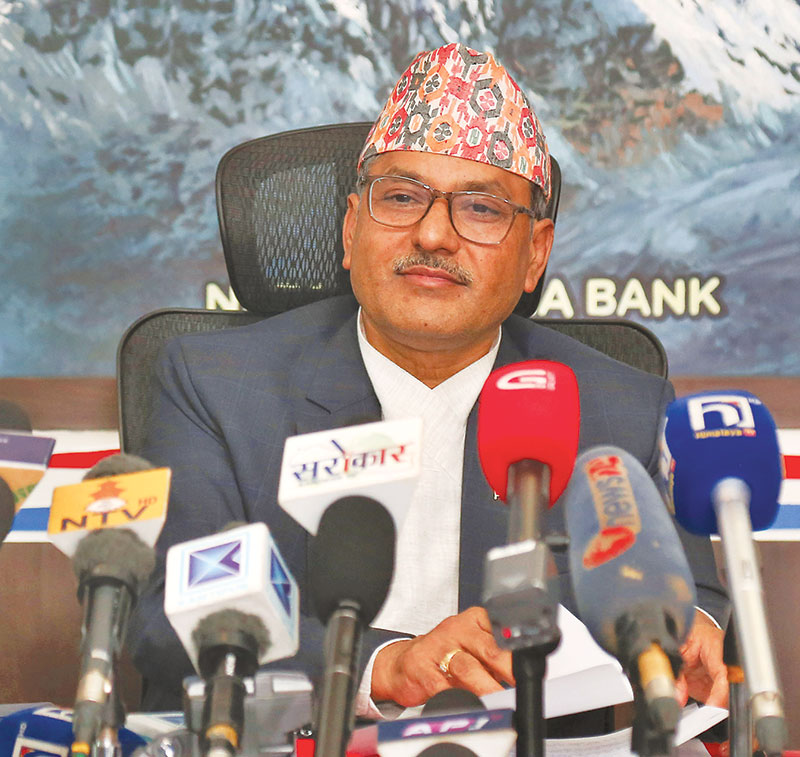
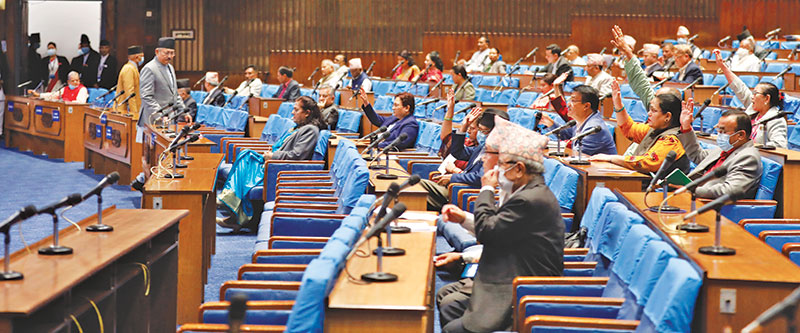
Governor Maha Prasad Adhikari.Post Photo

KATHMANDU : Covid-19 had forced the Nepal Rastra Bank to pursue a liberal monetary policy in the last two fiscal years with a view to expand credit to revive the pandemic-hit economy.
With the situation now changed with over expansion of credit
causing a steep jump in imports leading to depletion of foreign currency reserves besides contributing to rising inflation, the central bank has come up with a plan to reduce the expansion of credit and money supply in the market.
Measures have also been announced to help banks and financial institutions to maintain more liquidity as excessive lending in the initial months of the last fiscal year resulted in a shortage of loanable funds to finance the productive sector in the later months.
Unveiling the monetary policy, central bank governor Maha Prasad Adhikari announced that credit expansion to the private sector would be confined within 12.6 percent, a sharp reduction from the targeted 19 percent in the last fiscal year.
Likewise, the new monetary
policy aims to limit the growth of money supply (cash, demand deposits, non-cash assets that are very liquid and that are easily convertible into cash) to 12 percent from the last fiscal year’s target of 18 percent.
This is the first time that the growth target of credit expansion and money supply has
been kept at such a low level in many years.
The greater the money supply and credit expansion, the greater the possibility of increased inflation because of the demand they create in the market. During the
first 11 months of the last fiscal year, credit expansion to the private sector stood at 16 percent as banks and
financial institutions stopped further lending in the second half of the last fiscal year.
In the early months, credit growth to the private sector had crossed 30 percent.
Central bank officials have time and again admitted that most of the credit issued went into import financing which contributed to a ballooning balance of payments deficit and decrease in foreign exchange reserves.
Merchandise imports soared 27.5 percent to Rs1,763 billion, as against Rs186 billion in exports during the period. As a result, gross forex reserves plunged by 19.6 percent to $9.45 billion in mid-June 2022, down from $11.75 billion in mid-July 2021.
Massive imports coinciding with a surge in global inflation caused by rising prices of petroleum products contributed to a 70-month high inflation of 8.56 percent and depleting foreign exchange reserves.
Though the monetary policy aims
to tame inflation at 7 percent as announced by the budget statement for the current fiscal year, the
central bank believes maintaining inflation within that limit will be very challenging.
“The impact of rising fuel prices and supply side constraints on prices will continue to remain for some time,” the monetary policy states.
“As domestic demand [for goods and services] will increase due to the upcoming general elections, salary increment [of government staff] through the budget and the expansion of the social security net, it will be challenging to maintain inflation within the limit.”
Experts say the monetary policy
has acknowledged that rising inflation and massive imports have emerged
as major concerns for the economic health of the country. “The question
is whether the policy adopted will be adequate to control inflation and imports,” said Chiranjeevi Nepal, a former governor of the central bank.
Nepal said the central bank should have ended some of the credit schemes including the refinance, which contributed to a rise in imports and brought inflation from abroad along with the imported goods. Under this scheme, enterprises affected by Covid-19 would receive refinance at the rate of either 3 or 5 percent.
During the first 11 months of the last fiscal year 2021-22 ended July 16, a total of 24,305 borrowers received Rs115.70 billion. In the previous fiscal 2020-21, a total of 48,890 borrowers received Rs148.75 billion.
Governor Adhikari said the central government would review the policy on refinance, confining this scheme
to the productive sector including agriculture, exports and sectors which are yet to recover from the Covid-19 pandemic.
“Questions have been raised whether the refinance scheme has been received by firms which were in urgent need of such a measure,” said Narayan Poudel, former executive director of the central bank.
“Such refinance should be provided as emergency aid only. If the central bank provides this option continuously, it will lead to credit expansion and affect economic stability.”
Considering the impact of Covid-19, Nepal Rastra Bank had allowed banks and financial institutions to restructure and reschedule loans. It said that it would review this provision. The central bank also came up with
certain moves to improve the liquidity position of banks and financial
institutions.
After Covid-19 hit the country, the central bank had adopted a policy of allowing banks and financial institutions to maintain the liquidity level at the lowest possible so that they would be able to expand credit to help the economy recover.
Consequently, the cash reserve ratio (CRR), a certain percentage of a bank’s total deposits that it needs to maintain as liquid cash at Nepal Rastra Bank, and the statutory liquidity ratio (SLR), which is the minimum percentage of deposits that a commercial bank needs to maintain in the form of liquid cash, gold or other securities, were slashed.
As the new monetary policy seeks to reduce expansion of credit, it announced that the CRR and the SLR would also be raised.
The CRR will be ramped up to 4 percent from 3 percent starting from August 17 while the SLR will be raised to 12 percent for commercial banks from 10 percent by mid-January next year. In the case of development banks and finance companies, it will be hiked to 10 percent from the current 8 and 7 percent respectively.
Former governor Nepal said that both the CRR and the SLR should have been hiked further considering the current situation of liquidity crunch in the banking system and credit expansion.
Poudel says the new monetary policy has essentially aimed to address the issue of external sector risks such as a widening balance of payments deficit, depleting foreign exchange reserves and rising imports.
“To this end, it has sought to control credit expansion and money supply,” he said. “They are necessary measures too in the current context, but it may not help achieve the projected economic growth of 8 percent.”

A file photo shows souvenir shop owners waiting for customers at an alley in Bhaktapur, Nepal.reuters
HOME PAGE

House endorses bill to amend Citizenship Act

Once the bill gets through upper house, children of parents who got citizenship by birth will get citizenship by descent.
- BINOD GHIMIRE

Earlier, the UML had proposed a seven-year cooling period for granting citizenships but the House rejected the proposal.post Photo: Elite JOshi

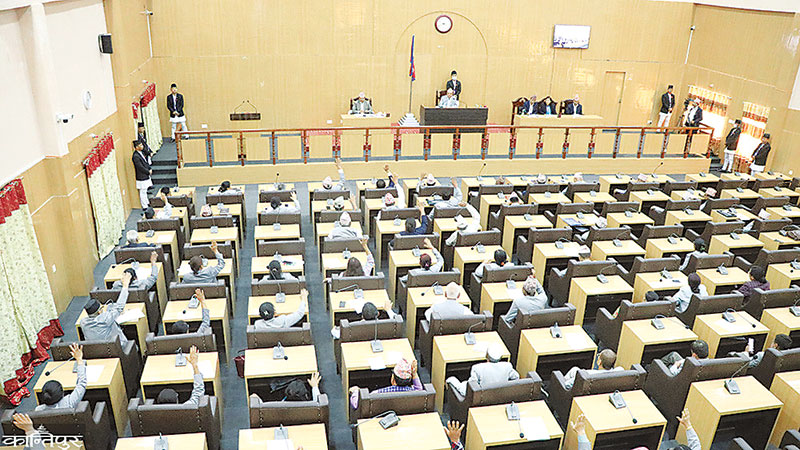
KATHMANDU : The House of Representatives on Friday endorsed a bill to amend the Citizenship Act, 2006 through a majority vote amid reservations from the main opposition CPN-UML.
The bill, once it gets through the National Assembly, will open the door for thousands of children of the parents who got citizenship by birth to acquire citizenship by descent. All eligible Nepalis born before September 20, 2015, the day when the Constitution of Nepal was promulgated, were granted naturalised citizenship. However, their children haven’t got citizenship in the absence of a law as the constitution said the provision to grant them citizenship would be guided by a federal law. The federal law hasn’t been prepared even seven years after the promulgation of the statue. Some 190,000 persons had acquired naturalised citizenship by birth.
Once the amendment gets through the upper house, one born to a Nepali woman in Nepal and whose father is unidentified would get citizenship by descent. However, the applicant’s mother must make a self-declaration that the father is not identified. She will be liable for action if it is found that her claim that the father of her issue is not identified turns out to be wrong.
The bill also paves the way for Non-Resident Nepalis to acquire citizenship. However, they will not be eligible to enjoy the political and administrative rights.
The endorsement of the amendment bill, without revision, was possible after the CPN (Maoist Centre) backtracked on its position to have some years as cooling period before granting naturalised citizenship to a foreign woman married to a Nepali man.
Whether to grant naturalised citizenship to foreign women married to Nepali men once they start the process to renounce the citizenship of the country of their origin was the most contentious issue the State Affairs and Good Governance Committee of Parliament had to resolve.
As consensus continued to elude, the committee in June 2020 endorsed a bill to amend the Act with a provision that foreign women married to Nepali men will have to wait for seven years for naturalisation.
Despite reservations from the Nepali Congress, then Rastriya Janata Party and the Samajbadi Party, the bill was endorsed in the House committee with a majority vote by lawmakers of the then Nepal Communist Party (NCP) formed after a merger between the CPN-UML and CPN (Maoist Centre).
The three parties were for retaining the provision of granting citizenship once the woman started the process to renounce citizenship of her country.
NCP lawmakers argued that as India takes seven years to grant citizenship to foreign women married to Indian men, Nepal too should have a similar provision. Because of serious differences among the major parties, the House of Representatives never put the bill to vote.
Two years later, the government on July 8 withdrew the bill from the House and registered a new one retaining the provision to grant citizenship to foreign women married to Nepali men once she starts the process to give up citizenship of her country.
The Maoist Centre, which voted to have a cooling-off period in the House committee in 2020, now has stood for granting citizenship once the woman starts the process to give up the citizenship of the country of her origin. While the UML lawmakers had no reservations on the other provisions in the bill, they demanded a cooling period before granting citizenship. They had registered amendments demanding a seven-year cooling period but their amendments were rejected by the House.
“All the countries in the South Asian region have certain cooling periods before granting citizenship. We object to the bill that opens the door to provide citizenship to a foreign woman married to a Nepali man immediately after she starts the process to give up her citizenship,” said Khagaraj Adhikari, a UML lawmaker, in the House.
Some UML leaders had said there should be similar provisions to grant citizenship to foreign women married to Nepali men and foreign men married to Nepali women. As per the bill, foreign men married to Nepali women must have lived for 15 years continuously in Nepal, denounced the citizenship of their country of origin, and be able to speak Nepali language to qualify for naturalisation.
“The bill has been introduced with the mindset that women married
to foreign men must leave Nepal. This is against the right to equality and a manifestation of patriarchal mindset,” said Binda Pandey, while taking part in the deliberations on the bill on Friday. “Equality must prevail.”
Legal experts say the provision in the bill is discriminatory. They say that there must be equality in granting citizenship. In the United States, for instance, both spouses are treated equally regardless of their gender, and the spouse of a US citizen who has resided in the country with his or her citizen spouse for at least three years can apply for naturalisation.
“It is good that the House of Representatives has endorsed the bill which, if ratified by the upper house, will do justice to thousands of people waiting for citizenship for years,” Sabin Shrestha, director at the Forum for Women, Law and Development, a non-governmental organisation, advocating for the rights of women and marginalised communities, told the Post. “However, it has several discriminatory provisions while some even contradict the constitution.”
Article 11 (5) of the constitution says a person who is born in Nepal of a woman who is a citizen of Nepal and has resided in Nepal and whose father is unidentified shall be provided the citizenship of Nepal by descent. It further says citizenship by descent will be converted into naturalised citizenship if his/her father is found to be a foreign citizen. However, against the constitutional provision, the bill has a provision of taking punitive action against the mother if the father is found.
Human rights experts say the bill also has failed to ensure citizenship with identity of descent and gender. Article 12 of the constitution says a person who obtains the citizenship of Nepal by descent in accordance with the Constitution may obtain a certificate of citizenship of Nepal with gender identity in the name of his or her mother or father.
However, the bill doesn’t include the provision. “Getting citizenship with identity is a constitutional right,” advocate Mohna Ansari, a former member of the National Human Rights Commission, told the Post.
“It is sad that the government is
reluctant to implement constitutional provisions.”
She, however, said the bill has paved the way for thousands who are stateless to acquire citizenship.
Urging the lawmakers to vote for the bill, Home Minister Bal Krishna Khand said despite their efforts no consensus could be forged on marital naturalised citizenship. “Granting citizenship to the children of parents who got citizenship by birth is the main objective of the bill,” he said. “Let us endorse it unanimously.”

HOME PAGE

Wild tiger numbers higher than previously thought

IUCN reports a 40 percent increase in estimated tiger numbers as it updates Red List, assessing the species’ extinction risk.
- AGENCE FRANCE-PRESSE

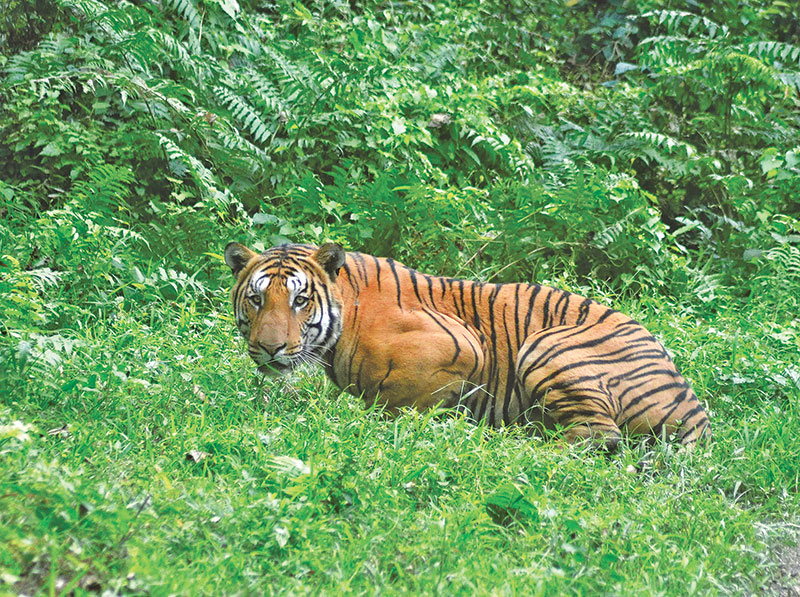
This photo taken on December 21, 2014 shows a Royal Bengal Tiger in a jungle in Kaziranga National Park, some 280 km east of Guwahati, India.AFP/RSS

GENEVA : There are 40 percent more tigers in the wild than previously thought, but with a maximum of 5,578 on the prowl, they remain an endangered species, conservationists have said.
The jump in numbers is due to improved monitoring,
with the population thought to be stable or increasing, said the International Union for Conservation of Nature on Thursday, but habitat protection projects showed that “recovery is possible”.
The tiger reassessment came as the IUCN updated its Red List of Threatened Species—the world’s most comprehensive information source on the global conservation status of plants, animals and fungi, assessing their risk of extinction.
The migratory monarch butterfly is now classified as an endangered species on the Red List due to climate change and habitat destruction.
And all surviving sturgeon species are now at risk of extinction due to dams and poaching.
“Today’s Red List update highlights the fragility of nature’s wonders, such as the unique spectacle of monarch butterflies migrating across thousands of kilometres,” said IUCN director general Bruno Oberle.
“To preserve the rich diversity of nature we need effective, fairly governed, protected and conserved areas, alongside decisive action to tackle climate change and restore ecosystems.”
The Red List assigns species to one of eight categories of threat.
A total of 147,517 were assessed in the latest version, with 41,459 species deemed as being threatened with extinction.
Of those, 9,065 are critically endangered, 16,094 are endangered and 16,300 are deemed vulnerable.
Established in 1964, the Red List counts 902 species that are now extinct, and 82 which are extinct in the wild.
There are thought to be between 3,726 and 5,578 wild tigers — 40 percent more than at the last assessment in 2015.
While the tiger remains endangered, the population trend indicates that projects such as the IUCN’s Integrated Tiger Habitat Conservation Programme “are succeeding and recovery is possible as long as conservation efforts continue”, the organisation said.
Major threats include poaching of tigers themselves, poaching and hunting of their prey, and habitat destruction due to agriculture and human settlement, said the IUCN.
“Expanding and connecting protected areas, ensuring they are effectively managed, and working with local communities living in and around tiger habitats, are critical to protect the species,” it said.
The migratory monarch butterfly, a monarch subspecies, is well known for its migrations from Mexico and California to summer breeding grounds throughout the United States and Canada.
The native population has shrunk by between 22 and 72 percent over the past decade, the IUCN said, with logging and deforestation having destroyed substantial areas of their winter shelter.
Meanwhile pesticides and herbicides used in intensive agriculture kill butterflies and milkweed — the host plant that their larvae feed on.
Climate change is also a fast-growing threat, with drought, wildfires, extreme temperatures and severe weather having a significant impact.
“It is difficult to watch monarch butterflies and their extraordinary migration teeter on the edge of collapse, but there are signs of hope,” said Anna Walker, who led the assessment of monarchs.
“From planting native milkweed and reducing pesticide use to supporting the protection of overwintering sites and contributing to community science, we all have a role to play in making sure this iconic insect makes a full recovery.”
The western population is at greatest risk of extinction, the IUCN said, having declined by an estimated 99.9 percent, from as many as 10 million to 1,914 butterflies between the 1980s and 2021.
The larger eastern population also shrank by 84 percent from 1996 to 2014.
“Concern remains as to whether enough butterflies survive to maintain the populations and prevent extinction,” the IUCN said.
The global sturgeon reassessment found that all remaining 26 sturgeon species are now at risk of extinction, up from 85 percent in 2009.
Their decline over the past three generations is steeper than previously thought.
The Yangtze sturgeon has moved from critically endangered to extinct in the wild, while 17 species are now critically endangered.
The reassessment confirmed the extinction of the Chinese paddlefish.
“Sturgeons have been overfished for their meat and caviar for centuries,” the IUCN said.
It called for reinforcement of protections under international law, with poaching affecting more than half of sturgeon species. Dams affect their migration, while warmer rivers due to climate change disrupt their reproduction.

Page 2
NATIONAL

Alliance has asked prime minister to postpone US visit, Yadav says

Yadav rules out cancellation of the visit; says it has been put on hold due to some reasons.
- Post Report

KATHMANDU : Upendra Yadav, the chairman of the Janata Samajbadi Party, a coalition partner in the current government, said on Friday that the ruling alliance advised Prime Minister Sher Bahadur Deuba not to embark on a visit to the United States for now.
Speaking at an interaction titled “Geopolitics and Nepal’s Military Diplomacy,” organised by the Centre for Social Inclusion and Federalism, Yadav, who is also a former foreign minister, said that the coalition had suggested that the prime minister’s visit to the US be put on hold in view of some internal reasons.
“It is not that the prime minister’s visit will not take place or that he will not go, but we have put this visit on hold for now because of internal reasons,” said Yadav.
Deuba’s visit was initially planned for mid-July. But then the issue of Nepal’s participation in the US government’s State Partnership Program surfaced.
Parties from across the political spectrum pressured the government not to participate in the SPP.
According to the US embassy in Kathmandu, Washington accepted Nepal in the SPP in 2019 after two requests in 2015 and 2017.
Following pressure from parties, which argue the SPP has military and security components, the government on June 21 decided not to be part of the American programme.
The Foreign Ministry, however, is yet to write to the US regarding the government decision. Speaker Agni Sapkota on Thursday ordered the government to apprise the House of the status of the SPP’s implementation in Nepal.
A few days ago, Madhav Nepal, chair of the CPN (Unified Socialist), which is also a coalition partner, said at a function that the prime minister’s visit “was cancelled” because Nepal refused to “pass” the SPP.
American officials, however, have maintained that there is nothing to “pass” with regard to the SPP and if
Nepal wishes to pull out of the program then the government should simply write to the US.
On Deuba’s visit, the Foreign Ministry on July 3 said that it is “expected.” But on Wednesday, it said the visit has yet to be confirmed.
“Earlier we were discussing a particular date for the prime minister’s visit,” Sewa Lamsal, spokesperson for the Ministry, said on Wednesday at a regular press briefing. “Now a new date will be announced once the two sides agree on it. We can’t announce the date until it is mutually convenient for both sides.”
On the SPP, Lamsal said the ministry is studying the matter.
“We are studying the various aspects of the SPP. We have received some facts and evidence that Nepal has already received some assistance under the programme. We are also studying in what areas, including disaster management, was the assistance received,” said Lamsal.
At Friday’s interaction, Yadav said that Nepal won’t be part of any military alliance.
Stating that Nepal cannot be part of the Indo-Pacific Strategy, Yadav said that the government has also decided not to be part of the SPP.
“The Foreign Ministry will write to the country concerned [the US],” said Yadav.

NATIONAL

Malnutrition a serious health crisis in Darchula

As many as 537 children in the district aged between 6 months and five years were found suffering from malnutrition in the last fiscal year 2021-22.
- MANOJ BADU

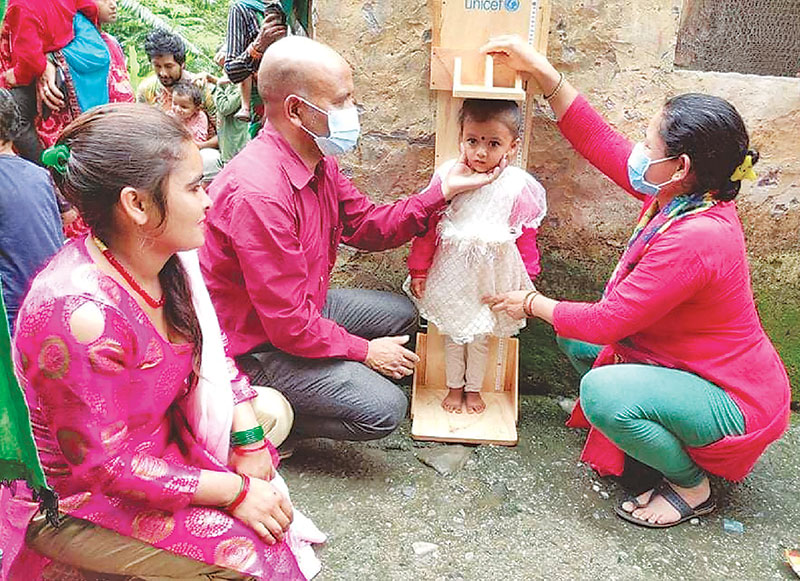
Food insecurity and a lack of awareness among guardians regarding nourishing food needed for a child’s growth are the leading causes of malnutrition in the district.Post Photo: MANOJ BADU

DARCHULA : Malnutrition in children is a serious health crisis in Darchula, a hill district of Sudurpaschim Province.
As many as 537 children between 6 months and five years were found suffering from malnutrition in the district, according to the District Health Office in Darchula. Among them, 168 children suffer from severe acute malnutrition.
The District Health Office in the last fiscal year 2021-2022 launched a programme to find out the state of malnutrition in the district. Health workers reached all 61 wards of the nine local units and conducted health check-ups of the children below five years of age.
“More than 500 out of 5,205 children who underwent health checkup in the district were found suffering from malnutrition. Among them, 168 suffered from severe malnutrition,” said Birendra Prasad Bhatta, immunisation supervisor at the District Health Office.
He said there were 35 severely malnourished children each in Shailyashikhar Municipality, Lekam Rural Municipality and Naugadh Rural Municipality of Darchula. Similarly, 20 children with severe malnutrition were found in Byas Rural Municipality, 15 in Marma Rural Municipality, 10 in Malikarjun Rural Municipality and four in Duhu Rural Municipality.
According to the District Health Office, there are a total of 13,048 children between six months and five years in Darchula.
Health workers say food insecurity and a lack of awareness among guardians regarding nourishing food needed for a child’s growth are the leading causes of malnutrition in children. Darchula is often hit by food insecurity as the food grown by local farmers hardly lasts for six months.
“A lack of awareness regarding nutritious food for children, teenage pregnancies and shortage of nourishing food are the main causes behind the high rate of malnutrition in the district,” said Bhatta.
The District Health Office provided fortified food to all 537 children suffering from malnutrition for three months. According to Khagendra Karki, information officer at the health office, 417 malnourished children were treated while others are still suffering from the ailment.
“Four children with severe malnutrition were found suffering from other diseases as well. They were admitted to a hospital for treatment,” said Karki. According to him, the District Health Office has launched several programmes through each local unit to eradicate malnutrition.
The Nepal Demographic Health Survey-2016 shows that 36 percent of children under five years of age suffer from chronic malnutrition (stunting or low height for weight). The government aims to reduce the stunting rate from the existing 36 percent to 24 percent by 2025, and to 14 percent by 2030, in order to meet the Sustainable Development Goals.
Malnutrition is a serious health crisis in Sudurpaschim Province. The Multiple Indicator Survey-2019 showed that the prevalence of wasting among children in the province stood at 14.1 percent.

Page 3
NATIONAL

Kathmandu District Court encroaches pavement with impunity while street vendors are fined

For past two years, a section of pavement at Babarmahal has been encroached upon by a bus and a truck impounded by the court.
- ANUP OJHA

KATHMANDU : On July 1, the municipal police of Kathmandu Metropolitan City snatched a corn cart away from a vendor couple in Baluwatar, for selling grilled maize on the footpath and obstructing pedestrian movement.
The incident captured in a video and shared on social media triggered a debate, with some saying footpaths are for pedestrians and others criticising the municipal police for depriving the poor couple of their livelihood.
Kathmandu’s footpaths are often encroached upon by street vendors for the lack of regulations on their business and they often face the wrath of the municipal police. But there’s one section in Babarmahal where pedestrians often face problems because the footpath has been encroached upon by the Kathmandu District Court.
For the last two years, a bus and a truck have been parked next to the gate of the district court. The vehicles were impounded for carrying contraband and goods evading taxes, according to court officials.
The case is open and until it is settled, officials say, they have no option but to keep the vehicles on the footpath.
Deepak Dahal, information officer at the Kathmandu District Court, acknowledged that the vehicles have been causing problems to pedestrians.
“We understand this has caused inconvenience to the public, but we don’t have any option either,” Dahal told the Post. “We don’t have space on the court premises for these big vehicles.”
Hari Saran Sapkota, who works as a medical supplier at Tripureshwar, said he walks the Babarmahal road on a regular basis and he has been seeing the two vehicles obstructing commoners’ movement for months.
“If these vehicles were parked on the footpath by an individual, the municipal police and traffic police would have fined them,” said Sapkota, 39. “This is a perfect example of abuse of power.”
Meanwhile, a woman in her late 20s, who owns a small shack on the roadside and has been selling tea to visitors to the district court for over a decade, said the municipal police and traffic police only book street vendors selling fruits and grilled maize, and two-wheelers.
“The bus and truck have been parked here for a long time but police have not been able to remove them although they are blocking pedestrian movements and causing traffic jams,” said the woman who refused to provide her name, fearing she could be evicted.
According to the data of the Kathmandu Valley Traffic Police Office, it detains around 200 vehicles (80 percent two-wheelers and 20 percent four-wheelers) every day for parking illegally. The Kathmandu Metropolitan City books around the same number of vehicles for similar offences.
Recently Kathmandu Mayor Balendra Shah started a campaign to remove street vendors from footpaths. However, the City appears to have failed to notice the two heavy vehicles obstructing the footpath in Babarmahal. The two vehicles have been parked on the tactile paving meant to guide the blind, while a huge number of motorcycles are parked on the side of the gate.
Sudarshan Subedi, former president of the National Federation of the Disabled, said it’s an irony that the City has been cracking down on public space encroachers following an order from the Supreme Court, while the district court has been openly flouting the same order.
“Isn’t it a moral crisis?” questioned Subedi. “In doing so, the district court and the authorities concerned are violating the rights of the people with disabilities.”
When asked about the encroachment of the footpath by the district court, Deputy Inspector General Mira Chaudhari, chief of the Kathmandu Valley Traffic Police, said the situation has been brought to her notice and that she is working to take necessary action.
“I inquired about the issue. I am told that the court has kept those vehicles on the footpath for lack of space on the court premises. But what they are doing is wrong,” Chau-dhari told the Post. “I will further inquire about the issue with the authorities.”
The Kathmandu District Court falls in Ward 11 of the Kathmandu Metropolitan City. Ward chair Hira Lal Tandukar said he had raised the issue about a year ago also.
“This whole area is infamous for illegal parking of motorbikes while vendors set up shops on the footpath,” said Tandukar, who was elected for a second term as ward chair. “I had deployed city police to remove parked motorcycles but we don’t have the machines needed to remove heavy vehicles,” he said. “It’s quite frustrating. I will again discuss this issue with the authorities concerned.”
Court officials said that since the hearing on the impounded vehicles is in the final stage, the vehicles will be removed soon.
“We will soon put the vehicles up for auction,” said Dahal, the information officer at the court. “It may take around two to four months.”

NATIONAL

Province 1 struggles to get a name as assembly term nears expiry

With elections just months away, parties again renew efforts to name the province, only to end up bickering.
- TIKA R PRADHAN

According to the constitution, a two-thirds majority of the provincial assembly is required to approve the name of the province.Post file Photo

KATHMANDU : Of the seven provinces carved out after the constitution guaranteed Nepal as a federal republic, one
in the east is yet to have a name—it is still known as Province 1 even as the five-year term of its first assembly is set to end.
The Provincial Assembly was mandated with the task of naming the province.
According to the constitution, a two-thirds majority of the provincial assembly should pass the name of the province.
Now as provincial elections are just months away, parties have once again renewed efforts to name the province, only to end up bickering.
The CPN-UML, the largest party in the Provincial Assembly, wants to name it “Koshi,” while the second largest Nepali Congress is in favour of “Saptakoshi”. And there are other parties that are batting for “Sagarmatha.”
And recently, groups of indigenous nationalities have joined the fray to demand a name that reflects the province’s ethnic identity. They have also launched demonstrations in Kathmandu, the federal capital.
Some of those organisations that are demanding a name that reflects the ethnic identity are indigenous wings of all major parties—Nepali Congress, CPN-UML, CPN (Maoist Centre), Janata Samajbadi Party and Sanghiya Loktantrik Rastriya Manch.
“Conspiracies are being hatched to name our province Koshi or Sagarmatha but we want it to be named Limbuwan-Kirat Province,” said Muksamahang Menyangbo, chair of Limbuwan Rastriya Mukti Morcha, which is close to the Maoist Centre.
And the current Chief Minister Rajendra Rai, who represents the CPN (Unified Socialist)—formed after the split in UML—is taking the lead to ensure the ethnic identity-based name to the province.
Many leaders blamed the previous government led by the Nepal Communist Party which had a two-thirds majority and could have easily named the province, for the prolonged indecision. However, UML leaders said there were complications then as the Maoists were for an ethnic-based name.
The Nepal Communist Party was a united force of the UML and the Maoist Centre. The party was invalidated in March last year.
“We are ready to take the share of the blame for failing to decide earlier but the previous government too had its own complications,” said Hikmat Karki, an assembly member from the UML who is currently entrusted by
the party with the task of reaching a consensus with other parties on the name.
“But parties are sharply divided. Our concern is if we go for a name that reflects ethnicity it could open the pandora’s box, as similar demands could arise in other provinces which already have their names,” he said.
The assembly needs 60 members to endorse the name of the province as per the constitutional provision, something which is impossible unless parties agree on a particular name.
Article 295 (2) of the constitution states that the name of a province is set by a two-thirds majority of the total number of members of the provincial assembly concerned. Currently, in the 93-strong Provincial Assembly, there are 90 members with one Maoist Centre member defecting to the UML and two members resigning to contest local polls.
The UML has 39 members, the Congress has 21, the Maoist Centre has 15, the CPN (Unified Socialist) has 10 and the Janata Samajbadi Party has 3 members. The Samyukta Loktantrik Rastriya Manch and the Rastriya Prajatantra Party have one member each.
A few days ago, after receiving a memorandum from those who are demanding ‘Limbuwan-Kirat’ for the province’s name, Rai said there could be protests if ethnicity-based identity is not ensured while naming the province.
Rai, according to leaders, has been saying that he would rather dissolve the provincial assembly if the UML and Congress pushed for a geography-based name.
“We cannot go for a name that reflects geographical and ethnic identity,” said Karki.
Province 2 recently was named Madhesh after an agreement among the parties. Four other provinces have retained the erstwhile zone names—Bagmati, Gandaki, Lumbini and Karnali. The province in the far-west has retained the erstwhile development region name—Sudurpaschim.
On July 8, nine different political parties and organisations jointly organised a press meet in Kathmandu and warned that if their demand for ethnic-based identity is ignored, it could lead to protests by indigenous nationalities.
To seek consensus among the parties, major parties have given the responsibilities to their leaders.
Provincial Assembly member of the Congress Rajiv Koirala has been given the responsibility to hold dialogue with other parties and try to forge consensus while the UML has formed a committee led by its leader Karki.
On behalf of the ruling coalition, Health Minister Jayaram Yadav, who is also a leader of the Janata Samajbadi’s Parliamentary Party, has been assigned the responsibility to hold dialogue with other parties to arrive at consensus on a name for the province.
“As of today, we have not been able to come to any conclusion,” Koirala told the Post. “Still we are trying to narrow down our differences.”
On Friday, Speaker Pradip Kumar Bhandari invited leaders of the parties represented in the assembly to discuss how to move ahead with naming the province.
The next meeting of the assembly has been scheduled for 1pm Sunday, which has been stalled since July 3. Some parties including Congress want the Speaker to start the process of naming the Province.
“If the process is started, parties will then feel pressure and try to come to a conclusion at the earliest,” said Koirala. “Or else, the ongoing protests could grow.”
Various indigenous groups have recently started taking to the streets demanding that the province must have an ethnic identity.
On Thursday demonstrations were held at Maitighar Mandala in Kathmandu and Biratnagar.
“We would be forced to launch a long-term protest if any other name that does not reflect the ethnic identity is chosen,” reads a statement of the nine groups that are in protest.
Some forces have even warned of an armed conflict if the ethnic identity is denied to Province 1.
Gopal Kirati, who leads another Maoist Communist Party, issuing a separate statement on July 12, has said his party will launch a strong struggle if their demand is not met.
“We will be ready for a multi-ethnic name like Limbuwan-Kirat if all the parties agree to it,” Koirala, the Congress leader said.
“But I don’t think parties will agree on it.”
The meeting of political leaders called by Speaker Pradip Kumar Bhandari has decided to make maximum efforts to endorse the name of the province through the ongoing session of the assembly.
“We have decided to pass the name of the province through the ongoing session,” said Rai, the chief minister of the province, following the meeting. “For which we will make maximum efforts to have a common name.”

Page 4
WORLD

Sri Lanka names new prime minister as troops forcefully clear protesters

Security forces seen beating at least two journalists during the overnight raid as well as two lawyers.
- ASSOCIATED PRESS

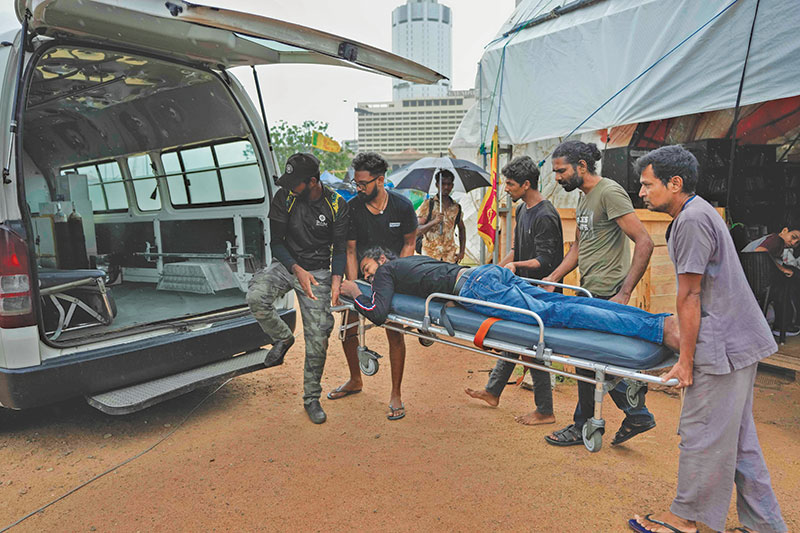
Protesters and paramedics carry an injured protester into an ambulance following a military eviction of protesters from the presidential secretariat in Colombo, Sri Lanka on Friday. AP/RSS

COLOMBO : Sri Lankan forces violently cleared the main protest camp of demonstrators outraged by the country’s economic meltdown as the newly elected and deeply unpopular president put army troops in the streets of the capital on Friday to maintain order.
Security forces were seen beating at least two journalists during the overnight raid, and the bar association said two lawyers were also assaulted—heavy-handed tactics denounced by the opposition, the UN, and the US The troops moved in even though protesters had announced they would vacate the site on Friday voluntarily.
Unbowed, the protesters vowed to continue their efforts to change their leadership. A crowd rallied for a few hours outside the main rail station, while some people also gathered as close as they could to the former demonstration site outside the presidential office.
Adding to signs that President Ranil Wickremesinghe would not address the concerns of protesters, he chose a prime minister on Friday with close ties to the political establishment that the demonstrators blame for the country’s collapse.
Sri Lankans have taken to the streets for months demanding their leaders resign over an economic crisis that has left the island nation’s 22 million people short of essentials like medicine, food and fuel. After they stormed the presidential palace and other government buildings earlier this month, then-President Gotabaya Rajapaksa, whose family has ruled Sri Lanka for most of the last two decades, fled and resigned.
Wickremesinghe, who had been prime minister, was elevated to president by lawmakers this week—apparently seen as a safe pair of hands to lead Sri Lanka out of the crisis, even though he, too, was a target of the demonstrations. On Friday, he appointed as prime minister a Rajapaksa ally, Dinesh Gunawardena, who is 73 and from a prominent political family.
After his election in a parliamentary vote this week, Wickremesinghe told lawmakers that the people “are not expecting the old politics from us.” But his recent moves signalled an inclination to maintain the status quo.
On Monday, when he was acting president, Wickremesinghe declared a state of emergency giving him the power to change or suspend laws and giving authorities broad power to search premises and detain people. Overnight, just hours after he was sworn in, he issued a notice under the state of emergency calling on the armed forces to maintain law and order nationwide—clearing the way for the move against the protest camp.
The protesters accuse Rajapaksa and his powerful family of siphoning money from government coffers and of hastening the country’s collapse by mismanaging the economy.
The family has denied the corruption allegations, but the former president acknowledged that some of his policies contributed to Sri Lanka’s crisis.
Starting at around midnight, army troops and police arrived in trucks and buses to clear the main protest camp near the presidential palace in the capital, Colombo, where demonstrators have gathered for the past 104 days. They removed tents and blocked roads leading to the site.
The Bar Association of Sri Lanka, the main lawyers’ body in the country, said the lawyers who were assaulted had gone to the protest site to offer their counsel.
In all eight people, including some protesters, were injured, some badly, according to a government official who spoke on condition of anonymity because he was not authorised to give the information to the media. Eleven people were arrested, he said.

WORLD

Xi offers Sri Lanka’s new president support

BEIJING: Chinese President Xi Jinping offered Sri Lanka’s new president his support on Friday, state broadcaster CCTV reported, as the Indian Ocean island grapples with its worst economic crisis in decades.
Ranil Wickremesinghe, a lawyer who served as Sri Lanka’s prime minister a record six times, was sworn in on Thursday in the face of fierce public opposition.
In his message, Xi said he believes Sri Lanka will be able to move towards economic and social recovery and he is “ready to provide support and assistance to the best of my ability to President Wickremesinghe and the people of Sri Lanka in their efforts”, CCTV reported.
Sri Lanka owes at least $5 billion to China although some estimates put it at almost twice that amount.
India has also lent it $3.8 billion and Japan is owed at least $3.5 billion, according to the International Monetary Fund, with another $1 billion due to other rich countries. (REUTERS)

WORLD

Russia says it destroyed HIMARS launchers, Ukraine denies claim

- REUTERS

LONDON : Russia’s defence ministry said on Friday its forces had destroyed four US-supplied high mobility artillery rocket systems (HIMARS) in Ukraine earlier this month.
Between July 5-20, “four launchers and one reloading vehicle for the US-made multiple launch rocket systems (HIMARS) were destroyed,” it said in a daily briefing.
Kyiv rejected Moscow’s claims, calling them “fakes” designed to undermine the West’s support for Ukraine.
Reuters could not verify battlefield reports.
Kyiv has hailed the arrival of eight HIMARS in Ukraine as a possible gamechanger for the course of the war, now about to enter its sixth month.
The advanced weapons are more precise and offer a longer range than other artillery systems, allowing Kyiv to strike Russian targets and weapons depots further behind the front lines.
Moscow has accused the West of dragging out the conflict by supplying Kyiv with more arms, and said the supply of longer-range weapons justifies Russia’s attempts to expand control over more Ukrainian territory, beyond the eastern Donbas region, for its own protection.
On July 6, just days after the first HIMARS arrived in Ukraine, Russia’s defence ministry said it had destroyed two of them, releasing a video of the alleged strike.
Ukraine has rejected Russia’s claims and said it was using the US-supplied arms to inflict “devastating blows” on Russian forces.
Serhiy Leshchenko, an adviser to President Volodymyr Zelenskiy’s chief of staff, said on Friday that Ukraine continued to use HIMARS to “cause numerous losses to the aggressor state.”
This week Kyiv has used HIMARS to strike a crucial bridge across the Dnipro river in Russian-controlled parts of the southern Kherson region, punching huge holes in the asphalt and prompting local Russian-installed officials to warn it could be completely destroyed if the attacks continue.

WORLD

Japan approves state funeral for ex-PM Abe, plan sparks protests

- REUTERS

TOKYO : The Japanese government said on Friday it would hold a state funeral for former Prime Minister Shinzo Abe on September 27, amid street and social media protests that the state shouldn’t fund ceremonies for Japan’s longest-serving, but divisive, premier.
Abe, prime minister for more than eight years over two terms and hugely influential in the ruling Liberal Democratic Party (LDP) even after leaving office, was gunned down two weeks ago at a campaign rally, an incident that deeply shocked Japan.
His funeral was held soon after, but the cabinet decided on Friday that a state funeral will be held on September 27 at the Nippon Budokan in central Tokyo.
“We made this decision, as has been said before, due to Abe’s record as the longest-serving prime minister, during which he exerted leadership skills distinctive from others and bore heavy responsibility for dealing with a number of serious domestic and international issues,” chief cabinet secretary Hirokazu Matsuno told a news conference on Friday.
The funeral will be fully paid for by state funds likely to be taken from the budget reserve, he said.

WORLD

Heatwaves to menace China as almanac’s ‘big heat’ day looms

The heat this summer has been described as extreme.
- REUTERS

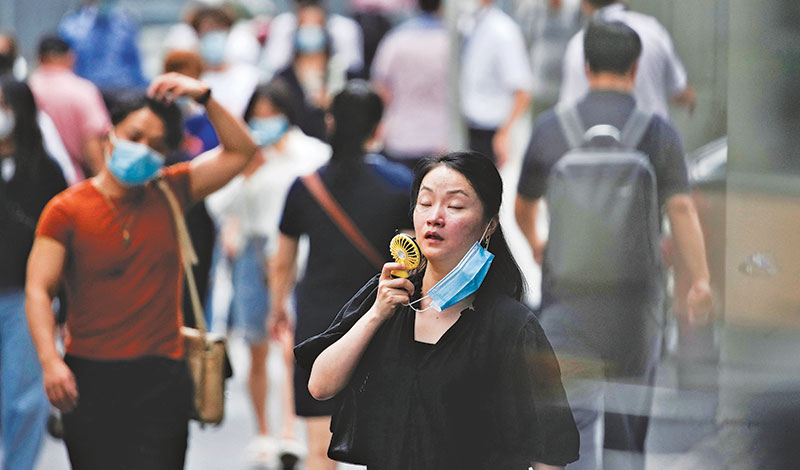
A woman uses a fan as she walks on a street on a hot day in Shanghai, China on Tuesday. reuters

BEIJING : China will suffer the return of more heatwaves over the next 10 days from east to west, with some coastal cities already on their highest alert level and inland regions warning of dam failure risks because of melting glaciers.
A sharp temperature spike is expected on Saturday, before building up into heatwaves, defined as periods of atypically hot weather of three days or more. This Saturday is the day of the “big heat” in the Chinese Almanac based on the lunar calendar.
The hot spell is expected to be similar in scope as heatwaves from July 5-17, but more regions could be hit by temperatures of 40 degrees Celsius or higher, Fu Jiaolan, chief forecaster at the National Meteorological Centre, told state media.
Some cities in Zhejiang province, home to many factories and exporters, on Friday issued red alerts, the highest in a three-tier warning system, forecasting temperatures of at least 40C in the next 24 hours.
The load on the national power grid could reach a new high this summer as demand for air-conditioning by homes, offices and factories surges, with safe operation facing “severe tests”, the Ministry of Emergency Management warned on Friday.
“For all of the factories in China and in Shanghai we have regulations that need to be followed,” said Leo Zhang, president of chemical product maker Sika China.
“Every year we do things to make the work more comfortable, for example giving workers ice-creams when it gets too hot.”
Zhejiang, as well as parts of Fujian, Guangdong, Hunan, Jiangxi and the city of Chongqing, also stand at risk of forest fires in the near term, the ministry said. In the western region of Xinjiang, accelerated glacial melt through July 29 poses risks to rivers and dams, the China Meteorological Administration said on Friday, warning particularly of a high risk of dam failure on a tributary of the Aksu River near China’s border with Kyrgyzstan.
This round of hot weather will have “a certain degree of impact” on the melting of alpine snow and ice, the administration said.
From June 1 to July 20, the Yellow River and Yangtze River basins—major centres of industry and commerce—were hit by at least 10 high-temperature days more than the norm. Heatwaves have also scorched other parts of East Asia, Western Europe, North Africa and North America, sparking wildfires in many countries.
Scientists caution that climate change will only make heatwaves hotter and more frequent.
The highest-ever recorded temperature in China is a matter of debate.
According to Chinese media, the hottest period in the last 300 years was in July 1743 during the Qing dynasty, with a French missionary in Beijing said to have recorded an all-time high of 44.4C.

WORLD

Saudi arrested after Israeli reporter sneaks into Mecca

Briefing

RIYADH: A Saudi who allegedly helped a non-Muslim enter the holy city of Mecca has been arrested, police in the kingdom said on Friday, after online backlash against an Israeli journalist. The journalist, Gil Tamary of Israel’s Channel 13, on Monday posted to Twitter video of himself sneaking into Mecca, Islam’s holiest city, in defiance of a ban on non-Muslims. Mecca regional police have “referred a citizen” to prosecutors for alleged complicity in “transferring and facilitating the entry of a [non-Muslim] journalist”, a police spokesperson said in comments reported by the official Saudi Press Agency. Despite growing behind-the-scenes business and security contacts, Saudi Arabia does not recognise Israel. (AGENCIES)

WORLD

Japan nuclear regulators approve release of Fukushima water into sea

TOKYO: Japan’s nuclear regulators have approved a plan to release into the ocean water from the wrecked Fukushima Dai-ichi nuclear power plant, the government said on Friday. The water, used to cool reactors in the aftermath of the 2011 nuclear disaster, is being stored in huge
tanks in the plant, and amounted to more than 1.3 million tonnes by July. The regulators deemed it safe to release the water, which will still contain traces of tritium after treatment, the foreign ministry said in a statement. (AGENCIES)

WORLD

Africa’s top public health body gets $100 million from World Bank

JOHANNESBURG: Africa’s main public health body, the Africa Centres for Disease Control and Prevention (Africa CDC), will receive $100 million from the World Bank to help African countries prepare for, detect and respond to
disease outbreaks. The Africa CDC has played a major role advising African countries during the Covid-19 pandemic and is also providing guidance on diseases like monkeypox. The World Bank said in a statement that the financial support would help boost the Africa CDC’s technical capacity. (AGENCIES)

Page 5
MONEY

Near free public transport eases congestion on Germany’s roads

- REUTERS

BERLIN : Urban traffic congestion eased in the weeks after Germany made public transport almost free, data show,
suggesting an experiment by Europe’s largest economy to combat its addiction to cars may be having some success.
Since the beginning of June, Germany has sold a monthly ticket for nine euros ($9.21) that is valid for unlimited trips on a vast swathe of its public transport network. The offer, which continues through August, was designed to take the sting out of soaring inflation and cut vehicle emissions. It was a bold move for the home of automakers BMW, Mercedes and Volkswagen, where drivers famously have no speed restrictions on stretches of motorway.
Mohawk-wearing punks from around Germany took advantage of the cheap tickets to flock to the upmarket resort island of Sylt last month. But it was unclear whether most travellers would park their beloved cars and board buses, trams and trains.
While it is still early to draw conclusions, data compiled by the navigation company TomTom for Reuters suggest the policy may be having an effect.
During the week of June 20, rush-hour traffic congestion was down in 23 of 26 cities compared with the week of May 16, before the new ticket was introduced, the data show. TomTom chose the two weeks because they were both free of holidays.
“This decline is related to the introduction of the nine-euro ticket,” said TomTom traffic specialist Ralf-Peter Schaefer.
Other factors may also play a role in the reduction, such as high fuel prices and pandemic-related work from home trends.
But TomTom data for the full month of June also show lower congestion compared with both May this year and June 2019, before the pandemic: congestion was down in 24 of 26 cities in June from May, and in 21 of 26 cities versus June 2019.
The findings could interest policymakers weighing possible future measures for low-cost public transport beyond August.

MONEY

Ukraine, Russia sign deal to reopen grain export ports

Hopeful sign of progress toward easing global food crisis; the accord crowns two months of talks brokered by the United Nations and Turkey.
- REUTERS

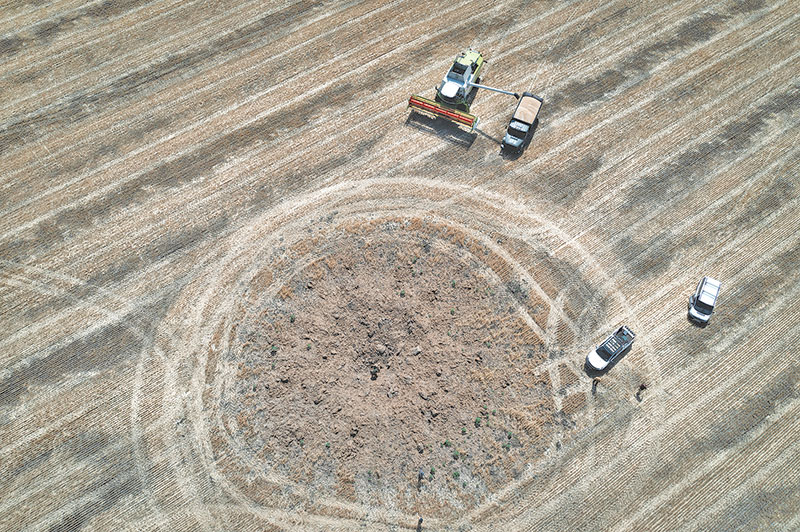
A file photo shows a farmer harvesting on a field around a crater left by a Russian rocket 10 kilometres from the front line in the Dnipropetrovsk region, Ukraine.AP/RSS

ISTANBUL/KYIV : Russia and Ukraine signed a landmark deal on Friday to reopen Ukrainian Black Sea ports for grain exports, raising hopes that an international food crisis aggravated by the Russian invasion can be eased.
The accord crowned two months of talks brokered by the United Nations and Turkey aimed at what UN Secretary General Antonio Guterres called a “package” that would both restore Ukrainian grain exports while easing Russian grain and fertiliser shipments despite tough Western sanctions on Moscow.
Guterres said the accord opens the way to significant volumes of commercial food exports from three key Ukrainian ports—Odesa, Chernomo-rsk and Yuzhny, and the UN would set up a coordination centre to monitor implementation of the deal.
But fighting raged on unabated in Ukraine’s east and, underlining deep-seated enmity and mistrust driving the worst conflict in Europe since World War Two, Russian and Ukrainian representatives declined to sit at the same table at the ceremony, and the display of the two countries’ flags was adjusted so that they were no longer next to one other.
“In case of provocations, [there will be] an immediate military response” by Ukraine, Mykhailo Podolyak tweeted.
Russia and Ukraine, both among the world’s top exporters of food, sent their defence and infrastructure ministers respectively to Istanbul for the signing ceremony, also attended by Guterres and Turkish President Tayyip Erdogan.
A blockade of Ukrainian ports by Russia’s Black Sea fleet, trapping tens of millions of tonnes of grain in
silos and stranding many ships, has worsened global supply chain bottlenecks and, along with sweeping Western sanctions, stoked galloping inflation in food and energy prices around the world.
Moscow has denied responsibility for the worsening food crisis, blaming instead Western sanctions for slowing its own food and fertiliser exports and Ukraine for mining the approaches to its Black Sea ports.
Senior UN officials, briefing reporters on Friday, said the deal was expected to be fully operational in a few weeks.
Safe passage into and out of the ports would be guaranteed in what one official called a “de facto ceasefire” for the ships and facilities covered, they said, although the word “ceasefire” was not in the agreement text.
Though Ukraine has mined nearby offshore areas as part of its defences against Russia’s five-month-old invasion, Ukrainian pilots would guide ships along safe channels in its territorial waters, they said.
Monitored by a Joint Coordination Centre based in Istanbul, the ships would then transit the Black Sea to Turkey’s Bosphorus strait and proceed to world markets, UN officials said. The deal will be valid for 120 days but renewable and would not be expected to be stopped any time soon.
“The fact that two parties at war—and still very much at war—have been able to negotiate an agreement of this kind...I think that’s unprecedented,” one UN official said.
Another said a separate pact signed on Friday would smooth Russian food and fertiliser exports and that the United Nations welcomed US and European Union clarifications that their sanctions would not apply to such shipments.
To address Russian concerns about ships smuggling weapons to Ukraine, all returning ships will be inspected
at a Turkish port by representatives of all parties and overseen by the JCC.
The overall objective is to help avert famine among tens of millions of people in poorer nations by injecting more wheat, sunflower oil, fertiliser and other products into world markets including for humanitarian needs, partly at lower prices. The United States welcomed the deal and said it was focusing on holding Russia accountable for implementing it.
Turkey, a NATO member that has good relations with Russia and Ukraine alike, controls the straits leading into the Black Sea and has acted as a mediator on the grain issue.

MONEY

Oil prices fall as global demand outlook darkens

- REUTERS

LONDON : Oil prices fell on Friday on a weakening global demand outlook and the resumption of some Libyan crude oil output.
Brent crude futures fell 55 cents to $103.32 a barrel by 1251 GMT, while US West Texas Intermediate (WTI) crude futures were down $1.05 to $95.30 a barrel.
The global economy looks increasingly likely to be heading into a serious slowdown, just as central banks aggressively reverse ultra-loose monetary policy adopted during the pandemic to support growth, data showed on Friday.
“Things are still negative on the economic front, but we are still in a structural shortfall for prompt oil and that means physical buyers will be there to support dips knowing the uncertainty of what lies ahead on the geopolitical front,” said Stephen Innes, managing partner at SPI Asset Management.
Innes said investors had next week’s US Federal Reserve decision on interest rates firmly on their minds. Fed officials have indicated that the central bank would likely raise rates by 75 basis points at its July 26-27 meeting.
“While 75 is in the cards, guidance will be important and any softening in the rate hike outlook would be great for global growth,” Innes added.
While signs of softening US demand weighed on oil prices and sent benchmark contracts sliding around 3 percent in the previous session, tight global supplies continued to keep the market buoyed.
Supply fears were easing slightly though after Libya resumed production at several oil fields earlier this week.
“Libyan production is recovering, but with clashes in the capital no one knows how long the production recovery will hold,” Giovanni Staunovo, an analyst at UBS, said, referring to clashes between rival factions in Libya amid growing concern that a political standoff could prompt renewed conflict.
Staunovo also said the market will look to preliminary OPEC production estimates for guidance next week.
WTI has been pummelled over the past two sessions after data showed that US gasoline demand had dropped nearly 8 percent from a year earlier in the midst of the peak summer driving season, hit by record prices at the pump.
In contrast, signs of strong demand in Asia propped up the Brent benchmark, putting it on course for its first weekly gain in six weeks. Demand in India for gasoline and distillate fuels rose to record highs in June, with total refined product consumption running at 18 percent more than a year ago and Indian refineries operating near their busiest levels ever, RBC analysts said.
“This signals much more than a strong recovery from Covid-plagued years,” RBC analyst Michael Tran said in a note.

MONEY

Overseas Friendship International Hospital officially opens in Thamel

Briefing
- Post Report

KATHMANDU: A premier private healthcare provider in Nepal with the goal of providing world-class medical service to the community opened on Friday in Thamel, Kathamandu. Overseas Friendship International Hospital has state-of-the-art facilities with an experienced team of healthcare professionals specialising in various medical fields and surgical specialties, reads the press release issued by the hospital. All physicians at the new hospital are certified by the Nepal Medical Council Board and equivalent, ensuring that patients receive an international standard of care in Nepal. (PR)

MONEY

Twitter, in Musk fight, posts $270 million quarterly loss

LONDON: Twitter reported a quarterly loss on Friday as revenue slipped even as its number of users climbed. The company’s quarterly earnings figures offered a glimpse into how the social media business has performed during a months-long negotiation with Tesla CEO Elon Musk over whether he will take over the company. The firm lost $270 million in the April-June period after revenue slipped 1 percent to $1.18 billion, reflecting advertising industry headwinds, as well as uncertainty” over Musk’s acquisition bid. The number of daily active users rose 16.6 percent to 237.8 million compared with the same period a year before. (AP)

Page 6
SPORTS

Germany cruise into Euro semis

The Germans see off Austria 2-0 to keep alive their bid for a record-extending ninth title.
- Post Report

Germany’s Alexandra Popp (front) celebrates with Jule Brand after scoring her side’s second goal against Austria at the Brentford Community Stadium in London on Thursday. Ap/Rss

LONDON : Germany remain on course for a ninth women’s European Championship title but were made to work hard for a 2-0 win over Austria to reach the semi-finals of Euro 2022 on Thursday.
Austria hit the woodwork three times in London, but goals from Lina Magull and Alexandra Popp sent the Germans through to the last four.
“The game could have ended 6-3,” said Germany coach Martina Voss-Tecklenburg. “We played against a very good side. Huge compliments to Austria.”
Germany had cruised through what appeared to be the toughest group with convincing victories over Denmark, Spain and Finland to reach the last eight in style.
But they were made to sweat until Popp’s bizarre 90th minute goal, when she charged down Manuela Zinsberger’s clearance, gave them side breathing space.
Austria had proven they are awkward opponents by pushing England all the way in a 1-0 defeat on the opening night of the tournament and eliminating Norway in the group stages.
Irene Fuhrmann’s side started strongly as Julia Hickelsberger-Fuller fired too close to Merle Frohms before Marina Georgieva headed off the post from a corner.
Germany were struggling to find the attacking verve that saw them score nine goals without reply in the group stage.
But they pounced on one error from the Austrian defence as Klara Buhl sped down the left wing and her cross was calmly slotted into the far corner by Magull for her second goal of the tournament.
Five years ago, Austria upset the odds to reach the semi-finals in their only previous major tournament at Euro 2017.
And they could have matched that achievement with more luck in the second half.
Barbara Dunst was inches away from catching Frohms off her line with an audacious effort from long range that came back off the crossbar.
Sarah Puntigam then smashed off the inside of the post as Germany struggled to clear a corner.
But Germany quickly regained their composure and should have extended their lead long before Popp’s fourth goal of the tournament.
Giulia Gwinn curled an effort off the post before Buhl’s piledriver crashed back off the crossbar.
Buhl was then guilty of one of the misses of the tournament when she skewed wide from Popp’s unselfish pass.
The Bayern Munich winger was mocked by her own teammates when a replay of that miss was shown on the big screens.
But Buhl was soon able to breathe easy when Popp’s press caught Arsenal goalkeeper Zinsberger out as her clearance rebounded off the Wolfsburg striker into the net.

SPORTS

Thapa named women’s football team coach

The Nepal APF Club coach had previously led the women’s team in the 2016 edition of the SAFF Championship.
- Post Report

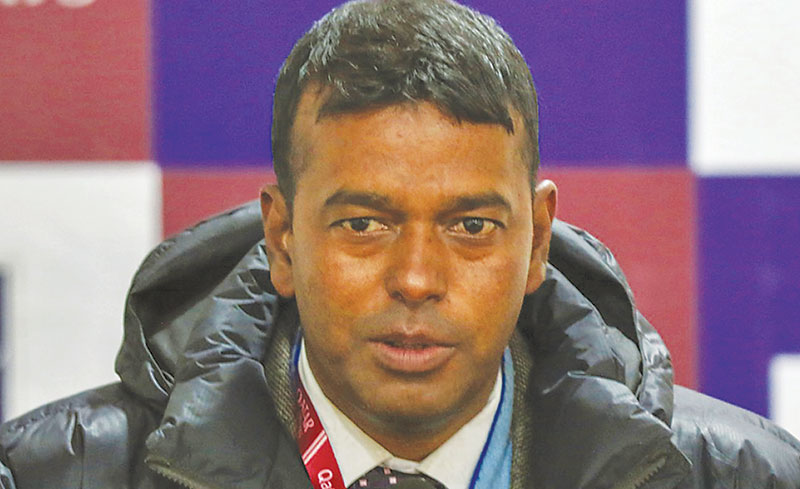
Kumar Thapa succeeds Australian Gary Philipps, who quit in December last year. Photo Courtesy: ANFA

KATHMANDU : Former Nepali international Kumar Thapa was appointed the head coach of the women’s national team for a second tenure on Friday.
According to All Nepal Football Association (ANFA), Thapa has been handed the responsibility for the sixth edition of the SAFF Women’s Championship scheduled to take place from September 6 to 19. Bindra Dewan has been named team manager.
Thapa, the coach of the ‘A’ division outfit Nepal APF Club, was earlier assigned the same responsibility
during the 2016 edition of the SAFF Championship. He will succeed Australian coach Gary Philipps, also the former technical director, who quit the job in December last year. Since then, the post of women’s head coach has remained vacant though Chetan Ghimire was assigned caretaker coach for a short period.
Under Thapa, the women’s team failed to reach the final of the SAFF for the first time. Leaving aside the fourth edition, the women’s team have entered the finals of all five editions so far. But they have never won the championship and lost the final to arch rivals India on all five occasions.
“It is like a lifeline for me,” said Thapa, who holds the AFC ‘A’ coaching licence as well as UEFA Executive MIP (Masters’ for International Players) certificate. He is the only person in Nepal to hold the MIP certificate.
“Though ANFA have told me verbally about the appointment, I am yet to get an official appointment letter. I have told them I would choose other technical staff as per my requirement,” said Thapa, adding that he would have two assistant coaches—one male and female each—and a goalkeeping coach.
“I hope to begin training from Monday after finalising other technical staff,” said Thapa, adding that there would be 40-50 players in the preliminary camp including all members of the squad that played in the AFC Asian Cup Qualifiers in September last year. “We will also call Non-residential Nepali players for training four weeks prior to the tournament, if there are any,” he added.
The football governing body has also formed an 18-member tournament organising committee under coordination of senior vice president Bir Bahadur Khadka for the Championship. Executive member Rabindra Chand has been named venue manager, Vijay Ghale as local general coordinator and Dinesh Byanjankar as security chief. Sanjeeb Silpakar is the coordinator of e the committee for marketing, broadcasting and digital rights of the regional competition.

SPORTS

Sri Lanka look to bounce back against upbeat Pakistan

- AGENCE FRANCE-PRESSE

GALLE : Dimuth Karunaratne’s Sri Lanka will look to bounce back in the second Test starting Sunday against an upbeat Pakistan team that is fresh off a morale-boosting win.
But the tourists have been hit by an injury to pace spearhead Shaheen Shah Afridi, who played a key part
in the team’s four-wicket victory on Wednesday.
Sri Lanka have witnessed contrasting results at the Galle International Stadium in the past three weeks, and now head into their sixth straight Test at the venue since November.
In the first of their two Tests against Australia at the ground earlier this month, the hosts first lost inside three days on a vicious turner, then bounced back to beat the tourists on a radically different wicket to end the series level at 1-1.
For the first Test against Pakistan, the pitch was once again entirely different, with little help for the spinners, even on the final two days, when Asian tracks usually turn.
“There was a big difference in the wicket we played against Australia and here,” Sri Lanka vice-captain Dhananjaya de Silva said. “Normally on a Galle pitch the fourth and fifth days don’t help the batsmen.”
Left-arm spinner Prabath Jayasuriya has stood out since his debut in the second Australia Test, where he got a match haul of 12 wickets.
He then bamboozled Pakistan with a total of nine wickets in the opening Test of this series.
But de Silva, an all-rounder who bowls off-spin, said Jayasuriya got little support from the other end against Pakistan.
Mystery spinner Maheesh Theekshana has been ruled out due to a finger injury and de Silva may be expected to play a bigger role with the ball alongside Ramesh Mendis and Jayasuriya.
Batsman Pathum Nissanka returns to the team after he contracted Covid in the middle of the second Australia Test.
The venue was shifted from Colombo to Galle due to the political unrest in Sri Lanka, and it is the hosts’ final Test of the season, with their next red-ball series a tour to New Zealand in March.
Pakistan skipper Babar Azam believes Jayasuriya remains Sri Lanka’s “main weapon” but was confident in his batsmen’s ability. “We will stick to our strengths and as batsmen remain positive,” he said.
The visitors rode on opener Abdullah Shafique’s unbeaten 160 to chase down a record 342 at the venue on a tense fifth day. The win gave them a 1-0 series lead.
Shafique is in elite company after the first six matches of his Test career, with 720 runs from 11 innings, behind only India’s Sunil Gavaskar (912 runs from 12 innings), Australian great Don Bradman (862 from 12), and West Indies’ George Headley (730 from 12).
Shaheen’s absence due to a knee injury will hurt Pakistan, who rely on their quicks to get early wickets even on turning subcontinent pitches.
Pakistan could make a few changes to their team, including bringing in left-arm orthodox bowler Nauman Ali to bolster their spin attack.

SPORTS

U-20 football team off to India

Briefing

KATHMANDU: Nepal under 20 men’s team left for India on Friday to compete in U-20 SAFF Championship to be held in Bhuwaneshwar, Orisha, from July 25 to August 5. Nepal will play against Maldives in the curtain raiser on July 25, Sri Lanka on July 27 and India on July 31 before wrapping up the group stage campaign against Bangladesh on August 2. The top two teams at the end of the round robin league will qualify for the final scheduled for August 5. Meghraj KC is the coach and Diwakar Ghale is the manager of the team. National Sports Council Member Secretary Tanka Lal Ghising and ANFA president Pankaj Bikram Nembang among others bade farewell to the team on Friday. (SB)

SPORTS

Mane named African Footballer of Year again

RABAT: Sadio Mane was named African Footballer of Year on Thursday after a season in which he kicked the winning penalty for Senegal as they claimed their first Africa Cup of Nations title and repeated the feat when they secured World Cup qualification. Mane finished ahead of Egyptian forward Mohamed Salah, his former Liverpool team mate, and fellow Senegalese Edouard Mendy in the voting. It was the second time the 30-year-old Mane, who last month joined German champions Bayern Munich, has won the award.

SPORTS

He was the last winner of the

award in 2019. “I dedicate this award to the youth of Senegal. I’m very emotional and don’t have the words to express how I’m feeling,” Mane told the audience at the CAF awards in Rabat after flying in from Washington DC, where he scored in a pre-season friendly for his new club on Wednesday. Mendy, who plays for Chelsea, was named the best goalkeeper in the world at FIFA’s 2021 award, held in January. (REUTERS)


SPORTS

Lingard joins Forest

LONDON: Nottingham Forest have signed former Manchester United midfielder Jesse Lingard
on a free transfer, the promoted Premier League club said on Thursday. Lingard, a United academy graduate, ended his 22-year association with the Old Trafford club following the expiry of his contract last month. The 29-year-old England international, who made his United debut in 2014, scored 35 goals in more than 200 games for them. Forest did not specify the length of his contract but Sky Sports reported he had signed a year-long deal. Lingard had been linked with a switch to Newcastle United as well as a return to West Ham United, where he enjoyed a successful loan spell in the 2020-21 season, scoring nine goals in 16 matches. (REUTERS)

HOROSCOPE

HOROSCOPE

ARIES (March 21-April 19) ****
Your ideas will be brilliant and larger than life today. Use this energy as an excuse to believe in yourself and your goals, even if the path ahead is a vast one. New and original thoughts are poised to creep into your psyche today.

TAURUS (April 20-May 20) ***
You’ll have an opportunity to rationalize your emotions without abandoning compassion. This cosmic climate will also make it easier for you to share your deepest feelings. Try not to make any large purchases today.

GEMINI (May 21-June 21) ****
Major shifts will manifest for you this morning. It will inspire you to use your voice, standing firmly in your disposition with an unwavering belief in your vision. People will get carried away with your words, speak wisely.

CANCER (June 22-July 22) ***
The energy today will be particularly charged for you. This cosmic alignment will light a fire within your social life, though navigating the scene could feel overwhelming at first. Use the popularity wisely and benevolently.

LEO (July 23-August 22) ***
You may not be in the most social mood today. You’ll value your privacy as you navigate through deep thoughts and emotions. These vibes are also great for implementing new spending limits, as you’ll be eager to save up for the future.

VIRGO (August 23-September 22) ****
The universe will reward you for cutting ties with behaviors, people, or situations that have been holding you back. The more you unload, the more space you’ll make for something better to come along, so try not to worry.

LIBRA (September 23-October 22) ***
If you’ve been crushing on someone in your friendship circle, today might be a good time to break the ice. This cosmic climate will benefit you socially and romantically, so don’t hold back when it comes to forming new bonds.

SCORPIO (October 23-November 21) ***
Even though it’s the weekend, you may want to invest time and effort into your professional goals today. This cosmic climate will bring big rewards your way. Prioritise your wellbeing can also score some major karma points.

SAGITTARIUS (November 22-December 21) ***
You’ll feel like a child blessed by the universe today. Communication will be key when it comes to manifesting your goals right now, so don’t be afraid to ask for what you want, both out loud and with soft whispers to the other side.

CAPRICORN (December 22-January 19) ****
You’ll feel motivated to break bad habits while prioritizing your mental health today. This cosmic climate will allow you to feel optimistic about the future and how you can grow into a stronger and more fulfilled version of yourself.

AQUARIUS (January 20-February 18) ***
Today presents the perfect opportunity to plan for a better tomorrow. Today’s cosmic alliance will boost your ego while helping you make sense of the world around you, including your likes and dislikes. Love and trust dearly.

PISCES (February 19-March 20) ***
Your financial savvy will have major payoffs today. This cosmic climate is also poised to bring a bit of unexpected luck your way, so you may want to keep your eyes peeled for good deals and money-making opportunities.

Page 7
CULTURE & LIFESTYLE

Women trying to make their own histories in the face of state power

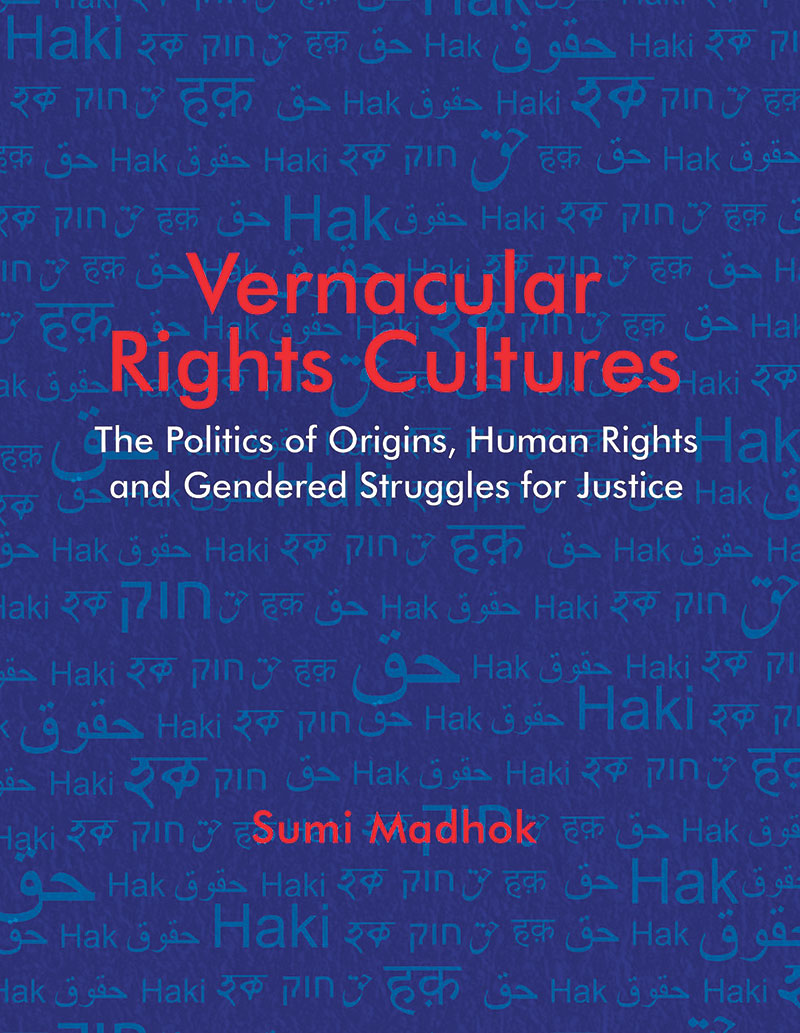
In ‘Vernacular Rights Culture’, Sumi Madhok documents different political imaginaries that animate rights struggles of subaltern groups.

The central question foregrounded by Sumi Madhok in ‘Vernacular Rights Culture: The Politics of Origins, Human Rights, and Gendered Struggles for Justice’ is the following: how do we tell stories of human rights that are independent of global power? How we should tell stories of culturally specific human rights, or of case studies of the discourse on the decolonial?
Madhok in this competently argued work, which is in equal parts political theory and empirical anthropology, foregrounds several sets of philosophical debates, from the vantage point of gender. The argument is buttressed by fieldwork in several districts of Rajasthan in Northwest India, and in Punjab in Pakistan. The work is located somewhat loosely in what has been called decolonial studies, but it eschews both polemics and binary opposites that many of these studies adopt as rallying points for their attack on epistemological inequality; seen as the outcome of hegemonic western-centric theory.
Madhok begins her argument by looking at what she calls the coloniality of power. The philosophical context for the emergence of the ‘rights of man’ is well-known pre-capitalism, the notion of the white propertied, heterosexual male as the holder of rights, the emergence of market society and of alienation, individualism and contractual relations. That these preconditions did not exist in a world that was colonised by the same countries and where movements passionately advocated freedom, is more than obvious. That the exploitation and the brutality of political colonialism violated the same language of rights that rulers of colonial countries spoke of is also well known. Nevertheless, it is the western notion of rights that has been upgraded into a universal currency.
Consequently, processes of the formulation and assertion of rights in the rest of the world have been reduced to mere case histories, or as derivative of hegemonic theories and practices. Postcolonial scholars have a problem with theories that are the product of European experiences, because these obfuscate the specifics of oppression and resistance phrased in the language of rights. The irony is that many governments in the postcolonial world also dismiss standards established by global human rights because these theories are based on philosophical presuppositions alien to their own people and culture.
Of particular note is hostile criticism/dismissal of women’s rights as western and, therefore, unsuitable to postcolonial worlds. Feminist movements are attacked on the ground that they speak a foreign language, and subscribe to western philosophical notions, and that these languages are inauthentic, culturally inappropriate and illegitimate. These attacks obfuscate the way women’s rights came up during the course of the freedom struggle in India/Pakistan. Subsequently, they became an integral part of constitutional morality, at least in India.
Feminists in the postcolonial world have, consequently, to take on the daunting task of acknowledging that the standards established by global human rights are legitimate. At the same time, they have to take on another task; that of defending the articulation of rights claims in their own societies as worthy of consideration, not only by their own governments, but by global human rights institutions. This is a daunting task.
Madhok universalises global rights claims, by telling us stories of how these claims originated in geographical spaces that do not find resonance in dominant languages. She introduces us to the alternative notion of rights as haq, and to the vocabulary, the philosophical preconditions and the imaginaries of the term. According to the author, haq is the Arabic Urdu, Persian, Turkish and Hindustani word for rights. The first recorded existence of haq can be traced to classical Hebrew, and it is also found in older Semitic languages such as Aramic and Mendian. Till today haq is used in South Asia, the Middle East and North Africa as synonymous with rights. In India, the term has been deployed extensively in the Northwestern part of the country by subaltern gendered groups. In her study of Pakistan, Madhok explores the way Punjabi subaltern women use the term to lay claims upon an authoritarian and militarised state.
Madhok does not only offer a linguistic alternative to a globally hegemonic discourse of human rights. She anchors political consciousness in this terminology. By exploring the vocabulary of rights in other cultures, we come to understand and appreciate other imaginaries, contestations and struggles for rights. Notably, Madhok does not view the historically specific assertion of rights as isolated from global human rights discourses. Her intent is to find out how scholarly investigations of contemporary struggles for haq can inform global scholarship on human rights. Conversely, how useful is the human rights framework for capturing political struggles for haq? The argument in the work addresses these major, complex and admittedly difficult questions competently.
Madhok, with great dexterity, avoids falling into the universal versus culturalist trap in two chapters which focus on the gendered articulation of haq in South Asia. We function in a world that is dominated and shaped by western epistemology and ontology. She also recognises that there can be no recovery of authenticity of culture, meanings and vocabularies in countries that have been subjected to colonialism and now newer forms of colonialism.
This recognition enables her to negotiate theoretically and through empirical anthropology the links as well as the contradictions between hegemonic vocabularies of rights, and rights discourses formulated in specific contexts. She is aware, as she shows in the fourth and the fifth chapter that a wholesale rejection of theories produced in the west and reproduced across the world can land us into uncritical celebrations of culturalism and right into the plans of rulers to reject rights talk.
In the course of her field work Madhok recorded the stories of development workers, grassroots activists and various citizens mobilisations that have demanded their haq. She has also interviewed independent rights activists within state-sponsored programmes such as development. Why do women in this part of the world phrase their demands in this language?
Struggles for haq by dispossessed people are ultimately struggles for life. These struggles are for natural resources that are increasingly appropriated by the state acting in tandem with capital. Vernacular political vocabularies, imaginaries and critical languages that emerge from sites of struggle are qualitatively different from the abstract and rarified global discourse of rights.
Madhok documents different political imaginaries that animate rights struggles of subaltern groups. She maps the ways in which they disrupt, speak back, expand and also help decolonise human rights talk. The specific agent who asserts rights is the poor tribal woman demanding the right to food, employment, public information, accountability and land and who articulates rights as a response to local power. Though rights reinforce global hegemonies, they can also subvert power hierarchies. In the final chapters of the work, Madhok suggests that global notions of human rights can be decolonised only when scholars track different genealogies and historical trajectories of rights. This is important if they want to shift the epistemic centre of human rights.
Notably, the author does not uncritically accept the articulation of rights in sites of struggle. She seems to imply that if feminists concentrate on immediate needs, or the preconditions of the right to life, they are likely to miss out on the wider context. Feminist movements in India and Pakistan have been unable to articulate a sufficiently transnational frame that would enable them to call into question the category of the nation state.
I find it interesting that unlike most theories in the decolonial mode, Madhok does not dismiss global rights as epistemogical imperialism and then proceed to privilege methodological nationalism. She focuses on the local but is all too aware that this site of struggle is shaped through global cycles of knowledge as well as by the practices of the nation state. There can be no easy answer to the question of global imperialism, there can be no easy solutions to the problems of the nation state, and there can be no easy resolution of the dilemmas of the local. A scholar has to carefully work through texts and contexts. It is this mapping out of overlaps and contradictions that makes her work so interesting.
The only aspect of her writing that bothers me is the language of the argument. As someone who has taught political theory for many years to post-graduate students, I believe that specialised languages can prove a bar to comprehension of significant theorisation. I recognise that scholars have to deploy languages adopted by the peer group they address. This is the demand of academia. Yet the constituency of the scholar should not be only the peer group, but also women who are trying to make their own histories in the face of state power, howsoever badly they may make these histories. I hope in the next work I read by Madhok, I will find her more comfortable with an easier style of communication. Her ideas are too valuable to be confined to seminar rooms of dense political theory and gender studies.

- Neera Chandhoke

The article was originally published in The Wire.

CULTURE & LIFESTYLE

Michelle Obama's book coming this fall

- HILLEL ITALIE

NEW YORK : Michelle Obama will have a book out this fall, "The Light We Carry," in which she reflects upon her experiences and shares insights on navigating an increasingly stressful world.
It's the former first lady's first entirely new work since the 2018 release of her acclaimed blockbuster "Becoming," which has sold more than 17 million copies worldwide, surpassing the sales of any memoir by a previous first lady or modern president, including her husband, former President Barack Obama.
"I've learned it's okay to recognize that
self-worth comes wrapped in vulnerability, and that what we share as humans on this earth is the impulse to strive for better, always and no matter what," Michelle Obama writes in the book's introduction.
"We become bolder in brightness. If you know your light, you know yourself. You know your own story in an honest way. In my experience, this type of self-knowledge builds confidence, which in turn breeds calmness and an ability to maintain perspective, which leads, finally, to being able to connect meaningfully with others—and this to me is the bedrock of all things."
The new book is not part of the reported eight-figure deal the Obamas reached in 2017, shortly after Mr Obama left office, with parent company Penguin Random House for their respective memoirs. A spokesperson declined to discuss financial terms for "The Light We Carry."
Crown will publish the 336-page book on November 15, almost exactly four years after the release of "Becoming,". "The Light We Carry: Overcoming in Uncertain Times" will come out simultaneously in 14 languages and 27 countries, with additional rights deals expected.
"In 'The Light We Carry,' Mrs Obama offers readers a series of fresh stories and insightful reflections on change, challenge, and power, including her belief that when we light up for others, we can illuminate the richness and potential of the world around us, discovering deeper truths and new pathways for progress," the publisher's announcement reads in part.
"Drawing from her experiences as a mother, daughter, spouse, friend, and First Lady, she shares the habits and principles she has developed to successfully adapt to change and overcome various obstacles—the earned wisdom that helps her continue to 'become.'"
On Thursday, Penguin Random House announced it was renaming an annual writing prize in her honour, the $10,000 Michelle Obama Award for Memoir, part of an awards program for public high school students the company launched in 1993.
Since completing "Becoming," Michelle Obama has written an edition for younger readers and launched a podcast. With Barack Obama and their production company Higher Ground, she has worked on such projects as the Oscar-winning documentary "American Factory" and a documentary about her tour for "Becoming," when she appeared at arenas nationwide with guest interviewers such as Oprah Winfrey and Sarah Jessica Parker. Promotional plans for "The Light We Carry" will be announced later.Crown is also the longtime publisher of Barack Obama.
– Associated Press

Page 8
CULTURE & LIFESTYLE

Let’s move for health!

Regular exercise and a healthy diet are great ways to keep at bay lifestyle-related non-communicable diseases.
- Post Report

I am an ophthalmologist practising in a tertiary eye care centre. My job keeps me busy, and I mean hold-your-urine-kind-of-busy, but I am not writing this article to complain about my job.
Despite the organised chaos that reigns my professional life, I stay motivated. I meditate twice a day and make an effort to do some form of physical activity at least twice a week. And no one has to tell me to do these things. I am already convinced that making an effort to take care of my mind and body (my software and hardware) is worth it.
Given the positive changes I have experienced since I started exercising and meditating regularly, I would like my community—the one I am growing with and the one that continues to push me to overcome my weaknesses and applaud the smallest of my achievements—to do the same.
The people I work with are all people of science. We practice medicine, an art that is almost always evidence-based. Evidence-based medicine shows that regular physical activity benefits the human body. A higher fitness level is associated with a lower chance of premature cardiovascular death. Just two sessions of resistance training per week can improve glycemic control in people with diabetes. Moderate to high-intensity exercise has been shown to improve levels of depression.
A person with a non-medical background would assume that people practising medicine know these facts and hence have a more or less consistent practice of doing some form of physical activity. But it’s not usually the case. I asked physicians from different fields if they engage in any form of physical activity at least twice a week? Only 39 percent answered yes.
This finding bothers me, both for the sake of the medical community and the general public at large.
Firstly, the lack of physical activity is a risk factor for disease. Being diseased literally means your body is not at ease. The disease may or may not have a name. You may not have hypertension, diabetes, or thyroid disorder, but you may feel suboptimal. You might have a sore back, constipation, insomnia, or mild depression. I am not trying to argue that exercise solves them all, but it is an integral part of the prevention and management of most medical conditions.
Secondly, when we, as caretakers of people’s health, do not prioritise physical fitness, we are disseminating skewed information regarding health and wellbeing. Suppose a physician prescribes physical activity to a patient, but s/he is not very convincing about it, based on their own life experiences and priorities. In that case, patients are less likely to be convinced of exercise’s benefits.
So, despite the ample evidence of the proven benefits of physical activity, why do we physicians not prioritise it in our personal lives and that of our patients? I guess it is because of the way we have been trained in medical school. Most of our training focuses on treating diseases with drugs and surgeries. Only a very few hours are invested in learning how to prevent and control diet and lifestyle-related non-communicable diseases (NCDs) like diabetes, hypertension, and cardiovascular diseases, among others. A study by Shiva Raj Mishra and colleagues on the prevalence of modifiable risk factors of major NCDs among medical students in three medical colleges in the Kathmandu Valley found a high prevalence of risk factors of major NCDs among medical students.
The medical community and public health policymakers can no longer ignore the shifting tides of diseases in Nepal. With rising purchasing power, changing lifestyles, and increased urbanisation, NCDs are on the rise. In 2019, NCDs accounted for 71 percent of total deaths in Nepal. Given the state of things, most of us are primed to suffer from a chronic disease as we age. Childhood obesity is on the rise. NCDs not only lead to death but also degrade the quality of the years we have to live.
Modern medicine has severely undervalued the importance of nutrition and physical activity. As a result, we have become too comfortable consuming medical drugs to fix ourselves. Although medication helps, for someone living with a chronic condition, the aim should be to control the disease with the least number of drugs.
For instance, if I were asked about the ways to manage diabetes in medical school, I would fill pages with a long list of medicines but never elaborate on the diet and lifestyle aspects. Since modern medicine is much more attuned to treatment than prevention, the cultural norms and institutions around treatment compel us to
promote drugs subconsciously.
This is not to say that exercise is the be-all and end-all. It has to be supported by a healthy and diverse diet with an equal emphasis on activities that help us be mindful and calm. Any measure of prevention is way simpler than treatment.
But here is the catch. Humans confuse simplicity for weakness. Exercising and meditating regularly and eating a healthy diet are simpler and cheaper lifestyle interventions we can make to minimise our chances of falling ill and then waiting in line for the doctor’s appointment, investing in pricey medicines and medical tests. But the latter seems like an effort that pays off as it will give immediate relief from pain. On the contrary, the former requires you to commit some time, and it takes a while before you see any visible result. It all comes down to choosing what we value as individuals and as a society.
So, does this article motivate you to grab your running shoes or a yoga mat? Changing lifelong habits and learning a new habit can be challenging. Sometimes motivation is not enough. It runs out on you. At some point in life, we have all promised to exercise regularly and make good on that promise. But soon, we give up, and then we are left with this terrible feeling of being a quitter. The trick is to start small. James Clear, the author of ‘Atomic Habits’, suggests several techniques like reducing friction between you and a behaviour change and habit stacking.
Having said all this, it all comes down to the individual’s decision to make or not make physical activity a part of personal care. Fifty years ago, an individual’s health probably depended on access to health care, basic sanitation, and health education. But that is not the case today. Information is at your fingertips. We just need to commit to ourselves and carve out some me time.

- Dr Ang Jangmu Lama

Dr Lama is an ophthalmologist at Tilganga Institute of Ophthalmology, Kathmandu.

CULTURE & LIFESTYLE

Court closes restraining order case against Ricky Martin

Police don’t provide further details, including who requested the order against the Puerto Rican singer.

Puerto Rican pop star Ricky Martin signs autographs in Mexico City in April 2011.AP/RSS

SAN JUAN : A Puerto Rico court “archived” a restraining order issued against superstar Ricky Martin, meaning the case was closed, a judicial spokesperson said Thursday.
The case had brought intense media attention, and without giving details, the Puerto Rican singer had only denied any wrongdoing. On Thursday, hours after the court ruling, he said that he was a “victim of lies” from a relative.
“I’ve been working onstage in the public eye for almost four decades,” he said in a video released by his publicists. “And I’ve never, ever had to deal with anything as painful as what I’ve been through in the last two weeks.”
A judge issued a restraining order in early July against the Puerto Rican singer. The order was filed under Puerto Rico’s domestic violence law, but police didn’t provide further details, including who requested the order.
But on Thursday, “the petitioner ceased his claims voluntarily; therefore, the case was archived, and no further procedures are required,” the judicial spokesperson told The Associated Press, speaking on condition of anonymity as required by the tribunal rules.
The hearing to review the case was scheduled for Thursday, but it took place behind closed doors, and the parties attended it virtually. Outside the tribunal, several media reporters and cameras awaited.
“Just as we anticipated, the temporary protection order was not extended by the court,” Ricky Martin’s legal team said in a statement.
When the restraining order was issued, the Puerto Rico newspaper El Vocero said the order stated that Martin and the other person dated for seven months. The report quoted the order as saying that they broke up two months earlier but that the petitioner said Martin did not accept the separation and had been seen loitering near the petitioner’s house at least three times. The AP didn’t obtain a copy of the order.
“This was never anything more than a troubled individual making false allegations with absolutely nothing to substantiate them,” Martin’s legal team said Thursday. “We are glad that our client saw justice done and can now move forward with his life and his career.”
The singer is expected to perform a concert Friday and Saturday with the Los Angeles Philharmonic at the Hollywood Bowl.

- ADRIANA DE JESÚS SALAMÁN
— Associated Press

CULTURE & LIFESTYLE

The good, the bad and Jordan Peele’s ‘Nope’

The film is part UFO thriller, part commentary on Hollywood and partly about the insanity of filmmaking itself.
- LINDSEY BAHR

(From left) Daniel Kaluuya, Keke Palmer, and Brandon Perea in a scene from ‘Nope’.AP/RSS

A great debut in Hollywood can be a blessing and a curse. Once you knock it out of the park like Jordan Peele did with “Get Out,” which captured the zeitgeist so perfectly within the framework of a greatly entertaining thriller, home runs become the standard, not the exception.
Now three movies in, Peele is in a bit of a conundrum. Audiences want to feel the same way they did with “Get Out.” But “Us” didn’t quite do it. And now “ Nope,” which has been shrouded in secrecy, hyped as Peele’s most ambitious yet and had more than a few casual filmgoers not so casually calling it their “most anticipated of the year,” is arriving under impossible expectations which aren’t exactly lessened by the fact that it’s also Peele’s reunion with Daniel Kaluuya.
This isn’t just a Peele problem: Look at where Steven Soderbergh was a few films after “sex, lies and videotape.” The terrific debut has been a bane for many filmmakers over the years. With success comes some level of artistic freedom and trust but also pressure from a lot of outsiders who had nothing to do with what made the first film special, from the money people to the studio, to the theatres, to the audience. It can be a scary place for a filmmaker to exist—that is if the filmmaker cares about, or agrees with, the noise.
So it is fitting that Peele, who is living the dream and nightmare, made “Nope” about just that. Kaluuya and Keke Palmer play OJ and Em Haywood, a brother and sister who descended from the unnamed, unidentified jockey riding the horse in Eadweard Muybridge’s “first-ever motion picture.” They have had, they say, skin in the game since the dawn of movies. Drawing on this legacy, their father (Keith David) built a successful business as a Hollywood horse wrangler, which OJ attempts to carry on after his death. Em is less invested in the reality of maintaining a ranch full of horses. She’s interested when the costumed cowboy Ricky (Steven Yeun), a former child sitcom actor with a theme park dude ranch down the road, offers to buy.
It is part UFO thriller, part commentary on Hollywood and partly about the insanity of filmmaking itself. There are self-conscious nods to “Close Encounters of the Third Kind” and “Signs.” Movie and pop culture references are everywhere, from the dialogue to the vintage crew hats and shirts everyone in town wears, like the bright orange “Scorpion King” sweatshirt OJ wears during the climactic showdown.
Peele sets an ominous mood immediately with a thread about a sitcom chimp who goes berserk. But his main set is in the rolling hills of Southern California’s inland ranches, which he and cinematographer Hoyte van Hoytema (“Dunkirk”) rightfully cannot get enough of. It is fitting that the UFO only seems to appear at magic hour.
As in “Us,” “Nope” offers an exciting set-up and lots of big, disparate ideas about legacy and perfection, the pursuit of the impossible shot, mythologies and trauma. But, also as in “Us,” those elements don’t quite coalesce in satisfying or revelatory ways.
And yet, “Nope” is still an entertaining world to be in for two hours as OJ and Em try to document the wild, unexplainable spectacle in the clouds. Some others join in the pursuit, like Brandon Perea’s Angel, an excitable electronics store employee, and the gravel-voiced Michael Wincott as a bored cinematographer who is tantalised by the idea of getting this once-in-a-lifetime shot using only analog technology.
Kaluuya’s OJ is a man of few words, one of which is the title of the film (used judiciously and to comedic relief). At times he seems to move at a glacial pace. His character is a bit of an enigma, but never boring. There is always something going on behind his penetrating eyes. Palmer’s Em, meanwhile, is a ball of energy and hustle and is equally compelling, though, again, slightly underdrawn.
“Nope” has also already had some critics throwing out less than favourable M Night Shyamalan references. But it is full of vibrant life, too. It goes a long way in forgiving the reveal, which I’d even argue is beside the point. This is a film that offers a lot to chew on, which is more than most big summer spectacles can promise.
For some, anything short of The Sunken Place will be a let down. Thankfully, though, Peele isn’t afraid of the mess or the screams from the cloud above.
— Associated Press