Electric vehicle imports see-saw as government policy fluctuates
Experts say different budgets come up with different priorities on EVs just as Nepal aims replace fossil fuel vehicles creating confusion.
- KRISHANA PRASAIN
Traders have called for uniform policy as regards government’s decisions on electric vehicles. Post File Photo
KATHMANDU, Nepal brought in a record number of electric vehicles (EVs) in the last fiscal year 2021-22 after seeing their imports seesaw for several years. In 2019-20, imports amounted to 575 units before dropping by more than a half to 249 units in 2020-21 due to Covid-19 restrictions and higher taxes. But in the last fiscal year that ended July 16, imports jumped sevenfold to 1,807 units. According to the Department of Customs, battery-powered cars, jeeps and vans valued at an all-time high of Rs5.32 billion entered Nepal in 2021-22. Dealers said that car buyers had made bookings seven months ago which shows that there is high demand. The future looks bright for EVs as all signs point to strong demand in the future. They say that the government’s policy to speed up the transition to zero emission transport is the key factor behind the EV push in Nepal. Ever-rising gasoline prices too made people think of switching to battery-powered automobiles, dealers say. Despite the upbeat outlook, the auto sector dreads ever-changing government policy. The budget for the last fiscal year had slashed the import duty on battery-powered autos from 40 to 10 percent in a bid to expand electricity use and promote environment-friendly transportation. Demand for EVs swelled, aided in no small measure by a steep hike in fuel prices, insiders say. “Government policy has definitely contributed to the proliferation of EVs in Nepal,” said Dhurba Thapa, president of the Nepal Automobile Dealers’ Association. Besides zero excise and lower customs duties, the auto loans up to 80 percent of the price of the car provided by banks and financial institutions have boosted buyers’ confidence, say electric car traders. Sandeep Sharma, marketing manager of Laxmi Intercontinental, the authorised distributor of Hyundai cars in Nepal, says that demand for EVs has been increasing. “But there are some warning signals,” he said. “The country’s economy is not performing well, and the government’s move to set it right has slightly impacted the auto market,” said Sharma. “As banks are facing a liquidity crisis, it’s not easy to get a bank loan to buy a car, including EVs,” he said. According to auto traders, the government has not restricted imports, but a hike in material prices globally could dampen the demand for EVs.
In 2020-21, then finance minister Yubaraj Khatiwada slapped excise duties ranging from 30 to 80 percent on EVs, depending on the motor capacity. Customs duty was fixed at 60 percent. Khatiwada justified his move claiming that EVs, particularly SUVs, were luxury items. Immediately after the duties were raised, EV prices nearly doubled, making them less competitive compared to fossil-fuel vehicles. In the last fiscal year, the budget presented by the then finance minister Bishnu Paudel removed the excise duty on EVs. He also rolled back the customs duty to 10 percent. Paudel explained that the move was intended to promote EVs. He declared that Nepal planned to shift from gasoline-powered light vehicles to electric vehicles by 2031, and announced a strategic plan to lower fuel imports. From this fiscal year, the government has decided to levy excise duty on top of the customs duty on high performance electric vehicles, which has made them more expensive, insiders say. Previously, there was no excise duty for electric vehicles. The budget presented by Finance Minister Janardan Sharma slapped 30 percent excise duty on vehicles fitted with 100-200 kW motors. A 45 percent excise duty has been levied on the import of EVs equipped with motors of 201-300 kW capacity. And 60 percent excise duty has been slapped on EVs with a motor capacity of more than 300 kW. Consequently, EV prices have started to rise again. “As the budget has increased the duty on 100 kW battery-powered EVs, the price of a Hyundai Ioniq-5 has increased to Rs10.6 million from Rs8.2 million,’’ said Sharma of Laxmi Intercontinental. “This has impacted sales. Despite a rise in inquiries for EVs, sales conversion is low due to lack of loanable funds with banks,” he said. “Around 95 percent of car buyers obtain auto loans, but nowadays that’s not easy. Interest rates have increased too.” There is a supply constraint in the case of Hyundai EVs as they come from South Korea. Auto dealers say that it normally takes three months to deliver EVs booked by customers. “EV bookings have increased by 40 percent,” said Sharma. On the two-wheeler front, the import of electric machines nearly doubled in the last fiscal year from the previous fiscal year. Nepal imported 5,455 electric motorcycles worth Rs481.32 million in 2021-22. Sameer Shrestha, project and marketing manager of Cimex, the authorised distributor of BYD in Nepal, said that they sold around 160 EVs in the past eight months. BYD of China is the largest EV manufacturer in the world. “Sales are growing,” Shrestha said. But he fears that the changing policy of the government will impact the growth cycle. Taxes have increased again and prices are up. “The prices of our ready-to-launch models with a battery capacity of 150 kW have gone up by Rs2.5 million with the change in the Nepal government’s tax policy.” The government has taken measures to discourage the import of vehicles powered by petrol and diesel, but they have been ineffective. According to the Department of Customs, Nepal imported automobiles worth Rs99.42 billion in the last fiscal year 2021-22, up from Rs97.37 billion in 2020-21. Imports of passenger vehicles totalled 14,860 units worth Rs16.70 billion. “The import figures increased despite the restrictions because the orders had already been placed before the government announced the ban,” Thapa said. In April, the government tightened automobile imports in a bid to prevent the country’s foreign currency reserve from depleting further. But two-wheeler imports plunged by 47.81 percent in the last fiscal year. The country brought in 181,599 two-wheelers worth Rs17.19 billion. The import bill for two-wheelers in the previous fiscal year was Rs32.94 billion for 353,534 units. In December last year, Nepal Rastra Bank unveiled a new policy making it mandatory for importers to keep 100 percent margin amount to open a letter of credit to import 10 types of listed goods, including automobiles. The central bank has decided to discourage the import of these goods considering that they are “non-essential”. In April, the government announced a complete ban on the import of vehicles running on petrol and diesel and motorcycles with a capacity of over 250 cc. On July 18, the government extended an 81-day-old import ban on 10 types of goods for another one and a half months, citing a lack of improvement in the country’s foreign currency reserves. The ban will remain in effect until August-end. As a result of the import restriction, the association of automobile dealers has decided not to hold its annual NADA Auto Show this year too. The event is one of the largest auto shows in the country. “Until two years ago, EVs were the second choice for customers in Nepal. Now, it’s the top choice,” said Shrestha.
HOME PAGE
Police transfers after announcing election date raise concerns
Observers say a caretaker government should stick to day-to-day administrative work rather than taking decisions that could influence the scheduled elections.
- TIKA R PRADHAN
Nepal Police
KATHMANDU, The Sher Bahadur Deuba government was reduced to a caretaker on Thursday following the announcement of federal and provincial polls, which are scheduled for November 20. Despite the fact that a caretaker government cannot make any important decisions, the government has made a slew of transfers of security officials in the guise of deputation. A day after the date for elections was announced, the government transferred 43 deputy superintendents of police (DSPs) and changed police chiefs of 10 districts on Friday. “The DSPs were transferred on deputation on Friday,” said Deputy Inspector General of Police Tek Prasad Rai, spokesman for the Nepal Police. The police force plays a crucial role in providing security during elections and many say the transfers could even help create a favourable election environment for the ruling parties. Similar transfers of government officials ahead of elections in the past had drawn strong condemnation especially from opposition parties as an attempt by the ruling forces to turn elections in their favour. During the May 13 local polls, the main opposition CPN-UML had accused the ruling parties of misusing the administration and security apparatus to influence the outcome of elections. “The home administration deployed police and civil servants in such a way as to benefit the ruling coalition,” said the statement issued by the UML after the May 13 elections. According to the notice issued by the Nepal Police on Friday, Birendra Godar has been transferred on deputation to Sankhuwasabha, Rabindra Nath Poudel to Mustang, Prakash Shrimal to Lamjung, Sharad Kumar Thapa to Bhojpur, Jayashwar Rimal to Kalikot, Mukunda Prasad Rijal to Dang, Madhusudan Neupane to Parbat, Prem Bahadur Shahi to Baitadi and Jageshwar Bhandari to Bajhang districts. The Nepal Police has also changed the chiefs of important police offices within Kathmandu Valley. Nishant Bhandari has been sent to New Baneshwar, Kopila Chudal to Police Circle Durbar Marg, Rabin Bista to Balaju, Rajkumar Shrestha to Jagati (Bhaktapur), Sanjiv Babu Khadka to Gaushala, Hari Bahadur Basnet to Bauddha, Ganesh Bahadur Bam to Lainchaur, Angur GC to Maharajgunj, Tarkaraj Pande to Maligaun, and Resham Bohara to Rani Pokhari on deputation. Besides the transfers, the government is working to push crucial bills in Parliament and opposition leaders and experts are questioning whether a caretaker government can do such things. Since the bills tabled in Parliament could have long-term repercussions and influence voters, many constitutional experts and observers have said a caretaker government should not push the bills. Speaking at the House of Representatives on Sunday after the House decided to send the impeachment motion against the suspended chief justice Cholendra Shumsher Rana to its investigation committee, UML leader and lawmaker Pradeep Gyawali questioned whether the caretaker government could give business to Parliament. Security experts also smell a rat in the police deputations. Former deputy inspector general of Nepal Police Hemanta Malla said there was a long practice among the rulers of misusing the local administration—chief district officers and the police to manipulate the election process. “There is no doubt that these police transfers were made with the intention to influence the polls,” Malla told the Post. “But it doesn’t mean that all those transferred officials would be willing to do whatever they are asked to do by politicians, unless those giving orders are political heavyweights with the capacity to provide cover for unlawful activities.” According to Malla, Budhiganga Municipality in Bajura district can be taken as an example of how security forces can influence the vote. The Election Commission had to conduct a repeat election in the Municipality after its study, according to an official at the polls body, found evidence of ballot rigging. Senior officials at the Home Ministry said the government may transfer chief district officers too, as part of “a regular process.” “In general chief district officers are normally transferred in 10-11 months and sometimes based on their individual requests, so it would not be a surprise if they are also transferred ahead of the elections,” said Tek Bahadur KC, joint secretary who leads the administration department of the Home Ministry. “But there won’t be bulk transfers.” KC said there was a trend earlier of transferring chief district officers en masse with the intention to influence the polls as their role becomes crucial in conducting the polls. “We will transfer only on the basis of necessity,” KC told the Post. But some experts are of the view that the government’s hands should not be tied under the pretext of elections. As the election approaches, the Election Commission issues a code of conduct for government officials and political parties, among others. Observers say although the announcement of elections should not automatically lead the government to inaction, whether the issue of transferring security officials after announcing the polls was right depends on the intention. “The understanding is that security officials should not be transferred after the poll date is announced. But what the government has done is not unnatural given the attitude of our rulers who often misuse state resources,” Bhojraj Pokharel, former chief election commissioner, said. “The government should abide by the election code of conduct once the Election Commission issues one.” The Election Commission issues the code of conduct 35 days before the election day. Pokharel said there is a trend in countries like Nepal of those in power misusing state resources in favour of the ruling party and spoiling the level playing field. “The major concern is the intention of those wielding power. If they have good intentions in transferring security officials, no one will raise questions, but the problem in our country is we have no leaders with integrity and ethics,” Pokharel told the Post. In a democracy, observers say, once the government announces the polling date its role is only to conduct the elections in a free and fair manner and hand over the reins to the elected government. Meanwhile, it needs to focus only on day-to-day administration while assisting the Election Commission in its duty. Congress lawmakers, however, refuse to admit that the government has turned into caretaker. They claim that the Deuba government can work in a full-fledged manner, as usual. Addressing the House of Representatives on Sunday, Nepali Congress lawmaker Dila Sangroula claimed the Deuba government is not a caretaker. Also, the whip of the Nepali Congress parliamentary party Min Bishwakarma, speaking to reporters on Sunday, claimed that the government turns into a caretaker only if the prime minister resigns, loses confidence of Parliament or the House is dissolved. UML leaders disagree. “I was surprised to learn about the police transfers in the guise of deputation,” said Subas Nembang, deputy leader of UML parliamentary party. “This clearly shows the government has ill intention.”
HOME PAGE
Rana impeachment motion sent to probe committee, but time is running out
Proposal can’t pass the House without the support of UML, which seems disinterested in ruling coalition’s agenda.
- BINOD GHIMIRE
KATHMANDU, Nearly six months after its registration at the parliament secretariat, the impeachment motion against Chief Justice Cholendra Shumsher Rana was forwarded to the Impeachment Recommendation Committee on Sunday following a discussion in the House of Representatives. The committee will now probe the allegations against Rana. As many as 98 lawmakers of the ruling coalition—Nepali Congress, the Communist Party of Nepal (Maoist Centre) and the CPN (Unified Socialist)—had on February 13 registered the motion against Rana with 21 charges including that he promoted corruption in the judiciary and failed to discharge his duties effectively. Rana was automatically suspended following the registration of the motion. After sitting on the motion for months, the ruling parties presented it for discussion in the House on Sunday and forwarded it to the recommendation committee. The recommendation committee to investigate the allegations against Rana was constituted on March 6. Taking part in deliberations, lawmakers of the main opposition CPN-UML asked the ruling parties and the Speaker why the motion was kept on hold for months and was presented only after the government announced the date for elections. Mahesh Basnet, a UML lawmaker, said the fact that the motion has been presented for discussions while the tenure of the lower house is nearing its expiry shows the ruling parties registered it to serve their vested interests. “It was wrong to keep the motion on hold for months despite the pressure from our party and the civil society to settle it through the parliamentary process,” said Basnet. “It has been presented for processing while the term of the House is coming to an end.” The government on Thursday announced that federal and provincial elections will be held on November 20. There is a debate going on about whether the House can function after the election date is announced. The recommendation committee has a maximum of three months to investigate the allegations and present its report before it is put to a vote. Rule 163 of the Regulations of the House of Representatives allows the recommendation committee a maximum of three months, from the day it starts work, to probe the allegations. Ruling party leaders say the motion couldn’t be presented because the UML obstructed the House while the government had to focus on the national budget after the obstruction was lifted. “The recommendation committee can conclude the probe in two weeks if there is consensus among the parties,” Min Bishwakarma, the Congress whip who is also a member of the committee, told the Post. “We want the House to vote on the motion before its tenure expires.” The ruling parties are for continuing the House meeting until Dashain (mid-October) as the terms of lawmakers do not expire until the Election Commission begins registering candidacies for elections. UML lawmakers, however, say it is not possible to conclude the investigations in two weeks as claimed by Congress lawmakers. Shiva Maya Tumbahangphe, who also is a member of the committee, said the lawmakers have already started visiting their constituencies after the poll dates were announced. Therefore, they cannot fully devote themselves to the investigation. Three of the UML lawmakers, who are on the recommendation committee, are currently touring their constituencies. “The ruling parties neither consulted us while registering the motion in Parliament nor before presenting it today [Sunday],” Tumbahangphe told the Post. “The impeachment motion is a sensitive issue which needs to be probed seriously by following a due process.” Officials at the parliament secretariat say it will take at least three-four days for the recommendation committee to hold its first meeting. And it will take a couple of more days to prepare the working procedure. Laxmi Prasad Gautam, secretary for the recommendation committee, said the senior-most member of the committee will consult with members and call the first meeting. “The committee will then prepare a working procedure and elect its coordinator before formally commencing its investigation,” he told the Post. “The chief justice will be called for his clarification on the charges and the committee may also consult experts.” The 11-member committee has four lawmakers from the UML, two each from the Congress and the CPN (Maoist Centre) and one each from the CPN (Unified Socialist), the Janata Samajbadi Party and the Loktantrik Samajbadi Party. The committee will endorse its report in consensus or through a vote and submit it to Parliament, according to Gautam. Experts on parliamentary affairs say completing the probe against Rana in 15 days, as claimed by Congress lawmakers, is impossible because the recommendation committee needs concrete evidence to impeach Rana and the process is time-consuming. “The motion has been forwarded just to show that the ruling parties had at least tried to impeach Rana,” Surya Kiran Gurung, a former general secretary at the parliament secretariat, told the Post. “The motion won’t be put to a vote without the assurance of a two-thirds majority in its favour. However, the UML appears to be against the motion. So I think the term of the House will expire before taking any decision on the motion.” The impeachment motion against Rana cannot be endorsed without the support of the UML, the main opposition, which has 98 lawmakers in the House. To impeach Rana, the motion needs to be passed by a two-thirds majority in the 271-strong House, for which 181 lawmakers must vote in its favour. “The opposition lawmakers must be clear whether they stand with the motion or oppose it. We can endorse the motion if the UML wants. Time is not a problem,” said Haribol Gajurel, a Maoist Centre lawmaker in the House. “It seems the UML wants to protect Rana.”
NATIONAL
Reconstruction of historical monastery starts
TAPLEJUNG: Reconstruction of the Dikichhyoling monastery in Olangchungola has finally begun. The Department of Archaeology started the reconstruction work a few weeks ago, according to Chheten Lama Sherpa, ward chairman of Phaktalung Rural Municipality-7. The monastery, which is situated at an altitude of 3,100 metres above sea level, is believed to have been constructed some 400 years ago. “The monastery has suffered damage over the years,” Sherpa said, “raising the risk that several archaeologically important objects might be lost.”
NATIONAL
Man attempts to burn wife, mother-in-law to death
The mother sustained serious burn injuries on her back, arms and leg while her daughter sustained injuries on her chest, arms and legs.
- SANTOSH SINGH
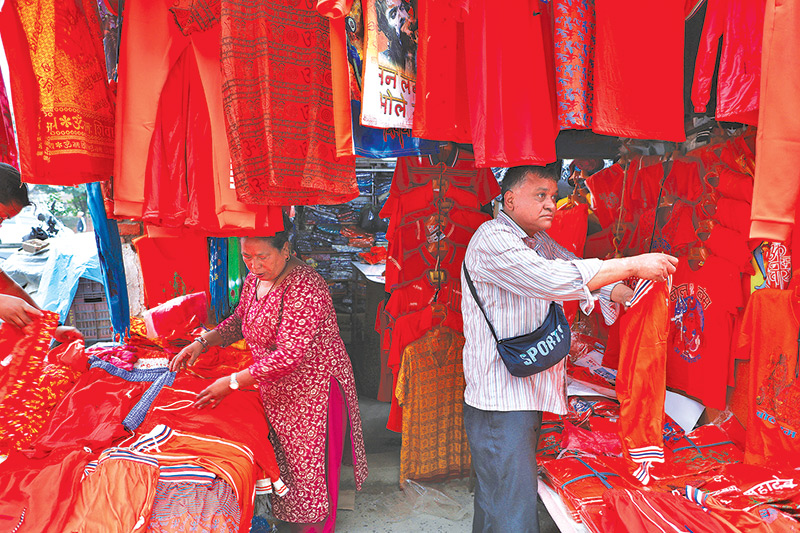
Bolbam garbs that are worn in honour of Lord Shiva on display at Tankeshwar, Kathmandu, Sunday. Post Photo: SANJOG MANANDHAR
DHANUSHA, A man in Mahottari district attempted to burn his wife and mother-in-law to death by dousing them in kerosene at Bhangaha Municipality-1 of Mahottari district, police said. The victims sustained critical burn injuries in the incident. According to the District Police Office in Mahottari, the alleged perpetrator Shankar Sada of Aurahi Municipality-8 in the district poured kerosene on his wife aged 35 and mother-in-law aged 65, on Saturday night. Deputy Superintendent of Police Prakash Bista said Shankar attempted to kill them after a heated family dispute. The critically injured mother and daughter were rushed to Provincial Hospital in Janakpur for treatment. The mother sustained serious burn injuries on her back, arms and left leg while her daughter sustained injuries on her chest, arms and legs. The provincial hospital referred the victims to Kathmandu as their treatment was not possible in Janakpur. “The victims are in critical condition. We referred both of them to the national capital as their treatment is not possible in Janakpur,” said Dr Rupesh Barma, who was involved in their treatment at the provincial hospital. According to Barma, the mother is expected to recover following treatment but the daughter’s health condition is very critical. Shankar fled the scene soon after the incident. Search is underway to nab the perpetrator, said police. The perpetrator attacked the women while they were asleep at around midnight. The suspect set them on fire after dousing them with kerosene. He locked the door from outside and ran away soon after the crime. The women cried for help but the villagers did not hear them as it was raining heavily. Rajawati Devi, a neighbour, knew about the incident first and informed other neighbours. “They were immediately rushed to Janakpur after the villagers knew about the incident,” said Sana Kumari Sada, a relative of the victims who stays in another house in the settlement. According to her, there were no serious disputes in the family. Police recovered an alcohol bottle that the perpetrator used to bring kerosene from a nearby shop. According to the locals, Shankar and his wife went to the field nearby together on Saturday evening to collect fodder for the cattle. He brought the kerosene while returning from the field. Shankar was staying at his in-law’s house with his wife and mother-in-law after returning from foreign employment in Kuwait a year ago.
NATIONAL
City, traffic police reintroduce ‘no horn’ policy in Kathmandu
This is the third time traffic police and city office have introduced the ‘no horn’ rule.
- Post Report
This file photo shows an elderly man talking on his phone in front of a ‘no horn’ sign. Post Photo: SANJOG MANANDHAR
KATHMANDU, The Kathmandu Valley Traffic Police Office in coordination with the Kathmandu Metropolitan City has reintroduced the ‘no-horn’ policy in bid to control noise pollution effective from Sunday. Kathmandu Mayor Balendra Shah and Deputy Inspector General Mira Chaudhari, chief of the Kathmandu Valley Traffic Police Office, jointly announced the reintroduction of the policy at a function held at Singhadurbar on Sunday. The reintroduction of the policy is the latest of the authorities’ efforts to tame noise pollution in the Valley and to make its application more ‘stringent’. This is the third time that the traffic police and the KMC have intensified the ‘no horn’ policy since its introduction in 2017. The authorities made a similar announcement in 2019. Between 2017 and 2019, the traffic police booked 12,271 drivers for unnecessary honking in public spaces. The ‘no horn’ policy in the Valley is applicable to all vehicles except emergency ones like ambulances and fire engines. The KMC has printed pamphlets to spread the message while Padma Kanya Multiple Campus has deployed 100 volunteers for two weeks to help implement the policy effectively. Both Shah and Chaudhari pasted stickers labeled ‘no horn’ on their vehicles and on other public vehicles on the road outside Singhadurbar. Speaking at the function, Shah said the City is coordinating with the Valley police to give continuity to the ‘no horn’ policy. “The policy has been in place for a while but its implementation has become weak,” Shah said. “That’s why we are putting the focus back on the policy.” Chaudhari requested all stakeholders to help make the drive a success. “Drivers should not honk unless it’s an emergency,” said Chaudhari, adding if anyone is found blowing horns without reason, they will be booked by the traffic police and will be liable to a fine of Rs500. According to the Motor Vehicle and Transport Management Act-1993, drivers caught blowing horns in restricted zones will have to pay fines up to Rs1,500. The traffic on Kathmandu roads has increased exponentially in the past five years and so have traffic jams and noise pollution. In 2017, when the authorities first announced the ‘no horn’ policy, Kathmandu Valley had 1.18 Million vehicles plying the Valley’s roads daily. Five years later, the number has reached 1.75 million, according to traffic police reports. “Horns from vehicles not only disturb us,” Shah said, “but also irritate us and can lead to mental stress.”
NATIONAL
Passage of bill on electricity becomes uncertain. Energy minister mulls ordinance
An amendment that aims to allow the private sector to engage in power trade inside and outside the country has become uncertain with the country entering election mode.
- PRITHVI MAN SHRESTHA
KATHMANDU, A bill to amend the Electricity Act-1992 to allow the Nepali private sector to trade in electricity has been passed by the National Assembly after two years of its tabling, but its passage through the lower house remains uncertain, leaving the private sector dejected. The bill to Amend and Integrate Existing Electricity Laws has provisions to provide licence to the private sector to trade in electricity within and outside the country. Until now only the state-owned Nepal Electricity Authority can engage in power trade. With the elections announced for November 20, lawmakers say Parliament is likely to function for a little over two months and this would be enough to pass the bill into law. But there are concerns whether the House should pass any bill since the government has been rendered a mere caretaker following the announcement of elections. “There is no certainty as to how long the current Parliament will function,” Energy Minister Pampha Bhusal said at an interaction organised by the Society of Economic Journalists, last month. “I am in favour of taking the bill to the House of Representatives but only if its passage is certain. Otherwise, we will have to begin the process from the beginning.” She said she has been in consultation with lawmakers and stakeholders to ascertain whether it would be appropriate to table the bill in the lower house or not. “My efforts will also be towards amending the Electricity Act-1992 to add ‘trading’ alongside the existing ‘production’ and ‘distribution’ provisions to allow the private sector to engage in power trade after the current parliament session ends,” she said, clearly indicating the possibility of her intention to amend the Act through an ordinance. During her meeting with representatives of Independent Power Producers of Nepal (IPPAN) on Friday, she was not hopeful of the current Parliament passing the bill. “The minister said she was making efforts to pass the bill but will not be taking a risk to take the bill to the lower house unless she receives assurances of its passage,” said IPPAN Vice-president Mohan Kumar Dangi, who participated in the meeting with the minister. Rajendra Phuyal, secretary of the National Assembly, agrees with Bhusal. “There is no point in tabling the bill at the House of Representatives if its passage is uncertain. “As far as I understand, the bill is less likely to be tabled in the lower house now,” he said. The current Sher Bahadur Deuba-led government turned into a caretaker one after the declaration of elections last week. “Although the code of conduct for elections is yet to be enforced by the Election Commission, whether the current government can take the amendment bill to parliament is still debatable,” said Ashish Garg, vice-president of IPPAN, adding, “We are therefore not hopeful of this bill. We may have to wait until a new Parliament is elected.” The private sector has long been pushing for the government’s approval to engage in power trading, including to export power to India. The private sector first established a trading company—Nepal Power Exchange Limited—in 2019 with the involvement of several companies associated with IPPAN. Since India allowed Nepal to sell electricity in the Indian market through the Indian Energy Exchange, an electronic trading platform of power, in November last year, the private sector in Nepal has also shown greater interest to export power to India. Nepal Power Exchange Limited and India’s Manikaran Power Limited signed a memorandum of understanding (MoU) on energy trading on January 10 this year. In the past year, more private sector players have shown interest to engage in power trade including the one promoted by the Nepal Infrastructure Development Bank. The Power Trading Company Limited, a subsidiary of the NEA, received the government’s permission for cross-border trading of electricity last December. The Company received a trading licence through a cabinet decision. Power Trading Company Limited is the first private sector company to receive power trading approval. The state-owned NEA is involved in power trade as per section (20) of the Nepal Electricity Authority Act-1984. Although the private sector has long been demanding, the government had been ignoring the call citing a lack of law. The Electricity Act 1992 does not allow the private sector to engage in power trade. The Ministry of Energy, Water Resources and Irrigation had earlier held inter-ministerial consultations on a draft electricity transmission directive and a set of guidelines to allow the private sector to engage in trading—domestic trading, export and import—of electricity. But the Ministry of Law, Justice and Parliamentary Affairs discouraged the plan, arguing that the existing law does not have any provision to allow the private sector to trade in electricity. Then, the energy ministry drafted an amendment to the Electricity Act-1992 through ‘Some Nepal Act Amendment Bill.’ “Had the government pushed hard to convince the lawmakers to pass the bill, it would already have become law opening the door for the private sector to engage in power trading,” said Garg, the vice-president of IPPAN.
EDITORIAL
Running out of time
Outgoing lawmakers are oddly rushing to pass bills after sitting on their hands for years.
The government on Thursday announced that the federal and provincial elections would be held on November 20; and with that, the Sher Bahadur Deuba administration has turned into a caretaker government limited to carrying out day-to-day administrative work. Ideally, caretaker governments, as a matter of practice, limit their roles to running the government without undertaking any major policy decisions such as introducing bills which require ratification by Parliament. But lawmakers, in the absence of an explicit clause, have decided to prolong Parliament to discuss and endorse a few pending bills. The decision to extend the term of Parliament beyond its past use-by-day has divided experts. Some of them have criticised the government for exploiting the loophole which has allowed casual interpretation of the constitution concerning the tenure of the House. But the crucial concern is not particularly over the loose interpretation of the House’s tenure, but rather over why there is a rush to pass some pressing bills at the last hour. There are 49 bills in the federal Parliament waiting for its endorsement, some of them have been pending for more than four years. So it begs the question: Why the need to show this pretence of sincerity at the tail end of the House’s tenure? Leaving essential matters until the last moment is an accomplished trait that Nepali politicians have exhibited at every step over the last five years. Constant infighting for ministerial berths, proroguing Parliament on several occasions, issuing ordinances to pass laws, and lack of participation and consultation among lawmakers has been a constant feature of the federal Parliament’s tenure. All these acts of the politicians have done more to erode the electorate’s trust bestowed upon the representatives than to strengthen the ideals of a fledgling republic. Practising the politics of ad hocism, Nepali politicians have turned a blind eye to the people’s pressing needs and the administration’s inefficiency. Hence the government’s move to focus on critical pending bills after announcing the elections will undoubtedly cause further chaos in the House. There has been lack of proper consultation between stakeholders and meaningful deliberation among lawmakers, which is necessary for the lawmaking process. What exactly are the politicians expecting to achieve, something they failed to accomplish in the last four and a half years? There is no question of setting a good precedent when their track record has been abysmal. This show of false sincerity shouldn’t fool the people who have witnessed the antics of the politicians over the years. It is clear where the priorities of the parliamentarians currently lie. There is nothing more important for a politician than to seek re-election. Therefore stop hoodwinking people into believing that extending the House’s term would in some way add to the industrious qualities shown by the representatives when it does not.
OPINION
Restoring landscape with bamboo
In contrast to natural forests, bamboo forests have the highest capability for ground water recharging.
- DIPTI BARAL
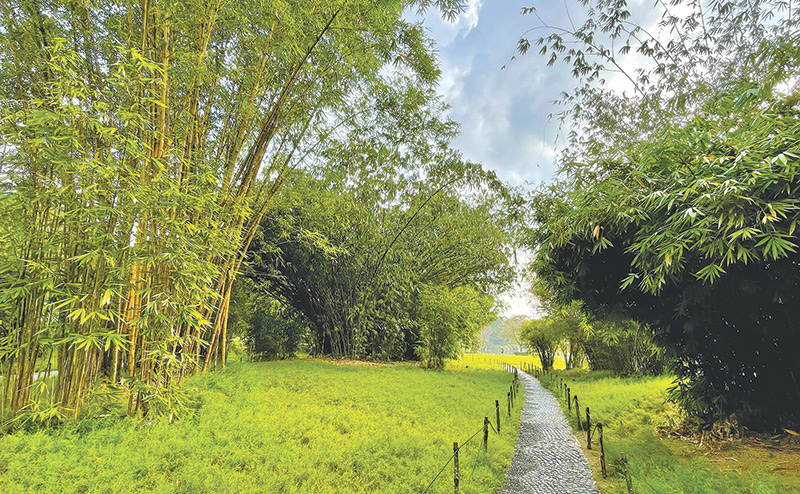
Unsplash
The damage humanity has inflicted on the planet is accelerating, with about 40 percent of the land surface having been degraded, as disclosed by the United Nations Convention to Combat Desertification in the Global Land Outlook 2. About 3.2 billion people worldwide are threatened with regard to their livelihood, well-being, access to food, water, energy and security by the degradation of forests, agricultural land and rangelands. Against this backdrop, the UN report also reveals a vision of potential landscape restoration on about 5 billion hectares by 2050 that brings in various benefits such as a 5 to 10 percent increase in crop yields in the developing nations, the ability to store 17 gigatonnes of carbon more than unrestored land could in 2015, and a slowed decline in biodiversity and natural areas. The year 2021 saw the kick-off of the United Nations Decade on Ecosystem Restoration, which runs from 2021 to 2030, intending to prevent, halt and reverse the worldwide adverse effects of landscape degradation. In 2011, the German government and the International Union for Conservation of Nature, along with the support of the Global Partnership on Forest and Land Restoration, launched the Bonn Challenge to restore 150 million hectares of degraded land by 2020. The New York Declaration on Forests further endorsed the challenge to restore 350 million hectares of land by 2030. Reducing Emissions from Deforestation and Forest Degradation is the most significant international Forest Landscape Restoration-related initiative that aims to slow, stop and converse forest loss and degradation. Contributing to many of such global initiatives, several nations across the globe have set their national targets. For example, African Forest Landscape Restoration Initiative is a country-led initiative in Africa to restore 100 million hectares of degraded land by 2030. Similarly, ECCA30 is a regional initiative that aims to restore 30 million hectares of degraded and deforested land in Europe, the Caucasus and Central Asia by 2030.
National reality In Nepal, 3.16 million hectares (or 11.81 percent of the total land area) have been affected by the degradation process. According to a 2015 report entitled Status of Crops and Weather issued by the Agriculture Extension Directorates, Lalitpur, agriculture suffered a Rs2.36 billion loss due to floods, landslides and drought in 2015, which was equivalent to more than 10 percent of the Agriculture Ministry’s budget for that year. The government of Nepal initiated a planting programme in its first Five-Year Plan (1956-61) to rehabilitate the country’s degraded land. In addition, Nepal has been a party to several frameworks and initiatives related to landscape restoration and has been working to meet conservation goals. Tarai Arc Landscape, Sacred Himalayan Landscape and the Kailash Sacred Landscape are some government-led landscape management and restoration programmes in Nepal. Further, other programmes are being implemented by a consortium of international and national organisations. Haphazard development activities have wreaked havoc on the conservation of land that peoples across the world advocate for nature-based solutions to such developmental problems. Indeed, so often, nature has the solution. It is just a matter of identifying and enacting the right one appropriately. With this wisdom, when it comes to landscape restoration, bamboo is a sustainable nature-based solution that can enhance people’s well-being and benefit the environment. In the 21st century, we need to reassess the plants we use and how we use them. Bamboo is a perfect material for rehabilitating degraded land since it can grow on low fertile soil, slopy land and under various climatic conditions. Bamboo is well known for faster growth, with a growth rate of 1 metre per day in some species. It has evergreen leaves, a dense canopy and numeral culms that intercept rainfall, reduce its kinetic energy and thus prevent soil erosion. Further, there is high litterfall production in bamboo that, along with a dense canopy, maintains the microclimate to facilitate the restoration of degraded land. Faster growth and large biomass of bamboo thus hasten land restoration. Additionally, the rhizome of bamboo, an extensive fibrous root system, holds the soil tightly and prevents landslides, floods, and erosion. The root system is shallow, with the most concentration in the depth of 0-30 cm, so, helpful for preventing topsoil erosion. Even when natural calamities like fire destroy the above-ground biomass, the plant can live thanks to the bamboo’s underground biomass. The bamboo forest’s water regulation functions are an addition to this. Infiltration and percolation are encouraged by bamboo roots. In contrast to natural forests, bamboo forests have the highest capability for ground water recharging. Due to the great potential of bamboo, many countries like Cameroon, Ghana, Rwanda, Sri Lanka, Brazil, Madagascar, Vietnam, China, Kenya and the Philippines are adopting it as a priority species for landscape restoration. In 2014, member nations of the International Bamboo and Rattan Organisation (INBAR) committed to restoring at least 5 million hectares of degraded land using bamboo.
Government indifference In Nepal, although many projects have used bamboo for landscape management and restoration, few programmes explicitly endorse bamboo for land restoration. Despite being rich in bamboo, Nepal’s bamboo-based economy contributes only 1 to 2 percent to the national GDP due to the government’s indifference, lack of support to farmers, disordered market and insubstantial skills. Further, there is no detailed inventory of existing bamboo forest estates, and people’s perspective towards using bamboo for landscape restoration is not documented. Such limitations hamper the efforts to understand the need to restore, improve productivity and develop bamboo clusters to support landscape restoration. Globally, landscape restoration is receiving significant attention from numerous initiatives, attesting that there is no better alternative than a nature-based solution to reclaim degraded lands. Many countries have rightly identified bamboo as a means for landscape restoration. But Nepal is still lagging behind in tapping the bamboo sector. In this regard, an appropriate government policy, environment and institutional intervention can foster the sector. In addition, international and national institutions related to bamboo should also help Nepal achieve its conservation goals.
Baral is a graduate in Agricultural Science from the College of Natural Resource Management, Puranchaur, Kaski.
OPINION
Counting queers
Excluding the LGBTQ+ community remains the norm in many developing countries.
- EGERTON NETO
Shutterstock
“What is your sexual orientation?” In Brazil, where queer people have historically been ignored and excluded from official statistics, this question holds special significance for the LGBTQ+ community. Brazil recently took a small step toward positive change when the country’s national statistics agency, IBGE, published its latest National Health Survey, which for the first time included questions about sexual orientation. According to the survey, based on data collected in 2019, around 2.9 million Brazilians identify as homosexual or bisexual. (The multiple-choice questionnaire was limited to four options—heterosexual, homosexual, bisexual, or “don’t know”—thus omitting transgender and nonbinary identities). Despite this encouraging development, the IBGE still refuses to include questions about sexual orientation and gender identity in Brazil’s national census. In June, a federal court rejected an effort by the Public Prosecutor’s Office to force the agency to incorporate these questions. Many leading economies have already done so. Canada’s 2021 census asked respondents what their gender identity is and what sex they were assigned at birth. The United Kingdom’s latest census included a voluntary question on sexual orientation. Australia’s recent census offered the option of identifying as male, female, or nonbinary. And the United States Census Bureau is still researching which questions to ask and how to ask them. But ignoring or excluding the LGBTQ+ community remains the norm in many developing countries. According to Kenyan doctor and human-rights activist Stellah Wairimu Bosire, censuses are an important tool in government planning, and excluding the queer community means that policies targeting employment, health, and homelessness do not consider the specific needs of LGBTQ+ people. A 2019 report by the Arcus Foundation on violence against LGBTQ+ people in five African countries found that accurate data can also help LGBTQ-focused NGOs better target interventions, evaluate their impact, and improve advocacy efforts. In the absence of official statistics, some civil-society organisations have built their own datasets. Brazil, for example, is the world leader in recorded murders of LGBTQ+ people. We know this because a trans-rights group, ANTRA, documented the numbers, names, and stories of the 140 trans people murdered in the country in 2021. Trans-rights groups in other parts of the world, including Letra Ese in Mexico, Helem in Lebanon, and TGEU in Europe, have been doing similar work. Almost every day, queer researchers send me requests to complete surveys, take part in interviews, or fill out forms. While this research sheds light on our shared experiences, very little of it reaches national audiences, and almost none comes from governments. The lack of official data renders me and my community invisible. It makes it extremely difficult to promote our interests and protect our rights, thereby denying us the fundamental rights of citizenship. This is no accident or oversight. In his book Queer Data, Kevin Guyan notes that decisions about what to ask in official surveys reflect the surveyors’ views. If statisticians and politicians don’t see LGBTQ-phobia as a problem, or wish to suppress our community’s demands, why would they include relevant questions in the census? And so trans people remain invisible, and homophobic violence, exclusion, and poverty are allowed to persist. Even when official surveys include questions on gender identity and lived experiences, the numbers are likely underreported, owing largely to a lack of trust. Many members of the LGBTQ+ community do not feel safe sharing details about their life with government agencies. After all, Brazil’s dismal failure to protect trans people’s lives speaks for itself, and US-based studies consistently find that sexual and gender minorities experience disproportionately higher levels of violence. Moreover, such violence is often a handmaiden of fascism. In Nazi Germany, the authorities created “pink lists” of individuals charged with the then-crime of being homosexual. Many were sent to concentration camps. The law banning homosexuality remained on the statute books in West Germany until 1994 and was used to prosecute some 100,000 people. More recently, Russian troops in Ukraine have reportedly been circulating a list of LGBTQ+ activists. Regardless of how people respond to questions about sexual orientation and gender identity, merely asking them is an affirmation. It makes people feel seen, normalises gender diversity, and brings us closer to full citizenship rights. In Brazil, the IBGE blamed budget cuts for its refusal to include LGBTQ-related questions in the 2022 census, claiming that their inclusion would cause delays. The judiciary has accepted these largely bureaucratic arguments, ignoring the struggles, pains, and experiences of the queer community in the name of pragmatism. Brazil is just one front in a global battle for inclusion. Recently, the World Bank published a cross-national analysis of laws affecting LGBTQ+ communities in 16 countries. This pioneering study is a huge achievement, but the scarcity of data means that conducting international or comparative analyses of LGBTQ+ rights remains a highly frustrating experience. Following the census battle, the IBGE announced plans to incorporate LGBTQ-related questions in smaller surveys in 2023 and 2024. This is a welcome development, but there is still a long way to go. Politicians must understand that any national census or survey that does not include the LGBTQ+ community will not accurately represent their citizenry. Another decade without data would mean another decade without adequate policies, perpetuating the historical injustices that have kept our community poor, vulnerable, and forgotten.
Neto, a Brazilian LGBT+ activist, is an Aspen New Voices Fellow. – Project Syndicate
MONEY
China’s exports gain steam but outlook cloudy
The global economy is being weighed down by soaring prices and rising interest rates.
- REUTERS
BEIJING, China’s export growth unexpectedly picked up speed in July, offering an encouraging boost to the economy as its struggles to recover from a Covid-induced slump, but weakening global demand could start to drag on shipments in coming months. Exports rose 18.0 percent in July from a year earlier, the fastest pace this year, official customs data showed on Sunday, compared with a 17.9 percent increase in June and beating analysts’ expectations for a 15.0 percent gain. Outbound shipments have been one of the few bright spots for the Chinese economy in 2022, as widespread lockdowns hit businesses and consumers hard and the once mighty property market lurches from crisis to crisis. “China’s export growth surprised again on the upside. [It] continues to help China’s economy in a difficult year as domestic demand remains sluggish,” said Zhiwei Zhang, chief economist at Pinpoint Asset Management. However, many analysts have expected exports to fade as the global economy looks increasingly likely to be heading into a serious slowdown. A global factory survey released last week showed demand weakened in July, with orders and output indexes falling to their weakest levels since the onset of the Covid-19 pandemic in early 2020. China’s official manufacturing survey indicated activity contracted last month, raising fears that the economy’s recovery from lockdowns in spring will be slower and bumpier than expected. But there were signs that transport and supply chain disruptions caused by Covid restrictions were continuing to ease, just in time for shippers preparing for peak year-end shopping demand. Foreign trade container throughput at eight major Chinese ports rose 14.5 percent in July, speeding up from the 8.4 percent gain in June, according to data released by the domestic port association. Container throughput at Covid-hit Shanghai port hit a record high last month. July exports may also have been buoyed by pent-up demand from Southeast Asia as supply snarls eased and factories there ramped up production, Bruce Pang, chief economist and head of research at Jones Lang Lasalle Inc, said in a research note. Moreover, amid negative real interest rate and surging inflation, some European and US customers may have frontloaded orders to ensure they had goods on hand with lower costs, he added. Still, while export growth remained high, mainly backed by price factors, the volume of exported goods dropped in July, said Chang Ran, a senior analyst at Zhixin Investment Research Institute. “Looking ahead in the second half of the year, exports are expected to be resilient in the short run, but weakening external demand may pressure them in the fourth quarter,” Chang said. Chinese exporters are facing mounting headwinds, one company executive told Reuters. “I am very worried about the impacts of soaring US inflation and rising China-US tensions on our export orders,” Jin Chaofeng, general manager at Nicesoul, one of Amazon’s top rattan outdoor furniture sellers, told Reuters.
MONEY
First foreign-flagged ship arrives in Ukraine since February, awaits cargo
- REUTERS
Inspectors visit the merchant vessel M/V Fulmar S, in Istanbul, Turkey on Friday. REUTERS
KYIV, A foreign-flagged ship arrived in Ukraine on Saturday for the first time since the war started in February, and will be loaded with grain, Ukrainian Infrastructure Minister Oleksandr Kubrakov said. Ukraine is starting to resume grain exports in an effort overseen by a Joint Coordination Centre in Istanbul where Russian, Ukrainian, Turkish and UN personnel are working. The United Nations and Turkey brokered a deal after UN warnings of possible outbreaks of famine due to a halt in grain shipments from Ukraine. Before the invasion, Russia and Ukraine together accounted for nearly a third of global wheat exports. Kubrakov said the Barbados-flagged general cargo ship Fulmar S was in the Ukrainian port of Chornomorsk. “We are doing [everything] possible to ensure that our ports can receive and handle more vessels. In particular, we plan to reach the level of at least three to five vessels per day in two weeks’ [time],” he wrote on Facebook. Zelenskiy said the resumption of exports was positive, adding that security risks remained. “The threat of Russian provocations and terrorist acts remains. Everyone should be aware of this,” he said in a late-night video address on Saturday.
MONEY
Futuristic Lectro E-cycles launched in Nepal
Briefing
KATHMANDU: Nimbus International Company Pvt Ltd, authorised distributor of Lectro E-cycles, unveiled its most awaited range in Nepal on Sunday. There will now be 11 models available in Nepal including the Cargo cycle, with prices ranging from Rs75,900 to Rs139,900. The e-cycles are manufactured by Hero Company India. The company claims battery ranges from 25km to 60km per full charge. A full battery charge takes anywhere from 5 to 7 hours. The e-cycles are powered by Li-ion batteries and is IP67 rated, which makes them water-repellent and provides 100 percent dust protection, to ensure a carefree ride in all weathers. The all new Lectro comes with a two-year warranty which includes battery and motors as well as lifetime warranty for the frame. (PR)
MONEY
Buffett’s firm reports $44 billion loss but its businesses thrive
Briefing
OMAHA: Warren Buffett’s company reported a $43.76 billion loss in the second quarter as the paper value of its investments plummeted, but Berkshire Hathaway’s many operating companies generally performed well suggesting the overall economy is weathering the pressure from inflation and rising interest rates. Berkshire said on Saturday that a largely unrealised $53 billion decline in the value of its investments forced it to report a loss of nearly $44 billion, or $29,754 per Class A share. That is down from $28.1 billion, or $18,488 per Class A share, a year ago. The stock prices of three of Berkshire’s biggest investments—Apple, American Express and Bank of America—all fell significantly during the second quarter. But those stocks have all rebounded during the third quarter, meaning Berkshire’s portfolio is already worth more than it was at the end of the quarter. Buffett has long said he believes Berkshire’s operating earnings are a better measure of the company’s performance because they exclude investment gains and losses, which can vary widely quarter to quarter. (AP)
WORLD
UN’s nuclear watchdog warns on Ukraine plant; Russia shells ‘dozens’ of towns
Two sides exchange blame over nuclear plant danger which has raised the prospect of a wider disaster.
- REUTERS
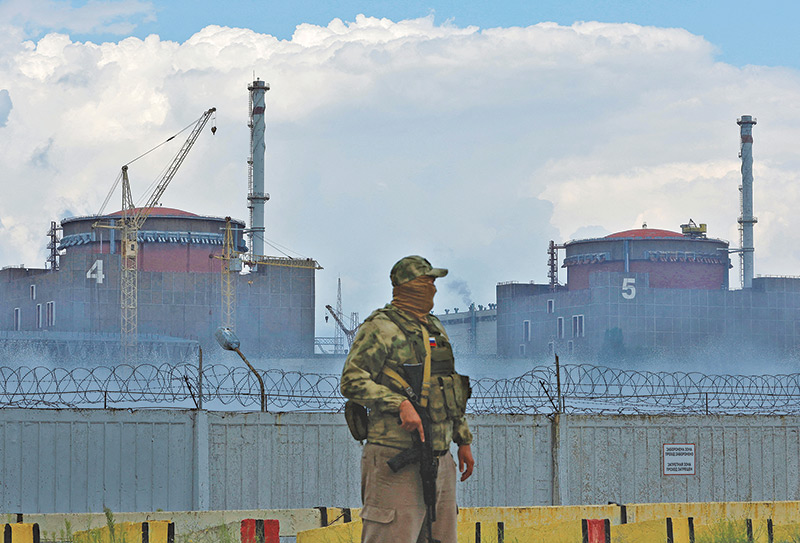
A serviceman with a Russian flag on his uniform stands guard near the Zaporizhzhia Nuclear Power Plant in the Zaporizhzhia region, Ukraine. REUTERS
KYIV, The head of the International Atomic Energy Agency raised grave concern about shelling at a nuclear power plant in Ukraine, as its military said Russian forces had attacked dozens of front-line towns. Since Russia invaded Ukraine on February 24 in what President Vladimir Putin termed a “special military operation”, the conflict has settled into a war of attrition fought largely in Ukraine’s east and south. But the fighting over the Zaporizhzhia nuclear plant in the south, captured by Russian forces in the opening stage of the war but still run by Ukrainian technicians, has raised the prospect of a wider disaster. “I’m extremely concerned by the shelling yesterday at Europe’s largest nuclear power plant, which underlines the very real risk of a nuclear disaster,” IAEA Director General Rafael Mariano Grossi said in a statement. Both sides have accused each other of engaging in “nuclear terrorism”. Ukraine’s state nuclear power company Energoatom blamed Russia for the damage while Russia’s defence ministry accused Ukrainian forces of shelling the plant. The United States has accused Russia of using it as a “nuclear shield” while Russia’s defence ministry said damage to the plant had only been avoided thanks to the “skilful, competent and effective actions” of its units. Grossi, who leads the United Nation’s nuclear watchdog, urged all sides to exercise the “utmost restraint”. Shells hit a high-voltage power line on Friday at the facility, prompting its operators to disconnect a reactor despite no radioactive leak being detected. While the world’s attention was focussed on the nuclear plant, the war was grinding on in the east and south. Russia is trying to gain control of the largely Russian-speaking Donbas region in the east, comprised of Luhansk and Donetsk provinces, where pro-Moscow separatists seized territory after the Kremlin annexed Crimea to the south in 2014. Ukraine’s military said late on Saturday that Russian forces had shelled dozens of front-line towns and were trying to attack in six different areas in the Donetsk region, all of which failed to gain any territory and were held back by Ukrainian forces. Reuters could not verify either side’s assertions about battlefield developments. Ukraine’s President Volodymyr Zelenskiy said on Saturday said that over the past week its forces had “achieved powerful results” in destroying Russia’s logistics supplies and rear bases. “Every strike on the enemy’s ammunition depots, on their command posts, and on accumulations of Russian equipment saves the lives of all of us, the lives of Ukrainian military and civilians,” he said in a late-night video address. British military intelligence said earlier that Russian forces were almost certainly amassing in the south, anticipating a counter-offensive or in preparation for an assault, and the war was about to enter a new phase, with most fighting shifting to a nearly 350 km front from near Zaporizhzhia to Kherson, parallel to the Dnieper River. Ukraine’s forces were focusing on hitting bridges, ammunition depots, and rail links with growing frequency in its southern regions, including the strategically important railroad spur that links Kherson to Russian-occupied Crimea, it said. In a positive development, Ukraine is starting to resume grain exports, easing fears of a global food crisis, in an effort overseen by a Joint Coordination Centre in Istanbul where Russian, Ukrainian, Turkish and UN personnel are working. Ukrainian Infrastructure Minister Oleksandr Kubrakov said a second caravan of four ships with Ukrainian agriculture products sailed from Black Sea ports. The first four ships left Ukraine last week under the agreement. Before the invasion, Russia and Ukraine together accounted for nearly a third of global wheat exports.
WORLD
Japan PM to change cabinet amid Taiwan, Unification Church issues
- REUTERS
TOKYO, Japanese Prime Minister Fumio Kishida said on Saturday he will reshuffle his cabinet next week to address mounting issues including Taiwan tensions, Covid-19 and economic stimulus measures to counter inflation. “We need to set off a new formation as soon as possible considering the various issues,” he told a news conference in Hiroshima. The earlier-than-expected staff change also comes as his administration faces increasing public scrutiny on the relationship between the religious group Unification Church and ruling party lawmakers, including slain former prime minister Shinzo Abe. Natsuo Yamaguchi, leader of Kishida’s ruling coalition partner Komeito party, said in a Saturday news conference that Kishida had informed him the cabinet reshuffle would be announced on Wednesday. Kishida did not give any details of his cabinet changes but the Yomiuri daily reported earlier that he would likely replace Defence Minister Nobuo Kishi, given his health issues. Defence is in the spotlight with tension surging between self-ruled Taiwan and mainland China in recent days. A recent surge of Covid to record-high infection numbers poses another problem for the government. A reorganisation of the cabinet and ruling party officials was slated for early September, after a memorial service for Abe who was shot dead last month, but Kishida brought it forward to address falling approval for the cabinet in polls, the Yomiuri said. The reshuffle comes after Kishida’s conservative coalition government increased its majority in the upper house of parliament in a July election held two days after Abe’s death. Kishi, 63, the younger brother of Abe, has been defence minister since September 2020. Jiji news agency reported on Friday that Finance Minister Shunichi Suzuki would be retained, and Industry Minister Koichi Hagiuda would either be kept or moved to another important post.
WORLD
Ex-rebel sworn in as Colombia’s president in historic shift
The 62-year-old is a former member of Colombia’s M-19 guerrilla group.
- ASSOCIATED PRESS
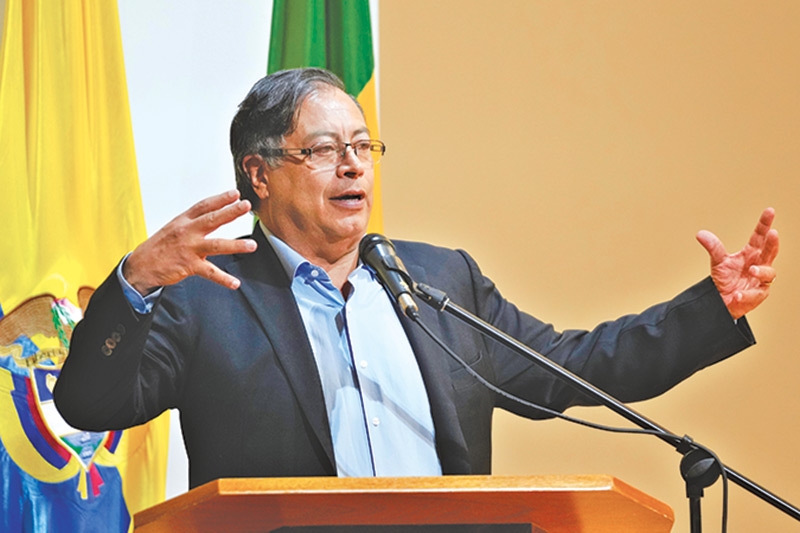
Colombia’s President-elect Gustavo Petro. AP/RSS
BOGOTA, Colombia’s first leftist president will be sworn into office on Sunday, promising to fight inequality and heralding a turning point in the history of a country haunted by a long war between the government and guerrilla groups. Senator Gustavo Petro, a former member of Colombia’s M-19 guerrilla group, won the presidential election in June by beating conservative parties that offered moderate changes to the market-friendly economy, but failed to connect with voters frustrated by rising poverty and violence against human rights leaders and environmental groups in rural areas. Petro is part of a growing group of leftist politicians and political outsiders who have been winning elections in Latin America since the pandemic broke out and hurt incumbents who struggled with its economic aftershocks. The ex-rebel’s victory was also exceptional for Colombia, where voters had been historically reluctant to back leftist politicians who were often accused of being soft on crime or allied with guerrillas. A 2016 peace deal between Colombia’s government and the Revolutionary Armed Forces of Colombia turned much of the focus of voters away from the violent conflicts playing out in rural areas and gave prominence to problems like poverty and corruption, fuelling the popularity of leftist parties in national elections. Petro, 62, has promised to tackle Colombia’s social and economic inequalities by boosting spending on anti-poverty programmes and increasing investment in rural areas. He has described US-led antinarcotics policies, such as the forced eradication of illegal coca crops, as a “big failure.” But he has said he would like to work with Washington “as equals,” building schemes to combat climate change or bring infrastructure to rural areas where many farmers say coca leaves are the only viable crop.
WORLD
Israeli airstrike kills second top Islamic Jihad commander
Two other militants and five civilians were also killed.
- ASSOCIATED PRESS
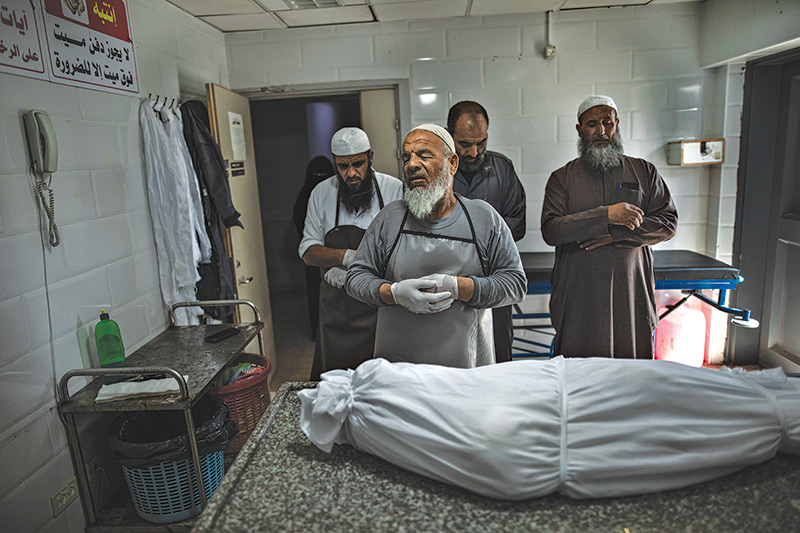
The body of Palestinian Muhammad Hassouna, who was killed in an Israeli airstrike, is prepared for his funeral at a hospital in Rafah, in the southern Gaza Strip on Sunday. AP/RSS
GAZA CITY, Israel said on Sunday that it killed a senior Islamic Jihad commander in a crowded Gaza refugee camp, the second such targeted attack since it launched its high-stakes military offensive against the militant group just before the weekend. The Iran-backed militant group has fired hundreds of rockets at Israel in response, and the risk of the cross-border fighting turning into a full-fledged war remained high. Gaza’s ruling Hamas group, which fought an 11-day war with Israel in May 2021, appeared to stay on the sidelines for now, possibly because it fears Israeli reprisals and undoing economic understandings with Israel, including Israeli work permits for thousands of Gaza residents, that bolster its control. The Islamic Jihad commander, Khaled Mansour, was killed in an airstrike on an apartment building in the Rafah refugee camp in southern Gaza late Saturday. Two other militants and five civilians were also killed in the attack, bringing the Palestinian death toll to 31 since the start of the Israeli offensive on Friday. Among the dead were six children and four women. The Palestinian Health Ministry said more than 250 people were wounded since Friday. Israel says some of the deaths were caused by errant rocket fire, including one incident in the Jebaliya refugee camp in northern Gaza in which six Palestinians were killed Saturday. On Sunday, a projectile hit a home in the same area of Jebaliya, killing two men. Palestinians held Israel responsible, while Israel said it was investigating whether the area was hit by an errant rocket. Mansour, the Islamic Jihad commander for southern Gaza, was in the apartment of a member of the group when the missile struck, flattening the three-story building and badly damaging nearby houses. “Suddenly, without warning, the house next to us was bombed and everything became black and dusty with smoke in the blink of an eye,” said Wissam Jouda, who lives next to the targeted building. Ahmed al-Qaissi, another neighbor, said his wife and son were among the wounded, suffering shrapnel injuries. To make way for rescue workers, al-Qaissi agreed to have part of his house demolished. As a funeral for Mansour began in the Gaza Strip on Sunday afternoon, the Israeli military said it was striking suspected “Islamic Jihad rocket launch posts.” Smoke could be seen from the strikes as thumps from the strikes’ explosions rattled Gaza. The Rafah strike was the deadliest so far in the current round of fighting, which was initiated by Israel on Friday with the targeted killing of Islamic Jihad’s commander for northern Gaza.
WORLD
Chinese and Taiwanese warships shadow each other as Beijing wraps up military drills
- REUTERS
Taiwan Navy ships are seen at the port in Keelung, Taiwan on Saturday. REUTERS
TAIPEI, Chinese and Taiwanese warships played high-seas “cat and mouse” on Sunday ahead of the scheduled end of four days of unprecedented Chinese military exercises launched in reaction to a visit to Taiwan by the US House speaker. Nancy Pelosi’s visit last week to the self-ruled island infuriated China, which responded with test launches of ballistic missiles over the island’s capital for the first time and the cutting of some communication links with the United States. About 10 warships each from China and Taiwan sailed at close quarters in the Taiwan Strait, with some Chinese vessels crossing the median line, an unofficial buffer separating the two sides, according to a person with knowledge of the matter. The island’s defence ministry said multiple Chinese military ships, aircraft, and drones were simulating attacks on the island and its navy. It said it had sent aircraft and ships to react “appropriately”. As Chinese forces “pressed” the line, as they did on Saturday, the Taiwan side stayed close to monitor and, where possible, deny the Chinese the ability to cross, said the person with knowledge of the situation who declined to be identified. “The two sides are showing restraint,” the person said, describing the manoeuvres as high-seas “cat and mouse”. “One side tries to cross, and the other stands in the way and forces them to a more disadvantaged position and eventually return to the other side.” Taiwan said its shore-based anti-ship missiles and its Patriot surface-to-air-missiles were on stand-by. The defence ministry said its F-16 jet fighters were flying with advanced anti-aircraft missiles. It issued photographs of Harpoon anti-ship weapons being loaded on another. Taiwan said on Saturday its forces scrambled jets to warn away 20 Chinese aircraft, including 14 that crossed the median line. It also detected 14 Chinese ships conducting activity around the Taiwan Strait. The Chinese exercises, centred on six locations around the island that China claims as its own, began on Thursday and were scheduled to last until midday on Sunday, the official Xinhua News Agency reported last week. There was no announcement from China on Sunday on whether the exercises were ending and Taiwan said it is unable to verify whether China had stopped them. Nevertheless, Taiwan’s transport ministry it was gradually lifting restrictions on flights through its airspace, saying notifications for the drills were no longer in effect. But Taiwan would continue to direct flights and ships away from one of the drill zones off its east coast until Monday morning, it said. China’s military has said the sea and air joint exercises, north, southwest and east of Taiwan, had a focus on land-strike and sea-assault capabilities. The United States called the exercises a significant escalation in China’s efforts to change the status quo. “They are provocative, irresponsible and raise the risk of miscalculation,” a White House spokesperson said. “They are also at odds with our long-standing goal of maintaining peace and stability across the Taiwan Strait.”China says its relations with Taiwan are an internal matter and it reserves the right to bring the island under its control, by force if necessary. Taiwan rejects China’s claim saying only Taiwan’s people can decide their future. China has warned the United States not to “act rashly” and create a greater crisis and the state-run Xinhua News Agency said in a commentary Pelosi had staged a “political stunt” out of self-interest. “Insisting on going to the island, she apparently does not care about harming China-US ties, or putting peace across the Taiwan Strait on the line,” it said. Taiwan’s foreign ministry condemned China’s “aggressive and provocative” exercises and urged it “to immediately stop such tension-escalating behaviours that have endangered the common good of the region and the world”.
WORLD
Sri Lanka asks China to defer arrival of ship after India objects
Briefing
- AGENCIES
COLOMBO: Sri Lanka has asked China to defer the planned visit of a Chinese survey ship to the island country after an objection from India, a government source told Reuters on Sunday. The Chinese research and survey vessel, Yuan Wang 5, was still on its way to Sri Lanka’s Hambantota port. It is scheduled to arrive there on August 11, according to shipping data from Refinitiv. India worries that the Chinese-built and leased port of Hambantota will be used by China as a military base in India’s backyard. The $1.5 billion port is near the main shipping route from Asia to Europe. China’s foreign ministry did not immediately respond to a request for comment on Sunday. Last week, a spokesperson for the Sri Lankan government said the ship was only stopping at Hambantota for refuelling. China is one of Sri Lanka’s biggest lenders and has also financed airports, roads and railways, unsettling India.
WORLD
Pacific Islands solidarity is a Biden priority, US diplomat tells Solomons
Briefing
- AGENCIES
HONIARA: US President Joe Biden sees strong ties with Pacific Island countries as a priority, Deputy Secretary of State Wendy Sherman said in the Solomon Islands on Sunday, underscoring the stakes of her visit as tensions have been mounting in the region. At a World War Two memorial event in the Solomons’ capital, Honiara, Sherman rebuked governments that she said sought to dismantle the rules-based international order. She did not specify which governments she was criticising but tensions in the region has been mounting between US allies and China. The Solomons surprised their neighbour Australia, and the United States, this year by striking a security pact with China.
WORLD
Kosovo detains Russian journalist at the border
Briefing
- AGENCIES
PRISTINA: Kosovo’s interior minister said on Saturday it has arrested a Russian journalist at the border on suspicion that she could be a spy, and security authorities were searching “for her intentions.”The country’s interior minister Xhelal Svecla named the journalist as Daria Aslamova.”Many countries have proven that she was engaged in espionage for Russian military intelligence and that she pretended to be a journalist,” Svecla said in press statement. Reuters could not verify Svecla’s accusations. Aslamova, who works for Russia’s tabloid newspaper Komsomolskaya Pravda, was quoted by her outlet as saying that she had been released and was now in the Serbian town of Raska.
WORLD
Canada jury convicts Dutch man of sexually extorting teen
Briefing
- AGENCIES
COURTENAY: A Canadian jury on Saturday found Dutch national Aydin Coban guilty on all charges of sexually extorting a teenager from British Columbia whose video of her online harassment sparked a global debate on cyber-bullying. Coban, who was extradited to Canada, was convicted in the British Columbia Supreme Court of extortion, two counts of possession of child pornography, child luring and criminal harassment against Amanda Todd, the teenager who died by suicide in 2012. Todd sparked an international debate over cyber-bullying when she posted a YouTube video detailing her online harassment. She committed suicide at age 15.
SPORTS
Ten Hag era at Manchester United begins with nightmare
The Red Devils suffer a 2-1 loss against Brighton in their opening Premier League match.
- REUTERS
Pascal Gross (centre) scored twice to help Brighton register their second straight win against Man United and their first ever at Old Trafford. Ap/Rss
MANCHESTER, New manager Erik ten Hag saw the depth of the crisis at Manchester United when his side fell to a 2-1 Premier League defeat by Brighton & Hove Albion at Old Trafford on Sunday, with German Pascal Gross scoring twice. United fans’ hopes that the off-season would mark a turning point have faded, with the club failing to make major moves yet in the transfer market and there was a grim familiarity to the club’s opening match. The former Ajax coach witnessed a performance that was every bit as disjointed as those produced under his predecessors Ralf Rangnick and Ole Gunnar Solskjaer last season. The sense that this was a continuation of last year’s decline began before kick-off where there were yet more loud and angry protests against United’s owners, the American Glazer family, under the South Stand. If that felt familiar, then the sight of Scott McTominay and Fred in midfield as United laboured against Graham Potter’s superbly drilled side was verging on deja vu. United had been shambolic in their 4-0 loss at Brighton in May and, even with debuts for defender Lisandro Martinez and midfielder Christian Eriksen, little felt new or changed about the performance. Brighton took the lead on the half-hour with Leandro Trossard finding former United forward Danny Welbeck who squared the ball to the back post for Gross to slot home. Nine minutes later, Gross doubled the lead, with his sixth career goal against United, after David De Gea had poorly pushed out a Solly March drive right into the path of the German who again made no mistake. Ten Hag introduced Cristiano Ronaldo in the 53rd minute and the Portugal forward, who is reported to want to leave the club, provided the spark for United’s attempted comeback. The home side gave themselves a foothold in the 68th minute when a goalmouth scramble ended with Alexis Mac Allister turning the ball into his own net but Brighton held on for a second straight win against United and their first ever at Old Trafford.
Tottenham, Chelsea win Tottenham Hotspur and Chelsea made winning starts to the new campaign earlier on Saturday. Spurs went behind, at home to Southampton, but then Antonio Conte’s side cruised to a 4-1 victory over the Saints. A penalty on the stroke of halftime from Jorginho was enough to give Chelsea a hard-fought 1-0 win at former favourite Frank Lampard’s Everton. Tottenham’s close-season recruitment has boosted hopes in north London that Antonio Conte’s side can get closer to the top two this season and they confirmed that positive perspective with an impressive start. The hosts fell behind to a James Ward-Prowse volley in the 12th minute but dominated throughout with goals by Ryan Sessegnon, Eric Dier and Dejan Kulusevski sealing the win. Southampton’s lead lasted only nine minutes before Sessegnon powered a header past Premier League debutant goalkeeper Gavin Bazunu from Kulusevski’s cross. Dier glanced in Son Heung-min’s cross with a stooping header in the 31st minute to put Tottenham ahead. Mohammed Salisu clumsily turned Emerson Royal’s cross into his own net in the 61st minute, and two minutes later Royal set up the impressive Kulusevski to guide an exquisite finish beyond Bazunu whose saves kept the score respectable. Chelsea peppered Everton’s goal with 13 corners in the first half but looked set to be frustrated as the interval approached, only for Jorginho to convert from the spot after Ben Chilwell had been fouled to give the visitors the lead. A brilliant save from Edouard Mendy early in the second half to deny Abdoulaye Doucoure preserved Chelsea’s advantage, and that was as good as it got for a disappointing Everton, who only survived relegation by the skin of their teeth last term. Nottingham Forest’s return to the top flight after a 23-year absence ended in a 2-0 loss at Newcastle United with Fabian Schar scoring a screamer before Callum Wilson sealed the win. There was a better start for another promoted side, Bournemouth, who beat Steven Gerrard’s Aston Villa 2-0 with goals from Jefferson Lerma and Kieffer Moore. Leeds United, who battled against relegation last season, had a new look with four debutants and enjoyed a 2-0 win at home to Wolverhampton Wanderers.
SPORTS
Teenage martial artist Prapti hopeful of medal at World Championships
The 14-year-old ninth grader will leave for Malaysia on Monday to compete at the Muay Thai Youth World Championships scheduled to be held from August 9 to 20.
- Sports Bureau
Prapti Batas, also the national champion in the U-16 age category will vie in the 51kg weight division of junior women’s 14 to 15 years age category. Post Photo: Keshav Thapa
KATHMANDU, Teenage martial artist Prapti Batas is all set to compete at the IFMA Muay Thai Youth World Championships to be held in Kuala Lumpur, Malaysia, from August 9 to 20. The national champion in the Under 16 age category will vie in the 51kg weight division of junior women’s 14 to 15 years age category. She will be Nepal’s lone representative in the event recognised by the International Federation of Muay Thai Association. “She is one of the most talented fighters we have,” said coach Rahul Moktan, who has been training her for a year at Gymkhana Muay Thai in Maharajgunj. “She completed her training for the tournament on Friday.” The 14-year-old who has been in the game for nearly two years has fought three bouts of the full sports in the country and won all. But they were all against home-grown opponents. She will face the real challenge in her maiden international fight in Malaysia. Altogether 11 fighters will vie in Prapti’s category. “Winning at the World Championships is a tough job, but as we are heading to competition, our focus will be to win the gold,” said coach Moktan. Prapti, a ninth grader at The British School, says she took up martial arts inspired by her father, Dipendra Raj Batas. “My father inspired me to join taekwondo some three years back,” recalls Prapti. “He took me to taekwondo dojang and I practised the game for three years. Later, while I was at the Gymkhana for fitness, gym coach [Moktan] persuaded me to join Muay Thai and now it has been more than a year that I am in the game.” Prapti also underwent a month-long training in Phuket, Thailand, in May. For the last one month, she has been undergoing training thrice a day. “As school is closed for summer vacation now, I have been training thrice a day. But I train twice on regular days,” said Prapti, adding that it was difficult for her to balance studies and games in the beginning but “now it is adjusted automatically.” Despite vying at an international competition for the first time, she is upbeat about her prospect of throwing a tough challenge. “I expect the opponents to be tough and taller than me because athletes from more than 100 countries will be vying in the competition,” Prapti said, adding that her strength lies in timing and perseverance. “I am hopeful of winning a medal. I need to utilise technique and power and I believe I am technically sound.”
MEDLEY
Horoscope
ARIES (March 21-April 19) **** The day will kick off with a cheering energy. While these vibes could inspire you to spread some joy around the office, you’ll feel more serious once afternoon rolls in. These vibes could also lead to emotionally charged power struggles.
TAURUS (April 20-May 20) *** You may feel as though your friends or colleagues are emotionally dumping on you this morning. Though the energy of those around you could feel overwhelming at first, you’ll have a chance to ground and find peace this afternoon.
GEMINI (May 21-June 21) **** Your words will have a warm and healing effect on people. Today’s skies give you an opportunity to organically move through emotional walls, whether they belong to you or someone else. Don’t share with people you don’t fully trust.
CANCER (June 22-July 22) *** Issues within your professional relationships could manifest today. You may begin to question who is really on your side, especially if your ideas or ability to move forward are being blocked by someone with more influence.
LEO (July 23-August 22) *** Your day is set to be a blessed one. This celestial exchange will activate the sector of your chart that governs spiritually. Don’t be afraid to ask the other side for a little bit of help, even if these wishes feel a bit silly or superficial.
VIRGO (August 23-September 22) **** You’ll have an opportunity to overcome your fears and anxieties today. Use this cosmic climate as motivation to face any uncomfortable conversations or personal work you’ve been avoiding. Under today’s skies, focus on having fun.
LIBRA (September 23-October 22) *** Don’t be afraid to reach out to your loved ones for reassurance today. This planetary alignment will remind you of the importance of love on both a romantic and platonic level, so be sure to celebrate all of your companions.
SCORPIO (October 23-November 21) *** Working steadily toward your goals will elevate your confidence, mood, and sense of self today. This day will help you feel comfortable with the pace of your current trajectory, but only if you find ways to stay busy and productive.
SAGITTARIUS (November 22-December 21) *** You may feel a bit rushed throughout the first part of the day. This day will inspire you to make the most of your morning, fitting as much onto your to-do list as possible, though you should avoid overwhelming yourself.
CAPRICORN (December 22-January 19) **** You may feel a bit overstimulated and in your own head this morning. Don’t feel guilty about staying quiet and moving at your own pace. Luckily, you’ll feel much more refreshed and like yourself as the afternoon rolls in.
AQUARIUS (January 20-February 18) *** The universe will ask you to share what’s in your heart today. These vibes are conducive to discussing romantic situations or close connections. It could cause you to shut down, especially if you harbor fears around rejection.
PISCES (February 19-March 20) *** A warm and stabilizing energy will find you. These vibes will remind you of your value and self-worth. Don’t be afraid to ask for a raise if you’re due one, especially if you can point out how you go above and beyond around the office.
CULTURE & LIFESTYLE
Keanu Reeves takes rare TV role
- ASSOCIATED PRESS
Reeves will star in a TV adaptation of ‘The Devil in the White City.’ The nonfiction thriller about ambition, a killer and the 1893 World’s Fair in Chicago was written by Erik Larson. AP/RSS
LOS ANGELES Keanu Reeves will star in a TV adaptation of “The Devil in the White City,” the bestselling nonfiction thriller about ambition, a killer and the 1893 World’s Fair in Chicago. Reeves will portray Daniel H. Burnham, an architect “trying to make his mark on history” with his designs for the fair, Hulu said in announcing the limited series last week. The other central role, that of convicted murderer Dr. H.H. Holmes, has yet to be cast, the streaming service said. Erik Larson’s novelistic-style account of the fair—formally called the World’s Columbian Exposition—was published in 2003. The fair’s nickname was White City, stemming from the color of many of its building exteriors. Various Hollywood players circled the book, and Leonardo DiCaprio acquired the rights in 2010, with the aim of starring in a big-screen version as Holmes. Martin Scorsese reportedly was set to direct. Scorsese, DiCaprio and Reeves are among the series’ producers. There was no immediate word of an on-screen role for DiCaprio in the Hulu project, and its release date was not announced. Reeves has worked almost exclusively in films, including the “Matrix” and “John Wick” franchises. He took an excursion into TV with “Swedish Dicks,” a 2016-18 comedy series about Swedish private eyes in which Reeves made brief appearances. Holmes, born Herman Webster Mudgett, was linked to and confessed to a number of murders. He was convicted and sentenced to death for only one and was executed in 1896.
CULTURE & LIFESTYLE
Hitler’s watch sold for $1.1M
- ASSOCIATED PRESS
CHESAPEAKE CITY, Md. A Maryland auction house has sold a wristwatch that once belonged to Adolf Hitler for $1.1 million. Alexander Historical Auctions in Chesapeake City had estimated the value between $2 and $4 million, describing the watch as a “World War II relic of historic proportions.” Newsoutlets report that Jewish leaders and others objected to the sale this week, saying it had little to no historical value. The auction house’s president, Bill Panagopulos, defended the auction and said the buyer is a European Jew. The watch features the initials AH and a swastika. The auction house said a French soldier seized the watch as spoils of war on May 4, 1945, when his unit became the first Allied force to arrive at Hitler’s Berchtesgaden retreat. The Nazi leader died in Berlin on April 30, 1945.
CULTURE & LIFESTYLE
Banksy painting sprayed in West Bank resurfaces in Tel Aviv
This is not the first time the street artist’s work has been lifted from the West Bank.
- ILAN BEN ZION,ISAAC SCHARF
Koby Abergel, an Israeli art dealer, reveals a painting by the secretiveBritish graffiti artist Banksy that was mysteriously transferred from the occupied West Bank to the Urban Gallery in Tel Aviv, Israel. AP/RSS
TEL AVIV, Israel A long-lost painting by the British graffiti artist Banksy has resurfaced in a swank art gallery in downtown Tel Aviv, an hour’s drive and a world away from the concrete wall in the occupied West Bank where it was initially sprayed. The relocation of the painting—which depicts a slingshot-toting rat and was likely intended to protest the Israel occupation—raises ethical questions about the removal of artwork from occupied territory and the display of such politically-charged pieces in radically different settings from where they were created. The painting initially appeared near Israel’s separation barrier in the occupied West Bank city of Bethlehem and was one of several works created in secret around 2007. They employed Banksy’s trademark absurdist and dystopian imagery to protest Israel’s decades-long occupation of territories the Palestinians want for a future state. Now it resides at the Urban Gallery in the heart of Tel Aviv’s financial district, surrounded by glass and steel skyscrapers. “This is the story of David and Goliath,” said Koby Abergel, an Israeli art dealer who purchased the painting, without elaborating on the analogy. He said the gallery was simply displaying the work, leaving its interpretation to others. The Associated Press could not independently confirm the authenticity of the piece, but Abergel said the cracks and scrapes in the concrete serve as “a fingerprint” that proves it is the same piece that appears on the artist’s website. The 70-kilometer (43-mile) journey it made from the West Bank to Tel Aviv is shrouded in secrecy. The 900-pound concrete slab would have had to pass through Israel’s serpentine barrier and at least one military checkpoint—daily features of Palestinian life and targets of Banksy’s biting satire.
Abergel, who is a partner with the Tel Aviv gallery, said he bought the concrete slab from a Palestinian associate in Bethlehem. He declined to disclose the sum he paid or identify the seller, but insisted on the deal’s legality. The graffiti artwork was spray-painted on a concrete block that was part of an abandoned Israeli army position in Bethlehem, next to a soaring concrete section of the separation barrier. Some time later, the painting was itself subjected to graffiti by someone who obscured the painting and scrawled “RIP Bansky Rat” on the block. Palestinian residents cut out the painting and kept it in private residences until earlier this year, Abergel said. He said the relocation involved delicate negotiations with his Palestinian associate and careful restoration to remove the acrylic paint sprayed over Banksy’s work. The massive block was then enclosed in a steel frame so it could be lifted onto a flatbed truck and rolled through a checkpoint, until it arrived in Tel Aviv in the middle of the night. It was not possible to independently confirm his account of its journey. The piece now stands on an ornately patterned tile floor, surrounded by other contemporary art. Baruch Kashkash, the gallery’s owner, said the roughly 2-square-meter (-yard) block was so heavy it had to be brought inside by a crane, and could barely be moved from the doorway. Israel controls all access to the West Bank, and Palestinians require Israeli permits to travel in or out and to import and export goods. Even when traveling within the West Bank, they can be stopped and searched by Israeli soldiers at any time. Israeli citizens, including Jewish settlers, can travel freely in and out of the 60% of the West Bank that is under full Israeli control. Israel prohibits its citizens from entering areas administered by the Palestinian Authority for security reasons, but there’s little enforcement of that ban. The Palestinians have spent decades seeking an independent state in the West Bank, Gaza and east Jerusalem, territories captured by Israel in the 1967 Mideast war. The peace process ground to a halt more than 10 years ago. Abergel said the artwork’s move was not coordinated with the Israeli military, and that his Palestinian associates, whom he declined to name, were responsible for moving it into Israel and crossing through military checkpoints. He said he has no plans to sell the piece. According to the international treaty governing cultural property to which Israel is a signatory, occupying powers must prevent the removal of cultural property from occupied territories. It remains unclear exactly how the 1954 Hague Convention would apply in this instance. “This is theft of the property of the Palestinian people,” said Jeries Qumsieh, a spokesperson for the Palestinian Tourism Ministry. “These were paintings by an international artist for Bethlehem, for Palestine, and for visitors to Bethlehem and Palestine. So transferring them, manipulating them and stealing them is definitely an illegal act.” The Israeli military and COGAT, the Israeli Defense Ministry body responsible for coordinating civilian affairs with the Palestinians, said they had no knowledge of the artwork or its relocation. Banksy has created numerous artworks in the West Bank and Gaza Strip in recent years, including one depicting a girl conducting a body search on an Israeli soldier, another showing a dove wearing a flak jacket, and a masked protester hurling a bouquet of flowers. He also designed the “Walled Off Hotel” guesthouse in Bethlehem, which is filled with his artwork. A spokesperson for Banksy did not respond to requests for comment. This is not the first time the street artist’s work has been lifted from the West Bank. In 2008, two other paintings—“Wet Dog” and “Stop and Search”—were removed from the walls of a bus shelter and butcher shop in Bethlehem. They were eventually bought by galleries in the United States and Britain where they were exhibited in 2011. Abergel says it’s up to viewers to draw their own conclusions about the artwork and its implications. “We brought it to the main street of Tel Aviv to be shown to the audience and to show his messages,” said Abergel. “He should be happy with it.”
— Associated Press
CULTURE & LIFESTYLE
Anne Heche in hospital, ‘stable’ after fiery car crash
Heche first came to prominence on the NBC soap opera ‘Another World’. She won a Daytime Emmy Award for the role.
- LYNN ELBER
Anne Heche at the premiere of ‘The Tender Bar’ in 2021. AP/RSS
LOS ANGELES Actor Anne Heche was in the hospital Saturday following an accident in which her car smashed into a house and flames erupted, a spokeswoman said. “Anne is currently in stable condition. Her family and friends ask for your thoughts and prayers and to respect her privacy during this difficult time,” Heather Duffy Boylston, Heche’s friend and podcast partner, said in a statement. Heche’s speeding car came to a T-shaped intersection and ran off the road and into the house in the Mar Vista section of Los Angeles’ westside shortly before 11 a.m. Friday, Los Angeles police Officer Tony Im said. The car came to a stop inside the two-story house and started a fire that took nearly 60 firefighters more than an hour to douse, the Los Angeles Fire Department said. Television news video showed a blue Mini Cooper Clubman, badly damaged and burned, being towed out of the home, with a woman sitting up on a stretcher and struggling as firefighters put her in an ambulance. No other injuries were reported, and no arrests have been made. Police detectives are investigating. A native of Ohio, Heche first came to prominence on the NBC soap opera “Another World” from 1987 to 1991. She won a Daytime Emmy Award for the role. In the late 1990s she became one of the hottest actors in Hollywood, a constant on magazine covers and in big-budget films. She co-starred with Johnny Depp in 1997’s “Donnie Brasco”; with Tommy Lee Jones in 1997’s “Volcano”; with Harrison Ford in 1998’s “Six Days, Seven Nights”; with Vince Vaughn and Joaquin Phoenix in 1998’s “Return to Paradise,” and with an ensemble cast in the original 1997 “I Know What You Did Last Summer.” Her relationship with Ellen DeGeneres from 1997 to 2000 heightened her fame and brought immense public scrutiny. In the fall of 2000 soon after the two broke up, Heche was hospitalized after knocking on the door of a stranger in a rural area near Fresno, California. Authorities said she had appeared shaken and disoriented, and spoke incoherently to the residents. In a memoir released the following year, “Call Me Crazy,” Heche talked about her lifelong struggles with mental health and a childhood of abuse. She was married to camera operator Coleman Laffoon from 2001 to 2009. The two had a son together. She had another son during a relationship with actor James Tupper, her co-star on the TV series “Men In Trees.” Heche has worked consistently in smaller films, on Broadway, and on TV shows in the past two decades. She recently had recurring roles on the network series “Chicago P.D.” and “All Rise,” and in 2020 was a contestant on “Dancing With the Stars.” “Better Together,” the podcast hosted by Heche and Duffy Boylston, is described online as a celebration of friendship.
– Associated Press
CULTURE & LIFESTYLE
Kim Kardashian and Pete Davidson split
- REUTERS
Kim Kardashian and Pete Davidson at the Metropolitan Museum of Art in New York City. REUTERS
LOS ANGELES Reality TV star Kim Kardashian and “Saturday Night Live” comedian Pete Davidson have ended their romance after nine months of dating, media outlets reported on Friday. E! News, People magazine and others quoted anonymous sources as saying the pair split this week. A spokesperson for Kardashian had no comment, and a representative for Davidson did not immediately respond to a request for comment. The celebrities began dating after Kardashian, 41, hosted “SNL” in October 2021. Kardashian is in the midst of legal proceedings to finalize her divorce from rapper Kanye West and stars in a new reality show with her extended family on Hulu. Davidson, 28, was a cast member on comedy sketch show “SNL” for eight seasons before announcing his departure in May. He has recently been filming a movie called “Wizards!” in Australia.