In Congress, rival faction ups the ante seeking fair share of seats for its leaders
Amid seat-sharing talks among ruling coalition partners, Koirala camp leaders are concerned they might be left out.
- ANIL GIRI
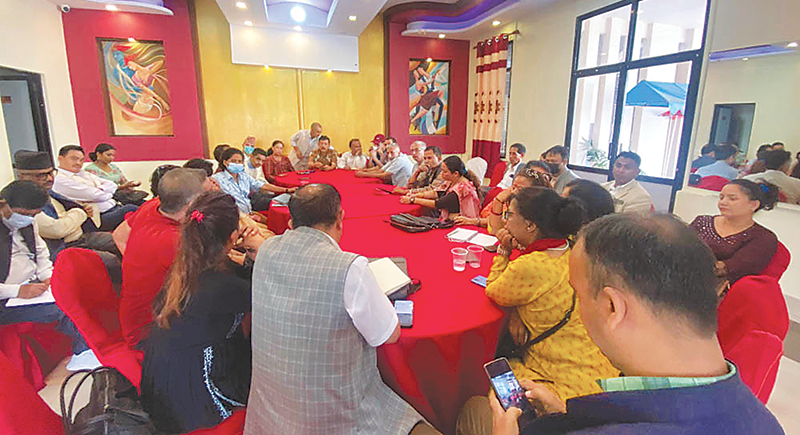
The Nepali Congress central work executing committee met briefly on Saturday.Post Photo
KATHMANDU : Hours after a meeting of the central work executing committee of the Nepali Congress entrusted party President Sher Bahadur Deuba with the task of nominating party candidates for the November 20 general and provincial elections, the rival camp led by Shekhar Koirala decided to seek 40 percent seats for its supporters. The Koirala camp held a separate meeting on Saturday and concluded that since Deuba, since his election as the party president, has been taking almost all decisions unilaterally, there’s a need to call for a justifiable seat distribution. There are 165 seats under the first-past-the-post (FPTP) system and 110 under the proportional representation (PR) system for the House of Representatives. For the seven provincial assemblies, there are 330 FPTP seats and 220 PR seats. The Congress is already under pressure when it comes to seat-sharing as its coalition partners are demanding at least 80 seats under the FPTP category. The Congress has been eyeing at least 99 seats for itself while the remaining 66 would go among the coalition partners. The five ruling parties have formed an 11-member task force to work out seat-sharing arrangements. But the task force has failed to form the modality. Congress leaders say the leadership is set to come under more pressure with the rival camp upping the ante. The Koirala camp is increasingly worried that its leaders could be left out as Deuba may agree to cede some more seats to the coalition partners for the fear that they could desert him. “That’s why the rival camp has decided to demand at least 40 percent seats for them,” said Guru Raj Ghimire, a Congress leader. The Congress is aiming for a majority, or close to majority seats, by contesting in 99–100 constituencies. If it can win 75–80 constituencies, the party stands a good chance to form a government even without the CPN (Maoist Centre). The Maoist Centre, hence, is in a bid to stop the Congress from winning majority seats. Arjun Narsingh KC, a senior Nepali Congress leader, said even 99–100 seats won’t be enough for the Congress. “But we should not cede more seats to the coalition partners than 65–66,” KC told the Post. “Within the Congress also, seat-sharing is a big issue.” At the Koirala camp’s meeting on Saturday, according to participants, some leaders expressed concerns that eligible and strong candidates of their camp might be barred from contesting the elections in the name of the alliance. “We were of the view that we need to be careful and seek 40 percent seats for our camp from the establishment,” said Ghimire. “If the tickets are distributed in an unfair manner, we will go for a struggle. The party president is taking decisions unilaterally.” Earlier in the morning, the central work executing committee was scheduled to discuss various issues including seat-sharing among coalition partners and between the two camps in the party. But a decision to task the party president with selecting candidates was swiftly endorsed, according to leaders, much to the chagrin of the rival faction. Multiple leaders said Deuba barely attends party meetings and decisions are being taken without taking into consideration the challenges the party faces. Though the coalition partners have decided to stick with the Congress for elections, they are working on their own sub-alliance also, which Congress leaders say is a cause for concern and the party needs to maintain unity to fight various such challenges. Coalition leaders say though the Congress has been saying it will contest in 99–100 constituencies, it will settle for 80. On Saturday, while speaking at the party’s Standing Committee meeting, Maoist Centre chair Pushpa Kamal Dahal said that the Nepali will be convinced with 80 seats, letting the partners keep 85 seats. Some leaders at the meeting suggested that in the last elections of 2017, the party had shared seats with the CPN-UML in the 40:60 ratio so this time too, the party should not agree to less than 40 percent seats, according to one standing committee member. That will mean 66 seats for the Maoist Centre alone and a huge reduction in the number of seats for the Congress. According to some Congress leaders, if those deserving to contest are excluded, they are likely to contest as rebel candidates and won’t support candidates from the ruling coalition. “In that situation, the CPN-UML may benefit,” said a Congress leader. Some political analysts say the Congress is bracing for a large-scale discontentment if it has to compromise on 80 seats by leaving 85 for coalition partners. Sri Krishna Aniruddh Gautam, a political analyst, said Deuba, however, doesn’t seem to be bothered as long as he gets the support of the Maoist Centre. “After all, no one asked for his resignation when the party faced drubbing in the last elections,” said Gautam. “The same leaders and cadres have reelected Deuba as party president. So who will launch a mutiny?” According to Gautam, leaving more seats for others would do more harm to the Congress than good. “Local election results have increased the confidence of the Maoist Centre and the smaller parties. That’s why they have increased their bargaining power,” said Gautam. “Deuba is compelled to entertain the communists for the fear of a left alliance and any other possible political fallout.”
HOME PAGE
Maoists lack office bearers—8 months after convention
Party chair Dahal delaying in selecting them as it helps him assert his authority and impose decisions, insiders say.
- TIKA R PRADHAN
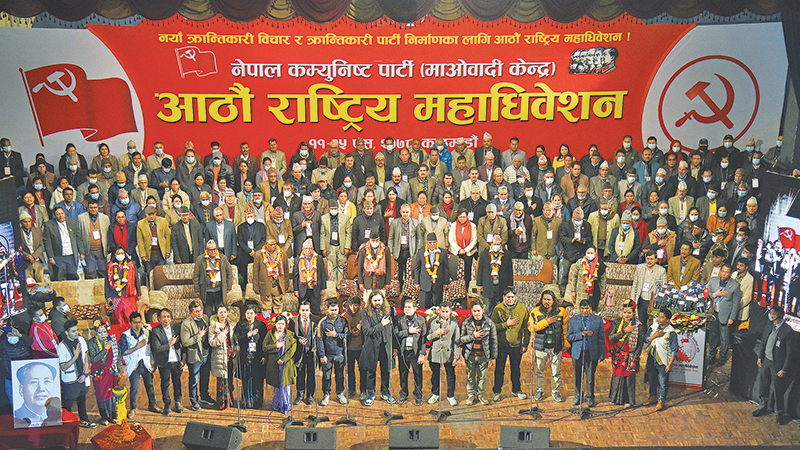
Maoist Centre insiders say collective decision making is lacking in the party.Post file Photo
KATHMANDU : More than five weeks after the Central Committee meeting and eight months after the eighth national convention, the CPN (Maoist Centre) has yet to pick its office bearers. The Central Committee meeting concluded on July 7 gave the full shape to the party’s 377-member Central Committee, 125-member politburo and selected 15 members for the 41-strong Standing Committee. Maoist chair Dahal, however, has shown no interest in selecting 15 office bearers. Insiders say the party chair prefers taking decisions on his own, rather than putting the issues for sorting out collectively. The party has to elect a senior vice-chair, six vice-chairs, a general secretary, two deputy general secretaries, three secretaries and a treasurer. Insiders say Dahal is under pressure to “manage” leaders as there are many aspirants for 15 office bearers’ posts. Dahal himself has admitted the same. On Saturday, while addressing the seventh annual general meeting of the Post Bahadur Bogati Memorial Academy, Dahal said a section of leaders has lost faith in the ideology, behaviour, policy and leadership appropriate for the party. “The challenge now is to manage leaders; this is my greatest challenge today,” Dahal said. “If we can manage leaders and establish a unified leadership there is no problem with the people.”
During the Standing Committee meeting held on Saturday, Dahal didn’t talk much about the office bearers and giving full shape to the Standing Committee. “Dahal seems uninterested in electing office bearers anytime soon,” said a Standing Committee member. “If the process of electing the office bearers doesn’t begin in the next meeting scheduled for Monday, it may not happen before the November 20 polls.” The leaders said Dahal doesn’t want to spoil the environment for polls by deciding on office bearers. The party has mandated Dahal to pick office bearers and give the full shape to the Standing Committee. The general secretary is a key post in the party and the chairman is in a fix over who to appoint, say insiders. While Dahal’s choice is Barsha Man Pun, Janardan Sharma too is staking claim to the post. Now both have built their own supporters. Party leaders said on Saturday that they won’t vote only to elect the general secretary because if an election is necessary, all office bearers should be elected. “The situation has got complicated as the party chair doesn’t want an election of office bearers,” said Chakrapani Khanal, a Standing Committee member. “Today our meeting only focused on the upcoming elections. If the party chair fails to announce the office bearers at the next meeting, we will have to wait until the elections are over.” An election for party positions is not a thing in the Maoist Centre. Dahal has been leading the party for over three decades by imposing himself as its chairman. During the eighth general convention held eight months ago, Dahal got himself installed as the party chair and his document endorsed. Insiders say collective decision making is lacking in the party. All major decisions including on endorsing the Millennium Challenge Corporation and citizenship amendment bill as well his recent India and Japan visits and selection of party ministers were taken by Dahal himself, which were then presented to the meeting of former Standing Committee members, insiders say. Dahal has already announced Narayan Kaji Shrestha as the senior vice-chair, for which Matrika Yadav too was vying. “Whatever the result, I have told the party chair that I will contest for the senior vice-chair post,” said Yadav. “But Dahal has said he will present his list at the Standing Committee and those who want to contest the polls can go for it.” Political commentators say Dahal is unlikely to select office bearers before the upcoming polls. “Actually Dahal doesn’t want to give the most powerful position after him to any other powerful leader like Janardan Sharma and Barshaman Pun,” said Mumaram Khanal, a former Maoist leader and political commentator. “He knows that if unified, Sharma and Pun can challenge his authority as the leaders of Rolpa and Rukum have got more chances to remain in power.” According to Khanal, if Dahal indeed wanted to appoint office bearers, he would have done so long ago. Dahal, who has served as prime minister twice, aspires to become prime minister at least one more time and he has made his intentions clear. From the local elections, the party has emerged as the kingmaker and he sees a good chance of leading the government—for a longer period of time compared to his earlier stints which lasted ten months or so. Analysts say Dahal fears that selecting office bearers at this time may affect the party’s poll prospects and subsequently his chances of becoming prime minister. “At this time, he will delay selection of office bearers, saying conflict among the leaders could affect polls,” said Khanal. “Dahal will settle this issue only after analysing the possible power equation after the results of the November 20 polls.”
HOME PAGE
Talk aims bringing Butwal yarn factory out of mothballs
Once Nepal’s largest spinning mill, it shut down more than a decade ago after being crippled by mismanagement.
- GHANASHYAM GAUTAM
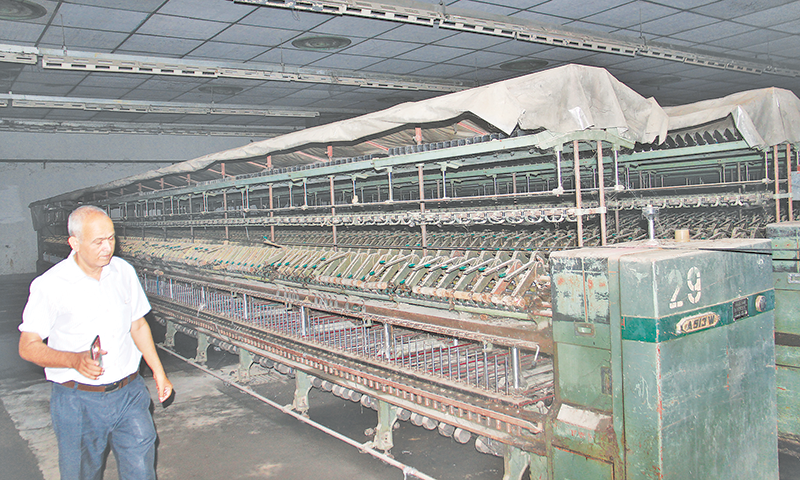
Most of the machinery of the plant has got ruined.Post Photo: GHANASHYAM GAUTAM
RUPANDEHI : The federal and provincial governments have revived talk of bringing Butwal Dhago Karkhana out of mothballs, but observers are sceptical as successive administrations have been saying so for more than a decade. Once Nepal’s largest spinning mill, Butwal Dhago Karkhana shut down amid a flurry of closures of varied state-owned enterprises crippled by mismanagement and political interference. Krishna Dhwaj Khadka, minister for economic affairs and cooperatives of Lumbini Province, said discussions were underway to reopen the iconic factory located in south central Nepal. “It has not been decided whether to give it to the private sector or operate it through a public-private-partnership model,” he said. “Discussions are going on with the federal government and the private sector.” Khadka claimed that a decision would be reached only after extensive deliberations. He said that if the government green-lights the plan, the federal government would prepare a procedure to operate the sick industry by bringing the private sector on board. Butwal Dhago Karkhana was established in 1983 with the objective of exporting yarn and thread to the international market. The mill started production in 1991; but within a decade, it had gone belly up. Unions and employees attached to various political parties ran it into the ground with their endless strikes and interference. After Nepal suffered a severe power shortage resulting in hours of rolling blackouts nationwide, the company pulled down its shutters for good. The buildings and equipment costing millions of rupees are in a dilapidated state. The machines have developed rust. The government established the factory with a plan to cultivate cotton in Nepalgunj, produce thread in Butwal and manufacture cloth at Hetauda Textile Mill. Soon after opening, the company was plagued by political interference. Political appointments, corruption and mismanagement became the order of the day. The factory’s losses started piling up, and it sank neck-deep in debt. It could no longer pay its employees with the revenues from producing and selling its goods. The company eventually fell apart. In 2003, the government leased the factory to Salt Trading Corporation, another state-owned company. But it too pulled out after a year. The factory’s management was then taken over by the Reliance Group, a private conglomerate. It ran the factory till mid-March 2008. Unable to control ballooning debts, the government decided to give compulsory retirement to all its workers in mid-September 2009. It has retained four people to look after the property. The factory contains six large buildings on 143 ropanis in the Butwal Industrial Zone. The buildings with a floor area of 23,000 square metres are now covered in cobwebs. During the rainy season, the machines are submerged in water because of leaks in the roof. Around 56 big machines used to produce yarn have rusted. A year ago, Shankar Pokharel, then chief minister of Lumbini, had decided that the provincial government would run the factory again. Next, Leela Giri, the minister for industry, tourism, forest and environment, pledged to revive the factory. But nothing happened. Chief Minister Kul Prasad KC has also announced that the government would resurrect the factory. But there was nothing in the provincial budget to carry out the promise. The policies and programmes of the federal government for this fiscal year announced by Finance Minister Janardan Sharma too have mentioned that the necessary policies would be formulated to operate Butwal Dhago Karkhana. But there was no budget allocation. Most of the industry ministers of the federal government have visited the factory. A succession of industry ministers, namely Anil Jha, Karna Bahadur Thapa, Mahesh Basnet, Som Prasad Pandey and Nabindra Raj Joshi, have inspected the mill. But the outcome has been zero. A team led by Baburam Gautam, joint secretary of the Industry Ministry, completed a field study recently. Dolraj Sharma, chief of Butwal Dhago Karkhana, said that the factory was not operable in its current situation. “It needs a complete makeover with modern technology.” The factory had more than 700 employees in its heyday. When it closed down, it had laid off 450 permanent employees. Baburam Bohra, former president of the Rupandehi Industry Association, said that “false assurances” had been coming from the government all the time. “One of the country’s big factories and its machines have turned into wreckage.” In 2013, the Industrial Board submitted a report to the government suggesting that the mill could be handed over to the private sector. But that suggestion too was not implemented. Butwal Dhago Karkhana was established under a public-private partnership model. The factory had investments from the government, Khetan Group, Salt Trading, Birgunj Sugar Mill, Himal Cement, Janakpur Cigarette Factory, Nepal Industrial Development Corporation and the public. The government holds 59.75 percent of the stock, corporations have 18.5 percent, Khetan Group 13.4 percent, Salt Trading Corporation 8.3 percent and the general public the remaining shares. At the time of establishment, the factory had an authorised capital of Rs600 million, issued capital of Rs450 million and paid-up capital of Rs370 million. Of the total investment, Rs30 million was public capital. Ujjwal Kasaju, president of the Butwal Chamber of Commerce and Industry, said that it would not be possible to operate the factory under the old modality. “The public share has not been finalised, the old employees may go on strike again,” Kasaju said. “There are no details of the factory’s shareholders either.” Kasaju suggested that instead of reviving the yarn factory, a new textile mill would be appropriate because of the current market demand.
The factory had more than 700 employees in its heyday. When it closed down, it had laid off 450 permanent employees.post photo
NATIONAL
Mountain districts face shortage of rice
The shortage is caused by delay in the transportation of grains by the contractors, officials say.
- RAJ BAHADUR SHAHI,DB BUDHA
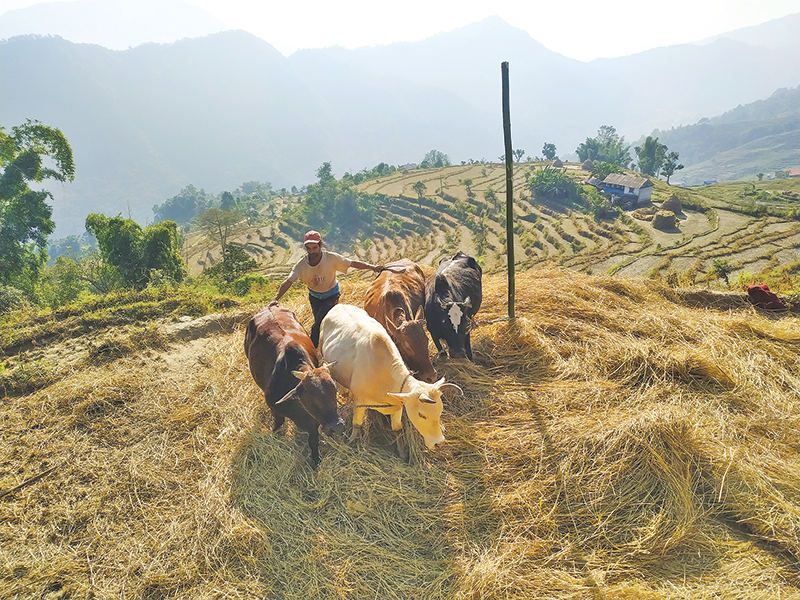
People in mountain settlements depend on food supplied from lower regions.Post file Photo
Food depots in the mountainous districts of Mugu and Jumla are running short on rice grains. Locals said the shortage has continued for the last two months. Jaimati Lavad, a resident of Chayanatha Rara Municipality-13 in Mugu, said that while the grains they harvest from their fields do not even last for six months, local traders charge an exorbitant price for the staple food. “We have to take loans to buy rice and that also does not seem to be an option right now,” Lavad said. Warehouses run by the Food Management and Trading Company Limited have 325 quintals of rice in stock in Jumla and 700 quintals in Mugu, officials said. But the stock is for emergency use only and not for sale, they said. This has forced the locals to buy rice from local traders at an exorbitant price. Harak Singh Budha, a resident of Soru Rural Municipality-7 in Mugu, said he had to pay Rs 2,200 for 25 kg of rice at the local trader’s. “I could buy the same amount of rice at Rs 1,500 from the depot,” he said. Officials at the company said shortage of rice in the two districts was caused by a delay in the transportation of rice grains by the contractors. Pushkar Bham, information officer at the company, said that the contractor transported only 8,000 quintals of rice to Gamgadhi in the last fiscal year, in contrast to a demand for 11,000 quintals. “Even Gamgadhi has only 700 quintals of rice in the warehouse for emergency situations,” he said. Ratapani and Kalai food depots in Mugu have also remained closed for a long time. Kamal Shahi, a local of Jima village in Soru Rural Municipality-6, said the shortage of rice has led to difficulties in their daily lives. “We don’t even have rice grains to be used for religious purposes,” Shahi said. Kalai, which has around 400 households, suffers from food insecurity. The local food production—mainly wheat, maize and millet—hardly lasts six months, say locals. In Mugu, the Food Management and Trading Company Limited has allocated 11,000 quintals of subsidised rice to Gamgadi, 1,000 quintals each to Soru, Shreekot and Pulu depots of Mugumkarmarong Rural Municipality for this fiscal year. Tsering Cyapne Lama, chair of Mugum Karmarong Rural Municipality, said that the villagers are facing major food issues because of the shortage of rice at the depot. The residents of Soru, Khatyad and Mugum Karmarong have not been able to get rice grains for even birth and death rituals as there is no rice in the local depot, he said. At Sarkegad and Shreenagar depot in the neighbouring district of Humla, contractors have been selling rice by themselves as there are no employees. “There are no employees at the depot, and contractors sell government rice at hiked prices,” said Lama. According to Nirmal Bista, head of the Jumla branch of the Food Management and Trading Company Limited, there are only 325 quintals of medium rice in Jumla. Similarly, 100 quintals of Basmati rice are kept for emergency situations. The quota of rice for Jumla has been set at 6,000 quintals for this fiscal year. Out of which, 1,300 quintals are sent to depots in Dolpa. “Every February, we ask for more rice. This time, the government increased the quota by 2,500 quintals of rice. But the contractor has not delivered the shipment yet,” said Bista. According to the company, 40 to 50 customers come to the depots daily to buy rice. But all of them return empty-handed. “We don’t have enough rice to sell. We are waiting for the additional 2,500 quintals to arrive,” Bista said. Khadka Construction Services has the contract to transport rice to the mountainous districts this year. Mugu faces food shortages almost every year, as the designated contractors do not transport rice on time. The Nagma-Gamgadhi road, which connects Mugu with the national road networks, is often blocked by snowfall in December, January and February, and during the monsoon season disrupting the transportation of essential goods to the district. The Karnali region sees a lot of discrepancies in the supply, management and sale of rice. In October 2020, police seized a truck carrying 250 kgs of subsidised rice at Subbakuna Check Post in Surkhet. The consignment meant for Mugu was headed to Bhaktapur in Bagmati Province. Subsidised rice is transported to various districts of Karnali from Surkhet, Nepalgunj, Dang and Dhangadhi through air and land. Some contractors even transport rice to Karnali from Bajura and Bajhang districts of Sudurpaschim Province.
NATIONAL
Government invites victims of loan sharks to register complaints
- POST REPORT
KATHMANDU : The government has called on the victims of loan sharks all over the country to register their complaints at their respective district administration offices by August 21. Issuing a statement on Saturday, the Ministry of Home Affairs said although there have been such complaints from most of the districts of Tarai, a call has been made to loan shark victims all over the country to register complaints so that such unscrupulous loaners can be brought to book. The process of bringing such financial criminals to book is also underway, but still, many victims have not been able to speak up about the exploitations by loan sharks or seek legal remedies, reads the statement. The Home Ministry on Friday formed a task force to study the situation of the victims, how loan sharks are operating and how such crimes can be controlled.
NATIONAL
‘Nepal has strong laws for LGBTQI+ groups but there’s gap in implementation’
US special envoy to advance human rights of LGBTQI+ community opens up about her Nepal visit and key takeaways.
- Post Report
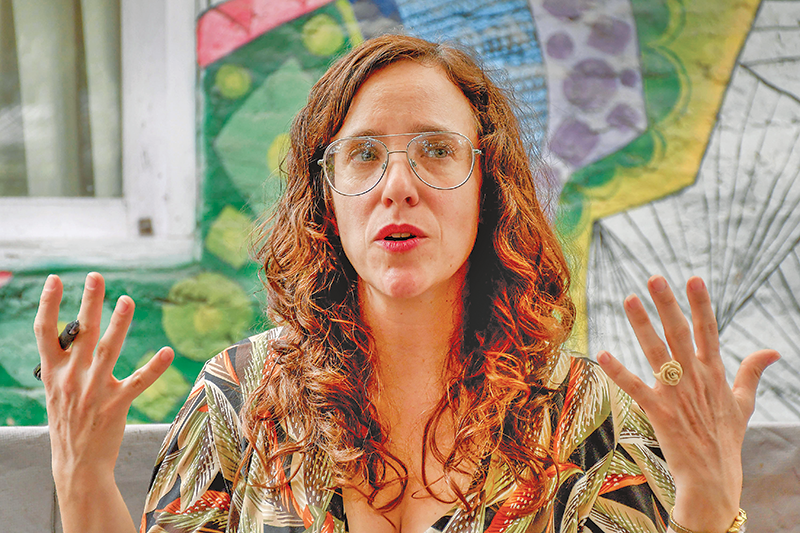
United States special envoy Jessica Stern.Post Photo: Anish Regmi
Jessica Stern, the United States special envoy to advance the human rights of Lesbian, Gay, Bisexual, Transgender, Queer and Intersex (LGBTQI+) persons, is in Nepal to take stock of the situation of the sexual minorities in the country. During her visit, she met with government officials, human rights activists and members of the LGBTQI+ community and discussed the efforts being made towards protecting and strengthening the human rights of the community. Prior to joining the State Department, Stern led OutRight Action International, a leading global LGBTQI+ human rights organisation, as its executive director for 10 years. Before she wrapped up her five-day stay in Nepal, the Post’s Binod Ghimire spoke with Stern to learn about her reading of the status of the community and what message she is taking home from here. This interview has been condensed for clarity.
Could you explain what role you have as President Joe Biden’s special envoy? Special envoys of the US government generally focus on particular thematic issues. We have special envoys working in racial equity and justice, disability rights, women’s freedom, religious freedom, climate change and there’s my role as a special envoy to advance the human rights of LGBTIQ+ people. I have many roles. I was appointed by President Biden in June 2021 and I serve as a lead on foreign relations policy as related to LGBTIQ+ issues in ways that influence everything from the issues we prioritise at the multilateral level like in the United Nations to human rights concerns we raise at a bilateral level with other governments. I set the policy direction in our main grant-making mechanism for LGBTIQ+ rights around the world. I consider it my obligation to listen to the LGBTIQ+ people around the world and also try to organise resources to help them because the LGBTIQ+ people everywhere deserve equal legal rights.
You had long been a rights activist with Amnesty International and Human Rights Watch. Now that you take government responsibility, are there differences as regards the pursuit of human rights? I think I am better as a government official because I spent so much of my career as a human rights defender. The reason is I know community-based organisations. When something happens like a bad law is introduced in parliament somewhere in the world and the US government wants to know how to respond, I contact LGBTIQ+ organisations, human rights organisations and I ask for their advice. That matters because human rights orgnaisations and the LGBTIQ+ people know how hard to push, when to push and why to push. The governance is better when we listen to civil society organisations.
What is the purpose of your visit? One of the opportunities I have as a special envoy is to identify the best practices on the LGBTIQ+ rights. There is not a country on the planet where there is no discrimination against these people. With that in mind, the question is how can we accelerate the pace of change. What the policies and programmes the governments should invest in so the LGBTIQ+ community, for example, can enjoy citizenship rights. Nepal has been the vanguard in terms of recognition in the constitution and seminal Supreme Court decisions. In fact, the US government can learn a lot from some of the firm legal arrangements of the government of Nepal. However, there is always a gap between the promise of the law and their implementation. I came here in part to learn how the US government can support LGBTIQ+ people in Nepal to make sure that they can live their best lives. Unfortunately, I heard from them that there is a long way to go. Also, the US has a very strong bilateral relationship with Nepal and it is always interested to support the LGBTIQ+ community here and the Nepali people in general.
What were the concerns raised by the LGBTIQ+ people in your meetings? I have been here for a few days and I have met around 50 people from the community where I heard a broad range of issues. I heard that the transgender people still experience high level of discrimination and violence and it is very difficult to change the citizenship documents. Without access to legal documents it’s hard to get a job, housing and it’s hard to get respect. I heard the lesbian and bisexual women are so invisible that they deal with very severe discrimination and violence and I heard about victims of homophobia and sexism. Forced marriage, unfortunately, is a consequence for most of them. I heard the people want the rape law to be expanded because any person of any gender and sexual orientation can be the victim of rape. I also heard that LGBTIQ+ people in Nepal want equal marriage, they want to be able to adopt children and be recognised as parents.
Did you raise the concerns of LGBTIQ+ people during your meetings with government officials? I emphasised, during my meetings with the government officials, that we have respect for the government as we have learnt from the laws ensuring equality to LGBTIQ+ communities. The governments from two countries need to learn together about supporting the LGBTIQ+ people. I am also here to learn so that we can do better ourselves in the US where discrimination persists at different levels. The US is not perfect; we have many problems. What the people from LGBTIQ+ community in many parts of the world say to me is they want to be more like Nepal. Nepal is a beacon of hope in this region in having equal laws. One of the reasons I came to Nepal is because it is a symbol of hope. Nepal is a leader in these issues.
What support is the US government providing to LGBTIQ+ community in Nepal? The most important form of support we can give is by having relationship with the community, listening to their concerns and supporting to elevate their priorities. We have long been supporting LGBTIQ+ and youth programmes. The support is in different forms. Yesterday (Friday), the US embassy marched in the Gaijatra parade but I didn’t see other government delegations there. The Blue Diamond Society and organisations said it always matters in having recognitisation from the government. A part of support we are extending is listening to LGBTIQ+ community seriously and showing solidarity.
What message are you taking home as you wrap up your Nepal visit? I am leaving with a lot of hope. Yesterday (Friday), when I was at Gaijatra, the minister for women, children and senior citizens delivered fiery remarks supporting the LGBTIQ+ community. I met with countless LGBTIQ+ organisations here. They are strong and smart. There are wonderful allies who try to support the LGBTIQ + people. I am leaving with confidence that LGBTIQ+ people exist in Nepal, they are changing Nepal and more Nepalis view them as valued ones.
NATIONAL
BA.5 subvariant responsible for most of new Covid infections
Eight of the 14 swab samples analysed at Dhulikhel Hospital were infected with the subvariant. Experts stress the need to increase booster shots uptake.
- Arjun Poudel
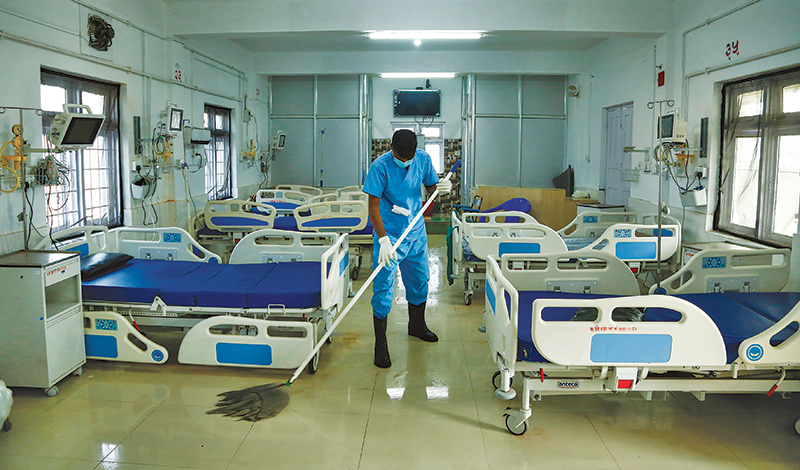
The fourth wave of the pandemic has seen fewer hospitalisations than the previous waves.Post file Photo: Praksh C Timilsena
KATHMANDU : The BA.5 subvariant of Omicron has been found mostly responsible for the spread of infections in the ongoing fourth wave of the coronavirus pandemic. A whole genome sequencing carried out at the Dhulikhel Hospital found the subvariant in swab samples of around 60 percent of the infected people. The subvariant was detected in eight out of the 14 swab samples of infected people selected randomly, doctors at the hospital said. The rest of the specimens were found to be infected with the BA.2.75, another subvariant of Omicron, according to Dr Rajiv Shrestha, an infectious disease expert at the hospital. Whole-genome sequencing is a comprehensive method of analysing the entire DNA sequence of an organism’s genes. Researchers believe that whole-genome sequencing of the coronavirus could be instrumental in tracking the severity and nature of the virus. In Nepal, five health facilities, including the Dhulikhel Hospital and National Public Health Laboratory, carry out the procedure currently. The Ministry of Health and Population has already confirmed the BA.5 subvariant of Omicron in Nepal, which dominates the global caseload at present. Infection of the BA.2.75 Omicron mutant that can evade immunity has also been recorded in the country. Doctors say the spread of BA.5 subvariant is concerning as its mutations evade the immune system even in fully vaccinated or previously infected people. “The new subvariants are more infectious than the previous variants,” Shrestha said. “Only the vaccination and previous infection have protected us from getting more severe. If that was not the case, severity from infection wouldn’t have been less than the Delta outbreak.” The Delta variant of the coronavirus first detected in India caused the second wave of the pandemic which killed at least 8,000 people and infected hundreds of thousands throughout the country. Along with the BA.5 and BA.2.75, several other subvariants—to name a few, BA.2.73, BA.2.12.1, BA.2.38, and BF.1—have been detected in swab samples of infected people in the past. On Saturday, two died and 263 people tested positive for coronavirus—162 in 1,399 polymerase chain reaction tests and 101 in 1,766 antigen tests. Active cases stand at 5,434 in the country. Of them, only 206 have been placed in institutional isolation. No authority has been monitoring health conditions and movement of the rest of other infected people. The Health Ministry said that 61 people have been admitted to the intensive care unit; four others, whose conditions are severe, have been placed in ventilator support. Of the 37 swab samples that underwent polymerase chain reaction tests at Nepal Mediciti Hospital, 17 tested positive. Despite high positivity rate and spread of infections, authorities have not shown concern to intensify testing, contact tracing, and taking other preventive measures, say health experts. The National Public Health Laboratory, which has the capacity to carry out over 3,500 polymerase chain reaction tests a day, performed a single test in the last 24 hours. “When we do not carry out testing and take other preventive measures to prevent the spread of infection, then what is the point of saying these numbers of people get infected daily,” said Dr Sher Bahadur Pun, chief of Clinical Research Unit at Sukraraj Tropical and Infectious Disease Hospital. “When we carry out less testing and unveil the data, it could mislead people. People might think that the level of risk has declined when they know the number of infected people has lessened.” Experts urged authorities concerned to focus on administration of booster shots, if they cannot take other preventive measures, including increasing testing, contact tracing, and enforcing public health measures, among others. “Vaccine prevents severity and lessens the chance of deaths. This is a proven fact and the number of people administered with booster shots is very low in our country,” said Dr Anup Subedee, an infectious disease expert. “Authorities concerned should make every effort to increase uptake of booster shots.” So far, 74,24,239 people or around over 25.5 percent of the total population have received booster shots. Doctors say among the reasons for low uptake of booster shots are indifference of authorities concerned to launch the booster dose administration programme, launch awareness drive, and lack of access to immunisation centres. The Health Ministry concedes that over 75 percent of the total deceased in the fourth wave of pandemic are unvaccinated people, meaning that subvariants of Omicron are not less severe than other variants. The Health Ministry does not even have proper records of the unvaccinated people or the records of vaccinated people on the basis of the brand of vaccine they received. Subedi said that it is imperative now that authorities concerned focus on increasing booster shots uptake. “They should also think of administering second booster shots to elderly people and to those having compromised immunity,” he said.
NATIONAL
Madhes government announces protest over delay in police adjustment
Internal Affairs Minister Bharat Shah says the first phase of the sit-in protests will start on Sunday and go on for a week.
- Post Report
KATHMANDU : The Madhes government has announced a protest against the federal government demanding immediate adjustment of police force. Organising a press conference in Janakpur on Saturday, Minister for Internal Affairs and Communication Bharat Prasad Shah said that the Madhes government is launching the first phase of its protests. “We will organise a sit-in protest in front of the provincial chief’s office for two hours every day for a week as part of our first phase of protests against the federal government,” Shah told the Post. “If the federal government remains indifferent towards our demands for a week, we will begin the second phase of our protests.” The protests, according to Shah, will begin on Sunday with a sit-in starting at 11am and see participation of ministers of the Madhes government, members of the provincial assembly and civil society members and intellectuals. Despite the continuous demand by the provincial governments that the police force be adjusted immediately, the federal government has not done so because of which provinces are facing problems. Earlier on July 7, internal affairs ministers of all the seven provinces had issued a seven-point declaration including their demands for early adjustment of the police force. In the second week of July, the internal affairs ministers met all major leaders of the ruling coalition and set a mid-August deadline to adjust the police force. The federal government, however, is unlikely to adjust police force as general and provincial elections have already been announced for November 20. Earlier, when provinces were demanding adjustment of the police force, Home Ministry officials looking into the matter said all preparations had been completed. The federal government has already taken control of security arrangements of the three districts of Kathmandu Valley—Kathmandu, Lalitpur and Bhaktpur—by amending the existing laws despite controversy, as even ruling party lawmakers saying the move would breach the constitution. The constitution says that the responsibility of the security of the province falls under the provinces. Kathmandu Valley falls under Bagmati Province. Minister Shah said the leaders in the federal government had told the internal affairs ministers of the provincial governments that it is difficult to adjust police before the polls, promising to complete the process after the polls. Conflict is set to escalate as the provincial governments want police adjustment before the November 20 polls while the federal government wishes to delay it until the polls. The Madhes government was the first among the seven to bring provincial laws related to provincial police law. Other provinces then followed suit. Madhes Province has been taking the lead in creating pressure on the federal government to provide their due rights guaranteed by the constitution. Currently, the Madhes government is led by a coalition of the Janata Samajbadi Party, the Nepali Congress, the CPN (Maoist Centre) and the CPN (Unified Socialist). Madhes provincial assembly had endorsed the provincial police bill on October 11, 2018 but even almost four years after the law, the provincial government has not been able to enjoy its constitutional rights yet. Schedule 6 of the constitution gives provincial governments authority to have their own police forces. But again, the federal government has shown no urgency to implement the federal police laws. Article 133 of the constitution says that any law enacted by provincial governments will be void if it is inconsistent with any federal law. Article 268(2) of the constitution states that each province will have its own police force. Clause 3 of the article says that matters relating to the operation, supervision and coordination of functions to be discharged by the Nepal Police and the provincial police shall be as provided for in the federal law. The Gandaki Provincial assembly had endorsed its provincial police bill in October 2020, paving the way for the provincial government to form its provincial police force.
OPINION
Search for themes for books
Nepali writers too have written about their experiences, but only a few merit attention.
- ABHI SUBEDI
I returned with an armful of Nepali books after attending what was called a “book launching” programme recently. They were supposed to be literary books basically. None of the books were written about the current themes that are rife today. That is a trend. Here I would like to briefly allude to this phenomenon of handling diverse themes for writing books in Nepali. I have in mind a selection of Nepali books published in contemporary times. They are said to be contemporary works. Anyway, the writers confidently declare the genre of their writings as literary though this subject demands some careful and informed discussions. Whatever may be the case, these books are eloquent about a number of things. Most important of them is the choice of themes for book writing. Elaborating on a particular subject in different chapters makes up a book. That is the simplest description of a book. In some of them, I also sensed an attempt to galvanise the current topics of discussions about Nepali social and political orientations. I could see an intelligent choice of themes for that kind of interdisciplinary endeavour by some of the writers. They were touching the contact zones of literature and opinions. But all of them have not done so successfully for various reasons not least the writer’s limited range of study.
Interpreting themes To dwell a little more on the theme of book, I want to recall what my favourite writer and theorist the late Italian Umberto Eco says about books in an interview with The Guardian in 2011. He says, “I think a book should be judged 10 years later, after reading and re-reading it.” But the books I am trying to allude to do not need that description. I am only trying to see what kinds of themes and subjects have attracted book writers over the years. I am only shuffling through the themes and areas of interest. They show how the writers have chosen both introvert as well as social and cultural themes for their book writings. I want to briefly return to the history of the political change and book writing in Nepal. I am alluding to the period after the fall of the Panchayat system introduced by the late king Mahendra, in 1990. The euphoria of the mood of victory opened up many fronts for expression. A review of history was the most dominant mood. Panchayat had so strongly dominated the thinking process and the psyche of interpreting history that writers, especially historians and political analysts, turned to the personas of the politicians or leaders of the democratic movements, living or dead. Writing about the lives of these leaders as well as making documentary films became the order of the day. I cannot discuss this topic in greater detail here. The oeuvres about BP Koirala, which included his own writings, Ganesh Man Singh and Pushpa Lal, that included his own writings, formed the main corpus of such books. BP’s memoirs, diaries and fiction came out in droves, as it were. During this euphoria, some of the Panchayat-time bureaucrats and soldiers too jumped on the bandwagon. A non-political person, I too was connected with the moments of the publication of some such books. A slim but important collection of Girija Prasad Koirala’s historical speeches entitled Simple Convictions (2007), nicely edited by Kanak Dixit, was published by Madhab Lal Maharjan of Mandala Book Point. I was invited by Kanak and Madhab to speak about the book at the Hotel Yak & Yeti on February 1, 2007. I freely interpreted Girijababu’s works, his life and politics in a very informal manner that the audience greeted with ovation and laughter that I can see on the video today. By inviting a literary writer, not a political scientist, to speak about the oeuvre of a politician whose interest in literature is not recorded anywhere, they wanted to flaunt some established rules there. Prime Minister Koirala could not attend. The following year, a similar pattern was repeated. I was invited by the publisher and the writer to give a keynote discourse at the launch of a book entitled Prachanda: The Unknown Revolutionary (2008) written by Anirban Roy, a Hindustan Times journalist and published by Mandala Book Point at the Hotel Himalaya on September 19, 2008. While waiting for the prime minister to come, I was alone with Prachanda’s father, a simple farmer named Muktinath, on the dais. He was the first person to listen to my review of his son’s book that morning. Prime Minister Prachanda could not attend. I am alluding to these two incidents for their interesting parallelism. I did not have to speak on such books after that. The political leaders themselves took up the task of speaking about any person in their party. No political scholar, let alone a literary writer, appear to be invited to speak on such books, if any.
New mode and mood For lack of space, I do not want to review the literary works that were written after the second revolution and the time after that. But after all these years, a new mode and mood of writing and publication of books has become the order of the day. It has shifted from the mood of valorising the personas of the so-called big politicians. Perhaps people are disillusioned about them. It has yet to be established though. When you realise that there are no politicians or heroes to turn to, you would turn to yourself, to the memories of your own toil and moil. Most of the books today are written by the writer himself or herself. But some of them are written by ghostwriters that are openly mentioned in some books. Several books today are written about the experience of migrant workers. One strong point of such writings is that people want to transfer the experience into text. Such practice has two advantages. The first advantage is that such an impersonal form of art heals your wounds and disturbing memories. I consider that a great achievement. The second advantage is that you are peeping into the present history by means of the metafictional accounts of your experience. A fuzzy line separates fiction from reality. There are examples of literary writings that have created the very power of the events of history. For that, your contemporaneity plays a role. Saadat Hassan Manto’s stories are the most eloquent examples. He writes about the human condition created by the partition history of India. But he was moving around the periphery of such a historical experience. He himself suffered from that turbulent border experience for which reason, reluctantly, he had to leave Bombay where his creative engagements were flourishing. Nepali writers too have written about their experiences, albeit a few of them have produced works that merit the attention of avid literary readers. This theme needs elaborate discussions.
OPINION
Handwritten versus digital diaries
Handwritten diaries may feel old fashioned, but they offer insights that digital diaries just can’t match.
- PAULA VENE SMITH
The first time I taught a college course called The London Diary for young Americans studying abroad back in 2002, each student ended up with a tangible book of memories, a handwritten record of their semester in London. But when I taught the course 15 years later, the first question my students asked was whether they could keep their journals online. The question brought home to me how the image of a diary has shifted from words scribbled in a blank book to images and digital text on a screen.
Why not go digital? Even while journaling apps like Penzu and Diaro become more widely available, estimates and surveys suggest that a sizable number of the world’s diary keepers still keep handwritten diaries. Fans of digital diaries grant them an edge in convenience, portability, searchability and password protection. Jonathan, one of my 2018 students, described in an essay for class how digital diarists can upload entries to multiple platforms, keeping some portions offline or restricted to a select audience while other parts go completely public. It’s harder to control distribution, encrypt entries or build an index with a journal kept on paper. I already expected my students to use electronic devices to read course materials, to communicate with me and with their families back home, to write essays for class, and to navigate London. Why not let them keep digital diaries, too?
Diary as artefact Poet and literary scholar Anna Jackson was researching the private papers of novelist Katherine Mansfield for her book Diary Poetics when she made an unexpected discovery. Jackson came across a “piece of the world” that was also an element of Mansfield’s journal—a kowhai flower between two pages in a notebook: “After all this time, there it still was, still yellow, still between the same two pages Mansfield had placed it between all those years ago. A piece of the world she wrote about was right there as a piece of the world still, not a piece of writing.” Jackson’s experience shows the power of holding in your hand the diary as a physical object. What scholars call the manuscript’s “materiality” links writer to reader in an unexpectedly intimate way. For historians and diary scholars, manuscripts are artefacts. A book’s binding, paper quality and ink can signal an anonymous diarist’s socioeconomic status. Changes in penmanship may show how the writer felt—drowsy, extra careful or agitated—while writing certain passages. Some clues, like the bit of evidence provided by inserting a memento, relay intentional messages. Others, like crossed-out words, may reveal information the writer did not plan to share. Physical evidence can also hint at what happened after a text was written. Damaged or missing pages may indicate a strong reaction to the contents. A few years ago, conservators at the National Maritime Museum in Greenwich, England, discovered a concealed entry in the diary of a 17th-century British sailor. In his diary, he originally confessed to committing a rape, but later wrote a different account of the event, pasting the new page so carefully over the original that it went unnoticed for more than 300 years.
Digital yet material Every original mark in a diary reflects an impulse of the moment. As diary instructor Tristine Rainer says in The New Diary, “At any time you can change your point of view, your style, your book, the pen you write with, the direction you write on the pages, the language in which you write, the subjects you include. … It’s your book, yours alone.” With so many convenient features, digital diaries remain a popular choice. This option, we might be surprised to learn, even has its own form of materiality. In How to Read a Diary, literature scholar Desirée Henderson notes that digital diaries, too, are objects, shaped by tools the diarist selects—in this case, software and hardware—to create the diary. The writer’s design choices, such as site structure, networking parameters, embedding of graphics, image and audio files and hyperlinks, offer grist for interpretation not unlike reading the nonverbal signs of a traditional diary.
Writing into the future As I thought about offering my students the online option, I began to imagine them many years from now, coming upon that London diary from their college days. I remembered my first group of students drawing sketches on their pages, attaching a Travelcard, café napkin, or theatre ticket. I remembered Anna Jackson with the kowhai flower. I couldn’t shake my conviction that future diary readers will be less enthralled by a digital product—even enhanced with multimedia—than by the quirky, untidy books hand-lettered by their predecessors. In the end, I assigned my students—at least those who were physically able—to create their London diaries by hand. They could still use their phones to capture images or take preliminary notes, but in the end they would produce a material keepsake. Several students decided to write in their notebooks while also keeping a digital diary. The dual process felt natural to them. To his blog Jonathan posted, “Like many children of the 21st century, I love the idea of keeping everything journaled online. This way I can make notes on my phone as I walk, have them automatically update on my computer, where I can expand with more time. If I wake up in the middle of the night with an idea, I don’t need to wake up a roommate with a lamp. However, the course also requires an analogue diary.” Every diary, “analogue” or digital, can be read as an artefact layered with meaning—one that conveys clues to its writer’s life and times in both nonverbal signals and words.
Smith is Professor of English at Grinnell College. — The Conversation
MONEY
US says India hid Russian origin of fuel shipped to US
- REUTERS
NEW DELHI : The United States has expressed concern to India that it was being used to export fuel made from Russian crude, through high-seas transfers to hide its origin, to New York in violation of US sanctions, a top Indian central banker said on Saturday. The US Treasury Department told India that an Indian ship picked up oil from a Russian tanker on the high seas and brought it to a port in Gujarat on the west coast, where it was refined and shipped on, said Reserve Bank of India Deputy Governor Michael Patra. US sanctions on Moscow for its February invasion of Ukraine prohibit the import to the United States of Russian-origin energy products including crude oil, refined fuels, distillates, coal and gas. “The refined output was put back on that ship and it set sail without a destination. In the mid-seas it received the destination so it reached at its course, went to New York,” Patra said at an event to celebrate 75 years of India’s independence. The US embassy in New Delhi said it had no immediate comment. Patra’s comments are India’s first official public reference to such US concerns. Delhi has not joined the sanctions against Russia or condemned what Moscow calls a “special military operation” in its neighbour. Patra said he was told the Russian crude was processed and converted into a distillate used for making single-use plastic. He did not identify the Indian vessel or refiner. “So that’s the way war works. It works in strange ways,” he said India, the world’s number 3 oil importer and consumer rarely bought Russian oil in the past. But since the war started, Indian refiners have been snapping up discounted Russian oil, shunned by many Western countries and companies.
MONEY
Dairy farm in Ukraine’s Donbas region struggles to survive
- ASSOCIATED PRESS
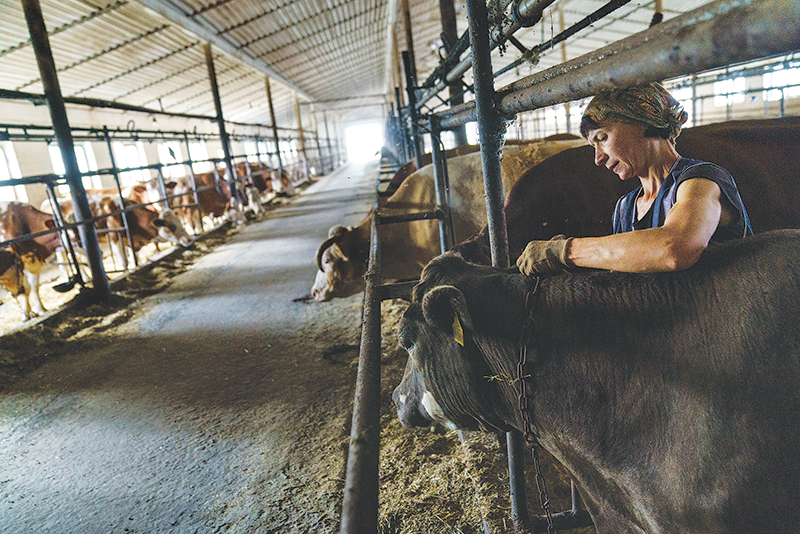
Halyna Borysenko secures cows in their stalls for milking at the KramAgroSvit dairy farm in Dmytrivka, Donetsk region, eastern Ukraine. AP/RSS
DMYTRIVKA : One of the last working dairy farms on Ukrainian-controlled territory in the eastern Donbas region is doing everything it can to stay afloat in a place where neither workers nor animals are safe from Russia’s devastating war. Only around 200 head of cattle remain of the nearly 1,300 kept at the farm before Russia invaded Ukraine on February 24. The 8,000-acre farm, set amid rolling hills in embattled Donetsk province, is producing two tons of milk a day compared to 11 tons daily before the war, its managers say. While a significant proportion of the KramAgroSvit farm’s revenues also once came from cultivating wheat, continuing that work comes with risks. As a farm employee harvested wheat with a grain combine on Sunday, the machine hit two land mines, resulting in a fire that burned more than 60 percent of the worker’s body. The worker survived, but is in critical condition as doctors tend to an infection. An inspection by an emergency services team found 19 additional mines in the field, said Ihor Kriuchenko, the farm’s senior livestock technician, adding that going out to harvest now is “very dangerous due to the shelling and mines.” Farmhands drive combines around visible artillery fragments to avoid them. Such realities of war have created a cascading series of complications that coalesced to drive the farm’s business down dramatically. In the nearby city of Kramatorsk, the provisional capital of Donetsk province, Russia’s attacks and a lack of gas for heating and cooking have caused most residents to evacuate, creating less demand for dairy products and, consequently, falling profits. Business also took a hit as Russian forces captured several other cities where the farm had distributed its milk and those markets disappeared behind the front line. Such conditions—disrupted demand and supply chains along with danger from shelling and mines—have made the prospect of farming in eastern Ukraine fraught with risks that threaten the future of the KramAgroSvit farm, which has been in business since 2003. “This farm was hit [by a rocket], and 38 cows were killed, plus some of our farming equipment and vehicles were destroyed. Investors decided it was too risky to keep so many cows here, so they were sold abroad,” Kriuchenko said. The farm’s owner had all the pigs and rabbits once raised there slaughtered and sold amid the uncertainty, he said. Anna Lavrenyuk, general director of Ukraine’s Association of Milk Producers, said at the end of June that Ukrainian dairy farms lost at least 50,000 head of cattle worth an estimated $136 million during the first three months of the war. Approximately 800 industrial dairy farms lost assets that included animals, barns, farming equipment and animal feed, Lavrenyuk said, while milk yields in front-line and Russian-occupied territories dropped by more than half since the war began. Ukrainian milk production was likely to fall to 2 million tons for the year, down by 750,000 tons since 2021, she said. Only around a third of the KramAgroSvit farm’s previous staff of 63 employees remains, Kriuchenko said, and revenues have dropped six-fold since Russian forces launched their offensive to seize the Donbas, an industrial region made up of Donetsk and neighbouring Luhansk province. One such worker, Nataliia Onatska, lined up around 50 cows side by side on Wednesday and attached vacuum pumps to their udders in one of the farm’s long, musty milking hangars. She’s spent her entire life on a farm and calls her job “the point of my life.” “I wish everything was like it was before and everyone had kept their jobs,” Onatska said. “It’s scary to live now. I’m just living from day to day.” The farm now feeds its wheat to the cows as grain prices have fallen and logistics costs have spiked, Kriuchenko said. The crop wasn’t profitable on the market because of a Russian naval blockade of Ukraine’s Black Sea ports that an UN-brokered agreement is only now slowly remedying. But of all the myriad challenges facing the farm, he said, the most difficult part has been saying goodbye to colleagues who had invested so much in its success. Amid the cutbacks, he said, he had to fire his wife. “It was very hard and sad to let all our staff go. Our team was brought together from nothing, and there was great teamwork, everything was good,” he said. “It was a shock for me to say goodbye to them.” As Halyna Borysenko, another worker in the dairy, finished milking the cows for the day, she said she pitied them for also having to live through the war. “The animals are acting differently. They’re scared just like we are,” she said. “They just can’t say it out loud.”
MONEY
Ukrainian adviser says $5 billion IMF loan would reassure other creditors
Country faces a 35 to 45 percent economic contraction in 2022.
- REUTERS
KYIV : Securing a new $5 billion loan from the IMF would help reassure Ukraine’s other creditors that the war-torn country’s macroeconomic situation was under control, President Volodymyr Zelenskiy’s chief economic adviser told Reuters on Friday. Fresh financing from the International Monetary Fund for around 18 months could serve as the anchor for a larger package of $15 billion-$20 billion to help Ukraine weather the economic crisis caused by Russia’s invasion, the adviser, Oleg Ustenko, said. He said Ukrainian officials were in touch with the global lender about the potential request, adding that the goal should be to move forward as quickly as possible. The IMF declined to comment. Ustenko’s comments came just over two weeks after Ukraine’s central bank governor, Kyrylo Shevchenko, told Reuters that he was seeking as much as $20 billion from the IMF over two or three years—an amount that would have put Ukraine well over the fund’s “exceptional access limit” for lending. The large size of that request had triggered intense debate within the IMF because it would have also raised questions about the sustainability of Ukraine’s debt. The revised plan would be modelled on a financing package agreed in 2015, after Russia’s invasion of the Crimea region of Ukraine, that included $17.5 billion in IMF funding but helped leverage total funding of $40 billion. “An IMF programme of $5 billion would be in line with earlier funding levels and might be a catalyst for funding from other sources, including the EU, [the US] Treasury and other individual countries,” Ustenko told Reuters. Ukraine’s previous $5 billion loan programme was cancelled in March as the IMF approved $1.4 billion in emergency financing with few conditions in the early weeks of Russia’s invasion. Ukrainian authorities pledged to work with the Fund to design a new economic programme “aimed at rehabilitation and growth, when conditions permit.” Ukraine, grappling with the internal displacement of some 7 million people by Russia’s invasion on February 24, is scrambling to marshal resources to deal with energy shortages, rising inflation, and a worsening humanitarian crisis as winter approaches. It faces a 35 percent-45 percent economic contraction in 2022 and a monthly fiscal shortfall of $5 billion, with only a third of some $29 billion in Western aid pledges having materialised thus far, economists say. This week, Ukraine’s overseas creditors backed its request for a two-year freeze on payments on almost $20 billion in international bonds, but Ukraine must still make $635 million in principal payments on prior IMF loans beginning in mid-September. Ustenko said Ukraine hoped to move forward quickly with negotiations with the IMF with an eye to reaching a preliminary agreement before those payments were due. Proponents of the new programme argue that Ukraine had made good progress on tackling deficits and addressing corruption before the war, and the new lending would allow it to stabilise the economy. But critics say a large new loan could put the Fund at risk, as Russia could still win the war and refuse to make good on Ukraine’s debts.
MONEY
Russian gross domestic product drops 4 percent in Q2
Briefing
- Post Report
MOSCOW: Russia’s gross domestic product contracted 4 percent in the second quarter of this year, the first full quarter since Russia sent troops into Ukraine, the state statistical service said on Friday. Russia was hit with a wide array of sanctions following its move into Ukraine on February 24, including sanctions that cut off some Russian banks from the SWIFT international transfer system, and a significant exodus of foreign companies. The report by the Rosstat service did not analyze why GDP was lower this year than in the same quarter of 2021. But it said there was a 15.3 percent drop in wholesale trade and a 9.8 percent contraction in retail trade. Russia had reported sizable GDP increases in the first quarter of 2022 and for the last three quarters of 2021. (AP)
MONEY
Brazil’s central bank chief predicts end of credit cards
BRASILIA: Brazil’s central bank chief Roberto Campos Neto on Friday said he believes credit cards will cease to exist soon due to the growth of the open finance system, through which clients authorize financial data sharing with different institutions. Open finance is a central bank project that has been implemented in phases since 2021. Speaking at an event about cryptocurrencies, Campos Neto projected that, through the system, users will control all aspects of their financial life in one “integrator” on their mobile, rather than having many apps from different banks. This will allow the development of cash management products for individuals and users to choose between making payments with the Pix instant payment system by debit or credit, he added. “This system eliminates the need to have a credit card. I think that credit cards will cease to exist at some point soon,” said Campos Neto, noting that banks have already started using Pix to offer credit. (REUTERS)
MONEY
Indonesians must prepare for a potential fuel price hike, minister says
JAKARTA: Indonesians must prepare for a potential hike in fuel prices as the government looks to control its ballooning energy subsidies amid high global oil prices, a cabinet minister said on Friday. Southeast Asia’s largest economy has tripled this year’s energy subsidy budget to 502 trillion rupiah ($34.22 billion) in order to keep some fuel prices and power tariffs unchanged and manage inflation. However, this may not be enough, as nearly all of the subsidised fuel quota has already been used, according to the finance ministry. Indonesia’s Investment Minister Bahlil Lahadalia said if the government has to increase the quota for subsidised gasoline to 29 million kilolitres from 23 million kilolitres, and assuming oil prices stay elevated and the rupiah weak, the subsidy bill could rise to up to 600 trillion rupiah. “Please convey to the people that my feeling is we have to get ready in case a fuel price hike happens,” Bahlil said. (REUTERS)
WORLD
Praise, worry in Iran after Rushdie attack; Tehran quiet
His book ‘The Satanic Verses’ caused a violent uproar in the Muslim world and a fatwa on the author was issued by Iran in 1989.
- ASSOCIATED PRESS
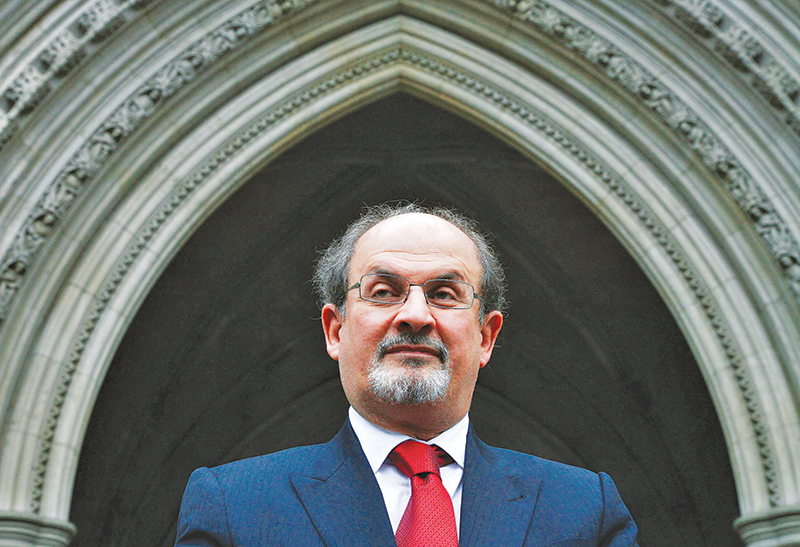
Indian-born author Salman Rushdie was forced into years of hiding after his book was condemned as blasphemous.REUTERS
TEHRAN : Iranians reacted with praise and worry on Saturday over the attack on novelist Salman Rushdie, the target of a decades-old fatwa by the late Supreme Leader Ayatollah Ruhollah Khomeini calling for his death. It remains unclear why Rushdie’s attacker, identified by police as Hadi Matar of Fairview, New Jersey, stabbed the author as he prepared to speak at an event on Friday in western New York. Iran’s theocratic government and its state-run media have assigned no motive to the assault. But in Tehran, some willing to speak to The Associated Press offered praise for an attack targeting a writer they believe tarnished the Islamic faith with his 1988 book “The Satanic Verses.” In the streets of Iran’s capital, images of the late Ayatollah Ruhollah Khomeini still peer down at passers-by. “I don’t know Salman Rushdie, but I am happy to hear that he was attacked since he insulted Islam,” said Reza Amiri, a 27-year-old deliveryman. “This is the fate for anybody who insults sanctities.” Others, however, worried aloud that Iran could become even more cut off from the world as tensions remain high over its tattered nuclear deal. “I feel those who did it are trying to isolate Iran,” said Mahshid Barati, a 39-year-old geography teacher. “This will negatively affect relations with many —even Russia and China.” Khomeini, in poor health in the last year of his life after the grinding, stalemate 1980s Iran-Iraq war decimated the country’s economy, issued the fatwa on Rushdie in 1989. The Islamic edict came amid a violent uproar in the Muslim world over the novel, which some viewed as blasphemously making suggestions about the Prophet Muhammad’s life. “I would like to inform all the intrepid Muslims in the world that the author of the book entitled ‘Satanic Verses’ ... as well as those publishers who were aware of its contents, are hereby sentenced to death,” Khomeini said in February 1989, according to Tehran Radio. He added: “Whoever is killed doing this will be regarded as a martyr and will go directly to heaven.” Early on Saturday, Iranian state media made a point to note one man identified as being killed while trying to carry out the fatwa. Lebanese national Mustafa Mahmoud Mazeh died when a book bomb he had prematurely exploded in a London hotel on August 3, 1989, just over 33 years ago. Matar, the man who attacked Rushdie on Friday, was born in the United States to Lebanese parents who emigrated from the southern village of Yaroun, the town’s mayor Ali Tehfe told the AP. Yaroun sits only kilometres away from Israel. In the past, the Israeli military has fired on what it described as positions of the Iran-backed Shiite militia Hezbollah around that area. At newsstands on Saturday, front-page headlines offered their own takes on the attack. The hard-line Vatan-e Emrouz’s main story covered what it described as: “A knife in the neck of Salman Rushdie.” The reformist newspaper Etemad’s headline asked: “Salman Rushdie near death?” The conservative newspaper Khorasan bore a large image of Rushdie on a stretcher, its headline blaring: “Satan on the path to hell.” But the 15th Khordad Foundation —which put the over $3 million bounty on Rushdie —remained quiet at the start of the working week. Staffers there declined to immediately comment to the AP, referring questions to an official not in the office. The foundation, whose name refers to the 1963 protests against Iran’s former shah by Khomeini’s supporters, typically focuses on providing aid to the disabled and others affected by war. But it, like other foundations known as “bonyads” in Iran funded in part by confiscated assets from the shah’s time, often serve the political interests of the country’s hard-liners. Reformists in Iran, those who want to slowly liberalise the country’s Shiite theocracy from inside and have better relations with the West, have sought to distance the country’s government from the edict. Notably, reformist President Mohammad Khatami’s foreign minister in 1998 said that the “government disassociates itself from any reward which has been offered in this regard and does not support it.” On Saturday, Mohammad Mahdi Movaghar, a 34-year-old Tehran resident, described having a “good feeling” after seeing Rushdie attacked. “This is pleasing and shows those who insult the sacred things of we Muslims, in addition to punishment in the hereafter, will get punished in this world too at the hands of people,” he said. Others, however, worried the attack —regardless of why it was carried out —could hurt Iran as it tries to negotiate over its nuclear deal with world powers.
WORLD
Ukrainian minister says Russia blocking access to medicines
WHO says it has recorded 445 attacks on hospitals and other health care facilities so far.
- ASSOCIATED PRESS
KYIV : Ukraine’s health minister has accused Russian authorities of committing a crime against humanity by blocking access to affordable medicines in areas its forces have occupied since invading the country 5-and-a-half months ago. In an interview with The Associated Press, Ukrainian Health Minister Viktor Liashko said Russian authorities repeatedly have blocked efforts to provide state-subsidised drugs to people in occupied cities, towns and villages. “Throughout the entire six months of war, Russia has not [allowed] proper humanitarian corridors so we could provide our own medicines to the patients that need them,” Liashko said, speaking at the Health Ministry in Kyiv late Friday. “We believe that these actions are being taken with intent by Russia, and we consider them to be crimes against humanity and war crimes that will be documented and will be recognised,” the minister said. The Ukrainian government has a programme that provides medications to people with cancer and chronic health conditions. The destruction of hospitals and infrastructure along with the displacement of an estimated 7 million people inside the country also have interfered with other forms of treatment, according to UN and Ukrainian officials. The war in Ukraine has caused severe disruptions to the country’s state-run health service, which was undergoing major reforms, largely in response to the coronavirus pandemic, when Russian President Vladimir Putin ordered his troops to invade on February 24. The World Health Organisation said it recorded 445 attacks on hospitals and other health care facilities as of August 11 that directly resulted in 86 deaths and 105 injuries. But Liashko said the secondary effects were far more severe. “When roads and bridges have been damaged in areas now controlled by the Ukrainian forces... it is difficult to get someone who had a heart attack or a stroke to the hospital,” he said. “Sometimes, we can’t make it in time, the ambulance can’t get there in time. That’s why war causes many more casualties [than those killed in the fighting]. It’s a number that cannot be calculated.”
WORLD
Russia claims full control of Pisky village in Donetsk
MOSCOW: Russian forces have taken full control of Pisky, a village on the outskirts in Ukraine’s Donetsk region, Interfax cited the Russian defence ministry as saying on Saturday. Reuters was not able to immediately verify the report. Russian and pro-Russian forces had reported that they had taken full control of Pisky more than a week ago. The ministry also said that Russian forces had destroyed a US-supplied HIMARS rocket system near Ukraine’s Kramatorsk and a depot with ammunition for the system, Interfax reported. (REUTERS)
WORLD
‘Dead fish everywhere’ in river after feared chemical waste dump
Tests are ongoing in Germany to establish the substance that may have led to the deaths.
- AGENCE FRANCE-PRESSE
Dead fish are pictured on the banks of the river Oder in Schwedt, eastern Germany, on Friday. AFP/RSSA
SCHWEDT : Thousands of fish have washed up dead on the Oder river running through Germany and Poland, sparking warnings of an environmental disaster as residents are urged to stay away from the water. The fish floating by the German banks near the eastern town of Schwedt are believed to have washed upstream from Poland where first reports of mass fish deaths were made by locals and anglers as early as on July 28. German officials accused Polish authorities of failing to inform them about the deaths, and were taken by surprise when the wave of lifeless fish came floating into view. In Poland, the government has also come under heavy criticism for failing to take swift action. Almost two weeks after the first dead fish appeared floating by Polish villages, Polish Prime Minister Mateusz Morawiecki said on Friday that “everyone had initially thought that it was a local problem”. But he admitted that the “scale of the disaster is very large, sufficiently large to say that the Oder will need years to recover its natural state.” “Probably enormous quantities of chemical waste was dumped into the river in full knowledge of the risk and consequences,” added the Polish leader, as German Environment Minister Steffi Lemke urged a comprehensive probe into what she called a brewing “environmental disaster”. Standing by the riverbank, Michael Tautenhahn, deputy chief of Germany’s Lower Oder Valley National Park, looked in dismay at the river on the German-Polish border. “We are standing on the German side—we have dead fish everywhere,” he told AFP. “I am deeply shocked... I have the feeling that I’m seeing decades of work lying in ruins here. I see our livelihood, the water—that’s our life,” he said, noting that it’s not just fish that have died, but also mussels and likely countless other water creatures. “It’s just the tip of the iceberg.” The Oder has over the last years been known as a relatively clean river, and 40 domestic species of fish make their home in the waterway. But now, lifeless fish—some as small as a few centimetres, others reaching 30-40 cm—can be seen across the river. Occasionally, those still struggling to pull through can be seen flipping up in the water, seemingly gasping for air. Officials believe that the fish are likely to have been poisoned. “This fish death is atypical,” said Axel Vogel, environment minister for Brandenburg state, estimating that “undoubtedly tonnes” of fish have died. Fish death is often caused by the distortion of oxygen levels when water levels are too low, he explained. “But we have completely different test results, namely that we have had increased oxygen level in the river for several days, and that indicates that a foreign substance has been introduced that has led to this,” he said. Tests are ongoing in Germany to establish the substance that may have led to the deaths. Early reports had suggested indications of extremely high levels of mercury. But another batch of preliminary results released on Friday evening showed unusually high levels of salt. Authorities said they were unconclusive, and that further test results on heavy metals and mercury were pending. In Poland, prosecutors have also begun investigating after authorities came under fire over what critics said was a sluggish response to a disaster. Tautenhahn said the disaster would likely carry consequences for years to come.
WORLD
Tropical Storm Meari hammers Japan
World’s third-largest economy often sees deaths and injuries caused by seasonal storms.
- ASSOCIATED PRESS
A man is drenched by the rain brought by Tropical Storm Meari, in Hamamatsu, Shizuoka prefecture, central Japan on Saturday.AP/RSS
TOKYO : Tropical Storm Meari unleashed heavy rains on Japan’s main Honshu island as it headed northward on Saturday toward the capital, Tokyo, according to Japanese weather officials. The Japan Meteorological Agency said that Meari made landfall in Shizuoka prefecture southwest of Tokyo in the afternoon, bringing sudden heavy rains and blasting winds to a widespread area and prompting warnings about mudslides and flooding. More than 72,000 people in the area’s main city of Shizuoka were told to evacuate due to possible landslides. Meari, packing sustained winds of up to 72 kilometres per hour, passed over Shizuoka and was traveling at a speed of about 20 kilometres an hour. The storm was expected to continue northward before veering eastward, swinging over the Pacific Ocean by early Sunday. The Tokyo area was hammered by periodic downpours starting in the late morning. Warnings on high waves in coastal areas were issued for Tokyo, Kanagawa prefecture southwest of Tokyo, and other nearby areas. The authorities warned against going near rivers and other waters, as the levels may rise suddenly. Rainfall was expected to worsen in Tokyo and areas north of Tokyo in the evening, they said. Warnings of flooding, strong winds and heavy rainfall were issued for the Tokyo area. Japanese media reports showed video of rivers rising perilously, almost reaching bridge decks, as rain splashed down on homes and people scurried in the streets, clinging to their umbrellas. Japan is in the middle of the Bon summer holidays and vacationers are traveling in droves, though some have had to cancel or change plans. The Rock in Japan Festival 2022, which began a week ago in Chiba prefecture east of Tokyo, cancelled the event for Saturday, the final day of the outdoor festival, and promised ticket refunds. All Nippon Airways cancelled some local flights in response to the storm. Low-cost carrier Skymark Airlines also cancelled some flights. Bullet train services were delayed, and speed limits in tunnels in Shizuoka were temporarily lowered as a cautionary measure. Sections of the Tomei Expressway, which connects Tokyo with Nagoya, were temporarily blocked off because of the heavy rainfall. Northern Japan has had some heavy rainfall lately and worries were growing about landslides. Rainfall was forecast to subside by early Sunday in the Tokyo area before hitting northeastern Japan.
WORLD
WHO plans to rename monkeypox over stigmatisation concerns
- ASSOCIATED PRESS
LONDON : The World Health Organisation says it’s holding an open forum to rename the disease monkeypox, after some critics raised concerns the name could be derogatory or have racist connotations. In a statement on Friday, the UN health agency said it has also renamed two families, or clades, of the virus, using Roman numerals instead of geographic areas, to avoid stigmatisation. The version of the disease formerly known as the Congo Basin will now be known as Clade one or I and the West Africa clade will be known as Clade two or II. WHO said the decision was made following a meeting of scientists this week and in line with current best practices for naming diseases, which aims to “avoid causing offense to any cultural, social, national, regional, professional, or ethnic groups, and minimise any negative impact on trade, travel, tourism or animal welfare.” Numerous other diseases, including Japanese encephalitis, Marburg virus, Spanish influenza and Middle Eastern Respiratory Syndrome have been named after the geographic areas where they first arose or were identified. WHO has not publicly suggested changing any of those names.
WORLD
Japan cabinet minister visits Yasukuni shrine for war dead
Briefing
TOKYO: Japan’s industry minister Yasutoshi Nishimura on Saturday became the first member of Prime Minister Fumio Kishida’s cabinet to visit the controversial Yasukuni shrine for war dead in Tokyo, Kyodo news agency reported. “I resolved to do my utmost for the peace and development of Japan, while thinking of the late Prime Minister Shinzo Abe,” Nishimura told reporters, according to Kyodo. Nishimura belongs to the party faction that was led by Abe, who was gunned down at a campaign rally last month. Kishida tapped Nishimura to head the Ministry of Economy, Trade and Industry in a cabinet reshuffle on Wednesday. Yasukuni is seen in China and South Korea as a symbol of Japanese former military aggression because it honours, among some 2.5 million war dead, 14 Japanese World War Two leaders convicted as war criminals by an Allied tribunal. South Korea expressed “deep disappointment and regret” at Nishimura’s visit. The shrine “glorifies Japan’s past war of aggression and enshrines war criminals,” the foreign ministry said in a statement.(AGENCIES)
WORLD
China sending fighter jets to Thailand for joint exercises
BANGKOK: The Chinese air force is sending fighter jets and bombers to Thailand for a joint exercise with the Thai military on Sunday. The training will include air support, strikes on ground targets and small- and large-scale troop deployment, the Chinese Defence Ministry said in a statement posted on its website. China’s expanding military activities in the Asia-Pacific region have alarmed the United States and its allies and form part of a growing strategic and economic competition that has inflamed tensions between the world’s two largest economies. US Defence Secretary Lloyd Austin visited Thailand in June as part of an effort to strengthen what he called America’s “unparalleled network of alliances and partnerships” in the region. The Falcon Strike exercise will be held at the Udorn Royal Thai Air Force Base in northern Thailand near the border with Laos. Thai fighter jets and airborne early warning aircraft from both countries will also take part.(AGENCIES)
WORLD
Festival stage collapse in Spain kills one, injures dozens
MADRID: One person was killed and dozens were injured when high winds caused part of the main stage to collapse at a dance music festival near the Spanish city of Valencia in the early hours of Saturday, regional emergency services said. Other infrastructure was also damaged when gusts battered the Medusa Festival, a huge electronic music festival held over six days in the east coast town of Cullera, south of Valencia. The festival, where French DJ David Guetta was due to play on Saturday, had DJs scheduled to play throughout the night on Friday across five stages. Of the injured, three suffered serious trauma injuries and 14 had more minor injuries, regional emergency services tweeted. Regional health authorities said later that 40 people were attended to. “We are completely devastated and saddened at what happened this morning,” organisers said in a statement. (AGENCIES)
HOROSCOPE
HOROSCOPE
- Post Report
ARIES (March 21-April 19) **** Intense and realistic dreams could manifest for you this morning. Take a moment to process your dreams avide a window into your subconscious.
TAURUS (April 20-May 20) *** You may have a hard time containing your emotions today. Keeping your peace when it comes to hurt feelings won’t feel like an option, though finding the words to express yourself may also pose a challenge.
GEMINI (May 21-June 21) **** You may feel as though your intuition is on the fritz this morning. Though you may get the impression that your third eye is trying to tell you something, decoding messages from beyond the veil won’t be easy.
CANCER (June 22-July 22) *** Messages from beyond the veil may come in the form of a dream. The energy will liven up this afternoon, elevating your drive and motivation when it comes to personal responsibilities or professional ambitions.
LEO (July 23-August 22) *** You may be forced to contend with authoritative or controlling behaviours within your romantic life today. Use this energy to set serious boundaries with anyone who hasn’t been respecting your autonomy.
VIRGO (August 23-September 22) **** Avoid the temptation to ignore any warning signs your body is giving off. Try not to muscle through any fatigue, headache, or discomfort that finds you right now, taking time to recover if you’re overdue for a rest.
LIBRA (September 23-October 22) *** Today might be a good day for setting boundaries with your electroniacs and social media accounts. Be willing to cut ties with any people or habits that have been dulling your senses or distracting your heart.
SCORPIO (October 23-November 21) *** Creative inspiration will find you in the very early hours this morning, making it a great day for artistic experimentation or deep meditation as the sun rises. Focus on finding connectivity between your heart and mind.
SAGITTARIUS (November 22-December 21) *** The day will provide you with the good sense to invest wisely in your home and financial future. Focus on adding some extra padding to your savings account or to finally invest in projects that need a bit of funding.
CAPRICORN (December 22-January 19) **** Don’t be afraid to speak with transparency, even if doing so makes you feel vulnerable. Clean up any clutter that’s been lingering in your space, doing so will provide you with a sense of relief and emotional clarity.
AQUARIUS (January 20-February 18) *** The vibe could get a little rocky within your romantic relationships today. Feeling trapped within your partnership could cause you to emotionally tap out, though you should certainly embrace some alone time.
PISCES (February 19-March 20) *** You’ll awaken to an empowering and motivating energy this morning. Use this energy to gain notoriety within your social circle, as the stars will align to elevate your popularity and expand your voice.
SPORTS
Shakib returns as Bangladesh T20 captain
- AGENCE FRANCE-PRESSE
DHAKA : Shakib Al Hasan on Saturday was named to return as Bangladesh’s Twenty20 international captain after he bowed to a Bangladesh Cricket Board ultimatum to scrap a deal with a betting site. The all-rounder was given the nod to lead the side for the upcoming Asia Cup in the United Arab Emirates and the World Cup in Australia. “Shakib realised his mistake,” BCB cricket operations chief Jalal Yunus told reporters as he announced the decision. “He is a very important player for us.” Earlier this month Shakib announced a partnership with Betwinner News, a portal operated by a gambling firm based in the Dutch Caribbean island of Curacao. Gambling is illegal in Bangladesh and he was forced to cancel the deal after the BCB president, Nazmul Hassan, issued an ultimatum ordering him to choose between the national team and Betwinner. Shakib captained Bangladesh to seven wins and 14 defeats in 21 T20Is until he was banned for two years—one of them suspended—in 2019 after he failed to record corrupt approaches. Shakib, who also returned as Test captain in July, replaces wicketkeeper-batsman Nurul Hasan as Bangladesh’s T20 skipper. Nurul was retained in the Asia Cup squad despite undergoing surgery on a finger in Singapore last week in the hope that he would regain his fitness by the time the tournament starts on August 27 in Dubai. Three-time Asia Cup finalists Bangladesh will face Sri Lanka and Afghanistan in Group B of the competition. Former captain Mushfiqur Rahim also returned to the side after being rested for the T20 series in Zimbabwe. Pace bowler Ebadot Hossain was handed a place in the T20 side for the first time after he impressed in Tests and one-day internationals, while batsman Sabbir Rahman and all-rounder Mohammad Saifuddin returned after a long gap.
SPORTS
Manchester City, Arsenal maintain perfect start
Pep Guardiola’s side demolish Bournemouth 4-0 and Mikel Arteta’s Gunners thrash Leicester 4-2 to keep winning streak in the Premier League.
- AGENCE FRANCE-PRESSE
Gabriel Jesus (left) marked his home debut for Arsenal with two goals and two assists on Saturday. Ap/Rss a
MANCHESTER : Manchester City stormed ominously to the top of the Premier League by cruising to a 4-0 win over Bournemouth, while Gabriel Jesus opened his Arsenal account in a 4-2 win over Leicester on Saturday. As soaring temperatures across England forced the need for water breaks at all this weekend’s Premier League games, it was City who were on fire at the Etihad as promoted Bournemouth were blown away. Erling Haaland failed to score on his home debut, but the Norwegian showed there is more to his game than goals as he used his strength before sliding in Ilkay Gundogan to open the scoring. Kevin De Bruyne then took centre stage with a scintillating finish with the outside of his right foot to find the far corner before the Belgian turned provider for Phil Foden to make it 3-0 before half-time. City eased off the gas after the break but added to their lead 11 minutes from time when Jefferson Lerma turned Joao Cancelo’s cross into his own net.
Jesus shines Haaland’s arrival at City was one of the factors behind Jesus’ departure and the Brazilian is already looking like a bargain for the Gunners as he marked his home debut with two goals and two assists to maintain Arsenal’s perfect start. Jesus was often deployed in wider areas in recent seasons by City boss Pep Guardiola, but was brought to Arsenal to be a number nine as he aims to secure a place at the World Cup later this year with regular games as a centre-forward. The 25-year-old showed his eye for goal with a sumptuous chip over Danny Ward to break Leicester’s resistance and doubled his tally by heading home a corner at the back post. William Saliba’s own goal gave Leicester a foothold against the run of play. But the Foxes quickly threw that hope away when Ward dropped a simple cross into the box and Jesus teed up Granit Xhaka to slot home. Another goalkeeping error at the other end gifted Leicester another goal as James Maddison’s strike squirmed under Aaron Ramsdale. Arsenal, though, again responded instantly to avoid a nervy finale as Gabriel Martinelli fired into the far corner before Jesus hit the post with the chance to seal his hat-trick.
Gerrard beats Lampard Steven Gerrard won the first managerial clash between him and former England teammate Frank Lampard as Aston Villa beat Everton 2-1 to get off the mark. Goals from Danny Ings and Emi Buendia eased the pressure on the former Liverpool captain after a run of two wins in their previous 12 games dating back to last season. However, Villa had to survive a nervy finish as Lucas Digne’s own goal gave Everton hope as Emi Martinez twice denied Anthony Gordon. Leeds missed the chance to join City and Arsenal on six points after blowing a 2-0 lead at Southampton. Rodrigo’s double put the visitors in command at St Mary’s, but goals from Joe Aribo and Kyle Walker-Peters may have saved Ralph Hasenhuttl’s job after reports this week suggested he could be the first Premier League sacking of the season. Brighton and Newcastle failed to build on their impressive starts last weekend as both missed chances aplenty in a 0-0 draw at the Amex. It was also scoreless between Wolves and Fulham at Molineux after Aleksandar Mitrovic saw a late penalty saved by Jose Sa with the chance to win it for the visitors.
SPORTS
Dortmund beat Freiburg 3-1
Briefing
FREIBURG: Borussia Dortmund scored three times in 11 minutes late in the second half through three substitutes to come from a goal down and beat hosts Freiburg 3-1 in the Bundesliga on Friday. The hosts struck first with Michael Gregoritsch’s looping header. Dortmund launched their comeback with an equaliser thanks to a howler by Mark Flekken who tried to block a 25-metre shot from teenager Bynoe-Gittens but let the ball slip through his hands and into the net in the 77th minute. Bynoe-Gittens then ran at the Freiburg defence and set up Julian Brandt who laid the ball back for Youssoufa Moukoko to score in the 84th. Halftime substitute Marius Wolf sealed the win in the 88th.(AGENCIES)
SPORTS
Osasuna stun Sevilla
MADRID: Osasuna stunned Champions League qualifiers Sevilla 2-1 in the opening match of the new Liga season on Friday. Argentine striker Ezequiel ‘Chimy’ Avila gave Osasuna a ninth-minute lead. However, the advantage lasted just two minutes before Rafa Mir made the most of a fine pass from another Argentine, Papu Gomez to equalise. But the underdogs grabbed a 74th-minute winner from the penalty spot courtesy of Aimar Oroz. Sevilla were also without Isco who arrived on a free transfer from Real Madrid but wasn’t considered ready to make the match-day squad. (AGENCIES)
FICTION PARK
Ghanashyam Bista’s punctured love
Despite having a terrible date experience, Bista did not let it stop him from searching for love.
- Pratik Mainali
The sun awakened the park after a gentle rain, and the sunlight gleamed in the scattered puddles. The trees sprang to life as the sun’s rays touched the leaves. The dews on the blue railings trembled like golden grains. A dog, leaning into a calm puddle, curiously looked at his reflection. Putting his feet on the arm of the bench victoriously, Ghanashyam Bista gazed at the blue sky. He drew a deep breath, closed his eyes, and felt the sunlight on his cheeks. Bista felt as happy as a pig in a ditch on this particular day. Last night, after tossing and turning on the bed for hours, Bista had decided that he would no longer drown in self-pity and would emerge victorious in the game of love sooner or later. He had made up his mind that he was going to fake it till he made it. A passerby, glancing at Bista, would’ve remarked that he bore a striking resemblance to a toad sunbathing on a river bank. Why wouldn’t he? Bista was worthy of this generous compliment. As he exhaled, his stomach bulged like a smooth, unwrinkled balloon. His massive throat bloated and shrank like a plastic bag in the wind, and his jaw rose and dipped from the vast sea of his throat. His shoulders were big, round, and flabby. His eyes, as they lay shut, looked like they were big and round and could pop out any second. Although not the most pleasant person to look at, Bista, it had been remarked by those who knew him, had the heart of gold. He had a way about him, a particular way of speaking that suggested that he was a distinguished and noble man. He moved with the gentle grace of a dignified being. Bista smiled to himself, and he was in a good mood. Yesterday, he went on a date. That morning, as he sat on the bench, bubbling with joy, the thoughts that came to his mind were as follows “She is a woman of the most delightful kind. She carries sunshine with her and is as graceful as a swan.” But things had taken a turn for the worst. The date didn’t go well at all. That night, as he slumped on his bed and gazed vacantly at the ceiling, the words of his date kept playing on a loop in his mind. “Bista, you worm. You rambling old imbecile. Where are your manners, you insect? Is this the way you talk to a lady? Ask for my permission before you speak. If you get my approval, lift your chin, look me in the eyes, clasp your hands respectfully, stay steady, and speak in a low, hushed tone. Once you finish talking, bow at me three times. Since I haven’t permitted you to speak, join your hands and apologise to me for wasting my time. Now blast away, shoo. Slither away, you reptile.” But today, as the same Bista sat on the blue dew-covered park bench, his opinions towards the woman were less flattering. There was no trace of sadness on Bista’s long, broad face. His feeling towards her seemed to have melted away like dew under the morning sun. His upturned face, soaking the sun’s warmth, seemed to be protected by an unruffled and impenetrable calm. Yesterday’s event had changed him. He was no longer the Bista who grew morose and moody over a punctured romance. This was a new, refined Bista. He had no time to think about old flings. Bista was back on the rails. No longer a man on the ivory tower, he was beginning to learn the ropes of relationships. Bista stood up slowly and started doing his regular early morning stretches. He then began to jog around the park. He jogged slowly, with his eyes on the cobbled track ahead of him. Suddenly, the patterns of the cobblestones were interrupted by the sight of a black, shiny boot. As Bista’s gaze travelled from the black boot to the blue trousers and the black belt and then to the slender neck and finally to the lean face attached to the slender neck, a shudder of romantic feeling passed through Bista. The figure that stood before Bista had folded her arms, lifted her chin and looked down at Bista through her nose. The figure was that of a policewoman who was doing her morning duty in the park. “You can’t run around here, sir. The park is strictly for walkers. If you want to run, you need to leave the park. You can run on the footpath outside.” With his hands hanging loosely beside him, Bista fixed his gaze at the police officer as her lips moved and her mouth uttered words. “I sure will remember from now on, miss.” He spoke with a noble air that only a king could display. As Bista’s voice reached the ears of the policewoman, her cheeks flushed. Bista smiled a genial smile, and he knew that the game was on.
Mainali is a student at the University of Wolverhampton, the UK.
FICTION PARK
Taking care of mental health
- Post Report
There will be days when you will feel the dark clouds hovering above You will feel a sense of gloom looming And before you know it You will be consumed by it
You will see nothing but darkness You will feel nothing but low You will think there’s no solution in sight And that all you can do is give up for good
At such a time Know that you are not alone Millions are fighting similar battles Sometimes winning and sometimes losing
Remember that you do not need to fight this battle alone And that there’s no harm in seeking help You will be surprised by the sheer number of hands willing to help you So reach out and do not suffer in silence.
- Sarala Acharya
Acharya is a BPH student from Butwal.
FICTION PARK
A fleeting life
- Post Report
The moments that we are spending today Will one day be just memories You are here today But you won’t be here tomorrow.
This is the reality of our existence This life that we hold so dear Is it really that dear? Have we got it all wrong?
Is life all about chasing material things Chasing titles and materialistic gains I think there’s more to life than this I think there are other ways to utilise this life.
Human life is precious, but we shouldn’t be too attached to it Let’s live our lives in the noblest way possible While we are here on this earth Let’s strive to engage in actions to make the world a better place.