Pradip Giri, a socialist thinker and philosopher, dies at 74
The Congress leader was well-versed in Marxism and earned respect from across the political spectrum for his politics of conviction, simplicity and great oratory skills.
- ANIL GIRI,Arjun Poudel,TIKA R PRADHAN,BINOD GHIMIRE
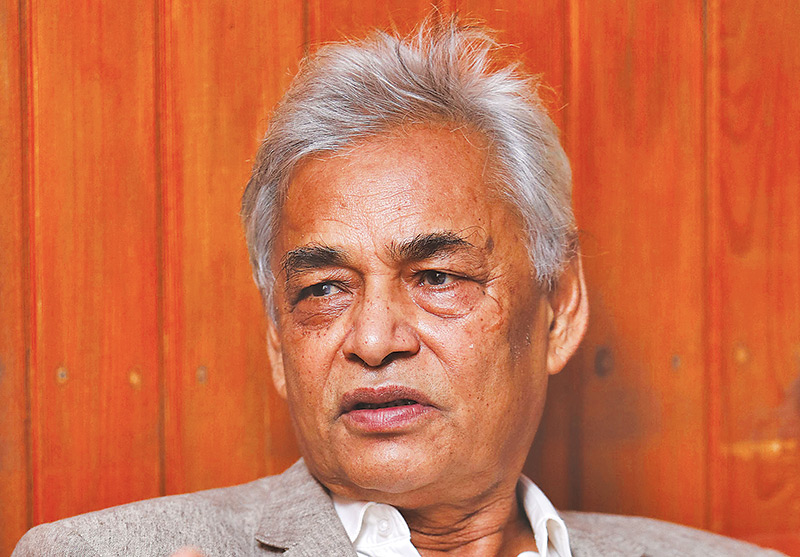
Giri was a leader who spoke his mind, not hesitating to offer opposing and unpopular views. Post file Photo
KATHMANDU, Nepali Congress leader Pradip Giri, a noted socialist thinker, passed away on Saturday night. He was 74. “He passed away at around 9:30pm,” Dr Pankaj Barman, a senior consultant and medical oncologist at Nepal Mediciti Hospital who had been attending to Giri, told the Post. “He was also battling a last-stage cancer. Pneumonia from which he had been suffering led to multi-organ failure.” Giri was admitted to Nepal Mediciti Hospital in Lalitpur last month after he returned from India after treatment for cancer. Earlier on Saturday, a statement by his family said Giri underwent immunotherapy a week back to boost his immune system. “However, he has now developed massive pneumonia, which has further compromised his health, resulting in multiple organ failure,” the statement read. Giri, a longtime Congress leader, worked closely with the late BP Koirala. He was highly influenced by the socialist movement in India led by Jayprakash Narayan and Ram Manohar Lohiya. He was known as a fearless leader, not afraid of criticising his own party and the leadership and never hesitating to offer opposing and unpopular views. He was a two-time member of the Constituent Assembly, which drafted the Constitution of Nepal 2015. He, however, refused to sign the document, saying the process was flawed and the constitution failed to address the concerns of various sections of the society—Tharus, Madheshis and Janajatis. He had his sympathy for those who were protesting against the constitution-writing process even as top leaders of his party rushed to finalise the document. A seasoned orator, Giri was well-versed in Marxism, often putting some communists, who claim to follow Marxist ideology, to shame. He won the 2017 parliamentary elections from Siraha-1. Giri, who started his political career in the early 1960s from the Nepali Congress, was also known for his simplicity, candor and wide-ranging erudition. He never held any position of benefit. Leaders from across the political spectrum expressed their condolences, hailing Giri as a veteran thinker, philosopher, socialist, intellect and an epitome of a leader who showed how politicians should lead a simple life. “We lost one of the brightest, most intellectual and profound thinkers of contemporary politics,” said Ghanshyam Bhusal, a CPN-UML leader. “A towering figure of our age committed to socialism.” Giri had a good grasp of Marxism too and was widely regarded as an intellectual who could explain Marxism to ordinary minds. “His [Giri’s] socialist view was different from others’ because he grounded socialism and Marxism philosophies in the Nepali context. A rare breed indeed,” Bhusal told the Post. “He was a true Gandhain… someone really inspired by Indian socialist leaders like Jayaprakash Narayan, Ram Manohar Lohia and the like.” A student of economics and philosophy, Giri led a simple life, according to politicians who have known him for long. He repeatedly refused the ministerial posts offered to him. Such a gifted orator he was that every time he spoke in Parliament, he held parliamentarians spellbound. He was one of the most sought-after politicians by television anchors. He has written over a dozen books on economics, women, philosophy and Marxism. Deep Kumar Upadhyay, a Congress leader who is a former Nepali ambassador to India and a longtime friend of Giri’s, said that an era of value-based politics has ended with Giri’s death. When the incumbent Congress-led government offered to pay for his hospital charges, Giri refused, said one Nepali Congress leader, highlighting the value-based politics Giri believed in. Before he was admitted to Nepal Mediciti Hospital, Giri was admitted to a hospital in Mumbai, India. “Despite being born in a rich family, he lived a very simple life,” Upadhyay said. “He was well-versed in Marxism, socialism, and social democracy. He could speak on literature to economics impromptu. A vastly knowledgeable person, he was highly regarded not only in Nepal but also India.” According to Upadhyay, Giri was one leader who always played the opposition role in the Congress, questioning the leadership and keeping them on their toes. For a long time, Giri had built an image of an anti-Koirala leader in the Nepali Congress because of his rebellious political nature. When the Congress split in 2002, Giri supported the Nepali Congress (Democratic) formed by Sher Bahadur Deuba. Giri chose to remain with Deuba because both of them came from the Krishna Prasad Bhattarai camp, according to Congress leaders. Those who knew Giri said that he had a very good understanding of world politics from the labour movement to how social democracy is functioning around the globe. “Giri was equally well-informed about the contemporary global trends, where the labour movement stands, and whether social democracy is functioning well or not,” said Bhusal, the UML leader known for his interpretation of Marxism. “The best thing about Giri is he looked at them and interpreted them from different angles. That kind of analytical brain is rare in Nepali politicians.” Despite being such a great thinker and an upright politician, Giri did have some flaws, leaders close to him say. He understood the problems in Nepali politics and would not hesitate to explain them, but he did little to address those issues, according to leaders. In multiple interviews, Giri would say that he chose not to become a minister because he wouldn’t be able to solve the problems he was talking about. Congress leader Bimalendra Nidhi is one of the persons who knew Giri since his student days. “He was one of the prominent leaders of our times. He never did politics of power and he often had views independent of the party line,” Nidhi told the Post. “He was not a leader of only the Congress but of the whole country. The country has lost a fine politician… it’s an irreparable loss.” Nidhi said Giri was a true follower of Gandhi, Lohiya and BP. “But he wouldn’t hesitate to criticise BP Koirala. That’s how he stood tall. He lived a life of conviction. The country today lost a leader who was simple, intelligent, honest, and knowledgeable.” According to the Nepali Congress, Giri’s last rites will be performed at Pashupati Aryaghat on Sunday. Giri’s body will be kept on hospital premises from 9-11am for final tributes, Congress whip Min Bishwakarma said in a statement. His body will then be kept at the Congress party office in Sanepa from 11:30am to 2pm, where the party leaders, cadres and general public can offer their final tributes. “His last rites will be performed at Aryaghat on Sunday evening,” said Bishwakarma. Congress President and Prime Minister Deuba said on Twitter that he was shocked by Giri’s demise. “I am shocked by the news of the death of my friend Pradeep Giriji, the leader of Nepali Congress and an ideological and socialist thinker of Nepali politics,” Deuba tweeted. “With his death, Nepal has lost a true and good leader. Wishing his soul eternal peace, I express my deepest condolences to the family.”
HOME PAGE
An interpreter of maladies
Pradip Giri was a quintessential Nepali public intellectual who interpreted to us our desires, miseries, hypocrisies.
- Dinesh Kafle
KATHMANDU, In the contemporary Nepali political sphere that usually reeks of moral turpitude and ideological penury, if there was any politician who resembled a distant cousin of Plato’s philosopher-king, it was Pradip Giri. The politician-philosopher who transcended ideological boundaries to become the most convincing interpreter of the maladies that imperil Nepali society and politics died on Saturday. He was 74. Giri leaves behind a legacy of over five decades of engagement with political activism and participatory democracy. Most of all, Giri leaves behind a legion of followers across ideological boundaries who respected him for his wit and erudition, if not a political vocation. If discussing life, literature, politics and society was not enough, journalists and intellectuals alike harboured dreams of—and on occasions, some even succeeded at—interpreting death and the afterlife with him. As his struggle with death came to light in the last few weeks of his life, media platforms became inundated with wishes for his recovery. But if there were anyone who could have taken his death as the most natural and inevitable event of his life, it would be Giri himself. A politician-philosopher who could explain Western political philosophy and Eastern mythology with equal ease, Giri was peerless in his intellectual prowess among Nepal’s politician-intellectuals. As he grew older, his baritone voice grew ever more calmer—he had attained the reassuring aura of a patriarch who would enchant youngsters with mythical stories and impart in us the moral courage to live an examined life. His speeches were rich with anecdotes and philosophical inquiry into mythological characters, including the Mahabharata and the Ramayana, and catered to the youth who are otherwise often disinterested in the speeches of politicians. Among Nepal’s politicians, he had no parallel within his party, the Nepali Congress, or outside when it came to linking contemporary political events with historical antecedents and premonitions for the future. He was, in fact, the only leader who came close to matching the intellectual legacy of Bishweshwar Prasad Koirala, the founder and ideological preceptor of the party. But it was always well-known that he had the intellectual aura of a philosopher, not the shrewdness of a politician of our times. In his party, he was at most an ideological guru for the rebellious fringe, with little influence in its machinations. Chided by the party’s mainstream Koirala faction, he even sided with Sher Bahadur Deuba during crucial junctures. He was infamous for his long, inexplicable absences from Parliament, but when he visited it and spoke during parliamentary sessions, it was impossible to ignore the passion he would demonstrate for the rights of the people, especially the oppressed and the marginalised, and the future of democracy. Did he live up to the same ideals that he professed in his public discourses, private conversations and parliamentary speeches? It is not for anyone except him to answer this question authoritatively. It is not entirely possible for a mortal human to live the virtuous and righteous life that one preaches. Each righteous person lives with inherent contradictions. Perhaps those who had a long engagement with him will be able to shed some light on the conformities or contradictions in his ideas of life and the way he lived it. But as Giri would perhaps agree, even the closest of our relatives, friends, lovers or enemies understand a fraction of what we are for real. Each person who’s ever been close to him may have different stories to tell about him, just as those of us who didn’t know him personally have our own reasons to admire or criticise his vocation as a politician and public intellectual. It’s only in bits and pieces that we live in the hearts and minds of other people. While speaking about a person like Giri who emanated great intellectual aura and moral courage, one always runs the risk of slipping into hagiographic description. For, each day of our lives, we have been looking for a hero who will come and save us from our miseries. That hero, we hope, will at least tell us about how messed up our lives are. But he would certainly disapprove of such desires and would refuse to be raised on a higher pedestal than his fellow mortals. In that sense, Giri, if he could not rescue us from our miserable lives, spoke with us; he explained the world to us in a way that we understood it in a larger historical context, and that made us intellectually richer. We derived pleasure and pain in equal measure from his interpretations of our lives. He was a quintessential Nepali public intellectual who explained to us our desires, miseries and hypocrisies. As a mortal being, Giri was a person with all human qualities of empathy, anger and cardinal desires. Any attempt at his deification may lead to a misrepresentation of the human being that he was. What was perhaps slightly different in him from many fellow compatriots was that he lived an examined life in the Socratic vein, aware of what makes life worth living. What goes without question is that he made Nepal’s public space a notch better, and for that, we should all be indebted.
HOME PAGE
International community expresses concern over transitional justice process
Diplomats during their meetings urge Deuba and Dahal to address victims’ grievances, as the government prepares to table the amendment bill in Parliament.
- ANIL GIRI
Members of the diplomatic community meet with Maoist chair Dahal on Saturday. Photo courtesy: Ramesh Malla
KATHMANDU, Just as the government is preparing to table the bill to amend the Commission of Enquiry on Enforced Disappeared, Truth and Reconciliation Commission Act 2014, a section of Kathmandu-based diplomats has expressed concerns over some of the provisions during their meetings with Prime Minister Sher Bahadur Deuba and CPN (Maoist Centre) chair Pushpa Kamal Dahal. After calling on Deuba on Friday, members of the diplomatic community jointly met with Dahal on Saturday and are scheduled to meet CPN-UML chair KP Sharma Oli soon, according to diplomatic sources. The UN’s Resident Coordinator in Nepal, Richard Howard, and ambassadors of the United States of America, the European Union, Germany, Australia and Switzerland held discussions with the leaders as regards Nepal’s plan to amend the transitional justice law, according to the Dahal’s private secretariat. Some of the provisions of the amendment bill have attracted criticism from victims, rights activists and civil society members who say the amendment is designed with an aim to exonerate the perpetrators of serious human rights violations during the 1996-2006 armed conflict. According to those familiar with the meetings, the diplomats expressed concerns over some of the provisions and urged both Deuba and Dahal that some qualifiers and more explanations are needed for cases of serious human rights violations. According to Khimlal Devkota, a Maoist leader, as the diplomats hailed the nationally driven peace process, they also put forth concerns over some of the issues including a lack of clarification on serious human rights violations and called for meeting international standards while concluding the transitional justice process. An aide to Prime Minister Deuba said that the diplomats were of the view that no exemption should be given to the persons involved in serious violations of human rights and if any victim is not satisfied with the process of prosecution initiated by the Special Court, the victim should be permitted to appeal to the Supreme Court. The amended bill has provisions that the transitional justice commissions will make recommendations to the Attorney General’s Office to start prosecution of cases of serious human rights violations. A Special Court composed of three judges from high courts will take decisions in cases of serious human rights violations filed by the Attorney General’s Office within six months of the recommendation from the two commissions. Criminal cases from the decade-long insurgency that are sub judice at the district and high courts will be transferred to the Special Court.
Any decision from the Special Court will be final with no provision for an appeal to the Supreme Court, as per the amendment bill. Victims and human rights organisations have expressed their reservations about the list of non-amnestiable crimes in the bill. The bill says “cruel murder” or murder after torture, rape, enforced disappearances and inhumane or cruel torture committed against unarmed or ordinary people during the insurgency are serious human rights violations and are non-amnestiable. It, however, doesn’t list war crimes and crimes against humanity under serious human rights violations. The bill has opened the door for amnesty for murder by saying only “cruel murder” will be non-amnestiable, thus providing a loophole to define all murders as non-cruel and grant amnesty, according to the victims. Conflict victims and human rights defenders have long been demanding that the act be amended in line with the 2015 Supreme Court verdict and international standards. Nepal’s transitional justice process has been extremely slow as there has been a lack of political will to conclude it while victims have been awaiting justice for 16 years since the end of the armed conflict in 2006. The international community, including the United Nations, as well as human rights organisations have constantly pressed Nepal to complete the process and ensure justice to the victims. As many as 13,000 people died, thousands were displaced and many were forcefully disappeared during the conflict. After Sher Bahadur Deuba became the prime minister and the subsequent appointment of Govinda Sharma Bandi as law minister, the process to amend the act started. According to Devkota, the diplomats were of the view that the 2015 Supreme Court verdict should be respected and honoured. The Foreign Ministry, however, expressed its ignorance about the diplomats’ meetings with Deuba and Dahal. A senior Foreign Ministry official told the Post that the ministry was not aware of both the meetings so they have nothing to share with the media. Sewa Lamsal, the Foreign Ministry spokesperson, said that the government through different channels has communicated to the international community that it is tabling an amendment bill on the transitional justice Act in the House after wider consultations. “We have apprised all concerned stakeholders of the consultations that were held before preparing the amendment bill and that the consultation process was wide and concerns of all sides were taken into consideration,” said Lamsal. “This development has been communicated by the highest political level to the diplomatic community.” After Bandi became the law minister, he held consultations in all seven provinces and in Kathmandu at the national level in order to win the trust of all sections before registering the new bill in Parliament. But victims staged protests in Kathmandu expressing concerns that the new amendment is targeted at protecting the perpetrators and granting them amnesty even in the cases of serious human rights violations. The diplomats’ meetings with Nepal’s political leadership come just ahead of the government plan to present the amendment bill in Parliament. The government is all set to present the new amendment bill in Parliament on Sunday, according to the Law Ministry. On the diplomats’ meetings with the top Nepali leadership, the US Embassy in Kathmandu said on Saturday in an email response to the Post that “as members of the international community in Nepal, we support a Nepali-led transitional justice process that is transparent, aligns with international law, and earns the public trust to achieve credible justice.” “We are encouraged by recent developments made by the Government of Nepal and look forward to the end of the long wait for justice for the victims of Nepal’s conflict era through a process that respects human rights, the rule of law, and facilitates the country’s full transition to lasting peace,” the embassy added. The diplomatic community in Kathmandu has always kept a close eye on Nepal’s transitional justice process and nudged the government on several occasions to ensure justice to the victims by following international standards. According to Devkota, the visiting ambassadors told Dahal that grievances of the victims should be listed and addressed accordingly. “On the issue of qualifying and clarifying the cases of serious human rights violations, we told them that the working procedure of the Act will provide further clarification. They expressed their solidarity with the ongoing truth and reconciliation process and their desire to support the nationally driven peace process,” said Devkota. According to a statement issued by Dahal’s secretariat, the visiting delegation of international organisations expressed their concern about the cases of serious violations of human rights and the rights of victims to appeal for justice as they called Nepal’s peace process ‘unique’ in nature. “Dahal expressed his gratitude to the visiting ambassadors for their collective concerns and best wishes for the near-ending peace process,” the statement read. “The chairman told the visiting delegation that serious discussions have taken place at the political level about the sensitivity of the Comprehensive Peace Agreement and the transitional justice process, Supreme Court’s verdict, voices of the victims and concerns expressed by the international community,” the statement added. “We are hoping to take forward—and give a logical conclusion to—this process by addressing all the concerns and grievances.”
NATIONAL
Lack of disaster management and preparedness raises alarm
Local governments’ complacency in implementing disaster risk management and post-disaster plans might lead to a repeat of last year’s tragedy, locals say.
- BIPLAV BHATTARAI
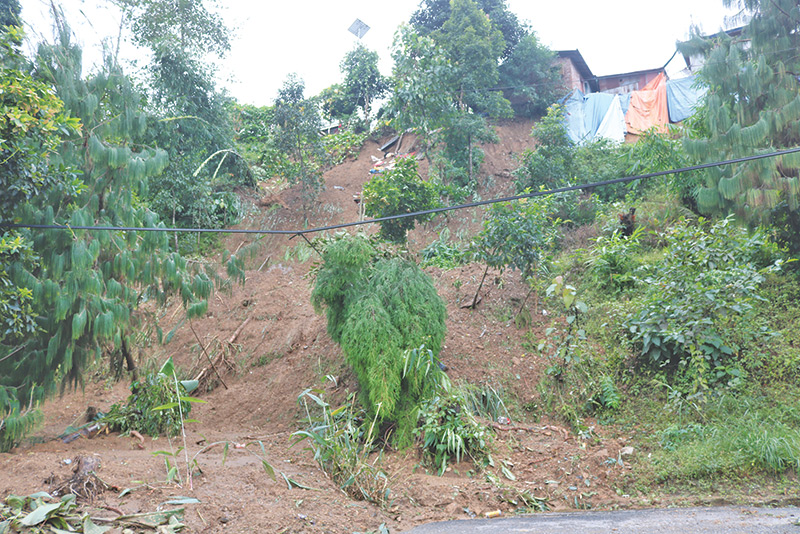
Residents fear they may have to face a repeat of last year’s disasters and complain that the local unit has not prepared for possible disasters. Post Photo
ILAM, On October 18 and 19 last year, landslides triggered by unseasonal rainfall killed 15 people in five local units in Ilam. Two went missing in the incident. A few days prior to the landslide, transportation along the Narayansthan road section of the Mechi Highway, considered the lifeline of eastern Ilam, was disrupted for a month because of multiple landslides along the road section. The road blockage left several landslide victims stranded with no access to transportation to move to safer areas. Several weeks later, one side of the road was opened for vehicle movement. It took a month for the entire road section to open since the local unit and the road division could not agree on whose responsibility it was to clear and mend the road section, according to Bidhru Pokhrel, chief of the Road Division Office in Ilam. Most of the rural road sections in the district including the Mechi highway were damaged by soil erosion and landslides in October last year. The district’s residents fear that they may have to face similar disasters this year also and complain that the local unit has not prepared for possible disasters this year either. Kishor Kripalu, a resident of Ilam Municipality -7, says people lost their lives and property to last year’s October landslide because the local unit was unprepared for disasters. “But this year too, the local authorities have not made any preparations even though the monsoon is upon us,” said Kripalu. “No major incidents have occurred so far but considering the previous year, monsoon season is not the only time we are at risk of natural disasters.” There are increasing complaints from several quarters that the local unit has not done the necessary work for disaster risk reduction and management. According to the district administration office, 10 municipalities of Ilam are at risk of landslides and mudslides. Madhav Dhungana, Ilam’s chief district officer, said his office is currently collecting data on people living in high-risk areas. A district disaster preparedness and response plan have also been sent to the local units, he said. Dhungana said that while the district formulates disaster management plans, it is the local units’ responsibility to implement them. The district administration estimates 1,973 members of 550 families are currently at risk of landslides while 1,200 households are at risk of mudslides. “The local units have not learned anything from their previous mistakes,” Dhungana said. “The elected representatives of the local units say they will complete the disaster prevention and preparation work in a month but disasters don’t adhere to time frames. Anything can happen anytime.” According to Dhungana, the local units’ infrastructure development projects have caused harm to the topography. “They allow construction activities without doing environmental impact studies,” he said. “The local units have yet to realise how they are putting everyone at risk with their haphazard construction projects.” A couple of weeks ago, a landslide damaged three houses in the Chisapani market of Mansegung Rural Municipality. There were no casualties. Ran Bahadur Rai, mayor of the Suryadev Municipality, said the local unit has not started disaster prevention and management works yet and that they plan to complete all preparations within a month. Superintendent of Police Mahendra Shrestha said they have informed all 81 wards of the district to purchase the essential rescue materials needed in case of disasters. “The Local Government Operation Act 2074 has given all the needed power and authority to the municipalities in disaster mitigation, management and relief,” Shrestha said. “There is nothing stopping them from preparing for the worst.” Every district has a disaster risk reduction and management committee at the district level under the chairmanship of the chief district officer and one at the local unit headed by the chairman of the ward that is at most risk of disasters. According to the District Administration Office, the risk of landslides is high in the highlands and central areas of the district. Development activities—roads, irrigation and infrastructure—in the Chure region have increased over the years exposing the Chure region to natural disasters. Dhungana, the chief district officer, said that unless local units make a detailed plan based on the local situation, formulating action plans at the district level will not be sufficient to prevent disasters and arrange for post-disaster help for the victims.
NATIONAL
Inclusivity just a refrain in Maoist party, as it fails to practise what it preaches
Party picks 21 office bearers with just one woman, two Madheshis, four Janajatis—none from Dalit, Muslim communities.
- TIKA R PRADHAN
KATHMANDU, Nepal’s Maoist party, which claims to have championed the inclusivity cause, announced 21 office bearers, eight months after its general convention, on Saturday with just one woman, two Madheshis, four Janajatis and no representation from the Dalit and Muslim communities. Even though Janardan Sharma and Barshaman Pun were said to be in the race, CPN (Maoist Centre) chair chose Dev Gurung for the general secretary post. “Today’s Standing Committee meeting finalised 21 office bearers after the party chairman proposed the list,” said Khagaraj Bhatta, a Standing Committee member. “Now, our party will focus on the upcoming polls for which a manifesto drafting committee has also been formed.” Though the party had decided to have 15 office bearers including the chairman, in a bid to manage the leaders, Dahal extended the number to 21. Pampha Bhusal, the only woman, is among the seven deputy general secretaries alongside Barshaman Pun, Janardan Sharma, Girirajmani Pokhrel, Haribol Gajurel, Shakti Basnet and Matrika Yadav. Dahal had already announced Narayan Kaji Shrestha as senior vice chair and Krishna Bahadur Mahara as vice chair. The nine secretaries of the party are Lilamani Pokhrel, Dinanath Sharma, Chakrapani Khanal, Ram Karki, Ganesh Shah, Devendra Poudel, Dilaram Acharya, Hitman Shakya and Hitraj Pande. Office Secretary Shreeram Dhakal has been appointed the party’s treasurer. “We were well aware of the fact that inclusivity was not possible in the top leadership of the party,” said Bhatta. “At least we could manage a Janajati leader for the second most powerful position in the party after chairman.” Gurung’s selection, however, is guided by Dahal’s personal interest, according to insiders, as the chairman wanted to have a “yes man” as the general secretary rather than someone who could challenge him. Gurung is considered a hardliner in the party who doesn’t harbour much ambitions but is just trying to find some space after returning to the mother party in 2016. A longtime Maoist leader, Gurung had deserted Dahal in 2012, six years after the end of the “people’s war”, to join a more radical Maoist party led by Mohan Baidya. Those parting ways with Dahal had accused him of deviating from the ideology and leaving the “people’s war” halfway. Insiders say Gurung is a natural choice for Dahal as he is unlikely to challenge the leadership nor make any move that could disturb the status quo. Dahal, who controls the party with an iron fist, feared that any imbalance in the internal dynamics would cost him politically after his party managed to get a new lease of life from the May local elections. Party leaders told the Post on Friday that the chairman would pick office bearers in such a way that he could “manage” leaders and take decisions as per his wish. “Dahal wants to run the party the way he wants and does not want anyone to object to his decisions, and Gurung is the best candidate for him,” said a politburo member asking not to be named fearing retribution. “The chair wanted a leader as the general secretary who could just be a rubber stamp.” Some party leaders said Saturday’s decision is a temporary arrangement and that the party will hold a special convention after the November 20 polls. The Maoist party’s convention, however, has always been a formality with Dahal asserting his role and imposing the decisions. Instead of electing members in the party committees, Dahal fishes out a list of his favourites from his pocket and announces the names, which are endorsed by leaders. “The date for the special convention has not been set. Discussions are going on with Madhav Nepal’s party at this time and we have to see the poll results also,” said Girirajmani Pokhrel, one of the newly elected deputy general secretaries. The Maoist Centre is currently in dialogue with the Madhav Nepal-led CPN (Unified Socialist) for a possible unification. Leaders say the temporary arrangement is also aimed at giving the party chair a free hand until the polls. On the party’s failure to ensure inclusivity, Pokhrel admitted to it but also defended it, saying “it is just a temporary arrangement”. Some leaders including Chakrapani Khanal and Janardan Sharma had expressed their dissatisfaction over Dahal’s selection of office bearers at Friday and Saturday meetings, respectively. “Actually they had their reservations about giving opportunities to those who had once betrayed the party,” said a Standing Committee member asking not to be named. “We accepted the chairman’s proposal just because we are heading for the polls and it is just an interim arrangement.” Along with Gurung, Pampha Bhusal, the only female office bearer, had also returned to the fold in 2016. Bhusal is currently the energy minister in the Sher Bahadur Deuba government. Other leaders who returned to the mother party were Ram Bahadur Thapa, Lekhnath Neupane, Surya Subedi and Maheshwor Dahal. Jayapuri Gharti, Mani Thapa and Matrika Yadav, who were in different outfits, had also rejoined Dahal’s Maoist party in 2016. Yadav has been selected as a deputy general secretary. Mani Thapa and Ram Bahadur Thapa are not with the Maoist party as they decided to remain in the CPN-UML following the Supreme Court’s invalidation of the Nepal Communist Party (NCP) in March last year. The Standing Committee meeting on Saturday also formed a manifesto drafting committee led by senior vice-chair Shrestha. General secretary Gurung, Girirajmani Pokhrel, Barshaman Pun, Janardan Sharma, Shakti Basnet, Lilamani Pokhrel, Ganesh Shah, Amrita Thapa, Parsuram Tamang, Parshuram Ramtel, Hari Roka, Jakir Hussain, Min Bahadur Shrestha, Krishna Chaudhari, Bhima Dhungana and Jagat Simkhada are the members. “I was not interested in the positions distributed today. Nor did I aspire to hold any of the posts,” said one of the office bearers selected on Saturday. “The process neither respects the spirit of inclusivity nor meets our expectations. But we didn’t oppose it just because it was delayed for around nine months, and the chairman has said it is just an interim arrangement.”
NATIONAL
Finalising candidates in some constituencies appears a tough row to hoe for ruling coalition
Besides splitting the 165 seats for direct election among allies, a major challenge will be managing the aspirants.
- NISHAN KHATIWADA
Kathmandu, For the five parties in the ruling coalition, taking a decision to fight elections under an alliance may not have been that difficult. But as seat-sharing discussions are underway, there seems to be a realisation that there are many facets and multitudes of challenges. There are some constituencies which key leaders of the coalition partners may not want to give up. Bishwa Prakash Sharma, general secretary of the Nepali Congress, has already decided to contest from Jhapa-1. In the 2017 polls, CPN (Maoist Centre) leader Ram Karki had defeated Sharma in that constituency. The Maoist Centre had then fought the elections in alliance with the CPN-UML. Now, the Congress and the Maoist Centre, along with CPN (Unified Socialist), Janata Samajbadi Party and Rastriya Janamorcha, have teamed up against the UML. Besides splitting the 165 seats for direct election among the partners, one major challenge for them will be managing the aspirants. Will Karki leave Jhapa-1 for Sharma? Or where will he contest from? Karki and Sharma’s case is just one example. In Tanahun-1, Krishna Kumar Shrestha (Keesan) defeated Congress senior leader Ram Chandra Poudel. Shrestha was contesting from the UML. But when the UML split in August, he joined Madhav Nepal’s Unified Socialist, a partner in the coalition. Poudel is willing to contest the election from the constituency, and Shrestha also has shown his interest. In Sindhupalchok-1, Mohan Basnet of the Congress has said he will not leave his constituency for anyone this time. Agni Sapokta of the Maoist Centre won the last elections from the very constituency. He is currently the House Speaker but is likely to contest from there again. Two key leaders from the ruling coalition are eying Doti—Unified Socialist’s Prem Ale and Congress’ Bir Bahadur Balayar, who also presides over the Nepali Congress Sudurpaschim provincial committee. Ale had won the last election on the UML ticket. Balayar has staked his claim to the candidacy citing that the Congress won more than two thirds of local government chiefs in the recently concluded polls. Observers say tension may be building in the ruling coalition given the multiple claims in some constituencies. “Managing candidacies in such constituencies will be a tough nut to crack for the coalition leadership,” said Uddhab Pyakurel, an assistant professor of Political Sociology at Kathmandu University. The Maoist Centre had won 36 constituencies in the elections held five years ago because it managed to defeat Congress candidates with the UML’s support. Now those defeated candidates may not want to leave their constituencies for the Maoist Centre just because the party is a coalition partner. The Unified Socialist did not exist then, but those in the party who won under the UML’s ticket too had defeated the Congress. According to Pyakurel, the Congress, the Maoist Centre and the Unified Socialist are under the compulsion to fight the elections together, but in many constituencies, there are claimants from all three parties. Puranjan Acharya, a political analyst, says even practically, the ruling coalition is not finding proper bases and as some coalition parties’ leaders remain adamant on fighting from a certain constituency, it is in real trouble. According to him, the high number of votes which the Congress expects to shift or transfer to partner candidates is impractical as other parties’ candidates hold fewer votes to fight against the UML. “Other parties have leading votes in only a handful of areas, which has made the decision-making regarding candidacies tough,” said Acharya. Failure to effectively manage candidates could lead to disappointment among cadres and leaders, observers say. Also, unhappy leaders from the ruling coalition could support other parties in the polls, according to Pyakurel. “To maintain their grip on their local constituency, they could deceive their own party. Dealing in constituencies to give political space to other parties’ leaders, ignoring the main [local] candidate of the region would lead to trouble,” said Pyakurel. Acharya foresees a similar problem. “The Congress, which leads the ruling coalition, could lose much public support and disappoint its key leaders if it has to cede constituencies for coalition leaders,” he said. Coalition party leaders, however, say problems regarding candidacies will be solved, even though they agree that some key leaders have shown their interests in the same constituencies. Chandra Bhandari, a Nepali Congress leader, said that only a handful of leaders wield the ultimate power in the political parties. “As there is a chance of becoming a lawmaker and further a minister from the proportional system, I don’t think there will be any conflict,” he said, referring to the situation of candidates leaving such contested candidates in exchange for a proportional representation seat. Maoist Centre chief whip Dev Gurung is hopeful that the top leaders will solve the problems that arise regarding the candidates. “They have sorted out bigger problems. In a multiparty system, problems emerge among the parties in an alliance. The top leadership will definitely sort the problems out,” Gurung told the Post. “All other leaders will have to abide by the decisions of the top leadership.”
NATIONAL
Valley authority’s move to plant saplings on narrow footpaths draws flak
Development authority aims to ‘beautify’ the city by planting saplings on footpaths. Pedestrians and urban planners say that doesn’t make sense.
- ANUP OJHA
Most of Kathmandu Valley’s streets are narrow with narrower footpaths. Photo courtesy: Anand chaudhary/ twitter
KATHMANDU, Dhurba KC, who goes on a morning walk regularly, has had to negotiate a particularly inconvenient footpath section for the past one week. An array of tree saplings have emerged along the footpath leading to Dhobikhola bridge near Hanumansthan, Kathmandu, bothering pedestrians. “The footpaths are already narrow,” KC, 43, who lives in Thapagaun, said. “The tree saplings make matters worse for pedestrians.” KC said he now walks the motor road instead of the footpath, despite the danger posed by vehicles. The saplings—that have caused huge inconvenience to pedestrians, especially porters, the elderly and those with disabilities—were planted a week ago by Kathmandu Valley Development Authority (KVDA), in coordination with ward offices of Kathmandu Metropolitan City and local clubs, according to officials at the ward 10 office of the City. The plantation drive has so far laid down 200 Juniper and Neem saplings along various road sections of the Valley, including at Hanumansthan. Naroj Aryal, a member of ward 10, said that he was present at the planting of saplings which, he said, was part of a “green drive”. “But it’s not sustainable,” Aryal admitted, adding that several people have complained about it. “I also do not feel comfortable seeing seedlings being planted in the already narrow footpaths.” Footpath sections from Ratopul to Kalopul and up to Bhatkekopul have also seen newly-planted tree saplings—a total of 130 saplings were planted in the area by the KVDA with financial assistance from the United Nations Environment Programme (UNEP), according to Navaraj Pyakurel, spokesperson for the KVDA. There are more saplings to be planted along the Valley’s narrow footpaths, according to Pyakurel. The plantation drive, part of the UNEP’s urban ecosystem-based adaptation project, aims to transplant over 8,000 saplings across the Valley over the next four years, said Pyakurel, adding that the UN agency has allocated Rs620 million for the project and other programmes such as rainwater harvesting, rooftop farming, and greening of spaces and parks, among others, with an aim to “beautify the Valley”. Beauty, however, is subjective. For Padam Gurung, 31, who runs a grocery shop in Kalopul, the drive “does not make any sense.” “The riverbank area of Dhobikhola already has greenery,” Gurung said. “I don’t think these plants will grow in the concrete but if they do survive and grow, there won’t be any space for people to walk. This is just a wasteof money.” According to Bhagawat Bhakta Khokhali, project manager for urban ecosystem-based adaptation, the plantation drive is a part of the greenery project. “We have planted climate-resilient trees only where there are wide footpaths,” Khokhali told the Post. However, when the Post scribe visited the area on Tuesday, all the footpaths in the Ratopul and Kalopul areas in ward 7 of KMC had become way too narrow to walk with the freshly planted saplings dotting them. “The whole stretch has become very risky to walk,” said Sushil Kumar Rawal, 50, a resident of Kalopul. Some residents of the Valley have taken to social media to express their disdain about the drive. On Monday, Anand Chaudhary shared photos of the plantation drive on Twitter asking authorities to find a better place to plant trees. “An already narrow pedestrian area; now it’s hard for two people to pass,” he tweeted. In the photo, a school student can be seen walking on the narrow footpath with saplings planted on either side. Most of Kathmandu Valley roads are narrow with narrower footpaths. Pedestrians have to manoeuvre their way through these narrow footpaths skipping over wares laid out on the ground by shopkeepers. Street vendors, motor workshops and eateries have over the years spilt over onto the narrow footpaths leaving pedestrians struggling to find space to walk. The local authorities have also planted saplings on the narrow footpaths in Bakhundole and Sanepa areas in Lalitpur, Naxal area, the inner parts of New Baneshwar and Taukhel area in Nagarjun Municipality. Urban planners say this move highlights the lack of farsightedness in plans adopted to beautify the city and the mismanagement of such drives. “Instead of managing such inconveniences, local authorities are just supporting such a futile drive that involves a lot of risks for pedestrians,” said senior urban planner Suman Meher Shrestha. “Just a decade ago, only the Durbar Marg area had walkable footpaths. Today most footpaths are one or two feet wide and the authorities now have planted saplings making the footpaths narrower.” According to a 2018 ‘Kathmandu Walkability Study’ by the Resource Centre for Primary Health Care, which surveyed 35 different sections of the Kathmandu Metropolitan City, pedestrian facilities are almost non-existent in capital city—60 percent of roads do not have distinctive footpaths and where footpaths are available, the width of the footpath is only four to six feet or less than that. Roads passing through populated areas must have footpaths of at least a minimum of 1.5 metres in width, according to Nepal Road Standard, 2070 (2013) under the Department of Roads Design and Planning Branch. In case of space constraints, where a footpath is less than 1.8 metres wide, there must be a provision for a passing zone every 50 metres that can accommodate two wheelchairs at a time. The international standard for footpaths is 1.8 metres, according to urban planner Shrestha. But this standard is not followed in Kathmandu Valley, Shrestha noted. “It is a misfortune,” said Shrestha, citing examples of developed countries where, he said, the government takes public safety seriously and therefore puts focus on ease of way. “They allocate wide spaces for footpaths so that people can walk safely. In Nepal, no one cares.” In his tweet, Chaudhary urged authorities to think of regular users of footpaths like porters, elderly, and people with disabilities—and not just vehicle users passing by—before coming up with such drives. “Please find better places to plant trees,” Chaudhary wrote.
OPINION
Investing in period positive schools
Schools need to build changing facilities with hand washing stations and disposal bins.
- MOHIT RAUNIYAR
Post file photo
In many Nepali communities, menstruation in and as a social context is considered “impure”, and women are mostly not allowed to stay with the family when they are menstruating. Among some rural communities, chhaupadi is a common practice, where women are banished to live in isolated sheds when they are menstruating. With roots deeply entrenched in a culture that encourages regressive and inhumane practices, it can be difficult to recognise menstrual shame. Addressing it is an impossible challenge, especially for a student with limited knowledge about the taboo, and in most cases, is barely taught anything significant about it in the classroom. The consequences of the stigma can be difficult to understand as a young person. Traditions associate menstruation with shame, embarrassment and evil spirits. In some cultures, women bury their menstrual cloth to prevent them from being used by evil spirits. Undoubtedly, the roots for turning this natural process into a taboo lie in religious and cultural aspects; however, it was and is still being perpetuated through society and classrooms.
Missing school The physical pain and discomfort added to the fear of staining are constantly and consciously on the minds of menstruating individuals. The stigmatisation of this concept impacts the lives, health and safety of women and girls while strongly reinforcing gender inequality. A UNICEF report in 2016 indicated that girls experienced shame, fear, confusion, teasing and lack of accurate information and advice, resulting in 15 to 22 percent of them missing school during menstruation. Further, menstruation can also be a consequential factor in girls dropping out of school. In India, one in five girls drop out of school after they get their period. There are myriad reasons—it could be parents’ fear of their daughters accidentally getting pregnant or to indicate that a girl is ready for marriage as it is a sign that they have turned into a woman. A good contributor to the absence of girls at school is the lack of proper toilets and menstrual hygiene products. Schools must take steps to provide menstrual health and hygiene management and access to sanitary products, and provide changing facilities to enable girls to manage their period without embarrassment to mitigate this absence to some level. Schools are also responsible for providing their students with proper knowledge about the importance of menstrual health and hygiene management, making knowledge about menstruation inclusive to all genders. They need to start supporting teachers, even male teachers and staff and equip them with the necessary menstrual health, hygiene and reproduction knowledge and training. Further, they need to ensure that all adolescent children, even boys, get used to this topic and that students are comfortable talking about it rather than being embarrassed and laughed at. Menstruating individuals need to feel safe when they are menstruating, and should be easily able to share their discomfort with their teachers and friends rather than whispering about it and reinforcing archaic mentality. There is a need to understand, especially among policymakers, that sanitary products are essential items, not luxury items. Imposing 15 percent customs duty, 13 percent VAT, and an additional 1.5 percent VAT on customs duty on imported menstrual products limit access to an already expensive necessity. Regardless of when a shift in the mentality and policy happens (hopefully, soon), schools have to be actively involved in providing sanitary pads to pupils of menstrual age as primary drivers of this change. When the New York City Department of Education announced that 25 public schools would be outfitted with dispensers filled with free feminine hygiene products for students, the schools reported a 2.4 percent increase in attendance after the dispensers were installed. We hear about menstrual product drives working to provide vending machines in different community schools, but it possibly only is a band-aid over the wound. Just as schools invest in building a new computer lab, they have to allocate a budget every year for sanitary vending machines and need to refill menstrual pads and tampons like they are refilling markers and chalk in the classrooms. And this needs to be replicated in society where vending machines need to be easily accessible to everyone and hopefully—for free. Undoubtedly, schools in our communities face a grave challenge in ensuring adequate facilities for menstruating girls. The World Health Organisation reported that two in five schools worldwide lacked basic hand-washing facilities while seven out of 10 schools lacked basic hand-washing facilities in developed countries. It gets worse when we direct our attention to Nepal. UNICEF’s analysis suggested that almost 78 percent of schools have access to improved water supply facilities while 82 percent to basic sanitation facilities, and only 69 percent of schools have separate toilets for girls while only 25 percent of schools in the country have fully functional water schemes.
Changing facilities These statistics sure are worrying, but when we are talking about young girls’ health, a positive change is required. Schools need to prioritise building changing facilities with privacy to enable menstruating individuals to manage their period without embarrassment. These facilities must have access to hand washing stations with clean water and soap and sanitary disposal bins. A menstruating individual should not be forced to go home or even miss school when they menstruate because they do not have access to clean and safe changing stations. Moving forward, the schools and policymakers need to prioritise menstrual hygiene and management. We cannot have more absenteeism in schools because of the embarrassment of menstruation or lack of people to support them. These basic yet impactful steps will not only support to increase the attendance rates, but also allow students of all genders to understand the concepts of menstruation which will, in turn, support curbing the stigma in the community. It is about making girls feel safe and stay in school while having their periods and even after. Schools in Nepal and around the world have to adopt a period positive concept. Interventions across various levels are required to improve menstrual health and hygiene among menstruating individuals, and to break the existing menstrual taboos in our community and our minds.
Rauniyar is a co-founder of Canopy Nepal and is a shaper at Global Shapers Kathmandu Hub.
OPINION
Why facts don’t always change minds
Being presented with facts that suggest their current beliefs are wrong causes people to feel threatened.
- KEITH M BELLIZZI
Shutterstock
“Facts First” is the tagline of a CNN branding campaign which contends that “once facts are established, opinions can be formed.” The problem is that while it sounds logical, this appealing assertion is a fallacy not supported by research. Cognitive psychology and neuroscience studies have found that the exact opposite is often true when it comes to politics: People form opinions based on emotions, such as fear, contempt and anger, rather than relying on facts. New facts often do not change people’s minds. I study human development, public health and behaviour change. In my work, I see firsthand how hard it is to change someone’s mind and behaviours when they encounter new information that runs counter to their beliefs. Your worldview, including beliefs and opinions, starts to form during childhood as you’re socialised within a particular cultural context. It gets reinforced over time by the social groups you keep, the media you consume, even how your brain functions. It influences how you think of yourself and how you interact with the world. For many people, a challenge to their worldview feels like an attack on their personal identity and can cause them to harden their position. Here’s some of the research that explains why it’s natural to resist changing your mind—and how you can get better at making these shifts.
Rejecting what contradicts In an ideal world, rational people who encounter new evidence that contradicts their beliefs would evaluate the facts and change their views accordingly. But that’s generally not how things go in the real world. Partly to blame is a cognitive bias that can kick in when people encounter evidence that runs counter to their beliefs. Instead of reevaluating what they’ve believed up until now, people tend to reject the incompatible evidence. Psychologists call this phenomenon belief perseverance. Everyone can fall prey to this ingrained way of thinking. Being presented with facts—whether via the news, social media or one-on-one conversations—that suggest their current beliefs are wrong causes people to feel threatened. This reaction is particularly strong when the beliefs in question are aligned with your political and personal identities. It can feel like an attack on you if one of your strongly held beliefs is challenged. Confronting facts that don’t line up with your worldview may trigger a “backfire effect,” which can end up strengthening your original position and beliefs, particularly with politically charged issues. Researchers have identified this phenomenon in a number of studies, including ones about opinions toward climate change mitigation policies and attitudes toward childhood vaccinations.
Focusing on what confirms There’s another cognitive bias that can get in the way of changing your mind, called confirmation bias. It’s the natural tendency to seek out information or interpret things in a way that supports your existing beliefs. Interacting with like-minded people and media reinforces confirmation bias. The problem with confirmation bias is that it can lead to errors in judgment because it keeps you from looking at a situation objectively from multiple angles. A 2016 Gallup poll provides a great example of this bias. In just one two-week period spanning the 2016 election, both Republicans and Democrats drastically changed their opinions about the state of the economy—in opposite directions. But nothing was new with the economy. What had changed was that a new political leader from a different party had been elected. The election outcome changed survey respondents’ interpretation of how the economy was doing—a confirmation bias led Republicans to rate it much higher now that their guy would be in charge; Democrats the opposite.
Brain’s hard-wiring doesn’t help Cognitive biases are predictable patterns in the way people think that can keep you from objectively weighing evidence and changing your mind. Some of the basic ways your brain works can also work against you on this front. Your brain is hard-wired to protect you—which can lead to reinforcing your opinions and beliefs, even when they’re misguided. Winning a debate or an argument triggers a flood of hormones, including dopamine and adrenaline. In your brain, they contribute to the feeling of pleasure you get during sex, eating, roller-coaster rides—and yes, winning an argument. That rush makes you feel good, maybe even invulnerable. It’s a feeling many people want to have more often. Moreover, in situations of high stress or distrust, your body releases another hormone, cortisol. It can hijack your advanced thought processes, reason and logic—what psychologists call the executive functions of your brain. Your brain’s amygdala becomes more active, which controls your innate fight-or-flight reaction when you feel under threat. In the context of communication, people tend to raise their voice, push back and stop listening when these chemicals are coursing through their bodies. Once you’re in that mindset, it’s hard to hear another viewpoint. The desire to be right combined with the brain’s protective mechanisms make it that much harder to change opinions and beliefs, even in the presence of new information.
You can train yourself In spite of the cognitive biases and brain biology that make it hard to change minds, there are ways to short-circuit these natural habits. Work to keep an open mind. Allow yourself to learn new things. Search out perspectives from multiple sides of an issue. Try to form, and modify, your opinions based on evidence that is accurate, objective and verified. Don’t let yourself be swayed by outliers. For example, give more weight to the numerous doctors and public health officials who describe the preponderance of evidence that vaccines are safe and effective than what you give to one fringe doctor on a podcast who suggests the opposite. Be wary of repetition, as repeated statements are often perceived as more truthful than new information, no matter how false the claim may be. Social media manipulators and politicians know this all too well. Presenting things in a nonconfrontational way allows people to evaluate new information without feeling attacked. Insulting others and suggesting someone is ignorant or misinformed, no matter how misguided their beliefs may be, will cause the people you are trying to influence to reject your argument. Instead, try asking questions that lead the person to question what they believe. While opinions may not ultimately change, the chance of success is greater. Recognise we all have these tendencies and respectfully listen to other opinions. Take a deep breath and pause when you feel your body ramping up for a fight. Remember, it’s OK to be wrong at times. Life can be a process of growth.
Bellizzi is a Professor in the Department of Human Development and Family Sciences at the University of Connecticut. — The Conversation
MONEY
How barter stores are sparing farmers marketing hassle
They take agricultural and forest products from the farmers and give them daily essentials in exchange.
- DIPENDRA BADUWAL,GAGANSHILA KHADKA
Iman Singh Rana of Chhatrakot Rural Municipality-2, Pallikot has grown tomatoes using modern technology. Post Photo: Dipendra Baduwal
GULMI, Market access has been a major hurdle for farmers in Nepal, and sometimes they have to watch helplessly as their vegetables worth millions rot in the fields for lack of buyers. But not farmers in Gulmi: they have no such problem because a barter store comes to their villages to collect their vegetable harvests. Paicho Pasal, which operates a chain of barter stores, takes agricultural and forest products from the farmers and gives them daily essentials in exchange. They bring food products such as sugar, cooking oil and salt and garments to the villages, which they swap for farm products. If the farmers don’t want to barter, the shops also pay cash. "Paicho Pasal also invests in farmers," said Keshav Neupane, its chief operating officer. “We provide technical service too. We help farmers to test the soil and provide quality seeds.” The shop makes pickles, jam and other products from the organic produce collected from farmers. “We sell them in the domestic market and also export them,” said Neupane. Ram Bahadur Nepali's field is covered with cauliflowers, and he is not worried about their sale. Nepali of Basad in Rurukshetra Rural Municipality-5 has cultivated vegetables targeting the upcoming festivals. “They will be ready for harvest during the Teej and Dashain festivals,” he said. Nepali switched to commercial vegetable farming after growing maize for several years. “I earned extra money by planting turnip and coriander along with cauliflower,” he said. Nepali claims he makes Rs500,000 annually. Paicho Pasal has been a boon for many farmers. “Small farmers can exchange their produce for daily necessities such as salt, oil, soap and food items,” Nepali said. “We don’t have to worry about the market as Paicho collects our vegetables.” Him Lal Puri from Bamgha has been a vegetable farmer for four decades, and remembers having a hard time selling his vegetables whenever he had a bumper harvest. “We had to carry our produce to markets in Ulli Khola and Khaireni Bazaar spending hours,” said Puri, who owns a 5-ropani farm. “I sell vegetables worth Rs200,000 annually. The only expense is buying seeds.” Until two years ago, Puri ploughed his fields using oxen. Now he uses a mini tiller. “The rise in our income has enabled us to use technology. We are also investing in our children's education,” he said. More than 150 households in Bamgha are engaged in commercial vegetable farming, according to Chet Narayan Shrestha, chairman of the Smart Agriculture Village Programme, an initiative of the provincial government to assist farmers. “Paicho Pasal alone has been buying vegetables worth Rs20 million annually,” Shrestha said. Paicho Pasal has motivated the villagers in commercial vegetable farming since 2014. Earlier, farmers were engaged in traditional farming. Output was low and they could sell their produce only when they had an abundant harvest. Modern technology has helped them to increase their production. Iman Singh Rana of Chhatrakot Rural Municipality-2, Pallikot uses modern technology in farming. Rana has built 14 permanent tunnels, or greenhouses made of plastic and bamboo. “I have cultivated tomatoes on 10 ropanis,” said Rana. “In the same tunnels, I have also planted beans and cucumbers.” Rana spent two decades of his youth as a welder in India. He started vegetable farming around seven years ago. “The income from farming has been better than what I used to make in India,” he said. Rana has hired two farm hands to help him. “Besides one daily meal, I pay them Rs12,000 each a month,” he said. According to Rana, he makes a profit of Rs600,000 yearly. Rana’s home is a collection centre for vegetables produced by local farmers. “We collect vegetables twice a week,” he said. “Then Paicho takes them away.” Thulapokhara at Chhatrakot-1 is a vegetable production centre. Around 500 households in the area are involved in vegetable farming, according to local residents. Bhuwan Kharal, 29, is among the highest earners in the area. “I produce vegetables worth Rs5 million annually,” said Kharal. Chhatrakot Rural Municipality has prioritised the use of modern technology, according to Kharal. Every household has built plastic tunnels and uses mulching techniques. Kharal grows vegetables on 80 ropanis. “Besides this, I am about to start a vegetable farm on 400 ropanis at Argheli in Palpa district,” he said. "While tomatoes and chillies used to be produced in large quantities in the past, red turnip, cucumber, cauliflower and cabbage are also produced these days," he added. Kharal, who has a bachelor’s degree in education, had once made up his mind to go abroad to earn more. “But when I saw my elder brother flourishing on the farm, I changed my mind,” he said. Paicho provides technical assistance to farmers, according to Kharal. “Technicians from Paicho visit us regularly,” he said. Kharal produces 80 tonnes of tomatoes, 30 tonnes of chillies, 20 tonnes of cauliflowers and 10 tonnes of red turnips annually. Farmers in many districts still rely on rainwater for irrigation. “We need irrigation facilities,” said Kharal. According to Paicho, it has mobilised 16 technicians, including a graduate in agriculture, with different areas of expertise to assist the farmers across the district. “Our technicians help farmers at every stage from planting to harvesting,” said Dhruba Neupane, managing director of Paicho Pasal. "We have signed contracts with farmers to buy their produce since market access is equally important. We run a collection centre in every village. The farmers are paid instantly.” Farmers in Gulmi produce vegetables worth Rs230 million every year, according to Navaraj Bhandari, chief of the Agriculture Knowledge Centre in the district. Commercial vegetable farming is done on 960 hectares. The 5,000 tunnels or greenhouses cover an area of 30 hectares. Chhatrakot, Rurukshetra, Satyawati, Chandrakot and Kaligandaki rural municipalities, and Resunga and Musikot municipalities are pocket areas for vegetables. While vegetables worth Rs127.5 million are sold in other districts, crops worth Rs102.5 million are consumed locally. "Around 11,503 tonnes of vegetables are produced in the district every year," said Bhandari. "There are 49,965 commercial vegetable farmers.”
MONEY
Greece rid of budget watch amid inflation, energy woes
- ASSOCIATED PRESS
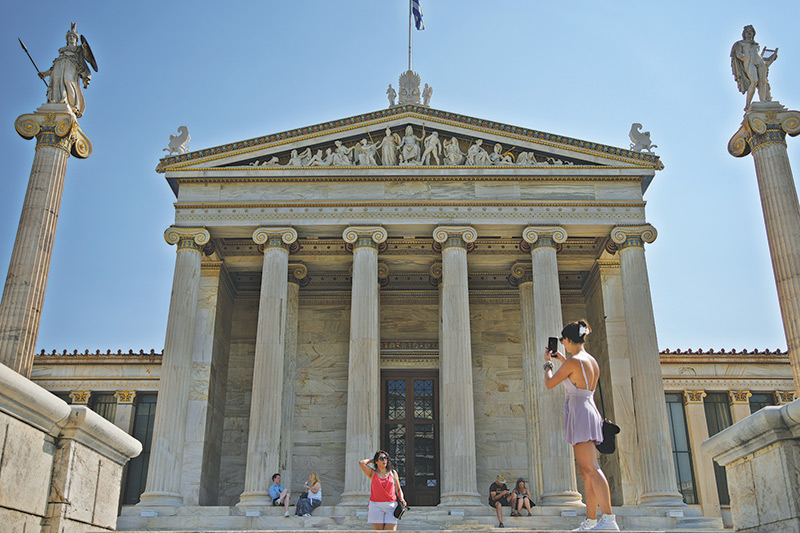
Tourists take photographs and others sit in front of Athens Academy in Athens, Greece on Friday. AP/Rss
ATHENS, GREECE, With more of a whisper than a resounding clang, Greece has shed another restriction dating to its painful financial bailout years. Saturday’s formal end of “enhanced surveillance” by European Union creditors means the country will no longer face quarterly scrutiny of its public finances to win debt relief payments. That gives Prime Minister Kyriakos Mitsotakis’ centre-right government greater freedom over the budget at a time when Greece, like all of Europe, is struggling with a post-pandemic cost-of-living and energy crisis triggered by Russia’s war in Ukraine. As Moscow has cut back natural gas to Europe, energy prices have surged, fueling galloping inflation and threatening to plunge Europe into recession. Nevertheless, Greece—like fellow bailed-out EU members Spain, Portugal, Cyprus and Ireland—will still be monitored by its creditors while paying back its debts. In Greece’s case, that will take another two generations, with the last loans due for repayment in 2070. Wolfango Piccoli, a co-president and director of research at Teneo consultancy who has covered Greece’s financial crisis for years, said the end of enhanced surveillance is not likely to have a meaningful impact. “It is mainly a technical matter that most investors are expected to ignore,” he said. While Mitsotakis’ government may try to score domestic political points with the exit from enhanced surveillance, “this will be a futile exercise,” Piccoli said. “The vast majority of the public is focused on the cost-of-living crisis,” he said. That is true for Efthymia Paidi, a 23-year-old central Athens florist who grew up during Greece’s financial crisis and doesn’t feel much has changed since. “I think the crisis is essentially continuing, it never ended,” she said. “What I see is a constant repetition. ... Unemployment is still high and salaries are low, while the cost of living is high.” Saturday’s milestone marks exactly four years from the end of the international loan program that left Greeks beaten down but still members of the European Union and its common currency, the euro. The Greek crisis roiled global markets and pushed EU unity to its limits. Investors stopped lending Greece money in 2010 after Athens acknowledged misreporting key budget data. To keep the country afloat, its European partners and the International Monetary Fund approved three rescue loan programs lasting from 2010 through 2018 worth a total 290 billion euros ($293 billion).
MONEY
US buying big Ukraine grain shipment for hungry regions: WFP chief
- ASSOCIATED PRESS
BULLA HAGAR, KENYA, The United States is stepping up to buy about 150,000 metric tons of grain from Ukraine in the next few weeks for an upcoming shipment of food aid from ports no longer blockaded by war, the World Food Program chief has told The Associated Press. The final destinations for the grain are not confirmed and discussions continue, David Beasley said. But the planned shipment, one of several the UN agency that fights hunger is pursuing, is more than six times the amount of grain that the first WFP-arranged ship from Ukraine is now carrying toward people in the Horn of Africa at risk of starvation. Beasley spoke Friday from northern Kenya, which is deep in a drought that is withering the Horn of Africa region. He sat under a thorn tree among local women who told the AP that the last time it rained was in 2019. Their bone-dry communities face yet another failed rainy season within weeks that could tip parts of the region, especially neighbouring Somalia, into famine. Already, thousands of people have died. The World Food Program says 22 million people are hungry. “I think there’s a high probability we’ll have a declaration of famine” in the coming weeks, Beasley said. He called the situation facing the Horn of Africa a “perfect storm on top of a perfect storm, a tsunami on top of a tsunami” as the drought-prone region struggles to cope amid high food and fuel prices driven partly by the war in Ukraine. The keenly awaited first aid ship from Ukraine is carrying 23,000 metric tons of grain, enough to feed 1.5 million people on full rations for a month, Beasley said. It is expected to dock in Djibouti on August 26 or 27, and the wheat is supposed to be shipped overland to northern Ethiopia, where millions of people in the Tigray, Afar and Amhara regions have faced not only drought but deadly conflict. Ukraine was the source of half the grain that WFP bought last year to feed 130 million hungry people.
MONEY
Cuba sees surge in foreign tourists
- AGENCE FRANCE-PRESSE
HAVANA, The number of foreign tourists visiting Cuba so far this year is up nearly sixfold from the 2021 period but remains below pre-pandemic levels, the government said Saturday. Officials say they are hoping to see more Russian tourists once flights cancelled because of Covid-19 and the Ukraine war are restored this year. The National Statistics Office (ONEI) said 834,891 tourists visited the island from January through July, compared to 141,293 visits in the first seven months of 2021. International tourism represents Cuba’s second-leading economic activity, after the sale of medical services, but the pandemic, along with continuing travel curbs from the US, saw the numbers collapse in 2020 and 2021. The total number of foreign visitors plunged from 4.2 million in 2019 to one million a year later.
MONEY
Foxconn to invest $300 million more in Vietnam: State media
Briefing
HANOI: Apple supplier Foxconn has signed a $300 million memorandum of understanding with Vietnamese developer Kinh Bac City to expand its facility in the north of the country to diversify and boost production, state media said on Saturday. The Taiwanese company’s new factory, on a plot of 50.5 hectares in Bac Giang province, will generate 30,000 local jobs, the Tuoi Tre newspaper said. Foxconn, formally called Hon Hai Precision Industry Co, and Kinh Bac City did not immediately respond to requests for comment. The move follows a report this week that Foxconn has started test production of the Apple Watch in northern Vietnam. Foxconn, which has been in Bac Giang for 15 years, has moved part of its iPad and AirPods production to Bac Giang’s Quang Chau Industrial Park, Tuoi Tre reported. It did not say which type of products would be produced at the new factory or its capacity. The Vietnamese government said last year Foxconn had invested $1.5 billion in the Southeast Asian country. (REUTERS)
MONEY
Ethiopian Airlines suspends pilots who missed landing
Briefing
NAIROBI: Africa’s biggest carrier Ethiopian Airlines said it has suspended two pilots who reportedly fell asleep and missed their landing during a flight from Khartoum to Addis Ababa. The plane overshot the runway at Bole International Airport in the Ethiopian capital on Monday before landing safely, according to flight-tracking website FlightAware. Independent website The Aviation Herald said the pilots fell asleep during the flight and were only woken up by an alarm triggered when autopilot mode disconnected. The plane circled back to land 25 minutes later, flight data showed. Ethiopian Airlines said on Friday that flight ET343 had temporarily lost communication with air traffic control but landed safely after it was restored. (AFP)
MONEY
China’s July Russian coal imports hit 5-year high
Briefing
SINGAPORE: China’s coal imports from Russia jumped 14 percent in July from a year earlier to their highest in at least five years, as China bought discounted coal while Western countries shunned Russian cargoes over its invasion of Ukraine. China brought in 7.42 million tonnes of coal from Russia last month, data from the General Administration of Customs showed on Saturday. That was the highest monthly figure since comparable statistics began in 2017, up from 6.12 million tonnes in June and 6.49 million tonnes in July 2021. Western countries were avoiding cargoes from Russia ahead of a European Union ban on Russian coal that came into force on August 11, aimed at reducing the Kremlin’s energy revenue over its February invasion. (REUTERS)
WORLD
Russia shells, Kyiv strikes as war broadens
Russian shelling collapses balconies and blows out windows in Mykolayiv, injuring at least nine civilians, authorities say.
- ASSOCIATED PRESS
A worker cleans up inside as an 11-year-old walks past a college where he took karate lessons, after a rocket attack in Donetsk region on Friday. AP/RSS
KYIV, UKRAINE, Russian forces stepped up their battle to seize one of the dwindling number of cities in embattled eastern Ukraine not already under their control while continuing to fire on towns and villages in the country’s north and south, Ukrainian officials said on Saturday. Russian shelling collapsed balconies and blew out windows in the southern region of Mykolayiv, injuring at least nine civilians, authorities said. A five-story apartment building and private homes in the town of Voznesensk were badly damaged, the Black Sea region’s governor said. “As of 13.30 pm [local time]—nine wounded, including four children. All children are in a serious condition. Ages range from 3 to 17 years,” Governor Vitaliy Kim wrote in a Telegram post. He added that a young girl lost an eye as a result of Saturday’s attack. Reflecting the broadening frontlines of the nearly 6-month war in Ukraine, a Ukrainian airstrike hit targets in the largest Russian-occupied city in the southern Zaporizhzhia region, according to Ukrainian and Kremlin-backed local officials. The Ukrainian mayor of Melitopol said preliminary reports pointed to “a precise hit” on a Russian military base. The head of the Kremlin-backed administration said the attack damaged residential areas and slightly injured one civilian. In its daily update, the General Staff of the Armed Forces of Ukraine said intensified combat took place around Bakhmut, a small city whose capture would enable Russia to threaten the two largest remaining Ukrainian-held urban centres in the eastern Donbas region. Bakhmut has for weeks been a key target of Moscow’s eastern offensive as the Russian military tries to complete a months-long campaign to conquer all of the Donbas, an industrial region that borders Russia where pro-Moscow separatists have self-proclaimed a pair of independent republics. A local Ukrainian official reported sustained fighting Saturday morning near four settlements on the border between Luhansk and Donetsk provinces, which together make up the contested region. Luhansk Governor Serhii Haidai did not name the settlements or mention Bakhmut, which lies around 25 kilometres from the border between the two provinces. Russian forces overran nearly all of Luhansk last month and since then have focused on capturing Ukrainian-held areas of Donetsk. Russian shelling killed seven civilians on Friday in Donetsk province, including four in Bakhmut, Governor Pavlo Kyrylenko wrote on Saturday on Telegram. Taking Bakhmut would give the Russians room to advance on the province’s main Ukrainian-held cities, Kramatorsk and Sloviansk. The General Staff update said Sloviansk and Kramatorsk also were targeted Friday along with the Kharkiv region to the north, home to Ukraine’s second-largest city. Neither Moscow nor Kyiv commented on the airstrike aimed at Russian-occupied Melitopol in southern Ukraine. Earlier Saturday morning, The Russian Defence Ministry’s spokesman, Igor Konashenkov, claimed that pro-Russia forces had shot down Ukrainian shells near the city, as well as near a key power station in the Kherson region, which the Russians seized early in the war. The head of the Kremlin-installed administration in Melitopol confirmed Saturday that the city had come under Ukrainian fire. “During the night, the Kyiv regime launched two attacks on our beautiful Melitopol, on residential areas of the city. Russian air defence systems shot down missiles, but as a result of the shelling, the houses of residents on [two] streets were partially destroyed and damaged,” Galina Danilchenko said on Telegram. The Ukrainian mayor of Melitopol, Ivan Ferodov, said local Ukrainian authorities were gathering information on the strike. “Tonight, there were powerful explosions in Melitopol, which the whole city heard,” Ferodov said. “According to preliminary data, [it was] a precise hit on one of the Russian military bases, which the Russian fascists are trying to restore for the umpteenth time in the airfield area,” Shortly after Dalnichenko’s post, Ferodov reported that residential areas in the city were hit but he blamed that strike that destroyed about 10 homes on the Moscow-backed forces stationed in Melitopol. He also reiterated his earlier claim that a Ukrainian airstrike badly damaged a Russian military base. The Ukrainian governor of the southern Zaporizhzhia region, which is partly controlled by Russia and where Melitopol is located, said late Friday evening that a child was seriously injured by Russian shelling on the outskirts of the regional capital that day. The governor, Oleksandr Starukh, said on Telegram that the 8-year-old girl remained on a ventilator following surgery, but was in “stable” condition. Starch added that the same attack in the city of Zaporizhzhia left two adult civilians with “injuries of moderate severity.”
WORLD
UN to end travel ban exemptions for Taliban officials
- AGENCE FRANCE-PRESSE
UNITED NATIONS, United States, The United Nations is set to end travel ban exemptions for 13 Taliban officials on Friday, pending any deal by Security Council members on a possible extension, diplomats told AFP. Under a 2011 UN Security Council resolution, 135 Taliban officials are subject to sanctions that include asset freezes and travel bans. But 13 of them were granted exemptions from the travel ban to allow them to meet officials from other countries abroad. In June, the 15-member UN Security Council’s Afghanistan Sanctions Committee removed two Taliban education ministers from the exemption list over the regime’s curtailment of women’s rights. At the same time, they renewed the exemption for the others until August 19, plus a further month if no member objected. Ireland objected this week, according to diplomatic sources. China and Russia have called for an extension, while the United States has sought a reduced list of the officials allowed to travel and the destinations they can travel to. The latest proposal on the table would allow just six officials to travel for diplomatic reasons, diplomatic sources told AFP. If no member of the Council objects by Monday afternoon, it will come into force for three months. In the meantime, the exemptions for the 13 officials end at midnight on Friday. Among the 13 are Deputy Prime Minister Abdul Ghani Baradar and Deputy Minister of Foreign Affairs Sher Mohammad Abbas Stanekzai. They were instrumental in negotiations with the US government of then-president Donald Trump which led to a deal in 2020 paving the way for America’s withdrawal from Afghanistan. A spokesperson for the Chinese mission at the UN, which currently holds the rotating presidency of the Security Council, this week called the Western position linking the travel ban to human rights “counterproductive.” The exemptions are “needed as much as ever,” the spokesperson said, adding that if reimposing a travel ban is all other members of the Council want to do, “clearly they have learned no lessons at all.”
WORLD
Pence says he didn’t leave office with classified material
- ASSOCIATED PRESS
Former US vice president Mike Pence. AP/RSS
DES MOINES, Iowa, Former US vice president Mike Pence said on Friday that he didn’t take any classified information with him when he left office. The disclosure—which would typically be unremarkable for a former vice president—is notable given that FBI agents seized classified and top secret information from his former boss’s Florida estate on August 8 while investigating potential violations of three different federal laws. Former President Donald Trump has claimed that the documents seized by agents were “all declassified”. Pence, asked directly if he had retained any classified information after office, told the AP, “No, not to my knowledge.” Despite the inclusion of material marked “top secret” in the government’s list of items recovered from Mar-a-Lago, Pence said, “I honestly don’t want to prejudge it before until we know all the facts.” Pence was in Iowa on Friday as part of a two-day trip, which hosts the leadoff Republican presidential caucuses. It comes as the former vice president has made stops in other early voting states as he takes steps toward mounting a 2024 White House campaign. Pence also weighed in on Republican Liz Cheney’s primary defeat earlier in the week to a rival backed by Trump. Cheney, who is arguably Trump’s most prominent Republican critic, has called the former president “a very grave threat and risk to our republic” and further raised his ire through her role as vice chair of the House committee investigating the January 6, 2021, insurrection at the US Capitol.
WORLD
Thousands gather to fete S Africa’s new Zulu king
- AGENCE FRANCE-PRESSE
King Misuzulu ka Zwelithini (centre) stands among fellow warriors in traditional dress at the KwaKhangelamankengane Royal Palace in Nongoma, South Africa on May 7, 2021. AP/RSS
NONGOMA, SOUTH AFRICA, Thousands of people gathered at the Zulu royal palace in South Africa on Saturday for the coronation of a new king in the country’s richest and most influential traditional monarchy. Misuzulu Zulu, 47, is set to succeed his father, Goodwill Zwelithini, who died in March last year after 50 years in charge but a bitter succession dispute threatens to overshadow the ceremony. Although the title of king does not bestow executive power, the monarchs wield great moral influence over more than 11 million Zulus, who make up nearly a fifth of South Africa’s population. Men and women in colourful traditional outfits assembled outside the marble palace on the hills of Nongoma, a small town in the southeastern province of KwaZulu-Natal, the Zulu heartland. Tens of thousands more were expected to arrive throughout the day to honour the new sovereign. “Today the king will be acknowledged by the whole Zulu Nation,” Misuzulu’s sister, Princess Ntandoyesizwe Zulu, 46, told AFP. Yet, an acrimonious family dispute over the throne raged. On Saturday, a court in Pietermaritzburg was to hear an urgent application by a branch of the royal family to block all ceremonies. In Nongoma, lines of Zulu warriors, known as amaButhos and holding spears and shields of animal skin, marched into the palace grounds. Women—some bare-chested, others in pleated skirts and beaded belts or draped with fabrics bearing the effigy of the sovereign—sang and danced. On Friday night, Misuzulu entered the palace’s “cattle kraal” where he took part in a secret rite designed to present the new monarch to his ancestors. Only select members of the royal family and amaButhos were allowed in the enclosure which is protected from curious eyes by a thick fence of tree trunks. “It’s a holy place, we can’t reveal to the world what is happening there,” said Muntomuhle Mcambi, 34, an amaButho. Earlier this week, the soon-to-be king also killed a lion at a nearby reserve—in one of the last steps before the coronation. His path to the crown has not been smooth. King Zwelithini left six wives and at least 28 children when he diedlast year. Misuzulu is the first son of Zwelithini’s third wife, who he designated as regent in his will. But the queen died suddenly a month later, leaving a will naming Misuzulu as the next king—a development that did not go down well with other branches of the family.
WORLD
African migratory birds threatened by hot, dry weather
An estimated 87 percent of African sites are at risk, a greater proportion than in Europe or Asia, study by UN environment agency and conservation group Wetlands International finds.
- ASSOCIATED PRESS
Flamingoes feed in Berg River estuary in Velddrif, South Africa on September 14, 2020. AP/RSS
MOMBASA, KENYA, Africa’s migratory birds are threatened by changing weather patterns in the centre and east of the continent that have depleted natural water systems and caused a devastating drought. Hotter and drier conditions due to climate change make it difficult for travelling species who are losing their water sources and breeding grounds, with many now endangered or forced to alter their migration patterns entirely by settling in cooler northern areas. Roughly 10 percent of Africa’s more than 2,000 bird species, including dozens of migratory birds, are threatened, with 28 species—such as the Madagascar fish eagle, the Taita falcon and hooded vultures—classed as “critically endangered.” Over one-third of them are especially vulnerable to climate change and extreme weather, an analysis by environmental group BirdLife International said. “Birds are being affected by climate change just like any other species,” BirdLife policy coordinator Ken Mwathe said. “Migratory birds are affected more than other groups of birds because they must keep on moving,” which makes it more likely that a site they rely on during their journey has degraded in some way. The African-Eurasian flyway, the flight corridor for birds that travel south through the Mediterranean Sea and Sahara Desert for the winter, harbours over 2,600 sites for migrating birds. An estimated 87 percent of African sites are at risk from climate change, a greater proportion than in Europe or Asia, a study by the United Nations environment agency and conservation group Wetlands International found. Africa is more vulnerable to climate change because it is less able to adapt, said Evans Mukolwe, a retired meteorologist and science director at the World Meteorological Organisation. “Poverty, biodiversity degradation, extreme weather events, lack of capital and access to new technologies” make it more difficult for the continent to protect habitats for wild species, Mukolwe said. Hotter temperatures due to human-caused climate change and less rainfall shrink key wetland areas and water sources, which birds rely on during migratory journeys. “Lake Chad is an example,” Mwathe said. “Before birds cross the Sahara, they stop by Lake Chad, and then move to the Northern or Southern hemisphere. But Lake Chad has been shrinking over the years,” which compromises its ability to support birds, he said. Parched birds means tougher journeys, which has an impact on their ability to breed, said Paul Matiku, executive director of Nature Kenya. Flamingoes, for example, which normally breed in Lake Natron in Tanzania are unlikely to be able to “if the migration journey is too rough,” Matiku said. He added that “not having water in those wetlands means breeding will not take place” since flamingoes need water to create mud nests that keep their eggs away from the intense heat of dry ground. Non-migratory birds are also struggling with the changing climate. African fish eagles, found throughout sub-Saharan Africa, are now forced to travel further in search of food. The number of South African Cape Rockjumpers and Protea canaries is severely declining. Bird species living in the hottest and driest areas, like in the Kalahari Desert that spans Botswana, Namibia and South Africa, are approaching their “physiological limits,” the most recent assessment by the UN’s expert climate panel said. It added that birds are less able to find food and are losing body mass, causing large-scale deaths for those living in extreme heat. “Forest habitats get hotter with climate change and ... dryland habitats get drier and savannah birds lack food because grass never seeds, flowers never fruit, and insects never emerge as they do when it rains,” Matiku said. Other threats, such as the illegal wildlife trade, agriculture, the growth of urban areas and pollution are also stunting bird populations like African fish eagles and vultures, he said. Better land management projects that help restore degraded wetlands and forests and protect areas from infrastructure, poaching or logging will help preserve the most vulnerable species, the UN environmental agency said. Birds and other species would benefit from concerted efforts to improve water access and food security, especially as sea level rise and extreme weather events are set to continue, said Amos Makarau, the Africa regional director of the UN weather agency.
WORLD
Chemical tanker, cargo ship crash near southwestern Japan
Briefing
- AGENCIES
TOKYO: A Japanese chemical tanker ship crashed into a cargo ship off the coast of southwestern Japan, the coast guard said Saturday. No one was injured among the six Japanese crew members aboard the tanker Ryoshinmaru and 14 Chinese crew members aboard the Belize-registered cargo ship Xin Hai 99. The crash early Saturday was under investigation and both ships were anchored in the area, about 3.5 kilometres off the coast of Wakayama prefecture, according to a Kushimoto Coast Guard official. Some oil leaked from the engine area of the cargo ship, which initially started to sink, but it was brought under control, the official said.
WORLD
15 dead in northern India after monsoon floods
Briefing
- AGENCIES
SHIMLA, INDIA: At least 15 people were killed in India after heavy monsoon rains triggered flash floods and landslides near the Himalayan foothills, authorities said Saturday. Flooding and landslides are common and cause widespread devastation during India’s treacherous monsoon season. Experts say climate change is increasing the number of extreme weather events around the world, with damming, deforestation and development projects in India exacerbating the human toll. Rescue officials were rushed to Mandi district in the northern state of Himachal Pradesh where a torrent of floodwater swept away two houses and killed eight people, a government statement said. Landslides and flooding claimed seven other lives across the state.
WORLD
Briefing
Briefing
- AGENCIES
BEIJING: North Korea imported more than 1 million masks and 15,000 pairs of gloves from China in July, shortly before declaring victory over Covid-19, Chinese trade showed on Saturday. Pyongyang last week declared victory over the coronavirus, ending a little-detailed fight against “fever” cases that had risen to 4.77 million. It has registered no new such cases since July 29. Still, China exported 1.23 million facial masks to North Korea in July, worth $44,307, surging from 17,000 the previous month, according to Chinese customs data.
SPORTS
Kane’s Premier League record goal fires Tottenham to victory
The England striker’s 185th goal for Spurs gives Conte’s men a 1-0 win over Wolves.
- AGENCE FRANCE-PRESSE
Tottenham Hotspur’s Harry Kane (left) on Saturday moved clear of Sergio Aguero’s total of 184 during his time at Manchester City. Ap/Rss
LONDON, Harry Kane set a Premier League record for the most goals with a single club as the Tottenham striker sealed a 1-0 win against Wolves on Saturday. Kane’s 185th top-flight goal for Tottenham took him above Argentina striker Sergio Aguero’s total of 184 during his time at Manchester City. It was also Kane’s 250th goal in all competitions for Tottenham, moving him 16 goals behind Jimmy Greaves as he bids to become the north London club’s all-time leading scorer. The 29-year-old’s landmark moment came in the second half at the Tottenham Hotspur Stadium as he headed home from close-range. Kane had scored his first goal of the season in last weekend’s 2-2 draw at Chelsea when his stoppage-time header drew him level with Aguero. Tottenham boss Antonio Conte has revived a team floundering when he took over last term, leading them into the Champions League and providing hope of a sustained spell as a top-four force. Conte had escaped with a fine for his role in the touchline clashes with Thomas Tuchel last weekend that saw the Chelsea manager given a one-match touchline ban. Conte’s ire was directed at his own players this time as Tottenham were out-played in the first half, the Italian’s anger eventually producing the desired response. Wolves’ £38 million ($44 million) club record signing Matheus Nunes made an impressive debut following his arrival from Sporting Lisbon this week. Goncalo Guedes also made his first Wolves start to take the number of Portuguese players in Bruno Lage’s line-up to seven. Ruben Neves, another of Wolves’ Portuguese army, tested Tottenham keeper Hugo Lloris from long-range, before Guedes cut inside for a low strike that flashed just wide. Neves was just off-target with a dangerous effort from distance, then Daniel Podence scuffed wide from a good position, prompting frustrated grumbling from Tottenham fans. Brazil legend Ronaldo, watching from high in the stands, looked equally unimpressed by turgid Tottenham’s disjointed display. At least Wolves provided some incisive moments to keep Ronaldo entertained as Nunes came close to a debut goal with a header that whistled just wide from Neves’ cross. Yet, for all their quality in possession, Wolves lacked a cutting edge and that would prove their downfall. Kane almost made them pay when his looping header forced Jose Sa to tip over at full stretch. Booed off after Pedro Neto lashed into the side-netting on the stroke of half-time, Tottenham were looking even more lethargic than they did during their limp first half at Chelsea last weekend. On that occasion, they survived thanks to Kane’s equaliser and the England captain led the charge again with a diving header that cannoned back off the bar early in the second half. Son Heung-min struck the outside of the near post from a tight angle as Tottenham finally started to hit their stride. Tottenham’s sudden burst of pressure was rewarded in the 64th minute. Ivan Perisic flicked on a header and Kane was perfectly placed to nod in Tottenham’s 1,000th home Premier League goal. Neves almost snatched an equaliser with a free-kick that curled inches wide. But Wolves have now gone a dispiriting 10 games without a league victory, a stark contrast to Tottenham’s positive outlook.
SPORTS
New Zealand level series
Southee takes four wickets and Boult claims three to help the Black Caps beat Windies by 50 runs in the second ODI.
- AGENCE FRANCE-PRESSE
New Zealand’s Tim Southee (right) celebrates after taking the catch to dismiss West Indies’ Akeal Hoseinduring on Saturday. Ap/Rss
BRIDGETOWN, Tim Southee and Trent Boult combined to demolish the West Indies top-order batting as New Zealand scored a series-levelling victory in the second One-Day International of a three-match series at Kensington Oval in Barbados on Friday. After Finn Allen’s 96 anchored the Black Caps to 212 off 48.2 overs batting first on another challenging pitch, Southee and Bolt claimed three wickets apiece as the home side limped to 63 for seven off 22.4 overs when a second heavy shower resulted in a prolonged delay to the day/night fixture. Set a revised target of 212 off 41 overs on the Duckworth-Lewis-Stern scoring method, Yannic Cariah’s 52 in his debut ODI innings and a swashbuckling 49 off 31 balls by Alzarri Joseph gave the tourists a fright in a frenetic 85-run ninth-wicket partnership. However Southee was summoned by stand-in captain Tom Latham and he responded immediately by bowling Joseph while Allen completed an excellent boundary catch to end Cariah’s effort as the West Indies were eventually dismissed for 161 off 35.3 overs to lose by 50 runs and set the stage for the series decider on Sunday. Southee’s final figures were four for 19 while Boult’s six-over spell at the start of the innings earned him three for 18. Earlier, opening batsman Allen’s effort off 117 balls with seven fours and three sixes was one of just four double-figure innings as the Black Caps, beaten in the first match by five wickets at the same venue two days earlier, were again found wanting against the home side’s combination of spin and pace. “I’ve always known I’ve got the grit in me but I never showed it. Showing now that I can do it is good,” said Allen on receiving the ‘Man of the Match’ award. “The wickets haven’t been batting-friendly but I have enjoyed the challenge.” In just his second ODI, off-spinner Kevin Sinclair claimed four for 41, including the last three wickets, terminating a last-wicket stand of 31 between Mitchell Santner and Boult with a catch off his own bowling to dismiss Boult. Former captain Jason Holder set the tone for the innings with an excellent opening spell, the fast-medium bowler snaring two early wickets and then returning to end Allen’s quest for the hundred in finishing with three for 24 off nine overs.
SPORTS
Sevilla still awaiting win
- ASSOCIATED PRESS
MADRID, Isco Alarcon’s debut was not enough to lift Sevilla to a first victory in La Liga. Sevilla remained winless after a 1-1 draw at home against Valladolid on Friday. The visitors took the lead with a goal by Anuar Mohamed in the 80th before Sevilla equalised through Karim Rekik in the 86th. Isco, who arrived after his contract with Real Madrid was not renewed at the end of last season, came off the bench in the 68th minute, but could not do much to help the hosts. Sevilla, who finished fourth in the league last season after staying near the top during most of the competition, had opened with a 2-1 loss at Osasuna. It was the team’s first match since Mexico forward Jesus “Tecatito” Corona broke his leg in training in an injury that was likely to keep him from playing at the World Cup. Valladolid, back in the first division after a one-year absence, had lost 3-0 to Villarreal at home. Rayo Vallecano followed up their draw against Barcelona at the Camp Nou with a 2-0 win at Espanyol, the other Barcelona city team. Isi Palazon and Pathe Ciss scored a goal in each half for the visitors. Both teams played most of the match with 10 men. Rayo lost Florian Lejeune to consecutive yellow cards two minutes apart in the 14th and 16th minutes, while Espanyol lost defender Sergi Gomez to a straight red card in the 30th. Espanyol had come from two goals down and scored late in stoppage time to open with a 2-2 draw at Celta Vigo.
SPORTS
Vardy extends Leicester deal
Briefing
- AGENCIES
LEICESTER: Jamie Vardy, a pivotal figure in Leicester’s fairytale 2015/2016 Premier League title-winning campaign, extended his contract with the Foxes on Saturday until 2024. The 35-year-old former England international says he feels “like part of the furniture” at the club who he joined in 2012 from then non-league Fleetwood. He has scored 133 Premier League goals in 272 appearances including 24 in the 2015/16 season when under Claudio Ranieri they defied the traditional powerhouses to lift the league trophy. “I’m obviously over the moon,” said Vardy, who has scored 164 goals in 387 appearances in all competitions. Vardy’s contract was due to expire in 2023 and he had been linked with ailing giants Manchester United during the transfer window. Vardy—who also enjoyed FA Cup success with Leicester in 2021—won the Premier League golden boot in 2019-20 with 23 goals and scored seven times in 26 appearances for England.
SPORTS
Man United to sign Casemiro
Briefing
- AGENCIES
LONDON: Manchester United said on Friday they have agreed to sign Real Madrid midfielder Casemiro in a deal worth up to a reported £60 million ($70 million). United manager Erik ten Hag has been desperate to land a defensive midfielder since taking charge at Old Trafford and has finally settled for Casemiro after failing to sign Barcelona’s Frenkie de Jong. Casemiro has been offered a four-year contract with the option of a further 12-month extension, with the transfer subject to the agreement of personal terms. The 30-year-old joined Real from Sao Paulo in 2013 and has been a key figure in midfield for the Spanish club, winning five Champions League titles. He is unlikely to be available for United’s next match against arch rivals Liverpool at Old Trafford on Monday. Instead, Casemiro’s debut could come at Southampton in the Premier League on August 27.
SPORTS
Afridi to miss Asia Cup
Briefing
- AGENCIES
LAHORE: Pakistan pace spearhead Shaheen Afridi will miss the Asia Cup in the United Arab Emirates and the home series against England as he continues to recover from a knee injury, the country’s cricket board said on Saturday. The 22-year-old left-arm fast bowler, who suffered a ligament injury in his right knee during a test series in Sri Lanka last month, has been advised to take four to six weeks of rest. Pakistan will begin their Asia Cup campaign in Dubai with an August 28 blockbuster against arch-rivals India. That will be followed by a seven-match Twenty20 home series against England. The PCB expects Afridi to return to action in a tri-series in New Zealand in October before heading to Australia for the Twenty20 World Cup.
MEDLEY
Horoscope
ARIES (March 21-April 19) **** You may get the sense that something is amiss when you wake up this morning. Try to be cautious of what or who you trust right now, as deception may hang in the air. Luckily, clarity will find you later in the afternoon.
TAURUS (April 20-May 20) *** Do your best to stay clear of petty drama and mean-spirited gossip this morning. The day could also stir up insecurities within yourself, making it important that you try not to worry about what others think about you.
GEMINI (May 21-June 21) **** There’s a risk you could wake up on the wrong side of the bed this morning. Don’t feel guilty about shutting down emotionally to regroup your heart and mind, but try not to lash out at anyone who seeks your advice.
CANCER (June 22-July 22) *** You may feel a bit overstimulated by the people around you this morning. Your cosmic climate could leave you with some temporary brain fog, so you may want to start the day with a grounding meditation session.
LEO (July 23-August 22) *** You’ll feel tempted to dish out some blunt comments love this morning. Unfortunately, not everyone will be in the mood to hear your thoughts and opinions, making it important that you choose your audience wisely.
VIRGO (August 23-September 22) **** You may struggle with people not respecting your boundaries this morning. Your cosmic climate could be particularly challenging for your romantic life, especially if you haven’t felt entitled to privacy recently.
LIBRA (September 23-October 22) *** Finding a balance between logic and intuition may become a struggle this morning. These sentiments will become exacerbated if you’ve been putting unreasonable expectations on yourself recently.
SCORPIO (October 23-November 21) *** You won’t be in the mood for petty behaviours today. While this cosmic climate could rile you up enough to confront anyone throwing shade in your direction, you may want to pause to make sure you have the facts straight.
SAGITTARIUS (November 22-December 21) *** Tensions may brew within your closest relationships this morning. However, miscommunication could be at the root of any hurt feelings, so it may be wise to take a short breather before confronting any issues at play.
CAPRICORN (December 22-January 19) **** Though you can be one of the more hard-headed members of the zodiac, you may want to consider how you’ve been closing yourself off to new opinions. Refusing to change your mind could cause serious issues.
AQUARIUS (January 20-February 18) *** Your sense of self could temporarily get shaken up this morning. Try not to lose touch with your sense of self-worth, and be extra leery about spending time with anyone who doesn’t support your hopes and dreams.
PISCES (February 19-March 20) *** Controlling your emotions may feel like a tall order this morning. These vibes will be problematic if you haven’t been dedicating enough time to self-care and self-love, making it a good time to prioritize your needs.
FICTION PARK
The mysterious night
By the time Ramesh got home from work, something horrific had happened near his home.
- Sugam Gautam
Unsplash
While returning home from the office, Ramesh stepped onto a garbage pile and almost fell to the ground. He cursed and let out a mouthful of spit. “How mannerless these people have become!” he mumbled to himself and advanced towards his destination. It had already become dark when he left his workplace. The 35-minute walk home from the office felt like a long marathon for him today. As he recalled his day at the office, he felt more irritated. A young girl, who had just joined the office a few weeks ago, had insulted him in front of all the employees. It had almost been a decade since he started working in that company, and no one had ever spoken a word against him. “Can’t you even type Nepali fonts on a computer?” she had asked and laughed. Ramesh had felt ashamed, but he kept his mouth shut. Everyone around had looked at him sympathetically. On his way home, he passed a liquor shop, which he’d never noticed before. He turned back and made his way to the liquor shop. He was not much of a drinker. He would only drink a glass or two on special occasions. As Ramesh scanned the liquor bottles on display, he couldn’t decide what to buy. The shop owner got up from the chair and asked Ramesh how often he drinks. “Not much,” said Ramesh. The shop owner suggested a bottle of wine. Ramesh didn’t like the idea; he wanted strong liquor for the night. After careful consideration, Ramesh finally picked a bottle of whisky. “Not a bad choice,” the shop owner said and wrapped the bottle. Now, Ramesh was on the street. He saw a metallic bench on the opposite side of the road, and he decided to sit there for some time. Sitting on the bench, he began to inspect the surroundings. He watched people enter the liquor shop and exit it with their choice of drinks. Ramesh enjoyed sitting there and watching the world go by, but he knew that if he stayed longer, he would be late for dinner. So he decided to make his way home. When he neared his house, he saw a black cat licking something on the floor of his house’s front yard. He’d never seen the cat before, and it didn’t even move when Ramesh approached him. Instead, the cat kept staring at Ramesh. Slightly disturbed by the cat’s stare, Ramesh shooed it away, and it disappeared into the bushes. It was only after the fourth knock that his wife opened the door. He glanced at the watch, which showed 8 pm. This was the first time he had returned home so late from work. As soon as Ramesh stepped into the house, his wife ushered him inside. She slammed shut the door and embraced Ramesh. He thought she was in a good mood today, but he was wrong. He noticed that his wife was sobbing. He pushed himself away from the embrace and examined his wife’s face. She looked scared. “What happened to you, dear?” Ramesh asked, taking a close look at the surrounding. Everything seemed to be in place. She tried to form a word but struggled to do so. Ramesh moved forward and hugged her. Resting his palms on her face, he asked, “What’s wrong?” She pointed her finger towards the window. “What happened there?” Ramesh asked. As her wife didn’t speak, he moved towards the window. He looked outside the window. There was nothing unusual, so he returned to where his wife was standing. “Why aren’t you speaking?” a worried Ramesh asked. No reply. An awkward silence persisted for a while. Ramesh took her to the bedroom and asked her to lie on the bed. “What’s wrong, dear?” Ramesh was adamant about finding the reason behind his wife’s dismal condition. Only after she lay on the bed did she seem relaxed. Then she spoke one word at a time. “I saw a man getting murdered on the porch of our house.” Ramesh’s face twitched. “What are you saying?” he asked in a shaky voice. “Yes, it’s true. A man was killed and put into a large sack. Then he was taken into a van,” she said. “Are you sure?” “Yes. Believe me. A woman killed the man.” “You mean to say that a woman was involved in the murder?” “Yes,” Ramesh’s wife replied. Ramesh couldn’t think properly. He went to the kitchen and poured himself a glass of water. He noticed she had not prepared the dinner. His wife came to the kitchen from the bedroom, and the couple sat on the chair facing each other. “Didn’t the man scream while she tried to kill him? And with what weapon did she kill him?” “With a knife. He screamed but not for a long time. I doubt if anyone in the neighbourhood heard his screams.” “Thankfully, you are safe,” Ramesh said, trying to calm his wife. “Yes, I was worried about you,” his wife said. “I even hesitated to open the door when I heard continuous knocks. Thank god, it was you.” “We should call the police tomorrow. Get some rest. I’ll make some noodles,” said Ramesh. As Ramesh started cooking noodles, he remembered the black cat licking something on the house’s porch. Maybe the cat was licking the blood of that dead man. The thought of a man murdered in front of his house shook him to the core, and he felt his knees go weak. Despite the restlessness growing inside him, he managed to stay calm in front of his wife. His wife fell asleep in a while, but he couldn’t. His mind went wild, with one disturbing thought after another. After struggling to sleep, he decided to have a glass of drink. He headed towards the kitchen, poured himself a glass of whisky, and sat on the floor. With every sip of the drink, he felt more relaxed. He drank the entire bottle. The liquor evoked a sense of fearlessness in him, so he went outside to see if there was any evidence. But he couldn’t find anything, not even a single drop of blood. He came back to the kitchen and sat on the floor. The whisky was slowly taking control of him. At one point, he couldn’t even stand on his feet, so he lay down on the floor and dozed off. It was 5 in the morning when he woke up. He found his head so heavy that he struggled to lift it. His mouth was stinking, and he hated himself at that moment. He walked towards the bedroom. He knew his wife would get mad at him for drinking so much. But once he reached the bedroom, he couldn’t find her wife. He called out her name loudly, but there was no reply. He checked every single room in the house, yet he couldn’t locate her. He became anxious. She must have gone to the market, he thought. He opened the front door. On the porch, the black cat he’d seen the previous night was licking something. The only difference between the last night and now was that the cat’s mouth was covered in blood. The grass was stained with fresh blood. Following the trail of blood, he reached the edge of the street, where he found the gold necklace that his wife used to wear. He picked up the necklace, clutched it tightly, and ran towards the police station. As he made his way toward the police station, he couldn’t help but wonder if his wife had also been murdered.
Gautam is an IT student at GMMC, Pokhara.
BLACKBOARD
The ultimate productivity hack is saying no
Saying yes has been a tool for us humans to please other humans.
- Suyash Bhandari
Unsplash
As Lao Tzu, the great Chinese philosopher, once stated, “Doing nothing is better than being busy”. How frequently do you just say, “Sure, why not,” when someone asks you to do something? Two days later, you find yourself overwhelmed by the amount of work on your to-do list. Even though we agree to do things for other people, we often find ourselves regretting them later. Saying yes has been a tool for us humans to please other humans. Like the character Patrick Baetmen from the movie ‘American Psycho’, all we do our whole lives is please others rather than be happy ourselves. We agree to say yes to unreasonable requests for several reasons. Here are a few examples: When we want to win favours. Fear of causing harm to another. Guilt. Respect for authority. Reciprocation. Duty. When you say no, you are only saying no to one option. No is a form of time credit. You retain the ability to spend your future time however you want. When you say yes, you have to pay back your commitment at some point. In other words, saying no saves you time in the future but costs you time now. Here are some ways to politely say ‘no’. Although that sounds wonderful, I’m afraid I’m busy. I’m unable to take on anything else at this time. I’ll have to pass on the opportunity even though it sounds fantastic. Thank you for thinking of me, but I’m not interested in this one. I won’t be responding to emails after work hours. I wish I had the time, but I’m afraid I don’t. That isn’t feasible for my timetable. Learning to say no is a must-have skill for one to possess right from the early stages of professional life. This skill helps one retain the most important asset in life--time. Once you have knocked out distractions, it can make sense to say yes to any opportunity that could potentially move you in the right direction. The opportunity cost of your time increases as you become more successful. At first, you eliminate the obvious distractions and explore the rest. As your skills improve and you learn to separate what works from what doesn’t, you have to continually increase your threshold for saying yes. The general trend seems to be that if you can learn to say no to bad distractions, you’ll earn the right to say “no” to good opportunities. More effort is wasted on things that don’t matter than doing things inefficiently. Elimination is a more useful skill than optimisation, according to James Clear. “There is nothing so useless as doing efficiently that which should not be done at all,” Clear says. We pay a very high price when we agree to do something we truly don’t want to. This increases stress, decreases energy, and results in resentment and decreased self-esteem and lack of trust. On the other hand, when we truly mean it when we say “yes,” we put all of our effort, energy, passion, and creativity into it.
Bhandari is a grade 10 student from Kathmandu.
BLACKBOARD
I want to be a movie star
Unsplash
When I grow up I want to be a movie star I want to play all kinds of roles A superhero, a cop, a gangster
I want to be a movie star So I can entertain people And make millions while doing so And lead the good life
I want to travel the world Attend award functions And rub shoulders with who’s who of the world I want to lead a glamorous life
Unlike some stars, I will never get tired of signing autographs I’ll always make time for my fans and always interact with them I can’t wait to grow up And be the movie star I am destined to be.
Ramesh Thapaliya Thapaliya is a grade 8 student from Morning Star Secondary School.