You internet speed is slow. Switch to text view mode

Switch
epaper logo
ST

Last Login:
Logout
+
Page 1
HOME PAGE

Khadka holds talks with Indian envoy Srivastava over Agnipath hiring row

Prime Minister Deuba seeks immediate resolution of the matter, as today’s recruitment from Butwal is deferred until further decision.
- ANIL GIRI

KATHMANDU,
Foreign Minister Narayan Khadka on Wednesday held a meeting with Indian Ambassador Naveen Srivastava and discussed Nepali youths’ planned recruitment under the Narendra Modi government’s Agnipath scheme, which has become hugely controversial in India itself.
The meeting took place just a day before the Indian Army’s scheduled plan to recruit Nepali youths in Butwal in Lumbini Province, for its Gorkha regiments.
The Indian Army regularly hires Nepalis for its Gorkha regiments, but after the Modi government in June this year launched the Agnipath scheme, it had sought Kathmandu’s views. The Sher Bahadur Deuba government, however, failed to respond.
The recruitment process in Butwal on Thursday has been postponed for now, officials said, adding that discussions are underway.
The Indian side had earlier in June informed the Nepal government that it would commence recruiting Nepali youths in Butwal from Thursday (August 25) and Dharan on September 1, according to officials privy to the developments.
Just as the Nepal government failed to respond to India, questions also arose over Nepali youths’ recruitment in the Indian Army under the Agnipath scheme.
Some sections in Nepal have always opposed Nepalis’ recruitment in the Indian Army. Others say hiring under the Agnipath scheme could be in violation of the 1947 tripartite treaty between Nepal, India, and British governments.
The Indian Army has for long been recruiting Nepali youths but the recent Agnipath scheme has stoked concerns in Nepal. So far, Nepalis hired in the Indian Army would serve their full term—until their retirement—and they would be entitled to pension benefits. Thousands of Nepalis who have served in the Indian Army receive pensions still today.
But those who would be hired now onwards would be recruited under the Agnipath scheme.
Of those recruited under the Agnipath scheme, 75 percent will retire after serving for four years, while 25 percent could be retained by the Indian armed forces and will serve the full term.
Those who will retire after four years will get INR 1.71 million as “Seva Nidhi Package” (interest accumulated on the amount as per the applicable interest rates would also be paid).
The 25 percent of “Agniveers” will be selected for enrolment in the Armed Forces as regular cadres.
As per the Agnipath scheme announced by the Modi government, it will be recruiting 46,000 “Agniveers” this year alone.
The number of Nepalis to be recruited under the Agnipath scheme is likely to be 1,300 for this year, far lower than in the previous years. After the Foreign Ministry failed to respond to the Indian correspondence until the last hour, the matter landed on the desk of Prime Minister Sher Bahadur Deuba who then instructed Foreign Minister Khadka to take an immediate decision, saying it was a sensitive issue, according to sources at the prime minister’s secretariat.
“On Tuesday, Prime Minister Deuba held a meeting with Khadka and Arun Subedi, his foreign relations adviser. Minister Khadka expressed concerns about the future of those who would return after serving for four years [in the Indian Army] and their possible misuse by some unwanted elements,” a member of Deuba’s private secretariat told the Post on condition of anonymity as he was not authorised to speak to the media. “The foreign minister was of the view that there was a need to take a prudent step.”
The member said that the prime minister then asked the foreign minister to hold discussions with all concerned. Accordingly, Khadka on Wednesday called on Indian Ambassador Srivastava and discussed the matter and informed the latter that the government will take a decision within a day or two, according to an official at the Ministry of Foreign Affairs.
Sources said Prime Minister Deuba was not happy that Foreign Minister Khadka sat on the letter India had sent two months back regarding the recruitment of Nepalis in the Indian Army.
“The prime minister was of the view that since the letter was received some two months ago, there should have been consultations and a decision should have been made on the matter,” said the member from Deuba’s secretariat. “The foreign minister on Wednesday briefed the prime minister on his meeting with the Indian ambassador,” the member added, stopping short of offering details.
Subedi, the prime minister’s adviser, said that the Indian side may defer its recruitment plan as per Nepal’s request to give a couple of days to take a decision.
Since the Agnipath scheme has become a hugely debated issue in India itself, some Nepali leaders said Nepal should first initiate the process to scrap the tripartite agreement of 1947 and have a bilateral agreement between Nepal and India, if needed.
“This is our consistent position that the tripartite agreement is not in our favour and this new Agnipath scheme will only militarise the youths, this is also not going good to our society,” said Narayan Kaji Shrestha, senior vice-chair of the CPN (Maoist Centre) who is also former foreign minister.
It was the Maoist party that long ago demanded the scrapping of the recruitment of Nepali youths in the Indian, British and other armies.
The Maoist Centre is currently a partner in the Deuba government.
When the party waged a war against the state in 1996 with a 40-point demand, ending Nepali youths’ recruitment in the Indian Army was one of their demands.
Shrestha said that they have not discussed the new Indian scheme inside the party so they have not made any official position yet.
“We have to analyse the social and other ramifications… as under this scheme many will be hired only for four years,” said Shrestha. ‘The Agnipath scheme has courted controversy in India itself, as some believe it will make every youth a military person at some point of life. This could be in India’s national interest. But we need to think if it is in our interest.”
According to Shrestha, the Maoist position that the 1947 tripartite agreement should be abolished is still valid now.
“Recruitment of Nepalis in any foreign armed forces should be stopped,” he said. “And if we need or feel that such recruitments should be allowed, we can reach a bilateral agreement with Indians by forging a national consensus.”


HOME PAGE

Nepal Telecom trialling eSIM service

The virtual SIM also allows subscribers to switch from one mobile network to another without having to change the physical SIM card.
- KRISHANA PRASAIN
Shutterstock

KATHMANDU,
Nepal Telecom is holding trials to launch its eSIM service which allows subscribers to use their mobile phone without inserting a physical SIM card in it.
The eSIM, short for embedded SIM, is built into the mobile set, and subscribers have to download software to activate it and link up with the network.
The virtual SIM also allows subscribers to switch from one mobile network to another without having to change the physical SIM card.
“We are currently in the trial phase. If things go as planned, we will make a commercial launch soon in our network,” said Shobhan Adhikari, spokesperson for the state-owned telecom giant.
Nepal Telecom says eSIM has several advantages like allowing customers to easily switch between service providers.
“It is a programmable SIM card that is embedded directly into a device,” said Adhikari.
Austria, Canada, Croatia, Czech Republic, Germany, Hungary, India, Spain, the United Kingdom and the United States, among other countries, offer eSIM service.
“Customers who travel frequently benefit from eSIM as they do not need to change their physical SIM continuously,” Adhikari said.
“The customer can replace the SIM card with an eSIM of the same number if their device supports the system.”
Hassles like plastic SIM cards being misplaced, lost or physically damaged are eliminated; eSIM also supports wearable devices.
Telecom officials say the benefits of adopting the eSIM technology include an increase in reliability in comparison to the physical SIM card.
According to experts, eSIM has less chance of mechanical failure, and it can be used in several devices, even very small ones.
“Users of wearable smart devices like smartwatch that support eSIM can benefit from the new service,” Adhikari said.
The physical SIM which communicates with the mobile network is programmed with the user’s information. With the eSIM, users download their profile to the device by using software. But not all phones currently support eSIM.
The devices that support eSIM are iPhone 13, 12 and 11 series; iPhone XS, iPad Pro 1st, 2nd, 3rd and 4th generation; iPad Air 3rd and 4th generation; different variants of Samsung Galaxy series, including the folded one; and Google Pixel 2 and later. Wearable devices of Apple and Samsung also support eSIM.
In April 2022, Nepal Telecom signed an agreement with Monty UK Global Limited to provide an eSIM platform.
“Nepal Telecom had planned to launch the eSIM in mid-July, but the trials were delayed,” said Adhikari.
Both 5G and eSIM are widely being adopted by industry stakeholders worldwide. Nepal Telecom is all set to begin the country’s first 5G technology trials by this year.
“The eSIM is secure. There will be no security issues in the new technology,” said Adhikari. “The customer can add or remove operators without the need to physically swap a SIM from the device.”
However, once the eSIM comes into implementation, customers will have to visit a Nepal Telecom outlet and fill out a know your customer (KYC) form.
The company has not fixed the tariff. “Since we are in the trial phase, we have not finalised the charges,” said Adhikari.
According to the management and information system report of the Nepal Telecommunications Authority, out of the 40.88 million mobile voice telephone service users in the country, Nepal Telecom counts 21.69 million users.
The eSIM became popular when Apple introduced the technology two years ago with the iPhone XS; and since then, all iPhones, Google Pixel devices and some Samsung devices have been equipped with it.
Samsung Electronics announced the Samsung Gear S2 classic 3G as the first device in the market to be equipped with an eSIM compliant with GSMA Consumer Remote SIM Provisioning (RSP) architecture.
Airtel introduced the technology for the first time in India in 2019.
Mobile number portability, which allows consumers to change operators without altering numbers, will become easier with the eSIM.
The Nepal Telecommunications Authority has prepared a draft of the Mobile Number Portability Regulation 2021, and once this comes into force, users can change service providers while retaining their own numbers.

HOME PAGE

How a Nepali environmental scientist founded award-winning period pants

WUKA is a line of absorbent and leakproof period underwear that prioritises comfort and environmental sustainability.
- Post Report
Ruby Raut’s WUKA period pants are sold in 46 countries.  Photo Courtesy: Ruby Raut

In the last decade, the market for disposable sanitary pads has skyrocketed, with aisles in supermarkets filled with imported and home-grown sanitary pads, tampons and pantyliners. While disposable sanitary pads have revolutionised how menstruation is managed globally, the unsustainability of plastic- and chemical-based period products is also becoming a highly debated issue.
As menstruators seek more comfortable and sustainable menstrual products, one of the innovations that is slashing the number of pads going into landfills worldwide is WUKA period pants.
Founded and run by Ruby Raut, WUKA, which stands for Wake Up Kick Ass, is a line of sustainable and ethically made period underwear, a brand based in the UK. WUKA period pants are just like any other regular underwear but made with absorbent, leakproof and breathable fabric to ensure a comfortable and sustainable period.
Raut, born in Yasok, a village in Panchthar, lived most of her life in Bhadrapur, Jhapa, before heading to the UK for her undergraduate degree, and has been living in the UK for the last 12 years.  
The Post’s Aakriti Ghimire spoke with Raut about her journey from using her mother’s old cotton sarees as pads during her periods to founding the award-winning WUKA period pants that are sold in 46 countries.
This interview has been condensed for clarity.


What is WUKA?
Wake Up Kick Ass—that’s WUKA. There’s generally a negative connotation around periods. But women worldwide have been kicking ass, regardless of whether they have periods. We wanted to put a more positive spin on the brand name, so we named it WUKA.
We design and sell period pants: underwear that completely replaces the need for disposable sanitary pads or tampons. They look like your regular underwear and feel like your regular underwear but have technical fabric inside that absorbs the blood and doesn’t allow it to leak. Once you take it out, you rinse the blood and wash it like regular clothes.
Every pair of WUKA replaces around 200 disposables going to landfills. They are a very sustainable period product and super comfortable for anyone.
We also did a carbon report on our product last year and found that it has six times less footprint than tampons and pads.

What was your experience with period products growing up in Nepal versus moving to the UK?
I had my first period when I was 12 years old and my mum gave me strips of her old sarees, cut into small pieces. Those were my menstrual products. My sisters before me had the same thing. We had a stack of six little fabric cloths. Super sustainable, if you think of it but they were quite uncomfortable.
I was around 17-18 when I tried my first sanitary pads. I wore one pad, and after I took it off, I didn’t have any place to throw it away. We didn’t have bins or anybody who could collect it. I chose to either burn it or bury it.
At least with cotton pads, I could wash, dry and put it away. So I went back to cloth pads.
When I arrived in the UK at 20 and went to the supermarket, I was shocked. You have an entire aisle for menstrual health management, anything you can think of—wipes to clean down there, pantyliners for discharges, day pads, night pads, thin pads, thick pads, tampons with string and tampons without string. You name anything and it’s there.
It was like a paradise for period products.
But it was only when I started studying environmental science as my undergraduate that I became more aware of how unsustainable everything is. You put it in the bin and you forget where it goes but it takes around 500-600 years for the plastic in pads and tampons to decompose.


Ruby Raut was born in Panchthar and has been living in the UK for the past 12 years. Photo Courtesy: Ruby Raut

How did you come up with the idea of period pants?
I was volunteering at Women’s Environmental Network and came across their 20-year-old research on chemicals used in period products to make them look white and the usage of perfumes on the pads.
I asked if we could reignite the project, sharing how I used cotton pads growing up in Nepal. One thing led to another and we thought of teaching school kids about ‘environmenstrual’ products—environment-friendly
menstruation products.
I was talking to the girls and I had this eureka moment where I thought to myself—you could have my mum’s saree sewn into the underwear and then worn like any other underwear.
On my way back home, I bought a second-hand sewing machine. I looked up a tutorial on Youtube and taught myself how to sew and make underwear. I took my husband’s old cotton t-shirts, put them in between the underwear and started innovating.
And I said I would wear it for the next few months to see how it feels.
And it worked.

How did you turn the idea to WUKA?
Now as much as it worked, it only absorbed a certain amount of blood. I then started looking into the leakproof fabric and stumbled upon umbrella fabrics and reusable nappies but they didn’t work.
After about four months of trial and error, I came across this amazing absorbent fabric that holds 200 times its weight. Predominantly used for undersea cabling, the fabric wraps around these huge pipes so that if any leak happens, the absorbent fabric will absorb and distribute it.
I took that fabric and then consistently called one of the last standing lingerie manufacturers in Wales for about three months. They finally let me make thirty underwear. I came back home and posted in local Facebook groups asking if anyone would want to try some period pants. And at that time, there was no word for ‘period pants’ either.
A month later, I started getting feedback from twenty-five people who tried it. They said, “it works and is absolutely comfortable to wear.” And that was enough for me.
I then went to the Kickstarter campaign in November 2017—a crowdfunding platform where you can put up your ideas and get funded. In two weeks, I managed to raise 7000 GBP, approximately Rs10 lakhs in Nepal, because a total of 116 strangers online really thought that this was going to work.
And that’s how it started.
On December 21, 2017, I had my very first order. I still email her every year to thank her for being my first customer.

How did WUKA perform once it got out in the market?
By March 2018, we were in every national news. “The UK’s first period pants are here”—headlines read.
It really boosted quite a lot of interest. We sold out the first 2000 products we had placed an order to the point that we managed to be in stock only in September 2018. People even waited for three months to get their period pants. And this is one style of
underwear, one colour, one flow.
The first year, it was just me and my husband who helped at the weekend. He did the website for me and I learned everything else myself. A year and a half later, I got my first hire—a customer service and packing/shipping person.
Two years in, my husband left his job and joined me full-time. Now we are a team of 17 people. We managed to grow quite a bit. We’ve got a big warehouse and different lines of underwear too.
We sell in 46 countries around the world. We supply supermarkets
across the UK, sitting next to all those paradise period products. And now ‘period pants’ is one of the most competing terms—so many brands are coming up.
In the UK, we are the number one brand; globally, we are in the top three.
The last two years have been rapid business growth. It’s incredible.

What was the biggest challenge you faced with WUKA?
With period pants, we created a new category that did not exist before. This means that this product is about changing habits. And in the entire world, one of the hardest things to do is convincing people to change habits. Convincing people to switch from what they have been using for decades to something reusable is tough.  
The first two years just explained the product and how it works.
These days, whenever I do an in-person event, people at least know about period pants. Now, it’s just about that click. About what ticks people to change their habits.

What was it like for you to bring WUKA to Nepal?
I couldn’t take WUKA to Nepal two years ago because it was not popular here in the UK. WUKA has become a brand name in the UK, and it’s easier to take it to Nepal. We sell online in Nepal for Rs1200, a comparatively lower price than in the UK.
We supply to quite a lot of charities, sports clubs, sports schools and trans-youth charities in the UK and Nepal. Every four months, we send 250 underwear to Days for Girls in Nepal.
We are more than happy to collaborate with organisations in Nepal willing to buy our products in bulk as part of their projects, which means we can provide them discounts of up to 30-35 percent compared to the retail price.

Page 2
NATIONAL

Medical waste disposed of in Biring River in Birtamod

Medical waste, highly hazardous to health and generated by various hospitals in Birtamod, has been finding its way to the Biring River of late.
- Arjun Rajbanshi
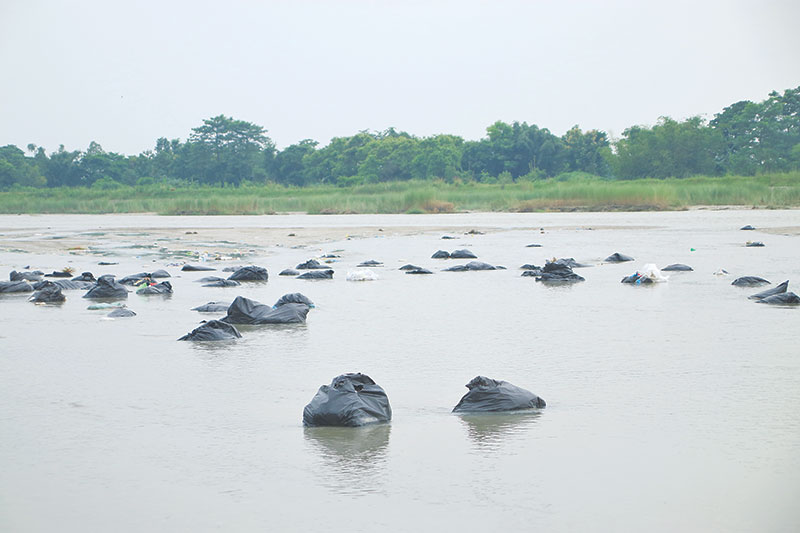
Experts warn that disposal of medical waste into the Biring River (pictured) is harmful to the people, animals and the entire ecosystem.  Post Photo: ARJUN RAJBANSHI

BIRTAMOD,
When Bhim Prasad Rajbanshi from Dhailadubba in Kankai Municipality-9 went to bathe in the Biring River on Monday with his friends, he saw bags full of garbage floating in the river. Upon closer inspection, he saw that all the garbage bags contained medical waste.
“The garbage bags contained syringes, gloves, used bandages, saline pipes, bottles, and soiled cotton pads, among others,” said Rajbanshi. Garbage has been disposed of even in the Kristajhar Community Forest area in Ward No 9. “We usually come to the river to bathe. Our cattle drink from the river. This river holds great significance for us because we conduct our death rituals by the river. But now, we can’t even step into the river because of the health risk the medical waste poses.”
Medical waste, highly hazardous to human and animal health, generated by various hospitals in Birtamod, has been finding its way into the Biring River of late.
The Biring river flows through Ward No 8 and 9 of Kankai Municipality.
The locals of Ward No 9 have submitted a written petition to the Ward Office to investigate the matter immediately demanding strict action against those responsible for polluting the river with medical waste. Locals including former ward president Prem Prasad Rajvanshi submitted a written application and demanded action. The Rajvanshi Social Development Committee has also protested against the dumping of medical waste in the river.
Nagendra Sangraula, deputy mayor of Birtamod Municipality, says the municipality does not collect medical waste from hospitals and that the hospitals themselves are responsible for the disposal of such waste.
“The municipality does not collect hospital waste but that does not mean dumping garbage into the river is acceptable. The police administration should take action against anyone who throws hospital waste in the river,” said Sangraula.
Binod Kumar Neupane, chief administrative officer at the municipality, said that the management of hospital waste is handled by the respective hospitals.
The garbage bags contain receipts from Birtamod Hospital, Manmohan Memorial Hospital and Kankai Hospital.
Romani Bhattarai, manager of Manmohan Memorial Hospital, informed that a contractor named Santosh Mallik collects the waste of most of the hospitals in Birtamod. “The contractor was hired three months ago to manage waste generated by our hospital. He has the contract for waste disposal of most hospitals in Birtamod. We have informed Mallik to immediately manage the medical waste thrown in the river.”
There are around a dozen hospitals in Birtamod.
Yubaraj Dangi, the executive head of Kankai Hospital, admitted that throwing medical waste into the river was a horrendous mistake. “Such mistakes have never happened in the past. We will ensure such a mistake is not repeated in future,” said Dangi. According to him, Mallik collects the medical waste of Kankai Hospital as well. “He was hired for collecting the medical waste of the hospital for Rs25,000 per month. He told us that he had one bigha of land where he would manage the waste when the agreement was made,” said Dangi.
Experts warn that throwing medical waste into the river is harmful to the people, animals and the entire ecosystem. Environmentalist Gyanendra Chaudhary termed the act of throwing medical waste into the river a crime. “Medical wastes need to be treated before their disposal in a safe place. Water polluted by medical waste stands to harm people, animals and crops,” said Chaudhary.
Meanwhile, the district administration office in Jhapa held a meeting with the operators of the hospitals on Wednesday and warned them to not repeat the mistake of throwing medical wastes into the rivers and streams. They have been instructed to manage the medical wastes as per the health care waste management guidelines.

NATIONAL

Kathmandu Metropolitan City demolishes illegal structures

City authorities are clearing shops set up illegally and businesses operating out of basements of big complexes.
- ANUP OJHA
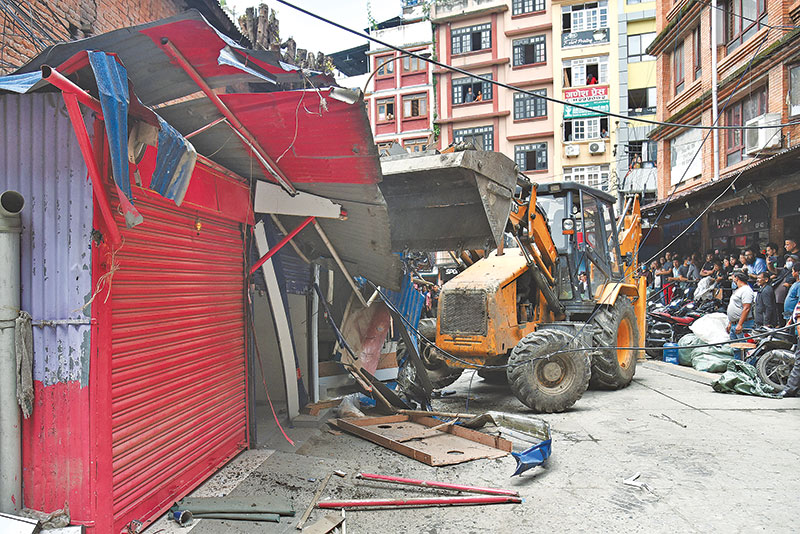
A municipal exacavator tears down illegal shops near Khichapokhari on Wednesday.  POST PHOTO: ANGAD DHAKAL

KATHMANDU,
Kathmandu Metropolitan City has intensified its drive to dismantle illegal structures and clear shops run out of the undergrounds of business complexes in the city.
On Wednesday, the City authorities, in the presence of Mayor Balendra Shah, demolished illegal structures in front of Kathmandu Mall in Sundhara, RB Complex in Khichapokhari, and London Pub at Durbar Marg.
“We cleared all the illegal structures at New Baneshwar and have intensified our drive in the New Road and Durbar Marg areas today,” said
Raju Nath Pandey, the newly elected chief of City police.
Earlier, on July 18, City authorities had issued a 35-day notice to vacate such underground areas but many business operators paid no heed to the order.
“Businesses are being run out of basements of various private buildings that are meant for parking or for storage purposes,” Pandey said. “We are gradually going to clear all such structures within the city.”
With basements meant for parking rented out to businesses, vehicles are parked outside the buildings and oftentimes, on the roadsides, causing traffic jams in the city.
When shop owners in the New Road area on Wednesday sought compensation for the demolished structures, Shah, who led the drive, asked them to make such demands with the building owners who allowed them to set up shops illegally.
“If building owners rent out spaces by constructing illegal structures, they should be the ones who pay the compensation,” said Shah.
Last month, the City authorities cleared the footpaths at New Baneshwar amid protests from street vendors. City authorities had then faced criticism for allowing motorcycle parking on the footpaths after removing street vendors.
Earlier, during the tenure of former mayor Bidya Sundar Shakya in April 2019, the city authorities had demolished 52 illegal structures in Khula Manch built by Jaleshwor Swachhanda Bkoi Builders after protest from locals, conservationists and civil society leaders.
The City has sent a letter to the Kathmandu District Court seeking its building’s site plan clearance document. The City has claimed that the district court has not presented a blueprint of the building in Babarmahal to its office.
Suraj Shakya, chief of the Building Construction Department of the KMC, has told Kantipur, the Post’s sister paper, that his office has not got the site plan of the Kathmandu District Court building.
“So far, we have not received the site plan of the district court, that is why we have sent a letter,” said Shakya, adding the City will be taking legal action against the court if it does not produce the site plan.
The district court has also encroached on the pavement in front of its building for the past two years. A bus and a truck that were impounded on charge of carrying contraband and goods evading taxes remain parked on the pavement creating inconveniences for pedestrians.
Despite criticisms from various quarters, including the locals, visually-impaired pedestrians, ward office and traffic police, the court has not removed those vehicles.

NATIONAL

39 Nepali women barred from travelling to the Gulf on visit visas

Briefing

KATHMANDU: Nepal Police on Tuesday night barred 39 Nepali women from travelling to Dubai and Kuwait on visit visas at Kathmandu’s Tribhuvan International Airport. “During interrogation, some of the women said they were travelling to Dubai and some to Kuwait. But they didn’t meet the requirement set by the government to visit the Gulf Cooperation Council countries,” DIG Shyam Gyawali, the chief of airport police, said. Earlier in March, the Department of Immigration issued a 17-point regulation to address visit visa-related issues. Among the provisions, only those individuals who have a record of travelling to the Gulf twice in the past are allowed to go there on a visit visa.  The documents the women carried did not meet the terms and conditions for travelling on a visit visa, Gyawali added. Last year, the government had issued a circular to Nepalis aspiring for foreign jobs to travel only after obtaining a work permit as per the prevailing law.

NATIONAL

Over 100 students taken ill in Salyan school

Briefing

SALYAN: More than 100 students of Siddheshwari High School in Nigalchula, Bangad Kupinde Municipality-12, have fallen ill, forcing the school to shut down for a week. Thaman Bahadur KC, headmaster of the school, said the students are suffering from fever, diarrhoea, headache, and two teachers and 18 students have tested positive for the coronavirus.

Page 3
NATIONAL

Impeachment recommendation panel to summon Chief Justice Rana on August 31

It plans to submit the report in September first week.
- BINOD GHIMIRE
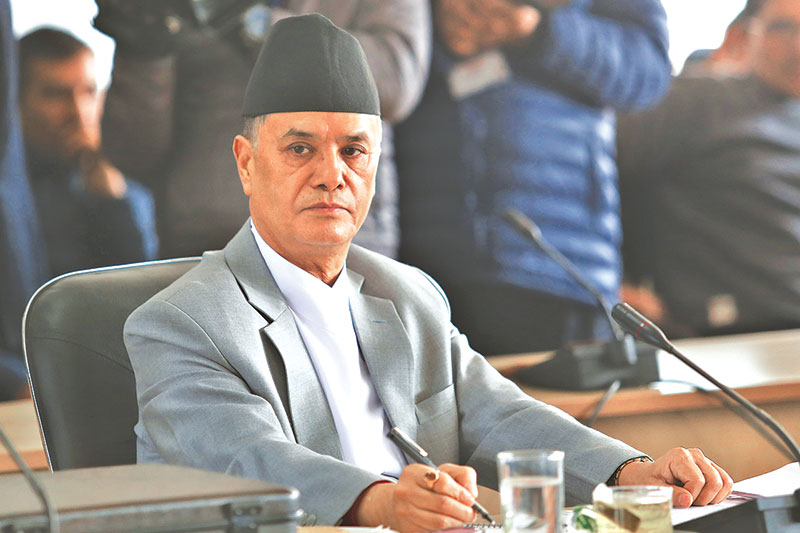
Chief Justice Cholendra Shumsher Rana remains suspended since February 13, when the impeachment motion was registered in Parliament.   Post File Photo

KATHMANDU, 
The Impeachment Recommendation Committee has decided to summon Chief Justice Cholendra Shumsher Rana next week to furnish clarifications on the allegations leveled  against him in the impeachment motion.
Endorsing its working procedure and the timetable, the committee on Wednesday decided to summon Rana before the committee on August 31. “The committee will serve the summons on Rana,” Laxmi Prasad Gautam, secretary of the committee, told the Post. “He will get time to defend himself before the committee.”
As many as 98 lawmakers of the ruling coalition—the Congress, the Maoist Centre and the Unified Socialist—had on February 13 registered the motion in Parliament against Rana with 21 charges. They claimed that Rana had promoted corruption in the judiciary, given access to middlemen for bench shopping, which is a term used for the unscrupulous practice of selecting benches through middlemen to ensure a favourable order, bargained with executives and failed to discharge his duties effectively among others.
Rana remains suspended from the day the motion was registered.
The committee has decided to call Rana for the clarification some five months after its formation. The 11-member committee, which has four lawmakers from the CPN-UML, two each from the Nepali Congress and the CPN (Maoist Centre), and one each from the CPN (Unified Socialist), the Janata Samajbadi Party and the Loktantrik Samajbadi Party, was constituted on March 6.
On August 7, the House of Representatives sent the motion to the committee to probe the charges made against Rana in the impeachment motion.
Ram Bahadur Bista, a Nepali Congress lawmaker who is chairing the committee as the eldest member, said apart from the decision to invite Rana, the committee has also agreed to conclude the probe either on September 7 or 8. “We have to work on a tight schedule to prepare and submit the report before the tenure of the House comes to an end,” he told the Post. “There is unanimity in putting the motion to a vote in the next 15-20 days.”
It requires a two-thirds majority in the 271-strong House to endorse the motion.
As per the Election Commission, the lower house can function until September 17, a day before the parties submit the closed lists of candidates for the November 20 elections.
Rule 163 of the Regulations of the House of Representatives allows the recommendation committee a maximum of three months, from the day it starts work, to probe the allegations. The committee, however, has to complete the entire investigation in two weeks.
Bista says there are challenges in completing the tasks in the prescribed time. “We have to publish the notice seeking proof against Rana’s alleged misdeeds and we might have to talk to multiple people,” he told the Post. “Substantiation of the allegations is most complex and time consuming. Yet we are committed to completing it.”

NATIONAL

Loktantrik Samajbadi mulls options as coalition undecided on bringing it into the fold

Its leaders say time has come for them to decide whether to join hands with UML or other forces.
- NISHAN KHATIWADA

KATHMANDU,
When the Loktantrik Samajbadi Party leaders called on Nepali Congress President and Prime Minister Sher Bahadur Deuba last week, they wanted to learn if the party will be incorporated into the ruling coalition and if so when.
Party chair Mahantha Thakur and senior leader Rajendra Mahato, among others, had urged Deuba to give a decision at the earliest possible. It has been a week, but they have not heard anything from the prime minister or the coalition, according to leaders.
As the ruling coalition itself has been facing difficulties to finalise seat-sharing arrangements, Loktantrik Samajbadi Party (LSP) leaders say they will now explore other options.
“As the ruling coalition is squabbling over seats with each constituent demanding more seats, we wonder if they could accommodate us,” said Keshav Jha, an LSP leader. “It looks like chances of our party joining the ruling alliance are slim.”
It was Deuba who was initially positive about bringing the LSP into the coalition fold, at least for two reasons—preempting its alliance with the CPN-UML and increasing the coalition’s poll prospects in the Madhesh region.
The LSP and the Janata Samajbadi Party (JSP) are two prominent forces in the country with their strong base in Madhesh. The JSP is currently a partner in the ruling coalition.  
Some believe the JSP’s reluctance could have prompted the delay in the decision on whether to accommodate the LSP in the coalition. But even other partners in the coalition like the CPN (Maoist Centre) and the CPN (Unified Soicalist) may also not be keen on bringing the LSP into the coalition, as the entry of one more party could mean shrinking the pie of the seats further.
The ruling coalition partners are currently struggling hard to distribute the 165 seats that are available for the House of Representatives under the direct election system.
According to Jha, if the Maoist Centre has no objections, the LSP can easily be part of the ruling coalition.
“The party is left with four alternatives—make one more effort to join the ruling coalition, explore options to join hands with the CPN-UML, form an alliance with other parties including the JSP, the CK Raut-led Janamat Party, and Resham Chaudhary’s Nagarik Unmukti Party for fighting the elections on its own.”
According to party leaders, Mahato has been given the responsibility of holding deliberations with Maoist chair Pushpa Kamal Dahal.
They say during earlier talks with Deuba, he offered the party the equal number of seats they currently have in the incumbent Parliament.  
In the current House of Representatives, the JSP has 17 seats while the LSP has 13 seats. Similarly, the JSP has 39 members in the Madhesh Provincial Assembly while the LSP has 16. The Madhesh Provincial Assembly is 107-member strong where 64 members are elected under the direct election system and 43 under the proportional representation system.
Nepal will vote on November 20 to elect 275 members for the House of Representatives—165 under the direct election system and 110 under the proportional representation category. Similarly, 330 members will be elected for seven provincial assemblies under the direct election system and 220 under the proportional representation category.
LSP chief whip Umashankar Argariya says in case the ruling coalition does not agree to include them, they will explore other options such as an electoral alliance with the UML.
“We have been demanding more seats than the current number in Parliament. If cooperation is not possible with the ruling coalition, we will obviously explore options,” Argariya told the Post.
Since both the LSP and the JSP do not have a strong vote base in other regions except in Madhesh and the upcoming elections will test their relevance and strength.
Laxman Lal Karna, an LSP leader, says time has arrived for them to make their strategy clear for the upcoming polls.
“Other parties also have not finalised their moves and strategies; seat-sharing discussions are also underway,” said Karna. “If one door is shut for us, we need to open other doors.
A meeting of the top leaders of the party on Wednesday decided to take the ongoing discussions on joining the ruling coalition to a logical conclusion at the earliest.
Insiders say the party is also mulling the possibility of joining other alliances, considering the pros and cons of such a move.
Congress leaders say there has not been much progress on the LSP’s entry into the coalition.
“I don’t have detailed information on the matter as Deuba himself is in discussion with LSP leaders,” said Bimalendra Nidhi, a Nepali Congress leader. “I believe that the party should be included in the ruling coalition.”

Page 4
EDITORIAL

Educating voters

The Election Commission needs to ensure that voters understand the hows and whys of voting.

Most people are aware that in a democracy, voting constitutes one of the essential aspects of citizen participation. The ability to exercise one’s franchise is to elect the people and the party of one’s choice without coercion. But the issue at hand isn’t just about queuing up to vote. People need to be made aware about not just how to vote, but also why they should vote. It thus becomes the responsibility of the Election Commission to ensure that voters understand the hows and whys of the electoral process to ensure effectiveness and efficiency.
A rising number of invalid votes is among the most critical lapses that have come to the notice of the Election Commission following the recent local elections. The high voter turnout usually gauges electoral success. While the number of votes may, to some extent, reflect people’s desire to participate, the effectiveness of participation fails to be guaranteed due to the increasing number of spoilt votes that cannot be included in the count. There is a need to ensure that voters understand how to put their stamp on the ballot paper, which can be complex to navigate for people with little or no exposure to the voting process.
Despite all efforts, the percentage of invalid votes for the mayoral positions that turned up in the recently concluded elections was as high as 13 percent in Kathmandu, Chitwan and Biratnagar. Young adults eligible to vote for the first time and those with a poorer understanding of the electoral process should be provided with messages detailing how to register and cast their ballots. It should be made clear that suffrage is universal, and all sections of society, especially the marginalised, are encouraged to participate and are welcome in the electoral process.
Educating the voters is disseminating information, programmes and materials about the mechanics of the election and the voting process for a particular election. While much of the world is engaged in social media, the commission may be inclined to use the internet as a medium of its choice in disseminating information. But the commission’s efforts are often limited to the amount of funds at its disposal. Thus, spreading electoral awareness should also be the responsibility of not just the Election Commission but also the political parties.
Considering the reach of the political parties, the Election Commission should allow them to publish their agendas and policies freely through print, radio and television. After all, educating the voters on why they need to vote is equally important to understand the processes followed during the elections. The point is not just in seeking universal coverage of the election, but in providing as much information as possible to clarify where the political parties stand with their proposal, which should help the voters make an informed decision.

OPINION

Mergers and factions

Given past experience, we might as well write off the yet-to-be-born party even before it comes into being.
- DEEPAK THAPA
Shutterstock

So, we are back to square one. In the sense that there is talk again about that eternal dream of the great factionalists of the world. I am referring, of course, to the communists, and their hopeful vision of seeing all the leftists united under a single hammer-and-sickle banner.
We have had 60 years of glorious history of splits and mergers since the first schism in the Communist Party of Nepal in 1962. The more recent past saw the division of the CPN-UML and later its resurrected whole although there were those who refused to be subsumed back into the original party. During its first stint in the government after the first Constituent Assembly, the CPN (Maoist), with its own decades-long history of factional splits and unifications, managed to entice in another faction and renamed itself the UCPN (Maoist). Notwithstanding the aspirational “U” (for “unified”) in its new name, not long after it succeeded in manoeuvring itself out of power the party saw numerous groups splitting off. So much so that by the time it saw another unification moment and became the CPN (Maoist Centre), the number of its offshoots it managed to bring back was ten. That obviously did not include the numerous others which have so far kept clear of the main Maoist party.

On-again, off-again
It was as the CPN (Maoist Centre) that the party formed alliance with the UML in the 2017 general elections and roundly hammered the Nepali Congress at the hustings. Buoyed by their success, the country’s two main communist forces decided to unite and became the incongruously named Nepal Communist Party (NCP) while equally incongruously foreswearing the term “unified” to denote a development that for once did seem so at the time.
The otherwise-historical Nepal Communist Party (NCP) government will probably be remembered most for the hash KP Sharma Oli made both of governance and the dream of a common communist front. Having overseen the unification of two parties, Oli’s finagling ensured that the end came sooner than later and with the strongest communist force ever seen in Nepal splitting into three parts.
Now, two of the three, the CPN (Maoist Centre) and the CPN (Unified Socialist) believe they have a chance where numerous attempts have failed thus far. The two parties have declared their intent to go for a merger after the upcoming November elections. The first question that springs to mind is why not now when they could make political capital by touting their common credentials. Perhaps they reckon they can wrangle more seats from the current ruling coalition when negotiating as two parties.
What beats reason by far is why Pushpa Kamal Dahal Prachanda and Madhav Kumar Nepal believe they will succeed despite their own history staring at them. For starters, despite their common lineage that draws upon the original CPN, the two parties come from two distinct strands of the communist movement. That difference was most strongly manifest during the drafting of the constitution with the Maoist Centre pushing for more liberal provisions with regard to an inclusive polity and society as opposed to the Unified Socialist’s mother party, the UML, displaying ample signs of kneejerk-reactionaryism, including from Nepal himself.
But the greater difficulty, if the merger actually goes ahead, is accommodating leaders from the two parties in a single structure at all levels, from the centre to the ward. The Nepal Communist Party (NCP) tackled the matter in a manner characteristic of our parties—by generally not dealing with it. It did, of course, create various bodies, but the imperative to include aspirants from both parties ensured that these became unwieldy bodies rather than those purported to provide guidance to the party leadership. The proposed new party will obviously face a similar problem.
Prachanda has so far held his party under a tight grip and while there are factions, these are at the second level and none with the clout to challenge his leadership. Nepal, however, comes to the table as the head of the larger of the two factions within his party. In the wings is Jhala Nath Khanal, who will certainly not take things lying down, as he made clear with his virulent opposition to the Millennium Challenge Corporation deal. It is this seasoned leadership consisting of former prime ministers that Prachanda will have to contend with.

As long as it lasts
To drive home this last point, it is worth considering an excerpt from an old piece of writing by American political scientist Austin Ranney. “Just about every democratic political party contains a number of factions, each advancing the cause of a particular set of leaders or a particular line of policy or both against the competing leaders and policies of other factions,” he wrote. “Hence every party to some degree faces the problem of keeping its major factions sufficiently happy that they will remain loyal to the party in its competition with opposing parties.”
Ranney continues: “One of the tactics most often used to accomplish this vital task is to see to it that the party’s roster of candidates is well and truly ‘balanced’—that is, contains sufficient representatives of each major faction to assure all factions’ leaders and members that their ideas and interests will be fairly treated and that they indeed will continue to have a voice in the party’s affairs.”
A simple and straightforward analysis that will forever remain true. I get a feeling that the main reason for putting off a pre-election merger is that Prachanda, Nepal and Khanal all dread the squabbling over the selection of candidates. The portents have never been good on that score.
Even otherwise, given the past experiences over and over, we might as well write off the yet-to-be-born party even before it comes into being. The only purpose it is likely to serve is to thumb their collective nose at Oli. For as long as the party lasts, that is.

OPINION

Abandoning the concept of ‘climate refugee’

When climate change is used to explain phenomena like migration, social inequality is naturalised.
- W ANDREW BALDWIN
Shutterstock

It is entirely reasonable to assume that as climate change intensifies, it will result in more human migration and displacement. Images of Bangladeshis seeking refuge from the latest cyclone or Californians fleeing suburban wildfires affirm a sense that climate change is driving the next great migration. And yet the great paradox of climate migration is that there is no such thing as a “climate migrant” or “climate refugee”.
These are socially constructed categories. They may appear to reflect the world as it is. But when we peel back their veneer, we find, instead, a world of power and vested interests. Diagnosing this power is a matter of pressing urgency for anyone concerned with the politics of climate change today.
The main issue is climate change itself. When the impacts of climate change, such as extreme weather or wildfires, are used to explain socio-political phenomena like migration, they obscure the underlying historical conditions of those they affect.
Take, for example, coastal Bangladesh. For decades, shrimp farming and, more recently, soft-shell crab farming have radically transformed the region. Promoted by institutions like the World Bank, these are forms of economic development that have earned Bangladesh much needed foreign currency. But they have also devastated the coastal environment, dispossessed local smallholders of land, and forced generations of rural people into precarious forms of wage labour.
People in wealthier countries might demand their governments do more to ensure “climate justice” in places like Bangladesh. But when we say rural-to-urban migration in Bangladesh is down to climate change, we diminish this important history.
This is why we should be extremely wary of categories like “climate migrant” and “climate refugee”, which are designed to draw our attention away from historical explanations. When, for example, the World Bank claims that 143 million people are expected to become “internal climate migrants” by 2050, it leaves little room for more nuanced historical accounts of migration.
The World Bank wants us to believe that climate change is the most pressing threat facing the world’s most precarious people and that it will force millions from their homes. However, by fostering this belief, the World Bank masks how its policies have rendered precarious the very people it now claims to be helping.

Factors beyond climate change
Or take a different example, that of suburban California. There is no denying that climate change can explain the increasing frequency of wildfires that routinely wreak havoc on the state’s suburbs. Nor can it be denied that many Californian homeowners are now selling up and moving to cooler places.
But when we explain wildfire and the resulting migration in terms of climate change alone—when we label this “climate migration”—we tell only half the story. Just as important is the history of home ownership in the state.
The uncomfortable fact is that the suburban landscape in California, however normalised it now appears, is the culmination of settler colonial history, white flight from city centres, lax planning laws and a dominant car culture.
It is also the result of an economic model in which homeowners are now expected to meet the costs of old age, education and health care by selling up the family home. No wonder people are liquidating their only asset and moving out of harm’s way.
To say this migration is because
of climate change obscures the fact that it is white suburban families who tend to have accrued enough wealth over the generations to move away from hazards like floods and fires.
This becomes even more apparent when we consider how the same choices were unavailable to black people fleeing New Orleans after Hurricane Katrina in 2005. As this example illustrates, when social outcomes like migration are explained in terms of climate change we are invited to disremember the history of racism in America.

The ‘other’ of climate change
In his classic work Orientalism, the late literary scholar Edward Said developed his concept of “the other”. Said’s reading of European literature and art is tremendously important because it explains how 19th-century European attitudes were made
possible.
Central to Said’s thesis is that Europe denied this other its own history. He sought to show how generations of European writers, artists, statesmen and conquerors imagined Europe’s other living in a realm outside history.
Orientalism was, for Said, not a form of knowledge that simply documented the reality of life in the Orient. It was an extension of European imperial power in which non-Europeans were said to be part of nature rather than western European humanity. It allowed Europe to believe it had a moral duty to intervene in the lives of the other, to modernise the other by bringing it into the folds of history.
We might say the same today about the figure of the climate migrant or refugee—what I have termed “the other of climate change”. The circumstances we face today with climate change are, of course, dramatically different than those that prevailed during the 19th century.
Still, constructs like climate migrant and climate refugee are analogous to the power that was the focus of Said’s criticism. These categories are used to define vast numbers of people, including millions of the world’s poorest, in terms of climate, as opposed to history. They render the history of places secondary to climate change, and in doing so, undermine the right people have to represent themselves on their own terms.
The power I am describing is not universal in form, nor does it serve a singular set of interests. Bangladesh and California are not remotely equivalent. Yet in both cases, when climate change is used to explain socio-political phenomena like migration, social inequality is naturalised.
When we see categories like climate migrant and climate refugee in use today, we should treat them not as innocent descriptors of reality. Instead, they should alert us to the presence of an insidious power whose origins are European. Rather than accept these terms at face value, we might instead ask ourselves: Who does the idea of the climate migrant, or climate refugee, really serve?

 
Baldwin is Associate Professor in Human Geography at Durham University.
— The Conversation

Page 5
MONEY

Clamour grows for completion of Butwal-Belahiya trade highway

The government has identified it as one of the key trade routes for the movement of commerce between India and China.
- DIPENDRA BADUWAL,MADHAV DHUNGANA
The highway project, launched in 2011-12, was expected to be completed in five years.  Post Photo: Ghanshyam Gautam

BUTWAL,
Calls to complete the long-stalled Butwal-Belahiya trade highway project have been mounting as the half finished work results in an environmental nightmare.
The Rs5.5 billion six-lane highway in south central Nepal links the trade hub of Butwal with the Indian border 24 km to the south. The government has identified it as one of the key trade routes for the movement of commerce between India and China through Nepal.
The highway project in Rupandehi launched in 2011-12, and was expected to be completed in five years. A 3.5-km section out of the total length of 27 km remains unfinished.
The contractor, a joint venture of Kanchenjunga and Biruwa, has not done work on a 2.7-km section from Butwal to Golpark, and a 750-m section from Siddharthanagar Belahiya. A 200-m long service lane remains incomplete too. The highway project was awarded to a number of contractors.
Delays in the completion of the project have not only made life difficult for travellers, businesses on the roadside say they are enveloped in a dust storm every time a vehicle passes.
When it rains, the highway turns into deep mud that traps vehicles like quicksand; and when the sun shines, dust flies everywhere and covers the shops and houses, locals say.
The local government has not taken any initiative to complete the project, making people’s lives difficult, they say. But with the elections approaching, the concerned authorities say they are serious about completing the unfinished work.
The Butwal-Bhairahawa area has emerged as a new economic hub in Lumbini province following the construction of the country’s second international airport and wider highways, hotels and manufacturing plants.
Nepal has scheduled federal and provincial elections on November 20. Voters had raised the issue of the Butwal-Golpark section during the local elections in May.
At that time, candidates of the major political parties had promised to complete the construction immediately if they won. Now, the public has started to exert pressure on the elected representatives.
Amid local pressure, Butwal Sub-Metropolitan City has been holding meetings regularly. It has been holding talks with the road project chief, construction companies, local representatives, district administration, and electricity and water supply officials.
Mayor Khel Raj Pandey said they had formed a facilitation committee led by Tek Raj Panthi, chief administrative officer of the sub-metropolitan city. The committee has been tasked to monitor and assist the project so that it can complete the work.
The committee consists of the chief of the electricity and water supply and president of the Butwal Chamber of Commerce and Industry.
Deepak Kumar Jha, chief of the project, said the 750-m section at Belahiya is yet to be constructed because some government-owned infrastructure needs to be demolished.
“There are customs offices, buildings of the local police and checkpoints at the border,” he said. “All these structures need to be removed. A 200-m service lane at Padsari in Omsatia Rural Municipality is still to be constructed.”
Jha said they had written repeatedly to the contractors to complete the work. He said that work would be completed after the monsoon.
The contractor started work on the Butwal-Chauraha-Golpark intersection in April 2017. The project deadline was October 2019 and it was extended to July 2022 through a Cabinet decision. There has been no progress even though the extended deadline has passed.
According to the project, it faced delays in the beginning due to an interim order by the Supreme Court not to demolish houses on the Chauraha-Golpark section.
The court later ordered the demolition work to be carried out and allowed the construction of the road, according to project officials.
“The design of the trade road had to be changed, and that too delayed the completion of the project,” Jha said. A drainage system was added later in the plan which increased the project cost from Rs450 million to Rs530 million. Jha said that five houses are yet to be demolished in the section. The construction of the road was also obstructed by delays in shifting electricity and telephone poles and drinking water pipes.
“The work of removing electricity poles and drinking water pipes remains to be done,” he said.
After progress slowed, the project published a public notice on July 29 seeking clarification from the contractor. Kanchenjunga-Biruwa Construction responded by submitting a new schedule.
“If the firm misses the deadline again, it will be fined and the contract will be terminated,” Jha said.
Sumit Shrestha, representative of Kanchenjunga-Biruwa Construction, said that work was delayed due to the court order that came right after the contract was signed.
“We will complete the work in the current fiscal year if the obstructions are  removed,” Shrestha said. “We are ready to face punishment if we miss the extended deadline.’’
Bharatmani Pandey, chief district officer, said progress was utterly slow on a 3-km section of the highway. He said that since the contractor has submitted a timetable to complete the project, the administration is also assisting them.
“It will not be acceptable if the work gets delayed again,” Pandey said.

MONEY

Qatar to invest $3 billion in beleaguered Pakistan economy

- AGENCE FRANCE-PRESSE

DOHA,
Qatar said Wednesday it would invest $3 billion in Pakistan’s debt-ridden economy in the latest boost by a Gulf state for the ailing South Asian nation.
Pakistan has been scrambling for finance in recent months, and
the International Monetary Fund is due to meet next Monday to discuss reviving a suspended $6 billion loan programme.
The United Arab Emirates this month said it would invest $1 billion in Pakistan and, according to reports, Saudi Arabia is considering extending an emergency $2 billion loan made last year.
The latest boost came in talks between Qatar’s emir Sheikh Tamim bin Hamad Al Thani and Pakistan’s Prime Minister Shahbaz Sharif.
The emir “stressed the importance of the brotherly and strategic relations between the two countries”
and the need to bolster their economic partnership, an official Qatari statement said.
“In this regard, the Qatar Investment Authority announced its intention to invest $3 billion in various commercial and investment sectors in the Islamic Republic of Pakistan,” it added. The statement said the two leaders also discussed cooperation in “defence” and “sports”.
But it did not confirm reports that Pakistan would send troops to Qatar for security during the football World Cup that starts November 20.
Last week, the Pakistan government said it had approved a deal with Qatar on the “modalities for deployment of troops for security assistance” during the World Cup.
Assistance from Gulf nations and a $2.5 billion loan from China has helped Pakistan stave off the worst of an economic crisis that has seen annual inflation rise above 20 percent.
A $6 billion IMF bailout package signed by former prime minister Imran Khan in 2019 has never been fully implemented, because the government failed to carry out promised cuts to subsidies and to improve revenue collection.
But the economy has shown recent signs of life. The rupee has strengthened and the stock market has made gains in the past two weeks.

MONEY

Japan signals return to nuclear power to stabilise energy supply

- REUTERS
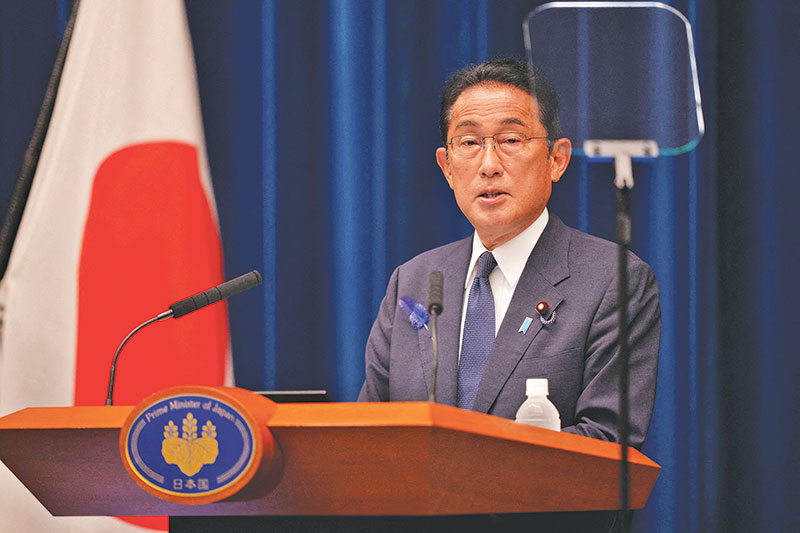
In this file photo, Japan’s Prime Minister Fumio Kishida delivers a speech at his official residence in Tokyo.  REUTERS

TOKYO,
Japan will restart more idled nuclear plants and look at developing next-generation reactors, Prime Minister Fumio Kishida said on Wednesday, setting the stage for a major policy shift on nuclear energy a decade after the Fukushima disaster.
The comments from Kishida—who also said the government would look at extending the lifespan of existing reactors—highlight how the Ukraine crisis and soaring energy costs have forced both a change in public opinion and a policy rethink toward nuclear power.
Japan has kept most of its nuclear plants idled in the decade since a massive earthquake and tsunami in 2011 triggered a nuclear meltdown at the Fukushima Daiichi power plant. Quake-prone Japan also said it would build no new reactors, so a change in that policy would be a stark turnaround.
Kishida told reporters he had instructed officials to come up with concrete measures by the year’s end, including on “gaining the understanding of the public” on sustainable energy and nuclear power.
Government officials met on Wednesday to hammer out a plan for so-called “green transformation” aimed at retooling the world’s third-largest economy to meet environmental goals. Nuclear energy, which was deeply opposed by the public after the Fukushima crisis, is now seen by some in government as a component for such green transformation.
Public opinion has also shifted, as fuel prices have risen and an early and hot summer spurred calls for energy-saving.

MONEY

Germany launches world’s first hydrogen train fleet

- AGENCE FRANCE-PRESSE

BERLIN,
Germany on Wednesday inaugurated a railway line powered entirely by hydrogen, a “world premiere” and a major step forward for green train transport despite nagging supply challenges.
A fleet of 14 trains provided by French industrial giant Alstom to the German state Lower Saxony has replaced diesel locomotives on the 100 kilometres (60 miles) of track connecting the cities of Cuxhaven, Bremerhaven, Bremervoerde and Buxtehude near Hamburg.
“We are very proud to put this technology into operation together with our strong partners as a world premiere,” Alstom CEO Henri Poupart-Lafarge said in a statement.
Hydrogen trains have become a promising way to decarbonise the rail sector and replace climate-warming diesel, which still powers 20 percent of journeys in Germany.
Billed as a “zero emission” mode of transport, the trains mix hydrogen on board with oxygen present in the ambient air, thanks to a fuel cell installed in the roof. This produces the electricity needed to pull the train.
Regional rail operator LNVG said the fleet, which cost 93 million euros (dollars), would prevent 4,400 tonnes of CO2 being released into the atmosphere each year.
Designed in the southern French town of Tarbes and assembled in Salzgitter in central Germany, Alstom’s trains—called Coradia iLint—are trailblazers in the sector.
The project created jobs for up to 80 employees in the two countries, according to Alstom.
Commercial trials have been carried out since 2018 on the line with two hydrogen trains but now the entire fleet is adopting the groundbreaking technology.
The French group has inked four contracts for several dozen trains between Germany, France and Italy, with no sign of demand waning.
In Germany alone “between 2,500 and 3,000 diesel trains could be replaced by hydrogen models”, Stefan Schrank, project manager at Alstom, told AFP.
“By 2035, around 15 to 20 percent of the regional European market could run on hydrogen,” according to Alexandre Charpentier, a rail expert at consultancy Roland Berger.

MONEY

China’s jobless turn to car boot sales as Covid-hit economy stalls

- REUTERS
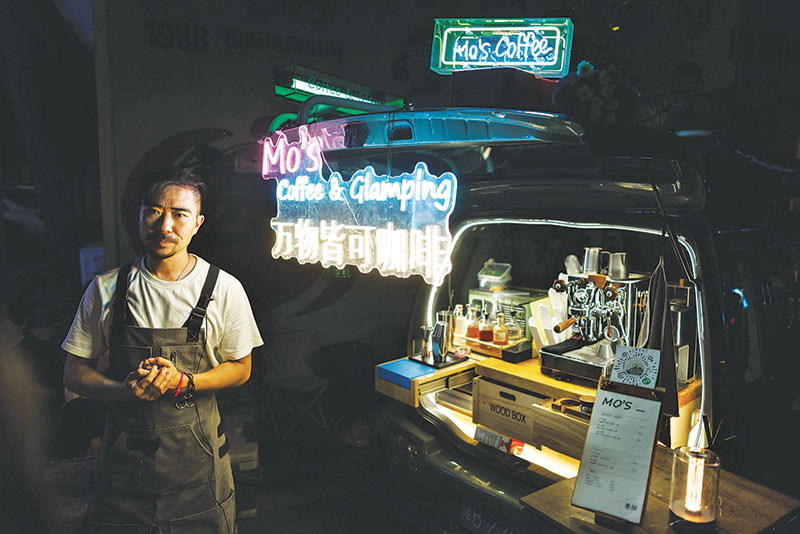
Wang Wei stands next to his coffee bar that he installed in the back of his car at a car boot fair in Beijing.  REUTERS

BEIJING,
When the Covid-19 pandemic forced Wang Wei to shut his tourism company, the Tianjin native poured his life-savings of 80,000 yuan ($11,785) into selling coffee from the back of his green Suzuki micro van in the Chinese capital Beijing.
Since June, Wang has driven his mobile coffee booth from car boot
fair to car boot fair, offering hand-brewed coffee steeped in an assortment of liqueurs.
Once considered too low-status for many, peddling wares on the street has made a comeback as people who lost their jobs or closed down their businesses seek new ways to make a living and work around China’s relentless anti-Covid policies.
Hospitality, tourism and after-school tutoring have been particularly hard hit.
Wang, 40, gave up a bricks-and-mortar coffee shop in Tianjin in 2020 when the pandemic first hit. Overseas group tours he used to organise also took a blow that year, with a lucrative trip to see the aurora borealis cancelled, costing him hundreds of thousands of yuan in lost earnings.
This year, the spread of the Omicron variant across China was the final nail in the coffin, making his group tours to the Chinese backcountry impossible.
Wang started running his mobile coffee booth this summer, after car boot fairs emerged in big southern cities like Chengdu, Chongqing and Guangzhou.
Under a canopy extending from Wang’s van, customers relax in camping chairs, with soft lights in the evening completing the glamping experience.
“The rising popularity of this car boot sale market has helped me tide over the most difficult of times,” said Wang, who reckons he earns about 1,000 yuan a day.
China’s economy barely grew in April-June. Youth unemployment has remained high, reaching a record 19.9 percent in July, the fourth month in which the rate had broken records.
Pan, 25, closed his bar in Shenzhen after a Covid outbreak in March, saddling him with over 100,000 yuan in debts.
“I was pretty down, and one night, my fiancée Annie, wanting to cheer me up, took me to a watering hole in a quiet area with warm, faint lights and soft music,” he said. That was when he saw a couple selling liquor at an outdoor stall, inspiring him to do the same—but from his Tesla.
“My best friend lent me 3,000 yuan, which became the initial investment for our pop-up liquor shop,” Pan said.
Pan and Annie ran out of money in their first week, but their determination paid off, with daily revenues climbing as high as 7,800 yuan.
“In the future, we plan to travel the country with our Tesla and sell liquor from the boot of our car in cities we enjoy the most,” said Pan.

MONEY

Fusemachines and UpaCare announce partnership

Briefing

KATHMANDU: Fusemachines, the leading enterprise AI talent solutions provider, on Wednesday announced its partnership with UK-based health technology company UpaCare Health to form an interdisciplinary team for developing a comprehensive patient-centric and AI-powered digital health platform. The platform will include features that help patients and healthcare providers connect with each other, while providing an effective way to collect and manage patient data. “The platform will also enable customised patient communications systems, cross-collaboration across health care providers, automated health visits and prescription planning,” reads the statement released by Fusemachines. Dr Sumitra Kafle, CEO and co-founder of UpaCare said that primary care, an integral part of community health, hinges on continued health promotion, chronic disease prevention and lifestyle management. “Unfortunately, in Nepal and other South Asian communities, this subset of medicine remains an afterthought with minimal infrastructure,” said Kafle. “We want to change that by offering a robust tech-based platform that makes primary care equitable and accessible while elevating patient and healthcare provider interaction.”

MONEY

Sunsilk Nepal to launch its Dashain vibes campaign

Briefing

KATHMANDU: Sunsilk Nepal is set to launch the Sunsilk Dashain Vibes campaign for the second year in a row. The campaign provides opportunities for girls to feature in the pack by showcasing their hair. The second edition of the campaign is expected to be more successful than the first one. The haircare brand last year launched the campaign, a digital contest, to become a part of its consumer’s life during Nepal's biggest festival. “Sunsilk is widely distributed and preferred by millions of consumers,” said Amlan Mukherjee, the managing director of Unilever Nepal. “We want our brands along with our consumers to be associated with local festivals and culture.” Aashina Deula, Pratima Karki and Lalana Chimariya had won the contest last year. They will feature in this year’s “Limited Special Edition Dashain Pack”, which is being launched for the first time in Nepal, reads a statement issued by the hair care brand. The new packs come in 3 different variants; Hair Fall Solution, Black Shine and Perfect Straight.

Page 6
WORLD

Thai PM Prayuth Chan-ocha suspended while court mulls if he defied term limits

Prayuth’s detractors contend he has violated a law that limits prime ministers to eight years in power but his supporters say his term should be counted from when the current constitution came into effect in 2017.
- ASSOCIATED PRESS
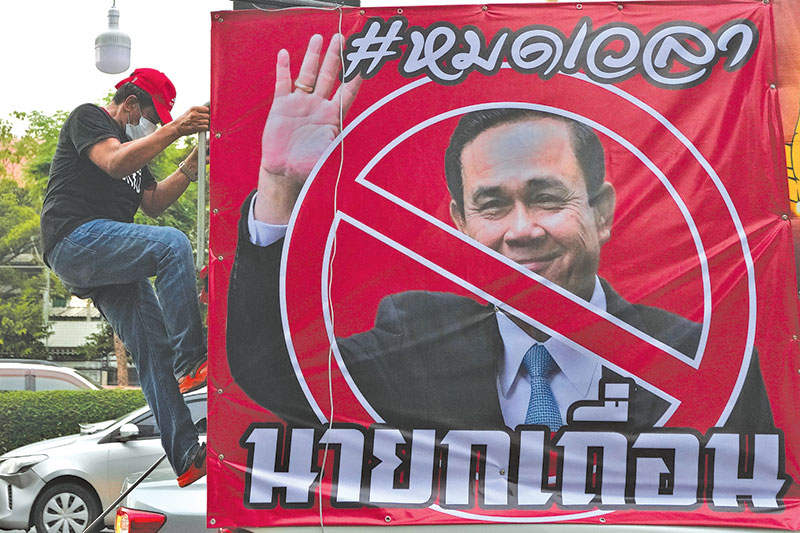
An anti-government protester climbs on a car beside a poster of Prime Minister Prayuth Chan-ocha in Bangkok, Thailand, on Wednesday.  Ap/Rss

BANGKOK,
Thailand’s Constitutional Court suspended the prime minister from his duties on Wednesday while it decides whether the man who led a military coup in 2014 has violated the country’s term limits, potentially opening a new chapter of turmoil in the nation’s troubled politics.
Prime Minister Prayuth Chan-ocha’s removal is likely to only be temporary since the court has generally ruled in the government’s favor in a slew of political cases.
Any decision to allow the general to stay on risks invigorating a protest movement that has long sought to oust him and reopening deep fissures in Thailand, which has been rocked by repeated bursts of political chaos since a coup toppled then-Prime Minister Thaksin Shinawatra in 2006.
Since then, Thaksin, a telecoms billionaire whose populist appeal threatened the traditional power structure, has remained at the center of the country’s politics, as his supporters and opponents fought for power both at the ballot box and in the streets, sometimes violently. The 2014 takeover ousted his sister from power.
Deputy Prime Minister Prawit Wongsuwan, a close political ally of Prayuth and part of the same military clique that staged the coup, will take over as acting prime minister, a spokesman for the prime minister’s office said Wednesday. Anucha Burapachaisri added that Prayuth would respect the court’s decision and called on others to do the same.
But those who want Prayuth gone don’t want Prawit in power either.
“No Prayuth. No Prawit. No military coup government,” a leading protest group said in a statement after the court decision Wednesday.
The group known as Ratsadon, or The People, issued a new call for protests, but only a few came in response.
Prayuth’s detractors contend he has violated a law that limits prime ministers to eight years in power—a threshold they say he hit Tuesday since he officially became prime minister on Aug 24, 2014. But his supporters contend his term should be counted from when the current constitution, which contains the term-limit provision, came into effect in 2017. Another interpretation would start the clock in 2019, following the election.
The case—in which the court is deciding whether a coup-leader has stayed in power too long—highlighted Thailand’s particular political culture: Often the soldiers who overthrow elected leaders then try to legitimize their rule and defuse opposition by holding elections and abiding by constitutional restrictions.
For instance, while Prayuth initially came to power in a coup, he won the job legally after the election in 2019.
By a vote of 5 to 4 on Wednesday, the court agreed to suspend Prayuth from his duties while it considers a petition from opposition lawmakers. The court’s announcement said Prayuth must submit his defense within 15 days of receiving a copy of complaint, but it did not say when it would rule.
He will remain in his other post of defense minister, according to Anucha, the spokesman.
Polls show Prayuth’s popularity is at a low ebb, with voters blaming him for mishandling the economy and botching Thailand’s response to the COVID-19 pandemic.
In 2020, tens of thousands of people took to the streets to demand that Prayuth and his Cabinet resign, while also calling for the constitution to be amended and the monarchy to be reformed.
Several confrontations between the student-driven protest movement and authorities became violent. A legal crackdown on activists further embittered critics. Small protests appealing again to Prayuth to step down and the Constitutional Court to force him to if he didn’t have been held daily since Sunday, but drawn only small crowds.
“I am very pleased. Gen. Prayuth has stayed for a long time and had no vision to develop the country at all,” Wuttichai Tayati, a 28-year-old who works in marketing, said while protesting in Bangkok on Wednesday. “At least taking him out for now might make Thailand move forward a bit.”

WORLD

Democrats celebrate win in US vote seen as litmus test on abortion rights

- AGENCE FRANCE-PRESSE

NEW YORK,
Democrats were Wednesday celebrating victory in a US special election being viewed as the last bellwether of the public mood on abortion ahead of November’s midterms, as the party seeks to make reproductive rights a key issue in the campaign.
Tuesday’s vote in a swing district in upstate New York was to choose a candidate to serve the final months of Democrat Antonio Delgado’s term in the House of Representatives, after he quit to become the Empire State’s lieutenant governor.
The battle for New York’s 19th congressional district comes two months after the Supreme Court sparked nationwide protests by ending the federally guaranteed right to abortion.
Democrat Pat Ryan, who has sought to turn the vote into a referendum on abortion access, was projected to win, according to US media.
“Choice was on the ballot. Freedom was on the ballot, and tonight choice and freedom won,” Ryan tweeted after he was forecast to triumph.
“We voted like our democracy was on the line because it is. We upended everything we thought we knew about politics and did it together.”
He has accused Republican rival Marc Molinaro and his party, who are against such access, of being “too extreme on women’s rights.”
Ryan’s victory “sends a clear message that voters are fighting back against Republicans’ extreme attacks on abortion rights,” Democratic Congressional Campaign Committee Chair Sean Patrick Maloney said in a statement. “Republicans can say goodbye to their ‘Red Wave’ because voters are clearly coming out in force to elect a pro-choice majority this November.”
Molinaro, who had followed his party’s main political talking points including on inflation and spiralling living costs, had refused to concede, The New York Times reported.
“Whether it’s tonight or it’s Nov. 8, we are going to win the 19th Congressional District and give voice to people who are working too damn hard and getting too little in return,” Molinaro told his supporters late Tuesday, the paper said.

WORLD

China warns of ‘severe threat’ to harvest from worst heatwave on record

- AGENCE FRANCE-PRESSE

CHONGQING,
China’s autumn harvest is under “severe threat” from high temperatures and drought, authorities have warned, promising Wednesday fresh steps to protect crops in the face of the country’s hottest summer on record.
The world’s second-largest economy has been hit by record heat, flash floods and droughts this summer—phenomena that scientists say are becoming more frequent and intense due to climate change.
Southern China has recorded its longest continuous period of high temperatures since records began more than 60 years ago, the
agriculture ministry said.
Four government departments urged the conservation of “every unit of water” to protect crops.
“The rapid development of drought superimposed with high temperatures and heat damage has caused a severe threat to autumn crop production,” a statement said Tuesday.
China produces more than 95 percent of the rice, wheat and maize it consumes, but a reduced harvest could mean increased demand for imports in the world’s most populous country—putting further pressure on global supplies already strained by the
conflict in Ukraine.
State media reported Wednesday evening that the government had pledged 10 billion yuan ($1.45 billion) to help ensure good rice harvests this autumn.
A meeting of Beijing’s State Council, presided over by Premier Li Keqiang, had agreed the government should “do an even better job in fighting and reducing drought”, broadcaster CCTV said.
Officials also called for “a combination of measures to increase water sources to fight drought, first ensure drinking water for the people, ensure water for agricultural irrigation, and guide farmers to fight drought and protect autumn grain”, it added.
Temperatures as high as 45 degrees Celsius (113 Fahrenheit) have led multiple Chinese provinces to impose power cuts, as cities struggle to cope with a surge in demand for electricity partly driven by people cranking up the air conditioning.
The heat broke records in Sichuan, where a temperature of 43.9 degrees Celsius (111 Fahrenheit) was recorded Wednesday afternoon, the province’s Meteorological Service Centre said in a statement.
The megacities of Shanghai and Chongqing have turned off outdoor decorative lighting, while authorities in Sichuan have imposed industrial power cuts after water levels dropped at key hydroelectric plants.
The searing heat is also drying up the critical Yangtze River, with water flow on its main trunk about 50 percent lower than the average over the last five years, state media outlet China News Service reported last week.
In Chongqing, where more than 1,500 people were evacuated from areas hit by multiple wildfires, locals were struggling.
“I feel too hot to sleep every night, and I’m awakened by the heat every morning,” Xu Jinxin, a 20-year-old student, told AFP.
“Because of the electricity shortage, we don’t leave the air conditioner on all day but rather turn it off once it’s cooled down a bit.”
The national meteorological service renewed warnings for drought and high temperatures on Tuesday, calling on 11 provincial governments to activate emergency responses.
Authorities have turned to cloud seeding—a method to induce rainfall—in parts of the country.
CCTV published footage this month showing meteorological workers shooting catalyst rockets into the sky and firefighters
transporting water to farmers in need.
It also broadcast images Wednesday of water trucks supplying people in villages in Sichuan and around Chongqing in a bid to counter shortages.
“The people with water supply difficulties in rural areas of Chongqing are mainly concentrated in mountain towns and relatively remote areas,” CCTV said.
“This is the worst heatwave ever recorded,” climate and energy expert Liu Junyan of Greenpeace East Asia told AFP. “Climate science shows extreme heat is becoming exponentially worse. So it’s more likely that next year will have record-breaking heat.”

WORLD

Western leaders salute Ukraine on its Independence Day

- ASSOCIATED PRESS
A Union Jack and a Ukraine flag fly over government buildings in front of the London Eye on Ukraine Independence Day in London, on Wednesday.  Ap/Rss

LONDON,
Western leaders pledged unwavering support for Ukraine as the war-ravaged country marked its Independence Day on Wednesday, coinciding with the six-month milestone of Russia’s invasion.
Leaders paid tribute to the sacrifices and courage of the Ukrainian people, voiced their resolve to keep supplying Ukraine with weapons and reviled Moscow for its attack on the neighboring Eastern European nation.
In Britain, floral and musical tributes punctuated a show of solidarity as Ukraine commemorated its 1991 declaration of independence from the Soviet Union. The U.K. Ministry of Defense tweeted a video of the Scots Guards Band, which usually provides musical accompaniment for the Changing of the Guard at Buckingham Palace, performing Ukraine’s winning Eurovision Song Contest entry, “Stefania.”
An arch of sunflowers—Ukraine’s national flower—decorated the entrance to the British prime minister’s Downing Street office. Prime Minister Boris Johnson, who is soon to leave office, urged allies to keep giving Ukraine all the military, humanitarian, economic and diplomatic support it needs.
“We will never recognize Russia’s annexation of Crimea or any other Ukrainian territory,” Johnson said in a Tuesday video address to an international summit on Russia’s seizure of the Crimean Peninsula from Ukraine in 2014.
Like London, Brussels also chose to dress up for the occasion. The Belgian city, which is home to the European Union’s institutions, decked itself out in the colors of the Ukrainian national flag. A giant Ukrainian flag was unfurled in the capital’s historic Grand Place.
U.S. President Joe Biden, marking the day by announcing significant new military aid to Ukraine, noted that the day was “bittersweet” for many Ukrainians, as they continue to suffer but take pride in withstanding Russia’s “relentless attacks.”
German Chancellor Olaf Scholz said in a video posted on Twitter that “our hearts go out to those who pay for the Russian war terror with their lives day after day, who are maimed and wounded.”
“We mourn with those who have lost friends or family members, who have had to flee, have been taken from their beloved homeland or by Russian occupiers, who have lost their belongings to Russian bombs, rockets and artillery shells,” the chancellor said.
Scholz had harsh words for Russia, rebuking the Kremlin for its “backward imperialism,” and stressed that Ukraine “will drive away the dark shadow of war because it is strong and brave, because it has friends in Europe and all over the world.”
French President Emmanuel Macron, in a video message bookended with phrases he spoke in Ukrainian, said the defense of Ukraine meant “refusing to allow international relations to be ruled by violence and chaos.” He said Ukraine’s Independence Day “is a day of pride. But in the place of legitimate festivities, we are thinking of the dead and the fighters today, of the courage and resilience of your people.”
Finnish Prime Minister Sanna Marin adopted a similar tone, calling Ukrainians “brave and unyielding.” She added: “We stand with you. We won’t look away.”

WORLD

Iran denies any link with groups hit in US Syria strikes

Briefing

TEHRAN: Iran’s foreign ministry on Wednesday denied any link with groups targeted by US air strikes in Syria, contradicting a claim by Washington. A ministry statement strongly condemned the “terrorist act” by the United States, saying it represents a “violation of the sovereignty, independence and territorial integrity of Syria”. The attack targeted “the popular groups and fighters against the occupation”, said ministry spokesman Nasser Kanani, referring to US troops stationed in eastern Syria. He denied the groups were “affiliated” with Tehran. The comments came hours after the US military announced it had launched, on the orders of President Joe Biden, strikes on Syria targeting facilities used by groups linked to the Islamic republic. The strikes in oil-rich Deir Ezzor province “targeted infrastructure facilities used by groups affiliated with Iran’s Islamic Revolutionary Guard Corps,” Central Command spokesman Colonel Joe Buccino said in a statement.

WORLD

Teen pilot sets age record for solo flight around world

Briefing

SOFIA: A Belgian-British teenager became the youngest person to fly around the world solo in a small aircraft after he landed on Wednesday in Bulgaria, where his global journey kicked off five months ago. Mack Rutherford, who turned 17 during the trip, landed on an airstrip west of Bulgaria’s capital, Sofia, to complete his task and to claim two Guinness World Records. Along with becoming the youngest person to fly around the world by himself, Rutherford is the youngest person to circumnavigate the globe in a microlight plane. His sister, Zara, who finished her own trip global flight in January at age 19, previously held the ultralight record. Rutherford took the age record from Travis Ludlow of Britain, who was 18 when he made a solo flight around the world last year. The record journey, which began March 23, took Rutherford through 52 countries over five continents. To set a mark recognized by the Guinness World Records, he crossed the equator twice. Born into a family of aviators, Rutherford qualified for his pilot’s license in 2020, which at the time, made him the youngest pilot in the world at 15.

Page 7
SPORTS

Football returns to Ukraine

Shakhtar Donetsk and Metalist 1925 play out a goalless draw in the first top-level match played in the war-torn country since Russia’s invasion in February.
- REUTERS
Shakhtar Donetsk’s Artem Bondarenko (down) in action with Metalist 1925 Kharkiv’s Andriy Remenyuk during their Ukrainian Premier League match inKyiv on Wednesday.  Reuters

KYIV,
Shakhtar Donetsk and Metalist 1925 played out a 0-0 draw in Kyiv’s empty Olympic Stadium on Tuesday as competitive football returned to war-torn Ukraine with the start of the country’s new Premier League season.
The opening matches of the campaign have been timed to coincide with Ukraine’s Day of the National Flag and provide a further show of resistance following Russia’s February invasion that brought a premature end to last season’s championship.
It was a first competitive fixture in nine months for both teams and, while there were obvious signs of rust, they provided an entertaining contest in which Shakhtar came closest to winning when Mykhailo Mudryk struck the crossbar.
The game was, at least, not interrupted by air-raid sirens, still a daily occurrence.
So tenuous is the situation that only certain venues with bomb shelters will be used for UPL games. No fans are allowed into the stadium, with fixtures mostly centred around Kyiv for now.
The return of the 16-team local league provides a distraction for 90 minutes away from the bloodshed and ravages of a war that Russia calls a ‘special operation’.
“This is our job, and we perceive it as a very big responsibility to show the world that life in Ukraine does not stop but continues,” Shakhtar’s Croatian coach Igor Jovicevic told reporters ahead of Tuesday’s game.
“Football is one of the factors that gives emotions to the whole country and people who fight for all of us. This is very important for us, not only Shakhtar but also for the entire UPL, to continue life.”
His thoughts were echoed by midfielder Mudryk, who added, “they (the watching world) should remember what events are happening in Ukraine, because a lot of time passes and perhaps the world forgets about it.
“Our goal is to use the games to remind the whole world that nothing is over and of the atrocities that are happening here in Ukraine.”
Shakhtar qualified automatically for the group stages of this season’s Champions League, having been top of the table when the 2021-22 UPL campaign was suspended.
They now await Thursday’s draw and will play their home games in Poland. The club had been using their website to give daily updates on the war from Ukraine’s Defence Ministry but can, for now at least, return to the more mundane team news and match reports.
That may seem like a small thing to many, but for the defiant people of Ukraine it means a lot.

SPORTS

KC announces 25-man squad for 2023 U-20 Asian Cup Qualifiers

- Sports Bureau
Meghraj KC’s side are drawn alongside Qatar, Bahrain, Bangladesh and Bhutan.  Photo Courtesy: NSJF

KATHMANDU,
Nepal U-20 national team head coach Meghraj KC announced a 25-man preliminary squad for the 2023 AFC Asian Cup Qualifiers on Wednesday.
KC has dropped Sonit Dahal, Ayush Shrestha, Roshan Thapa, Mohit Gurung and Rohit Subba—all of whom were part of a disappointing SAFF U-20 Championship campaign—for the September 10-18 qualifiers set to be held in Bahrain.
The U-20 team had a brilliant start in the SAFF defeating the Maldives 2-0 and Sri Lanka 3-0 before losing to eventual champions and hosts India 8-0, which had proved fatal in their bid to reach their third final.
Following their exit from the group stage despite holding Bangladesh to a 1-1 draw in their final group, Nepal assistant coach Bal Gopal Sahukhala had stressed that his side needed to improve both physically and tactically to put up a strong show in Bahrain.
KC has introduced goalkeeper Top Bahadur Rana, defenders Jaan Tamli, Shekhar Khawas, Shyanshu Bhusal and Raj Thokar, and midfielders Rakesh Bishwokarma and Sanjeev Lama in the squad.
The team has been training at the ANFA Complex in Satdobato.
Nepal are drawn alongside Qatar, Bahrain, Bangladesh and Bhutan in Group B. Nepal open their qualifiers campaign with a match against Bhutan on September 10 before taking on Qatar on September 12, hosts Bahrain on September 14 and Bangladesh on September 18.
The group winners (from Group A to J) and the five best runners-up will secure their berth to the Asian Cup finals to be held from March 1-8 in Uzbekistan, who have already qualified as hosts.
India, whose football federation was recently suspended by FIFA citing “undue influence from third parties”, will not participate in the qualifiers if the suspension is not lifted before the schedule. India are pitted against Asian powerhouses Australia, Group H hosts Iraq and Kuwait in Group H.


Nepal U-20 squad
Goalkeepers: Ishwor Gurung, Unesh Chaudhary,
Jiyarat Sheikh, Top Bahadur Rana
Defenders: Amar Shrestha, Ajay Chaudhary, Sumit Shretha, Srijan Dhani, Abhishek Waiba, Jaan Tamli, Shekhar Khawas, Shyanshu Bhusal, Raj Thokar
Midfielders: Dipesh Gurung, Aashish Rai,
Sandeep Karki, Janmajay Dhami, Kritish Ratna Chhunju, Sugam Suwal, Managya Nakarmi, Ayush Ghalan,
Rakesh Bishwokarma, Sanjeev Lama
Forwards: Niranjan Malla, Rohan Khadgi

SPORTS

Fulham suffer shock League Cup exit

The Premier League side succumb to a 2-0 defeat against fourth-tier club Crawley.
- AGENCE FRANCE-PRESSE

LONDON,
Fulham suffered an embarrassing League Cup exit as the Premier League side were beaten 2-0 by Crawley in a second round shock on Tuesday.
Marco Silva’s side are 83 places above League Two Crawley and beat Brentford 3-2 in the Premier League on Saturday.
But the Fulham manager’s decision to make 10 changes backfired badly at the Broadfield Stadium as struggling Crawley upset the form book.
Former Fulham striker Kevin Betsy, who has taken only a single point from his first five matches as Crawley manager, masterminded a memorable victory thanks to goals from Tom Nichols and Liverpool loanee James Balagizi.
The Cottagers joined Norwich and Leeds on the list of top-flight clubs who have suffered cup embarrassment at Crawley in recent years.
Silva handed debuts to Issa Diop, Marlon Fossey and 17-year-old academy graduate Luke Harris, while Shane Duffy and Kevin Mbabu made their first starts.
But Fulham fell behind with 16 minutes on the clock when Nichols took Ashley Nadesan’s pass and drilled a low left-footed drive across Marek Rodak into the far corner.
Just four minutes into the second half, Fulham midfielder Tyrese Francois conceded possession deep inside his own half and Balagizi seized on Nichols’ reverse pass to slot home.
Aston Villa came from behind to spare Steven Gerrard’s blushes in a 4-1 win at Bolton.
Everton scraped into the third round with a 1-0 victory at League One side Fleetwood.
Leicester needed a 3-1 penalty shoot-out victory to avoid a shock defeat at fourth tier Stockport, who held Brendan Rodgers’ troubled side to a 0-0 draw.

SPORTS

Indian federation asks FIFA to lift ban

- REUTERS

MUMBAI,
India’s football association has asked world governing body FIFA to lift the suspension imposed on it after the mandate of a court-appointed committee to govern the sport in the country was terminated this week.
India’s highest court disbanded the All India Football Federation (AIFF) in May and appointed a three-member committee to govern the sport, amend the body’s constitution and conduct elections that have been pending for 18 months.
FIFA banned the AIFF this month, citing “undue influence from third parties” and said the suspension would be lifted once the national
body regains full control of its daily affairs.
On Monday, India’s Supreme Court ruled that the committee’s mandate “stands terminated” and the day-to-day management of the country’s football affairs will be handed back to the AIFF.
In a letter sent to FIFA Secretary General Fatma Samoura on Tuesday the AIFF apprised the world governing body of the court’s ruling.
“We request the FIFA... to reconsider their decision of suspending the AlFF,” Sunando Dhar, AIFF’s acting general secretary, wrote in the letter.
“Since the conditions set out in your letter for lifting of the suspension stand satisfied, we request that an order to that effect be passed at the earliest for the AIFF to continue with the smooth running of football in India.”
The elections of the AIFF, formerly led by FIFA Council member Praful Patel, were to be held by December 2020 but were delayed due to an impasse over amendments to its constitution.
The AIFF elections are currently scheduled to be held early next month.

SPORTS

West Ham sign Emerson

Briefing
- AGENCIES

LONDON: West Ham United have completed the signing of left back Emerson Palmieri from Chelsea, the Premier League club announced on Tuesday, with the Italy international signing a four-year contract. British media reported that West Ham paid a fee in the region of 13 million pounds ($15.36 million) for Emerson, who was part of the Italy team that lifted the European Championship last year. The 28-year-old, who moved to Chelsea from AS Roma in 2018, could never establish himself as a regular at Stamford Bridge and spent last season on loan at French outfit Olympique Lyonnais. He made 71 appearances in all competitions for Chelsea. Emerson becomes West Ham’s seventh new signing and joins them with David Moyes’s side sitting bottom of the league table following defeats in their opening three games.

SPORTS

England’s Jill Scott retires

Briefing
- AGENCIES

LONDON: England’s second most capped player Jill Scott announced her retirement on Tuesday after helping her country to lift last month’s Euro 2022. Midfielder Scott, 35, made her international debut in 2006 going on to win 161 caps, 11 shy of Fara Williams’ record. She had clubs spells with hometown side Sunderland, Everton and Manchester City before a loan spell most recently with Aston Villa. Scott was a substitute as England beat Germany in London on July 31’s final. “I may be saying my goodbyes to football, but we’re going to make this a celebration,” Scott told The Players’ Tribune. “No sad faces!! We’ve had too much fun for any tears.” On Monday, the Lionesses’ all-time record goalscorer Ellen White said she would also end her career that had spanned 17 years.

MEDLEY

Horoscope

ARIES (March 21-April 19) ****
Today’s skies ask you to love and appreciate yourself, even if you don’t know exactly what the road ahead looks like. Luckily, it will allow you to open your heart and embrace a healthy ego, allowing you to embody confidence.

TAURUS (April 20-May 20) ***
Your ego may bruise more easily than usual. But, it will help you find support within your friendship circle. It also brings out your pragmatic and organizational side, helping you work toward your goals with an elevated efficiency.

GEMINI (May 21-June 21) ***
Watch your words today or you could find yourself in a tough predicament later. This cosmic climate could also make it difficult for you to stay focused at work, though making a to-do list could help you stay on track.

CANCER (June 22-July 22) **
Judgmental voices within your community could cause you to feel unsafe or insecure. Try not to let negative people interfere with your self-worth, and avoid comparing your life to those you encounter through social media.

LEO (July 23-August 22) **
You may feel disheartened by your professional path. This cosmic climate could cause you to become emotionally uninvested in your current situation, though you should avoid making any impulsive decisions today.

VIRGO (August 23-September 22) ***
Trauma or issues from the past could resurface in your psyche today. Though intrusive thoughts could threaten to spoil your day, facing them head-on will give you an opportunity to heal and release them for good.

LIBRA (September 23-October 22) ***
Today’s cosmic climate is poised to be a rocky one, and you won’t feel like wasting your time and energy on anyone who isn’t lifting you up. Luckily, the vibe help you feel positive about any actions you took earlier in the day.

SCORPIO (October 23-November 21) ***
You may need to separate your personal and professional lives today. Unfortunately, it can bring unexpected turmoil to the sector of your chart that governs love. But, you’ll have a chance to see things more deeply finding the closure.

SAGITTARIUS (November 22-December 21) ****
The world could feel a little messy or tense today. Luckily, the other side will be rooting in your corner, which will inspire you to tap into your altruistic side, helping others untangle any webs they may have fallen into.

CAPRICORN (December 22-January 19) ***
You may have a hard time letting go of the past today. Take some time to confide in a trusted ally this evening, bringing comfort and sense to your soul. Your focus will shift toward professional ambitions later tonight.

AQUARIUS (January 20-February 18) **
Though you may feel frustrated within your professional or personal life, you’ll have an opportunity to accept your situation and find a way forward. Try not to pressure yourself to figure out exactly what the next steps should be.

PISCES (February 19-March 20) ***
Today’s skies help you sail through the first part of your day. Unfortunately, the vibe will get a bit rocky as afternoon settles in. Luckily, the cosmic climate will give you permission to take a step back while prioritizing your needs.

Page 8
CULTURE & LIFESTYLE

College students are increasingly identifying beyond ‘she’ and ‘he’

By using different gender pronouns, young nonbinary people are showing how gender is unique to the individual.
- Genny Beemyn,UMass Amherst
Shutterstock

When students today fill out their college applications, they are not just identifying as “she” or “he.” More than 3 percent of incoming college students use a different set of pronouns. That’s according to my analysis of the more than 1.2 million applications submitted for the 2022-23 school year through the Common App, an online application platform used by more than 900 colleges.
While 3 percent may not seem like a lot, it represents nearly 37,000 students. It is also indicative of a growing number of young people who identify outside of a gender binary – that is, they do not identify as female or male. For example, the percentage of college students who indicated that they are nonbinary on one national survey has more than tripled from 1.4 percent in 2016 to 5.1 in 2022.

Beyond the binary
In analysing the data from the Common App, I found that 2.2 percent of students–more than 26,000 individuals–who applied to college for this fall identified as transgender or nonbinary. This figure is likely an undercount because some students may be reluctant to indicate their gender identity on an admissions form. For instance, students often complete their college applications with their families and are unlikely to state that they are trans or nonbinary if they are not out to them.
The leaders of the Common App provided me with data from the college applications for the 2022-23 school year so that I could analyse how students today identify their gender and what pronouns they use. Students’ names and other identifying information were withheld.
In looking at how students named their gender and pronouns on the Common App, two contrasting trends stood out to me.
One is the number of ways that nonbinary students have developed to describe their gender. Whereas trans people used relatively few gender identity labels for themselves when I came out as nonbinary in the late 1990s, these students provided approximately 130 different genders and about 78 different pronoun sets – from “ae/aem,” which was first used in a 1920 science fiction novel with third-gender characters who were born from air, to “ze/zir,” which is likely based on the German plural third-person pronoun “sie.”

Unique expressions
Through their use of different gender labels and pronouns, young nonbinary people are making detailed distinctions between different gender identities and showing how gender is unique to the individual. For example, the most common gender identity written in by the students was “genderfluid,” which was given by more than 40 percent of the write-ins. At the same time, many students named the specific way that their gender is fluid, such as genderfae individuals, whose gender can be fluid between feminine genders, nonbinary genders and genderlessness but which does not encompass masculine genders.
In contrast to the proliferation of gender labels, the other major trend among the college applicants was the use of “they/them” pronouns.
Of the students who went by pronouns other than just “she/her” or “he/him,” nearly 97 percent indicated using “they/them” as one of their pronoun sets. Just 19 students reported using only neopronouns, or new pronouns–that is, third-person singular pronouns other than the common ones of she, he, they and it–for themselves.
The use of “they/them” in the singular is not new. The practice goes back at least to the 1300s. The singular “they/them” fell out of favour in the 1800s, when “he/him” began to be widely used generically to refer to someone in the third person, despite opposition from many women.

Questions of acceptance
Unlike earlier attempts to create a singular third-person pronoun, the singular “they/them” has caught on in the larger society. It is considered appropriate language by online dictionaries, writing style guidelines and the news media. “They” in the singular was even declared “word of the year” by Merriam-Webster in 2019. The American Dialect Society designated “they” as “word of the decade” for the 2010s.
The widespread usage of “they/them” may be a recognition by many nonbinary students of the difficulty of getting others to use pronouns that may not be well known even in trans communities. This was my own experience. When I came out as nonbinary decades ago, I asked others to use “ze/hir” – pronounced “zee” and “here” – for me. But few people did. Unlike “they/them,” it was not language they knew or were comfortable using. After a few years, I decided to go by “they/them” and found people generally more willing and readily able to respect my identity.

Challenges remain
Despite the growing visibility of neopronouns today, people who use these pronouns still struggle to get others to learn and respect them. Neopronouns are hardly more accepted in the larger society now than they were when I used them in the late 1990s, or when they were proposed as early as the 1700s. To learn all the genders and pronouns used by nonbinary people today would be a difficult task and never-ending, as more and more genders and pronouns will undoubtedly continue to be devised.
But knowing all possible gender options should not be the point. What I think matters is knowing how the people in our lives see their gender and what pronouns they use for themselves and then using these pronouns.
This may involve learning different words to refer to someone, but people are always learning new terms. How many people knew the word “coronavirus” five years ago?
Using new pronouns for others affirms who they are and enables them to feel respected and seen. For many young nonbinary people who report that they are often misgendered, receiving support for their gender identities can improve their mental health and reduce their sense of social stigma. It really does not take much to learn to use pronouns like “ze/hir” or “xe/xem” (pronounced “zee” and “zem”), but it can go a long way toward building a positive relationship with someone and creating an inclusive culture for nonbinary people.


This article is republished from The Conversation under a Creative Commons license.

CULTURE & LIFESTYLE

Michael K Williams’ final film role in ‘Breaking’

The movie may go down as a footnote in Williams’ career.
- JAKE COYLE
John Boyega in a scene from ‘Breaking’.   AP/RSS

‘Breaking,’ Abi Damaris Corbin’s lean and heartfelt first feature, is a lacklustre bank-robbery thriller with noble intentions enlivened by an impassioned performance by John Boyega and an elegiac final appearance by the late Michael K Williams.
It’s not until well into “Breaking” that Williams, as a police negotiator, turns up. But the actor, who died last year, immediately reorients and deepens the film. As a sensitive ear to Boyega’s former Marine, who’s holed up inside an Atlanta-area Wells Fargo bank, Williams and his soulful, melancholy eyes bring a rush of empathy to the film, the white hair on his beard one last reminder of all the wise older characters the “Wire” actor might have gone on to play.
“Breaking” may go down primarily as a footnote in Williams’ career but it’s also a showcase for Boyega, an actor who, like Williams, has a powerful voice both on and off screen. He plays Brian Brown-Easley, who nervously and with little apparent plan walks into the bank and quietly informs the teller that he has a bomb.
Flashbacks fill in the tale, which comes from a true story from 2017. Disjointed scenes capture Brian’s long hours on the phone trying to get his disability check from the Department of Veteran Affairs. When he goes down to their offices and tells them he soon won’t be able to feed himself, he’s handed a pamphlet and told to take a number. It’s not until dozens of police are outside with snipers’ rifles aimed through the windows that we learn what Brian is owed: $892.34.
“Your life is worth more than that,” Williams’ police officer tells him.
“Breaking” is about how a feeling of worthlessness can push a person to the brink. Brian is only after what’s owed to him; he declines to take the bank’s money. He’s courteous to the two hostages, played by Nicole Beharie and Selenis Leyva. And, more than anything, he just wants to be heard, to not have his voice drowned out by VA bureaucracy and society’s disinterest.
Inside the bank, Brian spends most of his time pleading for a negotiator to be assigned or imploring a local reporter (Connie Britton) for coverage. “Tell them about what’s happening!” he screams. As in Sidney Lumet’s “Dog Day Afternoon,” Brian’s gambit is more protest than heist.
But “Breaking,” penned by Corbin with the British playwright Kwame Kwei-Armah, struggles to mix elements on the ground with a character study into Brian’s life. Scenes over the phone with his estranged wife (Olivia Washington) and daughter (London Covington) are flat.
And by the time “Breaking” creeps to its bloody climax, the movie has only made a thin sketch of its protagonist despite Boyega’s obvious dedication. Everything driving Corbin’s film is to be lauded, yet “Breaking” feels oddly lacking in drive. Brian, who clutches broken glasses throughout the film, never quite comes into focus.

– Associated News

CULTURE & LIFESTYLE

‘House of the Dragon’ is HBO’s top series premiere ever

Anticipation for the series was evident in how many people were streaming old ‘Game of Thrones’ episodes on HBO.
- DAVID BAUDER
Matt Smith as Prince Daemon Targaryen in a scene from ‘House of the Dragon’, a prequel to ‘Game of Thrones’.  AP/RSS

NEW YORK,
Nearly 10 million people saw the premiere of “House of the Dragon” on Sunday night, making the “Game of Thrones” spinoff HBO’s most-watched series premiere in the network’s history.
HBO aired the episode four times on premiere night and it was also streamed on HBO Max. The viewership number is only going to increase in the coming weeks.
For instance, the “Game of Throne” series finale in May 2019 was seen on its first night by 19.8 million, more than any other series episode on HBO, the Nielsen company said. HBO estimates that some 46 million people in total have seen it, when delayed viewing is taken into account.
Anticipation for “House of the Dragon” was evident in how many people were streaming old “Game of Thrones” episodes on HBO Max, which the network fed by offering crisper picture quality. T“The ‘Game of Thrones’ prequel recaptured the fire of HBO’s original masterpiece in a big way,” said Ashwin Navin, co-founder and CEO of the research firm Samba TV. That company estimated that the HBO series more than doubled the first-day viewership for Netflix’s new season of “Stranger Things” this summer.
The challenge—and opportunity—for HBO lies in trying to expand “House of the Dragon” beyond the built-in fan base, Navin said.
Fox News Channel led the cable networks with a prime-time average of 2.31 million. MSNBC had 1.32 million, ESPN had 896,000, Hallmark had 870,000 and HGTV had 866,000.
ABC’s “World News Tonight” won the evening news ratings race, averaging 7.2 million viewers last week. NBC’s “Nightly News” had 6.1 million and the “CBS Evening News” had 4.2 million.

— Associated Press

CULTURE & LIFESTYLE

No one’s really happy with food delivery platforms anymore

A cafe owner said one-third of what customers pay via delivery apps goes to the platforms in the name of various charges.
- Park Han-na
Scooters of Yogiyo, a Korea-based online delivery platform, lined up on the street.  Yonhap

Seoul
When food delivery platforms first emerged, they were hailed as an innovative new business that would bring convenience to our everyday lives.
With just a few taps, foodies were able to enjoy a wide range of dishes delivered right to their doorsteps. Small restaurants could reach a much wider pool of customers. People got jobs as delivery riders. Delivery startups were the darlings of the capital market, receiving huge investments.
But after a decade of living with Baedal Minjok, Yogiyo and, more recently, Coupang Eats, many seem to question whether these apps have improved things.
Kim Seung-june, 32, is sceptical after a recent experience.
Preparing for a housewarming party, he browsed the Baedal Minjok app for fried chicken and bossam, a Korean pork dish. The food from the two different restaurants came to a combined total of 50,000 won ($38.16), but the delivery charges amounted to one-fifth of that—10,000 won.
“I ended up collecting the food from the restaurants myself. I knew delivery fees were soaring, but it was too much,” he said.
Surveys suggest that customers who have lost their appetite for food delivery had similar reasons.
A poll commissioned by the Seoul Institute and conducted in March found that about 52 percent of Seoul citizens who did not use delivery services in the first quarter of this year cited the economic burden from the rising food and delivery costs.
The average cost of food delivery in Seoul in May has increased by about 12 percent compared to March, according to data from the Korea National Council of Consumer Organizations. The cost of delivering a meal for a single person has gone up by more than 40 percent, it showed.
Restaurant owners are also complaining about the rise in the commission fees they pay on orders received via delivery platforms.
“The profit margin on deliveries is small. Orders for a single serving generate hardly any profit,” said Kim Sung-hwan, who runs a small American Chinese restaurant in Mapo-gu, Seoul, adding that he would suspend delivery services if he had a sufficient number of customers who place orders directly to the restaurant.
Oh Eung-kyung, who opened a dessert cafe in the Seongbuk district in November last year, said one-third of what customers pay via delivery apps goes to the platforms in the name of various charges, such as advertising and subscription fees.
“During the first three months of opening, I only charged customers 2,000 won for each delivery. With that, the profits were not enough for the work I put in,” she said. What customers pay for delivery fees doesn’t cover the full cost of hiring a rider to fulfill the order. Restaurant owners usually shoulder a part of the actual delivery costs incurred in order to attract more customers, on top of paying commissions to the platforms.
So are delivery platforms raking in profits? Not really.
Woowa Brothers, the operator of Baedal Minjok, posted 2 trillion won in revenue in 2021, nearly double that of a year earlier as the prolonged Covid-19 pandemic pushed up demand for food delivery. But its operating loss soared nearly sevenfold to 75.7 billion won over the same period.
Coupang Eats logged 3.5 billion in operating losses in 2021. Unlisted Yogiyo is not required to disclose earnings but its profit structure is not much different from its competitors.
The food delivery market has grown rapidly since the Covid-19 pandemic started. According to Statistics Korea, it was valued 25.7 trillion won last year, 2.6 times bigger than in 2019.
While announcing its 2021 earnings in late March, Baedal Minjok said that losses are a result of outsourcing, mainly the expenses it pays to delivery agents. It spent some 574 billion won on outsourcing services last year, a huge jump from 181 billion won in 2020.
Increased competition among platforms has created a vicious circle.
Apart from big-budget advertisements and promotions, the jump in outsourcing expenses was mainly driven by the introduction of single-meal options on Baedal Minjok and Coupang Eats. Handling just one order at a time, riders could deliver individual orders more swiftly when compared to bundled deliveries involving multiple orders delivered to multiple locations in one journey. But single-meal delivery means the platforms need more agents to fulfill orders.
So has the rise of food delivery apps made the lives of delivery workers better?
Pay and conditions have certainly improved, but there is still widespread dissatisfaction. Trade unions have long claimed that delivery workers are one of the least protected groups in the current economy. Working mostly as gig workers, riders are entitled to little to none of the work-related benefits workers usually get. Their plea for better protection has sparked discussion in South Korea over the conditions for workers in the gig economy.
Baedal Minjok and Coupang Eats, after a long tussle with delivery unions over working conditions, such as the absence of insurance coverage for traffic accidents, have decided to hire full-time delivery workers. The latest demand from unions is a larger portion of delivery fees.

– The Korea Herald/ Asia News Network