Trip coincides with meeting between Russian and Chinese presidents.
- AGENCE FRANCE-PRESSE
KYIV, Ukraine, EU chief Ursula von der Leyen said on Thursday that war-torn Ukraine would have Europe’s support for “as long as it takes”, as she visited Kyiv for talks on closer integration with the bloc. Her trip coincided with a meeting between Russian President Vladimir Putin and his increasingly close ally Chinese leader Xi Jinping in ex-Soviet Uzbekistan, where the men hailed their strategic ties in defiance of the West. It also comes as Ukrainian forces consolidate gains against Russian forces in the east of the country in a dramatic offensive aided by Western weapons. Von der Leyen said Thursday’s visit was her third to Ukraine since Russia invaded in February, but this one was different. “We will never be able to match the sacrifice that the Ukrainians are making,” she told reporters during a joint press conference with Ukraine leader Volodymyr Zelensky. “But what we can tell you is that you’ll have your European friends by your side as long as it takes,” she said. Upon her arrival she noted her discussions with Ukraine’s leaders would be about “getting our economies and people closer”. Ukraine gained EU candidacy status in June at the same time as ex-Soviet Moldova, which borders Ukraine and like its neighbour has had Russian troops stationed in an eastern breakaway region. Zelensky told the same press conference that his country wants to join the European single market ahead of a decision on whether to grant Kyiv full EU membership. The historic candidacy vote angered Moscow, which has tried to retain political and military influence in both countries since the collapse of the Soviet Union three decades ago. EU countries have staunchly supported Ukraine since Moscow invaded in February by hitting Russia with economic penalties. Many members of the bloc have supplied Kyiv with advanced weapons that have helped Ukrainian forces in recent weeks recapture swathes of territory. Von der Leyen said just ahead of her trip that the successive waves of EU sanctions against Russia would remain and that Europeans must keep their resolve against Moscow.
HOME PAGE
Speculations over communist alliance suit the Maoist Centre just fine
CPN-UML wants to forge an alliance with Maoist Centre, whose leaders won’t deny left alliance rumours.
- TIKA R PRADHAN
KATHMANDU, As the seat-sharing discussion among the ruling five parties is getting knottier by the day, the CPN (Maoist Centre) leaders have said their option of forging a left alliance is not yet a ‘closed chapter’. The five coalition partners—the Nepali Congress, the CPN (Maoist Centre), the CPN (Unified Socialist), the Janata Samajbadi Party, and the Rastriya Janamorcha—are struggling to make headway in seat-sharing as all five parties have stood their ground on the minimum number of seats they want. The main opposition CPN-UML, frightened by the sheer prospect of confronting the five-party colossus in the November 20 polls, has been making quiet overtures to the Maoist Centre. But Maoist Centre chairperson Pushpa Kamal Dahal has been saying that the possibility of an alliance with the UML is almost nil. He also claims that the Maoist Centre will emerge as the country’s largest communist force after the upcoming polls. On Thursday, the chairpersons of the CPN-UML and CPN (Maoist Centre) were involved in a war of words while taking part in separate functions in the Capital. UML Chairman Oli said Dahal had ‘stabbed him in the back’ after he elevated the latter to the position of party chair. In turn, Dahal, addressing a function of his own party, accused Oli of openly engaging in corruption. These two statements on Thursday indicate that Dahal and Oli are not joining hands anytime soon. But Maoist Centre leaders say it would also be premature to rule out a broad left alliance as of now. During the meeting of the party’s office bearers held on Wednesday, Dahal had told leaders that the possibility of an electoral alliance with the main opposition UML was slim as there was no chance of Oli realising his mistakes. The Maoist Centre has repeatedly said that the UML leadership must own up to his mistakes for there to be any chance of a left alliance. “Our party chair had told us at Wednesday’s party meeting that there was no possibility of an alliance with the UML right now,” said Girirajmani Pokharel, a deputy general secretary of the Maoist Centre. “But we cannot rule it out either.” Many analysts suspect the Maoist Centre has been playing the ‘UML card’ (in talking up possible electoral alliance with the UML) as a bargaining tool with the Nepali Congress. The Congress, which is struggling to apportion seats within the party and among the ruling coalition partners, is also desperate not to let the Maoist Centre forge an electoral alliance with the UML. Party president Deuba keeps reminding party leaders about the drubbing the Congress suffered in the 2017 federal and provincial polls when the Maoist Centre had joined hands with the UML. However, Maoist Centre leaders are spooked by discussions inside the Congress aimed at ensuring that the party gets to lead the government for all five years if it is in a position to do so after the polls. The Congress has been bargaining for around 100 of the 165 direct election seats in the lower house so that it can garner near majority in the upcoming polls. The goal is to be able to form a government without the support of the Maoist Centre. “We are concerned that should the alliance win, Congress will try to lead the next government for all five years,” said Pokharel. After failing to finalise seat-sharing, the five-party coalition is currently focused on selecting candidates for the Proportional Representation system. Some Maoist Centre leaders have claimed that the UML, desperate for an electoral alliance, is ready to give the Maoists more than 70 of the 165 FPTP seats on offer. Earlier, in the 2017 polls, the Maoist Centre had won 37 of the 59 seats allocated to the party when it had forged an electoral alliance with UML. But, this time, Maoist Centre Chairman Dahal has been saying that the party will become the first communist force after the upcoming November 20 federal and provincial polls. This wish of Dahal cannot materialise if the party forges an electoral alliance with the UML, even though a communist alliance will be more natural and less confusing to the voters than the Maoist-Congress one. Such an alliance among like-minded forces would also help with vote-transfer. Yet a broad communist alliance does appear to be a long shot. Perhaps that is why the UML is trying to ‘poach’ Maoist Centre leaders. On Thursday, Oli welcomed Yam Bahadur Pariyar, a central member and joint in-charge of the Maoist Centre’s Chitwan district committee, into the UML. Given the deep level of mistrust between the two communist parties, “I don’t think our party will join hands with the UML,” Maoist Centre Deputy General Secretary Matrika Yadav told the Post. “Maybe our leaders are talking of the possibility due to the UML’s desperate overtures and in order to increase our bargaining power with Congress.”
HOME PAGE
Nepal refuses to be pushed into a hasty decision on Indian’s Agnipath scheme
Ministry says government formed after November polls will take a call on if Nepalis can join Indian Army’s plan.
- PURUSHOTTAM POUDEL
Indian Army chief’s statement comes on the heels of his visit to Kathmandu. Photo courtesy: Indian Embassy/Twitter
KATHMANDU, After the Indian Army chief General Manoj Pande on Wednesday hinted of India’s withdrawal of vacancies enlisted for Nepalis under the new Agnipath scheme, Nepal’s Ministry for Foreign Affairs on Thursday conveyed that the country is unlikely to take any decision on the issue before the November 20 elections. Speaking at a regular press briefing on Thursday, ministry spokesperson Sewa Lamsal said Nepal will not pursue the matter further right now. “This issue will be entertained only after the elections,” said Lamsal. “No talks or dialogues will be initiated immediately. The Nepal government has made its position clear, we will decide on it after the general and provincial polls.” Earlier, replying to a question at a session in the United Service Institute of India on Wednesday, General Pande had said the vacancies allocated to Nepali Gorkhas will have to be ‘redistributed’ to others for the time being if Kathmandu does not allow recruitment as per the laid-down cut-off dates. “In my opinion, I do not think Nepal will take any decision about Agnipath before the general elections on November 20,” General Pande said. “Especially given that some quarters are opposed to the Indian Army recruiting Nepali youths.” Many espied a hint of impatience—even irritation—in the Indian army chief’s comment at Nepal’s failure to come to a quick decision. However, security experts in Nepal argue that the Indian Army chief’s statement is natural. As India launched the Agnipath scheme without consulting Nepal, they reckon, it is in breach of the 1947 tripartite agreement between India, Britain and Nepal. Therefore India deciding to redistribute the scheme seats should be taken as natural. “The Agnipath scheme is not in favour of Nepali youths,” Retired Major General of Nepal Army Purna Bahadur Silwal told the Post. “Recruitment of Nepalis in the Indian Army should be based on the tripartite agreement. So if India decides to recruit other groups under the new Agnipath scheme, which is not in line with the agreement, then it should be taken as something normal.” The Indians can decide on this scheme on their own as it is not meant for Nepalis, Silwal added. Nepal has been in communication with India through multiple channels over the recruitment of Nepali youths under the Agnipath scheme, while stressing that any recruitment must be in line with the 1947 agreement, according to officials. Foreign Secretary Bharat Raj Poudyal met his Indian counterpart, Vinay Mohan Kwatra, on Tuesday to discuss bilateral issues. On Wednesday, he held talks with Indian External Affairs Minister S Jaishankar. But there was no mention of the Agnipath scheme in the statements issued by either country. Many believe Nepal should not allow India to recruit Nepali youths under the Agnipath scheme. According to the Indian government’s proposal, 75 percent of youths recruited under the scheme will retire after four years of service and receive a lump sum of INR 1.7 million under the “Sewa Nidhi Package.” That is Nepal’s primary concern, said Silwal. “What would the Nepali youths do after their retirement from the Indian army after only four years?” Silwal asked. “There is a good chance of them straying onto wrong paths.” However, Indian experts on Nepal see the issue differently. They say Nepal government’s decision to postpone the recruitments at least until November elections has only added to uncertainties. “Nepal should have done one of the two things,” former Indian ambassador to Nepal Ranjit Rae told the Post. “It should either have withheld recruitment under the Agnipath scheme for some time, or allowed recruitment now while leaving the new government to be elected through the November elections to take a formal decision on the matter.” When Nepal does not make a definitive decision, the Indian Army will have to look elsewhere to fulfil the required quota, said Rae.
HOME PAGE
Minors in no position to give consent to sex
Lowering the age of consent will leave children vulnerable to sex abuse, grooming and sexual violence, experts say.
- AAKRITI GHIMIRE
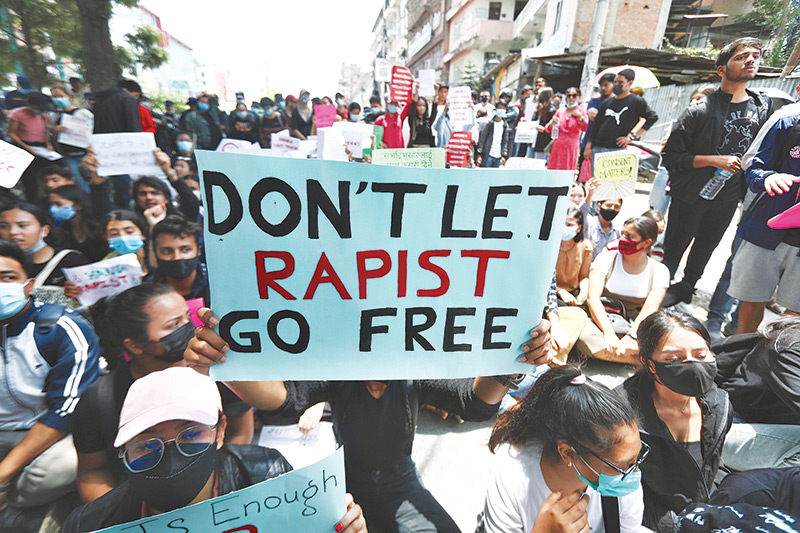
There have been protests in Kathmandu against the incidents of rape and sexual abuse. Post File Photo
Kathmandu, In late February, a 17-year-old singer accused the actor Purna Bikram Shah, popularly known as Paul Shah, 32, of raping her with a false promise of marriage. Earlier this month, the district court in Nawalparasi (East) sentenced Shah to two years and six months in jail and slapped a fine of Rs25,000. Shah wasn’t sentenced for rape but on the charge of molesting a minor. The same day Shah’s sentencing was announced in Nawalparasi, a rape complaint was filed in Kathmandu against another popular figure, Sandeep Lamichhane, the 22-year-old captain of Nepal men’s national cricket team. Like Shah, Lamichhane was accused by a girl aged 17, who is legally a child. In the aftermath of the accusations, there were demonstrations in favour of the accused, with many arguing that the age of consent should be lowered. Reducing the age of consent, however, will not lead to a reduction in cases of sexual violence, experts the Post spoke to said. It will only cut down on the number of reported crimes, leaving children more vulnerable to abuse while shielding perpetrators, they said. “Men in power have mostly abused women and young girls. Lowering the age of consent will allow men easier access to minors and let them get away with it, upholding the status quo,” Pooja Pant, a women’s rights activist and media artist, said. “It will also set impossible standards for victims to access justice.” The age of consent is the minimum legal age for young people’s capacity to make informed choices and participate in activities, including sexual behaviour. According to the National Penal (Code) Act 2017, consent may be expressed verbally or in writing or by gesture or conduct. It states that the age of consent in Nepal is 18 years and consent given by a person under ‘a mistake of fact or fear or threat of any kind of injury or harm, or in a state of unsoundness of mind, or undue influence is invalid’. While consent is often labelled a ‘tricky’ subject, experts argue otherwise. The narratives of consent as something ‘complicated’ are spread to uphold the unequal power dynamics in relationships and strip away partners’ sexual agency, they say. “That consent is tricky is a garbage idea,” Sameera Singh, a sexual and mental well-being advocate, said. “There’s nothing hard about asking. People say it’s a grey zone, that having a proper conversation while engaged in sexual activities is awkward. But that awkwardness or disruption prevents so much trauma and harm.” Singh added, “Mostly men who spread these narratives of consent as a grey area keep the power dynamics in place by taking away women’s agency.” Consent, according to experts, can be understood with the acronym FIRES—“Freely given, Informed, Reversible, Enthusiastic and Specific.” There should be no factors influencing the decision an individual makes when it comes to consent—for example, the individual shouldn’t be under the influence of alcohol or feel pressured because the partner is rich, older or influential. The individuals should know what ‘touching’ means in the context—whether it’s touching of arms and shoulders or genitalia. Consent is reversible and can be revoked at any instance, even if both partners are naked. In addition, consent should be enthusiastic—expressed along the lines of, “Yes, I want to have sex. I want to hold them. I want to do things.” However, children cannot give consent freely because they are structurally disadvantaged within the social hierarchy. In an adult-child relationship, the unequal power structures coerce the children into engaging in sexual activity. Children are instead vulnerable to various risks and harms, including abuse, grooming and sexual violence, where consent cannot be freely given, according to gender experts. “The fact that an individual is a renowned figure already lays the foundation for sexual coercion. And when these men are older and privileged, there are unequal power dynamics, building up the subtle pressures against children and young girls—who can’t say ‘no’—to engage in sexual activity,” said Madhurima Bhadra, lecturer of gender studies at Tribhuvan University. “The consent then is never freely given, nor informed, specific, nor enthusiastic.” The age of consent is thus codified to protect children with developing brains from making irrational decisions, according to gender experts. Biologically, adolescents’ brains aren’t fully developed. The prefrontal cortex—a significant part of the brain in terms of social interactions which affects the regulation of emotions, controls impulsive behaviour, and assesses risk and long-term plans—develops until the late 20s. “Young children are still developing to a certain point and they do not have the capacity to make decisions. They are rebellious and can make rash decisions without thinking of the consequences,” said Pant, the women’s rights activist who is the executive director of Voices of Women Media, a feminist media house. According to WOREC (Women Rehabilitation Center), the majority of rape cases reported involve minors. In fiscal year 2020-21, about 45 percent of reported rape cases involved girls below 16, and 37 percent aged 17-25. However, many rape cases of minors go unreported, because of various factors such as lack of awareness of what constitutes child sex abuse, fear of victim-blaming, inaccessibility of the justice system, and so on. Additionally, the argument for lowering the age of consent completely negates the existence of marital rape or domestic violence, according to experts. To think that by reducing the age of consent, rape will not take place is a “deep-seated patriarchal and misogynistic mindset,” they say. Experts say the burden of not engaging with a minor lies upon famous national figures like Shah and Lamichhane. They have the responsibility of knowing and acting according to the laws of the country they represent. “Yes, the young girl might have wanted to be in a relationship with Paul Shah but as an adult, it doesn’t exempt Shah of his responsibility to be aware of the laws of the land,” says Bhadra, a public health practitioner with a focus on sexual and reproductive health. “Even in Lamichhane’s case, he must at all times know and act in accordance with the law.”
NATIONAL
Rana promoted corruption in judiciary, lawyers tell impeachment committee
Accuse suspended chief justice of character assassination
- Post Report
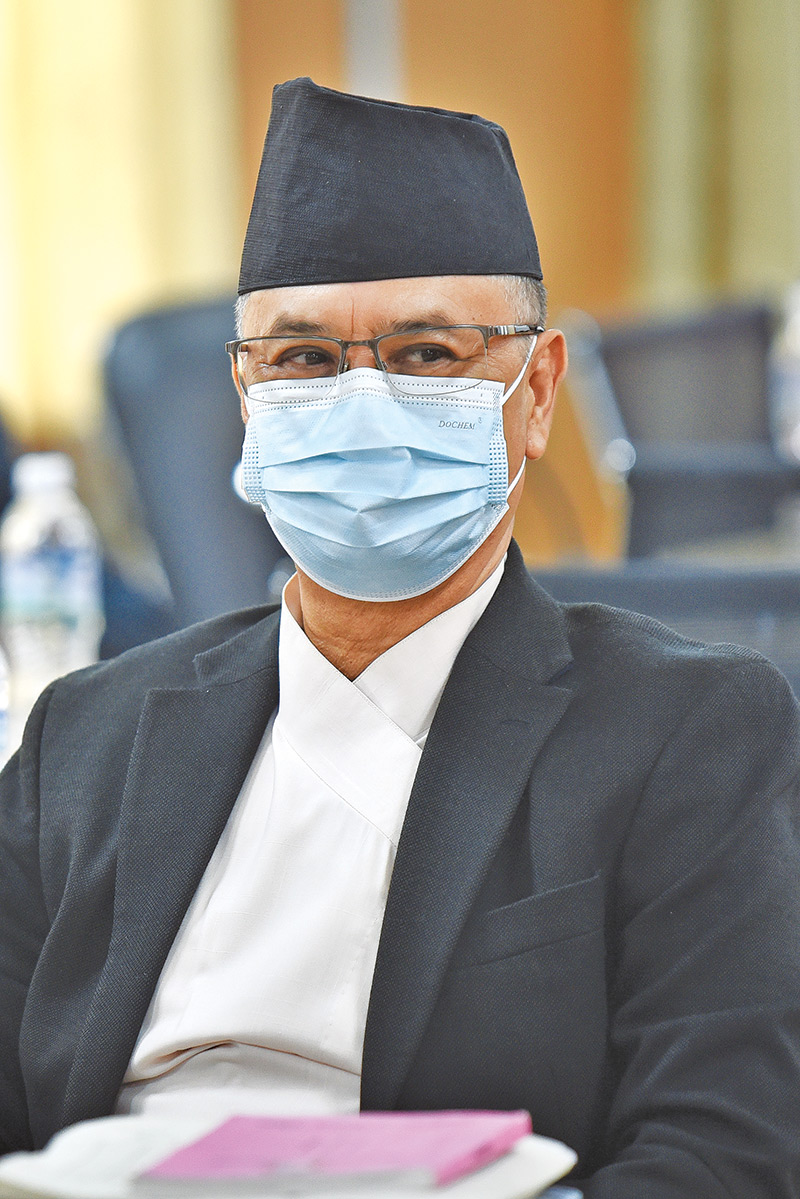
Suspended Chief Justice Cholendra Rana. Post Photo: Angad Dhakal
KATHMANDU, Lawyers who had led the protest against the then Chief Justice Cholendra Shumsher Rana have claimed there is ample ground to impeach him. Appearing before the Impeachment Recommendation Committee on Thursday, they rubbished Rana’s allegations against them saying he made baseless claims to prove himself clean. During his five-day-long question-answer sessions at the committee, Rana had accused several lawyers of bargaining with him to appoint their kin as judges and justices. He had also claimed they ganged up on him after he rejected their demands. The recommendation committee on Wednesday had decided to invite the lawyers named by Rana while defending himself at the committee. Though the sitting and former justices refused to appear before the committee, the lawyers obliged the calls. Speaking at the committee meeting, the lawyers said irregularities were at their peak in the judiciary under Rana and he was involved in corruption right from the moment he was appointed judge. Senior advocate Shambhu Thapa said Cholendra Shumsher Rana feels that impeachment motion will not get endorsed as long as he can appease a particular party. The 271-strong House of Representatives needs a two-thirds majority to endorse the impeachment motion registered on February 13. However, the ruling parties that lodged the motion lack the number. The motion cannot get endorsed from the House without the support from the main opposition CPN-UML. Without naming the UML, Thapa said, “Rana thinks he is shielded from getting impeached if he can win the confidence of a particular party. However, he has passed controversial verdicts and promoted corruption. He needs to be impeached.” Also speaking at the meeting, advocate Om Prakash Aryal said Rana had defamed many people under the pretext of defending himself. Rana had claimed the then chair of Nepal Bar Association Chandeshwar Shrestha had demanded him to appoint Aryal’s wife Chundevi Maharjan to the post of a high court judge. “This is clearly a character assassination by Rana. The parliamentary committee must take the matter seriously,” he said. “The committee must have sought evidence to justify his claim.” The committee has already asked 43 questions to Rana and plans to ask supplementary questions. “Rana has been called for Friday morning for further questioning,” said Laxmi Gautam, secretary of the committee.
NATIONAL
BP Koirala Institute of Health Sciences starts its own pharmacy
In the absence of a government-run pharmacy, patients had to buy medicines at higher prices from private drugstores.
- PRADIP MENYANGBO
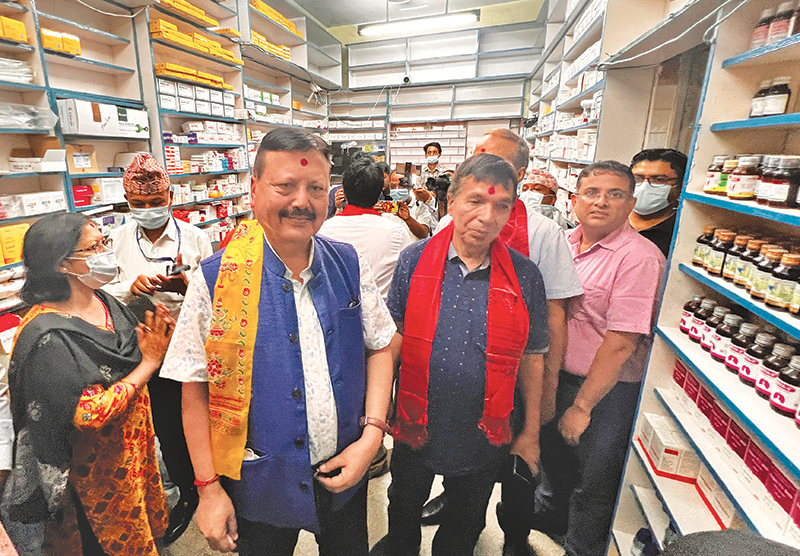
Officials of the BP Koirala Institute of Health Sciences, Dharan, at the inauguration of the pharmacy on Wednesday. Post Photo: PRADIP MENYANGBO
SUNSARI, BP Koirala Institute of Health Sciences in Dharan on Wednesday started the operation of its own pharmacy, the first for one of the biggest government hospitals in Nepal. In 2015, the government had directed all government hospitals to run their own pharmacy but in the absence of financial support from the government, the hospital had been without a pharmacy. The absence of a government-run pharmacy meant the patients had to buy medicines at a higher price from private pharmacies outside the hospital. “The 2015 government directive came about to make patients’ access to medicines easy and affordable. If only the hospital had been able to operate its own pharmacy earlier, then it would have helped a lot of patients,” said Dr Gyanendra Giri, vice-chancellor of the institute, while inaugurating the pharmacy. According to Laxman Maharjan, in charge of the pharmacy department of the institution, since the government has provided Rs2 million as seed money, it has become easier to run the pharmacy. “We will be purchasing medicines worth Rs40 million to be sold to patients coming to the hospital,” said Maharjan. “We will soon release a tender for the supply of medicines. In the first phase, pharmacy services will be extended to obstetrics and gynaecology, surgery, emergency and OPD as well.” Maharjan also said that 90 percent of the medicines prescribed by the doctors of the hospital to any patient will be available at cheaper and affordable prices through the pharmacy. According to the Public Procurement Act, pharmacies in government hospitals cannot keep more than 16 percent margin on any medicine for the benefit of the patients. Dr Gyanendra Giri, vice-chancellor of the institute, said that at present, on average medicines worth Rs1 million are being purchased daily by the patients visiting the hospital. “If the newly-opened pharmacy operates systematically then the sale of medicines can shoot up to Rs 9 million per day. The goal is to reach the number by 2023,” he said. Earlier, the then vice-chancellor Rajkumar Rauniyar also tried to bring the pharmacy into operation at two places within the institution. But the plan did not take off. According to Dr Jagat Narayan Prasad, the hospital director, pharmacy services will soon be expanded to dental colleges and orthopaedics, among others. About 5,000 types of medicine will be available in the pharmacy. The construction of a bigger pharmacy building at the cost of Rs 130 million will be completed in December making service easier, said Prasad. “In order to stem outside forces such as brokers and agents from making a profit off patients, it was imperative for the hospital to run its own pharmacy,” said Prasad. “Delivering medicines to those admitted for treatment to their hospital bed without an extra penny charged will be beneficial to everyone.” The hospital, with a capacity of 850 general and 250 emergency beds, is visited by nearly 4,000 patients on a daily basis, officials at the hospital said. Nearly 80 surgeries are carried out in the hospital in 24 hours.
NATIONAL
Candidate hopefuls in Nepali Congress could rebel if the party settles for fewer seats, leaders say
Dissidents including Shekhar Koirala insist party should keep around 100 lower house seats for itself.
- NISHAN KHATIWADA
KATHMANDU, In the 2022 local elections, several influential local Nepali Congress leaders rebelled against the party’s decisions about candidacies and contested the elections as independents. This happened after the Congress, which fought the elections under an alliance with four other parties, was unable to give tickets to many hopefuls in the party. Since the party has decided to continue the alliance in the upcoming federal and provincial elections, candidacy hopefuls in the party have threatened mutiny if the party fails to field enough candidates by itself. In last May’s local elections, the Congress’ official candidate in party President Sher Bahadur Deuba’s ward in Dadeldhura district lost to candidates from the party’s splinter faction led by Karna Malla which fought the elections on Nepali Congress (BP) tickets. Malla had partnered with the main opposition CPN-UML in the local elections. Malla—previously Deuba’s personal secretary who led the Dadeldhura district unit of the Nepali Congress twice—is vigorously pursuing his campaign to defeat Deuba in the upcoming elections. In Chitwan, the Jagannath Paudel faction of the Nepali Congress is planning to field its own candidates against those of the ruling five-party alliance. Paudel was in the spotlight after he contested as an independent candidate in the last local elections against the common candidate of the ruling alliance. Many top Congress leaders had travelled to Chitwan ahead of the elections to bring Paudel’s camp on board. Nepali Congress may face a major rebellion in the crucial elections if the party cedes more seats to alliance candidates in areas where it has a strong vote base, leaders and observers say. Paudel claimed that the Chitwan Congress has 25,000 to 30,000 loyal supporters but the party leadership has repeatedly undermined the strength. “Congress can easily secure majority votes in Chitwan. Why are they fielding candidates from other parties in the name of a coalition? Other parties in the coalition should instead support Congress candidates in Chitwan,” he told the Post. He warned that they would field rebel candidates if the party did not heed their demand. “In the local elections, they fielded Renu Dahal. And now they are trying to field Prachanda. This will harm the Congress organisation in the district,” he said. The Congress has remained a divided house of late over seat-sharing—some leaders including Deuba and Ram Chandra Poudel are ready to adopt maximum flexibility to save the coalition, but party dissidents including Shekhar Koirala insist that the party should not settle for less than 95 lower house seats. Leaders say if the party gets less than 100 seats, then it would not be possible to secure tickets for the party’s aspirants and this may lead to a rebellion. Speaking at a function in Janakpur a week ago, Congress leader Koirala reiterated his demand for 100 lower house seats. “We must get 100 seats to ensure a majority for the party. Otherwise, how will we get a majority? Other parties are not willing to give us 100 seats. But even the whole of 165 seats will be inadequate considering the candidacy aspirants in the party,” he said. Radheshyam Adhikari, a former National Assembly member from the Nepali Congress who is also a senior advocate, said ceding 65 lower house seats to other parties could put the Nepali Congress in difficulty and settling for fewer seats will only increase the odds of troubles and rebellion. “It is an arduous task for the Nepali Congress to keep the party organisation intact in the current context. It would be better for the party to partner with alliance members in certain constituencies and engage in a friendly contest in other constituencies,” he said. To work out a seat-sharing formula, the ruling alliance had formed an 11-member task force on August 5 and it had been given until August 16 to submit its report. After the task force failed to reach consensus, it asked the top leaders of the alliance to conclude the seat-sharing deal. Chandra Bhandari, a Nepali Congress leader, said the party’s top leadership is losing its own leaders’ trust due to its power-centred nature, ultimately giving birth to rebellions. Also, according to him, the old generation Congress leaders have always prevented or discouraged the younger generation leaders from rising to power. This has, he added, led to rebellion in many cases and will cause more problems to the party if corrective steps are not taken on time. “The leadership wants to stick to power and as a result more rebellions will occur in the party in the future,” Bhandari told the Post. The Congress parliamentary committee meeting on Wednesday decided to bar the candidates in the last local elections from becoming proportional representation (PR) candidates for both provincial and federal elections. And also those elected under the proportional representation (PR) system in the federal and provincial polls in 2017 will not be allowed to be PR candidates this time. Recently, the party’s lower level committees have also started taking disciplinary action against its leaders. Party joint general secretary Uma Kanta Chaudhary and lawmaker Amresh Kumar Singh have already been punished by the local level committees for acting against the party’s interest in the local elections. Such developments can also bring more troubles in the party, say insiders. According to former National Assembly member Adhikari, the likelihood of rebellion in the Congress is high in areas where the party leadership ignores the concerns of its lower rung units. “This is already happening in some places.” Nepali Congress became the second largest party in the 2017 general elections with 64 seats—23 under the direct election system and 40 under the proportional representation system. The Maoist Centre emerged as the third largest party with 53 seats—36 under the direct election system and 17 under the proportional representation system, with an alliance with the CPN-UML. In the 2017 general elections, many Congress candidates lost with small vote margins. Some of them had lost to Maoist Centre candidates. As the ruling coalition is mulling over giving priority in candidacy this time to the winners of the 2017 general elections, the Congress is in deep trouble, according to observers. “Key Congress leaders had lost in the 2017 general elections to the candidates of the communist alliance [of the UML and Maoist Centre] in many areas,” said Adhikari. “If the party fails to manage such leaders appropriately, they could rebel.”
NATIONAL
KMC reintroduces ban on smoking in public places
Kathmandu Metropolitan City officials claim the ban will be enforced effectively this time despite repeated failures in the past.
- ANUP OJHA
KATHMANDU, The Kathmandu Metropolitan City on Thursday announced a restriction on smoking and tobacco chewing in public places, effective from Saturday. The City’s eleventh municipal executive meeting took a decision to that effect. In view of public health and other considerations, the metropolis made the announcement to ban tobacco use in public, the City said in a notice. Those who do not abide by the city’s rule will be punished under the Tobacco Products (Control and Regulatory) Act (2011), the notice states. The Act bars smoking or chewing tobacco in public spaces and has a provision to slap a fine of Rs100 to Rs100,000 to the offenders. This, however, is not the first time the City has announced the ban. In March, 2019, it had announced a similar restriction on smoking and tobacco use in public spaces in all 32 wards of the metropolis. Former mayor Bidya Sundar Shakya and deputy mayor Hari Prabha Khadgi both had committed to the strict regulation of the rule across the city, but its enforcement was a failure. In the preceding year, in 2018, Shakya had announced an 18-month action plan that included a smoking ban to make Kathmandu “a healthy city”. This had failed to deter smoking in public spaces too. Even further back, in 2016, the Metropolitan Police Range Kathmandu had stepped up action against anyone smoking in public places. The security body had detained more than 600 rule-breakers in a week. They were fined Rs100 each but the campaign soon fizzled out. But this time around, the City will be mobilsing municipal police, Nepal Police and volunteers to make the drive a success, said Nabin Manandhar, spokesperson for the city office. Manandhar added that the ban this time will see success as the working procedure of the newly elected representatives is different. “You can see how illegal structures are being demolished in Kathmandu,” he said. “We are committed to what we say. From Saturday onwards, people will see the difference.” In the first week of March, the neighbouring Lalitpur Metropolitan City had declared the Patan Durbar Square, Jawalakhel and the periphery of City’s building in Pulchowk as “smoking-free area”. The Lalitpur city has also banned shop owners from selling cigarettes and tobacco near schools and colleges. “Unlike earlier, this is going to be more effective,” said Balram Tripathi, chief of the Health Department, Kathmandu, echoed Manandhar, saying the ban will have effect this time. “We have made a work plan, and you will see it once it goes into implementation,” Tripathi said. According to Tripathi, for the first few weeks, the City will be organising an awareness drive. In the second phase, the City will start taking action against those who breach the rule. According to the World Health Organisation’s May 2022 report, more than 8 million people die as a result of direct tobacco use every year around the world while around 1.2 million deaths are the result of non-smokers being exposed to second-hand smoke. A report published by the non-profit Nepal Development Research Institute said that 13 percent of deaths in Nepal in 2017 were attributed to smoking.
NATIONAL
World Bank launches Country Climate and Development Report
- Post Report
Kathmandu, On Thursday, the World Bank released a Country Climate and Development Report (CCDR) of Nepal, the first of its kind in South Asia. Keeping in mind the worsening impacts of climate change in Nepal, the report recommends four major areas in which Nepal should invest under the green resilient and development (GRID) framework. The report is on the nexus between climate change and development in Nepal. Firstly, improving systemic resilience of rural landscapes including food, freshwater and forest systems will be crucial to boosting adaptation, livelihoods and food security, says the report unveiled in Kathmandu. “For this, increasing water storage, investing in climate smart agriculture and expanding community forest management will be important,” said Martin Raiser, regional vice-president of South Asia for the World Bank. Secondly, harnessing Nepal’s significant hydropower opportunities as the means of clean and alternative energy is essential and third, managing urbanization and environmental quality to building resilience and improving health is of importance, says the report Finally, the fourth pillar the report outlines is investing in low-carbon and resilient connectivity, particularly road networks, to improve Nepal’s growth and services. In order to sustain progress in these four areas, the report outlines three key enablers: scaling up finance by partnering with private sectors, strengthening household and community resilience, and strengthening governance for climate change and disaster risk management. According to World Bank estimates, the gross domestic product (GDP) of Nepal is estimated to reduce by 7 percent in 2050 solely due to climate change. “The region will experience economic losses worth $160 billion every year due to climate change and it will need around,” said Raiser. To tackle this, Nepal will need $7.3 billion from development partners to support this agenda for the next three years, he said. In order to tackle climate change, Nepal should look into private financing and public investments by strengthening fiscal institutions and improving business environments in the country, said John Roome, regional director of the World Bank. “Nepal should strongly advocate for climate financing but it also needs to be realistic that big cheques are not going to come in the short term, so it needs to prioritize climate investments,” said Roome. According to government officials, this report provides critical support to managing climate change and implementing green, resilient and inclusive development (GRID) approaches in Nepal. However, youth advocates and experts criticized the report for lacking in inclusivity and components of youth actions. “From a social justice and climate justice framework, the report did not include community, gender and inequality based approaches,” said Radha Wagle, director general of the Department of Plant Resources at the Ministry of Forests and Environment. Adding to Wagle’s comment, Sepideh Keyvanshad, mission director of the USAID said that it is of utmost importance to think about “who is sitting at these tables of decision making, who are making these economic trade-offs? Whose voices are heard and included? What does it mean to “leave no one behind?”
EDITORIAL
Viral effect
The dengue crisis will get much worse if immediate measures are not taken to solve it.
As if Covid-19 and cholera were not enough, dengue fever now has the country in its grip as cases continue to rise. As of Tuesday, September 13, a total of 11,065 cases had been reported across the country, with Bagmati province recording the highest number (8,390) followed by Lumbini(1,421). Among the top 10 districts reporting dengue cases, Lalitpur, Kathmandu, Makwanpur and Rupandehi have the highest numbers: 3,793, 2,569, 1,112 and 594 respectively. Nine patients have already succumbed to dengue-related complications even as hospitals report running out of beds and capacities for treatment. The government’s response, meanwhile, has been slow and sluggish as usual. Although the Ministry of Health and Population has allocated funds for seven provinces, 60 districts and 139 local levels to control dengue, infections show no signs of coming under control for lack of coordinated efforts. The best way to stop the virus is to find and kill female Aedes aegypti or Aedes albopictus mosquitoes that spread dengue, but officials aren’t worried enough to go door-to-door and educate the people. It has been months since infections were first reported, but it is only now that the Health Ministry is considering the option of large-scale fogging. If the dengue outbreak continues in this vein, it could put our healthcare system under great strain. We saw during the Covid-19 crisis that it is only when the problem begins to get out of our hands that we start looking for solutions. The dengue crisis is expected to become dire during the Dashain holidays, when dengue-carrying people will travel en masse from cities to villages, and mosquitoes will become more active during the post-monsoon period, with concomitant increase in transmission rates. Moreover, public hospitals in several districts across the country are running out of testing kits for dengue. As a result, the hospitals are sending patients to private ones, which often charge exorbitantly. Ultimately, many patients who cannot afford tests at private hospitals are undiagnosed and at a high risk of severe illnesses. The question is: Can the government that has been so disinterested in handling the issue today be trusted to swing into action when it grows into a full-blown crisis? Notably, as with other vector-borne diseases, the dengue problem is here to stay, and we need a long-term vision to tackle it. Various studies suggest that global warming has altered the geographic prevalence of mosquitoes, with places previously known not even to have mosquitoes reporting dengue cases nowadays. We need not look further than the high Himalayan towns in Nepal. Dengue marked its presence in the lowlands in the mid-2000s and has been travelling uphill since. A general lack of awareness about this relatively new crisis has led to its continuous rise, with people unscrupulously leaving sewages open and collecting water in buckets for long durations, a significant cause for the breeding of mosquitoes. Boosting preventative awareness is, therefore, critical to stopping the spread of the virus. Authorities from all levels of the government should work together to provide people with necessary tools and information to locate breeding sites and stop the spread of dengue, sooner than later.
OPINION
What will make Nepali soft power tick?
Nepali stories, artists and entrepreneurs have the wherewithal to take on the world.
- Amish Raj Mulmi
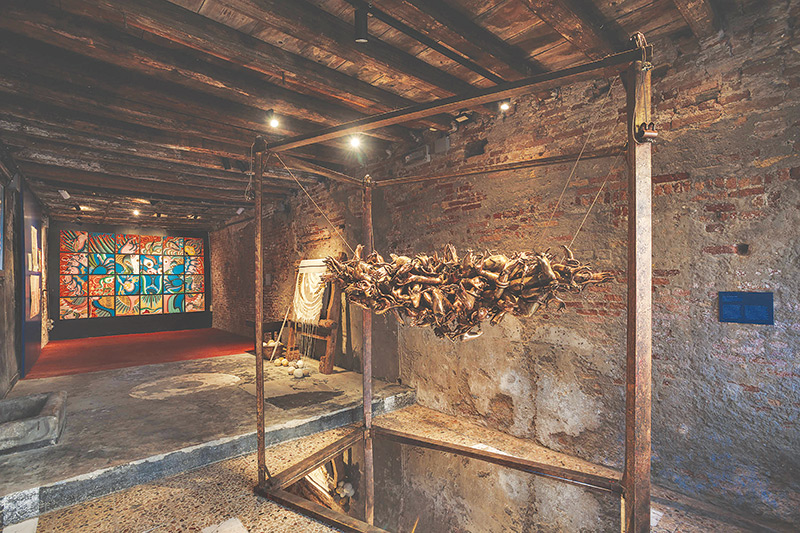
Tsherin Sherpa’s “Tales of Muted Spirits” at the Venice Biennale. Photo courtesy: Riccardo Tosetto
One of the tenets of Nepal’s foreign policy is soft power. The official foreign policy document says Nepal’s soft power can be promoted via Nepal’s “natural beauty, unique and rich civilisation, culture, lifestyle, diversity, thought processes, art, language, literature and sport”. The policy document goes on to highlight several elements that would be utilised to promote Nepali soft power abroad—Lumbini, Pashupati, Everest, the culture of welcoming guests, and so forth. By itself, the points highlighted in the document are commendable. But these are also generic arguments, ideas that are made to sound executable without any implementation hiccups. As we all know, Nepal’s forte is signing agreements without thinking of implementation. We’ve seen that with both the MCC and the BRI. So what is required to push Nepali soft power beyond these generic terminologies and really make the Nepal story tick beyond our borders?
‘Jalebi’ of laws At the recently concluded Kantipur Conclave, where I moderated a session on Nepal’s soft power potential, all four panellists had different ideas about what could take the Nepali brand abroad. While Nepal’s unique culture and natural heritage as our soft power highlights made the headlines, many news reports missed an important takeaway from the session: The regulatory hurdles that Nepali entrepreneurs and creative artists face to take the Nepal story abroad. Nepal’s regulatory space is, in the words of a panellist, a “jalebi”—a jumble of laws and regulations that desist and discourage smooth passage of our products and services. Consider this: Nepal got a pavilion at the prestigious Venice Biennale for the first time this year. Artist Tsherin Sherpa’s “Tales of Muted Spirits” exhibit was built on the histories and experiences of Himalayan communities, and was received as a “joyful, colourful and tactile exhibition” that “[shone] a light on Nepal, showcasing its traditional craft of carpet-weaving, the vibrant and distinctive thangkas, and its sculptural prowess.” The Venice Biennale is to the art world what the Cannes Film Festival is to filmmaking: It is where the best in the world are feted. Yet, as a panellist recalled, Nepal’s regulatory hurdles meant the organisers waited for nine months for the required permissions, which were granted only two days before the deadline. Inside Nepal, barring a few media outlets, Nepal’s presence in Venice barely made the news. The stories are similar across sectors—whether in the arts or entrepreneurship. Nepali stories, artists and entrepreneurs are willing to take on the world, but what’s stopping them is Nepal’s regulatory “jalebi”, a smorgasbord of archaic laws that would deter even the most courageous of our mythical heroes. Many believe the only way to succeed in Nepal is to develop a proximity towards the powers that be—whether through politicking, or by feeding them marsi chamal. For those who cannot, bad luck! There’s a wonderful music video by the Phosphenes for their track “Yestai Nai Hola”. The video, which has over 1.7 million views on YouTube, begins in the 1970s with an energetic young man out to get permission from a government office. The civil servant asks him to come the next day, then the day after, and so on until years pass by. The future arrives in Nepal—government offices now have a hologram of the civil servant. Yet, our protagonist is asked to come the next day once again. The smile on his face disappears, wiped out by the mammoth hurdle that is Nepal’s policy environment. It is indeed a microcosm of how Nepal functions.
Many opportunities Sectorally, there are several opportunities lying in wait for Nepal. As the success of films such as Dr Strange and Up in the Wind have shown, Nepal can harness its physical beauty as an international film location. Our brands—the Yeti, the Khukuri and the Gurkhas, Everest, to name a few—have a recall value most marketing experts would love to jump at. The Nepali thangka and sculptures travelled the world before any Nepali did. We have already acquired high levels of quality and competence in new agri-products such as coffee. Our mountaineers are the best in the world without question. And the goodwill Nepal carries everywhere is evident every time one travels outside the country. Yet, our diaspora’s success is obscured by the politicking within our non-resident Nepali associations. This year’s FIFA World Cup will be possible only through the blood and sweat—and often lives—of those of us brave enough to withstand the heat of Qatar. We should be able to claim this story—but only if we spare a thought for migrant labour to begin with. So what is Nepali soft power? And how can Nepal build on it? In my view, the answer to these lies in first articulating what the Nepal story itself is about. The Nepal story is not about a unique national identity—every country has one. Rather, the Nepal story in the 21st century is a story of success despite adversity, of rising above the destitution that we had inherited due to the extractive nature of Rana rule. The Nepal story is about finding success in new lands and alien cultures. Like the great immigrant communities of the past, Nepal today cannot be encapsulated within its borders alone. But first, we have to recognise the fact that political patronage will rarely allow for a Nepali product or service to think beyond our borders. Nepali creators, artists and entrepreneurs have taken on the world, but they need a regulatory and policy environment that allows them to do so without fear. There are a thousand stories waiting to break out, and all we need to do is let them free.
OPINION
Investing in Africa’s health
Domestic investment is crucial for securing health sustainability given the impact of global shocks.
- DONALD P KABERUKA
Shutterstock
There was a time, not so long ago, when an HIV diagnosis was a death sentence. AIDS, together with tuberculosis and malaria, killed millions of people and overwhelmed health systems worldwide—especially in Africa. But the world came together and fought back. The Global Fund to Fight AIDS, Tuberculosis, and Malaria, established in 2002, is an unparalleled success story. Cooperation between developed and developing countries, the private sector, civil society, and affected communities has saved 44 million lives, and the combined death rate from these three diseases has been reduced by more than half. Saving this many lives has had a huge economic impact. The Global Fund estimates that an investment of $1 through the health programmes it supports will result in $31 in health gains and economic returns over three years. And since most of its investments are in Africa, the benefits will spread across the continent. But the Covid-19 pandemic curtailed this rapid progress. While the death rate on the continent has not been as catastrophic as many feared, the pandemic has had a profoundly negative impact on Africa’s health systems and on the fight against AIDS, TB, and malaria. Testing, diagnosis, and treatment for these diseases have been severely affected, threatening the gains made in previous decades. Worldwide deaths from malaria, for example, increased by 13 percent in 2020, to a level not seen since 2012. Unless things change, the gap in health and economic outcomes between Africa and the rest of the world will widen. Overseas aid remains vital. If we are to reverse the losses created by the pandemic and continue to do lifesaving work, the Global Fund needs to meet its fundraising target of $18 billion over the next three years. The Fund’s Replenishment Conference this month will bring together representatives from donor countries, the private sector, and civil-society groups seeking to renew commitments and ensure overarching support for the fight against AIDS, TB, and malaria. But domestic investment is also crucial for securing health sustainability, especially given the impact of recent global shocks on both advanced and emerging economies. To this end, the Global Fund supports initiatives like the African Union’s African Leadership Meeting (ALM), which advocates for increased domestic resources for health. While the Global North can look forward to the post-Covid-19 economic recovery, Africa is still lagging behind the rest of the world in vaccine access and uptake. The continent will need more time to recover fully from the pandemic. How, then, in the face of an uncertain economic outlook—with African GDP dropping, inflation rising, and food and energy costs soaring—can governments realistically increase health spending? While there is no silver bullet, we have identified several actions that governments can take to promote investment in the health sector. For starters, economic recovery is a virtuous circle: GDP growth enables greater investment in health, and a healthier population is more productive. The next few years could be challenging as the longer-term consequences of the pandemic and the ripple effects of the war in Ukraine adversely affect investment and trade. But fully implementing initiatives like the African Continental Free Trade Area (AfCFTA) could help reduce Africa’s dependency on food and fuel imports. Another way to prop up local health systems would be to increase tax revenues. Many African governments face a significant “tax gap”—the difference between what their tax laws should, in theory, deliver and what governments manage to collect. Removing loopholes and reinforcing the efficacy of tax administration are powerful ways to make more money available for health. Governments should also allocate more funds to public health. Very few African countries currently devote 15 percent of their national budgets to the health sector—the target set by the 2001 Abuja Declaration. This, in turn, impedes their ability to ramp up efforts to eradicate AIDS, TB, malaria, and other epidemics, and thus reduces their chances of achieving the 2030 Sustainable Development Goals (SDGs). The private sector must do its part as well, whether through corporate taxes, employer-led health insurance, or workplace health schemes. Private companies benefit enormously from a healthier population and—as we have seen during the Covid-19 pandemic—can suffer dramatic losses when infectious diseases run wild. Of course, it is also important to make health spending more efficient. This would involve coordination between finance and health ministries. Finance ministries can support planning, budgeting, and spending by providing a clear indication of available resources over the medium term and by being responsive to changing needs, including health emergencies. Meanwhile, health ministries can design more streamlined and cost-effective public programmes. Pulling these levers requires political leadership and sustained effort. The Global Fund directly supports African communities and governments as they work to strengthen local health systems. But only a combination of international aid and domestic financing can turbocharge the efforts to eliminate AIDS, TB, and malaria by 2030. And only by ending these epidemics can we propel Africa’s economies, bolster the world’s defences against future outbreaks, and free millions from the burden of disease.
Kaberuka, a former president of the African Development Bank, is Board Chair of the Global Fund to Fight AIDS, Tuberculosis, and Malaria. — Project Syndicate
MONEY
China to release all stranded cargo trucks by Sept 27
Nepali traders were frantic they might miss the festival shopping season this year too if their goods did not arrive on time.
- BALARAM GHIMIRE
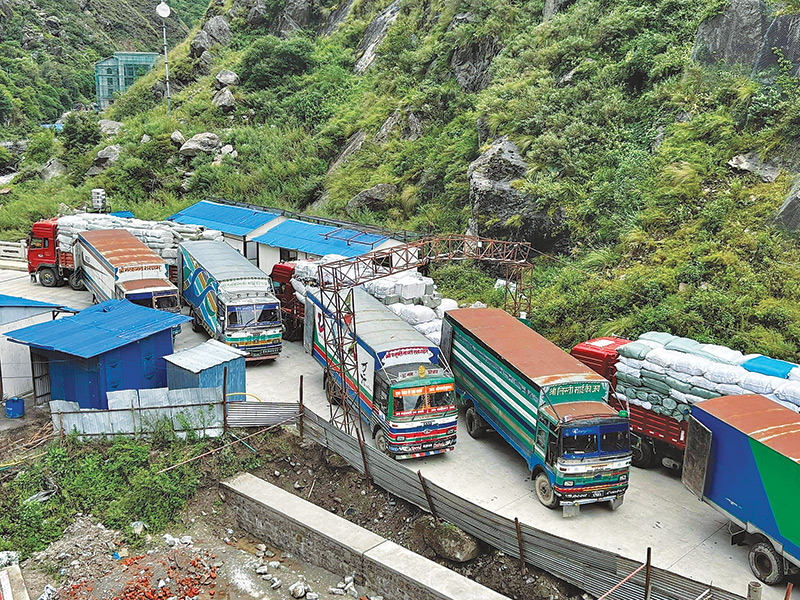
Apples, garlic and various other fruits and vegetables imported for the upcoming festive season are rotting in the containers, traders say. Photo Courtesy: Aman Tamang
RASUWA, Beijing has ordered Chinese customs authorities to release all Nepal-bound cargo trucks stranded on the Chinese side of the border by September 27, Nepali customs officials said on Thursday. The overnight development to open the border after keeping it shut for a month over Covid concerns follows the visit of top Chinese politician Li Zhanshu to Nepal. Li is chairman of the Standing Committee of the National People’s Congress and a No 3 member of the Politburo Standing Committee of the Chinese Communist Party, China’s top decision-making body. Arriving in Kathmandu, Li said that he would facilitate the passage of containers stranded on the Chinese side of the border. China has been imposing a one-way trade rule since the Covid-19 pandemic started in early 2020. Chinese truckers normally deliver the goods ordered by Nepali traders on the Nepal side and return with empty containers. The restriction on exports, however, remains. During a meeting with Prime Minister Sher Bahadur on Tuesday, Li assured the prime minister that China would reopen the border ports shortly after controlling Covid-19 cases in Tibet while facilitating the passage of containers carrying goods and supplies for the upcoming festivities in Nepal, the Foreign Ministry said in a press statement. Rasuwagadhi-Kerung and Tatopani-Khasa (Zhangmu) are the two key border crossings between Nepal and China. Following the order from Beijing, seven cargo trucks rolled into Nepal through the Kerung-Rasuwagadhi transit point on Thursday. Last month, Beijing announced a strict lockdown in Tibet following a resurgence in Covid-19 infections, preventing goods ordered for the festive season from passing across the border. China closed the Tatopani border point on August 10 and the second major transit point at Rasuwagadhi on August 14. The border closures came a few days after Nepali Foreign Minister Narayan Khadka’s visit to the northern neighbour when the Chinese side had agreed to open it for two-way trade. The Tatopani border point in Sindhupalchok district was opened on September 10, two days before Li’s visit. Nepali traders, who have been repeatedly calling on the prime minister and other politicians to request China to lift the border restriction ahead of Dashain, say it was a pleasant surprise even though the decision came late. The Dashain celebrations, Nepal’s biggest festival, begin on September 26. “Seven cargo trucks carrying readymade goods entered the country on Thursday morning,” said Ram Prasad Mainali, chief customs officer at Rasuwa Customs Office. “Chinese officials observed the border points on Thursday morning to operate it following a new health safety protocol.” According to Mainali, the Chinese side has informed Nepali authorities that all goods targeted for the festival shopping season that are stranded in different Chinese cities including Shigatse, Kerung, Nyalam and Lhasa, will be released by September 27. “We will make the necessary arrangements to send the trucks to Kathmandu by following customs and health related protocols.” Nepali traders were frantic they might miss the festival shopping season this year too like in the past two years when their shipments were held up at the Rasuwagadhi and Tatopani points. The Dashain and Tihar festival season is a key business event when tens of thousands of Nepalis engage in an annual shopping spree. Most of the fruits and clothes sold in Kathmandu are imported from China. During Tihar, the festival of lights, the markets are flooded with Chinese twinkle lights and decorations. Apples, pears, garlic and various other fruits and vegetables imported for the upcoming festive season are rotting in the containers, traders say. According to Nepali traders, nearly 250 containers laden with merchandise worth billions have been stuck in different cities and roads in Tibet following Beijing’s move to clamp a strict lockdown. “There are 50 containers loaded with goods in Kerung alone,” said Dharma Poudel, a trader. “We assume that there are around 250 containers stranded in Shigatse, Kerung, Nyalam and Lhasa.” Naba Raj Jaisi, chief district officer of Rasuwa, said Chinese authorities had communicated that they were ready to send cargo trucks 24/7 in order to clear the backlog. According to the Department of Customs, Nepal’s imports from China increased by 13.19 percent in the last fiscal year ended mid-July. The country imported goods worth Rs264.78 billion. Exports from Nepal to China plunged by 25 percent to Rs808.75 million in the last fiscal year from Rs1 billion in the previous fiscal year. Min Bahadur Shrestha, immediate past vice-president of the Nepal Trans Himalayan Border Commerce Association, lauded the government’s move. “The traders will miss a lot of sales if the goods imported for the festivals are not transported on time,” he said. “Traders have a hard time paying interest on their loans when their goods are not delivered on time.” The Tatopani-Khasa border point re-opened on May 29, 2019 after remaining closed for four years following the 2015 earthquakes. The border point was a major overland route for trade with the northern neighbour. China again closed the border points after the pandemic in January 2020, and they have not been fully operationalised since. The closure of the Chinese border in early 2020 has affected a large number of Nepali entrepreneurs exporting goods to China. The Kerung and Tatopani border points have been re-opened, but neither export nor import trade has picked up. The Rasuwagadhi-Kerung customs point, which was elevated to an international checkpoint between Nepal and China allowing people from third countries to cross the border, re-opened in July 2020.
MONEY
ADB extends $70 million to improve horticulture in Nepal’s hill areas
- Post Report
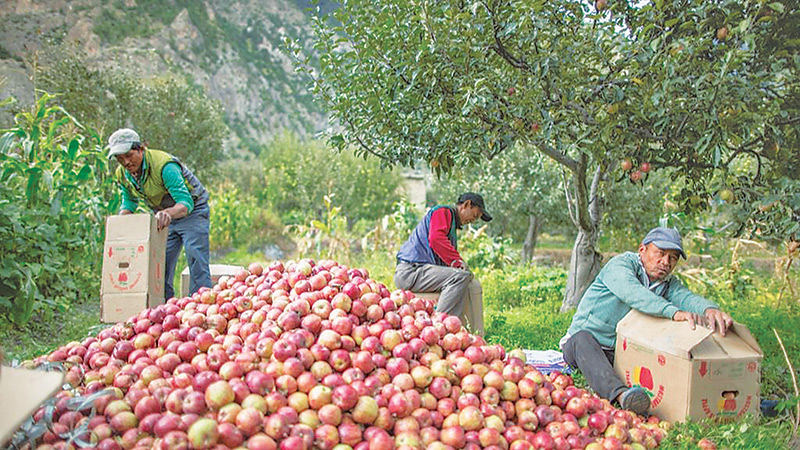
The Nepal government will contribute about $14.5 million to the project. PHOTO COURTESY: ASIAN DEVELOPMENT BANK
KATHMANDU, The Asian Development Bank (ADB) has approved $70 million of financing to improve the livelihood and climate resilience of horticulture farmers in the hilly areas of five provinces in Nepal. As a part of ADB’s overall efforts to address potential risks of food insecurity, the project will boost the productivity of 30,000 farmer households in Bagmati, Gandaki, Karnali, Province 1, and Sudurpaschchim, mainly through the development of around 10,000 hectares of climate-resilient fruit and nut orchard, the bank said in a statement. Partial grants will be provided to farmer groups and cooperatives to shoulder investment costs, while a credit guarantee fund will be established for farmers who lack collateral to access formal rural finance. The beneficiaries, represented by at least 30 percent women and 20 percent from disadvantaged groups, will be trained in climate change adaptation practices, including soil management, crop husbandry, and drip irrigation, among others. Fruit and nut demand in Nepal is increasing due to urbanisation, rising national wealth, improved knowledge of nutrition, and tourism, but horticulture productivity has been declining. A growing portion of cultivated land in hilly areas has been abandoned from farming as people are shifting to other employment and relying on remittances from abroad. The high climate vulnerability in lower hills and mid mountains also reduces farmers’ livelihood options. “ADB’s loan will support the government’s push to revive horticulture farming in hilly areas of Nepal, highlighted in its declaration of 2016–2026 as the ‘Fruit Decade’,” said ADB Senior Natural Resources and Agriculture Specialist for South Asia Sunae Kim. Aside from filling the gap between domestic supply and demand, higher profits expected from commercial fruit and nut farming could also help retain the younger population in the agriculture sector and offer income opportunities for women who are heading households after male outmigration.” The project will also enable farmers to market their produce by preparing a business plan collectively, and promoting cooperatives and marketing associations to aggregate horticulture products and manage their quality. Other interventions include training cooperatives and associations in food safety control systems, financial management, marketing, entrepreneurship and female leadership; supporting the preparation of contracts between cooperatives and buyers; and upgrading value chain infrastructure, such as traceability systems, commodity storage and collection centres, and orchard predator fencing. To ensure quality planting materials, the project will improve the institutional capacity for nursery and horticulture sector management. ADB’s financing comprises a $60 million concessional loan from ordinary capital resources and a $10 million grant from the Asian Development Fund. The Nepal government will contribute about $14.5 million to the project. The bank will also administer a $9 million grant from the Global Agriculture and Food Security Programme. The grant will support another 10,000 smallholder farmers, with less than 0.2 hectares and unable to invest in commercial orchard development, in producing irrigated vegetables during the dry season and nutritious food crops during the wet season.
MONEY
Mobile device management system goes online to check grey market
- KRISHANA PRASAIN
KATHMANDU, From early in the morning, mobile phone users have been receiving messages from Nepal’s telecom regulator: ‘your phone has been registered’. That’s because, Nepal Telecommunications Authority, the regulator, launched Mobile Device Management System (MDMS), on Thursday, months after it was planned. In a notice issued on Thursday, the authority said that the mobile sets brought from abroad personally till September 15 will automatically get registered in the MDMS. The authority has requested people to purchase phone sets only by checking whether it is registered or not on the MDMS from September 16 onwards. “The basic idea is to eliminate mobile imports from the grey market. The system will prevent phone sales without a bill and warranty,” said Purushottam Khanal, chairman of Nepal Telecommunications Authority. “The grey market will be totally shut down right after the system comes into operation.” According to the Department of Customs, the import of mobile phones increased by 10.75 percent to Rs40.89 billion in the last fiscal year that ended mid-July. Nepal imported 5.76 million phone sets in the last fiscal year. Traders say that the import figure is huge as nearly 50 percent of phone sets are illegally imported, without paying taxes. Officials say that the chances of mobile theft will be minimised, and criminal activities that are conducted through the use of mobile phones too will be reduced. The mobile importers and distributors also need to take mandatory permission from the authority before importing mobile phones, the authority said in the notice. People bringing new phone sets into the country, particularly from abroad, need to be registered within two weeks. People are allowed to bring two phone sets—one that they are using or a personal phone and another new one—when they enter Nepal. “If people bring more than two phones, they have to pay customs duty by submitting the purchase bill,” Khanal said. To get register the new phones, users have to submit a citizenship certificate photocopy or scan copy and scanned tax invoice online in MDMS. “This is free of cost,” said Khanal. “If the sets are not registered, within two weeks, the phone will be blocked,” said Khanal. “However, the user will receive a notice to register the phone before it is blocked.” In the case of foreign tourists, they need to register the phone within two weeks, Khanal said. Tourists can register their number by sending a copy of their passport and visa. “There are no charges to register,” said Khanal. Their mobile will be permitted to operate as per the visa period, he said. Importers that bring and sell phone sets through illegal means are not registered. The MDMS is security software that enables the telecom regulator to implement policies that secure, monitor and manage end-user mobiles. The system will be synced to a database called Equipment Identity Register which contains records of legal and illegal mobile devices in the country. The system is also expected to identify cloned, low-cost copy versions of branded phones with fake registration numbers. The telecom regulatory authority moved to develop the system four years ago after the Mobile Device Management System Bylaws 2018 were issued. The system built by the telecom regulator involves setting up a data centre where the personal records of mobile phone owners registered on the network of Nepal’s three telecom operators will be stored. In June 2019, the telecom regulator selected Malaysian firm Nuemera as the service provider to implement the system. Nuemera got into a controversy in 2017 following revelations that a similar phone blocking system it developed under an outsourcing model for the Malaysian Communications and Multimedia Commission was found to be the source of a data leak that affected 46.2 million subscribers in Malaysia. The authority said that there was an issue with Nuemera, but that the Malaysian regulator had already clarified the matter. The telecom regulator said the system was being built at a cost of Rs650 million.
MONEY
Taiwan president warns of ‘volatile’ challenges facing chip industry
Briefing
TAIPEI: Taiwan’s President Tsai Ing-wen warned the semiconductor industry faces new and “volatile” challenges, but said her government will work with the sector to overcome them. Taiwan is home to the world’s largest contract chipmaker, TSMC, and is a major producer of semiconductors used in everything from washing machines and cellphones to data centres and fighter jets. “The continued success of this industry comes in the face of unprecedented global challenges in recent times, including considerable uncertainty around supply chains,” Tsai told an industry forum in Taipei late on Wednesday, according to comments released by her office. (REUTERS)
MONEY
Thai central bank plans business digital payment platform by April
Briefing
BANGKOK: Thailand’s central bank plans to launch a digital payment service for businesses by April next year, and aims to expand cross-border payments with some other countries, officials said on Thursday. The PromptBiz platform will help businesses make and receive payments as well as send information, the officials told a media briefing. The service follows the launch in 2018 of PromptPay, a payment platform for the public. Budsakorn Teerapunyachai, senior director at the Bank of Thailand (BOT), said that PromptBiz could be a “game changer” in business payments if it mirrors the take up of PromptPay. (REUTERS)
MONEY
Japan logs record August trade deficit on weak yen, costly oil
Briefing
TOKYO: Japan posted a record trade deficit in August as costs for imports of oil and gas soared, the government reported on Thursday. The 2.82 trillion yen ($19.6 billion) deficit, the 13th in a row, was triple the deficit logged in the same month a year earlier. Customs-data showed exports rose 22 percent from a year earlier as regional economies recovered from pandemic-related disruptions while imports soared 50 percent. Energy-related imports from the Middle East accounted for about half of the deficit. Japan’s currency, the yen, has weakened sharply against the US dollar as the Federal Reserve has raised interest rates to counter inflation. Surging prices for many commodities and other products are also pushing Japan’s imports higher. (AP)
SPORTS
Nepal face India in crucial fixture today
Thapa will look to avenge the 2016 semi-final defeat, the only time Nepal exited from the last four in women’s SAFF.
- Sports Bureau
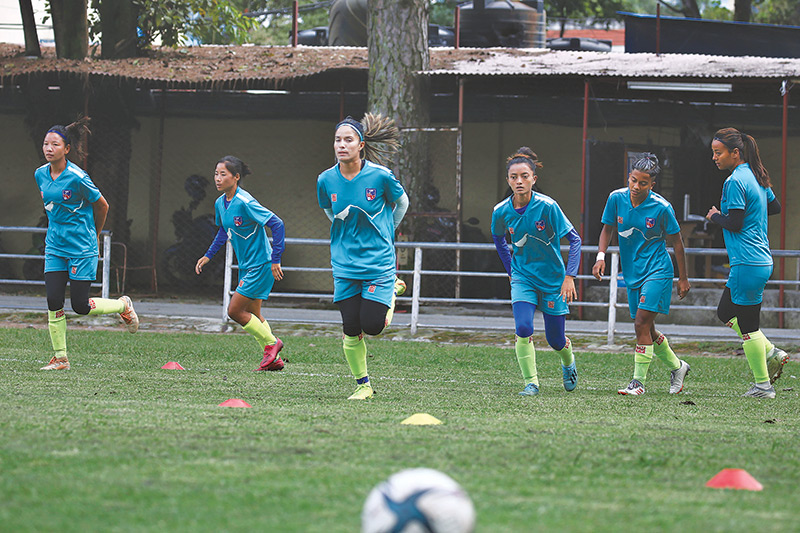
Members of Nepal’s national women football squad during a recent training session in the Capital. Post File Photo: Hemanta Shrestha
KATHMANDU, Nepal coach Kumar Thapa says the second semi-final match of the SAFF Women’s Championship between Nepal and India on Friday will be an opportunity for him to avenge the semi-final exit of 2016 at the away venue in Siliguri, India. Nepal had bowed out from the semi-final of the sub-continental tournament for the first and only one occasion in Siliguri losing 3-1 to India. Other than that, Nepal have entered the final of all previous four editions of the biennial tournament but never won the trophy finishing runners up behind India on all occasions. Thapa was the coach of the Nepal team in the fourth edition when Nepal met India in the semi-final. He is again the coach in the current event being played at Nepal’s home ground at Dasharath Stadium. “We had lost the semi-final at their home ground and now it is being played at our backyard. I got a second chance now and we don’t want to lose the game at our home turf,” said the former Nepal international midfielder. “India are a tough opponent with a strong history. We have not taken them lightly. We will try to minimise our mistakes,” said Thapa, whose side made it to the semi-final as group winners with a comfortable 4-0 win against Bhutan and 6-0 against Sri Lanka. Thapa also lamented that his side’s defence lineup and goalkeeper were never tested in their first two matches. India defeated Pakistan 3-0, Maldives 9-0 before losing 3-0 to Bangladesh and progressed into knockout as group runners up. Though India have won all five past encounters against Nepal in the SAFF Championship, coach Suren Kumar Chhetri termed Nepal as tough opponents. “Nepal are a good team and we learnt a good lesson today,” Chhetri had said after his side’s defeat against Bangladesh. Clarifying that his side would not underestimate the home team, he said: “Nepal is a football hub and it is always tough to play against them on their home soil. Lots of people come to support the home team.” Among 14 matches played between the two sides, Nepal have won just one, during the Women’s Gold Cup in Bhubaneswar in February 2019, drawn two and have lost 11 matches. Nepal’s star forward Sabitra Bhandari, ruled out of the team’s last match against Sri Lanka due to dengue, however, is in doubt for the game. “She is under observation but she has not had a fever since yesterday [Wednesday] evening. Hopefully she will be ready to play tomorrow,” said Thapa, adding that the doctor attending her will have final say about the talismanic forward. According to team sources, she had a light training session on Thursday. Bhandari is the all-time highest scorer for Nepal with 40 goals under her belt and was excluded from the team’s win over Sri Lanka. She had scored twice in the 4-0 win over Bhutan. Goalkeeper Anjila Tumbapo Subba will take charge of the post while Hira Kumari Bhujel, Gita Rana, Amrita Jaisi and Punam Jargha Magar are likely to be deployed as defenders. Bhandari and Amisha Karki are likely to be assigned the attacking role. But should Bhandari be benched, Rashmi Kumari Ghising is likely to take her place. Saru Limbu, Dipa Shahi and Anita KC and Anita Basnet will be deployed as midfielders. Bangladesh, the winner of Group ‘A’, will vie against Bhutan, Group ‘B’ runners up in the day’s early kickoff.
Head-to-Head Nepal 0-2 India (13th SAG Pokhara, 2019) Nepal 0-1 India (13th SAG Pokhara, 2019) Nepal 1-3 India ( AFC Olympic Qualifiers Myanmar, 2019) Nepal 1-3 India (5th SAFF Biratnagar, 2019) Nepal 2-1 India (Women’s Gold Cup India, 2019) Nepal 1-1 India (AFC Olympic Qualifiers Myanmar, 2018) Nepal 1-3 India (4th SAFF India, 2016) Nepal 0-5 India (12th SAG India, 2016) Nepal 0-0 India (12th SAG India, 2016) Nepal 0-6 India (3rd SAFF Pakistan, 2014) Nepal 1-3 India (2nd SAFF Sri Lanka, 2012) Nepal 0-1 India (1st SAFF Bangladesh, 2010) Nepal 1-3 India (11th SAG Dhaka, 2010) Nepal 0-5 India (11th SAG Dhaka, 2010)
Today’s Semi-final Fixtures Bangladesh vs Bhutan (Time: 13:00 NST) Nepal vs India (Time: 17:30 NST) Venue: Dasharath Stadium
SPORTS
Police edge NRNA to set up title clash against Army
Police beat NRNA by 13 runs in the 8-over match while Army were named winners in the rain-affected match without playing a single ball by virtue of topping the group.
- Sports Bureau
KATHMANDU, Nepal Police Club edged NRNA Sports Club by 13 runs in the Twenty20 match under Ninth National Games to set up the title clash against Tribhuvan Army Club, who progressed to the final without playing a single ball in the last four clash on Thursday. The day’s early kickoff at the TU ground in Kirtipur between Army and Sudurpaschim Province was abandoned even without a toss due to wet outfield as a result of overnight rain. Army were then declared the winners as the table toppers in the group rounds. Army had made it to the semi-final as Group ‘A’ winners while Sudurpaschim had progressed as Group ‘B’ runners up. It was the 17th match washed out in the tournament. At the group stage, 16 of the 25 matches were abandoned due to rainfall. The third place and final matches are scheduled for Friday. Army had defeated Police by 13 runs in the group stage. In the second match reduced to eight overs per side at the same venue, Police, electing to bat first, posted 110-6 and restricted NRNA at 97-3. Police’s number four batter Aarif Sheikh played a quickfire 15-ball 36 while captain Dipendra Singh Airee smashed 25 off 12 to create the base for victory. Sheikh hit three fences and maximums each before being caught by Basu Giri in a delivery by Diwas Giri. Airee hit two fences and a six before his dismissal. Karan KC was the other remarkable contributor smashing 18 runs off 8. He hit two sixes before being stumped by Dipen Shrestha. Opener Kushal Bhurtel contributed 5-ball 12 that included two sixes. Sunil Dhamala contributed six runs and Gulshan Jha remained not out on three runs. NRNA bowler Diwas claimed two wickets while Deepak Chhetry, captain Sunam Gautam and Dinesh Kharel picked one scalp each. Diwas gave away 28 runs in his two-over spell. Chasing the target, Sagar Pun and Gautam shared an 83-run partnership for the second wicket after opener Dinesh Kharel was dismissed on four runs. Pun and Gautam, however, failed to maintain the run rate despite making remarkable contributions. Skipper Gautam contributed 25-ball 46 that included two fences and four sixes before being caught by Bhurtel off Yogendra Singh Karki. Pun hit 37 off 20 that included four fences. He was caught by Karan KC in Karki’s delivery. Prithu Baskota remained not out on one run. Apart from Karki’s two wicket haul, Pawan Sarraf picked one wicket. Karki gave away 12 runs in his one over bowling. But captain Airee’s economic bowling figure was instrumental in Police’s victory as he gave away 18 runs in his two-over haul.
SPORTS
Legend Federer hails ‘incredible adventure’ as he announces retirement
- AGENCE FRANCE-PRESSE
In this file photo taken in October, 2017, Roger Federer celebrates after winning against Frances Tiafoe of the US at the Swiss Indoors ATP 500 tennis tournament in Basel. AFP/RSS
GENEVA, Swiss tennis legend Roger Federer is to retire after next week’s Laver Cup after admitting on Thursday his battles with a knee problem had forced him to call time on his historic career. “The Laver Cup next week in London will be my final ATP event,” he said in a statement posted on social media. The 41-year-old winner of 20 Grand Slam titles has been out of action since a quarter-final loss at Wimbledon in 2021, after which he underwent his third knee surgery in 18 months. “The last 24 years on tour have been an incredible adventure,” he wrote. “While it sometimes feels like it went by in 24 hours it has also been so deep and magical that it seems as if I have already lived a lifetime.” Federer has struggled with the knee problem for the past three years that has restricted him to only three of the 11 Grand Slams staged since the start of 2020. His fellow tennis legend Serena Williams is all but certain not to play again after bowing out of the US Open in the third round this month. Federer said that his body had effectively told him it was time to bring the curtain down. “I’ve worked hard to return to full competitive form,” he wrote. “But I also know my body’s capacities and limits, and its message to me lately has been clear. “I am 41 years old. I have played more than 1500 matches over 24 years. “Tennis has treated me more generously than I ever would have dreamt, and now I must recognize when it is time to end my competitive career.” Wimbledon paid him a handsome tribute in keeping with him being a record eight-time champion in the only Slam played on grass. “Roger, Where do we begin?” tweeted Wimbledon. “It’s been a privilege to witness your journey and see you become a champion in every sense of the word. “We will so miss the sight of you gracing our courts, but all we can say for now is thank you, for the memories and joy you have given to so many.” Teenager Carlos Alcaraz, the coming man in tennis having won the US Open last Sunday to become the youngest ever world number one, paid tribute to him as well with a broken heart emoji on Twitter. “Thank you for everything you have done for our sport,” Alcaraz said. The Laver Cup team event in London will also give him a final chance to play competitively as part of the “Big Four”, who dominated tennis over the past two decades.
MEDLEY
Horoscope
ARIES (March 21-April 19) **** You may have a hard time finding your motivation. This cosmic climate could leave you feeling overwhelmed by the details of your daily tasks. Staying organized and writing out your duties for the day can help you stay on track.
TAURUS (April 20-May 20) *** Your inner strength may be tested today. Controlling your temper may feel more challenging than normal, and your ego will be more susceptible to bruising. Do your best to remember how far you’ve come up until this point.
GEMINI (May 21-June 21) **** You may feel more emotional or irritable today. Struggles around what your heart wants versus what you know is good for you may also come into play, but try not to make any impulsive decisions that could drastically derail your path.
CANCER (June 22-July 22) *** Your dreams may be more emotional and memorable this morning. Take a moment to appreciate any pleasant astral realm encounters you may have had. Unfortunately, these rocky vibes may threaten to place you at a standstill.
LEO (July 23-August 22) *** Feeling undervalued within your community could trigger anger within you today. This cosmic climate could also lead to social anxiety or drama within your friendship circle, making it a good time to lay low and focus on yourself.
VIRGO (August 23-September 22) **** Unhealthy professional setting could eat away at your sense of self. This celestial snafu could also cause others to push your boundaries. Luckily, good vibes will flow and you’ll have the opportunity to lean into positive thinking and peace.
LIBRA (September 23-October 22) *** Try not to fight against your intuition today. This cosmic climate could bring through gut feelings and prophetic omens. It will empower you to see reality in an honest yet calculating way, ultimately allowing you to find your footing.
SCORPIO (October 23-November 21) *** Under today’s cosmic skies, taking note of any significant experiences that took place. Be careful who you trust, as it could bring some haters out of the woodwork. Move away from toxic connections in order to make more space for love.
SAGITTARIUS (November 22-December 21) *** Professional stress may have a negative impact on your love life. This day could put you in an irritable mood. Try not to lash out at your loved ones even if you’re more tense than usual. Reclaim grace through a creative outlet.
CAPRICORN (December 22-January 19) **** Watch out for tension at work today. Today’s skies could also cause you to become a bit distracted within your tasks. Watch out for confusion later this evening, and don’t feel guilty if you decide you’re in need of a social time out.
AQUARIUS (January 20-February 18) *** Try not to let your feelings get hurt if others aren’t receptive to your charms, looking for ways to feel confidence within yourself regardless of what others think. Creative ideas will flow, providing you with an opportunity to find healing.
PISCES (February 19-March 20) *** Look for ways to guard your aura. These rocky waters threaten to disrupt harmony. It also cautions against playing the role of peacekeeper, as it may be difficult to stay neutral while helping others untangle their own conflicts.
CULTURE & LIFESTYLE
Ruby Valley, an underexplored gem
Sandwiched between Manaslu Conservation Area and Langtang National Park, the picturesque
Ruby Valley boasts scenic mountain views, quaint villages, and hospitable people.
- Paul Gurung
Pangsang La, which lies at an altitude of 3,850 metres, offers breathtaking views of mountains such as Manaslu, Ganesh Himal, and DorjeLakpa. Photos Courtesy: Discovery World trekking
Ruby Valley, After walking for three days, I finally reached the village of Tipling. My birthplace, Ruby Valley’s Chalish village, was now only an hour’s walk. Even though I was physically exhausted, my heart was brimming with joy and excitement. This was my first trip back home in more than four years. Unlike my previous trips, I had both professional and personal reasons for making this journey this time. As a travel entrepreneur, I wanted to explore the valley’s potential as a trekking destination. For a tourism-reliant country like Nepal to continue attracting visitors, it is pertinent that it continues to come up with new destinations and experiences for visitors. And as someone very familiar with Ruby Valley and who shares immense pride in calling it home, I have never had any doubt about my picturesque birthplace’s tourism potential. My journey to Ruby Valley began from the town of Syabrubesi, which is a seven-hour bus ride from Kathmandu. The town is popularly known as the gateway to the famous Langtang region. After stopping for a night in Syabrubesi, I trekked to Gatlang, a sleepy, traditional Tamang village. Within an hour into the trek, Syabrubesi faded into the background, and the hustle and bustle of the town disappeared. I found myself on a snaking trekking trail with fantastic views of Ganesh Himal. After I crossed a tributary of the Budhi Gandaki river, the trail meandered into a forest, which signalled Gatlang was nearby. It took me six hours to finally reach Gatlang. What immediately caught my attention were the houses. They were all connected with each other, perhaps for better insulation. This made sense because winters in the village get notoriously cold. The roofs of all the houses were built using wooden planks, and these planks were held together by rocks. I decided to stay in a homestay for the night. My host told me, “Our ancestors (Tamangs) actually came to Nepal from Tibet to get involved in the horse trade.” That dinner, when the host family served a delicious local meal, I couldn’t help but wonder if the meal traces its origin to Tibet. At dinner, the host informed me that Parvati Kunda, a lake, was a must-visit site near the village, and he recommended that I visit it. So, the following morning, I left Gatlang and headed to Parvati Kunda, which is named after the goddess Parvati, the consort of Lord Shiva. This lake, situated at 2,550 metres above sea level, drains into the Parvati river. The freshwater lake also serves as a source of drinking water for the locals. I learned from the locals that the small temple near the lake hosts a huge religious gathering (mela) on Shrawan Purnima (Raksha Bandhan). Another attraction near the lake is the ruins of a palace that once belonged to a Ghale King.
From Gatlang, I headed to Somdang, another Tamang village. Not so long ago, the people in the village mined the land for ruby. Even though mining ceased a few years ago, mining activities have left an indelible mark on the area’s landscape, and it is this very mining practice that gave Ruby Valley its name. When I reached Somdang, it was already evening, and I decided to spend the night at a homestay in the village. I woke up early the following morning and bid adieu to Somdang. After trekking for four hours, I reached Pangsang La, a 3,850-metre pass. The pass, which commands breathtaking views of rolling hills and mountains such as Manaslu, Ganesh Himal, and Dorje Lakpa, is one of the biggest attractions for trekkers heading to the Ruby Valley. Since there weren’t any people on the pass, I had a great time soaking in the place’s tranquillity and mesmerising views. By crossing the Pangsang La Pass, I effectively entered the Ruby Valley. After descending for about three hours from this pass, I reached Laptung. Since it was still early, I decided to head further and make Tipling my stop for the fourth night. The following morning I left Tipling, and as the village of Chalish came into view, I got a glimpse of how ethnically diverse Ruby Valley is. The upper parts of the village were populated by Gurungs, Tamangs, and Magars, while Brahmans, Kshetris, and Dalits primarily inhabited the lower parts. Many Gurungs in the Ruby Valley are recruited in the British Gurkha Army. My grandfather was also a Gurkha soldier. Being in my village after all these years brought back many fond memories. Every year, on Lhosar (Gurung’s new year’s day), we have a huge gathering in our village. But we also celebrate Dashain and Tihar with great fervour, complete with traditional Gurung dances such as Maruni and Sorathi dances. I am especially fond of the Maruni dance, where young boys disguise themselves as girls and dance to the tune of traditional music. I also miss the jhankri (shaman) dance, which I used to observe in the neighbouring Tamang villages. This trek made me realise that Ruby Valley has still kept its old-world charm intact. The villagers still rely on animals to plough the not-so-fertile fields. People live side by side with their livestock, and the majority of the houses still retain their traditional elements. Since tourism is gaining a foothold in the region, most villages have homestays. This trek further reaffirmed my faith in Ruby Valley’s tourism potential. Ruby Valley should be on your list for those looking for a relatively unexplored yet easily accessible trekking destination in Nepal. The trekking trail boasts pristine wilderness, glorious mountain views, ethnic villages, and hospitable people. If you make Syabrubesi your starting point for the trek, the entire trek can be completed within a week for as little as Rs25,000.
Gurung is the founder/CEO of Discovery World Trekking and has over a decade of experience organising successful treks in the Himalayas of Nepal.