You internet speed is slow. Switch to text view mode

Switch
epaper logo
ST

Last Login:
Logout
+
Page 1
HOME PAGE

Migrant workers biggest moneymakers, but the country doesn’t care enough
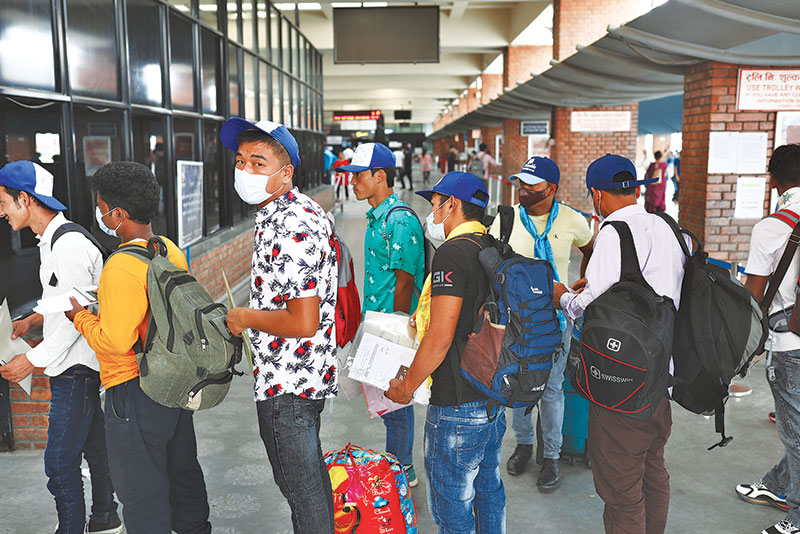
Nepal’s weak diplomacy has been a big barrier to addressing labour exploitation at work destinations.
- PAWAN PANDEY

Youths wait at Tribhuvan International Airport in Kathmandu with their documents before boarding flights to foreign job destinations.Post file Photo: SANJOG MANANDHAR

KATHMANDU : Nepali migrant workers sent home more than Rs1 trillion in the past fiscal year, making remittance a lifeline for the country’s ailing economy.
Remittance now ranks above foreign development assistance, foreign direct investment and private investments, combined, as a source of income for the country.
But exploitation of Nepali migrant workers is increasing as fast.
Migrant workers are three times more likely to be in forced labour than non-migrant adult workers, even though it has been decades since the abolition of slavery, according to a recent report entitled Global Estimates of Modern Slavery.
Fifty million people—or one in every 150 worldwide—are in situations of slavery globally, said the report jointly published by the International Labour Organisation, Walk Free and the International Organisation for Migration.
The report said that 28 million workers were in forced labour, and 22 million were trapped in forced marriages. More than 3.3 million of them are children.
Labour experts say that thousands of Nepalis face exploitation and forced labour when working in countries around the world. Nepal’s weak diplomacy has been a barrier to addressing labour exploitation issues.
Nepalis are travelling abroad en masse due to limited job opportunities at home due to prolonged political instability.
Labour migration can be beneficial, with remittances covering household expenses, including education, healthcare or savings, but exploitation and abuse of Nepali workers have remained unaddressed, experts say.
“Obviously, we need a strong diplomatic initiative to address labour exploitation issues,” said Rameshwar Nepal, executive director of Equidem Research Nepal, a human rights and labour rights research organisation.
“The poor working conditions of Nepali migrant workers became apparent during the Covid-19 pandemic,” said Nepal. “Our diplomatic missions need a complete overhaul to address labour issues.”
Nepal said that labour exploitation is rampant right from the recruitment phase. “Our labour governance is weak to intercept labour rights violations.”
Commonly reported complaints include contract breaches, limited freedom of movement, non-payment of wages and confiscation of identity documents.
Last month, nearly five dozen Nepali workers were deported from Qatar for allegedly joining a protest demanding their back pay.
“Migrant workers who are not protected by law or are unable to exercise their rights, face a higher risk of forced labour than other workers,” the report said. “The forced labour prevalence of adult migrant workers is more than three times higher than that of adult non-migrant workers.”
Modern slavery, as defined in the report, comprises two principles—forced labour and forced marriage.
Both refer to situations of exploitation that a person cannot refuse or cannot leave because of threats, violence, coercion, deception or abuse of power.
In the Covid era or in 2021, around 10 million more people were in modern slavery as compared to 2016 global estimates, the report said. Women and children remain disproportionately vulnerable.
The report suggests modern slavery can be ended by improving and enforcing laws and labour inspections; ending state-imposed forced labour; stronger measures to combat forced labour and trafficking in business and supply chains; extending social protection, and strengthening legal protections.
The report has suggested raising the legal age of marriage to 18 without exception.
Other measures include addressing the increased risk of trafficking and forced labour for migrant workers, promoting fair and ethical recruitment, and greater support for women, girls and vulnerable individuals, according to the report.
In the last fiscal year, 637,113 Nepalis were issued labour permits, the second highest figure in history.
The highest number of labour approvals was 642,859 in the fiscal year 2016-17, according to the Department of Foreign Employment statistics.
The rise, according to experts, was due to an increase in poverty immediately after the 2015 earthquake.
The government issued labour permits to 76,403 individuals last month--from mid-August to mid-September. The trend shows that by the end of this fiscal year, the number of Nepalis migrating abroad could touch the 1 million mark.
Migration is a push factor basically caused by climatic and political factors.
“In Nepal’s case, it is apparently a political factor,” said Jeevan Baniya, assistant director at the Centre for Study of Labour and Mobility, Social Science Baha, a non-profit involved in research in the social sciences in Nepal.
For the country which struggled for stable governments, there were hopes that the Nepal Communist Party, which was elected to power with a resounding majority in 2017, would increase jobs and opportunities by utilising the country’s resources.
The powerful government plunged into crisis, putting the country into a state of uncertainty.
“The migrant workers who had returned to Nepal during the Covid pandemic are back in their job destinations,” said Baniya. “This number may rise because of the low development activities here.”
Along with the numbers, the unstable government is not worried about workers’ safety, say insiders. They said that the compensation provided for death and serious injuries was nominal.
The Foreign Employment Board statistics show that since 2008-09, families of more than 11,200 workers have received compensation for their deaths. Over 2,200 workers have received compensation for injuries.
The government says it is working to ensure the safety of migrant workers by allowing people to travel to countries with which Nepal has a bilateral labour agreement.
“The safety of migrant workers has always been our priority,” said Thaneshwar Bhusal, deputy spokesperson for the Ministry of Labour, Employment and Social Security. “We have a range of interventions, most of which are implemented, to ensure Nepalis workers are safe in their workplaces.”
According to Bhusal, pre-departure orientation programmes are the best tool to ensure workplace safety tutorials are provided to migrant workers in advance. “There is, however, a question of the effectiveness of such tools,” he said.
The orientation programmes are poorly implemented, say experts.
A new curriculum was introduced to provide country-specific information for outgoing labourers through an audio-visual medium, but it remains unimplemented.
Organisations responsible for providing such training say they cannot implement the new curriculum by following the existing working procedure.
Raja Ram Gautam, president of the Federation of Foreign Employment Orientation Associations Nepal, told the Post in a recent interview that they had been providing the same orientation training for the past one decade.
“Our embassies and diplomatic missions in labour destinations have limited themselves to carrying out administrative work,” Ganesh Gurung, a senior labour migration expert, told the Post in a recent interview.
Under-secretary Bhusal argues that diplomatic missions are actively monitoring Nepali migrant workers’ well-being. “But the diplomatic missions are severely strained in terms of human and capital resources.”

A file photo shows a mother waving goodbye to her son going abroad as a migrant worker at Tribhuvan International Airport in Kathmandu.Post file Photo
HOME PAGE

‘Mountains are where my heart really belongs’

Outgoing US Ambassador Randy Berry on his love for Nepal’s nature, culture and food.
- Post Report

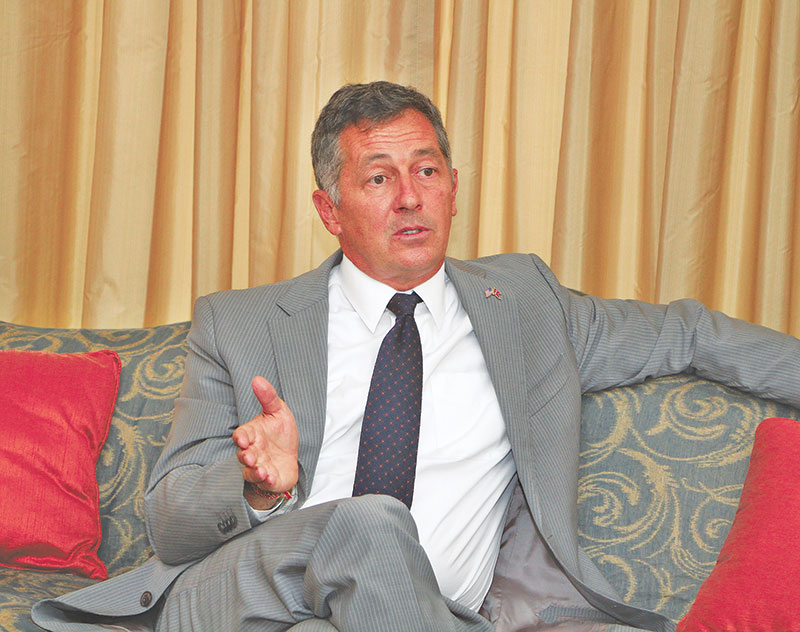
US Ambassador to Nepal Randy Berry. Post file Photo

In his two terms, first as the deputy chief of mission (2007-2009) and second as the ambassador (2018-2022), US envoy to Nepal Randy W Berry enjoyed many things in this country such as nature, culture, festivals and history. Berry also learned to cook Nepali food and developed a taste for Dal Bhat. Besides his two tenures as a diplomat in Kathmandu, he has some fond memories of his Nepal visits in the late 1980s and 1993. As he concludes his ambassadorial assignment, Jagdishor Panday asked him what images of the country he was carrying home.

When did you first come to Nepal and how did you find Kathmandu, the capital city, and Nepal in general?
I first visited Kathmandu when I was in my twenties. I came as so many Americans and Westerners do—with a backpack and lots of hopes to see spectacular mountains and really interesting cultural structures and practices. I spent a little time here in Kathmandu Valley; I visited Basantapur and Patan Durbar squares, and Pokhara on that very first trip. And I was just amazed, as so many people are. The drawing card is often the view of the mountains but in fact, it’s the people who keep visitors coming back. I’m so thrilled that I’ve had the chance twice in my career to come back and work here. I returned to work here in our embassy in 2007.
Of course, I had been watching from afar, and through news reports, the progress and challenges in reaching the comprehensive peace agreement. Then I got the wonderful opportunity to help form US policy and support Nepal’s rebuilding and move forward from civil conflict. So after I returned, in 2007, I spent the next two years supporting democratic institutions for economic growth and to re-energise the people-to-people ties.

If you didn’t come then, would you have come to Nepal again?
Yes, so I came one other time also, but just as a tourist. It was my first return visit, because there was something about the architecture and cultural practices here in Nepal that were really interesting. So my first assignment in foreign service for the United States was in Bangladesh. So I had a chance to come up and revisit those places. I came back to Nepal for the second time in 1993. The first time was in the late ’80s or early ’90s right after I finished my education.

What brought you here for the first time?
I am a child of the mountains. I grew up in the Rocky Mountains in Colorado on my family ranch. I’ve always felt that I am a mountain person. When I got out of the university and had another chance to travel a bit, I had a natural gravitation towards the great mountain ranges. And the chance to come here and see the Himalayas in person was too good to pass up. I remember when I was a little boy, I was fascinated with maps and my parents bought me a very outdated globe and a series of flash cards where you could look at a country and its outlines and major cities. Even at 10 years old, I memorised them. Nepal always struck me for a number of reasons. I could not understand, for example, the unusual shape of Nepal’s national flag. I thought it was interesting for a country that was landlocked and you know how that reflected its people. It was mainly just the process of curiosity on my part.

What places in Nepal have you visited so far?
At this point, I should maybe give you a list of places that I haven’t visited. I can give you some of my favourite spots. First of all, I got the chance to travel all the way from Humla district down to Bhadrapur (Jhapa) and Ilam. So I’ve been to the Tarai and the hills and the mountains as well. But a couple of places that really impacted me though include the Kathmandu valley itself and the remarkable cultural treasure that you have in its traditional Newar structures; I’m in awe of these magnificent temples and the artistry of the idols in the Valley. I also was really deeply touched in my first visit to Muktinath, which is a highly spiritual place and it was really impactful for me because of what it stands for—peace, coexistence of faiths, and you see it in action there. That was pretty impactful to me. To see all of the innovations and energies down in the area around Banke district and in Nepalgunj opened up a new understanding, as did my time in Janakpur, to look at this tremendous diversity, this patchwork of cultures that make up Nepal. And finally I’d be remiss by not noting the area around Mustang, from Jomsom north to Lo Manthang, which is unique and is such a remarkable cultural treasure for this country.

What is your favourite place in Nepal and what place would you recommend to your colleagues back in the US?
It’d be the place that I have visited most frequently with greatest interest—that is the area around the Baudhha Stupa. Again because I think it is a remarkable piece of history, culture, and faith, wrapped up in one incredible place.

You also visited Rara with your colleagues from other countries. Was that your recommendation or theirs?
Well, it is a collaborative decision that we made. Of course, for my Australian and British colleagues that I went with, we were talking about how similar our country’s view of this critical issue of climate change is. We all have similar approaches, similar conversations with the government and also we were looking at ways we can support Nepal on climate mitigation and ambitions. Because of that similarity, we decided on doing something together to demonstrate that this is a global problem that requires global solutions. Of course, there is also the other part of this—that to see a really pristine, beautiful part of Nepal that few people get a chance to go to, was a rare opportunity. Also what struck me was that kind of pristine beauty—whether it’s in Nepal or my home state of Colorado—is at risk if we don’t get climate change policy correct. For me it was the perfect combination of looking at policy and how we promote and work on a positive policy. But also, of course, get back to the mountains and the higher altitudes, which is where my heart really lies.

You’ve been participating in many of Nepal’s cultural events and festivals—be it Dashain, Tihar or Indra Jatra. What inspires you to do that?
What I have always adored about Nepal is the unique quality of its culture. Through these Jatras, through these observances, one gets an incredible insight into what is important to people and how a culture operates. So, I am eternally curious and I find I am still even today after many years in Nepal, every day I got something new to learn that deepens my understanding. And I really enjoy these Jatras and also the welcoming nature in which outsiders are welcomed to observe and watch these events unfold. There is nothing like it in the world. This is a completely unique ecosystem of cultures and diversity. It’s an absolutely remarkable place. But I felt so blessed to be able to witness the ones that you mentioned but also many others—the Bisket Jatra in Bhaktapur or the Nava Durga or the Chhath celebrations in Janakpur. If the job of a diplomat is to learn about and understand the place, this is a fundamentally important part.

Your active presence on social media, where you post about your participation in cultural events, has led many to quip that you are the ‘cultural ambassador’ of Nepal. What do you think about that label?
Well, I am honoured and I’d hope that I’d deserve it. One thing I wanted to do with our social media is to share the news and reality of this vibrancy. The key part of Nepal’s economy is tourism and a key part of that sector are tourists from the United States. So my ability to share my experiences here increases interest in Nepal. And I think that as I’ve had a chance to work on this 75-year-old relationship just for my small piece—the power of this really is the understanding between people. So, the more we can do to promote that mutual understanding the better.

In Nepal, there are a wide variety of castes and ethnic groups. How do you observe this diversity, this variety of demographics?
I think, like in my own country, the strength of the people in a diverse society is how it honours and respects the rights of everyone. I think there is great space to be proud of culture, tradition, ethnic and other religious traditions, to really embrace that as an aspect of identity that’s critically important. But I think also in a democratic society, it is important to look at those things which divide us or don’t allow that equal participation with a realistic eye. In a diverse society, equal opportunity of citizenship is really important, irrespective of all these other markers of identity.

You have visited all of Nepal’s geographical regions, from the Himalayas and the hills to the Tarai. How do you observe the customs and traditions of the people there?
I think with a great understanding of the enormous diversity of this country, you can go from one valley to the next and be experiencing something that is entirely different in terms of cultural practices and traditions. I think I have been very honoured to not have stopped my knowledge of Nepal with a visit to Kathmandu and Pokhara. I’ve had a chance to visit so many communities that it has really deepened my understanding of just how remarkably diverse this country is. There is beauty in diversity and other relationships are bound by respect to those traditions. I would mention that in a couple of weeks, something that we’ve always done with our United States mission here is we close before Dashain for a cultural event. So, we close our embassy right before Dashain begins. Our locally employed staff spend a lot of time with cultural dress and music, and food and songs to really put together a show which our American staff can experience. What I’ve seen that do with our own people who are new to Nepal is, again, this astonishment of just how diverse these expressions of culture can be.

Can you share any of your recent interesting trekking experiences?
I have not trekked as much as I would like to. But the most recent, I have had a chance to trek a trail I have never seen between Muktinath and Lomanthang. There I was able to see a degree of remoteness that I had not experienced. I love that feeling on the trail. I was very blessed to have some very remarkable guides and people who can explain what you are seeing. But I like that sense of complement together. In this case, I have done the hardest hiking I have ever done. It was more than I thought, I loved that experience. I can remember, in fact, a relatively high mountain pass, a mass of people, fluttering prayer flags, and an aspect of altitude that is incredibly emotional to be in such a place.

Do you enjoy Nepali food? If yes, what are your favourites?
I love it. Dal bhat and momos are a source of power. But I also know how to cook Kukhura ko masu [chicken].
I have had a chance to experience food right from the high mountains. One that is sticking in my mind is going down for a tremendous Biryani in Nepalgunj, and having Lassi in Janakpur. And I have had several opportunities to taste Newari food here in Kathmandu Valley with some very skilled cooks. I feel like I’ve had such an amazing exposure to Nepali food. I eat Nepali Dal bhat with my hands without using a spoon. First time I had rice and dal was a long time ago, when I made my first visit here.

You have been closely working on the preservation of Nepali cultural sites, isn’t it?
I do a lot of things as an ambassador and one thing I really love the most is the work we are able to do in the Kathmandu Valley and all across the country to support Nepali artists and architecture and re-building and preserving these historical monuments. I have always been in search of more money because I know the need is great all across the country. I think preserving these structures is highly important for preserving our history. So you, people of your age, your children and youths are also able to see and understand the structures. A key part of that work also involves preserving the stone art. So back in the 1980s I know clearly that so many of Nepal’s precious treasures and gods were stolen and sold in international markets. So, my team has worked incredibly hard in the last few years to raise the profile by working with local organisations, and I am very much pleased with the results here. It’s not just the return of the Laxmi Narayan to Patan [from the Dallas Art Museum]. We are now tracking dozens other such idols and statues and cultural items that were stolen from Nepal. Those items don’t belong to Western museums, they belong right here, where their function is not simply artistic but also spiritual. Just a couple of weeks ago, I had the chance to walk around Patan on an unscheduled personal visit, without journalists around. I was dying for that. And, with my kids I sat outside the Laxmi Narayan temple and explained to them about the importance of the temple. It was amazing to see that work of art occupying its original place after years of efforts to repatriate it. So, I certainly hope that these works continue.

Will you miss Nepal after going back?
I am already missing Nepal.

Do you have any plans to return to Nepal in the future?
This is one thing I am certain about, that I will be back. I think I will look forward to a chance to be one of the thousands of American faces coming here every year to visit Nepal and trek the trails.

How’d you define Nepal in one sentence?
That might be an impossible task. It might be a very long sentence with many commas. Nepal is an amazing tapestry of culture, practice, tradition, politics, and people; Nepal is a country marked by extraordinary diversity of landscapes, people and culture. How’s that? But I think the important part is about the people and their extraordinary hospitality. Whether you’re here in Kathmandu or in the most remote villages, one thing that is common is this idea of hospitality to a stranger that I think touches most Americans very deeply because this is not a reality in many other places in the world. But here, there’s genuine warmth and hospitality. So that was way more than a sentence.


US Ambassador to Nepal Randy Berry during his visit to Rara in Mugu district.Post courtesy: USAmbNepal /twitter

HOME PAGE

Verdict on petitions against President’s move unlikely before a month

As court goes on Dashain vacation from September 26 to October 9, it will not hear cases other than habeas corpus.
- Post Report

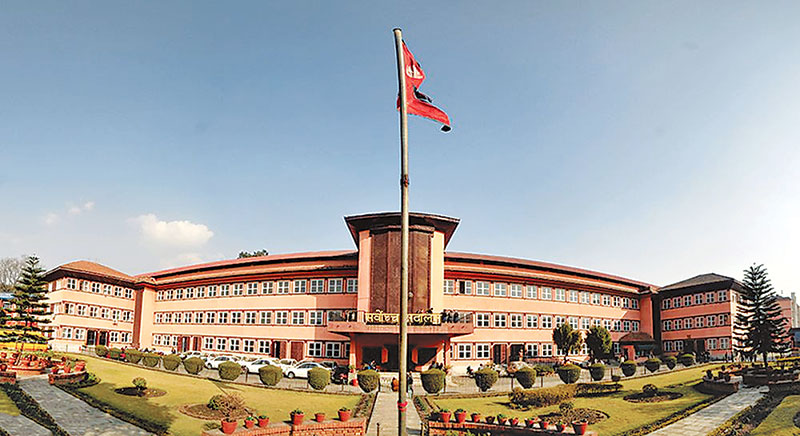
KATHMANDU : The Supreme Court on Friday did not conduct hearing on any of the writ petitions challenging the decision of President Bidya Devi Bhandari not to authenticate a citizenship bill, citing a high number of similar petitions.
Five major petitions demanding the Supreme Court’s intervention following the President’s refusal to authenticate the bill were assigned to a single bench of Justice Manoj Sharma, along with several similar petitions.
“The bench couldn’t hear the petitions due to time constraints,” Bimal Poudel, spokesperson for the court, told the Post. “A single bench on Sunday will look into them.”
The court’s failure to begin the hearings on Friday means the final hearings have been pushed by more than two weeks since the Court will be closed for the Dashain festival starting Monday. Although other government offices are closed only from Saptami (October 2), the seventh day of Dashain, courts, however, are closed from Ghatasthapana, the first day of the festival, on September 26.
Throughout the festival from September 26 to October 9, courts will only hear habeas corpus petitions, said Poudel.
The petitioners challenging the President’s decision have claimed that her move to sit on the bill was a clear breach of Article 113 (4) of the Constitution of Nepal. They have demanded that the court issue an order to the President to authenticate the bill, which was twice endorsed by both houses of parliament.
The Article says that if the President sends back a bill along with her remarks and if both the Houses reconsider the bill and send it again to the President as it was presented or with amendments, the bill shall be authenticated within 15 days.
However, Bhandari did not authenticate the bill and let the September 20 deadline lapse.
“The most the single bench can do on Sunday is issue a show cause notice to the defendant and decide whether to send the case to the constitutional bench or to a full bench. The court will go on a long holiday from the very next day,” advocate Sunil Ranjan Singh, one of the petitioners, told the Post. “I don’t see any possibility of a final verdict coming out in under a month.”
As acting Chief Justice Deepak Kumar Karki retires on October 1, Justice Hari Krishna Karki will then be the acting leader of the judiciary. Karki can head the judiciary until September 9 next year.

Page 2
NATIONAL

Squatters fall victim to elephant attacks

Last week, two elephants wreaked havoc in Lamaha of Rautahat. The victims are calling for their relocation to a safer place.
- SHIVA PURI

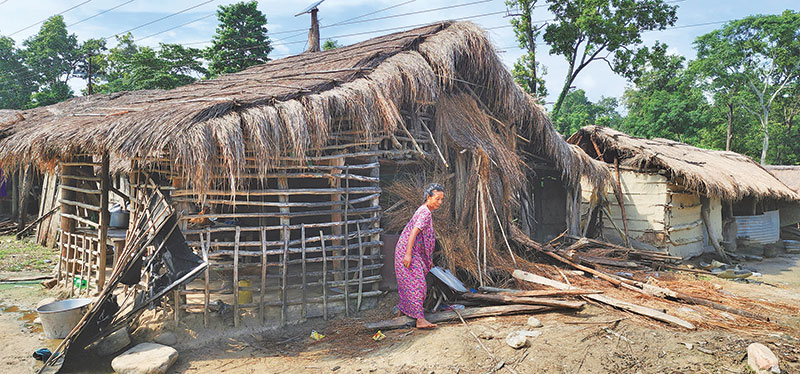
Sixty-five-year-old Dhanamaya Pahari of Lamaha in Rautahat outside her hut damaged by marauding elephants last week.Post Photo: SHIVA PURI 

RAUTAHAT : Dhanamaya Pahari, a 65-year-old resident of Lamaha in Chandrapur Municipality-6, recently took a loan of Rs50,000 to set up a retail shop of daily essentials targeting Dashain.
Last Wednesday, she went to the Chandranigahapur market and bought groceries for her shop. Pahari spent the night prepping up her shop, and set up bamboo fences to keep away intruders and wandering animals.
At around 2 in the morning, she woke up to loud noises outside. When she looked outside, she saw two elephants raiding her neighbour’s house and people trying to chase the megafauna away.
Pahari rushed towards the highway to save her life. Most of the villagers followed her. The elephants were still running amok, destroying the houses, including Dhanamaya’s, and her yet-to-be-opened shop.
“It took me a while to process everything happening around me. I started running to save my life, and then I saw a parked gas truck and climbed onto it,” Pahari recalled. “No one returned to the village that night. Most of us lost our homes and some have already left the settlement seeking a safer place. Now I don’t know how I’ll repay my loan.”
The villagers returned to the settlement the next morning. They are now appealing to the municipality office to relocate them to a safe space. But their appeals have yet to be heeded, say locals.
That night, personnel from the area police office, Chandranigahapur reached Lamaha settlement to chase away the elephants. But by then, the pachyderms had already damaged five houses belonging to Ram Pahari, Laxman Pahari, Phulmaya Magar, Arjun Pahari and Dhanamaya.
Dhanamaya, who lost her husband two years ago, says she is now left with little and has nowhere to go. “I have three sons but they live separately,” she said.
“After my husband’s death, the house was all that I owned. I thought I would earn some money through the shop but now I don’t even have that.”
Today, Lamaha, a squatter settlement of 14 households, is reeling under the shock of the incident and the confusion in its aftermath. Most of the residents have moved near the east-west highway.
“The village is virtually empty,” Laxman, who lost his house and crops he had saved for winter in the incident, said. “Most of the villagers are now living by the roadside, nowhere to go.”
The residents aren’t indigenous to Lamaha. They migrated here in 1987 after they were removed from Dangdunge village of Makawanpur. Ever since, they have been living in the forest near Lamaha River.
Sher Bahadur Pahari, 78, another resident, said they had been living peacefully for 35 years in the settlement surrounded by a dense forest. Nothing catastrophic happened. But the incident on Wednesday night has shaken everyone.
“We do not know why the elephants are angry. The attack was terrifying,” Sher Bahadur said. “Many people left their homes due to the fear of elephants. Women and children are seeking refuge with their relatives in other settlements. I do not know how long we will be able to survive without money and food.”
Keshar Bam, an employee of the Timber Corporation of Nepal (TCN), who was in the settlement when the elephants wreaked havoc, says there were more than 30 children in the settlement at the time of the incident.
“Everyone was running around to get the children to safety,” Bam said. “No one knew what or whom the elephants would attack next.”
According to Sanjay Kafle, mayor of Chandranagar, there is no electricity or water supply in
the settlement. Efforts are being made to provide relief to those affected by the elephant attack, Kafle said.
Kafle added that his office is discussing alternatives for relocating the victims. “This settlement is vulnerable and deprived of services, so it should be relocated permanently,” he said. “It will take some time but we are making efforts.”

NATIONAL

Congress’ Koirala camp ups the ante against Deuba

- ANIL GIRI

KATHMANDU : The infighting between the party establishment and rival faction in the ruling party Nepali Congress is getting fierce over distribution of tickets for federal and provincial elections. The rival camp led by senior party leader Dr Shekhar Koirala has upped the ante against Prime Minister Sher Bahadur Deuba, who is also the party president.
After Deuba failed to accommodate the aspirants from Koirala camp under the proportional representation (PR) category, the rival faction has called a gathering for Saturday “to pile pressure for fair distribution of elections tickets” among the party factions.
The party submitted the list of candidates at the Election Commission on September 18 representing the party under the proportional representation category. But the ruling alliance is still struggling to fix a seat-sharing arrangement among the five parties for federal and provincial elections. Ruling parties Nepali Congress, CPN (Maoist Center), Janata Samajbadi Party, CPN (Ekikrit Samajbadi) and Rastriya Janamorcha Nepal have forged an electoral alliance.
We are miffed as Deuba submitted a list of candidates under the proportional representation in the Election Commission ignoring our repeated concerns, a leader of the Koirala camp said. “The way Deuba unilaterally submitted the names under the proportional representation category, it has caused serious suspicion that he might further corner our camp under the first-past-the-post elections as well in both federal and provincial polls,” he said.
The elections for the federal parliament and provincial assemblies are scheduled for November 20.
A central committee member Ajaya Babu Siwakoti argued that they had to convene a gathering “to warn” the party leadership as Deuba didn’t accommodate rival camp’s nominees in the closed list under the proportional representation (PR) category.
Though the closed list of PR candidates submitted at the Election Commission is not made public, the Koirala camp suspects that Deuba has sidelined the rival camp in the nominations. Koirala is supported by Vice President Dhan Raj Gurung, General Secretary Gagan Thapa, Deputy General Secretary Badri Pandey and Jeevan Pariyar among other senior leaders. But it is not clear whether senior leaders including Koirala, Gurung, Thapa, Pandey, and Pariyar, among others, will attend the Saturday meeting.
On Friday, some leaders held a separate gathering in Kathmandu and decided to call the gathering to pressure Deuba to select candidates under the first-past-the-post (FPTP) elections in a fair manner.
General Secretary Thapa has stopped attending the meetings called by party president Deuba as the party establishment tried to corner the Koriala camp in ticket distribution, said a leader. Thapa is also a member of the 11-member task force formed by the ruling alliance to fix a seat-sharing arrangement. The ruling alliance despite its repeated attempts for the last one and a half months has been failing to agree on the number of seats to be shared among the parties.
Thapa has not attended party meetings for the past few months as he is unhappy with the Deuba camp’s attempts to sideline the Koirala faction in the selection of PR candidates, said another leader.
Ahead of submitting the closed list of PR candidates to the Election Commission, the Koirala camp had handed its list of candidates to Deuba for inclusion on the list. But Deuba regularly ignored the dissidents pushing them to call a separate gathering, said yet another leader.
“We disagree with the PR list they have submitted unilaterally to the election commission. The list should be amended,” said Jagadish Narsingh KC. “This is our warning to the party president who is intent on sidelining his rivals in the party.” KC is active in organizing the gathering.
The Saturday gathering is being organised at a party place in Kathmandu where several leaders including central working committee members, district presidents, and former district presidents, among others, will be participating.
“Ticket distribution should be done in a fair manner and no one in the party should feel ignored or isolated.
Unfortunately that is the case now. We will press the party leadership to ensure justice inside the party, otherwise Deuba should be ready to face the consequences,” said KC.
Koirala was defeated by Deuba in the 14th general convention of the party last year. Since then, the rival camp led by Koirala has been pressing Deuba not to discriminate against the leaders that aren’t close to the party’s establishment [Deuba camp].
The gathering has been called to ensure that competent leaders are not deprived of election tickets, said Siwakoti, who was elected central committee member from the Koirala panel. “Our party president is more concerned about ensuring fairness in seat allocation among the ruling parties while he has ignored a large section of our own party members in the process,” complained the leader.
The Deuba faction is also well aware that these gatherings called by the Koirala camp are aimed at piling pressure on the party president as he is directly overseeing ticket distribution, according to a leader close to Deuba.
“They might be unhappy with the party’s PR list, but we ourselves have not seen the list yet,” said Min Bishwakarma, a leader from the Deuba camp. He said the Koirala camp’s activities might have been aimed at piling pressure to extract more seats for their candidates under the FPTP category. As per the timeline given by the Election Commission, the FPTP candidates will register their candidacies on October 9.

Page 6
NATIONAL

Nepal starts vaccine trial for highly contagious cattle disease

The lumpy skin disease has already spread to 31 districts, killing at least 463 cattle and infecting 27,816 in the last two years.
- Arjun Poudel

KATHMANDU : As the risk of the spread of lumpy skin disease grows in the country, authorities have started a vaccine trial on animals to check the
effectiveness of the vaccine.
Officials say that a massive outbreak could happen at any time as the virus has already spread to many districts of the country since 2020.
“We have started injecting Neethling vaccine in animals,” said Barun Kumar Sharma, deputy director general at the Department of Livestock Services under the Ministry of Agriculture and Livestock Development. “We will check antibody levels the animals develop after the vaccination, its effectiveness and make a decision on whether or not to approve the vaccine.”
Lumpy skin disease, also called LSD, caused by a lumpy skin disease virus, is an infectious disease that primarily affects cattle. The virus is from the family Poxviridae. The virus mainly spreads through blood-sucking vectors—ticks, mites, and mosquitoes, among others.
At least 463 cattle have died and 27,816 have been infected with the viral disease in 31 districts throughout the country since 2020. The latest cases of infection were reported some four months ago in the Sudurpaschim Province, officials at the Department of Livestock Services say.
Many states of neighbouring India are currently witnessing a massive outbreak of the deadly cattle disease.
Veterinarians say infected cattle suffer from acute fever, discharge from the eyes and nose, salivation, and soft blister-like nodules all over the body.
After infection, animals immediately start losing weight, due to difficulty in eating, which ultimately affects milk production. Pregnant cows and buffaloes could suffer miscarriage, and in some cases infected animals die.
“Animals could also be affected by secondary infections once they get infected with the lumpy skin disease,” said Dr Sital Kaji Shrestha, an animal health expert. “The disease has spread across the country—from the eastern region to the farwest.”
As the virus is not zoonotic, the chances of humans getting infected are very slim, experts say.
Sharma, the deputy director general at the Department of Livestock Services, said that a trial of the Neethling vaccine is being carried out in animals. The vaccine is reported to be effective in controlling lumpy skin disease in several countries, officials said.
“We would like to request all farmers not to transport sick cattle, pay proper attention to biosecurity and cleanliness of the farm,” said Sharma.
Massive outbreaks of the disease are ongoing in the Indian states of Rajasthan, Gujarat, Punjab, Haryana, Himachal Pradesh, Uttarakhand, Uttar Pradesh, Madhya Pradesh, and Jammu.
As Uttar Pradesh adjoins Nepal, experts say there is a high risk of the disease further spreading in Nepal.
Experts say the mortality rate of the contagious disease is around 1.5 percent but the number of deaths of animals could increase due to secondary infections.
“We have also stepped up surveillance of the disease and alerted the agencies concerned about the possible outbreak of the virus,” said Dr Chandra Dhakal, senior livestock development officer at the Department.

Page 7
MONEY

USAID launches programme to promote women leaders in energy sector

- Post Report

KATHMANDU : USAID Urja Nepal, an energy development activity, on Friday launched a programme for the development of leadership and management skills for women in the energy sector.
The programme aims to make women capable of advancing the next generation of women leaders in the energy sector.
This programme will complement Nepal’s efforts to increase the participation of women in traditionally male-dominated professions, particularly in the electricity sector where they remain poorly represented in leadership positions.
The United States Agency for International Development (USAID) and the Nepal government’s electricity sector counterparts co-designed this programme to provide insights into the challenges women are facing every day.
“This understanding will identify the needed training and capacity building to close current technical gaps and improve leadership skills,” USAID said in a statement.
During the nine-month programme, the sessions will provide technical training in subjects relevant to Nepal’s energy sector, as well as leadership courses that focus on highlighting leadership skills and career advancement.
Minister for Energy, Water Resources and Irrigation Pampha Bhusal said the programme is in line with the government’s strong emphasis on increasing the involvement of women and minorities in decision-making roles in every sector.

MONEY

Young entrepreneurs voice concerns about ailing economy

Business professionals say Nepal’s economic situation is getting worse from bad as they discuss problems facing Province 1.
- Post Report

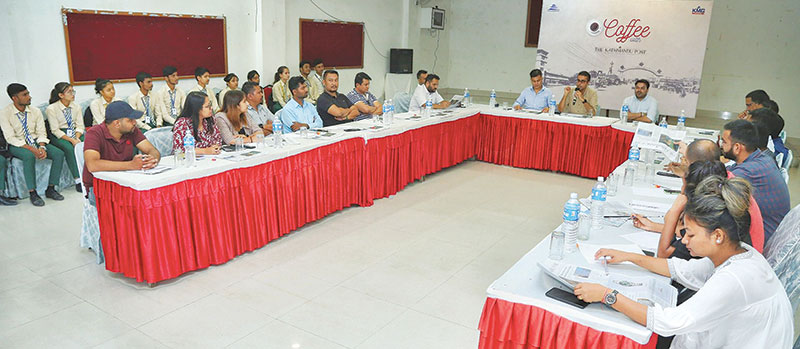
Participants attend an interaction programme titled ‘Coffee With The Kathmandu Post’ organised by the Kantipur Media Group in Biratnagar on Friday. post PHOTO: PRAKASH CHANDRA TIMILSENA

BIRATNAGAR : Young entrepreneurs and established business professionals in Province 1 on Friday flagged concerns about how the federal government exerted an undue influence on the province’s economy.
They said that the provincial government did not function as per its objective as all decisions are made by Kathmandu.
During an interaction titled ‘Coffee With The Kathmandu Post’ organised by the Kantipur Media Group in Biratnagar, entrepreneurs said the country’s economic situation was getting worse from bad.
“Biratnagar is known as the industrial hub. But factories here are closing one after another mainly due to unstable economic policies,” said Sanjeev Koirala, an entrepreneur.
Participants said that the interest rates on loans are so high that investors are being discouraged.
“We are clueless in which direction the country’s economy is heading,” said another participant.
The banks are offering higher interest rates on fixed deposits. This will make loans to do business
costlier. In this situation, why would anyone invest in a business? There is higher earning on deposits than an investment, said startup entrepreneurs.
With the Indian government imposing restrictions on food exports, the business of Nepal’s flour and rice mills has been affected, said entrepreneurs during the interaction.
Hemanta Agrawal, a member of the Nepalese Young Entrepreneurs’ Forum, said the import ban on goods has already had a negative impact on the business.
“There is difficulty in getting raw materials on time. The ordered goods are not delivered on time. On top of all these issues, the high cost of production has made our goods less competitive.”
Due to India’s export restrictions, most of the flour and rice mills in Biratnagar are on the verge of closure. Industrialists in Province 1 say manufacturers are going through plenty of problems, which remain unaddressed by the federal and provincial governments.
“It’s due to the frequent changes in the policies and programmes with the change in government. This does not help industrial development,” said participants.
Emerging entrepreneurs said foreign investors cannot be attracted to the country at a time when there is no environment for investments.
The government is least bothered to attract investments. There are no jobs without investment and youths are forced to leave the country in droves, said Agrawal.
Participants also raised their concerns about climate change. They said that agriculture has been hit by the phenomenon. The participants said that media coverage of economic issues was not enough.

MONEY

Esewa Money Transfer launches ‘Mero Digital Desh’ campaign

- POST REPORT

KATHMANDU : Esewa Money Transfer on Friday launched the “Mero Digital Desh” initiative to promote digital remittance.
“The main aims of the campaign are to promote the inflow of remittance through formal channels and to reduce the cost of sending remittance,” said Daniel Shrestha, the director of eSewa Money Transfer.
The company aims to make the people aware about the advantages of sending the remittance through digital channels over the traditional medium of sending the cash remittance.
A World Bank report published in May said that the officially recorded remittance flows to low and middle-income countries are expected to increase by 4.2 percent this year to reach $630 billion.
“Last fiscal year, Rs40 to Rs45 billion was spent on sending remittance to Nepal,” said Sagar Khanal, General Manager of eSewa Money Transfer. “It can be reduced by 50 percent by promoting digital medium.”
In the last fiscal year, Nepal received Rs1 trillion in remittance, the highest ever in the country’s history, according to the Nepal Rastra Bank.
The Mero Digital Desh campaign, which began on Friday, will continue until February 18 next year.
“Under the scheme, one winner every month will receive gifts worth Rs150,000 and one individual at the end of the campaign will be awarded with a fully facilitated house in Kathmandu,” said Khanal.
“Nepali individuals over the age of 18 and working in any country can be a part of the initiative by sending the remittance directly through eSewa Money Transfer to any bank account and eSewa wallet of the beneficiary in Nepal,” said Khanal.
Those receiving the cash remittance directly in their eSewa wallet are also eligible to become winners under the initiative, according to the company. The campaign will be promoted by actors Rajesh Hamal and Swastima Khadka on national and international platforms.
AjeshKoirala, the Chief Executive Officer of eSewa Money Transfer, said that the campaign is dedicated to all those who have been the backbone of the country’s economy by sending the remittance. “We urge the Nepalis living across the world to participate in the initiative,” said Koirala.

MONEY

Ukraine starts 2022 corn harvest, ministry says

KYIV: Ukrainian farms have started the 2022 corn harvest, threshing 92,200 tonnes of the commodity from 0.5 percent of the sown area, the agriculture ministry said on Friday. The ministry said in a statement that the corn yield stood at 4.41 tonnes per hectare. The ministry has said Ukraine could harvest 25 to 27 million tonnes of corn this year versus 42.1 million tonnes in 2021 and the Russian invasion was the main reason for the decrease in the harvest. Ukraine is a major global grain producer and exporter but is likely to register a significant drop in output this year, falling to about 50 million tonnes from a record 86 million tonnes in 2021 because of the invasion. The ministry said farmers had harvested a total of 26.1 million tonnes of grain from 61 percent of the sown area in 2022 as of September 23 and the average grain yield stood at 3.84 tonnes per hectare. It said the country had completed its 2022 wheat harvest with output at 19.2 million tonnes in bunker weight and the yield at 4.1 tonnes per hectare. (REUTERS)

MONEY

Hong Kong to end mandatory hotel quarantine for travellers

HONG KONG: Hong Kong’s leader announced the city would no longer require incoming travellers to quarantine in designated hotels as it seeks to remain competitive and open up globally after nearly two years. Incoming travellers will also no longer need a negative PCR test within 48 hours before boarding a plane to Hong Kong, the city’s chief executive John Lee said Friday at a news conference. Instead, they will need to present a negative Covid-19 result from a rapid antigen test conducted within 24 hours before the flight. (AP)

Page 8
WORLD

Russia starts annexation vote in occupied areas of Ukraine, West condemns ‘sham’

By incorporating the areas into Russia, Moscow could portray attacks to retake them as an attack on Russia itself.
- REUTERS

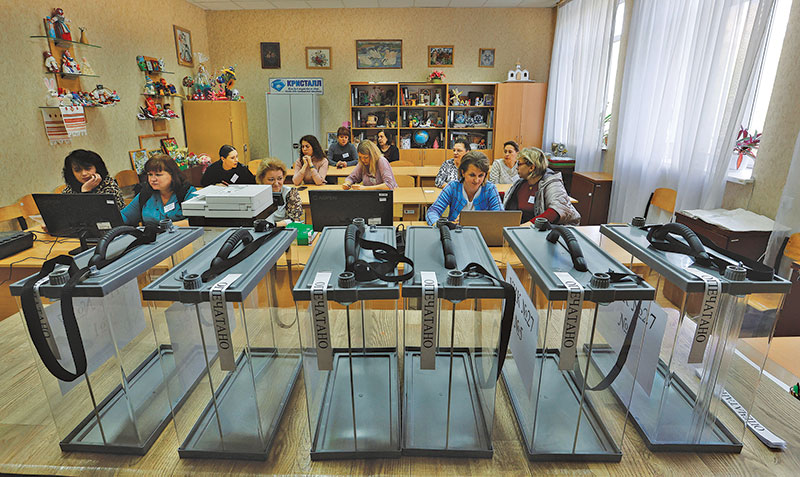
Members of the local electoral commission gather at a polling station ahead of the planned referendum on the joining of the self-proclaimed Donetsk people’s republic to Russia, in Donetsk, Ukraine on Wednesday. REUTERS

KYIV : Russia began referendums on Friday aimed at annexing four occupied regions of Ukraine, raising the stakes of the seven-month-old war in what Kyiv called an illegal sham that saw residents threatened with punishment if they did not vote.
The votes on whether the regions should become part of Russia began after Ukraine earlier this month recaptured large swathes of northeastern territory in a counteroffensive against the invasion that began on February 24.
With Russian President Vladimir Putin also announcing a military draft this week to enlist 300,000 troops to fight in Ukraine, the Kremlin appears to be trying to regain the upper hand in the grinding conflict.
And by incorporating the four areas into Russia, Moscow could portray attacks to retake them as an attack on Russia itself, a warning to Kyiv and Western supporters.
Putin on Wednesday said Russia would “use all the means at our disposal” to protect itself, an allusion to nuclear weapons.
The war has already killed tens of thousands of people, uprooted millions and pummelled the global economy. The referendums had been discussed for months by Moscow-installed authorities in the four regions—in Ukraine’s east and southeast—but Kyiv’s recent battlefield
victories prompted a scramble to schedule them.
Voting in the provinces of Luhansk, Donetsk, Kherson and Zaporizhzhia, representing about 15 percent of Ukrainian territory, is due to run from Friday to Tuesday.
Serhiy Gaidai, Ukraine’s Luhansk region governor, said that in the town of Starobilsk, Russian authorities banned the population from leaving the city until Tuesday and armed groups had been sent to search homes and coerce people to get out to take part in the referendum.
“Today, the best thing for the people of Kherson would be not to open their doors,” said Yuriy Sobolevsky, the displaced Ukrainian first deputy chairman of the Kherson regional council, said on messaging app Telegram.
The referendums have been condemned by Ukraine, Western leaders and the United Nations as an illegitimate, choreographed precursor to illegal annexation. There will be no independent observers, and much of the pre-war population has fled.
The Organisation for Security and Cooperation in Europe (OSCE), which monitors elections, said the outcomes would have no legal bearing as they do not conform with Ukraine law or international standards and the areas are not secure. Gaidai said that in the Russian-held town of Bilovodsk, a company director told employees voting was compulsory and anyone refusing to take part would be fired and their names given to security services.
“The mood of the Russians is panicky because they were not ready to carry out so quickly this so-called referendum, there is no support, there’s not enough people,” Kherson’s Sobolevsky said on messaging app Telegram.
Gaidai decried the plebiscites as “elections without elections”. He said people were being forced to fill out “pieces of paper” without privacy in kitchens and residential yards, with towns sealed off so people could not leave to avoid voting. Moscow maintains that the referendums offer an opportunity for people in the region to express their view.
“Voting has started in the referendum on Zaporizhzhia region becoming a part of Russia as a constituent entity of the Russian Federation! We are coming home!” said Vladimir Rogov, an official in the region’s Russian-installed administration.
That administration said two cars with “Ukrainian saboteurs” had entered the area and were being “dealt with”, Russia’s TASS news agency reported. Reuters was unable to verify the report.
Ukraine says it will never accept Russian control of any of its territory.
“[The referendums] will give Moscow no upper hand. It’s all nonsense, bluff and political manipulation to frighten us and the Western countries with their nuclear stuff,” Oleksandr Yaroshenko, 65, a resident in the capital Kyiv, told Reuters.
Voting was also being held for residents who have fled occupied territories at some 20 polling stations in Moscow, including the embassy of the self-proclaimed Donetsk People’s Republic, a Russian lawmaker said.
Russia previously used a referendum as a pretext for annexation in Ukraine’s Crimea in 2014, which the international community has not recognised.

WORLD

US aircraft carrier arrives in South Korea for joint drills

- ASSOCIATED PRESS

The USS Ronald Reagan is escorted as it arrives in Busan, South Korea on Friday. AP/RSS

BUSAN : The nuclear-powered aircraft carrier USS Ronald Reagan arrived in the South Korean port of Busan on Friday ahead of the two countries’ joint military exercise that aims to show their strength against growing North Korean threats.
The joint drills will be the first involving a US aircraft carrier in the region since 2017, when the US sent three aircraft carriers including the Reagan for naval drills with South Korea in response to North Korean nuclear and missile tests.
The allies this year have revived their large-scale military drills that were downsized or shelved in previous years to support diplomacy with Pyongyang or because of Covid-19, responding to North Korea’s resumption of major weapons testing and increasing threats of nuclear conflicts with Seoul and Washington.
The South Korean navy said the training is meant to boost the allies’ military readiness and show “the firm resolve by the Korea-US alliance for the sake of peace and stability on the Korean Peninsula.”
“The commitment of the US carrier strike group operating in and around the peninsula illustrates our commitment to stand together and our desire and focus ensuring that we are
interoperable and integrated to face any challenge or threat whenever we are required,” Rear Admiral Michael Donnelly, commander of the carrier strike group, said in a news conference.
The North Korean threat is also expected to be a key agenda when US Vice President Kamala Harris visits South Korea next week after attending the state funeral in Tokyo of slain former Japanese Prime Minister Shinzo Abe.
The Reagan’s arrival in South Korea comes after North Korean leader Kim Jong Un told Pyongyang’s rubber-stamp parliament this month he would never abandon his nuclear weapons and missiles he needs to counter what he perceives as US hostility. North Korea also passed a new law that enshrined its status as a nuclear power and authorised the preemptive use of nuclear weapons over a broad range of scenarios where the country or its leadership comes under threat. The diplomats reaffirmed the US commitment to defend South Korea in the event of a nuclear war with the full range of its military capabilities, including nuclear.

Page 9
SPORTS

Mbappe stars for France

Wins for Croatia, the Netherlands and Belgium
- ASSOCIATED PRESS

PARIS : Kylian Mbappe added another
fine solo goal to his collection and Olivier Giroud moved closer to France’s scoring record as the defending World Cup champions beat Austria 2-0 in the Nations League on Thursday.
Mbappe skipped past three defenders before drilling in his 28th international goal in the 56th minute, before Giroud celebrated his recall by heading powerfully in from Antoine Griezmann’s cross 10 minutes later to move onto 49 goals—two behind Thierry Henry’s national record.
France already lost their Nations League title but Croatia, the Netherlands and Belgium—also playing their penultimate matches before the World Cup in Qatar—all won on Thursday to stay in contention for the Nations League’s Final Four next June.
France’s victory also saved them from relegation from the top tier of the Nations League, sending Austria into last place with one game left but with only one point between them.
Croatia leapfrogged Denmark at the top of Group 1 by one point after beating the Danes 2-1 in Zagreb with goals from left back Borna Sosa in the 49th minute and midfielder Lovro Majer in the 79th, two minutes after Christian Eriksen’s equaliser.
The Group 1 winners and relegation will be decided on Sunday when France travel to play Denmark in Copenhagen and the Austrians host Croatia in Vienna.
The same goes for Group 4, although the Netherlands are heavy favourites since they lead Belgium by three points and have a better goal difference. The Belgians need to win by three goals in Amsterdam on Sunday.
The Netherlands won 2-0 in Poland with Cody Gakpo putting the Dutch ahead in the 13th minute and fellow forward Steven Bergwijn curling the second home in the 60th.
Belgium beat Wales 2-1 at home with standout midfielder Kevin De Bruyne and forward Michy Batshuayi scoring in the first half. Striker Kieffer Moore pulled a goal back shortly after the break for Wales, who are in last place and three points behind Poland before their meeting in Cardiff.
At Stade de France, defender Benoit Badiashile made his France debut alongside Monaco teammate Youssouf Fofana, who lined up in central midfield alongside Real Madrid’s Aurelien Tchouameni—their former Monaco teammate.
Mbappe’s early curler into top right corner was disallowed for offside and he then fluffed a chance after a slick one-touch combination with Giroud. Tchouameni hit the crossbar with
a superb overhead kick late in the first half.
Mbappe missed a great chance to score a second goal when he went clean through and shot wide.
Elsewher, Spain-based winger Awer Mabil scored his eighth goal in 29 appearances for Australia and the Socceroos beat New Zealand 1-0 Thursday at Suncorp Stadium in Brisbane.
In the 32nd minute, Australia midfielder Jackson Irvine poached the ball in New Zealand’s half and fed Mabil, who stepped around a defender and sent a long-range strike into the bottom corner of the net. Mabil plays for Spanish club Cadiz.
“Far from satisfied, to be honest,” Irvine said. “There’s a lot of things we could have done better, but at the end of the day, a win is a win.”
It was Australia’s last home match before the World Cup in Qatar. The teams play again on Sunday in Auckland. New Zealand did not qualify for the World Cup.
Australia advanced to their fifth consecutive World Cup in the final phase of qualifying after a penalty shootout win over Peru in Qatar in June. The Socceroos are in Group D and play France, Tunisia and Denmark.

SPORTS

Van Dijk admits to poor form at start of season

- REUTERS

I know I could have done better in the beginning of the season. I’m not naive about that. I know very well when I make mistakes.

– Virgil van Dijk

WARSAW : Virgil van Dijk has admitted he made a poor start to the season for his club Liverpool and said he feels a heavy burden of responsibility as captain of both club and his country, the Netherlands.
But van Dijk suggested he had turned a corner, particularly after a convincing performance for the Dutch against Poland in Warsaw on Thursday where they all but secured top place in their Nations League group, and a berth in next year’s finals, with a 2-0 win.
Van Dijk and Liverpool’s performances have fallen short of expectation this season, which he admitted to reporters afterwards: “I know I could have done better in the beginning of the season. I’m not naive about that. I know very well when I make mistakes.”
He said that because of his leadership role, it meant an even more intense spotlight when he played poorly.
“I also know that I am one of the important players at the club and of course also here at the national team. I feel that responsibility,” he said.
But Van Dijk, 31, said he was pleased with the way he had dealt with the dip in form and the challenges that went with it.
“Mentally it’s a challenge. You feel a lot of pressure on your head. A lot of people forget that too, it’s not easy to do that. We all try to show our best and if, in my case, you are one of the mainstays at the club, then you get the criticism you deserve. You have to deal with that and that is not always easy. But I did that just fine,” he said.
Liverpool are already nine points off the pace in the Premier League with two wins from their opening six games.

SPORTS

Muguruza ‘not scared’ of slump

- AGENCE FRANCE-PRESSE

Garbine Muguruza started the year ranked number three but has since lost in the first round of six tournaments.AFP/RSS

TOKYO : Struggling former world number one Garbine Muguruza said she was “not scared” of her deepening slump after losing in the quarter-finals of the Pan Pacific Open in Tokyo on Friday.
The number three seed lost 6-4, 6-2 to Russia’s Liudmila Samsonova to continue a dismal run of results this year for the two-time Grand Slam champion.
Muguruza has not managed to string together more than two wins at a tournament and fell out of the world top 10 earlier this month. But she said she had “already recovered” from her latest defeat and was looking forward to her next tournament.
“I don’t think I have to be too sad about it—I played good, she played better, and that’s pretty much it,” said the Spaniard, now ranked number 12 in the world.
Muguruza, who won the French Open in 2016 and Wimbledon a year later, started the year ranked number three but has since lost in the first round of six tournaments.
She said she “definitely felt at the beginning that this year was going to be a tough one”, but was “not scared of a tough year whatsoever”.
“I’m not saying it’s easy but I also have the experience of not having to be too sad about it,” she said. “Because I’ve been through many ups and downs, I have a tough wall where this is not going to bother me.”
Muguruza was the latest big name to fall at the Pan Pacific Open.
Top seed Paula Badosa, US Open semi-finalist Caroline Garcia and Wimbledon champion Elena Rybakina all made early exits, while Naomi Osaka withdrew in the second round with abdominal pain.

HOROSCOPE

HOROSCOPE

ARIES (March 21-April 19) ****
You may feel paralyzed by the pressure of your to-do list today. Luckily, you’ll have a chance to shake off this funk and reclaim clarity as afternoon rolls around. These vibes will encourage you to think outside of the box.

TAURUS (April 20-May 20) ***
Your desire for fun may clash with your sense of reason and personal responsibilities. It could also bring out your stubborn side, but try not to become a stick in the mud if everyone else around you is enjoying themselves.

GEMINI (May 21-June 21) ****
The day could cause you to overanalyze yourself and your situation, threatening to throw your emotions for a loop. Devoting your energy to self-care from the comfort of home, asking you to nurture your mind, body, and soul.

CANCER (June 22-July 22) ***
Today’s vibes could be particularly destructive if you fall into negative thought patterns or reconnect with toxic exes, so be sure to honor yourself by making healthy choices. Look for ways to express your love later tonight.

LEO (July 23-August 22) ***
Try not to emotionally invest in what others have vs. what you do not this morning. This cosmic climate could bring out your competitive side, but channeling it in healthy ways won’t feel so simple. Reclaim control of yourself.

VIRGO (August 23-September 22) ****
Under today’s skies, you may feel restricted by your responsibilities. These frustrations could put you in a temperamental mood, making it important that you watch your demeanor and avoid getting into conflicts today.

LIBRA (September 23-October 22) ***
Leaning into your spirituality can help you overcome internal stress, anxieties, or fears. However, these vibes could get a little rocky, making it important that you find ways to stay centered in your faith. Nurture your heart today.

SCORPIO (October 23-November 21) ***
Watch out for haters, frenemies, and power struggles within your social sphere. Though these vibes can generate conflict, try not to let your venomous side come out. Consider making up with any companions you may have had issues.

SAGITTARIUS (November 22-December 21) ***
The passion may feel off within your romantic connections. Though this cosmic climate could bring a chill to your love life, the vibes will dissipate once afternoon rolls around, helping you get back in the groove with your sweetie.

CAPRICORN (December 22-January 19) ****
The day may bring a strange amount of upheaval your way. Pay close attention to which areas in your life seem messy, as it could be a message from beyond that you’re trying to do too much. It’ll bring love and comfort to your soul.

AQUARIUS (January 20-February 18) ***
Try not to let your stubborn nature hold you back from learning important lessons. This planetary displacement will present you with an opportunity to evolve, though you’ll need to get comfortable with the idea of change today.

PISCES (February 19-March 20) ***
These vibes could also trigger sensitivities within yourself or your partner, making it important that you tread lightly and with grace. Luckily, the energy will feel more playful and accepting as afternoon rolls around.

Page 10
CULTURE & LIFESTYLE

‘Music has no language’

Bhuchung Sherap’s latest song, ‘Achala’, is one of the few Tibetan songs from Nepal to break the language barrier and become a hit among those who don’t understand Tibetan.
- Post Report

When the music video for ‘Achala’ dropped on YouTube a month ago, it had all the makings of a hit single. It featured Bhuchung Sherap’s melodious voice, a catchy tune, a clever blend of traditional Tibetan musical instruments with modern ones, and a breathtakingly beautiful music video showcasing many scenic locales, including Mustang’s awe-inspiring landscape.
Even though the song is entirely in Tibetan, the majority of those who have listened to it are those who don’t understand Tibetan, making the track one of those rare Tibetan songs to come out of Nepal to have broken the language barrier. In a little over a month, ‘Achala’ has already amassed more than 416,000 views on YouTube, and the song continues to trend on social media platforms.
While ‘Achala’ might have thrust Sherap into the spotlight, the song is not his first. He released his first Tibetan song (‘Reaguk’) back in 2015. He was 18 at the time.
“I have grown a lot as a person and musician since 2015. I started by making a certain type of Tibetan songs and then branched out to doing mashup/cover songs of popular Tibetan, Hindi, and Nepali songs,” says Sherap.
The Post’s Pinki Sris Rana sat down with Sherap to discuss his musical journey, his preference for Tibetan songs and what he thinks is important to take Tibetan-language music to the next level.

Did you always want to be a singer?
I have always been musically inclined. Growing up, I loved performing on stage. So in a way, I grew up singing Tibetan songs, both traditional and modern, before an audience. When I was in my teens, I joined Nepal Tibet Opera Association at the suggestion of my music teacher, and that was where I got proper musical training. One thing led to another, and in 2015, I started my own YouTube channel, hoping to publish my own songs.

You released your debut song in 2015, but for the next few years, you mainly focused on doing cover songs. Why?
Yes, that’s true. If you look at my first few Tibetan songs, you will see that they have very few views. This is understandable because the Tibetan population is very small, and if you make music catering to just that population, the scope of growth is very limited.
When I realised that, I decided to branch out and started doing cover/mashups of popular Nepali, Hindi and Tibetan songs. Some of those songs I did went on to do very well, and this allowed my channel to gain traction and showcase who I am as a singer to a broader audience.

Why do you think your early Tibetan songs didn’t go on to do as well as ‘Achala’?
With my early Tibetan songs, I was trying to make the same music I grew up listening to. What I didn’t know at the time was that times have changed, and so has people’s taste in music.

From 2021, your Tibetan songs started sounding differently. What convinced you to make that musical shift?
I think it was the people I started surrounding myself with. They were the ones who inspired me to think outside the box. You see, by 2020, the world had already witnessed Spanish and Korean songs that had overcome the language barrier and become popular worldwide. It took me some time to understand the statement’ music has no language’.
But once I grasped it, I decided to do things differently. I started putting in the work during the pandemic-induced lockdowns. I knew that I had to change myself as a musician and work towards creating Tibetan songs that keep intact that Tibetan essence yet are musically palatable to everyone. In a nutshell, I spent the last two years focusing on creating Tibetan songs that sound modern yet keep intact traditional elements that make our music stand out from the rest.

You said that majority of those who have watched the music video of ‘Achala’ are those who don’t speak and understand Tibetan. How was that like?
The last time I checked, around 70 percent of those who watched the song were those who didn’t understand Tibetan. This has been a humbling experience. As a musician, I think there’s no greater feeling than knowing that people connect with your music even if they don’t necessarily understand the words. When it comes to music, what matters the most is the feeling/vibe your songs can give your audience. Language doesn’t become a barrier as long as the song can give the right vibe.

You also said that you work as a cinematographer. How did that happen?
While making the video for my first Tibetan song, ‘Reaguk’, I got to know Chetan Karki, who is one of the first to start vlogging in Nepal. Through him, I met many who were into video production and interacting with them got me interested in making videos.
I realised early in this journey that being well-versed in video production would go a long way in helping me up the quality of my own music videos. When I met Jholey [Prajwol Thapa Magar], we decided to team up and start our own production unit. My mother even sold her gold jewellery to buy me a camera and all the other needed gadgets.
When I am not making music, I am busy handling video production projects, and that has allowed me to make extra income, which is always a good thing.

Coming back to music, what do you think about the Tibetan-language music landscape?
For a very long time, the majority of Tibetan-language musicians in produced music that primarily catered to the Tibetan-speaking populace. But things have started changing. There’s an increasing number of musicians experimenting with different genres and creating music that is more appealing to a wider audience. One such example is the Tibetan-language rap music scene, which is growing rapidly.
These are exciting times to be a musician because language is no longer a barrier, and this goes for Tibetan musicians as well. I believe Tibetan artists ought to focus on creating contemporary music that also reflects our own musical culture. The sky is the limit as long as we follow that.

CULTURE & LIFESTYLE

Thailand denies entry to model Han Lay who denounced Myanmar junta

- REUTERS

BANGKOK : A Myanmar model who took refuge in Thailand after speaking out against a military coup in her homeland has been blocked from returning to Bangkok, Thai authorities said on Thursday, over what her manager said was an Interpol notice.
Han Lay, who captured international attention last year with a moving beauty pageant speech calling for urgent help for Myanmar’s people during a military crackdown, did not have a valid visa to enter Thailand, the immigration department said. The 23-year-old was not being detained, and arrangements were being made for her to board a flight out of Thailand, the department said in a statement.
Nawit Itsaragrisil, the founder of Thailand’s Miss Grand International pageant, who also represents Han Lay, said she had been in the transit area of a Bangkok airport since Wednesday afternoon. He said Han Lay was stopped on arrival because she was the subject of an Interpol notice.
“She doesn’t want to go anywhere else. She wants to live in Thailand,” he told Reuters. “She’s waiting for a solution on how she can stay in Thailand.”
Myanmar has been in crisis since a coup in February last year triggered protests that the military suppressed with lethal force and thousands of arrests.
The junta’s crackdown had multiple targets, from pro-democracy and youth groups, to activists, politicians and even celebrities and social media influencers.
A spokesperson for Myanmar’s ruling military council could not be reached for comment. Interpol did not immediately respond to a request for comment on whether Han Lay was the subject of an Interpol notice.
Han Lay was a contestant in the Miss Grand International when videos went viral on social media of her fighting back tears on stage when talking about the bloodshed in Myanmar, on a day when more than 140 demonstrators were killed.
In an interview with Reuters last year, she said her people “will never give up”.
Han Lay’s Instagram postings indicate she has spent most of the past year in Thailand. She was returning to the country on a flight from Vietnam when she was denied entry.