Tripartite talks on equal benefits for ex-Gurkhas end inconclusively
While the parties have agreed to sit for talks again, no date has been fixed.
- ANIL GIRI
KATHMANDU, The long-awaited tripartite talks for equal pension and benefits for retired Gurkha soldiers ended inconclusively in London on Thursday. Gyan Chandra Acharya, Nepal’s Ambassador to the United Kingdom, was leading the Nepali delegation in the talks on behalf of the government of Nepal while Andrew Murrison, who was recently appointed as Minister for Defence People by Prime Minister of UK, Rishi Sunak, was leading the UK side in the talks, according to the leaders of the agitating Gurkha veterans. Ambassador Acharya tabled the agenda for talks, based on recommendations jointly made by the embassy in London, the Gurkha community and the British government, Krishna Ruchhenbung Rai, who is leading the campaign for justice and equality for Gurkha veterans, told the Post over the phone from London. “But the British side refused to touch the issue saying that the UK government has just been formed and the minister is new and he is learning.”
So there is no agreement and the talks have ended inconclusively, Rai said, adding that while the three parties have agreed to sit for talks again, no date was fixed. The British side said since there was a new government in London, it would need some more time to look into the issues raised by ex-Gurkhas. In 2018, the Nepali Embassy in London, representatives of the Gurkha community and the British government prepared a tripartite report and the outline for talks in order to settle the issue permanently. Thursday’s talks marked the first tripartite talks since the joint report was prepared. Major Judbahadur Gurung, Dhan Bahadur Gurung and Pushpa Rana Ghale represented the Gurkha veterans in the talks. A large number of ex-Gurkhas, their family members and relatives had gathered in front of the ministry when the talks were underway inside the Defense Ministry. The Nepali side clearly tabled the agenda during the meeting, held only for one hour on Thursday, said one Gurkha veteran. “We termed it as a positive beginning, but the next talks should not be delayed for a long time.” The British government—which had earlier dismissed ex-Gurkhas’ claim seeking equal pension and pay for those who had retired or had been made redundant by the British Army before 2006—has been saying that it will now only reconsider the demands on welfare and medical benefits. This time again the British side insisted on more welfare schemes for Gurkha veterans, instead of giving increments in pension and perks equal to British nationals, added Rai. Seeking equal pay, pension and perks as provided to the British nationals, three Gurkha veterans staged a hunger strike in August last year. After the strike, the British side agreed to sit for talks. But the tripartite talks were delayed due to frequent political changes in the United Kingdom. The 1947 tripartite agreement between Nepal, British and Indian governments had clearly outlined equal pay, pension and perks for Nepali youths in the Indian and British armies. The agreement had also paved the way for the distribution between India and Britain of existing Gurkha brigades serving in British India. Thus, the 2nd, 6th, 7th and 10th units of Gurkha Rifles became part of the British Army, while the remaining brigades were retained by an independent India. The tripartite pact assures that all perks, remuneration, benefits and pension schemes for Nepalis serving in the British and Indian armies will be equal to those of British and Indian nationals. However, Gurkha veterans have long alleged that Britain has pursued discriminatory policies on remuneration. On March 20, 2017, the British government had agreed to form a panel to study the demands of retired Gurkha army personnel, including pension. The panel submitted its report to the governments of Nepal and Britain on March 22, 2018. The report suggested that both governments form a committee for dialogue between Nepal and the British governments to address the demands of the British Gurkha veterans for equal pension. Apart from equal pension rights, the Gurkha veterans have also been demanding equal pay and perks, free healthcare and equal compensations, residency for family members of Gurkha soldiers and equal pension to the widows of Gurkha soldiers who died during service. Although the Gurkhas who retired after 2007 are getting pension and other perks on par with their British counterparts, the problem is with regard to the more than 8,000 Gurkhas who retired before 2007. The disparity and difference is more than 300 percent, according to Gurkha Satyagraha United Struggle Committee, which is leading the campaign. As things stand, the British side has time and again communicated to the Nepali authorities that giving equal perks and pension to former Gurkha soldiers would bring a huge financial burden on the British government. According to the Gurkha Satyagraha United Struggle Committee, more than 25,000 pensioners who retired before July 1, 2007 were deprived of equal pension. However, that number has since come down to around 8,000 as the others have died. In March 2019, the British government had announced an increase in pension by up to 34 percent for the Brigade of Gurkha servicemen who had joined before 2007. But that decision was rejected by the Gurkha veterans, dubbing it a “piecemeal approach” not on par with the British nationals. On Wednesday, Gurung, who is also a member of the talks team as well as the spokesperson for the Gurkha negotiators, had issued a statement saying the G2G table talks is a historic first where the two governments and Gurkha veterans’ representatives will be sitting together at ministerial level to ensure that we finally resolve these genuine grievances of all Gurkhas once and for all. “On the pension issue, the Gurkhas who had joined the British Army between January 1, 1948 and October 1, 1993 are the ones concerned. Those who joined from 1 October, 1993 are on the same terms and conditions as their counterparts in the British Army,” the statement said.
HOME PAGE
Parties’ higher education pledges smack of hypocrisy
While they promise to attract foreigners to local varsities, Nepalis don’t seem much interested in studying here and are leaving the country in record numbers.
- BINOD GHIMIRE
KATHMANDU, The number of Nepali students opting to study abroad is getting back to pre-Covid levels. Records at the Ministry of Education show 112,528 students headed for 80 various countries acquired No Objection Certificate (NOC) in the fiscal year 2021/22. The number is close to a fourth of the total university students in the country. Some half a million students are enrolled in 11 different universities in Nepal. Poor quality of education, delayed academic calendar and lack of jobs after studies, according to the education experts, are the reasons for the large-scale brain drain from the country. As per the ministry’s data 66,885 Nepali students acquired the NOC for Australia and 16,820 for Japan. Those getting the government’s clearance to study in the United States and Canada stood at 5,883 and 5,522, respectively, while as many as 5,074 got the NOC for the United Kingdom. The numbers of the students acquiring the NOC gives a tentative figure of the numbers of students flying abroad for higher studies. The country is headed for its second general elections after the promulgation of the 2015 constitution, and the parties are busy unveiling their election manifestos. Education is one of crucial agenda items in their pledges to voters. The election manifesto of the ruling Nepali Congress says it will encourage Nepali universities to enrol at least 10 percent international students. It also claims that it will connect Nepal’s universities to the international network of educational institutions for collaboration and cooperation. Binay Kusiyait, a professor at the Tribhuvan University and a researcher on education, says the parties should stop making unbelievable claims like attracting international students when Nepali students themselves do not trust our education system. “Why would international students come to Nepal when our own are unwilling to study here?” he told the Post. “The parties should also explain how they plan to realise their pledges. Sadly, the parties are happy making vague commitments, which are not backed by credible plans.” The CPN-UML is competing with the Congress in making unrealistic promises in the manifesto. The UML says, if elected to power, it will provide world class education and take educational infrastructure to international standards. Students, however, find such claims hard to buy as the same parties have overseen a steady decline in the quality of the country’s academic institutions over the past few decades. For instance, the Tribhuvan University, the country’s largest and the oldest university, hasn’t been able to publish the results of the examinations conducted a year and a half ago. As many as 125,000 students of the Bachelor’s in Business Studies First-Year have been waiting for their results since July last year. Similarly, 64,000 students of Bachelor’s in Education, and 35,000 students of Bachelor’s in Arts, who sat their examinations in July last year, are also waiting for their results. “The parties have been making tall promises about transforming the country’s education system before every election, but not much has improved,” Ronisha Raut, 20, who is preparing to join a foreign university, told the Post. “I am not convinced that my prospects will improve if I pursue my higher studies here.” The students claim politicisation has plagued the country’s education system. And they are not wrong. The vice-chancellor, rector and registrar in universities are appointed based on power-sharing agreements among the political parties. Even school teachers and university lecturers are appointed based on political affiliations. These appointees are gradually given permanent appointments without having to attend competitive exams. Education experts, meanwhile, point to the absence of a mechanism to hold the parties accountable in the event of their failure to make good on the promises. “This is the reason why they have been making impossible promises all these years,” said Kusiyait. Promulgation of the Federal Education Act was not a priority of any of the parties when they were in power. However, all of them in their manifestos have promised to soon promulgate it. “The public should grill the politicians repeatedly on how they plan to implement their pledges, and what they did all these years when they were in power,” said Kusiyait.
HOME PAGE
School transport concern resurfaces after boy’s death
Guardians complain schools in the Valley are not enforcing rules to guarantee the safety of students on board.
- ANUP OJHA
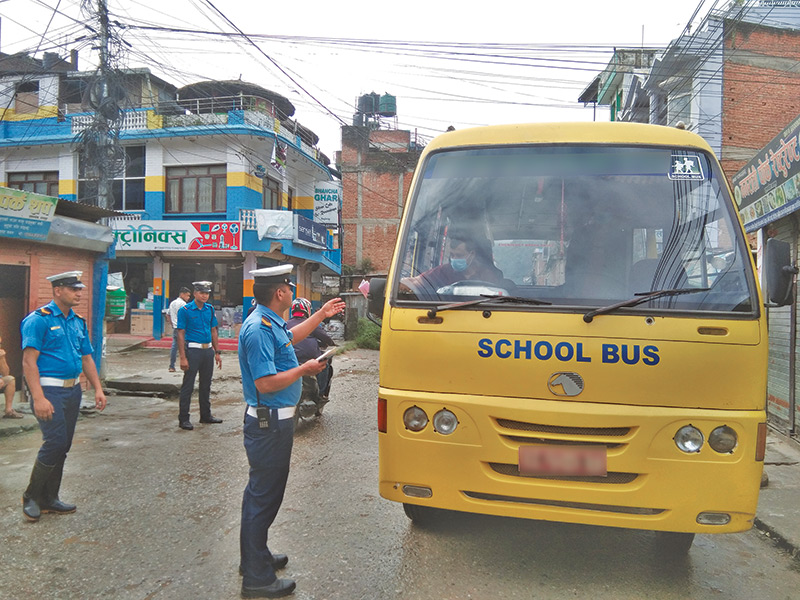
After an earlier accident, traffic police had checked school buses extensively. Post File Photo
KATHMANDU, Safety of schoolchildren has become an everyday concern of parents in Kathmandu these days. A 13-year-old boy got killed in a school bus-related incident in the Capital. On Wednesday, the boy was travelling to Gongabu on his way back from school when he craned his neck out of the bus and smashed his head against a tree at Lazimpat. Amid chaotic road traffic and choked walkways, safe commute is of paramount concern. One of the ways the parents try to ensure their children’s safety is using buses operated by schools which pick up and drop students at fixed points. According to Metropolitan Police Circle Lazimpat, the seriously-injured Ayushman Dahal, a fifth grader at Lazimpat based Best’s Montessori Chain of School, was rushed to Tribhuvan University Teaching Hospital on Wednesday afternoon. He succumbed to his injuries while undergoing treatment at the hospital on Thursday. Following the accident, the police took the bus driver, Roshan Adhikari, 30, into custody for investigation. “Our preliminary investigation showed that both the driver and the school are responsible. We are still in consultation with the parents of the deceased child and the school management. We are struggling to settle the issue,” said an officer from the Lazimpat Police Circle who didn’t want his identity disclosed. Rajendra Prasad Bhatta, spokesperson for the Kathmandu Valley Traffic Police Office, said the incident was “dreadful and unfortunate”. “If only the school had been more concerned about students’ safety, such an incident could have been avoided,” said Bhatta. He declined to get into the specifics of the negligence in this case as the investigation was ongoing. Every day, hundreds of school buses run across the Valley, picking up and dropping children door to door, but many bus operators don’t follow the rules. According to the Institutional School Criteria and Operation Directorate Act 2069 BS (2012), buses carrying students should be painted orange and each school should set the criteria to ensure safety and proper management of students while commuting. “Unfortunately, [in this case] the school management didn’t follow the rules,” said Suprabhat Bhandari, chairperson of the Guardians’ Association Nepal. “If only that particular school had observed how the bus was being operated, this dreadful accident could have been avoided,” said Bhandari. “As school buses carry small kids, the bus operator and assistants should be more careful in ensuring their safety.” The Post’s multiple attempts to contact representatives of Best’s Montessori chain of schools to get a response over the incident failed. Bhandari also complained that schools often cram kids into their buses and drivers often indulge in reckless driving while the students are still on board. “School buses should be the safest mode of transport, but that’s not the case here,” Bhandari said. Just two months ago, traffic police, while conducting a surprise check, had caught at least five school bus drivers drink-driving with students on board. Since then, the traffic police have arrested more than three dozen such school bus drivers in the Valley. After a massive media coverage and complains from parents over the issue, in the first week of September, the traffic police conducted a campaign against drink driving and made the checking of school buses more effective in coordination with the Private and Boarding School Organisation Nepal (PABSON) and the National Private and Boarding School Association Nepal (N-PABSAN), but Wednesday’s incident has raised eyebrows. “This once again is a wake-up call for all of us,” said DK Dhungana, chairperson at PABSON. “We had run an awareness programme against drink-driving with the help of traffic police. Now we will immediately hold a meeting and send a circular to all the schools to caution bus drivers and helpers.” Guardians’ Association Nepal, however, doesn’t believe PABSON’s assurances. “They just make promises when there is an incident. They forget it within days and don’t take any action,” alleged Chairman Bhandari.
NATIONAL
Supreme Court suspends extension of GMR deadline
Indian firm has yet to finish financial closure of Upper Karnali.
- PRITHVI MAN SHRESTHA
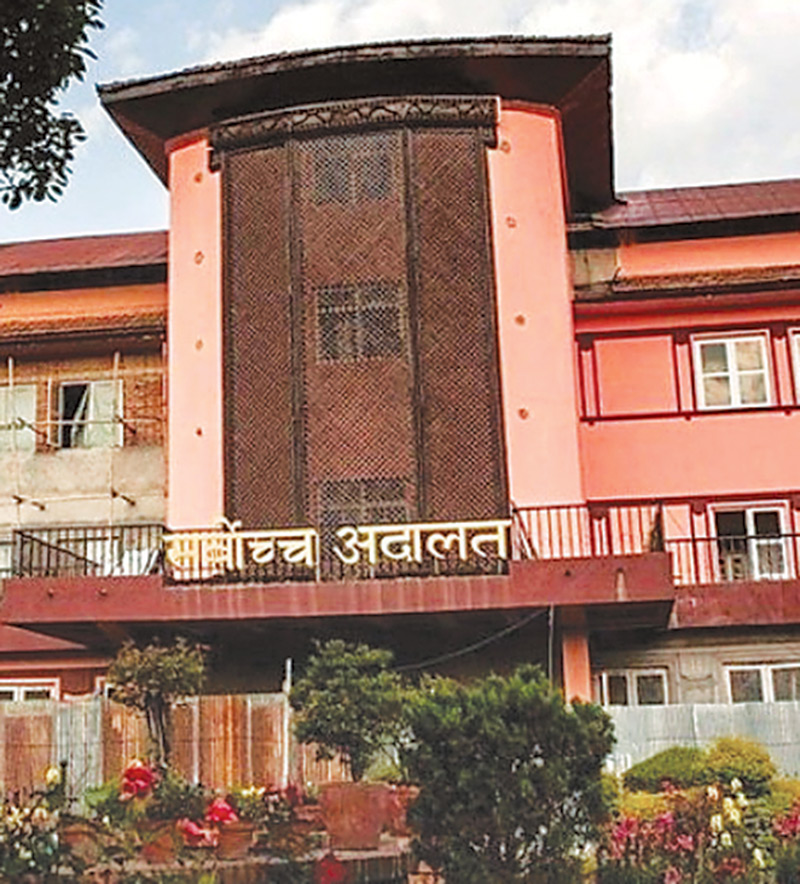
The Supreme Court. Post File Photo
KATHMANDU, The Supreme Court on Friday stayed the government’s decision to extend the deadline for GMR Energy to complete the financial closure of the 900MW Upper Karnali Hydropower Project, throwing the future of the project into uncertainty. On July 15, the Cabinet had decided to extend the deadline by two more years. Citing a number of reasons, a single bench of Justice Ishwar Prasad Khatiwada issued the interim order not to implement the government decision until the final verdict. On September 19, 2014, the Investment Board Nepal and GMR Energy signed the Project Development Agreement (PDA) giving the Indian company two years to conclude financial closure (generating resources to develop the project). The deadline was extended further on January 8, 2017 by one year. On November 10, 2017, the Investment Board extended the deadline by another year against which a writ petition was under consideration at the Supreme Court. “After expiry of the deadline, no decision was taken to continue the agreement and maintain the agreement intact,” the court observed. “In the context that the last deadline expired three years ago and there had been no extension since then, no logical justification can be found in extending the deadline by two years from July 15 this year.” The court has also questioned why the Cabinet had to extend the deadline for financial closure while the law authorises the Investment Board to do so. “There can be no justification for extending the deadline for financial closure until 2024 as the agreement was signed for two years in 2014,” the court said. The court has attached priority to the case. The interim order has made the Upper Karnali Hydropower Project further uncertain as the GMR won’t be able to work towards financial closure now. “As per the PDA, two sides can extend the deadline anytime,” said a lawyer familiar with the matter. “Even though the GMR applied for an extension, the IBN didn’t take a timely decision on the deadline in the past, contributing to the current situation.” According to the lawyer, the final verdict would be subject to how the government extended the latest deadline.
NATIONAL
Dhankuta District Hospital in a shambles
The hospital, which is one of the oldest in Province 1, has become a shell of its former self for a lack of upgrade.
- DEVENDRA BHATTARAI,Ramesh Chandra Adhikari
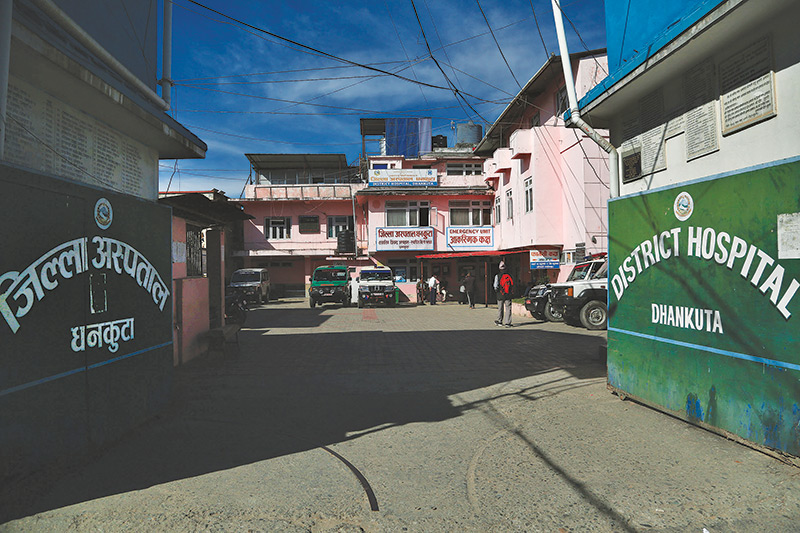
The Tri-chandra Hospital, which is now the District Hospital, Dhankuta was established in 1913. Post Photo: Prakash Chandra Timilsena
DHANKUTA, Tika Prasad Ghimire, a resident of Dhankuta Municipality-7, suffered a heart attack last week and was immediately rushed to the district hospital. But the hospital could not initiate his treatment and referred him to Biratnagar. Kedar Dahal’s mother is an asthma patient. The resident of Dhankuta-7 says his mother needs immediate medical intervention whenever she suffers an asthma attack. Last week he rushed his ailing mother to the district hospital after she started having breathing difficulties. “She was in pain and said she couldn’t breathe. I took her to the district hospital but the doctor on duty couldn’t treat her and referred her to Biratnagar,” said Dahal. “What is the point of a hospital if it cannot provide necessary services to patients.” The district hospital in Dhankuta has become a shell of its former self for a lack of upgrade. One of the oldest medical institutes in Province 1, the then Tri-chandra Hospital was established in 1913 in Chowk Bazar, Dhankuta, the old regional headquarters of the Eastern Development Region. This hospital catered to the patients of all 16 districts of the Eastern Development Region. Surya Bahadur Thapa, who was prime minister four times, kept this hospital on priority for the important role it played in providing medical services to a large population of the region. However, today the hospital is in complete disrepair and in need of major upgradation of physical infrastructure and medical facilities. Last year, then chief minister of Province 1, Bhim Prasad Acharya, announced that the 15-bed district hospital would be upgraded to 100 beds and would further be expanded into a medical college in mid-October, 2021. However, his promises did not come to fruition. Dr Manish Shah, acting chief of the hospital, says that patients come to the hospital seeking treatment but since the hospital does not have the needed manpower, resources and infrastructure, he refers all the patients to hospitals in Biratnagar. “It is a shame that we cannot provide the necessary treatment. People come to us hoping to get treated but we sadly have to turn them away,” said Shah. “Ghimire, the heart patient who had come to the hospital last week, was in a bad condition. If he wasn’t taken to Biratnagar immediately, he would have suffered more.” Dhankuta District Hospital is spread over 16 ropanis. It was estimated that at least 50 ropanis of space is needed to operate a 100-bed hospital. However, no work has been carried out in this regard. According to the government standard, the minimum criteria to run a 100-bed hospital is to have eight specialist doctors and the necessary support staff. The hospital currently has only one medical officer employed on a contract basis. Dr Pradeep Khatiwada, the medical officer, works 24 hours a day as there are no other doctors. “I only conduct routine checkups here. General surgery and maternity facilities have also been stopped for a lack of manpower and other facilities,” said Khatiwada. According to Khatiwada, an average of 1,300 patients visit the hospital annually. Ventilators and ICU beds were installed in the district hospital two years ago during the Covid-19 pandemic but they were never used for a lack of skilled manpower and specialists such as anesthesiologists. The provincial government provided 10 ICU beds with four ventilators with the help of the federal government’s Public Security Fund. The equipment was installed at a cost of around Rs16.5 million. “The posts of anesthesiologist and physician have not been announced. Since the district hospital does not have the right to advertise and fill the posts for specialist services, the posts have not been filled yet. The district hospital does not have specialist doctors so most services are unavailable here. Patients have to go to the BP Koirala Institute of Health Sciences in Dharan or a health centre in Biratnagar even in times of emergencies,” said Khatiwada. Shah, the acting chief of the hospital, said that the provincial government was supposed to allocate Rs160 million to turn the hospital into a medical college but the hospital received only Rs40 million in the first phase. “We returned the Rs40 million because the rest of the budget was never sent,” said Shah. “The hospital has not been able to prepare even the detailed project report (DPR) of the plausible expansion of the hospital since the land is yet to be allocated to the hospital.” “The district hospital is in dire straits. Development and planning were decentralised on paper, but no access was given to resources. It seems impossible to expand the services or even upgrade the physical infrastructure,” said Bhojraj Bhandari, head of the health unit of Dhankuta Municipality. “Referral patients from Terhathum, Sankhuwasabha and Bhojpur districts of the east come to Dhankuta, but due to the lack of health service facilities, patients who come in this way have to go to Dharan or Biratnagar for treatment,” he said.
NATIONAL
Rabi Lamichhane’s Rastriya Swatantra Party proposes directly elected prime minister
Briefing
KATHMANDU: The newly formed Rastriya Swatantra Party on Thursday unveiled its election manifesto for the upcoming federal and provincial polls, proposing a directly elected executive prime ministerial system as a form of governance. Unveiling the manifesto at an event in Kathmandu, the Rabi Lamichhane-led party proposed a broader electoral college for the presidential election incorporating ward chairpersons to federal lawmakers. Currently, an electoral college, including the members of the federal parliament and provincial assemblies, vote to elect a new president as per the constitutional provision. Moreover, the party has proposed electing an ‘apolitical’ president. Descendants of Nepali citizens who have not joined any political party or received political benefits for the past 10 years are eligible to compete in the presidential election, the party’s manifesto states. The party’s pledge regarding the head of the executive body is closer to the pro-monarchy Rastriya Prajatantra Party, which has also proposed a directly elected executive prime minister in its poll commitments. The Rastriya Swatantra Party has also proposed a directly-elected Chief Minister in provinces. The party has also floated a proposal in which the vice-president chairs the upper house.
NATIONAL
Nepal promises to continue participation in UN peacekeeping operations
Briefing
KATHMANDU: Nepal has reaffirmed its commitment to contributing to United Nations peacekeeping in all possible manners. Addressing the Special Political and Decolonization committee of the UN on Thursday, Amrit Kumar Rai, Nepal’s permanent representative to the UN, noted that many Nepali peacekeepers have been deployed around the world while stressing the need for a holistic and integrated approach to peacekeeping. “United Nations peacekeeping has evolved into multidimensional and multi-faceted operations with complex mandates that include upholding the rule of law, protecting civilians and ensuring human rights. And yet, they are underfunded and under-resourced undertakings,” Rai said. “Mandates should be specific, prioritised and achievable, and supported with adequate financial and technological resources adapted to the reality on the ground.” Rai added that member states must contribute to the peacekeeping budget in full and promptly to ensure resource predictability. According to the UN, Nepal is the second largest contributor of uniformed officers to UN Peacekeeping. More than 5,700 military and police personnel from Nepal are deployed to the UN operations in Abyei, the Central African Republic, the Democratic Republic of the Congo, Iraq, Lebanon, Libya, the Middle East, Mali, Somalia, South Sudan, and Western Sahara.
NATIONAL
Upper house panel suggests fewer ministries to cut costs
Calls for scrapping 10 federal ministries and reducing the number of provincial ministries to 10 percent of assembly’s size.
- TIKA R PRADHAN
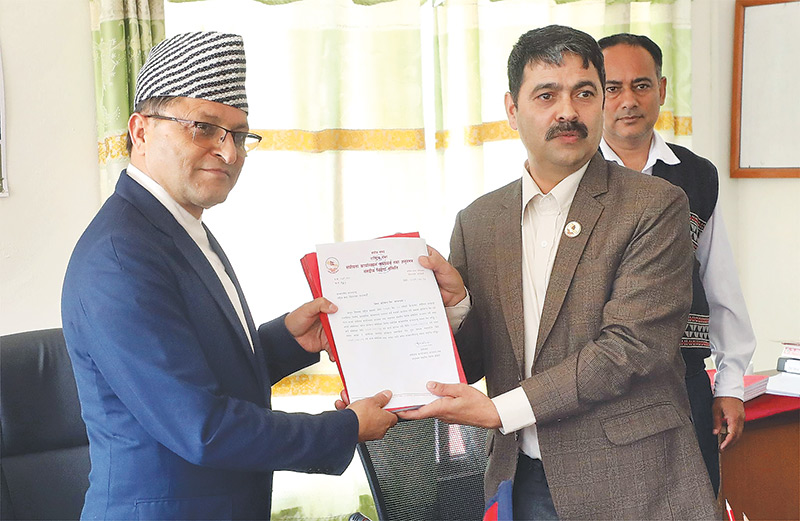
Lawmaker Khimlal Devkota (R) submits the report to upper house chair Ganesh Timilsina. Photo courtesy: Parliament secretariat
KATHMANDU, A special committee of the National Assembly has directed the government to reduce the number of ministries in both the federal and provincial governments for sustainable federalism. The panel has also suggested slicing off half the existing departments under the federal government. As per the recommendations of the parliamentary special committee formed to study the implementation and monitoring of federalism, the upper house committee has directed the government to do away with 10 of the 25 ministries in the federal government and limit the number of provincial ministries to 10 percent of the total strength of that particular assembly. “After a thorough study and consultations with experts, authorities of all three tiers of government and civil servants, we have made 99 recommendations,” said Khimlal Devkota, who heads the special parliamentary committee. “The government should implement them to ensure that federalism sustains for a long time.” Devkota, a member of the National Assembly who is also an expert on fiscal federalism, handed over the study report to the chairman of the National Assembly, Ganesh Timilsina, at a function organised in the Capital on Thursday. The recommendation of the National Assembly panel comes at a time when some political parties, including the right-wing Rastriya Prajatantra Party, several independent candidates and some leaders of major parties like the CPN-UML have been proposing that the provincial level be scrapped. Their major concern was the cost of sustaining federalism. Based on the study, a meeting of the special committee formed under the Parliamentary Sustainable Development and Good Governance Committee of the upper house has directed the government to take initiatives to cut the ministries of the federal government to 15 by mid-July next year and to halve the departments under the federal government, which are now almost defunct following the implementation of federalism. “Administrative costs have risen due to the increase in the number of provincial ministries and ministers,” stated the panel in its set of recommendations. “The number of provincial ministries must not exceed 10 percent of the total assembly members, with five provincial ministries as the bare minimum.” There have been many studies on how many federal ministries are needed after the country adopted federalism, which allows transfer of around 60 percent of the workload of the federal government to provincial and local governments. The Public Expenditure Review Commission led by the economist Dilli Raj Khanal submitted a report to the government in February, 2019, suggesting that the number of federal ministries be limited to 16. The commission formed by then KP Sharma Oli government in August, 2018 had given two reasons for slashing the number of ministries—the workload of the federal government had gone down significantly with two other tiers of government at the provincial and local levels taking many of the functions of the earlier unitary state system and, secondly, to reduce the state expenditure. In 2014, the Administrative Reform Recommendation Committee led by Kashi Raj Dahal, former chairperson of the Administrative Court, had suggested limiting the number of federal ministries to 12 once the country embraced the federal set-up. In the report submitted to the then Sushil Koirala government in April 2014, the Dahal-led panel had suggested having 18 ministries until the general elections after the promulgation of the new constitution and reducing the number to 12 once the local and provincial governments come into operation. The Devkota-led parliamentary special committee has also recommended the government to cut 50 percent of the civil servants and stop promoting the civil servants who have not served for at least two years. The committee also recommended keeping the chief administrative officers of the local level to the provincial governments concerned, besides setting budget ceilings for provincial and local governments. The committee made 99 recommendations to ensure smooth functioning of federalism, along with a time-bound chart including the authorities responsible for implementing the recommendations. Though the parliamentary committee, after a thorough study, made the recommendations to the government with a time-bound action plan, committee members have doubted its proper implementations. “It’s a matter of trusting our political leadership,” Devkota told the Post. Experts on administrative reforms are also apprehensive about implementation. Dahal, who is an expert on administrative reforms, also said his study panel had recommended that the provincial ministries must not exceed seven but none of the recommendations was implemented. He pointed out three problems in administrative reforms after the country adopted federalism—unstable structural setup, managerial problems such as creating positions catering to individuals instead of need, lack of successor plan and behavioural problems. “So far, not even 25 percent of the directives issued by parliamentary committees have been implemented,” said Dahal. “There is no basis to believe that our politicians have the willpower to implement these directives.”
NATIONAL
Lift drinking water scheme stalled for two years
Briefing
SALYAN: The Lanti-Botechaur Lift Water Supply project, which is run by Chhatreswari Rural Municipality with special federal grant, has been stalled for two years affecting as many as 300 families. According to Oja Bahadur Budathoki, chairman of Chhatreswari, locals have to walk for hours to fetch clean drinking water from rivers and springs. The project’s construction was stopped after the contractor missed the deadline. “The previous contractor did 20-25 percent of the work,” Budathoki said. “There is a plan to resume construction but the government must send the entire project budget for it.”
NATIONAL
Postal highway obstructed
Briefing
SARLAHI: Residents of Kaudena in Sarlahi district on Thursday obstructed transportation along the postal highway throughout the day, demanding the road be upgraded soon. The protesters blocked the road section from early morning by burning tyres. Chanting the slogan ‘no road, no vote’, the demonstrators warned that they would not cast votes for the candidates who do not take initiative to blacktop the highway section. The 41-km Sarlahi section of the postal highway is in poor condition while the highway has been blacktopped in the neighbouring districts of Mahottari and Rautahat.
EDITORIAL
A burning issue
The violence on the environment is a transnational problem and we need a collective resolve to tackle it.
In a recent interview with the Post, former Indian foreign secretary Shivshankar Menon assured India’s neighbours that it does not export its politics. There is much that can be said either in agreement or disagreement with the veteran diplomat’s statement. But there is something more lethal than politics that India is currently exporting to Nepal—the air pollution that is already leaving us with itchy eyes and aching heads. One can easily blame the paddy stubble-burning farmers of Punjab and Haryana, or even the Diwali revellers of Delhi, for the sudden decline in Kathmandu’s (or much of Nepal’s and north India’s) air quality. Yet this is a complicated problem that spans borders, politics, economics and environment, and which as such has no easy solutions—and which is precisely why it calls for a multinational, coordinated approach. As Dhruv Khullar’s recent New Yorker reportage put it, “India has among the world’s highest rates of chronic respiratory disease; on the worst days, breathing the Delhi air is equivalent to smoking two packs of cigarettes.” Being a close neighbour, Kathmandu cannot but be affected by the worsening air quality in Delhi. On Thursday, Kathmandu reported an Air Quality Index (AQI) score of 137—well above the accepted level of 100—while Tulsipur in Dang recorded 169. As winter deepens, the AQI level is only going to get worse. Again, the violence on the environment is a transnational problem and we need a collective resolve to tackle it. The inability of the government next door to solve the problem on time is causing us health problems today, but what is happening in India is only half the story. There are skeletons in our closets too, for Nepal too has witnessed increased incidents of winter-time forest fires, many of which can be attributed to human negligence. In any case, if the situation persists, we might as well show on our television screens a Nepali version of the Indian anti-smoking advertisement which says, “What has happened to this city? There is ash and smoke everywhere. Why doesn’t anyone say anything?” Our own politicians have for far too long gotten away with lies, even total incognisance, on air pollution. This life-and-death issue is almost non-existent in the manifestos of political parties contesting the upcoming parliamentary polls. The pollution that is an everyday problem for common citizens is, apparently, what Russian journalist Svetlana Alexievich calls, in the context of the 1986 Chernobyl nuclear plant disaster, the “missing history…the invisible imprint of our stay on earth and in time”. The invisibility, obviously, is a performative act of ignorance, for it is easier to feign ignorance than recognise and act. We have contaminated our arable lands with chemical fertilisers, polluted our waters with plastic, and poisoned our air with carbon monoxide. Every country in the world is complicit in the depredation of Planet Earth, and we are already paying the price for our actions. But when are we going to start a change for the better? When are we going to realise that individually we all fail but collectively we all triumph in this battle for our very existence?
OPINION
Gen-next power sector reforms
The private sector and the NEA must team up to develop the sector through trading with India.
- BISHAL THAPA
Goddess Lakshmi didn’t just smile on Nepal’s electricity fortunes this Tihar. The Hindu goddess of wealth rained down blessings like never before. On the day of Lakshmi Puja, October 24, the state-owned utility Nepal Electricity Authority (NEA) exported 9,603,000 kilowatt hours of electricity to India, 406,000 kilowatt hours of it during peak hours, earning approximately Rs30 million in the process. The NEA began trading electricity through India’s power exchange in June after obtaining approval from the Indian government. During the three-month period from mid-July to mid-October, the NEA earned approximately Rs3.7 billion in net exports. To get a scale of these earnings, picture this: The export revenues are enough to give each of its household customers a gift of Rs1,022. The NEA’s recent earnings from electricity exports have vindicated its strategy to integrate Nepal’s power system firmly with India’s electricity market. The voices that protested, including me that cautioned against an integrated cross-border electricity structure, have been proven wrong—at least for now. Nepal’s long cherished dream of exporting electricity and earning billions is finally being realised. This is clearly a moment for NEA and the government of Nepal to soak in the applause. The debate over pursuing energy trading with India is now closed. But the risks from integrating with India’s power markets haven’t gone away. There is still much that must be said and much that remains to be heard.
Adjusting to a new era Nepal is now integrated with India’s power market. As the development of additional cross-border transmission lines accelerates, some of it enabled by United States assistance under Millennium Challenge Corporation, there is no doubt that Nepal’s power sector is in a new era of cross-border electricity trading. There is no turning back now. Can Nepal reform fast enough to adjust and thrive in this new reality? The NEA’s exports this year have come during a period of unusually high prices in India’s electricity exchanges. Power prices rose sharply starting October 2021. Between June and October 2021, for example, the average day ahead market clearing prices on the Indian Electricity Exchange increased approximately 260 percent to 300 percent. India’s power sector regulator, the Central Electricity Regulatory Commission (CERC), noted that by March 2022 the day ahead and real time markets (where the NEA trades) had twice as many buyers as sellers. Market clearing prices were repeatedly hitting the exchange’s ceiling of INR20 (Rs32) per unit. In April 2022, the CERC capped the power price on the exchanges at INR12 per unit and renewed that ceiling in September. That maximum limit will remain in place through the end of the year. The challenge for Nepal will begin when India’s power prices return to normal levels. In the past, day ahead prices on the exchanges have ranged between INR3 and 4 per unit. Renewable energy may push these prices lower. Prices may be even lower in long-term contracts. Will Nepal’s new power plants remain competitive against those prices? India’s short-term power trading markets—the day ahead and real time—provide Nepal a good outlet for its surplus power. But these markets cannot induce new capacity to be built. Almost all new power plants in India are built on the back of firm long-term power contracts. In the entire Indian power system, only three plants are operating on a merchant basis without the guarantee of long-term power purchases, my former colleague reminded me. New hydro plants in Nepal will similarly only be built if there is certainty of firm power purchases over the long term. Only the NEA can currently provide that guarantee. New hydro plants with a combined capacity of approximately 7,000 megawatts are stuck waiting for the NEA to sign power purchase agreements, a leading Nepali power sector professional explained to me. The NEA has suspended signing new power purchase agreements for the last few years, he says. That suspension is, perhaps, for a reason. The NEA estimates that there isn’t enough domestic demand to absorb all the projected supply. It doesn’t want to be saddled with all that energy with nowhere to sell it. Prices and sales in India’s day ahead and real time power trading exchanges are not guaranteed. Committed purchases without committed sales would place the NEA in too much risk. How can power trading with India induce new capacity to be built in Nepal? Without access to India’s long-term power purchase agreements, there is no easy answer, unfortunately. This may be where Nepal must draw from an understanding of how India’s power markets evolved. India has undertaken significant power sector reforms over the last two decades. The introduction of real time trading two years ago, for example, was the result of deep structural changes that had been paralysed for a decade in struggles between different agencies and in the courts.
Reforms urgently required India’s electricity market, from which the NEA is expected to harvest Rs4 billion this year, is a product of those reforms. Further reforms are still unfolding. But there is now a base strong enough to support a robust trading platform. Nepal’s approach to power trading has lacked any meaningful reforms. It has plunged the NEA into electricity trading with the hope that the necessary reforms will follow. These reforms are now urgently required. Simply put, and as the power sector professional summarised it so aptly for me, “The NEA cannot do it all by itself.” The core to India’s power sector reforms was in allowing the private sector to participate. It allowed for risks to be diversified, capacity to be enhanced, and capital to be injected, thus helping the market to mature. Nepal’s power sector must rapidly reform to enable the private sector to supplement, collaborate and partner with the NEA in developing its power sector through trading with India. Without reforms, Goddess Lakshmi may find less reason to smile upon us, especially if all that power trading does is to lock us into an era of Indian power imports, while the vast potential of Nepal’s hydro simply flows down the rivers.
Thapa is an economist with a long experience in the energy sector.
OPINION
Rise of post-acute dengue syndrome
The ability of the dengue virus to cause long-term post-acute infection sequelae is alarming.
- SHER BAHADUR PUN
Shutterstock
Following the massive 2022 dengue outbreak, post-acute dengue syndrome is becoming apparent and drawing more attention in Nepal. A few days ago, a staff member at the Sukraraj Tropical & Infectious Disease Hospital resumed work after recovering from dengue. But he was still complaining of severe fatigue, weakness, and muscle and joint pain. Very recently, a retired hospital staff, who was also infected with dengue with severe symptoms, was continuously experiencing severe fatigue, asthenia and significant hair loss. In another case, a young woman, who had recovered from dengue fever a month ago, again visited the hospital with complaints of severe fatigue, joint pain (especially in the lower limbs), feeling feverish but without fever, headache, and brain fog (trouble with memory, inability to concentrate etc.). Other notable health problems reported after recovery from dengue infection include difficulty breathing while talking, dizziness, heavy head, sleep disturbances or sleepiness and heart palpitations. It is observed that people with post-acute dengue syndrome experienced/are experiencing at least two or more symptoms. Such complaints were not noticed or reported during the first massive dengue outbreak in 2019. There is, so far, no consensus on the most appropriate name for the post-acute sequelae of dengue fever and its time frame among scientific experts, although several studies on the persistent symptoms after recovering from the acute phase of dengue infection have been published in the past. Initially, there was no clear consensus on defining the post-acute sequelae of Covid-19. It was popularly known as “long Covid”, “long-haul Covid”, “chronic Covid”, and “post-Covid”. It was later defined as “an individual with a history of probable or confirmed SARS-CoV-2 infection, usually three months from the onset of Covid-19, with symptoms that last for at least two months and cannot be explained by an alternative diagnosis”. During the current 2022 dengue outbreak, most of the cases recovered eight to 10 days after symptoms first appeared. Thus, if the patient experiences symptoms (physical and/or mental) at least 10 days after the onset of the illness, the author herein refers to it as post-acute dengue syndrome. Several countries have previously reported post-acute dengue syndrome. In Sri Lanka, nearly one-third of dengue patients were found to have symptoms of post-dengue fatigue one to two months after infection. A six-month or longer follow-up study conducted in Brazil found that half of the dengue patients (54 percent) reported various symptoms that persisted for more than 14 days. In a study done in Cuba, over half (57 percent) of the individuals with a prior diagnosis of dengue fever found persistent clinical symptoms in the two years following infection/after their diagnosis. It shows that post-acute dengue syndrome is not rare and may go unnoticed due to lack of research, study or attention. Nonetheless, heretofore, post-acute dengue syndrome has not yet been widely recognised in Nepal. In light of the current dengue outbreak in Nepal, the sudden rise in post-acute dengue syndrome can be considered as an unexpected but possibly a new emerging event. Individuals living with post-acute dengue syndrome frequently asked questions about its duration (possible end time) and potential drugs for the treatment. There are, thus far, not enough published studies that mention or explain its management and lingering time. However, symptomatic treatment or supportive care from related field specialists could help improve the symptoms. Some studies found that the post-acute sequelae of dengue infection resolved over time without any specific treatment. As to its duration, it is not well known how long it lasts for. A Brazilian study found that symptoms persisted for up to one month in 44 percent of dengue patients, while symptoms remained for up to six months in the other 44 percent. Nevertheless, it can be as long as two years following the resolution of the acute phase infection, as shown by a Cuban study group. Nepal is witnessing a sudden surge of such syndrome for the first time in an increasing number of patients after recovery. Hence, its outcomes and time duration are yet to be known or studied. The ability of the dengue virus to cause long-term post-acute infection sequelae is alarming. Despite this, there is still a lack of research studies or interest in understanding the reasons behind this sequelae. Several interesting findings about dengue infection and its post-acute sequelae are emerging. For example, why a significant number of patients are having post-acute dengue syndrome following the current 2022 dengue outbreak, although the virus has been circulating in the population for about 18 years (first reported in 20004) in Nepal? Some studies found that symptomatic patients, especially those who experienced severe symptoms or went through warning signs of dengue fever, are at greater risk of having post-acute dengue syndrome. This means that hundreds of patients, who recently recovered from the disease, are expected to suffer from post-acute dengue syndrome in the coming days or months, as we observed most of the patients with severe symptoms of dengue virus, including bleeding complaints during the current 2022 dengue outbreak. Studies have found that females with dengue are at higher risk of having a post-acute dengue syndrome than their male counterparts. So far, the majority of the patients who complained of persistent symptoms after recovery from acute dengue infection were female. At present, the reasons behind these findings are not well explained and are yet to be explained. For the first time, post-acute dengue syndrome is increasingly seen among dengue patients after recovery from the virus in Nepal. Previous studies have observed the overall prevalence rate of the syndrome was about 50-60 percent or nearly half of the dengue patients. It is, thus, reasonable to anticipate a similar prevalence rate of post-acute dengue syndrome in dengue patients in the months or even years to come in Nepal.
Pun is Chief of the Clinical Research Unit at Sukraraj Tropical & Infectious Disease Hospital.
OPINION
Choked rivers
The authorities must limit the use of plastic, especially plastic packets and polyethene.
There is an all-out war going on against our rivers. We know it, we can see it, but we are doing hardly anything to prevent it, even though our lives and livelihoods both depend on this. One of the most persistent elements of this war is plastic pollution. Even though Bangladesh boasts about being the first country to ban the use of plastic, and the High Court granted rivers the legal status of “living entities” in early 2019, little effort has been made to walk the talk. For example, as per a recent analysis by the Centre for Policy Dialogue (CPD), 40 percent of Chattogram city’s mismanaged plastic is ending up in the Karnaphuli River, while the Rupsha River in the south-west is taking in 31.7 percent of such waste. This is, sadly, pretty much the story of all our rivers connecting cities. Industrial waste and irresponsible plastic management have turned rivers like the Buriganga, Meghna, Kirtankhola, Galachipa, Payra, and Bishkhali (among many, many others) into veritable dumping grounds. Of the 646 tonnes of plastic waste produced in Dhaka annually, 12 percent ends up in rivers. Worse still, given that Bangladesh has a deltaic landscape, its waters also have to bear the brunt of plastic waste flown in from neighbouring countries. Besides reducing navigability and making dredging very difficult, plastic pollution of rivers is harming the environment and the lives of humans and animals (aquatic and otherwise). Those traditionally dependent on rivers are also losing their livelihoods. Aquatic creatures that end up consuming plastic waste are often killed by it too. And most concerningly, as plastic waste disintegrates into microplastics and is consumed by animals, the toxic substances present in them can eventually become absorbed into animal tissue and contaminate the food chain of humans. The level of pollution and encroachment has reached a point that many rivers across the country have become extinct or are nearing extinction. There have been worrying reports on three rivers in Rajshahi, the Old Khowai in Sylhet’s Habiganj, and several others surrounding Thakurgaon in recent times. How can this be the state of a country that was once known as a Land of Rivers? What good is the status of a “living entity” if we do not stop our rivers from being choked to death? The government’s inaction towards identifying and punishing the polluters and encroachers is shocking indeed. It cannot continue any longer given the huge threat posed by tonnes of plastic waste being dumped into rivers every day. A country so dependent on its rivers, for trade, travel, and livelihoods, cannot afford to lose their functionality. The authorities must limit the use of plastic, especially plastic packets and polyethene. And they must ensure better management of plastic waste so that it doesn’t end up in our rivers.
— The Daily Star/ANN
MONEY
Digital economy overtakes e-commerce legislation
The proliferation of online shopping and e-retailers has made e-commerce laws urgently necessary, insiders say.
- KRISHANA PRASAIN
Nepal’s internet economy will be worth a billion dollars in the next couple of years, and there is a vital need for a framework, online traders say. Shutterstock
KATHMANDU, It has been nearly two years since the government prepared the draft E-Commerce Bill, but nobody knows when it will see the light of day. Even after a long wait, the proposed law has been pushed further into the background as the nation prepares for the general election and the formation of a new government. Gobinda Bahadur Karki, joint secretary at the Ministry of Industry, Commerce and Supplies, said they had received the bill from the Law Ministry two months ago, and that they forwarded it to the cabinet at around the same time. “Right after we sent it to the cabinet, Parliament was dissolved for the election. The bill needs to be passed by Parliament,” Karki said.While officials take their time, the online sector has been holding its breath. The proliferation of online shopping and e-retailers in the country has made e-commerce laws urgently necessary, insiders say. According to online traders, Nepal’s internet economy will be worth a billion dollars in the next couple of years, and there is a vital need for a framework. Online orders from outside Kathmandu Valley have swelled too, they say.Buyers and sellers both have been anxiously waiting for the government to pass e-commerce laws to end confusion in the way of doing business. Consumer rights activists complain that the lack of laws has made customers open to fraud. Buyers have received damaged products or the wrong product. They have also been cheated because of the different prices and the absence of a return and refund policy, the activists say. E-commerce entrepreneurs, for their part, have been grumbling that they are facing operational hassles because there are no clear laws. “The e-commerce market has been thriving in recent years, but it is unfortunate that laws governing it have not been passed. This has resulted in market irregularities in online business,” said Bishnu Prasad Timilsina, general secretary of the Forum for Protection of Consumer Rights-Nepal. “There is no regulation with any provision for punishment, and unscrupulous traders are taking advantage of the lack of governance,” Timilsina said. “It took many years for government officials to get the hang of e-commerce. Now that they have finally done something about it, a new group of people will be coming into government after the election; and there is no guarantee that they will pass the law,” Timilsina said. The e-commerce legislation will regulate and facilitate the trade of goods and services and intellectual property rights using electronic means, supporting the growing digital ecosystem. Kiran Timsina, co-founder of online cake seller UG Cakes and Urban Girl, says that without e-commerce laws, entrepreneurs are facing operational hassles and unhealthy market competition. “For any entrepreneur who wants to step into e-commerce, it is unclear how to register the firm at first despite registering it with Office of the Company Registrar,” Timsina said. “As the number of e-retailers is growing taking undue advantage of the lack of effective governance in the sector, it has created unfair market practices,” he said. Insiders say that the number of online shopping portals is rising sharply with many not even registering their firms anywhere. The government implemented a national strategy for e-commerce in August 2019 with a one-year timeline to draft the guidelines and regulations. The strategy has provisioned legal action against e-commerce firms found selling substandard products, charging high prices and not delivering the goods on time. It has also provisioned legal action for selling goods by giving false information. The strategy contains provisions for registration, approval and operation of e-commerce businesses, protection of consumer privacy, refund and return of goods, and legal action against unlawful market practices. According to the Connectivity in the Least Developed Countries Status Report 2021, Nepal’s performance in e-commerce is still poor despite increased online access. The report said that even among countries with higher internet penetration, awareness of e-commerce platforms is low in LDCs like Nepal. E-commerce is among the few sectors with the potential to add value, helping these countries to diversify their economies and graduate from the LDCs group. E-commerce entrepreneurs have been observing an increase in digital payment in recent days rather than cash on delivery. According to Nepal Rastra Bank, online transactions from mid-August to mid-September amounted to Rs4.92 trillion compared to Rs3.92 trillion in the same period last year. The number of transactions also reached 4.73 million during the review period. According to e-commerce entrepreneurs, 50 percent of the payments they receive are being made digitally, which include payment by debit or credit cards and e-wallets.
MONEY
Advertisers grill Elon Musk over Twitter ‘free-for-all’
Some clients have already begun to pause ad spending on Twitter this week.
- REUTERS
Musk’s Twitter account on a phone is seen in front of the Twitter logo in this illustration. REUTERS
CALIFORNIA, Elon Musk promised advertisers he would keep Twitter from turning into a “free-for-all hellscape.” This week, advertisers are beginning to demand details on how he plans to uphold the commitment. A media buyer at one major ad agency, who declined to be named for fear of reprisal, said the agency would meet with Musk this week to ask how the Tesla chief executive plans to clamp down on misinformation on the social media platform. The buyer also wanted to know how Musk’s pledge squared with his own actions, including one tweet over the weekend that spread a conspiracy theory about the attack against US House Speaker Nancy Pelosi’s husband Paul. Other topics include Musk’s plan to raise the cost of Twitter’s subscription service and serve “half as many ads,” and who will serve as advertisers’ point of contact after a procession of senior executives, including Twitter’s ad chief, left the company since he took over. The agency’s top clients are expected to join the meeting, the media buyer said. After tweeting in 2019 about his dislike of advertising, Musk is now under pressure to avoid alienating the advertisers who contribute more than 90 percent of its revenue. He is spending his first week as CEO in New York, with venture capitalist friends joining him in meetings to reassure companies that contribute more than $5 billion annually to Twitter. Jason Calacanis, an angel investor and podcast host who is assisting Musk in his first week of ownership, tweeted on Monday that Twitter had a “very productive day” of meetings with advertisers and marketers. Another media buyer who spoke with Reuters said their agency will not meet with Musk until he articulates a direction for Twitter or provides a substantive update on how the platform will serve advertisers. Some clients have already begun to pause ad spending on Twitter this week, said the second media buyer, who declined to name the advertisers as the source was not authorised to do so. The buyer said some clients had already pulled out of Twitter due to the months-long chaos around the deal, and some in response to concerns about child sexual abuse material on Twitter.
MONEY
Musk plans to cut half of Twitter jobs: Bloomberg
NEW YORK: Elon Musk plans to cut about 3,700 jobs at Twitter Inc or half of the company’s workforce in a bid to cut costs, Bloomberg News reported on Wednesday, citing people familiar with the matter. Twitter’s new owner will inform the staff affected on Friday, according to the report. Bloomberg also reported that Musk intends to reverse the social media company’s existing work from anywhere policy and will require employees to work from office though some exceptions could be made. Musk, in a tweet, had denied a New York Times report that said he was planning to lay off Twitter employees before November 1 to avoid stock grants due on the day. Twitter did not immediately respond to a Reuters request for comment. (REUTERS)
MONEY
Hundreds protest tax hikes, crackdowns in Sri Lanka
- REUTERS
COLOMBO, Hundreds of people marched in Sri Lanka’s largest city Colombo on Wednesday protesting against higher taxes, inflation and alleged state-led repression as the country struggles to emerge from its worst financial crisis in seven decades. The anti-government protest, jointly organised by opposition political parties, trade unions and civil society groups, was blocked by police as marchers attempted to reach a central part of the city where the president’s house and other ministries are located. “People can barely eat three meals a day and this government has done nothing to support people other than impose more and more taxes. We need solutions and we will keep fighting for them,” Ceylon Teacher’s Union Secretary Joseph Stalin said. Sri Lanka has been gripped by a deep financial crisis this year caused by record-low foreign exchange reserves that has left the island of 22 million people struggling to pay for essential imports including fuel, food, cooking gas and medicine. Widespread protests in July resulted in former President Gotabaya Rajapaksa fleeing the country and resigning after protesters stormed his office and residence.
MONEY
South China at risk of winter drought, drop in hydropower
- REUTERS
SINGAPORE, Southern China is expected to face a drought, which will reduce hydropower generation and mean more power output is needed from other sources to meet peak winter demand, a weather scientist said on Thursday. “Most parts of China are forecast to have near- or less rainfall this winter than a normal year. But southern China could see drought or even severe drought,” Shen Yanbo, chief scientist at public service centre of China Meteorological Administration, told a seminar hosted by state-backed Chongqing Gas Exchange. China’s Ministry of Emergency Management also on Tuesday said it expected a drought along the Yangtze basin in November, while central and southern China is at “extremely high risk” of bush fires. Shen identified other regions that might experience an “extreme severe drought,” including Chongqing and Guangxi, where hydropower is the most significant source of power supply. Chongqing and neighbouring Sichuan suffered a drought and power shortage in July and August, forcing companies including Taiwan’s Foxconn and battery giant CATL—to shut down or curb output.
MONEY
CGNET launches FTTH, super high speed internet at ‘Super Sasto Price’
Briefing
KATHMANDU: One of the nation’s fastest-growing and most admired Internet service provider, CGNET, has launched a new offer—FTTH- Football to the Home where customers can now enjoy higher bandwidth at a very affordable price ahead of the World Cup. Newly released packages consist of Sprinter Plus 130 Mbps at a monthly rate of just Rs799, Popular Pro 250 Mbps at just Rs1099 per month and Rockstar Max 350 mbps at just Rs1,299 per month, according to the press release issued by the company. Consumers can choose from the 3 packages with a validity period of 1-month, 3-month and 12-month. (PR)
MONEY
Turkey’s inflation hits 24-year high of 85.5 percent
Briefing
ISTANBUL: Turkish annual inflation climbed to a new 24-year high of 85.51 percent in October, official data showed on Thursday, slightly below forecast, after the central bank cut its policy rate despite surging prices. Inflation has surged since last year, when the lira slumped after the central bank began cutting its policy rate in an easing cycle long sought by President Tayyip Erdogan. In the last three months, the central bank slashed its policy rate by a total of 350 basis points to 10.5 percent. It promised another cut this month as the final move in the current easing cycle, running counter to the global monetary policy tightening trend. Month-on-month, consumer prices rose 3.54 percent, the Turkish Statistical Institute said, below 3.60 percent forecast in a Reuters poll. Annually, consumer price inflation was forecast to be 85.60 percent. The annual inflation in October was the highest since June 1998, when Turkey was working to end a decade of high inflation. (REUTERS)
MONEY
China’s yuan hovers near 15-year low after Fed decision
Briefing
SHANGHAI: China’s yuan hovered at a near 15-year low on Thursday, tracking broad dollar strength after US Federal Reserve Chair Jerome Powell signalled US rates would likely rise further than expected, dashing market hopes for a change in tone. The Fed raised its benchmark funds rate by 75 basis points as widely expected, but said its battle against inflation will require borrowing costs to rise further. Prior to the market opening, the People’s Bank of China set the midpoint rate at 7.2472 per dollar, 275 pips or 0.28 percent weaker than the previous fix 7.2197. (REUTERS)
WORLD
North Korea ICBM may have failed in flight, South officials say as allies extend drills
North Korea has had several failed ICBM tests this year, according to South Korean and US officials.
- REUTERS
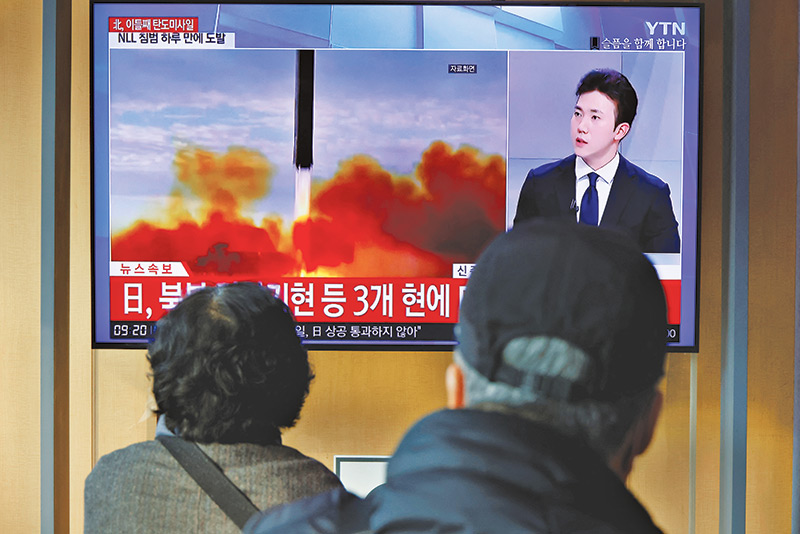
People watch a TV broadcasting a news report on North Korea firing a ballistic missile off its east coast, in Seoul, South Korea on Thursday. REUTERS
TOKYO/SEOUL, North Korea fired multiple ballistic missiles on Thursday, including a possible failed intercontinental ballistic missile (ICBM) that triggered an alert for residents in parts of central and northern Japan to seek shelter. Despite an initial government warning that a missile had flown over Japan, Tokyo later said that was incorrect. Officials in South Korea and Japan said the missile may have been an ICBM, which are North Korea’s longest-range weapons, and are designed to carry a nuclear warhead to the other side of the planet. South Korean officials believe the ICBM failed in flight, Yonhap news agency reported, without elaborating. Spokespeople for the South Korean and Japanese ministries of defence declined to confirm the possible failure. Japanese Defence Minister Yasukazu Hamada said the government lost track of the missile over the Sea of Japan, prompting it to correct its announcement that it had flown over Japan. Retired Vice Admiral and former Japan Maritime Self Defense Force fleet commander Yoji Koda said the loss of radar tracking on the projectile pointed to a failed launch. “It means at some point in the flight path there was some problem for the missile and it actually came apart,” he said. Although the warhead came down in the sea between the Korean peninsula and Japan, debris would have been travelling at high speed and may still have passed over Japan, Koda added. North Korea has had several failed ICBM tests this year, according to South Korean and US officials. The United States condemned North Korea’s ICBM launch, State Department spokesman Ned Price said in a statement. “This launch is a clear violation of multiple United Nations Security Council resolutions,” he said. It also demonstrates the threat from North Korea’s unlawful weapons of mass destruction and ballistic missile programmes, Price added. The launches came after Pyongyang demanded the United States and South Korea stop large-scale military exercises, saying such “military rashness and provocation can be no longer tolerated”. It has said that a recent flurry of missile launches and other military activities were in protest against such drills. The allies have been conducting one of the largest air exercises ever, with hundreds of South Korean and US warplanes, including F-35 fighters, staging around-the-clock simulated missions. After Thursday’s ICBM launch, the allies agreed to extend the drills past Friday, when they had been scheduled to end, South Korea’s Air Force said in a statement. “A strong combined defence posture of the ROK-US alliance is necessary under the current security crisis that is escalating due to North Korean provocations,” the statement said, using the initials of South Korea’s official name. North Korea also launched two short-range ballistic missiles on Thursday. The launches came after North Korea fired at least 23 missiles on Wednesday, the most in a single day, including one that landed off South Korea’s coast for the first time. South Korea issued rare air raid warnings and launched its own missiles in response after Wednesday’s barrage. On Thursday, the South’s transportation ministry announced that air routes had reopened in the area where the missile had fallen, having been closed for around 24 hours. After the first launch on Thursday, residents of Miyagi, Yamagata and Niigata prefectures in Japan were warned to seek shelter indoors, according to the J-Alert Emergency Broadcasting System. “We detected a launch that showed the potential to fly over Japan and therefore triggered the J Alert, but after checking the flight we confirmed that it had not passed over Japan,” Hamada told reporters. The first missile flew to an altitude of about 2,000 kilometres and a range of 750 km, he said. Such a flight pattern is called a “lofted trajectory”, in which a missile is fired high into space to avoid flying over neighbouring countries. South Korea’s Joint Chiefs of Staff said the long-range missile was launched from near the North Korean capital, Pyongyang.
WORLD
Delhi’s air a ‘crime against humanity’, spurs calls to close schools
- REUTERS
NEW DELHI, Delhi’s 20 million residents were effectively breathing smoke on Thursday as the air quality index (AQI) breached the “severe” and “hazardous” categories in nearly all monitoring stations of the Indian capital, raising calls to close schools. The AQI exceeded 450 at many places early in the day, according to data from the Central Pollution Control Board. A reading over 400 affects healthy people, with serious impacts on those with existing diseases, the federal government says. The index was over 800 in some pockets of the city, according to data from the Delhi Pollution Control Committee. “What is happening with air pollution in Delhi is nothing short of a crime against humanity!” author and socialite Suhel Seth wrote on Twitter. “There’s a total collapse of accountability!” The world’s most polluted capital is blanketed in smog every winter as cold, heavy air traps construction dust, vehicle emissions and smoke from the burning of crop stubble in the neighbouring states to clear the fields for the next crop. Parents and environmentalists on social media demanded schools to be closed. “I know children don’t vote for you, but still, requesting all the chief ministers of Delhi [capital region] to immediately SHUTDOWN all the schools,” environmental activist Vimlendu Jha wrote on Twitter. “It’s not NORMAL to breathe 500+ AQI, not for our children, where every third child already has some pulmonary challenge.” Delhi Chief Minister Arvind Kejriwal, whose party also rules Punjab where crop burning is rampant, said on Twitter that the “people of Punjab and Delhi are taking all steps at their level” to tackle pollution. The capital this week stopped most construction and demolition work to curb dust pollution and appealed to residents to share car and motorcycle journeys, work from home when possible and reduce the use of coal and firewood at home.
WORLD
Former Pakistan PM Imran Khan stable after ‘assassination attempt’
He was campaigning for fresh elections during a political rally when he was shot.
- AGENCE FRANCE-PRESSE
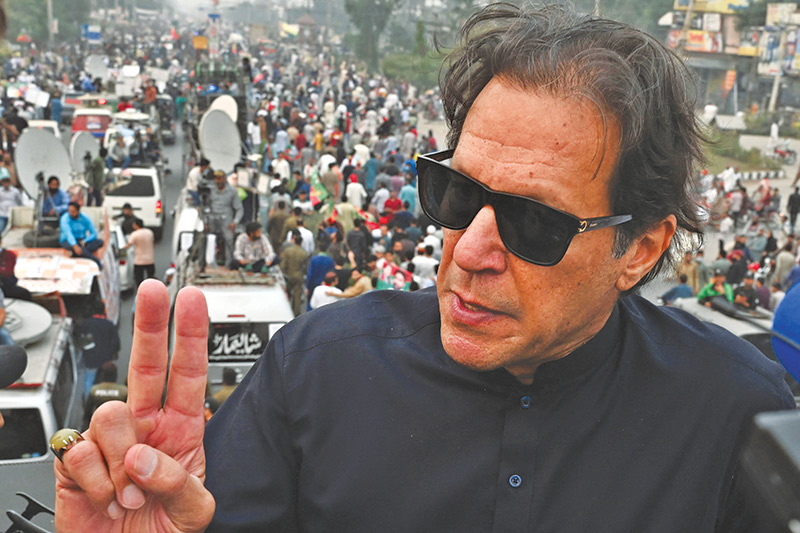
A file photo of Pakistan’s former prime minister Imran Khan. AFP/RSS
ISLAMABAD, Former Pakistan Prime Minister Imran Khan was in stable condition after being shot in the foot Thursday at a political rally in what the country’s president deemed “a heinous assassination attempt”. Khan has been leading a march since Friday from the city of Lahore towards the capital, Islamabad, campaigning for fresh elections after being ousted from office in April. Khan was wounded when shots were fired from the crowd near Gujranwala, his senior aide, Raoof Hasan, told AFP. “This was an attempt to kill him, to assassinate him,” Hasan said, adding that one alleged attacker had been shot dead and a second taken into police custody. In a tweet, Pakistan’s President Arif Alvi also called it “a heinous assassination attempt”. “I thank Allah that he is safe but injured with few bullets in his leg & hopefully non-critical,” he tweeted. Pakistan has been grappling with Islamist militants for decades, and politicians are frequently targeted by assassination attempts. In 2007 the nation’s first female leader Benazir Bhutto was slain in a suicide attack which still remains unsolved. Each day during his so-called “long march” 70 year-old Khan has mounted a shipping container towed by a lorry, making speeches from the open top to crowds of thousands in cities and towns along the way. The former international cricket star was booted from office in April by a no-confidence vote after defections by some of his coalition partners, but he retains mass public support in the South Asian country. Khan was voted into power in 2018 on an anti-corruption platform by an electorate tired of dynastic politics. But his mishandling of the economy—and falling out with a military accused of helping his rise—sealed his fate. Since then, he has railed against the establishment and Prime Minister Shehbaz Sharif’s government, which he says was imposed on Pakistan by a “conspiracy” involving the United States. Khan has repeatedly told supporters he was prepared to die for the country, and aides have long warned of unspecified threats made on his life.
WORLD
Russian shelling damaged nuclear plant power lines, Ukraine says
Generators have enough fuel to maintain the Zaporizhzhia Nuclear Plant for just 15 days.
- ASSOCIATED PRESS
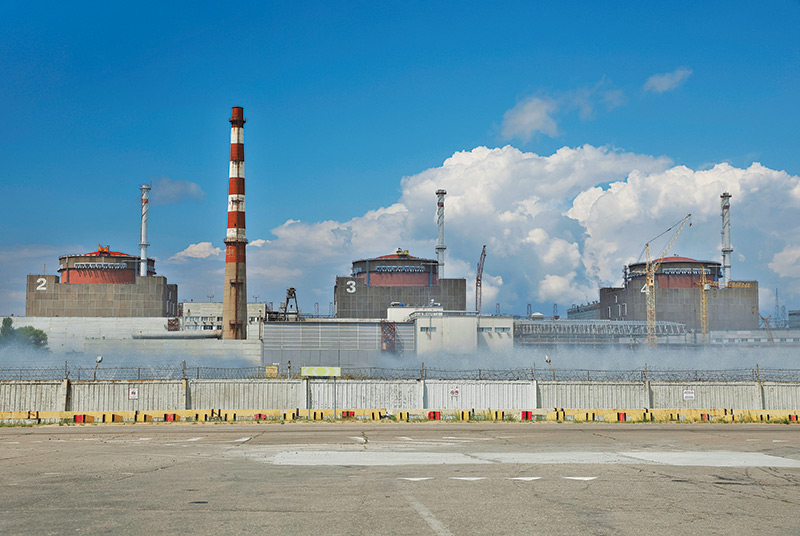
A file photo of the Zaporizhzhia Nuclear Power Plant in the Zaporizhzhia region, Ukraine. REUTERS
KYIV, Ukraine’s nuclear state operator said on Thursday that Russia has shelled and damaged power lines connecting Europe’s largest nuclear power plant to the Ukrainian grid, leaving the plant reliant on diesel generators again. The generators have enough fuel to maintain the Zaporizhzhia Nuclear Power Plant in southeastern Ukraine for just 15 days, Energoatom said in a post on its Telegram channel. “The countdown has begun,” Energoatom said, noting it had limited possibilities to “maintain the ZNPP in a safe mode,” raising fears of a potential nuclear disaster. With its six reactors inoperative, the plant relies on outside electricity to cool its spent fuel. Russia and Ukraine have traded blame for months amid the war for shelling at and around the plant that the UN’s nuclear watchdog has warned could cause a radiation emergency. The nuclear power plant lies within part of the Zaporizhzhia region that has been occupied by Russian forces since the early days of the war, which began when Russia invaded Ukraine on February 24. Although Russian President Vladimir Putin signed a decree transferring the plant to Russian ownership, Ukrainian workers continue to run the plant. Energoatom has repeatedly called for the withdrawal of Russian forces from the plant and the creation of a demilitarised zone around it. Energoatom said on Thursday that Russia had shelled two power lines that were connecting the plant to the Ukrainian grid overnight, and accused it of being “an attempt to reconnect the nuclear plant to the Russian power system.” The operator said the Russian side would try to repair the power lines in order to connect the plant to the Russian grid and therefore supply power to occupied Crimea and the parts of the eastern Ukrainian region of Donbas also currently controlled by Russia.
WORLD
Grief-stricken and angry parents bid goodbyes to Halloween disaster victims
- REUTERS
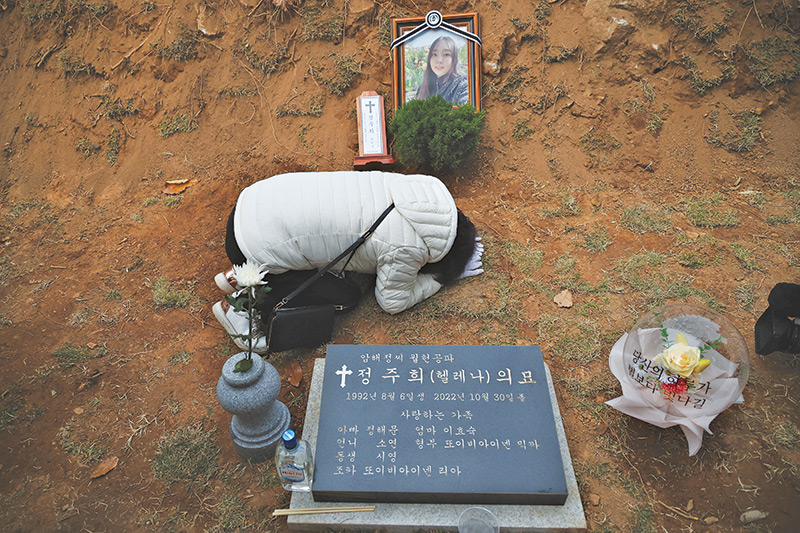
Lee Hyo-sook, 61, mother of Jung Joo-hee, 30, who was one of the victimsof a crowd crush that happened during Halloween festivities, grieves next to her daughter’s grave in Namyangju, South Korea on Thursday. REUTERS
SEOUL, “Dad, I’m going out” were the last words Jung Hae-moon heard his daughter utter, at the end of a chat they had on the telephone on Saturday as she turned down an invitation to dinner. Hours later, 30-year-old Jung Joo-hee was among 156 people, most of them in their teens and twenties, killed in the South Korean capital while celebrating Halloween free of Covid restrictions for the first time in three years. On Thursday, the young woman’s family buried her ashes in a peaceful family plot outside Seoul, with a planted sapling and bouquets by her grave stone and a sombre ceremony of prayers and tears. “Rest well. Mum and dad will come see you,” Jung Hae-moon said as the family stood by, together with his daughter’s pet poodle. As news of the disaster unfolded on Saturday, Jung Hae-moon dashed to Itaewon, a district of narrow streets full of bars and boutiques, to be met with chaos as distraught youngsters milled about in their Halloween costumes and rows of ambulances collected victims. More than 12 hours later, he found Joo-hee in a morgue, lifeless, swollen and bruised. Joo-hee’s mother, Lee Hyo-sook, said her daughter was a delight, a best friend who loved animals and wine. “The space she leaves is too big. The place she left in the family is too much, the emptiness,” Lee told Reuters after the funeral, speaking at a cafe that Joo-hee ran. The cafe is closed with a sign in black reading: “In mourning.” The anguish of Joo-hee’s family is being felt by all of the 156 bereaved families as a traditional three-day wake comes to an end and their loved one is placed in a coffin to be viewed for the last time before burial or cremation. Their grief is being shared by the county as a whole struggling to come to terms with the disaster that ended so many young lives on what should have been an evening of fun. Of the 156 dead, 101 were female, the government said. Another grieving father, Song Jae-woong, said his daughter, Young-ju, 24, was a gentle soul who was quick to befriend classmates, more than 200 of whom came to her funeral. Young-ju had dreamed of becoming an actress, her father said, speaking at a funeral home in Seoul. “Then, things turned out like this,” Song said. “Her friends told me that my daughter had a habit of seeking out and befriending anyone. She had a kind soul.” “It’s all over now.” Some families had no idea their children were even in the crowd in the Itaewon entertainment district on Saturday evening. “I had no idea she was there. It was impossible, I couldn’t believe it,” Lim’s father said at a funeral home as he and his family observed funeral rites. The father asked that he and his daughter be identified by just their family name, Lim. The man usually lives abroad and had not seen their only child for three years as Covid disrupted travel. He first heard of the disaster when an acquaintance sent him a text message about it, with neither knowing the daughter was caught up in it. Struggling with grief, he pulled out his telephone to show the message. “She was so creative and pretty,” the man said, adding that he had often strolled with his daughter through Itaewon. He used to park their car at the Hamilton Hotel next to the alley where Lim died. “I know that street very well.” For many parents, anger is seething with the grief. They wonder why their children were celebrating Halloween in the first place, a totally foreign concept for older Koreans. But the biggest question for many of those mourning their children is why no safety measures were enforced to control the crowd.
WORLD
Putin calls for modernisation of Russian military weapons
Briefing
- AGENCIES
MOSCOW: President Vladimir Putin said on Wednesday that the weapons used by Russia’s military should be modernised. “Weapons must constantly, continuously improve and remain effective. To achieve this, I repeat, it is important to ensure that there is active competition between manufacturers and developers,” Putin told a meeting of his co-ordination council.
WORLD
China says US has ‘no right’ to interfere in Hamburg port deal
Briefing
- AGENCIES
BEIJING: The U.S has “no right” to interfere in Chinese cooperation with Germany, China’s foreign ministry said Thursday, after Washington cautioned against Beijing getting a controlling stake in Hamburg’s port terminal. US interference is symptomatic of its practice of coercive diplomacy, foreign ministry spokesman Zhao Lijian told reporters at a daily briefing in Beijing. “Pragmatic cooperation between China and Germany is a matter for the two sovereign countries, the United States should not attack it without reason and has no right to meddle and interfere,” Zhao said Thursday, a day before German Chancellor Olaf Scholz was due in Beijing for a one day visit where he is expected to meet President Xi Jinping. Chinese shipping giant Cosco made a bid last year to take a 35 percent stake in one of logistics firm HHLA’s three terminals in Germany’s largest port, but Germany’s coalition was divided over the deal.
WORLD
G20 host Indonesia waiting to see if Putin will attend summit
Briefing
- AGENCIES
JAKARTA: G20 summit host Indonesia is waiting to see if Russian President Vladimir Putin will attend, Indonesia’s foreign minister said on Thursday, adding that differences over Ukraine had made preparations for the meeting particularly fraught. Indonesia’s presidency of the G20 this year and its preparations for the November 15-16 summit on Bali island have been overshadowed by the war in Ukraine and resulting food and energy crisis, with the world’s 20 most powerful economies disagreeing about how to respond to it. US President Joe Biden is due to attend.
SPORTS
Pakistan keep semi hopes alive
Shadab Khan’s all-round show helps the Pakistanis overcome South Africa by 33 runs in a dramatic rain-affected match in Sydney.
- AGENCE FRANCE-PRESSE
Pakistan’s Shadab Khan (second right) celebrates after dismissing SouthAfrica’s Aiden Markram during their ICC Men’s T20 World Cup cricket match in Sydney on Thursday. Ap/Rss
SYDNEY, Gutsy Pakistan kept their slim Twenty20 World Cup hopes alive with a 33-run win over South Africa in a dramatic rain-affected match at the Sydney Cricket Ground on Thursday. South Africa, who are still on course for the semi-finals, came out blazing after a rain delay saw their initial target of 186 adjusted down to 142, meaning they needed 73 runs in five overs. But the asking rate was too much and they finished on 108-9 at the end of a captivating match that had a bit of everything, from bad weather to good bowling and dropped catches. Their win means Pakistan can still reach the World Cup semi-finals if they win their last match against Bangladesh on Sunday and other results go their way. But they must rely on India or South Africa losing their final games. India face Zimbabwe and the Proteas play the Netherlands. Iftikhar Ahmed and Shadab Khan had rescued Pakistan with the bat with a superb 82-run partnership, their World Cup having looking dead and buried prior to that. Captain Babar Azam, who failed with the bat once again, was full of praise for his fighting side. “These are our best players and everyone is ready to play,” Azam said. “Everyone is a match-winner. Our first two matches were close losses, but we’ve given 100 percent in the last two matches and you never know, cricket is a funny game.” Iftikhar, who came to the crease with Pakistan in big trouble at 43-4, scored 51 off 35 balls and Shadab blazed 52 from 22 as Pakistan finished their innings at 185-9. Pakistan had looked headed for a certain early exit from the tournament as the South African seam attack tore through the top order. But Iftikhar stayed firm, sharing a 52-run partnership with Mohammad Nawaz before he and Shadab took the much-vaunted South African attack apart, taking the score from 95-5 to 177-6. After finishing strongly with the bat, the Pakistanis began well with the ball, Quinton de Kock chipping Shaheen Shah Afridi to Mohammad Haris at midwicket for a duck on the last ball of the first over. Afridi then removed the dangerous Rilee Rossouw for seven in his second over, caught by Naseem Shah on the third man boundary, leaving South Africa 16-2. South African captain Temba Bavuma has been struggling for form this tournament but he looked in great touch as he cruised to 36. He and Aiden Markram took the score to 65. But Shadab changed the game in his first over, the leg-spinner having Bavuma caught behind then bowling Markram through the gate one run later, leaving South Africa teetering at 66-4. The rain, which had been falling lightly on and off for much of the match in Sydney, then began to come down more heavily, forcing the players from the field with nine overs down. When they returned South Africa needed 73 runs in five overs, a target that proved too great. “It was definitely disappointing the way we ended our bowling and fielding,” Bavuma said. “Getting them four down early—we have questions to ask and need to come up with solutions. “We knew the weather could be an issue. We probably didn’t adapt quick enough. We want to put this game past us as quickly as possible and come again.” India top the group on six points, with South Africa second on five. Only the top two reach the semi-finals. Pakistan are third and Bangladesh fourth. They each have four points but Pakistan’s net run rate is superior.
SPORTS
Airee guides Police into PM Cup semi-finals
The captain takes 4-55 and scores 43 not out to lead the departmental team to a six-wicket win over Lumbini.
- Sports Bureau
Nepal Police Club’s Sunil Dhamala bats during the Prime Minister National One-Day Cricket Tournament against Lumbini at the TU Cricket Ground in Kirtipur on Thursday. Post Photo: Hemanta Shrestha
KATHMANDU, Nepal Police Club, on Thursday, advanced to the semi-finals of the Prime Minister Cup National One-Day Cricket Tournament after they defeated Lumbini Province by six wickets at the TU cricket ground, thanks to an all-round display by captain Dipendra Singh Airee. Airee took 4-55 to restrict Lumbini to 188 in 44.2 overs after they were sent in to bat first. The right-handed middle-order batter then smashed an unbeaten 43 to guide the departmental team to 192-4 in 37.1 overs. The win cemented Police’s position at the top of Group B with six points after three wins in as many matches and secured them a spot in the semi-finals. The top two sides from each group qualify for the last four. In another match played at the Mulpani cricket ground, Madhesh revived their PM Cup hopes with a 72-run win over Province 1. Lumbini have also played a match more than Madhesh, meaning their hopes of qualifying for the last four hang in the balance. At the TU Cricket Ground, Lumbini succumbed to their first defeat despite skipper Dev Khanal scoring a valiant 74. Lumbini had a terrible start to their innings after Karan KC had opener Aakash Tripathi caught behind for a duck on the fifth delivery of the first over. But Tripathi’s opening mate, Khanal, held his nerve and led the charge, hitting seven fours and two sixes in his 88-ball knock, which included a 59-run stand with Prajjwol Thapa. Thapa was trapped leg before wicket by Sagar Dhakal. Airee then removed Sandeep Rijali for 7, before Gulsan Jha took the prized wicket of Khanal on the second delivery of the 34th over. Bishal Bikram KC then tried to steady the innings with a 38-ball 30. But, after the fall of Khanal, Lumbini never recovered as they lost four wickets for just 14 runs with Airee claiming three wickets. Lalit Rajbanshi stopped any further progress removing Bikram KC, caught by Airee. Durgesh Gupta and Mohammad Husen scored 11 runs each to drag Lumbini to 188. In the chase, openers Sunil Dhamala played a quick-fire knock of 36 and Kushal Bhurtel scored 32, facing 41 deliveries, to give the Police a good start. Lumbini pacer Durgesh Gupta broke their 55-run stand for the first wicket, bowling Dhamala on the final delivery of the sixth over. Amit Shrestha then added 28 runs before Anil Kharel trapped him lbw in the 16th over. Bhurtel departed next, caught by Lumbini wicketkeeper Thapa. At the time, Police were already at 114-3. Airee continued his good form, putting on a 66-run stand with Aarif Sheikh, who made 35, to lead Police to victory. In the match played at Mulpani, sent in to bat first, Madhesh scored 214 runs in 48.1 overs on the back of a half century by wicketkeeper Anil Sah and then bowled out Province 1 for 142 runs in 43.1 overs. Though Madhesh made a shaky start to their innings, Sah scored 61 runs off 80 balls comprising five fours and a six. Sah shared a 68-run stand for the fourth wicket with Rohan BK, who contributed a 49-ball 28. Sah was trapped leg before by Province 1 captain Siddhant Lohani. Bibek Yada (32), Rupesh Singh (30) and captain Harishankar Shah (15) contributed for Madhesh. Province 1 bowler Firdosh Ansari grabbed five wickets in his 9.1 over bowling spell, conceding 34 runs. Lohani grabbed three wickets. Chasing the target, Province 1 lost wickets at regular intervals. Luv Kamat was the highest scorer for the team, scoring a 94-ball 29 while Bibek Anand Mehta contributed a 47-ball 25.
MEDLEY
Horoscope
ARIES (March 21-April 19) **** You may feel a bit hazy when you awaken this morning. Good vibes will flow later in the afternoon, reminding you to reach for the stars while holding onto hope. You may reclaim your energy levels just in time for the weekend.
TAURUS (April 20-May 20) *** Success and money will motivate you this morning which is perfect for creating solid foundations. Your social side will come out to play this afternoon. Be open to change as major shifts could manifest in your love life.
GEMINI (May 21-June 21) **** You may wake up feeling as though you’ve hit an energetic wall. Watch for microaggressions amongst your colleagues. Luckily, a helping hand will give you a chance to reclaim your sense of vitality and put you in a social mood.
CANCER (June 22-July 22) *** You’ll be deep in your thoughts and fantasies this morning. Though this cosmic climate will bring out your creative side, it could also put you in a quiet and antisocial mood. You will be in a passionate yet serious headspace.
LEO (July 23-August 22) *** The vibe may be off this morning. This cosmic climate could trigger weird dynamics within your professional and social sphere. Staying focused on your agenda can help you escape these wonky vibes.
VIRGO (August 23-September 22) **** This cosmic climate could leave you feeling off balance and unrested, so be extra compassionate with yourself. Luckily, a playful energy will help you distract yourself with a creative project or some flirting to boost morale.
LIBRA (September 23-October 22) *** You may feel frustrated with your responsibilities and to-do list this morning. Luckily, your productive nature will pay off later in the afternoon. Schedule an exciting date with that special someone this evening.
SCORPIO (October 23-November 21) *** You may feel as though your friends aren’t giving you the respect you deserve. Luckily, an empowering energy will provide you with an opportunity to stand up for yourself. Spend fun time with your pals this weekend.
SAGITTARIUS (November 22-December 21) *** You won’t feel like leaving the comfort of your home this morning. Luckily, a stabilizing energy will pull you out of this funk. Good vibes will bring warmth and love to your home. Plan a fun outing with your pals tonight.
CAPRICORN (December 22-January 19) **** You may become overstimulated by small details today. Luckily, order will be restored by mid-morning, helping you regain control of your disposition. Be sure to share your brilliant ideas if the opportunity presents itself.
AQUARIUS (January 20-February 18) *** You may have trouble appreciating your surroundings this morning. Try not to let small inconveniences throw off your mood. Take a moment for solitude. Small blessings are likely to manifest later this afternoon.
PISCES (February 19-March 20) *** You may feel moodier than usual this morning. Try to be mindful of your composure and word delivery. Luckily, cleansing energy will form by midmorning, helping you wipe the slate clean with your companions.
CULTURE & LIFESTYLE
Celebrating veganism at The Soaltee Kathmandu
The hotel’s ongoing Vegan Food Festival is its attempt to promote veganism and encourage restaurants and hotels to expand their vegan offerings.
- Isha Das
Chef de cuisine Vinay Singh (right) and chef de partie Rajaram Bidari ofThe Soaltee Kathmandu are the brains behind the hotel’s Vegan Food Festival. POST PHOTOS: KESHAV THAPA
Kathmandu On World Vegan Day on November 1, The Soaltee Kathmandu kicked off its ten-day-long Vegan Food Festival, which the hotel hopes will help spread knowledge and awareness about veganism. The hotel is also using the festival to promote the possibilities of plant-based dishes that replicate the texture and taste of meat. “A month ago, our hotel served as a venue partner for the Himalayan Vegan Festival. Many who took part in the festival suggested that we incorporate more vegan dishes into our menus,” says Agnimitra Sharma, executive assistant manager of F&B at The Soaltee Kathmandu. “This made sense because veganism is more popular than ever. We felt the need to cater to that demographic and work towards making The Soaltee Kathmandu a go-to place for vegans for quality food. So we decided to organise our very own vegan food festival and further spread awareness on veganism.” The food menu is at the heart of any food festival, and The Soaltee Kathmandu says its team spent considerable time and resources designing the menu. Rajaram Bidari, chef de partie at The Soaltee Kathmandu, designed the festival’s menu. Bidari has spent the entirety of his culinary career of 15 years with the hotel. “One of the areas we focused a lot on while designing the menu was creating vegan dishes that replicate the taste and texture of meat dishes,” says Bidari. “From the types of dishes, ingredients, and preparation time to types of utensils to serve the dishes, we went through each and every detail. We also conducted multiple tasting sessions before finalising the dishes.” The result of all that is a menu that features dishes like soya keema curry, vegan mutton curry, vegan chicken curry, eggless bhurji, and subz jalfrezi, among others. “The secret to making vegan dishes that taste like non-veg counterparts is by using the precise amount of plant protein and choosing the right spices and using them in the right quantity,” says Bidari. In terms of taste and texture, the dish featured in the festival that comes closest to its non-vegetarian counterpart is the eggless bhurji. Bidari and his team have used soya instead of eggs. Courtesy of the right amount of seasoning and the precise size of chopped soya, the eggless bhurji will most likely have you not miss eggs at all. The one ingredient that repeatedly features in the festival’s dishes is soya. Bidari says that the team decided to use soya not just because of how its texture could be cooked to closely represent different types of meat but also because of its inherent protein content. “The trick to making soya taste like meat or egg is preparing it by using the right amount of spices. Apart from natural spices, we have not used any artificial flavour to enhance the dishes’ taste and flavour,” says Bidari. Besides soybean-based dishes, the menu also features dishes like rajma masala, yellow dal tadka, mutter mushroom masala, vegetable biryani, quinoa and raisin salad, roasted tomato, bell pepper soup, etc. More than 90 percent of the dishes featured in the festival will be incorporated into the menu of Soaltee Kathmandu’s F&B outlets. “We hope the variety of vegan dishes we have featured in the festival will encourage other restaurants and food-serving venues to expand their vegan options in their respective menus,” says Sharma, a vegan. “This way, vegans like me do not have to always settle for a handful of dishes to choose from every time we go out to eat.”
What: Vegan Food Festival Where: Garden Terrace, The Soaltee Kathmandu When: November 1 to November 10, 12 pm to 10 pm Contact: 9801067222
CULTURE & LIFESTYLE
Climate activists get a month in prison for Vermeer protest
Johannes Vermeer’s iconic ‘Girl with a Pearl Earring’ painting was not damaged in the protest.
- ASSOCIATED PRESS
The Vermeer masterpiece ‘Girl with a Pearl Earring’ has become the latest artwork targetted by climate activists in a protest at the Mauritshuis museum in The Hague on October 27. AP/RSS
THE HAGUE, Netherlands Two Belgian activists who targeted Johannes Vermeer’s iconic “Girl with a Pearl Earring” painting in a climate protest last week were sentenced Wednesday to two months in prison, with prosecutors saying their action “crossed a line” of acceptable protest. Half of the sentence was suspended by a judge in The Hague, meaning the men will serve one month. A third suspect is due in court on Friday. One man glued his head to glass protecting the 17th-century masterpiece at the Mauritshuis museum in The Hague while another poured a can of thickened tomato soup over his head. The second man, wearing a T-shirt emblazoned with the words “Just Stop Oil,” then glued his hand to the wall next to the painting. A third man filmed the protest. The painting was not damaged, but the glass covering it had to be replaced, and the protest caused other minor damage, prosecutors said. The painting was returned to its wall a day later. Vermeer was not a prolific artist and just about three dozen of his paintings have survived, displayed in museums and galleries in various countries. In a statement, prosecutors in The Hague said that the activists’ “goal, however important you consider it, does not justify the means.” The prosecutors had demanded four-month sentences, saying they wanted to send a message that “paintings hang in museums to be enjoyed, not exploited for activist ends. You keep your hands off them.” Earlier this month, climate protesters threw mashed potatoes at a Claude Monet painting in a German museum and a similar protest happened in London, where protesters threw soup over Vincent van Gogh’s “Sunflowers” in the National Gallery. In both those cases, the paintings were not damaged.