You internet speed is slow. Switch to text view mode

Switch
epaper logo
ST

Last Login:
Logout
+
Page 1
HOME PAGE

Victjavascript:void(0);ims of Madhesh movement left to fend for themselves
Seven years after their revolt, many survivors struggle to meet basic needs.
- NISHAN KHATIWADA,BHUSAN YADAV,UMESH CHAUHAN
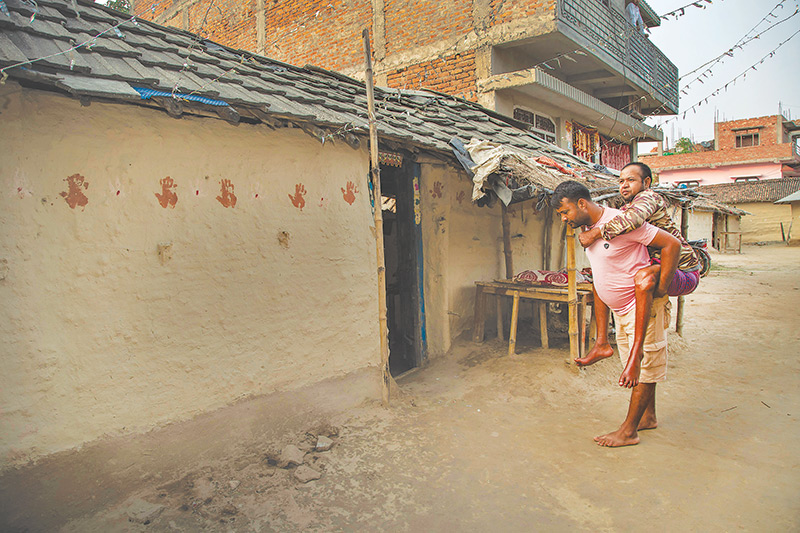
Bachcha Patel carries his older brother Munsi at their home in Gahi, Birgunj.   Post Photo: Prakash Chandra Timilsena

BIRGUNJ,
The victims of the Madhesh uprising are languishing in abject penury despite repeated assurances of compensation and rehabilitation by leaders across the political spectrum.
They are leading a miserable and painful life—struggling to secure two meals a day. Neither the provincial government nor the Madhesh-based parties, or the major political parties for that matter, have bothered to address their woes.
It’s been seven years since the Madhesh uprising of 2015 when many protesters were shot dead, while some others succumbed to their injuries. Still others who were seriously hurt eventually became physically disabled.
“Kathmandu has tricked Madhesh. Let’s join the movement for our rights even by risking our lives,” the then chair of the Sadbhawana Party, Rajendra Mahato, announced in the third week of August, 2015 just before the promulgation of the constitution. “If someone is martyred in the process, the government to be formed after the movement will provide Rs5 million to each victim and guarantee free education for their children and employment for their family members.”
In their 2017 election manifestos, Mahato’s Rastriya Janata Party and its partner Sanghiya Samajbadi Forum had made similar promises: “The martyrs of the Madhesh uprising will get Rs5 million each. For the injured, we will guarantee the honour of a living martyr, employment, and education for their children.”
On the day of the constitution promulgation on September 20, Munsi Patel from Bagahi in Birgunj Municipality-28 was hit by a bullet while protesting near Geeta Mandir in Birgunj.
He now is unable to walk or stand—he can only lie down or sit on the bed outside his house.
Patel got involved in the movement as he, along with many others, believed the constitution, which was going to be promulgated, had undermined the Madheshi people and their rights.
Even though the school was only 50 metres from his home, he could not attend it for want of finances. Financially weak, all four of the family’s sons, including Munsi, became daily-wage labourers.
Patel is unaware of his age. When asked how old he is, he just showed his citizenship card.

Kusumidevi Patel, mother of Satrughan, who died in Madhesh uprising of 2015. Post Photo: Prakash Chandra Timilsena


He had three children, but none survived. He even doesn’t remember the date of his marriage. “I got married in the year of the royal massacre in Kathmandu.”
Patel hopes political leaders would help him lead a normal life and feed his family. He doesn’t have the laalpurja [land registration certificate] of his house. His father had purchased a house from a moneylender named Madhav Shah back in 1971, but he is yet to get the laalpurja.
When he was shot at, he was first taken to Bir Hospital in Kathmandu, and later shifted to the Sushma Koirala Memorial Hospital. After that, he was brought to the Narayani Hospital in Birgunj and then taken to Delhi for further treatment.
Lying in his bed, he recounts the days when he actively participated in the Madhesh protests and the years of his struggle after getting bullet injuries. After seven years of the Madhesh movement and five years of Madheshi parties’ rule in the province, Patel has come to a conclusion, “Leaders only promise, never deliver.”
But Patel still hopes that the leaders from Madhesh, who have enjoyed power, will help him build a house for the family: “That is the least they can do.” He said the financial support he got from the government was not adequate. “They provided Rs300,000 twice. The money was spent on repaying loans. Once a loan is paid, another gets added. It would be better if they provided us monthly allowances.” He has been requesting for the same quite a few times, but to no avail.
In Patel’s view, the agenda raised by the Madhesh movement is yet to be addressed. “The leaders became ministers, lawmakers and chief ministers, but we are still landless. Even though a government was formed in the Madhesh, it has done nothing for us.”
Ranvir Singh Rajput, a resident of Hajminia in Rajdevi Municipality-5, has not been able to work to provide for his family after he was hit by a bullet in the Madhesh movement. His is a family of four—two children besides him and his wife—and he is struggling to run his family household.
Before the incident in which he was hit by a bullet at the Ram Krishna Mandir near Nandini hotel, he used to work as a lift operator in India, but now he can’t due to the bullet injury.
His wife works at a nearby school named Aadharbhoot Vidyalaya in Harminiya where she earns a monthly salary of Rs 10,000.
“No Madhesh-based party came to my help after I was injured during the Madhesh movement,” said Rajput. He reached out to the local and provincial leaders and even met the chief minister of the Madhesh province. “Once, I didn’t even have enough to feed
the family.”
He is losing his eyesight and has swelling in his joints. There is also a problem with his digestion. The Madhesh government did not respond to his plea, and none of the provincial leaders sympathised with him, he said. “I am in this pitiful situation because of the Madhesh provincial government. They simply don’t care.”
Suffering from extreme hunger, Rajput threatened the provincial government that he would commit suicide. “We don’t have access to the central government. But even the provincial government lent us a deaf ear.”
According to Rajput, the Madhesh-based parties do little, and are only good at bargaining for a share in the federal government.
Jitendra Prasad Yadav, from Kalaiya-12 of Bara, is now fifth in number in the list of proportional representation (PR) candidates from the Janata Samajbadi Party Nepal. He was also badly injured during the 2007 Madhesh movement.
That year, he led a protest against the killing of his leader and friend, Majid Miya, in the Madhesh uprising a day before. The administration had imposed a curfew at the time. They defied the curfew and performed Miya’s cremation rites. While they were returning home after doing so, they clashed with the police.
The police started firing and he got hit by a bullet. Yadav’s urine bladder burst. He now limps while walking and takes painkillers to ease the constant pain.
“Though the party leaders say I am a living martyr, neither the state nor the party has supported me financially or provided me any benefits,” Yadav said. “I also suspect that the inclusion of my name in the proportional representation list is merely a lollipop that I will never get to taste.”
Not all those who were injured by bullets in the Madhesh uprising returned home alive. On the same day Munsi Patel was injured, 20-year-old Satrughan Patel from Pakaha Mainpur also received a bullet near the Geeta Mandir in Birgunj. He did not survive.
Patel had just returned from Delhi when he joined his local friends in the protests.
“We got a call from his mobile. He was taken to the hospital. But he died before he could be treated,” his mother Kusumidevi recalls.
Two years after Patel’s death, the Sanghiya Samajbadi Forum made Patel’s mother, Kusumidevi, a candidate for the deputy chair of a rural municipality in the 2017 local polls. She got elected but her role was limited to doing formalities. She was not given any meaningful work by the rural municipality chair. “They had made me a candidate only to cash in on the public sympathy for the mother of a martyr,” said Kusumidevi.
After she was left out of the decision-making process, she had complained about it with party chair Upendra Yadav, then led a group of protestors against the rural municipality chair Vijaya Chaurasiya, before registering a case at the court. Nothing worked. She lost. Now she concludes, “Yi Rajanity Ham Naakaresakem.” (“Politics is not my cup of tea.”)
She is now fed up with politics. She played no part in the last local polls nor is she now engaged in any electioneering.
Lalbabu Patel from Tikuliya in Gaur Municipality-4 was injured in the Madhesh movement. In return, the government provided him with a water buffalo. He was frustrated with the corruption even in water buffalo distribution. “The buffaloes were given to us and they made a bill [invoice] of Rs175,000 for each animal,” he said. But they were so weak that he could sell his for only Rs50,000, while others could get no more than Rs25,000.
Patel was hit in the spinal cord in Gaur violence on September 13, 2015. He was treated in Birgunj, Kathmandu, and Delhi. He is still incapable of sitting up and working.
The Madhesh province government, however, claims that they have adequately compensated the victims of the Madhesh uprising.
Internal Affairs and Information Minister of the Madhesh Province Bharat Shah said, “It is human nature to be never satisfied.” He claimed the government had helped treat the injured and to provide skill-training to the family of the martyrs. “If they need any more assistance, we are ready for that as well.”
Federal government officials also claim to be sensitive to the needs of the Madhesh uprising’s injured and martyrs’ families. “We have provided an equal amount of financial assistance, that is Rs1 million each, for the families of those martyred during the Madhesh movement as well as the Jana Andolan [April 2006 movement],” said spokesperson of the Home Ministry, Phadindra Mani Pokharel.
The two Madhesh-based parties—Rastriya Janata Party and Sanghiya Samajbadi Party—had fought the 2017 elections together in the Madhesh province.
They won 19 federal seats—compared to 13 by Nepali Congress, Maoists and the UML combined.
They dominated the provincial elections too, winning 44 seats and forming the provincial government.
In the past seven years, the Madhesh-based parties went through several splits and mergers and are now largely represented by the Janata Samajbadi Party and the Loktantrik Samajbadi Party.
But they failed to do justice to the movement’s victims.
“In every political movement, the poor are at the forefront, and in clashes, they mostly become victims. Compensating and helping them has never been any party’s priority,” said Tula Narayan Shah, a political analyst and a close observer of Madhesh
politics.
The Madhesh-based parties had gotten votes by promising to provide compensation, free education, and jobs to the people in Madhesh. “They have done the movement grave injustice by breaking their promise,” Shah said.

HOME PAGE

Senior Chinese official coming today despite Nepal’s reservations

Delegation plans to tour heritage sites including those being restored with Chinese assistance ahead of major elections.
- ANIL GIRI
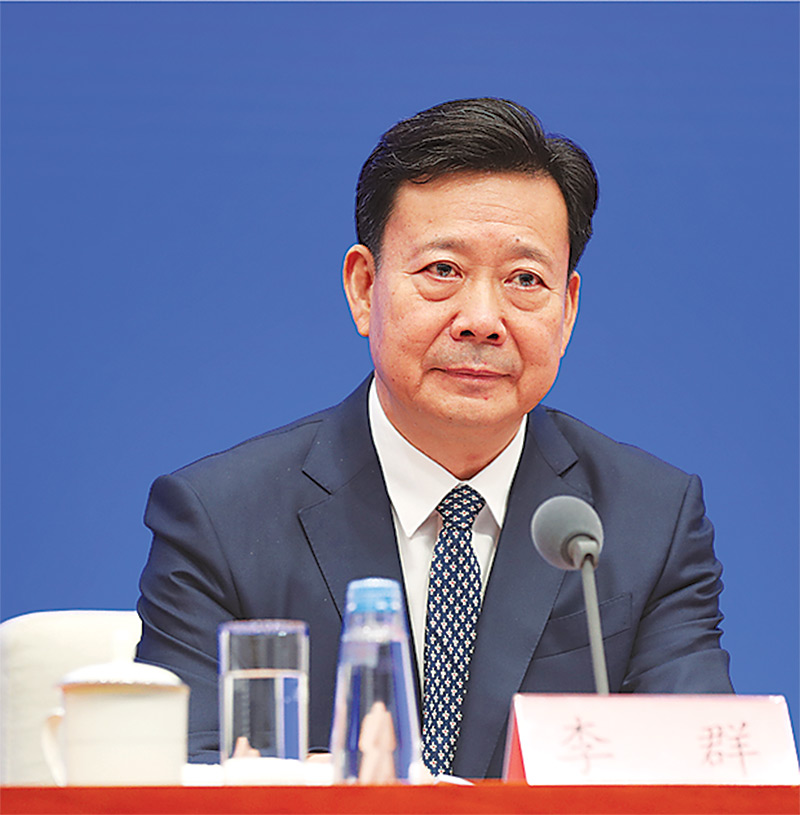
Chinese Vice Minister Li Qun.   Photo courtesy: scio.gov.cn

KATHMANDU,
Despite reservations from the government, Chinese Vice Minister for Culture and Tourism Li Qun, who is also the head of the National Cultural Heritage Administration, is visiting Nepal on Friday on a five-day visit.
In view of the approaching federal and provincial elections, the Ministry of Foreign Affairs had advised the Chinese embassy in Kathmandu to postpone the visit until after the elections, but the Chinese side insisted that the trip would be purely “personal” and involve visits to cultural heritage sites, officials at the Ministry of Foreign Affairs and Ministry of Culture, Tourism and Civil Aviation, told the Post. The Nepali embassy in Beijing is not aware of the visit.
The Prime Minister’s Office was also against receiving foreign dignitaries ahead of the elections as most leaders are busy electioneering and as the government is a caretaker one. It had advised the Ministry of Foreign Affairs to reschedule the visit, if possible. “But the Chinese side insisted on coming on schedule,” a senior official at the PMO said, requesting anonymity.
“Prime Minister Sher Bahadur Deuba has stopped meeting foreign dignitaries after the start of the election campaign,” another official at the PMO said, adding, “The visitors should understand that pre-election is not the right time to visit given our leaders’ busy schedules.”
But Director General at Department of Archaeology Damodar Gautam told the Post that the Chinese vice-minister is coming at the invitation of the government of Nepal and he will visit some cultural heritage sites that were damaged or destroyed by 2015 earthquakes and are being restored with Chinese government’s help.
With the election code of conduct in effect, the government cannot sign any agreement with foreign countries as such accords can potentially influence elections. Meetings with foreign diplomats have also been cut down significantly as such interactions could be interpreted as signs of foreign influence.
On Friday, the Chinese delegation will land at the Tribhuvan International Airport at 10:30 PM, but no welcome ceremony
is planned. The Chinese delegation will then leave for Hotel Soaltee and there is no official engagement on Friday, as per the itinerary.
On Saturday, the Chinese delegation led by Vice Minister Li will visit Kathmandu Durbar Square and inspect the heritage site. The Chinese Academy of Cultural Heritage and Nepali sides jointly reconstructed the Basantapur Palace complex which earlier served as one of the oldest museums in Kathmandu.
In the afternoon, the Chinese delegation will visit the China Cultural Centre at Maharajgunj which imparts training to Nepali citizens on Chinese culture, art, literature and language. After that, the delegation will visit the Chinese embassy, Kathmandu.
On Sunday, the Chinese entourage will visit and inspect the Bhaktapur Durbar Square. Later in the same afternoon, it will inspect the nine-storey Basantapur Palace Complex Restoration Project at Kathmandu Durbar Square. Accompanying the Chinese delegation at Basantapur will be Minister for Culture, Tourism and Civil Aviation Jeevan Ram Shrestha.
“The Chinese side has recently completed the restoration of the nine-storey Basantapur palace complex and has promised to support the rehabilitation of other quake-damaged structures including those at Bhaktapur Durbar Square and the Nuwakot palace in Nuwakot district, said Gautam,” adding, “We will sign the memorandum of understanding on the restoration of these heritage and cultural sites after the elections.”
In the same evening, on Sunday, the Chinese officials will visit Swayambhunath, and on Monday, they will visit the Patan Durbar Square and the national museum at Pashupatinath. On Tuesday morning, the Chinese delegation will leave for Hong Kong.
Officials said they are not aware of possible meetings between Li and Nepali leaders. “We have been told the visit is purely personal and informal where the Chinese delegation will visit some cultural heritage sites in Kathmandu, Lalitpur and Bhaktapur,” the foreign ministry official said. Former diplomats said it is inappropriate to host foreigner leaders and diplomats ahead of elections.
“First of all, those who are coming here should understand that elections are just over a week away and everyone is busy,” said former foreign secretary and ambassador, Madhuraman Acharya, adding, “If they don’t understand, we should postpone such visits citing elections.” “The failure to do so is suggestive of our helplessness and lack of independence on such matters,” said Acharya.

HOME PAGE

Broadcasters say ban on extra fees has put them in dilemma

Media Hub, which has obtained the rights to broadcast the FIFA World Cup event, says subscribers will have to pay Rs500 more.
- KRISHANA PRASAIN
Broadcaster says all preparations to air the World Cup have been halted.  Shutterstock

KATHMANDU,
The Supreme Court’s order to television channels not to charge their subscribers extra to watch the football World Cup has put them in a dilemma as advertising revenues do not cover the rights fees, they say.
The 2022 FIFA Qatar World Cup gets underway on November 20 with hosts Qatar taking on Ecuador. Billions watch the live coverage of the four-yearly extravaganza on television, making it the most watched sporting event in the world.
Media Hub, which has obtained exclusive broadcast rights to the FIFA World Cup, has decided to charge Rs500 extra from customers stating that domestic advertisements do not cover their costs.
The matches will be shown live on Himalayan TV, and it has announced that viewers will have to pay extra to access the World Cup.    
On Tuesday, a single bench of Justice Prakashman Singh Raut issued the interim order, and the final verdict is due on November 16, four days before the kick-off.
Advocates Kishor Poudel and Anupam Bhattarai had filed a writ petition stating that Nepalis didn’t have to pay extra to watch previous World Cups, and demanding additional fees this time was unlawful.
“All preparation work has come to a stop after the court order,” said Siddhartha Dhital, marketing director at Media Hub.
“If we wait for the court’s final verdict—which may or may not be in our favour—we will not have enough time to complete the preparations. There is a lot of technical stuff, and we don’t know what to do.”

A traveller stands next to a giant football in the new central concourse building at the Hamad International Airport on Thursday, in Doha. AFP/Rss


Dhital says it is not possible to broadcast to the world without charging customers. “If the court’s decision stays, we might not be able to broadcast the match.”  
He said that Media Hub had already paid $1.5 million to Viacom 18 India, including taxes to the Nepal government, to broadcast the games. The tournament final is scheduled to be held on December 18.
Dhital estimates their total expenses to broadcast the World Cup will come to Rs400 million. “Revenues from domestic commercials are not sufficient to cover the cost. So we have to make up for the shortfall by charging the customers.”
International media reports say that the Qatar World Cup will be the most expensive World Cup ever. The total cost of hosting the tournament is reported to be around $220 billion, around 20 times higher than the cost of the previous World Cup held in Russia.
“Customers of Net TV and Via TV have started making payments to watch the live broadcasts,” Dhital said.
“The issue has been misunderstood. It is not mandatory to pay extra fees. Viewers who do not wish to pay more can watch other channels but not the World Cup matches,” he said.
For the first time in history, a Middle Eastern country is hosting the World Cup football. A total of 64 matches will be played during the month-long competition.
According to lawyers the Post talked to, there should not be a monopoly in the market.
“As Media Hub has obtained exclusive rights to broadcast the FIFA World Cup, it is not fair to charge extra,” they said. “It is essential to see whether the exclusive rights secured by the companies impact the market. Monopoly should not prevail in
the market.”
Consumer rights activists say it is unfair to charge customers extra to watch the World Cup as they have paid their service providers the regular charges.
Prem Lal Maharjan, president of the National Consumer Forum, said that nobody can charge extra against the interest of customers.
“It’s against the law to charge extra. It is like cheating customers. They cannot charge more in order to recover their investment,” Maharjan said.
“Subscribers have been watching the television programmes by making advance payment. They need not pay more.”
Football fans around the world have criticised the high prices of the tickets to the World Cup matches.
Fan groups across Europe have accused FIFA of “hammering” supporters by hiking ticket prices in the “most expensive World Cup” ever.
The most expensive tickets on general sale for the December 18 final at Lusail Stadium cost 5,850 Qatari riyals (£1,179), which is 46 percent higher than the £807 ticket price for the 2018 final won by France.

Page 2
NATIONAL

Electioneering leaders ignore policy issues, trade blows in blame game

Political parties lack a clear vision for development, say analysts.
- PURUSHOTTAM POUDEL
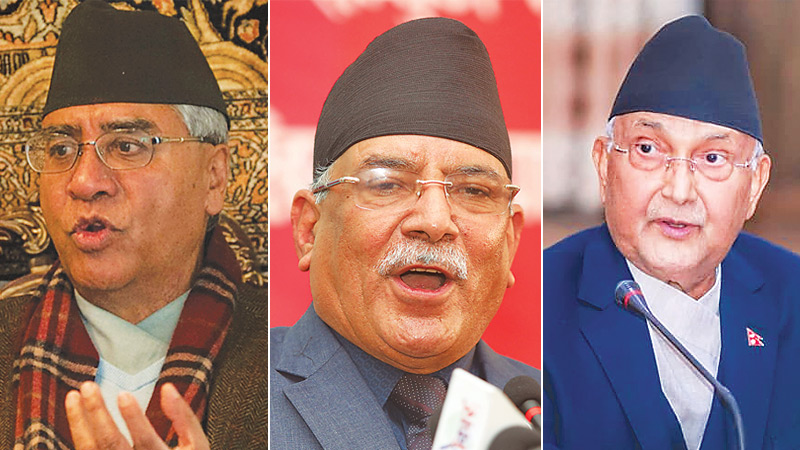
(From left) Congress chief Sher Bahadur Deuba, UML chair KP Oli and Maoist Centre chief Pushpa Kamal Dahal.   Post File Photos

KATHMANDU,
Election campaigns this time are fraught with negativity with political parties and candidates spending more of their energy on pointing fingers at rivals than presenting to the voters their own strengths, vision and policies.
The chiefs of three big parties—the CPN-UML, the Nepali Congress and the CPN (Maoist Centre)—are claiming they had the key role in incorporating the updated map of Nepal that included Lipulek, Limpiyadhura and Kalapani into the constitution.
Congress President and Prime Minister Sher Bahadur Deuba and UML chair KP Sharma Oli were already claiming credit for the Lipulek-Limpiyadhura-Kalapani map. Maoist Centre chair Pushpa Kamal Dahal joined the shouting match on Wednesday.
While inaugurating the party’s election campaign in Darchula, Oli announced that he would not “allow a single inch of our land to be encroached upon”.
A day after Oli’s announcement, Deuba reached his home district Dadeldhura in the far west and answered Oli saying that “making a statement in Darchula won’t help a bit”.
Addressing a campaign rally of the ruling alliance in Darchula on Wednesday, Dahal lashed out at Oli. Instead of introducing his party’s policies to the public, Dahal challenged Oli, saying that he would not be prime minister for the third time.
“I am ashamed to know that Oli still wants a majority in the elections to form the government,” Dahal told the mass meeting. “How he has the moral standing to again demand a majority in parliament even though he tried his best to dissolve the parliament, twice. I challenge Oli to become prime minister for the third time.”
Dahal often claims that Oli became prime minister with his support, both times but now, he said, he wouldn’t support him.
Darchula’s is just a case in point as to how leaders are engaged in blame games instead of coming up with new ideas and convincing voters with their proposals.
The parties that have raised issues of inclusion and participatory system previously, have remained conspicuously silent on these issues during their election campaigns. There are so many other pressing issues concerning the general people’s livelihoods that require policy formulation. Yet, the political parties are focused only on criticising their opponents in their election campaigns.
There are numerous agendas that need political action such as the issue of creating employment opportunities. Political parties frequently make tall claims to provide job opportunities in the country. Even though the election date (November 20) is drawing closer, thousands of youths are migrating from Nepal, seeking foreign employment. The leaders, meanwhile, have no time to address what’s forcing the people to migrate and whether they could have found the right employment opportunities right here, said labour migration specialist, Ganesh Gurung.
“During the election campaign, political parties are more ritualistic in explaining their policies and agenda,” Gurung told the Post. “While parties have emphasised on giving a free ticket to those going for overseas jobs, they lack a coherent policy.”
Last week when Deuba was addressing a mass gathering in his constituency in Dadeldhura, he spent more time criticising the Oli-led administration. His election campaign merely touches upon some policy issues and that his party would deliver on them, if it won the elections.  
“After the Oli-led government dissolved the parliament twice, we were forced to build the incumbent ruling alliance to topple his government, and the alliance will form the next government as well,” Deuba stated during his Dadeldhura’s election campaign on November 5. While criticising Oli, Deuba said that Oli’s visit to Darchula will not bring back Nepal’s encroached territory.
On November 4, while in Darchula, Oli accused the ruling alliance of having ‘no policy’ in their manifestos. He spent more time attacking the alliance than discussing his own policies.
While addressing an election campaign in Dhangadhi on November 6, Prime Minister Deuba accused the CPN-UML chair Oli and the government led by him. Deuba reiterated the dissolution of parliament as the reason for his becoming the prime minister.
“There is no provision in the constitution where the prime minister can dissolve Parliament,” said Deuba. “All the parties who were against such a move by Oli, united to form the government under the leadership of the Congress.” “The coalition has no policies, no direction and no destination,” said Oli while addressing another rally in Baitadi adding, “The coalition is attempting to loot the country.”
While he criticised the ruling coalition, which is contesting the election by forming an alliance, Oli could not give any convincing grounds as to how he would change the country through his party’s policies and programmes. “When Dahal was unable to loot the country during my premiership, he joined Deuba to form the government under Congress’ leadership,” said Oli, accusing Dahal while addressing an election rally in Kanchanpur on November 4, before leaving for Darchula.
Similarly, while addressing the election campaign of Baglung on November 7,  Oli branded Prime Minister Deuba a liar. “Prime Minister Deuba has lied to the people, saying that his government has found a diplomatic channel to dissolve the border issue. The incumbent ruling alliance does not have the capacity to hold a diplomatic dialogue with India.”  
Oli has planned to address some 40 mass gatherings during his current election campaign. It is presumed that his election campaigns will target the ruling alliance.
Blame game is not a new technique in Nepali politics. Political analysts also believe that the politicians often want to cover up their wrongdoings while highlighting the flaws of the opponents.
“We’ve been witnessing blame-game politics in the country for a long time,” political scientist Bhaskar Gautam told the Post. “Blaming each other has become more of an electoral norm for our political parties rather than discussing policy issues.”
While criticising the Oli-led administration, the ruling coalition has laid emphasis on his attempts to dissolve the parliament, twice. Corruption in the procurement of wide-body planes and the failure to successfully control the Covid-19 outbreak are some of the key issues in the ruling alliance’s election campaign.
While listening to the parties in election campaigns, it has become clear that the political parties have fallen short on their own policies, say political analysts. There are numerous challenges in society that must be addressed, and these need policy formulations. The analysts said they were disappointed to see that the leaders often level allegations against each other rather than debating on policy issues.
“It’s evident that our political parties lack a clear vision on policy matters,” political analyst Mina Poudel told the Post. “Because political parties have no objective and clear agenda, they engage in blame games.”

NATIONAL

Businesspersons demonstrate against interest hike

Briefing

DHANUSHA: Businesspersons in Janakpur have taken to the streets against an increase in interest rates by banks and financial institutions. A group of businesspersons led by the Janakpurdham Chamber of Commerce and Industry, protested on Thursday, carrying placards with slogans such as “Maintain stable interest rates” and “Limit interest rates to a single digit”, among others. They also submitted a memorandum to Madhesh Province Finance Ministry through the Chief District Officer. Jitendra Kumar Mahaseth, president of Janakpurdham Chamber of Commerce and Industry, said they resorted to agitation as the businesses are on the brink of closure as financial institutions have been charging interest rates “exorbitantly”. Mahaseth said their 12 points demands mentioned in the memorandum include limiting interest rates to a single digit and allowing banks to charge an additional premium as per risks being based on spread rate.

NATIONAL

Eight injured in tractor accident in Salyan

Briefing

SALYAN: Eight people were injured in a tractor accident near Rajai River on Thursday. Among the injured, four are in critical condition. According to police, the accident took place at around 11 am in Bangad Kupinde Municipality-10 of Salyan All the passengers in the tractor are from Thapachaur, Bangad Kupinde-10 and the injured have been sent to the provincial hospital at Kalagaon in Surkhet for treatment. “There were nine people on the tractor including the driver, who is on the run,” said Police inspector Santosh Khanal, information officer of District Police Office Salyan.

Page 3
NATIONAL

Parties regularly mention transitional justice in manifesto but progress dismal

Conflict victims say they are fed up with unfulfilled promises.
- BINOD GHIMIRE
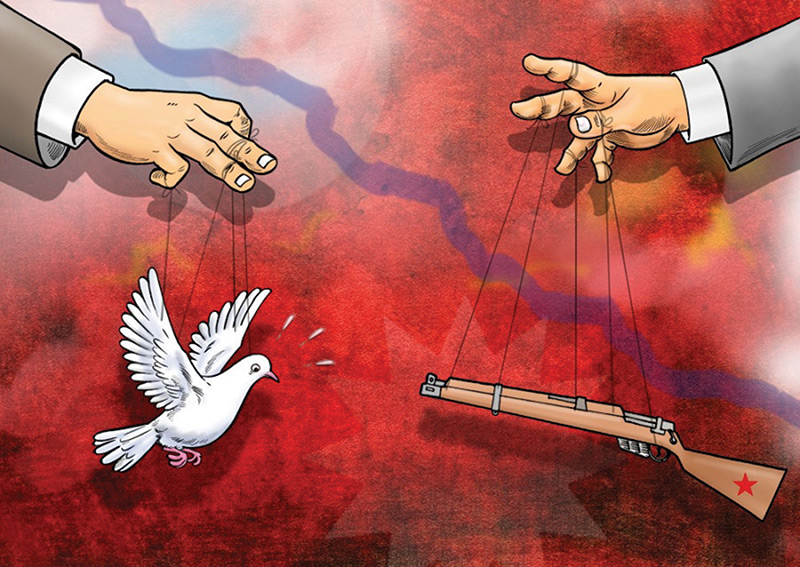
POST ILLUSTRATION

KATHMANDU,
Conclusion of the transitional justice process with an immediate effect was one of the major points in the Comprehensive Peace Accord signed between the government and the revolutionary CPN (Maoist) in 2006.
For the last 16 years, the parties have been making public commitments to concluding the process without delay. Such pledges are repeated ahead of the elections or while forming a new government. The upcoming federal and provincial assembly elections are no exception.
Concluding the remaining task of transitional justice is the commitment of all major parties expressed through their election manifestos. The CPN-UML manifesto has listed completing the remaining tasks of the peace process and transitional justice among the 20 of its major assurances.
It has said the party will provide medical treatment, employment, self-employment opportunities and rehabilitation to the injured and those disabled by the insurgency. “There will be compensation, rehabilitation and reparations to the insurgency victim families in addition to the assurance of justice and protection to the victims,” reads a pledge from its manifesto.
Similarly, the CPN (Maoist Centre) has listed transitional justice as one of three major tasks of the peace process. The integration of former Maoist combatants in security forces and promulgation of a new constitution that were parts of the peace process have been completed, but the peace process is still inconclusive as the transitional justice process remains incomplete, according to its manifesto.
 “The entire peace process will conclude once the Truth and Reconciliation Commission and the Commission of Investigation on Enforced Disappeared Persons complete their works,” says the manifesto. “Due priority will be given to concluding the transitional justice process with a focus on national reconciliation, bringing sustainable peace, and delivering justice to the victims.”
While the manifestos of the UML and the Maoist Centre have dedicated a couple of paragraphs to transitional justice, the ruling Nepali Congress has summed up the issue in just one sentence. The Congress manifesto says, “Completing the remaining tasks of transitional justice in line with the Comprehensive Peace Accord” is one of its priorities.
The three parties have been leading the government by turns since the peace deal. However, other than forming two commissions—the Truth and Reconciliation Commission and the Commission of the Investigation on Enforced Disappeared Persons—nothing tangible has been done towards providing justice to the thousands of victims from the insurgency that lasted for a decade from 1996.
Human rights activists say it is good that the parties have not forgotten the issue, however, the commitments on paper make no sense unless they get translated into actions. They say given the track record of the parties, it is hard to believe the commitments made in their election manifestos.
Charan Prasai, a human rights activist, says if the parties were even bothered a little about the victims, they would have amended the Enforced Disappearance Enquiry, Truth and Reconciliation Act, 2014.
The Supreme Court in February 2015 had directed the government to revise the amnesty provisions in the Enforced Disappearances Enquiry, Truth and Reconciliation Commission Act, 2014 in compliance with international principles and Nepal’s international obligations to human rights. However, close to eight years since the verdict, successive governments have done a little to amend the Act.
“Transitional justice has always found a place in the manifestos before every election, but when the parties reach to power they have been ignoring the topic. “This is just a strategy to appease the victims during elections,” Charan Prasai, a human rights activist, told the Post.
“We have been seeing that no party is committed to providing justice to the victims.” He says the politicisation in the formation of the two commissions have killed the hopes that the parties would work towards providing justice to the victims.
The truth commission has received 63,792 complaints since its formation in February 2015. Similarly, the disappearance commission has received 3,223 complaints of enforced disappearances at the hands of state security forces and the Maoists. After a preliminary investigation, the commission has identified 2,484 cases as genuine although the International Committee of the Red Cross says 1,333 people are still missing in connection with the armed conflict.
Other than conducting preliminary investigation in some of the complaints, there has been no progress towards providing justice to the victims. In the view of conflict victims, they are fed up with the unfulfilled promises. They say they have little hope that the parties will implement their pledges made in election manifestos. “These parties have always cheated the victims. They have always used us as vote banks in every election,” Janak Raut, a former general secretary of the Conflict Victims Common Platform, told the Post. “Their past deeds give no room for us to be hopeful.”

NATIONAL

Limbu of Congress files candidacy from Morang-3 (a)

Briefing

KATHMANDU: Nepali Congress leader Man Bahadur Limbu on Thursday filed his candidacy for the provincial assembly polls from Morang-3 (a). Limbu registered his candidature as per the revised election timetable published by the Election Commission following the death of a candidate contesting the November 20 polls from the party. NC fielded Limbu after Province 1 Minister for Forest, Environment and Soil Conservation Shekhar Chandra Thapa, who was contesting the polls, died on Wednesday. Thapa was undergoing treatment for dengue and pneumonia infection at Biratnagar-based Nobel Teaching Hospital.

NATIONAL

Top court continues interim order in favour of ‘No Not Again’ campaigners

Briefing

Kathmandu: The Supreme Court on Thursday gave continuation to its interlocutory interim order to the Election Commission not to take action against ‘No Not Again’ campaigners. A joint bench of Justices Sapana Pradhan Malla and Susma Lata Mathema decided to continue the interlocutory order in the second hearing of the petition filed by advocate Dinesh Tripathi naming the Election Commission as the defendant. Responding to the petition, a single bench of Justice Hari Prasad Phuyal on Sunday had issued the interlocutory order. The commission on October 25 had issued a statement warning the campaign to remove social media posts containing photographs of prominent leaders and take down the campaign’s Facebook page or face a five-year jail and Rs100,000 fine as per Article 47 of the Electronic Transaction Act.

NATIONAL

Election body fixes 141 polling centres for temporary voters

Briefing

KATHMANDU: The Election Commission has approved 141 polling centres for temporary voters to cast their votes under the proportional representation system in the upcoming polls. The centres have been designated for employees and security staff whose names are included in the final temporary voter roll but are not deployed at the centres, people in old age homes and prisoners except those sentenced for election-related crimes to vote under PR system.

Page 4
EDITORIAL

NHRC’s failings

The commission chairperson and members resigning would be the fastest way out of the current crisis.

The National Human Rights Commission (NHRC) has of late been on the news for doing things other than defending human rights. After a stern warning, which went unheeded, the Global Alliance of National Human Rights Institutions (GANHRI) has recommended downgrading Nepal’s constitutional human rights watchdog to ‘B’ status. GANHRI had earlier warned the commission to mend its ways to continue to enjoy its ‘A’ status. The issue of contention was the commission’s failure to justify the appointment of chairperson and members. The alliance had asked if they were appointed on the basis of Nepal’s domestic laws and essential requirements of Paris Principles that emphasise transparency and minimal political interference. The commission could not respond with a satisfactory answer, as a case related to the appointments continues to be sub-judice in the Supreme Court. The alliance also took serious exceptions to the commission’s work—or lack of it—in addressing human rights issues including discriminations on the basis of gender, ethnicity, sexuality and caste.
The commission’s story is symbolic of what ails Nepal’s public institutions—utter disregard for their fundamental values and unwarranted proximity to the party or politicians in power. Its impending downgrade reflects not just problems within the commission but also highlights how issues of human rights continue to be neglected in Nepal. The rights body has often limited itself to releasing press statements, rather than swinging into action, in response to grave concerns of human rights abuse. While it has done some commendable work—for instance in holding the government accountable for extrajudicial killing of Communist Party of Nepal leader Kumar Paudel and custodial death of Bijay Mahara—most of its activities have often been perfunctory. At other times, its work has been ineffective, even controversial, as the body has failed to end impunity and ensure optimum adherence to universal principles of human rights.
The imbroglio the NHRC has found itself in also brings into question Nepal’s second term at the United Nations Human Rights Council. An obvious question arises: If Nepal cannot ensure human rights within the country, how can it justify its re-election in the global body? The only way it can do so is by working to ensure maximum adherence to universal principles of human rights. For that, institutions such as the NHRC should be allowed to function independently, and its appointments and actions should not smell of political interference. Moreover, Nepal has failed to address insurgency-era abuses of human rights as its transitional justice mechanism continues to be hobbled by political interference and dishonesty. The GANHRI’s warning should, therefore, be a lesson for every Nepali public institution that their actions are under international scrutiny, and that they should work to meet optimum global standards in the way they function.
The commission still has a year to prove, through solid documentary evidence, that it is functioning in compliance with the Paris Principles before it loses its top international status. The shortest and fastest way out of the current crisis would be for the NHRC chairperson and members, all appointed without due process, to resign on their own. They can either ignominiously cling on to their posts till the Supreme Court axe eventually falls on them, or they can bow out now with a smidgen of dignity intact.

OPINION

Season of discontent

This year’s election has been marked by a refrain of discontent against traditional parties and their leaders.
- Amish Raj Mulmi

One evening in November 1949, a Dakota aircraft flew over Kathmandu distributing anti-Rana rule pamphlets. Over the next few days, the aircraft flew several sorties over other towns, and the Ranas could do nothing about it. As former prime minister Surya Bahadur Thapa wrote in his autobiography, the distribution of the pamphlets greatly assisted in spreading the word about the democratic movement.
Today, the Nepali people do not need to rely on aircraft sorties to make up their minds about their leaders. Social media does much of the job, so it was no wonder that the #NoNotAgain campaign, asking people to reject existing leaders in favour of new faces, got such traction. In a repeat of the Streisand Effect, what made the hashtag even more popular was the Election Commission’s (EC) threats to take down the campaign’s Facebook page.
Although the EC has not acted on most campaigning rule violations, particularly those committed by top leaders, the authority reasoned that the #NoNotAgain campaign  besmirched the leaders, forgetting that the democratic right to choose one’s leaders also gives citizens the right to not choose. The #NoNotAgain campaign is an expression of popular discontent, and the EC’s threats to take it down reinforces the belief that the election authority—like many other state institutions—is an active participant in the erosion of democratic values.

Overlapping dissatisfaction
This year’s election has been marked by a refrain of discontent against traditional parties and their leaders. Helicopter companies are having a heyday. After all, our citizens have been implored to vote for those who can afford to fly in one. The same old faces are back in our potholed lanes, doing their namastes. Jingoism is back, so are the tall promises of trains and ships.
However, there is widespread discontent among the masses, especially among the younger population, as witnessed by the popularity of the #NoNotAgain campaign. It would be a mistake to assume such dissatisfaction can be generalised into one convenient category. Rather, there are several strands of discontent which have overlapped with each other as the election nears.
The first group consists of the monarchists and those opposed to the federal secular republic. The discontent of this group, once influential via the old monarchical state’s networks, is well known. Representing the right wing conservative strain within Nepali society, it counts under its umbrella the traditional Kathmandu elite. While the monarchist strain of such politics can be labelled a fringe political demand for now, the fact that republican Nepal has decided to continue sheltering itself under monarchist ideals of nationalism means their influence on other discontented groups cannot be discounted, especially among the younger generation.
The geriatric nature of our politics means our leaders are no longer connected with the youth. One of the most revealing figures from this election is that while half of the voters are under the age of 40, two-thirds of all candidates are above the age of 40. Our leaders may believe it will be difficult to replicate Balen Shah’s victory in non-urban areas, but it would be a grave error to assume so. By rejecting those pursuing the #NoNotAgain campaign as araajak (anarchic) and labelling them as “irresponsible” as former prime minister Baburam Bhattarai has done, our leaders have shown how clueless they are about the simmering discontent among the youth, and are ignoring them at their own peril.
The third strand of discontent comes from left progressives, who believe traditional parties have weakened the federal republic and strayed from the demands that made the 2006 revolution possible. Our leaders claim to be the progenitors of the republic, but have ensured that the provinces turn into a fiscal burden on the exchequer. Women, Dalits and Janajatis have been short-changed once again. For a country priding itself on its woman head of state, women make up fewer than 10 percent of all candidates.
There is widespread frustration that the ideals of the republic have been trashed into the Bagmati, and Nepali politics has lost its moral centre by indulging in widespread corruption and middleman deals. It appears as if all the parties have made a deal to not raise corruption as an issue. Nothing else explains the absolute silence of all parties on the many scams–the Omni scam, the Baluwatar land scam, the CCTV scam—that have plagued the nation in the past five years alone. The worst part: None of it is shocking.
The last strands of discontent come from those who are peeved at losing out on electoral tickets because of coalition politics and internal party dynamics, and voters who will reject incumbent candidates who’ve disappeared from their constituencies. There are enough tales of citizens being ignored after the elections. One assumes anti-incumbency is the reason Pushpa Kamal Dahal Prachanda decided to contest from Gorkha and not Chitwan, where his daughter is mayor.

Challenge from newer parties
The emergence of new “non-ideological” parties and independent candidates is both a reaction to these discontents, and the belief that voters can look beyond ideological boundaries and choose them. A few shock losses of the existing leaders at the hands of such candidates will not be a surprise, especially if the candidate can muster the support of the discontented. Such parties will have an edge in urban areas, as both their candidates as well as their supporters belong to the upper middle classes whose frustrations with the existing parties are well known.  
While it would be presumptuous to believe newer parties and independent candidates can win a majority in this election, the question is whether the young voter can look beyond whether their parents were a Congress or a UML supporter, and vote for the candidate they deem right, a la Harka Sampang and Balen Shah, especially in non-urban and semi-urban areas. The exclusive party patronage system continues to reap rewards for its participants; but as more and more Nepalis leave the country, one wonders whether the system will bring in fewer returns in time.
Traditional parties have assumed that these discrete strands of discontent will not coalesce into a single oppositional bloc. That would be a grave error. If they do not address the discontent, the newer parties will certainly attempt to bring them together in the next five years. Whether that happens in the form of a popular party demanding the revival of the Hindu monarchy, or another that espouses even more radical thought, remains to be seen.

Mulmi is a columnist for the Post, and the author of ‘All Roads Lead North: Nepal’s Turn to China’.

OPINION

Reforming the power sector

Withdrawal of the Electricity Bill, 2020 is a regressive step that will delay reforms in Nepal’s power sector.
- Saroj Koirala
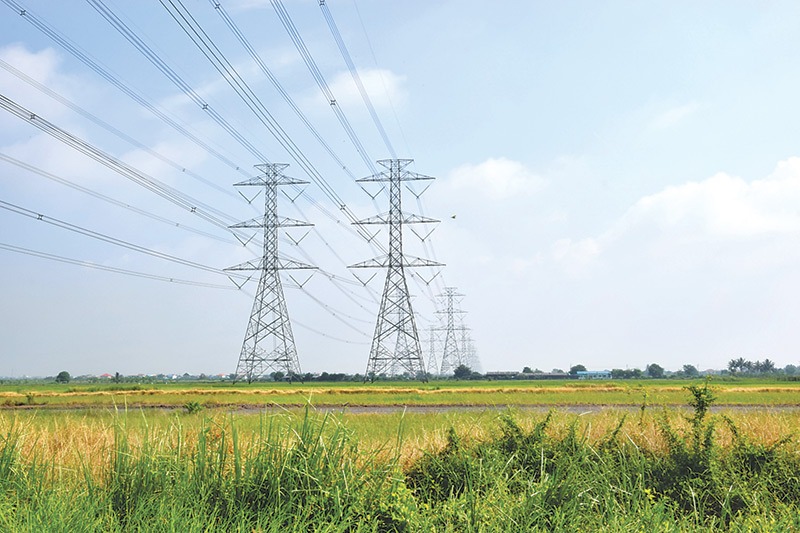
Shutterstock

On September 16, 2022, the Minister for Energy, Water Resource and Irrigation’s proposal to withdraw the Electricity Bill, 2020 was passed by the National Assembly, thus eliminating the possibility of any electricity-related legislation being enacted anytime soon. This Bill was expected to provide a statutory basis to further major reform activities in Nepal’s power sector and its withdrawal marks a major impediment for the sector, which has been yearning to attain new heights after Nepal’s recent progress in its electricity generation capacity.
The power sector reforms include activities like corporatisation of utilities, deregulation and delicensing, open access to transmission infrastructures, unbundling of vertically integrated utilities, privatisation of utilities, competition in wholesale and retail, restructuring of a distribution utility into smaller utilities, renewable energy integration, etc. In a nutshell, power sector reforms are frequent, if not continuous, processes oriented towards decreasing prices, maintaining price stability, and increasing the reliability of electricity. The Electricity Bill had proposed, among other things, to unbundle Nepal Electricity Authority (NEA), recognise power trade and electricity supply services as licensed activities, introduce competition in development and operation of electricity projects, and delicense captive generators. Additionally, the bill, upon enactment, provided the needed push for the operationalisation of open access, which has been delayed only because of uncertainty prevailing at the regulatory or policy levels.
Nepal has had a very structured electricity sector since the enactment of the Nepal Electricity Authority Act 1984, which provided monopoly powers to NEA for generating, transmitting, and distributing electricity. Later, the Electricity Act 1992 opened the doors to some reforms, like allowing entry of the private sector into the electricity sector and providing for a separate entity for consumer tariff determination. For long, the electricity markets in most countries were dominated by vertically integrated monopolies, and an independent regulator would determine tariffs chargeable by them. Competition in the electricity industry was practically non-existent as the competition often meant building parallel infrastructures in the same area, which increased risks for investors and costs for the end-consumers. But, as the electricity legislation was being implemented in Nepal, the global landscape pertaining to electricity was changing, and many countries had begun pushing for reforms which included unbundling and wholesale and retail competition. The importance of these reforms for Nepal was also realised immediately, but it was the height of the energy crisis in the early 2010s that necessitated some conclusive action.
After lurching and meandering for over two decades, Rastriya Prasaran Grid Company and Vidyut Utpadan Company were established in 2015 and 2016, respectively by the Government of Nepal as to-be successors of NEA’s transmission and generation businesses, respectively. The formation of these companies, without a statutory compulsion to unbundle, seemed like a decisive step towards restructuring NEA. However, the recent political discord and ambiguity of the subject in the political sphere prevented the passage of the Electricity Bill, which would otherwise have provided the legal impetus for power sector reforms.
Despite the dilemma at the political level, Nepal’s necessity for these reforms cannot be overstated. Unbundling of NEA will lead to the formation of smaller utilities that shall carry out separate designated functions with higher operational efficiencies. Additionally, it will bring about transparency and reduce any preferential treatment that tends to limit competition. NEA’s improving balance sheet, thanks partly to the recent growth in generation capacity and improved cross-border connectivity, might have eclipsed the urgency of restructuring for the time being. However, Nepal mustn’t lose sight of the fact that unbundling of NEA was envisioned to deliver higher reliability and price-stability of electricity to end-consumers.
Another pertinent reform proposed by the Electricity Bill was the development and operation of power projects through competition. Although NEA has been able to sell surplus electricity at a reasonable price through the Indian Energy Exchange (IEX), high generation tariffs might still pose threat to Nepal’s prospects, both domestically and abroad. The current method of generation tariff determination adopted by the Electricity Regulatory Commission (ERC) is reminiscent of how NEA determined the generation tariffs in the past and how it doesn’t incentivise developers to build power projects efficiently. However, mechanisms based on competition may offer chances to reduce generation tariff, likely through prioritisation of construction of cheaper projects.
Licensing of power traders and electricity suppliers and delicensing of captive generation projects are particularly important for bringing about competition and offering more choices to consumers. Currently, NEA is the sole off-taker of electricity in Nepal, and it has been selling electricity within and outside the country. However, licensing of power traders and electricity suppliers and delicensing of captive generators shall offer more channels for power to be traded both here and abroad.
To sum up, the electricity bill had sought to replace a structured power market with a more complex one, but while doing so, it could provide opportunities for alternate business models to flourish, which, in turn, would encourage innovation and increase competition. While the perils of drastic steps to the reform electricity industry should not be underestimated, as sometimes, they can even exacerbate the problems. By now, there are enough examples for Nepal to take lessons from. California, in the late 1990s, deregulated the electricity market in favour of competition in an attempt to reduce its wholesale price of electricity. This not only failed to reduce the wholesale price, it also led to the biggest utility in California filing for bankruptcy. Similarly, in the UK, past attempts of reform have failed to keep electricity prices low in the long run and have failed to curb the monopoly influence of utilities. In the case of India, different states are in different stages of reform, and while Delhi and Maharashtra are showing considerable progress after the restructuring of the electricity market, other states like Bihar and Uttar Pradesh are still lagging. Nepal can closely examine such examples and chart its course accordingly so that the country doesn’t suffer the same fate. Since Nepal has already established the ERC, it must be empowered to ensure that these reforms are carried out securely.
The current Electricity Act 1992 is often hailed as a success in promoting private sector participation in electricity generation, but it did have its shortcomings. The private sector wasn’t actually encouraged by the merit of the act alone but by the government’s policy to offer concessions to the power projects after the advent of the energy crisis in the early 2010s. The act’s restrictive provisions also didn’t allow new business models to flourish and may be partly deemed liable for the crisis. So, further delays to enact appropriate electricity legislation may cause Nepal to lose various opportunities or worse, bring in new problems. In light of the government of Nepal having recognised electricity as a conveyor of the prosperity of the country and because these reforms must not be further delayed, there is a need for Nepal to prioritise power sector reform as a matter of national priority. The subject must remain above petty political squabbles and the government must proactively work to foster consensus among all stakeholders. The enactment of a new electricity legislation should be the bottom-line of such consensus. The House of Representatives election, which is just around the corner, can be an opportunity for the political leadership to initiate meaningful dialogues and show commitment in this matter.


Koirala works in electricity sector regulation and reform.

OPINION

On child brides

From early marriage to risky pregnancy, we must break the cycle.

It is quite frustrating that, despite all our economic progress and flashy infrastructure development, Bangladesh is still doing poorly in a number of social indicators including health and education for girls. A recent study has revealed how Bangladesh had an adolescent pregnancy rate of 27.7 percent in 2017-18. This was the highest rate of adolescent pregnancy in the entire South Asian region, as per the study. To put that into perspective, the rate was 6.8 percent in India (DHS 2019-2021), 8.1 percent in Pakistan (DHS 2017-2018), and 12.1 percent in Afghanistan (DHS 2015).
While the abnormally high rate of adolescent pregnancy in Bangladesh may come as a surprise to many, the reasons attributed to it are well-known: child marriage, incorrect use of contraceptives, lack of access to sexual and reproductive health related information, and predominant gender norms, among others. Of them, child marriage is, of course, the biggest culprit—it shows how one bad thing, if left unchecked, leads to another bad thing.
We must acknowledge that this data is based on a demographic and health survey conducted before the pandemic. The situation, in all likelihood, may be worse now, given how recklessly child marriage increased over the last two-three years. According to data gathered by this daily from different districts, at least 11,000 school children were married off by their families between March 17, 2020 and September 12, 2021. A more recent study by the National Girl Child Advocacy Forum revealed that, between January and August 2022, as many as 2,301 girls fell victim to early marriage in 28 districts of the country.
The rising trend of early marriage is bound to contribute to a rise in adolescent—and hence, complicated and unsafe—pregnancies. It would be a rare case if a child bride was found to have any form of agency over what happens to her reproductive health. Most often, it is the young girl’s in-laws who pressure her into getting pregnant, while also forbidding any methods of birth control. And not just the families, but the authorities (local and national) are also as much to blame for the severe health issues that an adolescent girl may face while being pregnant or giving birth, such as eclampsia, postpartum haemorrhage, systemic infections, preterm deliveries, low birth weight and neonatal deaths.
We commend the efforts of local NGOs to bring down child marriage rates, but it is high time the government took stricter measures to prevent this scourge from happening in the first place. Often, it is seen that a child marriage is halted by local authorities but is performed in secret later by the families. We must find a way to stop this. Local governments must play a stronger role in stopping child marriage and raising awareness so that girls are spared the curse of child marriage and attendant health risks. We must all work together to prevent adolescent pregnancies.

— The Daily Star/ANN

Page 5
MONEY

German business leaders warn against pulling out of China

- ASSOCIATED PRESS

BERLIN, 
A group of top German business executives is warning against withdrawing from China, while acknowledging that it’s right for Germany to redefine its relationship with Beijing.
The intervention by eight chief executives in an article on Thursday for the daily Frankfurter Allgemeine Zeitung comes as Germany
grapples with its future relationship business and political relationship with China.
They said German companies’ sites in China and elsewhere in the world contribute significantly to their competitiveness, and that China has become the world’s second-biggest and most dynamic market—“so our presence there is particularly important in the interest of German economic strength.”
The potential of the Chinese market offers an opportunity to scale up faster and to be more successful in other markets, securing jobs in Germany, the authors argued.
They said that, given China’s increasingly assertive behaviour and the human rights situation in Xinjiang province, “it is right for Germany today to define its relationship with China in a more nuanced way, in the three dimensions of competition, cooperation and systemic rivalry.” But, they added, “in the current public discussion, we perceive an almost exclusive emphasis on systemic rivalry, in words and concrete measures.”
“Despite all the challenges of China and with China, we are convinced that its fundamental growth dynamic will remain,” the authors wrote. “A withdrawal from China would cut us off from these opportunities.”

MONEY

‘Inflation biggest challenge for CFOs’

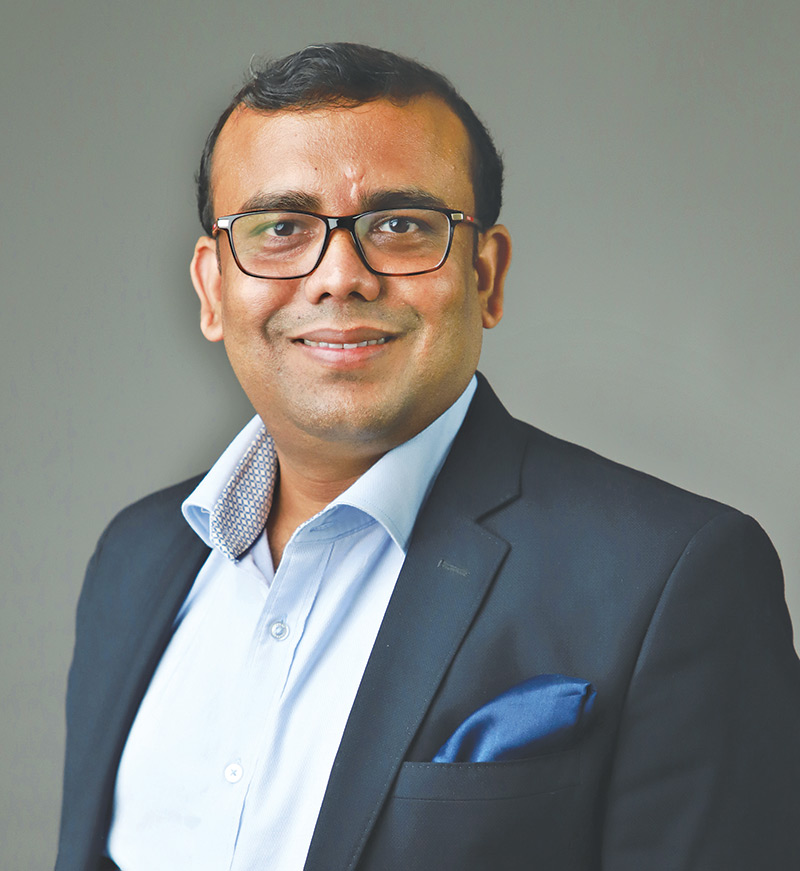
Jashisha Kumar Gupta, the CFO at Daraz Nepal.   PHOTO COURTESY: DARAZ NEPAL

The Russian invasion of Ukraine this year has not only triggered large-scale humanitarian crises but has also added downside risks to the global economy, including Nepal, which is still dealing with the Covid pandemic. The war has caused inflationary expectations to soar and has delivered a sharp shock to the business sentiment which had been recovering after lockdown measures were lifted. Globally, companies’ Chief Financial Officers (CFOs) report a record level of risk, stemming from geopolitics and inflation. In an email interview with the Post, Jashisha Kumar Gupta, the CFO at Daraz, Nepal talks about inflation as one of the most significant future risks. Excerpts:


What are the challenges that you see as a CFO this financial year?
We are all aware that Covid-19 effects on the global economy are still being felt. Liquidity problems, rising gasoline prices, and currency devaluation are key factors driving present-day inflation in Nepal. Inflation is a significant challenge for the CFO of any company. The crisis in Ukraine has also stalled the global economy and increased the prices of food and other necessities. Such an occurrence has increased the pressure on already-existing global inflationary forces. A CFO’s job is to maintain a strong financial position by controlling costs, maintaining liquidity, and forecasting future expenses. This requires a lot of research into how their company is doing in comparison to their competitors as well as the market at large. With inflation on the rise, CFOs must face supply chain disruption from conflicts or geo-political reasons and liquidity problems from economic downturns or unexpected expenses.
 
How has global inflation impacted the business of Daraz? How have demands changed recently in a price-sensitive market like Nepal?
Daraz functions as a platform where merchants display their goods and customers use the platform to make purchases. Sellers are unable to acquire goods at cheaper prices due to global inflation and supply chain disruptions, and as a result, the price of products has increased. Some products’ prices have escalated to the point where the consumer must make trade-offs in order to afford the present price. The demand has been significantly influenced by inflation-driven pressures. The first thing businesses need to understand is that inflation is not just about prices going up; it’s about the purchasing power of money going down. Inflation can mean that even if prices are stable, money will buy less than before because buyers have less available. In other words, inflation causes a decrease in purchasing power without any change in the price level.

How do you see the progress of the e-commerce industry in Nepal?
E-commerce is an ecosystem in which a marketplace, a payment partner, and a delivery partner collaborate to offer a wide variety of product assortments under one virtual roof and deliver the consumer’s preferred product to their doorstep across Nepal. The government and pertinent regulators are actively pushing the digital Nepal agenda, which has contributed to the long-term success of this industry. The e-commerce business will continue to flourish as a result of the proposed e-commerce bill, which could be passed soon and contains crucial provisions required for the development. The e-commerce sector is well-positioned to benefit from shifting market dynamics thanks to a young population and rising internet usage. The e-commerce industry in Nepal is
still in its early stages, but it is quickly evolving. In the future, we can expect more e-commerce businesses, as well as an increase in the number of people shopping online; especially with benefits such as greater choice, convenience, and competitive prices. The e-commerce industry is also creating new opportunities for Nepali businesses, helping them to reach a wider audience and tap into larger markets.

How is Daraz impacting Nepal’s economy?
Small and medium-sized businesses (SMEs) are the foundation of any economy, and Daraz enables SMEs to sell their products throughout Nepal, increasing their revenue. It has also increased interprovincial level demand, which benefits domestic supply. Daraz has a positive impact on Nepal’s economy, creating jobs and providing a boost to businesses. In addition, we make it easier for local businesses to reach a wider audience. As Daraz continues to grow in Nepal, it is likely that the country’s economy will continue to benefit. Our prepayment share increased from 13 percent to 35 percent and during campaigns— prepayment share exceeded 50 percent, assisting the digital economy. Daraz also employs over 1,000 employees at any given time and is constantly creating new jobs.

Is this year’s 11.11 campaign any different from last year’s? What are the expectations for this year?
Similar to a festival, 11.11 brings together a retailer, a brand partner, a bank partner, a logistic partner, and an employee to celebrate. 11.11 sets records and benchmarks every year, and this year, Daraz users will receive up to 80 percent off on over 1.1 million products. We are able to provide our customers with attractive offers despite import limitations and other macroeconomic difficulties. We are dedicated to providing exceptional service to improve our customers’ overall buying experiences.

MONEY

Foodmandu celebrates 12th anniversary with exciting new offers

KATHMANDU: Foodmandu, Nepal’s first and largest food delivery company, is celebrating its 12th anniversary. A variety of offers and activities have been planned to commemorate the occasion. “This year, we want to centre our celebrations around giving back to our customers,” says Shyam Ratna Mali, Head of Brand and Marketing at Foodmandu.
The company is sharing a coupon code for a flat 12 percent off as a special one-day anniversary discount. In addition, customers can get 12 percent cashback/discounts up to Rs 120 on online payments made through digital payment providers IME Pay, Khalti, connectIPS, and Fonepay, reads the statement issued by the company. The offers will continue for 12 days until November 22. (PR)

MONEY

Foxconn adjusts production to avoid holiday blues

- REUTERS

TAIPEI, 
Apple Inc supplier Foxconn said on Thursday it expected smartphone revenue to fall this quarter and is adjusting production to prevent recent Covid-19 curbs at a massive iPhone factory in China from impacting holiday orders.
Foxconn has grabbed headlines in recent weeks, with tight virus restrictions at its Zhengzhou plant, the world’s largest iPhone factory, disrupting production and fuelling concerns over the impact of China’s virus policy on global supply chains. The plant in China’s industrial hub employs about 200,000 people.
The cost impact of the Covid controls, including offering bonuses to retain workers, will be short term and Foxconn has been working with the government to resume normal production as soon as possible, he added.
On Wednesday, Foxconn said it would continue production in Zhengzhou under a “closed loop” system, where staff live and work on-site in a bubble isolated from the wider world. Many employees have fled the factory over the rigid controls which have limited people’s movement and seen enforced quarantine, with stories of food and medical shortages circulating on social media.
If disruptions persist, it could hamper Foxconn’s ability to ship iPhones in what is traditionally the peak season for Taiwan tech firms as they race to supply cellphones and other electronics for the year-end holiday period in Western markets followed by the Lunar New Year in East Asia.

Page 6
SPORTS

England rout India to set up Pakistan final

Hales and Buttler share an unbeaten 170-run stand for opening wicket as the English team cruise to victory in 16 overs.
- AGENCE FRANCE-PRESSE
England’s Jos Buttler (left) and Alex Hales celebrate after defeating India in World T20 semi-final.   Ap/RSS

ADELAIDE,
Alex Hales and Jos Buttler hammered brilliant unbeaten half-centuries as England crushed India by 10 wickets on Thursday to set up a Twenty20 World Cup final with Pakistan.
Chasing 169 for victory in the second semi-final in Adelaide, Hales smashed seven sixes in his 86 and Buttler, who made 80, hit three in a spellbinding batting performance to cruise into Sunday’s final in Melbourne with four overs to spare. It was a far cry from earlier in the tournament when England were shocked by Ireland.
“That feels a long time ago now,” said Buttler. “The character we’ve shown to get through the tournament since then, and put in our best performance today, has been amazing.”
Hardik Pandya’s 33-ball 63 guided India to 168-6, but the total proved inadequate for an inspired opening pair, as England chase their second T20 crown after their 2010 triumph.
England captain Buttler smashed Bhuvneshwar Kumar for three boundaries in the opening over of their chase and his side never looked back. He kept up the batting onslaught and Hales soon joined the big-hitting party as England raced to 63-0 in six overs. Hales reached his 50 off 28 balls and was severe on Axar Patel, who leaked 28 runs in his three overs as the match was torn away from India in a flurry of sixes and fours.
Hales raised the team’s 100 with another six off Pandya and Buttler soon changed gears to catch up with his partner. Skipper Buttler reached his 50 with a six and a four off Pandya to douse any hopes of India attempting to end their world title drought since their 2013 Champions Trophy triumph. He fittingly hit the winning runs with a six off Mohammed Shami to set up a repeat of the 1992 50-over World Cup final between Pakistan and England, which Pakistan won.
“We came here excited, it was a really good feeling when we came in,” said Buttler. “We always want to start as fast as we can and aggressive. Adil Rashid was (batting) down at number 11 today, and that gives us the freedom to come out aggressive, that depth.”
Earlier, Virat Kohli made his fourth half-century of the tournament and put on a 61-run fourth-wicket stand with Pandya, who tore into the opposition attack in the final overs, taking 57 off the final three overs, including 20 off one from Sam Curran. But it proved too little, too late, after a sluggish start with the bat against some disciplined England bowling and then a ragged performance in the field.
“It’s pretty disappointing how we turned up today,” said captain Rohit Sharma. “It was definitely not a wicket where a team can come and chase it down in 16 overs. The way we started with the ball was not ideal. We were a little nervy, but you have to give credit to the openers as well. They played really well. If we keep it tight and the batsman still score runs, we’ll take it. But we didn’t do that today.”
Chris Jordan, in the side for the injured Mark Wood, picked up three wickets.
England invited India to bat and KL Rahul began with a cracking boundary off Ben Stokes. Seamer Chris Woakes had Rahul caught behind off a rising delivery for five. Skipper Rohit Sharma hit four boundaries after a scratchy start as he and Kohli attempted to rebuild but Jordan broke through in his first over and ended a 43-run partnership when Sharma mistimed to wide long-on with the score on 57.
Suryakumar Yadav smashed a six and four off Stokes but soon fell to Adil Rashid’s leg-spin for 14. Kohli passed 4,000 T20 international runs with a boundary off Liam Livingstone that took India’s total to 100-3 after 15 overs. Kohli, who leads the tournament batting chart with 296 runs, reached 50 off 39 balls but fell next delivery to a sharp catch at short third man by Rashid off Jordan.
Pandya smashed four fours and five sixes before treading on his stumps to be out hit wicket off Jordan’s final ball of the innings.


Brief scores

ICC Men’s T20 World Cup
2nd Semi-Final, Adelaide Oval
Toss: England elected to field first    

India 168-6
H Pandya 63 (33)
V Kohli 50 (40)
C Jordan 4-0-43-3

England 170-0 (16 Over)
J Buttler not out 80 (49)
A Hales not out 86 (47)
A Patel 4-0-30-0
England win by 10 wickets
Player of the Match    : A Hales

England’s path to final

Super 12
Oct 22    Beat Afghanistan by 5 wickets at Perth
Oct 26    Lost to Ireland by 5 runs (DLS method) at Melbourne
Oct 28    No result v Australia (rain) at Melbourne
Nov 1    Beat New Zealand by 20 runs at Brisbane
Nov 5    Beat Sri Lanka by 4 wickets at Sydney

Semi-final
Nov 10    Beat India by 10 wickets at Adelaide

SPORTS

APF storm into the final

The Sharad Vesawkar-led side chase a 123-run target in 21.3 overs to register a seven-wicket win over Madhesh.
- Sports Bureau
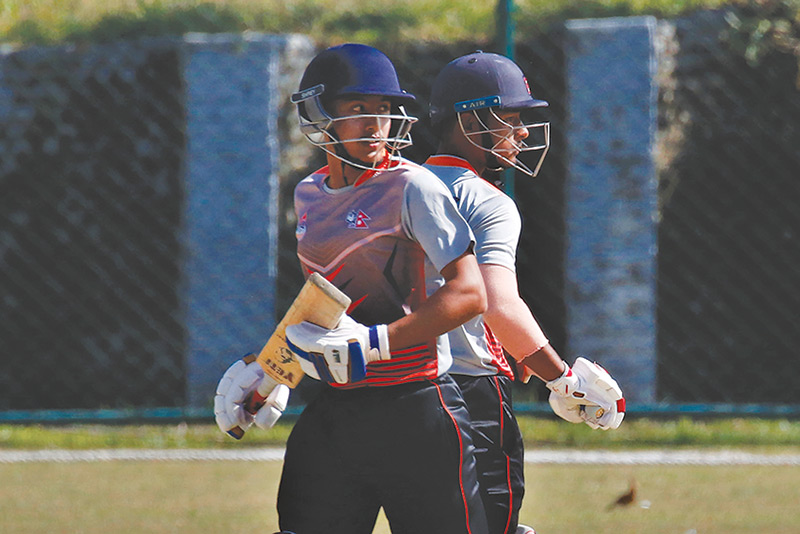
APF’s Sumit Maharjan (right) and Lokesh Bam running between the wickets against Madhesh in the semi-final of Prime Minister Cup ODI National Cricket Tournament on Thursday.   Post Photo: Hemanta Shrestha

KATHMANDU,
Nepal Armed Police Force (APF) Club registered a thumping seven-wicket win over Madhesh Province to storm into the final of the Prime Minister Cup One-Day National Cricket Tournament at the TU ground in Kirtipur on Thursday.
Sent in to bat first, Madhesh were bowled out for 122 runs in 31 overs after Kamal Airee claimed four wickets, including three top-order batters. APF chased the target in 21.3 overs, losing only three wickets, to enter the final of the 50-over tournament for the third time in five editions of the Cup since 2017.  
APF, the winners of 2018 edition and the runners up of 2021 edition, will now meet the winners of the second semi-final between Tribhuvan Army Club and Nepal Police Club in the summit clash on Saturday.
The second semi-final is scheduled for Friday.  
APF were also the winners of the last edition of the game held in the Twenty20 format in January with a view to prepare and select the team for ICC World Twenty20 Global Qualifiers.
Madhesh were off to a shaky start, losing wickets in quick succession. APF’s right arm medium pacer Airee made an early breakthrough by clean bowling opener and captain Harishankar Shah for six runs on the third delivery of the seventh over. He also trapped Rohan BK leg before wicket on his next delivery for a golden duck with the score reading 14 for 2.
The 21-year-old then dismissed Anil Sah for 13 runs after he was caught by Mousom Dhakal with 30 runs on the board. This piled early pressure on Madhesh.
Tailender Rupesh Singh was the highest scorer for Madhesh, scoring an unbeaten 36 off 23 balls which included four hits to the fence as well as two sixes. Opener Santosh Karki became the fourth wicket to fall after he was trapped leg before by Bhuvan Karki, scoring a 48-ball 20.
Imran Sheikh (16), Mohammad Aadil Alam (11) and Rajesh Yadav (13), were the other batters for Madhesh to reach double-digit scores.
APF bowler Airee, named player-of-the-match, conceded 27 runs in his nine overs spell. Bhuvan Karki and Mousom Dhakal accounted for two wickets each.
Chasing the target, Lokesh Bam contributed 35 runs and he remained not out, registering the highest score of the innings. Openers Pradeep Airee and Aasif Sheikh shared a 60-run stand for the first wicket.
Pradeep hit 33 off 38 balls while Sheikh contributed a 32-ball 25. Sheikh hit five boundaries before he was bowled by Rajesh Yadav, becoming the first wicket to fall. Pradeep struck four boundaries and two sixes before Rupesh Singh got him out.
Sumit Maharjan contributed 13 runs off 20 balls that included two hits to the boundary. Bam’s 35 comprised four hits to the fence along with a maximum, while Sundeep Jora remained unbeaten on six runs.
Madhesh bowler Rupesh Singh took two wickets in his seven-over spell. He conceded 29 runs and bowled two maidens.

MEDLEY

Horoscope

ARIES (March 21-April 19) ****
Restless sleep could plague you in the very early hours this morning. Luckily, a helpful energy will motivate you to take on the day by storm. You will find cosiness in the comfort of home this evening. Try not to be too emotional.

TAURUS (April 20-May 20) ***
This cosmic climate will elevate your connection to the world around you. You’ll notice a shift this evening that will encourage you to express your emotions in productive ways. You will also dive into deeper friendships.

GEMINI (May 21-June 21) ****
You’ll be eager to make progress this morning. Impatience and frustration could build up and a series of accidents could add up to one big problem. Luckily, the vibe will shift this evening, helping you feel relaxed and grounded.

CANCER (June 22-July 22) ***
Your impulsive nature could become triggered this morning. Take some time to ground before starting your day to avoid costly mistakes. You’ll notice a shift this evening and you will feel more aligned and in control.

LEO (July 23-August 22) ***
A desire for notoriety and popularity will drive you this morning. Try not to go overboard with your schemes on how to get it. You’ll be put in a more introspective headspace when the energy shifts later this evening.

VIRGO (August 23-September 22) ****
This cosmic climate will highlight your professional abilities. You may feel confused about your importance in your partner’s life. The vibe will shift this evening, putting you in the mood to connect with your circle of friends.

LIBRA (September 23-October 22) ***
Your manifestation skills will become highlighted under this cosmic climate, but only if you’re willing to work hard for your goals. Meanwhile, gut instincts can lead you down the path to a better tomorrow.

SCORPIO (October 23-November 21) ***
This cosmic climate will act as the dynamite needed to embrace explosive changes, so don’t be afraid to make some serious moves. The vibe will mellow this evening, supercharging your intuition and manifestation skills.

SAGITTARIUS (November 22-December 21) ***
Unpleasant dreams might disturb you in the early hours this morning. Be sure to check in with your heart, or your feelings could become overwhelming. Try to release any uncomfortable emotions you’ve been harbouring.

CAPRICORN (December 22-January 19) ****
Staying organized will be the key to finding motivation this morning. Try not to let your social media feeds disconnect you from the material realms. A harmonious energy will put you in the mood for romance as evening rolls.

AQUARIUS (January 20-February 18) ***
This cosmic climate will upgrade your confidence and self-expression. Pace your expectations when it comes to gaining notoriety.  You’ll feel a shift this evening that will ask you to focus on your healthy and daily routines.

PISCES (February 19-March 20) ***
Your heart, mind, and soul will work in unison today. Try not to become overwhelmed by these dreams, or you could start to question if these goals will ever become a reality. Confidence and fun will follow you as evening rolls.

Page 7
CULTURE & LIFESTYLE

Lalitpur’s three underrated kimbap joints

When it comes to serving proper kimbaps, these three small joints in Lalitpur have been earning rave reviews and amassing a loyal customer base.
- Isha Das
Post Photo: Keshav Thapa

Kathmandu
Lalitpur’s Korean restaurant scene has grown immensely in the last few years. The district alone is home to over a dozen restaurants specialising in Korean cuisine. But unbeknownst to many, Lalitpur is also home to several small joints specialising in the much-loved Korean dish kimbap. A few days ago, we set out on a mission to find the best kimbap joints in the district, and here is our list of three places where the kimbaps are as good as they come.

Mr Gim Baab, Dhobighat
This no-frills kimbap joint is housed in a tiny roadside stall. But don’t let this takeaway-only restaurant’s not-so-attractive appearance fool you. Mr Gim Baab has been in operation for the last seven years and the joint’s regular customers, who are mostly students and young professionals, swear by its kimbaps.
Pawan Tramu is the owner/chef of this humble establishment, and he first learnt the technique of making kimbap from his Korean language teacher in Nepal. In the seven years that Mr Gim Baap has been in operation, the outlet has earned a solid reputation for using fresh ingredients. Another factor that has worked in Mr Gim Baab’s favour is its pricing. The joint serves some of the cheapest kimbaps in all of Kathmandu.

Contact: 9818281368
Opening hours: 11am to 6pm (Sundays to Fridays)
What we like: Tuna kimbap (Rs 340), chicken kimbap (Rs 300), and mixed kimbap (Rs 400).

Photo Courtesy: GimbapGo

GimbapGo, Jhamsikhel
The newly opened GimbabGo is the most expensive kimbap joint on the list. As soon as you step in, you immediately realise that this place will create a cute photo background for Instagram. But it’s not just aesthetics that GimbapGo aces in.
Thanks to Edward Leebonghu, GimbapGo’s South Korean chef, the dishes that roll out of the kitchen stay true to their Korean cuisine heritage. Leebonghu is the chef and also the co-owner of the restaurant. Apart from kimbap, the restaurant’s menu also features other Korean dishes like bibimbap, chicken feet, and Korean Ramen, among others. The restaurant also serves a wide range of desserts.

Contact: 9802079797
Opening hours: 10am to 9pm (Sundays to Saturdays)
What we like: Tuna kimbap (Rs 550), chicken kimbap (Rs 490), and egg and cheese kimbap (Rs 490)


Post Photo: Isha Das

2Bhai Kimbap, Bhaisepati
If you like to go out and eat, chances are you know how Bhaisepati has become home to some excellent restaurants in the last few years. 2Bhai Kimbap is one of the relatively new restaurants in the area. Not long after it opened in early 2020, the pandemic hit, and the restaurant had to halt its operations for months. The owners had to incur heavy losses. But that’s all history now.
2Bhai Kimbap is now fully operational, and within a short time, it has earned a loyal following because of its kimbaps and other Korean dishes. The meat used in kimbaps is well-marinated and packed with flavours. Apart from being surprisingly good, the kimbaps are also reasonably priced, which has made them quite a hit among college-going students.

Contact: 9848769671
Opening hours: 9am to 8pm (Sundays to Fridays)
What we like: Tuna kimbap (Rs 320), chicken kimbap (Rs 350), and crab kimbap (Rs 320)

CULTURE & LIFESTYLE

Snoop Dogg biopic is in development

The film will be written by Joe Robert Cole, who co-wrote the two ‘Black Panther’ films.
- ASSOCIATED PRESS
Snoop Dogg performs a DJ set as ‘DJ Snoopadelic’ during the ‘Concerts InYour Car’ series in 2020, in Ventura, California.  AP/RSS

NEW YORK
Snoop Dogg is getting a big-screen biopic.
Universal Pictures announced on Wednesday that the studio is developing a film about Snoop Dogg’s life to be produced by the 51-year-old rapper. The film will be written by Joe Robert Cole, who co-wrote the two “Black Panther” films, and directed by Allen Hughes, the filmmaker of “Menace II Society.”
“I waited a long time to put this project together because I wanted to choose the right director, the perfect writer, and the greatest movie company I could partner with that could understand the legacy that I’m trying to portray on screen, and the memory I’m trying to leave behind,” Snoop said in a statement. “It was the perfect marriage. It was holy matrimony, not holy macaroni.” Universal previously turned the story of rap group N.W.A. into the hit 2015 film “Straight Outta Compton” and also released the acclaimed Eminem biopic “8 Mile” in 2002. Cole said the studio “has proven they can guide a movie like this to something special.”
Donna Langley, chairman of Universal Filmed Entertainment Group, said she met with Snoop shortly after he acquired Death Row Records. His acquisition was announced just days before Snoop performed in the Super Bowl halftime show in February with Dr Dre, Eminem, Mary J Blige and Kendrick Lamar.
Snoop Dogg broke through in the early ‘90s as part of the West Coast rap scene as a collaborator of Dr. Dre. He’s sold more than 35 million albums worldwide in his three-decade career. He’ll produce the film along with Sara Ramaker and Hughes.