You internet speed is slow. Switch to text view mode

Switch
epaper logo
ST

Last Login:
Logout
+
Page 1
HOME PAGE

Five battleground constituencies in Madhesh Province

In the local elections held earlier this year, Nepali Congress emerged as the largest party in the province.
- NISHAN KHATIWADA

RAJBIRAJ,
As the country is set to vote in federal and provincial elections next week, many are watching the Madhesh province with keen interest because of its recent history of political movements that shook the entire nation.
Following the Madhesh uprising in the run-up to the promulgation of the Constitution of Nepal 2015, the Madhesh-based parties came into national spotlight. They fared well in the 2017 elections riding a pro-Madhesh wave.
 The Madhesi parties, at the time of constitution promulgation, had sensed the new document would also fail to address several of their concerns including the demand for a separate Madhesh state covering the entire Tarai belt from east to west Nepal.
But beset by disputes and splits, Madhesh-based parties are now on the decline and traditional parties hold sway over the region.
In this year’s local elections, Congress emerged as the largest party in the province.
On the other hand, the country’s largest party, the UML, also managed to make inroads in the region.
Out of the 136 local units, Nepali Congress locked in 46, UML won 30, Janata Samajbadi 25, Loktantrik Samajbadi 14, while the Maoist Centre bagged victory in nine.
In the 2017 federal polls, the UML had a rather lacklustre performance in the province, winning only two of the 32 constituencies.
But in the next week’s elections, two strong alliances are going head to head. One is led by the Nepali Congress with the Maoist Centre, the Unified Socialist, the Loktantrik Samajbadi Party and the Rastriya Janamorcha as partners, and the other is the UML-led alliance with the Janata Samajbadi Party and the Rastriya Prajatantra Party as partners (in select constituencies of the province).  
Some constituencies in Madhesh are therefore going to see tough competition.
Janata Samajbadi Party chair Upendra Yadav and Janamat Party chief CK Raut are in the fray in Saptari-2. Yadav is supported by the UML while Jay Prakash Thakur, another strong candidate, is backed by the ruling coalition.
As per local observers, caste-based politics plays a considerable role in elections here.
As Khalid Siddiqui from the Janata Samajbadi Party was elected to the National Assembly with Yadav’s support, the latter is expected to win a good chunk of local Muslim votes. Thakur, another candidate, is also considered strong as he had garnered more than 9,500 votes from the constituency as an independent candidate in the 2017 elections.
CK Raut, however, is a new face in the constituency. He is popular among the poor and may also attract a good chunk of frustrated votes on the back of his anti-corruption campaigns.
Similarly, in Bara-4, former minister and Unified Socialist leader Krishna Kumar Shrestha (Kisaan) is contesting from the ruling alliance while UML leader Ekbal Miya is fighting under the UML-JSP alliance banner.
Shrestha had defeated Ram Chandra Paudel in the 2017 polls in Tanahun-1, while Miya was elected from Bara-4 as a candidate of the then Rastriya Janata Party. This time, Miya defected to the CPN-UML after his party, the LSP, denied him a ticket.
Shrestha, who has the backing of the LSP in the constituency, is regarded as a candidate with a good chance of winning. Miya, on the other hand, is expected to attract a good chunk of Muslim votes.
Former Nepali Congress leader Ichchha Bahadur Wagle is contesting as an independent candidate. Prabhu Shah, a former UML leader considered influential in Madhesh, has also supported Wagle’s independent candidacy.
A fierce competition is anticipated in the constituency.
Another battleground constituency is Parsa-1, where LSP leader Laxman Lal Karna is contesting as a ruling alliance candidate, Janata Samajbadi Party leader Pradip Yadav is in the fray with UML’s backing, and Ajaya Dwivedi is contesting as an independent. Dwivedi, a well-known former Nepali Congress leader and ex- president of the party’s district chapter, is also considered a strong candidate.
Karna has shifted to Parsa-1 from his old constituency of Parsa-4. LSP does not have a stronghold in Parsa-1, but he might benefit with the support of the Nepali Congress, which has a good vote base here.
Based on the results of the recent local elections, Pradip Yadav has the highest number of votes among the candidates of the ruling alliance.
LSP leader Anil Kumar Jha is contesting from Dhanusa-3 under the ruling alliance while UML leader Juli Kumari Mahato is in the fray with support from the JSP. In the 2013 elections, Mahato had lost to Congress leader Bimalendra Nidhi. In 2017, she did not contest from the constituency.
Anil Jha contested the 2017 polls from Rautahat 1 and won. As per the seat-sharing arrangement of the ruling coalition, Unified Socialist chair Madhav Kumar Nepal is contesting from Rautahat 1.
The votes garnered by parties in the latest local elections suggest that Nepali Congress is the strongest in Dhanusha-3 followed by the CPN-UML. But Jha has the challenge of transferring votes from the Nepali Congress in his favour as the LSP is only the fourth largest party in the constituency.
And in Siraha-2, Chitra Lekha Yadav of the Nepali Congress and Raj Kishore Yadav from the Janata Samajbadi Party Nepal are contesting the upcoming polls as candidates of the two alliances.
Both of these leaders have become ministers by contesting polls from different constituencies in Siraha district. The results of recent local elections suggest a difference of under 2,000 votes between the Congress-led alliance and the UML-JSP alliance in the constituency, heralding a tough competition.
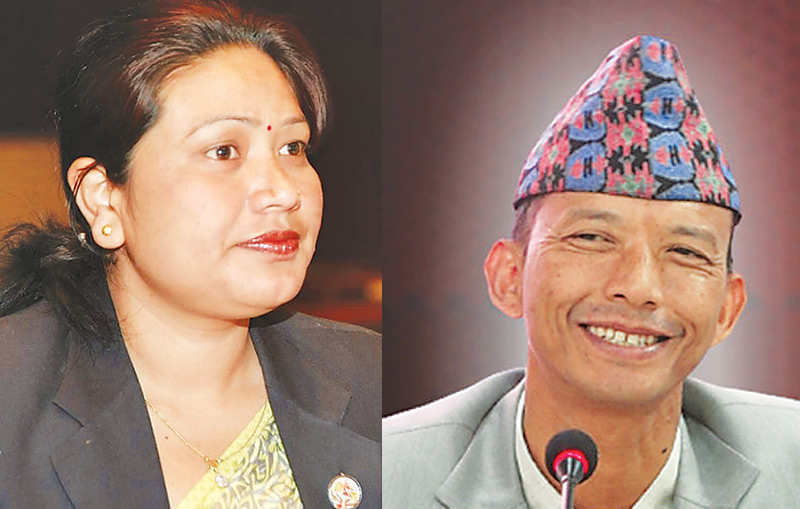
Raj Kishore Yadav had won the last federal polls from Siraha 4. Chitra Lekha Yadav was elected to the parliament under the proportional representation system in 2017.

HOME PAGE

President defends move on citizenship

Supreme Court had asked Sheetal Niwas to explain why Bhandari didn’t approve the bill.
- BINOD GHIMIRE
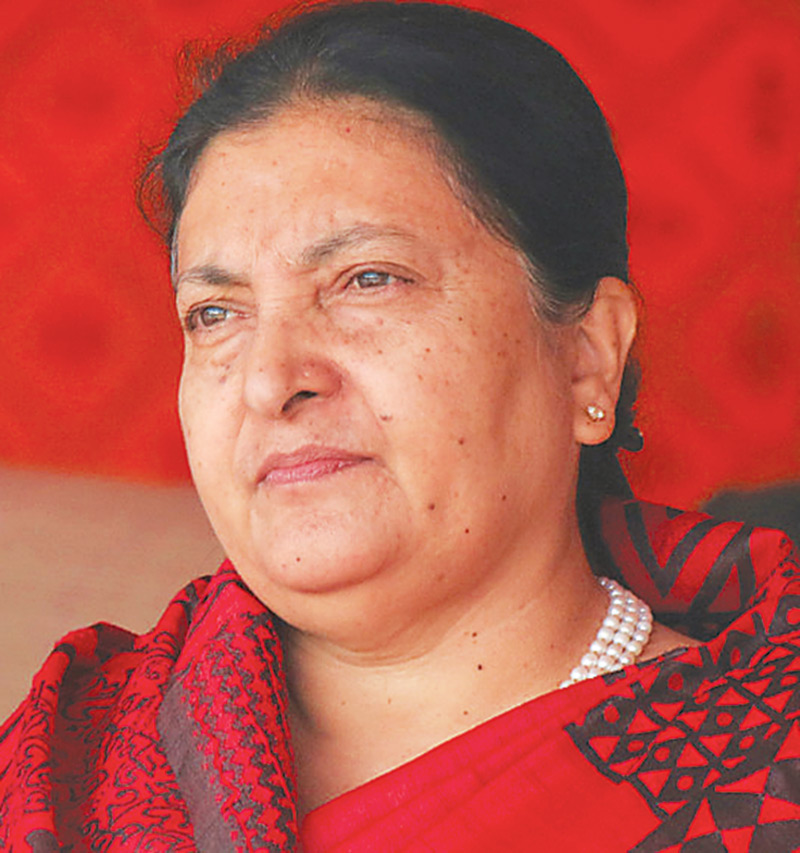
President Bidya Devi Bhandari.  Post file Photo

KATHMANDU,
The Office of President has defended the decision of President Bidya Devi Bhandari not to authenticate the amendment bill to the Citizenship Act, arguing it was in line with her duty to safeguard the constitution.
Responding to a show cause notice from the Supreme Court after a preliminary hearing on the writ petitions challenging her refusal to authenticate the bill, which was resent for the presidential seal, the President’s Office Sheetal Niwas has said the head of the state can keep the bills sent without following due process on hold.
“The bill was kept on hold keeping in mind the President’s constitutional duty to safeguard and abide by the statute, as the bill was resent for authentication without any discussion, consultation and study of comments from the President’s Office, thereby violating the spirit of the constitution,” reads one of the points in the clarification submitted to the Supreme Court through the Attorney General’s Office.
A single bench of Justice Hari Phuyal on September 25 had asked the President’s Office to explain why Bhandari hadn’t endorsed the bill and why her office shouldn’t be directed to authenticate it. Five different writ petitions were lodged by advocates asking for the Supreme Court’s intervention against Bhandari’s refusal to authenticate the bill that was twice endorsed by the federal parliament.
The petitioners have claimed the decision to put the bill on hold without authenticating was a clear breach of Article 113 (4) of the Constitution of Nepal. They have demanded that the court ask the President to correct her move and direct her to authenticate the bill.
The article says if the President sends back a bill along with her remarks and if both the Houses reconsider the bill and send it again to the President as it was presented or with amendments, the President shall authenticate the legislation within 15 days. However, Bhandari did not authenticate the bill and let the September 20 deadline lapse.
In its response to the apex court, the President’s Office said the bill was kept on hold as it was re-sent for authentication against existing norms, processes and constitutional spirit. As per Article 113 (4) of the constitution, said the President’s Office, it is mandatory for both the houses of parliament to reconsider a bill if the President’s Office returns it with comments and reservations. The two Houses, however, decided not to change the bill ignoring the President’s demand.
“The bill was returned with comments with the expectation that a new bill would be prepared as per spirit of the constitution,” reads another point in the clarification.
The President Office has explained the reasons for keeping the bill on hold in around three dozen points. “The office has answered to the Supreme Court through the Attorney General’s Office,” Tika Dhakal, a press advisor to President Bhandari, told the Post.
The bill was introduced mainly to open the door for thousands of children of the parents who got citizenship by birth to acquire citizenship by descent. The Act allowed everyone born within Nepal’s territory before April 12, 1990 to get citizenship by birth. However, their children are yet to get citizenship by descent in the absence of a law. (The constitution says the provision to grant them citizenship will be guided by federal law.)
The bill was dragged into controversy mainly after the CPN-UML objected to a provision in the bill to retain existing provisions in the Citizenship Act on marital naturalisation. It says a foreign woman married to a Nepali man can obtain naturalised citizenship when she starts the process of renouncing her original citizenship.
Women rights activists said the bill was discriminatory as the provision doesn’t apply to foreign men married to Nepali women.
While defending the President’s decision to sit on the bill, the President Office has said Bhandari is confident that a new federal citizenship bill will be prepared in line with the Constitution of Nepal incorporating the concerns her office had raised.
It is understood that the bill that was forwarded without following due process couldn’t have been authenticated by the President, the clarification argues, and hence the decision to withhold the bill forwarded for authentication without parliamentary endorsement is lawful and as per the spirit of the constitution. The President’s Office has also demanded that the writ petitions be annulled.
The President Office also claims the writ petitions were registered with ill intent. “It is a disrespect to the President’s Office to register the writ petitions against Clean Hand Doctrine with mala fide intent and for the court to conduct the hearing on them,” reads one point in the clarification. “Therefore the petitions deserve to be annulled prima facie.”

HOME PAGE

Trump pulls trigger on 2024 White House run

His unusually early entry into the race is being seen in Washington as a bid to get the jump on other Republicans.
- AGENCE FRANCE-PRESSE
Former US President Donald Trump speaks at the Mar-a-Lago Club in Palm Beach, Florida.  AFP/RSS

PALM BEACH, United States,
A combative Donald Trump launched into the 2024 White House race on Tuesday, setting the stage for a bruising Republican nomination battle after a poor midterm election showing by his hand-picked candidates weakened his grip on the party.
“America’s comeback starts right now,” the 76-year-old former president told hundreds of supporters gathered in an ornate American flag-draped ballroom at his palatial Mar-a-Lago residence in Florida.
“In order to make America great and glorious again, I am tonight announcing my candidacy for president of the United States,” Trump said, minutes after filing the official paperwork for his third presidential run.
Trump’s unusually early entry into the race is being seen in Washington as an attempt to get the jump on other Republicans seeking to be party flag-bearer—and to stave off potential criminal charges. In a fiery, hour-long speech, Trump lauded—and at times inflated—his accomplishments as America’s 45th president and fired off verbal salvos against Democrat Joe Biden, who defeated him in 2020.
“I will ensure that Joe Biden does not receive four more years,” Trump vowed, while the US leader greeted his announcement with a tweet saying: “Donald Trump failed America.”
Trump, who was impeached for seeking political dirt on Biden from Ukraine and again after the January 6, 2021 attack on the Capitol by his supporters, launches his new bid with several potential handicaps.
He is the target of multiple investigations into his conduct before, during and after his first term as president—which could ultimately result in his disqualification.
These include allegations of fraud by his family business, his role in the attack on the Capitol, his attempt to overturn the 2020 election, and his stashing of classified documents at Mar-a-Lago.
Meanwhile Trump’s Republicans are licking their wounds after disappointing midterms, widely blamed on the underperformance of Trump-anointed candidates, and some are openly asking whether Trump—with his divisive politics and mess of legal woes—is the right person to carry the party colours next time around.
Several possible 2024 primary rivals are circling, chief among them the governor of Florida Ron DeSantis, who bucked the tide and won a resounding reelection victory on November 8.
The powerful media empire of Rupert Murdoch has already appeared to turn its back on Trump, labelling him a “loser” who shows “increasingly poor judgement.”
And Trump remains banned by Facebook and Twitter, which was instrumental in his stunning political rise. In his announcement speech, Trump attacked Biden over inflation, crime and immigration, mocked climate change and congratulated himself for toppling the Islamic State, keeping North Korea in check and building a border wall with Mexico.
“Under our leadership, we were a great and glorious nation. But now we are a nation in decline,” he said. “This is not just a campaign this is a quest to save our country.
“In two years the Biden administration has destroyed the US economy,” he said.ied because they have ignored common man’s problems and used public offices to enrich themselves and their family members.

Page 2
NATIONAL

Voter frustration with major parties growing

Some observers liken the current state of public dissatisfaction to that which existed before the April 2006 movement.
- TIKA R PRADHAN,PURUSHOTTAM POUDEL

KATHMANDU,
Shobha Kayastha, a resident of Ranibari, Kathmandu constituency-5, has decided not to vote in the elections next week.
Kayastha, along with her spouse, voiced her frustration with the leaders for their repeated failures to deliver on development promises and their “utter shamelessness”.
Rising public frustration due to non-performance and failure of politicians is dangerous for democracy, observers worry.
“Barring some party cadres, everyone we talk to is frustrated with the performance of our politicians and their lack of accountability,” said Kayastha, who runs a grocery shop. “Can you give one reason why anyone should stay in this country?”
The Kayastha couple is fed up also because the road in front of their shop was dug up three times in the last two years, leaving the area muddy throughout the rainy season and dusty at other times.
“The leaders don’t know how much the delay in road-repair has cost local businesses,” she said.
Of late, public disenchantment has grown after several senior leaders picked their near and dear ones as candidates for parliamentary and provincial assembly elections under both the proportional representation and first-past-the-post systems.
Voters’ changing mood was visible in the mayoral election in May. People in Kathmandu Metropolitan City, Dharan Municipality and Dhangadhi Sub-metropolitan City elected independent candidates as mayors.
Recent projections by a few news websites have shown that independent candidates, especially those from the Rabi Lamichhane-led Rastriya Swatantra Party, could this time snatch some parliamentary and provincial seats from the big parties.
Anisha Acharya, a permanent resident of Biratnagar who is a master’s level student, expects new faces in the political scene after the elections.
“There is unhealthy competition among members of the same political parties, and they have been playing with public emotions,” Acharya said. However, there is some optimism this time as many educated youths are contesting the elections either independently or as candidates of new parties.”
Many people have pinned their hopes on independent candidates this time, but these candidates, if they win, will struggle to deliver as they lack political organisation, observers say. Political analyst Rajesh Gautam says: “Though new faces are welcome in politics, most of them have no prior experience of holding public office, and they are not accountable to anyone even if they fail to deliver.”
Krishna Khanal, a professor of political science, is disturbed by growing public disenchantment with political parties. This could lead to a situation seen prior to the second people’s movement of 2006, he said. “The revolution culminated in the overthrow of the monarchy, which had been discredited under King Gyanendra.”
In that time, the movement launched by seven political parties was unable to gain traction as public opinion was largely unfavourable towards them.
Khanal recalled that the people’s movement led by the political parties gained momentum only after civil society leaders joined the fray.
“Rather than learning from past mistakes, political parties kept belittling people’s agenda. The public objected to the numerous wrongdoings of the KP Oli government, which was formed after the first federal election in 2017,” Khanal told the Post. “But the coalition government formed after the dissolution of the Oli government, led by Nepali Congress President Sher Bahadur Deuba, continues to replicate Oli’s faults, which is the reason for people’s dissatisfaction with established parties.”
Khanal continues, “If people’s rising dissatisfaction with the established political authority is reflected in the elections, party politics can face a debacle.”
Dr Govinda KC, a medical reforms campaigner and social activist, on Tuesday appealed to the public not to vote for top leaders of major parties including Congress President and Prime Minister Sher Bahadur Deuba, UML chair KP Sharma Oli and Maoist Centre chair Pushpa Kamal Dahal. Organising a press meet in Kathmandu, Dr KC claimed that the leaders have corrupted and criminalised politics.
Devendra Raj Pandey, a civil society leader and former minister who now uses social media to raise public concerns, agreed with Khanal. “Public dissatisfaction with political parties in the election season should be taken seriously, because there was a similar level of resentment against the parties before the April 2006 popular movement as well.” Mahendra Gautam, 41, lecturer at Padma Kanya Campus and a permanent resident of Kathmandu-4, says the public disdain for political parties and their candidates is justified because they have ignored common man’s problems and used public offices to enrich themselves and their family members.

Page 3
NATIONAL

Complaints against Hamro Nepali Party candidates for trying to cash in on Balen Shah’s ‘image’

Dinesh Thapaliya, the chief election commissioner, says his office is studying the complaints.
- Post Report

KATHMANDU,
In recent local elections, Balen Shah and Harka Sangpang Rai won the mayoral race with cane (lauro) as their election symbol.
Shah and Rai defeated candidates from the five-party alliance and CPN-UML in the Kathmandu Metropolitan City and Dharan Sub-metropolitan City, respectively.
Inspired by their victory, a group of individuals, mainly professionals, started a “lauro abhiyan” (cane campaign), encouraging qualified youths to contest the elections challenging party leaders who have dominated electoral politics for decades.
A few weeks before the government on August 5 announced that it would hold the elections for the House of Representatives and provincial assemblies on November 20, they formed a new party—Hamro Nepali Party—with a cane as their election symbol.
The overwhelming support the independent candidates got in the local polls encouraged them and many others to contest the federal and provincial assembly elections. The party has fielded 65 candidates under the first-past-the-post for the lower house and 101 for the provincial assemblies.
Now, as the polling day inches closer, the party’s candidates have got dragged into controversies. They have been accused of trying to cash in on Shah’s “image” and his slogan during the local election campaign.
“Balen Shah told us that he hasn’t extended his support to any of the candidates. However, the aspirants from Hamro Nepali Party were seeking votes, saying that they have his support,” Dinesh Thapaliya, chief election commissioner, told the Post.
“We also have received complaints that the party’s candidates have been copying Shah’s slogan, without his consent. Also, despite contesting elections as party candidates, they were seeking votes saying they were independent candidates.”
 “Baa aama lai tekaune, bhrastachari lai sekaune” (“a cane to support your old parents, a cane to beat the corrupt with”), became popular during Shah’s election campaign.
“We have told the Election Commission that it can take action against such candidates, if their actions result in the violation of the election code of conduct,” Bhupa Dev Shah, secretary to Shah, the mayor at the Kathmandu Metropolis, told the Post. “It is now up to the Election Commission to decide.”
Thapaliya, meanwhile, has said that candidates from a particular party seeking votes claiming themselves to be independents is tantamount to fraud. He said that when candidates contest the elections on the ticket of a particular party, they must identify themselves as party candidates as it is their party that decides their tickets and they are guided by their party’s policies and principles.
The party’s leadership, however, refused to acknowledge that they ever claimed that their candidates had Balen Shah’s support.
Ananta Raj Ghimire, the Hamro Nepali Party chairperson, said that his party wants to see people like Balen and Harka in Parliament.
“Their names are taken to showcase what type of representatives we need in Parliament. Our party has clearly said that we don’t have any support from Balen,” Ghimire told the Post. “Our candidates are contesting the elections under the party banner. They haven’t projected themselves as independents.”
Talking to the Post last month, Ghimire, however, had said that the Hamro Nepali Party was different to the traditional forces and more than a party, it was a network of people having a similar vision—to make their motherland a better place.
He had also claimed at the time that those elected from the party would be free to function independently. However, unlike those elected as independents, the ones elected as party candidates are legally bound to follow their party’s principles.
Thapaliya, the chief election commissioner, said the commission is currently studying the complaints made against the candidates from the party and would take the necessary decisions soon.
“The commission plans to decide on the complaints filed until Wednesday, by Saturday. “The actions will depend on the severity of the charges against the candidates,” said Thapaliya.

NATIONAL

Issue over Lamichhane’s citizenship gets complex

Election Commission unlikely to decide on the matter before the voting day.
- BINOD GHIMIRE
The Election Commission is yet to study the complaint against Rabi Lamichhane.  Post Photo

KATHMANDU,
The office of the Chief Electoral Officer in Chitwan has asked Rastriya Swatantra Party chief Rabi Lamichhane to clarify over the complaint that he did not relinquish his Nepali citizenship even after receiving the citizenship certificate of another country.
A complaint was lodged at the Election Commission on Tuesday seeking to scrap Lamichhane’s candidacy from Chitwan-2 claiming that the copy of the citizenship that he had submitted while filing his candidacy was not valid.
“We handed over a letter to a representative of Lamichhane today (Wednesday),” Ritendra Thapa, chief electoral officer in the district, told the Post. “He has up to a week to respond.”
Thapa said his office will forward the clarification to the Election Commission, which would take a decision on the complaint. The commission has another week to decide on the matter.
“I don’t think any decision on the matter is possible before the polling day,” said Thapa. The country votes to elect the members of the House of Representative and seven provincial assemblies on Sunday.
Deepak Bohara, a leader of Rastriya Swatantra Party who received the letter for clarification on behalf of Lamichhane, claimed the latter’s citizenship was genuine and the issue was raised a few days before vote just to defame his party and its president.
He claimed that Lamichhane had renounced his American citizenship and its proof was submitted to the Immigration Department to revive his older citizenship. However, he failed to say whether or not Lamichhane has reacquired the Nepali citizenship. As per Section 10 of the Citizenship Act, any person who acquires the citizenship of a foreign country automatically loses Nepali citizenship.
The Act, however, has a provision for reclaiming the Nepali citizenship after one renounces the foreign citizenship.
Section 11 of the Citizenship Act says if any citizen of Nepal who has acquired foreign citizenship returns to reside in Nepal and submits a notification to the designated authority the evidence of renunciation of foreign citizenship, his/her Nepali citizenship shall be provided again once she/he submit the evidence of renunciation.
An application needs to be submitted to the respective office to reclaim the Nepali citizenship.
Clause 11 of the regulation to the Act says the person who has renounced the foreign citizenship should apply to the Ministry of Home Affairs or the concerned District Administration Office. The concerned authority, after studying the application, would issue the citizenship of Nepal containing the same details mentioned in the previous document.
If the claim of the Chitwan District Election Office is anything to go by, Lamichhane doesn’t seem to have produced the citizenship he acquired after renunciation of his American citizenship. Thapa said the copy of the citizenship he had produced to file the nomination was issued in 1993. That means it is the same citizenship that he had acquired before moving to the United States of America.
Officials at the Ministry of Home Affairs say the citizenship one acquires after renouncing the foreign citizenship is completely different from the one taken beforehand. “The new citizenship is counted from the date it was issued after renunciation of the foreign citizenship,” Lila Kumari KC, an under-secretary at the Home Ministry, told the Post.
The Election Commission is yet to study the complaints against Lamichhane. “We will study the case only after the District Election Office writes to us after receiving the clarification from Lamichhane,” Yagya Bhattarai, a joint-secretary at the Legal Department at the commission, told the Post.

NATIONAL

Minister Chaudhary faces tough challenge in Dang-1

Metmani Chaudhary was elected from the constituency in the previous House elections as a CPN-UML candidate.
- Post Report
Minister for Urban Development Metmani Chaudhary (right) is up against UML’s Shanta Chaudhary in Dang-1.   Post File Photos

KATHMANDU,
Dang-1 constituency has largely been a Nepali Congress bastion since the restoration of  democracy in 1990. Except in the first Constituent Assembly election of 2008 and the 2017 general election, the party has always won the constituency, which covers Deukhuri Valley in the district.
If the votes received by ward chairpersons during the recent local elections are any guide, the Congress remains the most popular party in the constituency. However, in an electoral arrangement among the parties in the ruling coalition for next week’s elections, Dang-1 has been allotted to the CPN (Unified Socialist).
Metmani Chaudhary was elected from the constituency in the previous House elections as a CPN-UML candidate. With the backing of the CPN (Maoist Centre, he secured a comfortable victory against his opponent from the Congress. He bagged 37,908 votes, against his closest rival Sushila Chaudhary’s 24,074.
Five years later, Metmani is now a CPN (Unified Socialist) leader and minister for Urban Development in the Deuba government. He is seeking re-election from the constituency as the common candidate of the ruling coalition. His major competitor will be from the UML, his former party, while the Congress, which was his main rival last time, is now an ally.
The vote tally from the May 13 local polls favours the Congress. The Congress ward chair candidates received 29,757 votes while the UML candidates stood second with 27,025 votes in total. The Maoist Centre candidates got a total of 19,276 while those from Metmani’s party, CPN (Unified Socialist), got just 2,341 votes.
Local candidates from the alliance combined received a total of 51,374 votes, which is 24,349 more than that of the UML, which is contesting the November 20 election alone in the district. The KP Sharma Oli-led party has fielded Shanta Chaudhary, a former Kamlari (indentured labourer) and the party’s whip in the latest House of Representatives.
It looks easy for Metmani to defeat Shanta, if the vote secured by the parties of the ruling alliance in the local election go to his kitty this time as well. However, the election is not plain maths, say local leaders from the alliance parties.
Yogendra Chaudhary, the Congress Central Working Committee member, was a ticket aspirant from the constituency. He didn’t get the ticket because his party’s leaders in Kathmandu conceded the seat to the Unified Socialist. He has been included in the party’s closed list for proportional representation. Metmani’s victory largely depends on Congress’ vote bank and Yogendra Chaudhary’s wholehearted support is a must for it.
“Being a party worker, I will obey my party’s order,” Yogendra said. “The alliance candidate will have my full support.” Unlike in the local elections, the Congress in the constituency is divided. Parbata DC Chaudhary, a two-time Congress lawmaker, quit the party, expressing her dissatisfaction over the party’s decision.
She had won the second constituency assembly elections in 2013 while she became a lawmaker under the proportional representation system in 2017. Parbata has now joined the Resham Chaudhary-led Nagarik Unmukti Party. “I will use my entire strength to secure victory for Nagarik Unmukti Party,” she said. “There is no point in sticking to the Congress, which has deviated from its ideology.”
Interestingly, Yogendra’s elder brother—Surendra—happens to be a candidate from the newly formed party. The Congress leaders say defection of Parbata and Surendra’s candidacy means a significant number of Congress votes may not go to Metmani.
Yogendra and Surendra’s family happens to be a long time Congress supporter, which is going to be divided following the latter’s candidacy. “A significant vote from the Tharu community that voted for the Congress is going to Surendra this time,” said a Congress district committee member.
To add to the problem, Dev Raj Pathak, a long time Congress cadre, is a candidate from Rabi Lamichhane’s Rastriya Swatantra Party. A section of the dissidents from the Congress have sided with him. Madhu Acharya, 58, from Parseni village from the constituency is one of them. “Many Congress cadres like me are with Pathak this time. We won’t vote for the alliance’s candidate,” Acharya told the Post.
The differences within the five-party alliance have elated the UML. The party’s local leaders say very few Congress voters are going to vote for Metmani this time.  
Hari Belbase, a former district committee member of the UML, claims that his party will win, even if it retains its local election vote. “He (Metmani) is heavily dependent on the Congress voters, but very few votes are getting transferred to him. The UML alone is far ahead of the Unified Socialist and Maoist Centre together,” Belbase claimed to the Post. “Shanta is going to win this time.”
However, to ensure Shanta’s victory will not be as simple as Belbase said. Ganga Chaudhary Satgaunwa, who is a UML proportional member of the lower house in 2017, is contesting the election as an independent candidate from the constituency after the party denied her ticket. She could prove to be a spoiler for the UML.
The Unified Socialist leaders say Surendra and Pathak will only divert a few hundred Congress votes. “We are not afraid of Surendra or Pathak who can’t garner more than 300-400 votes each,” Narayan Sharma, Metmani’s personal assistant, told the Post. “Most of the alliance vote will get transferred. We will get three-fourth of the total votes that will be cast in the constituency.”

NATIONAL

Woman killed in house fire

The blaze that continued for over an hour left one dead and another injured.
- Post Report

BHAKTAPUR,
A woman died in a fire that broke out at a house in Rai Tole in Madhyapur Thimi Municipality, Bhaktapur on Wednesday.
The fire erupted at around 7:45am in the three-storey wood-and-brick house belonging to one Atmaram KC, according to District Police Range, Bhaktapur. KC’s 25-year-old daughter died in the incident.
DSP Raju Pandey of the police range said that the victim, who was suffering from paralysis and was intellectually disabled, died of burn injuries.
A team of firefighters equipped with two fire trucks from Bhaktapur tamed the inferno at around 9am. Personnel from the Nepal Police, Nepal Army and Armed Police Force coordinated with the locals to take the fire under control.
Meanwhile, KC’s 14-year-old daughter also sustained injuries during the fire. She was taken to Korean Hospital and has been discharged after receiving first-aid treatment.
Police said that the extent of property damage caused by the fire is yet to be ascertained.

Page 4
EDITORIAL

Starting anew with China

The pact on utilisation of Chinese grants could be an opportunity to get things on bilateral front moving.

In a major event marking Nepal-China development cooperation, the two countries on Tuesday inked a deal for the utilisation of Rs 15 billion in Chinese grants in development projects Kathmandu picks. The China International Development Cooperation Agency, the country’s external aid and development agency, is keen on implementing various projects in Nepal’s northern districts. With negotiations stalled for some time, the final deal, with the implementation period of 2023-24, has finally been sealed. Separately, Nepal is yet to decide on the projects to be funded under the Rs58 billion grant announced by Chinese President Xi Jinping during his 2019 Kathmandu visit. It is vital that Nepal plays its cards right for the utilisation of this grant that could be pumped into such developmental projects such as the delayed second phase of Ring Road expansion, Tokha-Chahare tunnel, Syabrubesi-Kerung road expansion and construction of a new wing of the Bir Hospital in Bhaktapur.
The Chinese have made several promises, primarily related to development, over the years, although there has been little progress on the ground. A case in point is the trans-Himalayan rail network, for which there have been multiple negotiations and promises, including during Chinese President Xi’s 2016 Nepal trip. As of today, the railway remains a pipe dream although the Nepali side, during the agreement signing ceremony in Beijing on Tuesday, is also learnt to have asked the Chinese side to start implementing President XI Jinping’s promises. The Chinese have reportedly assured that the feasibility study of the cross-border railway will start by this year’s end.
The much-touted Trade and Transit treaty signed by former Prime Minister KP Sharma Oli and Chinese President Xi Jinping did not yield desired results primarily due to the inability of the Nepali side to follow up, partly due to the frequent government changes in Kathmandu and partly owing to lack of ambition among Nepali leaders and bureaucrats. We cannot have such a carefree attitude when dealing with China. Nepal needs China’s goodwill and support for its development, and to reduce its overdependence on India, which has repeatedly blockaded Nepal, most recently in 2015. China must also share blame for the recent cooling of bilateral ties as its strict Covid lockdown policies have cut off regular exchange of visits between the two countries. Nor has China been able to generate much goodwill among the Nepali people, as the two main border points with the northern neighbour have been virtually shut down since 2019.
The signing of the agreement on utilisation of Chinese grants could be the perfect opportunity to get things on the bilateral front moving again. The least Nepal can do after the federal and provincial elections are over is to quickly select projects for the two grants’ utilisation, and thereby send a clear signal of intent. Now that China is finally opening up after long Covid-19 restrictions, there is a possibility for closer engagement. Irrespective of which parties come to power post-election, this should be among their first order of business. Nepal-China ties are too important to be left to chance.

OPINION

Climate justice at home

Dozer owners are altering our landscape in the name of land development for housing and road connectivity.
- MADHUKAR UPADHYA
Post File Photo

Loss and damage funding is finally an agenda item of the Conference of Parties (COP) negotiations this year, 30 years after the idea was first introduced. The funding refers to finance aimed at addressing unavoidable climate change catastrophes that developing countries are particularly vulnerable to—a move designed to make polluters pay for the damage they caused. Much work still needs to be done in terms of mechanisms and criteria to determine what qualifies as climate-induced disasters and how much compensation needs to be allotted. It’s one part of the climate change negotiations at the COP 27 meeting. The other part is more contentious and, therefore, a harder nut to crack—drastic cuts in emission within a short period of time to achieve the 1.5 degrees Celsius goal set by the Paris Agreement.
The latest figures released at the summit show global carbon dioxide emissions from fossil fuels are soaring and likely to increase by 1 percent in 2022. Therefore, the general consensus seems to be that COP must admit that the 1.5 degrees Celsius goal is dead.
One doesn’t need to be a climate scientist to understand the grim consequences of a warmer world. As long as we continue pumping energy equivalent to seven Hiroshima atomic explosions into the atmosphere every second unabated (an increase from four such bombs every second in 2013), the rate at which the climate is changing will only escalate. In the last decade alone, the world demonstrated a callous, near-belligerent disregard for the climate.
 
Oil explorations
With an ongoing energy crisis courtesy of the Russian aggression in Ukraine, fossil fuel proponents can justify more oil exploration in the name of energy security even though it’ll take years for these projects to be operational, with no impact on the current energy crisis. Almost all companies have plans for more exploration. They’ve been planning to invest $160 billion in expansion since 2020.
 The richest 10 percent of the global population, the ones who influence global policies, emit 49 percent of global emissions, while the bottom 50 percent, who tend to be the victims of the climate consequences, account for only 10 percent. Therefore, it must be noted that the rich are responsible for reducing emissions.
While loss and damage has taken centre stage in global negotiations, the demand to phase out fossil fuels has also been rising simultaneously. However, limited growth and supporting loss and damage seem to be mutually exclusive. One needs to remember that current international finance flowing to the developing countries for adaptation is between five to 10 times less than what is required—current projections determine they will need around $340 billion per year by 2030. Loss and damage will add further pressure to this demand for funding.
Economic progress continues to be prioritised over climate justice, with decision-makers conveniently ignoring the fact that the climate crisis is a direct result of pursuing economic progress over nature’s capacity above all. Unfortunately, the sheer number of fossil fuel industry representatives and lobbyists at Sharm El-Sheikh is an omen of this—governments may choose to accept trivial projects to balance emissions such as net zero in the next three decades instead. Electric vehicles are a welcome change, but they won’t replace all internal combustion engine vehicles or private jet planes within this decade. After all, symbolic gestures can only go so far.
Under the given circumstances, aggrieved scientists and activists, who see the oncoming dangers, have started protests like “Just Stop Oil” and blockading private jets at airports. The sentiment behind these actions was echoed in the UN Secretary General’s words, “We are on a highway to climate hell with our foot still on the accelerator.”
Should the Pakistan floods, drought in Somalia, heat waves in China and Europe, or wildfires across Australia and parts of the United States occur more frequently, there will be a catastrophe on an apocalyptic scale. Any efforts to rebuild the economy or restore the damage caused by such disasters will take years, if not decades, depending on a country’s economic resilience. Similar disasters may repeat within that period because the recurrence period of disasters of such scale isn’t known yet. Getting into a vicious cycle of more emissions leading to more disasters and, therefore, to increased demands for more funding for loss and damage is not an acceptable scenario. So the “Just Stop Oil” protests and blockades of private jets continue with a simple message: Stop the unchecked exploitation of the planet.

Climate justice at home
Coming back to Nepal, much of these discussions may not be as pertinent as most of them are global in nature, but the rising cost of living, energy security, food security and a progressively degrading environment caused by landslides and floods are crucial for us domestically. Some of these problems have been aggravated by wealth inequality within our society. We have large emitters in Nepal too—the rich who are responsible for a large portion of our national emissions. Why not tax them for the carbon dioxide they emit beyond average emitters? Individuals and companies who own fleets of gas-guzzling SUVs should be charged for the greenhouse gases they emit, in addition to the existing environmental tax.
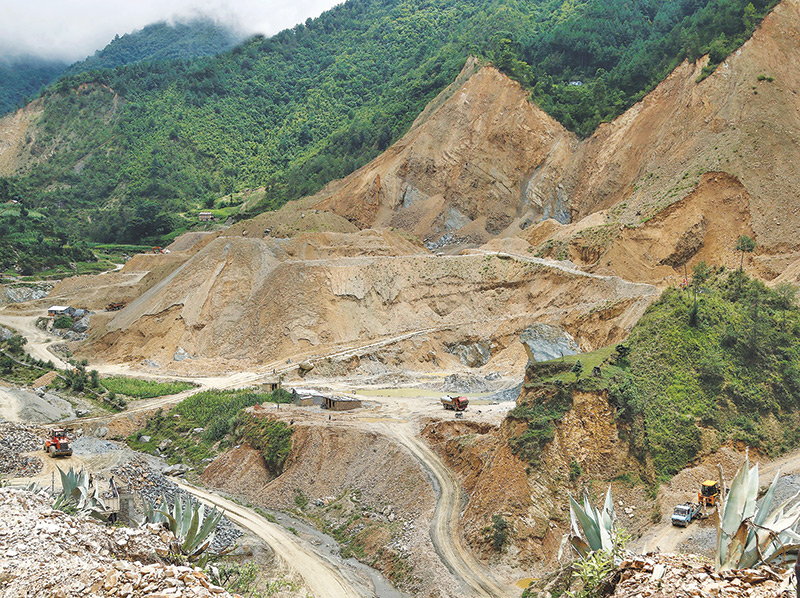
Dozer owners, in collaboration with the private sector, are altering our landscape in the name of land development for housing or connectivity through roads or sand and gravel mining. This destruction of natural habitats and water sources has often led to the drying of springs and subsequently landslides and debris flow, destroying farms and houses. Why not hold them accountable for such loss and damage? As global negotiations stall over rich countries’ reluctance to even listen to loss and damage arguments, we can’t afford any more delays in pursuing climate justice and an action-oriented approach to addressing the climate crisis. We can continue advocating for climate justice at global fora, but we should also pursue it at home by making polluters in Nepal pay part of their profits as compensation for the damage they cause.
Nepal has a unique opportunity to become a pioneer and an exemplar in this regard if we take the necessary steps. With the elections on our doorsteps, here’s hoping that we choose responsible and sensible candidates to make this a reality.


Upadhya is a senior watershed expert and columnist for the Post.

OPINION

Democracy beyond elections

Nepal’s under-represented marginalised communities are less likely to have their issues addressed.
- NARAYAN ADHIKARI,NICHOLAS BUDNY
Post Illustration

When we talk about free elections, we often focus on the process: Voter education, the role of the Election Commission, campaign budgets, and the like. But integrity at the conceptual level is an equally critical piece of the puzzle.
In short, Nepal’s elections suffer from a lack of new ideas. For an election to truly be accountable, it must represent the voice of the people at every stage—in the political parties, the candidates, and their philosophies. In Nepal, this remains a significant barrier to democratic progress. Consider the political landscape since the 2017 elections, in which alliances between political factions have become a new norm for Nepali politics. This year, the alliance between the CPN- Maoist Centre and Nepali Congress will contest the election against the alliance led by the CPN-UML.
Broadly, such partnerships are understandable; most political parties within Nepal promote democratic socialism, and many of their goals align. However, several worries remain.
First, the alliances don’t make ideological sense. The Maoist Centre leans strongly left, whereas the Nepali Congress is centre-left. They represent different segments of the Nepali political spectrum, calling into question why they compete for votes together. Partnerships between political factions are currently motivated by opportunism rather than by ideals. These alliances, especially at the top tier, change interparty dynamics into a game of mergers and acquisitions which fiercely undermine the democratic and electoral process.
Second, such coalitions leave Nepal vulnerable to outside influence. For instance, it was suspected that China’s Chinese Communist Party (CCP) played a role in the 2017 alliance between the CPN-UML and CPN-Maoist Centre. While elections represent internal competition, they are also a chance for Nepal to create a unified voice for the country. A political system in which parties serve as proxies will quickly silence that voice. With Nepal growing in geographic, strategic, and economic importance to major powers, this potential consequence of interparty coalitions cannot be ignored. China is already deepening ties through Confucius Institutes and the China People’s Armed Police; the US is likewise attempting to use the Millenium Challenge Corporation and State Partnership Programme to sign Nepal onto its broader Indo-Pacific strategy. If we wish to navigate a balance between these influences, Nepal sorely needs a government that represents its constituents fairly.
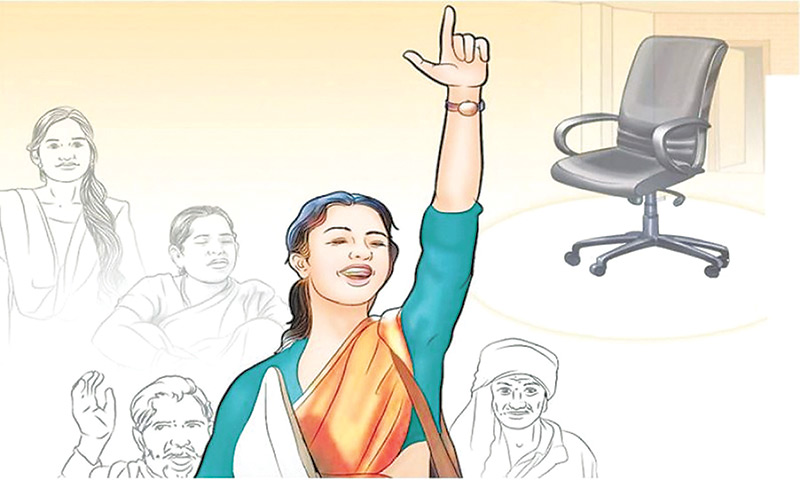
Third, conceptual integrity is also hindered by a lack of inclusive representation at the candidate level. For the upcoming general elections, only 9.33 percent of the total candidates for the House of Representatives under the first-past-the-post (FPTP) system are women. For the Provincial Assembly election, this number shrinks to 8.59 percent. The ruling coalitions led by the Nepali Congress and CPN-UML have nominated just 25 women as candidates under the FPTP system. There is only one candidate from the LGBTIQ+ community. Without adequate representation among candidates, marginalised communities in Nepal are less likely to have their issues addressed and  structural inequalities will remain.
Fourth, Nepal’s current methods of monitoring representation are also largely ineffective. For example, political leaders have openly prioritised their relatives when submitting closed lists—a system introduced to ensure better representation across castes, classes and communities than through the FPTP system. It is essential to create these avenues for inclusion, but their opacity is being abused.
Fifth, in light of the overwhelming deprioritisation of ideology in Nepal’s elections, it isn’t surprising that voters have grown jaded, further neglecting efforts to hold their politicians accountable. Nowhere is this vicious cycle better seen than in party manifestos, which were recently released in the buildup to the election. These manifestos, which once distinguished political factions on the basis of ideas, have now become a numbers game, with parties announcing competing economic projections for issues such as job creation and social security benefits. With parties predicting double-digit growth rates that dwarf all realistic expectations, the manifesto process has become less about promoting ideology and more about fulfilling old rituals—to almost comedic effect. If parties announced at least a roadmap for the results that they expect to achieve, we could once again foster the kind of political discourse that allows for informed, accountable voting.
Finally, Nepal’s next government could extend voter accessibility to groups that offer unique perspectives. Millions of Nepali migrant workers (estimated to be as many as 3.5 million), while eligible to vote, have no provisions allowing them to do so, disenfranchising them politically. While their remittances power nearly a quarter of Nepal’s GDP, their voices are not represented in governance. In addition to providing them basic citizenship rights, allowing absentee voting for migrants would inject a new perspective that does not currently play a role in Nepali politics. Migrant workers have largely worked in the developed world, and have unique lived experience in the labour market, contributing to a demographic of voters with potentially powerful input on critical issues such as employment and social services. If Nepal continues to lose young workers and thus young votes, election results will pan out with increasing homogeneity, producing the same coalitions, the same candidates, and the same (lack of) ideas.

Adhikari is a co-founder of Accountability Lab Nepal.
Budny is an accountability fellow at Princeton University, USA.

OPINION

Dialogue to avoid conflict

Many international problems could be resolved if the United States and China work together.

A battle for supremacy in which China is challenging the international order led by the United States is affecting the politics and economy of the entire world. Engaging in dialogue and preventing the rivalry from developing into a military conflict is the minimum the United States and China should do.
US President Joe Biden and Chinese President Xi Jinping held an in-person summit for the first time. The meeting is said to have lasted about three hours. US-China relations have been unprecedentedly tense since China conducted large-scale military exercises in waters near Taiwan in response to a visit to the island by US House Speaker Nancy Pelosi in August. Dialogue between the two countries has come to a halt, including talks between their military officials, as China has refused to confer with the United States on various issues.
The fact that the two leaders exchanged views and confirmed both sides’ positions in the face-to-face meeting is a significant step toward the easing of tensions. On the other hand, it also showed once again that the rift is too deep to produce results in a single summit.
On the Taiwan issue, Biden said the United States opposes any unilateral changes to the status quo and objects to China’s coercive actions toward Taiwan. In response, Xi stressed that the Taiwan issue is at the core of China’s interests and is a red line that must not be crossed in US-China relations. This is a one-sided view that does not allow the United States to get involved in the issue.
Xi objected to the US policy of imposing trade restrictions on China to address Beijing’s theft of technology and unfair trade practices, saying such restrictions “undermine international trade rules.” Regarding criticism of human rights violations, Xi argued that his country implements “Chinese-style” democracy.
The bold remarks suggest Xi might be trying to reinforce his reputation as a strong leader to people in China, following the establishment of his long-term leadership at the Chinese Communist Party’s National Congress last month.
China’s threats to global peace and free trade, and its disregard for universal values such as human rights and the rule of law have triggered concerns in the whole international community, not just in the United States. It is unacceptable that Xi does not understand the situation and dismisses it as interference in internal affairs. If Xi wants to enhance China’s prestige and stabilise US-China relations, he should reflect on his own words and actions.
Many international problems could be mitigated or resolved if the United States and China work together. Biden and Xi are said to have agreed to oppose the use of nuclear weapons or nuclear threats in Ukraine. Xi needs to urge Russian President Vladimir Putin to end his invasion of Ukraine and stop making nuclear threats against that country. Xi should also change his current stance of tolerating North Korea’s nuclear and missile development and steadily implement UN Security Council sanctions resolutions against Pyongyang.

— The Yomiuri Shimbun/ANN

Page 5
MONEY

Exports may fall slightly after LDC graduation: Report

Nepal has been getting preferential treatment as a least developed country which will end in 2026.
- SANGAM PRASAIN
About two-thirds of Nepal’s exports are absorbed by India, and preferential market access there is built into a bilateral trade treaty,and is not tied to LDC status, the report said.   POST FILE PHOTO

KATHMANDU,
Nepal will be stepping into uncharted territory after it is inducted into the company of middle-income developing countries in 2026, and exporters are beginning to worry about the higher tariffs and stricter rules of origin provisions that will follow.
Being a least developed country (LDC) meant Nepal got preferential treatment; but after 2026, it will have to hold its own. And the thought disconcerts many. Relax, says a new study, it won’t be so bad.
South Asia Watch on Trade, Economics and Environment (SAWTEE), stated in its report entitled Nepal’s Graduation from the LDC Category: Implications for International Trade and Development that exports could fall by 2.5 to 4 percent as a result of increased tariffs.
Last November, the United Nations General Assembly approved a proposal to upgrade Nepal from an underdeveloped country to a middle-income developing country by 2026.
But the country will not be left to fend for itself right away. It has been given a five-year preparatory period to allow a smooth transition, considering Covid-19 and the need to implement policies and strategies to reverse its damage to the economic and social sectors.
Nepal was included on the LDC list in 1971.
The report said that graduation means losing a host of international support measures offered by the international community to aid Nepal’s efforts in overcoming its development-related challenges.
A major implication of LDC graduation is the loss of preferential market access available through LDC-specific schemes under the Generalised System of Preferences (GSP) and other arrangements.
About two-thirds of Nepal’s exports are absorbed by India, and preferential market access there is built into a bilateral trade treaty, and is not tied to LDC status, the report said. However, Nepal’s exports will face tariff increases in other major and potential destinations that offer LDC-specific tariff preferences.
While the European Union (EU), the United Kingdom, and Turkey provide a transition period of three years after graduation, Nepal will face new tariff regimes in other preference-granting countries post-graduation.
The report said that the tariff increase in the United States market, which is the largest market for Nepal’s exports after India, is relatively low at 1.5 percent.
However, in the EU, the tariff may increase by 5.7 percent if Nepal becomes ineligible for its Generalised Scheme of Preferences Plus (GSP+) which gives developing countries a special incentive to pursue sustainable development and good governance.
The tariff increase is negligible if Nepal gets entry into the GSP+ group of countries, according to the report.
Tariff increase is also relatively large for Nepal’s next largest markets—China, Japaaxn and Canada.
Tariff increase is zero in the case of Australia and Norway as their next-best schemes offer significant duty-free coverage. Exports to Switzerland will also see a negligible increase in applied tariffs.
Exports to the Republic of Korea, New Zealand and Thailand will see a large increase in applied tariffs; but they represent a low share of Nepal’s exports, the report said.
Tariff increases are significant for most of Nepal’s top exports.
A major export sector that faces the largest increase in tariffs is the clothing sector (6.7 percent), but the extent of change will be much lower under the GSP+ regimes which may be 1.4 percent.
In the textiles sector, which represents the largest sector with regard to exports to preference-granting countries, the tariff increase will be 2.6 percent under the ordinary GSP regimes and 0.7 percent under the GSP+ regimes.
The Nepali private sector is worried about the possible increase in tariffs, and fears a severe impact because the country’s cost of production is higher than in neighbouring countries and other competitors.
For instance, according to the report, the cost of production in the apparel sector is about 26 percent higher than that of the neighbours.
The impact is expected to fall predominantly on small and medium enterprises (SMEs) as they represent the bulk of exports to LDC-specific preference-granting countries, according to the report.
The report said that Nepal struggles to utilise the available trade preferences.
Around 62 percent of its exports to preference-granting destinations are eligible for LDC-specific preferential treatment, but only 74.2 percent of them enter the market utilising LDC-specific preferences.
Under the Agreement on South Asian Free Trade Area (SAFTA), Nepal will face a significant increase in tariffs for its top two current exports—refined soybean oil and palm oil.
It exports these products to India through the SAFTA route.
However, the sustainability of these exports is questionable given that they are based on the differential in tariffs on imported raw materials between Nepal and India, the report said.
Exports to the EU are expected to see the largest losses, assuming that Nepali exports face ordinary GSP instead of GSP+. Getting GSP+ will significantly reduce export losses in the EU, the report said.
Export loss in the US will be much lower than in other markets. The impact will be the largest for the clothing and textiles sector.
The graduation will also impact official development assistance, an important source of finance for Nepal. The country may be eligible to receive highly concessional loans only for the next couple of years.
The report said that by the time Nepal graduates from the LDC group in 2026, it is quite likely that the World Bank will offer blend credit (subject to Nepal’s situation in terms of external debt distress and creditworthiness).
Blend credit is less concessional than International Development Association regular loans. For example, the maturity period could fall by eight years; the grace period could fall by one year, and the interest rate could increase by 0.5 percent. The loans given by the Asian Development Bank are less concessional. The maturity period could fall by up to seven years; the grace period could fall by three years and the interest rate could increase by 1 percent.
The United Nations Development Programme (UNDP) and the United Nations Children’s Fund (UNICEF) are mandated to provide a certain portion of their core resources to LDCs. This portion is allocated to the LDCs as a group and not individual LDCs.
Hence, graduation from the LDC category could potentially affect a portion of the core resources dedicated to the country in the subsequent budget cycle.
However, in the case of UNDP, the UN has mandated the organisation to assist graduating countries in achieving a smooth transition; thus, it may not immediately curtail funds allocated to Nepal, the report said.
Nepal has been providing cash subsidies to the exporters of select products—agricultural and non-agricultural—for over a decade, and they could come under greater scrutiny.
The report has suggested that since other preference-granting countries have extended GSP to graduated LDCs on a case-by-case basis, Nepal should also initiate dialogue with its trading partners for an extension of LDC-specific concessions and preferences for three to five years after graduation. 

MONEY

Pay extra to watch World Cup, top court rules

Media Hub, which has obtained broadcast rights to the World Cup, has decided to charge Rs565 extra per user.
- Post Report
Billions watch the live coverage of the four-yearly extravaganza on television, making it the most-watched sporting event in the world.  SHUTTERSTOCK

KATHMANDU,
The Supreme Court on Wednesday issued a ruling in favour of Media Hub, an advertising agency, allowing the company to impose extra charges on customers to give them access to the live broadcast of the FIFA World Cup 2022.
Media Hub, which has obtained exclusive broadcast rights to the FIFA World Cup, has decided to collect Rs565 extra (including VAT) per set-top box stating that domestic advertisements do not cover their costs.
The matches will be shown live on Himalaya TV.
Advocates Kishor Poudel and Anupam Bhattarai had filed a writ petition stating that Nepalis didn’t have to pay extra to watch previous World Cups, and demanding additional fees this time was unlawful.
On November 8, a single bench of Justice Prakashman Singh Raut issued the interim order to those concerned not to charge the customers until the final verdict is made.
Justices Prakash Kumar Dhungana and Manoj Kumar Sharma on Wednesday said that there is no need to continue the short-term interim order issued on November 8.
The 2022 FIFA Qatar World Cup kicks off on Sunday with hosts Qatar taking on Ecuador.
Billions watch the live coverage of the four-yearly extravaganza on television, making it the most-watched sporting event in the world.
“Watching the World Cup football by paying extra is not a regular but an optional issue for the viewers,” reads the Supreme Court verdict.
There also appears to be an option in the agreement between Himalaya TV and Media Hub that some important matches would be broadcast free of cost.
This means that customers who do not pay extra too can watch at least four important matches.
“We welcome the court’s verdict,” said Siddhartha Dhital, marketing director at Media Hub. “All the work for broadcasting the world cup matches had been halted after the court’s interim order. We will now work 24/7 to ensure the broadcast.”
“Worldlink and Vianet Communication, two of the leading internet and television services providers, have already signed agreements with us to broadcast the matches,” said Dhital.
Dhital had earlier told the Post that Media Hub bid for the broadcast rights for around Rs250 million for the month-long event. And an additional Rs150 million would be required for promotional activities and technical support.
For the first time in history, a Middle Eastern country is hosting the World Cup football. The tournament in Qatar will continue until December 18. A total of 64 matches will be played during the championship.
International media reports say that the Qatar World Cup will be the most expensive ever. The total cost of hosting the tournament is reported to be around $220 billion, around 20 times higher than the cost of the previous World Cup in Russia. Football fans around the world have criticised the high prices of the tickets to the World Cup matches.
Fan groups across Europe have accused FIFA of “hammering” supporters by hiking ticket prices in the “most expensive World Cup” ever.
The most expensive tickets on general sale for the December 18 final at Lusail Stadium cost 5,850 Qatari riyals (£1,179), which is 46 percent higher than the £807 ticket price for the 2018 final won by France.

MONEY

World Bank, Rural Reconstruction Nepal sign $4.5 million grant pact

The project will increase the income of forest-dependent indigenous people and communities in the Madhesh and Lumbini provinces.
- Post Report

KATHMANDU,
The World Bank and Rural Reconstruction Nepal signed a $4.5 million grant agreement to strengthen the capacity of indigenous peoples and local communities in Nepal’s forest sector.
The five-year dedicated grant mechanism for indigenous peoples and local communities in Nepal project will help enhance the capacity of indigenous peoples and local communities to participate in Nepal’s REDD+ (Reducing Emissions from Deforestation and Forest Degradation) processes at the local, national, and global levels for the sustainable management of forests, the multilateral funding agency said in a statement.
“This will help create livelihood opportunities and increase the income of forest-dependent communities in the Madhesh and Lumbini provinces,” it said.
Rural Reconstruction Nepal is the national executing agency for the project.
The agreement was signed by Lada Strelkova, World Bank Operations Manager for Maldives, Nepal, and Sri Lanka, and Arjun Karki, president of Rural Reconstruction Nepal.
“This project supports Nepal’s indigenous peoples and local communities through a dedicated funding mechanism that will promote and protect their customary institutions that are crucial for the sustainable management of natural resources and climate resilience,” said Strelkova.
“The project contributes significantly to Nepal’s transition to Green, Resilient, and Inclusive Development (GRID) for sustainable recovery, growth, and jobs.”
“The project provides much-needed support to forest-dependent indigenous peoples and local communities to enhance their resilience and build livelihoods through the small-scale forest and non-forest-based business and employment opportunities,” said Karki.
Indigenous peoples and local communities are both beneficiaries and active proponents and participants in the project, the World Bank said.
“This project is an excellent example of the innovation and leadership of indigenous peoples and local communities in Nepal,” said Meerim Shakirova, Natural Resources Management Specialist at the World Bank.
“Notably, it demonstrates that they can lead the design and implementation of development projects, meeting the expectations of the communities they represent as well as the requirements of the World Bank, donors, and partners.”
“Indigenous peoples and local communities in Nepal are a critical pillar for climate action. I believe that the project will improve their capacity and skills to have a greater role in forest-related decisions at the country and international levels,” said Bharati Pathak, Co-chair of the National Steering Committee.

MONEY

WTO warns of ‘real’ recession risk in some major economies

- REUTERS
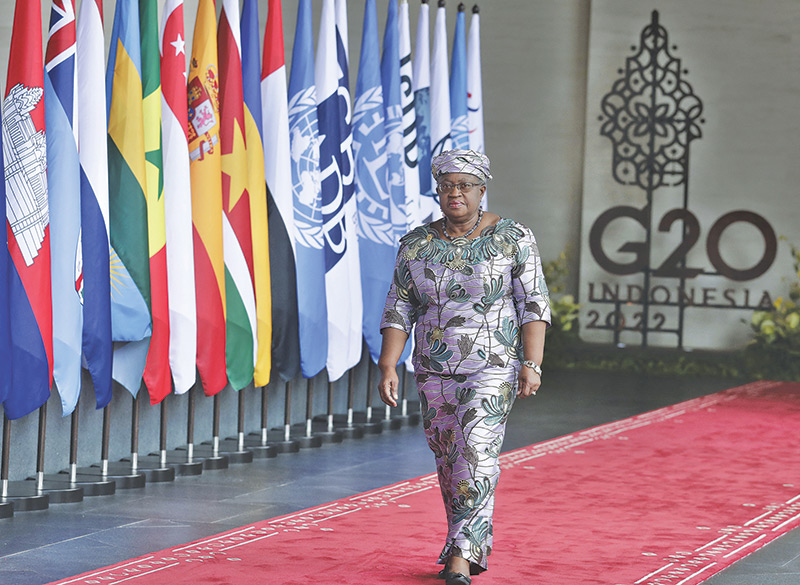
Director-General of the World Trade Organisation Ngozi Okonjo-Iweala arrives for the G20 Leaders’ Summit in Bali, Indonesia on Tuesday.   REUTERS

NUSA DUA,
The head of the World Trade Organisation (WTO) warned on Wednesday that several major economies face a real risk of sliding into recession as the war in Ukraine, rising food and fuel costs, and soaring inflation cloud the global outlook.
“It may not happen everywhere, but several key countries risk sliding into recession,” WTO Director-General Ngozi Okonjo-Iweala told Reuters on the sidelines of the G20 leaders’ meeting in Bali, Indonesia.
“Of course, the impact of that can be quite significant for emerging markets and poor countries, which need external demand from the developed countries to recover.”
The Geneva-based trade body last month projected global trade to rise just 1.0 percent in 2023, down sharply from an estimated 3.5 percent rise for this year. “There are so many uncertainties and most of the risks are on the downside,” such as the fallout from the war in Ukraine and headwinds from inflation, she said.
A second day of talks by the Group of 20 (G20) leaders on Wednesday was disrupted by an emergency meeting to discuss reports of a missile landing in Polish territory, adding to uncertainty over the economic fallout from the war in Ukraine.
Okonjo-Iweala said she has called on G20 leaders to phase out food export restrictions, which have been on the rise and hurt poor countries by pushing up food prices.
Among the few bright spots that she noted, US President Joe Biden and Chinese leader Xi Jinping met on the sidelines of the G20 summit to mend strained bilateral ties that are among the uncertainties weighing on the prospects for global recovery.
“One doesn’t want to read too much into it, but it’s always good when the two biggest economies in the world talk to each other,” Okonjo-Iweala said of the US-China summit. “Certainly with respect to trade, it’s very helpful.”
Okonjo-Iweala said she was “very hopeful” some breakthrough will be made in reforming the WTO’s dispute settlement system, which has been paralysed since 2019 when the administration of former US President Donald Trump blocked the appointment of judges for an appeals body arbitrating on global trade disputes.

MONEY

WorldLink reaches 700,000 households

Briefing

KATHMANDU: Internet service provider WorldLink has achieved a milestone by reaching 700,000 households. The company established on September 15, 1995, said it achieved the milestone at 9:12 pm on Monday. The country’s leading internet service provider said it took 23 years to reach the six-digit mark. In June 2017, it reached 100,000 households and added 600,000 new households in just five and a half years. The company said that it has 150 branch offices across Nepal employing over 5,000 people. Worldlink said its coverage has reached 73 districts and plans to connect Darchula, Baitadi, Manang, and Mustang soon. According to the company, it has been providing free WiFi services through WiFi Express at more than 14,000 spots across the country.  (PR)

MONEY

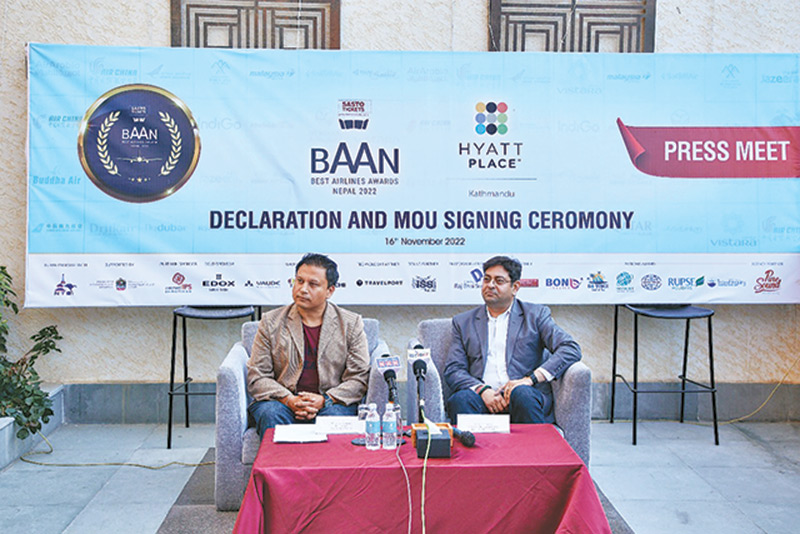
Best Airlines Award Nepal 2022 to be held next month

Briefing

KATHMANDU: Global Tourism Promotion Council on Wednesday announced that it will organise the Best Airlines Award Nepal 2022 to honour the contribution of airlines in the upliftment of Nepal’s tourism sector. The objective of the award is also to make airlines more responsible towards customers, the organiser said. The award will be conferred on December 13 at Hyatt Place Hotel Kathmandu. Thirty domestic and international airline companies serving Nepal will be nominated for the award under different 16 categories. Three categories are exclusively for Nepali airlines. International airlines operating in Nepal will be competing in eleven categories. The remaining two are reserved for stakeholders contributing to make aviation safe and convenient. As per the organiser, winners of the competition will be selected via public voting and jury. The award is being held in collaboration with Nepal Tourism Board. (PR)

Page 6
SPORTS

Bista’s late strike fires Nepal to victory against Pakistan

The forward’s 83rd minute goal gives Rohit Chand’s side a 1-0 friendly win.
- DIL KUMAR ALE MAGAR
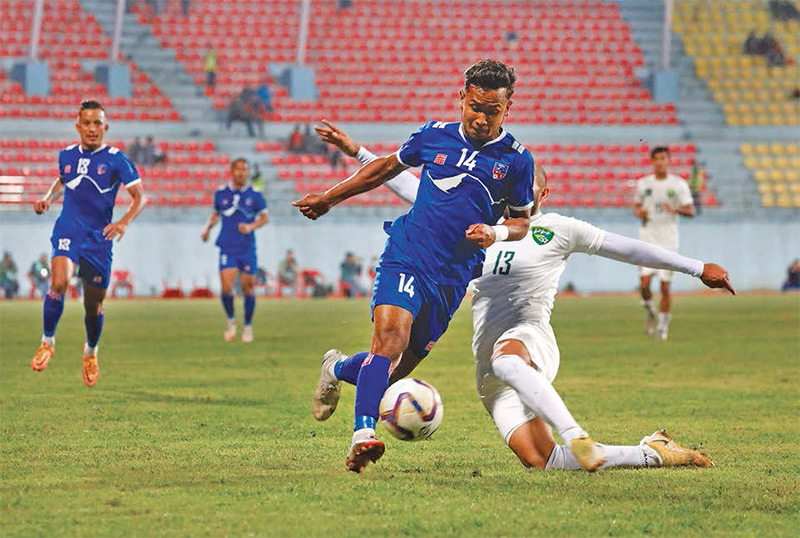
Nepal’s Anjan Bista (front) scored only goal of the match that fired theteam to victory against Pakistan at Dasharath Stadium on Wednesday.  Post Photo: Hemanta Shrestha

KATHMANDU,
A late goal from Anjan Bista helped Nepal see off Pakistan 1-0 in their international friendly football match at the Dasharath Stadium in Kathmandu on Wednesday.
Nepal were celebrating their 50th international match at their home ground and Bista put the icing on the cake when he caught the Pakistani defenders napping, and slipped into the six-yard box to tap home a long range cross from Sunil Bal in the 83rd minute after a good work from Dinesh Rajbanshi.
Bal had come as a second-half substitute replacing Ayush Ghalan in the 72nd minute.
Bista’s 11th international goal means he joins former national team captain Hari Khadka as the second-highest scorer in Nepali football history. Nirajan Rayamajhi holds the record for most international goals with 13 to his name.
Nepal played their first official international match at the Dasharath Stadium at the 1984 South Asian Games, where the Gorkhalis had a dream campaign—winning 4-0 against the Maldives in their first ever match at the home ground and becoming eventual champions following their 4-2 win over Bangladesh in the final.
Wednesday’s match was the first for Rohit Chand as a captain and Prabesh Katuwal as a caretaker coach.
Chand wore the captain’s armband in the absence of goalkeeper Kiran Kumar Limbu, who is playing for the Punjab FC in India’s second-tier football competition I-League.
Deep Karki took over the duty of guarding the post against Pakistan.
Since the departure of former coach Abdullah Al Mutairi, Nepal have remained without a coach. Pradip Humagain led charge of the national team as an acting coach in a 3-1 friendly win against Bangladesh in September thanks to a hat-trick from forward Bista.
And Bista was on target again on Wednesday that saved the blushes of Nepal in Katuwal’s first match in charge in a dull display in front of nearly 7000-strong crowd.
“Credit to the whole team…they deserve it,” said the player-of-the-match Bista after the match. “I would also like to thank the Nepali fans for their mind-blowing support.”
Pakistan were playing their first international match in more than three years due to Covid-19 pandemic and FIFA suspension, and had called up four Denmark-based players.
“We are very happy to make a comeback in international action,” said Pakistan coach Shahzad Anwar.
“This is my fifth time in Nepal and I feel great to see the response of the Nepali football supporters,” the coach added.
Despite the squad boasting international club experience in captain Hassan Bashir, goalkeeper Yousuf Butt, playmaker Adnan Mohammed and defender Abdullah Iqbal, Pakistan lacked coordination.
Nepal weren’t much better either. But after a tedious first half, Bista took full advantage of Pakistan flaws to give Nepal their sixth win in 16 matches against the Shaheens. Four matches between them have ended in a draw.
Bista said his side committed a lot of mistakes in the first half. “We discussed this in the changing room and planned to up the ante after the break. We built-up the game as per the plan and were able to break the deadlock finally,” Bista said.
About his feat as the joint-second highest scorer, Bista said, “I am only focusing on the game, not the high score.”
Anwar said he was happy with his team’s performance. “I am very satisfied with the game our boys performed against Pakistan,” he said. “We will do our best in the next match.”

SPORTS

Nepal edge UAE by three wickets for a series-levelling win

Aarif Sheikh and Gulsan Jha shares a 62-run partnership for the seventh wicket to guide the Rhinos to victory and square the three-match ODI series 1-1.
- Sports Bureau
Aarif Sheikh (left) and Gulsan Jha run between the wickets during their second One-Day International cricket match against the United Arab Emirates in Kirtipur on Wednesday.  Post Photo: Hemanta Shreshta

KATHMANDU,
Nepal defeated the United Arab Emirates by three wickets in the second One-Day International match to level the series 1-1 on Wednesday.
Chasing a target of 192 runs at the TU cricket ground, Nepali batters Aarif Sheikh and Gulsan Jha put on a 62-run stand for the seventh wicket to guide Nepal to 193-7 in 47.5 overs.
Nepal’s batting order has long come under sharp criticisms for its inconsistencies, and the woes continued again, with openers Arjun Saud and Aasif Sheikh departing cheaply thanks to an early blow from UAE bowler Hazrat Bilal.
Monday’s big hitter Saud, who made a fairytale ODI debut hitting a half-century in the first match, was out for a nought, caught by Sabir Ali off Bilal.
Aarif’s poor form continued on Tuesday as well. The 21-year-old right handed batter scored 6 runs before Bilal had him caught by Basil Hameed.
Skipper Rohit Paudel is having a horror stint in Kirtipur. Captaining his only second ODI, Paudel was sent back next for 8 runs, trapped leg in front by Rohan Mustafa. Since his appointment as captain on Friday, Paudel has only managed 9 runs.
Former skipper Gyanendra Malla, who played a 59-ball 26, combined with Kushal Bhurtel to crawl Nepal to 54 before he was run out in the 17.3 overs, as Nepal stared at a second defeat and a series loss.
But Bhurtel breathed some life into the innings hitting 35 runs facing 52 deliveries, before he became the second victim of Mustafa.
Dipendra Singh Airee, who also scored a fifty in the first ODI, added 13 runs.
But Sheikh and Jha held their nerves late in the innings. Sheikh hit an unbeaten 33 off 58 balls and Jha smashed a player-of-the-match 37 off 49 to guide Nepal to a series-levelling victory.
Sompal Kami was not out on 16 runs.
Earlier, Kami and Lalit Rajbanshi shared six wickets between them to restrict the UAE to 191 in 43-2 over despite Muhammad Waseem shining with the bat with a half century.
The opener smashed 50 off 46 balls—which included three boundaries and four sixes. He shared a 72-run partnership with Vriitya Aravind, who made 25, for the first wicket to give the UAE a solid start to their innings.
But Airee put a break in their march removing Aravind in the fifth delivery of the 12th over.
Rajbanshi then pocketed the prized wicket of Waseem, caught by Sheikh in the 15th over. Mustafa (4) was out next, bowled by Kami.
Captain Chundangapoyil Rizwan (22) partnered with Alishan Sharafu to fight off the Nepali pacers but Bhurtel had him caught by Paudel.
The UAE were reeling at 145-5 when Vishnu Sukumaran, who was making his ODI debut, returned contributing 15, caught by Aasif in the 34th over.
But Sharafu’s 35 off 43 helped the UAE steady the ship until Jha had him caught by Airee. Hameed added 24 but Kami and Rajbanshi combined to polish off the tail.
The teams will play the third and decisive ODI on Friday.


Brief scores
United Arab Emirates Tour of Nepal
Second ODI, TU cricket ground
Toss: UAE, elected to bat first.
United Arab Emirates 191 (43.2/50 overs)
M Waseem 50 (46), A Sharafu 35 (43)
S Kami 7.2-0-35-3, L Rajbanshi 10-0-41-3
Nepal 193-7 (47.5/50 overs)
G Jha 37 (49), Aarif Sheikh 33(58),
K Bhurtel 35 (52)
R Mustafa 10-0-24-3
Nepal win by 3 wickets.
Player of the match:
Gulsan Jha 37(49) & 1-29
Series Result: Three-match series level at 1-1

MEDLEY

Horoscope

ARIES (March 21-April 19) ***
Your intuition and manifestation abilities will be supercharged throughout the coming weeks. However, you’ll need to stay grounded in reality and the details of what work lies ahead. Be mindful of your past mistakes.

TAURUS (April 20-May 20) ***
This cosmic climate will ask you to take a strategic approach toward your goals. Remember to nurture both romantic and platonic relationships. New pathways and opportunities for love will shine this evening.

GEMINI (May 21-June 21) ***
You’ll awaken with an optimistic and harmonious state of mind, so remember to lean into the sweeter side of life. Your flirting skills will also be boosted, helping you get ahead within your goals and matters of love.

CANCER (June 22-July 22) ***
This cosmic climate can help you feel motivated to get organized within your personal goals. However, you’ll need to focus on wellness and health right now. Your advice-giving skills will also improve, helping you support your peers.

LEO (July 23-August 22) ****
It’s time to reconnect with your creative self. Nurturing your mind will elevate your aura and confidence, helping you feel as though the world is your oyster. Friendship will also play an important role in your mental health.

VIRGO (August 23-September 22) ***
This cosmic climate is poised to bring new joys to your heart, so be sure to develop new relationships and emotional connections. Home will also feel more calming and therapeutic than usual. Make sure you aren’t overly generous.

LIBRA (September 23-October 22) ****
You will be inspired to use your mind and words with more enthusiasm. Be sure to approach the world with a friendly and inquisitive demeanour, and new opportunities or relationships are sure to form.

SCORPIO (October 23-November 21) ***
This planetary placement will inspire you to operate from a supportive and stabilizing place, giving you an opportunity to give and receive positive reinforcement. Make sure to look for ways to improve your finances.

SAGITTARIUS (November 22-December 21) ****
This cosmic climate can help elevate your popularity, though you’ll need to take a proactive approach toward socialising. Luckily, people will be naturally drawn to your aura, making it easier to form organic connections.

CAPRICORN (December 22-January 19) ***
Personal revelations are likely to come, making it important that you’re willing to face your mind, heart, and soul. Socialization will feel more mentally depleting than usual, so be sure to choose your company wisely.

AQUARIUS (January 20-February 18) ***
Try not to be surprised if rumours begin to circulate around you. New friendships and online connections are also likely to emerge. Plan on spending the evening at home and try to release the past and look toward the future.

PISCES (February 19-March 20) ***
You may want to set strict goals for verbal boundaries and professional ambitions. You will find a perfect balance between pragmatism and dreaming of a good future. New doors within your romantic life will open this evening.

Page 7
SPORTS

Tite has sweet selection headache up front

The Brazil coach plans to use all nine forwards and has leaned towards a formation with Neymar adopting a midfield role in support of the attack, like ‘a bow behind three arrows’.
- ASSOCIATED PRESS

SAO PAULO,
Wingers, false nines, target men and centre forwards in the Brazil squad for the World Cup are giving coach Tite a nice selection
headache up front.
As the five-time champions aim to win the title for the first time in 20 years, Tite also knows his attack has limited experience on the sport’s biggest stage.
That’s something which he hopes will be offset by an abundance of skill, speed and aggressiveness to worry—or terrify—opposing defences.
The nine forwards in the 26-man squad are Neymar, Vinicius Jr, Rodrygo, Richarlison, Raphinha, Antony, Gabriel Jesus, Gabriel Martinelli and Pedro. Only Neymar, from the 2014 and 2018 World Cups, and Jesus, Brazil’s starting striker four years ago in Russia, have experience in the tournament.
The other seven will make their World Cup debuts in Qatar.
Tite has said he plans to use all nine. The main decision is where to play Neymar, a regular starter for 10 years. The coach has leaned towards a formation with Neymar adopting a midfield role in support of the attack, like “a bow behind three arrows,” according to Tite.
With Neymar as a midfielder-striker, Brazil’s most promising starting lineup has included Vinicius on the left, Richarlison as a target man, and Raphinha on the right. Many expect that to be the chosen option in the opening match against Serbia on November 24. Switzerland and Cameroon are also in Group G. The alternative would be to place Lucas Paqueta on the left in a position where he could move into the midfield.
That was often the case in World Cup qualifying but Brazil would be choosing a player who is recovering from a shoulder injury over Vinicius, who scored the winner for Real Madrid in the Champions League final this year.
“Brazil were very predictable for a while due to their dependency on Neymar,” Brazil great Zico said in September. “Now he is just the icing on the cake, the guy who will deliver something extra. Brazil have other players up front. A lot of players.”
Richarlison, who has seven goals for Brazil in his last seven internationals, will likely have Neymar behind him. Vinicius—or Paqueta—and Raphinha will be allowed to focus on their attacking skills because the likely left and right backs, Alex Sandro and Danilo, are expected to play more defensively.
If Vinicius and Raphinha fail to deliver, Martinelli and Antony will be warming up on the bench. Jesus and Rodrygo can also play on the flanks. If Paqueta starts and struggles, Tite could still field a rested Vinicius or Martinelli.
Tite’s squad also leave three players in waiting if Richarlison fails.
Jesus has improved as a finisher since the tournament in Russia and is also agile enough to open gaps for box-to-box midfielders such as Fred and Bruno Guimaraes to exploit. Rodrygo can do likewise while Pedro was the top scorer at the latest Copa Libertadores.
Pedro, who scored 12 in 13 matches for champion Flamengo, could end up as the team’s main striker during the World Cup. Tite has previously praised the player’s “unique” style and said he has an ability to “follow the quick thinking of midfielders.”
Experience could also influence bringing Jesus into the starting lineup when the tournament moves to the knockout stage if Brazil, as expected, advance from their group. Four years ago, Jesus failed to score in Russia but says he’s ready to make an impact this time.
Many were upset that Liverpool’s Roberto Firmino, Atletico Madrid’s Matheus Cunha and Flamengo’s Gabriel Barbosa were not chosen. And Brazil great Ronaldo, who scored both goals against Germany in the 2002 World Cup final, said 16-year-old striker Endrick of Palmeiras should have been selected.
“If I could take one, just to be a part of it, with little chance of playing for real, I would take Endrick,” Ronaldo said on his YouTube channel. “It would be a sensational experience for him and for the future of the national team.”

SPORTS

Ecuador leave Castillo out of World Cup squad

- AGENCE FRANCE-PRESSE

QUITO,
The Ecuadoran football federation said Tuesday that defender Byron Castillo had been left out of the nation’s World Cup squad to avoid further “unfair sanctions” in a dispute over the player’s nationality.
Last week the Court of Arbitration for Sport ruled that Castillo was eligible to play in Qatar but sanctioned the federation over the “falsification” of his passport. That cleared the way for the South American nation to take part in the World Cup after Chile and Peru had contested Ecuador’s qualification over the eligibility of Castillo.
The Chilean football federation (FFCH) said there was evidence that the player was born in Colombia in 1995 and not in Playas, Ecuador, in 1998.
The FFCH alleged “use of a falsified birth certificate, false declaration of age and false nationality”.
World governing body FIFA ruled in September that Castillo, who played in eight of Ecuador’s qualifiers, was considered to have “permanent Ecuadoran nationality”.
The case went to the CAS, which partially upheld the appeals by Chile and Peru. The court said Castillo was eligible to play for Ecuador in the qualifiers “considering that the Ecuadoran authorities acknowledged Byron Castillo as an Ecuadoran national”. But it added: “While the player’s Ecuadoran passport was indeed authentic, some information provided therein was false.
“In particular, the panel was comfortably satisfied that the player’s date and place of birth were incorrect since the player was actually born in Tumaco, Colombia, on 25 June 1995.”
The football federation was ordered to pay a fine of 100,000 Swiss francs ($106,000), and the men’s team will be docked three points in the 2026 World Cup qualifiers.
The federation said in a statement on Tuesday that Castillo would not be travelling to Qatar.
“Faced with the risk of more unfair sanctions, the Ecuadoran Football Federation is obliged not to include the player Byron Castillo Segura in the final list presented to FIFA,” it said.
Castillo on Tuesday uploaded a photo of the Ecuadoran team to his Instagram account, wishing them well and stating: “My dream doesn’t end here, I stand firm.”

SPORTS

Club teams impacted Italy’s failure to qualify for World Cup

Italian clubs often prefer to keep their prized players away from the national team rather than risk injury. There are no ‘ultra’ fans for Italy like there are for every club in Serie A, B and C.
- ASSOCIATED PRESS
Italy’s Joao Pedro reacts after missing a scoring chance in the World Cup qualifying playoff football match against North Macedonia at the Renzo Barbera Stadium in Palermo, Italy in this file photo taken on March 24. North Macedonia won 1-0.   Ap/Rss

ROME,
Loved and admired around the world for producing players like Roberto Baggio and Andrea Pirlo, Italy’s national team struggle for respect at home.
In a country where club teams rule and provincialism stretching back to medieval times still prevails, the Azzurri are often considered an afterthought—or even an inconvenience.
Italian clubs often prefer to keep their prized players away from the national team rather than risk injury. There are no organised hard-core “ultra” fans for Italy like there are for every club team in Serie A, B and C.
Italy do not even have a home stadium like England do with Wembley. Instead they barnstorm around the country, often playing games in small stadiums and cities—appearing at the San Siro in Milan and the Stadio Olimpico in Rome for only the biggest of matches.
Dragged down by a dearth of top young players and the demise of the Italian league over the last decade, four-time champions Italy failed to qualify for a second consecutive World Cup.
Winners of the European Championship last year, Italy were beaten at home by North Macedonia in a qualifying playoff in March.
Four years earlier, it was a playoff loss at home to Sweden that kept the Azzurri from the 2018 World Cup in Russia. And at the 2010 and 2014 World Cups, Italy were eliminated in the group phase.
 
No respect
Serie A refused the Italian football federation’s request to amend its calendar and move the league matches from the weekend before the playoffs, which would have allowed coach Roberto Mancini more time with his players.
“There is always great resistance from the clubs towards the national team,” federation president Gabriele Gravina said after the playoff loss. “The national team is seen more as an annoyance than something that unites an entire country.”
More recently, centre forward Ciro Immobile was held back from boarding the team plane to a Nations League game in Hungary amid disagreement about his injury status between the national team and his club, Lazio.
And on Sunday, a couple of hours after Qatar face Ecuador in the opening match of the World Cup, Italy will play a mostly meaningless friendly against Austria in Vienna.
The Italian football federation wanted to move the friendly with Austria up a day to Saturday to avoid the conflict with the World Cup but state broadcaster RAI reportedly refused because it preferred to air “Dancing with the Stars” on Saturday night.
With modern Italy having been unified in 1861, historically bitter rivalries persist between north and south and even cities in the same region.

Serie A’s demise
When Roma won the inaugural edition of the third-tier Europa Conference League last season, it was the first European title for an Italian club since Inter Milan lifted the Champions League trophy in 2010.
Failures to renovate and build new stadiums, match-fixing scandals and poor financial decisions have all contributed to the demise of the Italian league—and consequently the national team.
Italian clubs have also been hesitant to use young Italians, forcing Mancini to sometimes rely on players with little experience—like when he called up then-19-year-old Nicolo Zaniolo in 2018 before Zaniolo had ever appeared in Serie A. Zaniolo is now considered one of Serie A’s top players.
 
Missed penalties
Two failed penalty attempts from Jorginho in the qualifying matches against Switzerland ended up being decisive. One match ended 0-0, the other 1-1.
If Italy had won either of those two matches, they would have finished ahead of Switzerland and gained automatic qualification to the tournament in Qatar.
“Let’s not persecute Jorginho. But if you miss two penalties, you end up staying home,” Di Gennaro said.
 
Revival
Unlike after Gian Piero Ventura lost the players’ support and was fired after the failed qualification for 2018, Mancini kept his job and is already working on a revival.
The Azzurri qualified for the Nations League final four in June with Croatia, Spain and the Netherlands. And Italy are bidding to host the 2032 European Championship, which would represent a prime opportunity to rebuild the country’s crumbling stadiums.
Mancini can count on a core of young players like goalkeeper Gianluigi Donnarumma and forwards Zaniolo, Federico Chiesa, Giacomo Raspadori and Gianluca Scamacca to turn things around.
Unheralded Wilfried Gnonto has also impressed for Italy recently.

Serie A represented
Serbia and Poland each called up 11 players from Serie A to their World Cup squads. And Juventus are sending 11 players to Qatar.
So who will Italian fans support? They’ll root for the players on their club teams.
Juventus supporters will cheer Dusan Vlahovic and Filip Kostic with Serbia; Inter Milan fans will follow Romelu Lukaku’s Belgium; and AC Milan “tifosi” will keep an eye on Rafael Leao with Portugal.
It’s all about the club teams—not Italy.

Page 8
CULTURE & LIFESTYLE

I find editing more enjoyable and easier than writing

The writer and editor Lisa Choegyal on the type of reader she is, why she likes editing, and her favourite books on Nepal.
Photo Courtesy: Lisa Choegyal

Lisa Choegyal first arrived in Nepal in 1974 for a trekking expedition and has since made Kathmandu her home. In the nearly fifty years that she has stayed in Nepal, Choegyal has been part of many ecotourism projects in Nepal and beyond and authored and edited many books on Nepal. The most recent book she produced and edited was ‘Nepal Remembered, Historical Images from the Dirgha Man and Ganesh Man Chitrakar’. She is also the honorary consul of New Zealand to Nepal. In this interview with the Post, Choegyal discusses why she likes editing more than writing, the genres she enjoys reading and her favourite books on Nepal.

Excerpts:

What kind of reader are you? Do you prefer to read in one go or take your time finishing a book?
I would describe myself as a voracious reader. I am never without a book and sometimes have several on the go at the same time. At night I can’t sleep without reading for at least a short time, even when I am very tired. I often find myself still reading into the early hours, but there are very few books I can claim to have read in one go.

An author or an editor, which role do you prefer more and why?
I find editing more enjoyable and much easier than writing. Perhaps it is something to do with the pleasure of reorganising words and sentences that are already on the page into a final polished version. Although writing is much more rewarding in terms of personal satisfaction, I do find it really hard work. Perhaps every writer does. I am very good at distracting myself by working on other things and finding multiple reasons not to tackle that blank page on the computer screen. Usually, I work best in the late afternoon and evening when I have run out of excuses not to sit down and just start writing.

What is the one interesting thing that you learned from a book you read recently?
I have long been aware of the sophisticated communication system that exists between trees, using their roots and leaves to warn each other of impending danger. But I never knew that there are some precious fig trees that can be buried during the winter months to protect them from the cold. You dig a trench, tie up their branches, push them over, leaving half their roots in the ground, then cover them in straw and soil. Next spring, they are uprighted, flourishing and fruiting again in the warm weather. I learned this from Elif Shafak’s latest novel, ‘The Island of Missing Trees’, which is set in Cyprus.

What are your favourite books on Nepal and why?
In terms of novels, I love anything by Samrat Upadhyay. I believe he captures a special essence of Nepali life. My favourite is ‘Arresting God in Kathmandu’, which brought me up with a jolt when I first read it. And I much admired Shrada Ghale’s sparse and honest novel, ‘The Wayward Daughter’.
All the non-fiction books by Charles Allen on South Asia are informed and entertaining, but for Nepal, don’t miss ‘The Prisoner of Kathmandu: Brian Hodgson in Nepal 1820-43’ and his two books on the rediscovery of Lumbini, ‘The Buddha and the Sahibs’ and ‘The Buddha and Dr Fuhrer’.
Sagar SJB Rana readably captures the complicated world of his forebears in ‘Singha Durbar, The Rise and Fall of the Rana Regime in Nepal’.

Which genres do you enjoy reading? And which do you avoid?
I love novels, and fiction is my favourite genre to read. I aspire to be clever enough to write one, but I doubt I will. But I also enjoy the stimulation of learning from non-fiction, particularly all aspects of history, exploration and, of course, the environment and the natural world. During the lockdown, I even tackled important new subjects (to me), such as economics (‘Value(s)’ by Mark Carney) and earth science, especially when they relate to today’s context of climate change, species extinction, and the destruction of our planet.
I also enjoy a wide variety of memoirs and diaries. Ironically, I find myself avoiding travel writing, with the exception of anything written by Robert Byron and Bruce Chatwin. My house is filled with books, including lots of photographic books about Nepal and elsewhere, cookery books and some poetry, but these days, with no bookshelf space left, I prefer to read on my iPad Kindle. I suppose I have wildly catholic and eclectic tastes, but I have a poor tolerance for anything that is badly written.

What is that one book you read that has left a lasting impression on you?
So many books have made a lasting impression on me, but most recently, I was captivated by the complex layers and intricate storytelling of the novel ‘Lightning’ by Felicity Volk (currently our Australian Ambassador to Nepal). Rooted in central Australia, it ranges the world and encompasses a vast swathe of emotions from loss, love, and displacement. The novel’s delicate brand of magical realism would translate well into the mystical world of the Kathmandu Valley, so let’s hope that Felicity Volk is inspired to write a novel set in Nepal.

Could you name one book that you wish your younger self had read?
‘Himalaya: A Human History’ by Ed Douglas is an ambitious and wonderfully successful overview of the historical, geographic, and social evolution of the Himalayas in a beautifully readable style that would have greatly enhanced my understanding of Nepal had I read it when I first arrived in 1974. I especially enjoyed the mountaineering and botanical research chapters. Unfortunately, it was only published in 2020, but I wish I could have read it earlier!

What books would you recommend to someone who wants to learn more about Nepal?
If you ask me for one book about Kathmandu that I recommend to everyone, resident and visitor alike, I always say ‘The Living Goddess’ by Isabella Tree, a mesmerising deep dive into the tantric world of the Valley. It is an easy read, but it took her 13 years to research and write, revealing layers and cultural depths of Kathmandu that we think we know, ensuring it will never seem the same again.
Not a book, but for those with intense interest, I found the series of lectures on the history of modern Nepal by Father Ludwig Francis Stiller on The Record Nepal History Series podcasts to be insightful and fascinating. You can find the podcast at www.recordnepal.com.