You internet speed is slow. Switch to text view mode

Switch
epaper logo
ST

Last Login:
Logout
+
Page 1
HOME PAGE

Nepali Congress-led alliance likely to form governments in all seven provinces

UML leads FPTP tally in 3 provinces, Congress ahead in 4.
- NISHAN KHATIWADA

KATHMANDU,
Just as in the case of federal parliament, the post-poll positioning of political parties is coming into focus in the provincial assemblies too.
The shape and size of the federal government will have a big impact on government-formation in provinces.
If the ruling Congress-led alliance gets a majority in the federal parliament, and forms a government at the central level, the alliance members are likely to agree to a package deal including the provinces, say political watchers.
The leaders of the Congress-led alliance have also started claiming that the five-party alliance will make the federal government. Speaking after a meeting of the coalition in Bhairahawa on Sunday, Nepali Congress leader and Home Minister Bal Krishna Khand said, “The five-party alliance will form the government and the coalition will last for the next five years.”
On Saturday, Maoist Centre chair Pushpa Kamal Dahal and Nepali Congress chief Sher Bahadur Deuba had met at Baluwatar to discuss the alliance’s next step. In the meeting, they had agreed to give continuity to the coalition. If that is the case, and given the election results so far, there is a high chance of the Congress-led alliance forming governments in all seven provinces.
At the time of this writing, the CPN-UML is leading the first-past-the-post (FPTP) seat tally in three provinces while the Nepali Congress is ahead in four. Under the proportional representation (PR) elections in provinces, the Congress is ahead in Madhesh, while the UML tops the list in all other provinces.  The newly formed Rastriya Swatantra Party, which has performed well in the federal polls, did not contest the provincial seats.
The UML has thus far won 23 provincial seats under the first-past-the-post electoral system in Province 1. Similarly, the Congress has 14 seats, while the Maoist Centre is third with nine seats. The Rastriya Prajatantra Party has two seats and the CPN (Unified Socialist) too has bagged a pair of seats.
Of the six provincial constituencies in which counting is underway, the UML is leading in one, Congres in four and the Unified Socialist is leading in one. Province 1 assembly is 93-strong, where 56 members are elected from the FPTP system while 37 come from the proportional representation category. And the Congress-led alliance seems to be in a position to form the next government.
Under the proportional representation system, the UML is leading the count in Province 1 with 489,894 PR votes, ahead of the Congress, which has 418,372 votes.
The Rastriya Prajatantra Party has 148,759 votes and the Maoist Centre has 144,187. The Janata Samajbadi Party is in third place with 49,412 PR votes, while the Unified Socialist stands fifth with 44,674 votes.
The UML had won 14 provincial seats as of Sunday evening in the Madhesh provincial assembly. Similarly, Nepali Congress had 13 seats, while the Janata Samajbadi Party was placed third with eight seats. Loktantrik Samajbadi Party had locked in seven seats while the Janamat Party and independent candidates got six seats each. The Maoist Centre and the Unified Socialist won four seats each.
The UML is leading in one Madhesh provincial seat, where the counting was still underway on Sunday evening. The Congress-led alliance has bagged more seats than the coalition led by the UML in the province. The Madhesh provincial assembly is 107-strong where 64 members are directly elected and 43 are elected under the proportional representation system.  
In the Madhesh provincial assembly, Nepali Congress is at the top of the PR table with 287,516 votes, while CPN-UML and Janata Samajbadi Party stand second and third with 245,510 and 193,523 votes, respectively. The Janamat Party led by CK Raut has got 172,317 votes, the Maoist Centre 112,381 votes, the Unified Socialist 83,853 votes and the Loktantrik Samajbadi Party has received 67,823 votes so far.
In the Bagmati provincial assembly, the Congress is leading the tally with 24 seats, trailing the Maoist Centre, which has 14 seats. Similarly, the UML is third, winning 12 seats. The Rastriya Prajatantra Party has won seven seats while the Unified Socialist has locked in five provincial seats. The Hamro Nepali Party and the Nepal Majdoor Kisan Party have won a seat each.
Counting for the two provincial seats in Dolakha district has been halted for the time being. The Congress-led alliance is in a comfortable position under the direct election system in the province. The Bagmati province has a 110-member legislature—66 members elected from the FPTP and 44 from the proportional representation category.
The UML has received 386,273 votes under the PR category in the Bagmati provincial polls, while the Congress has got 335,650 votes. The Rastriya Prajatantra Party stands third with 195,108 votes. The Maoist Centre is in fourth place, having received 193,201 votes and the Nepal Majdoor Kisan Party has got 61,245. Meanwhile, the Unified Socialist has garnered 38,357 votes.
In the Gandaki provincial assembly, the Congress is leading the race with 16 seats while the UML is trailing with 12 seats. The Maoist Centre is in third place with five seats, while an independent candidate has won a seat. Gandaki has 60 members where 36 are elected under the FPTP system and the rest through the proportional representation system. Counting is yet to start in two provincial constituencies in Gandaki. The Congress-led alliance is in a comfortable position to form a government, if the results so far are any guide.
The UML is leading the PR vote tally for Gandaki provincial assembly with 340,533 votes, followed by the Congress with 317,596 votes. Similarly, the Maoist Centre has received 115,366 votes, while the Rastriya Prajatantra Party is in fourth place with 57,053 votes.  
Similarly, in the Lumbini provincial assembly elections, UML is in first place, winning 18 seats. Congress is trailing the UML with 16 seats, while the Maoist Centre stands third with four seats. The Janata Samajbadi Party, the Nagarik Unmukti Party, the Loktantrik Samajbadi Party and the Rastriya Prajatantra Party have locked in two seats each. The Janamat Party got one seat and independent candidates have won three seats.
The Congress and the Maoist Centre are leading in one provincial constituency each where vote counting is underway. The competition is tough between the Congress-led alliance and the UML. As many as 52 assembly members will be directly elected for the Lumbini provincial assembly, while 35 will get elected under the proportional representation category.  
The UML tops the list with 502,325 votes, and the Congress is in second place, having received 441,659 votes under the proportional representation category in the elections for the Lumbini provincial assembly. Meanwhile, the Maoist Centre stands third with 174,590 votes. The Rastriya Prajatantra Party has so far received 113,419 and the Nagarik Unmukti Party 89,809 PR votes for the provincial assembly.  
Likewise, the Congress and the Maoist Centre have won nine seats each for the Karnali provincial assembly. UML has so far got five provincial seats while an independent candidate has won one seat. The UML did not fare well in the province under the FPTP system. As such, the Congress-led alliance has a majority to form a government.
The Karnali provincial assembly is 40-strong where 24 members are elected under the FPTP system and 16 under the proportional representation category.
In the Karnali assembly, the UML has 183,950 PR votes and the Congress has 170,756 votes. The Maoist Centre is standing third with 137,629 votes. Meanwhile, the Unified Socialist is in fourth place with 35,826, trailing the Rastriya Prajatantra Party, which has received 25,186 votes.
In the Sudurpaschim province, the Nepali Congress tops the table with 11 seats for the provincial assembly, and trailing is the Maoist Centre with eight seats. The Nagarik Unmukti Party has so far won five seats, while the UML has three seats. The Unified Socialist has locked in one seat while an independent candidate has won one seat and is leading in one.
Counting in two provincial seats is yet to begin in the province. The UML had a disappointing result under the FPTP system for the Sudurpaschim provincial assembly with the Congress-led alliance in advantage. The Sudurpaschim provincial assembly has 32 directly elected seats and 21 proportional representation seats.
However, the UML is leading the PR vote count for the provincial assembly with 240,482 votes. Nepali Congress, with 226,369 votes is in the second position. The Maoist Centre stands third with 108,296 PR votes, while the Nagarik Unmukti Party is in fourth place, having received 60,036 votes. The Unified Socialist has received 39,779 votes.
HOME PAGE

Court bars export of sand, aggregates

Ruling says the government is a trustee in the protection of natural resources.
- BINOD GHIMIRE

KATHMANDU,
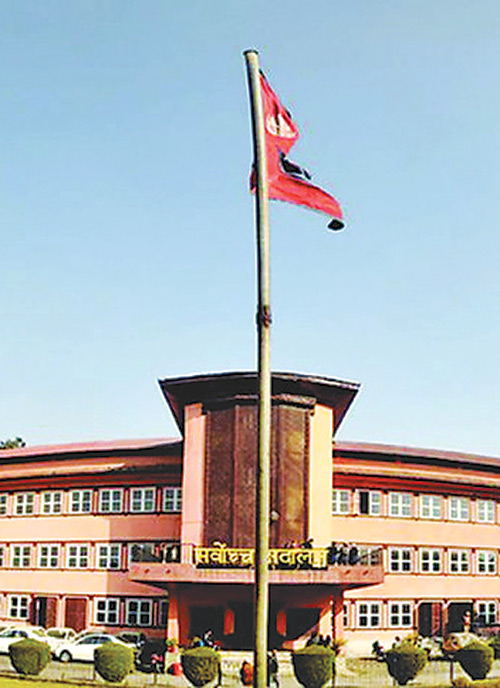
The Supreme Court has ruled that the extraction of stones, aggregates and sand be done only for domestic consumption after having a law in place.
The full text of the verdict issued on the writ petitions filed against the erstwhile government’s move to export construction materials says the destruction of nature shouldn’t be allowed in the name of boosting export.
In the national budget for the fiscal year 2021-22, the KP Sharma Oli government had come up with the idea to export stones, pebbles and sand. “Based on the environmental impact assessment, mine-based stones, pebbles and sand can be exported to minimise the trade deficit,” then-finance minister Bishnu Paudel had said while unveiling the budget.
The decision was challenged in the Supreme Court saying the move would destroy nature and increase the risk of natural disasters. On June 18 last year, the constitutional bench of the Supreme Court through an interim order directed the government not to implement its policy to extract stones, pebbles and sand for export.
The full text of the final verdict passed in May last year by the constitutional bench led by then acting Chief Justice Deepak Kumar Karki, was issued a few days ago.
“It is necessary to prepare an umbrella law after proper research and in consultation with independent experts to guide the extraction of stones, pebbles and sand only for the construction of the private and public infrastructure within the country,” says one point in the verdict.
Until the federal parliament prepares a law in line with the constitution and its spirit, no export of stones, pebbles and sand would be done from any part of the country, the decision further said. It has also directed the government to undertake strict surveillance to stop any such exports.
Senior advocate Dinesh Tripathi, one of the writ petitioners, said the court has clearly said that stones, pebbles and sand are not export items. “There is no law that specifically guides extraction of such materials,” he told the Post. “As per the court order, the incoming parliament must focus on preparing the necessary law at the earliest. Until then, the extraction must stop.”
Though the court’s spirit is to stop the export of such materials, it has allowed the legislature to use its authority to prepare a law with due focus on environment protection, Tripathi added.
The court has observed that an unchecked extraction of such materials adversely impacts the environment and nature, and is against the constitution.
Article 30 of the constitution states that every citizen has the right to live in a clean and healthy environment. The court has said being a trustee in the protection of natural resources, the government must take every decision only after proper study and impact assessment. The order further says the country must save nature and ecology
for upcoming generations and it is their right to live in a clean environment.
The constitutional bench observed that a wrong perception has taken hold that the local governments have the prerogative to extract such construction materials from rivers and mines. “In our cooperative federalism, the local governments are meant to work hand in hand with the people in their need and development works,” reads the apex court’s ruling. “They were not created for extraction and export purposes, neither does the constitution give them with such authority.”
As matters stand, the local governments have been awarding contracts for the extraction of construction materials from rivers and mines.

HOME PAGE

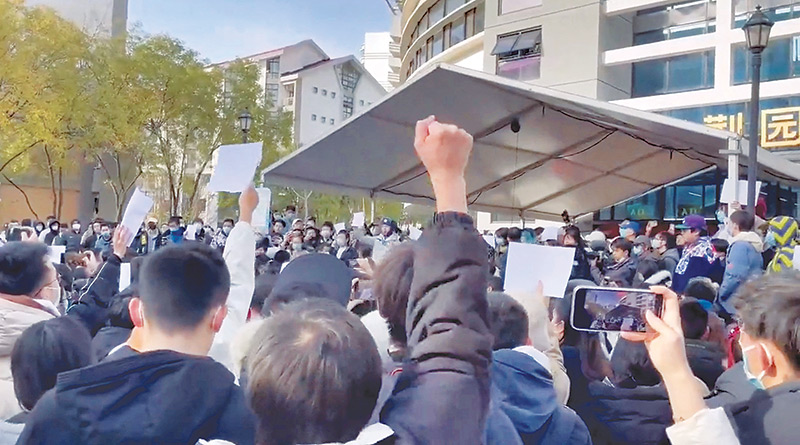
Protests in China as anger boils over Covid curbs

Wave of civil disobedience is unprecedented in mainland China since Xi Jinping assumed power a decade ago.
- REUTERS
Students take part in a protest against Covid-19 curbs at Tsinghua University in Beijing, China in this image taken from a video released on Sunday.  Reuters

SHANGHAI/BEIJING, 
Crowds of demonstrators in Shanghai shouted and held up blank sheets of papers early on Sunday evening, as protests flared in China against heavy Covid-19 curbs following a deadly fire in the country’s far west sparked widespread anger.
The wave of civil disobedience, which has included protests in cities including Beijing and Urumqi, where the fire occurred, is unprecedented in mainland China since Xi Jinping assumed power a decade ago.
In Shanghai, China’s most populous city, residents had gathered on Saturday night at Wulumuqi Road—which is named after Urumqi—for a candlelight vigil that turned into a protest in the early hours of Sunday.
As a large group of police looked on, the crowd held up blank sheets of paper as a protest symbol against censorship. Later on, they shouted, “lift lockdown for Urumqi, lift lockdown for Xinjiang, lift lockdown for all of China!”, according to a video circulated on social media.
Later, a large group chanted “Down with the Chinese Communist Party, down with Xi Jinping”, according to witnesses and videos, in a rare public protest against the country’s leadership. Reuters could not independently verify the footage.
Later, police kept a heavy presence on Wulumuqi Road and cordoned off surrounding streets, making an arrest that triggered protests from onlookers, according to unverified videos seen by Reuters.
By evening, hundreds of people had gathered again near one of the cordons, some holding blank sheets of paper. “I am here because of the fire accident in Urumqi. I am here for freedom. Winter is coming. We need our freedom,” one protestor told Reuters.
At Beijing’s prestigious Tsinghua University, dozens of people held a peaceful protest against Covid restrictions during which they sang the national anthem, according to images and videos posted on social media.
In one video, which Reuters was unable to verify, a Tsinghua university student called on a cheering crowd to speak out. “If we don’t dare to speak out because we are scared of being smeared, our people will be disappointed in us. As a Tsinghua university student, I will regret it all my life.”

People hold signs during a candlelight vigil held for the victims of the Urumqi fire, in Shanghai, China on Saturday in this picture obtained from a social media video. REUTERS


One student who saw the Tsinghua protest described to Reuters feeling taken aback by the protest at one China’s most elite universities, and Xi’s alma mater.
“People there were very passionate, the sight of it was impressive,” the student said, declining to be named given the sensitivity of the matter.
Thursday’s fire that killed 10 people in a high-rise building in Urumqi, capital of the Xinjiang region, saw crowds there take to the street on Friday evening, chanting “End the lockdown!” and pumping their fists in the air, according to unverified videos on social media.
Many internet users believe that residents were not able to escape in time because the building was partially locked down, which city officials denied. In Urumqi, a city of 4 million, some people have been locked down for as long as 100 days.
China has stuck with Xi’s signature zero-Covid policy even as much of the world has lifted most restrictions. While low by global standards, China’s cases have hit record highs for days, with nearly 40,000 new infections on Saturday.
China defends the policy as life-saving and necessary to prevent overwhelming the healthcare system. Officials have vowed to continue with it despite the growing public pushback and its mounting economic toll.
China’s economy suffered a broad slowdown in October as factory output grew more slowly than expected and retail sales fell for the first time in five months, underscoring faltering demand at home and abroad.
Adding to a raft of weak data in recent days, China reported on Sunday that industrial firms saw overall profits fall further in the January-October period, with 22 of China’s 41 major industrial sectors showing a decline.
The world’s second-largest economy is also facing other headwinds including a global recession risks and a property downturn.
Widespread public protest is extremely rare in China, where room for dissent has been all but eliminated under Xi, forcing citizens mostly to vent on social media, where they play cat-and-mouse with censors.
Frustration is boiling just over a month after Xi secured a third term at the helm of China’s Communist Party.
“This will put serious pressure on the party to respond. There is a good chance that one response will be repression, and they will arrest and prosecute some protesters,” said Dan Mattingly, assistant professor of political science at Yale University.
Still, he said, the unrest is far from that seen in 1989, when protests culminated in the bloody crackdown in Tiananmen Square. He added that as long as Xi had China’s elite and the military on his side, he would not face any meaningful risk to his hold on power.
This weekend, Xinjiang Communist Party Secretary Ma Xingrui called for the region to step up security maintenance and curb the “illegal violent rejection of Covid-prevention measures”.
Xinjiang officials have also said public transport services will gradually resume from Monday in Urumqi.
Other cities that have seen public dissent include Lanzhou in the northwest where residents on Saturday upturned Covid staff tents and smashed testing booths, posts on social media showed.

Page 2
NATIONAL

Exploitation fears as more contractors become lawmakers

Stakeholders say contractor-turned lawmakers could misuse their influence to skew laws and policies in their favour.
- PRITHVI MAN SHRESTHA

KATHMANDU,
As more contractors have been elected to parliament and provincial assemblies through last week’s elections, stakeholders have raised concerns about its potential adverse effects. They fear that the contractors could skew laws and policies in their favour.
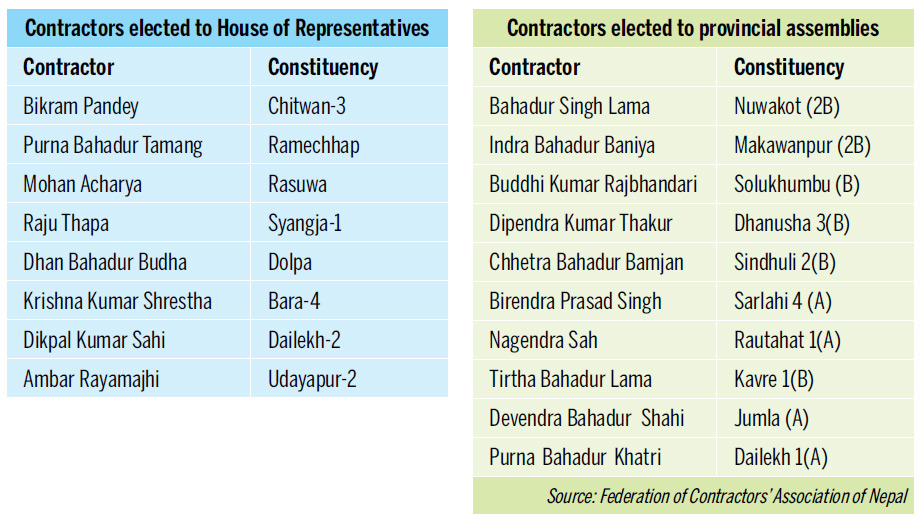
At least half a dozen contractors have been elected to the House of Representatives under the first-past-the-post (FPTP) electoral system, according to the Federation of Contractors’ Association of Nepal (FCAN), the umbrella organisation of contractors. Likewise, another dozen have been elected to various provincial assemblies, the umbrella body said.
The country held federal and provincial elections on November 20 and almost all results are already in.
“There will be more lawmakers representing contractors in both the federal parliament and provincial assemblies,” said Rabi Singh, president of the FCAN. “This time, a significant number of contractors have been elected directly by the people unlike in the elections five years ago. And more contractors could be elected under the proportional representation system as well.”
Some of the big names elected to the federal parliament include Bikram Pandey, owner of Kalika Construction Private Limited and a former minister; Mohan Acharya,  owner of Rasuwa Construction and former lawmakwer; and Purna Bahadur Tamang, owner of Kanchharam Construction Company Ltd.
In 2017, Pandey, who contested the elections on a Rastriya Prajatantra Party ticket from Chitwan-3, was defeated by CPN (Maoist Centre) chair Pushpa Kamal Dahal. But this time, Pandey defeated Maoist Centre’s candidate Bhojraj Adhikari in the same constituency. Likewise, Acharya won from Rasuwa on a Nepali Congress ticket.
Similarly, contractor and former minister Krishna Kumar Shrestha (Kisan) won the lower house seat from Bara-4 on a CPN (Unified Socialist) ticket. Also in 2017, Shrestha had won from Tanahun-1 by defeating Congress leader Ram Chandra Poudel.
Likewise, Dhan Bahadur Budha Magar, another contractor, has been elected to the lower house from Dolpa on a CPN (Unified Socialist) ticket.
And in the provincial assembly elections, some notable figures who got elected include Bahadur Singh Lama, owner of Himdung and Thokar Pvt Ltd and former federal lawmaker; and Indra Bahadur Baniya of Baniya Nirman Sewa.
Lama won from Nuwakot 2 (B) and Baniya from Makawanpur 2(B).
“The main reason for more contractors winning the elections is the good works they have done in their constituencies and campaign spending also has some role,” said Singh. “Contractors are not the people who have huge amounts of money, but they are not afraid to spend when needed.”
Their election comes amid an ongoing debate over growing election spending and elections getting costlier and unaffordable for many candidates.
During the 2017 elections, average spending by a first-past-the-post candidate for the House of Representatives was Rs10.1 million and it was Rs8.1 million for provincial assembly candidates, according to a study by the Election Observation Committee, Nepal (EOC-Nepal), a poll observer body.
EOC-Nepal studied campaign finance in this year’s elections also.
 “In the local elections last May, mayoral candidates in metropolitan cities spent up to Rs100 million in campaigning while the average spending by such candidates was around Rs30-40 million,” Binod Sijapati, an economist who has been coordinating a study on campaign finance for the EOC-Nepal, told the Post last month. “This suggests federal and provincial elections are increasingly getting out of common people’s reach.”
According to Sijapati, the trend of businessmen and contractors contesting elections is growing. Earlier they used to finance political parties’ elections campaigns. “They believe they can better protect their interest by joining lawmaking bodies instead
of staying outside,” Sijapati had told the Post.
Also, contractors have easy access to finance. After winning a contract, they are paid a certain amount in advance to start the project and they can use such money to finance their campaign.
“I heard a contractor, who has just been elected to the House of Representatives, had received Rs50 million in advance from a government entity to start a road project,” said Ramesh Sharma, chairperson of Sharma and Company, a contractor firm.
Sharma concurs that there is a possibility of the contractor lawmakers misusing their positions to influence laws and policies.
“There is the risk of conflict of interest,” said Sharma. “If a lawmaker who owns a contractor firm uses his influence to land lucrative government contracts for his own firm, this will be wrong.”
Also, if a firm owned by a contractor who is also a lawmaker or minister fails to complete projects on time then officials may not dare to take action against such a firm. “But if they act in good faith, it will help in good governance,” said Sharma.  
When a number of contractors were nominated to the Development and Technology Committee of the erstwhile House of Representatives in 2018, a number of lawmakers openly opposed their participation.
Contractor lawmakers Jip Chhiring Lama, Bahadur Singh Lama and Hari Narayan Rauniyar were among the members of the parliamentary committee responsible for monitoring development projects.
A few years ago, lawmakers representing certain businesses were accused of attempting to influence lawmaking.  
For example, in 2016, a bill on the Banks and Financial Institutions Act was registered in Parliament with a provision that barred those occupying constitutional posts from becoming board members of banks and financial institutions. But a group of then lawmakers—Ichchha Raj Tamang, Bhisma Nath Adhikari, Prem Bahadur Ale, Ganesh Kumar Pahadi, Umesh Shrestha, Baburam Pokharel and Yagya Raj Sunuwar, all of whom represented various businesses—registered an amendment proposal demanding that only chiefs and members of constitutional bodies be barred from holding positions in the boards of banks and financial institutions.
Also, some lawmakers, who owned private schools, had in 2016 thwarted a government plan to convert all private schools into trusts through an amendment to the Education Act.
Rajendra Raj Sharma, a retired joint secretary at the Ministry of Physical Infrastructure, said contractors’ influence was pronounced in the frequent amendments to the public procurement regulations in the last few years.
The regulations were changed twice in an interval of just three months this year as the government made the 12th amendment to the public procurement regulation in July this year to give domestic firms an edge over foreign firms in construction projects. The amendment barred foreign firms from bidding for construction works valued below Rs5 billion.
Stakeholders say the new provision stifles competition resulting in compromise in the quality of work.

NATIONAL

Activists memo ward office against Khula Manch parking plan

Ward-28 chairman receiving the memorandum on Sunday said his office will oppose the Kathmandu Metropolitan City’s plan.
- ANUP OJHA
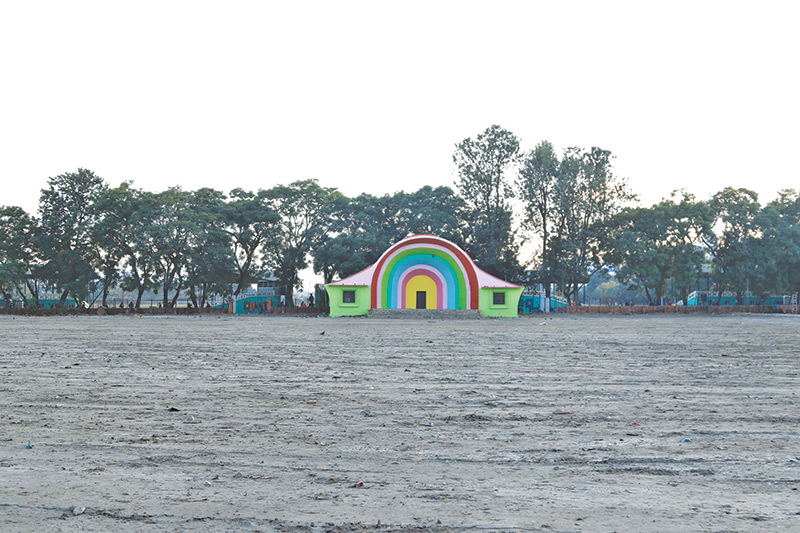
The Khula Manch where Kathmandu Metropolitan City plans to build an underground parking lot.   Post Photo: KESHAV THAPA  

KATHMANDU,
Heritage activists and locals who initiated the ‘Occupy Tudikhel’ campaign in 2019 for three months to reclaim encroached public space, on Sunday submitted a memorandum to the Kathmandu Metropolitan City’s ward-28 protesting the City’s plan to construct an underground parking lot at the historical Khula Manch.
“Since the Khula Manch lies in ward-28, we decided to first nudge the ward office,” said Ganapati Lal Shrestha, a heritage conservationist and one of the campaigners of Occupy Tudikhel.  
On November 15, the Kathmandu Metropolitan City’s 10th executive meeting approved a proposal to prepare a detailed project report (DPR) for a three-story underground parking facility and a water recharge pit at Khula Manch. Conservationists, groundwater experts and locals have expressed serious concerns over the plan.  
“The Local Government Operation Act 2074 mandates local governments to protect public spaces, but it seems the KMC is doing just the opposite,” said Sanjay Adhikari, spokesperson of Occupy Tudikhel, who is also a law student.
After continuous protests by heritage activists, locals and citizen-led groups calling for vacating Khula Manch in 2019, municipal officials had finally removed the bus park and padlocked its gate on April 28 last year. During Dashain, it was used as a parking lot for shoppers.
“Earlier it had been agreed to plant grass on the ground and the KMC had started clearing the bushes and unwanted vegetation. But all of a sudden it came up with the plan to construct a three-story underground parking lot. But what is more strange is that the elected representatives remain quiet on a sensitive issue like this,” the memo submitted to the ward office on Sunday reads.
When the Post asked the ward office about the KMC’s basement parking plan, the officials said it was tabled at the executive meeting without prior information and the meeting decided to proceed with the DPR plan.
“Since we are also elected representatives, we know the value of the Khula Manch, so we will not allow the Kathmandu Metropolitan City office to construct a parking lot there,” said Bhairam Khadgi, ward-28, chairperson.
“We will soon meet the mayor and tell him that the Khula Manch should be left untouched,” said Khadgi.
The Khula Manch, which lies at the heart of Kathmandu, is a historically important public space and location of political protests, rallies, concerts and festivals. The Khula Manch was the flashpoint of the popular movements of 1990 and 2006. The country saw restoration of democracy in 1990, while the 2006 movement led to the abolition of monarchy.   
Besides this, groundwater experts have also said that construction of an underground parking facility would affect the groundwater recharge system.
Last week in his conversation with the Post, groundwater expert Padma Sundar Joshi of the UN Habitat Nepal said that construction of an underground parking lot might be helpful in resolving the parking problem in Kathmandu, but digging up 30 to 40 feet underground would greatly impact the underground water recharge system.
“There will be ample space for parking in the Dharahara area since the Post Office has shifted. Also, an alternative parking lot can be developed inside the Nepal Airlines Corporation compound. So why do they want to dig up the historical public space? Do they have the answer?” said Shrestha.
Some conservationists suggest that the Nepal Airlines Corporation should be shifted elsewhere, a multi-storey parking building should be constructed on the site and the New Road area should be declared vehicle-free zone.
The Kathmandu Metropolitan City has long been criticised for not building a bus park, a lack of which has greatly inconvenienced those who need to travel to the outskirts of Kathmandu as they have no proper spots to board vehicles.
In 2016, the city had decided to use half of the Khula Manch as bus park to facilitate the construction of a view tower at the old bus park site across the road. The City had planned to use the tower’s basement and the first floor as a bus terminal, but the tower is still under construction, and the capital city is without a bus park.

NATIONAL

Pilgrims complain of lack of amenities

Briefing

JANAKPUR: Hundreds of pilgrims have arrived in Janakpur for the week-long Bibaha Panchami, Ram-Janaki marriage festival, which starts Sunday. Many pilgrims complained about the lack of free lodging arrangements and toilets. “Not all pilgrims can stay in hotels and lodges. It would have been helpful had the sub-metropolitan city set up community centres and temporary toilets for devotees like us who have less money,” said Mahajan Mahato of Darbhanga, India. The festival organising committee says the number of pilgrims exceeded their estimates leading to mismanagement and shortages. “The festival is being organised for the first time after the Covid pandemic, so pilgrim numbers have increased markedly,” said Mahant Ramatpeshwar Das, a member of the organising committee.

NATIONAL

22 candidates lose security deposits in Parbat

Briefing

PARBAT: Twenty-two candidates who contested the federal and provincial elections have lost their security deposits after failing to secure 10 percent of the total valid votes. District Election Officer Lakshu Sharma said 10 federal election candidates, and seven provincial election candidates from Parbat 1 (A) and five from Parbat 1 (B) lost their election deposits. Sharma said there were 12 candidates for the only federal seat in the district. Likewise, there were nine for Parbat 1 (A) and seven for Parbat 1(B). Only the candidates of the CPN-UML and the ruling coalition had crossed the vote threshold and secured their deposits, said Sharma.

NATIONAL

NHRC urged not to move its Diktel office

Briefing

KHOTANG: Amid plans by the National Human Rights Commission to move its Diktel-based office elsewhere, local officials in Diktel have requested the commission’s head office in Lalitpur to scrap the plan. Tirtharaj Bhattarai, mayor of Diktel Rupakot Majhuwagadhi municipality, submitted a memorandum to the commission’s head office in Lalitpur on Sunday. The office was set up in Diktel sixteen years ago.

NATIONAL

Demand for vote recount

Briefing

SUNSARI: The counting of votes in Sunsari constituency 4 remains postponed from 3 pm on Saturday after a dispute. Minister for Communication and Information Technology, Gyanendra Bahadur Karki, who is a Nepali Congress candidate, has demanded a recount alleging irregularities. An all-party meeting on Sunday ended inconclusively following which Karki filed a petition with the Election Commission, demanding a recount. Based on the last count, Congress’ Karki and the UML’s Jagdish Prasad Kusiyat are neck and neck. As per the last count, Kusiyait has won 21,433 votes, and Karki 21,445 votes. Out of the 32 wards in Sunsari-4, 22 have been counted. There are 1,28,065 voters in this area.

Page 3
Page 4
EDITORIAL

On their own merit

If talent is discouraged in old parties, those committed to public service will seek alternatives.

One widely noted aspect of the November 20 elections has been how most of the second-rung leaders cosy with party leadership have lost. These second-rung leaders had gotten various favours, including election tickets, mostly due to their unswerving loyalty to party leadership, rather than because of their competence or popularity. Conversely, most of the candidates who have proven their competence in running the party organisation and in maintaining public touch have won, despite them not always being in the good books of party chiefs. In a way, there is nothing surprising about popular candidates winning elections. But in a country where elections are often won and lost on the back of money and muscle power, this has come as a wonderful surprise.
Both Gagan Thapa and Bishwa Prakash Sharma were popularly elected as two general secretaries of Nepali Congress in the party’s general convention last year, even though they weren’t candidates from the grand old party’s establishment faction. They had in fact often dared to speak out against what they saw as the top leadership’s excesses. Both have now won parliamentary elections with big margins. On the other hand, the likes of Shankar Sharma and Dev Gurung, who were handpicked as the general secretaries of CPN-UML and CPN (Maoist Centre), respectively, lost the general elections from their home constituencies.
Similarly, Home Minister Balkrishna Khand of Nepali Congress and Senior Vice-chair Ishwar Pokharel of UML, two other election candidates known for their proximity to their respective party leaders, also lost. These cases speak volumes about the extent of internal democracy in our established parties. But they also show that the voters are becoming increasingly discerning; they increasingly prefer candidates who they believe can work independently based on their own conscience rather than orders from above.  
These election results should make the leaderships of old parties reconsider their criteria for now they appoint office-bearers and choose election candidates. It basically comes down to putting in place a system of robust internal democracy. CPN-UML, which was earlier commended for its rigorous democratic process while choosing leaders from local to central levels, started appointing important office-bearers on ad hoc basis since KP Sharma Oli became party chair. Intra-party democracy is even worse in CPN (Maoist Centre), where leaders are rarely selected through elections. In Congress, some young leaders like Thapa and Sharma have forcefully risen through the ranks, overcoming hurdles placed in their way by the sheer weight of their personality.
If promising politicians are not encouraged and promoted in certain parties, talented people who are committed to public service will seek alternatives, as some have done this time by joining the Rastriya Swatantra Party. The old parties, bereft of new leaders with new ideas and visions, could soon become relics if they don’t change their old ways. Hopefully, the public’s clear signalling this time will serve as an eye-opener. The signal is that just as in other professions, politics also needs periodic influx of new ideas and personalities, and that democratic parties cannot be run as fiefs of a handful of leaders.

OPINION

Economic promises and challenges

None of the manifestos explains how to mobilise resources and improve administration.
- CHANDAN SAPKOTA
Post File Photos

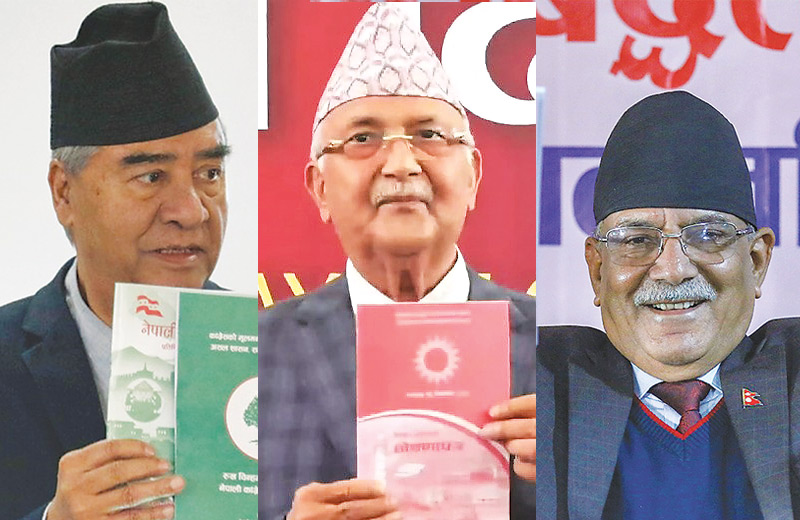
The major political parties unveiled a long wish list of distributional and aspirational programmes in their election manifestos. Irrespective of the lofty promises, which were also announced five years ago but remain unfulfilled, and their viability due to resource and administrative constraints, the next government will have to steer an economy that is facing substantial internal and external headwinds. Weak economic growth, limited fiscal space amidst rising public borrowing, escalating inflation and financial sector vulnerabilities, and threats to external sector stability are some of the macroeconomic challenges that the next administration will have to confront head on. Unfortunately, there are no easy fixes.
The political parties have aimed for high and sustained growth rates as in the previous manifestos. The Nepali Congress wants to achieve real gross domestic product (GDP) growth of over 7 percent, and the CPN-UML promises a double-digit growth rate. The Nepali Congress and the CPN-UML each have pledged 2 million and 2.5 million annual tourist arrivals, respectively. Additionally, they have vowed to create 250,000 and 400,000 jobs annually. There are equally grand promises on governance, prosperity, inclusivity and sectoral reforms. There is competition among the parties to increase unfunded and unconditional social security handouts outright or lower eligibility requirements. Note that social security expenses nearly doubled as a share of GDP since 2016-17 and are higher than the money the government invests in civil works.

Dream merchants
None of the political parties’ manifestos explains how to mobilise resources and enhance administrative capabilities to achieve the intended goals. In fact, none has costed their proposed projects and programmes. They read like a stripped-down version of the medium-term plan published by the National Planning Commission but without the details on costed programmes, intended resources mobilisation, fiscal deficit, and governance and accountability mechanisms.
They also don’t honestly discuss the achievements against the promises in their previous manifestos. There are hardly any substantial changes in the way public finance is governed, development plans are made, and projects and public services are delivered.
The manufacturing sector is still performing poorly due to an unfavourable environment for private sector development. Its growth rate over the last five years averaged just 3.4 percent. Budget execution, particularly the capital spending absorption capacity, has eroded. It averaged 65.2 percent between 2017-18 and 2021-22, lower than 76.2 percent in the preceding five years. Cooperative and competitive federalism remains an unfinished and neglected agenda. Banking sector liquidity problems have become endemic and financial sector vulnerabilities are building up to a level that threatens to unravel economic stability.
Despite overall tight liquidity for an extended period, there was a generous flow of credit to a few sectors, such as real estate and housing, whose prices have skyrocketed throughout the country. The fact that it is happening despite a sharp rise in interest rates points to unresolved structural weaknesses, including asset liability mismatches and evergreening or whitewashing of portfolios. Inflationary pressures have generally been elevated. External sector imbalances loom large, although much of it is masked by the decline in imports due to increased prices, tight bank financing and quantitative restrictions.

Challenges persist
The economy is in this state owing to external factors beyond the government’s control, such as the pandemic’s effect on economic activities and the increase in fuel and commodities prices because of the Russian invasion of Ukraine. However, it also reflects the shortcomings of the last and current administrations in decisively tackling the binding constraints to growth, good governance and effective public service delivery.
Going forward, three main macroeconomic challenges confront the next administration. First, the government will be pressed to accelerate growth while taming elevated price pressures. Supporting industrial sector growth, particularly the manufacturing sector, by overhauling legal and regulatory hurdles to ease the process of doing business so that output is cost competitive globally will be the key to sustained growth and employment generation. A cheaper supply of electricity (but not below cost recovery rate) to domestic firms rather than the export of allegedly surplus electricity will be important. A full recovery of the tourism sector with higher per-tourist spending could also provide some momentum. Promotion of agro-processing activities and value chain, year-round irrigation in agricultural belts, and digitisation to improve service delivery and streamline subsidies and targeting will be helpful. However, this must be synced with the need to rein in inflationary pressures, which are partly imported as high energy and commodity prices pass through, and partly exacerbated by domestic supply-side constraints such as lack of adequate infrastructure, black marketeering and sectoral cartels. A tighter monetary policy aimed at unproductive and speculative sectors to reduce vulnerabilities while facilitating a sustainable level of credit to productive sectors may be helpful. A coordinated fiscal and monetary policy response can support growth-enhancing measures without jeopardising price and external sector stability.
Second, effective fiscal management and discipline will be challenging, given the lofty promises. The large fiscal deficit since 2016-17 means that there is limited fiscal space to launch new initiatives as promised by the political parties. Revenue growth is stagnating, but expenditure growth remains high. Tax revenue may not fully cover recurrent expenses. Hence, efforts to rationalise recurrent expenses, especially unfunded handouts and the public wage bill; boost chronically low capital spending and its quality; broaden the tax net and the tax base through effective monitoring and digitisation; and increase concessional external financing will be important in the medium term. Furthermore, judicious cash flow, debt operations and management to reduce the cost of debt servicing and plugging fiscal leakages through digitisation and accountability are vital.
Third, the government will have limited options to manage external sector imbalances. A high cost of production that is eroding comparative and competitive advantages and an adverse external environment due to economic slowdown in major export destinations are affecting exports. The increasing import bill, partly due to high energy and commodity prices globally and a depreciation of the Nepali rupee against convertible currencies, combined with low exports and moderation in remittances growth have widened the current account deficit, which reached 12.8 percent of GDP in 2021-22. Efforts to discourage imports through outright quantitative restrictions and credit tightening have led to a lower current account deficit lately and a slight improvement in import cover by foreign exchange reserves. However, it is not a sustainable approach because the slowdown in essential imports also hampers overall economic activities. Tariffs should be adjusted without breaching multilateral and bilateral trade agreements. Ideally, the adequacy of foreign exchange reserves should not fall below 5.5 months of prospective imports of goods and services.

Sapkota is an economist.

INTERVIEW

Old parties failed to understand the new generation

The political template of Congress and Communists are decades old. Closed camps and cadre training don’t work so well in the age of social media.
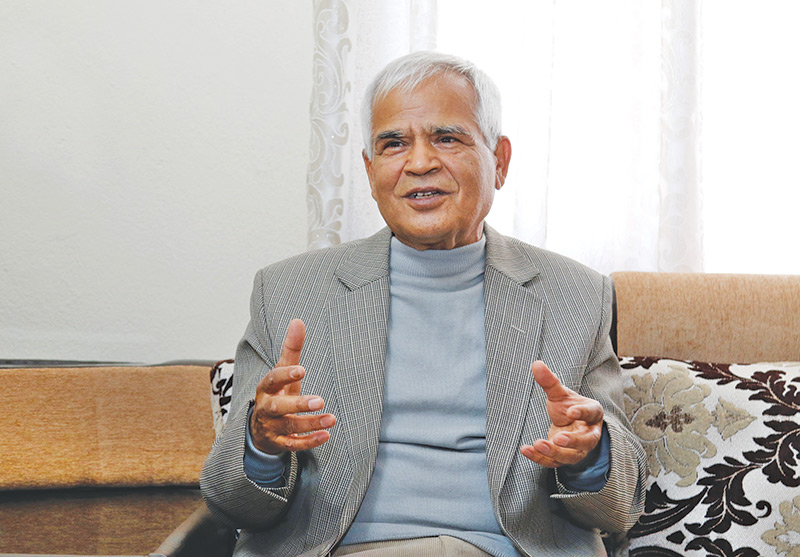
Krishna Khanal.   Post Photo: Keshav Thapa

As vote-counting for the 2022 federal and provincial elections ends, a tentative picture of the parties’ strengths and weaknesses is becoming clear. The Post’s Thira Lal Bhusal and Nishan Khatiwada talked to political analyst Krishna Khanal about the recently-concluded elections, their indications, and future power politics.

How do you analyse the emerging election results?
May’s local polls had already hinted at a certain level of restlessness. Voters can change sides at any time, was the takeaway message. Voters frustrated by the lacklustre performance of previous mayors, elected a new mayor unlinked with politics in Kathmandu metropolitan city. Yet, the political parties did not learn their lessons.
Thus, the result of the November polls is no surprise, at least for me. It would have been unexpected had the new parties and independent candidates swept the elections. Rastriya Swatantra Party (RSP) emerging as a challenger to the big parties hints that voters crave for a change. Though the dominant parties are still the Congress, UML, and Maoist Centre, the public disenchantment has been expressed in the 2022 major polls.
The public dissatisfaction was also reflected in Madhesh. The CK Raut-led Janamat Party caught the public imagination and has emerged as a regional force. Meanwhile, many of the key Madheshi leaders did not fare well.  

Many think the Rastriya Swatantra Party lacks ideological clarity. What do you say?
I don’t think ideologies matter much in contemporary politics. Parties like the RSP are still in their infancy. What matters is how they turn promises into actions.
They won because of their anti-corruption agenda and promise to deliver. Now, they should build the bases for delivery—with clear agendas for development and good governance. They should think of whether their presence in government (if they join it) can bring about policy-level changes.
Good governance is easier said than done. The emerging parties should have concrete ideas. Agenda-wise preparation is necessary to shape law-making in a way that opens the door for good governance. Also, the emerging parties should avert any disputes that may arise on the issue of joining the government. Such disputes can lead to splits, as the history of our parties suggests.

Would you back the statement that the various pre-poll alliances failed?
It has now been shown that vote-convergence is not easy in an open system like ours where the election franchise is deemed a sovereign right of the public. It is not necessary that even conventional voters will agree when top leaders ask them to cast votes for other parties. People were frustrated when they were asked to do so. And political parties, on the other hand, shared seats based on calculations without any proper research.

Which, in your view, is better: pre-poll or post-poll alliance?
Pre-poll alliance is better in the sense that there exists a commitment to the voters—partners claim to be proceeding jointly. The votes in the constituencies Congress won in FPTP also consist of Maoist Centre votes. Votes have been more or less shared between the alliance partners. So, in a way, it makes alliance partners accountable to voters and to each other.
On the other hand, opportunism and the lust for power characterise post-poll alliance. As such, the pre-poll alliances have more potential to sustain. This is only a theory but in India some alliances have sustained for decades.
This time, the alliances are said to be unnatural as they incorporate partners with opposite ideologies.
Our voters are indoctrinated with various ideologies. But our political parties have been sharing power for a long time, despite their divergent ideologies.
Ideologies don’t exist in a pure sense. Alliances can be forged over agendas such as governance and development. Unnatural alliances are nothing new. However, such alliances should be workable. The two options now are either a government under the Congress or UML leadership. What matters is the decisions that will be made in the parliament. For that, having a workable alliance is a good option.

The forces which lobbied for change after the 2006 movement seem to be on the wane. How do you see this change?
Two forces emerged back then: The Maoists and the Madheshis. Maoists failed to develop into a united and well-organised political party. Maoist leader Prachanda has since 2006 remained busy in power politics while ignoring the ground and organisational strength. The Maoist Centre should realise that power comes from a strong base.
Likewise, Madhesh-based leaders such as Upendra Yadav who are actors in national power politics have been ignoring their bases. As such, the foundation of the Madhes-based parties is also weakening.

Maoist Centre has  been the kingmaker in Nepali politics since 2013. But it did not fare well in elections this time. Which forces will play this role this time?
With the emergence of new forces in the Parliament, the power equation will naturally change. The Maoist Centre’s inability to become the sole kingmaker has provided space for the Rastriya Swatantra Party as a potential kingmaker. It would have been otherwise had the Congress been able to garner a majority with the backing of the Maoist Centre.

Do you see any possibility of a communist alliance?
No. I don’t see the possibility of a durable communist alliance. The Maoist Centre and the Unified Socialist have split away from a solid communist force. They can play the alliance card to trick people. Or foreign powers can try to influence Nepali politics with this card. But I don’t see space for an alignment on the basis of ideologies such as communism. Working alliance is the only option now.

Do you foresee more political instability as a result of more parties competing for power?
Yes. There can be a difficulty if there is no point of convergence between the RSP and Maoist Centre. Also, in such a case, there is a chance of government formation with the help of smaller forces. The main problem is that our alliances lack honesty, and dishonest alliances can lead to instability.

How do you evaluate the performance of Madheshi parties?
Madheshi people still want more regional forces to emerge. But the political actors from Madhesh are dependent on foreign forces and big parties.
It is not wrong of regional forces to seek power even at the federal level but they should have a long-term vision on how to use that power. The leaders from Madhesh have time and again come to power. But to what extent they were successful in establishing the regional agenda is an unanswered question.
The Madhesh agenda is permanent, but the actors can change. Previous actors no longer hold sway—old Madhesh-based parties did not fare well and their key leaders either lost or struggled for victory.

What challenges do you foresee for the big parties?
The emergence of new forces signifies that the public will look for alternatives if the parties fail them repeatedly. They want a better-functioning Parliament.
The main challenge for the old parties is to change their modus operandi which can no longer be based on conventional agendas. The political template of Congress and Communists are decades old. A new generation of voters has emerged and we are in the digital age. Closed camps and cadre training don’t work so well in the age of social media.  
The big parties have challenges galore as the new generation does not heed party leaderships’ guidance on how they should vote. They seek rational reasons. The parties have failed to understand how the new generation thinks.

What are the chances of the old leaders passing over the leadership baton to young ones?
The current alliances have morphed into alliances only between their top leaders. As the top leaders are not positive about leadership transfer, I see less possibility for new faces in power politics.
The new generation should speak up in favour of leadership transfer. I personally find Gagan Thapa’s claim to prime minister timely. And, I think the time is ripe for top leaders of big parties to step down. Parties are losing public trust, as was reflected in the voting. If they step down, the leadership change would be easier.
Given the old leaders’ reluctance to step down, intra-party rebellions seem inevitable, especially in the Nepali Congress.

Page 5
NATIONAL

Top court scraps writ petition related to impeachment of former chief justice Karki

The Constitutional Bench last week quashed the petition filed in May 2017.
- BINOD GHIMIRE
Post File Photo

KATHMANDU,
After sitting on a writ petition for five and a half years and deferring a decision 35 times, the Supreme Court has scrapped the petition that challenged the impeachment motion against then chief justice Sushila Karki.
The Constitutional Bench of the Supreme Court last Wednesday scrapped the petition filed by advocate Sunil Ranjan Singh in May, 2017, challenging the move of the Nepali Congress and the CPN (Maoist Centre) to register an impeachment motion against Karki. Lawmakers of the Congress and the Maoist Centre had registered an impeachment motion against the former chief justice at the Parliament Secretariat on April 30 the same year, objecting to one of her rulings.
After a preliminary hearing, a single bench of Justice Cholendra Shumsher Rana had stayed the impeachment motion, saying “the move to impeach the chief justice is against the spirit of the Constitution of Nepal”.
“It appears that the impeachment motion was brought against the apex court’s order on the appointment of the Nepal Police chief, which is sub judice in this court, but the move, prima facie, is against the spirit of the constitution,” Rana’s bench said at the time. The bench also directed the parliament secretariat to put the impeachment motion on hold until a final decision on the petition. Based on Rana’s ruling, Karki returned to the court and led the judiciary until her retirement.
Five and a half years later, the court scrapped the petition. Although the ground for scrapping the petition is unclear, officials say that since the issue has already been settled, the court found no need for a ruling.
“The details, however, will be out soon with the full text of the decision,” Bimal Poudel, spokesperson for the Supreme Court, told the Post. He said it would take at least a couple of months for the full text.
Petitioner Singh argued that the House should not impeach justices just because some parliamentarians are dissatisfied with court verdicts. Of the nine charges they had leveled against Karki, one was related to a ruling in which the top court had quashed the government’s decision of appointing Jay Bahadur Chand as the chief of Nepal Police.
Karki’s bench on March 21, 2017 had scrapped the then Sher Bahadur Deuba government’s decision to appoint Chand as the inspector general of police on February 21 that year although he was behind his colleagues in performance ratings.
Singh had also demanded that the Constitutional Bench define the criteria for impeachment. However, the court did not entertain his demand. “I am surprised that the petition has been scrapped after being sub judice for years,” Singh told the Post.
“I am of the view that Parliament cannot impeach justices just because lawmakers are not satisfied with their verdicts. By refusing to issue a writ as I petitioned, the court has kept the door open for impeachment against justices whenever the lawmakers are not satisfied with their rulings.”
Had the court issued a verdict on the matter, Singh added, it would have cleared the confusion over the impeachment motion against suspended chief justice Cholendra Shumsher Rana as well.
As many as 98 lawmakers of the ruling parties in February registered a motion against Rana, who remains suspended from that very day. The term of the House of Representatives expired without deciding on the matter. Whether the motion will continue in the upcoming House is debatable.
“I am pretty sure that the court decided to scrap my petition for possible connection with the impeachment motion against Rana,” Singh said.

NATIONAL

Omicron sub-variant BM.1.1.3 circulating in Nepal

Of the swab samples of nine people, all tested positive for different sub-variants on Sunday.
- Arjun Poudel
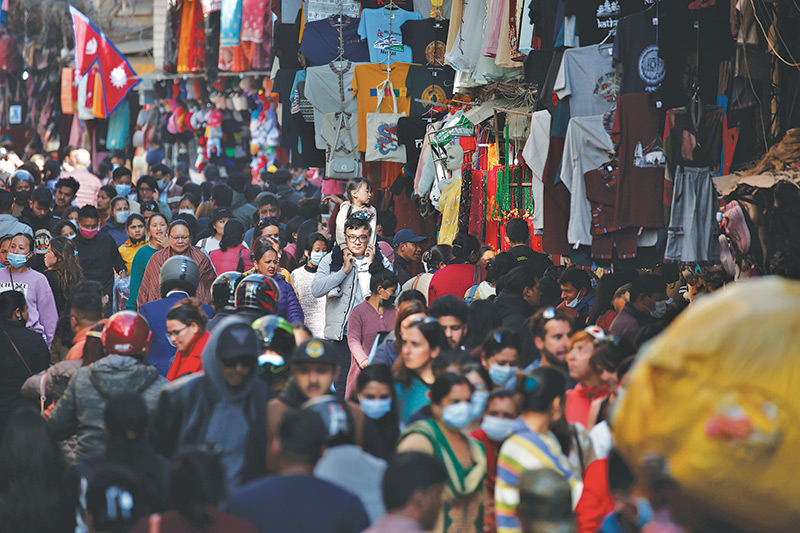
A crowd of people, most of them without masks, is pictured at a busy street in Ason, Kathmandu on Sunday.  Post Photo: Elite Joshi

KATHMANDU,
Nepal on Sunday confirmed the infection of Omicron’s new sub-variant BM.1.1.3.
Experts say BM.1.1.3 is another descendant of highly transmissible Omicron’s sub-variant BA.2.
According to the Dhulikhel Hospital, which carried out whole-genome sequencing on swab samples of nine coronavirus-infected persons recently, along with BM.1.1.3, BA.2.75.1. BA.2.75.2 and BA.2.75.3 have been detected in the swab samples.
“Several sub-variants of the Omicron variant of the virus have been found in all swab samples of infected persons,” Dr Rajiv Shrestha, an infectious disease expert at thje Dhulikhel Hospital, told the Post. “This means the Omicron variant of Covid-19 has been continuously circulating in communities. Detection of a new-sub variant of the virus means that the virus is not only circulating, but also mutating continuously.”
Whole-genome sequencing is a comprehensive method of analysing the entire DNA sequence of an organism’s genes. Researchers say that whole-genome sequencing of coronavirus could be instrumental in tracking the severity and properties of the virus.
Omicron’s BA.2 variant sub-variant, itself is considered far more infectious than all other previous variants, which led to a third wave in various countries, including Nepal. It is made up of several sub lineages and the most common is BA.1, BA.2.BA.3, and B.1.1.529. And several others.
Nepal has reported almost all variants and sub-variants of Covid-19 detected in any corner of the world. Due to the high mobility of people across the globe, the risk of any virus variant entering the country remains always high, doctors say.
On Sunday, Nepal reported four cases of coronavirus infection. Of the 512 swab samples on which polymerase chain reaction tests were carried out, three tested positive for the virus, and one person tested positive for the virus in an antigen test.
The number of positive cases was only one on Saturday.
Doctors, however, say the numbers of positive cases declared by the Health Ministry are neither real nor close to reality.
“When we stop carrying out testing we will not find a single case of infection,” said Shrestha.
Authorities stopped carrying out active case finding a long time ago. Only healthy people who need a report of a polymerase chain reaction test to go abroad, are undergoing testing.
Of late, most people are shunning even the basic Covid-19 safety measures such as wearing face masks, maintaining social distance, and washing hands.
So far, 12,019 deaths have been reported from Covid in the country, according to the official count. The Health Ministry said as many as 1,153,084 people have tested positive for Covid throughout the country since the start of the pandemic nearly three years ago.
The Health Ministry said that 22,324,933 people or 76.5 percent of the total population has been fully vaccinated. The number of people taking booster shots stands at 7,972,791, as of Thursday.

Page 6
WORLD

Pockets of shelling across Ukraine as wintry warfare looms

Both sides are bogged down by heavy rain and muddy battlefield conditions in some areas, experts say.
- ASSOCIATED PRESS
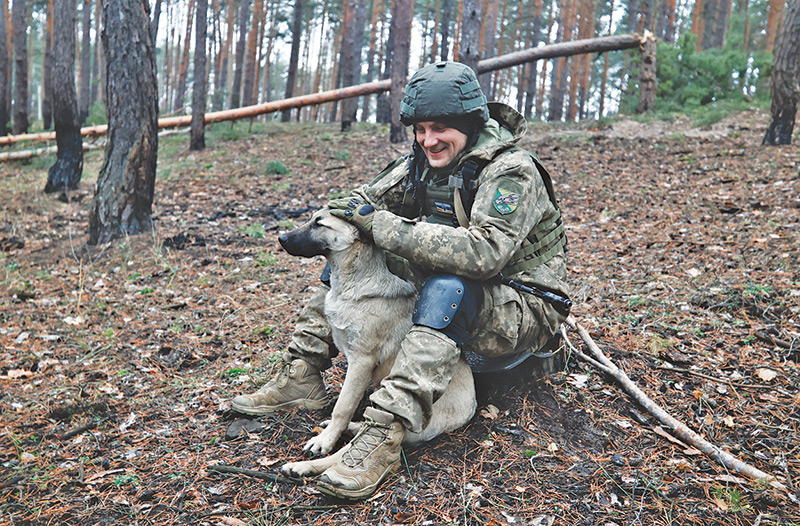
A Ukrainian serviceman take a rest on the frontline at an undisclosed location in the Donetsk region, Ukraine on Saturday.   AP/RSS

KHERSON,
Shelling by Russian forces struck several areas in eastern and southern Ukraine overnight as utility crews continued a scramble to restore power, water and heating following widespread strikes in recent weeks, officials said on Sunday.
With persistent snowfall blanketing the capital, Kyiv on Sunday, analysts predicted that wintry weather—bringing with it frozen terrain and gruelling fighting conditions—could have an increasing impact on the direction of the conflict that has raged since Russian forces invaded Ukraine more than nine months ago.
But for the moment, both sides were bogged down by heavy rain and muddy battlefield conditions in some areas, experts said.
After a blistering barrage of Russian artillery strikes on at least two occasions over the past two weeks, infrastructure teams in Ukraine were fanning out in around-the-clock deployments to restore key basic services as many Ukrainians dealt with only a few hours of electricity per day—if any. Ukrenergo, the state power grid operator, said on Sunday that electricity producers are now supplying about 80 percent of demand. That’s an improvement from Saturday’s 75 percent, the company says.
The Institute for the Study of War, a think tank that has been closely monitoring developments in Ukraine, said reporting from both sides indicated that heavy rain and mud have had an impact—but wider freezing expected along the front lines in coming days could play a role.
 “It is unclear if either side is actively planning or preparing to resume major offensive or counter-offensive operations at that time, but the meteorological factors that have been hindering such operations will begin lifting,” it said in a note published on Saturday. ISW said Russian forces were digging in further east of the city of Kherson, from which they were expelled by Ukrainian forces more than two weeks ago, and continued “routine artillery fire” across the Dnipro River.

WORLD

Taiwan president resigns as party leader after loss

- ASSOCIATED PRESS

TAIPEI,
Taiwan President Tsai Ing-wen resigned as head of the ruling Democratic Progressive Party following local election losses on Saturday in which voters chose the opposition Nationalist party in several major races across the self-ruled island.
Concerns about threats from rival China, which claims Taiwan as its territory, took a backseat to more local issues in the elections.
Tsai had spoken out many times about “opposing China and defending Taiwan” in the course of campaigning for her party. But the party’s candidate Chen Shih-chung, who lost his battle for mayor of Taipei, only raised the issue of the Chinese Communist Party’s threat a few times before he quickly switched back to local issues as there was little interest.
Tsai offered her resignation on Saturday evening, a tradition after a major loss, in a short speech in which she also thanked supporters.
“I must shoulder all the responsibility,” she said. “Faced with a result like this, there are many areas that we must deeply review.”
Candidates from the Nationalist party won the mayoral seat in Taipei, Taiwan’s capital, as well as in Taoyuan, Taichung and New Taipei city. Taiwanese were picking mayors, city council members and other local leaders in all 13 counties and in nine cities. There was also a referendum to lower the voting age from 20 to 18, which was defeated, according to local media.
Chiang Wan-an, the new Taipei mayor, declared victory Saturday night in a large rally. “I will let the world see Taipei’s greatness,” he said.
Not all votes had been formally counted by the time of his speech, but Chiang and the other candidates’ numerical lead allowed them to declare victory.

WORLD

Pakistan’s ex-PM Khan says his party to quit all assemblies

- ASSOCIATED PRESS

ISLAMABAD, 
Pakistan’s former premier Imran Khan said on Saturday his party was quitting the country’s regional and national assemblies, as he made his first public appearance since being wounded in a gun attack earlier this month.
Khan, a former cricket star turned politician, was ousted in a no-confidence vote in Parliament in April. He is now in the opposition and has been demanding early elections, claiming his ouster was illegal and orchestrated by Prime Minister Shahbaz Sharif, with the US government’s help. Sharif and Washington have dismissed the allegations and the current government says the next polls will be held as scheduled in 2023.
Khan launched a protest march late last month from the eastern city of Lahore toward Islamabad as part of his campaign for early polls, but stepped down from personally leading the convoy after he was wounded by a gunman who opened fire at his vehicle. One of Khan’s supporters was killed and 13 were wounded in the attack. The gunman was arrested.
On Saturday night, in the city of Rawalpindi near Islamabad, Khan rejoined the protest march, where he made his remarks.
He told tens of thousands of his cheering supporters that his Tehreek-e-Insaf party was leaving all regional and national assemblies and getting out of this “corrupt system.”
His party resigned from the national assembly en masse in April ahead of a vote to elect a new prime minister, although most of the resignations have yet to be accepted. Khan’s stronghold is in the northwest province of Khyber Pakhtunkhwa, and leaving the Punjab assembly would hand power to his rivals.
The politician spoke for more than an hour and included references to the Sufi mystic Rumi and the fall of the Soviet Union.
Toward the end of his speech, Khan did a U-turn on his demand for snap elections, saying his party would win the polls scheduled for nine months’ time. He also said he would no longer march on the capital.
“They [the government] cannot deal with a march in Islamabad, they can call as many police as they want, but they cannot stop the hundreds of thousands from entering Islamabad,” said Khan. “We could have created a situation like Sri Lanka. I have decided against marching on Islamabad because I don’t want there to be anarchy in the country. I don’t want to cause any harm to this country.”
Khan said he will meet with his chief ministers and parliamentary party and announce the timing of the exit.

WORLD

Kim’s daughter appears again, heating up succession debate

- ASSOCIATED PRESS
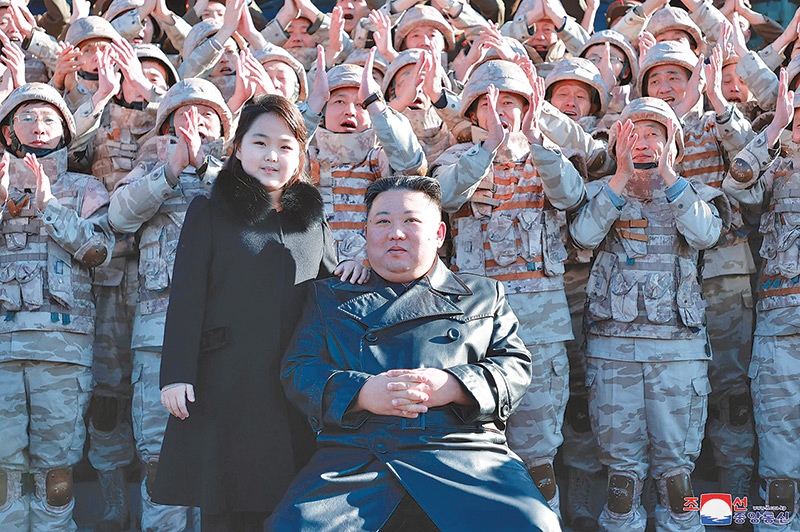
North Korean leader Kim Jong Un and his daughter pose with soldiers for a photo at an unidentified location in North Korea.   Korean Central News Agency/Korea News Service via AP/RSS

SEOUL,
North Korean leader Kim Jong Un’s daughter made a public appearance again, this time with missile scientists and more honorific titles as her father’s “most beloved” or “precious” child. She’s only about 10, but her new, bold photos are deepening the debate over whether she’s being primed as a successor.
The daughter, believed to be Kim’s second child named Ju Ae and about 9 or 10 years old, was first unveiled to the outside world last weekend in state media photos showing her observing the North’s intercontinental ballistic missile launch the previous day with her parents and other older officials. The daughter wearing a white puffy coat and red shoes was shown walking hand-in-hand with Kim past a huge missile loaded on a launch truck and watching a soaring weapon.
On Sunday, the North’s official Korean Central News Agency mentioned her for the second time, saying she and Kim took group photos with scientists, officials and others involved in what it called the test-launch of its Hwasong-17 ICBM.
KCNA described her as Kim’s “most beloved” or “precious” child, a more honorific title than her previous description of “[Kim’s] beloved” child on its November 19 dispatch. State media-released photos showed the daughter in a long, black coat holding her father’s arm as the two posed for a photo. Taking after her mother Ri Sol Ju, who wasn’t visible in any of the photos on Sunday, she had a more mature appearance than in her unveiling a week ago.
Some photos showed the pair standing in the middle of a line of uniformed soldiers before a massive missile atop a launch truck. Others showed Kim’s daughter clapping her hands, exchanging handshakes with a soldier or talking to her father as people cheered in the background.
 “This is certainly striking. The photograph of Kim Ju Ae standing alongside her father while being celebrated by technicians and scientists involved in the latest ICBM launch would support the idea that this is the start of her being positioned as a potential successor,” said Ankit Panda, an expert with the Carnegie Endowment for International Peace.
 “State media underscoring her father’s love for her further underscores this, I think. Finally, both of her initial public appearances have been in the context of strategic nuclear weapons—the crown jewels of North Korea’s national defense capabilities. That doesn’t strike me as coincidental,” Panda said.
After her first public appearance, South Korea’s spy service told lawmakers that it assessed the girl pictured is Kim’s second child, who is about 10 and whose name is Ju Ae. The National Intelligence Service said her looks matched information that she is taller and bigger than other girls of the same age. It also said that her unveiling appeared to reflect Kim’s resolve to protect the security of North Korea’s future generations in the face of a standoff with the United States.
South Korean media previously speculated Kim has three children—born in 2010, 2013 and 2017—and that the first child is a son while the third is a daughter. The unveiled daughter is highly likely the child who retired NBA star Dennis Rodman saw during his 2013 trip to Pyongyang. After that visit, Rodman told the British newspaper The Guardian that he and Kim had a “relaxing time by the sea” with the leader’s family and that he held Kim’s baby daughter, named Ju Ae.
North Korea has made no mention of Kim’s reported two other children. But speculation that his eldest child is a son has led some experts to question how a daughter can be Kim’s successor given the deeply male-dominated, patriarchal nature of North Korean society. Kim is a third-generation member of the family that has run North Korea for more than seven decades, and his father and grandfather successively governed the country before he inherited power in late 2011.
 “We’ve been told that Kim has three children, including possibly a son. If this is true, and if we assume that the male child—who has yet to be revealed—will be the heir, is Ju Ae truly Kim’s most ‘precious,’ from a succession standpoint?” said Soo Kim, a security analyst at the California-based RAND Corporation. “I think it is too early to draw any conclusions.”
She said that Kim Jong Un may think his daughter’s unveiling is an effective distraction while conditioning Washington, Seoul and others to living with the North Korean nuclear threat as “the spectacle of Ju Ae appears to eclipse the intensifying gravity of North Korea’s nuclear and missile threat.” She added that by parading his daughter around, Kim Jong Un may also want to tell his people that nuclear weapons are the sole guarantor for the country’s future.
In comments published by state media Sunday, Kim called the Hwasong-17 “the world’s strongest strategic weapon” and said his country’s ultimate goal is possessing “the world’s most powerful strategic force.”
Experts say the Hwasong-17 is North Korea’s longest-range missile—designed to strike the mainland US—but is still under development. Its launch was part of a barrage of missile tests that North Korea says were meant to issue a warning over US-South Korean military drills that it views as an invasion rehearsal.

WORLD

Death toll from Indonesia quake rises to 321, official says

Briefing
- AGENCIES

CIANJUR: The death toll from an earthquake that hit Indonesia’s island of Java this week has risen to 321 as rescuers found more bodies on Sunday, the national disaster mitigation agency said. The shallow 5.6-magnitude earthquake hit the West Java town of Cianjur on Monday, where most of the victims were killed as buildings collapsed or landslides were triggered. Disaster mitigation agency chief Suharyanto, who like many Indonesians uses only one name, told a news briefing Sunday that rescuers found three more bodies. Eight were found on Saturday. “With the discovery of these three [bodies], as of today, the death toll becomes 321 people,” said Suharyanto. Eleven people remain missing. Rescuers will resume their search on Monday, focusing on areas where the missing are believed to have been buried, said West Java search and rescue agency head Jumaril, who also uses one name. The quake damaged more than 62,000 houses and forced more than 73,000 people to evacuate to at least 325 shelters, Suharyanto said.

WORLD

Kishida’s approval hits new low after ministers resign

Briefing
- AGENCIES

TOKYO: Japanese Prime Minister Fumio Kishida’s public support slipped to a new low in a poll published on Sunday, as a series of cabinet resignations has compounded anger over the ruling party’s ties to a controversial religious group. Support for Kishida’s cabinet fell to 33.1 percent from 37.6 percent a month ago in the Kyodo news poll, his lowest in the agency’s surveys since he took office in October 2021. It found disapproval at 51.6 percent, exceeding 50 percent for the first time. Kishida’s support has been sliding since the July assassination of former Prime Minister Shinzo Abe revealed deep and longstanding ties between ruling Liberal Democratic Party politicians and the Unification Church, a group that critics say is a cult. Exacerbating the government’s problems, scandals have forced three cabinet members from office since last month. The Kyodo poll found 62.4 percent of respondents disapproving of how Kishida had handled the resignations of Economic Revitalisation Minister Daishiro Yamagiwa, Justice Minister Yasuhiro Hanashi and Internal Affairs Minister Minoru Terada.

WORLD

Uganda’s president extends Ebola epicentre’s quarantine for 21 days

Briefing
- AGENCIES

KAMPALA: Uganda’s President Yoweri Museveni has extended a quarantine placed on two districts that are the epicentre of the country’s Ebola outbreak by 21 days. Movement into and out of Mubende and Kassanda districts in central Uganda will be restricted up to December 17, the presidency said late on Saturday. It was originally imposed for 21 days on October 15, then extended for the same period on November 5. The extension were “to further sustain the gains in control of Ebola that we have made, and to protect the
rest of the country from continued exposure.” The government’s
anti-Ebola efforts were succeeding with two districts now going for roughly two weeks without new cases, the president said. “It may
be too early to celebrate any successes, but overall, I have been briefed that the picture is good,” he said in a statement. The East African nation has so far recorded 141 infections. Fifty-five people have died since the outbreak of the deadly haemorrhagic fever was declared on September 20th.

Page 7
MONEY

World Cup fans turn to live streams to avoid extra fee

The Nepal Telecommunications Authority has said it cannot block live streaming without getting the green light from the government.
- KRISHANA PRASAIN
Some fans have been viewing the World Cup on the internet using a virtual private network (VPN) which is easily available on some platforms.   SHUTTERSTOCK

KATHMANDU,
Football fans who don’t want to pay extra to watch the FIFA World Cup on their cable television have been watching free live streams of the matches on the internet, prompting complaints from the broadcasting rights holder for Nepal.
Media Hub, which has obtained exclusive rights to broadcast the FIFA World Cup Qatar 2022, has moved to get local internet service providers to block live streams, and lobby groups have responded that it is illegal to block online content without sanction.
The media service provider has been engaged in an argument with activists who proclaim their right to watch free online content.
Tara Nath Dahal, executive chairman of Freedom Forum Nepal, a non-governmental organisation working for the protection and promotion of human rights, tweeted on Friday questioning the internet service providers’ action to restrict FIFA World Cup content on the internet as if it is their prerogative.
“If content on the internet is filtered like this, it shows glaringly what the internet freedom situation is like in Nepal.”
The Nepal Telecommunications Authority has said it cannot block live streaming without getting the green light from the government.
“We have obtained both digital and broadcasting rights, and we have the right to protect their misuse as we have paid for them,” said Som Prasad Dhital, executive director of Media Hub. “Our right should be secured by the government too.”
Media Hub obtained broadcasting rights from FIFA through Viacom18 Media, an Indian media and entertainment company, by paying Rs400 million.
“As we obtained the full rights, live streaming of the games is illegal,” said Dhital, who is also president of the Advertising Association of Nepal.
Some fans have been viewing the World Cup on the internet using a virtual private network (VPN) which is easily available on some platforms.
According to reports, FIFA World Cup live matches are only available on for-pay TV channels or streaming services in most territories. In these regions, the average cost of streaming each World Cup match is $60.
Nepalis can watch the matches on television by paying an extra Rs565 including tax per set-top box for the duration of the tournament.
Reports say there are legitimate broadcasters in around eight countries where the matches are shown on free-to-air online streaming websites. These sites geo-block the games if your IP address is from another country.
Some fans have been live streaming World Cup matches for free, from anywhere, using a VPN, which can conceal the users’ physical location and IP address. In Nepal, for example, many live streaming sites like 9goal, score808 and crichd have popped up allowing users to watch the championships without paying.
“Broadcasting the matches through any site is against Media Hub’s agreement with FIFA and Viacom 18,” Dhital said.But advocates decry attempts to filter content on the internet as being illegal.
“Unless the government bans a particular site, private companies do not have the right to filter or restrict the content that is available on the internet,” said Santosh Sigdel, founder chairman of Digital Rights Nepal, an advocacy group which works to strengthen civic space and digital rights.
“There is a regulator to decide what content should be available on the internet,” he added.
Purushottam Khanal, chairman of the Nepal Telecommunications Authority, said broadcasting right holder Media Hub had written to the regulator requesting it not to show the matches from other sites through internet service providers.“Media Hub has raised a question, and we have informed internet service providers about the same,” Khanal said. “We have not directed any internet service provider to block such sites,” he said. “Even we do not have the right to filter online content.”
Some internet service providers, who provide internet protocol television (IPTV) service, have shut down many sites that were streaming the football matches for free, according to Sigdel. “This is control over the content.”
Internet service providers say they have blocked many sites that are not registered or listed in Nepal.
“Facebook and Twitter both have been registered in Nepal,” Sigdel said.
“The internet is an open-access platform, and one does not have to get a licence to put content on it. Also, it is not necessary to get registered or listed; but if the content goes against the law, the government needs to regulate it.”
The rush of television viewers paying extra for the FIFA World Cup overwhelmed servers for hours on November 20, with many customers venting their ire at digital payment systems like Esewa and Khalti for delaying their transactions.
According to Media Hub, around 300,000 customers had subscribed to the FIFA World Cup as of Sunday, which is being broadcast on the channel Himalaya Premium TV.

MONEY

Monkeys in Thailand mark their day with feast

The festival is an annual tradition in Lopburi and held as a way to show gratitude to the monkeys for bringing in tourism.
- ASSOCIATED PRESS
Monkeys enjoy fruit during monkey feast festival in Lopburi province, Thailand on Sunday.   AP/RSS

LOPBURI,
A meal fit for monkeys was served on Sunday at the annual Monkey Feast Festival in central Thailand.
Amid the morning traffic, rows of monkey statues holding trays were lined up outside the compound of the Ancient Three Pagodas, while volunteers prepared food across the road for real monkeys—the symbol of the province around 150 kilometres north of Bangkok.
Throngs of macaque monkeys ran around, at times fighting with each other, while the crowds of visitors and locals grew.
As the carefully prepared feast was brought toward the temple, the ravenous creatures began to pounce and were soon devouring the largely vegetarian spread.
While the entertainment value of the festival is high, organisers are quick to point out that it is not just monkey business.
“This monkey feast festival is a successful event that helps promote Lopburi’s tourism among international tourists every year,” said Yongyuth Kitwatanusont, the festival’s founder.
“Previously, there were around 300 monkeys in Lopburi before increasing to nearly 4,000 nowadays. But Lopburi is known as a monkey city, which means monkeys and people can live in harmony.”
Such harmony could be seen in the lack of shyness exhibited by the monkeys, which climbed on to visitors, vehicles and lampposts. At times the curious animals looked beyond the abundant feast and took an interest in other items.
“There was a monkey on my back as I was trying to take a selfie. He grabbed the sunglasses right off my face and ran off on to the top of a lamppost and was trying to eat them for a while,” said Ayisha Bhatt, an English teacher from California working in Thailand.
The delighted onlookers were largely undeterred by the risk of petty theft, although some were content to exercise caution.
“We have to take care with them, better leave them to it. Not too near is better,” said Carlos Rodway, a tourist from Cadiz, Spain, having previously been unceremoniously treated as a climbing frame by one audacious monkey.
The festival is an annual tradition in Lopburi and held as a way to show gratitude to the monkeys for bringing in tourism. This year’s theme is “monkeys feeding monkeys,” an antidote to previous years where monkey participation had decreased due to high numbers of tourists, which intimidated the animals.

MONEY

Twitter CEO Musk says user signups at all-time high

- REUTERS

CALIFORNIA,
Twitter Inc Chief Executive Elon Musk says new user signups to the social media platform are at an “all-time high”, as he struggles with a mass exodus of advertisers and users fleeing to other platforms over concerns about verification and hate speech.
Signups were averaging over two million per day in the last seven days as of November 16, up 66 percent compared to the same week in 2021, Musk said in a tweet late on Saturday.
He also said that user active minutes were at a record high, averaging nearly 8 billion active minutes per day in the last seven days as of November 15, an increase of 30 percent in comparison to the same week last year.
Hate speech impersonations decreased as of November 13 compared to October of last year.
Reported impersonations on the platform spiked earlier this month, before and in wake of the Twitter Blue launch, according to Musk.
Musk, who also runs rocket company SpaceX, brain-chip startup Neuralink and tunnelling firm the Boring Company, has said that buying Twitter would speed up his ambition to create an “everything app” called X.
Musk’s “Twitter 2.0 The Everything App” will have features like encrypted direct messages (DMs), longform tweets and payments, according to the tweet.
In another tweet early on Sunday, Musk said he sees a “path to Twitter exceeding a billion monthly users in 12 to 18 months.”
Advertisers on Twitter, including big companies such as General Motors, Mondelez International, Volkswagen AG, have paused advertising on the platform, as they grapple with the new boss.
Musk has said that Twitter was experiencing a “massive drop in revenue” from the advertiser retreat, blaming a coalition of civil rights groups that has been pressing the platform’s top advertisers to take action if he did not protect content moderation.
Activists are urging Twitter’s advertisers to issue statements about pulling their ads off the social media platform after Musk lifted the ban on tweets by former US president Donald Trump.
Hundreds of Twitter employees are believed to have quit the beleaguered company, following an ultimatum by Musk that staffers sign up for “long hours at high intensity,” or leave.

MONEY

Dolfu in Mugu awaits tourists

Tourists hardly visit the area due to the lack of publicity and basic infrastructure.
- RAJ BAHADUR SHAHI
A general view of Dumana, a village in Mugu.    Post Photo: Prakash Chandra Timilsena

MUGU,
Dolfu, Nepal’s most underrated tourist destination, in Karnali is waiting for visitors.
Located on the rim of Rara Lake, it is famous for endangered wild animals like red panda, white deer musk, Himalayan goral and deer. Dolfu can be reached after a two-day trek from Rara, where the spectacular Mugu and Koiji mountains can be viewed. The famous Chaya Nath shrine built in ancient style, Tamakhani, Tihar Gumba, Tihar Dobhan and other tourist destinations are the key attractions of Dolfu.
But the destination is still unknown to the general public.
Tshering Lama, a local, said that due to low publicity, the area is underrated.
Tourists hardly visit the area as they are not aware of the location and lack of infrastructure, he said.
There are around 150 small and big waterfalls along the way to Dolfu.
“Tourists only visit Rara, but there are dozens of natural, cultural and ecologically important destinations in Mugu district,” said Lama.
In Mugu, there are nearly a dozen homestays. But none in Dolfu.
Kalsan Lama, another local, said there are around 1,200 ancient monasteries and stupas in Dolfu villages--such as Pulu, Kimri, Magri and other villages of Upper Mugu.
“These places are important for those who wish to research Lama culture and traditions,” Kalsan said. “Since most of our traditions are similar to those of Tibet, it could be a perfect learning platform for scholars and tourists,” he said.
Lama said that there are around 150 caves in Puwa village only.
Upper Mugu is also a storehouse of herbs such as Yarsagumba, dactylorhiza hatagirea (Pachaule), aconitum heterophyllum (Atis), picrorhiza kurroa (Katuki) and among others.
Raju Karki, a tourism entrepreneur, said that efforts are being made to promote Dolfu. “We are preparing a map and other works like developing infrastructure and trekking trails are being planned accordingly.”
Jun Bahadur Baduwal, chairman of Chhayanath Rara Municipality-14, said that under the rural access programme that has recently constructed a road from Gamgadhi to Chankheli mountain, plans are being made to divert tourists to upper Mugu who come to Rara.
Baduwal said that Chankheli mountain’s base camp can be reached from Rara in an hour and a half.
“If we draw tourists to places like Chhaya Nath shrine and Rinmoksha, businesses will take a leap,” Baduwal said. “Due to the small budget at the local level, Rara lacks infrastructure.”
Rara hosts the country’s deepest freshwater lake situated at an altitude of 2,990 metres and spread across 10.8 square-kilometre in the Jumla and Mugu districts, which makes the area on the list of one of the top most beautiful sites to visit.
Rara lake is part of the Rara National Park, and according to park officials, 224 kinds of plants, including medicinal herbs, 272 types of birds, and 51 types of mammals, including the endangered red pandas, can be found in the park.
From mid-March to mid-April, visitors can also see the blooming forests of rhododendron.
Apples are found in abundance around Rara from August to December.
The perfect time to visit Rara is in spring, autumn or summer.

MONEY

Ukraine wants lower cap on Russian oil

Briefing

KYIV: The price for Russian seaborne oil should be capped at between $30 and $40 per barrel, lower than the level that Group of Seven nations have proposed, Ukrainian President Volodymyr Zelenskiy said on Saturday. European Union governments, seeking to curb Moscow’s ability to fund the Ukraine war without causing an oil supply shock, are split over a G7 push that the cap be set at $65 to $70 per barrel. It is due to enter into force on December 5. “The limit that is being considered today—about $60—I think this is an artificial limit,” said Zelenskiy, who has consistently pushed allies to impose tougher sanctions of all types against Russia. “We would like the sanctions to be very effective in this fight, so that the limit is at the level of $30-$40, so Russia feels them [the sanctions],” he told a news conference. (REUTERS)

MONEY

Malaysia PM Anwar eyes targeted subsidies for low-income groups

Briefing

KUALA LUMPUR: Malaysia is reviewing its government subsidies programme, aiming to direct money toward low-income groups, Prime Minister Anwar Ibrahim said on Sunday, prioritising the rising cost of living as he takes office at a time of slowing growth. Government agencies have two weeks to review the implications of narrowing the subsidies, he told a news conference. Malaysia offers subsidies to all citizens, with fuel and cooking oil accounting for the biggest expense. (REUTERS)

Page 8
SPORTS

Milan six-for gives Sudurpaschim third consecutive win in U-19 cricket

Captain Anurag Singh’s side defeat Gandaki Province by 113 runs to move to the top of seven-team standings.
- Sports Bureau
Milan Bohara of Sudurpaschim Province bowls during the U-19 National Cricket Tournament 50-over cricket match against Gandaki Province in Kirtipur on Sunday.   Post Photo

KATHMANDU,
Milan Bohara’s six-wicket haul helped Sudurpaschim Province thrash Gandaki by 113 runs and register their third consecutive victory in the U-19 National Cricket Tournament in Kirtipur on Sunday.
Gandaki were chasing a target of 214 runs at the TU cricket ground. But spinner Milan rattled the Gandaki batting order returning 6-11 and skittled them for just 100 runs in 32.5 overs.
Opener Govinda BK top scored for Gandaki hitting 22 off 30 balls before he was caught by wicket keeper Sunil Chand off Naren Saud.
Arjun Kumal provided the next highest score with 20 off 40 balls. But it was BK’s opening partner Kumal who became the first casualty of Milan, when the bowler had him caught by Aakash Chand in the 9.2 overs.
Milan then continued the onslaught with his lethal spin and removed Karan Pangeni (15), Cibrin Shrestha (0), Sachinraj Adhikari (7) and Sujan Gautam (0) to put Gandaki in deep trouble at 80-7.
Aakash dusted off Sudip Aryal and Shishir Bhusal in the second and sixth delivery of the 27th over respectively before Milan rounded off the victory removing captain Subash Bhandari, who had presented some resistance with a slow 53 ball-16 knock.
Milan, who also bowled four maiden overs, was adjudged player of the match.
Earlier, after winning the toss and electing to bat first, Sudurpaschim posted 213 after lower order batter Aakash hit 40 runs facing 45 deliveries. Sudurpaschim captain Anurag Singh made 37 off 71 balls.
Gandaki’s Subash Bhandari returned 3-30 that included the scalps of openers Deepak Bohara (11) and Bishal Ayer (6) and Milan (24). Naren added 28 runs while Gajendra Bohara, Sunil and Hemant Dhami contributed 19 runs each.
The third loss in as many matches pits Gandaki at the bottom of the table.
Sudurpaschim moved to the top of the table with six points. Bagmati Province, the only other unbeaten team in the seven-team standings, are second, also on six points.
In the day’s other match at the Mulpani cricket ground, Karnali Province defeated Madhesh Province by two wickets despite a five-wicket haul from Yunish Singh.
Chasing 136, Karnali reached 139-8 in 34.4 overs after opener Manish Thapa gave them a solid start to their innings hitting 32 runs off 34 balls. Thapa also put on a 46-run stand with Anirudh Kunwar, who made 16, for the second wicket to anchor the Karnali innings.
Thapa was bowled by Ranjit Kumar in the 9.6 overs. Kumar was the pick of the Madhesh bowling returning 5-23 that also included the scalps of Kunwar, Roshan Shahi (1), Suwash Ayer (14) and Sandip Shahi (5). Karnali were reeling at 6-84 when Kumar’s venomous 10-over spell—that also included three maiden overs—ended.
But number seven batter Mohan BK staged a late resistance with an unbeaten 38 to guide Karnali to their first victory of the tournament.
Abijit Mandal took two wickets while Rajesh Yadav picked one.
Earlier, Madhesh, who elected to bat first after winning the toss, crawled to 135 all out in 41.5 overs after Karnali’s Yunish Singh starred with the ball taking 10-2-35-5.
Madhesh openers Mayan Yadav (18) and Shailendra Sah (31) shared a 45-run partnership to give them a bright start.
Ganesh Dadel removed Mayan to break their opening stand and Singh bowled Sah to cause further damage. Karnali then kept losing wickets at regular intervals as Singh sent back Megh Raj Ram (16) and Imran Sheikh (5).
After Dablu Malik (15) was caught by Ayer off BK in the 22.5 overs, Madhesh could not regroup and were skittled for a low total, with no batters reaching the double digit figures.
Sarfraj Mansuri (17) was the last to fall, caught by Anuj Chanara off Aawash Shah, another standout bowler, who took 2-9 in his 6.5 over spell.
Sudurpaschim will aim to maintain their winning streak when they take on Province 1 on Monday. Gandaki face Lumbini in the day’s other fixture.


Brief scores
U-19 National Cricket Tournament
Eighth match, TU cricket ground
Toss: Sudurpaschim, elected to bat first.
Sudurpaschim 213 (49.3/50 ov)
A Chand 40 (45), A Singh 37 (71)
S Bhandari 10-1-30-3
Gandaki 100 (32.5/50 ov)
G BK 22 (30)
M Bohara 9.5-4-11-6
Sudurpaschim win by 113 runs.
Player of the match: Milan Bohara
Ninth match, Mulpani cricket ground
Toss: Madhesh, elected to bat first.  
Madhesh 135 (41.5/50 ov)
S Sah 31 (48)
Y Singh 10-2-35-5
Karnali 139-8 (34.4/50 ov)
M BK 38 not out (40), M Thapa 32 (34)
R Kumar 10-3-23-5
Karnali win by 2 wickets.
Player of the match: Yunish Singh

MEDLEY

Horoscope

ARIES (March 21-April 19) ***
You’ll be put in an intellectual yet rebellious mood today. A positive energy can help you implement boundaries with anyone who might trigger you, as long as you diplomatically draw lines and maintain distance.

TAURUS (April 20-May 20) ***
It's okay if you need to temporarily shut down in the name of self-preservation. This cosmic climate is poised to bring disharmony to the table, and you may feel as though the people around you are more authoritative.

GEMINI (May 21-June 21) ***
While this cosmic climate could bring tension to the collective, you'll be in a unique position to find peace and gratitude from within. Luckily, you'll have a chance to safely crawl out of your shell as evening manifest.

CANCER (June 22-July 22) ***
You'll feel inspired to break unhealthy patterns and evolve into an improved version of your already fabulous self today. Unfortunately, rocky vibes may prevail in the afternoon, threatening to sour the moods of people.

LEO (July 23-August 22) ***
Try not to let the negativity of others discourage you from following your dreams. Luckily, the vibe will lighten as evening emerges, giving you a chance to reclaim your confidence through self-care and positive mantras.

VIRGO (August 23-September 22) ***
Try not to become flustered if your sense of order is challenged, giving yourself space to pause, ground, and find your centre. These vibes are perfect for cosying up in your space and tackling your chores later tonight.

LIBRA (September 23-October 22) ***
This cosmic climate could trigger power struggles, though people won't mess with you unless they're truly threatened by or jealous of you. Luckily, you'll reclaim stability through your closest companions as evening rolls.

SCORPIO (October 23-November 21) ***
This cosmic climate will bring tension into the air, and hurts from the past could trigger you all over again. The universe will ask you to pamper yourself as evening rolls, making it the perfect time for self-care.

SAGITTARIUS (November 22-December 21) ****
You’ll be in a rambunctious and opinionated mood. Avoid gossiping, mouthing off, or sharing too much information. Luckily, a lighter energy will manifest as evening creeps in, encouraging you to embrace romance.

CAPRICORN (December 22-January 19) ***
Try not to let a stubborn disposition interfere with your ability to work with friends or colleagues this afternoon. This cosmic climate will bring tension to the table. Refusing to compromise could delay your ability to move forward.

AQUARIUS (January 20-February 18) ***
People will seem more moody or cold than usual, and an increase in your intuition could make you especially sensitive to the murky vibes. The cosmic atmosphere will help you find love and support within your social sphere.

PISCES (February 19-March 20) ***
Social anxiety may find you today. Don't feel guilty about laying low right now, as these vibes have the potential to trigger gossip, drama, and conflict. Luckily, you'll have a chance to embrace harmony as evening rolls around.

Page 9
SPORTS

Croatia knock Canada out of World Cup

The 2018 runners-up win 4-1 to eliminate the Canadians out of their first World Cup in 36 years.
- AGENCE FRANCE-PRESSE
Croatia’s Andrej Kramaric celebrates after scoring against Canada in Doha on Sunday.  Afp/Rss

DOHA,
Croatia got their World Cup campaign back on track as Andrej Kramaric’s double inspired a 4-1 win that eliminated Canada in Sunday’s Group F match in Doha.
Zlatko Dalic’s side were stunned by Alphonso Davies’s second-minute opener at the Khalifa International Stadium. But Hoffenheim forward Kramaric equalised and Marko Livaja put the 2018 World Cup runners-up ahead just before half-time.
Second-half goals from Kramaric and Lovro Majer ensured Croatia could celebrate their first win of the tournament after a goalless draw with Morocco in their first match.
Croatia sit top of Group F, above Morocco on goal difference, and a draw in their final game against Belgium on Thursday would guarantee they reach the last 16.
The Croatians seized control of a group blown wide open by Morocco’s shock 2-0 win against Belgium earlier in the afternoon.
Canada competed gamely but have now lost all five matches in their World Cup history, with their only previous appearance in 1986 also ending in group-stage elimination.
Herdman’s team took just 68 seconds to rock Croatia when Tajon Buchanan crossed into the Croatia area and Davies timed his run perfectly to power a header past Dominik Livakovic from 10 yards.
Croatia’s clever passing and movement gradually took a toll on Canada and they drew level in the 36th minute. Kramaric was picked out by Ivan Perisic’s deft reverse pass into the Canada area and he took a touch before drilling a fine finish into the far corner from an acute angle.
Croatia were hitting their stride and Hajduk Split forward Livaja, selected in place of Nikola Vlasic, repaid Dalic’s faith in the 44th minute. Josip Juranovic’s run was halted just outside the Canada area, but Livaja pounced on the loose ball, nimbly shifting it out of his feet before sending a superb low strike past Milan Borjan.
The predatory Kramaric delivered the knockout blow in the 70th minute.
Perisic’s cross reached Kramaric in the Canada area and he worked space for a left-foot finish that arrowed through Atiba Hutchinson’s legs into the bottom corner.
Majer’s tap-in completed the rout from Mislav Orsic’s pass in stoppage time.

Morocco stun Belgium
Morocco jeopardised Belgium’s World Cup hopes as Abdelhamid Sabiri and Zakaria Aboukhlal’s late goals secured a surprise 2-0 triumph in Doha on Sunday.
Belgium could have qualified for the last 16 with victory but instead produced another insipid display after their fortunate opening win over Canada.
Substitute Sabiri was the hero thanks to a 73rd-minute free-kick which Thibaut Courtois allowed to bounce in at his near post, before Aboukhlal grabbed a second in stoppage time at the Al Thumama Stadium as the Morocco fans celebrated their first World Cup win in 24 years.
Morocco will qualify for the knockout phase for the first time since 1986 if they can avoid defeat against Canada on Thursday.
Belgium, the world’s second-ranked side, will have to beat 2018 runners-up Croatia to be sure of going through.
Roberto Martinez’s ageing side have reached at least the quarter-finals of each of the past four major tournaments.
Any tension in the stands was lifted and the Morocco fans were able to celebrate their first World Cup win in 24 years.

Japan stumble
Costa Rica stunned Japan 1-0 thanks to a late goal Kyesher Fuller.
Japan, who shocked four-time champions Germany 2-1 in their opener in Qatar, could have taken a giant stride towards the last 16 with a win.
Instead they laboured for large parts of the match against a Costa Rica side who were hammered 7-0 by Spain, then defender Fuller scored in the 81st minute with a deflected strike.
It was Costa Rica’s first shot on target at this World Cup.

Messi reignites Argentina
Earlier on Saturday, Lionel Messi reignited Argentina’s World Cup challenge with a superb goal in a 2-0 win over Mexico in Group C.
Rocked by a stunning upset defeat against Saudi Arabia on Tuesday, Argentina faced Mexico knowing that a defeat would send them crashing out of the tournament.
But Messi breathed fresh life into Argentina’s campaign with his eighth World Cup goal in his fifth appearance in the finals.
The 35-year-old maestro, desperate to crown his glittering career by lifting football’s greatest prize, rifled home a low shot on 64 minutes to put Argentina en route to victory.
Rising star Enzo Fernandez made the game safe with a magical curling strike in the 87th minute, sparking wild celebrations amongst Argentina fans at the glittering Lusail Stadium.
An Argentinian victory on Wednesday against Poland will carry the South American champions into the knockout rounds from Group C.

SPORTS

After latest milestone, Ronaldo eyes World Cup glory

A win against Uruguay today would secure Portugal’s qualification from Group H to the knockout stages with a game to spare.
- ASSOCIATED PRESS
Portugal’s forward Cristiano Ronaldo takes part in a training session at the Al Shahania SC in Doha on Saturday.  Afp/Rss

DOHA,
Another game, another personal milestone. For all the turmoil that has surrounded Cristiano Ronaldo ahead of what is likely to be his final World Cup, the Portugal great continues make his mark.
On Thursday he became the first man to score in five World Cups. Earlier this season he registered the 700th club goal of his career.
Not bad for a 37-year-old, who doesn’t know where he will be playing beyond Qatar after having his Manchester United contract terminated in the wake of his incendiary interview criticising manager Erik ten Hag and the club’s owners.
A win against Uruguay on Monday would secure Portugal’s qualification from Group H to the knockout stages with a game to spare after their opening 3-2 win against Ghana.
“This is just the beginning,” Ronaldo said in an Instagram post, adding that “there are no impossibilities.”
But if football’s ultimate numbers man is to achieve his ambition of lifting the one major trophy that eludes him, he cannot do it by himself. That much was clear against Ghana, when Portugal also needed goals from Joao Felix and Rafael Leao to hold on for victory.
Felix is the likeliest heir to Ronaldo’s throne as Portugal’s inspiration-in-chief and has even been linked with a potential move to United.
If Qatar is Ronaldo’s last World Cup dance, the moves are not quite as fluid as they once were.
His goal against Ghana came from the penalty spot, rather than a moment of the type of individual brilliance on which his career has been built.
That being said, FIFA Technical Study Group member Sunday Oliseh still described as “total genius” his ability to win a disputed foul from Mohammed Salisu that Ghana coach Otto Addo insisted should not have been awarded.
Ronaldo’s celebrations suggested he does not care where the goals come from, so long as they keep on coming. But Portugal cannot solely rely on such moments—and amid the noise that surrounds their most celebrated player, it can be forgotten how much talent coach Fernando Santos has at his disposal.
Not least Atletico Madrid forward Felix, United midfielder Bruno Fernandes and Bernardo Silva of Manchester City.
“A selection with the quality of ours has to be favourite in any game,” said Portugal forward Goncalo Ramos ahead of Uruguay at the Lusail Stadium.
“It’s important to win the second game now.”
Uruguay drew 0-0 with South Korea in their first game of the tournament.
Like Portugal, Uruguay are blending the old and the new. Ronaldo’s long-time rival from their time at Real Madrid and Barcelona respectively, Luis Suarez, is in an attack that also features the country’s new generation of talent in Darwin Nunez and Facundo Pellistri.
At 35, Suarez is no longer the force he once was and he was substituted just after the hour against South Korea. Another 35-year-old in Edinson Cavani replaced him, but Uruguay still couldn’t find a goal.
Ghana exposed vulnerabilities in Portugal’s defence—but Uruguay will need to be much more clinical if they are to capitalise on Monday.

Page 10
CULTURE & LIFESTYLE

Natisara wins Kamla Bhasin Award in India

First of its kind, this award is given to social workers from South Asia for their outstanding work on gender equality.
- Post Report
Natisara Rai (centre) is the co-founder of Shakti Milan Samaaj (SMS).   Photo Courtsey: Biraj Patnaik/Twitter

Kathmandu
Natisara Rai, co-founder and executive director of Shakti Milan Samaaj (SMS) based in Kathmandu, has received the Kamla Bhasin Award along with Vidya Rajput from India.
The award named after a pioneer feminist activist, poet and author Kamla Bhasin, was given on Sunday by Azad Foundation, iPartner India and National Foundation for India, for the first time. Both the awardees also got INR 100,000 each.
Rai, trafficked from Nepal to India’s Kamathipura, was forced into sex work when she was 13. As an HIV-positive herself, she advocates for fellow HIV-positive women in Nepal to access healthcare, dignified work and education through her organisation SMS.
While Rajput, co-founder of an organisation called Mitwa, is a transwoman from Chhattisgarh’s Bastar. Her organisation raises awareness on transpersons’ rights, including the right to self-identify.
The winners were selected by a five-member committee chaired by Anu Aga. The other jury members were Khushi Kabir from Bangladesh, Binda Pandey from Nepal, and Salil Shetty and Namita Bhandare from India.

SPORTS

Nature is his frame

How Gorakh Bista became one of Nepal’s leading landscape photographers.
- Pinki Sris Rana
Post Photo: Deepak KC

Kathmandu
Gorakh Bista and his photographs may not be familiar to many. But you may have come across his photo features, in newspapers and magazines, and on the walls of places like the Sheetal Niwas, the official residence of the President of Nepal.
For a country known in the world for its stunning landscapes, Nepal has only a handful of landscape photographers. Bista, who has been at it for over 15 years, is one of them. In 2018, President Bidya Devi Bhandari honoured him with the ‘Prabal Jana Sewa Shree’, one of Nepal’s highest civilian awards.
“I consider myself lucky to have been born in a place where there is so much diversity and variation in terms of geography, landscape and colour,” says the 39-year-old.
Nepal is, without a doubt, a scenically gifted country, but not all photographs can do justice to its beauty the way Bista’s work manages to. The shots he captures are an outcome of hard labour, patience and persistence.
Although Bista gives more credit to nature and luck than himself, his work speaks otherwise.
“Since landscape photography depends primarily on natural elements, you cannot be sure when you will get the shot you imagined,” Bista says. “Sometimes it takes days, sometimes a week, and sometimes even a whole different season. You wait patiently to capture the right moment in the right light and from the right place.”
When Bista visits a location, he first tries to understand the place, its culture and tradition. He brainstorms the shot he wants before starting his process. Before falling asleep, for instance, he plays around with the idea of the kind of shots he wants from a certain place. This ritualistic brainstorming helps him with the framing, he says. And he waits patiently for the shot.
In a world where people are rushing and hustling every day, waiting for hours and hours at the same spot to get the perfect shot might feel like a drag to many. For Bista, it feels like meditation, he says.
The patience he has to get the shot of his imagination isn’t something he was born with. It is what he learnt from nature and life.
Back in 2006, when he was pursuing a Bachelor’s degree in photojournalism, naturally he envisioned himself doing photojournalism or studio photography. The only jobs he knew were there for photographers. But things changed when he had the opportunity to visit Mt. Kailash, the 6,714m peak in Tibet, the same year.
It was the beginning of what Bista would be doing for the rest of his life.
He had with him a Konka camera that cost Rs500 and he was mesmerised by what he saw. There has been no turning back for him since then. After that trip, he travelled to many places practising landscape and travel photography, at times at his own expense, and at other times, collaborating with travel and tour companies, convincing them that he would give them his pictures.
“People often compare our photographs and go on about their experiences. But one thing I can vouch for is the hardship I faced during those years,” he says.
“I don’t think many have gone through those experiences.”
Between 2007 and 2010, Bista even detached himself from his own family. For an average, middle-class family like his, the idea of making a living by clicking pictures was beyond their understanding, Bista says. It still is.
Dodging everyone who questioned his decision to pursue photography, Bista solely focused on his passion and honing his craft.
“I never pursued this field in the hope of earning money as such,” he says. “It just happened that way.”
Bista has evolved over the years and now he treats landscape photography as a fine art photography. Adobe, the US-based computer software company that has become the industry standard for digital art as a whole, defines fine art photography as a way of capturing artists and their vision in a digital or physical print.
In Bista’s case, it is usually the physical prints that are 8 feet long horizontally. He sells only limited editions of his photographs, making them exclusive and providing a letter of authenticity. But he started doing this only recently.
Bista says that when he started out, he used to experiment a lot with his camera gear and tried to capture as much of the landscape as he could through wide-angle shots. “With time, I started understanding that beauty actually lies in the details and the layers I could capture,” he says. “That is why I started to focus more on understanding the place and began presenting it in an intimate way from unique locations.”
Going to places and finding unique, far-flung locations to click pictures demands that photographers like Bista be physically fit at all times.
Bista was born and raised in Humla, a remote district in Karnali Province. Growing up with nature there helped him a great deal to cope with nature from a young age, he says. That also helped him stay physically fit. But he worries that he won’t be able to do the same when he turns 60, say, or when his body begins to wear.
Keeping his personal worries aside, he urges the upcoming generation to pursue arts and photography without the fear of sustainability.
“With the advent of concepts like the NFTs, where creation has become the game changer, there’s an immense opportunity for the younger generation in this field,” he says.