Dahal wants to be prime minister. Does he stand a chance?
The Maoist supremo is trying to cash in on internal conflict in the Congress and to leverage his position as kingmaker.
- ANIL GIRI,TIKA R PRADHAN
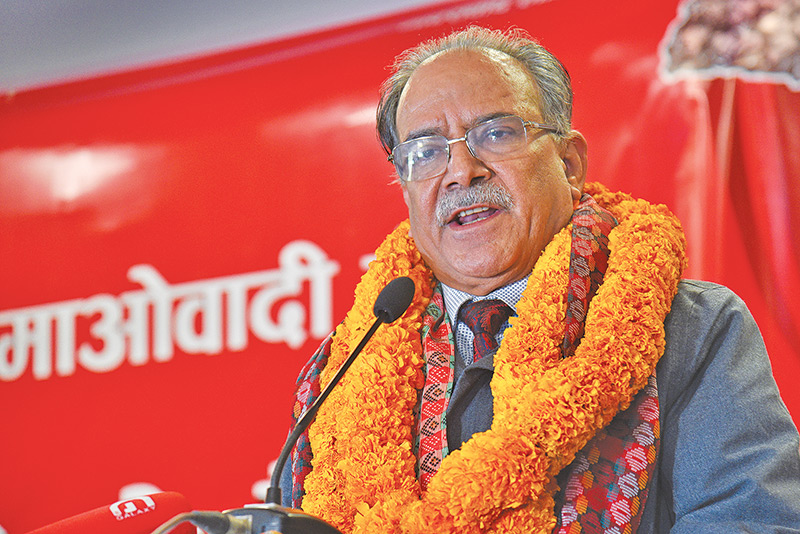
Pushpa Kamal Dahal. Post File Photo
KATHMANDU, With the counting of both the first-past-the-post (FPTP) and proportional representation (PR) votes of the November 20 elections nearly over, leaders have intensified meetings and behind-the-curtain negotiations to form a new government and, above all, to decide the new prime minister. There are several claimants for the post. Incumbent Sher Bahadur Deuba, CPN (Maoist Centre) Chairman Pushpa Kamal Dahal, Nepali Congress General Secretary Gagan Thapa, and Congress leader Ram Chandra Paudel, among others, have already staked their claims to the top executive job. And with no party getting a majority, there is no clarity on the shape of the new government as well as on its leadership. A section of the Congress establishment camp has already proposed Deuba for prime minister. “We should not seek an alternative to Deuba,” Congress Vice-president Purna Bahadur Khadka said on Thursday. “We went to the election under his leadership and got respectable results. So no one should doubt that Deuba is the undisputed candidate for parliamentary party leader,” he added. As per the charter of the Nepali Congress, any lawmaker aspiring to become prime minister should first be elected parliamentary party leader. Khadka, a lieutenant of Deuba, met Dahal on Thursday and discussed government formation. But as the new government will be a coalition one, the Congress needs the support of coalition partners to get Deuba appointed as prime minister. Maoist chair Dahal, who claims to have been cheated out of the post by CPN-UML chair KP Sharma Oli in the post-2017 government, is himself waiting in the wings to head the next government. Also, Dahal and Deuba reportedly have a gentleman’s agreement to lead the next government by turns; Maoist Centre insiders say Dahal wants to become prime minister for the first two and a half years. But Deuba is quietly making his own preparations to head the new government and is working to bring the Janamat Party and the Nagarik Unmukti Party, besides the Loktantrik Samajbadi Party, on board. On Thursday Deuba separately met Janamat Party chief CK Raut and Loktantrik Samajbadi Party chair Mahantha Thakur. Raut also met Dahal on Thursday evening and discussed the possibility of joining the government. Maoist Centre leaders, meanwhile, are hoping that the ruling alliance would readily accept Dahal as next prime minister, arguing that he played a crucial role in unseating the Oli-led government and rallying support behind Deuba last year. “A section of Nepali Congress leaders also fears that Dahal can switch sides and join the UML camp,” a senior Nepali Congress leader said, adding, “Before Dahal takes such a drastic step, we have to accept him as next prime minister and save the alliance.” UML Chairman Oli, meanwhile, has already invited Dahal to sit for talks to discuss a new leftist government under the latter’s leadership. Oli has reportedly proposed heading the new government alternately for two and a half years each. But Maoist leaders doubt the offer. According to a senior Maoist leader, UML is a divided house with competing interest groups, and Oli’s offer may not be genuine. “We are getting patchy and mixed signals from the UML, so as of now the possibility of our party partnering with the UML is low,” said the Maoist leader. The leader said Dahal has already told some Maoist leaders in private that he will look for an opportunity to lead the next government. But the road to premiership will be a bumpy one for Dahal. Some ruling alliance leaders like Minister for Urban Development of the CPN (Unified Socialist), Metmani Chaudhary, have already announced that Deuba will be the next prime minister. Chaudhary, speaking in Kathmandu on Thursday, even claimed that under a new power-sharing deal, his party is likely to appoint the new Speaker of the House of Representatives while the Maoist Centre’s nominee may be the President. He rejected the possibility of a left coalition government involving the UML and said the current ruling coalition will most likely settle on a power-sharing deal with member parties sharing top posts including the President, Vice-president, Prime Minister, Speaker, Deputy speaker and provincial chief ministers. “A UML-led coalition is not possible now. The existing coalition itself will form the new government. And as the biggest party in the coalition, the Congress has every right to lead the government. The Maoist Centre is the second-largest in the coalition, so it will settle for President,” Chaudhary said. “We may also claim the Speaker’s post. I think talks will move ahead accordingly.” Though vote-counting in the three remaining constituencies—Bajura, Syangja and Dolakha—is under way, the counting of all proportional representation votes is set to be completed and a picture of the parties’ respective strengths is already clear. The Nepali Congress will be the largest party with around 90 seats, followed by the UML with 80 seats, while the Maoist Centre is headed for third position with around 31 seats. The Rastriya Swatantra Party, the new outfit led by journalist Rabi Lamichhane, with around 21 seats, will be the fourth biggest parliamentary party. While some think the chances of Maoist Centre chair Dahal heading the new government have diminished with the party’s ‘unexpectedly poor showing’ in the elections, others believe that Dahal is still a kingmaker and will make best use of his options to get to power. However, given the growing internal conflict within the Congress party with its general secretary Bishwa Prakash Sharma prepared to field Gagan Thapa, another general secretary, for prime minister, some observers say Dahal could take advantage of the infighting and become the prime minister for the first two-year term. Not only General Secretary Thapa, senior leader Ram Chandra Poudel and leader Shekhar Koirala are also eyeing the coveted post. Poudel too has already started lobbying with influential leaders across parties to back his own bid. “There is an intense conflict in the Congress to remove Deuba from the helm,” said Ramesh Malla, chief personal secretary to Maoist chair Dahal. “Although serious discussions on government leadership are yet to start, we cannot rule out the possibility of our chairman leading the new government with Congress’ support.” Meanwhile, Dahal on Wednesday went to Sukute in Sindhupalchok, apparently to seek a respite from Kathmandu’s hectic schedule. There he met his confidants including former speaker Agni Sapkota and expressed his readiness to lead the next government with the coalition’s support. “Our party’s first priority is to form a government from within the existing coalition and we believe our party chair should get to lead the government in the first go,” Maoist Centre’s Sindhupalchok district in-charge Madhav Sapkota, who won the parliamentary seat from Sindhupalchowk-1, told the Post. Dahal’s trip was arranged by Sapkota. As part of the coalition’s preparations to form new government, Dahal along with CPN (Unified Socialist) chair Madhav Nepal and Nepal Samajbadi Party chair Baburam Bhattarai recently met Resham Chaudhary, the jailed leader of the Nagarik Unmukti Party (which has won three FPTP seats in the lower house), at Dillibazar Sadarkhor prison. Meanwhile, two Unified Socialist leaders talking to the Post dismissed the possibility of the Congress supporting Dahal’s bid for prime minister. “The first priority of the Congress establishment faction is prime minister for Deuba and if not, it could propose Ram Chandra Poudel for the post. I don’t think they will back a communist to lead the government,” said a senior Unified Socialist leader asking not to be named. The leader also rejected the possibility of Dahal partnering with the UML to become prime minister. “I have also heard of Oli’s PM proposal for Dahal. But I don’t think they can muster a majority.”
HOME PAGE
Migration turning hill villages into ghost towns
Villages in Ramechhap, Dhankuta lie abandoned and fields fallow with residents leaving in search of greener pastures.
- TIKA PRASAD BHATTA,Ramesh Chandra Adhikari
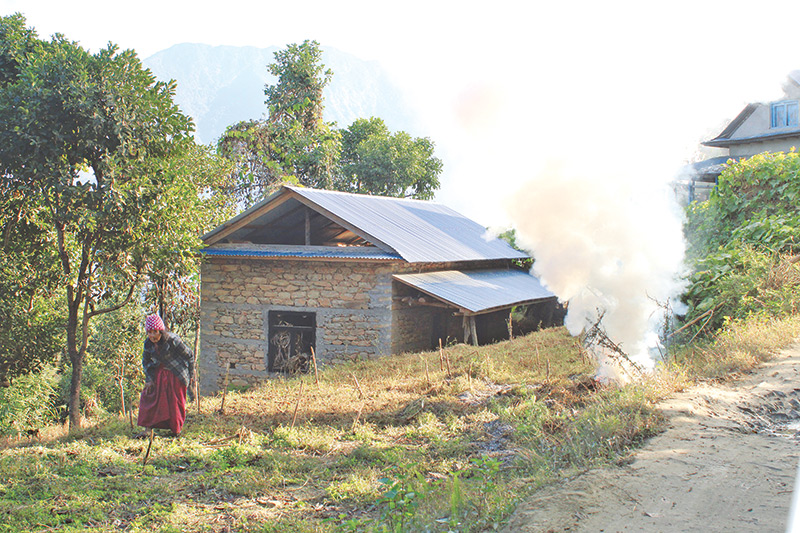
Motimaya Tamang outside her house in Nagdaha of Likhu Tamakoshi, Ramechhap. Post Photo: Tika Prasad Bhatta
Ramechhap / Dhankuta Motimaya Tamang, a 73-year-old woman of Nagdaha, Likhu Tamakoshi Rural Municipality-5, in Ramechhap, lives alone. These days she works in her field from sunrise till sundown ploughing, harvesting millet and cutting hay. A mother of two sons, Tamang says the responsibility of running a household and taking care of the fields is becoming too much for her but as she has no one to help her, she perseveres. “My sons live in Kathmandu with their wives. They don’t want to come back to the village but I can’t leave the fields fallow and the house decrepit, so I keep working,” said Tamang. “My children ask me to move to the city with them but Nagdaha is my home, I can’t leave.” Tamang wakes up in the morning, gets busy with household chores and settles down for a meal. By afternoon, she’s out in the fields. “I’m not young anymore so there are aches and pains everywhere. But if I don’t take care of the house, it will start crumbling,” said Tamang. At present, every Nagdaha villager has a similar story to tell. With the days getting colder, the villagers are working hard in the fields to harvest millet. But like Tamang’s, almost every household in the village is empty of young people—only the elderly remain. “The temperature is dipping. It gets dark early and these old bones cry for rest,” said Tamang. “But the fields need to be tended to; meals need to be cooked. We get no rest.” According to the data of the municipality, the total population of the Likhu Tamakoshi-5, is 5,600, but the villages are mostly empty. Around 470 elderly people in the ward get social security allowance from the municipality. “There are around 200 households in the village and in most of the houses only elderly people remain as most of the young people have left the village in search of employment,” said Tamang. “Some older people have also left with their children. Their houses are on the verge of collapse and their fields fallow.” Laxman Shrestha, a 55-year-old man, lives in his ancestral village with his wife. His four children left for greener pastures and haven’t returned, says Shrestha. “It’s just me and my wife here. We have three daughters and one son. My daughters are all married off and my son went to Kolkata, India for employment. He died there,” said Shrestha. “The lack of young people in the villages becomes more evident during the harvest season. The elderly folks can be seen working in the fields from sunrise to sunset. My wife and I do the same.” Seventy-year-old Bir Bahadur Magar, former ward chairman of Likhu Tamakoshi Ward No 5, says he doesn’t want to work the fields anymore, but has no option. “The village has turned into a shell of its former self. Sorrow and sadness have taken over. Roads, electricity and schools have reached the village but for whose benefit, we don’t know. There are no children here to attend school,” said Magar. According to Magar, almost half of the houses in the villages are empty with the young people moving away and some convincing their parents to move with them. “Most of my neighbours have moved to Kathmandu to work in factories, construction sites and as drivers there. In most of the houses, one can see only old people. Agriculture has been the way of life in the villages for so long and those who have remained are carrying the tradition forward. But if the young keep leaving the villages, this way of life will soon become extinct,” Magar told the Post. Shrestha, whose son died in Kolkata, says making a living through farming is becoming difficult by the day. “We only have two ropani [0.25 acres] of land. Our harvest lasts us two to three months and then we have no income to see us through the rest of the year,” said Shrestha. “Earlier I used to make wicker baskets and sell them, but now there is no demand for such products in the local market, so I stopped.” The economic condition of the elderly population in the village is worsening by the day, says Aash Bahadur Tamang, a 65-year-old man. “Every week someone or the other is moving out of the villages. But they are young people and can restart life anywhere. The ones who are left behind can’t go anywhere to earn money so they work in the fields and make do with whatever grows in their fields,” said Aash Bahadur. Umesh Gurung, the chairman of Ward No 5 of Likhu Tamakoshi Rural Municipality, says that the youngsters are not to blame for leaving the villages. “Everyone has the right to choose the kind of life they want to live. Rural villages have nothing to offer to the youth. However, leaving their elderly parents to their own devices is also not good. To prevent the youths from leaving, we have to offer them employment opportunities, modern perks and benefits, and develop the rural landscape on par with the urban centres,” said Gurung. All of this is possible, but all three levels of government must work together and find a solution. The local government alone can’t bring major changes. According to Gurung, most development projects in the villages have remained in limbo in the villages for a lack of manpower. “We could hire labour from other places but that just adds to the cost. We are contemplating how to move forward,” he said. Aash Bahadur says people started leaving the villages in droves around 2007-2008. “The villages used to be quite populated until 10-15 years ago. The locals themselves would engage in development projects and even host public gatherings during social occasions,” he said. “But now the villages look deserted. Some older people are still here because they don’t want to go to the cities with their children while others don’t have anyone to offer them to leave.” A similar story is playing out across villages in Dhankuta district’s Chaubise Rural Municipality and Chhathar Jorpati Rural Municipality. Villages in both local units have become desolate with almost every second house locked. In the Kuruletenupa village that spans wards 3 and 4 of the rural municipality, hundreds of houses lay abandoned. Only five out of 50 houses in Kuruletenupa are currently occupied. Balananda Adhikari, a local of Kuruletenupa, says his village was one of the largest villages in the rural municipality but in the past decade, it has turned into a ghost village. “Until a decade ago, the villages were full of people and joy. Today many houses are empty; most have been abandoned and are crumbling with the doors and windows broken and hanging on one side,” he said. “The continuous migration of people from villages to cities is a sad reality. When you see a settlement from afar, it looks like a thriving place but when you go near, you’ll see the houses lay in ruins with no one to care for them,” said Adhikari. Gairigaun, Bajthala, and Thulagaun settlements near Kuruletenupa village are also mostly deserted. “Currently, out of the 22 houses in Thulagaun, all are empty except three,” said Adhikari. Similarly, in Dadagaun in ward 3 of the rural municipality, only two families out of 26 families still live there. In Andheri in the same ward, out of the 20 houses, only one is occupied. According to Gopi Krishna Bhandari of Kuruletenupa, people started leaving the villages after struggling with problems such as shortage of drinking water, basic health facilities, schools and such. Rajkumar Chemjong, chairman of the Chaubise Rural Municipality, said that 300 families have relocated from Wards 3 and 4 over the past decade. “We have been making efforts to stop the migration, but in vain,” he said. In ward 4 of Chhathar Jorpati Rural Municipality, out of about 150 houses, only 31 are inhabited. According to Shankar Ojha, facilitator of the rural municipality, people started deserting the villages more than a decade ago after the water sources dried up. “Perhaps people did not stay here because there were no economic activities or income-generating opportunities. The municipality has taken several steps to keep people back in the villages. We launched a programme to provide cattle for free to those who come back to live here, but there were no takers,” he said. Adhikari, from Kuruletenupa, says most of the traditional houses in villages are crumbling, which signifies the collapse of a way of life. “If these houses are not restored and protected as cultural heritages, and the people not recalled, we may lose an important part of history.”
NATIONAL
KMC to discuss squatter problem with government agencies and stakeholders
Municipal police has charged 18 people from Thapathali squatter settlement with assault after staff injuries Monday.
- ANUP OJHA
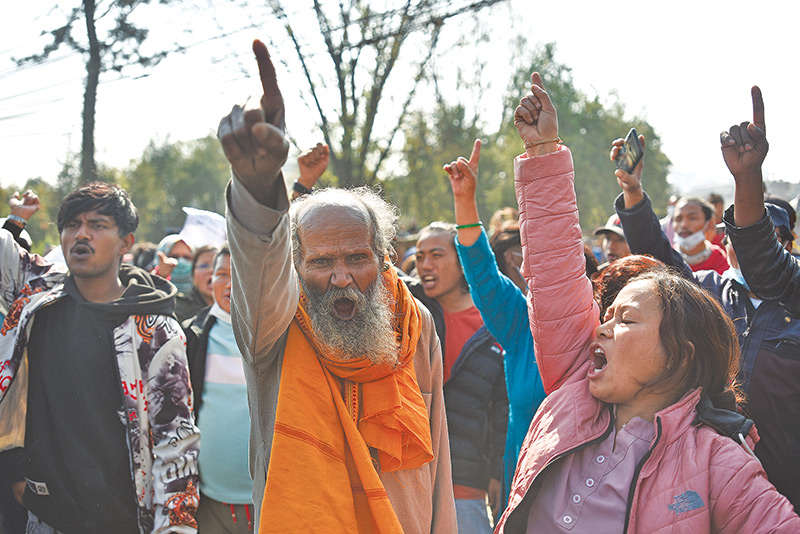
Squatters at Thapathali chant slogans against the Kathmandu MetropolitanCity’s attempts to remove their settlement on Bagmati riverside. Post Photo: Angad dhakal
KATHMANDU, The Kathmandu Metropolitan City, which on Monday tried to forcefully remove the squatter settlement on the banks of the Bagmati river in Thapathali, has since softened on its approach. The city office has said that it would now be consulting with other government agencies for a solution. On Monday, Raju Nath Panday, chief of the city police, and a large number of city police personnel under the command of Mayor Balendra Shah had reached the settlement in Thapathali with two excavators. But as soon as they reached the settlement, they faced aggressive retaliation from the squatters, resulting in violent clashes between the two sides. Panday and over a dozen city police were injured as squatters attacked them with stones and brickbats. Three of them had to be admitted to the Intensive Care Centre in Norvic Hospital. The city police has lodged a First Information Report (FIR) at the District Police Range, Teku against 18 people who live in the settlement. Mayor Shah, who was praised by a section of the people for demolishing the illegally built structures, deployed the city police at the squatter settlement after the High Powered Committee for Integrated Development of Bagmati Civilisation (HPCIDBC) sought KMC’s support in clearing the encroachments. He allegedly didn’t consult other concerned bodies. The Committee had issued a notice to the squatters for a third time on November 11 to vacate the settlement by November 20. Because of the eviction notice, more than 900 squatters around the Thapathali settlement have been living in constant fear of being attacked by the city police. They chanted slogans against Mayor Shah and home minister Bal Krishna Khad. Since the clashes, the squatters have been protesting against the City. The committee’s report shows that at present, as many as 34,096 squatter families are living on the banks of the Bagmati river. Meanwhile, in an executive meeting of the City held on Wednesday, many ward representatives questioned Mayor Shah’s ‘immature’ decision and the consequences faced by the city police. They also sought the reasons behind a lack of cooperation among the security agencies. “The city has cooperated with HPCIDBC and is in a drive to remove the illegal structures, that’s why we reached the settlement,” said Bhoop Dev Shah, secretary to Mayor Shah. He said that the city will now go ahead consulting with the Urban Development Ministry, National Land Commission, Kathmandu Valley Development Authority (KVDA), HPCIDBC, National Land Commission, respective ward committees, representatives of squatters and other stakeholders. Two days after the clashes between the City and squatters, the KVDA, on Wednesday, issued a 35-day notice to remove illegal structures constructed on encroached public lands. The authority has even warned of charging the costs incurred on the demolition drive from the concerned individuals or organisations if they didn’t remove such structures on their own. “Sooner or later, we will regain the public land and no one will be allowed to encroach any public land,” said Shah, the mayor’s secretary. The KMC officials also expressed their dissatisfaction with the security agencies for not giving their full support to the city police. In Monday’s clashes, the squatters attacked the city police with stones, bricks and sharp weapons. They accused the Nepal Police and Armed Police Force who were deployed there in large numbers of remaining meek spectators to the violence in the area. “The Home Ministry should either support the KMC or should clearly tell us that they can’t give us security,” Shah said. “If that’s the case, we would move on our own.” Since Monday’s incident, the general public seems to be sharply divided. Some have applauded Mayor Shah, saying that he had taken the right decision to regain the public land by removing illegal settlers. Others, however, accused him of being ‘inhuman’, taking “immature steps without doing a proper study on issues like identifying the genuine squatters and the fake ones.” Earlier, in May 2012, the Baburam Bhattarai-led government had demolished 251 squatter huts at the same settlement by deploying over 1,000 security personnel. To relocate the squatters, the government had then built a settlement at Ichangu Narayan in Nagarjun hills, spending Rs230 million. The buildings have remained unused since the squatters have refused to relocate.
NATIONAL
3 dead, 7 hurt in jeep accident
District Digest
EAST NAWALPARASI: Three persons died and seven got injured after a jeep fell about 150 metres off a road at Hupsekot Rural Municipality, in East Nawalparasi on Thursday. The condition of three injured is critical. The jeep was heading for Dedhgaun from Daldale Bazaar. According to District Police Chief Bhubaneshwar Tiwari, all the dead were residents of Boudikali and Bulingtar rural municipalities. Police reached the incident site and rescued the injured, Tiwari said. Among the seven injured, three are in critical condition.
NATIONAL
Re-polling held in 10 centres
District Digest
DOLAKHA: The Election Commission conducted re-polling at 10 voting centres in the disrict Thursday after charges of ballot stuffing during the elections on November 20. According to the chief election officer Dilliratna Shrestha, there are a total of 8,514 eligible voters in the area. The re-polling was held at voting centres A and B of Putalikath, Baiteshwari Rural Municipality-2 and at voting centres A, B, and C at ward 3 of the rural municipality. Also, re-polling was held at A, B and C centres in ward 6 of the rural municipality, and voting centres A and B in ward 3 of Tamakoshi Rural Municipality.
NATIONAL
Girl run over by earth mover dies
District Digest
DHANGADI: A 14-year-old girl was killed after being run over by a grader in Dhangadi on Thursday. According to the local police, the grader owned by Kalika Construction was levelling the road near Hasanpur Pipal Chautara was on a reverse gear when it ran over the girl. The girl, an eighth-grade student of Hasanpur-based Panchodaya Secondary School, died on the spot, police said. Police have taken grader operator Bimal Kumal, 27, of Bharatpur Metropolitan City, Chitwan, into custody.
NATIONAL
Dolphins sighted in Narayani
Distrtict Digest
EAST NAWALPARASI: Dolphins were sighted in the Narayani river near Amaltari in Kawasoti Municipality. Tek Mahato, a nature guide, spotted two dolphins in the river on Wednesday. “We were searching for the dolphins for the past two weeks after the locals informed us about it,” Mahato said. “We saw two dolphins while we were boating near the Amaltari ghat.” Environmentalists have said dolphins are on the verge of extinction in the Narayani river due to increasing pollution.
NATIONAL
Lawmaker-elects trying to act as executives even before swearing-in
Experts on parliamentary affairs say the elected representatives should instead focus on how to perform their roles in the House effectively.
- BINOD GHIMIRE
KATHMANDU, On Monday, Mahesh Bartaula, a newly elected member of the House of Representatives from Makwanpur-2, inspected Krishi Samagri Kendra in Hetauda and asked the officials why the farmers were not getting chemical fertilisers. He also directed Prakash Gyawali, director of the centre, to immediately start distributing fertiliser to the farmers in his constituency. Bartuala defeated Birodh Khatiwada, former minister and a Standing Committee member of the CPN (Unified Socialist), in the November 20 parliamentary election. He started directing the officials just a day after receiving the certificate of election. A day later, Deepak Singh, a newly elected member from Makwanpur-1, reached the Hetauda Hospital for inspection. Singh not just said he would work towards improving the health services in the district but also asked the hospital authority to improve its services right away. The vote count for the federal and provincial assembly elections is on the verge of conclusion. As of Thursday, 162 members like Bartula and Singh have been elected under the first-past-the-past system. Though they have received their certificates, they are yet to take the oath of office to formally become lawmakers. However, many of them have already started acting not just as lawmakers but more than that. Laxmi Prasad Gautam, joint secretary of law at the Parliament Secretariat, says those who have been elected to the House can behave like lawmakers only after they are administered the oath. Gautam says that every individual, not just the elected representatives, can seek updates from the authority on any development project or an issue of their concern. But as lawmakers they cannot directly instruct the government agencies to do something. “As the people’s representatives, they [lawmakers] can definitely take updates on every activity of public concern,” said Gautam. “However, I don’t think any law authorises them to issue directives.” MP-elects from the newly formed Rastriya Swatantra Party that has performed exceptionally well in the polls have left others behind in ordering government agencies. A few days earlier, RSP President Rabi Lamichhane visited a road section in his Chitwan-2 constituency with officials where he grilled them why the works hadn’t been completed. In a video widely circulated on social media, he is heard asking the officials to ensure the road section is completed within the deadline. “No excuse for further delay is accepted,” he is heard saying. Following in his footsteps is Hari Dhakal, a recently elected member of the lower house from Chitwan-1 for Lamichhane’s party. A few days earlier, he reached the construction site of a bridge over Pampha Khola in Rapti Municipality-7. From there he called the constructor not to delay the construction on any pretext. “I don’t want to hear anything. I want the bridge to be completed by the end of the current fiscal year, that’s it. Only thing I understand is you are completing the bridge in the next seven months,” he is heard saying in a widely circulated video. Experts on parliamentary affairs say the newly elected representatives must understand that they are not activists and their position demands some decorum. “Until those newly elected formally take responsibility, they should focus on studying how they should act in Parliament and what their roles and responsibilities are,” Som Bahadur Thapa, former secretary of Parliament told the Post. “They must demonstrate maturity in their actions.” Lawmakers’ role is policy formulation and scrutiny over government through Parliament. “Parliament is a proper channel to direct the government and its subordinates,” said Thapa. “Lawmakers should not try to function as executives.”
NATIONAL
Utility seeks bids to supply solar power to grid
The electricity authority is buying solar power through competitive bidding, ending the fixed rate regime.
- PRITHVI MAN SHRESTHA
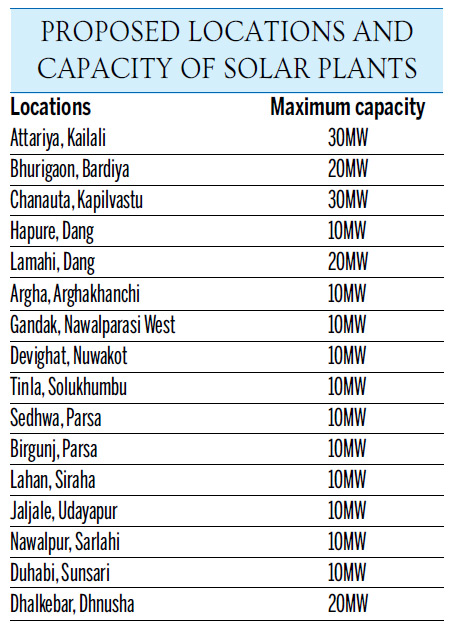
KATHMANDU, Nepal Electricity Authority has invited proposals from developers for setting up solar plants connected to the grid so they can sell power through competitive bidding. The NEA plans to buy a maximum 100MW of power from such solar plants proposed to be developed by the private sector at 16 locations across the country. Up to 230MW of solar power plants could be developed in those locations. This is for the first time that the state-owned power utility sought to buy solar power through bids. In January, the NEA board had decided to procure solar energy only through bidding, ending the fixed rate regime of the previous three years. The NEA said it sought to buy solar power through open competition to bring down the prices considering the significant cheapening of solar equipment in the neighbouring countries and global market. In March, the power utility had decided to cap the maximum rate to be offered to solar power generators at Rs5.94 per unit. Earlier, the NEA had been signing power purchase agreements with developers at a fixed rate of Rs7.30 per unit based on the Working Procedure on Grid Connected Alternative Electric Energy Development-2017. “Proposals were requested to select the bidders who want to develop power in the designated area and sell electricity to us at less than Rs5.94 per unit,” said NEA Spokesperson Suresh Bhattarai. “We will sign the PPA only with the developers who pass technical evaluation and offer competitive bids below the maximum price ceiling.” As per the notice issued on November 28, the bidders can submit RfPs by February 26. As per the bid notice, the solar project must be commissioned within 18 months from the date of PPA signing between the NEA and the developer. As per the notice, bidder(s) can propose a maximum capacity set for specific locations ranging from 10MW to 30MW based on the location. They cannot propose to deliver less than 1MW at the delivery point. The bidder can choose any solar photovoltaic power generation technology. The developer will also be responsible for evacuating power from the plant to the nearby NEA substation, according to the RfP notice. The power utility will sign the PPA with the developers for 25 years as per the Working Procedure on Grid Connected Alternative Electric Energy Development-2021. After that period, the developers have to hand over the solar plants along with the land used to the government. However, solar power producers say the price cap on solar power could make many solar plants unfeasible as the prices of solar panels have risen globally again amid supply constraints and the Russian invasion of Ukraine. “Investors may need to wait for 15 to 20 years to recover their investment,” Bharat Kumar Malla, senior vice-president of the Solar Electric Manufacturers Association Nepal told the Post in October. “The investors will rethink whether to invest in solar plants in Nepal.” Currently, the contribution of solar power in the country’s energy mix is minimal. According to the Ministry of Energy, Water Resources and Irrigation, as much as 44 megawatts of solar energy has been connected to the national grid as of last fiscal year ended mid-July. This contributes 1.94 percent to Nepal’s total installed capacity. Nepal’s total power generation in mid-July stood at 2268MW, according to the energy ministry. The power monopoly made a move to buy solar energy in volumes as part of implementing the government policy of increasing the share of other renewable sources such as solar and wind to 10 percent of the total installed capacity. The government aims to increase the share of solar and wind power as a generation mix would bolster energy security considering that heavy reliance on a single source could be risky. Ram Prasad Dhital, former board member of the Electricity Regulatory Commission, told the Post in October that the country needs to diversify its energy mix to ensure energy security considering that Nepal is prone to earthquakes and landslides that could affect hydropower projects. The Department of Electricity Development has issued survey licences for 44 projects with a combined capacity of 1,238.7 megawatts. Major projects getting survey licences include the 300MW Jhapa SPV Power Plant and the 200MW Nepalgunj SPV Power Plant to be developed by GT Energy; 250MW Grid Connected Solar Project in Kohalpur; and Banganga to be developed by Risen Clean Energy Nepal. On top of that, the department has issued construction licences for 21 solar projects with a combined capacity of 133.56MW.
NATIONAL
Nepal disease control body to study high dengue mortality
Sixty-two people died and around 54,000 have been infected by the deadly virus in Nepal this year alone.
- Arjun Poudel
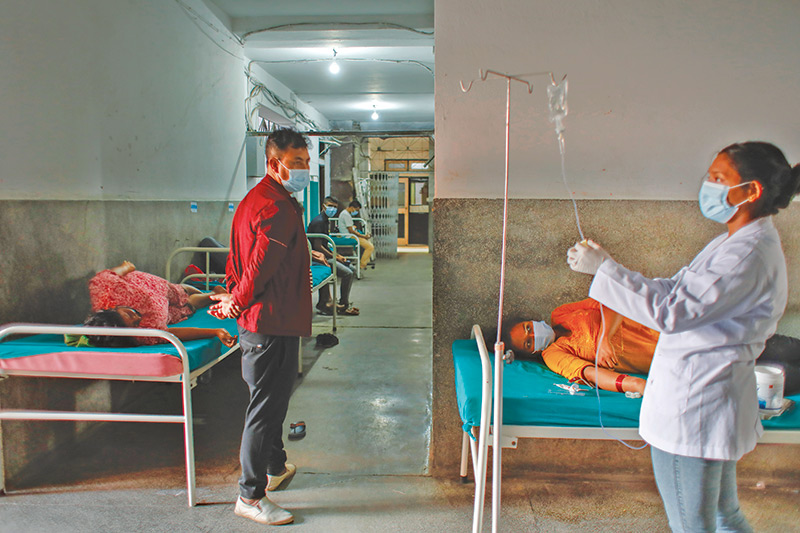
This file photo shows a nurse tending to a dengue patient at Sukraraj Tropical and Infectious Disease Hospital in Teku, Kathmandu. Post File Photo: Elite Joshi
KATHMANDU, The Epidemiology and Disease Control Division has said that it has started a study on the cause of the high death rate from infection of the dengue virus. Since January, at least 62 people have died and around 54,000 others were infected by the virus, which has spread to all 77 districts of the country, according to the Ministry of Health and Populations. “Deaths from infection from the dengue virus is too high and we have started a comprehensive study to determine the cause of deaths,” said Dr Gokarna Dahal, chief of the Vector Control Section at the division. “A team of experts will analyse the cause of deaths from various aspects.” Dengue is a mosquito-borne disease transmitted by female Aedes aegypti and Aedes albopictus mosquitoes. The same vector also transmits chikungunya, yellow fever, and Zika, according to the World Health Organisation. Post-monsoon is considered a high transmission season for dengue, but Nepal has witnessed outbreaks of the deadly disease since the start of the year and in the pre-monsoon and monsoon seasons as well. Officials said that the deadly virus has become endemic, as cases of infection of the virus have been reported in all months throughout the year. Experts say reported dengue cases could be just the tip of the iceberg, as around 90 percent of the dengue-infected people do not show any symptoms. Those closely tracking the cases suspect many more people could have succumbed to the disease as not all deaths are reported, just like during the Covid pandemic. Negligence in the case of management, taking preventive measures, lack of awareness about the risks among the public, and delay in seeking health care services after infections could be among the reasons for the high death rate from infection of the virus, according to experts. An expert team is tasked to analyse the type of population, which have been severely affected by the infection. “We will also review, if the preventive measures taken by agencies concerned the three tiers of governments—federal, provincial, and local level, were effective or not,” said Dahal. Doctors say that many people infected with dengue have not been seeking hospital care, which is also the reason for the decline in reported cases. Dengue virus serotype 1 (DENV-1), 2 (DENV-2), and 3 (DENV-3) have been found responsible for the dengue epidemic in the country. Studies were carried out at the Tribhuvan University and the BP Koirala Institute of Health Sciences, according to officials at the Health Ministry. Another extensive study jointly carried out by the National Public Health Laboratory and the Nepal Health Research Council has also been completed. Dengue cases have declined significantly amid dipping temperatures. But 15 to 20 people are still testing positive for dengue every day. Entomologists warn that dengue spread has gone down naturally but the risks are still there. They say that a new surge could start once the temperature rises, as no serious initiatives have been taken to destroy the eggs of infected mosquitoes. “All deaths from dengue virus should be analysed thoroughly and its underlying cause established,” said Sishir Panta, an entomologist. “Many other shortcomings could be responsible for a wide spread of the virus and high severity and death rate which should also be analysed properly and further plannings should be made accordingly.” Nepal has witnessed a dengue epidemic every two or three years. In 2019, at least six people died and over 17,000 were infected by the virus, which had spread to 68 districts.
NATIONAL
IOC slashes petrol, disease prices and increases LPG rate
Briefing
KATHMANDU: Indian Oil Corporation (IOC) on Thursday sent a revised rate of petroleum products to Nepal Oil Corporation (NOC). As per the latest rate, the Indian utility has decreased the price of petrol and diesel while increasing the cost of Liquefied Petroleum Gas (LPG). “As per the latest rate received from the IOC, the price of petrol has decreased by Rs2.38 and diesel by Rs11.26 per litre,” said Birendra Goit, director of supply and distribution department of the NOC. “The price of LPG has increased by Rs 45 per cylinder.” Nepali customers, however, will not benefit from the revised prices unless the NOC decreases the prices of the petroleum products accordingly in the domestic market.
NATIONAL
US envoy Thompson meets Prime Minister Deuba
Briefing
KATHMANDU: US Ambassador Dean Thompson met Prime Minister Deuba on Wednesday evening. This is the first meeting between Deuba and Thompson since the latter arrived in Nepal on October 13 to take up his new assignment. Foreign Relations Adviser to the prime minister Arun Subedi said that Thompson congratulated Deuba for holding successful elections to the federal and provincial parliaments. During the meeting, the US envoy said that the United States hopes that the recent elections would strengthen the democratic process in Nepal, according to Subedi. In response, Deuba thanked the US for its support in Nepal’s democratic transition, democracy, human rights and development endeavors, Subedi. He added that the prime minister expressed hope that the US will continue to support Nepal.
NATIONAL
Deuba expresses condolence on Jiang Zemin’s demise
Briefing
KATHMANDU: Prime Minister Sher Bahadur Deuba has expressed condolences on the passing of Jiang Zemin, the former president of the People’s Republic of China. Deuba took to Twitter on Thursday to extend his condolence. “I am deeply saddened by the passing away of former president of the People’s Republic of China Mr. Jiang Zemin. He was a great friend and well wisher of Nepal,” read the Tweet. “I would like to express my deepest condolences to the Government and the people of China and the bereaved family members.” Jiang Zemin (1926-2022) was the President of China from 1993-2003 and visited Nepal in 1996. He also met several Nepali leaders, including late king Birendra Shah in 2001 in Boao Forum for Asia, Hainan. In July 2022, Jiang met with former king Gyanendra Shah in the Great Hall of the People in Beijing. Jiang died on Wednesday at the age of 96 of leukemia and multiple organ failure, according to the Chinese state media.
EDITORIAL
Exclusionary parliament
Major parties are running out of excuses to deny election tickets to marginalised.
A fair number of young candidates winning the first-past-the-post (FPTP) elections for the federal Parliament is something to be celebrated. The sad bit is that the incoming Parliament is still going to be homogenous, with low representation of historically marginalised groups like women, Dalits and Janajatis. Only one Dalit candidate has won under the FPTP system. A total of 16 Dalit candidates will be represented after factoring in PR seats. Thereafter, Dalits will comprise 5.8 percent of the 275-member federal lower house, even as they make up 13.8 percent of the national population. Likewise, just eight women have been elected through the FPTP system thus far. Forget that there are more women than men in the country; even the constitutional requirement of 33 percent women’s representation in Parliament is likely to be flouted by exploiting procedural loopholes. The total representation of Janajatis will be slightly better—with 24 percent representation against the national population of 38 percent—but again far from satisfactory. The parties failed to field more candidates from marginalised groups under the FPTP system mainly because of the belief that such candidates cannot win elections. There is some truth to it. Women and members of the traditionally marginalised communities often lack the kind of money and muscle power that, for example, seasoned Khas-Arya male politicians bring to the election table. They are thus at a disadvantage right from the get go. Yet the results of recent elections also suggest the fast-changing electorate is more than willing to vote for clean and capable candidates, irrespective of their ethnic, gender or socio-economic backgrounds. The power of money and muscle, which have traditionally been instrumental in determining electoral outcomes in Nepal, is evidently on the decline. The major parties are thus fast running out of excuses not to give tickets to promising candidates from the marginalised groups. This phenomenon can also be seen as an extension of lack of internal democracy in political parties. Again, their top echelons are filled with upper-caste men who are reluctant to trust either women or members of other ethnic communities with important responsibilities. Yet they all talk big, as is evident in their high-sounding manifestos promising a more “inclusive and equitable” Nepal. In reality, they continue to view the idea of representation and affirmative politics through the lens of tokenism rather than as a matter of conviction. No political party that keeps away large sections of the society from important decision-making posts can be termed a democratic outfit; equitable representation is the bedrock of democracy. The hope again is that a third of the parliamentarians who have made it to the house for the very first time will lead this fight for more inclusiveness in all state organs, and in the political parties they represent. It should now be their responsibility to enact (and push for the implementation of) affirmative action policies to remove the traditional barriers members of the marginalised communities face on their quest for greater political representation. Only then will the national Parliament be a truly vibrant place for discussion of competing ideas and visions.
OPINION
Power to the provinces
The provincial governments should be allowed to choose their own electricity future.
- BISHAL THAPA
Shutterstock
Balen Shah, mayor of Kathmandu, and Rabi Lamichhane, newly elected Member of Parliament from Chitwan-2, did not cast their votes for the Provincial Assemblies. Both of them oppose the structure of the provinces in Nepal’s federal set-up. Lamichhane indicated he was not for scrapping the provinces, he just wanted certain reforms. Shah, who has been bulldozing illegal structures around Kathmandu, perhaps would like to drive a bulldozer over the part about provinces in the constitution. Exactly why or what they oppose or wish to reform is not clear. Both have won convincing victories, and are widely regarded as agents of change and symbols of hope. Their voice, or in this case, their symbolic protest by refusing to vote, matters deeply. But this is no time to doubt the relevance of the provinces. If utilised as the constitution intended, the provinces could be the most important component driving the systemic changes that Shah and Lamichhane are seeking to lead.
Lame arguments I draw upon a story from the energy sector to illustrate how the provinces could sustain positive long-term changes and invite the mayor and the MP to reconsider their opposition. This June, the provinces announced an annual budget of Rs305 billion, a 17 percent increase over last year. Approximately 15,000 staffers currently work in the provincial governments. Most of the key organisations and institutional arrangements have been established. But the provincial governments have yet to become truly meaningful. It is also important that change agents like Shah and Lamichhane not fall for lame arguments. One such claim is that this system is too expensive administratively for Nepal’s size and economy. This argument is fallacious. By this reasoning, a dictatorship would be the most cost efficient system. But I’m sure that is not the vision that Shah and Lamichhane are promoting. The federal government is yet to pass any legislation that empowers the provinces in the energy or environment sector. The Environment Protection Act 2019, for instance, provides some authority to the provinces and local governments; but contains ambiguities like an unfunded mandate to undertake unspecified activities. Assessing the failures of the provincial governments without recognising the fact that the federal government is dictating the terms is a bit like choking someone and wondering why he is not breathing. In the evolving landscape of Nepal’s federal structure, the provinces could play a critical role in driving positive change. To see how, consider this. In September 2022, the Ministry of Energy, Water Resources and Irrigation withdrew an amendment to the Electricity Act-1992 that had been placed for consideration before Parliament. The amendment attempted to introduce a wide range of reforms: Improve the corporate structure of the Nepal Electricity Authority; reduce licence requirements; open access in transmission; unbundle the utility into generation, distribution and transmission; retail electricity competition; and integrate renewable energy. These reforms are widely needed. But sensing a lack of broad-based political support, the ministry withdrew the proposed amendment from Parliament. This attempt to reform the Electricity Act may have failed for many reasons. One may be that there wasn’t enough support for these amendments. Since the Nepal Electricity Authority is now a profitable institution, electricity supply is abundant and new generating capacity is in the pipeline, the urgency for reform may have appeared weak. But this doesn’t mean the underlying basis for reforms proposed in the amendment isn’t necessary. On the contrary, they are critical to the long-term growth and continued success of Nepal’s electricity sector. But who will be the champion of these reforms? This is where the provinces have a special role to play as champions of reform and advocates for change. The provinces must be able to invoke the authority granted to them under the constitution. Schedule 9 lists electricity services, along with water supply and irrigation, under the “List of Concurrent Powers of Federation, State and Local Level”. Despite this authority, there is no real effort to understand or assess what that authority means, and more importantly, how it could be institutionalised. One way to move forward could be to establish a vision for the electricity sector. Besides unbundling the power utility, its ownership could be devolved into the provinces. Some provinces may then choose to privatise their power utilities. Some may decide to involve private sector players. Some may choose to open distribution to retail competition where customers can choose their own suppliers, enable open access and introduce other models for competition. All of this will require a strong regulatory foundation, akin to the amendments of the Electricity Act. If Nepal’s constitution allowed the provincial governments to pick their names and capitals, surely, they could be allowed to choose their own future on electricity.
Champions of reform Nepal’s constitution grants the provinces and local governments the authority and responsibility over the electricity sector. By staking claim to that authority, they could provide what the electricity sector currently lacks: champions of reform. Reform-minded, forward-looking emerging leaders such as Shah and Lamichhane, who embody the hope of many Nepalis, must also recognise this opportunity for system-wide reform. They must translate these opportunities into credible mass movements for reform instead of becoming just another cult of personality. The devolution of power from the centre to the provinces and local governments, and ultimately the people of Nepal, is the core philosophy of the constitution. In the energy sector, the provinces have the power to champion and bring about reform that has eluded it for decades. Prominent leaders, like the mayor of Kathmandu and the parliamentarian from Chitwan, must explore ways to mobilise the provinces to deliver what Nepal’s constitution truly intended for the Nepali people.
Thapa holds a master’s degree in economics from the University of Maryland and currently works in the energy sector.
OPINION
Blaming it all on climate change
Climate change brings many problems. But should all extreme events be attributed to it?
- SUBASH PANDEY
Post File Photo
A good understanding of a problem depends on one’s ability to ask the right questions. Asking the right question is paramount when it comes to extreme natural events and attributing them to climate change. Moreover, there is this saying: A problem well-defined is a problem half-solved. One of the greatest climate scientists and communicators, Professor Katherine Hayhoe shared on Twitter: “‘Was it caused by climate change?’ is the most common question when we hear about an extreme event. But when it comes to hurricanes, that’s the wrong question. The right one is, ‘How much worse did climate change make it?”’ Professor Hayhoe refers to hurricanes here, but this is equally applicable to other extreme events like flash floods, heatwaves, large-scale landslides, forest fires, and heavy downpours that strike Nepal every year.
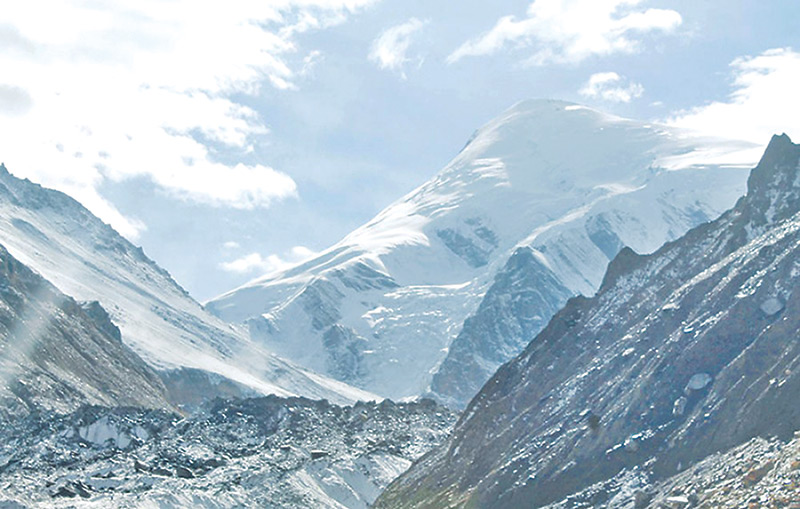
Attributing extreme events to climate change In Nepal or elsewhere, attributing all these extreme events to climate change has become a norm for politicians, bureaucrats, and contractors to escape from their responsibilities and hide their incompetencies. Climate change might have accelerated those extreme events, but the root cause of disasters from extreme events could be the construction of roads in hilly regions without proper consultation with technicians, poor management of forests, not abiding by building codes and land-use planning, or events stemming from weak planning and policies. Climate attribution science, also known as extreme event attribution (EEA), is a new branch of climate science that tries to address whether climate change has influenced “the likelihood and/or severity of individual extreme events” based on longer observational records and advanced climate models. But there are a lot of challenges for this new science to evolve, especially in countries like Nepal, where there is a lack of trustworthy historical data on climate change. We have enough evidence to say that anthropogenic activities are responsible for the observed 1.2 degrees Celsius rise in the global average temperature. In Nepal, the rising temperatures are rapidly melting glaciers in the Hindukush Himalayan region, increasing the threat of Glacial Lake Out-Burst Floods (GLOFs). Rainfall has become too erratic and unpredictable here. However, we can’t confidently link extreme natural events and resulting disasters to only climate change because of its complexities and other additional management factors responsible for it.
Application of EEA It is difficult to find research; there’s not even one from Nepal on extreme event attribution to climate change on google scholar. Lack of research on EEA might be a consequence of poor records of historical and observational climate data in addition to lack of climate scientists who focus on advanced climate models for their research in Nepal. However, we can learn from the application of extreme event attribution in other countries, especially the US. The US is the most politically divided country regarding climate change, and people are sceptical of linking extreme events to climate change. As many as 43 percent of total Americans deny anthropogenic climate change at all. In this situation, EEA has become instrumental in answering the question of the contribution of climate change to extreme events like hurricanes, mega-drought, and large wildfires across the western US forests. In recent decades, forest fire in the US has been enabled by multiple factors, including poor forest management (fire suppression), human settlements, natural climate variability, and human-caused climate change. Extreme event attribution research shows that anthropogenic climate change accounted for an almost 55 percent increase in fuel availability by increasing aridity and contributed to an additional 4.2 million hectares of wildfires between 1984-2015. In the absence of human-caused climate change, this additional forest fire area would have been avoided. Similarly, another study finds that anthropogenic trends in “temperature, relative humidity, and precipitation” estimated from 31 climate models accounted for 47 percent of the 2000-2018 mega-drought severity in the US. Moreover, there is another significant study conducted in West Africa. Using a process-based crop model, one study shows that anthropogenic climate change caused regional average yield reductions of 10-20 percent, and 5-15 percent for millet and sorghum, respectively, over the period 2000-2009. Over the same period, the yield reduction accounted for $2.33-$4.02 billion loss for millet and $0.73-$2.17 billion, for sorghum. The authors of this study argue that similar research and findings could be a basis for the loss and damage, which was the primary agenda of many poor countries at COP 27 in Egypt this November.
What lessons can Nepal learn? Unfortunately, one has to cite findings on extreme event attribution from other parts of the world as there is no such study in Nepal. Therefore, Nepal should first invest in research on EEA and keep a good record of all climate variables (not only precipitation and temperatures). Similarly, responding to how anthropogenic climate change has contributed to extreme events in Nepal would not only help make our politicians, bureaucrats, and developmental contractors transparent and accountable for their work but also strengthen the position of countries like Nepal at the annual COP. The main agenda of developing countries at future COP will be the operationalisation of the loss and damage fund established under the UNFCCC at COP 27 in Egypt. Developed countries led by the US at COP 26 in Glasgow refused separate funding for loss and damage, citing insufficient scientific evidence for such a claim. Research on EEA will support developing countries in quantifying the loss and damage. We hear many activists and scholars in Nepal focusing more on climate finance, especially for loss and damage. Along with climate finance, they also need to raise voices on strengthening the research capacity that would answer questions related to climate change and extreme events, which would make our claim for loss and damage robust. Moreover, mainstream media reporting on such events should not hype the extreme events just by linking them to climate change. While interviewing climate scientists or reporting on extreme events, they should stop asking, “Did climate change cause this specific extreme event?” as the answer to such a question will always be “no”. Rather they should ask, as Professor Katherine Hayhoe asks, “How much worse did climate change make extreme events?” To answer this question, Nepal needs to invest more in climate attribution research.
Pandey is a graduate student of Climate Science and Policy at the Bard College in New York.
OPINION
Stop fueling Ukraine conflict
Peaceful settlement of the crisis is the only way to end the sufferings of people in Ukraine.
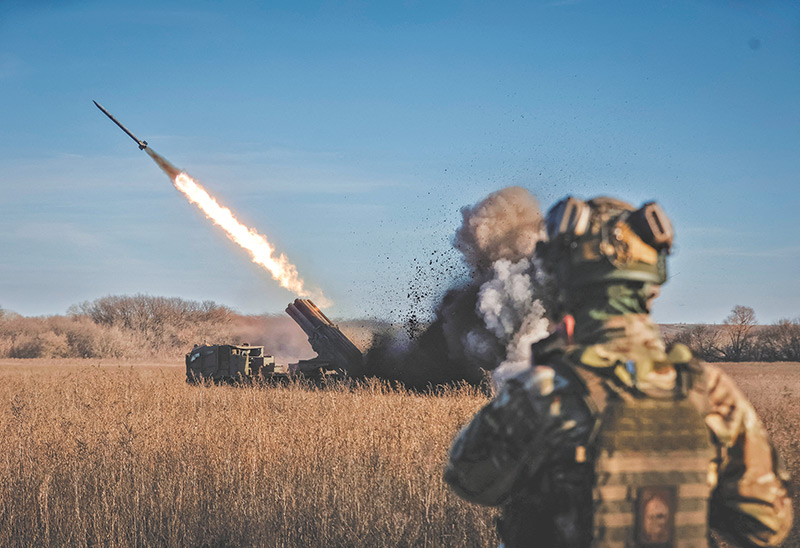
For anyone wishing for an early end of the nearly 10-month Russia-Ukraine conflict, the message from the two-day NATO foreign ministers’ meeting that ended in Bucharest, Romania, on Wednesday was not very encouraging. This is because the world’s largest security alliance, rather than exploring the possibilities to realise a negotiated settlement of the crisis by trying to create conditions for peace talks at an early date, seems to be intent on prolonging the hostilities despite the sufferings in Ukraine and the fact the conflict-induced global food and energy crises are pushing more people around the world into extreme poverty and hunger. NATO Secretary-General Jens Stoltenberg on Tuesday pledged to drum up support for Ukraine aimed at ensuring the defeat of Russia, “because we know that the only way to achieve an outcome of this war which ensures that Ukraine prevails as a sovereign independent nation is to strengthen its position on the battlefield”. He also said Moscow cannot stop the alliance’s expansion to include Ukraine. Given that NATO’s continuous eastward expansion has been at least partly responsible for the ongoing conflict, Stoltenberg’s remarks only serve to make a settlement at the negotiation table even more difficult. Moreover, NATO’s confirmation at the meeting that deliveries of more sophisticated missile systems such as Patriot missiles are being considered risks escalating the war into a direct military conflict between NATO and Russia. Dmitry Medvedev, deputy chairman of the Russian Security Council, said on Tuesday on his Telegram channel: “If, as Stoltenberg hinted, NATO supplies … Patriot complexes along with NATO personnel, they will immediately become a legitimate target of our armed forces.” Instead of prolonging and escalating the conflict by supplying Ukraine with weapons, the US, NATO and the European Union should conduct comprehensive dialogue with Russia with the aim of not only bringing an end to the conflict in Ukraine but also resolving their differences with Russia so that a stable security architecture can be established in Europe. All parties concerned should work to realise those goals no matter how dim the prospects are. Continuing on their present course risks turning a Cold War vendetta that is long past its sell-by date into an even broader and more catastrophic hot war. Most pressingly, peaceful settlement of the crisis as soon as possible is the only way to end the sufferings of people in Ukraine, and others around the world who have been impacted by the spillover effects of the hostilities. The conflict has devastated Ukraine’s infrastructure and economy, and forced around 6 million people to flee Ukraine in one of the fastest-growing refugee crises in recent history. Even Stoltenberg admitted, “the price we pay is in money, while the price Ukrainians pay is a price paid in blood.” That should be on his conscience, and all those who are intent on prolonging the conflict.
— The China Daily/ANN
MONEY
Bridges yet to be built 3 years after road was completed
Lack of river crossings has made life difficult—and dangerous—for the residents of Dolpa, eastern Jajarkot and northern Rukum.
- HARIHAR SINGH RATHORE
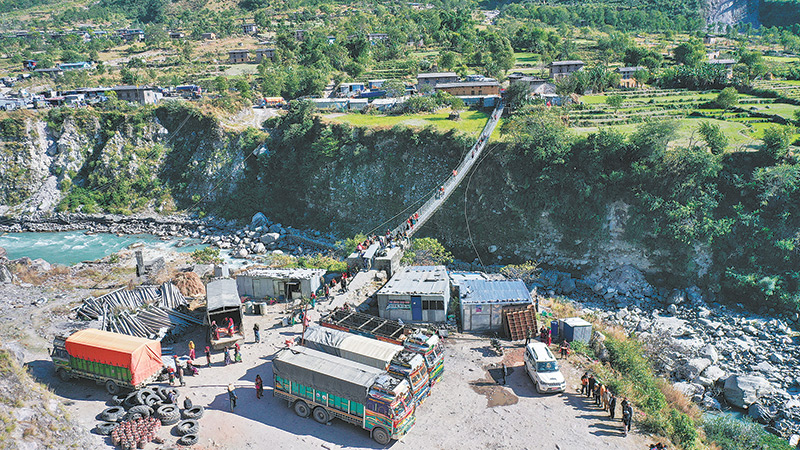
Lack of a permanent bridge in the area has made freight charges extremely high. POST PHOTO: HARIHAR SINGH RATHORE
JAJARKOT, The completion of a road linking Dolpa and Jajarkot has brought little cheer to locals because of the absence of bridges. The 118-km road was completed three years ago, but the contractors are yet to build five bridges which means porters still have to carry goods on their backs. Lack of river crossings has made life difficult—and dangerous—for the residents of Dolpa, eastern Jajarkot and northern Rukum, three remote districts in western Nepal. One Bailey bridge at Chaukha in Ragda of Jajarkot district; three concrete bridges at Khadang, Kabargad and Tripurakot Bagar; and another Bailey bridge at Rupgad in Dolpa remain to be built. Workers have only laid a simple foundation at the construction sites. The completion of concrete bridges at Holu Khola, Rimma and Chisapani in Jajarkot, and Bailey bridges at Kaina Khola and Nalgad, has facilitated transportation immensely, but locals continue to face hardships because of delays at other sites. Transportation is expensive, and this has pushed up the cost of everything for residents who are mostly poor. “The price of cement in Dolpa is more than double what it costs in Jajarkot. Cement costs Rs3,500 per quintal in Dolpa while you can buy it for Rs1,600 in Jajarkot. The price of a bundle of tin roofing sheets costing Rs11,000 in Jajarkot goes up to Rs18,000 when it reaches Dolpa. Eggs cost Rs500 per crate, sugar Rs130 per kg, lentils Rs200 per kg and rice Rs100 per kg,” said Tej Prakash Buda, a local businessman of Dolpa. “Lack of bridges has made transportation tremendously difficult and expensive. Because of the high price tags of the goods, there is very little profit for traders,” he said. The government has awarded a contract to build a Bailey bridge at Tallu Bagar over the Bheri River. This bridge connecting Jajarkot and western Rukum is of vital importance because it links Dolpa with the national road network. Lack of a permanent bridge in the area has made freight charges extremely high. Residents of the three districts have to pay more for all their needs despite having a road connection. The government had awarded the Rs38.5 million contract to Him Sagarmatha Khadka Krishna JV last December with a completion deadline of June this year. But workers have only finished building the foundation at one end and erecting a pillar in the middle. “Because of the very slow pace of progress, the contractor was summoned to the office and told to finish the remaining work by mid-January next year,” said Ashutosh Karna, head of the Road Division Office at Chaurjahari. “The construction of Rupagaad bridge near Dunai, the headquarters of Dolpa district, has also been terribly slow. It was supposed to be completed by mid-April this year,” said Karna. “Locals have also been suffering due to the delay in the completion of a bridge over the Bheri River linking Nalgad Municipality-11 of Jajarkot and Aathbiskot Municipality- 6 of Western Rukum,” said Jayakrishna Hamal, a local of Thulibheri Municipality of Dolpa. “The road has been completed, but we haven’t been able to feel that we have a road because there are no bridges. There are nearly five dozen rivers on the road segment. There is no bridge even over the Bheri River. Porters have to carry the goods across the suspension bridges and reload them on the vehicles waiting on the other side of the river,” Hamal said. Vedanidhi Adhikari, chief district officer of Dolpa, said that locals have to take the vehicles across rivers over unsafe wooden bridges as a bridge at Rupgad of Thulibheri Municipality remains unfinished. “The bridge is important to connect the district headquarters Dunai with Jufal and the Bheri Corridor,” said Adhikari. “Market access for local products like apple, Himalayan aromatic herb and other herbs have been difficult, and local traders have been bringing in daily essentials by paying exorbitant truck charges.” According to Adhikari, it costs as much as Rs80 per kg to transport goods from Nepalgunj to Dunai. “Porters charge up to Rs40 per kg to carry goods across suspension bridges. All construction materials have to be transported over the same road, and delays in delivery and high costs are major problems,” said Harichandra Budha, a local trader of Dolpa. “The government has already awarded a contract to blacktop the road from Khalanga, headquarters of Jajarkot district, to Nalgad Municipality-11, and it is sad that the bridge is yet to be built,” Budha added. Local activist Rajendra Bikarm Shah claims that road improvement work has been moving ahead very slowly too, not only bridge building. “Delays in building bridges and upgrading roads have slowed down the construction of a service track for the Jagdulla Hydroelectricity Project,” said Shah. Karna, chief of the Road Division Office, said that the remaining four bridges in the Bheri Corridor would be completed by mid-May next year. “The construction materials have been stored in Surkhet and Nepalgunj, and the contractors have been told to transport them to the project sites and finish them as soon as possible.” The Dolpa-Jajarkot road is part of the Bheri Corridor. It was built by the Nepal Army and handed over to the Nepal government three years ago. The Road Division Office had then commenced the work of road upgradation and bridge construction. “The process of issuing the contract for blacktopping the remaining portion of the road was started after completing an Environmental Impact Assessment and other related tasks. Yet builders have already received the contract to blacktop the road,” said Karna. “It has already been a year since the contract was issued, but the contractor has not begun even the most basic job,” said local resident Bharda Bohora. The construction of the strategically important road connecting Pasagadh, Jajarkot with Dunai, Dolpa began in 2008. Work stopped for two years because of a design conflict, and resumed after it was sorted out.
MONEY
Chinese farmers let cabbages rot as Covid curbs disrupt sales
Vegetable prices are likely to go up during the Lunar New Year holiday.
- REUTERS
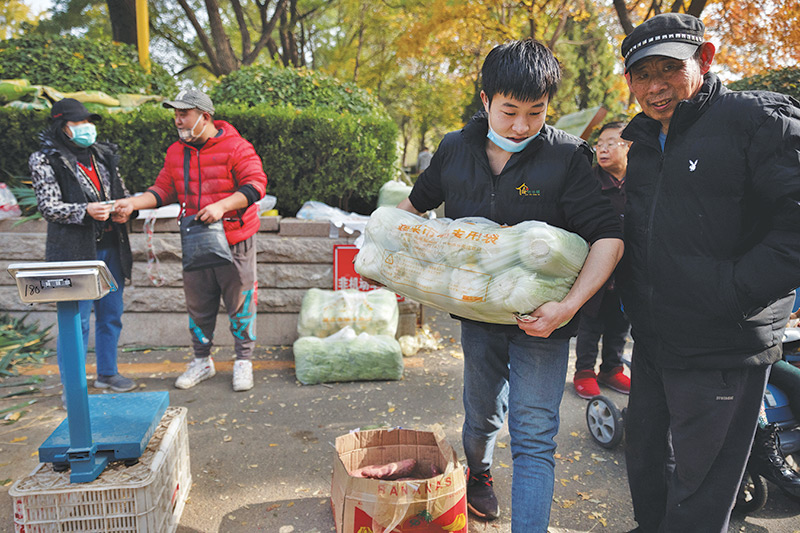
A file photo shows a woman buying cabbage at a street stall in Beijing, China. REUTERS
BEIJING, China's vegetable growers are ploughing their produce back into their fields or leaving it to rot, as widespread restrictions to curb the spread of Covid cut off distribution channels and close markets. Thousands of tonnes of vegetables are unsold in central Henan province, one of the country's top producing regions, according to local media reports, charities and farmers, while farmers in northern Shandong province, another top growing region, are also unable to reach markets. Despite a wave of unprecedented protests against tough measures to curb the spread of Covid, China has not relaxed restrictions on movement in many areas in response to record cases of the disease. "I feel so bitter whenever I go to the land and can't help bursting into tears," said a 36-year-old Henan farmer surnamed Wang, who has left his crop of yellow-heart cabbages in the ground to perish in imminent frosts. Wang's cabbage is usually sold in large cities like Beijing, Shanghai and Tianjin. This year, his merchant can't reach his farm, and he can only get 35 cents per half kilo compared with 80 cents last year. "I would rather not sell it and leave it there," he said. The situation is exacerbated by a fragmented supply chain, where small farmers sell to middlemen who purchase for large wholesale markets in cities. Many traders are unable to travel, restricted from leaving their homes and prevented from exiting motorways to reach rural areas or other cities. "It's not easy to get off the motorway, and then you're required to quarantine. The cost is too high, so no one dares to do it," said a Shandong-based vegetable buyer surnamed Cui. Cui typically sends up to 20 large trucks of cauliflower, cabbage, and lettuce to markets daily in this season. Now markets in major cities like Handan, Tianjin, and Shijiazhuang are all closed and growers in Shandong are also impacted, he said. "In Dezhou vegetables are all being ploughed into the ground, celery, kale, cabbage, nobody wants them," said Cui. In Henan, where tough Covid measures caused riots last month at the world's largest iPhone factory, more than 900 farmers entered their details on a document circulated online to seek new customers. Others shared videos on social media, showing them ploughing crops into the ground and comparing minimal prices for their produce with high retail prices in cities. Henan produced 76 million tonnes of vegetables last year, or about 10 percent of the nation's supply, according to the National Bureau of Statistics.The Ministry of Agriculture and Rural Affairs said on Tuesday it had launched an initiative to sell Henan vegetables at large wholesale markets, selling 4,677 tonnes last week. It also set up a hotline to connect farmers with sellers, and said it would find cold storage facilities to stock winter vegetables. Despite such efforts, vegetable prices are likely to go up during the Lunar New Year holiday next month, said Cui. "The local government is too busy with the epidemic. Who cares about vegetables?" he asked.
MONEY
Finance minister denies economic crisis
The private sector urges the government to be serious, but the government says let’s not spread a false message.
- Post Report
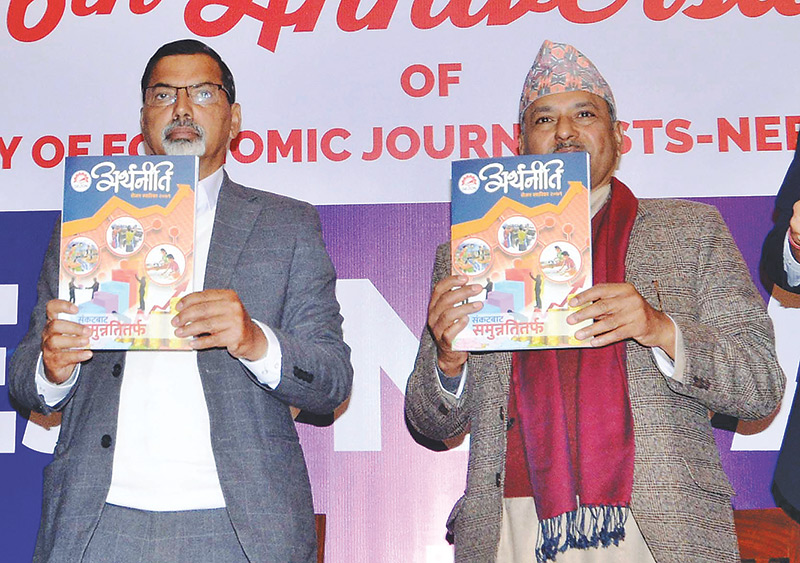
Finance Minister Janardan Sharma (left) during a programme in Kathmandu. PHOTO COURTESY: Society of Economic Journalists Nepal
KATHMANDU, Finance Minister Janardan Sharma, on Thursday, said that the country is not passing through an “economic crisis” as portrayed by the private sector. On Tuesday, the Federation of Nepalese Chambers of Commerce and Industry, the key private sector body, had warned that the country is in a financial crisis and the government is least bothered about the situation. “It’s not quite at that stage as is being said by the private sector,” said Sharma, speaking at a programme organised on the occasion of the 26th anniversary of the Society of Economic Journalists Nepal (SEJON). He urged experts and stakeholders not to call the current situation a “crisis”. “The economic indicators are improving. The construction work will speed up which would increase the capital expenditure.” The central bank’s data also shows that the current economic condition of the country is improving, said Sharma, expressing his dissatisfaction with some individuals and experts who are vocal about the economic situation of the country. “Since the economy is facing various pressures and challenges rather than a crisis, let’s think and discuss the solutions now. Let’s not spread a false message,” said Sharma. Nepal Rastra Bank governor Maha Prasad Adhikari said the world’s economies are under stress. “But, Nepal’s situation is not that bad.” “Compared to other countries in South Asia, except India, Nepal’s economy is stable. But there are challenges too,” said Adhikari.In its 55 years of history, the country for the first time encountered foreign exchange pressures with reserves depleting by $2.34 billion within a year due to external reasons, he added. Adhikari said the central bank is always ready for discussions to find solutions to the problems. Adhikari said the restrictions on imports are not for forever. Though the import ban on certain goods has affected revenue earnings, in many cases, it is positive. Gagan Kumar Thapa, general secretary of the Nepali Congress, said the incoming leadership should have courage to face the economic situation of the country. “We are in an unprecedented crisis and the problem would be resolved, only if we work with determination,” he said. “It is important for the next prime minister to understand the seriousness of the current situation,” said Thapa, adding that the government should conduct open and transparent discussions with different private sector players and shouldn’t ignore them. Shekhar Golchha, president of the Federation of Nepalese Chambers of Commerce and Industry, said that he had not seen any leader who is willing to cooperate with the private sector. “Why is there a trend of being afraid and hesitant to cooperate with the private sector even though it is known that economic development is not possible without the participation of the private sector,” Golchha asked.
MONEY
Sri Lanka hopes for tourism revival next year
Country to end this calendar year with 750,000 tourist arrivals and about $2 billion in earnings.
- REUTERS
COLOMBO, Sri Lanka hopes to double tourist arrivals to 1.5 million next year and bring in $5 billion in vital foreign exchange, the tourism minister said on Thursday, as the island nation seeks ways to tackle its worst financial crisis in seven decades. The country of 22 million people, famed for its beaches, ancient temples and aromatic tea, has been struggling for months to pay for essential imports of fuel, food and medicine because of a lack of foreign exchange. "Tourism can play a major role in Sri Lanka's recovery and this is what we are aiming for next year," Tourism Minister Harin Fernando told reporters in Colombo. Sri Lanka would likely end this calendar year with 750,000 tourist arrivals and about $2 billion in earnings, Fernando said, adding his ministry would be targeting high end tourists and introducing new products in 2023. The Indian Ocean island is also rolling back night-time power cuts in tourism zones, as the overall electricity situation improves from 13-hour power cuts earlier in the year, Power Minister Kanchana Wijesekera said on Wednesday. Months of protests, political turmoil, power cuts and fuel queues dampened tourism in Sri Lanka just as it was recovering from the Covid-19 pandemic in mid-2022. An estimated $4 billion loss in tourism revenue over the past two years also contributed to tipping Sri Lanka into the financial crisis, according to former ministers. Sri Lanka signed a preliminary agreement with the International Monetary Fund (IMF) for a $2.9 bailout in early September but has to get prior financing assurances from private and bilateral creditors, including India, China and Japan before disbursements can begin.
MONEY
India’s jobless rate rises to three-month high of 8 percent in November, CMIE says
Briefing
NEW DELHI: India’s unemployment rate rose to 8.0 percent in November, highest in three months, from 7.77 percent in the previous month, data from the Centre for Monitoring Indian Economy (CMIE) showed on Thursday. The urban unemployment rate rose to 8.96 percent in November from 7.21 percent in the previous month, while the rural unemployment rate slipped to 7.55 percent from 8.04 percent, the data showed. The data from the Mumbai-based CMIE is closely watched by economists and policymakers as the government does not release its own monthly figures. (REUTERS)
MONEY
Pakistan’s consumer price inflation slows to 23.8 percent
Briefing
ISLAMABAD: Pakistan’s annual consumer price inflation slowed to 23.8 percent in November from 26.6 percent a month earlier, the statistics bureau said on Thursday, days after the central bank unexpectedly hiked policy rates. Prices were up 0.8 percent in November from the previous month, the bureau said in a statement. Core inflation for urban and rural areas measured by non-food, non-energy increased to 14.6 percent and 18.5 percent respectively in November, year-on-year, the bureau added. Pakistan’s finance ministry said in its monthly outlook released earlier this week that inflation would decline marginally in November, while staying in a range of 23 percent-25 percent. On November 25, the central bank hiked its policy rate by 100 basis points to 16 percent, the highest in several years, as it sought to prevent inflation from becoming entrenched. (REUTERS)
MONEY
UK house prices post biggest slide since mid-2020
Briefing
LONDON: British house prices tumbled 1.4 percent in November compared with October, the biggest monthly drop since June 2020 and the clearest sign yet that the housing market is cooling rapidly, data from mortgage lender Nationwide showed on Thursday. A Reuters poll of economists had pointed to a fall of 0.3 percent, following a 0.9 percent drop in October. In annual terms, house price growth slowed to 4.4 percent in November from 7.2 percent in October, Nationwide said. Other gauges of house prices have also pointed to a slowdown underway. Nationwide said the fallout from the September economic agenda of former prime minister Liz Truss continued to reverberate through the housing market. (REUTERS)
WORLD
China set to loosen Covid curbs after week of historic protests
Ruling party to allow home quarantine, cut mass testing, sources say. Top official says severity of virus weakening.
- REUTERS
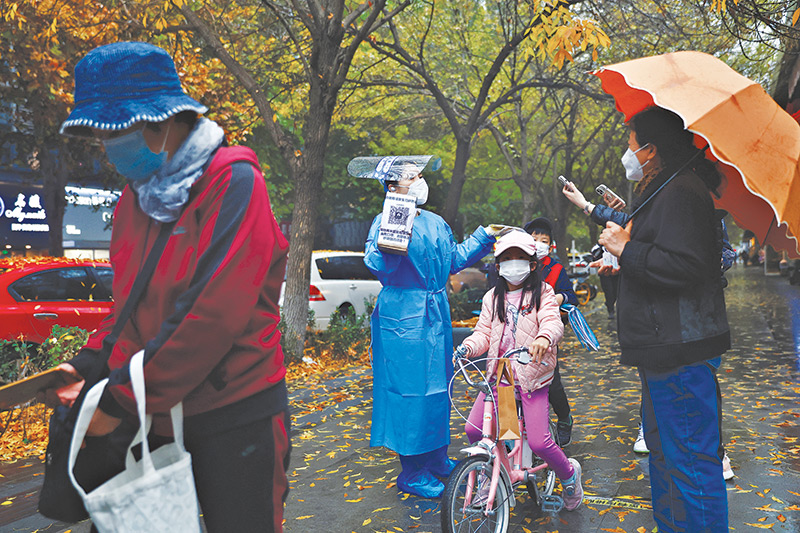
A file photo shows an elderly person scanning a QR code at a nucleic acid testing site for the coronavirus disease, in Beijing, China. REUTERS
HONG KONG/BEIJING, China is set to announce an easing of its Covid-19 quarantine protocols in the coming days and a reduction in mass testing, sources told Reuters, a marked shift in policy after anger over the world’s toughest curbs fuelled widespread protests. Cases nationwide remain near record highs but the changes come as some cities have been lifting their lockdowns in recent days, and a top official said the ability of the virus to cause disease was weakening. Health authorities announcing the easing in their areas have not mentioned the protests—the biggest show of civil disobedience in China for years—which ranged from candle-lit vigils in Beijing to street clashes with police in Guangzhou. The measures due to be unveiled include a reduction in the use of mass testing and regular nucleic acid tests as well as moves to allow positive cases and close contacts to isolate at home under certain conditions, the sources familiar with the matter said. That is a far cry from earlier protocols that led to public frustrations as entire communities were locked down, sometimes for weeks, after even just one positive case. The frustration boiled over last week in demonstrations of public defiance unprecedented in mainland China since President Xi Jinping took power in 2012. The unrest comes as the economy is set to enter a new era of much slower growth than seen in decades. On Thursday night, Shanghai train commuters reported wirelessly receiving an unsolicited document onto their phones saying that life in China would only get better if there was a full lifting of lockdown and that Xi step down - an apparently new tactic amid a heavy police presence in some cities ahead of the weekend. Less than 24 hours after violent protests in Guangzhou on Tuesday, authorities in at least seven districts of the sprawling manufacturing hub, said they were lifting temporary lockdowns. One district said it would allow schools, restaurants and businesses including cinemas to reopen. Cities including Chongqing and Zhengzhou also announced easings. The sense of official momentum towards a landmark shift built on Thursday as Vice Premier Sun Chunlan, who oversees Covid efforts, told a meeting of frontline experts that the Omicron variant was weakening in its ability to cause disease, allowing China to improve prevention efforts. “After nearly three years fighting against the epidemic, our country’s medical and healthcare system has withstood the test,” she said in remarks published by the official Xinhua news agency. “The vaccination rate of the entire population exceeds 90 percent and public health awareness and quality has been improved signifciantly,” she said. State media reported Sun saying a day earlier that China was facing a “new situation” in its response to Covid, and urged further “optimisation” of testing, treatment and quarantine policies. The mention of weakening Covid pathogenicity contrasts with previous messages from a usually hawkish Sun about the deadliness of the virus. “Sun’s [earlier] speech, in addition to the notable easing of Covid control measures in Guangzhou yesterday, sends yet another strong signal that the zero-Covid policy will end within the next few months,” analysts at Nomura said in a research note. “These two events perhaps point to the beginning of the end of zero-Covid.” In the capital, Beijing, some communities have begun preparing for changes. One community in the east of the city held an online poll this week on the possibility of positive cases isolating at home, residents said. “I certainly welcome the decision by our residential community to run this vote regardless of the outcome,” said resident Tom Simpson, managing director for China at the China-Britain Business Council. He said his main concern was being forced to go into a quarantine facility, where “conditions can be grim to say the least”. Prominent nationalist commentator Hu Xijin said in a social media post on Wednesday that many asymptomatic carriers of coronavirus in Beijing were already quarantining at home. Expectations have grown around the world that China, while still trying to contain infections, could look to re-open its borders at some point next year once it achieves better vaccination rates among its hesitant elderly.
WORLD
Democracy leader says 2,000 dead fighting junta in Myanmar
- REUTERS
BANGKOK, At least 2,000 pro-democracy fighters have been killed in Myanmar battling a military junta that seized power last year, the head of a parallel civilian government said in an interview aired on Thursday, urging allies to provide military aid. Duwa Lashi La, acting president of the National Unity Government (NUG), comprised of remnants of the administration of deposed leader Aung San Suu Kyi and others, was speaking to the Reuters NEXT conference from an undisclosed location in Myanmar. “We regard [the deaths] as the price we must pay,” said Duwa Lashi La, a former teacher and lawyer in his seventies who fled his home in Kachin State in northern Myanmar with his family. The military has branded him and his colleagues terrorists and banned citizens from communicating with them, but their parallel civilian government enjoys widespread support. Allied armed groups known as People’s Defense Forces have emerged across the country. Duwa Lashi La has been pictured visiting troops, who include former students and professionals driven to the jungles by military crackdowns, clad in a flak jacket and helmet. “I have no idea when I will give up my life,” he said. “It is up to God’s will. I am already committed to sacrificing anything for my country,” he said. The Southeast Asian nation has been in turmoil since the military seized power in February last year, reversing a decade-long democratic experiment, and used deadly force to crush protests. In addition to the 2,000 deaths in fighting, more than 2,500 civilians have been killed elsewhere, mostly in crackdowns on protests, according to the Assistance Association for Political Prisoners. Pro-democracy fighters are out-gunned by an army equipped by Russia, China and India, which uses fighter jets to carry out deadly bombing raids. More than 1.3 million people have been internally displaced since the coup, according to the UN.
WORLD
Modi’s home state Gujarat votes in key local polls
A second round of voting will take place on Monday before votes are counted December 8.
- ASSOCIATED PRESS
NEW DELHI, Voters in Prime Minister Narendra Modi’s home state of Gujarat cast ballots on Thursday in crucial local elections, a vote that is seen as a barometer of his ruling Bharatiya Janata Party’s popularity ahead of a 2024 general election in India. The polls are the first of two phases of voting in the western state that Modi ruled as chief minister for over a decade before he led his ruling Hindu nationalist party to victories in national elections in 2014 and 2019. A second round of voting will take place on Monday before votes are counted December 8. Modi’s party remains popular despite criticism of inflation and unemployment and is expected to emerge victorious. Most pre-election surveys and several political analysts have predicted that it will win a majority of the 182 seats in the state for a record seventh time in a row, defeating the main opposition Congress party and new entrant Aam Aadmi Party. The BJP has been in power in Gujarat, a state of more than 60 million, since 1995. Modi and dozens of top leaders of his party have been campaigning in Gujarat and voters will go to the polls a month after the collapse of a suspension bridge in the town of Morbi killed 135 people. The disaster angered people across the state but analysts say it won’t dent BJP’s popularity in the polls. India’s main opposition Congress party is hoping to revive its fortunes and regain some popularity in the state. In October, the party elected a new president, a move that was seen to shed its image as a family dynasty. In September, Rahul Gandhi, its most prominent leader, launched a cross-country unity march across Indian cities, towns and villages to rejuvenate the party and win the people’s support. But analysts say neither event will help the party electorally during the Gujarat polls. Meanwhile, the BJP is facing a tough challenge from the Aam Aadmi Party, which has ruled the capital, Delhi, since 2015. Earlier this year, it swept polls in the northern Punjab state by overthrowing the Congress party. Aam Aadmi Party, which grew out of a nationwide anti-corruption movement in 2012, has been a force to reckon with in Delhi. Since its surprise win in the Punjab state, the party has been trying to strengthen its presence across the country. A strong showing in Gujarat could indicate whether the party could appeal voters during the 2024 general election, mainly at the expense of the Indian National Congress party that has struggled since 2014.
WORLD
Viewers flock to watch glowing lava ooze from Hawaii volcano
People take a photo in front of lava erupting from Hawaii’s Mauna Loa volcano on Wednesday near Hilo, Hawaii. AP/RSS
- ASSOCIATED PRESS
KAILUA-KONA, The world’s largest volcano oozed rivers of glowing lava Wednesday, drawing thousands of awestruck viewers who jammed a Hawaii highway that could soon be covered by the flow. Mauna Loa awoke from its 38-year slumber on Sunday, causing volcanic ash and debris to drift down from the sky. A main highway linking towns on the east and west coasts of the Big Island became an impromptu viewing point, with thousands of cars jamming the highway near Volcanoes National Park. Anne Andersen left her overnight shift as a nurse to see the spectacle on Wednesday, afraid that the road would soon be closed. “It’s Mother Nature showing us her face,” she said, as the volcano belched gas on the horizon. “It’s pretty exciting.” Gordon Brown, a visitor from Loomis, California, could see the bright orange lava from the bedroom of his rental house. So he headed out for a close-up view with his wife. “We just wanted … to come see this as close as we could get. And it is so bright, it just blows my mind,” Brown said. The lava was tumbling slowly down the slope and was about 10 kilometres from the highway known as Saddle Road. It was not clear when, or if, it would cover the road, which runs through old lava flows. The road bisects the island and connects the cities of Hilo and Kailua-Kona. People traveling between them would need to take a longer coastal road if Saddle Road becomes impassable, adding several hours of drive time. Ken Hon, scientist in charge at the Hawaiian Volcano Observatory, said at current flow rate, the soonest the lava would get to the road is two days, but it will likely take longer. “As the lava flow spreads out, it will probably interfere with its own progress,” Hon said. Kathryn Tarananda, 66, of Waimea set two alarms to make sure she didn’t oversleep and miss her chance to see sunrise against the backdrop of eruptions at Mauna Loa. “It’s a thrill,” she said. “We’re out in the middle of raw nature. It’s awe inspiring that we live in this place. ... I feel really, really fortunate to be an islander.” Mauna Loa last erupted in 1984. The current eruption is its 34th since written record keeping began in 1843. Its smaller neighbour, Kilauea, has been erupting since September 2021, so visitors to the national park were treated to the rare sight of two simultaneous eruptive events: the glow from Kilauea’s lava lake and lava from a Mauna Loa fissure. Abel Brown, a visitor from Las Vegas, was impressed by the natural forces on display. He planned to take a close-up helicopter tour later in the day—but not too close. “There’s a lot of fear and trepidation if you get really close to it,” Brown said. “The closer you get, the more powerful it is and the more scary it is.”
WORLD
Heaviest Ukraine fighting rages in east, NATO seeks to sustain support against Russia
US missile contract worth $1.2 billion awarded to help Ukraine, Pentagon says.
- REUTERS
Ukrainian servicemen fire with a Bureviy multiple launch rocket system in Donetsk region. REUTERS
KYIV, Russian forces tried to advance in eastern Ukraine and trained tank, mortar and artillery fire on Kherson in the south, the Ukrainian military said, as Western allies sought to buttress Ukraine and its neighbours against Moscow. In Washington, a $1.2 billion contract for six National Advanced Surface-to-Air Missile Systems (NASAMS) for Ukraine was awarded to Raytheon, the Pentagon said. Ukraine Foreign Minister Dmytro Kuleba said on Wednesday his country needed US-made Patriot missile defence systems to protect its civilian infrastructure, which has been under heavy attack by Russia at the start of winter. US Secretary of State Antony Blinken said Russian President Vladimir Putin had focused “his ire and his fire” on Ukraine’s civilian population and warned Russia that its strategy would fail to divide Ukraine’s supporters. “Heat, water, electricity ... these are President Putin’s new targets. He’s hitting them hard. This brutalisation of Ukraine’s people is barbaric,” Blinken told a news conference in Bucharest following a two-day NATO meeting. At the NATO foreign ministers meeting, allies on Wednesday pledged to help Moldova, Georgia and Bosnia-Herzegovina as they face pressure from Russia, NATO Secretary-General Jens Stoltenberg and ministers said. Russian Foreign Ministry spokesperson Maria Zakharova said the outcome showed NATO was “absolutely not interested in a political and diplomatic solution in Ukraine”. Russia invaded Ukraine nine months ago in what it calls a “special military operation” to rid Ukraine of nationalists it considers dangerous. Ukraine and Western allies accuse Russia of an unprovoked, imperialist land grab. Ukraine ordered all of Kyiv’s embassies abroad to strengthen security after two letter bombs were sent to the Ukrainian ambassador in Madrid and an arms company in Spain that manufactures rocket launchers donated to Ukraine. Spanish police said they were are examining a possible link between the two bombs, one of which injured an embassy security officer. In the Donetsk region of eastern Ukraine, site of the heaviest fighting, Russian forces tried to make further advances and shelled several towns, including Bakhmut and nearby Soledar and Opytne, the General Staff of the Ukrainian Armed Forces said in a Wednesday night statement. On the southern front, it said Russian forces took up defensive positions and trained tank, mortar and artillery fire on Ukrainian positions and on the regional capital of Kherson, abandoned by Russian troops earlier in November. Other battleground activity was reported in northeastern and central Ukraine, the military said. Reuters was not able to verify battlefield reports. “We are analysing the intentions of the occupiers and preparing counter-measures—tougher counter-measures than is now the case,” President Volodymyr Zelenskiy said in a Wednesday evening address.
WORLD
Five letter bombs detected in Spain, country steps up security
Briefing
- AGENCIES
MADRID: Bomb disposal experts defused a fifth letter bomb on Thursday as Spain stepped up security to confront a spate of explosive devices sent to high-profile targets, including the prime minister and the Ukrainian ambassador in Madrid. Early indications suggest that all five of the packages were sent from within Spain, the country’s Deputy Interior Minister told journalists. Rafael Perez, the junior minister responsible for security, said the homemade devices were sent in brown packages containing a flammable powder and tripwire that would generate “sudden flames” rather than an explosion. The packages were addressed to the heads of the institutions they were sent to.
WORLD
North Korea’s Kim calls for meeting to review state affairs
Briefing
- AGENCIES
SEOUL: North Korean leader Kim Jong Un called for a major political conference before year’s end at which he is expected to address his increasingly tense relations with Washington and Seoul over the expansion of his nuclear and missile programmes. North Korea’s state media said on Thursday that Kim presided over a meeting of the ruling Workers’ Party’s Politburo in which members reviewed the implementation of state policies in 2022 and decided to hold a larger plenary meeting of the party’s Central Committee at an unspecified time in late December. Kim in recent years has used political conferences in late December or early January to review state affairs and reveal his most important goals in economic and foreign policy and arms development.
WORLD
China’s Xi urges Ukraine talks in meeting with EU’s Michel
Briefing
- AGENCIES
BEIJING: Chinese leader Xi Jinping urged negotiations on a political solution to the Ukraine conflict in talks with visiting European Council President Charles Michel in Beijing on Thursday, state broadcaster CCTV said. Xi was quoted as saying that “solving the Ukrainian crisis through political means is in the best interest of Europe and the common interest of all countries in Eurasia.” “Under current conditions, we must avoid escalation and expansion of the crisis and work for peace,” Xi said.
SPORTS
Former Sports Council member secretary no more
- Sports Bureau
Kishor Bahadur Singh died of a heart attack. Post File Photo
KATHMANDU, Former member secretary of National Sports Council (NSC) Kishor Bahadur Singh died in Kathmandu on Thursday. He was 73. Singh had suffered a heart attack, according to Nepal Badminton Association President Ramji Bahadur Shrestha. Singh breathed his last at Norvic Hospital, Thapathali, where he was admitted on Wednesday evening after his health suddenly deteriorated. Singh served as the member secretary of the Council from 2003-2007. A former Nepali badminton legend, he was a six-time men’s singles national champion from 1972 to 1977. NSC paid its tribute to the late Singh stating that his death caused a huge loss to the Nepali sports and a great pain to the council family. “Singh’s contribution to the development and expansion of Nepali sports is laudable. We express our heartfelt condolences to the bereaved family and relatives. May his soul rest in peace,” the NSC statement reads. All Nepal Football Association (ANFA) said it was grieved by the death of Singh. “The ANFA family is saddened to learn of the loss of former NSC member secretary Kishor Bahadur Singh. Our thoughts are with the Singh family. We offer them our heartfelt condolences in this difficult situation,” ANFA said in a statement. Singh is survived by a wife and a daughter. His final rites will be performed at the Pashupati Aryaghat on Friday, according to the NSC.
SPORTS
Lumbini see off Province 1 to keep alive final hopes in U-19 national cricket
Bishal Bikram KC’s team are third in the table and face an easy task against winless Madhesh in their last league match.
- Sports Bureau
Lumbini players celebrate a wicket during their U-19 National Cricket Tournament match against Province 1 in Kirtipur on Thursday. Post Photo: Hemanta Shrestha
KATHMANDU, Nirmal Gurung-inspired Lumbini Province thrashed already-eliminated Province 1 by six wickets at the TU cricket ground on Thursday to stay in contention for the final race in the Under-19 National Cricket Tournament. Spinner Gurung returned the match figures of 5-4 in his 4.2 over bowling spell that also featured two maiden overs to help Lumbini restrict Province 1 to a paltry total of 69 in 26.2 overs. Gurung impressed from the start, removing opener Sonu Ansari for a nought in the very first delivery of the first over. Suvan Gahatraj, the highest scorer for Province 1, made 22 before Avishek Gautam (1-11) had him caught by Aakash Tripathi in the ninth over. Durgesh Gupta, who took five wickets in a 85-run shock win over Bagmati on Wednesday, then bowled captain Dipesh Kandel (5) and Faijal Rahaman (0) in the successive deliveries of the 12th over to inflict further damage on Province 1 innings. Tul Bahadur Thapa added to the Lumbini misery, trapping Bhupal Dangal in front towards the end of the 20th over. Gurung then brushed off the rest of the batters including the wicket of Estain Rijal—the only other Province 1 batter to reach double digit figures—as Province 1 succumbed to the third-lowest total of the tournament so far. Province 1 also hold the tag for the lowest total in an innings when they were bundled out for just 51 by title favourites Sudurpaschim on Monday. In reply, Lumbini also struggled with the bat, with openers Tripathi and Dev Khanal departing cheaply for 17 and 19 respectively. Captain Bishal Bikram KC was sent back for a nought, trapped lbw by Dipesh Kandel (3-19), who also removed Khanal. Khanal also removed Prajjwol Thapa for 15 to wreak havoc in the Lumbini batting order. But despite the batting collapse, the target was too easy to reach and Sunil Bhandari added 6 not out and Vishal Bhusal contributed 8 not out as Lumbini reached 73-4 in just 16 overs. The win gives Lumbini eight points from five matches, level with Bagmati on points. Bagmati occupy the second spot due to superior run rate. But they face an acid test against unbeaten Sudurpaschim in their final league round on Friday. A defeat against the leaders could prove fatal to Bagmati’s chances to reach the final, provided Lumbini face an easy task against rock-bottom Madhesh Province, who are still winless after four rounds and have already exited the tournament. The top two teams at the end of the single round robin league will qualify for the December 5 title match.
Consolation win In the day’s dead rubber action at Mulpani cricket ground, Gandaki Province defeated Karnali Province by 109 runs to register their first win of the tournament. Openers Govind BK and Arjun Kumal scored half centuries each and Deepak Dumre added 44 as Gandaki posted 234-7 after choosing to bat first. Aawash Shah took three wickets while Mohan BK pocketed two for Karnali. In response, Subash Bhandari returned 6-27 and Cibrin Shrestha took 3-15 as Gandaki skittled out Karnali for 125 in 30 overs for a consolation victory.
Scorecard U-19 National Cricket Tournament 16th match, TU cricket ground Toss: Province 1, elected to bat first. Province 1: 69 (26.2/50 ov) S Ansari 22 (22) N Gurung 4.2-2-4-5 Lumbini: 73-4 (16/50 ov) D Khanal 19 (39) D Kandel 5-1-19-3 Lumbini win by six wickets. Player of the match: Nirmal Gurung 17th match, Mulpani cricket ground Toss: Gandaki, elected to bat first. Gandaki: 234-7 (50/50 ov) G BK 55 (87), A Kumal 50 (106), D Dumre 44 (27) A Shah 10-0-70-3 Karnali 125 (30/50 ov) S Ayer 32 (36) S Bhandari 10-3-27-6, C Shrestha 5-2-15-3 Gandaki win by 109 runs. Player of the match: Subash Bhandari
SPORTS
Belgium crash out after Croatia draw
What has long been called Belgium’s ‘Golden Generation’ is set to split with the semi-final appearance in 2018 as its peak.
- ASSOCIATED PRESS
Belgium’s Romelu Lukaku reacts after missing a chance to score against Croatia at the Ahmad Bin Ali Stadium in Al Rayyan, Qatar on Thursday. Ap/Rss
AL RAYYAN, The win and a place in the round of 16 at the World Cup was there for Belgium. All the team needed was for Romelu Lukaku to score as the ball reached him in front of goal in the final seconds. Somehow, he missed. Belgium and their aging generation of players were eliminated Thursday after a 0-0 draw with Croatia, who advanced as the second-place team in Group F behind Morocco. While Croatia—the 2018 runners-up and a 1998 semi-finalists—aims for another deep run at the World Cup, Belgium are facing the breakup of their talented but underachieving squad after failing to live up to their status as the second-ranked team and one of the tournament favourites. Lukaku, who came on as a halftime substitute and squandered several great chances, punched the side of the dugout as he walked off, knocking the plexiglass screen out of place. Not only did he fail to guide in that late chance from close range, he hit a shot against the post with the goal beckoning. Another chance, from a header in front of goal, sailed over the bar, but it’s not clear if the goal would have counted. What has long been called Belgium’s “Golden Generation”—now featuring six players with more than 100 appearances—is set to split with the World Cup semi-final appearance in 2018 as its peak. The team, who have faced questions of infighting between players during the tournament in Qatar, scored only one goal in three games and saved their best performance until their final match. It came too late.
Morocco advance Morocco advanced to the last 16 for just the second time after clinging on for a 2-1 win over Canada. The victory meant they finished top of Group F ahead of 2018 World Cup finalists Croatia and semi-finalists Belgium. The Moroccans’ only other trip past the group stage came in 1986. Hakim Ziyech scored for Morocco in the fourth minute after a bad error by Canada goalkeeper Milan Borjan left the winger to shoot the ball into an empty goal. Youssef En-Nesyri added a second in the 23rd. It looked then like Morocco would overrun the Canadians. But Nayef Aguerd’s own-goal just before halftime made it 2-1 and lifted Canada enough for them to put pressure on Morocco in search of an equalising goal for most of the second half. Canada came agonisingly close when a header from captain Atiba Hutchinson, who came on as a second-half substitute, bounced off the crossbar and onto the goal-line. Canada, who will co-host the next World Cup in 2026 with the United States and Mexico, had already been eliminated before the Morocco game. They ultimately lost all three of their games in Qatar, matching their three defeats at their only other World Cup appearance in 1986.
Argentina, Poland qualify Lionel Messi will grace the World Cup stage at least one more time. The Argentina great had a penalty saved but his team still beat Poland 2-0 earlier on Wednesday after second-half goals from Alexis Mac Allister and Julian Alvarez and advanced to the last 16. After opening the World Cup with a shocking 2-1 loss to Saudi Arabia in one of biggest upsets in the tournament’s history, Argentina wound up finishing in first place in Group C and will next play Australia — a surprise qualifier for the knockout stage. As for Poland, it was ultimately a happy night, too, because the team went through as the group’s second-place team—on goal difference ahead of Mexico—and will next play defending champions France. Messi ended up relieved after failing to score a penalty for the second straight World Cup. It was awarded after he was hit in the face by the flailing hand of Poland goalkeeper Wojciech Szczesny, who made amends by diving to his left to block Messi’s kick in the 39th minute. “I’m upset that I missed the penalty, but the team came back stronger after my error,” he said. Mexico beat Saudi Arabia 2-1 but the victory wasn’t enough. Because of Argentina’s 2-0 victory over Poland in a simultaneous match, Mexico failed to advance out of their group for the first time since 1978. Mexico had reached the knockout round at the last seven World Cups, second only to Brazil, who have gone through to the round of 16 since 1986.
SPORTS
Ghana and Uruguay meet again after 2010 drama
Ghana would reach last 16 with a win over Uruguay. A draw could also be enough depending on the result of South Korea vs Portugal.
- ASSOCIATED PRESS
Uruguay’s Luis Suarez refused to apologise on Thursday to Ghanaians overhis infamous handball at the World Cup 12 years ago that denied Ghana acertain goal and a place in history. Ap/Rss
DOHA, Ghana and Uruguay meet at the World Cup on Friday in a repeat of one of the tournament’s most contentious games, and Luis Suarez still isn’t apologising for his central role in the controversy 12 years ago. Uruguay striker Suarez’s deliberate handball on the goal-line at the end of extra time in the quarter-finals of the 2010 World Cup in South Africa denied Ghana a certain goal and a place in history as the first African team to reach the semis. Suarez was sent off for the handball but celebrated wildly on the sidelines when Asamoah Gyan hit the penalty off the crossbar. Uruguay won the ensuing penalty shootout. To make it worse, Suarez boasted after the 2010 game: “Truth is, it was worth it.” On Thursday, he remained unrepentant. “I don’t apologise because I take the handball and the red card but the Ghana player missed the penalty. It’s not my fault because I didn’t miss the penalty,” Suarez said. Ghana can now go some way towards settling the score. By beating Uruguay in their final Group H match, Ghana would advance to the round of 16, while knocking Uruguay out of the tournament. Though the match in Al Wakrah has been circled as one to watch ever since the World Cup draw was made, Ghana coach Otto Addo tried his best to cast it as a “normal game” despite 2010 remaining a raw and painful memory for many Ghanaians, who are demanding revenge for the handball. “For me, it’s not a big topic,” Addo said, adding he wouldn’t criticise one of his own players if they did the same as Suarez. “I would expect every player to do all he can to make sure his team goes through. Even sacrificing himself with a red card.” “What happened in 2010 is very sad but we can’t change it. We want to look forward and we want to win this game,” he said. “No matter how.” Ghana, who squeezed out a thrilling 3-2 win over South Korea in their last game, must win again in Al Wakrah to be certain of going past the group stage for the first time since 2010. A draw could also be enough depending on the result of South Korea vs Portugal. Captain Andre Ayew is the only Ghana player in Qatar who was on the 2010 squad. Uruguay have a handful, including the 35-year-old Suarez, who is playing what’s likely his farewell World Cup before winding down a career that saw him celebrated as one of the best forwards in the world at one point. He won the Copa America with Uruguay and Spanish league titles and a Champions League trophy with Barcelona. Suarez also carved out a reputation as one of the game’s most controversial characters and has been punished three times for biting opponents, including a four-month ban for biting Italy defender Giorgio Chiellini on the shoulder at the 2014 World Cup in Brazil. Suarez started Uruguay’s 0-0 draw with South Korea in Qatar but was on the bench for the 2-0 loss to Portugal, which left Uruguay bottom of the group. Uruguay must now beat Ghana and hope South Korea do not beat Portugal to extend their stay at the World Cup and Suarez’s international career for at least one more game. Goal difference will decide it if Uruguay and South Korea both win. Stoking it just a little bit more, Suarez said the 2010 game against Ghana does still mean something to Uruguay. “We are going to put our lives and soul into this match,” Suarez said. “Ghana are a good team but we know them, we have beaten them before and we know how to beat them again.”
CULTURE & LIFESTYLE
Going local on the Australian Base Camp
‘It’s about the journey, not the destination,’ they say. On this trip, we lived it.
- AYUSH GURUNG
Photos: Shutterstock
One winter evening in 2018, as I bid farewell to my friends and departed for our homes, there was excitement in the air. After all, we were leaving on a four-day trip the next morning. Typical of a bunch of 15-year-olds, we had barely ever trekked in our lives. Having hiked only on short trails around the Kathmandu Valley, we had now decided to go on a trip to get a closer look at the mountains. The trip in question was a lesser-known route to the Australian Base Camp. After a few Google searches and a quick call to an agency, we were ready to set off. The following morning, our journey began. After a seven-hour drive, through the roads and places most of us were familiar with, we reached Pokhara. Our trek was scheduled for the following day, so we were advised to rest well. Getting advice is one thing and being able to apply it is another. None of us seemed too tired even after the seven-hour drive. We stayed up late, talking about the trek and joking about who would not be able to walk the distance. After what felt like an eternity, the night passed. It was now dawn and the first day of our trek. We had our breakfast and set off on our journey to Phedi, a village 18 kilometres from Pokhara, on foot. The trail from Phedi to Dhampus was serene, to say the least. It took us through jungles, paddy fields and local civilisations. Although the trek isn’t necessarily arduous, it does test your limits at times. The trail features plain roads, narrow paths through various farmlands and an amusing flight of the stairs. As uncertain as the nature of the trail may be, the welcoming smiles and hospitality are equally certain. Along the journey, you find various individuals to keep you company. Our favourites were the schoolchildren and the mules. It was almost noon when we reached Dhampus. What we were told was that an hour-long trek had taken us two-and-a-half hours. We settled down in an eatery by the roadside to have lunch and get some much-needed rest. The exhaustion from the trek coupled with the sleepless night was slowly piling on us. But the exhaustion made the lunch much better. The Thakali set there was drastically different from the ones served in fancy restaurants in the Valley. The ingredients were organic and home-grown. The locals tried to persuade us to spend the night in Dhampus and ascend further the next day. “The mountains look just as beautiful from here. We have cultural dance programmes in the evening. You can experience and learn about the local inhabitants,” the eatery owner told us. “I’ll personally show you around.” However, the weather had become cloudy and we could not tell if the mountains looked just as beautiful up close. Besides, we were set in our tracks and had decided that we would reach the Australian Base Camp that very day. We turned down the hotel owner’s offer and set off on our journey again. The trek from Dhampus to the Australian Base Camp was comparatively easier than the one from Phedi to Dhampus. The nature of the trail remained almost identical, but it was not as steep or narrow.
After walking for two hours, we decided to take a break. By that time, we were in one of the many human settlements we had passed along the way. As we walked through the stone-paved alleys, we noticed a few locals hanging around a small tea shop. They looked at us with welcoming smiles when they saw us approaching. My friends settled on the small wooden benches outside the tea shop as they exchanged greetings. “Reyngo prairi narai hola (Must have been tired walking this long),” said one of the locals. “Anaarai muh, toi aatai muh (No, not tired yet. Nothing has happened),” I replied, as I made my way to the shop. The locals were elated when they heard my reply. “Aachya, kyi Tamu wa? (Aachya, are you a Gurung?),” one of them asked. “Knihba (Yes),” I replied, clarifying that I did not speak much Gurung and that was pretty much all that I knew. After a little back and forth about where I was from, and if I was originally from the village or villages nearby, we left the locals behind and continued with our journey. By the time we reached the Australian Base Camp, it was half past four. The weather had still not cleared up. But we were hopeful that we would be greeted by the mountains when we woke up. The hope was short-lived. One of the locals informed us that the weather could remain gloomy and not clear up for days. We were disappointed, but we had to remain optimistic. After all, we had not walked all the way up there for nothing. The houses at the Australian Base Camp were different from what we had seen along the way. It was fascinating to see how humans had urbanised lands that were seemingly in the middle of nowhere. Although situated at an elevation of 2,045 metres above the sea level and many kilometres away from urban civilisation, the Australian Base Camp had all the facilities that one could expect—internet, hot water shower, continental meals—but with a price tag, of course. For our dinner in the evening, we opted for the traditional Thakali rice set. While we waited for our dinner, we peeked at the menu which boasted of a large variety of dishes. Do you want to enjoy a pizza while you watch the mountains or would you like to watch the sunrise on the horizon? No problem. Maybe you’re in the mood for some hot Japanese-style soup. Say no more. They had it all. After our dinner, we headed for the campfire that was arranged in a nearby open field. We sang and danced the night away with strangers from all over. All of us around that fire were away from home, yet felt like we belonged. Like we were one big family. We had carried tents and sleeping bags, with plans of spending the night in them, but the weather demanded otherwise. Although very rare, there were chances of rain, since it was still cloudy. We were told that the temperature dropped very low during the nighttime and that it was better to stay indoors. We agreed. The rooms weren’t fancy—two beds and a small table shelf. Just enough to accommodate two people and spend the night. The next morning, at around 4 o’clock, we heard knocks on the door. “Wake up call for the sunrise and mountain watching,” the voice on the other end said.
Exactly as we were told the previous night, the temperature had indeed dropped pretty low. It was still dark outside and the sun was not out yet. We walked up to the terrace of our hotel and waited anxiously. “Had the weather cleared up or would we have to return disheartened?,” a question all of us had on our minds. Thankfully, a few minutes later, we started to see traces of the Himalayas from the dark. The night sky was lifting and the sun was rising on the horizon. In no time, the mountains showed themselves in full glory. Although not as close as one would have expected, the view was majestic nevertheless. We had our breakfast and rested before we started our descent. The trek down was rather easy. As much as I would have loved to meet the locals from the tea shop, none of my friends opted for the longer route. So we walked towards Kande instead, which was just an hour away. We boarded a bus from Kande and returned to Pokhara. A wise man once said, “It’s about the journey, not the destination.” You must have heard and used the phrase multiple times, but I lived it during this trip. Sure, watching the mountains and the sunrise was an experience of a lifetime, but interacting with complete strangers and exchanging stories with them was even better. The campfire may have kept us warm while it lasted, but the warmth from the hospitality and the welcoming nature of the people remains indelible. The destination may be what kept us going, but the journey and the people we met along the way are what made it special.
Destination: Australian Base Camp Getting there: Take a bus from Baglung bus park or Tudikhel to Phedi or Kande. Australian Base Camp is an hour-and-a-half to three-hour walk, depending on where you start the hike from. Budget: Around Rs8,000 per person.
CULTURE & LIFESTYLE
Academia Industry Alliance to promote media and entertainment sector
The two-day event ending today has brought together academicians, industrialists and officials from various ministries.
- Post Report
Noted Indian film director Ramesh Sippy inaugurates the two-day event on Thursday. Photo Courtesy: SB Services
Kathmandu The Round Table Discussion on ‘Academia Industry Alliance’, organised by Purbanchal University School Of Science and Technology (PUSAT), SB Services and Media and Entertainment Skills Council (MESC), has seen speakers from within and beyond borders to discuss the roles of the academic sector to uplift the media and entertainment industry. With the goals of developing faculty programmes, placement-linked skill development programmes, and setting up business programmes on augmented reality, virtual reality, extended reality and gaming field, the guests from India and Nepal have gathered in Kathmandu to discuss expanding Nepal’s courses throughout the provinces. Minister for Internal Affairs and Law of Bagmati Province Kadar Karki as the chief guest and Chairman Padmashri Ramesh Sippy of the Media & Entertainment Skills Council (MESC) from India spoke alongside Pramila Devi Shakya Bajracharya, secretary at the Ministry of Education, Science and Technology. Deans of the universities in Nepal and several animation companies from India also participated in the two-day programme starting Thursday. Minister Karki, emphasising the idea of making Nepal a media and entertainment hub, extended his support to creating a viable roadmap through the conclusion of discussions. “Since technology has been an integral part of our lives, the demand in this industry is more than we can supply,” said Bajracharya, secretary at the Education Ministry who also attended the discussion. “Today, the market isn’t just limited to India or Nepal—the whole world is our market, making employment opportunities more widely available,” she added. The second day of discussion will involve bankers, stakeholders from Nepal Film Development Board and businesses catering to the media and entertainment sector.
CULTURE & LIFESTYLE
Nepathya to kick off ‘Music for Humanity’ tour on December 2
The band will travel across the country with their entourage, covering twelve cities in total.
- Post Report
KATHMANDU Nepathya has announced their musical tour—Music for Humanity—from today to 31. The band will travel across the country with their entourage and cover cities like Biratnagar, Birgunj, Hetauda, Narayanghat, Nepalgunj, Dhangadhi, Surkhet, Butwal, Pokhara, and Kathmandu. The band’s latest tour carries a social message of ‘Music for Humanity’ and aims to support Manavsewa Ashram, a social organisation which provides shelter to the homeless. Known for their signature folk-rock music, Nepathya has conducted similar social campaigns like ‘Sundar Shanta Nepal’ and ‘Shanti Ko Lagi Sikchya’ in the past. The band’s initiatives work towards bringing communities together through their music and contribute to the benefit of society at large. The Music for Humanity tour is kicking off on the heels of the federal and provincial polls and Amrit Gurung, Nepathya’s lead singer, says the timing of the tour was a conscious choice. “It’s time for our entire country to come together again through the power of music,” says Gurung. “The political party flags have fluttered in the skies, now it’s time for Nepali flag to do the same. We hope our music will bring people together.” Tickets for the concert are available online. The ticket in nine cities is priced at Rs1,000 while in Kathamndu it will cost Rs1,500.
What: Nepathya Live Concert Where: Biratnagar, Birgunj, Hetauda, Narayanghat, Nepalgunj, Dhangadhi , Surkhet, Butwal, Pokhara, and Kathmandu. When: December 2-31 Contact: 9855076005