You internet speed is slow. Switch to text view mode

Switch
epaper logo
ST

Last Login:
Logout
+
Page 1
HOME PAGE

Nepal makes over Rs11 billion selling power to India

The earning was the third largest from the export of a single commodity in the fiscal year 2021-22.
- PRITHVI MAN SHRESTHA

KATHMANDU, 
Nepal earned over Rs11 billion by selling excess power to India from early June to this week, the Nepal Electricity Authority said on Monday. The high income suggests electricity has emerged as a major export item.
In early November last year, India had for the first time allowed Nepal to sell electricity in the Indian market via a competitive bidding process.
But after exporting for a few weeks, Nepal stopped selling power to India in December amid reduction in power generation in the dry season. Exports resumed this year with the start of monsoon in early June.
Initially, the southern neighbour had permitted Nepal to sell 39MW generated by the 15MW Trishuli and 24MW Trishuli hydropower projects.
However, Nepal was allowed to sell up to 364MW produced by six hydroelectric projects—140MW from the Kaligandaki Hydropower Project, 68MW from the Middle Marsyangdi, 67MW from the Marsyangdi and 51MW from Likhu-4 developed by the private sector,  besides 37.7MW from Trishuli and Devighat hydropower projects—beginning early June this year.
In November this year,  India allowed export of additional power from the 22.1MW Chilime Hydropower Project and 23.5MW.  “Nepal has got approval to export 408MW from eight projects,” the NEA said in a statement.
The power utility body said it sold 1.35 billion units of electricity to the southern neighbour since resuming transfer in June. Earnings for the period stood at Rs11.16 billion as power was sold at the rate between Rs6.58 and Rs12.15 a unit.
It earned Rs2.83 billion from exports from July to the end of the last fiscal year 2021-22 and an additional Rs8.32 billion since the start of the new fiscal year 2022-23, according to the utility body. It aims to earn Rs16 billion within the current fiscal after resuming exports in May next year.
If the export target for the current fiscal year is met, the country is likely to become a net exporter of power. In the last fiscal year, the NEA imported power worth Rs15.46 billion. Along with growing power production in the country, the power import bill has been on a decreasing trend. In the previous fiscal year 2020-21, Nepal had imported electricity worth Rs21.82 billion, according to the NEA.
Nepal’s earning from electricity was the third largest from the export of a single commodity in the last fiscal year 2021-22.
Soybean oil topped the chart with exports worth Rs48.12 billion in the last fiscal year, followed by palm oil (Rs41.06 billion), according to the Trade and Export Promotion Centre (TEPC), a trade promotion agency under the commerce ministry.
Nepal earned as much as Rs11 billion by exporting yarns and Rs9.56 billion by exporting woollen carpet in the last fiscal year, according to the TEPC.
“Obviously, electricity has emerged as a big export product,” said Mohan Kumar Dangi, vice president of the Independent Power Producers Association of Nepal (IPPAN). “With more power projects set to be connected to the national grid, it has been necessary to explore the domestic and external markets.”
The NEA has projected an addition of 705MW to the country’s power system by the end of the current fiscal year 2022-23. Currently, Nepal’s power projects have an installed capacity of over 2,200MW.
The country faced power spillage this wet season owing to decreased demand at home and the Indian export cap of 408MW.  “So, without increasing domestic demand and getting approval from India to export more, there is the possibility of more spillage next wet season,” said Dangi.
However, he hoped that India would be flexible and buy more as the southern neighbour has a policy of increasing the share of clean energy in its energy mix.
Nepal and India announced the Joint Vision Statement on Power Sector Cooperation in early April during Prime Minister Sher Bahadur Deuba’s visit to India. The statement talked about strengthening cooperation on joint development of power projects in Nepal, and the development of cross-border transmission infrastructure and bi-directional power trade with appropriate access to electricity markets in both the countries, based on mutual benefits.
The two countries have moved ahead to build the New Butwal-Gorakhpur Cross-Border Transmission Line, which will enable trade of more energy.  
Dangi, however, insisted that the country needs to expand the domestic market for power by replacing fossil fuel, sell more to India and start exporting to Bangladesh as well.
For now, the NEA has stopped exporting to India amid a fall in output owing to reduced water levels in the snow-fed rivers where hydropower plants are based. Instead, the NEA has started importing power from India as domestic production is not enough to sustain high winter-time demands.
Nepal imported 4,477-megawatt hours of electricity from India on Monday.
Nepal has been decreasing electricity imports from its southern neighbour amid a gradual rise in domestic production. The total energy imported from India was 1,543 gigawatt-hours in the fiscal 2021-22 as compared to 2,806-gigawatt hours in the fiscal 2020-21, which is a decrease of 45.01 percent, according to the annual NEA.
The net import of electricity after the deduction of export was 1,050 gigawatt-hours, which accounts for only 9.49 percent of the total available electricity in FY 2021/22.
Kul Man Ghising, managing director of the NEA, said that the country might have to import power for four months. “But unlike in the past years, imports this year will be lower than exports,” said Ghising.  “We will be a net exporter of power in terms of both volume of energy and earnings.”

HOME PAGE

It’s Thapa vs Deuba in Congress MP leader race

Win or lose parliamentary party vote, Gagan Thapa has already projected himself as the party’s future leader.
- PURUSHOTTAM POUDEL

KATHMANDU,
Gagan Thapa, the 46-year-old general secretary of the Nepali Congress, will run against the 76-year-old party president Sher Bahadur Deuba for the position of parliamentary party leader in an election today. To be elected the leader, a candidate has to secure the backing of at least 45 of the party’s 89 lawmakers.
“Whether or not Gagan Thapa wins the parliamentary party election on Wednesday, by being picked as the opposition faction’s consensual candidate, he has already projected himself as the party’s future leader,” Krishna Khanal, a political analyst, told the Post. “While Thapa was the de facto leader of the party earlier too, he will now get a chance to establish himself as an independent power centre.”
Many in the opposition faction, however, do not accept Thapa as their leader. “Although our group recommended Thapa’s name for the parliamentary party leader, Shekhar Koirala is still our leader,” said Sanjaya Kumar Gautam, a party lawmaker.
Thapa got the approval to contest the election following his meeting on Tuesday with at least 35 Congress lawmakers. The group also decided to endorse Koirala as party president at the 15th general convention. (Koirala had lost the race for party presidency to Deuba at the 14th Nepali Congress general convention in December 2021.)
Koirala, addressing the meeting of his followers at the venue, said: “I am in favour of a generational shift in politics. That is why I would like to support Gagan Thapa for the position of parliamentary party leader.”
It is said that Koirala decided to support Thapa’s bid for parliamentary party leadership after he was promised the faction’s backing in the presidential contest at the next general convention.
However, some experts disagree.
“Koirala wasn’t going to fight a losing battle. He instead pushed someone from the younger generation when he found his own chances of winning the party election slim,” Rajesh Gautam, a political analyst, told the Post. “Had he been more certain of winning, he would not have backed Thapa.”
However, Gautam said Thapa’s decision to contest parliamentary party leadership is a significant step. “The message is that Thapa has dared to fight such a formidable foe,” Gautam said. “His winning or losing is really irrelevant.”
In the run-up to Wednesday’s party election, Congress leader Ram Chandra Paudel proposed Deuba’s name for parliamentary party leader, while party vice-president Purna Bahadur Khadka seconded his proposal. Though Paudel himself was an aspirant for the post, he could not garner the support from rival factions.
Koirala proposed Thapa’s name for parliamentary party leader, while another vice-president Dhanaraj Gurung, another general secretary Bishwa Parkash Sharma and Pradip Paudel, a party leader, seconded the proposal.
Although leaders close to Thapa claim he will put up a strong fight, Deuba’s chances of winning remain strong. Deuba is favoured to win parliamentary party leadership as most of the incoming Congress parliamentarians are from his camp.
However, a party leader close to Thapa, said: “Yes, we will need to put in some effort but a victory for our candidate is not impossible.”
Meanwhile, President Bidya Devi Bhandari has already invited House members to claim the office of the prime minister by December 25.
As a result, the Congress will choose its parliamentary party leader before the lawmakers-elect are sworn in.
According to Nepali Congress’ statute, any party leader who aspires to become prime minister must first win the election for parliamentary party leader. If more than one candidate stakes a claim for the position, an election will be held to determine the winner.
Deuba’s establishment camp claims it has the support of at least 55 lawmakers, while Thapa’s rival camp claims the backing of around 38 lawmakers as of Tuesday evening.
The election for the parliamentary party leadership is scheduled to be held at 8 am on Tuesday at the party’s parliamentary committee office at Singha Durbar.

HOME PAGE

Duped: The curious case of bounced cheques

In the past five months, 2,529 cheque bouncing cases were registered at Kathmandu District Police Range.
- ANUP OJHA

KATHMANDU,
To Srijana Chand, who had just built a new house at Gongabu, Ramesh (name changed), an owner of a furniture outlet at Bhangal, Bansbari, was someone she could trust with finances. He used to supply her furnishing items from his outlet as and when she required.
In September, Ramesh asked for a Rs1.9 million loan from Chand and gave her a post-dated cheque. Chand informed her husband Dibendra, 47, about Ramesh’s request. Dibendra, who had recently returned from Macau after working there for 13 years, agreed to Ramesh’s request, based on their past experience of doing business.
 Ramesh had already supplied furniture worth around Rs1 million to the family from his shop at Bhangal in Budhanilkantha Municipality.  
“In the past, he seemed honest,” Chand told the Post at the District Police Range Kathmandu on Sunday. Ramesh had convinced the couple that he needed the money to expand his furniture warehouse.
“He even promised to sign a loan contract, but as we trusted him, we provided him the money without a contract, as we needed more furniture for our new house,” said Chand.
After a month, she went to the NIC Asia Bank at Gongabu to cash the cheque Ramesh had given.
To her disbelief, the cheque bounced. When she tried to contact Ramesh, he was unreachable. She started inquiring about him and came to know that Ramesh had similarly duped 15 others in the area and was now untraceable.
“We came to know that Ramesh only had a small share in the furniture business,” said Chand.
Five months ago, Pradip Khatri, 31, who lived in the Pepsi Cola area, gave Rs500,000 to Hari Prasad (name changed), a real estate broker. Hari had promised to return the sum to Khatri after transferring the ownership of a piece of land to another person, in a month’s time.
He told Khatri the transfer process had already begun and that he would get his money back within weeks.
Khatri knew Hari through one of his relatives and they had met regularly for a few years as both of them lived in the same area.
“He gave me a signed cheque for the amount I gave him in cash. After a month, I went to the bank to withdraw the money, but there was no balance in his account. Since then, the man has been out of contact,” said Khatri, who owns a business near PepsiCola, Kathmandu.
Chand and Khatri’s examples illustrate a larger problem. Records at the Teku-based Kathmandu District Police Range show
that banking crimes, especially cases of bad cheques, are rapidly increasing in the Valley.
On Sunday, when the Post reached the Teku office, there was a queue of more than 20 people who were there to register complaints against similar banking frauds.
“We are struggling to process all the financial offence cases we are getting,” said Superintendent of Police Dinesh Raj Mainali, spokesperson for the range. Police records show a single cheque of up to Rs210 million has bounced.
As things stand, 3,563 complaints of bad cheques were lodged in the past five months and the police registered 2,529 of them. The unregistered complaints involved cases where the parties had settled disputes through mutual understanding, while the others were of those who had inquired about the process to file complaints.
In the fiscal year 2020-2021, a total of 1,997 cases of banking fraud were registered at the police range.
Half a decade ago, in the fiscal year 2015-2016, only seven cases of banking fraud were registered, while in 2017-2018, there were only 10 such cases filed with the police in the Valley.
After registering the cases, the police issue warrants against alleged offenders based on their preliminary investigation. In some instances, offenders return the money. “But many remain out of contact, so we depute our respective police circles to look after the case in their area,” said Inspector Pratik Singh, deputy in-charge of the Banking Fraud Offence Department at the District Police Range, Teku.   
According to the Banking Offence and Punishment Act, 2008, the bouncing of a written cheque three times due to the account holder’s failure to maintain the amount mentioned on the cheque is counted as a banking offence.
If the stated amount is up to Rs1 million, the culprit faces up to a year’s imprisonment. An amount between over Rs1 million and Rs5 million attracts a jail-term of one to two years. For amounts between over Rs5 million and Rs10 million, and above Rs10 million, the jail terms are between two to three years, and three to five years, respectively.
Criminologist Ganesh Bhattarai, who is also a professor at the Kathmandu School of Law, mostly blames the country’s current economic crisis for the increasing number of such crimes.
“There has been an interruption in the flow of money since the Covid-19 pandemic. The real estate business has also faltered, driving many business people into huge losses,” said Bhattarai.
“Getting rid of creditors by giving them a bad cheque is their way of avoiding a difficult situation,” he added.
Mainali, the spokesperson for the police range, agreed that the main reason for the soaring number of cheque bounce cases is the ongoing economic crisis.   
“Yes, a few people involved have been found to be ignorant, who did not know the gravity of their crimes, but many are doing so intentionally, and looking for ways to earn a quick buck by deceiving people with post-dated cheques.”
According to the Teku-based Banking Fraud Offence Department at the District Police Range, of the total cheque fraudsters, over 93 percent admit to acting intentionally.  
Mainali added: “I request people to keep their bank cheques safe and issue a cheque only when they are sure their accounts have the amount mentioned.”   
Meanwhile, Chand, who has already visited the Teku police office three times to request the police to nab Ramesh, said she never knew she would have to go through such an ordeal.
“This is a big financial loss for my family,” said Chand. “Earlier, I thought I was the only person who had been cheated, but when I came to file a complaint with the police, I was surprised to learn that so many others had been similarly duped.”

Page 2
NATIONAL

Specialist services for pregnant women begin at Kolti Primary Health Centre

Women with obstetric issues in nine local units of Bajura, Humla, Kalikot and Jumla will benefit from the service.
- Basanta Pratap Singh
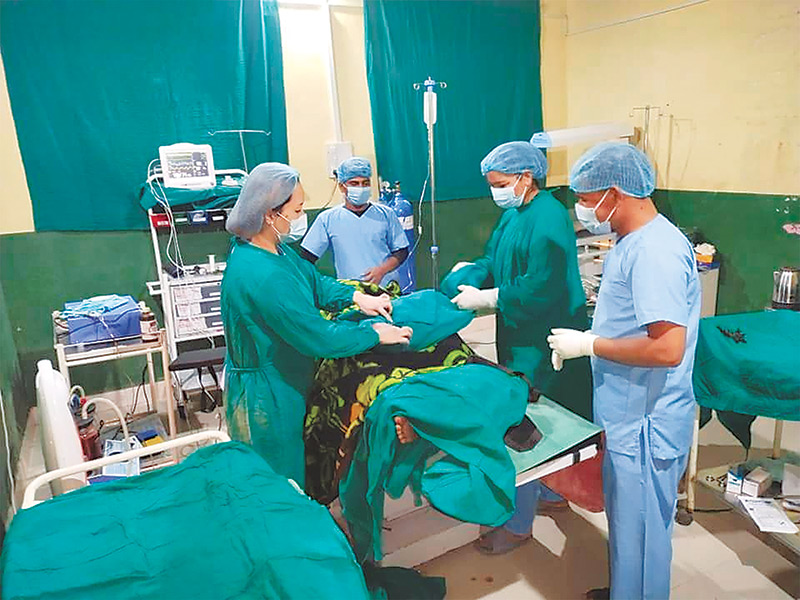
Doctors at Kolti Primary Health Centre are seen performing a Caesarean section on Asmita BK on Friday.  Photo Courtesy: Keshar Bohara

BAJHANG,
Asmita BK of Kotila in Budhinanda Municipality-6 underwent a Caesarean section at Kolti Primary Health Centre on Friday. She had expected a normal delivery but had to opt for a C-section to prevent delivery complications. If BK’s delivery date was only a week ahead, she would have faced problems seeking C-section service in the remote municipality.
“I feel lucky to have received the specialist service in Kolti itself. It was my first pregnancy and I was very worried about safe delivery,” BK told the Post. “The health centre started the service just in time and saved me and my baby. Many pregnant women in the area have died for the lack of timely medical intervention.”
Kolti Primary Health Centre in the northern part of Bajura, a remote hill district of Sudurpaschim Province, initiated specialist services in gynaecology and obstetrics including caesarean surgery for the first time last week.
Thousands of people living in nine local units of Bajura, Humla, Kalikot and Jumla districts stand to benefit from specialist health services at the health institution.
According to Om Jung Shahi, health unit chief of Budhinanda Municipality, a team of health workers led by specialist doctor Sonam Gurung conducted BK’s C-section.
The Kolti Primary Health Centre commenced specialist gynaecology and obstetric services at the initiation of the Jumla-based Karnali Academy of Health Science and Budhinanda Municipality.
The local people, mainly women, are happy with the introduction of gynaecological and obstetric services in Kolti. “Our sisters and daughters die due to the lack of good health service every year,” said Sangita Bista of Budhinanda-2. “Now we don’t have to worry about losing mothers and their babies to pregnancy complications.”
Budhinanda Municipality provides Rs20,000 for the rescue of pregnant women and postpartum mothers in case their treatment is not possible in the local unit. But the rescue, according to Bista, is not effective due to the lack of regular air service at Kolti Airport.
Previously, the local people in the Kolti area had to take pregnant women with complicated health issues to either Martadi, the district headquarters of Bajura, or Dhangadhi and Nepalgunj by spending thousands of rupees to get treatment from specialist gynaecologists and obstetricians.
“Pregnant women from neighbouring Kalikot, Humla and Mugu districts can now visit Kolti Primary Health Centre for safe delivery,” Shahi, the health unit chief, said. “We are optimistic that the maternal mortality rate in Bajura will decrease with the beginning of specialist services in Kolti.”
According to him, an average of around 30 pregnant women visit Kolti Primary Health Centre in a month. “Among them, five to seven patients with complicated health situations were referred to other hospitals,” Shahi added. “Some of those referred patients died while a few others gave birth on the way.”
The newly launched services in Kolti will benefit people from Khatyad Rural Municipality of Mugu; Palata and Pachal Jharana rural municipalities of Kalikot; and Tajakot, Adanchuli and Sarkegad rural municipalities of Humla.
Janak Bohara, the mayor of Budhinanda Municipality, said he has prioritised initiating the specialist gynaecological and obstetric services in Kolti ever since he assumed office seven months ago.
“We frequented Kathmandu and Jumla several times and our efforts finally paid off,” he said. “No women will have to die due to pregnancy complications from now onwards.”
According to Bohara, Karnali Academy of Health Sciences and Budhinanda Municipality have each agreed to bear half of the salary of a specialist doctor and operation theatre nurse at Kolti Primary Health Centre.
Bohara said efforts are under way to initiate other specialist services as well. “Enhanced health services will not only serve the locals of Kolti but will provide a lifeline to locals of the neighbouring districts as well,” he said. “We will soon manage a consultant general practitioner at the Kolti Primary Health Centre.”

NATIONAL

Two dead, 25 injured in road accidents in Saptari, Dhading and Salyan on Tuesday

District Digest

SAPTARI: A 12-year-old girl died after being hit by a tipper truck in Rupani, Saptari district, on Tuesday. Following the incident, agitated family members and locals obstructed the Rupani Road section of the East-West Highway. The police fired several rounds of tear gas to disperse the agitated crowd and clear the road section. According to police, a team of police personnel from Rajbiraj headquarters was deployed to the incident site to investigate the incident. In a separate accident in Dhading, one died on the spot and 14 were injured as the passenger bus they were travelling on and a microbus collided near the Bihanui Petrol Pump in Malekhu at around 10:15am. Meanwhile, in Salyan, 11 people were injured in a bus accident while travelling from Chatreshwori Rural Municipality-1, to Tulsipur in Dang district. The accident occurred in the Patare section of the Rapti Highway.

NATIONAL

Five illegal hunters held with gun, deer

District Digest

BIRGUNJ: Five hunters have been arrested with a dead sambar deer and a gun from Akabaniya of Sakhuwaprasauni Rural Municipality, Parsa. A joint team of Nepal Army and Parsa National Park employees detained the suspects from the national forest in Akabaniya on Monday night. A female sambar deer with bullet injuries, head of a male sambar deer, a 12-bore gun, a night vision binoculars among other logistics were seized from the suspects. “Preliminary investigation shows that the suspects have been involved in illegal hunting for a long time. Detailed investigation is underway into the incident,” said Surya Khadka, the information officer at Parsa National Park.

NATIONAL

Three red pandas found dead in five months

District Digest

JAJARKOT: One red panda was found dead near the forest area of Paik, Kushe Rural Municipality-9, on Saturday, in what was a third such incident in five months. The dead red panda was handed over to Balkrishna Oli, forest guard of the Sub-Division Forest Office, Kushe. According to Jajarkot Police Chief DSP Santosh Niraula, three of the endangered species died in the past five months in the Kushe and Borekot community forests. Two of the dead red pandas were killed by dogs. The cause of death of the diminutive mammals on Saturday is yet to be ascertained. “As illegal hunting and poaching increase in the Kushe forest area, the red pandas attempt to enter the village area, where they are killed by dogs,” Niraula said. “This has raised concerns about the conservation of this endangered animal.”

NATIONAL

Local govenment chief convicted of drug charges

District Digest

BAGLUNG: Surya Bahadur Gharti, chairman of Nisikhola Rural Municipality in Baglung, has been convicted on drug trafficking charges. The single bench of judge Diwakar Bhatta of District Court Baglung convicted him on Sunday. According to police, Gharti was arrested from his home with 80 kg of marijuana on December 27, 2020. He was later released on bail after almost three months. Gharti is on the run.

Page 3
Page 4
EDITORIAL

Too young to marry

More effort is needed to raise awareness and educate young men, women and parents.

The continued prevalence of child marriage is a matter of great shame for Nepal. The country has the third highest rate of early marriage in Asia and the second highest (40 percent) in South Asia after only Bangladesh (59 percent). We easily surpass India (27 percent), Pakistan (21 percent) and Bhutan (26 percent). According to the Nepal Demographic and Health Survey 2022, around 14 percent of girls aged 14-19 years became pregnant early from these marriages. Among them, 10 percent gave live birth, while two percent experienced pregnancy loss. Those working for child rights see a direct link between economic conditions and child marriage, while the practice is also affected by culture and gender norms, level of awareness, lack of access to healthcare and illiteracy. They also believe Covid-19 induced lockdown, parental deaths, school closures and dropouts made things worse. Further, self-initiated child love marriages are rampant as ever.
The government acknowledges the effects of child marriage. Nepal banned the practice in 1963 and has a national strategy to eliminate it too. The country has committed to ending it by 2030 as part of the Sustainable Development Goals. The legal age for marriage for both men and women has been increased to 20 years in the National Civil Code Act 2017, putting Nepal among countries with the highest legal age bars for marriage in the world. National and international organisations and agencies are also working in collaboration with the government to address the problem. Yet such efforts have still fallen short. The child marriage rate is 21 percent in Karnali province, 20 percent in Madhesh and 8 percent in Bagmati. In Makwanpur district, it is a whopping 59.7 percent. Child marriage is also prevalent in urban and rural areas, slums and the outskirts of big cities, including Kathmandu. So where are our efforts to end this social evil going wrong?
Often the parents who marry off their daughters too soon or the teenagers who elope are not fully aware of the consequences of child marriage. As a result, girls lose their childhood innocence to take up unnecessary marriage burdens. It also leads to further complications such as early childbirth. Education becomes a distant dream, destroying their potential. It systematically robs them of their human rights, disempowers them, and puts them at high risk of violence.
This calls for extra efforts to raise awareness and educate young men, women and parents, beginning from the grassroots. Local governments could go door-to-door and conduct social media campaigns to make people realise the mental, physical, legal and educational effects of early marriages. The next step is to empower girls to enable them to make good decisions. The Nepal Demographic and Health Survey suggests that young women between 14 and 19 years with no education are more likely to conceive than those with at least secondary level education. Scholarship initiatives and allowances for young girls can perhaps help them envision a better future for themselves, and deter them from underage marriage.
It is difficult to change entrenched patriarchal mindsets. Even today, girls are seen as a burden to their families. But it is not an impossible task as well. Constant monitoring and evaluation of “child marriage-free” communities and concerted efforts of schools, local level bodies, parents and other concerned authorities can make a difference. As will economic incentives for parents and girls from low-income families. Again, there is no magic bullet. It is rather a matter of making incremental but continued progress.

OPINION

Melancholy of the Madheshi intelligentsia

Except Madhesh, all other provinces are patterned after the old regional administrative system.
- CK LAL

Janakpur wears a battered and beaten look. Two general elections in a row—first for the formation of local governments and then for the selection of provincial and federal parliamentarians—appear to have sapped the energy of the city. A resurgence of anti-federalism forces in local politics has deflated the exuberance of Madheshi self-rule aspirants.
 Since all parties in the electoral fray seemed to be equally unpalatable, people voted for the candidates they disliked the least; and are now stuck with winners that are not particularly committed to protect and advance their political interests. Most newly-elected representatives of the people are beholden to their political patrons and financial backers in Kathmandu.
The leadership of the sub-metropolitan city has gone to the former chairperson of the city committee of the Nepali Congress who resigned his post to contest as an independent candidate against the coalition partner of his parent party. It is perhaps natural for him to behave like a lone wolf, and have little respect for the members of
the team tasked with the governance of the city.
The elections to the federal Parliament have gone in favour of the power couple Raghuvir Mahaseth and Juli Kumari Mahato of the Communist Party of Nepal (Unified Marxist-Leninist). Their party vehemently opposed the Madhesh Uprisings, but they will have to represent constituents that were at the forefront of the struggles for dignity and self-rule of Madhesh.
The local politicos of the Loktantrik Samajbadi Party and the Janata Samajbadi Party seem to be in a despondent mood. They blame their leaders such as Mahanth Thakur and Upendra Yadav, but are unwilling to share the responsibility for the electoral debacle. In addition to the poor image of the leaders, infighting between cadres was also responsible for the lacklustre performance of Madhesh-dependent parties.
The local units of almost all parties that have little influence outside Madhesh continue to be the fiefs of faction leaders that are sometimes unable and often unwilling to think about collective interests. They spend more time criticising each other than critiquing their competitors from other parties.
The Janamat Party is the new player in the game of one-upmanship in Madhesh. It belongs to the entrepreneurial tradition of politics where an ambitious individual builds a party rather than an interest group forming a steering committee and selecting its leader for a stipulated period. Somewhat like the political platforms of Rabi Lamichhane and Resham Chaudhary, CK Raut has erected a structure to rationalise his ideological capitulation for possible co-optation into the permanent establishment.
Whatever shape the ruling coalition takes in the province, it’s almost sure that the political parties that agitated for the institutionalisation of federalism, furtherance of inclusion and promotion of proportionate representation during the three Madhesh Uprisings will have a secondary role in its governance.
 Dreams of provincial autonomy died with the promulgation of the contested constitution that sabotaged the idea of federalism with the creation of local bodies beholden to the federal government. A fear of the facade of provincial governance falling off the centralised structure has begun to grip the Madheshi intelligentsia that once thought about creating an assertive and confident identity of Madhesh.

Consumer society
The winter haze in Janakpur is deceptive—while the fog is for real in the city of ponds, smoke and other atmospheric pollutants that turn it into smog often come with the westerly winds from far away in the north Indian plains. Save for a few brick kilns, there is no significant industrial activity—polluting or otherwise—in the vicinity of the provincial capital.
Agriculture is no longer the mainstay of the local economy. Subsistence farmers still till the land, grow cereal crops, tend to the buffalos and fish in the ponds. But the yield from farming has to pay for expensive inputs, and the surplus is hardly sufficient to cover the cost of everyday life. Whosoever can do so wants to escape from Madhesh at the very first opportunity.
Only a few Madheshis manage to find gainful employment within the country. Every young man who can sell a piece of land or borrow from the neighbourhood moneylender at usurious rates applies for a passport as soon as he comes of stipulated age. Thereafter, the heart-wrenching stories of modern day slavery in the inhospitable countries of West Asia and Malaysia begin to unfold. However, it’s their remittances that fuel the engine of the local economy.
Almost all businesses draw their profits from remittance beneficiaries. From sacks of rice to baskets of onions, from packets of noodles to the boxes of Chinese smart phones and from the pouches of shampoo to the bottles of whisky, everything begins to sell more once remittances begin to flow.
Traders have displaced feudal lords of yore from their pre-eminent position in Madheshi society. Many of them have gone into more lucrative businesses such as running for-profit schools and operating private hospitals. Motorcycle sales have multiplied as a white collar class has emerged that makes its living by helping traders amass more profits.
In addition to traders, moneylenders and the businesses of education and health, operators of the “dozer development” industry are the second most influential players in rural and urban municipalities. Local governments award construction contracts for inadequately conceived and ill-designed infrastructure projects. The windfall profits then go towards funding officials and political parties.
The nexus between traders, contractors, moneylenders and their political patrons at the local level have strengthened in the absence of civic activism. Media outlets prefer to deal with weighty issues of national politics and international affairs rather than stick their neck out by exposing ambitious operators. The emergent capitalists realise that the power to make them richer and protect them from possible prosecution lies in the hands of the federal authorities.
 
Clientelistic politics
The promise of federalism is based on self-rule for the provinces and shared rule at the federal level. Local governments are expected to be self-governing entities. It is required that every level of government be autonomous and not be subordinate to anybody other than the constitution.
The problem with the controversial constitution is that it has given more authority to the local units—veritably turning them into local states with legislative, executive and judicial powers—than they can handle while it has emasculated the provinces that could have made self-rule of the people possible. The condition has been further aggravated by the refusal of the federal government to hand over even constitutionally mandated powers to the provinces.
Except Madhesh, all other provinces of Nepal are patterned after the regional administrative system of the past. Sudurpaschim has retained the name of the development region while Bagmati, Gandaki, Karnali and Lumbini have reused the long-discarded identifications of zones. The legislature of Province 1 is yet to discard the name imposed upon it by the federal authorities.
The principle of subsidiarity guarantees a degree of independence that corresponds with the competence to exercise the authority of self-governance responsibly. Compared to all other provinces, Madhesh is relatively homogeneous in its composition. Its capital is quite accessible from every corner of the province throughout the year.
The Madheshi intelligentsia had dreamt of turning Janakpur into an educational and cultural hub of regional regeneration. A constitutional emasculation and political debacle has pushed that vision into the background once again.


Lal is a veteran political commentator.

OPINION

The burden of trust: RSP’s challenges

Members of the Rastriya Swatantra Party are young, educated, and driven, which is good but not enough.
- Naresh Koirala
Post file photo

The Rastriya Swatantra Party (RSP) is going to the Parliament with 20 seats, which is a significant achievement for a party registered less than six months before the election. It got there by encroaching on the vote banks of all three major parties: The Nepali Congress (NC), the Communist Party of Nepal (United Marxist-Leninist), and the Communist Party of Nepal (Maoist Centre). The NC’s and the UML’s proportional votes were nearly 15 percent less than in 2017; the Maoists beat the RSP by barely 40,000 votes. The older parties mocked the RSP’s success as a “flash in the pan”.  
The RSP does run the risk of being a “flash in the pan” if it fails to deliver the promises it made during the election. The delivery is fraught with serious challenges, both external and internal. But the party is not without the opportunity to be an enduring force in our political landscape.

External challenges
Politics and political leaders in Nepal have become metaphors for deceit and corruption. The RSP emerged from the people’s growing anger with pervasive corruption and consequent economic stagnation. It made fighting corruption its cause célèbre. To maintain its credibility, it has to convince its voters that it is actively fighting the corrupt and producing results.
But with only 20 seats in Parliament dominated by older parties, its capacity to fight corruption with any effect is limited. It may have a chance if it forges an issue-based alliance with the likes of the Rastriya Prajatantra Party (RPP) and independents who have also won the election on the anti-corruption agenda.
The alliance’s first task in Parliament should be to propose the reopening of the corruption files buried in various government agencies. Both the NC and the UML are likely to resist the proposal. They know what is hidden in those files; much of the corruption happened under their watch and with their connivance. The resistance from the older parties will leave the RSP and its partners no option but to report to the public why their efforts failed. How the public will respond is difficult to predict. It could trigger a national anti-corruption movement, but it may not!
Curiously, the anti-corruption protest rallies in the last few years, led by individual corruption crusaders, have failed to coalesce into an organised national movement. That is why the older parties mock the RSP’s rise as a “flash in the pan”. They do not seem to recognise that the RSP and other anti-corruption candidates’ election victory and their expected call for action in the Parliament may change the dynamic by giving new hope and impetus to the people agitating for action.  
A false sense of invincibility by the perpetrators of wrongdoing and unpredictability of timing is in the nature of any large public uprisings. Festering public anger is like a volcano etching to explode. What looks implausible today becomes inevitable tomorrow. Witness what happened during the Arab spring! What happened in Sri Lanka just a year ago? There is no reason something similar may not happen in Nepal. People are angry and are looking for a change.  
No one wants instability and national uprising. This can be averted if younger leaders not tainted by corruption take the reins of power. At the time of this writing, it does not look like that will happen.  
Even if public pressure forces the government to be more flexible in reopening the old files, removing corruption in the long term will require legislative work to strengthen existing anti-corruption laws and enforcement of the new laws. New laws are required to prevent conflict of interest, election cost control, control of politicisation of bureaucracy and constitutional bodies and many others. RSP and its partners should initiate the drafting of such laws.
These are difficult tasks and the RSP will have to remain united, relevant, and purpose-driven to be effective. As a young party, going forward, it will face many internal challenges with which it will have to deal expeditiously to be able to deal with these challenges.  

Internal challenges
The members of RSP are young, educated, and driven, which is good but not enough. The party needs a defined political ideology, money to operate and a nationwide organisation to remain viable. Before long, a political party without an ideological anchor turns into a cult. Witness the three big parties. The NC leadership has made a mockery of its founding ideals of “Democratic Socialism”. The Communist parties’ use of the prefix “Communist” with their name is nothing more than a leftover from the past. The bosses of all three parties operate like dictators, primarily aiming to capture national resources to enrich themselves and their party. No one protests.   
Political ideology defines a party’s values. The RSP will have to develop its policy positions within the context of an interdependent 21st century world on sensitive policy matters, e.g. rastriyata (nationalism) economy, environment, climate change, and governance. These policies must be compatible with the party’s core political ideology. Otherwise, the party will be trapped in perpetual conflict with itself.  
The party will need money to operate. How will it finance itself? How will it maintain cohesiveness in the face of financial difficulties and inducements from big businesses and parties, which is sure to come?
The RSP carries a huge burden of people’s trust and has an opportunity to effectively challenge the fossilised old parties if they remain honest and respectful of that trust. Perhaps, before they start their party meetings, every executive should collectively remind themselves of the burden of the trust and note that its betrayal will be a disaster. They will do well if, before making any decision, they ask themselves, “How is this decision going to help the people (rather than myself) in the short and long term”?  


Koirala is a retired engineering consultant and a political observer.

OPINION

What is killing them?

There have been no attempts to investigate the underlying causes of migrant workers’ deaths.

The unnaturally high number of Bangladeshi migrant workers who die in Gulf countries and return to us as corpses is too often swept under the rug. A report published by The Daily Star on Sunday, to mark International Migrants Day, has revealed that the bodies of at least 45,301 male and female migrant workers arrived in the country between 2008 and June of this year. Among the six destination countries—Saudi Arabia (KSA), United Arab Emirates (UAE), Oman, Kuwait, Bahrain, and Qatar—a staggering 12,930 deaths have taken place in Saudi Arabia alone. While the deaths of migrant workers in Qatar have been highlighted as a human rights issue over the past month, given the country’s lavish hosting of the 2022 FIFA World Cup using infrastructures largely built by migrant workers, other Gulf countries must also receive their share of the criticism.
The question that is foremost in our minds is: How do so many Bangladeshi workers die in these destination countries? While a few workers die by suicide or are killed, the causes of death mentioned most often—as per documents that accompany their bodies—are strokes and heart diseases, alongside workplace accidents. The curious thing is that a large portion of those who have died of strokes were young, or at most middle-aged. Unfortunately, there have been no attempts to investigate and publicise the underlying causes of migrant worker deaths by the host countries.
Given the degree of reporting on the issue over the years and the narratives of migrant workers and their families, it is no secret that the working and living environments in destination countries are horrid. Not only are temperatures much higher than in Bangladesh, but the work hours can also extend to 12 or even 18 hours, while workers are always under pressure to send enough money home, leaving no opportunity for them to have enough rest—let alone any leisure. Given the lack of enforcement of any workers’ rights, most Bangladeshis are also forced to do risky, often life-threatening jobs. Not to mention how badly some workers are treated, especially women migrants who work informal jobs in homes, becoming victims of verbal, physical, and/or sexual abuse, or even murder.
Ultimately, it all boils down to the fact that Bangladeshis and workers from other origin countries are severely exploited by the Gulf states. The lack of transparency on the destination countries’ part regarding worker treatment, coupled with the lack of enthusiasm of the origin countries to hold them accountable has resulted in Bangladeshi migrant workers having to earn their bread in inhumane conditions, away from everything they know and everyone they love. Unfortunately, it is often seen that Gulf countries hold higher ground as they can choose to take in more workers from other countries if one origin country imposes stricter conditions for their citizens.
We demand that Bangladeshi authorities at home and in destination countries prioritise the lives of migrant workers. These are the people on whose labour and remittances our economy is dependent. So why is their well-being not given the utmost importance? The sight of families receiving the bodies of their loved ones, who have died in destination countries while trying to provide them with a steady income, needs to stop being a regular thing.

—The Daily Star/ANN

Page 5
NATIONAL

As Covid surges in Japan and Korea, calls grow for close surveillance

Thousands of Nepali students and migrant workers in the East Asian nations keep travelling back to Nepal.
- Arjun Poudel

KATHMANDU,
A new worry has gripped those deployed at the Tribhuvan International Airport health desk: why has no new alert been sounded by the agencies concerned despite Japan and South Korea reporting a rapid surge in Covid cases of late?
There are direct flights to Kathmandu from both the countries, where thousands of Nepali migrant workers and students live and keep travelling back home to Nepal.
“We have received no new directive from the Ministry of Health and Population,” said a health worker deployed at the TIA health desk asking not to be named, as he is not authorised to speak to media. “We seek [QR] quick response codes or negative results of polymerase chain reaction tests and let people enter the country.”
Several countries, including South Korea and Japan, where Nepal has a high mobility rate, have been witnessing massive spikes in Covid infections. South Korea on Tuesday recorded 87,759 new cases and 56 deaths on Tuesday. Japan recorded 185,694 cases and 231 deaths on the same day. China reported 2,722 new cases and five deaths.
According to the Department of Immigration, in November alone, the number of arrivals from Japan was 955 while 1,015 left for the country from the Kathmandu airport. Similarly, there were 1,670 arrivals from South Korea and 1,616 departures to the country from Kathmandu in the same month.
Doctors say that even the fully vaccinated and those who already have been administered with booster shots and who also have quick response codes can get infected with the virus and pass it on to others.
Of late, Nepal has been witnessing a rapid decline in new Covid infections. The country reported zero cases on Friday and Sunday. The Health Ministry reported six cases of the coronavirus infection on Tuesday. Active cases rose to 19 on Tuesday from 11 on Sunday, the lowest since the first wave of pandemic hit the country in 2020.
Experts in Nepal say that even if new cases have declined significantly of late, the infection might have been spreading in communities.
Case detection has declined, as only the healthy people seeking to go abroad or returning from abroad are undergoing coronavirus testing, the experts added.
“Even if new cases have declined significantly of late, there is a risk of a new surge again,” said Dr Biraj Karmacharya, an epidemiologist.
“We should not be too worried, but vigilance should be stepped up.”
Authorities stopped tracking active cases months ago. Experts say the coronavirus is continuously mutating.
Nepal has reported Omicron’s new sub-variant BM.1.1.3, which is another descendant of highly transmissible Omicron’s sub-variant BA.2, of late.
Along with BM.1.1.3, BA.2.75.1, BA.2.75.2 and BA.2.75.3 have been detected in swab samples in whole-genome sequencing.
Whole-genome sequencing is a comprehensive method of analysing the entire DNA sequence of an organism’s genes. Researchers say that whole-genome sequencing of the coronavirus could be instrumental in tracking the severity and properties of the virus.
Nepal has reported almost all variants and sub-variants of Covid detected in any corner of the world. Due to the high mobility of people across the globe, the risk of any virus variant entering the country remains always high, say the doctors.
“The uptake of booster shots is very low in our country and it’s been around a year. Many people took the booster shots,” said Karmacharya.
“It could be too late to wait for a new surge to start to ramp up the booster drive. Authorities should do everything possible to increase the uptake of booster doses.”
The Health Ministry had decided to administer second booster shots months ago, but has not yet implemented the decision.
Officials at the Health Ministry said that they are aware about a new Covid surge in countries like Japan and South Korea, and are in close contact with international health agencies.
“We will step up surveillance measures and closely monitor the international situation,” said Dr Samir Kumar Adhikari, the joint spokesperson at the Health Ministry. “A new surge may come in the coming days, but that doesn’t mean that we should start worrying.”

Page 6
MONEY

Cabinet gives green light for seasonal workers

Seasonal Workers Management Working Guideliness 2022 permits local level to select workers and send them to foreign countries for temporary jobs.
- PAWAN PANDEY
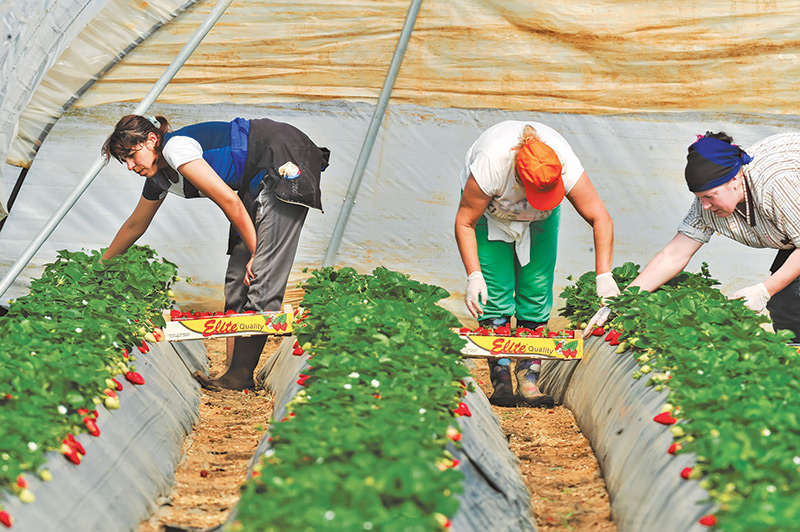
Besides South Korea, the UK has emerged as an important destination for Nepali seasonal farm workers.  Shutterstock

KATHMANDU,
A cabinet meeting on Sunday gave an in-principle approval to send seasonal migrant workers to foreign countries.
The Seasonal Workers Management Working Guidelines 2022 permits local level to select suitable candidates and send them to work temporarily in foreign countries.
The government moved to pass legislation to send Nepali citizens abroad as seasonal workers following a shortage of farm hands, in particular, after the Covid-19 pandemic, insiders say.  
Germany, Italy, Spain, France and Poland employ large numbers of migrant agricultural labourers.
According to the International Labour Organisation (ILO), the international movement of migrant agricultural and horticultural workers in many parts of the world has been historically governed through “seasonal foreign worker programmes”.
The governments of the respective countries provide temporary visas to migrant workers during the planting and harvesting seasons.
The system is well developed in Canada, the United States and the European Union where seasonal work is regulated, respectively, by the Seasonal Agricultural Worker Programme, H2-A Programme and the EU Seasonal Workers Directive, which fixes the criteria and requirements for the admission of seasonal workers from non-EU countries.
According to the ILO, an agency of the United Nations, many countries in the Asia-Pacific region, such as Australia, New Zealand and the Republic of Korea, have also extended their programmes in this area in recent years.
In December 2019, Korea passed legislation to create a new visa allowing a stay of up to five months for foreign workers in the agriculture and fisheries sector.
“According to the new guidelines enacted by Nepal, individuals will be sent for foreign employment under a ‘zero cost’ scheme through a government initiative,” said Rajeev Pokharel, joint secretary at the Ministry of Labour, Employment and Social Security.
“The visa will be for almost a year. For the first time, local governments will be able to send workers to foreign cities with which they have established a sister city relationship. Foreign cities will send request letters through their respective embassies,” he said.
“Local governments have been given the authority to select and recruit workers. They will make their own guideliness to carry out the recruitment process,” he said. After the candidates have been selected, their names will be sent to the Department of Foreign Employment. The department will then process the workers’ visa applications.
While South Korea has been most keen to hire Nepali workers for seasonal jobs, a large number of Nepalis have gone to the United Kingdom in recent years to work as fruit pickers.
Officials said the move would legalise seasonal workers as there has been a mass departure of Nepalis to different countries through visit or student visas.
Nepal currently has a provision to issue labour permits for two years.
The new guidelines for seasonal workers comes almost seven months after the government issued a circular prohibiting local units from sending temporary farm workers to South Korea.
According to the Nepal Labour Migration Report published on Sunday, 79,921 Nepalis have gone to South Korea under the employment permit system from 2008 to November 2022 for farm and manufacturing work.
Besides South Korea, the UK has emerged as an important destination for Nepali seasonal farm workers.
From 2019 to the first quarter of 2022, according to the report, 1,124 Nepalis received UK visas for temporary work, putting Nepal in the second spot after India as the largest receiver of UK visas among South Asian countries in recent years.
Seasonal work in the horticulture sector in the UK consists of picking fruits, vegetables and flowers for six months.
Workers have to pay around Rs41,666 (equivalent to 259 pounds) as an application fee besides spending for their visa and two-way ticket. They require a certificate of sponsorship, which is a reference number which holds information about the job and personal details.
There have been multiple reports of workers paying exorbitant recruitment fees to secure work and workers not being provided employment for the entire six-month period.
Last month, the Post interviewed several Nepali seasonal workers who said they had to pay Rs500,000 to Rs900,000 to a third-party agent for securing fruit picking jobs in the UK.
According to them, a farm worker can save Rs200,000 or more per month if they can get seasonal work.
A European Parliament report says that the reality of seasonal agricultural work is a harsh one, with generally poor working and living conditions. Undocumented migrants, but also legal ones, can fall victim to illegal gang-master practices or even modern forms of slavery.
The exploitation of women occurs in certain regions. The coronavirus pandemic, which disrupted harvests in the spring of 2020 as seasonal workers faced travel restrictions, also highlighted their essential role in EU agriculture and laid bare their sometimes appalling working and living conditions, the report said.
The European Parliament adopted a resolution on the protection of seasonal workers in June 2020, calling on Member States to ensure proper implementation of the relevant EU legislation, and on the European Commission to issue new specific guideliness and propose long-term solutions to fight abusive practices and protect victims.
In Nepal, migrant workers are exploited too before they leave the country. They have to pay hefty pre-departure fees. Government officials say that after the law is enforced, the exploitation will end.
According to joint secretary Pokharel, action will be taken against those taking illegal recruitment fees from seasonal workers after the implementation of the guidelines.
Though the new guidelines can set a new precedent in Nepal’s foreign labour sector if implemented properly, labour migration activists and researchers point out the need for a robust regulatory mechanism to oversee the entire process, from the selection of applicants to their employment abroad.
“I have not studied the new guidelines, but it should have come much earlier,” said Jeevan Baniya, assistant director at the Centre for Study of Labour and Mobility, Social Science Baha, a non-profit organisation involved in research in the social sciences in Nepal.
“With countries like South Korea and the UK demanding more temporary workers from Nepal in recent years, we should have assessed the situation and taken advantage of it,” he said, adding that there could be undesirable consequences if not managed properly.
“The concern is that local governments have limited capacity to manage migration at this time, and will need a significant increase in capacity, governance framework and monitoring to ensure that risks of corruption and extortion do not arise,” said Andy Hall, a Kathmandu-based migrant workers rights specialist working in South and Southeast Asia.
“The government should send workers only after ensuring their labour rights,” said Baniya. “Provisions related to recruitment fees, living and working conditions, minimum contract duration and work specification must be ensured.”

MONEY

World Bank slashes China growth forecast

- AGENCE FRANCE-PRESSE

BEIJING,
The World Bank on Tuesday slashed its China growth forecast for the year as the pandemic and weaknesses in the property sector hit the world’s second largest economy.
In a statement, the institution slashed its forecast to 2.7 percent from 4.3 percent predicted in June. It also revised its forecast for next year from 8.1 percent down to 4.3 percent.
Both figures are well below Beijing’s GDP growth target of around 5.5 percent for the year, a figure many analysts believe is now unattainable.
“Economic activity in China continues to track the ups and downs of the pandemic—outbreaks and growth slowdowns have been followed by uneven recoveries,” the World Bank said.
“Real GDP growth is projected to reach 2.7 percent this year, before recovering to 4.3 percent in 2023, amid a reopening of the economy.”
After years of sudden lockdowns, mass testing, long quarantines and travel restrictions, China this month abruptly abandoned its zero-Covid policy. But disruption to businesses has continued as cases surge and some restrictions remain in place.
Health authorities have admitted that official figures no longer capture the full picture of domestic infections now that mass testing requirements have been dropped.
“Continued adaptation of China’s Covid-19 policy will be crucial, both to mitigate public health risks and to minimise further economic disruption,” Mara Warwick, World Bank Country Director for China, Mongolia and Korea, said. Last week the IMF warned it too would likely downgrade its projections for China again, blaming a predicted continued rise in cases. The fund cut its growth projection for China in October to 3.2 percent this year—the lowest in decades—while expecting growth to rise to 4.4 percent next year.
But “very likely, we will be downgrading our growth projections for China, both for 2022 and for 2023”, IMF chief Kristalina Georgieva told AFP.
Experts fear China is ill-equipped to manage the exit wave of infections as it presses ahead with reopening, with millions of vulnerable elderly people still not fully vaccinated.
“Accelerated efforts on public health preparedness, including efforts to increase vaccinations especially among high-risk groups, could enable a safer and less disruptive reopening,” Warwick said.

MONEY

UK government refuses to give way on pay as nurses, medics strike

- ASSOCIATED PRESS
Demonstrators hold up placards in support of a strike by nurses outside St Thomas’ Hospital in London on Tuesday.  AP/Rss

LONDON,
The British government said on Tuesday it will not offer more money to nurses and ambulance crews to end strikes that are piling pressure on an already overstretched health system.
Prime Minister Rishi Sunak’s Conservative administration is under pressure to increase its pay offer to health care staff who are seeking big raises in the face of decades-high inflation that was running at 10.7 percent in November. Thousands of nurses walked off the job on Tuesday in their second 24-hour strike this month.
Ambulance drivers, paramedics and dispatchers are set to strike on Wednesday and again on December 28.
They are joining railway staff, passport officers and postal workers in the UK’s biggest strike wave for decades, a response to a cost-of-living crisis driven by soaring food and energy prices in the wake of the Covid-19 pandemic and Russia’s invasion of Ukraine.
Pat Cullen, head of nurses union the Royal College of Nursing, urged Sunak to “step in now and do the decent thing on behalf of every patient and member of the public of this country” by negotiating over pay. The union has asked for a raise of 5 percent above inflation but says it is willing to accept less.
The union says it will stage more strikes in January if there is no deal. Nurses have agreed to staff key areas including critical care and cancer services during the strikes, but thousands of operations and procedures have been cancelled in England, Wales and Northern Ireland. Nurses in Scotland are not on strike.

MONEY

JICA, Dolma Impact sign $10 million pact to aid Nepal’s growth

The Dolma Impact Fund has invested in companies like CloudFactory, Fusemachines, Sastodeal, Upaya Cargo City, and Foodmandu.
- Post Report

KATHMANDU,
Japan International Cooperation Agency (JICA), on Tuesday, signed a $10 million investment agreement with Dolma Impact Fund II,
focusing investments in renewable energy, technology and healthcare in Nepal.
The fund also contributes to gender equality and fulfills the criteria in the “2X Challenge: Financing for Women”, an initiative adopted by the G7 development finance institutions, including JICA, on the occasion of the G7 Leaders’ Summit in June 2018.
According to Dolma Impact Fund, the project will contribute to sustainable development goals--Goal 5 [Gender equality], Goal 7 [Affordable and clean energy], and Goal 8 [Decent work and economic growth].
Tim Gocher, CEO of Dolma Impact Fund, while addressing an event in Kathmandu through the virtual medium, said Nepal would see a huge increase in foreign direct investments in the coming future that would create more jobs, prosperity and stronger industrial development.  
The Dolma Impact Fund has $100 million under management and has invested in 12 companies across energy, healthcare and technology.
“Nepal needs more aid in hospitals, trained doctors and nurses and medicines manufactured domestically, so that the country can support itself in a future crisis,” Gocher said.
“We are further investing in renewable energy apart from the existing 46.5 megawatt project, with JICA. We just do not promote and build renewable energy, we promote the capital markets too, so that more investors come into the sector, Gocher added.
The Fund has invested in companies like CloudFactory, Fusemachines, Sastodeal, Upaya City Cargo, and Foodmandu.
About 15,000 employees have been created in companies that the Fund has invested in, said Gocher.  
Jin Wakabayashi, senior deputy director-general of the Private Sector Partnership and Finance Department of JICA, said: “This is our first partnership with an investment partner in Nepal. Dolma Impact Fund is a leading private equity fund and we are excited to partner with such a fund and contribute to the development of Nepal.”
JICA has been supporting the Investment Board of Nepal to strengthen sources for investments, he said. JICA has also been in
technical cooperation for hydropower projects.
Recently, JICA has started a new technical cooperation project to support entrepreneurs in Nepal, said Wakabayashi.
JICA’s investment will be mainly utilised for equity investment in healthcare companies, IT and digital companies, and renewable energy projects in Nepal.
JICA’s investment is part of the final close of Dolma Impact Fund II, which brings the fund corpus to $71.96 million.
“Nepal is facing the challenge of a hollowing out of industry caused by the increased number of migrant workers, which, in turn, is due to a lack of promising domestic industries and job opportunities in Nepal. Therefore, the fosterage of promising industries such as healthcare and the IT and digital sector is urgently needed in Nepal,” said a press statement issued by the Dolma Impact Fund.
Dolma Fund Management contributes to the development of the stock market and the private equity fund market in Nepal.

MONEY

Thailand approves tax breaks to boost public consumption

Bizline

BANGKOK: Thailand’s cabinet on Tuesday approved tax measures to help boost public consumption to support the economy as it recovers, the finance minister said. The tax measures include a tax deduction of 40,000 baht ($1,149.4) for shoppers on goods purchases from January 1 to February 15, Finance Minister Arkhom Termpittayapaisith told a news conference. Land and property tax was cut by 15 percent with some registration fees reduced for 2023, while the tax on jet fuel was lowered to 0.20 baht per litre from 4.726 baht for six months from January, he said. The tax breaks are estimated to cost the government 18.7 billion baht ($537.5 million) in lost revenue but would help boost spending next year and should increase gross domestic product by 0.76 percent, Arkhom said. The tax measures, together with the ministry’s other support programmes such as loans, should increase liquidity, spending and investment by 279 billion baht, he added. (Reuters)

MONEY

China completes construction of second biggest hydro plant

Bizline

HONG KONG: China’s second largest hydropower facility on the upstream branch of the Yangtze river was formally completed on Tuesday after the last generating unit was connected to the grid, state broadcaster CCTV said. The Baihetan hydropower plant is equipped with sixteen 1-gigawatt (GW) turbines, making it the second largest hydropower generator in China and the world, behind only the Three Gorges Project, also on the Yangtze river. The plant is estimated to generate 62.44 billion kilowatt-hour (kWh) annually, CCTV said, which could save about 90.45 million tons of coal a year and cut annual carbon dioxide emissions by 248.4 million tonnes. Baihetan is one of six giant hydropower stations along the Yangtze river, China’s longest. The Three Gorges Corporation, the project’s developer, has described the 289-metre (948.16 ft)dam and its associated infrastructure as one of the country’s biggest and most challenging engineering projects. (Reuters)

MONEY

TikTok ban in US spending proposal

Bizline

WASHINGTON: US lawmakers early Tuesday included a proposal to bar federal government employees from using Chinese app TikTok on government-owned devices in a key spending bill. The Senate last week voted on a bill sponsored by Republican Senator Josh Hawley to bar federal employees from using the ByteDance-owned short video app on government-owned devices. It was the latest action by US lawmakers to crack down on Chinese companies amid national security fears. The ban is in a massive omnibus measure to fund US government operations that is expected to be voted on this week. The bill gives the White House Office of Management and Budget 60 days “to develop standards and guideliness for executive agencies requiring the removal” of TikTok from federal devices. Reuters reported the proposed ban’s expected inclusion in the legislation earlier. The proposal last week won the backing of House Speaker Nancy Pelosi and House Republican Leader Kevin McCarthy. TikTok has said the concerns are largely fueled by misinformation. The legislation would not impact the more than 100 million Americans who use TikTok on private or company-owned devices. (Reuters)

Page 7
SPORTS

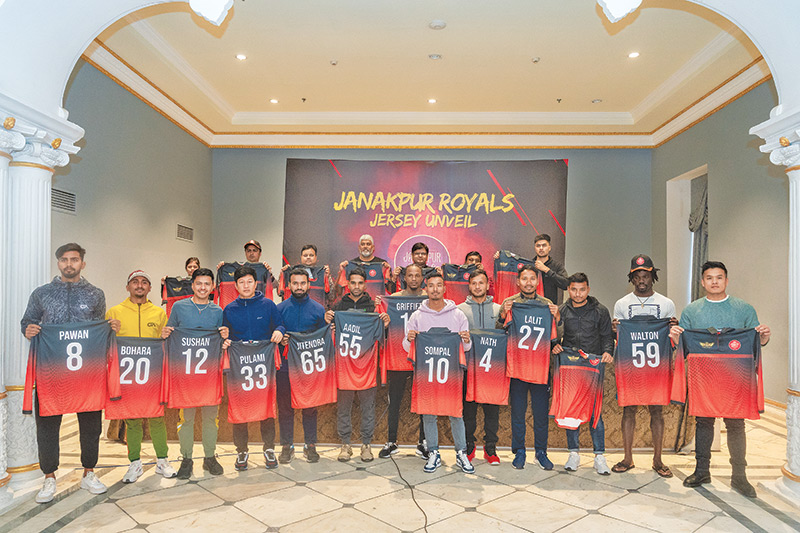
Griffith to captain Janakpur Royals

Janakpur open their Nepal T20 campaign against Pokhara Avengers on December 24.
- Sports Bureau
Members of Janakpur Royals unveil their team jersey in Kathmandu on Tuesday.   Post Photo

KATHMANDU,
West Indies batsman Trevon Abashai Griffith will captain Janakpur Royals in the Nepal T20 League, the country’s first ever official franchise tournament which is set to take place from December 23 to January 20, 2023.
“My aim is to give Janakpur the trophy of Nepal T20 League,” Griffith said at Janakpur’s team announcement and jersey unveiling function in Kathmandu on Tuesday.
The 31-year-old top order batsman has played for both Jamaica and Guyana in first-class cricket and represented the West Indies U-19 team at the 2010 World Cup in New Zealand. He also played for Guyana Amazon Warriors in the Caribbean Premier League between 2013 and 2015.
“Griffith is the best option we have based on experience,” said Janakpur head coach Umesh Patwal.
Sompal Kami, the marquee player of Janakpur, was named vice-captain. Fast bowler Kami had led Chitwan Tigers to their maiden Everest Premier League title in October last year.
“Sompal knows about Nepali players. He will assist Griffith and coordinate with him in making key decisions,” the coach added.
Janakpur also announced their 17-team squad that includes six foreign players.
Knights will lock horns with Pokhara Avengers on Friday in the season opening match of the tournament.
Janakpur open their campaign against Pokhara on December 24.

Janakpur Royals Nepal T20 squad
Trevon Abashai Griffith (West Indies), Chadwick Walton (West Indies), Kesrick Williams (West Indies), Ashan Priyanjan (Sri Lanka), Sharafuddin Ashraf (Afghanistan), Samiullah Shinwari (Afghanistan), Sompal Kami (Nepal), Sandeep Jora (Nepal), Mohammad Adil Alam (Nepal), Dilip Nath (Nepal), Lalit Rajbanshi (Nepal), Sushan Bhari (Nepal), Sagar Pun (Nepal), Pawan Sarraf (Nepal), Jitendra Mukhiya (Nepal), Khadak Bohara (Nepal), Rajesh Pulami (Nepal)

SPORTS

England complete historic series sweep in Pakistan

The English win the third Test by eight wickets to become the first team to complete a 3-0 whitewash in Pakistan.
- ASSOCIATED PRESS

KARACHI,
Ben Stokes finished unbeaten as his relentless England lineup powered to an eight-wicket win in the third and final cricket Test on Tuesday to complete an historic series sweep in Pakistan.
England started the day needing a further 55 runs for victory and reached 170-2 within 38 minutes to secure their second successive win with more than a day to spare in their first Test tour to Pakistan in 17 years.
It was Pakistan’s first ever 3-0 loss in a three-Test series on home soil.
Pakistan fell for 216 against 18-year-old leg spinner Rehan Ahmed (5-48) in the second innings, setting England a modest target of 167 for victory.
Ben Duckett resumed Day 4 on 50 and remained unbeaten on 82 off 78 balls and skipper Stokes signed off his team’s dominant ‘Bazball’ brand of aggressive cricket by finishing 35 not out.
“The commitment and mindset have been top drawer,” Stokes said.
Pakistan spinner Abrar Ahmed could have finished the series with 18 wickets in two Test matches, but Agha Salman couldn’t hold onto a difficult chance from Stoke at long-on with England just 19 runs away from a memorable win.
“Definitely disappointment as a team, we are not good enough to fight back,” Pakistan captain Babar Azam said. “We were good in patches, but we lost back-to-back wickets in the first innings and that moment cost us.”
England won the first Test on a flat wicket in Rawalpindi by 74 runs in dimming light on the last day before recording a thrilling 26-run win at Multan on a slow turning track inside four days.
Rehan Ahmed, on debut, conquered Pakistan’s batters in the team’s fortress—National Stadium—on Day 3 and England had motored to 112-2 in the final session through aggressive batting of Zak Crawley (41) and Duckett.
It was a just a third loss for Pakistan at the National Stadium in 45 Test matches and first in 15 years. England were the first team to beat Pakistan there in a Test match in 2000 before South Africa won a Test match here seven years later.
The 3-0 drubbing was also Pakistan’s fourth successive Test loss at home after Australia beat them in the final Test earlier this year to win the two-Test series 1-0.
Pakistan were kept at bay throughout the last three weeks and unable to find the right combination to counter England’s aggressive game plan, which began at home this summer and now has seen them winning nine of the last 10 Test matches. England’s only loss in that period was against South Africa at Lord’s before the Proteas got beaten 2-1 in the series.
England set the tone of a clean sweep in Pakistan when four of their batters smashed centuries on the opening day of the first Test and the visitors racked up world-record 506-4.
Young Harry Brook filled perfectly in the shoes of injured Jonny Bairstow with three successive Test centuries on tour and amassed 468 runs.
Brook’s 111 at Karachi in the first innings fetched England a vital first innings lead of 50 runs before Pakistan capitulated against Ahmed’s leg spin in the second innings.
Brook’s only blemish in the series came in the first innings at Multan when he fell to Abrar Ahmed for 9 in the first innings when the mystery spinner got the first seven England wickets in his debut Test. He made 153 and 87 in two belligerent knocks at Rawalpindi before scoring 117 in the second innings at Multan.


Scorecard

ICC WORLD TEST CHAMPIONSHIP

ENGLAND TOUR OF PAKISTAN
Third Test, Karachi
Toss: Pakistan, elected to bat first.
Pakistan 304 & 216
First Innings: B Azam 78 (123),
A Salman 56 (93)
J Leach 4-140
Second Innings: B Azam 54 (104), S Shakeel 53 (133)
R Ahmed 5-48
England 354 & 170-2 (T: 167)
First Innings: H Brook 111,
B Foakes 64 (121)
A Ahmed 4-150, N Ali 4-126
Second Innings: B Duckett 82 not out (78), B Stokes 35 not out (43)
A Ahmed 2-78
England win by eight wickets
Player of the match: Harry Brook
Player of the series: Harry Brook
England win the three-match series 3-0.

SPORTS

Moktan, Poudyal, Bista enter circuit 2 quarter-finals

Briefing

KATHMANDU: Pramamsa Moktan, Adya Poudyal and Swastika Bista reached the quarter-finals of the girls’ singles event at the 20th Jayakar Memorial ATF Tennis Tournament Circuit 2 at the Satdobato tennis court on Tuesday. Moktan defeated Naba Bishan of the Maldives 7-5, 7-5, Poudyal saw off Oman’s Aisha Al Busaide 6-3, 6-3 and Bista thumped India Honey Jumani 6-3, 6-0 to advance. Raj Bir Pradhan was the sole Nepali player to make it into the boys’ singles last eight. Pradhan topped Yue Hing Wong of Hong Kong 6-0, 6-2.  Nepal’s Nishad Joshi, Darsheel Shrestha, Boris Adhikari, Brijesh Aryal all fell against their foreign opponents. (SB)

SPORTS

Benzema ends France career

Briefing

PARIS: Ballon D’Or winner Karim Benzema announced he was ending his international career on Monday. “I made the effort and the mistakes it took to be where I am today and I’m proud of it! I wrote my story and ours ends,” Benzema, 35, wrote on Twitter. Benzema, who scored 37 goals for France in 97 appearances, had to withdraw from France’s World Cup squad due to a left thigh injury. The Real Madrid player, who won the Ballon d’Or award in October, was frozen out of the France team for five and a half years because of his involvement in a blackmail scandal over a sextape involving his former teammate Mathieu Valbuena. Kylian Mbappe won the Golden Boot award with eight goals, including a hat-trick in Sunday’s penalty shootout defeat by Argentina following a 3-3 draw at the end of extra time. (AFP)

MEDLEY

Horoscope

ARIES (March 21-April 19) ****
Changes in your career will be triggered today. Use this energy to step into the limelight at work, showcasing your steadfastness, work ethic, and ability to complete tasks. Be sure to put yourself first this evening.

TAURUS (April 20-May 20) ***
You’ll feel more connected with the other side in the coming weeks. So, be sure to reconnect with your favoured meditation or prayer. Be sure to listen to your intuition. Consider taking a cleansing salt bath later this evening.

GEMINI (May 21-June 21) ****
You’ll start to view things in a very black-or-white manner. You may want to cut ties with irrelevant people and things. However, you’ll want to show love and appreciation for the people that lift you up later this evening.

CANCER (June 22-July 22) ***
A harmonious and stabilizing energy will find you today. You’ll feel rooted in your most valued relationships, so be sure to nurture the most important dynamics. Try not to be overly critical of yourself or others this evening.

LEO (July 23-August 22) ***
The universe will ask you to get organized within your professional ambitions throughout the next month. Make sure you nurture your health as well. Consider unplugging from your devices this evening.

VIRGO (August 23-September 22) ****
You’ll feel both playful and serious in the coming weeks. This solar placement will ask you to prioritize creativity and fun, though abandoning your responsibilities in the meantime would be a mistake.

LIBRA (September 23-October 22) ***
Consider creating a stable and steady home environment throughout the next month. Use this energy to update your space and spend more time indoors. You’ll find yourself in a social and flirty mood this evening.

SCORPIO (October 23-November 21) ***
These vibes are all about backing up your thoughts with tangible action, especially when it comes to improving upon your professional standing. Give yourself permission to slow down and nurture your body this evening.

SAGITTARIUS (November 22-December 21) ***
The universe will ask you to slow down and find your centre today. This solar placement can also bring financial gains your way. Plan on dedicating your evening to your passion project or creative outlet.

CAPRICORN (December 22-January 19) ****
You’ll feel energized, creative, and adored throughout the coming weeks. Just try not to get overwhelmed by the idea of another candle landing on your cake. Plan on scheduling some quiet time this evening.

AQUARIUS (January 20-February 18) ***
Boundaries will be a major theme for you in the coming weeks. You may want to sort through your deepest thoughts and feelings. Try not to ice out your family and friends without explanation while embracing quietness.

PISCES (February 19-March 20) ***
You’ll be the glue that holds your social group together. The stars will ask you to bring people together. The vibe could get a bit emotionally charged this evening, threatening to trigger mood swings within yourself and others.

Page 8
CULTURE & LIFESTYLE

Not your usual romance novel

Colleen Hoover’s wildly successful book is a contemporary romance story that illustrates the devastations of domestic abuse and the strength of the survivors.
- Isha Das

Kathmandu
If you fall in the age group of 15 to 24 or regularly interact with people from the age demographic, chances are you have heard of Colleen Hoover’s novel ‘It Ends With Us’. Even though the book was launched in 2016, it was only in early 2022 that it became incredibly popular after it started trending on TikTok.
In Nepal, the book started flying off the shelves of bookstores early this year. According to Radha Sharma Rai, senior sales manager of Ekta Bookstore, the book has been in high demand for almost a year, and at one point in time, the novel completely sold out, and buyers had to wait for the store to restock it.
Colleen Hoover, also known as CoHo on social media, has a strong fanbase among the younger generation of readers, who call themselves CoHorts. The reason can also be Hoover’s consistent presence in the literary community on both Instagram and YouTube.
At its core, ‘It Ends With Us’ is a romance novel. To be specific, the story explores a love triangle between Lily Bloom, Ryle Kincaid, and Atlas Corrigan. The story opens with Bloom alone on a rooftop, coming to terms with the death of her abusive father, and there she meets Kincaid, a neurosurgeon. They fall in love with each other and get married. It is all smooth sailing until Corrigan, Bloom’s ex-boyfriend enters the story, and things start getting complicated between Bloom and Kincaid. That’s when Hoover reveals a completely different side of Kincaid, who is short-tempered and quick to get physically abusive and violent. After each and every episode of physical abuse, Kincaid apologises to Bloom and promises never to repeat it, only to fail every time and continue the cycle of abuse.
In the first half of the novel, Bloom, who grew up seeing her father abuse her mother, repeatedly says that she would never get in an abusive relationship, but when she finds herself in one, she desperately tries to find reasons to justify her husband’s acts.
After one such episode of physical abuse, Bloom tells herself, “All humans make mistakes … everyone deserves another chance.” The domestic abuse in the book is romanticised in such a way that it makes the readers believe that if they love their partner, they should also accept their abuse.
Another thing that I found problematic is how Hoover presents Kincaid as an extremely attractive, charming, and successful person with this other side that surfaces every once in a while. And in doing so, Hoover appears to dissolve the fine line between normalising Kincaid’s violent and abusive behaviour and glorifying toxic masculinity. Since the novel features several graphic scenes of rape and physical abuse, it’s hard to understand the logic behind not including any trigger warnings.
After I finished reading the book, one of the first thoughts that came to mind was what the novel’s many young and impressionable readers would take away from the story.
Tashi Gurung, a counselling psychologist, agrees that some aspects of the book are problematic, but he also believes that some of the topics the book explores will go a long way in making young readers aware.
“Keeping in mind the age demographic of the readers, I think the book plays the crucial role of readers making aware of mental health issues and the cycle of domestic abuse”, says Gurung. “The story also makes readers realise how early childhood experiences make us unconsciously follow the behavioural patterns of our parents.”
Pragya Joshi, a 21-year-old reader, agrees with Gurung and says that reading the book made her realise what abusive relationships and victim manipulation look like.
“But there’s no denying that the book is problematic. One particular aspect that I have strong reservations about is how the story manipulates readers to root for Atlas, who has sex with a minor, by portraying him as the perfect hero,” says Joshi.
‘It Ends With Us’ would be a good choice for someone who wants a light yet emotional read. The tale doesn’t end here. The book got so popular on  TikTok, that the author released a sequel titled ‘It Starts With Us’, on October 18, 2022. The second novel revolves around the story of Lily Bloom and Atlas Corrigan.
While some readers argue how the novel can impact young readers negatively, others just enjoy reading this work of fiction.

Name of the book:    ‘It Ends With Us’
Characters:    Ryle Kincaid, Atlas Corrigan, Lily Bloom
Pages:    386
Published date:    August  2, 2016
Price:    Rs 800

CULTURE & LIFESTYLE

Abhaya Subba’s new single to premiere today

Titled ‘Aaja Kina (Tonight)’, the musician’s latest song, will be officially released at Supper Club, Thamel.
- Post Report
Photo Courtesy: Abhaya subba

Kathmandu
Abhaya Subba, known for her high-octane rock songs, is all set to show the audience a different side as a musician with her new single ‘Aaja Kina (Tonight)’. With the song, Subba has dabbled in the dark funk retro genre for the first time. While the musician wrote and composed the song, she teamed up with DJ Zanrix to produce it.
“The Covid-19 pandemic seems to have finally loosened its grip on us, and I think it’s time for all of us to get back to our normal lives and have fun with each other,” she says. “I hope ‘Aaja Kina (Tonight)’ will bring everyone to the dance floor and celebrate life.”
The music video for ‘Aaja Kina (Tonight)’ will be released on Wednesday at Supper Club, Thamel. Apart from Subba, the music video will also feature a host of social media influencers and celebrities, including Malvika Subba, Sushma Karki, Elina Dong, Asmi Shrestha, and Parakram Rana. Oscar Shrestha and team Element directed the video.
“A lot of people have shown me support by appearing in the video and wished me the best for my future,” says Subba.
Pragati Pun, one of the finalists of the Boogie Woogie Nepal (a dance reality show), choreographed the video.
In 2023, Subba will be releasing two tracks. “‘Aaja Kina (Tonight)’ is just the beginning,” says Subba.

What:    Premiere of Abhaya Subba’s new single ‘Aaja Kina (Tonight)’
Where:    Supper Club
When:    December 21, (Wednesday) 7pm onwards

CULTURE & LIFESTYLE

Indian Rapper Dino James brings his act to Nepal

Rapper Dino James, known for releases like ‘Dooriyan’ and ‘Yaadein’, is set to perform in Nepal for the first time at Club Platinum on December 25.

At the age of 31, Indian rapper and composer Dino James, known for hits like ‘Dooriyan’ and ‘Yaadein’, has garnered himself a huge global audience of multinational listers, with many of them Nepal. In recognition of all the support, the rapper is bringing his act to Nepal for the first time this December.
On Christmas Day, Dino James will perform live in front of an audience on ‘The Beginning Tour’ presented by Whizz Media at Club Platinum, Kathmandu. Early birds can book tickets to the concert through eWallet platform Khalti at Rs 1,500. The concert will take place from 8pm onwards and attendees can enter the venue once they’ve shown the downloaded receipt for the ticket at the counter.
Dino James made his debut in 2016 with his first rap song titled ‘Loser’. Since then, he has released an album titled ‘D’ and multiple singles, racking up over two million monthly listeners on Spotify and millions of streams on all of his songs.

Where:    Club Platinum
What:    The Beginning Tour
When:    December 25 (Sunday), 8pm onwards
Price:    Rs 1500, for early birds

CULTURE & LIFESTYLE

Pokhara to host international music festival

Grasslands Carnival features four international DJs and an eclectic mix of Nepali musicians.
- Post Report

Kathmandu
This Saturday, Pokhara will be playing host to Grasslands Carnival, a music festival with an impressive lineup of international and local artists. The event is organised by Deft Events, which defines itself as ‘an agency dedicated to showcasing the best of talents from far and near’. The festival’s international are from the UK, India, and Hong Kong.  
From the UK, there’s Zed Bias; from India, there are Sohail Arora, aka Rafiki, and Dibyashree Ghosh, aka Aayna; and from Hong Kong, there’s DJ CZone.
Apart from the international artists, the carnival also features an eclectic mix of Nepali artists like Shailendra Rai, aka Shailu Rai, Surakshya Malla, Foeseal, Everest Crew, DJ Kanxi, DJ Bishwas, and Dmriti.
“The musical event incorporates different genres of music like electronic, hip hop, and rock, among others”, says Rishav Shrestha, co-founder of Deft Events. “We want the audience to get a taste of various genres from local and international artists.”

What:     Grasslands Carnival
Where:     Calm Pokhara, Panchase Marga, Pokhara
When:     December 24, 2pm onwards
Ticket price:     Rs 1,000 (pre-sale), Rs 1,500 (phase 1 sales), Rs 2,000 (phase 2 sales), Rs 2,500 (gate sales)
Contact:     9808230472