You internet speed is slow. Switch to text view mode

Switch
epaper logo
ST

Last Login:
Logout
+
Page 1
HOME PAGE

Even those looking sound might have mental health issues

Experts advise sufferers to communicate their problems with others, and call for awareness drives on mental health.
- Arjun Poudel

KATHMANDU,
“Had tried to commit suicide hundreds of times but was not successful. Tried to crash my own vehicle on purpose to kill myself but it did not happen. … Was in depression for the last two-three years, but no one understood. Instead they scolded me, when I told them that I was in depression,” reads Prem Prasad Acharya’s Facebook status, which he posted on Tuesday before setting himself on fire outside the Parliament building at New Baneshwor.
He died in the course of treatment on Wednesday morning.
His Facebook status of over 6,500 words not only exhibits his financial woes, struggles in life and failures in business ventures, as well as bureaucratic hassles in doing business in Nepal. It is also suggestive of his poor mental health, something he had been suffering from for years.
“Sucide is a reaction to stressful life situations. It is an extreme manifestation of mental health problems, especially depression,” said Dr Saroj Ojha, a consultant psychiatrist. “Acharya’s case could be representative, as many entrepreneurs might have been going through similar metal pressures, especially after the Covid pandemic.”
As the number of entrepreneurs rises in the country, so do mental health problems in such people. And the problems have arisen significantly after the pandemic, according to mental health experts.
Although there has been no systematic study on suicidal thoughts or mental health problems in business people or entrepreneurs in Nepal, reports in international media show there has been marked rise in suicide among entrepreneurs after the pandemic.
Hundreds of people lost their relatives and thousands became jobless, incurred losses in business and faced other problems. Some struggled to clear debts or pay back loans to financial institutions.
“People looking healthy from outside could also be suffering from serious mental health problems,” added Ojha. “It all looks normal from the outside but no one knows what they are going through inside. Unlike other health problems, most mental health problems do not get diagnosed unless a patient talks about the problems with others.”

Doctors say suicide affects people of all ages and backgrounds.
“A couple had hung themselves to death in a tea estate in Ilam on the same day [Tuesday],” said Dr Basudev Karki, a consultant psychiatrist at the Nepal Mental Hospital. “Over 18 Nepalis are committing suicide every day—this is not a small number.”
Data provided by the Nepal Police show 6,792 people died by suicide (over 18 people on average each day) in the fiscal year 2021-022. The number was lower than the previous fiscal year 2020-2021, when 7,117 (over 19 each day) took their own lives.
Doctors say there could be multiple reasons for the occurrence of suicidal thoughts. Most people cannot communicate their feelings even with family members.
Due to the social stigma attached to mental health patients, and lack of awareness, people in Nepal generally do not like to talk about mental health problems, experts say. They say that people do not attempt suicide for a single reason. Whatever the cause, suicides and suicide attempts have a ripple effect—impacting families, friends, colleagues, communities and societies.
According to clinical psychiatrists, even severely depressed people can change their mind if they get proper and timely counselling on time. They say that the impulse to kill oneself does not last long and many people try to get help before choosing to end life.
Easing access to counselling services, timely detection of mental health problems, imparting life skills to people, and creating general awareness on the stigma attached to mental health problems are some ways to cut the suicide rate.
“It is the responsibility of the relatives, friends and family members to help those with mental health problems,” said Karki. “Suicides can be prevented and there are several ways to change the minds of those having suicidal thoughts.”
Experts on mental health say there is a tendency of concealing mental health issues, largely due to the stigma attached to it and this stigma has its roots in lack of education.
“All kinds of mental health problems including suicidal tendency has been seen in a significant number of people in Nepal,” said Dr Phanindra Prasad Baral, chief of the Non-communicable Disease and Mental Health section at the Epidemiology and Disease Control Division. “We are doing our best to address mental  problems, but our efforts have been insufficient to prevent suicides.”
A study carried out by the Nepal Health Research Council shows that about 13 percent of the population suffers from some form of mental disorder, which means around one in eight people has mental health issues.  
The World Health Organization says 800,000 people die by suicide every year across the globe and 16 million people attempt to kill themselves.
“Suicides are preventable and much can be done to prevent it at individual, community and national levels,” states the UN health agency.

If you or someone you know is considering suicide, please contact the following helplines.
Nepal Mental Hospital suicide hotline: 1166
Tribhuvan University Teaching Hospital suicide prevention hotline: 9840021600:
Patan Hospital crisis helpline for suicide prevention: 9813476123
The Transcultural Psychosocial Organisation: 16600102005
HOME PAGE

Discontent brewing in ruling coalition

Parties accuse Oli and Dahal of taking decisions unilaterally. Nagarik Unmukti Party fields its own candidate for an upper house seat, going against the alliance.
- NISHAN KHATIWADA
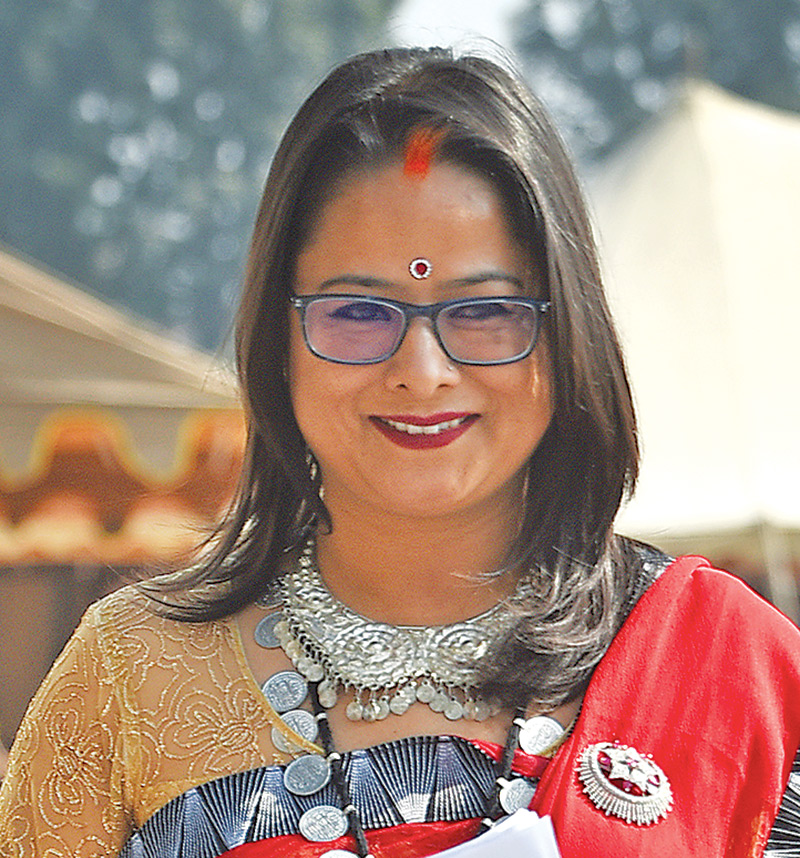
Nagarik Unmukti Party led by Ranjita Shrestha is yet to join the Cabinet despite being a part of the ruling alliance.  Post Photo

KATHMANDU,
Six political parties—the CPN-UML, the Rastriya Swatantra Party, the Rastriya Prajatantra Party, the Janata Samajbadi Party, the Janamat Party, and the Nagarik Unmukti Party—had backed Maoist Centre chief Pushpa Kamal Dahal’s bid for premiership a month ago.
But now the seven-party alliance appears to be in danger.
Dissatisfaction had already surfaced in the alliance with some parties refusing to join the Cabinet. The Nagarik Unmukti Party has taken its umbrage a step further by fielding its own candidate for a vacant National Assembly member, challenging the ruling alliance’s candidate in the process.
Nagarik Unmukti Party leader Rajendra Bir Raya has thrown his hat in the ring for the by-election for the upper house from Lumbini province against UML’s candidate Kumar Dashaudi. The Nepali Congress has also thrown itself into the fray. A by-election is scheduled for February 8 at the Province Election Centre, Dang for the seat that went vacant after the then UML National Assembly member Khim Lal Bhattarai from Rupandehi resigned from the post ahead of November 20 polls.
“We will not withdraw our candidacy at any cost,” Nagarik Unmukti Party chair Ranjita Shrestha told the Post.
“Though we gave the vote of confidence to Prime Minister Pushpa Kamal Dahal, we are in opposition in Parliament. Until our jailed leaders are freed, we won’t join the ruling alliance,” said Shrestha.
The party is the kingmaker in the Sudurpaschim province with seven seats in the 59-strong assembly.
Party insiders say that though they supported the alliance in appointing Chief Minister, Deputy Speaker, and Speaker in the province, they will not give a vote of confidence to Chief Minister Rajendra Rawal until their demands are met.
Rawal had to rush to Kathmandu seeking help from top leaders of the ruling alliance for the floor test, after Unmukti Party leaders insisted that they wouldn’t support him until their jailed leader Resham Lal Chaudhary and others were freed. Rawal even met Chaudhary in jail. The provincial assembly meeting called for Wednesday was postponed until further notice.   
And all is not well with another partner of the alliance—the Janamat Party—as well.

A month after he was appointed minister without portfolio on December 25, Janamat Party Vice-Chair Abdul Khan assumed office as the Minister for Water Supply only on Wednesday. Though Prime Minister Dahal had given Khan the Ministry of Water Supply, the latter refused to assume office earlier, claiming that his party had been promised the Ministry of Industry, Commerce and Supplies.
The party, which managed to become a national party in its first try at parliamentary elections by winning six seats in the House of Representatives, is not happy with the ministerial allocations. It was until recently insisting on one more—either the Ministry of Agriculture or the Ministry of Industry.
“The prime minister has assured us to resolve the issue of ministerial berths soon. So, our vice chair assumed office today [Wednesday],” Janamat Party General Secretary Chandan Singh told the Post.
Leaders of the Janata Samajbadi Party, which is led by Upendra Yadav, on the other hand, are riled by recent unilateral decisions made on behalf of the alliance by Prime Minister Dahal and UML chair KP Sharma Oli.
Janata Samajbadi spokesperson Manish Suman said his party has been consistently demanding that all seven alliance member parties should be taken into confidence while deciding on ministerial allocations and governance.
“But just the two leaders [UML’s KP Oli and Dahal of the Maoist Center] are unilaterally taking decisions,” he said. “That’s why we have not joined the Cabinet despite being an alliance member.”  
The Janata Samajbadi Party won 12 seats in the parliamentary elections last November. Of late, the party has been saying that it will not join the Cabinet unless its nominee is appointed the country’s Vice-president.
“Dahal and Oli have been imposing their joint decisions on coalition member parties. Their such behaviour will have a negative impact on the alliance,” Suman said.  
Some observers see Oli’s interventions that have prevented Prime Minister Dahal from working freely as one big reason for growing disenchantment among alliance members.
“If recent developments are any guide, I think there are problems over power-sharing among the parties as Oli takes all the decisions while the prime minister’s hands are tied,” said Jhalak Subedi, a political analyst.
“The head of the Cabinet has not been allowed to work freely, hence all the problems.”

HOME PAGE

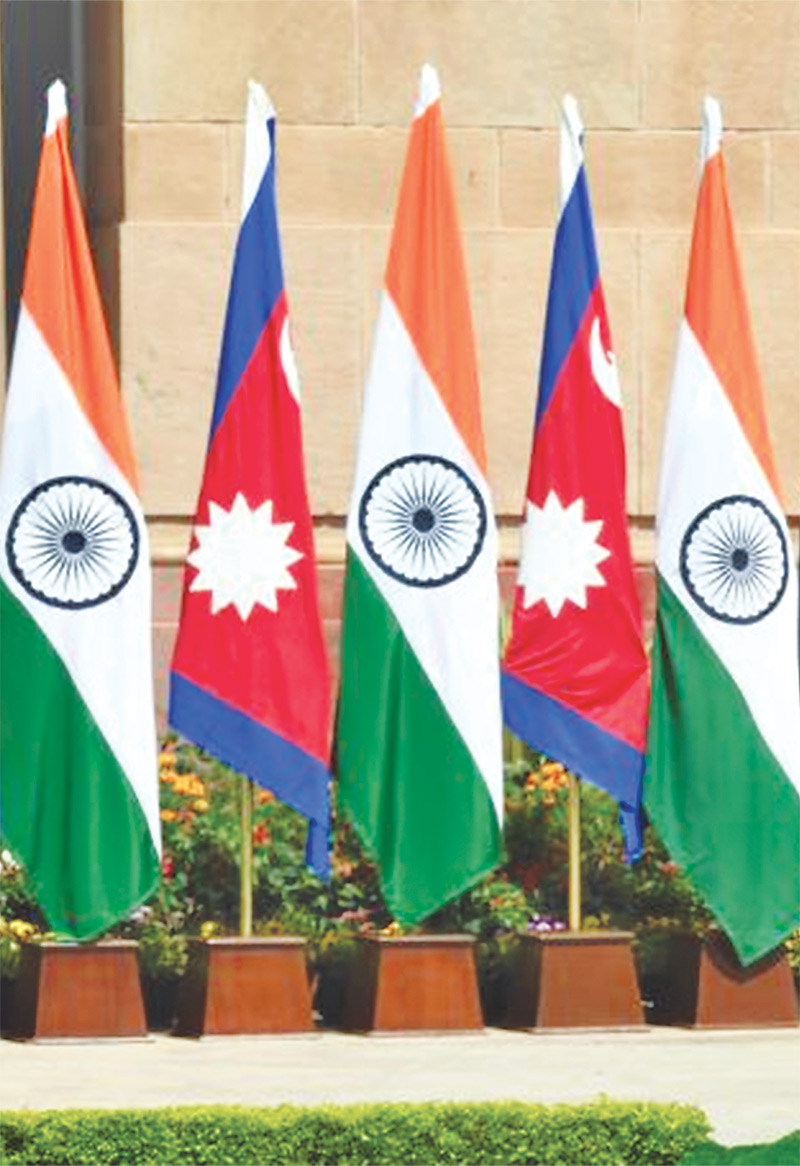
Nepal to propose two new cross-border transmission lines with India

The two countries are scheduled to hold bilateral meetings on energy in late February.
- PRITHVI MAN SHRESTHA
Nepal wants to sell more power to India.  File Photo: Xinhua

KATHMANDU,
Nepal will propose developing two new Nepal-India cross-border transmission lines during the upcoming high-level meetings on energy between the two neighbours.
As hydropower production has been growing in the country amid limited consumption, Nepal must sell more power to India to avoid spillage. For this, reliable infrastructure for cross-border transmission of power is necessary, officials say.
Nepal plans to discuss constructing two new high capacity cross-border transmission lines during the meetings of the joint secretary-level Joint Working Group and the secretary-level Joint Steering Committee, both scheduled to be held in India in late February.
“On our agenda are two additional cross border power lines—400kV transmission line connecting Inaruwa (Duhabi) of Nepal and Purnia of Bihar, India and 400kV New Lamki (Dodhara)-Bareli Cross Border Transmission,” said Madhu Bhetuwal, joint secretary at the Ministry of Energy, Water Resources and Irrigation. “Considering the likely increase in power production in coming years, we will not be able to consume it all domestically, and so we need more cross border power lines to export more power.”
According to the Nepal Electricity Authority (NEA), there has been limited progress in carrying out studies on these two projects.
“The task of preparing a detailed design for the Duhabi-Purnia transmission line has been completed, but financing modality has yet to be finalised,” said Kulman Ghising, the NEA executive director, in a recent interview with the Post.
There has been preparation for a comprehensive design of the New Lamki (Dodohara)-Bareli Cross Border Transmission Line project too, according to the NEA. During the wet season in 2022, Nepal suffered spillage of power as domestic consumption slumped while India permitted limited power export.
As per an article by Prabal Adhikari, power trade director of the NEA,
published in the Post in May last year, an estimated 706.8MW is expected to be added to the national grid in the current fiscal 2022-23 while 706.8MW expected to be added in the next fiscal year 2023-24.
Likewise, 551.1MW is expected to be added in 2024-25, 787.2MW in 2025-26, and 976.7MW in 2026-27, according to Adhikari.
Officials say all these potential additions cannot be consumed within the country and transmission infrastructure is essential to ensure their sales in the Indian market and beyond.

According to Bhetual, the two sides will also discuss upgrading the existing low voltage cross-border lines. There are a dozen cross-border transmission lines between Nepal and India of 33kV, 132kV and 400kV capacities, according to the Ministry of Energy.
Only the Dhalkebar-Muzaffarpur Cross Border Transmission Line has 400kv capacity, which can transport around 1,000MW. Other 11 cross-border transmission lines can transport between 5MW and 125MW only, according to a white paper on energy issued by the ministry in May 2018.
“Even when the country faces a power outage because of unforeseen circumstances in the future, we need more high capacity transmission lines to ensure reliable power supply in the country,” said Bhetuwal. There has been progress in construction of the New Butwal-Gorakhpur Transmission Line, which will be able to supply up to 3,500MW.
The Millennium Challenge Account (MCA) Nepal, a special purpose vehicle established by the government to implement the MCC Compact projects, will build an 18 kilometres section from the New Butwal substation to the Nepal-India border under the New Butwal-Gorakhpur Transmission Line Project.
The MCA Nepal has already invited tenders from contractors for the purpose. To build this transmission line in the Indian territory, the NEA and the Power Grid Corporation of India have set up a joint venture company there.
Moreover, in order to export the electricity produced by the Arun III Hydropower Project, which is being developed by the Indian business SJVN Limited, a separate cross-border transmission line is also being built between India and Nepal.
The NEA sold electricity worth Rs11.16 billion to India beginning June last year until it stopped the exports in the third week of December owing to a decline in production at the onset of winter. All the electricity sold to India was transmitted through the Dhalkebar-Muzaffarpur Transmission Line. India currently permits Nepal to sell 452.6MW of power generated by eight hydropower projects in India’s energy markets.
NEA has set a target of selling power worth Rs16 billion in the current fiscal year 2022-23 after resuming export in June next year. In the last Joint Steering Committee meeting held in February last year, India agreed to increase the volume of power to be exported through Dhalkebar-Muzaffarpur power line once the 400kV Hetauda-Dhalkebar-Inaruwa Transmission Line was completed in 2023.

Page 2
NATIONAL

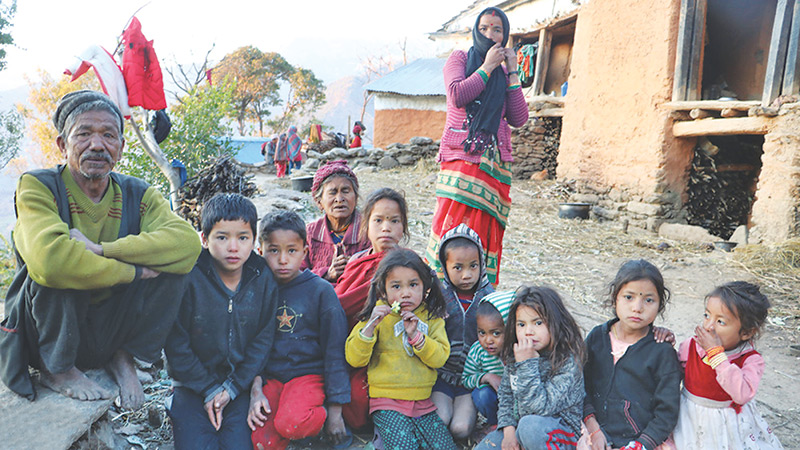
Victims of last November’s Doti earthquake spend cold winter months under flimsy tarp

Thirty-four people from eight families have been living under one tarpaulin tent in Uparkada.
- Mohan Shahi
Earthquake victims of Uparkada in Purbichauki-5 pictured recently.   POST PHOTO: Mohan Shahi

DOTI,
It has been three months since Majite Saud, a 70-year-old man from Uparkada in Purbichauki Rural Municipality-5, started living in a tent. He has been spending the cold winter months under a tarpaulin tent since he lost his house to the November 9 earthquake.
Six people died, seven were injured, and hundreds were displaced by a magnitude 6.6 earthquake that hit Purbichauki Rural Municipality.
Besides Purbichauki, Dipayal Silgadhi Municipality and Shikhar Municipality were also affected by the powerful trembler. Approximately 500 houses were completely damaged, and another 4,500 were partially damaged in the local units.
Since then, hundreds of earthquake victims have been living in temporary shelters in nearby areas.
Thirty-four people, including Majite, from eight families, have been living under one tent in Uparkada to fight the cold. The current temperature in the area is six degrees Celsius.
Saud, who is an asthma patient, says his health condition is worsening by the day because of his poor living conditions. “I have been suffering from asthma for the past 20 years but it has never been as worse as it is this year,” he said. “All of us are sleeping on the cold hard ground pressed against each other to stay warm.”
Saud’s house has suffered major damages from the earthquake and the fear of the roof falling over his head is what is keeping him from returning home, he says.
Rambha Saud, a 30-year-old woman, is eight-months pregnant. She is among the 34 victims sharing the same tent. Since winter began, she has had to visit the health centre in Chaukhute in Ward No 5 four times to cure common cold and cough.
In addition to her own health, she is worried about the health of her unborn child.
“We have been living here in the tent like prisoners. I have not been able to take care of my unborn child. We cannot light a fire inside the tarpaulin tent to keep ourselves warm. The roof itself is beginning to leak,” said Rambha. “Our house was made of mud, stones and wood. The earthquake destroyed it completely, so we don’t have anywhere else to go.”
According to her, elderly, pregnant women, and children are suffering from cough and cold. “All of us are living in miserable conditions and most of us are sick,” she said.
Ram Prasad Pathak, chief of the health unit of Purbichauki Rural Municipality, says the displaced victims are showing physical and psychological problems caused by displacement. “There are currently more than 200 pregnant women and more than 300 asthmatic patients in the earthquake-affected Purbichauki area. Most victims who lost their homes to the earthquake are living in tents with no protection from the cold. More people are likely to fall ill if this continues and there is also a shortage of medicines in the municipality,” he said.
Khante Saud, one of the displaced victims, says the government authorities have not shown any interest in their plight. The authorities have not even completed the initial report of the earthquake, he said.
“Even though tarpaulins, blankets, and warm clothes were distributed by the local unit and various charitable organisations, they are not enough,” said Khante. “They have to resettle us before our condition gets worse. The authorities have not even announced any rehabilitation programmes for us.”
According to Kalpana Shrestha, chief district officer, plans are afoot to construct temporary houses for the displaced but construction work on the project has only just begun. “The Nepal Cross Society
will build 200 houses in coordination with the Community Development Centre, a non-governmental organisation, and Upekshit Samudaya Sashaktikaran Tatha Bikas Manch, also a non-governmental organisation, will build 150 temporary houses,” said Shrestha.
Lakshiram Kunwar, chairman of the Nepal Red Cross Society, Doti, said the construction of the temporary house was delayed due to some legal issues. “Those issues have now been resolved and the construction of the house has begun on Tuesday,” he said.

NATIONAL

Province 1 Assembly officer killed in road accident

District Digest

MORANG: Prem Bahadur Shrestha, an officer of the Province 1 Assembly Secretariat, died and two others were injured in a road accident in Biratnagar on Wednesday. According to police, Shrestha died during treatment, and the other two are receiving treatment at the Birat Medical College Teaching Hospital. The accident occurred when the motorcycle of Shrestha and a scooter coming from the opposite direction collided at Biratnagar Metropolitan City-3.

NATIONAL

Pungche Hinang monastery destroyed by fire

District Digest

GORKHA: The ancient Pungche Hinang monastery in Chumnubri Rural Municipality-2 in Gorkha district, has been destroyed by fire. The fire that broke out around 4 pm Tuesday could be extinguished only after six hours, at 10 pm. According to SP Kedar Acharya of the district police, the locals believe that the monastery was around 200-year-old, and all the books and idols that were inside were either damaged or destroyed. “A preliminary investigation has revealed that the fire started due to an electrical short circuit,” said Acharya.

NATIONAL

Bagmati Cabinet gets a full shape

District Digest

MAKAWANPUR: Bagmati Chief Minister Shalikram Jammkattel gave full shape to his Cabinet on Wednesday by appointing eight new ministers. From the UML, Eka Lal Shrestha took oath as Minister for Labour, Employment and Transport; Rameshswar Shrestha as Minister for Health; and Keshav Pokharel as Minister for Agriculture and Livestock Development. Likewise, Yuvaraj Dulal, Ganga Narayan Shrestha, and Kumari Moktan from the CPN (Maoist Centre) were sworn in as Minister for Physical Infrastructure Development, Minister for Internal Affairs and Law, and Minister for Social Development, respectively. From the Rastriya Prajatantra Party, Dambar Tamang was appointed as Minister for Tourism, Industry and Cooperatives, and Raju Bista as Minister for Forest and Environment.

NATIONAL

Seven injured in bus accident

District Digest

KHOTANG: At least seven people were injured when a bus en route to Diktel from Kakarvitta met with an accident at Rupakot Majhuwagadhi Municipality-13 in Khotang district on Wednesday morning. According to Deputy Superintendent of Police Manjil Mukarung, all the injured have returned home after receiving treatment at Khotang District Hospital. “There were 19 people, including the driver, in the bus when the accident occurred,” said Mukarung.

NATIONAL

Municipal officials charged with graft

District Digest

SURKHET: The Commission for the Investigation of Abuse of Authority has filed a corruption case against three employees of Panchapuri Municipality and a hotel owner at the Special Court on Wednesday. According to Shyam Prasad Bhandari, spokesperson of the anti-graft body, the case has been filed against Mohan Bahadur Budha, the accounts officer; Lal Bahadur Subedi, a municipal officer; Tulsi KC, of the education unit of the municipality; and Bhabilal Ramjali, the owner of the hotel for preparing a fake invoice.

Page 3
Page 4
OUR VIEW

Flames of resistance

Prem Acharya set himself ablaze as a protest against the dehumanisation of ordinary Nepalis.

On Tuesday afternoon, Prem Acharya lit himself on fire in the middle of one of Kathmandu’s busiest roads in a horrific protest against the system. While Acharya was covered in flames, a VVIP motorcade passed by the ghastly scene without so much as bothering to slow down and check what was going on. Stunned police officers, who were standing right there to provide security to the political big shots, sprang into action only after the procession of SUVs had passed. But by that time, Acharya had suffered burns over 80 percent of his body. He was rushed to hospital where he succumbed to his injuries in the wee hours of Wednesday. Videos showing Acharya engulfed in fire and the motorcade passing by cruelly illustrate the emotional distance between politicians and ordinary Nepalis.
As disturbing as the images of the act is the harsh reality of the dehumanisation millions of Nepalis face on an everyday basis.
That Acharya had chosen Naya Baneshwor, the nerve centre of Nepali politics, is no coincidence. This is the place that witnesses, on a daily basis, the complex stratagems of political parties to outdo one another, oblivious of the concerns of ordinary folks. This is where parliamentary democracy is turned into a zero-sum game as Members of Parliament endlessly berate each other and grapple for power. Though this is where the supreme institution representing the voice of the people is housed, the site has mostly been inaccessible to the common people. Acharya’s self-immolation is a loud and clear voice of resistance against the deafening silence of parliamentarians to people’s concerns.
Acharya seemed to have timed his act of sacrifice to coincide with the procession of VVIP cars, but he perhaps forgot that VVIPs travel in limousines with tinted windows, their eyes blinded by power. A video-crazed public also took Acharya’s self-immolation as a spectacle to be recorded on their mobile phones instead of trying to save him. As the dreadful footage spread on social media, an outraged population vented frustration against an apathetic state which sits idly by even as common Nepalis keep running into brick walls.  
Acharya’s odyssey as an entrepreneur who failed multiple times but tried to rise each time is a heroic tale of resilience. Yet there were only so many failures he could withstand in the absence of a safety net on which to fall back upon when all his avenues were exhausted. In his long suicide note, he laid bare a list of a young entrepreneur’s struggles. Acharya’s resistance was not just against the state, as is evident in his suicide note. He has named some major business establishments in Nepal that didn’t pay what they owed him. The state should investigate these allegations and, if true, provide compensation to Acharya’s family and punish the guilty parties.
A country where citizens have to set themselves on fire to be heard cannot be called a democratic state. Acharya’s political act of self-immolation is a call for conscientious citizens to speak up against the many social injustices imposed upon them. It is also a plea to the new government and the authorities to better address the multidimensional vulnerabilities that a common Nepali faces.

OPINION

CAAN’s gotta go

The worldwide coverage received by the Pokhara crash is not likely to do Nepal any good.
- DEEPAK THAPA
Reuters

Introduced with the best of intentions after the 2006 political change, parliamentary hearings to vet the nominations of high officials of the state have been quite a farce. Besides the fact that informed questioning does not happen, there is practically no danger of anyone failing because of the two-thirds majority required to reject an appointment. Particularly since our lawmakers never question their leaders’ choices, and simply rubberstamp any and every one sent their way. Had a Parliament existed at the time of his appointment, even someone as crooked as Lok Man Singh Karki, the disgraced former anti-corruption czar, would have breezed through given the backing he enjoyed from the bosses of all political parties that mattered.
Unlike political appointments though, I guess for mid-level officials like the career diplomats sent off as ambassadors, the hearings are possibly more stressful. Thus, in September 2020, two of them, appointed to Berlin and Brussels, respectively, found themselves under the scanner. Of particular concern to members of the parliamentary hearing committee was the question of the European Union’s (EU) blacklist that has barred Nepali planes from flying into EU airspace since 2013. The Foreign Ministry officials were asked to outline their plans on getting us off the hook.
The duo appeared to have come prepared and sounded quite earnest that the issue would receive their highest priority with both expressing hope that Nepal would soon be removed from the dreaded list. The one going to Belgium even said he would consider the matter his “special task”. Probably anticipating such a statement, one of the Members of Parliament reminded them that previous envoys had also given similar assurances but failed.
That is correct, but where the lawmaker is absolutely wrong is in ascribing blame to the diplomats for that state of affairs.
Anyone who has followed the EU blacklist fracas over the years—centre-stage again with the recent Yeti Airlines mishap in Pokhara—would know very well that the crux of the problem lies in the commonsensical requirement that the Civil Aviation Authority of Nepal (CAAN) be split into service providing and regulating bodies. It is there in plain English in the “List of Air Carriers Which Are Banned from Operating within the Union”, with all the Nepali airlines listed since they are “carriers certified by the authorities with responsibility for regulatory oversight of Nepal”.
Thus, if anyone is at fault, it has to be the Parliament, the Members of Parliament that comprise the legislative body, and the government. At the time the ambassadorial hopefuls were being questioned, the Nepal Civil Aviation Authority Bill and the Nepal Air Service Authority Bill had actually been introduced in the National Assembly. It took nearly a year more for the bills clear the upper house, but the erstwhile House of Representatives did not take them up for more than one year thereafter before its term came to an end. The bills are now dead.

Doing nothing
With nearly all the safety measures determined by the International Civil Aviation Organisation having been fulfilled, all that appears to stand in the way of the EU lifting the ban is the division of responsibilities. Instead, the approach of our government has been to do zilch to get the required laws passed and instead appeal to every EU official that happens by and hope for the best.
It would be somewhat naïve to expect the crafting of new laws to automatically make the Nepali skies safer. But a start could have been made, and we would have been able to build on that. What boggles the mind is the inability of successive governments to get that done over 10 years.
After the National Assembly had passed the aviation bills, one would have expected the lower house to get cracking as well. But, as was pointed out in these pages, in March last year, the minister at the time suddenly pulled back, “explaining that some employees of the aviation regulator were opposed to the planned fragmentation of their office”. The chap who succeeded him apparently even went to the extent of declaring that CAAN would not be split at the behest of anyone.
One does wonder what imperative drives the ministers to look out for the interests of a bunch of bureaucrats instead of the country as a whole. Even the tragic death of one of their predecessors was not enough to move them. (For the record, we have had eight ministers since.) As for CAAN, all the news reporting so far points to the strong opposition within that powerful organisation to any dilution of its authority (and the perks that come with it).
The accident that killed the minister also saw the deaths of a couple of senior CAAN officials. But the vested interests within remain strong. In fact, in the last meeting with the EU officials in November 2022, CAAN argued that the split had been achieved through “the functional separation of CAAN’s regulatory and service provider roles, namely by preventing the transfer of staff between regulatory and service provider sections of the CAAN”. We can only hope that it was not meant in all seriousness and only a stop-gap measure until the parliament can resuscitate the now-dead bills.

EU blacklist
The headline coverage received by the Pokhara crash worldwide is not likely to do Nepal any good. Once again there is scrutiny on us. And there is every reason to feel alarmed given the figures. Starting with the first in 1955, there have been a total of 104 air crashes in Nepal. More than 900 lives have been lost. Our place in the EU blacklist will surely stand for the near future. The audit report of the US Federal Aviation Administration is also expected soon, and there is little to expect the Americans to go easy on us.
For the government’s part, if the past is any guide, once the hullabaloo dies down, it will be back to business and slow pedalling will resume. As in the failure for five years to pass the law adopting the Montreal Convention 1999 to replace the earlier Warsaw Convention 1929. This singular inaction meant that the families of air crash victims will continue to receive just $20,000 in compensation instead of $100,000.
It has been reported that opposition to the Montreal Conventions provisions is stiff from domestic airlines. It would serve their business better to use the heft they appear to wield to push the government to bring in the reforms as asked for by the EU. Objectively speaking, the EU really does care whether we do it or not. They simply will not allow our planes to fly into its airspace, and also will not allow the chartering of Nepali airliners using their funds. The bad press from being in its bad books is what we should worry about, and the long-term impact it can have on our tourism itself. In fact, the various umbrella bodies representing the travel industry should weigh in as well to offset CAAN’s and other vested interests’ recalcitrance.
The efforts of those involved in the aviation sector appear misdirected though. One example suffices. An Australian expert on TV after the Pokhara crash was clear message that we need to take things far more seriously than we have done so far. The expert, who also happened to be associated with the eponymous airlineratings.com, said they had stopped rating Nepali airlines since they had begun receiving threats of lawsuits in response to the low ratings our companies were getting. Talk of barking up the wrong tree!

Thapa writes on a range of topical social and political issues.

OPINION

Decay of the party system

Political culture will suffer if parties adopt a nepotistic approach to politics.
- SAMBRIDH GHIMIRE
Photo courtesy: KP Sharma Oli’s Secretariat

There has been considerable global debate of late concerning the state of democracy, especially with the global intelligentsia worried about its deteriorating values. Nepal, which has had several trysts with democracy in the past, institutionalised it through its constitution in 2015. Despite these positive developments, the country is still plagued by the global deterioration of democracy. The primary yet ignored aspect in this debacle has been the decline of the party system. This decline is a more significant indication of the fall of democracy than issues such as attacks on individual freedom, manipulation of independent institutions, and lack of transparency in governance.
The way Prime Minister Pushpa Kamal Dahal has been promoting his kin may be seen as normal practice by some. But those with a longer historical perspective view it as contradictory to the original values of the Nepali Maoists. The CPN-Maoist Centre, as it is called today, was formed through a popular uprising that promoted ethnic communities against the dominant influence of the more affluent Khas Arya community.
While the primary goal of the Maoists was to assert the autonomy of different ethnic and linguistic communities of Nepal and promote self-respect, it also took a more progressive stance on issues of caste and gender than the then-Congress and CPN-UML. The Maoists positioned themselves as a party that promoted ethnic pride and social reform. It was not intended to be a family-run business. However, Dahal did exactly the same. He is also promoting his second daughter Renu Dahal, helping her win the position of Bharatpur mayor.

Hereditarian hegemony
The Maoist Centre is not the only party to adopt a nepotistic approach. Nepali Congress has an extended history. For many years after its founding, the party’s main goal was to establish democracy in Nepal. It was only under the leadership of Girija Prasad Koirala that it became a family-run party. Other regional parties, such as the Nagarik Unmukti Party and the Janata Samajwadi Party, have also followed this path. When Prachanda appointed his daughter to his secretariat and his son-in-law to the provincial government, he was most likely influenced by the examples set by his predecessors, who had already given significant appointments to their kith and kin. Even parties like the Janata Samajwadi Party and Rastriya Janmorcha, that claim to be committed to “social justice” have leadership that passes between family members, undermining their professed ideologies.
The trend of family-run parties may not have emerged if the oldest political party in Nepal, the Nepali Congress, had not transformed into a family-run entity under the leadership of Girija Prasad Koirala. The Congress of today bears little resemblance to the party that played a crucial role in Nepal’s democratic revolution. The fundamental difference between the Congress of the past and present is exemplified in the family history of one of its most prominent leaders, BP Koirala. During his tenure, none of his four brothers became Parliament members or ministers. His mother insisted he give Girija Prasad Koirala a ticket during the 1959 parliamentary elections. But he refused, choosing to field Bishwa Bandhu Thapa instead. Unfortunately, this kind of restraint is absent in Nepali politics, not just in the Congress. The Koirala succession of their kith and kins, Sushil Koirala and Sujata Koirala, as their political heirs, encouraged leaders of the Maoist Centre and others to do the same with their kins.
When leaders like Pushpa Kamal Dahal, Sher Bahadur Deuba and Upendra Yadav promote their wives and children in their parties or governments, it sends a message to other members that they will never have the opportunity to rise to leadership positions, regardless of their talents and attributes.

Personality cult
Another aspect of democratic decline is the subordination of parties to a single leader, as exemplified by the CPN-UML under the leadership of KP Sharma Oli. Before Oli’s era, the party did not have a personality cult like it does today. It opposed the “worship of an individual” and claimed that its collective leadership and inner-party democracy set it apart from Girija Prasad Koirala’s Nepali Congress.
The cult of personality surrounding leaders has harmed Nepali democracy. Disturbingly, this trend has begun to influence the operations of other political parties and individuals. When the Rastriya Swatantrata Party was established, it gained significant support for its anti-corruption stance and apparent rejection of entitlement and privilege. However, over time, it has evolved into a tool for the personal aspirations of Rabi Lamichhane. Other leaders of the party similarly defer to him just as other leaders of the CPN-UML defer to Oli. The idea that one person can represent an entire political party or state is also evident in the cults of CK Raut in Madhesh and Resham Chaudhary in Sudurpaschim. The evolution of a personality cult around Balen Shah is also pretty evident, with his supporters attacking his critics.
The degradation of the Nepali party system is nearly complete, with some parties becoming family-run businesses and others quasi-religious cults that exalt their leader as a living god. The far-reaching consequences of this troubling trend have yet to be thoroughly evaluated. Nevertheless, political parties are considered one of the most important institutions in modern society, and the health of democracy is heavily dependent on their well-functioning.
If political parties operate within a culture of deference and obedience and mandate family or hero worship, it negatively impacts the broader political culture. If a leader only seeks praise from his or her party colleagues, how will he or she be inclined to receive criticism from the media? If a leader demands unconditional loyalty from party members, he or she will probably require their total support for unlawful acts of policy from the bureaucracy, police, media, or judiciary when in power. All these things continue to reverberate in the minds of Nepalis.

Ghimire is a political consultant and electoral strategist.

THEIR VIEW

Covid-19 shift to Class V disease

A shift allowing Covid-19 to be handled at general medical institutions, like seasonal influenza.

The number of cases in which emergency transports of patients take a long time is increasing. Before reviewing the status of Covid-19, the problems with the emergency medical system must be analysed and necessary measures must be taken. Since the end of last year, emergency calls and transports have increased significantly, and it has often been difficult to find facilities that will accept patients. The number of cases in which patients were refused by hospitals three times or more and had to wait for more than 30 minutes reached a record high for the fourth consecutive week. At their peak, such cases exceeded 8,000 per week nationwide.
The exhaustion of emergency medical workers, who are forced to work long hours, is also conspicuous. In Tokyo, there was an
accident involving an ambulance that appeared to have been caused by the driver falling asleep at the wheel due to fatigue. The three emergency medical workers in the ambulance reportedly had been working for 17 consecutive hours. It is becoming increasingly difficult to maintain the normal functioning of the emergency medical system, and the situation can be deemed to be serious. The health and safety of emergency medical workers is also important for patients. There is an urgent need to secure personnel and review the system.
Of the cases in which it was difficult to transport patients, less than 30 percent of people were suspected to have been infected
with the novel coronavirus, a smaller percentage than in past outbreaks. There are probably multiple factors contributing to the strain on emergency medical services, not just this winter’s coronavirus epidemic. Prior to the pandemic, emergency transports had been increasing each year due to the ageing of the population. The number temporarily declined sharply due to restrictions on social activities and other reasons, but has gradually returned to the pre-pandemic level. The addition of Covid-19 patients to the mix has led to the belief that emergency transports have increased as a whole.
The tight situation is also believed to have been affected by the difficulty of outpatients with a fever being treated at medical institutions. Even if people have a high fever, there are a limited number of medical institutions that accept them, and it is sometimes difficult for them to get an appointment. There must be many cases in which people cannot find a medical institution to accept them and end up calling an ambulance even for minor illnesses. A situation must be avoided in which people with serious symptoms who are in need of emergency medical care cannot be saved.
The government intends to lower the status of Covid-19 under the Infectious Diseases Control Law from a disease “equivalent to Class II” to “Class V,” a shift to allow the disease to be handled at general medical institutions, like seasonal influenza. After the change, it is hoped that any medical institution will be able to treat patients with a fever. However, if things do not go smoothly, emergency medical services will once again be plunged into a state of confusion. It is important to steadily improve the medical system, starting now.
Emergency calls are said to include less urgent calls, including pranks. Emergency medical services are a vital lifeline of society. The central and local governments should work to expand and improve consultation services that can be used by people who are unsure whether to call an ambulance. Each and every member of the public should also make sure to use them properly.

— The Japan News/ANN

Page 5
Page 6
NATIONAL

Electing President is task cut out for Dahal and Oli

Even after the formation of federal and provincial governments, Prime Minister Pushpa Kamal Dahal and the UML chief KP Sharma Oli still harbour mistrust, say observers.
- PURUSHOTTAM POUDEL
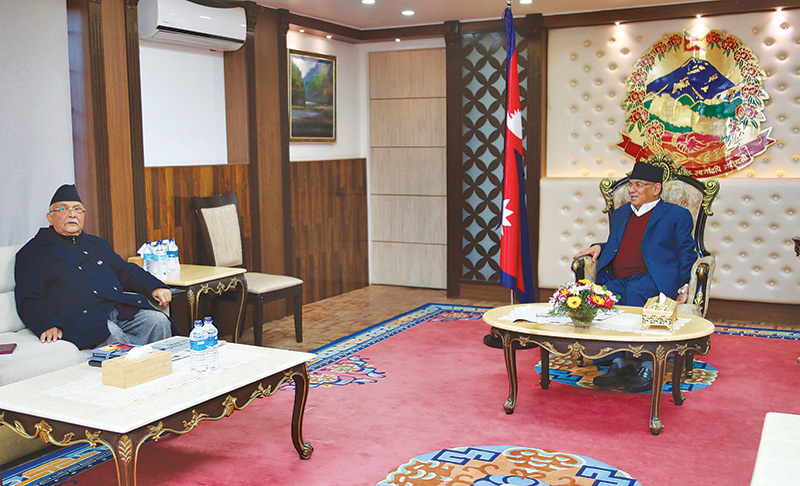
Prime Minister Pushpa Kamal Dahal (right) and CPN-UML chair KP Sharma Oli pictured at a meeting in Baluwatar recently.  RSS

KATHMANDU,
Prime Minister and CPN (Maoist Centre) chair Pushpa Kamal Dahal and CPN-UML chief KP Sharma Oli, who had unexpectedly joined hands to form a governing coalition on December 25, has so far succeeded in forming the government under Dahal’s leadership, expand the Cabinet, and elect the Speaker and Deputy Speaker.
The two leaders, who were arch-rivals until a few months ago, however, still harbour suspicion of each other despite being key partners of the
governing coalition.
The upcoming election for the post of President has now become a major bone of contention between the two top leaders.
Of late, even after the expansion of the Cabinet and the election of the Speaker, Dahal and Oli have been holding a series of marathon meetings, which reflects the two leaders are still struggling to find a common ground on the election of President.
The two recent moves have added to UML chair Oli’s suspicion of Dahal. First, the decision of the Nepali Congress, the largest party in the House of Representatives, to give a vote of trust to Dahal, and second Dahal’s public statement to consult the Congress in connection with the presidential election.
Dahal’s fear is that a domineering UML chair Oli, who already has a strong hold on the Cabinet, has also secured the post of Speaker and four chief ministers and other key posts for his party, will have a very strong grip on the state apparatus. As per the two-party agreement, Dahal has to hand over the prime ministership to Oli in the second half of the five-year term. Once the UML heads the executive, the Maoist Centre will in turn head the legislature.
In an attempt to check Oli, Dahal seems to be exploring an alternative way to deny the UML the presidential post. Dahal, therefore, has also floated the option of a non-political candidate for the head of state. However, Oli and other UML leaders have vehemently opposed the idea saying that the ruling coalition has already agreed on electing a UML nominee as President.
Political observers and experts claim there is a trust deficit between the two leaders.
Political analysts claimed that if the UML candidate wins the presidency, it will be challenging for Dahal to lead the government. On the other hand, Oli seems to be fearing that Dahal and his party may at the last moment betray him by not supporting the UML’s presidential candidate.
“If the UML is able to appoint a President, Oli will be stronger,” Hari Roka, a left-leaning political analyst who was also the first Constituent Assembly member under the Maoist quota, told the Post. “Therefore, Prime Minister Dahal does not want that to happen while Oli is trying to convince Dahal.”
Roka said Dahal seems to be trying to avoid the situation of powers being centralised on the UML.
However, UML leader Bishal Bhattarai claims that there is no deficit of trust between the two leaders. He argued that a series of meetings between the two main leaders of the governing coalition aimed at solving various problems shouldn’t be interpreted as mistrust.
“Running a coalition government of diverse parties in itself is difficult in Nepal. Therefore, the two leaders of the ruling coalition are involved in regular discussions,” Bhattarai told the Post. “The UML-Maoist coalition was formed only after the Congress-led alliance betrayed Dahal. And today he is prime minister with our support, so there is no misunderstanding between the leaders.”
However, Roka claimed that the two leaders meet regularly because they don’t trust each other. He also drew parallels between the present scenario and the situation when Oli and Dahal used to hold a series of meetings when the two leaders jointly headed the then Nepal Communist Party. Roka said the present situation reminded him of the NCP period.
During the NCP days, the majority of the secretariat members (five out of nine) were close to Dahal. Oli accused Dahal of creating unnecessary pressure on him with the backing of the majority members of the party secretariat. The personality clash between the two leaders resulted in the split in the NCP in 2021 which had merged to form a single party back in 2018. After the party split, the two leaders were engaged in spitting venom at each other.
However, after the result of the November 20 elections, the two leaders suddenly came together to form the government under the leadership of Dahal. But, the reins of the government are said to be in Oli’s hands.
Alliance partners like the Rastriya Swatantra Party and the Rastriya Prajatantra Party are also reportedly in the grip of Oli. Political analyst Roka argues that Oli is trying to create pressure on Dahal by keeping the coalition parties on his side.
Dahal spent more than five hours at Oli’s residence in Balkot on the day he expanded the Cabinet on January 16. After the meeting with Oli, Dahal inducted 12 ministers and three ministers of state. He was appointed prime minister on December 25.
There are also assumptions that Dahal lacks the authority to make a single-handed decision on government matters because he is heavily reliant on Oli. Indicating the same in his address to Parliament on January 19 during the Speaker’s election, Nepali Congress General Secretary Bishwa Parkash Sharma said Dahal was caged.
In a recent interview with the Post, Janamat Party chief CK Raut, a ruling alliance partner, also acknowledged the prime minister’s role in weakening the coalition government.
To minimize Oli’s pressure, Prime Minister Dahal wants to see someone non-political appointed as President, said a Maoist Centre leader close to Dahal. A source close to Prime Minister Dahal referring to him said, “The prime minister is confident that he can convince the Congress if the UML agrees on appointing a non-political person as President.”
On Tuesday too, Oli had a meeting with Prime Minister Dahal at Baluwatar. They are said to have discussed contemporary issues including the Presidential election.
“The meeting between two leaders was focused on the elections for President and Vice-President,” a Dahal aide told the Post. “They also discussed the possibility of picking someone non-political as President.”
The Congress which gave the vote of trust to Dahal has been calling for electing a new President through political consensus, and Dahal has responded positively to the proposal.
But CPN-UML chair Oli has rejected the idea outright saying only a UML nominee will be President as per an earlier agreement with the Maoist Centre.
Prime Minister Dahal also convened an all-party meeting on January 17 to seek national consensus on the presidential election. Oli had walked out of the meeting midway.

NATIONAL

‘It’s a murder, not suicide’

Self-immolation by a young man, who accused the state of failing him repeatedly, could be the tip of a much bigger social problem, experts say.
- ANUP OJHA

KATHMANDU,
Prem Prasad Acharya died a difficult death. On Tuesday, he set himself on fire in front of the Parliament building at New Baneshwar, Kathmandu. Videos circulating on social media after the incident showed Acharya running to the middle of the road while Prime Minister Pushpa Kamal Dahal was just leaving the Parliament with a motorcade, before he set himself on fire. Acharya was rushed to the Kirtipur-based burns hospital but it was too late. He was pronounced dead early in the morning on Wednesday.
Dr Surendra Basnet, chief at the burn ward of the hospital, said that by the time Acharya was admitted to the hospital 80 percent of his body had burn injuries.
Before setting himself on fire, Acharya, 37, who hails from Ilam, had written a long note on Facebook, describing his struggle—particularly about how he failed in his goals due to the state’s failure to monitor illegal activities of big corporate houses and other assorted frauds. Acharya not only detailed his struggle to solve his financial problems but also offered a list of 25 suggestions to ensure good governance.
He has asked the state to create a conducive environment for citizens like him who are willing to ply their trade in the country, unlike millions who have left the country for better opportunities abroad.
Acharya’s death has sparked a conversation about the duties of the Nepali state towards its citizens, especially towards those who despite their genuine efforts cannot succeed either in landing good jobs or in entrepreneurship. And about what the state should do to ensure that they would not resort to extreme steps like the one Acharya took on Tuesday.
Acharya’s death reflects the abject failure of the state on multiple fronts—this has been the refrain among the public and even some prominent political leaders.
Taking to Twitter, Nepali Congress General Secretary Gagan Thapa wrote that the incident was not the failure of a person but of the whole state mechanism and system. “This is the failure of us who run the system,” he wrote.
Deputy Prime Minister and Home Minister Rabi Lamichhane expressed similar sentiments on Facebook earlier in the day. “In this case we are guilty. I am guilty,” Lamichhane wrote.
“Each and every unit, departments and organs of the state have failed in this case,” Mayor Balen Shah wrote on Facebook.
Former finance secretary Rameshore Khanal said the government should at least do these three tasks to avert incidents like this one in the future—first, simplify bureaucratic procedures for any kind of services that the general public seek. For example, if somebody wants to register a company, they should not have to face the kind of hassles they now do, Khanal said.
Put the right person in the right position, Khanal stresses. The government should make such a mechanism so that no service seeker has to return home without completing their task at public offices, he said. The third of Khanal’s points concerns the provision of reward and punishment for government officers. “As things stand, the government only rewards officials who have links with politicians,” said Khanal. “That should change.”
Khanal also pointed to bureaucratic failures. For example, the agriculture ministry does not recognise the real farmers while giving grants, he said. “Instead, those who have links with political parties but do not even own any farms enjoy the grants by forging documents.”
Sociologists have different take on the issue. Guman Singh Khatri, an assistant professor at the Central Department of Tribhuvan University, said society and the state are responsible for an individual’s suicide.
“If you look at the case of Acharya, there are various social causes that led him to burn himself,” Khatri said. “The incident highlights the hardship and frustration that beset youths who want to stay in Nepal and do something on their own.”
Khatri cites the socio-economic problems caused by the Covid-19 pandemic, political instability, economic recession, increase in taxes, and lack of law and order in the country as reasons behind Acharya’s self-immolation.
Mina Upreti, a lecturer of sociology at the Tri-Chandra Multiple Campus, says this incident hints at how Nepali society still doesn’t care enough about mental health issues. She pointed out the lack of proactive role of family, society and the state in preventing suicide. “Family members, society and the state all should play a role in preventing suicide cases,” she said.
After Acharya’s demise on Wednesday, many Nepalis took to social media to weigh in on the incident.
“You need not to do PhD on why Nepal didn’t develop, if you read Acharya’s suicide note that’s enough,” wrote Madhav Karkee, with the Twitter handle @madhabkarkee.
Another Twitter user Panta Nava Raj PhD questioned if Acharya’s self-immolation would bring any change in the country’s economic
policies. “Would this incident bring an end to carteling?” he wrote.
Meanwhile, a group of activists took to Kathmandu’s streets on Wednesday afternoon over Acharya’s death. The protestors marched from Maitighar to New Baneshwar, to the spot where Acharya had immolated himself. Dubbing their protest ‘Kathmandu Uprising,’ they carried placards that read ‘it’s a murder, not suicide’, and ‘‘Is this country a slaughterhouse?’
The march culminated in a sit-in at New Baneshwar. Addressing attendants, Sanjeev Upreti, an activist and professor of English, lamented the loss of life of the youth who was victimised by the country’s existing socio-economic status. “Acharya’s story is so emotional that he has tried time and again to come back from one failure after another, only to be let down by the country’s socio-economic structure,” Uprety said.
Acharya’s story reflects the condition of hundreds of thousands of youths in our country, Uprety added. “We are compelled to come to the streets to demand that this situation be ended,” he said.

NATIONAL

Hearing to continue tomorrow in home minister’s citizenship case

Supreme Court spokesperson hints at some kind of ruling on that day.
- Post Report

KATHMANDU,
The final hearing on the writ petitions challenging Minister of Home Affairs Rabi Lamichhane’s legitimacy as a member of the House of Representatives will continue on Friday.
Acting Chief Justice Hari Krishna Karki-led Constitutional Bench couldn’t complete the hearing on Wednesday, pushing it until Friday. “The final hearing will continue on Friday as well,” Bimal Poudel, spokesperson for the Supreme Court, told the Post. “Some kind of a ruling is possible on that day.”
On December 14, advocates Yubaraj Poudel and Rabiraj Basaula had registered a writ petition at the Supreme Court arguing that Lamichhane cannot become a member of parliament because he doesn’t have the Nepali citizenship. The writ petitioners had also demanded that the Supreme Court issue an interim order to stop Lamichhane from working as a lawmaker until the final court verdict.
The court refused to issue an interim order in the preliminary hearing on January 6. However, it kept the petitions on the priority list and decided for a continuous hearing starting January 25. The Constitutional Bench sits twice a week—Wednesday and Friday.
Putting forth his arguments on behalf of the petitioners, senior advocate Surendra Bhandari claimed Lamichhane was not a Nepali citizen.
“He doesn’t possess the Nepali citizenship. He hasn’t followed the due legal procedure to reclaim his citizenship,” said Bhandari. “He, therefore, is not a Nepali citizen.”
The plaintiffs have argued that just abandoning the foreign citizenship is not enough to reclaim the original citizenship. Lamichhane in February 1994 acquired citizenship by descent. Twenty years later, he in 2014 got American citizenship. His Nepali citizenship got automatically scrapped the day he became an American citizen as per the Citizenship Act.
Section 10 of the Act says any Nepali citizen who voluntarily acquires the citizenship of any foreign country will automatically lose the Nepali citizenship.
Lamichhane, a media person by profession, returned to Nepal a few months after becoming an American citizen and started working here.
After four years, a complaint was lodged in the Press Council Nepal saying that he was working in Nepal without a work permit. A foreign national needs a permit to work in Nepal. Only after the criticism did Lamichhane in May 2018 abandon the American citizenship and its proof was presented to the Department of Immigration.
He, however, never applied to reclaim his citizenship. Lamichhane’s lawyers have argued that as he never renounced Nepali citizenship, his citizenship from 1994 got automatically revived the day he surrendered American Citizenship.
The Citizenship Act, however, doesn’t say so. Section 11 of the Citizenship Act says if any citizen of Nepal who has acquired foreign citizenship returns to reside in Nepal and submits a notification to the designated authority the evidence of renunciation of foreign citizenship, his/her Nepali citizenship shall be provided again once s/he submits the evidence of renunciation.
An application needs to be submitted to the respective office to reclaim the Nepali citizenship as per the Act and its regulation.
Clause 11 of the regulation to the Act says the person who has renounced the foreign citizenship should apply to the Ministry of Home Affairs or the concerned District Administration Office. The concerned authority, after studying the application, would issue the citizenship of Nepal containing the same details mentioned in the previous document. The copy of the citizenship he had produced to file the nomination was issued in 1994.
Defending Lamichhane, the Attorney General’s Office has argued that the provision in the regulation is just procedural; therefore, his citizenship is reclaimed once he abandoned the foreign citizenship. “The petitions against Lamichhane are deemed to be scrapped because our Citizenship Act doesn’t envision a condition where one is without citizenship,” Sanjeev
Regmi, a joint Attorney General argued. “His citizenship was reinstated once he decided to renounce the foreign citizenship.”

Page 7
MONEY

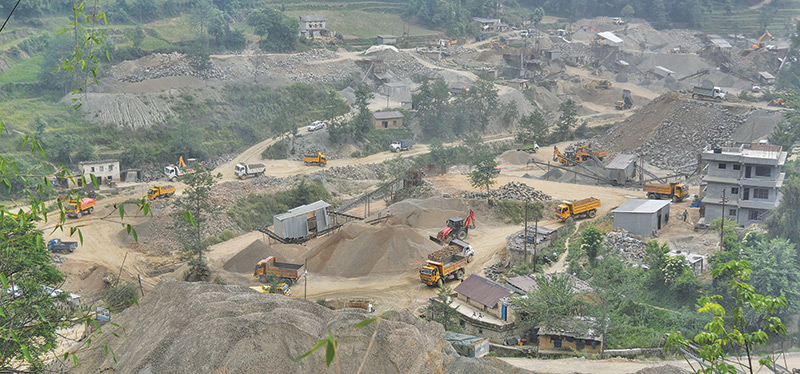
Illegal crushers allowed to run temporarily as construction projects come to halt

The government, however, has set a condition that illegal crusher plants have to be registered and pay taxes by mid-July.
- PAWAN PANDEY
There are around 1,200 crusher plants across the country.  Post File Photo

KATHMANDU,
The government on Wednesday decided to allow “illegal” crusher plants to operate temporarily, setting a condition that they have to be registered and pay taxes by mid-July.
Wednesday’s Cabinet meeting took a decision to allow crusher plants to operate as the shortage of riverbed materials like sand and gravel started to hit the development works.
After the end of monsoon, the October-March period is the peak time for construction activities.
“We welcome the government decision,” said Sita Ram Neupane, president of the Federation of Nepalese Crushers and Mines Entrepreneurs’ Association. “The meeting has also decided to form a committee, including representatives from crusher plants, to formulate laws for the operation of crusher plants beginning the next fiscal year.”
“We hope the government won’t delay the formation of the committee.”Construction projects across the country have ground to a halt for lack of sand and gravel after the government shut down illegal stone crushing plants, officials said.
Work has stopped at the Rs22-billion Nagdhunga Tunnel Project, slated for completion on April 26, for 10 days, according to Madhav Prasad Adhikari, deputy project chief.
“Construction projects that require sand have stopped completely,” said Adhikari. “The contractor has claimed compensation for the stoppage, but it has not been approved yet.” As of the first week of January,
the project had achieved around 48 percent physical progress. The financial progress is 50 percent. The construction of the project began in October 2019.
Nearly 75 percent of the crusher plants across the country were shut down from the beginning of January following a circular from the Home Ministry.
The ministry, on January 4, directed the District Administration Offices to immediately shut down crusher plants involved in quarrying and processing stone, gravel and sand that were operating without registration or updated permits.
The ministry also asked the offices to investigate and immediately shut down quarrying that has continued even after the completion of various development projects for which the plants and contractors concerned were granted permission to extract stone, gravel and sand.
There are around 1,200 crusher plants across the country. Among them, 890 have been closed so far following the circular, according to the ministry.
Ministry officials say they have followed the Supreme Court’s order and directed all the factories operating illegally to close down. Operators of crusher plants have questioned the intent behind the government’s abrupt decision.
Fadindra Mani Pokharel, spokesperson for the Home Ministry, told the Post last week that the ministry had only followed the apex court’s order.
Pokharel claimed the ministry’s decision has not affected the plants that are operating legally.
The Supreme Court in June last year issued an interim order not to implement the amended provisions on the standards for extraction, sales and management of stones, pebbles and sand.
The amended standards introduced in May last year had allowed crusher plants to be set up closer to forests, human settlements, rivers, highways, religious, cultural and archaeological sites and transmission lines than before.
The Federation of Nepalese Crushers and Mines Entrepreneurs’ Association, in a statement issued last Friday, asked the government why it had implemented the order months after it was issued by the Supreme Court. “The court had issued the order on July 20, but why did the government implement it only on January 4 to affect construction work including those which were set to begin after the election?” it said.
“We would like to inform all concerned that it is against the spirit of the law for the District Administration Offices to prevent plants which have been registered in accordance with the law and hold licences from engaging in excavation, production and distribution of stones, gravel, sand and pebbles.”
Hari Kumar Pokharel, project director at Pushpalal (Mid-Hill) Highway Project, said the closure of crusher plants in recent weeks had created shortages of sand and pebbles.
“Work requiring sand and pebbles has been affected at various places,” said Pokharel. “Only those projects that have ample stocks of these construction materials are continuing work at the moment.”
Kedar Prasad Nepal, project chief of the Bridge Sector, Kathmandu under the Department of Roads, seconded Pokharel, adding, “The contractors have already submitted applications saying they will not be able to continue work due to lack of construction materials following the closure of the crusher plants.”
Chuda Raj Dhakal, project coordinator of the Road Improvement and Development Project under the Department of Roads, said work had stopped for the past seven days.
Dhakal questioned why the crusher plants that have not been declared illegal by the government too had stopped operating.
“The government has only issued a circular to shut down the illegal plants,” said Dhakal. “But it looks like the illegal plants have barred the legal ones from operating too,” he said.
The concern of the government regarding illegal excavation of sand and pebbles from the Chure region and its transportation to India is valid, but the recent circular has affected construction work across the country besides providing an excuse to slowpoke contractors to blame the delay on the shortage of materials, according to Dhakal.
Devendra Karki, former government secretary, who once headed the energy and physical infrastructure ministries, said there might be a weakness in the formation of guidelines or there may be poor monitoring, but once it goes into effect, it should be followed. “You have to follow the rule from day one. However, the rules can be amended if it is not workable.”

MONEY

Nepal to send black box of Flight 691 to Singapore

- Post Report

KATHMANDU,
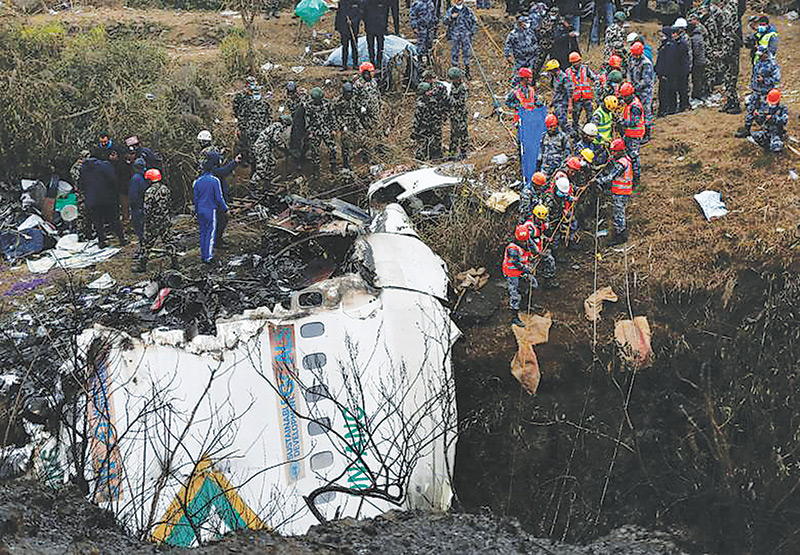
Nepal has decided to send the ‘black box’ of Yeti Airlines Flight 691, which crashed in Pokhara last week, to Singapore.
All 72 people on board were killed when the plane crashed minutes before landing at the new international airport in Pokhara, on January 15.
Officials say one body is still unaccounted for. Buddhi Sagar Lamichhane, joint secretary at the Tourism Ministry, said three members of the investigation commission would take the black box to the Transport Safety Investigation Bureau, a statutory board under the Ministry of Transport of Singapore.
The black box contains two types of recording devices—flight data recorder (FDR) and cockpit voice recorder (CVR). A flight recorder, popularly known as black box, is an electronic recording device placed in an aircraft for the purpose of facilitating the investigation of aviation accidents and incidents. They are painted in bright orange and are kept in the aircraft’s tail section, where it is more likely to survive a crash.
“We are departing to Singapore on Friday. It will take at least a week for the examination of the CVR and FDR,” said Lamichhane, the member secretary of the commission, who is also in the team. FDR preserves the engine sounds, instrumental warnings and other audio recordings during the flight while CVR preserves the sounds in the cockpit, including the conversation of the pilots.
CVR records the signals of the microphones and earphones of the pilots’ headsets and the cockpit.
According to Lamichhane, they decided to take the black box to Singapore as the two countries have a memorandum of understanding to assist in the field of aviation.
“The examination of the black box in Singapore is free of cost,” said Lamichhane. According to officials, of the 72 people, the bodies of 60 people have already been handed over to the family. Twenty-two bodies were handed over in Pokhara and the remaining were flown to Kathmandu on January 18 to carry out further investigation and postmortem.

MONEY

Winter rainfall cheer wheat farmers

Farmers who planted wheat are happy to witness winter rainfall this year, but mustard, potatoes and lentil growers are largely worried as water has inundated their farmland.
- MOHAN BUDHAYER

DHANGADHI,
Rain that lashed most parts of the western Tarai since the last few days brought cheer to farmers who had planted the wheat crop. Farmers who have planted cash crops like lentils, mustard and potato, however, are largely worried about crop loss.
“The winter rainfall is good for wheat as it needs water during the flowering stage,” said Pyara Lal Rana, a farmer of Dhangadhi-7. “The rainfall could boost wheat output.” Wheat is Nepal’s third major cereal crop after rice and maize, which is harvested in March.
Timely winter rainfall boosts the yield of wheat. Farmers in the western mountain are also happy following the continuous snowfall. Locals say that snowfall will increase apple, barley and wheat production—the key winter crops in the mountain region.
Meteorologists have forecast winter rainfall in the country from Monday, mostly in western Nepal.
Devraj Devokta, a farmer of Bardagoria at Kailali, had planted lentils on his two-and-a-half bighas of land. But, he is worried about the loss caused by the continuous rainfall.
“The rainwater has inundated the land where I have cultivated lentils,” said Devkota. “This has damaged the crop.”
The farmers requested the government to assess the losses incurred by farmers.
According to Khagendra Sharma, chief of the Agriculture Knowledge Center in Kailali, rainfall has caused damage to the lentil crop.
“The lentils in highland areas have not been affected,” said Sharma.
He said that farmers who were preparing to harvest mustard seed in western Nepal are also affected.
“We will start surveying the damage once the rain stops,” added Sharma. “Only then we can quantify the total loss.”
According to Sharma, rainfall also damaged potato farms.
“The untimely rainfall intensifies the late blight fungus in potato plants,” said Sharma. The western terai districts have been receiving rainfall for the last couple of days.
Similarly, the hilly and mountainous districts in far west Nepal have started witnessing snowfall.
Crop expert Sharma said the snowfall benefits wheat and barley plants in the mountain region.

MONEY

WHO investigating links between cough syrup deaths in children

The WHO has identified six drugmakers in India and Indonesia who produced the syrups.
- REUTERS
A logo is pictured at the World Health Organisation in Geneva, Switzerland.   REUTERS

GENEVA,
The World Health Organisation (WHO) is investigating whether there is any connection between manufacturers whose contaminated cough
syrups it has linked to the deaths of more than 300 children in three countries, a person familiar with the matter told Reuters.
Citing “unacceptable levels” of toxins in the products, the WHO is seeking more information about the specific raw materials used by six manufacturers in India and Indonesia to produce medicines linked to the recent deaths, as well as whether the companies obtained them from some of the same suppliers, the person said. The WHO has not named any suppliers.
The WHO also is considering whether to advise families globally to reassess the use of cough syrups for children in general while questions over the safety of some of these products are unresolved, the person said. WHO experts are evaluating the evidence for whether, or when, such products are medically necessary for children, the person said.
The deaths of children from acute kidney injury began in July 2022 in Gambia, followed by cases in Indonesia and Uzbekistan. The WHO has said the deaths are linked to over-the-counter cough syrups the children took for common illnesses and which contained a known toxin, either diethylene glycol or ethylene glycol.
To date, the WHO has identified six drugmakers in India and Indonesia who produced the syrups. These manufacturers have either declined to comment on the investigation or denied using contaminated materials that contributed to any deaths. Reuters has no evidence of wrongdoing by the companies the WHO has named.
“This is of the highest priority for us, to see no more child deaths from something that is so preventable,” WHO spokesperson Margaret Harris said, without commenting further on the details of the organisation’s work.
The United Nations health agency said on Monday it had widened its investigation into potential diethylene glycol and ethylene glycol contamination in cough syrups to four additional countries where the same products may have been on sale: Cambodia, the Philippines, East Timor and Senegal. It called on other governments and the global pharmaceutical industry to launch urgent checks to root out substandard medicines and improve regulation. The International Federation of Pharmaceutical Manufacturers and Associations (IFPMA) said in an emailed statement on Tuesday that its members “are already doing what the WHO is calling for”, in line with national and international guidelines.
The WHO has already issued specific alerts for cough syrups made by two Indian manufacturers, Maiden Pharmaceuticals and Marion Biotech, in October 2022 and earlier this month. It said their syrups were linked to deaths in Gambia and Uzbekistan respectively, and the alerts asked people to stop using them.

MONEY

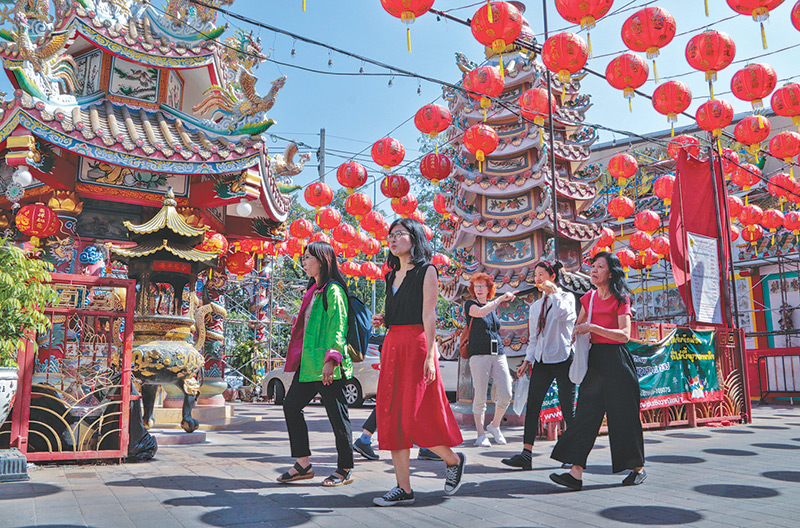
Asia hotspots quiet as Chinese tourists stay away

- ASSOCIATED PRESS
Chinese tourists tour Pung Tao Gong Chinese Temple in Chiang Mai, Thailand on Monday.   AP/RSS

CHIANG MAI,
Just a handful of Chinese visitors were posing for photos and basking in the sun this week in the market and plazas near Chiang Mai’s ancient Tha Phae Gate, one of many tourist hotspots still waiting for millions of Chinese travellers to return.
The beaches and temples of destinations like Bali and Chiang Mai are the busiest they have been since the pandemic struck three years ago, but they’re still relatively quiet.
Still, Chanatip Pansomboon, a soft drinks seller in the Chinatown district of Chiang Mai, a scenic riverside city in northern Thailand, was upbeat. He trusts that with the number of flights from China steadily increasing, it’s only a matter of time.
“If a lot of them can return, it will be great as they have buying power,” Chanatip said. The expected resumption of group tours from China is likely to bring far more visitors. For now, it’s only individual travellers who can afford to pay, with flights costing more than triple what they normally do, who are venturing abroad.
This includes people like Chen Jiao Jiao, a doctor who was posing for pictures with her children in front of Tha Phae Gate’s red brick wall, escaping the damp chill of Shanghai to enjoy Chiang Mai’s warm sun and cool breezes on her first overseas vacation since the virus surfaced in China in early 2020.
“After three years of pandemic and a severe winter, now it’s opening up,” Chen said.
“For we Chinese, the first choice is to visit Chiang Mai because the weather is warm and the people here are very warmhearted.”
In 2019, 1.2 million Chinese tourists visited Chiang Mai, generating 15 billion baht ($450 million) of tourism-related income, money sorely missed across the region as countries shut their borders to most travel.
Group tours are due to resume from February 6, but the number of tourists who will come will depends on how many flights are operating, said Suladda Sarutilawan, director of the Tourism Authority of Thailand’s Chiang Mai office. She said the hope is for about 500,000-600,000 visitors from China this year.

MONEY

Japan cuts economic view as exports to Asia weaken

Bizline

TOKYO: Japan cut its view on the overall economy for the first time in 11 months in January, as China’s Covid-19 infections and a slowdown in global demand for tech and semiconductors hurt exports, especially to Asia. The government expects the economy, the world’s third largest, will pick up going forward but Japan needs to pay full attention to the impact from China’s spreading infections after it dropped stringent pandemic curbs, the report said. The economic downgrade followed the Bank of Japan’s move last week when it slashed its economic growth projections for the next two fiscal years amid worries that slowing global demand will weigh on Japan’s export-reliant economy. “The economy is recovering moderately but some weakness is seen recently,” according to the latest report by the Cabinet Office. The authorities slashed its assessment on exports for the first time since November 2011, while it also cut its view on imports for the first time in three months. The January report said both exports and imports are “weakening recently” compared with its previous view of “almost flat” last month. (REUTERS)

MONEY

Berlin airport cancels all flights amid ground staff strike

Bizline

BERLIN: Berlin Airport cancelled all its flights on Wednesday after ground staff went on strike to press their demands for higher pay. The walk-out affected about 300 flights to and from the German capital. Labour union Verdi said its members are seeking a raise of 500 euros ($544) per month. German news agency dpa reported that employers have offered staff a one-off payment of 2,000 euros. Germany experienced its highest annual inflation in more than 70 years last year. Sharp increases in the cost of food and energy saw full-year inflation reach 7.9 percent in 2022. (AP)

Page 8
WORLD

Germany clears way for scores of tanks for Ukraine, Washington also poised

Russian envoy says tank shipments would be ‘blatant provocation’. Ukraine says tanks will be a ‘punching fist’ for democracy.
- REUTERS
A file photo shows Germany delivering its first Leopard tanks to Slovakia in Bratislava, Slovakia.   REUTERS

BERLIN/KYIV,
Germany cleared the way on Wednesday for Europe to send scores of battle tanks to Ukraine, and Washington was poised make a similar announcement—moves hailed by Kyiv as a potential turning point in the war and condemned by Moscow as escalation.
Kyiv has been calling for months for Western main battle tanks that would give its forces greater firepower, protection and mobility to break through Russian defensive lines and potentially reclaim territory occupied by the invaders.
Andriy Yermak, the head of Ukrainian President Volodymyr Zelenskiy’s administration, reminded Kyiv’s allies that it wanted tanks in the hundreds, adding on Telegram: “This is what is going to become a real punching fist of democracy.”
Germany, previously the West’s holdout, said it would send an initial company of 14 of its Leopard 2 tanks from its own stocks, and also approve shipments by other European countries.
The overall aim would be to supply Ukraine with two battalions of Leopards, typically comprising three or four companies, each with around 14 tanks.
Berlin said the first would arrive within three or four months, and that it would also provide training, ammunition and maintenance.
“This decision follows our well-known line of supporting Ukraine to the best of our ability. We are acting in a closely coordinated manner internationally,” Chancellor Olaf Scholz said in a statement.
Germany’s decision immediately paves the way for pledges from other countries that also use the same tanks.
Spain and the Netherlands said they too could send Leopards and Norway was reported to be considering the matter. Poland and Finland had already pledged to send some as soon as Berlin approved. Britain has offered a company of 14 of its comparable Challengers and France is considering sending its Leclercs.
The decision to send tanks lifts one of the last taboos in Western support: providing weapons that have a mainly offensive rather than defensive purpose.
Two sources in the United States said Washington would announce later on Wednesday that it would provide dozens of its Abrams M1 tanks.

A file photo shows US Army M1A1 Abrams tanks during a military exercise in Adazi, Latvia. REUTERS


Russia’s embassy in Germany denounced Berlin’s “extremely dangerous decision”, which it said could draw Germany into the war - something Berlin explicitly denied. Kremlin spokesman Dmitry Peskov said any US tanks sent to Ukraine would “burn like all the rest”.
Moscow says supplies of modern offensive weaponry to Ukraine will prolong the war and postpone what it says will be its inevitable victory. Anatoly Antonov, Russia’s ambassador in Washington, said deliveries of US battle tanks would be a “another blatant provocation”.
In the past week, Russia has ramped up its threats, with Dmitry Medvedev, an ally of President Vladimir Putin, saying openly that a nuclear power that faced defeat could use nuclear weapons.
Western officials who support sending the tanks have dismissed Moscow’s threats as bluster, saying Russia is already waging war at full tilt and has been deterred from attacking NATO or using nuclear arms.
“The right decision by NATO Allies and friends to send main battle tanks to Ukraine. Alongside Challenger 2s, they will strengthen Ukraine’s defensive firepower,” British Prime Minister Rishi Sunak wrote on Twitter.
Polish Prime Minister Mateusz Morawiecki tweeted a message of thanks to Scholz for a “big step towards stopping Russia”.
Last week, allies pledged billions of dollars’ worth of new military aid including hundreds of armoured fighting vehicles and troop carriers—seen as more effective for attacking when used alongside tanks to burst through enemy lines.
Ukraine acknowledged that its forces had withdrawn from Soledar, a small salt-mining town in the east that Russia had claimed to capture more than a week ago in its biggest gain for more than half a year.
The town is close to Bakhmut, a larger city that has been the focus of an intense Russian assault for weeks.
The Russian-installed governor of Ukraine’s Donetsk region said units of Russia’s Wagner contract militia were now moving forward inside Bakhmut, with fighting on the outskirts and in neighbourhoods recently held by Ukraine.
Reuters could not verify the situation there.
In the 11 months since it invaded, Russia has killed thousands of civilians, forced millions from their homes and reduced entire cities to rubble.
It says its “special military operation” was necessary to stem a security threat arising from Ukraine’s ties to the West, which it now portrays as seeking to destroy it. Kyiv and its allies say Ukraine never threatened Russia, and the invasion is a war of aggression to subdue its neighbour and seize land.

WORLD

Classified documents found at former US Vice President Pence’s home

- REUTERS
Former US Vice President Mike Pence.  REUTERS

WASHINGTON,
Documents marked as classified were discovered at former US Vice President Mike Pence’s Indiana home last week, and he has turned those classified records over to the FBI, his attorney said in letters seen by Reuters on Tuesday.
The attorney, Greg Jacob, sent a letter to the National Archives on January 18 notifying them of the documents and in a separate letter on January 22 notified the Archives that the FBI came to the former vice president’s home to collect them.
The discovery puts Pence in the company of his former boss, former President Donald Trump, and President Joe Biden after documents with classified markings were found at their residences.
Jacob said in the letter dated January 18 to the National Archives that “out of an abundance of caution” Pence had engaged outside counsel to review records stored in his home after reports about the materials found at Biden’s residence.
“Counsel identified a small number of documents that could potentially contain sensitive or classified information interspersed throughout the records,” Jacob wrote in the letter.
“Vice President Pence immediately secured those documents in a locked safe pending further direction on proper handling from the National Archives,” he said. Pence’s counsel did not review the contents of the documents once they were determined to be marked classified, the letter said.
In a separate letter dated January 22, Jacob said the Justice Department “bypassed the standard procedures and requested direct possession” of the documents at Pence’s residence.
With agreement by the former vice president, FBI agents came to his Indiana home at 9:30 pm on January 19 to collect the documents stored in the safe, Jacob said.
Biden, whose documents dated from his time as vice president, and Trump, who resisted turning over the items, leading to an FBI raid, are both facing special counsel investigations by the Justice Department over improper handling of classified materials.
During a presidential transition period, the records from each administration are supposed to be turned over to the legal custody of the US National Archives. It is unlawful to knowingly or wilfully remove or retain classified material. Failure to properly store and secure classified material poses risks to national security if it should fall into the wrong hands.
The Pence discovery may help ease the political fallout for Biden, who had criticised Trump last fall for his handling of classified materials, leading to charges of hypocrisy when documents at his former office and his garage were found. The issue has become a political liability for both men, who may face each other in a 2024 presidential race.
Republican Senator Lindsey Graham, a critic of Biden and an ally of Trump, said he did not think any of the three men were intentionally trying to compromise national security.
“But clearly we have a problem here. So hopefully when this is all said and done, maybe we’re overclassifying things, that may be part of the problem,” he said. “What became a political problem for Republicans is now a national security problem for the country.”
CNN first reported the story of the documents being found at Pence’s home.
A spokesman for former President Barack Obama told Reuters when asked about possible classified documents or searches that his office had been given a “clean bill of health” by the National Archives.

WORLD

BBC film on Indian PM Modi, 2002 riots draws government ire

Authorities are scrambling to halt screenings of the film at colleges and universities.
- ASSOCIATED PRESS
Indian Prime Minister Narendra Modi waits for the arrival of Egyptian President Abdel Fattah El-Sisi at Hyderabad house, in New Delhi, India on Wednesday.   AP/RSS

NEW DELHI, 
Days after India blocked a BBC documentary that examines Prime Minister Narendra Modi’s role during 2002 anti-Muslim riots and banned people from sharing it online, authorities are scrambling to halt screenings of the programme at colleges and universities and restrict clips of it on social media, a move that has been decried by critics as an assault on press freedom.
Tensions escalated in the capital, New Delhi, on Wednesday at Jamia Millia University, where a student group said it planned to screen the banned documentary, prompting dozens of police equipped with tear gas and riot gear to gather outside campus gates.
Police, some in plain clothes, scuffled with protesting students and detained at least half a dozen, who were taken away in a van.
“This is the time for Indian youth to put up the truth which everybody knows. We know what the prime minister is doing to the society,” said Liya Shareef, 20, a geography student and member of the student group Fraternity Movement.
Jawaharlal Nehru University in the capital cut off power and the internet on its campus on Tuesday before the documentary was scheduled to be screened by a students’ union.
Authorities said it would disturb peace on campus, but students nonetheless watched the documentary on their laptops and mobile phones after sharing it on messaging services such as Telegram and WhatsApp.
The documentary has caused a storm at other Indian universities too.
Authorities at the University of Hyderabad, in India’s south, began a probe after a student group showed the banned documentary earlier this week.
In the southern state of Kerala, workers from Modi’s Bharatiya Janata Party held demonstrations on Tuesday after some student groups affiliated with rival political parties defied the ban and screened the programme.
The two-part documentary “India: The Modi Question” has not been broadcast in India by the BBC, but India’s federal government blocked it over the weekend and banned people from sharing clips on social media, citing emergency powers under its information technology laws. Twitter and YouTube complied with the request and removed many links to the documentary.
The first part of the programme, released last week by the BBC for its UK audiences, revives the most controversial episode of Modi’s political career when he was the chief minister of western Gujarat state in 2002.
It focuses on anti-Muslim riots in which more than 1,000 people were killed.
The riots have long hounded Modi because of allegations that authorities under his watch allowed and even encouraged the bloodshed. Modi has denied the accusations, and the Supreme Court has said it found no evidence to prosecute him.
Last year, the country’s top court dismissed a petition filed by a Muslim victim questioning Modi’s exoneration.
The first part of the BBC documentary relies on interviews with victims of the riots, journalists and rights activists, who say Modi looked the other way during the riots.
It cites, for the first time, a secret British diplomatic investigation that concluded Modi was “directly responsible” for the “climate of impunity.”
The documentary includes the testimony of then-British Foreign Secretary Jack Straw, who says the British investigation found that the violence by Hindu nationalists aimed to “purge Muslims from Hindu areas” and that it had all the “hallmarks of an ethnic cleansing.”
Suspicions that Modi quietly supported the riots led the US, UK and EU to deny him a visa, a move that has since been reversed.
India’s Foreign Ministry last week called the documentary a “propaganda piece designed to push a particularly discredited narrative” that lacks objectivity, and slammed it for “bias” and “a continuing colonial mindset.”
Kanchan Gupta, a senior adviser in the government’s Ministry of Information and Broadcasting, denounced it as “anti-India garbage.”
The BBC in a statement said the documentary was “rigorously researched” and involved a wide range of voices and opinions.
“We offered the Indian Government a right to reply to the matters raised in the series—it declined to respond,” the statement said.
The second part of the documentary, released on Tuesday in the UK, “examines the track record of Narendra Modi’s government following his re-election in 2019,” according to the film’s description on the BBC website.
In recent years, India’s Muslim minority has been at the receiving end of violence from Hindu nationalists, emboldened by a prime minister who has mostly stayed mum on such attacks since he was first elected in 2014.
Critics say press freedom in India has declined in recent years and the country fell eight places, to 150 out of 180 countries, in last year’s Press Freedom Index published by Reporters Without Borders.

WORLD

Hipkins sworn in as New Zealand PM

- ASSOCIATED PRESS
New Zealand’s Prime Minister Chris Hipkins.  AFP/RSS

WELLINGTON,
Chris Hipkins was sworn in Wednesday as New Zealand’s 41st prime minister, following the unexpected resignation last week of Jacinda Ardern.
Hipkins, 44, has promised a back-to-basics approach focusing on the economy and what he described as the “pandemic of inflation.”
He will have less than nine months before contesting a tough general
election, with opinion polls indicating his Labour Party is trailing its
conservative opposition.
New Zealand Governor-General Cindy Kiro officiated the brief swearing in ceremony in front of his friends and colleagues after she earlier
accepted Ardern’s resignation.
“This is the biggest privilege and responsibility of my life,” Hipkins said at the ceremony. “I’m energised and excited by the challenges that
lie ahead.”
Carmel Sepuloni was also sworn in as deputy prime minister, the first time a person with Pacific Island heritage has taken on the role. She congratulated Hipkins and thanked him for the trust he’d placed in her.
After the ceremony, Hipkins said as an aside to reporters: “It feels pretty real now.”
Hipkins is known to many by the nickname “Chippy,” which fits with his upbeat demeanor and skills as an amateur handyman.
He served as education and police minister under Ardern. He rose to public prominence during the Covid-19 pandemic, when he took on a kind of crisis management role. But he and other liberals have long been in the shadow of Ardern, who became a global icon of the left and exemplified a new style of leadership.

WORLD

South Korea, Japan grapple with snowstorms

- ASSOCIATED PRESS

SEOUL,
Thousands of travellers swarmed a small airport in South Korea’s Jeju island on Wednesday in a scramble to get on flights following delays by snowstorms as frigid winter weather gripped East Asia for the second straight day.
Officials at South Korea’s Ministry of the Interior and Safety didn’t immediately report any major damage or injuries from subzero temperatures and icy conditions that have affected most of the country since Tuesday.
But at least eight roads and 10 sea routes remained closed as of Wednesday afternoon. About 140 homes in capital Seoul and nearby regions reported busted water pressure pumps or pipes as temperatures dipped to around minus 15 to minus 20 degrees Celsius across the mainland.
In Japan, heavy snow and record cold temperatures also brought widespread disruptions.
At least one person has died and two more deaths were being investigated in connection with the cold weather, Chief Cabinet Secretary Hirokazu Matsuno told reporters.
Thousands of people using train services in Kyoto and Shiga prefectures in western Japan were forced to stay overnight in carriages or stations, while vehicles on major roads across the country were left stranded and hundreds of flights cancelled, Kyodo News reported.
Air traffic returned to normal after hundreds of flights in and out of Jeju were grounded on Tuesday because of strong winds and snow, stranding an estimated 40,000 travellers who had visited the resort island for Lunar New Year holidays.
Around 540 flights, including nearly 70 that were temporarily added by transportation authorities in an emergency response, were scheduled in and out of Jeju on Wednesday alone.

WORLD

Two die and nine missing after cargo ship sinks off Japan

Briefing
- AGENCIES

TOKYO: Thirteen crew members were rescued from a cargo ship that sank off southwestern Japan early on Wednesday during fierce winter winds but two have since died, the coast guard said. Rescuers were searching for the remaining nine. The 6,651-tonne Hong Kong-registered “Jintian” issued a distress call late on Tuesday, the Japan Coast Guard said. Media reported a person on the ship said it was listing and taking on water, and later reports said the 22 crew—all Chinese or Myanmar nationals—had transferred to lifeboats. There was no immediate word on what caused the vessel, which was carrying lumber, to capsize. A Coast Guard spokesperson said winds were strong at the time. The Coast Guard immediately sought assistance from patrol ships and aircraft in the vicinity west of Nagasaki, government spokesman Hirokazu Matsuno said.

WORLD

London police sorry after another officer guilty of sex crimes

Briefing
- AGENCIES

LONDON: The head of Britain’s biggest police force on Wednesday apologised after another of his officers was convicted of sex crimes, and admitted that on average two to three officers faced criminal charges in court every week. The Metropolitan Police is battling to restore its reputation after a serving officer was jailed for life for the kidnap, rape and murder of a young woman in south London in 2021. Earlier this month another officer admitted 24 rapes and a string of other sex offences, prompting fresh questions about lax vetting procedures at the London force. In the latest case, police constable Hussain Chehab on Tuesday admitted having sex with a 14-year-old girl and possessing indecent images of children.

WORLD

India invites Pakistan’s foreign minister for May meeting

Briefing
- AGENCIES

MUMBAI: India has invited Pakistan’s foreign minister to a meeting of the Shanghai Co-operation Organisation (SCO) that it is hosting in May, Indian media reported on Wednesday, signalling a possible thaw in relations between the nuclear-armed rivals. The invitation came days after Pakistani Prime Minister Shahbaz Sharif called for talks with India over all outstanding issues, including the disputed Kashmir region. The SCO comprises China, India, Russia, Pakistan and four Central Asian states.

Page 9
SPORTS

Task force suggests cricket body scrap Nepal T20 deals with Seven3Sports

National Sports Council probe committee concludes that the cricket governing body breached laws while selling the Nepal T20 League rights to the Indian sports management company Seven3Sports.
- Sports Bureau
National Sports Council Member Secretary Tanka Lal Ghising (centre) receives the report from the task force in Kathmandu on Wednesday.  Photo Courtesy: NSC

KATHMANDU,
A task force formed to investigate the controversy surrounding the scandalous Nepal T20 League has concluded that the agreement reached between the Cricket Association of Nepal and Seven3Sports, an Indian sports management company, needs to be scrapped immediately.
The five-member probe committee led by National Sports Council (NSC) Executive Committee Member Ekindra Bahadur Kunwar, submitted its report to NSC Member Secretary Tanka Lal Ghising on Wednesday.
“The agreement reached with the foreign company (Seven3Sports) breaches the provisions of section 28 and section 44 (2) of the National Sports Development Act 2077 BS,” the NSC said in a press release.
“It is, therefore, concluded that the agreement related to Nepal T20 League that was executed against the prevalent Acts and Rules remains subject to immediate scrapping,” it adds.
The Nepal T20—the first ever franchise cricket league of the country—has been rocked by spot-fixing scandals and pay issues.
The Central Investigation Bureau (CIB) of Nepal Police Tuesday revealed involvement of 10 individuals—including one Nepali cricketer and four Nepali middlemen—in the spot-fixing during the league that was held between December 24, 2022 and January 11, 2023.
Police on Monday arrested veteran cricketer Mehboob Alam and emerging star Mohammad Aadil Alam (Aadil Ansari) on spot-fixing charges. According to CIB Superintendent of Police Sanjay Singh Thapa, Mehboob had approached at least two players with a fixing proposal, while Aadil was involved in spot fixing in at least two matches. The cricketers duo were remanded for five-days for further investigation on Tuesday.
The task force was formed after the revelations of spot-fixing by Kathmandu Knights captain Gyanendra Malla and league’s commentator Sachin Timalsena shook Nepal T20.
The tournament was mired in controversy even before its inauguration after its organiser CAN sold the tournament’s rights to Seven3Sports for eight years for Rs330 million without competitive bidding.
The Section 44 (2) of the National Sports Development Act states that sports associations should obtain permission from the government through NSC before reaching any sort of deals with foreign governments, organisations or individuals. Even though CAN initially claimed to have completed the necessary process before reaching the deal with Seven3Sports, the NSC and the ministry denied permission to the country’s cricket governing body.
Seven3Sports has also been hot on heels with the CIB for its possible involvement in the spot fixing.
According to CIB sources, Seven3Sports Managing Director Jatin Ahluwalia allegedly masterminded the scandal and the arrested cricketers had operated as per instructions from Ahluwalia, who fled Nepal in the middle of the tournament after rumours of match- and spot-fixing made rounds.
None of the six teams have made full payment to the cricketers and there is also lack of transparency in team ownership as half of the owners are still unknown.

SPORTS

Djokovic, Sabalenka roll into semi-finals

The Serb crushes Russian fifth seed Rublev 6-1, 6-2, 6-4. The Belarusian defeats Croatia’s Vekic 6-3, 6-2.
- AGENCE FRANCE-PRESSE

MELBOURNE,
Novak Djokovic was two wins away from a 22nd Grand Slam crown after bulldozing into the Australian Open semi-finals on Wednesday, while Aryna Sabalenka was equally impressive in reaching the women’s last four.
Serbia’s Djokovic delivered a masterclass to crush Russian fifth seed Andrey Rublev 6-1, 6-2, 6-4 on Rod Laver Arena and set up a meeting with Tommy Paul for a place in Sunday’s final.
Djokovic’s quest to go level with great rival Rafael Nadal on a leading 22 major titles carries an air of inevitability. The 35-year-old struggled with a hamstring injury in the early rounds at Melbourne Park but was dominant during his fourth-round demolition of Alex de Minaur and was equally clinical against the outclassed Rublev.
Victory for the red-hot favourite propelled him into a 44th Grand Slam semi-final to close the gap on Roger Federer’s all-time record of 46.
Anything other than a rampant win for Djokovic against unseeded Paul would amount to a massive upset, albeit at a tournament that has seen numerous shocks in the men’s and women’s draws.
Paul defeated his fellow American Ben Shelton 7-6 (8/6), 6-3, 5-7, 6-4 to reach his first major semi-final. But former world number one Djokovic, who can return to the top of the rankings if he wins the Australian Open for a record-extending 10th time, will be a whole new prospect.
Paul, ranked 35, and the Serb great have never played each other before.
The other semi-final is between third seed Stefanos Tsitsipas and Russian 18th seed Karen Khachanov.
Sabalenka set up a semi-final with surprise-package Magda Linette after once again displaying the kind of form and finesse that have made her favourite for the women’s title.
The Belarusian fifth seed defeated Croatia’s Donna Vekic 6-3, 6-2 as she closes on a first Grand Slam title.
The match was closer than the score suggested, but Sabalenka is playing scintillating tennis—she is yet to drop a set so far this year.
Sabalenka will play unseeded Linette for a place in Saturday’s final after the Pole marched into her first major semi-final at the age of 30.
Linette stunned former world number one Karolina Pliskova 6-3, 7-5 to continue flying the flag for Poland after the shock exit of world number one Iga Swiatek.
Two-time Melbourne champion Victoria Azarenka, also from Belarus, will face Moscow-born Kazakh Elena Rybakina in the other semi-final.
Both women’s semi-finals are on Thursday.

SPORTS

Prajapati and Adhikari to battle in NPGA Match Play title clash

- Sports Bureau

KATHMANDU,
Dinesh Prajapati and Ramesh Adhikari advanced into the final of the Surya Nepal NPGA Match Play, the third event under the Surya Nepal Golf Tour 2022-23, at the Royal Nepal Golf Club on Wednesday.
Seventh-ranked Dinesh defeated eighth-ranked Dhana Bahadur Prajapati 2&1, and No 13 Adhikari beat No 10 Bhuwan Kumar Rokka 2&1 in the semi-finals. Dinesh and Adhikari will fight for the title in a 36-hole contest on Thursday, while Dhana and Rokka will play for third place over 18 holes.
Earlier, top seeds were knocked out in the quarter-final matches. No 1 Sukra Bahadur Rai, No 2 Bhuvan Nagarkoti, third seeded Jayaram Shrestha and fifth-ranked Rabi Khadka faced defeats.
Rokka stunned top seed Rai 3&1, while Dhana ousted defending champion Nagarkoti 3&2. Adhikari saw off Khadka 3&2 and Dinesh recorded a 3&2 victory over Shrestha.
The tournament carries a cash purse of Rs250,000. The winner will receive Rs60,000, while the runner-up will get Rs42,000.
Third and fourth placed pros will earn Rs32,000 and Rs24,000 respectively.
Four losing quarter-finalists will get Rs11,000 each, while the eight pros who were eliminated from the first round will receive Rs 6,000 each.

SPORTS

Susma Tamang wins historic boxing silver in Thailand

- Sports Bureau
(From left) Nepal’s Susma Tamang, Uzbekistan’s Fozilova Farzona, Thailand’s Yodwaree Thipsatcha and Mongolia Byeisyenbyei Janarguli pose with their medals after the 48 kg women’s final in Bangkok, Thailand on Wednesday.   Photo source: Asian Boxing Confederation/Facebook

KATHMANDU,
Susma Tamang won a silver medal in the ASBC Asian U-22 Men and Women Boxing Championships in Bangkok, Thailand on Wednesday.
Tamang lost the women’s 48 kg weight category final 5-0 to defending champion Fozilova Farzona of Uzbekistan at the Huamark Indoor Stadium.
Despite the loss, Tamang will return home on a high after becoming the first Nepali to reach the final and secure silver in an Asian-level championship in Nepali boxing history.
Tamang had defeated her Mongolian opponent Byeisyenbyei Janarguli in the third round based on a referee spot contest for a historic win.
Janarguli and Thailand’s Yodwaree Thipsatcha won bronze medals.
Uzbekistan dominated the women’s category capturing five of the 11 gold medals.
Host nation Thailand became second with three golds while Kazakhstan claimed two and Mongolia nabbed the other one.

MEDLEY

Horoscope

ARIES (March 21-April 19) ****
Watch out for sharp tongues, conflict, and miscommunication this morning, dear Aries, as the moon squares off with chatty Mercury. This cosmic climate could also present you with a few mental blocks, so you may want to keep a notepad handy.

TAURUS (April 20-May 20) ***
Your intuition will be sharp this morning, dear Taurus, as the Aries moon connects with perceptive Mercury. Unfortunately, this newfound sensitivity could become overwhelming, especially if surrounded by high emotions and opinionated companions. Lean into your spirituality.

GEMINI (May 21-June 21) *****
The online realms may be a triggering place this morning, dear Gemini, as the Pisces moon squares off with Mercury, your planetary ruler. Try not to get sucked into doomsday news stories or social media conflicts, or you could end up souring your mood.

CANCER (June 22-July 22) ***
You may feel temperamental and emotionally closed off this morning, dear Cancer, as the Aries moon forms a harsh square with Mercury. Try not to snap at others if tensions rise, though it may be wise to avoid socializing.

LEO (July 23-August 22) ****
Your penchant for daydreaming will be amplified today, dear Leo, as the moon continues its journey through Aries and your solar ninth house. Unfortunately, a harsh connection between Luna and Mercury could burst your bubble. Don't be afraid to ask for support should you need it.

VIRGO (August 23-September 22) ***
It'll be difficult to conceal your frustrations today, dear Virgo, as the Aries moon squares off with opinionated Mercury. It'll be important that you choose your battles wisely in order to avoid power struggles. Give yourself a moment of solitude.

LIBRA (September 23-October 22) ****
Take some time to appreciate and honour the people who raise you up today. Remind yourself that it's okay to lean on others for support, though you'll need to be willing to return the favour. Creative ideas will flood your psyche.

SCORPIO (October 23-November 21) ***
There will be no shortage of distractions this morning, sweet Scorpion, as the Pisces moon squares off with cerebral Mercury. Do your best to stay on task right now. Luckily, a helping hand from Chiron will provide you with the motivation to get organized.

SAGITTARIUS (November 22-December 21) ***
Don't let your ego talk you into overspending this morning, dear Archer, as the Aries moon squares off with Mercury. This celestial exchange could temporarily dull your wits, making it important that you stay grounded in logic.

CAPRICORN (December 22-January 19) ****
You should feel confident about the future. Get creative with your new year's resolutions, especially where creative goals are concerned. Unfortunately, there’s a danger that you could get caught up in focusing on the negative.

AQUARIUS (January 20-February 18) ***
Intrusive thoughts, self-doubt, and succumbing to fears could hold you back this morning, dear Aquarius. You may also want to be mindful of who you trust and avoid believing everything you hear. Luckily, a supportive energy from Chiron can help you find clarity.

PISCES (February 19-March 20) ***
You'll have a chance to connect with the people around you in meaningful ways. Though you're used to playing the role of a wallflower, now would be a good time to open up to let others see who you are.

Page 10
CULTURE & LIFESTYLE

It’s especially important for women to read

Sumitra Manandhar Gurung, who has been leading women empowerment programmes for decades, talks about her reading habits and the general importance of reading.
- Post Report
Post Photo: Keshav Thapa

Born in a Newar household that held education in high regard, Sumitra Manandhar Gurung as a child was always encouraged to read. Manandhar, growing up in a joint family in Kathmandu, did not have much chores to tend to, and that is when she developed a habit of reading. A pioneer in the microfinance sector, Manandhar has been leading women’s empowerment programmes and working on women’s issues for decades. She is the founder and former CEO of Mahila Sahayatra Microfinance Bittiya Sanstha. Manandhar was also involved in the 2015 constitution-making process in Nepal where she focused on the inclusion of marginalised groups.
In this interview with the Post, Manandhar shares her fondness for reading and talks about how only a few people have the habit of reading.

How did you start reading?
I was in my early teens when I started reading books for fun. My uncle, the youngest brother of my father, read a lot of English comic books. He wouldn’t share those books saying it was not meant for the kids. I remember stealing those books and reading them. The illustrations in the comic books are what made me interested in reading and what helped me understand the English language.
Unfortunately, that wasn’t the case for books in Nepali. There were limited Nepali books, let alone comic books that attracted young readers. This is a reason why I am not as proficient in Nepali.

Do you believe reading helps a person to grow? How?
It definitely does. Reading helps you understand different perpectives, and societies so, it makes you more compassionate. It helps one get over narrow orthodox beliefs and acts as a window to the outside world. This is why reading is important for everyone and it is especially important for women and children. Since it is women who nurture the family, look after everyone and spend the most time with children, when women understand different perspectives, it passes down to their children. That understanding can either come from experience or reading. And because the majority of Nepali women will never get the opportunity to visit different countries and learn about the world, reading is the fastest medium to gain such knowledge.
However, in Nepal, reading has always been a luxury limited to affluent families and societies. People living in rural areas are still struggling to get basic academic books for the children. And in our social structure, where women are often too busy with their house chores, they rarely get the free time to pursue reading.

You are also the author of ‘Beyond the Eco-crisis’, an ethnographic study exploring the relationship between the land and ethnographic practices. Do you prefer readeing or writing?
I love doing both. It is after reading that one wants to write. I don’t get enough time to read and write nowadays but I try do these as much as I can during my free time.
Although I spend a lot of time looking into this subject, over time, I have also realised that reading and writing about women empowerment or women’s issues alone is not enough. It is essential to carry out practical actions to see some change. That is what I have been trying to do through my work as the CEO of Mahila Sahayatra Microfinance Bittiya Sanstha.

What kind of books do you prefer to read?
Your preference for reading evolves as you live through different stages of your life. I also believe that our preferences for books are biological—it depends on what you and your body are going through. I started out reading comic books in my early teens. After that, I started reading books of prose poetry, and moved on to romance novels. Then, I read a lot of books on social structures that gave me a closer look in to the realities of the society we live in. I have been reading biographies and autobiographies lately, as they keep me motivated. Since I am also planning to write reflections on the life I led, reading them has also given me insights into writing one too.

What are some books you would recommend to our readers?
As of now, I would like to recommend ‘What Went Right’ by Mark Liechty because while everybody is pointing out problems in Nepal, Lietchy looks in to the success stories of Nepal’s hydropower project. Another would be, ‘Long Walk to Freedom’ by Nelson Mandela which is an autobiography that delves deeper into the struggles of leading people and their positions. Likewise, ‘Lifelines’ by George Zeidenstein, is Zeidenstein’s memoir. He was a civil rights lawyer and had the opportunity to work in Nepal as well. Another autobiography would be ‘Bhava Thanha: An Autobiography’ by AT Ariyaratne, who is the founder of the Sarvodaya Shramadana Movement of Sri Lanka, which envisioned a society with no poverty and no affluence. I would also like to suggest ‘The Vulgarity of Caste’ by Shailaja Paik and ‘Kathmandu Upatykaka Sanskritik Chhirka Mirka’ by Bhuwanlal Pradhan. These two books are about the social structure of our country, which I believe are quintessential reads.

CULTURE & LIFESTYLE

2023’s most anticipated screen adaptations

The Kathmandu Post brings to you four highly-awaited book-to-screen adaptations that are coming out this year.


Wonka

Roald Dahl’s uber popular children’s book ‘Charlie and the Chocolate Factory’ has already been made into two films (in 1997 and 2005). Now we have another movie coming out based on the same book but this one covers a different perspective. The upcoming ‘Wonka’ will show us a young Willy Wonka and how he met the Oompa Loompas.
Directed by Paul King, the movie stars Timothée Chalamet as the titular character alongside Olivia Coleman and Sally Hawkins.


Are You There God? It’s Me, Margaret

The 1970 novel ‘Are You There God? It’s Me, Margaret’ by Judy Blume is finally getting adapted into a film. Categorized as a coming-of-age comedy-drama, the movie will follow 11-year-old Margaret, played by the talented Abby Ryder Fortson, as she handles making new friends after moving to the suburbs and her turbulent feelings as an adolescent.
Fans of the ‘Mean Girls’ star Rachel McAdams will see her take on the role of Margaret’s mother, Barbara Simon who is a painter. The film is directed by Kelly Fremon Craig.


The Color Purple

The Color Purple is an upcoming musical drama directed by the Ghanaian rapper, record producer, author, artist and filmmaker Blitz Bazawule. Based on the 1982 novel of the same name by Alice Walker who also won a Pulitzer Prize for it, the movie is a must-watch release. Covering heavy topics like domestic and sexual abuse, and the silence that surrounds it the film will be released near the end of the year.
The Color Purple boasts a stellar cast including Oprah Winfrey, Whoopi Goldberg and Danny Glover.


A Man Called Otto

A Man Called Otto is based on Fredrik Backman’s internationally best selling novel from 2012, A Man Called Ove. The story focus on Ove, a grumpy old man who plans on taking his own life after retiring from his job and losing his wife. He meets the sharp-witted Marisol after her family moves into the house next to him and they form an unlikely friendship.
The movie directed by Marc Foster will star Tom Hanks as Otto and Mariana Treviño as Marisol alongside Rachel Keller, Manuel Garcia-Rulfo and Kailey Hyman.

CULTURE & LIFESTYLE

Getting together to read

The ninth edition of Reader’s Meet is happening today.
- Post Report
Photo Courtesy: Russian House in Nepal/Facebook

Kathmandu
The Russian House in Nepal is hosting the ninth edition of their Reader’s Meet today.
Reader’s Meet is a book reading and experience sharing program conducted in collaboration with Half Tone Design Private Limited. The last Reader’s Meet session happened on December 29, 2022.
The event will feature an interactive group discussion program too. According to Half Tone Design, the main purpose of the program is to build reading habits and share experiences.

What:    Reader’s Meet
Where:    The Russian House in Nepal, Kamalpokhari, Kathmandu
When:    January 26
Time:    2:30-3:00pm