Maoists cotton to Congress, as Dahal, Oli size each other up
Maoist Centre entrusts Chairman Dahal to make the final call on presidential candidate.
- TIKA R PRADHAN
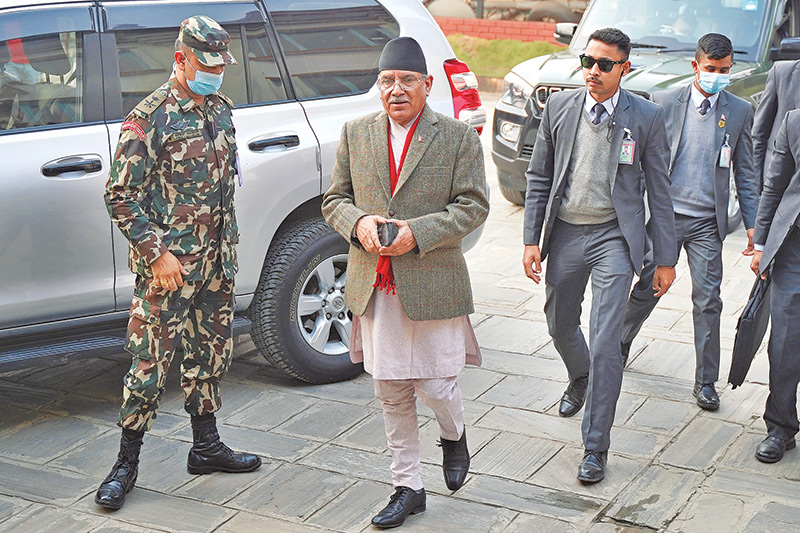
Prime Minister Pushpa Kamal Dahal (centre) at Maoist Centre headquarters on Monday. Post Photo
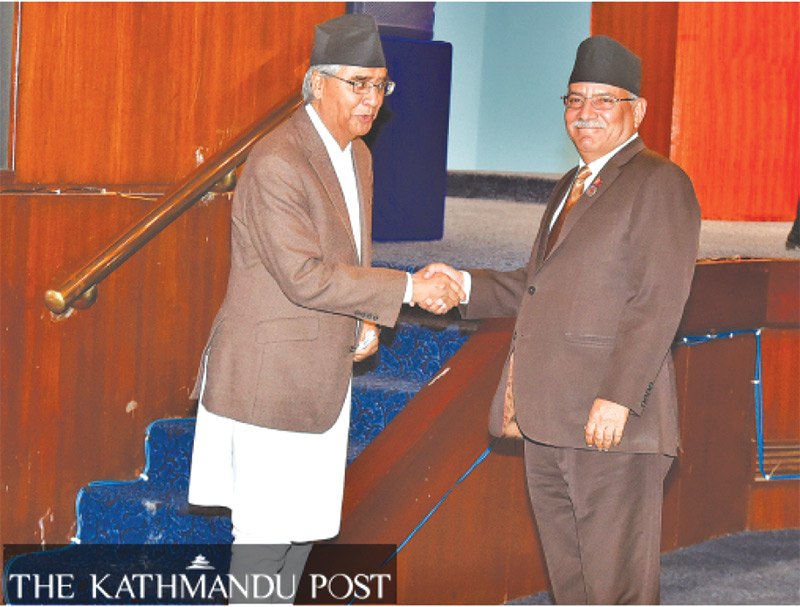
KATHMANDU, Even with just four days to go for the filing of nominations for the presidential election, the CPN (Maoist Centre) is still keeping its cards close to its chest. There have been no clear indications about whom it will support as the new head of state, even though the party seems to be inching closer to the Nepali Congress on the issue. Leaders of the Maoist Centre claim the party will ultimately support a Congress candidate but is still weighing its options. The Congress, according to some Maoist Centre leaders, has proposed that Dahal can continue as prime minister for a full five-year term in return for the Maoist Centre’s support for a Congress nominee for President. A meeting of office bearers of the ruling party on Monday evening decided to seek national consensus on the upcoming presidential polls scheduled for March 9 till the very end and entrusted party chair Pushpa Kamal Dahal to make the final call. “Today’s meeting has decided to seek a national consensus even while trying to save the existing ruling coalition,” said Dinanath Sharma, secretary of the party. “And the party trusts the party chair and prime minister to do the right thing.” Maoist Center Vice-chair and Spokesperson Krishna Bahadur Mahara said the meeting decided to make republicanism, federalism, secularism, inclusiveness and safeguarding of the constitution as well as the completion of the peace process major bases to forge such a consensus. Talking to reporters after the meeting held at party headquarters in Koteshwar, Mahara said his party was hopeful that national consensus could be achieved by Friday. As per the election schedule published by the Election Commission, parties will have to file nominations for the presidential polls on Saturday. Prime Minister Dahal held a discussion with top Nepali Congress leaders on Sunday during which the latter again asked for Maoist Centre’s support in the upcoming presidential election. On Sunday, CPN (Unified Socialist) chair Madhav Nepal and Janata Samajbadi Party chair Upendra Yadav held talks with the prime minister during which they suggested the Maoist Centre elect the President through consensus. Dahal also met Rastriya Swatantra Party chair Rabi Lamichhane on Monday morning. Dahal again met Nepal before he went to Koteshwar to attend his party’s office bearers’ meeting. “It’s the prime minister’s duty to forge consensus. I asked him to take the initiative for it,” Nepal told reporters following his meeting with Prime Minister Dahal at Singha Durbar. “We want strong cooperation. I advised him that we should all go on a long trip together and make attempts for national consensus.” Meanwhile, UML leaders have been waiting for the Maoist Centre’s decision. Party chair KP Sharma Oli has been telling his party colleagues that the existing coalition may break “as foreign interference has intensified”. He was referring to the recent visit of Indian foreign secretary Vinay Mohan Kwatra. During the party office bearers’ meeting, Dahal had briefed them that Oli had met Baburam Bhattarai, Unified Socialist chair Madhav Nepal and its senior leader Jhalanath Khanal separately and had told them that the UML would be happy to support any one of them as presidential candidate. Oli, according to leaders, has proposed Nepal to reunite their parties and become the country’s President. “Oli and Dahal know each other more than anybody else, and each is trying to anticipate what the other is likely to do,” said Ganesh Sah, secretary of the Maoist Centre. “It seems that they both want to build pressure on one another.” Leader Sah said Dahal won’t accept an active UML leader as President and Oli knows that he would suffer the most from the ruling coalition’s unraveling. “The trump card is now with Dahal, which he will continue to hold for a few more days,” Sah told the Post. While addressing his party’s function at Pokhara on Monday, Dahal said the parties that forged the 12-point agreement in 2005 should join hands during the presidential election as well. According to some Maoist leaders, he was hinting at the Nepali Congress, which was one of the parties to the peace process, while KP Sharma Oli was yet to be the UML chief. A team of senior Nepali Congress leaders led by party president Sher Bahadur Deuba met the prime minister on Sunday. In attendance were senior leader Ram Chandra Poudel, Vice-president Purna Bahadur Khadka, General Secretary Gagan Thapa and former general secretary Krishna Prasad Sitaula. These meetings have apparently helped lay a strong foundation for a Congress-Maoist Centre alliance.
HOME PAGE
‘National consensus’ is again in vogue. Does it make sense?
Most observers say the term is applicable only in national emergencies and seldom in peacetime politics.
- NISHAN KHATIWADA
KATHMANDU, The ruling alliance is divided over who should be the new head of state, with the CPN-UML laying claim to the presidential post while the Maoist Centre continues to root for a consensus-based President. Speaking in Kathmandu on Sunday on the occasion of Democracy Day, Prime Minister Pushpa Kamal Dahal said broad national consensus is the need of the day. Similarly, at a function in Sindhuli the same day, Maoist Centre vice-chair Agni Sapkota said the next President cannot be elected without national consensus. On the other hand, UML leaders term their coalition partner Maoist Centre’s sudden change in tone as ‘duplicity’ and an ‘afterthought’ and claim that the Maoists were earlier in favour of giving the presidential post to a UML nominee. Political observers say the idea of national consensus is meaningless in normal-time politics, and the term is brought up time and again only to quench certain politicians’ thirst for power. “You opt for a national consensus only when there is a serious political crisis. You don’t invoke it just to get to power, as some political leaders are doing now,” said Chandra Dev Bhatta, a political scientist. According to Bhatta, national consensus becomes essential during disasters such as devastating earthquakes and pandemics. “High-profile political leaders cannot start shaping national politics in line with their self-interests.” Political commentator CK Lal agrees. “The term national consensus is invoked in war-like conditions. During peacetime, its utility is limited,” said Lal, who is also a columnist for the Post. Currently, UML chief KP Sharma Oli and the party’s leaders have been reminding the Maoist Centre of their agreement that was purportedly reached last December while appointing Pushpa Kamal Dahal as the prime minister. Prime Minister Dahal and his party, the Maoist Centre, have been saying that there should be a national consensus on a presidential candidate as they fear appointing a UML candidate to the top post will give the party complete control of national politics—especially with the post of Speaker already in its bag, and Oli supposed to take over as prime minister after two and half years. Nepali Congress, on the other hand, has also been claiming the President’s post. Dahal’s insistence on a President elected through national consensus has given them hope. “Bringing up the term national consensus merely to distribute state benefits among parties and politicians will do no good to our fledgling democracy,” Bhatta said. The term national consensus was much touted when Dahal backed out from the government in 2009 and when Jhalanath Khanal resigned as a prime minister in 2011. Many politicians and political parties used the term afterwards as well. Now, it has been making headlines again. Jhalak Subedi, a political analyst, echoed Bhatta and Lal, saying, “In regular political process, the use of the term national consensus is wrong. Issues should be sorted out through election, and the parliament should be allowed to play its role effectively. Parties should field their candidates, and try to garner votes. That will itself be a kind of consensus,” Subedi said. The political parties that consider themselves relatively weak may try to increase their bargaining power by bringing up the issue of national consensus in normal times, added Lal. Bhatta asserted that in politics, there should be space for criticism and opposition. “What will happen if all parties are in power?” Political experts don’t recall many instances in Nepal’s political history when the idea of national consensus was successful or even useful. According to Bhatta, the actual national consensus had been reached following the 2006 people’s movement when the political parties needed to steady the rocking ship of the state. Coming to today, the Election Commission has scheduled the Presidential election for March 9 in order to elect the third President of the republic. Incumbent President Bidya Devi Bhandari will retire on March 13. Political analyst Indra Adhikari, however, offers a different logic. She believes national consensus has become a necessity in events like the presidential election. However, according to her, as consensus among all political forces is impossible, we can have such a consensus among major parties, which is enough. “Previous Presidents’ failure to rise above partisan interests led to problems. If a new President is elected through national consensus, then no political party can misuse the top post,” Adhikari added.
HOME PAGE
When will women lead big political parties?
Bibeksheel Sajha recently elected Samikchya Baskota as party chief while Ranjita Shrestha heads another new party, the Nagarik Unmukti Party.
- Purushottam Poudel
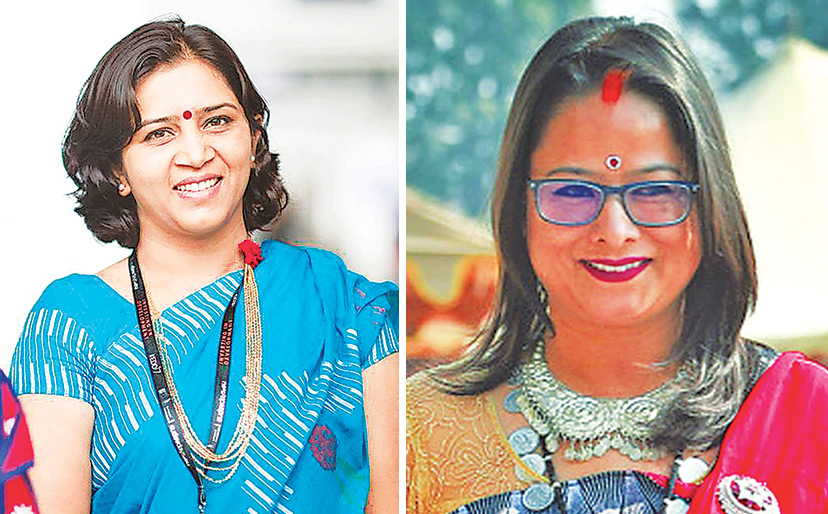
Samikchya Baskota (left) and Ranjita Shrestha. Post File Photo
KATHMANDU, While women leaders in traditional political parties are confined to powerless positions, new parties like the Bibeksheel Sajha and the Nagarik Unmukti are showing the way to the major forces. Bibeksheel Sajha has elected Samikchya Baskota as party chief whereas another female leader Ranju Darshana was elected as the general secretary of the party at its general convention on February 11. Although a few women leaders have led their respective parties in the past, Bibeksheel Sajha’s case is different, as the emergent party has elected two women leaders in its two most powerful positions from the general convention. Though not elected, Ranjita Shrestha is another woman leader who heads a party. Nagarik Unmukti under the leadership of Shrestha won three first-past-the-post (FPTP) seats in the House of Representatives in the November polls, the first general election the party contested. Bibeksheel Sajha, which fought the November election under the command of Baskota, however, could not win a single seat in the federal parliament. The involvement of women in politics in Nepal has a long history. Though women were successful in making it to top state posts such as the President, the Speaker, and the Chief Justice, their representation in leadership positions in political parties remains poor. At one time in 2016, women held the state’s three top positions—Bidya Bhandari as the head of the state, Sushila Karki as Chief Justice, and Onsari Gharti Magar as Speaker of the lower house. However, women have yet to occupy the top executive post (prime minister) or the top post of any major party. The Nepali Congress, the CPN-UML and the CPN (Maoist Centre) are yet to elect a woman leader even as general secretary, the second most powerful position, let alone as party chief. But they have elected or nominated women leaders as party vice-presidents. Women leaders of other parties say they take it as a matter of pride when they see female leaders in the driving seats of the Bibeksheel Sajha and Nagarik Unmukti parties. “The election of women leaders in powerful positions will motivate female leaders from other parties to challenge the status quo,” Nepali Congress deputy general secretary Maha Laxmi Upadhyaya told the Post. Nepali women leaders have always actively participated in politics. They, however, are consistently underrepresented, particularly in key positions. “Even while there are capable women in the parties, they are not elevated to leadership positions because of the patriarchal mindset,” Samikchya Baskota, newly-elected president of the Bibeksheel Sajha, said. “Lack of acceptance of women as leaders makes it difficult for them to progress in politics.”
It has been nearly eight decades since Nepali women started playing key roles in political and societal changes in the country. In 1947, the Nepal Women’s Association was established under the leadership of Mangaladevi Singh, Sahana Pradhan and Sadhana Adhikari. This organisation sparked a political awakening among women. They played a lead role in ensuring voting and educational rights for women. The Congress gave a ticket to a female candidate, Dwarika Devi Thakurani, in the first parliamentary elections of 1959. Also, the vice-chair of the upper house, the Mahasabha of Nepal’s first parliament formed in 1959, Kamal Rana was a woman. She was elected by beating a male candidate in voting while the chair of the assembly was chosen by consensus. Thakurani was appointed a minister in the BP Koirala-led Cabinet of the first elected government and became Nepal’s first female minister when she was appointed deputy minister of health and local self-governance. Despite the fact that women have been able to hold ministerial positions for over 60 years, Nepal is yet to elect its first female prime minister. Shailaja Acharya and Sujata Koirala, two leaders in the Congress, and Sahana Pradhan of the UML, have progressed to the position of deputy prime minister, but no woman has attained the top executive post. Why? Women leaders claim that they have fewer opportunities to participate in political activities. If we consider the November elections, less than 10 percent of women were candidates under the FPTP electoral system. Among 2,412 FPTP candidates for the House of Representatives, only 225 (9.33 percent) were female, while over 90 percent (2,187) were male. There are exceptions, but the statutes of major political parties allow only their executive head or parliamentary party leader to become the country’s executive head, say women leaders. Women leaders also blame lack of women leaders holding executive positions in traditional parties for their absence from the country’s executive positions. When women are rising to the top of Nepal’s newly-formed political parties, why are female leaders in traditional political parties being denied top positions despite their decades-long contribution and experience in national politics? Do female leaders lack skills to run the organisation or is there something wrong with the party’s organisational structure that does not support women? For Congress Deputy General Secretary Upadhyaya, the structural shape of the parties is not the only reason women leaders haven’t been able to rise to positions of leadership. “A traditional party is one where the leaders have a long history of involvement in the party,” Upadhyaya said. “Who has contributed more to the party over time is another issue that comes up while discussing leadership. A leader must thoroughly grasp the party’s institutions in order to succeed in its election process. With a new party, that might not be the case.” UML leader Binda Pandey’s understanding of this matter is slightly different. “As female leaders have accompanied male leaders in the new parties right since the day of the party’s formation, claiming and accepting leadership has become easier,” Pandey told the Post. “If Rabindra Mishra and other party leaders hadn’t split from Bibeksheel Sajha, Samikchya Baskota might not have been in the position to lead the party,” Pandey added. “We have historical evidence that when a party is in difficulty, female leaders are given party leadership.” But Baskota rejects Pandey’s argument. “Our party came into existence to establish alternative politics. It never believed women should not be promoted to party head,” Baskota told the Post. “We wouldn’t have had trouble climbing to the party’s top position, even if Rabindra Mishra and other senior leaders were still in the party.” Earlier, Sahana Pradhan was chair of the left alliance during the 1990 democratic movement. Similarly, Pradhan was given the position of party chief of the newly-formed party CPN (ML) in 1998, which was formed after a split in the UML. Additionally, Pampha Bhusal, who is the Maoist Centre’s vice-chair at the moment, was the chairperson of Samyukta Janamorcha after the second parliamentary elections in 1991, before Baburam Bhattarai replaced her. According to UML leader Pandey, a party’s political history could explain why women have not succeeded in rising to leadership positions in traditional outfits. There was no conducive atmosphere for women to organise and engage in politics at the time of the formation of the traditional parties. At that time, there were men in most positions in the party hierarchy. Following the people’s movement of the 1990s, women started being given the responsibilities as office bearers in political parties. The largest party in Parliament, the Congress, has Maha Laxmi Upadhyaya as the deputy general secretary whereas the other old party and the second-largest party in Parliament, the UML, has Asta Lakshmi Shakya as vice-chair and Padma Aryal as party secretary. In the third-largest CPN (Maoist Centre), Bhushal has recently been promoted to the post of vice-chair. She is the only woman among the office bearers. Even the recently founded Rastriya Swatantra Party (RSP) has failed to include female leaders in decision-making positions. “Nepali politics is still heavily dominated by elderly leaders and the top leadership is yet to be transferred to those who emerged after 1990’s change,” said Pandey. “Once the new generation rises to leadership positions, women will be in a position to claim the top posts.”
HOME PAGE
Biden makes surprise visit
KYIV, Ukraine, President Joe Biden paid an unannounced visit to Ukraine on Monday to meet with President Volodymyr Zelenskyy in a defiant display of Western solidarity with a country still fighting what he called “a brutal and unjust war” days before the first anniversary of Russia’s invasion. “One year later, Kyiv stands,” Biden declared after meeting Zelenskyy at Mariinsky Palace. Jamming his finger for emphasis on his podium, against a backdrop of three flags from each country, he continued: “And Ukraine stands. Democracy stands. The Americans stand with you, and the world stands with you.” Biden spent more than five hours in the Ukrainian capital, consulting with Zelenskyy on next steps, honoring the country’s fallen soldiers and seeing US embassy staff in the besieged country. The visit comes at a crucial moment: Biden is trying to keep allies unified in their support for Ukraine as the war is expected to intensify with spring offensives. Zelenskyy is pressing allies to speed up delivery of promised weapon systems and calling on the West to provide fighter jets—something that Biden has declined to do. The US president got a taste of the terror that Ukrainians have lived with for close to a year when air raids sirens howled just as he and Zelenskyy wrapped up a visit to the gold-domed St. Michael’s Cathedral. (AP)
NATIONAL
Of the arrestees in Gongabu riot, three are regular thieves, police say
Transport operators say the Gongabu incident should be taken seriously by law enforcement authorities.
- ANUP OJHA
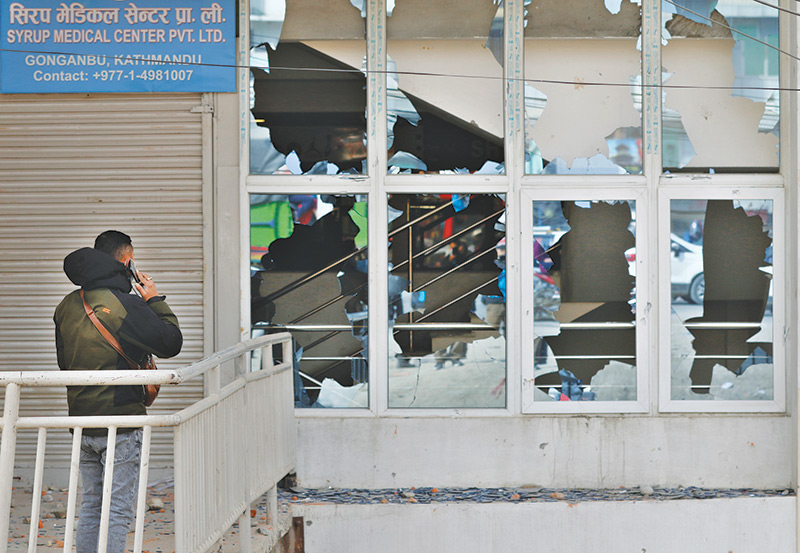
Looters had made off with mobile sets worth millions of rupees in the robbery, taking advantage of a protest by public transport workers. Post Photo
KATHMANDU, Among the 60 people arrested until Monday for vandalism and looting at the New Bus Park-based Lotse Mall and for torching police vans on February 13, three are people involved in frequent thefts who had frequently been nabbed earlier from various parts of Kathmandu Valley for crimes, police said. “While tracing their history, three of those who we arrested in cellphone theft and vandalism at Gongabu have been found to be involved in frequent theft cases,” said Superintendent of Police Sitaram Rijal, who is also spokesperson for the District Police Office, Kathmandu. He said police are continuing their investigation, and they are still searching for persons involved in the crime through CCTV footage collected from the crime scene. Rijal said there might be more people who were arrested frequently for offences like pickpocketing, theft, robbery and other criminal offences in the Valley involved in the riot. Police suspect that some of the people who were seen in CCTV screening might have already fled Kathmandu as it started to nab the culprits after the incident a week ago. Rijal said police will be nabbing other looters if traders provided them with an IMEI number of the mobile sets stolen from their shops. Looters had made off with mobile sets worth millions of rupees in the robbery, taking advantage of a protest by public transport workers. The Federation of Nepal Mobile Business Associations had estimated that mobile sets worth around Rs80 million to Rs90 million were looted in the incident. Police, however, say they are yet to ascertain the actual value of the loot, as they have not got the details from the traders. “This is a serious issue, and this incident has alerted everyone of us. The security agencies need to be more alert during such protests in the days to come,” said Rijal, adding that as of Monday, police have charged 15 people for theft, 35 for arson and vandalism and another 15 for offensive activites. Police say those who were arrested for theft, looting and arson are being detained at Balaju Police Circle for further investigation and those accused of theft are being kept at the Maharajganj Police Circle. Those who are arrested are drivers, helpers, waiters and cooks of hotels based in Gongabu, police said. Police said they are preparing to file a case at the court in accordance with the chapter 20 of The National Penal (Code) Act, 2017. Recently, after the incident, videos on social media had gone viral that showed a group barging into a mobile shop in the mall, walking away with new phones, and protesters burning down two police vans. Photos of pedestrians crossing roads through the tense area with their hands raised were also widely circulated in social media. Guman Singh Khatri, an assistant professor of Sociology at Tribhuvan University, said the act of theft in a business complex and vandalism indicates the stark reality of absence of security apparatus. After widespread criticism, the Home Ministry on the second day of the incident, on February 14, directed Nepal Police to probe into the incident and arrest all those involved in the arson of the police vans and looting. As the protest organised by various organisations of transport operators turned unruly, the organisers were also criticised for failing to take command of the protesters. “We had never thought that a peaceful protest would turn into such a violent one,” said Saroj Sitaula, vice chairman of Federation of Transport Entrepreneurs’ Associations. “Everyone should take lessons from the Gongabu incident, and protest leadership should take a lead to curb such unwanted incidents.” The transport operators on February 13 had staged a demonstration against the traffic police’s ‘stringent’ rules, and Kathmandu Metropolitan City’s announcement to not let long and medium route public vehicles be parked in the open spaces other than inside the New Bus Park located at Gongabu, Kathmandu.
NATIONAL
JSP joins Lumbini government
District Digest
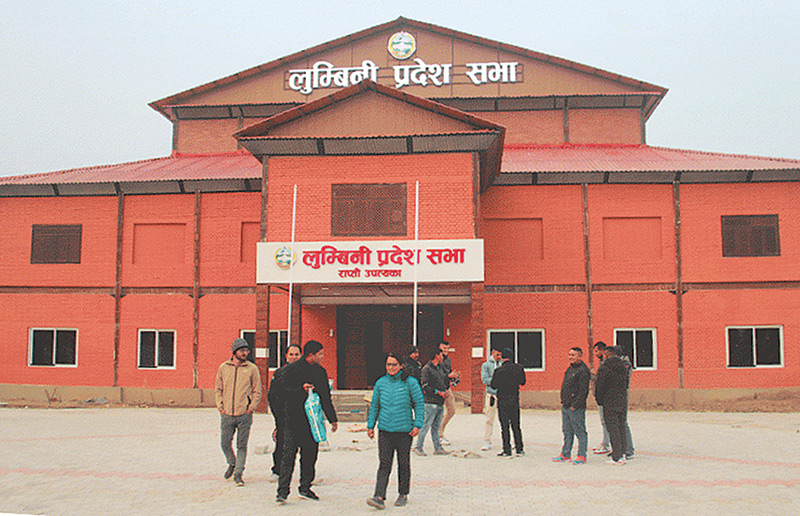
DANG: The Janata Samajbadi Party (JSP) has joined the Lumbini provincial government. Samajbadi Party’s provincial assembly leader Bhandari Lal Ahir took oath of office and secrecy on Monday as the minister for agriculture and land management. Province head Amik Sherchan appointed Ahir as a minister on the recommendation of Chief Minister Leela Giri on Sunday. CPN-UML’s Tulsi Ram Sharma, who was previously appointed as the minister for agriculture and land management, has been assigned to look after the office of the chief minister and council of ministers.
NATIONAL
Woman dies in elephant attack
District Digest
MAKWANPUR: An elderly woman died after she was attacked by a wild elephant in Manahari Rural Municipality-4, Makwanpur on Monday. Police identified the deceased as Radha Adhikari, 64. The tusker attacked the victim while she was working in her kitchen garden, according to police. Adhikari was critically injured and passed away while undergoing treatment at Chitwan Medical College. Enraged at the incident, locals vandalised a check post of Parsa National Park in Lamitar. They blamed the park authority and Nepal Army personnel for not protecting the local people from wildlife attacks.
NATIONAL
Two die in tractor accident
District Digest
SYANGJA: Two persons died when a tractor skidded off the road and fell some 15 metres down in Waling Municipality-6 of Syangja district on Sunday night. Police identified the deceased as tractor driver Nabin Sunar, 32, of Chapakot Municipality-2 and his assistant Sobin BK, 14, of Waling Municipality-8. According to Deputy Superintendent Rabindra Khanal, the tractor, which was loaded with stones, was heading to Mirdi from Jagat Bhanjyang. Both of them died while undergoing treatment, said police.
NATIONAL
Locals demand timely completion of road project
District Digest
DANG: Local residents on Monday staged demonstrations in Ghorahi, Dang demanding the completion of road expansion work along Ghorahi-Tulsipur road stretch. As part of their protest, the locals picketed the Road Division Office in Ghorahi. The road widening work of the Ghorahi-Tulsipur section commenced eight years ago but the four-lane road project is still incomplete. “We were compelled to protest,” said Chitrakanta Acharya, a local. “The authorities concerned paid no heed to our demands of completing the road project timely.”
NATIONAL
Congress hopeful of securing presidency after Maoist Centre’s decision
Congress leaders say Oli could propose Madhav Nepal for new President to create division between Dahal and Deuba.
- Post Report
Congress President Sher Bahadur Deuba (left) and Prime Minister Pushpa Kamal Dahal. Post File Photo
KATHMANDU, With the decision of the CPN (Maoist Centre) office bearers on Monday to elect a new President through national consensus, Nepali Congress leaders said they have become more confident about their nominee getting elected to the top post. The presidential election is slated for March 9 and the Maoist Centre has entrusted Prime Minister Pushpa Kamal Dahal with the responsibility of taking the final call on whom to support for President. “This is a good decision and we will talk with Prime Minister Pushpa Kamal Dahal further,” senior Nepali Congress leader Ram Chandra Poudel said. Poudel is one of the aspirants for the presidential post from the Nepali Congress, but the party has yet to announce its nominee. Nepali Congress leaders are confident that the ruling Maoist Centre and a few other parties that are not part of the government will also support the Congress’ candidate. Some Congress leaders said the Maoist Centre’s decision was expected. “The decision to entrust Dahal to take the final call on presidential elections was expected,” said Nepali Congress Chief Whip Ramesh Lekhak, “We will expedite talks with other parties and within the party as well.” Besides Poudel and Sitaula, some Nepali Congress leaders are mulling the name of party President Sher Bahadur Deuba for future president. This is one greater possibility to secure the post of president by forwarding the name of Deuba but no formal discussion has entered into the party meeting, the Nepali Congress leader said. An office bearer of the Nepali Congress said that time has come for Dahal to take a firm and concrete decision as the CPN-UML, the largest party in the ruling coalition, is hoping to appoint its nominee as President with Maoist support. The UML leaders have been claiming that their nominee should be made President as per an agreement reached with the Maoist Centre in December. On December 25, the CPN-UML had supported Dahal as prime minister reportedly based on an understanding that the Maoist party would support UML’s nominee for President. However Prime Minister Dahal has now said that the understanding with the UML has become irrelevant after the Nepali Congress extended his government a vote of trust on January 10. Since then, Dahal has been saying that the new President should be elected through a national consensus. “We will also definitely put pressure on Dahal to make a decision in our favor. Our talks with Dahal over the past days have remained positive, so we hope he will not betray us,” the Congress leader said. Congress leader Krishna Prasad Situala, another aspirant for President, said that as of now talks with Prime Minister Dahal have been progressing positively but they have yet to hold final and decisive talks with the prime minister. “Since I am no longer an office bearer of the party, I don’t know much about how the process will move ahead. Now it is up to the party president, vice president, general secretaries and others how to shore up support in favour of a Congress candidate,” he said. The Nepali Congress is discussing reviving the old five-party alliance together with other like-minded political forces but the UML. Leaders have also assumed that UML chair KP Oli could propose senior communist leader and chairman of the CPN (Unified Socialist) Madhav Kumar Nepal for new President. “Oli is playing different cards, and his new Madhav Nepal card will not work,” said Min Bishwakarma, a Congress leader, adding, “Proposing Nepal for new President is nothing but an attempt to create a division between Dahal and Deuba.” After Nepali Congress President Deuba refused to support Dahal for next prime minister, Oli immediately rescued Dahal and helped him secure the post on December 25.
NATIONAL
Former king is suitable candidate for new head of state, aide says
In a statement issued on Democracy Day, former king Gyanendra Shah has offered to collaborate with political parties.
- Purushottam Poudel
Deposed king Gyanendra Shah regularly issues press statements on important occasions. Post File Photo
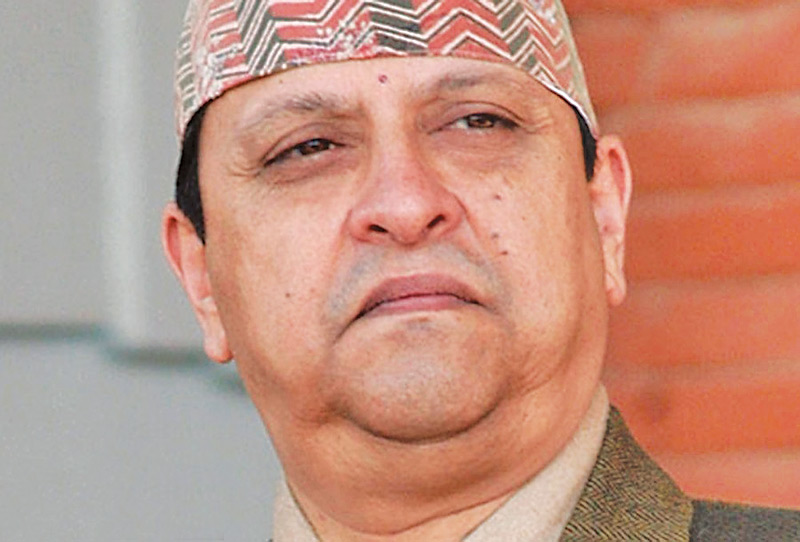
KATHMANDU, While the major political parties are in a standoff over who should be the next President with an election for the head of the state scheduled for March 9, a press statement issued by former king Gyanendra Shah on the eve of the Democracy Day [Saturday] hints at a slight departure from his prior stance that political parties are solely responsible for the instability, leaders say. This time he has offered to collaborate with political parties. Since his ouster in May 2008, the deposed King Shah has been regularly issuing press statements on important occasions. Meanwhile, some of his public activities were the talk of the town. Shah’s earlier press statements would reprimand parties for misgovernance while expressing concerns over the country’s deteriorating political and economic situation, and its poor image abroad. In the latest press statement, however, instead of blaming political parties for the deteriorating condition of the country, he has offered to collaborate with the parties. “It is the legacy and the tradition of our lineage to accept the decision of the majority of the people of Nepal. Even in the most adverse moments of the sad situation, we did not lose our composure and patriotism and we did not leave the country, but we can no longer remain silent about the continuing decline of Nepal,” the press statement from Shah stated. “Over these years [since the abolition of monarchy], the country’s long-term peace, stability and international respect and sovereignty have begun to crumble. Now, to save this country, there should be no delay in cooperation between political parties, which are indispensable for democracy, and a monarchy with a long patriotic historical heritage, based on mutual trust,” it added. KP Sharma Oli, the leader of the CPN-UML, denounced Shah’s statement. Oli sarcastically said: “On what basis should the political parties cooperate with the former King?” When journalists sought reaction from Oli, who arrived in Biratnagar on Sunday, on Shah’s message, he responded: “Former king Gynendra continues to act in the same manner as he did when he was in power. He gets excited after seeing a few people around him.” Govind Raj Pokharel, a Nepali Congress leader and former vice-chair of the National Planning Commission, claimed that the press statement released by the former King Gyanendra differs from the ones he previously issued. “The way the former King has raised the issue of good governance, the country’s poor economic situation and the diplomatic sloppiness seen in the country, seem to be pragmatic,” Pokharel said. “However, what he means by ‘we can no longer remain quiet to the country’s backslide’ is something abstract.” Pokharel further questioned, “By saying ‘we can no longer remain quiet’ did he mean he would make attempts to restore the monarchy or help solve the problems faced by the country and the people?” Just like the Congress leader Pokharel, senior journalist Yubaraj Ghimire also found the former King’s statement to be abstract. When it comes to the issues the nation and the problems its people are facing, former King Gyanendra has been raising concerns in his press statements over the last two to three years, Ghimire said. “The statement recalls his leaving the crown and sceptre in the custody of the Nepali people as he left the palace,” Ghimire said. “India both formally and informally invited the former king to live in India after his abdication, but he declined the offer. His press statement consistently reminds us that he is living in Nepal.” The former king’s personal secretary, Phanindra Raj Pathak, however, denied that the press statement is an abstract piece. “The leaders of several political parties express their displeasure when they meet with us saying that the former king did not call the parties for a formal meeting,” Pathak said. He further added that the former king, this time, has called the political parties for cooperation based on mutual trust. “If the political parties want a person of consensus as the head of state, then a former king could be a good candidate,” Pathak said. “Why can’t we create a post of head of state instead of president and give the position to the former king?” As matters stand, the presidential institution itself is under controversy because when a leader of a political party gets elected as President, instead of being loyal to the country, they become more obliged to their former party. Therefore, the desire to elect a non-political person as President was also being expressed by the leaders of the major parties, until recently. However, Congress leader Pokharel said that the former king cannot be made the head of state. “There is no possibility of bringing the former king to such a position under any name.” “I read the statement of the former king and I am curious to know the intention,” journalist Ghimire said. “However, what I think is that when the political forces in Nepal are divided under different names, the foreign powers fancy their chances. That might be the reason for throwing up the possibility of a former monarch as an alternative.” This is not the first time Shah has expressed dissatisfaction over the condition of the country and political party leaders have repeatedly raised questions about the king’s public activities and political statements. Head of the Foreign Department cell of the CPN-UML, Rajan Bhattarai, who is considered a close aide to party chair Oli, challenged the former king to launch a new party. “The former king can set up his own political party and join politics instead of urging political parties for cooperation,” Bhattarai said. The deputy general secretary of the Maoist Centre and the political advisor of Prime Minister Pushpa Kamal Dahal, Haribol Gajurel, echoed Bhattarai. “There is a rise of populism in the country, and the former king who has been living off state benefits is just trying to fish in troubled waters,” Gajurel told the Post. Though the leaders of political parties criticise the former king, they are also often found slandering one another for having relations with the former monarch. On December 20, 2020, while the NCP was in power, former Prime Minister Oli dissolved the previous Parliament for the first time. The party’s two factions held street demonstrations to support and condemn the prime minister’s action. Pushpa Kamal Dahal-Madhav Nepal faction claimed that the then-NCP Oli faction had conspired with the former king after the Oli faction announced to demonstrate in front of the Narayanhiti Palace on February 5, 2021. Due to the dissatisfaction within the party, the then NCP got divided into three factions. KP Sharma Oli had accused the Maoist Centre chair Dahal on December 15, 2021, of reaching a covert agreement with the former king. After the monarchy was overthrown in 2008, Kamal Thapa’s Rastriya Prajatantra Party initially pushed for its reinstatement, but it had no effect. Thapa has since renounced his support to the monarchy, claiming that the Shah interfered in the party’s general convention held at the end of 2021, to defeat him. Notwithstanding Thapa’s withdrawal from the debate over the monarchy’s restoration, the Rastriya Prajatantra Party and its leader Rajendra Lingden have continued to advocate for the restoration of constitutional monarchy. Durga Prasain, a medical entrepreneur, has recently been added to the list of the former monarch’s supporters. The former king took part in a function titled ‘Save the Nation, Nationality, Religion, Culture and Civilization Campaign’ organised in Jhapa on February 13. A similar kind of function is scheduled to be held in Dhangadhi on February 22, in Chitwan on February 25 and on March 4 in Kathmandu. Although there has been a general public disenchantment towards the political parties in recent times due to their failure to deliver, occasional street demonstrations by the supporters of the former king will have no impact on the political system, experts say. “The former king’s statements criticising the parties are insignificant, because he failed to deliver when he was in power,” political analyst Lok Raj Baral said. “If he wants to join politics then he is free to do so by launching a political party. Otherwise, I do not see any reason for political parties to cooperate with him.”
NATIONAL
Noted human rights activist Mathura Prasad Shrestha passes away at 88
Dr Shrestha is widely acclaimed as a torchbearer of Nepal’s public health sector and human rights activism. He played an important role in two people’s movements.
- Post Report
Dr Mathura Prasad Shrestha
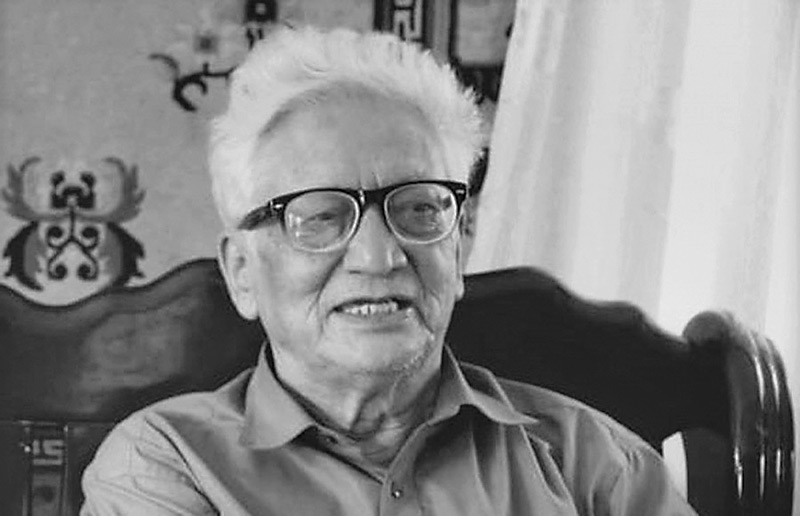
KATHMANDU, Dr Mathura Prasad Shrestha, a renowned civil rights activist and former health minister who for his long-spanning service in the public health sector earned the epithet ‘guru of gurus’, died on Monday at the Annapurna Neuro Hospital in Maitighar, Kathmandu. He was 88. Shrestha breathed his last at 4:15 am on Monday at the hospital, where he was undergoing treatment for respiratory complications for the past few days, the hospital administration said. Dr Shrestha was born at Bandipur in Tanahu and brought up in Chitwan, where his family had migrated few years after he was born, according to Thaleshwor Dawadi, a childhood friend of Dr Shrestha. Dr Shrestha completed his primary education in Bandipur and his intermediate schooling in Kathmandu. For his medical study, he went to India. Dr Shrestha has been widely acclaimed as a torchbearer of Nepal’s public health sector, with some of his acquaintances dubbing him a ‘guru of gurus’. Shyam Shrestha, a political analyst who worked closely with Dr Shrestha, remembers him as a professor and the propagator of community medicine. “He contributed to formulating a medical study curriculum and played a crucial role in the establishment of the Institute of Medicine,” Shrestha said. “He advocated that community-level primary care would be suitable for countries like Nepal.” Shrestha played an important role in the first People’s Movement of 1990. He then served as the founding vice-president of the Human Rights Protection Forum. In April 1990, he was appointed the health minister in the Nepali Congress leader Krishna Prasad Bhattarai’s interim cabinet. Another prominent human rights activist Devendra Raj Panday was also included in the cabinet as the finance minister. “He actively advocated for the country’s public health service, human rights and civil rights,” Shrestha, the political analyst, said. Dr Shrestha was one among the three people to appeal to the public for the second people’s movement, which followed King Gyanendra Shah’s coup on February 1, 2005. “Citizens Movement for Democracy and Peace (CMDP) of 2006 had three leading figures—Dr Shrestha, Panday and myself,” said Krishna Pahadi, a human rights activist. Prime Minister Pushpa Kamal Dahal along with former prime minister and UML Chairman KP Sharma Oli and Deputy Prime Minister and Finance Minister Bishnu Paudel have expressed their condolences on Dr Shrestha’s demise. Dr Shrestha is survived by six sons from his two wives, both of whom are dead. Dr Krishna Prasad Adhikary, registrar of the Nepal Medical Council, said Dr Shrestha’s dead body has been kept at the Maharajgunj-based TU Teaching Hospital. His funeral rites will be performed on Tuesday morning at 11 am.
OPINION
Reimagining South Asia
Let's imagine a South Asian digital currency and other initiatives for the region.
- SUJEEV SHAKYA
Shutterstock
Last week, I was watching on YouTube a video of the performances at the virtual event organised by the South Asia Symphony Foundation where many South Asian talents got together to perform. This foundation founded by a former Indian foreign secretary Nirupama Rao and her husband has been trying to promote peace through exchange related to music. I kept wondering how many such efforts there are in South Asia, and how many who believe in the concept of South Asia.Nearly three decades ago, Himal Southasian, a publication of the Southasia Trust, brought about a competitive spirit in the region with many wanting to get publications out and put together events and programmes. Even international organisations started to use the word “Southasia” more liberally. Kanak Mani Dixit has to be credited with the work that Himal did in trying to bring together a common agenda rather than squabble about our differences. We have people like C Raja Mohan and Bibek Debroy in India who kept the South Asia agenda alive. The National University of Singapore hosts the Institute of South Asian Studies, where I have been fortunate to hold a Senior Fellow position, and I try to make Nepal also heard on the South Asian platform along with another Senior Fellow Nishchalnath Pandey. While there are many South Asia-oriented institutions in different academic institutions worldwide, the discussions and publications are just centred around India and Pakistan. The competition in many institutions has been to focus on the strained relations between these two neighbours rather than find common areas to talk about.
Imagine no borders There are three reasons why it is important to reimagine South Asia. First, the impact of climate change is real and not an issue that is seen as an activists’ delight. We have seen how polluted air or migratory birds do not see political boundaries. If India is to build the infrastructure it wants to, it is also important to figure out how it will not be at an ecological cost to Bhutan or Nepal. In Nepal, we have seen in the past few decades stones, sands and aggregates cross the border through a not so transparent mechanism that operates under the protection of the highest level of political leadership. We have seen that Bhutan, despite its 70 percent forest cover, still faces challenges of air pollution due to transboundary movement of pollutants. There are institutions like the International Centre for Integrated Mountain Development (ICIMOD) that have a knowledge repository of research, but it is time to see how we can make this useful for individuals, businesses and institutions. There is lot of common work to be done in the areas of adapting and mitigating the impact of climate change. No country can tackle these issues alone, which means there is no alternative to regional initiatives. The World Bank has embarked on the One South Asia programme, and it is trying to revisit some of the past successes in bringing people who believe in the potential of an integrated region together. The second reason is that the Covid-19 pandemic accelerated the pace of digitisation and digitalisation. Internet penetration, e-commerce and digital payments proliferated along with the use of social media. This means there is an opportunity for regional collaboration. In Unleashing Nepal, I have talked about the concept of a common South Asian currency to be named Rupa. Now is the right time to revisit this in the form of a digital currency that can be stored in digital wallets with convertibility protocols determined by the central banks of the respective countries. Imagine, a truck driver travelling from Chittagong port in Bangladesh to Bhutan or Nepal can just rely on the currency he has stored in this digital wallet without having to bother about where to exchange money. Similarly, movement within South Asia can be regulated using digital platforms as every country has created its own digital ID which makes monitoring so much easier.
Expensive Bhutan Third, it is important to ensure there are more youths who believe in reimagining South Asia. Whenever we discuss South Asia, we hardly find young people in any of the countries really understanding the potential of working jointly. Never before in history has the world been so connected, but never before has it been so difficult to cross boundaries physically either. While Nepali music and films are popular in Bhutan, there is no way a Nepali can travel to Bhutan without paying high fees. Similarly, there are so many collaborative efforts that can be brought to fruition by Indian and Pakistani artists, but it is like close to impossible to make such things happen. We need to ensure that people who host South Asian events provide as much space as possible to every country. Talk of making South Asia should revolve around people-to-people cooperation between different countries, not the strained relations between India and Pakistan. I have been continuously writing about Border Economic Zones and embracing frontier opportunities. For Nepal, it is in its own interest to push the agenda of South Asia, not leverage the ease of travel to Nepal to convene South Asian platforms and events. There is renewed interest in South Asia, we just need to reimagine and make many of the things we have been talking about for decades happen.
Shakya is the founder and CEO of beed and the author of ‘Unleashing Nepal’ and ‘Unleashing the Vajra’.
OPINION
The monetary policy’s upshots
The depreciation of the Nepali rupee versus the US dollar will cost us more while repaying foreign loans.
- NISCHAL DHUNGEL
The Nepal Rastra Bank (NRB), the central bank of Nepal, took an accommodating policy stance during the pandemic to support households and businesses. The average inflation rate in fiscal year (FY) 2020/21 stood at 3.6 percent and doubled to 6.32 percent in FY 2021/22. For the first six months of the current FY 2022/23, it stands at 7.2 percent. Inflation has significantly increased due to the detrimental effect of the supply chain post-Covid19 pandemic and the Russia-Ukraine war. Rising inflation raised the cost of fuel and raw materials, causing production costs to skyrocket. As a result, the output capacities of both small and large-scale industries have decreased. The government imposed an import ban to safeguard the diminishing foreign exchange reserves, but it lifted the ban recently as the demand for goods and services increased amidst economic recovery. These factors contributed to the first half of the current fiscal year’s revenue collection falling short of expectations. The revenue collection for the first six months of mid-January 2023 decreased by 15 percent compared to last year. The Finance Ministry reduced the federal government’s budget by 20 percent because of its inability to generate revenue as projected. The increased liabilities for wages, pension, social security, and subsidies for chemical fertiliser and disaster management have strained ongoing government expenses. The government needs to pay the interest on international and domestic loans. The depreciation of the Nepali rupee versus the US dollar will prove expensive to re-pay foreign loans.
World Bank and IMF support The International Monetary Fund (IMF) approved $395.9 million as part of the Extended Credit Facility (ECF) Arrangement for Nepal. The ECF provides financial support to nations with a persistent balance of payments issues. This arrangement would help the government lessen the pandemic’s effects on people’s health and economic activity, safeguard vulnerable populations, maintain macroeconomic and financial stability, and promote long-term growth and poverty reduction. The program will encourage significant funding from Nepal’s development partners and help reduce funding shortfalls. These actions supported a subsequent credit boom by cutting loan rates early in the pandemic. To aid Nepal’s tenacious recovery from the Covid-19 pandemic and promote sustainable growth, the World Bank approved a $150 million development policy credit. The Nepal Programmatic Fiscal Policy for Growth, Recovery, and Resilience Initiative, funded by the World Bank, will work to enhance the country’s institutions and laws, especially those governing debt management, public capital investment, and tax and customs systems.
Effect of monetary policy At the beginning of FY22, NRB monetary policy aimed to strike a balance between tightening needed for economic and financial stability and assistance for the nascent economic recovery. The NRB’s main policy targets are maintaining the policy floor of foreign exchange reserves covering seven months of imports and setting the inflation ceiling at 7 percent for the year FY 2022/23. The goal of monetary policy is to limit total credit to the private sector by 12.6 percent and total money supply by 12 percent for FY 2022/23. NRB raised the cash reserve ratio (CRR) from 3 percent to 4 percent. As a result of the credit boom, imports peaked in the first half of FY22, and foreign exchange reserves declined. The NRB increased its policy repo rate targeting both credit demand and supply. A change in monetary policy was in response to worries about faster-than-expected credit expansion, the growing import bill, dwindling reserves, and rising inflation as loan growth soared beyond estimates in the first half of FY22. To bring down inflation and discourage credit lending, the NRB increased the interest rates. The weightage average interest rate for inter-bank rose from 4.76 percent in mid-January 2021 to 7.48 percent in mid-January 2022. Similarly, weightage average interest rates for lending increased from 9.44 percent in mid-January 2021 to 12.79 percent in mid-January 2022. A credit constraint occurred as the additional liquidity injections weren’t enough to make up for the drop in loanable funds. By the end of FY22, private sector credit had fully returned to FY21 levels as a proportion of GDP due to the higher lending interest rates offered by commercial banks to borrowers, which increased from 8.5 percent to 11.6 percent between mid-July 2021 and mid-July 2022. Credit to the private sector stabilised at comparatively higher prices, falling from 102 percent of GDP at the end of FY21 to 101.5 percent of GDP at the end of FY22. The NRB injected a total of Rs3094.76 billion in liquidity until mid-January 2023. NRB provided Rs318.09 billion through a repo, Rs83.85 billion through an outright buy auction, and Rs2692.83 billion through a standing liquidity facility (SLF). The NRB introduced a merger and acquisition policy with the aim of strengthening financial stability. After the mergers of the commercial banks, the number of commercial banks decreased from 27 in mid-July to 22 in mid-January 2023. Micro-finance institutions decreased from 70 in mid-July to 64 until mid-January 2023. The central bank of Nepal mandates that banks maintaining higher paid-up capital help reduce the number of banks and financial institutions. Bank and financial institutions’ (BFIs) private sector credit increased by Rs137.33 billion (3 percent) during the first six months of FY 2022/23 compared to a growth of Rs492.63 billion (12.1 percent) during the same time last year. Out of the total outstanding credit held by BFIs until mid-January 2023, 67.2 percent went to real estate and 12.2 percent to current assets (such as goods used in agriculture and non-agriculture).
BFI soundness Despite liquidity restrictions, indicators of BFI soundness were high. The average capital-to-risk-weighted assets ratio, which measures the sufficiency of bank capital, remained more elevated than the legal requirement of 11 percent. After massive credit expansion, NRB raised interest rates which is also the byproduct of the misuse of loans. In addition, due to the lengthening of loan repayment schedules as part of the central bank’s response to Covid-19, the overall number of BFIs’ nonperforming loans (NPL), defined as loans that are past due by 90 days or more, also marginally decreased. As of mid-July 2022, commercial banks had an NPL ratio of 1.3 percent, development banks had an NPL ratio of 1.5 percent, and finance businesses had an NPL ratio of 7 percent. Even though these numbers are encouraging, some swift forbearance measures should be in place to assess the asset quality in the banking sector. Banks are issuing fresh disbursements to reduce the level of nonperforming assets. Nevertheless, given the adverse economic effects of Covid-19, the IMF should closely monitor the system to ensure NPLs are accurately measured and that all banks’ provisioning and capital are still sufficient. The NRB should improve the regulatory environment to offer precise restructuring guidance to address BFI assets and loan quality. NRB issued Working Capital Loan Guideline 2079, which mandates banks to issue working capital loans secured by the current assets. Credit Policy Guidelines of the licensed institution shall clearly mention the margin and adequacy of the existing assets required for the security. Hence, the NRB should encourage banks to monitor borrowers’ creditworthiness continuously and establish asset categorisation and reclassification criteria that accurately evaluate banks’ asset quality. Lastly, Nepal should facilitate bank financing to productive businesses, invest in infrastructure and education, and adopt digital technology and research and development.
Dhungel is an economist at A2F Consulting LLC based in the United States and a fellow at the Nepal Institute for Policy Research.
OUR VIEW
Rural women’s woes
One-off health camps are unlikely to bring lasting solutions to systemic neglect of women’s wellbeing.
The health of Nepali women in remote parts of the country continues to be precarious. As the Post reported on February 19, countless women of Achham district in Sudurpaschim Province are suffering from uterine prolapse and yet they don’t have any place to go for treatment. (Uterine prolapse is a medical condition wherein the pelvic floor muscles and ligaments stretch and weaken to a point that they fail to provide enough support to the uterus.) Young as well as elderly women in the remote district are compelled to live for years with the unbearable pain (and complications) associated with the debilitating disorder. For instance, many women of Dhakari Rural Municipality the Post talked to gave harrowing details of their health conditions as even health camps where they get general checkups and primary care have gotten rare. When, four years ago, a health camp was organised at Mangalsen, the district capital, women suffering from uterine prolapse had heaved a sigh of relief. They could finally get the much-needed surgery. But they could not then abide by the doctors’ suggestions for regular check-ups as such services were unavailable at the district hospital, let alone in their village health post. There has also been no health camp in the district in the past four years—and there is apparently no immediate plan to organise one either. According to the district hospital, women below 30 years of age are increasingly suffering from uterine prolapse, and all the attendant complications. These women of Achham are only the tip of the iceberg of all the other Nepali women from other remote parts who are suffering from similar reproductive health problems. Besides lack of health facilities, other societal factors are also responsible for the deterioration of women’s health. Many women try to hide such problems, unsure of how to bring up such a “delicate matter” with their husbands or even friends. They are afraid of being mocked and ridiculed by the patriarchal society they live in. Women’s reproductive health is something that is routinely overlooked. For instance, many rural women are forced to give multiple births when they cannot produce sons. Concomitantly, the family may put pressure on them to abort a female foetus. These societal factors compound women’s health problems. So while formulating policies and taking initiatives to address women’s health problems, authorities must take a multi-pronged approach, involving a mass door-to-door awareness campaign as well as availability of at least basic healthcare for women at local health facilities. Strengthening each of the 753 local units with basic equipment, doctors and other health workers has become most essential—in line with the spirit of the new federal system and the constitution that lists basic healthcare as a fundamental right of Nepali citizens. Article 35 (1) states that every citizen shall have the right to free basic health services from the State, and no one shall be deprived of emergency health services. Organising one-off health camps is unlikely to result in durable solutions to what is a systemic problem of neglect of women’s health and wellbeing as well as a lopsided healthcare system that prioritises the health of the urban rich over the rural poor.
THEIR VIEW
Tagore statue removed
Removal of the statue reveals the state of freedom of expression in Bangladesh.
How ironic—or perhaps how fitting—that a statue protesting the recent incidents of censorship and repression in Bangladesh must meet the tragic fate of “forced disappearance.” Its removal by the Dhaka University authorities without so much as a warning or a show-cause notice to the artists who installed it on the campus, and the wording used to justify such an action, only solidifies the message the artists were trying to push forth in the first place: that the freedom of thought and expression in the country are under attack. The statue in question was that of Nobel Laureate Rabindranath Tagore, with his mouth taped, holding a book that had a nail pierced through it. It was set up on Tuesday by leftist students of DU near the Raju Memorial Sculpture, apparently to highlight the current climate of censorship and shrinking space for free thinking and creativity in the country, and was supposed to be in place till the end of February. The statue’s placement near the entrance to Ekushey Boi Mela—a day after the Bangla Academy filed an appeal challenging the High Court order to allow Adarsha Prokashoni a stall at the fair—could also be interpreted as a criticism of the increasingly rigid stance of the academy on censorship of books that challenge the dominant state-endorsed narrative. We recognise that there is an issue of permission, and that the DU authorities cannot simply allow everyone to arbitrarily erect statues on the campus without oversight or say. However, we are completely taken aback by the authorities’ explanation—that they demolished it as it represented a “degraded culture” and that the poet’s sculpture was “distorted.” What exactly do the authorities mean by “distorted” or “degraded culture”? We can only assume that they take issue with protest art and demands for free speech, for that is clearly what the statue signified. If anything is out of place in a university that is historically linked to progressive student politics and mass struggles for emancipation in the country, it is the DU authorities’ heavy-handed handling of the matter. It goes without saying that a university campus is one where students should be free to explore and exchange ideas, engage in constructive debates and experiment with different modes of artistic expression. Unfortunately, over the years, we have seen our campuses being held hostage by ruling party cadres, with the administrations implicitly or explicitly furthering the interests of the ruling party and clamping down on dissent. The space for critical thought—which ought to be a crucial component of higher education—is sorely missing on our campuses, and indeed in our society at large. The ban on Adarsha Prokashoni, as well as on Jannatun Nayeem Prity’s book Jonmo o Jonir Itihash from the ongoing book fair, have already painted a bleak picture of artistic freedoms—or the lack thereof—in the country. We are alarmed to see that bodies such as the Bangla Academy and DU, which ought to be autonomous and custodians of free thought, are now playing increasingly authoritarian roles, arbitrarily shutting down critical discourses and artistic expressions. We urge the authorities to remember our foundational and constitutional commitments to work towards a society where, to quote Tagore, the mind is without fear, where knowledge is free, and where the clear stream of reason has not lost its way.
— The Daily Star/ANN
MONEY
Multigrain sattu flour finds export market
Schools are being urged to serve sattu under the mid-day meal programme amid junk food invasion.
- AGANDHAR TIWARI
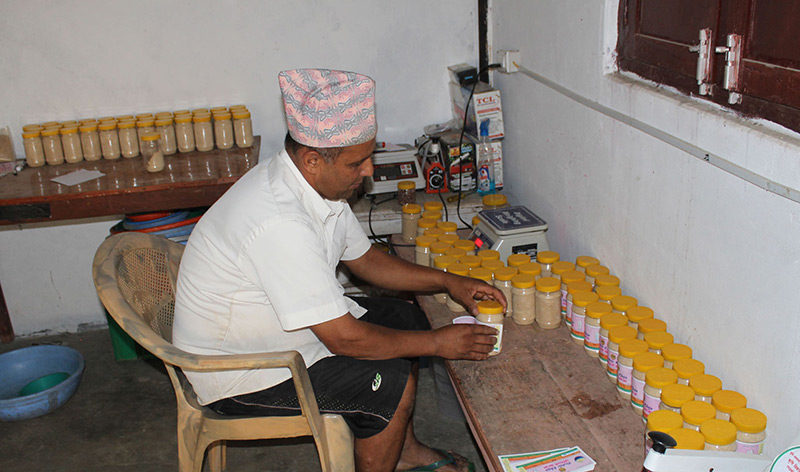
Thaneshwar Bhusal packs jars of sattu in Phalebas, Parbat. POST FILE PHOTO
PARBAT, A traditional multigrain flour is finding an export market for its high protein while foreign junk food is invading Nepal’s villages, say traders. Last year, entrepreneur Thaneshwor Bhusal exported 1 tonne of sattu flour which is made from powdered gram, pulses and cereals. A buoyant Bhusal plans to make 5 tonnes of sattu this year and export most of it. Nepali sattu is sold in Japan, the United States, the United Kingdom, Australia and South Korea, Bhusal says, but instant noodles have displaced this nutrition-rich food in the hinterlands. In remote villages, store shelves are packed with instant noodles because they are easy to cook, and can also be eaten directly from the package. Villagers say demand for noodles has exploded because they are more convenient compared to sattu. Even the government’s mid-day meal programme in schools has been providing packaged food to the students. Krishna Acharya, chief of education of Phalebas Municipality, says the government has been urging schools in the district to serve sattu under the mid-day meal programme. The community school mid-day meal programme is being run in 42 out of the 77 districts in the country to improve access to education as well as student’s health and nutrition by offering nutritious food. Malnutrition has been rising throughout the country of late. Experts say that malnutrition is not only a result of not getting enough to eat, but also lack of nutritious food, lack of knowledge about using locally available food, and growing junk food consumption among children. Experts say that it is ironic that demand for sattu has been increasing abroad but falling locally. “Most of the orders for sattu comes from supermarkets operated by Nepalis in foreign countries,” said Bhusal. “Sattu’s high-protein credentials can be leveraged to popularise it among increasingly health-conscious consumers, but you need proper marketing.” Sattu is also used by packaged food and drink manufacturers, but in small quantities. There are several cottage companies in the district that produce sattu by processing corn, soybean and wheat. They export the flour to Europe and the US. A community-operated food processing company in Mudikuwa, Phalebas Municipality-4 has also been exporting sattu flour. Sattu is sold in food stores and department stores in Kushma Bazaar. Sattu is quality tested before being shipped to market and has a six-month expiry date. Bhusal, who was exporting pickles and candy made from hog plum, and ginger, started producing sattu after getting more orders. He sells sattu under the brand name Poshilo Sattu, which means nutritious sattu. Bhusal expanded his business and started producing sattu with a Rs760,000 financial aid from the government of Gandaki province. He started production in 2018. Now he wants to position sattu as an alternative to junk food. Bhusal started exporting his product to the international market three years ago. For two years before that, he was sending it to different food shops in the district. His company Parbat Food Processing has been operating in Mudikuwa for 22 years. According to him, some volunteers from the US and Europe have been coming to his factory to learn to make pickles and sattu. This year, three foreigners learned the process. Students from Germany, Canada, China, the US and India are frequent visitors who come to learn, said Bhusal. “The price of sattu in Nepal and the rest of the world is the same,” Bhusal said. “I have kept the same price to market the product.” Sattu costs Rs400 per kg. Bhusal says people in his village are not interested in eating it. “Initially, locals laughed after I started producing sattu for commercial purposes because it was available in almost all homes in the village,” he said. “But now the market has been expanding locally and internationally. Even villagers come to buy it.” With the rise in demand, farmers are also happy because they are getting a fair price for their crops like maize, wheat and soybean. “The price of maize in the village is higher than the market rate,” said Chandrakala Bhusal of Phalebas-6. “Following the establishment of the sattu flour factory in Mudikuwa, we have been selling maize by grading it.” According to farmers, their maize crop which did not fetch even Rs32 per kg now sells for Rs65 per kg, Bhusal says he buys chickpeas, cashew nuts, peanuts and grains used to make sattu from other districts. Health workers say that sattu is made from organic nutritious grains produced in the village which is beneficial to people, especially children and the elderly. “Sattu flour may not appeal to people who have a liking for junk food,” said Rudra Sapkota, chief of the Health Department in Phalebas. “But it has many health benefits.” The flour helps to deal with health problems like gastric, indigestion and other stomach-related issues. “It is good in terms of nutrition,” he said.
MONEY
French minister urges $16 billion IMF programme for Ukraine
- AGENCE FRANCE-PRESSE
PARIS, France’s finance minister called Monday for a $16 billion International Monetary Fund programme to support Ukraine over the next four years as its economy reels from Russia’s invasion. Bruno Le Maire said France would also push for tougher sanctions against Moscow. Speaking ahead of a meeting of G20 finance ministers in India this week, Le Maire said he wanted “us to work on an IMF programme for Ukraine which could be in the order of 15 billion euros ($16 billion) over four years”. “Beyond the support provided by Europe, beyond the support provided by G7 countries, it is important that the IMF mobilises for Ukraine”, he said. On Friday, the IMF said it had reached a staff-level agreement with Ukrainian authorities paving the way to a fully-fledged loan, which would also support the country’s bid to join the European Union. The IMF said Ukraine would be able to request financial support after a “strong” performance meeting its targets. The government in Kyiv submitted a package of draft tax laws to parliament aimed at lifting revenues, and is taking steps to address arrears, among other efforts. “In the framework of the G7, we will also argue for a strengthening of economic sanctions against Russia”, Le Maire added, describing the penalties as an effective “long-term weapon”. Russia’s invasion of Ukraine a year ago has displaced millions of people, and global food and energy prices surged on the fallout from the war. Ukraine’s economy contracted by 30 percent last year, less severely than anticipated, but recovery and reconstruction have been estimated at hundreds of billions of dollars. Apart from the IMF’s work with Ukraine, the World Bank has also mobilised over $18 billion in emergency financing for the country, with more than $16 billion disbursed through projects.
MONEY
Russians switch to used cars as sanctions pummel auto sector
- REUTERS
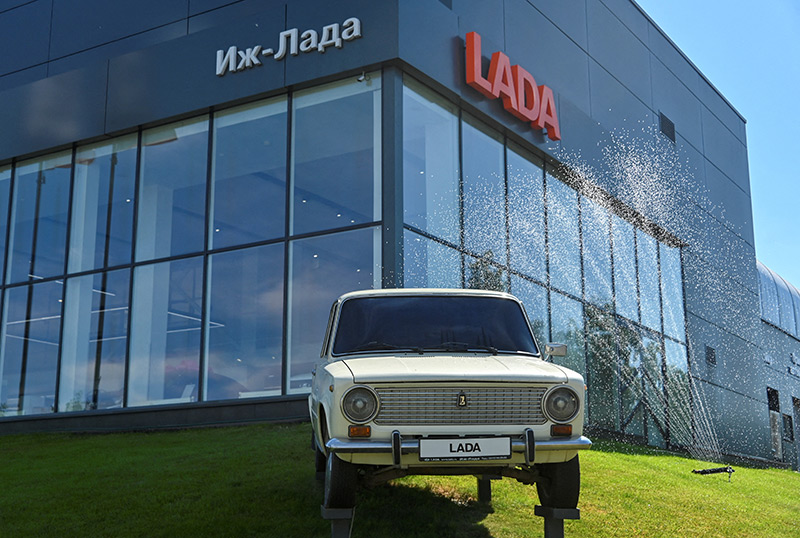
A file photo shows a Soviet-made retro VAZ-2101 car on display in front of a showroom of Izh-Lada dealership in the city of Izhevsk, Russia. REUTERS
MOSCOW, Spending on new cars in Russia more than halved last year as the auto industry felt the full force of Western sanctions over the conflict in Ukraine, with production plunging, prices soaring and buyers switching to cheaper used models. While analysts continue to debate the overall effectiveness of economic curbs on Russia, there can be no doubt they have hit hard in its car industry, which was heavily reliant on foreign manufacturers and imported parts. Spending on new cars slumped 52 percent to 1.5 trillion roubles ($20.4 billion) last year, while the number of new cars sold tumbled by 58.8 percent. Car production also slumped to its lowest since the 1991 collapse of the Soviet Union as Western automakers halted production and sold factories. Overall spending on new and used passenger cars dropped over 15 percent in 2022, as inflation pushed up prices and drove living standards down, data from analytical agency Autostat shows, despite a 14 percent rise in spending on used cars. That left used cars accounting for almost three quarters of all cars sold, up from 55 percent in 2021, the data shows. “Money flowed into the used cars market as prices for second-hand cars held up, while at the same time the structure of the new cars market changed significantly,” Autostat CEO Sergei Udalov told Reuters. “Budget Ladas and Chinese cars with prices of 2 million roubles and more remain in it, while premium brands have almost completely left,” he said. Annual inflation at 11.9 percent last year contributed to an estimated 1 percent drop in Russians’ real disposable incomes, according to the Rosstat statistics agency. Retailers have invested heavily in discount store formats, a trend that is being mirrored in the automotive sector. Anton, an employee at a major Russian company who declined to give his last name, purchased a used Skoda in December, preferring a Western-made car to a domestic or Chinese-made alternative. At 2.5 million roubles, his Skoda was around 1 million roubles more expensive than it would have been a year earlier, but still 1 million roubles cheaper than a brand new version. Anton said he felt lucky to have snapped up a used foreign-made car with low mileage, as stocks are running low. “A new car is now just a perk for rich people, unless it’s a Lada or a Chinese car,” he said. According to Autostat, the average price of new cars sold last year increased by 17 percent to 2.33 million roubles, and used ones by 32 percent to 890,000 roubles. Czech carmaker Skoda Auto, a unit of Volkswagen, said deliveries to Russia fell 80 percent in 2022. Volkswagen has closed its Russian factories and stopped imports, but has not yet agreed to a sale like some of its peers.
MONEY
Access tunnel of 140 MW Tanahun hydro project built
The $505 million project can generate energy for six hours daily during the dry season.
- SAMJHANA RASAILI,Basanta Pratap Singh
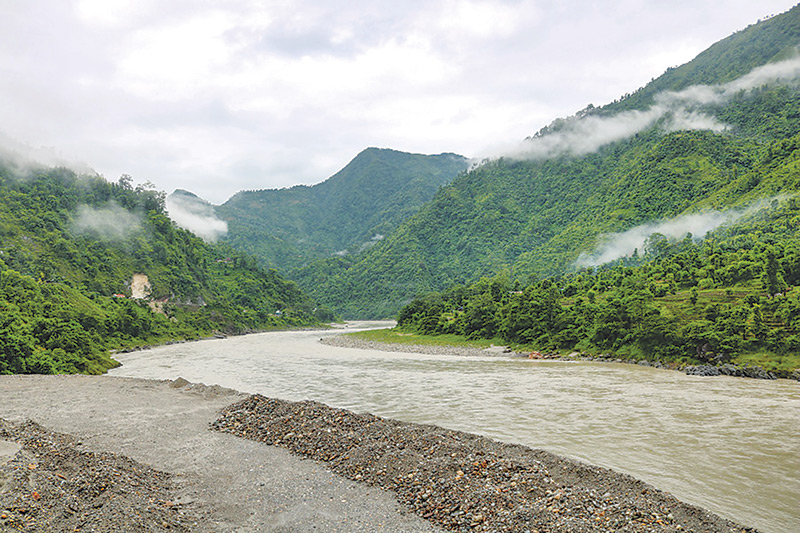
The project is targeted to be completed by June 2026. Shutterstock
TANAHUn & BAJHANG Tanahun hydropower project has built the access tunnel as a part of its first phase of infrastructure construction. The 140-megawatt project is being constructed in Damauli. According to the project, the tunnel is 436-metre-long with a 7-metre diameter of entrance. Rajabhai Shilpakar, project chief, said that the tunnel will facilitate transporting construction materials and equipment to the upper side of the proposed dam construction area. In the first phase, a 140-metre-tall dam will be built. The first blast to open the access tunnel was conducted in March 2022. The tunnel work, however, was halted for 48 days due to the lack of explosives. The first package—a 140 metre-tall dam and other structures—is being constructed by a joint venture of Song Da Corporation, Vietnam and Kalika Construction, Nepal. The project said that the work for the 539.8 metre-long diversion tunnel-1 under the second package has started. The second package includes the construction of the tunnel, powerhouse along with the installation and operation of hydromechanical and electromechanical equipment which has been awarded to Sinohydro, China. Under the third package, the contract for the construction work of a 220 KV double circuit transmission line from Damauli to Bharatpur in Chitwan has been awarded to KEC International, India. The project is targeted to be completed by June 2026. Tanahu Hydropower Limited, the developer of a 140-megawatt scheme, has signed a power purchase agreement (PPA) with the Nepal Electricity Authority to sell the electricity generated by the plant. As per the PPA, the power utility will pay Tanahu Hydropower Rs12.40 per unit during the dry season, which lasts from December to May, and Rs6.08 per unit during the wet season, which lasts from June to November. The PPA also includes a provision under which Tanahu Hydropower can increase the power purchase rate by 3 percent annually for eight years after it commences commercial generation. After the increase, the Nepal Electricity Authority will have to pay Rs15.38 during the dry season and Rs7.54 during the wet season. The Tanahu Hydropower Project will be one of the biggest reservoir-type projects in the country with an estimated annual energy generation capacity of 587.7 GWh in the first 10 years of operation. The project can generate energy for six hours daily during the dry season. The project is being built using a credit facility extended jointly by the Asian Development Bank, Japan International Cooperation Agency and European Investment Bank (EIB). The total cost of the project, including transmission lines and rural electrification, is $505 million. Asian Development Bank is providing $150 million, Japan International Cooperation Agency $184 million, European Investment Bank $80 million while the government and Nepal Electricity Authority are injecting $80.6 million into the project. “The project has achieved nearly 35 percent of physical progress,” said Shilpakar. Meanwhile, two hydro projects in Kalanga Gad river in Bajhang, built by the private sector, have started generating electricity. The Kalanga Gad hydropower project, which started construction in 2017 aims to generate 65 MW of electricity—including 15.33 MW from Kalanga Gad, 38.46 MW from Upper Kalanga Gad and 10.70 MW from Upper Sanigad. Bibas Amatya, managing director of Sunam Infrastructure Construction, which was awarded the project, said that the power of Upper Kalanga with a capacity of 38 MW was connected to the national grid on January 31. Similarly, the electricity generated by the 15MW Kalanga Gad project was connected to the national grid on January 25. The work of the 10 MW Sanigad hydropower project is yet to be completed. The electricity produced by this project has been sent to the Balach substation in Baitadi through a 132 kV transmission line. The length of the transmission line is 37.5 km.
MONEY
TTF Bengaluru 2023 concludes on a high note
Bizline
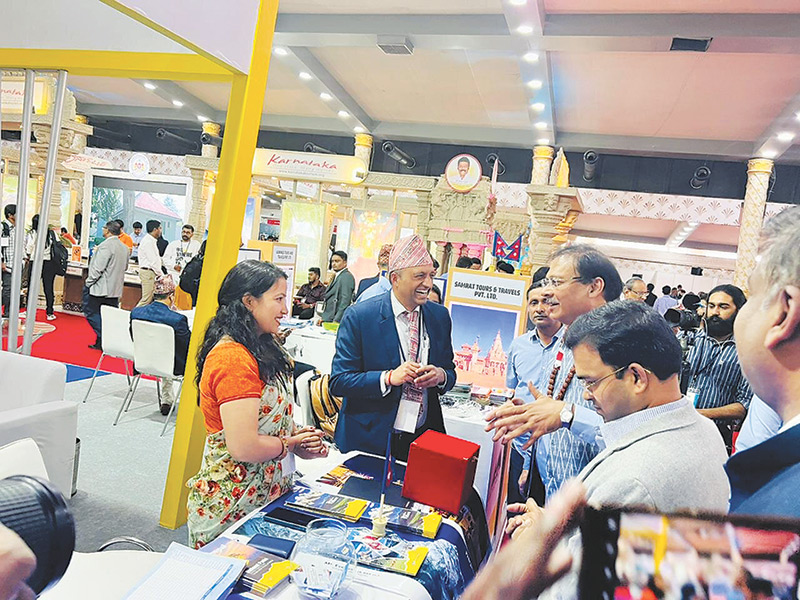
KATHMANDU: TTF Bengaluru, focussed on the ever-growing Southern India travel market, concluded on Sunday. With over 120 participants from four countries and 20 Indian states, it showcased a great travel rebound after two years of disruptions. A clear indicator that the industry is now on a strong upward curve, this edition was 50 percent bigger than the one held in 2022 and saw a bumper response from travel trade members and travel enthusiasts alike, reads the press release issued by the organiser. The TTF series—India’s oldest and largest travel trade show network, is focused on providing the most effective marketing platforms to promote tourism in the major travel markets in India, and the 2023 series kick started with TTF Bengaluru. More than 4,000 travel trade visitors and travel enthusiasts thronged the show floor over the three days, bearing testament that it was a perfectly timed show right before the summer vacation travel season. (PR)
MONEY
TK Elevator appoints Rycon Group as its authorised distributor in Nepal
Bizline
KATHMANDU: TK Elevator has appointed Rycon Group as its authorised distributor in Nepal to tap the elevator market of the country and further expand its market share. As a global mobility solutions provider, TK Elevator strives to provide the best solutions and services to customers across the globe, said Manish Mehan, chief executive officer and managing director at TK Elevator (India). “By joining hands with Rycon Group, a leading player in the industry with immense local expertise, I am confident that the synergistic benefits arising from the collaboration will boost our growth trajectory in Nepal in the coming time,” said Mehan.
MONEY
Uber to introduce 25,000 EVs in India amid clean car push
Bizline
NEW DELHI: Uber Technologies will introduce 25,000 electric vehicles (EVs) in India for ride-sharing over three years, its country head said on Monday, its first move to adopt clean cars. The EVs will be bought by Uber’s fleet partners from Tata Motors, India’s biggest electric carmaker, Prabhjeet Singh, president, Uber India and South Asia told Reuters. “We are going to be a big catalyst in accelerating the [EV] ecosystem,” Singh told Reuters. India’s federal and state governments are pushing for greater electrification of shared taxis, an area currently dominated by Uber’s local rival BluSmart, an electric mobility start-up. (REUTERS)
SPORTS
Man United anticipate new owners and a fresh era of success
- ASSOCIATED PRESS
MANCHESTER, It has been a week to remember for Manchester United. After an epic encounter with Barcelona and at least two takeover bids, a 3-0 win against Leicester on Sunday kept Erik ten Hag’s team firmly in the race for the Premier League title. It’s fair to say there is a lot happening both on and off the field at a club that is entering the dawn of a new era. With bids from Qatar and billionaire fan Jim Ratcliffe confirmed after Friday’s deadline for initial offers, Old Trafford was already in a celebratory mood, with many fans eagerly anticipating the departure of unpopular current American owners, the Glazer family. But Ten Hag is also giving them much to cheer with the impact he has had on the team that have gone 10 years since they last won the league title under iconic former manager Alex Ferguson. Both Sheikh Jassim bin Hamad Al Thani and Ratcliffe have vowed to return United to their former glories and it is not yet known how many other bids were submitted to merchant bank Raine Group by the time of Friday’s deadline. But Ten Hag is doing an impressive enough job of turning the club’s fortunes around even without the aid of new owners as his team remain in contention to win four trophies in his first season in charge. The win against Leicester kept the pressure on Arsenal and Manchester City at the top of the table and Ten Hag says the takeover will not be allowed to become a distraction. Whether Ten Hag likes it or not, the topic of United’s next owner is not going away. On the field, Ten Hag’s team are on a roll and face a crunch week, which includes the second leg of the Europa League playoff against Barcelona at Old Trafford on Thursday and then the League Cup final against Newcastle at Wembley three days later. The 2-2 draw with Barca at the Nou Camp was the latest indication that United are ready to challenge Europe’s elite again. If Rashford continues his current run of form then there is every chance the fans will be celebrating again after that match. The striker has scored 16 goals in his last 17 games and a career-best 24 for the season. Jadon Sancho also showed signs that he is on the way back to top form by coming off the bench to seal the win that leaves United three points behind second-place Manchester City and five off leaders Arsenal.
SPORTS
Namibia conclude Nepal Tri Series without a victory
The African team lose against Scotland by 43 runs to suffer a fourth straight defeat.
- Sports Bureau
Players of Scotland celebrate after taking a wicket of Namibia during the Nepal Tri Series of the ICC Men’s Cricket World Cup League 2 at the TU cricket ground in Kirtipur on Monday. Post Photo: Hemanta Shrestha
KATHMANDU, The visiting Namibia team lost all four matches of the Triangular Series of the ICC World Cup League 2 after they succumbed to a 43-run defeat against Scotland at the TU ground in Kirtipur on Monday. Winning the toss, Namibia invited Scotland to bat first and bowled them out for a moderate total of 221 runs in 48.4 overs after Ruben Trumpelmann claimed five wickets. Chasing the target, Namibia lost wickets at regular intervals and were bundled out for 178 runs, their lowest total in the series, in only 38.4 overs. Though Scotland lost their wickets at regular intervals, a combined effort from the batters helped them post a moderate target. After losing openers Kyle Coetzer for a duck and ODI debutant Liam Naylor cheaply for 20 runs, the number three batter Christopher McBride contributed a 75-ball 47, the highest of the innings. He slammed four hits to the fence. Captain Richie Berrington contributed 32 runs off 55 balls that included a boundary and a six. Tomas Mackintosh contributed a 48-ball 34, Michael Leask a 26-ball 29, Matthew Cross a 22-ball 16 and Chris Greaves a 12-ball 14. Tailender Mark Watt contributed 10 runs. Left arm pacer Trumpelmann was the pick of the Namibian bowling. The player-of-the-match gave away 30 runs in his 9.4 overs of bowling. Tangeni Lungameni grabbed two wickets in his nine overs of bowling, giving away 58 runs. In the run chase, Namibia also kept losing wickets at regular intervals despite a half century by opener Lo-handre Louwrens. He scored 52 runs, the highest of the game, facing 67 deliveries that included four hits to the boundary. Captain Gerhard Erasmus was the second- best contributor for Namibia scoring a 38-ball 43 which comprised four boundaries and two sixes. Apart from the duo, wicketkeeper batter Zane Green (25 runs off 40), Trumpelmann and Shaun Fouche (10 runs each) were the other batters to touch double-digit mark. Scotland’s slow left arm orthodox bowler Mark Watt picked up four wickets in his 8.4 overs spell. He conceded 41 runs with two maiden overs. Michael Leask returned with figures of 10-1-42-3 and McMullen claimed two wickets.
Namibia return winless from Nepal The outcome meant Namibia returned without a single win from four matches of the series. They had lost the opening match against hosts Nepal by two wickets before facing a 10-wicket hammering by Scotland. They had lost by three wickets in their second match against Nepal before losing their final match of the series on Monday. The match outcomes came as a huge blow to Namibia in their ambition of qualifying directly into the ICC World Cup Qualifiers. Only the teams finishing in top three positions among the seven teams of League 2 secure a place for the qualifiers. Namibia are third in the standings with 37 points while Scotland were crowned champions after they defeated the former in their first match of the series. They have 50 points before they play against Nepal in their last game, the 36th match of the League 2, on Tuesday. Namibia are yet to play two matches against the United Arab Emirates (UAE) and they could also lose their third position to the UAE or Nepal depending on the outcome of the remaining games of League 2. Each team will play 36 matches at the completion of the League 2 cycle.
SCORECARD ICC Men’s Cricket World Cup League 2 Nepal Tri Series, TU cricket ground Toss: Namibia, elected to field first. Scotland 221 C McBride 47 (75), T Mackintosh 34 (48) R Trumpelmann 5-30 Namibia 178 (38.4/50 overs) L Louwrens 52 (67), G Erasmus 43 (38) M Watt 4-41, M Leask 3-42 Scotland win by 43 runs. Player of the match: Ruben Trumpelmann (NAM)
SPORTS
Case filed against five on spot-fixing charges
The District Attorney’s Office Kathmandu has filed charge sheet against Mehboob, Aadil, Nitesh, Nabin and Rabi.
- Sports Bureau
KATHMANDU, The District Attorney’s Office Kathmandu on Monday filed a case against five Nepalis, including three cricketers, at the Kathmandu District Court on charge of spot-fixing during Nepal T20 League held from December 24, 2022 to January 11, 2023. Veteran cricketer Mehboob Alam, emerging star Mohammad Aadil Alam (Aadil Ansari) and Nitesh Gupta (Nitesh Shah) are among the three players who have been charged by the attorney office. The attorney office has demanded three year of imprisonment and fine of up to Rs50,000. The three were already arrested by the Central Investigation Bureau (CIB) of Nepal Police. Aadil Ansari played for Janakpur Royals in the Nepal T20 and featured in eight of the 12 matches his side played in the tournament. Nitesh Shah plays domestic games in Birgunj. The attorney office has demanded the same action against Nabin Kandel and Rabi Majhi, who are at large, and also appealed to the court for an arrest warrant. The CIB has opened an investigation after allegations of match-fixing and spot-fixing during Nepal T20, the first ever franchise league organised by Cricket Association of Nepal (CAN). The cricket governing body of the country had leased the event to Indian company Seven3Sports as strategic and commercial partner for eight years without following legal procedure of the country. The attorney office has said it will also file further charge-sheet against Seven3Sports managing director Jatin Ahluwalia, chief executive Abhishek Saklani and other Indian nationals Samir Sheikh, Birendra Shah, Bikash Dhyani, Biratnagar Super Kings owner Rahul Sharma and captain Andre McCarthy of Jamaica if they get arrested in Nepal in future or if their address is revealed. The CIB has also suspected that Seven3Sports might have come to Nepal with the view to get illegal benefit via spot-fixing and online betting and the attorney office would file an additional charge-sheet if other players’ involvement is found in the fixing.
Mehboob Alam attributes spot-fixing approach Mehboob Alam has given a statement to CIB that he had proposed Mohammad Aadil Alam (Aadil Ansari) and Aarif Sheikh for spot-fixing. In the statement recorded by CIB, Mehboob said that he proposed the cricketers for fixing after his neighbour Rabi Majhi asked him to. Majhi had offered Rs600,000 each if the players obeyed their instructions and got out for less than five runs in batting or conceded more than 10 runs per over to the opponents. Sheikh did not give a prompt response to the offer. “I was supposed to take Rs200,000 from Rs600,000 had they accepted the offer. The amount was not dispatched as they did not accept the offer and I did not approach any other player for spot-fixing,” Mehboob had said in the statement. Mehboob Alam is one among very few players to have set a rare record of bowling all 10 opponent batters in a single match when he achieved the feat against Mozambique during 2008 ICC World Cricket League Division Five. He gave away only 12 runs in his 7.5-over spell. Meanwhile, Aadil Ansari in the statement has ruled out his involvement in spot-fixing. “An Indian national named Samir Sheikh had approached me for fixing via Whatsapp but I rejected it. He had asked me to throw a no ball and a wide and offered me Rs100,000. But I asked him not to talk about such things,” he had said in the statement. He also claimed that he had promptly informed about the fixing approach to CAN’s cricket manager Binod Das. iHe claimed that he hurled a wide and a no ball accidentally during the match against Kathmandu Knights on December 27 in the League but he ruled out that he bowled as per instruction of the Indian national.
MEDLEY
Horoscope
ARIES (March 21-April 19) **** You may feel as though you’re simply drifting. It’ll be easy to get carried away with your imagination, though you’ll need to invest in healthy distractions if you decide you need a break from the real world.
TAURUS (April 20-May 20) *** You’ll be an enigmatic presence amongst your community. Bring a little mystique into your look as you navigate neighbours, colleagues, and peers, allowing yourself to shine while flowing through the day.
GEMINI (May 21-June 21) **** Allow the visionary within to thrive professionally. Unfortunately, fear of failure or being misunderstood could hold you back later in the day . Sudden obstacles may also manifest, but try not to let your confidence falter.
CANCER (June 22-July 22) *** Your compassion and spiritual morals will be strong today. You may feel triggered by society or social media fodder. Nurture your most precious relationships.
LEO (July 23-August 22) *** Though the vibe may have felt a little emotional and intense for you recently, your cares will seem to melt away . Watch out for tension within your industry, and be careful who you share your ideas with.
VIRGO (August 23-September 22) **** A super romantic energy will surround. Just try not to fall off track with your daily tasks. Today is perfect for pillow talk, flirting, and opening your heart, though you should be mindful that self-care is just as important as human-to-human contact.
LIBRA (September 23-October 22) *** Lend some time and energy toward embracing wellness. You’ll have a chance to melt away physical symptoms of stress under this celestial exchange, so be sure to embrace deep breathing, light stretches, and perhaps some fresh air.
SCORPIO (October 23-November 21) *** Your creative nature will take centre stage this afternoon. Lean into these artistic vibes by playing with new ideas and concepts, as doing so will allow you to make headway within your relationships and passions.
SAGITTARIUS (November 22-December 21) *** A light and airy energy will flow through your space. Should you find yourself cozied up at home, take a moment to relish this moment of domestic bliss. Your heart will also benefit from this celestial exchange.
CAPRICORN (December 22-January 19) **** Your words will have the power to soften hearts. Allow yourself to lead with grace and compassion, as doing so can help melt away any social tension. Just be mindful of revealing too much of yourself.
AQUARIUS (January 20-February 18) *** Look for opportunities to invest in your dreams and wildest fantasies . Your intuition will be strong right now as well, especially when it comes to navigating emotions and the material realms.
PISCES (February 19-March 20) *** You’ll have an alluring and healing effect on people . If there’s anyone you’re hoping to make an impression on, now would be a good time to wow them with your charm and grace. Consider reaching out to a friend.
CULTURE & LIFESTYLE
The paradox of pleasure
How the culture of instant gratification is making us unhappy.
- Dipesh Tandukar
Shutterstock
A few days back, I wanted to buy a new pair of shoes and bought them without difficulty. Right after that, I went to grab lunch with my friends when one of them commented, “That was fast. In the past, I remember us having to wait several months just to buy a new t-shirt and don’t get me started on how much we had to request for some cash from our parents.” Hearing this was quite interesting to me. On one hand, I really appreciate the efficiency and ease of buying these things whenever I desired, be it through online platforms or going somewhere physically, but on the other hand, it made me think. Did I appreciate this immediate and quick bombardment of gratification and pleasure? And, the more I researched this, the more evidence came forward that instant pleasure or fulfilment may not be a good thing for us. Think about the last time when you got something you requested. Think back to when you wanted something and got it without much difficulty. You prolly won’t have to think much. It may be the last time you ate something you craved. Or treated yourself to something nice. Or logged into that social media account you deactivated. Or the time you watched that movie or series for the whole day. It seems harmless enough. After all, it’s a small thing. How big of a harm can it cause you? But these small things are the ones that indicate how much control we have over ourselves. In a way, our deeply rooted need for instant gratification isn’t entirely our fault. The way companies make social media, games, and shopping so addicting is partly to blame. If it is so easy to satisfy our needs and wants immediately, then, of course, we would opt for it. After all, we are driven by our need for convenience, and this need for comfort is something that has pushed us towards greater innovation. That is the reality, but when we consider how the need and desire for convenience has caused us to become comparatively lazier, unmotivated, stressed and riddled with mental health issues, it makes me think, is the desire for convenience worth all the trouble we may suffer down the line? In the end, we are the ones who are being deeply impacted by it. We are the ones who have to bear the consequences of the decisions we make. What we are experiencing at those moments is a Paradox of Pleasure. We, as humans, tend to seek convenience and happiness, and as a result, we always try to create a pleasant environment for ourselves. We have become accustomed to getting what we want when we want it, and that is the problem. Instant gratification creates a false sense of pleasure. When we get what we want quickly, we experience a temporary rush of dopamine. However, this feeling doesn’t last, as we quickly become accustomed to it. But. that rush of dopamine is what we keep chasing. And no amount of material goods can fulfil it. Eventually, we become unable to delay the need for gratification. This is what we are beginning to see in our daily lives more and more often. We can become frustrated and anxious when we have to wait for something. It is very evident in the way we become very irritated when the internet lags even for a while or when there is load shedding. The effects of instant gratification are especially more rampant in the younger generation. We often see that they are more prone to anger, self-doubt, and stress as they lack the ability to be patient and wait. This can also be true for those who lack self-control as they become more addicted to the things that give them immediate pleasure. The problem with seeking immediate pleasure is that it creates a never-ending cycle of desire. The more our needs are fulfilled immediately, the more we tend to become unappreciative of what we possess. We keep chasing for more while our desires never truly end. And, eventually, we may even start to feel like we’re not good enough or that we’re not living up to our expectations. This can lead to a vicious cycle of negative self-talk and low self-esteem. This is the reality we are facing in the world. Seeking instant gratification is something that has been ingrained in us, and it is difficult to avoid. But when it comes down to the wire, we have to ask ourselves, is this really making me happy, or is it something that is keeping me distracted from reality? Ask yourself this, is this momentary happiness really worth it? Is it really making you happy? If your answer is no. It may be time for a change.
Dipesh Tandukar is a mental health professional. He is currently the organisational psychologist at Happy Minds, a mental health and well-being platform.
CULTURE & LIFESTYLE
Auditions for Miss Nepal begin
The participants who get chosen in the regional selections will be called for the Kathmandu audition.
- Post Report
Judges at the Miss Nepal Pokhara audition. Photo Courtesy: The Hidden Treasure
Kathmandu Auditions for Miss Nepal have begun. The pageant’s organiser, The Hidden Treasure (THT), has already wrapped up regional auditions in Itahari and Birgunj for Province 1 and Madhesh Province, respectively. The next regional audition, for Gandaki Province, will take place on February 22 at Waterfront Resort, Pokhara. THT held a press conference in Pokhara on Monday to announce the details of the Gandaki Province audition. The organisation will hold an orientation session where the auditionees will get more details about the auditions and participate in an interactive session and a Q&A session. The auditions at every province are preceded by a press meet and an orientation. Miss Nepal World Priyanka Rani Joshi, Miss Nepal Earth Sareesha Shrestha and Miss Nepal International Nancy Khadka are the judges for the Birgunj audition alongside THT Directors, Pramod Kansakar and Subarna Chhetri. After Pokhara, THT is holding auditions at Dhangadi in the Sudur Paschim Province, Nepalgunj in the Lumbini Province and Surkhet in the Karnali Province on March 4, March 11 and March 13, respectively. The participants who get selected in the regional auditions will be called for the Kathmandu audition that will take place on March 18. The finalists will be selected during the Kathmandu auditions. Preeti Manandhar, an administrator at THT says, “This year, we will take around 24 finalists. The final number of participants has yet to be decided.” The applications for Miss Nepal 2023 will close on March 15. THT reveals that the orientation for the finalists will happen on March 22 and the training is scheduled to start on March 26.
CULTURE & LIFESTYLE
A makeup artist’s guide to skin care
Freelance makeup artist Asmita Rai shares her daily skin care routine.
- Rukusha Giri
Photos Courtesy: Asmita Rai
Kathmandu We have all wondered how celebrities get flawless skin. Who better to tell us how it is achieved than a makeup artist who works on making the celebrities’ skin smooth and blemish free for the camera? Makeup artist Asmita Rai, who has worked with the likes of Samragyee RL Shah, Najir Husen and Malika Mahat among others, shares her skin care with The Post and gives us the insider info on how she works on her clients’ skin.
The basics: Rai reveals that her skin was not in a good condition before she learned about skin care. However, after researching the topic and learning what good skin care is, she has stuck to following its rules to a T. She admits that she only uses high quality products that suit her skin type and this simple habit has made a world of a difference for her. She begins her morning skin care by cleansing her skin. She then applies toner, followed by a vitamin c eye cream—which she concentrates on the area underneath her eyes which is prone to dark circles. After that, she applies a moisturiser and a sunscreen. While Rai does not stick to only using products from a particular brand as she enjoys exploring different brands and how her skin would react to it. This rule, however, does not apply when it comes to the Cetaphil cleanser. She says that she has been using that particular cleanser for quite some time as it suits her skin very well. She applies foundation and other makeup products on top of this. Rai’s night time skin care routine is a lot more simpler than her morning one. She simply removes her makeup, cleanses her face and applies a moisturiser.
Weekly additions: Rai uses masks on her face whenever she has some time to wind down and focus on her self care. She uses both masks from cosmetic brands as well as DIY masks made from things found in her kitchen. Again, there is no specific brand she goes to for her masks and frequently switches between a variety of them. As for the homemade mask, Rai uses a mixture of coffee and honey to her face to naturally treat the problematic spots on her face.
Dealing with acne: The makeup artist reveals that she deals with acne all winter long because her skin is extremely dry. On the areas where it breaks out, she applies the Vaseline petroleum jelly for some heavy moisture. She also claims to regularly drink water to keep her skin and body moisturised, and her face looking fresh and glowy.
Rai’s recommendations: Rai drinks at least three litres of water every day and she urges everyone to stay hydrated drinking warm water. This, she says, is the best thing anyone can do for their skin. She refuses to recommend a specific product for everyone to use as each individual has a different type of skin which will suit specific products. Also, she can’t recommend particular products as she does not stick a specific brand herself.
Dealing with clients’ skin: As a freelance makeup artist, Rai works with a variety of people every day, and everyone she works with has a distinct type of skin. As her job requires her to maintain her clients’ skin too, she makes it a point to figure out their skin type before applying any product on their faces.