Putin suspends US nuclear treaty in anti-West speech
- AGENCE FRANCE-PRESSE
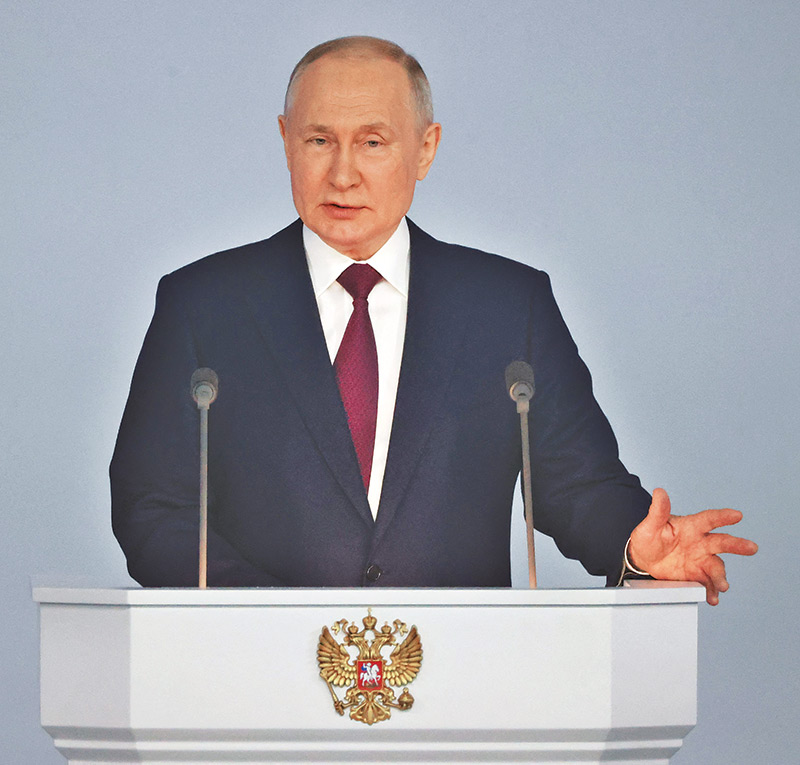
Russian President Vladimir Putin. AFP/RSS
MOSCOW, President Vladimir Putin on Tuesday suspended Moscow’s participation in a nuclear arms treaty with Washington and accused the West of escalating the conflict in Ukraine, ahead of a key speech by US President Joe Biden. In his scathing state of the nation address ahead of the first anniversary of the campaign in Ukraine, Putin also vowed that Russia would keep fighting in Ukraine and “systematically” achieve its aims. The Russian leader accused Western powers of wanting “to be done with us once and for all”, but said increasingly stringent international sanctions on Russia “will not succeed”. He said Moscow would no longer take part in the New START treaty for nuclear disarmament but would not pull out of the agreement altogether. The 2010 deal is the last remaining arms control treaty between the world’s two main nuclear powers but it has frayed in recent years, with the two sides accusing each other of not complying with it. US Secretary of State Antony Blinken said Russia’s decision was “deeply unfortunate and irresponsible” but that Washington was still willing to talk about the issue. NATO Secretary General Jens Stoltenberg said the move meant that “the whole arms control architecture has been dismantled”. Putin was speaking a day after US President Joe Biden made a surprise visit to Kyiv in which he promised additional arms deliveries for Ukraine and “unwavering” support. On a visit to NATO member Poland on Tuesday, Biden told President Andrzej Duda he was coming “at a critical moment”. “NATO is stronger than it’s ever been,” Biden said, reaffirming Washington’s “iron-clad” commitment to the Western alliance’s principle of collective defence. Duda said that thanks to Biden “we can see that America can keep the world order”. Biden is due to respond to Putin’s address at 1630 GMT on Tuesday with his own speech in Warsaw’s historic Royal Castle. On Wednesday, he is due to meet with the leaders of nine eastern NATO members which have been staunch supporters of Ukraine and where there are fears of the conflict spilling over. A top US official reacted to Putin’s remarks, dismissing as an “absurdity” his accusations that Russia had been threatened by the West as justification for sending troops into Ukraine on February 24, 2022. “Nobody is attacking Russia. There’s a kind of absurdity in the notion that Russia was under some form of military threat from Ukraine or anyone else,” White House National Security Advisor Jake Sullivan told reporters in Warsaw. Shortly after Putin’s speech, Ukraine’s presidential chief of staff Andriy Yermak said on Telegram that Moscow was “strategically at a dead end”. “Our goal is to kick them out of Ukraine and punish them for everything,” he said. When the Kremlin launched the offensive in Ukraine, its so-called “special military operation” was planned to be a rapid conquest leading to capitulation and the installation of a pro-Russian regime. Since then, Russia has been forced to give up ground in Ukraine but has kept up a barrage of drone and missile attacks and the military and civilian toll has spiralled. According to the latest estimates from Norway, the conflict has wounded or killed 180,000 Russian soldiers and 100,000 Ukrainian troops. Other Western sources estimate the conflict has caused 150,000 casualties on each side. In Ukraine on Tuesday, President Volodymyr Zelensky blasted Russia for “mercilessly killing” civilians in the southern city of Kherson as local officials reported at least five deaths following strikes there. AFP reporters saw dead bodies covered with plastic sheets or foil blankets on the streets near a bus stop and a supermarket in Kherson. Kherson is the capital of one of the four regions—along with Donetsk, Luhansk and Zaporizhzhia—that Russia claims to have annexed but has never fully controlled. On Tuesday, China said it was “deeply concerned” about the conflict, which it said was “intensifying and even getting out of control”. Foreign Minister Qin Gang said Beijing would “urge the countries concerned to stop adding fuel to the fire as soon as possible”. China has sought to position itself as a neutral party, while maintaining close ties with its strategic ally Russia. China’s top diplomat, Wang Yi, is due in Moscow on Tuesday for talks, in his final stop of a European tour. He is expected to meet with Russian Foreign Minister Sergei Lavrov on Wednesday. Stoltenberg on Tuesday echoed US concerns that China could supply Russia with weapons to help it pursue its campaign in Ukraine. The Western allies worry they are falling behind in supplying enough shells for Kyiv’s artillery to fend off a renewed Russian offensive. But if the fears—first raised by Washington—that China is preparing to deliver weapons to Russia are realised, they could fall even further behind in what would be a growing arms supply race.
HOME PAGE
Parties busy politicking have no time for people
Last year, politicians spent time putting together election coalitions. This year, they are caught up in power politics.
- PURUSHOTTAM POUDEL
KATHMANDU, Jhanka Shrestha, 55, a permanent resident of Ranibari in Kathmandu, runs a pharmacy. Shrestha, who has been in the business for the past 30 years, provides for his family with whatever he earns by selling medicines. But the recent economic downturn has hampered his business and taken a toll on the earnings, he complains. Shrestha says the politicians in charge of the country’s affairs are paying little attention to improving the national economy, which was first battered by the global pandemic and by the Russia-Ukraine conflict since last year. “Leaders often hold their meetings only to discuss who gets what positions, while putting people’s issues on the back burner. Why don’t they focus on public welfare?” he questioned. “We voted in the November elections hoping that things would improve, but we have been proved wrong once again.” Rameshore Khanal, a former finance secretary, says political dysfunction overshadowing people’s day-to-day issues is a problem not just in Nepal but all over the developing world. This time last year, political parties were discussing possible dates for local elections. The polls in 2017 were held in three phases: May 14, June 28, and September 18. However, the Election Commission as well as some law experts then argued that since the local elections (first phase) were held on May 14, 2017, there should be a new set of elected representatives—mayor/chair, deputy mayor/deputy chair, ward chairs, two women ward members and two other ward members in each local unit—by May 29, 2022. But there was also the argument that the local representative elected in the third phase (September 18) would not be able to complete their five-year tenure. Amid these conflicting arguments, the local elections, second since the country adopted a new constitution in 2015, were eventually held on May 13 last year. Soon after the local elections, the parties, especially the five-ruling alliance—Nepali Congress, CPN-Maoist Centre, CPN-Unified Socialist, Janata Samajbadi Party and Rastriya Janamorcha—were again engrossed in seat-sharing for the federal and provincial elections scheduled for November 20 in the year. After this seemingly endless election mode the country found itself in, the political parties were soon busy haggling for power. First, a dispute over who should become the prime minister split the ruling five-party coalition which had contested the local and general elections as an alliance. A new alliance of seven parties with the CPN-UML and the Maoist Centre as key partners was born. The alliance anointed Pushpa Kamal Dahal, chair of the Maoist Centre, as the prime minister on December 25. But the Dahal government is already in trouble as its coalition parties find themselves divided over the candidate for new President. “The problem with politics under a capitalist economic system is that the public agenda seldom gets the priority,” Khagendra Prasai, associate professor of philosophy at the Nepal Open University and a political analyst said. “We cannot expect the parties that so blatantly ignored public issues during elections to suddenly start caring about the same public after coming to power.” Though the Dahal-led government has directed various government departments for effective service delivery, experts find such directives meaningless in the absence of proper implementation and regular monitoring. “I recently travelled to some districts outside the Kathmandu Valley and found people everywhere frustrated with the state of politics and the economy,” Khanal, the former finance secretary, told the Post. “People share their tales of misery and how the politicians and the government have failed them.” One key issue the country currently needs to address is the economy. Inflation has picked up. The poor in far-western districts of Dadeldhura, Bajhang, Achham, Bajura and Darchula, among other regions, are burdened by exorbitant loans from microfinance companies. Unable to repay the loans, some have killed themselves while many others have fled their villages. But the rulers in Kathmandu appear unfazed. The markedly low turnout in last November’s federal and provincial elections hinted at the growing public frustration with the political parties. As per the report of the Election Commission, just 61 percent of voters exercised their franchise last November. The election of independent mayoral candidates like Balen Shah and Harka Sampang last May and the emergence of new political outfits like the Rastriya Swatantra Party, which won 20 seats in federal elections, suggest the public’s patience with traditional parties is running thin. “The parties have not learned from their previous mistakes,” sociologist Guman Singh Khatri said. “Public frustration is already high and could soon burst out.”
HOME PAGE
Oli’s offer has Madhav Nepal dreaming of Sheetal Niwas
Unified Socialist chief is shuttling between Dahal, Deuba and Oli, trying to drum up support for his presidency.
- TIKA R PRADHAN
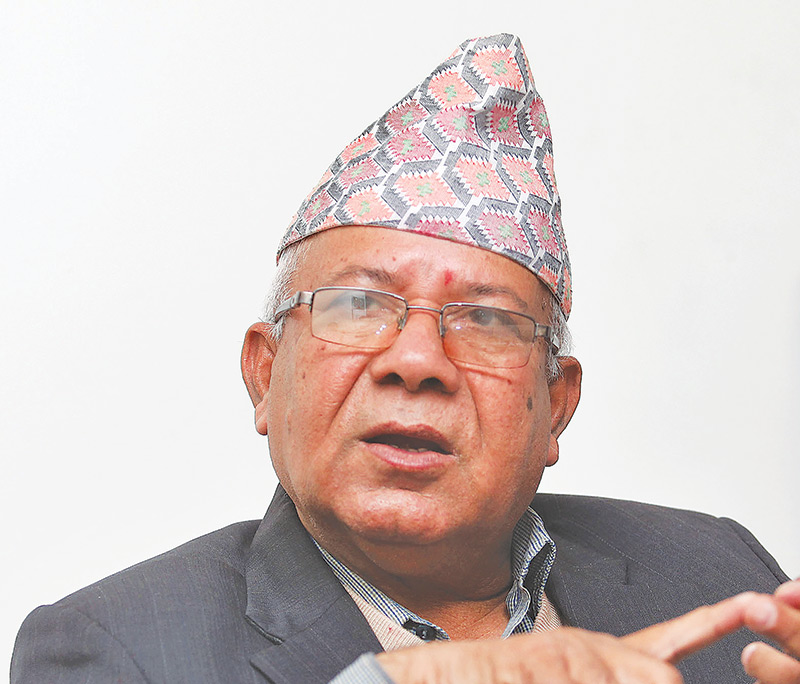
Madhav Kumar Nepal. Post File Photo
KATHMANDU, Former prime minister and CPN (Unified Socialist) chair Madhav Kumar Nepal suddenly finds himself thrust to the spotlight following news reports that CPN-UML chair KP Sharma Oli has proposed Nepal as a possible presidential candidate. Nepal is also eager to run for the President in a vote scheduled for March 9, but the question remains whether the political parties will agree to make him their ‘consensus candidate’ for the top job. “It’s true that Nepal discussed with Oli at length about the presidential election, but I’m not aware of such a proposal,” said Prakash Jwala, a senior CPN (Unified Socialist) leader. “It’s not that Nepal cannot be a presidential candidate. The only rider is that he should be a consensus candidate.” Nepal has reportedly taken Oli’s proposal to heart and is trying to rally the support of the Maoist Centre and the Congress for his candidacy, according to the Unified Socialist leaders. Oli had also proposed a reunification between the UML and Nepal’s Unified Socialist, according to reports. “Unity with the UML is impossible immediately, but the two parties can discuss it if the UML backs Nepal for President,” Jwala told the Post. Nepal met Dahal at Singha Durbar on Monday and asked the latter to try to build consensus on his name in the Maoist Centre. The Unified Socialist leader also plans on meeting senior Congress leaders. Speaking to reporters in Dang on Tuesday Nepal, however, said his party is yet to discuss the prospect. “We want our share of the pie in any power-sharing deal,” Nepal said. “We don’t want to be the ones to make sacrifices all the time.” While he was still in the UML, a dissident group led by Nepal had decided to back Nepali Congress chief Sher Bahadur Deuba’s bid for prime minister in 2021. Deuba, with the backing of the UML’s Nepal faction and the Maoist Centre among others was elected prime minister in July 2021. Later, Nepal formed the CPN (Unified Socialist) by splitting the UML. Nepal also revealed on Tuesday that both Congress President Deuba and Maoist Centre chair Dahal had agreed to support his party’s candidate for President before the federal elections last year. Before the polls, Nepal had asked the then Congress-led ruling coalition that he should be made the executive head for a year as the coalition partners had planned on helming the post-election government by turns, according to leaders of coalition parties. But the situation is different now. Dahal became prime minister with the UML’s support after Deuba refused to allow the former to helm the government for the first half of the five-year term. Now the UML is in the driving seat with both the Congress and the Unified Socialist shunted to opposition benches. Some Maoist Centre leaders, meanwhile, claimed that Dahal would only back Nepal’s bid for President if the Unified Socialist agrees to merge with the Maoist Centre. “If the Unified Socialist joined hands with the UML, there would be no point in supporting a UML candidate [Nepal],” said an office bearer of the Maoist Centre asking not to be named. “But we can consider backing him if he agrees on a merger with our party.” Moreover, the Congress, which wants the post of President for itself, is unlikely to support Nepal’s bid for the top post. “We have already given our word to Ram Chandra Poudel, so I don’t think our party can support Nepal’s bid for President,” said a senior Congress leader. “Also, we won’t support a UML nominee.” The Nepali Congress is preparing to take a decision on its own presidential candidate within a day or two. Congress President Deuba is expected to meet Nepal to discuss Oli’s proposal. “We will soon pick our party’s official nominee for President,” said Purna Bahadur Khadka, the Congress vice-president. Observers believe Oli’s proposal to Nepal is an attempt to sow a seed of discord between the Congress and the Unified Socialist. Political analyst Jhalak Subedi, quoting UML leader Subas Nembang, said that a leader [Nepal] who has already served as the executive head could attempt to exercise power even in the ceremonial position like the President, so such a person should not be made the head of the state. “If Oli really wanted Nepal to be the President, he would first talk about it with Dahal and create an environment for the Congress to support his candidacy,” said Subedi, a political analyst. “Even the Congress won’t support Nepal.” The most possible scenario, according to Subedi, is Dahal leading the government for around four years and allowing Nepal to lead it for the last one year—while the Congress gets to appoint the President. For this to happen, said Subedi, Congress should allow Nepal to lead the government for a year, or Nepal should be ready to settle for a few ministers in the Cabinet and possibly a provincial chief minister. Another political analyst Hari Roka said Nepal’s possibility of becoming President rests solely on the Congress’s decision—and the prospect now appears unlikely. “The UML is yet to make an official decision,” said Roka, a political economist. “It is not easy for the UML and the Unified Socialist to agree on Nepal as President.” Many UML leaders are still very hesitant to appoint Nepal, someone they see as a ‘betrayer’, as the President. Nor are all Unified Socialist leaders thrilled at the prospect of their chairman becoming the President either, in which case he will have to resign from his party position. The party, they say, could then face an existential crisis.
HOME PAGE
Nepal pull off a sensational win to sweep series
Beat champions Scotland to win all four matches in the tri-series also featuring Namibia.
- Sports Bureau
Nepal captain Rohit Paudel and Karan KC celebrate their win against Scotland during the Nepal Tri Series of the ICC Men’s Cricket World Cup League 2 at the TU cricket ground in Kirtipur on Tuesday. Post Photo: Angad Dhakal
KATHMANDU, Hosts Nepal pulled off a sensational two-wicket victory over champions Scotland on the back of a record ninth-wicket partnership, adding to three consecutive victories in as many matches in the Triangular Series of the ICC World Cup League 2 at the TU ground in Kirtipur on Tuesday. Captain Rohit Paudel played an instrumental role in Nepal’s victory, scoring an unconquered 95 runs. He also shared an unbeaten 75-run partnership for ninth wicket with Karan KC, who contributed 31 not out. Inviting the visitors to bat first, Nepal bowled out Scotland for 212 runs in 46.1 overs after leg spinner Sandeep Lamichhane shone with the ball, claiming four wickets. In the run chase, Nepal made a shaky start to their run chase and lost wickets at regular intervals and at one stage, were staring at defeat with the scoreboard reading 138-8. But captain Paudel, who came in to bat at number four, held his nerve as Nepal eventually went past the finishing line, scoring 213-8 in 44.1 overs with Paudel smashing the winning boundary. This is the first time Nepal has won all four matches of the League 2 triangular series among the seven series played so far. They became the second team after Oman to achieve such a feat. Oman had won all four matches of the series at the same venue, defeating both Nepal and USA in February 2020 in the double-header format. “We felt that we could win even after losing five or six wickets,” Nepal captain Paudel said at the post-match conference. “We stitched together a partnership with good understanding after Karan came in and I was hopeful of achieving the target,” he added. Despite missing out on a century by five runs, Paudel said: “Rather than scoring a century, successfully chasing the target and getting 95 was a happy moment.” The win also ignited Nepal’s hopes of retaining their One-Day International (ODI) status as the top five teams in the seven-team standing are supposed to retain their ODI status which is due to end in July. The International Cricket Council (ICC) has not yet given any clear indications for the pathway of ODI status. Nepal now must win six among its eight remaining matches of the League 2 to secure a top-five finish.
They could also earn a top-three finish and secure a place in the World Cup Qualifiers should they win all remaining eight matches and get favourable results from other opponents. Nepal currently sit sixth with 26 points from 28 matches with two series – eight matches – yet to play. They will fly to the United Arab Emirates (UAE) to play their penultimate series of the League 2 from February 27 to March 6 involving UAE and PNG. Playing in front of a roaring home crowd, Nepal lost early wickets in quick succession as openers Kushal Bhurtel departed on one run and Aasif Sheikh on 12 runs with 19-2 on board. Bhurtel was trapped leg before by Mark Watt in the second over and Sheikh was caught by Kyle Coetzer off Brandon McMullen. Former captain Gyanendra Malla was the next batter to be dismissed at 21, scoring the runs off 31 deliveries. He was trapped leg before wicket by Watt. Paudel who came to bat at number four did not get the ideal support from the other end as Kushal Malla departed after scoring a 28-ball 17 while Sundeep Jora (1), Dipendra Singh Airee (7), Sompal Kami (2) and Sandeep Lamichhane (9), all departed cheaply. But Karan KC, coming in to bat at number nine, gave Nepal the much needed stability, playing an unbeaten 37-ball knock of 39. He and captain Paudel also shared an unfinished 75 run ninth-wicket partnership, eclipsing Nepal’s previous best ODI partnership for the wicket. Scotland’s slow left-arm orthodox Watt was the pick of bowling, claiming three wickets in his 10-over spell. He conceded 29 runs and bowled a maiden over. Chris Greaves picked up two wickets in his 10 overs of bowling, giving away 61 runs. Earlier, sent in to bat first, the visiting side seemed to have made a sound start before leg spinner Lamichhane accounted for two batters in a row with 89-3 on board. While he trapped opener Kyle Coetzer leg before on 22 runs off 23 balls in the eighth over, Lamichhane also removed the other opener George Munsey on 60 runs, the highest scorer of the innings. He bowled Munsey on the fifth delivery of the 14th over and trapped captain Richie Berrington for a duck off the following ball. Munsey slammed nine hits to the boundary as well as two sixes in his 50-ball knock. Wicketkeeper batter Matthew Cross was the next best scorer, hitting a 63-ball 42. Other notable scorers for Scotland were Brandon McMullen who scored a 48-ball 31 and Christopher McBride who chipped in with a 30-ball 22. Lammichane, accused of raping a minor and freed on bail, was the pick of Nepali bowling attack, claiming four wickets. He conceded 45 runs in his 10 overs. Karan KC took three wickets in his 8.1 overs, giving away 42 runs. Lalit Rajbanshi and Kushal Malla shared a wicket each.
NATIONAL
Bajhang flood victims struggling for justice for over two decades
Around 165 families were relocated to Kailali but 20 years later, they are still landless.
- DR PANT
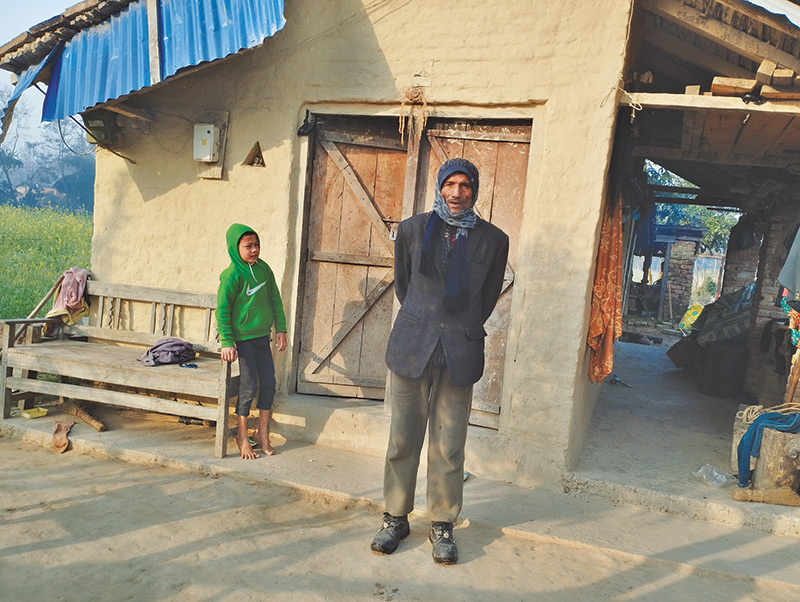
Flood-displaced Dabbu Thapa and his child outside their hut on government land in Kailali. Post Photo
DHANGADHI, For the past 23 years, 53-year-old Piru Bon and 52-year-old Dabbu Thapa have been running from pillar to post seeking justice. The natives of Bajhang were displaced from their homes in June 2000 when heavy rainfall battered Bajhang causing severe floods in the Seti river. Around 165 families from the then-six VDCs became homeless. The VDCs of Matela, Malubela, Lekgaun, Kotdewal, Supeda, and Luyeta were all affected by the floods. Among the scores displaced were Bon and Thapa. Bon has been living on the banks of the Mohana River between the Kanchanpur and Kailali districts while Thapa has been living on the banks of the Banda River in Kanchanpur. Following the flood and the subsequent displacement of hundreds of families, a high-level team conducted an inspection of the disaster sites. The government, in coordination with the District Development Committee, Bajhang, allocated 70 bighas of land for them to live on in Bhalukhola, Godawari Municipality-1 of Kailali district. However, displaced victims like Bon and Thapa never got their dues. “After the completion of the government processes, we moved to Kailali to the allocated location in Bhalukhola. We had started building huts and lived there for a month before forest officials started coming to our settlement and setting our huts on fire,” said Thapa. “This happened during the time of the armed conflict, so we weren’t even sure if the people burning our huts were from the forest department but they did pose as forest officials.” According to Thapa, the then-District Development Council Bajhang, in coordination with the Kailali District Development Committee, the Ministry of Forestry, the Landless Squatters’ Problems Resolution Commission, and the Ministry of Land Reforms had decided to relocate the flood-displaced families to the empty spaces in the forest area of Bhalukhola. Despite having the approval of all concerned authorities, Bon and Thapa along with the other displaced families still had to suffer. According to Thapa, most of the displaced had come to Tarai for the first time and even after a year of living in the government-allocated area, they did not have smooth sailing. “At night, people in army uniforms would threaten us with consequences if we didn’t vacate the area immediately. After such repeated incidents, more than half of the families left,” said Thapa. “Some went to live with their relatives while most left for India in search of jobs.” According to Bon, they went to the District Forest Office in Kailali with all the necessary documents. “The officials said that they would help us, but some locals filed a false complaint against us saying we were destroying forest resources,” he said. “I was sent to custody eight times after that. Every time I went to the forest officials, they would arrest me.” On April 3, 2001, the Ministry of Land Reform and Management issued a circular to the Landless Squatters’ Problems Resolution Commission to give land to the victims of Bajhang. That same day, the Commission also issued a circular to the Landless Squatters’ Problems Resolution Commission, Kailali, as per the decision of the Ministry. The commission decided that land should be given to the victims, but the authorities did not do so. On February 21, 2019, the Kailali District Court issued a verdict in favour of the victims. The Doti High Court also upheld the district court decision on June 28, 2019, and gave a verdict in favour of the victims. The Ministry of Forestry of the provincial government has also written a letter to the victims, citing the court decision on December 4, 2021. “We have all the evidence. There are judgements and verdicts of the courts in our favour, but a new settlement has been established on the land that was allotted to us,” Thapa said. “Where do we go now?” According to Bon, the Godawari Municipality has assured them of solutions to their problems but the assurances are limited to words. “Over 400 hectares of forest area in ward 1 of the municipality has been encroached upon and turned into settlements, and we are still fighting for the land allotted to us,” said Bon. Advocate Dal Bahadur Dhami, who provides legal assistance to the victims, said that verdicts from two courts, ministry-level decisions, approval from the Landless Squatters’ Problems Resolution Commission, decisions of the ministries of the provincial government, and repeated all-party meetings were all in favour of giving land to the victims. “But still, the victims have been living a hellish life for 23 years,” Dhami said. “The victims also filed a petition but no hearing has been held so far.” Birendra Bhatta, mayor of Godawari Municipality, says that he has not received any information on this subject since he was elected. “I can’t say much in this matter before getting the necessary information in coordination with the related authorities,” Bhatta said.
NATIONAL
Overextraction and shrinking open spaces cause groundwater depletion in Kathmandu Valley
Authorities plan to harvest rainwater at TU Teaching Hospital and other government buildings to replenish aquifers.
- ARJUN POUDEL
KATHMANDU, All three deep borewells at the Tribhuvan University Teaching Hospital, Maharajgunj have gone defunct—the last one dried up some five months ago. Of the other two, one dried up some eight months ago and the other 18 months ago. “All three borewells were more than 300 feet deep,” Dr Dinesh Kafle, executive director at the Hospital, told the Post. “One of them was drilled 40 years ago by the Japanese, when they built the hospital. The water has stopped coming out of it now.” The problem of borewells and tubewells drying up has been reported in many places of Kathmandu Valley. Overpumping of groundwater, shrinking open spaces, lack of rainfall for months, black-topping, and concretisation of roads and open spaces around homes are among the reasons for the depletion in groundwater in the Valley, according to experts. “We got several complaints of wells, borewells and tubewells drying up and depletion of groundwater,” said Prabin Chandra KC, hydrogeologist at the Kathmandu Valley Water Supply Management Board. “Some people have also lodged complaints about the physical damage caused to residential houses due to massive extraction of groundwater by nearby factories and offices.” Experts say the drying up of deep borewells on the hospital premises during the monsoon is alarming, because aquifers generally get replenished during the rainy season. The Tribhuvan University Teaching Hospital had replaced the water pumps and cleaned the borewells, but such steps failed to pump water. Two shallow borewells were also dug up on the hospital premises after the deep borewells dried up, but submersible pumps could draw only muddy water. “Patients do not use muddy water and it is also not appropriate to ask them to use whatever comes from hospital taps,” said Kafle. “The muddy water also damaged medical equipment. A lot of money is spent to change dialysis membranes (a semi-permeable film containing various sized pores) due to the muddy water.” At the request of the hospital, which provides treatment to thousands of patients every day, the Kathmandu Upatyaka Khanepani Limited has connected a three-inch pipeline to the hospital, but the problem is that the utility does not supply water regularly. Officials at the Kathmandu Valley Water Supply Management Board said several institutions and the general public have been facing problems due to the wells, tube wells and borewells gone dry. “Our own study carried out in the past showed that the groundwater in Kathmandu Valley has been depleting,” said KC, the hydrogeologist. “There were fewer problems in the northern part of the Valley, including Budhanilkantha and Tokha areas, but depletion is serious in the central part of the Valley.” While open spaces in the Valley are shrinking, which prevents the aquifers from recharging, the problem of natural springs, wells and borewells drying up has become acute, experts say. To recharge groundwater, Kathmandu Valley Water Supply Management Board has launched a pilot to harvest rainwater in government buildings including government schools and hospitals. “We have allocated a budget to harvest rainwater at the Tribhuvan University Teaching Hospital and in a few schools in the Valley this fiscal year,” said Radha Dhakal, an official at the board. “Almost all households in the Valley have their own borewells but very few have left space to recharge groundwater, which is a major problem.”
NATIONAL
Two children injured in IED explosion
National
POKHARA: Two children sustained shrapnel injuries when an improvised explosive device (IED) went off at Thuldhunga of Pokhara Metropolitan City-33 on Tuesday. The incident happened while the victims played with the explosive device they found in the local forest. According to the District Police Office in Kaski, Michael Chaudhary, 15, and Sabin Tamang, 13, were injured in the incident. The injured are receiving treatment at the Pokhara Academy of Health Sciences.
NATIONAL
Man dies in rhino attack
Briefing
CHITWAN: A man died after he was attacked by a rhino in Ratnanagar of Chitwan on Tuesday morning. Chandra Bahadur Tamang, a local resident of Ratnanagar-9, succumbed to his injuries, said Ganesh Prasad Tiwari, information officer at the Chitwan National Park. The 60-year-old was attacked on the road that falls between Lal Parsa and Mohana, Tiwari said. Rhinos have been recorded to use the road section regularly. Tiwari further requested the locals to stay alert as two rhinos have recently been found roaming in the area. The human settlements around the national park have been prone to wild animal attacks for years. Five people have been killed in animal attacks in Chitwan this fiscal year alone.
NATIONAL
Teen killed in road accident
Briefing
PARSA: A 13-year-old boy died on Tuesday after being hit by a van in Thori Rural Municipality of Parsa. The van was coming from Birgunj in the Parsa section of the Postal Highway early on Tuesday when the accident occurred. The victim, who was returning home after attending early morning coaching classes, sustained serious injuries to his head and body in the accident. Police personnel from the Bijayabasti police post had taken the victim to the Birgunj-based Tarai Hospital, where he succumbed to the injuries. Padam Bilas Panta, driver of the van, fled the scene, but was soon nabbed and taken into custody by the Sirsiya police team.
NATIONAL
Thousands of women skip routine maternity services
Around 140,000 Nepali women give birth at home, around 210,000 do not make postnatal visits and 45,000 don’t receive antenatal care, report says.
- Arjun Poudel
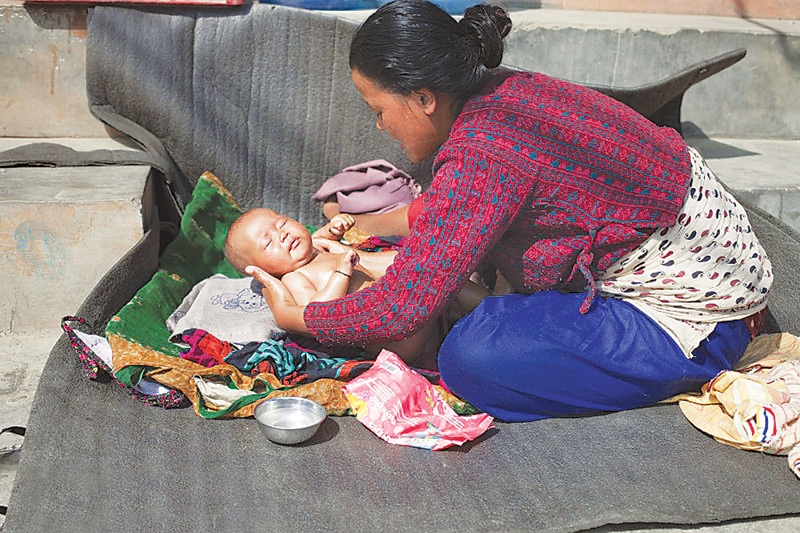
A nationwide study carried out last year shows only 70.2 percent women received a postnatal check during the first two days after birth. Post File Photo
KATHMANDU, If the preliminary report of Nepal Demographic and Health Survey-2022 is anything to go by, around 210,000 women do not receive postnatal visits, 140,000 women give birth to their babies at home and 45,000 women do not receive antenatal care visits. However, officials at the Ministry of Health and Population said that they are still unaware of the identity and whereabouts of those women that are deprived of routine maternity services. “We do not know who those women are and where they are,” said Nisha Joshi, senior public health officer at the Family Welfare Division under the Department of Health Services. “Despite an impressive improvement in maternal health care seeking trends in the country, the report shows that thousands of women are still deprived of maternity care services.” The nationwide study carried out between January 5 and June 22 last year with technical and financial support from the United States Agency for International Development shows that only 70.2 percent women received a postnatal check during the first two days after birth. It is estimated that around 700,000 women get pregnant every year throughout the country. The figure was 57 percent in 2016. The report also shows that 94.3 percent women received antenatal care, meaning that around six percent or 45,000 women did not receive the service. The figure was 84 percent in 2016. Likewise, the report shows that 79.3 percent of women gave birth to their babies in health facilities, which means over 20 percent or around 140,000 women gave birth to their babies at home. The figure was only 65 percent in 2016. The report also shows that 96.1 percent pregnant women received iron supplementation tablets during their pregnancies, meaning that four percent of the total or around 28,000 women did not take the supplement. Maternity care visits, including antenatal care visits, postnatal care visits and institutional delivery, and provisions of iron supplementation and folic acid are among the measures taken by authorities to lessen maternal deaths. The government provides all said services free of cost from state-run health facilities throughout the country. Some community hospitals and medical colleges also offer the services free of cost for which the Ministry of Health and Population reimburses the amount to those health facilities. Nepal reduced the maternal mortality rate from 539 per 100,000 births in 1996 to 239 per 100,000 births in 2016—for which the country even received the Millennium Development Goals award. Since then, the number has not declined significantly. The health target under the UN’s Sustainable Development Goals is to reduce maternal mortality rate to 75 for every 100,000 births by 2030. SDGs, a follow-up on the Millennium Development Goals (MDGs), aims at ending poverty and hunger and all forms of inequality in the world by 2030, and Nepal has committed to meeting the goals. “We are in line to meet the SDG target on maternal health but the problem is a large number of women are still deprived of the basic services offered by the government,” said Joshi. “We hope that the detailed report of the Nepal Demographic Health Survey-2022 would help us to figure out who and the whereabouts of the women left out of the maternity care services.” To lessen complications and maternal deaths, the Health Ministry has doubled antenatal care visits from four to eight. To encourage pregnant women to make antenatal care visits, the government also provides allowances. Experts say antenatal visits will help health workers rule out complications earlier in the pregnancy. The Health Ministry has also hired trained nurses to provide postnatal care at home. Of the total number of maternal deaths, 24 percent die during or after childbirth and 19 percent in the postnatal period, according to the Health Ministry. The government also provides iron supplements free of cost from state-run health facilities. Institutional delivery at state-run health facilities has been provided free of cost for years. Maternal health experts say that access to health care facilities and availability of trained human resources at health care facilities are still a main challenge to lessen maternal deaths. “It would take hours to reach health facilities in remote settings,” said Dr Ganesh Dangal, president of Nepal Society of Obstetricians and Gynaecologists. “Even if women in labour are taken to health facilities, there is no guarantee that health facilities have trained human resources.” Doctors say health authorities failed to convince people about the importance of postnatal care and possible risk factors after child births. Excessive bleeding after childbirth, also known as postpartum haemorrhage, is the most common factor leading to the death of new mothers in the country. Several government programmes—increasing antenatal and postnatal care, President’s Women Uplift Programme, free institutional delivery service, and allowances given to pregnant women for antenatal, postnatal and institutional delivery—have yielded results to reduce maternal deaths. Experts say that a lot of improvements have to be made to lessen the current rate of maternal deaths.
NATIONAL
Valley traffic police using automated system for surveillance
Traffic police head Mira Chaudhari says they are going for more automation in controlling traffic rule violations in the Valley.
- Post Report
Officials say the offenders who are caught on CCTV footage are fined between Rs500 and Rs1,500. They also have to attend the mandatory one-hour road safety awareness class. Post file Photo
KATHMANDU, The Kathmandu Valley Traffic Police Office has booked as many as 4,314 traffic rule violators over the past seven months, it said on Monday. Of them, 3,292 were booked after the office’s CCTV control room released information, while the remaining 1,022 were nabbed from different places in the Valley. The office also informed of its plan to increase the use of an automated system to identify traffic rules violations. “With the automated system, we aim for an increased surveillance on traffic rules violations,” said Deputy Inspector General (DIG) Mira Chaudhari, who is also the chief at the Valley Traffic Office. “We have made progress towards that.” According to traffic officials, the control room has three full time personnel who, through CCTV surveillance, keep records of traffic rules violations such as red light jumping, lane crossings, open door, and flouting of one-way rule. Those assigned in the control room point out the number of vehicles, their location, time, and type. They contact the Transportation Office to get the rule violators’ personal details. “Then we contact the violators, summon all of them to our office, and they pay the fine,” said Rajendra Prasad Bhatta, spokesperson at the office. Officials say the offenders who are caught on CCTV footage are fined ranging between Rs500 and Rs1,500. They also have to attend the mandatory one-hour road safety awareness class. “With this move [use of automated system], those who have been flouting traffic rules when they don’t see traffic police will become more conscious,” Bhatta said. “We hope that this will also help in reducing road-related accidents.” Over the past few years, the traffic police has become more technology-friendly. It had started to use CCTV for surveillance on the roads starting from 2017, but that was not much effective. “Now we are fully equipped,” Chaudhari said. “There will be more CCTVs on the roads so that people will be more conscious about traffic rules violations. This will surely decrease road-related accidents.” Earlier, during the Covid-19 pandemic in 2020, the traffic police decided to move all of its paperwork related to traffic rules violations online. The violators could pay their fines at the Global IME Bank and attend the mandatory one hour class. Meanwhile, the Kathmandu Valley traffic police department also plans to introduce more automation for overspeeding vehicles. “Besides using a radar speed gun, we will also install automated machines that can keep records of all overspeeding vehicles at once,” Chaudhari said. “This will be a great tool to control accidents on highways.”
NATIONAL
Rupak Sapkota appointed foreign affairs adviser to prime minister
Briefing
KATHMANDU: Dr Rupak Sapkota has been appointed as the foreign affairs advisor to prime minister Pushpa Kamal Dahal. Sapkota, who holds a degree in International Relations from China, was appointed to the post following the decision of the cabinet meeting held on Tuesday. Sapkota is expected to assume office on Wednesday after he receives his letter of appointment since Tuesday is a public holiday on the occasion of Gyalpo Losar. Sapkota is the son of former Upper House speaker and a central committee member of the CPN (Maoist Centre), Agni Prasad Sapkota. A former deputy executive director at the Institute of Foreign Affairs, Sapkota has been teaching international relations and diplomacy at Tribhuvan University. He is also a member of the varsity’s international relations and diplomacy committee. Sapkota graduated from the Renmin University of China in 2018 with a doctorate degree in International Relations.
NATIONAL
Loktantrik Samajbadi proposes Thakur as national consensus candidate for President
Briefing
KATHMANDU: The Loktantrik Samajbadi Party has proposed party chairman Mahantha Thakur’s name as the national consensus candidate for the position of President. Party leaders on Tuesday met Prime Minister Pushpa Kamal Dahal and proposed Thakur’s name as the presidential candidate of consensus during the meeting held at the Prime Minister’s residence in Baluwatar on Tuesday, said party leader Rajendra Mahato. “The Prime Minister has been seeking a consensus candidate for the presidency and in that connection, we went to meet the Prime Minister,” said Mahato, “We told the prime minister his thought regarding a candidate for the post of President by national consensus was good and proposed that Mahanta Thakur could be the candidate of national consensus.” Mahato said the party leaders floated the proposal to the prime minister, envisioning that it would be easy for everyone to agree on Thakur’s name. According to Mahato, Prime Minister Dahal, in response, said that Thakur could be a suitable candidate for the post of President. “The prime minister’s reply to our proposal was that Thakur, even though is not a candidate of national consensus, is a suitable candidate for the position and many others are also saying the same thing. The proposal is not something new, we were saying something that everyone already knew,” said Mahato. Leader Mahato said that Prime Minister Dahal, during the meeting, reiterated the idea that the president should be made by national consensus. LSP leaders said that Dahal, during the meeting, said that no one has been named so far for the position and that he is still in consultation. “I have not mentioned anyone’s name for the post of President and I am holding consultations with everyone,” said PM Dahal, during the meeting, “I am holding discussions with the Nepali Congress and the CPN-UML for national consensus. I haven’t decided on anyone yet.”
OPINION
Time for civil service reform
The administration is the main mechanism for implementing the state’s laws and policies.
- KHIM LAL DEVKOTA
POST FILE PHOTO
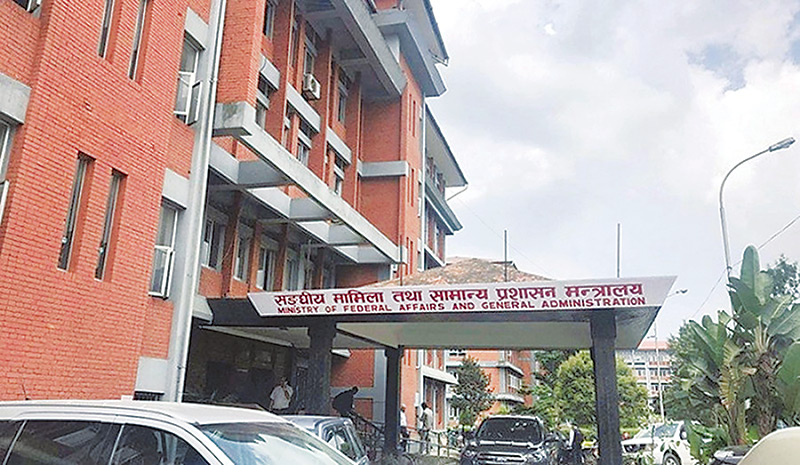
A significant change in Nepal’s modern administrative system took place after the advent of federalism in 2017. The Administration Reform Commission formed in 1991 under the chairmanship of the then prime minister Girija Prasad Koirala had recommended reducing the number of ministries from 21 to 18, decreasing the number of employees to one-third, and providing local governments with more functional responsibilities and revenue resources. But most of these recommendations were not followed. In 2017, another Administration Reform Committee was formed under the minister of general administration. This panel recommended having 15 ministries at the federal level and seven in the provinces, but it was ignored. Recently, the Federalism Implementation Parliamentary Special Committee of the National Assembly recommended having 15 ministries at the federal level. The number of provincial ministers was to be fixed at 10 percent of the number of members in the Provincial Assembly. The administration is the main mechanism for implementing the state’s laws, policies, rules and standards. The administration needs to be flexible so that people can get services easily. There is a general opinion that Nepal’s administrative system has not been streamlined even after the country moved to federalism. In 2019, the Ministry of Federal Affairs and General Administration announced that employee adjustment in all three levels of government had been completed in accordance with the constitution. It was estimated that about 139,000 employees would be needed for the federal units—35 percent at the federal level, 16 percent in the provinces and 49 percent in the local units.
Civil service law If we analyse the functional responsibility of the federal units, more than half of the workload has gone to the subnational levels. However, many organisational structures are still unnecessarily piled up at the centre. Around 49,000 positions have been created at the centre, and 40,000 have been retained. Although it has been estimated that about 68,000 employees are required at the local level, 24,000 fewer employees have been accommodated. During the adjustment, it was announced that there was a shortage of 24,000 employees at the local level. The provinces were also advised to manage a minimum of 9,000 employees on their own. But they have no way of doing this. The federal civil service law has not been promulgated even after five years. The Provincial Public Service Commissions existed, but they could not deliver the expected results. Regarding the local level, as per the Local Government Operation Act, the basic principles and standards regarding the formation, operation, management, service conditions and facilities of local services shall be in accordance with federal laws. The federal government did not pass this law for five years. In 2019, remote local units which faced a shortage of employees coordinated with the Public Service Commission and filled up about 10,000 vacancies. The federal government also created more problems by transferring these employees to other places. Currently, the subnational levels are so short-handed that they have to rely on junior-level employees. This problem is seen mostly in Madhesh, Karnali and Sudurpaschim provinces. Employees at Singha Durbar have nothing to do while there is a shortage of staff at the subnational levels. Government employees are unwilling to go to remote areas of the subnational levels. Further, the federal government is also increasing employee positions. As per government sources, about 5,000 official posts have been added at the centre after the employee adjustment. The assessment of the number of employees required at the federal units was not practical and realistic. A new organisation and management survey for the federal units should be conducted to implement the new administrative organisation structure.
Biggest problem As there is no Federal Civil Service law, there is chaos in the administrative sector now. The law should be passed by the current parliamentary session. As soon as the Federal Civil Service law is promulgated, the provinces should take the lead in creating the Province Civil Service laws which should be identical to the federal law. In some districts, there are two or three offices of the same provincial ministry, which is burdensome. In some districts, there is a compulsion to go to another district to get services. Rather than keeping many offices in one district and none in others, it is better to keep provincial offices in the district integrated. The biggest problem is that politicians do not improve when they are in power. When they are out of power, they talk a lot. If those who are in power work wholeheartedly, not only the administration system but every sector of the state can be improved. Prime Minister Pushpa Kamal Dahal has a lot to do to improve the administration system. But the proper steps haven’t been worked out yet. It will take some time for the results after determining the correct steps. If the irregularities seen in the administration mechanism cannot be eradicated, the change sought by citizens is impossible.
Devkota is an expert in federalism and local government.
OPINION
Globalisation here to stay
While global trade has raised people out of poverty, it has also resulted in trade imbalances and mounting debts.
- BIJENDRA MAN SHAKYA
Shutterstock
At the World Economic Forum in Davos, Switzerland, in January this year, global political and economic leaders highlighted the case for globalisation and “deglobalisation” as a result of a host of international incidents that took place in recent years. From Covid-19 to Brexit and the war in Ukraine, the combined effects of these international incidents unexpectedly broke the global supply chain—the offspring of globalisation. That raised questions about the uncertainty of growing dependence among economies and forced countries and companies to rethink their interdependence. However, a key message from Davos, which particularly applies to developed countries, is that globalisation must continue to evolve while its demise has been exaggerated. But its relevance to less-developed countries such as Nepal, struggling to survive in the globalised economy, was undermined. Nepal initiated integration with the global economy by reducing trade and investment barriers and liberalising the foreign exchange mechanism in the early nineties. It was reinforced by the country’s affiliation to the regional free trade agreement in South Asia and the multilateral trading system of the World Trade Organization. While it has raised hundreds of thousands of people out of poverty and boosted trade and investment in the country, it is also blamed for growing trade imbalance and debt outstanding, absolute poverty and uneven development. Moreover, the issues of social discord and inflexibility to domestic regulations often dominate the debates on globalisation in the country. The contention is not about the advantages and disadvantages of globalisation but about what restrains underdeveloped countries like Nepal from benefiting most from economic globalisation. The trinity of comparative advantage, innovation, and global supply chain explains this phenomenon. Without the combined effect of these forces, it is difficult for underdeveloped countries to specialise, economise, and stabilise production to compete globally. With the liberalisation of trade, Nepali producers have gained in product specialisation to some extent. The reduction in tariffs and the elimination of the licensing system have helped give them choices to import quality inputs at the lowest possible prices from around the world. Consequently, some consumer goods-based industries flourished domestically to substitute imports, whereas some agriculture and labour-based products emerged as export potential. Hand-knitted carpets, apparel, and pashmina shawls have established their global images. Development of new commercially viable products for export is continuing and should continue. However, Nepali producers are failing to catch up with the speed of innovation and the global supply chain. An incentive to innovate does not come without compensation to producers for taking the risk as ‘first mover’. Similarly, integration into the global supply chain is low due to a lack of human capital and restrictive regulatory policies in the country. Without these two factors as complementary to specialisation, the producers will focus on the same old goods instead of diversifying into high-value-added products in both the manufacturing and agriculture sectors. This also means less sophisticated global value chains or low participation in the global production network for Nepali producers. A World Bank study illustrated that the foreign technology embodied in imported intermediate inputs and their higher sophistication positively impact exporter performance in Nepal. Nepali firms that import more than 30 percent of intermediates from outside South Asia have 16.8 percent larger export values, export to 40 percent more destinations, and have unit values that are 10 percent higher on average than other firms. Ironically, Nepal’s trade performance has been stagnant despite having export potential at around 12 times its actual annual merchandise exports, as estimated by the World Bank. With export growth remaining at 4 percent on average since the turn of the century, Nepal features among the 20 countries in the world with the slowest export growth in the past two decades. While Nepal benefitted from globalisation by exporting labourers, a large inflow of remittance made it dependent upon this external source for financing the economy. Nepal ranked fifth in terms of contribution of remittance to gross domestic product (GDP) that finance one of the highest trade deficits in the world. The worst scenario of the migrant workers’ export is the shortage of skilled and semi-skilled manpower within the country, resulting in a decline in their contribution to GDP. Unlike Nepal, many developing countries have boosted growth through trade diversification and integration into global economies. This is evidenced by the achievements made by Nepal’s close neighbours. Globalisation has been a boon to India and China. While India has established itself as the world’s outsourcing hub for services, China is renowned as the world’s manufacturing centre and an attractive location for investment from multinational companies. Most strikingly, Bangladesh has emerged as one of the world’s top readymade garment exporters, second after China. This could not have been possible for Bangladesh without its policy coherence to globalisation. Just as the developed countries benefited from agglomeration and economies of scale through the invention of new technologies in production and transportation in the past, the developing countries have captured the global markets by harnessing labour-intensive sectors. In today’s globalised world, commitment to digital trade and e-commerce with management and control of geographically dispersed supply-chain could be a game changer for developing countries. Therefore, Nepali entrepreneurs shouldn’t undermine these developments. They should focus on the trilogy of comparative advantage, innovation, and global supply chain to survive in the globalised world. This is because the World Economic Forum at Davos gave a clear message that globalisation is evolving, not retreating.
Shakya is an Associate Professor at Tribhuvan University.
OUR VIEW
Untimely consensus
Forging a “national consensus” in the absence of national emergencies is an affront to multiparty politics.
The idea of ‘national consensus’ started taking shape when the political parties were in a collective fight against the autocratic monarchy in the aftermath of King Gyanendra Shah’s coup on February 1, 2005. Back then, the parties had a single goal: To bring sovereignty back to the people. When Shah subsequently announced the restoration of the dissolved parliament, the political parties again had no option to work together to chart out a new political course for the country. The unfinished business of the peace process that started in 2006 also gave them the impetus to keep working together. Then, in 2008, the country elected its first Constituent Assembly, whereupon there was still a need for the parties to collaborate in order to draft a new national charter and to see the peace process to its logical end. But Nepal turned a corner when it got a new constitution on September 20, 2015, even though the process of transitional justice, a crucial component of the peace process, remained incomplete. That was when the idea of national consensus should have died a natural death. The country had charted a definite course and it was now up to the political parties to compete to win public trust and govern on the basis of this trust. Yet the idea sputters on. It is now being invoked not to conclude the transitional justice process, which would have been a worthy goal, but to prolong the tenure of a government led by the leader of the third biggest political party in the parliament. In normal course, the Maoist Centre Chairman Pushpa Kamal Dahal, whose party has just 32 lawmakers in the 275-member assembly, would not have become the prime minister. Yet he managed to coax and cajole his way to power. And now he dusts off the idea of national consensus so that he can continue as the government head. This is not to single out Dahal though. Given the brand of self-serving politics Nepali political leaders have pursued of late, perhaps the likes of Sher Bahadur Deuba and KP Oli, the heads of the first and the second largest parliamentary parties respectively, would have done the same where they were in Dahal’s shoes. Yet the idea of forging national consensus when there are no emergencies in the country is an affront to multiparty politics. It would be dangerous if the idea became synonymous with three or four top leaders coming together and forging a deal convenient to their realising their individual political ambitions. The election of the country’s President is a competitive process. The head of the state will be chosen by an electoral college composed of the members of the federal parliament and state assemblies. It would be wrong of a handful of leaders at the centre to try to dictate the voting intent of the members of these sovereign chambers. There is also no guarantee that a consensus President, if one can be found, will stay within constitutional bounds. Plus, can any candidate be ‘politically neutral’ in a society thoroughly steeped in politics? Both Dahal, who insists on political consensus and Oli, who is as adamant on “political consensus in favour of a UML candidate”, are wrong on this account. If national consensus gets a bad rap, tomorrow, when the country really needs it, say in some emergency, the public won’t be convinced that it is being pursued with the right intent.
THEIR VIEW
Freedom of thought
Teachers, thinkers and scholars must be placed at the top of the social hierarchy.
We are humbled and elated that The Daily Star could honour 12 luminaries of the country who we describe as “Sentinels of Freedom of Thought.” From pre-independence days and throughout Bangladesh’s 50 years, these individuals have steadfastly championed the principle of freedom of thought and expression. They have courageously and consistently stood up against political oppression, injustice, discrimination, and inequality. In the present context, where the space for freedom of thought and expression is being constricted more and more, it is befitting to recognise and appreciate these extraordinary human beings whose lives are examples for younger generations to follow. The individuals honoured are jurist Dr Kamal Hossain, Prof Serajul Islam Choudhury, artist Rafiqun Nabi, Prof Abdullah Abu Sayeed, Prof Rehman Sobhan, writer and researcher Jatin Sarkar, writer and political activist Badruddin Umar, language veteran Ahmed Rafiq, human rights activist Hameeda Hossain, artist Mustafa Monowar, educationist Sharifa Khatun and women rights champion Noorjahan Bose. Each of these individuals stand for freedom of thought. While freedom of thought is an inalienable right guaranteed by our constitution and considered the fundamental factor that differentiates us humans from all other living beings, it is a right that cannot be taken for granted. As we have seen globally, as well as in our country, this right must be nurtured through many layers of society. We have made impressive inroads in developing physical infrastructure for our economic growth but we ask, where is the infrastructure to develop freedom of thought? Where is the investment in rescuing the ailing education system which forms the bedrock of progress for a civilisation? Instead, we see repressive laws being used by the government and those affiliated with the ruling quarters to crack down on anyone who dares to have or share views that differ from the powers that be. Other forms of intimidation tactics are also being used to push society further and further towards complete intellectual bankruptcy. We need better skilled, better paid teachers, modern curricula, universal access to ICT skills, and resources and infrastructure required to bring education up to a standard that is suitable for the present world. But underlying all this there has to be an unwavering commitment and respect for scholarship, critical thought and intellectual advancement. We must place our teachers, thinkers and scholars at the top of the social hierarchy for they are the ones who can guide us through, who can inspire us to think innovatively and who can show by example a dedication to make positive changes in society. In order for this to happen, we believe the most basic prerequisite is freedom of thought. As a paper that has been deeply committed to independent journalism, we believe that it is time for us to retrieve this unassailable right, one that has been the primary driving force in all our social and political movements—whether it was our movement for our mother tongue or our freedom from repression and discrimination from colonial, fascistic or autocratic rule. To do this we must all work together, regardless of our political affiliations, to uphold, protect, honour, nurture and celebrate freedom of thought and consider it the “oxygen” that is essential for us to breathe.
—The Daily Star/ANN
MONEY
Small borrowers ruined by exorbitant interest rates
Insiders say the actual number of victims of microfinance companies may be in the hundreds of thousands.
- SUBIN ADHIKARI
The victims accuse officials of microfinance companies of putting poor people in a debt trap and then looting them for life. Photo Courtesy: SEJON
KATHMANDU, Former owner of a retail store Dil Kumari Karki now washes dishes after going bankrupt. Karki had opened a small grocery in Rautahat with Rs100,000 borrowed from neighbours. She expanded the shop by borrowing more money, and eventually her loans piled up to Rs450,000. When her creditors began asking for their money back, she turned to microfinance companies for more loans. The microfinance companies decided to squeeze her after finding out about her predicament, and demanded up to 36 percent interest. Karki made interest repayments to her neighbours by borrowing from various microfinance companies. She owed money to 10 creditors, including five microfinance companies—Forward, Mero Microfinance, Mithila, Deprosc and Sana Kisan. “I decided to sell a kattha of my land to repay my debts. I found a buyer who agreed to pay me Rs1 million per kattha, but later he backed out,” said Karki. The interest on her loans has been piling up, and the microfinance companies have been coming to her house regularly. Karki said her debts bloated to Rs4.5 million in the last four years due to high interest rates. “The microfinance companies also seized my land.” She is under constant mental torture, and now washes dishes in people’s homes in Kathmandu, earning up to Rs10,000 per month. She uses most of her income to send her son to school. Shyam Kumari Chaudhary of Devipur in Siraha has a similar story of woe. She borrowed Rs20,000 from a microfinance company when her father fell ill and had to be taken to India for treatment. She paid back Rs11,000 after returning from India, and planned to pay the remaining Rs9,000 later. Not long after, Chaudhary was stunned to find out that the interest on the Rs9,000 had ballooned to Rs120,000. “I paid Rs120,000 to the microfinance company. They say I still have to pay Rs40,000 more.” The microfinance company has been threatening me. “If I don’t pay Rs40,000 within a few days, I will have to pay an additional Rs20,000 as penalty,” said Chaudhary, speaking at a programme in Kathmandu on Monday. Chaudhary said company officials came to her home at night and threatened her family to pay the debt. Karki and Chaudhary are a few examples of debtors being ruined by usurious interest rates. About a dozen other victims related their experiences of being cheated by microfinance companies at an interaction organised by the Society of Economic Journalists-Nepal in Kathmandu on Monday. Insiders say the actual number of victims of microfinance companies may be in the hundreds of thousands. A large number of them have not complained out of fear. The concept of microfinance, now in wide practice in Nepal, dates back to the 1970s when a Bangladeshi economics professor Muhammad Yunus established Grameen Bank to provide microcredit to women to set up micro businesses. This model contributed greatly to uplifting thousands of Bangladeshis out of poverty, and Yunus and Grameen Bank even received the Nobel Peace Prize in 2006 for their work. His model of microfinance was replicated all over the world and in Nepal too. Harihar Dev Pant, former deputy governor of Nepal Rastra Bank, is credited with introducing the Bangladeshi model of microfinance in Nepal some 30 years ago. Microfinance companies are registered and regulated by Nepal Rastra Bank, the country’s central bank. There are 64 microfinance companies currently in operation. Bharat Singh Thapa, assistant professor of microfinance at Tribhuvan University, said that microfinance companies work on the collaborative effort of financial and social capital. “In the case of Nepal, these companies have turned themselves into shadow banks to collect deposits and provide loans,” said Thapa. “The social aspect has been destroyed.” Thapa stated that the existing model of microfinance has failed. “There is a need to remodel it in order to make it functional in a better way. Due to the absence of discipline in microfinance companies, low-income people are at risk of falling prey to profiteering individual lenders,” added Thapa. Most of the victims stated that microfinance companies have now turned into loan sharks. “The central bank has adopted a liberal policy to regulate microfinance companies as compared to other financial institutions due to its social factor,” said Rewati Nepal, executive director of Nepal Rastra Bank. According to him, microfinance companies are allowed to issue collateral-free loans of up to Rs1.5 million. They can charge only up to 15 percent interest and take 1.5 percent service charge. “I request the victims, who have been asked to pay unlawful interest rates to immediately file a complaint with the central bank. We will take action without any delay,” said Nepal. Speaking at the programme, representatives of microfinance companies admitted that there were some problems in the sector. “The board of directors set high targets for executive officers. As a result, they engage in dirty games to meet the deposit and loan targets,” said Janardan Dev Pant, CEO of Nirdhan Utthan Laghubitta Bittiya Sanstha. “Because of the ill intentions of a few, there is a risk of all the achievements and contributions of microfinance being overshadowed.” The victims say that company employees also manhandle and abuse borrowers, and confiscate their belongings. “Many people have committed suicide, several have been forced to flee their homes, and some have even been compelled to engage in prostitution to repay their debts to microfinance companies,” said Poonam Mahato, a victim from Lahan. “Who will take responsibility for that?” The victims accuse officials of microfinance companies of putting poor people in a debt trap and then looting them for life. “This problem has existed in the microfinance sector for a long time. The pandemic and liquidity crisis caused a sudden outburst,” said Mani Ram Gyawali, leader of an ad hoc committee formed to protest against microfinance companies.
MONEY
Nagdhunga tunnel project deadline extended
Delays caused by the pandemic among other issues cited for the extension of the completion period to April 25 next year.
- Post Report
Until February 17, the excavation work was completed for 1,813 metres of the main tunnel. Post File Photo
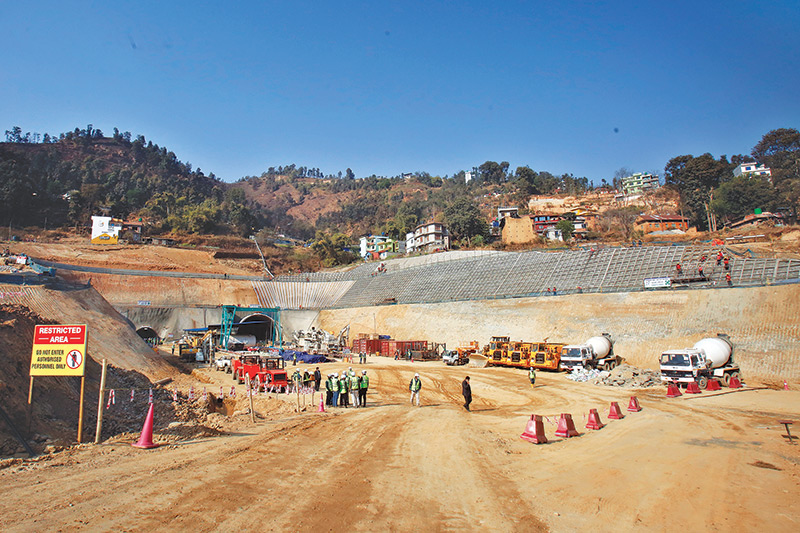
KATHMANDU, The government has extended the deadline of Nepal’s first tunnel road project—Nagdhunga Tunnel—to April next year. The 2.68 kilometres long tunnel project has so far seen about 49 percent of the physical progress, according to an official associated with the project. The project’s original deadline was April 26, 2023. “The deadline has been extended until April 25 next year due to the delays caused by Covid-19 and other technical issues,” said Madhav Prasad Adhikari, the deputy project chief. The geological issues faced by the project are also being analysed, according to Adhikari. “The land compensation issue at Balambu, where a flyover is to be built, has also caused hindrance in the project’s work.” Until February 17, the excavation work was completed for 1,813 metres of the main tunnel and 2,069.8 metres in the evacuation tunnel. The main and evacuation tunnels will be 2.68 kilometres and 2.55 kilometres long, respectively, when completed. Being constructed by the Japanese company Hazama-Ando Corporation, the tunnel passes under the western rim of the Kathmandu Valley, allowing motorists to avoid the treacherous hills which face frequent landslides. With the project’s completion, commuters on the Nagdhunga-Naubise stretch will be able to avoid at least 19 hairpin bends and sharp curves along an 8 km section of the roadway. According to a 2015 preparatory survey, it takes around 34 minutes to navigate the 8 km section following the route’s existing alignment. The then Prime Minister KP Sharma Oli laid the foundation stone of the Rs22 billion project in October 2019. It was expected to be completed within three and a half years. Besides the tunnel from Sisne Khola to Basnetchhap, the project also has a 2.6 km four-lane approach road with a service lane on each side. Of the total, 2.2 kilometres of the approach road will be from Basnetchhap to Thankot and the rest on the other side of the tunnel. Around 79 percent of the roadway excavation and 69 percent of embankment filling work has been completed on the access road. The project was also affected last month after the home ministry issued a circular on January 4 to ban “illegal” crusher plants across the country. However, the government later allowed the crusher plants to operate temporarily, setting a condition that they have to be registered and pay taxes by mid-July this year, after a shortage of riverbed materials like sand and gravel hit development works. “The construction work has picked up pace after the government’s decision,” said Adhikari, the deputy project chief. The deadline of the project, which was first extended by three months, has been pushed further beyond, by nine months. “The recent expansion was done following the government’s provision for projects whose agreements happened before the Covid-19 pandemic,” Adhikari said. “We are hopeful that the project will meet the new deadline.” In 2016, the Japanese government agreed to provide a soft loan of Rs15.28 billion for the tunnel to eliminate the need to travel the circuitous route over the Valley’s western rim, which is the main overland link between the capital and the southern plains. Its repayment period is 40 years, including a grace period of 10 years when the government will not have to pay any interest or repayment instalments. Following the end of the grace period, the government will have to pay annual interest at the rate of 0.01 percent. It will also have LED lighting, mechanical ventilation, an evacuation tunnel door and emergency telephone service. The approach road will have three bridges, toll booths and a roadside rest area for travellers. The rest area, spread over 4,650 square metres, will have a parking space for nine heavy vehicles and 23 light vehicles, fast food restaurants, shops and toilets.
MONEY
SecurityPal inaugurates security operations command centre
- Post Report
KATHMANDU, SecurityPal, a ‘consolidated solution’ for completing security reviews and questionnaires, unveiled a security operations command centre in Kathmandu on Tuesday. The inauguration ceremony saw the presence of United States ambassador to Nepal Dean R Thompson. “To see a company like SecurityPal starting up and engaging so many dynamic people from Nepal but also the interplay that’s happening with them and your customer base around the world is really something wonderful to behold and something exciting to be part of,” Thompson said at the function. The command centre provides SecurityPal’s customers with dedicated support including its latest feature—native language support in Japanese, German, Spanish, Portuguese and French, among others, the company said in a statement. This also serves to bolster SecurityPal’s proprietary ‘Augmented Intelligence’ approach to solving the critical pain point, the statement added. “Most solutions in the market are over-reliant on artificial intelligence which has shown a tendency to be confidently incorrect, introducing non trivial risk for deals and security teams,” said Sunil Chhaya, general partner at Kearny Jackson, a firm that backs tech companies at their early stages. “SecurityPal has astutely deconstructed the problem and applied the technology at the right points of the value chain in conjunction with experienced in-house security analysts.” The command centre also helps scaling companies and enterprises tackle the complex and evolving nature of security reviews and questionnaires, the statement further read. The command centre will serve as a hub for the company’s security professionals to collaborate, share knowledge and best practices, and provide customised support to each of its customers, the company said. “For the modern security-sensitive enterprise, security reviews and questionnaires are a 24/7 occurrence,” said Pukar Chandra Hamal, founder and chief executive officer of SecurityPal. “That demand necessitates robust ‘always-on’ operations. This is why we are thrilled to expand our global footprint and deepen our commitment to providing the best possible coverage for the customers.”
MONEY
India ties up with Singapore for real-time payments link
- REUTERS
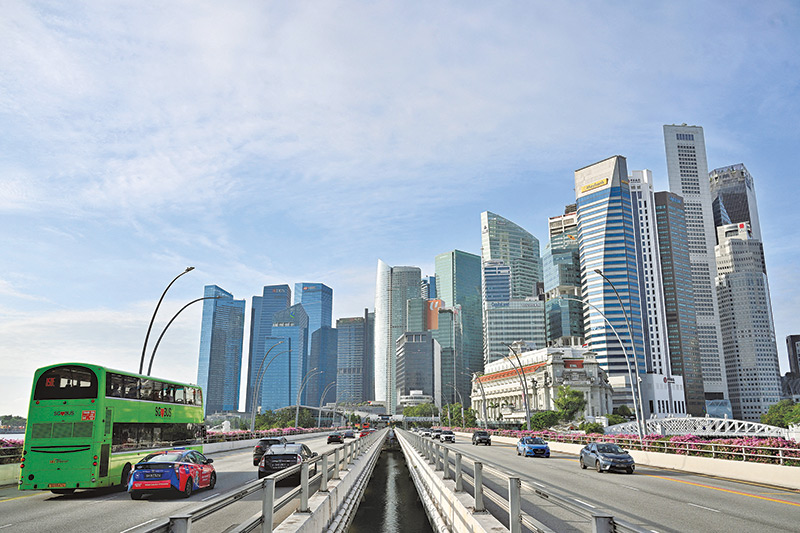
View of the skyline in Singapore on January 27. REUTERS
MUMBAI, India and Singapore launched on Tuesday a real-time link to facilitate easier cross-border money transfers between the two countries, the first such for the South Asian nation that is the world’s biggest recipient of remittances. Transfers of funds between the two countries will now be possible using just mobile phones due to the tie-up between India’s Unified Payments Interface (UPI) and Singapore’s PayNow facility. Such arrangements, which are a growing trend in Asia, typically lower the costs of payments. Singapore has already established a cross-border payments link with Thailand and is working on one with Malaysia, according to the website of the city-state’s central bank. “This will enable people from both the countries to immediately and at low-cost transfer funds (by) just using their mobile phones,” Indian Prime Minister Narendra Modi said at a virtual event for the launch of the service. The linkage will help migrant workers, professionals, students and their families, said Modi. UPI is an instant real-time payments system, allowing users to transfer money across multiple banks without disclosing bank account details. Similarly, PayNow is a service offered by participating banks that allows sending and receiving Singapore dollar funds from one bank to another using a mobile number. Singapore’s Prime Minister Lee Hsien Loong told the launch event cross-border retail payments and remittances between the two countries currently amount to over $1 billion annually. “The UPI-PayNow linkage will grow in utility and will contribute more in facilitating trade,” Lee said. India received $89 billion in foreign remittances in 2021/22, the highest ever in a year by any nation. The World Bank has projected that number to rise to $100 billion in the current year.
MONEY
Realme’s thinnest smartphone to be available in Nepal soon
Bizline
KATHMANDU: Realme has revealed the design of its latest realme 10 4G—the brand’s slimmest set ever released globally. The new smartphone will be available in Nepal soon, the company said in a statement. With an ultra-slim body of 7.95mm, the realme 10 4G packs a 5000 mAh battery and is still lightweight, making the holding experience easy for everyday use, the company said. Realme 10 4G brings a perfect balance for every consumer—a 6.4-inch AMOLED display for a large and vivid viewing experience, an ultra-slim and lightweight body for long-time holding, a 5000mAh battery for whole-day usage, and a stylish design for extended personality. Aside from the design, realme 10’s render also indicates realme 10 4G will come with a consumer-favoured 3.5mm headphone jack and a 200 percent ultra boom speaker.
MONEY
Sri Lanka to make $2.6 billion in loan repayments
Bizline
COLOMBO: Sri Lanka’s cabinet has approved loan repayments worth $2.6 billion in the first half of this year, in line with its debt suspension plans, its cabinet spokesperson said on Tuesday. The island of 22 million people is tangled in the worst financial crisis in over seven decades, triggered by a severe shortage of foreign exchange that forced the country to announce a suspension of foreign debt repayments in April 2022. However, Sri Lanka will continue to repay multilateral loans from several organisations including the World Bank and Asian Development Bank, cabinet spokesperson and Transport Minister Bandula Gunawardana told reporters. The loan repayments will include $2 billion in foreign loan repayments and $540 million in interest payments. Repayments will also include $709 million in dollar-denominated Sri Lanka Development Bonds and $46 million in interest payments, Gunewardana added. Sri Lanka signed a preliminary agreement for a $2.9 billion bailout with the International Monetary Fund (IMF) last September but has to put its debt on a sustainable path before disbursements can begin. (Reuters)
MONEY
Dubai airport sees surge in arrivals
Bizline
DUBAI: Dubai’s airport welcomed 66 million passengers in 2022, more than double the previous year, it said on Tuesday, a spike its chief executive attributed to “huge growth” in Russian travellers. The main business hub of the oil-rich United Arab Emirates is home to one of the world’s busiest airports. The airport “welcomed a total of 66,069,981 passengers during 2022”, representing year-on-year growth of 127 percent, according to a statement. In 2021, around 29.1 million passengers passed through Dubai, and the authorities had expected 57 million visitors for the year 2022. India, Saudi Arabia and the United Kingdom topped passenger arrivals but Russia has also “been an important contributor”, CEO Paul Griffiths said. “We’ve seen a huge growth in the Russian market since the... tensions between Ukraine and Russia started a year ago,” he told AFP. Russians accounted for 1.9 million passengers — more than double the 912,000 recorded for 2021, Griffiths said. The UAE has maintained a neutral stance towards Russia’s war in Ukraine, which is nearing its one-year anniversary. The Gulf nation has emerged as a top destination for rich Russian emigres fleeing the impact of Western sanctions. Russians were the top buyers of Dubai properties last year, according to brokerage Betterhomes, bolstering the city’s record real estate transactions last year. (AFP)
SPORTS
Grealish’s impact growing at Man City
It’s the control and balance Grealish brings to the City team which really stand out and it’s why, at the moment, the England winger is Guardiola’s go-to guy.
- ASSOCIATED PRESS
Jack Grealish has started in Man City’s last seven games in the Premier League and the last nine games in all competitions, having cemented his place on the left wing. Ap/Rss
MANCHESTER, Jack Grealish might never put up the kind of cold, hard numbers that justify his status as English football’s first 100-million-pound player. For Manchester City manager Pep Guardiola, weighing up the impact of Grealish goes far beyond simply counting up his goals and assists—though they are obviously welcome. It’s the control and balance Grealish brings to the City team which really stand out and it’s why, at the moment, the England winger is Guardiola’s go-to guy amid a turbulent period on and off the field for the club. City resume their bid for a first Champions League title with a round-of-16 matchup with Leipzig, who host the first leg on Wednesday. Grealish was never a lock to play in these kind of big matches in his first season at City following that 100 million pound (then $139 million) move from Aston Villa in the offseason of 2021. Indeed, in the team’s run to an agonising elimination by Real Madrid in the semi-finals, Grealish played in just two of City’s six knockout-stage matches—both times as a second-half substitute. Now, he appears to be one of the first names on Guardiola’s team sheet. Grealish has started in City’s last seven games in the Premier League and the last nine games in all competitions, having cemented his place on the left wing. His goal output remains modest—three in 28 games, all in the league—but two of them have come in the past month and in big games against Manchester United and Arsenal. It was notable last season how tentative Grealish was at times, maybe afraid of making a mistake and primarily concerned with retaining team shape out on the left. Now he is attacking the opponent’s area more, being more bold with his dribbling and making late runs into the box off the ball. And it’s not been lost on Guardiola, who has been impressed by Grealish’s improved “ambition and aggression.” “His commitment to take a risk and important decisions right now makes the difference,” Guardiola said. “He has to continue (doing this).” His ability to retain and recycle the ball has always been strong and, according to teammate Bernardo Silva, “helps us breathe.” For City playmaker Kevin De Bruyne, it has been important for Grealish to forget about the critics and focus on adapting to City’s way of playing under Guardiola. Grealish was the main man at Villa, but is just one of many top players at City. “People look at the stats all the time but he does very important things for us,” De Bruyne said. “We’re winning a lot of games and he’s a big part of that.” Grealish might have some more competition on the left, however, as Phil Foden is back in favour after missing matches since the World Cup because of concerns about his fitness and form. Foden made his first start in a month in the 1-1 draw with Nottingham Forest, a match that saw Grealish set up the goal by Silva. Still, Guardiola’s front three of Grealish, Erling Haaland and Riyad Mahrez looks set in stone for the big games. Grealish said a big part of his decision to move to City was so he could play in the Champions League and he is finally getting that opportunity. Leipzig, who are fifth in the German league and has lost only once in their last 20 games in all competitions, have pedigree in the Champions League after reaching the semi-finals in 2020. Last year, the team lost at City 6-3 in the group stage and won the return match 2-1 when City were already sure of advancing. City lost in the Champions League final to Chelsea in 2021 in the team’s best run in the competition.
SPORTS
Scotland says had ‘informed’ CAN about Lamichhane snub
KATHMANDU: Scotland coach Shane Burger said that Cricket Scotland had already informed the Cricket Association of Nepal (CAN) about their decision not to shake hands with Nepal’s leg spinner Sandeep Lamichhane, who is accused of raping a minor and is out on bail. The Scottish team boycotted Lamichhane on Friday in the first match of the Series which saw Nepal beating them by three wickets. The Scots did not shake hands with Lamichhane at the end of the match as per the international tradition in the sport. Nepal’s cricket governing body Cricket Association of Nepal (CAN) had claimed that Cricket Scotland had not told them anything in advance about the decision. However, Scotland coach Burger said that they had already informed all the parties involved. “As the governing body, we have made a decision that we do not stand for any sort of discrimination and racism and we have communicated the decision to the parties involved.” “As role models of the society, we have to stand up and make some tough calls at times,” said Burger after his side’s defeat against the home team. (SB)
SPORTS
Warner out of India Test
Briefing
- AGENCIES
SYDNEY: Veteran opener David Warner has been ruled out of Australia’s remaining two Test matches in India after injuring his elbow and sustaining a concussion in the second cricket Test in New Delhi. Warner was substituted out of the match after the first innings and replaced by Matt Renshaw. Australia slumped to a six-wicket loss following a dramatic second-innings batting collapse as India took a 2-0 series lead and retained the Border-Gavaskar Trophy. Cricket Australia issued a statement Tuesday saying Warner will return to Sydney for rest and recovery but is expected to return to India next month for the three-game limited-overs series. Australia are struggling with form and injury problems in India. Injured pace bowler Josh Hazlewood also returned to Australia, without playing a Test, after the loss in New Delhi. Skipper Pat Cummins was making a quick return to Sydney because of a serious family illness but was scheduled to be back in India ahead of the third Test starting March 1 at Indore.
SPORTS
Azpilicueta out of hospital
Briefing
- AGENCIES
LONDON: Chelsea captain Cesar Azpilicueta has been discharged from the hospital and is “recovering well” after being kicked in the head during an English Premier League game, the club said on Tuesday. Azpilicueta was taken off on a stretcher wearing a neck brace and breathing from an oxygen mask following a 10-minute stoppage after being hit in the face by an attempted overhead kick by Southampton player Sekou Mara in Chelsea’s 1-0 loss at Stamford Bridge on Saturday. Chelsea said Azpilicueta sustained a concussion and was back at the club training ground. “The club’s medical team are closely monitoring Cesar’s condition, adhering to the important concussion protocols in place to ensure his safety,” Chelsea said. “Cesar observed training today, before he starts working towards returning to the pitch.”
SPORTS
Gracia to coach Leeds
Briefing
- AGENCIES
LEEDS: Leeds appear to be close to hiring Javi Gracia as manager of the struggling Premier League team after the Spanish coach arrived at Elland Road on Tuesday. It would be Gracia’s second job in England’s top division, after a spell at Watford from 2018-19. Leeds have been searching for a replacement for Jesse Marsch, who was fired on February 6 after nearly a year in charge. Michael Skubala, who had been coaching Leeds’ under-21 team, was placed in interim charge for the last three games. In that time, Leeds have dropped into the relegation zone and are currently in next-to-last place. Gracia has been out of work since leaving Qatari team Al Sadd in June. Leeds’ next game is against last-place Southampton on Saturday.
MEDLEY
Horoscope
ARIES (March 21-April 19) **** A warm and supportive energy will upgrade your aura as you sleep. Good vibes will continue to flow, putting you in a social and passionate mood. A burst of luck will find you later in the day.
TAURUS (April 20-May 20) *** The stars will align to support your healing process in the very early hours this morning. Take a moment to tap into your heart when you awaken, choosing to show yourself love and compassion before beginning the day.
GEMINI (May 21-June 21) **** You’ll awaken with a sense of love and compassion for your community. Be sure to carry these sentiments into your day, greeting those you encounter with grace and kindness.
CANCER (June 22-July 22) *** The vibe may feel a bit off when you awaken this morning. Though it’s certainly important that you stay focused at work, doodling on post-it notes and documenting artistic ideas can help hold you over until you have more free time to play with.
LEO (July 23-August 22) *** The universe will bless you in the very early hours this morning. Take a moment to meditate on your hopes and dreams when you awaken, harnessing these supportive vibes with positive mantras and visualizations.
VIRGO (August 23-September 22) **** Emotional release may find you as you traverse the dream realms this morning. Take a moment to connect with and open your heart once you’ve awakened, allowing yourself to feel renewed and excited for the day.
LIBRA (September 23-October 22) *** You’ll awaken feeling graceful, grateful, and full of love, activating the sector of your chart that governs harmony. A burst of creative energy will find you. Opportunities to bond on a philosophical level can help strengthen your relationships.
SCORPIO (October 23-November 21) *** A restorative energy will wash over you in the very early hours this morning. Embrace these vibes by getting a head start on your day and checking items off your to-do list efficiently and with style.
SAGITTARIUS (November 22-December 21) *** Today will give you a little confidence boost as you explore dreamland. Celebrate these harmonious vibes when you awaken by connecting with your higher self, making an internal promise to seize the day, have fun, and move with purpose.
CAPRICORN (December 22-January 19) **** Messages of support and extra love from beyond the veil should leave you feeling refreshed and at peace as you awaken, though you may want to stay off your social media pages in an effort to relish the moment.
AQUARIUS (January 20-February 18) *** Try not to get distracted as you prepare for work this morning. Luckily, clarity will be restored, firing up your mind and soul with creative ideas while sharpening your wits.
PISCES (February 19-March 20) *** Take a moment to ground while connecting with your spirituality this morning. It could throw you off your game if your head drifts away with the clouds, making it important that you seek beauty in the world around you.
CULTURE & LIFESTYLE
A life dedicated to people’s welfare
‘I accept this prestigious award on behalf of millions of patients, their families, my team and the Nepali people.’
- AARATI BARAL
Dr Sanduk Ruit receives the ISA award at the Cultural Centre in Manama, on Tuesday. Photo Courtesy: Pradhumna Mishra
MANAMA, BAHRAIN In a royal ceremony at the ISA Cultural Centre, Manama, Bahrain, on Tuesday, numerous happy and keen eyes were on ophthalmologist Sanduk Ruit, a laureate of the prestigious ISA Award for Service to Humanity. The King of Bahrain, Hamad bin Isa Al Khalifa, handed Dr Ruit $1 million (Rs131 million) during the ceremony. Dr Ruit was declared a recipient of the fifth edition of the award only a month ago for his immense contribution to humanity through his work on the prevention of blindness. Not only has he reached out to vulnerable and poor communities in Nepal with simple and free procedures as well as low-cost small-incision cataract surgery (a technique to replace cloudy lens inside the eyes with an artificial one) to treat blindness in Nepal, but he has also taken his skills to many other developing countries. So far, he has healed the eye sight of 120,000 individuals. King Khalifa addressed and welcomed the delegates and journalists from countries including Nepal, Egypt, Syria, Jordan, Lebanon, and Saudi Arabia, among others, at the ceremony. “It is our pleasure to join you at the conclusion of the fifth session of the ISA Award for Service to Humanity,” said the King. He also congratulated Dr Ruit for his influential works. “On this auspicious occasion, it is a pleasure to congratulate Dr Sanduk Ruit on this well-deserved recognition of his valuable and influential works that have made him the most worthy recipient of this honour,” he said. Shaikh Mohammed bin Mubarak Al Khalifa, chairman of the ISA Award Committee, also lauded Dr Ruit as an example for the world in terms of humanitarianism. The ISA Award for Service to Humanity organisation was established in 2009 in the name of His Highness the Late Amir of Bahrain, Shaikh Isa bin Salman Al Khalifa. It is granted every two years to either individuals or organisations committed to humanitarian work. Being shortlisted for one of the most prestigious awards was not easy for Dr Ruit—the process was gruelling. The ISA award jury came to Nepal to study and analyse his works thoroughly. They found him eligible for the award based on honest feedback from patients, the operational status of his methods and their sustainability, knowledge-sharing, and the impact his works have created in the community. Dr Farhan Nizami, a member of the ISA Award jury committee said that the award ceremony is a moment to celebrate a life so thoroughly dedicated to working for the welfare of people. “Dr Sanduk Ruit has inspired everyone to dedicate their lives to others and take care of them. Moreover, what he has built up has a great influence all over the world. We are also honouring the institutions he is involved in as a whole today. His team has followed in his footsteps of humanitarian service,” said Dr Nizami. On the eve of the ISA Award for Service to Humanity, the Minister of Information of Bahrain, Ramzan bin Abdullah Al-Nuaimi also highlighted how the kindness of Nepali people as a whole is reflected in Dr Sanduk Ruit’s humanitarian works. “Kindness is embedded in Nepalis, and Ruit has represented them,” he added. In a speech followed by the award handover function, Dr Ruit said that ISA Award represented the true value of Bahrain and its people. He thanked the Kingdom of Bahrain for being impartial, inclusive, and doing a grass-roots level study to find game-changing humanitarian work. “I accept this prestigious award on behalf of millions of patients, their families, my team and the Nepali people whose goodwill and best wishes I bring to this distinguished gathering,” said Ruit. Dr Ruit hopes the award will further increase the capacity of the institutions he has been working on, such as Tilganga Institute, Tej Kohli & Ruit Foundation, and the Himalayan Cataract Project, to scale up their work globally. “We have fine-tuned cataract surgery in Nepal and have taken it to other parts of the world. This award will further strengthen our capacity and help us take our skills to more needy people,” he said in a press meeting following the award ceremony. The journalists present in the press meeting asked Dr Ruit about the challenges he faced while working, the prevalence of cataract surgery in Nepal, the sustainability of the service, and so on. He recalled how, in 1998, when the low-cost intraocular lenses were invented, many multinational corporations opposed them, believing the lenses were too cheap to treat patients. To ensure their quality, Dr Ruit’s team over-engineered the lenses. “We were successful in ensuring the lens’ quality. Now I can proudly say that we have distributed 6 million intraocular lenses without a single complaint about them.” Dr Ruit also revealed his vowed to complete at least half a million cataract surgeries in the next five years, especially for those who can’t access and afford the surgery.
CULTURE & LIFESTYLE
Bilateral bonding over art
Nepal and Bangladesh share strong ties and the art communities of the two countries are quite similar, says the ambassador of Bangladesh to Nepal.
- Aashika Gautam
Post Photo: Keshav Thapa
Kathmandu On the occasion of International Mother Language Day, the Embassy of Bangladesh organised an Art Camp titled, ‘Love for Language and Culture’ on Tuesday. The event ran from 10:30 am to 5:00 pm and featured renowned Nepali artists. According to the Secretary of Trade, Promotion and Culture, Mohammad Humayun Kabir, International Mother Language Day is a big occassion in Bangladesh as the country initiated its celebration. Moreover, historically, 21 February is also the day people of Bangladesh—then East Bengal of Pakistan—fought for recognition for the Bengali language and established it as their state language, back in 1952. All Bangladeshi missions across the world celebrated the event. Kiran Manandhar, Jeevan Rajopadhyaya, Vijay Thapa and Gautam Ratna Tuladhar were some of the famous artists who participated in the programme. Secretary Kabir says, “We have an emotional attachment to the event because it leads back to 1952 when people were rebelling to have Bangla be the state language. In 1991 UNESCO declared this day as International Mother Language Day to protect the language and culture of every ethnicity. From that day their lebration was global.” The ambassador of Bangladesh to Nepal, Salahuddin Noman Chowdhury, reveals that the art camp is a new way of commemorating the occasion that has been celebrated for the last 70 years. He says, “Art is a great medium to celebrate language, culture and traditional values. All of these are under the threat of extinction right now. So we organised this event hoping it will send a strong message to encourage communities to protect our culture and languages.” The ambassador adds, “Nepal and Bangladesh share a strong bond and the art communities of both the countries are quite similar. So we thought this event would be a good way to connect the two communities.” Ratna Shakya, the president of Artboom and a coordinator of the event felt it showcased the culture and art of both nations. He also requested the Embassy of Bangladesh to conduct similar events in the future. Sushma Rajbhandari, another coordinator of the event, revealed that the embassy is infact planning another event in the near future to showcase all the art pieces created on Tuesday. Artist and the founding chancellor of Nepal Academy of Fine Arts Kiran Manandhar also echoes Shakya’s sentiments about events like this being important to preserve the art and culture of Nepal and Bangladesh. Artist Vijay Thapa made the strong bond between Nepal and Bangladesh the theme for his painting of the day. He says, “Our countries have maintained a good relationship. I see it reflected in the strong bond we share—almost like a mother protecting her baby. That is what I based my art for today on.” Another artist present at the programme, Raju Pithakote also created a piece that symbolises the bond between Nepal and Bangladesh. His painting depicted a ray of union between the two nations. Commenting on his own artwork, he says, “This painting symbolises not just the connection between two countries but also the love shared between two individuals.”
CULTURE & LIFESTYLE
My podcast picks
Sujita Basnet
Basnet is a social worker, beauty pageant winner and management consultant. She was crowned Miss Nepal Universe in 2021 and founded the Liberated Scholarship Program in 2016.
Stuff You Should Know
This is a podcast and video series by the information and entertainment organisation HowStuffWorks. Started in 2008, this podcast has over 2,000 episodes released to date. I love this podcast because I get to learn facts about some day-to-day things that I would otherwise overlook. I wouldn’t even be curious about how some of the things covered in the podcast but learning about them is interesting nonetheless.
Rocket by Relay FM
Hosts Brianna Wu and Simone de Rochefort bring fun tech stories to you every week through Rocket. Over 400 episodes of the podcast have aired since its inception in 2015. Each episode of this podcast runs from an hour to an hour and a half. As a woman working in the tech industry myself, I enjoy tuning into this podcast run by women to stay up-to-date with the hottest tech gossip of the week.
Not Past It by Gimlet
Not Past It is a weekly podcast, airing every Wednesday, produced by the digital media company and podcast network, Gimlet Media. Hosted by Simone Polanen, the podcast covers things that happened that very week in history and how that impacted humanity. Started in 2021, the podcast has over 90 episodes released to date. I really like Not Past It’s narration. This is another cool podcast you can listen to for fun history facts.
Gangster Capitalism
Started in 2019, the Gangster Capitalism podcast is hosted by Andrew Jenks. To date, three seasons of the podcast have come out—each one focusing on a different topic. The first season covered the 2019 college admission scandal in six episodes, the second covered National Rifle Association in eight episodes, and the third on Jerry Falwell Jr. and Liberty University also in eight episodes. I really enjoyed learning about the US college admission scandal of 2019 in its first season and binge-listened to it.