You internet speed is slow. Switch to text view mode

Switch
epaper logo
ST

Last Login:
Logout
+
Page 1
HOME PAGE

Nine parties speak up as court opens way for Dahal’s criminal trial

A bill to amend transitional justice law, in line with court orders, will be tabled in current House session, they say.
- BINOD GHIMIRE

KATHMANDU,
Nine political parties said on Sunday that they were deeply concerned about the issues that have recently been raised over the transitional justice process.
Their concerns come two days after the Supreme Court’s order to allow writ petitions seeking criminal investigation against Prime Minister and CPN (Maoist Centre) chair Pushpa Kamal for his statement that he would take responsibility for killings of 5,000 of the 17,000 people who lost lives during the Maoist insurgency.
“Our serious attention has been drawn over the issues raised in the transitional justice process recently,” reads a statement from the parties without referring to the court order. “We are committed to concluding the transitional justice process as per the spirit of the constitution and the Comprehensive Peace Accord. Remaining tasks related to the revision of the law related to it will be completed soon.”
A bill to this end, and in line with previous Supreme Court orders, will be tabled at the ongoing session of the federal parliament, reads the statement.
The parties’ meeting that was  called to discuss the presidential election was dominated by the court’s order. The parties in the newly formed alliance are the Nepali Congress, the CPN (Maoist Centre), the Janata Samajbadi Party, the CPN (Unified Socialist), the Loktantrik Samajbadi Party, the Nagarik Unmukti Party, the Janamat Party, the Rastriya Janamorcha and the Nepal Samajbadi Party.
“Today’s meeting mostly focused on the Supreme Court’s ruling and discussed how to move ahead,” Janamat Party leader Abdul Khan, who also is a minister for water supply in the Dahal Cabinet, told the Post.
The alliance’s meeting was held hours after Dahal’s party, and current as well as ex-Maoist leaders, strongly criticised the Supreme Court for its Friday’s decision.
Correcting an earlier decision of the court’s administration to reject the petition against Dahal, a division bench of Justices Ishwor Prasad Khatiwada and Hari Phuyal had ordered its registration.
Advocate Gyanendra Aran, who also is a victim of the Maoist insurgency, and Kalyan Budhathoki, had on behalf of over a dozen victims challenged the decision to reject the petition. Talking to the Post, Aran said the writ petitions against Dahal couldn’t be registered on Sunday due to a delay in receiving Friday’s decision.
The court administration handed over the decision only on Sunday evening.
“We will register the petition on Tuesday [Monday is a public holiday],” Aran told the Post. The Maoist Centre has already voiced its fierce criticism of the court and the petitioners even before the petition had been registered.
Issuing a statement on Sunday, the party said the court’s order to allow the registration of the petition against Dahal was of serious concern.
“The party rejects and strongly condemns any activities that go against the constitution and the progressive achievements attained through various political movements,” read a statement from the party general secretary Dev Gurung. “As the Truth and Reconciliation Commission and the Commission of Investigation on Enforced Disappeared Persons are working on transitional judicial proceedings, we would like to remind that no action can be taken by breaching the jurisdiction of the commissions.”
Aran and Budhathoki had on November 10 last year moved a petition demanding a ruling to start investigation against Dahal as he had openly taken responsibility for the killings of 5,000 persons during the insurgency that started in 1996 and lasted a decade. The court’s registrar had at the time refused to register it. Aran and Budhathoki  then challenged the registrar’s decision against which the court passed an order on Friday.
In its ruling the court has said the victims’ quest for justice, truth and reparation cannot be prolonged indefinitely on different excuses.
Rejection of the petition at a time when the transitional justice process has stalled cannot be justifiable and logical, says the order. “Looking at the severity of the issue it would be wrong to reject the petition’s registration, barring the seeking of justice through judicial process,” reads the order.
Addressing a Maghi festival celebration function on January 15, 2020, in Kathmandu, Dahal had said that he,
as the leader of the Maoist party that led the decade-long insurgency, would take the responsibility for the deaths of 5,000 people and that the state should own up the remaining deaths. As many as 17,000 people lost their lives during the insurgency.
On November 14 last year, the Supreme Court had asked its administration to give clarifications for its refusal to register the petition against Dahal. A single bench of Acting Chief Justice Hari Krishna Karki had decided to seek a report from its administration on why the Supreme Court registrar had refused to register the petition.
Hours after his party issued the statement, Dahal, addressing a function in the Capital, said national and international reactionary forces have always tried to attack him and his party and he has long been fighting them. “Being a prime minister I cannot say many things openly now, but you have seen how we are being attacked,” he said without mentioning the court order. “We [all breakaway Maoist factions] must unite for a fight back.”
Against the claim of the Maoist Centre that the insurgency-era cases of atrocities must be handled by the transitional justice mechanisms, Friday’s ruling says, “criminal justice process cannot be kept on hold, made ineffective and passive on any pretext.”
According to sources, Dahal had spoken of the seriousness of the issue at the meeting of the nine ruling parties on Sunday evening, claiming it was a conspiracy against his party. He termed the court’s step ‘unnecessary’ as there were transitional justice mechanisms to look into conflict-era cases.
Former Maoist leaders also have taken the court’s order as a conspiracy against them. Nepal Samajbadi Party chair and former prime minister Baburam Bhattarai, addressing the same function, said registration of petition against Dahal was a provocation for confrontation. “Attempts are being made to criminalise people’s war [Maoist insurgency]. [Are you] registering a case against a sitting prime minister? Isn’t this a provocation?” said Bhattarai, who is also a
former vice-chair of the party. “How can a complaint be lodged for making a minor statement?”
The petitioners say they are under pressure not to lodge the case. “You cannot imagine the pressure we are facing to refrain from registering the petition. However, no power can stop us,” Aran said.
Human rights defenders say the Maoist Centre, by issuing the statement, is trying to intimidate the court and the petitioners.
Kapil Shrestha, a former member of the National Human Rights Commission, said the apex court has made a commendable decision to hold Dahal, who led the insurgency, accountable. “It takes courage to challenge a sitting prime minister. I expect the Supreme Court to make a historic decision to end the impunity in the country,” Shrestha told the Post. “The court must intervene as the transitional justice process has become a farce.”
The petitioners say the court ruling shows it will come up with a “much-needed” final verdict. “Friday’s ruling has given us hope that there will be some order that forces the government and parties to do justice to the victims,” said Aran.

HOME PAGE

Vice President: Will Yadav favour women, minority?

Janata Samajbadi chair has the chance to recommend one but insiders say he may trade the post for his own MP bid.
- TIKA R PRADHAN
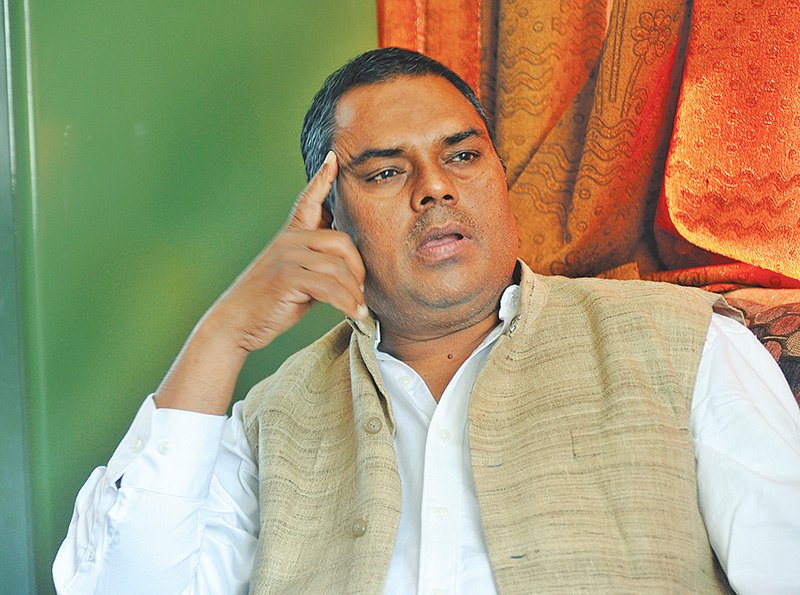
Upendra Yadav.   Post File Photo

KATHMANDU,
As the country is all set to elect a new President on March 9, people are also curious about the next Vice President to be elected through an election slated for March 17.
With the nominations of Ram Chandra Paudel of Nepali Congress (as a common candidate of the eight-party alliance) and Subas Nembang of the CPN-UML, one of them is certain to be the country’s next President.
Given the strength of the eight-party alliance in Parliament, where a total of 12 parties are represented, Paudel appears all set to get elected as President, although UML’s Nembang is also trying his best to make it to the coveted post.
In the sharing of key positions among the eight parties of the coalition, the Janata Samajbadi Party has got a chance to field its candidate for Vice President.
With the constitution making it mandatory to elect the President and Vice President from different genders or communities, the Madhes-based party has a good opportunity to elect someone from deprived communities or a woman to the key state post.
Observers say JSP chair Upendra Yadav, who spearheaded a Madhesh movement in 2007, is in a position to show magnanimity and promote a leader of any Madhesi minority group or a female leader to the position of Vice President.
However, according to party insiders, Yadav is working to turn the situation in his personal favour. Sources said he wants to pave the way for his reentry into the Parliament despite losing the general election against Janamat Party chair CK Raut in Saptari-2 last November. Yadav is the only party chief in the newly formed eight-party alliance who was defeated in the latest general elections.
“Developments in the JSP suggest party chair Yadav’s only focus is to enter Parliament by making his lawmaker Ram Sahay Yadav Vice President,” said Chandra Kishore, a political analyst, who follows Madhesh politics. “He has also succeeded in securing the position of Vice President for his party from the ruling alliance.”
Yadav was defeated with more than 18,000 votes from Saptari-2 constituency in the general elections three and a half months ago. He had lost to Raut, who won the polls with 35,042 votes.
According to leaders of the ruling coalition, they have agreed to allocate the post of Vice President to the JSP with the intention of bringing Yadav back into the House of Representatives.
Party insiders said Ram Sahay Prasad Yadav, who was elected from Bara-2 defeating the CPN (Maoist Centre)’s candidate, has vowed to abide by the party’s decision.
“Though the party has not taken any decision regarding its candidate for Vice President, as things stand, Ram Sahay is a potential candidate,” said Rajkishor Yadav, a senior party leader and lawmaker.
He said the need for the party chair to join the parliament has been felt not only in the party but also in the coalition, and informal discussions on the issue have started.
“As there is still time for the election of the Vice President, we will start formal discussions in a few days,” Rajkishor Yadav said. “Our chairman has told us that a decision will be taken in a way so as to safeguard the achievements of the political changes in the country.”
Chairman Yadav had earlier promoted Ram Sahay to the post of the JSP parliamentary party leader, sidelining another senior leader Ashok Rai, who was elected from Sunsari-1. This is also seen as Yadav’s calculated move, and reflective of his desire to lead the JSP’s parliamentary party in the event of his getting elected from Bara in the by-election. Once elected, the President and Vice-President have to resign from their parliamentary seats and when the seats go vacant the Election Commission will hold a by-election there.
Another party leader said there have also been discussions that the party should send someone from deprived communities to the post of the Vice President.
“But the party chair won’t stand for it,” said a leader asking not to be named. “It will be easier for the party chair to enter Parliament from Bara-2 as the ruling coalition will join hands in the by-election to ensure his victory.”
Although the JSP leaders argue that Chairman Yadav has good reasons to join the House of Representatives, political observers accuse him of showing a lust for power.
“Yadav has a great opportunity to show his generosity by nominating someone from Madhesi Dalit or Tharu communities for Vice President,” said Chandra Kishore. “Although it is not illegal for a candidate who had lost the polls in November by a huge margin to contest a by-poll, it cannot be considered politically and morally right.”
He questioned Yadav’s contributions during his repeated parliamentary terms, and what difference
he could make by becoming a lawmaker again.
In the first Constituent Assembly, Madhav Nepal was defeated in both the constituencies he had contested, but later he was nominated to Parliament under proportional representation system—and even managed to become prime minister.
Although parties at the time had argued that Nepal’s presence in the Constituent Assembly was a must to produce a constitution, he could not even save the first Constituent Assembly let alone help produce a constitution.
“No leader is indispensable,not even Uprenda Yadav,” Kishore told the Post. “Therefore, this time the JSP should better seek someone from deprived communities instead of quietly supporting the party chair’s inappropriate ambition.”
The country’s first President Ram Baran Yadav and Vice President Parmananda Jha were from the Madheshi community. The second president, incumbent Bidya Devi Bhandari and Vice President Nanda Bahadur Pun, are both from hill communities.

HOME PAGE

Nepal stares at recession amid depressing market conditions

Economists and market analysts warn instability in the government could make matters worse.
- KRISHANA PRASAIN
Nepalis are not buying cars, furniture, gold and clothes. They are spending less at restaurants and reducing goods purchases at home.  Post File Photo

KATHMANDU,
At most of Kathmandu’s apparel stores, one poster is common nowadays: SALE.
But that’s not helping rev up sales.
The apparel stores have witnessed a slowdown in discretionary spending by consumers over the past few months, primarily because of inflationary pressures, reflecting how a slowing economy has dampened the market’s mood.
A credit crunch, real estate slowdown, tumbling stock market and rising unemployment have rattled the economy even as a new government was formed.  It’s summer now. And the demand appears to be even worse. Nepal’s economy seems weaker than many economists had thought.
The economy is entering a pronounced slowdown due to the impact of the months-long import ban and the government’s low capital spending. Political instability has added to the woes.
In this year’s budget, the government targeted eight percent economic growth. But after six months, the mid-term review slashed the projected growth to nearly half that.
The International Monetary Fund (IMF) has also lowered Nepal’s growth rate from its initial estimates.
The IMF said Nepal’s economy is expected to expand by 4.4 percent this fiscal year—from mid-July 2022 through mid-July 2023.
“The consumers spent cautiously due to high inflation,” said Govinda Nepal, an economist. “Nepal’s economy is weaker than many had thought.”
Nepalis are not buying cars, furniture, gold and clothes. They are spending less at restaurants and purchasing less goods for their homes.
“The consumers are cutting their budgets almost everywhere,” said Nepal.
The politicians seem unbothered. The newly-formed government lost confidence within two months, sending everything into the doldrums.
“We see the country gradually moving to recession,” Nepal said.
According to the Nepal Rastra Bank, the year-on-year consumer price index of goods and services increased by 8.68 percent and furnishing and household equipment rose by 8.33 percent during the first half of the current fiscal year.
Clothes and footwear inflation increased by 6.43 percent, while transport inflation went up by 16.43 percent in the review period.
Economists say the deceleration in retail sales could slow economic growth further. Traders say the high-interest rates and depreciation of the Nepali rupee have turned the market sentiment gloomy.
“After slowing winter sales, we may suffer this summer too. There is no business at all,” said Ashok Kumar Shrestha, president of the Nepal Trans-Himalayan Border Commerce Association.
“The high-interest rate has made traders think twice before importing goods.”
Although the burden of the increased dollar and transport costs are added to the goods’ price and passed on to the consumers, traders are increasingly worrying that people are not buying because of a recession-like situation.
According to the Central Bureau of Statistics, the economy grew at 0.8 percent in the first quarter of the current fiscal year as compared to the same period last fiscal year. It is the lowest year-on-year growth in the past seven years, triggered by slowed trade and deceleration of the construction and mining sectors.
According to the bureau, if the growth rate of the first quarter of the current fiscal year is compared with the fourth quarter growth rate of the last fiscal year, it is -1.21 percent.
“This winter, jackets and other apparel didn’t sell much. They are now being kept on sale,” Shrestha said. “No sales means traders are cash-strapped. They are worrying about managing their funds to import summer clothes, footwear and accessories,” he added.
The traders said immediately after the Covid-19-related restrictions were lifted, the goods ordered for winter from China used to come in summer and vice-versa due to China’s “unofficial trade embargo.”
Now, traders say whether they are summer items or winter items is a secondary concern, since demands have slumped. “The sales are subdued,” said Sampath Sharma, proprietor of Planet Fashion, a women’s clothing store at Khichapokhari, New Road. The customer flow in his shop has halved.
“I have been running this shop for 20 years and I have never seen such a slowdown in the market,” Sharma said. “I also incurred heavy losses from winter clothing.”
The major markets like New Road, Mahabauddha, and Durbarmarg have started sales offers, but people are still not showing up.
According to traders, there is no issue with the import of goods from the northern border nowadays, as traders have ordered fewer goods for summer. However, they anticipate price hikes. “The price of apparels is not going to come down. It will rise further. We cannot say by how much,” said Naresh Katwal, president of Nepal National Traders Federation.
The Nepal National Traders Federation, plus nine other trade federations and 50 associations, have been protesting against a sharp rise in interest rates since mid-January and have been demanding a reduction in the bank interest rates.
The Nepal Rastra Bank on February 9 continued with its tight monetary policy aimed at controlling credit expansion. It feared that easy availability of credit could again fuel imports, leading to a rapid depletion of its modest foreign exchange reserves. The Nepal Bankers Association reduced the interest rate by one percent on fixed deposits. Even though the interest rate was reduced on deposits, no changes were made in the lending rates.
The bankers have been saying that interest rates in Nepal have increased due to the global economic situation, inflationary pressures, an import-based economy and the strengthening of the dollar.
Last July, the central bank released the monetary policy for the fiscal year 2022-2023, increasing bank rates, policy rates and deposit collection rates by 1.5 percentage points each to 8.5 percent, seven percent and 5.5 percent, respectively.
“We have been protesting against the high-interest rate of the banks since mid-January,” said Katwal.
The IMF has flagged concerns about the large boom-bust credit cycles in Nepal’s financial sector. This means credit may have grown to excessive levels and borrowers’ repayment capacity may have eroded due to higher lending rates.
“A new and dangerous trend has emerged. Entrepreneurs are resorting to suicide,” said Katwal. “The government should not let the situation get out of control.”

Page 2
NATIONAL

Parties preparing for April 28 by-election in Chitwan 2

The lower house seat became vacant after Rabi Lamichhane, who was elected from the constituency in November, lost lawmaker status after citizenship document controversy.
- RAMESH KUMAR PAUDEL
Representatives of political parties and stakeholders at a discussion with Election Commission officials in Chitwan a few days ago.   Post Photo: Ramesh Kumar Paudel

CHITWAN,
Political parties have started preparations for the Chitwan-2 by-election scheduled for April 23.
The Election Commission decided to hold the by-election as the constituency became vacant after Rastriya Swatantra Party President Rabi Lamichhane, who was elected from the constituency last November, lost his lawmaker status over citizenship. The Supreme Court scrapped Lamichhane’s lawmaker position in January citing that the citizenship certificate he produced for the parliamentary election was invalid.
“We have already initiated campaigning for the upcoming poll,” said Krishna Prasad Bhusal, Chitwan chairman of the RSP. “The party started launching orientation programmes and expanding its organisation. Before going to the voters, the party is busy in internal preparations for the by-election.”
The RSP appointed Bhusal its district chief two weeks ago, after Dharmendra Sapkota stepped down expressing his dissatisfaction with the party leadership.
The RSP has launched campaigning in the hilly parts of Kalika Municipality and Ichchhakamana Rural Municipality in Chitwan-2. Lamichhane received fewer votes from those hilly parts in the November election.
Rabi Lamichhane was elected to the House of Representatives from Chitwan-2, defeating his closest rival Umesh Shrestha of the Nepali Congress by an overwhelming margin. Lamichhane received 49,261 votes against Shrestha’s 15,091. Krishna Bhakta Pokhrel of the CPN-UML garnered 14,649 votes.
The Election Commission has already published its calendar for the by-election. The political parties and independent candidates should file their candidacies on April 3. As many as 18 parties have been registered in the Election Commission for the by-election.
The Congress also started its campaign in Chitwan last week. There are a total of 28 wards of Bharatpur Metropolis, Kalika Municipality and Ichchhakamana Rural Municipality in Chitwan-2.
“We have mobilised two party representatives in each ward targeting the upcoming by-election,” said NC district president Rajeshwar Khanal. According to him, the party will launch further programmes soon.
The UML, CPN (Maoist Centre) and the Rastriya Prajatantra Party are also busy launching various programmes in Chitwan now. The UML has launched a nationwide programme called Mission Grassroots, which is ongoing in Chitwan as well. “In Chitwan, it is mainly focused on the by-election,” said Ram Prasad Neupane, the UML district chairman.
There were a total of 124,014 voters in Chitwan-2 for the November 20 election. Among them, 84,315 exercised their franchise. According to Bhimsen Karki, chief of the election office, Chitwan, 631 new voters have been listed.

NATIONAL

Archaeological study of historical Chaitya begins in Nuwakot

Local residents hope the move will help in preserving heritage sites in the district.
- KRISHNA THAPA
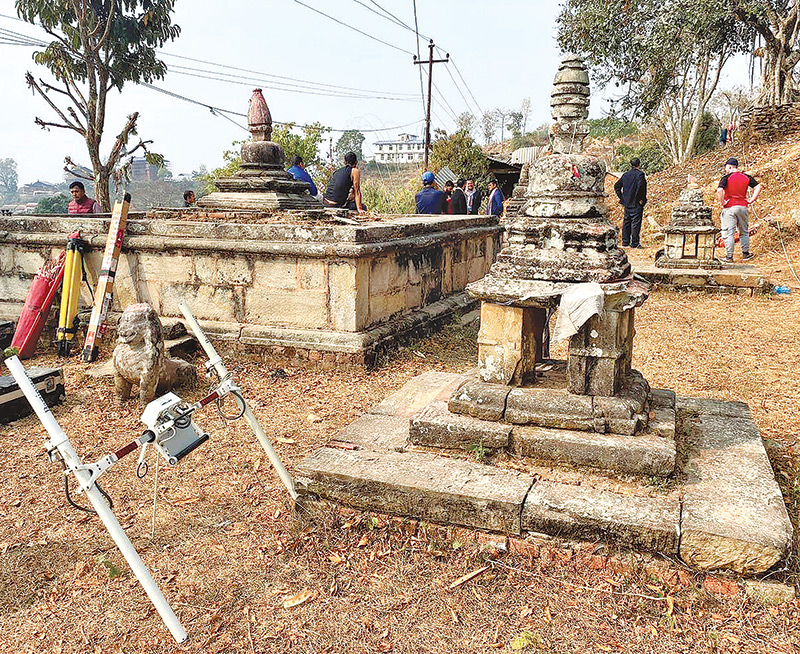
Archaeologists at the site of a Buddhist shrine believed to be from the Lichchhavi era, at Saraswatisthan in Nuwakot in this recent photo.  Photo: Courtesy of Bidur Municipality

NUWAKOT,
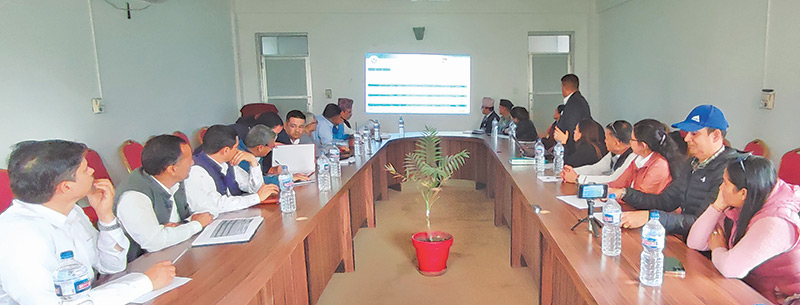
The Department of Archaeology has initiated study of a historical Chaitya, a Buddhist shrine, located in Bidur Municipality-2 of Nuwakot district. The Buddhist shrine is believed to have been built during the Lichchhavi period around 1,400 years ago.
The department was concerned about the monument, with a view that it might have some historical and archeological significance. The Chaitya, which is located around one kilometre north-west from Nuwakot Durbar, is in a state of disrepair and neglect.
A team of archeologists led by Ram Bahadur Kunwar, deputy director general and spokesperson for the Department of Archaeology, visited the monument site and carried out study last week. Two archaeologists from the UK’s Durham University were also in the team. The Department of Archaeology plans to renovate and reconstruct the monument following the archeological study of the site.
“The team of archaeologists studied the historical Chaitya and collected important information about it. They conducted a geophysical survey of the area,” said Arjun Phuyal, chief of Monument Conservation and Palace Maintenance Office in Nuwakot. The maintenance office is under the Department of Archaeology.
The main Chaitya is surrounded by other smaller Chaityas. There is an entry gate on the eastern side of the monument. Two stone lions guard the gate. There is a statue of Ganesh in front of the monument while there is also a stone inscription erected by King Prithvi Narayan Shah after he repaired the site. There are two small Chaityas in the western corner and a statue of Manjushree on the wall of one of the Chaityas. Another small Chaitya on the southern side is now in ruins. There is a temple dedicated to Goddess Saraswati and a statue of Natyeshwari just a few metres above the Chaitya.
According to Phuyal, the Chaityas have been found to be quite old. “The Department of Archaeology will carry out a study in the second phase as well on the basis of the report of geophysical survey,” said Phuyal, adding that the geophysical survey report is yet to come.
Bidur Municipality took initiatives for the archeological study of the Chaitya. It coordinated with the Department of Archaeology for the study.
“The municipality has been working for the excavation and conservation of the archaeological sites in the district,” said Rajan Shrestha, mayor of Bidur Municipality. He expressed his hope that the department would help the municipality in preserving historical monuments located in the area.
The local residents complain that the authorities concerned have not paid much attention to the conservation of important religious shrines. “The Department of Archaeology, in coordination with the municipality, finally started its study of the Chaitya,” said Prahlad Malla, a local resident. “Let’s hope that it will help in renovating and conserving the monuments.”

NATIONAL

Nine-party bloc hits back at pro-royal activities

- Post Report

KATHMANDU,
The nine-party alliance has said it has taken serious exception to ‘anti-constitutional activities’, especially the ongoing demonstrations calling for reinstating the monarchy in the country.
This is the first statement issued by the newly formed coalition after Prime Minister Pushpa Kamal Dahal ditched the alliance with the CPN-UML to return to the electoral alliance that included the Nepali Congress.
“Our attention has been drawn to the recent activities against the constitution and the democratic republic achieved with the sacrifices of the people,” read a statement issued by the nine-party coalition after its meeting held at Baluwatar on Sunday.
“We express our strong commitment to moving ahead in unity for safeguarding the constitution and the democratic-republican set-up,” read the statement jointly signed by the leaders of the Congress, CPN (Maoist Centre), Janata Samajbadi Party, CPN (Unified Socialist), Loktantrik Samajbadi Party, Nagarik Unmukti Party, Janamat Party, Rastriya Janamorcha and Nepal Samajbadi Party.
“We have agreed to speak against the ongoing anti-constitutional activities with one voice,” Rajendra Pandey, a Unified Socialist leader, told the Post.

NATIONAL

Sudurpaschim Chief Minister Shah wins trust vote

Briefing

DHANGADHI: Sudurpaschim Chief Minister Kamal Bahadur Shah secured a vote of confidence in the Sudurpaschim Provincial Assembly on Sunday. Nepali Congress provincial assembly leader Shah was appointed Sudurpaschim chief minister on February 9. Shah passed the floor test with a clear majority, receiving 41 votes in the 53-strong assembly. Meanwhile, 11 lawmakers, including 10 from the CPN-UML and one Rastriya Prajatantra Party member, voted against the motion.

NATIONAL

Two killed, 11 injured in jeep accident

Briefing

OKHALDHUNGA: A total of two people died and 11 others were injured when a jeep met with an accident at Chishankhugadhi Rural Municipality-3, on Sunday morning. According to Inspector Dipak KC of the District Police Office, the jeep was headed for the district headquarters from Diyale. The deceased were men from Chishankhugadhi-3. “A total of 14 people were in the jeep and 10 people who were seriously injured have been airlifted to Kathmandu for treatment and one person with minor injuries is receiving treatment at the Okhaldhunga Community Hospital in Siddhicharan Municipality,” said KC.

NATIONAL

Mild tremors recorded in two districts

Briefing

KAVRE/ACHHAM: Two mild earthquakes were reported in Kavrepalanchok and Achham districts on Sunday morning. According to the National Earthquake Monitoring and Research Centre, an earthquake measuring 4.3 magnitude epicentred in Kavrepalanchok district was recorded at 8:03am. Likewise, another tremor of 4.4 magnitude epicentred in Achham district was recorded at 8:35am. There are no reports of any damage so far.

Page 3
NATIONAL

China increases its defence budget amid ‘escalating’ external threat

China targets GDP growth of 5 percent for 2023, up from 3 percent it achieved in 2022.
- Purushottam Poudel
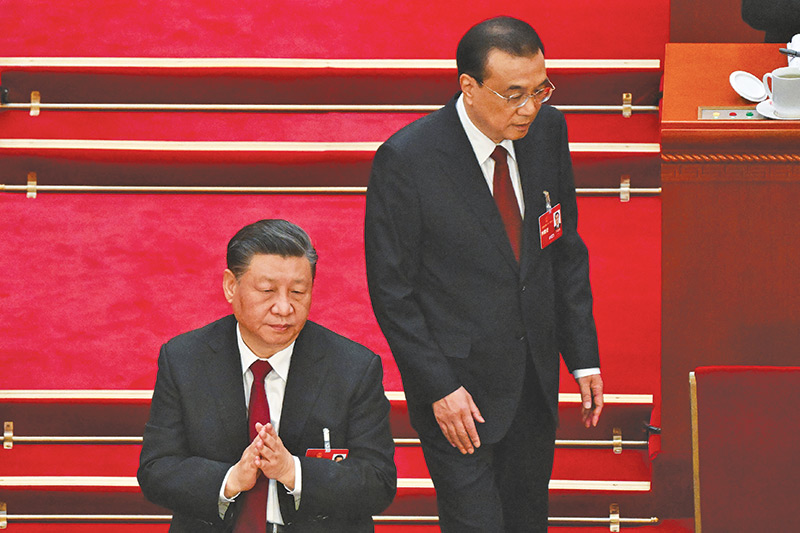
Chinese President Xi Jinping (left) and Premier Li Keqiang in the opening session of the National People’s Congress at the Great Hall of the People in Beijing on Sunday.  AFP/RSS

BEIJING,
While the global economy is set on a downward spiral this year, China, in contrast, is aiming to become one of the world’s fastest-growing major economies.
The assertion was made by the outgoing Chinese Premier Li Keqiang in his opening remarks at the 14th National People’s Congress (NPC), which got underway on Sunday at the Great Hall of the People in Beijing. China aims to achieve a gross domestic product (GDP) growth of 5 percent for 2023.  The country’s GDP growth rate for 2022 stood at 3 percent.
While presenting his report on the work of the government for about an hour in the presence of around 3,000 delegates in the Great Hall, Li marked the conclusion of his decade-long stint in office.
Though Li asserted that the nation’s economic development and progress would be accelerated, he could neither provide a compelling justification for the assertion nor a categorical solution to the country’s current problems.
In particular, given the global economic turmoil caused by the effects of the Covid pandemic and its subsequent impact, and the uncertainty brought by the Russia-Ukraine war, Li did not mention the foundations to which the Chinese growth plans are anchored.
Although the prime minister’s report discussed how to address the internal challenges in the economy, the report is unclear on how the country will handle external economic challenges.
“Confronted with new downward pressure on the economy, we acted decisively and made timely adjustments. We made use of the policy tools kept in the reserve over the years, proactively adopted pre-determined policies, and remained firm in advancing supply-side structural reforms,” Li said in his address to the NPC.
Beijing also announced an increase of 7.2 percent in its military spending while warning of an ‘escalating’ threat from abroad. Mentioning the uncertainties in the external environment and attempts to contain China being on the rise, Li said that China was constrained to increase its military budget. With this, it is expected that the People’s Liberation Army will have nearly $255 billion to spend in the year 2023.
The outgoing Chinese premier said that under the leadership of Xi Jinping, the country had successfully contained the Covid pandemic.
Although Li applauded President Xi for his leadership to contain the pandemic during the NPC meeting, it is widely believed that the two had diverse opinions on Xi’s zero-Covid policy.
While presenting the report on the work of the government over the past five years, Li claimed that more than 32 million people were lifted out of poverty by providing employment opportunities. The report claims that the government had provided unemployment benefits to more than 10 million people in total.
“China’s GDP increased to 121 trillion yuan, registering an annual growth rate of 5.2 percent over the past five years,” said Li.
“Over the past decade, GDP has increased by almost 70 trillion yuan at an annual rate of 6.2 percent.”
“We should adhere to the party’s basic policy on religious affairs, and follow the principle that religions in China must be Chinese in orientation,” the report on the work of the government stated.
The subject of adherence to President Xi’s philosophy has been ranked top among the 29 recommendations made in the report for the government to implement in 2023.
The 14th NPC, which is China’s top legislature and the most powerful state body under the Chinese constitution, began its meeting on Sunday and would conclude on March 13. It’s almost certain that the fourth session of the current NPC will re-elect Xi Jinping as China’s president for a third consecutive term.

NATIONAL

Government refutes Oli’s statement on Mustang Buddhist college plan

Minister says there was no plan to build such an institution in the district bordering China.
- Post Report

KATHMANDU,
The government has refuted the statement of former prime minister and UML chair KP Sharma Oli and claimed that it has no plan to open any university at Mustang.
On Sunday, Oli had fiercely criticised the government for “harming relations with China” by planning to establish a Buddhist college with the support of India in Mustang, a district that borders Tibet of China.
Issuing a statement, government spokesperson and Minister for Communication and Information Technology Rekha Sharma said that the government had not decided to establish any such institution in the district. Sharma also stated there was information that Baragung Mukti Chhetra Rural Municipality of Mustang had written to the Indian Embassy seeking financial assistance to establish a college. The government would investigate the matter.
“A public statement floated in the media attributing to the former prime minister and CPN-UML chair KP Sharma Oli has drawn the serious attention of the Nepal government. We will study and investigate the matter and the government will make it clear through a statement,” the minister said.
“The statement that the government was preparing to establish a university at Baragung Mukti Chhetra Rural Municipality of Mustang on the proposal of one country and targeting another was illusionary. The government would like to make it clear that no decision has been taken to this effect.”
The government has also expressed serious concern saying that such remarks could affect the country’s foreign relations. “It is not appropriate to speak in a way that affects the country’s foreign policy,” said the statement.
Sharma further clarified that the government was committed to safeguarding the country’s sovereignty, integrity, national interests and independent and non-aligned foreign policy.

Page 4
OPINION

Rethinking retirement age

The civil servants in Nepal retire relatively early, and this is not good news for the country.
- PUSHPA RAJ JOSHI
Post Illustration

Studies have shown no significant difference in the productivity of younger and healthier older workers. In fact, older workers have been found to perform better than their younger counterparts. Today, the active working age of healthy individuals is regarded to be until the early eighties of their lives. This is also the phase when one can transfer the knowledge and experience acquired through a long career into productive outcomes. By this time, the government or the respective hiring organisations would have made financial and temporal investments on their employees. So, the final phase of one’s career should be dedicated to giving back to the organisation where one is employed. The retirement age is generally based on this assumption.
The retirement age in most countries with the highest gross domestic product (GDP) is in the mid- to late-seventies. As per the Organization for Economic Cooperation and Development (OECD), the current retirement age in most European countries is 65 or above. Countries with lower retirement ages (early- to mid-fifties) have comparatively lower GDPs, except for China (54 years). Nepal, with an official retirement age of 58 years for civil servants, falls in the second category.
Compared to global trends, the official retirement age is relatively early in Nepal. However, this age limit broadly applies to civil servants, and one can work well beyond the official retirement age of 58 years in private organisations. Fifty-eight years is quite early to pack one’s bag for good. Studies have shown that this is the peak time of one’s career, and the employee can deliver to his/her maximum at this age. In judiciary and other constitutional commissions, the retirement age is 65; health and education sector employees retire at sixty. This implies that the retirement age for civil servants in Nepal needs immediate rethinking. Even the provision of mandatory retirement after 20 years of service should be obliterated.
The logic behind early retirement in Nepal is that the older generation should make way for the younger recruits. This assumption was based on the government policy implemented decades ago. During the late eighties and early nineties, the life expectancy of Nepali citizens was around 50 years, and the number of government agencies that would recruit officials was limited. In addition, Nepal was partially isolated from the rest of the world during those days. The retirement age of civil servants was 60 years before the reinstatement of multi-party democracy, which was reduced by two years in 1992.
In modern times, the decades-old assumption of early retirement seems illogical. The life expectancy of Nepali citizens has increased considerably, and the average age of the people is predicted to reach 74 years by 2030. Moreover, the Nepali labour market is vibrant today, and the frequency of government and private organisations requiring a skilled workforce has expanded multiple folds. These factors reveal that the retirement policy in Nepal should be immediately reformed.
Civil servants receive up to 75 percent of their salaries as pension after retirement. This amount is constantly increased with regular salary hikes. Hence, bidding goodbye to civil servants at an early age adds a huge financial burden on the state treasury. In 2019, the Parliamentary State Affairs and Good Governance Committee identified this issue and recommended that the government increase the retirement age of civil servants by at least two years. This would have brought uniformity in the retirement age of civil servants and health and education sector employees. In addition, it would have saved the financial burden on the pensions of civil servants for two years. However, the recommendation never came into practice.
With the global increase in life expectancy, early retirement adds to financial liability on governments. Additionally, retiring at an early age snips a long active and energetic life of an individual. The new recruits replacing the retired employees require time to learn their responsibility and gain the required experience in contributing to their maximum capacity.
This results in reduced national productivity, thereby restricting the prosperity of the nation. Hence, the retirement age should be adjusted according to contemporary global trends, and maximum output should be extracted from the employees for a more extended period.
For many years, Nepal has been poised at a stale juncture from which the country must swiftly excel. The young working force is forced to leave the country mainly as construction site labourers in the Middle East and the Gulf Cooperation Council (GCC) countries. This practice needs to be reversed, and young people should be encouraged to stay in Nepal. The government should train and employ young workers in various sectors, including agriculture, construction, manufacturing, mineral resources and textile in the country itself. The employees should be paid fairly, and a ubiquitous pension system should be introduced. This will hold the working force in the country, and the young blood will contribute to the development of the nation. The retirement age of employees in all sectors should be adjusted as per the general global trend to the mid-sixties. This is viable, given how Supreme Court judges and members of various constitutional commissions have been competently working till the age of sixty-five.
Having experienced the continuous development of the retirement system in Germany, I feel Nepal should also take a leaf out of Germany’s retirement model. The retirement age in Germany has been increased by one year—to 66—in 2023. From this year, until 2031, the retirement age will be increased by two months each year, and the mandatory retirement age will finally reach 67 years. For early retirement, each missing year results in a 3.6 percent reduction in the gross pension entitlement. This motivates the employees to work till their mandatory retirement age. The late retirement age in Germany has contributed to increased national productivity.
A well-deserved retirement with financial remuneration after an active working phase is a fitting tribute to employees. This is also a fundamental obligation of a welfare nation, and is a general global trend. Hence, Nepal should initiate a ubiquitous pension system in all sectors while adjusting the retirement age, preferably in the mid-sixties. This will ultimately contribute to boosting national productivity, thereby improving quality of life.


Joshi is a senior scientist and assistant professor of neurobiology at Martin-Luther University Halle-Wittenberg, Germany.

INTERVIEW

China’s projects don’t always get conducive environment in Nepal

‘When China wants to carry out developmental work in one country, there is no need for some other South Asian countries to feel insecure.’
- Post Report
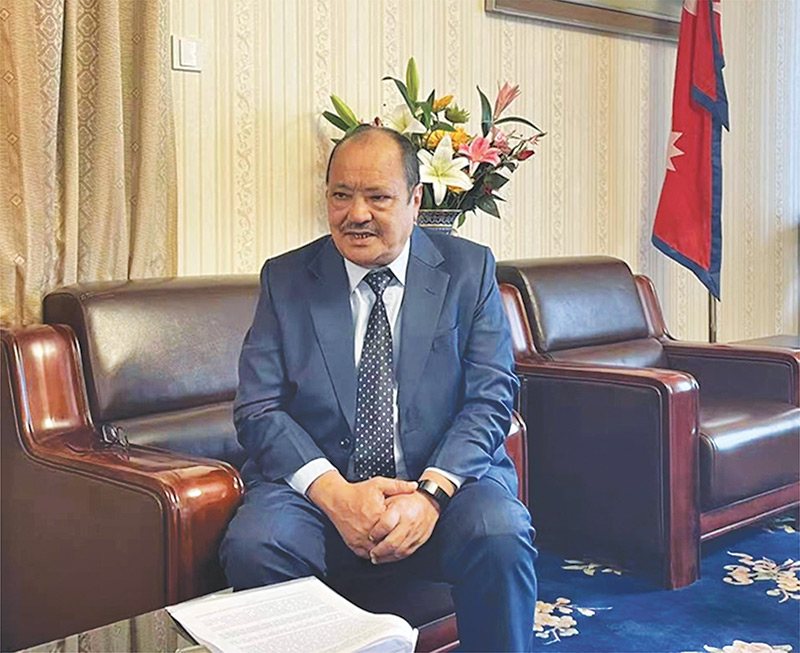
Nepal’s China envoy Bishnu Pukar Shrestha.
Photo courtesy: Xie Wenting/GT

With China on the brink of confirming Xi Jinping as the country’s president for the third consecutive term, Purushottam Poudel of the Post caught up with Bishnu Pukar Shrestha, Nepal’s ambassador to China. In this wide-ranging interview, the ambassador opens up on the Belt and Road Initiative (BRI), new dimensions of Nepal-China relations and his experience in China.

It has been seven months since you took charge as Nepal’s ambassador to China. How would you assess your tenure thus far?
It was somewhat difficult to work in the initial phase due to China’s zero-Covid policy. I could not meet many Chinese officials. Also, when I came here as ambassador, Nepali students who had returned to Nepal due to Covid-19 were unable to come back to China. Cross-border traders had trouble operating. Agreements between the two countries were put on hold.
Narayan Khadka, then foreign minister of Nepal, came to China shortly after my arrival. His visit was an opportunity for both countries to reiterate their commitment to implementing the agreements entered into since 2016. Soon after that, Nepali students began to travel to China to study. An effort has been made to open the land border which was closed due to the pandemic. We have also worked at enhancing air connectivity between the two countries.
During Khadka’s China visit, China announced 8 million yuan for Nepal. In December, we reached an agreement on this. We took the initiative to dispatch a team for a railroad feasibility study. Similarly, we took the initiative to build electric transmission lines between the two countries. To do so, a Chinese expert group travelled to Nepal and held meetings with the officials of the Nepal Electricity Authority. I met with the deputy administrator of the Chinese National Energy Administration after the Chinese team got back. During our meeting, the deputy administrator made an interesting suggestion. According to him, a 220 KV power project can be built instead of a 400 KV line currently in discussion, as even the 200 KV line can produce 600-700 MWh per hour and will be comparably cheaper to build. I have conveyed the message to Nepali officers.
We are also working on economic diplomacy. Recently, we conducted two forums on investment opportunities in Nepal. We have participated in different trade fairs and tried our best to showcase our products. Our efforts have focused on easing trade, tourism and transport.

Did the embassy follow up with the group who went to Nepal for the feasibility study of the railroad after they returned to China?
No, we haven’t. Those persons actually represent a government company. However, we are in contact with the China International Development Cooperation Agency (CIDCA), a state organ responsible for the project’s implementation. According to the information we’ve received from the CIDCA, the feasibility team that visited Nepal has filed a positive report.

The Pokhara International Airport was started well before China came up with its Belt and Road Initiative in 2013. But China now says the project is a part of the BRI. How do you see this issue?
The construction work of Pokhara International Airport started before the BRI came into being. With China declaring the airport as a project under BRI, I raised a question
as to how Pokhara Airport can be so designated. We have been saying that China should not look at the BRI
project only from the profit and loss point of view. But there is also no need for Nepal to raise any objections on this issue.

The fact remains that Nepal initially named 35 projects under BRI, of which nine were selected with mutual understanding. The Pokhara International Airport was not part of those selected  projects.
The Pokhara airport is not a BRI project; that much is clear. As far as the nine projects under the BRI are concerned, first, there should be a mutual understanding over who will invest how much in the BRI. My point is that we should undertake development projects with financial assistance from everywhere.

It has been more than five years since we signed the BRI project. In this period, even the framework for project implementation under the initiative has not been formulated. Why?
We now refer to the “One Belt, One Road” initiative as the “Belt and Road Initiative”. The Chinese side claims that Nepal has been lethargic in providing necessary details about the projects to be implemented. But the Nepali side claims all necessary details have been provided. Setting aside these two claims, I’ve learned that Nepal has not adequately responded to Chinese inquiries on the details of the projects. But I also feel that China is reluctant to prioritise Nepal’s projects. Due to this, we have not started discussing how much money China will invest under the BRI in Nepal and how much Nepal will invest. Now we are in the process of approving the projects. We expect them to go more smoothly after that.

What is your view of the geopolitical struggle among big powers in South Asia?
It is important for us to understand which country looks at Nepal from what perspective. Apart from Bhutan, China has embassies of all other South Asian countries and it holds regular meetings with their ambassadors. When China wants to carry out developmental work in one country, there is no need for some other South Asian countries to feel insecure.

Do you think one reason for the poor progress of Chinese projects in Nepal is the vast difference in the governing styles of the two countries, with one being a one-party system and the other a multi-party democracy?
It is unfair to say China has a single-party system. China has multiple parties; it is just that the Communist Party of China is the dominant one. When questioning the ability of China, we must also accept that one reason China cannot work smoothly in Nepal is that we cannot give them a conducive working environment. That may, for instance, contribute to a Chinese contractor’s inability to finish a job on time. But there have also been cases where the Chinese have been at fault. The Budhi Gandaki project was taken up by the Chinese Gezhouba Company, however, they later left. Something similar happened with West Seti.

China still seems eager to work with Nepal’s communist forces. How do we interpret this?
A core communist belief is that communists around the world should unite. The Communist Party of China is no exception. There are many communist parties in Nepal as well, despite the fact that their slogan is the same. Even after the Maoists joined the peace process back in 2006, there was a call for Nepal’s major communist forces to unite. During the 2017 legislative elections, the endeavour to unite the big communist parties of Nepal finally materialised.
But the union could not last for two reasons. One, the leaders could not manage the unity internally, and on the other, some external forces tried to undo the unity. So the Nepal Communist Party broke up. China has been suggesting that the communist parties again work together, but that does not mean it is interfering. I also don’t think the Chinese are using any kind of force to bring about another communist unity in Nepal.

As a member of a communist party yourself, how do you compare the communists of Nepal and China?
The two sets of communists have similar philosophies. For instance, there is a two-line struggle within the Communist Party of China as well. An intra-party struggle was seen some time ago on whether to maintain the zero-Covid policy. I would say the communists in China are more disciplined than those in Nepal. But more than that, it would be hard to compare the two lots.

In Nepal, the resident ambassadors can easily meet high-ranking officials, even the President and the prime minister. Not so here. Even after seven months, you have not been able to present your credentials to President Xi.
Yes, I am yet to present my credential certificate. There are embassies from more than 175 countries here. As a result, it is improbable that ambassadors from all countries will get easy access to high-ranking officials. Occasionally, I also tell Chinese officials that it should be easier for representatives of other sovereign countries to meet high-level people of their country.
The Chinese respond that if any of our work is interrupted, it is a separate problem, or else it is difficult to manage time for their high ranking officials. Anyway, they are trying their best. When I arrived here as an ambassador, I had an opportunity to meet Wang Yi, who was then the foreign minister. I also got to meet the new Foreign Minister of China, Qin Gang. Also, what you have to remember is that we can start working as ambassadors in China after we present our credentials to the chief of protocol of the Chinese foreign ministry. This is unlike in Nepal when you can work only after presenting your credentials to the President.

OUR VIEW

Growing menace

Cyber Bureau should be enhanced so that it can combat complex and planned cyber attacks.

The world is changing fast, and so is the nature of crimes. The latest forms of wrongdoings are committed through digital means and this has become one of the most challenging tasks for security agencies, public and private entities and individuals. But we in Nepal seem unprepared to deal with the complications these new technologies pose. As in other offences, security agencies and mainly the Nepal Police handle cybers crimes. Yet the police, burdened with a myriad other responsibilities, are yet to prioritise cyber crimes.
The police’s Cyber Bureau is entrusted with resolving digital crimes but the unit seems to be struggling in the absence of trained human resources. The bureau is in fact overwhelmed by petty individual cases; the only body entrusted with handling cyber crimes should rather have been focused on organised and planned attacks to vital organisations that could potentially invite a national crisis. For instance, only in the last week of January, government offices faced cyberattacks that resulted in disruptions of hundreds of government websites across the country. They also hit international travel due to the shutdown of the immigration server.
Internet and digital transactions cover all places and walks of life—urban as well as remote areas, rich as well as poor sections of the society. The number of internet users in Nepal is increasing by leaps and bounds every day. According to Nepal Telecommunications Authority, the country has 38.38 million internet subscribers—in a population of under 30 million—as of mid-October 2022. This number will rise speedily in the days to come. But as our reports suggest, individuals with even minor cyber-related problems currently have to come to the Kathmandu-based bureau. That need not be the case.
According to officials working in cyber security in the banking sector, around 5,500 cyber-related crimes were registered in the country from 2016 to 2020—and 77 percent of them affected the banks. The number of unregistered cases could be bigger still. According to the bureau, of the nearly 70 daily complaints it gets, around 50 are petty crimes, many of them unrelated to the bureau. For instance, of the total complaints, nearly 90 percent are related to hacking of email and social media passwords and other general issues.
Both police officials and independent experts working in the field of cyber security say such minor technical problems must be resolved at the local police units. The units should be trained and equipped for that so that people from far-flung districts do not need to descend on Kathmandu. The bureau can then use its limited bandwidth to deal with the cyber crimes of more serious nature.
As cyber crimes are going to create more and more problems for individuals as well as sensitive sectors like civil aviation, banks and other vital national bodies, there is a need for a new cyber crimes policy that befits the emerging challenge. Moreover, besides equipping local police units to handle minor technical problems, the capacity of the Kathmandu-based bureau should be enhanced so that it can combat complex and planned cyber attacks originating both in and outside the country. Given the rapid pace at which cyber crimes are evolving, a business-as-usual approach could invite disastrous consequences.

Page 5
MONEY

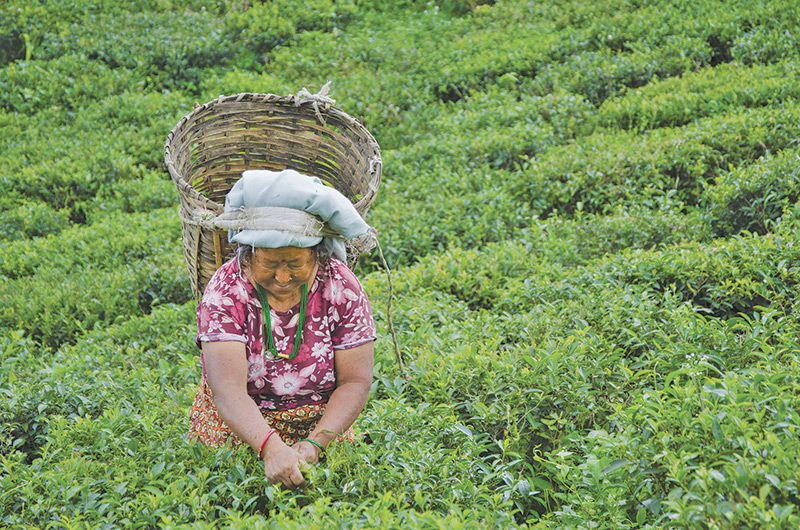
Small tea growers criticise electricity demand charges

Tea farmers allege that the Nepal Electricity Authority has made the tariff regulations without having an adequate study of the industry.
- Arjun Rajbanshi
The demand charges are based on the highest level of electricity an individual customer demands at one time during the billing period.   SHUTTERSTOCK

JHAPA,
Nepal Electricity Authority’s decision to impose demand charges for small tea growers equal to big industrial players has affected farmers in eastern Nepal.
The demand charges are based on the highest level of electricity an individual customer demands at one time during the billing period.
For years, farmers have been using electricity under the agricultural irrigation facilities that provide electricity to farmers at a reduced price.
The National Tea Policy 2000 has mentioned tea as an agricultural product.
The policy says that a subsidised tax rate, equivalent to other agricultural sectors, will be applied while importing irrigation equipment for tea plantations.
The government will prioritise the development of road connectivity, irrigation, electricity, telecommunication, education, health and other basic infrastructure in the tea sector, according to the policy.
However, the Nepal Electricity Authority has excluded the tea sector from its priority list. It has placed it under agriculture-based industries in Electricity Tariff Collection Regulations, 2022.
The authority has categorised the plantations associated with cooperatives as a rural and domestic industry, while plantations registered as a company are seen as a small-scale industry in the regulation. Similarly, the authority is also imposing demand charges for tea estates spread over 10 kattha (36,450 sq ft) of land.
According to Rajmani Bajgain, chief of Nepal Electricity Authority Bhadrapur distribution centre, the tea sector now being categorised as rural and domestic industries has to pay Rs60 per kVA every month as demand charges and Rs7.80 per unit of electricity. Previously the electricity rate was Rs3.60 per unit.
Similarly, plantations enlisted as small-scale industries by the regulation now have to pay Rs110 per kVA every month as a demand fee and Rs9.60 per unit of electricity consumed.
“The new tariff rate has made it difficult to sustain tea farming,” said Keshav Mainali, a local of Haldibari Rural Municipality-3. “We have the plantation in just 2 to 4 bigha, how can we be categorised as an industry ?”
He demanded the authority revoke the new tariff rate and apply the same rate in the other agricultural sectors.
Parbat Dangi, another local stated, “The plantation doesn’t require irrigation for seven to eight months, but we still have to pay the demand fee for that duration too.”
“This provision has made small plantation owners worried.”
Farmers allege that the electricity authority has made the regulations without having an adequate understanding of tea farming.
“The provision of demand fee and hiked electricity charge for tea plantations isn’t relevant,” said Chandi Parajuli, former president of Nepal Tea Producers’ Association. “We condemn the act of hindering irrigation in tea plantations.”
The team of farmers had also submitted a memorandum to Rajendra Lingden, the then minister of energy, water resources and irrigation.

MONEY

India may issue alert on Marion cough syrup exports after toxins found

More than 300 children died last year of acute kidney injury associated with contaminated medicines.
- REUTERS

NEW DELHI,
India may issue an alert on cough syrup exported by Marion Biotech, whose products have been linked to deaths in Uzbekistan, after tests showed many of the company’s drug samples contained toxins, a drug inspector said on Saturday.
Indian police on Friday arrested three Marion employees and are looking for two directors after tests in a government laboratory found 22 of 36 syrup samples “adulterated and spurious”.
New Delhi is pursuing the issue even as the government has pushed back against allegations that cough syrup made by another Indian company, Maiden Pharmaceuticals, led to the deaths of children in Gambia last year.
Vaibhav Babbar, an inspector involved in the Marion probe, told Reuters the samples had been adulterated with ethylene glycol and diethylene glycol—the toxins that the World Health Organisation says were found in the products sold by the two companies in the two countries.
As many as 70 children have died in Gambia and 19 in Uzbekistan.
More than 300 children, most under age 5, in Gambia, Indonesia and Uzbekistan died last year of acute kidney injury associated with contaminated medicines, the WHO said in January.
In addition, it said the Philippines, Timor Leste, Senegal and Cambodia might be affected because they may have the medicines on sale. It also called for “immediate and concerted action” among its 194 member states to prevent more deaths.
“Because Marion’s drugs have gone to so many countries, I pray nothing happens elsewhere,” Babbar said. “The health ministry could issue an alert. They may do it. It will be good to issue an alert.”
He said he did not know whether an alert was under active consideration.
An Indian health ministry spokesperson did not immediately respond to requests for comment. Marion did not answer calls from Reuters and did not immediately respond to an email seeking comment.
A government alert would warn people in all countries to take the products off their shelves, though it carries no legal penalty.
Babbar said the drugs had also been exported to Kyrgyzstan and Cambodia.
Babbar has been part of a team that inspected Marion’s plant four times after Uzbekistan said in December the children died after consuming the company’s cough syrups. India suspended Marion’s production soon after.
Analysis by Uzbekistan’s health ministry showed the syrups, Ambronol and DOK-1 Max, were contaminated with unacceptable amounts of diethylene glycol or ethylene glycol, the WHO said in a January medical product alert. The UN health watchdog said it was is important to detect and remove these substandard products from circulation.
The syrups were administered in doses higher than the standard for children, either by parents mistaking the product for anti-cold remedies or on the advice of pharmacists, according to the analysis.
India in October suspended production at Maiden for violating manufacturing standards after the WHO said four of its cough syrups may have killed dozens of children in Gambia.

MONEY

ECB facing high core inflation in the near term, Lagarde says

- REUTERS
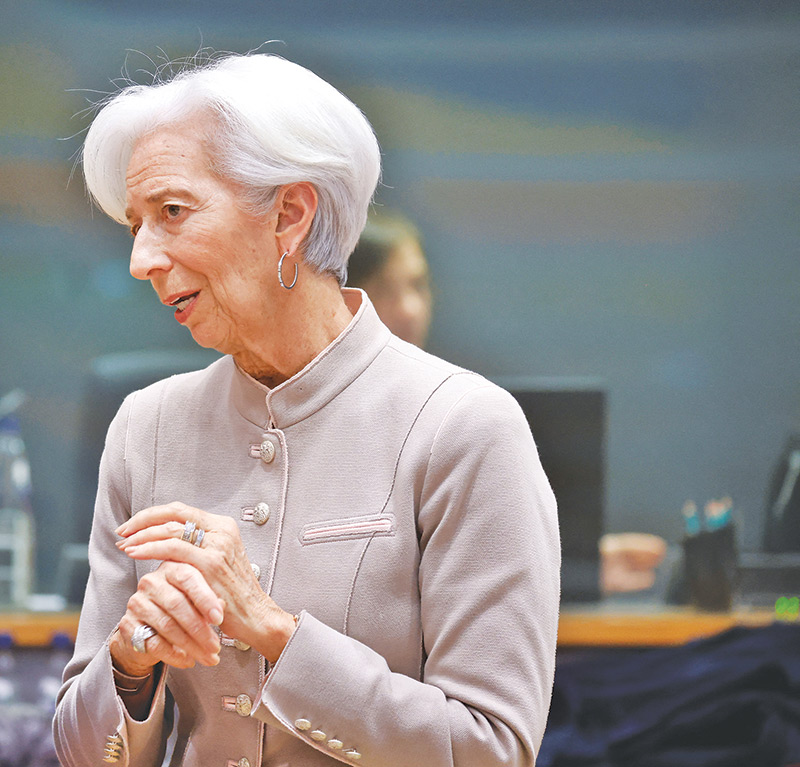
President of the European Central Bank Christine Lagarde.   REUTERS

FRANKFURT, 
Underlying inflation in the euro zone will stay high in the near term so a 50 basis point European Central Bank interest rate increase later this month is increasingly certain, ECB President Christine Lagarde told Spanish media group Vocento.
The ECB has already raised rates by 3 percentage points since July and essentially promised another half a percentage point increase on March 16 but investors have recently speculated on an even bigger move given poor inflation data.
Lagarde said the flagged increase is now “very very likely” but she also warned that underlying inflation, which filters out volatile food and fuel prices, could stay uncomfortably high even as the overall inflation rate drops in the coming months.
“In the short term, core inflation is going to be high,” Grupo Vocento quoted Lagarde as saying on Sunday.
Several policymakers have warned recently that ECB rate hikes need to continue until core inflation turns around and starts falling towards the ECB’s 2 percent target. Underlying inflation rose to a record high 5.6 percent last month and some policymakers fear that the increase is now due to a surge in wages in the services sector, which makes price growth more durable and difficult to break.
“We must continue to take whatever measures are necessary to bring inflation back to 2 percent. And we will do so,” Lagarde said.
She added that the euro zone economy is holding up better than feared and output should accelerate from near stagnation in the closing quarter of 2022.

MONEY

Neoteric Nepal holds Haier Channel Partner meet

Bizline

KATHMANDU: Neoteric Nepal, the sole authorised distributor for Haier in Nepal recently organised the inaugural grand function “HAIER CHANNEL PARTNER MEET 2023” with a theme of ‘TOGETHER TO NEW HEIGHTS’ at Aloft Kathmandu, Thamel. Well renowned multinational appliance brand, Haier, today announced the expansion of its new product line up of microwave for the Nepalese market in the presence of more than 100 dealers from all over Nepal. The event was a fantastic opportunity for the dealers to network, share insights and learn from each other, reads the press release issued by the company. (PR)

MONEY

Zonta Club Kathmandu honours individuals

Bizline

KATHMANDU: Zonta Club of Kathmandu joined the global celebration of the social, economic, cultural and political achievements of women as part of the International Women’s Day and Yellow Rose Day by honouring the efforts of individuals working toward gender equity. At the Yellow Rose Day event, the Zonta Club of Kathmandu presented the awards to the women from various walks of life. The list of awardees for 2022 are as follows; Mira Rai—Princess Helen Shah Inspirational Award; Muskan Khatun—Amar Rana Game Changer Award; Sushma Tamang and Sonika Dhakal—Ratna Devi Women in Sports; Bibhusha Pathak and Samiksha Khadka—Jyoti Scholarship Award; Anjani Pokhrel and Kalbina Shrestha—Indrakala Scholarship Award; Unsung heroes: Sita Subedi—Dancer, Nisha Chaulagain—Driver, Suneera Regmi—Aero Space, and Pinkey Shital Gurung—LGBTQ activist. (PR)

MONEY

Tesla recalls 3,470 Model Y vehicles over loose bolts

Bizline

WASHINGTON: Tesla Inc said it is recalling 3,470 2022 through 2023 Model Y vehicles in the US because bolts securing the second-row seatback frames may not have been securely tightened, according to a filing made public on Saturday.  The National Highway Traffic Safety Administration (NHTSA) said a loose seat frame bolt may reduce seat belt system performance, increasing injury risks during a crash. Tesla told NHTSA it has identified five warranty claims since December that may be related to these conditions. Tesla said it was not aware of any injuries or deaths that may be related to the recall issue.  (REUTERS)

Page 6
WORLD

Nations reach unified accord to protect marine life on high seas

The updated framework had been in discussions for more than 20 years.
- ASSOCIATED PRESS
A file photo shows a sea turtle swimming over corals on Moore Reef in Gunggandji Sea Country off the coast of Queensland in eastern Australia.   AP/RSS

WASHINGTON, 
For the first time, United Nations members have agreed on a unified treaty to protect biodiversity in the high seas, representing a turning point in a yearslong effort to bestow order on vast stretches of the planet where conservation has previously been hampered by a confusing patchwork of laws.
The UN Convention on the Law of the Sea came into force in 1994, before marine biodiversity was a well-established concept. The treaty agreement concluded two weeks of talks in New York.
An updated framework to protect marine life in the regions outside national boundary waters, known as the high seas, had been in discussions for more than 20 years, but previous efforts to reach an agreement had repeatedly stalled. The unified agreement treaty, which applies to nearly half the planet’s surface, was reached late Saturday. “We only really have two major global commons—the atmosphere and the oceans,” said Georgetown marine biologist Rebecca Helm. While the oceans may draw less attention, “protecting this half of earth’s surface is absolutely critical to the health of our planet.”
Nichola Clark, an oceans expert at the Pew Charitable Trusts who observed the talks in New York, called the long-awaited treaty text “a once-in-a-generation opportunity to protect the oceans—a major win for biodiversity.”
The treaty will create a new body to manage conservation of ocean life and establish marine protected areas in the high seas. And Clark said that’s critical to achieve the UN Biodiversity Conference’s recent pledge to protect 30 percent of the planet’s waters, as well as its land, for conservation.
Treaty negotiations initially were anticipated to conclude on Friday, but stretched through the night and deep into Saturday. The crafting of the treaty, which at times looked in jeopardy, represents “a historic and overwhelming success for international marine protection,” said Steffi Lemke, Germany’s environment minister.
“For the first time, we are getting a binding agreement for the high seas, which until now have hardly been protected,” Lemke said. “Comprehensive protection of endangered species and habitats is now finally possible on more than 40 percent of the Earth’s surface.”
The treaty also establishes ground rules for conducting environmental impact assessments for commercial activities in the oceans.
“It means all activities planned for the high seas need to be looked at, though not all will go through a full assessment,” said Jessica Battle, an oceans governance expert at the Worldwide Fund for Nature.
Several marine species—including dolphins, whales, sea turtles and many fish—make long annual migrations, crossing national borders and the high seas. Efforts to protect them, along with human communities that rely on fishing or tourism related to marine life, have long proven difficult for international governing bodies.
“This treaty will help to knit together the different regional treaties to be able to address threats and concerns across species’ ranges,” Battle said.
That protection also helps coastal biodiversity and economies, said Gladys Martínez de Lemos, executive director of the nonprofit Interamerican Association for Environmental Defense focusing on environmental issues across Latin America. “Governments have taken an important step that strengthens the legal protection of two-thirds of the ocean and with it marine biodiversity and the livelihoods of coastal communities,” she said.
The question now is how well the ambitious treaty will be implemented. Formal adoption also remains outstanding, with numerous conservationists and environmental groups vowing to ensure passage.

WORLD

China proffers ‘peaceful reunification’, Taiwan says respect our democracy

Most Taiwanese people have shown no interest in being ruled by autocratic China.
- REUTERS
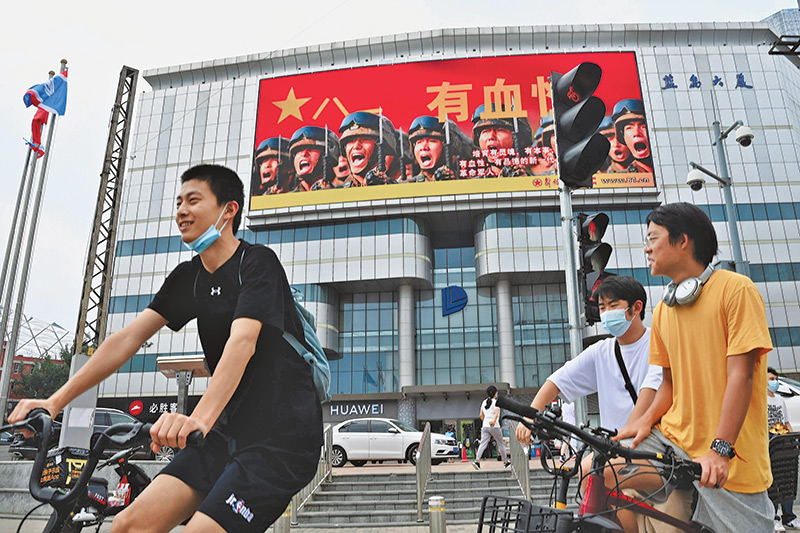
A file photo shows cyclists passing by a large screen on a building promoting the Chinese People’s Liberation Army in Beijing.   AFP/RSS

BEIJING/TAIPEI, 
Chinese Premier Li Keqiang pledged “peaceful reunification” with Taiwan on Sunday as well as resolute steps to oppose Taiwan independence, with Taipei responding that Beijing should respect the Taiwanese people’s commitment to democracy and freedom.
China, which claims democratic Taiwan as its own territory, has increased its military activity near the island over the past three years, responding to what it calls “collusion” between Taipei and Washington, Taiwan’s main international backer and arms supplier.
In August, China staged war games around Taiwan in response to a visit to Taipei by then-US House Speaker Nancy Pelosi.
Speaking at the opening of the annual meeting of China’s parliament, Li said Beijing stands by the “one China” principle, which states that Taiwan is part of China, though did not directly threaten military action.
The government should implement our party’s policy for “resolving the Taiwan question” and “take resolute steps to oppose Taiwan independence and promote reunification”, he told the roughly 3,000 delegates at Beijing’s enormous Great Hall of the People.
“We should promote the peaceful development of cross-Strait relations and advance the process of China’s peaceful reunification.”
Most Taiwanese people have shown no interest in being ruled by autocratic China, which has never renounced the use of force to bring the island under its control.
Li, in separate comments on defence, said the armed forces should boost combat preparedness, though did not mention Taiwan within that context.
Taiwan’s China-policy making Mainland Affairs Council responded to what it called Li’s “reaffirmation” of China’s Taiwan policy by saying Beijing should face up to the reality that the two sides of the Taiwan Strait are “not subordinate to each other”.
China should “respect the Taiwanese people’s commitment to the core concepts of holding fast to the sovereignty, democracy and freedom of the Republic of China”, it said, using Taiwan’s formal name.
China should deal with cross-strait affairs pragmatically in a rational, equal and mutually respectful manner, so as to create conditions for healthy interactions, it added.
Taiwan President Tsai Ing-wen has repeatedly offered talks with China, which have been rebuffed as Beijing believes her to be a separatist.
Taiwan’s government strongly disputes Beijing’s sovereignty claims, and says only the island’s 23 million people can decide their future.
Taiwan holds presidential and parliamentary elections in early 2024 and tensions with China are likely to dominate campaigning.

WORLD

Kyiv says Russian troops pursuing ‘attempts to encircle’ Bakhmut

Bakhmut has been mostly reduced to rubble during the longest battle of the invasion.
- AGENCE FRANCE-PRESSE
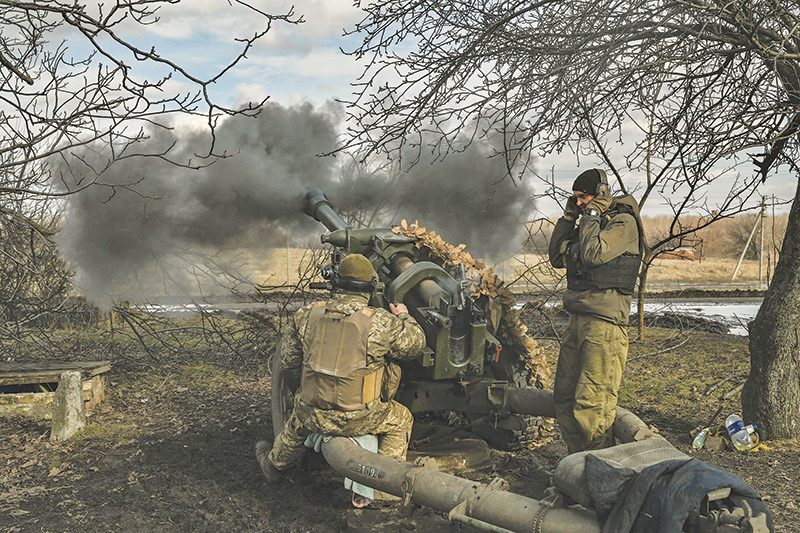
Ukrainian servicemen fire a 105mm Howitzer towards Russian positions, near the city of Bakhmut, on Saturday.   AFP/RSS

KYIV,
Kyiv said on Sunday it was holding off attacks from Russian troops still attempting to surround Bakhmut, a now-destroyed eastern Ukrainian city that Moscow has been trying to capture for months.
Ukraine has vowed to defend “fortress Bakhmut” but it has faced Russian troops determined to take the city that has turned into a political prize as the battle drags on.
The Ukrainian general staff said “more than 130 enemy attacks” had been repelled over the past day including in Kupiansk, Lyman, Bakhmut and Avdiivka.
“The enemy continues its attempts to encircle the town of Bakhmut,” it said on Sunday morning.
Bakhmut has been mostly reduced to rubble during the longest and bloodiest battle of the invasion.
Sergiy Cherevaty, a spokesman for Ukrainian forces, said on Saturday the situation was “difficult but under control” in the city he described as a “priority target for the enemy”.
There is fighting in an around the city, the US-based Institute for the Study of War (ISW) said, warning that with Ukrainian supply routes were narrowing.
“The Russians may have intended to encircle Ukrainian forces in Bakhmut, but the Ukrainian command has signalled that it will likely withdraw rather than risk an encirclement,” ISW said Saturday.
Ukraine and Russia have since the summer fiercely fought for the city, whose symbolic importance surpassed its military significance.
Pro-russian separatists in the Donetsk region posted a video purporting to show Wagner fighters in the suburbs north of Bakhmut, having taken control over the Stupki railway station.
Wagner, a private army headed by Yevgeny Prigozhin, has taken centre stage in the fight for the city, which has exposed rivalries with Russia’s conventional forces.
On Friday, Prigozhin said his fighters had “practically encircled” Bakhmut, and only one road remained under Ukrainian control.
Prigozhin has for weeks been publicising the advances of his men towards the eastern city.
Prigozhin regularly posts videos of himself alongside mercenaries, on the ground or even in a fighter jet, in contrast with Russian generals criticised for shirking the frontline.
In a rare exception, Russia on Saturday released a video of defence minister Sergei Shoigu inspecting troops in frontline regions in Ukraine.
The ministry said Sergei Shoigu inspected an advance command post in the South Donetsk direction without specifying exactly where or when.
He was seen travelling in a helicopter and talking to a soldier in front of damaged buildings.
The ISW think tank said Shoigu went there “likely to assess the extent of Russian losses around Vugledar and the possibility of a further offensive in this direction”.
While the epicentre of the fighting is in the east of Ukraine, the death toll from a strike this week on an apartment block in southern Zaporizhzhia has now risen to 13.
Zaporizhzhia is one of the four regions—along with Donetsk, Lugansk and Kherson—that Russia claims to have annexed but never fully controlled.
Still, Moscow’s forces have held the Zaporizhzhia nuclear power plant since March 4, 2022.
The plant has repeatedly made headlines and revived fears of nuclear catastrophes similar to the deadly Chernobyl disaster that shook Ukraine in 1986.
The exiled mayor of Energodar, which houses the central, told AFP Russia uses the plant as a “nuclear shield” to for its troops and equipment.
Kyiv and Moscow have blamed each other for shelling around the plant and the International Atomic Energy Agency (IAEA) posted observers there.

WORLD

Protests break out in Iran over schoolgirl illnesses

- REUTERS
A young woman lies in hospital after reports of poisoning at an unspecified location in Iran in this still image from video from Thursday.  WANA via REUTERS

DUBAI, 
Worried parents protested in Iran’s capital Tehran and other cities on Saturday over a wave of suspected poison attacks that have affected schoolgirls in dozens of schools, according to Iranian news agencies and social media videos.
The so-far unexplained illnesses have affected hundreds of schoolgirls in recent months. Iranian officials believe the girls may have been poisoned and have blamed Tehran’s enemies. The country’s health minister has said the girls have suffered “mild poison” attacks and some politicians have suggested the girls could have been targeted by hardline Islamist groups opposed to girls’ education.
Iran’s interior minister said on Saturday investigators had found “suspicious samples” that were being studied.
“In field studies, suspicious samples have been found, which are being investigated... to identify the causes of the students’ illness, and the results will be published as soon as possible,” the minister, Abdolreza Rahmani Fazli, said in a statement carried by the official news agency IRNA.
Sickness affected more than 30 schools in at least 10 of Iran’s 31 provinces on Saturday. Videos posted on social media showed parents gathered at schools to take their children home and some students being taken to hospitals by ambulance or buses.
A gathering of parents outside an Education Ministry building in western Tehran on Saturday to protest over the illnesses turned into an anti-government demonstration, according to a video verified by Reuters.
“Basij, Guards, you are our Daesh,” protesters chanted, likening the Revolutionary Guards and other security forces to the Islamic State group.
Similar protests were held in two other areas in Tehran and other cities including Isfahan and Rasht, according to unverified videos.
The outbreak of schoolgirl sickness comes at a critical time for Iran’s clerical rulers, who have faced months of anti-government protests sparked by the death of a young Iranian woman in the custody of the morality police who enforce strict dress codes.
Social media posts in recent days have shown photos and videos of girls who have fallen ill, feeling nauseaous or suffering heart palpitations. Others complained of headaches. Reuters could not verify the posts.
The United Nations human rights office in Geneva called on Friday for a transparent investigation into the suspected attacks and countries including Germany and the US have voiced concern.

WORLD

Qatar’s emir criticises delay in aid to earthquake victims in Syria

- REUTERS

DOHA,
Qatar’s emir said on Sunday he was puzzled by the delay in delivering aid to victims of last month’s earthquake in Syria, adding that it was wrong to abuse humanitarian aid for political purposes, in an apparent swipe at the Syrian government.
Qatar was among several regional states that backed rebels in Syria’s civil war and has previously spoken out against efforts by some countries to normalise ties with Damascus.
Emir Sheikh Tamim bin Hamad al-Thani, speaking at the opening of the UN Least Developed Countries conference in Doha, stressed the need to help Syrians “without hesitation” and support Turkey’s efforts to recover from the devastating earthquake.
The death toll in Turkey has risen to above 45,000, bringing the total toll including Syria to about 51,000.
In Syria, the northwest region controlled by rebels at war with President Bashar al-Assad was the worst hit.
“As I wonder at the delay in the arrival of aid to these [Syrian] people, I stress that exploiting a human tragedy for political purposes is unacceptable,” Sheikh Tamim said.
The United Nations has called for access by all parties in Syria, already devastated by years of civil war, in order to scale up aid deliveries.
Relief bodies complain of restrictions by the Damascus government that they say politicise aid distribution.
Other aid agencies say hardline rebels have blocked aid deliveries from government-held parts of Syria, further complicating efforts.

WORLD

Police attempt to arrest former PM Imran Khan

Briefing
- AGENCIES

LAHORE: Police in Pakistan said officers attempted on Sunday to arrest former prime minister Imran Khan, who is battling several legal cases as he pressures the government for early elections. Officers from the capital, Islamabad, arrived at Khan’s home in the eastern city of Lahore, which was surrounded by hundreds of his supporters, but were unable to carry out the arrest. “A team of Islamabad police has arrived in Lahore to arrest Imran Khan to comply with the court orders,” Islamabad police said in a tweet. “Imran Khan is reluctant to surrender—the Superintendent of Police had gone into the room but Imran Khan was not present there.” The arrest warrant was issued after Khan failed to appear in court in a corruption case on February 28.

WORLD

‘Major’ fire at Cox’s Bazar refugee camp in Bangladesh under control

Briefing
- AGENCIES

DHAKA: A “major” fire that broke out at a Rohingya refugee camp in Bangladesh on Sunday, destroying several homes, is now under control, police officials told Reuters, adding that there were no casualties. The blaze hit Camp 11 in Cox’s Bazar, a border district where more than a million Rohingya refugees live, with most having fled a military-led crackdown in Myanmar in 2017, Rafiqul Islam, additional police superintendent at Cox’s Bazar told Reuters. “We currently don’t have an estimate for damages but there are no reports of casualties,” Islam said, adding that the blaze was under control and senior officials from the fire, police and refugee relief departments were present at the site. Faruque Ahmed, a local police official, said the cause of the fire was not clear.

WORLD

South Korea, Japan near landmark deal on wartime labour dispute, media reports

Briefing
- AGENCIES

SEOUL/TOKYO: South Korea and Japan may be near resolving a dispute over colonial-era forced labour that has overshadowed political and trade relations between the two neighbours, with media reports saying Seoul could announce plans on Monday. The South Korean government plans to announce on Monday morning its solution to the historical and legal dispute over compensating people forced to work under Japan’s 1910-1945 occupation of Korea, Japan’s Kyodo news reported, citing unnamed diplomatic sources. 

Page 7
SPORTS

Jawalakhel shock Machhindra

Simanta Thapa-led team fight back from one goal down to stun the defending champions 3-1.
Army play a goalless draw with Sankata. Satdobato defeat New Road Team 2-1.
- Sports Bureau
Sankata Club’s Sunil Bal (left) in action during the Martyrs Memorial A-Division League football match against Tribhuvan Army Club at the Dasharath Stadium in Tripureshwar on Sunday.  Post Photo: Hemanta Shrestha

KATHMANDU,
Jawalakhel Youth Club came from behind to stun defending champions Machhindra 3-1 to start their Martyrs Memorial A-Division League campaign in style at the Dasharath Stadium on Sunday.
Machhindra drew the first blood after Devendra Tamang scored a sensational free kick for the two-time winners in the 23rd minute.
But a determined Jawalakhel dealt an early blow to Machhindra’s ambitions to win the third successive title with three stunners after the break.
First, Hishub Thapaliya drilled home the equaliser in the 59th minute, confidently slotting past the goalie Bishal Shrestha after a good work from Fode Fofan in the midfield.
Machhindra came under pressure after conceding the equaliser and Jawalakhel took full advantage of it to further the lead five minutes later, thanks to a blunder from goalie Shrestha.
Shrestha failed to clear a back pass from Diwakar Chaudhary and Nkoto Synous Masoabi—whose first half effort was cleared by Ranjit Dhimal from the goalline—quickly volleyed over the helpless goalkeeper to leave Machhindra shell-shocked.
Jawalakhel captain Simanta Thapa, then, headed in a free kick from Hishub Thapaliya in the 76th minute to sum up a scintillating second half comeback.
The defeat also snapped Machhindra’s 19-run unbeaten streak in the league. Machhindra had not lost a single match in the 2020-21 season.

Sankata, Army share spoils
Sankata Club held departmental giants Tribhuvan to a goalless stalemate in a drab affair at the Dasharath Stadium.
The best chance of the first half fell to Sankata in the 32nd minute. Junior Onguene Nkengue intercepted a pass from Army defender Jitendra Karki, sprinted past two defenders into the penalty area but ended up firing wide.
Sunil Shrestha almost put Sankata in front nine minutes into the break with a double effort. He seized possession from Army defender Bikash Khawas and attempted a close range effort from a tight angle.
Goalkeeper Bikesh Kuthu saved the shot but lost possession of the ball which Shrestha quickly directed towards the goal but Deepak Gurung saved Army from early blushes with a goal line clearance.
Army were toothless and lacked precision and control after the break as well and wasted a golden opportunity in the fifth minute of the injury time.
Second half substitute Ramesh Bhujel released Dinesh Hemjan into the penalty box with an almost perfect pass but Hemjan fired in haste and his tame shot was easily saved by Sankata goalkeeper Tikendra Singh Thapa.
“We could not execute our strategy. We need to improve our weaknesses. I hope our team will play better in the upcoming matches,” said Army assistant coach Raju Tamang.
Sankata coach Salyan Khadgi made peace with the draw.
“Our boys created many opportunities today but we are happy with the point,” said Khadgi.
“Ayush Galan missed today’s game but will be available next week. I expect result in the next matches,”
he added.

Satdobato beat NRT
Dipak Raj Singh Thakuri scored a brace as Satdobato Youth Club beat New Road Team 2-1 at the Chyasal Stadium.
Thakuri gave Satdobato the lead in the 45th minute but Nicolas Serge Song equalised in the added minutes.
But Thakuri responded with a late effort to give Satdobato a flying start.

SPORTS

Arsenal stay in control of Premier League title race

The Gunners fight back to beat Bournemouth 3-2 to maintain a five-point lead over Manchester City.
- ASSOCIATED PRESS
Arsenal’s Reiss Nelson celebrates after scoring the winner against Bournemouth.   Ap/Rss

LONDON,
The first goal could barely have come earlier.
The winning goal couldn’t have been scored any later.
Arsenal went through a roller coaster of emotions when pulling off a stirring second-half recovery to beat Bournemouth 3-2 and stay in control of the English Premier League title race on Saturday.
Rocked by conceding after 9.11 seconds for the second-fastest recorded goal in Premier League history, Arsenal completed their comeback when substitute Reiss Nelson smashed home a left-foot shot from the edge of the area in the seventh minute of stoppage time with virtually the last kick of the game.
“It was madness from the first second,” said Arsenal manager Mikel Arteta, whose team maintained their five-point lead over Manchester City with 12 games left for each team in a back-and-forth title race.
City did their part in Saturday’s early game, beating Newcastle 2-0 at home through goals by Phil Foden and Bernardo Silva to keep the pressure on Arsenal.
The response by Arteta’s team ended up being extraordinary, with Arsenal’s three goals—from Thomas Partey, Ben White and, in thrilling fashion, Nelson—coming from the 62nd minute just when it looked like relegation-threatened Bournemouth were going to pull off the most unlikely of victories.

Pressure off Potter
Just as big a goal came at Stamford Bridge, where Wesley Fofana headed in off a corner to earn Chelsea a 1-0 win over Leeds and ease some of the pressure that has been building on manager Graham Potter.
It was only a second win in the last 11 games in all competitions for Chelsea, who are languishing in mid-table despite spending $630 million over the last two transfer windows.
That has left Potter clinging to his job but he has some respite, at least until Tuesday when Chelsea look to come back from 1-0 down to Borussia Dortmund in the second leg of their last-16 matchup in the Champions League.
“We’ve had to suffer. It’s been a challenging period,” Potter said.
“We were the team who had something to lose so it was great character from the players. They cared and showed togetherness in the team. It gives us something to build on.”

Pressure on Moyes
West Ham manager David Moyes felt the ire of his own fans after an alarming 4-0 loss at Brighton.
“You don’t know what you’re doing” and “Sacked in the morning” were some of the chants coming Moyes’ way in the second half as West Ham’s winless away run in the league extended to 11 matches after a feeble display.
The team are in 16th place in the 20-team league, two points above the relegation zone
Brighton overwhelmed West Ham and scored through a penalty from Alexis Mac Allister, tap-ins by Joel Veltman and Kaoru Mitoma, and a late strike from Danny Welbeck.
 
Tottenham’s bad week
A bad week for Tottenham got worse with a 1-0 loss at Wolverhampton that kept the race for Champions League qualification wide open.
Three days after a defeat at second-tier Sheffield United in the FA Cup, Tottenham put in a meek performance at Molineux against a team fighting relegation. Adama Traore scored the 82nd-minute winner.
Tottenham stayed in fourth place but gave the teams below hope in the race for Champions League qualification. Newcastle in fifth and Liverpool in sixth place both have two games in hand.
 
Off the bottom
The battle to avoid relegation couldn’t be much closer after Southampton beat Leicester 1-0 to climb off the bottom of the standings on goal difference.
Southampton moved to next-to-last place, above Bournemouth and below Everton. All three teams are on 21 points. Leeds, West Ham and Leicester are the next three teams, and the bottom six are separated by just three points. In the day’s other game, Aston Villa won at home to Crystal Palace 1-0 thanks to an own-goal by Joachim Andersen.

MEDLEY

Horoscope

ARIES (March 21-April 19)
Your subconscious may align with the material realms in unexpected and strange ways today. You’ll feel more focused as the hours continue to unfold,work ethic, and skills as a team player.

TAURUS (April 20-May 20)
Your popularity will skyrocket today. Don’t feel guilty about setting a boundary if you need space, though your social and fun-loving side will come out to play as the hours unfold.

GEMINI (May 21-June 21)
Don’t be surprised if random memories suddenly manifest, though you will also be blessed with innovative ideas that can help pave your way toward success. Be sure to honor what your heart tells you as the day unfolds.

CANCER (June 22-July 22)
The world will feel equal parts vast and small today. You may find yourself running into old friends, meeting strangers from foreign lands, and feeling more tapped into your community. Look for unique ways to express yourself.

LEO (July 23-August 22)
You’ll be in a unique position to break through barriers today. Don’t be afraid to free the rebel within you, especially if you feel that unfair rules or jealous colleagues have been restricting your ability to thrive.

VIRGO (August 23-September 22)
You’ll feel spiritually aligned with your nearest and dearest today. you may want to be on guard for tense exchanges, marking the perfect excuse to take a moment for silence to focus on your thoughts.

LIBRA (September 23-October 22)
You’ll be in a feisty mood. You won’t have much patience for systems or routines that seem unproductive or outdated, so take the initiative to improve your efficiency and that of your colleagues.

SCORPIO (October 23-November 21)
You’ll be in a playful and sentimental mood . You will break new ground within your closest relationships, so don’t be afraid to reveal more of yourself, especially where quirky behaviors or humor are concerned.

SAGITTARIUS (November 22-December 21)
You’ll want to watch out for tension within your career . If it’s been a minute since you tidied up your space, consider harnessing the energy at play to keep busy by getting back on track with your organization.

CAPRICORN (December 22-January 19)
Allow the genius that lives within to spread its wings and share ideas. You may also find yourself on the receiving end of juicy news or gossip, but try not to spread secrets that don’t belong to you.

AQUARIUS (January 20-February 18)
You’ll be in a sweet yet wacky mood. You may want to practice restraint with larger purchases. If you’re in a relationship with joint finances, making it important that you and your partner are on the same fiscal page.

PISCES (February 19-March 20)
Your mind will operate from a higher wavelength . The unpredictable nature of this celestial exchange suggests you may want to think your words through before sharing them. Show the people you care for some extra love and affection.

Page 8
CULTURE & LIFESTYLE

Many colours of Holi

How do the seven provinces of Nepal celebrate the festival?
- Rukusha Giri
Post File Photo

Kathmandu
According to the Bhagawat Mahapuran, Holi celebrates the triumph of good over evil. It marks the day the demon princess Holika, sister of Hiranyakashipu, was killed in the fire while trying to burn her nephew, Prahlada.
The festival is celebrated all over Nepal in different ways. The Post brings you the many ways the festival of colours is celebrated in all seven provinces of Nepal.

Janakpur, Madhesh Province
Tarai region is infamous for its grand Holi celebrations. Janakpur is a great example of how big the celebration of the festival of colours can get.
Holi celebration in the Madesh Province starts a fortnight before the actual festival day. The city’s inhabitants participate in a Parikrama (circumambulation of temples) where they visit one temple every day for 15 days—starting and ending with Janaki Mandir.
“Holi is a big deal in Janakpur because it marks the end of the winter season and the beginning of spring,” says Aayush Goyenka, a 19-year-old student from Janakpur. At the Janaki Temple grounds, farmers play with mud instead of colours to signify this change of seasons.

Biratnagar, Koshi Province
Biratnagar celebrates Holi in a spirit of socialisation. The Tarai region of the province is highly influenced by the
celebration of the festival in India.
Dilli Prasai, an associate professor at Tribhuvan University and a Biratnagar native, says that while the festival was only celebrated by people living in Tarai until a couple of years ago, now, people across all regions seem to celebrate Holi.
According to Prasai, the culture of Holika Dahan (collecting wood and burning them as a symbol of burning Holika) is slowly disappearing in Biratnagar, and only some families who are very invested in Holi follow this ritual. The families that participate in Holika Dahan also perform a puja (an act of worship) near the fire, put on a tika of the ashes on the forehead and eat prasad (devotional offering).
“The next day (the day after Fagu Purnima), everyone gathers as usual to celebrate Holi,” says Prasai adding that water balloons are banned in the province, so people can only play with colours during the festival.

Sindhupalchok, Bagmati Province
Sindhupalchok’s Holi typically begins a day before the Tarai holi. On the day before Purnima, people gather and
assemble a bonfire. Since the district is home to a sizeable Buddhist population, villagers traditionally would not participate in the Hindu festival of colours. However, with the advent of social media, youths in Sindhupalchok have also begun celebrating Holi in recent years.
“The villagers in Sindhupalchok do not celebrate Holi the same way that people in other parts of the country do,” says Devendra Bhandari, a well-known Dhami (faith healer) in the district.
Bhandari described his experiences gathering several plants, including Jatamasi (spikenard)  and ‘Kumkum Dhoop,’ to burn on the Holika Dahan bonfire.
The major areas of Sindhupalchok, such as Bahrabise, Melamchi, and Chautara Sangachowk, have a Hindu population and celebrate Holi. They begin their celebration with a bonfire the day before, and the next day they all assemble in groups to celebrate the holiday with colours and water balloons.

Syangja, Gandaki Province
The elderly villagers of Gandaki celebrate Holi customarily by singing and dancing together, whilst the youth celebrate by playing with colours. Holi in Syangja is not the same as holi in the Tarai area.
“Holi used to be more localised in our neighbourhood, and I still love that vibe. But still, with all of these social networks, the younger generation is playing holi in new and interesting ways,” says Dilip Pratap Khand, former mayor of the Waling Municipality in Syangja.
“The way I remember playing Holi has completely changed. We used to put a simple tika back in our days. But today’s youths smear chemical-based harmful colours on their faces. They also roam from one location to another in trucks, splashing water on one another. I find this problematic,” says Khand.

Rupandehi, Lumbini Province
Holi in Lumbini begins the day after Shivaratri. The area’s youth gather sammat, a collection of wood, dry plants and herbs, over these two weeks and burn these in a communal fire during Fagu Purnima to mark Holika Dahan.
“We stay up all night before the fire to welcome Holi,” says Khushi Ram Chaudhary, a board member of Tharu Kalyankari Sabha. Lumbini natives begin their Holi by taking home ashes from the Dahan and putting on its tika in the morning.
“Lumbini has a large Tharu population. On Holi, members of the Tharu community sing and perform ‘JhiJhiya’ dance. We visit each other’s houses to perform and get bheli (jaggery), chamal (rice) and dakshina (monetary offering),” explains Chaudhary, adding that a participant of this ritual later organises a lunch for the whole team with this money.

Surkhet, Karnali Province
Since Karnali has a mixed population from the Tarai and Hilly regions, the province’s Holi celebration is also an amalgam of these regions. The celebration is pretty mild in the hills compared to the Tarai. Individuals from the Tarai, like those from the highlands, bring their unique flavours.
“Youths nowadays celebrate their own kind of Holi,” says Tilak Poudel, an advertiser on TV Today Channel, adding that locals come together and organise local Holi events across various themes. Everyone gets together to enjoy the festival in the city by playing with colours, water, and Deuda Khel (a cultural dance performed in Sudurpashchim).
“Surkhet is a meeting point of many cultures, so everyone has their own way of celebrating the festival of colours,” says Poudel.

Achham, Sudurpashchim Province
Holi is known as ‘Fagu Parba’ in Achham.
People in Achham start preparing for Holi eight days before the actual holiday. Everyone comes together to celebrate Holi by playing games.
“We begin our Holi celebrations as soon as Shivaratri ends. We celebrate by singing and dancing Deuda Khel,” says Uday Ram Dhungana, a college administrator in Achham.
He further explains that Achham natives bring the Chir (a decorated pole) in an open space and worship it for eight days, until the day prior to Hol. They then light up the Chir as the symbolical victory of good over evil.
Achham also play a one-of-a-kind game called ‘Fagu Holi Khel,’ which is played from the day the Chir is set on the ground till Holi. The last day of this enigmatic festival of colours is celebrated by singing, dancing, and having a lot of fun with vibrant colours.


With inputs from district correspondents.

CULTURE & LIFESTYLE

The tale of a tennis prodigy

Abhilasha Bista has no intention of slowing down after her unparalleled success early on.
- Aashika Gautam
Post Photo: Anish Regmi

Kathmandu
Abhilasha Bista is arguably one of the best tennis players in the country. An under-19 tennis prodigy, Bista has a number of accolades added to her name at quite a young age. While growing up, Bista aspired to be a renowned player. With sheer passion and dedication, she has become a national-level player and continues to make her mark in tennis.
Bista started her career at the tender age of seven while a student at St. Xavier’s School. She says, “Our school had tennis practice sessions on Saturdays and Sundays. I used to practice with my brother during those days. My brother stopped playing tennis after the 10th grade as he aspired to be a doctor. I found myself keenly interested in the sport and saw a future in tennis.”
Bista says that her family was very supportive of her passion and career. She also calls herself a pampered child as she recalls her parents leaving no stone unturned to provide her with all the necessary tennis equipment.
While this served as a big motivation for her to further her career, the way Nepali sports fans sideline tennis is a little disheartening for Bista. “Football fans will fill a whole stadium for a game, but a tennis match draws a smaller crowd in Nepal,” Bista says, adding that government support is extremely necessary to motivate athletes in sports other than football and cricket to move forward. “Both the junior and senior players are doing exceptionally well in their respective domains. Their outstanding performances have often won us international recognition. We seek a little more respect and validation from our audience,” adds Bista.
The tennis star also mentions that it is critical to acknowledge and push women in sports and that the government has to promote female players—especially the ones who play sports that aren’t as popular as football.
Bista feels that the tennis community is pretty welcoming of female players, in general. She states that she hasn’t yet been discriminated against or belittled for being a female sportsperson.
Sports, according to Bista, can only be pursued by individuals who are consistent with their practices. “I push myself a lot. I compete in tournaments frequently and do whatever I can to better my game. There are days when I feel tired and fatigued, but I still show up to practice,” she says.
For Bista, who is currently pursuing a degree in computer science as well, juggling school and sports was never a major concern. She has been working hard in both these fields and excels in both.
Bista considers Bibhuti Karki and Pranav Khanal as her tennis idols. She recalls watching all their games growing up, and the fact that she has played alongside Khanal (in mixed doubles games) and converses regularly with Karki (who is actually a distant relative of Bista) is surreal to her.
Arab tennis player Ons Jabeur is another one of Bista’s favourites. “Jabeur was raised in a middle-class family and struggled a lot while playing tennis. She is now one of the best players in the world. Her journey gives me a lot of hope because it proves that coming from a small country and a middle-class family doesn’t matter if you have true talent,” she says.
Bista herself has represented Nepal in a lot of national and international games. When asked about her most memorable moment from the court, she says it has to be when she and her partner, Ira Rawat, defeated the Pakistani team in the quarterfinals of the South Asian Games 2019.
Having reached unparalleled success at such a young age, 19-year-old Bista has no intention of slowing down. She states that she wants to represent Nepal and serve as a sports ambassador in more competitions in the future.