Prime minister likely to visit India around mid-April
China has invited Dahal to the Boao Forum in March-end. He could choose not to go to China before India though.
- ANIL GIRI
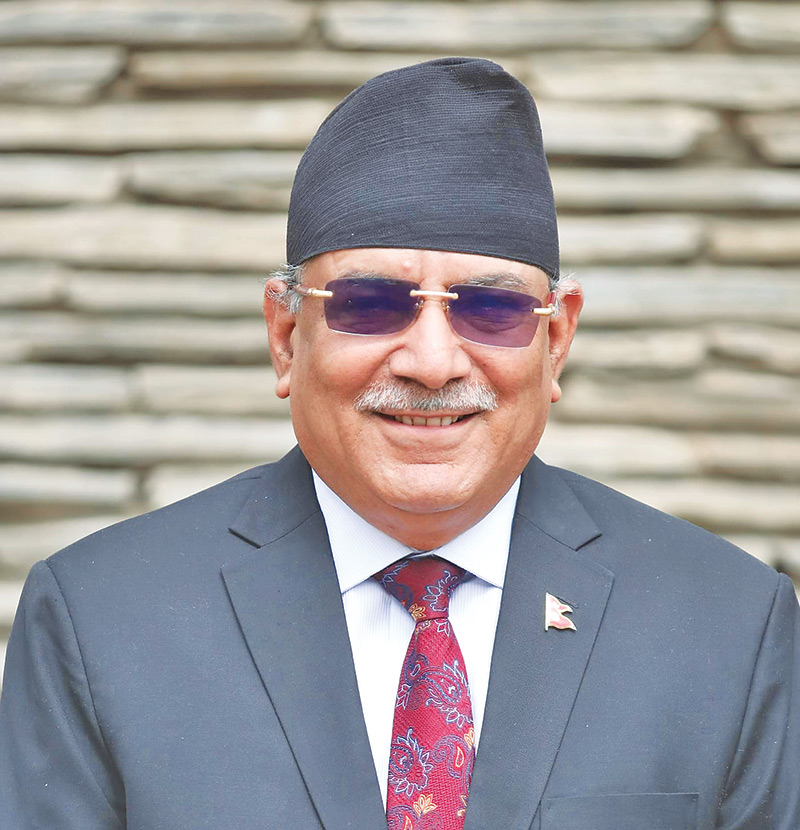
Pushpa Kamal Dahal RSS
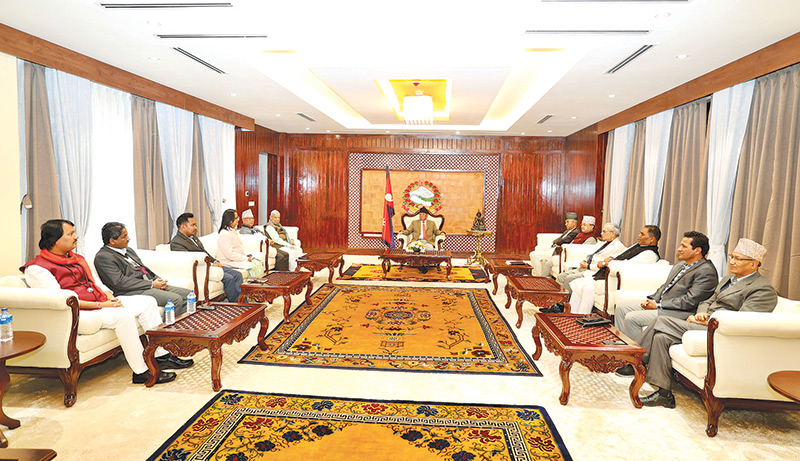
KATHMANDU, Prime Minister Pushpa Kamal Dahal is likely to embark on a state visit to India before mid-April. However no date has been finalised between the two sides, sources in Kathmandu and New Delhi told the Post. Earlier, the prime minister had announced that his first foreign visit would be to India. Once the prime minister gets a vote of confidence in the House, expands the Cabinet and new governments are formed in the provinces, the prime minister will have the time for the visit, an aide to Dahal said. These processes could take up to four weeks. Then the prime minister will visit India, the aide said. The Ministry of Foreign Affairs has started groundwork for the visit. Meetings are being held with the line ministries to prepare the agenda, said an official at the ministry. Diplomatic sources said the proposed date of the visit is April 13–15 but another government official said there had been no discussion with the Indian authorities on the visit’s dates and itinerary. “Following indications from Delhi that it will invite the prime minister soon, we have started necessary preparations for the visit,” a senior foreign ministry official said. “The visit is expected to take place sometime between the second and third weeks of April.” “The visit will happen after the prime minister seeks the floor test in Parliament and expands his Cabinet. But the dates are yet to be fixed,”said Haribal Gajurel, Dahal’s political adviser. During an interaction with some editors on January 15, the prime minister had revealed that he would make New Delhi his first port of call. The prime minister is also invited to the Boao Forum for Asia that is scheduled to take place from March 28 to 31 in Boao town of Qionghai city, South China’s Hainan province. But it is not sure whether the prime minister would visit China ahead of India—and while he has his hands full settling power-sharing negotiations among the parties supporting the government. In 2008, after being elected prime minister for the first time, Dahal went off the beaten track to visit Beijing for the Olympics inaugural ceremony without first travelling to India, as Nepali prime ministers have traditionally done. Dahal later tried to control the damage and upon his return from Beijing said that his first ‘official’ visit would still be to India. Having thus caused deep suspicions in the officialdom in New Delhi, Dahal, in his second stint as prime minister, first went to India on a state visit in September, 2016. Some foreign policy experts said the prime minister would definitely visit India first as he could not be seen as undermining India’s importance. “In this present context, the prime minister cannot ignore or avoid India,” said Mrigendra Karki, executive director of the Centre for Nepal and Asian Studies (CNAS), Tribhuvan University (TU). “Dahal must have learned his lesson from his two previous terms as government head. So, this time, he is unlikely to make India unduly suspicious by visiting China first,” Karki said. When he tried to tilt towards China in the past, India no longer trusted him, he added. “He knows by now that it will be difficult for him to work smoothly as prime minister without first winning India’s trust.” In July last year, Dahal visited India at the invitation of Bharatiya Janata Party (BJP) National President JP Nadda. In addition to the BJP president, he had at the time met External Affairs Minister of India S Jaishankar and National Security Adviser Ajit Doval. Dahal’s planned India visit was briefly discussed with Indian Foreign Secretary Vinay Mohan Kwatra when he came to Kathmandu in February.
HOME PAGE
Anti-money laundering grouping asks Nepal to curb private sector corruption
Stakeholders say doing so could make businesses feel harassed and vitiate an already dicey business climate.
- PRITHVI MAN SHRESTHA
KATHMANDU, The Asia Pacific Group on Money Laundering has pointed out Nepal’s failure to criminalise corruption involving the private sector as one of the country’s deficiencies in complying with the standards on anti-money laundering and terrorist financing, a senior government official said. Nepal’s existing anti-corruption laws—the Prevention of Corruption Act-2002 and the Commission for Investigation of Abuse of Authority Act 1991—criminalise corruption involving the public sector. Bills to amend these laws registered at the National Assembly three years ago will also fail to criminalise corruption involving the private sector. Nepal’s constitution authorises the CIAA, the anti-corruption authority, to investigate and prosecute only the malpractices involving public officials. However, Nepal in 2011 ratified the United Nations Convention Against Corruption that calls for preventive measures and criminalisation of the most prevalent forms of corruption in both public and private sectors. “The Asia Pacific Group on Money Laundering [APG], in its initial report submitted a month ago to Nepal for its opinion, has pointed at the non-criminalisation of corruption involving the private sector as problematic,” a government official with access to the report told the Post on condition of anonymity because he was not authorised to speak to the media. The private sector has long been opposed to any agency investigating its matters claiming that such measures could discourage investments in the country. The government, which often promises a sound investment climate in the country, has thus far heeded the private sector. “Current and proposed laws to control corruption don’t have a provision to criminalise corruption involving the private sector,” said the government official. “Standards of criminalising corruption involving the private sector should be different to similar standards for the public sector, if any such standards are to be set.” The official argued that business enterprises in the country cannot operate with the same standards that govern public entities and officials. According to the UN Convention Against Corruption, to which Nepal is a signatory, member countries should take measures to prevent corruption involving the private sector, enhance accounting and auditing standards in the private sector and, where appropriate, provide effective, proportionate and dissuasive civil, administrative or criminal penalties for failure to comply with such measures. In order to achieve these ends, the convention has called for measures to deepen cooperation between law enforcement agencies and relevant private entities and promote development of standards and procedures to safeguard the integrity of relevant private entities, including codes of conduct. Prevention of conflicts of interest, promotion of the use of good commercial practices among businesses and in the contractual relations of businesses with the state, and prevention of the misuse of procedures regulating private entities are other measures included in the convention. It calls for preventing conflicts of interest by imposing restrictions, as appropriate and for a reasonable period of time, on the professional activities of former public officials or on the employment of public officials by the private sector after their resignation or retirement. The Nepal’s Civil Service Act-1993 does not bar civil servants from joining the private sector after their retirement or resignation. Civil servants are often accused of working in favour of the international agencies that they plan to join after their retirement. The law governing the central bank, the Nepal Rastra Bank Act-2002, however, bars its senior officials from working at any banks or financial institutions (BFIs) for a specified number of years after retirement. A person who has served as the governor of the central bank can never work in any commercial bank or financial institution, according to the Act. Similarly, deputy governors and executive directors cannot work in any BFI in any capacity for three years after retirement. Likewise, an officer-level employee of the central bank is barred from working in any BFI for two years after retirement. “We need to introduce a law to prevent conflict of interest in order to comply with anti-money laundering standards,” Rajan Khanal, former finance secretary, told the Post in an interview a few months back. As a party to the UN convention, Nepal has an obligation to address the issue in whatever way possible. The CIAA has long been calling for its expanded jurisdiction to probe the private sector in line with the UN convention. Speaking at an event organised by the CIAA to mark its 32nd anniversary on February 11, Prem Kumar Rai, the chief commissioner, called for an expanded jurisdiction to enable the commission to investigate even improper conduct, issues related to conflict of interest, and private and non-governmental sectors as well. However, former CIAA chief commissioner Surya Nath Upadhyay said the state should not penalise the private sector for corruption so long as there is no involvement of government money, government officials or government institutions. “Otherwise, the private sector will feel hassled and discouraged,” he said. He pointed to the several laws and regulatory agencies with the authority to take action against private sector entities involved in malpractice. “For example, the Nepal Rastra Bank can penalise banks and financial institutions and their promoters and employees for illegal and criminal practices and there are also ways to penalise private sector people under the anti-money laundering law, among others,” he said. Even the CIAA has been prosecuting private sector actors found to be working in collusion with government officials and bleeding state coffers. For example, the CIAA, in December 2018, filed a corruption case against former minister Bikram Pandey along with 20 other government individuals after several sections of the main canal of the multi-billion-rupee Sikta Irrigation Project collapsed apparently owing to substandard construction. On June 20, this year, the Special Court cleared all 21 including Pandey of the charges. He was charged not as a minister, but as the owner of the contractor firm, Kalika Construction, which was involved in building the main canal. The CIAA, in October 2018, had filed a corruption case against Pappu Construction owner Hari Narayan Rauniyar and his son Sumit Rauniyar for building a substandard bridge across the Babai river at Jabdighat in Bardiya district. Private sector representatives say any move to penalise them under the pretext of controlling corruption would have a negative impact on the economy. “Nepal’s economy is already overregulated,” said Hari Bhakta Sharma, former president of the Confederation of Nepalese Industries (CNI). “Business climate will be severely affected if further control measures are brought against the private sector.” As Nepal faces the risk of being greylisted by the Financial Action Task Force (FATF), a global anti-corruption body, for its deficiencies in controlling money laundering and terrorist financing, the government is required to address the deficiencies the Asia Pacific Group has pointed out. After a field visit to Nepal in December last year as a part of mutual evaluation of Nepal’s compliance, the Asia Pacific Group prepared a report and shared it with Nepal. In fact, the government itself has identified 15 laws that need amendments. The government recently rushed a bill to Parliament to amend several such laws. “When the new bill is passed, around 70-80 percent of the legal deficiencies pointed out by the Asia Pacific Group will be addressed,” the government official said. “It, however, does not address the issue of criminalising corruption involving the private sector.”
HOME PAGE
Buying salt becoming a challenge for outlying Mugu villages
Locals have to make an arduous, costly two-day journey to Gamgadhi to buy subsidised salt.
- RAJ BAHADUR SHAHI
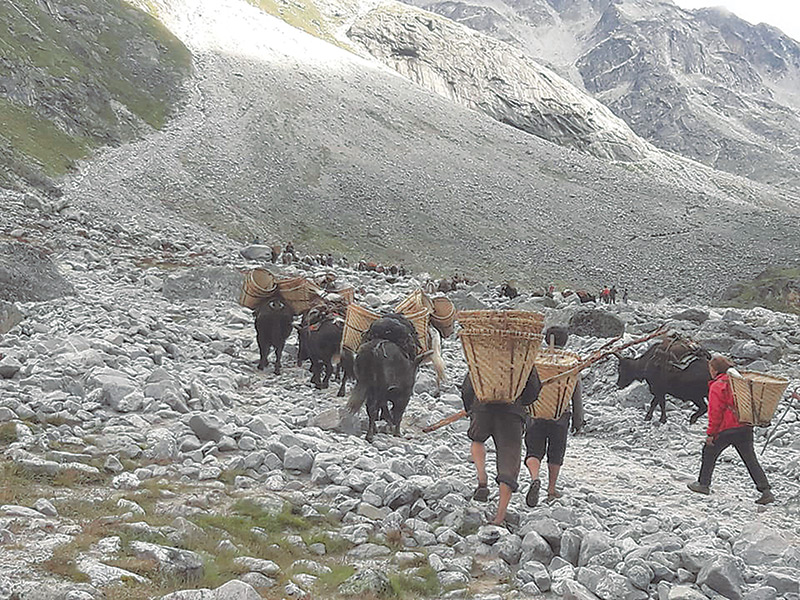
Mugu locals with wicker baskets on their backs and pack animals heading for Tibet to buy salt, in this photo taken five years ago. Villagers living along the Nepal-Tibet border who relied mostly on Chinese marketsfor supplies were hit hard due to Covid-induced border closure. POST PHOTO: Raj Bahadur Shahi
MUGU, It is a challenge for Phunjong Tamang, a resident of Mugum Karmarong Rural Municipality-2, to provide for his family of five given his poor financial condition. The unavailability of salt locally has further added to his challenge, he says. “The price of salt is higher than that of food grain,” Tamang said. “We can at least grow crops in our own fields, but we can’t produce salt. The unavailability of salt has been a generational struggle for the locals of Mugum Karmarong.” Until five years ago, Tamang, like many others from his village, travelled to Tibet to purchase salt. But ever since the borders closed due to the Covid pandemic, he has been forced to walk for two days to reach Gamgadhi, the district headquarters to procure salt. The Mugu (Nagcha) border point has remained closed since 2020 when the Covid pandemic broke out. Although salt depots have been established in Soru and Khatyad rural municipalities outside of the district headquarters, a salt depot is yet to be established in Mugum Karmarong. This has compelled the locals of Chitai, Dolphu, Karti, Kimri and other villages in the rural municipality to travel to the district headquarters for salt. Salt is among rationed food items in the district. The Gamgadhi branch of the Salt Trading Corporation sells five kgs of non-iodised salt per person per month. “We have to travel for two days to reach Gamgadhi. Then we have to wait in a queue for an entire day to purchase five kgs of salt,” said Torcha Tamang, a resident of Chitai village. “The entire journey to and from the village and a day’s wait at the depot takes us five days.” So including the cost of travel, food and accommodation, each local pays around Rs5,000 to get five kilos of salt, which is sold at a subsidised price of Rs9 per kilo, says Torcha. Torcha says the authorities concerned have not prioritised the villages in Mugum Karmarong to set up a salt depot. “There are salt depots in other villages so the locals don’t have to travel to Gamgadhi, but our rural municipality does not have one and we are suffering as a result,” said Torcha. “We either have to eat unsalted food or spend money to go to Gamgadhi to buy salt. There are no other options.” According to Phutuk Tamang, salt shortage has been a long-standing issue in their village. Phutuk, a local resident of the Dolphu village, shares that before the pandemic, some 56 locals would embark on a journey with their horses and mules to Tibet during May-June to buy salt. However, the border closure has deprived them of that option. Chitai, a dense village of 66 families, is no stranger to salt shortage. Even though food essentials such as rice, lentils, ghee, cooking oil, tea leaves, and others are readily available in the village, Chitai locals too have to take the arduous journey to the district headquarters for salt, says Tsering Tamang, a village local. “We are forced to buy crystal salt at Rs75 per kg from sellers, who bring back salt from Gamgadhi.” Tsering shares that they have to rely on one of the two options—either buy the salt from the sellers at an extremely high price or travel to the headquarters to buy the subsidised salt distributed by the corporation. Mugum Karmarong Rural Municipality has a total population of 1,200 people. Mugu, Chitai, Karti, Kimri, Wangri and 12 other villages share their border with the Chinese autonomous region of Tibet. The lack of a salt depot in Mugum Karmarong has hugely inconvenienced the locals, said Mugum Karmarong Rural Municipality chairman Tsering Kyapne Lama. “The border has been closed for so long and the locals have no option but to travel to the headquarters for salt,” he said. According to Kyapne Lama, repeated requests for the establishment of a salt depot in the rural municipality have been made to various authorities, but to no avail. However, Salt Trading Corporation Branch head Devendra Kumar Mahato claims that the discussion about the establishment of a salt depot at the rural municipality is in progress. Out of the yearly quota of 3,200 quintals of salt that has been set for the district, 1,200 quintals are distributed between Chhayanath Rara Municipality and Mugum Karmaron Rural Municipality every year, Mahato added. “While the yearly quota in itself is insufficient, the untimely and delayed salt production by the contractors adds to the burden of the consumers.”
NATIONAL
Groundwater depletion affecting many settlements in western Tarai
Climate change, rapid urbanisation and over-extraction of riverbed material are to blame, experts say.
- DR PANT
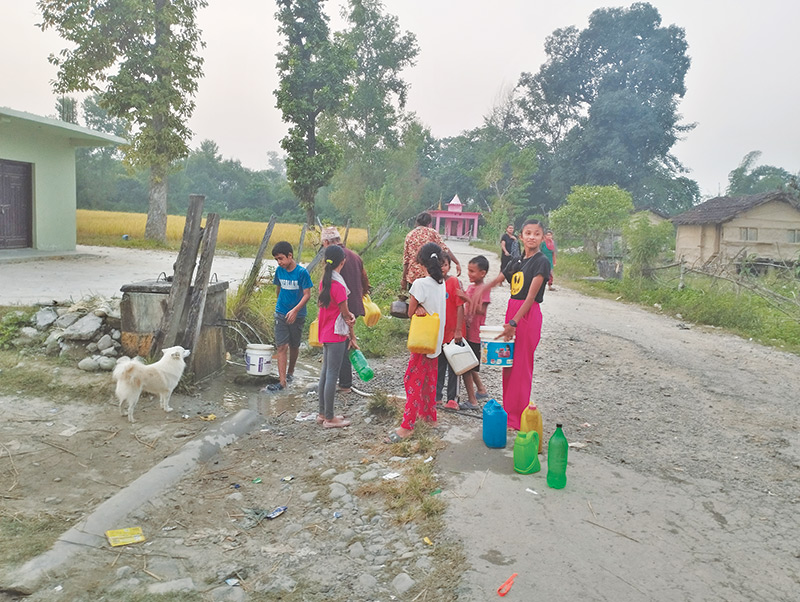
Local residents await their turn at a public tap to fill up their pots at Krishnapur Municipality-2 in Kanchanpur. Post Photo
KAILALI, Dabbu Thapa, a farmer from Krishnapur ward 2 in Kanchanpur, has been drilling holes in his fields in the hopes of finding groundwater to irrigate his fields. But no matter how deep he drills, he can’t find a single droplet of water, says Thapa, 54. “There is no water in the borewells and the rainfall is neither reliable nor sufficient,” he says. “We are suffering due to a lack of water for agriculture and even for drinking.” Local residents report that, in some areas of the Kanchanpur and Kailali districts, a majority of borewells, both public and private, have dried up. Half a dozen water supply projects in Krishnapur and Shuklaphanta Municipality in Kanchanpur are drying up, Thapa says. It has been four years since most borewells and hand pumps in Krishnapur’s ward 2 and 4 began to dry up. The Attariya Urban Drinking Water Project constructed five borewells in Attariya Bazaar of Godawari Municipality, Kailali, four years ago. Four of them have now dried up. Project officials attribute the drying up of the borewells to the depletion of groundwater in the Attariya area. Three years ago, the local unit’s consumer committee conducted a technical test after the borewells started drying up. The test revealed the borewells could not pump water to the surface due to the exhaustion of groundwater sources. The project then constructed a water storage tank with a capacity of 400,000 litres, about 5 km from Attariya Bazaar, where groundwater depletion is not extreme, to supply water to 4,500 households. In Kanchanpur, projects have now started searching for alternative sources of water near the foothill area of Chure. Four years ago, Krishnapur Municipality started installing a deep well hand pump in every settlement. But one hand pump is not enough to cater to at least 15 to 20 households in every settlement, says Dawal Chand, a local resident of ward 2. “There is always a long queue of people waiting for their turn to collect water,” Chand says. “Drinking water projects have not been able to supply drinking water since the borewells have dried up, so we have to rely on the hand pump to meet our water needs.” Engineer Parikshit Shrestha, consultant for the Urban Water Supply and Sanitation Project, says that until 15 years ago groundwater was available a mere 30 feet below the surface but now, one has to drill at least 80 to 120 feet deep into the ground for water. “But even that doesn’t guarantee there will be water,” he said. Several factors have contributed to the continuous depletion of groundwater in the Tarai region of the Sudurpaschim province, says Shrestha. Exploitation of groundwater systems, changes in the water cycle, irregular rainfall, exploitation of rivers and riverbed materials, climate change, and increased destruction of the Chure region have led to a water crisis in the area, he says. “For now, two local units in Kanchanpur are facing an immediate water crisis but the other places are also gradually running out of groundwater,” he said. “Similarly, different parts of Kailali are also facing the same problem.” Another factor contributing to the depletion of groundwater is the increase in population given the unchecked urbanisation in the Tarai region. “Population increase has led to rapid urbanisation and its attendant phenomenons—deforestation and over extraction of riverbed materials,” Shrestha said. “That has also affected the storage capacity of the groundwater system.” According to the data of the Department of Water Supply and Sewerage Management, 51 percent of the Nepali population uses tap water, 35 percent uses hand pumps, and only 14 percent uses natural resources and other resources. Likewise, in west Tarai, 67 percent of farmers depend on groundwater for irrigation while 90 percent of people use groundwater for all household purposes. According to Dr Birbhadra Singh, a researcher who has studied the underground water storage system in Nepal and the importance of Chure foothills, the capacity of underground water storage is decreasing due to the exploitation of natural resources. “Although there is no separate study and data exclusively for Kailali and Kanchanpur districts, experts suggest that the groundwater storage capacity in these two districts is much lower than reflected in the national data,” Singh said. Experts on Chure Tarai conservation say that if the exploitation of the rivers of Tarai and Chure continues then areas of west Tarai will face a severe water crisis within the next decade. “Due to the disturbance on the underground water level and storage cycle, problems such as land infertility, an inability to grow trees, and the depletion of groundwater resources will continue,” said Dr Jagannath Joshi, member of the Chure Tarai Protection Committee.
NATIONAL
Valley’s deputy mayors form network for coordination
- Post Report
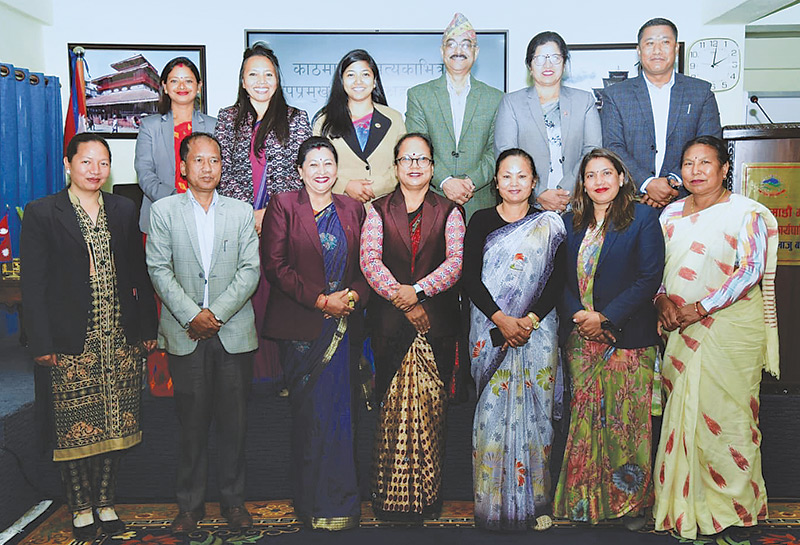
Deputy mayors of the Valley’s various local units in a group photo Tuesday. Post Photo
KATHMANDU, In a bid to introduce integrated planning and parallel work procedures, a ‘network’ of deputy mayors in Kathmandu Valley was formed on Tuesday. Urban planners welcome the drive but are doubtful if that really works as the Kathmandu Valley Mayors’ Forum formed under former mayor Bidya Sundar Shakya was ineffective. The deputy mayors’ network met in the Capital. Kathmandu Deputy Mayor Sunita Dangol chaired the first meeting that was attended by a dozen deputy mayors of the Valley. Dangol said the network aims to enhance the capacity of Valley’s deputy mayors, who are mostly female, and to work towards solving problems in an integrated way. Kathmandu Valley that comprises three districts namely Kathmandu, Lalitpur and Bhaktapur has 18 local federal units—two metropolitan cities and 16 municipalites. Except for Tokha, Madhyapur Thimi, and Changu Narayan municipalities, all the local governments in the Valley have women deputy mayors. “This is a good initiative because Kathmandu Valley is interlinked with cities and needs integrated planning for overall development,” said urban planner Suman Maher Shrestha. “But if they don’t come up with a concrete plan and execute it, it makes no sense,” said Shrestha. The Valley mayors’ forum formed after the local election in 2017 ended without doing anything significant for integrated development last year. Dangol told the Post that their working procedure will be different and result-oriented. “For example, on Tuesday we invited Raju Kumar Khatiwada, chief judge of Kathmandu District Court, and learnt a lot about law and the legal framework under which we can work,” said Dangol, adding that the deputy mayors had learnt about the judicial committee at the local level. In each local unit, the deputy mayor or deputy chair oversees the judicial affairs. Article 217 of the constitution authorises the deputy chief to head the judicial committee and settle legal issues. Article 217 (1) says a three-member judicial committee is coordinated by the vice-chair in a village body and the deputy mayor in a municipality in order to settle disputes under their jurisdictions. “Next time we will bring resource persons from different sectors to educate us, so that we can focus on our local issues,” said Dangol. The deputy mayors would also work together for market inspection; and to settle tax issues. “Because our local bodies are separated by only houses or rivers, we are highly interconnected. Consulting with each other improves local governance,” said Dangol. The Valley’s deputy mayors will also hold annual meetings to share their experiences, and make integrated plans. Nepal has 753 local units including 6 metropolises, 11 sub-metropolises, 276 municipalities and 460 rural municipalities. Tuesday’s meeting was attended by deputy mayors Anita Lama of Budhanilkantha, Murari Tamang of Tokha, Sushila Adhikari of Nagarjun, Shanta Thapa of Kageshwori Manohara, Basanta Shrestha of Chandragiri, Sanani Lama of Gokarneshwar, Shrijana Burlakoti of Tarkeshwar, Bijaya Krishna Shrestha of Madhyapur Thimi, and Sarita Bhattrai of Suryabinayak.
NATIONAL
Three more vultures found dead, one taken ill
District Digest
EAST NAWALPARASI: An additional three vultures were found dead while one more was taken ill in Kawasoti on Tuesday evening. The incident comes only days after six vultures were found dead in the same area. A preliminary investigation by the Nawalpur Division Forest Office revealed the birds died after consuming poisoned jackal carcasses. “Poultry farmers had poisoned jackals that preyed on chickens and ducks,” vulture conservationist DB Chaudhary informed, adding as many as three jackals have been found dead in the area recently. According to Mohan Kafle, head of the Division Forest Office, anyone found guilty of intentionally killing endangered species can be booked and punished as per the prevailing law. “Postmortems were performed on the remains of the vultures and jackals and have been sent to the Nepal Academy of Science and Technology (NAST) for further investigation,” Kafle said. “It may take up to three weeks for the reports to arrive. Only then will we know what poison killed the vultures.” The sick vulture is being treated at the Jatayu Restaurant, a community-managed feeding place for vultures, alongside other sick vultures.
NATIONAL
Woman injured in cooking gas cylinder blast
District Digest
PALPA: Pampha Ghimire, 52, of Bagnaskali Rural Municipality was injured in a cooking gas cylinder explosion on Wednesday. According to the police, Ghimire sustained minor injuries following the incident at her house in Barangdi Phalale. Dayaraj Neupane, a local, informed that Ghimire received injuries to her hand and face. “The explosion has damaged a section of the house,” said Neupane. “The fire was put out immediately with the help of the locals, so further damage was avoided.” Neupane said Ghimire was cooking when the cylinder exploded all of a sudden. Police are investigating the case.
NATIONAL
Power-sharing in provinces gets trickier
New ruling alliance has nine members eagerly waiting to make changes in federal and provincial governments.
- NISHAN KHATIWADA
Leaders of the ruling alliance engage in a discussion at the Prime Minister’s residence in Baluwatar, Kathmandu on Wednesday. RSS
KATHMANDU, Frequent changes in the power equation are not new to Nepali politics where political instability remains a persistent problem. Following last month’s change in the composition of the ruling coalition in Kathmandu, provincial governments are set to yet another change in leadership in just five months since the general elections. Until a few weeks ago, the federal government was led by CPN (Maoist Centre), with the backing of the largest communist force the CPN-UML and other fringe parties. Now, the Nepali Congress has replaced the UML, and a new ‘ten-party’ alliance emerged in the run-up to the Presidential election held on March 9. The new alliance has some new members. Despite the change in the coalition, the new members have yet to join the Pushpa Kamal Dahal Cabinet. Since the collapse of the UML-Maoist coalition in February-end that saw the Rastriya Prajatantra Party and Rastriya Swatantra Party withdrawing their ministers, Dahal alone has been heading 16 ministries besides the Janamat Party, whose leader Abdul Khan is the minister for industry, commerce and supplies. Now the ten-party alliance is eagerly waiting to make changes in federal and provincial governments. The prime minister, however, will keep his post. But in provinces, there will be changes not only in the composition of the Cabinets but their leadership as well. The parties that were not in the provincial governments are more eager to join. “We played a crucial role in cobbling together the new alliance, so we plan to join governments both at the centre and in the provinces,” said Jagannath Khatiwada, deputy general secretary of CPN (Unified Socialist), who is also the spokesperson of the party. The three parties—the Nepali Congress, the Maoist Centre and the Unified Socialist—have an informal agreement to head the central government by turns. Prime Minister Dahal is set to expand the Cabinet soon after securing a vote of confidence in Parliament following the Vice President’s election, which is scheduled for Friday. The UML lost the Sudurpaschim provincial government in February second week after one of the coalition partners, the Nagarik Unmmukti Party, refused to give a vote of confidence to UML’s chief minister. The Nagarik Unmukti Party, a regional party mainly having a stronghold in the same province, has been demanding that its de-facto leader Resham Chaudhary, who is serving prison term in Kathmandu after being convicted in the 2015 Tikapur killings, be released before it could join the government. Although the party is reiterating the demand, it appears eager to join the government even before the demand is met. It has lawmakers in Lumbini, Sudurpaschim and Madhesh provinces. “We will join provincial governments, but we have some demands that need to be addressed first. We are more focused on the Sudurpaschim Province,” said Ratan Thapa, general secretary of the party. “Our participation in provincial governments will be based on our strength in the respective provincial assemblies.” In the previous coalition, Nagarik Unmukti was in a strong position as the UML could not manage a majority in the assembly without its support in the Sudurpaschim Province. Now the scenario has changed. The Congress and the Maoist Centre combined have a clear majority in the 53-strong assembly. “But still, our main demand is the freedom of our jailed leaders, and joining the governments is our second priority,” insisted Thapa, the spokesperson. The Nepali Congress is yet to join provincial governments in six of the seven provinces. It has been leading the Sudurpaschim government with Kamal Bahadur Shah as the chief minister after the fall of the UML government. The UML, which has already pulled out of the government at the centre, is still leading provincial governments in Koshi, Lumbini and Gandaki. If the changed equation at the centre worked in the provinces, the UML would soon be thrown out of power. In Koshi Province, which has a 93-member assembly, the UML and the Rastriya Prajatantra Party combined have 46 lawmakers. The new 10-party alliance, on the other hand, has 47 lawmakers, including the Speaker from the Maoist party. The Speaker votes only in case of a tie. In the Gandaki Province headed by the UML, the Congress-Maoist-led alliance has 36 members—a comfortable majority in the 60-strong assembly. Similarly, in the 87-strong Lumbini provincial assembly, the UML and the Rastriya Prajatantra Party together have only 33 lawmakers. The ruling alliance can easily form a new government here. In other provinces, member parties of the new alliance are already heading the governments. The Loktantrik Samajbadi Party, a partner of the ten-party alliance, is in the provincial assembly of Lumbini and Madhesh province, but has not joined governments. “After the election of the Vice President, we will proceed based on a new agreement to join the provincial governments. Let’s see how the power sharing negotiation goes at the time,” said Keshav Jha, a Loktantrik Samajbadi Party leader. Easier said than done for the new alliance, say political watchers. Since there are more parties–10– in the new coalition, power-sharing is set to get knottier. A political commentator, Chandra Kishore, who follows national as well as regional politics closely, said, “The smaller parties getting united and finalising their own candidate for Vice President means they are seeking a significant share in the executive power-sharing.” On Saturday, three Tarai-based parties—the Mahantha Thakur-led Loktantrik Samajbadi Party, CK Raut’s Janamat Party and the Nagarik Unmukti Party of Ranjita Shrestha—forged a working alliance to bolster their bargaining power. They even fielded their own candidate Mamata Jha for the Vice President election. The Nepali Congress, on Wednesday, decided to vote for Janata Samajbadi’s Ram Sahay Prasad Yadav in the vice presidential election. According to Kishore, the Nepali Congress has many aspirants for chief ministerial posts, the Unified Socialist has been claiming that it made huge sacrifices for the alliance in the past, and the Madhesh-based parties have accordingly upped their ante. The Unified Socialist remained with the present coalition even as the rival CPN-UML had offered Madhav Kumar Nepal President’s post. CK Raut thinks that he should have a share of power equal to Upendra Yadav’s Janata Samajbadi Party as he had defeated Yadav in the elections, according to leaders close to the Janamat Party leader. “That’s why forming provincial governments will be a very difficult job. So no one wants to open a Pandora’s box before the vice-presidential election and prime minister’s floor test,” he said. “There is a chance that the number of provincial ministries will be increased by bi-furcating some portfolios and appointing more ministers of state.” The constitution, however, has restricted the size of the cabinets to a maximum of 20 percent of the total number of members of the assembly concerned. The Rastriya Swatantra Party, which is fourth largest in the House of Representative, will, however, have no role in formation of provincial governments since the party had opted out of the provincial elections.
NATIONAL
Ruling alliance fails to agree on Vice President
Election body orders Congress to submit clarification after the party announced support to Ram Sahay Yadav.
- Post Report
KATHMANDU, A meeting on Wednesday of the 10-party coalition that supports the Pushpa Kamal Dahal government failed to agree on who to elect as Vice President since two members of the coalition are claiming the post. The vice-presidential election is scheduled for Friday. Alliance members Janata Samajbadi Party and Janamat Party have fielded Ram Sahay Prasad Yadav and Mamata Jha, respectively, as their candidates for the post. UML vice-chair Asta Laxmi Shakya is another candidate. Janata Samajbadi’s Pramila Yadav later backed off from the race to bolster the prospect of the party’s official candidate Ram Sahay. “Leaders are closer to agreeing on Ram Sahay’s candidacy,” said Haribol Gajurel, political adviser to Prime Minister Dahal. “Final decision will be taken tomorrow [Thursday].” As per the election code of conduct, no political party can publicly back any candidate. But on Wednesday morning, a meeting of the Nepali Congress decided to support Ram Sahay’s candidacy and the decision was read out to the press by the party’s spokesman Prakash Sharan Mahat. Later in the afternoon, the CPN-UML filed a complaint against the Nepali Congress at the office of the Election Commission accusing the party of violating the election code of conduct. CPN-UML whip Mahesh Bartuala registered the complaint saying the Congress also violated the electoral silence period restrictions. Following the complaint, the Election Commission has ordered the Nepali Congress to submit an explanation within 24 hours. The commission has ordered the Congress to provide a copy of the party’s decision that was read out to the press by spokesman Mahat. Although Congress announced its support to Janata Samajbadi’s Ram Sahay Prasad Yadav, the 10-party alliance has yet to agree on his candidacy. “We held a positive discussion on Wednesday, but failed to arrive at a conclusion,” Shakti Basnet, deputy general secretary of the CPN (Maoist Centre), told the Post. “More discussion will be held Thursday.” Outside the ruling alliance, the Rastriya Prajatantra Party has decided not to support any candidate and skip the vote. Last week also, the party abstained from voting in the presidential election. Previously, leaders of the pro-monarchy party had said casting votes in the presidential election would go against the party’s political line. The Rastriya Swatantra Party, another political party which is not in the government but supports the government, has yet to decide on who to support for Vice President. In last week’s presidential election, the party voted for the Congress nominee Ram Chandra Paudel. “We want to see a woman elected as Vice President, so might vote accordingly,” an RSP leader said, adding, “But the party will take an official decision ahead of the election.”
NATIONAL
As India reports uptick in Covid cases, experts in Nepal urge caution
- Post Report
KATHMANDU, With gradual increase being reported in new Covid cases in India, the Central government on Saturday requested all states and union territories to follow operational guidelines for integrated surveillance of respiratory pathogens. According to media reports, fresh daily cases crossed 600 in India for the first time on Wednesday in 117 days. Several states of India, including Delhi, Maharashtra, Gujarat, Tamil Nadu and Telangana recorded a surge in new cases. Infectious disease experts as well as virologists in Nepal said that there is no need to be worried about reports of a new Covid surge in India, as last year’s surge there did not spread to Nepal. They said that authorities concerned, however, should closely monitor the infection rate in India and remain vigilant, if the new surge is caused by a new variant or sub-variant of the virus. “We don’t know what variant is causing the new surge in India,” said Dr Prabhat Adhikari, an infectious disease expert. “We don’t need to be worried, if the virus variant causing a surge in India is the one already circulating in our country. If the virus variant is a new one, then it is a cause of concern for us.” Some experts in Nepal said that the rise in new cases in India is a matter of concern since there is an uninterrupted cross-border movement every day. Thousands of people from both countries enter each other’s territories every day. Also a large number of people choose unregulated porous borders to enter the other side. Nepal had witnessed the second and third wave of Covid pandemic after the virus wreaked havoc in India. More than 8,000 people died of infection during the second wave of the pandemic triggered by the Delta variant, in Nepal, in 2021. Hundreds of thousands of people were infected during the third wave of pandemic caused by the Omicron variant. “It has already been a year that many people were administered with booster shots,” said Dr Sher Bahadur Pun, a virologist, who is also the chief of the Clinical Research Unit at Sukraraj Tropical and Infectious Disease Hospital. “Health authorities should try their best to administer second booster doses at the earliest.” Life has returned to normal in Nepal and most people seem shunning even the basic Covid safety measures such as wearing face masks, maintaining social distance and washing hands. Doctors say even if authorities concerned cannot enforce public health safety measures strictly, they should continue the awareness drive about the risks and the importance of vaccines. Meanwhile, health authorities in Kathmandu Valley are preparing to launch a campaign to administer second booster shots of Covid vaccine in the third week of March. The move by health offices of all three districts—Kathmandu, Lalitpur and Bhaktapur—comes amid reports of a poor uptake of the second booster shots by members of priority groups. The Ministry of Health and Population had started administering second booster shots some two weeks ago, after COVAX, a UN-backed international vaccine-sharing scheme, delivered 1.5 million doses of the Pfizer-BioNTech bivalent Covid vaccine to Nepal. Health workers, pregnant women, those having compromised immunity, people suffering from chronic diseases and those above 55 years of age have been designated as priority groups for the inoculation of the bivalent Covid-19 vaccine, in the first phase. The second booster shots are being administered from district hospitals throughout the country. In Kathmandu, vaccine doses are being administered from the hospitals of the Nepal Army, the Armed Police Force, Bir Hospital, Tribhuvan University Teaching Hospital, Sukraraj Tropical and Infectious Disease Hospital and Civil Service Hospital. The jabs are also being administered from the central office of the Nepal Red Cross Society. Doctors say booster shots are needed to give people an added level of protection against Covid. Several studies, including the one carried out in Nepal, show that the immunity levels achieved from vaccination or natural infection wane after six months of the vaccination or natural infection.
NATIONAL
Rastriya Prajatantra Party to abstain from vice-presidential election
Briefing
KATHMANDU: The Rastriya Prajatantra Party has decided to abstain from voting in the vice-presidential election scheduled for Friday. RPP had also abstained from the Presidential election held last week. Previously, leaders in the pro-monarchy party had voiced that casting votes in the presidential election would be against the party’s political line. Meanwhile, the Nepali Congress, CPN (Maoist Centre), and the CPN (Unified Socialist) have decided to support Janata Samajbadi Party candidate Ram Sahay Prasad Yadav in the upcoming vice-presidential election. Three candidates are vying for the nation’s second-highest post. Ram Sahay Prasad Yadav of the Janata Samajbadi Party and Mamata Jha of the Janamat Party from the ruling alliance have filed their candidacies for the post of Vice President. Similarly, UML’s vice-chair Astalaxmi Shakya also filed her candidacy for the vice president’s post. Pramila Yadav, too, had filed her candidacy but later announced her withdrawal to support Ram Sahay of her party.
NATIONAL
Ministers, officials barred from unessential international travel
Briefing
KATHMANDU: The government has barred ministers and high-ranking officers from international travel, except for cases of urgency. A cabinet meeting held on Tuesday took the decision to implement the travel ban on ministers and high-ranking officers, said government spokesperson Rekha Sharma, who is also the Minister of Information and Communications. Minister Sharma, in a press conference held on Wednesday, said that the meeting also decided to maintain uniformity in study visa fees between Nepal and the United States. The cabinet meeting also decided to extend the deadline of the Yeti airlines investigative committee by 45 days.
NATIONAL
Lightning destroys house
Briefing
ROLPA: A lightning hit Chandra Bahadur Khadka’s house on Tuesday night. A local of Dokraban, Runtigadi Rural Municipality-6, informed the police that the lightning struck his house at around midnight. According to the Area Police Office, Holeri, the lighting strike stoked a fire and completely destroyed the house. No one was injured. Police have estimated the property damage at around Rs450,000.
OPINION
Russian oil for South Asia
The most significant fallout of the Russia-Ukraine war was its impact on the energy market.
- SMRUTI S PATTANAIK
Shutterstock
On February 5, the European Union banned Russian fuels. India decided to import Russian crude oil at a 30 percent discount to strengthen its energy security. It started refining Russian oil to bolster its exports to Europe. India’s exports of petroleum products to the EU rose 20.4 percent year-on-year in April-January to 11.6 million tons. In January 2023, India surpassed China to emerge as the largest importer of sea-borne Russian oil, which rose by 260 thousand barrels per day (kbd) month-on-month in December to reach 1.2 million barrels per day (mbd) in January. India has strongly defended its decision to buy oil from Russia. Pakistan has joined the game and decided to import oil from Russia in currencies of “friendly” non-Western countries. Cash-strapped Pakistan is likely to save around $2 billion once it starts importing in April. Its desire to import oil from Russia had faced political problems as former prime minister Imran Khan was voted out of power. The new regime led by Prime Minister Shabaz Sharif was keen on Western help to negotiate an International Monetary Fund bailout package to save itself from bankruptcy. Though it postponed buying oil from Russia, it is now seriously reconsidering its decision given the burgeoning oil import bill.
Power outages Bangladesh has also explored the opportunity to import energy from Russia. Last August, it was reported that Bangladesh had negotiated with Russian company Rosneft to import crude oil at $59 per barrel. The plan was shelved as Bangladesh’s trade with Russia was insufficient to pay for the oil in rubles, but many attributed this decision to Prime Minister Sheikh Hasina’s wish not to displease Washington. However, Dhaka has decided to import oil from India which will be cheaper, according to some estimates, by $1.5 million per 100,000 tons due to lower transport costs given the shorter distance. Considering its dwindling foreign currency reserve, Bangladesh now has sought to import oil from Saudi Arabia on deferred payment. Pakistan, Bangladesh and Sri Lanka have suffered power outages as private producers closed down electricity generation due to rising oil prices in the international market. Sri Lanka, which declared itself bankrupt as it defaulted to pay international lenders, faced a severe energy crisis and a complete blackout that added to the popular disenchantment that saw a powerful president being evicted from office. Its attempt to import oil from Russia could not succeed because of its bankruptcy status and sanctions against Russia, and banks were unwilling to open letters of credit. Moreover, Sri Lanka requires debt restructuring and cannot openly defy Western sanctions. It has been importing oil through Dubai-based Coral Energy. Like Bangladesh, it is exploring various options to import oil from a third party. In fact, and quite ironically, the US, Australia and Europe have also taken the third-party route. Following the sanctions against Russia, oil importers have devised an innovative formula to relabel Russian oil and sell it in the international market. India is increasingly using rupees to settle its oil bill with Russia. Sri Lanka has also opted to pay in Indian rupees as both these countries are allowed to open Vostro accounts.
Sanctions and prices It is important to note that most countries in the region are energy-dependent, and to boost the post-Covid economy, energy becomes a determining factor. Though there are debates on whether the sanctions against Russia are working, it cannot be denied that the rise in international oil prices due to the war had a cascading effect on the economies of the region. The sanctions imposed in February 2022 made the Russian ruble collapse against the US dollar, and immediately impacted oil prices. South Asian countries also saw their currencies crashing against the US dollar, making imports unsustainable. Many of these countries, baring India, banned the import of luxury items and placed restrictions on opening letters of credit. The Organization of the Petroleum Exporting Countries (OPEC) decided to reduce oil production in November, blaming global economic uncertainty, adding to the already volatile oil market. The most significant fallout of the Russia-Ukraine war was its impact on the energy market. As the West put sanctions on Russian companies, countries scrambled to find alternatives to Russian energy. South Asia, which was recovering from Covid, was not an exception. Oil prices in the international market soared, impacting economic recovery in the region. Growth rates are seeing a downward trend. Though there are several factors, the most important has been the rising oil price that has precipitated inflation. For example, in the 2022-23 financial year, India grew at 7 percent; Pakistan, facing a severe economic crisis, is projected to grow at 4.8 percent; Bangladesh at 7.10 percent; and Sri Lanka will have a negative growth rate. Most of these countries will go for an election next year. Inflation and local currencies in these countries continue to struggle against the dollar, and unemployment will impact elections. While India has been able to keep the price of petrol under control due to the import of crude oil from Russia, other countries have opted for third-country imports to get around Western sanctions. Though it is difficult to say whether these sanctions have been successful, one can conclude that they have impacted the economies of developing countries which have been caught between Russia and the West, and have borne huge costs due to the rise in crude prices, impairing their economic development.
OPINION
Women survivors silenced
The transitional justice mechanisms cannot make the survivors of sexual violence invisible.
- BINITA POUDEL
Post Photo: Prakash Chandra Timilsena
One of the most glaring issues in the ongoing discussions on transitional justice in Nepal is the invisibilisation of the survivors of sexual violence during the Maoist insurgency. As with most conflicts, the Maoist insurgency also witnessed many cases of sexual violence, including rape and murder after rape. And invariably, women constitute a majority of the survivors. Even after 15 years of signing the Comprehensive Peace Accord and the promise to solve the gross violations of human rights, the survivors of sexual violence continue to live with the trauma of violence committed against them. What adds to the trauma is the perennial negligence of their calls for justice. There are 314 rape cases among the 63,700 complaints at the Truth and Reconciliation Commission. Anecdotal evidence shows that the number of rape cases was many times more than the actual number reported. This is a society that often questions the survivor of the violence rather than the perpetrator in cases of sexual violence. The taboo linked to survivorship demotivates many women to call out their perpetrators, let alone seek legal recourse against them. Surviving the incident of violence is not enough for a woman; she has to relive the trauma as each of her utterances is scrutinised and questioned while giving the alleged perpetrator more benefit of the doubt than required. The fact that the incident happened decades ago adds to the degree of public scrutiny the survivor is subjected to, questioning her memory and asking her to forget the incident. A significant section of Nepali society still blames the woman’s body rather than the rapist’s criminality, leaving women with little agency to seek justice. Calls for justice in cases of sexual violence have, therefore, fallen into the cracks.
Ill intentions As the government prepares to give a final push for an amendment to the Enforced Disappeared Enquiry, Truth and Reconciliation Commission Act in the current session of Parliament, survivors of sexual violence during the insurgency worry if their traumas will be brushed under the carpet yet again. Their concerns are not unfounded, as the last time the Sher Bahadur Deuba government tried to amend the Act through a bill in Parliament, it pushed for mass amnesty even in cases of gross violation of human rights, including murder. The trick last time was to play with the definition of “heinous crimes”, whereby any crime could be subjectively interpreted as “not heinous enough” and thus eligible for amnesty. An obvious implication of such misinterpretations would be the watering down of cases of sexual violence, including rape and murder after rape, as minor incidents worthy of amnesty. When the bill was presented by the Deuba government in July last year, Pushpa Kamal Dahal, the commander-in-chief of the insurgency, was part of the coalition government. Incidentally, these two men had come face-to-face multiple times before and during the insurgency. Now, they have swapped positions, whereby Dahal is the Prime Minister and Deuba is a major coalition partner. Gobinda Bandi, the Law Minister who introduced the bill in Parliament then, and is the prime minister’s advisor now, has already promised to the international human rights community in Geneva last month that he would push for an amendment to the transitional justice act. As the Damocles’ Sword of transitional justice hangs over their heads, Dahal and Deuba will undoubtedly push for a revision this time. But the question is: Will it soothe the wounds of the sexual violence survivors whose voices have been subdued so far? The answer is most probably in the negative.
Allies turned strangers Any attempt at providing justice to survivors of sexual violence during the insurgency calls for trustworthy allies. Ironically, the Maoists, who enticed women to the insurgency with the promise of their emancipation, have left them to fend for themselves when it comes to soothing their wounds. Having gotten a taste of power politics, the Maoists have abandoned theidea of seeking justice for their former combatant comrades, let alone the entirety of Nepali women. Not only have the Maoists left their female comrades alone in their fight for justice, but they have also failed the civilian women survivors. The Maoists’ promise of emancipation of women got lost in the way they lusted for power after they turned into a mainstream political party. The former combatants have failed to provide even a sense of dignity to the women who faced sexual violence during the insurgency. In point 19 of their 40-point demand, the Maoists call for an end to the patriarchal exploitation and discrimination against women and access to the paternal property as their brothers. Today, they shy away from helping provide justice to women and girls in gross human rights violations, let alone the call for equal access to property rights. This is a direct affront to the women who had been promised equality and justice.
Winding path to justice Despite international pressure and the resolutions to protect the survivors of sexual violence, the government has ignored the issue. The Convention on the Elimination of All Forms of Discrimination Against Women, which was ratified by Nepal in 1991, in its general recommendation 30, requires the state to prevent, investigate and punish all forms of gender-based violence, in particular, sexual violence and implement a policy of zero tolerance. The United Nations Security Council resolution 1820 requires that the state implement policies to address conflict-era cases of sexual violence. The United Nations Security Council resolution 1325 highlights the importance of women’s full and equal participation in conflict resolution, peacebuilding, peacekeeping, humanitarian response, and post-conflict reconstruction. Being party to these resolutions, Nepal should work firmly towards fulfilling them. The Nepal Government, in its National Action Plan 2011-2016, committed to, among other things, protecting the rights of women and girls and preventing the violation of their rights during the conflict and the post-conflict period. However, it has failed to stay true to its words. Considering how the cases of gross violation of women’s bodily autonomy and human rights are related to the insurgency, there is no doubt that these need to be dealt with through the transitional justice process. But transitional justice should not be used as an excuse to provide mass amnesty to the perpetrators while the survivors continue to live with their traumas. The fact that the violence cases happened decades ago is already making the justice process tricky for women. Since some of the issues occurred in the early days of the insurgency, it is already close to three decades since; even the median time of the insurgency—the emergency era when the cases of gross violence of human rights escalated—is already two-and-a-half decades behind us. In the interim, many perpetrators might have died, or the evidence might have perished or been destroyed. In such cases, the state should offer a personalised apology to the survivors for failing to provide timely justice and support them with relief. Such a reparation should, however, not be confused with mass amnesty. The door to justice for the women survivors is closing fast, and we must hurry up before failing them again.
Poudel is a lawyer and human rights activist.
OUR VIEW
Divide to rule
The bhagbanda politics is undemocratic to the core and an impediment to the country’s growth.
If one word succinctly describes the rot in contemporary Nepali politics, it is bhagbanda, or the culture of distributing power and perks based purely on self-serving political calculations. The culture seems to run in the veins of our politicians. Ideally, bhagbanda should mean a distribution of the state’s resources equitably, based on the ideas of justice and fairness. But in contemporary Nepali politics, bhagbanda culture is a different ball game altogether; here, qualification and democratic values are of secondary importance, as is evident in the appointments to various state institutions, ranging from judiciary to ministries, and from constitutional bodies to the President’s Office. Fair competition based on ideology and conviction seems to be a thing of yore as leaders have turned politics into a game of arithmetics whose only intended result is to get hold of executive power. The latest iteration of the bhagbanda culture began at the end of December last year when Maoist supremo Pushpa Kamal Dahal started running between Baluwatar and Balkot in his pursuit of the prime minister’s post. Frustrated by Sher Bahadur Deuba’s refusal to give him the prime minister’s position in line with a prior commitment, Dahal sealed a deal with KP Sharma Oli and various other parties, including the Rastriya Prajatantra Party and the Rastriya Swatantra Party, to form a coalition government. But the coalition came crashing down in just two months after Dahal and Deuba again agreed to revive their old bhagbanda deal. Hence the dramatic turnaround in politics, with the ouster of the UML and the Rastriya Prajatantra Party from the Dahal government. Prime Minister Dahal now leads a coalition government backed by 10 political parties of various hues and sizes, all of which are drooling for plum cabinet positions. Visibly weighed down by the burden of dividing the pie of power among his supporters, Dahal wants to wait until he gets the vote of confidence, for he has no confidence that his partners will continue to support him once the bhagbanda of ministries is over. No wonder Dahal presides over almost a dozen and a half ministries even as the government’s functioning suffers in the absence of dedicated ministers. The bhagbanda culture has damaged the country’s democratic fabric so much that Dahal recently had to assure top bureaucrats that the goings-on in the coalition would not hamper their work. The current coalition’s bhagbanda politics recently developed a crack with the confusion over the nomination for the Vice President’s post, the election for which is slated for Friday. The Janata Samajbadi Party (JSP) had earlier supported Dahal in the hope of getting the Vice President. If it did so, a way would have opened up for party chief Upendra Yadav to compete in by-elections in his bid to enter Parliament. The party then proposed yet another Vice President candidate as a backup option. The Janamat Party, meanwhile, nominated its own insider Mamata Jha to counter the JSP’s nominees although it is a partner with the JSP in the ruling coalition. That the parties with minuscule shares in votes for presidential elections would seek big parties’ votes for their candidates suggests how deeply the bhagbanda culture is ingrained in Nepali politics. But the calculative bhagbanda politics is undemocratic to the core, and is an impediment to the country’s nascent democracy and its growth and prosperity. The political actors who identify themselves as democrats should wean themselves off this corrosive culture if they are serious about protecting the democracy they together fought for.
THEIR VIEW
Another failure
Blaming past leaders cannot absolve the present dispensation of failure in taking action within control.
The average Pakistani may not be able to put three meals on the table for their family, but that has not been enough to compel the country’s political leadership to forego the luxuries they enjoy at the expense of the public exchequer. Several “austerity measures” had been announced with great fanfare last month in what was touted as a bid to slash ministries’ and departments’ spending by Rs200 billion annually. Yet, the government seems to be having trouble enforcing these measures despite a dedicated monitoring committee tasked with overseeing the implementation of the prime minister’s austerity plan. According to a news report in yesterday’s pages, 16 of the 30 luxury vehicles given to cabinet members, parliamentary secretaries, and chairmen of standing committees have yet to be returned to the government’s central pool despite the passage of three weeks since the announcement of the “immediate” measures. It seems that despite the everyday misery that has been imposed on ordinary folk, we remain a country of plenty for those in power. According to the same report, many senior bureaucrats have also continued using their government-provided sports utility vehicles and luxury sedans. Similarly, there has been no indication from either the judiciary or the armed forces with regard to cutting needless expenditures at a time when the country has virtually defaulted. More shocking is the revelation that the Petroleum Division has even organised a junket for officials from public-sector oil and gas companies to fly in from as far as Karachi and Quetta to the Takht-i-Babri in Kallar Kahar. We have recently started hearing from our nation’s top decision-makers that the global lending agency we have turned to for a bailout does not really have our public’s best interests at heart. The question is, do they? Pakistan burns as our Neros fiddle. The PDM leadership has appeared more ineffectual and desperately inept at handling the country’s poly-crisis with every passing day. The prime minister has managed to relegate himself to the margins of the news cycle after starting to sound like a broken record. It is embarrassing that he keeps regurgitating the same promises every few months or so, each time with fewer results. How long must this dog and pony show go on? Crisis reveals character, as they say; in our case, it has completely exposed the elite’s abject disinterest in the welfare of the masses as long as their personal interests are secure. No amount of blaming past leaders can absolve the present dispensation of failing to take action on matters within its control. If the government cannot enforce its writ even within its own house, how does it expect to steer an entire nation of more than 200 million souls out of the dire straits it finds itself in?
— Dawn/ANN
MONEY
Foreign direct investment falls 93.61 percent year-on-year in first seven months
Experts blame Nepal’s topsy-turvy politics for scaring away potential investors.
- KRISHANA PRASAIN
Restrictive FDI policies make it difficult for exporters to access inputs from abroad. Post File Photo
KATHMANDU, Foreign direct investment to Nepal nosedived by 93.61 percent year-on-year during the first seven months of the current fiscal year, which experts have attributed mainly to political instability. According to Nepal Rastra Bank, foreign direct investment fell to Rs1.04 billion in the first seven months ended mid-February from Rs16.29 billion during the same period of the last fiscal year. A World Bank report says that attracting and retaining foreign direct investment will be a crucial component of Nepal’s future growth. At less than 1 percent of the gross domestic product, Nepal’s current levels of foreign investment are the lowest among similar countries. Nepal appears to have all the ingredients to reap benefits from the agriculture and tourism sectors. “But digging deeper reveals an economic morass marked by political instability, deficiencies in infrastructure, stifled investment, and skills shortages,” the report says. More and more Nepali workers are seeking opportunities abroad, which has further dampened the country’s economic momentum. In addition, employers face a lengthy process to hire foreign workers, and repatriating profits is still difficult. Nepal has prioritised several export sectors with potential–cardamom, ginger, tea, medicinal and aromatic plants, fabrics, textiles, leather, footwear, pashmina, carpets, tourism, professional services and IT engineering. Low foreign direct investment is also holding back Nepal’s export potential in the agricultural sector. Many farm products, including teas, herbal remedies and spices, fit into Nepal’s “brand”, but the bulk of exports of these products is of low quality, with little value added Restrictive investment policies and policies that make it difficult for exporters to access inputs from abroad negatively impact each of these sectors in a variety of ways. “The then prime minister KP Sharma Oli had garnered a two-thirds majority to run the government for a five-year term. This had increased the confidence of investors, but the government tumbled. Following the latest election, there is political turmoil again,” said former central bank governor Dipendra Bahadur Kshetry. “Investors are not confident in a country where there is instability.” Experts say Nepal has plunged into another round of political instability, and this will hurt its aspiration to graduate to a middle-income country. The country saw its Parliament dissolved and restored twice within a short time. The world’s leading economies slid into recession as the global energy and inflation crises sparked by Russia’s invasion of Ukraine cut growth, and this hurt Nepal too. The government then imposed an eight-month-long import embargo on goods it termed as luxury items. Experts and economists say these were the key factors behind what investors thought was not a good time to invest in Nepal. “Currently, the incumbent prime minister himself is taking care of 16 ministries,” Kshetry said, adding that amid such political instability, investment is obviously a risk. Economists say foreign investors consider factors like investment security, profit and facilitation. “Political instability challenges these factors, and investors are reluctant to invest, and they go into a wait-and-see situation,” Kshetry said. Potential foreign investors also consider the level of a country’s foreign exchange reserves before making investment decisions because they want to be sure they will be able to repatriate profits, Kshetry said. There is a global recession. Central banks around the world are raising interest rates to control increasing inflation. According to the Department of Industry, while foreign investment realisation has been dismal, foreign direct investment pledges nosedived 40 percent to Rs18.65 billion in the first seven months of the current fiscal year. “Foreign investment has dropped because the country is going through a political transition. The impact of the global economic recession is also visible in Nepal,” said Prakash Kumar Shrestha, chief of the economic research department at the central bank. “Foreign investors look for the prospect of profit, and political uncertainty and policy hurdles make investors think twice before making an investment,” he said. Speaking at a programme on Tuesday, Prime Minister Pushpa Kamal Dahal said Nepal had made significant reforms in its investment climate. “We are seriously working on simplifying procedures and fully operationalising the one-stop service for investors. Rules are being developed for automatic approval of foreign direct investment.” But, according to experts, nothing has been done on the ground. They say that frequently changing trade and financial policies have been hurting investors. “Nepal signed agreements with several hydropower developers last year that increased the volume of actual investments. Investments are being made in the cement industry,” Shrestha said. “As demand for cement has dropped, investments, too, have stopped.” Nepal’s wildly changing policy confuses potential investors, say experts. Last October, the government sharply lowered the minimum threshold for foreign direct investment to Rs20 million from Rs50 million in a bid to attract small investors. Before that, in June 2019, the government had jacked up the minimum limit for foreign direct investment to Rs50 million from Rs5 million. In November last year, Nepal tightened business visa rules for foreign investors to prevent misuse of the permit, and to narrow the gap between proposed investments and actual investments. Investors lamented that they had to face problems bringing their family members to Nepal. “We have not done much to encourage and attract foreign direct investment in Nepal. It will take time. The prolonged political uncertainty is one of the key reasons for declining foreign investment,” said Siddhant Raj Pandey, chairman and CEO of Business Oxygen, Nepal’s first private equity fund. “It is also a fact that foreign investors do not have the appetite to invest post-Covid-19,” Pandey said. “Nepal’s macroeconomic situation is not so bad, but investment is not coming. Why? Because we have not been able to spread this message internationally,” he said. “The government has provisioned the establishment of a hedging fund to reduce the risk of foreign investment in Nepal in the budget for the current fiscal year, but the plan is in limbo now. As it takes a long time to process investments, we are focused on the process; and we don’t care to ask what investors are looking for in Nepal,” Pandey said. The government’s budget statement had also announced strengthening economic diplomacy to attract foreign investment in export, tourism and other sectors. “But the priorities change along with frequent changes in government,” said Kshetry.
MONEY
Sri Lankan state workers strike against high taxes
- ASSOCIATED PRESS
COLOMBO, Sri Lankan health, railway, port and other state workers were on a daylong strike on Wednesday to protest against sharp increases in income taxes and electricity charges, as the island nation awaits approval of an International Monetary Fund package to aid its bankrupt economy. Most government hospitals around the country suspended their outpatient clinics because doctors, nurses and pharmacists were on strike. The railways operated fewer trains and armed soldiers guarded carriages and train stations fearing sabotage. Trade unions say the increase in taxes and electricity charges have hit them hard amid difficulties from the country’s worst economic crisis. They have threatened to extend the strike indefinitely if the government fails to address their demands. The government says it was compelled to raise taxes to strengthen state revenue and electricity charges to cover production costs, key prerequisites to unlocking the proposed $2.9 billion IMF package. Authorities say they managed to operate some trains and most state banks despite the strike. IMF Managing Director Kristalina Georgieva said last week the fund’s board will meet on March 20 to consider the final approval of Sri Lanka’s bailout package after China gave crucial debt restructuring assurances. Sri Lanka announced last year it was suspending repayment of its foreign loans amid a severe foreign currency crisis that resulted in shortages of fuel, food, medicines and cooking gas, along with long power cuts. The crisis led to street protests that forced then-President Gotabaya Rajapaksa to flee the country and resign. President Ranil Wickremesinghe, since taking over last July, has managed to end the power cuts and reduce shortages. The Central Bank has said the country’s reserves have improved and Sri Lanka’s rupee has started to strengthen after crashing last year. The Central Bank has wrested back control of foreign currency trade from the black market, the monetary authority says.
MONEY
Tourism stakeholders seek reliable data
Data unavailability and inconsistencies have affected the formulation of tourism policy.
- Post Report
Tourism industry provides jobs for 300,000 people directly and around 1 million indirectly. PHOTO COURTESY: NEPAL TOURISM BOARD
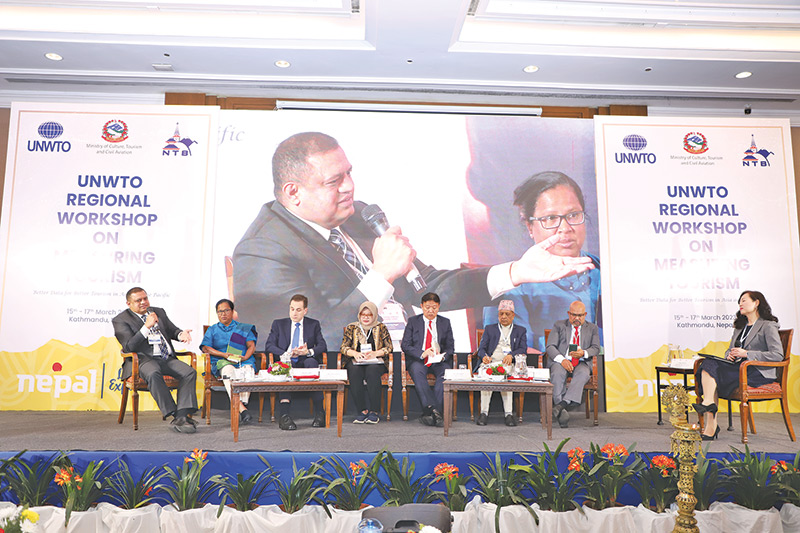
KATHMANDU, Nepal Tourism Board in association with United Nations World Tourism Organisation organised a regional workshop on measuring tourism on Wednesday to discuss the role of reliable tourism data for effective formulation of tourism policy. Participants said the unavailability of accurate data and inconsistencies in the existing ones have hindered the development of the tourism industry, especially in Asia and the Pacific. There is a big difference in data provided by different agencies, said Dhananjay Regmi, chief executive officer of the Nepal Tourism Board. Regmi was addressing the panel on the topic “Measuring Tourism for People, Planet and Prosperity”. “Regarding the contribution to Nepal’s tourism industry in the country’s gross domestic product, there are varying data—ranging from 2.5 percent to 10 percent,” said Regmi. “The biggest challenge is to choose which source to rely on.” Regmi said that the tourism industry in Nepal provides jobs for 300,000 people directly and around 1 million indirectly. Nepal received 1.2 million foreign tourists, the highest number to date, in 2019. Regmi, however, claimed there is a fault in the very data collection process. “We are only counting the tourists coming to Nepal by air,” Regmi said. “Around 1.4 million Indian tourists come to Nepal by land and that has never been included in the statistics.” The board has been conducting a survey on Indian tourists entering Nepal via the surface route. But it has not been consistent. The speakers also stressed that climate change has impacted the tourism industry. Ayshanie Medagangoda-Labé, UNDP’s resident representative in Nepal, said that policies are there, but they are poorly implemented, due to the lack of investment. “Policymakers now need to consider sustainable tourism,” said Medagangoda-Labé. “An integrated approach is needed while formulating policies on economy, emission and environment.” “Ways of reducing tourism-induced plastic pollution, too, need to be discussed,” she said. Regmi said that data on the changing weather patterns are required to mitigate the climate change impact on the tourism sector. “Tourism has enabled many families to shift from using firewood to liquefied petroleum gas, thus reducing the emissions to some extent,” Regmi said. Tourism Minister Sudan Kirati underscored the need for the development of tourism through product development and diversification. “We need to focus on research to identify new products, increase investment, and continue integrated tourism infrastructure development to benefit the community who rely on tourism earnings.” Nepal has initiated a tourism satellite account with support from the UNDP. The speakers said that data collection in the tourism sector requires a multi-sectoral approach and its existing mechanisms need strengthening. Pudji Ismartini, deputy chief of distribution and services statistics, BPS-Statistics Indonesia, said that data collection and processing processes need to be upgraded with modern technologies such as smartphones.
MONEY
China’s economy shows gradual recovery after Covid reopening
- REUTERS
A file photo shows employees working on a production line manufacturing mechanical parts at a factory in Beijing, China. REUTERS
BEIJING, China’s economic activity picked up in the first two months of 2023 as consumption and infrastructure investment drove recovery from pandemic disruption, despite challenges of weak global demand and a persistent downturn in the property sector. China’s abandonment of Covid-19 controls late in 2022 has reinvigorated an $18 trillion economy that has suffered one of its lowest growth rates in nearly half a century, with analysts expecting momentum to improve further in coming months. Industrial output in the January-February period was 2.4 percent higher than a year earlier, data by the National Bureau of Statistics (NBS) showed on Wednesday, slightly missing expectations for a 2.6 percent gain in a Reuters poll. The reading accelerated from a 1.3 percent annual rise in December. Retail sales in the first two months jumped 3.5 percent from a year before, reversing a 1.8 percent annual fall seen in December. The result was in line with analysts’ expectation and with hopes for an economic revival led by consumption as flagging global demand weakens Chinese exports. The data followed signs of strength in February purchasing managers indexes (PMIs) published on March 1. “Overall, the data confirm what more timely indicators, including the PMIs, had already suggested - that the fading of virus disruptions led to a rapid improvement in economic conditions at the start of the year,” said Julian Evans-Pritchard, head of China economics at Capital Economics, in a note. The Covid-sensitive catering sector has notably reaped benefits from the reopening, with January-February revenue surging 9.2 percent from a year earlier, compared with an annual 14.1 percent fall seen in December, when widespread infections kept people at home. “We expect China’s growth momentum to improve further in coming months, driven mainly by the ongoing consumption recovery and still-accommodative macro policy,” analysts at Goldman Sachs said in a note. Nomura analysts pointed to shrinking exports and weakness in the property sector holding back recovery. They forecast first-quarter gross domestic product would be 3.6 percent higher than a year earlier, compared with the fourth quarter’s 2.9 percent annual rise.
MONEY
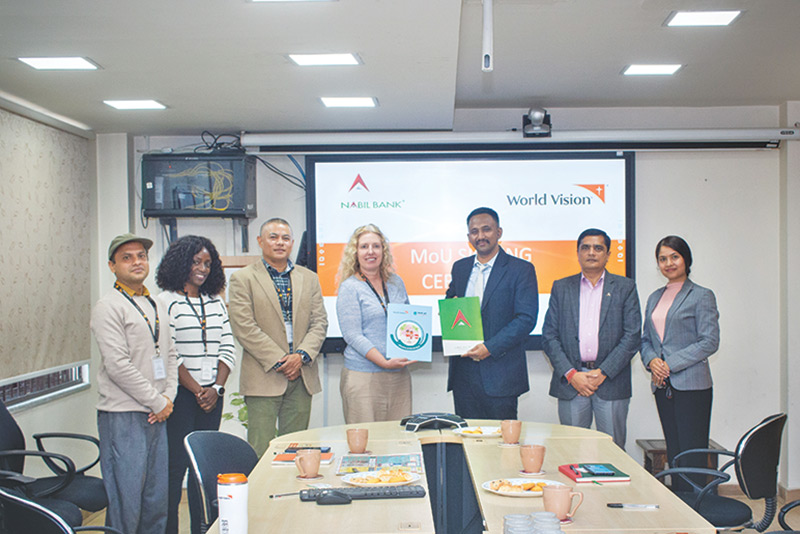
World Vision International Nepal partners with Nabil Bank for social cause
Bizline
KATHMANDU: World Vision International Nepal has signed a Memorandum of Understanding (MoU) with Nabil Bank. The MoU aims to promote collaborative planning and implementing financial inclusion initiative programmes in Nepal to improve access to financial services among the vulnerable population such as women, people with disability and excluded communities. According to the press release issued by the organisation, the combined effort will contribute to the National Development goals of Nepal as well as achieve sustainable development goals. (PR)
MONEY
Australian coking coal too pricey for China even as import restrictions end
Bizline
SINGAPORE: China’s demand for Australian coking coal for steelmaking remains lacklustre even after Beijing removed import restrictions, as supplies from local mines, Mongolia and Russia are cheaper, traders say. Beijing in early January partially eased an unofficial ban on Australian coal imports by allowing three state-backed utilities and a steelmaker to resume procurement as the two countries sought to rebuild ties. The restrictions were further eased last month after China’s commerce ministry said coal trade is a “normal activity”. Several key coal import regions, such as Guangdong, Fujian and Guangxi, have fully lifted the curbs, according to three people who deal in Australian coal, adding that customs authorities have granted permission to clear all cargoes. However, the policy change has not spurred much buying by Chinese coking coal traders as there is barely any profit to be made due to high Australian coking coal prices. (REUTERS)
MONEY
Saudi investment in Iran could happen ‘very quickly’ after agreement, minister says
Bizline
RIYADH: Saudi Arabia’s finance minister, Mohammed al-Jadaan, said on Wednesday that Saudi investments into Iran could happen “very quickly” following an agreement. “There are a lot of opportunities for Saudi investments in Iran. We don’t see impediments as long as the terms of any agreement would be respected,” al-Jadaan said during the Financial Sector Conference in Riyadh. Iran and Saudi Arabia agreed on Friday to re-establish relations after years of hostility that had threatened stability and security in the Gulf and helped fuel conflicts in the Middle East. Tehran and Riyadh agreed to resume diplomatic relations and re-open embassies within two months, according to a statement issued by Iran, Saudi Arabia and China. (REUTERS)
WORLD
Moscow warns US aircraft away from its air space after drone crash
Russian ambassador says drone was gathering target intelligence. Washington says Russian planes were reckless.
- REUTERS
A file photo shows a US Air Force MQ-9 Reaper drone sitting in a hanger at Amari Air Base, Estonia. REUTERS
WASHINGTON/KYIV, Moscow told Washington on Wednesday to keep well away from its air space after a US drone intercepted by Russian jets crashed into the Black Sea, the first known direct confrontation between the superpowers since Russia invaded Ukraine. The US military said the incident was caused by a mid-air collision after two Russian Su-27 fighter planes approached one of its MQ-9 Reaper drones on a reconnaissance mission over international waters. The fighters harassed the drone and poured fuel on it, before one clipped the drone’s propeller, causing it to crash into the sea, Washington said. “This incident demonstrates a lack of competence in addition to being unsafe and unprofessional,” said James B Hecker, commander of US air forces in Europe. White House spokesman John Kirby said US officials had told Russia’s ambassador Anatoly Antonov that Moscow should be more careful in international air space. Moscow denied the aircraft had collided and said the drone had crashed after “sharp manoeuvres”. It said the drone had “deliberately and provocatively” flown close to Russian air space with its transponders off, and Moscow had scrambled fighters to identify it. “The unacceptable activity of the US military in the close proximity to our borders is a cause for concern,” Antonov, the ambassador, said in a statement, accusing Washington of using drones to “gather intelligence which is subsequently used by the Kyiv regime to strike at our armed forces and territory”. “Let us ask a rhetorical question: if, for example, a Russian strike drone appeared near New York or San Francisco, how would the US Air Force and Navy react?” he said, calling on Washington to “stop making sorties near the Russian borders”. The Kremlin said there had been no high-level contacts with Washington over the incident. Bilateral relations were “in a very lamentable state” but “Russia has never refused constructive dialogue, and is not refusing now”, said spokesman Dmitry Peskov. Kyiv, for its part, said the incident showed Moscow was willing to “expand the conflict zone” to draw in other countries. Russia was raising the stakes as it faces “conditions of a strategic defeat” in Ukraine, tweeted Oleksiy Danilov, secretary of Ukraine’s National Security and Defence Council. Washington has said neither it nor the Russians had recovered the wrecked drone. The United States conducts regular surveillance flights in international air space in the region. It has supported Ukraine with tens of billions of dollars in military aid but says its troops have not become directly engaged in the war. Ukraine’s President Volodymyr Zelenskiy repeated his commitment to defending Bakhmut, the small eastern city that has become the target of Europe’s bloodiest infantry battle since World War Two. Moscow has waged a winter offensive involving hundreds of thousands of freshly called-up reservists and convicts recruited from jail as mercenaries. It is trying to capture Bakhmut to secure its first substantial victory in more than half a year. Kyiv had appeared likely last month to be preparing to pull out of the city but has since doubled down on defending it, saying it is exhausting Russia’s attacking force there to pave the way for its own counter-attack later this year. Zelenskiy said in an overnight address that he had met his top military brass, and the main focus was on Bakhmut: “There was a clear position of the entire command: Strengthen this sector and destroy the occupiers to the maximum.” Some Western and Ukrainian military experts have questioned whether it makes sense for Kyiv to continue the battle for Bakhmut, because of its own heavy losses there. Ukrainian Deputy Defence Minister Hanna Malyar said the defence of Bakhmut was important because a “large amount of enemy material is being destroyed ... A huge number of troops are being killed and as of today, the enemy’s capacity to advance is being reduced.” Intense fighting has also been under way north of Bakhmut, where Russia is trying to recapture territory it lost to a Ukrainian counter-offensive last year, and further south, where Moscow took heavy losses in failed assaults on the Ukrainian-held bastion of Vuhledar in February. In the latest internal shakeup in Ukraine, Zelenskiy dismissed the governors of three regions: Luhansk in the east, Odesa on the Black Sea in the south and Khmelnytskyi in the west. No reason was given. He has replaced several other governors since the start of the year, including the leadership of most of the frontline provinces. The front lines in Ukraine have barely moved for four months despite the most intense infantry battles of the war. Russia’s assaults have largely failed across most of the front line, apart from Bakhmut where it has captured the east of the city and advanced north and south as it tries to encircle it. Both sides describe the fighting in Bakhmut as a “meat grinder”, with the battlefield strewn with dead.
WORLD
Hindu group backs government’s stance against recognising same-sex marriage
- REUTERS
NEW DELHI, The ideological parent of India’s ruling Hindu nationalist Bharatiya Janata Party (BJP) has backed the government position against recognising same-sex marriage, months after raising hopes with supportive comments on gay rights. Prime Minister Narendra Modi’s BJP government has opposed recognising same-sex marriage and urged the Supreme Court to reject challenges to the current legal framework lodged by LGBT couples. Final arguments in the case are due to be heard by a five-judge bench starting April 18. “Marriage can only take place between persons of opposite genders, we agree with the government’s stance on same-sex marriage,” the Press Trust of India news agency quoted Dattatreya Hosabale, a top official of the Rashtriya Swayamsevak Sangh (RSS), as saying. RSS chief Mohan Bhagwat had said in January that the lesbian, gay, bisexual and transgender (LGBT) community “should have their own private and social space as they are humans and have the right to live as others”. Although Bhagwat had not referred specifically to same-sex marriage, his comments could force the government to reassess its opposition, a junior minister in the federal government and a senior BJP leader had said at the time. The RSS, established in 1925, is a powerful Hindu group estimated to have millions of active members across India and overseas. The organisation played a major role in Modi’s rise to power. India decriminalised homosexuality when it scrapped a colonial-era ban on gay sex in 2018, but it remains a taboo topic in this socially conservative country of 1.4 billion.
WORLD
More clashes in Pakistan as police try to arrest ousted premier Imran Khan
Former cricket star turned Islamist politician failed to appear in court on graft charges.
- ASSOCIATED PRESS
A supporter of former Prime Minister Imran Khan hurls back a tear gas shell fired by riot police officers to disperse them during clashes, in Lahore, Pakistan on Wednesday. AP/RSS
LAHORE, Supporters of former Pakistani Prime Minister Imran Khan threw bricks at police who fought back with clubs and tear gas for a second day on Wednesday after officers tried to arrest the ousted premier for failing to appear in court on graft charges. Police besieged the 70-year-old opposition leader’s house in the eastern city of Lahore since Tuesday as his supporters hurled rocks and bricks, and swung batons snatched from the officers. Violence was also reported between Khan’s supporters and police in other major cities, including Karachi, Islamabad, the garrison city of Rawalpindi, Peshawar, Quetta and elsewhere in Pakistan. The government sent additional police to Lahore’s upscale area of Zaman Park, where Khan lives. Early Wednesday, Khan had emerged from his house to meet with his supporters, who had faced tear gas and police batons through the night to save him from arrest. He said he was ready to travel to Islamabad on March 18 under his arrest warrant, but that police did not accept the offer. Khan later posed for cameras seated at a long table, showing off piles of spent tear gas shells he said had been collected from around his home. “What crime did I commit that my house has been attacked like this,” he tweeted. Fawad Chaudhry, a senior party leader from Khan’s party claimed hundreds of Khan’s supporters were injured. At the Islamabad High Court, Khan’s lawyer Khawaja Haris and his team petitioned for the suspension of the arrest warrant for the former premier. The court was expected to issue a ruling about the suspension later Wednesday. By around 2 pm, the clashes subsided and police stepped back, apparently in an effort to ease the tensions. This encouraged more Khan supporters to join those outside and inside his home as the situation calmed. Many chanted Allahu akbar, the Arabic phrase for “God is great.” Khan, still wearing a gas mask, greeted them at his home. Officials said security forces were told to move back from Khan’s house while the court in the capital, Islamabad, considered whether to suspend the warrant. The Punjab provincial government said on Wednesday that more than 100 police officers were injured in clashes with Khan’s supporters. They denied Khan’s allegation that officers were using live ammunition. Khan, who was ousted in a no-confidence vote in Parliament in April, was ordered to appear before a judge in Islamabad on Friday to answer charges of illegally selling state gifts he had received during his term as premier and concealing his assets.
WORLD
Time and money for love: China brainstorms ways to boost birth rate
Demographers warn China will get old before it gets rich.
- REUTERS
A file photo shows a person holding a girl as a boy driving a toy car at a mall in Shanghai. REUTERS
HONG KONG, Concerned by China’s shrinking population, political advisors to the government have come up with more than 20 recommendations to boost birth rates, though experts say the best they can do is to slow the population’s decline. China dug itself into a demographic hole largely through its one-child policy imposed between 1980 and 2015. Authorities raised the limit to three in 2021, but even during the stay at home Covid times couples have been reluctant to have babies. Young people cite high childcare and education costs, low incomes, a feeble social safety net and gender inequalities, as discouraging factors. The proposals to boost the birth rate, made at the annual meeting of China’s People’s Political Consultative Conference (CPPCC) this month, range from subsidies for families raising their first child, rather than just the second and third, to expanding free public education and improving access to fertility treatments. Experts took the sheer number of proposals as a positive sign that China was treating its ageing and declining demographics with urgency, after data showed the population shrinking for the first time in six decades last year. “You cannot change the declining trend,” said Xiujian Peng, senior research fellow at the Centre of Policy Studies at Victoria University in Australia. “But without any fertility encouragement policy then fertility will decline even further.” A motion by CPPCC member Jiang Shengnan that young people work only eight hours per day so they have time to “fall in love, get married and have children,” was critical to ensure women are not overworked, Peng said. Giving incentives to have a first child could encourage couples to have at least one child, she said. Many provinces currently only subsidise second and third children. To help alleviate the pressure on young families, the National Health Commission (NHC) issued draft rules on Wednesday that would allow qualified individuals to run day care operations for a maximum of five children up to three-years old. China’s birth rate last year fell to 6.77 births per 1,000 people, from 7.52 births in 2021, the lowest on record. Demographers warn China will get old before it gets rich, as its workforce shrinks and indebted local governments spend more on their elderly population. Experts also praised a proposal to scrap all family planning measures, including the three children limit and the requirement for women to be legally married to register their children.
WORLD
Cyclone Freddy to ease after battering Malawi, Mozambique
- ASSOCIATED PRESS
BLANTYRE, After killing hundreds and displacing thousands as it barrelled through Mozambique and Malawi since late last week, Cyclone Freddy is set to move away from land on Wednesday which should bring some relief to southern African regions that have been ravaged by its torrential rain and powerful winds. The cyclone has killed at least 199 people in Malawi’s southern region including Blantyre, the country’s financial hub, according to local authorities. In neighboring Mozambique, officials say at least 20 people have died since the storm made landfall in the port town of Quelimane on Saturday night. “There are many casualties—either wounded, missing, or dead and the numbers will only increase in the coming days,” said Guilherme Botelho, the emergency project coordinator in Blantyre for Doctors Without Borders. Malawi, which has been battling a cholera outbreak, is at risk of a resurgence of the disease, Botelho said, “especially since the vaccine coverage in Blantyre is very poor.” The aid organisation has suspended its outreach programmes to protect its staff against flash floods and landslides but is supporting cyclone relief efforts at a local hospital. A regional cyclone monitoring centre on the island of Réunion projects that Freddy will move back out to sea by late Wednesday afternoon. It’s unclear whether the cyclone—now set to be the longest ever—will then dissipate or move away from land after that. “Even rich countries that are advanced democracies would have been no match for the level of destruction this cyclone has brought,” said Kim Yi Dionne, a political scientist at the University of California Riverside. Freddy has accumulated more energy over its journey across the Indian Ocean than an entire US hurricane season. Yi Dionne said that the scale of destruction comes despite Malawi’s disaster agency having prepared and planned “for the challenges that come with our contemporary climate crisis.” Scientists say climate change caused by mostly industrialised nations pumping greenhouse gases into the air has worsened cyclone activity, making them more intense and more frequent. The recently-ended La Nina that impacts weather worldwide also increased cyclone activity in the region. Cyclone Freddy has been causing destruction in southern Africa since late February.
WORLD
Turkey floods kill 10 in earthquake-affected provinces
Briefing
- AGENCIES
ANKARA: Floods caused by torrential rains hit two provinces that were devastated by last month’s earthquake, killing at least 10 people and increasing the misery for thousands who were left homeless, officials and media reports said on Wednesday. At least five other people were reported missing. One person was killed in the town of Tut in southeastern Adiyaman province, where surging waters swept away a container home sheltering a family of earthquake survivors, Governor Numan Hatipoglu said. The governor of neighbouring Sanliurfa province, Salih Ayhan told HaberTurk television that four people were killed by the floods in his region. Later, rescuers found the bodies of five Syrian nationals inside a flooded basement apartment in Sanliurfa, the private DHA news agency reported. Television footage from Sanliurfa showed flood waters surging along a street and sweeping away cars as well as a man being rescued from an underpass. Several people were evacuated from a drenched campsite in where earthquake survivors were sheltering in tents. Patients were also evacuated from a hospital, HaberTurk reported.
WORLD
Russian President Putin says Germany remains ‘occupied’
Briefing
- AGENCIES
MOSCOW: Russian President Vladimir Putin said Germany’s response to the explosion on North Sea pipelines showed that the country remained “occupied” and unable to act independently decades after its surrender at the end of World War Two. Putin, interviewed on Russian television, also said European leaders had been browbeaten into losing their sense of sovereignty and independence. Western countries, including Germany, have reacted cautiously to investigations into the blasts which hit Russia’s Nord Stream pipelines last year, saying they believe they were a deliberate act, but declining to say who they think was responsible. “The matter is that European politicians have said themselves publicly that after World War Two, Germany was never a fully sovereign state,” Russian news agencies quoted Putin as telling state Rossiya-1 TV channel. “The Soviet Union at one point withdrew its forces and ended what amounted to an occupation of the country. But that, as is well known, was not the case with the Americans. They continue to occupy Germany.”
WORLD
China, Russia, Iran hold joint naval drills in Gulf of Oman
Briefing
- AGENCIES
BEIJING: Naval forces from China, Iran and Russia—all countries at varying degrees of odds with the United States—are staging joint drills in the Gulf of Oman this week, China’s Defence Ministry has announced. Other countries are also taking part in the “Security Bond-2023” exercises, the ministry said on Tuesday without giving details. Iran, Pakistan, Oman and the United Arab Emirates all have coastline along the waterbody lying at the mouth of the strategic Persian Gulf. “This exercise will help deepen practical cooperation between the participating countries’ navies ... and inject positive energy into regional peace and stability,” the ministry statement said. The exercises scheduled for Wednesday through Sunday come amid heightened tensions between the US and China over a range of issues, including China’s refusal to criticise Moscow over its invasion of Ukraine and continuing support for the Russian economy.
WORLD
Indonesia arrests 4 foreigners for alleged drug smuggling
Briefing
- AGENCIES
JAKARTA: Indonesian authorities said on Wednesday they have arrested four foreigners for allegedly trying to smuggle drugs into the country, including a Nigerian man who had swallowed dozens of capsules filled with more than a kilogram of methamphetamine. A Brazilian man and three Nigerian men were arrested separately between January and March at Soekarno-Hatta international airport in Jakarta and several apartments in the capital, police spokesperson Trunoyudo Wisnu Andika told a news conference in Jakarta. Indonesia is a major hub for drug trafficking in Southeast Asia.
SPORTS
Nepal eye Qualifier but UAE send a warning
Rohit Paudel’s Rhinos will take on the Emiratis—who beat PNG by six wickets on Wednesday—in the final and deciding match of the Cricket World Cup League 2 today.
- Sports Bureau
Players of United Arab Emirates celebrate a wicket of Papua New Guinea at the TU Cricket Ground in Kirtipur on Wednesday. Post Photo: Hemanta Shrestha
KATHMANDU, Nepal will look to secure an automatic berth at the ICC Men’s Cricket World Cup Qualifier when they take on the United Arab Emirates in the final and deciding match of the Cricket World Cup League 2 at home on Thursday. But the Gulf nation on Wednesday showed the Rhinos they are still able to put up a fight. The Emiratis had had a patchy run in the League 2 losing four straight matches—two each against Nepal and Papua New Guinea—that not only cost them a spot in the top three position but also jeopardised their One Day International (ODI) status. But on Wednesday, they recovered to thump PNG by six wickets at the TU Cricket Ground, with UAE captain Muhammad Waseem smashing his maiden ODI century in his explosive 76-ball 119 that featured six boundaries and 12 sixes. Waseem also created the record for most sixes in an innings in the League 2 cycle. It was also the most sixes by a UAE batter in an ODI match. Waseem reached his century in 60 balls that helped the UAE chase down a 235-run target in 38.4 overs. It was UAE’s only second win in their last 11 matches. Waseem’s men will now seek to continue the momentum against an in-form Nepal even though a victory over the Rhinos will not be enough for them to leapfrog the United States in the fifth position. Nepal are having a fairytale march to their League 2 campaign winning 10 of their last 11 matches and moving up to the fourth position in the table with 38 points, just one point adrift of Namibia—who currently occupy the third spot—with a match in hand. Just a month ago, Nepal were languishing in the sixth position in the seven-team League 2 standings with 18 points from 24 games and their hopes of progressing on the path to the Cricket World Cup 2023 hanged by a thread. Now they are just one win away from claiming the last automatic spot at the Qualifier set to be held in Zimbabwe in June and July this year. Rohit Paudel’s boys have found their mojo back. The appointment of Monty Desai as head coach in early February transformed the Nepali cricket team, particularly in the batting department, which had been the biggest headache for the national side until a month ago. “The dressing room is calm and sir [coach] has given us freedom and motivated us to express ourselves with batting,” Paudel said after Nepal beat UAE to retain their ODI status on Monday. Under Desai’s guidance, Nepal swept the ODI home series of League 2 for the first time last month and are unbeaten at home. They also posted three of their top four ODI totals. Nepal last week amassed their highest-ever ODI total of 297 on their way to beating PNG by 56 runs. On Sunday, they not only secured a record 177-run win against the UAE but also restricted them to their lowest ODI total. Nepal’s only defeat of the last 11 matches came against the UAE at Dubai International Cricket Stadium on March 2. League 2 champions Scotland and second-placed Oman have already joined South Africa, Sri Lanka, Ireland, hosts Zimbabwe and the Netherlands in the World Cup qualification. If Nepal lose against the UAE or if the match is tied, Namibia will progress instead. But all will not be lost. The Rhinos will have to take the extra road of qualifier playoff—a repechage event to the Global Qualifier—set to take place in March and April in Namibia this year. The bottom four teams of the League 2—PNG, UAE, US and either Nepal or Namibia—will join Cricket World Cup Challenge League winners Canada and Jersey in the playoff, with the top two teams taking the last two spots of the Zimbabwe qualifiers. PNG wrapped up their League 2 campaign with 11 points. If UAE finish below the two teams out of PNG, Canada or Jersey in the playoff, they will be relegated to the Challenge League.
SPORTS
Manang win, Army lose derby
The eight-time champions beat NRT 3-1. Army suffer a 1-0 defeat against APF.
- Sports Bureau
Manang Marshyangdi Club’s Roshan Rana Magar (left) celebrates after scoring against New Road Team during the Martyrs Memorial A-Division League in Tripureshwar on Wednesday. Post Photo: Hemanta Shrestha
KATHMANDU, Manang Marshyangdi Club registered their second win of the season after they defeated New Road Team (NRT) 3-1 in the Martyrs Memorial A-Division League on Wednesday. Roshan Rana Magar, Sayidjamol Davlatjonov and Koffi Timothee Koudo scored for Manang at the Dasharath Stadium, with the win sending the record eight-time league champions up to third in the 14-team standings with eight points from four matches. Rana Magar put Manang in front in the 39th minute with his clever footwork as he dribbled inside the penalty area and drilled a low shot past NRT goalkeeper Pujan Hona, after he was set up by Randip Paudel. Davlatjonov came off the bench after the hour mark and made an instant impact. Moments after replacing Bhison Gurung, the Uzbek set up Koudo for a header inside the six-yard box but Hona reacted quickly to deny the Togo attacker. But Hona could not stop Davlatjonov from furthering Manang’s advantage from the spot kick in the 69th minute after NRT substitute Janmejay Dhami badly tackled Davlatjonov inside the box. Koudo then made certain that Manang walked away with three points with a brilliant individual effort in the 87th. Ashok Thapa pulled a consolation goal for NRT with a header in injury time. NRT, who suffered their third defeat of the season, lie second from bottom with one point. Tribhuvan Army Club’s unbeaten run in the league came to an end after they suffered a 1-0 defeat against APF Club at the Chyasal Stadium. Mani Kumar Lama scored the decisive goal for APF in the 37th minute finishing a cross from Bipan Shrestha. Army stay in the ninth position with one win, two draws and one loss. It was APF’s second win this season. Square on seven points with Jawalakhel Youth Club and Three Star Club, they lie in the fifth spot, in between Jawalakhel on fourth and Three Star on sixth. Khumaltar take on Satdobato Youth Club and Himalayan Sherpa lock horns with Sankata Club on Thursday.
SPORTS
Rai breaks course record, maintains lead
The Nepal number one pro’s 11-under 61 eclipsed the previous record of 10-under 62.
- Sports Bureau
KATHMANDU, Nepal number one pro Sukra Bahadur Rai set the new course record of 11-under 61 in the second round of the Surya Nepal Central Open, the fifth event under the Surya Nepal Golf Tour 2022-23, at the par-72 Gokarna Golf Club on Wednesday. Rai broke the previous record of 10-under 62 scored by three Indian pros Shamim Khan (2008), S Chikkarangappa (2013) and Abhijit Singh Chadha (2013) in the Surya Nepal Masters. After the career-best round of bogey-free 61, Rai posted 36-hole total of 18-under 126 and opened up a three-stroke lead over Bhuvan Nagarkoti, who carded nine-under 63 for 15-under 129. Amateur Sadbhav Acharya is in the third position at three-under 141 after he carded three-under 69 in the second round. Subash Tamang (71) and pro Jayram Shrestha (75) share the fourth place at one-under 143. Niraj Tamang is sixth at even-par 144 after he played one-over 73, while Bhuwan Kumar Rokka carded two-under 70 to move up to seventh at one-over 145. Tanka Bahadur Karki (71) and Shivaram Poudel (73) share the eighth spot at 146, while Sanjay Lama (75) and amateur Bhujel (73) are tied for 10th three-over 147. Another amateur golfer Tashi Tsering (71) and pro Dinesh Prajapati (74) are tied for 12th place at four-over 148. Rai carded five-under 31 on the front nine and played six-under 30 on the back nine. He started the day with birdies on the first two holes and sank an eagle on the seventh. Rai finished the front nine with his third birdie on the ninth hole. After taking the turn, he carded a birdie on the 11th and sank an eagle on the 12th hole to go eight-under for the day. He then carded three straight birdies on the 13th, 14th and 15th holes. Nagarkoti, who equalled the record of Shivaram Shrestha’s nine-under 63, carded scintillating eight-under 28 on the front nine before playing one-under 35 on the back nine. He carded a birdie on the first hole and sank an eagle on the third. Nagarkoti then carded four consecutive birdies on the fourth, fifth, sixth and seventh holes before adding another on the ninth hole. After taking the turn, he carded birdies on the 11th and 12th holes for 10-under score but he dropped a shot on the 13th hole. He then saved pars on the last six holes. Cut was applied at 13-over 157 with 21 pros and seven amateurs making it to the final two rounds. Pros Rame Magar, Pradeep Kumar Lama, Rajendra Shrestha Pradhan, Ramesh Adhikari, Bal Bhadra Rai, Sanjok Moktan, Ram Krishna Shrestha, Rabi Khadka, Deepak Magar, Kamal Tamang, Surya Prasad Sharma and Kishan Kaliraj Sunar survived the cut. In the amateur section, Suresh Tamang, Nischaya Jung Rayamajhi and Capt Norbu Sherpa earned berths in the final rounds.
MEDLEY
Horoscope
ARIES (March 21-April 19) You’ll find yourself in a dreamy headspace by midmorning, helping you find inspiration on a deep level. Unfortunately, taking action toward your vision might not seem so simple which could cause mental wires to cross if you move with haste.
TAURUS (April 20-May 20) Give yourself space between social interactions, but don’t be afraid to connect deeply and authentically. A sense of community will plant the seeds of kindness in your heart marking the perfect occasion to perform a few random acts of kindness.
GEMINI (May 21-June 21) If you find that people are less tolerable than normal, don’t feel guilty about throwing up boundaries and hiding away in your comfort zone. Luckily, the ambiance will soften by midmorning allowing you to reclaim your role as a social butterfly.
CANCER (June 22-July 22) Consider starting your day with positive affirmations and abundance mantras, Believing there’s a light at the end of the tunnel will allow you to charge forward. Taking a moment to touch base with your higher self meditation can help you reclaim clarity.
LEO (July 23-August 22) Opportunities to change your perspective and envision a brighter tomorrow will come into play by midmorning. Check in with your to-do list this afternoon or you could end up dropping the ball on important commitments.
VIRGO (August 23-September 22) You keep doing you. Invest some time and energy into flirting and nurturing your romantic connections bewitching your beloved with an excess of dreamy charisma. You’ll sense an elevating shift later strengthening your spirituality.
LIBRA (September 23-October 22) Choose to lean into the bright side of life, allowing your heart to open up to love, and deep connections. Check in with your mental health, taking care to actively release any stress or tension that’s collected in your body.
SCORPIO (October 23-November 21) Try not to put unreasonable expectations on yourself and others. Avoid dishing out unsolicited advice. However, positive mantras, and encouraging sentiments can help you break through any funk that finds you. Take special care to check in with your emotions.
SAGITTARIUS (November 22-December 21) Organization is an important piece when manifesting ideas and conjuring success. Strategizing for your goals will also elevate your confidence, so be sure to tap into your responsible side. Try not to let stubbornness get the better of you.
CAPRICORN (December 22-January 19) Today, staying positive and tapping into your strength will help you prevail while building confidence. Your mind will come to life with inspired and creative ideas though you’ll need to stay organized if you hope to materialize such visions.
AQUARIUS (January 20-February 18) Take special care to examine your habits and thought patterns, actively choosing to evolve your behaviors in an effort to nurture your highest self, encouraging you to indulge your senses by embracing lovely sights, sounds, scents, and flavors.
PISCES (February 19-March 20) Try to remember that value isn’t contingent on how popular someone is. This cosmic climate can help you overcome any feelings of insecurity you may struggle with socially, especially if you take a moment to talk yourself up.
CULTURE & LIFESTYLE
Good readers make good writers
Saguna Shah talks about her reading habit and how it has helped her become who she is today.
Photo Courtesy: Saguna Shah
Saguna Shah is a writer, actor and the founder of BOOkahOlics, Nepal’s biggest online book club. She is currently playing the lead role in Shilpee Theatre’s play ‘Bimoksha’. She also teaches communication skills, French and academic writing to students of Bachelor’s in International Hospitality and Tourism Management at Silver Mountain School of Hotel Management and life writing to Masters in English Literature students at Dillibazar Kanya Multiple Campus. In an interview with The Post’s Anweiti Upadhyay, Shah talks about her reading habit and how it has helped her become who she is today.
How did you start reading? I think my reading habit developed in school. We used to have a reading hour where we just read story books and abridged versions of novels. I loved detective mysteries and adventure stories when I was younger. So, I read a lot of Enid Blyton and Agatha Christie. Some of the first books I remember reading are ‘Robinson Crusoe’, ‘Adventures of Huckleberry Finn’, ‘The Famous Five’ series and the Sherlock Holmes stories. I read everything I could get my hands on. My mother is a big reader, too, so I’d attempt to read the things she was reading as well. I read things in English, Nepali and Hindi.
How have your reading preferences changed over the years? I think everyone’s preferences change as they move through life, and so did mine. Right now, I am very into biographies and memoirs. But because I run a book club and we hold monthly discussions called ‘Chakati Bahas’ (cushion discussions), I have to read and be updated about popular books and writing styles. I usually don’t read fiction or new Nepali releases. That isn’t what I naturally gravitate towards, but I have to for the sake of the book club. Honestly, I didn’t read in Nepali much before. In general, I prefer non-fiction to fiction in English. But I read across all genres in Nepali.
Which book has had the biggest impact on your life? This is a very difficult question for a reader to answer. There are so many books that have left lasting impressions on my life. In fact, I’m writing a memoir right now in which I wanted to name the ten books that have impacted me greatly. There are just so many books I couldn’t leave out of this list that I settled on naming this segment ‘20 of my best reads’ instead. I’ll narrow these down to two for now. This could be a cliche answer coming from a teacher but ‘Tuesdays with Morrie’ by Mitch Albom has made a lasting impression on me. It showed me how a teacher could have a life-changing impact on their students even outside of the classroom. Similarly, the subjugation of women in ‘The Handmaid’s Tale’ by Margaret Atwood left me with chills and a lot to think about.
Who are your favourite authors? Jiddu Krishnamurti is my all-time favourite writer. I find life’s answers in his books—especially ‘The First and Last Freedom’. I’ve come to realise that I really like Indian writers. I love everything by Sashi Tharoor. I enjoy Suketu Mehta’s writings too. I read ‘Maximum City: Bombay Lost and Found’ about 11 years ago, and I remember loving it a lot. I actually met him at last year’s Nepal Literature Festival and had a chance to speak to him. Another author I love who was also at the Literature Festival is Shehan Karunatilaka. I just finished reading ‘The Seven Moons of Maali Almeida’, and it is a book everyone should read. As for Nepali writers, I like writers from the older generation more than contemporary writers. The issues they wrote three-four decades back are still relevant today. The writers of today are successful in their own right and are doing well, but somehow I don’t find their work enriching. Whenever I sit down with the intention of enjoying what I read, I pick BP Koirala, Parijat or Banira Giri’s works.
How has reading helped you in your career and your life in general? I think the fact that I read makes me more intimidating. Knowledge is a powerful tool which is respected but also feared. When people learn that I read a lot, I have noticed that they create an image of me in their heads which is more austere compared to how I am in real life. This creates a kind of wall between them and me, and I come off as a little ‘unapproachable’. I do not mind this, as I do think it is necessary to be reserved in professional settings sometimes. It keeps some people at arm’s length, which is not always a bad thing. Reading has also made me calmer and a good listener. Reading is a form of meditation. I don’t fret over things and get carried away as much anymore because of reading. It has helped me think more analytically and express myself more clearly.
Amidst your busy schedule, how do you find the time to read? Honestly, the drama I’m doing right now, Bimoksha, is taking up much of my days. So I don’t have much time to actually sit down and read right now. But even during all of this, I did finish reading a couple books. I was asked to write the blurb for and give feedback on Deepak S Rana’s ‘Dakini’ recently. I also finished ‘The Seven Moons of Maali Almeida’, ‘Eklo’ by Buddhisagar, and a short story collection. I carry these books with me wherever I go and read them any chance I get. For example, when I’m stuck in a big traffic jam or when I’m in the hospital waiting room, I whip out a book and start reading. So, I have been reading—I just haven’t had the chance to sit down and spend long hours with books.
Are there authors whose writing styles like and influence your own work? I don’t think I am heavily inspired by any author in particular. This, I believe, is something every writer develops on their own. However, I do incorporate tips other writers give out on writing. Indian novelist Shobhaa De has also talked about making writing 2,500 words a day a daily practice. This is a tip I like and utilise. There is one book on writing that I want to mention here—Haruki Murakami’s ‘What I Talk About When I Talk About Running’. Murakami is a runner, but in this book, he talks about writing and how writers need to make it a daily practice. Recently, BOOkahOlics organised a creative writing workshop led by Amal Chatterjee and poet Nabin Chhetri where I learned different writing and poetry techniques. I am not big on poetry but in Chhetri’s workshop, I did write poems in a very short time. Through these workshops, I learned that people have so much potential in them, they just need to learn how to curate and craft it.
Suggestions to aspiring writers The first and most basic thing aspiring writers should do is read a lot. Those who are good readers become good writers. I also think writers should learn how to edit and revise their writing. Sometimes, you might think you’ve written something outstanding. But until you learn to and edit your text to tweak things, you will not grow as a writer. There will be times when you will have to completely scrap your writing—even those you feel you’ve written well—and start over. Put away what you have written for a week and come back to it. You will definitely see things you can improve on.
CULTURE & LIFESTYLE
Honouring a trailblazer
Museum of Nepali Art looks back on the contributions of German conservation architect and artist Wolfgang Korn.
- Urza Acharya
Two students looking at Korn’s anatomical drawings at MoNA, Thamel. Post Photo: Deepak KC
Kathmandu Museum of Nepali Art (MoNA) is nestled inside the heart of Thamel. As you enter Kathmandu Guest House (KGH), the hustle-bustle of Thamel bazaar takes a back seat, and you enter a space that is wide and calming. MoNA is housed in an underground space of KGH. It features a permanent collection of exhibits—from the symbolic blue hues of Asha Dangol’s ‘Union in Destruction’ to the calming aura of Lain Singh Bangdel’s ‘Sigh’, among many others. The corner left of the museum, however, has taken up a more short-term arrangement. Artworks and architectural maps by German conservation architect and author Wolfgang Korn are on display from March 10 to 18. Wolfgang Korn is not an unfamiliar name in Kathmandu, especially in the art and architecture scene. Korn first came to Nepal in 1968, some 55 years back, under the German Development Services’ summer project. Initially, he planned to leave for West Africa, but fate clearly had other plans for him. When he first entered the valley, Korn reveals that he felt like he had been “cast head first into all the complexity of a medieval town.” Korn was in awe of the amazing Malla-period architecture—from the majestic temples to the stupas and small chaityas. He recalls being captivated by the Char Narayan Temple in Patan Durbar Square. Korn created maps of many heritage sites, beginning with nothing but a folding ruler, measuring tape, notebook and pencil. “I grasped the distinctiveness of Newa architecture: you need only two materials to build a unique style of buildings: wood/timber and mud,” he revealed, via email. Ever since, Korn has come back to Nepal on several occasions, and each time, he makes sure to document and promote Newa architectural sites. From his 1976 book ‘The Traditional Architecture of the Kathmandu Valley’ to the more recent ‘Erotic Carvings Of The Kathmandu Valley Found On Struts of Newar Temples’, Korn has championed the marvels of the valley’s indigenous architecture styles in Nepal and all over the world. Going back to the exhibition at MoNA, it features prints of Korn’s architectural maps of prominent temples and sites within Kathmandu, like the Kasthamandap Temple, Maju Dega and Chhyusa Bahal. “Without the blueprint created by Wolfgang Korn, the restoration of the Kasthamandap Temple would’ve been impossible. Nepalis really have to learn to appreciate what he has done for us,” says Rajan Sakya, director of MoNA. The drawings are craftfully composed, Korn’s many years as an architect are reflected in the symmetry and the precision in the prints. The iconic map of Kasthamandap is the centrepiece of the exhibition; its large size, elevated red backdrop and central lighting give it an aura of sublimity. The map denotes documented history, one that proved to be of utmost importance, especially after the 2015 earthquake destroyed many of our beloved heritage sites. Opposite the big Kasthamandap drawing is a video projection in which Korn details his journey of mapping Newa architecture throughout the years. The exhibition also feels like Korn’s attempt to break free from the idea of him simply being an architect. In fact, the more refreshing pieces are his acrylic and watercolours cityscapes that he has painted over several years. “I wanted to try working with colours at home in Germany. So, I joined classes and seminars to help me find my way. But I’ve been pretty flexible in choosing a style,” he says. These paintings feature a serene scape—the charm of European architecture mingled with the colours of the seasons gives his work a kind of nostalgia. The paintings are accompanied by photos of him at Venice, Germany and even Laos, which add to the paintings. Similarly, there are also anatomical drawings of the human body—‘Sonya’ and ‘Rolf III’—that are minimalistic but pleasant. Some are made from watercolour, whereas others are of charcoal. Jenny Maharjan, manager at MoNA, revealed that the earnings from the exhibition will fund Kang’s upcoming fifth book ‘Dedicated lines, inspired colours.’ “Korn has put his watercolour and charcoal works from his student days, along with the maps, so he can raise some funds for his book,” she says. Korn’s first book ‘The Traditional Architecture of the Kathmandu Valley’ which was published in 1968, is a holy grail for any architecture student interested in Newa architecture. It’s actually taught under the curriculum in engineering schools. The team at MoNA want to continue the influence Korn has had on architecture students in Kathmandu. “We’re trying to set up a meet for the students where they can sit and ask him questions,” she says. Maharjan also said that MoNA wanted students to come to see the exhibition, although the Rs 500 ticket (50 percent off if one can show their student ID) might cause hindrances as not many students have the financial resources to pitch good money for an art exhibition. MoNA goes against the norm in that sense as most galleries in Kathmandu are free to visit or charge a minimal fee. The exhibition also feels a little out-of-place within the space, as it’s not particularly in a different room but in one section of the museum, which is already filled with an overwhelming amount of artworks. Though one could argue that MoNA is doing away with the idea of the white-cube gallery, the maximalist frames and red colour in the walls do take away from the artworks—especially the acrylic and watercolour ones. However, MoNA still champions the fact that celebrating Korn’s contribution to the documentation of multiple temples and stupas in Kathmandu can inspire interested students to follow suit. “If we could get even one architecture student to work with a Guthi and document the temples, we wouldn’t have to go through the painful process of rebuilding as we did in 2015,” says Sakya adding that by making a blueprint of the temples, the students get to practice their craft whereas the Guthis and in turn, the government receives a valuable document that can be sued for preservation and restoration. Despite its misgivings, the fact that MoNA has chosen to recognise a person whose contribution to Nepali art and architecture is commendable. Wolfgang Korn’s hand-drawn blueprints are, to put it simply, one of the pillars for the conservation of traditional Newa sites. However, MoNA should certainly find ways to add gravitas to the upcoming exhibitions, perhaps by giving it more space and, of course, by making it more accessible to the general public.
The exhibition will continue till March 18.
CULTURE & LIFESTYLE
NIFF starts today
Out of 500 films submitted from over 50 countries, 95 were selected for the final competition.
- Post Report
Photo Courtesy: Niff
Kathmandu Nepal International Film Festival (NIFF) is set to start its 6th iteration. A press meet was organized on Wednesday marking the start of the event. The event will be inaugurated by Prime Minister Pushpa Kamal Dahal on March 16 at QFX Civil Mall. NIFF is organised by Nepal Flim and Cultural Academy. In the opening, a movie titled “Chari” directed by Kerin Sharma will be screened. K P Pathak, the chair of NIFF, revealed that out of 500 films submitted from over 50 countries, 95 were selected for the final competition. Eight of these 95 films will be awarded under different categories like short films, feature films and documentaries. ‘The Gautama Buddha Award’ will be given to the best international feature film, with a cash prize of $1500. ‘The Mt Everest Award’ will be given to the best international documentary film, with a cash prize of $1000. Two of the films made by Nepali filmmakers will receive the National Feature Flim and the National Short Film award, with cash prizes of Rs100,000 and Rs50,000 respectively. “We have a very devoted audience for each edition of our festival. This time we hope to bring in newer audiences,” says Pathak. He thinks that the QFX cinema venues will help attract a more diverse audience. NIFF will continue till March 20.