You internet speed is slow. Switch to text view mode

Switch
epaper logo
ST

Last Login:
Logout
+
Page 1
HOME PAGE

Nepali state’s commitment to free speech in doubt

Two recent incidents have made people question Dahal government’s sincerity to protect constitutional freedoms.
- NISHAN KHATIWADA

KATHMANDU,
It was quite a sight. On Tuesday, police personnel were seen trying to tightly cover the mouths of some youths who were protesting against Prime Minister Pushpa Kamal Dahal—directly to his face. The young protestors seemed displeased with the high interest rates the banks and financial institutions have been charging of late.  
In no time, the video of the police personnel trying to gag the protestors went viral, courting criticisms from all sections of society. The issue even reached the National Assembly.
National Assembly member Bimala Rai Paudel sought answers from the Home Ministry in the upper house meeting on Wednesday. “The photos are out that the police are seen trying to cover the mouths of protesters who are trying to speak. What were they trying to say? Can the police close the mouths of those who want to speak? If not, has the Home Ministry punished the police personnel concerned? I want answers from the Home Ministry,” she said.  
Instead, the protestors have now been punished.
The District Administration Office Kathmandu has allowed the police to keep the three detained protestors in custody for five days for further investigation on charges of indecent behaviour. The detained are Uddav Basnet, 23, from Solukhumbu, Som Sharma, 30, from Baglung, and Biplav Khadka, 18, from Bajhang.
At the same time, the government is being denounced as it is planning to saddle the federal parliament with a controversial bill to amend telecommunication laws. Various circles—from public to intelligentsia—have been criticising the draft of the bill which will allow the government to tap the phones and social media details, without prior court approval, of just about anyone.
The government has been questioned on why it is trying to restrict people’s basic freedoms and violate their right to privacy, which are the essence of democracy? What is happening is a brutal attack on the right to privacy, and the right to information and free speech, critics say.  
Madhu Raman Acharya, former foreign secretary, wrote on Twitter that the police or investigating officer should never record the personal phone calls under the pretext of investigation.
Any such probe on a serious matter like national security, without seeking permission from court will go against personal freedom and privacy, he said.
Similarly, Nepali Congress senior leader Shekhar Koirala also criticised the government for trying to bring the provision to record personal call details. “Tapping phone calls under any pretext is unacceptable in democracy. A question has also been raised about the government’s intent as a similar attempt was stopped in the past following criticism,” Koirala tweeted. He has also asked political parties, human rights activists, civil society members, and media personnel to seriously think about the issue.
The Oli government had also tried to enforce similar provisions, allowing the investigative authorities to monitor or intercept the call, audio, video, electronic signal or details of the public. The attempt was foiled following intense opposition from various walks of life as well as from the opposition parties. Two years ago, the information technology bill was stopped after it drew severe criticism, as it endangered free speech.
Till now, a court permit is a must to access someone’s phone calls or SMS records. The court had issued a mandamus order in 2016 barring the police and investigating authorities from accessing the phone and SMS records without a permission from the court.
If the draft bill gets endorsed, authorities seeking a prior court permission will be a thing of the past.
Section 77 (1) of the draft says the investigative body can record calls of anyone, or get the details disclosing the identity or other details from the service provider if the person in question is believed to be engaged in
activities against Nepal’s sovereignty, territorial integrity, national interest, treason, crime or organised crime or criminal offence. Section 77 (2) says that there will be direct access to service providers for activities under sub-section 1.
Similarly, Section 79 states that investigating officers can also deactivate a telephone, mobile or communication media.
Internet freedom advocate and president of Digital Rights Nepal Santosh Sigdel said Section 79 restricts the freedom of expression and right to information.
According to him, Section 77 (1) allows interception of all kinds of criminal offences, irrespective of their gravity, which is not justifiable on the grounds of ‘necessity’ and ‘proportionality’.
Similarly, the draft bill doesn’t distinguish between emergency and non-emergency situations. “Democracies around the world allow a certain level of executive power to be exercised in times of emergency,” he said. For example, in India, the investigating agencies do not need prior government approval for phone call interception during an emergency, but they need such permission during peace times.
The proposed draft also does not define the vague term “authorised investigation agency”. Similarly, it is unclear which personnel from such agencies will have access to private phone records. “The fundamental right to privacy guaranteed by the constitution cannot have such a low ceiling,” said Sigdel.
A broad provision under Article 77 (2) is even more problematic, according to Sigdel. “The provision of direct access to the entire system of service providers is aimed at widespread surveillance of citizens. Furthermore, the proposed provision says authorised agencies can use any ‘appropriate technology’ they deem necessary. The Pegasus software issue in India is an example of how the government could misuse its power in such cases.”
Opposition parties in India have been accusing the Modi government of spying on rival politicians. Pegasus infects mobile devices (both Android devices and iPhone), allowing it to extract messages, photos and emails, record calls and secretly activate microphones.
Tara Nath Dahal, executive chairman of the Freedom Forum that advocates free speech, said signs are that the Nepali state is not serious about protecting civil liberties. “We call this a democratic country and we have the right to freedom and privacy enshrined in our constitution too, but the state mechanisms including the political leadership are not committed to even basic freedoms such as the freedom of expression and right to privacy,” he said.
“Whenever the authorities are challenged, they show intolerance. They can’t take criticism. Our political system is democratic, but the mindset of our leadership is authoritarian,” said Dahal.
HOME PAGE

Concerns after tainted cop’s promotion

Basanta Bahadur Kunwar, who has been promoted to AIG, is reportedly a front-runner for Nepal Police chief.
- BINOD GHIMIRE

KATHMANDU,
Victims of the 10-year Maoist insurgency have objected to the promotion of Basanta Bahadur Kunwar to Additional Inspector General (AIG) of Nepal Police. The government on Monday promoted five Deputy Inspectors (DIG) General including Kunwar, Tek Prasad Rai, Deepak Thapa, Shyam Lal Gyawali and Kiran Bajracharya to AIGs.
One of the five AIGs will replace incumbent chief of Nepal Police, Inspector General Dhiraj Pratap Singh, who is retiring on Friday. “The government’s move to promote Basanta Bahadur Kunwar, who was repatriated while at a United Nations Peacekeeping mission for his involvement in human rights violations [is concerning],” the victims said in a joint statement.
Kunwar, who was deployed in the UN peacekeeping mission in Liberia, was recalled in October 2011, within three months of his posting, in connection with his alleged involvement in a 2009 torture case. A youth from Siraha district, arrested on theft charges, was severely tortured in 2009 when Kunwar was serving as the police chief in the district.
Kunwar is one of the major contenders for the police chief position. The government is preparing to appoint a new inspector general of the police on Friday. “Kunwar’s promotion is an example of deep-rooted impunity in Nepal. It shows the government is not serious about human rights issues,” Ram Bhandari, a conflict victim and a human rights activist, told the Post. “Successive governments have been protecting and promoting perpetrators who should actually have been facing legal actions.”
The government is criticised for not doing enough to book human rights violators from the time of the insurgency and later. The National Human Rights Commission often complains against the government for not heeding its recommendations to prosecute hundreds of officials and other people involved in the rights violations.
After the government ignored the rights body’s recommendations, in October 2020 it made public a list of 286 people including former top government and security officials involved in serious human rights violations over the past two decades.
The list included former Chief of Army Staff Pyar Jung Thapa, former home secretary Narayan Gopal Malego and former chief of Nepal Police Kuber Singh Rana.
Rana was implicated for his direct involvement in the enforced disappearance and subsequent killing of five youths in Godar, Dhanusha in 2003 at the height of the Maoist insurgency. The commission, after a thorough investigation, had recommended the government to take action against Rana. However, that never happened. Instead, the then Baburam Bhattarai-led government in 2o12 promoted him to the chief of the police force.
The commission had implicated Malego in a case of excessive use of force by the Nepal Police in Rangeli, Morang during the second Madhesh movement in January 2016.
The constitutional human rights body had also asked the government to bring Thapa to justice as he was leading the national defence force when 49 people were disappeared from the Army’s Bhairavnath Battalion in Maharajgunj between April 2003 and February 2005, but that recommendation went unheeded.
Among the human rights violators implicated by the commission since its formation in 2000, the highest number–98—is from the Nepal Police, followed by 85 from the Nepal Army and 65 from the then CPN (Maoist). The commission has also implicated 16 civil servants, eight Armed Police Force personnel and four teachers.
The commission made public the list of perpetrators after the government repeatedly ignored its recommendation for action. Despite the commission’s move, the government, ignoring its legal obligation, is yet to act on the recommendations.
Officials at the Advocacy Forum Nepal, which has been taking up cases of human rights violations, say Kunwar’s promotion shows the government is least bothered about human rights protection.
“Torture is a criminal offence, but Kunwar is yet to be prosecuted,” said Bikash Basnet, a programme manager at the forum.
The victims say promoting a human rights violator to the top police post will give a bad name to Nepal. “We appeal to the government not to promote any police officials with poor human rights records,” the statement added.

HOME PAGE

Why Indian opposition leader Rahul Gandhi may lose his parliament seat

He was found guilty of defamation and sentenced to two years in prison on Thursday.
- REUTERS
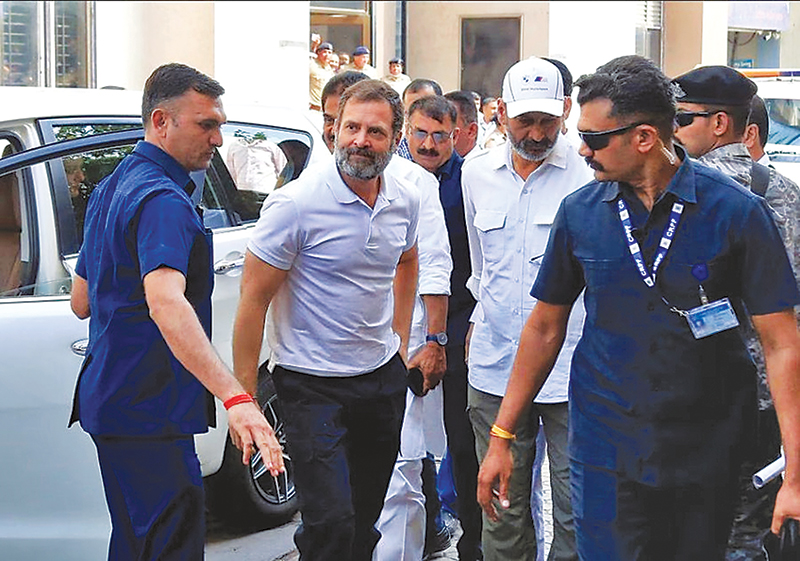
Rahul Gandhi, a senior leader of India’s main opposition Congress party,arrives at a court in Surat in the western state of Gujarat, India on Thursday.   AP/RSS

New Delhi,
India’s opposition leader Rahul Gandhi faces the risk of being immediately disqualified as a lawmaker after being convicted in a defamation case and sentenced to two years in jail.
Here are some examples of how that might play out:

What does the law say?
The Representation of the People Act, 1951, the law that governs elections in India, mandates disqualification of any lawmaker who is “convicted of any offence and sentenced to imprisonment for not less than two years”.
Gandhi, 52, was on Thursday found guilty of defamation by a magistrate’s court in the western state of Gujarat for an election speech he made in 2019 in which he referred to thieves having Modi as their surnames.
The disqualification comes into effect from the date of conviction.
A formal disqualification order will, however, have to be passed by the secretariat of the lower house of parliament of which Gandhi is a member.

Can Gandhi contest elections?
Gandhi faces the risk of not being able to contest national elections due in 2024 if his conviction is not suspended or overturned by a higher court before the elections.
The law also mandates that a convicted lawmaker cannot contest elections for six years after the end of their jail sentence. Gandhi represents the Wayanad constituency in the southern state of Kerala.

How can Gandhi avoid disqualification?
To avoid disqualification, a convicted lawmaker has to secure an order from a higher court suspending the conviction, lawyers said.
The Representation of the People Act does not give any timeframe for securing such a suspension or acquittal before parliament passes the formal disqualification order.

The disqualification can also be overturned and the lawmaker reinstated to parliament if the conviction is stayed or overturned and a fresh election to the seat is yet to be conducted. Gandhi was present in the Gujarat court which gave him bail immediately and suspended the sentence for a month, allowing him to appeal against it.
He can secure bail extensions during the appeal period but cannot contest elections until the conviction is stayed or he is acquitted in the case.
“So while it appears from reports that Mr. Gandhi’s sentence has been suspended by the court that convicted him, he would have to soon obtain a stay on the conviction from an appellate court to save himself from disqualification,” Supreme Court lawyer Vikram Hegde told Reuters. Gandhi, a senior leader of the Congress party and the scion of the Nehru-Gandhi political dynasty, will appeal in a higher court, his party said.

Page 2
NATIONAL

Kidney patients deprived of dialysis services in Kanchanpur

Patients suffering from kidney-related complications have to visit either Dhangadhi in Kailali or bordering Indian towns for treatment.
- BHAWANI BHATTA
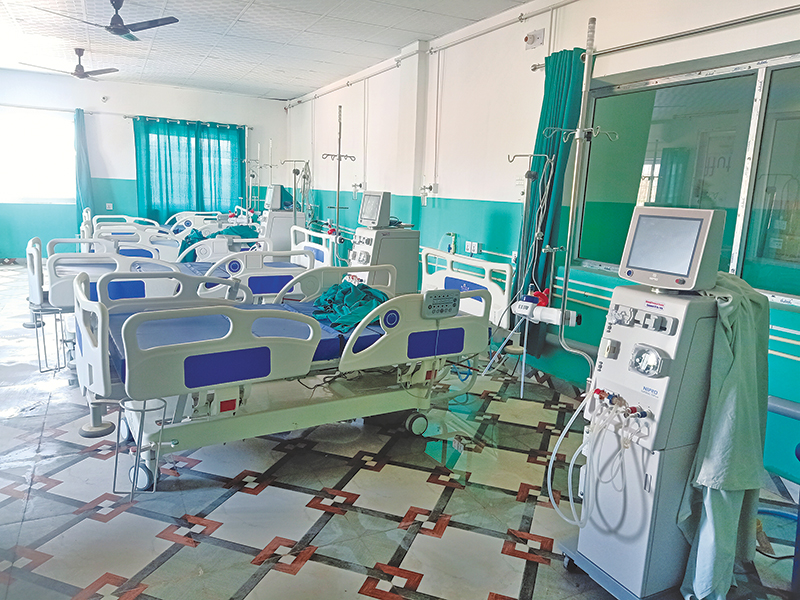
Five dialysis machines were brought to Mahakali Provincial Hospital in Kanchanpur over a year ago, but the hospital has yet to start the service.  Post Photo

KANCHANPUR,
Jaya Bahadur Bista, a resident of Shuklaphanta Municipality ward 11, has been frequenting a hospital in Dhangadhi for the past year to avail of the dialysis service. “Despite having a well-equipped hospital in the
district, we have to go to Seti Provincial Hospital in Dhangadi or to bordering Indian towns for dialysis,” Bista said.
Kidney patients in Kanchanpur, a Tarai district in Sudurpaschim Province, are hugely affected due to the lack of dialysis service in the district. The patients have to visit Dhangadhi in Kailali or bordering towns of India to get the service.
Five dialysis machines were brought to Mahendranagar-based Mahakali Provincial Hospital around one and a half years ago. The hospital installed the machines and additional equipment two months ago and appointed and trained human resources.
However, the provincial hospital is yet to initiate the service due to the lack of permission from the Department of Health Services under the Ministry of Health and Population.
“All preparations were completed some two months ago to initiate the dialysis service but we are unable to begin service as the department is yet to grant us permission for the service,” said Krishna Nanda Bhatta, chair of the Mahakali Provincial Hospital Development Committee. He admits that the kidney patients of Kanchanpur and other neighbouring districts are hugely affected as they have to go outside the district for dialysis service.
A technical team from the department is scheduled to visit the provincial hospital for inspection before it grants permission to operate dialysis service. “We were informed that the department’s technical team will visit the hospital by mid-April,” Bhatta said. “We hope to begin the service once we get the go-ahead.”
The Mahakali Provincial Hospital has five dialysis machines. According to the hospital administration, four machines will provide regular dialysis service while the fifth one will be used for emergency cases. The hospital has appointed four trained staff nurses and provided training to three doctors at the hospital to cater to patients seeking the service.
Meanwhile, kidney patients demand immediate commencement of the dialysis service. They submitted a memorandum to the hospital development committee on Wednesday, urging them to initiate the service at the earliest.
“Mahakali Hospital has everything but we are deprived of the dialysis service,” Bista said. “The concerned authorities should know our hardships and commence service soon.”
According to Bista, more than 40 kidney patients from Kanchanpur regularly visit Dhangadhi for dialysis services. “Most of them go to the hospital twice a week for dialysis. Imagine the hardships we have to go through to get treatment,” he said. “Many other people go to India as it is not easy to get a turn for dialysis in Dhangadhi. Many people from Bhimdutta, Dodhara Chandani and Bedkot municipalities visit Indian towns for the service.”
Kidney patients were hit the hardest during Covid-19 pandemic as the Nepal-India border remained closed for months. The patients had to acquire a pass from the district
administration office and fulfil other due legal procedures to go to India for dialysis.
Kidney patients complain that dialysis service is quite expensive and that people from poor economic backgrounds cannot afford the service. “Private health institutions charge Rs4,500 or more for each session of dialysis,” Bista said. “Even the Seti Provincial Hospital charges up to Rs3,500 if one has to get dialysis service more than twice.”

NATIONAL

Police seize 300 kg marijuana

District Digest

BIRATNAGAR: Police seized 300 kg marijuana from a vehicle with Indian registration number from Dharan in Sunsari district on Thursday. Acting on a tip-off, police raided a Mahindra Scorpio which was parked at Dharan Sub-Metropolitan City-4. A search is on to find the driver and owner of the vehicle, said police.

NATIONAL

Man dies after falling into electric trap

District Digest

SARLAHI: A 50-year-old man died after falling into an electric trap set up for wildlife in Balara Municipality-5, Sarlahi, on Wednesday night. Police identified the deceased as Ram Akshaya Mahato of Koiritole. According to the District Police Office, the incident happened as the victim went to his neighbour’s cornfield to answer nature’s call. The electric trap was installed in the cornfield to protect crops from wild animals. A detailed investigation is underway into the incident, said police.

NATIONAL

Rescued leopard released in national park

District Digest

PARSA: A leopard that was rescued from a human settlement in Pokhariya Municipality-5 was released in the forest of the Parsa National Park on Thursday. A technical team from the National Trust for Nature Conservation in Parsa on Wednesday rescued the leopard that had terrorised the locals. Three people, including a police officer, were injured when the leopard attacked them.

Page 3
NATIONAL

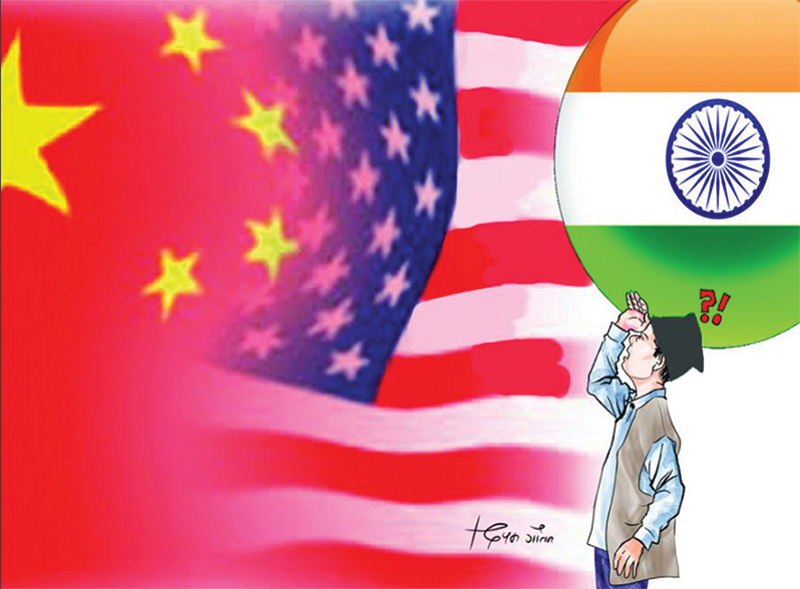
As powerful countries compete for influence, nations like Nepal advised to tread carefully

Given that Nepal’s only two neighbours China and India are arch-rivals, the US seems equally concerned about happenings in Nepal.
- Purushottam Poudel
Post illustration

BEIJING,
The US, China and India have in recent times launched various strategies aimed at increasing or consolidating their influence in the world.
On March 15, Chinese President Xi Jinping attended the world political parties’ meeting organised by China where he unveiled the Global Civilization Initiative (GCI). Prior to this, he offered the idea of the Global Development Initiative (GDI) in 2021 at the United Nations General Assembly, and then the Global Security Initiative (GSI) in 2022 at the Boao Forum for Asia.
Before that, in 2013, he introduced the Belt and Road Initiative (BRI). China believes these initiatives are a response to the responsibility to rise to the common challenges facing humanity and contribute to China’s solutions to advancing global modernization and the progress of human civilizations.
“Although each initiative targets specific global problem areas, these initiatives are important public good China has shared with the world in the new era,” said Wang Donghong, an associate professor in Marxism and Contemporary China Studies at Shaanxi Normal University. “This will inject a strong impetus into humanity’s modernization process and building a community with a shared future for mankind.”
While Nepal’s northern neighbour China has been advocating numerous initiatives in the past few years, the southern neighbour India is also not behind. India launched global initiatives like the Indo-Pacific Oceans Initiative, the International Solar Alliance, and the Lifestyle for Environment.
Likewise, the United States has its own Build Back Better World (B3W) for the growth and solidarity of the global human community. In June 2021, US President Joe Biden made this an official programme at the G7 summit, a gathering of the developed nations, which received the member states’ approval. Scholars of international relations also believe that B3W is forged with the aim of competing with China’s BRI.
Although the US Indo-Pacific Strategy (IPS) and the State Partnership Program (SPP) have become buzzwords, earlier US initiatives like the Blue Dot Network and the Trans-Pacific Programme are no longer in public debate.
“Major nations see this as their duty to not just provide welfare, security and representation for their citizens but also contribute to addressing regional and global challenges,” said Swaran Singh, a professor of Diplomacy and Disarmament at Centre for International Politics,  Jawaharlal Nehru University, New Delhi.
“They invariably involve a large number of other partner nations that bring these initiatives the requisite legitimacy as well as efficacy in achieving their objectives.”
Zhiqun Zhu, a professor of political science and international relations at Bucknell University, US, however, said a world power country and a country aspiring to become a world power are taking various programmes in the name of human development in their attempts to consolidate their influence abroad.
“I think the world has entered a multipolar stage with several powers vying for global influence. The United States is busy competing with and containing China as its global leadership has declined,” Professor Zhiqun sees this as normal as the US global leadership continues to decline and US-China competition intensifies. “Other powers may feel compelled to step in to offer alternative ways to manage world affairs,” Professor Zhinqun said.  
Is the goal of these projects for the “development and welfare of the human race” by major powers merely a smokescreen for their ulterior motives?
Professor Zhinqun said, when it comes to the similarities, all the initiatives are purportedly aimed at building a better, safer and more prosperous world for everyone.
“A better approach is for these powers to work together and coordinate their efforts to achieve common objectives.”
Nepal will undoubtedly be impacted by these often competing initiatives. Given that Nepal’s only two neighbours China and India are arch-rivals, the US seems equally concerned about happenings in Nepal. In such a scenario, it is crucial to consider how Nepal will benefit from the plans put in place by these major rival powers and avoid unneeded disruption.
Bhaskar Koirala, an expert in international relations, says it might be challenging for Nepal to balance itself.  “It will be difficult for Nepal to navigate the many big and sometimes diametrically opposed geopolitical initiatives that are being floated by the US, China, India—all countries Nepal has friendly relations with.”
Historically, India in particular has been very sensitive about Kathmandu’s diplomacy that impinges on India’s security concerns and such a course should be avoided as much as possible, added Koirala.
As such, any path that Nepal chooses should explicitly avoid moving in ways that adversely harm the overarching security concerns of Nepal’s diplomatic partners.
Koirala further adds, “It is not imprudent for Nepal to take time to thoroughly evaluate what the implications of her foreign policy choices will be; to not act impatiently and even, as a matter of strategy, focus instead on purely domestic concerns and abjure from making any sudden and dramatic shifts in policy that may trigger more instability internally and externally.”
According to former ambassador Shambhu Ram Simkhada, when the three nations that are significant to Nepal are introducing new initiatives to strengthen their positions as global leaders, Nepal must first be clear in its internal policy.
“When the countries are forging various new initiatives, Nepal needs to make explicit in its foreign policy and be clear whom should we cooperate with, and on what issues,” Shimkhada said. “If there are some areas where we cannot cooperate then it must be made clear why we cannot go together.”
Wang Zong, a professor and Nepal expert at Yunnan University in China, also believes that Nepal should prioritise its own interests.
“As Nepal adheres to the foreign policy of balance, it would be ideal for the country to carefully weigh which initiatives of which countries will be most beneficial to it,” professor Wang said.

NATIONAL

Experts urge authorities to prepare for the worst of climate disasters

Amid IPCC’s ‘clarion call’, Nepal should be more proactive to adapt to climate crisis.
- Arjun Poudel
Post File Photo

KATHMANDU,
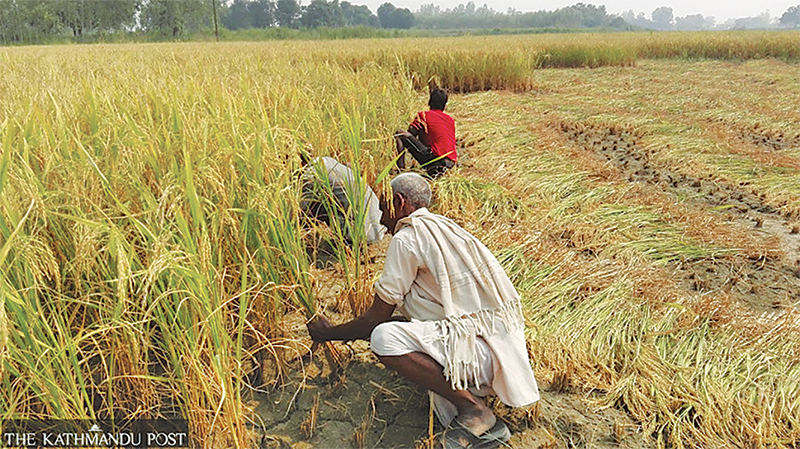
Vegetables have become dearer of late. The price of groceries, including rice and wheat flour, has also increased exponentially. A prolonged dry spell for over five months affected the production of winter crops. And the subsequent rainfalls increased the risk of crops getting damaged ahead of harvesting. As a result, the price of daily essentials has seen a steep rise.
Of late, Nepal has been increasingly witnessing extreme weather events like prolonged drought and dry-spell during cultivation season, and flooding, landslides and inundation at the time of harvest. But the authorities concerned have yet to wake up to adopt measures to mitigate the impacts of such events, experts worry.
“Adverse weather events triggered by climate change have become more pronounced and more frequent of late,” said Madhukar Upadhya, a watershed expert who writes a column on environment and climate change for the Post. “Almost all the people in the country have been bearing the brunt of climate change directly or indirectly, but the authorities concerned have not yet woken up to address the problems.”
On Monday, scientists delivered a ‘final warning’ on the climate crisis. The Intergovernmental Panel on Climate Change (IPCC), composed of the world’s leading climate scientists, set out the final part of the sixth assessment report that stated that only swift and drastic action to curb greenhouse gas emissions can avert irrevocable damage to the world.
António Guterres, the United Nations secretary-general, has said the report is “a clarion call to massively fast-track climate efforts by every country and every sector and on every timeframe. Our world needs climate action on all fronts: everything, everywhere, all at once.”
The report states that damage to climate will become irreversible if global temperature rises to 1.5 degrees celsius above pre-industrial levels. To avert that, governments should drastically cut down on their emissions. If the governments just stick to their current policies, it would become impossible to limit global temperature to below 1.5 degree celsius, the report states.
Nepal is one of the most vulnerable countries to the climate crisis, as multiple studies have pointed out. Over the past few years, drought and dry spells have become the new normal in the cultivation season and floods and inundation in the harvesting season.
Last year, thousands of farmers throughout the country incurred heavy losses at the time of cultivation of summer crops. A prolonged dry spell in western Nepal in mid-monsoon forced farmers to migrate to India in search of work. Hundreds of people in districts of eastern Tarai were displaced due to floods and inundations. People in many parts of the country have been currently facing acute water scarcity due to prolonged dry spells.
Climate experts in Nepal agree that limiting global temperature to below 1.5 degrees celsius is not in the hands of the Nepal government. They say that even though the role of the country in the emission of greenhouse gases is negligible, people in the country cannot escape the brunt of the adverse effects of climate change.
“We do not need additional proof to say that climate change has had adverse effects on livelihoods in Nepal, as incidents of droughts, dry spells, landslides, flooding and inundation have become more frequent and thousands of people have been affected every year,” Upadhya said. “We need immediate actions to protect our people from the direct and indirect impacts of climate change but authorities concerned are too slow to recognise the problems and take measures accordingly.”
Farmers preparing to harvest winter crops—such as wheat, barley, oats, lentils and oilseeds—have been worried as rainfall has occurred daily for the last few days. Officials at the Ministry of Agriculture and Livestock Development concede that the rain has caused damage to winter crops but they do not know the scale of loss incurred by the farmers.
Sunil Kumar Singh, an information officer at the Department of Agriculture, said his office is currently assessing the rainfall’s impact on winter crops.
Lack of rainfall in the hilly and mountainous areas not only affected the production of winter crops but also hit power generation.
Mingma Chhiri Sherpa, chairman of Khumbu Pasang Lhamu Rural Municipality in Solukhumbu district, said that the local unit saw no snowfall in the entire winter months. “This affected the generation of energy from micro hydro in our areas,” he said. “Agriculture products, animal husbandry and tourism, which are a major source of income of our area, got affected due to lack of snowfall.”
Experts say that instead of doing something concrete, authorities concerned have been harping on about the same ‘trivial things’ such as lessening the use of plastic bottles, reducing smoke from industries, and promoting afforestation. They warn that the impact of global warming will be both short-term and long-term across multiple sectors.
Raju Pandit Chhetri, director of Prakriti Resources Centre, which advocates environment-friendly policies and development practices, said that it is important to consider what measures we take to provide scientific information about weather patterns to the public, how scientific and accurate our information is, and what we do in the aftermath of disasters triggered by climate, among other things.
“Implications of climate change will be in multiple sectors—health, food security, education and women empowerment,” he said.
Experts suggest other mitigation measures such as strengthening early warning and weather monitoring systems, encouraging farmers to opt for drought and flood-resistant crops or other alternatives to food crops, and launching crop insurance drives.
“All state agencies should collaborate and coordinate to deal with effects of climate change,” said Chhetri. “If we wait until extreme weather events become more frequent to react, it will be too late.”

NATIONAL

Graft case filed against former rural municipality chair

Briefing
Post File Photo

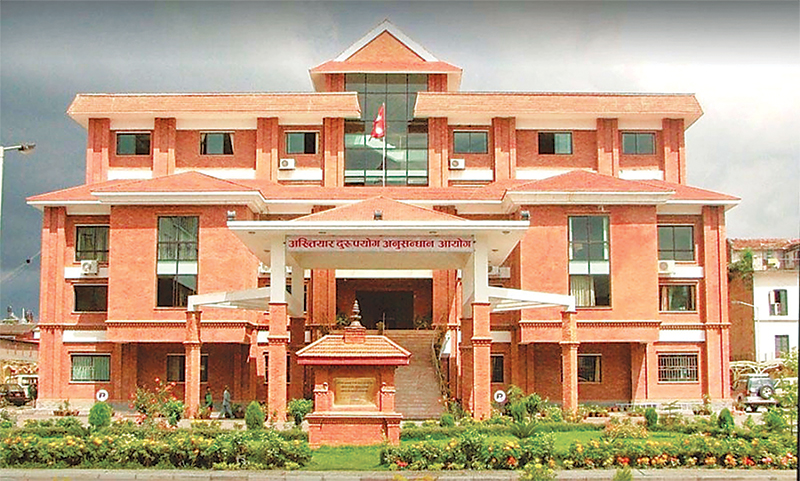
KATHMANDU: The Commission for Investigation of Abuse of Authority has filed a corruption case against the then chairman of Marchawari Rural Municipality Keshavnanda Bania. The commission filed a charge sheet against Bania at the Special Court in Kathmandu on Thursday on charges of corruption by acquiring illegal assets. According to CIAA spokesperson Bhola Dahal, the Rs9.186 million graft case was filed demanding confiscation of the illegal property and an equal fine. An investigation carried out by the commission found that Bania earned Rs8.1 million during his tenure following his election in 2017. However, his total expenditure stood at Rs17.5 million. The charge sheet mentions that the source of property worth Rs9.1 was not established.

NATIONAL

Nepal reports 17 new Covid cases

Briefing

KATHMANDU: Nepal recorded 17 new cases of coronavirus in the last 24 hours, the Ministry of Health and Population said on Thursday. The country had not reported new cases on Tuesday and Wednesday. The new cases were confirmed through 505 PCR and 949 antigen tests during the same period, according to the ministry. The country did not report any Covid-19 related death in the last 24 hours. The countrywide death toll has reached 12,020 since the pandemic began. According to the ministry, 989,152 infected people have recovered from the disease so far, one of them in the last 24 hours. The number of active cases stands at 30. A total of 16,308 people received Covid-19 vaccines in the last 24 hours.

Page 4
OPINION

Inclusive green growth

Initiatives to reduce emissions and ‘green’ the economy offer opportunities to fix existing inequities.
- BISHAL THAPA
Shutterstock

Electric vehicles provide a great many benefits for Nepal. The policy to encourage the adoption of private electric vehicles through lower import taxes is not one of them. The case of electric vehicles provides an excellent illustration of how efforts to green the economy and reduce emissions are missing the opportunity to fix existing inequities.
In October 2021, Nepal announced an audacious goal to achieve full net zero by 2045. Net zero emissions would mean that Nepal would completely negate its total emissions of greenhouse gases through reductions or other methods to absorb carbon dioxide (CO2) from the atmosphere (such as through increased forestry). For comparison, India seeks to achieve net zero emissions by 2070.  
Nepal’s net zero announcements were made in its submission under the United Nations Framework Convention on Climate Change (UNFCCC), the global agreement governing action on climate change. In the long-term strategy, Nepal reports that it has “incorporated the green, resilient, and inclusive development (GRID) agenda into its development policies and plans”. For the record, “inclusive” appears only five times in the 37-page strategy submission to UNFCCC. As with all government announcements in Nepal, a lot is said. Some of them are promptly forgotten. Very little is eventually done. Inclusive policies that benefit the poor and vulnerable must not be allowed to be casually cast aside.

Inclusive growth
The Nepal Country Climate and Development Report, prepared by the World Bank and published in September 2022, highlights how Nepal remains extremely vulnerable to weather events induced by climate change. “Persistent drought could cause food shortages and rising food prices with lasting impacts on farm incomes, nutrition, and poverty,” it states. The impact of flood and heat waves on labour productivity, agriculture and livestock could cause the economy to shrink by 7 percent by 2050, the report estimates.
The poor will be on the front lines of these disasters and climate shocks. “Vulnerable communities, particularly poorer households and those relying on subsistence agriculture, as well as remote, mountainous municipalities, face the highest risks,” Faris Hadad-Zervos, the World Bank Country Director for Maldives, Nepal and Sri Lanka, wrote in November 2022 while describing the importance of inclusive development. In the article, Hadad-Zervos points out that Nepal’s development will be determined by how it addresses the dual challenges of “vulnerability and inequality”. The country’s development path, he argues, must be “inclusive of the poor and vulnerable”.
Nepal’s long-term strategy for net zero emissions estimates that approximately $375 to $485 billion (in current terms) will be required by 2040 to meet its goals. These are staggering requirements, representing approximately 33 to 42 percent of Nepal’s total gross domestic product (GDP) between 2022 and 2040. Responses to the climate challenges offer unprecedented large opportunities to mobilise investment and technologies. This should be an equally unprecedented large opportunity to repair many of the existing historical inequalities. The investments and technologies leveraged for climate must be redirected to benefit the poor, marginalised and vulnerable in equal measure. Inclusive policies are worth fighting for, even if rich people must pay more to drive their shiny, fancy new electric private vehicles.

Inclusive policy
Increasing personal vehicle ownership is not a stated policy goal of Nepal at this time. Shifting vehicles from petrol and diesel towards electric is. Nepal’s long-term strategy for the net zero goals includes significant targets for electric vehicles. By 2030, it aims to have electric vehicles account for 90 percent of all private and 60 percent of all public automobile, including two-wheeler, sales.
The government is primarily using lower taxes to induce the shift to electric vehicles. Petroleum vehicles currently face import and other taxes totalling at least 240 percent on average of the cost of the vehicle. In contrast, private electric vehicles face approximately 10 to 70 percent in customs and excise duties, and receive preferential lower road tax and other benefits. Bigger private electric vehicles, those with above 100 kW of power typically bought by the rich, pay progressively higher taxes within that range. But even then, the relative tax on electricity is significantly lower than on conventional petroleum cars. Tax rebates have also been provided for public electric vehicles and electric two-wheelers.
Electric vehicle imports are soaring on account of these tax rebates, data from the Department of Customs illustrates. In the first eight months of this 2022-23 fiscal year, approximately 2,200 private electric vehicles had been imported, almost a 70 percent increase over the same period last year (there is a reported six-month waiting period for new electric cars). Similarly, approximately 5,800 two-wheelers and 5,000 three-wheelers, representing more than a doubling over last year, have been imported. Approximately 185 large electric buses and micro buses have been imported.
Although tax rebates are increasing the adoption of electric vehicles overall, the benefits are disproportionately enjoyed by private electric vehicle owners. Approximately 80 percent of private vehicle imports are now electric. Electric two-wheelers, which represent almost 75 percent of vehicle registrations in Nepal, still account for less than 15 percent of all two-wheeler imports. It is a similar case with public transport, where approximately 30 percent of imports currently represent electric vehicles.
The relative difference between taxes for electric and petroleum automobiles is quite high for private four-wheelers, making it highly beneficial to switch. It is not so for public transport vehicles and two-wheelers. Conventional petroleum buses face almost the same import tax rate as electric ones, while the tax for petrol two-wheelers is much lower than for four-wheelers. The tax benefits for public vehicles and two-wheeler owners from purchasing an electric vehicle are almost negligible.  
While tax incentives have increased the adoption of electric vehicles, the benefits have been borne almost entirely by the rich, who are the most likely to purchase private cars. In eight months of this fiscal year alone, the resulting losses in tax revenues exceeded approximately Rs10 billion. These benefits have been enjoyed by approximately 2,500 happy, and mostly wealthy, car owners who would have been able to pay higher taxes for those vehicles.
Electric vehicles are a good example where we must encourage the government to evaluate whether its policies to green the economy are disproportionately favouring the rich over the poor, and whether we are remaining true to our goals for inclusive growth or not. There are other policies that could increase electric vehicle use without allowing the few already rich beneficiaries to walk away with all the benefits. Over the next two decades, some $350-$450 billion in investments will flow towards clean energy, climate adaptation and the green revolution in Nepal. The rights of Nepal’s poor, marginalised and vulnerable people to benefit from the green revolution must be secured. They can’t be cheated by yet another revolution.

OPINION

Saving children from drowning

Among more than 1,500 drowning deaths in Nepal in 2019, 31.8 percent were children under five.
- PUSPA RAJ PANT

Open and easy access to water carries the principal risk to drowning. Anyone living near open water sources such as ditches, ponds, irrigation canals or rivers, and those who lack swimming skills, are at a high risk of drowning. Most drownings among toddlers or young children occur in water bodies inside or nearby their homes. Nepali media also periodically reports some such incidents. It is heartbreaking to read about child death in buckets or similar containers of water used for domestic purposes, i.e., drinking, cooking, or cleaning. Despite being an invaluable resource, water stored inside the homes often becomes a cause of death for the youngest members of families.
Globally, drowning is considered a silent killer of children under five, who make the highest percentage of total drownings. According to the latest World Health Organization (WHO) estimates, 47,800 children under five years died worldwide from drowning in 2019. This is 20.3 percent of the fatal drownings that occurred in 2019.

Bucket-water drowning in Nepal
In 2019, more than 1,500 drowning deaths occurred in Nepal; 31.8 percent of them were children under five. Drowning is the 10th major cause of death for children of this age group. In other words, drowning kills nearly 18 per 100,000 children below five years every year in Nepal, more than whooping cough, malnutrition, measles and tetanus. Drowning is the cause of 2.8 percent of the under five-year child mortality in Nepal. The lack of a national drowning database prevents more detailed knowledge about drownings. However, Nepal Police keeps records of unnatural deaths. According to these records, nearly 10 percent of total drowning cases were of children under five years old. Since not all deaths are recorded, information regarding the magnitude of the drowning problem in Nepal is largely unknown. Reporting a complete picture of any issue might be beyond the remit and responsibility of the media, but it has an invaluable contribution to assessing the breadth of drowning—a neglected topic concerning children’s safety.
On March 17, 2023, a toddler drowned to death in Tarakeshwor Municipality, in the outskirts of Kathmandu, after drowning in a water drum inside the washroom. The toddler was found unconscious and was rushed to a super speciality hospital six kilometres away from the site of the incident. It is not reported how the child was transported and whether the child was given any first aid before being taken to the hospital. The child reportedly succumbed while receiving treatment.
A quick scan of media reports indicates an appalling situation of water safety, lack of adequate child supervision and parental familiarity with simple drowning prevention measures. Between March 2016 and March 2023, a reported 34 children of one to 48 months were killed due to contact with bucket water near their homes. An equal number of boys and girls were found drowned in buckets storing water for domestic purposes or similar potable water containers. Among the deceased children, 30 were two years or less, and the girls were younger than the boys. The average age for girls was 17 months, while it was 21 months for boys. This account does not include drownings in nearby ditches, tanks, and wells.

Seeking accountability
Global drowning prevention communities are working hard to compile and collate evidence of effective drowning prevention strategies worldwide. Recently, the WHO has highlighted preventing drowning by providing daycare and basic swimming and water safety skills. The United Nations has called the member states to expedite national drowning prevention actions and commemorate World Drowning Day on July 25 each year. Some countries have reduced drowning by collaborating with communities, mobilising wider stakeholders, and considering safety precautions at home, leisure, and workplaces.
Every child has the right to life and protection as per the Constitution of Nepal 2015, the Children’s Act 2018, and the Convention of the Rights of Children 1990. The state is responsible for preparing parents with adequate parenting skills and ensuring minimum safety standards where children live, study and play. In Nepal, the National Child Rights Council (NCRC) is accountable for ensuring child
rights protection and promotion, facilitating policy consultation and capacity development at all three tiers of governance. The Ministry of Health and Population (MoHP), WHO’s focal ministry for population health, is mandated to formulate a National Water Safety Strategy and its implementation in close coordination with the relevant stakeholders.
Separation of individuals from hazards is the primary preventative measure in injury prevention. It is crucial to prevent toddlers and young children from drowning. This could be achieved by covering the bucket or water containers after use and keeping them out of reach of children. In addition, elders should give full attention to the child, for instance avoiding the use of mobile phones when looking after children. Locking the toilets is another measure since some toddlers drown in bucket water there. Also, the bucket of water left in the courtyard must be covered. The best practice is to install barriers so that crawling toddlers and young children cannot access water buckets and containers. Parents should learn to perform basic first aid and cardiopulmonary resuscitation. Local levels may have a more significant role in ensuring children’s safety, including safety from household water hazards.


Pant is an injury prevention and road safety researcher.

OUR VIEW

The notional ID

The flawed national ID card scheme suggests it was introduced for the benefit of certain vested interests.

That the new national ID card would turn out to be a waste of precious taxpayer money was a foregone conclusion when the government started distributing—read: Enforcing—it in 2018, with no preparation whatsoever. Having virtually no takers except for those who want to make new passports and those sitting for medical licence exams, two purposes for which the cards are mandatory, the so-called one-stop solution to identification that began with a big hullabaloo has fizzled out to nothingness. The national ID card imbroglio, in a country that has failed so much as to provide citizenship and identity cards to up to half a million of its legitimate citizens, exposes the casualness with which the Nepali government makes big decisions.
Apart from its limited use, there is no secret about the national ID card’s failure to take off even after five years of its implementation. Only 133,000 cards have been distributed since its launch, while a total of 1.2 million cards have been printed. The government has collected the biometrics of 11.4 million people but it has yet to inform them when the cards will be distributed to every Nepali. More than that, it has failed to assure them that it is not just another flimsy plastic card with very limited use.
There is always the risk of a big data breach in Nepal which is desperately struggling to secure its digital infrastructure. The ease with which electoral candidates can easily buy voter name lists through fraudulent means makes the task of getting a national ID card inherently risky, the cards liable to information theft from hackers from all over the world. (In recent times, Nepal has also witnessed the immense damage that scammers can do with fake ATM cards.) From insurance agents to advertising platforms to violent groups, everyone is out there seeking data on all kinds of people all the time, and the government is still trying to impose a so-called “all-in-one” digital national ID card. Ironically, the national ID card is neither fully digital nor has it found acceptance from the government’s various wings themselves, let alone the citizens.
To make the citizens take the additional hassle of obtaining a new card, the government must prove its seriousness, for instance by working to quickly integrate the databases of different government offices and making our digital infrastructure more secure. Moreover, it must be able to explain how the national ID scheme is not a carbon copy of similar schemes in the neighbourhood; that a few folks decided it was the right thing to do just because others were doing it. Plus, what can this card do that other identity cards, such as the citizenship card, driving licence, or voter card, cannot? If the proponents of the cards believe that so much is already clear to the citizens, they are mistaken. People are in fact highly confused.
That there are so many questions and so few credible answers suggests these cards were introduced for the benefit of certain vested interests that profited handsomely from the scheme. This suspicion is buttered by the fact that these cards look cheap and flimsy and not worthy of being deemed national ID.

THEIR VIEW

Water management

Groundwater depletion risks safe drinking water access and adversely affects agriculture and industries.

We observed World Water Day on Wednesday, March 22. It is unacceptable that people’s access to clean water, sanitation, and hygiene in Bangladesh is in such a sorry state. Despite making some progress towards improving its water and sanitation infrastructure and services, Bangladesh is still miles away from achieving the targets of ensuring universal access to the availability and sustainable management of water and sanitation for all, which is a part of the United Nations Sustainable Development (Goals SDG 6). According to 2022 data from water.org, 41 percent of the population in Bangladesh—around 68 million people—lacked access to a reliable, safely managed source of water. Around 61 percent of the population—a staggering 100 million people—lacked access to safely managed household sanitation facilities. According to a World Health Organization (WHO) study from 2021, 107 million people in Bangladesh did not have basic handwashing facilities with soap and water at home.
The data clearly illustrate that the state of our water management is in dire straits. With so much hype around Bangladesh’s graduation from the Least Developed Country category (LDC), the real scenario of millions of people not having access to basic water-related services is extremely concerning. What is the point of development that cannot even ensure people’s access to safe drinking water and proper sanitation facilities?
As this newspaper reported exactly a year ago, Bangladesh ranks seventh out of 10 countries in the Asia-Pacific region that extract the most groundwater, according to UN findings. Such quick depletion of groundwater not only puts at risk our access to safe drinking water, but could also lead to major problems for our agriculture and industries. Moreover, approximately 5 to 24 percent of the land area in Bangladesh is exposed to extremely high to high risks of elevated arsenic, salinity and groundwater depletion hazards. And this means that somewhere between 4.5 to 17 percent of our population are still being exposed to these health hazards, leading to enormous health problems for people. Yet, the emphasis put by the authorities on improving this situation over the years has been grossly inadequate.
The answer to solving the problem can be found in reducing our dependence on groundwater. As per the SDGs, 70 percent of our water consumption must come from surface water sources. But, as we know, our surface water is horribly polluted and its use will only be possible once the government ensures enough water recycling and purifying plants.
At the same time, the government also needs to protect whatever surface water is available from further contamination. In that regard, the government has to make the use of effluent treatment plants mandatory for all factories. The lax enforcement of laws is the biggest problem we have when it comes to water management in the country—leading to the widespread pollution of our rivers, for example. And the onus is on the authorities to change that.

— The Daily Star/ANN

Page 6
MONEY

Auto loans are back as cash crunch eases and import ban ends

According to the Nepal Automobile Dealers’ Association, nearly 90 percent of car buyers take auto loans.
- KRISHANA PRASAIN
Taxes on the import of gasoline-powered vehicles are a key contributor to the nation’s treasury.   POST FILE PHOTO

KATHMANDU,
Automobile dealers and commercial banks have relaunched their financing schemes after more than a year as the liquidity crisis has eased and the import ban on cars has been lifted.
Vehicle sellers say they expect sales to pick up with the resumption of auto loans while bankers say that the cash crunch has diminished to some extent.
Dhruba Thapa, president of the Nepal Automobile Dealers’ Association, says sellers have started making agreements with banks to provide easy financing.
“The improvement in the liquidity crisis has come as a relief for
both customers and auto dealers,” said Thapa.
According to him, banks continued to issue loans for electric vehicles (EVs) while the scheme was suspended for gasoline-powered vehicles. “Now, financing for non-electric vehicles has resumed after the government lifted the import ban,” he said.
Automobile dealers have long been demanding that the financing margin for non-electric vehicles be raised. Currently, banks provide a 50 percent financing facility for non-electric vehicles. For EVs, banks provide loans that cover 80 percent of the purchase price of the vehicle.
Pioneer MotoCorp, the authorised distributor of Nissan vehicles in Nepal, and Nabil Bank recently signed a memorandum of understanding (MoU) on the financing of Nissan vehicles, both electric and non-electric.
Nabil Bank will provide up to 80 percent financing for Nissan electric vehicles for individuals and up to 70 percent for institutions.
The bank will provide up to 70 percent financing for non-electric vehicles for institutions and up to 50 percent for non-electric vehicles for individuals.
Similarly, Shangrila Motors, the authorised distributor of Peugeot and Citroen vehicles in Nepal, and Everest Bank have signed an MoU to collaborate on vehicle financing.
Everest Bank will provide up to 80 percent bank financing for electric vehicles, up to 70 percent financing for non-electric vehicles for institutions, and up to 50 percent bank financing for non-electric vehicles for individuals.
Automobile dealers say that the collaboration with banks aims to offer easy retail financing for customers wishing to purchase vehicles.
“Banks are focusing on electric vehicles for long-term benefit from the environment perspective as this will reduce fossil fuel imports which are a major reason for the country’s widening trade deficit,” said Sunil KC, president of the Nepal Bankers’ Association.
KC, who is also CEO of NMB Bank, said that the liquidity crunch in banks had also started to lessen. “Banks have accorded priority to EVs. Regarding the financing margin for non-electric vehicle, it’s the prerogative of banks,” he said.
NMB has also been prioritising financing for electric vehicles at preferable interest rates, KC said.
Last April, the government imposed import restrictions besides ordering importers to maintain a 100 percent margin amount to open a letter of credit.
The directive issued on April 26, 2021 embargoed 10 types of goods described as luxury items. They included, among other things, mobile sets worth over $600, motorcycles of over 250cc capacity and all non-electric vehicles.
The mid-term review revealed that stopping imports to save foreign currency had led to low revenue collection.
Taxes on the import of gasoline-powered vehicles are a key contributor to the nation’s treasury. Imports of petrol vehicles plunged by 91.7 percent, resulting in a drop in tax collection by 92.36 percent.
Imports of diesel vehicles fell by 33.65 percent, resulting in a drop in tax collection by 18.08 percent.
According to the Department of Customs, Nepal imported fuel worth Rs227 billion in the first eight months of the current fiscal year ended mid-March compared to Rs217.30 billion in the same period of the last fiscal year.
The country imported petroleum products worth Rs383.92 billion in the last fiscal year 2021-22.
Vehicle imports plunged by 56.99 percent to Rs32.65 billion during the review period.
The import of electric vehicles swelled by 55.38 percent to Rs6.16 billion in the first eight months of the current fiscal year, customs data show. Nepal imported 2,198 electric vehicles in the first eight months of the current fiscal year compared to 1,357 units in the same period of the last fiscal year.
Nepal has been importing electric vehicles mostly from India, China and Korea. The soaring cost of gasoline has helped boost EV sales. Industry insiders say EVs are gaining popularity and market share in Nepal even though fuel prices are now trudging backwards.
According to the Nepal Automobile Dealers’ Association, nearly 90 percent of car buyers take auto loans. 

MONEY

Launch debut of 3D-printed rocket ends in failure

- ASSOCIATED PRESS

CAPE CANAVERAL,
A rocket made almost entirely of 3D-printed parts made its launch debut on Wednesday night, lifting off amid fanfare but failing three minutes into flight—far short of orbit.
There was nothing aboard Relativity Space’s test flight except for the company’s first metal 3D print made six years ago.
The startup wanted to put the souvenir into a 200-kilometre-high orbit for several days before having it plunge through the atmosphere and burn up along with the upper stage of the rocket.
As it turned out, the first stage did its job following liftoff from Cape Canaveral Space Force Station and separated as planned. But the upper stage appeared to ignite and then shut down, sending it crashing into the Atlantic.
It was the third launch attempt from what once was a missile site. Relativity Space came within a half-second of blasting off earlier this month, with the rocket’s engines igniting before abruptly shutting down.
Although the upper stage malfunctioned and the mission did not reach orbit, “maiden launches are always exciting and today’s flight was no exception,” Relativity Space launch commentator Arwa Tizani Kelly said after Wednesday’s launch.
Most of the 33-metre rocket, including its engines, came out of the company’s huge 3D printers in Long Beach, California.
Relativity Space said 3D-printed metal parts made up 85 percent of the rocket, named Terran. Larger versions of the rocket will have even more and also be reusable for multiple flights.
Other space companies also rely on 3D-printing, but the pieces make up only a small part of their rockets.

MONEY

Israeli farm techniques add new twist to Kalash Dairy

- SHANKAR ACHARYA
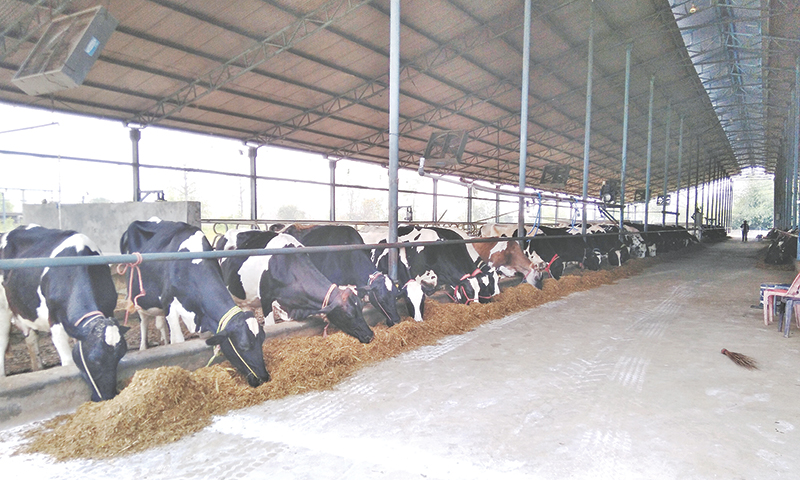
All tasks such as feeding the cows, extracting the milk, cleaning excreta are done by a computerised system.   POST PHOTO: SHANKAR ACHARYA

PARSA, 
Software engineer Shyam Badan Yadav started Kalash Dairy one-and-half decades ago.
He started to source milk from farmers to produce dairy products such as ice cream, cake, curd, paneer, butter, and so on.
Yadav saw his business growing by leaps and bounds. However, he was unable to increase the output due to the lack of milk.
Three years ago, Yadav set up his own farm--Kalash Cattle Farm.
He now owns 150 cows of Holstein breed, and collects over a thousand litres of milk daily.
The milk produced by the farm is consumed by his factory alone.
The dairy products are sold to Birgunj, Janakpur, Lalbandi and Bardibas.
Along with the milk, his farm also produces a tonne of compressed natural gas (CNG) and a  tonne of compost manure. The collected CNG is enough to power the factory for five hours a day. Whereas, the company sells manure commercially.
The production of gas will increase as more cows are added, which the company is planning to sell to in the industrial estate, stated Yadav.
Yadav aims to increase the number of cattle on his farm to 1,000 and milk production to around 25,000 litres a day in the near future.
“We are in the final stage of infrastructure development,” said Yadav. “We will increase the number of cows and milk production after a year.”
The total project cost is worth Rs770 million, out of which Rs500 million has already been invested. The remaining Rs270 million will be invested to buy additional 850 cows to operate at maximum capacity, he said.
The company is also producing silage–grass or other green fodder compacted and stored in airtight conditions, to use as animal feed in addition to the feed pallets.
According to Yadav, feeding the silage to the cows in addition to the regular feed increases milk production in cows.
Yadav claimed that the farm, spread over an area of around nine hectares, is the first fully automated cow farm in the country.
All tasks such as feeding the cows, extracting the milk, cleaning excreta are done by a computerised system, therefore a team of 17 people is enough to operate the entire farm, said Yadav.
The milking machine can milk a cow in five minutes and it has the capacity to milk 40 cows at a time.
Along with that, the company uses huge fans and water sprinklers to keep the temperature favourable inside the shade for the cows. Two veterinarians are appointed to the farm to take care of the cows and calves. The cows and heifers are kept separately on the farm, likewise, milk-giving and non-milk-giving cows too are segregated.
Due to the cleanliness of the farm, the problem of odour and disease infestation is relatively low.
“We have a plan to set up a cattle feed manufacturing plant too,” added Yadav.
Yadav toured Israel to get training on dairy farming before setting up the farm. After returning, he obtained loans from Nabil Bank and Jyoti Bikash Bank and kicked off the project.
However, right after setting up the farm, the Covid-19 pandemic stalled his business. But now, it has picked up steam as people’s lifestyle has been restored to normalcy.
Once the company starts operating at full capacity, the farm will employ an additional 23 people, said Yadav.
The company is encouraging locals of Thori Municipality and three other local bodies to engage in maize farming. The maize produced by them will be bought by the company to use as feed for the cows.
“The farmers of Thori, which earlier planted tobacco and other cash crops, have started planting maize from this year,” said Yadav. “This will increase their income by threefold as compared to the other crops.”
Yadav stated there is no alternative to large-scale automated dairy farms in Nepal to bridge the gap between the demand and supply of dairy products in the country.
According to The Commercial Livestock Survey 2021 made public by the Ministry of Agriculture and Livestock Development, 15,380 dairy cows produce a total of 45,803 tonnes of milk on average while 10,841 buffaloes give 23,231 tonnes of milk on average.  
Out of these, there are around 6,809 Holstein cows that produce 25,110 tonnes of milk on average every year.
 The survey also states that there is are a total of 6,486 commercial livestock farms in Nepal.
“If around 25 large-scale dairy farms are established in the country, then we can be self-reliant in dairy products,” added Yadav.

MONEY

China’s super rich population drops

Country still has the most number of billionaires at 969.
- REUTERS
Jack Ma, billionaire founder of Alibaba Group.  REUTERS

SHANGHAI, 
More than 400 people lost their billionaire status last year, most from China, as global monetary tightening, Covid-19 disruptions and Beijing’s crackdown on major tech companies hurt the super wealthy, a ranking of the world’s wealthiest showed.
China lost 229 billionaires from the Hurun Global Rich List 2023, accounting more than half of the 445 people who disappeared from the list, which ranks moguls with a minimum net worth of $1 billion, the Hurun Report said on Thursday.
The world’s second biggest economy also added 69 new billionaires to the list during the period.
“The number of billionaires in the world is down by 8 percent, whilst their total wealth dropped 10 percent,” said Rupert Hoogewerf, founder and chairman of the Hurun Report. A total of 3,112 people made the list, versus 3,381 a year earlier, he added.
China remained the biggest source of the super rich, with its total number of billionaires standing at 969 as of January 16, 2023, ahead of the United States with 691. Luxury brands had a good year, with LVMH chief Bernard Arnault rising to the top of the list and Hermes heirs Bertrand Puech and family coming in third.
Stand-out names falling off the list included Sam Bankman-Fried, who lost his $21 billion fortune after the collapse of crypto exchange FTX.
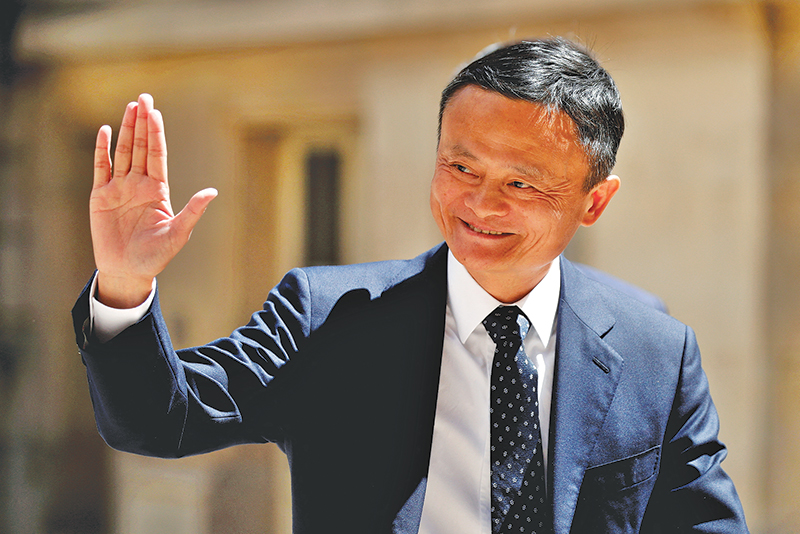
In China, Jack Ma, founder of China’s e-commerce giant Alibaba Group Holding , dropped to 52nd place from 34th a year earlier, due largely to China’s regulatory crackdown on its tech sector.
“Interest rate hikes, the appreciation of the US dollar, the popping of a Covid-driven tech bubble and the continued impact of the Russia-Ukraine war have all combined to hurt stock markets,” Hoogewerf said.
In the past year to end-January, the S&P 500 plunged by more than 14 percent, while in China, the benchmark Shanghai Composite index lost nearly 11 percent.
Meanwhile the country’s yuan lost about 8 percent of its value against a surging dollar in 2022, the biggest annual drop since 1994, due largely to Federal Reserve’s aggressive rate hikes and a slowing domestic economy.
Hoogewerf said he was generally positive towards this year after gauging scales of economic confidence and happiness among Chinese high-net-worth individuals.
“The only thing I am not certain of is whether there would be a global financial crisis,” he said. “We have seen bank crises in the United States and then Switzerland. I am not sure if there would be contagion. If not, wealth will grow by a huge margin.”

MONEY

Hyatt Regency Kathmandu to host Thai Food Fest

Briefing

KATHMANDU: Hyatt Regency Kathmandu will be hosting the highly anticipated Thai Food Fest from March 25 to April 4 at Sesame Restaurant. The hotel will be showcasing the best of Thailand’s vibrant food culture and guests will be able to indulge in a variety of traditional Thai dishes for Rs3,500, reads the press release issued by the establishment. In addition to the mouth-watering food, guests will also have the opportunity to witness the delicacies of Thai cooking firsthand. (PR)

MONEY

Nabil Bank signs letter of cooperation with USAID TCA

Briefing

KATHMANDU: Nabil Bank has signed a Letter of Cooperation with USAID Trade and Competitiveness Activity with the common goal to increase the availability of finance and access to financial products and services to micro, small and medium-sized enterprises (MSMEs) in a sustainable way. With this cooperation, both parties agree to work to boost tourism, agriculture and digital services. Gyanendra Prasad Dhungana, CEO of Nabil Bank and Agnes Luz, Chief of Party, USAID Trade and Competitiveness Activity signed the agreement. This partnership is expected to cross-share organisational strengths, experience, technologies, methodologies, and resources to pursue common goals in a collaborative way, the bank said in a statement. (PR) 

MONEY

China criticises possible US plan to force TikTok sale

Briefing

BEIJING: China’s government said Thursday it would oppose possible US plans to force TikTok’s Chinese owner to sell the short-video service as a security risk and warned such a move would hurt investor confidence in the United States. Governments are worried TikTok’s owner, ByteDance, might give browsing history or other data about users to China’s government or promote propaganda and disinformation.
The Wall Street Journal reported US authorities were considering banning TikTok ban if ByteDance doesn’t sell the company. “If the news is true, China will resolutely oppose it,” said a Ministry of Commerce spokeswoman, Shu Jiting. She gave no indication what Beijing might do. A forced sale “would seriously damage investors from multiple countries including China” and hurt “confidence to invest in the United States,” Shu said. (AP)

Page 7
SPORTS

Footballer Shrestha calls time on international career

One of the most successful footballers of the current generation, the winger-cum-defender flew to Australia Thursday night seeking a better future.
- Sports Bureau
Nepal’s Sujal Shrestha celebrates after scoring a goal against Sri Lankaduring the men’s football competition of the 13th South Asian Games at the Dasharath Stadium in Kathmandu in this file photo dated December 4, 2019.  Post File Photo

KATHMANDU,
Nepal national team footballer Sujal Shrestha announced his international retirement on Thursday evening through a facebook post.
The 31-year-old Shrestha, following in the footsteps of more than three dozen Nepali footballers, chose Australia as a destination for a secured future. Addressing his fans and well-wishers, he wrote: “….I feel that it is the right time for me to take international retirement.”
Shrestha, also the captain of Machhindra Club, flew to Australia along with his club-mate and national team defender Ranjit Dhimal Thursday night. He was not in the national squad that is currently playing in the “Three Nations Cup” at home, following an injury he picked up during the Martyrs Memorial ‘A’ Division League match against Church Boys United Club.    
Shrestha, a product of ANFA Academy, made his international debut against Bhutan at an international friendly in 2011. Since then, he has been a key member of the squad and has won 45 official international caps for the country. He has scored three goals in the national jersey and his last appearance for the national side was against Pakistan during an international friendly in November last year.
“Eleven long years, 51 games and the country’s flag in my heart—I feel really proud to have represented my country,” Shrestha wrote. “Amid the thick and thin, titles and some disappointing moments in memory, I announce my retirement from the national team.”
He added: “It was a great honour for me to wear the national jersey for such a long time, which I did with pride and passion. The youngsters and current members of the national team are very much capable and talented. I am very much confident that they will not let the country’s flag down.”
Known as a true gentleman in football, Shrestha is one of the most successful footballers of the country—both at the domestic and international levels. He has won four ‘A’ division league titles, including two each with Machhindra and Manang Marshyangdi Club. He also captained ‘A’ division league champions Machhindra to title last season and was an influential member of the squad the previous year when they won their first ever top tier title.
Shrestha had taken over the national team’s captaincy during the team’s international friendly against Myanmar in November 2017. Under his leadership, Nepal national U-23 team retained the men’s football title at the 2019 South Asian Games in Kathmandu, and was also a key member of the team that won AFC Solidarity Cup in 2016. He scored a goal against Macau in the final.
Though he played as a midfielder for most of his career, Shrestha was deployed as a defender by coach Bal Gopal Maharjan during the 2019 SAG after Bikash Khawas picked up an injury during the tournament.
Since then, he had been playing both as defender and midfielder as per the team’s requirements, although Nepal’s outgoing coach Abdullah Almutairi preferred him more as a defender than a winger or midfielder.
“I thank all my fans and well-wishers who supported me with applause and cheers. Also, my gratitude to the coaches who believed in me and gave me a regular place in the team,” Shrestha added.

SPORTS

Nepal open ACC Premier Cup against Malaysia

- Sports Bureau

KATHMANDU,
Nepal national men’s cricket team will kick off their ACC Premier Cup 2023 campaign taking on
Malaysia at the TU Cricket Ground on April 18.
The opening day will also see Hong Kong face Singapore at the Mulpani Cricket Ground.
The Premier Cup will work as a qualification pathway towards the Asia Cup 2023, to be held in Pakistan in September 2023.
Nepal are pitted in Group ‘A’ alongside Oman, Qatar, Malaysia and Saudi Arabia.
Group ‘B’ consists of the United Arab Emirates, Hong Kong, Kuwait, Singapore and Bahrain.
The winners and the runners-up from each group will advance into the semi-finals. Both the last four matches will be held on April 29.
The final will be played on May 1.
The winner of the 10-team tournament will join Afghanistan, Bangladesh, India, Pakistan and Sri Lanka—the five full members of the Asian Cricket Council—for the Asia Cup.
Afghanistan, Bangladesh and Sri Lanka are in Group B.
The Premier Cup champions will compete against India and the hosts Pakistan in the Group A matches.

SPORTS

Sudurpaschim, APF off to winning starts in Lalitpur Mayor Women’s T20

Bindu Rawal’s team see off Lalitpur Mayor’s XI by 51 runs, while Sita Rana Magar’s side beat Madhesh Province by 10 wickets on the opening day at the TU Cricket Ground.
- Sports Bureau
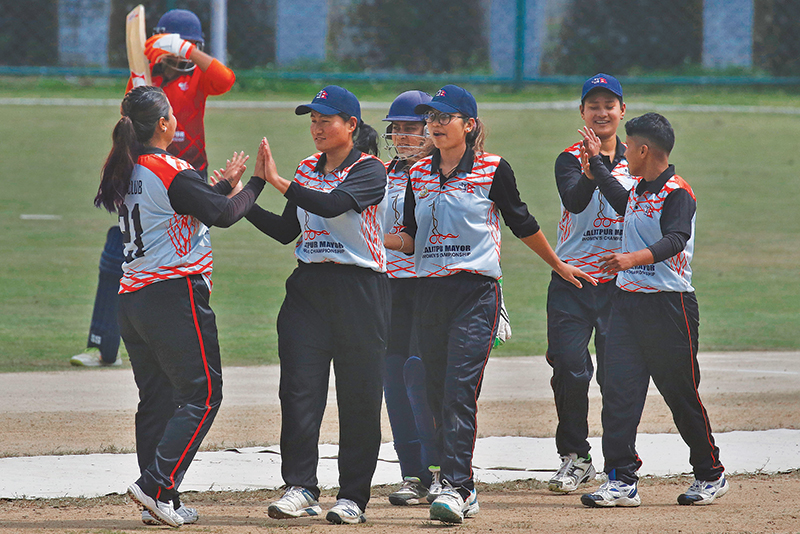
Players of APF Club celebrate a wicket of Madhesh Province during the Lalitpur Mayor T20 Women’s Championship in Kirtipur on Thursday.  Post Photo: Hemanta Shrestha

KATHMANDU,
Sudurpaschim Province and Nepal Armed Police Force (APF) Club were off to winning starts in the Lalitpur Mayor Twenty20 Women’s Championship that kicked off on Thursday at the TU Ground in Kirtipur.
In the opening match, Sudurpaschim saw off the challenge of hosts Lalitpur Mayor’s XI by 51 runs and departmental giants APF registered a thumping 10-wicket victory over Madhesh Province.
In the earlier fixture, Sudurpaschim opted to bat first and posted 137-3 in their allotted 20 overs on the back of an unbeaten half century by Samjhana Khadka. Chasing the target, Lalitpur could only manage to reach 86-7.
Player-of-the-match Khadka, who came in to bat at number three, played an unconquered knock of 51 runs off 45 balls that included six hits to the fence. Opener and captain Bindu Rawal scored a 14-ball 18 studded with four hits to the fence before she was bowled by Sony Pakhrin.
Her opening partner Rubi Poddar hit a 33-ball 28, comprising four boundary hits.
Kabita Joshi played an unbeaten innings of 27 runs off 28 balls. She slammed two fours and a six.
Kritika Marasini of Lalitpur pocketed two wickets and Pakhrin picked one.
Chasing the target, Lalitpur had their five batters run out, including opener Laxmi Chaudhary, the highest scorer of the innings, who contributed 25 runs off 28 balls. Her opening partner Kanchan Shrestha scored a 32-ball 16. Helisha Gurung was the other batter for Lalitpur to touch a double digit score, making a 23-ball 19.
Sudurpaschim bowler Ritu Kanaujiya picked up two wickets in her four-over spell, conceding 12 runs.
In the later fixture, inviting Madhesh to bat first, APF bowled them out for a paltry 58-run total.
APF openers Jyoti Pandey and Sita Rana Magar had an unbeaten 61 run partnership, taking their team to victory in only 7.3 overs.
Sana Praveen, who came in to bat at number three, was the only Madhesh Province batter to reach a double digit score, making 25 runs off 45 balls. She hit two boundaries before being trapped lbw by Sonu Khadka. Seema Kunwar was the second-highest scorer, contributing eight runs for Madhesh.
APF’s Khadka was the pick of their bowling, claiming four wickets in her 2.4 overs, conceding only nine runs. Captain Rana Magar claimed three wickets.
Chasing the target, Rana Magar scored 45 runs off 36 balls, studded with nine hits to the fence. Jyoti Pandey hit a 10-ball 8. Rana Magar was declared the player-of-the-match.
APF will next play against Sudurpaschim and Lalitpur will take on Province 1 on Friday.

MEDLEY

Horoscope

ARIES (March 21-April 19)
Allow yourself to embrace moments of luxury throughout the day, taking care to breathe deeply, savor delightful sights, scents, and flavors. However, it’ll also be important that you rely on your wits while staying focused on goals.

TAURUS (April 20-May 20)
Take a moment to appreciate yourself, starting the day with a positive mind and heart. Plan on unleashing the weirdo that lives within, embrace freedom on a soul level. You can hold back, if you’re afraid of vulnerability.

GEMINI (May 21-June 21)
You’ll be in a unique position to express love without having to say much. A sense of urgency may follow you as the day unfolds, motivating you to push through any projects or goals you’ve been chipping away at.

CANCER (June 22-July 22)
You will be encouraged to see the good in humanity, helping you find faith that the world is a beautiful place. Be sure to greet each stranger with a smiling face, even if you’re unsure of where things might lead.

LEO (July 23-August 22)
Take a more proactive role within your profession, as doing so can help you win the admiration of others. Be mindful of following your gut, your intuition could mislead you into repeating mistakes from the past.

VIRGO (August 23-September 22)
It is perfect for an early meditation, so try to commune with the life force that exists within and around you before kicking off the day. Wrap up any professional loose ends that need tending to.

LIBRA (September 23-October 22)
You may pop out to reveal the truth of your heart, accepting what you cannot change will allow you to move on from unpleasant emotions and situations. Consider showing your vulnerable side to your closest companionships.

SCORPIO (October 23-November 21)
You will open your heart to love in all of its forms, so be sure to invest in the relationships that matter most. Your heart may surprise you, though you should avoid acting recklessly with your emotions.   

SAGITTARIUS (November 22-December 21)
Treat your body to some extra care and encourage wellness and healthy living. Make a move on any cuties you’ve been eyeing. Consider trying out a new routine, give a chance to reinvent the wheel that moves your life forward.

CAPRICORN (December 22-January 19)
Start your day with uplifting music, and consider putting some extra effort into your appearance, even if the nuance is subtle. Work hard for your goals. Consider surprising your sweetheart with a thoughtful gift or gesture.

AQUARIUS (January 20-February 18)
You will make peace with your emotions. You will nurture yourself and others with plenty of kindness and care. Excitement will fill your home invite over loved ones for an impromptu happy hour or dinner party.

PISCES (February 19-March 20)
Your thoughts will be particularly grounded and romantic. It will be sweet when it comes to drafting love letters or poetry, so don’t be afraid to let the heart move you. Invest in the organization and efficiency of your home.

Page 8
CULTURE & LIFESTYLE

A charming multi-cuisine cafe

Masala Beads Cafe feels like it came straight out of a Korean drama. So it is guaranteed to appeal to young people, particularly Gen Z.
- Mimamsha Dhungel

Kathmandu
If you have been shopping for accessories and other trinkets from the popular Masala Beads store, you will be elated to know that the store has branched out to Masala Beads Cafe at Thamel, Jyatha. The appealing cafe is atop the new Masala Beads Thamel shop, opposite Hotel Holy Himalaya. You can explore Thamel’s lively streets and easily find the cafe for a pleasant day out with your friends.
The cafe has a charming atmosphere and is themed after Studio Ghibli, a very popular Tokyo-based Japanese animation studio. Plushies of the beloved character Totoro from Studio Ghibli’s 1988 Japanese animated fantasy film, ‘My Neighbour Totoro’ are placed in the cafe. The relaxing songs playing in the background, the interesting decor, neon lights, cool mirrors, and other creative ceiling hangings are instant mood lifters. Even the bathroom area is beautifully embellished with postcards and shining mirrors.
The cafe’s decor, ambience, and menu are a brand-new aesthetic for Kathmandu. It is located in a very tranquil setting with tons of greenery and frequent gush of wind. The capacious environment gives you enough space where you can read a book, have a conversation or just devour your food. You can go to the cafe for a break after a long day, or it can also be your go-to spot for a weekend outing.
As the cafe feels like it could have come straight out of a K-drama, the cafe is guaranteed to appeal to young people, especially Gen Z, who are well-versed in Korean and Japanese shows. Masala Beads Cafe has a plethora of items on its menu. From
Asian flavours to tasty snacks, fulfilling main course to delicious desserts and drinks, you are sure to return from the cafe carrying a food baby.

Masala Beads Cafe

Location:    Thamel, Jyatha, Kathmandu
Opening hours:    9am to 10pm
Delivery:    Not available
Price:    Inclusive of all taxes
Parking:    Available for two-wheelers
Payment options:    Cash, Fonepay, Card

Iced Matcha Latte
Price: Rs330
The cafe offers an extensive drinks menu. After giving it some thought, I decided to start with a healthy option. Matcha is high in antioxidants and has a lot of health benefits. So, I went with the cafe’s matcha latte. I was excited to try it because matcha-flavoured beverages and desserts are trending. The cafe provided both hot and iced lattes. I chose the latter. The matcha’s emerald colour went well with the cafe’s green decor. It was akin to a conventional cafe latte, but instead of espresso, matcha was used.
For someone who is not familiar with the matcha’s taste, the drink might taste a tad bit bitter. But if you love matcha, this is the drink for you.

Thai Green Curry
Price: Rs480
The cafe’s menu has a dedicated section called Asian Corner that features Asian delicacies. I had their Thai Green Curry with Tofu and plain rice. The curry was made with a green curry paste using lemongrass, ginger, and green chillies. The coconut milk gave the curry a creamy texture. To go with the gingery sauce, it also had tofu (bean curd) and cauliflower. If you are not a big fan of ginger, the taste might not appeal to you. The ginger’s tanginess might be something new compared to the Nepali palate.
This curry was more flavorful than most Thai curries I’ve tried. The Thai Green Curry, unlike our usual dal-bhat-tarkari, had different flavours and spices that left me wanting more. The rice that came with the curry was perfectly cooked and topped with fried aromatics. It was a new flavour for me, but I highly recommend trying it.

Parsley Chicken
Price: Rs680
The food presentation at Masala Beads Cafe deserves special mention. The plating of the parsley chicken impressed me. The day I tried the dish, I was told that it was a new addition to the menu —only  three days old. The Parsley Chicken set had two chicken leg pieces stuffed with cheese, broccoli, mushroom, and thyme. The chicken was brushed with parsley and served with mashed potatoes. It had a good mix of protein and sautéed vegetables.
You will also get a mustard cheese sauce to complement your chicken. Blanched broccoli, tomato and carrot were added to the creatively decorated plate. The portion served is enough for two people. The texture of the chicken was a little rubbery and dry. Even the mashed potatoes lacked the creamy consistency I would usually prefer. Aside from that, the dish was pleasant.

Spaghetti Bolognese
Price: Rs580
This was the showstopper for me. The dish had spaghetti noodles with creamy tomato sauce and minced chicken. What is pasta without cheese on top? I loved that there was a generous amount of cheese on the spaghetti. The thick and creamy texture of the tomato sauce went really well with the noodles and the herbs like oregano and basil. With the sweet and savoury burst of flavours pleasing your tastebuds, every bite of the Spaghetti Bolognese was scrumptious.

Bento Cake
Price: Rs500
Bento boxes are cute lunch boxes used to transport a single serving of food for lunch. Cakes based on the bento concept were first introduced in Japan in the 12th century. Bento cakes are not widely available in Nepal. Masala Beads Cafe’s red-velvet bento cake took my breath away. It looked adorable and lovely on the plate and was a delight to taste as well. The cake was rich, fluffy, and moist. As I have a huge sweet tooth, I went all in on the cake, and each bite gave me foodgasms. You should not miss their bento cakes at all costs.

CULTURE & LIFESTYLE

Snapshot of the times

Famed director the late Pratap Subba’s iconic 1978 film ‘Paral ko Aago’ is brilliantly made but has a regressive plotline.
- Urza Acharya
Screengrab from Youtube

Kathmandu
Yes, yes. Before anyone starts spewing the same old defense against critiquing films or literature from the past, I want to say—I know. Things were different back then. You can’t see the past with today’s moral standards. But should that always be the case?
This is what I had to keep on telling myself as I watched Pratap Subba’s 1978 film ‘Paral ko Aago’. Subba, a veteran filmmaker from Darjeeling, made several other films like ‘Bachna Chahane Haru’, ‘Masaal’, and ‘Kahi Adhyaro Kahi Ujjyalo’. He passed away on March 16.
Based on a short story by writer Guru Prasad Mainali of the same name (known as ‘A Blaze in the Straw’ in English), the story follows the lives of husband and wife, Chame and Gauthali. Mainali is a writer from the realism school of thought, or ‘yatharthabadh’ in Nepali. His other popular stories include Naso (The Ward) and Sahid (The Martyr). His stories are incredibly didactic—a little too much for my taste, but I understand where he’s coming from. During the early 1900s, perhaps writers felt like it was necessary for stories to have a moral message—don’t discriminate, send your kids to school, and whatnot. And ‘Paral ko Aago’ has a similar social message: Don’t hit your wife. Well…you can hit her a little. But not so much that she leaves home.
Pratap Subba first read the story while studying in Darjeeling. In an interview, he claimed, “The story had driven me mad. The plot of the film circled my mind day and night. I had to make it. So I did.” Starring Tanka Sharma (an actor from Darjeeling) as Chame, and veteran actress Basundhara Bhusal as Gauthali, ‘Paral ko Aago’ is considered an archetype of Nepal’s early cinema. And it’s not difficult to see why.
As a film, ‘Paral ko Aago’ is brilliant. The adaptation of story to script is almost religious—even the dialogues are the same. For a black and white film made in the 1970s, the structure and editing of the film are seamless and much more sophisticated than that of contemporary Nepali films. The length is around one and a half hours and rarely does anything feel out of place. Except for a short montage of a jhakri (shaman) curing an ill person. That comes out of nowhere and I still can’t figure out why it was put in the film.
Despite being shot on film, the cinematography oozes through the screen. At the beginning of the film, we see Gauthali attending a wedding, with roaring panche bajas and dancing people. There’s also a very fun little dohori montage between the groom and the bride’s sides. The clear skies, small mud houses, cows grazing, and people in the village going about their day is an honest    portrayal of the time (and perhaps relevant even today).
A secondary storyline also follows in the film, one of Juthe Damai (I don’t even want to begin dismantling how casteist that name is) and his wife. In contrast to the always bickering Chame and Gauthali, Juthe Damai and his wife are shown to be very understanding and loving. They act as mouthpieces for both Mainali and Subba to transfer moral messages to the audience. In one scene, (which is not present in the story) Juthe Damai, while sewing clothes for an ‘upper-caste’ villager, politely points out the irony of how people wear the clothes he makes but don’t drink the water he touches. Gauthali’s mother—who is  non-existent in the original story—acts as a mouthpiece that defends Gauthali’s decision to go back to her maita (maternal home). She comforts a crying Gauthali saying, “It’s okay. We’ll plough our fields and work harder to keep you here. No need to go back to him only to be a slave.”
Subba gives Mainali’s story more nuance—giving the Dalit characters as well as the women in the film, a voice and in turn, more autonomy. Subba clearly had a vision for the film, and that’s why at least technically, it’s so sharply made.
The best part of the film, without a doubt, is the music. As she comes back with fodder for the cows, we hear Gauthali sing (her beautiful voice lent by Aruna Lama), “I would fly away, but I am no bird, I cannot bear to stay.” All the songs are so masterfully composed and sung, it’s impossible not to feel nostalgic for the musical brilliance of the aadhunik songs of the 1970s.
Yes, the plot of ‘Paral Ko Aago’ is casteist, misogynistic, and even normalises domestic violence. But you should watch it nonetheless. Because Mainali’s story and, in turn, Subba’s film are a reflection of the past—they speak from an era where issues of equality didn’t even exist. Still, Mainali, though in a flawed way, urges husbands to be kind to their wives (which should be a given). Similarly, in the film, Subba subtly points out the absurd and distorted narrative of untouchability.
I’m not a believer of revising history. Because no matter how cruel it was, there is always something to learn from and see how far we’ve come.  So, as viewers of today, we have to watch ‘Paral ko Aago’ with a grain of salt. One thing we have to acknowledge and appreciate is Subba’s vision, the film’s historical significance as well as its technical mastery (given the resources). But for the story…it’s a sign of the times.

Paral ko Aago
Language:     Nepali
Subtitle:     Not available
Duration:    1 hour, 31 minutes
Director:    Pratap Subba
Cast:    Basundhara Bhushal, Tanka Sharma and Menuka Pradhan
Released:    1978