You internet speed is slow. Switch to text view mode

Switch
epaper logo
ST

Last Login:
Logout
+
Page 1
HOME PAGE

Nepal is ageing as children’s share in population shrinks
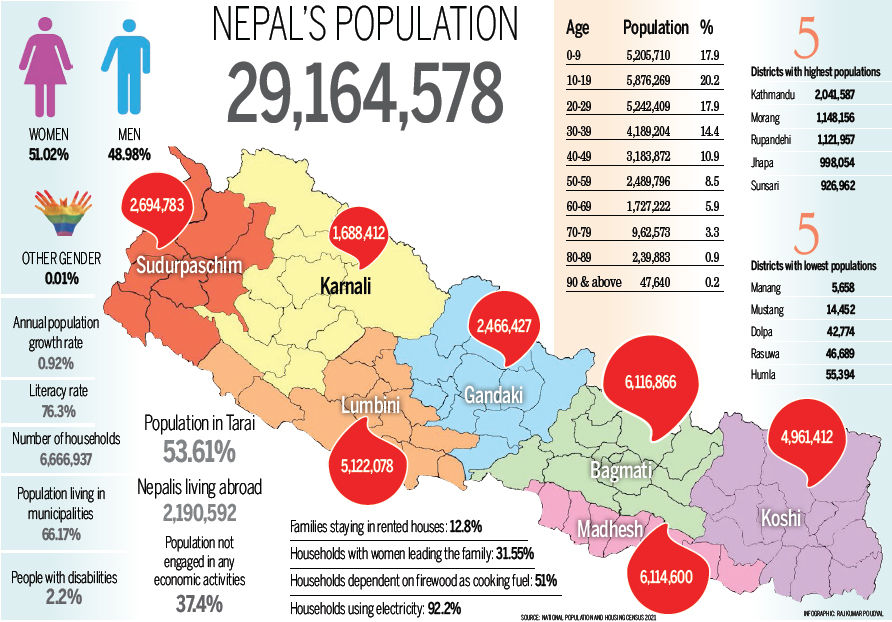
Final census report does not break down population based on ethnicity, language, religion.
- PRITHVI MAN SHRESTHA

KATHMANDU,
Nepal saw a significant drop in the population aged 14 years or below  while the number of people aged 15 years or above rose significantly during the period from 2011 and 2021, indicating that the country’s population is ageing.
According to the final data of the Population Census 2021 made public on Friday, the country’s total population stood at 29,164,578. Of the total, the share of children aged 14 years or below was 27.83 percent, a marked drop from 34.91 percent in the 2011 census.
When it comes to the share of the working age population in the 15-59 years age group, it grew to 61.96 percent in 2021 from 56.96 percent in 2011. The share of the population aged 60 years or above stood at 10.21 percent, a rise from 8.13 percent in 2011, according to the new census report.
People have started having fewer babies. According to the census report, annualised population growth from 2011 to 2021 stood at 0.92 percent, an 80-year low since Nepal started holding population census in 1911.
Nepal’s annual population growth rate now is less than the global average of 1.01 percent in 2020, according to the World Bank statistics.
“Fall in the population of children, who are dependent on their parents, and the rise in the working-age population is good for the country as it suggests the country has entered the phase where it can enjoy demographic dividend,” said Nebin Lal Shrestha, deputy chief statistical officer at the National Statistics Office. “But Nepal is deprived of this demographic advantage as youths are migrating to foreign lands in search of jobs for the lack of opportunities in the country.”
Officials and experts, however, are also worried that a reduction in the population of children and rise in elderly population could contribute to a slump in economic activities in the long term.
“Policymakers need to factor in a larger share of the ageing population in the future considering the current trend of low birth and high life expectancy,” said Hem Raj Regmi, another deputy chief statistical officer during the unveiling of the census report.
Various factors including outmigration of Nepali youths, rising cost of child-rearing, greater participation of women in workforce, and a delayed age for marriage, have collectively led to a decrease in the fertility rate, according to officials and experts.
On the other hand, with the nuclear family model growing popular and paucity of caregivers, people are having fewer babies, they said.
“The implication is that the high number of economically active population who will age over time will not be adequately replaced,” said Govinda Nepal, former member of the National Planning Commission. “The number of people who rely on others for support will grow.”
According to Nepal, there is nothing to be worried about the ageing population as the country’s working-age population has also been growing. “But it is necessary to analyse the pattern of ageing and bring a policy on handling the future growth in elderly population,” he added.
The state’s liability for social security of the elderly population along with other beneficiaries has been rising. The Sher Bahadur Deuba-led government reduced the eligibility age for elderly allowance to 68 years from 70 years from the current fiscal year 2022-23, putting a considerable financial burden on the state treasury.
According to the population census, there are 1.52 million people aged 68 years or above. The number of people of this age group was 999,417 as per the 2011 census.
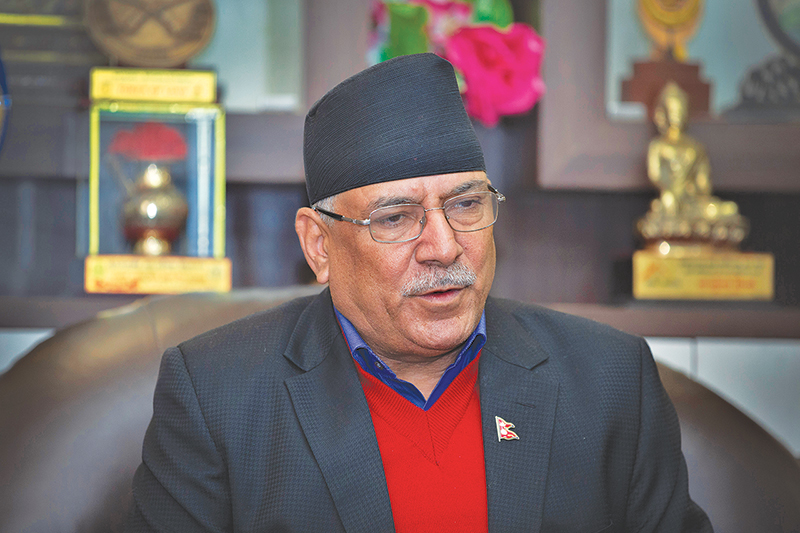
Prime Minister Pushpa Kamal Dahal, who unveiled the final report of the census on Friday, also admitted that there has been an imbalance in the rate of population growth between younger and older age groups. “The census data will help bring special programmes aimed at population management,” he said.
The population census is crucial for devising policies and strategies for the next decade. “It will be key to budgeting and service delivery as per the development needs and diverse areas and make targeted investments,” said Won Young Hong, Country Representative of United Nations Population Fund.
Even though the report gave detailed census data, the national statistics agency is yet to unveil population breakdowns, based on ethnicity, language and religion.
“As various institutions and individuals representing different ethnicities, languages and religions had diverse opinions on the categorization of population in certain sub-groups, we decided to wait for consensus on the matter,” said Shrestha, of the National Statistics Office.
He said that his office was holding consultations with various ethnicity and language related constitutional bodies but no consensus has been reached. “We hope to reach a certain consensus in the next four months after which we will produce population data based on ethnicity, language and religion,” he added
The erstwhile Central Bureau of Statistics, which has now been renamed as the National Statistics Office, had conducted a census from November 11 to November 25 in 2021. Though the Central Bureau of Statistics had unveiled a preliminary census report in January last year, it took more than a year for the National Statistics Office to produce the final report.
“Initially, it was delayed by elections,” said an official of the National Statistics Office. “We had planned to unveil the final report in January, but that could not happen as the Election Commission barred us from doing so ahead of the presidential election.”
According to officials of the national data agency, the final census report does not include the population of Kalapani, Lipulekh and Limpiyadhura areas even though their population was included in the preliminary report made public last year.
“We could not reach these regions for census-taking owing to non-cooperation from the Indian authorities,” said Shrestha. “We have assessed that the total number of people in these regions is under 500. But we didn’t include the population of this region in the final report as verification was difficult.”

HOME PAGE

Power play: Provinces taking cue from centre

Emerging coalitions are working to remove the CPN-UML from provincial governments.
- TIKA R PRADHAN

KATHMANDU, 
The ripples of the change in the power equation in Kathmandu are being felt in provinces. On Friday, CPN (Maoist Centre) decided to withdraw its support and also pulled out of the UML-led Gandaki provincial government, making a new government necessary there.
In Bagmati, the UML withdrew from the government as Chief Minister Shalikram Jamkattel of the Maoist Centre got the trust vote for the second time on Friday.
As the new ruling coalition at the Centre is preparing for a package deal on sharing of portfolios in Singha Durbar and provincial governments, discussions have started at the provincial level to change the power equation.
In Gandaki, UML chair KP Sharma Oli’s close aide Khagaraj Adhikari must secure the assembly’s confidence within a month or resign as the chief minister. With 22 seats in the 60-strong provincial assembly, Adhikari was appointed the chief minister with the backing of the Maoist Centre and the Rastriya Prajatantra Party on January 9. The provincial government had four ministers from the UML including the chief minister, two from the Maoist Centre and one from the RPP.
With 27 seats in the assembly, the leader of the Nepali Congress parliamentary party Surendra Pandey is preparing to lead the provincial government although the Maoist Centre is also laying claim to government leadership for the first half term.
“Now, the process of change in the provincial government has started with our parliamentary party’s decision to withdraw support to the government,” said Hari Chuman, outgoing minister and parliamentary party leader of the Maoist Centre. “We, the two ministers of our party, have resigned.”
Now the Adhikari-led government has fallen into minority.
Appointing ministers is taking time not only in Kathmandu but also the provinces. “I wanted to fill the Cabinet right away, but I think it may take a few days,” Jamkattel told the Post after securing the trust vote on Friday.
Maoist leaders of the province claimed that Prime Minister Dahal and Congress President Sher Bahadur Deuba have told the provincial leaders that the Maoist Centre will lead the first half term and the Congress the second half.
With the major parties in the coalition encouraged by the recent understanding among the top leaders to rule the provinces by turns, the provincial committees of the parties have started discussions to topple the UML-led governments and change the coalitions in places where the Congress, the Maoist Centre and the Janata Samajbadi Party lead.
On Tuesday, Dahal said at a function in Gorkha that all major parties will take turns to lead the provincial governments. “We are still discussing provincial governments and have yet to arrive at a conclusion,” said Purna Bahadur Khadka, the Congress vice president and a key negotiator. “It’s obvious that all the provincial governments will be led by major parties of the coalition by turns.”
The previous seven-party coalition had shared four provincial governments: Koshi, Gandaki, Lumbini and Sudur Paschim going to the UML, Bagmati and Karnali led by the Maoist Centre, and the Janata Samajbadi Party steering the Madhesh Province.
Although Sudurpaschim was allocated to the UML, the party could not form government there after the Nagarik Unmukti Party refused to give a vote of confidence. Now a Congress-led government has been installed with the support of the Maoist Centre, the CPN (Unified Socialist) and the Nagarik Unmukti Party. In Lumbini Province, major parties in the assembly—the Maoist Centre, the Nagarik Unmukti, the Janata Samajbadi and the Loktantrik Samajbadi Party—have started discussions to withdraw their support to the government led by the UML’s Lilanath Giri. Giri received a vote of confidence from all these parties and independent assembly members on January 19.
The process of forming a new government will begin once the Maoist Centre withdraws its support to the Giri government. In Koshi, among the 93 provincial assembly members, the UML has 40, the Congress has 29, the Maoist Centre 13, the RPP 6, the Unified Socialist four and the Janata Samajbadi has one member.
The two sets of parties there are in a deadlock: the coalition of the UML and the RPP has 46 seats, while the other that includes the Congress, the Maoist Centre, the Unified Socialist and the JSP, also has 46 seats. In case of a tie, the vote of the Speaker, who was elected from the Maoist party, will be decisive.
“We are yet to start discussions on changing the government given the magic number we have in the provincial assembly,” said Indra Aangbo, the Maoist Centre parliamentary party leader. “Discussions will begin soon.”
The CK Raut-led Janamat Party, the Mahantha Thakur-led Loktantrik Samajbadi and the Ranjita Shrestha-led Nagarik Unmukti have formed a working alliance in an attempt to bargain for a bigger share of government. However, Shrestha said her party will not join any government until her husband Resham Chaudhary is not released from prison. Chaudhary is doing time at Dillibazar jail after he was convicted in the Tikapur incident of 2015.
“The parties in the working alliance will have our support but we won’t join any government until our demands are met,” Shrestha told the Post. In Madhesh Province too, the Janamat Party is laying claim to government leadership. Party chair CK Raut has already told the top leaders of the 10-party coalition that his party should get the chief minister of Madhesh as the Janata Samajbadi got the Vice President.
JSP leader Ramsahay Prasad Yadav has been appointed the country’s Vice President.
The 107-strong provincial assembly includes 24 members of UML, 22 of Congress, 19 of JSP, 13 of Janamat, and nine each of the LSP and Maoist Centre. Likewise, there are seven members from the Unified Socialist and one each from the RPP, the Sanghiya Samajbadi and the Nagarik Unmukti, besides one independent member. According to leaders, the UML’s ministers will be replaced by Congress members.
The Maoist Centre’s Ram Kumar Sharma-led Karnali government will incorporate the Congress, the largest party in the province. In the 40-strong provincial assembly, the Congress has 14 seats, the Maoist Centre 13, the UML 10, while there are one each held by the Unified Socialist, the RPP and independent candidates. “We are waiting for instructions from the top leaders of our coalition,” said Jeevan Bahadur Shahi, parliamentary party leader of the Congress in Karnali Province and the former chief minister.

Page 2
NATIONAL

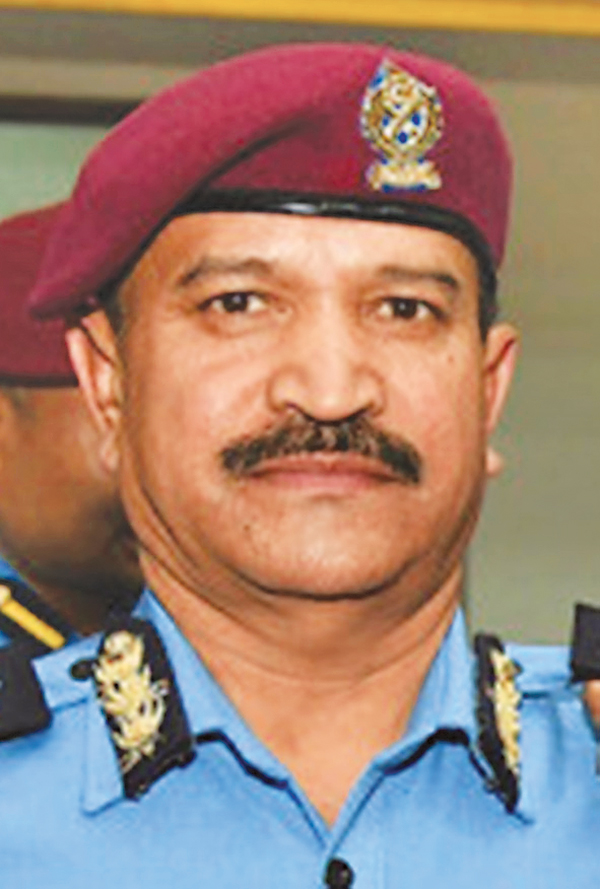
Basanta Kunwar is new Nepal Police chief

- Post Report

Kathmandu,
Additional Inspector General Basanta Kunwar has been promoted to Inspector General of Nepal Police.
A Cabinet meeting on Friday selected Kunwar for the post.
Kunwar was elevated to the senior-most position of Nepal Police after Inspector General Dhiraj Pratap Singh retired on Friday after 30 years of his service.
Singh and his batchmates had lobbied to extend the 30-year service period but the government gave continuity to the compulsory retirement provision.
Other additional inspector generals Tek Prasad Rai, Deepak Thapa, Shyam Lal Gyawali and Kiran Bajracharya were also in the race for the top post. They were promoted to AIG only on Monday.
Kunwar joined the police force in March 19, 1995, as an inspector and will retire in mid-April 2025. He has the experience of policing in several districts in various capacities and also at Kathmandu Valley Crime Division and the Nepal Police Headquarters.
Kunwar has been accused of human rights violations during the Maoist insurgency. Conflicts victims on Thursday had objected to the promotion of Kunwar to AIG but the government promoted him to the top post, ignoring the concerns over his tainted past.
Kunwar, who was deployed in the UN peace mission in Liberia, was recalled in October 2011 over his alleged involvement in a 2009 torture case in Nepal. A youth from Siraha, arrested on theft charges, was severely tortured in 2009 when Kunwar headed the police force in the district.

NATIONAL

Dhorpatan hunting reserve faces opposition to buffer zone plans

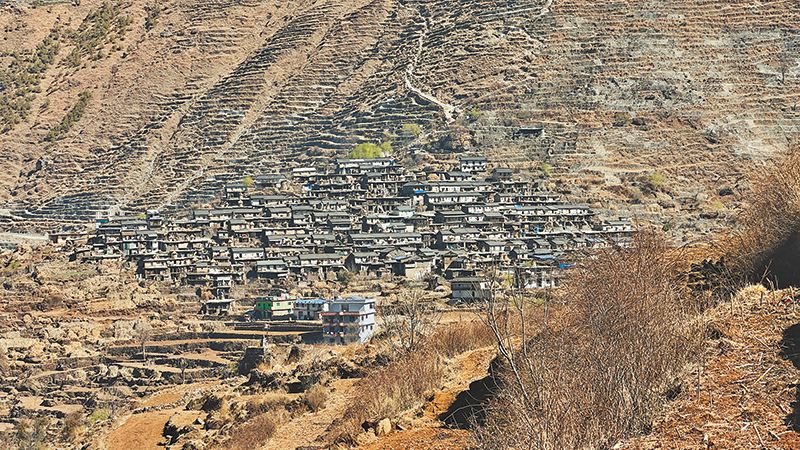
The residents of Putha Uttarganga Rural Municipality, which falls inside the hunting reserve, fear a buffer zone would restrict their movement and may cause displacements.
- MAHESH KC
The Takgaun village in Putha Uttarganga Rural Municipality inside the Dhorpatan Hunting Reserve.   Post Photo: Mahesh KC

WEST RUKUM,
The Dhorpatan Hunting Reserve, the only reserve that allows game hunting in Nepal, has been struggling to create a buffer zone in its effort to protect the bio-diverse reserve.
Spread over a total area of 1,325 square kilometres, the hunting reserve is in the Dhaulagiri mountain range and touches Baglung, Myagdi, and East Rukum districts. Sixty percent of the reserve lies in East Rukum covering much of the Putha Uttarganga Rural Municipality.
The reserve was established in 1983 and its notice was published in the Nepal gazette four years later. The reserve is home to 32 species of mammals and 130 bird species.
According to Ranger Binod BK of the Taksera sector office, the reserve has been struggling for a long time to create a buffer zone but their efforts have been unsuccessful largely due to objections from the residents of the Putha Uttarganga Rural Municipality. “The locals fear they would be displaced if a buffer zone is created as most villages of the rural municipality fall under the reserve area,” said BK.
Wards 1, 2, 3 and 4 and some areas of wards 10 and 11 fall inside the hunting reserve.
Shir Bahadur Budha of Ward 10 says it would be better for the locals if the hunting reserve dropped the buffer zone idea. “Most human settlements of the rural municipality fall inside the hunting reserve. So if they created a buffer zone then that would limit our freedom of movement and that would simply be unacceptable,” he said.
However, Abinash Thapa, assistant conservation officer of the reserve, disproves the notion that a buffer zone would cause displacement of the locals or restrict their movement.
“We will create a buffer zone and form a local management committee to oversee the zone. Also, at least 30 to 50 percent of the income generated by the hunting reserve will go towards the committee, which will spend the money on various development works in the communities,” said Thapa. “Having a buffer zone means there will be fewer human-animal conflicts and it also helps in conservation efforts.”
Thapa also claimed that no settlement will face displacement. “Creation of a buffer zone will not have any negative impact on the locals or their livelihoods, but it’s hard to convince them since they appear unprepared to listen to us,” he said.
According to Thapa, the hunting reserve has seven blocks designated for hunting, four of which are in East Rukum.
“The first hunting season starts from mid-September and ends in mid-November, and the second season starts in mid-March to mid-May every year. Hunters from all over the world have started coming already,” said Thapa.
The government gives hunting enthusiasts permission to hunt specific species in the reserve each year. The Department of National Park and Wildlife Conservation has issued permits to hunt eight Himalayan blue sheep and 12 Himalayan tahrs through competitive bids this season, according to BK, the ranger.

Page 3
Page 4
NATIONAL

Dahal in a fix amid competing demands by coalition members

Cabinet expansion unlikely before Tuesday, say leaders.
- Post Report
Prime Minister Dahal had earlier said that he would give full shape to the Cabinet by Friday.  Post File Photo

KATHMANDU,
Ahead of taking a vote of confidence, Prime Minister Pushpa Kamal Dahal had told reporters that he would conclude the Cabinet expansion by March 24. But the deadline set by the prime minister expired on Friday and if the ruling party leaders are to be believed, the Cabinet expansion is unlikely to be completed before next Tuesday.
Party leaders in the ruling coalition say there is a dispute among the parties over the number of ministries each one wants to lead. As well, there are issues related to a package deal among the parties, including the formation of  governments in the provinces, besides preparation of a common minimum programme of the ruling alliance.
“On Friday evening too, Prime Minister Dahal called a meeting of the top leaders of the ruling parties for the allocation of the ministries which would get divided among the ruling parties. This is a work in progress and there are some positive developments, but it will take one or two days for a breakthrough,” said an aide to the prime minister.
Earlier, it used to take 10–15 days for Cabinet expansion by the prime minister after taking the vote of confidence. But this time, it won’t take that long,” said the Nepali Congress Vice President Purna Bahadur Khadka, a key negotiator from the party in the power sharing deal.
Khadka will probably lead the party in the government and is looking for the portfolio of deputy prime minister and minister for finance. Party spokesman Prakash Sharan Mahat is also a top contender for the finance minister’s job.
Though the Nepali Congress is eyeing as many as 10 ministries in the Cabinet, Dahal has already communicated to the Nepali Congress leaders that it would impossible for him to give 10 ministries to the Nepali Congress alone as he has to accommodate other parties as well that voted for him during the floor test on March 20.
“We are still in discussions. It will take some more time, the cabinet expansion is unlikely to be completed any sooner than 4-5 days,” Khadka said.
From the Nepali Congress, besides Khadka and Mahat, three other senior leaders—Dr Shekhar Koirala, Bimalendra Nidhi and Prakash Man Singh—have expressed their intent to lead their party in the Dahal-led coalition government.
Party Vice-president Dhan Raj Gurung, assistant general secretaries Kishor Singh Rathore, Badri Pandey and Jeevan Pariyar, have also shown their interests in joining the government. Other lawmakers, namely NP Sawad, Dipak Khadka, Sita Gurung, Mohan Bahadur Basnet, Dhan Raj Gurung, Pradip Poudel, Uday Sumsher Rana, Binod Chaudary, Dig Bahadur Limbu, Tejulal Chaudhary, Ajay Kumar Chaurasiya, Ramesh Rijal, Arjun Narsingh KC too, want to join the government. Out of the eight Cabinet seats, Deuba has agreed to give two to the rival Shekhar Koirala-Gagan Thapa team, but Shekhar has named three leaders—party vice president Gurung, and Limbu and Chaudhary—as his picks.
Meanwhile, the CPN (Unified Socialist) is demanding more than three ministerial portfolios and a seat in the upcoming by-elections, which are being held in Tanahun, Bara and Chitwan on April 23.
“We won’t join the government if we are not given three ministries,” senior party leader Jhalanath Khanal said.
In order to fix the number of ministries to be led by the ruling parties, Prime Minister Dahal has been holding consultations every day with top leaders of the ruling parties, but has failed to reach a conclusion yet.
The Unified Socialist is also staking its claim to either the Home Ministry or the Finance Ministry which both the CPN (Maoist Centre) and Nepali Congress want for themselves.
“We have already sacrificed a lot in the name of alliance and coalition, so we have demanded at least one major ministry,” said a senior Unified Socialist leader.
Since the deadline set by the prime minister for Cabinet expansion expired on Friday, Haribol Gajurel, chief political adviser to the prime minister said  there must be some positive development and breakthrough within a day or two.
Some ruling party leaders said that since the number of parties supporting Dahal have increased, there is a likelihood that not all parties would get  ministries that they have staked their claims to.
“We have staked our claims to more than three ministries, but the way new parties have supported the government and expressed their intent to join the government, we might reduce our demand to two ministries,” senior Janata Samajbadi Party leader, Raj Kishor Yadav said. “We are expecting the cabinet expansion to be completed within two to three days.”

NATIONAL

International rights groups slam bill on transitional justice law

The bill, if adopted in its current form, will not adequately provide for the effective prosecution of serious crimes under international law, the groups say.
- Post Report

KATHMANDU,
Three international human rights organisations have joined Nepal’s conflict victims and human rights activists in criticising the amendment bill on the Enforced Disappearances Enquiry, Truth and Reconciliation Commission Act saying the draft contradicts domestic laws.
Since it is not in line with Nepal’s international legal obligations, the bill will not provide justice to the victims, they argue.
Issuing a joint statement on Friday, Amnesty International, the Human Rights Watch, and the International Commission of Jurists said the bill, if adopted in its existing form, will not adequately provide for an effective prosecution of serious crimes under international law. They have also questioned the reluctance of the government to take proper consultations with the victims over the content of the draft legislation, arguing it has seriously undermined credibility with its current approach.
The international watchdogs have demanded a revision of the bill so that it complies with the Supreme Court’s rulings and international human rights law and standards before its parliamentary endorsement. The revision process, they say, should ensure adequate consultation with conflict victims on the content of the proposed legislation.
Conflict victims and human rights activists have been objecting to the bill and demanding revision of several provisions before it is tabled for a vote in the federal parliament. Insurgency-era victims, afflicted by both the state and the Maoist sides, said the legitimacy of the transitional justice process will always come under question if it fails to address their concerns.
On March 9, the Pushpa Kamal Dahal administration registered the bill in the House of Representatives retaining all the disputed provisions of an earlier bill, which the government had withdrawn from parliament last year after widespread criticism. The three international organisations had expressed serious reservations in the previous bill as well.
“Key provisions of this bill appear to be designed to shield alleged perpetrators from prosecution for some of the most serious crimes under international law,” Dinushika Dissanayake, Amnesty International’s deputy regional director for South Asia, was quoted as saying in the statement. “If it is rushed through Parliament without significant changes, it cannot be the basis for a process that has the support of conflict victims, nor will it have any legal credibility at home or abroad.”
Both the state security forces and the then Maoist insurgents committed serious human rights crimes and violations of international humanitarian law during the armed conflict in Nepal from 1996 to 2006. The Comprehensive Peace Agreement that ended the insurgency included a commitment to setting up a truth and reconciliation commission “to investigate [the] truth about people seriously violating human rights and being involved in crimes against humanity”.
However, the governments, led successively by all major political parties, have blocked efforts at truth and justice, according to the statement.
The present bill, if endorsed in the current form, would allow many people, allegedly responsible for abuses amounting to crimes under international law, to evade justice. It would result in the Nepali justice system continuing to abandon many victims and survivors, some of whom have waited two decades for truth and redressal. “There have been almost no successful prosecutions of serious crimes under international law since the conflict ended in 2006,” said the statement.
In the statement, the international human rights organisations have pointed out several problems in the bill. Along with the flaw in the categorisation of serious and non-serious human rights violations, the bill also fails to establish a special investigation unit to collect evidence. It also fails to clarify how the principle of non-retroactivity of criminal law would apply in a manner consistent with international law.
International law requires the prosecution of certain serious crimes, such as torture and enforced disappearance, if warranted by evidence, irrespective of whether they were crimes under domestic law when they were committed, according to the statement.
“The bill fails to clarify which ‘applicable law’ would be used to prosecute those involved in serious crimes. The Penal Code, which came into force in 2018, prevents retroactive applicability of its provisions. Moreover, the Penal Code includes statutory limitations for the crimes of rape, torture and enforced disappearances,” said the statement.
The international human rights organisations also said the provision that the judges in the Special Court would be appointed in consul-
tation with the Judicial Council doesn’t ensure transparency of their appointment.
“Once again, Nepal’s political leaders are attempting to legislate an escape hatch for some of those responsible for serious crimes under international law,” Meenakshi Ganguli, South Asia director at Human Rights Watch, was quoted in the statement as saying. “After over 16 years of trying and failing with this strategy, it should be clear to them that only a credible and legitimate justice process will successfully complete the peace process.”
They have also urged the United Nations and other diplomatic partners of Nepal to speak up on the matter.
“The UN and Nepal’s diplomatic partners should make it clear that only a process that meets international legal standards can receive international support and recognition, and insist on justice for serious crimes under international law so that victims have the opportunity to see perpetrators held to account,” the rights group said.

Page 5
MONEY

Half of Nepali homes still burn wood to cook food

Among the 6.66 million households in the country, 51 percent use firewood and 44.3 percent use liquefied petroleum gas in their kitchens.
- KRISHANA PRASAIN
Irregular electricity supply has prevented Nepalis from switching from LPG to electricity to do their cooking, leaving the country completely dependent on imported fuel.  Shutterstock

KATHMANDU,
More than half of Nepali households still burn firewood to cook their food even though the use of liquefied petroleum gas (LPG) has doubled in the last 10 years, says the final report of the latest national census released by the National Statistics Office on Friday.
Among the 6.66 million households in the country, 51 percent use firewood and 44.3 percent use LPG in their kitchens.
Burning biomass creates air pollution that causes a sweeping array of health harms, experts say.
Among other types of cooking fuels, 0.5 percent of the families use electricity, 2.9 percent use dung cakes, 1.2 percent use biogas and 0.1 percent use kerosene or other fuels.
Karnali province which has 366,037 households is the largest user of firewood in the country, with 82.2 percent of them relying on wood burning stoves for cooking. According to the census, only 13.9 percent of households in Karnali use LPG.
Bagmati province, which contains Kathmandu Valley and has 1.56 million households, leads in LPG consumption with 69.8 percent of the families using it for cooking. As per the report, 29 percent of the households in the country’s financial hub are still using firewood in their kitchens.
In 2011, as per the previous census, 5.42 million Nepali households, or 21.03 percent of the total, used LPG for cooking purposes.
Nepalis started using LPG in a big way from 1995-96 when it was formally introduced as an alternative to kerosene in urban and semi-urban areas. At that time, Nepal used to import 18,600 tonnes of LPG annually.
In 2001, only 7.7 percent of Nepali households were found to be using LPG as a primary fuel for cooking. Consumption started rising after 2007-08, soaring to 19.59 percent of the households.
Then load-shedding began, coinciding with government restrictions on collecting firewood. LPG demand then took off, reaching 115,813 tonnes in 2008-09, and kept climbing.
It rose by 21.89 percent to 141,171 tonnes in 2009-10.
Consumption reached 159,286 tonnes in 2010-11, and by 2020-21, it had swollen to 536,028 tonnes. Nepal currently spends Rs36.15 billion annually to import LPG.
“There are several reasons why LPG has not reached all households,” said Sushil Bhattarai, former deputy managing director of Nepal Oil Corporation. According to him, the first reason is affordability. The initial investment required to switch to LPG amounts to Rs6,000.
“A gas stove costs around Rs2,000 and a cylinder of gas costs Rs3,800 including the deposit for the cylinder,” he said. “A cylinder of gas lasts a month or two. So, for many families in the low-income bracket, LPG is expensive.”
There are still many districts that have no access to LPG because of the difficult terrain, Bhattarai said.
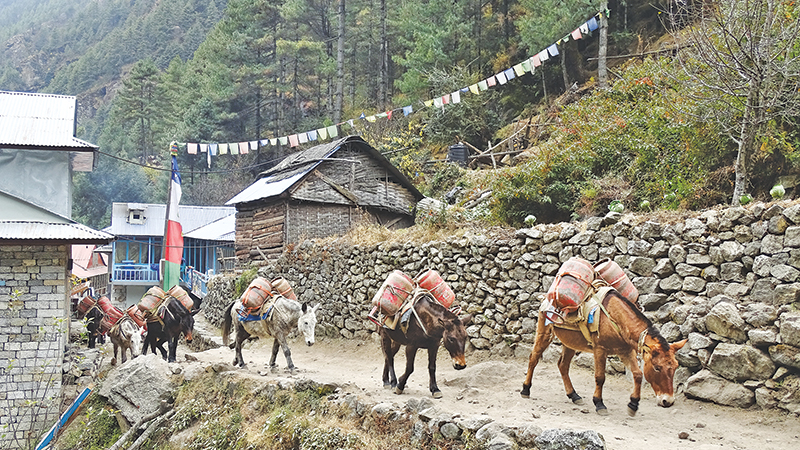
“A cylinder weighs 29 kg. Small cylinders are not available, which makes it difficult to transport them to the highlands as it has to be done by porters or pack animals,” he said. “This is one reason why traders are not expanding their LPG business in the remote Himalaya, except for the Everest region.”
In the high Everest region, one of the world’s most expensive destinations, a gas cylinder costs Rs10,000. The retail price of a cylinder in Kathmandu is Rs1,800. The government subsidises cooking gas by Rs359 per cylinder.
As increasing LPG consumption increases dependency, the government has no plans to supply cooking gas cylinders to remote areas like it supplies rice.
Irregular electricity supply has prevented Nepalis from switching from LPG to electricity to do their cooking, leaving the country completely dependent on imported fuel.
For the state-owned monopoly Nepal Oil Corporation, the cooking gas business is a big money maker. But for the country, it’s a loss.
“LPG consumption is growing at a rate of 15 percent annually,” Bhattarai said. “Nepal consumes 100,000 cylinders per day.” The irony is that Nepal currently is an electricity-surplus country and could switch to electricity for cooking needs.
“LPG coverage in India is 99 percent as the government makes it available in all parts of the country due to the health impact on women from burning firewood,” Bhattarai said.
State-owned power utility Nepal Electricity Authority knows that electricity can be cheaper, and it also knows that people are suffering from the irregular power supply. But so far, the grievances of consumers have never been addressed.
Kul Man Ghising, managing director of the Nepal Electricity Authority, told the Post in a recent interview that it was vital to ensure an uninterrupted supply of electricity to encourage people to switch to electric cooking.
“LPG cannot be replaced overnight. If people shift to electric cooking from LPG, it will increase load demand,” he said. “But since we don’t have proper infrastructure, it is immediately not possible to supply uninterrupted electricity supply as per demand.”
Ghising said they would require an additional 500-600 megawatts if all LPG cylinders in Kathmandu Valley were to be replaced.
The country has made progress in the use of electricity. According to the census, 92.2 percent of the households in Nepal have access to electricity. The figure was 67.3 percent during the last census in 2011.
The census report said that 73.15 percent of households have phone access and 72.94 percent of households have smartphones. Nepal imports mobile phone sets worth Rs38 billion annually.
Similarly, 49.37 percent of households own a television, 37.72 percent of households have access to the internet, and 35.29 percent of Nepali households own a bicycle.
The census shows that 27.3 percent of the population owns motorcycles or scooters, and 15 percent of the population uses computers or laptops. In Nepal, 4.2 percent use washing machines, 23.7 percent own refrigerators and 53 percent own fans.
As per the census, out of the total 23.95 million people over 10 years, 15.68 million or 65.5 percent are economically active.

MONEY

Coca-Cola and Doko Recyclers install 15 PET Collection bins

Bizline

KATHMANDU: Coca-Cola in Nepal and Doko Recyclers announced the placement of 15 informative PET Collection Bins across Kathmandu Valley and Bharatpur on Thursday. This initiative is the second phase of the joint project ‘Refresh and Recycle’ which initially commenced in August 2020 with the support of local authorities. The project is a PET bottle collection campaign which aims to raise awareness and educate communities about giving new life to PET bottles through a recycling process, reads the press release issued by the company. (PR)

Page 6
SPORTS

Ronaldo, Kane break records in wins for Portugal, England

The Portugal striker makes record 197th appearance for his country as they thump Liechtenstein 4-0. Kane becomes all-time leading English scorer after a goal against Italy.
- ASSOCIATED PRESS
Portugal’s Cristiano Ronaldo scored two goals against Liechtenstein during the Euro 2024 qualifying match in Lisbon on Thursday.  AP/RSS

New York,
It was a record-breaking night for Cristiano Ronaldo and Harry Kane  as qualifying for the European Championship in 2024 got underway on  Thursday.
Already the leading scorer in men’s international  football, the 38-year-old Ronaldo now has more international appearances  than any other male player after racking up No 197 in Portugal’s 4-0  win over Liechtenstein. The former Real Madrid and Manchester  United striker marked the occasion by converting a penalty and adding  another second-half goal—a powerful free kick from the edge of the  area—to move onto 120 in international matches.
Kane, meanwhile,  became England’s outright leading scorer of all time by netting a  first-half penalty in a 2-1 win at Italy. It lifted Kane to 54 goals for  his country, one more than Wayne Rooney.
Qualifying for Euro 2024, which will take place in Germany, started three months after the World Cup finished.
Call it belated revenge for England. The  meeting with Italy in Naples was a repeat of the Euro 2020 final won by  the Azzurri at Wembley Stadium. The teams have met since then—twice,  in fact, with Italy gaining a win and a draw in Nations League  qualifying last year. This time, England held on after first-half  goals by Declan Rice and Kane, who tucked away a spot kick awarded  following a VAR review after it was determined that Italy defender  Giovanni Di Lorenzo touched the ball with his hand while attempting to  prevent Kane from reaching a corner.
Kane had missed his last  penalty attempt for his country, late in the 2-1 loss to France in the  World Cup quarterfinals last year. “It had to be a penalty, of course,” a smiling Kane said of his record goal.
Argentina-born  forward Mateo Retegui, who has Italian citizenship through his maternal  grandmother, pulled a goal back on his debut and England played with 10  men from the 80th after left back Luke Shaw collected two yellow cards  in the space of 54 seconds. Italy lost to England in a competitive match for the first time since a World Cup qualifier at Wembley back in 1977.
It  was a disappointing way for the Azzurri to start their latest  qualifying campaign for a major tournament, having failed to get into  the last two World Cups. “We might be starting with an uphill struggle this time,” Italy coach Roberto Mancini said, “but let’s hope we end it better.”
North Macedonia beat Malta 2-1 in the other match in Group C, which also contains Ukraine.
Roberto  Martinez enjoyed a comfortable start to his tenure as Portugal coach  after handing Ronaldo a start against Liechtenstein. The striker  was left out of Portugal’s knockout-stage matches at the World Cup but  was selected up front alongside Joao Felix—and repaid the faith shown  in him by Martinez, who left his role as Belgium after the tournament in  Qatar.
Joao Cancelo and Bernardo Silva scored before Ronaldo’s double in Lisbon. “It’s  a new cycle,” Martinez said. “It is very important that a player shows  commitment and that he can use his experience. Cristiano has that: A lot  of experience and a lot of commitment to the national team.” Also in Group J, Bosnia-Herzegovina beat Iceland 3-0, while Slovakia and Luxembourg drew 0-0.
There was a sense of poignancy when Denmark and Finland met for their opening Group H qualifier at Parken Stadium in Copenhagen.
The last time the teams met was at Euro 2020 and it was the game—and same venue—when Denmark playmaker Christian Eriksen collapsed with cardiac arrest.
Nearly two years later, Denmark won 3-1 thanks to a hat trick from striker Rasmus Hojlund in his first start for his country. Slovenia beat Kazakhstan 2-1 and Northern Ireland defeated San Marino 2-0.

SPORTS

APF pull off second consecutive win

Unbeaten half century by Sita Rana Magar gives APF a 15-run victory over Sudurpaschim.
- Sports Bureau
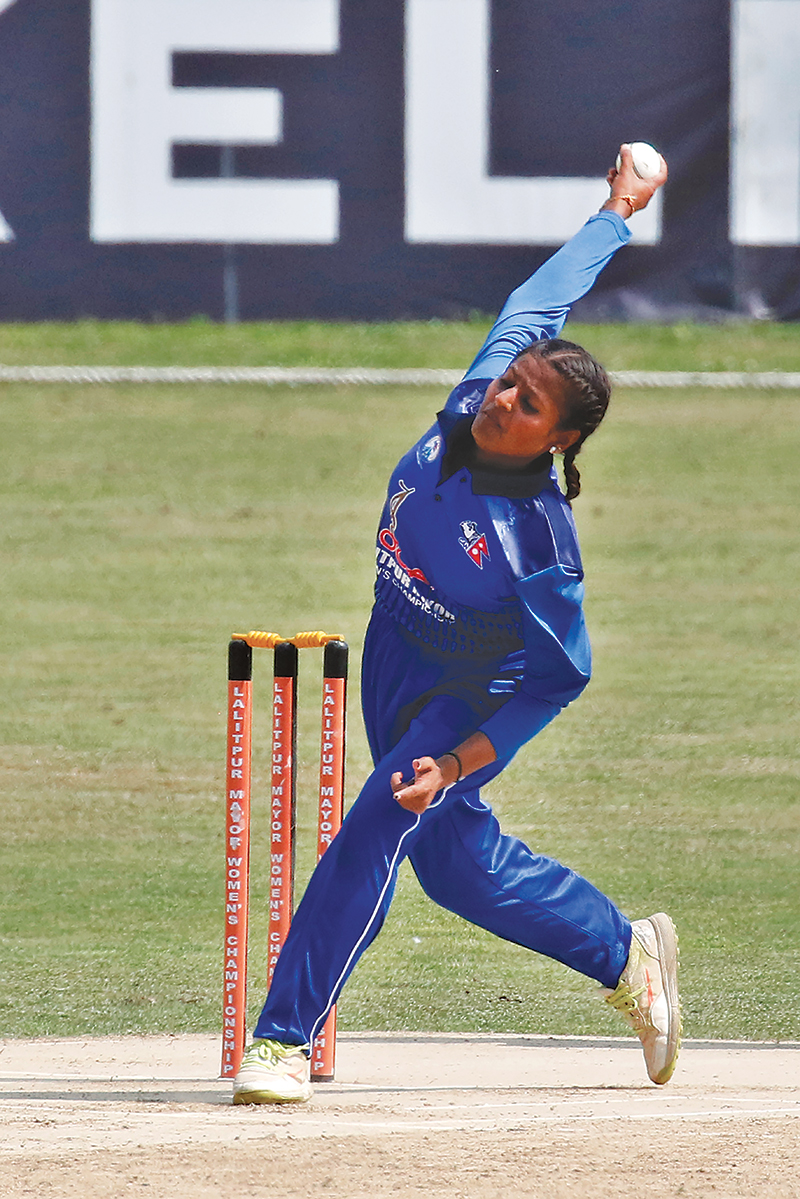
Nisha Shah of Koshi Province claimed three wickets of Lalitpur Mayor XI at the TU Cricket Ground in Kirtipur on Friday.   Post Photo

KATHMANDU,
Captain Sita Rana Magar cracked an unbeaten half century for Nepal Armed Police Force (APF) Club as they beat Sudurpaschim Province by 15 runs to register second victory in a row in the Lalitpur Mayor Women’s Cricket Championship at the TU Ground in Kirtipur on Friday.
Sent in to bat first, Rana Magar and Indu Barma shared an 80-run stand for the second wicket as APF posted 121-2 in the allotted 20-over. Chasing the target, Kabita Kunwar’s half century went in vain for Sudurpaschim as they got restricted to 106-6.
The second victory from as many games puts APF, who defeated Madhesh Province by 10 wickets on Thursday, on top of the standing with four points. Sudurpaschim, who beat  hosts Lalitpur Mayor’s XI by 51 runs on Thursday, have two points from as many games.
After losing their opener Jyoti Pandey on 13 runs made off 22 balls, the pair of Rana Magar and Barma created the foundation for a challenging total. The player-of-the-match Rana Magar played an unconquered innings, making a 59-ball 52, studded with seven hits to the fence.
Barma scored a 37-ball 45 that included five hits to the boundary. She was caught by Kabita Joshi off a delivery bowled by Ishwori Bist in the last over. Mamta Chaudhary scored an unbeaten three runs.
Bista was the only Sudurpaschim player to take a wicket. She gave away 29 runs in her four-over spell.
Chasing the target, Sudurpaschim kept losing wickets at regular intervals, despite a half century by opener Kabita Kunwar. She cracked 51 off 60 balls, comprising three boundaries and two sixes before being stumped by wicketkeeper Pandey off a Rana Magar delivery. Kabita Joshi, coming in to bat at number six, remained unbeaten on 17, made of 26 balls. Samjhana Khadka was the other player to touch a double-digit score, an 18-ball 17.
APF’s Suman Bist claimed two wickets while Rana Magar and Barma shared a wicket each.

Koshi off to winnings start
National captain Rubina Chhetry-led Koshi Province made a winning start with a seven-wicket win over Lalitpur Mayor’s XI, inflicting a second defeat on the home team.
Lalitpur, who chose to bat first, were bowled out for 65 runs off 16.5 overs. Koshi raced to an easy victory in 12 overs, scoring 66-3.
Only two batters of Lalitpur managed to reach double digit scores with opener Laxmi Chaudhary contributing 23 runs off 32 balls and tailender Manish Upadhayay remaining not out on 10 runs off eight balls.
Nishal Shah of Koshi claimed three wickets conceding 11 runs in her four-over spell and won the player-of-the-match award. Apsari Begam took two wickets.
Chasing the target, Begam contributed an unbeaten 29 runs off 32 balls, the highest of the innings, which included four boundary hits. Captain Chhetry hit an 18-ball 13.
Asmina Karmacharya of Lalitpur picked up two wickets. She gave away 26 runs in her four-overs of bowling.
Madhesh will next play against Sudurpaschim and APF will take on Koshi Province in Saturday’s fixtures.

SPORTS

Germany look to rebuild after World Cup

- ASSOCIATED PRESS

DUSSELDORF, 
Another World Cup failure, another rebuild for Germany. This time there’s even more at stake.
Germany will host next year’s European Championship and is desperate to avoid another debacle at home. The  Germans once took pride in having a “tournament team,” one that could  put distractions aside to perform when it mattered.
Following  group-stage exits at the 2018 and 2022 World Cups and a
round-of-16 loss  at the last European Championship, however, Germany has not won a  knockout game since the now-defunct Confederations Cup in 2017.
The  current rebuild—with Germany able to skip qualifying as Euro 2024  host—starts with friendlies against Peru on Saturday and Belgium on  Tuesday. Germany coach Hansi Flick’s squad is a mix of regulars  like Emre Can, Timo Werner and Joshua Kimmich, and some more  experimental picks. The six players getting their first call-ups include  two right backs, Josha Vagnoman and Marius Wolf. There is also AC Milan  defender Malick Thiaw and 21-year-old winger Kevin Schade, who is a  bench player for Brentford in the Premier League.
Just like  predecessor Joachim Low after the 2018 World Cup, Flick has left out  Bayern Munich forward Thomas Muller.
Some other big names are out of the squad temporarily,  whether because of injury (goalkeeper Manuel Neuer broke his leg while  skiing) or personal reasons (midfielder Ilkay Gündogan became a father  last week). The reasons for dropping Real Madrid defender Antonio  Rudiger and Bayern forward Leroy Sane are less clear-cut, but seem to be  part of Flick’s experiments in the rebuild.
Flick already bet on  youth in his World Cup squad by selecting forwards Jamal Musiala, Karim  Adeyemi and Youssoufa Moukoko, which made the latter the youngest player  to ever play for Germany at the tournament at 18. All three will be  missing from the upcoming games with injuries.
Another promising  youngster, attacking midfielder Florian Wirtz, will  return after missing the World Cup with injury.
Low spent 2019 and  2020 working on his own failed rebuild. That means there is already a  large pool of players who have been tried in the Germany team and  discarded, especially at problem positions like left back, where Flick  seems to have settled on Leipzig defender David Raum over other  potential candidates like Inter Milan’s Robin Gosens.

MEDLEY

Horoscope

ARIES (March 21-April 19)
You will become more temperamental throughout the coming weeks. Accomplishing tasks may feel especially difficult when your heart’s not in it. You’ll find yourself in a chatty and curious headspace, so be sure to flex your social skills.

TAURUS (April 20-May 20)
You’ll feel motivated to follow your ideas. You’ll find that it’s easier to speak and think with passion, so don’t be afraid to follow your heart. Look for ways to reconnect with your senses and appreciate where you are.

GEMINI (May 21-June 21)
You’ll feel motivated by money and the pursuit of fine things. It’s okay if you get a bit materialistic, as long as you take care to nurture your finances. However, you may need to set some boundaries.

CANCER (June 22-July 22)
Pursu the people and hobbies that make you feel alive. Spiritual connections could manifest, bringing out your inner mystic. You may want to avoid large crowds if they tend to make you anxious, opting instead to keep your circle small.

LEO (July 23-August 22)
Play with new ideas and creative hobbies, keeping your work under wraps until it’s ready to be displayed. A rush of social activity will come your way, whether you’re ready for it or not.

VIRGO (August 23-September 22)
You will crave community putting you in touch with the invisible threads that connect us all. Take a moment to express gratitude to the other side, which can also help you nurture soul bonds and romantic connections.

LIBRA (September 23-October 22)
You’ll feel emotionally invested in your professional success. Advocate for your dreams, pushing the envelope if it can help you get ahead. It is the perfect opportunity to do a bit of candle magick, meditation, prayer, or manifestation work.

SCORPIO (October 23-November 21)
It important that you move full steam ahead toward your dreams. Consider sending a flirty text, setting the stage for playfulness and romance. Focus on self-improvement and a transformation of the mind throughout the next two days.   

SAGITTARIUS (November 22-December 21)
You’ll feel motivated to work on yourself. Though there will certainly be themes around moving ahead, you’ll likely be asked to make a few sacrifices in order to grow. A helping hand will bring profoundness to your words.

CAPRICORN (December 22-January 19)
You can expect to see more movement in your love life. Prepare to be moved by passionate exchanges, flirtation, and amore, allowing such beauty to reinvigorate your soul. Consider taking a break and allowing your mind to unwind.

AQUARIUS (January 20-February 18)
Embrace wellness, though you’ll need to touch base with your core habits in order to truly untangle any patterns that need fixing. You will have transformative and meaningful conversations, giving you an opportunity to bond with others.

PISCES (February 19-March 20)
Get ready for an era of fun, creativity, and perhaps a bit of steam. Let your chin up and hair down, so be sure to move forward with pride and playfulness. Take note of any inspired thoughts that find you.

Page 7
CULTURE & LIFESTYLE

Tracing Nepal’s cultural history in Beijing

When it comes to highlighting Nepali culture in China, there has been very little effort from our side.
- Raunab Singh Khatri,Aneka Rebecca Rajbhandari
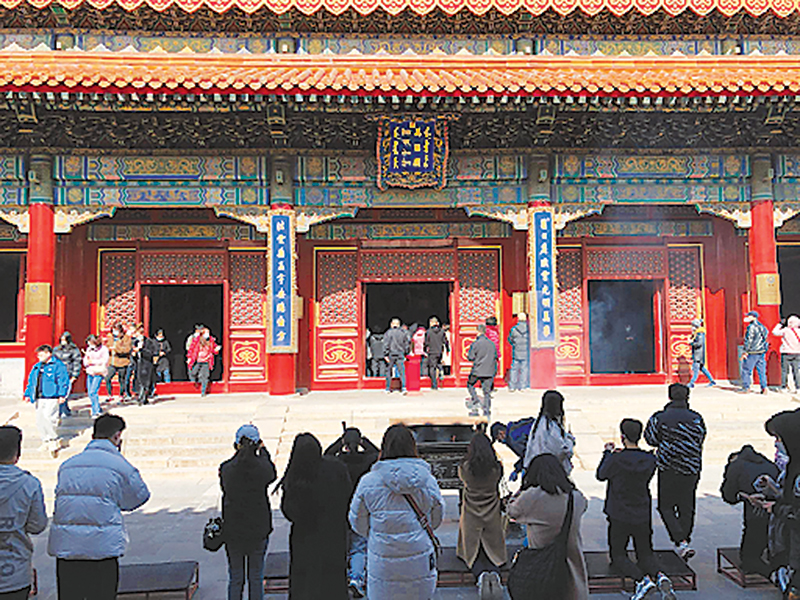
Visitors and devotees burn incense at the Yonghegong Lama Temple.

Six years ago, when we visited Miaoying Temple, which houses the White Dagoba built by Nepali artist Arniko in Beijing, apart from a few dedicated devotees, the temple would rarely see visitors. The once bustling temple that in the past held countless rituals and fairs had become estranged even among those living in Beijing. Most of our friends and colleagues would send us photos of Miaoying temple during their visit after our relentless effort to promote it during our time in Beijing.
However, in 2023, when we arrived at the Miaoying, we were greeted by a substantial crowd of Chinese visitors of various age groups waiting in queues to enter the temple. For Nepali passport holders, entrance remains free, and there is no queue: a small privilege if you will.  The entrance to the temple holds an elaborate exhibition that signifies the 750 years of the founding of the White Dagoba temple. The exhibition was thoughtful enough to include an entire room of sketched stories of Arniko’s life pasted from the book Arniko Chitrakatha that was originally presented by the Nepal-China Executive Council.
The new souvenir shop inside the temple premises had a wave of customers. To our surprise, the store manager Hu Jiyu, who was self-teaching himself Nepali language, passionately told us about his interest in tracing the roots of Arniko. Hu intends to come to Nepal soon to research the history of Arniko and cultural heritage that captures Nepal-China exchanges. The Miaoying Temple had never felt this vibrant before.

Miaoying Temple in Beijing.

The temple is located in Beijing, which remains geographically distant to Nepal as compared to other southern Chinese cities. One can argue that Nepal shares more rich culture and history with Beijing than it does with most other countries in South Asia. Yet, when it comes to promoting awareness of our culture in Beijing, there has been very little effort from the Nepali side.
We are still reliant on the Chinese to promote tourism on our behalf. The Nepal-China cooperation exhibition at the Miaoying Temple was sponsored by three agencies, all Chinese entities as mentioned in the exhibition board. Miaoying Temple receives countless visitors in the surrounding café and restaurants with picture-perfect views of White Dagoba. The Arniko statue was brought to Miaoying temple from Nepal in early 2002 by Arniko Society in the presence of late eminent Sinologist Niranjan Bhattarai. However, without stepping into the temple, the visitors wouldn’t be informed about the Nepali artist behind the Dagoba, which is a huge miss for Nepal.
While the Arniko-built temple will take time to develop into a cultural and economic hotspot in Beijing, a 15-minute drive from here will take you to the famous Yonghegong Lama Temple, which sees jam-packed visitors. With a bundle of free incense provided at the gate, the Lama Temple is never out of crowds and witnesses hundreds of tourists every day.

Exhibition board in one of the halls of the Miaoying Temple.

Interestingly, the Lama Temple also has a close association with Nepal. At the end of the temple premises is the world’s tallest sandalwood statue of Maitreya Buddha, recorded in the Guinness World Record. The sandalwood used to make the statue was bought from Nepal around 1750s by the seventh Dalai Lama as a gift to Emperor Qianlong, which took three whole years to reach Beijing. With better coordination, Nepal’s contribution to the temple could be emphasised more, which in turn will promote cultural tourism.
Similarly, another 15-minute drive from the Yonghegong Lama Temple will take you to the Dazhong Temple Ancient Bell Museum which shelters the largest bell in China. This bell weighs over 40 tons, has a height of over 22ft and is named after the Ming dynasty emperor, Yongle. Inscribed on the big bell are Buddhist mantras written both in Ranjana script and Chinese. The gigantic bell is difficult to capture in a single frame and the wide circumference demands absolute attention from the visitor. The description of the bell, however, fails to mention the language and instead focuses on the sutra on the bell.
Within a few kilometres in central Beijing, one can feel Nepal’s presence across multiple historical sites. Whether due to a lack of awareness or preparation, Nepal’s historical connection to this core area of China’s capital remains unknown both among locals and Nepali people. At times we have met Nepali tourists and officials who stay in Beijing but almost never end up visiting the temple or landmarks connected to their homeland.
Since January 8, China has dropped major travel restrictions and requirements as three years of pandemic have proven disastrous for Chinese domestic and international tourism. In that context, there is an incredible opportunity to promote Nepal in Beijing’s hotspots like the Miaoying Temple and the Yonghegong Lama Temple.  
After failing to make it into the first list of countries for outbound Chinese tourists during the peak time of the Spring Festival, Nepal has finally made it to the second batch, becoming the third South Asian country after Maldives and Sri Lanka who are in the first list. With poor official publicity of Nepal on Chinese social media and public spaces, we are losing the opportunity to reintroduce Nepal post-pandemic.

Ranjana script on one of the bells of the Dazhong Temple Ancient Bell Museum in Beijing.

Nepal is also excited about the return of Chinese tourists but underprepared to welcome them. Travelling from Kathmandu to Kunming, one can notice the conspicuous absence of Chinese-language content related to Nepal in airlines magazines and video projections. You cannot appeal to Chinese tourists the same way you appeal to the rest of the world. China has its version of social media and ecosystem, which they highly rely on to understand the destination country.
For example, one of our Chinese friends was well aware of the good Chinese restaurants in Kathmandu even before she visited Nepal. She had gleaned the knowledge from Chinese restaurant review apps.
In Nepal, we cannot stop talking about the immense Chinese tourism market, yet there has been little effort to engage the Chinese on things related to Nepal inside their own country. For instance, the Kunming Changshui International Airport’s international terminal remains empty even as it gears up for the Kunming South Asia Expo in June 2023. Yet there is little promotion of the event even within Kunming.
Recently, colourful pictures of Holi being hosted and celebrated by the Nepali Consulate in Chengdu with the local Chinese and Nepali community was circulated in Chinese social media. This indicates a relaxed Covid mindset on the part of the Chinese, offering a great way to promote Nepal. Similarly, an investment meet was organised at the Nepal Embassy in Beijing to encourage potential Chinese
investors to invest in Nepal. Initiatives like these should be better synchronised.
Unless and until Nepal customises its tourism promotion based on the interests of Chinese tourists, both the number of tourists and revenues from China will remain limited.

Rajana script inscribed on the Yongle Bell, the largest bell in China.

Khatri and Rajbhandari are co-founders of The Arniko Project.

CULTURE & LIFESTYLE

Events

Photo: Courtesy of Floriculture Association Nepal/Facebook


Nepal Flora Expo 2023
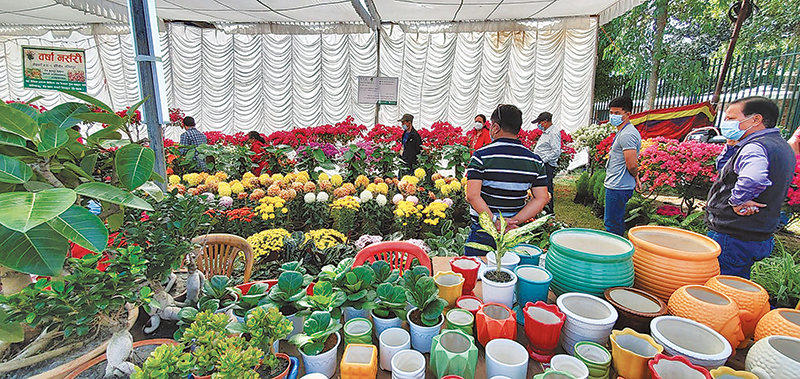
Floriculture Association Nepal is organising the 23rd iteration of the Nepal Flora Expo. Around  70 stalls have been set up in the exhibition—60 business stalls and 10 information stalls. The expo will feature over 450 types of plants and flowers. The expo is a good opportunity for enthusiasts to become familiar with a wide range of flora.  
Where:     Bhrikuti Mandap, Kathmandu
When:     March 31 to April 3
Time:     9:00am to 5:30pm
Entry:     Free


Earth Hour 2023

Photo: Courtesy of WWF

WWF Nepal is organising an Earth Hour 2023 event on March 25. The event focuses on the sustainability fair. The program was first organised in 2019. It will feature sustainable shopping, games, stalls, art and afternoon music. The event is all about celebrating sustainable goods and their practices. The musical performance will be performed by artists like Wangden Sherpa, and Utsav Nepal.
When:     March 25
Where:     Bhrikuti Mandap, Kathmandu
Time:     11:00am to 5:00pm
Entry:     Free

Permaculture Workshop for a Day
The Joon Project is hosting a one-day workshop to share knowledge regarding the permaculture concept. The event is in the Joon House near Sunrise Model School, Damak. If you have a green thumb or are just interested in connecting with like-minded individuals, attend this event to learn about plantations, plant together and just have fun.
Where:     The Joon House, Dhukurpani Road, Damak, Jhapa
When:     March 25
Time:     10:00am onwards  
Entry:     Free

Death of a Salesman by Arthur Miller

Photo: Courtesy of Prayas Bantawa Rai

In association with Actors Studio and Mandala Theatre, Go Win Production presents a play called Death of a Salesman by Arthur Miller or Euta Sapana Ko Awasan in Nepali. The drama was written by Arthur Miller in 1949 and it was the recipient of the 1949 Pulitzer Prize for Drama and Tony Award for Best Play.
Where:     Mandala Theatre, Thapa Gaun, Kathmandu
When:     March 24 to April 23
Time:     5:15pm (Sunday to Saturday), closed on Monday, additional show at 1pm on Saturdays and Fridays
Entry:     Premium Rs1000, General Rs500

Yoma’s Second Anniversary

Photo: Courtesy of Yoma

Yoma, which simply means ‘Dear Mother’, is a creative centre for children and adults offering a range of fun, curated activities. Yoma is celebrating its second anniversary, by organising a themed event on the Disney musical Encanto. There will be activities like musical performances, painting floral plants, ‘Mirabel’ glasses, karaoke and movie screening.
Where:     Jhamsikhel, Lalitput
When:     March 25
Time:     11am to 5pm
Entry:     Rs1500 (including all activities for children)

Page 8
CULTURE & LIFESTYLE

Taking formals to new heights

Fashion designer Ramila Nemkul had the idea of launching a boutique concentrating on business-casual designs during her decade-long stay in Finland.
- Anweiti Upadhyay
Post Photo: Keshab Thapa

Kathmandu
Although it has only been five years since the launch of Kasa, its founder Ramila Nemkul is a veteran in the Nepali fashion scene with over 18 years of experience. She calls Kasa, a brand that women—particularly working women—can turn to get their everyday formals and business casual clothing.
The name Kasa derives from the Italian word ‘Casa’, meaning house. Nemkul considers ‘K’ her lucky alphabet, so she changed the first letter of the word. The boutique she launched and looked after, before Kasa, called Kavya, also followed this naming formula.
The designer got the idea of launching a boutique concentrating on formal wear during her decade-long stay in Finland. “All the high-end shops selling formal clothing had tags declaring they were made in South Asian countries. This made me think how South Asian designers could also make high-quality formal clothes and find a market for it all over the world,” says Nemkul.
Before launching Kasa, Nemkul researched the formal wear (also the general fashion) market across China and South Asia to see how the big brands were running their business and where she could get the best fabrics for her designs.
After returning to Nepal, she decided to open Kasa in Patan Dhoka, Madan Smarak Road, right next to Kavya Boutique. The ground floor of the building houses the brand’s first outlet. They have recently also opened another one in Durbarmarg. The rest of the floors are used as the production and storage space for both Kasa and Kavya.
When she first launched Kasa, Nemkul remembers getting suggested to change the niche of the brand by her friends, family and fashion industry insiders. “They would say, ‘Do you really think anyone would buy designer formal clothing—much less white shirts in Nepal? They turn yellow after the first wash.’ But because I’d set my mind to making formal wear, I stuck with my suits and white shirts,” exclaims Nemkul adding that she feels she did the right thing as white shirts are among the best-selling items at Kasa.


The collections


Kasa puts out four collections every year—in summer, fall, winter and spring. While all the collections adhere to the brand’s concept of formal clothing, they tweak it enough to differentiate one collection from another.
Nemkul says that her favourite thing about putting together a look is layering. “I absolutely love layering. So I incorporate that a lot while creating Kasa’s looks—even in the spring and summer collections,” she adds. The spring and summer collections usually have a white shirt as the focal point. The autumn and winter collections, on the other hand, feature a variety of overcoats.
Every collection has about 12 to 20 looks. This adds up to about 80 to 100 looks each year. Nemkul explains that while the spring/summer collections are generally smaller, the autumn/winter collections can feature over 20 looks.
The brand has worked out a collaboration with The Hidden Treasure, where they sponsor Miss Nepal events and have the current Miss Nepal title holders as the face of the brand. Kasa originally had plans to reveal both a spring and a summer collection this year. However, because of the Miss Nepal events that have been taking place over the past couple of months, Kasa couldn’t settle on a date for the spring collection photoshoot. So, the brand is releasing a combined spring/summer collection soon.
Kasa recently launched their website too. As they are getting orders from all across the world—mainly from Europe, Australia and North America—Nemkul thought having a website would make ordering easier for the customers.
The upcoming spring/summer 2023 collection will have a total of 12 smart-casual looks. While Nemkul prefers using dark and neutral shades for her designs, she introduced a more pastel and nude colour palette last year and is continuing with that for the upcoming collection.
Nemkul says that most working women—especially doctors, bankers and corporate workers—buy frequently from Kasa. As the brand puts out high-end products, they cater to women who earn well.


Where it all began

Photos: Courtesy of KASA

From a young age, Nemkul knew she would pursue fashion as her career. She was interested in clothes—especially making clothes—all her life.
She had already been sewing clothes by the time she was in middle school. She recalls staying up all night making dresses she had seen (and liked) earlier that day. She would flaunt these dresses the next day. “I had an incredible ability to replicate clothing,” she says.
When asked where she learned to sew and cut, Nemkul says she picked it up from a TV program on home science. “I don’t remember what channel it was—probably NTV,  I doubt any other channels were around that long ago—but this home science show would occasionally have detailed episodes on tailoring and cutting.”
After completing her Plus Two, Nemkul joined IEC College Of Art & Fashion’s diploma in fashion design course. She then interned at Chahat Boutique in Kupondole. She had initially planned to do a bachelor’s in fashion design after the diploma. “But I was so confident in my designing skills that I didn’t think I would need another degree,” says the designer.
So, in 2005, she launched Kavya Boutique at Patan Dhoka, by renting the place from her dad, who owns the building. Rato Bangla School had just opened nearby, and she remembers rushing to open the outlet early in the morning so that students going to the school would see the shop and tell their mothers about it.
That was one of the first advertising strategies Nemkul implied to promote her brand. Another way she marketed Kasa was through full-page ads published in ‘Nari’ magazine. This decision was also met with a lot of criticism by people close to her, as they thought paying Rs25,000 for an ad in a magazine was ridiculous. (This was back in 2005.)
Again, Nemkul stuck to her guns as she believes advertising is one of the most important things for fashion brands. “I am actually thinking of doing a PhD in marketing to know more about it,” she says.
The designer already has a plethora of fashion and business degrees under her belt. In 2007, she handed over Kavya to her sister and moved to Finland. She completed her Bachelor’s in International Business at Central Ostrobothnia University, Finland, a Master’s in Entrepreneurship and Innovation at Aalto University, Finland and a second Master’s in Fashion Design and Management from Asian Academy of Film and Television (AAFT), India. Additionally, she also completed a diploma in Fur Design from Centria University, Finland.
Following her footsteps, Nemkul’s son is also currently studying Luxury Brand Management in Finland. “Kasa could turn into a family business,” she jokes, adding that she is hoping he will take over Kasa in the future.

Behind the designing process
Kasa has a total of 25 workers, including four designers. While the brand does not have specific themes for every collection, they pick one detail to play with each collection.
In last year’s spring and summer collections, they varied the sleeve designs. This time around, they are adding laces to the button-downs.
A couple months before the launch of each collection, Nemkul and the designers at Kasa sit down to discuss the designs. “Everyone pitches their ideas. We also list out things that are trending in the fashion scene and see if we can incorporate an element or two into the collection,” says Nemkul. But she adds that Kasa’s collections aren’t trend-focused. The brand primarily focuses on creating comfortable and chic formal wear.


Putting on a show


Fashion businesses showcase their work to their potential customers through fashion shows. However, in Nepal’s case, things work a little differently.
“While operating Kavya, I participated in TGIF Nepal Fashion Week. But I can tell you that it doesn’t really benefit the designers. People come to watch the show for the models, not the new designs,” states Nemkul adding that she doesn’t see a point in participating in the show anymore.
She has even argued with the organisers because the clothes were treated as the secondary attraction to the event, while they focused on the big-name models. She admits that this frustrated her to no end as she (like every other designer) and her team put in a lot of effort to pull off a fashion show.
This is why Nemkul started organising runway shows by herself for Kasa. She wants to showcase how they can be done well—even in Nepal—if you focus on actually telling a story through your designs. All four of the brand’s runway shows have been organised in the winter to launch their winter collection.
Kasa’s runway shows are pretty iconic in their own right. The first show took place at the Patan Museum. Nemkul doesn’t care much for stage design and fancy seating placements. The models simply strutted around a pit (akin to an orchestra pit) with the audience viewing the designs on sukuls (traditional mats) laid out on the staircase.
An unusual sight one will see at Kasa’s fashion shows is how the front row—and honestly, every other row—are filled with everyday people and not celebrities. Nemkul considers showcasing her new collections to her regular customers of utmost priority.
Kasa’s most famous fashion show till date is The Mt Everest Fashion Runway. The first Mt Everest Fashion Show took place at Kala Patthar while the second one was conducted at Gokyo.
“I realised that my clothes will not be seen by the international market if I keep doing fashion shows in Kathmandu. So, I had to do something that could be seen the world over,” says Nemkul adding that these collections also prioritised sustainability. She reveals that the international models didn’t even charge anything for their work as they were simply excited to do a show at Mt Everest.
The most recent runway show, titled Kathmandu Fashion Gala, happened in December last year at Baber Mahal Revisited to celebrate the brand’s 5th anniversary. The show featured their winter 23 collection featuring items made from pashmina.