You internet speed is slow. Switch to text view mode

Switch
epaper logo
ST

Last Login:
Logout
+
Page 1
HOME PAGE

Ruling coalition seeks to keep the Speaker on a tight leash

They want him to follow Business Advisory Committee’s lead. Experts say that’s unfair.
- BINOD GHIMIRE
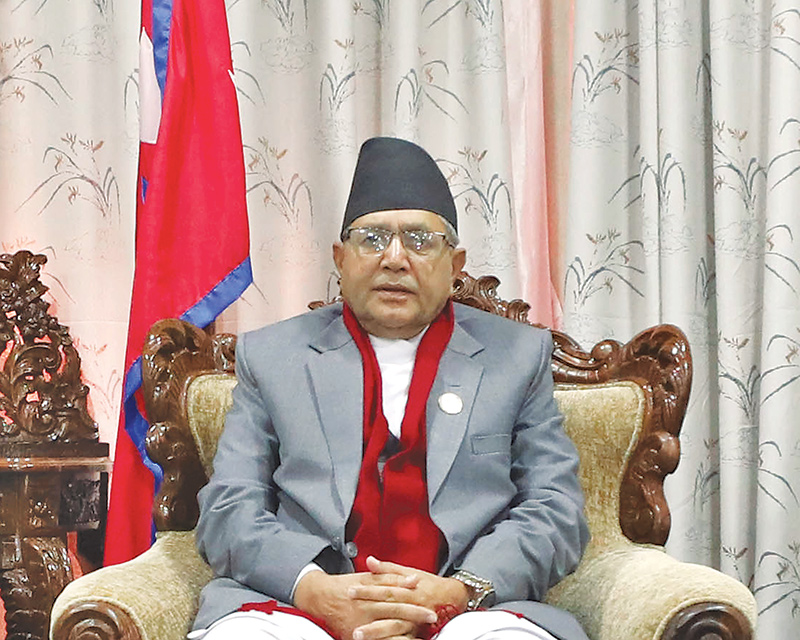
Speaker Devraj Ghimire.  Post File Photo

KATHMANDU,
Two years ago, the then Prime Minister and CPN-UML chair KP Sharma Oli had accused Speakers, first Krishna Bahadur Mahara and then Agni Prasad Sapkota, of not cooperating with his government to present the Millennium Challenge Corporation Nepal Compact in the Parliament. Both the Speakers were CPN (Maoist Centre) nominees.
Now as CPN-UML’s Devraj Ghimire takes over the helm of the House of Representatives, the ruling alliance doesn’t seem to trust him. The level of distrust is so high that the Nepali Congress, the Maoist Centre and other ruling party lawmakers have recently registered about a dozen amendments to the House regulations draft, which was finalised after a long discussion about two weeks ago.
The lawmakers want to fetter the prerogative of the Speaker over
House proceedings. One of the amendment proposals says, “All the works the Speaker performs must be decided by the Business Advisory Committee [BAC].”
The BAC comprises chief whips, whips and select lawmakers of the parties and gives suggestions to the Speaker on House proceedings. If there are differences of opinion on House proceedings, it is the platform to resolve them.
The ruling party lawmakers say they sought a revision in the draft regulation after getting hints that the Speaker could function arbitrarily. As per their claim, in his consultations with the cross-party lawmakers, the Speaker agreed to call a House meeting for March 20. However, he then summoned it for March 19.
Likewise, Ghimire agreed to call another meeting on March 23 to discuss the regulations. However, that didn’t happen and the next meeting was called for March 26. “All lawmakers can register amendments. They felt a revision is necessary,” Hit Raj Pandey, the Maoist Centre chief whip, told the Post. “I don’t think there is anything wrong in asking for a revision.”
The revision, however, clearly is an attempt to oblige Ghimire to simply follow the decisions of the BAC, which the ruling parties dominate.
Constitutional experts say the Speaker should remain impartial. He should not be seen to be working in the interest of some particular party and Ghimire’s actions show he has not been able to coordinate with the parties, which is his prime responsibility, they say.
“The Speaker must show high moral character. He needs to demonstrate the ability to coordinate among all the parties in the House,” senior advocate Dinesh Tripathi, who is also the chair of the Constitutional Lawyers Forum, told the Post.
“Ghimire’s actions make him a suspect. However, the Business Advisory Committee also cannot dictate terms to the Speaker.  It is not mandatory for the Speaker to abide by the committee’s decisions.”
Experts also say as a presiding officer, the Speaker must have the liberty to run the House. Taking to Twitter, Bipin Adhikari, a professor at the Kathmandu University School of Law, said the essence of the parliamentary system will collapse if the BAC dictates the Speaker.
The UML and the Maoist Centre were in the same alliance that elected Ghimire as Speaker on January 19. However, the alliance has broken down, giving birth to a new one, following the March 9 presidential election. Now the Maoist Centre has joined hands with the Congress.
Ghimire, meanwhile, has expedited consultations in the face of the ruling parties’ attempts to curtail his authority. He held a meeting with chief whips and whips of various parties. He also met Prime Minister and Maoist Centre chief Pushpa Kamal Dahal to discuss the ruling parties’ attempts to revise House regulations.
On Tuesday, he consulted cross-party chief whips and asked them to withdraw their amendment proposals.
“The Speaker wants unanimity in the regulations,” Shekhar Adhikari, press advisor to the Speaker, said. “He is in regular consultations. Hopefully, some meeting points will be found soon.”
The Regulation Drafting Committee finalised the bill after long deliberations.
UML lawmakers have accused the ruling party lawmakers of trying to backtrack on something already agreed upon. “We need to respect the Speaker’s position as an institution. I believe we can reach a consensual agreement,” UML Chief Whip Padam Giri said.

HOME PAGE

Covid cases rise again, new virus variant suspected

Ramping up testing, enforcing public health measures and booster shots stressed to reduce the infection’s severity.
- Arjun Poudel

KATHMANDU,
The ongoing rise in Covid cases is a clear sign that a new virus variant is penetrating the communities, infectious disease experts in Nepal said on Tuesday.
They warned that the country could witness a big rise in new cases in
the coming days since no measures have been taken to prevent the infection’s spread.
“The actual number of positive cases could be several times more in communities than the numbers unveiled by the health authorities, as all infected people are not testing themselves,” said Dr Rajiv Shrestha, an infectious disease expert at the Dhulikhel Hospital. “And, the rise might have been caused by a new virus variant. Authorities should resume active case finding, which was stopped months ago.”
Nepal on Tuesday recorded 24 new Covid cases. On Monday, the figure was 69—twenty five in 488 polymerase chain reaction tests and 44 in 778 antigen tests. The test positivity rate is more than five percent.
The Ministry of Health and Population, however, said that the 69 cases represent a cumulative figure of the past four days. But on Sunday too, 16 people had tested positive and the ministry claimed that it was the cumulative figure of the cases that had yet to be documented over the past five days.
Officials say that the majority of the people testing positive for coronavirus, of late, are those who returned home from India.
Lately, India has been reporting a sharp rise in coronavirus cases. The country on Tuesday recorded four deaths and 1,573 fresh coronavirus infections, according to media reports.
Several states and territories of India, including Delhi, Maharashtra, Gujarat, Tamil Nadu, Uttar Pradesh, Bihar, West Bengal, Uttarakhand
and Telangana saw a surge in new cases. Uttar Pradesh, Bihar, West Bengal and Uttarakhand are states bordering Nepal.
Experts say the rise in new cases of coronavirus in Nepal comes as no surprise after the rise in new cases in India and given the uninterrupted cross-border movement. Thousands of people from both countries enter each other’s territories every day on top of the large number of those who use unregulated points along the porous borders to cross over to the other side.
Health Ministry officials said that they have already alerted the agencies concerned about the risks, asking them to step up surveillance. The problem, however, is that almost all polymerase chain reaction (PCR) laboratories set up in the districts have been shut for months. The contract period of lab technicians expired months ago, which means the laboratories do not have the human resources required to run those facilities or carry out testing on swab samples of suspected cases.
Moreover, most districts in the Tarai region bordering India do not have health desks.
“The time has come to start active case finding and for that, we need to start community testing,” said Dr Janak Koirala, an infectious disease expert. “Along with this, we should also ramp up booster vaccination drives. Vaccine doses should be secured for all eligible populations and the public health measures need to be strictly enforced.”
Doctors say that even if the new virus variant does not severely impact the young population, the elderly and those with weak immunity are at a high risk. The rise in infections also increases the severity and hospitalisation rate, the doctors added.
Scientists in India say that a new sub-variant of Covid, XBB.1.16, is responsible for the recent surge in cases. They, however, say people in India have developed a hybrid immunity due to vaccination and natural infection, so the current Covid variant will not lead to hospitalisations and severity. The Indian government has advised people to wear face masks, avoid crowds and complete their vaccination doses if they haven’t already done so.
Officials at the National Public Health Laboratory, which conducts whole-genome sequencing to identify virus variants on a regular basis, said that no new virus variant has been detected in Nepal so far.
“We have already brought swab samples of infected persons from Sudurpaschim Province and have asked them to be sent to the provincial health laboratories,” said Dr Runa Jha. “We will bring those swab samples to Kathmandu and carry out whole-genome sequencing to identify the virus variant.”
Whole-genome sequencing is a comprehensive method of analysing the entire DNA sequence of an organism’s genes. Researchers believe that whole-genome sequencing of coronavirus could help track the properties of the virus and the infection’s severity.
As many as 12,020 Covid-related deaths have been reported in Nepal so far, according to an official count.

HOME PAGE

Hope and despair in Suntala Superzone

Spoilage loss inhibits plan to buttress value chain of mandarin oranges in Syangja.
- Dinesh Kafle
Oranges rotting at cold storage in Jaisidanda, Syangja.  Post Photo: DINESH KAFLE

PUTALIBAZAAR (SYANGJA),
It rained suntalas in Syangja this winter. The monsoon had been benevolent and hailstones a rarity. By the time Dashain and Tihar were over, the mandarin orange tree branches were bowing down with the weight of their produce.
Traders from Kathmandu, Pokhara, Butwal and Narayanghat began to visit the mandarin groves and place wholesale prices on the mandarins. Over a hundred farmers were estimated to have made more than Rs1 million each, while a few crossed the Rs4 million mark.  But Dil Bahadur Rana, 40, a mandarin farmer and trader, had different plans. He has between 600 and 700 mandarin trees in his ancestral grove in Thuladihi, in Putalibazar Municipality-7, out of which between 120 and 130 bear fruit, totalling around 8 tonnes.
Rana knew that higher yield meant greater supply and lower prices, especially when everyone was selling at the same time. So he bought mandarins in bulk from his neighbours and prepared to wait.
Rana plucked the first lot in the last week of November when the mandarins were moderately ripe and transported them to the cold store in Jaisidanda, 7 km from the Syangja district headquarters.
By December 24, when he deposited his last batch in the cold storage warehouse, he had hoarded around 25.6 tonnes. He then went home to spend time with his family, tend to the pigs, and deliver heaps of manure to the mandarin trees to prepare for the next bloom. He planned to return two months later, when mandarins would be in short supply in the market, to sell his stock.
Two weeks later, Rana got an urgent call from the cold store. He was numbed by what he saw there.
“More than half of my stock had rotted,” Rana told the Post.
Rana wasn’t the only one who lost his mandarins. Nearly 50 percent of the 126 tonnes in the cold store was lost to mould; the rest had to be sold off at reduced rates owing to imminent decay.
The cold store is just one in a network of support infrastructure necessary to turn Syangja into a “mandarin orange superzone” as part of the government’s Rs130 billion Prime Minister’s Agriculture Modernisation Project. Launched in 2016, the 10-year project identifies the feasibility of promoting specific agricultural vocations in various districts, and helps develop them into pockets, blocks, zones and superzones.
But the cold store’s failure showcases the numerous gaps in Syangja’s post-harvest produce management practice.
Grown widely in the mid-hills of Nepal, between 800 and 2,400 metres above sea level, mandarin—Citrus reticulata Blanco or suntala, as it’s locally known—contributes 0.85 percent to Nepal’s agricultural gross domestic product.
According to the Ministry of Agriculture and Livestock Development, Nepali farmers grew 198,406 tonnes of mandarins on 18,369 hectares in the fiscal year 2020-21. In Syangja alone, production reached 18,350 tonnes on 1,225 hectares of production area.
A citrus fruit whose roots are traced to China, mandarin has been a major cash crop among farmers in Syangja ever since its vocational plantation began almost 50 years ago, with farmers in the Jaisidanda, Rangkhola, and Mayatari areas taking the lead.
“In 1973, I planted three saplings that I received from the then District Agriculture Office,” said Krishna Aryal, a pioneering mandarin farmer in the district who says he now has 1,200 mandarin trees. “In 1977, I harvested a doko basketful of mandarins. This year, I made around Rs3.6 million.”
This year, the district harvested 22,000 tonnes of mandarins, worth around Rs1.38 billion, according to Binod Hamal, chief of the Agriculture Knowledge Centre, Syangja, a provincial undertaking to modernise agriculture.
The district also holds the distinction of having the largest density of mandarin farming in the country, one of the reasons why the government, in the year 2016-17, declared the district a “mandarin superzone”.
The superzone area accommodates over 3,000 farmers in the district, and covers over 2,000 hectares of land.
According to Tuk Bahadur Thapa, an agriculture officer at the Project Implementation Unit in Syangja, there are around 1.2 million mandarin trees in the district, and this is a conservative estimate.
The Syangja superzone office, which has helped increase the district’s mandarin acreage by 700 hectares in the past six years, aims to increase it to 3,000 hectares in the next four years when the project ends, according to Madhav Lamsal, chief of the implementation unit.
To this end, it provides farmers with technical support and a 50-85 percent subsidy to purchase harvesting materials, including clippers, crates and bags.
“There has been a wave of mandarin cultivation in the district after the superzone office was established,” Thapa said. “Farmers come to us saying they have cleared their jungles, and want to plant mandarins and that they want our support.”
Mukti Adhikari, 48, a farmer from Putalibazar-10, Rangkhola, exemplifies this growing interest. Adhikari spent 15 years in South Korea, mostly doing what he says was a “3D” job: dirty, difficult and dangerous.
He returned home 10 years ago after his father fell ill. His father died soon after. Adhikari did not return to Korea, but decided to tend to the mandarin grove his father had developed 50 years ago.
“I was born and brought up on the mandarin grove,” Adhikari told the Post in January as he helped his workers adjust a huge tarpaulin sheet placed below the tree branches to keep the fruits off the ground.
“If you have 5 ropanis (2,500 square metres) in Syangja facing northeast, you should become a mandarin farmer rather than chase a government job,” said Adhikari, who claims to have made an estimated Rs4.5 million from mandarin sales this winter.
He says he has around 500 fruiting trees and has planted an additional 1,700 saplings recently.
But the cold store has him worried. This year, all but 4.5 tonnes of the 12.3 tonnes of mandarins he had deposited there rotted. Adhikari, also a member of the cold store management board, says the government should have been more forthcoming in its support to the farmers.

According to the Agriculture Ministry, Nepali farmers grew 198,406 tonnes of mandarins in 2020-21. Post Photo: Dinesh Kafle

The eye of the storm
The Syangja Cold Store Cooperative Committee was established in 2012 with the sole aim of establishing a refrigerated warehouse to minimise post-harvest losses and maximise farmers’ profits. Initially, it allowed farmers to store their mandarins for free as a trial phase. The spoilage loss last year was around 10 percent.
This time, the cold store planned to charge them Rs120 per crate of 20 kg for three months, but decided not to charge any fee after the mandarins rotted. The Project Implementation Unit paid the electricity bill, charging the farmers a reduced fee.
The warehouse, the size of around a dozen trucks, is nestled on a hillside in a sinyaale, a shadowy corner, 100 metres below the Siddhartha Highway. Commonly known as Chisyan Kendra, the cold storage was established in 2012 and is supported by 104 cooperatives and three municipalities—Putalibazar, Galyang and Bhirkot.
The initial plan was to build a cold store with a capacity of 2,500 tonnes at a cost of Rs240 million, with a 60 percent grant from the Department of Cooperatives.
According to Ananta Kumar Shrestha, chairperson of the cold store, they raised the rest of the money from other sources, including a Rs20 million loan from the National Cooperatives Development Board.
With the opening of the facility, farmers had hoped that they would be able to sell more of their fruit until the start of the summer, earning more and throwing out less. But that was not to be.
In the last week of January, a dozen men and women sat on the porch of the cold storage warehouse, sorting a heap of mandarins in various stages of degeneration. The fully deformed mandarins went into one set of crates to be dumped on a terrace just a kanlo below the porch, to keep the sight and smell away.
Relatively fresh ones were sorted by size—jethi in one, maili in another, and kanchhi in yet another—to be sold to middlemen for Rs100, Rs80 and Rs50 a kilo, respectively.
Those laced with moderately green mould were wiped with a cotton cloth and placed into a separate crate for sale at half price.
Amid the chatting workers, Dil Bahadur Rana too was sorting the mandarins pensively.
“They should not have tampered with the temperature,” Rana said. “I lost only 10 percent when the temperature was set at 5.5 degrees Celsius. Things got worse when they hiked it to 10 degrees.”
 
Ills begin at the grove
Rana believes that the mandarins went bad due to the temperature hike, but others are not so sure.
Umesh Kumar Acharya, chief of the National Citrus Research Programme in Dhankuta, says the temperature was not the only problem. He was one of the scientists called for help after the operators realised the infection was getting out of hand.
Acharya’s team found that the temperature was maintained at 5.5 degrees Celsius, which was too cold for the mandarins, leading to chilling injuries. He suggested a temperature of 8-12 degrees Celsius and a relative humidity of 85 percent, not the 75 percent maintained at the time of his team’s visit.
But Acharya says he found even worse problems. The door of the facility was kept open, and individuals coming with even one crate were allowed in, disrupting the airflow and the controlled temperature.
Many of the mandarins were too small or damaged and were unfit for long-term storage.
“Blue and green mould are common occurrences in stored mandarins. The idea is to disinfect them with water and calcium chloride before storing them, which they didn’t do,” he said.
For Acharya, the problems began right at the farm due to haphazard harvesting methods. “The farmers did not follow standard operating protocol during and after harvesting the fruit,” he told the Post.
Fruits aimed for long-term storage need to be treated differently. The mandarins must be picked half-green using gloves and fruit clippers during the daytime when there is no dew.
Once plucked, they must be washed with a water and calcium chloride mixture and left to dry in the shade. Then, they must be stored in the cold room using sanitised crates—all within 24 hours of harvest.
Shrestha, the cold store chairperson, concedes that they failed to enforce strict protocol. “Some farmers brought their mandarins in sacks, but we did not want to send them back as they would feel discouraged. It was a mistake,” Shrestha admitted.
Asmita Khanal, a horticulture scientist at the National Agricultural Research Centre in Malepatan, Pokhara, another expert invited for observation, agrees with both Acharya and Shrestha.
“Last year, the farmers followed protocol, as there were fewer of them, and the protocol was easier to enforce. This year, though, the cold store operators ignored protocol as they got an unexpected number of farmers storing their products. Since the infected mandarins were stored haphazardly with fresh ones, the infection spread,” said Khanal.
There is also a lack of human resources trained to operate the cold storage.
Binod Hamal, chief of the Syangja Agriculture Knowledge Centre, told the Post, “We could not maintain the oxygen, humidity and temperature at the micro level. We don’t have cold store engineers here, and it was too expensive to bring them from India.”
 
Hope amid despair
The losses in Syangja this year show how despite having all the necessary components for a successful supply chain—production, cold storage and market—farmers are unable to reap the benefits.
Hikmat Kumar Shrestha, senior monitoring and evaluation officer at the Prime Minister’s Agriculture Modernisation Project, said that the farmers had been selling their mandarins fresh because of the failure to increase their value over time using added value chains like cold storage.
“We need to study how to increase time value in the postharvest condition. The better time value we create, the better returns we get. The government should focus on research in this area,” Shrestha said.
Meanwhile, farmers like Dil Bahadur Rana, though alarmed, are not discouraged by the loss they incurred this year.
Even as he awaits relief, Rana believes there is no alternative to the cold store. When contacted by the Post over the telephone in the first week of March, Rana sounded hopeful.
“I hope the way the cold store functions improves, and it must. I will give them my suggestions on how to do it.”
Despite the problems this year, Rana, who claims to have lost Rs600,000 in investments and almost Rs1.5 million in potential profits, sounded determined to make a comeback.
“Whatever I lost from the mandarins, I will recover from the mandarins,” Rana said. “The trees have already started blossoming again.”
This early spring, Rana’s mandarin blossoms washed his grove white, heralding a new season and another year of plenty. But at the end of March, there was unseasonal rain and hail. The mandarin blossoms were all washed away.


(This report is prepared in collaboration with the Centre for Investigative Journalism-Nepal).

Page 2
NATIONAL

Protest against naming of Koshi Province intensifies

On Tuesday, 25 people were injured when protesters clashed with the police in Biratnagar.
- DEO NARAYAN SAH
Riot police and demonstrators face off in Biratnagar on Tuesday.  Post Photo: DEO NARAYAN SAH

BIRATNAGAR,
There is no sign of abatement of the protests against the naming of ‘Koshi’ Province. The activists advocating identity-based nomenclature have intensified agitation against the provincial assembly’s decision to name the province as Koshi.
Violent clashes ensued in Biratnagar, the provincial headquarters of Koshi, on Tuesday in which 25 people were injured, some seriously. Security personnel used water cannons and lobbed 36 teargas canisters to disperse the protesters.
Chief of Morang District Police Deepak Pokharel said the clash ensued when the protesters attempted to breach the security barricades. The policemen were compelled to use force after the protesters started pelting them with stones, claimed Pokharel.
The protest, by the Province 1 Renaming Joint Struggle Committee, was staged outside Big Hotel at Roadshesh Chowk of Biratnagar where the provincial lawmakers were scheduled to attend an interaction on the Resource Management for Achieving Sustainable Development Goals. The event was called off due to the protest.
According to the District Police Office, 19 protesters and six security personnel sustained injuries in the sporadic clashes. Chief District Officer Tirtharaj Bhattari said the protesters sustained minor injuries in the incident and they are now in normal health conditions.
Some political parties that lobby for identity-based politics, ethnic and cultural organisations called the protest demanding renaming of the province to reflect ethnic identity. Kirat Yakthung Chumlung, Kirat Rai Yayokkha and the Nepal Federation of Indigenous Nationalities have been coordinating the protest.
Meanwhile, the protesters have expanded their agitation in various districts of the province. Some agitators manhandled the ward chairman of Urlabari Municipality-6. Ward chief Chintamani Paudel was injured in the incident that took place as the protesters attempted to padlock the ward office. Paudel lodged a complaint at the Area Police Office in Urlabari demanding action against the assailants. The struggle committee also padlocked the office of Urlabari Municipality.
In Panchthar, the activists padlocked the office of Phalelung Rural Municipality on Tuesday. They locked the offices of chief administrative officer, account branch and administration branch. The struggle committee wrote letters to all the local units in Koshi Province asking them to close their offices from March 28 to 31.
The number of participants in favour of renaming the province has increased mainly after the death of a protester on March 24. The police allegedly baton-charged protesters, during which one Padam Limbu Lajehang had sustained serious head injuries in Biratnagar on March 19. He succumbed to the injuries while undergoing treatment after five days. Lajehang, 42, of Dharan-15 was the central co-commander of the Limbuwan Volunteer affiliated to Sanghiya Loktantrik Rastriya Manch led by Kumar Lingden.
The federal government formed a six-member committee headed by joint secretary of the Home Ministry Ram Bandhu Subedi to probe into the death. The committee is yet to submit its report.
Dakendra Singh Limbu, member of the struggle committee and chairman of Kirat Dharma Tatha Sahitya Utthan Sangh, said that they would continue to protest unless the province was named again based on identity. The protest will be further intensified, he warned.

NATIONAL

Police seize 9.8 kg hashish

District Digest

PARSA: Police seized a huge cache of hashish from a house in Kalikamai of Parsa district. Police said the hashish was seized from Brijesh Prasad Kurmi’s house. Acting on a tip-off, a police team had raided the house on Monday. The district court on Tuesday remanded Kurmi into custody for four days for investigation.

NATIONAL

Man dies in brick kiln accident

District Digest

SAPTARI: One Indian national died and two others got injured when a wall at the kiln of the JSR brick factory in Piparahi, Rupani Rural Municipality-2 collapsed Tuesday. Police said all three were workers there. The deceased was a 45-year-old man from Cooch Behar district in West Bengal who died while undergoing treatment at Gajendra Narayan Singh Hospital, Rajbiraj. The wife of the deceased and another man who was injured are receiving treatment at the same hospital, said police.

Page 3
NATIONAL

Cabinet moves to proceed with criminalising predatory lending

Decides to amend the criminal code. Although the existing civil code allows victims to file a case against unscrupulous lending, the law does not specifically mention such lending.
- Post Report
Post File Photo

KATHMANDU,
Amid mounting pressure to take action against predatory lending that is widespread in the Tarai and has devastated many families, the government on Tuesday officially decided to amend the law to criminalise the practice.
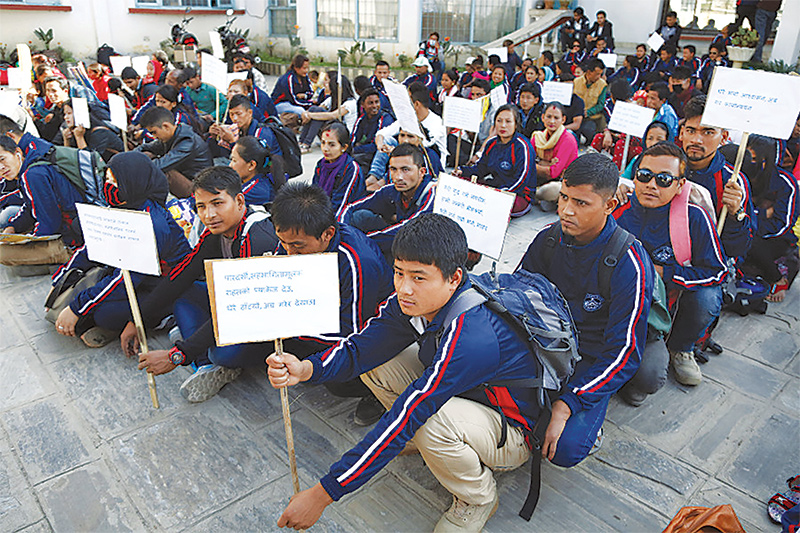
A Cabinet meeting took the decision after hundreds of loan sharking victims came to the Capital by travelling on foot for 11 days from different districts of Tarai to draw the government’s attention to their plight. They also protested at Maitighar on Tuesday.
On Monday, the victims marched in front of the Tundikhel Khula Manch demanding legal actions against loan sharks.
Minister of Communications Rekha Sharma said Tuesday’s meeting has decided to proceed with the process to amend the National Criminal Procedure (Code) Act-2017 to declare the practice of loan-sharking a crime and punish those involved.
Ahead of the cabinet meeting, the private secretariat of Prime Minister Pushpa Kamal Dahal released a publicity material on social media listing out ten measures taken by the prime minister and his secretariat to address the grievances of the loan-sharking victims. Several political parties have expressed their solidarity with the demands of the victims.
“The meeting has decided to amend the criminal code and an amendment proposal to this effect will be forwarded to the Bills Committee of the Cabinet for further discussion,” a minister told the Post.
A few months ago, a six-member Home Ministry task force led by joint secretary Bhishma Kumar Bhusal had advised the government to amend some laws including the criminal code, criminal code act, civil code and civil code acts to criminalise unscrupulous lending.
Although the existing civil code allows victims to file a case against predatory lending, the law does not specifically mention such lending.
Currently, loan-sharking is essentially categorised as an offence under the civil code, although acts such as blackmailing, extortion and other exploitations fall under criminal offence. As a result, the victims have to fight the deep-pocketed loan sharks alone.
“Besides amending the civil and criminal laws and codes, we have also proposed a work procedure on how to ascertain whether any loan falls under predatory lending,” Bhusal said.
Although the current law says interest per year on household financial transactions should exceed more than 10 percent, the law does not specifically define loan-sharking.
If the law is amended, it will open the way for the government to investigate and prosecute moneylenders involved in predatory lending.
The protesting victims have been demanding that the government make arrangements to provide them loans at lower interest rates, bring laws against unscrupulous lending and scrap personal mortgaging contracts known as Tamasuk. The loan-sharking victims returned to Kathmandu six months after signing a five-point agreement with the government in September last year after which they had ended their protest.
According to the Bhusal task force report, loan sharks tend to file court cases based on the documents borrowers signed on terms dictated by loan sharks.
The loan sharks were found to have filed cases against the victims to recover their loans while the victims were often denied access to the court process.
According to the Ministry of Home Affairs, over 3,351 complaints have been registered across the country against loan sharking practices. This number could go up significantly if the government specifically criminalises predatory lending practices. Of them, the district administration offices have cleared 346 complaints. As many as 774 are under consideration at DAOs, 525 complaints are under the jurisdiction of courts, the police are dealing with 850 complaints, and no action has been taken on the remaining 1,181 complaints.
“There are hundreds more such cases at several district administration offices, district police offices and other police units,” a joint secretary at the home ministry said, adding, “Some cases need to be handled by courts.”
On Tuesday, the government formed a four-member team headed by the joint secretary at the Home Ministry Rudra Devi Sharma to hold talks with the protesting victims.
Home Ministry undersecretary Dil Kumar Tamang, undersecretary at the Office of Prime Minister and Council of Ministers Uma Kanta Adhikari, and undersecretary at the Ministry of Law, Justice and Parliamentary Affairs Jung Bahadur Dangi are members of the talks team.
The Bhusal task force report has called for legal action against loan sharks who prepare multiple versions of their transactions and charge higher than reasonable interest rates.  
According to the task force’s report, other factors also made the legal fight against loan sharks challenging for the victims. The victims signing documents prepared by loan sharks; victims putting up lands as collateral or transferring land ownership in the name of loan sharks to get a loan; the lender not giving a receipt of the loan even after the loan has been repaid; the victims’ fear of court procedures; weak defence by victims in the court on the accusations made by the loan sharks; and the proxies of loan sharks buying collateralised lands while the lands are auctioned off—they are all challenges against ensuring justice for the victims.
“It will take some time to address these issues,” said Kedar Nath Sharma, joint secretary at the Ministry of Home Affairs, said,
adding, “Because several laws need to be addressed.”
“After we reached an understanding with the victims last September, some progress was made towards addressing the problem. We will discuss the role being played by the chief district officers in some districts,” said Adhikari.

NATIONAL

200 ill after consuming devotional offerings

SALYAN: Around 200 people, including children, adults, and elderly people, fell ill after consuming a devotional offering at the house of Prem Bahadur Khatri of Bahunthana in Bagchaur Municipality-5 during a worship ritual on Monday. According to Hari Bahadur Kathayat, head of the health unit of the municipality, the patients have developed symptoms similar to food poisoning. The municipality has deployed medical personnel and provided medicines for their treatment. “Most of them are in normal condition and receiving treatment at home while some with critical conditions are receiving treatment in different hospitals,” said Kathayat. (pr)

NATIONAL

Deal on power-sharing eludes ruling parties

Prime minister presented the Common Minimum Programme at Tuesday’s meeting, to be endorsed with necessary changes.
- Post Report

KATHMANDU,
The ruling coalition failed to agree on power-sharing on Tuesday as its major partners stuck to their guns, tying the hands of Prime Minister Pushpa Kamal Dahal who has often said the Cabinet would be expanded without further delay.
Dahal was preparing to appoint new ministers on Wednesday after finalising the division of ministries among the parties supporting him on Tuesday.
“With major parties demanding ministries more than the prime minister can allot, discussions on power-sharing did not move ahead today,” said a senior leader of a major party in the coalition. “Once the four major parties agree on the numbers, we will enter ministerial portfolios on Wednesday.”
With the coalition failing to divide the ministries, the meeting was adjourned until Wednesday morning.
The coalition meeting will finalise the Common Minimum Programme prepared by the team of Rajendra Shrestha of Janata Samajbadi Party, Ramesh Lekhak of the Nepali Congress, Shakti Basnet of the Maoist Centre and Vijay Poudel of CPN (Unified Socialist).
“Today the coalition partners tentatively agreed on the government’s Common Minimum Programme (CMP) which was presented by the prime minister at the meeting while discussing power-sharing,” said Manahari Timilsina, a media expert to the prime minister. “The next meeting scheduled for tomorrow morning will finalise the CMP and the power-sharing deal.”
According to leaders present at the meeting, the coalition partners presented their claims to the ministries. The prime minister presented the draft CMP, which another meeting will finalise with necessary changes while also agreeing on a power-sharing deal, according to them.
According to leaders involved in the negotiations, the largest party—Congress—has demanded nine ministries, Janata Samajbadi Party and CPN (Unified Socialist) want three ministries each while Loktantrik Samajbadi Party claimed two ministries during Tuesday’s meeting.
Maoist leaders said the meeting failed to arrive at a conclusion because the parties have demanded more and plum ministries while there are a limited number of ministers the prime minister can appoint within the constitutional limit.
Earlier in the morning, CPN (Unified Socialist) leaders including its chair Madhav Nepal had met the prime minister to demand at least three ministries in the federal government and at least four ministers in provincial governments, two provincial chiefs and a chief minister. Leaders of the party argue that they need more ministries because the party has not got any constitutional positions such as President, Vice President and Speaker.
However, the prime minister, according to the leaders, had told them that it would be difficult for him to allocate the ministers as demanded. He has promised them to be as generous as possible, they said.

Page 4
OPINION

The pretence of higher education

The government can’t stop kids of sociocultural elites from going to American or European universities.
- CK LAL
Post Illustration

Some time ago, students graduating from a secondary school in Bhaktapur wrote farewell notes on the back of each other’s shirts. Written in Nepali, the content of such messages was poignant and evocative of desperation.
In a widely circulated photograph, one student had the legend scribbled on the back of his attire, “May your journey to Korea be successful”. Another scribble was somewhat more wishful, “We shall meet in Japan”. Prospective migrants consider Japan and South Korea to be more desirable destinations.
Anguish was apparent in the third scrawl: “We shall meet in the Gulf”. The region being thus referred is the destination for the 4D category of dirty, difficult, dangerous and despicable jobs that the middle class Nepalis have traditionally looked down upon with disdain. The aspiration of most school graduates in Nepal is an armchair job where an attendant serves tea in glass tumblers at frequent intervals.
Apart from showing the hopelessness of students barely out of their teens, the picture also proves that voting with the feet has become the favoured mode of registering their protest. The rebelliousness that defined the youth of yesteryears seems to have been replaced by a desire to exit the system.
The boys in the reported exchange of adieu scrawls perhaps came from a relatively safer socio-economic background. After all, not every youngster in the country gets a chance to complete secondary school. According to the recently released census figures, the literacy level of four out of eight districts in Madhesh Pradesh is just about 60 percent, which is much lower than the national average of 76.3 percent.
School uniforms these days are usually unisex wears and it’s not uncommon among even middle class children to share the shirts of their elder siblings. The boys aspiring to go to Korea, Japan or even GCC sheikhdoms probably had a reliable space to store their memorabilia. That is not a privilege available to those who live in makeshift shelters of their parents.
For the poor, acquiring one of the worst passports ranked between North Korea and Somalia is expensive and full of hassles. Visa, travel and hefty fees of manpower agencies in search of work entail further costs.
In addition to the indication that Nepal is fast losing its demographic dividend, the second most important meaning of the farewell exchanges between the secondary school graduates is that the planners of university education need to rethink their future strategy.

Declining desirability
With per capita GDP hovering around $180 up until the 1980s, socioeconomic stagnancy has been endemic to Nepal for centuries. Farmers remained stuck in the subsistence occupation of growing crops that depended upon the vagaries of monsoon. Most traders dealt with daily necessities and had limited surplus to invest in new ventures. The political elite consisted primarily of the royal family and its cronies that directly or indirectly controlled all financial levers. Access to higher education was the only ladder of limited upward mobility for everyone else.
After the 1970s, campuses of Tribhuvan University (TU) in regional towns had begun to attract the best and brightest of the rural landholders. Since an Indian degree put the student at linguistic, cultural and academic disadvantages, many parents suffered enormous hardships to send their children to the faraway capital city for higher education. Bureaucracy remained the preserve of the Bahun-Chhetri-Newar (BCN) cluster as it does more or less even today. But back then, the rapid expansion of schools in the countryside needed a large number of teachers. A university graduate was almost sure to find placement in the public education system.
The situation changed abruptly when Nepal signed on the Structural Adjustment Programme (SAP) in the mid-1980s, ostensibly to “attain macroeconomic balances and raise GDP growth rate on a sustainable basis” through market-oriented reforms. Schools, hospitals and banks were thrown open to the profit sector.
By the early 1990s, a TU degree had become almost superfluous: The public sector had nothing on offer and the profit sector put a premium on skills rather than on formal qualification. Critics who bemoan the state of higher education after the early 1990s often ignore the possibility that politicisation may have been a consequence rather than the cause of deterioration in the academic standards.
The classical view holds that the purpose of higher education is the cultivation of the mind that “strengthen, refine, and enrich the intellectual powers” of a person. Such a person is of little use for the market that puts a premium upon manipulative marketeers and mindless consumers. University enrolment became merely a device to wait and hustle for better opportunities.
Historically, many institutions of higher learning began as training centres for the Buddhist monks, the Christian clergy, the Muslim maulvis and the Hindu pundits who also taught useful skills such as astronomy, agriculture, healthcare, book-keeping and human psychology in addition to the usual scriptures and classics. Other than the science, technology, engineering, and mathematics (STEM), medicine, and management streams, the utilitarian value of a TU degree had become almost a liability in terms of opportunity cost by the mid 1990s.
The government planners, unfortunately, decided to do more of the same as they went about creating clones of TU all over the country even as the behemoth of Kirtipur retained its control over its far-flung campuses. Though conceptualised as a flower-bed university for the tutees coming out of some of the frightfully expensive “bonsai schools” that served the progenies of the comfortable class, the Kathmandu University too soon turned into an institution of accreditation rather than concentrate upon becoming a centre of excellence in generating, exchanging, disseminating and storing knowledge.
The breast-beating in Nepali media over 44 billion rupees worth of foreign currency flowing out of the country within seven months of the current fiscal year in the name of higher education seems to have missed the forest for the trees. In the evolving knowledge economy, peripheral countries such as Nepal lack the material and human resource to train and retain, let alone attract, university students.

Dynamic centres
It needs to be accepted that the pursuit of the pleasure of knowledge through education in humanities and search for a global lifestyle shall continue to be the playfield of the sociocultural elite. The government can’t stop their kids from going to American or European universities. The only way of getting them back to Nepal even for short periods will be to legalise dual passports and invite political controversy!
The majority of “students” going to Australia, Japan and even Canada hope to begin with learning, start earning and then remain gainfully employed in the host country. Their remittance appears low because most of it is channelled through informal networks.
Since a degree in a remittance-dependent country is largely an adornment, perhaps the government can hand over all institutions of higher learning, barring the central campus of TU and its research institutions at Kirtipur, to provincial governments. They in turn can retrofit—physically and academically—larger ones among them as independent universities.
Perhaps the proposition of small universities training motivated students to synthesise learning from life, laboratory, library and lectures is an idea whose time has come. It will prepare them for problems that are yet to crystallise with the dawn of the age of Artificial Intelligence. The exodos abroad is unlikely to stop anytime soon.

OPINION

Maoist betrayal and reparations

Channelling support to ex-child soldiers through the Maoists would be like asking the fox to guard the chicken coop.
- Kul Chandra Gautam
Post File photo

The recent decision by the Pushpa Kamal Dahal-led government to declare thousands of victims of the Maoist insurgency as “martyrs” and to award a generous financial allowance to former child soldiers illegally deployed by the Maoists in their “People’s War” has triggered much indignation and controversy. Dahal took these important decisions, potentially incurring huge expenses from the national treasury, taking advantage of an interim period with an incomplete cabinet comprising his hand-picked ministers from his own party that commands less than 12 percent of the members in Parliament.
There are many examples of how the Maoists mastered the art of fleecing huge amounts from the national budget. Maoist leaders fleeced billions of rupees in the name of their combatants in cantonments during six years of the peace process from 2006 to 2011. My book, Lost in Transition: Rebuilding Nepal from the Maoist Mayhem and Mega Earthquake, contains a catalogue of how the Maoists deliberately prolonged and used the peace process as a cash cow for their party coffers and to enrich several Maoist leaders without any accountability.
It is true that other political parties and their leaders are also complicit in widespread corrupt practices. But the hypocrisy of the Maoists is particularly staggering because they justified their “People’s War” as a crusade against corruption and to establish genuine “people’s democracy”.

‘Bourgeois education’
Among the most unforgivable actions of the Maoists was misleading thousands of children and youth with false promises that ruined their lives. They enticed these gullible youngsters to drop out of school, saying that the prevailing “bourgeois education” was useless, and that it was more urgent and important to overthrow the feudal regime and establish a new “people’s democracy” that would dramatically change their future. Such slogans were used to lure even primary school students to drop out and join the Maoist militia or “cultural troupes”. Meanwhile, the Maoist leaders found many creative ways to give their own children quality “bourgeois education” and access to good civilian jobs and business opportunities.
At the height of the insurgency, in many areas under their influence, the Maoists enforced a policy of “one family, one volunteer for the Maoist cause”, demanding that each family should allow them to recruit one family member—often an adolescent—to join their armed militia. Their preferred recruits were mostly vulnerable adolescents, particularly from the poor and historically marginalised and oppressed communities.
I was a senior UN/UNICEF official during the decade of the Maoist insurgency (1996-2006). Along with the UN Secretary-General’s Special Representative on Children and Armed Conflict, UNICEF was particularly concerned with the plight of child soldiers deployed by some governments and non-state actors in conflict situations worldwide. Both as a UNICEF official and as a Nepali, I naturally took an extra interest in reports of the recruitment of child soldiers by the Maoists in contravention of several UN conventions and international treaties ratified by Nepal.  
In my efforts to informally help the UN Secretary-General’s “good offices” for the peace process in Nepal, I had established discreet contacts with several key Maoist leaders, including Baburam Bhattarai, Narayan Kaji Shrestha, Krishna Bahadur Mahara and Dinanath Sharma. In my discussions with them, a topic that I always raised was their use of child soldiers.
At a meeting with the Maoist chief ideologue Baburam Bhattarai at the residence of prominent Nepali civil society leader Devendra Raj Pandey, I sought his clarification on the Maoists’ recruitment of child soldiers. Bhattarai denied such “allegations” and assured me that their party fully abided by the Convention on the Rights of the Child (CRC) and other international treaties, and it was against their party policy to recruit children as combatants.
Despite such denials, many national and international NGOs found irrefutable evidence of children being recruited into the Maoist militia and their “People’s Liberation Army”. For over 10 years, the Maoists were listed by the UN as a non-state actor using children in armed conflict. This was proven beyond any doubt by the United Nations Mission to Nepal (UNMIN).

Ineligible versus ‘ayogya’
UNMIN verified over 3,000 combatants recruited into the Maoist PLA when they were under 18. As per the Comprehensive Peace Accord (CPA) and the Agreement on the Monitoring of the Management of Arms and Armies (AMMAA), these youngsters were considered “ineligible” to be certified as combatants for possible integration into the security forces.
A short-hand Nepali translation of the word ineligible is ayogya that can also be interpreted as “incompetent”. Maoist leaders deliberately incited the ex-child soldiers to protest against this negative-sounding designation, insinuating that the arrogant and insensitive UNMIN officials insulted these proud and patriotic youngsters as incompetent or ayogya.
According to the terms of the CPA and AMMAA, all ex-child soldiers should have been discharged from cantonments promptly after their verification. But the Maoist leaders delayed their release and rehabilitation for several years, making all kinds of unreasonable demands with the government and donors, supposedly on their behalf. Meanwhile, the party leadership continued to give them false assurance that
“somehow” it would either ensure their integration into the Nepal Army or secure very generous cash allowances for them.
Knowing that the international community was full of goodwill and was prepared to invest generously for the rehabilitation of ex-child soldiers, the Maoists tried to negotiate a package that would have secured them either a big lump sum in cash or to bankroll them in some organised skill training and income-generating activities under their party’s continuing control and influence. But such arrangements were simply unacceptable under the UN’s guiding principles for the rehabilitation of child soldiers.
Having failed to secure any such bounty for them, the Maoist party abandoned these poor ex-child soldiers when it became clear that they were no longer useful as bargaining chips with the international community. After wasting four more years of their precious life, it was a bitter-sweet sight to see these “disqualified”
combatants leaving the cantonments with only Rs22,000 in their pockets, many clutching small babies in their arms.
Had the Maoist leaders not misled them, most of these ex-child soldiers could have left more happily with a very generous rehabilitation package that the UN country team had prepared for them. This package, for which UNICEF and other agencies had secured promises of around $70 million from various donors, would have included scholarships for basic education, vocational training as community medical assistants, laboratory technicians and other income-generating skills, and funding for essential toolkits, access to micro credit, career counselling and support for starting small enterprises or finding jobs, including foreign employment.
Regrettably, the Maoist leaders did not allow the ex-child soldiers to interact freely with UN staff to better understand what the rehabilitation “package” contained and how it could be further improved. For instance, I knew that if UNICEF were allowed to interact directly with the female ex-child soldiers who were pregnant or lactating at the time of their release, it would be ready to design and deliver a special package suitable for their needs.
Instead of encouraging their ex-combatants to access the rehabilitation package prepared by the UN, and negotiating to make it better, the Maoists denounced and belittled it as insulting, dishonourable and unacceptable. Most Nepali youngsters outside the cantonments would have felt lucky if they had access to such benefits.
With the passage of time, the ex-child soldiers are now adults and most have their own children and families. While some have become successful entrepreneurs and professionals, most feel traumatised, stigmatised and neglected by the former party that stole their childhood and left them to fend for themselves. Like other victims of conflict, they have suffered great injustice and deserve some help.
But given the history of deceit and betrayal by the Maoist party, channelling any support to ex-child soldiers through any Maoist-led ministry or party-affiliated organisation would be like asking the fox to guard the chicken coop. Like the broader transitional justice process, any arrangement for reparations should be carefully designed in consultation with genuine victims and administered in a transparent manner with adequate safeguards against further abuse by the perpetrators of the original sin.  


Gautam is a former Assistant Secretary-General of the UN and Deputy Executive Director of UNICEF.

OUR VIEW

Faith betrayed

The trustees of the Pashupatinath are failing in their duty. They are also misusing believers’ donations.

As you stroll around the holy shrine of Pashupatinath, you cannot help but notice its sorry state: Litter scattered here and there, stinking toilets, lack of drinking water and beggars annoying the visitors for alms. What’s more, over two dozen dilapidated temples await attention. Even the famous row of Shivalayas, the Gorakhnath temple, and other historical monuments that have all developed scary-looking cracks by the 2015 earthquakes haven’t received a reconstruction plan. Pashupatinath, also a UNESCO World Heritage Site, is slowly going to the ruins due to the negligence and dishonesty of its management body—the Pashupati Area Development Trust (PADT). The Trust seems to have done little to preserve the area, despite its copious incomes.
The Trust amasses hundreds of millions of rupees every year. It collected Rs750 million just in the last fiscal year. Its financial record reveals a staggering Rs1.2 billion cash in several banks, along with the acquisition of 9.7kg gold, 316.5kg silver and 3,667 ropanis of land in the 56 years from 1962 to 2019. So what is all this wealth being used for? There have been some laudable efforts, for instance the introduction of electric crematorium, new kiriyaputri buildings, and installation of portable toilets. But with the kind of earnings of the Trust, a lot more could (and should) have been done.
As if the mismanagement and opacity at the Trust were not enough, on January 28 a donation box that was under 24-hour CCTV surveillance disappeared from the western part of the Pashupatinath Temple. The investigation committee is yet to make its findings public. The Trust has also underreported its earnings from pilgrims’ donations during this year’s Mahashivaratri. A handful of folks are clearly profiting from these financial shenanigans.
The Trust, as per the Pashupati Area Development Trust Act, 1987, operates under the patronage of the prime minister of Nepal and the chairpersonship of the tourism minister. Yet timely intervention of these high-ranking government authorities has been sorely missing, especially when it comes to ensuring transparency in the Trust’s functioning. If this state of neglect continues, in time, even the world heritage site status of the area may be threatened.
Interestingly, there is a provision in the Pashupati Area Development Trust Act that requires the Office of the Auditor General to audit the accounts of the Trust. Yet it is hard to believe that the current state of mismanagement and neglect would have continued had the books been properly audited. Or is it that whatever anomalies the office has pointed out over the years have been papered over thanks to the political protection the Trust members enjoy?
The Pashupatinath area is not only associated with the religious sentiments of the vast majority of Nepalis; thousands of tourists from every part of the country and beyond come to marvel at its cultural and historical heritage. This national treasure should not be allowed to go to waste because of the vested interests of a few individuals. No one should have the right to play with people’s faith or with the money they give for the upkeep of their god’s sanctuary.

Page 6
MONEY

Slower economic growth expected this year, central bank governor says

- Post Report
The inflation, too, is being estimated to remain on the higher side.  Post Photo 

KATHMANDU,
Nepal’s construction sector demand has slowed to a crawl and it could deal a crushing blow to the country’s overall economic performance, Nepal Rastra Bank Governor Maha Prasad Adhikari said on Tuesday.  
In the first quarter of the current fiscal year, mining and quarrying and the construction sector suffered the most, posting negative growths of 29.2 percent and 24 percent, respectively.
The share of the construction sector to the country’s gross domestic product is more than 6 percent.
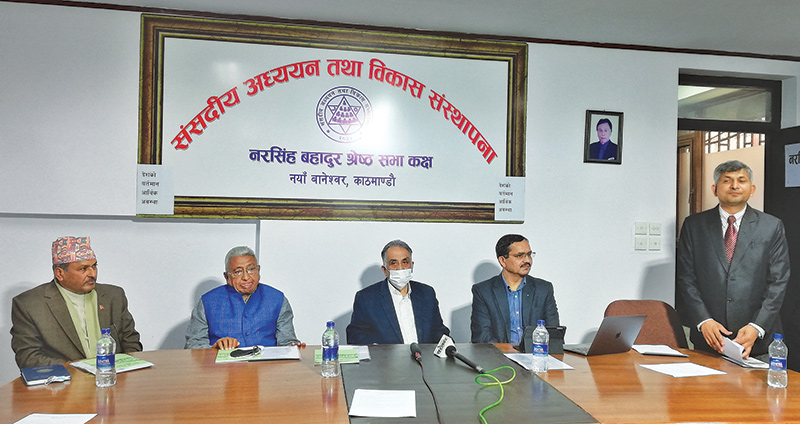
Adhikari said the slowed demand in cement and steel could result in lower economic growth. “The targeted 5 percent growth may not be achieved this fiscal year ending mid-July,” said Adhikari, addressing a programme entitled ‘Current Economic Situation of the Country’, organised by the Foundation for Parliamentary Studies and Development.
Nepal’s economic growth was 5.84 percent in the last fiscal year.
The apex bank’s governor, however, said Nepal’s key economic indicators have improved and are no longer adding to the fiscal deficit.
Fiscal deficits are negative balances that arise whenever a government spends more money than it brings in during the fiscal year.
The inflation too, is being estimated to remain on the higher side.
The monetary policy had targeted to keep inflation within 7 percent.
“But it is still above that target,” Adhikari said. “It is expected that inflation will be between 7-8 percent until mid-July,” said Adhikari.
The external sector’s performance is heading in a positive direction, he added. “The external sector almost got derailed in the last fiscal year and we have since come out of it,” Adhikari said.
The import-export and the overall trade deficit have shrunk. The trade deficit declined by 18.7 percent in the first seven months of the current fiscal year, he added.
The remittance earning has grown 27.5 percent, which has helped stabilise the external sector. Nepal has been receiving remittances of more than Rs100 billion per month.
“As the number of migrant workers is increasing, we expect that the remittances will increase,” Adhikari said.
“As a result of increased remittances, the banks’ liquidity has now crossed Rs400 billion,” he added.
During the last fiscal year, the central bank had injected around Rs350 billion into the market.
The tourist arrival has also reached pre-Covid era levels and the room occupancies are also improving, which is positive, said Adhikari.
The interest rate fluctuated due to the imbalance in demand and supply, he noted. “The banks, to increase liquidity, offered higher interest rates for deposits,” Adhikari said.
The interest rates are declining gradually as the base rate has come to 11 percent, the average loan interest rate is at 13 percent and the average deposit interest rate is around 9 percent. “The easing liquidity has been reducing the interest rate in
the past few months. The indications until now show that interest rates will not go up. In fact, it is on a declining trend,” he said.
Adhikari said that the revenue collection of the government has declined due to which it is becoming difficult to maintain the current expenditure for the government.
“It is challenging to increase the revenue this year as the private sector income has declined, and corporate tax too, is on the decline. There is no sign that revenue from imports will increase this year,” said Adhikari.
Achyut Wagle, a professor at Kathmandu University, said the government’s current expenditure is Rs600 billion and it has been collecting revenue for the same amount.
“The government is struggling to provide salaries from the current expenditure and this is a rare event in its history.” Wagle said that there is a need for a policy response to resolve the ongoing economic problem.
“There is a need for legal and structural policy reform,” he said.
Govinda Raj Pokhrel, former vice chairman of the National Planning Commission, said Nepal’s financial governance has become weak—in both the private and public sectors.
“The country’s economic situation is not good and the reasons for that are many,” Pokhrel said.
Remittances have become a major source of income which is not sustainable, he said.

MONEY

Book on Nepal-India spiritual circuit launched

- Post Report

The book mainly describes five religious sites in Nepal and India.  Post courtesy: NICCI 

KATHMANDU, 
The Nepal-India Chamber of Commerce and Industry (NICCI), on Monday, unveiled a book titled ‘Religious and Spiritual Circuits Nepal and India’, to promote religious tourism between the two friendly neighbours.
The book mainly describes five religious sites—Shiva Shakti Circuit, Mahabharat Circuit, Ramayan Circuit, Buddhist Circuit and Shikh Circuit—in Nepal and India.
It also showcases the immense richness of these religious sites found in the two countries and their significance to three of the world’s major religions—Buddhism, Hinduism and Sikhism.
Addressing the ceremony, the Minister for Culture, Tourism and Civil Aviation Sudan Kirati, said Nepal-India relations date back to the times of ancient rishis and sages. He said that the book will contribute to enhancing religious tourism between the two countries.
Navin Srivastava, India’s ambassador to Nepal, said the book, which is a joint contribution of scholars from Nepal and India, will contribute to enhancing the people-to-people ties as well as in tourism promotion.
The book talks about the mythology and religious importance of many religious sites which expresses the richness and depth of the religious heritage spanning the Indian sub-continent and many parts of South-East Asia.
The book has been prepared by experts and scholars from both the countries, who are—Neera Mishra, Ramesh Dhungel, Basudev Krishna Sashtri, Ramesh Bhattarai, Hari Prasad Adhikari, Acharya Pandit Tek Narayan Upadhaya, Gyani Gurubaksh Singh, Rajinder Singh Chadha, Bikram Pande Kaji and Deepak Anand. Marshal Rathore and Luja Mathema, the two officials of the NICCI also contributed to the writings.
According to NICCI, to promote religious tourism, the Indian Railway Catering and Tourism Corporation is scheduled to start the Bharat-Nepal Aastha Yatra Tour, starting on March 31.
The nine-night, 10-day tours will entail visiting significant Hindu religious places such as Ayodhya, Varanasi and Prayagyaj in India and Pashupatinath in Nepal.

MONEY

Alibaba says will split into 6 groups, separate IPOs expected

Bizline

BEIJING: Alibaba announced Tuesday that it would split into six business groups in one of the most significant overhauls of a leading Chinese tech firm to date. Daniel Zhang, the company’s chairman and CEO, said the restructuring would enable each separate business to pursue its own fundraising and public listing plans. Hangzhou-based Alibaba said the moves were intended to “unlock shareholder value and foster market competitiveness”. Under the new arrangement, each of the six newly established units will be managed by its own CEO and board of directors. A key exception to the restructuring is Taobao Tmall Commerce Group—the operator of one of China’s top online purchasing platforms—which will remain wholly owned by Alibaba Group. Recent years have seen the internet giant face unprecedented headwinds as Beijing has imposed tighter restrictions on the domestic tech industry. Combined revenue at China’s internet companies shrank by just over one percent to 1.46 trillion yuan ($212 billion) in 2022, the first contraction in almost a decade, according to data from the Ministry of Industry and Information Technology. (AFP)

MONEY

Cancer-causing compounds found in everyday food: EU

Bizline

PARIS: Cancer-causing chemical compounds called nitrosamines have been detected in a range of everyday foods and could pose a health risk to consumers, the European Food Safety Agency warned on Tuesday. The 10 nitrosamines—which are not intentionally added to food but which can form during its preparation and processing—are carcinogenic and also genotoxic, which means they may damage DNA, according to a new study conducted by the European Union agency. “Our assessment concludes that for all age groups across the EU population, the level of exposure to nitrosamines in food raises a health concern,” said Dieter Schrenk, chair of the EFSA’s panel on contaminants in the food chain. “Based on animal studies, we considered the incidence of liver tumours in rodents as the most critical health effect,” he added. (AFP)

MONEY

Stocks mixed as bank fears recede

Bizline

LONDON: Global stock markets fluctuated on Tuesday as fears of a banking crisis ebbed after weeks of turmoil. On Wall Street, the Dow opened higher but the S&P 500 and tech-heavy Nasdaq fell, while Europe’s main indices seesawed in afternoon trading and Asia was mixed. “Markets are uninspiring today because of the lack of fresh catalysts to encourage the bulls, following the recent financial-sector turbulence,” said Fawad Razaqzada, analyst at City Index and Forex.com. Most equity markets had advanced Monday as bank shares jumped after US lender First Citizens bought most of collapsed rival Silicon Valley Bank (SVB). The gains followed last week’s rout over concerns that the turmoil in the sector—which sparked the UBS takeover of Credit Suisse—could hit other major institutions, such as German giant Deutsche Bank. (AFP)

Page 7
SPORTS

Thakuri last-gasp goal rescues Nepal from historic Bhutan defeat

The substitute forward scores in the stoppage time to salvage a 1-1 draw for the hosts. Nepal meet Laos in the final.
- Sports Bureau
Dipak Raj Singh Thakuri (10) prepares for a header during the Prime Minister Three Nations Cup football match against Bhutan at the Dasharath Stadium in Kathmandu on Tuesday.  Post Photo: Hemanta Shrestha  

KATHMANDU,
Hosts Nepal averted a first ever defeat to Bhutan after substitute forward Dipak Raj Singh Thakuri scored a stoppage-time goal to salvage a 1-1 draw in the last group match of the Prime Minister Three Nations Cup at the Dasharath Stadium in Tripureshwar on Tuesday.
However, the home team had to settle for first ever draw against the South Asian minnows in almost four decades since the two sides first played an official competitive match in the 1984 South Asian Federation Games.
The draw, however, was enough for Nepal to book a place in the final as they had defeated Laos 2-0 in their opening game while Bhutan had gone down to Laos 2-1. Even a two goal margin defeat would have been sufficient for Nepal to progress into the final.
But the outcome was a harsh blow to Bhutan, who came into the game looking for a must win over the hosts to secure the final berth. The final scheduled for Friday will now see Laos vying against Nepal.    
Nepal finished on top of the standings with four points, one point ahead of runners up Laos. Bhutan walked away with one point.
“We are happy to have secured a draw against Nepal because we never avoided defeat against Nepal in the history of football,” Bhutan’s coach Pema Dorji said at the post match conference. “Today we were dominant in the game, controlling ball possession and threatening the opponents more often.”
As said by coach Dorji, Bhutan were a far better side. They kept possession and control and took a lacklustre Nepal by surprise, opening the score in the 19th minute. Unmarked Tenzin Norbu drove a low header past captain and goalkeeper Kiran Kumar Limbu to stun noisy supporters and take the lead over Nepal for the first time in footballing history.
While Bhutan made as many as four attempts on goal in the first half, Nepal’s only remarkable attempt on goal came in the 45th minute before rookie defender Sanish Shrestha’s header from the crowded area in Nabin Lama’s corner sailed above bar after header touches from Ananta Tamang and Pujan Uperkoti.
Anjan Bista had come closer to scoring in the early second half after he found a ball deflected at Manish Dangi inside the area, but Bhutan’s goalie Tshering Dendup rescued the visitors, sprinting quickly to grab the ball and also collide with forward Bista, who was stretchered off. He was replaced by Thakuri in the 51st minute.
Bhutan threatened Nepal yet again in the 64th after Phuntsho Jigme applied a low ball strike in Dawa Tshering’s corner forcing goalie Limbu into action. Forward Thakuri, under tight marking of Bhutanese defender, fired above the bar after he was set by Erik Bista.
Dangi, who replaced forward Nawayug Shrestha at the start of second half, could have levelled in the 79th after he dispossessed Phuntos Jigme before firing wide from a tight angle.
But Thakuri rescued the Gorkhalis from the jaws of historic defeat against the run of play in the 90th minute. Bhutan goalkeeper Tshering Dendup will especially rue the draw as his unsuccessful attempt to punch the corner from substitute Nishan Khadka allowed Ananta Thapa to lift the ball over him before substitute Thakuri, who was left unattended, took full advantage of it to head into the empty post.
The last-gasp goal saved Nepal from an embarrassing defeat against the South Asian minnows but the draw will still serve as a wake-up call for the new coach Vincenzo Alberto Annese.
Nepal’s Italian coach Annese, however, claimed that there were lots of improvements in the team. He said that they failed in the first half. “We created some clear chances, but failed to capitalise on them,” he said. “We will try to perform better in the next game.”

SPORTS

Koshi and APF to clash in Women’s T20 final

Chhetry’s side see off Madhesh to finish second in the group.
- Sports Bureau

KATHMANDU,
Koshi Province registered a thumping 62-run victory over Madhesh Province to set up the title clash against Nepal APF Club in the Lalitpur Mayor Women’s Cricket Championship at the TU ground in Kirtipur on Tuesday.
Sent in to bat first, national captain Rubina Chhetry-led Koshi posted 105-6 in the allotted 20-overs and then restricted Madhesh to a paltry total of 43-9 in the last group stage game to finish runners up.
Nepal Armed Police Force (APF) Club, already assured of the final, saw off Lalitpur Mayor’s XI by 37 runs in the early kickoff to finish the group round by maintaining a perfect record.
The tournament’s final will be played on Thursday.
APF wrapped up with the maximum eight points with four wins while Province 1 finished runners up on six points with three wins and a defeat. Their only defeat came against APF. Sudurpaschim Province finished third on four points, Madhesh ended up fourth on two points while Lalitpur crashed out without any points, losing all four games.
Captain Chhetry, who came to open the innings for Koshi, contributed the highest 39 runs off 38 balls. Her opening partner Kajal Shrestha contributed a 28-ball 22 and Apsari Begam hit a 32-ball 19. Smriti Katuwal scored 10 runs.
Madhesh bowlers Amisha Patel, Amiran Nisha and Santoshi Chaudhary picked up two wickets each.
Madhesh came up with a poor performance with the bat. Middle order batter Saraswati Kumari was the only player managing to reach a double digit score. She  scored 10 runs.
Koshi captain Chhetry, Alisha Khadiya and Nisha Shah claimed two wickets each. Chhetry was also named the player-of-the-match for her all-round show.
In the earlier game, opting to bat first, APF posted 110-6 on the back of an unbeaten 41 runs from Rajmati Airee and they then restricted hosts Lalitpur to 73-8.
The player-of-the match Airee slammed four hits to the fence, for APF, in her 52-ball knock. Captain Sita Rana Magar contributed a 16-ball 19 while Binu Budha contributed a 16-ball 12 runs.
Lalitpur bowlers Shristi Jaisi and Seemana KC shared two wickets each.
In the run chase, only three Lalitpur batters managed to touch double digit scores with Sony Pakhrin contributing 15 runs off 19 balls, Laxmi Chaudhary scoring 10 runs off 23 and Seemana KC 10 runs off 21 balls.
APF’s Rajmati Airee and Binu Budha picked up two wickets each.

SPORTS

Khadka takes lead on Day 1

Cards five-under 63 for a one-stroke lead over Prajapati.
- Sports Bureau

KATHMANDU,
Rabi Khadka took a one-stroke lead over Dinesh Prajapati at the end of the first day of the Surya Nepal Challenge, the sixth event under the Surya Nepal Golf Tour 2022-23, at the par-68 Royal Nepal Golf Club on Tuesday.
Khadka carded five-under 63 on his home course and is one stroke ahead of Dinesh Prajapati, who carded a bogey-free four-under 68.
Bhuvan Nagarkoti and Deepak Magar are joint third at two-under 66. Bhuwan Kumar Rokka and amateurs Subash Tamang and Suresh Tamang share the fifth position at one-under 68.
Rame Magar is eighth with the score of even-par 68. Pros Dhana Bahadur Thapa, Shiva Ram Poudel and amateurs Sadbhav Acharya and Yubraj Bhujel are tied at ninth position at one-over 69.
Leader Khadka played three-under 31 on the front nine and carded two-under 32 on the back nine. He made a flying start with a birdie on the first hole and sank an eagle on the par-5 fourth hole before taking the turn. On the back nine, Khadka carded three birdies on the 10th, 17th and 18th holes and faced the lone bogey of the day on the 16th hole.
Prajapati carded two-under 32 on both halves. He carded birdies on the fourth and fifth holes on the front nine. Prajapati then carded birdies on the 10th and 13th holes on the back nine.
Nagarkoti carded one-under 33 on both halves. After facing a bogey on the third hole, Nagarkoti carded birdies on the fourth and eighth holes. After taking the turn, he carded birdies on the 10th and 13th holes but faced a bogey on the 17th hole.
Magar played one-under 31 on both halves. His bogey-free front nine included a birdie on the second hole. Magar then carded birdies on the 12th and 13th holes and dropped a shot on the 15th hole.
A total of 37 golfers—29 pros and eight amateurs—are taking part in the tournament.
Cut will be applied after the second round. Top 21 pros and ties (if any) will make the cut along with six amateurs and those who make the professional cut.

MEDLEY

Horoscope

ARIES (March 21-April 19)
Today will act as a mixed bag, making it important that you strive to move from a positive and loving place. A nostalgic energy could have you mourning missed opportunities. A helping hand will allow you to find beauty in the present.

TAURUS (April 20-May 20)
An isolating energy could find you. Your clarisma will elevate a sense of grace, encouraging you to break free from your shell to socialise. A witty energy will flow through you, so don’t be afraid to crack a few outlandish jokes.

GEMINI (May 21-June 21)
Avoid the temptation to reach for your phone first thing this morning. Meanwhile, a helping hand will encourage you to embrace silence and introspection, allowing you to find clarity and inner truth before proceeding with your agenda.

CANCER (June 22-July 22)
The moon continues its journey through your sign this morning, forming connections with the healing asteroid. This cosmic climate will conjure a strange energy, putting you in a serious yet social mood. Plan on letting your hair down.

LEO (July 23-August 22)
Your faith may waver as of, though a helping hand can help you reclaim a sense of beauty in this world. Accept that not every element of life has to be magical, opting instead to face your responsibilities in order to conquer them.

VIRGO (August 23-September 22)
Today will bring both positive and negative energy to the table. Avoid interacting with competitive or jealous peers in order to flow through these cosmic tides, gravitating toward your most kind-hearted and uplifting companions.

LIBRA (September 23-October 22)
Show yourself some extra love this morning. Luckily, a helping hand can direct you to a positive headspace, allowing you to shake off any funk lingering in the air by tapping into your personal power. Surprising negotiations could come into play.

SCORPIO (October 23-November 21)
You may feel slightly bogged down by your obligations this morning. Luckily, a helping hand will step in to help you find harmony within your to-do list, though you may need to access your gratitude in order to truly appreciate your blessings.

SAGITTARIUS (November 22-December 21)
Watch how you treat yourself and others this morning. It could cause your mood to ebb and flow, fluctuating from tranquil and in control to competitive or over the top. Look for ways to shake up and improve your lunchtime routine.

CAPRICORN (December 22-January 19)
Try not to let trauma from your childhood prevent you from fully embracing love today. Show some extra compassion to yourself as you move through the morning, acknowledging your emotions without abandoning hope and resilience.

AQUARIUS (January 20-February 18)
Your heart and mind may feel at odds this morning. Even if you’re struggling to stay on task, do your best to keep a positive narrative within. Emotional breakthroughs can help you find your centre this afternoon.

PISCES (February 19-March 20)
Allow your mind to drift toward love this morning. Unfortunately, donning rose-coloured glasses could cause you to lose touch with reality, making it important that you maintain a practical yet positive attitude. Creativity will flow through your veins this afternoon.

Page 8
CULTURE & LIFESTYLE

Encounters with beauty and loss

PhotoKTM 5 asks us to engage—to stop, think, change our way of life, and reboot entirely, in the face of a looming climate catastrophe.
- Sophia L Pande
‘Seeds Shall Set Us Free’ exhibition by Munem Wasif at Gallery MCube at Chakupat, Lalitpur.   Photos: Courtesy of Sophia L Pandé

Today, more than ever, we stand at the threshold of an apocalypse. The United Nations Intergovernmental Panel on Climate Change (IPCC) released a report last week that gives us a decade (maybe) before the planet warms 1.5 degrees Celsius above pre-industrial levels, bringing about extreme changes in weather patterns, precipitating natural disasters that would render the Earth close to unlivable. This unfolding scenario is quite literally on our doorstep. A decade can flash by in the blink of an eye, just as decades have passed as the world has largely ignored increasingly desperate calls for reducing carbon emissions.
The fifth edition of Photo Kathmandu asks us to engage; to stop, think, change our way of life, and reboot entirely, in the face of this looming catastrophe. It is not didactic, it poses questions, provides both general and specific examples, giving visitors a chance to re-experience slices of the natural world in the heart of a bustling mediaeval city, and a rare opportunity to immerse themselves in alternative futures, some radical, others more pragmatic, a few made particularly beautiful by their compassion and nuanced world view.  
The festival uses videos and photography, the chosen medium of documentarians, to highlight the plight of the planet, showcasing poignant vignettes of both the humans and non-humans who inhabit it. Working at a sophisticated nexus of botany, ornithology, technology, anthropology, photography, and methodical research, the exhibits portray the stark realities of the loss of ur-seeds and traditional farming methods due to scientific and technological advances in agriculture (at Gallery MCube), and the devastating impact of treating cattle with Diclofenac, an NSAID used to reduce pain and inflammation in people as well, resulting in a mass poisoning of the vultures or Jatayu, that feed on them (at Namkha). There is a silver lining here, but you must go to the exhibition to properly experience it.
With ‘Chhimeki Chara’ we learn about the enchanting plumage and characteristic trills of our neighbourhood birds, the Black Bulbul, the Alexandrine Parakeet, the little Brown Shrike, most of which are fast losing their habitats as humans displace animals, birds, plants, and trees (in Chyasal but also spread out across the festival routes). At the Aakash Bhairav Temple Exhibition, in Khapinchhen, we are taught, aurally, how to name avians in various languages, to deepen our connection to the environments we live in, and we get a chance to watch people across Nepal speak intimately about the uses of the indigenous plants that grow in their areas. At Patan House, in the Dhaugal neighbourhood, we come face to face with the artefacts of progress that scar our natural landscapes, not always bringing the benefits they promise, a stark contrast to the images of stunning endangered orchids, pinned onto a wall on the street itself, providing an unexpected but welcome burst of marvellous flora against a bleak backdrop of brick and cement.     
Changing behaviour takes generations. If we are going to evolve to respect the planet and everything that lives on it and survive climate change, it needs to be now, yesterday even, not in a few years’ time, and it needs to happen en masse, from grassroots to policy level. People have always turned away from the truth when it is too difficult to face, we see it in our government but also in our own civic behaviour as we continue to buy new mobile phones, purchase new vehicles, buy synthetic clothing, build our houses without any attention to the carbon footprint we are creating, or the trail of effluence we are leaving behind.
Nepal may not contribute much to global carbon emissions, but putting out a bonfire fed by wood and plastic today, whatever our traditions, composting our waste, trying to live a life with attention to the community, making way for those who do not have agency, human and non-human, and opening our minds to thought-streams and points of view that are different from our own, are all specific and general ways that we can start bringing about meaningful change from within. Art may be the only vehicle that can truly provide an outlet and platform for conversation that might address all our anger, fears, hopes, and dreams.
The Skin of Chitwan, the biggest exhibit at Photo Kathmandu (at Bahadur Shah Baithak) seeks to do this. It is an immersive, tactile experience that brings the viewer into a space where we experience the degradation of the very soil of a celebrated national park and UNESCO World Heritage Site. With ambient sounds and voices, images and microscopes, the curators and researchers have brought us an unconventional archive from a place of loss and flux—we can make of it what we may, be moved by the violence to nature, the uprooting of the indigenous Tharu people, dismayed that progress has wrought irreparable damage on a way of life, even while bringing relief from endemic diseases like malaria, and providing employment other than back-breaking subsistence agriculture.
Can we build an alternative future that incorporates the magic of science and technology while turning back to our roots and opening ourselves to the wisdom of indigenous knowledge? Can we move away from broad, generalised, mainstream notions of development, forging a unique, rigorous path that incorporates a vertically integrated, grassroots-based sustainability without becoming Luddites and railing against all progress?  
The answers are in our own hands, maybe even in our dreams, as long as we stop to think, listen, and above all, to pay attention.
PhotoKTM 5 is on till March 31.


Pandé is a writer, art-historian, film-maker, and  a long-running columnist for The Kathmandu Post and Nepali Times. She consults on education outreach, conservation, sustainable development, and resource mobilisation.

CULTURE & LIFESTYLE

Getting rid of comedones

Dermatologist Jebina Lama’s guide to dealing with blackheads and whiteheads.
- Rukusha Giri
Shutterstock

Kathmandu
Blackheads and whiteheads are common problems most teens and people in their 20s and 30s deal with. While they do appear a little different—because blackheads are open comedones while whiteheads are closed ones—and are caused by different things, they can be treated in the same way. The founder of The Skin Clinic, Dr Jebina Lama, is a consultant dermatologist and has been practising aesthetic dermatology for the past nine years. She tells The Post everything one needs to know about black and whiteheads.

What are blackheads and whiteheads?
Pimples and blackheads are not the same thing. Blackheads are visible skin bumps and clogged pores mostly filled with dead skin cells and oils. Open comedones are another name for blackheads. Comedones are skin-coloured bumps that take shape where a pimple forms. They are made up of follicles beneath the skin with huge pores clogged with sebum during the formation of blackheads. A chemical reaction takes place beneath the skin. The clogged pore turns black when a dark pigment under the skin oxidises. These are named blackheads.
Whiteheads are also clogged pores—mostly filled with dead skin cells and oils. Closed comedones are whiteheads covered with skin cells. Excess sebum combines with dead skin cells, forming a plug in the follicle. It bulges outside and creates a whitehead. Acne frequently causes whiteheads on the face, chest, and back.

What age group gets blackheads and whiteheads the most, and why?
People in all age groups get blackheads and whiteheads—except kids below the pre-teen age. Those with active oil glands can get these quite frequently. People in their teens, 20s and 30s suffer from congested pores more than other age groups.
Those with active oil glands prone to acne breakouts can frequently develop whiteheads on their face. Whiteheads can develop into active acne-like nodules, papules and pustules after bacterial infection.

How can one minimise blackheads and whiteheads?
Salicylic acid can be used to eliminate blackheads and whiteheads. Similarly, beta hydroxy acid, commonly used to treat acne, can also reduce blackheads and whiteheads as it boosts cell turnover and clears clogged pores. It can dry active acne lesions because it is a mild chemical irritant.
Another chemical that can be used is retinoids. It opens clogged pores and alters skin cell development, which helps to stop acne from forming. Differin gel is an over-the-counter retinoid containing 0.1% adapalene, an ingredient experts recommend to help treat acne, and blackheads and whiteheads.
Exfoliating acids can also treat whiteheads and blackheads. AHA—with or without BHA—works on the skin’s surface, while BHAs work below the skin’s surface to clear blocked pores and hasten the healing of cystic acne.
People with these problems can start with one ingredient first. All these ingredients are highly irritating, so one must be cautious while using them.
Washing the face regularly—every morning and night—will help kill bacteria and remove dead skin cells, especially before bed or after a sweaty workout.
Vitamins can help the skin fight acne by giving it an extra boost. The most popular vitamins for treating whiteheads are vitamins A, D, zinc, and omega-3 fatty acids.
Blackheads in people have all been connected to zinc, vitamin E, and vitamin A deficiencies. Therefore, taking vitamin E every day in the morning is advised. Supplements with vitamin E are available online.

What is the difference between blackheads and whiteheads?
The substance that makes up white and blackheads—typically a mixture of dead skin cells, oil, and sebum—is the same. Blackheads remain open, while whiteheads have closed pores. Whiteheads are more prone to develop into active acne, whereas blackheads are
easier to extract and less prone to develop into active acne. The skin has not yet ruptured in the case of whiteheads. However, the pore only has a limited amount of space. It expands as your body continues to produce oil and dead skin. If the pore remains clogged after opening, the blemish oxidises and becomes a blackhead.
A small number of blackheads and whiteheads are considered normal. They aren’t painful or dangerous to anyone’s health.

Should one see a dermatologist if they have blackheads and whiteheads?
Most individuals will have a small number of blackheads and whiteheads. But if you want to have clear skin without any congestion, then definitely, yes, you should visit a dermatologist.

CULTURE & LIFESTYLE

My podcast picks


Rachana Dahal


Rachana Dahal is a well-known musician, with releases like ‘Bhumari’ and ‘Daagbatti’, who debuted in 2019. Her songs often feature commentary on personal as well as societal issues like mental health.


The Jordan B Peterson Podcast

The podcast started on December 7, 2016 and has 230 episodes. It talks about the creation of aimless social hierarchies that leave people devoid of meaning. I like this podcast because it features intellectual discourses. The podcast delves deep into distinct elements: narcissism, psychopathy, sadism, among others. It also discusses the major problems plaguing today’s youths.


Aperture

‘Aperture’ launched only six months ago and has aired 21 episodes to date. This podcast is about bringing the cosmos to our planet: the ideas of future, reality, simulation, and nihilism are topics covered in the podcast. I like it because along with talking about the cosmos, they also bring in psychologists to come and talk about self help.


History of the Universe

The early universe, the creation of the first stars and galaxies, redshift, and gamma-ray bursts are some of the topics covered by Prof Nial Tanvir from University of Leicester, UK.  This podcast interests me since it is all about the cosmos, time, super forces, and the universe’s entire history.


Kurzgesagt—In a Nutshell

Kurzgesagt, which translates to ‘In a Nutshell’ in German, is an animation studio and YouTube channel based in Munich that has a unique perspective on design, color, and storytelling. This long running podcast has 11 seasons and 171 episodes. I love to watch the animated videos on YouTube that accompany the podcast.


Teal Swan

Teal Swan talks about truths behind beliefs, love, shame, hurt, relationships, fear and our response to our loneliness in her podcast. This podcast includes 433 episodes and is available on YouTube. I just really enjoy listening to Teal Swan. This is definitely for someone who wants to get inspired by authenticity, freedom and joy.