Nagarik Unmukti throws spanner in PM’s Cabinet plan
Regional party lays claim to urban development ministry, which prime minister had allotted to Nepali Congress.
- TIKA R PRADHAN
KATHMANDU, Prime Minister Pushpa Kamal Dahal couldn’t expand his Cabinet on Thursday as well after some fringe parties insisted on getting the ministries allocated to other coalition partners. One such fringe party is the Nagarik Unmukti Party that has been laying claim to the Ministry of Urban Development, which Dahal had already allocated to the largest party, the Nepali Congress. Although coalition partners have agreed on a tentative division of 21 ministries, the prime minister failed to appoint ministers after several parties made claims to a few plum ministries. “The prime minister is trying to settle the differences after some parties insisted on getting ministries that have already been allocated to other parties,” said Ramesh Malla, personal secretary to Prime Minister Dahal. “It may take some time to resolve the issue.” According to members of the prime minister’s secretariat, the Cabinet will be expanded on Friday afternoon. As per Thursday’s agreement, the Congress will lead eight ministries—Finance; Foreign Affairs; Defence; Urban Development; Land Management, Cooperatives and Poverty Alleviation; Federal Affairs and General Administration; Health and Population; and Law, Justice and Parliamentary Affairs. The Congress is preparing to send its team to the Dahal Cabinet under the leadership of Vice President Purna Bahadur Khadka as a deputy prime minister. Besides the prime minister, the Maoist Centre will have five ministries—Home Affairs; Communication and Information Technology; Culture, Tourism, and Civil Aviation; Energy, Water Resources and Irrigation; and Women, Children and Senior Citizens. The CPN (Unified Socialist) was demanding three ministries, but had to settle for two—Physical Infrastructure and Transport, and Forest and Environment. Currently, the Maoist Centre’s senior vice chair Narayan Kaji Shrestha as a deputy prime minister is leading the Ministry of Physical Infrastructure and Transport. The Janata Samajbadi Party will get two ministries—Education, Science and Technology, and Agriculture and Livestock Development. But the Nagarik Unmukti Party, which was given the Ministry of Youth and Sports, insists that it wants no portfolio other than Urban Development. “We want Urban Development instead of Youth and Sports,” said Damodar Pandit, spokesperson of the Nagarik Unmukti Party. As the leaders of the fringe party were insistent on their demand, the prime minister delayed Cabinet expansion, according to leaders privy to the development. The party has decided to send its chair Ranjita Shrestha to the government. The Loktantrik Janata Party has already nominated Sharat Singh Bhandari as minister for Labour, Employment and Social Security. The demand of the Janamat Party, however, has been fulfilled this time as the party is set to get the Ministry of Industry and Commerce. Abdul Khan of the party currently heads the Ministry of Water Supply and he will soon switch the portfolio. The Ministry of Water Supply will then go to the Nepal Samajbadi Party. The Baburam Bhattarai-led party is likely to nominate Mahendra Raya Yadav, who is the only directly-elected lawmaker of the party, as minister. While addressing a function in Bharatpur on Thursday, Prime Minister Dahal hinted at the ongoing dispute among coalition partners over ministerial allocations. “We are yet to finalise the allocation of a few ministries,” Dahal told reporters at Chitwan on Thursday morning. “I was planning to expand the Cabinet and administer oaths to new ministers today. It will happen tomorrow [Friday] morning, if not today.” Two of the coalition partners that supported the government during the prime minister’s second vote of confidence have opted not to join the Cabinet. The Rastriya Swatantra Party having 19 seats in the House of Representatives has decided to stay outside the government after it could not get the ministries the party leaders were earlier leading. Also, the Rastriya Janamorcha has decided to stay out of the Cabinet. Government’s Common Minimum Programme readyMeanwhile, the task force of the ruling coalition is close to finalising the government’s Common Minimum Programme (CMP). According to the leaders involved in drafting the document, the ruling coalition has expressed its commitment to conclude the peace process within two years and complete the police adjustment (in line with the federal setup) within six months after the Cabinet gets its full shape. The CMP also promises an Election Act to ensure voting rights to all Nepali citizens living abroad. The cases filed against those involved in various political movements will be dropped, fake cases annulled and political prisoners released. The task force includes Ramesh Lekhak from the Nepali Congress, Rajendra Shrestha from the Janata Samajbadi Party, Shakti Basnet from the Maoist Centre and Vijay Kumar Poudel from the CPN (Unified Socialist). However, task force members also say they are yet to give a final touch to the CMP. “We have presented our draft. Now it will be finalised after discussing it among all the coalition partners,” said Rajendra Shrestha, a member of the task force.
HOME PAGE
Economist Wagle quits Congress ‘after constant humiliation by the Deubas’
Wagle is said to have joined Rastriya Swatantra Party and is set to contest Tanahun-1 seat.
- ANIL GIRI
Swarnim Wagle
KATHMANDU, Noted economist and former vice-chairman of the National Planning Commission Swarnim Wagle announced his dissociation from the Nepali Congress on Thursday ‘due to constant humiliation’ by the party’s chief Sher Bahadur Deuba and his wife Arzu Rana Deuba. His announcement has triggered a stir in the political and media circles. Soon after the announcement, Wagle joined the Rastriya Swatantra Party and is set to contest the Tanahun-1 parliamentary seat, which was vacated after Congress lawmaker Ramchandra Paudel was elected President. By-elections have been scheduled next month for three vacant seats including Tanahun-1. According to several Nepali Congress sources, President Paudel had recently asked Wagle to become his foreign relations and economic adviser. Wagle agreed, but said he would work as honorary adviser—and would not take any salary or benefits. But Congress chief Deuba and his wife intervened and obstructed the appointment. It was then that Wagle decided to quit the party. “The President was all set to appoint Wagle, but Deuba and his wife, Arzu, stopped him,” a Congress leader said. “Wagle got miffed especially because they barred him from working as an adviser, even without the salary, and finally he decided to quit the party.” After Wagle was rejected, Congress leader and former minister Sunil Bahadur Thapa was appointed the President’s political adviser. Similarly, former Nepal Rastra Bank governor Chiranjibi Nepal and former attorney general Baburam Kunwar have been appointed economic and legal advisers, respectively, to the President. Before quitting the party, Wagle sent a message to four Congress leaders—general secretaries Gagan Thapa and Bishwa Prakash Sharma; senior leader Shekhar Koirala; and another leader Govinda Raj Pokhrel—stating that he could not stay in the party due to continuous ‘insults and humiliations from the Deuba-Arzu gang’. Despite your [the four leaders’] support and generosity, I cannot not remain in the Congress anymore, wrote Wagle. “This is a big loss to the party, we have missed a visionary leader,” Pokhrel, who worked closely with Wagle for a long time, told the Post. “He would normally consult us, but he came to this decision all of a sudden,” Pokhrel said, adding, “I am trying to reach him, but he is not responding.” His frustrations with the party were growing for several reasons, according to leaders close to Wagle. One Nepali Congress leader told the Post that the party’s decision to deny him the Tanahun-1 ticket was the straw that broke the camel’s back. A meeting of the work execution committee of the Congress has decided to field Govinda Bhattarai from Tanahun-1 and Jit Narayan Shrestha from Chitwan-2. As soon as the Congress on Thursday named Bhattarai as its candidate from Tanahun-1, Wagle announced his divorce from the party. “We hope we will get connected again in some way the day you have a decisive role in the party. Until then, I promise to cooperate and maintain the current intimate friendship,” Wagle said in the message sent to the four leaders. Wagle was involved in drafting the party’s manifesto for the parliamentary elections last November and aspired to contest the elections. But he was denied a ticket. Some reports suggest that Rabi Lamichhane’s Rastriya Swatantra Party has offered Wagle its ticket to contest the Tanahun-1 by-election. RSP leader Aranico Panday dropped the hint on Twitter on Thursday. “Looking forward to @SwarnimWagle finally getting elected to parliament and living up to his potential guiding the country’s economy,” Panday, a central committee member of the Rastriya Swatantra Party, tweeted. “Best of luck, my friend! May the bell ring throughout Tanahun-1!” Going beyond that, Rastriya Swatantra Party spokesman Mukul Dhakal said that Wagle is indeed an RSP member and is set to contest the election from Tanahun-1 on the party’s ticket. Dhakal said the party was in contact with Wagle for some time but they have yet to decide what position to assign him in the party. After Wagle’s announcement, the two Congress general secretaries, Thapa and Sharma, held a meeting at the party headquarters at Sanepa and tried to stop him from quitting, but their attempts were unsuccessful. “I have decided to distance myself from the Nepali Congress Party, with which I was associated since the ‘Satyagraha’ of 2042 BS and the Janandolan of 2046 BS and 50 years of my family legacy with the party,” Wagle wrote in his Facebook post. In his Facebook post on Thursday, Wagle said the Congress party’s activities in recent years make its ‘self-respecting’ members ashamed. Wagle also announced that he will be active in a new public role from the Nepali New Year 2080, with the agenda of democracy and economic progress based on good governance. Wagle is currently the chair of the Institute for Integrated Development Studies (IIDS), a South Asian policy think-tank established in Kathmandu in 1979. He also served in advisory roles at several international organisations including the UN.
HOME PAGE
Uncertain world order dominates Boao discourse
Experts stress Nepal should not miss chances to show up at international forums at a time of contested politics.
- Purushottam Poudel
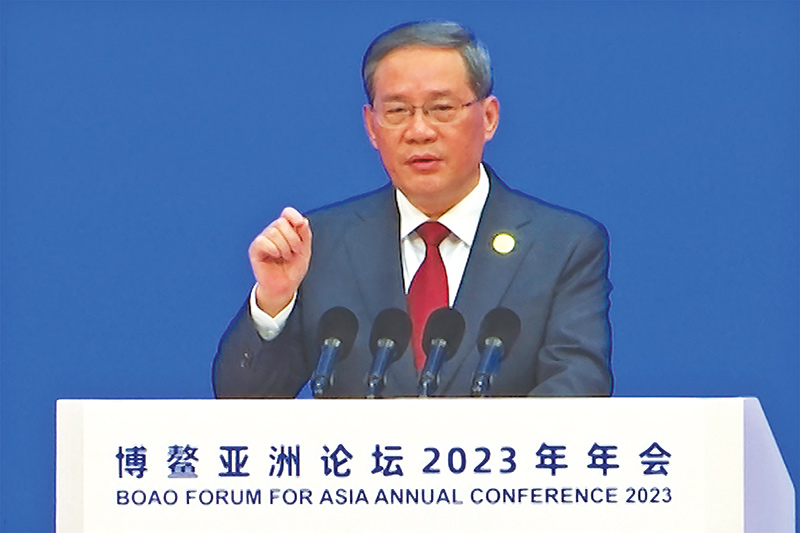
Chinese Premier Li Qiang addresses the Boao Forum for Asia conference in Hainan. AP/RSS
HAINAN, Growing tensions in international affairs took the centre stage at the annual BOAO Forum for Asia (BFA) conference in Hainan province of China. The rising confrontation between China and the United States and its potential effects on world politics took precedence at the BFA, which is otherwise designed to discuss Asia’s economic issues. During the conference scheduled for March 28-31, topics ranging from climate change to digital economy and the future of clean energy are being discussed, as well as their possible impact on world politics. This year’s theme of the conference—an “Uncertain World: Solidarity and Cooperation for Development amid Challenges—is significant in the context where global politics has become more erratic, said the Chinese Premier Li Qiang, while addressing the forum on Thursday. When global politics are getting muddied, Li said: “Cooperation is most crucial. The three initiatives forged by President Xi Jinping—global development, global security, and global civilisation—are the Chinese plans to develop the world.” “We must work together for stability and for a peaceful world. To achieve that, every country should abide by the five principles of peace mentioned in the United Nations Charter,” he added. Li said: “We can implement the Global Security Initiative for world peace and tranquillity. Asia, home to 40 percent of the world’s population, is the anchor of the world. Asia should be the impetus for the world economy. Regional Comprehensive Economic Partnership (RCEP) and the Belt and Road Initiative’s (BRI) implementation for the successful future of Asia is imminent.” Li also said China has been a defender of global development and peace. “In an uncertain world, the certain thing is that China is the anchor of global peace and development.”
Those speaking at the conference did not only express their concerns about a deteriorating relationship between China and the United States, they also expressed concerns about the war between Russia and Ukraine and its impact on the world economy. Prime Minister of Singapore Lee Hsien Loong, addressing the conference, said: “The Russian invasion of Ukraine has violated the UN Charter. Asian countries should work for a good relationship with China and America.” Addressing the conference, the managing director of the International Monetary Fund (IMF), Kristalina Georgieva, offered the suggestion of making global supply chains more beneficial for mankind. “Globalisation has not served all, equally,” Georgieva said. “The long-term cost of trade fragmentation could cost the world economy seven percent in the coming year and the economic fragmentation will adversely impact Asia, severely,” she warned. For the past three years, the economy of the world has been drowning, the IMF managing director said. “With the rise in interest rates, many countries’ economies are in depression. The world should soon launch a mechanism to address the issues.” Asia’s growth and development, against the background of a global economic slowdown, is a redeeming feature, said the BFA Secretary-General Li Baodong during the Global Economic Outlook session. According to him, the Asian economy is expanding gradually and China’s economic recovery has sent a very clear message of stability to the world. “Recovery of China’s economy means it will play a leading role in solving the global economic growth problems,” said the BFA Secretary-General. The event’s speakers pointed out the dangers of the Russia-Ukraine war and the Sino-American rivalry. There was also a discussion on the impact of artificial intelligence including the viral chatbot, Chat GPT, on the world. Nepali Ambassador to China Bishnu Pukar Shrestha represented the country at the Forum attended by around 2,000 representatives from 50 countries. Nepal has been a regular participant at the Boao Forum for Asia since its establishment in 2001, often sending a top-level delegation to Hainan. Nepal is one of the 29 founder nations of the BFA. Nepal did not receive an invite for the 2021 conference of the Boao Forum. This year, Prime Minister Pushpa Kamal Dahal did not attend the gathering. He had been at the event in 2017. Other Nepal officials who participated in the Forum in the past include former President Ram Baran Yadav and King Birendra. On its website, the Forum calls itself an international organisation with the founding purpose to promote economic integration in Asia. “At a time when Nepal was in the process of Cabinet formation, it was only expected that there would be no high-level participation from Nepal at the BOAO Forum this year,” said Sundarnath Bhattarai, the director of the China Study Centre in Kathmandu. Dahal had an official invitation for the forum, but he opted out in order to manage Nepal’s internal politics, Bhattarai added. “However, Nepal should not miss opportunities to participate in international forums where it can voice its concerns at a time of contested global politics and turbulent economy. The country has to be heard abroad,” he said.
NATIONAL
Musahar man kills self amid looming eviction
Twenty-four families of Musahars have been living on a piece of land at Kawilasi for the past five decades. They have now been ordered to move out.
- OMPRAKASH THAKUR
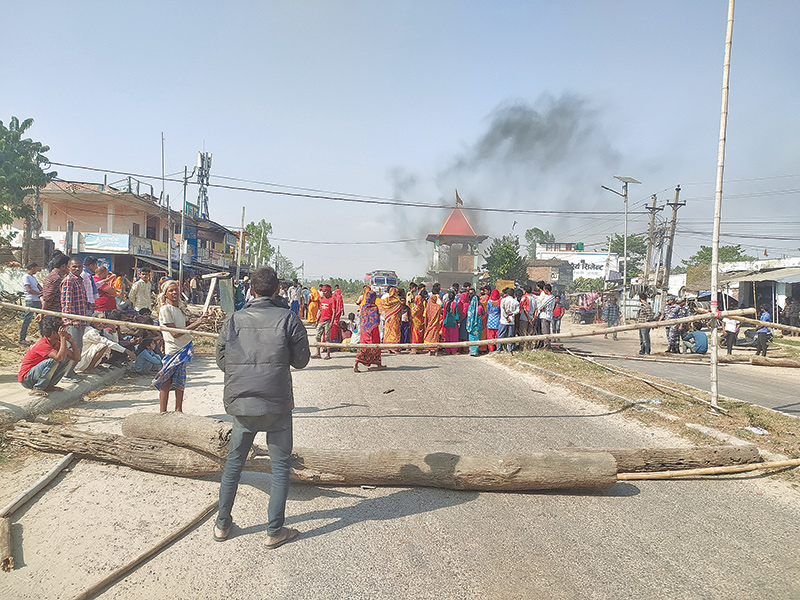
Musahar people facing eviction blocked road in protest at Gaurchowk in Sarlahi on Monday. POST PHOTO: Om Prakash Thakur
SARLAHI, Upendra Dhanukar, a 40-year-old Musahar man, died by suicide on Saturday night. Dhanukar was under immense pressure after being told to vacate his house in a Musahar settlement in Kawilasi Municipality ward-7, where his family had been living for the past five decades, according to his family members. The post-mortem report confirmed Dhanukar had died by suicide. The police handed over the body to his family on Monday. Musahars from the settlement led protests on Monday morning in Gaurchowk along the Nawalpur-Malangawa road section accusing the moneyed of displacing the Musahar community. According to Lalka Majhi, a Musahar woman, 24 families have been living in Kawilasi ward-7 on a plot of land measuring approximately 8.5 kattha (around 2,900 square metres) for several years. Madan Krishna Prasai, the previous land owner, had given them the land to settle down, says Majhi. But the residents never had the land registered under their names. The Sarlahi District Court states that the said land was auctioned by the court in 2010 after Mukul Prasai, Madan Krishna’s son, failed to pay his loan to one Ram Kailash Raya. Rai won the auction. Following the auction, Raya visited the Musahar settlement several times to evict the settlers. But the locals protested and prevented Raya and the police from bulldozing the homes of the Musahars. After several disputes between the Musahars and Raya and initiatives from the police and the local administration, an agreement was reached on Friday between the Musahars and Raya. At the meeting held at Kawilasi Area Police Station Raya agreed to compensate the Musahars with Rs7 million on condition that they leave the land. Majhi claims the Musahars were coerced into signing the agreement by Raya in cahoots with local politicians. “They put pressure on us at the police station. We had told them we only wanted half of the land to live in but the other party refused,” she said. “Rs7 million compensation is not enough for 24 families. With that money, we can’t move anywhere else and settle down.” According to Rajnikant Jha, a human rights advocate from Kawilasi ward-7, those wanting to remove the Musahars from their settlement must take the responsibility for Dhanukar’s death. “Dhanukar was a leader of the Musahars in the area. Friday’s forced agreement left him dejected. He was driven to a point where he had to kill himself,” said Jha. Dhanukar’s wife, Rekha, says her husband was not in favour of the agreement since he did not want to leave his birthplace. “He was willing to participate in the auction and pay the money for the land as directed by the court, but he wasn’t allowed to do that,” said Rekha. “Since the court’s decision in 2010 to auction the land, we haven’t had an easy life. My husband was at his wit’s end and he decided to take his life.” Dhanukar has left behind his wife, two daughters and a son. The youngest daughter is 10 years old. Rekha is now worried for her children and their well-being since she does not have the financial resources to take care of them. “We will soon be displaced. I don’t know where I will go with my children,” she said.
NATIONAL
Protesters padlock offices of Dharan local units
District Digest
SUNSARI: Protesters advocating identity-based nomenclature of the Koshi Province padlocked the offices of the Dharan Sub-Metropolitan City and all 20 wards on Thursday, demanding that the province be renamed. The activists of Kirat Yakthung Chumlung, Kirat Rai Yayokkha, the Nepal Federation of Indigenous Nationalities and some political parties that lobby for identity-based politics have been protesting against the new name of the province by forming a joint struggle committee. The committee has announced plans to padlock offices of local units and remove new sign boards that bear the new name from March 28 to 31.
NATIONAL
Bara-2 by-election further polarises Madhesh politics
The ‘working alliance’ formed during Vice President election is disintegrating.
- NISHAN KHATIWADA
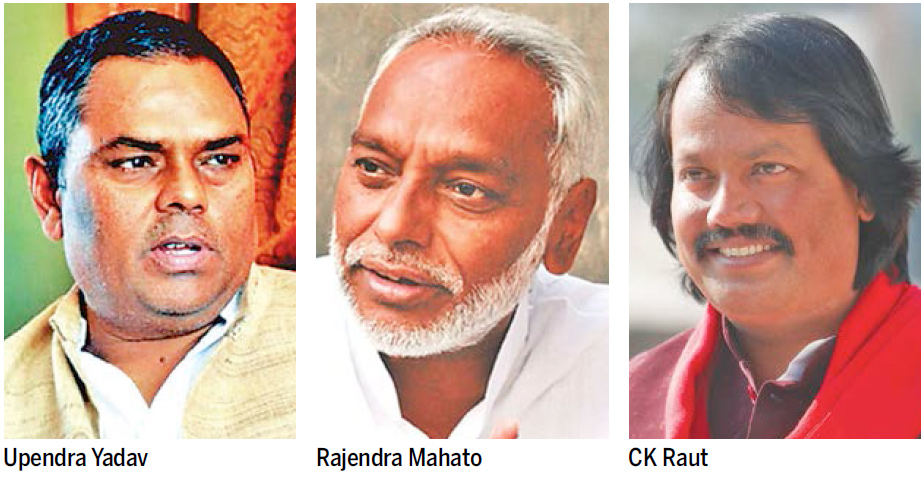
KATHMANDU, Rajendra Mahato, a veteran of Madhesh politics, has tossed his hat in the ring for the by-election in Bara-2, a constituency that has remained vacant after Ramsahay Prasad Yadav was elected the country’s Vice President. Keshav Jha, executive member of the Loktantrik Samajbadi Party, confirmed to the Post that his party has decided to field senior leader Mahato for the by-election. “The Janamat Party had previously promised to help us in the by-election,” he said. “And we are confident that they will.” The newly-emerged Janamat Party, however, has other plans. On Wednesday, it welcomed Maoist Centre’s Shiv Chandra Kushwaha to its fold with a plan to field him against Upendra Yadav in Bara-2. The Loktantrik Samajbadi Party, the Janamat Party and the Nagarik Unmukti Party had forged a working alliance ahead of the vice-presidential election. Mamata Jha from the Janamat Party stood a distant third, with even the parties of the ‘working alliance’ not voting for her. Now the partners of the alliance are keen on fielding their separate candidates. “The more candidates other parties field, the better the prospects of our candidate,” Jha said. “Kushwaha, an influential local leader, had lost the November elections to Ramsahay Prasad Yadav by fewer than 400 votes. His votes and Janamat Party’s votes will remain intact and we will win, even if the Nepali Congress supports the Janata Samajbadi Party.” Ramsahay won the parliamentary election last year securing 13,822 votes with the backing of the CPN-UML. Kushwaha came close, with 13,468 votes. The Election Commission has scheduled by-elections in three constituencies. Ramchandra Paudel and Ramsahay Prasad Yadav—who were elected from Tanahun-1 and Bara-2—became President and Vice President, respectively. Rabi Lamichhane of Rastriya Swatantra Party had lost his parliamentary post after the Supreme Court invalidated the citizenship certificate he produced while filing his candidacy. Now he has re-acquired the certificate. Madhesh-based leaders of the Nepali Congress, on the other hand, say they will support Upendra Yadav’s candidacy in Bara-2. “We have already been directed by the party’s central body to support the candidacy of Janata Samajbadi’s Yadav in Bara-2,” said Nitesh Gupta, publicity department chief of the Congress Madhesh Province chapter. Traditionally, the constituency is a stronghold of the Nepali Congress. Voices have also surfaced in the Congress’ Madhesh body that the party should rightfully claim to lead the Madhesh provincial government now. “As we are the largest party in Madhesh from the ruling alliance and will support Yadav in the polls, we believe that the Nepali Congress should get its turn to lead the government,” said Gupta. The Bara Chapter of Congress had recommended Radhe Chandra Yadav as the candidate. Observers say the Bara by-election exposes the fragmentation in Madhesh politics and the competition among key leaders to lead regional politics. Madhesh politics was robust from 2008–2013 as it was heated up due to the Madhesh movement. Until 2013, the Madhesh-based parties went through multiple splits and fared poorly in the second Constituent Assembly elections in 2013. The 2015-16 Madhesh movement united Madhesh forces again. As a result, they fared somewhat better in 2017 major elections. But after 2018, as political analyst Vijay Kant Karna puts it, the Madhesh politics has been going through a phase of fragmentation and rivalry. “Madhesh-based parties have been competing against each other to claim the province’s leadership but it’s not a competition about policies and agendas for development,” he said. This fragmentation has proved to be a fertile ground for ascendant politicians like Janamat Party chair CK Raut to lure votes of dissidents who are disenchanted with the traditional Madhesh-based parties. Raut’s party won six seats in the lower house in the major polls. “Raut thinks that if he defeats Upendra Yadav, he will emerge as the ‘leader’ of Madhesh,” Karna said. “But being the sole leader of Tarai-Madhesh is in no way possible.” Karna added that Rajendra Mahato, on the other hand, is fighting for his own and his party’s existence. The Loktantrik Samajbadi Party fared poorly in the last major polls—it could not get the threshold votes to become a national party. Mahato was defeated by Mahindra Raya Yadav of the Nepal Samajbadi Party in the November general election from Sarlahi-2. Karna said that Raut also wants to create a political space for himself and his party in the Bara, Parsa and Rautahat districts where the party’s hold is comparatively weaker.
NATIONAL
Accidents, insurgency blamed for rise in disabled population
- PRITHVI MAN SHRESTHA
KATHMANDU, Nepal has been seeing a sharp rise in the number of people with disabilities in the last two decades forcing the government to spend more on social security for such people. According to the Population Census 2021 released last Friday, the number of disabled people increased to 647,744 in 2021 from 513,321 in census 2011. The disabled population in Nepal, according to the 2021 census, accounts for 2.2 percent of the national population, a rise from 1.94 percent in 2011. As per the 2001 census, only 0.46 percent of people in Nepal were disabled. “Increasing cases of road accidents and the decade-long Maoist insurgency are responsible for the rise in the number of disabled people,” said Hemraj Regmi, deputy chief statistician, at the National Statistics Office, which released the final report of the census last week. The share of the population aged 60 years or above stood at 10.21 percent, a rise from 8.13 percent in 2011, according to the new census report. Problems like poor vision and hearing loss appear as one grows older. “Growing ageing population contributed to the rise in the number of disabled people with such problems,” said Regmi. According to the census, the share of disabled population with partially impaired vision stood at 17.1 percent, the second largest after the physical disability whose share is 37.1 percent. Likewise, the share of blind population in 2021 is 22.5 percent, up from 18.46 percent in 2011. The share of disabled population with hearing problems was eight percent in 2021. If the number of deaf people is also included, the total share of the population with hearing impairment stands at 15.9 percent, up from 15.45 percent in the 2011 census. While the rise in the ageing population contributed to the rise in the number of disabled people, even the number of younger disabled people is also rising, Regmi said. “Rising cases of accidents, particularly road accidents, and the insurgency also contributed to the rise,” he said. People who were disabled during the insurgency continue to carry the disabilities and they are continued to be counted as disabled in each census until they are alive. As of mid-February of the current fiscal year 2022-23, a total of 137 people were seriously injured in road accidents while 4,600 sustained minor injuries, according to the traffic police office. The rise in disabled population means that the state has to spend more on their social security. According to the Department of National ID and Civil Registration, 194,473 people who are fully disabled or heavily disabled are the beneficiary of the social security allowance as of mid-January this fiscal year. Article 43 of the constitution has guaranteed the right to social security for the disabled people. The government had started providing social security allowance to disabled people since fiscal year 2008-09. A fully disabled person receives Rs3,990 per month while heavily disabled receives Rs2,128 per month, according to the department. The result of the census, however, has not pleased activists working in the field of disabled people. Sugam Bhattarai, general secretary of the National Federation of Disabled Nepal, said that the census results have not reflected the true figure of disabled people. “It must be 10-15 percent of the population,” he said. “We suspect enumerators skipped asking questions about disabilities in many households.” He said that the ‘misrepresentation’ of the figures on disabled population in the census could affect their political participation. “They also cannot get proper representation in government employment.”
NATIONAL
President appoints three advisers
KATHMANDU: President Ramchandra Paudel on Thursday appointed three advisors. Former minister Sunil Bahadur Thapa has been appointed the chief political adviser to the President, an official at the President’s Office said, adding Thapa will be given the cabinet rank. Similarly, former Nepal Rastra Bank Governor Chiranjibi Nepal has been picked as economic adviser to the President. Meanwhile, former attorney general and provincial chief of Gandaki Province Baburam Kuwar has been appointed as the President’s legal adviser, the official said. Thapa, who is also a former UN diplomat, will lead the team of advisers at the President’s Office. Former ambassador Suresh Chandra Chalise has already been appointed as foreign relations adviser to the head of the state. Chalise will also look after the President’s private secretariat. (PR)
NATIONAL
Nepali Congress finalises candidates for by-elections
Briefing
KATHMANDU: The Nepali Congress has finalised its candidates for the April 23 by-elections. A central work execution committee meeting of the party held on Thursday decided to field Govinda Bhattarai in Tanahun-1 and Jeet Narayan Shrestha in Chitwan-2. The meeting decided to support Janata Samajbadi Party’s candidate in Bara-2, said Badri Pandey, the party’s joint general secretary. Samajbadi Party Chairman Upendra Yadav is eager to contest the election from the constituency. By-elections are scheduled in three constituencies to fulfil the vacant House of Representatives seats. The seats in Tanahun and Bara had become vacant after Ramchandra Paudel and Ramsahay Yadav were elected President and Vice President, respectively. Paudel was elected as a member of the House of Representatives from Tanahun-1, while Yadav from Bara-2. Likewise, Chitwan-2 became vacant after Rastriya Swatantra Party President Rabi Lamichhane, who was elected from the constituency last November, lost his lawmaker status after the Supreme Court invalidated his citizenship certificate in January.
NATIONAL
Nepal reports 42 new coronavirus cases
Briefing
KATHMANDU: Nepal on Thursday reported 42 new Covid-19 cases, the country’s Ministry of Health and Population said in its daily situation report. The new cases were confirmed through 915 tests—300 RT-PCR and 615 antigen tests. A total of 44 people tested positive for the virus through PCR tests and five through antigen tests. The ministry released the data on new infections over the three days in its report. As of Thursday, 6,020,138 PCR and 1,539,208 antigen tests have been carried out across the country. According to the ministry, 989,182 infected people have recovered from the disease so far, 17 of them in the last 24 hours. The number of active cases stands at 123. The country did not report any Covid-19-related death in the last 24 hours, according to the Health Ministry. The countrywide death toll since the pandemic began stands at 12,020. On Wednesday, Nepal had reported 34 new coronavirus cases.
OPINION
For a plural publication landscape
Given the irregularity of publications, they do not make the research landscape robustly plural.
- PRATYOUSH ONTA
Shutterstock
Around the time when I finished my PhD in 1996, most academic journals (in the social sciences and humanities) that were published from Nepal were published from Kathmandu Valley. Very few academic institutions outside of the valley had ventured to publish such journals. Twenty-seven years later, that is no longer the case. Academic journals are now being published from virtually every significant city of the country. Cities like Pokhara and Biratnagar have seen the publication of many such journals. Smaller (in terms of academic capital) cities too have joined the act. In recent years, academic journals have been published from institutions located in Ilam Bazaar, Bhadrapur, Dharan, Dhankuta, Birgunj, Hetauda, Bharatpur, Kawasoti, Bhairahawa, Butwal, Gajuri, Gorkha, Besishahar, Baglung, Nepalgunj, Surkhet, Tikapur, Dhangadhi, Mahendranagar and other locations. These new journals, many of them available in the Nepal Journals Online portal (nepjol.info), have apparently boosted the institutional and geographical plurality in the journal publication landscape in the country. How is this plurality being realised? There are many aspects of this phenomenon, but the case of Pokhara gives us one important insight. The 2016 Education Management Information System Report prepared by Prithvi Narayan Campus, a constituent college of Tribhuvan University (TU), lists the eight departments that it then had under its Faculty of Humanities and Social Sciences: English, Nepali, Economics, Geography, History and Culture, Political Science, Sociology/Anthropology and Rural Development, and Population Studies. Later in the same report, we find a list of all the journals published by its various departments. When you compare the two lists, it becomes clear that each of those eight departments then published a separate journal. They are, respectively, The Outlook: Journal of English Studies, Prithvi Bangmaya, Economic Literature, The Himalayan Geographers, Historia, Journal of Political Science, Himalayan Journal of Sociology and Anthropology, and Demographic Forum. If you count all the journals that have been published from Prithvi Narayan Campus and other educational institutions in Pokhara, the number exceeds 30. That is quite impressive on face value. Same kind of growth has also been seen in the context of specific disciplines. For example, there has been an impressive growth in the number of sociology and anthropology journals published from different institutional locations since the first of such journals Occasional Papers in Sociology and Anthropology was published by the then Central Department of Sociology and Anthropology of TU in 1987. More than 10 such journals have been published since then, three from institutions located outside of Kathmandu Valley. Hence, one would have to conclude that the capacity to produce academic journals has spread to different parts of Nepal from its erstwhile concentration in Kathmandu Valley. If you take journal publication to be a proxy for some sort of research activity, then the above-mentioned facts indicate that knowledge production is being decentralised to a certain extent in Nepal. This is the good news.
Irregular journals In theory, academic journals are supposed to be published regularly, say one or more times a year. When journals are regularly published over the course of several years, they become recognised platforms for academic discourse. However, longevity and regularity are two different things when it comes to Nepali journals. Detailed data I have presented elsewhere shows that while some Nepali journals might have been around for many years, they are still very irregular. Except for a few journals, the ones published from Pokhara named above are also irregular. My detailed analysis of the sociology and anthropology journals published from Nepal, included as a chapter in the 2021 volume Practices of Sociology in Nepal, edited by Pranab Kharel and Gaurab KC, suggests that they too are no exception to this trend. Most of these journals are irregular in the sense that there is a discrepancy between their declared frequency and their real publication frequency. For instance, a new issue of the annual journal, Himalayan Journal of Sociology and Anthropology, has not been seen since 2016. Among the two editors who were mostly responsible for its management, one resigned from his professorial position at Prithvi Narayan Campus and the other went on a long doctoral research leave. Some of the other journals such as Occasional Papers and Nepalese Journal of Qualitative Research Methods have become defunct. The only regular journal in this group is the annual Dhaulagiri Journal of Sociology and Anthropology edited by its indefatigable chief editor Man Bahadur Khatri. Irregularity of our journals, then, is the bad news.
Influencing factors Why is this so? More than 35 years ago, the American scholar of higher education and publishing in developing countries, Philip G Altbach wrote: “There is a tendency in many Third World nations for individual academic institutions to establish scholarly journals, which almost inevitably become limited in authorship and circulation to the sponsoring institution and its mailing lists. They are seldom able to develop a wider constituency or establish a national or international reputation.” Altbach’s observations are still valid for the case of Nepal. Our journal production is clearly limited by the way in which they are conceptualised and executed as single department-specific productions. The eight departments in Prithvi Narayan Campus producing their own separate eight journals mentioned above exemplify this phenomenon. In most cases—there are some exceptions—these journals then suffer from the limitations of small editorial management teams and an inadequate supply of good research-based articles. To put it more generally, internal political dynamics within professional entities of academics, namely departments and discipline-specific organisations, have majorly determined what those bodies have been able to do as organisational entities. Lack of internal collegiality in such entities has, more often than not, limited the collective capacity of such groups and debilitated the functioning of editorial teams from departments or discipline-specific organisations. Bereft of long-term collective collegial work culture (which needs to be built up over years), most of these journals then become irregular. They appear in print when one or more committed editors put together an issue; but when such editors are missing, no one can be sure when the next issue will be published. At the moment then, our journal publication landscape appears plural in institutional and geographical terms; but given the rampant irregularity of these publications, they do not make the research landscape robustly plural. Effectively this means that the relative dominance of institutions based in Kathmandu Valley in terms of research production continues unabated. That is not good news if your idea of a federal republic includes robust institutional and geographical plurality in terms of knowledge production in the country. What can be done? Those who establish and manage journals need to enhance their “catchment areas” of potential authors beyond their own departments or campuses. Universities and funding bodies like the University Grants Commission can provide incentives for journals that are edited by academics from multiple departments and institutions. Specific disciplinary bodies can also seek to produce journals that are really open to contributors in their disciplines from all over the country and beyond. Such ventures would have the potential to be regular in frequency provided they are adequately supported in the medium term. That scenario of plural knowledge production would be really good news for a federal Nepal.
A portion of this article is derived from Onta’s article “(Almost) Always Occasional: The World of Sociology and Anthropology Journals Published from Nepal” in the volume Practices of Sociology in Nepal (Vajra Books, 2021).
OPINION
Meeting Nepal’s water challenges
The efforts to address water scarcity and water-induced disasters have been futile.
- SUCHANA ACHARYA,SAROJ KARKI
Water scarcity is a pressing issue that demands immediate attention. It threatens every aspect of our lives, from food security to public health, economic stability and political power. Sustainable water management is crucial to sustaining different sectors, especially with the increasing demand and climate change impacts. Without it, water resources may decline, compromising public health, causing economic losses and threatening food security. Prioritising water sustainability as a key policy component is crucial to ensuring a healthy and prosperous future. The achievement of Sustainable Development Goal 6 (SDG6), which aims to ensure clean water and sanitation for all, holds immense significance not only in terms of sustainable water resource management but also in the realisation of several other SDGs. The UN 2023 Water Conference, held on March 22-24, marks a watershed moment, providing a vital platform for governments, businesses and communities to make significant commitments towards securing a sustainable future for water and hence achieving global water and sanitation goals.
UN 2023 Water Conference The conference was held against the backdrop of several pressing issues related to the global water crisis, including the latest World Water Development Report, IPCC reports, UN Water Action Decade 2018-28 and other relevant data. Nearly three out of four natural disasters are linked to water, and a quarter of the planet lives without safely managed water services or clean drinking water. The theme of “Partnerships and Cooperation for Water” set the stage for the release of the UN World Water Development Report 2023, unveiled on the eve of the conference. Addressing the challenge of securing water, food, and energy while promoting sustainable water management, universal access to water and sanitation, and mitigating climate change requires collaboration from all stakeholders. Each person has a role, and partnerships among all actors are crucial. The conference came to a close with the adoption of the Water Action Agenda, an ambitious and collaborative plan aimed at safeguarding the world’s most valuable shared resource. The agenda comprises nearly 700 commitments, ranging from enhancing monitoring and data systems to bolstering infrastructure resilience through capacity-building efforts. This landmark action plan has garnered over $300 billion in pledges, which could unlock socio-economic and ecological gains worth at least one trillion dollars. However, the non-binding nature of these commitments raises questions. It was reiterated to prioritise water at the forefront of the global political agenda. The Water Action Agenda represents a critical step in ensuring future water security. Through the prioritisation of science-based actions and innovative solutions, this initiative has the power to revolutionise how we manage and protect our most precious resource. Alternative food systems to reduce water use, global information system for SDGs, early warning systems for safety were also highlighted.
Nepal’s water management The erratic distribution of water resources and the uncertainty of climate patterns, population growth, and anthropogenic activities have left water resource planners and policymakers grappling in recent years. Although Nepal has emphasised the concept of Integrated Water Resources Management (IWRM) in its National Water Resources Strategy, National Water Plan, and other water-related policies, it still lacks a proper institutional arrangement and plan implementation framework to address IWRM across the water resources sector. As a result, Nepal’s effort to address several water-related challenges, including water scarcity, deteriorating water quality, and water-induced disasters remains futile. Therefore, there is a need to restructure the institutional arrangement and implementation mechanism to enable effective IWRM practices and ensure sustainable management of the country’s water resources. The River Basin Planning report being prepared by the Water and Energy Commission Secretariat (WECS) has the potential to be a pivotal document that could shape Nepal’s water resources management in a significant way. Nepal’s focus on the water resources sector has been primarily on water utilisation and infrastructure development, with less attention to water management and conservation plans and programmes in terms of both scale and budget allocation. Without a greater emphasis on water management and conservation, the country may face significant challenges in meeting its future water needs and ensuring water security for its citizens. Instead, we need to adopt a broader perspective that draws upon past experiences, community engagement and technological innovations to ensure that we achieve our sustainable development goals. To address water management challenges effectively, capacity development for professionals at all levels of government and the private sector, as well as collaboration among different sectors at the national and international levels, and science-based actions are essential. Nepal has been globally praised for its remarkable success in community forestry, but despite various policy provisions and programmes, the community’s involvement in water management has been declining in recent years. Given the current changing socio-economic and political circumstances, it is imperative to reconsider water management strategies that keep communities at the core. The 2020 Water Resources Policy of Nepal outlines 11 strategies to achieve sustainable and optimal use of water resources to support the nation’s socio-economic transformation. These strategies are not only tailored to address Nepal’s water resources challenges but are also aligned with global trends, making them crucial for achieving sustainable and optimum utilisation of water resources. The effectiveness of these strategies, however, hinges on the timely implementation of corresponding acts and regulations as well as institutional strengthening.
Way forward Water is irreplaceable and demands diverse stakeholder engagement for sustainable management. The UN Water Conference 2023 aimed to tackle various aspects of the global water crisis, including water scarcity, pollution, disaster management, and climate change and re-establish water as a global common good. Nevertheless, the ultimate objective remained constant: Securing the sustainability of our valuable water resources. Whether through effective policies, innovative technologies, or community-based initiatives, the focus remained on preserving water availability and quality for ourselves and future generations. Appropriate interventions at the local and national levels can effectively address many of Nepal’s challenges in sustainable water resources management, and international cooperation should be reserved for tackling issues that exceed national capacity. To attract global attention and secure financing for water-related initiatives, Nepal must focus on developing reliable water governance, implementing innovative ideas, enhancing capacity building, and strengthening institutions. By doing so, the country can demonstrate its commitment to effectively managing its water resources and gain the trust and support of the international community. Nepal needs to do its homework in these areas to build a solid foundation and be better positioned to address the challenges of water scarcity and climate change. The international community is looking for reliable partners committed to finding innovative solutions, and Nepal has an opportunity to demonstrate its potential in this regard.
The authors are irrigation and water resources practitioners in the government sector.
OUR VIEW
All in the name
Protests in Koshi show that ethnic identity agenda is very much alive and should be addressed politically.
When Koshi became the last province in the country to get an official name a month ago, there were expectations that the nomenclature imbroglio would end once and for all. That was not to be. The way the meeting of the assembly of the erstwhile Province 1 proceeded on the day of the nomenclature had some essential ingredients for the dissent that would follow. The name of the province was announced with fanfare following a vote in the provincial assembly with an absolute majority, topped with a public holiday; however, the name was immediately rejected by a section of the local people. Apart from several other factors, the problem began with the major parties in Kathmandu imposing the name rather than letting the people’s representatives in the province make an informed choice. The Kirat-Limbuwan Struggle Committee, among others, has been staging protests against the endorsement of the province’s new name in Biratnagar. Similarly, there have been protests in other parts of the province, with some instances of violence. One Padam Bahadur Limbu was killed on March 24, while many others suffered injuries. The ongoing protests have to do with the dissatisfaction among a section of the people who say the name does not represent the identity of the people living in the region. The momentum for the dissent, though, had been building up since as early as 2017, when the first provincial elections were held, and provinces began to carve new identities for themselves. Despite years of haggling over the name, there seems to have been little consultations with the stakeholders in the region, the locals in the main, on the issue. That province could not be named for the longest time among all seven provinces shows that it was a complicated matter. It was thanks to the Maoist Party that various ethnic communities across the country became vocal about their rights to identity. This is the discourse they mainly pushed, especially in the run-up to the first Constituent Assembly elections in 2008. The Maoists even floated the idea of creating provinces along ethnic lines, only to ditch the idea once they got embroiled in parliamentary politics and considered it beneficial to side with mainstream forces rather than oppose them. The Maoists have come far from the ideals of ethnicity- or identity-based demarcation of provinces, but little did they know that long after they had abandoned it, the torch for ethnicity-based provinces would be taken up by others. As the most important agent for building a case for ethnicity-based provinces, the Maoists are morally responsible for either supporting the protests in the Koshi Province or convincing them otherwise. No less responsible are the parties that have bulldozed their ideas of naming the province in a way that makes the people living in the region misrepresented. The protests in Koshi show that the agenda of ethnic identity is very much alive and should be addressed politically. In a recent interview with the Post, CPN-UML deputy general secretary Prithvi Subba Gurung said the problem would have been resolved had the province been renamed Kirat-Koshi. While the act of renaming itself has various nuances, the ideas like the one floated by Subba could serve as talking points in an attempt to resolve the ongoing conflict. First, the governments at both the federal and provincial levels should ensure that the series of violence in the province comes to a stop and there are peaceful negotiations to safe-land the dispute.
THEIR VIEW
Crop concerns
The agriculture sector offers enormous business opportunities to investors.
After last year’s heatwave that caused wheat grains to shrink significantly, the ongoing wet spell in Punjab and elsewhere is to be welcomed. It will prove salutary for the upcoming wheat harvest, especially in the rain-fed regions. However, farmers in some districts are likely to suffer unexpected losses due to strong winds and hail that have accompanied the heavy rains over the last one week. According to the agriculture department, hailstorm damage to the wheat crop remains confined to 123,000 acres out of 16.041m acres under the staple crop in the province. They are hopeful that the present wet spell will help the grains grow in size and make up for the previous output loss. Nevertheless, farmers, especially those with small holdings, whose fields have been flattened by the hail and winds, must brace themselves for significant financial losses. Many may not be left with enough to buy inputs for the summer crop, and will need government support. Over the years, the farm sector has proved to be a major factor responsible for Pakistan’s falling economic growth. Its poor performance has retarded industrial growth, affected textile exports and put pressure on the fragile current account. In the last 15 years, agriculture’s real annual growth has been restricted to 2.2pc-2.6pc a year, which is dismal when compared to the expansion in the services and industrial sectors. This is so in spite of the fact that almost two out of three Pakistanis are somehow linked to and depend on agriculture for their livelihood. Even within the agriculture sector, according to a report by the Pakistan Agriculture Coalition, it is the crops—mainly wheat, maize, cotton, sugarcane and rice—that are holding back its growth. The production of major crops has grown by just 1.1pc for nearly two decades, despite consuming most of the country’s agricultural assets: land, water, labour, etc. There are multiple reasons that can be cited for the decline of crops, including lack of investment, low mechanisation, poor seed technology and varieties, obsolete and bad government policies affecting farmers’ choices, and so on. The impact of climate change in the form of droughts, floods and erratic weather patterns has accelerated this slide in the last one decade or so, and Pakistan remains among the top 10 countries most vulnerable to global warming. The stagnation in farming means that the trade balance will keep worsening while food insecurity and poverty will continue to surge unless the trend is reversed. That will require a change in our decades-old policies, increased use of technology and massive private investment in the value chain. The agriculture sector offers enormous business opportunities to investors. But their participation will remain limited unless the government decides to pull itself out of the supply chain and stops interfering in the market.
— Dawn/ANN
MONEY
Rattan furniture industry seeks friendlier policy
Due to the complex paperwork required to harvest rattan, manufacturers prefer to import their raw materials from India.
- SUBIN ADHIKARI
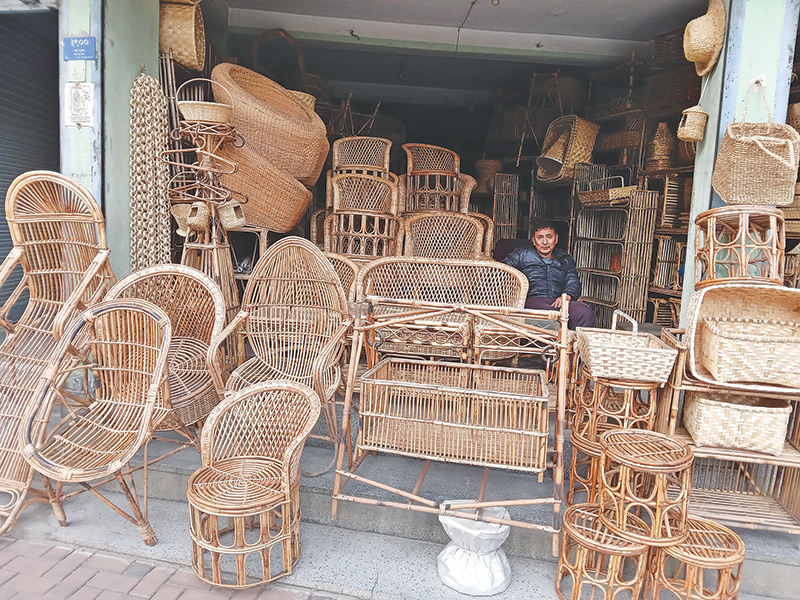
Interest in rattan products is increasing as they are handmade using natural materials without harmful colours or chemicals. POST PHOTO: SUBIN ADHIKARI
KATHMANDU, Narendra Das Shrestha, a local of Kupandol, Lalitpur, has been selling rattan furniture for 30 years. His inventory consists of chairs, tables, sofas and other furniture made from rattan vines, also known as bet, a climber plant. His family carried on a flourishing rattan furniture business for ages, but lately it is running into difficulties due to the Covid pandemic and subsequent liquidity crisis. “Both Nepalis and foreigners like our products, but nobody has the money now,” said Shrestha. “Every day, many people come to see the products, but they leave promptly when we tell them the price.” Prices at Shrestha’s shop range from Rs300 for a basket to Rs70,000 for a sofa. He sources these products from factories in Godavari and Sankhu in Kathmandu Valley and as far away as Dharan. “Foreigners buy small items to take home as souvenirs,” added Shrestha. Adjacent to Shrestha’s shop is another rattan store run by Sumitra Nagarkoti. She mainly sells light products like baskets, table lamps and clothes hangers. The products at her shop cost from Rs200 to Rs8,000. Nagarkoti says people have been showing greater interest in rattan products lately. “Along with individual customers, there are restaurants and cafes that buy decorative pieces.” The products are made in her father’s factory where he has a team of six workers. Interest in rattan products is increasing as they are handmade using natural materials without harmful colours or chemicals. If protected from direct sunlight and rain, rattan furniture can last for more than 30 years, traders say. Rattan traders are concerned by growing competition from cheaper imported furniture. They say the government should adopt a protectionist policy to save domestic industry from collapsing. Making rattan furniture is a skill-based business that has been passed down from generation to generation in local communities. They are often run by families and are not registered, and so have limited access to bank loans, government subsidies and other benefits. To add to their woes, sourcing raw materials is becoming more difficult. Rattan, which falls under the category of non-timber forest products, is found in the forests of Kailali, Bardiya, Dang and Chitwan districts in the Tarai. But due to the complex paperwork required to harvest rattan, manufacturers prefer to import their raw materials from India, which fulfils around 60 percent of the domestic requirement. In 2007, the government made it mandatory to conduct an initial environmental examination (IEE) and environmental impact assessment (EIA) to harvest more than 5 tonnes of rattan at a time from community and national forests. The regulation requires community forest user groups to get approval from their respective Division Forest Office too. Hence, harvesting of rattan from community forests has dropped considerably. In 2019, the government amended the Environment Protection Act and raised the threshold to 150 tonnes. Chote Lal Chaudhary, a researcher who has written multiple research papers on rattan, says government policy discouraged community forest consumer groups from harvesting rattan due to the red tape at the Division Forest Office. “During the period from 2007 to 2019, many manufacturers turned to Indian suppliers in the absence of regular supply from Nepali community forests,” said Chaudhary. Besides, manufacturers say Nepali rattan is of lower quality compared to the Indian product. “The rattan in Nepal (paani bet) is thinner than the rattan found in Siliguri in northeast India,” said Ramlal Nagarkoti who owns a rattan furniture factory in Godavari. “So we prefer to buy Indian rattan even if it’s expensive.” Local bodies in Bardiya, Dang and Sarlahi, in association with several non-governmental organisations, have attempted to promote commercial farming of higher quality rattan. But it takes six years for a rattan plant to reach maturity and become ready for harvest. The rattan plant is covered with thorns which makes harvesting a difficult task. Therefore, Indian workers are brought to harvest and process the rattan in most Nepali community forests. Community forest user groups and local bodies are trying to train locals to harvest and process the rattan plant, but they lack the necessary equipment. Satti Karnali Community Forest in Kailali is the largest producer of rattan in Nepal with an annual production of around 480 tonnes. Until a few years ago, they depended on Indian workers, but now they have a team of 40 locals to harvest and process rattan. Processing work finishes by the first week of May and the product is ready for market. The community forest charges Rs45 per kg from local buyers and Rs100 per kg from traders. Officials are concerned they may get a lower price this year due to the poor quality of rattan. “The rattan plants have turned black due to rain during the harvesting period,” said Min Bahadur Thakulla, secretary of Satti Karnali Community Forest. Nepal has a capacity to produce 4,400 tonnes of rattan annually while consumption is around 1,300 tonnes. But due to lack of coordination between the concerned parties, Nepali manufacturers are importing rattan from India while tonnes of rattan plants lie rotting in Nepali forests, said Chaudhary.
MONEY
Nabil Bank unveils greenhouse gas emission report of its projects
- Post Report
KATHMANDU, Nabil Bank has unveiled its greenhouse gas emission report for the year 2022 from the bank’s loan and investment portfolios under the infrastructure and project financing division. The report has been made public as part of a commitment letter signed by Nabil Bank as one of the Partnership for Carbon Accounting Financials signatories in 2021. The infrastructure and project financing portfolio includes a range of investments and loans to business sectors like energy, cement, airlines, telecommunication services and others. The sustainable banking vertical of the bank had set out to measure emissions from the bank’s loan and investments portfolio under the infrastructure and project financing division. The assessment of the portfolio’s carbon emission revealed that the total emissions for the year 2022 amounted to 80,671.37 tonnes of carbon-dioxide equivalent.Simultan-eously, investment in hydro and solar comprises carbon-dioxide emissions avoided by 2,131.81 tonnes. “While this is a significant amount, we are actively working to reduce our carbon footprint and make our portfolio more sustainable,” said Gyanendra Prasad Dhungana, CEO of Nabil Bank. Nabil Bank is dedicated to building a sustainable future, he added. “We recognise that this requires collective action. We believe that transparency is essential in achieving our goals, as we are committed to providing regular updates on our progress towards a net-zero carbon footprint.” Nabil Bank, being the first private sector bank in Nepal, has pioneered financial service innovations and sustainability in the banking industry.
Out of a 13.3-kilometre-long tunnel, 4.5 km has been dug since work began in mid-Oct.
- RAJKUMAR KARKI
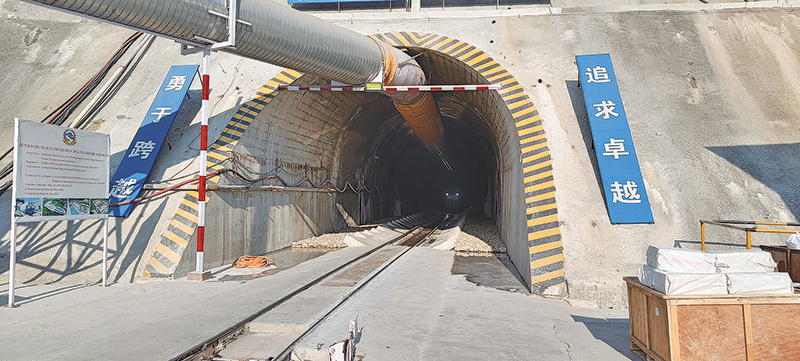
A tunnel boring machine has been used to cut through the hills, which makes Sunkoshi Marin the second project after the Bheri Babai Diversion Multipurpose Project in Surkhet to do so. POST FILE PHOTO
SINDHULI, The Rs10.05 billion tunnel project of the Sunkoshi Marin Diversion Multipurpose Project in Sindhuli is doing better than expected as 14 percent of physical progress has been achieved in less than six months. According to the project officials, out of the proposed 13.3-kilometre-long tunnel, 4.5 kilometres have been dug since the work began in mid-October last year. The diversion tunnel will redirect part of the flow of the Sunkoshi River to the Bagmati River to irrigate farmlands in the Tarai. The construction site is located in Sindhuli district, about 120 km southeast of Kathmandu, on BP Highway. The Rs83.51 billion Sunkoshi Marin project located in Sindhuli and Ramechhap districts envisages taking water from the Sunkoshi River and directing it into the Bagmati River to irrigate 122,000 hectares of farmland in Rautahat, Dhanusha, Mahottari, Sarlahi and Bara districts in the southern plains. According to the project officials, the irrigation scheme is estimated to cost Rs37.3 billion and the hydropower component Rs46.19 billion. The tunnel is part of the irrigation component. The water from the Sunkoshi will first be diverted to the Marin River in Sindhuli through the 7-metre-wide tunnel before being channelled into the Bagmati River. The water will then be collected at a barrage and distributed to irrigate the fields. Low water flows in the Bagmati River have caused severe difficulties for farmers in Rautahat and Sarlahi districts in irrigating their fields. In the dry season, irrigation facilities are not available. The project proposes to construct a 12-metre-high barrage across the Sunkoshi River and divert a discharge of 67 cubic metres per second through the tunnel to Kusumtar located in Ward 6 of Kamalamai Municipality. A powerhouse will be built on the Marin River to generate 28.62 megawatts of electricity. Mitra Baral, the project chief, said they planned to dig 500 to 700 metres of the tunnel every month. A tunnel boring machine has been used to cut through the hills, which makes Sunkoshi Marin the second project after the Bheri Babai Diversion Multipurpose Project in Surkhet to do so. The other end of the tunnel will be at Kan Dungri, which lies around 700 metres below the Triveni, which is the confluence of the Tamakoshi and Sunkoshi rivers, in Sunkoshi Rural Municipality. According to the senior divisional engineer Ashok Raj Gautam, the project has not faced any hurdles yet. “The work in some part of Chure has been completed,” said Gautam. “We have begun digging on the Mahabharat range.” The work would be completed before the set deadline of 22 months, Gautam claimed. “The work at the Mahabharat range part, however, will be more difficult,” Gautam said. China Overseas Engineering Co. won the contract for the construction of a tunnel for the Sunkoshi Marin Diversion Multipurpose Project in 2021. The Sunkoshi Marin Diversion Multipurpose Project intends to provide a round-the-year irrigation facility to five drought-prone districts in the southern plains, decades after it was envisioned. The project was first mooted in 2016 when the government had planned to begin a scheme titled Prosperous Tarai-Madhesh Irrigation Special Programme to provide water to the parched farmlands in five drought-prone Tarai districts. At that time, the Ministry of Irrigation had proposed to develop the Sunkoshi Marin Diversion Multipurpose Project to provide irrigation facilities to these districts. Insufficient rainfall has long been a recurrent problem here. A massive outflow of youths to foreign lands has created a shortage of labourers to carry out agricultural activities, making things more difficult for the local farmers.
MONEY
Kazakh airline says business is booming as Russia loses traffic
Moscow has lost its status as a hub for flights between Europe and Asia.
- REUTERS
FlyArystan planes are seen at Almaty International Airport, in Almaty, Kazakhstan on Tuesday. Reuters
ALMATY, Kazakhstan’s flagship airline, Air Astana, is speeding up its expansion plans to take advantage of a drop in air traffic via Russia and the reopening of China, chief executive Peter Foster told Reuters. Many global airlines stopped flights to Russia after it invaded Ukraine last year. As a result, Moscow has lost its status as a hub for flights between Europe and Asia, allowing its southern neighbour Kazakhstan to boost its market share. “Prior to the start of the war in Ukraine, a lot of traffic in general, going in the western direction, whether that was to Europe or to the US, was traveling from this region via the Russian Federation,” Foster said in an interview. “Obviously, that is no longer the case. And so what has happened is there has been a shift of gravity and we are extremely well placed to take advantage of that shift.” Air Astana, part-owned by Britain’s BAE Systems, posted a record profit of $78.4 million last year as its traffic grew 11 percent to 7.4 million passengers, even though the company has also ceased flights to Russia. The company plans to grow its fleet to 50 aircraft by the end of this year from the current 44 aircraft, Foster said, and is accelerating expansion plans for the coming years. “We are making more orders for 2024-27. I think it’s common knowledge now that the 787 Dreamliner will arrive in 2025. So we will continue to expand the fleet both with those aircraft and with more Airbus 320 family aircraft,” he said. “We see very big opportunities in China, as China has opened again, following Covid, India is doing well.., Pakistan is a growth market.”
MONEY
Samsung launches Galaxy A54 5G and A34 5G in Nepal
Bizline
KATHMANDU: Samsung has launched its all-new Galaxy A34 5G and Galaxy A54 5G in Nepal. For the first time in Galaxy A series, the A54 5G features a glass back, giving it a premium look and feel. Both devices offer spill and splash resistance with IP67 rating and Corning Gorilla Glass 5 for improved scratch and drop protection, reads the press release issued by the company. The A54 boasts a 50MP OIS primary lens while the A34 comes with a 48MP OIS primary lens. Pricing for the A54 5G starts from Rs56,999 while the A34 5G costs Rs45,999. (PR)
MONEY
Twitter blocks Pakistan government’s account for viewing in India, notice says
Bizline
NEW DELHI: Twitter has blocked the Pakistan government’s account from being viewed in India in response to a legal demand, according to a notice on the social media platform on Thursday. The company’s guidelines compel it to withhold entire accounts in response to a valid legal demand, such as a court order. The account, @GovtofPakistan, remained available for viewing and interaction from countries such as the United States and Canada, Reuters checks showed. (REUTERS)
MONEY
Boeing’s first astronaut flight to space delayed until July
Bizline
CAPE CANAVERAL: Boeing’s first launch of astronauts has been delayed again, this time until July. NASA announced the latest postponement on Wednesday, saying more time is needed to certify and test the Starliner capsule’s parachute system before the spacecraft blasts off with two test pilots. Additional software testing is also underway. Liftoff is currently targeted for no earlier than July 21 from Cape Canaveral Space Force Station. (AP)
WORLD
Ukraine acknowledges Russian gains in Bakhmut; Moscow arrests US reporter
Kyiv has been on the defensive for nearly five months but says it is planning a counteroffensive soon.
- REUTERS
A tank is towed through a road, amid Russia’s invasion of Ukraine, near the bombed-out eastern Ukrainian city of Bakhmut, in the eastern Donetskregion, Ukraine on Wednesday. REUTERS
KYIV, Ukraine acknowledged some Russian gains inside the eastern battlefield city of Bakhmut, while insisting on Thursday that it was inflicting greater losses on the Russian attackers than its own forces were taking in defence. In a potential escalation of Russia’s diplomatic feud with the United States, Moscow’s FSB security service said it had arrested an American reporter for The Wall Street Journal, Evan Gershkovich, on suspicion of spying for Washington. The small mining city of Bakhmut has been the site of the bloodiest infantry battle in Europe since World War Two as Russian forces have sought their first victory since mid-2022 in a huge winter assault. Ukraine has been on the defensive for nearly five months but says it is planning a counteroffensive soon. “Enemy forces had a degree of success in their actions aimed at storming the city of Bakhmut,” the General Staff of the Ukrainian armed forces said in an overnight report. “Our defenders are holding the city and are repelling numerous enemy attacks.” The report gave no details of the Russian gains. The Institute for the Study of War think tank said Russian troops and Wagner mercenaries had captured territory in the south and southwest of the city over the past two days, and Wagner had occupied a metal plant in its north this week. Russian forces have been advancing slowly inside Bakhmut in intense street fighting for weeks. Kyiv seemed likely a month ago to abandon the city but has since decided to stay and fight for it, hoping to break the attacking force. Deputy defence minister Hanna Malyar said in a social media post that losses were inevitable, but “the enemy’s losses are many times greater”. Serhiy Cherevatyi, a Ukrainian military spokesperson, told national television: “Bakhmut remains the epicentre of military activity...It’s still constantly ‘hot’ there.” As winter has turned to spring, the pressing question is how much longer Russia can sustain its offensive, and when or if Ukraine will strike back. There are signs its campaign is slowing down. The number of daily Russian attacks on the front line reported by Ukraine’s general staff has declined almost by half over the past four weeks. The arrest of Gershkovich could have an impact both on diplomacy with the United States and on international coverage of Russia and the war. He would be the highest profile American arrested by Russia since basketball star Brittney Griner, who was caught arriving in Moscow with cannabis oil a week before the invasion of Ukraine and freed in a prisoner swap in December. The FSB said in a statement it had “stopped the illegal activities of US citizen Gershkovich Evan, born in 1991, a correspondent of the Moscow bureau of the American newspaper The Wall Street Journal, accredited at the Russian Foreign Ministry, who is suspected of spying in the interests of the American government”. No comment was available from the newspaper. The FSB said Gershkovich had been tasked “by the American side” with gathering information on “the activities of one of the enterprises of the military-defence complex”. It provided no evidence. The US Embassy’s travel guidance, last updated in February this year, advises US citizens not to travel to Russia because of the danger of arbitrary arrest and says US citizens living or travelling in Russia should depart immediately. Moscow has effectively outlawed all independent Russian news outlets since the start of the war but has continued to accredit some foreign reporters. Journalism has become sharply limited by laws that impose long sentences for any public criticism of the war.
WORLD
North Korea kills people for sharing South Korean videos, drugs: Report
- REUTERS
SEOUL, North Korea executes people for drugs, sharing South Korean media, and religious activities as it stifles its citizens’ human rights and freedom, its rival, South Korea, said in a report on Thursday. South Korea’s Unification Ministry, which handles inter-Korean affairs, based the 450-page report on testimony collected from 2017 to 2022 from more than 500 North Koreans who fled from their homeland. “North Korean citizens’ right to life appears to be greatly threatened,” the ministry said in the report. “Executions are widely carried out for acts that do not justify the death penalty, including drug crimes, distribution of South Korean videos, and religious and superstitious activities.” Reuters could not independently verify the South Korean government’s findings but they were in line with UN investigations and reports from non-governmental organisations. North Korea has rejected criticism of its rights conditions as part of a plot to overthrow its rulers. The report gave details of rampant state-led rights abuses in communities, prison camps and elsewhere, including public executions, torture and arbitrary arrests. Deaths and torture regularly occur in detention facilities and some people were summarily executed after being caught trying to cross the border, the ministry said. The report came as South Korea seeks to highlight its isolated neighbour’s failure to improve living conditions while racing to boost its nuclear and missile arsenals. South Korean President Yoon Suk Yeol said the report should better inform the international community of the North’s “gruesome” abuses, saying North Korea deserved “not a single penny” of economic aid while it pursues its nuclear ambitions.
WORLD
Taiwan’s president begins US visit to shore up support
- ASSOCIATED PRESS
WASHINGTON, Taiwan’s president is beginning a swing through the United States and Central America, a visit aimed at showing that her self-ruled island has allies as it faces a rising threat from China. Taiwan was carefully calibrating President Tsai Ing-wen’s stops in the United States, and as always forgoing any official meetings with senior US leaders in Washington, in an effort to contain what China said would be a strong but as yet unspecified response. Tsai arrived in New York on Wednesday and was scheduled to spend Thursday in the city, but few details of the trip were made public. A senior Chinese diplomat in Washington, embassy charge d’affaires Xu Xueyan, pointed to an expected meeting between Tsai and House Speaker Kevin McCarthy elsewhere in the country. The meeting would have serious repercussions overall and a “serious, serious, serious” impact on US-China relations, she said in a virtual session with reporters on Wednesday. Senator Robert Menendez, a New Jersey Democrat and chairman of the Senate Foreign Relations Committee, said he hopes any US officials meeting unofficially with the president convey that American support for Taiwan is “strong and unequivocal.” Taiwan is an important partner for Washington in the Indo-Pacific and a major recipient of US military aid. The US, Taiwan and their allies in the region are boosting their military readiness with the aim of deterring or defending against any future military action by China, which claims the island as its own. Last August, Beijing responded to the visit of then-House Speaker Nancy Pelosi to Taiwan by launching missiles, deploying warships across the median line of the Taiwan Strait and simulating a blockade of the island. China also temporarily suspended dialogue with the US on climate and other major issues and restricted military-to-military communication with the Pentagon.
WORLD
Philippine ferry fire kills 31 people
Most of the victims were in the budget section of the passenger cabin.
- ASSOCIATED PRESS
A Philippine Coast Guard ship trains its hose as it tries to extinguish fire on the MV Lady Mary Joy at Basilan, southern Philippines early Thursday. Philippine Coast Guard via AP/RSS
MANILA, A fire broke out on a ferry in the southern Philippines and raged overnight for eight hours, killing at least 31 of the approximately 250 passengers and crew, officials said on Thursday. Many of the more than 200 people who survived the blaze jumped off the MV Lady Mary Joy 3 and were rescued from the dark sea by the coast guard, navy, a nearby ferry and local fishermen, said Governor Jim Hataman of the southern island province of Basilan. Rescuers were still searching Thursday for at least seven missing people, he said. Hataman said the burned ferry was towed to Basilan’s shoreline, where the bodies of 18 of the 31 victims were discovered in a budget section of the passenger cabin. “These victims perished on board due to the fire,” Hataman said by telephone. He said more people may have been on the ferry who were not listed on its manifest. The ferry’s skipper, however, told coast guard officials that he tried to run the burning ferry aground on the nearest shore to allow more people to survive or be rescued, regional coast guard commander Rejard Marfe said. The fire raged for about eight hours, he said. The ferry was traveling to Jolo town in Sulu province from the southern port city of Zamboanga when it caught fire off Basilan close to midnight, Hataman said. At least 23 passengers were injured and taken to hospitals. “Some of the passengers were roused from their sleep due to the commotion caused by the fire. Some jumped off the ship,” Hataman said. The steel-hulled ferry could accommodate up to 430 people and was not overcrowded, Marfe said. According to the manifest, it was carrying 205 passengers and a 35-member crew, he said. In addition, it had a security contingent consisting of four coast guard marshals and an unspecified number of soldiers who were not listed on the manifest for their protection, Marfe said. He said officials are investigating whether the 33-year-old ferry was seaworthy, if there were passengers not listed on the manifest, and whether the crew properly guided passengers to safety.
WORLD
Finland’s PM Marin in battle to stay in power
She became the world’s youngest premier at 34 in 2019.
- REUTERS
Finland’s Prime Minister Sanna Marin. REUTERS
HELSINKI, Finnish Prime Minister Sanna Marin, who in 2019 became the world’s youngest premier at 34, is battling to stay in power in an election on Sunday as the country faces a recession and her challengers accuses her government of bloated public spending. Marin, who has appeared on the covers of Vogue and Time Magazine, is considered by fans around the world as a millennial role model for progressive new leaders. But at home, she has been the subject of mundane political scrutiny, criticised by the opposition for her centre-left coalition’s debt-fuelled spending and by the media for her partying at a time when Europe’s energy crisis hit Finland hard. Marin says spending on education and health services is key to securing economic growth. Her rivals, Petteri Orpo of the right-wing National Coalition Party and Riikka Purra of the nationalist Finns Party, are calling for fiscal austerity to restore government finances. The three parties are running neck-and-neck in opinion polls, with the most recent survey showing the National Coalition leading with 19.8 percent support, ahead of Marin’s Social Democrats and the Finns Party at 19.2 percent each. And while personally popular, it is unclear if her popularity will translate into victory for her party in the parliamentary vote. In 2019, the Social Democrats won very narrowly, with 17.7 percent of the vote.
WORLD
Chile detects first case of bird flu in a human
Briefing
- AGENCIES
SANTIAGO: Chile detected the first case of bird flu in a human, the country’s health ministry reported on Wednesday. The case was detected in a 53-year-old man who presented severe influenza symptoms, according to a statement issued by the ministry, but they noted the patient was in stable condition. The government is also investigating the source of contagion as well as others who were in contact with the patient. Chile has reported cases of the H5N1 bird flu since late last year in wild animals. Recent cases in industrial farms caused the government to halt poultry exports. Industrial cases have also been detected in Argentina, but Brazil, the world’s largest exporter of poultry, remains free of the contagion. Chilean health authorities noted the virus can be transmitted from birds or marine mammals to humans, but there is no known human-to-human transmission. Earlier this year, Ecuador confirmed its first case of human transmission of bid flu in a 9-year-old girl. Global health officials have said risk of transmission between humans is low, but vaccine makers have been preparing bird flu shots for humans “just in case.”
WORLD
Pope has good night in hospital despite infection, Vatican says
Briefing
- AGENCIES
ROME: Pope Francis spent a good first night in the hospital after being admitted for a respiratory infection, a Vatican official said on Thursday. Further medical updates were expected later in the day. Francis was taken to Rome’s Gemelli hospital for tests on Wednesday afternoon after experiencing difficulty breathing in recent days. The 86-year-old pope, who had part of one lung removed as a young man, does not have Covid-19 but will remain in the hospital for several days of treatment, the Vatican said. His audiences were cancelled through Friday. Francis is scheduled to celebrate Palm Sunday this weekend, and it wasn’t clear how his medical condition would affect the Vatican’s Holy Week observances, which include Holy Thursday, Good Friday, the Easter Vigil and finally Easter Sunday on April 9.
WORLD
UAE president names son Abu Dhabi crown prince, brothers to top roles
Briefing
- AGENCIES
DUBAI: United Arab Emirates President Sheikh Mohammed bin Zayed Al Nahyan has appointed his eldest son Sheikh Khaled as crown prince of Abu Dhabi, the oil-rich capital of the Gulf state, and named his brothers to top roles, state media said on Wednesday. Sheikh Mohammed, who became president and Abu Dhabi ruler last year after running the US-allied OPEC oil producer for years, named his brother Sheikh Mansour as UAE vice president, alongside Dubai ruler Sheikh Mohammed bin Rashid Al Maktoum. This appeared to further centralise power in Abu Dhabi, which is the political capital by virtue of its immense oil wealth, of the UAE federation of seven emirates. Dubai is the Gulf’s business and tourism hub. Sheikh Mohammed appointed his other brothers Sheikh Tahnoun bin Zayed Al Nahyan, the UAE’s national security adviser who controls a sprawling business empire, and Hazza bin Zayed Al Nahyan as deputy rulers of Abu Dhabi.
WORLD
Casualties reported after Army helicopters crash in Kentucky
Briefing
- AGENCIES
LOUISVILLE: Two Army helicopters crashed Wednesday night in southwestern Kentucky during a routine training mission, causing “several” casualties, military officials said. The two HH-60 Blackhawk helicopters, part of the 101st Airborne Division, crashed around 10 pm on Wednesday in Trigg County, Kentucky, according to a statement from Fort Campbell. The 101st Airborne confirmed the crash, saying on Twitter it resulted in “several casualties” but did not specify whether those were injuries or deaths. “Right now our focus is on the Soldiers and their families who were involved,” it added. Kentucky Governor Andy Beshear had said earlier that fatalities were expected, adding that police and emergency officials were responding. The crash is under investigation.
WORLD
Sibling, 5, fatally shoots 16-month-old brother in Indiana
Briefing
- AGENCIES
LAFAYETTE: A 16-month-old boy was fatally shot by his 5-year-old sibling at a northwestern Indiana apartment, authorities said. The older sibling accessed a handgun inside the Lafayette apartment on Tuesday afternoon and fatally shot the boy, who was identified as Isiah Johnson, police said late Tuesday. Lafayette police Lieutenant Matt Gard said someone outside of the apartment called 911 after the shooting to report that a child was not breathing. “There was one adult and two children inside the apartment,” Gard told the Journal & Courier. An autopsy was scheduled for Wednesday to determine the child’s cause and manner of death.
SPORTS
APF Club make Mayor T20 hat-trick
Unbeaten half centuries from captain Rana Magar and Barma guide the departmental side to a 54-run victory over Koshi.
- Sports Bureau
Members of Armed Police Force Club celebrate after winning the Lalitpur Mayor’s Cup Women’s T20 Cricket Tournament in Kirtipur on Thursday. Post Photo: Hemanta Shrestha
KATHMANDU, Nepal Armed Police Force Club (APF) clinched the Lalitpur Mayor’s Cup Women’s T20 Cricket Tournament for the third time in a row defeating national captain Rubina Chhetry-led Koshi Province by 54 runs in the final on Thursday. Sent to bat first at the TU Cricket Ground, captain Sita Rana Magar and Indu Barma slammed unbeaten half centuries as the departmental giants posted a challenging total of 154-4 before restricting Koshi at 100-6. After losing opener Jyoti Pandey for two runs, Rana Magar and Barma shared an unconquered 136-run partnership for the second wicket. Rana Magar, named player-of-the-match for the fourth time in the fifth match of the tournament, smashed 79 runs in her 68-ball knock studded with nine hits to fences and two sixes. Barma played a quick-fire 51 off 41 balls that included five boundaries and a six. Koshi Province’s Alisha Khadiya picked the only wicket after she trapped opener Jyoti Pandey leg before. Chasing the target, Koshi’s opener-cum-captain Rubina Chhetry contributed 35 runs off 41, the highest of the innings. She cracked four fours before she was bowled out by Binu Budha Magar. Her opening partner Kajal Shrestha was dismissed on six runs. Lakita Rajbanshi was the second highest scorer for Koshi; she played ball-a-run 21 which included two boundaries and remained unbeaten. Apsari Begam was the other Koshi player to manage double digit figures, contributing 10 runs off 24. She was also bowled out by Budha Magar. Rekha Rawal, Sonu Khadka and Nary Thapa shared one wicket each. APF had defeated Sudurpaschim Province in the final of previous two editions. Apart from winning the player-of-the-match award, APF captain Rana Magar was also named the player-of-the-series. She scored 214 runs in five matches and also claimed eight wickets. She bagged a purse of Rs30,000 for the player-of-the-series award. She also received Rs5000 for being adjudged the player-of-the-match. Koshi captain Chhetry was declared the best batter for scoring 139 runs. Her teammate Nisha Shah was awarded the best bowler award for her six wicket haul. They walked away with a purse of Rs15,000 each.
Scorecard Lalitpur Mayor Women’s T20 Cricket Final, TU Cricket Ground Toss: Koshi, elected to field first. APF 154-1 S Rana Magar 79* (68), I Barma 51* (41) A Khadiya 1-25 Koshi 100-6 R Chhetry 35 (41) B Budha 2-18 APF win by 54 runs. Player of the match: Sita Rana Magar
Player of the series: Sita Rana Magar Best batter: Rubina Chhetry Best bowler: Nisha Shah
SPORTS
Khadka retakes lead at Surya Nepal Challenge
- Sports Bureau
KATHMANDU, Former top pro Rabi Khadka returned to top of the leaderboard after the third round of Surya Nepal Challenge, the sixth event under the Surya Nepal Golf Tour 2022-23, at par-68 Royal Nepal Golf Club on Thursday. Khadka carded one-under 67 for the 54-hole total of three-under 201. He is two strokes ahead of defending champion Bhuvan Nagarkoti, who carded one-under 67 for one-under 203. Bhuwan Kumar Rokka is in the third position at even-par 204 after he played two-over 70. National team golfer Sadbhav Acharya is placed fourth overall and is first in the amateur section. Acharya played two-over 70 for the total score of one-over 205 and is two strokes ahead of Nepal number one amateur, Subash Tamang. Pro Dinesh Prajapati is placed fifth at two-over 206 after playing three-over 71, while Tamang is one stroke behind in sixth position with three-over 207. Tamang faltered to four-over 72 in the third round. Deepak Magar and overnight leader Dhana Thapa share the seventh place at six-over 210. Veteran Magar shot seven-over 75, while Thapa hit nine-over 77. Jayram Shrestha, Sanjay Lama, Shivaram Poudel and amateur Yubraj Bhujel are tied on eight-over 212 in the ninth position. Khadka, who was the leader in the first round and had slipped to the second spot on the second day, played an even-par 34 on the front nine before carding one-under 33 on the back nine. Khadka carded birdies on the first and fourth holes before dropping shots on the eighth and ninth holes. But he carded birdies on the 10th, 13th and 17th holes and faced a double bogey on the 12th hole. Nagarkoti played an even-par 34 on the front nine and carded one-under 33 on the back nine. He carded birdies on the fourth and eighth holes but dropped shots on the seventh and ninth holes. After taking turns, he faced bogeys on the 11th and 17th holes against birdies on the 10th, 12th and 14th holes. Rokka carded an even-par 34 on the front nine and played two-over 36 on the back nine. He carded a birdie on the first and dropped a shot on the ninth. After taking the turn, he carded birdies on the 12th and 16th holes but dropped shots on the 10th and 15th holes and suffered a double bogey on the 18th hole. Amateur Acharya carded even-par 34 on the front nine and played two-over 36 on the back nine. He started the front nine with a birdie and dropped a shot on the ninth. After taking the turn, he faced bogeys on the 11th and 18th holes and suffered a triple bogey on the 15th hole against an eagle on the 13th and birdie on the 17th hole. The winner will receive Rs100,000. The runner-up and the third-place finisher will get Rs65,000 and Rs46,000, respectively. Other pros in top 21 will also get their share of cash prizes.
SPORTS
Nepal, Laos vie in final
Weiss’s men will be looking to win their first silverware against the Gorkhalis in the Three Nations Cup final today.
- Sports Bureau
Nepal captain Kiran Kumar Limbu (left) and Laos skipper Soukaphone Vongchiengkham pose with the Prime Minister Three Nations Cup trophy at the Dasharath Stadium on Thursday. Post Photo: Hemanta Shrestha
KATHMANDU, Host Nepal and Laos will vie in the final of the Prime Minister Three Nations Cup with their eyes on the trophy at the Dasharath Stadium on Friday. Though Nepal defeated the visitors in the first match of the tournament played on March 22, they struggled against Bhutan on Tuesday before a last minute goal from substitute forward Dipak Raj Singh Thakuri earned the hosts a 1-1 draw. It was the first occasion Nepal had played a draw against the South Asian side in almost four decades and in the 13th encounter between the two sides. But Laos had edged Bhutan 2-1 on March 25 providing them a much needed victory, first among their last six games. They had lost four among five matches before playing a draw against Myanmar in the ASEAN Football Federation Championship played in December and January. Nepal, meanwhile, defeated Bangladesh and Pakistan in international friendlies at home in September and November last year. But the home side are struggling due to the migration of dozens of national team regulars to Australia for a better future. Team Nepal are without the 12 key players who played international friendlies against Bangladesh and Pakistan. “We have prepared well and it will be a great game. We are ready to get good results,” said Nepal’s newly appointed coach Vincenzo Alberto Annese at the pre-match conference. The Italian, who was appointed on March 1 and is undertaking his first assignment with the national team, faced harsh criticism following the draw against Bhutan. “The final is final and getting results is essential,” Annese said. “We are physically and mentally ready for the game.” Nepal captain Kiran Kumar Limbu said that his side expects tough challenges from the opponents. “The game is very important for us and we have a new and young squad,” he noted. “The match will be important to motivate our young players and build their confidence.” Nepal will be without midfielder Pujan Uperkoti due to suspension as he was shown yellow cards in both games against Laos and Bhutan. Influential forward Anjan Bista, stretchered off against Laos in the second half due to back injury, is also in doubt for the final though coach Annese claimed that he was fit to play the final. Similar to Nepal, the game will be crucial for them as they would be lifting their first silverware. “As far as I remember, Laos have not won silverware before. Should we win the final it will be a big achievement,” Laos’ German coach Michael Weiss said, adding that they struggled in the first match against the home team because they played after long travel and higher altitude of Kathmandu and time differences. “The answer will be given tomorrow on the pitch. And then after 90 minutes, we see the result.” Weiss went on, “It will be a big thing if we win the final. We can get more training camps and players get incentives.” Laos captain Soukaphone Vongchiengkham echoed him. “Our people in Laos are very excited for this match because we are playing away from home and we are under enormous pressure after losing past matches,” the captain said. “But we want to win and make the people proud.” Nepal will have the advantage of a home ground and home crowd in the game and Laos coach Weiss believes that Nepal are big favourites. “But we want to try to make life hard for the home side as much as possible,” he said. The match, however, will not be counted as an official international like the previous games of the tournament as it won’t fall under FIFA international window.
MEDLEY
Horoscope
ARIES (March 21-April 19) The vibe will be playful yet easygoing throughout the day. Don’t be afraid to let your hair down and step into the limelight in the afternoon. Try to schedule some time with your bestfriend before you tuck in for the night.
TAURUS (April 20-May 20) Don’t feel guilty if you decide to lay around the house for most of the day. These vibes are perfect for nurturing yourself and your space, taking a step back from over stimulating work environments, traffic, and crowds. Your subconscious may illuminate new truths.
GEMINI (May 21-June 21) Look for ways to nurture your mind today. Today is perfect for asking questions, pursuing new knowledge, and sharing ideas. Consider striking up a conversation with someone you don’t know that well,. Try not to be intimidated by other people’s knowledge.
CANCER (June 22-July 22) Allow your cheery disposition to shine through today. Your mood will have a direct impact on your immediate surroundings, making it important that you hold strong in your elevated mindset. Give yourself permission to reap the rewards of success.
LEO (July 23-August 22) The universe will lend you some extra shine today. The vibe will be particularly elevated as the afternoon rolls around, giving you the sense that you’re not alone in this universe. Today is perfect occasion for a bit of manifestation or divinatory work.
VIRGO (August 23-September 22) It’s okay if you want to move stealthily. Opportunities to shed your skin will come to fruition this afternoon, marking the perfect excuse to draw a salt bath or reach for your favorite aura spray. Solitude can lead to moments of enlightenment.
LIBRA (September 23-October 22) You’ll act as a rising star within your community today, though you’ll need to embrace the work that comes with rubbing elbows and shaking hands. These sentiments will be especially true, elevating your charisma and ability to charm.
SCORPIO (October 23-November 21) You’ll feel ambitious and eager to carve out a name for yourself today, it can cause your ego and desire for success to intertwine, though it’ll be important that you maintain reasonable expectations for yourself. Luckily, this will help you get organized.
SAGITTARIUS (November 22-December 21) Allow yourself to fully embrace spirituality and personal philosophies today. These vibes are ideal for exploring new concepts, as your soul will be eager for fresh experiences and obscure ways of thinking. Divine inspiration can help you find creative genius.
CAPRICORN (December 22-January 19) You won’t be in the mood to compromise today. This will give you an edge in negotiations and business dealings, especially when you proceed with confidence and strength. Take a moment to check in with and nurture you.
AQUARIUS (January 20-February 18) Love will linger in the air for you. Your words will elevate, helping you step up your game conversationally, which can allow you to make headway within your personal and intellectual goals. Strive for harmony as the hours continue to unfold.
PISCES (February 19-March 20) Approach the day, with a strong work ethic and efficient organization. These vibes are also perfect for nurturing your health, so take special care to embrace foods, habits, and activities that can help boost your energy levels.
CULTURE & LIFESTYLE
An exciting escapade
There was a natural juxtaposition right in front of our eyes. The sight of endless concrete lay lifeless far below on one side. On the other, the greenery of the hills was full of life and hope.
- Mimamsha Dhungel
Post Photos: Mimamsha Dhungel
Kathmandu I awoke last Monday with a rush of both thrill and excitement. After all, it had been about six months since my previous walk, a class hike in Aanbu Khaireni, Tanahun. I got out of bed, yawning and peered out the window. The sky appeared dreary, as if an irate painter had splattered his black paint all over his unfinished picture. I promptly looked at the weather forecast, and the rain warnings only added to the gloom. I sluggishly approached my mother and said, “Aama, I think we should skip the hike today.” She was already dressed for hiking, much to my surprise, with a pink cap on her head, athletic clothing, and comfy shoes by her side. My mother is an endearing woman. The bad weather did not prompt her to abort our plans and stay home. Instead, she insisted that the climb would take place that day regardless of how lazy I was. Our goal was to make it up to the summit and reach the Kalu Pandey Memorial Park, Indrathan. We started our walk from Ghatte Danda, Dahachowk, from 9am in the morning. We got some chocolates, cold beverages, and crackers to give us the energy boost needed for the hike. The weather was not ideal when we set out; the sky was menacing, threatening us with a downpour, the hills were forlorn, and our spirits were low. As we continued walking, the sky began to clear, and we could see the valley shrinking as we ascended. We could see the concrete houses of Kathmandu diminishing like lego pieces 40 minutes into the hike. We had hiking trails ahead of us that led straight uphill–my mother and I were already panting, our faces flushed and exhausted. We took short rests and sipped cold drinks to refuel our batteries. It took over an hour for the skies to clear and reveal the true colours of the landscape. The vista was reminiscent of a historical picture due to the azure sky, emerald hills, and brown hiking routes. You could also see a triptych of clouds, hills, and a cityscape. As we continued walking, we noticed a small boy coming down from the hills. Contrary to the breathless mother-daughter duo, he was clothed in a school uniform and full of energy. The young guy wore a blue shirt and a yellow topi, he looked shy when I approached him. “Bhai, where do you live?” I asked. “Indrathan,” he replied, pointing his hands to the top of the hill. I couldn’t talk to him long since he ran late for school. Yet, I learned that he walked to school every day, all that distance, with no trace of frustration or misery on his face. The tiny kid left ample morning motivation to continue the hike with fire and passion. This, accompanied by my mother’s sarcasm, was enough for me to push myself into finishing the hike. The villages were sparse, and we did not come across many villagers. The path uphill was interspersed with small traditional houses. There weren’t many shops or eateries along the way either. As our energy levels dropped, we relied on the snacks that we had carried on our way. The hike provided a break from the city’s buzz and bustle. I felt liberated and happy--high up, away from all the commotion below. We had a better glimpse of the Chandragiri forest to the South as we went along the track. The dwindling range of hills in the west were breathtaking. There was a natural juxtaposition right in front of our eyes. The sight of endless concrete lay lifeless far below on one side. On the other hand, the greenery of the hills was full of life and hope. Our path was lined with an abundance of white wildflowers. With their pleasant smell, it felt like wandering through a curated garden. “This is the smell of nature, the aroma that reminds me of my childhood,” my Aama would say as she sniffed the air. We arrived at a peculiar place named Kuiro Danda, which was enveloped in Kuiro, a blanket of fog. The view reminded me of the album cover for Taylor Swift’s ‘Folklore’–a melancholic trance where the tall Salla trees floated in the dejected fog. For around 10 minutes, we could see nothing except the faint silhouettes of the trees. After a while, the fog dissipated in the blink of an eye, and what we saw next was straight out of a movie poster. The auburn brown soil against the lush green trees and wildflowers everywhere reminded me of ‘Alice in Wonderland’, except none of it was imaginary. The weather threw us another curve ball on our approach to Indrathan, where the ancient Kalu Pandey Memorial Park awaited. By the time we reached the top of the hill, it was dark again, with a chilling wind blowing from all sides. We were simply crossing our fingers that it wouldn’t rain until we finished the hike. The burial ground and memorial park dedicated to the legacy of Kaji Kalu Pandey has gained popularity in recent years due to its historical significance. Vamshidhar Pandey, also known as Kalu Pandey, was a military general and statesman from Nepal who served as the Kaji of the Gorkha Kingdom. According to historical records, he was the commander of Gorkhali forces during the Nepali Unification War and was killed in the opening battle of Kirtipur. Locals believe that the park is a manifestation of Kaji Kalu Pandey’s wish to be buried in a place from where he could see the Kathmandu Valley, the Nuwakot Durbar and Gorkha. In accordance with his wishes, there is a stone sculpture of his that looks far and wide from atop the hill. Sadly, we were unable to view Gorkha, which is supposedly visible from the park, because of the fog. The Manakamana Temple is located near the memorial park. “The real Manakamana Temple is in Gorkha, but those who cannot travel to Gorkha to offer prayers can come to pray at our temple,” explains Pradhan Thapa, a villager. “Prithvi Narayan Shah brought stones from Gorkha to build this temple. It is a replica of the Manakamana Temple in Gorkha,” he said. We also went to the Indradaha, a historical pond that residents claim dates back centuries. Legend has it that Lord Indra took a bath in this pond with his elephant. The pond is also famous for the Indradaha bathing fair, held every year on Bhadra full moon day (sometime during September) in Dahachowk. Thousands of enthusiasts travel long distances to attend the fair. We visited these mythological, cultural, and historical sites, which were all within walking distance of one another. We peered through Nagarjun municipality on our way back. We had to take a tea break since the cold was becoming intolerable. Gulping warm tea while admiring the picturesque view of the hills was exquisite. On our way back, we stopped by Switzerland Park, which I thought was overrated. The park had nothing remarkable aside from broad open expanses ideal for picnics. On our way back, the trail felt fairly steep. If your shoes do not have a decent grip, one slip and you will undoubtedly tumble into the cliff. My Aama was pumped about the hike until the very end. It seemed as if I had brought a child on their first adventure. She would dance around, ask me to take pictures of her and enjoy every moment of the hike. It felt great to spend time with her in the midst of nature. On our way back, we passed by rhododendron trees, blooming in full red splendour. The walk ended in Balambu, an ancient Newa village with antique Newa dwellings, temples, patis, and pauwas. The hike concluded around 1pm. If you walk without taking breaks, you will finish the hike even faster. I can’t wait to discover the next hiking trail near Kathmandu with my dear Aama. I’m glad I didn’t let my laziness get the best of me and went hiking that day. This hiking trail is an undiscovered gem in the western outskirts of Kathmandu. Much to my astonishment and relief, it began raining as soon as I entered my room. Perhaps, like Paulo Coelho suggested, the entire universe conspired to ensure that I completed the hike, and believe me, it was all worthwhile.
CULTURE & LIFESTYLE
A Ladakhi in the trans-Himalayan nexus
Ruhail Qaisar, a noise musician from Ladakh, draws from intergenerational trauma and the ravages of late-stage capitalism.
- Sarah Shamim
Photo: Courtesy of Thejaswani Chandran
Kathmandu Sitting on the balcony of a cafe in Thamel, Ruhail Qaisar deconstructed the abstruseness of handmade instruments. “You get Piezo mics, best for metal surfaces,” he said as he knocked on the cafe’s metal balustrade with his ring, briefly clanging through the metal. “They pick up the sound from the inside.” This deconstruction soon veered into a conversation about the history of noise music. Qaisar talked about how the Berlin-based band Einstürzende Neubauten began making instruments by hand in the 1980s using stolen construction materials. He explained that this was due to their lack of means to buy instruments. Born in a lower-middle-class house in Ladakh, Qaisar, 28, has related to this struggle, relying on instruments made from found objects as a self-taught noise musician. His music is a manifestation of personal and political catastrophe. The decay of Ladakh caused by late capitalism, coupled with the trials of intergenerational trauma constitute his defiant sonic performance. On March 11, Qaisar presented his work in Lalitpur with noise musicians from Nepal and the United States. Qaiser was born to Muslim parents, the first educated generation in Leh, the largest city of India’s union territory, Ladakh. The region’s geography, at the helm of borders with Pakistan and China and has yielded a historical legacy of land disputes and encroachments. Qaisar did not see a whole lot of technology during his early childhood. He did not grow up seeing many educational institutions. He explains that there was a trend where parents sent their kids abroad to study. Consistent with this, he was sent to a boarding school in Delhi. Around 2010, flash floods hit Ladakh. These floods were destructive to the point where they were considered extreme geologic events in the Himalayan region. After this, he began to see Ladakh transform into a tourist town. During Qaisar’s time as a University student in Delhi, he lost his aunt, Fatima. The loss of an integral community member coupled with the decay in his hometown informed his second album, which he named Fatima. A “requiem for a dead future,” Fatima was released in January 2023. Confusion and chaos translate into the album through a diverse array of tracks, each one so sonically distinct yet thematically interconnected. Qaisar takes found footage from Ladakh and mutates it using electronic frays and sounds. This is part of Qaiser’s efforts to preserve and repurpose totems that uphold memories of what Ladakh used to be. As the album opens with ‘Fatima’s Poplar’, it is particularly intriguing how Qaisar borrows from English philosopher Nick Land, contextualising and transforming Land’s words based on his own experiences. Another track, ‘The Abandoned Hotels of Zangsti’, relies less on words and philosophy, and more on the chirping of Choglamsar village’s birds that reach a calming yet cautionary crescendo before they quiet down. Qaiser’s journey as a noise musician was a subversive attempt to break away from the stasis and polished over-curation within the music scene in India’s elite circles. To Qaiser, “mess ups, mistakes, and aberrations hold more power than anything that exists on more commercial terms”. Therefore, he began to connect more with the organic music scenes in Lahore, Bangladesh, and Kathmandu. “I felt like the music there was emerging from a community level rather than through daddy’s studio,” Qaisar said, putting out a cigarette before lighting another. Through these links, he released his album under Aisha Devi’s Berlin-based record label, Danse Noire. Devi, whose paternal lineage comes from Kathmandu, liaised between Qaisar and Nischal Khadka, who works on curating and combining different audio and visual media within the Himalayan region. “He has been trying to form this trans-Himalayan nexus of artists and I resonated strongly with the idea and motivations. I wanted to do something in Nepal,” said Qaiser. This resonance brought him to Beers N’ Cheers in Jhamsikhel for an event called ‘Noise Trepanation’. The event’s name was inspired by one of Qaisar’s favourite Concrete Winds songs of the same name. Alternating red and blue lights illuminated the dark space as a niche group of people gathered for the event. After the event, Qaisar spent the remainder of his time in the valley exploring junkyards and post-earthquake ruins. This is not the first time the artist has been interested in exploring the concept of earthquakes through his art. Last year, he was involved with an industrial band called Xalxala (from the Urdu word ‘Zalzala’ meaning earthquake) where Ladakhi lyrics formed a conjecture with industrial music. This was Qaisar’s segue into noise music. “The idea of that was to try to make music and not make music at the same time. Keep anti-music and music going on at the same time. Like a double mirror expression.” Qaisar’s time in Kathmandu enabled him to draw a juxtaposition between Kathmandu and Ladakh. Walking through Thamel, a spot curated for tourism, strikes a chord of familiarity within him because it reminds him of home. Both regions once ravaged by natural disasters, were rebuilt on the promise of a blossoming tourism industry. Resultingly, buildings of concrete cement replaced the old architecture in both regions. Qaisar goes as far as to deem the two eras of architecture opposites of one another. While Qaisar observed Kathmandu’s post-earthquake commercial rebuilding during his visit, he witnessed this process firsthand in Ladakh at the age of ten. He saw the mental headspace of his community deteriorate as commercial tourism rose. Qaisar holds the memory of the phasphun tradition, an old Ladakhi practice where communities took care of each other irrespective of religion. He also recalled the anthropogenic damage done to the region, reminiscing how “things were much purer” during his early childhood. “Rivers weren’t tainted and mountains were clean.” With his work, Qaisar does not only write an elegy to what Ladakh used to be, but strives to preserve its memory. He is now exploring this in mediums beyond sound. In the past year, he has worked on compiling old home videos into a 30-minute montage. This brings his aspirations of simultaneously preserving and mourning Ladakh into the visual realm.