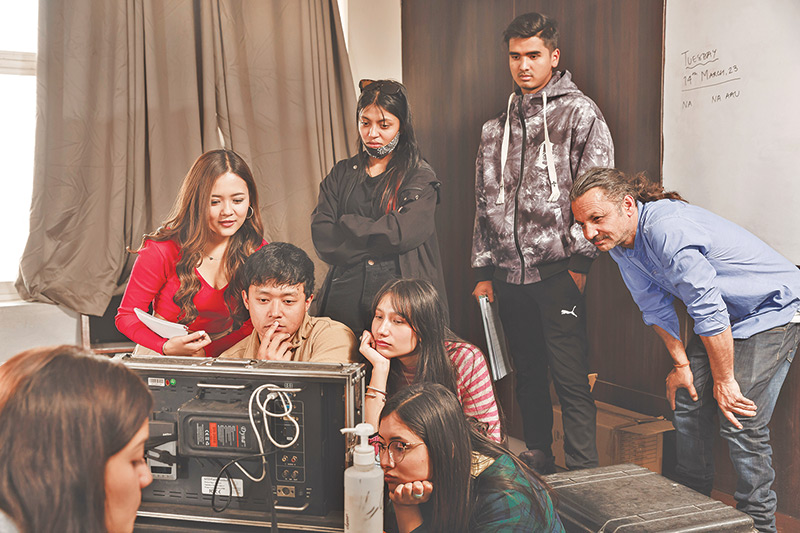
Rastriya Swatantra, Janamat and Nagarik Unmukti parties have failed to effective play their parliamentary roles.
- NISHAN KHATIWADA
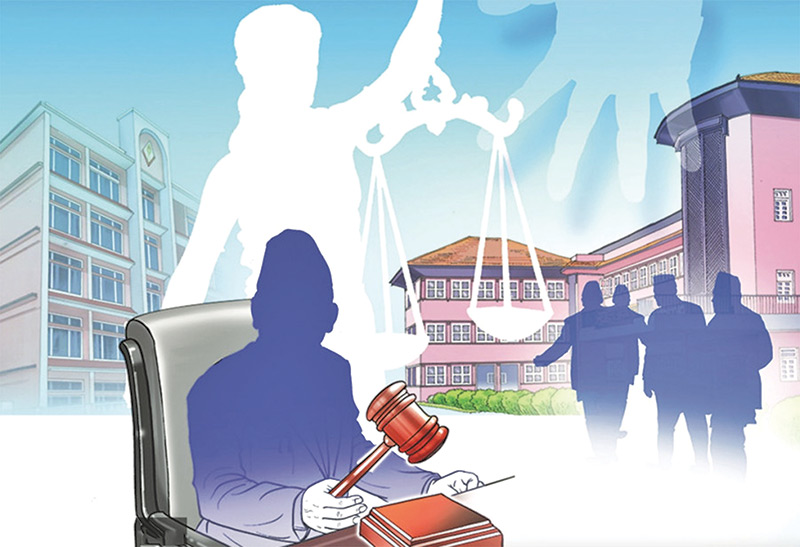
Post Illustration
KATHMANDU, Three parties—the Rastriya Swatantra Party, the Janamat Party and the Nagarik Unmukti Party—made it to Parliament last November in their first try at parliamentary politics, winning 20, six, and four seats, respectively. But they have failed to deliver effectively either as ruling parties or as strong opposition raising public voices, say observers. Jhalak Subedi, a political commentator, said the new parties are struggling to take a clear ideological stance and appear more focussed on negotiations for power. “Either they lack a clear roadmap for their political agenda, or they are unwilling to prepare one.” The Rastriya Swatantra Party (RSP) and the Janamat Party joined the CPN (Maoist Centre) chair Pushpa Kamal Dahal-led government formed after last November’s elections—the former with three ministries and a minister of state, and the latter with just one minister. But the RSP’s tenure in the government was short-lived. Its party chair and the then home minister Rabi Lamichhane was stripped of the lawmaker position on January 27 after the Supreme Court invalidated his Nepali citizenship. Prime Minister Dahal himself took charge of the home ministry. Another coalition partner, CPN-UML chair KP Sharma Oli, pressed him to allocate the ministry to Lamichhane, but Dahal declined. Lamichhane’s personal attempts to regain the position also failed. Eventually the RSP quit the government and recalled its ministers, even as it continued supporting the government. The party’s decision to recall its ministers but support the government left it in a position whereby it could neither be an effective ruling party nor a strong opposition. The Nagarik Unmukti Party had said it would join the Dahal-led government if its jailed leaders and cadres, including Resham Chaudhary, were freed. During the first floor test of Prime Minister Dahal, the party decided to support him but remain in the opposition bench until its demands were met. The Nagarik Unmukti kept pushing its demands to the point that the government in Sudurpaschim province collapsed within a month of its formation after the UML chief minister was unable to secure a mandatory vote of confidence. Uddhab Pyakurel who teaches political sociology at the Kathmandu University said the main problem with the three parties is that their leaderships are essentially authoritarian, coming to decisions without in-party consultations. “The parties are person-centric. For example the Rastriya Swatantra Party is Rabi Lamichhane-centered, and it impacts its modus operandi and every decision.” According to Pyakurel, the freedom of Resham Chaudhary is a legal issue, but the Nagarik Unmukti Party has been viewing it solely as a political one. Likewise, the politics of the Janamat Party has revolved around the ego clash between its chair CK Raut and Janata Samajbadi Party chair Upendra Yadav. “The new parties appear even worse when it comes to embracing or accommodating differing opinions. If a party is person centric, its leader is always focussed on rewarding his or her confidants with powerful government positions including ministers in order to continue to win their loyalty and support,” Pyakurel said. Dahal, as the new head of the coalition including the Congress, has not been so accommodative of the new parties—or that is how they feel. Dahal’s former partner, the UML, decided to pull out of the government on February 27 after the Maoist Centre refused to support a UML nominee for President. Dahal’s second confidence vote came within two-and-a-half months of his first, as a result of the UML and the Rastriya Prajatantra Party quitting the government and withdrawing their support. He took the floor test on March 20 and won with the backing of the new ten-party alliance that also included all three new parties—the RSP, the Janamat Party, and the Nagarik Unmukti Party. The new alliance set its eyes first on the presidential and vice-presidential elections. The Maoist Centre decided to back a Nepali Congress candidate for President in the election held on March 9. In the current government, the Nagarik Unmukti Party’s chairperson Ranjita Shrestha, who was tipped to lead the Ministry of Youths and Sports, later agreed to be minister for Land Management, Cooperatives and Poverty Alleviation. But she had been demanding the Urban Development portfolio. When Dahal finally expanded his Cabinet last Friday, the Janamat Party got riled after it was denied the portfolio of its choice. Just before the President administered the oath of office to four new ministers at the President’s Office, the party’s minister, Abdul Khan, tendered his resignation after the Ministry of Industry his party was hoping to get was given to the Nepali Congress. Subedi thinks smaller parties in the ruling coalition are under constant pressure to make their presence felt, which, in their reckoning, is possible only by getting hold of a handful of ministries. “Look, our society is also impatient and can hardly wait for five years. Nepali politicians thus promise their voters and cadres that they will soon get positions of power so that ‘we can do your work’.” The RSP is yet to decide whether to join the government. But leaders claim the party will pick a path soon. RSP central committee member and press coordinator Ganesh Karki agrees that the party should clarify whether it will be a strong and effective ruling party or a potent opposition in Parliament. But, he said, the party is now fully focused on the by-elections so that it can win all three contested seats and become even more powerful in Parliament—thus the job of taking a clear stand has been postponed. “But our lawmakers have been strongly raising issues of public concern in Parliament,” he said.
HOME PAGE
Vaccine fund cuts may backfire, experts warn
Budget for paying lab technicians across Nepal to carry out polymerase chain reaction tests has also been slashed.
- ARJUN POUDEL
KATHMANDU, Nepal currently does not have Covid vaccine doses for children as well as the general adult population. There are vaccine doses in stock for certain priority groups, but again the health agencies do not have enough funds to administer the doses. “It is true that the budget for administering Covid vaccine and the allowances for immunisation workers have been slashed,” an official at the Ministry of Health and Population told the Post on the condition of anonymity, as the official is not authorised to speak to the media. “We only raise questions about low vaccine uptake, but do not discuss the underlying causes.” The incumbent government has directed the ministries concerned to cut down on unnecessary expenditures, and the Ministry of Finance accordingly slashed the budget for Covid vaccination programme, officials say. Along with the vaccination budget, the budget for paying lab technicians, who were hired throughout the country to carry out polymerase chain reaction (PCR) tests, has also been slashed, and these are among the reasons for fewer tests being conducted despite the surging infection rate, according to officials. Also, a lot of health facilities and health workers, who were deployed in the first, second and third waves of the coronavirus pandemic have yet to get the allowances promised by the government. “Yes, the budget for Covid vaccination has been slashed,” said Dr Bibek Kumar Lal, director of the Family Welfare Division under the Department of Health Services. “We all know how important Covid vaccination is, and we are witnessing a surge in new cases as well.” Nepal has been witnessing a rise in new cases of coronavirus infection and XBB.1.16, a sub-variant of Omicron, is considered to be the main culprit. Doctors say XBB is a hybrid lineage of two Omicron sub-variants and has the capacity to evade immunity from prior infections and vaccinations. “Decision to slash the Covid vaccination budget could prove costly,” said Mahendra Prasad Shrestha, former chief specialist at the Health Ministry. “Such nonsensical decisions are being made time and again, and the country and people have to pay for it.” Shutting down the country after detection of just one Covid case, stopping free testing that led to a halt in contact tracing completely when a new wave of the pandemic was taking off, and asking people to come to the hospital only after developing serious symptoms, were among some of the wrong decisions taken by the authorities in the past. Such decisions are considered among the reasons for the rapid spread of the virus, according to experts. There is a consensus among experts that vaccines are the only reliable means to lessen the severity and deaths from coronavirus infections as the general public stopped following safety measures long ago. “We should not forget that vaccination helped to ease the severe impact of the pandemic and resume daily activities including economic activities. Children have returned to schools, and migrant workers are going abroad for employment again,” said Dr Baburam Marasini, former director at the Epidemiology and Disease Control Division. “The decision to slash the vaccination budget is terrible.” Health authorities have been currently administrating Covid jabs to people above 55 years old, pregnant women, those having comorbidities, those taking immunosuppressants, and health workers. However, the uptake of the vaccine in the said groups is very low. “To increase the vaccine uptake, vaccination should be launched as a campaign,” said an official at the Health Ministry, who also wished not to be named in the news as the person is not authorised to speak to the media. “But we don’t even have the budget to pay the vaccination staff.” Meanwhile, the ministry said that 98 new cases of Covid have been reported on Wednesday. Of the 427 polymerase chain reaction tests conducted, 71 returned positive, and 27 others also tested positive in 1,341 antigen tests. Active cases reached 322 on Wednesday. The ministry said that four people in serious conditions have been admitted to intensive care in the Valley and one person in critical condition has been placed under ventilator support.
HOME PAGE
Love him? Hate him? For Trump, attention is attention
For much of his life, Trump has been a narrator, controlling image, message and his preferred version of the truth.
- ASSOCIATED PRESS
AP/RSS
New work, In the currency of today’s attention economy, Donald Trump is the world’s richest man. His media-engulfed arraignment in New York was an out-of-court Exhibit A. In returning to the no-business-like-show-business metropolis that propelled him to tabloid-fodder fame so many years ago, the former president also returned to the very stage where he thrives the most. As he did so, even in an atypically sedate manner, he demonstrated the peculiar way he encounters the world—as luminary and aggrieved party rolled into one. Love him? Hate him? Don’t care? Doesn’t matter. Just like during his presidency, he commands notice. Still. Thousands of New York City police officers, the US Secret Service and swarms of journalists deployed across lower Manhattan can all attest to that. It was a procedural court appearance, the low rung of drama in a criminal case, but it was a full-on spectacle. And calling it that, assessing it in that way, does not diminish it—not in today’s world, where spectacle and all its byproducts drive the attention economy and the cultural conversation. There was something about Tuesday, and about the five days that preceded it, that was somehow both familiar and deeply abnormal. For the most part, Americans had left behind the all-Trump, all the time ethos that governed our days between 2016 and, say, mid-2021. So that Trump-flavoured thrum that has prevailed since news of the indictment emerged Thursday was hardly new.
Familiar, too, was the uneasy collision of exhibition with seriousness, of the mannered machinations of government with the anything-goes rhetoric of reality-TV-inflected, 21st-century populism. Just as during the Trump presidency, you saw the monuments that Americans build to reassure themselves that their effort to administer a democratic republic is a Very Serious Endeavor. Before, it was the Washington edifices of the executive and legislative branches; on Tuesday it unfolded in a courthouse made of heavy masonry erected into the imposing architecture that enshrines the rule of law. Yet all that familiarity obscured what was something genuinely new under the American sun: the moment-by-moment chronicling of an ex-president leaving for court, entering court, charged with felonies in court, leaving court in a motorcade headed for the airport to board his private plane, the one with his name very publicly painted on the side. “Otherworldly is the perfect way to put it,” Dana Bash said on CNN.
Looking in at Trump We got to see it all, as has become our way. Inside the courthouse, we saw the cinema-verité style of news cameras behind barricades, desperately seeking—and getting—a glimpse. Outside, everything was tracked from above by four news helicopters, a tableau with echoes of a previous slow-motion trip that echoes through the decades: that of the white Bronco driven in 1994 by OJ Simpson—someone also accused of a high-profile crime. That American preoccupation with big, loud storylines was on full display Tuesday as anchors, pundits and sources talked and talked and talked. You heard it baked into the language at every turn. – There was a main character you can’t look away from: A Newsmax anchor awaiting Trump’s court appearance called him the “star of the show.” – There was a metaphorical musical score: “His legal cases will be a soundtrack of his presidential campaign,” CNN’s Jeff Zeleny said. – There was commercial power. “Donald Trump has made one hell of a brand,” one of his attorneys, Joe Tacopina, said after the arraignment. – There was disinformation built to sell product: Though no mug shot was taken of the former president during his time in court Tuesday, people raising funds on his behalf quickly ginned up a fake one and blasted it out to rally the troops and lighten their wallets. – And there was an unremitting stream of content, led by Trump himself, who posted on his Truth Social account right up until he approached the courthouse and resumed right as he left it. “America was not supposed to be this way,” he said at one point, another of those statements he calibrates perfectly to make his personal tribulations into national ones.
Whose message? For so much of his life, Trump has been a narrator, controlling image, message and, often, his preferred version of the truth. With the presidency, he made that approach national policy. But on Tuesday, as rules and laws wrested that sense of control from him, he found himself not the narrator but the narrated. Even with all the attention and criticism across all of the years, that’s a position to which he is deeply unaccustomed. And from the look of the photos and brief video, it’s not one he liked. As those sombre images of him in court flashed across national screens, anchors and pundits used words like “diminished” and “swaggerless.” Not things that Donald Trump generally abides. “At that moment, that is not a conqueror. That is a granddad having a very bad day.” commentator Van Jones said on CNN after watching the former president’s dejected facial expression as he left Trump Tower before the arraignment.
NATIONAL
District court orders arrest of judge accused in marital rape
Judge Bhuwan Giri’s wife has also charged him with domestic violence.
- MANOJ PAUDEL
KAPILVASTU, The Kapilvastu District Court has issued an arrest warrant against Judge Bhuwan Giri, who is now working at the Judicial Council in Kathmandu. A month ago, Giri’s wife had registered a complaint at the Kapilvastu District Police Office against the judge, accusing the latter of marital rape, following which the district court on Monday issued the arrest warrant. Giri, who was assigned to serve as district judge at the Kapilvastu District Court last June, was transferred to the Judicial Council in Kathmandu a month ago. “We registered the complaint against Giri, and an investigation is underway,” said Deputy Superintendent of Police Prem Bahadur Basnet. Giri’s wife has accused her husband of domestic violence and sexual exploitation. In November last year, Giri’s wife had lodged a complaint at the District Police Office, but the police refused to register her complaint. Soon after that Giri had also filed a complaint against his wife at the District Police Office accusing her of stealing money. Following the police’s refusal to register her complaint, Giri’s wife went to Kathmandu and spoke to various media outlets. On February 15, Giri’s wife staged a demonstration outside the federal parliament building at New Baneshwar. She and two other women were arrested for protesting. She had filed a complaint at the National Human Rights Commission and the National Women’s Commission, seeking action against her husband. She also filed another complaint at the Judicial Council. She is Giri’s second wife. He had been staying with her after legally separating from his first wife.
NATIONAL
Three Nepalis among seven dead in Sikkim avalanche
Avalanches have killed at least 120 people in the Indian Himalayas over the past two years.
- POST REPORT
KATHMANDU, At least seven people, including three Nepalis, died in an avalanche that occurred on the Gangtok-NathuLa JNM Road in northern Sikkim on Tuesday. The Indian Express reported that the avalanche struck the 14th mile on Jawaharlal Nehru Road connecting Gangtok to NathuLa pass at approximately 12:15 pm. According to a statement issued by Tushar G Nikhare, the District Collector in Gangtok, three Nepalis succumbed to injuries following the natural disaster—Shiva Prasad Lamichhane and Ashika Dhakal, 22, of Chitwan and Muna Shah Shrestha, 29, of Rupandehi. The statement further said arrangements are being made by the Sikkim government to transport the bodies to Nepal and hand them over to concerned authorities. The natural disaster has also left 13 people, all Indian nationals, injured. The injured are receiving treatment at STNM Hospital in Gangtok, according to the statement. According to the Voice of Sikkim, nine persons among the injured were discharged following treatment. Rescue teams made final checks on Wednesday for anyone still trapped in the avalanche, Reuters said. On Tuesday, 20 survivors were pulled from the snow before rescuers called off their search as bad weather closed in and darkness fell. Avalanches have killed at least 120 people in the Indian Himalayas over the past two years. NathuLa serves as a route for the Kailash Mansarovar pilgrimage to Mount Kailash in China, considered one of the holiest Hindu pilgrimages.
NATIONAL
Group cuts elephant’s trunk in Sauraha
District Digest
CHITWAN: An unidentified group cut a part of the trunk of a domesticated elephant in Sauraha on Tuesday. According to the United Elephant Operation Cooperate Chairman Rishi Tiwari, the perpetrators cut the tip of the pachyderm’s trunk that was being kept at a local elephant shed during the night. The 45-year-old elephant named Chanchalkali, which was registered under the name of Dipendra Khatiwada, was being used for jungle safaris at the Chitwan National Park by the cooperative. Tiwari informed that the elephant’s caretaker and rider, who was asleep during the time of the incident, woke up to the squeals of the injured elephant and informed the local authorities.” Around a 17-18 cm portion of the trunk’s lower part sustained cut injuries,” said Kiran Rijal, a veterinarian at the National Trust for Nature Conservation in Sauraha. According to Tiwari, the elephant’s health is good and it has started eating. “She is eating food but the elephant is having a hard time drinking water because the tip of the trunk has been cut,” Tiwari said. “The doctors suggested giving water using a pipe.” The cooperative manages 35 elephants which are used for jungle safaris at the park.
NATIONAL
JSP activists continue protest in Rajbiraj
District Digest
SAPTARI: The Janata Samajbadi Party (JSP) activists staged demonstrations in Rajbiraj, the district headquarters of Saptari, on Wednesday, continuing their protest against the police’s assault on the party’s district president Kedar Yadav. The protesters took out a rally that moved around the city. They clashed with security personnel in front of the District Police Office. The JSP claimed that Yadav, who had reached the police station to hold talks, sustained injuries on his head following a physical altercation with a police inspector.
NATIONAL
Lumbini fails to curb maternal mortality despite good infrastructure
Lumbini has the highest mortality rate among all seven provinces in the country at 207 deaths per 100,000.
- Amrita Anmol
Pregnant women from rural areas suffer because of delays in finding appropriate health facilities. Post Photo: Amrita Anmol
BUTWAL, Maya Thapa, a 30-year-old resident of Rolpa Municipality ward 10, went into labour on June 1, 2022 but she was taken to the district hospital only the next day. At the hospital, Dr Prakash Bahadur Budha informed her relatives that she had twins. Her blood pressure had shot up and she needed immediate surgery. The doctor referred her to hospitals in Dang and Butwal. But Maya’s relatives took her home instead. After two days of labour pain, she gave birth to twins at home on June 3. She suffered from postpartum haemorrhage and fell unconscious immediately after the delivery. She did not regain consciousness. “Maya could have survived if she was taken to a well-facilitated hospital on time,” said Budha. In the fiscal year 2021-22, a total of 4,100 pregnant women in Lumbini province did not go for institutional births and delivered their babies at home. Fourteen among them died of delivery complications; 12 women breathed their last while being rushed to the health institutions. Health professionals say these were all avoidable causes and with timely medical intervention, the women would have survived. Lumbini province, which comprises six Tarai and six hill districts, has an alarming maternal mortality rate. As many as 74 women died due to pregnancy and delivery complications in the last fiscal year. Two Tarai districts—Banke and Rupandehi—were top of the list with 32 and 23 maternal deaths, respectively. Four women died in Bardiya; three each in Palpa, Rolpa and Pyuthan; two each in Dang and Kapilvastu; and one each in Arghakhanchi and Gulmi. Data from the Ministry of Health and Population suggests a yearly increase in the maternal mortality rate in the province. In the fiscal year 2017-18, 53 women died of pregnancy and delivery complications while 54 maternal deaths were reported in the fiscal year 2018-19. In the fiscal year 2019-20, 71 maternal deaths were reported while the number stood at 72 in the fiscal year 2020-21. Lumbini province has a relatively better health infrastructure in comparison to some other provinces. The province is home to the three biggest hospitals in the country—Lumbini Provincial Hospital, Bheri Hospital and Rapti Academy of Health Sciences. To ensure safe delivery, 406 birthing centres have been set up in the Province. There are 22 hospitals with C-section facilities. The provincial government has deployed 84 nurses for door-to-door service for pregnant women and new mothers under the safe motherhood programme. However, none of the steps taken by the government has been able to curb the maternal mortality rate in the province. As per the national census 2021, Nepal’s maternal mortality rate is 151 per 100,000. But the maternal mortality rate of Lumbini is 207 per 100,000, which is the highest among all seven provinces in the country. Kaushal Raj Bhandari, the focal person at Lumbini Health Directorate, attributes the alarming maternal mortality rate in the province to the absence of well-equipped hospitals in remote areas leading to delays in medical intervention. However, women’s rights activists who are vocal proponents of reproductive rights of women and safe motherhood say there are more reasons for the high mortality rate in the province. Gyanu Paudel, a rights activist for the reproductive health of women, says that the family of pregnant women must take more accountability for the well-being of the mother and that the government authorities should implement plans and policies catered to every woman and not just those in a position to visit a well-facilitated hospital. “The availability of sound health infrastructure must be clubbed with responsible action from the family and society to ensure mothers don’t die an untimely death,” she said. Article 38 of the constitution of Nepal affirms that every woman shall have rights to safe motherhood and reproductive health. Safe Motherhood and Reproductive Rights Act 2018 was enacted to make health services safe, qualitative and accessible for safe motherhood. Unsafe home delivery is still a major challenge in controlling maternal mortality in the province. Only 13 of 109 local units in the province have successfully reduced the home birth rate to zero as of now. The poor quality of services in health facilities outside major urban centres also contributes to the avoidable deaths of pregnant women and postpartum mothers. The lack of skilled human resources and necessary equipment in health institutions in rural areas leads to patients being referred to big city hospitals, inadvertently delaying urgent medical intervention. According to Sunita Gyawali, a nursing officer at the health ministry, despite Lumbini province having a good health infrastructure, the maternal mortality rate is still high because well-equipped hospitals are still inaccessible to most women in rural areas. “Pregnant women from rural areas suffer because of delays in finding appropriate health facilities,” Gyawali said. “Postpartum haemorrhage is one of the reasons women are losing their lives.” Twenty-three percent of maternal deaths every year can be attributed to excessive bleeding during or after childbirth, according to Gyawali. “If they had sought timely medical help, they would have been saved. Postpartum infection, high blood pressure during pregnancy, unsafe delivery and abortion are other leading causes of high maternal mortality rate in the province.” Anisha MC, aged 24, of Jhimruk Municipality ward 7, died in February 2022 for a lack of a well-facilitated hospital with specialist service close by. She was taken to Pyuthan Hospital on February 25 where she underwent surgery the next day. “But she had further health complications after the surgery. The hospital referred her to Butwal. She died on her way to Butwal,” said Binod MC, the victim’s relative. According to him, Anisha died due to the lack of specialist health services in Pyuthan Hospital. The federal government’s President Women Upliftment Programme is designed for needy pregnant women and postpartum mothers. Under the programme, pregnant women in remote areas receive medevac services free of cost. Several villages of Rukum (East), Rolpa, Pyuthan, Arghakhanchi, Palpa and Gulmi districts of Lumbini have been selected for the programme. “But the programme has not been as successful as expected,” said Bhandari, the focal person at Lumbini Health Directorate. “Many pregnant women and postpartum mothers do not get immediate air rescue. The shortage of obstetricians, gynaecologists and trained nurses has affected the programme.” The Lumbini provincial government allocated Rs60,000 to each local unit to manage free ambulance service to help pregnant women reach nearby health facilities quickly. It also provided Rs200,000 each to the district-level hospital in case the pregnant women and the postpartum mothers need to be taken to well-facilitated hospitals in case of emergencies. The federal government provides allowances—encouragement and transportation—if a pregnant woman goes for regular health checkups at least four times during pregnancy, and opts for institutional births. The newly unveiled report about maternal mortality shows that 151 women in every 100,000 died from maternity-related complications. The study was carried out in 2021. Paudel, the rights activist, said establishing hospitals and introducing policies is not enough to curb maternal mortality rate. “There must be a practical application of all government plans and programmes aimed at pregnant women and new mothers. Services related to pregnancy, safe delivery, postpartum and neonatal care should be lobbied through the rights-oriented views,” Paudel said. “A woman getting pregnant means she is going to give birth to a citizen of the nation. The state, therefore, should enhance access to quality health services to provide treatment to every woman facing pregnancy complications. Creating awareness about the need to provide the best care to pregnant women and new mothers must be prioritised.”
NATIONAL
Nepali developers likely to sign MoU with Indian power buyers in direct deal
Power ministers from India, Bangladesh, Bhutan and Sri Lanka are invited to the Power Summit in Kathmandu on April 18-19.
- Post Report
Shutterstock
KATHMANDU, Nepal’s domestic private sector hydropower project developer and Indian buyer could sign a memorandum of understanding (MoU) for direct power purchase in the Power Summit scheduled to be held on April 18-19. Independent Power Producers’ Association, Nepal (IPPAN), which is organising the eighth edition of the Power Summit in Kathmandu, said that negotiations were ongoing between the two sides to make the event fruitful. Office bearers of the IPPAN, however, refused to divulge the companies involved in such a deal saying that it is still premature to share details as such revelation could derail the deal. Even though Indian companies such as SJVN Limited and GMR Energy, which are developing 900MW Arun 3 and 900MW Upper Karnali projects, have signed direct power purchase agreements with Indian buyers, no domestic company of Nepal has so far signed an agreement with Indian buyers. “If that happens, it will be a breakthrough for Nepal’s domestic company to sell power directly to Indian buyers,” said Ashish Garg, vice-president of IPPAN, at a press meet in Kathmandu on Wednesday. Nepal’s electricity law has no provision for granting any company other than Nepal Electricity Authority a right to trade power. But Garg argued that the hydropower companies could directly deal with buyers as per Section 22 of the Electricity Act-1992. Section 22 (2) of the Act says, “the licensee [developer] desiring to export electricity generated on its own to the foreign country may do so by entering into an agreement with the Government of Nepal on such matter”. Despite continued insistence from the private sector, the government failed to get the bill to amend the Electricity Act-1992 passed by the previous parliament. The bill registered in the National Assembly in July 2020 had provisions for granting trading licences to the private sector. In September last year, the government withdrew the bill after it became clear that it would not pass Parliament. According to the energy ministry, about half a dozen companies have already submitted their applications for trading licences. Currently, the developers have only one option—selling power to the Nepal Electricity Authority. “Without trading licence, the private sector companies cannot sign power purchase agreement deals,” said Krishna Prasad Acharya, the IPPAN president. “We will continue to make efforts for such legal provisions allowing the private sector to get trading licences.” In January last year, Nepal Power Exchange Limited and India’s Manikaran Power Limited signed a memorandum of understanding on energy trading. But its implementation was hamstruck by the lack of law in Nepal that grants trading licences. Nepal Power Exchange Limited has not received a trading licence. Besides potential signing of direct purchase agreement between hydropower developer and the buyer, many other agreements and understanding for future development of power projects and market creation in renewable energy could be reached at the power summit, according to the IPPAN. Acharya said that the government has sent invitations to the power ministers of India, Bangladesh, Bhutan and Sri Lanka for their participation in the summit at the IPPAN’s request. The South Asian Forum on Energy Investment (SAFEI) will also release a report on mobilising investment in the region during the power summit. The umbrella body of the private sector power developers said that about 800 participants including 300 international delegates from more than 30 countries are expected to participate in the summit. “The Indian delegates will be present in large numbers as the Indian Embassy in Kathmandu is the country partner for the event,” the IPPAN stated. Energy trading companies, power producers, financial institutions, transmission and distribution companies, consulting companies, vendors, and think tanks, among other stakeholders, are invited to the event, it said. “There will also be delegates from around a dozen Chinese companies,” said Garg. The event comes at a time when Nepal is aiming to export its surplus energy in the wet season for the next few years and around the year after the country becomes fully self-reliant on electricity possibly by 2026. Nepal’s total installed capacity has reached 2,520MW and an additional 600MW is expected to be added in 2023, according to IPPAN. Nepal is likely to have a generation capacity of 6,700MW by 2027 with the private sector’s contribution reaching 80 percent to the total power generation capacity from the current 55 percent. Nepal has committed to becoming a net zero country by 2045 mainly through the use of green energy.
NATIONAL
Supreme Court issues show cause notice in Rabi Lamichhane passport case
Attorney general asked to furnish the reason for not lodging a case against the Rastriya Swatantra Party president.
- Post Report
Lamichhane had obtained his Nepali passport from the Nepali Embassy in Washington DC on May 27, 2015. Post File Photo
KATHMANDU, The Supreme Court on Wednesday issued a show cause notice to the Office of the Attorney General for not lodging a case against Rastriya Swatantra Party President Rabi Lamichhane in a case of passport misuse. Responding to a writ petition filed by Yubaraj Paudel, the court has given 15 days to the Attorney General’s Office to respond explaining the reasons for giving clean chit to Lamichhane. A single bench of Justice Hari Phuyal also decided to seek the proof of Lamichhane surrendering his American passport, if he did so. Lamichhane claims that he renounced his American passport in 2018. “Receive and produce the documents that prove Rabi Lamichhane had surrendered his American passport either to the Department of Immigration or the District Administration Office Kathmandu,” reads the court’s order. Paudel on Monday had moved the court against the decision of the Attorney General not to prosecute Lamichhane in the passport case. Paudel has demanded that the March 20 decision of the attorney general not to file a case against Lamichhane be overturned through a referral order and a mandamus order be issued in the name of the defendants to conduct a fair investigation into the case. “There is no legal provision for an American citizen to get a Nepali passport,” Paudel’s writ states. “Rabi Lamichhane’s act of acquiring a Nepali passport by giving false information that he is a Nepali citizen even though he was an American citizen at the time is a criminal and punishable offence.” The Office of the Attorney General gave a clean chit to Lamichhane in the case of dual passports citing a Nepal Police report which stated that since the old Nepali citizenship that he acquired had already been deactivated, there was no need to file a case on the matter. Lamichhane had obtained his Nepali passport from the Nepali Embassy in Washington DC on May 27, 2015 based on the old citizenship that was automatically invalided after he acquired the American citizenship. At the time of obtaining the Nepali passport, he was a US citizen. Lamichhane obtained US citizenship in 2014 and left the US in 2018. As per the Passport Act, an attempt to get a passport by providing false information is a criminal offence. Lamichhane also obtained a US passport on March 5, 2014.
OPINION
Miscarriage of (chief) justice
Justices eyeing plum positions during or after active service risk eroding the independence of the judiciary.
- SEMANTA DAHAL
Post Illustration
The leadership of the Supreme Court has been relegated to a caretaker status ever since the ignominious ejection of Cholendra Shumsher Jung Bahadur Rana on February 13, 2022. In the 15 months since, two senior judges have impersonated the Chief Justice, not only by assuming the acting role in the courtroom but outside as well, including in the swearing-in ceremony of the third President Ramchandra Paudel. While the “acting” perhaps warrants some compliment for blending well into the character of the Chief Justice, the plight the judiciary is subjected to is unwarranted.
Acting too much When Justice Deepak Kumar Karki retired in October 2022, the government awarded him post-retirement benefits equivalent to a formally appointed Chief Justice. The decision invited criticism, including remarks of an unduly influenced judge, but was not revoked—neither by the executive nor the judiciary. The appointment of Chief Justice during Deepak Kumar Karki’s tenure was stymied ostensibly by half-measured impeachment proceedings initiated against Cholendra Shumsher JBR and a lengthy election period. But most importantly, it was crippled by the political honchos seeking to impair the judiciary to tip the strength of the executive. Justice Hari Krishna Karki, the current judicial protagonist, who had to self-direct himself to perform the “acting” role, has been facing a similar antagonistic plot. Only around five months remain of his “acting” tenure, which started six months ago. Alas, even in this instance, the political intent and indications do not align with constitutional provisions, including Article 284 (2), which requires the Constitutional Council headed by the Prime Minister to recommend the appointment of a Chief Justice a month before the occurrence of the vacancy.
Hearing or red herring? The appointment of the Chief Justice, under the constitutionally envisaged process, commences with the recommendation by the Constitutional Council, undergoes a rejection voting before the Parliamentary Hearing Committee, and completes with the appointment and oath administration by the President. This process is vulnerable to undue prolongation, especially if the Constitutional Council fails to quorate, rules of parliamentary procedures are not adopted, and above and beyond all, political considerations eclipse the constitutional provisions. The first case in point is the excessive delay in inducting the ex-officio members of the Constitutional Council following the November 20 general elections. The position of the Prime Minister—Pushpa Kamal Dahal—was filled on December 20 last year; the Speaker—Dev Raj Ghimire—and the Deputy Speaker—Indira Ranamagar—on January 19 and 21 this year, respectively; and the leader of the opposition—KP Sharma Oli—on March 20, this year, after a few rounds of shuffling and Dahal’s re-run of the floor test. If this was not too winding a route already, the government has now moved an amendment bill to regulate the business of the Constitutional Council, which could upset the timely holding of the body’s meetings. The second case in point is the fool’s bargain that delayed the adoption of the rules for the conduct of parliamentary proceedings. The ruling coalition led by the Maoists and the opposition led by the UML were duelling over whether or not to strip the Speaker of some of the position’s customary privileges. The rules were finally adopted in a sparsely attended house session on Sunday, April 2. Now the selection of honourables to the Parliamentary Hearing Special Committee remains outstanding; without its formation, it is inconceivable to grant a parliamentary hearing to any nominee to the office of the Chief Justice. The parliamentary confirmation of a judge’s nomination, a feature uncharacteristic of the bicameral parliamentary system, first found a place in the Interim Constitution of Nepal 2006 due to the red wave provoked after the Maoist militants were dragged into the peace process. The confident Maoists, back in the day, wanted to lower the judges’ confidence, and hence parliamentary hearing was incorporated at their insistence. This constitutional overture was retained in the 2015 Constitution and has become a parliamentary modus operandi for obstructing crucial Supreme Court judicial appointments, meriting a more profound debate on whether parliamentary hearing upholds judicial independence. Notably, unlike the US Constitution defining clearly the role of “advice and consent” of the Senate, the 2015 Constitution of Nepal does not equip the Parliamentary Hearing Special Committee with similar authority.
Last words Empirical studies conducted by Professors Ryan Black and Ryan Owen in the United States examining the behaviour of the judges of US courts of appeals have shown that the judges expecting elevation to the US Supreme Court are more likely to consistently rule in line with the preference of the US President. This is not an encouraging finding for judicial independence, but considering the factors affecting human behaviour, it is not surprising either. Humans, ultimately, are susceptible to temptation. Although a similar conclusion cannot be made about the judges of Nepal without a detailed comparative study, Black and Owen’s study on the American judges’ tendency help us understand that political branches of the state have the incentive to resort to a variety of luring tactics to keep the aspirant Chief Justice firmly in check. An aspirant Chief Justice will not always grandstand to please the government in power, but what cannot be denied is that an aspirant might avoid or shun cases having strong political overtones fearing political retaliation or backlash. If the fear increases, judicial independence and effectiveness diminish, eroding the rule of law. As a result, the last words written to ascribe meaning to the constitutional provisions will be botched. It is time to act sincerely—but without acting.
Dahal is a lawyer.
OPINION
Unpacking trade ties with China
Nepal trades more with distant economies like Italy and France than it does with its immediate neighbour China.
- Prashanti Poudyal
Post File Photo
Nepal’s trade with China resumed through the Rasuwagadhi checkpoint in December. The two busiest checkpoints on the northern border, Tatopani and Rasuwagadhi, had been non-functional for the past three years due to Covid-restrictions imposed by China. While Covid-19 was a major catalyst, one can’t help but notice Nepal’s declining trade with China over the years. Today, Nepal trades more with distant economies like Italy and France than it does with China. Last year, Nepal’s trade deficit with China increased to Rs263.97 billion. While there are numerous agreements with China in place, their effectiveness is hardly seen on the ground, as the core problems remain neglected. Nepal has long felt the need to diversify its trade rather than relying solely on India. The need was reinforced by the unofficial blockade of Nepal’s southern border points in 2015. Nepal had to import oil along with other essential products from China. This led to the signing of an oil trade deal with China in October 2015 in a bid to end the monopoly of Indian Oil Corporation in the Nepali market. Nepal then signed the Transit and Transport Agreement (TTA) with China in 2016 and China’s Belt and Road Initiative (BRI) in 2017. Trade is one among the five major components of the BRI.
Irrelevant agreement A free trade agreement (FTA) is an agreement between two or more nations to eliminate or reduce tariff barriers on imports and exports. But for Nepal, like many least developed countries (LDCs), non-tariff barriers are more of a hindrance. Non-tariff barriers aside, the FTA between Nepal and China could be detrimental to Nepal’s economy. As per a study done by the Centre for Social Inclusion and Federalism, China provided an economic analysis predicting a 4.8 percent increase in GDP if Nepal were to move forward with the FTA. Nepal’s Ministry of Industry, Commerce and Supplies then conducted an economic analysis of its own which instead showed a decline in GDP by 0.24 percent. The said report was forwarded to China with a proposal to sit for a meeting to discuss it. However, there has been no response from the Chinese counterpart as of yet. Even if the FTA with China could help Nepal’s trade, the impact would only be marginal. This is because, as per its commitment to the World Trade Organisation, China has already extended 98 percent of its tariff line on duty-free quota-free to all LDCs including Nepal. This means Nepal would only have an additional 2 percent to optimise from. While 8,000 products fall under China’s duty-free quota-free, Nepal has requested for an additional 495 products that it has been exporting to China. Nepal and China have several agreements in place, with little to no effect seen on the ground. A glaring example is the Nepal-China Transit Transport Agreement, signed in 2016 with big promises of ending Nepal’s over-reliance on India. However, the agreement has been in limbo ever since. The Nepal-China Transit Transport Agreement was touted as a “geopolitical gamechanger for Nepal” as it was Nepal’s response to India’s months-long ‘unofficial’ border blockade after the promulgation of Nepal’s new constitution. In 2019, Nepal and China also signed the Transit Transport Agreement implementation protocol, which meant Nepal could use seven Chinese sea and land ports for third-country trade. Now, seven years after the signing of the agreement and four years since the signing of the protocol, not a single consignment from any third country has been received by Nepal via China under the agreement. The Transit Transport Agreement, in retrospect, seems to be more of a political gimmick and geostrategic signalling to our southern neighbour. In any case, the routes and provisions outlined in it cannot serve as substitutes for trade routes with India or trade with India as a whole. Furthermore, unclear modalities and procedures seem to be major hindrances affecting the implementation of the agreement. Several provisions, including the detailed modality of cargo movement, its movement from Chinese ports towards the Nepal-China border, the real operational modality for the movement of cargo, processes involved at Chinese sea ports, delivery of imports and consignments from East Asia to Nepal, and the terms and conditions of the agreement, are yet to be discussed. All such modalities and procedures were provisioned to be negotiated through future bilateral consultative meetings and negotiations. However, these meetings have never been held.
Way forward Although China is an important trading partner of Nepal, exports to the northern neighbour have been minimal over the years. In the fiscal year 2021-22, exports to China slipped to the 12th position. In fact, Nepal has exported more to distant economies like Italy, France, Canada and Japan in comparison to China, its immediate neighbour. To overcome this, it becomes important to understand the main reasons for Nepal’s high trade deficit with China. Nepal’s lack of competitiveness coupled with non-tariff barriers is one. Low investment in the productive sector, particularly in manufacturing, which has resulted in a low volume of exportable surplus, is another. The focus now should be on addressing these underlying problems first. The Transit Transport Agreement’s ineffectiveness and the Nepal-China BRI agreement’s failing to gain traction necessitates the same. As a friendly neighbour, China should show flexibility in allowing Nepal to access its seaports. Further, China should refrain from unilaterally opening and closing the border as it has been doing over the years.
Poudyal is a researcher at the Centre for Social Inclusion and Federalism.
OUR VIEW
Sinners of Sikta
Those who botched the national pride irrigation project should not be allowed to get away this time.
Months after the humble soil of Sikta bore the burden of responsibility for the collapse of the eponymous irrigation project, the Commission for the Investigation of Abuse of Authority (CIAA) has come forward to salvage the soil’s image. The anti-graft body has filed an appeal at the Supreme Court against the Special Court verdict that absolved 21 defendants who faced irregularity charges in the irrigation canal building project. The Special Court had on June 19 last year acquitted all 21 accused, including Bikram Pandey, chairperson of Kalika Construction, the project’s main builder, and various other individuals including other high-ranking government officials. The CIAA has claimed that the irrigation ‘national pride project’ in western Nepal had been developed in haste without so much as considering the findings of a feasibility report with a clear motive of corruption. A task force formed to investigate the collapse of the canal had found that the consultants had avoided carrying out a special test of the soil before starting building. Moreover, substandard construction of the project, in addition to the “dispersive” nature of the soil at the project site, had led to repeated collapse of the main canal. The burden of testing the suitability of the soil before spending billions of rupees of public money falls on the builders and other stakeholders and not on the soil itself. However, the Special Court in its verdict blamed the canal rather than the individuals who ignored the most fundamental rule before beginning a project. The court’s argument while giving clean chit to the accused was ridiculous, considering how every other consideration related to the flawed construction had been ignored while putting the blame on the physiological condition of the soil at the construction site. The canal collapsed during its testing phase in 2016 and has done so multiple times since, with the builders failing to provide a permanent solution to the problem. In the investigation that followed, the CIAA found that irregularities had begun right at the design phase. As if the serious accusations of graft and the Special Court’s tragic verdict were not enough, Pushpa Kamal Dahal earlier this year appointed Pandey as the minister of physical infrastructure in a clear case of conflict of interest. Although Pandey and his party colleagues resigned from their positions soon after, the fact that he got the plum position despite the serious allegations levelled against him show how the country’s top leadership have no qualms about serving their vested interests at the expense of national interest. The fact that the irrigation canal project had got a go ahead despite multiple study reports showing clear evidence of dispersive soil shows corruption in Nepali politics and bureaucracy runs deep. The CIAA is right in pursuing the case against the “erroneous” Special Court verdict on the irregularities in the Rs25.02 billion project. The anti-corruption body should make sure to take the case to a logical conclusion to ensure that large-scale corruption cases like the Sikta are not repeated and the wrongdoers do not get away with substandard work at the cost of people’s hard-earned money. If those involved in this most egregious case of corruption get away, then the rule of law in the country can be declared dead.
THEIR VIEW
Adieu, electronic voting machines
The Election Commission of Bangladesh must prove its ability to defend the democratic process.
We may all breathe a sigh of relief that the brouhaha over the EVMs is finally over, with the Election Commission deciding to forego the use of the electronic machines in the upcoming parliamentary election citing a lack of funds. Since it was first introduced in 2018, there have been widespread fear about its fool-proofness to electoral tampering; in particular, concerns were raised about the audit cards via which election results are collected, which are vulnerable to manipulation in the absence of a voter-verifiable paper audit trail (VVPAT). Despite strong reservations from many political parties, including the BNP, and civil society actors, the EC, till now, seemed hell-bent on going ahead with its decision to use EVMs, finalising a massive Tk 8,711 crore project for EVM procurement and management last year. We are glad that the EC has finally seen reason, if only in consideration of the enormous expenses that the project would entail. Back when the proposal was first made, we had warned the EC against such an expensive undertaking in the midst of the worst economic and cost-of-living crisis in over a decade, particularly given that Bangladesh was buying the EVMs at inflated costs. Now that the EC has retracted its position, we wonder what will happen to the 150,000 EVMs already bought in phases since 2018, at 11 times the price of the machines in India. EVMs worth Tk 642 crore have already become unusable for a lack of proper storage facility and maintenance, according to EC documents. We urge the EC to make sure that our remaining stock—paid with taxpayers’ money—are stored properly so that they may be used in the future, if and when it is decided, through political consensus, to switch to EVMs. While the decision to scrap the EVMs is a step in the right direction, the EC must not lose sight of the fact that there are many other pressing issues that it must address before the public, and other political parties can be confident that the upcoming elections will be free, fair and participatory. Foremost among them is ensuring full independence of the EC, and guaranteeing the ever-illusive “level-playing field” for all political parties. Unfortunately, the performance of the EC in the by-elections, except for one notable exception, has not inspired confidence in its ability to rise above and rein in party politics. As it tries to engage with other political parties and to ensure them of its neutrality, the commission needs to remember that it is only through its commitment to the electoral process—rather than the party in power—that it can inspire faith about its ability to guide the nation to a democratic future. The EC must also prove its ability to ensure compliance of the administration and law enforcement in playing their part in defending the democratic process. It must not be seen as reflecting the increasingly intolerant stance of the government towards critics, human rights defenders and the media. The BNP, on its end, must forego its propensity to reject any and all proposal and initiatives of the EC, without due consideration or discussion. Such wholesale rejection will not produce constructive results, and risks jeopardising not just future prospects for the party, but the country at large.
— The Daily Star
MONEY
Government spending hit by slowed revenue inflow
Officials admit that there have been some issues related to payment, but say that the problem is not as severe as made out to be.
- PAWAN PANDEY
In the first quarter of the current fiscal year, the construction sector, which contributes nearly 7 percent to the country’s gross domestic product, posted a negative growth of 24 percent, according to the Central Bureau of Statistics. POST FILE PHOTO
KATHMANDU, Contractor Tanka Chaulagain has not received around Rs160 million from the government for various building projects, including a bridge along the mid-hill highway. Insiders say the government is low on cash because of slowed revenue collection with the economy in a slump. “The situation is more severe in infrastructure projects, mainly in the provincial and local governments,” said Chaulagain. “How can we function when the government does not pay us on time? We are not getting bank loans either. Without running capital, it’s difficult to take part in tenders.” A World Bank report published on Tuesday said a decline in construction activities was one of the key reasons behind Nepal’s slowed economic growth in the current fiscal year. The construction sector has faced various problems. First, prices of construction materials rose significantly. Second, credit extended to the construction sector (including residential housing) declined due to lack of loanable funds and high interest rates. Third, the temporary closure of illegal crusher factories in January 2023 led to a shortage of construction materials such as sand and gravel. The government instantly backtracked on its decision, and allowed the “illegal” plants to operate under the condition that they get registered and pay taxes by mid-July. In the first quarter of the current fiscal year, the construction sector, which contributes nearly 7 percent to the country’s gross domestic product, posted a negative growth of 24 percent, according to the Central Bureau of Statistics. Contractors say that because of low revenue collection this fiscal year, payment issues will be more serious in the next fiscal year. Contractor Bishnu Bhai Shrestha has a similar story. He says the government owes him around Rs100 million. Shrestha is currently implementing a Rs600 million school reconstruction project in Sindhupalchok and a Rs250 million building project in Gauradaha, Jhapa. “There is no cash flow,” he said. “Our projects have been affected.” A delegation of contractors met with Finance Secretary Toyam Raya on Tuesday and drew his attention towards the payment issues. Raya has asked them to present their grievances in writing. Nirmal Aryal, deputy director of the Federation of Contractors’ Associations of Nepal, said the government owes more than Rs60 billion to various contractors across the country. Nepal’s construction sector witnessed double-digit growth for two consecutive years following the reconstruction drive after the 2015 earthquake. In 2018-19, the sector saw a robust 8 percent growth, taking the annual output of the construction sector to over Rs 232 billion. The construction business was hit after the lockdowns began in March 2020, and workers started migrating in search of work. Just as the industry began recovering in 2022, the country went into a financial crisis. Around 1.5 million workers are estimated to be engaged in the construction sector. In addition, it employs around 500,000 skilled Indian labourers. Rabi Singh, president of the Federation of Contractors’ Associations of Nepal, told the Post in a recent interview that development works were progressing at a snail’s pace due to inflation and the absence of cash flow. “The government does not have enough funds to invest in infrastructure as it has been struggling to manage its daily expenses,” he said. Government officials admit that there have been some issues related to payment, but argue that the problem is not as severe as made out to be. “Inflation is a worldwide phenomenon and there is a provision for extra payment for the increased cost of construction in big projects,” said Bhimarjun Adhikari, spokesperson for the Ministry of Physical Infrastructure and Transport. “It cannot be made an issue to halt development activities.” With nearly three months left before the end of the fiscal year, capital expenditure was recorded at a meagre Rs97.91 billion as of Tuesday, which is around 26 percent of the initial target, according to the statistics of the Financial Comptroller General Office. The Department of Roads has requested the Finance Ministry to arrange Rs23 billion as they are facing problems financing ongoing development activities. Last year, contractors abruptly halted work at 3,500 of the 5,000 projects across the country citing rising prices of construction materials following the Russia-Ukraine war in February 2022. The contractors asked the government to adjust the inflation rate in the projects they were working on, largely affecting development across the country. “There is a provision to address increased cost of construction according to Nepal Rastra Bank’s inflation index,” said Ramhari Pokharel, spokesperson for the Department of Roads, which receives a major chunk of the budget every year. “Though the Finance Ministry has not been able to manage additional funds, we have received unofficial communication that Rs10 billion has been approved for the Roads Department,” said Pokharel. In Nepal, construction activities usually pick up after the Dashain and Tihar festivals in the autumn, and most of the capital budget is spent in the second half of the fiscal year. With the end of the monsoon, the October-March period is the peak time for construction activities.
MONEY
India’s power output grows at fastest pace in 33 years, fuelled by coal
Emissions from power generation rose nearly a sixth to 1.15 billion tonnes.
- REUTERS
SINGAPORE, India’s power generation grew at the fastest pace in over three decades in the just-ended fiscal year, a Reuters analysis of government data showed, fuelling a sharp surge in emissions as output from both coal-fired and renewable plants hit records. Intense summer heatwaves, a colder-than-usual winter in northern India and an economic recovery led to a jump in electricity demand, forcing India to crank up output from coal plants and solar farms as it scrambled to avoid power cuts. Power generation rose 11.5 percent to 1,591.11 billion kilowatt-hours (kWh), or units, in the fiscal year ended March 2023, an analysis of daily load data from regulator Grid-India showed, the sharpest increase since year ended March 1990. Output from plants running on fossil fuels rose 11.2 percent, the quickest growth in over three decades, thanks to a 12.4 percent surge in electricity production from coal, the analysis showed, offsetting a 28.7 percent decline in generation from cleaner gas-fired plants as a global spike in LNG prices deterred usage. In the new fiscal year that began April 1, Indian power plants are expected to burn about 8 percent more coal. The rapid acceleration in India’s coal-fired output to address a spike in power demand underscores challenges faced by the world’s third largest greenhouse gas-emitter in weaning its economy off carbon, as it attempts to ensure energy security to around 1.4 billion Indians. Total power supplied during the last fiscal year was 1509.15 billion kWh, 8.4 percent higher than a year earlier but still 6.69 billion units short of demand, the widest deficit in six years. Electricity generated from coal rose to 1,162.91 billion kWh, the data showed, with its share in overall output rising to 73.1 percent - the highest level since the year ending March 2019. India’s Central Electricity authority estimates that 1 million kWh of power produced from coal generates 975 tonnes of carbon dioxide, while the same amount of power generated from gas produces 475 tonnes. A plant fired by lignite, known as brown coal, emits 1,280 tonnes to produce equivalent power. Increased fossil fuel burning for power in the world’s fifth largest economy drove up CO2 emissions during the year by nearly a sixth, to 1.15 billion tonnes, Reuters calculations based on government data and emissions estimates show. That is 3.4 percent of the International Energy Agency’s estimate of annual global emissions of 33.8 billion tonnes in 2022. Many major countries boosted coal use in the twelve months due to Russia’s invasion of Ukraine, but the rise was steepest in India, data from energy think-tank Ember shows.
MONEY
Swiss regulators defend rescue of Credit Suisse
- ASSOCIATED PRESS
GENEVA, Swiss regulators on Wednesday defended the rescue of Credit Suisse through a controversial takeover by rival bank UBS as the best solution with least risk of spreading a wider crisis and severely damaging Switzerland’s standing as a financial centre. The merger was “the best option” and one that “minimised risk of contagion and maximised trust,” said Urban Angehrn, chief executive of the Swiss Financial Market Supervisory Authority, or FINMA. Angern said two other options—a takeover by the Swiss government or putting Credit Suisse into insolvency proceedings—had serious drawbacks. Insolvency would have left the functional parts of Credit Suisse in operation as a Swiss-only bank, but one with a “damaged reputation” through bankruptcy, he told reporters in the Swiss capital of Bern. A temporary takeover by the Swiss government would have exposed taxpayers to the risk of losses. “One can well imagine, what devastating effect the insolvency of a big wealth management bank of Credit Suisse AG would have had on Swiss private banking,” Angern said. “Many other Swiss banks could have faced a bank run, just as Credit Suisse did itself in the fourth quarter.” Swiss government officials, including FINMA regulators, hastily orchestrated the $3.25 billion takeover of Credit Suisse by UBS on March 19 after Credit Suisse’s stock plunged and jittery depositors quickly pulled out their money. Authorities feared that a teetering Credit Suisse could further roil global financial markets following the collapse of two US banks. UBS Chairman Colm Kelleher expressed confidence about the takeover, saying the deal is expected to close in the next few months, alluding to the complexity of the first-ever merger of two “global systemically important banks.” “Whilst we did not initiate these discussions, we believe that this transaction is financially attractive for UBS shareholders,” he said at the bank’s annual shareholders meeting on Wednesday in the Swiss town of Basel.
MONEY
Nepal’s growth faces slowdown amidst domestic and external challenges
- Post Report
The agricultural sector expanded by 1.5 percent year-on-year in the first quarter of the current fiscal year. Post File Photo
KATHMANDU, Nepal’s economy will experience slower growth than previously projected due to the impacts of import restrictions, monetary policy tightening, higher inflation, and shrinking government expenditure reflecting lower government revenue, according to the World Bank’s twice-a-year country update. The World Bank said that political stability remains important to manage the economy and ensure the continued pursuit of development priorities. The Nepal Development Update released on Tuesday said Nepal’s economy would grow by 4.1 percent in the fiscal year 2022-23, ending mid-July, a downward revision from the October 2022 forecast. The report said that higher-than-expected inflation would reduce household purchasing power and drag growth. Welfare recovery remains uncertain due to rising inflation and risks to agricultural production. Reduced investments in human capital, especially amongst those yet to recover from a job loss following Covid-19, also impose risks to rising inequality. Import restrictions were a contributing factor to slower growth and lower revenues in the first half of the year. Nepal relies heavily on imports as a tax base, which contributes about half of total tax revenues through VAT, excise and import duties and allows Nepal to raise higher revenues than most other countries in the region. The import restrictions imposed in 2021-22 and eventually lifted in 2022-23 reduced the current account deficit and stabilised foreign exchange reserve stocks as intended in the first half of the current fiscal year. The unintended consequences of this policy include a steep drop in fiscal revenues and slower growth in the first half of 2022-23 as goods imports fell. The World Bank said that for the first time in five years, Nepal’s fiscal balance was negative in the first half of 2022-23. Revenues fell across the board while expenditures remained flat, opening an estimated fiscal deficit of 0.3 percent of the GDP. It was expected that import restrictions and slower credit growth would directly impact trade-related revenue in customs and excise revenues, which together fell by an estimated 1.6 percentage points of GDP between the first half of 2021-22 and 2022-23. As around 60 percent of VAT and 40 percent of excise collections are based on trade, VAT revenues and income tax receipts combined fell 1.1 percentage points of GDP between these two periods as well. Data from the first six months of the current fiscal year paint a mixed picture, the report said. The high demand for imports witnessed as Nepal emerged from the pandemic has moderated, foreign exchange reserve buffers are accumulating, credit is growing more sustainably, tourists are returning to the country, and remittances are growing as outmigration surges. The less positive aspects of the economy’s evolution include lower growth prospects than previously anticipated, a fiscal deficit in the first half of the year, and the continuation of a challenging external environment as global interest rates continue to rise and commodity prices remain moderately high as Russia’s invasion of Ukraine continues. Growth is expected to accelerate to 4.9 percent in the next fiscal year, supported by the resumption of tourism, growth in remittances, and the gradual easing of monetary policy. However, risks to the outlook are tilted downside and include higher-than-expected inflation, which will dampen consumption and growth, the possible impacts of likely rotations in government officials, and rising inequality from reduced investments in human capital, especially amongst those yet to recover from unemployment following the pandemic. “Amid measures taken to address pressures on the external sector, the Nepali economy has faced the unintended consequences of a slowdown in economic growth and lower fiscal revenue,” said Faris Hadad-Zervos, World Bank Country Director for Maldives, Nepal, and Sri Lanka. “This makes the government‘s Green, Resilient, and Inclusive Development (GRID) agenda even more pressing.” “These reforms will yield optimal results as Nepal communicates its intended policy changes with the public in advance, takes timely action, and fine-tunes policies during implementation,” he said. The agricultural sector also grew with an expansion in main-season paddy production. However, industrial sector growth declined as construction activities slowed. The construction sub-sector contracted for various reasons. First, prices of construction materials rose significantly. Second, credit extended to the construction sector declined (including residential housing) due to a lack of loanable funds and higher interest rates. Third, the temporary closure of illegal crusher industries in January 2023 led to a shortage of construction materials such as sand and gravel. The construction activities in Nepal take place mostly between October and November (after festivals) and May (before monsoon), with a significant share of government capital spending occurring mostly in the second half of the fiscal year. The agricultural sector expanded by 1.5 percent year-on-year in the first quarter of the current fiscal year. It is expected that further growth will register in the second quarter reflecting an increase in main season paddy production (8.6 percent year-on-year) even with shortages in chemical fertilisers, reflecting a good monsoon and improved seed varieties. Despite the increase in production and productivity of paddy, Nepal continues to import rice, mainly from India. Agricultural imports including rice contributed to almost one-fifth of overall imports in the first half of the current fiscal year. Private investment cooled, the report said. The decrease in construction activities, lower registration of new businesses, slower credit growth to the private sector, and lower imports of intermediate and capital goods suggest a decline in private investment during the first half of the current fiscal year. These declines were partially offset by a rise in public investment.
MONEY
April being celebrated as ‘Soy Month’
Bizline
KATHMANDU: The dedicated protein education initiative, ‘Right To Protein’, is celebrating ‘Soy Month’ in April. In a press statement released Wednesday, the initiative said the purpose behind the right to protein movement is to highlight the significance of sustainable food systems and protein-rich diets. “With the focus on highlighting the role soybeans play in increasing sustainable food systems and protein-rich diets, the initiative is inviting all stakeholders to join in increasing awareness and understanding about the benefits of soy, soy-based foods and soy-fed animal sources of protein such as poultry and aqua,” the statement reads. The World Food Programme has reported that approximately 14 percent of the population in the country suffer from protein deficiency. (PR)
MONEY
Neosphere revamps education curriculum
Bizline
KATHMANDU: Neosphere has revamped their curriculum and re-entered the market post-covid with the vision to be a preferred global technology institution that provides a transformative education to shape the digital future and generates new knowledge for society, industry & nation. The organisation has made alliances with the several colleges & corporate house to provide the higher education courses, reads the press release issued by the firm. (PR)
WORLD
‘He’s a war criminal’: Putin security officer defects
Says Putin doesn’t use a cellphone or the internet and insists on access to Russian state television wherever he goes.
- ASSOCIATED PRESS
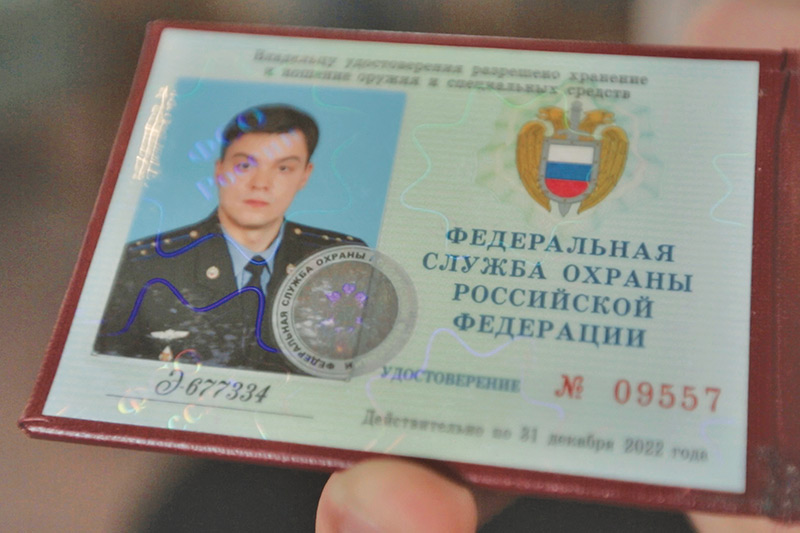
This photo provided by the Dossier Centre shows the Russian Federal Protective Service identification card of Gleb Karakulov in Turkey. Dossier Centre via AP/RSS
LONDON, On October 14, a Russian engineer named Gleb Karakulov boarded a flight from Kazakhstan to Turkey with his wife and daughter. He switched off his phone to shut out the crescendo of urgent, enraged messages, said goodbye to his life in Russia and tried to calm his fast-beating heart. But this was no ordinary Russian defector. Karakulov was an officer in President Vladimir Putin’s secretive elite personal security service — one of the few Russians to flee and go public who have rank, as well as knowledge of intimate details of Putin’s life and potentially classified information. Karakulov, who was responsible for secure communications, said moral opposition to Russia’s invasion of Ukraine and his fear of dying there drove him to speak out, despite the risks to himself and his family. He said he hoped to inspire other Russians to speak out also. “Our president has become a war criminal,” he said. “It is time to end this war and stop being silent.” Karakulov’s account generally conforms with others that paint the Russian president as a once charismatic but increasingly isolated leader, who doesn’t use a cellphone or the internet and insists on access to Russian state television wherever he goes. He also offered new details about how Putin’s paranoia appears to have deepened since his decision to invade Ukraine in February 2022. Putin now prefers to avoid airplanes and travel on a special armoured train, he said, and he ordered a bunker at the Russian Embassy in Kazakhstan outfitted with a secure communications line in October — the first time Karakulov had ever fielded such a request. Along with information on Putin, Karakulov’s testimony offers an intimate view of one man’s decision to defect — without telling his own mother, who he said remains a strong Putin supporter. It raises critical questions about how deep the Russian public’s acceptance of the war runs, and how Putin’s opponents in the West and beyond might leverage any silent opposition. While not speaking directly about his case, an official with a security background from a NATO country said a defection like Karakulov’s “has a very great level of interest.” He spoke on condition of anonymity to discuss sensitive political matters. “That would be seen as a very serious blow to the president himself because he is extremely keen on his security, and his security is compromised,” he said. “That’s something that he would be very unhappy about — particularly if the compromise is to do with communications, upon which a great deal relies.” As an engineer in a field unit of the presidential communications department of the Federal Protective Service, or FSO, Karakulov was responsible for setting up secure communications for the Russian president and prime minister wherever they went. While he was not a confidant of Putin’s, Karakulov spent years in his service, observing him from unusually close quarters from 2009 through late 2022. Karakulov, his wife and his child have gone underground, and it was impossible to speak with them directly due to security constraints. The Dossier Centre, a London-based investigative group funded by Russian opposition figure Mikhail Khodorkovsky, interviewed Karakulov multiple times and shared video and transcripts of more than six hours of those interviews with The Associated Press, as well as the Danish Broadcasting Corporation DR, Swedish Television SVT, and the Norwegian Broadcasting Corporation NRK. The Dossier Centre confirmed the authenticity of Karakulov’s passport and FSO work identity card, and cross-checked details of his biography against Russian government records, leaked personal data and social media postings. The Associated Press reviewed the materials from the Dossier Centre and independently confirmed Karakulov’s identity with three sources in the US and Europe, who were not authorised to speak publicly. The AP also independently corroborated personal details, including Karakulov’s passport numbers, date and place of birth, two registered addresses, and the names and ages of family members, but was unable to verify details of his defection. The AP also confirmed that Karakulov is listed as a wanted man in the Russian Interior Ministry’s public database of criminal suspects. The ministry initiated a criminal investigation against Karakulov on October 26 for desertion during a time of military mobilisation, according to documents obtained by the Dossier Centre and seen by the AP. The FSO is one of the most secretive branches of Russia’s security services. “Even when they quit, they never talk, but they know a lot of details of the private life of the president and the prime minister,” said Katya Hakim, a senior researcher at the Dossier Centre. Karakulov moved as part of an advance team, often with enough specialised communications equipment to fill a KAMAZ truck. He said he has taken more than 180 trips with the Russian president, and contrary to widespread speculation, Putin appears to be in better shape than most people his age. Putin has only cancelled a few trips due to illness and has annual medical checkups, he said. Unlike the prime minister, Putin does not require secure internet access on his trips, Karakulov said. “In all my service, I have never seen him with a mobile phone,” he said. “All the information he receives is only from people close to him. That is, he lives in a kind of information vacuum.” Karakulov’s work brought him to luxury hotels for summits, beach resorts in Cuba, yachts — and aboard a special armoured train outfitted for the Russian president. Putin’s train looks like any other, painted grey with a red stripe to blend in with other railway carriages in Russia. Putin didn’t like the fact that airplanes can be tracked, preferring the stealth of a nondescript train car, Karakulov said. “I understand that he’s simply afraid,” he said. Putin began to use the train regularly in the run-up to the February 2022 invasion of Ukraine, Karakulov said. Even last year, Putin continued to insist on strict anti-Covid measures, and FSO employees took shifts in two-week quarantine so there would always be a pool of people cleared to travel with Putin on the train, he said. Putin has set up identical offices in multiple locations, with matching details down to the desk and wall hangings, and official reports sometimes say he’s one place when he is actually in another, according to Karakulov and prior reporting by a Russian media outlet. When Putin was in Sochi, security officials would deliberately pretend he was leaving, bringing in a plane and sending off a motorcade, when he was in fact staying, Karakulov said. “The guys would talk about this, really laughing,” he said. “I think that this is an attempt to confuse, first, intelligence, and second, so that there are no assassination attempts.”
WORLD
In final speech, Jacinda Ardern reflects on leading New Zealand
- ASSOCIATED PRESS
Jacinda Ardern makes her final speech to New Zealand’s Parliament on Wednesday. AP/RSS
WELLINGTON, In her final speech to New Zealand’s Parliament on Wednesday, Jacinda Ardern described in emotional terms how she’d navigated a pandemic and a mass-shooting during her tumultuous five-year tenure as prime minister. She also told humorous anecdotes like how a European leader so admired the striking hair of Ardern’s chief-of-staff that he fluffed it like a hairdresser — which she joked had helped secure a free-trade deal — and how her mother once sent her a uplifting, if somewhat grandiose, message: “Remember, even Jesus had people who didn’t like him.” On a more serious note, she urged lawmakers to take the politics out of climate change. “There will always be policy differences,” Ardern said during her valedictory address, wearing a traditional Māori cloak called a korowai. “But beneath that, we have what we need to make the progress we must.” When Ardern finished speaking after about 35 minutes, she was greeted with a standing ovation by lawmakers from across the political spectrum and rousing renditions of several Indigenous Māori songs. A global icon of the left and an inspiration to women around the world, Ardern in January stepped down as prime minister, saying, “I no longer have enough in the tank to do it justice. It is that simple.” But she stayed on as a lawmaker until April to avoid triggering a special election ahead of the nation’s general elections in October. Later this month, Ardern will begin a new, unpaid role combating online extremism as Special Envoy for the Christchurch Call.
WORLD
Zelenskyy visits Poland to thank ally and meet Ukrainians
More than 1.5 million Ukrainians have registered with the Polish government since the war began.
- ASSOCIATED PRESS
Poland’s President Andrzej Duda (2nd right), with his wife Agata Kornhauser-Duda, welcomes Ukrainian President Volodymyr Zelenskyy with his wife Olena (left), as they meet at the Presidential Palace in Warsaw, Poland on Wednesday. AP/RSS
WARSAW, Ukrainian President Volodymyr Zelenskyy and his wife were welcomed with military honours in Poland on Wednesday at the start of a state visit that is meant as a gesture of thanks to the neighbouring nation for its crucial support in Ukraine’s defence against Russia’s invasion. The visit is a rare foray for Zelenskyy out of Ukraine since Russia invaded in February 2022. While it follows visits to the United States, Britain, France and Belgium, it stands out from the others because it was announced in advance without the secrecy of past trips. It is also unusual that the president is joined by the first lady, Olena Zelenska. Marcin Przydacz, the head of Polish President Andrzej Duda’s foreign policy office, described it as Zelenskyy’s first visit of this kind since the war began. At a welcome ceremony in the courtyard of the royal palace, while Duda and the two countries’ first ladies were dressed in formal attire, Zelensky wore his signature dark sweatshirt and khaki trousers as a show of support for Ukraine’s fight. While Zelenskyy’s trips last February to London, Paris and Brussels were part of his push for warplanes and for Ukraine’s European Union and NATO membership, and his visit to Washington last December was to shore up US political support, the journey to Warsaw was intended primarily to thank a country that has been an international cheerleader for Ukraine. Poland, lying on NATO’s eastern flank, feels especially threatened by Russia and has been one of the leading advocates for providing military aid. The visit also shone a light on Poland’s rising international role in a new security order that is emerging after Russia’s aggression against Ukraine. Poland, a member of NATO and the European Union, is modernising its military with orders of tanks and other equipment from US and South Korean producers, while the United States has also beefed up its military presence in Poland. Warsaw has been a key ally for Ukraine since Russia’s full-scale invasion last year, also becoming a hub for humanitarian aid and weapons to transit into Ukraine. Zelenskyy is to meet with Duda and Prime Minister Mateusz Morawiecki, attend an economic forum focused on the reconstruction of Ukraine and meet some of the Ukrainians who have found refuge in Poland. Poland has been a key destination for Ukrainian refugees, particularly those who want to remain close because they plan to return or want to be able to visit loved ones.
WORLD
Five children drown in water tank in southern Indian temple, NDTV reports
Briefing
- AGENCIES
NEW DELHI: Five children drowned on Wednesday in a water tank inside a temple in Chennai, the capital of Tamil Nadu state in southern India, broadcaster NDTV reported, in the second deadly incident in a temple this week in the South Asian country. An investigation is being conducted into the Chennai incident, which took place during a ritual, the report cited local police as saying, adding that the bodies of all five victims were recovered. On Thursday, at least 35 people were killed and 16 others injured when the roof of a stepwell inside a temple collapsed in the central state of Madhya Pradesh. The incident, in the city of Indore, occurred as devotees gathered to celebrate the Hindu festival of Ram Navami. Reuters’ partner ANI reported on Monday that local authorities have since filled up the stepwell, demolished an old temple built on it as well as a new temple being built nearby, both of which were constructed illegally.
WORLD
Finland’s Marin steps down as party leader
Briefing
- AGENCIES
HELSINKI: Finland’s outgoing Prime Minister Sanna Marin is stepping down as leader of the Social Democratic party, she said on Wednesday, adding she will serve as a regular lawmaker in the newly elected parliament from next week. “I will start my work as member of parliament next week and I hope I can also lead a calmer life,” Marin told a news conference, adding she would not run for president. She said she had not received any offers for international positions. Marin sought another term as Finland’s leader in last Sunday’s election but her party came third behind the right-wing National Coalition and the Finns parties.
WORLD
Top Saudi, Iranian diplomats to meet in China
Briefing
- AGENCIES
RIYADH: The top envoys for Saudi Arabia and Iran will meet in Beijing on Thursday, an Iranian official and a Saudi-owned newspaper said, as the two regional rivals work to hash out next steps of their diplomatic rapprochement amid a China-brokered deal. The meeting between Prince Faisal bin Farhan Al Saud and his Iranian counterpart, Hossein Amirabdollahian, will be the first formal meeting between Saudi Arabia and Iran’s most senior diplomats in more than seven years. After years of hostility that had fuelled conflicts across the Middle East, Tehran and Riyadh agreed to end their diplomatic rift and re-open embassies in a major deal facilitated by China last month.
WORLD
Report: Husband of ex-Scottish leader arrested
Briefing
- AGENCIES
LONDON: The husband of former Scottish first minister and Scottish National Party leader Nicola Sturgeon has been arrested in a party finance probe, British media reported on Wednesday. Police in Scotland did not identify Peter Murrell as the 58-year old man arrested Wednesday “in connection with the ongoing investigation into the funding and finances of the Scottish National Party.” However, Britain’s Press Association, the BBC and others reported it was Murrell. “Clearly it would not be appropriate to comment on any live police investigation but the SNP have been cooperating fully with this investigation and will continue to do so,” the party said in a statement released after the arrest.
SPORTS
Mighty Vietnam hammer lacklustre Nepal 5-1
Nepal now face an almost impossible task against the Asian giants on April 8 when they meet again at the Dasharath Stadium in the second leg of the Group C qualifiers.
- Sports Bureau
Nepal’s Amisha Karki (left) and Vietnam’s Huynh Nhu vie for the ball during the Group C game of the first round of the AFC Women’s Olympic Qualifiers in Kathmandu on Wednesday. POST PHOTO: KESHAV THAPA
KATHMANDU, Nepal’s hopes of progressing into the second round of the AFC Women’s Olympic Qualifying Tournament for Paris 2024 took a nasty hit after they lost to Vietnam 5-1 in a one-sided affair at the Dasharath Stadium in Kathmandu on Wednesday. Huynh Nhu scored a brace, and Pham Hai Yen, Nguyen Thi Bich Thuy and Nguyen Thi Thanh Nha hit the targets for Vietnam. Sabitra Bhandari pulled back a consolation goal for the hosts. Nepal were playing against a side that have already secured their place in the 2023 FIFA Women’s World Cup for the first time in their history. The absence of Gita Rana was badly missed as Ananta Raj Thapa’s side were unable to fix a leaky defence overtaken by the young guns. And Vietnam were not kind. Amisha Karki missed a golden opportunity to put Nepal in front in the 9th minute. Dipa Shahi dropped a long ball in the pocket of space in the Vietnam box for Karki with only goalkeeper Khong Thi Hang standing between them, but Karki flashed over the bar to a great disbelief. The early lead could have turned the table in Nepal’s favour in a chilly evening but Pham Hai Yen punished Nepal for the miss two minutes later. Vietnam responded with quick attacks to put Nepali defence under constant pressure. Nepali defenders failed to clear the ball allowing Vietnam front line to wander freely inside the area. Hai Yen took full advantage of it when Nguyen Thi Tuyet Dung cut inside to set up Hai Yen for an easy header. Tuyet Dung then tested Nepal captain and goalkeeper Anjila Tumbapo Subba in the 21st minute on a rebound after Hai Yen hit the woodwork. Karki then wasted another chance in the 34th minute when Vietnam’s Le Thi Diem My failed to clear a free kick from Amrita Jaisi allowing Karki to fire from the six yard box but her tame shot was comfortably saved by Vietnam’s Thi Hang. And Vietnam cashed in again for another wasted opportunity in the 36th minute through a spot kick. Samikshya Karki handled the ball inside the penalty area and captain Nhu stepped up to net her 63rd international goal for Vietnam. Nepal’s misery continued two minutes later when Bich Thuy’s shot deflected off Jaisi before evading Subba. The visiting side played with the same intensity after the break as well, and forced goalie Subba a save three minutes into the second half. Vietnam captain Nhu, who plays for Portugal women’s top division side Vilaverdense, stretched the lead moments later heading a cross from Hoang Thi Loan. Sabitra Bhandari pulled one back for Nepal in the 79th minute with a cool and quality finish after Saru Limbu put her through. The goal infused some life into Nepali squad but Thanh Nha killed off the game, arrowing a 35-yard scorcher over a frustrated Subba in the first minute of injury time. Nepal now face an almost impossible task against the 33rd ranked team on April 8 when they meet again at the same venue in the second leg of the Group C matches. Nepal are ranked 100th in the FIFA Women’s World Ranking. The Group ‘C’ was originally a four-team event but was reduced to a two-team affair after Palestine and Afghanistan withdrew from the tournament. Only the group winners advance into the second round.
SPORTS
Another 0-0 stalemate underlines sharp decline for Chelsea, Liverpool
The qualification for the Champions League is looking increasingly unlikely for both the Blues and the Reds.
- ASSOCIATED PRESS
LONDON, Another 0-0 stalemate between Chelsea and Liverpool. Another match highlighting the sharp decline of two of England’s top teams who, at this rate, are unlikely to be playing in the Champions League next season. Chelsea were playing their first game since the firing of Graham Potter on Sunday but little was different under his interim replacement, Bruno Saltor. Indeed, there was something very familiar about the teams serving up a goalless draw. That has been the score in this fixture in their last four meetings—both Premier League matches this season and both domestic cup finals last season, which were ultimately won by Liverpool via penalty shootouts. The top four, and qualification for the Champions League, is looking increasingly unlikely for both teams. Liverpool, who ran Manchester City so close for the title last season, are in the eighth place and seven points off fourth-place Tottenham. Chelsea, on the back of spending $630 million in the last two transfer windows, are four points further back in 11th place. Scoring goals remains Chelsea’s big problem, with the expensively assembled team failing to net at home for the fifth time in 2023. Reece James had a strike disallowed for a narrow offside against Enzo Fernandez and Kai Havertz’s celebrations for a goal in the second half were cut short after VAR spotted the ball rebounded off his arm and into the net after Liverpool goalkeeper Alisson Becker saved the striker’s shot. “These have been emotional days,” Bruno said, “and the players have been able to keep focused. It’s a credit to them.” Liverpool manager Jurgen Klopp was satisfied with the reaction of his team after a humbling 4-1 loss at Manchester City, which led to him making six changes—including dropping Mohamed Salah, Trent Alexander-Arnold and Andrew Robertson to the bench. “Yes, it was not the best football,” Klopp said, “but these boys are really good footballers and tonight they put in a proper shift.”
No change Firing their manager didn’t have an instant effect on Leicester, either. A 2-1 defeat at home to Aston Villa dropped Leicester into next-to-last place and means the team have lost six of their last seven league games, drawing the other one. Following the departure of Brendan Rodgers on Sunday, first-team coaches Adam Sadler and Mike Stowell were put in interim control of Leicester but they weren’t able to fix a leaky defence that has now conceded 51 goals in 29 games. Bertrand Traore came off the bench to score Villa’s winner in the 87th minute, with Leicester down to 10 men by that time after Kiernan Dewsbury-Hall collected a second booking in the 70th. Harvey Barnes had earlier cancelled out the opener by Villa striker Ollie Watkins, who scored for the sixth straight away game—the first player to do so in the Premier League since former Manchester City striker Sergio Aguero in 2017. Villa climbed to seventh place under Unai Emery and have won five of their last six league games.
Relegation battle It was a significant evening in the league’s tightest relegation battle in years—and Leeds turned out being the big winners. By rallying to beat fellow strugglers Nottingham Forest 2-1, Leeds climbed out of the bottom three and jumped to 13th place in the 20-team league. The fight to avoid the drop remains too close to call, though, with five points separating Crystal Palace in 12th and Leicester in 19th. Forest, who have dropped to fourth-to-last place, took the lead at Elland Road through Orel Mangala in the 12th minute only for Leeds to turn the game around thanks to goals by Jack Harrison and Luis Sinisterra before halftime. Bournemouth dropped back into the relegation zone after losing 2-0 at home to Brighton, whose goals came from teenage strikers—a deft flicked finish by Evan Ferguson in the 27th and Julio Enciso’s individual effort in second-half stoppage time. Brighton moved up to sixth place, four points off the top four, and could yet challenge for Champions League qualification.
MEDLEY
Horoscope
ARIES (March 21-April 19) Prioritize balance and love above all else this morning, darling Aries, though you’ll need to be mindful of your own boundaries as well. Watch out for funky vibes later in the afternoon. Themes around dishonesty could also come into play.
TAURUS (April 20-May 20) Don’t bite off more than you can chew this morning, dear Taurus. Your to-do list may be sprawling, more tasks or chores are likely to present themselves, making it important that you prioritize where to place focus. Take care to stay hydrated.
GEMINI (May 21-June 21) Dear Gemini. Consider investing in yourself and your own interests if your friends aren’t available and finding ways to entertain yourself. Try not to sacrifice your standing in the process asking you to touch base with your health.
CANCER (June 22-July 22) Be mindful to keep healthy tabs on your ambitions this morning. Watch out for emotional landmines taking care of your mind and your own feelings. You’ll sense a shift in an artistic but private mood throughout the next two days.
LEO (July 23-August 22) Your mind will be a busy place this morning. From logistics to creative ideas, and spiritual thoughts, you can bet that your psyche will run through many scenarios. Dear Lion, Give yourself permission to lay low from home.
VIRGO (August 23-September 22) Your stubborn side will shine through this morning, darling Virgo. Though you definitely have preferences on how things are done, try not to get frustrated when others don’t see the world through your eyes. Try to schedule time for meditation.
LIBRA (September 23-October 22) Your heart will be full of love today. Allow yourself to lean into optimism right now. Don’t let a hopeful disposition distract you from red flags. You’ll be able to let go of negativity while finding luxury in the present.
SCORPIO (October 23-November 21) You may feel tempted to stay under the covers while hiding from your to-do list this morning. Don’t feel guilty about flying under the radar, but try not to slip into an unproductive state, suggesting you should relax from home.
SAGITTARIUS (November 22-December 21) Your popularity will skyrocket this morning, dearest Archer making it important that you set boundaries with anyone who oversteps. You may also want to keep an eye on your screen time. Plan on spending the evening in solitude.
CAPRICORN (December 22-January 19) Don’t over-invest in controlling your emotions this morning. The stars nudge you to nurture your feelings. However, it’ll also be important that you stay on track with your responsibilities, though unbalanced connections could bring forth unforeseen self-doubt.
AQUARIUS (January 20-February 18) You should feel more connected to your spirituality this morning, dear Aquarius. This cosmic climate is perfect for swimming in philosophical waters, though you’ll need to keep an open mind in order to make the most of these vibes.
PISCES (February 19-March 20) Resist the urge to burn bridges this morning, dear Pisces. It’ll be important that you choose your battles wisely, as small disagreements could snowball into something more. Luckily, the energy will shift, activating spirituality and luck later.
CULTURE & LIFESTYLE
Let us document folk tales to preserve our identity
Writer and folklorist Tulasi Diwas discusses the importance of folk traditions and why writers should change their writing style frequently.
Post Photo: Elite Joshi
Few individuals have had the impact Tulasi Diwas has in terms of collecting Nepali folk tales and researching the folk culture of numerous ethnicities across the country. Writer, poet, folklorist and cultural expert Diwas’ work has been translated into over 25 languages. He is also the recipient of Yug Kavi Siddhicharan Award in 2018 and the Bisista Sahitya Siromani honour at the 2013 International Poetry Festival in India. In this interview with The Post’s Anweiti Upadhyay, Diwas discusses the importance of folk traditions and why writers should change their writing style and topics all the time.
When did you start reading? I started reading books outside of my coursebooks when I was in grade 8. I remember picking up tons of books in Nepali, English and Hindi growing up and haven’t stopped since. I also started collecting books as soon as I began reading. So, over the years, I have accumulated quite a collection of books for my personal library. My father didn’t get to study (formally) as much as he wanted to. That doesn’t mean he couldn’t read or write—he did that quite well. In fact, he was a government officer. But I was more influenced by my uncles who were well-educated and very involved in cultural activities, including music, dance and writing. This is how I got interested in both reading and the many aspects of Nepali culture. Later in life, I founded Bal Mandir in Dhankuta with some of my colleagues. I also served as the school’s principal for some time, so I felt a need to know even more about the world. So, I would read a lot of books to quench my thirst for knowledge. And I’ve only felt a greater need for reading ever since.
What are you reading nowadays? As culture and folklore are the topics I’m highly interested in, I mostly read books on them. I’m also a big lover of poetry. So, I read poetry very often too. But nowadays, I don’t get to read as much as I once used to. Because of my work, I’ve started taking a functional approach to reading. I read up on topics I need to for the projects I’m working on. I travel a lot for work. During my travels, I do come across books that are popular or highly acclaimed in different countries that I probably wouldn’t have come across in Nepal. I read those too. However, among these, I can only read ones that are translated into one of the three languages I understand. Additionally, I also get to know many talented and critically acclaimed writers from all around the world while attending various conferences for work. I get gifted books during these meet-ups and I’m compelled to read the books I’ve received personally from these authors too.
What are some writers or literary works you love? Has any writer’s work influenced your own writing style? My reading interests have always been diverse. In the past few decades, the genres and languages I read across have expanded even more—especially as I encounter a lot of writers from all across the world. So, I can’t give you just a name or two when it comes to my influences or the writers and books I love. Another reason I’m a little hesitant to give you specific names when it comes to writers is that no two writeups by an author are the same. Just like how two siblings born to the same parents aren’t similar. And I firmly believe they shouldn’t be. We, humans, are ever-evolving. I’m not the same person I was yesterday or even an hour ago, and neither are you. So why should two things written by the same person be similar?
So you think writers should always change their writing styles? Definitely. That is how you grow as a writer and a person. Each and every creation of a writer should be different. This could be through style, genre, subject or anything else. This happens quite naturally for many writers. I think it should apply to creative creators of all kinds, not just writers. There is a big difference between writers of subjects like history and geography, and literary writers. The former collects data and information and puts all of that into words we can understand. They don’t have to be creative with their writing. However, the latter has to put all of their creativity into everything they write. Their writeups are a direct reflection of their creative flair. These writeups have to try out different things with their writeups all the time. They shouldn’t create what is already there. They should see what isn’t there and create that.
Do you apply this to your own writing too? Yes, I do. This is why I don’t write every day. I space out my writing time so that I won’t repeat what I write.
Your most beloved book to date is ‘Nepali Lok Katha’ (Nepali Folk Tales). You have done a lot of research on and documented the folk culture of Nepal. Why is it important to research and document these? Nepal is very diverse in terms of culture and tradition. And all of this diversity is a result of the varied topography that makes up our country. It is very easy to get to know how diverse Nepal is in terms of culture, tradition, language and lifestyle. You just need to travel from the bottom of a hill to the top. You will see how the difference in topography naturally brings about changes in everything, including the food we eat, costumes we dress ourselves in, languages we sing, songs we sing, festivals we celebrate, movements we use in our dances and the perception we have of the world. If everyone here understood how deeply our culture and lifestyle are shaped by the part of the country we live in, we would instinctively understand why it is important to research and document this. If all Nepalis understood and accepted this geographic truth, we would understand each other regardless of our diverse backgrounds.
A lot of young Nepalis know folk tales originating from other countries. However, they are not aware of Nepali folk tales. What is the reason behind this? The main reason for this is that our folk tales haven’t been documented much. Many countries are very invested in researching, documenting, celebrating and spreading their culture. They know how important it is to preserve their own unique identity in the world. We are not doing that here. We promote and spread foreign cultures over our own. Most institutes and colleges in Nepal teach music and dances from other cultures while paying dust to our own. I insisted a lot on having colleges like Padma Kanya Multiple Campus include folk dances and songs from different Nepali cultures including Newa, Tharu and different indigenous groups from the Far West. They were previously teaching Indian classical music and dances. Changes like these need to happen all over the country to preserve and promote our folk traditions. I, in fact, think Nepali folklore should be taught as a subject of its own at different colleges and universities across the country. It’s a vast topic and there is a lot of study and research here. This will enable more Nepalis to get introduced to the many cultures and traditions of our nation.
Where do you think Nepali literature stands in the global literary scene? I’ve been able to attend various literary seminars, conferences and events across the world as a literary figure from Nepal. Trust me when I say I don’t think we need to be upset about our standing in the global literary scene. The literary works published by Nepali authors aren’t in any way inferior to the works of foreign authors. However, I do feel that if we could get more of our good literary pieces translated into other languages, then we could spread the word about the masterpieces written by Nepali writers to a bigger audience.
CULTURE & LIFESTYLE
Videos: Cut by cut
The co-founders of Stellar Studios, a Kathmandu-based video production company, talk about how they plan to make a name for themselves in this rapidly evolving field.
- Apecksha Gurung
Photos: Courtesy of Prabish Newa
Kathmandu For aspiring filmmakers Nayan Rai, Anjon Limbu, and Ashok Adhikari, cinema is their first love. And that’s what brought them together to start Stellar Studios—a creative video production company that makes music videos and advertisements. Rai was the first one who initiated the idea of establishing their own production house with Limbu and Adhikari. Their most recent production is ‘Je Chhau Timi’ by Swoopna Suman and Samir Shrestha, which gained over 5,900,000 views within ten days. This song hit home for a lot of young Nepalis, not just in the country but also in Australia and the UK. Founder Rai reveals that storytelling has always captivated him, and he has a constant appetite for learning new things. “I used to make a miniature movie theatre out of cardboard boxes as a kid and make several photo reels to show off my best stop motion work,” he recalls, adding that it feels surreal to see that he is now a CEO of a production firm at the age of 26. Though the studio has been mostly sticking to music videos and advertisements, Rai belives his true calling is making crime thrillers. He is eager to see where his career will lead him in the future. “I can’t wait to tell you my story,” he says. Limbu has been working in the media production field since 2016. He began as a video editor, but as he gained more experience, he also developed skills as a colourist and director. “I always try to get better at what I do, and every project I work on teaches me something new,” says Limbu. Adhikari, on the other hand, is a VFX maestro, working on animation, editing and post-production. “In Stellar, we want to tell viewers important stories that compel them to reflect, experience, and reevaluate their worldview,” he says. Launched oin 2021, Stellar Studios has already come a long way, coming up with music videos for popular artists like Sushant KC. They are a ‘full-service’ media company that works on not just advertisements and music videos but also political campaign ads, short films, and documentaries. Their team comprises of Nisseem Shrestha as content supervisor, Nisim Gorkhali as operations manager, Supran Shrestha as photographer, Nhujan Dongol as junior editor, Rajesh Chaudhary and Aaditya Shrestha as the cinematographers. The secret behind Stellar Studios’ success, Limbu reveals, is that each member of the team possesses a unique set of skills. “This has allowed us to be responsible in our specialised field and prioritise our commitments,” he says.
When the studio is approached by agencies and brands for a given project, it falls under their responsibility to turn the client’s vision into a concept that best fits their needs. For a project, the deadline set by their clients typically determines the pace for their initiatives. However, they lament that companies often delay payment long after the project is completed, which sometimes affects the studio’s sustainability. But this doesn’t mean they don’t give their best in all the projects they take up. The scheduling procedure is also impacted by the actors’ and crew’s availability. “In order to plan our film sessions, it is crucial to keep everyone’s schedule in mind,” says Rai. The studio uses a variety of software depending on the concept and the goal of the project, and it takes a tremendous amount of effort for their videos to go from visualisation and conceptualisation to the final outcome. When it comes to the budget, Limbu adds that it again mostly depends on the project. “The budget elevates the production value. Even if it’s merely a music video, we have to think about innovation, productivity, management, crew involvement, cast, and other factors,” he adds. In any media project, there are three important parts: pre-production, production and post-production. “Pre-production is like creating a foundation for the video that we are about to create. It includes script writing, storyboarding, selecting the right cast, selecting the right location, and scheduling everything before the date of the shoot,” says Limbu, adding that if a crew fails to have proper preparation, it gets incredibly difficult for the shooting crew during production. The choice of location is set according to the video’s concept and budget. “We are very mindful and thorough with our pre-production process,” he says. Post-production, in Limbu’s opinion, is where everything comes together. After they get the footage from the shooting team, the director of the project then sits with the editor and the editing takes place. “To give you an idea, we mostly use Adobe Premiere and DaVinci Resolve for post-production,” says Limbu. After the editing process, the finalised video goes to the colourist for colour grading. “In Nepal, the importance of colour grading and colour correction is greatly underrated,” he says, adding that colour grading adds that extra layer of finesse to the finished video and aids in establishing the narrative. For the song ‘Je Chhau Timi’, it was singer Suman who reached out to them. The team decided that a one-take shoot was was the ideal approach to accomplish their objective which was to showcase the unfiltered realism of Suman’s music. The video features the two singers—Suman and Shrestha—singing below thundering dark clouds. Despite the darkness that surrounds them, they are seen singing happily. “We wanted people to realise that everyone possesses the capacity for immense strength even in the most difficult times–all we need to do is accept it,” says Rai.