Koshi Province crisis: Politics static, protests relentless
The recently named province is currently embroiled in two problems with no solution in sight.
- NISHAN KHATIWADA
The provincial politics in Koshi is experiencing twin troubles—one relates to the flaring up of ethnic sentiments after the recent naming of the province and the other to the tricky numerical strength of the parties in the assembly. The alliance that runs the federal administration has found it difficult to form a provincial government and the new nomenclature of the province has led to violent protests that saw a demonstrator being killed and hundreds getting injured. The Janata Samajbadi Party (JSP) pulled out of the Koshi government on Wednesday and also withdrew its support to the chief minister. Nirmala Limbu, the party’s sole representative in the provincial assembly, was the health minister in the CPN-UML-led provincial government. The Nepali Congress-led central coalition has been mulling ways to form a new government in Koshi based on the power equation in Kathmandu. The CPN (Maoist Centre), a coalition partner, is still in the UML-led Koshi Cabinet, along with the Rastriya Prajatantra Party. In the 93-member provincial assembly, the UML has 40 seats, the Congress 29, the Maoist Centre 13, the RPP 6, the CPN (Unified Socialist) 4, and the Janata Samajbadi Party one seat. Both the Congress-led bloc and the UML-RPP alliance have 46 seats each, adding to the difficulty of crafting a ruling coalition. What further complicates the matter is that the UML is the largest party in the province. Constitutional experts say the Speaker cannot vote to form the new government. “The Speaker cannot vote to prove the majority to form a government. If the Speaker votes, he or she will be the Speaker of the majority and is no more neutral,” said constitutional expert Bipin Adhikari. To form a new government, the central alliance partners should quit the government, making the chief minister seek a floor test. Article 188 (2) of the Constitution of Nepal states that in case the political party the chief minister represents is divided or a political party in a coalition provincial government withdrawing support, the chief minister shall table a resolution in the provincial assembly for a vote of confidence within 30 days. Experts, however, remain divided on the issues of both provincial and central governments. Some argue that floor tests are not required unless the government falls into a minority. In any case, the parties in Koshi are not thinking about seeking a vote of confidence until they find a clear way of securing a majority. Rajendra Karki, a lawmaker from the Maoist Centre in the Koshi legislature, said as there is no clear majority to make a new government, their current focus is on the policies and programmes and the budget. “Until we find a clear way forward, we are in no mood to push the province into instability, by initiating the process of a new government formation.” According to provincial leaders, the Congress and its partners have been trying to woo the Rastriya Prajatantra Party. The party that has already pulled out of the central government has been allying with the UML in Koshi in line with the two parties’ collaboration as the opposition in the federal parliament. However, the Maoist Centre, which leads the federal government mainly with the backing of Congress, hasn’t quit the Koshi Cabinet. The Congress, therefore, has been urging the Maoist Centre to pull out of the UML-led government. “We have already asked the Maoist Centre to pull out. Only then will the process of a new government formation begin,” said Binod Rai, a provincial lawmaker from the Congress. “Yes, the numbers are tricky. But we are in negotiation with the ruling parties. We will definitely find a way out.” Some ethnic groups have been staging protests, demanding the name of the province be changed to reflect the identity of the major ethnic communities in the region. And the protests have been increasingly turning violent. Province 1 was named ‘Koshi’ on March 1. Since then, the protests have intensified with hundreds getting injured in clashes, and there is no sign of a let up in protests against the ‘Koshi’ name. Instead, the activists advocating identity-based nomenclature have intensified their agitation. Kirat Yakthung Chumlung, Kirat Rai Yayokkha and the Nepal Federation of Indigenous Nationalities have been coordinating protests organised by the Province 1 Renaming Joint Struggle Committee. “The government has called the agitating groups for talks. An understanding will be reached to resolve the issue,” said Karki, the provincial lawmaker. “All the parties in the Koshi assembly have agreed that talks are the best way to resolve the matter.” Presidents of 14 districts of the Congress party issued a statement on Wednesday, saying the nomenclature issue should be resolved through talks. “We cannot suppress the protest,” they said. But the UML Koshi parliamentary party has said that the name cannot be changed, regardless of the government’s intentions. A meeting of the parliamentary party on Sunday ruled out any alternative to the province’s existing name. A province can be renamed with a two-thirds majority of its assembly voting for the motion.
HOME PAGE
Why development projects in Nepal are seldom completed on time
Poor budget implementation raises questions over the projects announced for the upcoming fiscal year as well.
- PRITHVI MAN SHRESTHA
RSS
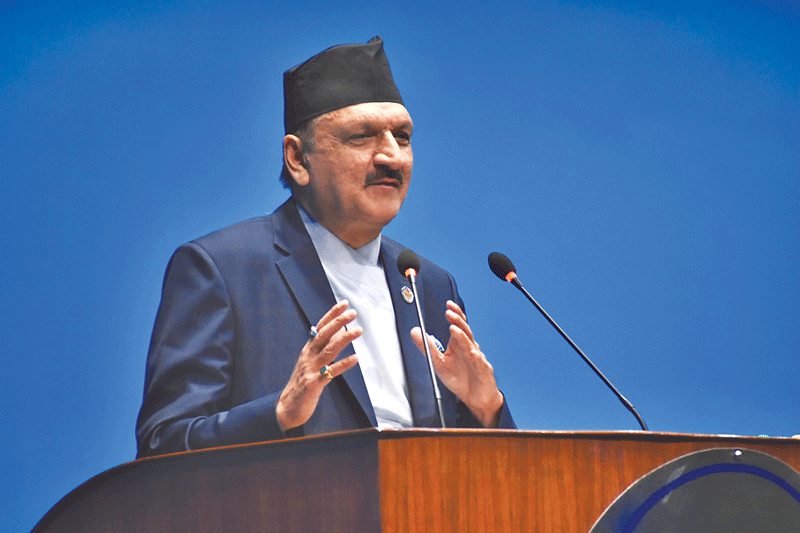
Finance Minister Prakash Sharan Mahat presented the budget for upcoming year on Monday.
The government has presented in Parliament a budget of Rs1.75 trillion for the next fiscal year 2023-2024 without many lofty promises, with the fiscal estimates 2.37 percent lower than the allocations made for the current fiscal year. As the government faces a resource crunch to implement development projects, the finance minister was circumspect in budget-making. While resource crunch is a problem, the inability to spend available resources also continues to be a major issue. The government is estimated to spend Rs1.54 trillion or 83.90 percent of the allocated amount in the current fiscal year ending in mid-July. Capital budget spending is expected to remain at Rs258 billion or 67.91 percent of the allocated amount, according to the document read out by Prakash Sharan Mahat. As of June 2, the capital spending stood at 37 percent of the allocated budget, according to the Financial Comptroller General Office. The dismal progress also reflects in the poor implementation of the fiscal provisions for the current fiscal year. A government report shows that the progress in budget implementation remains abysmal. The Prime Minister’s Office said it had set 1,270 activities and 2,795 milestones, besides 339 result indicators for 21 ministries to determine the implementation status of the policies and programmes for the current fiscal year. As of mid-April, only 10.39 percent of the activities have been completed, while 20.57 percent of the milestones have been achieved, according to a report released by the PMO on May 17. Of the 356 activities in the infrastructure sector, 28 were completed, 296 are under construction and 32 have made no progress, according to the report. Besides overall activities and milestones, the PMO had also selected 30 projects with large budgets for evaluation—including 20 related to infrastructure and 10 related to economic activities, social activities and governance. The physical progress in those projects stood from 13.57 percent of the annual target to 155.55 percent. Progress in most projects remains below the mark, the report added.
Experts say the track record of poor budget implementation raises questions over the government’s ability to implement projects announced for the upcoming fiscal year as well. Tulasi Sitaula, a former government secretary with an experience in handling infrastructure projects, said the hurdles in implementation have not changed in a number of years. “For example, funds are allocated for projects that are not ready to go,” Sitaula said. “Seldom does the government complete a detailed project report (DPR), land acquisition, and forest and environment clearances before undertaking a project.”
Project selection sans preparation The country currently has 24 National Pride Projects. Of them, the construction of Pokhara International Airport, the Gautam Buddha International Airport and the Upper Tamakoshi Hydropower Project have been completed. But no international flight has yet taken off from the new Pokhara airport, while only a handful have jetted off from the Gautam Buddha Airport. Many projects are under construction, a majority of them at a glacial pace, while there is no certainty about how some ‘National Pride Projects’ will be developed. For example, the Nijgadh International Airport is designated a National Pride Project but there is no clarity on its development. The government in the budget for the next fiscal year talks about starting the project after determining its investment modality. There is also no clarity on how the East-West Railway would be developed even though the Department of Railway has been working on opening its track. “There is a trend of allocating huge sums for projects which are not yet ready to go,” said Sitaula. “In my view, we have to revisit the National Pride Projects and include those that are ready for implementation after the completion of all preparatory works including DPR, development modality, land acquisition, and forest and environmental clearances.” Even the under-construction projects suffer delays. For example, the Sikta Irrigation Project was supposed to be completed by the fiscal year 2024-2025, but physical progress in the highly prioritised project is just 38.82 percent, according to the Economic Survey 2022-2023 released on May 28. The Rani Jamara Kulariya Irrigation project is supposed to be completed by the end of fiscal 2023-2024 but progress stands at 58.5 percent, according to the Economic Survey. Data show that most under construction National Pride Projects are facing time and cost overruns.
Politics in picking projects In April 2021, former prime minister KP Sharma Oli announced the commencement of 165 strategic road projects, one in each electoral constituency. But the environmental impact assessment (EIA) and detailed project report (DPR) studies have not been conducted for most of them. An official at the Department of Roads had at the time told the Post that the DPRs of only 10 roads had been completed. Back then, Oli had announced elections to the House of Representatives. The erstwhile Nepal Communist Party (NCP) was dissolved in March 2021 with a Supreme Court order—reviving the CPN-UML and the CPN (Maoist Centre). According to Sitaula, politicians also rush to include projects of their choice under the high-priority category because of resource guarantees, irrespective of whether they are ready for implementation. Besides the National Pride Projects, the government created another category of ‘Transformative Projects.’ “I sense that the transformative projects came into being after strong pressure from politicians to get their projects enlisted under the National Pride Projects,” said Sitaula.
Land acquisition and forest clearance Many transmission line projects are facing time and cost overruns as they face local protests asking for more compensation or re-alignment of transmission lines. For example, the Nepal Electricity Authority (NEA) has been struggling to complete the Bharatpur-Bardaghat line due to the protests by local residents against the existing alignment at Dumkibas of Nawalparasi (East). Delayed forest clearance has affected the Kushma-New Butwal transmission line project. Dirghyu Kumar Shrestha, chief of the transmission directorate at the NEA, said only 50 to 60 percent of annual targets on project implementation were being met due to factors like delays in land acquisition and forest and environmental clearances. “People seek full compensation even in the case of the transmission right-of-way and obstruct work,” said Shrestha. “The government offices responsible for forest and environment clearances take years to issue permits even after the Cabinet gives its go-ahead.” He said the rules are such that if a shrub has grown into a tree, that should be recounted and that takes time.
Government versus contractors The government usually blames contractors for poor implementation of development projects. Both officials and builders agree that a single contractor occupying a large chunk of the work affects its ability to swiftly implement a development project. Contractors on the other hand blame the government for delayed payments of mobilisation advance as well as clearance of bills of accomplished works. “The contractors have outstanding dues of more than Rs60 billion that they need to claim from the government in the current fiscal year,” said Rabi Singh, president of the Federation of Contractors’ Association of Nepal. “When the government stops cash flow to contractors, how can they work at pace?” The government struggled to pay the contractors due to a reduced revenue collection, officials said. As of June 2, the government collected Rs796.41 billion, compared to Rs907.67 billion gathered in the same period of the fiscal 2021-2022, according to the FCGO.
What next? The budget for the next fiscal year seeks to address the prevalent issues plaguing the implementation of development projects. According to the budgetary provision, contract-signing can happen only in the case of the projects that have completed DPR, environmental impact assessment, land acquisition and the right of way. “There is a tendency to guarantee resources for multi-year contracts without the confirmed availability of such resources,” it said. The budget specifies that resource guarantee would be nullified if the contract is not signed within nine months after such approval. The budget also makes it mandatory for the contract to be awarded by mid-November, warning that the budget could otherwise be withdrawn. “Obviously, some budgetary provisions for the implementation of development projects are welcome,” said Sitaula. “But, again, our poor history of budget implementation does not inspire confidence.”
HOME PAGE
Nepali team’s performance masks failures of cricket governing body
Players yet to be paid for T20 tournament with CAN keeping mum in the spot-fixing case.
- PRAJWAL OLI
Post file Photo
National players celebrate after winning the final of ACC Men’s Premier Cup last month.
Nepal T20, the first-ever franchise cricket tournament organised by the Cricket Association of Nepal (CAN), which it described as a ‘game changer’, ended rather disappointingly earlier this year. Rocked by match fixing and payment issues, the event ended up putting promising cricketer Mohammad Aadil Alam (Aadil Ansari) and veteran Mehboob Alam behind bars on charges of spot fixing. Police investigation showed six Nepalis and six foreigners were involved in the fixing scam. Ansari and Alam were both released on bail. International Cricket Council’s (ICC’s) Anti-Corruption Unit team had even visited Nepal to investigate, but they are yet to release their report. The six-team tournament was held between December 24, 2022 and January 11, 2023. Players were forced to protest in the middle of the tournament, as they had reportedly not been given the promised pay. The protests even delayed some matches; players from some teams are yet to receive payments. Despite all this, however, the cricket governing body of the country has remained mum on the matter. Players of Far West United and Kathmandu Knights have only received half their contracted salaries, according to multiple sources the Post talked to. The Nepal T20 and governance issues at the CAN were largely overshadowed by the sensational on-field success of the national men’s cricket team. In a spectacular turnaround, the team emerged victorious in 11 of their last 12 matches of the ICC World Cup League 2 in February and March, to seal a direct berth for the ICC World Cup Qualifiers taking place from June 18 to July 6 in Zimbabwe. They also earned a berth for the Asia Cup by winning the ACC Premier Cup. The CAN had leased NepalT20 to the Indian sports management company Seven3Sports for eight years—without an open bidding. As per the agreement, the event was leased at Rs330 million and the company was supposed to give the cricket governing body of Nepal Rs33 million for the first edition. But it paid only Rs22 million in three instalments and later, unilaterally terminated the contract, citing the CAN’s failure to fulfil its promises. The Nepal Police, however, suspected Seven3Sports had a hand in the fixing scam. CAN executive committee member Mohammad Daud Ansari on June 2 filed a written application to CAN, seeking answers about payment issues of Nepal T20. Addressing the CAN President Chatur Bahadur Chand, he described Nepal T20 as a shame in the history of Nepali cricket. “The company fled before the end of the tournament and the players are yet to get the match fees,” Ansari wrote. “The cash prize for winners and the player-of-the-match prizes have not been distributed and CAN is also yet to receive the amount as per the contract.” Urging Chand to make things clear within a week, Ansari added, “What are the initiatives taken by CAN to get the money? The body’s failure to take legal action against the company is also mysterious. I request the president to furnish detailed information about it.” Ansari claimed that the nomination of the executive committee member Dura Raj Pathak as acting secretary was illegal. He was nominated to the post after former acting secretary Prashant Bikram Malla, also the director of Nepal T20 Governing Council, resigned after the fixing scam. Ansari also raised questions about transparency while upgrading facilities at the Mulpani grounds, payments at Yellow Pagoda Hotel and the event management contract given to Levin Sports during bilateral and triangular series organised by Nepal. “I am not much aware about payment to players of Far West United and Kathmandu Knights. I think they have received 50 percent of their salaries from their respective franchises after our initiation,” said CAN president Chand. “Treasurer [Roshan Singh] and Malla [Nepal T20 Governing Council director] know about this.” CAN treasurer Roshan Singh was not available for comment on the financial issues related to the Nepal T20 tournament or on the other ‘non-transparent’ transactions as claimed by Ansari. But Malla, who had resigned from the Governing Council, said, “Four franchises have already paid all dues and the remaining two franchises have committed to do so. We are hopeful that they will be paid. The CAN had asked for six months’ time to settle the payment of players from the date of the tournament’s end.” Regarding the event management fees of bilateral (Nepal-Zimbabwe) and triangular series (Nepal, Malaysia and Papua New Guinea), Malla said that the event was leased to SunBe, a Kathmandu-based event manager, instead of Levin Sports and Rs10 million, almost half the contract amount, had already been received. “We are in touch with them and they have also asked for a time extension,” Malla said. “We can even drag them to court, but I am optimistic it will be settled in the near future.” CAN President Chand said that he had written to Seven3Sports on the remainder of the payment and added that should the Indian company ignore them they would seek court’s help as a last resort. Regarding Ansari’s written application to CAN, Chand said that he had already received the letter. “He published it on social media barely a day after his ultimatum had expired. He should have discussed the matter with us,” said Chand. He also claimed that Pathak’s appointment was valid as per the CAN’s amended statute.
NATIONAL
Law revision to allow University Grants Commission to issue equivalence papers
The job is being done by Tribhuvan University and there were calls to change the arrangement.
- Post Report
Ending Tribhuvan University’s prerogative to issue equivalence certificates, the government is shifting the authority to the University Grants Commission. The government has registered an amendment to the University Grants Commission Act with a provision to transfer the authority for equivalence to the commission from the oldest varsity. The amendment bill has a clause that says “the commission will issue equivalence certificates”. Equivalence certificate validates one’s degree earned from foreign boards and universities. There were debates that the Tribhuvan University shouldn’t be getting the authority for the validation of foreign universities as they are of the same status. Based on the demand that a higher authority be entitled with the responsibility for issuing the equivalence certificate, the government initiated the process for a change in the legislation. The Nepal government started the process for the transfer of authority a year after the Indian government made similar efforts. The Indian University Grants Commission last prepared guidelines on the basis of which academic equivalence will be provided to degrees offered by foreign universities with the degrees offered by their Indian counterparts. In India, the union education ministry had entrusted the Association of Indian universities, an organisation of major universities in India, with the charge to issue equivalence certificates to students who completed their schooling or higher education from foreign boards and universities. An equivalence certificate is a must for Nepalis for applying for jobs or for higher study in the country. Devraj Adhikari, chairperson of the commission, said they will start providing the equivalent certificates once the amendment gets through Parliament. “There were voices from academics that the commission should get the authority for the equivalence certification. The government has addressed it now,” Adhikari told the Post. “Now we need additional human resources for the task. We expect the government to depute additional staff soon.” Thousands of students apply for the equivalence certification every year. The number is increasing with a rise in the number of students opting to study abroad. A record 121,000 students acquired No Objection Certificates to join a foreign university last year.
NATIONAL
Mother, son die after consuming toxic mushroom
District Digest
- Post Report
DHANKUTA: Muna Rai, 28, and her seven-year-old son Sachin died after they consumed poisonous mushrooms in Dhankuta. The victims, temporarily staying in Dhankuta Municipality-7, consumed a curry made of toxic mushrooms that Muna collected from a local forest on Monday. They were taken to the district hospital for treatment after they suffered from severe diarrhoea and vomiting and were later referred to BP Koirala Institute of Health Sciences. The mother died on Friday while her son passed away on Saturday morning, police said.
NATIONAL
Two men held with endangered Eurasian eagle owls
District Digest
- Post Report
GORKHA: Police have detained two locals from Sahid Lakhan Rural Municipality-6 in Gorkha in possession of two endangered Eurasian eagle owls, locally called Huchil. Mohan Thapa Magar, 26, and Bikas Thapa, 25, were held with the alive wild birds for investigation on Thursday, said police. The detainees were handed over to the Division Forest Office for further investigation. “The accused were found rearing the wild birds in their houses,” said Mahesh Paudel, information officer at the forest of
NATIONAL
Rescuers unable to trace missing CTEVT officials
District Digest
- Post Report
SINDHULI: Rescuers failed to trace three officials from the Council for Technical Education and Vocational Training who went missing in the Sunkoshi river following a jeep crash on Friday. Security personnel and locals continued the search Saturday but to no avail. Preparation is on to divert water from the original course as the high flow of water is causing difficulty in the search operation, said police. CTEVT administration division director Krishna KC, 57, director of project division Yam Prasad Bhurtel, 56, and technician Bhanu Poudel, 32, are missing after the jeep plunged into the river..
NATIONAL
Dahal claims his India visit has built trust
While Nepal’s foreign ministry states the two prime ministers discussed boundary matters, the Indian ministry makes no mention of it.
- Post Report
Post Photo: hemanta shrestha
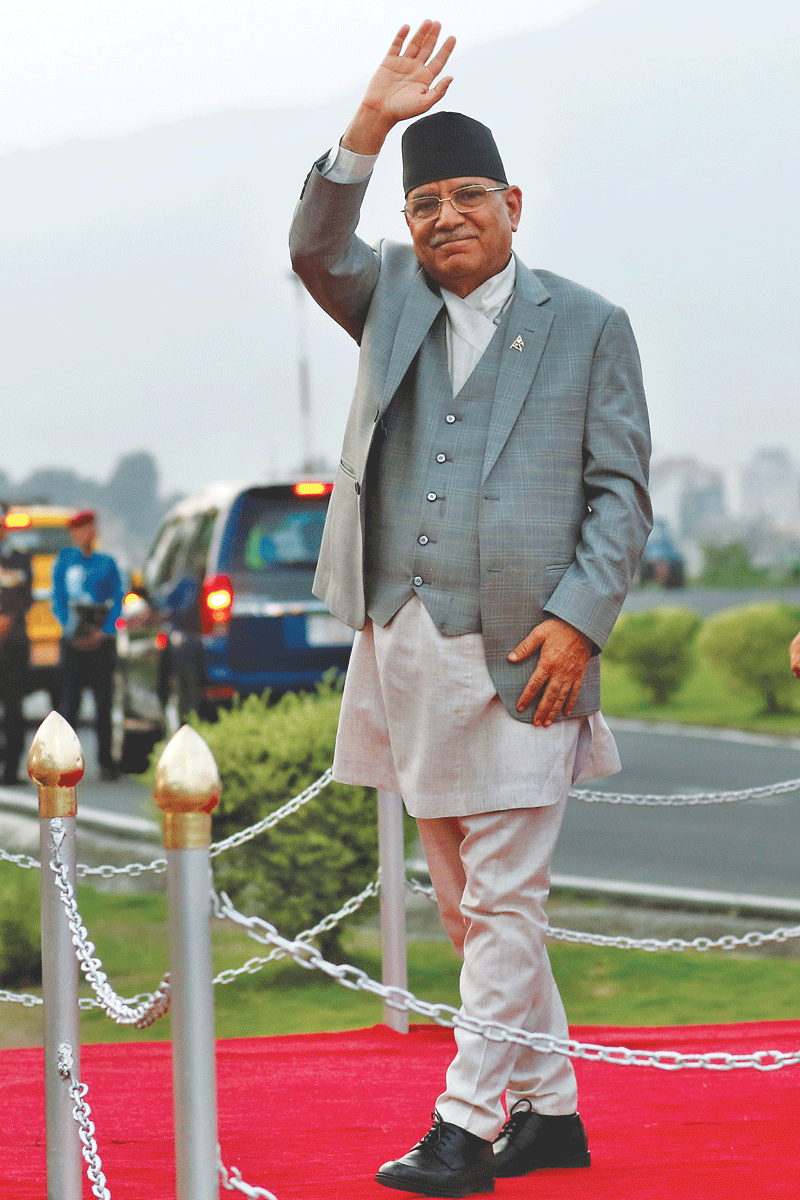
Prime Minister Pushpa Kamal Dahal waves after he lands at Tribhuvan International Airport on Saturday.
Prime Minister Pushpa Kamal Dahal has claimed that his India visit has restored trust with Indian leadership at the political level. He said his India visit was largely successful, citing the signing of several agreements and understandings reached between the two sides. Prime Minister Dahal and Nepali delegation returned home on Saturday after completing the four-day official visit to the southern neighbour. “There have been some problems in our relations with India since 2019. Now it is improving,” Dahal told reporters upon his arrival at Tribhuvan International Airport. “You must have noticed the statement made by Modi-ji in the joint press conference where he said that we want to take this relationship to new heights.” Stating that there was a kind of trust deficit between the two sides, Dahal claimed that with the visit, they have restored the trust and confidence. “You must have sensed it in the statements of Modi-ji too. He talked about the statement he made in 2014 in our Parliament where he had mentioned the idea of HIT,” Dahal said. “Now he has reaffirmed that we should make it a super-HIT.” During the visit, Prime Minister Dahal and Indian Prime Minister Narendra Modi inaugurated six different projects and witnessed exchange of seven memoranda of understanding related to transit treaty, petroleum infrastructure, development of integrated check post, project development agreements on development of two hydroelectric projects, and cross border digital payments. “The visit has given clear guidance,” said Dahal. “The Indian prime minister himself announced that India will import 10,000 megawatts of energy from Nepal in the next ten years.” Dahal said that he and Modi discussed boundary disputes and both sides agreed to settle them through established bilateral mechanisms. In the joint press conference, Modi also said that India will resolve the differences over boundary matters with Nepal but the statement issued by India’s Ministry of External Affairs has not mentioned any such discussions in delegation level talks or during the one-on-one between Dahal and Modi. But the statement issued by the Ministry of Foreign Affairs stated that the two prime ministers also discussed boundary matters. “The Prime Minister of Nepal urged the Prime Minister of India to resolve the boundary matters through the established bilateral diplomatic mechanisms,” read the statement. But Prime Minister Dahal, while addressing the press conference at the airport, said that he and Modi seriously discussed boundary matters and agreed to seek solutions; otherwise, bilateral ties would not be normal. “The Indian prime minister made a public commitment,” Dahal said. “This shows we are seeking an amicable solution.” Dahal said that he and Modi discussed various options on settling boundary matters, including land swaps like what India and Bangladesh did in 2015. But the main opposition party, the CPN-UML, on Saturday strongly opposed the prime minister’s statement about the land swap idea to resolve the boundary dispute with India in the Kalapani region. A parliamentary party meeting of the UML on Saturday concluded that Dahal’s statement on land swap is against national interest. “We will seek an answer to his statement on land swapping,” UML’s Chief Whip Padam Giri said. “The prime minister could not raise any issue that is in Nepal’s national interest during his India visit and failed to take up the issues that he had earlier announced in the Parliament.” Dahal said he discussed various options on how to resolve boundary matters with his counterpart and one of them was the Bangladesh model. “This can be an option but we have just touched on the matter,” he said. “It is not the final deal. We claim the Kalapani region belongs to us. If India considers the Kalapani region sensitive, we can think of other alternatives too.” Earlier, some leaders and experts used to raise the issue of land swapping between Nepal and India but this is the first time a sitting prime minister is publicly talking about the option. Popularly known as “chicken neck”, the Siliguri Corridor is very sensitive for India due to its geopolitical importance because it is also a window for India into Bhutan, Bangladesh, China, Myanmar and the entire North-East of India. The prime minister took credit for the long-term energy cooperation agreement with India. Indian Prime Minister Modi, during the joint press conference, assured that India will import up to 10,000 megawatts of energy from Nepal. The two sides have agreed on a trilateral energy cooperation between Nepal, India and Bangladesh where Nepal will export 40 megawatts of energy to Bangladesh using Indian transmission lines. On air entry route, Dahal said that though India has granted low-altitude route for now, Nepal’s request for high-altitude route is still on the table and India is positive about allowing one either from Nepalgunj or Mahendranagar. “We also discussed setting up a fertiliser plant in Nepal on a joint venture,” Dahal said. “Amendment on the transit treaty is an important decision we made… Modi-ji and I discussed options to reduce the widening trade gap between Nepal and India, easy access of Nepali agricultural products in India and simplifying customs procedures.” Dahal also clarified about his visit to Shree Mahakaleshwar Temple in Ujjain of India’s Madhya Pradesh state. “I have visited churches, mosques and monasteries such as the ones in Lumbini. I am secular and I respect all religions. But the state should not have a religion. I am not only a communist but also the prime minister of this country, so I should respect all religions.” About his wearing of the saffron dress while worshipping at the temple, Dahal said “that was the protocol of the temple and breaching it would give a very wrong message to millions of Hindus in India about the Nepal government”. He said if he had not worn the saffron dress, it would have hurt the sentiments of one billion Indian people. “This is part of cultural diplomacy,” he said. “Some have also asked me about the Rudraksha I offered in the temple but it wasn’t me who arranged the Rudraksha, they were rather arranged by the foreign minister.” Besides Indian Prime Minister Modi, two former Nepali prime ministers Sher Bahadur Deuba and KP Oli have also promoted “temple and religious diplomacy” in each other’s country. Now Dahal appears to be following suit. Dahal said that he did not visit the Mahakaleshwar Temple to seek blessing for his ailing wife, Sita, who is suffering from a disease called progressive supranuclear palsy (PSP), a rare brain disorder that causes problems with movement, walking and balance, and eye movement. About the report of the Eminent Persons’ Group on Nepal-India relations, Dahal claimed that he had taken up the matter with his Indian counterpart. “We are serious about receiving the report prepared by the EPG and we have taken up the matter with Indian side but we did not want to spoil the visit over one issue, especially after some good agreements and understandings in areas of economic development, cross border infrastructure, connectivity, energy cooperation and others,” Dahal said. The eight-member Nepal-India EPG panel submitted a joint report suggesting a new blueprint for bilateral relations amid the changed bilateral, regional and global contexts including the replacement of the 1950s peace and friendship treaty with a new one. “Once we narrow down the differences, we will also resolve the matter of the EPG,” Dahal said.
NATIONAL
Health ministry revises Covid mandates
Face mask optional, proof of Covid-19 vaccination, QR code no longer needed for travellers.
- Post Report
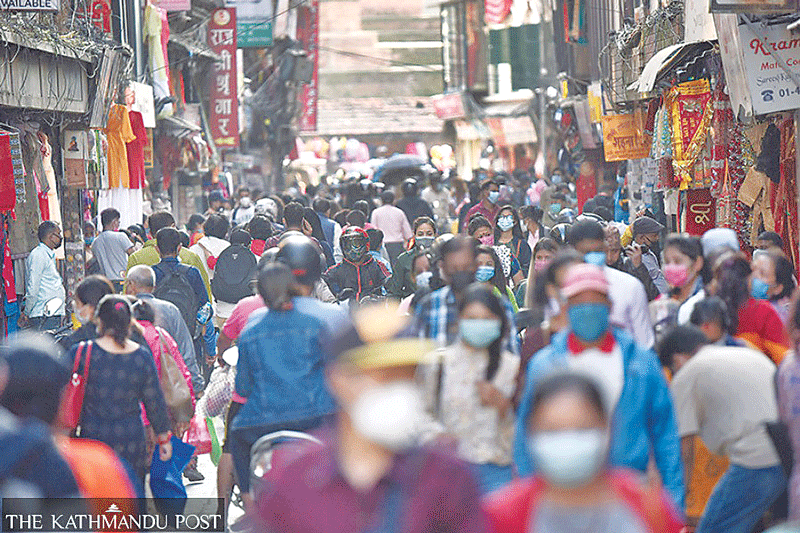
Nepal’s Ministry of Health and Population on Friday lifted the mandatory requirement of face masks in public, a provision that was in place since the early days of the Covid-19 pandemic. The ministry’s move comes amid a declining rate of coronavirus infections and their severity in the country. In a statement on Friday, the ministry also said that domestic and international travellers no longer need to present proof of vaccination against Covid-19. The ministry, however, has decided to continue regular surveillance and screening of travellers who may be at a risk of being infected from Covid-19. “The ministry would like to request all to wear face masks optionally,” the statement read. Nepalis had started wearing face masks since the early days of the pandemic three years ago when people started to die from coronavirus infection in neighbouring China, where the outbreak originated. As the pandemic spread further, authorities concerned in Nepal made face masks mandatory in public places. The decision was enforced strictly during the time of nationwide lockdown and prohibitory order, a time when the first and second waves of the pandemic hit the country. Not everyone complied with the government’s decision though. The Health Ministry at the time had also begun a Nepal Mask Campaign with the slogan, “I will wear a mask and encourage others to wear one too.” But now with the authorities lifting most of the restrictions enforced to control the second wave of the pandemic, daily life has returned to normalcy and most people have already stopped wearing face masks in public places. The pandemic is still not over though. On Saturday, four people tested positive for the coronavirus. Active cases in the country currently stand at 18. As many as 12,031 people have died from Covid-related complications in Nepal, according to the official count. On May 5, the World Health Organisation declared that Covid-19 no longer constitutes a public health emergency of international concern. On 30 January 2020, the UN health body had declared Covid-19 a public health emergency of international concern, the highest level of alarm under international law.
NATIONAL
Number of castes, ethnicities in Nepal increases to 142
The number of mother tongues now stands at 124 and the number of religions followed in the country is 10.
- Post Report
The number of castes and ethnic groups in Nepal has increased to 142, according to the National Census 2021. The 2011 census had recorded 125 ethnic groups. The National Statistics Office, previously known as the Central Bureau of Statistics, said the latest information was published based on the recommendations of the expert group and answers by the respondents in relation to ethnicity, language and religion in the census. Of them, Chhetris comprise 16.45 percent of the population, Brahmans-Hill 11.29 percent, Magars 6.9 percent, Tharus 6.2 percent, Tamangs 5.62 percent and Bishwakarmas 5.04 percent. The number of mother tongues now stands at 124 and the number of religions followed in the country is 10. The bureau said 124 languages have been listed while categorising 12 foreign languages as ‘other’ due to the very small number of speakers of the languages. It has also added 13 new languages. Nepal had recorded 123 languages in the previous census. According to the census, Nepali is spoken by 44.8 percent of the population followed by Maithali at 11.05 percent. The third most spoken language is Bhojpuri at 6.24 percent. Likewise, Tharu (5.88 percent), Tamang (4.88 percent), Bajjika (3.89) and Avadhi (2.96) are other languages spoken in various parts of the country, according to the census. Hinduism is the predominant religion comprising 81.19 percent of the population. Among the rest, 8.21 percent of the population follows Buddhism, 5.09 percent Islam, 3.17 percent Kirat, 1.76 percent Christian, 0.35 percent Prakriti, 0.23 percent Bon and 0.01 percent Jain. Other religions followed in Nepal are Bahai and Sikha. According to the 2011 census, Hinduism was followed by 81.3 percent of the population. Buddhism, Islam, Kirat, Christianity and Prakriti are followed by 9 percent, 4.4 percent, 3.1 percent, 1.4 percent and 0.5 percent of the population, respectively.
NATIONAL
Congress defends President’s moves to authenticate citizenship bill, pardon Chaudhary
The party says the head of state has fulfilled his constitutional duties by making these decisions.
- Post Report
At a time when President Ramchandra Paudel has drawn flak for authenticating the citizenship bill and pardoning Resham Chaudhary, the Nepali Congress has come in his defence, saying the President has just fulfilled his constitutional duties. Issuing a statement on Saturday, the ruling party said the President served the constitutional duty of protecting the sovereignty of the Parliament and safeguarding the constitution, as well as strengthening national unity by averting a constitutional crisis. Stating that the President can’t return the bill to the Parliament that was already forwarded to the office by completing the due process, the party said sending back the bill to Parliament would be a ridiculous step. The Cabinet just reminded the President of the state of the bill, said Congress, the largest party in the Parliament. The party has claimed that there was no point in making a fuss by criticising the President for pardoning Resham Chaudhary on the recommendation of the Council of Ministers as per the demand of all political parties. It is regrettable that unnecessary and meaningless accusations have been levelled against a respected institution like the President, the statement states. President Paudel on Wednesday had authenticated the citizenship bill which former President Bidya Devi Bhandari had twice refused to endorse. Paudel pardoned Tikapur killings convict Chaudhary on the occasion of Republic Day on May 29. The party’s statement has come a day after the party’s general secretary Gagan Thapa criticised the decision to authenticate the citizenship bill and pardon Chaudhary.
NATIONAL
Farmers unhappy as Cotton Development Board is scrapped
Rastriya Samachar Samiti
- Post Report
Post Photo: Deepak kc
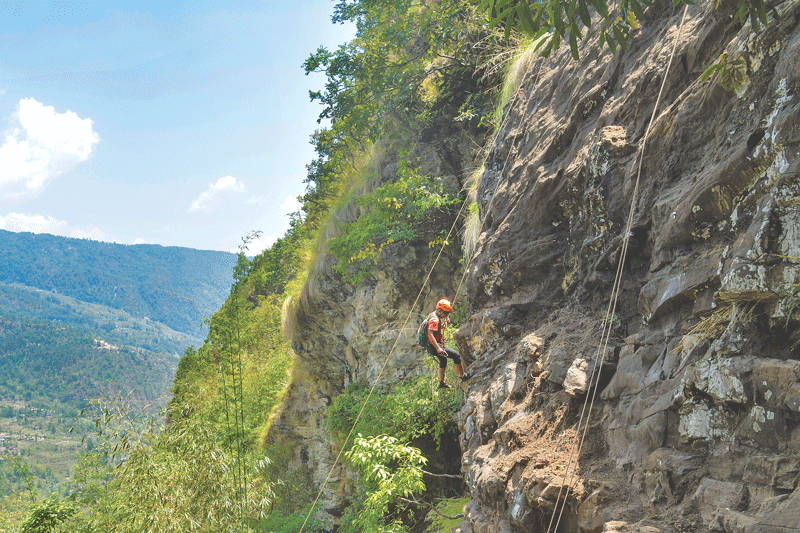
A man rock-climbs at Sokla in Dolakha Bhimeshwar Municipality ward 2 on Thursday.
Farmers of Banke and Bardiya districts are worried after the government decided in the budget for the upcoming fiscal year to scrap the Cotton Development Board based in Khajura. The farmers engaged in cotton farming for years were planning to grow the crop this year too. Shatish Niraula, a farmer, rued the announcement to scrap the Cotton Board. He suggested that employment could be created by running a yarn factory to use the cotton output. Hariram Tharu of Rapti Sonari, who has been involved in cotton farming for the past few years, said his income had been pretty good. The board has sold cotton worth Rs30 million in the current fiscal year. Board Chairperson Hemant Raj Kafle said that seeds and pesticides had already been purchased for 300 farmers this season. “There is no cotton in stock. The board has a Rs100 million capital and its income has been consistent in recent years,” Kafle said. The board had purchased 100 tonnes of cotton in the current fiscal year. The yarn industry in Biratnagar purchases 15 tonnes of cotton from the board every month. All the cotton in the board’s depot was sold last year.
OPINION
Land grabbing at Kirtipur campus
The space represents a covenant of minds to work for a common educational culture.
- ABHI SUBEDI
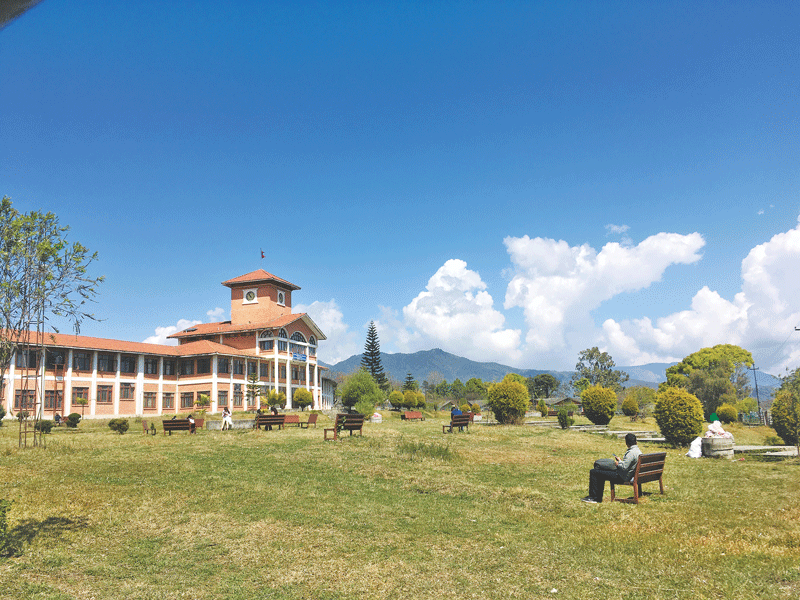
I become pensive when I try to link education and politics at this time when the line separating them is getting fuzzier. In order to write about the relationship between education and politics, I have chosen the central space of Tribhuvan University (TU) in Kirtipur for the following reasons. First, it is the centre of the pioneering and largest university in the land. Second, it is my alma mater. Third, I think the example of TU is applicable to explain the modus operandi of other Nepali universities and their space management. Kirtipur as a university space is shrinking everyday as it is being slowly taken over by different agencies and institutions. It is said that if the rate of encroachment continues in this manner, the university will run out of space even to continue the existing academic programmes. This is an alarming calculation. This ongoing interface of space and education at the Kirtipur campus of Tribhuvan University has become a public board on which to see the graphs of the changes happening in modes of urbanisation, patterns of buildings, methods of encroachments and chaos in architectonic structuration that includes the most important university establishment of the land. In other words, Kirtipur university space has become a mirror of urbanisation, land holding, recklessness and lack of direction. Never retire Some personal narratives are in order. I realise that I have been going to teach and work with the postgraduates at the Central Department of English at regular intervals for half a century. A senior karmachari had said when handing me my letter of retirement, “Remember, teachers and farmers never retire.” I realised the power of his aphorism when I found myself teaching postgraduate classes and supervising students’ research works in the programmes run by my erstwhile students, and now teachers of the department, once a week or so. This has given me a sense of engagement in this most serious work which I would like to call productive pedagogy. It has also given me a chance to see the foundational spirit of the TU academic practice at work. But what saddens me is that neither the institute nor the concerned departments publish any regular academic journals. And whatever people outside academia may say, the fundamental spirit of teaching and studies still works as the guiding principle in the departments that are functioning. There are problems, however. The corrosive effect of politicisation and the low priority given to coherent serious studies and publication of research articles are some of them. Even then, some dedicated academics are working hard to keep up the tradition of scholarship. As far as I understand, the problems at Kirtipur are not entirely different from those experienced by the departments of the humanities and social sciences faculty at universities elsewhere in the world. Some departments are nearing a state of closure. Some departments are not getting enough students. TU’s plight is also shaped by the general socio-political climate of the country. Broadly, I am talking about the general indifference to education, and the rise of a fractious selfish culture in the sphere of academia. It is common knowledge that universities produce political leaders, elites and people to fill up important positions in society. It may be appropriate to cite the conclusion of a survey made by Emma Irving about what she calls “the diversity crisis of Oxford University”. She writes, “Graduates from the university—and from Cambridge, its rival—fill the highest echelons of the law, media and politics in Britain and around the world. Of Britain’s 57 prime ministers, 30 graduated from Oxford.” (The Economist, March 1, 2023.) The same cannot be said about TU in terms of producing prime ministers. But its graduates have been filling the high ‘echelons of the law and politics’ and ministerial positions. Class is not a distinctive mark of education here as the applicants can easily come from any background.
Favourite target TU has always remained a favourite target for students because this is where they can easily get admission and inexpensive education. Such unhindered access naturally creates communities and forums that easily turn into political platforms. Political leaders are interested in making use of such forums. The gift of institutional education is the interval between life’s regular work and the period of acquiring knowledge. That is a precious juncture in educational practice. Nepali tertiary educationists and students have failed to honour and use that interval. What I find disheartening is that political parties have failed to honour that interval. Instead, they have turned the interval into forums where they unscrupulously build their party organisations. Talking about the geography of the Kirtipur campus of Tribhuvan University, I would like to allude to a famous essay written by British philosopher Bertrand Russell about the importance of university as a place, which is needed to create a culture of learning. The sanctity of such places should not be violated. The space represents a covenant of minds to work for a common educational culture. Good universities of the world are known to have created such spaces. We have failed to understand that in the case of Kirtipur, and have constantly engaged in violating its sanctity, even grabbing its land, which is slowly telling on our educational culture.
OPINION
Keeping our lungs safe
PUSHPA RAJ JOSHI
- Post Report
Chronic obstructive pulmonary disease (COPD) is a severe and progressive lung condition that can destroy one’s health and quality of life. This is the most common non-communicable disease (NCD) resulting in the highest fatality rate in low- and middle-income countries. Nepal has the world’s highest age-adjusted casualty rate for chronic lung disease, at 183 deaths per 100,000 population and a 12 percent prevalence in adults. COPD is primarily caused by long-term exposure to irritating substances, such as tobacco smoke, indoor and outdoor air pollution, and occupational hazards. Due to smoking, open-fire kitchens in rural regions, and air pollution in urban areas, Nepal remains a perfect breeding ground for respiratory diseases, including COPD. Some of its symptoms include shortness of breath, coughing, wheezing, and chest tightness. Over time, COPD can lead to significant lung damage and respiratory complications, making it a leading cause of morbidity and mortality worldwide. In many cases, COPD develops gradually, and its symptoms may go unnoticed or be dismissed as part of the normal ageing process. Unfortunately, delayed recognition and diagnosis can result in the disease progressing to more advanced stages before appropriate treatment is initiated. COPD is rapidly spreading at the community level in countries with weak healthcare facilities. Especially in Nepal, there are severe challenges related to tobacco smoking, use of biomass fuel for cooking and heating, indoor and outdoor air pollution, and occupational exposure to dust and chemicals. These risk factors contribute significantly to the development of COPD. Moreover, the lack of awareness about COPD and its risk factors among the general population, healthcare professionals and policymakers is hindering its early detection and effective management. Educational initiatives on the disease can play a crucial role in narrowing this gap. Accessibility to healthcare facilities, especially in rural areas, is also a barrier to the early diagnosis and treatment of COPD in Nepal. The limited availability of trained healthcare professionals, diagnostic tools and appropriate medications will exacerbate the issue. Due to the silent progression of COPD, many cases remain undiagnosed until the disease has significantly advanced. Strengthening non-communicable disease-related healthcare services in low-income countries is a principal aspect of the current globalisation and health goals and debates set by global institutions. In this regard, the World Health Organization (WHO), as one of the targets of the Sustainable Development Goals (SDG), has announced that premature mortality from NCDs will be reduced by a third through prevention and treatment, as well as by promoting mental health and wellbeing by 2030. Nepal, as a member of the United Nations (UN), is committed to the SDGs. The Ministry of Health and Population (MoHP) and other concerned health authorities seem determined to fulfill this commitment. However, with a vertically aligned primary healthcare system, where disease management programs lie at the core and are surrounded by a vast network of community health workers at the periphery, it is a herculean task for Nepal to efficiently address these issues. Hence, Nepal needs to act swiftly and sensibly to maintain pace with the SDG targets. One of the strategies should be to adequately address the impact of NCDs, including COPD. Some of the essential approaches to evidence-based management of COPD are discussed in this article. First, community-level policies and interventions should be implemented to reduce exposure to risk factors such as tobacco smoke, indoor and outdoor air pollution, and occupational hazards. This will be achieved through community-wide awareness campaigns and educational programmes to increase understanding of COPD, its risk factors, and the importance of early detection and treatment. This initiative will empower individuals to seek timely and appropriate healthcare services and motivate them to make necessary lifestyle adjustments. The local executive bodies, including the municipalities and village development committees, should be given the responsibility to initiate such public awareness programmes. These administrative bodies should recruit well-trained and competent healthcare workers. Second, general physicians should be trained to diagnose and treat COPD in accordance with state-of-the-art technological interventions. Contemporary pulmonology training should be offered to aspiring pulmonologists. Recently, renowned respiratory physicians from Nepal came together to establish the Nepal Respiratory Society (NRS), which is regularly conducting courses on various obstructive airway diseases, including COPD. In addition, annual conferences are also being organised to discuss the recent advancements in the field of respiratory diseases. Now, the NRS can design accredited training courses on COPD and other respiratory diseases that are tailor-made for the Nepali healthcare context. The respiratory physicians trained through NRS-endorsed courses will be perfect ambassadors for addressing COPD related issues in Nepal. In addition, collaborations should be initiated with renowned international academic institutes. There are many international global health funding programmes intended to support international cooperation, sustainable development and international education work in low-income countries. For example, the Hospital Partnership programme carried out by the German Society for International Cooperation (GIZ) supports diverse global health projects in underdeveloped countries, especially in Africa and Asia. Such opportunities should be grabbed to strengthen the evidence-based management of respiratory diseases. Third, ubiquitous access to quality healthcare facilities should be expanded to ensure the availability of diagnostic tools and medications and train healthcare professionals in diagnosing and managing COPD. This includes accumulating accurate data on the prevalence, burden, and risk factors of COPD in Nepal through research and surveillance. This will aid in formulating evidence-based policies, interventions and resource allocation. COPD diagnosis and treatment should be made affordable and accessible in all community-level healthcare facilities. Evidence-based management of COPD is essential in Nepal to hinder the pace of this silent killer, which claims many people’s lives every year. The country should follow international guidelines on managing this disease, with some adaptations to suit the local context. Moreover, it is important to note that the management of COPD should be tailored to individual patient needs and may require adjustments based on local resources, cultural factors, and healthcare infrastructure in Nepal. It is recommended to consult local COPD guidelines and collaborate with healthcare professionals experienced in managing COPD for the best outcomes. This will help Nepal move closer to achieving one of the primary healthcare targets of the SDG by 2030.
Joshi is a senior scientist and neurobiologist at Martin-Luther University Halle-Wittenberg, Germany.
OPINION
Allure of AI and its risks
The impact that generative AI will have on society is extremely serious.
- Post Report
Various concerns surround generative artificial intelligence, which makes texts and images that appear to have been created by humans. If the government promotes its use too easily, it may sow the seeds of future of trouble. The government’s AI Strategic Council, chaired by Prof. Yutaka Matsuo of the University of Tokyo, has compiled points of discussion for AI-related policy issues. As the changes brought about by AI appear likely to surpass those of the Industrial Revolution and the internet revolution, the council has characterised AI-related changes as “the arrival of a great opportunity” for Japan. But the council also cited seven risks of generative AI, including inappropriate use of personal information, a flood of false information, increasingly sophisticated crimes and copyright infringement. It stressed that the utilisation of AI and the response to the risks should be “facilitated in a well-balanced manner.” However, the impact that generative AI will have on society is extremely serious. The council said in its points of discussion that “existing legal systems should be made well known to the public,” but the risks are not so slight that such a measure alone can balance the utilisation of AI and the response to its risks. Priority must be placed on newly formulating regulations and legislation. There are growing voices around the world claiming copyright infringement by generative AI. A group of artists and illustrators in the United States has filed a class action lawsuit against AI operating companies, claiming that their works were imitated by AI without their consent. Robert Thomson, chief executive officer of the company that publishes The Wall Street Journal, warns that the rise of generative AI could “fatally undermine journalism.” Japan revised its Copyright Law in 2018 to allow AI to freely “learn” texts, images and other copyrighted works without the consent of rights holders. Isn’t it a serious mistake to have eased restrictions on AI in contrast to other countries? The government should consider revising the law again. Another important issue is how to prevent inappropriate use of personal information. As generative AI, which requires the input of entire texts, is more likely to reveal personal interests and tastes than internet search engines that operate based on separate words, there is no escaping the fear that personal information could be passed on to AI service providers. The use of AI in the medical field also must be advanced cautiously. It is not clear who will be held responsible if, for example, an AI misdiagnoses a patient’s illness. The points of discussion were drawn up barely more than two weeks after the inauguration of the AI Strategic Council—which only met twice. It is also problematic that Prime Minister Fumio Kishida has instructed that the points of discussion be reflected in the outline of the budget proposal for next fiscal year, which will be compiled in mid-June. Based on the harsh experience of Japan having fallen behind other countries in terms of digitisation, the government wants to restore the nation’s position with regard to AI. But it is wrong to rush headlong into utilising it while leaving consideration of the risks on the back burner.
— The Yomiuri Shimbun (Japan)/ANN
OPINION
Allure of AI and its risks
The impact that generative AI will have on society is extremely serious.
- Post Report
Various concerns surround generative artificial intelligence, which makes texts and images that appear to have been created by humans. If the government promotes its use too easily, it may sow the seeds of future of trouble. The government’s AI Strategic Council, chaired by Prof. Yutaka Matsuo of the University of Tokyo, has compiled points of discussion for AI-related policy issues. As the changes brought about by AI appear likely to surpass those of the Industrial Revolution and the internet revolution, the council has characterised AI-related changes as “the arrival of a great opportunity” for Japan. But the council also cited seven risks of generative AI, including inappropriate use of personal information, a flood of false information, increasingly sophisticated crimes and copyright infringement. It stressed that the utilisation of AI and the response to the risks should be “facilitated in a well-balanced manner.” However, the impact that generative AI will have on society is extremely serious. The council said in its points of discussion that “existing legal systems should be made well known to the public,” but the risks are not so slight that such a measure alone can balance the utilisation of AI and the response to its risks. Priority must be placed on newly formulating regulations and legislation. There are growing voices around the world claiming copyright infringement by generative AI. A group of artists and illustrators in the United States has filed a class action lawsuit against AI operating companies, claiming that their works were imitated by AI without their consent. Robert Thomson, chief executive officer of the company that publishes The Wall Street Journal, warns that the rise of generative AI could “fatally undermine journalism.” Japan revised its Copyright Law in 2018 to allow AI to freely “learn” texts, images and other copyrighted works without the consent of rights holders. Isn’t it a serious mistake to have eased restrictions on AI in contrast to other countries? The government should consider revising the law again. Another important issue is how to prevent inappropriate use of personal information. As generative AI, which requires the input of entire texts, is more likely to reveal personal interests and tastes than internet search engines that operate based on separate words, there is no escaping the fear that personal information could be passed on to AI service providers. The use of AI in the medical field also must be advanced cautiously. It is not clear who will be held responsible if, for example, an AI misdiagnoses a patient’s illness. The points of discussion were drawn up barely more than two weeks after the inauguration of the AI Strategic Council—which only met twice. It is also problematic that Prime Minister Fumio Kishida has instructed that the points of discussion be reflected in the outline of the budget proposal for next fiscal year, which will be compiled in mid-June. Based on the harsh experience of Japan having fallen behind other countries in terms of digitisation, the government wants to restore the nation’s position with regard to AI. But it is wrong to rush headlong into utilising it while leaving consideration of the risks on the back burner.
— The Yomiuri Shimbun (Japan)/ANN
MONEY
Farmers prosper by growing fruits on riverbanks
They have found out that they can grow crops with less manure and less water in the sandy soil on the banks of the Doda river.
- KAMAL PANTHI & BHAWANI BHATTA
post photo: kamal panthi
More than 300 families are growing fruits and vegetables on the river banks, which have become a key source of income for them.
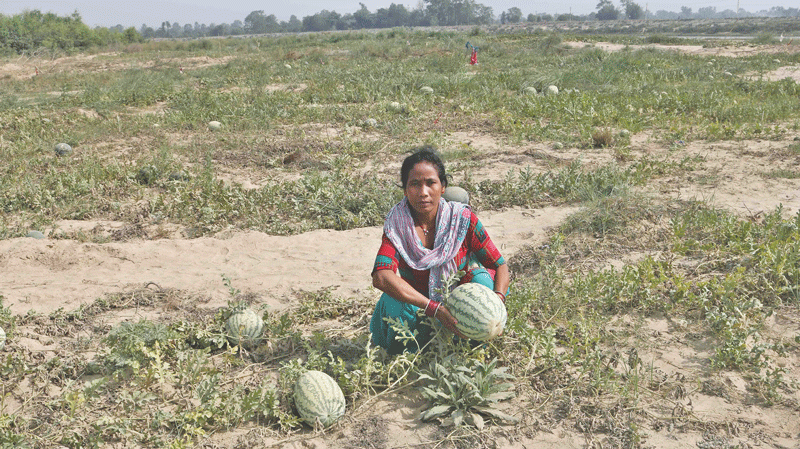
The banks of the Doda river in Laljhadi Rural Municipality are dotted with thatched huts housing guards who watch over the fruits and vegetables flourishing on the once barren land. Farmers had no use for the river banks that were covered sand and gravel, but now they have become important sources of income for them. They have found out that they can grow crops with less manure and less water in the sandy soil. Several villagers have even built temporary dwellings on the river banks. It’s summer and the river banks have turned green with watermelons. But the farmers are disheartened that they have to compete with cheap Indian imports that are flooding the market. “We guard the crops during the night and during the day. These huts protect us from the sun,” said 70-year-old watermelon farmer Daan Singh Giri. He grows watermelon, gourd, bitter gourd, cucumber and pumpkin on his farm at the river’s edge. Daan Singh’s son Mel Singh usually harvests the vegetables early in the morning and loads them on tractors for transport to nearby markets. In 2007, the Doda river flooded and the family had to move. The flood waters also covered their 3-acre farm with sand and gravel. Mel Singh became worried about his survival when he saw his farm destroyed. But the flood actually turned out to be a boon for him as he found out that fruits and vegetables grew well on his field. More than 300 families are growing fruits and vegetables on the river banks, which have become a key source of income for them. Customers come to the farms to buy vegetables like pumpkins and gourds. But farmers like Singh have a hard time selling their watermelons. “Watermelons are imported from India and so the Nepali product does not get a good price,” said Mel Singh. Watermelons sell for Rs30 per kg in the local market. Farmers get only Rs12 per kg from wholesale buyers. When Singh supplied watermelons to a vegetable mart in Mahendranagar, he was offered only Rs7 per kg. Around 50 stalls have been set up at either end of the Banhara Bridge in Kanchanpur where farmers display fruits and vegetables produced on the river banks. “The cost of transporting fruits from Laljhadi to Mahendranagar is Rs4 per kg,’’ said Singh. Although the production cost of watermelon is not much, there are expenses like transportation which push up the cost. “A few farmers sell watermelons on the highway,” he said. Farmers get low prices for their fruits and vegetables from wholesalers, but they can make a handsome income by selling them to the customers directly. “Last month, I sold watermelons worth Rs100,000 to the customers directly,” said Shiva Lal Rana, a local of Krishnapur-2. “We don’t get fair prices selling our products to wholesalers. Therefore, we have set up our own stalls on the highway,” said farmer Sharada Rana. Sharada’s husband works in Shimla, India and she has to look after the children by herself. “The income from watermelons covers all my domestic expenses, including the school fees of my children,” added Rana.Shree Daas Tharu of Gulariya lost 7 acres of land when the Babai River flooded three decades ago. He tried to grow various crops on his farm which was covered by sand. Tharu is happy now because watermelon grows well on the sandy land. For the last seven months, starting from mid-November, he has been making a good earning which, according to him, helps to support his family. The 74-year-old Tharu said he had not imagined that his sand-covered field would yield such a big income. Aash Rani Tharu, 40, of Barbardiya-11 lost her 1.5-acre farm to the flood. Nowadays, she is making a good income from the same piece of land. Farmers say that cultivation on the river banks is not feasible during the rainy season. Many farmers now grow fruits and vegetables on the river banks and take them to the highways to sell. “We don’t have to face market problems for our products. We don’t have to look for buyers either,” said farmer Ram Naresh Ray of Indrapur. Farmer Fuku Ram Tharu said he made more than Rs60,000 in the last three months by growing vegetables on the land he has leased near the river’s edge. “The money has helped me to pay the children’s school fees. I also make instalment payments of my home loan,” said Tharu. According to him, local farmers are making up to Rs40,000 per kattha in a season by growing watermelons and vegetables. In the last four decades, floods in the Babai River have turned more than 167 acres of farmland into wasteland. “It’s not easy to farm on the banks of the river,” added Tharu. According to the Agriculture Knowledge Centre in Kanchanpur, around 400 families in the district have been engaged in farming on 30 to 35 hectares of land on the river banks covered with sand and gravel. The farmers plant the seeds in December-January and start harvesting in mid-March. It lasts till mid-June. “The sandy soil on the river banks is suitable for growing climber and creeper plants,” said Hari Datta Joshi, an agricultural officer at the knowledge centre. “The cost of production is also low as they don’t need irrigation like for other plants.” Farmers say that nearly 14 tonnes of fruits and vegetables can be produced on a hectare. They are sold to customers directly. Farmers also make bulk shipments to other districts in Sudurpaschim and Lumbini provinces.
MONEY
Russian clothing brands plug gap left by Western rivals
REUTERS
- Post Report
REUTERS
A file photo shows people lining up to enter an H&M store, which was reopened to sell the remaining stock before the company exits the Russian market, in Moscow, Russia.
Russian designers and brands are helping the retail sector gradually recover from a turbulent 15 months of store closures and slumping demand, with new labels plugging the gap left by foreign rivals and shoppers tentatively returning. Hundreds of foreign retailers shut up shop in response to Russia despatching troops to Ukraine in February 2022, leaving some of Moscow’s most prestigious streets with boarded up stores and the industry reeling from a roughly $2.5 billion hit. Spain’s Inditex has sold some of its more than 500 Russian stores to a UAE-based buyer. Its flagship Zara store in central Moscow, which sat idle for over a year, last month reopened under new management and a new brand, MAAG, leaving customers largely satisfied. “It looks like nothing has changed since you-know-who was here,” Moscow resident Anton told Reuters outside the store. Fellow Muscovite Antonina said: “I did not find any differences apart from the variety of choice. There’s less of everything at the moment.” Retail sales, a key gauge of consumer demand, slumped in 2022, hit by soaring inflation and falling wages, while the Western exodus contributed to heavy industry losses, said Oleg Klimov, the president of Russia’s Council of Shopping Centres, with logistics and payment concerns taking months to resolve. “People in general just did not understand what was going on,” he told Reuters. “They did not want to spend money. The losses were about 200 billion roubles ($2.47 billion). “But it is recovering now,” he added. “Money always eventually changes hands.” Shopper Irina Nikulina said she did not miss foreign brands too much, except when needing something simple, like a reasonably priced white t-shirt. Tatiana Vakhonina said she missed Swedish furniture giant IKEA and Zara the most. “We go to Kazakhstan for shopping now,” she said. “But some things cannot you buy at all anymore.”
MONEY
Argentines grill more steak despite pressures of 109 percent inflation
REUTERS
- Post Report
Argentines are expected to eat the most beef in five years in 2023, extending the country’s reign as the number 1 steak consumer per capita despite the painful impact of 109 percent inflation on food prices, a Rosario grains exchange report showed on Friday. The major beef producer, where “asado” barbecues are a key part of the culinary culture and steakhouses dot city streets, has seen in recent years beef consumption dip as prices climbed and diners shifted to cheaper chicken and pork. That, however, seems to be partly reversing, even in the face of one of the world’s highest inflation rates which has badly hurt spending power. Analysts expect inflation could hit 130 percent by the end of the year. “Despite everything, the traditional asado remains one of the pillars of the local gastronomic tradition, and a must at most Argentine dinner tables,” the exchange said, adding likely beef consumption this year would be 53.1 kilograms per person. The exchange said the relative cost of beef versus pork and chicken had dropped since 2021, though it remained elevated versus a historical average. Gross salaries were also slightly higher than in 2021, though again lower than historic averages. The proportion of beef in meat consumption climbed this year to 46 percent from 44 percent two years ago. However, the amount of beef and its share is still far below peaks of some 68 kg per capita and over 70 percent in the past two decades. The recent bump in the data underscores the importance of beef in Argentine culture, even as the highest inflation rate since 1991 has pushed some 40 percent of the population into poverty.
MONEY
Sweltering heat in Vietnam’s north sparks power cuts
- AGENCE FRANCE-PRESSE
Hanoi residents flocked to the Vietnamese capital’s air-conditioned shopping malls on Saturday to escape power cuts at home, as the grid struggled to cope with the high demand caused by soaring heat. Vietnam is one of many countries across South and Southeast Asia experiencing record-high temperatures in recent weeks. As the temperature rose to 36 degrees Celsius, Bui Manh Duc Tai and his napping girlfriend were among those at the Aeon shopping mall trying to escape the blistering heat. “Our home was without power since this morning. We came here for some cool air,” Tai told AFP. In another corner, student Nguyen Minh Thu sat on the floor trying to finish an assignment on her laptop. “I had to come here for power so I could study,” the agriculture student said, adding the electricity at her home had been on and off all morning. Scientists have warned that global warming is increasing the frequency and intensity of extreme weather events around the world, including heat waves. Drought and a prolonged heatwave have put a lot of pressure on power supplies in the country’s north, according to supplier Vietnam Electricity. At another packed mall outside Hanoi, families with young children sought refuge in the air-conditioning. “I have been here with my two young kids since lunch time. The kids can play, while I can go shopping. We will go back home after dinner. Hoping the power is back then,” Do Thuy Dung said. Average power consumption in Hanoi in May increased by more than 22.5 percent compared with April, Vietnam Electricity said. State media also reported power cuts in recent days in Quang Ninh province—home to the world heritage-listed Ha Long Bay.
MONEY
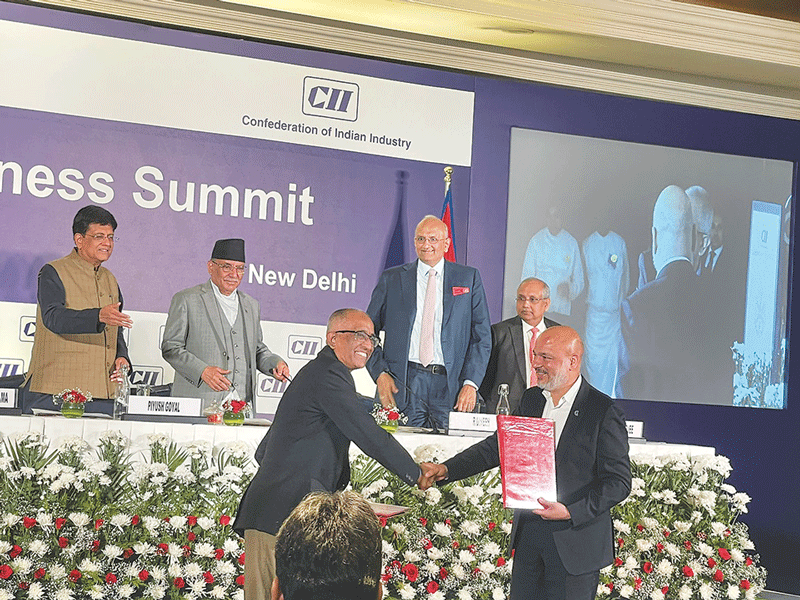
Indian Oil, Golchha Group sign agreement to manufacture lubricants in Nepal
Bizline
- Post Report
KATHMANDU: A joint venture agreement has been signed between Golchha group and Indian Oil Mauritius Limited, Indian Oil’s wholly-owned subsidiary, to erect a state-of-the-art lube blending plant for the local production of SERVO lubricants in Nepal. The joint venture will also explore the possibility of investment in other energy sectors, including waste to energy. The Lube Blending plant is expected to be ready by the end of 2024. Both companies will have an equal stake in the venture, reads the press release issued by the company. Speaking about the agreement, Shekhar Golchha, chairman and managing Director of Golchha group, said, “We are thrilled to announce the commencement of a significant partnership with Indian Oil, India’s largest company. This marks the beginning of a remarkable journey for us at Golchha Group, as we embark on our first joint venture. This milestone collaboration signifies a pivotal moment in the history of Nepali industrialists and the industrial landscape of our nation.”
MONEY
Realme Narzo N53 and N55 launched
Bizline
- Post Report
KATHMANDU: Realme, the most trusted technology brand launches two exciting additions to its smartphone lineup, the narzo N53 and N55 in Nepal. These new smartphones offer cutting-edge features, sleek designs, and powerful performance to cater to the needs of dynamic Gen-Z users in the Nepali market. The narzo N series represents diversity, uniqueness, and endless possibilities, empowering individuals who refuse to conform and have distinctive interests, passions, and aspirations, the company claims. The realme narzo N53 stands as realme’s slimmest smartphone ever, featuring an ultra-slim 7.49mm body while the realme narzo N55 ensures reliable and long-lasting performance establishing a next-gen experience for the younger generations. The narzo 53 model, with a storage capacity of 4+64 GB, is priced at Rs15,999 while the variant with 6+128 GB storage is available at Rs18,999. Similarly, the narzo N55 model, equipped with 4+64 GB storage, will be priced at Rs20,499, while the 6+128 GB variant will be offered at a price of Rs24,499. The narzo N55 is available in stunning Prime Black and Prime Blue while the narzo N53 is available in beautiful Feather Gold and Feather Black.
MONEY
Xiaomi unveils Redmi Note 12 5G
Bizline
- Post Report
KATHMANDU: Xiaomi, the global technology leader, has announced the launch of Redmi Note 12 5G in Nepal. This new Redmi Note sets a new standard for connectivity, offering lightning-fast 5G capabilities. Users can now enjoy seamless browsing, streaming, and downloading experiences with incredible 5G speeds and low latency. Featuring a stunning 120Hz AMOLED high refresh rate display, Redmi Note 12 5G delivers unparalleled picture quality with fluidity. Featuring a stunning 120Hz AMOLED high refresh rate display, Redmi Note 12 5G delivers unparalleled picture quality with fluidity. Redmi Note 12 5G comes in three colours Onyx Gray, Forest Green, Ice Blue in 6GB+128GB and 8GB+256GB variants. The 6GB+128GB and 8GB+256GB variants are priced at Rs29,999 and Rs31,999 respectively. Customers will be able to buy the phone at authorised stores and retailers all over Nepal from June 11.
MONEY
MetLife Nepal to support sickle cell anemia awareness project
Bizline
- Post Report
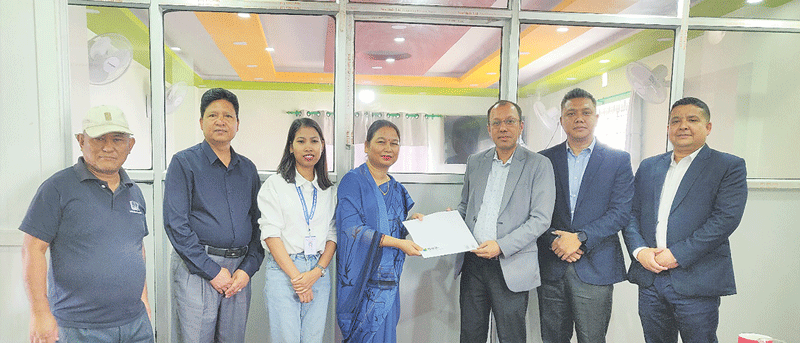
KATHMANDU: MetLife Nepal and Rural Women Development Center (RWDC) have jointly agreed to assist in minimising the spread of Sickle Cell Anemia in affected areas of Dang district in mid-western Nepal. People infected with the disease find difficulty in doing any kind of physical work in their daily lives and are subject to social and economic disadvantages in the community. Under this initiative, MetLife Nepal shall support RWDC to conduct awareness programmes, especially with the leaders, volunteers and concerned stakeholders of the affected areas. MetLife Nepal will also support RWDC in screening, treatment, and effective counselling to the people of the affected areas, to help them live positively, minimise further risks, and eradicate the social stigma and discrimination associated with the disease.
MONEY
OPEC+ begins meetings which may lead to further output cuts
Bizline
- REUTERS
LONDON: OPEC and its allies begin two days of meetings on Saturday which may culminate in further production cuts of as much as 1 million barrels per day, OPEC+ sources told Reuters, as the organisation faces flagging oil prices and a looming supply glut. OPEC+, which groups the Organisation of the Petroleum Exporting Countries and allies led by Russia, pumps around 40 percent of the world’s crude, meaning its policy decisions can have a major impact on oil prices. Three OPEC+ sources told Reuters on Friday cuts were being discussed among options for Sunday’s session, when OPEC+ ministers gather at 2 pm (1200 GMT) in Vienna. Before then, OPEC ministers will meet at 11 am on Saturday. The sources said cuts could amount to 1 million bpd on top of existing cuts of 2 million bpd and voluntary cuts of 1.6 million bpd, announced in a surprise move in April and which took effect in May. If approved, this would take the total volume of reductions to 4.66 million bpd, or around 4.5 percent of global demand.
MONEY
US concludes Mexico airspace review, but no verdict yet
Bizline
- REUTERS
MEXICO CITY: US aviation regulators finished a review of Mexico’s airspace safety but have not yet announced a final decision, Mexico’s transportation ministry said on Friday, more than two years after the country was stripped of its top air rating. The US Federal Aviation Administration (FAA) still has several weeks to finalise a decision about whether Mexico will recover the rating, the transportation ministry said in a statement. The FAA downgraded Mexico’s aviation safety rating to Category 2 in 2021, citing safety deficiencies and blocking Mexican carriers from adding new US flights. Since Mexico lost the rating, the FAA has conducted a series of audits on the local civil aviation authority and its compliance with international safety standards. A government source told Reuters earlier on Friday that the concluded audit was Mexico’s “last,” implying a positive resolution.
WORLD
India train crash kills over 280, injures 900 in one of nation’s worst rail disasters
Despite government efforts to improve rail safety, several hundred accidents occur every year on India’s railways,
- ASSOCIATED PRESS
AP/RSS
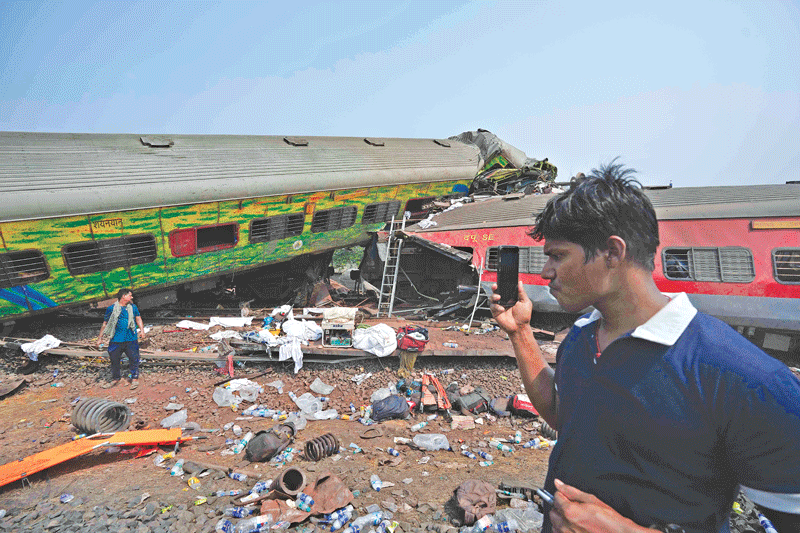
People inspect the site of passenger trains that derailed in Balasore district, in the eastern Indian state of Orissa on Saturday.
Rescuers found no more survivors in the overturned and mangled wreckage of two passenger trains that derailed in eastern India, killing more than 280 people and injuring hundreds in one of the country’s deadliest rail crashes in decades, officials said on Saturday. Chaotic scenes erupted after the derailment on Friday night about 220 kilometres southwest of Kolkata, as rescuers climbed atop the wrecked trains to break open doors and windows using cutting torches. The death toll rose steadily throughout the night. Scores of bodies, covered by white sheets, lay on the ground near the tracks while locals and rescuers raced to free the hundreds of people trapped in the rail cars under the twisted metal and broken glass. Army soldiers and air force helicopters joined the effort. An Associated Press photographer saw bodies still entangled in a badly mangled coach, as rescuers struggled to retrieve them working under the oppressive heat with temperatures reaching up to 35 degree Celsius. “By 10 pm [on Friday] we were able to rescue the survivors. After that it was about picking up dead bodies,” Sudhanshu Sarangi, director of Odisha state’s fire and emergency department, told The Associated Press. “This is very, very tragic. I have never seen anything like this in my career.” At least 280 bodies were recovered overnight and into Saturday morning, he said. About 900 people were injured and the cause was under investigation. The accident occurred at a time when Prime Minister Narendra Modi is focussing on the modernisation of the British colonial-era railroad network in India, which has become the world’s most populous country with 1.42 billion. Modi flew to the crash site and spent half an hour examining the relief effort and talking to rescue officials. He was seen giving instructions on the phone to officials in New Delhi. He later visited a hospital where he walked around inquiring from doctors about the treatment being given to the injured, and spoke to some of them, moving from bed to bed in a ward. Modi told reporters that it was a sad moment and he was feeling the pain of those who have suffered in the accident. He said the government would do its utmost to help them and strictly punish those found responsible. Modi on Saturday was supposed to inaugurate a high-speed train connecting Goa and Mumbai that is equipped with a collision avoidance system. The event was cancelled after Friday’s accident. The trains that derailed did not have that system. Amitabh Sharma, a Railroad Ministry spokesperson, said the rescue work was near completion. Rail authorities will start removing the wreckage to repair the track and resume train operations, he said. About 200 of the severely injured people were transferred to specialty hospitals in other cities in Odisha, said PK Jena, the state’s top administrative official. Another 200 were discharged after receiving medical care and the rest were being treated in local hospitals, he added. Scores of people also showed up to donate blood. “The challenge now is identifying the bodies. Wherever the relatives are able to provide evidence, the bodies are handed over after autopsies. If not identified, maybe we have to go for a DNA test and other protocols,” he said. Ten to 12 coaches of one train derailed, and debris from some of the mangled coaches fell onto a nearby track, according to Sharma. The debris was hit by another passenger train coming from the opposite direction, causing up to three coaches of the second train to also derail, he added. A third train carrying freight was also involved, the Press Trust of India reported, but there was no immediate confirmation of that from railroad authorities. PTI said some of the derailed passenger coaches hit cars from the freight train. The rescue operation was slowed because two train cars were pressed together by the impact of the accident, Jena said. Officials said 1,200 rescuers worked with 115 ambulances, 50 buses and 45 mobile health units through the night. Saturday was declared as a day of mourning in Odisha. Villagers said they rushed to the site to evacuate people after hearing a loud sound created by the train coaches going off the tracks. “The local people really went out on a limb to help us. They not only helped in pulling out people, but retrieved our luggage and got us water,” PTI cited Rupam Banerjee, a survivor, as saying. Passenger Vandana Kaleda said that people were falling on each other as her coach shook violently and veered off the tracks. “As I stepped out of the washroom, suddenly the train tilted. I lost my balance. ... Everything went topsy turvy. People started falling on each other and I was shocked and could not understand what happened. My mind stopped working,” she said. Another survivor who did not give his name said he was sleeping when the impact woke him up. He said he saw other passengers with broken limbs and disfigured faces. The collision involved two trains, the Coromandel Express traveling from Howrah in West Bengal state to Chennai in Tamil Nadu state and the Howrah Superfast Express traveling from Bengaluru in Karnataka to Howrah, officials said. It was not immediately clear which derailed first. Ashwini Vaishnaw, India’s railway minister, said a high-level probe would be carried out. The political opposition criticised the government and called for Vaishnaw to resign.
WORLD
Heavy rains continue to hit Japan, suspending some trains
- REUTERS
Heavy rains caused by Tropical Storm Mawar and a seasonal rain front continued on Saturday morning in a wide swath of the Japan, prompting authorities to issue warnings of damage and stranding many people as train services were suspended. Although Mawar has weakened from super typhoon status, the Japan Meteorological Agency (JMA) urged people to be on high alert for landslides, rising rivers and flooding in eastern Japan, while warning of landslides in western Japan. One person has died as a result of the storm. Some 7,000 households in the eastern and western regions were without power, but restoration work was being carried out, the industry ministry said on Saturday. Shinkansen bullet trains, suspended from Tokyo to Nagoya in central Japan since Friday, resumed operation around noon (0300 GMT) on Saturday, Kyodo news agency reported. The rainy season front has become more active due to the inflow of large amounts of humid air from Mawar, which wreaked havoc on Guam earlier this week, Kyodo quoted the JMA as saying. From Friday through Saturday morning, heavy localised rain fell in many parts of Japan, marking the heaviest rainfall on record for June in some areas, Kyodo said. A man found in a car flooded by heavy rain in Toyohashi in central Japan was taken to the hospital, where he was later confirmed dead, Kyodo said. Parts of Japan were slammed by torrential rain on Friday as Mawar neared, with authorities advising more than a million people to evacuate, many flights and other transport cancelled and power outages in thousands of homes.
WORLD
Counter-offensive on track despite Russian missile barrages, Ukrainian defence official says
Deputy defence minister dismisses proposal by Indonesia’s defence minister at the Singapore meetings to establish a demilitarised zone to halt the fighting in Ukraine.
- REUTERS
Reuters
A Ukrainian military helicopter takes off to carry out a mission in Ukraine on Thursday.
Ukraine’s plans for a counteroffensive against Russian occupation remain on track, its deputy defence minister told Reuters on Saturday, despite an “unprecedented” wave of missile and drone attacks across the country in recent weeks. Volodymyr V Havrylov said that alongside cruise missile strikes, Ukraine had faced repeated volleys of ballistic missiles in May, especially in urban centres including the capital, Kyiv. “Their primary goal is to stop our counter-offensive and target decision-making centres,” he said on the sidelines of Asia’s top security conference, the Shangri-La Dialogue in Singapore. Havrylov called Russia’s heavy use of ballistic missiles in May a “last strategic resort” and noted that his country’s air defence systems had been “more than 90 percent effective” against the attacks. For Russia “it was a huge surprise to find that the effectiveness of [their ballistic missiles] was almost zero against modern air defence systems, which we received from our partners,” he said. The United States and Germany provided Ukraine advanced Patriot missile batteries this year. Ukraine had already received advanced shorter-range systems such as NASAMS and IRIS-T from Western partners. Ukrainian President Volodymyr Zelenskiy said on Saturday his country was ready to launch a much-awaited counter-offensive. Havrylov said the missile barrages had not affected the timing. “Nothing can stop our efforts, our desire, and our confidence that we’ll win this war,” he said. Ukraine will “start the counter-offensive, with the ambition to liberate our territories this year,” he added. Moscow calls the invasion, which began in February 2022, a “special operation”. Havrylov declined to comment about recent drone attacks and border incursions into Russian territory, including some strikes that reached near Moscow. “They [Russia] have a lot of internal events that are of course linked to this war,” he said. “We have a lot of people inside Russia who support Ukraine.” The two countries have accused each other of spreading terror in their respective capitals with air strikes. Havrylov, who joined defence and military officials from all over the world at the Singapore meeting, said Ukraine expects NATO allies to provide a detailed roadmap to membership at the defence pact’s summit in Vilnius, Lithuania, next month. “We want to see a clear... set of steps to be taken by both sides,” he said. “Not just an indication that the door is open.” He added that Ukraine also expected guarantees of security to be provided while the country is in a “transition period” on the way to membership. He dismissed a proposal by Indonesia’s defence minister at the Singapore meetings to establish a demilitarised zone to halt the fighting in Ukraine, saying: “We are not going to negotiate any deal related to loss of our territory, including Crimea.” Havrylov praised the recent supply of British Storm Shadow cruise missiles, which British defence minister Ben Wallace said on Friday had not missed any targets Ukraine had attacked. The addition of modern fighter aircraft such as F-16s would improve the country’s air defence capabilities, Havrylov said. He said he could not comment on whether Ground-Launched Small Diameter Bomb, another long-range strike weapon Western allies have provided this year, had been used in combat yet. Ukraine has had good meetings and discussions with many countries, including Asian nations, at the Shangri-La Dialogue, Havrylov said. “We want to engage with everybody,” he said.
WORLD
Erdogan sworn in for third term as Turkish president
- AGENCE FRANCE-PRESSE
afp/rss
Turkish President Recep Tayyip Erdogan
Turkey’s Recep Tayyip Erdogan was on Saturday sworn in for a third term as president, promising to serve “impartially” after winning a historic runoff election to extend his two-decade rule. The inauguration in parliament will be followed by a lavish ceremony at his palace in the capital Ankara attended by dozens of world leaders. Turkey’s transformative but divisive leader won the May 28 runoff against a powerful opposition coalition, despite an economic crisis and anger over a February earthquake that killed more than 50,000 people. Erdogan won 52.18 percent of the vote while his secular rival Kemal Kilicdaroglu scored 47.82 percent, official results show. “As president, I swear upon my honour and integrity, before the great Turkish nation ... to work with all my power to protect the existence and independence of the state ... and to fulfil my duty impartially,” Erdogan said in parliament after a ceremony outside the building where he saluted soldiers under pouring rain. Supporters in parliament gave Erdogan a minute-long standing ovation after his swearing in, while some opposition lawmakers refused to stand up. In his oath, Erdogan also promised not to deviate from the rule of law and the secular principles of the republic founded by Mustafa Kemal Ataturk 100 years ago. Turkey’s longest-serving leader now faces significant immediate challenges in his third term, including the slowing economy and tensions with the West. “From a geopolitical point of view, the election will reinforce Turkey’s recent pursuit of an independent foreign policy,” said Matt Gertken, chief geopolitical strategist at BCA Research. “This policy aims to extract maximum economic and strategic benefits from eastern and autocratic states while still preventing a permanent rupture in relations with western democracies,” he said. “Tensions with the West will likely increase again,” Gertken added. Azerbaijan’s President Ilham Aliyev, Iran’s vice president Mohammad Mokhber, Hungary’s right-wing Prime Minister Viktor Orban and the speaker of the lower house of Russia’s parliament, Vyacheslav Volodin, are among the foreign guests expected at the ceremony later Saturday. Armenia’s Prime Minister Nikol Pashinyan will also be present, his office said, the latest sign of a thaw between the two arch foes. Addressing the country’s economic troubles will be Erdogan’s first priority, with inflation running at 43.70 percent, partly due to his unorthodox policy of cutting interest rates to stimulate growth. The president is due to unveil his new cabinet on Saturday, with media speculating that former finance minister Mehmet Simsek, a reassuring figure with international stature, could return. A former Merrill Lynch economist, Simsek is known to oppose Erdogan’s unconventional policies. He served as finance minister between 2009 and 2015 and deputy prime minister in charge of the economy until 2018, before stepping down ahead of a series of lira crashes that year. “Erdogan’s government looks like it will pursue an orthodox stabilisation programme,” said Alp Erinc Yeldan, professor of economics at Istanbul’s Kadir Has University. “What we see now is that the news about Mehmet Simsek and his team is greeted with enthusiasm by the markets,” he told AFP. NATO allies are anxiously waiting for Ankara to green-light Sweden’s drive to join the US-led defence alliance, before a summit in July. Erdogan has delayed approving the application, accusing Stockholm of sheltering “terrorists” from the outlawed Kurdistan Workers’ Party (PKK) which is listed as a terror group by Ankara and its Western allies.
WORLD
CIA Director William Burns met Chinese leaders in Beijing
Briefing
- Post Report
WASHINGTON: CIA Director William Burns went to Beijing in May to meet with Chinese counterparts, a US official said on Friday, in what is the highest level visit by a Biden administration official since a suspected Chinese spy balloon was shot down by American forces. Burns’ visit, first reported by The Financial Times, comes as Washington tries to cool tensions with Beijing over the balloon and other recent conflicts between the world’s two largest economies and geopolitical rivals. US officials have long warned that China rejects their efforts at outreach. That raises the possibility of miscommunication spiralling into conflict, they say. “Last month, Director Burns travelled to Beijing where he met with Chinese counterparts and emphasized the importance of maintaining open lines of communication in intelligence channels,” said a US official who spoke on condition of anonymity to discuss Burns’ schedule, which is classified.
WORLD
US, Canadian navies stage joint mission through Taiwan Strait
Briefing
- Post Report
TAIPEI: A US and a Canadian warship sailed through the Taiwan Strait on Saturday, the US Navy said, in a rare joint mission in the sensitive waterway at a time of heightened tensions between Beijing and Washington over Chinese-claimed Taiwan. The US Navy’s 7th Fleet said the guided-missile destroyer USS Chung-Hoon and Canada’s HMCS Montreal conducted a “routine” transit of the strait “through waters where high-seas freedoms of navigation and overflight apply in accordance with international law”. “Chung-Hoon and Montreal’s bilateral transit through the Taiwan Strait demonstrates the commitment of the United States and our allies and partners to a free and open Indo-Pacific,” it said in a statement. While US warships transit the strait around once a month, it is unusual for them to do so with those of other US allies.
WORLD
Israeli military says it is exchanging fire near Israel-Egypt border
Briefing
- Post Report
JERUSALEM: The Israeli military said it was exchanging fire near the southern border with Egypt on Saturday, shortly after it reported two casualties in a security incident in the area. It was not immediately clear whether the incidents were related and with whom the military was trading fire. Following the earlier event, spokesman for the Israeli military Daniel Hagari said “a security incident occurred in the area of the Paran Regional Brigade, in which two people were injured”. Israel’s Army Radio reported that at least one gunman opened fire at Israeli forces close to the area around the Egypt border where two Israelis were shot earlier on Saturday while security forces were operating to thwart smuggling activity. The latest condition of the casualties was unclear.
WORLD
Russian forces tried to blow up my men, says mercenary boss Prigozhin
Briefing
- Post Report
MOSCOW: Russian mercenary boss Yevgeny Prigozhin, who has been arguing with top military brass for months, on Friday escalated the feud by accusing pro-Moscow forces of trying to blow up his men. Prigozhin’s Wagner Group troops have largely pulled back from the eastern Ukrainian town of Bakhmut, most of which they captured last month after taking heavy casualties, and handed over their positions to regular Russian forces. Prigozhin, writing on Telegram, said his men had discovered a dozen locations in rear areas where defence ministry officials had planted various explosive devices, including hundreds of anti-tank mines. When asked why the charges had been set, the officials indicated it was an order from their superiors. “It was not necessary to plant these charges in order to deter the enemy, as it [the area in question] is in the rear area. Therefore, we can assume that these charges were intended to meet the advancing units of Wagner,” he said.
WORLD
NATO member Turkey to send troops to Kosovo
Briefing
- AGENCIES
ISTANBUL: Turkey plans to send commandos to Kosovo on Sunday and Monday in response to a NATO request to join the alliance’s KFOR peacekeeping force following unrest in the north of the country, the Turkish defence ministry said. In a statement on Saturday, the ministry called for restraint and constructive dialogue to resolve a crisis that it said could harm regional security and stability. “Our assigned unit (a commando battalion) is planned to be deployed to ... Kosovo on June 4-5,” the ministry said. A political crisis that has spiralled into violence in Kosovo’s north has intensified since ethnic Albanian mayors took office in the region’s Serb-majority area, which led the US and its allies to rebuke Pristina. The majority Serb population had boycotted the April election, allowing ethnic Albanians to be elected.
SPORTS
CBU floor Jawalakhel to extend lead on top
Aashish Chaudhary scores a late double as the leaders grab 3-0 victory to extend lead by five points in ‘A’ Division League.
- Sports Bureau
Post Photo: KESHAV THAPA
Aashish Chaudhary (right) and Suvash Gurung of CBU celebrate after the team scored second goal against Jawalakhel Youth Club on Saturday.
Leaders Church Boys United (CBU) took a giant stride in their title ambition after a 3-0 victory over fellow contender Jawalakhel Youth Club in the Martyrs Memorial ‘A’ Division League ending the latter’s title chase at the Dasharath Stadium on Saturday. Nepal international Anjan Bista struck in the first half stoppage time before Aashish Chaudhary hit twice in the late second half as CBU extended their lead by five points atop the standings with only two rounds remaining. Gearing up to become the first team after Manang Marshyangdi Club (MMC) to claim the elusive trophy in their top tier debut season, CBU now have 44 points. But the defending champions and second-placed Machhindra, who have played a game fewer, could trim down the lead to two points if they beat Nepal Police Club on Sunday. Third-placed Jawalakhel, who were chasing their first league title, are now effectively out of the race with 37 points from 24 games. The competitive game saw CBU take the lead moments before the first half whistle after Indian forward Ranjeet Pandre was brought down by Rahul Rahul inside the area prompting referee Prakash Nath Shrestha to point towards the spot. Bista stepped in to take the penalty only for Jawalakhel goalie Ishwar Gurung to block it. But the forward reacted quickly to slam in a semi-volley in the rebounder as they went into the break with a 1-0 cushion. CBU doubled the advantage in the 88th with a well-placed header from Chaudhary at the far post from the area after he was allowed to turn in Kamal Shrestha’s cross. He then sealed the comprehensive victory in the second minute of the stoppage time with a low drive from close range after he found a ball cleared by goalie Gurung from the goalline in his bid to stop Erik Bista’s freekick just ahead from the corner flag. Satdobato leapfrog in points tablen At the early kickoff in Chyasal, Satdobato Youth Club edged Tribhuvan Army FC 2-1 to leapfrog four spots up in the standings. Shiva Subedi gave an early, second-minute lead to Satdobato before Nepali international forward Nawayug Shrestha restored parity for the departmental side. He scored from the close range in the 29th minute capitalising on a rebound from goalie Abishek Baral after the shot-stopper blocked a penalty taken by the forward himself. Satdobato players had protested against match referee Shyam Danuwar’s decision to award the spotkick which brought the game to standstill for more than five minutes. But Satdobato had the last laugh after forward Dipenk Raj Sing scored the second goal in the 63rd minute which turned out to be decisive. The ninth victory of the season lifted Satdobato to fifth place on 32 points with two games to play before the league wraps up. Army, winless in the last three matches, dropped one spot below to seventh with 30 points. Three Star survive scare Substitute Sunil Tamang rescued a point for four-time top-tier league champions Three Star Club after a late goal earned them a 1-1 draw against APF FC at the early fixture in Dasharath Stadium. Three Star, winless in the last 13 games and struggling to avoid relegation, are just three points adrift of the drop zone at 10th place with 28 points. Having earned just two points from the last six games, Three Star could drop further should Sankata Club or Friends Club, both of whom have a match advantage, win their next fixture. Bottom two teams at the end of the league will be relegated to the second division. APF remained unchanged in ninth place with 30 points. APF broke the deadlock in the 23th minute with Mani Lama unleashing a 25-yard scorcher after a one-to-one exchange with captain Nabin Lama. Substitute Tamang, who replaced Aayus Shrestha in the 84th, hit back the equaliser two minutes after his entry when he semi-volleyed Yogesh Gurung’s pass from the crowded zone.
SPORTS
Malaysia edge Nepal to tie 5-match series 2-2
- Sports Bureau
The last match of the five-match Twenty20 International bilateral series on Sunday will determine the winner after the visiting Nepal women’s cricket team crashed to a four-wicket defeat against hosts Malaysia in their fourth game on Saturday. The series got tied 2-2 at the YSD-UKM Cricket Oval in Bangi after the visitors succumbed to their second defeat. Opting to bat first, Nepal were off to a shaky start and posted 96-7 before the home team scored 97-6 off the last ball of the innings. Nepal lost top-order batters cheaply, including openers Kajal Shrestha (6 runs) and Sita Rana Magar (5 runs), Jyoti Pandey (1 run) and captain Rubina Chhetry (0) with only 18 runs on board. Indu Barma, who came in to bat at number four, then held her nerve to anchor the innings, scoring 32 runs off 31 balls. She struck three boundaries before being bowled by Winifred Duraisingam. Number seven batter Bindu Rawal (24 runs off 26 balls) and Kabita Kunwar (not out 12 runs off 13) were the other Nepali players to score in double digits. Malaysian all-rounder Duraisingam grabbed three wickets in her four-over spell, conceding 17 runs. Chasing the target, Duraisingam – who came to open the innings – smashed 38 runs off 52 balls, laying the foundation for victory. She hit two boundaries before getting run out. Captain Mas Elysa contributed 13 runs off 18 balls and Mahirah Izzati Ismail scored 16 runs off 26. Nur Arianna Natsya also made a valuable contribution of unbeaten nine runs facing 15 deliveries. Nepali bowlers Kunwar, captain Chhetry, Rana Magar and Kabita Joshi all picked up a wicket each.
SPORTS
Gundogan double secures FA Cup for treble chasing Manchester City
- AGENCE FRANCE-PRESSE
Manchester City are one game away from a historic treble after Ilkay Gundogan scored twice to beat Manchester United 2-1 in the FA Cup final on Saturday. Pep Guardiola’s men completed a domestic double at Wembley and can become just the second side, after United in 1998/99, to win the Premier League, FA Cup and Champions League in the same season should they beat Inter Milan to become European champions for the first time on June 10. Gundogan scored the fastest goal in FA Cup final history after just 12 seconds. United levelled on 33 minutes through Bruno Fernandes’ penalty after Jack Grealish was harshly penalised for handball. But the City captain, in what could be his final game for the club on English soil, volleyed home the winner six minutes into the second-half. The first ever major final between the Manchester giants had the most explosive of starts. Most of the 83,000 crowd were still taking their seats from the pre-match festivities when Victor Lindelof’s headed clearance sat up perfectly for Gundogan to volley home a stunning strike after just 12 seconds. That appeared to set the tone for the Premier League champions. Rodri headed into the side-netting moments later before Erling Haaland failed to get a clean connection on Gundogan’s enticing cross. United were barely able to get across the halfway line in the first half hour, but got the break they needed to get back into the game. Aaron Wan-Bissaka’s header back across the City box brushed the arm of Grealish and referee Paul Tierney was instructed to review the incident by VAR. Despite City’s protestations, Tierney pointed to the spot and Fernandes coolly sent Stefan Ortega the wrong way. The Portuguese’s celebrations in front of the City fans were met with a flurry of objects thrown from the stands, one of which struck Lindelof. City boss Pep Guardiola was also showing his fury at the officiating as VAR did not intervene seven minutes before half-time when Kevin De Bruyne was wiped out by Fred inside the area and no penalty was awarded. At the other end, United passed up a great chance to turn the game around before half-time when Raphael Varane fired high and wide at the back post from a corner. Having fought so hard to gain a foothold, United were made to pay for another slow start in the second-half. Gundogan was the goalscorer again as he fired home from De Bruyne’s free-kick. United rallied in a tense finale as Marcus Rashford and Alejandro Garnacho flashed efforts inches off target. The ball came back off the City bar in a goalmouth scramble deep into stoppage time. However, the Red Devils could not find the goal to deny Guardiola an 11th major trophy as City boss and protect the unique legacy of Alex Ferguson’s great side 24 years ago.
CULTURE & LIFESTYLE
Chasing shadows
My father had sold me as a slave in a town called Matsye, an island in Lake Chiling known for its fishing business.
- Sandesh Parajuli
My father was a baker. You know, they called alcohol a cake. He worked for a gang that illegally transported Nepali booze to India across the Mechi river. He was drunk most of the time, and he brought home very little money. My mother didn’t want him, so she fled with a carpenter from Morang. It seems she didn’t want me either. I was just 18 months old. When I turned nine, my father brought us a fish for dinner. That night, I slept so well. Perhaps it was the best sleep I have had in the last four years. Four years. That’s how long it’s been. Deep sleepers hear evil whisper, they said. To sleep deep is to sin. I woke up in hell in the morning. My father had sold me as a slave to a town called Matsye, an island in Lake Chiling known for its fishing business. Lake Chiling is so big that educated people say it covers one-third of the country. I don’t know what a country is, but I understand they mean very big. Khatris, Thapas, and Bistas ruled the lake. Khatris were my masters. They said they bought me for three thousand rupees. That’s more than what my father made in a month. The contract was for five years. When Khatris handed me a net and pushed me to the skiff, I knew I would eat fish every day, but I would never get the same sleep. The first time on the boat, I was terrified. But I met Suman there. Strangely, he didn’t have little fingers on both his hands. “You look scared. Do you know how to swim?” he asked. I shook my head. “Children like us have died their first day here,” he said. “Will you teach me to swim?” I asked as a cacophonous motorboat made a dart toward us. “Damn, they are again here,” he said irritably. There were three boys, slightly taller than us. Their modern boat started encircling our old-wooden skiff. They began teasing us for our skin, clothes, and ‘dirty, miserable’ life. I could not hold on. I began swearing and cursing. Suman kept urging me to stop. Over the next few days, Suman taught me to swim. He taught me not to fight when confronted by the masters’ sons. Rather, he taught me where to run and hide. Importantly, he taught me not to flee slavery without proper plans; else they would catch and cut a finger: a ‘gentle’ reminder of what would happen if attempted again. “I failed twice,” he would chuckle at his humble, self-deprecating humour. “If you decide to leave, tell me you would do better than this,” he would raise his palms. “Then they will beat you,” I would say. “Then you will be free,” he would reply. Suman became the reason for my survival in that hostile land, and I loved him. Sometimes, before sunrise, Suman and I would climb up the hill in the middle of the island and wait for the sun to emerge from the eastern horizon of the lake. As the sun ascended, we would glance down toward the water. The golden glitters would be dazzling as the rays bounced off the sheet mirror stillness of the surface and reached our eyes. We would shield our eyes with a cupped hand and laugh. Still laughing, we would spread our arms wide and spin until our heads rang and then collapse onto the damp ground, staring up at the boundless, coral sky as though it held the secrets to our salvation. Those were the only moments we felt free and living. There are more than 500 child slaves here in Chiling. The fishes in the lake are small. Masters say small hands are needed to pick them from nets. That’s just a pretext. It is actually small wages. If small hands were so useful, they would not cut those small fingers. There is an entire forest under the lake. Occasionally, the plants would snag the net. Suman used to swim under the boat to fix it. Sometimes, there wouldn’t be any fish around. It was, again, Suman to swim to see where they were concentrated. Friends would often ask me why it was always Suman who dived in from our boat. “I don’t know,” I used to say. Suman was very good at what he did. His first five years ended during my third. The masters flattered his father and paid him extra. He was re-bought for the next five years. This hugely affected him. He always wanted to read. He understood the perils of life bereft of education and feared systematically falling under the fishing trap his entire life. He started behaving weirdly. He would wake up in the middle of the night and wouldn’t return until morning. Despite my persistent inquiries, he remained reticent. Eventually, he told me he secretly worked for the other master at night to collect enough money to bribe the night watchmen. I am ‘almost ready’ now, he said. It was 3 am. As usual, Suman was not around. I had a fever, and the bed was too warm. I decided to take a stroll along the shore. Twenty minutes, and I was tired. As I prepared to rest under a cottonwood tree, I could sense something breaking the stillness of the lake. I heard splashes in the distance. Initially, they were gentle, and then, they turned frantic. I squinted. There was something in the water. Someone. Drowning. A moment of terror gripped me. My mind raced, torn between the instinct to save the life and the fear of potential consequences. I knew jumping was the right thing to do, but what if he dragged me down in desperation? I was not strong. I was sick. I thought about Suman; he was strong and smart. He could have easily saved him, but I had no idea which side of the lake Suman was in then. The drowning friend couldn’t call for help, but I could, and I did, but to no avail. No one was around, and I was not jumping. Silence ensued after a few minutes of struggle, and the empty boat soundlessly glided upon the shimmering surface of the lake beneath the soft glow of the moon. In the morning, rumours spread that someone from Bista’s boat got trapped on his own net while diving at night. Three important things marked that day: I proved my incompetence to myself, Suman didn’t return: he fled, and the masters and their sons mercilessly beat me, asking his whereabouts. Suman wouldn’t return; the beatings and inquiry persisted. Then I learned a lesson for my life. * It is midnight. I look at a dense forest ahead. I just crossed the lake. It was the festive time on the island, and the night watchmen were all drunk. I can’t take the road; the gatekeepers will know. And there are tigers in the forest, but I should go. Better to be someone’s food than to rot underwater. “Hey, who’s there?” Someone yells. I turn around. It is the Ratan Bista. Suman had told me that Bistas mostly carried their business at night. “Damn!” I exclaim in terror and run, but my bagpack is too heavy to allow swift motion. Soon, a strong hand clutches my shoulder. “Now that I have caught you, I could send you to your master, and he will gift me your little finger, which I will feed to my chicken. Or, I have a proposition.” “What proposition?” “You could work for me during nights like your friend did before he died. And I will pay you, so you can sometimes eat good food at the eateries. Chicken, if you want.” “He didn’t die. He fled.” “You think your friend fled? You still don’t know the truth, do you? Remember the boy that drowned near the cottonwood tree last week?” he smirked. “Well, that is the only way to leave this place. Oh, actually, you would still fail. Nobody cares to bring your body to the shore and send it to your parents. The lake will have you.” I was paralysed. Mr Bista lifted up my bag pack and moves towards his boat. “Come with me, my little soldier. I have a job for you,” he yells. A sense of defeatism runs down my spine, and I immediately become a sheep. As I follow him, I constantly get haunted by the truth I never exclaimed. Remember Suman always diving from our boat? The truth is he did it so that I didn’t have to. If I had known Suman was the one drowning near the cottonwood tree, would I have jumped?
CULTURE & LIFESTYLE
A story of love and loss
Maggie Doyne, 2015 CNN Hero, launched her memoir ‘Between the Mountain and the Sky’ early this year.
- Anish Ghimire
PHOTO: Courtesy of Blinknow
CNN Hero of the Year 2015, Maggie Doyne, launched her memoir ‘Between the Mountain and the Sky’ in April. During the event, Doyne opened up about her journey—how it began with her using the money she got from babysitting to build a home for orphans in war-torn Nepal. Now, she is the co-founder of the BlinkNow Foundation and Kopila Valley Children’s Home and School in Surkhet, Nepal which supports Nepali children by providing them with quality education and advocating for a safe environment. Doyne’s book documents a journey of motherhood. It isn’t a how-to guide for aspiring nonprofit leaders or donors; rather, it tells the coming-of-age tale of a young lady caught between two worlds. Encountering love, sorrow, healing, and hope, she has come a long way. The candid memoir tells the story of her unwavering courage, kind nature, and the world-changing work she and her co-founder Tope do. The tales in this book will make you contemplate, smile, and cry. The memoir is brilliantly written, using excellent descriptive language. Doyne is expressive with her narration. She has gone through unimaginable amounts of heartbreak, grief, hopelessness, anxiety, and peril. But what you take away from her narrative is her ceaseless love and passion for the kids she raises and the neighbourhood she lives in. In the book, it is clear Doyne sees herself as a foreign guest (in Nepal) who wants to provide all the support she can muster for her growing community and not a white saviour. Through her book, Doyne wants people also to understand Nepal thoroughly. She encourages Nepali youths to backpack across their country and see how not every child has access to what they have. Besides that, she emphasises the importance of being audacious enough to look at challenges and confront them. People look at Doyne’s life and assume it is fun, surrounded by many kids who probably love to play around all the time, but she has gone through many challenging times to reach where she is today. She also details the many times she wanted to give up in the text. Doyne has always been a big believer in how a loving environment is crucial for every child. A happy childhood and good education can make a world of difference which is a pivotal message that can be extracted from her book. As you read Maggie’s words, you break down at the misfortunes and cheer at the triumphs. You begin to understand that she doesn’t want to make a blockbuster change that gathers the attention of the world. All she wants is a safe place for an underprivileged child to grow and receive education. While writing the book, she made sure not to glorify the journey but to provide raw and candid insights into her life. She couldn’t have done it on her own, as this isn’t just her story. Inside the book are many other stories of children, helping hands, parents, and other people that impacted her journey. Books like ‘Between the Mountain and the Sky’ offer a glimmer of hope when you’re discouraged by reading or hearing about the horrific events and hate crimes happening in our world. Doyne’s story is a reminder that teenagers can bring great change and hope to this world. When she was asked what could be a takeaway from the book at its launch, Doyne said, “We should not miss the power and beauty every child possess. If a child has all its needs met and a good childhood, that could change the world.”
CULTURE & LIFESTYLE
‘Across the Spider-Verse’ spins new spider worlds
The movie traces the journey of teenager Miles Morales to save the spider universes from catastrophe.
- Danielle Broadway & Rollo Ross
American film-producing and writing duo Christopher Miller and Phil Lord were determined to weave a combination of art and heart into Sony Picture’s ‘Spider-Man: Across the Spider-Verse,’ and that meant broadening the stories of the Spider-people. For their sequel to 2018’s ‘Spider-Man: Into the Spider-Verse,’ they have sought to build new worlds to immerse audiences in a web of animated adventure. “We wanted each one to look very distinctive and have their own aesthetic,” Miller told Reuters ahead of the film’s opening day. “So that was a really fun opportunity to tell a story where you get to go to all these places and see these worlds you’ve never seen before and give the audience something they’ve never experienced.”
The movie traces the journey of teenager Miles Morales, voiced by Shameik Moore, embarking on a mission with love interest Gwen Stacy, voiced by Hailee Steinfeld, to save the Spider-People in every universe from catastrophe. The animation styles were influenced by the Miles Morales Marvel comic books created by Brian Michael Bendis and Sara Pichelli and also incorporate a watercolour look often seen in cover art for the comic book series Spider-Gwen. The voice cast includes Issa Rae as Spider-Woman, Oscar Isaac as Spider-Man 2099, Daniel Kaluuya as Spider-Punk and Brian Tyree Henry as Miles’ father, Jefferson Davis. The theme? For people from all walks of life to unapologetically accept themselves.