‘Greater Nepal’ map in Mayor Shah’s office stirs debate
Law experts term the decision ‘childish’ and against the country’s constitution and national interest.
- ANIL GIRI
KATHMANDU, Balendra Shah, the mayor of Kathmandu Metropolitan City, has placed a map of ‘Greater Nepal’ in his chamber as a symbolic counter to India’s placing of the ‘Akhand Bharat’ mural in its new parliamentary building in New Delhi. Mayor Shah, who was elected by Kathmandu’s voters and who took the oath under the constitution of Nepal, is accountable to the same constitution. But his latest decision has raised constitutional and legal questions. Can an elected people’s representative go against the letter and spirit of the constitution? Some constitutional experts think his decision is unconstitutional. Shah, who is currently in the Indian city of Bangalore, called his aides on Thursday and asked them to place the map of ‘Greater Nepal’ in his chamber in response to a mural painted on the wall of India’s new parliament building. “We have to remember the proud history of Nepal,” an aide of Shah told the Post, when asked why Shah had kept the unofficial map in his office. “Mayor Shah thinks that it gives a positive vibe of nationalism.” Bipin Adhikari, an expert on constitutional affairs, told the Post that only the constitutionally-approved map of Nepal should be used by elected representatives. During a press conference in New Delhi, External Affairs Minister of India S Jaishankar remarked on the issue of ongoing ‘Akhand Bharat’ controversy: “It depicts the extent of the Ashokan Empire. Friendly countries will understand. You can forget about Pakistan, they don’t have the capacity to understand.” “It is not a political issue,” said Jaishankar, adding “friendly nations like Nepal have understood India’s explanation, however, a nation like Pakistan does not have capability to understand it”. “This is a cultural map, not a political one. I hope our friendly neighbours understand it.” In the old days, the Nepali territory was spread from Teesta in the east to Sutlej in the west; these areas now fall inside Indian territory. Those who are campaigning for Greater Nepal are asking for return of the land that Nepal controlled before the Treaty of Sugauli signed in 1816 following the Anglo-Nepalese war between the Nepali state and British-India. After the Sugauli Treaty, Nepal ceded the land from the Mechi River to Sikkim-Jalpaiguri-Teesta in the east and from Mahakali River up to the Sutlej in the west. On March 4, 1816, the Sugauli Treaty was signed between Nepal and the East India Company, which confined the territory of Nepal to Mechi-Mahakali. The total land mass that Nepal ceded during the Treaty of Sugauli was more than 60 percent of today’s Nepal. “Land alone does not constitute a country, population is as important. When a responsible elected representative takes such a decision, this is something that needs to be looked at very carefully,” said another constitutional expert. Noted cartographer Buddhi Narayan Shrestha also decried Shah’s decision. “Shah is an elected mayor of Nepal’s capital. His position in the protocol is equal to that of a state minister. He should be mindful of this,” Shrestha said. “He should not do anything that may result in tensions between the two countries. Shah should follow the constitution.” During the official visit of Prime Minister Pushpa Kamal Dahal to India, the border dispute with India figured in the bilateral meeting. Speaking at a meeting of the National Assembly on Wednesday, the prime minister said: “We raised the issue of a new Indian map which is placed in the Indian parliament. We raised this issue on a serious note. But the Indian side responded that it was a cultural and historical map and not a political map.” The new Indian mural includes territories like Lumbini and Kapilvastu, the birthplace of the Buddha. Nepal and India are already in a boundary row over Kalapani, Lipulekh and Limpiyadhura—the Nepali side has, for long, been claiming the territories as its own. After India in November 2019 unilaterally issued a new map by including the three areas within India and refused to entertain Nepali concerns, Nepal too, six months later in May 2020, issued its own map by including the three areas within its borders. This dispute took the bilateral ties to a new low. Mayor Shah is currently in India for his wife’s treatment. The new Indian parliament was inaugurated by Indian Prime Minister Narendra Modi on May 28. The creation of the ‘Akhand Bharat’ mural in the parliament building has invited strong protests from Nepal, Bangladesh and Pakistan, as per some Indian media reports. “The mayor of Kathmandu should follow the rule of law and he does not have the freedom to endorse the controversial concept of ‘Greater Nepal’,” said Adhikari. “Yes, it is just a concept like ‘Akhand Bharat’. “The mayor of Kathmandu should think twice before making such a decision. This childish act of Mayor Shah does not suit us and is unacceptable. His act does not validate the concept of Greater Nepal. People like him who hold executive power should not engage in such things.” The government of Nepal has not given any formal response to India on the issue. Besides Mayor Shah, Nepal’s opposition party CPN-UML has already rejected the new Indian mural that has been placed in India’s parliament. Similarly, a senior leader of the ruling Nepali Congress also opposed the new Indian map and urged the public to emulate Mayor Shah. Gagan Thapa, general secretary of Nepali Congress, the largest party in Nepal’s parliament, said on Thursday that Nepal should also publish a map of ‘Greater Nepal’. “If any country [unilaterally] publishes its cultural map, Nepal also holds the right to discuss and publish the map of ‘Greater Nepal’,” said Thapa. “If Nepal considers publishing a [similar] map, India should not object to it. Rather, it should accept it.” Responding to Mayor Shah’s move, the mayor of Dharan Sub-metropolitan City in eastern Nepal, Harka Sampang, said his office would also put up a ‘Greater Nepal’ map. “I saw Balen-jyu has placed a Greater Nepal map in his office,” Sampang wrote on Twitter on Thursday. “Dharan will follow suit.”
HOME PAGE
Every fourth drinking water sample in Kathmandu has faecal coliform
Most of the tested samples were taken from bottled water.
- ARJUN POUDEL
KATHMANDU, Nearly a quarter of the drinking water being used in Kathmandu has been found contaminated with faecal coliform, according to the latest study carried out by the government’s Epidemiology and Disease Control Division. Faecal coliform, a microscopic organism, lives in the intestines of warm-blooded animals or their faeces. The presence of faecal coliform means that the drinking water being used by the residents of Kathmandu is contaminated with sewage, doctors say. “Presence of faecal coliform has been found in 32.6 percent of the water samples collected from ward 13 of Kathmandu Metropolitan City in the third week of May,” Bhola Adhikari, an official at the division told the Post. “Most of the water samples collected for tests were from bottled jar water.” Along with jar water, tests were carried out on tap water supplied by the state utility, tanker water, tube well water, water from wells, and Melamchi water. Officials at the division said that water samples were also collected from wards 11 and 12 and deadly microbes were found in 16.7 and 15.5 percent of their samples, respectively. The division had carried out a similar testing in the last week of April too. The drinking water samples collected then from the same places had also shown the presence of faecal coliform. According to officials, faecal coliform was detected in 20.8 percent of the drinking water samples collected in April from ward 11; 13.9 percent in the samples from ward 12; and 18.5 percent in the samples from ward 13. Officials say, 504 water samples from various sources were tested back then. Of the 504 water samples collected for testing in April, 271 were from jar water, and of them, 37 samples (13.7 percent) were contaminated with faecal coliform. Likewise, 152 were tap water samples and of them, 30 samples (19.7 percent) had harmful microbes. Similarly, 10 out of 28 well water samples (35.7 percent), four out of 25 Melamchi water samples (16 percent), seven out of 23 samples of tanker water (30.4 percent), and one rainwater sample were found contaminated with coliform. Jar water is widely used by households and offices in the Kathmandu Valley and is considered comparatively safe. However, the presence of the deadly microbes suggests not all jar water brands are safe to drink, without treatment. “The presence of faecal coliform in jar water shows that the water is contaminated with faeces,” said Dr Sher Bahadur Pun, chief of the Clinical Research Unit at Sukraraj Tropical and Infectious Disease Hospital. “We should not forget that cholera also spreads from faecal contamination of water.” Experts have asked the general public to make sure their water is safe before drinking. “Proper purification of drinking water, its safe storage and safe handling are as important,” said Merina Maharjan, programme officer of Environment and Public Health Organisation, a non-governmental entity. “Methods being used in water purification also determine the water quality.” According to the study, no microbes were found in water that was filtered and boiled. Likewise, the chlorination method used for water purification was also found to be 100 percent safe. Last year, the Kathmandu Valley witnessed a massive cholera outbreak as of those who were tested, at least 70 percent tested positive for Vibrio cholera 01 Ogawa serotype. Cholera is a highly infectious disease that causes severe diarrhoea and vomiting, resulting in dehydration and can lead to death within hours, if left untreated. Public health experts say the consumption of contaminated water not only causes cholera, but also increases the chances of contracting dysentery, typhoid, and hepatitis A and E. Doctors say initiating awareness drives and ensuring safe drinking water are the only ways to save people from water-borne diseases, including cholera. A combination of careful surveys, provision of safe drinking water, good sanitation and hygiene standards, social mobilisation, and treatment are required to contain the spread of infection, they added. The World Health Organisation says cholera is a global threat to public health and an indicator of inequality and lack of social development. The UN health agency also said a multifaceted approach is required to control cholera and cut deaths.
HOME PAGE
Nepal not doing enough to tackle online child abuse
According to police cyber bureau, 110 cases of sexual abuse against children were reported in the past 11 months.
- ANUP OJHA
KATHMANDU, Seven months ago, a woman in her mid-twenties sexually abused her nine-year-old sister. She also took pictures, made abusive videos by stripping the sister naked and sent it to her boyfriend, via Gmail. In the same week, while she was sending explicit content through email, the police cyber bureau in Bhotahity received an AI-generated notification about child pornographic content from Google, which actively scans images that pass through Gmail accounts to see if they match child pornography. “You can’t imagine an elder sister can do such things to her small sibling, and send it to her boyfriend,” said bureau spokesman Pashupati Kumar Ray. After two months of investigation, the bureau found that the woman was from Bhaktapur, where the two siblings were living with their mother, a widow. Later, when the police arrested the woman, they discovered that she was the family’s sole breadwinner. “The woman has been kept in custody, and a rape case has been filed against her,” said Ray. In another case, a 20-year-old man and a 13-year-old girl become friends through an online gaming app, FreeFire, where multiple players can play as they verbally interact. The online gaming app developed by Garena for Android and iOS was in 2019 the most downloaded mobile game globally. As they played online, they exchanged phone numbers and started to communicate through Facebook messenger. Later, the two met and the man raped the girl. As time passed, the man started calling the girl to continue their physical relationship, and when the girl refused, he threatened to send her nude pictures and videos to her relatives and parents. Eventually, the girl ignored the man’s advances. As he had threatened, the man posted her nude videos on social media. “The girl came to cyber bureau with her mother to file a complaint, but we told her to lodge a rape case,” said Ray. These are two cases of how underaged children are being sexually abused through the internet. According to data provided by the cyber bureau, this fiscal year alone, 110 cases of online sexual abuse have so far been registrered. The bureau has in the past three years received 460 cases of online sexual abuse of children. “The issue of sexual abuse of children and teenagers is getting serious by the day,” said Ray. Officials say the best way to prevent children from online abuse is for the parents to limit their internet use. The longer they are online, the greater their chances of facing online violence such as cyberbullying, sextortion and honey trapping. Not only in Nepal but globally too children and teenagers are being victimised online. Children are becoming prone to cyber risks as the internet becomes an integral part of their lives. Most parents allow their children to use cellphones in their leisure time. According to a survey conducted by the DQ Institute, an international think tank dedicated to setting global standards for digital intelligence education, three in four children worldwide experienced at least one cyber-risk last year. The institute’s study in 2022 found 50 percent of children and adolescents across the surveyed countries were affected by cyber-bullying, while around 40 percent experienced cyber threats and 25 percent were exposed to violent and sexual content. “Nepal is more vulnerable to children-related cyber crimes,” said cyber security expert Bijay Limbu, who is also the chief executive officer at Vairav Technology. “We don’t have an Act to protect children online, so those who abuse children over the internet can easily escape,” said Limbu. Even the Ministry of Women, Children, and Senior Citizens in 2021 approved and put in place the Online Child Protection Procedure, 2021, with a view to curbing online abuses of minors. But that has so far been ineffective. The Child Protection Procedure says it is the duty of internet service providers to implement measures to restrict children’s access to harmful or adult content on the internet. Earlier, the Nepal Telecommunications Authority had also brought ‘Guidelines for Parents, Guardians, and Educators on Child Online Protection’, in order to cut the probable risks of the internet as reported by the news website onlinekhabar, but it is unclear how effective the guidelines have been. Experts say lack of awareness among parents about the harm caused by online content, and absence of proper law to monitor online sexual abuses are proving to be major problems. “If you look at developed countries, children there don’t have access to adult or gaming content. The law does not permit it, but in Nepal, giving children cell phones and the internet is seen as the best way to keep them engaged, and they can easily stray on to any website,” said Limbu. The US Privacy Protection Act of 1988 , under the Children’s Online Privacy Protection Act (COPPA), imposes specific requirements on operations of websites and online services to protect the privacy of children under the age of 13. However, in Nepal, it has almost become a norm for parents to give their cell phones to children. Many children are addicted to gaming apps such as Pubg, Fortnite Battle Royal, and Counter Strike. These are mediums, say experts, that can victimise children sexually. Those working in the field of child protection and advocacy for child rights, say the risk is aggravated by inadequate response mechanisms, weak law enforcement and lack of awareness on safe use of the internet among children and their parents. Anil Raghuvanshi, founder of ChildSafeNet, a non-governmental organisation established with a mission to make digital technology safer for children, said the government must take the initiative to make the internet safe for children. “To do so, the government should include internet safety courses in school curricula. Nepal should then set up police cyber bureaus in all provinces, and build capacities of the district police offices to probe online crimes against children,” said Raghuvanshi. The parents themselves need to learn about online safety and guide their children accordingly, added Raghuvanshi. “The children should be encouraged to share their online experiences and support should be provided when there is evidence that they are experiencing online harm.”
GENERAL
Nepal announce SAFF squad with three new faces
- Sports Bureau
KATHMANDU, Nepal have included three new faces in the 23-member final squad of SAFF Championship announced on Thursday for the sub-continental event scheduled from June 21 to July 4 in Bengaluru, India. Midfielder Laken Limbu and defenders Bimal Pandey and Simanta Thapa are the players to be named in the national squad for the first time by Italian head coach Vincenzo Alberto Annese. Limbu is the midfielder of Three Star Club that is struggling to avoid relegation in the ongoing Martyrs Memorial ‘A’ Division League. Thapa plays for Jawalakhel Youth Club and Pandey for Tribhuvan Army Football Club in the ‘A’ Division League. Nepal are scheduled to play a friendly against the Philippines on June 15 to prepare for the championship and will leave for the Southeast Asian Country on June 12. The ‘A’ Division League will conclude only on June 10 and the team will have a one-day preparation before leaving for the Southeast Asian country. Despite coach Annese’s willingness to conduct the training camp a few weeks prior to the championship, the clubs did not release 30 players called in the national camp citing the ongoing ‘A’ Division League which saw Church Boys United as the new champions in the penultimate round on Tuesday. The relegation battle is down to the wire and the two teams to be relegated at the end of the 14-team league will be determined in the last rounds only—Friday and Saturday. When asked if the preparation period was enough for the championship, ANFA spokesperson Suresh Shah said, “The players are in good shape as they have been training continuously with their respective clubs for the league. However, the time to train together as a team is not sufficient.” Nepal are pitted alongside hosts India, Kuwait and Pakistan in Group A. Group B consists of Lebanon, Maldives, Bhutan and Bangladesh. The last edition’s runners-up Nepal will take on Kuwait in the curtain raiser on June 21 before vying against host India on June 24. Nepal will play their final group game against Pakistan on June 27. Kuwait and Lebanon—both from outside the South Asian region—are participating in the SAFF Championship as guests. They were invited by the South Asian Football Federation with a view to make the championship more competitive.
NATIONAL
Frequent landslides along Lokpa Bhir trail put Chumnubri locals at risk
Local residents suffer especially during the monsoon season when the trail becomes unusable. Local tourism is also affected.
- HARIRAM UPRETI
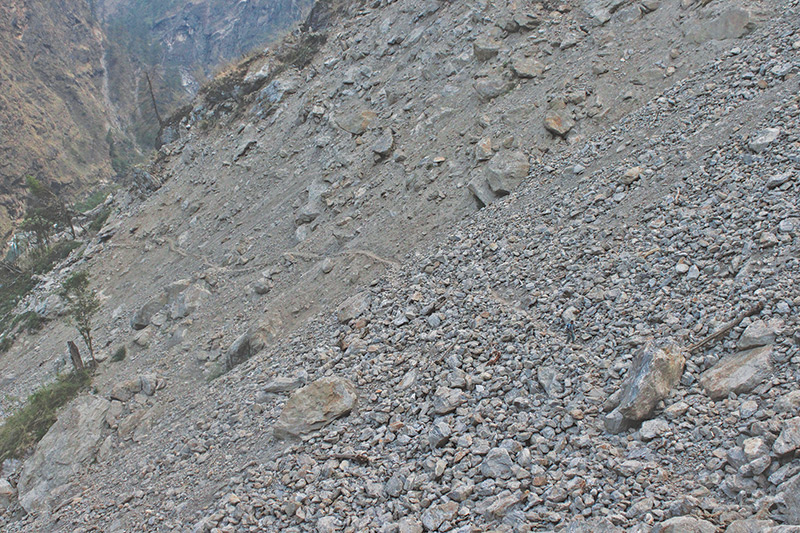
A man walks along a rugged foot trail through a landslide at Lokpa Bhir in Chumnubri Rural Municipality, in this recent photo. POST PHOTO: HARIRAM UPRETI
GORKHA, Gyurme Lama, a local of Chhekampar in Gorkha’s Chumnubri Rural Municipality-7 crosses the 800-metre Lokpa Bhir foot trail at least twice a week. He uses the trail to get to villages such as Chumchet in Ward 6 to buy daily essentials. But he gets scared every time he makes the journey; he worries about his unstable footing on the trail and the risk of getting hit by falling rocks from above. Lokpa Bhir in Chumchet in Ward 6 of the rural municipality is a landslide-prone area. For the last two years, the trail has seen multiple dry landslides from the cliff above. “I am extremely careful when I am walking the trail,” said the 40-year-old Lama. “I have to coordinate my movement because the soil is loose and if I lose my footing, there is nothing to stop me from falling off into the Budhigandaki River below. Frequent landslides have made the area dangerous. I have to watch out for rocks falling from the cliff above.” The trail is used not just by the locals of the rural municipality, but also by trekkers and hikers, says Lama. “This trail is a disaster waiting to happen,” he said. “If the landslide is not controlled soon, the coming rainy season will be difficult for us and those who come to this trail.” Lokpa Bhir is the entrance to Tsum Valley in Chumnubri, a popular tourist destination. Bibek Pandit, a local tourist guide, says the last two years have been difficult for the local tourism market. “The dry landslide started some two years ago and since then we haven’t been able to bring trekkers,” he said. “We can’t bring them here given the risks. But what is more worrisome is the locals have no choice but to use this trail.” According to Saroj Lama, ward chairman of Chumnubri-6, due to continuous landslides in Lokpa, locals suffer especially during the monsoon season when the trail becomes unusable. “In the last rainy season, the trail was completely closed due to landslides,” he said. “The locals transporting daily consumables on mules were unable to transport food to the villages for three months.” The rural municipality has made temporary foot trails for the locals to use, but during the monsoon season, those trails also become unusable, Lama said. “We need to find a permanent solution to prevent landslides along the trail. We will have to fortify the trail, but the rural municipality alone cannot do this for a lack of resources,” he said. “The landslides are getting bigger and bigger every year. We have been reaching out to the higher authorities for their attention for the past two years but no one has come forward to help us.” A cantilever bridge was constructed in 2016 along the Lokpa Bhir trail but by 2021 the bridge had become unusable after the Budhigandaki River washed away the approach path. The unseasonal rains of mid-October 2022 and flooding of the river swept away around 100 metres of the foot trail on the southern side of the bridge following which temporary repairs were done. “The cantilever bridge is the only way for the local mule transporters to supply goods to villages in Chumnubri Rural Municipality. “We repaired about 20 metres of the bridge at a cost of Rs1.8 million so that the locals can at least cross the bridge. Fencing work on the bridge is still underway,” said Saroj. Locals of 19 settlements in Chumchet and Chhekampar villages of Chumnubri Rural Municipality use the cantilever bridge along the Lokpa Bhir. The rural municipality is still disconnected from the national road network and local residents still rely on mules to carry food grains and daily essentials.
NATIONAL
Raute elder Karna Bahadur dies at 92
National Digest
SURKHET: Karna Bahadur Shahi, the senior-most member of the Raute community, passed away on Tuesday. He was 92. Shahi, the eldest member of Nepal’s last surviving nomadic tribe, had been living in Dareghat of Bhairavi Rural Municipality in Surkhet district. He is survived by a son. According to Lal Bahadur Khatri, a social worker who has been following the Raute community in Karnali province since June 2018, Shahi’s funeral rites were performed as per Raute customs on Wednesday morning. As per their tradition, the body of the deceased is buried wrapped in a net that the community members use to trap monkeys. Each member of the community presents wheat, rice and pieces of new clothing, among other things, during the funeral. With Shahi’s demise, only 141 members of the nomadic tribe remain. Rautes, indigenous to Nepal, are found in Salyan, Surkhet and Dailekh districts.
NATIONAL
Three dead, four injured in two different road accidents
District Digest
KALIKOT/SYANGJA: At least three people died in two separate road accidents in Kalikot and Syangja districts on Thursday morning. Forty-three-year-old Man Bahadur Shahi and his wife Man Kumari Shahi, 36, died in a jeep accident at Serachaur of Raskot Municipality-2. Another passenger, Rita Shahi Singh, 30, sustained serious injuries in the accident. Singh was taken to Surkhet for further treatment, said Deputy Superintendent of Police Jayashwar Rimal. The accident occurred after the jeep driver Binod Darlami, 21, allegedly got off the vehicle to tie his shoelace without applying the handbrake, following which the vehicle moved in reverse and met with the accident. Darlami has been taken into police custody and further investigation into the accident is ongoing. Similarly, one other person lost his life in a road accident in Syangja on Wednesday evening, leaving three others injured. The accident occurred in ward 3 of the Arjun Chaupari Rural Municipality at around 6pm on Wednesday. The pickup truck of the Syangja District Coordination Committee fell some 50 metres off the road. Driver Amrit Khanal, who had sustained serious injuries, died during treatment at the district hospital, said Deputy Superintendent of Police Rabindra Khanal. Three passengers aboard the vehicle have sustained injuries, said police.
NATIONAL
Ward chairman arrested on rape charge
District Digest
DARCHULA: The ward chairman of Mallikarjun Rural Municipality-3 has been arrested on the charge of raping a woman. Ward chairman Madan Singh Dhami was arrested from the district headquarters of Khalanga on Wednesday after a woman accused him of rape, according to police. Dhami had absconded after allegedly committing the crime on February 3. The victim had registered a complaint at the Darchula District Police Office against the accused on February 17. The district court has extended Dhami’s judicial detention by a week for further investigation.
NATIONAL
Hearing on whether to remand the defendants in fake Bhutanese refugee scam continues
- Post Report
KATHMANDU, Lawyers of the defendants of the fake Bhutanese refugee scam have demanded that they should be released on either a general date or on bail as they denied their involvement in the scam. Countering the allegations against them by the government attorneys, the lawyers have claimed that the accused cannot be punished on the issue for which there is no legal basis. Hearing is underway to decide whether the defendants could be released on a general date, on bail or be sent to prison for further legal proceedings. Defending Sanu Bhandari, senior advocate and former attorney general Raman Shrestha claimed that the chargesheet against Bhandari cannot be registered as a case of fraud because there is no legal basis to identify Nepalis as Bhutanese. He had spoken for Bhandari, an alleged middleman in the fake Bhutanese refugee scam. Senior advocates Balkrishna Dhakal and Prakash Subedi and advocates Dil Kumari Rai and Kumar Adhikari pleaded on behalf of the accused Indrajit Rai, who was working as security adviser to the erstwhile home minister Ram Bahadur Thapa. They demanded the court release Rai on a general date or on bail citing his fragile health conditions instead of keeping him in confinement. During tea time, in a heavily guarded lobby outside the bench room, the defendants including Indrajit Rai, Shumsher Miya and Bhutanese refugee leader Teknath Rizal had their meal while former home minister Balkrishna Khand was roaming around. Rizal and Miya were sharing their meal, while the onlookers were saying they had learnt to share things. On Wednesday, the respective lawyers of Keshav Dulal, Sanu Bhandari and Tanka Gurung had started pleading on behalf of them. Following the pleading of the six lawyers of Dulal for his release on bail on Wednesday one lawyer had pleaded in favour of Bhandari. Lawyers Bikash Bhattarai, Bikash Thapa, Bishwas Acharya, Yogendra Bahadur Adhikari, Nar Bahadur Yogi and Rajan Bhattarai had pleaded on behalf of Dulal. After the hearing of government attorneys that started on Sunday and concluded on Tuesday on whether to remand the defendants in the scam, the lawyers of the defendants have started to defend them with their arguments from Wednesday. They argued that the defendants have been charged without adequate evidence and only based on the statements of a select few people. They also argued that the accused were selectively prosecuted while some top leaders accused of involvement in the scam were not prosecuted. On Thursday also, they continued to argue that their clients were charged without concrete evidence—saying a person visiting a hotel for his personal work cannot be convicted. On May 24, the Kathmandu District Attorney’s Office filed criminal cases at the Kathmandu District Court against 30 individuals including former deputy prime minister Top Bahadur Rayamajhi and former home minister Bal Krishna Khand, accusing them of being involved in the fake refugee scam. Of them, 18 have been arrested while the others continue to be at large. The defendants have been charged with four types of crimes—treason, organised crime, fraud and forgery.
NATIONAL
Government ignoring Human Rights Commission’s recommendations to investigate the Gaur massacre
The victims from the incident have lodged a petition at the Supreme Court demanding its intervention in the investigation.
- BINOD GHIMIRE
KATHMANDU, The government has ignored the National Human Rights Commission’s recommendation to investigate Janata Samajbadi Party chair Upendra Yadav among 129 others in connection with the 2007 Gaur massacre. The constitutional human rights watchdog on January 7 had asked government agencies through the Prime Minister’s Office to probe the heinous crime and take action against Yadav and others, if found guilty. The commission also demanded the progress made in the investigation every three months. However, five months since, the government hasn’t abided by the recommendations that are legally binding. “We haven’t received any report about the investigation. The commission’s recommendations have been left unimplemented,” Shyam Babu Kafle, chief at the investigation division of the commission, told the Post. He said the only response they have received so far is from the Armed Police Force, which said it has not given any post-retirement appointments to officials who are accused in the incident. In its recommendations, the commission had asked the government to proceed with the investigation of the complaint lodged with the Rautahat District Police Office on May 11, 2007 and report to the commission about the progress every three months. It also asked to provide Rs300,000 to each victim family while also providing free treatment to the injured, seeking details of all of it but to no avail. The constitutional rights watchdog had concluded that the killings of more than two dozen people were well orchestrated and that both the then Madheshi Janadhikar Forum Nepal and CPN (Maoist) were aware of possible violence. On March 21, 2007, as many as 27 persons associated with the Maoists were brutally killed and another 115 were injured in the incident. As neither party took any initiative to averting the violence, the commission had also decided to draw the attention of Pushpa Kamal Dahal, then Maoist chairperson, Prabhu Sah, then general secretary of the Madheshi Mukti Morcha, Bindesh Yadav, Rautahat district chief of the then Maoist ‘People’s government’, and Yadav, the then MJFN chairman. Concluding its investigation more than than 15 years after the incident, the commission had also directed the government to take departmental actions against then Rautahat district police chief Yogeshwar Romkhami; then chief district officer Madhav Prasad Ojha; Superintendent of Police Ram Kumar Khanal; deputy superintendent of Armed Police Force Dharmananda Sapkota; and sub-inspector Kamakhya Narayan Singh. If they are no longer in service, it asked the concerned authorities not to give them an opportunity in future government service. The Armed Police Force said its accused staff in the incident haven’t been given any responsibility after their retirement. The commission also concluded that the incident happened since the Maoists insisted on holding their programme in the Rice Mill area of Gaur where the MJF-Nepal had already booked a spot as the venue for its mass meet. Several human rights commissions came to similar conclusions. In its report in April 2007, the Human Rights Watch remarked that there was no doubt that most, if not all, of the killings could have been prevented. Aruna Joshi, joint-secretary at the Human Rights Division of the Prime Minister’s Office, said they had written to the Ministry of Home Affairs to implement the commission’s directive. “The prime minister’s office doesn’t implement [the directive by] itself but directs the respective line agencies to act. However, there has been no progress so far,” Joshi told the Post. “We are continuously following up the matter with the agencies of concern.” The implementation of the commission’s recommendations by the government has been very low over the years. Less than 15 percent of its recommendations have been fully implemented so far. “The commission can publish the names of the people who didn’t cooperate in implementing its recommendations. However, the commission hasn’t taken that step,” said Kafle. It’s not just the government that is reluctant to abide by the commission’s recommendations, the judiciary too hasn’t given due priority to hearing petitions related to the incident. The victims from the incident have lodged a petition at the Supreme Court demanding its intervention in the investigation of the case. The hearing that was supposed to be conducted by a single bench of Justice Prakash Man Singh Raut couldn’t take place on Thursday. The hearing was deferred twice earlier. Human rights activists say the government’s reluctance in implementing the commission’s recommendations is a reflection of a culture of promoting impunity. “Culture of impunity is dominant. Many criminal acts have been politically patronised,” Shree Ram Adhikari, a former officer at the commission, told the Post. “The government has not only failed in implementing recommendations from the constitutional commission but is also completely indifferent to different UN standards, guidelines, and resolutions. People will not get justice as long as fugitives are present in Parliament.”
NATIONAL
Commission calls all-party meeting to discuss government decision to ‘scrap’ district poll offices
In the budget, the government announced to confine district election offices within the district administration office.
- TIKA R PRADHAN
KATHMANDU, The Election Commission is holding an all-party meeting on Friday to discuss the government’s decision to ‘scrap’ district election offices. Commissioner Ram Prasad Bhandari said the commission will hold consultations with all the parties as the government decided to keep the election offices under the executive going against the constitution. The government, through its budget for the fiscal year 2023-24, announced it’d ‘scrap’ the district election offices and put the election-related works under the jurisdiction of district administration offices. Bhandari said the commission will be forced to seek legal remedies to protect its autonomous authority and rights if the government doesn’t rectify the decision. The government, however, says it decided to limit the District Election Offices to a small unit within the respective District Administration Offices in a bid to cut costs. The government now plans to have only one employee as a focal person of the election body at the district administration office. All other positions of the district election office will be scrapped. The Election Commission and experts have taken serious exception to the government move, accusing the authorities of trying to infringe on the rights of autonomous institutions. Though government authorities claimed that having offices and many staffers in the 77 districts was not necessary as the next elections would happen only after four years. “There will be a unit of the District Election Office at the District Administration Offices with an official to coordinate election-related works,” said Prakash Thapa, a press coordinator of Finance Minister Prakash Saran Mahat. “It doesn’t mean that the election offices were dissolved; they were shrunk to avoid unnecessary expenses.” The Election Commission and election experts, however, say that the move was nothing but a ploy to infringe on free and fair elections that will ultimately affect the democratic system. They have also claimed that the amount spent for those district offices was not a big deal for the country and questioned the intention of the leaders in power. “In countries like Denmark and Sweden you don’t need any office or officials, just a representative of the home ministry conducts polls with the help of local representatives,” said Neil Kantha Uprety, a former chief election commissioner. “But in countries like ours, parties in government are involved in transferring the officials close to them so as to bring the voting results in their favour. Therefore, we developed structures of the election commission at the district levels.” Uprety dared the government to close all the constitutional commissions including the Commission for Investigation of Abuse of Authority so that a lot of money would be saved. It’s been more than three decades since the Election Commission set up its structures at the district level so that those offices could work throughout the year—collecting the names of new voters and launching awareness campaigns besides educating voters on the importance of the election. The political parties were up in arms when the chief district officers were designated to lead the Election Code of Conduct Monitoring Committees and therefore the plan was changed—allowing the head of the District Treasury Controller’s Office to lead the monitoring committees. According to officials at the Election Commission, 19 District Election Offices have their own buildings, in three other districts—buildings of District Election Offices are under construction while in eight districts such offices are stationed at other government buildings and as many as 12 other district election offices have purchased their own lands to construct their buildings. Only seven employees work at each district election office. Currently, the Election Commission has 70 district election offices and offices in all seven provinces. Officials of the Election Commission led by Chief Election Commissioner Dinesh Thapaliya expressed concerns over this ‘unexpected’ government move to Deputy Prime Minister and Home Minister Narayan Kaji Shrestha on Monday. According to an official present at the meeting, Home Minister Shrestha said he would consult with the prime minister and finance minister about it and would take a decision as per the consultation of the Election Commission. “At a time when the government was expected to equip the Election Commission with more sophisticated equipment to ensure free and fair elections, this abrupt move has shocked us,” said one of the election commissioners.
NATIONAL
Sushila Thing nominated Congress whip
Briefing
KATHMANDU: Sushila Thing has been nominated Nepali Congress whip for the House of Representatives. Congress President Sher Bahadur Deuba appointed Thing of Sindhuli to the post on Thursday. Keshav Raj Joshi, personal secretary to Deuba, said lawmaker Thing was nominated to the post as per Clause 13 (2) of the statute of the parliamentary party. Thing, who was elected central committee member through the 14th general convention in December 2021, was elected to the lower house under the proportional representation electoral system. Ramesh Lekhak is the chief whip of the party.
NATIONAL
Police, locals clash over smuggled fertilisers
Briefing
SARLAHI: A clash ensued between locals and police personnel in Dhankaul Rural Municipality of Sarlahi district on Thursday after the latter tried to confiscate smuggled fertilisers. Police lobbed three shells of teargas canisters to take the situation under control. The clash ensued after security personnel tried to seize the fertilisers stored in the house of Raju Sahani at Dhankaul-7. Superintendent of Police Naresh Raj Subedi said police lobbed teargas shells after villagers started pelting stones at them. Police seized 72 sacks of fertilisers while some villagers ran away with a few sacks. Police Inspector Sumit Kushwaha and a senior constable have sustained minor injuries. Police said Sahani is on the run and they have launched a manhunt to nab him.
OPINION
Supporting research libraries
Most such libraries run by governmental entities, universities and NGOs are still concentrated in Kathmandu.
- PRATYOUSH ONTA
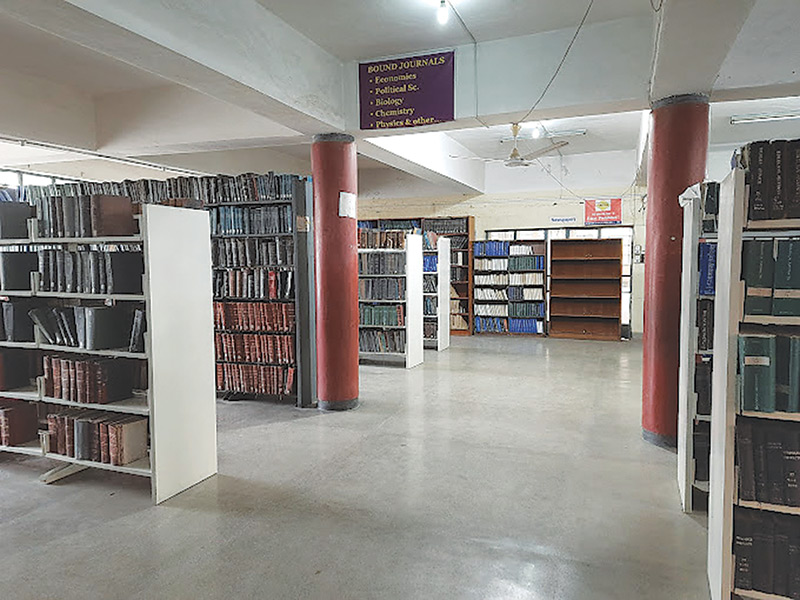
Photo: Courtesy of Smrat Baral
In several of my previous columns over the last five months, I have argued for a pluralistic higher education and research landscape in Nepal. One major constituting presence in such a landscape should be research libraries in different parts of the country. This column is devoted to this phenomenon. In the early decades of the 20th century, there were only a few libraries in Kathmandu that could be described as research libraries. One of them, Bir Library, was owned and operated by the Rana government, but two were privately owned by Hemraj Sharma (1878-1953) and Kaiser Shamsher JB Rana (1892-1964). Foreign researchers who visited Nepal during the 1920s visited these libraries, mostly to consult unpublished handwritten manuscripts. Such visitors included the famous French scholar Sylvain Levy who made two trips—his second and third—to Nepal during the 1920s. Nepali researchers who had come of age by the end years of the Rana era (including Nayaraj Pant) accused Hemraj and Kaiser Shamsher of not opening their enormous libraries to them while welcoming foreign scholars.
Post-Rana era After his death in 1953, Hemraj’s collection was sold to the Nepal government by his family. That collection was added to the collection of the library of the government, latterly known as the National Library. Some years after the death of Kaiser Shamsher, his entire library and the building in which it was located was donated to the Nepal government by his family. Their collections are still consulted by researchers. After the end of the Rana regime in 1951, research became a call for a small number of Nepalis, both inside and outside the university system. Over the course of the next four decades, various research libraries were established as part of the university system. Tribhuvan University Central Library and the library of the Centre for Nepal and Asian Studies were particularly important for those pursing research in the disciplines of the social sciences and the humanities. Within the TU system, libraries were also set up in its constituent campuses located in different parts of the country. However, even those in relatively large colleges such as Prithvi Narayan Campus in Pokhara were mostly set up to feed textbooks to students and faculty. Hence, they continue to do a poor job of collecting even the leading journals published from Kathmandu. In the immediate post-Rana period, the research collective Samsodhan Mandal led by Pant as guru began building its own collection of works for research purposes (it had also inherited the collection of Pant’s elder relatives). Some research centres (for example, the Human Resources Development Research Centre operated by members of the Nepal Jesuit Society) built functional libraries that were not really accessible to members of the general public.
Post-Panchayat era After the end of the Panchayat regime in 1990, a few non-governmental research libraries were set up in Kathmandu. The two notable ones are those owned and operated by the Social Science Baha and Martin Chautari (MC). The Baha library was set up as a general social science library. The MC library was initially set up in 2006 as a media research documentation centre. Its early development policy was mostly focused on collecting all kinds of reference works and print media products useful to researchers doing work on media studies. Over the last decade, it has grown to become a useful library for researchers doing work on many different themes including education, contemporary history, feminist analysis, Nepal studies and much more. Similarly, some of the new universities have also built up research libraries to cater to the needs of their students and faculty members. As can be gathered from the above discussion, most of the research libraries run by governmental entities, universities and non-governmental organisations are still concentrated in Kathmandu Valley. This fact does not tally with our desire to realise a pluralistic research landscape. What might be done then? Let us only focus on four aspects. Governance: Given the federal structure, provincial and local governments might begin by identifying some existing libraries whose collection could be augmented over the course of the coming years to serve research functions. Here, the first question should not be who owns these libraries. Instead it should be: Are the current owners amenable to a re-designed management model in which a multi-constituency board would oversee the operation of the augmented library in concern? If current owners are not amenable to such re-designs, then these two tiers of governments should make public calls for proposals from coalitions of universities, colleges and non-governmental organisations to set up new research libraries in specific areas. Funds: Research libraries should be a basic tenet of public life. Capital investment and operating funds of such libraries can be justified by the public services they offer to specialist researchers and general members of the public with various research needs. Hence, their financial needs should be met by funds channelled through the budgets of the provincial and local governments over the medium and long-term periods. In other words, such commitment and support should not be contingent upon the whims of elected politicians in a particular election cycle. Needed funds might also be partially raised from private sector operators with a strong presence in the locality. We must learn how research universities in the United States, for instance, erect library buildings (or their specific wings) with donations from wealthy individuals. Operating funds could also be raised as small donations from members of the public and non-governmental entities. Collection orientation: To function as research libraries, such entities will have to cover the basic functions expected of such libraries. Hence, they will have to hold basic reference works across the broad disciplines in the social sciences and humanities and also subscribe to a set of digital reference sources which are increasingly accessible against the payment of certain fees. But each research library could also build its own character in the form of specific focus or two. For instance, a research library located in central west Nepal could focus on building a strong collection related to the region’s long history of migration and its remittance economy. Such a collection will have to be very good in terms of works on Gurkha history but also books on the more recent phenomenon of long-distance labour migration to different parts of the world. Its collection will also have to be strong on the folklore of the area, especially as it relates to migration. Such a library could also be the home for an oral history and visual archive on long-distance labour. Collection development and management: Such libraries will, of course, need professional librarians to develop and manage their collections. However, volunteer groups of researches and members of the general public should also be involved. Researchers can help to identify books to be bought. Travelling members of the public can be asked to bring books from outside of Nepal (this strategy has worked well for the MC library). Others can be asked to volunteer their time to help in the daily operation of the library. Possibilities galore. And realising them, to me, is the real stuff of a loktantra. But is anyone listening?
OPINION
The Modi decade
It is far from clear that India is prepared to handle a conflict with China or Pakistan (or both).
- SHASHI THAROOR
Shutterstock
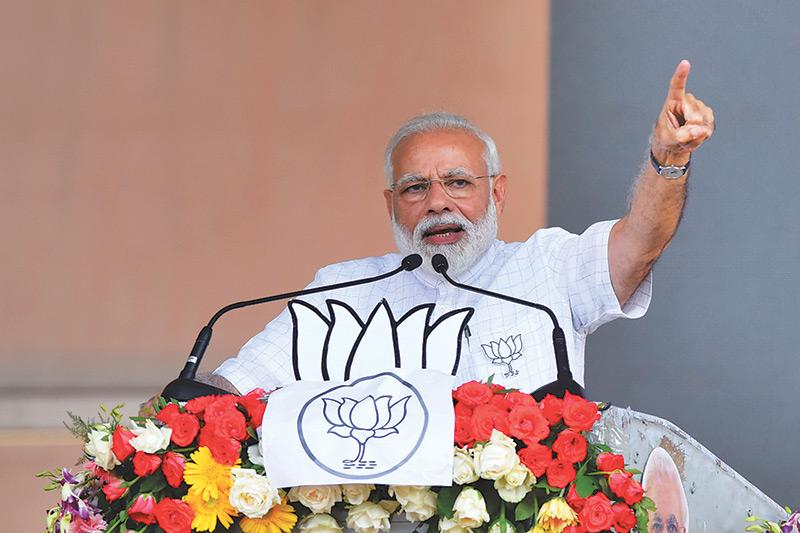
Last month, Indian Prime Minister Narendra Modi’s government inaugurated a new parliament building in New Delhi. It was supposed to symbolise the vision of a “new India” that Modi and his ruling Bharatiya Janata Party (BJP) claim they have been realising during nine years in power. But the building has proved highly controversial, with 20 opposition parties boycotting the inauguration ceremony—the latest manifestation of the seemingly irreparable breakdown in relations between the opposition and the government. As a member of the opposition, I, too, have strongly criticised the Indian government’s policies, rhetoric, and functioning. But the fact is that Modi reportedly enjoys the highest approval ratings of any world leader. As we approach the beginning of an election year, it is worth considering the sources of this support. The Modi government can claim some notable accomplishments. The most obvious has been the rapid construction of much-needed infrastructure, including new airports, ports, and highways, enabled by streamlined procedures, quick approvals, and extensive reliance on private contractors. The infrastructure boom has changed the face of many parts of India, and the work continues, with large new investments in modernising India’s railway network—one of the world’s largest, but among its creakiest. The government has also strengthened the social safety net for millions of poor Indians. Though Modi campaigned in 2014 against the previous government’s welfare schemes, which he claimed were colossally wasteful and bred a culture of dependence, his government has presided over the provision of toilets, cooking-gas cylinders, cash transfers to farmers, and access to electricity and clean drinking water in rural India. Such initiatives are not perfect—toilets lack enough running water, women are unable to afford to refill gas cylinders, and electricity supplies are erratic. But they have undoubtedly improved the quality of rural life, especially in the poor states of the northern “Hindi Belt.” The Modi government has also overseen progress in the diffusion of technology. The proliferation of smartphones with cheap data plan has connected nearly a billion Indians to the internet. The much-vaunted “India Stack”—comprising government-backed application programming interfaces (APIs)—has enabled private companies to build the online commons. A startup culture has developed, mainly in the tech domain, and several unicorns (startups valued at more than $1 billion) have emerged. When a Pakistani videoblogger gushes about Indian street vendors offering Paytm QR codes on their tea carts, or bankers rave about India’s Unified Payments Interface (which transfers money directly between bank accounts), India gains in global esteem. The government’s claim to have reduced “leakage” by delivering welfare payments directly to beneficiaries’ accounts is credible. Finally, Modi has invigorated Indian diplomacy, travelling tirelessly around the world, hugging world leaders, and addressing raucous rallies of Indian expatriates in foreign capitals. India’s relations with the United States and its allies have never been better, and cooperation with key Gulf countries has never been closer. But these successes have been offset by far less admirable policies. The BJP’s belligerent Hindutva nationalism—which promotes a narrow interpretation of history and demonises India’s minorities, particularly Muslims—can be likened to a toxin injected into the veins of Indian society. With BJP leaders and their acolytes in the Hindutva “Parivar,” or “family” of associated organisations, regularly spouting inflammatory and divisive rhetoric, it should be no surprise that violence has surged. Muslims have faced lynching by so-called cow vigilantes, and some Christians have been subjected to vandalism and assault during the Christmas season. Though Indian elections remain free and fair, anti-democratic trends have taken hold between votes. Dissent is framed as disloyalty, with criticism of government policies labelled “anti-national.” The tax agencies and financial police have been unleashed against opposition leaders and their supporters, and “bulldozer justice” has been dispensed mainly against Muslim protesters—whose homes and businesses are literally bulldozed—without due process. Moreover, the autonomy of Indian institutions—from the Reserve Bank of India to the Election Commission—has been weakened. Even the judiciary has come under pressure. Parliament has been reduced to a bulletin board for government decisions. The Modi government has also fallen far short on economic policy. Despite the progress in areas like transport infrastructure and technology diffusion, India has a long way to go on many fronts, particularly schooling, skills development, sanitation, and public health-care facilities. Likewise, the benefits of economic growth have failed to reach the poor and lower-middle class. Unemployment is at record highs, and female labour-force participation is plummeting. Many small and micro-enterprises had to be permanently closed after the disastrous demonetisation of 2016. Farmers are struggling to cope with falling incomes. Budgetary allocations for many essential welfare programmes, including the National Rural Employment Guarantee Scheme, have dwindled. Crony capitalism is rampant. The Modi government’s response to the Covid-19 crisis also left much to be desired. Though Indians were eventually vaccinated, images of migrant workers trudging homeward during a nationwide lockdown still haunt the country. And while the government claims that less than 500,000 people died, the World Health Organization estimates that the real figure is 10 times higher, raising questions about the reliability of official statistics. The jury is still out on the Modi government’s handling of several other challenges, from the Ukraine war to Chinese encroachments along the disputed Himalayan frontier. It is far from clear that India is prepared to handle a conflict with China or Pakistan (or both). The 2015 deal to buy 36 Rafale fighter jets from the French company Dassault Aviation continues to draw controversy, owing to contractual irregularities. India’s first prime minister, Jawaharlal Nehru, is the only one to have won three successive terms in office. Next year, the Indian people will weigh Modi’s mixed record and decide whether it warrants making him the second.
Tharoor is an MP for the Indian National Congress. — Project Syndicate
OUR VIEW
Too hot to handle
As heat waves leave everyone vulnerable, one solution could be rescheduling work hours.
The sheer number of TikTokers making omelettes on solar-heated pans tells us much about the heat wave that has engulfed Tarai districts in the past few days. Even the celebrity chef Santosh Shah could not resist the temptation of appearing in one such video with the unrelenting heat becoming the talk of the lowlands. As temperature crosses 40 degrees in several districts in central and eastern Tarai, daily life in the region has been disturbed. Several local levels there have rightly called for a shutdown of schools until the heat subsides. The schools that are still running should be immediately shut too until the wave passes. Continuing to run schools in this heat would be an injustice to the young minds that are there to learn rather than be victims of an unforgiving climatic condition and an apathetic administration. The Meteorological Forecasting Division of the Department of Hydrology and Meteorology has warned the situation will stay dire for a few more days. What’s more, meteorologists have warned of below-average rainfall and above-average temperatures across the country this monsoon. This means that the state should work more effectively to warn people of the danger of stepping out and working in the scorching heat. But simply sending warnings is not enough. As vital is uninterrupted power supply in the affected region so that people can at least use their cooling fans or coolers. Local governments can provide such equipment at subsidised rates to citizens who cannot afford them. Extreme heat waves also lead to loss of lives, as has been the case almost every year, and the best way to prevent such deaths is to equip citizens with the instruments to tackle those problems. The summer also often brings along health problems in the region, as heat stroke causes nausea, headache, dizziness and fainting. Hospitals should be equipped to deal with the onslaught of heat-related illnesses. As of now, schools are the only major institutions that have been closed temporarily. However, as heat waves leave everyone vulnerable, one solution could be rescheduling work hours, especially in labour-intensive sectors. A case in point is the advisory issued earlier this year by India’s central government to reschedule work hours for labourers. In the United Arab Emirates, the government has announced a midday work ban from June 15 to September 15 to ensure worker safety, a campaign the Gulf country has been enforcing for the past 18 years. If the heat situation is bad today, even worse is the fact that they are here to stay. As the climate emergency deepens, hot spells, like droughts, floods and landslides, are going to be more frequent in the coming days, years and decades. The climate situation is so dire that we are now already talking of adaptation techniques, as mitigation and resilience measures are not enough. In neighbouring India, heat waves cause hundreds of deaths every year as their frequency continues to rise. Last year, the South Asian subcontinent recorded the hottest March since 1901. The temperature in Uttar Pradesh went as high as 49.2 degrees Celsius, while it reached 51 degrees Celsius in Jacobabad of Pakistan in mid-May, as rains were a rarity. As we stare into a bleak future with extended seasons of drought, we need to immediately come up with collective and localised adaptation measures.
THEIR VIEW
Politician-police cooperation
Where bomb instructions are available on the internet, campaign speech security must be prioritised.
Election campaign speeches are an important opportunity for politicians to deliver their arguments directly to voters. It is necessary for the police and politicians to consult well in advance and establish a system to protect both freedom of speech and safety at campaign speech venues. The National Police Agency has compiled a report on security procedures following an incident in which an explosive device was thrown at Prime Minister Fumio Kishida at a campaign speech venue in Wakayama City. The report concluded that there were problems with checks on people in the crowd gathered at the fishing port where the speech was to be held, summarising that there should have been close consultation between the police and the Wakayama prefectural chapter of the ruling Liberal Democratic Party that organised the speech. According to the report, the Wakayama prefectural police were told by the LDP’s prefectural chapter that the audience would include only members of a fishermen’s cooperative, and that even if nonmembers came, it would be possible to visually identify them. For that reason, the police left audience checks entirely up to the fishermen’s cooperative and metal detectors were not used. The organisers probably wanted the audience to be close to Kishida as much as possible during his speech, in an atmosphere without strict and elaborate security. As a result, however, a man with explosives was able to enter the venue. The fact that an incumbent prime minister was attacked less than a year after the fatal shooting of former Prime Minister Shinzo Abe is an extremely serious matter. There is an urgent need to overhaul security procedures. What is particularly serious is that the NPA had checked the prefectural police’s security plan for the Kishida speech in advance in light of Abe’s fatal shooting. It must be said that the measures to prevent a recurrence did not work. The police intend to ask political parties to hold campaign speeches indoors if possible, so they can check the names and accreditation of participants, and inspect baggage at entrances as well. However, some politicians have expressed reluctance, arguing that it is difficult to communicate with independent voters unless they stump on the streets. There also must be many politicians who want to shake hands with voters outdoors. The police and political parties should share information about such things as the layout of venues and the size of the audience to find the best security methods. Dignitaries such as the prime minister require particularly tight security. It might be worth considering keeping people on the streets a certain distance from politicians and installing bulletproof screens. In the United States, many campaign speeches are held indoors, and there are thorough baggage checks and screening of attendees, reportedly. In recent years, schedules for campaign activities have been widely publicised on social media, and many nonlocals have attended speeches. It has become difficult to determine whether attendees are locals with visual checks alone. Now is an age where the internet contains information on how to make guns and bombs. It is important to go beyond conventional insight to ensure the safety of campaign speech venues, on the assumption that there is always the possibility that dangerous people are in the crowd.
— The Yomiuri Shimbun (Japan)/ANN
MONEY
Wage talks likely to be tough with economy in recession
The unions have demanded that industrial workers be paid on a par with first level office helper in the civil service.
- PAWAN PANDEY
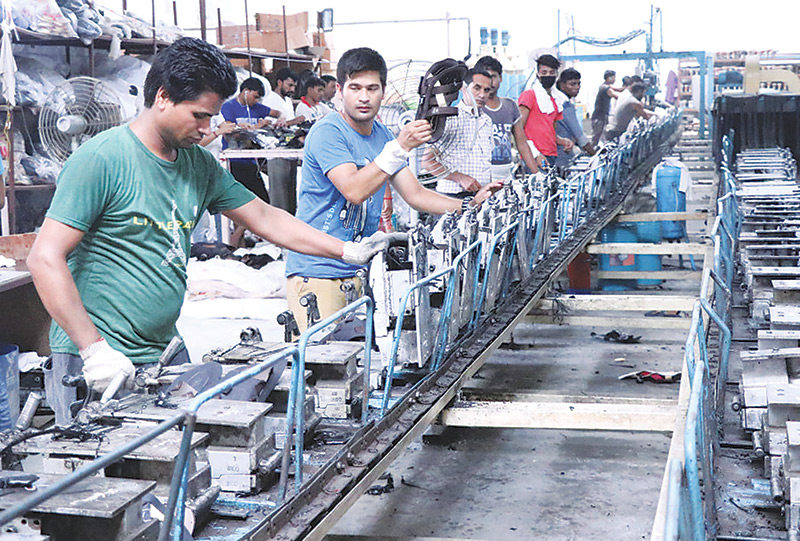
Workers say they are being buffeted by high inflation while employers say they are having difficulty staying alive with the economy in a tailspin. Post File Photo
KATHMANDU, The government, private sector and trade unions are bracing for a long fight ahead as scheduled two-yearly wage hike negotiations get underway. Workers say they are being buffeted by high inflation while employers say they are having a hard time staying alive with the economy in a tailspin. The unions have demanded that industrial workers be paid on a par with first level office helper in the civil service who get a monthly salary of Rs26,348. A factory worker currently earns a minimum of Rs15,000 per month, and employers say their salary expectations are too high when the country is wallowing in an economic slowdown. Four months ago, an 11-member committee was formed to recommend a minimum wage plan. The panel is expected to submit its report to the government in the next two weeks. The committee is under the coordination of Dandu Raj Ghimire, joint secretary at the Ministry of Labour, Employment and Social Security, and consists of representatives from the Labour Ministry, Department of Labour and Occupational Safety, Ministry of Industry, Commerce and Supplies and Nepal Rastra Bank. Representatives from the trade unions and employers’ organisations also sit on the committee. As per the existing provisions, the minimum wage is reviewed every two years. This year’s negotiations are particularly unusual and intense as they are taking place at a time when the economy is going through a bad phase and consumers are being battered by runaway inflation. Hansa Ram Pandey, a senior expert at the Federation of Nepalese Chambers of Commerce and Industry (FNCCI) and a member of the committee, said they had alerted the government about the country’s economic situation. “Despite the legal provision requiring the minimum wage to be reviewed every two years, we cannot ignore the fact that the economy is in a slump. Many factories have shut down or have cut production. Manufacturing plants are operating at 50 percent capacity,” Pandey said. “While we should consider workers’ benefits, it is equally important to consider how industries will survive in a recession-like situation.” As per the National Statistics Office, the country was officially in a recession until the second quarter of the current fiscal year, with the annual economic growth rate projected to slow down to 1.86 percent as a result. The first meeting of the wage committee was held on January 27, according to Janak Chaudhary, vice-president of the General Federation of Nepalese Trade Unions (GEFONT) and one of the panel members. “On behalf of the trade unions, we have asked that the government either provide subsidies to workers at the low end of the pay scale or hike the minimum salary to Rs26,348,” Chaudhary said. The minimum monthly wage for industrial workers is currently Rs15,000 which includes Rs9,385 basic salary and Rs5,615 inflation allowance. The last time the minimum wage was reviewed was in the fiscal year 2021-22. Prior to that, the minimum monthly salary was Rs13,450. Nepal’s private sector employs around 4.93 million persons, nearly 86 percent of the country’s labour force, according to a study entitled State of Private Sector in Nepal: Contributions and Constraints, jointly produced by the FNCCI and the International Finance Corporation (IFC). Chaudhary said high inflation appears to have become the new enemy for workers who have a small salary. “We have demanded an end to pay discrimination between government and private sector employees,” he said. “Why is the minimum pay for civil servants much higher than for private sector workers? The government has increased the salaries of government officials despite low revenue.” According to Nepal Rastra Bank, the country’s central bank, the year-on-year consumer price inflation rose to 7.44 percent in mid-March from 7.14 percent a year ago. Economists say that since inflation has risen from a higher base of 7.14 percent, Nepal is passing through hyperinflation, an extreme case of inflation. They say that higher inflation rates are more prevalent in Nepal because the country often lacks sufficient data and transparency. Raising the minimum pay has not been so easy in Nepal. Insiders say that unions normally resort to a strike if their demand is not met. In the past, unions tried organising strikes and picketing government buildings to put pressure on it. The unions are in a wait-and-see mode. Chaudhary says they haven’t planned their next move and are eagerly waiting for the committee report. He said the government would not increase the minimum pay but make some adjustments to the pay structure in line with growing inflation. Ghimire says they plan to submit the report to the government in the next two weeks with their recommendations. “The government will make an informed decision whether or not to raise the minimum salary based on the report.”
MONEY
Human rights watchdogs sign pact to protect Nepali migrant workers’ rights
Over 102,000 received labour approval for Qatar in the first nine months of the fiscal year.
- Post Report
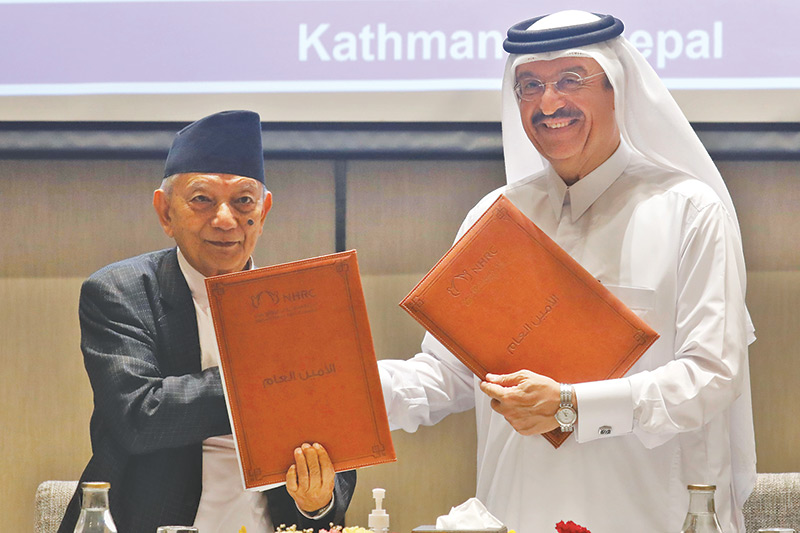
Top Bahadur Magar (left), chairman of the National Human Rights Commission of Nepal, and Mohammed Saif Al-Kuwari, deputy chairman of theQatari National Human Rights Committee, sign the pact on behalf of their respective organisations in Kathmandu on Thursday. POST PHOTO: ELITE JOSHI
KATHMANDU, The National Human Rights Commission of Nepal and Qatar on Thursday signed a memorandum of understanding to cooperate on protecting the rights of migrant workers. The MoU says it aims to enhance cross-country cooperation, with closer collaboration in the exchange of information from migrant worker complaints to legislative procedures. Top Bahadur Magar, chairman of the National Human Rights Commission of Nepal and Mohammed Saif Al-Kuwari, deputy chairman of the Qatari National Human Rights Committee, signed the pact on behalf of their respective organisations. Al-Kuwari said that signing the MoU was the best way for the two countries to cooperate on human rights issues. “I think it’s a good opportunity to exchange information about migrant workers, especially now, when we have invited more than 400,000 workers from Nepal,” he said. Magar said that despite the presence of frameworks such as international human rights laws, international and regional mechanisms and guidelines, as well as national legislation, workers migrating overseas are facing a lot of challenges. “This calls for an institutionalised and effective approach to implement existing measures, timely adoption of policies and legislations and saving the international and regional cooperation for harmonisation of the policies and regulations,” said Magar. “There is an urgent need to make sure that businesses respect the human rights of migrant workers with internationally recognised standards.” Qatar is one of the major labour destinations for Nepalis. But, Nepali workers in the country, which hosted the World Cup Football last year, have often been subjected to human rights and labour rights violations. International human rights organisations, migrant rights groups, families of workers, labour unions and fans around the world have been demanding Qatar compensate the workers for the injustices they have suffered. Though Qatar announced the end of the exploitative Kafala system, which restricts workers from changing their jobs or leaving the country without the permission of the employer in 2020, employers in the country continue to create trouble for workers looking to change jobs, a recently published report says. “To restrict workers from changing employers or leaving the country, the employers often file charges of abscondment or theft against them, which results in their arrest,” the report says. Nearly 102,000 Nepalis have received labour approval, including new and reentry, for Qatar in the first nine months of the current fiscal year, which ended mid-April, according to the Department of Foreign Employment. The recently published report shows that workers going to the Gulf and Malaysia were made to pay exorbitant and illegal recruitment charges, faced contract breaches, wage theft, difficulties in access to justice and hassles for returning home, and getting their rightful benefits and compensations. This is, however, not the first time the two national human rights bodies have signed such an agreement. A similar pact was signed back in November 2015.
MONEY
India monsoon reaches Kerala after longest delay in 7 years
The monsoon delivers nearly 70 percent of the rain needed to water its farms and recharge reservoirs.
- REUTERS
MUMBAI, Monsoon rain reached the coast of India’s southernmost Kerala state on Thursday, offering relief to farmers after a delay of more than a week, marking its latest arrival in seven years. The monsoon, the lifeblood of India’s $3 trillion economy, delivers nearly 70 percent of the rain needed to water its farms and recharge reservoirs and aquifers. It also brings relief from the worst of the hot weather. In the absence of irrigation systems, nearly half of India’s farmland depends on the June-September rains and their late arrival could delay the planting of rice, cotton, corn, soybean and sugar cane, traders said. “Southwest Monsoon has set in over Kerala today, the 8th June, 2023, against the normal date of 1st June,” the state-run India Meteorological Department (IMD) said in a statement. This year, the IMD had expected the rains to arrive over the state’s coast on June 4 but the formation of severe cyclonic storm Biparjoy in the Arabian Sea delayed their onset. The IMD confirms the monsoon has begun after taking into account rainfall measured at weather stations in the southern state of Kerala and westerly wind speeds. Conditions are favourable for the monsoon to advance into the central Arabian Sea and some parts of Kerala, Tamil Nadu and Karnataka states, the IMD said. India received 57 percent lower rainfall than average in the first week of June, weather office data showed on Wednesday, reflecting the delayed arrival of the wet weather. The monsoon would make progress in coming days in the south but central and western areas could get little rain over the next two weeks, said a senior IMD official, who declined to be identified as he is not authorised to talk to media. The weather office has forecast below average rains for June with the monsoon expected to pick up later. However, for the entire four-month season, the IMD has forecast an average amount of rain despite the formation of a possible El Nino weather phenomenon. In the past, India has experienced below-average rainfall during most El Nino years, sometimes leading to severe droughts that destroyed crops and forced authorities to limit the export of some grains.
MONEY
Nepal-China friendship dragon boat festival to start in Pokhara on June 23
- Post Report
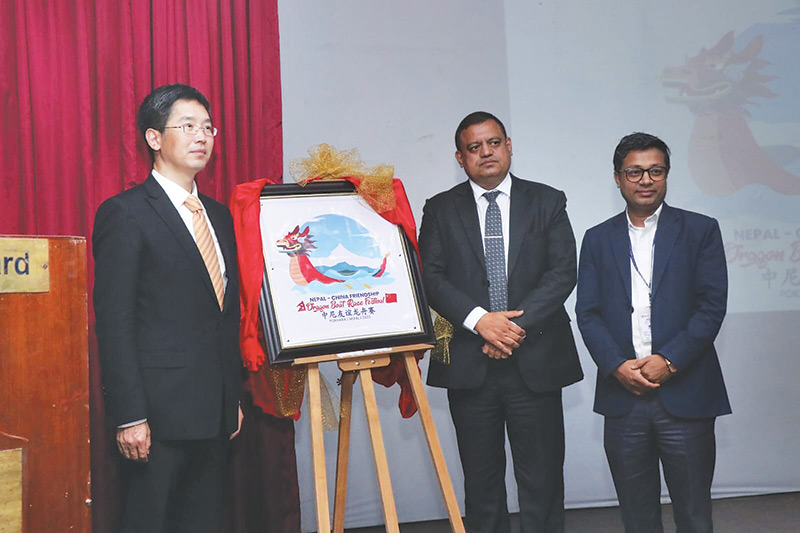
This would be the first key promotional event being organised in the country after more than three years, in order to attract Chinese tourists. PHOTO COURTESY: NEPAL TOURISM BOARD
KATHMANDU, Nepal Tourism Board, the Chinese embassy in Nepal and Pokhara Metropolitan City have joined hands to organise the first-ever Nepal-China Friendship Dragon Boat Race Festival in Pokhara. The two-day event will begin on June 23. This is the first promotional event being organised in the country after more than three years, to attract Chinese tourists. According to a notice issued by the Ministry of Culture and Tourism of the People’s Republic of China, starting from March 15, the national travel agencies and online travel companies are allowed to resume, on a pilot basis, outbound group tours for Chinese citizens to relevant countries. Dhananjay Regmi, chief executive officer of the Nepal Tourism Board, said that the event would help Nepal attract Chinese tourists. “As June marks the beginning of off-season tourism in Nepal because of the monsoon, these kinds of events will help Nepal’s tourism industry attract tourists round-the-year.” The Dragon Boat Race has been held in more than 50 countries and has entered the Asian Games and Olympics as well. The event is the first of its kind in Nepal. The race will have eight teams from Nepal, China and Singapore participating in 200 metres and 500 metres races in Phewa Lake. Eight boats crafted especially for Dragon Boat Racing and other necessary items arrived in Nepal earlier this week through the Kerung border and have already reached Pokhara. Similarly, participants have reached Pokhara and have started training in Phewa Lake. The China Dragon Boat Association is providing technical assistance and coaching to the participants in the competition. The competition will be followed by cultural performances and food exhibitions from both countries. Wang Shin, the deputy chief of mission of the Chinese Embassy in Kathmandu, said that Pokhara is a very popular destination among the Chinese visitors. “Some Chinese tourist guidebooks even list Pokhara as one of the top 10 places in the world to see.” “With the opening of the new Pokhara International Airport, the event is expected to be a milestone in highlighting Pokhara globally as a world-class premier holiday destination,” said Wang. “We are trying to get charter flights for the event. If everything goes as planned, regular flights from China to Pokhara will commence soon.” In March, Beijing allowed its citizens to travel to Nepal as tourists after more than three years. Following the reopening of China, Nepal received 4,770 Chinese tourists in April, the highest since March 2020. In May, the Chinese tourist numbers stood at 4,667 individuals. In 2019, Nepal received a record 169,543 Chinese tourists. When the Chinese economy started to boom, Nepali investors started building luxury hotels that started to multiply. The boom, alas, turned to bust almost as fast. The Covid-19 pandemic came, and all the Chinese tourists were gone in a flash. Their numbers fell to 19,257 in 2020. As many as 6,198 and 9,599 Chinese tourists arrived in Nepal in 2021 and 2022, respectively—comprising mostly diplomats and those who had got stranded in third countries.
MONEY
MetLife Nepal and Standard Chartered enable e-mandate feature for premium payments
Bizline
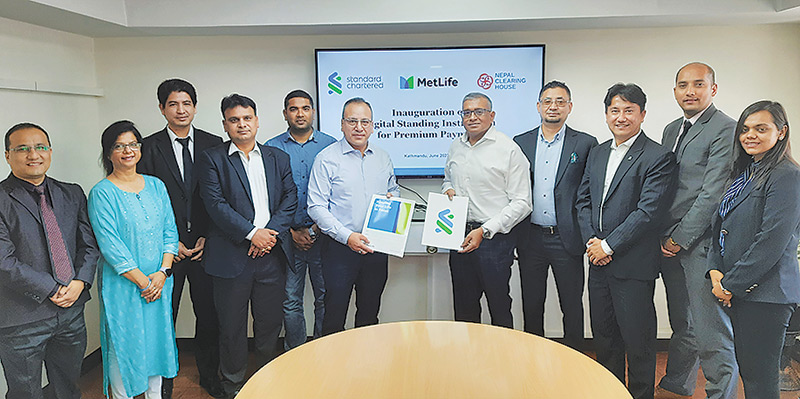
KATHMANDU: MetLife Nepal Insurance has partnered with Nepal Clearing House (NCHL) in collaboration with Standard Chartered Bank Nepal to enable the digital standing instructions (e-Mandate) feature for the payment of premiums by integrating its system with the National Payments Interface (NPI) of NCHL. This feature has been enabled for the first time in the insurance sector of Nepal by MetLife Nepal, reads the press release issued by the bank. This feature allows the direct debit of the customer’s account on the due date of premium payment upon subscription of the feature by the customers. With this, the customer does not need to initiate such payments each time. The bank says e-mandate based payments support payments of regular or recurring/periodic nature. (PR)
MONEY
Isuzu says no plans to relocate Thailand factory to Indonesia
Bizline
TOKYO: Japanese truck maker Isuzu Motors said on Thursday it was not planning to move a factory to Indonesia from Thailand, a day after the Indonesian industry minister signalled it would. “While our company continues to focus on Indonesia as a major market, there are no plans to relocate a Thai factory to Indonesia,” an Isuzu spokesperson said. The company had made no announcement on the matter, the spokesperson added. Isuzu already has a factory in Karawang, Indonesia. Indonesian Industry Minister Agus Gumiwang Kartasasmita said on Wednesday that Isuzu planned to move the factory and could start production as early as next year. (REUTERS)
WORLD
Zelenskyy visits area flooded by breached dam as five reported dead in Russian-occupied city
Kyiv has accused Russia of purposely destroying the dam, which is located in an area controlled by Russian forces.
- ASSOCIATED PRESS
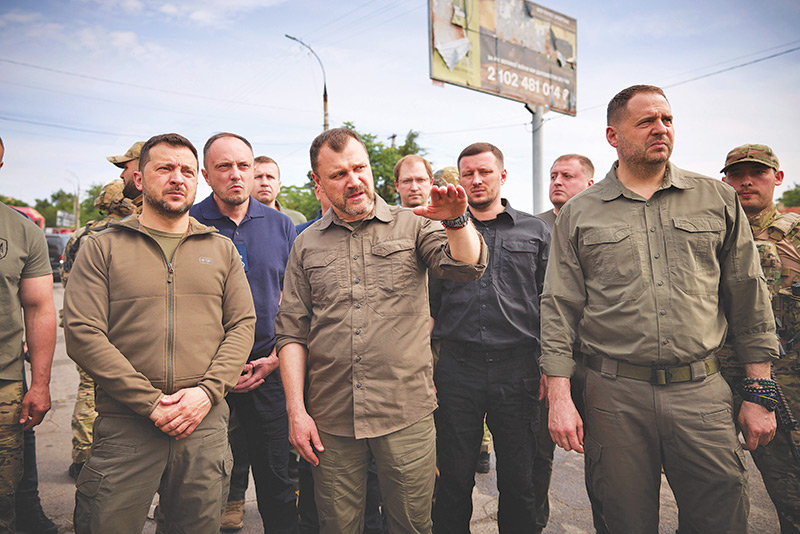
Ukrainian President Volodymyr Zelenskyy (left) visits the flood hit areas in Kherson, Ukraine on Thursday. Ukrainian Presidential Press Office via AP/RSS
KHERSON, Five residents of a Russian-occupied city next to a breached dam have died in massive flooding triggered by the catastrophe, its Kremlin-appointed mayor said on Thursday, the first official report of deaths from one of the largest environmental crises since Russia’s invasion of Ukraine more than 15 months ago. Vladimir Leontyev, the Russian-appointed mayor of Nova Kakhovka, told Russian state TV that two other people who had gone missing after Tuesday’s dam breach had been found, and efforts were underway to evacuate them. Officials say more than 6,000 people have been evacuated from dozens of inundated cities, towns and villages on both the Russian and Ukrainian-controlled sides of the Dnieper river, which has become part of the front line between the fighting forces. The collapse of the Kakhovka hydroelectric dam and emptying of its reservoir on the river have added to the misery that the region has suffered for more than a year from artillery and missile attacks. Rescue workers fanned out to get drinking water to beleaguered locals, warning that contaminated water could cause illness. Thousands of people have been left homeless, cropland has been ruined, access to electricity and mobile phone networks has been limited or cut off entirely, and land mines have been displaced by the surging waters, officials say. On the Ukrainian-controlled western bank, President Volodymyr Zelenskyy arrived on Thursday to evaluate the response to damage caused by the dam breach, including efforts to evacuate civilians and provide them with drinking water and other support. After visiting an aid distribution point and a medical facility, Zelenskyy ordered Ukrainian officials to provide a “fair valuation” of flood damages and develop a scheme to compensate residents whose property was damaged or whose businesses had to relocate, his office said in an online update. In areas that they administer, Russian-appointed authorities said nearly two dozen people have been hospitalised, 4,280 people have been evacuated and some 14,000 buildings have been flooded. Russian officials say the destruction of the dam, which created a giant reservoir of water used for irrigation and drinking water, will eventually halt fresh water supplies to Russian-controlled Crimea, even though the peninsula has enough fresh water for now—with its reservoirs 80 percent full. Ukrainian authorities cut off fresh water supplies to Crimea after Moscow’s illegal annexation of the peninsula in 2014, and Russian President Vladimir Putin cited the need to restore them among the main reasons for his decision to invade Ukraine. Regional Governor Oleksandr Prokudin said the average level of flooding on Thursday morning in the region was more than 5.6 metres and roughly 600 square kilometres of the region were submerged—more than two-thirds of that on the Russian-controlled eastern bank. He said nearly 2,000 people had been evacuated from Ukraine-controlled areas, and the operations were continuing despite constant shelling from Russian forces across the river. “People are tired ... [they] have no desire to flee to other regions of Ukraine,” Prokudin said. The true scale of the disaster is yet to emerge in an affected area that was home to more than 60,000 people. French President Emmanuel Macron tweeted that the destruction of the dam was an “attack” and an “atrocious act,” without saying who is to blame. Paris said it was rushing aid including water purifiers, 500,000 water purification tablets and hygiene kits to help people displaced by the disaster. Ukrainian officials have accused Russia of purposely destroying the dam, which is located in an area controlled by Russian forces. President Alexander Lukashenko of Belarus, a key ally of Russian President Vladimir Putin, backed the Russian claim that Ukraine blew up the dam to distract attention from what it described as a botched Ukrainian attempt to launch a counteroffensive. “They needed to cover up the three days of their ‘counteroffensive’ in which they lost nearly 200 armoured vehicles and more than 2,000 troops,” he said during Thursday’s meeting with officials. “And so it’s all about Kakhovka and no one is talking about that. It’s quite obvious.”
WORLD
Four children wounded in knife attack in French town
- REUTERS
ANNECY, A Syrian national wounded four children and an adult in a knife attack in a park in the southeastern French town of Annecy on Thursday, police said, leaving some of the victims critically ill in hospital. The attacker was a Syrian national with legal refugee status in France, a police official told Reuters. He was not known to security agencies and his motives were unclear, an investigative source said. French Interior Minister Gerald Darmanin said on Twitter that the attacker had been arrested. Two children and one adult were in life-threatening condition, while two children were slightly hurt, police said. “Children and one adult are between life and death. The nation is in shock,” French President Emmanuel Macron said in a statement on Twitter, calling the attack “an act of absolute cowardice”. Witnesses said at least one of the children wounded in the attack was in a stroller. The incident took place at around 0745 GMT in the playground of a lakeside park in Annecy, a town in the French Alps. “He jumped [in the playground], started shouting and then went towards the strollers, repeatedly hitting the little ones with a knife,” a witness who gave his name as Ferdinand told BFM TV. “Mothers were crying, everybody was running,” said George, another witness and owner of a nearby restaurant. The TV channel showed footage of several policemen overpowering an individual in a park.
WORLD
Malaysia, Singapore slam comedian for ‘offensive’ joke over MH370 disappearance
- ASSOCIATED PRESS
KUALA LUMPUR, Malaysian officials on Thursday condemned a Singapore-born stand-up comedian who mocked Malaysia and made fun of the 2014 disappearance of Malaysia Airlines Flight MH370 during a skit in the United States. Jocelyn Chia posted her act on social media, sparking outrage in Malaysia and prompting Singapore officials to quickly apologise. Chia made crude remarks about Malaysia, which she said lagged far behind Singapore after the two separated in 1965. She joked about Malaysian airplanes not being able to fly, drawing gasps from the audience. Chia continued: “Why? Malaysian Airlines going missing not funny, huh? Some jokes don’t land.” Flight MH370 was carrying 239 people from Kuala Lumpur to Beijing when it vanished on March 8, 2014, and is presumed to have crashed in the far southern Indian Ocean. Malaysian Foreign Minister Zambry Abdul Kadir said Chia’s act “showed a total lack of sensitivity and empathy” toward Malaysians and the victims’ families. “This video also clearly depicts behaviour that is contrary to the values of Asian countries that are known for their manners and morals,” he said in a statement. Singapore Foreign Minister Vivian Balakrishnan took to Twitter on Thursday to apologise. He said he was appalled by Chia’s “horrendous statements” and that Chia doesn’t speak for Singaporeans. “We treasure our ties with family and friends in Malaysia, and are sorry for the offense and hurt caused to all Malaysians,” he said. Singapore officials said Chia was no longer a citizen. The Singapore Straits Times reported she is now a US citizen. Following the backlash, the video appeared to have been removed from some of Chia’s social media but could still found on some sites. A Malaysian social news portal, the World of Buzz, reported that Chia was defiant. She had posted earlier on social media in response to criticism that “people take jokes way too seriously,” it said. Chia added that “tragedy + time = comedy” and said that the joke was acceptable as it has been long enough since the incident, the site reported. Her comments were later inaccessible. Scattered pieces of debris that washed ashore on African beaches and Indian Ocean islands indicated that MH370 likely crashed in a distant remote stretch of the ocean. But a government search by Australia, Malaysia and China failed to pinpoint a location. And a second, private search by US company Ocean Infinity found no sign of a possible crash site.
WORLD
Philippines raises alert level around volcano, villagers told to leave danger zone
Mayon is one of the most restive of two dozen active volcanoes across the Philippines.
- ASSOCIATED PRESS
Mayon Volcano spews white smoke as seen from Daraga, Philippines on Thursday. AP/RSS
MANILA, Philippine officials on Thursday raised the alert level for one of the country’s most active volcanoes after superheated streams of gas, debris and rocks cascaded down its upper slope in a condition they fear could lead to a hazardous eruption within days or weeks. Villagers living within a 6-kilometre radius of Mayon volcano’s crater were told to leave the long-designated permanent danger zone and move to safer grounds due to the danger of volcanic emissions, lava flows, rockfalls and other hazards, officials said. Cedric Daep, a provincial public safety official, said villagers were preparing to evacuate from the danger zone, which is supposed to be off limits to permanent residents but where many mostly poor families have built houses in Mayon’s shadow over the years. “Civil aviation authorities must also advise pilots to avoid flying close to the volcano’s summit as ash from any sudden eruption can be hazardous to aircraft,” the Philippine Institute of Volcanology and Seismology said. A tourist draw in northeastern Albay province for its picturesque conical shape, Mayon is one of the most restive of two dozen active volcanoes across the Philippines. It last erupted violently in 2018, displacing tens of thousands of villagers. Government volcano experts said they raised the alert level around Mayon to the third of a five-step warning system after detecting an increasing number of rockfalls and at least two volcanic earthquakes in recent days. Three brief volcanic gas and ash emissions on Thursday streamed down the volcano’s southeastern gully about a kilometre from the crater, they said. “This means that Mayon is exhibiting magmatic eruption of a summit lava dome with increased chances of lava flows ... and of potential explosive activity within weeks or even days,” the government volcanology institute said. Aside from Mayon, officials were closely monitoring Taal volcano south of Manila and Mount Kanlaon on central Negros island due to renewed signs of restiveness. A number of villages in three towns near Taal suspended classes on Wednesday due to thick smog emanating from the volcano, one of the world’s smallest, and residents were advised to limit outdoor activities and wear masks for protection. The Philippines lies along the Pacific Ring of Fire, a region prone to earthquakes and volcanic eruptions. A long-dormant volcano, Mount Pinatubo, blew its top north of Manila in 1991 in one of the biggest volcanic eruptions of the 20th century, killing hundreds of people.
WORLD
Wildfires burn across Canada with little relief in sight
- REUTERS
A file photo shows smoke billowing upwards from a planned ignition by firefighters tackling the Donnie Creek Complex wildfire south of Fort Nelson, British Columbia, Canada. BC Wildfire Service via REUTERS
OTTAWA, Forest fires continued to burn across Canada on Thursday as the country endured its worst-ever start to wildfire season, forcing thousands of people from their homes and sending a smoky haze billowing across US cities. About 3.8 million hectares have already burned, roughly 15 times the 10-year average, according to federal Minister of Emergency Preparedness Bill Blair. Warm, dry conditions were expected to persist in the months ahead. Although wildfires are common in Canada, it is unusual for blazes to be burning simultaneously in the east and west, stretching firefighting resources and forcing the Canadian government to send in the military to help. Hundreds of US firefighters arrived in Canada to help and more were on their way. Prime Minister Justin Trudeau blamed climate change. “These fires are affecting everyday routines, lives and livelihoods, and our air quality,” Trudeau said on Twitter. Some of the worst fires have sprung up in the eastern province of Quebec, and more than 11,000 people had to evacuate their homes in Quebec. Wildfire season started unseasonably early in Alberta last month and burned a record area, and Nova Scotia continues to battle its largest-ever blaze. In parts of the Pacific province of British Columbia, which is facing the second-biggest wildfire on record, temperatures were forecast to hit 33 Celsius on Thursday, before thunderstorms and heavy rains arrive on Friday. Rob Schweitzer, executive director of BC Wildfire, said lightning strikes could spark more blazes in tinder-dry forests and the outcome would depend on how much precipitation comes with the storms. “When you get 150 or 200 strikes in one day from lightning coming through the province, it’s impossible to have enough resources to suppress them all,” he said. Wildfires have eased in Alberta, the centre of Canada’s oil and gas industry, but more than 3,000 people remain under evacuation orders and heat warnings are in effect in the south of the province. Smoke-forecasting website BlueSky Canada showed wildfire smoke spreading across much of the country on Thursday. The smoke is set to intensify in Ottawa, Toronto, Cleveland and Pittsburgh and remain thick in other cities along the east coast of the United States, including New York.
WORLD
Air India says low engine oil pressure caused diversion to Russia
- AGENCIES
NEW DELHI: Pilots on the Air India plane that was stranded in Russia had received an indication of low oil pressure in one engine, forcing them to land at a nearby airport, the airline said on Thursday. Air India’s replacement flight to ferry passengers to the original destination of San Francisco landed on Thursday, with the airline mobilising additional support to carry out clearance formalities for passengers upon arrival, it said. The original stranded aircraft’s 216 passengers and 16 crew had been housed in makeshift accommodation at Russia’s remote Magadan airport. Facilities at Magadan “may not have met the standard” Air India normally aims to provide, the airline said in a letter apologising to passengers for the delay in reaching San Francisco. Angry passengers had complained on Wednesday about inadequate food at their accommodation, which they said looked like a school.
WORLD
Pakistan’s Imran Khan gets bail on murder charges, lawyer says
Briefing
- AGENCIES
ISLAMABAD: Ousted Pakistani prime minister Imran Khan secured bail on Thursday from the Islamabad High Court over murder charges, blocking his arrest for 14 days, his lawyer Gohar Khan said. The ousted prime minister is now free on bail in several other cases. He had been arrested on May 9 and held for three days, triggering violent protests by his followers. He had travelled to the capital from his Lahore home to extend his bail in the other cases and seek bail over new murder charges, to avoid a new arrest.
WORLD
Scientists find crocodile ‘virgin birth’ at Costa Rica zoo
Briefing
- AGENCIES
MEXICO CITY: Scientists have documented the first-known instance of a “virgin birth” by a crocodile, which had been living in isolation for 16 years at Costa Rican zoo, according to a study published Wednesday. The female American crocodile laid 14 eggs in 2018 within her enclosure, a not uncommon phenomenon among captive reptiles. The more puzzling fact, however, came after three months of incubation when one egg was found to contain a fully formed stillborn baby crocodile. According to the study published in the journal Biology Letters, scientists tested the crocodile fetus’ genetic makeup. They found DNA sequences showing it was a result of facultative parthenogenesis (FP), or reproduction without the genetic contribution of males. The phenomenon of FP, which some scientists have referred to by the shorthand of “virgin birth,” has also been documented in other species of fish, birds, lizards and snakes. In FP, a female’s egg cell can develop into a baby without being fertilised by a male’s sperm cell.
WORLD
India not planning to invite Ukraine to G20 summit
Briefing
- AGENCIES
NEW DELHI: India is not planning to invite Ukraine to the summit of the Group of 20 industrialised and developing nations in September, its external affairs minister said on Thursday. “In our view, G20 participation is for members and organisations we have invited. That list we declared as soon as we assumed the G20 presidency” in December, Subrahmanyam Jaishankar told reporters. Ukraine is not a G20 member, while Russia with whom it is fighting a war is part of the grouping.
SPORTS
Amateur Acharya heads into the final with sole lead
- Sports Bureau
KATHMANDU, Amateur golfer Sadbhav Acharya opened a two-stroke lead heading into the final round of Surya Nepal Premier Golf Championship at the par-72 Gokarna Golf Club on Thursday. The 17-year-old Acharya carded a second straight seven-under 65 on the third day to post the 54-hole total of 16-under 200. He is two-stroke ahead of his closest competitor and overnight joint leader Subash Tamang who played a card of five-under 67 for 14-under 202. Pro Niraj Tamang carded two-under 70 to remain in third place at eight-under 208, while defending champion Sukra Bahadur Rai was one stroke behind him after he carded one-under 71. Dinesh Prajapati and Bhuvan Nagarkoti are tied in fifth position at five-under 211. Prajapati scored four-under 68 while money-leader Nagarkoti played one-under 71. Jayram Shrestha (72) is seventh at 213, while Purna Prasad Sharma and Shivaram Poudel share the eighth position at four-under 214. Sharma carded six-under 66 and Poudel played one-over 73. Toran Bikram Shahi played three-over 75 and he is in 10th position with the total score of one-under 215. Leader Acharya played two-under 34 and five-under 31 on each halves. He carded birdies on the first, third, fifth and ninth holes and faced bogeys on the second and sixth holes on the front nine. At the back nine he birdied on the 11th, 12th, 14th, 15th and 16th holes. in a bogey-free back nine. Tamang, who shared the lead with Acharya after the second round on Wednesday, carded four-under 32 on the front nine and one-under 35 on the back nine. Tamang carded birdies on the first, third, fourth, seventh and ninth holes and dropped a shot on the sixth hole at the front fine. After taking the turn, he faced bogeys on the 10th and 14th holes against birdies on the 12th, 16th and 18th holes. Pro Niraj Tamang played five-under 31 on the front nine but ended up three-over 39 on the back nine. He started with four straight birdies and added another on the seventh hole in the bogey-free front nine. After taking the turn, he triple bogeyed on par-five 15th hole and dropped a shot each on 14th and 16th holes. He saved a shot each on the 11th and 12th holes. A total of 50 golfers – 41 pros and nine amateurs – are taking part in the last and the eighth event of the Surya Nepal Golf Tour 2022-23 season. The event carries a purse of Rs 1.52 million. Top three pros will receive Rs270,000, Rs170,000 and Rs120,000 respectively. Other pros in top 21 will earn their share of cash prizes.
SPORTS
Man City eye treble but Inter pose threat
Guardiola’s men will start as clear favourites. But the underdog tag will be one the Italian side will be happy to wear, as they did in 2010 when Jose Mourinho’s side ambushed Bayern Munich with a superb counter-attacking display.
- REUTERS
Erling Haaland’s (left) 12 goals in 10 Champions League appearances so far this season played a huge role in Man City’s progress to only their second final. AP/RSS
ISTANBUL, Manchester City’s domination of the English football landscape is undisputed after another season of silverware-gathering under Pep Guardiola but against Inter Milan in Saturday’s Champions League final they can finally become kings of the continent. Guardiola delivered an 11th trophy in seven years to owner Sheikh Mansour when City beat Manchester United to win the FA Cup last weekend, having claimed a fifth Premier League title in six seasons a couple of weeks earlier. Now only Inter stand in the way of a treble that would match Manchester United’s still unique feat of 1999. Emulating that would go a long way to banishing any lingering sense of inferiority that became part of City’s DNA when they were stumbling out of the top-flight and their illustrious neighbours were all-conquering. More pertinently, City’s Abu Dhabi owners would finally get their hands on the European trophy that their massive financial investment in the club since 2008 was designed to achieve. City came close in 2021 when they misfired in the final against Chelsea in Porto—a defeat that still haunts Guardiola who is looking to win the trophy for a third time having taken Barcelona all the way in 2009 and 2011. This time Guardiola is unlikely to be found wanting against an Inter side who few would have fancied reaching the final for the first time since they beat Bayern Munich 2-0 in 2010. City will start as clear favourites, of that there is no doubt. They outplayed European aristocracy Bayern Munich and Real Madrid en route to the final and have players who will warm the bench in Istanbul’s Ataturk Olympic Stadium on Saturday who would waltz into Inter’s first team, and indeed most teams in Europe.
With Norwegian Erling Haaland, scorer of 52 goals in all competitions, leading their attack, Kevin De Bruyne conducting the orchestra, a watertight defence and inspirational captain Ilkay Gundogan perhaps playing his last game, the task facing Inter is a daunting one. But Guardiola has been around long enough to know that taking the final step is no formality. “A final against an Italian team is not always the best gift, honestly,” he said in the build-up. Simone Inzaghi’s Inter finished third in Serie A, a massive 18 points behind champions Napoli. But the underdog tag will be one they will be happy to wear, as they did in 2010 when Jose Mourinho’s side ambushed Bayern with a superb counter-attacking display. Inter conceded only three goals over the course of six matches in this year’s Champions League knockout stage, beating Porto, Benfica and AC Milan to reach the final. In Alessandro Bastoni, former Manchester United player Matteo Darmian and Francesco Acerbi, Inter possess a defensive trio versed in the best Italian methods and who will relish the challenge of trying to stop City’s slickers. Midfielder Henrikh Mkhitaryan is another former Man Utd player who will need no added motivation. Up front Edin Dzeko will need no introduction to City fans while Lautaro Martinez offers a considerable threat. Inzaghi says Inter’s run has been “a dream” but they have not arrived in Turkey’s gateway city to make up the numbers and if City’s players are to achieve sporting immortality they are going to have to earn it.
MEDLEY
Horoscope
ARIES (March 21-April 19) Today will invite you to explore the depths of your psyche. It is perfect for checking in with yourself and your patterns. Good vibes will flow, marking the perfect excuse to set financial goals and invite prosperity.
TAURUS (April 20-May 20) Look for ways to demonstrate compassion today. Luck will be on your side, so don’t be afraid to put your wishes into the world, step into the limelight, and shine. Today will boost your skills as a visionary speaker.
GEMINI (May 21-June 21) Your compassionate side can help you get ahead in business right now, so be sure to show your colleagues some extra love and patience. Pay attention to your thoughts, offering enlightenment when you take a moment to reflect.
CANCER (June 22-July 22) You’ll find that it’s easier to connect with your intuition and higher power throughout the next two days, so be sure to invest in your favourite mystical practices.Today will bring aid to any manifestation work you’ve been tending to.
LEO (July 23-August 22) Your relationships could intensify throughout the next two days. It is perfect for letting others peer behind the curtain, adding depth to the companionships you wish to nurture most. Focus on your professional agendas, helping you make occupational waves.
VIRGO (August 23-September 22) Love will hang in the air today. Meanwhile, a helping hand could lead to fated meetings, so don’t be afraid to start up a conversation with any intriguing strangers you encounter. Luck will be on your side.
LIBRA (September 23-October 22) Today will ask you to tune into your health. You may feel more sensitive to stress or certain foods throughout the next two days, making it important that you prioritise living well. A sweetness will find you.
SCORPIO (October 23-November 21) Finding a creative outlet or passion project will elevate your confidence and sense of self today. Today will encourage you to take a chance on love and on yourself. You’ll feel your heart expand, putting you in the mood to spread joy.
SAGITTARIUS (November 22-December 21) Today will elevate your intuition and compassionate nature. As it will remind you to tend to your work before lounging on the couch. Luckily, a helping hand will energise and motivate you to tackle your to-do list.
CAPRICORN (December 22-January 19) Your words will be particularly insightful today. Your aura will seem larger than life, marking the perfect excuse to rub elbows, have fun, and showcase your talents. Plan on laying low at home as the day comes to a close.
AQUARIUS (January 20-February 18) Today will bring a peaceful and grounding energy as you stir from your slumber. It will ask you to financially invest in your domestic or professional goals. You’ll find yourself in a generous mood, marking the perfect excuse to spread some cheer.
PISCES (February 19-March 20) Today will open new pathways, especially when you believe that anything could happen. Luck will be on your side when you use your voice this afternoon. Plan on doing something luxurious from the comfort of home this evening.
CULTURE & LIFESTYLE
The Tibetan food paradise
The ambience of Gawa restaurant is inviting, and the flavours it offers is reminiscent of a comforting home-cooked meal.
- Rukusha Giri
Post Photos: Keshav Thapa
Kathmandu Some days ago, I was on the lookout for Tibetan restaurant that served authentic dishes at affordable prices. My brother suggested I try out Gawa Restaurant in Bauddha, which he said fit all my criterias. I’ve tried Tibetan food a few times and I must say, Gawa is among the best at the cuisine. The restaurant has a homey atmosphere and a delicious aroma of food welcomes you as you enter its premises. Two cosy rooms at the side caught my attention as I was stepping in and I wondered if they were reserved for couples. The owners of the place told me those rooms were used for smoking and big gatherings. As a family-run restaurant, Gawa is best suited for family gatherings. Although the restaurant does not have a child zone or playroom for children, your kids will definitely feel at home in this pleasant place. While chatting with the staff and the owners, I found out that the restaurant started as an online delivery service during the Covid pandemic. As many loved their food and wanted the family to open up a restaurant, the owners of Dawa complied and launched the place in late 2020.
Alu Mushroom Phing with Tingmo Price: Rs260
I was pretty excited to try Tibet’s famous Alu Mushroom Phing. The dish combines tofu and black mushroom to create tasty curry. I enjoyed chewing on the soft texture of the mushroom. Tingmo, on the other hand, is a steamed bread. Tingmo and Alu Mushroom Phing together is a fantastic combo. The slightly sweet bread balances out the spiciniess of the Phing. Although this was my first time trying out the dish, I’m sure I’ll order this at the Tibetan places I visit from now on.
Momo Price: Rs220 (buff), Rs190 (veg)
Although it is a popular dish—offered by most eateries around the Valley—Gawa somehow elevates this dish. It wouldn’t be a lie to say the restaurant has become one of my favourite places for momo after this review.
What I liked the most about the momo was its plentiful filling and thin outer layer. It felt fresh and light—something I really enjoy in my momo.
Droepa Fry Price: Rs250
Made from the lining in a buffalo’s stomach, Droepa Fry, has a rubbery texture. It is similar to the Nepali dish bhuttan, but without the spices. This dish taste and (mildly) smells like the stomach (meat from that area), so not everyone will like its taste. It is also dry in texture and garnished with fresh crunchy onions. This dish is an excellent option for those who prefer healthier food, as it isn’t spicy and tastes good. It can even be served as a side dish to complement other food items.
Sha Phaley Price: Rs200
Sha Phaley is a Tibetan dish typically prepared by stuffing seasoned meat and cabbage into bread and deep-frying it in oil. Gawa’s Sha Phaley is completely home-made which gives it a unique homey flavour. It also seemed way less oily than the Sha Phaley I’ve tried in other restaurants. It has mild flavours and spiciness and is the perfect thing to order if you are in the mood for a simple and healthy dish.
Keema Noodles Price: Rs210
Keema noodles is another popular dish around Kathmandu and for good reason. Noodles with keema (minced meat) is a fail-proof combination. Gawa’s version of this dish doesn’t disappoint. It is richer in spices than their other items and a stand out among the dishes I tried there. I would recommend Gawa’s Keema Noodles if you like noodles in general. It is lighter than most restaurant’s version of the dish but just as flavourful—if not more—and tasty.
Mint Lemonade and Watermelon Mojito Price: Rs180 (Mint Lemonade), Rs210 (Watermelon Mojito)
The drinks I was served at Gawa—namely, Mint Lemonade and Watermelon Mojito—were refreshing. The restaurant achieved the perfect balance between sweetness and sourness with their Watermelon Mojito. I’m not a big fan of mint in general so I was hesitant to try out the Mint Lemonade—it looked a little too thick and green for a lemonade. However, I was pleasantly surprised by how good it was. The minty flavour was subtle and the sweet syrup complemented it well. Surprisingly, I also enjoyed the aftertaste of the drink. This was my favourite among the two drinks.
Gawa Restaurant Location: Bauddha Road Ramhiti, Kathmandu Opening hours: 9:00 am to 10:00 pm Delivery: Available only during the day Price: Inclusive of all taxes Parking: Available Payment options: Cash, POS, Fonepay Smoking: Available in the designated area
CULTURE & LIFESTYLE
‘Sherpa’ by Nepali authors published in Italian
The book has been praised for its rare firsthand accounts of mountain tales from the Sherpas.
- Post Report
PHOTO: Courtesy of Pradeep Bashyal
Kathmandu In less than one year after being published in English, the internationally renowned non-fiction book by Nepali authors Pradeep Bashyal and Ankit Babu Adhikari, titled “Sherpa: Stories of Life and Death from the Forgotten Guardians of Everest,” has now been released in Italian. The Italian version has a new title, “Sherpa: I Custodi Dell’Everest” (Sherpa: Keepers of Everest). The translation was done by Clara Mazzi for Corbaccio, a publisher based in Milan. The book, initially published in July 2022, secured a deal with Cassel, an imprint of Octopus Publishing Group under the flagship of Hachette UK. Along with Nepal, it is available in hardcover, paperback, audio, and Kindle editions in 70 countries. When asked about the new Italian edition, authors Bashyal and Adhikari expressed their excitement, stating, “We are thrilled that our book reaches readers across different languages. Italians have always been close to the mountains in Nepal and worldwide. We are glad that Italian became the second tongue for the book.” Since its publication, reviewers worldwide have praised the book as a rare firsthand account of mountain tales from the Sherpa people themselves. The authors extensively talked to Sherpa communities in Nepal and India, aiming to provide readers with an intimate understanding of the Sherpas’ lives and experiences. The book shares stories about the most notable Sherpas of the past 50 years, particularly those connected to Mount Everest.
CULTURE & LIFESTYLE
Here’s what a ‘haat bazaar’ in Delhi sells—books
Every Sunday, a local fair in Daryaganj offers a wide range of books at cheaper prices, making it a haven for students and collectors alike.
- RAJESH MISHRA
Vendors setting up shops on the pavement on a Sunday morning in Daryaganj. Photo Photo: Rajesh Mishra
New Delhi Typically, a ‘haat bazaar’ is a weekly market that has been set up either in the cities or rural areas. In such bazaars, we think of shops that sell green vegetables, food grains, garments, and makeup items. But there is a one-of-a-kind haat bazaar in New Delhi where you will find books instead of these everyday items. Asarfilal Verma, who’s also 60, has spent decades selling books there. “The main goal of this bazaar is to provide books at an affordable price to people,” he says. This bazaar for books is open every Sunday in New Delhi’s Daryaganj. Once a week, this place becomes a pilgrimage site for book lovers. Spread across the market, either in the shade or on the floor, bookshops spread a large array of books, enticing passersby to sneak a peek. This bazaar is frequented by students from different schools and colleges, book lovers, and youths preparing for government-level examinations. The books that normally cost Rs 500 to Rs 1000 are available at Rs 100 to Rs 200 inside the bazaar. Some books are even sold on the basis of Kilograms. “We don’t just sell books for students; we also sell books that come in handy to workers of various professions and businesses,” says Verma. “Cookbooks, books on electrical appliances, and carpentry are available here.” Moreover, historical and archaeological books which aren’t found in big bookshops are also available here, which makes it a hub for book lovers. A student of engineering, Mo Samir, shares that he waits for the Sunday bazaar to buy the books or copies that he needs on a daily basis. “Books by many authors are here, and they are spread on the floor, which makes it easy to pick,” he says while searching for books in the market. “On top of that, books are cheaper here. It’s less than half of the original price.” A bookseller, Tapan Kumar, highlights the price as an important factor in why the market is such a hit. “Books are available elsewhere too, but not at the price we sell,” he says. The ‘Sunday book bazaar’ originally began in 1964 AD. In the early days, books were sold on the footpath on a nearby street. Since that created a fuss in traffic management, the administration tried to remove the sellers. The vendors, however, weren’t giving up so soon. They went to court when the footpath market was removed by the police department. In 2007, the court provided a lifeline to the bazaar. A hearing from the court gave the book bazaar a place in the women’s haat bazaar. One of the reasons why this bazaar is open on Sunday is because Sunday is a public holiday when schools, colleges, and the Darya Ganj market remain closed. This ensures that books become the central focus. The chief of the bazaar association, Kamar Shaid, says the old scrap market is the primary source for the books. “Near the Jama Mosque, there was an old scrap market. There, one could find various electrical items coming from big houses. The source for old books is also established there,” he says. “Since 1971 AD—since I was 18—I’ve been bringing books from there and selling them here.” The bazaar faces a few troubles once in a while, he recalls. Over the past 25 years, he has struggled with the police administration and the municipality, he adds. “The Sunday book bazaar remains an identity of New Delhi,” says an assistant professor at Jindal School of Language and Literature, Kanupriya Dhingra. She did a PhD in the very bazaar because of its peculiar origin story and history. “Getting books cheaply isn’t the only attraction of this bazaar. People come from all over with a strong hope that books that aren’t anywhere else can be found here,” she says.