Nepal staring at impending ‘stagflation’, economists say
Political instability, violence, and climate disasters have been threatening food security in South Asia: Experts
- SANGAM PRASAIN,KRISHANA PRASAIN
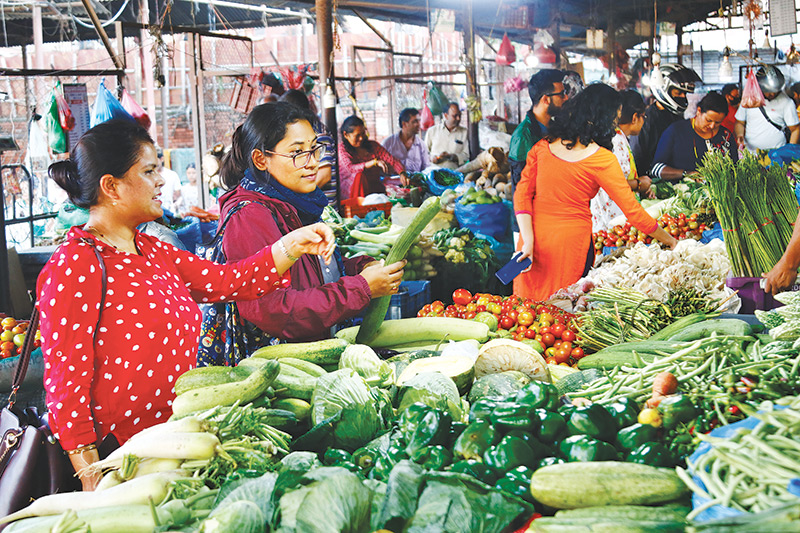
Taxes, particularly VAT, are a new threat to consumers hit by high inflation. Post File Photo
KATHMANDU, Nepal is staring at stagflation, a scenario where an economy faces high inflation, low growth and high unemployment—all at the same time, economists said on Monday. Nepal’s efforts to stamp out a surge in inflation have slowed the economic growth rate sharply. At the start of the current fiscal year, the government had pompously declared that the economy would grow by an astounding 8 percent during the year. But reality set in soon enough. As the economy floundered, the gross domestic product (GDP) growth rate projection was halved to 4 percent during the mid-term review of the budget. Then in April, the National Statistics Office said the economy would not grow by more than 1.86 percent, the lowest growth rate since the fiscal year 2015-2016. That year, Nepal was hit by earthquakes. There was an economic contraction in 2019-2020 too, caused by the Covid pandemic. Nepal plunged into its first recession in six decades during the first two quarters of this fiscal year as economic output continued to be weighed down by inflation and political instability. Officials at the National Statistics Office said that Nepal had narrowly avoided a technical recession in the third quarter. “Inflation will keep on rising and we could face even higher inflation in coming years,” said Biswash Gauchan, executive director of the Institute for Integrated Development Studies. “The burden of stagflation will make the poor suffer as a significant portion of their income is spent on food,” said Gauchan. He was speaking at the unveiling of Global Food Policy Report, 2023 in Kathmandu on Monday. The report urged Nepal and other South Asian nations to focus on their food prices system, else high prices could make lives of everyone hard. According to the report, the recovery and development of food systems in South Asia face multiple challenges. Although the spillover effects from the Russia-Ukraine war have not been large, South Asia has been affected by the global rise in food, fuel, and fertiliser prices. Food prices in the region have risen sharply, contributing to food insecurity. Gauchan said that the Covid pandemic included geopolitical shocks and supply disruptions, which have had a devastating impact on Nepal’s economy. “Adding to the challenge, Nepal is experiencing a uniquely high price level, probably the highest in the region, making our products less competitive,” said Gauchan. Land prices in Nepal are among the highest in the world. Economists say that land for Nepalis has become a high-value asset instead of a mode of production. For example, if a farmer sells his land and puts the proceeds of sale in a bank, he makes a handsome monthly earning from its high interest rate. But, if he uses it as a mode of production, he makes a meagre income from it. Climate change is adding to the woes with farmers facing huge losses annually. In October 2021, the Ministry of Agriculture and Livestock Development estimated that the unseasonal rainfall in the autumn had caused a loss of nearly Rs10 billion in the agricultural sector, including livestock. “Climate change is one of the major reasons for the disaster being confronted by Nepal. It has exaggerated the threats to our food system,” said Narayan Kaji Shrestha, deputy prime minister and home minister. “Nepal’s rising food crisis not only highlights the economic and social disparity, there is also a change in the behaviour patterns such as shifting to cheaper and less nutritious foods,” said Shrestha. Food insecurity in Nepal has increased in recent years as Nepal is becoming more dependent on imported food, he added Nepal’s ever-swelling agricultural imports hit the Rs400 billion mark in the last fiscal year ended July 16, 2022, prompting experts to warn that a farming country becoming so dependent on imported food indicates a full-blown emergency. Taxes, particularly VAT imposed by the government, are a new threat to consumers hit by high inflation. Shahidur Rashid, director of the South Asia Region at the International Food Policy Research Institute, said the geopolitical tension in one region impacts the other region. For instance, according to him, the Russian invasion of Ukraine has had far-reaching consequences. It has made everything more expensive. “Nepali farmers had to suffer due to a sharp rise in the fertiliser prices.” Natural disasters have increased over the last two decades in South Asia. “This adds more threats to food security,” said Rashid. The frequency of extreme weather events like floods, cyclones, heatwaves and earthquakes has gone up, leading to internal displacement and forced migrations. Building a sustainable food system in South Asia is, perhaps, the most important thing to do in the world, Rashid said. Nepal’s agricultural sector has been underperforming over the decades. The sector growth, which was 5.2 percent in 2019, declined to 2.4 percent in 2020. The growth in 2021 was 2.8 percent, which reached 4.2 percent in 2022. The report said that South Asia is far off the track to achieve Sustainable Development Goal 2, which is Zero Hunger, by 2030. “It’s because the governments of South Asia failed to tackle the problem in the agriculture sector,” the report said. “The number of undernourished people and those facing severe food insecurity have increased substantially over the past five years.” Nepal’s prevalence of undernourishment, which was below 5 percent in 2017, increased in 2021. The country’s prevalence of severe food insecurity, which was slightly more than 10 percent in 2017, has increased to nearly 15 percent. The frequency of natural disasters has also been increasing in Nepal in the last two decades. Floods are among the most lethal natural disasters in South Asian countries, followed by storms, droughts, earthquakes, landslides, epidemics and extreme temperatures. “Political instability and violence are also key components that have been threatening food security in the South Asian region,” the report said. The report recommended short- and long-term measures to tackle the food system crisis in South Asia, which include identifying the vulnerable households and groups—women, children, the elderly, and disabled persons—and providing them adequate support. It recommended the promotion of intraregional trade, including the removal of recently adopted protectionist policies and increasing production by improving smallholders’ access to modern technologies and inputs. Investments in customised climate-smart agriculture systems need to be increased in order to avoid a full-blown emergency in the coming years, the report suggested.
HOME PAGE
Expectations low as the socialist front comes into being
Baburam Bhattarai opts out. Socialist Front Nepal has 54 lawmakers in the House of Representatives.
- NISHAN KHATIWADA
KATHMANDU, Nepal’s leftist forces announced the much-touted socialist front on Monday. The CPN (Maoist Centre), the CPN (Unified Socialist), the Janata Samajbadi Party and the Communist Party of Nepal led by Netra Bikram Chand Biplav announced the formation of the front amid a function at Rastriya Sabha Griha in Kathmandu. Maoist Centre chair Pushpa Kamal Dahal, Unified Socialist chair Madhav Kumar Nepal, Janata Samajbadi Party chair Upendra Yadav and Communist Party Nepal General Secretary Netra Bikram Chand jointly signed the agreement on the Socialist Front Nepal. The combined strength of the four parties makes the front the third largest force in Parliament. It has 54 seats in the House of Representatives: 32 of the Maoist Centre, 10 of the Unified Socialist, and 12 of the Janata Samajbadi Party. It has, however, the largest share in the federal Cabinet, with ten ministers and three ministers of state. The front partners have agreed to set up a secretariat to implement the front’s policies, plans and programmes, for monitoring purposes and for day-to-day operation. The secretariat will incorporate representatives from all member parties. They are also planning to expand the front in the provincial and the local levels, should the situation demand. They will establish a coordination committee incorporating the chairs of the member parties and other representatives for taking policy-level decisions. That committee can form subcommittees and assign their jurisdiction based on necessity. The front has left the door open for other political parties to join. The four top leaders will lead the front by turns, as per the agreement. Speaking at the launching function, Nepal Communist Party General Secretary Chand said, “The goal is to free our nation from this crisis…where the youths feel confused and the general public feels restless. The regressive forces should not benefit at any cost. This is why we are undertaking this historic experiment.” Similarly, Janata Samajbadi Party chair Yadav said, “We have formed this front in a bid of the progressive and revolutionary forces to move ahead together. A lot of political work is left to be done. We will proceed by correcting the many mistakes and flaws we made in the past.” “The danger of regression is evident,” said Nepal, the chair of Unified Socialist. He said the front will try to mitigate the danger and thus win public trust. Prime minister and the Maoist Centre chair Pushpa Kamal Dahal said effort will be made to incorporate other like-minded political forces in the front, claiming that the front has not been put together out of a sudden impulse. According to Dahal, the failure of the Nepal Communist Party is a matter to be seriously assessed. He further said, “In the past, problems surfaced due to the hurried unity between the parties. So now, by learning from the past, the front will move forward as one force while also maintaining individual parties’ independence.” Nepal Samajbadi Party chair Baburam Bhattarai, who had also expressed his willingness to be a part of the front while it was being formed, however, skipped the announcement function. Merging, unifying, and splitting have for decades been rituals of Nepal’s communist forces. Many times, communist forces have come together by promising big things, only for the unity to soon unravel. One such example is the dissolution of the Nepal Communist Party, which was considered to be the most powerful communist force in Nepal’s history, in early 2021. With the chequered history of leftist fronts, political watchers doubt the sustainability of the recently formed socialist front as well. Political analyst Rajendra Maharjan said the front appears to have been formed with immediate parliamentary arithmetics in mind—and not by stepping on long-term agendas. “Almost all political parties talk about socialism. This front has no concrete idea on how they will realise their goals,” he said. Maharjan added that the political parties in the front appear keen on increasing their bargaining power if they have to bargain with the CPN-UML and Nepali Congress in the future. For Vijay Kant Karna, another political commentator, the sole reason for the front’s existence is to consolidate power and create a political space for themselves. “All the constituent parties have weakened and fared poorly in recent elections. That’s why they want a front to show their presence,” he said. “Also, the parties fear that if they weaken, their leaders will disperse.” The Maoist Centre has shrunk from 53 seats in 2017 to 32 seats in the House of Representatives. Similarly, the Unified Socialist failed to even be a national party and the Janata Samajbadi Party has weakened in its own bastion, the Madhesh. The Nepal Communist Party also has no visible presence in parliamentary politics. In Karna’s reckoning, the front’s longevity is in doubt. “It will not last as it lacks concrete objectives. None of its constituent parties accept each other’s leadership,” he said.
HOME PAGE
800 were on the boat that sank off Greece: Pakistan police
- REUTERS
MUZAFFARABAD, Pakistan, A boat that capsized off the coast of Greece last week was carrying around 800 people, according to an initial investigation by police in Pakistan, which declared a national day of mourning on Monday. Pakistani authorities said they had arrested 14 suspects in connection with the alleged trafficking of migrants and police said they were searching for other suspects. A statement from Prime Minister Shehbaz Sharif’s office said the Pakistani government had ordered a high-level inquiry into the human trafficking network thought to be involved. National flags were at half-mast on all official buildings on Monday in Pakistan, which was home to some of those who drowned last week. The police report said one of those arrested had admitted to sending three men onto the boat, which had a capacity for 300-350 people, and had charged them each up to three million Pakistani rupees ($10,452.96). The assessment 800 people were on board came from initial investigations, police officer Riaz Mughal said. “We learnt from two survivors, the arrested suspects and the bereaved families that the boat was carrying around 750 to 800 people,” Mughal told Reuters. Witness accounts had placed the number on board at between 400 and 750 people and Greek authorities have said 104 survivors and 78 bodies have been brought ashore. One of the suspects arrested in Pakistan said his own son had been on the boat, and was missing, the report said. It also said the main suspect behind a smuggling network spanning Libya, Pakistan and Greece, was based in Libya. Mughal said at least 21 of those who died last week came from the Kotli district in the Pakistani-administered part of the Himalayan Kashmir region, from which people have left for Europe for many years. Senior Regional Police Officer Tahir Mahmood, based in Muzaffarabad, Kashmir’s capital, said the police were hunting further suspects in addition to those arrested. He did not specify how many.
HOME PAGE
Cabinet under fire for dropping case against teacher’s attackers
Chalaune on hunger strike protesting decision to withdraw attempted murder case against pro-Congress students.
- ANUP OJHA
Police detain Prem Chalaune (centre right) from Kathmandu District Court on Monday. Post Photo
KATHMANDU, Police on Monday briefly detained Tribhuvan University assistant professor Prem Chalaune after he launched a hunger strike inside the premises of the Kathmandu District Court. He was protesting last week’s government decision to withdraw a case against a group of students who physically assaulted him three years ago. Police said Chalaune was arrested shortly after he and his supporters ‘created disturbance’ inside the District Court premises. They had shouted slogans against the government decision and announced a hunger strike at the court. Chalaune and his supporters were released two hours later, according to police. “We released him after a brief detention at the Metropolitan Police Circle at Singha Durbar,” said Superintendent of Police Sitaram Rijal, who is also a spokesman of Kathmandu District Police Range in Teku. Chalaune, an assistant professor of sociology at the university campus in Kirtipur, was brutally beaten on campus on October 6, 2020 by a gang including Hari Achayra, TU chapter president of Nepali Congress-affiliated Nepal Students’ Union (NSU); Yogendra Rawal, secretary of the same organisation; along with other members of the union. Chalaune had sustained serious injuries on his head, chest and thighs, and spent a month in hospital. Even as a case of attempted murder against the assailants is sub judice at the District Court, the Cabinet on June 13 decided to withdraw the case. “My physical and mental conditions are not good. I have been living under constant fear,” Chalaune told reporters at the District Court on Monday. According to him, he has been regularly attending court dates for the past three years. The final hearing of the case has been scheduled for Tuesday. Of the seven defendants in the case, which was filed by the district attorney as it is a criminal case, two are on the run and the remaining seven were released on bail. “You don’t get justice here, this country is governed by goons,” he said. He accused the government of killing truth, justice and humanity by deciding to withdraw the case. “I came to the court to protest as all my options were blocked. The government itself has killed justice. If the government can settle such a case, what’s the use of the judiciary?” he questioned. Talking to the media in the court premises on Monday, Chalaune said he had only asked the representatives of the student union at the university to remove the padlock, which they had placed at the sociology department’s gate for 60 days, and they brutally beat him up. “What would a teacher say when his department is closed for two months?,” he questioned. He also said goons had stalked him for weeks before attacking him. “How can you imagine that ordinary people in far-flung villages will get justice when a university teacher in the Capital is subjected to such injustice? If politicians cover-up such a heinous crime committed in broad daylight, how do you expect the people in remote areas to get justice?” questioned Chalaune. “I can’t tolerate this injustice any more,” he said after the police released him in the afternoon. In the evening, Chalaune started a ‘fast-unto-death’ strike at the TU chancellor’s office in Kirtipur. This is not just the first case of a university teacher or scholar being attacked or assaulted by groups with political affiliations. Earlier this month, a group of NSU students misbehaved with Purbanchal University Service Commission Chairman Mahesh Raj Dahal.
The NSU students had barged into Dahal’s residence at Aapgachhi in Itahari Sub-Metropolitan and splashed black paint on him. Later police arrested the NSU Morang chapter president Saroj Pokharel. A video footage of the offending NSU students has gone viral on social media. Following strong public criticism of the misbehaviour, police arrested Pokharel. Many people termed the NSU act as barbaric, and an example of growing lawlessness in the country. “The Cabinet decision has set a wrong precedent and shows student unions are above the law,” Dinesh Prasain, who teaches sociology to MPhil students at the Tribhuvan University, told the Post while reacting to the government decision in Chalaune’s case. “He [Chalaune] survived by sheer luck. The attack was an act of complete hooliganism, and how just is it for the Cabinet to make a decision, which is a court’s job? ” said Prasain. Soon after it became known that the Cabinet had decided to withdraw the case, social media users unleashed a barrage of criticism of the move. “Cabinet? Protecting citizens or criminals,” wrote Twitter user Rita Thapa. Raju Prasad Chapagain, a constitutional and human rights lawyer tweeted saying “withdrawing the case means killing the right to justice.” “Therefore, the decision should be withdrawn immediately,” Chapagain wrote. Sanjeev Uprety, an author and civil society activist, demanded justice for Prem Chalaune. “This decision not only attacks the core of the rule of law and independent judiciary but also makes university a place of extreme politicisation and criminal attacks. The government should withdraw the decision immediately,” Uprety tweeted in Nepali. “There should be an independent judicial enquiry and the culprits should be punished. Prem should get justice.”
NATIONAL
Continued rain hampers rescue efforts in east Nepal
As many as 27 people are still missing in separate incidents of floods and landslides in Sankhuwasabha, Panchthar and Taplejung.
- DIPENDRA SHAKYA,ANANDA GAUTAM,LAXMI GAUTAM
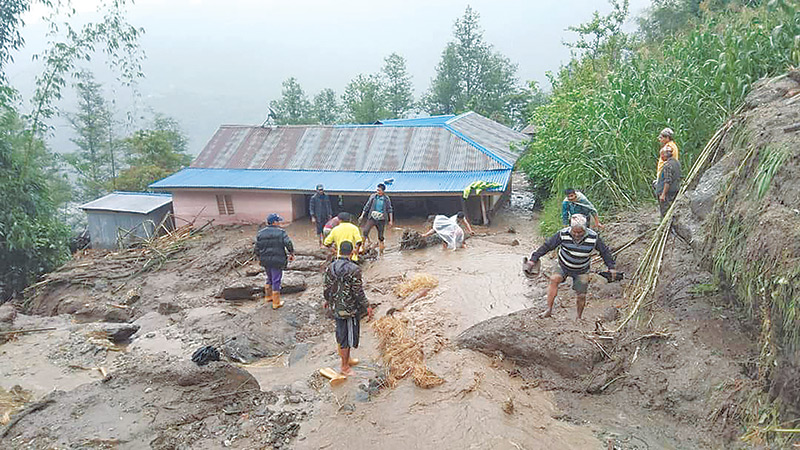
People salvaging belongings at a house half-buried by a landslide at Khewang in Sirijangha Rural Municipality in Taplejung district, picturedon Monday. POST PHOTO
SANKHUWASABHA / TAPLEJUNG / PANCHTHAR Adverse weather conditions affected rescue and relief works in the floods and landslides affected areas in eastern Nepal on Monday. Rainfall continued throughout the day, hampering efforts to search for the missing and rescue those trapped in the disasters. According to government authorities, as many as 27 people are still missing in separate disasters triggered by heavy monsoon rains in Sankhuwasabha, Panchthar and Taplejung districts on Saturday night. Security personnel rescued 12 victims while the death toll caused by the monsoon mayhem in the eastern hill districts of Koshi Province reached eight on Monday. One dead body remains unidentified. According to the District Police Office in Sankhuwasabha, a joint group of 250 security personnel of the Nepal Army, Nepal Police and Armed Police Force have been mobilised to find 18 workers from Super Hewa Hydropower Project. “The rescuers have been facing difficulties due to continuous rains and disruption of rural roads in the affected area,” Deputy Superintendent of Police Birendra Godar said. Security personnel, people’s representatives, relatives of the missing victims and the locals searched for the missing the whole day on Monday but could not trace them. A body, according to police, was recovered on the banks of the Hewakhola stream but the identity of the body is yet to be ascertained. A man died in the floods while altogether 21 people went missing in separate incidents of floods in Sankhuwasabha. Eighteen people working at the six-megawatt hydropower project went missing as the flooded stream buried the project site. In Taplejung, Keshar Kumar Rai and his son Suresh Rai died as a landslide struck them near their residence at Mehele village of Sidingwa Rural Municipality-6. Ganesh Tamang from the same village died in a landslide on Saturday night. Another local, Raj Kumar Rai, sustained injuries in Monday’s landslide. A Nepal Army helicopter medevaced him to Biratnagar, the provincial headquarters of Koshi.
Sidingwa Rural Municipality has been hit the hardest by rain-induced disasters. The whereabouts of three victims who went missing in a landslide in Sidingwa-6 on Saturday night are still unknown. According to Chief District Officer of Taplejung Goma Dev Chemjong, the floods and landslides incurred damage in Maiwakhola, Pathibhara and Yangbarak rural municipalities as well. Ratna Lingden, the ward chief of Sidingwa-6, said around 400 of the ward’s total 500 households are at risk of landslides. “I urged them to stay in Nilgiri Secondary School and Devithandanda as they are relatively safer,” Lingden said. He expressed his dissatisfaction as the government has not provided relief materials such as tents, food and blankets to the displaced people. “Roads are disrupted and we can’t seek help from anyone else,” he added. “The government should make arrangements to provide the victims with basic necessities at least.” The meeting of the district natural disaster management committee held on Sunday decided to request the local units to provide relief materials in the disaster-affected areas. “We would certainly help our people but the rural roads and foot trails have been disrupted since it has been continuously raining in the area,” said Man Bahadur Rai, chairman of Sidingwa Rural Municipality. “We don’t have a helicopter. How can we reach the victims in this situation?” In Taplejung, the disasters damaged three motorable bridges, five suspension bridges, two hydropower projects and eight public buildings, including Mehele Health Post. Scores of people have been displaced in the district. Danish Gurung and his wife have been staying in a cave with their two-and-half-year-old daughter in Surumkhim of Sidingwa-7 for the past few days as a landslide at Gagre put an animal shed they were staying at high risk. According to Chetmaya, Danish’s mother, their rescue was not possible as the flooded Tawakhola swept away a suspension bridge and it has been continuously raining in the area since Saturday. Panchthar is also witnessing continuous rainfall since Saturday. On Monday, heavy rains lashed Phidim Municipality, Hilihang Rural Municipality, Yangwarak Rural Municipality, and Phalelung Rural Municipality. Thirty-five houses have been affected in these four local units while the number of displaced families has been increasing every day, according to the District Police Office, Panchthar. On Monday afternoon, the Panchthar-Terhathum road section of the Mid-Hill Highway was blocked due to a landslide caused by continued rainfall. Earlier on Sunday morning, rainfall destroyed the Hewa bridge on the Mechi Highway and a Bailey bridge on the Tamor corridor, completely disconnecting three local units—Hilihang Rural Municipality, Yangwarak Rural Municipality, and Phalelung Rural Municipality—from roads. The road connection between Taplejung and Panchthar has also been disrupted due to the collapse of the Hewa bridge. According to Mekh Bahadur Magrati, chief district officer of Panchthar district, 12 people who were trapped in their houses in Phedi, Yangwarak-1 due to floods and landslides were rescued in a helicopter by the Nepali army on Monday morning. Currently, the rescued people are taking shelter at the Bishnu Secondary School in Chyangthapu, Yangwarak-1. Magrati said that the basic and daily necessities of the rescued and other victims have been arranged in coordination with the local level and the district disaster management committee. Three people have lost their lives in Panchthar since Saturday, according to him. The deceased were from Hilihang-7, Phidim-10, and Phalelung-3. Three people are still missing while one injured is receiving treatment at the district hospital, Magrati said. According to the District Administration Office, Panchthar, around 15 small and big bridges have been destroyed due to landslides and floods. More than 50 cattle have died. Several farmers’ land and crops near the banks of the river have also been swept away. DSP Hari Khatiwada of the District Police Office said that floods and landslides have blocked and damaged several roads connecting the local units to the district headquarters in Phidim, making the search, rescue, and relief operations challenging. Prime Minister Pushpa Kamal Dahal, who reached the flood-affected areas on Monday, said that relief and rescue work would be carried out as quickly as possible. He assured rehabilitation of the displaced and prioritisation of the construction of Bailey bridges in areas where bridges have been washed away by floods. Dahal has also directed all the government agencies of the district to join the rescue, relief, and search operations for the missing persons. Along with the Prime Minister, Deputy Prime Minister and Home Minister Narayan Kaji Shrestha, Physical Infrastructure and Transport Minister Prakash Jwala, and Urban Development Minister Sita Gurung, people’s representatives of the affected areas Yogesh Bhattarai, Basant Nemwang, Deepak Khadka, and Koshi provincial assembly member Rajendra Karki visited the affected districts on Monday.
NATIONAL
Screening of ‘Adipurush’ stalled nationwide
Briefing
KATHMANDU: The screening of the Indian movie ‘Adipurush’ has been stalled nationwide citing issues of law and order. Kathmandu Mayor Balendra Shah on Sunday had taken to his Twitter and Facebook accounts to announce the metropolis’ decision to bar all Indian movies from screening at cinemas within Kathmandu Metropolitan City. The move came after Shah’s call to rectify a particular statement used in the film went unheeded. “Until Monday morning, only Kathmandu and Pokhara had decided to bar screening of the film. Soon other cities—Dharan, Itahari, Janakpur, Dhangadhi, Chitwan—followed suit,” said Manoj Rathi, a film distributor associated with Shree Venkatesh Films, the official distributor of ‘Adipurush’ in Nepal. The controversy around the movie had already affected its business, and now the stoppage of the film’s screening has ended any hopes of recovery, Rathi added.
NATIONAL
One dead in Humla jeep plunge
Briefing
HUMLA: One person died in a jeep accident in Humla, a remote mountain district of Karnali Province, on Monday. “Jeep driver Rajesh Hemjunj Tamang, who had sustained injuries in the accident, died while undergoing treatment at the district hospital,” said Deputy Superintendent of Police Bhimlal Bhattarai. The jeep heading for Hilsa from Simkot, the district headquarters, swerved off the road and plunged some 50 meters off the Chyachhahara cliff into the Karnali river. Tamang, a resident of Janakpur in Dhanusha district, managed to escape the accident by jumping off the vehicle but sustained serious injuries. There were 12 passengers in the jeep. They survived the crash as they were asked to get off after the jeep struggled to drive up an uphill slope, said police.
NATIONAL
Former director general of irrigation department faces corruption charge
He is accused of amassing Rs35.67m illegitimately.
KATHMANDU, The Commission for Investigation of Abuse of Authority on Monday filed a corruption case against Madhukar Prasad Rajbhandari, former director general of Department of Water Resources and Irrigation, at the Special Court allegedly for amassing illegal properties. The anti-graft body said in a press statement that Rajbhandari amassed properties worth Rs35.67 million through illegitimate means. Rajbhandari served in the government services from March 14, 1995 to September 16, 2022. According to the CIAA, Rajbhandari could show the legal source of his income amounting to Rs38.55 million during his government services. His legal income was generated from his salary, savings made by his wife, retirement benefit received by his wife, daily visit and local allowances, income from maturity of insurance policies, income from sales of shares, loans taken from various financial institutions including Employees Provident Fund, rental income, pensions, remittances and dividends from shares ownership, the anti-graft body said. But he invested as much as Rs74.22 million in land purchases, house construction, purchase of shares, loan payment, premium payment for insurance policies, study expenses, investment in companies, purchase of vehicles and bank balances. The CIAA said that a corruption case has been filed at the Special Court as Rajbhandari was found to have amassed properties illegally and lived an unusually high standard of life during his service period in the government. The anti-graft body has also named his wife, Deepa Shrestha, as defendant stating that illegal earnings made by Rajbhandari were used in purchasing lands, constructing a house, making investments in a company and paying insurance premiums in her name.
NATIONAL
Health ministry alerts agencies concerned about monkeypox risks
Experts have warned against complacency, which could trigger an outbreak of the virus in communities.
- Post Report
The symptoms of monkeypox include fever, headache, body pain, and itchy rashes on face, hands, and feet. Shutterstock
KATHMANDU, The Epidemiology and Disease Control Division has alerted all agencies concerned about the risk of an outbreak of the monkeypox virus in the communities. The division’s move comes amid concerns about the spread of virus in the communities, especially after the country on Saturday confirmed its first case of monkeypox infection. The virus was detected on a 60-year-old foreign woman in Kathmandu. “The agencies have already started taking measures to lessen the spread of the infection,” said Dr Hemanta Ojha, an official at the division. To lessen the risk of the outbreak, the health ministry has started contact-tracing persons who came in close contact with the infected woman, investigating the outbreak, stepping up surveillance and alertness level at the health desks in international border points and international airports. Ojha said that officials have been working to trace primary contacts of the infected woman. Surveillance will be continued as it takes up to 21 days for the symptoms to develop, officials say. Gopal Pandey, a health worker deployed at the health desk established at the Tribhuvan International Airport, said that they have been asked to send passengers to the hospital if they have fever, rashes and other symptoms of monkeypox. However, such an alert had also been issued a year ago following the outbreak of the virus in several countries in Europe and Africa and North America. Public health experts say that every disease seen in any corner of the world has a possibility to come to Nepal due to the high mobility of its own people and the foreign tourists. “People from any part of the globe can come to Nepal, which means, the risk of any disease seen in any corner of the globe arriving here exists,” said Dr Sher Bahadur Pun, chief of the Clinical Research Unit of the Sukraraj Tropical and Infectious Disease Hospital. “Our own experience during the Omicron outbreak shows that deadly diseases could enter the country long before we know about them.” Pun said there is a higher possibility of a disease like monkeypox spreading in the communities as people don’t open up about such problems. “People generally do not go to the hospitals to get examined for sexually-transmitted diseases.” Experts say screening suspects at the health desks of international airports and land crossings are not sufficient to prevent a possible outbreak of monkeypox in the country since it usually takes between five and 21 days for the first symptoms to appear. The confirmed case of infection was also identified at a private clinic in Kathmandu. Monkeypox is a rare disease caused by infection with the monkeypox virus. Most common in the remote parts of Central and West Africa, the disease has now been reported in at least 112 countries, including Nepal. Neighbouring India has also reported cases of monkeypox. Its symptoms include fever, headache, swelling, body pains, exhaustion, and itchy rashes on the face, hands, and feet. As the disease primarily spreads through close person-to-person contact, public health experts recommend self-isolation and good hygiene to avoid it. The World Health Organization has designated the outbreak as a public health emergency of international concern—which is the highest health alert. The UN health body says that an international public health emergency is an “extraordinary event” that poses a serious public health risk. Covid-19 and Ebola outbreaks were also followed by such a declaration. More than 87,000 cases and 112 deaths from monkeypox have been reported in 2022, according to the UN health body. Doctors say even though the monkeypox infection is usually mild and most people recover within weeks, the authorities concerned should not underestimate the risks. “Surveillance should be stepped up, contact tracing should be made effective and study should be also carried out if cross transmission has happened to pets,” said Dr Prabhat Adhikari, an infectious disease expert. “Medicines should be ensured and ring vaccination should be done if it’s found that other people are also infected with the virus.” Experts say health workers should be trained on the risks, symptoms, and treatment procedures for monkeypox. Chances of misdiagnosis will be high in persons infected with the monkeypox virus as its symptoms are similar to chickenpox or smallpox. Meanwhile, the Health Ministry has said the health condition of the monkeypox-infected woman is normal.
OPINION
Geoeconomics over geopolitics
Nepal faces challenges in managing diplomacy on three levels—global, regional and bilateral.
- ACHYUT WAGLE
Post Illustration
On Monday, United States Secretary of State Antony Blinken concluded his visit to China, the first by an American secretary of state in the last five years. The US described Sunday’s talks with Chinese counterpart Qin Gang which lasted five and a half hours as “candid, substantive and constructive”. The Chinese propaganda machine too called the discussions “candid, in-depth and constructive”. The US strategy of diplomatic engagement comes at a time when relations between the world’s two largest economies are at their lowest point since 1979. Relations rapidly deteriorated in recent years primarily over the question of Taiwan which Beijing views as “the core of China’s core interests, the most consequential issue and the most pronounced risk in China-US relations.” There were global apprehensions that the Taiwan issue might escalate into a full-blown military conflict with instant ramifications on the international supply chain, financial markets and global security. The biggest achievement of Blinken’s China sojourn is the agreement to continue the “conversation” in the future. Observers feared that the global economy, already feeling intense heat from the protracted Russia-Ukraine war, might face another deadly shock if any form of conflict involving the two largest economies began in the South China Sea, the world’s busiest maritime corridor. But the fact is that despite the adamant diplomatic posturing and intense competition for geopolitical influence, both sides have deeper economic interests which they are not prepared to forsake. US-China trade is poised to cross $700 billion in 2023, making China America’s largest single country trade partner surpassing Canada and Mexico. The merchandise trade balance is heavily skewed in China’s favour. This is the reason why Blinken and Qin agreed to “encourage more people-to-people and educational exchanges, increase the passenger flights between the two countries and to welcome more mutual visits by students, scholars and business people.” The US has a huge Chinese diaspora and China is host to hundreds of American multinational companies. US foreign direct investment stock in China is valued at about $2 trillion.
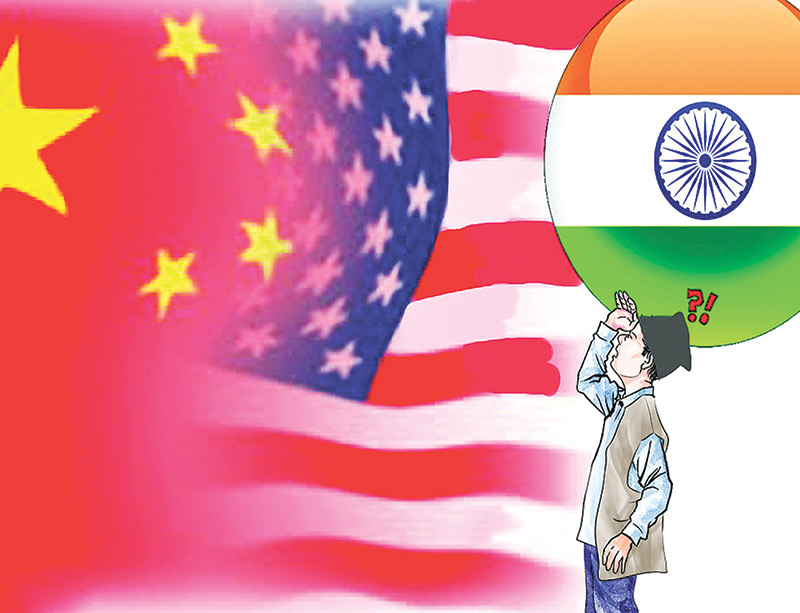
Regional dimension Although these high diplomatic dramas of the superpowers are out of Nepal’s league, she is destined to be at the receiving end of their inevitable outcomes. Situated between China and another global power India, Nepal also enjoys 75 years old relations with the US. When all these great powers and many others choose to compete instead of cooperating, Nepal is left to do a precarious balancing act which is proving to be impossible to perform. Nepal is constantly faced with challenges in managing diplomacy on three levels—global, regional and bilateral. Western democracies are keen on containing Chinese “advances” in the form of economic and cultural engagements in Nepal. There are allegations that the West uses Nepal as a point to peep into China. The increasingly fierce competition between China and India to extend their respective spheres of influence in Asia has obvious repercussions on Nepal and its ecopolitical dynamics. India’s increased engagement with the US and the rest of the democratic world has apparently irked China. Here too China and India are the biggest bilateral trade partners on the Asian continent. Therefore, China has been quick to introduce a series of diplomatic instruments. Besides the decade-old Belt and Road Initiative (BRI), China has launched the Global Development Initiative (GDI), Global Security Initiative (GSI) and Global Civilisation Initiative (GCI) and asked countries including those in the immediate neighbourhood to join them. The $50 billion China-Pakistan Economic Corridor and $25 billion China-Myanmar Economic Corridor under the BRI are the flagship projects of Chinese investment in the region. Economic engagements in Bangladesh, Afghanistan and Nepal are also significant.
Nepal in a fix On a bilateral level, Nepal is already a member of the BRI and part of the GDI. Last week, China asked Nepal to officially join the GSI and the GCI. Nepal has expressed its inability to support the GSI because of its location and longstanding “non-aligned” policy. The GCI which is designed to share “China’s wisdom to the world” has an interesting catch. Nepal has made the excuse of needing more time to study it since it is a fairly new proposition. Apparently, this appears to be a different “soft” tool to expand influence. What is notable about the Chinese “reminder” to support the GCI is the timing. During Prime Minister Pushpa Kamal Dahal’s recent India visit, he not only visited Mahabaleshwar Temple in Madhya Pradesh dressed in a saffron dhoti like an orthodox Hindu, but also paid homage to Pashupatinath after his return to Kathmandu as part of the rituals traditionally performed to conclude a pilgrimage. This was a highly unbecoming act for a “Maoist” communist leader. To the Chinese, it must have appeared as a manifestation of India’s civilisational influence, therefore, they brought forward the new proposal of the GCI. In nutshell, despite purported differences over the strategic aspects of relationships, whether between the US and China or between India and China, economic interests will prevail over crude geopolitics.
OPINION
Protecting vulnerable refugees
A failure to prosecute the culprits in the fake Bhutanese refugee case may tarnish Nepal’s image.
- Neetu Pokharel,Som Niroula
Post File Photo: Prakash Chandra Timilsena
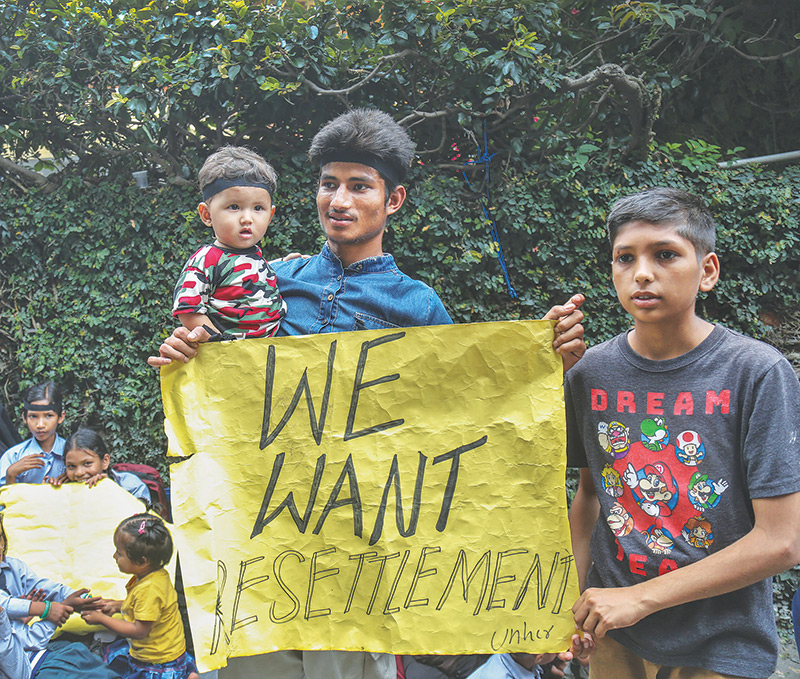
The institutionalisation of corruption in politics and government has derailed the value of democracy, the rule of law, and human rights in Nepal. One such instance is the recent controversy over the making of fake Bhutanese refugees by misusing state mechanisms and with the direct involvement of high-level government functionaries. Such actions not only damage the integrity of Nepal’s political system but also erode the faith of the national and international agencies in the country. Additionally, it undermines the government’s role towards its citizens and refugees. As we observe World Refugee Day today, we must consider how the recent fake Bhutanese refugee scam has tarnished the image of refugee communities worldwide and why it is a serious crime. Refugees in Nepal have been facing various forms of discrimination in the camps, including lack of access to education, health, food, housing and social security. Although the Nepali state has actively facilitated the third-country relocation of the Bhutanese refugees, the manipulation of refugee data and the misuse of its resources in turning Nepali citizens into fake Bhutanese refugees calls into question its commitment to protecting refugees.
Protection practices vary In the early nineties, almost 113,000 Nepali-speaking Lhotshampas from southern Bhutan were evicted by the repressive government of the time. The Lhotshampas, subsequently called Bhutanese refugees, first arrived in India and were further pushed by the Indian state to Nepal’s eastern plains. Some Nepali-speaking Bhutanese citizens still linger in various prisons of Bhutan as political prisoners. The refugee crisis has failed to resolve even after several rounds of dialogue between the Nepal and Bhutan governments, primarily due to the reluctance of the latter. India’s role in resolving the crisis has hardly been positive, and Bhutan continues to play the diplomatic card, flaunting its Happiness Index in front of Western governments. The Bhutanese refugees stayed about 18 years in the several camps of Jhapa and Morang, waiting to return to their homes. However, several rounds of dialogue among the political parties and civil society organisations in the camps for their resettlement failed to create a safe and dignified environment for their return. Thanks to a resettlement programme, around 113,500 refugees have been resettled in the United States, Canada and Australia, among others. Similarly, around 400 Myanmarese citizens who were forced to leave their country are living in Nepal. They live precarious life as they do not have identity cards. The Nepal government does not support their food, education, health, care, and protection. The role of the United Nations Human Rights Council (UNHRC) does not seem proactive and supportive of Rohingya refugees compared to their support of the Bhutanese refugees. Though the Nepal government has not ratified the Refugee Convention 1951, it has the responsibility for the protection and care of the people seeking refugee status in Nepal since the country is the state party of most of the international human rights conventions that guarantee of human rights of people. The government’s role in responding to the need of Tibetan refugees is also different. An estimated 20,000 Tibetan refugees still live in Nepal. These refugees have faced problems while accessing public services and including identity cards. The children of the refugees also face difficulty pursuing higher education due to a lack of proper documentation. What’s more, the Tibetans are often treated by the Nepal government as illegal migrants instead of providing them with refugee status. This clearly shows the vulnerability of the different refugees in Nepal.
Laws and policies The lack of laws and policies makes the refugee communities more vulnerable to securing legal identity and humanitarian support. Nepal is the state party to the nine major treaties which provide the obligation for equal treatment and non-discrimination though the country is not a state party to the 1951 Convention on Refugees. Moreover, Nepal does not have any laws or policies related to refugees. The government’s response to the refugees should be guided by the principle of respecting human rights and nondiscrimination. The recent Bhutanese refugee scam has drawn the attention of national and international communities. It is not just the issue of corruption; it is an organised crime against the state and a reflection of corruption institutionalised by state agencies. First, the critical condition of the rule of law in the country has been aggravated more in this case. The government and judiciary should be prompt in a fair investigation and prosecution of those directly or indirectly involved in luring the people and in this crime. A failure to properly investigate and prosecute the culprits may raise expose the incompetence of government and judiciary at the national and global levels. Second, the recent scam should not undermine the rights of the existing refugees in Nepal. The issues of social protection, safety, livelihood and socio-economic rights, along with the dignified life of the refugees, should not be shadowed or kept in low priority amidst the hype of this fake refugee scam. The government and UN agencies should work and collaborate to provide humanitarian assistance and protection of refugees proactively. They should also register refugees and give them a clear identity to avoid manipulation in the future. The Nepal Government’s commitment to nondiscrimination principles and respect for human rights also applies to refugees. The corruption, crime and cheating in the name of refugees should not result in further victimisation of the refugees. Civil society organisations, international agencies and politicians should continue to demand accountability of the government and justice-providing agencies, also help the government in addressing the refugee scam cases fairly and protecting the rights of refugees in Nepal.
Pokharel has worked on women’s rights, peace, justice and development for over a decade. Niroula has worked on human rights for over a decade and has written on forced migration.
OUR VIEW
Confused on China
If we are unclear about what we want, meaningful progress in bilateral ties will remain elusive.
What does Nepal want from China? The answer appears to be pretty straightforward: China, as one of Nepal’s only two contiguous neighbours, gives the landlocked country trading and transit routes that do not pass through India. As the next economic superpower-in-making, China has a lot to teach Nepal in areas like technology, agriculture modernisation and infrastructure-building. It can, moreover, be a vital source of foreign investment. But if we are so clear about our own needs, what explains our failure to fulfil them? Following the 2015-16 Indian blockade, Nepal signed a crucial trade and transit treaty with the northern neighbour. But what has come out of it since? Precious little. And what about the BRI projects that were supposed to result in all kinds of economic benefits for Nepal? Why have they stalled for so long? Maintaining balanced relations with India and China is among Nepal’s stated foreign policy goals. Yet the country is getting more and more dependent on India while its links with China are weakening. Nepal was already heavily dependent on India for everything from fuel to fruits. Now it has also handed over all its big hydropower projects to Indian developers, much to Beijing’s displeasure. Notwithstanding the rhetoric of top leaders, they only look north when their individual equations with New Delhi go haywire. Following the easing of Covid-19 restrictions, there is again increased movement of top officials between Nepal and China. One or the other high-ranking Nepali delegation is invariably visiting China, and vice-versa. Among their other concerns, the Chinese are worried about the slow progress on the BRI projects. Frankly, they must be bewildered. (Even Chinese President Xi Jinping visited Kathmandu in 2019 as a show of trust between the two countries.) In the aftermath of the blockade, Nepali political leaders implored Beijing to come to the rescue of its small neighbour; they said they were ready to explore “India’s alternative”. But no sooner did the memories of the blockade begin to fade, the old vows were conveniently forgotten. The more recent engagements with Chinese leaders will also come to naught unless our political leaders collectively pursue ties with the north as a matter of national interest. Of course, lack of progress on the BRI is not just Nepal’s failure. China too has at times appeared ambivalent on how to push projects under it. Its proximity to Nepali communist parties has not gone down well among Nepalis either. Chinese mandarins often seem to forget that Nepal is a functioning (if a flawed) democracy and has its own, if a touch slower, way of doing things. This is why it is important to be clear about what we want from China as a matter of principle. If the BRI projects are important for us—and there is a common consensus that they are—what are we doing to ensure that we derive maximum benefit from them? How can these projects help us reduce our overreliance on India? If we are unclear about what we want and if individual parties and personnel pursue Nepal-China relations as befits their interest, meaningful progress in bilateral ties will remain elusive. No amount of goodwill visits can compensate for that.
THEIR VIEW
Save the children
Pneumonia confirmed to be the leading cause of infant deaths in Bangladesh.
We are gravely concerned about the unexpected rise in the infant mortality rate in Bangladesh. According to a new government study, deaths of children under five increased to 31 per thousand last year from 28 in 2021, 2020 and 2019. And deaths of children under one increased to 25 per thousand from 22 per thousand. Despite making significant strides over the past decades, this recent increase in child mortality marks a step backwards in achieving our Sustainable Development Goal (SDG) of reducing under-five mortality to at least as low as 25 per thousand live births. The health ministry has also set a target to reduce under-five mortality to 20 by 2035. Experts say the latest figures highlight a lingering gap in child healthcare services in the country, which requires urgent attention and action from healthcare officials. Though reasons behind the rise were not analysed in the latest study, the project director noted that in 2021, pneumonia was the leading cause of infant death, along with jaundice, diarrhoea, malnutrition, acute respiratory infection, and drowning. Experts stated that over 24,000 children in the nation die from pneumonia each year, which can be prevented through an integrated development of the healthcare system. Regarding malnutrition, another recent study in May also showed that 50 percent of children are consuming unhealthy, processed foods. And according to WHO and Unicef, as many as 38 children die every day from drowning, which can be prevented by low-cost solutions such as awareness programmes in local communities. With such staggering statistics but available solutions, it is now time for policymakers to open their eyes and take a comprehensive approach to address the reported causes of children’s deaths in the nation. We urge the officials to take the latest study seriously and launch the required interventions in child healthcare facilities, which also accounts for the socioeconomic inequity in infant survival. Studies have shown that a household’s income status and the region’s administrative division are potential risk factors of infant deaths. Officials must recraft a more holistic strategy, with community-based facilities and awareness programmes to promote healthier lives for all our children.
— The Daily Star (Bangladesh)/ANN
MONEY
World Bank set to approve $700 million for Sri Lanka: Sources
- REUTERS
COLOMBO, The World Bank is likely to approve $700 million in budgetary and welfare support for Sri Lanka at its next board meeting on June 28, sources told Reuters, the biggest funding tranche for the crisis-hit island nation since an IMF deal in March. The economy of the country of 22 million is expected to shrink 2 percent this year before returning to growth next year, the government estimates, following last year’s record contraction of 7.8 percent after foreign exchange reserves hit record lows. The International Monetary Fund approved a bailout of nearly $3 billion in March, which Sri Lanka expects will bring additional funding of up to $4 billion from the World Bank, the Asian Development Bank and other multilateral agencies. Of the proposed World Bank funding, $500 million will be for budgetary support and is likely to come in two tranches of $250 million each, one of the sources, from the World Bank, said. The first tranche is likely to be disbursed immediately after board approval with the next possibly in October, as the bank watches the progress of Sri Lanka’s debt restructuring and the first review of the IMF programme, due in September, the World Bank source added. The remaining $200 million will be earmarked for programmes to assist the poor, whose numbers have doubled to 25 percent of the population since the onset of the Indian Ocean nation’s worst economic crisis early last year, another World Bank source said.
MONEY
Paris air show returns with jets and missiles in demand
- REUTERS
A model of a Future Combat Air System, a European aircraft developed by France, Germany and Spain is displayed during the Paris Airshow at Le Bourget Airport near Paris on Monday. Reuters
PARIS, The Paris Airshow opened on Monday with last-minute jet order negotiations and supply chain headaches competing for attention with rows of missiles, drones and futuristic transport. The world’s largest air show, which alternates with Farnborough in Britain, is at Le Bourget for the first time in four years after the 2021 edition fell victim to the pandemic. French President Emmanuel Macron flew in to the packed aerospace bazaar by helicopter and watched a flying demonstration including Airbus’s latest jet development, the A321XLR, and air power including the French Rafale fighter. The US F-35 fighter was due to fly later on Monday. Belgium said it would apply to join as an observer the potential successor to the Rafale and multinational Eurofighter, the Franco-German-Spanish FCAS fighter project, despite differences between industrial partners over whether to expand the project. The air show is taking place under the shadow of the conflict in Ukraine, with no Russian presence in the chalets and exhibition halls in contrast to the last event four years ago. Some Ukrainian officials and aerospace firms were expected to be present at the show. France’s Thales announced a contract from Indonesia for 13 long-range air surveillance radars. On the commercial side, planemakers arrived with growing demand expectations as airlines rush for capacity to meet demand and help reach industry goals of net zero emissions by 2050.
MONEY
Companies vow to hire refugees in Europe
UN says 110 million people have been displaced globally.
- ASSOCIATED PRESS
LONDON, Multinational companies including Amazon, Marriott and Hilton pledged on Monday to hire more than 13,000 refugees, including Ukrainian women who have fled the war with Russia, over the next three years in Europe. Just ahead of World Refugee Day on Tuesday, more than 40 corporations say they will hire, connect to work or train a total of 250,000 refugees, with 13,680 of them getting jobs directly in those companies. “Every number is a story of an individual family who left everything, seeking safety, seeking protection and wanting to be able to rebuild as quickly as possible,” said Kelly Clements, UN deputy high commissioner for refugees. “So the commitments that businesses are going to make on Monday are absolutely essential.” She says 110 million people have been displaced worldwide, with an estimated 12 million from Ukraine, nearly half of whom are living in Europe after the continent’s largest movement of refugees since World War II. The hiring push in Europe was organised by the Tent Partnership for Refugees, a nonprofit founded by Chobani CEO Hamdi Ulukaya that connects businesses and refugees, and is being unveiled at a gathering in Paris. The group’s first summit in the US last year led to commitments to hire 22,725 refugees. In the new round, Amazon leads the pack, vowing to hire at least 5,000 refugees over the next three years in Europe, followed by Marriott and Hilton with 1,500 each, Starbucks and ISS with 1,000 each, and smaller commitments from brands like Adidas, Starbucks, L’Oreal, PepsiCo and Hyatt. “This is good for us as a company because the opportunity to add diversity to our workforce will continue to make us a stronger company,” said Ofori Agboka, Amazon vice president overseeing human resources. “With diversity brings innovation, creativity, different insights.” He said the vast majority of jobs will be hourly roles at fulfilment and storage centres and in transport and delivery. Companies are hoping refugees can fill staffing needs after the economy bounced back from the pandemic.
MONEY
Facebook owner wants preteens to step into virtual reality with its Quest headset
- ASSOCIATED PRESS
Meta’s next generation mixed reality headset, the Quest 3. Photo: Courtesy of Meta
CALIFORNIA, The corporate parent of Facebook and Instagram plans to open a digital gateway for kids as young as 10 years old to enter virtual reality through the Meta Quest headset, despite rising concerns about children spending too much time on social media. Meta Platforms, which oversees a social media empire created by Facebook founder Mark Zuckerberg, disclosed it will lower the minimum age for a Quest account from 13 years old to 10 years old in a Friday blog post. The Menlo Park, California, company framed the change coming later this year as a family-friendly way for more people to explore artificial realms that Zuckerberg touts as the “metaverse.” The move to lure preteens into a virtual world filled with digital avatars and other technological fabrications comes just weeks after US Surgeon General Vivek Murthy called upon tech companies and lawmakers to take steps to protect children from the potentially harmful mental and emotional effects of too much exposure to social media. Both Facebook and Instagram for years have been under fire for using tactics that get kids hooked on social media at a young age, undercutting their real-life relationships with friends and families while exposing them to the risk of online bullying and abuse by sexual predators. In its blog post, Meta said that parents will retain control over their children’s accounts for the Quest 2 and Quest 3 headsets and promised that preteen access will be limited to “age-appropriate” apps deploying virtual reality, or VR. Preteens won’t be able to have a Quest account without explicit approval from their parents and all apps used on the platform will require parental consent, too, according to the company, which is recommending the younger age group be limited to a two-hour daily time limit on the headset. Other safeguards will include setting all preteen accounts to a private setting by default and a pledge not to show them any ads that generate most of Meta’s revenue. “We’re building this with our Responsible Innovation Principles and our commitment to building safe, positive experiences for young people at the forefront,” Meta wrote in the blog post. The company also is providing parents with extensive guidance when assessing whether they should allow a 10- to -12-year-old to use a virtual reality headset. One section of the guide cites “a growing body of research examining the positive effects of VR in medical/clinical contexts, including interventions to support the development of social competence skills, to distract from painful or anxiety-inducing medical procedures, and to support specific skill development in specialised populations,” such as children with cerebral palsy. By expanding the potential audience for the Quest, Zuckerberg appears to be taking another significant step toward his goal of sculpting the metaverse into a sphere that eventually will be as popular as Facebook and Instagram have become since he started the company in a college dorm room nearly 20 years ago. The metaverse so far has mostly been a digital ghost town, even though millions of Quest headsets have been sold. The Meta division that oversees the Quest headset and metaverse lost $13.7 billion last year while bringing in $2.2 billion in revenue. What’s more, Meta is facing formidable new competition from Apple, which last week unveiled a headset called Vision Pro that’s capable of thrusting users into virtual settings, too. The high-end headset, priced at $3,500, received enthusiastic responses in carefully staged demos, but it won’t be in stores until some time early next year. Meta already has announced the next Quest headset will cost $500 as a way to get more people to buy it before the Vision Pro is released and now is taking steps to get preteens on board.
MONEY
‘Mini Australia Carnival’ concludes in Kathmandu
Bizline
KATHMANDU: The ‘Mini Australia Carnival’ programme, organised in collaboration with Unicampus Global and Mini Australia, concluded successfully on Friday. The event was completed with great enthusiasm at the Unicampus premises at Putlisadak. According to the press release issued by the organiser, the event showcased the best of Australian culture, entertainment and educational opportunities. In addition to various entertaining presentations and activities, the organiser said that the programme acted as a guide for students who want to get an international education in Australia. (PR)
MONEY
India’s Nifty 50, Sensex drop on profit-taking near record highs
Bizline
BENGALURU: India’s blue-chip Nifty 50 and Sensex indexes declined on Monday due to profit-taking as they approached their all-time highs, although the broader indexes extended their rally to record levels. The Nifty index closed 0.37 percent lower at 18,755.45, while the benchmark S&P BSE Sensex fell 0.34 percent to 63,168.30. They rose as much as 0.30 percent earlier, with the Nifty coming within 10 points of its record high of 18,887.60. “There is nervousness in domestic equities near record high levels due to concerns over high valuations and monsoons,” said G Chokkalingam, founder and head of research at Equinomics Research Pvt. (REUTERS)
WORLD
Death toll rises amid sweltering heat wave in 2 of India’s most populous states
Climate experts say that heat waves will continue and India needs to prepare better to deal with their consequences.
- ASSOCIATED PRESS
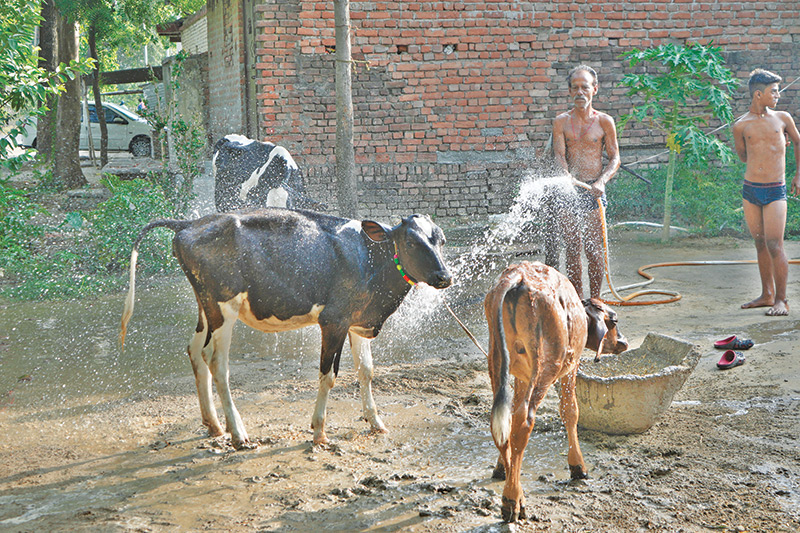
A villager sprays water on his livestock to protect them from heat in Ballia district, Uttar Pradesh state, India on Monday. AP/RSS
BALLIA, Nearly 170 people have died in two of India’s most populous states in recent days amid a sweltering heat wave, officials said on Monday, as hospitals are overwhelmed with patients and routine power outages add to the challenges. In the northern state of Uttar Pradesh, 119 people have died from heat-related illnesses over the last several days while in neighbouring Bihar state 47 people have died, according to local news reports and health officials. The largest hospital in Ballia district in Uttar Pradesh is unable to accommodate more patients, officials said, and its morgue was overwhelmed after 54 people died due to the heat. Some families were asked to take the bodies of their relatives home. While northern regions of India are known for sweltering heat during the summer months, temperatures have been consistently above normal, according to the Indian Meteorological Department, with highs in recent days reaching 43.5 degrees Celsius. A heat wave is declared in India if temperatures are at least 4.5 degrees Celsius above normal or if the temperature is above 45 degrees Celsius. “We have been issuing heat wave warnings for the past few days,” said Atul Kumar Singh, a scientist at the IMD. Despite the warnings, government officials did not ask people to brace for the heat until Sunday, when the death toll began to increase. Adding to the heat stress are consistent power outages across the region, leaving people with no running water, fans or air conditioners. Uttar Pradesh Chief Minister Yogi Adityanath said the government was taking measures to ensure an uninterrupted power supply in the state. He urged citizens to cooperate with the government and use electricity judiciously. “Every village and every city should receive adequate power supply during this scorching heat. If any faults occur, they should be promptly addressed,” he said Friday night in a statement. Inside Ballia district hospital, the chaotic scenes were reminiscent of the coronavirus pandemic, with families and doctors scrambling even as many patients required urgent medical attention. The corridors smelled of urine, garbage and medical waste, and hospital walls were stained with betel leaf spit. “All our staff has been here for three days straight and are completely overworked,” said Aditya Singh, an emergency medical officer. The wards in the hospital had no functioning air conditioners, and cooling units that were installed were not working properly due to power fluctuations. Attendants were fanning patients with books and wiping their sweat in an attempt to keep them cool. Officials in the district hospital say more severe cases are now being shifted to hospitals in bigger cities nearby such as Varanasi and more doctors and medical resources are being sent to the district hospital to deal with the heat-induced crisis. Outside, Ballia residents told the AP they were scared of going outside after midmorning. “So many people are dying from the heat that we are not getting a minute’s time to rest. On Sunday, I carried 26 dead bodies,” Jitendra Kumar Yadav, a hearse driver in Deoria town, 110 kilometres from Ballia, told the AP. Climate experts say that heat waves will continue and India needs to prepare better to deal with their consequences. A study by World Weather Attribution, an academic group that examines the source of extreme heat, found that a searing heat wave in April that struck parts of South Asia was made at least 30 times more likely by climate change.
WORLD
Russian court starts new trial of Navalny
- ASSOCIATED PRESS
MELEKHOVO, A Russian court on Monday opened a new trial of imprisoned Russian opposition leader Alexei Navalny that could keep him behind bars for decades. The trial is taking place at a maximum security prison in Melekhovo, 250 kilometres east of Moscow, where Navalny—the Kremlin’s arch foe—is serving a nine-year sentence for fraud and contempt of court. Navalny, 47, who exposed official corruption and organised major anti-Kremlin protests, was arrested in January 2021 upon returning to Moscow after recuperating in Germany from nerve agent poisoning that he blamed on the Kremlin. Navalny has said that the new extremism charges, which he rejected as “absurd,” could keep him in prison for another 30 years. He said an investigator told him that he would also face a separate military court trial on terrorism charges that could potentially carry a life sentence. The new trial comes as Russian authorities are conducting a sweeping crackdown on dissent amid the fighting in Ukraine, which Navalny has harshly criticised. The Moscow City Court, which opened the hearing Monday at Navalny’s IK-6 prison, didn’t let the media into the room and they watched the proceedings via video feed from a separate building. Navalny’s parents were also denied access to the courtroom and followed the hearing remotely. Navalny, clad in his prison garb, looked gaunt but spoke emphatically and gestured energetically as the trial got underway. The new charges against Navalny relate to the activities of his anti-corruption foundation and statements by his top associates. His allies said the charges retroactively criminalise all the activities of Navalny’s foundation since its creation in 2011. One of Navalny’s associates, Daniel Kholodny, was relocated from a different prison to face trial alongside him.
WORLD
Blinken meets Chinese President Xi
Xi said that they had made progress and reached agreements on ‘some specific issues’.
- ASSOCIATED PRESS
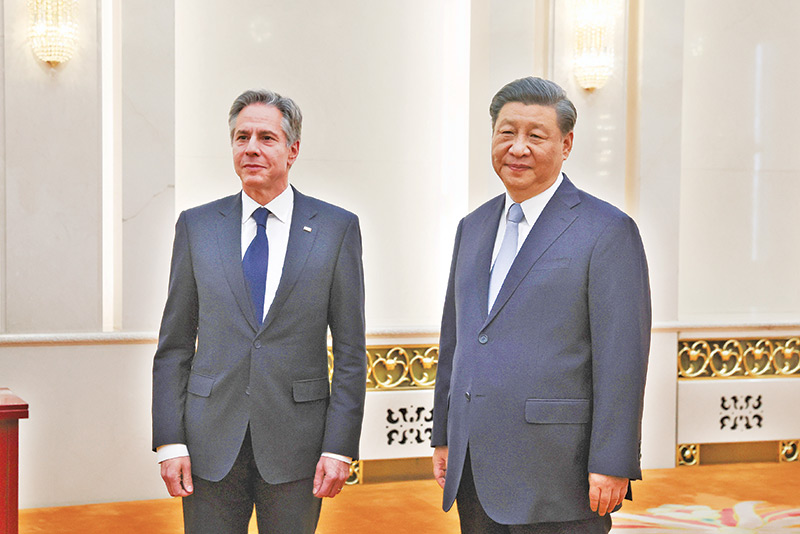
US Secretary of State Antony Blinken meets with Chinese President Xi Jinping in the Great Hall of the People in Beijing, China on Monday. AP/RSS
BEIJING, US Secretary of State Antony Blinken met with Chinese President Xi Jinping on Monday, as the top US diplomat wrapped up a high-stakes two-day visit to Beijing aimed at easing soaring tensions between the countries. The 35-minute meeting at the Great Hall of the People had been expected and was seen as key to the success of the trip, but neither side confirmed it would happen until a State Department official announced it just an hour beforehand. In footage of the meeting released by state broadcaster CCTV, Xi is heard to say “The two sides have agreed to follow through on the common understandings President Biden and I have reached in Bali.” In earlier meetings between Blinken and senior Chinese officials, the two sides expressed willingness to talk but showed little inclination to bend from hardened positions on disagreements ranging from trade, to Taiwan, to human rights conditions in China and Hong Kong, to Chinese military assertiveness in the South China Sea, to Russia’s war in Ukraine. Xi said that they had made progress and reached agreements on “some specific issues” without elaborating. “This is very good,” Xi said. “I hope that through this visit, Mr. Secretary, you will make more positive contributions to stabilising China-US relation,” Xi added. Despite Blinken’s presence in China, he and other US officials had played down the prospects for any significant breakthroughs on the most vexing issues facing the planet’s two largest economies. Instead, these officials have emphasized the importance of the two countries establishing and maintaining better lines of communication. Blinken is the highest-level US official to visit China since President Joe Biden took office, and the first secretary of state to make the trip in five years. His visit is expected to usher in a new round of visits by senior US and Chinese officials, possibly including a meeting between Xi and Biden in the coming months.
WORLD
Eight villages retaken from Russian forces in two weeks, Kyiv says
Zelenskiy says speed of Western arms supply is key.
- REUTERS
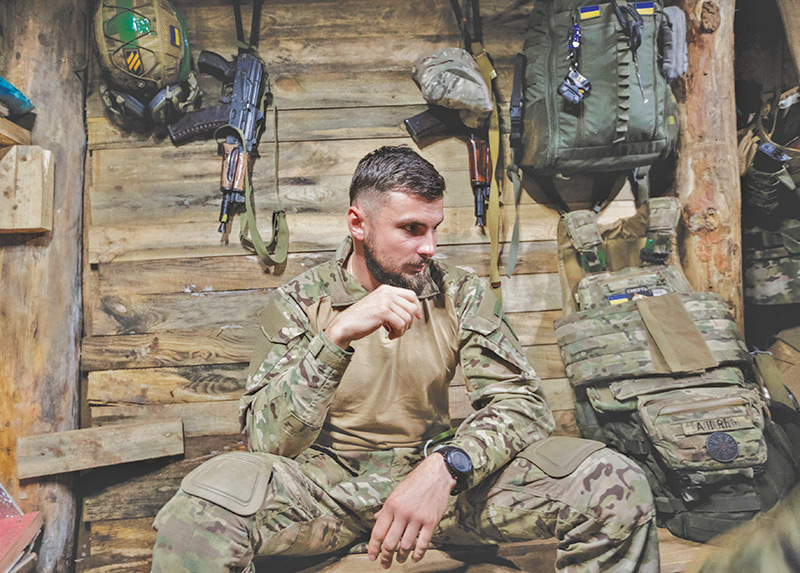
A Ukrainian serviceman is seen in a shelter at the front line in Donetsk region, Ukraine. Reuters
KYIV, Ukraine said on Monday it had driven Russian forces from an eighth village in its two-week-old counteroffensive, a settlement on a heavily fortified part of the front line near the most direct route to the country’s Azov Sea coast. A Russian-installed official said on Sunday that Ukraine had taken control of the village, Piatykhatky, in the southern Zaporizhzhia region. He later said Moscow had pushed them out and on Monday morning he said Ukraine was attacking again. Ukraine’s Deputy Defence Minister Hanna Maliar said Ukrainian forces had not only retaken Piatykhatky but had advanced by up to seven km into Russian lines in two weeks, capturing 113 square km of land. “In the course of two weeks of offensive operations in the Berdiansk and Melitopol directions, eight settlements were liberated,” Maliar said on Telegram, referring to two cities on the Russian-occupied coastline. The reported capture of the villages reflects incremental gains for Ukraine that highlight the challenge of breaking through lines Moscow has spent months strengthening. Piatykhatky is significant, however, as lies around 90 km from the coast. Ukrainian President Volodymyr Zelenskiy hailed the efforts of the troops and said he would continue talks with Western allies to get weapons and ammunition supplies to them as soon as possible. “Our troops are advancing, position by position, step by step, we are moving forward,” he said on Sunday evening. “The main thing is the speed of supply.” On Monday, the Russian Defence Ministry said its forces had thwarted a Ukrainian attempt to take the village of Novodonetske in the eastern Donetsk region, another area where Kyiv’s counteroffensive has been focused. It released a video showing what a soldier heard talking in it said was a captured French-made tank. Kyiv did not comment and Reuters could not verify the latest battlefield accounts. Ukraine has acknowledged attacks along several parts of the 1,000 km front line in its long-anticipated counteroffensive to retake the 18 percent of its territory occupied by Russia. But Kyiv has imposed an information blackout on current and future battles for security reasons. Analysts say the main phase of the counteroffensive is yet to begin. Both sides appear to have taken heavy losses in recent fighting and both say they have lost fewer troops than their foes. “The enemy’s ‘wave-like’ offensives yielded results, despite enormous losses,” Russian-installed official Vladimir Rogov said on Telegram in reporting the Piatykhatky fighting. The conflict has killed thousands of civilians, destroyed towns and cities and driven millions of people from their homes as well as exacerbating global inflation and reshaping security. Russia says it invaded Ukraine to “denazify” it, an argument Ukraine and its Western allies call a pretext for a land grab.
MOSCOW: One of Russia’s top spymasters said on Monday he hoped that the UN nuclear watchdog and the European Union would look into Ukrainian nuclear activity that he said might signal Kyiv was working on a “dirty bomb”. Sergei Naryshkin, the head of Russia’s SVR foreign intelligence service, did not provide documentary evidence to back his assertions. Kyiv has in the past said it takes its responsibilities for nuclear power very seriously while accusing Russia of recklessness when it comes to its control of the Zaporizhzhia nuclear plant in southern Ukraine. Naryshkin said in a statement that his service had information that a batch of “irradiated fuel” had secretly been sent from the Rivne nuclear plant in western Ukraine for disposal at a spent fuel storage facility in Chornobyl. He said the action, which Reuters could not independently verify, was suspicious and could only be explained by Kyiv intending to create a “dirty bomb”, combining radioactive material with conventional explosives.
WORLD
Magnitude 6.4 earthquake strikes the Gulf of California
Briefing
- AGENCIES
CALIFORNIA: An earthquake of magnitude 6.4 struck the Gulf of California on Sunday, the European Mediterranean Seismological Centre (EMSC) said. Mexico’s civil defence office confirmed that there were no immediate reports of damage in the areas where the earthquake was felt, but recommended boats and the nearby coastal population take precautions due to possible currents in ports. The quake struck at a depth of 10 km, EMSC said. Shortly after the quake occurred, the US Tsunami Warning system said there was no tsunami danger for the US West Coast, British Columbia, or Alaska. The US Geological Survey (USGS) pegged the earthquake at a magnitude of 6.3.
WORLD
Swedish defence must adapt to match ‘long-term’ Russian threat, lawmakers say
Briefing
- AGENCIES
STOCKHOLM: A special Swedish parliamentary defence committee said on Monday the country’s defence must focus on the threat posed by Russia and a military attack could not be ruled out. The Nordic nation has been scrambling to bolster its defences, having applied to join NATO last year as a result of Russia’s invasion of Ukraine, though Turkey and Hungary have so far held up Swedish entry into the Western alliance. “Russia’s aggressive actions have led to a structural and greatly deteriorated security situation. Russia has further lowered its threshold for military use of force and exhibits a high risk propensity,” the committee said in a report.
SPORTS
Familiar foes Nepal, US vie in a crunch game today
Having lost their opening matches of the ICC Cricket World Cup Qualifiers, both sides will be eyeing a victory to get their Super Six hopes back on track.
- Sports Bureau
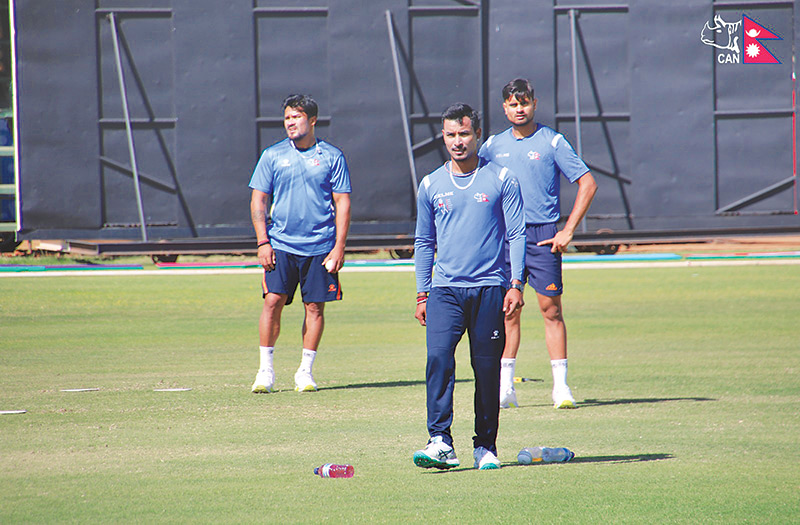
Among the six ODI matches against the US, all played during ICC World Cup League 2, Nepal won three, lost two while one match ended in a tie. Photo: Courtesy of CAN
KATHMANDU, Nepal and the United States will play their second matches in the ICC Cricket World Cup Qualifiers on Tuesday, looking to recover from defeats in their opening matches of the tournament. Nepal had gone down to hosts Zimbabwe by eight runs despite posting a remarkable target of 291 runs at the Harare Sports Club. The US team succumbed to a 39-run defeat against the West Indies at the Takashinga Sports Club in Harare. Having lost their opening matches in the five-team group that also includes the Netherlands, both sides will come into the game knowing that a defeat in the second match could turn costly for their Super Six hopes. Only the top three teams of both groups in the 10-team qualifiers will be eligible for the Super Six stage. The two finalists from the Super Six will qualify for the ICC World Cup to be played in October and November in India. “It was a good experience playing against a strong Zimbabwean side. We had given them a tough target, but they played really well,” said Kushal Bhurtel in a video posted on the Cricket Association of Nepal’s social site. Bhurtel, also the highest scorer for Nepal against the home team who missed the century mark by one run, said that a positive outcome against the US would put their team at ease. “We have the next match against the US and we could be at ease, if we get a better outcome against them.” Though Nepal performed well with the bat against the tough opponents in their opening match, they failed in the bowling department. For the US, middle order batter Gajanand Singh scored an unbeaten ton after the top order batters made a shaky start to their innings against the West Indies. They managed to score 258 runs on the back of 101 runs by Singh, before losing the game. While Nepal and Zimbabwe were playing in the 50-over format for the second time four years after the 2018 Qualifiers, the US and the Rhinos are well known foes. Having played six One-Day International (ODI) matches between them from 2020 to 2022, the two sides are well aware of each other’s strengths and weaknesses. Among the six ODI matches, all played during ICC World Cup League 2, Nepal won three, lost two while one match ended in a tie. Nepal won both their matches played at the TU ground—by 35 runs and eight wickets in February 2020. In the two games played at Al Amerat in Oman, Nepal won the first match by five wickets and lost the other by six wickets in September 2021. In June 2022, in the last two games played in Houston, the first game finished in a tie while the US won the second game.
SPORTS
Spain’s Nations League crown calms fears around De la Fuente project
Luis de la Fuente’s La Roja defeat Croatia 5-4 on penalties after the match finished 0-0 following extra time to earn their first trophy since European Championship 2012.
- AGENCE FRANCE-PRESSE
AP/RSS
ROTTERDAM, Spain coach Luis de la Fuente has quelled the doubts around him by leading his country to Nations League glory and ending a decade-long trophy drought. La Roja needed penalties to see off Croatia and triumph in Rotterdam, but doing so helped ease tensions following their Euro 2024 qualifying defeat by Scotland in March. De la Fuente’s appointment by the Spanish Football Federation (RFEF) to replace Luis Enrique raised eyebrows—the 61-year-old is a relative unknown as a coach, having worked within the country’s youth ranks from 2013 onwards. After an unconvincing performance in a win over Norway in his opening game, defeat in Glasgow sparked alarm. However matches three and four proved far more enjoyable for the coach, beating Italy and then Croatia to lift their first trophy since Euro 2012. That conquest, along with World Cup 2010 and Euro 2008, was a golden era for Spain, which all future teams are judged against. Although the Nations League is a new competition, this only its third edition, Spain and De la Fuente are hopeful that it can prove a springboard for more success, with the waters now more tranquil around him. “All projects are better constructed on a base of victory and this gives us more strength, confidence, calm,” said the coach. RFEF president Luis Rubiales defended De la Fuente and said stories that he considered ousting him were false. “The coach has always been very secure, and we believe in him to the maximum,” Rubiales told reporters on Sunday. “We have no problem, the coach has always been 100 percent in his job, and we have always trusted in him. He’s been at 100 percent since the beginning. Starting a new project is hard, and with new players, so young—that’s hard too.”
Rodri the key With reduced concerns around his capability, attention has turned to how the coach’s side is shaping up to mark Spain’s new era. One of De la Fuente’s biggest choices has been a shift to a 4-2-3-1 formation, instead of Spain’s typical 4-3-3. The key cog is Manchester City midfielder Rodri, who was named the player of the Nations League finals. While Luis Enrique drew criticism for playing Rodri as a centre-back at the 2022 World Cup to make room for veteran Sergio Busquets, his successor has reinstalled him in the centre of the pitch. Rodri, arguably the best in the world in his position, linked well with Mikel Merino against Italy and then Fabian Ruiz against Croatia. The 26-year-old, who scored City’s Champions League final winning goal in Istanbul against Inter Milan earlier in June, has even been touted as a potential Ballon d’Or winner. Speaking with clarity and confidence and leading by example on the pitch, Rodri has become his country’s torchbearer. “This generation promises a lot,” he said after the Nations League triumph. Before, he had called for Spain to start a new winning cycle. Rodri’s emergence as the team’s “frontman” is in part due to an absence of star power in the attack, with Spain boasting a host of dangerous—but not elite—forwards. Barcelona’s Ansu Fati was bright off the bench against Croatia and showed he can have a big impact if he can stay fit, while Yeremy Pino, Dani Olmo and Marco Asensio are all similarly bright, but inconsistent. Alvaro Morata has played at many of Europe’s top sides without fully convincing, while back-up striker Joselu has just joined Real Madrid, his career best form coming at the ripe age of 33. Spain could not find a breakthrough against Croatia and needed penalties to triumph, which De la Fuente said added extra spice to the victory. “We deserved to win before, but the penalties give it a dash of the epic,” said the coach, who expects to continue thriving. “Obviously, winning gives you more shine, and I expect more joy to come in the future.”
MEDLEY
Horoscope
ARIES (March 21-April 19) You’ll be in a unique position to emotionally soothe yourself today. Sit with your feelings and greatest dreams at peace. Unfortunately, the vibe will tense up later in the afternoon. Follow through on your passions and fun this evening.
TAURUS (April 20-May 20) People will be drawn to your enigmatic and compassionate aura today. You may begin to feel conversationally stretched thin this afternoon. Give yourself a few moments to clear your mind Recharge from the warmth and comfort of home.
GEMINI (May 21-June 21) Feel proud of your professional and financial accomplishments today. Take a moment to admire your journey thus far. Evening will bring a rush of activity to your mind. Stress could cause you to feel overly sensitive to light or sound.
CANCER (June 22-July 22) Prepare for a day of ups and downs. Start the morning with some meditation or positive mantras. Though the energy might level out for a bit, you might fret over your next steps if you don’t take care of yourself.
LEO (July 23-August 22) You’ll be in a unique position to release grief without having to sort through your shadow. A desire to look on the lighter side of life will make darkness less threatening.You will want to be seen and adored.
VIRGO (August 23-September 22) Feel free to connect with others and impart sage advice. However, you’ll want to be on guard for frenemies, avoid anyone with a malicious streak. Luckily you won’t feel guilty about taking time to yourself.Keep a positive attitude tonight.
LIBRA (September 23-October 22) You’re responsible for following through on the universe’s blessings. Consider taking a break if you start to become agitated. Rally your peers for snacks or drinks after work. Just be sure to head home at a reasonable hour.
SCORPIO (October 23-November 21) A rush of dreamy energy will bolster your confidence and optimism. However, you may need to ground later in the afternoon. However, tensions could brew this evening, giving you permission to set boundaries so that you focus on finding balance.
SAGITTARIUS (November 22-December 21) Your home will feel like a restorative oasis this morning. Get your work done from the comfort of your abode if you can. However, step outside for some fresh air this afternoon. Expect to feel invigorated the next two days.
CAPRICORN (December 22-January 19) You’ll have a unique talent for sweet-talking others this morning. These vibes are perfect for selling others on your vision. Be sure to check in with your best buds and romantic interests. Unfortunately, tensions could manifest later, remain gracious.
AQUARIUS (January 20-February 18) Handling your to-do list will seem more satisfying than usual, especially if you support yourself with small treats throughout the day. Just try not to lose focus later in the day, be sure to check your work twice.
PISCES (February 19-March 20) Though you’ll flow through most of the day with good vibes, be on guard for tension later in the afternoon. Luckily, you’ll feel more drawn to your work than malicious gossip. Just remember to give yourself a break.
CULTURE & LIFESTYLE
Rebuilding broken bonds
While it is okay to try to protect yourself from memories that have been emotionally difficult for you, it’s not healthy to carry around the baggage of trust issues.
- Sujina Manandhar
Shutterstock
I’m sure many of us have been heartbroken. But has your trust ever been broken? In our life, we come across a lot of people. Many of them become our acquaintances, and some become our friends, but only a few end up being the ones we feel comfortable bestowing our complete trust upon. It is only to these certain individuals that we gradually open our deepest secrets and show our ugliest scars to. We put our faith in them and hope they see us for who we are. We believe we are safe and loved enough not to be judged by parts we aren’t proud of. Not everybody receives the honour of trust. But what happens if one of these people breaks our trust? Ask yourself: Have you ever been put in a situation where someone you trusted did something completely unexpected, which came as a shock and left you questioning everything, including your own judgment? When trust is broken, it makes you think whether you truly knew this person or if you were blinded by wanting to see every tiny bit of good in them. Oftentimes, we also develop a sense of dread and guilt for trusting people in the first place, and we berate ourselves for being so gullible and vulnerable. It may also result in you promising yourself that you will never ever in your life trust anybody. Trust is a very delicate thing. Once it is breached, it becomes difficult to trust or welcome a new person into your life. We may even begin distrusting the ones already with us. Well, while it is okay to try to protect yourself from events that have been emotionally difficult for you in the past, it’s not healthy to carry around the baggage of trust issues. Especially if it renders you unable to form deep connections with others in your life. Of course, it isn’t good to be gullible about everything that people say, but it’s also not healthy for you to question every statement spoken, overanalyse them down to every single detail, and question yourself whether or not you should show vulnerability and express your thoughts in front of every person in your life. You need to understand that while the pain you endured, the betrayal you felt, and the guilt you experienced for trusting those people are all valid, it’s not necessary that every person you meet along the way is going to be the same. You need to let go of the fear of going through pain and be open to trusting the old, the new, and the better people in your life who are genuinely there for you. You need to realise that the person who hurt you and the person who you are now afraid to trust are not the same. When trust dies, you may feel like a small part of you that trusted the person also died along with it. It’s okay to grieve that innocent part of you. Take your time. Feel the pain but don’t let the pointed shards keep hurting your ability to trust every other person in your life. Having your trust broken was not your choice, but whether you let that incident become a scar or a lesson is up to you. Learn from it: don’t be naive, but don’t put up a wall; become stronger, but accept your vulnerable side too. Let that incident teach you, but don’t let it define who you are. The main thing you can do is trust yourself. Trust the journey you have taken so far. Tell yourself that you can trust people and not be hurt by them, and don’t let a few bitter experiences or few individuals colour your perception of the entire world–your world does not need to change into a dark, scary place filled with people that could hurt you. Don’t let a few bad experiences make you afraid of opening up. Don’t give people from the past so much power that it affects your present and future. Embrace the real you and feel comfortable showing yourself to other people in your life who wish to have a meaningful connection with you.
Manandhar is a mental health advocate who provides psychosocial counselling.
CULTURE & LIFESTYLE
For a leisurely brunch
Every Saturday, ‘Zing: World of Flavors’ at Hyatt Place offers lavish food options, along with activities.
- Post Report
Photo: Courtesy of Zing:World of Flavors
Kathmandu Saturday brunches tend to be laid-back and leisurely, making them the ideal opportunity to forgo home cooking and check out restaurants’ intriguing specials.One such restaurant inside the premises of the Hyatt Place Kathmandu called ‘Zing: World of Flavours’ is providing a Saturday brunch deal with tons of exciting things to do in between. Called the ‘Lazy Daze Brunches,’ the offer was introduced two months ago as a new addition to their regular brunches. There are three intriguing options in ‘Lazy Daze Brunches. One is the ‘Lavishing Breakfast,’ which offers over 50 varieties of breakfast dishes. From starters, main dishes, live stations, to dessert, this brunch has it all. The restaurant also organises the ‘Travel and Paint’ event, which is held every Saturday. The hour-long class is led by a professional artist, and participants are free to paint whatever they like for an additional fee. They can even take their canvas home with them. Similarly, the in-house band will perform live during the event. Fot those looking for a little more relaxing time, one can also select a package with the pool included. As the offer is only up on Saturdays, reservations for this brunch must be made by Friday. With an additional Rs 2800 in the mix, you will be offered unlimited drinks.
Where: Zing: World of Flavors, Hyatt Place, Tahachal, Kathmandu When: Every Saturday Time: 12:00 pm to 4:00 pm Price: Rs2800 per person and Rs3500 for brunch with swimming Contact: 9801229377
CULTURE & LIFESTYLE
Radio Kantipur announces National Music Award 2023
The fifth edition of the event will take place on July 7, the 24th anniversary of the radio.
- Post Report
(From left) Bhupendra Khadka, Shishir Pachhai, and Gauri Shankar Dahal at Radio Kantipur’s press meet for National Music Award on Monday. Post Photo: Elite Joshi
Kathmandu Radio Kantipur announced the fifth edition of the National Music Award at a press conference on Monday. The event will take place on July 7, marking the radio station’s 24th anniversary. The ceremony will honour musicians working across diverse genres who have made important contributions to the Nepali music industry. A total of 75 artists have been nominated for the awards in 15 different categories, including Best New Singer, Best National Song, Best Music Group, and Best Music Director, among others. A musician who has been serving in the field of music for a long time will be honoured with the Life Time Achievement Award, which comes with a purse of Rs100,000 and a trophy. Another major award that will be given out on the occasion is the People’s Choice Award. Audience responses and YouTube views will be calculated to pick the top five winners in the category. The choice for nomination has been handed over to a jury whose members haven’t been disclosed yet. The nominees are selected by assessing all songs and musicians featured on Radio Kantipur from August 2021 to August 2022. Organisers said they aim to bring together older and newer musicians at the show. Radio Kantipur announced the names of more than 15 performers, including Swoopna Suman, Shiva Pariyar, and Pradip Rodan. Singer Salman Ali, who won the title of Indian Idol 2018, will grace the stage for a special performance. The show will also feature some stand-up comedy performances. Speaking at the press meet, Shishir Pachhai, chief executive officer of Kantipur TV HD, explained the responsibility that media houses have towards people in different fields. “Radio is not just about music but also about social responsibility,” he said. “We are presenting the award to thank people who have contributed immensely to the music industry and Kantipur and also to provide a platform for their talent.” He also revealed that the artists get Rs15 as royalty every time their songs are played on Radio Kantipur. Pachhai also emphasised the importance of radio as a platform for musicians and music lovers. “Even though new platforms like YouTube are popular right now, if we look at the history and the current context of Nepal, radio is the means that reaches a big chunk of the population,” he said. To get airtime at Radio Kantipur, a song has to be registered at the station’s office and go through a quality check. Currently, the Radio Kantipur library has over 700,000 registered musical pieces.
CULTURE & LIFESTYLE
Captivated by alternate realities? Here’s a guide to some good stuff
Loved ‘Everything Everywhere All at Once’? Can’t get enough of ‘Spider-Man: Across the Spider-Verse’? Then this list is for you.
- ASSOCIATED PRESS
Elizabeth Olsen as Wanda Maximoff in a scene from ‘Doctor Strange in the Multiverse of Madness.’ AP/RSS
We’ve compiled a non-exhaustive sampler of fiction about alternate universes and multiverses. It’s a great starter kit if your media tastes run to asking: What if? ‘It’s a Wonderful Life’ (1946): In this Christmas classic, the family man George Bailey grows increasingly frustrated as opportunities pass him by, and it takes an angel-in-training—on Christmas Eve—to dump him into a universe where he never existed and show him how important his life is. ‘Doctor Strange in the Multiverse of Madness’ (2022): After years of hints and slivers, including an emerging plotline in ‘Spider-Man: No Way Home’ (2021), Marvel goes full-on multiverse in this exploration of how realities can collide and start bleeding into each other. ‘Sliding Doors’ (1998): Gwyneth Paltrow misses a train—and doesn’t. The two splintered realities unfold very differently, producing versions of her character that must be reconciled. ‘Yesterday’ (2019): Jack Malik, an aspiring musician, finds himself stranded in a near-identical universe where no one has ever heard of the Beatles (or Coca-Cola, for that matter). He starts singing the songs as if he wrote them. Hijinks and big feelings ensue. ‘The Butterfly Effect’ (2004): Ashton Kutcher plays a college student who finds he can revisit his past and change things, and each time he does so, a different reality is born. ‘The Family Man’ (2000): After an encounter in a convenience store, arrogant Manhattan finance guy Jack Campbell wakes up in a very different—and less affluent—life in the New Jersey suburbs and finds himself married to and parenting with his old girlfriend, whom he had walked away from years ago. As he navigates his new life and the choices he made or didn’t make to get there, a more complex picture emerges. And for the kids… ‘Shrek Forever After’ (2010): Shrek finds himself in an alternate, darker reality where he never got together with Fiona.