Due process flouted while installing gold Jalahari at Pashupati
Anti-graft body’s weight measurement showed no major shortfall in Jalahari gold quantity.
- PRITHVI MAN SHRESTHA
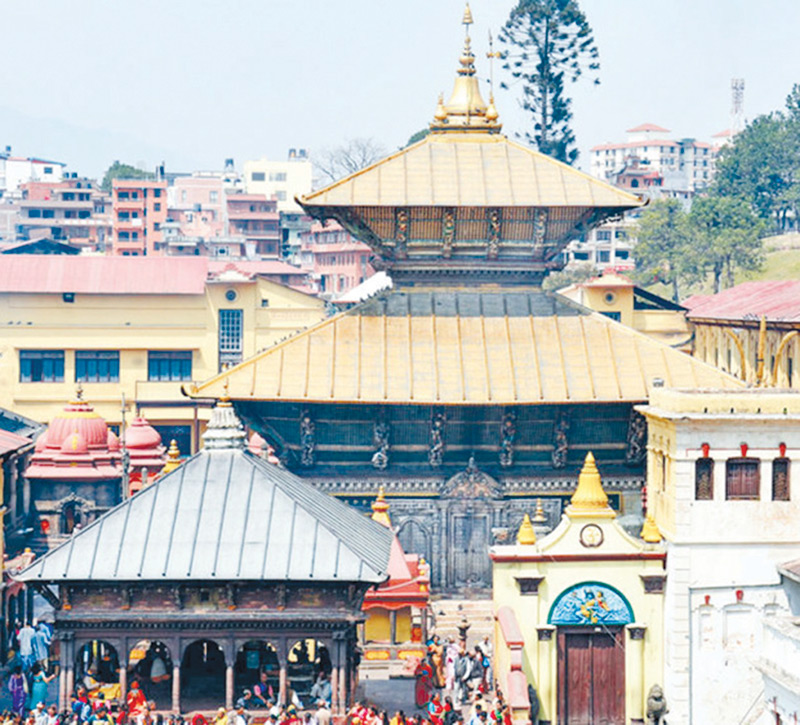
Pashupatinath Temple Post File Photo
KATHMANDU, The Commission for the Investigation of Abuse of Authority (CIAA) on Sunday didn’t find any significant difference in the weight of the gold ‘Jalahari’ installed in the sanctum sanctorum of the Pashupatinath Temple, but the issue continued to spark debate as the Pashupati Area Development was found to have flouted due process. Jalahari is the receptacle that covers the base of the Shiva Linga and collects and drains liquid offerings like water and milk offered to the Linga. The anti-corruption body, which has been investigating alleged corruption in the installation of the gold Jalahari, on Sunday removed it from the temple and weighed it. According to a CIAA source, it was measured at 107.46kg, which is close to the stated weight of 107.92kg. Earlier, a complaint was registered at the CIAA claiming that around 11kg gold was missing from the Jalahari and the anti-graft body had initiated investigation into the matter. “The installation of golden Jalahari invited controversy as the Trust officials installed it hastily and without following due process,” said Govinda Tandan, former member secretary of the Trust. “Also, the Jalahari was around half a kg lighter. Gold usually doesn’t get worn out so long as it is not mixed with other metals.” Narottam Baidya, former treasurer of the Trust, said that the CIAA’s measurement established that the weight of the Jalahari was found to be less than what was claimed by the Trust. “The member secretary of the Trust had claimed in Parliament that he was ready to face even capital punishment if any discrepancy was found in the weight of the Jalahari,” he added. Speaking at the National Concerns and Coordination Committee of the National Assembly on June 14, Member Secretary of the Trust Milan Kumar Thapa had said he was prepared to face the death penalty if there had been any embezzlement in the process of installing the golden Jalahari. Thapa said it was shameful to make accusations without Baidya is one of the two writ petitioners who moved the Supreme Court against the government’s decision to install the golden Jalahari. The earlier Jalahari was made of silver. Even though the latest measurement of Jalahari weight showed no significant difference compared to the claimed one, according to the CIAA source, the Office of Auditor General said in its 59th annual report had also flagged the Jalahari installation process as non-transparent. The Trust had purchased 103.77kg of pure gold from the Nepal Rastra Bank for Rs801.10 million in order to make the Jalahari. Then 2.89kg of copper, 1.249kg silver, 12.75gm zinc was added to the gold, taking the total weight to 107.924gm, the auditing body said referring to the Trust’s documents. These metals are added to pure gold to make ornaments harder and more durable. Of the total gold used in the Jalahari, 96.822kg was used for Jalahari proper while a golden band covering it weighed 10.976kg. “The Trust, however, failed to provide details of whether the gold that remained after the installation of the Jalahari proper was then used for making the outer band covering the Jalahari,” the auditor general’s report says. Likewise, the Trust also failed to follow the Pashupati Area Development Trust (Second Amendment) Regulations while remunerating the craftsmen who made the Jalahari, according to the auditing body. As per the regulations, the board meeting of the Trust decided to provide the wages to the craftsmen directly from donors. Instead, they should have been paid by the Trust after receiving donations in its own bank account. There are no records of the donations for crafting the Jalahari, which was carried out in a rolling mill at Patan Durbar Square. “But the Trust failed to submit the agreement signed with the rolling mill and details of payments made to the 13 craftsmen,” the report says. In January 2021, the then prime minister KP Sharma Oli had announced to provide Rs300 million to the temple to install the gold Jahalari and the Ministry of Culture had accordingly released the money. Observers saw Oli’s announcement as part of his attempt to placate the Hindu constituency after President Bidya Devi Bhandari had, on Oli’s recommendation, announced snap elections after dissolving the House. On February 23, 2021, the Supreme Court had reinstated the House of Representatives, terming the House dissolution by the President ‘unconstitutional’. Later, in February 2021, Baidya and Nikita Dhungana had filed a petition challenging the government decision to install the Jalahari. Just before the Supreme Court issued a stay order on the matter, the then President, Bidya Devi Bhandari, had already unveiled the 96.822kg gold adornment. The writ petitioners had claimed that replacing the silver Jalahari with golden one was against the Ancient Monument Preservation Act-1956. Section 12 of the Act says, one who destroys, demolishes, removes, alters, defaces or steals is subject to punishment with a fine of Rs25,000 to Rs100,000 or with an imprisonment of 5-15 years or both after recovering an amount equal to the claimed amount for damage to the ancient monument/archaeological object concerned. Meanwhile, lawmakers from the ruling parties including Nepali Congress Lawmaker Pradeep Poudel and Maoist Centre’s Devendra Poudel on Monday called for parliamentary investigation of the Jalahari dispute.
HOME PAGE
Nepal yet to execute BRI projects, says Foreign Minister Saud
His statement comes as rebuttal amid Chinese claims that Pokhara International Airport is part of the BRI.
- ANIL GIRI
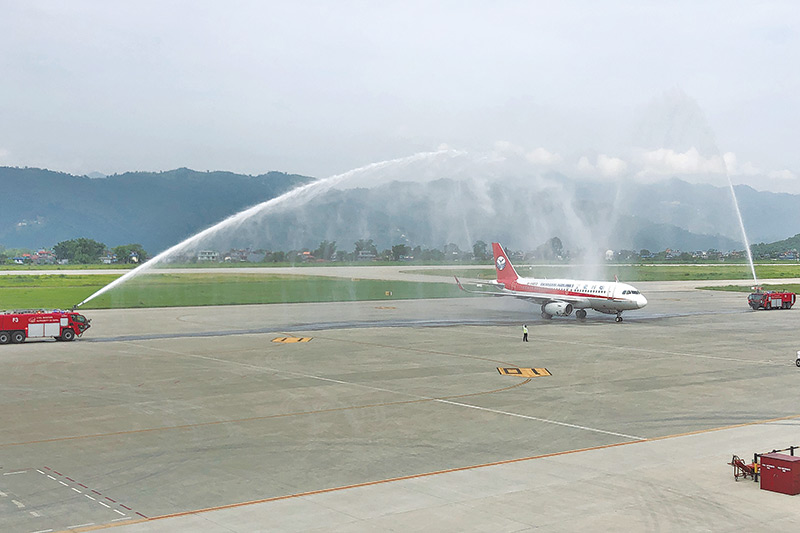
Six months after the airport’s opening, a Sichuan Airlines chartered flight landed in Pokhara on Wednesday with 84 passengers on board the Airbus A319 aircraft. Post Photo: Deepak Pariyar
KATHMANDU, China’s unilateral announcement that the Pokhara International Airport was built under the framework of the Belt and Road Initiative (BRI) has finally reached Parliament. Two members of Parliament—Ram Hari Khatiwada of the Nepali Congress and Asim Shah of the Rastriya Swatantra Party—on Monday asked Foreign Minister NP Saud and Tourism Minister Sudan Kirati whether the Pokhara International Airport is a part of the BRI and whether the government would clarify its position on the issue. Responding to them, Foreign Minister Saud said that Nepal and China had signed the framework agreement of the Belt and Road Initiative (BRI) in 2017 and it is still at the stage of execution. He did not name the Pokhara airport but stated that not a single project under the BRI has come into operation in Nepal. “The project implementation plan of the BRI is at the stage of discussion between Nepal and China. Not a single project in Nepal under the BRI has been executed. The project implementation plan of the BRI is still under consideration,” said Saud. After the Nepal side selected nine projects to be executed under the BRI, the second Belt and Road Initiative Conference in China in 2019 incorporated the Trans Himalayan Multidimensional Connectivity in its outcome document. The nine projects were—the Rasuwagadhi-Kathmandu road upgrade; Kimathanka-Hile road construction; road from Dipayal to the Chinese border; Tokha-Bidur road; Galchhi-Rasuwagadhi-Kerung 400kV transmission line; Kerung-Kathmandu rail; 762MW Tamor hydroelectricity project; 426 MW Phukot Karnali hydroelectric project; and the Madan Bhandari Technical Institute. Ahead of Chinese President Xi Jinping’s state visit to Nepal four years ago, when the Chinese Foreign Minister Wang Yi was in Kathmandu in March 2019, the Nepali side proposed developing the Madan Bhandari University under the BRI. That was the only project the Nepali side had proposed for development under the BRI, but due to several reasons, it is in limbo. After the Covid pandemic hit China, other projects were also affected. Then the Chinese side, about two years ago, forwarded the text of the project implementation plan of the BRI so that negotiations of projects and their execution under the initiative could be expedited. A draft of the implementation plan is a prerequisite for project selection, funding modality, budgeting, supervision and monitoring, and human resource management. The Ministry of Foreign Affairs was taking the lead in developing the plan while other agencies like the Office of the Prime Minister and the Ministry of Finance provided inputs on the draft, which is not moving yet, two government officials told the Post. “Once we agree on the text of the project implementation plan, we can negotiate and execute the project under the BRI,” said one official. “Not only from Nepal, the Chinese had also asked for similar implementation drafts from other countries that have signed up for the initiative.” When Nepal signed the BRI agreement in 2017, it was touted as a watershed moment in Nepal-China ties. But with not a single project taking off under the Chinese programme, there were doubts if Nepal was itself reluctant to undertake these projects for geopolitical reasons. India and the United States see the BRI as China’s bid to exert influence in the region, using its economic heft. Countries like Sri Lanka and Pakistan in South Asia too are part of the BRI. When Nepal agreed to build projects under the initiative, Pushpa Kamal Dahal of the Communist Party of Nepal (Maoist Centre) was prime minister. After him, Sher Bahadur Deuba of the Nepali Congress led the government, followed by KP Sharma Oli of the CPN-UML. After successive governments failed to initiate any project under the BRI, said a pair of foreign ministry and finance ministry officials who are familiar with the matter, there was some kind of unease on the Chinese side if Nepal was really committed to what it signed up for. The only development on the BRI from the Nepali side is that Kathmandu in January 2019 sent a list of nine projects to China. There was no further progress. Before finalising the text of the project implementation plan of the BRI, the former Dueba government told visiting Chinese Foreign Minister Yi that Nepal would prefer grant and aid or soft loans under the BRI due to the country’s precarious economic situation and that Nepal cannot afford big-ticket projects with high-interest loans and short repayment timelines. This was something time and again communicated to the Chinese side. The Finance Ministry, while writing its comments in the text of the project implementation plan, said that Nepal cannot afford a loan whose interest rate goes beyond one percent, nor can it receive commercial loans to execute the BRI projects. The Nepali side also insisted that there should be free and fair competition among the bidders under the BRI framework. The major impediment in the selection and implementation of projects is a lack of clarity on the financing modality, according to multiple officials. Nepal, they say, wants donations while the Chinese insist on soft loans. A Nepali diplomat who was earlier based in Beijing said that there is no hard and fast rule to develop the implementation plan and not all countries that signed up to the BRI have such plans. A month after signing the agreement, the government in June 2017 had formed three different committees headed by secretaries from finance, foreign and physical infrastructure ministries to execute the BRI projects. The finance secretary-led committee was tasked with coordinating and facilitating the selection of the projects and forwarding the concept to the foreign secretary, who was mandated to hold meetings with the relevant stakeholders before pitching them to the Chinese side. A sub-committee led by secretaries from several ministries was entrusted with providing technical support to the finance and foreign secretaries. These thematic and sectoral sub-committees were supposed to prepare technical details of the projects and recommend them to the three secretaries, according to a former secretary at the Ministry of Physical Infrastructure. “None of these mechanisms, however, functioned properly. They became defunct without holding a single meeting,” the former secretary, who did not wish to be named, told the Post. Initially, there were speculations that China would be building two separate railway projects—linking China’s Kerung with Kathmandu, and Kerung with Pokhara—whose detailed study is still being carried out. China has already agreed to carry out the study under the banner of Nepal-China Trans-Himalayan Multi-Dimensional Connectivity Network. The feasibility study of Kerung-Kathmandu railway has begun with a Chinese grant and is expected to be completed in another 40 months. Without progress on a single project, the BRI framework agreement has been renewed twice, with the most recent in May. Policy coordination, infrastructure connectivity, unimpeded trade, financial integration and connecting people are the five major priority areas of the initiative. The implementation plan encompasses all possible areas of cooperation and gives clarity on project negotiations on both sides. For example, according to officials working on the draft, if Nepal seeks support for connectivity projects under the BRI, it would make a list of various kinds of projects under air connectivity, physical connectivity, digital connectivity, transmission lines, cultural connectivity and connectivity through trade, goods and commerce. Another foreign ministry official told the Post that there were some rounds of discussions between the two sides and drafts were exchanged so as to reach a consensus on the proposed projects. But in the absence of a dedicated implementation plan, Nepal could not identify the projects under the BRI. But China’s unilateral announcement that Pokhara International Airport falls under the framework has put officials in a quandary. On December 31 last year, on the eve of the Pokhara International Airport inauguration by Prime Minister Pushpa Kamal Dahal, the Chinese Embassy wrote on its Twitter account that “This [Pokhara airport] is the flagship project of the China-Nepal BRI cooperation.” Six months after the airport’s opening, a Sichuan Airlines chartered flight landed in Pokhara on Wednesday with 84 passengers on board the Airbus A319 aircraft. The Chinese Ambassador Chen Song, on Wednesday, reiterated that the Pokhara airport falls under the BRI. Nepali government officials, however, have been rejecting the Chinese claim. “The whole world is saying that the airport is not under the BRI, so why are our MPs confused whether it is under the BRI?” asked tourism minister Kirati. He added: “Why is this issue being raised in Parliament? Why are our parliamentarians so confused? Why are we unnecessarily spending our time and energy on this issue when the whole world and newspapers are saying no, it is not [a part of the BRI].”
HOME PAGE
Tragic lessons from Titanic submersible saga and Greek migrant shipwreck
One grabbed unrelenting attention. One was discussed as another sad routine story.
- ASSOCIATED PRESS
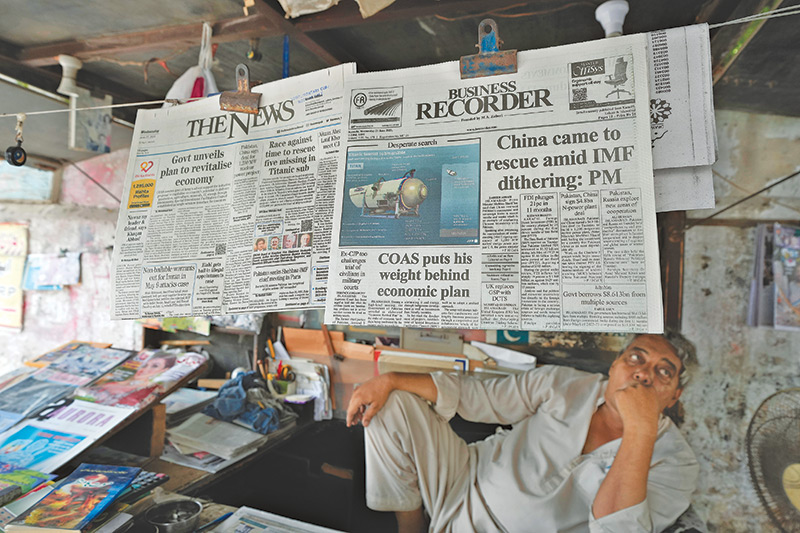
A vendor sits beside a copy of a morning newspaper which reports missingTitanic submersible at a stall, in Karachi, Pakistan on June 21. AP/RSS
WASHINGTON, Across the span of nearly a week, the saga of a lost submersible that had gone into the depths of the ocean to see the Titanic wreckage rippled across the national and global conversation—culminating in news that the craft had imploded and its five occupants were dead. But a far bigger disaster days earlier, the wrecking of a ship off Greece filled with migrants that killed at least 80 people and left a horrifying 500 missing, did not become a moment-by-moment worldwide focus in anywhere near the same way. One grabbed unrelenting, moment-to-moment attention. One was watched and discussed as another sad, but routine, news story. What makes these two events at sea different in how they were received? Viewed next to each other, what do they say about human reactions to tragic news? And why did the saga of the submersible grab so much attention?
An unknown outcome and [we thought] a ticking clock By the time the world learned about the Greek shipwreck, the event had already taken place and, to some extent, the outcome was already known. All that was left was the aftermath. Conversely, the Titan [the world thought] was an event in the process of happening—something that unfolded in real time with a deadline attached. As with any narrative, a ticking clock increases tension and attention.
The fact that no one could communicate with the submersible—or learn anything about what the people inside were experiencing—only added to the potential for close attention.
A renowned historical tragedy back in the news Before anything even went awry, the Titan was already venturing into a realm of existing high interest—the wreck of the Titanic, itself the archetype of modern disasters long before James Cameron’s popular 1997 film. So there was an interest already baked in that had nothing to do with the submersible itself. Cameron’s reaction to the Titan disaster only made that connection more intense. He told the BBC in an interview broadcast on Friday that he “felt in my bones” that the Titan submersible had been lost soon after he heard it had lost contact with the surface during its descent to the wreckage of the ocean liner at the bottom of the Atlantic Ocean. He said focus in the media over the next few days about the submersible having 96 hours of oxygen supply—and that banging noises had been heard—were a “prolonged and nightmarish charade.”
Class and race played a role Many reactions and memes this week centred around the notion—fair or not—that one event involved rich people using the ocean as a playground, while the other was a sadly frequent recurrence of misfortune befalling people who lack status, resources or even a voice in the modern marketplace of ideas. Apryl Alexander, a public health professor at University of North Carolina-Charlotte who has studied trauma and survivors, said the migrants on the ship in Greece didn’t seem to engender the same interest from the public as did the wealthy individuals who paid $250,000 apiece to explore the Titanic. That reminded Alexander of the differences in news coverage of crime in the United States. Crimes get more attention when the victim is white and wealthy compared to a person of colour in poverty, Alexander says.
A small group of people had the media’s ear Tim Recuber, an assistant professor of sociology at Smith College who studies mass media, digital culture and emotions, says people tend to be drawn to stories that allow them to empathize with the suffering of others—and that it’s easier to empathize when there are smaller numbers of people involved. “I think some people are calling out this time around the sort of inequalities that are baked into it around class,” Recuber said. “We are able to learn who the people on the sub are because of who they are. They’re wealthy and they have access to the press. Divisions of race and national identity matter in terms of who gets empathized with.”
The public lives vicariously through risks others take Risk-takers who choose their risks have grabbed headlines almost since there have been headlines. So the public was likely enthralled about others cheating death by doing something dangerous, says Daryl Van Tongeren, a psychology professor at Hope College in Michigan who has studied the meaning around big events and their effect on people. In other words, he said, readers and viewers can feel alive by living vicariously through others who are taking risks. “There’s this fascination with people who engage in these high-risk experiences,” Van Tongeren said. “Even though we know that death is the only certainty in life, we invest in these activities where we get close to death but overcome it. We want to demonstrate our mastery over death.” he said.
Disaster fatigue is a factor, too The pandemic. Mass shootings. Economic problems. War. Climate change. It can be hard for another piece of bad news to punch through. “People are starting to tune out,” Alexander said. In the end, she said, she’d like to see the same level of societal interest in human tragedies regardless of race, religion, demographics, or other factors: “For all of us, we hope that if any of our loved ones go missing that the media and the public would pay the same attention to all stories.”
NATIONAL
Youths deprived of citizenship finally find happiness
People unable to acquire citizenship due to a legal vacuum are now flocking to district administration offices following the court’s clearance.
- AJIT TIWARI,SHANKAR ACHARYA
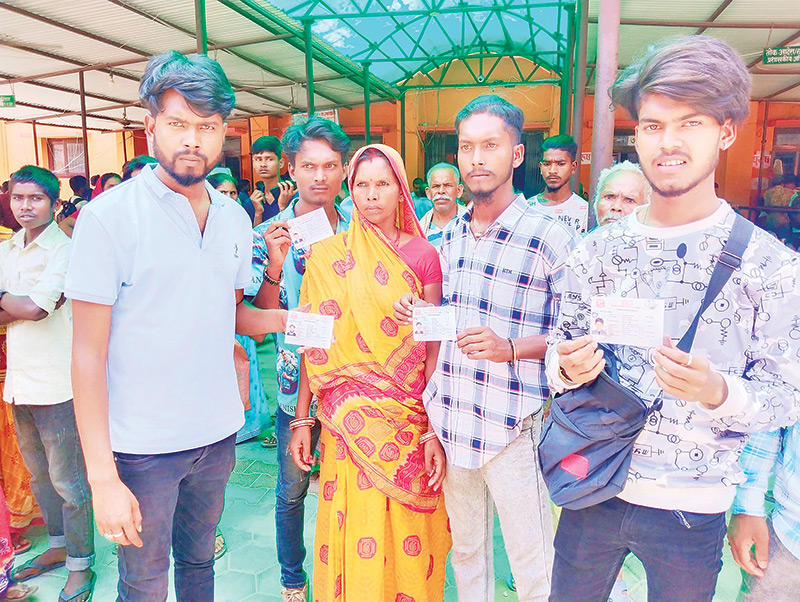
Indrajit Safi (foreground, left) with his brothers and mother at District Administration Office in Kathmandu on Sunday after receiving their citizenship. Photo: Courtesy of Indrajit Safi’s Facebook
JANAKPUR / PARSA Indrajit Safi is an engineer by profession. A resident of Dhanusha district, he was on the forefront of the longstanding struggle of thousands of youths deprived of citizenship for years. He spearheaded a sit-in and confrontation at Maitighar in Kathmandu, almost every day ever since the Supreme Court issued an interim order in response to a writ petition filed against President Ramchandra Paudel’s authentication of new amendments to the Citizenship Act. Indrajit’s struggle finally paid off on Sunday as the apex court on Thursday cleared the way for the implementation of new amendments to the Citizenship Act. Indrajit, along with his mother Sonawati and three brothers, reached the District Administration Office (DAO) in Dhanusha in the first hour on Sunday and submitted all required documents. Indrajit and his three brothers received citizenship by descent from Chief District Officer Kashiraj Dahal. “This moment has turned all the hardships including those we endured during protests at Maitighar into happiness. I wish nobody will have to struggle for citizenship when they have to focus on studies and make a career,” Indrajit told the Post after he acquired citizenship. After Indrajit and his brothers were handed over citizenship certificates they hugged their mother. They came down where many people were queuing for citizenship, and took a family photo with the queue in the background. They posted the photo on social media and shared happiness. Indrajit is the central chairman of the struggle committee of the people deprived of citizenship. The 31-year-old engineer is a resident of ward 3 of Ganeshman Charnath Municipality in Dhanusha. He and his brother could not acquire citizenship when they attained the required age for citizenship. His brothers Ranjit, 29, Chhotu, 22, and Rabin, 21, were visibly elated and credited Indrajit’s long struggle for the joyous moment.. Indrajit has a long history of struggle for citizenship. He had been running from pillar to post for citizenship. “Earlier, I didn’t care much about citizenship, thinking that both my parents have citizenship and I could acquire it easily. I went to Kathmandu to study grade 11 and 12 after passing the School Leaving Certificate in 2013. I was asked to furnish a citizenship certificate to get enrolled for engineering,” Indrajit shared his ordeal. “I immediately went to Dhanusha to get citizenship. But the district administration office returned me empty handed stating that the Supreme Court prevented people like me from acquiring citizenship certificates,” said Indrajit. According to him, the DAO employees assured him that a new law would be formulated so that children of the people who acquired Nepali citizenship by birth would get citizenship. “I waited for two years for citizenship. Later I went to India to study engineering after learning that a citizenship certificate was not required to study there,” said Indrajit. Many people like Indrajit have acquired citizenship after the new amendments of the Citizenship Act came into implementation across the nation. They are now relieved from ‘statelessness’. “I now feel that I am a citizen of Nepal. My happiness has no bound for being Nepali citizen. I will work for my country,” said Indrajit, a civil engineer. Renu Kumari Yadav of Bishnupur in Siraha also acquired citizenship. She married a few years ago and gave birth to a daughter. But her child was deprived of birth registration as Renu did not have a citizenship certificate. “I feel that I have won a big battle. It took just about half an hour to get citizenship after fulfilling the necessary process and documents,” said an elated Renu proudly holding her citizenship card. On Sunday and Monday, the DAO, Parsa was crowded mainly with the youths who waited in serpentine queues for citizenship. They seemed a bit anxious and in a hurry fearing that the Supreme Court or any higher authorities could issue another order to prevent the implementation of the new amendment to the Citizenship Act. “I was in a panic until I got my citizenship. Finally I am a citizen of my country,” said Bhim Chaube, a 23-year-old man from Birgunj Metropolis-6 in Parsa. He complained that he had been offered to work as an accountant in a multinational company along the Parsa-Bara Industrial Corridor last year, but he could not take the offer as he did not have a citizenship. “Now that I have a citizenship certificate, I will find a good job,” said Chaube. According to Binaya Kumar Shrivastav, spokesman at the DAO in Parsa, around 70 people who were earlier deprived of citizenship, acquired citizenship on Sunday alone. In Morang, Niraj Kamat who attempted to self-immolate at Maitighar in the first week of June protesting the Supreme Court’s interlocutory interim order not to implement the new amendments of the Citizenship Act, received citizenship on Monday. Chief District Officer of Morang Birendra Kumar Yadav handed him the citizenship certificate. “I was deprived of opportunities and benefits provided by the state due to the lack of citizenship. I returned from the mouth of death and finally acquired citizenship. Our protests finally paid off,” said Kamat, aged 25, of Katahari Rural Municipality-4. He said his dream to be a police officer was ruined due to the lack of citizenship and he could not continue his studies in desperation. According to him, his father Kisun Dev Kamat had acquired citizenship by birth while his mother Gulab Devi Chaudhary had acquired citizenship by descent, but he was deprived of citizenship. The Supreme Court on Thursday cleared the way for the implementation of new amendments to the Citizenship Act that were authenticated by President Paudel. A division bench of justices Ananda Mohan Bhattarai and Kumar Regmi decided not to give continuity to the interlocutory interim order earlier issued by the single bench of Justice Manoj Sharma. Hearing the writ petition filed by senior advocates Surendra Bhandari and Bal Krishna Neupane, the apex court on June 4 had ordered authorities not to enforce the new amendments. The petitioners had filed the petition at the apex court following the President’s authentication of the amendment bill, stating that President Paudel had endorsed the Citizenship Bill unconstitutionally. The court’s latest order has cleared the way for thousands of children of parents who got citizenship by birth to acquire citizenship by descent. The new amendment is expected to benefit around 400,000 people. President Ram Chandara Paudel on May 31 had authenticated the bill—the same one that his predecessor Bidya Devi Bhandari had twice refused to endorse—after repeated requests from the government followed by a series of consultations with legal and political experts.
(With inputs from Deo Narayan Sah in Morang)
NATIONAL
Woman missing in Panelakhola
District Digest
JUMLA: A 46-year-old woman, a resident of ward 2 of Guthichaur Rural Municipality in Jumla district, went missing in the flood in the Panelakhola River on Sunday evening. According to the Jumla District Police Office, the woman went missing while trying to reach the watermill in the river when the water level was high. The flood also damaged two watermills. Efforts are being made to search the women in coordination with local police.
NATIONAL
Three arrested on usury charges
District Digest
SAPTARI: Police on Sunday arrested three people on charges of usurious lending. According to SP Narendra Kumar Karki, chief of the Saptari District Police Office, the arrested have been accused of lending money in Rajbiraj and nearby areas at high interest rates. Police made the arrest after five people lodged complaints against them. A recently introduced ordinance criminalising loan sharking has provisioned stern punishment for the lenders including up to seven years in jail and fines of up to Rs70,000. As per the ordinance, if a loan shark has confiscated cash or property from the borrower, an equivalent cash or property or the same property should be returned to the borrower. The ordinance has also amended the National Criminal Procedure (Code) Act-2017 to provision prosecution of loan sharks under the anti-money laundering law.
NATIONAL
Two local unit officials charged with graft
District Digest
RUPANDEHI: A corruption case was filed against three people, including the chief administrative officer of Shudhodhan Rural Municipality and the ward chairman of Ward 7 of the rural municipality, by the Commission for the Investigation of Abuse of Authority at the Special Court on Monday. According to Bhola Dahal, CIAA spokesman, the case has been filed under corruption and bribe-related offences against chief administrative officer Anantapani Marasini, ward 7 chairman Bhim Bahadur Yadav, and a service seeker.
OPINION
Seeking solace in personalities
It is unfortunate that our society worships personalities rather than collective effort.
- SUJEEV SHAKYA
Post File Photo
Last week, I shared fellow columnist CK Lal’s column “Pathos of vulnerable narcissism” which discussed authoritarian behaviour. The point that I agree with him on is what is this confounded nationalism when 6,500 passports are being issued each day? I was trolled, and as I always receive after I write something about India-Nepal relationship—protest tweets! It is unfortunate to see that our society cherishes and focuses on personality worship more than building teams and institutions, as evidenced by the trolls and abuse on social media against Balen Shah’s criticism. For someone who created and worked in teams in different fields, the personality driven authoritarianism is complete opposite to what I believe in. There have to be healthy debates, and different view points should be accepted. Opinion pieces in newspapers exist not for people to shun their beliefs and believe in the writers, but to get an opportunity to get the other view (as my column is named). This also made me think about global developments and question whether autocratic figures across different fields are the flavour of the month.
Global trends When we talk about Elon Musk, the owner of Twitter, we forget that it is a publicly traded company and there are other shareholders who own 21 percent of its stock. However, he has created a personality cult-driven environment where a company is identified with the individual, questioning the concept of corporation, corporate governance and corporate citizenry. When liberalisation boomed in the 1990s, companies were identified as a corporation rather than with an individual. IBM was never discussed in the context of owners. We even discuss Microsoft or Google with emphasis on the owners. I recall the business relationships I had in my earlier job with ITC in India, a faceless conglomerate. It is astonishing to see how Ratan Tata gets dragged into becoming the face of the Tata companies, many of which are corporate citizens. Twenty years ago, in the heyday of Ratan Tata’s silent crusade, he was not discussed so much as a person as the institution and legacy he continued to lead. In politics, it seems it was the rise of the Trump phenomenon that pushed towards the importance of individual identity in politics. Be it President Xi Jinping, Prime Minister Narendra Modi, President Recep Tayyip Erdogan or President Vladimir Putin, it is always about individuals rather than the institution they belong to. When Modi decided to inaugurate the new Parliament building without even inviting the President of India Droupadi Murmu, it was seen as a normal day because that had become the norm. We should not forget that even Hitler was allowed to do all the things he did as a majority of his people believed he was right. In Nepal, the last local elections brought about the rise of two individuals—the mayor of Kathmandu Balen Shah and the mayor of Dharan Harka Sampang—who could question the status quo and bring about transformation that we rarely see in Nepali local governments. However, Kathmandu’s mayor continued to draw attention to his authoritarian style of operation and trust in a team that would not question him. Many have silently distanced themselves from him over time. I start recalling the days of the October 2002 takeover by King Gyanendra when hoarding boards sponsored by business people popped up welcoming the move. In February 2005, the king decided to go for direct rule and we all know what happened. His government fell in 14 months! I was working at the Soaltee Group at that time, and I recall the ways in which critics were silenced and only people who would not criticise would be allowed to hover around. However, our love for personality worship and autocrats continues. Be it KP Sharma Oli in the CPN-UML, Pushpa Kamal Dahal Prachanda in the Maoist party and Sher Bahadur Deuba in the Congress. They survive by keeping people who are not critical close to them. They believe that what they do is successful as no one close to them criticises them. If they do so, they lose proximity. Therefore, a cadre of sycophants exist who in turn do not want critics. If Girija Prasad Koirala had lived in the times of social media, we would have learnt a lot about his autocratic traits.
Hero worship In South Asia, where idol worship, worship of cult leaders and hero worship exist, it’s fertile ground for authoritarianism. When a self-proclaimed guru who golfs during his leisure time can sell high-priced front row seats to see him dance, we know how gullible we are! Rather than read the simple teachings of the Buddha, we worship SUV-hungry personalities as gurus who have made great fortunes after renouncing “material life”. We like to associate public institutions with individuals, be they publicly listed institutions or institutions with state or public money. In a country where the Buddha’s concept of commune and the social structure of guthis developed, it is interesting to see how we do the opposite of these concepts and constantly search for larger than life figures. Of course, there is some silver lining in the dark clouds. The Rastriya Swatantra Party celebrated a year of existence last week. It is one of the institutions that began as something synonymous with an individual, and in a year, it has developed a team where more than one person is important, and it is an institution in the making. Decisions are becoming more team-oriented than the verbose rant of an individual. This will perhaps make people think whether it is important to have autocrats who have no accountability or have teams that will provide checks and balances. History has enough stories to tell about the instances of destruction, including self-destruction, inflicted by autocratic megalomaniacs. It’s always important to get the other view.
OPINION
Talking mental health
Individuals who open up about their mental health are called weak and those who suffer in silence deemed strong.
- REBECCA M SHRESTHA
Shutterstock
“So, can you read my mind?” This question is almost always raised whenever I tell someone I am a psychologist. While I am more than happy that I cannot read minds (or stars, for that matter), I have realised that many people would rather that I could. After all, this would mean that they would not have to express themselves or explicitly ask for help—a quick and silent fix is what most desire. My interactions with Nepalis show that they are in a dire need for someone who understands and helps with their mental health problems, but they are hesitant towards tailored and thorough therapy. The issue starts with a general lack of awareness of what psychologists are and what they do. Psychologists, unlike psychiatrists, treat mental health disorders via verbal therapy. These therapy treatments, which require multiple sessions, generally last an hour each. “Eh, bolera?” Is a reply I usually get, along with a subtle hint of disappointment—“Ah, bolera!” Speaking about one’s problems—especially mental health difficulties—which aren’t readily tangible is generally frowned upon in the South Asian culture. Individuals who open up about their mental health are called weak and those who suffer in silence deemed strong. We fail to realise the strength and effort it takes to articulate what is going on inside our minds when we are struggling to comprehend ourselves. It is crucial to understand that it is okay not to be okay sometimes, and asking for help when needed displays insight and courage. After all, we are not machines–in fact, even machines need servicing. Moreover, we don’t think twice before going to a hospital when we need a physical check-up, do we? This is because we have been taught to believe that, unlike physical health, mental health is closely linked to reputation and honour. The shame associated with having psychological difficulties and seeking therapy is rooted far deeper than what meets the eye. The concept of ijjat, the role this has in developing mental health disorders, and the barrier that this presents towards mental health help-seeking behaviour in South Asia have been thoroughly studied. The pride that young individuals are expected to bring to their families by becoming engineers or doctors, by adult men who are meant to provide for their families day in and day out, and by women who are expected to adjust to living with their in-laws post-marriage are all non-negotiables in many families. Moreover, the road to attaining such pride is often expected to be linear, with no detours or mistakes. The pressure it brings about may form the basis for severe psychological stress, unhealthy coping mechanisms and mental health disorders. Poor mental health literacy, denial and ignorance—“no one in our family has such a problem”—have robbed numerous individuals suffering from mental health disorders of their chance for recovery. Despite a dearth of research pertaining to mental health in Nepal, recent studies have revealed a steadily growing number of suicides and cases of depression and anxiety. A total of 25,316 people took their lives between 2015 and 2019—an average of 14 people each day—not to mention the numerous cases that go unnoticed or remain unrecorded, according to Bhagabati Sedain Silwal and co-authors in a 2021 paper titled “Burden of suicide in Nepal: an analysis of police records.” Furthermore, a national mental health survey conducted by the World Health Organization revealed that among 9,200 adults who participated, 10-20 percent were affected by common mental health problems. Among those affected, 78 percent did not seek any help to alleviate their symptoms. The leading cause of this lack of treatment was confusion about who to turn to and where to seek professional care. So, with all this noise in their heads, who do people turn to? By default, these mental health issues are disclosed within friend circles and family. Often, it is met with statements like “You should not be so weak” and “What will others say if they find out?” Sufferers are left feeling even more lost and unsupported. This is where the role of a psychologist comes into play. While family and friends undoubtedly have the best intentions in mind and in many cases also help alleviate some degree of psychological distress, there is a difference between family advice (helpers) and trained professionals (skilled helpers). Trained mental health professionals can assess, diagnose and provide evidence-based treatment for mental health disorders such as anxiety and depression while also providing coping strategies and stress management without the bias that people close to us may have. Their advice leads to better treatment outcomes and sustained recovery. “Why spend money on this?” is an argument I have often heard. To put it bluntly, seeking help for our mental health from mental health professionals is comparable to how we would go to a medical doctor and not our engineer uncle to treat diabetes. Having said this, I understand that humans are creatures of habit, and change, even if pleasant, can often be difficult to initiate. Asking for help when one has mental health issues is that change. Support may be obtained from those close to us. But more often than not, this is not enough. Regrettably, the majority of the population is limited to this resource for support. Thankfully, in larger cities in Nepal, there is a steady rise in the number of psychologists in public and private hospitals as well as psychology clinics. Asking for help when feeling helpless is not a sign of weakness. It takes great strength and bravery to admit that we need support. By accepting this, we take the first step towards achieving a balanced state of physical and mental wellbeing.
Shrestha is a psychologist.
OUR VIEW
All talk and no change
The budget speech is not a dictum carved in a stone; it must reflect deep engagements in a palimpsest.
“Listen to all opinions, but act on your own.” Finance Minister Prakash Sharan Mahat seems to have internalised this oft-misinterpreted adage a bit too religiously. For, after weeks of post-budgetary analyses in Parliament, all that the finance minister has done is turn deaf ears to the comments and criticisms and is trying to bulldoze the parliamentary process to get the budget passed. All through the parliamentary debates, Minister Mahat has carried an air of intellectual arrogance unbecoming of a leader of a patchwork coalition government that represents contesting ideologies. Often, even as opposition leaders made fairly constructive criticisms, Minister Mahat made grumpy faces, even at times donning a mildly disdainful grin. Such was his bearing while responding to former foreign minister Bimala Paudyal Rai’s criticism that the budget had been hard on those who looked forward to buying mid-range electric vehicles. He had not seen low-income families who could afford an Rs4 million electric car, the minister had sheepishly retorted, while failing to explain how his revision of tax rates made sense amid a climate emergency when replacing fossil fuel-guzzling vehicles with electric ones is a necessity. In his failure to address oppositional voices, the finance minister has failed to acknowledge that a budget speech is not an irreversible dictum of a mediaeval despot carved in stone. Rather, it should be a palimpsest bearing the marks of a continuum of dialogues, revisions and afterthoughts emanating from an argumentative culture. In its fallibility lies the true strength of any thought or speech, not least a federal budget speech that represents the aspirations of 30 million Nepalis. Regrettably, the finance minister seems to take the oppositional voices as no more than a counterbalance in the competitive parliamentary process that can be passed over if he has the numerical majority on his side. In fact, opposition leaders are not the only ones calling for a revision of the budget. Deputy Prime Minister and Home Minister Narayan Kaji Shrestha was being sensible when he said in Parliament on Sunday that the weeks of post-budget analyses made no sense if the budget was going to be passed without any corrections. Other leaders who have made some sharp interventions on the budget include Mahat’s own party General Secretary Gagan Kumar Thapa, and Mahat’s former partyman-economist Swarnim Wagle who continues to share his passion for neoliberal capitalist policies. As a crucial authority mandated with using the country’s resources to maintain macro- and micro-economic stability amid a deep economic crisis, the finance minister would do well to heed constructive criticism within and beyond Parliament. The members of parliament are not just talking heads out there to criticise the finance minister’s budgetary provisions for nothing. They are thinking, living representatives of the people from across the country. Their opinions should be heard as the voices of the millions of people that make up Nepal. If there are some arcane parliamentary regulations preventing timely revision of the budget, they must be changed, and the onus for doing so again lies with the ruling parties, including Mahat’s Congress.
THEIR VIEW
Protect our parks
Most parks in our cities are more or less in a similar state, with commercial interests and lack of care.
After having gone through some of the most punishing summer days on record not long ago, do we need any more incentive to stop what’s causing this “man-made” heatwave? Apparently, we do, unbelievable as it may seem. A recent report by Prothom Alo shows how—far from dialling back—those in charge are still encouraging mindless concretisation leading to continued depletion of green spaces, further warming our cities. The report is on a park in Chattogram city where, according to a survey, a staggering 55 percent of its space is covered with concrete infrastructure, blatantly violating building regulations that restrict concrete usage to no more than 5 percent of park space. The Biplab Udyan is under the city corporation, but leased out to two private firms who are largely responsible for its current plight. Its central area is filled with rows of food stores and seating arrangements, all made of concrete. Also, a large part of the park is surrounded by bamboo fences and thus off limits to visitors. They can stroll through the walkways, but those too are made of concrete, as are the benches. There is little sign of greenery in an area that is supposed to be full of it. It is safe to assume that most parks in our cities—there are not many left—are more or less in a similar state, with commercial interests and lack of care and awareness turning them into concrete-laden landscapes. Green spaces like parks and playgrounds are important for relaxation, recreation, and communal gathering. They are also crucial for controlling temperature in a city. But in our blind pursuit of development, we are destroying not just these urban oases but also our future as a species. This is as true in Chattogram as in other large cities including Dhaka, where, in DNCC alone, green areas have shrunk 66 percent over the last three decades. The authorities must reverse this trend. They must stop commercialisation and concretisation of our parks, and take steps to improve the overall coverage of green spaces in our cities.
— The Daily Star (Bangladesh)/ANN
NATIONAL
JSP vows to lobby for directly elected president and fully proportional parliament
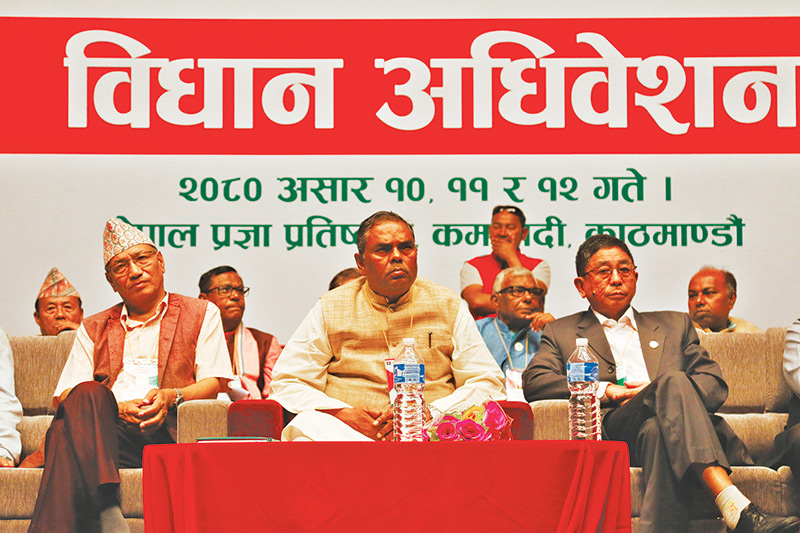
Party chair Yadav presented the draft of the statute on Sunday for deliberations among the party representatives attending the convention. The draft has proposed a two-term limit in the same executive post.
- Post Report
Janata Samajbadi Party leaders attend the inaugural session of the party’s statute convention held in Kathmandu on Sunday. Post Photo: Keshav Thapa
KATHMANDU, The Janata Samajbadi Party is set to adopt a policy of lobbying for the directly elected presidential system in the country. The Madhesh-based party has also set its goal to fight for establishing a Parliament with fully proportional representation. Presenting a draft statute of the party on Sunday, JSP chair Upendra Yadav proposed the aforementioned form of governance for deliberations among party delegates during its statute convention that is underway in Kathmandu. The three-day event will continue till Tuesday. The party will stand in favour of “the directly elected executive president and a parliament with fully proportional representation as the form of governance of the nation,” states section 5 of chapter 4 of the draft statute. The then Madhesi People’s Rights Forum Nepal, led by Upendra Yadav, had proposed the same model of governance during the constitution writing process in the Constituent Assembly as well. The Yadav-led ruling party JSP now has 12 seats in the House of Representatives and leads two ministries in the government. Party chair Yadav presented the draft of the statute on Sunday for deliberations among the party representatives attending the convention. The statute has proposed the age limit of 70 years for the election and nomination of the officials in the central committee, provincial committees, national committee, and district committees of the party. Likewise, it has proposed a two-term limit in the same executive post. According to the provision, a leader cannot file their candidacy for the third time for the same level and the same position if they have already completed their two terms in a position in district, province/national, or central committee levels. The draft states that the national general convention of the party will be held every five years. However, it has also been proposed that in case of national emergency or special circumstances, the convention can be preponed or postponed by a maximum of a year. The general convention will be the supreme body of the party. On Monday, the representatives discussed the statute in groups during the closed session, informed Manish Suman, party spokesperson. “Around 800 convention representatives gathered from across the country were divided into 10 groups for the pointwise discussion on the statute,” Suman said. “The groups selected their facilitators from among the central committee members.” According to him, the suggestions will be presented and discussed on Tuesday and then the statute will be endorsed. The statute has proposed that the national general convention will elect a 151-member central committee, including a 13-member office bearers: a chair, a co-chair, three vice-chairs, a general secretary, three deputy general secretaries, three secretaries and one treasurer. “The central committee will be the most powerful executive body of the party in the absence of the national general convention and federal council. It will be responsible/accountable to the general convention and the federal council,” the draft states. The draft has proposed the nomination of central members (excluding office bearers) with a 30:70 ratio (30 from the open category and 70 based on proportional representation), a requirement for at least 40 percent youth participation. Similarly, a central executive committee will be formed including the federal council chair, central committee chair, senior leader, co-chair, vice-chairs, general secretary, deputy general secretary, secretary, treasurer, and 15 members elected from the central committee. Similarly, the statute has proposed four central agencies: Central Advisory Committee, Central Disciplinary Commission, Central Account Commission, and Central Election Commission. If the party deems the statute amendment necessary, the central committee will form a statute amendment task force with a maximum of nine members including a coordinator.
NATIONAL
Kathmandu District Court judge Bhattarai resigns
- Post Report
KATHMANDU, Kathmandu District Court judge Shree Krishna Bhattarai resigned from the position on Monday. Submitting his resignation, Bhattarai said that he had reservations over the appointment of Hari Krishna Karki as the chief justice, despite questions being raised about the latter’s legal and ethical beliefs. Bhattarai said that he decided to quit the position as it would be uncomfortable for him to work under someone he had prejudices against. Expressing his dissatisfaction with the procedure of appointing judges, Bhattarai alleged that people with political connections often got appointed to the judicial council. Bhattarai complained that people with political connections took office and alleged that politicians’ involvement in appointing judges has discouraged officials who spent their entire career in the judicial service. “The process of appointment of judges involves favouritism, with those in political power appointing their own people. This makes the future of other judges, like myself, extremely bleak,” Bhattarai said. Despite filing a complaint at the Parliamentary Hearing Committee against Chief Justice Karki before his appointment to the position, the committee failed to exercise its discretion, Bhattarai added. “The committee, that I entrusted to serve justice, itself was illegal. The appointment of the chief justice also remains illegal. I don’t feel it would be right for me to continue working under someone whose appointment I objected to,” Bhattarai said. “I don’t see improvements taking place without sit-ins or protests.” He further added that he would actively work to bring reforms and strengthen the judiciary in the future.
NATIONAL
Over two-thirds of road accident deaths in Nepal involve motorcycles, report says
Seventy-five percent of two-wheeler accidents occur in Bagmati Province. One-fifth of the severely injured individuals in road accidents lose limb function, while five percent suffer brain damage.
- Post Report
KATHMANDU, Motorcycle accidents account for 68 percent of those killed or injured in road accidents or crashes that occur in Nepal, according to a new report. Due to the hassles in public transport, two-wheelers especially motorcycles and scooters are very much popular, especially among the youths in Nepal. However, the final report of the Nepal Demographic and Health Survey-2022 carried out by the Ministry of Health and Population between January 5 and June 22 last year with technical and financial support from the USAID, depicted an alarming figure of deaths and injuries in road accidents, involving motorcycles. On average, 14 deaths occur due to road traffic injuries per 100,000 population in Nepal. More males (11 deaths per 100,000) than females (three deaths per 100,000) die due to injuries suffered during road accidents. “The most common type of road traffic accidents or crashes in Nepal involve motorcycles. Two-wheeler accidents account for 68 percent of those killed or injured in the 12 months preceding the survey,” stated the report. A large number of those involved in road traffic accidents have non-fatal injuries. Overall, 1,088 individuals per 100,000 population (301 per 100,000 females and 787 per 100,000 males) sustain nonfatal injuries due to road accidents or crashes. There were 1,102 deaths and injuries for every 100,000 people due to road accidents and injuries in the 12 months preceding the survey. The study showed females and males aged 15-24 years are more prone to road accidents that might lead to death or nonfatal injuries (1,659 individuals died or injured per 100,000 population) than those in the other age groups. Similarly, deaths and injuries due to road accidents are higher in urban areas (1,236 per 100,000 population) than in rural areas (833 per 100,000 population). Road accidents or crashes caused the most deaths and injuries in the Madhesh Province (1,430 per 100,000 population), followed by Bagmati Province (1,156 per 100,000 population), Sudurpaschim Province (1,112 per 100,000 population), and Lumbini Province (1,017 per 100,000 population). The study showed that of those injured or killed, 12 percent were involved in bicycle accidents, four percent in bus accidents, and another four percent in three wheeler tempo-related accidents. Five percent were involved in pedestrian road accidents or crashes. Nearly two-thirds (63 percent) of those who were injured in road accidents in the last 12 months had a cut or an open wound, while 28 percent had broken bones, 23 percent percent had internal injuries, and 13 percent sustained head injuries. One-fifth (21 percent) of the severely injured individuals lost limb function, while five percent suffered brain damage. The study showed that motorcycle accidents are mostly prevalent in the Bagmati Province (75 percent). According to the latest data from the Department of the Transport management, motorbikes constitute around 80 percent of the total fleet of motor vehicles in the Kathmandu Valley, followed by private vehicles at around 13 percent and heavy duty vehicles at four percent and public transport vehicles, which constitute around three percent. The National Planning Commission estimated the road accident death rate in Nepal to be 15.9 deaths per 100,000 population. Overall, there were 14,736 injuries and 2,789 deaths related to road crashes in the fiscal year 2018-2019. A report by the Nepal Police showed that a total of 2,883 individuals died and 7,282 others sustained severe injuries due to road crashes during the fiscal year 2021-2022. As part of a global commitment, Nepal has adopted SDG Target 3.6 on road safety under which the country aimed to halve the number of road traffic fatalities and injuries by 2030. Worldwide, road traffic injuries are the eighth leading cause of deaths among people of all ages and the leading cause of death among children and young adults aged 5-29 years. The burden of road traffic deaths is disproportionately high among the low- and middle-income countries with relation to the size of their populations and the number of motor vehicles in circulation, according to the World Health Organisation. Injuries sustained in road traffic accidents cause considerable economic losses to individuals, their families, and nations. Nations also suffer social losses as a result of accidents, according to the UN health body.
NATIONAL
Corruption case filed against former Pashupati Area Development Trust member secretary Dhakal
Briefing
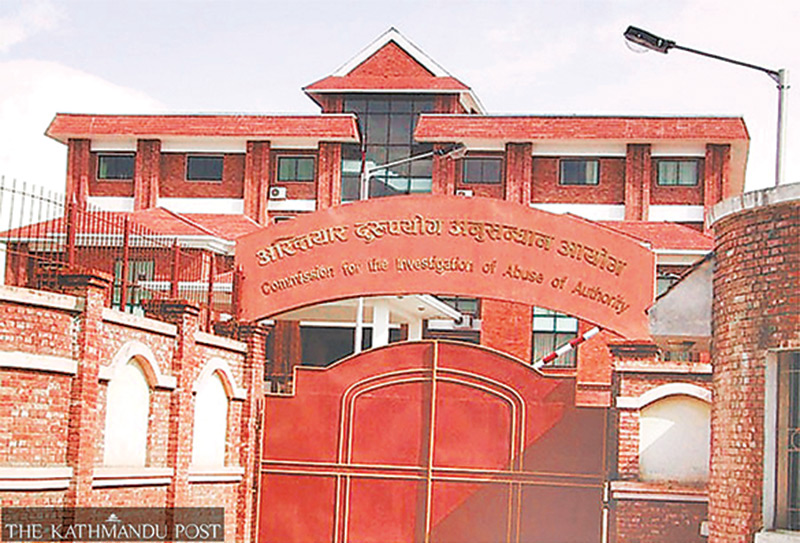
KATHMANDU: The Commission for the Investigation of Abuse of Authority (CIAA) on Monday filed a corruption case against Dr Pradeep Dhakal, former member secretary of Pashupati Area Development Trust, at the Special Court for allegedly amassing properties illegally. The anti-graft body, in its statement issued on Monday, said that the accused had amassed properties worth Rs14.41 million through illegitimate means. According to the CIAA, Dhakal could show the legal sources of his income worth Rs63.99 million during his tenure in office. Dhakal’s legal sources of income were his salary, incentives, travel allowances and other perks, amount received from the Citizen Investment Trust following his retirement, loans from different banks and cooperatives, income from sales of shares, and loans taken from various individuals, the anti-graft body said. But he invested as much as Rs78.40 million in land and property purchase, interior decoration of the building, loan payments, purchase of shares, service taxes charged by financial institutes, and other medical charges.
NATIONAL
Two found dead in Bhotebahal
Briefing
KATHMANDU: Two people were found dead in Bhotebahal of Kathmandu on Monday. The bodies of Dipen Limbu, a resident of Jhapa, and Jitesh Gurung, of Sindhuli, were recovered from a well, police said. Limbu had prepared to install a water pump to fetch water on Monday morning. After the pump fell into the well, he entered the water source to bring it back during which he lost consciousness. Gurung, who entered the well to rescue Limbu, also fainted. As per the preliminary investigative report, the victims were found to have died by suffocation, said Senior Superintendent of Police Dan Bahadur Karki.
MONEY
Chinese tourists can now use mobile pay in Nepal
WeChat Pay, one of the dominant digital payment platforms in mainland China, enters the Himalayan republic.
- KRISHANA PRASAIN
A file photo shows signs accepting WeChat Pay displayed at a shop in Singapore. REUTERS
KATHMANDU, Chinese digital payment service WeChat Pay and NMB Bank Nepal have partnered to make the mobile payment system available in Nepal. The service which launched on Thursday allows Chinese nationals visiting Nepal to pay for their purchases using their mobile sets. In February 2020, Nepal Rastra Bank had allowed NMB Bank to establish infrastructure and a mechanism to bring WeChat Pay to Nepal. But Covid-19 got in the way and the inauguration was put off. Chinese Ambassador to Nepal Chen Song tweeted on Thursday, “Warm congratulation to Wechat Pay Cross-border Payment service Inauguration in Nepal. A new step forward in financial connectivity, one of the five “connectivities” under #BRI initiative.” He also wished for the success of the cooperation between NMB Bank and WeChat Pay to bring more tangible benefits to the two countries. “The cooperation between NMB Bank and WeChat Pay has legalised payments via WeChat Pay in Nepal,” said Sudesh Upadhyaya, deputy CEO and chief information officer of NMB Bank. “Chinese nationals visiting Nepal with WeChat Pay on their mobiles can make payment by scanning a quick response (QR) code,” said Upadhyaya. “For now, the service is available only to Chinese visiting Nepal and not to Nepalis going to China. With Chinese nationals making payment via WeChat Pay, it will help Nepal earn foreign currency.” In May 2019, Nepal had banned WeChat Pay and AliPay stating that online payments through unregistered systems were illegal and resulted in a loss of income for Nepal. WeChat Pay, operating on Tencent’s messaging service, and e-commerce giant Alibaba’s Alipay are the two dominant platforms in mainland China. WeChat Pay, officially known as Weixin Pay in China, is a mobile payment and digital wallet service that allows users to make mobile payments and online transactions. Nepal has recently agreed with different countries to permit online cross-border digital payment. On June 1, Nepal and India signed a memorandum of understanding for cross-border digital payment, which is expected to ease transactions for business people, students and tourists from both countries. The cross-border digital payment service will be available to travellers of both countries reciprocally. “We are working on technical integration and connection of the system for Nepal-India cross-border digital payment after the discussion with a unified payment interface (UPI) team of the National Payment Corporation of India,” said Neelesh Man Singh Pradhan, CEO of Nepal Clearing House. On June 1, Nepal’s Fonepay signed a memorandum of understanding with Sri Lanka’s National Payment Network: LankaPay by developing an interoperable digital payment system that enables users to transact seamlessly across the two countries. The collaboration will allow users of either network’s applications to make payments across merchants of these two networks in either country in an affordable and convenient manner, the company said in a press release. “In the first phase, we prioritise acquiring for cross-border digital payment, which means allowing foreign nationals to make payment in Nepal using the digital payment mode of their respective countries,” said Guru Prasad Poudel, executive director of Nepal Rastra Bank and chief of the payments department. “The first phase is also about developing a mechanism so that Nepalis in foreign countries can send money through digital payment services,” Poudel said. “In the second phase, Nepali nationals will be allowed to make digital payments in their respective countries. For this, limitations need to be determined and charges on transactions also need to be made. The second phase is yet to be implemented,” he said. According to Nepal Rastra Bank, there were 10 payment system operators (PSOs) and 27 payment service providers (PSPs) in Nepal as of mid-May. There were 13,744 PSP agents and 18.22 million wallet users in the country as of mid-May. Nepal made electronic payment transactions totalling Rs3.88 trillion from mid-April to mid-May this year, down from Rs5.31 trillion during the same period last year.
MONEY
UN warns of impact if Black Sea grain deal ends
A Ukrainian envoy has said he was 99.9 percent certain Russia would quit when it comes up for renewal on July 18.
- REUTERS
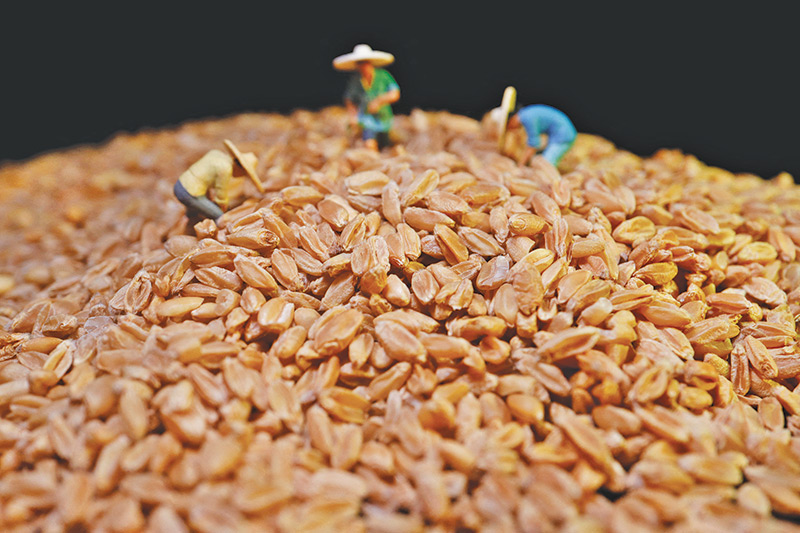
Wheat kernels are displayed with farmer miniatures in this illustration picture. REUTERS
GENEVA, An end to the Black Sea grains deal would hit the Horn of Africa hard, aid officials said on Monday, warning that another hike in food prices would add to the tens of millions of people facing hunger. Moscow has been threatening to walk away from the deal known as the Black Sea grain initiative—brokered by the United Nations and Turkey in July last year—if obstacles to its own grain and fertiliser shipments are not removed. A Ukrainian envoy has said he was 99.9 percent certain Russia would quit when it comes up for renewal on July 18. Famine in parts of the Horn of Africa was averted this year as the rainy season, projected to fail for a fifth consecutive year, beat expectations. But aid officials say some 60 million people are still food insecure in seven east African countries and worry about the impact of a further blow. “A non renewal of the Black Sea initiative would absolutely hit Eastern Africa very, very hard,” Dominique Ferretti, World Food Programme Senior Emergency Officer, told a Geneva briefing. “There’s a number of countries that depend on Ukraine’s wheat and without it we would see significantly higher food prices.” WFP is seeking to pre-position as much food as possible and would be compelled to try to switch suppliers if the deal were scrapped, Ferretti added. Brenda Lazarus from the Food and Agriculture Organisation, said that diets in Somalia, Sudan Djibouti and Eritrea were focused on wheat and any change would be “very slow”. UN data shows that around 700,000 tonnes have been shipped to Kenya and Ethiopia since the Black Sea deal began. While that is only about 2 percent of the total volume, the region has also been hit by the surge in wheat prices since Russia’s February 2022 invasion of Ukraine, although prices have since retreated. A World Health Organisation official said some 10.4 million children faced acute malnutrition and reported the highest admittance levels to medical facilities in the past three years in Somalia, South Sudan and parts of Kenya.
MONEY
Auto firms race to secure non-Chinese graphite for electric vehicles as shortages loom
- REUTERS
A file photo shows a worker looking on at the Niska trial graphite mine,owned by Talga Group, which aims to launch commercial production in 2024, in Norrbotten, northern Sweden. REUTERS
LONDON, Automakers, including Tesla and Mercedes, are rushing to lock in graphite supply from outside dominant producer China, as demand for electric vehicle (EV) batteries outpaces other uses for the mineral for the first time due to soaring EV sales. Auto firms have been slow to plan for graphite shortages, focusing mainly on better-known battery materials lithium and cobalt, even though graphite is the largest battery component by weight. Now, car makers are knocking at the doors of new producers, such as Madagascar and Mozambique, as this year EVs are forecast to account for more than 50 percent of the natural graphite market for the first time, according to consultancy Project Blue. Shortages of material produced outside of China will be even more acute as legislation in the United States and Europe aims to cut reliance on China for critical minerals. “Automakers are in a real bind because there’s been no investment in Western graphite,” said Mark Thompson, founder and managing director of Australia’s Talga Group Ltd, which plans to launch production next year in Sweden. Each EV on average needs 50-100 kg of graphite in its battery pack for the anodes, the negative electrodes of a battery, about twice the amount of lithium. The main use of graphite has been in the steel industry, but EV sales are due to more than triple by 2030 to 35 million from 2022, BMO Capital Markets forecasts. Graphite shortages are expected to rise in coming years, with a global supply deficit of 777,000 tonnes expected by 2030, Project Blue projections showed. About $12 billion of investment is needed by 2030 in graphite and 97 new mines required by 2035 to meet demand, Benchmark Mineral Intelligence (BMI) said in a report. China produces 61 percent of global natural graphite and 98 percent of the final processed material to make battery anodes, BMI said. Talga group is seeking to supply automakers, such as Tesla, Toyota and Ford, as well as battery producers such as Sweden’s Northvolt, Thompson told Reuters. Tesla Inc and Northvolt did not reply to a request for comment while Toyota Motor Corp and Ford Motor Co declined to comment. Talga has already signed non-binding supply agreements with two European battery makers that have links with Mercedes-Benz, Stellantis and Renault. Mercedes said it was diversifying the sourcing of raw materials, including graphite, and “have been in dialogue with various suppliers for some time”. “All the car companies are now scrambling to understand how to source battery materials at the mine level,” said Brent Nykoliation, executive vice president of NextSource Materials. NextSource, which in April commissioned a mine in Madagascar, is also in talks with auto companies, but said the details were confidential. Tesla has been at the forefront in securing graphite, having already agreed deals with Syrah Resources, which operates a mine in Mozambique, and with Magnis Energy Technologies. Syrah is building a US processing operation, one of a handful of plants being built outside of China that can transform graphite for battery use. NextSource is building a processing plant in Mauritius while Talga plans to construct a factory in Sweden. Western processing operations, however, will grow slowly. “China is still incredibly dominant in the graphite space and we anticipate they will maintain dominance for years to come,” said George Miller, senior analyst at BMI. By 2032, China will still control 79 percent of production of a type of processed graphite—uncoated spheroidised purified graphite—compared to 100 percent in 2022, according to BMI. This Chinese influence on the market may make it difficult for automakers who want to qualify for EV subsidies under the US Inflation Reduction Act. The IRA requires certain high percentages of battery components to be produced in the United States, or in a country with which it has a free trade deal. The European Union has proposed legislation that aims to reduce dependency on any one country for any key raw material to 65 percent by 2030. Agreeing graphite supply deals is complex, requiring extensive safety testing for material going into each model of EV that can take up to three years. Western auto groups are focusing on deals with graphite mines partly because it is around 55 percent less carbon intensive to produce anodes with natural material compared to synthetic graphite made from petroleum products.
MONEY
S&P cuts China GDP forecast as calls for stimulus intensify
- REUTERS
BEIJING, S&P Global cut its forecast for economic growth in China this year, underscoring the uneven nature of the country’s post-reopening recovery that is spurring more calls for further stimulus. S&P now expects China to log GDP growth of 5.2 percent in 2023, down from an earlier estimate of 5.5 percent. It was the first such cut by a global credit ratings agency this year and follows lowered predictions by Goldman Sachs and other major investment banks. “China’s key downside growth risk is that its recovery loses more steam amid weak confidence among consumers and in the housing market,” S&P said in a statement on Sunday. The world’s second-largest economy has slowed in recent months after coming back to life with the lifting of three years of restrictive zero-Covid policies. In May, property investment slumped further, industrial output and retail sales growth missed forecasts, and youth unemployment hit a record 20.8 percent. Forecasts for China GDP growth this year range between 4.4 percent and 6.2 percent. S&P said likely measures to bolster the economy could include “easing housing purchasing restrictions and mortgage down-payment requirements, expanding credit and infrastructure financing and, perhaps, fiscal support for consumption.” Ning Jizhe, a senior economic official with the country’s top political advisory body and the former head of China’s statistics bureau, is among policy advisers calling for more supportive measures to be rolled out. “It is better to introduce measures sooner than later,” he said at a forum in Beijing on Sunday, adding that the impact of the measures “ought not to be small”. Last week, China cut its key lending benchmarks, the first such reductions in 10 months. A week earlier, the People’s Bank of China (PBOC) lowered short- and medium-term policy rates. The world’s second-biggest economy will roll out more stimulus this year, sources involved in policy discussions have said. Last week, three major state-run securities newspapers published front-page articles that cited economists as saying that the PBOC will likely further ease monetary policy.
MONEY
Kathmandu Marriott Hotel gets ‘A’ rating for food safety
Bizline
KATHMANDU: Kathmandu Marriott Hotel has been awarded ‘A’ for food safety rating by the food quality watchdog. According to the hotel, they received the rating from the Department of Food Technology and Quality Control. “This recognition is a testament to the hotel’s unwavering commitment to maintaining the highest standards of hygiene and food safety, ensuring the well-being of its guests and staff,” the hotel said in a press statement. The rating is based on a comprehensive evaluation of food safety and hygiene practices, including food handling, preparation, storage, and service. “We are proud to have received this recognition from the government,” said Vishal Mehra, general manager of the Kathmandu Marriott Hotel. “Our team has worked tirelessly to ensure that our food safety practices are of the highest quality, and this rating is a testament to their dedication and hard work.” (PR)
MONEY
Go First’s lenders approve $55 million fund infusion to revive bankrupt Indian carrier
Bizline
MUMBAI: Lenders to India’s Go First, which is under bankruptcy protection, have approved interim funding of 4.50 billion rupees ($54.9 million) to resume operations and restart the airline, two banking sources said. Go First was granted bankruptcy protection on May 10. Reuters reported last week that the airline has sought 4 billion to 6 billion rupees in additional funds from banks. “This interim funding does not come with collateral, it will be a part of the insolvency cost and will be given priority over other dues,” said one of the bankers. The promoters, however, have indicated that they do not intend to infuse more funds into the airline, the second banker said. (REUTERS)
MONEY
Amazon workers in Leipzig start 48-hour strike for higher wages
Bizline
LEIPZIG: Workers at Amazon’s warehouses in Germany’s eastern city of Leipzig started a 48-hour strike on Monday to press for higher wages, the country’s public sector union ver.di said. The workers want a collective labour agreement that includes a 2.5 euro ($2.73) per hour wage increase for a 12-month period, a 250-euro wage hike for apprentices and for the labour agreement to be binding for the company. Ronny Streich, a representative of the ver.di union which called the strike, said some employers in the retail and delivery industry offered a 3 percent wage increase for the first year of the agreement and described it as “a slap in the face”. (REUTERS)
SPORTS
Club volleyball from July 8
Men’s event will have eight teams and women’s event will see participation of six teams.
- Sports Bureau
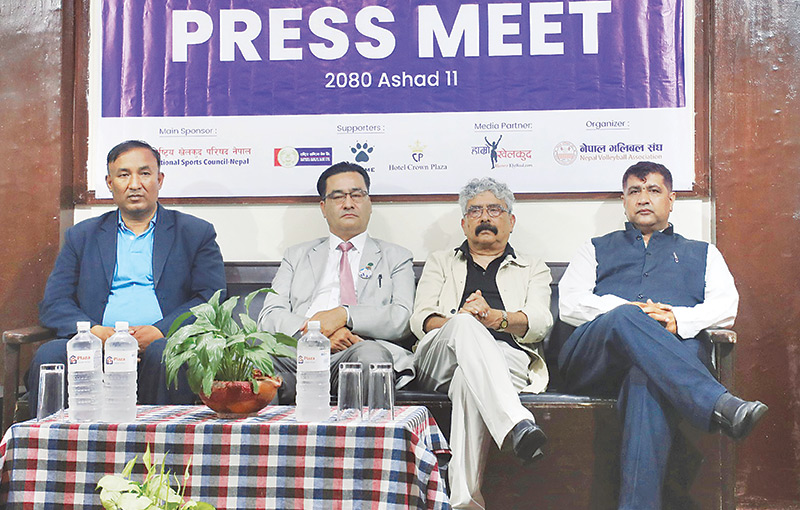
(From left) Nepal Volleyball Association vice-president Gautam Lasiwa, president Jeetendra Bahadur Chand and former president Manoranjan Raman Sharma during a press meet in Kathmandu on Monday. Photo: Courtesy of NSC
KATHMANDU, Nepal Volleyball Association is all set to organise the seventh NVA Women’s and Men’s National Volleyball Club League tournament from July 8 to 15 at the National Sports Council covered hall in Tripureshwar, Kathmandu. The tournament, scheduled as per the NVA’s annual calendar, is being organised as part of its policy to develop, promote and guide the game towards professionalism, said NVA president Jeetendra Bahadur Chand at a press conference on Monday. The men’s event will feature eight teams and the women’s competition will see participation of six teams—all qualified from the club championship tournament held in January. The men’s event will feature Nepal Police Club, Tribhuvan Army Club, Nepal Armed Police Force Club (APFC), Dawali Milan Club, Keshablal Memorial Foundation, Gandaki Province, Sailung Bagdhungha Sports Club and Tip Top Help Nepal. The women’s category will have NPC, APF, TAC, New Diamond Youth Sports Club, Everest Volleyball Club and Gandaki Province. A team will be eligible to field three overseas players in the game. The winner in the men’s section will qualify for the CAVA Men’s Club Volleyball Championship, which NVA has proposed to organise in Nepal in December, according to Chand. “We are also lobbying to have the tournament’s runner up in the capacity of the host country,” Chand added. The expected cost of the tournament is Rs7.5 million, out of which the National Sports Council (NSC) will provide Rs4 million. The top four finishers in both men’s and women’s section will bag Rs600,000, Rs300,000, Rs150,000 and Rs75,000, respectively. The best players in men’s and women’s section will get Rs35,000 each while best server, setter, blocker, spiker, libero and coach will earn Rs15,000 each. Chand also informed that both the men’s and women’s team will have foreign coaches for upcoming Asian Games. Belgium citizen Jan De Brandt is already appointed women’s coach and the men’s team will also get a foreign coach. Brushing off criticism against the national men’s team, who lost all six matches of the CAVA Men’s Volleyball Nations League in Bishkek, Chand said that the team was in a learning process. “It is not fair to relate all competition with outcome. The experience and the lesson the team learnt is valuable,” he said. “It was an opportunity for us to know our level in the Asian standard.”
SPORTS
Williams blitzkrieg lifts Zimbabwe, West Indies on the brink
Zimbabwe crush the US by a whopping 304 runs while West Indies lose in a super-over thriller.
- REUTERS
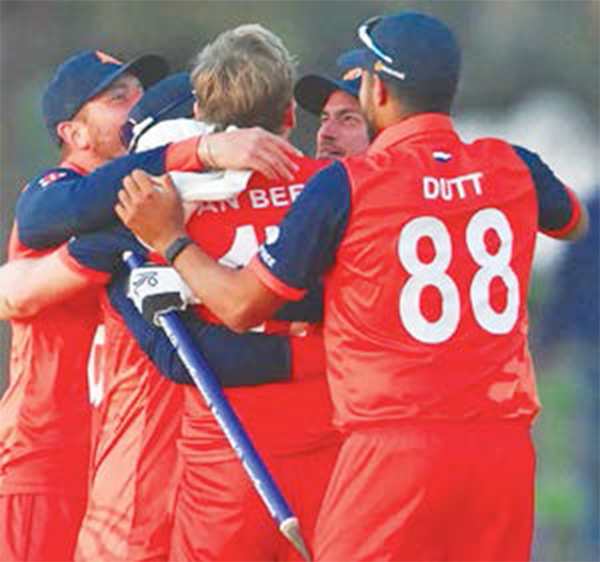
Dutch players celebrate after they defeat West Indies in a high-octane Super Over. Photo: Cricket Netherlands/twitter
Bulawayo, Zimbabwe batter Sean Williams smashed 174 from 101 balls in a 304-run win in their one-day international World Cup Qualifier against the United States but West Indies lost a super over to the Netherlands, thereby facing an uphill battle to stay in the race. Zimbabwe take four points into the ‘Super Sixes’ stage of the competition and Netherlands two, but West Indies will have zero and must win all three of their remaining games to stand a chance of reaching the World Cup in India that starts in October. Two-time winners West Indies have appeared at every tournament since it was first staged in 1975, but with only the top two teams from the Super Sixes qualifying for the main event, their chances now appear slim. They posted 374 for six in their 50 overs, but a superb 111 from 76 balls by Netherlands batsman Teja Nidamanuru allowed the Dutch to tie the game and set up a super over. The Netherlands’ Logan van Beek smashed 30 from six Jason Holder deliveries and West Indies wilted under the pressure as they lost both their wickets for eight runs in five balls. The Dutch also advance to the Super Sixes from Group A, while the three confirmed teams from Group B are Sri Lanka, Scotland and Oman. Zimbabwe’s colossal winning margin fell just shy of the men’s ODI record which India posted six months ago in their 317-run demolition of Sri Lanka in Thiruvananthapuram. Sent in to bat, the African side smashed their highest ODI total of 408-6 with Williams ably supported by opener Joylord Gumbie (78), Sikandar Raza (48) and Ryan Burl, whose 47 runs came at a strike rate of 294. The US were never in the chase and lost regular wickets as they were bowled all out for 104 in 25.1 overs, including three comical runouts. Zimbabwe finished the group stage of the qualifiers unbeaten, having also overcome West Indies, Netherlands and Nepal. “We’ve found our momentum and we’re looking to carry it forward,” Williams said after being named player of the match. “Having the crowd behind us is like having a 12th man.”
SPORTS
Djokovic still Wimbledon favourite, new world number one Alcaraz says
Alcaraz’s impressive form suggests he will be the biggest threat to Djokovic’s bid to secure an eighth title at the All England Club next month.
- AGENCE FRANCE-PRESSE
Carlos Alcaraz Ap/Rss
LONDON, Carlos Alcaraz believes he is capable of winning Wimbledon after claiming his first title on grass on Sunday by beating Alex de Minaur 6-4, 6-4 in the final at Queen’s Club. The Spaniard’s fifth title of the season also takes him back to the top of the world rankings, but he said Novak Djokovic remains the favourite to win Wimbledon for an eighth time next month. Alcaraz was playing on the grass for just the third tournament in his career and showed an impressive development through the week at Queen’s after nearly falling to French lucky loser Arthur Rinderknech in the first round. The US Open champion won his next four matches without dropping a set and is confident of going beyond the fourth round at Wimbledon for the first time. “I have quite a lot of confidence heading into Wimbledon. I ended the week playing at a high level, so right now I feel one of the favourites to win Wimbledon, but I have to get more experience on grass,” said Alcaraz. “Novak is the main favourite to win Wimbledon, but I will try to play at this level to have chances to beat him or make the final. I saw a statistic that Novak has won more matches at Wimbledon than the other top 20 players (combined). What can you say about that you know? Novak is the main favourite to win Wimbledon. That’s obvious. But I will try to play at this level, to have chances to beat him or make the final at Wimbledon.” Djokovic has reigned supreme in SW19 since 2018. He has not lost on Centre Court in 10 years since losing to Andy Murray in the final. But Alcaraz is hoping to have the crowd on his side should the top two seeds meet in the final. “I saw that Djokovic has never lost a match on Centre Court since 2013 when he lost against Andy so it’s ten years without losing a match on centre court, it’s crazy. But I hope to have the crowd behind me to change that stat.” De Minaur had dumped out Murray and world number six Holger Rune on his route to the final. But the Australian was left to rue Alcaraz’s ability to win the big points in a tight contest. “I’m content because I know I left it all out there and I try to play the way that I want to play,” said De Minaur. “So that’s a big positive for me coming into Wimbledon.” De Minaur had two break points for the chance to serve for the first set when he led 4-3. Alcaraz responded, though, to hold serve and immediately break the world number 18 in the next game before serving out for the set. He then needed lengthy treatment as he had strapping applied to his right quad. Alcaraz’s movement did not seem affected as he again pounced on his only break point to move ahead 3-2 in the second set. Two rare errors gave De Minaur some hope in the final game as Alcaraz found himself 0-30 down. But the Spaniard’s booming serve dug him out of trouble as four straight points secured the title and a return to world number one.
MEDLEY
Horoscope
ARIES (March 21-April 19) Your day could get off to an inharmonious start. Collect yourself, and give your confidence and motivation a healthy boost. Don’t be afraid to speak from the heart, as doing so could unlock new financial or romantic opportunities. Lay low cuddle.
TAURUS (April 20-May 20) Take steps to support your health and physical. Embrace wellness. It’s an ideal time to tidy up. Use your voice while planning for the future you desire most. Create your own opportunities, so take your time if it’s time to move forward.
GEMINI (May 21-June 21) Whether you need to curb your relationship with social media or update your electronics, now is the time to do so. Promises made during this time are also more likely to be kept. Hidden fortunes may reveal themselves.
CANCER (June 22-July 22) You’ll wake up feeling emotionally restored. Drama at home or work might unravel. Connect with your surroundings, as doing so will cause you to feel more stable and motivated. Don’t be afraid to socialise, as lasting connections could ensue.
LEO (July 23-August 22) Try not to gossip or get sucked into unhealthy office politics and professional drama. Focus on your own goals and personal well-being. Good vibes will flow, bringing enlightenment to your domestic and occupational spheres.
VIRGO (August 23-September 22) The real world may seem a bit boring or disenchanting. Disappearing feels tempting, don’t zone out when it comes to important commitments. You may need to find peace and quiet first. Expand your network of connections. Unleash your social side.
LIBRA (September 23-October 22) Unfortunately,relationships may be tested. Remember how important community is. Connect with the people who lift you up, especially if you could use some extra support. Your business savvy, negotiation skills and ability to advocate for yourself is sharpened.
SCORPIO (October 23-November 21) While it may be wise to operate from behind the scenes, don’t let negative thought patterns take over. You’ll feel in control when you focus on the path toward success. Your intuition and ability to think ahead are heightened.
SAGITTARIUS (November 22-December 21) You might face disorganization in your routine. Stay rooted in your to-do lists, but don’t let stress take hold if you fall behind on tasks. Important connections could also be made during this time. Indulge in enhancing mind-body connectivity.
CAPRICORN (December 22-January 19) You may feel closed off emotionally. Follow your instincts if you feel you need to protect yourself but don’t lock out loved ones. Focus on professional ambitions and stepping into your power. Your confidence and natural allure are boosted.
AQUARIUS (January 20-February 18) Lessons from beyond the veil await. Don’t get frustrated if you face obstacles, focus instead on learning and growing from the situation. Harmony will be easier, and you’ll be encouraged to pursue your passions. Speak up within professional spheres.
PISCES (February 19-March 20) Don’t take it personally if you encounter a few temperamental counterparts. Keep tabs on your own disposition, thinking through your words before sharing them. Stay focused on the tasks ahead. Stand in your power.
CULTURE & LIFESTYLE
Finding meaning through gratitude
When we choose to be grateful, we accept our life the way it is.
- Tashi Gurung
Shutterstock
Lately, I have been battling with thoughts about death. Perhaps it is because of the feelings of grief I am coming across—either through the clients I have seen or the literature I have read recently. This has given rise to a fear of death in me that wasn’t as prominent before. To be more particular, the uncertainty of it and how fickle and transient life is. This thought of how life is so impermanent made me feel very anxious. I pondered over how one can lose their life without any foresight, leaving behind their ideas, desires, wants and needs, thoughts of the future, and things they wanted to accomplish and achieve. The existential dread and anguish arising from these thoughts made me search for the answers or avenues to cope with them. Reaching out to my family, they shared a particular insight that gave me a huge sense of relief. Having been raised in the Buddhist faith, being born as a human is considered the greatest boon in a living being’s existence. It is considered the culmination of all the good deeds one does in life, ie dharma to be born as a human in their next rebirth. As a result, I considered my existence in itself as a gift. In fact, it made me even more mindful of my life to use it to the fullest for myself and others. The Buddhist teachings emphasise the value a human should place on their life to practice dharma as they have the intellectual capacity to differentiate what is moral and good. On embracing my life as a gift and boon, the anxiety and dread significantly dropped. I realised that the burden of death had subsided to make me embrace the present moment for the way it is. That’s when I observed that on doing this, I actually had tapped into a therapeutic resource and intervention that I often employ: gratitude. I realised that even though I have used this with my clients many times, I had hardly used it myself. Gratitude is an emotion of being thankful; in other words, counting our blessings. When we are choosing to be grateful, we are accepting our life for the way it is—saying yes to life. We are acknowledging that our life has elements in it that make it worth living, rather than looking at despair and sorrow. Much research has been conducted on gratitude’s long-standing effects on mental health. Gratitude is linked with positive emotions of hope, happiness and contentment and leads to a decrease in feelings of loneliness and isolation. Similar to the link between mental and physical health, gratitude has also been found to better sleep routines and strengthen our immune system. Gratitude journaling can be a great way to start on this technique. A lot of times, as I get occupied in my day-to-day life, I have found myself not being truly mindful of my circumstances. Thus, I have made it a point to write down a few things that I feel grateful about every day in the morning—no matter how small or big. It can be as simple as the food my mother prepared for me or a random act of kindness by a stranger when walking in the street. As I write about the minor, novel event, experience, or person in my days, I consequently embrace and enjoy the pleasant emotions arising from it. Along with my own internal experience, I extended my gratitude to others. I remembered an assignment we had done during my training, which involved us writing gratitude letters to our families. I rewrote the letter and gave it to them, which gave me a warm feeling. I considered it a perfect opportunity for me to embrace the life that I had been given and make it a point to be thankful for it. I have also made a personal goal to use the privilege and freedom to extend it to others, in any way I can, as I move further in life. This is where I realised the true meaning of life lies. Gratitude, as it has been for me, is a very powerful tool to deal with the complex feelings of existential dread (that we all might battle from time to time). Appreciating our existence, and extending kindness to the world around us can truly make life more meaningful and purposeful.
Gurung is a counselling psychologist at Happy Minds, a mental health and well-being platform.
CULTURE & LIFESTYLE
How to not put things off untill the last minute
Occasional procrastination isn’t too bad. It only becomes an issue if your studies, work or life are directly affected.
- Rukusha Giri
Shutterstock
Kathmandu I will do it later’ can seem like an elementary sentence—something said as an afterthought. However, we can all relate to instances when the phrase has gotten us in trouble, be it assignments or work. Procrastination is the tendency of pushing things that one has to get done till the very last minute. Studies published by the American Psychological Association show that around 20 percent of adults procrastinate chronically. The number is as high as 50 percent among college students. Most of us are guilty of leaving the preparation for a significant test until the last minute. We also wait until there are no clean clothes left to wear before doing the laundry. Despite multiple promises to go to the gym, we end up sleeping in. Sandesh Dhakal, a lecturer at the central department of psychology at Tribhuvan University, says that procrastination is a relatively common phenomenon. However, chronic procrastination could hint at something a bit more serious, and those who feel like they are procrastinating too much should seek help. Dhakal talks about why the tendency of procrastinating has seen an increase over the few decades.
How can one realise that they are procrastinating? Have you ever been busy with other activities instead of focusing on your primary task? This is the main sign that you are procrastinating. Let’s take an example of a student. When an exam is near, and you need to be studying, your mind suddenly recalls other minor activities. It could start by remembering that you have to clean your room, wash dishes, or do anything that isn’t pressing for the moment. Procrastinating occasionally isn’t all too bad. We all do it. However, it only becomes an issue if your studies, work or life become directly affected. Things get tricky when people don’t realise that they are not doing their primary task and are instead focusing on other activities. Procrastination doesn’t always result in work not being completed. In fact, a procrastinator often finishes their work at the very last moment. But this effort often comes at a cost to their mental well-being. Moreover, the work often isn’t as sincere and lacks quality.
Is procrastination a symptom of mental health problems? Procrastination is not a direct indication of a mental health condition. Instead, it could be seen as a symptom of mental health issues. When faced with an emotional disturbance or problem that an individual has a hard time coping with, they procrastinate to avoid dealing with it. Although it provides short-term relief, the guilt and pressure of unfinished work can be overwhelming. Procrastination has been viewed as a defense mechanism. It offers an unhealthy protection from the harsh realities of life. Additionally, when people avoid essential tasks and focus on less important ones, it allows them to reassure themselves that they have some form of control in their lives. While it could hint at the possibility of anxiety, ADHD or other mental health issues, procrastination is not a direct symptom of a specific mental disorder.
Is procrastination more prevalent among young individuals? Nowadays, young people are engaged in too many things. They consume a lot of information and have a lot of things on their minds. We often hear that kids shouldn’t be given too much pressure, but not giving kids any guidance can be harmful as well. As our brain develops the most as children, what we learn when young become our habits. Therefore, kids should be given proper guidance in matters of discipline, punctuality and sincerity without it being too harsh. If a child isn’t taught the value of doing things on their own and on time, then they could end up procrastinating as adults.
How can we stop ourselves from procrastinating? People need to be aware first. Without realisation, we won’t know why and how we are procrastinating. Moreover, if it becomes chronic, we shouldn’t hesitate to tell others and seek help. In the case of adults, self-realisation and remedy work best, whereas in the case of children, it is the role of parents, teachers and community to teach children the importance of managing one’s time.
CULTURE & LIFESTYLE
Showcasing the best in hip-hop
The BET Award 2023 honoured Busta Rhymes, hip-hop’s 50 years and paid tribute to legends like Takeoff and Turner.
- MARIA SHERMAN
Coco Jones accepts the award for best new artist at the BET Awards on Sunday. AP/RSS
LOS ANGELES, US The 2023 BET Awards celebrated 50 years of hip-hop with tributes to the genre’s earliest voices, late legends, and new talent during a show packed with spectacular performances that consistently felt like a party. Sunday’s biggest surprise came when Quavo and Offset, the surviving members of Migos, performed ‘Bad and Boujee’ in front of an image of Takeoff, who died in a shooting last December. “BET, do it for Take,” the duo shouted near the beginning of their set, as their backdrop switched from the image of a space shuttle to one of Takeoff pointing in the air. Throughout the show, whether it was Tupac, Notorious BIG, Biz Markie or Pop Smoke, performers and emcee Kid Capri paid homage to late hip-hop stars, often by quickly highlighting a taste of their best-known hits. In a show where few awards were given, Capri and BET kept the emphasis on the music. Busta Rhymes took home the night’s biggest honour, the Lifetime Achievement Award, handed to him by Swizz Beatz. The 12-time Grammy Award-nominated rapper, producer, and pioneering hip-hop figure is widely regarded as one of the great MCs, with seven Top 10 Billboard Hot 100 hits. Diddy, Janet Jackson, Chuck D, Missy Elliot, Pharrell Williams, and Mariah Carey recorded a video tribute to Rhymes. An energetic tribute to Rhymes followed—the MC teamed up with Spliff Star for ‘Ante Up Remix’, ‘Scenario’, ‘Look At Me Now’, ‘I Know What You Want’, before a long list of A-listers jumped in. Throughout the show, old-school hip-hop heroes and modern stars mixed it up onstage, performing tracks celebrating rap’s most influential cities and innovation. Audience members danced and sang along (and a few hopped up on stage) while Capri and MC Lyte kept the hostless show moving. It was mostly hiccup-free—save for a hitch during Patti LaBelle’s performance and the show running nearly four hours—particularly noteworthy for an event scheduled amid the ongoing Hollywood writers’ strike. LaBelle honoured Tina Turner with a performance of the late singer’s hit ‘The Best’, telling the audience at one point she couldn’t see the words. “I’m trying, y’all!” she said before powering into the chorus. A masked Lil Uzi Vert opened the show at Los Angeles’ Microsoft Theater before it jumped into a quick history lesson. Capri walked the audience through a medley of the earliest days of New York City ’80s rap culture. The coveted best new artist award went to Coco Jones, in a category which featured only female performers. “For all of my black girls, we do have to fight a little harder to get what we deserve,” she said in her acceptance speech. “But don’t stop fighting even when it doesn’t make sense. And you’re not sure how you’re going to get out of those circumstances. Keep pushing because we are deserving of great things.” It was the perfect mirror for the night: New York rapper Ice Spice ran through abridged versions of ‘Munch (Feelin’ U)’, ‘Princess Diana’ and ‘In Ha Mood’; Glorilla brought ‘Lick Or Sum’ to the BET stage, and Kali powered through her TikTok hit, ‘Area Codes’. In the audience, generations of hip-hop heavy-hitters cheered.