You internet speed is slow. Switch to text view mode

Switch
epaper logo
ST

Last Login:
Logout
+
Page 1
HOME PAGE

Government mulls extending passport procurement deal
With stock depleting, France’s IDEMIA may be asked to supply more copies as fresh tender would need time and new set-up.
- ANIL GIRI

Post Photo: hemanta shrestha

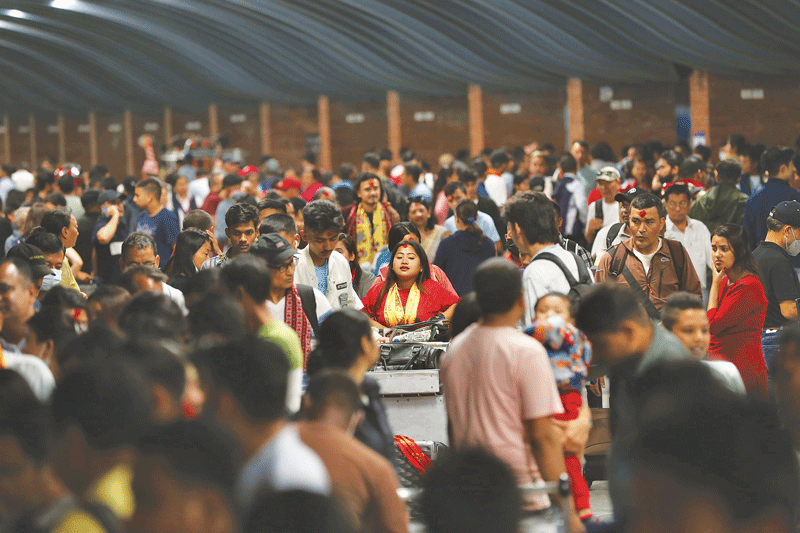
A crowd of people departing Nepal and their relatives pictured at the Tribhuvan International Airport in Kathmandu on Friday evening.

In order to address a looming shortage of passport copies, the government is in the final stage of procuring the books from the current supplier, the IDEMIA. The France-based security company has been delivering e-passports to Nepal since November 2021.
It had won the bid to print, supply and install the required technology including the personalisation centre in November 2021. With the distribution of the previous stock of two million passports nearly complete, the government is now procuring additional copies to meet the growing demand for the travel document through fresh negotiation.
Though the government had options to call for a fresh bid for passport printing and supply before reaching
a new deal, given the fast depletion of stock, it has decided to give continuity to the old procurement deal through negotiation, said officials. Minister for Foreign Affairs NP Saud told the Post that a proposal has been tabled in the Cabinet with the government ready to procure passports through negotiation with the IDEMIA. But the minister did not reveal the number of the passports to be procured from the IDEMIA or the price. The company had in 2021 won the bid to provide two million passports at the cost of $21.1 million ($10.46 for each copy) including technical support.
“The IDEMIA has submitted three proposals, with various time frames and pricing,” a senior ministry official said, adding, the volume of procurement would determine the price.
Damaru Ballav Poudel, director at the Department of Passports, told the Post that the office has only around 430,000 passports remaining. After the 34-page passports went out of stock, the department started distributing 66-page passports from June 18 following a Cabinet decision to meet the immediate requirement. Last month 146,800 passports were issued, said Poudel. At this pace, the stock will last for only three months.
The Ministry of Foreign Affairs, stated in its proposal forwarded to the Cabinet that besides procuring more passports, a new bidding process will also be initiated. There are also ongoing talks to procure passports under a government-to-government deal and some foreign security printing companies are interested in supplying passports under such a deal.

“If we get an affordable rate, value added service and a reliable supply, the procurement of the passports can be done under a government-to-government deal,” said minister Saud.
The IDEMIA has proposed the options of supplying 1.5 million, 1.8 million or 2.8 million passports. The 1.5 million passports can meet the requirement of six months, the 1.8 million will cater to the demand for eight months and 2.8 million will be enough for 15 months, considering the daily volume of passport distribution at present.
Sources said that as the government will most likely procure 2.8 million passports, they will be enough for another one-and-a-half years. After that period, fresh procurement will be made by a new tendering process. A new company could be contracted to supply passports following a fresh bidding process or the government could even reach a G2G deal, they suggest.
As it would take at least two years for a new company to print and supply passports, procuring 2.8 million copies would be the best option, officials privy to the developments said. “Once the Cabinet takes a formal decision, we will negotiate with the IDEMIA and sign a new contract,” said Poudel, the department director. “Simultaneously, we will work on the global bidding process for the printing and supply of passports.”
Under the fresh tender process, besides time taken (ranging from 18 to 24 months), it will be necessary to install the technology and set up personalisation centres in all 77 districts as well as in the Nepali missions abroad, another official at the foreign ministry said. “It’d be wise to procure the 2.8 million copies but the decision is a prerogative of the Cabinet”.
The ministry had formed two committees, one for negotiations with the IDEMIA and the other for preparing a fresh tender process. Former foreign minister Bimala Rai Paudyal had also proposed procuring 2.8 million passports through negotiations but it did not materialise as her tenure ended abruptly. A technical team had also suggested procuring 2.8 million passports back in February.
Last time, the process to introduce e-passports took three years, said Poudel. “Now we hope negotiations will conclude within two years before bids are awarded in a global tender
process.”
The previous KP Sharma Oli government had in 2019 called for bids to supply five million e-passports to Nepal. After the cancellation of the initial tender process, the Oli government reduced the number to two million while inviting fresh proposals.
HOME PAGE

Measles cases in Kalikot concern doctors

The disease should be contained before it turns into an epidemic, health officials say.
- Tularam Pandey

A nine-year-old boy and his brother, aged two, of Khadachakra Municipality-2 in Kalikot district suffered from high fever, red eyes, cough and rashes a month ago. After the children’s condition worsened, their parents took them to the district hospital on May 26. There already were two other people with similar symptoms at the hospital.
A medical team of Dr Sanket Bishwakarma at the hospital suspected that the children might have contracted measles. They collected swab samples from the four patients and sent them to the National Public Health Laboratory in Teku, Kathmandu. The test report on June 4 confirmed measles.
According to the District Health Office, the measles patients are from wards 1 and 2 of Khadachakra Municipality. They returned home following treatment.
“The children might not have been vaccinated against measles,” said Bishwakarma. “A campaign should be launched to identify the children who aren’t vaccinated and immunise them.”
Doctors suspect Kalikot, a hill district of Karnali Province, might be facing a measles outbreak. Seven other children from the same settlement as the four measles patients have shown similar symptoms.
“Samples of those seven children were collected and sent to Teku for lab testing a few days ago. The report has yet to come,” said Katak Bahadur Mahat, public health officer at the District Health Office.
The seven children are currently receiving treatment at the district hospital.
According to Mahat, this is not the first measles outbreak in Kalikot. “Five years ago, seven children died of measles in the district. The disease is spreading in the district this year as well,” said Mahat. He warned that the disease should be contained before it becomes widespread.
Child health experts say low vaccination coverage, floating population, lack of public awareness of the importance of vaccines and apathy of the agencies for removing the loopholes are some of the reasons behind regular outbreaks of measles around the country.
Health authorities across the country provide two doses of the Measles-Rubella vaccine to children aged between nine and 15 months.
The Ministry of Health and Population recently launched a nationwide door-to-door campaign to “search and inoculate” children who have missed out on routine immunisation. However, it is estimated that Kalikot has about 72 percent vaccination coverage against measles.
Measles was endemic in Nepal. An average of 90,000 cases were recorded yearly from 1994 to 2004. Routine measles vaccination began in 1979, starting with three districts. The campaign was extended nationwide after 10 years. Still, measles continues to stalk children across the country.

Measles is a contagious disease transmitted through fluids from the nose, mouth or throat of infected persons and through the air. The virus infects the respiratory tract and then spreads throughout the body. It remains a big cause of death among young children globally despite the availability of a safe and effective vaccine, according to the World Health Organisation.
Nepal is committed to eliminating measles by 2026. To declare a country as measles-free, the number of cases should be less than five per one million people throughout the year.

HOME PAGE

Macron shelves Germany visit as France riots spread

- AGENCE FRANCE-PRESSE

President Emmanuel Macron on Saturday informed Berlin he was postponing a state visit to deal with the urban rioting that has rocked France for the last four nights, as the 17-year-old whose killing by police sparked the protests was laid to rest.
Police arrested 1,311 people overnight Friday to Saturday, the highest figure since the violent protests began over the point-blank killing by a policeman of Nahel M in the Paris suburb of Nanterre on Tuesday.
Shops were ransacked and town halls attacked in various locations nationwide, despite the interior ministry sending out 45,000 members of the police and also armoured vehicles to deal with the rioting.
The protests over the death of teenager Nahel M, who was of Algerian origin, have again exposed the severe racial tensions in modern France and increased scrutiny on the police who have long been accused of singling out minorities.
The crisis is a hugely unwelcome development for Macron, who was looking forward to pressing on with his second mandate after seeing off protests that erupted in January over raising the pensions age.
The German presidency announced that Macron spoke by telephone with German President Frank-Walter Steinmeier “and informed him of the situation in his country” as he requested the visit scheduled to begin on Sunday be postponed.
The move is hugely embarrassing for Macron who earlier this year was forced to postpone a visit by Britain’s King Charles III to France due to the protests over pensions.
Nahel’s funeral ceremony began in the Paris suburb of Nanterre where he lived, with a large crowd gathering at the local cemetery in a tense atmosphere, an AFP reporter said.
The family wanted to be as intimate as possible, and far from the cameras. A ceremony is scheduled for early afternoon at the mosque in Nanterre and the interment will then take place in the giant Mont Valerien cemetery in the area.
In a rare intervention on a social issue, the French national football team, many of whose top players are of minority background, joined calls for an end to the clashes.
“The time of violence must give way to that of mourning, dialogue
and reconstruction,” the team said in a statement posted on social media by captain and Paris Saint-Germain superstar Kylian Mbappe.
Les Bleus said they were “shocked by the brutal death of young Nahel” but asked that violence give way to “other peaceful and constructive ways of expressing oneself”.
Interior Minister Gerald Darmanin said that overall the scale of violence was less intense than previous nights but there was still intense rioting in certain areas including the cities of Marseille, Lyon and Grenoble, with bands of often-hooded rioters pillaging shops.
Provisional ministry numbers released early Saturday said 1,350 vehicles and 234 buildings had been torched overnight, and there had been 2,560 incidents of fire set in public spaces.
The ministry also said 79 police or gendarmes had been injured.
The southern port city of Marseille was again the scene of clashes and looting from the centre and further north in the long-neglected low-income neighbourhoods that Macron visited at the start of the week.
In a bid to limit the violence and trams in France have stopped running after 9:00 pm (1900 GMT) and the sale of large fireworks and inflammable liquids has been banned.
Prime Minister Elisabeth Borne also announced the cancellation of large-scale events across the country, which included two concerts this weekend by hugely popular singer Mylene Farmer at the Stade de France venue.
Macron, who initially denounced an “unforgivable” death, also Friday criticised an “unacceptable exploitation of a death of an adolescent”
in some quarters and vowed to work with social networks to curb “copycat violence”.
He also urged parents to take responsibility for underage rioters, one-third of whom were “young or very young”.
The UN rights office said on Friday that the killing of the teen of North African descent was “a moment for the country to seriously address the deep issues of racism and racial discrimination in law enforcement”.
The unrest has raised concerns abroad, with France hosting the Rugby World Cup in the autumn and then the Paris Olympic Games in the summer of 2024.
Britain and other European countries updated their travel advice to warn tourists to stay away from areas affected by the rioting.
“Our hotel members have suffered a wave of cancellations of reservations in all the territories affected by the damage and clashes,” said chef Thierry Marx, president of the main association for hotel and catering industry employers.
A 38-year-old policeman has been charged with voluntary homicide over the teenager’s death ,and has been remanded in custody.

HOME PAGE

Do laws and institutions to preserve Nepal’s ancient monuments work?

Department of Archaeology, responsible for preventing breach of the law, is toothless. Observers say only by making it strong and independent can monuments be saved.
- ANUP OJHA

Post PHOTO: SANJOG MANANDHAR

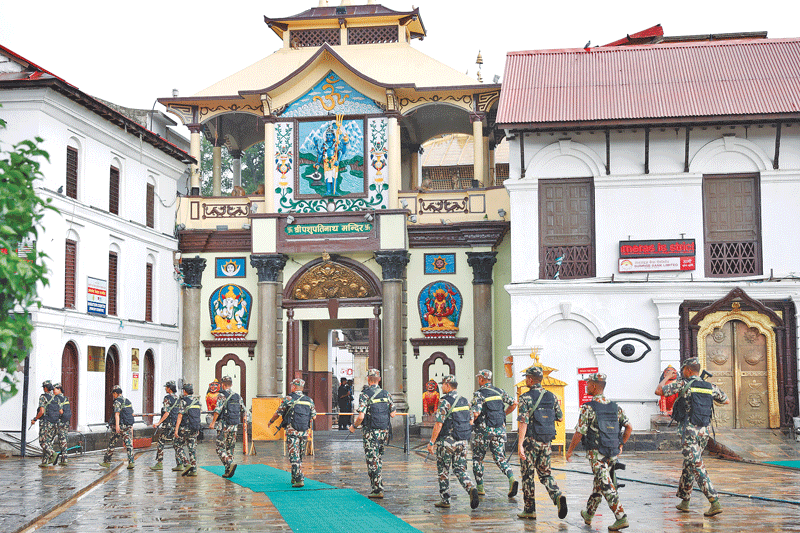
Pashupatinath Temple is guarded as investigators inspect a gold installation there on June 25.

Last week, ‘Jalahari’, the golden receptacle that covers the base of the Shiva Linga and collects and drains liquids like water and milk offered to Lord Shiva at the Pashupatinath Temple, made headlines after the Commission for the Investigation of Abuse of Authority (CIAA) took it off from the main temple to measure its weight. The golden receptacle had been installed in the third week of February last year.
Although the CIAA found no significant difference in the weight of the gold used in the Jalahari installed in the precincts of the temple, the issue sparked a debate as the Pashupati Area Development Trust (PADT) was found to have flouted due process.
According to CIAA officials, the gold in the Jalahari was measured at 107.46kg, which is close to its weight stated earlier—107.92kg.
Last year, amid severe criticism from local residents, heritage conservationists and priests, the PADT went ahead with its plans to replace the temple’s silver Jalahari with a golden one. Oddly, the then President Bidya Devi Bhandari installed a 96.822kg golden structure just hours before a Supreme Court stay order.

The apex court issued the order after hearing a petition filed by the former treasurer of the Trust, Narottam Baidya, and lawyer Nikita Dhungana who had challenged the government’s decision to install the golden Jalahari.
The writ petitioners had claimed that replacing the silver Jalahari with a golden one was against the Ancient Monument Preservation Act-1956.
Section 12 of the Act says that one who destroys, demolishes, removes, alters, defaces or steals an ancient monument or archaeological object is subject to punishment with a fine of Rs25,000 to Rs100,000 or with an imprisonment of 5 years to 15 years or both, after recovering an amount equal to the claimed amount for the damage to the object concerned.
The Act has been limited to the paper, Baidya said. “If only the government authorities had followed the Act, they would not have installed the golden Jalahari,” he added.
Although the Ancient Monument Preservation Act-1956 is crucial to preserving the ancient monuments that have historical and archaeological value, whether it is actually
being implemented is a different matter altogether. “The local, provincial and federal levels should strictly follow the Act, and the Department of Archaeology (DoA) should ensure that they are doing so,” said Baidya.
“But in most cases, the department takes little or no action.”

Why the Act?

The Act says any ‘ancient monuments’, historical buildings and heritage sites such as temples, houses, abbey, cupola, monastery, stupa, vihar, etc., which are older than one hundred years are important from the view of history, arts, science, architecture or art of masonry and need to be preserved in their original form. Any modification in the object, if necessary, requires authorisation from the Department of Archaeology.
The Act states that if any of the monuments needs conservation, maintenance and renovation, it can be carried out by the Guthi Sansthan under supervision, technical service and direction of the department.
Section 13(2) says that if a person or an institution possesses traditional, ancestral or archaeological objects that are over one hundred years old, the owner of such collections shall have to register such items in a prescribed office.
“The main purpose of establishing the Act is to preserve ancient monuments and heritage in their original form, but the problem is that even the officials including the Head of State seem unaware of the importance of our heritage,” said Bhim Nepal, a monument conservationist.

Who owns the monuments?

In relation to ownership, ancient monuments are classified under two categories: public ancient monuments and private ancient monuments. In terms of their importance, these monuments come under three categories—the ones having international importance, national importance and local importance.
The Pashupatinath Temple covers all three categories. And, as it is listed among the UNESCO World Heritage Sites, it holds great historical, cultural and religious significance and it
has both artistic as well as archaeological values.
According to Section 3 (B) of the Act, it’s the Department of Archaeology that owns them and it shall conserve, maintain and renovate public ancient monuments.
Meanwhile, the conservation, maintenance and renovation of monuments under private ownership, and which are inside the protected monuments area, shall be carried out by the concerned person. If such monuments need to be repaired, or touched, the person should take permission from the DoA.

How active is the department?

Although the Act gives the DoA authority to look after ancient monuments, it has not been able to do its job effectively. “The Act was formulated in good faith but the DoA has not been able to function as desired to make it effective,” said Ganapati Lal Shrestha, a heritage conservation activist.
Meanwhile, Prakash Mani Sharma, a senior advocate who has long been advocating for the preservation of cultural and natural heritage, says the main problem of the department is that it’s a unit that works under the Ministry of Culture, Tourism and Civil Aviation.
“For its greater effectiveness, the DoA should be an independent high-powered autonomous authority as in India,” said Sharma.
He also expressed concern at the state of seven out of the 10 UNESCO World Heritage Sites in Nepal in the Kathmandu Valley: Durbar squares of Kathmandu, Bhaktapur and Lalitpur, Swayambhunath, Bauddhanath, Pashupatinath and Changunarayan.
“It’s high time the department was given more independence,” said Sharma.
The conservationist said that the district administration and local units are not serious about preserving heritage sites. “In cases of breach of archaeological values, the role of the department of archaeology is limited to just dispatching a letter,” he added.
Shrestha said unless the DoA has its own police or security force that can intervene when someone breaches the archaeological value of the historical sites, it can’t effectively preserve any monuments or structures. He said the chief district officer and the local authority should work with the DoA to preserve monuments.

Protection of shrines and temples

Conservationists say the issue of protection and conservation of heritage drew public attention mainly
after the 2015 earthquakes when a large number of heritage sites were destroyed or damaged.
According to the department, a total of 745 historical, cultural and religious monuments in 20 districts were damaged in the disasters.
“But the local authority and the Kathmandu Valley Development Authority have never coordinated with DoA for the protection and preservation of heritage sites,” said Shrestha. The Ancient Monument Preservation Act-1956 doesn’t allow construction of underground structures near heritage sites, but the Kathmandu Metropolitan City has been giving permissions for such underground construction.
“Unless the local, provincial, and federal governments are serious about the Act’s implementation and are ready to follow the DoA’s instructions, it will be impossible to protect shrines and temples with historical and archeological importance,” said Shrestha.

Breaches of the Act

Over time, there have been many breaches of the Act, and the PADT and Kathmandu Metropolitan City (KMC) are among the main violators. For example, apart from the Jalahari issue, the Trust had back in February 2019 used ‘concrete’ to erect pillars and fill 12 dug pits in the unique Vishwaroop temple in the premises of Pashupati. But it backtracked after public criticism. Six months prior to the controversy, the Trust had come under fire after it used plain cement concrete—a binding agent in construction materials—to build the 170-metre pavement in the Mrigasthali area that led to the temple.
In December 2017, too, the Trust was widely criticised for using concrete in the reconstruction of historic Bageshwori Temple in Pashupati.

Page 2
NATIONAL

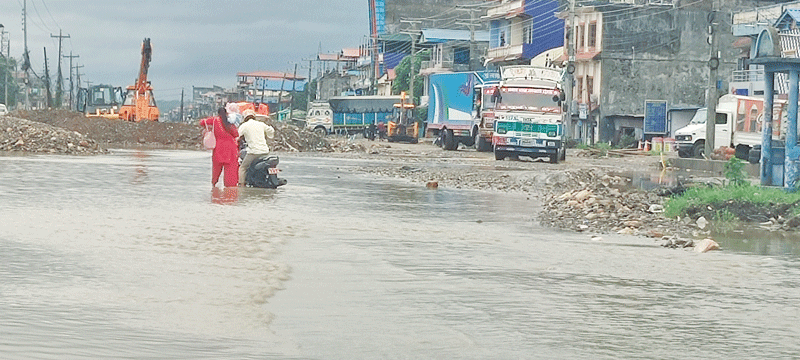
Monsoon disasters hit life in several districts

The western parts of the country have been put on high alert as rainfall causes water levels to rise at an alarming rate.
- Post Report

Post Photo

The Nawalpur district received the most rain in the last 24 hours, recording 275.4 mm of rainfall in the time period.

Water-induced disasters-triggered by heavy monsoon rains affected daily life in various parts of the country on Saturday.
Transportation disruption on major highways has been reported in several places within the past 24 hours, leaving hundreds of passengers stranded. Threat of flooding looms large in
the riverside settlements due to incessant rains. Gandaki and Lumbini provinces were hardest hit by the monsoon mayhem.
The Mugling-Narayanghat road section, one of the country’s busiest travel routes, was frequently disrupted as heavy rains caused landslides since Thursday. The vehicular movement was on and off thanks to the landslides along the 36-km long road stretch.
Meanwhile, the situation along the Aryabhanjyang-Ramdi road section in Palpa is no better. Traffic was disrupted from early on Saturday following a mudslide caused by incessant rainfall in the area.
Efforts from personnel from the local area police and the road division have been to no avail as the flow of mud from the hill continues to pile on the road. According to the Chief of Road Division Pradeep Niraula, all excavators are constantly occupied during the rainy season due to the simultaneous occurrence of multiple landslides.
“Landslides keep occurring in multiple places at the same time,” Niraula said. “Since the local units offer no support, we have to work on our own to clear traffic in all places.”
The rains inundated paddy fields in Madiphant area of Palpa. According to Rajesh Kumar Aryal, the ward chairman of Tansen Municipality-9, around 2000 ropanis land in Madiphant that lies in some part of Tansen Municipality and Baganaskali and Mathagadhi rural municipalities.
Similarly, transportation was disrupted along the Beni-Jomsom road section due to multiple landslides triggered by heavy monsoon rains. A landslide blocked the road stretch at Baisari in Raghuganga Rural Municipality-2 and Nagdhunga at Annapurna Rural Municipality-2 in Myagdi district on Saturday. We have a tough time to clear the debris and resume transportation as it has
been raining continuously in the area, said police.
The western parts of the country have been put on high alert as incessant rainfall causes water levels to rise at an alarming rate. At the Tinau river near Butwal, the water level has reached the danger zone and continues to rise, prompting authorities to send warning alerts.
According to the Department of Hydrology and Meteorology, the river is considered to have reached warning levels when the river’s water level reaches 5.3 metres. Crossing 5.6 metres means it has reached the department’s red zone.
Water level in the Narayani river is also rising as the region has been experiencing continuous rainfall for the past 14 hours. Although no untoward incidents have happened as of yet, everyone has been advised to stay alert.
The Nawalpur district has received the most rain in the last 24 hours, recording 275.4 mm of rainfall in the time period. Likewise, the Syangja district has also experienced alarming levels of rain, recording 204.4 mm since yesterday.
Meanwhile, the Flood Forecasting Division under the Department of Hydrology and Meteorology on Saturday afternoon warned of floods in riverside settlements and landslides due to incessant rainfall in some districts of Gandaki and Lumbini provinces.
Sunil Pokharel, senior hydrologist of the division, said there is a high risk of landslides due to sporadic heavy rains for the last 24 hours.
According to the division, the rainfall in the last 24 hours has exceeded the threshold in Syangja, Dang, Nawalpur, Rupandehi, Palpa and Tanahun districts. In the last 24 hours, the maximum rainfall of 220 mm was recorded in the Danda area in Nawalpur.
The Meteorological Forecasting Division recorded 159 mm rainfall in Koilabas of Dang, 167 in Tilottama of Rupandehi, 178 in Gandakot of Palpa, 276 in Deurali Nawal of Nawalpur and 141 in Malunga of Syangja. Likewise, Atraulitar of Tanahun received 187 mm of rainfall, Tansen of Palpa 169 and Bhairahawa of Rupandehi 136. According to the division, there is a risk of floods and landslides in a particular place if precipitation exceeding 60 mm is recorded within an hour, 80 mm in three hours, 100 mm in six hours, 120 mm in 12 hours and 140 mm in 24 hours.
Urban areas including Kathmandu are inundated when rainfall exceeding 60 mm occurs within an hour, according to Pokharel. The flood forecasting division has asked people living in Tinahu riverside settlements to stay alert as the water level of the river has crossed the danger mark.
The water level has also increased in some small rivers in Koshi, Gandaki, Lumbini and Sudurpaschim provinces. The division has also warned of flash floods in streams flowing through the Chure region. The division has also warned of flash floods in Rupandehi, Kapilvastu, Palpa and Nawalparasi.

(With inputs from our local correspondents)

NATIONAL

Mother, daughter found dead in suspicious circumstances

DISTRICT DIGEST
- Post Report

RUTAHAT: A woman and her daughter were found dead under suspicious circumstances in Maulapur Municipality-4 of Rautahat district on Friday night. According to Superintendent of Police Bir Bahadur Budha Magar, 24-year-old Kabita Devi and her two-year-old daughter were found dead at their residence. The toddler was found hanging from a ceiling fan while the mother’s body was found under the staircase that leads to the home’s entrance. “Search to find the victim’s husband and father-in-law, who went out of contact after the incident, is underway,” said Budha Magar. Bijaya Shankar, the woman’s father, said his daughter was constantly subjected to physical and mental abuse by her husband.

NATIONAL

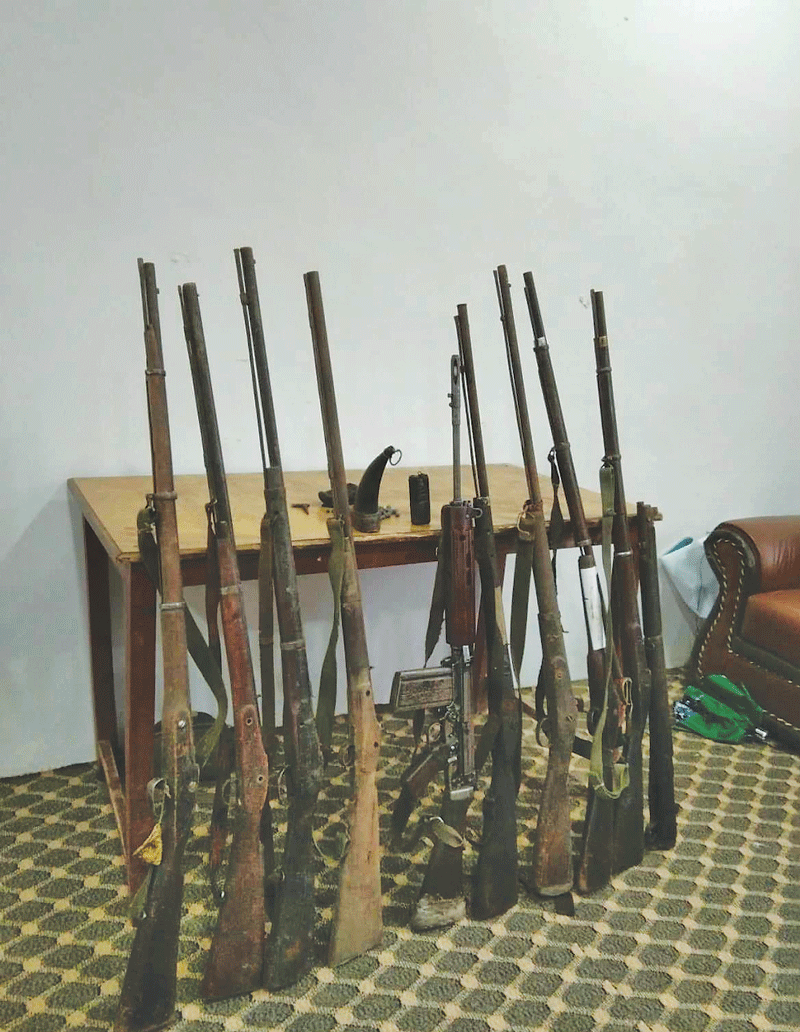
Nine weapons seized from Dhorpatan area

DISTRICT DIGEST
- Post Report

BAGLUNG: Dhorpatan Hunting Reserve, the only hunting reserve in the country, has seized nine weapons from various places over the past few days. According to Birendra Raj Kandel, chief conservation officer at the reserve, the seized weapons were used by the poachers to hunt wild animals and birds illegally. One self-loading rifle, one 303 rifle and seven muskets were confiscated during the security drive launched by the reserve. The seized weapons were handed over to the district administration office for investigation.

NATIONAL

Jumla police launch drive to control drug abuse

DISTRICT DIGEST

JUMLA: The District Police Office (DPO) in Jumla has launched a campaign to control drug consumption and smuggling in the district. The drive was formally launched on Saturday by organising a rally in Khalanga, the district headquarters of Jumla. The DPO aims to coordinate with the local units, civil society, political parties, people’s representatives, teachers and students to make the campaign a success. Of late, drug abuse and smuggling are rife in Jumla, a mountain district of Karnali Province. Data available at the DPO shows as many as 63 people were detained on drugs-related cases for the past three months.

Page 3
Page 4
OPINION

Generational change in Nepali politics

The Maoist story is the most eloquent in terms of political discussions, reports and reviews.
- ABHI SUBEDI

Generational change has hardly been a subject of wide discussions in Nepal. People have always believed in the hierarchical and vertical structure of society. A unique structure based on the power of the upper echelons of the traditional elite has shaped the psyche of the general public. Such a psyche either discourages questioning or imparts a sense of complacency as the guiding factor.
Being a literary writer, I always looked for expressions of generational change in poetry. Siddhicharan Shrestha (1912-92), also called Yug Kavi or “poet of the times”, has written moving poems about generational change based on his personal feelings. When he turned 36, he felt he was crossing a very important liminal line in his life. And he wrote, “Oh, I am surprised/ how I turned 36 today. / It hurts me to feel that/ I’m hurled into this distance/ without doing any meaningful work”. My translation: That sense of ageing felt by a man of 36 was a very private experience. This poem must have been written in 1948, two years before Nepal overthrew the oligarchic Rana rule. A youth or an elderly person had his or her own rhythms in a traditional society. People of the younger generation did not question their elders.
The political leaders who led the freedom movement were also about the same age as the poet Siddhicharan Shrestha. While working on the first diary of that period of BP Koirala (1914-82), I came across an expression in which he realises in the same manner as poet Shrestha: ‘’Since some time I have been feeling that I am growing old as if I stepped into middle age from youth. This is a melancholy feeling and a giver of birth of old age.’’ (May 1, 1952). He was 38 years old when he had this realisation. The sense of generational change did not haunt the youths in politics at that time. Curiously, a politician and literary writer considered himself an old person.
The politicians of that period, like BP Koirala, Ganesh Man Singh, Manmohan Adhikari, Krishna Prasad Bhattarai and Pushpa Lal, continued to lead their political parties. But things changed when the leaders of the selfsame generation became old. An ailing and old Girija Koirala was in the leadership role until the last moment of his life. Ganesh Man Singh, however, gave up his leadership role without making sure who would succeed him. He expressed dismay over some younger leaders deviating from the path. I heard him saying so and bursting into tears one evening at a gathering of poets at poet Kedarman Vyathit’s house.
Generational change in Nepali politics has come to a difficult pass because holding on to power has become a very attractive option for the political leaders. Leadership is believed to involve both access to finance and commanding authority. Philosopher Bertrand Russell calls it lust for power; leaders exhibit the lure by clinging to the leadership role. In both democratic and autocratic countries, leaders have given continuity to their leadership either through the ballot or the bullet. In Nepal’s case, it would be wrong to draw such conclusions. But what can be said with all certainty is that not relinquishing the party leadership is guided by a desire to remain in power.
Consternation rather than healthy debate tends to shape the character of Nepali politics. We must consider another feature of Nepali political parties: They have embraced almost all the famous and established political and ideological theories of action and behaviour. That mainly includes Marxism, socialism, social democracy and the indigenous practice of politics known under different names. Though it is not easy to say whether those theories were correct or not, or more importantly, whether those theories guided their working style or not, we can attempt to understand them. The last decade was an important turning point in Nepali political debate.
Such an assessment did not come smoothly. It came as a result of changes, some of which were very challenging. The Marxist parties experienced the jolts of such changes more than the others, among whom the oldest party, the Nepali Congress, did not have to face the challenge of radically reviewing its political stand. The communists felt the jolts of history more than the others. Their challenges ranged from redefining the established political principles based on Marxism to adapting to the new modes, methods and principles of operation as enshrined in the constitution. The story of the Maoists is the most eloquent in terms of political discussions, reports and reviews. The communist parties are generally fighting different battles for their identities at different moments of change. The dominant practice among them appears to be breaking and coming together. It is difficult to know what shapes “the political unconscious”, to use the expression of American Marxist literary critic Fredric Jameson, in such political practices. The theme of interest here is, however, the psyche of generational change that dominates discussions among the Nepali political leadership today.
The generational discussion has become a pronounced theme these days. A tacit and sometimes clearly articulated consensus has emerged among the political leaders of the younger generation: They should take the reins of leadership from the septuagenarian leaders in a decent, but effective manner. Though, as said by Gideon Rachman in his latest book The Age of the Strongman (2020), authoritarian leaders have become a central issue in global politics, we need not worry about that in Nepal. The solution is simple: Hand over leadership to the new generation.

OPINION

Perils of debt-financed fiscal deficit

For developing countries with growing financing needs, well-managed debt can enable growth.
- BIGYAN BABU REGMI

Nepal’s budget deficit has significantly increased since the 2015 earthquake due to reconstruction needs. Deficits persisted even during the Covid-19 pandemic. In the past five fiscal years, fiscal shortfalls, largely financed by domestic and foreign borrowing, have hovered between 25 to 30 percent of the total budget, compared to 15 to 20 percent in years before the earthquake. Despite the need to tame the gap, election-motivated public spending, short-tenured governments and impulsive resource allocation continue to cause inflated budgets and imprudent fiscal deficits.
With an estimated borrowing of almost 50 percent higher than the projected capital expenditure, escalating the debt burden is counter-productive. Especially in an environment where revenue mobilisation and capital expenditure are not performing well, a debt-financed (hefty) deficit could only deepen long-run fiscal woes.

Rising debt burden
In the aftermath of the debt crises in Sri Lanka and Pakistan, concerns arose about whether Nepal would follow suit. Fortunately, Nepal’s debt-to-GDP ratio of 42 percent is not outrageously high yet, and the remittance-backed forex reserve cushions external shocks. Nonetheless, the trend over the last few years signals a cautionary approach for future choices. Nepal’s outstanding debt has more than doubled in the past five years, growing by 135 percent from $7.1 billion in FY 2017-18 to $16.7 billion in FY 2022-23. During the same period, India’s outstanding debt increased by only 47 percent despite its aggressive infrastructural spending. While Nepal’s external debt has an average of 36 years for maturity—a comfortable horizon for the medium-term—hasty borrowing choices now could harm the country’s fiscal health in future.
With a yearly real economic growth rate of below 6 percent and an annual growth in public debt of 20 percent, if the current trend continues, the debt will rise above 60 percent of GDP in the next three to five years. This is concerning as even rapidly growing economies such as Malaysia, Indonesia and Vietnam shy away from raising the debt level beyond 50 percent of GDP. For Nepal, which is struggling to diversify its revenue sources, the increasing debt burden means an unnecessarily large liability for debt financing every year. In times of resource crunch, debt defaulting, or even the risk of it, could impede our access to international lending. On the other hand, rising debt levels can have several unintended consequences in the market. For instance, as the debt level increases, investors become more sensitive to economic vulnerabilities, which can discourage risk-taking behaviour in the private sector. Likewise, the government’s temptation to print money to clear debt obligations can lead to upward pressure on inflation and devaluation of the local currency, harming exports.

Short of debt strategy
It would be unfair to characterise debt per se as an undesirable fiscal instrument. For developing countries with growing financing needs, well-managed debt can enable growth and structural transformation. As a least developed country (LDC), Nepal has access to abundant sources of concessional lending. Making use of such prospects before LDC graduation (due 2026) would also serve the case for debt as a sensible financing instrument in the short term. However, as the share of capital expenditure in the budget continues to shrink (27 percent in FY 2019-20 versus 17 percent in FY 2023-24), whether the tenacious debt aims to generate growth remains a question. Against this backdrop, one can imagine that extensive borrowing is emerging not from rigorous needs assessment but from inertia, if not an obsession, for oversized spending.
Notably, 87 percent of Nepal’s external debt is from multilateral creditors and has an average interest rate of around 1 percent. Based on these statistics, one might argue that Nepal’s debt pile is concessional and the cost of borrowing is trivial to add any worrying pressure on the economy. However, it is worth underscoring that no debt is a free lunch, and albeit the low-interest rate, funding impetuous projects from loans has a high opportunity cost.
While Nepal can still benefit from the pool of concessional loans, it is high time Nepal built a clear, farsighted debt strategy to channel funds into projects with longer lifespans and/or considerable social/economic/environmental benefits. As such, climate-smart infrastructure, energy, and micro, small, and medium enterprises (MSMEs)-centred employment are some areas where the financing gap is high and longer-term development dividends are lucrative.

Diligence and accountability
The United Nations Development Program claims Nepal faces a financing gap of around $6 billion annually in achieving the Sustainable Development Goals (SDGs) by 2030. This shortfall will expand in size and scope when longer-term transition strategies and net-zero commitments are incorporated. A combination of financing instruments, including debt, can narrow this gap. However, with such a shortfall annually, there is an opportunity cost for every rupee spent. So accountability and diligence are necessary to ensure rigorous allocation of funds and maximise the marginal return of investment.
Since inflated budgets are emerging from unrealistic revenue targets, sincerity in government income projections is the first step towards changing status quo. A rigorous analysis of financial accounting data must guide fiscal estimates. Real-time statistics on most macro and micro indicators are readily available to decision-makers. Renouncing these data to create blown-up budgetary projections and bulky borrowing lessens the credibility of fiscal policies.
Nepal’s unfulfilled yearning for rapid economic growth needs a growing domestic income. However, blatantly inflating the figures without developing a proper mechanism for sustainable revenue growth and diversification can only derail our growth targets. Second, evidence-based policy-making will be pivotal to directing more energy into projects that have yielded significant progress/outcome and diagnosing implementation hiccups where progress is lacklustre. Furthermore, change in the budget formulation process is a much-needed reform that can, by and large, address
issues pertaining to accountability and transparency. Giving a longer time for pre-budget discussion and preparation of plans and policies can enable wider ownership among stakeholders.
Extensive discourse and scrutiny of fiscal choices can also gradually make accountability and diligence intrinsic to the process. After all, the goal is to build institutional capacity and procedural rigour, where fiscal policies materialise from evidence-led explorations, not from the wishful judgements of a “social planner”. Restoring credibility in policies through more diligence throughout the process gives rise to needs-driven spending/deficit and targeted debt.

Better strategy
The lure of reaping short-term political dividends has led to impulsive fiscal choices in Nepal. Inertia for expansionary budgets has given rise to a growing deficit. The absence of a long-term debt strategy and alternative financing instruments has increased the reliance on domestic and foreign loans. Consequently, Nepal’s outstanding debt has surged by 135 percent in the last five years, much higher than its neighbours, such as India. Uninterrupted, this trend will raise the debt to an unsustainable level and can have unintended consequences across growth stimulators in the public and private sectors. To accelerate debt-enhanced-development, Nepal needs to develop a prudent debt strategy and explore avenues for concessional and climate-related financing. Amid a shrinking base for revenue and underperformance of capital expenditure, there should be accountability and due diligence for every rupee spent. Embracing evidence-based policy-making and nurturing institutional rigour will spur needs-based resource allocation and targeted borrowing.

Regmi is an economist engaged with ETH Zurich, Switzerland.

Page 5
NATIONAL

Prime minister meets chief ministers, local government representatives to discuss implementation of federalism

In the first-ever Coordination Council consultation, Pushpa Kamal Dahal vows to sort out conflicting issues.
- TIKA R PRADHAN

RSS

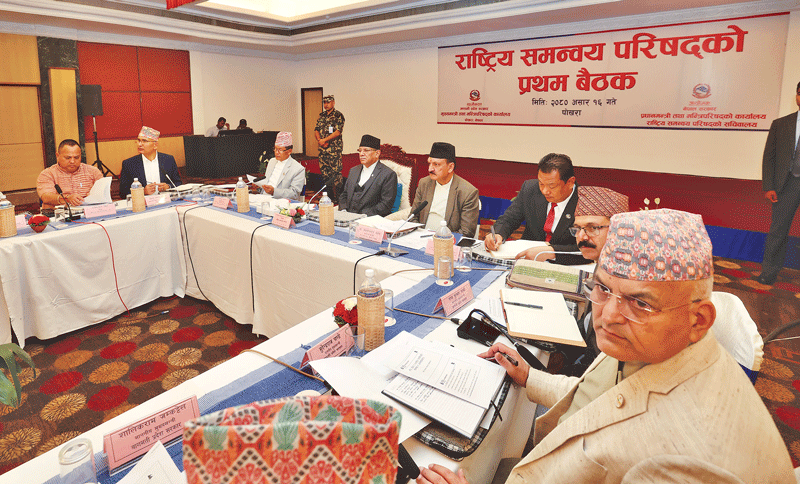
Prime Minister Pushpa Kamal Dahal (fifth from right) chairs a meeting of the National Coordination Council on Saturday in Pokhara.

Prime Minister Pushpa Kamal Dahal has promised to address all the concerns of the provinces and the local level, chief ministers and local people’s representatives have said.
Dahal convened a meeting of the National Coordination Council for the first time on Saturday in Pokhara after the country adopted federalism in 2015. The 20-member council headed by the prime minister includes three ministers—holding law, finance and federal affairs and general administration portfolios—besides seven chief ministers, the chairs of the associations of rural municipalities and municipalities, and the representatives of district coordination committees, among others.
However, there are doubts whether the prime minister, who has failed to address their concerns until now, can fulfil his promise easily.
The chief ministers, who have been accusing the national leaders of ignoring the provinces and refusing to devolve the constitutional powers to them, said Dahal’s recent moves have given them hope that federalism would now be implemented effectively.
“Prime Minister Dahal has already convened three meetings with the chief ministers and has promised them laws necessary to adjust the police force and the one related to civil service at the earliest,” said Shalikram Jammakattel, chief minister of Bagmati Province. “We hope things have changed now and the stalled implementation of federalism is underway.”
The secretariat of the National Coordination Council is expected to make the decisions of the first meeting public within a few days.
The meeting, according to some participants, has decided to form a panel to identify the issues that clash between the three tiers of government within three months.
“Today’s meeting remained fruitful in the sense that we have started discussions on our conflicting issues and decided to form committees to find ways to resolve them amicably,” said Bhim Prasad Dhungana, president of the Municipal Association of Nepal (MuAN).
Laxmi Devi Pande, chairperson of the National Association of Rural Municipalities in Nepal (NARMIN), said that Saturday’s meeting, though delayed, has given hope to the local units that their concerns would be addressed and that no laws would be passed without consulting with them.
“We put forth all our concerns at the meeting and the prime minister promised that he would not take any step before consulting with us,” Pande told the Post over telephone. “The prime minister also pledged to hold frequent meetings of the council and discuss all issues among the three levels of government.”
The provinces and local units have also demanded that the federal government finalise the federal laws that are under consideration only after addressing their concerns.
Six chief ministers, excluding Hikmat Karki of Koshi, had handed over a 17-point charter of demands to the prime minister after their inter-provincial meeting on Friday.

NATIONAL

With Koshi government losing majority, RPP holds the key to new Cabinet formation

Binod Rai, a Congress member of assembly, confirms talks with the Rastriya Prajatantra Party to bring it on board.
- NISHAN KHATIWADA

Post file Photo

Hikmat Karki has become the caretaker chief minister after he lost the trust vote on Friday.

The Koshi Province head has entrusted Chief Minister Hikmat Karki to run the government in a caretaker capacity, in accordance with the Article 169(3) of the constitution, until the formation of a new government. The Article states that even though the office of the chief minister falls vacant pursuant to clause (1), the same Council of Ministers shall continue to act until another Provincial Council of Ministers is constituted.
As the UML government in the province failed to win the vote of confidence on Friday, the Nepali Congress-led alliance has initiated negotiations with other parties to find out ways to secure a majority in the provincial assembly.
Given the tricky arithmetic in the provincial assembly, the most effective way to form a new government would be to bring the Rastriya Prajatantra Party (RPP) into their fold, say the Congress-Maoist alliance leaders.
Binod Rai, a Nepali Congress lawmaker in the assembly, said they are in talks with the Rastriya Prajatantra Party to bring them on board.
Some regional leaders have also reached Kathmandu for negotiations with the central leaders of the political parties.
“None of the political parties are ready for the midterm polls. The new government will now be formed in accordance with the Article 168(2) of the constitution,” said Rai. “If the RPP joins hands with us, we will have a comfortable majority to form the new government.”
The right-wing RPP, currently backing the UML in the province, has six lawmakers.
The party, however, is yet to discuss the matter formally.
RPP chief whip in Koshi, Ambar Bahadur Bista, said they haven’t held any discussion with the Congress-led alliance.
“But we believe that the province should not be pushed towards midterm elections,” Bista said. “We are waiting for the direction from the party’s central leadership.”
The backing of 47 members is needed to form a new government. But both the Congress-led bloc and the UML-RPP alliance have 46 seats each, adding to the difficulty of crafting a ruling coalition. In the 93-member provincial assembly, the UML has 40 seats, the Congress 29, the Maoist Centre 13 (including the Speaker, who can’t take a side in government formation), the RPP six, the CPN (Unified Socialist) four, and the Janata Samajbadi Party one seat. As such, the RPP’s numbers seem crucial for the Congress-led alliance to form the new government. Even for UML, its backing is a must, given the current political situation.
“Yes, we have the decisive votes in Koshi Province,” said Sagun Sundar Lawati, the RPP spokesperson.
“The party will discuss the issue of the province, both at the centre and at the province level and then take a decision.”
The province head has been holding consultations with parties to make a call for the formation of the new government. If he invokes Article 168 (2) of the constitution, two or more parties should show their majority in the assembly to stake their claim to form the government.
Excluding the Speaker, the Congress-led alliance is one lawmaker short of majority. The UML has been warning that the Speaker cannot take sides while forming a government, while the Congress and its partners claim that the Speaker can vote.
If the two or more parties fail to garner a majority, the largest party UML will lead the government based on Article 168(3) of the constitution. The article states that in cases where the chief minister cannot be appointed under clause (2) or the chief minister so appointed fails to secure a vote of confidence under clause (4), the head of state shall appoint as the Chief Minister the parliamentary party leader of the party which has the highest number of members in the State Assembly. However, the chief minister thus appointed must prove his majority in the assembly within 30 days.
If even Article 168(3) fails to produce a government from the assembly, any lawmaker in the assembly can show the majority and lead the government. The chief minister thus appointed also has to get the vote of confidence. If all the options run out, the province will head towards the midterm polls.

NATIONAL

Dahal tries to woo dissatisfied Janamat Party

Budget shows his support base is shrinking. PM risks having to go for floor test again if CK Raut’s party pulls the plug.
- Post Report

Prime Minister Pushpa Kamal Dahal has urged Janamat Party not to withdraw its support to the government saying that he was serious about increasing the budget for the Madhesh Province in appropriate ways.
The CK Raut-led party says the national budget is biased against Madhesh. In the House of Representatives on Wednesday, he did not support the budget for the new fiscal year. After the Dahal administration got the budget passed by Parliament defying calls for revision to the fiscal estimates, pressure is growing for the party to withdraw its support, Janamat leaders say.
Dahal on Saturday met Raut and urged him to continue the party’s support. “However, we cannot [continue to] be part of the ruling alliance that is biased towards Madhesh and the Madheshi people,” Chandan Singh, general secretary of the Janamat Party, told the Post.
Janamat has called a meeting of its central committee on Sunday to discuss its move. Singh said Sunday’s meeting is unlikely to reach a decision on whether to quit the government or remain in it, the party could be authorised to take a call.
“Since this government has long been ignoring the concerns of our party, calls are growing louder to withdraw support to it,” Abdul Khan, the party’s vice chairperson, told the Post.
The major bone of contention between the government and the Janamat is Dahal’s refusal to give the party the ministry it wanted. It had been seeking to lead either the Ministry of Agriculture or the Ministry of Industry, Commerce and Supplies. The Janamat Party got the water supply ministry instead.
The party quit the federal government on March 31, having been denied a ministerial berth of its choice even when the Cabinet was reshuffled after the CPN-UML quit the ruling alliance.
The party’s minister, Abdul Khan, resigned after the Ministry of Industry that his party was laying its claim to was given to the Nepali Congress.
Dahal, who is gradually losing his hold in Parliament, doesn’t want to lose Janamat Party. In his first vote of trust on January 10, Dahal garnered the support of 268 lawmakers in the 275-strong House. He had to go for the floor test again on March 20 after the UML and the Rastriya Prajatantra Party no longer backed his government.
Dahal survived, securing 172 votes. Along with the CPN (Maoist Centre), he received a vote of confidence from the Congress, the Rastriya Swatantra Party, the Janata Samajbadi Party, the CPN (Unified Socialist), the Janamat Party, the Loktantrik Samajbadi Party, the Nagarik Unmukti Party, three independent lawmakers and the Rastriya Janamorcha. In Wednesday’s vote on the budget, Dahal got the backing of only 147 House members, marginally above the required majority of 138. This shows the government’s support base is diminishing in Parliament.
Dahal might have to face the House again to prove the majority’s support if the Janamat Party decides to part ways. Article 100 (2) of the constitution says “the prime minister shall table a motion for the vote of confidence in the House of Representatives if the party which the prime minister represents is divided or the party in the government withdraws its support.”
Dahal, however, argues that he doesn’t need to face another vote of confidence as long as he enjoys the minimum support necessary. The government will not fall into the minority even if the Janamat Party with six seats decides to withdraw the support. “The Dahal government will continue to command a majority even if a few fringe parties take back their support. So I don’t think he needs to seek the vote of confidence. The decision, however, can be challenged in court,” said Mohan Lal Acharya, a constitutional lawyer.

Page 6
MONEY

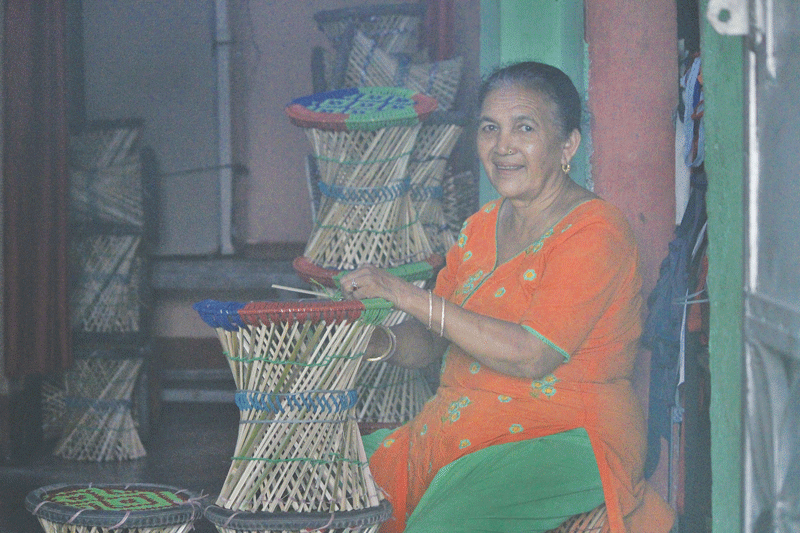
Handmade stools bring good income to entire village

Many have purchased plots and constructed houses with the money they earned from making stools.
- PARBAT PORTEL

POST PHOTO: PARBAT PORTEL

Villagers say that due to the proliferation of foreign goods, demand for homemade stools has dropped sharply. 

Rajendra Acchami of Mechinagar-12 in eastern Nepal has been making bamboo stools for the last four decades. There are around 800 households here who are engaged in this craft. The handmade stools are sold across Nepal and are important to the local economy.
“I learnt the skill of making the stools at a young age. Later, I went into business for myself,” said Acchami. His son, who is now 30 years old, works with him.
According to Acchami, the craftsmen initially used buffalo leather for the seats. Now leather is not available, and they have switched to fibre, nylon and velvet ropes. The stools are sold in major cities such as Kathmandu, Pokhara, Butwal and Bhairahawa.
Acchami says he used to sell stools with nylon seats for Rs250 each in the past. Now it is difficult to get Rs134 each. Stools with seats made of velvet rope used to sell for Rs170 each.
“We are forced to sell the stools at a lower price nowadays,” said Tanka Century, president of the Nepal Dalit Garima Sanstha, a non-governmental organisation. Obtaining raw materials is difficult too.
“The craftsmen have to buy raw materials like bamboo sticks, old cycle tyres and ropes at a higher price,” said Century, who has been engaged in the business for a long time.
“The market price doesn’t even cover the cost of raw materials.”
The craftsmen say that due to the proliferation of foreign goods, demand for homemade stools has dropped sharply. So have prices.
According to them, old bicycle tyres, which they import from India, cost Rs25 each. The old tyres are sewn around the edge of the base of the stools.
A small-sized bamboo costs Rs25 which can be split into 100 sticks. Velvet ropes come from Kathmandu and cost Rs300 per kg.
“A couple of years ago, velvet ropes cost Rs30 per kg. Now the price has increased by 10 times,” said Century.
Suresh Ramtel of Nayabasti in Mechinagar-12 says it costs Rs130 to make a stool and they have to sell it for Rs134. Acchami exports his stools to China. Previously, he shipped them to the United States too. “Foreigners want the stools to be made of high quality materials. They also pay well,” he said.
“The entire village, where most of the inhabitants are Dalits, is dependent on this business because no one has an alternative source of income,” said Acchami.
Many of them have purchased plots and constructed houses with the money they earned from making stools.
Traders go to the stool makers’ houses to buy them. Some craftsmen market their products themselves.
Khadga Acchami of Kalijhoda in Mechinagar-12 is credited with introducing the stool making craft to the villagers.
In 1978, he was jailed after being falsely accused of slaughtering cows and smuggling the skins to India.
Acchami’s family used to collect the skins of the buffalos slaughtered in the district. Indian traders used to come to him to buy the skins.
But some of the locals didn’t think well of Acchami’s business.
They filed a complaint with Bansbari Leather and Shoe Factory that Acchami was slaughtering cows and smuggling the skins. Killing cows is illegal in Nepal.
“None of the neighbours supported us at that time,” said his wife Krishna Kumari. “My husband had to stay in jail for two months for no reason.”
During his two-month stay in Chandragadhi jail, he learnt the skill of making bamboo stools. He returned home with a plan to start selling the stools commercially.
Initially, he started making the stools using the skins collected from nearby places. But the neighbours complained because of the foul smell of the skins.
“We had to stop using skins as the complaints increased,” said Krishna Kumari. Acchami continued making stools but he used fibre for the seats instead of leather.
Gradually, his stools gained popularity in the local market, and he provided training to some youths because he needed more hands as demand increased.
Khadga Acchami passed away three years ago. He left behind a craft that has become a major source of income for the entire village.
“Initially, our house looked like a stool factory,” said Rajendra Acchami, Khadga’s younger brother. “We used to produce hundreds of stools a day and employed some of the locals as well.”
Subsequently, the employees left and started their own business.
Janak Lwagun says that the government has not paid enough attention to transforming this skill-based activity into a commercial enterprise.
“If the government invests money to create a sustainable business, thousands of youths can be self-employed and they will not have to go to foreign lands to find work.”
According to Lwagun, the stools are being exported to China again after a break caused by the Covid-19 pandemic. Ramtel says that the cost of raw materials is increasing while the price of the finished product is going down.
Middlemen have been stepping in and pocketing a large share of the profits.
“They buy from us at a low price and sell to end customers at an inflated price,” said Ramtel. “They have been taking most of our hard-earned income.”

MONEY

French tourism sector faces cancellations over unrest

The French retail federation also called for reinforced police security around stores.
- AGENCE FRANCE-PRESSE

FP/RSS

A French anti-riot police officer walks past a burning truck in Nantes, France on Saturday. 

Days of violent protests across France after the fatal police shooting of a teenager have started to impact the country’s tourism sector, with hotels and restaurants facing cancellations while some have also suffered damage in the unrest.
Since the death of 17-year-old Nahel during a traffic stop in a Paris suburb on Tuesday, “our hotel members have suffered a wave of cancellations of reservations in all the territories affected by the damage and clashes,” said chef Thierry Marx, president of the main association for hotel and catering industry employers.
Marx said on Friday he was receiving daily alerts from industry professionals who have suffered “attacks, looting and destruction of their businesses, including some restaurants and cafes”. “Our establishments are intrinsically hospitality venues, and sometimes even refuges and places of help in crisis situations. They must not suffer the consequences of anger that they have not aroused and we condemn these actions,” he added.
Marx wants the authorities to do “everything” to guarantee the safety of people in the hotel and catering industry in the world’s most popular tourist destination.
The French retail federation (FCD) also called for reinforced police security around stores, said managing director Jacques Creyssel.
The riots “gave rise to real scenes of looting”, he said, with “more than a hundred medium and large food or non-food stores vandalised, looted or even burned”.
These incidents “are extremely serious and have an extremely heavy cost”, according to Creyssel, who said he had asked the economy, interior and trade ministers to act.
The Paris Ile-de-France Chamber of Commerce said it was ensuring its teams were mobilised to “provide
the necessary support and technical assistance, particularly in terms of continuing operations, insurance compensation, etc...” for traders and managers of affected companies.
The GHR organisation for independent hotels and restaurants in France deplored that “foreign [TV networks] are starting to show images of Paris on fire and blood, which does not correspond to reality”.
“Will the violence and riots continue and cause a real wave of cancellations? That’s the risk,” managing director Franck Trouet told AFP.
“Asian tourists, in particular, who are very concerned about security, may not hesitate to postpone or cancel their trip,” he warned.
Didier Arino, managing director of the Protourisme firm said: “Tourists who know us well, like the Belgians or the British, who also have problems themselves in their suburbs, will be able to make sense of things”.
But in the end, he said “it’s as if we were doing a negative publicity campaign worth several tens of millions of euros for destination France”.

MONEY

Coca-Cola to see less pain from looming WHO decision on aspartame: Analysts

- REUTERS

Coca-Cola will only see a limited impact if the world health agency classifies the artificial sweetener used in its Diet Coke, aspartame, as a possible carcinogen, thanks to its scale of production, analysts said on Friday.
Such a classification of the popular additive in July by the World Health Organisation’s cancer research arm could cause consumers, food companies, retailers and restaurants to decide whether to fight back or find alternatives.
But for Coca-Cola, whose low-calorie products accounted for a third of its total volumes sold in 2022, analysts said switching to a natural sweetener could be easier than many other companies that use aspartame.
“Coca-Cola has one of the best production and distribution systems globally... who have successfully navigated plenty of hurdles in the past, like sugar taxes and reformulations associated with that,” said Charlie Higgs, an associate partner at Redburn Ltd, a consumer staples research firm.
In the past, beverage makers like Coca-Cola and PepsiCo have tweaked their ingredient composition to comply with evolving policy changes.
The companies had in 2012 altered their manufacturing process of the caramel colouring in their colas to meet the requirements of a California ballot initiative aiming to limit people’s exposure to toxic chemicals.
Market Analyst Grzegorz Drozdz at investment firm Conotoxia Ltd said the shift from aspartame could hit the short-term profitability of Coca-Cola, but does not see a steep decline in its long-term growth due to its production history.
However, PepsiCo could get an edge over its rival as it had moved away from aspartame to a blend of sucralose and acesulfame potassium earlier, CFRA Research said.
The company first replaced the additive from some US diet sodas in 2015, but brought it back in some products a year later. It again removed aspartame in 2020.

MONEY

Apple’s market value ends above $3 trillion for first time

- REUTERS

Apple Inc’s stock market value ended a trading session above $3 trillion for the first time on Friday, lifted by signs of improving inflation and bets that the iPhone maker will successfully expand into new markets.
Shares of the world’s most valuable company jumped 2.3 percent to $193.97, giving it a market capitalisation of $3.05 trillion, Refinitiv data showed.
The Cupertino, California company’s market capitalisation briefly peaked above $3 trillion in intraday trading on January 3, 2022 before
closing the session just below that mark.
Apple has surged 49 percent so far in 2023 in a rally by several of Wall Street’s most valuable companies, fuelled by bets that the Fed is nearing the end of its campaign of interest rate hikes, and by optimism about the potential for artificial intelligence.
Apple’s most recent quarterly report in May showed revenue and profits fell but still beat analysts’ expectations. Along with a steady track record of stock buybacks, the financial results reinforced its reputation as a safe investment at a time of global economic uncertainty.
“It’s a testament to one of the greatest publicly traded companies that’s ever existed. It continues to grow and diversify its revenue streams, has shareholder-friendly management, buys back shares, throws off a dividend and has a fortress balance sheet with strong and defendable cash flows,” said Art Hogan, chief market strategist at B Riley Wealth.
Apple’s $3 trillion milestone follows the June 5 launch of a pricey augmented-reality headset, its riskiest bet since the introduction of the iPhone more than a decade ago.

MONEY

Inflation eases sharply in bankrupt Sri Lanka

- AGENCE FRANCE-PRESSE

COLOMBO: Sri Lanka’s inflation eased to 12 percent in June, official data showed on Saturday, the lowest figures since the island nation careened into an unprecedented economic crisis last year. Sri Lanka defaulted on its $46 billion foreign debt in April 2022 and the public endured months of food, fuel and medicine shortages. The crisis has eased since, with the government securing a $2.9 billion bailout from the International Monetary Fund in March. June inflation was the lowest since the 9.9 percent figure recorded in November 2021. It is down from 25.2 percent in May and a peak of 69.8 percent in September. “Inflation is expected to reach single-digit levels by early third quarter 2023,” the Central Bank of Sri Lanka said.

MONEY

Twitter now requires users to sign in to view tweets

Bizline
- REUTERS

CALIFORNIA: Twitter will now require users to have an account on the social media platform to view tweets, a move that owner Elon Musk on Friday called a “temporary emergency measure”. Users who try to view content on the platform will be asked to sign up for an account or log into an existing account to see their favourite tweets. “We were getting data pillaged so much that it was degrading service for normal users!” Musk said in a tweet. He added that hundreds of organisations or more were scraping Twitter data “extremely aggressively”, affecting user experience.

MONEY

China urges Netherlands to not abuse export control measures

Bizline
- REUTERS

BEIJING: China has urged the Netherlands to not hinder bilateral cooperation in the semiconductor industry and to not abuse export controls, China’s Ministry of Commerce said in a statement. The statement was made in response to questions from the media, it said. It also said the two countries have communicated frequently and at various levels on the topic. The Dutch government on Friday announced new restrictions on exports of some semiconductor equipment, boosting a US-led drive to curb supplies of high-tech components to China.

MONEY

Botswana inks new deal with diamond giant De Beers

Bizline
- AGENCE FRANCE-PRESSE

GABORONE: Botswana has reached an eleventh-hour deal with diamond giant De Beers after months of tense negotiations that saw the continent’s top producer threatening to cut ties with the storied company. The Botswana government and Anglo-American, the majority owner of De Beers, have reached an “agreement in principle”, the two sides said in a statement issued late Friday. The agreement provides for a new 10-year agreement to sell the rough diamonds produced by Debswana—a joint venture equally owned by the government and De Beers—and a 25-year extension of its mining licences.

Page 7
SPORTS

West Indies miss out on World Cup for first time

The two-time champions were bowled out for 181 runs before Scotland chased down the target with 6.3 overs to spare in Harare.
- AGENCE FRANCE-PRESSE

Photo: Courtesy of ICC

Brandon McMullen of Scotland batting against West Indies during the Super Six match of the ICC Men’s Cricket World Cup Qualifier at Harare Sports Club in Zimbabwe on Saturday.

The West Indies failed to qualify for the Cricket World Cup for the first time as the two-time champions slumped to a seven-wicket thumping by Scotland at the qualifying event on Saturday.
The Caribbean side, needing a win to keep their slim qualification hopes alive, were bowled out for 181 in their 50 overs before Scotland chased down the target with 6.3 overs to spare in Harare. Shai Hope’s men have zero points with only two matches remaining in the Super Six stage in Zimbabwe after previous defeats by the hosts and the Netherlands.
“There is not one thing I can put my finger on. We let ourselves down in the entire tournament,” said captain Hope. “The preparation needs to be better. We cannot come here
and expect to be an elite team without preparation. Cannot expect to wake up one morning and be a great team.”
The global one-day showpiece, which will be held in India from October 5 until November 19, will be notable for the absence of one of the sport’s traditional powerhouses.
Scotland exacted revenge for an agonising and controversial loss by the West Indies at the previous World Cup Qualifier in 2018 which saw them miss out on the main tournament with a first one-day international win over their opponents. “A really important win. We know the importance of every game,” said Scottish skipper Richie Berrington. “Playing for the World Cup is as big as it gets. The boys were outstanding.”
They now sit just two points behind Zimbabwe and Sri Lanka, with the top two to qualify for the 10-team event, ahead of their final two games against Zimbabwe on Tuesday and the Dutch two days later.
“Should be another great game (against Zimbabwe). All to play for still,” added Berrington. “Two important points on the line, so should be a good test against them at home in Bulawayo.”
The damage was done early on by the Scottish seam bowlers as they reduced the Windies to 81-6 after winning the toss and electing to field first. Young all-rounder Brandon McMullen dismissed the West Indies top three of Brandon King, Johnson Charles and Shamarh Brooks and finished with 3-32 from nine overs. Scotland’s spinners kept the squeeze on despite a brief fightback from Jason Holder and Romario Shepherd.
Shepherd was brilliantly caught by Safyaan Sharif off the bowling of Mark Watt for 36 and Holder was trapped lbw by Chris Greaves three balls later, as the Windies lost their last four wickets for 23 runs.
Holder sent back Scotland opener Christopher McBride from the very first delivery of the Scots’ innings to give his team hope. But a 125-run partnership for the second wicket between McMullen and Matthew Cross put Scotland firmly on course for victory.
McMullen holed out off Shepherd for 69 but the game was already all but won. Left-arm spinner Akeal Hosein removed George Munsey with 20 required, leaving it up to Cross to guide Scotland home with an unbeaten 74 from 107 balls.
The West Indies had previously played at every World Cup, winning the first two editions in 1975 and 1979.

SPORTS

CAN general manager resigns, blames harassment by president

Britant Khanal, appointed in April last year, alleges that President Chand harassed him under influence of alcohol.
- Sports Bureau

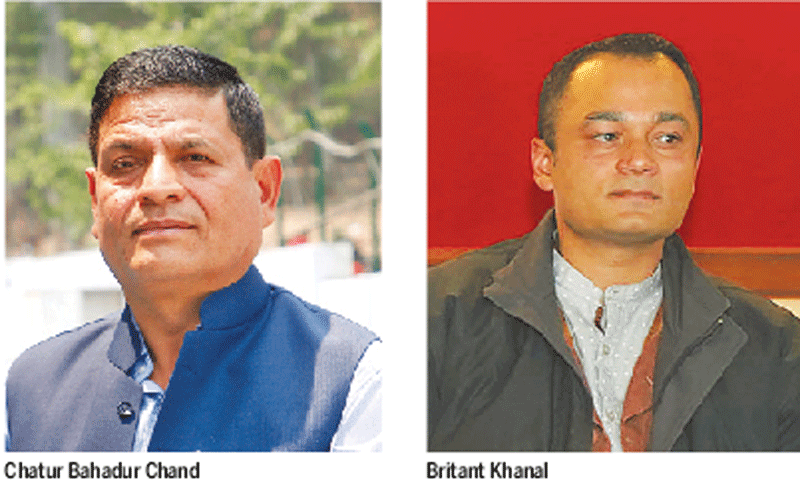
Cricket Association of Nepal (CAN) General Manager Britant Khanal has resigned from his position, blaming harassment by the cricket governing body’s president Chatur Bahadur Chand.
“…I decided to resign after he (Chand) came to CAN’s headquarters under the influence of alcohol in broad daylight and misbehaved with me, using foul language,” alleged Khanal in a Facebook post on Saturday.
He was appointed to the position of general manager on April 16, 2022.
Khanal also accused Chand and a few influential board members of being involved in unnecessary micro-management in the administrative works of CAN.
“He misused his position on multiple occasions, sometimes claiming that there was pressure from the Prime Minister’s Office and at other times, from political parties to get his interests served. If he could not fulfill his interests then he would warn of sacking. I could not accept to work with a slave mentality, so I decided to quit,” said Khanal.
He also claimed non-transparency in the financial management at CAN. “The board has been interfering in the financial matters as well and the audit is also non-transparent, not accountable. The fund CAN gets from the International Cricket Council (ICC) should have been used for the betterment of cricketers and the game in an accountable way, but that is not the case,” Khanal the Post.
Khanal claimed that he was harassed in front of CAN’s treasurer Roshan Singh and the acting secretary Durga Raj Pathak at CAN’s office in Mulpani, about a week ago. “I was expecting that the duo would initiate action against the harassment, but both of them chose to remain mum,” he added.
CAN President Chand, also the Baitadi district president of Nepali Congress, refuted all allegations against him. “The general manager had submitted resignation last Saturday and it was approved at a board meeting held yesterday (Friday). Better to ask him, if he was harassed or not. He submitted his resignation a week ago and is making such allegations after his resignation was approved by the board,” said Chand.
“He should have gone for legal action if he was really harassed. All the allegations, including misbehaving with him, financial irregularities and other charges are baseless,” Chand claimed.
Meanwhile, the CAN board meeting held late evening on Friday has decided to conduct a general convention, which will elect new leadership, on September 22 and 23. The meeting also decided to participate in the ACC Men’s Emerging Teams Asia Cup in July, ICC Women’s World Cup Asia Qualifier in August and September and the Asia Cup in August and September.
CAN member Padam Khadka has been assigned the coordinator’s role to study the prospects of the upcoming edition of NepalT20. Chhumbi Lama and Kailash Bista are other members of the Khadka-led committee.
The meeting also decided to name the upper Mulpani Stadium as Jai Kumar Nath Shah International Cricket Stadium in memory of the late Shah who had served as the
CAN president for more than four decades.

SPORTS

HOROSCOPE

- Post Report

ARIES (March 21-April 19)
Pay close attention to any brilliant ideas that land in your psyche once the Nodes of Fate become active this afternoon, as your intuition will be heightened.
Plan on spoiling yourself a bit as the day comes to a close.

TAURUS (April 20-May 20)
Emotional dreams may find you in the early hours, dear Taurus. Your heart will reveal what it truly wants, but try not to let passion cloud your judgment. Keep your eyes peeled for signs of any synchronicities mid-morning.

GEMINI (May 21-June 21)
A flirty yet relaxed energy will find you as you awaken, dearest Gemini, making it the ideal time to text your crush. Consider logging off and treating yourself to a cleansing bubble bath as the day comes to a close.

CANCER (June 22-July 22)
Sweetness will carry you into the afternoon as the Nodes of Fate become active overhead, and new connections could grow into lifelong friendships when you embrace community. The universe will ask you to connect with your spirituality.

LEO (July 23-August 22)
The cosmic climate is perfect for focusing on your health, building sustainable habits, and accessing your organizational side. If there are any lingering chores on your to-do list, be sure to tackle them before the day slips away.

VIRGO (August 23-September 22)
The Sagittarius moon connects with Mars in the very early hours, dear Virgo, jumpstarting your intuition and natural instincts. However, you’ll likely be snoozing as these vibes unfold, though you may want to journal any dreams that stand out.

LIBRA (September 23-October 22)
Use the energy to kick off your day with a good book, or consider rallying your friends for brunch. You’ll sense a shift mid-morning, inspiring you to embrace domestic bliss and all the stabilizing vibes that come with it.

SCORPIO (October 23-November 21)
The Nodes of Fate become active as afternoon rolls in, asking you to body pursue what your heart desires most. However, you’ll need to bring structure to any creative ambitions you harbor, reminding you that hard work is an integral part.

SAGITTARIUS (November 22-December 21)
While treating yourself is great for boosting morale and celebrating success, these vibes will ask you to embrace monetary security as well. Plan on hiding away from the comfort of home as the day comes to a close.

CAPRICORN (December 22-January 19)
Try not to read too much into your astral realm encounters. Trust that your psyche is simply working itself out. You’ll feel elevated and in the mood for attention mid-morning, though it may fall on you to arrange gatherings with family or friends.

AQUARIUS (January 20-February 18)
Pay close attention to any brilliant ideas that land in your psyche once the Nodes of Fate become active this afternoon, as your intuition will be heightened. Plan on spoiling yourself a bit as the day comes to a close.

PISCES (February 19-March 20)
The Nodes of Fate become active this afternoon, sharpening your thoughts when it comes to matters of the future. Energy will accompany you into the evening, though a busy social life could make it difficult to move away from your screens.

Page 8
FICTION PARK

A love that disarms fear

‘I am scared, Apurva,’ Tejashwi expressed and hugged him tightly. ‘I feel, if I open my eyes, then we will fall.’
- Anish Ghimire

Are you sure that we’re going the right way?” Tejashwi asked for the fourth time as Apurva ran his eyes on the map. Irritated, he folded the map, kept it aside, and uttered, “No, this is the wrong way. I have a deal set up with a human trafficker, which is where we part ways.”
She rolled her eyes and looked outside the window to the vast rough land. The road was ill and dusty. With time, dusk was approaching and they had to reach the destination before the natural light went off. The car jerked forward several times like a canoe on the waves of the ocean. The wheels of the car kissed the edge of the road, peeking down at the land situated meters below. She closed her eyes as the land below had its mouth open. A small failure and the cliff would swallow them. Maybe I am just afraid of falling. That is when she thought of a question.
“Hey, I have a question,” She said turning to him.
“What?”
“When people say they have a fear of heights, do they have the fear of the height or of the fear of falling from that height?”
“That is a brilliant question and importantly relevant. Why don’t you ask me after we’re done driving along the cliff?”
“Answer me.”
He dropped the gear harshly and pressed the accelerator on the uphill. Tejashwi stared at him impatiently waiting for the reply, “I don’t know. I think it is the fear of falling in most cases. But some people can have anxiety by just looking at the land deep beneath from where they stand.”
“I guess,” she said and looked outside.
“You know what? Let’s find out.” Apurva announced and pressed the brakes. With the approval of an abrupt plan, he parked his car on the side and placed his legs on the remote land. Happily, he grabbed his soul mate’s hand and walked to the edge of the hill. A sharp wind crept through their warm bodies, Tejashwi grabbed his hand tightly.
“Oh my god,” She voiced her fear looking down at the land formed below. “What will happen if we jump?”
“I think for a couple of seconds, we might feel free as a bird. Our shoulders and body will let go of all the troubles that subside us. But after a split second of that relief, our bones will start breaking. They will let go of each other as our fragile bodies will start spinning and breaking. And all of this can happen before we realize it.” He grabbed her by the shoulder, pulling her to his chest and kissing her on the forehead. She closed her eyes in fright.
“I am scared, Apurva.” She expressed and hugged him tightly. “I feel, if I open my eyes, then we will fall. Can we go now?”
“Relax love. I got you.” She held him tight as if holding onto her life.
“Do you trust me?” he asked.
“I do,” She replied bravely.
“Then slowly open your eyes and look into me. Inside my eyes there is no fear, I swear.” He spoke softly. His words hummed like a song. Slowly, she peeked with one eye and saw Apurva smiling at her. His smile felt safe. A feeling when a stray dog finds shelter amid rainfall. His eyes mirrored a feeling of reliance. The vigour of love was indisputable. She belonged in his eyes because she had bestowed her faith in them. The cloud of intimacy showered the rain of security. She opened her eyes and brought her lips to his for a brief period of the clock ticking. Then their eyes met, and she forgot about the fatal heights and the fear of falling. With you, I can walk on a coal fire, survive an avalanche, and sleep in a lion’s den.
“Now, look down without letting go of me. If you look alone, the fear will crawl with you, but if we look together, then we will beat that fear. If we stand together, then fear loses its power. We can overcome the silly insecurities that hold us back.” He said with elegance and smiled.
She looked at him with strong admiration. His perspective on life and its reluctance to witness adversity was transforming. “What did I do to deserve you? I love you so much.”
Wheels rolled along the skyline, towards a lonely road that led to the top of the hill. Apurva flashed the headlights as night had taken its shape. The car came to a stop at the topmost part of the hill. Stepping on the untouched land exposed them to a spectacular view of the city. Lights
scintillated the entire city like a Christmas decoration. Apurva and Tejashwi shared the mesmerizing view of the city in amazement. But moving their eyes upwards, they saw the sky was troubled with thick clouds. Abruptly, their eyes were drawn to attention as quick lighting struck near the city. It looked like a portal that connected the land and the sky. That is when they decided to construct the tent as soon as possible, as the shower was on its way. Putting down the materials, they found a flat spot for their tent. Rushing quickly, they unloaded the tent from the car. A thunder rushed through their ears, pulling them by surprise. The panic mode was activated as a few drops of rain
managed their way to the land.
“You know it’s weird,” he said in the middle of a rush.
“What?” she asked as she was connecting the tent poles.
“We feel the rain before any human because we are in the highest form of land.” He expressed and laughed while he struggled to erect the frame of the tent. “So if you think about it, we are ahead of time.”
“I don’t have the time to think about anything.” She replied hastily. Before one could say anything rain thudded against their bodies.
“Oh my god, Apurvaaaa!” she screamed as they put the finishing touches hurriedly while starting to get soaked in the rain.
“Come on quick!” Apurva shouted as both of them entered haphazardly through the small opening. Water dripped from their bodies to the surface of the tent.
“Oh no, we’ve wet the tent.” Apurva realised and got up as he hit his head on the tent. Within a second, it opened quickly, exposing them to the blistering shower. They looked at each other amid the sweet disaster and burst into laughter. The rain couldn’t alter their happiness. Huge laughter and aliveness to the fantasy-like moment acted as a shield from the effect of the huge rain. Clutching hands, they rushed to the car.
After the outpouring of love just like the rain outside, they decided to open the window as the car’s ambience turned steamy. Cold air swept past their body bracing their mind and soul. She rested on his arms as they watched the rain delay its pace. In union, they witnessed the fading of the clouds, making way for billions of stars. The force of rain faded away as the night became quieter with the sounds of insects trying to fill the noise. They came out of the car amid the evolution of a clear sky. A giant full moon shone above them, providing a dim light on their sacred love.

This is an excerpt from the author’s recently published novel ‘The Stardust In Us.’

CULTURE & LIFESTYLE

Peering into the delicate

Shaili Malla, a young artist from Bauddha, presents a dream-like, foggy window into the memories that have shaped her.
- Urza Acharya

Taragaon Next is a quaint space. Midst the large hovering trees and the immodestly green grass (where you can greet a fox or two) are the pod-like brick houses with large circular windows. Designed by an Austrian architect, Carl Pruscha, in 1972, Taragaon Next is a rare instance of a space not corroded by a vulgar display of concrete and chaos. It is here that one can view Shaili Malla’s delicate little exhibition, ‘Echoes from Yesterday.’
Shaili, a Bachelor in Fine Arts (BFA) graduate from Kathmandu University, wears many hats. Besides working with traditional art mediums like painting, she also vlogs, illustrates, and sells stickers, bookmarks, art prints, handmade brooches and cards. ‘Shaili ko shaili’ (Shaili’s style), as her YouTube channel is called, hints at an artist on the cusp of evolving times—adjusting to technological and
digital movements.
‘Echoes from Yesterday’ is her first solo exhibition. She’s taken a reserved tone for it—working with paint and translucent paper to create paintings heavily influenced by her past and the things that have shaped her.
As one enters the gallery, one is greeted with a rather eerie-looking painting. A mossy-green hydra (or perhaps a tree) stands in the middle of a foggy frame. Only as you get closer will you notice what gives the painting its mist-like texture—layers. Shaili uses translucent paper to add layers to her works—juxtaposing different colours, shapes and drawings to create the final narrative.
Shaili reveals that her primary muse is memory. With each of her paintings—a dog sleeping on a red sofa, an elderly woman peering out from the curtains—she recalls memories from her past. The dog is her beloved pet, Snoop (who passed away), and the woman is her
grandmother.
This recollection moves beyond the tangible—one painting captures a rather serene sky, while the other is a reconstruction of a cityscape at night. “Even though our memory fades, some sensory detail—scent, sight, or texture—remains. That is what I wanted to show,” she says.
This idea of recollecting past memories occurred when she started journaling with a close friend. “I used to draw, while my friend used to write,” she says. If they travelled somewhere, they’d press flowers and leaves to mark their visit. However, due to an unforeseen event, her dear friend passed away. “This exhibition is also my way of remembering him,” she says.
Because her artworks come from an incredibly personal place, they have a sense of fragility. The paintings are shrouded in a white mist, and her subjects look like they
are in the process of disappearing into the frame itself. This perhaps hints at the frail nature of our memories—wherein we slowly
forget even the happiest days of our lives.
That way, Shaili’s works seem like an attempt to document, appreciate and recognise these moments before they evaporate into oblivion.
There is a softness in Shaili’s paintings—reflected in how she speaks—as she chooses calm, placid and subtle colour palettes over strong ones. This is also evident in her final year BFA project, ‘Dear Wolves’, which she showcased at Nepal Art Council in 2022.
‘Dear Wolves’ is a poignant collection—tackling the issue of catcalling and harassment, particularly in public vehicles, without being overtly didactic. She has painted wolves—with notoriously haunting eyes and a sinister smile—gazing directly into the eyes of the viewer. This gaze surely creates a feeling of uneasiness in anyone—perhaps mainly women—who have faced unwelcome and lingering stares from strangers during public commutes.


What makes Shaili’s style different are the toned-down, neutral colours she uses to tackle heavy issues like loss and discomfort. At first glance, it is easy to dismiss her work as just pretty or soothing, but if you take a more serious look, you’ll notice that it carries much more depth and awareness.
It is rather rare for a recent art graduate to gear up—and meet the demands—for a solo exhibition. However, it is young artists who bring in fresher and more unique perspectives, daring to delve into topics that many of us might not have even considered pondering upon. Thus, it is extremely important that young artists are supported, encouraged and guided by those who already have a steady footing in the world of art.
Shaili’s first solo exhibition was made possible by Taragaon Next’s ‘Artist in Studio’ programme, which provides up-and-coming artists with monetary help, a studio and guidance to create a unique body of work within a course of six weeks or more. The final display is then exhibited at Taragaon Next’s gallery.

The exhibition will continue till July 9 at Taragaon Next, Bauddha, Kathmandu.

CULTURE & LIFESTYLE

Ford gets a send off in Indiana Jones

The actor says he’s hanging up Indiana Jones’ fedora, for better or worse.
- LINDSEY BAHR

Goodbyes don’t tend to mean much in the Hollywood franchise system. Death isn’t a reliable end for characters or, lately, even actors. Technology, nostalgia and the often-inflated value of brands and IP have created a nightmarish cycle of resurrection and regurgitation, curdling what we love most.
And yet when someone like Harrison Ford says he’s hanging up Indiana Jones’ fedora, for better or worse, you believe him. “Indiana Jones” producer Frank Marshall has also said that they won’t recast the character, which seems more dubious and, though well-intentioned, something he won’t be able to guarantee. All it takes is a new executive demanding a reboot.
Not that it would ever really work, though. Any self-respecting movie fan knows the truth: The magic of Indiana Jones belongs wholly to Harrison Ford. Apparently, he doesn’t even necessarily need Steven Spielberg behind the camera, though, to be fair, the foundation was well-laid for a veteran like James Mangold to step in. But there is no Indy—none that we care about anyway—without Ford.
In this way, it’s hard not to go into “Indiana Jones and the Dial of Destiny,” in theaters Friday, without a sense of melancholy—not exactly the ideal state of mind for what should be, and mostly is, a fun summer blockbuster. But it certainly adds a poignancy to the whole endeavor whether the film merits it or not.
If only it didn’t start with that pesky de-aging technology (the best it’s ever looked but it remains unsettling),
giving us a 45-year-old
Indiana Jones doing some of the wildest stunts we’ve ever seen our beloved archeology professor attempt—atop a speeding train to boot. This sequence is ostensibly there to introduce the film’s MacGuffin, Archimedes Antikythera, a real celestial calculation machine with extraordinary predictive capabilities that in the film is bestowed with some otherworldly powers.
But we know the real reason: It’s there to let us gaze at that familiar face and to go on one last adventure with the Indy we grew up with, before being thrust back into reality with a nearly 80-year-old Ford (he’s 81 in July) playing a 70-something Indy.
– Associated Press