Local units flooded with funds for schemes directed by centre
Federal government’s motives questioned as budget for projects where local units have a say has been slashed.
- PRITHVI MAN SHRESTHA
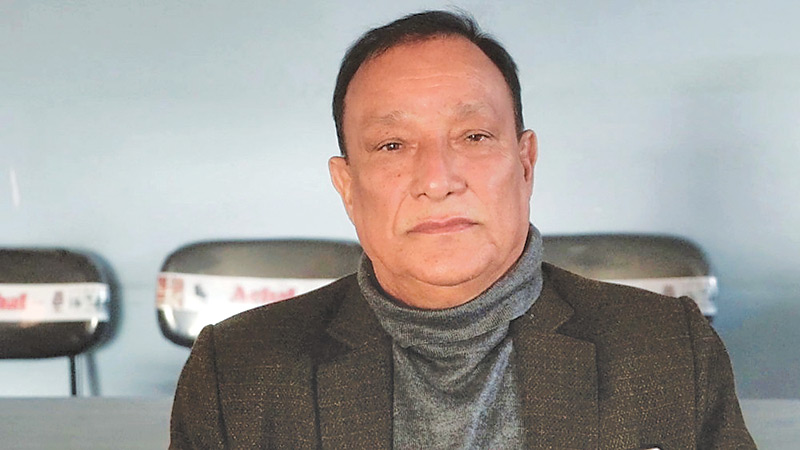
KATHMANDU, The federal government has been increasing conditional grants to local governments while reducing fiscal equalisation grants, giving little freedom to local units to invest the financial resources in the projects they prioritise. Fiscal equalisation grants are allocations to the provincial and local governments for implementing the programmes and projects that the sub-national governments have chosen for themselves whereas conditional grants fund the implementation of the federal government’s specific programmes and projects. The federal government increased conditional grants to the local governments to Rs191.89 billion for the next fiscal year 2023-24 from Rs183 billion in the current fiscal year 2022-23, according to the finance ministry. In fact, the conditional grants have been on the upward trajectory since fiscal year 2018-19 when Rs110 billion was allocated under the heading. On the other hand, the fiscal equalisation grants were reduced to Rs87.35 billion for the next fiscal from Rs100.23 billion in the current fiscal year 2022-23, the finance ministry said. In fact, such grants had been steadily increasing until the current fiscal year, from Rs84.7 billion in the fiscal 2018-19. Local governments are heavily reliant on fiscal transfers from federal and provincial governments with such transfers making for two-thirds of total financial resources of the local units in the fiscal year 2021-22, according to the 60th annual report of the Office of the Auditor General. Experts said the rapid rise in conditional grants compared to equalisation grants suggest that the federal government, going against the spirit of federalism, wants to dictate what projects to implement at the local level. “The spirit is to strengthen local governments to make their own decisions on development projects,” said Khim Lal Devkota, a lawmaker and an expert on fiscal federalism. “Reducing fiscal equalisation grants while increasing conditional grants means forcing local governments to carry the burden of the federal government while giving them little room to implement the projects of their choice.” Besides fiscal equalisation and conditional grants, special and complementary grants are other types of grants that local governments get. Even though the constitution has given provincial and local governments much power, experts and stakeholders say the tendency of centralising institutions and resources has continued. “Reducing the share of conditional grants to be provided to local governments is vital to strengthening them,” said Devkota. “Reduction of conditional grants for provinces and local governments means handing over office, staff and budget to sub-national governments and strengthening their roles in national development.” The provincial and local governments have long been complaining about the centralisation of financial and human resources. When the government staff adjustment process began, most human resources were retained at the centre contrary to earlier promises. Even though overall fiscal transfers to local governments are rising, the share of conditional grants where the local governments have little say, is growing rapidly. Conditional grants are provided to achieve certain national goals and to achieve certain standards and quality of the public services in the countries where the federal rules prevail. But local governments complain that the grants were recklessly doled out as per the wishes of certain politicians and interest groups. “Our demand is that there should be no allocation under conditional grants,” said Bhim Prasad Dhungana, president of the Municipal Association of Nepal. “Even if conditional grants are to be provided, they should be based on the needs of local people and the decisions of local governments.” He said besides allocating more in conditional grants compared to equalisation grants, the federal government also decided to set aside a budget for federal lawmaker-directed projects, which is also a type of conditional grant. Local governments are usually responsible for implementing the projects chosen by the lawmakers. The government allocated Rs50 million for each constituency under the Constituency Infrastructure Development Programme, which was revived after a gap of two years amid strong pressure from lawmakers. “Increasing the budget for programmes that certain politicians sign off on while decreasing the amount for programmes based on local needs is a blatant violation of the spirit of federalism,” said Dhungana, who is also the mayor of Neelkantha Municipality, Dhading. He said that there are many instances of conditional grants being allocated for programmes that are not necessary for local governments. Besides reduction in budgetary allocation under the fiscal equalisation grants, the federal government has continued to implement small-budget projects. In the budget for the fiscal year 2022-23, the federal government announced that projects that cost up to Rs5 million and related to water supply, tourism and urban development had been handed over to local governments. “The promise was never realised as the budget allocated for these projects were returned to Kathmandu purportedly due to resource crunch faced by the central government,” said Khim Bahadur Thapa, general secretary of Nepal Association of Rural Municipalities in Nepal. As much as Rs22 billion had been allocated for provincial and local governments along with handover of these smaller projects. “All the budget meant for provincial and local governments was returned to the federal government,” said Thapa. Elected local representatives that the central government failed to send even the budget allocated under conditional grants in the current fiscal. “The local governments have been denied as much as Rs13 billion that was supposed to be sent in the fourth quarter of this fiscal,” said Thapa, who is also chairperson of Kaligandaki Rural Municipality, Syangja “Local governments have been unable to pay contractors and user group who have completed their works.”
HOME PAGE
DPM Shrestha urges China to sign implementation deals on BRI projects
Says he asked Chinese leaders to ramp up aid to Nepal in line with the northern neighbour’s economic progress.
- ANIL GIRI
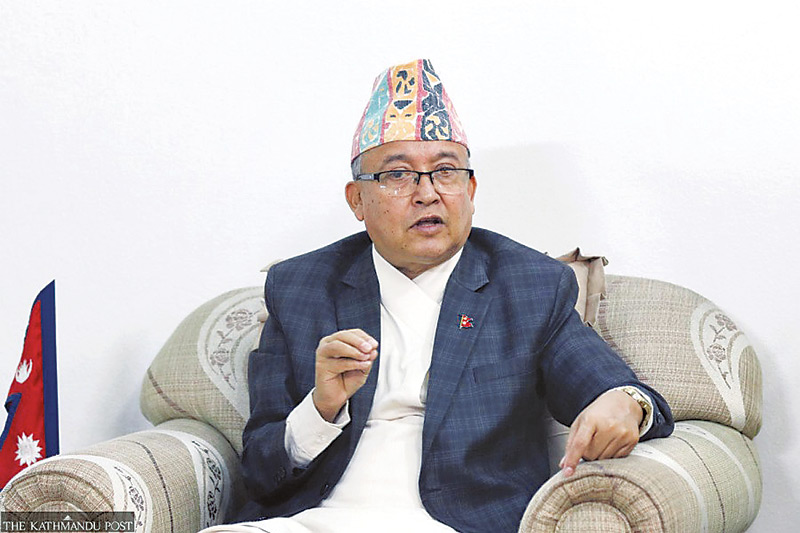
KATHMANDU, When Chinese leaders asked Nepal to expedite projects under the Belt and Road Initiative (BRI), Deputy Prime Minister Narayan Kaji Shrestha urged them to first sign project implementation agreements. Shrestha, who visited the Chinese province of Sichuan last week to take part in the 19th Western China Trade Fair, also held talks with Chinese Vice Premier He Lifeng and other senior officials of the Communist Party of China (CPC). The CPC leaders had expressed their concern over the delay in implementing BRI projects in Nepal, Shrestha told the Post on Monday. “In reply, I urged them to start the process by signing project implementation agreements. Then we can fix priority projects to be executed under the BRI and funding modalities, among other things,” said Shrestha. Shrestha also urged the Chinese leaders to fund a landmark BRI project in Nepal through grant assistance. “After signing project implementation plans, we can discuss funding, which may include grants or soft loans or joint investment,” he added. Although the Kathmandu-based Chinese Embassy and diplomats insisted that the new Pokhara International Airport is also part of the BRI, Nepali officials have been rejecting the claim saying that the signing of the Pokhara airport was completed some five years ago and BRI figures nowhere in the loan agreement. Nepal officially became part of the BRI in 2017 by signing a framework agreement. The BRI is an ambitious plan launched by Chinese President Xi Jinping to develop two new trade routes connecting China with the rest of the world. Responding to lawmakers in Parliament last week, Foreign Minister NP Saud had said that Nepal and China had signed a framework agreement on the BRI six years ago, and it is still in the stage of execution. He did not name the Pokhara airport, but stated that not a single project under the BRI has come into operation in Nepal. “The project implementation plan of the BRI is at the stage of discussion between Nepal and China. Not a single project in Nepal under the BRI has been executed,” said Saud. After the Nepali side selected nine projects to be executed under the BRI, the second BRI Conference in China in 2019 incorporated the Trans Himalayan Multidimensional Connectivity in its outcome document. The nine projects were—the Rasuwagadhi-Kathmandu road upgrade; Kimathanka-Hile road construction; road from Dipayal to the Chinese border; Tokha-Bidur road; Galchhi-Rasuwagadhi-Kerung 400kV transmission line; Kerung-Kathmandu rail; 762MW Tamor hydroelectricity project; 426 MW Phukot Karnali hydroelectric project; and the Madan Bhandari Technical Institute. Then, around two years ago, the Chinese side forwarded a draft of the BRI’s project implementation plan in order to expedite the negotiations and execution of projects. A draft of the implementation plan is a prerequisite for project selection, determining funding, budgeting, supervision and monitoring, and human resource management. “The Ministry of Foreign Affairs was taking the lead in developing the plan while other agencies like the Office of the Prime Minister and the Ministry of Finance provided inputs on the draft. But there has been no further progress,” according to two officials from foreign and finance ministries. “Once we agree on the text of the project implementation plan, we can negotiate and execute projects under the BRI,” said the foreign ministry official. “Not only from Nepal, the Chinese had sought similar drafts from other countries that have signed up for the initiative.” According to the DPM Shrestha, the Chinese side first proposed the project implementation plan and the Nepali side responded with its comments. “I insisted the Chinese leaders sign the implementation plan,” he said. The Finance Ministry, while commenting on the text of the project implementation plan, stated that Nepal cannot afford a loan with an annual interest rate of more than one percent, nor can it fund BRI projects through commercial loans. The Nepali side also insisted that there should be a free and fair competition among bidders under the BRI framework. The major impediment in the selection and implementation of projects is a lack of clarity on the financing modality, according to multiple officials. Nepal, they say, wants grants while China insists on soft loans. Without progress on a single project, the BRI framework agreement has been renewed twice—most recently in May. Policy coordination, infrastructure connectivity, unimpeded trade, financial integration and connecting people are the five major priority areas of the initiative. The implementation plan encompasses all possible areas of cooperation and gives clarity on project negotiations on both sides. For example, according to officials working on the draft, if Nepal seeks support for connectivity projects under the BRI, it would make a list of various kinds of projects under air connectivity, physical connectivity, digital connectivity, transmission lines, cultural connectivity and connectivity through trade, goods and commerce. Another foreign ministry official told the Post that there were some rounds of discussions between the two sides and drafts were exchanged so as to reach a consensus on the proposed projects. But in the absence of a dedicated implementation plan, Nepal could not identify the projects under the BRI. According to Shrestha, he also urged the Chinese leaders to ramp up Chinese assistance to Nepal in line with China’s economic progress. “When China was not as rich as it is now, they built several infrastructure projects in Nepal including the Ring Road, Araniko Highway and set up several factories and hydropower stations in Nepal. But now China has become more prosperous, but its economic assistance to Nepal has not increased accordingly. So I urged the Chinese to increase economic assistance and investment in Nepal to match their economic might,” said Shrestha. Similarly, DPM Shrestha, during his meeting with Chinese leaders, claims to have called for speedy completion of Chinese-involved projects including the second phase of Ring Road expansion, which remains delayed since the Covid pandemic. The detailed project report for the work has not yet been finalised. Before being appointed home minister, Shrestha served as minister for physical infrastructure and transportation until March. He had also expressed concerns over the delay in the work with the Chinese envoy to Nepal Cheng Song. In Sichuan, Shrestha had put across the issue of delays in two other projects—the widening works on the Narayanghat-Butwal section of the East-West highway and Abu Khairani-Pokhara section of the Prithvi Highway—both of which are being implemented by Chinese contractors. Shrestha said he also asked the Chinese leaders to open more trading points between Nepal and China and build additional dry ports along the Nepal-China border to boost trade. “The limited opening of the border points have limited our engagements and trade. So we have to open more trading points,” he added. Nepal and China have been trading solely through the Kerung-Rasuwagadhi and Tatopani entry points, say Nepali officials. Trade through Tatopani has been sluggish even as Nepal is exporting next to nothing to China.
HOME PAGE
Kathmandu mayor announces plan to select students for scholarships in Grade XI
HISSAN accuses him of not consulting stakeholders before making the decision.
- ANUP OJHA
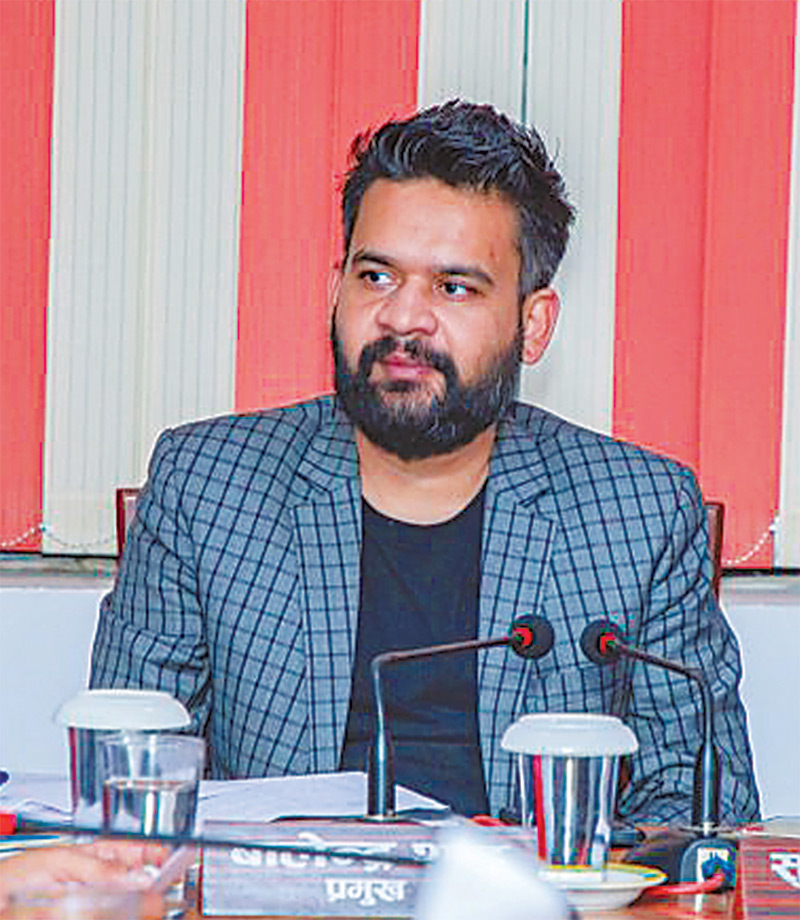
Mayor Balendra Shah. Photo: KMC
KATHMANDU, Kathmandu Metropolitan City (KMC) Mayor Balendra Shah seems to have a penchant for stirring up controversies through his unilateral decisions, but he has been receiving all-round praise, particularly on social media, for his decision to bring reforms in the education sector. Shah’s drives such as ‘Textbook-free Friday’ in community schools within the city, his decision to provide scholarships to 10 percent of the students (mainly for those from poor economic backgrounds), and KMC’s directive to private schools to provide salaries to teachers on par with public schools have been well-received. In the first week of June, the KMC published the names of 342 private schools within the metropolis that failed to provide details of scholarships they have given to students up to Grade 10. Many schools rushed to provide their scholarship details. By June 20, out of 504 private schools in the metropolis, 465 submitted the details, and the KMC estimates a total of 1,300 students will benefit from it. Amid this, on Monday, Mayor Shah made yet another announcement that came as a relief for the poor, the underprivileged and the marginalised students. Now the KMC itself will select students who will get class 11 scholarships in private schools, starting from the current academic session. Shah’s Facebook post was shared more than 1,300 times, and has received over 6,500 comments, almost all positive, on the social network until Monday evening. Mayor Shah also said that KMC will conduct a scholarship examination to select students who demonstrate exceptional academic aptitude but come from a weak financial background. The Nepal Guardian Federation welcomed the mayor’s announcement but expressed doubts about its implementation. “Yes, the KMC can conduct exams and give scholarships to the needy based on existing laws as it has the jurisdiction over schools up to the plus-two level,” said Suprabhat Bhandari, chair of the federation. “But how can it ensure that only deserving students get the scholarships?” He added, “Good execution is important. Hopefully this is more than a social media stunt.” According to KMC’s recent report, there are 504 private schools and 89 community schools in the metropolis. The Higher Secondary Schools’ Association Nepal (HISSAN), however, said the KMC mayor’s proposal was unacceptable to them. “Before making such a decision, shouldn’t the KMC have talked to the stakeholders?” said Yuvraj Sharma, senior vice president of HISSAN. “The private sector has been paying so much tax to the government.” He accused the KMC mayor of imposing “dictatorship” on all tax-paying private educational institutions by making big announcements through social media instead of formally corresponding with them. “If the mayor tries to become more forceful, its consequences will not be good,” Sharma said. “We are against the mayor’s decision. It’s totally unacceptable because he can’t make decisions unilaterally.”
NATIONAL
Dalit’s house torched for eloping with ‘upper-caste’ girl in Jumla
Police have arrested the girl’s brother on charges of criminal arson and caste-based discrimination.
- DB BUDHA
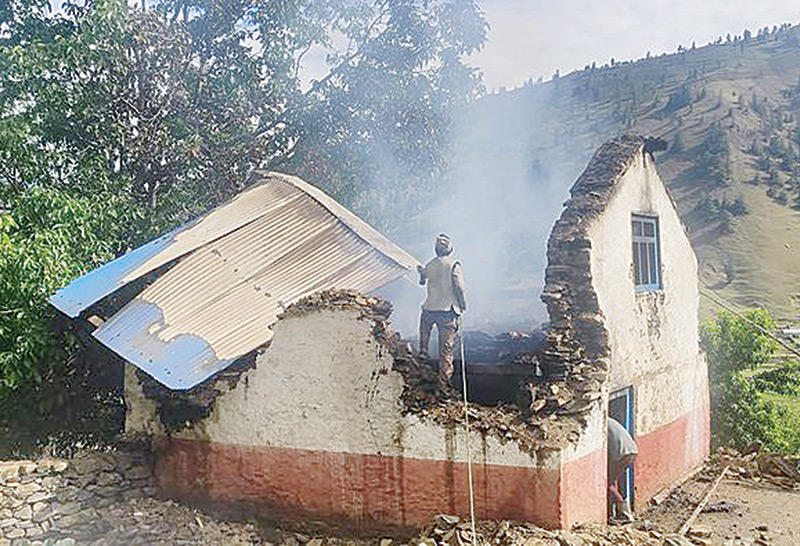
The burnt house of Mukunda Nepali at Tatopani of Gidikhola in Jumla pictured on Sunday morning. POST PHOTO: DB BUDHA
JUMLA, Police on Monday filed criminal arson and caste-based discrimination cases against 21-year-old Himmat Giri who allegedly torched the house of Mukunda Nepali, a Dalit, for eloping with his sister. Himmat reportedly set fire to Mukunda’s house in Gidikhola in ward 4 of Tatopani Rural Municipality in the district at 4am on Sunday. “Cases of criminal arson and caste-based discrimination have been filed against the accused on Monday and an investigation into the matter is underway,” Assistant Police Inspector Raju Sarki told the Post. According to locals, Mukunda and the girl had been dating for two years. They eloped last week. The girl’s family has refused to accept the union stating that the girl is only 16 years old, labelling it a case of child marriage while the boy’s family accuses them of caste discrimination. Police have also issued arrest warrants against Himmat’s father and uncle. Mukunda’s brother, Bharat Nepali, who was away in the district headquarters during the time of the incident, said their house has been completely destroyed. According to him, the villagers tried to douse the fire but were unsuccessful. The house had already been gutted when a police team led by Assistant Sub Inspector Rajendra Giri reached the incident site. Based on the victims’ claims, police estimated that property worth around Rs6.5 million was damaged in the fire. The fire has rendered Bharat and his family homeless while his brother Mukunda and his wife are out of contact. “We have lost our house and Mukunda is not in contact,” said Bharat. “This atrocity is intolerable.” Police arrested Himmat from Kalekholi in the district headquarters while he was preparing to fly to Nepalgunj. Police Inspector Dharma Raj Joshi said the accused told police that he set Mukunda’s house on fire in a fit of rage. “The accused told us that he acted out of rage,” said Joshi. “There was an ongoing dispute about the couple’s elopement.” There are 28 Dalit households in the area. The villagers said they were preparing to resolve the dispute after bringing the couple back. “A solution would have been found following a discussion,” said local Dhanshree Nepali. Mukunda, who was living in the district headquarters was preparing to enrol in a college to pursue a Bachelor’s degree. According to locals, the girl was a student at a local school in the village. Joshi said that police units across the Karnali Province have been directed to search for the couple. Dalits in Nepal have suffered for generations at the hands of the so-called upper-caste people and they continue to face atrocities. Caste-based discrimination is still rife in Nepal even after efforts—and the legislation—to end it. The Jumla incident serves as a reminder of the 2020 Rukum West incident in which six Dalit youths were killed over an inter-caste love affair. On May 23, 2020, 21-year-old Nabaraj BK, from Bheri Municipality in Jajarkot district, along with 18 of his friends, had gone to Soti in Chaurjahari Municipality of Rukum West to bring a 17-year-old girl, belonging to a so-called ‘upper caste’, as his bride when the locals attacked them and chased them towards the Bheri River. Nabaraj along with Ganesh Budha Magar, Tikaram Nepali, Lokendra Sunar, Govinda Shahi and Sandip BK were killed in the incident.
NATIONAL
One dead, another injured in elephant attack
District Digest
KAKARBHITTA: Eighty-year-old Pannadevi Sah died after she was attacked by an elephant in Jhapa on Monday while 38-year-old Kamala Dhimal was injured in a separate attack by the same elephant, police said. Sah, a resident of ward 10 of Mechinagar Municipality, had stepped out of her home at 5am for prayers when she was attacked by the pachyderm. She died on the spot. Dhimal, a resident of Buddhashanti Rural Municipality, has been admitted to the Birta City Hospital for treatment.
NATIONAL
Two jewellery stores sealed in Butwal
District Digest
BUTWAL: Authorities sealed two jewellery stores in Butwal on Monday over the alleged involvement of the owners in gold smuggling to India. The stores were sealed after an investigation showed the proprietors were involved in a case in which a man was nabbed with 1.965 kg gold while he was trying to smuggle it into India, said Yuvaraj Bhattarai, information officer at Bhairahawa customs office. A team of the Armed Police Force on June 25 had handed over the accused, Humananda Giri of Dang, along with the seized gold to the customs office for investigation. Security personnel had arrested the man with gold worth around Rs20 million and a car during a security check at ward 2 of the Lumbini Sanskritik Municipality. Bhattarai said they started an investigation into the case after obtaining judicial custody of the accused.
NATIONAL
Boy dies after falling off a cliff in Darchula
District Digest
DARCHULA: A 12-year-old boy died after falling from a cliff in Dhangkang of Apihimal Rural Municipality on Sunday. According to the police, the grade 5 student of Chhipulakedar Secondary School died after falling off a cliff while playing in school on Sunday. Gyanendra Bahadur Singh, information officer at the District Police Office, Darchula, said that the boy fell some 50 metres while playing near the school compound and died on the spot. Singh informed that a police team has been deployed from Khandeshwari Police Station and Area Police Office in Latinath to further investigate the incident.
NATIONAL
Election Commission proposes two-term limit for PR candidates
In the draft bill, the poll body has proposed the provision for ‘NOTA’ and mandatory allocation of 33 percent seats for women candidates under the FPTP system, among others.
- Post Report
Chief Election Commissioner Dinesh Kumar Thapaliya Post File Photo
KATHMANDU, The Election Commission has proposed various amendments to the election laws as it decides to register the ‘Bill to Amend and Consolidate the Election Law’ at the Parliament through the Ministry of Home Affairs. A meeting of the commission on Monday decided to forward the new amendments to the government, which will register proposals at the Parliament. As per the proposed amendment, the Election Commission has suggested that a person who has already been elected twice through the proportional representation (PR) system be barred from filing candidacy under the same electoral category. The existing election law does not have a limit for a candidate who wants to participate in the elections through the proportional representation system. Likewise, the commission has also proposed a provision that a candidate who has lost the elections (local, provincial or federal) shall not be allowed to file candidacy from another constituency in either of the elections for five years, except for the by-election of the respective constituency. Moreover, the commission has included another provision that gives the voters the right to reject candidates. For that purpose, the commission has proposed a provision that gives voters a right to reject any candidate and for that, a ‘NOTA’ sign should be included in the ballot paper. In the draft bill to amend the current election laws, the commission has proposed a provision that makes it mandatory for the political parties to field at least 33 percent women candidates under the first-past-the-post electoral system. The Commission has stated that the changes were proposed in the new integrated election law to replace seven different existing laws based on Nepal’s constitution, the directive order of the Supreme Court and past experiences. In the new integrated bill to be presented at the parliament, the election body has proposed 27 different changes, which commission officials expect will clear the confusion that affected the past elections and introduce some newer practices as per the expectations of the people. Major changes proposed by the election body include updating the voters list through an electronic medium, collecting details of Nepali citizens living abroad to prepare the list, and fixing the election day and duration of publicity campaigns. Elections officials said they included the provision to bar candidates from contesting polls repeatedly within five years in view of the widespread criticism levelled against leaders who were defeated in the elections but contested another election held within the same term. To ensure better representation of women in the governing process, the commission has made it mandatory for political parties to field at least 33 percent of women candidates under the FPTP election system. One of the two candidates for chairperson and vice-chair or mayor and deputy mayor must be a woman, while at least 33 percent of ward chair candidates must be women. The commission has proposed that while registering their candidacy, all candidates must submit their property details registered in the names of their family members. To avoid the existing confusion about the starting and ending point of their term, the election body has proposed that it should begin from the day of election for all the elections of the House of Representatives, Provincial Assembly and local level while their term would end the day the candidacy filing for the next election begins. For the new election law, the election body has proposed that the candidates must make all the financial transactions of their polling campaign only through the bank account listed while registering their candidacy. To address the voting rights of Nepali citizens living abroad for various purposes, the commission has proposed that provisions should be made to allow them to vote for the PR category of the House of Representatives via diplomatic missions. For the first time in Nepal’s election history, the commission has proposed the provision of NOTA [None of The Above] for the voters who don’t like to vote for any of the candidates, and if the NOTA crosses 50 per cent of the total valid votes, the election will be terminated. Besides that, the commission has also proposed that public transportation needs to be managed on the election day to make the election process easier for all elections of the House of Representatives, Provincial Assemblies and the local level.
NATIONAL
Coalition leaders agree to form government led by Congress in Koshi
- POST REPORT
Uddab Thapa
KATHMANDU, Leaders of the ruling coalition in Kathmandu have decided to form new government in Koshi Province under the leadership of Nepali Congress. A meeting of coalition leaders held at the prime minister’s residence in Baluwatar on Monday also decided that Uddab Thapa of Congress would be a candidate to lead the provincial government. Rajendra Pandey, acting chair of CPN (Unified Socialist), who attended the meeting said the top leaders at the meeting decided to instruct provincial leaders of their respective parties to elect Thapa as chief minister as Congress is the largest party in Koshi among the coalition partners. “Once the Congress leader is elected chief minister, other ministries will be allocated among coalition partners and that will be agreed upon based on inter-party negotiations,” Pandey said after the Baluwatar meeting. According to him, they have decided to seek support of the Rastriya Prajatantra Party to form the government in Koshi. The RPP’s support is a must for the coalition to secure a majority in the provincial assembly. After UML leader Hikmat Karki failed to garner a vote of confidence, the Maoist Centre, Congress, CPN (Unified Socialist) and Janata Samajbadi Party are working hard to form a new government but due to lack of the necessary numbers to ensure a majority, they had sought the help of the top leaders of their parties in Kathmandu. The leaders took the decision as the provincial head Parshuram Khapung on Sunday issued a notice calling upon political parties to come up with a proposal within 5 pm Thursday to form a new government.
NATIONAL
PM wants Janamat Party in Cabinet despite rival parties’ reservations
Prime Minister Pushpa Kamal Dahal is ready to allocate one ministry to the Janamat Party, said its general secretary Chandan Singh.
- NISHAN KHATIWADA
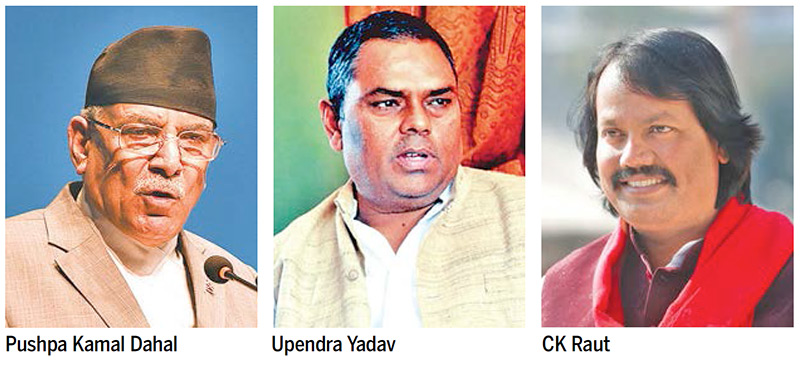
KATHMANDU, Prime Minister Pushpa Kamal Dahal has been preparing to welcome Janamat Party in his government through a reshuffle of the current Council of Ministers. On Sunday, the prime minister met with Janamat chair CK Raut and urged him to join the government, sources said. Dahal is ready to allocate one ministry to the Janamat Party, said Janamat Party General Secretary Chandan Singh. “But we have some conditions,” Singh said. “We are seeking one ministry—either the Urban Development or Industry or the Agriculture ministry.” Singh added that the allocation of a ministry for its minister without portfolio in the Madhesh government is also among their demands. Expanding his Cabinet for a third time in May, Chief Minister Saroj Kumar Yadav stripped Basanta Kushwaha of the Janamat Party of his portfolio, replacing him with the Unified Socialist’s Govinda Bahadur Neupane as the minister for land management, agriculture, and cooperatives. Three Madhesh-based parties made it to the House of Representatives following last year’s general polls. However, the relations between the regional rival forces have been cold—especially between the Janamat Party and the Janata Samajbadi Party, as both of them sense each other as major obstacles to holding sway in Madhesh politics. Yet the leaders of the Janata Samajbadi and Loktantrik Samajbadi Party have claimed that they were okay with Janamat joining the federal government. Surendra Jha, a Loktantrik Samajbadi Party leader close to Mahantha Thakur, said as the Janamat Party is a part of the coalition, giving it one ministry would not be so complicated. Insiders say the prime minister has been trying to bring the Janamat Party into the government given the volatile political situation and the tricky parliamentary arithmetic. Last week, while passing the appropriation bill from the lower house, 107 voted against the budget and 147 voted in its favour. As many as 138 votes were required to endorse the bill. Some ruling coalition partners had expressed their displeasure after the budget for the fiscal year 2023-2024 was announced. “Yes, there are flaws in Janamat’s decision making but given the current political circumstances, it is better to induct the party in the government,” Jha said. Janata Samajbadi Party spokesperson Manish Suman said the party will not be engaged in the politics of negation. “If the prime minister believes the government will be better served by bringing in Janamat, we are okay with it.” Suman, however, added that the Janamat has repeatedly been flouting the norms and the discipline of the coalition—during the vice-presidential elections and bypolls in Bara. They had also voted against the appropriation bill in the House of Representatives on June 28. In the election for Vice President in March, Raut’s Janamat Party had fielded its own candidate, Mamata Jha, for the post against Janata Samajbadi Party’s Ramsahay Prasad Yadav. Janamat and Janata Samajbadi Party’s bitter rivalry was evident also during the Bara bypoll held in April, when Upendra Yadav was in the race. “If coalition partners do not abide by discipline, there will be no future of the coalition,” Suman said. “Our party is not happy with the Janamat’s recent activities but we will not engage in the politics of negation.” Janamat Party quit the federal government on March 31, having been denied a ministerial berth of its choice. The party’s minister, Abdul Khan, submitted his resignation after the Ministry of Industry that his party was laying its claims to was given to the Nepali Congress. Currently, the Nepali Congress is leading nine ministries in the Cabinet, while the CPN (Maoist Centre) leads six ministries and has one minister of state, besides the prime minister. The CPN (Unified Socialist) leads two ministries along with one minister of state. The Janata Samajbadi is in charge of two ministries and has one of its leaders as state minister, while the Loktantrik Samajbadi Party and Nagarik Unmukti Party lead one ministry each. Leaving the traditional parties flabbergasted, the CK Raut-led Janamat Party, in its maiden parliamentary election, got six seats and became a national party. Moreover, party chair CK Raut trounced Janata Samajbadi chief Upendra Yadav with a sizable margin of votes in Saptari. People have been seeing it as a strongly emerging political force in Madhesh with a huge potential. Despite that, however, the party has been failing to forge a concrete roadmap and is in a dilemma on whether to govern or remain in the opposition. “CK Raut and his party are confused regarding the track they should be walking on—whether to join the government or remain in opposition,” said Chandra Kishore, a political commentator. “Sometimes, they claim to be a vital part of power-sharing and challenge Yadav but they are unclear on how they would differ from the traditional Madhesh-based parties.” Kishore said that the Janamat Party should stay in the opposition and be a vocal advocate of Madhesh issues and agendas. “For that, they should have clarity on the Madhesh issues, show commitment, and have a clear concept, which they currently lack,” he said. “That’s not a good sign for an ascendant political force.”
NATIONAL
Nepal Oil Corporation slashes fuel prices
Briefing
KATHMANDU: Nepal Oil Corporation has reduced the price of petroleum products, effective from Monday midnight. The corporation has reduced the price of petrol, diesel and kerosene by Rs5 per litre in Kathmandu, Pokhara and Dipayal. Similarly, the cost of petroleum products in Tarai has been slashed by Rs7.5 per litre, while in Surkhet and Dang, fuel prices have been reduced by Rs6 per litre. The meeting of the NOC board held on Monday evening decided to reduce the price, said Manoj Thakur, the spokesperson of the corporation. He added that the NOC has determined the price using a scientific system. The NOC has included Tarai (Charali, Biratnagar, Janakpur, Birgunj, Amlekhgunj, Bhalwari, Nepalgunj and Dhangadhi) in the first category, while Surkhet and Dang are in the second category. Likewise, Kathmandu, Pokhara and Dipayal are included in the third category. As per the new adjusted price, petrol will cost Rs170/litre and diesel and kerosene will cost Rs150/litre in Kathmandu, Pokhara and Dipayal. In Tarai, the consumer price of petrol will be Rs167.5/litre, while the price of diesel and kerosene will be Rs147.5/litre. In Surkhet and Dang, the consumer price of petrol will be Rs169/litre, while the price of diesel and kerosene will be Rs149/litre. Meanwhile, the NOC has kept the price of LP gas for cooking unchanged. The state-owned oil monopoly has also reduced the price of aviation fuel. The price of domestic aviation fuel has been reduced by Rs14/litre and the price of international aviation fuel has slashed by Rs15/litre.
NATIONAL
Police arrest two more in Lalita Niwas land scam
Briefing
KATHMANDU: Police have made two more arrests in connection with the Lalita Niwas land scam. The Central Investigation Bureau of the Nepal Police arrested Ramesh Kumar Pokharel, the former head of Samarjung Company, and Dev Narayan Maharjan. “They were arrested in connection with the scam on Monday,” Senior Superintendent of Police Dinesh Acharya of the CIB told the Post. Pokharel is accused of forging government documents with the intent of transferring the ownership of the government land located at Lalita Niwas, Baluwatar, to Pashupati Tikicha Guthi. Meanwhile, Maharjan, who was presented as a tiller by the guthi, was taken into custody allegedly for taking Rs600,000 to carry out the task, police investigation revealed. With this, a total of eight arrests have been made in connection with the scam so far. The police had arrested seven accused on June 27. Three of them —Kaladhar Deuja, Surendra Kapali and Hupendra Mani KC— were released later in the day citing a stay order issued by the Supreme Court in August last year that had prevented their detention for investigation. Three more individuals—Baburaja Maharjan, Ghaman Kumar Karki and Shivaji Bhattarai—were taken into custody by the police on Sunday. Lalita Niwas covers around 300 ropanis (around 15 hectares) of land and includes the areas of the prime minister’s residence, Nepal Rastra Bank’s central office and some other VIP residences.
OPINION
The meddling unions
The importance of having a functional calendar for higher education is self-evident.
- ACHYUT WAGLE
Shutterstock
The University Grants Commission is working hard to find a workable mechanism to implement a “unified” academic calendar for Nepal’s universities. If not a unified academic calendar, at least a synchronised one would help to complete the courses on time and regain trust in Nepal’s higher education system. Prime Minister Pushpa Kamal Dahal who is ex-officio chancellor of about a dozen universities, has been emphasising the importance of strictly adhering to the programme in his policy speeches. Speaking at Kathmandu University’s 28th convocation ceremony last month, Prime Minister Dahal said, “Because universities have not been effectively implementing the academic calendar, the schedules related to student admission, classes, examinations and publication of the examination results have become uncertain. This has harmed the future of students and caused anxiety to their parents and guardians.” The speech outlined three distinct sets of policy preferences. First, the highest policy making level has realised the need for a functional academic calendar for Nepal’s higher education. This is not only desirable but an overdue exercise. Second, the prime minister has rightly proposed creating a “national calendar” instead of a unified or single calendar for all higher education institutions. Third, his idea of giving freedom to individual universities to frame their own calendars matching their specific nature and needs is undoubtedly a pragmatic approach.
The ecosystem imperative The academic calendar is affected by various schedules and events in the country’s academic system. The most critical prerequisite is the publication of the Grade 12 results on a fixed date every year so that higher education institutions can plan accordingly and students can gain timely admission into undergraduate courses. The National Examination Board which is responsible for publishing the Grade 12 results might expect the same with regard to Grade 10 results. Since any disruption in the schedule sets off a chain reaction, it will not be possible to stick to the academic calendar at the university level until this is stopped. At the core of the ecosystem approach should lie the national education policy with defined timelines, goals and expected outcomes. The policy must have a framework that not only recognises the complementarity of high school education, vocational and technical education and degree awarding university education, but also functions in tandem with the overarching goal of the country’s human resource management plan. Nepal still lacks a coherent human resource management policy that is linked with the country’s education system to ensure supply of the desired skills. The results of a preliminary study carried out under the auspices of the National Planning Commission with support from a donor agency have not yet been made public. The consequences of not maintaining the academic calendar are perhaps not adequately appreciated at the highest policymaking level. One of the major reasons for Nepali students going abroad for higher studies is that it takes much longer here to complete the programme and graduate. Such delays adversely affect the quality of educational outcomes too.
Stakeholder approach It is not only the fault of the academic authorities for the academic calendar going haywire. Students, teachers, academic administrators and parents too have failed to respect and implement the schedule. Politically motivated strikes, lock-ups and disturbances by students, teachers and staff unions have appeared as the main reason for the disruptions at a majority of universities. Relentless unionisation by the major political parties has prevented reform in the higher education system, including implementation of the academic calendar. The parties consider the student unions as the main breeding ground for their cadres, and the teacher and staff unions as their support system. This remains the root cause for all anomalies in university education. The importance of having a functional calendar for higher education—national, unified, synchronised or whatever—is self-evident. But even the best calendar has little chance of being implemented unless the entire educational ecosystem is revamped. The proposed national calendar for university education, as envisioned by the prime minister, can only be implemented if there is political will to prevent interference by the trade unions, including those affiliated to his own party. This will substantiate the prime minister’s intention to reform the academic calendar and also set a precedent in depoliticising Nepal’s higher education.
OPINION
French riots and Nepal’s ‘respectable’ casteism
Everyone pretends that Dalits have been afforded unprecedented amounts of rights and privileges.
- MITRA PARIYAR
Post File Photo
The violent unrest in France over the past few days, following the murder of a 17-year old Algerian-descent man, Nahel M, by a Parisian policeman on June 27, has shaken the country. There have been deadly clashes with the enforcement officials on the streets of Paris, Marseillie and many other cities and towns. Hundreds of protestors have been arrested and many shops and businesses vandalised or looted. A Parisian mayor’s family home was attacked and his family injured. Similar to the 2020 uprising in the United States of America after the killing of George Floyd in police custody, in the city of Minneapolis, the French uprising has drawn global attention. Not many people would support this level of violence, but the spontaneous outpouring of rage by the underprivileged youth and their supporters deeply resonates with the feelings of many oppressed peoples in Europe and around the globe, including, of course, Nepali Dalits. The United Nations has alluded that the French riots are a reaction to a deep culture of racial hatred and violence in society, including police brutality. It issued a statement urging France to recognise this reality and address its “deep issues” of racial hatred. Indeed, many activists, scholars and journalists have also commented that the nation-wide disturbance is much more than an issue of law and order, although the government would be inclined to represent it as such. The flaring of the street violence is a form of fightback against persistent racial discrimination and police brutality mainly targeted at the immigrants and their descendants originally from North Africa. On June 30, the French author, film director and activist Rokhaya Diallo wrote an angry commentary in The Guardian, where she held the state responsible for the destructive rioting on the streets. She observed, “France has ignored racist police violence for decades. This uprising is the price of that denial.” Many published research papers and books demonstrate the endemic problem of racial profiling and violence in France. Above all, I found Jim Wolfrey’s 2017 book Republic of Islamophobia: The rise of respectable racism in France interesting and useful. An academic at the University College London, Wolfrey specialises in French history. In this remarkable book, he unveils how the French political class has systematically whitewashed racism in recent decades. I was particularly struck by Wolfrey’s novel concept of “respectable racism”. I believe this can be a useful lens to understand the dynamics of racism and similar issues in almost any country. The author argues that racist policies have become widely accepted and “respectable” in French society in the past decades under the veneer of secularism and gender equality. The 2011 ban on full-face cover, for example, has been described as a step towards promoting female freedom amongst Muslim minorities. On the contrary, the policy has been a powerful tool to demonise and suppress minority religions and cultures, thereby promoting Islamophobia. Through Wolfrey’s perspective, one can discern that Nepal, too, has been promoting what might be called “respectable casteism” over the past decades. The problem has become further entrenched, particularly since the fall of the Hindu monarchy in 2008. Paradoxically, the end of the royal regime has led to the bolstering of Brahmanism. Whereas in the past, Brahmins were in charge of religious/moral authority and Chhetris of political authority, now Brahmins control both. Even the second tier of the social structure now feels alienated and disempowered. Forget about those at the bottom of the ladder. Strengthened Brahmanism has inevitably led to further Hinduisation of politics (actively promoted by the BJP government across the border). So much so that Prime Minister Pushpa Kamal Dahal, who destroyed Hindu temples and slaughtered cows to feed Brahmins during the so-called People’s War, recently performed an elaborate six-hour puja at the Mahakaleshwar Temple in Ujjain, India. That too in a saffron suit, in Narendra Modi’s fashion. This means greater intolerance towards minority religions (Christians, Muslims) and suppressed groups—particularly Janajatis and Dalits. The latter are religiously and culturally perceived as impure, inauspicious and polluted. Much of the national federal and provincial budget is now spent on building or decorating Hindu temples and religious sites. But not a rupee is spent on steps necessary to enforce the new laws in favour of Dalit freedom. Everyone seems content with the false belief that Dalits have become free and equal under the veneer of constitutionalism, liberal democracy and secularism. In the past, when autocratic Shah kings and Rana families ruled the land, caste discrimination was a clearly stated policy. The 1854 Muluki Ain introduced by Jung Bahadur Rana was so casteist that even penal laws were different for different castes, and the Dalits were officially treated worse than slaves. In contrast, the 2015 constitution of republican Nepal has guaranteed full civic and human rights to every cater, including Dalits. Caste discrimination has become a punishable crime. These are great achievements, of course, which potentially open the gates of Dalit liberty. Of equality and humanity. But these letters in the law books seem toothless in the face of traditional Hindu laws or the code of Manu. Violence against Dalits has gone up in recent years. Dalits attempt to exercise their rights as stated in the constitution, which becomes unacceptable for the so-called upper caste. The latter refuse to give up caste discrimination not only to preserve the traditional power structure, but also to avoid the potential wrath of their lineage and other deities. All the parties and their leaderships understand too well that casteism has remained strong even today mainly due to the mismatch or contradiction between modern secular laws and the traditional Hindu laws. As Nepal is a Hindu majority country where most people are religious—or firmly spiritual—this becomes an intractable problem. But, instead of dealing with this caste conundrum, governments and parties, and society in general, have chosen to deny the very existence of the problem. Everyone pretends that society is changing rapidly in a new republican setup and Dalits have been afforded unprecedented amounts of rights and privileges. With this culture of denial—the supposition that Nepal has moved to a post-caste society—comes the harassment of anyone trying to speak up for caste equality. This is seen in social media discourse, mainly on Facebook and TikTok. The following are some of the false but popular understandings about Dalits: i) Contemporary Dalits enjoy too much freedom and privilege from the state, especially through the quota system; ii) If they want to enjoy state benefits as low castes, they should naturally expect to be treated as such; iii) State laws are squarely on Dalit’s side, at the expense of sacred laws and cultural traditions; iv) Dalits also exclude other castes from their homes and ritual performances; so why blame only the higher castes for bigotry and intolerance. In other words, casteism has now become much more accepted and respectable in Nepali society. Unlike in the past, when fighting against the state, political parties don’t attack caste discrimination. The media and civil society aren’t bothered either. And, always led and indoctrinated by the upper castes, many Dalit activists themselves are confused; they lack the guts to speak up.
A graduate of Oxford University, Pariyar is a Dalit rights activist who has worked in universities in Australia and England.
OUR VIEW
Dahal’s insecurity
How will bringing together parties with limited public mandate revive Maoist Centre’s electoral fortunes?
These are desperate times for Prime Minister Pushpa Kamal Dahal. First, the CPN (Maoist Centre) chairman wanted to fashion a “socialist front”. In the event, he did succeed in stitching it together, with his Maoist Centre, the Janata Samajbadi Party, the CPN (Unified Socialist) and the Netra Bikram Chand-led Communist Party of Nepal as members. Now, he has announced efforts to unite all Maoist splinter groups. Dahal leads the government as the head of a party with just 32 seats in the 275-member federal lower house. This makes him insecure. After the front’s formation, he now has the support of 52 house members from the bloc, but even this is way shy of a majority. Rumours of his main coalition partner, the Nepali Congress, joining hands with the CPN-UML, the main opposition, to unseat Dahal has made him lose sleep. He wants to bring together various Maoist splinter groups as he also feels his hold on the Maoist Centre slipping away. Dahal has this tendency of setting up rival groups within his party so that he can play the mediator, seemingly the only person who can keep the party intact. A few leaders in the party, he feels, have become too ambitious—and hence the desired entry of the firebrand Chand to balance them. The problem with all these efforts is that they are purely person-centric. Dahal wants to cement his hold on the prime minister’s chair and retain his over three-decade-long party leadership. The former will be a lot harder than the latter. Even though the socialist front now has a combined 52 seats, it is not a political party and its members will ditch Dahal the moment they get a better power-sharing deal from others. They are fickle as their unity is based not on any ideological similarity but power calculations. One reason the previous merger of the KP Sharma Oli-led CPN-UML and the Dahal-led Maoist Centre unravelled was that neither of the two seemed ready to stay away from the prime minister’s seat for any time. This is why, even though people had given the communist coalition a mandate to rule for the next five years, the merger unravelled in under three years. Now Dahal not only has to fight off the traditional rival parties but also the Rastriya Swatantra Party, which, according to the Maoists, poached a significant number of their electoral votes. If the status quo continues until the next general elections, they fear, the Maoist Centre could be wiped off the electoral map. But besides hoping that the RSP implodes from within, Dahal and his party can do precious little to counter the new party’s unmatched appeal among the under-40 population. It is hard to see how bringing together a bunch of parties that have very limited public mandate can revive the Maoist Centre’s electoral fortunes. More likely is the entry of some extremist leaders in the party so that the chairman can continue to ‘divide and rule’ for a few more years. Such is now the limited horizon of a once revolutionary leader who was ready to lay down his life to transform his country.
THEIR VIEW
Power crisis
Consumers in Pakistan have to cope with hours-long scheduled and forced outages daily.
Even with International Monetary Forum funds almost in hand, Pakistan’s worsening blackouts continue to signal economic distress. Signs are that last year’s energy crisis will appear milder in comparison to what the people are going to experience in 2023—both in summer and winter. There are multiple factors behind Pakistan’s energy shortage. The immediate problem is simple: There isn’t enough fuel. The other major reason is the aging power grid, which is incapable of meeting the massive growth in the summer load. Therefore, consumers have not only to cope with hours-long scheduled and forced outages daily, but also frequent tripping and fluctuation in power supply. The energy outlook for winter is also bleak, as the bid to secure six “spot” liquefied natural gas (LNG) cargoes has been rebuffed by global gas suppliers because of Pakistan’s dollar crunch and problems in opening letters of credit for imports. Will the next attempt to purchase three cargoes for January and February succeed? It is anyone’s guess. Long power outages are not new to Pakistanis; one can recall the late 2000s and early 2010s—or even earlier. The massive Chinese investments in electricity generation under the China-Pakistan Economic Corridor (CPEC) initiative had, however, engendered hopes that the blackouts would soon be history. That didn’t happen. Rather, the price of new generation capacity increased the cost of production, forcing the government to accumulate a huge power-sector debt because it could not recover the full electricity production bill from consumers, despite raising retail prices multiple times. The post-Covid surge in global oil and LNG prices made matters worse, as the government was compelled to resort to frequent power and gas outages, both in summer and winter, to reduce its energy import bill, which was proving to be a drain on our meagre foreign exchange reserves and causing the current account deficit to expand. That said, we must acknowledge that the present energy crisis is not an outcome of historical and structural factors pulling down the fragile power sector alone. In recent months, energy shortages have become a symptom of Pakistan’s failing economy. With the authorities struggling to procure fuel and consumers scrambling to pay bloated bills, Pakistan’s power troubles are unlikely to go away anytime soon without significant improvement in the country’s financial position and the implementation of the painful reforms needed to fix structural issues in the energy sector.
— Dawn (Pakistan)/ANN
MONEY
Ginger prices soar on low output in India
Exports almost doubled to 21,098 tonnes valued at Rs997.76 million in the first 11 months of the fiscal year.
- Pradeep Menyangbo
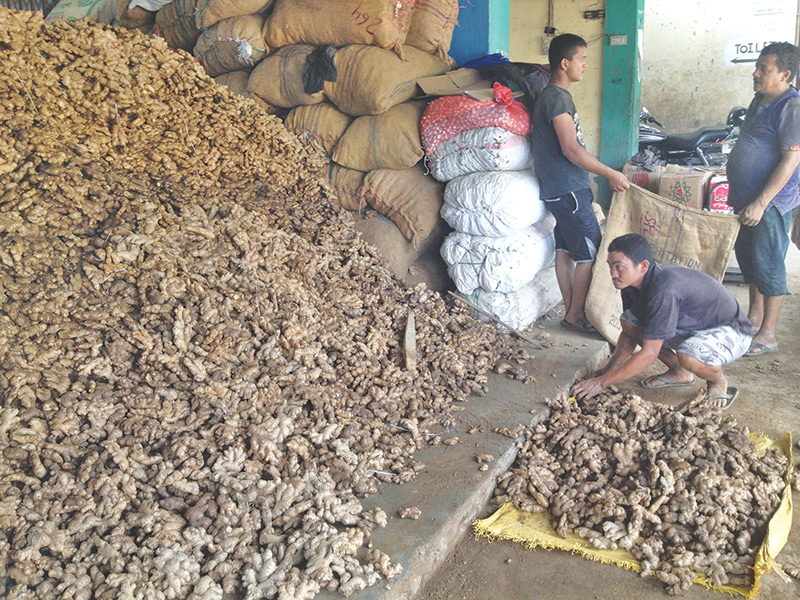
The wholesale price of ginger has reached Rs240 to Rs250 per kg in the agricultural markets at Gaighat, Udayapur and Birtamod, Jhapa. Post File Photo
SUNSARI, Ginger farmer Krishna Magar of Dhankuta is walking on air after the price of the spicy root jumped six-fold this year. The cash crop is a major source of livelihood in eastern Nepal, and a rise in prices means a higher standard of living for the farmers there. Magar was selling ginger for Rs40 per kg till last year, but poor harvests in India this year sent the price soaring to Rs250 per kg. Traders say Nepal’s ginger exports to India in the first 11 months of the fiscal year were almost double compared to the previous year. Nepal is one of the world’s largest producers of the spice. The ginger grown in Nepal is high in oil and oleoresin. Several reports have shown that it can be sold to large industrial buyers in India and other countries if output is increased and quality is ensured. More than 98 percent of Nepali ginger is sent to the southern neighbour. Ginger root is mostly used by the Ayurveda pharmaceutical industry, particularly in India. It is also used to make jam, jelly, candy and sauce, among other products. Magar says he has been growing ginger for decades. “My father too was a ginger farmer. We have never seen the price rising like this,” said Magar from Gurdhum, Sagurigadhi-6. Magar was visiting the agricultural goods market in Dharan-13 to sell his harvest. He said there was no guarantee that the current rate would last. “If this price continues till mid-October, thousands of ginger farmers will benefit,” he said. Last year, Magar earned barely Rs50,000 by selling 1.5 tonnes of ginger. The price had sunk to a low of Rs10 per kg some years ago, and many farmers switched to other crops. Ginger farmers in eastern Nepal are excited about this season’s harvest. Nepal is fully dependent on the Indian market to export its produce, and the traders there decide the rate. Laxman Bhattarai, manager of the agricultural goods market in Dharan, says that ginger prices are determined by Indian traders. “Ginger farming is like gambling,” Bhattarai said. “No one knows when the price will rise or fall.” This year, high demand and low production resulted in record high prices, traders say. The wholesale price of ginger has reached Rs240 to Rs250 per kg in the agricultural markets at Gaighat, Udayapur and Birtamod, Jhapa, according to Bhattarai. Farmers of Udaipur and Khotang sell their ginger in Gaighat. Farmers of Dhankuta and Tehrathum send their crops to Dharan while farmers in the Mechi corridor—Ilam, Panchthar and Jhapa—sell theirs in Birtamod. The Dharan agricultural market said 7,820 tonnes of ginger had been sold there as of the last week of June. At the same time, ginger worth Rs1.6 billion has been exported to the Indian market. Traders say that another 2,000 tonnes of ginger will arrive in the Dharan agricultural market by mid-August. Last year, 10,641 tonnes of ginger worth Rs425.6 million was sold in the Dharan agricultural market at the rate of Rs40 per kg. “Based on the current price, the ginger produced in the Koshi corridor, mainly Sankhuwasabha and Dhankuta, has a market value of Rs1.15 billion,” Bhattarai said. In the fiscal year 2012-13, the price had hit a high of Rs170 per kg. During that year, 5,650 tonnes of ginger was exported to the Indian market. But in 2016-17, ginger prices plunged to Rs10 to Rs15 per kg, prompting distressed farmers to dump their harvests on the road outside the agricultural market. Wholesale trader Gyan Bahadur Basnet says demand for ginger rose in Nepal because output in India has dropped by 60 percent this year. “Demand for Nepali ginger rises when Indian production declines,” Basnet said. Traders in eastern Nepal transport ginger to the processing centre across the Mechi border in Naxalbari, India. There the ginger is cleaned, sorted according to size and dispatched to markets in Kolkata, Patna and Delhi in India. Nepal has not been able to market its ginger in other countries due to lack of information about the product’s physical and biochemical properties. Reports show that the spice has a huge overseas trading potential if substantial improvements can be made in yield, quality and volume by investing more in research and development. Even without a substantial improvement in quality, small trading hubs in India will continue to be major markets for local ginger. Bhattarai says that if the government builds a ginger processing centre in Nepal and makes arrangements for branding, labelling and packaging, Nepali ginger farmers can earn three times more. Nepal’s ginger exports swelled by 81.4 percent in the first 11 months of the current fiscal year ended mid-June. Shipments amounted to 21,098 tonnes valued at Rs997.76 million, according to the Trade and Promotion Centre. In the last fiscal year, exports totalled 11,958 tonnes worth Rs641.45 million.
MONEY
Global factory output slumps as weak demand weighs
- REUTERS
LONDON/TOKYO, Global factory activity slumped in June, business surveys showed on Monday, as sluggish demand in China and in Europe clouded the outlook for exporters. Across the euro zone manufacturing contracted faster than initially thought, as persistent policy tightening by the European Central Bank squeezed finances, and in Britain the pace of decline steepened as optimism faded. In Asia, while factory activity expanded marginally in China, it contracted in Japan and South Korea as Asia’s economic recovery struggled to maintain momentum. “There are no real signs we are going to get any rebound in the manufacturing sector this year. On the whole we are still talking about a negative assessment,” said Rory Fennessy, European economist at Oxford Economics on the euro zone release. Compiled by S&P Global, HCOB’s final euro zone manufacturing Purchasing Managers’ Index (PMI) fell to 43.4 from May’s 44.8, its lowest since the Covid pandemic was cementing its grip on the world, below a preliminary reading and further from the 50 mark separating growth from contraction. June’s downturn was broad-based with surveys published earlier on Monday showing factory activity in all four of the euro zone’s biggest economies contracted last month. The S&P Global/CIPS UK Manufacturing PMI fell to 46.5 from 47.1 in May, its lowest reading this year and one of the weakest since the 2008-09 financial crisis. Asia’s surveys underscore the toll China’s weaker-than-expected rebound from Covid lockdowns is inflicting on the region, where manufacturers are also bracing for the fallout from aggressive US and European interest rate hikes. “The worst may have passed for Asian factories but activity lacks momentum because of diminishing prospects for a strong recovery in China’s economy,” said Toru Nishihama, chief emerging market economist at Dai-ichi Life Research Institute.
MONEY
Musk’s Twitter rate limits could undermine new CEO, ad experts say
- REUTERS
Twitter app logo is seen in this illustration. REUTERS
CALIFORNIA, Elon Musk’s move to temporarily cap how many posts Twitter users can read on the social media site could undermine efforts by the company’s new Chief Executive Linda Yaccarino to attract advertisers, marketing industry professionals said. Musk announced on Saturday that Twitter would limit how many tweets per day various accounts can read, to discourage “extreme levels” of data scraping and system manipulation. Users posted screenshots in reply, showing they were unable to see any tweets, including tweets on the pages of corporate advertisers, after hitting the limit. Ad industry veterans said the move creates an obstacle for Yaccarino, the former NBCUniversal advertising chief who started last month as Twitter’s chief executive officer. Yaccarino has sought to repair relationships with advertisers who pulled away from the site after Musk bought it last year, the Financial Times reported last week. The limits are “remarkably bad” for users and advertisers already shaken by the “chaos” Musk has brought to the platform, Mike Proulx, research director at Forrester, said on Sunday. “The advertiser trust deficit that Linda Yaccarino needs to reverse just got even bigger. And it cannot be reversed based on her industry credibility alone,” he said. Lou Paskalis, the founder of advertising consultancy AJL Advisory and former marketing boss at Bank of America, said Yaccarino is Musk’s “last best hope” to salvage ad revenue and the company’s value. “This move signals to the marketplace that he’s not capable of empowering her to save him from himself,” he said. Under the new cap, unverified accounts were initially limited to 600 posts a day with new unverified accounts limited to 300. Verified accounts could read 6,000 posts a day, Musk said in a post on the site. Hours later, he said the cap was raised to 10,000 posts per day for verified users, 1,000 per day for unverified and 500 posts per day for new unverified users. Capping how much users can view could be “catastrophic” for the platform’s ad business, said Jasmine Enberg, principal analyst at Insider Intelligence. “This certainly isn’t going to make it any easier to convince advertisers to return. It’s a hard sell already to bring advertisers back,” she said.
MONEY
Firm sues Twitter for $665,000 for not paying bills
SYDNEY: An Australian project management firm has filed a lawsuit against Twitter Inc in a US court seeking cumulative payments of about A$1 million ($665,000) over alleged non-payment of bills for work done in four countries, court filings showed. Sydney-based private company Facilitate Corp on June 29 filed the suit in the United States District Court for the Northern District of California claiming breach of contract over Twitter’s failure to pay its invoices. The Australian firm’s lawsuit is the latest alleging non-payment of bills and rent against Twitter since Elon Musk bought the social media platform for $44 billion last year. Facilitate said from 2022 through early 2023, it installed sensors in Twitter’s offices in London and Dublin, completed an office fit-out in Singapore, and cleared an office in Sydney. For those works, Twitter owed the company about 203,000 pounds, S$546,600 and A$61,300, respectively, Facilitate said. (REUTERS)
MONEY
Thulo.com introduces agro marketplace
Bizline
KATHMANDU: Thulo.com, an online market platform, has introduced Agro Marketplace to transform agricultural trade digitally. “We understand the challenges farmers, buyers, and sellers face in the agricultural industry. Our aim is to bridge the gap and create a seamless and efficient marketplace where farmers can connect directly with potential buyers and sellers, fostering a thriving agricultural economy,” the company said in a statement. With Agro Marketplace, farmers gain access to a broader network of potential buyers, enabling them to showcase their products and negotiate fair prices. On the other hand, buyers can discover a diverse range of high-quality agricultural products, sourced directly from trusted farmers, the company said. “Our platform facilitates secure transactions and provides transparency throughout the entire process, ensuring a seamless and trustworthy trading experience,” it added. (PR)
MONEY
India’s Tata Motors hikes prices of passenger vehicles for third time in 2023
Bizline
BENGALURU: Indian car maker Tata Motors said on Monday it will increase prices of its passenger vehicles by an average 0.6 percent across models and variants from July 17. The price hike is meant to offset the residual impact of past input costs, the company said in a statement. Tata Motors had announced price hikes of 1.2 percent in January and 0.6 percent in April, citing increased input costs and regulatory changes, respectively. The company’s total expenses for the quarter that ended March 31 climbed nearly 30 percent from a year earlier on an increase in the cost of materials consumed. Vehicle prices across segments have increased in India after the government mandated automakers to fit them with a device to monitor emissions, sparking an increase in cost. (REUTERS)
MONEY
Kremlin: ‘Not too many hopes’ for Black Sea grain deal
Bizline
MOSCOW: Russia is pessimistic about the prospects of renewing the Black Sea grain deal because no progress has been made in implementing accompanying agreements that pertain to Russian exports, the Kremlin said on Monday. The Financial Times reported on Monday that the European Union was considering a proposal for the Russian Agricultural Bank to set up a subsidiary to reconnect to the global financial network, as an incentive for Moscow to extend the deal. The deal, under which Russia has guaranteed the safety of grain ships heading to and from Ukrainian ports through waters it controls, is set to expire on July 18 and Kremlin spokesman Dmitry Peskov told a briefing there were “not too many hopes” it would be extended. When the deal was signed in July 2022, the United Nations and Russia also signed a memorandum of understanding committing the UN to facilitate unimpeded access of Russian fertiliser and other products to global markets. (REUTERS)
SPORTS
Nepal enter U-16 East Zone final
The young Rhinos thrash Singapore U-16 by 87 runs to set up Malaysia clash.
- Sports Bureau
Nepal players celebrate a wicket during their ACC Men’s U-16 East Zone Cup semi-final match against Singapore in Malaysia on Monday. Photo: Courtesy of CAN
KATHMANDU, The Nepali youth team registered a thumping 97-run victory over Singapore in the ACC Men’s U-16 East Zone Cup cricket tournament to set up a final clash against hosts Malaysia on Monday. Opting to bat first, Nepal posted 184-9 in the allotted 35 overs before bowling Singapore out for 87 runs in 31.3 overs at the Bayumas Oval in Pandamaran, in the semi-final. They will now play against Malaysia in the title decider on Tuesday. Malaysia edged past Hong Kong by 77 runs in the other match during the day. It will be the second meeting between Nepal and Malaysia in the tournament after the home team’s 84-run defeat in their group stage game on Friday. Openers Suryanshu Koirala and Niraj Kumar Yadav gave a strong start to Nepal, posting a 63-run stand for the first wicket. Koirala was dismissed for 43 runs, the highest of the innings, after Riyan Naik caught him off a delivery by Harsh Venkatram. He struck six hits to the boundary. Yadav contributed 42 runs off 49 balls, studded with three hits to boundary along with a six. Hariharan had him caught by Riaan Naik in the 17th over. Middle-order batter and captain Abhisekh Tiwari (25 runs off 21 balls), Pratik Bhattarai (12 runs off 29) and Dipu Kumar (not out 12 runs off 15) were the other major contributors for Nepal. Singapore bowler Hariharan grabbed three wickets in his seven-over spell, conceding 31 runs. Harsha Venkatram and Kabir Berlia pocketed two wickets apiece. Singapore made a sloppy start to their run chase and lost wickets at quick intervals. Opener Roshan Ravichandran scored 24 runs off 27 balls, the highest of the innings, before he got run out with 45-2 on board. They lost their remaining eight wickets adding only 42 runs. Lower middle order batter Pranav Dhanuka (not out 14 runs off 17 balls) and Kabir Berlia (11 runs off 15) were the only other batters to touch double-digit scores for Singapore. Kritik Kamat was the pick of Nepal’s bowling, claiming three wickets. The player-of-the-match gave away nine runs in his 2.3 overs spell that included a maiden over. Captain Tiwari, Pratik Pokharel, Santosh Yadav, Ashok Dhami and Naren all shared a wicket each.
SPORTS
Swiatek beat Zhu to launch Wimbledon title quest
The reigning US Open and French Open champion wins 6-1, 6-3 against her 34th-ranked opponent.
- REUTERS
World number one Iga Swiatek has yet to get past the fourth round at Wimbledon. AP/Rss
LONDON, World number one Iga Swiatek cruised into the Wimbledon second round with a 6-1 6-3 mauling of China’s Zhu Lin on Monday in a fine start to her quest for a first Grand Slam title on grass. The 22-year-old Pole, who won the French Open title for the third time last month to make it four Grand Slam crowns, has yet to get past the fourth round of the London major. Swiatek looked good in her movement on the surface and showed no signs of any effects of the illness that had ruled her out of her Bad Homburg semi-final on Friday. “I felt really confident. I felt like I did a very good job,” said Swiatek, a former junior champion at Wimbledon. “I feel really good after Roland Garros (French Open). After Roland Garros I took some time to appreciate what happened. “Last year it was my second Grand Slam (at the French Open) and it felt overwhelming. This time I could focus on celebrating and actually at getting back to work with more peace in my head.” Zhu, ranked 34th in the world, earned a break point in the first game but Swiatek won 11 points in a row to sprint into a 3-0 lead. Another break put Swiatek, a renowned slider on clay and hard courts who has often struggled with her movement on grass, firmly in the driving seat. Zhu saved two set points at 5-0 but Swiatek sealed the first set a game later with a powerful crosscourt forehand winner. The pair traded breaks early in the second before Swiatek, who pulled out of her Bad Homburg semi-final on Friday due to illness, earned a second one and was 4-3 up when play was interrupted due to rain. It resumed after the roof on Court One was shut but Swiatek needed only seven minutes to win the two games she needed and sealed victory with a backhand winner.
MEDLEY
Horoscope
ARIES (March 21-April 19) Intuitive dreams could reveal information about fears, hopes, and paths toward success, so be sure to reflect on any meaningful scenes that found you in the astral realm. Empowering energy will keep you professionally motivated when Pluto becomes active.
TAURUS (April 20-May 20) Your spirituality will be particularly empowering helping you overcome any hurdles that may have found you recently. You’ll sense a shift later, asking you to invest in the future you feel inspired and excited by. Watch out for tension with loved ones.
GEMINI (May 21-June 21) The vibe will feel intense dear Gemini, making it important to plan your movements wisely. This cosmic climate can be both empowering and destructive, so be sure to choose your highest path, even if doing so requires sacrifice.
CANCER (June 22-July 22) Good vibes continue to flow, creating a harmonious ambiance that’s perfect for connecting deeply with someone you love. You’ll sense a shift once Luna migrates into Aquarius, strengthening your resolve to maintain meaningful relationships.
LEO (July 23-August 22) You may become suddenly motivated to declutter your surroundings in an effort to get organized, as the Capricorn moon aligns with Pluto. Make the most of these vibes by reaching for your full potential with all the organization and hard work.
VIRGO (August 23-September 22) A loving, harmonious, and restorative energy will find you early this morning, dear Virgo, thanks to a sweet exchange between the Capricorn moon and Neptune. Good vibes continue to flow nudging you to step into your power while being unapologetically yourself.
LIBRA (September 23-October 22) The Capricorn moon connects with Neptune this morning, dear Libra, asking you to unapologetically embrace wellness. Lean into these vibes by putting your physical and emotional needs first. You may also feel inspired to tidy up your space.
SCORPIO (October 23-November 21) Your mind will brim with creative ideas early this morning, thanks to a cosmic alliance between the Capricorn moon and Neptune. Try to do something inventive before clocking in for the day, and be sure to journal any brilliant ideas.
SAGITTARIUS (November 22-December 21) The vibes are perfect for appreciating your physical form and sending yourself some love from head to toe. Consider paying off debts when Luna crosses over Pluto this afternoon, making financial moves that will empower you in the long term.
CAPRICORN (December 22-January 19) Take a moment to appreciate your mind and its ability to think creatively, taking a break from your generally pragmatic disposition. Don’t be afraid to seek attention, as doing so will bring forth a transformative sense of empowerment.
AQUARIUS (January 20-February 18) The vibes are ideal for disconnecting from stress and connecting with beauty, especially where nature, music, food, and art are concerned. A cleansing energy will find you, providing you with an opportunity to shed bad habits and unhealthy situations.
PISCES (February 19-March 20) The vibes are great for advocating for causes you feel passionate about. You’ll sense a shift bringing a busy energy to your psyche that’s perfect for pulling back and getting creative. Feel free to embrace solitude throughout the next two days.
CULTURE & LIFESTYLE
How childhood experiences shape our adulthood
When parents are warm and guide children while also respecting their independence, it helps them become confident and independent.
- Dristy Moktan
Shutterstock
Childhood is a crucial stage in a person’s life. It is a formative period that lays the foundation for our future selves. It is a delicate period where being unable to meet a child’s needs can have long-lasting effects on their adult life. We often assume that children don’t fully grasp what’s happening around them because they are young. However, this is a misconception. Even at a young age, children can comprehend and understand their surroundings. The experiences faced as a child, from the nurturing environment provided by caregivers to the quality of relationships established, play a crucial role in shaping who we become. Though we grow up, childhood experiences continue to influence us well into our adulthood and much later in our lives. We often underestimate how big of a role these can play. Think back to why someone behaved the way they did. Is it just because that is the way they are or rather because of the things they experienced as a child? The things we wanted and dreamed of as children still matter to us, but we learn to adapt to fit societal and cultural expectations that are set upon us. In the context of mental health, the events and environments we encounter during our early formative years shape our psychological well-being in significant ways. The scars of childhood trauma can run deep, shaping who we become as adults. When children endure physical or emotional abuse, neglect, or witness violence, it can have a lasting impact on their personality. These experiences often lead to mental health challenges like depression, anxiety, or post-traumatic stress disorder (PTSD) later in life. Managing emotions can become a struggle, as they may find it difficult even to regulate their emotions. Trusting others can become a daunting task, and forming healthy relationships can become more difficult. Children can also be deeply affected by marital problems between their parents. When a partnership is only maintained for the sake of the children, and parents often fight, it deprives the child of the proper care, love, and stable home environment they need. In such situations, children often blame themselves for what’s happening or try to provoke their parents to gain attention. They carry a constant burden of guilt, and instead of experiencing a nurturing family environment, they are exposed to parental disputes. Their home becomes an uncomfortable place for them. These adult issues that should not burden the child at such a young age become ingrained in them while growing up. Similarly, the way parents raise their children also has a big impact on how they grow up. When parents are very strict and punish their kids frequently, children become anxious and turn into individuals who compulsively abide by the rules, no matter where they are. This is authoritarian parenting. On the other hand, when parents are warm and give guidance while respecting the child’s independence, it helps the child become confident, independent, and able to care for themselves. This is called authoritative parenting. An overly protective upbringing can cultivate fears and insecurities in a child, which persist into adulthood, leading to risk-aversive behaviour, trust issues, and excessive worrying about potential dangers. When parents neglect their children or treat them badly, it manifests as many emotional and psychological problems the children have to deal with throughout their lives. It’s important for parents to provide love, support, and proper guidance to help their children grow into happy and well-adjusted adults. Additionally, the school environment and peer relationships during childhood also significantly impact children. If a child shares that they are being teased or bullied, it is crucial to address it immediately and create a safe and supportive environment for them to open up. When bullying is left unaddressed, children may develop a self-imposed silence as a protective shield, which can lead to anxiety disorders, social phobia, or even post-traumatic stress disorder in the future. These experiences shape their self-perception and affect their future interactions with others. The amount of time parents spend with their children is also equally important. Sometimes, parents require personal space or are preoccupied with work. They ask the grandparents to step in and care for and give company to the children during these instances. While children may enjoy the company of their grandparents, if they are consistently sent away to spend time with others, it can damage the parent-child relationship, causing the child to feel neglected. Even though spending time with grandparents may bring joy and treats, it cannot replace parents’ love. In modern times, it is observed that children are sometimes appeased with toys, but this does not improve the situation. In fact, for the child, the toys are symbols of their parent’s absence. Material possessions cannot substitute love and quality time together. In such cases, children growing up may develop resentment towards their parents, isolate themselves, or even display aggression. A child is like a seed, and childhood experiences are like the sunlight and water that nurture their growth. What the child grows up to be depends upon the type of nurturing they receive. They hold clues to our strengths and weaknesses, influencing how we behave and connect with others. Therefore, it is essential to take a step back and think about how we are treating children and what they are learning and experiencing. Although every person has their own way of showing love and care, parents have the responsibility to make deliberate decisions about the environment they create for their children.
Moktan is a psychosocial counsellor at Happy Minds, a mental health and well-being platform.
CULTURE & LIFESTYLE
Powerful stories take time to unfold
Kesang Tseten, one of Nepal’s foremost filmmakers, reflects on his decades of experience making observational documentaries.
Photo: Courtesy of Kesang Tseten
Kesang Tseten is a Nepali documentary filmmaker whose films have been screened at numerous international film festivals, such as the International Documentary Film Festival of Amsterdam (IDFA), the Vienna International Film Festival, and the Mumbai International Film Festival. With 16 films under his name, some of which are ‘Hami Kuna Ko Manche’, ‘Who will be a Gurkha’, ‘Castaway Man’, his love for telling stories has taken him to places all over the world. Tseten started making films in 1997 at the age of 40. Before that, he had no prior experience in filmmaking. In the past, he worked as a freelance writer for Himal Magazine. In this interview with the Post’s Rose Singh, Tseten talks about how he began making documentaries and what continues to inspire him to tell stories about the unique cultures and people of the country.
How did you get into filmmaking? I trained as a journalist at Columbia University, and always wanted to be a writer. I would write short stories, and I’ve even written a book which is yet to be published. I realised that writing isn’t essentially different from filmmaking because despite being different mediums, the core is the same, and that is to tell a story. A friend working at International Centre for Integrated Mountain Development (ICIMOD) asked me to make a film about indigenous knowledge and technology. I set out to make a film about Lepcha people—an indigenous group in Sikkim and the Naga people (another indigenous group) in Nagaland, focusing mainly on their culture and livelihood. After that, Helvetas reached out to me to make a documentary on the Machhindranath Jatra. Two documentaries later I began calling myself a filmmaker.
How do you choose the stories for your documentary? Usually, an organisation approaches me with a project. But I also pitch my own ideas. However, the terms are the same—that I make my film independently and not as a public relations exercise for the organisation. Documentary filmmakers are often looking for a subject that stands out in some manner. For me, it is about finding a new story. For ‘In Search of the Riyal,’ the idea wasn’t unique, but the end result was surprisingly powerful. I decided to film the experiences of five young migrant workers who were given training in scaffolding for seven weeks before departing for the Gulf. Migration is pervasive in Nepal, and remittances contribute to 23 percent of the GDP. Thousands of people leave the country every year in search of a way of livelihood. While many think about migration in slogan terms—as slavery and exploitation only—I wanted to show that it is more complex than that. I eventually made five films about migrant workers (In Search of the Riyal, The Desert Eats Us, Saving Dolma, The Riyalists, and A Migrant Speaks). With migration, the challenge was to make a film about an over-done topic in a nuanced way. I wanted to show that labour migration is more than just hopelessness and exploitation and ask: Where does the people’s agency to choose their own path fit into this narrative? Millions of people can’t all be fools; they must have good enough reasons to go, which is a different matter from the mistreatment and abuse they might suffer. People want an easy answer but human lives are more complex.
What is your creative process like? It’s a very open process and I don’t have any preconceived notions. 99 percent of the time, a story takes shape as you go along exploring it; you just need to know whereto start. Humans are complex and their stories take time to unfold. I am very careful not to give away the story to my characters as that could cause them to infer what I want and accommodate accordingly. The last thing you should urge your subjects is to be natural because when you ask them to be natural, you are asking them to act.
Your filmmaking style is observational. Why are you drawn to this method in particular? I prefer to let people show me who they are and capture them in their natural environment instead of asking them to ‘tell’ me who they are. In ‘Who Will Be a Gurkha,’ I made a conscious shift towards embracing an observational approach and showing people as they go about trying to get recruited to the British army. Although the film has interviews, the interview is not with the camera but with officers speaking to the aspiring recruits. So the film is in a purely observational form. Interviews are important, I prefer not to rely on them as it can often result in over-telling rather than showing. Films by Frederick Wiseman and the Maysle Brothers, eminent practitioners of observational filmmaking, have taught me that. Filmmaking is also about patience. Sure, I want to connect and talk to my subjects. But a certain quality is uncovered when you quietly witness them in their everyday lives dealing with the conflicts they face on both social and personal levels. This isn’t something you can know by simply asking. Essentially, it’s not you who’s telling the story, it’s the people themselves. I do what I can to facilitate that. My production company Shunyata Films, is based on the core idea that there are multiple truths. The non-dualistic nature of human experiences is what fascinates me the most and is the philosophical basis of my work.
What are the struggles you have faced as a filmmaker? I don’t think of filmmaking as a struggle because I made an active choice to do what I do. That makes the challenges worthwhile. I struggle only when I have to do something that isn’t fulfilling to me. Sure, there are financial hassles but I am lucky my wife earns well. Finding institutions to support your film often feels like begging and I understand why many abandon their passion because there is no support system. There is frustration and dejection when you make a bad film and it is difficult to put your work out there for scrutiny. During the making of ‘In Search of the Riyal,’ I had to follow the migrants to the countries they went to. I got a visa to go to Qatar and managed to locate two of the migrants I had been filming. When I got there I realised that one can’t walk around with a camera, and they were very strict when it came to labour migrants. I managed somehow. I had to take a small camera or film with my iPhone. Journalist Devendra Bhattarai helped me enormously. I couldn’t have made the film without his help. While shooting ‘Hami Kuna ko Manche,’ the villagers in Rasuwa told me they converted to Christianity because it was less of an economic and social burden than observing shamanic customs which involved slaughter. It wasn’t my agenda to portray this, but how could I not show it? It was simply the reality we encountered. It was not up to me to pass judgement as to whether this change was good or bad. Many years later, they told me they converted back to Buddhism or shamanism, because they didn’t ‘need’ Christianity. So all along, they seemed to know what they were doing and why. There will always be difficulties and dilemmas when you make films. We just have to manoeuvre through them sincerely and carefully.
CULTURE & LIFESTYLE
Cast for ‘Squid Game 2’ announced
Netflix Korea revealed that the first script-reading session with the cast was held in June.
- Lee Si-jin
Photo: Via ANN
SEOUL, South Korea Netflix Korea has revealed cast members joining the second season of the South Korean phenomenon ‘Squid Game.’ Actors Park Gyu-young, Kang Ae-sim, Jo Yu-ri, formerly of disbanded IZ*ONE, Choi Seung-hyun—also known as Big Bang member TOP—are among eight to be confirmed for the cast of ‘Squid Game 2.’ Though the cast may seem unfamiliar to some viewers, many of them have made a name for themselves in other Netflix Korean originals. Park, 29, caught both local and global drama fans’ attention with her performance in Netflix’s webtoon-based horror series ‘Sweet Home’ (2020), the first Korean series to enter the Netflix Top 10 chart in the US, reaching third place. Others include veteran musical actor Kang, who made her first TV appearance in JTBC’s hit rom-com ‘Be Melodramatic’ (2019) and her Netflix debut with ‘Move to Heaven’ (2021), will join the original cast in the upcoming season. Jo and Choi are beloved K-pop artists who expanded their careers with various films and TV dramas. Veteran actor Lee Jin-uk, 41, the lead actor in multiple seasons of the ‘Voice’ franchise, will team up with director Hwang Dong-hyuk again after the 2014 comedy movie ‘Miss Granny.’ Hwang, whom many credited for discovering Jung Ho-Yeon, a rookie actor who rose to instant stardom with ‘Squid Game,’ also looked to new talent to round up the cast. Some of the new faces include young stars like Lee Da-wit, Roh Jae-won and Won Ji-an. Netflix Korea said that the first script-reading session with the cast was held in June. Shooting for the second season is scheduled to begin in the second half of the year, according to the global streamer. Hwang’s bloody survival show is considered Netflix’s biggest series, reaching over 111 million fans and being the most-watched show on Netflix with 1.6 billion hours.