You internet speed is slow. Switch to text view mode

Switch
epaper logo
ST

Last Login:
Logout
+
Page 1
HOME PAGE

Coterie contractors immune to Home Ministry offensive
anamolies in govt contracts
- PRITHVI MAN SHRESTHA

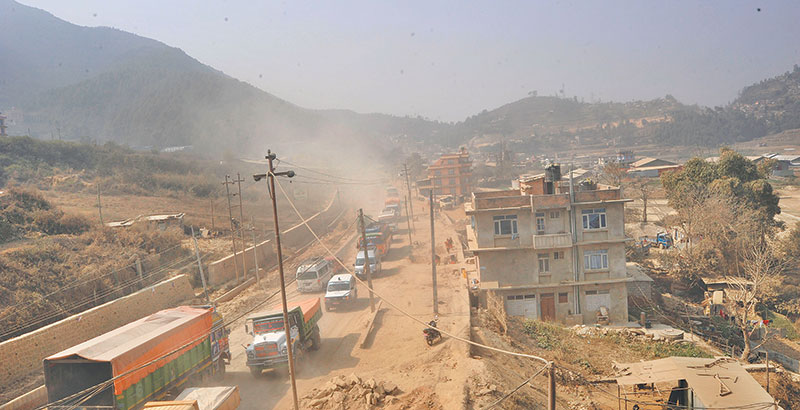
A dusty section of the Kalanki-Satungal road. Post File Photo 

KATHMANDU : As the Home Ministry launches an offensive against non-performing and under-performing contractors, even arresting some of them, politically well-connected contractors remain untouched by the move.

Performances of Pappu Construction owned by lawmaker Hari Narayan Prasad Rauniyar of the ruling Sanghiya Samajbadi Forum-Nepal and that of Shailung Construction, whose Chairman Sharada Prasad Adhikari is the landlord of Nepal Communist Party Co-chairman Pushpa Kamal Dahal, are of particular interest for the number of projects being built and the delays.

Progress in a number of projects handled by these two companies is dismal, raising questions if they enjoy political protection.For example, a bridge over Bagmati River at Tinkune in Kathmandu was supposed to be completed on June 19 this year. With Pappu Construction failing to work on time, the progress has been disappointing at 20-25 percent, according to the Department of Roads (DoR).

The Bagmati bridge is among a dozen projects undertaken by Pappu Construction, which are running behind their schedule. The company had got deals to construct around four dozen bridges apart from roads. However, most of them face delays, DoR officials said.

Pappu Construction, said officials, is notorious for bidding government projects at the lowest price but not completing them on time. Such is its poor track record that the Asian Development Bank, which funded construction of a bridge over Bisnumati River at Teku, decided not to provide further support. The ADB pulled out after Pappu failed to complete the bridge works by the December 2017 deadline. “Around 80 percent work has been over. The government has to inject its own resources into the remaining task,” said a DoR official.

In Kathmandu alone, the company has got contract for two bridges over Bagmati and three over Bishnumati—all unsatisfactory works, according to DoR officials.“In case of the Bagmati bridge, the company recently mobilised workers at night so that the consultant would not supervise construction,” a senior DoR official said.

Lawmaker Rauniyar blamed the government for the delays in works undertaken by his company.
“The government’s failure to clear electricity, telephone and sewerage systems near the project site at Tinkune forced us to start late,” said Rauniyar, claiming that he had already handed over all the Pappu Construction responsibilities to his son.“In case of the Teku bridge, the design was changed twice so we could not start work on time.”

As far as Shailung Construction is concerned, people travelling on the Kalanki-Nagdhunga section suffer due to traffic jams and dust. Three packages of the project were supposed to be completed between mid-October 2017 and mid-January 2018.

But DoR officials say construction work has not begun for 5km of the 9-kilometre stretch. The contract was awarded to a joint venture company led by Shailung in mid-July 2015. “In the package from Tribhuvan Park to Nagdhunga, around 70 percent road section has been blacktopped,” said Mukti Gautam, spokesperson for the DoR.

According to officials, work on a 4km section has not begun due to a stay order of the Supreme Court while building on the 1 km stretch was delayed since some roadside house owners had refused the compensation amount.

“But the works got delayed at some locations where right of the way is clear due to the contractor failing to get down to work on time,” said a DoR official.Shailung Chairman Adhikari admitted some weakness on the part of his company citing unavailability of sand due to a ban on its mining in Dhading while blaming the government’s failure to clear the right of way for delays.

“Hopefully, we will complete the job where right of the way is clear within this fiscal year. Then we’ll terminate the contract ourselves,” Adhikari told the Post, expressing displeasure at “continued efforts in the media to defame me by linking me with Dahal”.

Shailung also failed to complete works on the Bishalnagar-Chandol-Chakrapath road section and the Buddhnagar-Ratna Rajyalaxmi School section of the road on time. Here, Adhikari blamed obstruction by locals for the delays.

DoR officials admit that some projects were affected by inadequate budget allocation and delay in completing design works. But they said the tendency of a single contractor to lay their hands on many projects at a time had affected works as equipment and workforce are shared among various schemes.
The practice of bidding lower than the estimated cost is another reason behind contractors failing to complete works on time. In case of Pappu, the bid amount is almost half the estimated cost.

For instance, the estimated cost of the bridge over Tarahari Jhanjha river in Rautahat was Rs80.67 million but the Division Road Office, Chandranigahpur accepted Pappu’s Rs48.09 million bid. As a result, only 18 percent construction work has been over even as the agreed deadline expired on May 16.

Questions over quality
A bridge built by Pappu Construction over Babai River at Jabbighat in Bardiya collapsed on August 13, 2017 when work was about to be over. Despite locals’ continued insistence that a weak foundation had been laid, the project was allowed to move ahead. The 55th annual report of the Office of the Auditor General says that its February audit found one pillar sinking and others bent. Some slabs were broken while the upper surface of the bridge was roughened beyond use.

The government spent Rs197.5 million on the structure even after the project was awarded to Pappu Construction on July 6, 2016. The report said efforts to complete the project by recovering compensation amount from the contractor had not begun. According to a Road Department official, a quality test conducted by the Institute of Engineering found the foundation weak. But the contractor has denied the charge arguing that the test was conducted in its absence. The test was carried out at the order of the Commission for Investigation of Abuse of Authority.

This is not the only project where Pappu Construction is found to have compromised on quality. The contractor was fined Rs58.47 million for failing to complete a section of the Nepalgunj-Kohalpur road. The quality of works was also poor, according to DoR officials. But Pappu Construction went to arbitration and won the legal battle with a three-member team deciding in its favour. “The arbitration last month ruled that Pappu need not pay for compensation while the DoR owes the contractor around Rs20 million,” said a DoR official.


HOME PAGE

PM has lengthy China shopping list

- ANIL GIRI

KATHMANDU : Prime Minister KP Sharma Oli eyes sizeable support from Beijing to development projects during his five-day state beginning on June 19 with various line ministries forwarding dozens of schemes for Chinese funding.

The Ministry of Foreign Affairs has received dozens of requests from several ministries for undertaking projects under the framework of the Belt and Road Initiative that Beijing is actively pushing across the globe. These projects include rail, road, energy cooperation, trade and commerce and protocol deal on transit and transportation in connection with the northern neighbour.

Officials at the Commerce Ministry said three sea ports—Tianjin, Shanghai and Guangzhou—and two land ports have been identified for Nepal’s third country trade via China. A text for this is in the final stage of signing. Other proposals include slashing duty on raw material import and measures to reduce trade deficit through increased access for Nepali products to the Chinese market. Sources ruled out a free trade agreement but said Nepal was looking for other measures to facilitate trade with the giant neighbour.

The Commerce Ministry is also pursuing opening of the branch of a Chinese bank in Nepal through an MoU. Another proposal is on reopening of the Tatopani trading point and upgradation of border infrastructure. Construction of dry ports in Rasuwa and Timure and setting up cross-border economic cooperation zones are also on the agenda.

The Ministry of Physical Infrastructure and Transport has forwarded proposals on building all-weather north-south corridors under the BRI. This includes detailed project report and construction of a dedicated two-lane Kimathanka-Khadbari-Dhankuta-Rani road. Other links are Karnali Corridor (Jamunaha-Hilsa), Gandaki Corridor (Belhaiya-Korola), Thori-Kerung Corridor, Kodari-Birgunj Corridor and Bhitthamod-Lamabagar-Lapach Corridor.

During the visit, the Nepali side is all set to propose a detailed feasibility study for two proposed rail lines— Kerung- Rasuwagadhi-Kathmandu and Kathmandu-Lumbini-Pokhara—under the BRI framework with Chinese assistance, said Madusudan Adhikari, secretary at the MoPIT. The ministry also
forwarded proposals on protocol for using Tibetan highways, construction of bridges on the Tatopani highway, and the Tokha-Chhahare tunnel.

The Ministry of Energy, Water Resources and Irrigation has proposed construction of the Galchhi-Kerung 400kv cross-border transmission line, Butwal-Attariya-Mahendranagar (765kv), East-West transmission line via East-West Highway (400kv), Marsyangdi-Kathmandu (400kv) and Karnali and Koshi corridors and 132kv double circuit transmission line monopole around Ring Road.

Another proposal concerns dialogue mechanism on energy cooperation between Nepal and China at the secretary and joint-secretary levels. For consideration of the political leadership to execute various hydropower projects, the ministry has proposed Kimathanka-Arun (450MW), Tamor (762MW), Sunkoshi II (1110MW), Sunkoshi III (536MW), Nalsingh Gad (426MW) and Uttarganga (300MW). Most likely, the Nepali side will seek Chinese assistance to build the Tamor project in a joint venture with a Nepali entity, said sources.

Under the BRI framework, some irrigation and water resource projects such as Panchkhal Valley lift irrigation project, Sunkoshi Marin Diversion Multipurpose Project, Eastern Tarai River Management Project, Mid-hill Tar lift irrigation project and proposal for Mahadev Khola rainwater harvest are included. Other areas of cooperation could be the proposed Madan Bhandari Institute of Science and Technology, Kathmandu Ring Road expansion (phases II and III) and setting up disaster risk reduction centres in all provinces.

Another proposal is on joint border patrols in northern districts bordering China’s Tibet but no decision has been made, said Home Secretary Prem Rai. Other proposals are building small-size educational and public health facilities in the seven provinces, among others.

Page 2
NEWS

Stray dogs call the shots in city

Five people die in Kathmandu after dogs infected with rabies virus bite them
- Post Report

The Kathmandu Metropolitan City 2016 data shows there are around 30,000 stray dogs in Kathmandu. 

KATHMANDU : Five people died in the last one month because of rabies following dog bites in Kathmandu, according to Teku based Sukraraj Tropical and Infectious Disease Hospital.

The hospital records show the incidence of dog bites have increased in Kathmandu. As a preventive measure, the hospital administers anti rabies vaccination to citizens round the clock since the last three months.

On an average, 30 people visit the hospital in the night to receive for vaccination jabs.The hospital’s data further shows, 17 people died in 2017 and 16 in 2016 after rabies-infected dogs bit them.Tropical Hospital Clinical Research Co-ordinator Dr Sher Bahadur Pun said, “Earlier we had a record of maximum 10 deaths per year, but it has steadily gone up.”Last year, 36,089 (24,783 male and 11,306 female) patients visited the hospital in Teku to take anti-rabies jabs. The number of patient was less in 2016 (29,309).“On an average, 200 people come for anti-rabies
vaccines every day,” said Dr Pun.

Veterinary doctors say many cases of rabies go unnoticed and undocumented because of lack of awareness among people. Rabies is a fatal virus spread to people from the saliva of infected animals, usually transmitted through bites. The Teku hospital also gives anti-rabies vaccines citizens for other animal bites such as monkey, pig, horse, boar, lion and rat.

The hospital’s record show, 99 percent people seek anti-rabies jabs because of dog bites.National Zoonoses and Food Hygiene Research Center Researcher and Veterinary Dr Rakesh Chand said, “The stray dog bites have become severe health hazard. If the government does not take preventive action, this would be another fatal killer.”Hospital data shows the number of patients seeking anti-rabies vaccine doubles on Sundays and other holidays.

“People’s movements are more on Sundays and holidays. People drink and walk on the road. Children go outdoors to play and expose themselves to stray dog bites,” said Dr Chand. When the rabies-infected animals bite humans, doctors give either five intramuscular vaccine jabs or intradermal four times.
The Kathmandu Metropolitan City (KMC) 2016 data shows there are around 30,000 stray dogs in Kathmandu. Veterinary doctors say the number has increased over the last two years because the government has not taken any step to control stray dog’s population explosion.

The World Health Organisation (WHO) report says 40 percent of people bitten by suspect rabies animals are children below 15 years of age. “It was a Saturday, and we were going for zoo, from nowhere a stray dog appeared bit my son. Instead going to the zoo we went to hospital,” said Ambika Bista from Tinkune. Dr Chand said stray dogs are major cause of rabies. However, Tropical Hospital receives many people for anti rabies jabs after bites by their pet dogs.

People fear to walk on the roads, mostly during the night, because of the increase in stray dogs, and their proclivity to attack humans.“It was Friday night, we were returning from a party through Teku area to reach my room in Lalitpur, suddenly a bunch of stray dogs surrounded us, one bite me, we threw stone and chased them away,” said Manish Silwal, a computer programmer.

Infections Disease Hospital Section Officer Rup Narayan Khatiwada said, the government spends up to Rs 100 million to buy anti-rabies vaccine.“If the government controls stray dog population, this would reduce vaccine cost and the probability of dog bites would reduce,” said Khatiwada.

The Kathmandu Metropolitan City (KMC) in 2016 collaborated with Humane International Society for community dog management in the Capital for which it had allocated a budget of Rs 35million, but this did not give substantial results.

The metropolis had done sterilising of dogs from Singha Durbar area and had announced to take this drive all over Kathmandu to reduce the menace of stray dogs in the city, but it failed.

NEWS

Army chief Chhetri heads to India

- BINOD GHIMIRE

KATHMANDU : The Chief of Army Staff General Rajendra Chhetri travels to India on Wednesday to attend the Indian Military Academy’s (IMA) cadet Passing Out Parade to be held on June 9 in Dehradun, the capital city of Indian state Uttarakhand.

Invited by the Chief of Indian Army General Bipin Rawat, he will attend the event organised by the IMA as Chief Reviewing Officer this Saturday.

This would be General Chhetri’s 16th foreign visit since he took the charge of national defence force around three years ago.General Chhetri will meet with high officials of Indian defence force including Rawat.As Chief of Army Chhetri had commenced his first international visit from the India in first week of February, 2016 to receive the rank of Honorary General of Indian Army conferred by the then Indian President Pranab Mukherjee. Since then there is no stopping to his junkets.

General Chhetri had taken the charge of CoAS on September 10, 2015. On an average, he has gone on foreign trips every two months in his last 33 months as the Army Chief. He now has three months left in the service before retiring and making way for Lieutenant General Purna Chandra Thapa to lead Nepal’s 92,000-strong force.

The USA tops the list of General Chhetri’s visits. He has visited it thrice followed by India twice. He has been to Pakistan, Bangladesh, Sri-Lanka, Thailand, the UK, Congo, China, South Korea, Lebanon and the UAE.

His latest visits were to Pakistan last month and to Congo in the first week of April.His visit to India this week would be his fifth foreign trip this year. Sources claim he is most likely to embark on visit to China a few weeks after returning from India.Nepal Army Spokesperson Brigadier General Gokul Bhandari said foreign visits aim to strengthen military and civilian relationships between the two countries.

“The more such visits, the stronger is the bilateral relationship,” he told the Post, adding such visits are part of military diplomacy.Experts have a different point of view. They say it is the government’s responsibility to evaluate whether it is necessary.

“There has to be analyses on whether such visits have brought about the necessary changes in the military and diplomatic relations as claimed,” security expert Geja Sharma Wagle told the Post.The government should first have clarity on whether the visit is of national priority before giving permission. The Cabinet grants permissions for such foreign trips, he said.

NEWS

Cerebral palsy event kicks off in Capital

- Abijeet Pant

Kathmandu : A weeklong event to empower caregivers of children with cerebral palsy and other neurological disorders started in Kathmandu on Tuesday.

The event aims to sensitize citizens about the physical, mental, and social challenges children with cerebral palsy have to deal with.

Organisers Cerebral Palsy Nepal and Carers Worldwide gave details about the event at a press conference that marked the formal opening of the programme.Addressing the media, Carers Worldwide Founder Anil K Patil said, “There a lack of expertise among the caregivers to handle children with cerebral palsy. There is also a lack of awareness on the challenges that such caregivers face every day.”
The event includes ‘Dissemination Workshop’ on June 7 that would empower around 400 caregivers. The attendees would get an insight on the surveys conducted in Nepal and worldwide.

An estimated 80,000 Nepali suffer from Cerebral Palsy (CP), a disorder caused by injury of brain that results in severe physical disability and cognitive ailments.Although the cure of this disease is unknown, every child suffering with this condition has specific needs and has to be looked after perpetually.
Affected children require special methods of teaching such as physiotherapy, speech therapy, or sensory integration that are rarely available under one roof.

A survey conducted by Cerebral Palsy Nepal, among 390 caregivers in Kathmandu, shows around 69 percent have health problems - mental as well as physical due to the stress and arduous physical work of carrying and tending for their children.

Manju Maharjan, a mother and a carer from Dhapakhel, said carers feel excluded from societies because they remain inactive outside.“We face discrimination in various places such as schools where the administrators are unwilling to accept such children,” said Maharjan.

Page 3
NEWS

RJP-N to uphold partnership with SSF-N in State 2

- Post Report

KATHMANDU : The Rastriya Janata Party-Nepal has decided to continue its support to the Sanghiya Samajbadi Forum-Nepal in Province 2. Brushing off rumours that the coalition partners were parting way after the SSF-N joined the KP Sharma-led federal government, a meeting of the six-member presidium of the RJP-N on Tuesday decided to keep the provincial coalition intact.

“We have decided to continue with our strong support to the government under the SSF-N in Province 2 despite the latest development in the central government,” said Anil Jha, a leader of party’s presidium.Another influential leader in the presidium, Rajendra Mahato, also claimed that Tuesday’s meeting decided to continue party’s support to the SSF-N-led government in Province 2. “We have agreed on the fact that the developments in the central government will not have any affect whatsoever on the existing coalition in Province 2 government,” Mahato said.

The Tuesday’s presidium meeting also decided to recommend Kalpana Pandey, who was listed after Binu Panta, as the member of Province 5 parliament. Panta had tendered her resignation citing health reason.

The party on Tuesday started discussions on its statute and programmes for the upcoming national convention besides selection of parliamentary party officials, including its leader and deputy leader.
The RJP-N has failed to select the parliamenary party due to differences among its leaders.

The meeting will continue on Wednesday where the leaders would try to find a common ground on all the issues and take their understanding to a political committee meeting scheduled to begin
on Friday.

NEWS

Province 2 govt will complete its full tenure: CM Raut

- Post Report

RAUTAHAT: Province 2 Chief Minister Mohammad Lal Babu Raut has said the coalition of Sanghiya Samajbadi Forum-Nepal (SSF-N) and Rastriya Janata Party- Nepal (RJP-N) will remain intact for five years.
“Nobody can shake this coalition government in Province 2. Rumours surrounding the possible toppling of the provincial executive are without base,” Raut told a press meet in Gaur on Tuesday.

The Upendra Yadav-led SSF-N joined the federal government last week following a two-point deal with the Nepal Communist Party. The SSF-N move has led many to think about the possible change in power equation in Province 2.Speaking at the assembly meeting in Janakpur on Monday, RJP-N Parliamentary Party leader Jitendra Sonal also ruled out suggestions that there would be a change in the power equation. (PR)


NEWS

Govt seeks Chinese help to curb gold smuggling

- Post Report

KATHMANDU: Home Minister Ram Bahadur Thapa has sought China’s help in curbing gold smuggling and illegal transaction of dollar rampant at the border areas.

Minister Thapa had sought the support with Chinese Ambassador to Nepal Yu Hong during her courtesy call at the Home Ministry on Tuesday.

In response, Ambassador Yu said she would convey Nepal’s concerns to the authority concerned in the Chinese government. Gold smuggling from the Nepal-China border points has caused a major problem for the Nepal government. During the meeting, Minister Thapa thanked the Chinese government for its continuous support for the upgradation of infrastructure, machinery and training of security agencies, according to Thapa’s secretariat. (pr)

NEWS

Oli lauds Nepal’s green efforts

- POST REPORT

Prime Minister KP Sharma Oli plants a litchi sapling on the Singha Durbar premises in the Capital to mark World Environment Day, on Tuesday. Post Photo: Prakash Chandra Timilsena 

KATHMANDU : Prime Minister KP Sharma Oli has praised Nepal’s efforts towards conservation of the environment and sustainable development.

In his message, on the occasion of the World Environment Day, on Tuesday, PM Oli said Nepal’s forest and mountains play a significant role in protecting and conserving global environment.

“Greenery and mountains are our assets. Mountains are not merely piles of mud and rock. Our mountain ranges have been giving water in the form of rainfall and snow. Nepal’s contribution is extraordinary in
conservation of world environment,” said PM Oli in Kathmandu. Taking a dig at the international community, PM Oli said Nepal was being taught on how to conserve the environment although it has negligible role in polluting it.

“In international programmes, we are lectured on carbon emissions because of our lifestyle of cooking with firewood, but they have been polluting the oceans with chemicals which rises above and reaches our mountains where they cause acidic rain and snowfall,” he said.

Nepal has no contribution in emission of greenhouse gases that depletes the ozone layer and pollutes oceans. “Our carbon emission is negligible, but they ask us on how to mitigate. Actually, they have to think how to mitigate,” said PM Oli.

PM acknowledged the environmental pollution the country was facing because of lack of awareness and development aspirations that affect the environmental balance.He urged citizens not to disturb the natural balance as the impact of environment and ecology could inflict unprecedented disasters on humans.

To celebrate the World Environment Day, the government launched “One Nepali: One Fruit Plant” campaign. PM Oli inaugurated the fruit-tree plantation event. He planted two saplings of litchi and avocado at Singha Durbar.Other ministers and government officials took part in the campaign that aims to plant 100,000 fruit-tree saplings.

The PM urged everyone to plant at least one sapling that could generate income as well as provide nutrition to families. “We could export fruits to countries that do not grow fruits that we have. Fruit exports could contribute to the vision of a prosperous and happy Nepal,” he said.

The PM revealed the government plans to utilise some forests areas as resources while preserving others as natural forest. “We will not disturb the natural forest to maintain the ecosystem’s balance since many wild animals and creatures depend on it. The government will utilise other forest resources by maintaining a rotation of cutting and planting,” he concluded.

NEWS

UN country office switches to solar power

- Post Report

KATHMANDU : The United Nations in Nepal has taken a landmark step towards a renewable energy future with the installation of the solar energy system in its country office in Kathmandu.

Acting Interim UN Resident Coordinator and Country Representative of WFP Pippa Bradford, Director of Alternative Energy Promotion Centre Nawaraj Dhakal and the heads of UN agency in Nepal inaugurated the new system on World Environment Day.

According to the UN office, the newly installed system comprises 426 photovoltaic (PV) panels and a 204-kWh lithium storage battery, capable of producing 196,000-kilowatt hour (kWh) annually, which is roughly equivalent to the consumption of electricity by 1,410 Nepali citizens in a year.

The solar system powers LED lights, computers, server room equipment and printers, among others, for up to 1.44 hours autonomously and will save $26,300 on electricity bills annually.Speaking at the inauguration ceremony, Bradford said, “By switching to solar and encouraging staff to use energy more efficiently, the UN in Nepal is practising what we preach. This is our commitment to sustainable energy, and we hope to inspire organisations and individuals to take action to achieve the Sustainable Development Goals and create a renewable energy future.”

With the move, UN House is expected to reduce CO2 emissions by 52 tons annually—equivalent to 86 motorcycles taken off the roads and 260 Nepali citizens’ carbon footprint, the office said in a statement on Tuesday.The solar energy project is a joint initiative of four UN agencies: UNDP, WHO, FAO and Unicef.

Page 4
NEWS

Panel begins survey to clear Phewa Lake encroachment

- LAL PRASAD SHARMA

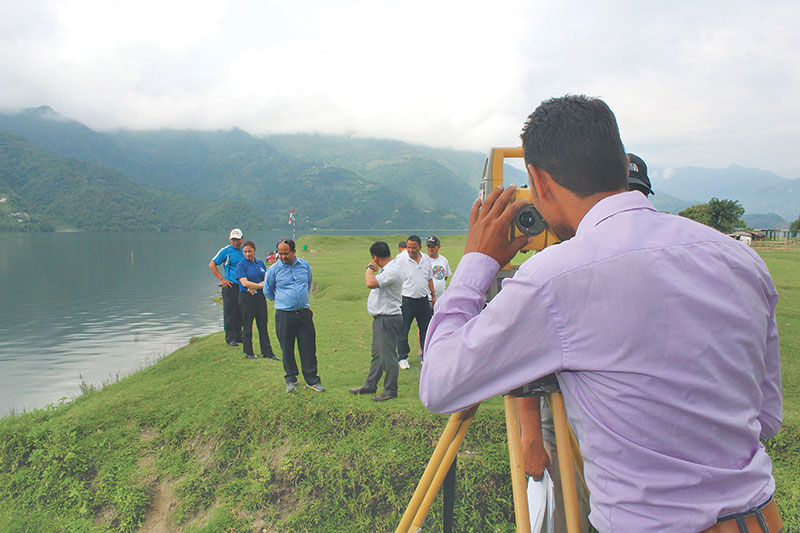
Government team surveys a hotel property allegedly built by encroaching the Phewa Lake in Pokhara. Post Photo 

POKHARA : A probe committee formed by the government to investigate into Phewa Lake encroachment began its survey from Monday.

On April 29, the Supreme Court had ordered the government to remove the buildings and business establishments built by encroaching the lake area in Pokhara.

The court had also ordered the government to submit a report on lake encroachment within two months.
As per the directive of the apex court, the committee began its study, starting from hotels built within 65-metre from the lake’s edge.The committee is also studying about the untreated sewage sources that are channelled into the lake. The committee is led by Narayan Regmi, chief survey officer at the Ministry of Agriculture, Land Management and Cooperatives.
Regmi said the main objective of the committee were to determine how much of the lake’s area has been encroached since 2032 BS so that it can be reclaimed and restored.

The committee members are currently tallying their study findings with the records at the Kaski Land Revenue Office. They are also involved in other data collection work. The committee will submit its report to the Supreme Court within 15 days, Regmi said. The Supreme Court has set down the lake’s area at 2,874 ropanis (6.5 sq km approx). Until 1957, the lake covered an area of around 10 sq km. The measurement in 2007 showed that its area had shrunk to a mere 4 sq km.

On May 2012, a commission led by Bishwa Prakash Lamichhane, the former chairman of city development committee of Pokhara, had mentioned that 86 hectares of the land around Phewa Lake had been converted into personal properties by illegal means. It had also recommended the government to terminate the ownerships of such properties .

The commission’s report also lists the names of over 1,000 individuals who had acquired properties within the lake’s immediate surrounding. According to a report prepared by the Phewa Lake Conservation and Management Office two years ago, as many as 204 buildings have been built by encroaching the lake’s property.

NEWS

Rickshaw puller found dead

news digest
- Post Report

PARSA: A rickshaw puller was found dead in a suspicious circumstance in Birgunj-8, Parsa, on Tuesday morning. Police said the body of 42-year-old Gopal Pariyar was found on a cart on the premises of a house in Panitanki. DSP Rajan Limbu said there were scars around Pariyar’s neck. His body was taken to Narayani Sub-Regional Hospital for post-mortem. (PR)

NEWS

Mild earthquake felt in Bajura and Humla

news digest
- Post Report

BAJURA: An earthquake measuring 4.9 on the Richter scale struck Bajura district on Tuesday morning. According to Seismological Centre in Surkhet, the earthquake occurred at 7:19am with its epicentre at the border of Bajura and Humla districts. The tremor was felt in Bajura and Humla. No casualty or property damage were reported. (PR)

NEWS

Bhatta is PP leader of NCP

news digest
- Post Report

DHANGADHI: Trilochan Bhatta has been appointed the Parliamentary Party (PP) leader of Nepal Communist Party (NCP) in Province 7. The first meeting of the NCP PP meeting appointed Bhatta as the PP leader of the province on Tuesday. Bhatta was also the PP leader of the erstwhile CPN (Maoist Centre) before the party merged with the CPN-UML to form the NCP. He is also the chief minister of Province 7. The meeting also appointed Prakash Bahadur Shah as the NCP deputy PP leader. He was earlier the PP leader of UML. Tara Lama Tamang and Akkal Rawal were appointed the party’s chief whip and whip respectively. (PR)

Page 5
WORLD

Iran all set to boost nuclear activities

- REUTERS

BEIRUT,
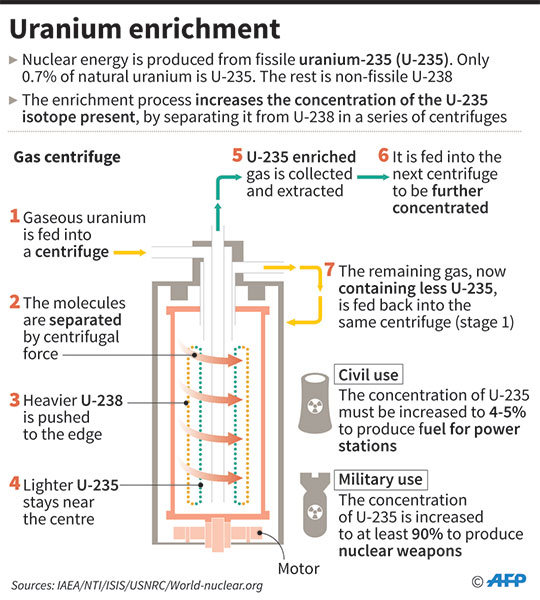
Iran has begun preparations to boost its uranium enrichment capacity, its nuclear chief said on Tuesday, adding to pressure on European powers trying to save a nuclear accord with Tehran in peril after a US withdrawal.
France, Britain and Germany want to salvage the 2015 deal’s core bargain of sanctions relief in exchange for restrictions on Tehran’s atomic activities. Washington has reimposed sanctions against Tehran since quitting the deal last month, arguing Iran posed a security threat.
Iran has set out conditions to stay in the nuclear deal, including steps to safeguard trade with Tehran and guarantee Iranian oil sales. But it has also said it could resume its 20 percent uranium enrichment, which is banned under the deal.
Iran was developing infrastructure for building advanced centrifuges at its Natanz facility, Ali Akbar Salehi, director of Iran’s Atomic Energy Organisation said in a news conference broadcast on state television.
Supreme Leader Ayatollah Ali Khamenei said on Monday he had ordered preparations for Iran to have greater enrichment capacity if the deal falls apart. Iran’s nuclear agency said it would inform the UN nuclear watchdog on Tuesday the process to increase capacity had begun.
Salehi said this did not violate the nuclear deal but that it marked an increase in the pace of the nuclear programme.
“If we were progressing normally, it would have taken six or seven years, but this will now be ready in the coming weeks and months,” he said.
Iran has also developed the capacity to produce electricity at Natanz, Salehi said, a site which lies around 300 kilometres (186 miles) south of Tehran.
The 2015 agreement allows Iran to continue 3.67 percent uranium enrichment, far below the roughly 90 percent threshold of weapons-grade. Before the deal was reached, Tehran enriched uranium to up to 20 percent purity.
Salehi’s comments Tuesday appeared to be a warning to the remaining signatories of possible consequences if the deal were to collapse. European powers still back the deal but have concerns over Iran’s ballistic missile programme and its influence in the Middle East. Iran says the two issues are non-negotiable.
Salehi said Iran could not accept a “flawed” nuclear deal, nor could it adhere to the deal’s restrictions while facing new sanctions. He reiterated previous statements by officials that Iran is prepared to significantly increase its nuclear activity if the deal falls apart.
“Then the situation will progress in a different way,” Salehi said. “I hope there will never be a need to go back to that situation.”
He also repeated Iran’s position that its nuclear programme was for civilian purposes only.

WORLD

At least 11 dead in China iron-ore mine explosion

- AGENCE FRANCE-PRESSE

BEIJING,
A truck carrying explosives blew up near the entrance of an iron-ore mine in northeast China on Tuesday, killing 11 people, injuring nine and leaving another 25 trapped underground, state media reported.
Some of the victims stuck inside the mine run by China National Coal Group Co in Liaoning province were able to contact rescuers, according to state broadcaster CCTV. The local government of Benxi, where the blast occurred, has dispatched a rescue team, CCTV added.
The workers were drilling a mining shaft when the truck exploded just after 4:00 pm near the entrance to the mine, the broadcaster said.
Deadly mining accidents are common in China, where the industry has a poor safety record. A gas leak killed at least 18 people working in a coal mine in central Hunan province in May last year.
In December 2016, explosions in two separate coal mines in the Inner Mongolia region and in Heilongjiang killed at least 59 people.

WORLD

US pushes Nato to ready more forces to deter Russian threat

- REUTERS

BRUSSELS/WASHINGTON,
The United States is pressing European allies to ready more Nato battalions, ships and planes for combat, officials say, in a fresh move to shore up Nato’s deterrence against a potential Russian attack.
US Secretary of Defense Jim Mattis will seek broad agreement for the plan in Brussels on Thursday when alliance defence ministers meet, laying the ground for endorsement by Nato leaders at a summit in July, four US and Nato officials and diplomats told Reuters.
The plan would require Nato to have 30 land battalions, 30 air fighter squadrons and 30 navy ships such as destroyers ready to deploy within 30 days of being put on alert, although the proposal does not discuss specific troop numbers or a deadline for setting up the strategy.
The size of battalions vary across Nato, from 600 to 1,000 soldiers.
This lays down a challenge for European governments, pilloried by US President Donald Trump for slashing military spending after the Cold War, to remedy long-running problems with helicopters and jets that are grounded for lack of parts.
“We have an adversary (Russia) that can move quickly into the Baltics and Poland in a ground attack,” said one senior Nato diplomat who was briefed on the US plans.
“We don’t have the luxury of taking months to mobilise,” the diplomat said, saying the US idea was known as 30-30-30-30.

WORLD

With khukris and assault rifles, Singapore’s Gurkhas to guard Trump-Kim summit

frontline force
- REUTERS
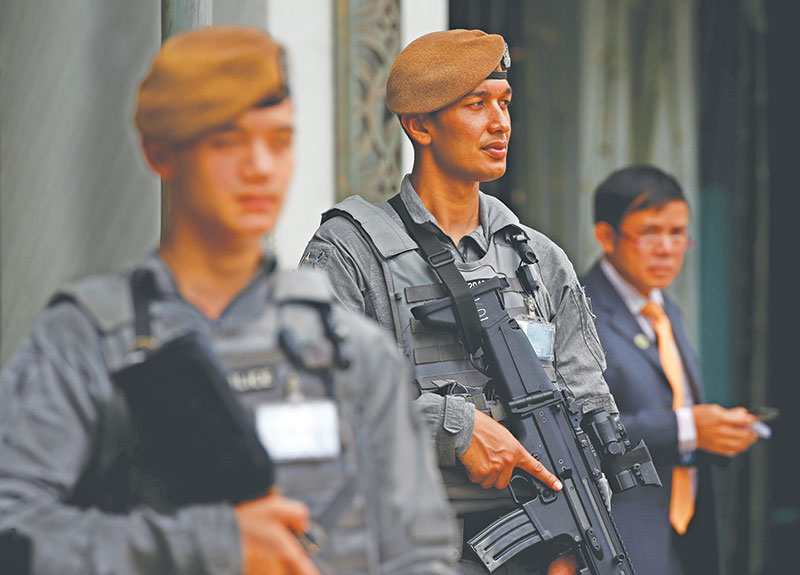
A file photo shows Gurkha policemen standing guard at the venue of the 16th IISS Shangri-La Dialogue in Singapore.REUTERS

SINGAPORE,
When US President Donald Trump and North Korean leader Kim Jong-un meet for their historic summit in Singapore later this month, they will be protected by men from one of the fiercest warrior tribes in the world—the Gurkhas of Nepal.
While both leaders will bring their own personal security teams, elite Singaporean police, including its Gurkha Contingent, will be securing the summit venue, roads and hotels, according to diplomats familiar with VIP security in the island state.
The Gurkhas, who have a low-profile presence in Singapore, were more visible than usual at the weekend as they secured the Shangri-La Hotel for a security conference that included Indian Prime Minister Narendra Modi, US Defense Secretary Jim Mattis and other regional ministers.
The Gurkhas, recruited by the Singapore police from the hills of faraway Nepal, were kitted out in body armour, Belgian-made FN SCAR combat assault rifles and pistols in leg holsters at the conference, in what some security experts believed was a dry run for the US-North Korea summit.
Despite all the advanced weaponry, the Gurkhas do not prepare for battle without the khukri - the heavy curved knife that is their traditional weapon of choice. According to custom, the khukri must draw blood every time it is unsheathed.
“They are among the best Singapore can offer, and I am sure they will be involved (in the summit),” said Tim Huxley, an expert on Singapore’s armed forces at the International Institute for Strategic Studies (IISS).
“They remain very much a substantial and frontline force, and the demands of this kind of event are precisely the sort of special operation that the Gurkhas are trained to handle,” he said.
A spokesman for the Singapore police declined to comment on the deployment of the Gurkhas or their numbers.
The IISS Military Balance says 1,800 Gurkhas serve in the Singapore police, across six paramilitary companies.
A legacy in part of the British colonial era and more recent pragmatic Singaporean leadership, Singapore’s Gurkhas are linked to a British tradition that has recruited and paid for elite regiments of soldiers from Nepal for more than 200 years.
Beaten back by the Gurkhas in the 19th century Anglo-Nepalese War and admired for their valour and fighting skills, the colonial British then began to recruit them. Now Gurkhas serve in the British, Indian and Nepalese armies, as well as in Brunei and Singapore.
They have fought in both world wars as well as the Falklands conflict and, more recently, in Afghanistan.
Huxley said the Gurkhas had long proven to be an asset to Singapore’s leadership, providing a neutral force within an ethnically diverse city-state, including VIP and anti-riot protection.
At times of regional tension, they have protected international schools, and are often seen at the Malaysia-Singapore border crossings.
The Singapore Police website describes the group as “tough, vigilant and steadfast” that operates “across the spectrum of paramilitary operations to help safeguard Singapore”.
They live with their families in the secure Mount Vernon Camp outside the city, an enclave that ordinary Singaporeans are not allowed to enter.
A woman married to a Gurkha who lived in the camp said life there was restricted.
“We have a curfew of 12 midnight,” she said. “For women, we can let them know if we have a genuine reason to stay out, for men, there is no excuse.
“One of the rules we have is that we have to be in bed by 10.30 p.m. every night. This means no music, no nothing. Even if we have a party, we need to stop. If not, there will be some form of enforcement by the people patrolling.”
Typically recruited at 18 or 19 before being trained in Singapore, the Gurkha soldiers retire at 45 when they are repatriated.

WORLD

Myanmar firm tries to make trash trendy

- AGENCE FRANCE-PRESSE
Debra Martyn, a volunteer from Canada, works on an art project using recycled plastic materials at a Chu Chu recycling shop in Dala, on the outskirts of Yangon. The Chu Chu project is aimed to turn rubbish collected from Yangon’s streets into recycled crafts.AFP/RSS

DALA (Myanmar),
With creative flair the Myanmar-based social enterprise “Chu Chu” lets little go to waste as its staff turn discarded clothes and rubbish into handy accessories that get snapped up by tourists.
Coffee sacks are woven into baskets and old tyres are refashioned as belts — just some of the 60 products on offer at the organisation’s shop in Dala, a short ferry ride from the bustling downtown of commercial hub Yangon.
“We’re trying to change the way of thinking that recycled things are old and dirty,” explains Canadian volunteer and product developer Debra Martyn.
“We try to make things that are good quality, well constructed, nicely designed and beautiful — and can be considered useful.”
Myanmar has seen a huge spurt in development over the last few years after emerging from half a century of junta rule in 2011.
But the increase in the availability of consumer goods has also caused waste levels to skyrocket, clogging city streets, fields and alleyways.
Chu Chu, which means “plastic” in Burmese, started in 2013 with just two workers.
Now it employs 45 local women and their products sell at souvenir shops in Yangon and across the country.
For the moment, most customers are foreign tourists as Myanmar is still a long way from embracing recycling or recycled products, says managing director Wendy Neampui.
“They just don’t understand that throwing plastics away is disastrous,” the 66-year-old says.
Even the shop itself is made from reused waste.
Plastic bottles cemented together form the walls and a roof made from old tyres provides insulation and protection during the punishing seasonal changes. The team suffers no shortage of raw materials. Just five minutes away lies the town’s eyesore of a garbage dump, where piles of putrid rubbish spread over a vast expanse of land roughly equivalent to two football pitches.

WORLD

Saudi says new Yemen missile intercepted

News Digest
- AGENCIES

RIYADH: Saudi air defences on Tuesday intercepted a ballistic missile that targeted the western city of Yanbu after being fired from rebel-held territory in neighbouring Yemen, a Saudi-led military coalition said. The missile fired at the coastal city did not cause any casualties, coalition spokesman Turki al-Maliki said in a statement released by the official Saudi Press Agency. Iran-backed Huthi rebels have in recent months ramped up missile attacks against neighbouring Saudi Arabia, which leads a military coalition that has fought the insurgents since 2015. The latest strike comes as coalition-backed Yemeni forces advance on the rebel-held Red Sea port of Hodeida, the main conduit for humanitarian supplies into a country teetering on the brink of famine.

WORLD

Czech PM rejects Merkel’s migration call

News Digest
- AGENCIES

PRAGUE: Czech Prime Minister Andrej Babis on Monday rejected a new “flexible” European Union approach to migration pushed by German Chancellor Angela Merkel. At the weekend, Merkel proposed a “flexible system with division of labour” which could see countries that refuse to take in refugees compensate by making contributions in other areas. “We don’t want to compensate, why should we compensate with a contribution?” Babis said in an interview with the daily Frankfurter Allgemeine Zeitung. “We have said clearly: it is our people, our businesses who will decide who will work and live with us.” Under a scheme introduced in 2015, asylum seekers from the frontline states of Greece and Italy were to be moved to other EU countries under a quota system, but Hungary, Poland and the Czech Republic have refused to take almost any. Merkel’s proposal for a “flexible” system could see countries that refuse to take refugees instead provide financial aid to those on the front line.

WORLD

Guatemala volcano death toll tops 60

- AGENCIES

ALOTENANGO: Rescue workers pulled more bodies Monday from under the dust and rubble left by an explosive eruption of Guatemala’s Fuego volcano, bringing the death toll to at least 65.Disaster Relief Agency spokesman David de Leon told a briefing that there are 46 people injured, most of them seriously, more than 1.7 million being hit by the disaster, including 3,271 ordered evacuated and 1,787 in shelters in the departments of Escuintla, Sacatepequez and Chimaltenango since Sunday’s eruption. The volcano erupted early Sunday, spewing out towering plumes of ash and a hail of fiery rock fragments with scalding mud. Authorities had warned the death toll could rise after searches resumed for survivors in communities on the mountain’s southern flank.

Page 6
EDITORIAL

Beyond symbolic inclusion

Caste based discrimination is the elephant in the room that cant be ignored anymore

Kalu Devi Bishwokarma, Sanghiya Samajbadi Forum-Nepal parliamentarian from Kailali, on Monday took to the floor to inform the House about her ordeal finding a rental apartment in Kathmandu. The MP lamented that she failed to find a suitable apartment in the Capital for over a month because of the casteist and discriminatory mindset of the landlords she approached. It is jarring that over five decades after caste-based discrimination was criminalised, people from the Dalit community, including elected representatives, continue to suffer from various forms of bigotry and marginalisation.
According to the 2011 census, Dalits comprise 13.13 percent of the total population of Nepal, although this figure is often contested as researchers feel the figure is underreported. The political transition in Nepal after the 1990s, and especially after 2006, brought about many political and social changes, including bringing issues of identity and representation to the fore. However, the Dalits continue to feel excluded from political and social domains. In fact, Dalit representation has been negligible when compared to other marginalised groups such as the Madhesis and the Janajatis. Having had little political agency and tools for self-assertion in the past, when issues of inclusion were raised most vociferously, the Dalit voice got the least hearing in public debates. Being at the bottom of the caste hierarchy and patriarchy, Dalit women are the most discriminated and are often targets for witch-hunts and sexual violence. Members of the Dalit community are routinely denied job opportunities, education and social security, including housing and rental apartments.


Article 40 of the present constitution earmarks certain rights for the historically marginalised Dalits such as providing special provisions for their empowerment and representation. Dalit representation has certainly got some political momentum lately. Every ward now needs to have a Dalit woman representative member, and 13.8 percent of the total seats in Parliament has been allocated for the Dalits according to the Proportional Representation (PR) system. While there are laws in place, constitutional provisions and tokenistic social events such as ‘sahabhoj’, or co-dining, will amount to little as long as caste bias remains in a subterranean form.


Raising a voice against casteism and discrimination not only from institutional but also an individual level is the need of the hour. Robust check and balance mechanisms against discrimination, introducing awareness through school and college textbooks, and taking the politics of representation beyond mere tokenism are some of the ways in which the caste problem can be addressed to some extent. Unless there is a synchronic effort from the existing practices in the constitutional, political and cultural matrix, any substantial change in the deep-rooted forms of discrimination will remain a pipedream.

OPED

Now is the time

Development, peace and stability should be the foundation for trilateral relations
- LOK RAJ BARAL

Goodwill foreign policy can be conceptualised as one that aims at achieving national interests through cooperative endeavours and mutual understanding. It is, therefore, a positive term that keeps a country away from classical strategies and tactics that have been in vogue since the times of Chanakya and Machiavelli. Succeeding experts in international politics and diplomacy used whatever means possible for furthering national interests. The old might is right theory seemed to create a hierarchy of nation-states institutionally through the United Nations, as well as through the day-to-day practices in bilateral and international relations. Thus, as Hans J Morgenthau said in his classic Politics Among Nations, international politics is nothing but a struggle for power.


In such a hierarchical system, smaller countries are either required to fall in line with hegemonic powers (regional and international) or adopt their own sound foreign policies and strategies that guarantee national security and fulfil other objectives. Even rival powers mend their fences through such quiet diplomacy. Recent examples of successful quiet diplomacy were shown by China and India, and North Korea and South Korea together with the US.


Diplomacy is key
The days of the primacy of quiet diplomacy and cooperative relations have thus arrived, and military power alone is not relevant, if not obsolete, in inter-state relations. The manoeuvrability demonstrated in the past may not necessarily be applicable to unpredictable relational patterns in both bilateral, regional and international contexts. China and India, Nepal’s immediate neighbours with whom its current foreign policy is more or less confined, seem to put their rival powers status to a low key in order to reduce areas of conflict such as border disputes and other points of discord. Differences between them are being adroitly managed so as to avoid possible flashpoints for conflicts.


The latest developments suggest that both neighbours have come to an understanding that areas of cooperation should be strengthened for mutual benefit while potential areas of conflict should either be relegated to the background or, if possible, avoided altogether. Following a policy of walking a tightrope between and among the major world powers, India seems to be in dire need to deescalate conflicts with other small and big powers. India’s good neighbourly policy, which has been activated in recent months, has tried to impress on its neighbours that its hard policy options often employed in the past may not be relevant in the present context.


The Chinese foreign minister’s view on trilateral cooperation as expressed during the Nepali foreign minister’s visit to Beijing recently is an indication that China is in no mood to stoke more controversies with India, that too in the context of Nepal, whose geo-political situation always makes it conscious of its limitations. Indian Prime Minister Narendra Modi’s informal
visit to China and the meetings he held with  Chinese President Xi Jinping has effectively buried the hatchet on the Doklam border issue that had almost reached a flashpoint for conflict recently, demonstrating that the two countries are looking to nurture a more cooperative relation in the future.


India’s move to reset relations with Nepal can also be taken as a pointer that India wants to develop a new understanding, which in a way departs from the traditional relational patterns, both structural and functional, in order to meet the exigencies of the present time and context. In the wake of such developments, India needs to accept Nepal’s desire to be close to China for development, peace and stability, and also for strengthening trilateral relations between the three countries. India’s old mindset that Nepal should in no case be close to China cannot be validated in the changing context of greater connectivity and developmental cooperation.


The way forward
In order to address India’s sensitivity, Nepal, on its part, should also not play one neighbour off against the other, as rulers and politicians did in the past. Nepal’s domestic politics and the practice of using what Gunnar Myrdal wrote in a different context in the 1960s, resentful nationalism, or today’s much touted anti-Indianism, has contributed to straining bilateral relations. Politicians in Nepal were/are prone to such brinkmanship as these postures that were adopted from time to time have paid dividends in the short run. India too is responsible for giving rise to problems in bilateral relations as its strong-headed policymakers and security experts didn’t appreciate Nepal’s aspirations to manage its own affairs independent of outside influence.


Although the fundamentals of India-Nepal relations are not likely to change despite upcoming agendas of greater closeness between China and Nepal, increased connectivity and openings have their own usefulness and cannot always be linked to mutual security and the wide ranging relations that exist between India and Nepal. For, in a substantive sense, Nepal-India relations would remain the same, but they need to be renewed and reviewed to match the time and situation. Nonetheless, old dominance and dependency syndromes that are manifest in small power, big power relations have to be sympathetically looked into by the concerned powers realising the limitations of small countries. Small countries like Nepal should also upgrade the level of development and other capabilities to catch up with the changes taking place across the immediate neighbourhood.


India’s traditional dominance has shrunk in recent years, not because geo-politics has changed drastically, but because of a new context and time. In the past, the southern neighbour was perceived as indulging in micro-management deliberately or due to the attempts of Nepali politicians to curry favour from Indian functionaries. So, Nepali politicians were also responsible for entertaining what I call ‘invited intervention’ when they needed external help during the political struggle for democracy or while seeking a mediatory role for the management of domestic politics. However, realistically speaking, the domestic context of Nepal’s foreign policy cannot be easily ruled out in view of greater historical, political, cultural, economic and other links with India. Thus, any realistic approach to bilateral relations would have to take ‘linkage politics’ as an important aspect of India-Nepal relations. But it is up to Nepali politicians in general to formulate certain guiding principles reflecting the commonalities, constraints and self-confidence without being hyper-nationalistic.


Commitments to development, peace and stability, to which both neighbours of Nepal are committed, should be the solid foundation for promoting trilateral relations. This is the right time to maximise benefits with goodwill besides maximising greater cooperative relations between the two neighbours. Recent Indian willingness to put bilateral relations on track should also prepare a positive environment for trilateral cooperation.

OPED

Clean conscience

Government policies to ban plastic is one thing, using conscience to avoid using them is another
- Pramisha Thapaliya

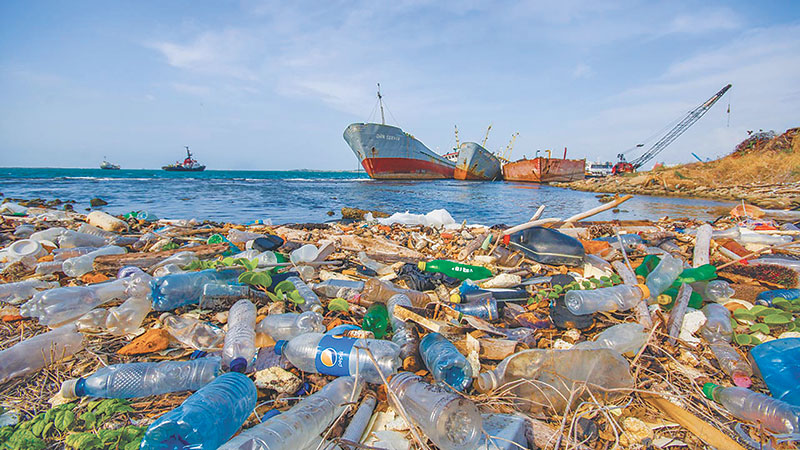
Single use plastic has become the most convenient medium of carrying goods nowadays. One million plastic drinking bottles are purchased every minute and five trillion disposable plastic bags are used worldwide every year. Fifty percent of the plastic we use is single use, which has an average usage of just 12 to 15 minutes but takes 400 to 1000 years to disintegrate. Given this, plastic pollution has become one of the greatest challenges of our times and keeping this in view, the theme for this year’s World Environment Day—observed on June 5--was ‘Beat Plastic Pollution’.


Plastic pollution occurs when plastic accumulates and begins to negatively impact the natural environment. While plastic remains an incredibly useful and versatile material, it also possesses toxic chemicals and it aren’t biodegradable. When plastic-made materials are thrown or washed away, the toxic materials leech into the environment, adversely affecting terrestrial and aquatic organisms. Also, it is said that plastics could act as magnet for other pollutants like pesticides and metals as well. Today plastics are everywhere--fishing nets used worldwide for commercial fishing, plastic packaging of food, plastic cutlery, straws in restaurants and plastic shopping bags, just to name a few.


Plastic pollution also creates imbalances in the food chain harming all organisms, from planktons to human beings. When small living organisms are poisoned due by plastic, large organisms that consume them also suffer. The news of dead whales, dolphins and other marine species due to the ingestion of plastic, have become common place. Humans ingesting plastic microparticles through the fish we consume is also increasingly becoming a reason for alarm.


Although policies matter, it alone will not act as a panacea to the problem of plastic pollution. Small individual actions count and joint effort of individuals, stakeholders, businesses and governments could lead to concrete solutions in curbing the plastic problem.
But first, we can start from small initiatives like bringing our own shopping bags to the market, refusing plastic cutlery, using refill water bottles and coffee mugs, cooperating with the government to manage waste in a sustainable manner and urging the manufacturing industry to come up with sustainable alternatives. If we have plastic bags and equipments, reusing them as much as possible rather than just once will go a long way too. Educating industries, business and restaurants about alternatives is another potential solution. Bags containing less than 20 micron are particularly harmful for the environment. Therefore, citizens should work in tandem with the local governments and manufacturers of plastic bags in order to discouraging their usage.


Plastic pollution today is a global problem and Nepal has not been spared from its consequences either. In Nepal, the use of plastic bags has multiplied exponentially in the past decades and though Nepal government imposed a ban on the use of plastic bags that are less than 20 microns thick in 2010, the provision has not seen robust implementation due to the lack of guidelines and monitoring.


The bitter truth is that these policies couldn’t bring expected change. Unless plastic-free business alternatives are provided to the business community, proper monitoring and supervision activities are implemented and education and awareness levels raised, a plastic-free society will remain a distant dream.


On World Environment Day, #BeatPlasticPollution had been trending on social media and it is encouraging to see so many individuals and organisations unite for the singular cause of curbing plastic pollution. It goes without saying that there is no plant B and it is our duty to pass on a livable and sustainable earth to future generations. To that end, taking little steps and minimising plastic use bit by bit in our daily life might not seem like much, but when these little efforts are combined, big changes are possible. From this environment day onwards, let’s pledge to redefine our behavior, and more importantly use our purchasing power for the collective good.


Thapaliya is an Agri-Internee with the Prime Minister’s Agriculture Modernisation Project

OPED

A drop in the desert

Postplatform
- SOMY PAUDYAL

To have the quality of salt is not an easy task. We all know how important salt is. Its absence makes our food bland. We don’t need a whole lot of it, but it is one of the most important ingredients added to food all over the world. Salt makes our food tasty and adds flavour. We too should strive to be like salt, so that when people look at us or taste us, they will find some flavour.


However, it is not easy to be among the minority. I would like to give my own example. The core principle of my life is being honest. I like to be honest to myself and to others. But it is not always easy to be so. When I am giving an exam, I get called by someone sitting beside me for answers to questions. I feel really uncomfortable at such times. I know cheating is wrong, and I know that they too know it is wrong; but they can’t help it. When I have to ignore my own friends in the exam hall, I feel bad. I choose honesty over friendship at that moment.


To be a light in a world of darkness is not easy. You cannot change people’s mentality. Like in my case, I have tried but have never been successful explaining to my friends that you should not cheat in any way during exams. You should write what you know; and if you fail, you should not be sad because it was your evaluation and you can do better next time. When I say this, they think I am acting like a saint and some even think I am insane.


I remember one instance in my school life. I was probably in grade 10. In a unit test, there was one very short answer question. I later got a scolding from my teacher who said that I was really dumb because everyone in my class had written the correct answer to that question while mine was blank. He said that I should have asked and written the correct answer. I was both amazed by his comments and also embarrassed. I had to pay the price of being honest by being shamed in front of the entire class.


The example that I try to set doesn’t work a lot of times. It would only appear as if I am being very religious or that I am trying to show off by being ‘holier than thou’. It is just like a drop in the desert or a flick of light in the darkness; it doesn’t help much. But my conscience doesn’t let me change and be like them even though I am among the minority. I will continue to be a drop in the desert hoping someday that those drops will form a small puddle, and it will be a place for someone to quench their thirst in the desert.

OPED

Foreign policy challenges

Well-formulated foreign policy essential
- DAWN

A coherent, well-formulated and popularly supported foreign policy is essential, especially in an age of globalisation when new and daunting challenges have emerged. Foreign policy cannot be seen in isolation, for it is only a reflection of a
country’s domestic policy. The two are linked inextricably, as foreign policy cannot be effective and credible unless backed by a domestic policy that promotes harmony and good governance at home.


While the measures and initiatives the PML-N pledged to undertake were mostly non-controversial, attempting to assert itself in the national security and foreign policy domains proved disastrous for the PML-N government, and may have contributed to Nawaz Sharif’s ouster. In hindsight, the collision between the military-led establishment and the Sharif-led PML-N government may have been foretold in the party’s election manifesto. In 2018, the challenges in the national security and foreign policy domains remain numerous and complex. But there are significant opportunities too. Whichever party or coalition takes charge of the federal government after the elections, the conduct of foreign policy will be fundamental to its success. The internal dimension i.e. managing civil-military relations will perhaps be as important as the external dimension. Ultimately, much will depend on how Pakistan manages its ties with four countries: China, the US, Afghanistan and India.

Page 7
THE GUARDIAN

Halt laws that criminalise media

Israel’s proposals to ban unflattering coverage of the military threaten press freedom
- ROY GREENSLADE

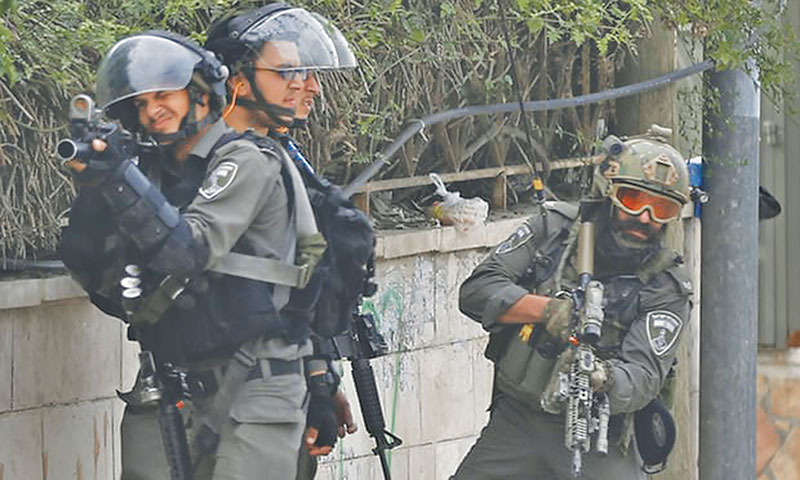
On the day the US moved its embassy to Jerusalem, Israeli soldiers opened fire on unarmed Palestinian protesters who gathered at the border fence on the Gaza Strip.
Sorry. That requires a rewrite to reflect “the truth” as promulgated by the Israeli government.
On the day the US moved its embassy to Jerusalem, Israeli soldiers opened fire to prevent an invasion of their country by Arabs living in the Gaza Strip.
This is a typical instance of the divergence in reporting that has become a hallmark of recording the conflict in Israel/Palestine.
Indeed, the use of term Israel/Palestine is also a matter of dispute. No matter how hard journalists may try, they find it virtually impossible to make a neutral, factual statement when writing and broadcasting about the Middle East.
Both sides perceive bias in every report. It’s as if facts – those statements of reality underpinned by evidence that can be verified and which are supposed to be a reporter’s stock-in-trade – do not exist. But there is one reporting medium that continues to have value: the camera, moving or still. It enables people elsewhere to get some perspective on events. Although contextual explanation, inevitably loaded with propaganda, quickly follows, it is impossible to erase the images from viewers’ minds.
Now Israel’s parliament is being asked to consider a law that would prevent us from having even that momentary, partial view of what members of the Israel Defence Forces are doing. A bill has been proposed that seeks to prohibit “the photographing and documenting” of IDF troops “with the intention of undermining the spirit” of the army. It recommends a five-year prison term for offenders and 10 years for those judged to have harmed state security.
According to its proposer, Robert Ilatov, chairman of a minority rightwing group supportive of the ruling Likud party, the “worrying phenomenon” of the monitoring of Israel’s soldiers by pro-Palestinian organisations through video, photographs and audio recordings is a “biased and tendentious” act with “a clear anti-Israeli agenda”.
Reports suggest the idea has the support of Israel’s defence minister, Avigdor Lieberman, the founder of Ilatov’s party. That prompted Israel’s liberal newspaper, Haaretz, to treat the matter seriously in an editorial that called the proposal “dangerous”. Its aim, said the paper, was “to silence criticism of the army and in particular to prevent human rights organisations from documenting the Israeli army’s actions in the [occupied] territories”. The International Federation of Journalists also condemned the proposal, arguing that it “constitutes a serious breach of the freedom of the press” because it “criminalises the work of journalists”.
Haaretz agrees, believing such a law would harm press freedom: “The public has a right to know what the reality is and especially what the ‘people’s army’ is doing in its name and on its behalf.”
I couldn’t put it better myself. Any restriction on the freedom to report inhibits the possibility of holding power to account.
One trigger for the Ilatov initiative is obvious. In March 2016, a Palestinian attacker who was lying wounded and immobilised on the ground was shot dead at point-blank range by an IDF soldier, Elor Azaria. The shooting was caught on video and posted on social media by the Israeli human rights organisation, B’Tselem. As a result, Azaria was arrested, convicted of manslaughter and served nine months of an 18-month sentence before being released last month.
Would he have been charged if there had been no film? We cannot be sure, but it is significant that it was the first time in 12 years that a member of the IDF had been convicted of manslaughter. The truth could not be fudged because of the film footage. Azaria was the criminal, not B’Tselem.
The message for Israel’s politicians is straightforward. There is no democracy without press freedom and there is no press freedom without democracy. If they wish to uphold their claim to be living in a democratic state, they should vote overwhelmingly against Ilatov’s ill-considered proposal.


Robinson learns the limits
So, you may rightly ask in view of the above, does the exercise of press freedom have no limits at all? Can we film wherever we like, whenever we like? Should we be able to speak without any restriction?
The straightforward answer is “no”. Even in a democratic society there can be good reasons to circumscribe freedom. It is a lesson the self-described “independent activist and journalist”, Tommy Robinson, discovered last week when sentenced to 13 months in prison for breaching the contempt of court law by live-streaming from outside a Leeds court.
Robinson, erstwhile leader of the English Defence League, sought to present himself as a free speech hero. Hundreds of misguided people supported him in the foolish belief that “the establishment” is engaged in a conspiracy to suppress details of an ongoing trial.
Reporting restrictions have been put in place in the interests of the trial being conducted fairly, and Robinson’s action had the potential to prejudice the process. If these silly antics had not been halted, a retrial might have been necessary.
To confuse matters further, Robinson’s own case was then subject to a reporting restriction that had the unforeseen effect of feeding the conspiracy theorists. Their fantasies were given full rein online before the ban was lifted following an appeal by local journalists.
In reality, what Robinson and his rightwing cronies were in danger of reviving was hue and cry, a practice outlawed in the early 19th century. It was anything but a responsible use of press freedom.


Fake death is gift to Russia
Lies cannot be fought with lies because the original liar is always the beneficiary. That’s the clear lesson of the Arkady Babchenko fiasco.
It is impossible to see any value in the Ukrainian security service’s elaborate faking of his death. The hoax has been a gift to the Kremlin’s lying machine and it is a pity that Babchenko should have allowed himself to be used in such a stupid stunt. Despite trenchant criticism of his deceit, he appears anything but repentant, describing the British press as “fucking smart arses”, and adding “go fuck yourselves”.
Why single out British reporters? Journalists across the world have poured scorn on Babchenko’s actions. Rather than hurl insults, he would do better (a) to explain exactly how pretending to be dead helped prevent his assassination; and (b) to apologise for providing Vladimir Putin with his greatest propaganda gift to date.

THE GUARDIAN

Russia is killing stray dogs

As World Cup approaches, street dogs are being ruthlessly eliminated
- Chas Newkey-Burden

With two weeks to go until the World Cup kicks off in Russia, death squads are targeting undesirables in the street. In what local authorities describe as an attempt to make Russia more media- and visitor-friendly, horrifying executions are taking place. However, the great purge is aimed not at man but at man’s best friend – they are coming for the dogs.
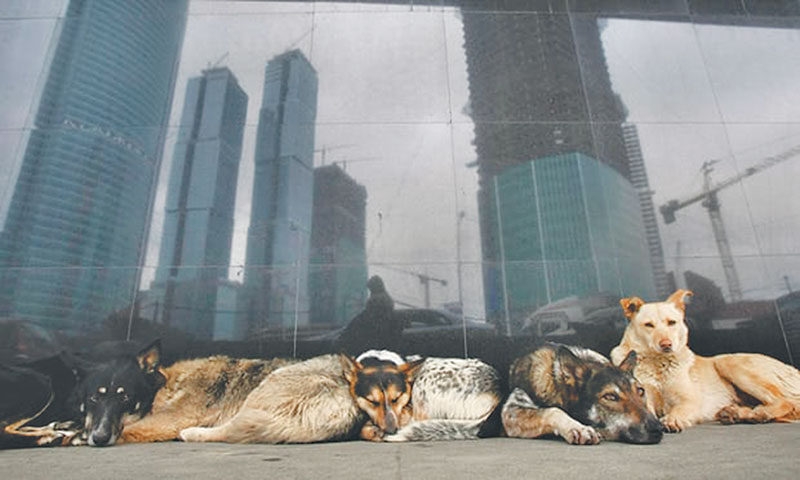
Russia’s street dogs are perhaps more lovable than most. They have drawn admiration for their intelligence and resilience. Many of them commute into the cities each morning on the trains. They know to get on the train’s front or back carriage for the least crowded journey, and they know where to get off for the best food. When they beg for food as a pack, they move their youngest and cutest member to the front, knowing this will melt the hearts of passers-by. On busy streets, they’ve even learned to obey traffic lights and cross when it’s safe, trotting alongside pedestrians.
These are the sweet, abandoned creatures who are being exterminated in the name of the beautiful game. Many are killed with poisoned food. This sneaky form of violence condemns the animals to slow and painful deaths, usually with convulsions as they choke on their own vomit before eventually collapsing. Other hunters use poisoned darts or blowguns for their killings. Lives silently snuffed out because they don’t fit the image the authorities want to present.
Officials deny that euthanasia is their official policy, claiming the focus is to move dogs into shelters. But Open Cages and local campaign groups insist the slaughter is continuing. Social media in Russia has become awash with photos and videos of convulsing or dead dogs. It all feels horribly reminiscent of 2014, when stray dogs were rounded up and killed in Sochi ahead of Russia’s Winter Olympics. The private pest control company hired for the mass slaughter there referred to dogs as “biological trash”. An animal rights group described scenes of “mass poisonings and shootings”.
Ahead of the World Cup, Russian parliament member Vladimir Burmatov visited a shelter in Yekaterinburg and discovered a “very painful” scene, with “malnourished dogs and conditions that you couldn’t even call satisfactory”. He said a “large quantity” of the shelter’s dogs were being unnecessarily put to sleep. There is a £1.20 budget for each killing, which suggests how compassionate the process is likely to be. After all, the shelter is run not by animal welfare experts, but a rubbish collection and disposal firm.
Stray dogs are certainly a big issue in Russia. There are approximately 2m strays in the country’s 11 World Cup host cities. But killing them is surely not the answer. The most effective solution to the problem might be a long-term policy of spay and neuter. A more immediate approach for dogs currently on Russian streets would be proper investment in suitable shelters for them. God knows, the World Cup brings in enough cash to football’s governing body, Fifa, that they could chip in a few million.
As well as pressing Russian authorities to immediately halt the killings, Fifa should insert an animal welfare clause into the host contract for all future tournaments, including the 2022 World Cup in Qatar, a country with its own strays.
Perhaps some World Cup stars will step up to the plate, too? Lionel Messi, Mesut Ozil and Harry Kane often post photos of them posing with their dogs. In this money-spinning game, the influence of these superstars is immense. Here’s their chance to show they really love dogs.

THE GUARDIAN

A comedian who isn’t an antisocial

Robert White is turning Britain’s Got Talent into Britain’s Got Tolerance
- Yousif Nur

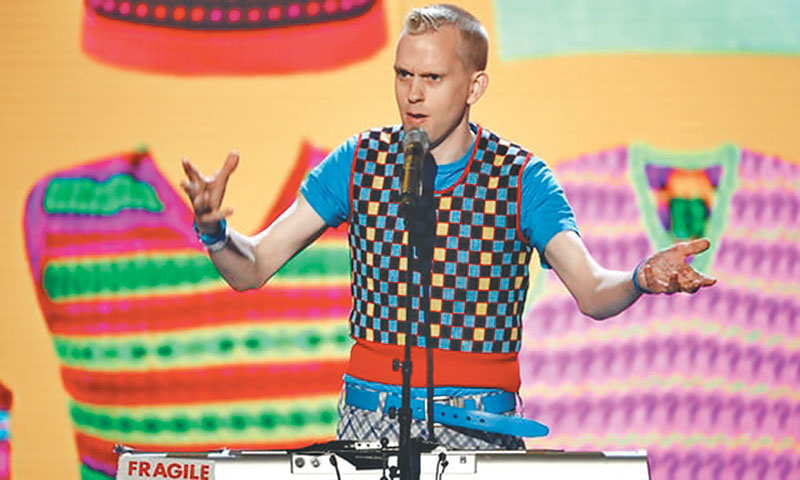
For someone who describes himself as “the only gay, Aspergic, quarter-Welsh comic on the British comedy circuit”, Robert White had already cornered a niche market or two. And thanks to his recent semi-final triumph on Britain’s Got Talent his career looks set to take off despite any prejudices that might exist towards his sexual orientation, disability or nationality.
People might see Asperger syndrome as something holding White back, but that clearly isn’t the case. Once he ended up in prison for a prank that went horribly wrong, and then there was the recent altercation with the grime artist Big Narstie when he seemed to misread social cues – but the TV audience loves him.
The question is: will White’s success on the show help those with Asperger’s to be more visible and understood in society more broadly? Susan Boyle came second in Britain’s Got Talent in 2009, and was relentlessly mocked for a long time afterwards. She was diagnosed a few years later, and having Asperger’s has not stopped her doing pretty well for herself. But her case certainly didn’t mark a step change in society’s perception of the condition.
People with Asperger’s are often looked at with a strange sense of admiration as they tend to follow what they are passionate about with a laser-sharp focus. They will do whatever it takes to become successes in their own right, to the point where it becomes an obsession. Perhaps that’s why so many illustrious names down the years have been people with Asperger’s: Courtney Love, Dan Aykroyd, Tim Burton and Isaac Newton, just to name a few.
But how many people are even aware of these cases? White has leapt into the limelight with his condition front and centre of the discussion. His success dispels the popular misconceptions surrounding people with Asperger’s as being antisocial, or total introverts. That could shift the dial. The key to gaining more understanding of the condition is open communication, dialogue and, perhaps most important, empathy. No two people on the autistic spectrum are the same, just as no neurotypical (as people who aren’t on the spectrum are known) individuals are the same: understanding this will go a long way to understanding people with autism/Asperger’s and their specific needs – just consider the woman with Asperger’s who was recently thrown out of a film screening for laughing. Public perception has a real effect on the lives of people with Asperger’s, and one of the ways to change that is by demonstrating how “normal” we are.
Britain’s Got Talent and ITV deserve plaudits for giving people across the spectrum the opportunity to enjoy success and fame. In doing so they could make Britain a more tolerant society. And for people with Asperger’s like me, White is yet another example of someone triumphing against the odds, breaking through glass ceilings – and shattering the myth that you have to be neurotypical to succeed.

THE GUARDIAN

An abortion gave me freedom

Abortion in extreme cases are necessary
- Hadley Freeman

When I was 23, my life forked. Until then, it had felt like one of those LA freeways with half a dozen lanes: I had options in terms of which path I took, but they were all going in the same general direction.
I was barely making a living in a job I enjoyed, and living in a dump with friends I adored. Life was wide open. Then one day I took a pregnancy test and suddenly there were two directions for me: have the baby or don’t. I cried on the bathroom floor with my best friend, but the tears were out of embarrassment that I had been so careless. They weren’t out of fear. It was years before I appreciated what a privilege that was.
During the Irish abortion referendum there was a lot of talk about the extreme cases in which legal abortion is not just a right but a necessity: rape victims, foetuses with fatal abnormalities. But it would be dishonest not to mention the more banal stories like mine. Back then, I was with my first boyfriend, whom I loved very much. I was starting to recover from anorexia – which is why I hadn’t been more careful: I assumed I couldn’t conceive – and my boyfriend was then no more emotionally equipped than I was to look after a baby.
But the truth is, we – I – absolutely could have had that baby. I would have had to give up my job and move back in with my parents. My relationship would have eventually ended, and it would have taken years for me to be able to support myself and the baby. But, sure, I could have done it.
As the Irish went to the polls last week, several male columnists took it upon themselves to share their revelations about the female body. One broke the astonishing news that, when a woman is pregnant, a baby is growing in her womb. Another informed us that women who defend abortion are analogous to “human rights-abusing dictators when outsiders complain at what they do within their borders”. Because a woman’s body belongs to the people, not to her. Given that anti-choice arguments are always predicated on the idea that women are either idiots or evil, it’s a wonder anyone thinks they should have children at all. New York Times columnist Ross Douthat gave the game away when he wrote that, “with its restrictive abortion laws”, Ireland hadn’t “compromised women’s health”. Not once did he mention Savita Halappanavar, the 31-year-old woman whose death sparked the referendum; Halappanavar died of septic shock when the Galway hospital she was in refused to induce a miscarriage during her unviable pregnancy.
A few days before my abortion, a male acquaintance told me I didn’t know what I was doing. I was killing a baby! Did I really think I could live with myself afterwards?
I did and I do. People say abortion is complicated, but it isn’t. Only those with the luxury of not having to worry about the practicalities of parenthood can sentimentalise the situation.
Because if I had continued with that unwanted pregnancy, what then? I wouldn’t have had it in me to give the baby up for adoption, but I also wouldn’t have been a good mother – because I wasn’t ready. As it happens, two of my friends got pregnant at around the same time. Both continued their pregnancies and, because they were more emotionally mature than me, ultimately thrived as mothers. But I know as well as I know my own shadow that would not have been my story. I could barely look after myself then, let alone a baby, and becoming a parent would not have made me grow up: it would have made me dependent on my parents for years. I needed – and wanted – more time.
Since I had twins at 37, I’ve become even more pro-choice, because I now know the realities of pregnancy, childbirth and motherhood. Making anyone go through that when they don’t want to is so obviously self-defeating, it verges on the surreal.
My story is not every story, any more than an anti-choice campaigner’s love for their children is an argument against abortion. Women’s needs are different. That’s why they need a choice. Even some pro-choicers talk about abortion with distaste. But I love my abortion. It gave me the freedom to work, to choose when I wanted children and who I wanted them with. My now-long-ago-ex-boyfriend and I are not yoked together by a baby we weren’t ready for. And my abortion was so free of shame and fear that it has never affected me emotionally. The miscarriage that I had at 38, I think about every day, because I wanted that baby; my abortion at 23, I never think about at all. While I couldn’t control the outcome of the former, I am lucky to live in a place that let me control the latter.
Irish women, I’m so happy you finally have the freedoms I have, and Northern Irish women, you are not forgotten. One day soon the rules that control your life will look like something from a distant, crueller age. Because they are.

Page 8
LIFE & STYLE

Hari, America Boys bring new tales to cinemas

- Post Report

Kathmandu,
Nepali cinemas saw the release of two comedies this week—Hari and America Boys. Directed by debutantes Pratik Gurung and Safal KC, Hari stars Bipin Karki in the lead role and has received rave reviews from the critics and audience alike. Critics have been positive about the film’s use of a novel narrative technique, and have lauded the way Hari “trail-blazes on its own path at a time when almost all of the Nepali films are commercially-oriented.” As one critic wrote, “For the most part, Hari is magnificent. If only for the richness of visual language, we need more films like Hari… But it might not satisfy those filmgoers who are used to enjoying mainstream Nepali films.”
Hari is currently competing at the box office with American Boys, which stars Sandip Chhetri, the darling of Nepali television, Arpan Thapa and another up-and-coming comedian Kameshwore Chaurasiya.
The producers of America Boys organised a viewing party at Kumari Hall in the Capital which saw the presence of noted comedians, actors and directors on Monday.
Speaking after the show, comedian Kiran KC said that he would score America Boys a full hundred out of hundred. “I really liked the screenplay,” KC said. “I didn’t know much about the directors. But there is not a single instance where the film is trying too hard to make you laugh,” KC added, before lamenting, “If only the film had a more lively star cast…”
Directed by Prabesh Poudel, America Boys tells the story of three youths who lie to their families about moving to the US.

LIFE & STYLE

Early Van Gogh landscape sells for 7m

- BBC

PARIS,
Painted in 1882, Fishing Net Menders in the Dunes depicts peasant women working on the land, inspired by countryside around The Hague in the Netherlands.
It was bought by an American collector after a bidding war that pushed the price above its estimate of £3m-£5m. The painting is the first Van Gogh to be auctioned in France for more than 20 years.
“It’s fetched such a high price [compared to the estimate] because there are hardly any Van Goghs on the market,” said the auctioneer, Francis Briest. “You can only find them in private collections or museums, and therefore buyers are prepared to pay over the odds for a work of this quality and importance.” Van Gogh painted the work when he was 29 years old, during a formative period spent living near The Hague.
“We already find all the characteristics of a Vincent painting, especially his treatment of landscape,” said Bruno Jaubert, associate director of modern art at auction house Artcurial. The painting was the only landscape work Van Gogh produced at the time, Jaubert said.
The last sale at a Paris auction of a Van Gogh painting was The Garden at Auvers, sold in the mid-1990s for $10m.
Van Gogh’s Portrait of Dr Gachet fetched what was then the highest ever price for a painting when sold at auction in May 1990 for $82.5m.

LIFE & STYLE

Comic reflections

- Post Report

Kathmandu,
An exhibition of caricatures of noted Nepali personalities, Nepali Caricature 2075, is currently ongoing at Nepal Art Council in the Capital. The exhibit was inaugurated this week by Ragini Upadhyay.
 The exhibit includes the caricatures of more than four dozen personalities—from poet Madhav Prasad Ghimire and playwright Abhi Subedi to leg-spin prodigy Sandeep Lamichhane.
Organised jointly by Nepal Academy of Fine Arts and Cartoonists’ Club of Nepal, the exhibit includes caricatures done by a total of 34 artists such as Manujbabu Mishra, Ashokman Singh, Jeevan Rajopadhyay, Abin Shrestha, Basu Kshitiz, Rabindra Manandhar, Devendra Thumkeli, Keshav Raj Khanal, Rabi Mishra and Deven Pandey, among others.

Speaking about the exhibit, Abin Shrestha, chairperson of Cartoonists’ Club of Nepal, said that the value of caricature in the field of Nepali arts is on the rise. “It’s good to see caricaturists begin to employ colours and different motifs in their artworks. And exhibits like this that portray luminaries of Nepali society in a humorous light will only help the popularity of the medium further,” Shrestha said.
As part of a competition held parallely with the exhibit, for which the organisers commissioned works from up-and-coming cartoonists, Abhinash Malla, Suraj Shakya, and Ramila Maharjhan bagged the first, second and third prizes. The winners bagged prizes worth Rs 15,000,
Rs 12,000, and Rs 10,000, respectively.
The show will continue through June 6.

LIFE & STYLE

Weinstein set to plead innocent

- AGENCE FRANCE-PRESSE

NEW YORK,
Fallen movie mogul Harvey Weinstein was expected to plead innocent to rape and sexual assault charges in New York, opening a legal battle for the #MeToo movement that dreams of seeing him behind bars.
The 66-year-old Weinstein was charged with rape and a sex crime in New York late last month, nearly eight months after his career imploded in a blaze of accusations of sexual misconduct. Weinstein is due in a Manhattan court, for a formal reading of the indictment. His alleged crimes could put him in prison for as many as 25 years.
Two women are named in this indictment. But nearly a hundred have said since October they were harassed or sexually abused by Weinstein over several decades.
That has turned the one-time toast of Hollywood into the catalyst of the MeToo movement and arguably one of the worst sexual predators in recent American history.
Salma Hayek, Gwyneth Paltrow and Angelina Jolie are among more than two dozen actresses who say they were sexually harassed by the producer. A few, including Asia Argento and Rose McGowan, said they were raped.
Benjamin Brafman, Weinstein’s lawyer, is one of America’s most celebrated criminal defense attorneys. His past clients include former IMF boss Dominique Strauss-Kahn, who escaped criminal prosecution for alleged sexual assault in 2011. No details about the identity of the two accusers were given by the prosecutor.
Brafman said the rape complaint came from a woman who had a 10-year affair with Weinstein, but the information was not confirmed. The prosecutor will still have to prove beyond a reasonable doubt that Weinstein committed illegal acts, and with these two women specifically.
No one, however, expects the lawsuits will be dropped, as was the case for Strauss-Kahn.

LIFE & STYLE

Hollywood’s rush of gender-swap remakes

- AGENCE FRANCE-PRESSE

LOS ANGELES,
From the polarising Ghostbusters remake to the controversy over female versions of James Bond and Doctor Who, Hollywood’s proclivity for gender-swapped retreads is among its most enduring and contentious.
The trend—seen as empowering or annoying, depending on who you ask—is getting fresh attention with Ocean’s 8 due for release on Friday, Overboard still in theatres and What Men Want coming out in January.
There’s nothing new in Hollywood, and gender-swapping has been popular since Howard Hawks cast Rosalind Russell for His Girl Friday (1940) in a part played by a man in the source movie, The Front Page (1931).
A slew of female-led remakes followed—from The Incredible Shrinking Woman (1981) and The Next Karate Kid (1994) to American Psycho II: All American Girl (2002) but were largely seen as pale imitations.
Ghostbusters (2016) could well be studied in future film history classes for the bizarre backlash it received from the legion of ‘ghostbros’ who swore lifelong loyalty to the 1984 original. Much of the criticism was grounded in straightforward misogyny—with a certain kind of male moviegoer scandalised both by the presumption of a remake and by the very idea of women trying to be funny.
With two months to go until its release, its trailer had become the ninth most-disliked YouTube video in history, with over one million users down-voting it into oblivion.
Various entertainment media estimated the eventual losses for Sony and its partners at somewhere in the $55-75 million region, despite the film garnering mainly positive reviews.
The fact that these movies keep coming out despite the missteps is a sign of progress and a “minor miracle,” according to Kelly Konda, of the We Minored in Film entertainment blog. “This used to be a one-and-done ordeal... However, with ‘Ghostbusters,’ Hollywood took a big swing on a female-led project, and didn’t overreact to its failure,” he wrote. Some Hollywood watchers have argued that while female-flipping may seem progressive, in reality it militates against those really fighting pay inequality, harassment and other forms of sexism.
“Even though I can get excited for a movie like ‘Ocean’s 8’... at the end of the day it still seems to signify that women’s movies still need some sort of male appeal to get made,” said Hazel Cills of female-focused pop culture website Jezebel.
“A gender-swapped movie implies that women aren’t important enough to get their own, original stories, and thus must piggy-back on franchises helmed by men that have already proven to be successful.”
It was an issue that came up when Sandra Bullock, Cate Blanchett and the rest of the Ocean’s 8 cast hosted a news conference at New York’s Metropolitan Museum of Art earlier this month.
Bullock admitted that initially she “honestly didn’t think it would work, or get made” while Blanchett agreed that, a few short years ago, such a project would have been out of the question.

LIFE & STYLE

Solo running on empty

- AGENCE FRANCE-PRESSE

LOS ANGELES,
Solo: A Star Wars Story clung to the top spot in North American theatres but again fell below expectations, taking in $29.4 million, just over a third its opening-weekend receipts, said box office tracker Exhibitor Relations.
That left the movie well behind two recent predecessors in the popular sci-fi franchise: 2016’s Rogue One made $64 million in its second weekend while last year’s The Last Jedi did even better, at $72 million.
Some film analysts blame Star Wars fatigue. Even by the standards of today’s sequel/prequel-heavy Hollywood, the franchise from Disney-owned Lucasfilm has been prolific. Starring Alden Ehrenreich as a younger version of the swashbuckling space pilot, Solo has amassed a cumulative global total of $264 million, pushing it into 15th place for 2018.
A strong second with $23.2 million was Fox’s Deadpool 2, the 11th instalment in the X-Men series, starring Ryan Reynolds as the fast-talking Merc with the Mouth. In third spot was a new release, Adrift from STX Films, at $11.6 million. In its sixth week out, Marvel’s Avengers: Infinity War took $10.6 million for fourth place.

Page 9
THE COLLEGAIN

A Love Note

- Pratik Mainali

The hills of the west looked like gentle ripples and stretched as far as the eyes could see. Below them, in a narrow valley, the blazing sun beat down on the dust-ridden roads. An old bus rattled onwards leaving behind black smog and whirls of dust.


As the advancing bus tore through the silence, the passengers could feel the wind lashing at the windows. Inside the bus, the passengers were soaked in sweat. Some were impatiently tapping at the window and whistling. As the vehicle passed over a bridge, people craned their necks to see a river, a trailing white ribbon that ambled into the horizon. It was quite the scenery—the emerald forests on one side and golden fields on the other. Meanwhile, Sujan has his eyes fixed solely on the shadow of the bus, floating along the road. The smell of dust, excrement and dry fields is a peculiar smell, so Sujan slid the window shut. Eventually, the dust settled. Sujan looked down to find the bus heaving and sloshing along a muddy road. He pulled the window back open. The road had been crisscrossed by tire markings from the previous vehicles that had come this way. In the sky, black clouds gathered and offered respite from the sweltering sun. A stream of sweat ran down Sujan’s back so he unbuttoned his topmost button and loosened his tie.


He looked back at the rolling hills. They seemed to be impossibly far away. Hadn’t they just reached the plains a few minutes ago? A cloud of flies buzzed into the bus and agitated the passengers. The bus stopped and with it stopped the roar of the engine and that constant clattering sound. For a second there was an unnerving silence. “Toilet break,” shrieked the conductor, breaking the silence with his prepubescent voice. Sujan rose up but then decided not to go. I’ll reach home in 15 minutes, I can hold it. A bearded man, seated besides Sujan, who seemed to tremor with excitement, lunged at the door, and disappeared into the woods. Sujan sat calmly in silence. Fifteen more minutes. Patiently, he listened to the trees rustling, dead leaves crunching under footsteps, and the breeze whistling. He even managed to hear water gurgling somewhere. With no other vehicles in sight, they had the entire highway to themselves. Soon it grew unbearable so he decided to walk out.


As he walked, gripping the seats tightly, the bus tilted and shook. From the door, an elegant woman emerged and walked towards him. As she neared, she tripped on the seat and fell in his arms. Sujan could feel his heart swell as the woman’s slender arms embraced him. Her smell made his cheeks blush. He held her by the shoulders and helped her up.


“Are you all right?”
“I’m all right,” she said blankly. Then she casually walked past the file of seats until she reached hers and sat down, as if nothing had happened. When he came back, the bus was full. He was coated in mud, white as chalk, but he didn’t know that.


As the bus pulled away, the lady looked back at him. His heart lurched. He pretended to be
rummaging through his pocket. He felt a cold piece of paper and narrowed his eyes. Producing it from his pocket, he glanced at it. “I Love You”. The bus jolted and the paper fell onto the road.


“Itahari”, said the conductor. Sujan shuddered, and hastily carried his bags. As the bus stopped, Sujan stepped down on the cobblestone pavement. He made his way past the crowd of people. On the ground, the cobblestones looked like a complex jigsaw puzzle. He disappeared into the labyrinth of houses. As he entered the gulley, his brows widened and he staggered back. The girl was walking nonchalantly towards him. As she reached him, she stopped. Her brows raised, “God, I’m glad. You came to the exact place.” Sujan managed to smile. He hadn’t been able to read the other side of the paper.


Mainali is a BIBM student at  Herald College, Kathmandu

THE COLLEGAIN

Un-schooling

- Sanjog Karki

Recently, I read a provocative article titled, “School is Bad for Children” written by John Holt. As I read the piece, I found his thoughts mesmeric. Needless to say, children have a huge reserve of latent talent. Sadly, traditional methods of teaching/learning keep students from properly developing their talents. By undermining natural curiosity, self-confidence, creativity, originality, independence, and patience, the school system often turns them into adults that are dependent, impatient, and indolent.


Children today can be very stubborn, much to the chagrin of parents and teachers. This predicament reminds me of an instance in a story where one person runs in front of a buffalo, calling it forward while another pulls on a rope tied to its neck, holding it back—essentially strangling it. The one holding back the buffalo is like the parents of school children while the person calling it forward is analogous to the teachers—the children are, of course, buffalos. No doubt, the victim here is the buffalo and this story of a bewildered bovine quite accurately depicts the sorry state of the prevailing education system in our country.


There’s another pertinent fable—the story of a mother camel and her calf. Once the calf asked his mother the reason for having a hump on its back. She replied, “Look son! We are desert creatures. We must, therefore, have some reserve water for desperate times.” The calf continued to pose questions asking, “Why do we have flat feet?” She replied, “So that our legs won’t fall into the sand.” He queried again, “Why do we have thick eye-lashes then?” She replied, “To keep sand from getting into our eyes.”  Finally the calf asked angrily, “Then why are we kept inside a zoo?” and its mother did not reply.


Just as free-living, wild animals are entrapped in zoos, students are confined to their schools that keep  them  from knowing the real world. School fetters the natural tendency of children to learn in an open environment and perform spontaneously. Students are treated with indifference and teachers are apathetic to their genuine interests. Attempting to teach children in a restrictive environment, that too forcefully, is total hogwash.


School is a difficult place for non-conformists. And remember, most of the celebrated personalities of the world were non-conformists. They were out of the crowd because they dared to be different. That’s why educators must make room in their class for these non-conformists. With meteoric technological advancements, some traditional methods of teaching have become obsolete. Academic performance is not a complete reflection of a students’ capability. Limited curriculum, examination, marks and grades hinder students’ potential outcomes. Comprehensive, vocational, value-based and student-friendly education ought to be utilised if educational institutions are serious about developing their students into capable human beings.


Karki is pursuing a Bachelor’s in Psychology from Ratna Rajya Laxmi (RR) Campus, Bhrikutimandap, Kathmandu

THE COLLEGAIN

The power of introverts

- Saroj Wagle

I am an introvert by nature and it is not my fault at all. Sometimes, I feel alone even when I am with company. When I look at others who have large groups of friends, I realise that I am different from them because of my introverted nature. Being an introvert, I hardly like to talk to strangers.


Personally, I feel I am my own best friend and no matter the difficulty, I know I can depend on myself. What’s wrong with my solitude? What’s wrong with my enjoying one-on-one conversations instead of a big party? What is considered fun truly depends on who you are asking.


Research shows that introverts are generally reserved, plan their actions and control their emotions. They tend to be serious, reliable and optimistic. There are five reasons why we should appreciate introverts. First and foremost, introverts have hidden talents, just because they don’t say much, doesn’t always mean they are clueless. While others are busy chatting, introverts observe things most people are unaware of. Sometimes, they can even read people. It may seem introverts are always zoned-out but in fact, they tend to be analysing the situation and thinking of creative ideas to one day share with you.


Second is that introverts keep the world balanced. In a world that cannot stop talking, the ability to listen to what each has to say, is an important virtue that will assist us in building peaceful relationships based on understanding. The truth is that introverts can patiently listen to others and this is an increasingly important skill.


Third one is that introverts can ‘self-recharge’. Though the extrovert may accrue energy by mixing and socialising in crowds, introverts are self-recharging powerhouses. They don’t need to constantly put themselves out there to feel energised. Their energy is found through solitude.


Fourth one is that introverts make great friends. Although they tend to stick to a small friends circle, introverts may yet make it to your list of fun people to hang out with.


The fifth reason is that introverts have something important to say. There is nothing more gratifying to an introvert than finally taking advantage of a moment to speak. When extroverts may speak every thought that comes to mind, an introvert will filter their thoughts and only speak of the ones they think best to share.


All in all, what I am saying is that culturally, we need a much better balance between introverts and extroverts. The world is built for extroverts, but we should adapt to include the power of introverts in our daily workings too, so that the world can be a better place to live in.


Wagle is pursuing an MBA degree at Charotar University of Science and Technology in Gujarat, India

THE COLLEGAIN

HOME

- Aakriti KC


Lost,
Lost between the people,
And lost between the places,
Searching for a place like home.
Truly a strange place,
With a strange peculiar power,
Peculiar power that makes home,
Creating home, making love,
Creating love, making warmth.
Warmth that gives protection,
Protects me as a guardian.
Home, made of happy bricks.
Home, where angles sing me to sleep.
Home, more like my fortress,
And smelling like sweetness
Home, a place so close to me,
And home, a place so far.
Home, that I left,
And home that left me.
Miles away, I see home
With lights on, so welcoming,
A welcome, which is not for me,
Yet a welcome that I’ve always wanted.


KC is a student at CCMA College

THE COLLEGAIN

That would make a difference

- DENISHA SAPKOTA

When the pain was overwhelming
and the tears didn’t stop
trickling down my cheeks
would you rather
come to me and
erase the thoughts
off of the head and
wipe the tears
with a soft touch
Because
That would make a difference.

When nightmares haunt
When no one is in sight
But you be by my side
 Allaying my fears
With an embrace
Would you rather say,
Sleep well  because
“I’ve caught
all the terrors
and cast them away”
That would make a
difference.
When the heart bleeds
From sharp edges of broken dreams
When there was nothing to do
With nothing to tell
rather than staying apart
Would you come to me
and be my voice
That would make a difference.

When the echoes grow louder
And the happiness subsides
and the pain turns to numbness
From the dome of the sky
to where I lie
I see stars
Like scars seeping light
From perfect darkness
So would you come to me
And say,
“Don’t worry
I’ll be with you”
That would make a difference.

Anything would’ve
Made a difference
if you were the same
as the one in my thoughts
But you’re not,
Because you were different.


Sapkota is a student at Tri Chandra College

Page 10
HOROSCOPE

Horoscope

ARIES (March 21-April 19)
****
Your memories can be wonderful, heartwarming notions that tie you to the people you love, and they maintain a valuable tie to a past that helped create the person you are today. But memories, when held onto too literally or wistfully, can also be paralysing.


TAURUS (April 20-May 20)
****
There is an interesting phenomenon going on in your life right now: The closer you come to fully understanding things, the slower the pace of your life becomes. This may make it difficult for you to build on any new ideas, and it could be a challenge.


GEMINI (May 21-June 21)
****
You are in the thick of things right now—which means that you are just as far away from the beginning of something as you are from the ending of it. This is the perfect time to take a break, gather your thoughts and wait until you feel re-energised enough to move again.


CANCER (June 22-July 22)
****
Take a break in your day and plop yourself down in a busy park, restaurant or mall and take a look around. Clothing choices, hairstyles are suddenly the most fascinating thing on earth for you This is the beginning of a very observant phase.


LEO (July 23-August 22)
***
Why do you think you need to wait for someone else to get the ball rolling? You need to force yourself to establish communication—get online or on the phone and reach out to make something new happen.


VIRGO (August 23-September 22)
*****
Just try to relax and go with the flow today—follow the path of least resistance. Float through the day like a leaf on a babbling brook, and enjoy the ride. There are fascinating twists and turns laid out throughout your day, hidden like Easter eggs.


LIBRA (September 23-October 22)
*****
Sometimes, changes in your life happen slowly and over time, and sometimes they strike your life like lightning—and create a dramatic change on the landscape. But all types of change are driven by you, so keep that in mind today.


SCORPIO (October 23-November 21)
*****
Planning is the key to your success right now, so make sure you have enough time to organise all the details. Dates, times and other critical information needs your devoted attention, so try to focus as much as you can on pulling all the elements together.


SAGITTARIUS (November 22-December 21)
****
The company you keep says a lot about who you are. What does your crowd say about you? Be aware of the energy you are putting out into the world and make any adjustments that you feel might be necessary.


CAPRICORN (December 22-January 19)
****
You are entering a very inventive phase of life right now, and as soon as this morning begins, you will start to see things in a new way. You’ve been looking at your normal routine from a fresh perspective for a while now. Try to think up new approaches.


AQUARIUS (January 20-February 18)
*****
There are a few broad themes running through your life right now, and many of them are shared with someone close to you. This overlap gives the two of you a lot of common ground and similar interests. If you’re interested in pushing this relationship, go ahead!


PISCES (February 19-March 20)
****
There are few mysteries in your life right now, but that is a very good thing. Do not mourn the loss of the drama, the uncertainty and the stress of not knowing what’s in store for you. Instead, embrace the comfort of knowing what is happening now.

Variety

GRAFFITI

GRAFFITI

Variety

WORD GAME

WORD GAME

Variety

RIPLEY’S BELIEVE IT OR NOT

RIPLEY’S BELIEVE IT OR NOT

Variety

STRIPS

STRIPS

Variety

FILMS

VEERE DI WEDDING
QFX LABIM Mall: 11:30/15:30/16:45/19:30
QFX Chhaya Center: 12:00/15:00/18:00/19:30
QFX Jai Nepal: 12:00/15:00/18:00
QFX Civil Mall: 12:15/15:30/19:00
QFX Kumari: 12:15/15:15/18:30


AMERICA BOYS
QFX Civil Mall: 12:30/15:15
QFX Kumari: 15:00/18:15
QFX LABIM Mall: 12:00
QFX Chhaya Center: 19:00


DEADPOOL 2
QFX LABIM Mall: 12:15/18:45
QFX Chhaya Center: 13:00/16:00
QFX Civil Mall: 15:45


HARI
QFX Kumari: 12:00
QFX LABIM Mall: 14:15
QFX Chhaya Center: 16:30
QFX Civil Mall: 18:45


BHAVESH JOSHI SUPERHERO
QFX Chhaya Center: 12:30
QFX LABIM Mall: 15:00


SUNKESARI
QFX Civil Mall: 12:00/18:30


RAAZI
QFX LABIM Mall: 18:30

Page 11
SPORTS

Clinical Army make short work of APF

- Post Report
Binod Bhandari of Tribhuvan Army Club plays a shot against APF Club during their PM Cup match at the TU Stadium in Kirtipur on Tuesday. POSTPHOTO

Kathmandu, 
Tribhuvan Army Club (TAC) prevailed in a departmental duel to finish Group ‘A’ winners of the Prime Minister Cup One-Day National Cricket Tournament on Tuesday.
In a match reduced to 40 overs due to wet outfield, TAC rode on half centuries from opener Anil Mandal and skipper Binod Bhandari to beat Nepal Armed Police Force (APF) Club in their last league game. TAC remained unbeaten with eight points from four matches and APF, who were already in the semis, followed them as runners-up.
The two teams are yet to learn their semi-final opponents after Nepal Police Club (NPC)’s six-wicket victory over Province 3 in another shortened game at the Mulpani Cricket Ground left a three-way tie ahead of last day of league on Wednesday.
NPC lead the table on net run-rate with five points from three matches after they were tied on points with Province 5 and Province 7. Province 5 and NPC meet in the only match of Wednesday where only a huge-margin defeat for either side can give Province 7 an outside chance to qualify for the last four.
The Armymen’s dominating display was the toast of the day after a solid batting performance from top four batsmen took them to 228 all out in 40 overs. APF did make a modest start but were dismissed for 158 in 32.5 overs.
Subash Khakurel (22) and Anil Sah (25) began with a 42-run first wicket stand before two wickets from Sagar Pun and one each from Sushan Bhari Shrestha and Shahab Alam reduced them to 63-4 in 14.4 overs. Rohit Kumar Paudel (28) and Bhuwan Karki (26) kept APF in the game with a 45-run stand but APF went through another mini collapse losing three wickets in a space of 14 runs.  Amar Singh Routela top-scored  with a 16-ball 29. Sompal Kami took 3-37, while Bhari, Sagar and Shahab took two wickets apiece.
Earlier, Sagar and Anil put on 77 runs for the first wicket. Sagar scored 46 from 55 balls with three sixes and as many fours before falling to Prithu Baskota. Mandal shared another 82-run stand for the second wicket with Naresh Budhayer (37).
Man-of-the-match Anil scored 72 off 99 balls. Bhandari then notched up tournament’s fastest fifty, achieved in just  22 balls. Bhandari struck five sixes in 23 balls and fell to spinner Basanta Regmi. Bhuwan took 3-44 from four overs for APF.
The match in Mulpani was reduced to 20 overs and Province 3 made a challenging 137-9. They reduced NPC to 25-3 in four overs but a match winning 110-run stand between Aarif Sheikh and opener Sunil Dhamala guided the NPC to 138-4 in 19.5 overs.
Man-of-the-match Aarif made a 66 from 54 balls with six boundaries and two sixes. Sunil was unbeaten on 50 from 46 balls hitting 50 from 46 with three maximums and two boundaries. Province 3 innings was built around two Sonu Tamang (48) and Aadil Khan (45).


Prime minister cup cricket
Tribhuvan Army Club 228 all out in 40 overs (AK Mandal 72, B Bhandari 50; B Karki 3-44, K KC 1-36) beat Nepal Armed Police Force Club 158 all out in 32.5 overs (AS Routela 29 not out, RK Paudel 28; S Kami 3-37, SB Shrestha 2-17) by 70 runs;
Man-of-the-match: AK Mandal
----------
Nepal Police Club 138-4 in 19.5 overs (A Sheikh 66, S Dhamala 50 not out; R Srivastav 2-32, K Mahato 1-29) beat Province 3 137-9 in 20 overs (S Tamang 48, A Khan 45; R Giri 3-25, LS Bhandari 2-25) by six wickets; Man-of-the-match: A Sheikh

SPORTS

Dutch, Italy play 1-1 draw

- AGENCE FRANCE-PRESSE

TURIN,
Nathan Ake headed in a late equaliser as the Netherlands held 10-man Italy 1-1 in Monday’s international friendly in Turin between two heavyweights who failed to qualify for the World Cup.
Simone Zaza had put Italy ahead after 67 minutes in Juventus’ Allianz Stadium but the hosts were hit two minutes later when defender Domenico Criscito was sent off for a tackle on Ryan Babel. Bournemouth centre-back Ake got the equaliser past the hosts two minutes from time, and almost added a second in injury time. Both sides are rebuilding after failing to reach the World Cup finals in Russia.
New Italy coach Roberto Mancini’s first three games in charge have resulted in a 2-1 victory over Saudi Arabia, 3-1 defeat by France, and 1-1 draw against the Dutch.
Mancini said he was optimistic with what he had seen in his first two weeks in charge. “It’s difficult after 10 days to develop really complex tactical situations, but we saw some good things against France and again today,” said the 53-year-old.
The Dutch are also forging a new era under Ronaldo Koeman after failing to qualify for both Euro 2016 and the World Cup. Four-time world champions Italy proved wasteful in the first half despite dominating play with chances from Andrea Belotti, Simone Verdi and Criscito. Torino striker Belotti—starting in place of Mario Balotelli—had the ball in the net within three minutes but the goal was ruled offside.
Lorenzo Insigne then set up Verdi who fired over, with Criscito’s header cleared off the line by Ruud Vormer. Koeman’s side got into their stride more after the break but Italy nevertheless opened the scoring when second half substitute Zaza picked up a Federico Chiesa centre. But minutes later Criscito was sent off for a mistimed tackle, giving three-time World Cup runners-up the Netherlands a numerical advantage.
“I’m happy with the goal because I had sad memories of the national team, I felt a little emotional,” said Zaza, who has been recalled by Mancini having not played since missing a penalty kick in Euro 2016 against Germany.

SPORTS

Thiem downs weary Zverev

- AGENCE FRANCE-PRESSE
Austria’s Dominic Thiem returns ball to Germany’s Alexander Zverev during French Open match in Paris on Tuesday. AP/RSS

PARIS,
Dominic Thiem reached his third successive French Open semi-final on Tuesday with a 6-4, 6-2, 6-1 demolition of a hobbled and exhausted Alexander Zverev.
German second seed Zverev simply ran out of gas, paying a heavy price for needing three successive five-set matches to reach his first Grand Slam quarter-final. His Roland Garros marathon also left him physically drained — he needed his left thigh strapped in the second set.
The statistics made bleak reading for Zverev—he finished with 42 unforced errors and just 19 winners. In a tight first set of a match played in overcast, heavy conditions, Thiem converted the only break point off a backhand winner in the seventh game before securing the opener.
Zverev, who had spent more than two and a half hours than his Austrian opponent getting to this stage, hit 13 unforced errors to Thiem’s miserly eight. A double break took the 24-year-old Austrian to 4-1 in the second set before Zverev needed a medical timeout for a leg injury. With his left thigh heavily strapped, the 21-year-old German was soon two sets down and looking at having to become the first player to win four consecutive five-setters if he was to make the semi-finals. Zverev managed just four winners in the second set. There was no coming back for the big-hearted German who was quickly down 4-0 in the third before Thiem wrapped up the affair.
American 13th seed Madison Keys proved too strong for Kazakhstan’s Yulia Putintseva as she reached the French Open semi-finals for the first time. The 23-year-old, who lost to compatriot and good friend Sloane Stephens in last year’s US Open final, could next face a repeat of that match after a 7-6 (7/5), 6-4 victory over Putintseva. The 10th-seeded Stephens takes on Russian Daria Kasatkina in the second women’s quarter-final later on Tuesday.
On Monday, Serena Williams’s shock withdrawl meant Russian Maria Sharapova, the champion in Paris in 2012 and 2014, goes on to play 2016 champion Garbine Muguruza, who was 2-0 ahead of Lesia Tsurenko when the Ukrainian quit having suffered a leg injury.

SPORTS

APF beat Police in straight sets

Sports Digest

KATHMANDU: Nepal Armed Police Force (APF) Club defeated Nepal Police Club (NPC) 25-22, 25-17, 25-15 during the fourth RBB NVA National Women’s Club League Volleyball Championship on Tuesday. The result meant APF have now six points from two matches while NPC have three points from two matches. New Diamond beat Jawalakhel Volleyball Training Centre (JVTC) 25-10, 25-10, 25-9. Army registered double win after defeating Padmodaya Youth Club of Chitwan 25-18, 25-11, 25-17 and JVTC 25-5, 25-8, 25-7. Army have six points from three matches. (PR)

SPORTS

Suman inspires NPC to victory

Sports Digest

NUWAKOT: Suman Lama stuck a brace to steer Nepal Police Club to the semi-finals of the Nuwakot Gold Cup Football Tournament with 3-0 rout of Gorkha Boys of Rupandehi on Tuesday. Abhishek Rijal put the departmental team ahead on the hour mark and Suman doubled the advantage in the 55th minute through penalty spot. NPC were awarded with penalty after Niraj Basnet tripped Sunil inside the danger zone. Suman seal the emphatic win adding his second four minutes from time. Man-of-the-match Suman was rewarded with Rs 10,000. Nuwakot XI will take on Three Star Club on Wednesday. (PR)  

SPORTS

Kanjirowa enter semi-finals

Sports Digest

KATHMANDU: Columbus School and Kanjirowa School entered the semi-finals of the Setiopi Inter-school football tournament semi-finals on Tuesday. In the last league matches at the Modern Indian School (MIS) grounds, Kanjirowa eased to a 3-0 victory over hosts MIS on goals from Krishna Lungeli, Roman Dulal and Anup Thapa Magar. In the second match, Columbus routed Kathmandu Model College 4-0 after they got the early initiative through a Kushal Raut own goal. Roshan Thapa, Jipesh Makaju and Digvijay Pun Magar added one each for the winning side. (PR)

Page 12
SPORTS

Brazil out to put behind Germany humiliation

- ASSOCIATED PRESS
Tite

RIO DE JANEIRO,
There’s no chance Tite or any of his players will forget the score of Brazil’s humiliating semi-final loss at the last World Cup.
Supporters of the Selecao still ensure it echoes in their ears: 7-1. As high-profile Brazil players walked off the pitch following a recent training session at Teresopolis, a few dozen disgruntled fans chanted “7-1.” That loss to Germany in the 2014 World Cup semi-finals will be in the back of the minds of the Brazil players whenever they start a match in Russia, particularly the six who were involved in that squad.
But the current group is very different from the group that flopped at home four years ago. After a series of changes implemented by coach Tite since September 2016, the five-time World Cup champions once again are considered title contenders. After hearing the negative chants at the training ground recently, four-time World Cup winner Mario Zagallo expressed optimism the humiliation could make Brazil stronger this time. “That 7-1 will sting forever,” the 86-year-old Zagallo told The Associated Press. “But Tite and Neymar give us hope again. In 2014 we didn’t have our best in the World Cup. Now players will fight for positions - the mindset has changed.”
Tite took over as coach after Brazil had two troubled years under Dunga. A modern and disciplined tactician, he has insisted the national team openly confront its humiliation. With a new resolve, Brazil became so effective that they were the first team to qualify for Russia. His 4-1-4-1 tactics, sharpened after conversations with Carlo Ancelotti, has shaped the right mix of players.
Instead of low-scoring target man Fred, Brazil has Gabriel Jesus up front. If the Manchester City striker underperforms, Tite could still count on Liverpool’s Roberto Firmino, whereas four years ago Luiz Felipe Scolari had to count on Jo. The agile Philippe Coutinho has taken the spot occupied four years ago by Oscar, and 26-year-old Neymar—recovering from right foot surgery—has matured and offers a bigger threat in front of goal than in 2014.
Brazil’s defense in 2018 is also superior to the 2014 lineup. Casemiro, a four-time Champions League winner with Real Madrid, has replaced Luiz Gustavo. Defender Marquinhos is more skilled than Dante and more secure than David Luiz, the two central defenders who contributed to Brazil’s big loss. After securing a spot at the World Cup, Tite turned his attention to a different objective: Treating the psychological scars of the 7-1 defeat. “The first step is to play a friendly against them, wherever they want, in Germany,” Tite told the AP a year after getting the job. “We need to play away so we feel that weight.”
Brazil beat Germany 1-0 in Berlin in March, despite having Neymar out injured. It was another step in the right direction for a team tasked with overcoming the most embarrassing loss in a proud football history. Marcelo, Fernandinho, Willian and Paulinho are the only Brazilians who played in that 2014 semifinal match and are still in the national team. Neymar was out with a fractured vertebrae and Thiago Silva was suspended. “That was the worst night of my life,” Fernandinho told TV Globo. “But now we have a chance to turn the table, try again. And we have a big chance to end it in a better fashion.”
Despite Brazil’s good recent form, many fans remain apprehensive. Store managers have reported slow sales of Brazil flags and shirts. It could be because of the country’s long economy crisis, but it could also be that the confidence of the current group of players is still yet to reach most fans.
Retiree Thomas Alves hasn’t given up, recently heading to a Rio de Janeiro shopping mall to buy a new TV “because I watched the 7-1 in the one I have now.” “If we don’t do well
again, at least it won’t be another hammering,” he said, joking that he’d hand off the old TV set to somebody who supports a rival team. “Just in case, I will give my old one to an Argentinian friend.”

SPORTS

Morocco impressive in victory, Serbia lose

- REUTERS
Morocco’s Khalid Boutaib (right) in action against Slovakia’s Robert Makduring their international friendly match in Geneva, Switzerland, on Monday. REUTERS

ZURICH,
Lukewarm Serbia stumbled to a 1-0 home defeat by Chile in a World Cup warmup on Monday while Morocco were far more impressive in a 2-1 win over Slovakia in the other match involving a finalist.
Serbia, who face Brazil, Costa Rica and Switzerland in their group, looked vulnerable every time the South American champions—who surprisingly failed to qualify for the World Cup—came forward. Guillermo Maripan headed in an 89th-winner for Chile, a fair reward for their more adventurous display.
Morocco, who face Iran, Portugal and Spain in World Cup Group ‘B’, produced plenty of slick passing against Slovakia as they extended their unbeaten run to 11 matches. Although they fell behind to a long-range Jans Gregus effort in the 59th minute, Morocco replied with goals from Ayoub Kaabi and Younes Belhanda in a 10-minute spell.
Poland’s preparations suffered a blow when defender Kamil Glik seriously injured his shoulder in training on the same day as being named in their 23-man squad. Coach Adam Nawalka said the 30-year-old, who fell awkwardly after attempting an overhead kick, would be replaced by VfB Stuttgart’s Marcin Kaminski if he did not recover in time to travel to Russia.
Egypt gambled on Mohamed Salah returning to fitness by naming him in their final squad, while Mohamed Elneny, the midfielder who has not played since April after suffering an ankle injury in action for Arsenal, was also included. Salah is still recovering from the shoulder ligament injury suffered in last month’s Champions League final when he went off early in the game in Kiev as Liverpool lost to Real Madrid.
Egypt are hoping he will recover within three weeks, which could leave him fit to play in their final group match against Saudi Arabia on June 25.

SPORTS

Infantino cagey over 48-team WC

- AGENCE FRANCE-PRESSE

ZURICH,
Fifa’s president indicated on Monday that the 2022 World Cup cannot be expanded to 48 teams without agreement from hosts Qatar, while backing further study of the “interesting” proposal.
Speaking just 10 days before the 2018 tournament kicks off in Russia, Gianni Infantino did not categorically say that Qatar has the right to veto an enlarged 2022 tournament if Fifa voters decide in favour of an expansion. But he said that imposing a 48-team competition on Qatar—which is in the thick of preparations for a 32-nation tournament—would be “absolutely” unfair. “Obviously, Qatar will need to agree and it will be the first to agree because we need to work together,” Infantino said at Fifa’s headquarters in Zurich.
Infantino’s support for a 48-team World Cup is not in doubt. Expanding the tournament by 16 teams for 2026 was among his first signature achievements after taking charge of Fifa two years ago. He credited South American confederation Conmebol with suggesting the enlargement be pushed up in four years.
Fifa voters convening in Russia next week will decide strictly on whether 48 teams in 2022 merits closer analysis. Infantino insisted it was premature to speculate on the likelihood of the idea moving forward. “We have a contract with the Qataris. They have been awarded a World Cup with 32 teams and that is how it is,” the Fifa boss said. “Contracts are there to be respected.”
But, he also raised a prospect that some experts poses the greatest threat to Doha’s World Cup aspirations: shared hosting.
The 2022 World Cup has been a source of controversy since the day the gas-rich Gulf state was awarded the tournament eight years ago.
Adding to all that is the punishing economic embargo imposed on Qatar by its Gulf neighbours over Doha’s alleged support for terrorism. Qatar has overcome those substantial obstacles and kept World Cup preparations on track. But for Simon Chadwick, a sports and geopolitics expert at Britain’s Salford University, sharing the World Cup would mark “something of a defeat for Doha”.

SPORTS

After 1998 unity, cracks open up in French team

- AGENCE FRANCE-PRESSE
(From left) A file photo shows French players Robert Pires, Bixente Lizarazu, Zinedine Zidane and Marcel Desailly celebrate after beating Brazil in the final of 1998 Fifa World Cup at the Stade de France in Saint-Denis. AFP/rss

PARIS,
It is 20 years since the night France won their World Cup at the Stade de France and a powerful myth was born on the streets of Paris.
The team representing the famous blue, white and red tricolour flag was also multi-hued. The shirts were “Bleu, Blanc, Rouge,” and the squad that had united to beat Brazil, 3-0, with two goals from Zinedine Zidane, was “Black, Blanc, Beur,” or black, white and French of North African descent.
There had been dissenting voices from far-right politicians, yet France fell in love with the icon, Zidane, who was of Algerian Kabyle descent and players born, or with roots, in the Caribbean, Senegal, Ghana, New Caledonia, Portugal, Spain, Armenia, Argentina, as well as France. That night, on the Champs-Elysees an enormous crowd embraced the myth of a cohesive, harmonious, multi-ethnic France.
It was a myth that soon began to crack. Guadeloupe-born Lilian Thuram, France’s most capped player and the scorer of two goals in the 1998 semi-final, said in 2008: “The celebration of the ‘France Black-Blanc-Beur’ was a slogan.” Thuram has frequently, and coherently, spoken out on race and football and that has made him a lightning rod in debates on the topic.
In a recent interview he said: “It’s extremely stupid to say there’s a French identity,” because “every one of us carries a unique identity.” Tensions over that identity emerged among the swashbuckling players themselves. These exploded in 2011 after French investigative website Mediapart exposed a discussion on race quotas in France’s age-group teams. According to the Mediapart, those at the top of French football believed there were “too many blacks and Arabs and not enough whites.”
Laurent Blanc, who was national coach at the time, part of the defensive backbone of the 1998 squad, had, it was reported, signed off on a quotas plan proposed by others in the French Football Federation. “It seems that we keep producing the same type of player: big, strong, powerful,” Blanc reportedly said at a meeting in 2010. “Who is big, strong, powerful? The blacks.” “The Spaniards, they told me: ‘We do not have any problem. We don’t have any blacks’.”
In the political storm that followed, Blanc apologised and was cleared of any wrongdoing by Sports Minister Chantal Jouanno and a federation inquiry. But the affair tore the 1998 squad apart. The majority supported Blanc, known as “The President” in his playing days, including his Ghanaian-born centre-back partner Marcel Desailly and Zidane, who told L’Equipe that Blanc “had to stay” as national coach and that “he isn’t racist.”
Others were less forgiving. Senegal-born Patrick Vieira, who came on as a substitute in the 1998 final, said: “It’s scandalous! These are serious remarks.” Thuram weighed in on French TV, saying Blanc’s apology “did not live up to the severity of the proposal”.
Thuram, like Desailly and Blanc, a big, strong and powerful player with a reputation for brains, is the man French media turn to for quotes on race and that evidently annoys some former teammates. During the Blanc scandal, Christophe Dugarry, who came off the bench for the last 24 minutes of the 1998 final, accused Thuram of “passing for a Supreme Court judge” and, for the first time, described a scene from the day of the 1998 final.
Thuram said that he did not recall incident and despite the differences, says he remains attached to his 1998 teammates. Looking back over 20 years at the legacy of that triumph, Christian Karembeu, the New Caledonian who started in midfield, said: “It is France with diversity, with different ethnicities and different religions. Voila la France! It’s multicultural and one has to accept that as well. Football is a catalyst for uniting a people.”

Page 13
MONEY

Brokers boycott trading on Nepse for whole day

- RAJESH KHANAL

KATHMANDU,
Stock brokers stepped up their protest by boycotting trading on the Nepal Stock Exchange (Nepse) for the whole day on Tuesday after holding a 30-minute boycott on Monday.
Traders rose up in arms after the government revised the capital gains tax threshold on the sale of bonus and rights shares. They have threatened to boycott trading for an indefinite period if the government does not withdraw its decision.
Investors picketed the central office of Nepse at Singha Durbar and the offices of a number of brokering companies as part of their protest. Zero shares were traded on the floor of the Nepse on Tuesday. The daily turnover on a normal day reaches Rs400 million. Nepse spokesperson Murahari Parajuli said no shares were traded throughout the country on Tuesday.
Investors launched a protest after the Inland Revenue Department (IRD) last Friday wrote to the Securities Board of Nepal, Nepse and CDS and Clearing instructing them to revise the capital gains tax threshold on bonus and rights shares.
The IRD has asked them to charge capital gains tax as per the Income Tax Act 2002. As per the new directive, investors are required to pay capital gains tax on the sale of rights and bonus shares on the basis of the market value of the company’s shares.
The boycott by brokers resulted in losses worth millions of rupees in revenue to the government. This is the second boycott in two years. In 2016, brokers boycotted trading for a day after the Securities Board of Nepal revised their rate of commission.
Santosh Mainali, general secretary of the Stock Brokers Association of Nepal, said stockbrokers were compelled to stop transactions after investors did not post any purchase or sale orders.
“Although we kept our offices open for work, no investor turned up for share transactions,” said Mainali. He added that small investors might have been reluctant to post orders due to risk of loss with uncertainty hanging over the fate of the government’s new policy.
Finance Ministry officials said they were considering refunding the money collected as capital gains tax if the concerned investors suffer a loss during the year. “The ministry is mulling to charge capital gains tax based on the base rate of Rs100 per unit at the time of the transaction, which will be refunded to the investors if they face loss on average transactions over a year,” a Finance Ministry source said.
Stockbrokers, however, said the proposed tax refund policy would not help small investors and those who conduct transactions irregularly. “These types of investors exist in the market, and they will not benefit even if the government enforce the tax refund system on share transactions,” said a stockbroker who wished to remain unnamed.
Rajan Lamsal, general secretary of the Nepal Investors Forum, said they would boycott share trading for an indefinite period if the government disregarded their plea.
“Our only concern is that tax authorities should not overburden investors if they have incurred a loss. Also, the capital gains tax should be considered as the final tax and not income tax in advance,” Lamsal said.


FinMin forms taskforce
KATHMANDU: The Finance Ministry on Tuesday formed a taskforce to study the new system of imposing capital gains tax on right shares and bonus shares based on the market value and floor price of Rs100 per unit. The seven-member taskforce led by Finance Joint Secretary Uttar Kumar Khatri includes representatives from the IRD, Department of Revenue Investigation, Securities Board of Nepal, Nepse and CDS and Clearing, and a capital market expert as members.


Revenue Secretary Shishir Kumar Dhungana said the panel had been given 15 days to submit a report. “Based on the study report, the ministry will plan its next move,” Dhungana said.
Meanwhile, the Nepal Chamber of Commerce (NCC) expressed concern at the government’s recent decision to revise the threshold of capital gains tax on rights and bonus shares based on the market price. It demanded that the government revoke the decision.
“The new tax slab is against universally accepted principles and ongoing international practices,” the NCC said in a press release. (PR)

MONEY

Crop losses for farmers likely to reach Rs6.4 billion

- BHARAT JARGHAMAGAR
A file photo shows banana plants destroyed by storm in Bara.

SIRAHA,
Crop losses for farmers in the eastern Tarai district of Siraha are likely to reach Rs6.4 billion this year due to strong winds and hailstorms from April to May, the District Agriculture Office said.
The district has been facing huge losses every year due to climatic stress like floods, storms and hailstorms as farmers lack proper knowledge about the state-subsidized crop and livestock insurance schemes that have been running for the last five years.
The government has been providing a 75 percent subsidy on the premium for agriculture related insurance policies to protect farmers from potential losses.
The insurance plan is also aimed at reducing expenses for the state as the government has had to compensate farmers for losses on many occasions. In 2017, the government paid out more than Rs1.5 billion in compensation to farmers who lost their crops during the August floods.
However, a majority of farmers including those from Siraha are unaware about crop insurance and the subsidy offered by the government. The government has made crop and livestock insurance mandatory, but the policy has not been effectively implemented.
Ram Chandra Yadav, a senior officer at the District Agricultural Office, said that insurance companies were not working actively to bring farmers under the policy. “As farmers are unaware about the process to insure their crops and livestock, the plan has not been as effective as expected.”
According to the District Agriculture Office, insurance policies covering fish farming and ‘chaite’ spring paddy worth Rs20.91 million were sold in Siraha last year. But the insured were commercial farmers, said Yadav.
“We have not even heard about crop and livestock insurance,” said Mishri Yadav, a farmer of Malhanwa who lost a large part of his mango crops this year. His mango orchard spread over 2 bighas was destroyed by storms and hailstorms last month.
The April-May storms had destroyed mango crops worth more than Rs5 billion in Siraha. But farmers will not be able to recoup their losses as they don’t have insurance. The storm and hailstorm destroyed mango, watermelon, pulse, maize and litchi farms, said the agriculture office.
Nearly 70 percent of the mango crop worth Rs5.75 billion was blown away by the strong storm, the office said.
Similarly, hailstorms destroyed watermelon crops growing on 310 hectares worth Rs74.4 million, vegetables cultivated on 925 hectares valued at Rs416.2 million, lentils cultivated on 398 hectares valued at Rs200 million, maize cultivated on 40 hectares worth Rs4 million and litchi crops valued at Rs20 million. The maize and millet output is expected to drop 50 percent due to the storm.

MONEY

Airfares hit record high as carriers hike fuel surcharge

higher fuel price
- SANGAM PRASAIN

KATHMANDU,
Domestic airfares reached a record high after carriers jacked up the fuel surcharge in line with increased aviation fuel prices. The Airline Operators Association of Nepal (AOAN) on Tuesday gave the go-ahead to its members to hike ticket prices to reflect higher fuel prices.
However, the increased airfares are unlikely to put a dent in travellers’ wallets immediately. Airlines said they rarely have to pay the full fare with an intense price war going on following the end of the travel season.
According to carriers, domestic passenger movement drops steeply during the monsoon season. The June-August period also coincides with the off-peak season in the tourism industry.
Last Saturday, state-owned oil monopoly Nepal Oil Corporation (NOC) jacked up aviation fuel prices sold to domestic carriers by Rs5 per litre to a two-year high of Rs100 per litre.
In response to the fuel price hike, airlines decided to increase the fuel surcharge.  The government controls the price of a plane ticket and airlines are not allowed to increase the airfare, but they are permitted to revise the surcharge if fuel prices fluctuate by at least Rs4 per litre.
In the latest increase, the fuel surcharge that is added on to the cost of an plane ticket has been raised from Rs45 to Rs220, depending on the distance, following the approval of the Civil Aviation Authority of Nepal (Caan).
Following the revision, the normal fare on a flight from Kathmandu to Dhangadhi, the longest domestic route, will cost Rs12,870, including Rs4,415 fuel surcharge and Rs200 airport tax. A ticket on the shortest flight, Kathmandu-Simara, has gone up to Rs3,170, including Rs900 fuel surcharge and Rs200 airport tax.
“Although the airfare is high, it has not affected the travel budget due to the ongoing price war,” said Prajwol Thapa, chief of marketing and sales at Simrik Airlines. “Travellers can easily get tickets on a flight from Kathmandu to Dhangadhi at half the normal fare,” he said. “The fare war has intensified due to low travel demand. Normally, travel
demand drops during the monsoon season. This is also the off-season for tourism.”
On Monday, the cheapest flight to Biratnagar dropped to a year’s low of Rs2,500, compared to the normal airfare of Rs7,450. Airlines have released many seats on Wednesday’s flights to Biratnagar for Rs3,000 each.
“The price war is likely to put pressure on some airlines having a low capital base,” said an airline official. But it won’t affect big players because they are waiting for the travel rush during upcoming festivals like Dashain, Tihar and Chhath,” he said.  “The profits generated during the 15-day sales bonanza in October, which is also Nepal’s peak tourist season, and during another tourist season from March-May, keep airlines afloat the rest of the year.”
The year 2017 was a bumper year for domestic airlines as they recorded a 39.47 percent jump in domestic air passenger movement following the addition of new aircraft to cater to the growing number of air travellers.
Domestic airline companies saw the movement of a record 2.45 million passengers in 2017, as travellers chose to fly rather than drive over bone-jarring national highways, according to Tribhuvan International Airport (TIA). With larger fleets, the Nepali skies saw an average of 255 domestic flight movements per day last year, up from 200 in 2016.


NEW AIRFARE
From Kathmandu    Revised Fuel surcharge     Revised Airfare
Dhangadhi               Rs4,415                               Rs12,870
Mountain                 Rs3,430                              Rs11,470
Nepalgunj                Rs3,260                              Rs10,015
Bhadrapur               Rs3,000                              Rs9,150
Surkhet                    Rs3,455                              Rs8,675
Biratnagar                Rs2,400                             Rs7,570
Bhairahawa             Rs2,055                              Rs6,300
Tumlingtar              Rs1,845                               Rs6,045
Pokhara                  Rs1,585                               Rs5,030
Janakpur                 Rs1,285                               Rs4,265
Bharatpur               Rs1,070                               Rs3,655
Simara                    Rs900                                 Rs3,170
(Source: AOAN)

Page 14
MONEY

World Cup spending, profits to fall short of record sums

- ASSOCIATED PRESS
A flag with the logo of the World Cup 2018 on display with the St. Basil’s Cathedral in the background, in Moscow, Russia.AP

GENEVA, 
The 2018 World Cup has cost Russia billions of dollars to stage and will make FIFA hundreds of millions in profit.
Still, the big numbers that are routine for major sports events are unlikely to set World Cup records.
Russia’s official budget of 678 billion rubles ($11.6 billion) spent on projects for the tournament is less than the estimated $15 billion spent by Brazil on the 2014 World Cup.
The budget to meet President Vladimir Putin’s pledge to showcase a warmer, more open Russia excludes some transport projects the tournament relies on. It also looks a bargain compared to the $51 billion bill for the 2014 Winter Olympics that extended from Sochi into nearby mountains.
FIFA will top $6 billion for the four-year commercial cycle tied to this World Cup, beating its $5.656 billion target. The marquee tournament is overwhelmingly the main source of FIFA income.
That target, however, was conservative compared to $5.72 billion of overall income booked by FIFA in the Brazilian World Cup period.
Sponsors have been harder to sign since the May 2015 revelation of American and Swiss federal investigations of bribery rocked FIFA and dozens of international soccer leaders. Here’s a look at some of the financial numbers: Life was relatively good for FIFA and Russia in December 2010 when hosting rights were awarded.
The 2010 World Cup in South Africa ran smoother than many feared, and helped deliver a $631 million FIFA profit for a four-year period that included a global financial crash. The 2006 World Cup in Germany earned FIFA around $700 million.
Oil prices started a surge beyond $100 per barrel, fueling Russia for its Olympic and World Cup hosting.
By May 2015, oil prices had slumped. Russian banks and businessmen were hit by international sanctions following the previous year’s annexation of Crimea and the ruble value fell.
FIFA’s attempts to sell two-tournament sponsorship packages with the 2022 World Cup in Qatar stalled.
“It is complicated, especially in a market where (potential partners) see some crisis around,” said Philippe Le Floc’h, the FIFA marketing director who inherited tough sales conditions in late-2016.
The World Cup kicks off with two major gaps in FIFA’s sponsorship plan.
FIFA wanted a total of 14 deals in its top-tier “Partner” category - including long-term backers Adidas and Coca-Cola - and second-tier “Sponsor” category. There are just 12. Companies from the United States, Japan, Germany and Britain did not renew after the 2014 World Cup. Logical replacements, Russian energy giant Gazprom and Qatar Airways, were joined by four Chinese in the 12-sponsor lineup.
FIFA’s previous leadership revamped the third-tier program for 20 backers - four from each of five global regions - to increase revenue. It did not work.
The total by the end of May was: Four Russian deals, three with state-controlled firms; a single Chinese sponsor; none from the Americas or Africa and the Middle East. The overall 34-sponsor program found 17 buyers.
However, the booming broadcast rights market has cushioned FIFA’s finances.
Deals struck in 2011 with Qatar-owned Al Jazeera Sport, now BeIN, and US broadcasters Fox and Telemundo reaped a big raise over 2010-2014 tournament prices. FIFA did lose about $100 million of expected income when Italy was eliminated in November before a national TV deal was agreed at a discount.
Ticket sales are below the 3 million mark achieved in South Africa and Brazil. Scaled-back 35,000-capacity stadiums in Yekaterinburg and Kaliningrad are small by modern World Cup standards.
FIFA long predicted a $100 million surplus for a 2015-18 period of spiraling legal costs offset by cost-cutting under CEO-like secretary general Fatma Samoura.
The financial report in March predicted end-of-year reserves climbing back to $1.8 billion. It was $1.523 billion in 2014. FIFA’s $400 million fund for 32 competing national federations is $42 million up on 2014. The winner and runner-up each gets a $3 million raise to pocket $38 million and $28 million, respectively. The 16 teams going home after the group phase each earns $8 million.
FIFA has budgeted spending $791 million on teams and players - for prize money, club compensation, insurance for players injured on national-team duty, and preparation costs for 32 squads.
Clubs providing players will share $209 million from FIFA. A daily rate of $8,530 for the official involvement of 736 players is shared among each club they were registered with in the two previous years. FIFA President Gianni Infantino has made cash promises through December 2022, when the Qatar tournament ends.
FIFA’s 211 member federations get 20 percent more, lifting their annual grant to $1.5 million. Continental governing bodies like UEFA get the same raise, to $12 million annually.
The 2022 prize fund goes up 10 percent to $440 million. However, that sum was agreed for a 32-team tournament, and it could yet be for 48.
FIFA’s conservative long-term budget projects $6.56 billion income and $6.46 billion spending in 2019-22.
Smaller stadiums in Qatar means income from ticket and corporate hospitality sales should drop.
World Cup broadcasting rights are ever-more important, providing half of all revenue in the next four years, FIFA said in March.

MONEY

UK economy ‘on course to rebound’ in Q2

- ASSOCIATED PRESS

LONDON, 
The British economy appears to be bouncing back following a period of near-stagnation that had reinforced fears about the impact of Brexit, surveys indicated Tuesday.
The British Retail Consortium said overall sales rose by a solid 4.1 percent in May. It credited the rise to sunny weather and said sales were boosted in the run-up to the wedding of Prince Harry and Meghan Markle. The day itself was more subdued though as households up and down the land opted to stay at home and watch the festivities.
And in a survey of service sector activity that is closely monitored by the Bank of England found growth running at a three-month high. In their monthly survey of the service sector, financial information company IHS Markit and the Chartered Institute of Procurement & Supply said their so-called purchasing managers’ index for the sector - a broad gauge of business activity - rose to 54 in May from 52.8 the previous month. Anything above 50 indicates expansion.
“The improvement in service sector activity adds to evidence that the economy is on course to rebound in the second quarter,” said Chris Williamson, IHS Markit’s chief business economist.
Williamson said that after taking into account separate surveys into manufacturing and construction, growth in the April-June period could come in at 0.4 percent, ahead of the first quarter’s tepid rate of 0.1 percent.
“However, disappointing inflows of new work suggest that growth could wane in coming months as Brexit-related uncertainty continues to weigh on spending decisions and dampen business confidence,” he said.
Brexit remains the biggest challenge for the British economy. Firms have been reluctant to invest without any clear idea of the country’s future relationship with the EU. Britain is due to leave the bloc in March, 2019 but the lack of progress in Brexit discussions in recent months is raising fears that the country faces a “cliff-edge” departure. That could mean that firms will see tariffs slapped on their exports and trading levels heavily hit.
However, one of the early impacts of Brexit appears to be waning. After the country voted to leave the EU in June 2016, the pound fell sharply, raising the cost of imported goods, a development that stoked inflation and reduced living standards and weighed on consumer spending. Now, though, with inflation falling and wages rising, consumer spending appears to be buoyant. Another sign of an improving consumer backdrop alongside the BRC figures came from the Society of Motor Manufacturers & Traders, which found that new car demand grew by 3.4 percent in the year to May. This is the latest increase following a long run of declines that many industry experts partly blame on the impact of the Brexit vote.
Overall, Tuesday’s figures may well stoke expectations that the Bank of England will increase interest rates again this year. It held off from raising its benchmark rate by a quarter-point to 0.75 percent in May largely because of the slowdown in first-quarter growth, which it said was primarily due to a protracted bout of wintry weather. “As such these data releases keep the prospect of an August rate hike firmly on the table,” said James Knightley, chief international economist at ING.

MONEY

UK Cabinet backs expansion of London’s Heathrow Airport

- ASSOCIATED PRESS

LONDON, 
The British government has approved the construction of a third runway at Heathrow Airport - a decision that puts the long-running issue to an uncertain parliamentary vote.
Transport Secretary Chris Grayling described the decision by a Cabinet sub-committee as the right move for the country and one that signaled a commitment to global connectivity, which would boost the economy for generations to come. “My department has met with local residents and fully understands their strength of feeling but this is a decision taken in the national interest and based on detailed evidence,” he said.
The location of a new runway in southeastern England has been debated for years amid concerns over pollution, traffic and noise.
The Department for Transportation last year asked the public for comments on the plans to build the runway at Heathrow, arguing the project would permit an additional 260,000 flights a year and give a 74 billion-pound ($99 billion) boost to the British economy over 60 years.
Heathrow is already one of the world’s largest airports, but the decision on whether to expand it has been a source of contention, particularly in Prime Minister Theresa May’s government.
Foreign Secretary Boris Johnson, whose constituency is heavily affected by the noise and pollution, once promised to lie down in front of bulldozers rather than allow the airport to expand. May’s constituency of Maidenhead, west of London, will also likely be affected by a third runway. Grayling pledged lawmakers would vote by early July. Given that a number of lawmakers of the minority Conservative government have said they will vote against, May will likely have to rely on the votes of the opposition. And even if approval is granted, the argument is likely to go on as a court challenge from anti-expansion activists is anticipated. John Stewart, the chairman of the anti-Heathrow expansion group, Hacan, described the vote as a bad day for residents.

MONEY

Wellness travel: It’s more than just staying fit on the road

evolution of wellness travel
- ASSOCIATED PRESS
A file photo shows participants working out on paddle boards during Wanderlust Squaw Valley, in North Lake Tahoe, California. AP

FORT LAUDERDALE,
 It’s one thing when hotels open fitness centers, but quite another when fitness centers open hotels.
Luxe gym Equinox is opening a hotel in New York’s new Hudson Yards neighborhood next year in a move that embodies the evolution of wellness travel.
Most hotels have beefed up fitness options - you can book rooms with stationary bikes and rent workout clothes - but wellness travel has become much more than just keeping fit while on the road. Increasingly it’s become the point of the journey. And it’s bringing in big dollars.
Whether it’s foraging for your own medicinal herbs in Peru, cycling across the California coastline or spending several thousand dollars to workout alongside celeb trainer Tracy Anderson in Aspen, Colorado, wellness tourists made 691 million trips in 2015, according to the Global Wellness Institute.
In the past, wellness vacations straddled between starvation-style bootcamps or relaxing spa weekends to detox from an unhealthy lifestyle. But as self-care has evolved into a daily goal, it’s found an obvious match in travel. International and domestic wellness tourism brought in $563 billion in 2015, up from $489 billion in 2013, according to the Global Wellness Institute. Wellness travel is expected to grow to $808 billion by 2020.
The travel trend has mirrored the shift in retail. Gone are the days when shoppers head to a brick-and-mortar store to buy shoes that they could buy online. Instead, they’re being lured to stores by experiences.
Similarly, vacationers are less excited about lying on the beach with umbrella drinks. They too want a more immersive experience, like a yoga meditation retreat or surf camp, to connect with others and revitalize themselves, experts say.
“(Fitness has) gone from being an activity to now it’s a destination. It’s a purpose,” said Marshal Cohen, an analyst for the trend group NPD. “That’s a huge shift in spending. We’re not building wardrobes anymore. We’re building memories and the photos we’re clicking on our phones and posting on social media are the fruits of our labor.”
The Curtain Bluff resort in Antigua launched a new wellness concierge where guests can meet with the team at no extra charge to design their own fitness program including everything from zumba to pilates. Amanpuri’s resort in Phuket, Thailand, created four wellness immersions, where guests can focus on fitness, weight loss, digestive cleanses or mental awareness during a three- to 14-night vacation. Offerings include reiki, an alternative stress-reduction therapy, and life-coaching.
The trend is even spilling over to cruises, once stereotyped as weight-gaining vacations with bottomless buffets.  Now, wellness can be the point of the cruise. Holland America Line, in partnership with O, The Oprah Magazine, has programs for meditation and healthy living.
Cruise passengers can also combine wellness with sightseeing in ports of call. Take a shore excursion on a Regents Seven Seas cruise, for example, and you might end up doing yoga on a coconut plantation in Ko Samui, Thailand, or outdoor tai chi in Marseille, France, with a view of the sea on one side and a palace on the other.
“We are seeing (cruise) lines of every ilk and size embrace healthy eating, fitness, all sorts of positive, new kinds of approaches to yoga and that kind of thing,” said CruiseCritic editor at large Carolyn Spencer Brown. Savvy athleisure retailers are also seizing on it. Lululemon and Free People, a bohemian line popular with yogis, have both branched into wellness tourism. Free People’s retreats started a few years ago where participants can exercise and try journaling or tarot card workshop in spots like Glacier National Park.
Zen travelers are shelling out thousands to follow celebrity trainers to exotic destinations. Tracy Anderson, who is Gwyneth Paltrow’s business partner and the trainer who shapes Jennifer Lopez’s famous booty, hosts a handful of intimate weekends each year with less than 40 guests.

MONEY

Air China resumes North Korea flights

News Digest

BEIJING: Flag carrier Air China is resuming flights between Beijing and Pyongyang after a five-month suspension, its website showed on Tuesday, as ties between the neighbouring nations improve. The resumption comes as China has sought to mend ties with its Cold War ally ahead of a planned summit between North Korean leader Kim Jong Un and US President Donald Trump on June 12. Air China last November indefinitely suspended flights between Beijing and Pyongyang as bilateral ties were frayed by China’s decision to support UN sanctions to curb North Korea’s nuclear weapons programme. Prior to the suspension, China’s flagship carrier had last year reduced the frequency of flights to North Korea citing low demand from business travellers and tourists visiting the country. (AFP)

MONEY

SAfrica economy contracts at sharpest rate

News Digest

JOHANNESBURG: South Africa’s economy suffered its sharpest contraction in nearly a decade in the first quarter of 2018, official data showed on Tuesday, highlighting the huge challenge facing President Cyril Ramaphosa as he tries to get the economy back on its feet. Gross domestic product (GDP) contracted by 2.2 percent in the period from January to March, compared with the preceding three months, the statistics authority Stats SA calculated. “After growing by 3.1 percent in the fourth quarter of 2017, the South African economy wobbled in the first quarter of 2018, shrinking by 2.2 percent,” it said in a statement. It was the sharpest contraction since the first quarter of 2009, when South Africa’s economy shrank by 6.1 percent. (AFP)

MONEY

Saudi economy returns to growth

News Digest

DUBAI: The Saudi economy pulled out of recession in the first quarter of 2018 thanks to oil price rises, a think-tank said Tuesday. Capital Economics said the oil-dependent Saudi economy grew by 1.5 percent in the first quarter, after having contracted by 0.7 percent in 2017. “The oil sector was the main driver of the recovery,” the London-based group said. Oil prices surged to around $80 a barrel last month from under $30 a barrel in early 2016 after OPEC and non-OPEC producers struck a deal to cut output. As a result of the crash in prices, the economy dipped into negative territory last year for the first time since 2009, a year after the global financial crisis. (AFP)

Page 15
MONEY

Third Saccos meet to begin on Thursday

- Post Report

KATHMANDU,
Nepal Federation of Savings and Credit Cooperative Unions (NEFSCUN) in association with Ministry of Agriculture, Land Management and Cooperatives is organising the third Saccos Congress on Thursday.
A total of 620 participants, including a number of experts from abroad, are participating in the two-day seminar which is expected to provide a roadmap for devising risk-based monitoring system to stabilise deposits in the savings and credit cooperatives.
The conclave entitled ‘Inclusive Economic Development: Restructuring of Legal Code for Uniformity in Saccos,’ will discuss on the uniform system in financial cooperatives across the country. It has also targeted to share good practices and technology in these cooperatives along with the implementation of the advanced tools and ideas.
There are 34,512 cooperatives currently in operation in the country, including 14,000 savings and credit cooperatives.
In 2016, they held deposits totalling Rs302.2 billion and disbursed loans worth Rs274.2 billion, according to the government statistics. More than 600 cooperatives are estimated to have an annual turnover of Rs50 million and above.
However, many cooperatives, savings and credit cooperatives in particular, have failed to implement good governance practices and corporate culture in management.
Speaking at a programme on Tuesday, Paritosh Poudyal, coordinator of Saccos Congress, said it would mainly focus on developing an extensive work plan to safeguard the depositors
of savings and credit cooperatives.  
NEFSCUN Chairman DB Basnet said they had planned to implement common standards in audit system in financial cooperatives. “The congress will help incorporate the ideas of various stakeholders on the matter,” Basnet said.
The Ministry’s Secretary Gopi Krishna Mainali stressed the need for capacity building of cooperatives at the grass-roots level. According to him, the government has handed over the management of cooperatives in 72 districts to the local government.

MONEY

Flipkart founder-backed Indian startup launches subsidised electric scooter

- REUTERS

BENGALURU, 
Bengaluru-based startup Ather Energy opened pre-orders for its flagship electric scooters on Tuesday, hoping to build a beachhead in the world’s largest two-wheeler market that will allow it to launch a mass-market vehicle within two years.
Some 18 million petrol-driven scooters and motorcycles are sold in India annually, clogging roads in Delhi, Mumbai and Bengaluru with some of the world’s worst traffic and highest levels of pollution.
Electric bikes so far have played a tiny role in those sales and Ather is the first major venture to follow US electric car producer Tesla in designing and building its own bike from scratch.
Ather has raised $43 million in funding so far from some of India’s best-known investors, including the country’s No.1 two-wheeler maker Hero MotoCorp, Walmart partner Flipkart’s founders and hedge fund Tiger Global Management.
It has started building charging points in India’s tech-heavy global outsourcing hub, Bengaluru, and priced its scooters at more than double the average cost of those currently on the market—even after including an almost 20 percent subsidy from the government.
The company plans to put 2,000 of the scooters on the road through August and up to 100,000 over the next two and a half years, while also expanding to nearby Chennai and Pune.
“I think it’s better to go after a segment limited to a city, where the users can be reached in a direct way, build a brand around there and then (go) wider and wider,” Chief Executive Officer Tarun Mehta told Reuters on the sidelines of the launch.
“We will have a mass-market product in two years after we break even and build that mass-market credibility.”
Retailing at 109,750 rupees ($1,634.52) for the 340 model and 124,750 rupees for the more powerful 450 version, prices include a subsidy of 22,000 rupees under the government’s “FAME” scheme for the promotion of electric vehicles.
India was ranked 177 among 180 countries in the World Economic Forum’s Environmental Performance Index earlier this year and is struggling to counter the ecological fallout of surging car and scooter ownership.
The power ministry has eased regulations, making it easier for companies to set up charging stations, but to date there have been relatively few takers and no common system of charging.
Both the models come with an independent navigation system, which uses data
from an in-built SIM card. The 340 model can achieve a mileage of 60 kilometres on a single charge, while the more powerful 450 can hit 75 kilometres.
Along with the two models, Ather also rolled out a 700 rupees ($10) monthly plan, Ather One, which includes everything from service requirement, doorstep pickup and delivery, breakdown assistance, data charges on the vehicle, consumables and all fuel.
Users can also charge the vehicle from an ordinary socket at home or at work, with Ather refunding the cost within three months.

MONEY

A decade after debut, first A380 jumbos to be broken up

It’s too big
- REUTERS
General view shows an Airbus A380 at the final assembly line at Airbus headquarters in Blagnac near Toulouse, France. REUTERS

SYDNEY, 
A German investment company said on Tuesday it would strip two unwanted Airbus A380 superjumbo passenger jets for parts after failing to find an airline willing to keep them flying following a decision by Singapore Airlines not to keep them in service.
The decision by Dortmund-based Dr Peters Group deals a fresh blow to the planemaker’s efforts to maintain market interest in the double-decker, barely 10 years after it went into service hailed by heads of state as a symbol of European ambition.
“Psychologically it is not good for Airbus, but this is a very large aircraft with a very small second-hand market,” said UK-based aerospace analyst Howard Wheeldon.
Despite strong reviews for its quiet and spacious cabin, demand for the 544-seater has fallen as many airlines drop the industry’s largest four-engined aircraft in favour of smaller twin-engined ones that are more efficient, and easier to fill. “It’s too big. There was a battle for airline fashions and it lost out,” Wheeldon said.
Airbus says the iconic jet will eventually prove itself as travel demand saturates airport capacity at major cities.
“We can’t comment on the decision by Dr Peters, which is the owner of the aircraft,” an Airbus spokesman said.
“We remain confident in the secondary market for the A380 and the potential to extend the operator base.”
Singapore Airlines launched A380 services amid fanfare in December 2007, but returned the first two aircraft to their German financiers when leases expired some 10 years later. The two discarded aircraft were repainted and flown to Tarbes in the French Pyrenees to be stored, and since then their fate has been uncertain as their owner looked for other takers.
“After extensive as well as intensive negotiations with various airlines such as British Airways, HiFly and IranAir, Dr Peters Group has decided to sell the aircraft components and will recommend this approach to its investors,” the company said in a statement emailed to Reuters.
Airbus has been working for months to try to stimulate a second-hand market for the A380 to encourage new airlines to take the risk of investing in the plane, knowing the asset would be worth the right amount when they decide to sell it on.
When it was launched, the A380 boasted highly customised interiors to help airlines promote a luxury feel, but the cost of replacing such bespoke fittings is now seen as a handicap.
“The problem is the cost of reconfiguration. It is $40 million or more per plane,” a senior industry source said. The planes will not be scrapped entirely, but their huge frames will be combed for valuable components such as landing gears and electronics, a Dr Peters official told Reuters.
Their engines have already been removed and leased back to manufacturer Rolls-Royce for use as spares. US-based VAS Aero Services will be responsible for extracting and selling parts.
Dr Peters said the deal would yield a positive return for investors in funds used to finance the jets. It operates a number of boutique funds targeted at wealthy individuals and has two more A380s in Singapore that could face the same fate.
While dismantling the first two passenger-carrying A380s will embarrass Airbus and dismay the plane’s 3,800 workers, later examples of the flagship jet may not be as vulnerable.
Early copies of a new plane tend to be less efficient and Singapore Airlines recently ordered some new A380s. However, overall demand is thinner than Airbus expected, forcing it to slow production to a trickle while looking for more business.
Still, Emirates, the largest A380 customer, is keeping faith with the jet which brings millions of passengers a year through its Dubai hub and is associated with the airline’s global brand.

MONEY

Asian equities rise on better US economy

News Digest

HONG KONG: Most Asian markets rose on Tuesday, extending recent gains as analysts said optimism over the improving US economy was helping overcome worries about a possible trade war and geopolitical uncertainty. US investors provided another strong lead with the Nasdaq chalking up a new closing high, as Friday’s better-than-expected jobs report continued to provide support despite an expected jump in Federal Reserve interest rates. Attention this week turns to the Group of Seven summit that begins Friday in Quebec, where Donald Trump is expected to face criticism over his decision to lump tariffs on Canadian, Mexican and European steel and aluminium. The EU and Canada have filed complaints at the World Trade Organization while China has also issued a warning to Washington not to target its exports.  (AFP)

MONEY

Switch to e-cars will cost Germany 75,000 jobs

News Digest

FRANKFURT: The growing use of electrified vehicles is expected to cost Germany’s crucial car sector some 75,000 jobs by 2030, a study found Tuesday, with smaller auto parts suppliers set to be worst hit. The IG Metall union, which commissioned the study along with BMW, Volkswagen, Daimler and a string of car parts makers, said the pivot towards cleaner engines posed a “major challenge” to Germany’s biggest industry, which employs more than 800,000 people. Electric engines are simpler to build and require far fewer parts than petrol- or diesel-fuelled cars. According to the study, carried out by the Fraunhofer Institute, the shift will eliminate 100,000 of the 210,000 jobs in drivetrain manufacturing by 2030, while around 25,000 new roles will be created linked to batteries and other specific requirements for electric cars. (AFP)

MONEY

Britain banks £2.5bn for slice of RBS

News Digest

LONDON: Britain’s government on Tuesday said it had sold a small chunk of state-rescued Royal Bank of Scotland for more than £2.5 billion ($3.3 billion, 2.8 billion euros), albeit at a loss. Britain on Monday resumed privatisation of the Royal Bank of Scotland, which at the height of the global financial crisis a decade ago underwent the world’s biggest bailout by taxpayers. The Conservative government headed by Prime Minister Theresa May has sold a 7.7-percent stake in RBS, leaving it still with a majority holding of 62.4 percent, much of which it plans to offload through to 2023.  (AFP)

Page 16
MONEY

Motorola, Khalti tie up to promote e-payment

- Post Report

KATHMANDU, 
Motorola and Khalti have announced a strategic partnership to promote digital payment in Nepal among new smartphone buyers. As part of the agreement, Khalti has rolled out cashback offers of up to Rs2,000 on a selected range of Motorola smartphones.
Motorola seeks to promote the digital payment habit among smartphone users in Nepal through this campaign, the company said in a statement.
“We are not just selling hardware and smartphones, but also promoting smart use cases. People don’t become smart just by buying smartphones or just using Facebook. You become smart only by using the phone to make your life easy and convenient,” said Amit Agrawal, managing director of Lifecom, the authorized distributor for Motorola in Nepal.

“Khalti is working to promote mobile payment in Nepal. Thus we came up with this idea of tying up with Khalti to promote digital payment and making smartphone users smarter.”

Nepal lags far behind in mobile payment adoption compared to our neighbouring countries like India, China and Bangladesh. This partnership is expected to accelerate adoption of mobile payments in Nepal, he said.

“Though smartphones have reached the hands of almost every youth, most are not aware that the devices can also be used for payment. We are proud to be partnering with Motorola to launch this lucrative campaign and provide mobile payment service to its new smartphone users. We expect this campaign to promote digital payment among Nepali youths and take mobile payment to the next level,” said Manish Modi, managing director of Khalti.
“This is a very lucrative offer to people who are planning to buy a new smartphone. The campaign seeks to encourage current non-users of mobile payment to change their payment habit and enjoy a richer user experience with Khalti’s seamless mobile payment,” the company said.
The offer is available with four specified Motorola smartphones: Moto C, Moto C+, Moto
E4 and Moto E4+. The phones are available for purchase at any authorized reseller of Motorola phones in Nepal, the company said.

MONEY

Sterling rises on services data

- REUTERS

LONDON, 
Sterling jumped on Tuesday after a survey showed companies in Britain’s dominant services sector grew more quickly than expected in May after a winter slump in early 2018.
But the mood concerning the pound’s outlook remained more subdued due to uncertainty surrounding Britain’s planned exit from the European Union in March 2019 and the Bank of England’s path for monetary tightening.
After slumping 3.43 percent against a resurgent dollar in May, sterling started June on the front foot, buoyed by data showing signs of a possible strengthening of the British economy after a sluggish first quarter.
The IHS Markit/CIPS services purchasing managers’ index (PMI) rose to a three-month high in May, better than forecast in a Reuters poll of economists.
That pushed sterling up to $1.3391—close to a two-week high—before it tapered later in the session to $1.3339 as the dollar strengthened broadly. Against the euro, the pound also rose to a four-day high of 87.25 pence. Tuesday’s business survey—the third in as many days to show tentative signs of strength returning to the economy—could increase the chances of a Bank of England interest rate hike later this year. Investors are now pricing in a roughly 40 percent chance of the BoE raising borrowing costs in August—the next time it updates its economic forecasts.
But analysts warned that risks around the sort of relationship Britain can agree with the EU after Brexit continue to cloud the currency’s outlook.
“Brexit concerns and uncertainties still hang over these [rate hike] expectations and these concerns will only develop over the summer,” said Hamish Muress, currency analyst at OFX.
Analysts at Barclays said that business conditions in Britain were less favourable today than three months ago.
“The May rebound confirms some weather-related weakness in early 2018 it also shows that the underlying trend of economic growth is weak in the first half of 2018,” the analysts said in a note to clients.
Bad weather and slow growth saw markets in May drastically scale back expectations for monetary tightening.
BoE interest-rate setter Silvana Tenreyro said on Monday much of the weakness in Britain’s economy in early 2018 would probably prove temporary but that the timing for any rate rise was an open question.
“While I anticipate that a few rate rises will be needed, the timing of those rate rises is an open question,” she said.

MONEY

India prepares sweeteners for sugar mills, cane growers

- REUTERS
A file photo shows a farmer working in his sugarcane field on the outskirts of Ahmedabad, India. REUTERS

NEW DELHI,
India is set to announce support measures to cut a growing sugar surplus and prop up local prices, the food minister said on Tuesday, a move aimed at helping loss-making mills and millions of cane growers who make up a key voting bloc.
Prime Minister Narendra Modi’s cabinet is likely to back the proposals as early as Wednesday.
The measures include building a 3 million tonne government stockpile to soak up excess supply from the domestic market and granting soft loans worth 45 billion Indian rupees ($670 million) to help millers expand their ethanol production capacity, Food Minister Ram Vilas Paswan said.
Modi’s Bharatiya Janata Party (BJP) last week suffered a blow in a by-election in Uttar Pradesh, the top sugar producing state in India’s northern cane belt.
Analysts viewed the result as a bellwether for a general election due by May 2019.
Modi needs to placate India’s 50 million cane growers, whose numbers make them an influential political lobby, to smooth his route back to power next year.
Paswan said the measures could cost the government 80 billion rupees, but refused to give full financial details.
“We’ll be able to give you the details about these measures once the cabinet clears this,” Paswan said.
India, the world’s biggest consumer of sugar and No. 2 producer after Brazil, has in the past created government stockpiles, or buffer stocks, to tackle supply gluts caused by yo-yoing output.
Late last month Reuters reported that the government would approve the proposal that would require sugar mills to stock 3 million tonnes of sugar in their warehouses, with the government paying the carrying costs for the commodity.
Shares of sugar companies such as Dhampur Sugar Mills Ltd, Mawana Sugars Ltd, Balrampur Chini Mills Ltd and Avadh Sugar & Energy Ltd jumped on Tuesday in anticipation of the measures.
Sugar prices have dropped to their lowest in 28 months, exacerbating financial woes of sugar mills. Citing their poor financial health, mills have said they are unable to pay cane farmers on time.
Mills owe more than 220 billion rupees to the cane farmers for this year, Paswan said. Rising cane arrears have angered farmers.
The government also approved a plan to provide financial support to cane farmers for produce sold to sugar mills.
New Delhi scrapped a 20 percent tax on sugar exports in March, and in April asked mills to export 2 million tonnes of sugar to cut back inventories.

MONEY

Weak demand drags India’s services activity into contraction in May: PMI

Bizline

NEW DELHI: Activity in India’s service industry shrank in May for the first time in three months as new orders stagnated, but business optimism was the highest since 2015 on expectations that demand will turn around, a business survey showed. The Nikkei/IHS Markit Services Purchasing Managers’ Index fell to 49.6 in May from April’s 51.4, sinking below the 50-mark that separates growth from contraction. While data last week showed Asia’s third-largest economy grew at its quickest pace in nearly two years, the latest PMI survey suggested it may have trouble maintaining that momentum. Last quarter’s faster growth, coupled with accelerating inflation, have dramatically changed expectations for the Reserve Bank of India’s monetary policy. It is now expected to change its stance to hawkish as early as a policy review on Wednesday and raise rates in August. A recent surge in the price of oil, India’s biggest import item, and a sharp weakness in the rupee will be inflationary, keeping prices on an up-trend. While the jump in input prices was evident in the latest survey, firms continued to absorb most of the cost pressure to attract dwindling demand, pressuring profit margins. (REUTERS)

MONEY

Starbucks investors mourn end of an era as Schultz exits

Bizline

NEW YORK:  Starbucks Corp’s shares fell more than 1 percent on Tuesday as the departure of Howard Schultz, the architect of the company’s move into a cafe format in the late 1980s, added to a run of worrying headlines for the world’s biggest coffee chain. Schultz, who took up the post of executive chairman after he stepped down as Chief Executive in 2017, will be stepping away from the company after nearly four decades of service to mull a “range of options”. Shares of the Seattle based-company lost 1.3 percent in premarket trading on Tuesday, compared to a nearly 2 percent when Schultz’s exit was announced after the closing bell on Monday. The coffee maker has been battling competition from bigger rival JAB Holdings as well as independent coffee shops while also striving to fend off damage to its image from the arrest of two black men at a Philadelphia store in April. “Investors did not anticipate Schultz (would) return to the CEO role to help improve domestic trends, but we view the resignation as an incremental negative for shares given the loss of a powerful mind,” Cowen & Co analyst Andrew Charles wrote in a note. (REUTERS)

MONEY

More payments in euros but greenback still rules

Bizline

FRANKFURT: The euro almost matched the dollar with a more than one-third share of global payments in 2017, the European Central Bank said Tuesday, but still lags the greenback in other measures of worldwide heft. The unit accounted for just below 36 percent of global payments in 2017, continuing its upward trend from 2015 lows and inching closer towards the greenback’s near-40-percent share, the ECB said in a regularly-published report. Most of the euro’s gains came at the expense of the dollar, as payments in other major currencies like the British pound and Japanese yen were roughly stable while the Chinese renminbi declined from already low levels. The single currency also enlarged its share of foreign exchange settlements, while foreign investments in euro-area companies were “as high as they ever have been since the advent of the euro in 1999,” the ECB found. On the other hand, several vital indicators fell, including the proportion of international debts denominated in euros and the unit’s share of central banks’ foreign currency reserves, adjusted for exchange rate effects. Averaging out a selection of gauges it tracks, the ECB economists found that “the share of the euro across a broad range of indicators... remained close to historical lows” after a long slide from its early-2000s peak. (AFP)

MONEY

Reserve Bank of India to hold rates

Bizline

BENGALURU: An increasing number of economists expect the Reserve Bank of India (RBI) to raise interest rates on Wednesday, a Reuters poll found, but most still think the central bank will stay on hold and use this week’s meeting to prepare for an August hike. In a snap poll of 56 economists taken after gross domestic product data on Thursday, 26 of those respondents, or about 46 percent, expect the RBI to take the repo rate higher at the June 6 meeting. The GDP data showed Asia’s third-largest economy grew at its fastest pace in nearly two years in the January-March period. That compares with 21 of 57 economists, or about 40 percent of them, in a poll taken before the GDP data was published. “The risk has gone up, definitely, but (we’re) not convinced enough for it to happen in June,” said Kunal Kundu, India economist at Societe Generale. “We still stick to August.” While most economists in the latest Reuters poll expect the repo rate to remain at 6.00 percent on Wednesday, a majority forecast the RBI to raise it by 25 basis points to 6.25 percent in August. The RBI may use the June meeting to shift its policy communication to an explicit tightening bias away from the neutral bias it has held since February last year. (REUTERS)