You internet speed is slow. Switch to text view mode

Switch
epaper logo
ST

Last Login:
Logout
+
Page 1
HOME PAGE

Narayangadh-Muglin road opens 24 hours

- RAMESH KUMAR PAUDEL
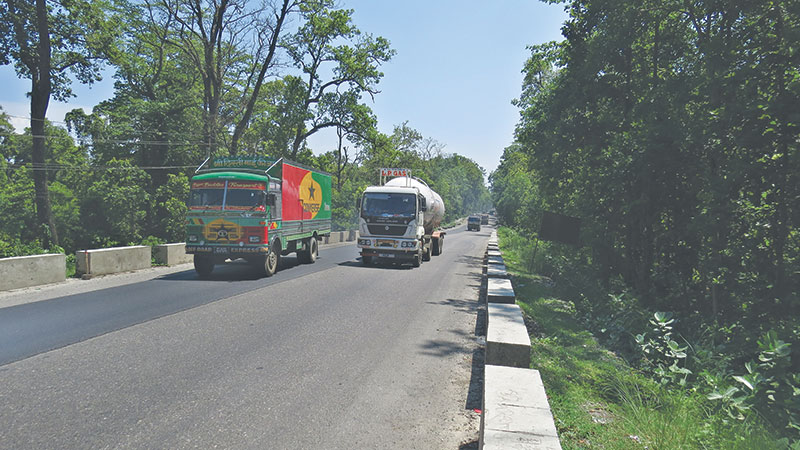
Trucks ply the Aaptari-Ramnagar stretch of the Narayangadh-Muglin road on Wednesday. Post Photo: RAMESHKUMAR POUDEL

CHITWAN, JUNE 6
With the completion of first phase of road blacktop work, the Narayangadh-Muglin road section has opened round-the-clock from Wednesday. Workers completed the first phase of blacktopping along the 33.2-km road section on Tuesday.
The passengers will now be spared hours of long traffic jams and dust they suffered for three years. The road section remained closed for six hours from 10am to 4pm every day  since January for the road expansion and blacktopping works.
“The road stretch is now open to traffic for 24 hours as the first phase of blacktopping has been completed,” said Engineer Shiva Khanal, the information officer at the Narayangadh-Muglin Road Project. A vehicle can pass through the road section in 35 minutes if there are no   other obstacles, claimed Khanal.
The Narayangadh-Muglin section, a major road linking Kathmandu with other parts of the country, carries the heaviest traffic in the country, accounting for 90 percent of Nepal’s total international trade traffic. Around 20,000 vehicles ply the road section daily.
The road project, which is being carried out with Rs3 billion aid from the World Bank, will upgrade and expand the 33.2-km section of the road section to the Asian Highway standards and address road safety, axle-load control and environmental sustainability issues along the trade corridor.
The road will be expanded to a double-lane road with a width of 9-11 metres. The current width of the road is 5.5 metres. The road will be widened up to 11 metres from Aaptari to Jugedi, and up to 9 metres till Muglin.
According to project officials, around 92 percent of work along the 33.2-km section has been completed. Engineer Khanal said that road should be blacktopped in three phases for road surface marking. As per the agreement, the pitch should be 16cm thick, 6-6 cm during the first and second phase of blacktopping and 4 cm in the third phase.
Khanal estimated that it would take around 20 more days to complete all three phases of the blacktopping work. “The construction of around 3,100-metre-long road barriers and maintenance of 14 bridges along the section has yet to be completed,” he added.
The road project has been divided into three sections. Different construction companies have worked on each section since 2015. The deadline was extended four times to complete the road expansion work. The latest contract extension ended on May 30.

HOME PAGE

NCP finally gets legal party status

- Post Report
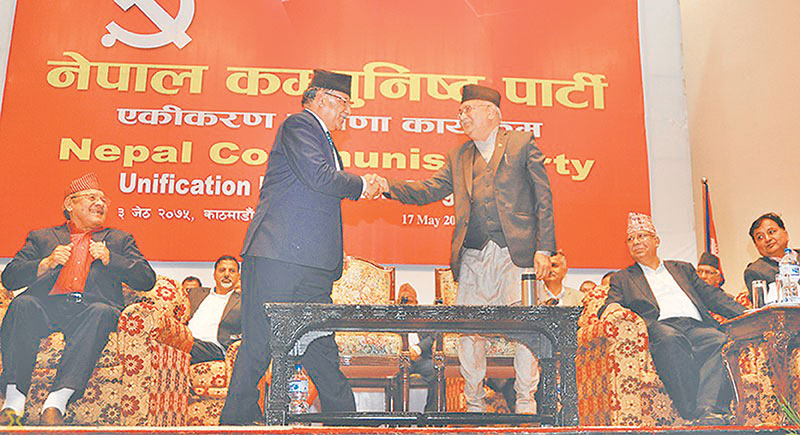
CPN Co-chairmen Oli and Dahal shake hands during party unification function in Kathmandu last month. Post File Photo

KATHMANDU,
The Election Commission (EC) has decided to register Nepal Communist Party (NCP), nearly three weeks after the merger between the CPN-UML  and the CPN (Maoist Centre). The decision was made at a meeting of the EC commissioners on Wednesday.
The EC decision has given the legal status to the NCP which does not have 33 percent representation of women in the party’s central committee.
According to Election Commissioner Narendra Dahal, the commission has decided to write to all the registered political parties, calling them to ensure 33 percent representation of women in their central committee within a month.
“Our job is to guide and facilitate political parties for better management. But again, it has to be a two-way process,” Dahal said when asked if the commission’s decision set a wrong precedent. “The EC will take a decision based on the specific case if similar situation arises in the days to come.”  
The Party Registration Act states that a party needs to ensure 33 percent representation of women from the central to local levels. Only 72 women leaders have been nominated in the central committee which accounts for only 16 percent of the 441-member NCP Central Committee.
The party’s 45-member Standing Committee has two women leaders, while there are no women representatives in the nine-member Central Secretariat. The NCP will have to either replace male leaders with female or increase the number of central committee by inducting women leaders to abide by the EC decision.
The name of the newly-established party had gathered eyeballs ever since its announcement as Rishi Kattel had already registered a party with the same name. The NCP had initially filed an application with an underline beneath the party name to ensure that they are entitled to obtain the same party name. As it was not practical, the party again decided to register it as Nepal Communist Party. Kattel’s party has no acronym.  
The meeting of the commissioners had also convened on Tuesday on the same agenda, but the meeting could not reach to any conclusion.

HOME PAGE

IBN refutes govt claim on West Seti Project

Says there has been no decision to scrap pact signed with China Three Gorges on 750MW undertaking
- BIBEK SUBEDI

KATHMANDU, 
Investment Board Nepal (IBN) has refuted Finance Ministry’s claims that the government would build the West Seti Hydropower Project with internal resources as stated in the recently released budget statement for fiscal 2018-19.
There has been no decision to scrap the pact signed with China Three Gorges Corporation (CTGC)--the potential developer of the 750MW reservoir-type project, the IBN said in a statement on Wednesday.
“Recent media reports suggesting that the accord signed with the Chinese developer will be scrapped and the government will build the project on its own have drawn our attention,” the statement reads. “No such decision has been made by the government.”
The board is reviewing the recommendations made by a government panel on taking the project forward, and it is yet to reach a decision on the issue, the IBN added.
Presenting the federal budget for the next fiscal year on May 29, Finance Minister Yubaraj Khatiwada had said the construction work on West Seti would be commenced by mobilising internal resources.
Highly-placed government sources said the IBN statement has come as damage control after the Chinese side expressed concern over the budget statement. “There was concern from the Chinese side after the budget statement talked about building the West Seti through internal resources,” said a source, adding that there was a meeting at the Prime Minister’s Office over this issue.
The project, located in far-western Nepal, has been languishing in uncertainty after the CTGC said it would not go ahead with the scheme if the power purchase rate was not increased. The IBN board of directors formed the committee last March to suggest possible ways to break the stalemate.
The panel has suggested to the government either to scrap the agreement signed with the CTCG or provide it a second chance to build the scheme by scaling down the installed capacity.   
“There was confusion after the budget speech from stakeholders including the developer. The issue of West Seti construction with the CTGC has not reached to the logical conclusion. That’s why we’ve issued the press statement to clarify the issue,” said Maha Prasad Adhikary, CEO of the IBN.
According to the IBN, the committee said the government should build the project on its own by coordinating with the provincial government if it scraps the deal with the Chinese company. The second option is to slash the installed capacity to 600MW as proposed by the CTGC more than a year ago, and allowing it to proceed with the project. During a meeting last year, CTGC officials had proposed decreasing the installed capacity citing a drop in the water level in the river. However, the Nepal Electricity Authority (NEA), the venture partner of the Chinese company in the project, rejected the plan.
A few months ago, CTGC asked IBN to guarantee a rate of return of 17 percent on the project arguing that it would not be bankable at the power purchase rate fixed by the government. When asked about the West Seti, Chinese Foreign Ministry Spokesperson Hua Chunying said information about Nepal government scrapping the West Seti deal is not true. “According to the information I have, this report is not true. The relevant project is a commercial one. The Chinese firm involved is in talks with the Nepali side on this project’s economic feasibility and other matters,” she said on Wednesday in a regular press meet in Beijing.
As per the power purchase rate made public by the Energy Ministry in January 2017, reservoir-type projects like the West Seti will get Rs12.40 per unit during the dry season which lasts from December to May, and Rs7.10 per unit during the wet season which lasts from June to November. The IBN then decided to take the matter to the board.
The West Seti has been in limbo since CTGC subsidiary CWE Investment Corporation and the IBN signed a memorandum of understanding to construct the hydropower project in August 2012. It took more than five years to sign a joint venture agreement between the CTGC and NEA, the state-owned power utility. As per the pact, the Chinese company will have a 75 percent stake in the joint venture company, while the NEA will hold the rest of the shares.
The West Seti Hydropower Project will extend across Baitadi, Bajhang, Dadeldhura and Doti districts, and is expected to generate 2.8 billion units of electricity per year.

Page 2
NEWS

Health insurance plan yet to cover 38 districts in Nepal

- Post Report

KATHMANDU,
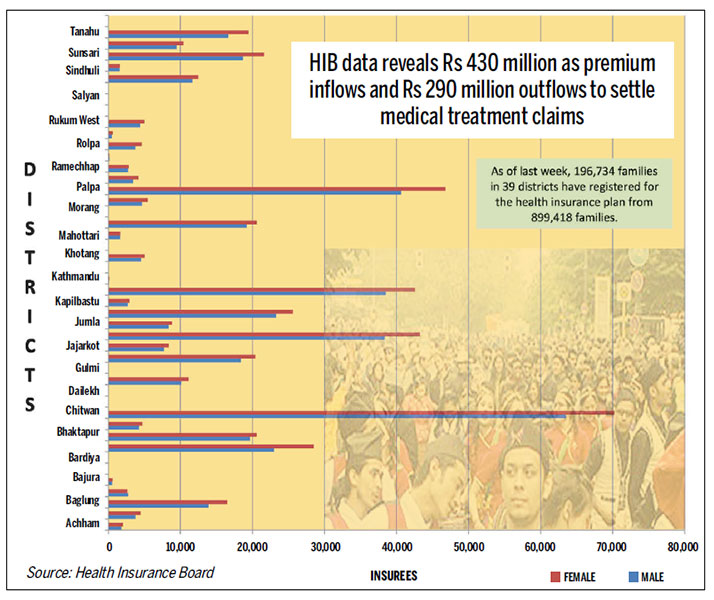
The public health insurance plan, started by the central government in 2016-17 fiscal, is yet to cover 38 of the 77 districts, Health Insurance Board (HIB) data shows.
As of last week, 196,734 families in 39 districts have registered for the health insurance plan from 899,418 families.
The government first launched the public health insurance plan in 2016-17 from Kailali, Baglung and Ilam districts.
HIB data reveals Rs 430 million as premium inflows and Rs 290 million outflows to settle treatment claims.
Citizens have shown little interest in health insurance policies. The government plans to include more
people under health insurance cover by enforcing the policy strictly on the government staff, already mandatory for public servants and migrant workers.
Department of Health Services Director General Dr. Guna Raj Lohani said, “As of now, the insurance plan is voluntary. Entry of government staff including civil servants, teachers, army and police personnel would encourage more people to enroll.”
Under this plan, a family of up to five members must pay a premium of Rs 2,500 annually to avail health services up to Rs 50,000. A family comprising more than five members, must pay Rs 425 for each additional member. This would qualify them for an additional insurance cover of Rs 10,000.
The limited amount of health cover discourages people register for this plan, health experts say. The amount provided under the plan would not suffice to treat one member of the family in some cases, insurance experts argue. Addressing these concerns, Dr. Lohani said planners have discussed increasing insurance coverage to Rs 100,000 from the current Rs 50,000 per family.
Health experts also stress on improvement of local hospitals for effectiveness of the policy.  As per the policy, insurance policy holders can avail health services at primary health centres and district hospitals.
Substandard health services at local hospitals compel beneficiaries to travel to cities where the government has empanelled some hospitals.
Health Insurance Board Executive Director Dr. Madan Kumar Upadhyaya said, “Universal coverage of health insurance means reducing medical costs for people drastically. However, as long as public hospitals are not good enough in providing services, people will not have the motivation to choose health policies.”
The private hospitals can provide these services after Health Ministry permits, under the same charges fixed by the government.
Dr. Ramesh Koirala, a heart surgeon and an adviser to former Health Minister Gagan Thapa said proper monitoring of private sector, and providing treatment under the scheme, would be crucial in ensuring quality health services for people.
The government aims to expand its health insurance plan in all 77 districts. Finance Minister Yubaraj Khatiwada has allocated funds to this end.
Khatiwada has said the government will make health services easily accessible and reliable for citizens.

NEWS

Khatiwada urges transparency in using grants to rebuild houses

- RASTRIYA SAMACHAR SAMITI
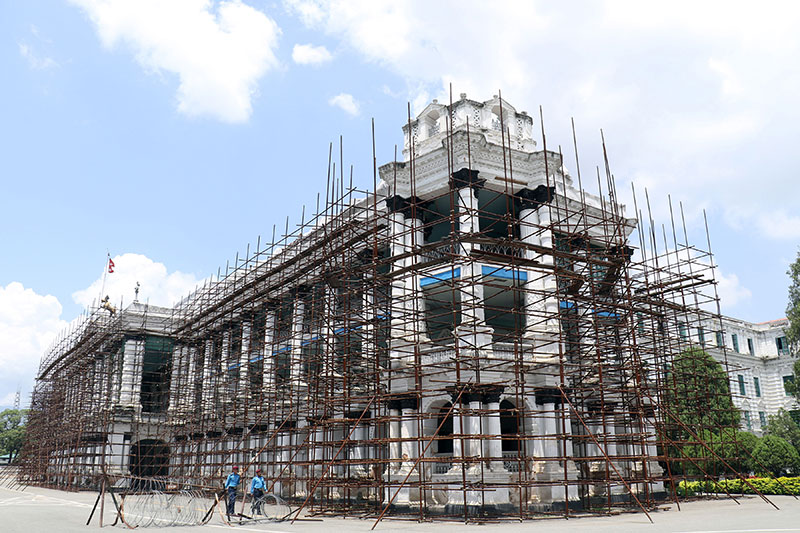
Retrofitting work on Singha Durbar begins on Wednesday with the installation of scaffolding around the building damaged by the earthquake on April 25, 2015.  RSS

Kathmandu,
Finance Minister Yubraj Khatiwada has said that the grant provided to earthquake victims for reconstruction of private houses should be spent in a transparent manner.
Inaugurating a seminar organised by the National Reconstruction Authority on Wednesday, Finance Minister Khatiwada said that the government has given first priority to the reconstruction of private houses.
“House owners should be active in rebuilding their homes as the government has been providing grant after taking loan from donor agencies. It is the responsibility of house owners to construct their houses,” Khatiwada said.
He added that the NRA was ready to resolve problems surfaced in course of reconstruction. He said that the Nepal Rastra Bank and NRA would make criteria to ease the process for concessional loan said to be given for reconstruction.
Similarly, NRA Chief Executive Officer Yubraj Bhusal said that out of 102,000 houses that need to be reconstructed in Kathmandu Valley, 10,000 have already been rebuilt and the process begun to construct 25,000 others. “Still 15,000 quake victims have yet to sign agreement for the reconstruction of houses. This programme is organised to solicit feedback from people’s representatives to resolve problems surfaced in this regard,” Bhusal said.
Presenting details on the progress in the reconstruction sector, NRA Spokesperson Krishna Prasad Dawadi and Joint-spokesperson Manohar Ghimire said that a total of 161,000 houses have been reconstructed across the nation. Mayors of Kageshwori Manohara and Dakshinkali municipalities—Krishna Hari Thapa and Mohan Basnet—said the real earthquake victims are still out of the list of beneficiaries. Secretary at the Ministry of Agriculture, Land Management and Cooperatives Gopinath Mainali, Chief of District Coordination Committee, Kathmandu Shiva Sundar Baidya also shared their thoughts on the matter.

NEWS

Congress appoints Pandey as PP leader

News Digest

KATHMANDU: Nepali Congress (NC) President Sher Bahadur Deuba has appointed leader Surendra Pandey as the Parliamentary Party leader at the National Assembly (NA). Pandey, who is also the party’s central member, has become the member of National Assembly for the first time. The NC has 13 lawmakers in the NA. Pandey said Congress would play a constructive role as opposition in the Parliament. (PR)

NEWS

Saarc and Unicef renew agreement

News Digest

KATHMANDU: The South Asian Association for Regional Cooperation (Saarc) and United Nations Children’s Fund (Unicef) have renewed a cooperation agreement. Saarc Secretary General Amjad Hussain B Sial and Jean Gough, regional director at Unicef Regional Office for South Asia (Unicef Rosa), signed the agreement on Tuesday. The agreement focuses on the development, protection and participation of children, and raising the awareness, understanding and action for children, through policies and programmes, theUnicef said in a statement. “Saarc and Unicef Rosa enjoy excellent collaboration, and work together on issues related to children, education, early childhood development, maternal and adolescent nutrition,” the statement added. “The collaboration is also taking place on issues of child marriage, gender equality, violence against children and health issues in South Asia.” (PR)

NEWS

City to host Asian labour meeting

News Digest

Kathmandu: Kathmandu will host a ministerial-level meeting of Colombo Process in November, the Permanent Mission of Nepal to the United Nations in Geneva said in a statement on Wednesday. The Colombo Process is a regional consultative process on labour migration which comprises 12 Asian countries—Nepal, India, China, Afghanistan, Bangladesh, Cambodia, Indonesia, Pakistan, Philippines, Sri Lanka, Thailand and Vietnam. Nepal is the current chair of the process. The process could help member states develop a common labour agreements for the welfare of migrant workers and guaranteeing their rights. (RSS)

Page 3
NEWS

Confusion in RJP-N over party establishment day

- Post Report

KATHMANDU,
The Rastriya Janata Party-Nepal, which was formed last year following a merger of six Madhes-based fringe parties, has yet to decide on the date for party’s first national convention.
The six parties had announced their merger
on April 20 last year and the first meeting of the newly-formed RJP-N endorsed the decision on May 2. Subsequently, the party applied for registration at the Election Commission on July 7. After endorsing the registration on July 14, the EC informed the party on July 16.
The party had promised the EC to hold its national convention and finalise office bearers of the party’s central committee within a year.
But the leaders have to decide the deadline yet which would have allowed them to ask the poll body for an extension of the national convention date.
“RJP-N has not yet fixed its establishment date. We are ready to consider July 14 as the cut off day,” said RJP-N General Secretary Keshav Jha.
Leaders claimed that the party could not convene a meeting as the party coordinator had been to India for more than 45 days for a medical check-up.
Even the political meeting, scheduled for Friday, might also be postponed with most of the political committee members attending the Province 2 government’s presentation of its police
and programmes on Thursday. It would take a few more day before Parliament approves the policies and programmes and the provincial government endorses a budget.
At Wednesday’s presidium meeting, the party finalise the statute of the parliamentary party paving the way for the national convention. The leaders also discussed regulations and party’s declaration.

NEWS

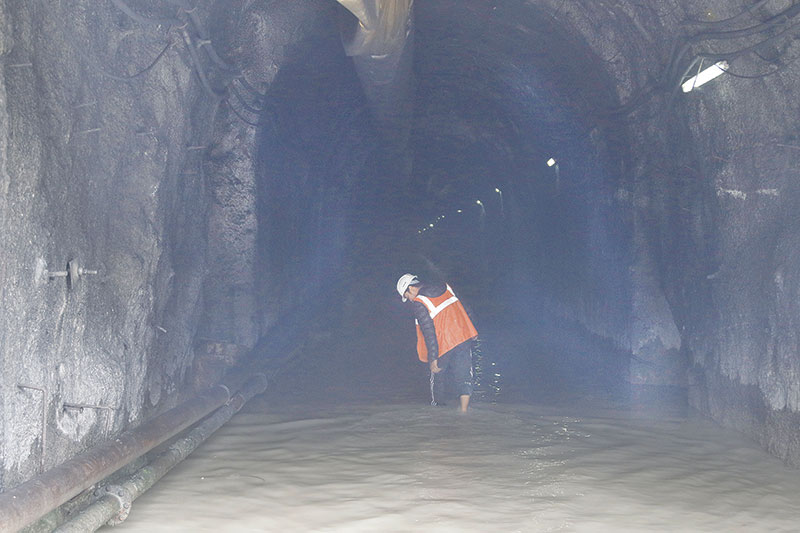
Melamchi project crawls as Italian firm dithers on job

- CHANDAN KUMAR MANDAL

KATHMANDU, 
Melamchi project work continues to crawl as the contractor has failed to honour his commitment to work efficiently as per schedule and supply water to Sundarijal by August this year.
After completing the digging work for the tunnel on April 12, the Italian contractor for the project Cooperativa Muratori e Cementisti di Ravenna (CMC) had vowed to complete all pending work by August.
Government officials are on tenterhooks by the slow pace of work because national pride is at stake. They fear project may again miss the deadline as not much work has been done in the period post the tunnel breakthrough.
Water Supply Ministry Secretary Krishna Raj B.C. said the contractor has drifted away from their commitment made to Nepal government.
Recalling CMC (China) Regional Manager Salvatore Caciero’s commitment made at the breakthrough event in April, Secretary Krishna Raj. Said, “Their commitment to deliver does not reflect at the site. This would compromise the government’s image as another delay will break our goodwill with the public.”
Soon after the tunnel breakthrough, a meeting was held on April 26 between Melamchi Development Board (MDB), Asian Development Bank, the Consultant Engineers (Eptisa) and the contractor CMC. During the meeting, an action plan mentioned works that would be completed from May 1 to August 30. They also agreed to expedite the work. The CMC had agreed to divert Melamchi water to Sundarijal on August 15.  After the action plan, a series of meetings followed with stakeholders. Officials had told the contractor to follow the schedule and accelerate work with monsoon round the corner, said Secretary Krishna Raj.
During the two meetings held on May 10 and May 17, the contractor promised to follow the timetable and put aside their demand of additional Rs1.65 billion from the government. They also invited a high-level ministry team to inspect the site.
“Although the delay issue is under consideration with the Dispute Board (DB), they promised to continue the work. This was not done as per the plan,” said the secretary. The ministry visiting noted the work was behind schedule and no one from CMC was present at the site.
The team observed that only 52m of invert lining was done, far less than the planned 210m per day. As per the action plan, they should have completed 6km of inverting and tunnel finishing per month to stay abreast of the schedule.
The consultant engineer then issued ‘Notice to Correct’ to the contractor, urging them to work as per the schedule.
In a shocking development, the consultant Eptisa, through a letter dated June 6 addressed to the MDB, informed its Resident Project Manager Thomas Berberich was no more with the project.
“The EPTISA needs the Board’s consent and approval to replace consultant. They did not get the approval. They informed after removing the team leader of the contractor,” said a high-level ministry source. He said they did not give reasons why they terminated the Project Manager’s contract just before the DB Hearing Process on June 8.
The hearing will discuss the contractor’s demand for additional money for the additional work required for open cutting and slope stabilising in the Headwork area after the earthquake.
The contractor had to carry out nearly 60,000 cubic meters of open cut at the Headwork site. They demand additional Rs 1.65 billion for this work. The government paid them Rs 280 million for the additional work. Slowing down their work right before the deadline and working haphazardly as per their wish raises questions about their intentions to complete the work in the stipulated time, said the source.  
“Termination of Berberich, who strongly refuted the contractor’s claim, and sluggish work progress at the 11th hour, shows they want to influence the project completion,” added the source.

NEWS

Home Ministry vows action against delinquent builders

- Post Report

KATHMANDU,
Home Minister Ram Bahadur Thapa on Wednesday vowed to take action against those contractors who fail to complete their task within the deadline.
Addressing a press conference at the ministry on Wednesday, Minister Thapa said: “Stern action will be taken against anyone who violates the law regardless of their status.”
He was responding to a pointed question if any action would to be taken against Pappu Construction owned by lawmaker Hari Narayan Prasad Rauniyar of the ruling Sanghiya Samajbadi Forum-Nepal and that of Shailung Construction, whose Chairman Sharada Prasad Adhikari is the landlord of Nepal Communist Party Co-chairman Pushpa Kamal Dahal, are of particular interest for the number of projects being built and the delays.
“We have already made it clear that whoever violates the agreement and misuses the state coffers are criminals. And this issue is under the jurisdiction of the law,” Thapa said.
The government’s crackdown on non-performing and under-performing contractors will be continued, Minister Thapa asserted.
On the gold smuggling case, the home minister said that ‘big fish’ of the gold smuggling racket have become restless as the investigation into the case nears its conclusion.
“We have arrested some small and medium fish. Hopefully, we will get hold of the big fish behind the gold smuggling,” he said.
He admitted that some elements are trying to influence the ongoing investigation into the case.
Minister Thapa said the deadline of the probe committee formed under the ministry could be extended if necessary, but “we will reach a conclusion soon”.
He further said the investigation is also looking into money-laundering and illegal remittances as they are related to gold smuggling. “The Home Ministry is working to demolish such nexus.”

NEWS

Contractors blame late payment for delay

anamolies in govt contracts
- PRITHVI MAN SHRESTHA

KATHMANDU,
The government’s failure allocate adequate budget as well as timely payment to the contractors have delayed several projects.
Delays in payments have given contractors, who are not doing well, to give some excuse. Many contractors are not doing any project work and misusing the advance payment to buy land and houses.
The Home Ministry has taken action against such truant contractors. Although police has arrested some of the under-performing contractors, the government too is guilty for not taking punitive action against contractors who are politically well connected.
Though contractors are at fault in many projects, the government’s failure to ensure budget and failure to pay them on time are the reasons for the slow progress, admit  some government officials.
Currently, 926 bridges are under construction. These require Rs63 billion, but the government has allocated just Rs3.5 billion in the current fiscal year, according to Department of Road (DoR). For the next fiscal year, Rs2.88 billion has been allocated for the bridges to be built on roads.
“There has already been works worth Rs10 billion in the current fiscal year, but we could not pay the contractors in the absence of adequate funds,” said Mukti Gautam, spokesperson at DoR.
Recently, the bridge section of the DoR submitted the list of projects with additional budget demand of Rs6.8 billion to the Finance Ministry to pay contractors for completed works.
“We have received Rs2 billion so far and are in the process of making payments,” said an official of the bridge section of the DoR.
According to the department, they have failed to pay around Rs15 billion to contractors who have completed road projects.
Contractors have blamed that the government’s failure to pay on time as one of the reasons for the slow progress of many projects.
“Without timely payment, the contractors are forced to stop work which causes the delay,” said Ram Sharan Deuja, secretary general of Federation of Contractors’ Association of Nepal (FCAN). According him, the contractors are yet to receive around Rs55 billion from the government. Some payments are due since the beginning of the current year.
One of the reasons for the crunch to pay to the contractors is the government diverting funds meant for various projects, handled by the central government agencies, to local governments.
“There is no budget allocated under three budget headings-123, 147 and 148 which are related to regional and urban road projects handled by us because of reallocating budget meant for us to the local governments,” said Gautam.
“As the projects were not transferred along with budget to the local governments citing the lack of their capacity at the moment, we are now seeking transfer of budget to us from other headings to pay to the works undertaken in various projects with no budget.”
 The failure to clear hurdles such as providing rights of the way, clearance of electricity and telephone pillars are other aspects that have affected the construction works.
Contractors admit that there are ‘bad apples’ among contractors who have misused advances to buy land and houses instead of the projects.
“There is a legal mechanism to pay the advance in two instalments. Only after seeing the progress in first instalments, second instalment is paid. But, due to collusion between the two sides, even those not working in the projects have received full advances,” said Deuja.

NEWS

Authorities arrest two firm owners for not delivering

- Post Report

SINDHUPALCHOK/MUGU, 
Authorities have arrested two contractors in Sindhupalchok and Mugu districts as part of the Home Ministry’s crackdown against non-performing and under-performing contractors.
The District Police Office, Sindhupalchok, on Wednesday detained Dharma Raj Bhandari, whose firm was contracted to repair the 25 km Khadichaur-Jiri road, from Chautara. The proprietor of Khimti Construction Company, Bhandari had fled without completing the project. Superintendent of Police Mohan Prasad Pokharel said they arrested Bhandari for failing to deliver on the contract that required his company to complete the project a year ago.
Bhandari had gone out of contact four months ago after completing only half of the work. In Mugu, police arrested Barma Jung Bam of Rashmi Construction Service at the instruction of the District Administration Office (DAO) on Tuesday.
Police apprehended Bam from Jumla after his company failed to gravel the 9 km Gamgadhi-Rara Airport road. Bam’s firm had won the contract for the Rs3.8 million project that was to be completed by June 13, 2017. Chief District Officer (CDO) Umakanta Adhikari said Bam was detained because he was liable for non-performance on the contract. Bam is also accused of failing to complete the construction of the Khallagad Bridge in Kalikot district.
Meanwhile, the DAO, Achham, has send the names and details of the contractors to the Home Ministry for failing to meet the deadlines of several projects.
CDO Krishna Prasad Acharya said that the details of eight contractors who failed to complete the construction of eight road and two bridge projects had been sent to the ministry.
The DAO, Doti, is also collecting the details of the non-performing and under-performing contractors. CDO Birendra Kumar Yadav said the office was assessing the progress of the development projects that were under way in the district.  

Page 4
NEWS

7,000 families in Makwanpur yet to receive housing aid rants

earthquake reconstruction
- PRATAP BISTA
A bricklayer builds a house wall at Bhimphedi Rural Municipality in Makwanpur. Post Photo

HETAUDA,
Around 7,000 earthquake-affected families in Makwanpur have still not signed the housing aid agreement in absence of land ownership documents.
More than three years have passed since the devastating earthquake of April 25, 2015, and these families have not even begun the first step towards building new homes. The National Reconstruction Authority (NRA) has included these families on its housing aid beneficiary list, but without landownership documents, they are unable to claim the housing aid that the government offers in three instalments.  
This problem emerged because the concerned families had either been squatting on public land or living without land ownership documents before the earthquake, said Somnath Timalsina, chief of the NRA Project Implementation Unit, at a public hearing organised by the human rights organisation, Insec, on Wednesday.
In some cases, Timalsina said, the persons whose names were included on the list have either deceased or gone abroad for employment.
There are also some technical issues caused due to joint land ownership, he added.  
According to the NRA, there are 4,257 families without land ownership certificates in the district; 213 of them are landless.
Forty-three persons whose names were included on the housing aid beneficiary list have died and 170 are in foreign countries.
Similarly, 81 people have joint land ownership papers.
According to the NRA records, 31,817 families in Makwanpur were included on the housing aid beneficiary list; among them, only 24,887 families signed the housing aid agreement with the NRA.
So far, 23,969 families have received the first instalment of the aid, while 14,815 and 5,757 families have received the second and the third instalments respectively.
Currently, 14,628 homes are under construction in Makwanpur.
Raghunath Khulal, chairman of the District Coordination Committee, expressed concern about sluggish progress of the reconstruction work in  the district.
With the current pace of work, he said, the earthquake-affected families are unlikely to have new homes even after five years.

NEWS

Conserving ancient relics

- RSS

RUPANDEHI: A conservation project is underway at Sainamaina Municipality-1 in Rupandehi to protect the ancient relics and heritage sites that date back to the time of the Buddha. Mayor Chitra Bahadur Karki said they recently completed fencing programme to guard the site where ancient brick walls, deep well and other historic structures and artefacts were unearthed during excavation. The municipality has also set up a museum where several excavated objects and artefacts are on display. Karki said a master plan was being prepared to support the conservation of the site. The undertaking is estimated to cost Rs 500 million.

NEWS

Province 2 MPs in ugly spat

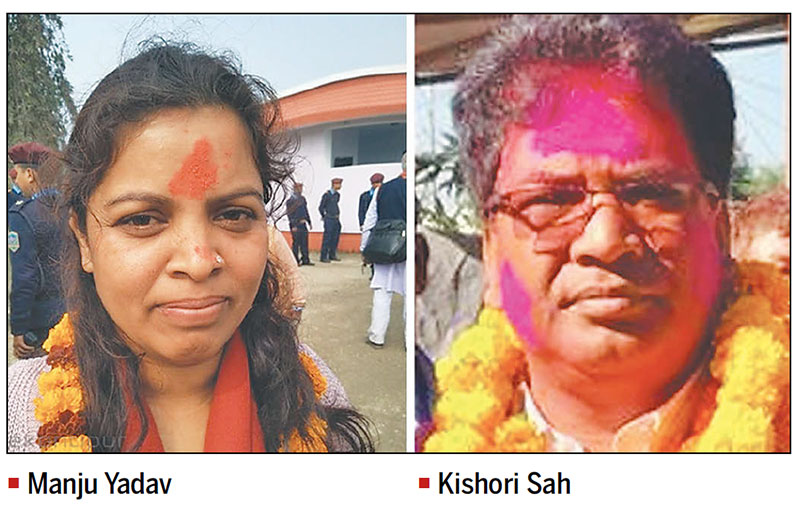
NCP lawmaker Manju Yadav slaps her colleague Kishori Sah
- SANTOSH SINGH

JANAKPUR,
Nepal Communist Party (NCP) Province 2 lawmaker Manju Yadav slapped her fellow party lawmaker Kishori Sah at the Parliamentary Party office in Janakpur on Tuesday.
Witnesses said Yadav planted a tight slap on Sah’s cheek when the latter tried to intervene in an argument that the former was having with the office computer operator.
 Yadav was in the office to get some documents typed following Tuesday’s Province Assembly meeting when she got into a verbal altercation with the computer operator because she insisted on typing the documents herself. But the argument soon took a new turn when Sah entered the office and tried to calm Yadav down.
The Post learned that Sah was the first one to ‘slap threat’ Yadav, but it was Yadav who struck first.      
Yadav was elected under the proportional representation category from Mahottari district and Sah was elected under the first-past-the-post category from Dhanusha.
Both lawmakers were left red-faced, one of them literally, after the incident.

NEWS

Bholiyani residents face double threat of flood, landslide

- MANOJ BADU

DARCHULA,
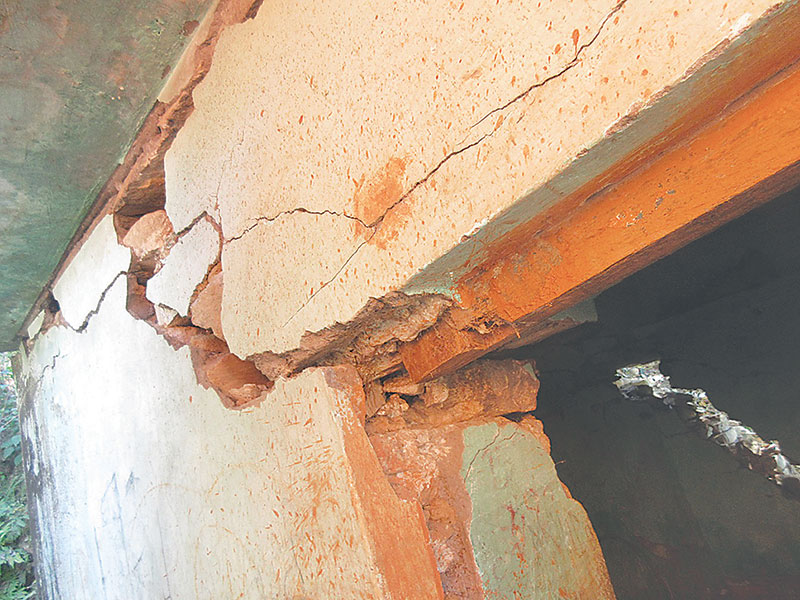
Bholiyani, a small riverside settlement in Malikarjun Rural Municipality-6 of Darchula district, is facing a double threat of flood and landslide which could force its residents out of their homes this monsoon.   
The 18 families living on the edge of the Mahakali river have so far braved the onslaught of flood, but now they also have a landslide threat to contend with.
The ground on which the Bholiyani stands is losing its solidity, cracks have opened up both outdoors and inside people’s homes.
Fourteen households are at high risk of landslide, said Gopal Singh Dhami, the municipal ward chairman.  
“The rain on Friday has made the situation worse. The people are afraid that a landslide could occur any time,” he said.
The fear of landslide has already prompted 10 families to move out of their homes. But since they have nowhere else to go, they are forced to camp outside their homes, without roofs over their heads.
“These people do not even have tarpaulin sheets to build makeshift shelters at a safe distance,” Dhami added.
Tula Magar and her family abandoned their home at Bholiyani four years ago.
She said they had to leave because of the constant threat of the Mahakali riverwaters sweeping away the settlement.
“We moved to our relative’s home, but there are several families in Bholiyani who have no place to go. The authorities concerned should relocate the settlement to a safe place before the disaster strikes,” she said.

NEWS

Police arrest silver smuggler

News Digest

MAHOTTARI: Police arrested a man in possession of 20 kg smuggled silver on Wednesday. The Armed Police Force personnel deployed at the Nepal-India border in Matihani, Mahottari, held Dipendra Thakur of Janakpur-4 with the contraband silver while he was travelling to India on a motorcycle, police said. (PR)

NEWS

Govt employee caught with bribe money

News Digest

SARLAHI: A team from the Commission for Investigation of Abuse of Authority (CIAA) arrested an administrative officer at the Siraha District Administration Office (DAO) while taking bribe on Wednesday. Suresh Das was caught red-handed in front of the District Court with Rs 50,000 bribe.
He had allegedly demanded the money from a client to help settle a legal case. (PR)

NEWS

Lightning kills woman and her grandson

News Digest

HETAUDA: A 55-year-old woman and her grandson died after being struck by lightning at Bakaiya Rural Municipality-9 in Makwanpur district
on Tuesday night.
Four other family members were injured in the incident. Police identified the deceased as Chhalimaya Thing and her 15-month-old grandson Devsingh. The victims were asleep in their home at the time of the incident. The injured were taken to Hetauda Hospital for treatment. Lightnings have claimed nine lives in Makwanpur in the past 10 months. (PR)

NEWS

Suspected bird flu kills over 400 chicks

News Digest

INARUWA: More than 400 chicks have died of suspected H5N1 or bird flu virus at a poultry farm in Koshi Rural Municipality-6, Sunsari. The poultry farmer, Upendra Yadav, said the chicks he had recently bought from Kailashpati Hatchery in Chitwan started dying from Monday evening. Concerned locals have urged the District Livestock Service Office to conduct a clean-up in the area and run necessary test to confirm the disease that killed the fowls. (RSS)

Page 5
WORLD

Kim turns from threats to hugs in diplomatic drive

- AGENCE FRANCE-PRESSE

SEOUL,
From threats of war to brotherly hugs, North Korean leader Kim Jong-un has emerged as a skilled diplomat with the unexpected assistance of a new player in the game: US President Donald Trump.
Kim’s sudden turn to statecraft at the height of tensions is straight out of a North Korean playbook that goes back decades, analysts say, but Trump’s spontaneity has allowed it to have an unprecedented impact on the field of diplomacy.
After a year of multiple missile launches that brought the US mainland within range of his rockets, and the North’s largest atomic test to date, Kim declared Pyongyang’s nuclear quest complete and began his overtures for negotiations.
Kim reached out to the South’s dovish President Moon Jae-in in time for the Winter Olympics and later made his international debut with a surprise trip to traditional ally China to finally pay his respects to President Xi Jinping, repairing a relationship that had frayed in recent years.
He is due to hold a historic summit with Trump next week in Singapore, brokered by Moon—the first-ever meeting between a sitting US president and a North Korean leader. “It was premeditated,” said Kim Hyun-wook, a professor at the Korea National Diplomatic Academy.
“Kim knew that if he started by fixing inter-Korean ties, it would lead to talks with the US and China would reach out.” In meetings with the South Korean and Chinese leaders, including seaside strolls and al fresco woodland tea, Kim has appeared polite and pleasant, a stark contrast to Pyongyang’s previous chest-thumping.
The North Korean leader has also extended goodwill gestures to the US, releasing three American detainees and dismantling his nuclear test site, while halting missile launches for over six months.
“Kim’s not just good at maximum pressure, he’s also pretty good at maximum engagement,” said Jung Pak, a former North Korea expert at the CIA who is now a scholar at the Brookings Institution.
He has proved “quite skilled at playing the regional players against the other”, she said, and “sees Beijing as a key counterweight (and probably an insurance policy) against the United States”.


Singapore FM to visit Pyongyang
SINGAPORE: Singapore’s foreign minister will make a two-day trip to Pyongyang starting on Thursday, as preparations for a summit in the city-state between Donald Trump and Kim Jong-un accelerate.
Vivian Balakrishnan will pay the official visit to the North Korean capital at the invitation of the North’s Foreign Minister Ri Yong Ho, Singapore’s foreign ministry said in a statement.
The minister, who will be accompanied by foreign ministry officials, will also meet the North’s
ceremonial president Kim Yong Nam, the statement said.
It did not give details about the reason for the trip. But preparations for the historic June 12 meeting between the US president and North Korea’s leader have been gathering pace, with the White House Tuesday revealing that it will take place on the resort island of Sentosa.

WORLD

UN council asks Myanmar to cooperate with its investigators

- AGENCE FRANCE-PRESSE

UNITED NATIONS (US), 
The UN Security Council is asking Myanmar’s government to cooperate with UN experts to investigate allegations of atrocities against the Rohingya, according to a letter seen by AFP on Tuesday.
At least 700,000 Muslim Rohingya have been driven out of Myanmar since an army operation was launched in Rakhine state in August. Britain, France, the United States and the UN have described the campaign as ethnic cleansing.
After a visit to Myanmar and Rakhine state in early May, the council noted that the government had agreed to investigate the allegations but said UN bodies such as the human rights office must be involved.
Undertaking independent and transparent “investigations into all allegations of human rights violations and abuses and holding accountable perpetrators of violence, with involvement of the international community... would turn this commitment into concrete action,” said the letter sent on May 31. .
The council asked Myanmar to respond within 30 days to its request.
Myanmar has refused to allow a fact-finding mission set up by the UN Human Rights Council to enter the country, and has barred UN rights expert Yanghee Lee.
New UN envoy for Myanmar Christine Schraner Burgener is due to pay her first visit to the country in the coming weeks. Myanmar has rejected allegations of widespread abuses during the military campaign and argued that the operation was aimed at rooting out extremists.

WORLD

Iran stands ground on nuclear inspections

- REUTERS

VIENNA, 
Iran will not cooperate more fully with atomic inspectors until a standoff over its nuclear deal is resolved, its UN envoy said, as one signatory warned Tehran against moving ahead with preparations to boost its uranium enrichment capacity.
European powers have been scrambling to salvage the agreement they signed in 2015 since US President Donald Trump pulled Washington out last month and said he would reimpose far-reaching US sanctions on Iran.
Foreign and finance ministers from those three countries - France, Britain and Germany - have written to US officials to stress their commitment to upholding the pact, and to urge Washington to spare EU firms active in Iran from secondary sanctions.
An Iranian withdrawal from the deal, which lifted sanctions on Tehran in exchange for curbs on its nuclear programme, would “further unsettle a region where additional conflicts would be disastrous,” the ministers wrote in the letter dated June 4 and seen by Reuters on Wednesday.
Since the US pullout was announced, authorities in Tehran have sent mixed signals on whether they believe the nuclear deal’s remaining signatories, which also include China and Russia, can salvage it.
Supreme Leader Ayatollah Khamenei said on Monday he had ordered preparations to increase uranium enrichment capacity if the agreement collapsed.
Tehran also informed the International Atomic Energy Agency (IAEA), the UN nuclear watchdog that polices restrictions placed on its activities under the deal, of “tentative” plans to produce the feedstock for centrifuges, the machines that enrich uranium.

WORLD

China urges respect for nuclear deal

BEIJING: China urged all parties to the Iran nuclear deal to uphold the pact on Wednesday after Tehran unveiled plans to boost uranium enrichment capacity following Washington’s pullout from the agreement.
Iran said on Tuesday that it would boost its capacity by opening a centre for production of new centrifuges, possibly as early as Wednesday, at the Natanz plant.
Under the 2015 nuclear agreement that Iran signed with world powers, it has the right to build and test certain centrifuges, though detailed restrictions exist for the first 10 years on the types and quantities of the machines.
“Under the current situation, we hope that all parties concerned can proceed with the long-term and overall interests in mind and continue to sustain and implement the agreement,” Chinese foreign ministry spokeswoman Hua Chunying told a regular press briefing. (AFP)

WORLD

In polluted India, engineers find novel way to capture diesel genset soot

- REUTERS

NEW DELHI,
India has some of the worst air pollution in the world and smog levels often spike during its sweltering summers, when smoke-belching diesel generators are used to offset power shortages, as air-conditioners and fans stoke consumption.
But a team of Indian engineers has figured out how to capture some of the generator exhaust and turn it into ink, keeping the emissions from entering the atmosphere.
They say they have created the first-ever device to capture emissions specifically from diesel generators—a welcome invention for a country that has 14 of the world’s 15 most polluted
cities, the World Health Organization (WHO) says.
“We are aiming to bring down pollution levels in the major cities by a very significant percentage in a very short span of time,” said Arpit Dhupar, one of three engineers who developed the technology now installed in Gurugram, a satellite city of New Delhi, the capital.
Their device attaches to generators to capture up to 90 percent of soot particles from cooled diesel exhaust. The material can then be sold to ink manufacturers.
Their company, Chakr Innovation, has installed 53 devices in government firms and offices, as well as real estate developers, Dhupar said, saving 1,500 billion litres of air from pollution. It has collected over 500 kg of soot, which has been used to create more than 20,000 litres of ink, he added.
Chakr Innovations is not the first start-up to see cash in diesel exhaust.
A competitor called Graviky Labs, based in the southern city of Bangalore, is using similar technology to turn diesel exhaust from vehicles into ink.
About 1.1 million people die each year from the effects of India’s air pollution.

WORLD

Change a-brewing as health-conscious Brits snub booze

Drinking culture
- AGENCE FRANCE-PRESSE

LONDON,
Britain has celebrated its drinking culture for centuries but initiatives such as the “Dry January” campaign show body-conscious adults are now shunning alcohol in record numbers—a phenomenon seized upon by the drinks industry.
“I actually realised I slept better, I felt great, I had a lot more energy,” 47-year-old Stuart Elkington said after he made the decision seven years ago to give up alcohol while trying to start a family with his partner.
A 2017 poll showed that 57 percent of 7,100 respondents said they had drunk alcohol in the previous week—the lowest level since the annual survey, conducted by the Office for National Statistics, was launched in 2005, when the figure stood at 64 percent.
That has translated into a rise in the number of Britons who say they do not touch a drop of alcohol—just over a fifth of those questioned last year, compared to 18.8 percent 12 years earlier.
The trend is particularly noticeable among those aged 25 to 44, where the figure climbed five points to 20.6 percent.
For all the benefits he felt after just six months of alcohol abstinence though, Elkington said he had one frustration.
“The one thing I did miss was actually having a beer. When I went and tried to find a really tasty beer I couldn’t really find one,” he told AFP.
Taking matters into his own hands, in 2016 he launched Dry Drinker, an online company selling beer, wine, sparkling wine and other alcohol-free or low-alcohol drinks. The range rapidly expanded and today comprises more than 100 products. “When you’ve got kids and a family or a busy life you don’t really want to waste your time with hangovers,” he said. “For me it was about having the best of both worlds: I could enjoy some fantastic beer but without the negative aspects.”
Elkington said that sales had skyrocketed on the back of demand for products offering “the taste of alcohol but without alcohol”. The trend seems to have been amplified by the popularity of “Dry January”, which became a formal campaign in 2013, when people give up alcohol for a month after the excesses of the holiday season.
According to its instigators Alcohol Concern, five million Britons took part last year.
Sales of beer and cider containing less than 1.2 percent alcohol jumped by nearly 28 percent in 2017 compared to 2015, with demand for alcohol-free wine rising eight percent, according to consumer researcher Kantar Worldpanel.
The main driver of demand is “growing health-consciousness amongst consumers and greater awareness of the risks associated with heavy alcohol consumption,” BMI Research analysts reported.
Similar trends have been seen across developed nations.
“Low-alcohol drinks also have lower calories than conventional alcoholic drinks,” it added.
Both the alcohol and mass retail industries have rushed into the blossoming sector.
Producers are spending millions of pounds on bringing “much better quality” low-alcohol products to market.
Several alcohol-free beers have recently been launched on the British market, including one by the world’s largest brewer, AB InBev.
The Belgian-Brazilian company estimates that alcohol-free or low-alcohol beers will account for one fifth of its beer sales by volume by 2025.

WORLD

Pakistan extends curfew in border region

News Digest
- AGENCIES

PESHAWAR: Authorities in Pakistan’s restive tribal region expanded a 24-hour curfew along the Afghan border to avert further clashes between tribesmen and militants after at least three people were killed and dozens injured in recent days, officials said on Wednesday. The move comes as tensions mount in the area with burgeoning civil rights group the Pashtun Protection Movement (PTM) heightening calls for the removal of alleged Taliban-linked militants from the region. The US and others have long accused Pakistan of using proxies in Afghanistan, including the Taliban and other militant groups. Islamabad denies the claims. PTM has had repeated clashes with the militants this week during two rallies in the area, leading authorities Tuesday to expand an earlier curfew to encompass all of the South Waziristan tribal district. “Curfew has been tightened and extended to the entire South Waziristan. More than 80 people have so far been arrested,” a senior government official in Peshawar said.

WORLD

Nato rejects Qatar overture

News Digest
- AGENCIES

BRUSSELS: Nato on Wednesday declined an overture by Qatar to join the Western military defence alliance, saying membership was reserved to the United States and Europe. It was responding to a comment by Qatar’s defence minister on Tuesday that his country’s long-term strategic “ambition” was to join Nato. “According to Article 10 of the Washington Treaty, only European countries can become members of Nato,” an official of the 29-country alliance told AFP. Speaking on the anniversary of a bitter year-long diplomatic dispute among Gulf nations that has seen Qatar isolated from its former regional allies, Defence Minister Khalid bin Mohamed Al-Attiyah said Qatar wanted to become a full  member of Nato.

Page 6
EDITORIAL

Out in the streets

Govt should employ proactive measures to control population of stray dogs in the Valley

Street dogs are as inextricable part of the Kathmandu landscape as temples. The most recent data from the Kathmandu Metropolitan City estimates Kathmandu’s street dog population to be around 30,000 strays, although the number is likely higher. Sustaining themselves off garbage and scraps put out by people, these mixed-breed dogs live in groups in neighbourhoods across the Capital, often times in close proximity and contact with humans. However, the unregulated swell in their numbers in the past few years is becoming a matter of growing concern.


According to the Teku-based Sukraraj Tropical and Infectious Disease Hospital, five people died last month from rabies following dog bites. The hospital’s records show the incidences of dog bites are on the rise in Kathmandu, with 36,089 patients visiting the hospital for anti-rabies vaccinations in 2017, a rise from 29,309 instances in 2016. Records also show that the inflow of patients double on the weekends and public holidays when more children are out playing in the streets.


A combination of factors has contributed to this growing problem. One of them is the lack of oversight over the burgeoning pet industry in the country, which is currently lumped under the purview of The Ministry of Livestock Development—the government body that oversees animal welfare and industries in Nepal. While it is difficult to put a number on how big the pet economy is at the moment, some estimates put the annual turnover at about Rs 600 million. This growing obsession with foreign breeds and  excessive unregulated breeding has led to a situation where the demand for ‘high value’ pure-breed puppies have soared, while the Nepali mixed breed has literally become worthless. As a result, even though encouraging adoptions can be a viable solution to getting strays off the streets, its popularity is yet to catch on in Nepal.


Another long-term solution is Animal Birth Control (ABC). Sterilising and vaccinating dogs is a one-time intervention that can effectively reduce the number of dogs, as well as disease and behavioural problems. What’s more, ABC is relatively inexpensive: the medicine costs come to about Rs 1500 per dog. Over the years, the government as initiated several ABC drives to manage the population of street dogs, most recently collaborating with the Humane Society International on a community dog management programme with a budget of Rs 35 million in 2016. But apart from sterilising dogs in the Singha Durbar area, the project failed to expand the drive to other neighbourhoods in the Capital.


Last month, the north Indian state of Uttar Pradesh faced an unprecedented crisis when their rocketing street dog population began to turn on humans, killing 13 children. In the fallout, hundreds of dogs were lynched in retributive killings in the region.


Nepal’s, and Kathmandu’s, street dog issue pales in comparison; but by proactively rolling out innovative and humane solutions to manage the stray population now, the government could ensure that the streets remain safe for both humans and their best friends.

OPED

Imagination and reimagination of the past

It is necessary to remember the messy travails of the past to humanely reshape the present
- PRAMOD MISHRA

I am staying in Campsie, an Asian (predominantly Chinese) suburb of Sydney, and reading The Fatal Shore, an epic narrative of Australia’s founding, by Robert Hughes. Campsie is not China Town, which is somewhere in the city on the map, but it looks very Chinese.  Its L-shaped market, a concentration of ethnic shops—from grocery to gadget—looks very Asian and the layout of the neighborhood, too, is very Asian—crowded, bustling, people of all ages hanging about or walking with bags filled with daily groceries.  I walk to the market to buy Asian greens, meat and other familiar vegetables, change money, or just hang out and watch the bustle.  


For the last two days, the temperature has hovered around 55 degrees Fahrenheit, and it’s been raining.  I have rented a car and will head out to Canberra and possibly Melbourne today to avoid the rains.  Yet, I can’t say that I haven’t enjoyed walking to the market, catching the train to visit the city (it costs only $3.50 Australian dollars one way).  At the city center called Town Hall Square, blocks of indoor cavern is lined with shops, and the shops are staffed mostly by young Chinese women whose English accent betrays their new arrival to the country.  I bought an UGG alpaca scarf and a waterproof, wind-resistant Kathmandu brand hat from a Kathmandu store that sells travel and outdoor adventure apparel.  The Kathmandu brand was a pleasant surprise, and it turns out that it was founded in Christchurch, New Zealand, and its founders, too, are Australians and New Zealanders—and the company has gone through several permutations of mergers, buying and selling.  


Weave a story
In this mishmash world, Robert Hughes gives us a corrective to Australia’s founding.  Like every other nation-state, Australia, too, had its national narrative and mythmaking.  Begun as a penal colony for Britain’s social effluent—beggars, thieves, forgerers, etc—criminalised by its extremely harsh penal code related to property, Australia became the refuge after the American War of Independence when the United States newly-founded on the nobler principle of life, liberty and pursuit of happiness refused to take in any more convicts from Britain.  Hughes offers in extreme detail how the first batch of convicts arrived on January 20, 1788, in Botany Bay (today, Sydney Airport is located next to Botany Bay) and how they survived through years of starvation, how they made it, and how a new aristocracy arose and reinvented the past by both mythologising it and creating its own system of otherness and criminality by creating its own convict space in Norfolk Island, some 877 miles east of Australian mainland.  It mythologised the past by reimagining the origins of Australia’s founding as the result of Britain’s geostrategic policy of countering the French and the Dutch in their claims on India and the Spice Islands.


This aspect of nation-building has always interested me—mythology and reinvention of the origin narrative of a nation.  The dominant group within a state always interprets and reinvents the past for its own convenience and interest.  And when a new group gains prominence, it tries the same thing.  In South Africa in 2008, I saw the same thing—one dominant national narrative was waning and another rising.  The Robben Island prison of the apartheid years had turned into a busy museum and a pilgrimage—and apartheid itself had become a period of sacrifice and suffering through which the soul of South Africa had emerged well-forged and glorified as represented by Robben Island itself and by the Apartheid Museum.  Yet, when I visited the Voortrekker Monument near Pretoria, it was almost empty. I saw only an Afrikaner mother of two teenage children (a boy and a girl), showing them around, explaining the past in a reverential tone.  Indeed, that Great Trek east in a caravan of wagons away from the British power had been an epic journey for the Boar, who reinvented themselves and created their own system of us and them of the most notorious kind in the second half of the 20th century.  


A plethora of narratives
Similarly, India is witnessing a struggle between its Gandhian-Nehruvian-Ambedkarite multicultural, pluralist origin narrative of the Indian nation and its freedom struggle from colonial rule and the Hindutva narrative of the Hindu nationalists who seek the origin of the Indian nation in the mythic past of all-conquering Hindu emperors and noble kings like Ram, Raghu, Bharat and Krishna.  The Gandhian-Nehruvian-Ambedkarite narrative of the Indian nation as a liberal, tolerant community excluded Subhash Chandra Bose’s narrative of national self-esteem through valor, violence and assertion.  Similarly, the Puritan founding narrative of the United States of America stigmatised the fallen women, demonised the Native Americans and excluded the slaves.  Nepal’s own case has been going through permutations.  During the Panchayat system, Mahendra was a villain for the communists and democrats.  Now, not just King Prithvi but Jung Bahadur and King Mahendra and KP Oli have become national heroes for them.  Yet, this narrative is contested and will undergo change with the emergence of new dominant power structures.  


From Nathaniel Hawthorne to Toni Morrison, it is the writers who have exposed the anomalies in the national origin narrative.  In the case of Australia, it’s Robert Hughes who has performed his duty grandiosely.   In India also, writers, such as Arundhati Roy and Ram Chandra Guha have taken up the task of telling their corrective versions.  In Nepal, too, this imagining and reimagining of the past continues in order to influence and shape the present.’


In Australia, Keven Rudd, the then prime minister, not many years ago issued an official apology to Australia’s aborigines for all the violence and displacement the settlers perpetrated on them.  And this was when the first settlers themselves had been the victims of Britain’s exclusionary justice system. Some may say that it’s not the past but the present that matters.  But Australia’s multicultural present of Asians, aborigines, Europeans and others will always do well to remember the messy travails of its origin so they can humanely reshape the present.

OPED

Realistic aims

Finance minister has come up only with plans and programmes that can be implemented, if tried honestly
- BHOJ RAJ POUDEL

The government’s budget for the fiscal year 2018-19 has been criticised for not making a clear policy departure from the past. The notion that comes from Finance Minister Yubaraj Khatiwada is that the government’s fiscal policy should be implementable. The white paper tabled in Parliament on March 30 was a diagnostic report from a finance minister who is also known to be a technocrat. The white paper was applauded for bringing out the actual situation of the country’s continually crippled economy. Although the budget has been presented as a panacea for the ills, it will work only if it is taken seriously by all the stakeholders, public and private.


Solon-Lycurgus nexus
The implementation of the budget in the future is linked to the idea of economics and law. Improving law enforcement for economic development can be viewed from the prism of whether our society becomes law-abiding. For the law to develop roots and the rule of law to prevail requires ordinary people to believe in the law as economist Kaushik Basu argues in his new book The Republic of Beliefs: A New Approach to Law and Economics. However, such beliefs and meta-beliefs can take a very long to get entrenched in society.
Solon of Athens and Lycurgus of Sparta are often viewed as the ‘founders of Western legal and political thought’. Solon, born in Athens in 638 BC, became the chief magistrate when the city state was in disarray. He played a role in creating one court for all citizens, but more importantly, he paid attention to laws that made economic life possible. The laws encouraged specialisation and exchange, and taking explicit positions on trade, allowed commerce for some commodities but banned it for others. Solon’s counterpart in Sparta, Lycurgus, is often considered to be the founder of the Spartan constitution, the Rhetra. To him are attributed ideas and rules concerning social equality and even wealth redistribution. The trouble with getting into much detail about Lycurgus is that he believed that laws ought not to be written down but held mentally as a code to abide by.


Coming all the way from ancient Greece, countries have, since then, taken the path of formulating economic policies in the form of laws to make economic life functional and prosperous. For example in the US, where laws such as the Sherman Antitrust Act of 1890, Clayton Antitrust Act of 1914 and Robinson-Patman Act of 1936 were endorsed and strictly enforced to regulate market competition and deter collusion. The government’s annual financial plan is, above all, a guiding path towards formulating such laws, which can bring enormous changes in the economic life of society.


The budget for fiscal 2018-19 has laid a foundation for creating numerous laws that are urgently required to bring the economy back on the right track. Finance Minister Khatiwada has explicitly outlined in the budget statement that several laws would be formulated to attract foreign direct investment, encourage public-private partnership to develop small, medium and large scale projects, improve the revenue collection mechanism and completely ban any kind of syndicate in the market.


The budget has also outlined the growth trajectories for the next five to 10 years such as job creation, quality education and health services, and industrialisation. However, the budget has not given much attention to the sentiments of the private sector while highlighting the objective of attracting private investment from both domestic and foreign investors. Additionally, the finance minister did not given much regard to the demand of elected parliamentarians. Such moves of the finance minister were criticised, and so the budget was roundly criticised by members of his own Nepal Communist Party.


Collective effort
Given the sizable electoral mandate, the government’s budget is historic by all means. The expectations were enormous. Clearly, it was not possible to meet all these expectations. Hence, it is time for all political leaders and policymakers including bureaucrats to help the government implement whatever direction the budget has taken. We can’t forget that the economy was messed up as we continued to bring a populist budget each year without giving due attention to the ground realities.


Finance Minister Khatiwada is a combination of Solon and Lycurgus in Nepal at this moment, and the budget he has outlined may not be the best, but we can see that he has come up only with plans and programmes that can be implemented, if tried honestly. Khatiwada has been challenged in Parliament to go to the field and win a village level election for his iron-fisted approach to funnelling money into parliamentarians’ pockets, as he was nominated by Prime Minister KP Sharma Oli. Regardless, the budget speech has shown Khatiwada as Solon-Lycurgus, but what one has to wait and see is how its implementation will unfold within the upcoming fiscal year.


Against this backdrop, it is important to highlight the importance of the requirement of institutions and law enforcers in the country. The critical part is developing institutions and formulating laws that support the implementation of the budget in order to achieve the goals. Finance Minister Khatiwada’s claim that the budget has been designed to help the economy recover largely depends on our state machinery and especially the bureaucracy and its support.


Poudel is an economist

OPED

Never give up

Postplatform
- KHILENDRA BASNYAT

A few days ago, I happened to meet a classmate who was in a depressed state of mind. When I asked him the reason, he told me that he got into debt after his business failed. When I heard these words, my heart sank; and I tried my level best to console him. However, he was so shocked that he had gotten into a mood to give up his business for ever. On the way back home, I remembered his pitiful words and sad face which caused an unfair impact on my mind. This is why I could hardly divert my mind to other things.


In fact, it is natural to have ups and downs in our lives. For this reason, we should not be frustrated when we encounter problems. Rather, we should aim high even at this time and make strenuous efforts to achieve more miracles, which are not over in this world. Actually, our life is a mixture of happiness and misery. In order to achieve success in any work, we should have some useful purposes, new knowledge and keen interest for which we must have the appropriate aptitude as well as the goal. The so-called great men and women of the world ascended to the pinnacle of success through their efforts of doing their work incessantly. Hence, we should also strive to do our work in a good manner so as to occupy a front seat in the drama of our lives.


In order to gain success in our lives, we must have a positive attitude which helps to develop creative thoughts. Such thoughts, if repeated continuously, give birth to a belief which becomes reality in the long run. Not only this, a positive attitude helps to extract inner energies to carry out constructive work, but this fact is not known to most people engaged in various activities. To develop such an attitude, we must continuously cultivate the habit of thinking and doing what is good and beneficial to our families, friends and relatives. At any moment of our lives, we are inviting either success or failure. However, we should not forget to think of success and be strongly committed to working hard as far as possible.


We should always be happy and cheerful because only a cheerful mind can think positively and gain success in every walk of life.


Actually, success is a continuous
and constant process; hence, endeavours should be made to reach new destinations and move constantly into a new future. In addition, forward thrusts and achievement motives help gain success in any sector. Of course, some components are essential for achieving success in any kind of work, but the main rule of achieving success is to think big and organise ourselves for it. Moreover, we should always remember that yesterday’s success is over and today is another day for gaining success.

OPED

Trump’s Man in Berlin

- THE NEW YORK TIMES

His confirmation as ambassador to Germany took a while, but when Richard Grenell arrived in Berlin in May he wasted no time riling up his new hosts. On his first day on the job, he tweeted that German companies doing business in Iran should “wind down operations immediately” because President Trump had decided to unilaterally withdraw from the painstakingly negotiated nuclear deal with Iran.Germans were not amused by an ambassador telling them what to do, but that hardly deterred our man in Berlin. What he did next was to give an outrageous and insulting interview over the weekend to Breitbart, summarised thus by the alt-right mouthpiece: “Trumpian U.S. Ambassador to Germany Richard Grenell has expressed great excitement over the wave of conservatism in Europe, saying he wants to ‘empower’ leaders of the movement. Ambassadors do not represent a president; they represent a state, and they are not supposed to go around “empowering” nationalist movements or far-right ideologies in other countries. It may be anachronistic to expect politically appointed American diplomats to fully abide by traditional European standards of diplomatic correctness. And it may be unrealistic to expect that the handpicked envoy of a president be respectful or wise in his utterances. But Mr. Grenell does not, and should not, represent the United States.

Page 7
ASIAN NEWS NETWORK

A year after the withdrawl

A year after the withdrawl
- Saleemul Huq
Americans protest President Trump’s withdrawal from the Paris Agreement on Climate Change outside the White House in June 2017.  PHOTO: ANDREW CABALLERO-REYNOLDS/AFP

A year has passed since President Trump announced that the United States would formally withdraw from the Paris Agreement on Climate Change. What has happened since has been a mixture of good and bad—but on the whole, more good than bad.


The obvious bad news was that the biggest and richest country was reneging on a commitment made by its president in Paris. This had several consequences, including the halting of the US pledge to provide funding for the Green Climate Fund (GCF) as part of the commitment of developed countries to provide USD 100 billion each year from 2020 onwards.
It also meant that the US federal government would not try to fulfil the commitments that it had made under President Obama to reduce its emissions of greenhouse gases.
However, the worst news is by far for the citizens of the US rather than for the rest of the world. This is the denial of the science and reality of human induced climate change by Trump and the head of the Environment Protection Agency (EPA). This has already had the effect of depriving US citizens of the protection from its own federal government to adapt to the adverse impacts of climate change. The more than 4,000 deaths of US citizens in Puerto Rico attributable to Hurricane Maria are just one example.


In contrast, the good news is that many people in the US are not following or even supporting their president. There is a growing movement of Americans who say they are still in the Paris Agreement and will do their best to fulfil the US commitments made under President Obama.
For example, around 20 governors of states, led by Governor Jerry Brown of California, have declared their intentions to fulfil their obligations under the Paris Agreement. In fact, California (which by itself is the 7th largest economy in the world) will be hosting a global summit on climate change in September this year.


At the same time, Mayor De Blasio of New York is leading many dozens of mayors of cities who are committed to fulfilling their obligations as well. In fact, he has re-constituted President Obama’s Climate Change Experts Advisory Committee which Trump had dismissed as soon as he moved into the White House. This committee is now based at Columbia University in New York and is being funded by both the city of New York and the Governor of the State of New York.


Another even more important change for the better is the market driven shift from fossil fuels to renewable energy across the US even in states under Republican governors. This, despite efforts by Trump to subsidise the coal industry. No one wants to invest in coal any more.
At the international level the major reaction to the US withdrawal from the Paris Agreement was to rally everyone else to redouble their commitment. Thus, for example, President Macron of France offered to make up the financial contribution of the US in the Intergovernmental Panel on Climate Change (IPCC) while other developed countries have promised to make up the US deficit of USD 100 billion per year from 2020 onwards.


Another important indicator of US’ isolation on this issue is the fact that not a single country joined the US in withdrawing from the Paris Agreement (unlike when they withdrew from the Kyoto Protocol with Australia by their side).


Perhaps the biggest shift that has taken place, which is not necessarily directly attributable to Trump’s decision to withdraw from the Paris Agreement, is the inexorable global shift from fossil fuels to renewable energy driven by a combination of technological advances in wind and solar energy efficiency, along with improved electricity storage capacity (which allows the intermittency problem to be solved).


Countries like China and India are in the forefront of this revolution in energy systems and are likely to be the winners in the 21st-century race to a post-fossil fuel world leaving the US behind and 20th-century technologies.


Finally, while it is important to acknowledge that the decision of Trump to officially withdraw from the Paris Agreement is not a good development for the world, nevertheless, the fact that the rest of the world, and indeed even the people in the US, don’t agree with him is the ultimate good news.


One of the most important, but under-appreciated elements of the Paris Agreement on Climate Change is that while it required the leaders of all countries to come to an agreement first, the implementation of the agreement does not necessarily need those leaders anymore. Anyone and everyone can do his or her own part to implement the agreement without permission from political leaders.


In less than a year of President Trump’s withdrawal, this fact has become abundantly clear.

ASIAN NEWS NETWORK

Doing the dishes

- RAFIA ZAKARIA

From the outside, Sweden looks like the most equal country in the world. What men do, women do as well. The streets of Sweden’s cities are full of both of them; they ride their bikes to work, they push children in strollers, they do groceries, they work in banks and they work in construction.


The premise of gender equality, reflected as it is in the public division of labour, seems to be flourishing here. If there is a place in the world most committed to gender equality, this seems to be it. Even the country’s foreign policy advertises itself as a ‘feminist’ foreign policy, committed to realising the principles of gender equality. Sweden’s international development programmes are thus required to make gender equality the first priority.


But at home, things are a bit different. The equal division of labour that one imagines is the private dimension of gender equality—men and women doing the dishes, purchasing the groceries and performing the million domestic chores that are involved in running a home— are hard to realise even in a country so committed to gender equality. And there is data to back this: according to a recent study published by the European Sociological Review, equality is not the norm in every single relationship.


Even more interestingly, the study finds that relationships in which men discount the domestic work done by their partners and do not share equally in it, reveal greater dissatisfaction with the relationship. In simple terms, husbands who do not do the dishes in Sweden face the highest risk of getting dumped.


Sweden is not alone. Another study from Australia, where (surprise, surprise) men and women do not share the housework, show similar results. With far less government support for realising gender equality in relationships, Australian women (like so many others in the rest of the world) find themselves saddled with hours and hours of extra work once children are born. This fact, the unwillingness of too many men to share in the housework, has been linked to Australia’s very high divorce rate.


The fix to the problem is simple in theory: in couples where both husband and wife work outside the home, they must share the domestic chores or at least responsibility for them. In couples where only one works outside the home, it is absolutely crucial that the person doing all or most of the domestic chores be acknowledged for their share of the work.


In Pakistan, where there is little or no commitment to gender equality, the story is even sadder. Traditional gender roles combined with the pressures of an urbanising society means that women are saddled with both a career and all the responsibility of ensuring that the home runs smoothly. Old but resilient ideas of manhood mean that many men are totally unwilling to share in the housework or even care for the children. Both are easily dismissed as the realm of women; the man will be less of a man if he changes a nappy or if he cleans up the kitchen.
Then again, there are the in-laws, particularly many mothers-in-law, who stand guard, ensuring that the work they did must now be heaped on the new woman in the house. The darling sons of these women never do the dishes and never will do the dishes and very few will thank their wives for doing the work. Unlike the women in Sweden, who can easily choose divorce, Pakistani women saddled with all the dishes and none of the thank-you’s have no recourse but to sigh and bear it.


Some men and their mothers may consider this a victory, but this is not true. As any Pakistani woman knows, a home with such a lopsided power arrangement, where the separate branches of governance, male and female, are not balanced, is not a happy home. Even if it is true that men have always dominated, husbands have always ruled the home, what has been forever is not what can persist forever. As the Swedish and Australian examples show, ultimately such arrangements are weak arrangements, built not on love but on the lack of better options.
Equality in the home, admittedly, is not a priority for most Pakistanis. Even in this moment of incipient political change, where the usual suspects and many others are leveraging their power and hedging their bets, few pause to consider that the imbalances of the public sphere are born of those that are constantly justified in the private sphere.


When people are raised and reared in an environment that is often a tyranny, where power is never evenly distributed and one bossy force controls everything, they remain ill equipped to demand anything more in the public and political spheres. What works at home, everyone assumes, works everywhere else — one side with all the power, everyone else with all the silent hatreds, all the unattended misgivings.


The dishes, then, are a symbol of so much more than simply the dishes; sharing in the work of managing a life together reflects mutual respect rather than absolute fear.
Relationships based on respect, on overcoming differences and sharing power, ones that ensure the happiness of all involved, are the bricks and bones of a truly healthy family. No one wants to do the dishes, but when everyone participates in doing them there is little opportunity for secret hatreds to grow and seethe and simmer.


So it is with everything else; the home is, after all, the microcosm of the state as a whole, easy to rule with fear and intimidation but left vulnerable in its secret resentments. Even if they are silently borne, the weight of these secret grudges weighs the bonds that bind. A lifetime of inequality, of dishes dumped on one person, of power hogged by one side, is a persistent threat to the home and to the whole in which it exists.

ASIAN NEWS NETWORK

US should move forces in Germany to Poland

Poland is willing to spend $1.5 billion to $2 billion to entice the US to build a permanent military base there, according to a Defense Ministry proposal. The plan offers a strong incentive for the US to consider moving at least some of its forces from Germany, especially since the current deployment makes little military sense.


Placing US bases in Germany after World War II was a response to the need to deter a Soviet attack and prevent Germany from becoming a military threat again. The second goal appears to be irrelevant today. Higher military spending is unpopular with German voters, and the government is unwilling to raise its defense budget to the 2 percent of economic output required by the North Atlantic Treaty Organization. The proposed spending level for next year is 1.3 percent.


In addition, the theoretical front line in a conflict between Russia and NATO no longer runs through Germany, which today is buffered from Russia by a number of countries, including the Baltic states and Poland. Germans feel safe, and they’re among the least inclined to defend a NATO ally against a Russian attack.


In a 2016 analysis of a possible Russian attack on the Baltics, Rand Corp.’s David Shlapak and Michael Johnson explained that the new front line is about the same length as the Cold War-era West German border, but it’s only defended by Baltic and Polish forces along with a small number of temporarily deployed NATO troops. If the Kremlin decides to overrun the Baltics and present NATO with a fait accompli, it’s likely to be able to do so before, for example, US heavy armor could arrive from, say, Grafenwoehr, not far from Germany’s border with the Czech Republic.


The numbers of US soldiers in Germany has shrunk to 35,000 last year from almost 250,000 in 1985, but maintaining that presence is costly for Germany. It has required 521 million euros ($607 million) in direct budgetary expenses alone since 2008. That’s only a fraction of the total costs; for example, in 2009, the direct German defense budget expenditure linked to the US bases only reached 41.3 million euros, but Rand calculated the total -- including construction costs, leases and benefits to former employees of the bases -- at 598 million euros. This has been partly offset by economic benefits for the areas around the bases, but Germany today faces a severe housing shortage, and the bases could be turned into residential real estate.
Deploying US troops in Poland would serve a strategic purpose. The Defense Ministry argues that it would help NATO defend the Suwalki Gap, the narrow, highly vulnerable piece of land between the Russian exclave of Kaliningrad and the Belarus border where Poland and Lithuania abut each other.


US military bases in other countries aren’t particularly useful today: Any major conflict in Europe or the Middle East would still require the deployment of troops from the US, which would be almost as fast as from the German bases. But some US allies, including Poland and the Baltic states, really want the American presence to provide a sense of security. These countries are happy to take on extra costs: Poland and Estonia already spend more than 2 percent of economic output on defense, and Latvia and Lithuania are closer to Russia than Germany. None of these countries is likely to do anything to put the US at risk of entanglement:


There are arguments against the move, too. Russia doesn’t have anything to gain by invading the Baltic states or Poland. Any conceivable benefits of trying to take over resource-poor nations with a mostly hostile population pale before the risk of a full-blown conflict with NATO. And the Kremlin would object loudly to the transfer of US bases from Germany to Poland, decrying it as another violation of Western promises not to expand NATO to Russia’s borders.
There’s nothing, however, that Russia could do in response. It has already accepted temporary NATO deployments to the Baltics and Poland. So the US doesn’t stand to lose anything by accepting Poland’s generous proposal and gradually relocating troops there from Germany. A move of this kind would be consistent with stated US goals, such as deterring Russia. It would also allow the US to support an ally eager for closer military ties.


It might also force Germany to give more thought to its position. Would it feel unprotected with a smaller US presence? Would it, perhaps, be motivated to enhance its own defense? Or would it still be secure in its apparent conviction that no one is interested in attacking it?
The US should offer protection to the countries that want it most, and reduce its involvement with nations that benefited in the mid-20th century. The American military presence should be aligned with its allies’ sense of being threatened. This anxiety gets stronger the closer a country is to Russia’s borders. Ignoring that makes little military or political sense.

Page 8
LIFE & STYLE

Season 2 of Singha Durbar in July

- Post Report

Kathmandu,
Season 2 of the Nepali Television series Singha Durbar is set to go on air starting on July 15.
The series is being directed by Nabin Subba, whose filmography includes Khangri (The Mountain), Numafung and Goodbye Kathmandu.
As in the first season, the series will have Gauri Malla in the lead role, essaying Prime Minister Asha Singh, a democratic, focused and transparent leader who aims to implement the constitution and boost the collaboration between the state and the people.
“Prime Minister Asha Singh is back in office with a coalition government,” Malla said. “I am excited to be part of the second season of Singha Durbar, that too when our country is going through manifold political changes. The well-researched script of the series will definitely act like a road-map for the people and the politicians.”
According to the producers, Search for Common Ground–Nepal, as in the opening season, the second season will delve into the power struggle inside the walls of Singha Durbar and leads the audience through the journey that the prime minister takes fighting grave challenges, stereotypes, and incidents that will pose a threat to her leadership.
The 13-episodes of the series reflect current-day politics, and revolves around the quest of the first woman prime minister. The series also touches upon issues such as federalism, good governance, inclusion, and LGBT rights, among others.
Alongside Malla, the second season of Singha Durbar will feature actors Ramesh Ranjan Jha, Pramod Agrahari, Hemanta Chalise, Aalok Thapa, Badal Bhatta and Prakash Ghimire, among others.

LIFE & STYLE

Photo of the year to win Rs 100,000

- Post Report

Kathmandu,
The umbrella association of Nepali photojournalists, Photojournalist Club (PJ Club), announced the fifth iteration of the Global IME Bank Photo Contest and Exhibition 2018 amid a function held in the Capital on Wednesday. The Club also announced a call for submission of the photographs at the event.
Interested photographers can register their photographs through the organiser’s official website by June 20.
The competition this time around has seven thematic categories—Daily Life, News, Nature and Wildlife, Culture and Tourism, Nepal Smiles, Sports, and Photo Story.
Speaking at the announcement ceremony, Bikash Karki, president of PJ Club, said the competition is only for Nepali photographers. “Those photographs that are taken by tourists or shot outside of Nepal will not be eligible for the competition, barring one exception when the photo falls under Sports category and the subject is a Nepali player.”
The organisers said that they expect the submission of over 13,000 photographs. In 2016, the contest saw the submission of 11,000 images.
The qualified photographs will be judged by a panel comprising Prateek Pradhan, editor of the online news portal Baahrakhari, senior photo journalist Chandra Shekhar Karki, senior photographer Mani Lama, artist Sujan Chitrakar, AFP photo journalist Prakash Mathema, and Indian photographer Pablo Bartholomew.  The top three photgraphs in each of the seven thematic categories will be awarded Rs 30,000, Rs 20,000, and Rs 10,000, respectively. The title award Global IME Bank Photo of the Year will be provided to one photographer with a cash purse of Rs 100,000.
After the competition, the best 160 photographs will be put up on display at Nepal Art Council from June 29 to July 15.

LIFE & STYLE

‘Dutt should have played last portions in his biopic’

- PRESS TRUST OF INDIA

MUMBAI,
Salman Khan has seen the trailer of Sanju, a biopic on friend Sanjay Dutt’s life, but believes the actor should have been a part of his story, particularly in the last portions.
Ranbir Kapoor has played Dutt’s role in the film, that chronicles his life from his young years to his life after jail. “For Sanju, I was thinking why is somebody else playing this bit? The last eight-10 years, you cannot do justice to that. Sanju should have played the last bit,” Salman said in a group interview here.
“I have seen the trailer. Raju Hirani is a very sensible filmmaker so he has made a film,” he added.
Asked if he is fine with a biopic on his life, Salman said,“No.”
When prodded further about an autobiography, Salman said, “No. I anyway say things openly... But I don’t want to do it.”
Salman, 52, is looking forward to his Eid release Race 3 on June 15.

LIFE & STYLE

Prasad brings Nischal Basnet on board

- Post Report

Kathmandu,
The producers of the new Bipin Karki-starrer, Prasad, on Tuesday announced that the film will also star director Nishcal Basnet. Prior to this, it was announced that film will have Bipin Karki and Namrataa Shrestha playing a distressed couple reeling under the pressure to conceive a child.
Speaking about the film’s new casting set up, director Dinesh Raut said that as soon as the script was finalised, he had Nischal’s image in mind to play one of the film’s pivotal roles. Director of three hit feature films, Basnet has also starred in films like Kabaddi and Dui Rupaiyan, among others.
“When it comes to acting, I am still very reluctant. And I am very choosy about the kind of characters I play,” Basnet said, “Prasad has a very challenging role for me and the film’s script is also very good; so I was interested as soon as I finished reading the script.”
Written by journalist Sushil Paudel, Prasad is being produced under the banner of Subhash Thapa Entertainment.
According to producers, the principal photography of Prasad will start on June 15.

LIFE & STYLE

Miss America waves bye bye to bikinis

- BBC

Los Angeles,
The Miss America beauty pageant is scrapping its swimwear segment and will no longer judge competitors on physical appearance.
The evening gown section is also being axed, with contestants asked to wear something that makes them feel good and expresses their personal style instead.
Former winner Gretchen Carlson broke the news on ABC’s Good Morning America.
“We will no longer judge our candidates on their outwards, physical appearance. That’s huge,” she said.
“We are no longer a pageant,” said Carlson, the first former Miss America to be named chair of the board of trustees of the Miss America organisation.
“We are a competition.”
Instead of the swimming costume segment, there will be interviews with the contenders, who will be asked about their passion, intelligence and understanding of the Miss America role.
Carlson explained: “We’ve heard from a lot of young women who say, ‘we’d love to be a part of your programme but we don’t want to be out there in high heels and a swimsuit’. So guess what, you don’t have to do that anymore.
“Who doesn’t want to be empowered, learn leadership skills and pay for college and be able to show the world who you are as a person, from the inside of your soul?” She added: “That’s what we’re judging them on now.”
Miss America’s former executive director Sam Haskell, president Josh Randle, and other board members resigned over a scandal last year over vulgar emails disparaging contestants.
In the emails, published by the Huffington Post, pageant officials made degrading remarks about past winners’ appearance, intellect, and sex lives.
Following the revelations, Carlson became part of an all-female leadership team at Miss America.
She was crowned Miss America in 1989.

LIFE & STYLE

Fashion world mourns Kate Spade death

- BBC

New York,
The Council of Fashion Designers of America has paid tribute to Kate Spade, who died on Tuesday, calling her “a great talent who had an immeasurable impact on American fashion”.
Spade, a handbag and fashion designer, was found dead in her New York home. Police said they were investigating her death, at 55, as an apparent suicide.
Spade’s family said in a statement that they were “devastated by today’s tragedy” and would “miss her terribly”.
The designer is survived by her husband, Andy Spade, and their teenage daughter, Frances Beatrix.
Spade, a former editor of fashion magazine Mademoiselle, created a fashion sensation in the 1990s with her line of handbags, and built an accessories empire that grew to hundreds of shops internationally.
“Kate Spade had an enviable gift for understanding exactly what women the world over wanted to carry,” Anna Wintour, the editor-in-chief of Vogue, said in a statement. Police said the designer’s housekeeper found her unresponsive on Tuesday at her Park Avenue apartment in Manhattan.
The New York police department chief of detectives, Dermot Shea, said a note had been found at the scene but he declined to reveal its contents. He said the evidence at her home pointed to “a tragic suicide”.
Spade founded the Kate Spade Handbags brand in 1993 with her partner Andy, whom she had met while studying journalism at Arizona State University, and another friend, Elyce Arons.
The brand opened its first store in New York in 1996, with a stated aim of designing the perfect handbag. Its logo was the spades playing card symbol, and its bright and colourful patterned designs became a hallmark of its products.
Spade sold her namesake brand in 2007 and it was bought last year by New York rival designer Coach in a deal worth $2.4bn.

Page 9
HEALTH & LIVING

Are you eating too much protein?

For years we’ve been fed the line that a diet of red meat, supplements and protein shakes can have real health benefits. If only it were that simple
- DAVID COX

For the past two decades, the benefits of high-protein nutritional regimes have been relentlessly marketed to the general public, largely through the booming diet, fitness and protein supplement industries. However, while this has lined corporate pockets—the whey protein supplement industry alone was worth $9.2bn in 2015—scientific research has suggested time and again that it may be harming our health.
Adding to the mound of evidence, a recently published study by researchers at the University of Eastern Finland, who tracked 2,400 middle-aged men over the course of 22 years, reported that a high-protein diet resulted in a 49 percent greater risk of heart failure. Many large, long-term population studies have also found that people who consume large amounts of protein, especially in the form of red and processed meat, are more likely to be obese or develop type 2 diabetes, cardiovascular disease and colon cancer.
So why have we been persuaded into eating more and more protein? Thomas Sanders, professor of nutrition and dietetics at King’s College London, says the idea of a protein gap in our diet was first broached by a professor at MIT, Nevin Scrimshaw, in the 1960s. He claimed that the protein that comes from plant sources such as vegetables was deficient in vital amino acids and that we therefore needed to eat more animal protein.

“A lot of this work was supported by the food animal industry in the US, which was all for getting people to eat more meat,” Sanders says. “But then it was shown that, by eating a variety of plant-based foods, you can get all the amino acids you need, and the theory was debunked by 1972. More recently, it has been revived by the health food industry, the diet industry and some of the farming lobbies.”
One of the main drivers for increased protein consumption has been the gym culture that took off in the late 1990s, and the accompanying trend for putting on muscle mass. But scientists believe that the idea of requiring additional protein in your diet to build up muscle, either through meat or supplements such as protein shakes, is a myth.
“There are some quite nice trials which now show that giving people extra protein doesn’t actually increase muscle mass,” Sanders says. “What builds up muscle is exercise and load bearing, and the body has ways of conserving its existing protein to do that. If you eat more protein, the body just breaks it down into ammonia and urea and you excrete it.”
In fact, compared to other mammals, humans are actually naturally adapted for a relatively low protein intake, requiring protein to make up just 10 percent of our daily calorie requirement. This equates to around 50-60 grams for the average person, but the National Diet and Nutritional Survey has found that we typically eat considerably more—in the region of 75-100 grams.
Over the past 50 years, research has consistently found that whenever we tinker with our natural protein needs, it can have adverse consequences, at all phases of our lives. Human breast milk is quite low in protein: when cow’s milk formula was first used to create an artificial replacement for breast milk, the excessive protein content was found to cause accelerated growth rates in early life. This became associated with an increased risk of developing chronic diseases such as cancer in later life, forcing the formula to be adapted to have a lower protein content.
In adults, high intakes of particular protein sources, for example red meats such as lamb, beef and pork, as well as processed or charred meat, have been linked to a variety of chronic illnesses. But while these trends have been known for a long time, scientists have only relatively recently accumulated evidence showing why this is the case.
The link between red or processed meat and heart disease is a particularly complex one, but one clue could be the content of these proteins. Red meat is very high in iron, while processed meats are typically high in salt, both known to be bad for the heart in large concentrations. In addition, excessive protein increases the amount of urea the body produces, putting greater strain on the kidneys. This increases through life, as renal function declines naturally with age. Unsurprisingly, studies have consistently found links between kidney disease and diets high in red meat.
“Chronic renal disease also contributes to cardiovascular problems, particularly heart failure, as the kidneys regulate things like blood pressure,” Sanders says. “I suspect one of the reasons why high protein intake may be linked to heart failure could be related to the kidneys not coping as well.”
Scientists have also developed theories as to why large amounts of red and processed meat can lead to colon cancer, particularly when the meat is overcooked. Chemical reactions between the heat and amino acids in the protein can release a variety of chemical compounds, such as heterocyclic amines and polycyclic aromatic hydrocarbons, that are thought to be carcinogenic. In addition, the high amount of nitrates found in processed foods can cause heavy inflammation in the gut, leading to the accelerated cell division that is characteristic of cancer.
Microbiome research has further suggested that high-protein diets can alter the pH and therefore the natural bacterial flora of the gut, with potential carcinogenic consequences. “If you look at people eating a diet without much meat, they have a totally different bacterial flora to people living on high-meat diets,” Sanders says. “And these bacteria degrade the bile in the gut into secondary bile acids that are thought to promote the growth of tumours.”
But not all protein has been associated with these negative consequences. Protein sourced from poultry, dairy and plants such as beans, peas and nuts, is thought to have a neutral or even beneficial impact on kidney and heart health, provided it is consumed in moderation.
Perhaps one of the biggest problems with high-protein diets is that the excess protein typically indicates an imbalanced diet, as it comes with a deficiency in another crucial food source. “A balanced diet is one that meets all your nutrient requirements and prevents chronic disease,” Sanders says. “High-protein diets are often low in fibre, and we think colorectal cancer and obesity are linked to low intakes of fibre. There has been so much negativity about fat over the years, but you see in the big population studies that weight gain typically occurs when a big proportion of the diet comes from animal protein.”


—©2018 The Guardian

HEALTH & LIVING

Remarkable therapy beats terminal breast cancer

Judy Perkins had been given three months to live, but two years later there is no sign of cancer in her body
- James Gallagher

The life of a woman with terminal breast cancer has been saved by a pioneering new therapy, say US researchers. It involved pumping 90 billion cancer-killing immune cells into her body. Judy Perkins had been given three months to live, but two years later there is no sign of cancer in her body. The team at the US National Cancer Institute says the therapy is still experimental, but could transform the treatment of all cancer.
Judy—who lives in Florida—had spreading, advanced breast cancer that could not be treated with conventional therapy. She had tennis ball-sized tumours in her liver and secondary cancers throughout her body. She told the BBC: “About a week after [the therapy] I started to feel something, I had a tumour in my chest that I could feel shrinking.
“It took another week or two for it to completely go away.” She remembers her first scan after the procedure when the medical staff “were all very excited and jumping around”. It was then she was told that she was likely to be cured.
Now she’s filling her life with backpacking and sea kayaking and has just taken five weeks circumnavigating Florida.


Living therapy
The technology is a “living drug” made from a patient’s own cells at one of the world’s leading centres of cancer research. Dr Steven Rosenberg, chief of surgery at the National Cancer Institute, said: “We’re talking about the most highly personalised treatment imaginable.”
It remains experimental and still requires considerably more testing before it can be used more widely, but this is how it works: It starts by getting to know the enemy. A patient’s tumour is genetically analysed to identify the rare changes that might make the cancer visible to the immune system.
Out of the 62 genetic abnormalities in this patient, only four were potential lines of attack. Next researchers go hunting. A patient’s immune system will already be attacking the tumour, it’s just losing the fight between white blood cells and cancer. The scientists screen the patient’s white blood cells and extract those capable of attacking the cancer.
These are then grown in huge quantities in the laboratory. Around 90 billion were injected back into the 49-year-old patient, alongside drugs to take the brakes off the immune system. Dr Rosenberg told me: “The very mutations that cause cancer turn out to be its Achilles heel.”


Paradigm shift
These are the results from a single patient and much larger trials will be needed to confirm the findings. The challenge so far in cancer immunotherapy is it tends to work spectacularly for some patients, but the majority do not benefit. Dr Rosenberg added: “This is highly experimental and we’re just learning how to do this, but potentially it is applicable to any cancer. “At lot of works needs to be done, but the potential exists for a paradigm shift in cancer therapy—a unique drug for every cancer patient—it is very different to any other kind of treatment.” The details were published in journal Nature Medicine. Commenting on the findings, Dr Simon Vincent, director of research at Breast Cancer Now, said the research was “world class”. He said: “We think this is a remarkable result.
“It’s the first opportunity to see this sort of immunotherapy in the most common sort of breast cancer at the moment it has only been tested in one patient, “There’s a huge amount of work that needs to be done, but potentially it could open up a whole new area of therapy for a large number of people.”


—©2018 BBC

HEALTH & LIVING

Trauma from parents leads to poor health

CHILDREN’S HEALTH

Trauma experienced by a parent during childhood has long-reaching consequences—maybe even to the point of negatively impacting their own children’s health, a new study found. “It is well known that adverse childhood experiences can lead to serious and wide-ranging effects on the health of the people who go through them,” said FéliceLê-Scherban, PhD, the study’s lead researcher and an assistant professor in Drexel’s Dornsife School of Public Health. “A lot of these health problems—such as substance abuse, depression or chronic illnesses like cardiovascular disease—can affect how parents care for their kids and the environments where they grow up.”
“Adverse childhood experiences” are described as serious traumas or stress a person experiences during their formative years. This might include something like abuse or exposure to violence and/or drugs.
The study, published in Pediatrics, looked into surveys taken by 350 Philadelphia parents who answered questions about their own “ACEs.” It is found that for every type of ACE a parent went through, their children had 19 percent higher odds of poorer health and 17 percent higher odds of having asthma.

HEALTH & LIVING

Physically demanding jobs shorten men’s lives

New study

Despite much evidence that getting lots of physical activity bodes well for long-term health, when it’s physical labour on the job, the opposite might be true. Researchers found that men whose jobs involve a lot of physical labour are 18 percent more likely to die prematurely than workers who sit at desks most of the day. The analysis looked at data from 17 previous studies examining the link between longevity and activity levels at work, including a total of 193,696 adults followed for an average of almost 20 years. Overall, 29,639 people, or 19 percent, died during the study period. “We’ve known for a while already that physically demanding work can be bad for you,” said lead study author Pieter Coenen, an occupational health researcher at VU University Medical Center in Amsterdam.
But the idea that it might drive people to an early grave is relatively new, Coenen said. While the study wasn’t a controlled experiment designed to prove how activity levels at work might directly affect longevity, the results suggest there’s something inherently different about manual labor and leisure-time exercise, Coenen added. During leisure time, for example, people might jog for a half hour or so, enough time to increase their heart rate and build stronger bones and muscles. But in some jobs, physical activity can be nonstop for eight hours straight with few breaks, and this can take a toll on health over time, leading to chronic issues like back pain and straining the cardiovascular system, Coenen said.

HEALTH & LIVING

Is shingles contagious?

Live well

Shingles, the painful and blistery rash that arises when the chickenpox virus becomes reactivated, can be contagious, but only for people who are not already immune to chickenpox. Those who have never had chickenpox or been vaccinated against it are at risk for developing chickenpox—not shingles—if they come in contact with fluid from the blisters of a shingles patient. The blisters are contagious until they crust over, “and people should keep them covered,” said Dr Pritish K Tosh, an infectious disease specialist with the Mayo Clinic in Rochester, Minn.
He noted that it’s important to “make sure people who are at risk not come in contact with these lesions.” Those at risk include anyone who has never had chickenpox or has not yet been vaccinated. Special caution should be taken with pregnant women or those with a compromised immune system, who may not know whether they are immune to the disease. Chickenpox is transmitted through contact with an infected person’s respiratory droplets or their lesions, which contain the varicella zoster virus. Though it has historically been a children’s disease, many American children today do not develop chickenpox because they are vaccinated against it. Shingles is caused by the same varicella zoster virus. After patients recover from chickenpox, the virus remains dormant in their nerve cells, where it is
typically kept in check by the immune system for decades.

Page 10
HOROSCOPE

Horoscope

ARIES (March 21-April 19)
***
You’ve been firing on all cylinders lately, and this mad pace must stop. Now would be the perfect time to take a break. Deadlines can wait, and there are not going to be any fires erupting any time soon. Relax your mind and stay close to home.


TAURUS (April 20-May 20)
*****
There’s been a strong self-confidence brewing deep inside of you, and it’s about to start showing itself. Put yourself in as many challenging situations as possible and you will see yourself shine brighter than ever before.


GEMINI (May 21-June 21)
**
It’s going to be a day of exaggerated reactions to everyday situations —if someone cuts in front of you in line, it will feel like a personal attack. As you can imagine, things could get out of hand quickly. Composure is the key to keeping your cool and not doing anything.


CANCER (June 22-July 22)
****
If you feel like you’ve been through an emotional wringer, you’re due for a break soon. Your exceptional attitude has made everything go much more smoothly than it could have. Tempers are cooling, fortunes are turning and you are set for a traveling opportunity.


LEO (July 23-August 22)
*****
The very first step to getting what you’ve been wanting is to express it. Saying it out loud makes it real and lets the universe know that you’ve got some expectations it can help fill. Now may be the right time to get rewarded for all those karma points.


VIRGO (August 23-September 22)
*****
This day will roll along at a fairly leisurely pace that will fit your mood quite nicely. It’s a day to savour the sweet little aspects of the people and places around you. Your small victories will make you just as proud as the big ones, appreciate them.


LIBRA (September 23-October 22)
*****
You’re coming out of an introspective period in your life—as you emerge from your cocoon, encourage more communication with the people you love. Try to answer all your phone calls, and resist screening anyone. Send out a few ‘How are you doing?’ emails.


SCORPIO (October 23-November 21)
****
You and everyone around have been involved in positive discussions, but there’s been little progress in the areas that really need it. Connecting with other people and sharing ideas is a wonderful thing, but at a certain point, someone needs to take the ball.


SAGITTARIUS (November 22-December 21)
***
There’s a lot to be said, but the more rewarding type of communication for you to explore will be much more subtle. Without disrespecting anyone’s privacy or personal space, you can put yourself in the right place at the right time and hear good things.


CAPRICORN (December 22-January 19)
***
The games people play can get highly competitive, but everyone’s machinations will be harmless and collaborative. Step into the middle of the action and just focus on having fun! It’s not worth your time to get stressed out over competition.


AQUARIUS (January 20-February 18)
***
Working behind the scenes may not be as glamorous or exciting as taking centre stage, but it’s also nowhere near as nerve-racking. Consider yourself lucky if you’re relegated to support staff in someone’s big project or life event right now.


PISCES (February 19-March 20)
***
You will have a nourishing effect on anything you come into contact with, as your words and actions can help things grow a lot more quickly. Speak the truth in every situation and good things will result. If you sense something new starting, give it your total attention.

Variety

GRAFFITI

GRAFFITI

Variety

WORD GAME

WORD GAME

Variety

RIPLEY’S BELIEVE IT OR NOT

RIPLEY’S BELIEVE IT OR NOT

Variety

STRIPS

STRIPS

Variety

FILMS

LAPPAN CHHAPPAN KAALA KAARIKALAN
QFX Chhaya Center: 08:30/12:15/16:00/18:15/19:30
QFX LABIM Mall: 08:30/12:00/15:45/19:30
QFX Kumari: 08:45/11:45/15:30/19:15
QFX Jai Nepal: 08:30/15:00


VEERE DI WEDDING
QFX LABIM Mall: 09:00/11:30/15:00/17:15/20:00
QFX Chhaya Center: 08:45/11:45/15:00/18:00
QFX Kumari: 08:30/13:00/19:00
QFX Jai Nepal: 12:00/18:45


DEADPOOL 2
QFX LABIM Mall: 11:45/18:30
QFX Chhaya Center: 12:00/15:15


AMERICA BOYS
QFX Kumari: 16:00


RAAZI
QFX LABIM Mall: 14:15

Page 11
SPORTS

Dipendra, Aarif star for NPC

pm cup one-day national cricket
- Post Report
Dipendra Singh Airee (right) and Dilip Nath run between the wickets during their PM Cup match against Province Five at the TU Stadium in Kirtipur on Wednesday.  Post Photo: Hemanta Shrestha

Kathmandu, 
Dipendra Singh Airee and Aarif Sheikh put on splendid battling display with an unbroken century stand to lead Nepal Police Club (NPC) to a seven-wicket victory over Province No 5 in the Prime Minister Cup One-Day National Cricket Tournament on Wednesday.
The result meant unbeaten NPC finished at the top of Group ‘B’ with seven points and will now meet Group ‘A’ runners-up Nepal Armed Police Force (APF) Club on Saturday. Province 5, who qualified for the last four as pool runners-up on better net run rate after being tied on five points with Province 7, will clash with Group ‘A’ winners Tribhuvan Army Club on Friday.
Electing to bat first, Province 5 had a sluggish start before their lower middle order guided them to a respectable 200-9 in 50 overs. NPC also had similar chase and at one stage were 97-3 but Dipendra and Aarif proved why they have cemented their spot in the national team with flawless innings steering their team to 201-3 in 44 overs.
Amit Shrestha did the bulk of scoring in NPC’s 48-run opening wicket partnership with Sunil Dhamala who, from the other end, frustrated Province 5 bowlers with rock solid defence. Amit scored 30 off 41 with three hits to the fence before falling prey to spinner Lal Bahadur Adhikari. Sunil shared another 44 runs for the second wicket with Dilip Nath (24) but two wickets in five runs from Sandeep Sunar brought Province 5 back in the game.
Sunil scored a painstaking 36 from 82 balls with one boundary and after his departure Dipendra and Aarif kept Province 5 bowlers at bay. The two batsmen gradually built the innings with their class and technique in their professional negotiation with the target.
Man-of-the-match Dipendra scored 53-ball 58 and Aarif, who sealed victory with a six, scored 45 off 51 in their 105-run partnership. Both the batsmen struck three sixes and two boundaries each. Aarif had come into the match following a match-winning 66 against Province 3 a day earlier in Mulpani.
Diminutive opener Shankar Rana had controlled the first half of the Province 5 innings with 30-run stand for the first wicket with Sandeep (20) and 44 for the second with Shubhendu Pandey (17). The 74-1 turned 90-5 after left-arm spinner Lalit Narayan Rajbanshi took two wickets including that of Shankar and Shakti Gauchan (one).
Shankar scored 44 from 78 balls with four boundaries and a six. Saurav Khanal rebuilt the innings with a 49-run stand for the sixth wicket with Rajbir Singh (21) but the hard-hitter lost his wicket in a bid to up the ante leaving Province 5 at 164-7. Saurav scored 42 off 54 with five fours and a six. Krishna Karki (26) and Bikram Kumar Bhushal (20 not out) shared 36 runs for the eighth wicket pushing the team to 200 runs.
Rajbanshi returned with figures of 2-37 from 10 overs and Ramnaresh Giri was hit for 54 runs from his 10 overs while taking two wickets. Dipendra gave an allround performance with a miserly figures of 1-22 from 10 overs that included three maidens.


Summary
Nepal Police Club 201-3 in 44 overs (DS Airee 58 not out, A Sheikh 45 not out; S Sunar 2-35, LB Adhikari 1-38) beat Province 5 200-9 in 50 overs (S Rana 44, S Khanal 42; LN Rajbanshi 2-37, R Giri 2-54) by seven wickets
Man-of-the-match: DS Airee

SPORTS

Muguruza, Halep enter semi-finals

- AGENCE FRANCE-PRESSE
Spain’s Garbine Muguruza returns a shot against Russia’s Maria Sharapovaduring their quarter-final match of the French Open tennis tournament at the Roland Garros in Paris on Wednesday. AP/RSS

PARIS,
Garbine Muguruza thrashed Maria Sharapova 6-2, 6-1 to reach the French Open semi-finals on Wednesday, condemning the Russian to her worst Grand Slam defeat in more than six years.
The Spanish third seed, who was the 2016 champion, will face top seed Simona Halep for a place in final. That semi-final will also decide the No 1 spot next week. Current world No 1 Halep made the semi-finals for the third time by battling past Germany’s Angelique Kerber 6-7 (2/7), 6-3, 6-2.
Sharapova, playing at Roland Garros for the first time since 2015, suffered her most one-sided defeat at the Slams since a 6-3, 6-0 loss to Victoria Azarenka in the 2012 Australian Open final. “I am very pleased to be in another final in Paris,” said Muguruza who has yet to drop a set and claimed her first win over Sharapova in four meetings.
Sharapova, who missed the 2016 tournament because of a doping ban and last year after she was refused a wild card, was broken six times, committed 27 unforced errors and won just five points on her own serve in the second set. It was just fifth loss in 25 Grand Slam quarter-finals.
Muguruza pounced on an error-plagued Sharapova start to lead 4-0 with a double break. Sharapova never recovered from serving up three double faults in the first game. By the end of the first set, the five-time major winner had won just eight points against the Muguruza serve and failed to carve out a single break point.

Muguruza only hit five winners in the opener which was more than enough against the erratic Russian who reached the quarter-finals for the first time in three years when old rival Serena Williams handed her an injury-enforced walkover. Sharapova, 31, was broken in the opening game of the second set which she immediately retrieved. However, it was just a brief respite as 24-year-old Wimbledon champion Muguruza claimed a quick double break for 4-1, backed up by a hold for 5-1. It was all over in the next game when Sharapova sent another backhand out wide.
The 2014 and 2017 runner-up Halep came back from a set down for the second time in the tournament to see off 12th seed Kerber who was bidding to become the first German woman in the last-four since Steffi Graf in 1999. Two-time major winner Kerber raced into a 4-0 lead in the first set before having to rely on a tiebreak to nudge her ahead.
However, Halep proved the steadier player in the remainder of a tie which featured a total of 99 unforced errors and 12 breaks of serve.

SPORTS

Djokovic faces career crisis

- AFP

PARIS: Novak Djokovic is facing the gravest crisis of his career after a shock French Open defeat to Italian journeyman Marco Cecchinato left him contemplating missing Wimbledon to rebuild his game and reboot his state of mind. The 31-year-old Serb slumped to an epic 6-3, 7-6 (7/4), 1-6, 7-6 (13/11) quarter-final loss to world No 72 Cecchinato, a player who had never won a match at the majors before this year’s Roland Garros. Djokovic, a former world No 1 and 12-time Grand Slam title winner, had previously only been beaten by a player ranked lower than 25-year-old Cecchinato at the majors on two occasions—Marat Safin at Wimbledon in 2008 when the maverick Russian was at 78 and 117th-ranked Denis Istomin at last year’s Australian Open.
Tuesday’s defeat left Djokovic shell-shocked, so much so that he threatened to skip the forthcoming grasscourt season and, by extension, Wimbledon where he is a three-time champion. His career statistics which used to sing of record-breaking feats now make grim reading.
The last of his 12 majors was secured at Roland Garros in 2016 when he completed a career Grand Slam. That was the year he also became the first player to break through the career $100 million prize money barrier. His resume lists 68 career titles but he’s only won four since his French Open in 2016. That Paris win came after three final defeats in 2012, 2014 and 2015.

SPORTS

Army make 6 wins in row

wheelchair basketball
- Post Report

KATHMANDU, 
Tribhuvan Army Club (TAC) maintained their stranglehold on the Turkish Airlines Engage Empowering League (EEL) Wheelchair Basketball Championships with six consecutive victory while the winning run of the Bodhisatwas in Action’s (BIA) came to an end on Wednesday.
TAC crushed Spinal Cord Injury Rehabilitation Centre (SCIRC) 50-6 to maintain their 100 percent winning run and moved two points clear at top of the standings with 12 points.
Raju Katuwal scored 34 points for the departmental team in a match held at the Shree Jagdal Gan Chhauni Barrack.
BIA, who played two matches on Wednesday, suffered a 33-8 loss in their sixth match against Jawalakhel Wheelchair Sports Club (JWSC). Prem BK contributed 13 points for JWSC. BIA, however, defeated Nepal Spinal Cord Injury Sports Association (NSCISA) 22-6 on the back of 11 points from Ramesh Khatri.
After from BIA victory, JWSC also beat Wheelchair Sports Association (WSA) 31-4. The outcome leaves JWSC and BIA level on 10 points, two behind leaders TAC from six matches. Pokhara, who registered double win on Wednesday, have 10 points from eight matches. Pokhara hammered Nepalgunj 36-2 and Chitwan 12-0.
Suresh Gauli netted 10 points in their win over Nepalgunj while Ram Chandra Pariyar rolled in four points against Chitwan.
In other matches of the day, Chitwan beat Nepalgunj 8-2 to finally open their account in the points table after eight matches while WSA saw off SCIRC 14-8. WSA are in fifth position with six points from as many matches. NSCISA and SCIRC have four points each.
Chitwan are second from bottom with two points and pointless Nepalgunj are at the bottom of the standings. Both Chitwan and Nepalgunj have played eight matches each.
The tournament features nine teams in men’s and five teams in women’s category. Top four teams after the round robin league will vie in the playoffs. The next round matches will be played on June 9.

SPORTS

Man United seal Fred deal

- AGENCE FRANCE-PRESSE
Fred

LONDON,
Manchester United announced on Tuesday they have agreed a deal to sign Brazilian international midfielder Fred from Shakhtar Donetsk as Jose Mourinho seeks the magic formula to topple Premier League Champions Manchester City.
The 25-year-old will cost the English giants a reported fee of more than $67 million and give Mourinho a powerful-looking midfield, with the Brazilian set to slot in alongside Paul Pogba and Nemanja Matic. Fred becomes the first major summer signing by United boss Mourinho, who is also reportedly closing in on a deal for Porto defender Diogo Dalot.
United finished second in the Premier League behind City but were a whopping 19 points behind their fierce rivals. Despite their highest league finish since Alex Ferguson retired, Mourinho was heavily criticised for adopting cautious tactics in several big games as United were often made to look ponderous in comparison to stylish City’s commitment to attack.
And beating Man City to the signature of Fred, who was a target for the English champions in January, could prove to be a significant first step.

SPORTS

Russia aims to bring football to the fore

- AGENCE FRANCE-PRESSE

MOSCOW,
An isolated Russia throws open its doors in a week for a World Cup full of glitz and glamour designed to bring in the hosts from the cold.
The month-long celebration of the world’s most popular sport has been haunted by fears over racism and violence as well as diplomatic spats. But Vladimir Putin has left no stone unturned making sure the biggest—and most controversy-laden—event Russia has seen since Moscow’s 1980 Moscow Summer Olympics seduces a sceptical world.
Twelve sparkling stadiums in 11 cities spanning the European portion of the world’s largest country are ready after getting their last licks of paint. And superstars ranging from Brazil’s Neymar to Argentina’s Lionel Messi and Portugal’s Cristiano Ronaldo are all healed up and rearing to fight for the right to hoist the Jules Rimet Trophy on July 15.


Almost every second person on Earth tuned into the last edition of the spectacular in Brazil in 2014. That tournament saw the hosts suffer a traumatic 7-1 beating by Germany in semi-finals that left a nation obsessed by football in shock. Eventual champions Germany and Brazil again top a list of favourites that also includes Spain and past winners Argentina and France.
Russia’s chances of doing something special are modest. The hosts are the second-lowest ranked team of the 32 in the final and are riven by internal squabbles and injuries. Putin counters that Russia will come out tops simply by pulling off the most expensive World Cup ever staged while struggling under the weight of international sanctions.


Sanctions and boycotts
The West’s penalties are a response to an ever more aggressive foreign policy Putin has pushed in the eight years since securing the hosting rights over England in a vote tainted by bribery charges. Russia has annexed Crimea from Ukraine and defied the West by unleashing a bombing campaign in support of Bashar al-Assad in Syria. The US intelligence community believes Moscow meddled in America’s 2016 presidential election. Its British counterpart says Russia used a nerve agent in England to try and kill former double agent Sergei Skripal.


A doping scandal that got Russia banned from the Olympics and forced its athletes to compete under a neutral flag at last winter’s Pyeongchang Games completed a picture of relations in utter tatters. Yet Putin has emerged from all this looking as strong as ever. The Kremlin also does little to hide its pleasure at seeing the failure of efforts by some in England and eastern Europe to organise a diplomatic boycott of Putin’s party.


Neymar and Neuer
Yet the world’s focus in the final week before kickoff will not be on politics or racism and riots but things like Neymar’s right foot. Brazil’s latest heir apparent to Pele sparked national panic by undergoing surgery on a broken bone near his toe on March 3. The 26-year-old’s return could not have been more triumphant as he scored in a 2-0 defeat of Croatia on Sunday that left even coach Tite stunned.


Germany will also be delighted to have seen talismanic goalkeeper Manuel Neuer come back from an eight-month absence with a foot problem of his own. He looked as confident as ever in a 2-1 loss to Austria and was included in the final squad. And Russia will be watching with curiosity as Egypt star Mohamed Salah recovers from a left shoulder injury he suffered in Liverpool’s 3-1 Champions League final loss to Real Madrid.


The timeline set out by Egypt’s football bosses suggests Salah might be in the lineup against the hosts in the second round on June 19. The two nations will likely vie with Saudi Arabia for the second knockout qualification spot in a group that includes two-time World Cup winners Uruguay. An early exit would spell disaster for Russia—still waiting to make their first Last 16 of a World Cup since Soviet times.

SPORTS

APF, NPC enter semi-finals

Sports Digest

KATHMANDU: Departmental teams Nepal Armed Police Force (APF) Club and Nepal Police Club (NPC) advanced to the final of the fourth RBB NVA National Women’s Club League Volleyball Championship on Wednesday. APF beat Padmodaya Youth Club of Chitwan 25-11, 25-16, 20-25, 25-5 to confirm their semi-final spot with two matches to spare. APF have nine points from three matches and are level on points with NPC who have played a match more. NPC beat Jawalakhel Volleyball Training Centre 25-7, 25-9, 25-11 before seeing off Padmodaya 25-12, 25-16, 25-16. New Diamond dispatched Tribhuvan Army Club 25-21, 25-14, 25-18 to earn six points. (PR)

SPORTS

Rupandehi make it to the final

Sports Digest

NEPALGUNJ: Defending champions Rupandehi XI beat hosts Nepalgunj XI 4-2 to advance to the final of the third Nepalgunj Gold Cup football tournament on Wednesday. Rupandehi took an early 15th minute lead through Fona and were 3-0 up by break. Rupandehi doubled the advantage in the 21st minute through Syala and they were 3-0 up a minute later after Glory John scored third the goal. Karna Limbu cut the deficit early in the second half before Rupandehi restored three-goal cushion through Janak Karki. Bibhusan KC made it 4-2 for Nepalgunj. Sankata Club will take on Farwest XI in the second semi-final match on Thursday. (PR)

SPORTS

Ajit, Ram Maya set nat’l records

Sports Digest

LALITPUR: Ajit Kumar Yadav and Ram Maya Budha set junior national records in 1,500m race during the 10th President’s Running Shield at the Army Physical Training and Sports Centre in Lagankhel on Wednesday. Ajit of Province 3 clocked 4min 02.9sec to better his own previous record in the boys’ event. Ram Maya of Province 6 clocked 5:0.8 to break record set in the last edition by Manju Raut of Jumla. Prakash Rana Magar of Province 4 won boys’ 100m gold in 11.3 while Lujala Amatya of Province 3 secured girls’ gold in 13.3 sec. (PR)

Page 13
MONEY

Nepal-India talks on air routes next week

- SANGAM PRASAIN

KATHMANDU,
A technical delegation from the Airports Authority of India (AAI) is scheduled to arrive in Nepal on June 14 to discuss cross-border airspace issues that have been pending for the last five years, Civil Aviation Authority of Nepal (Caan) officials said.  
The Indian team will be led by Anil Kumar Dutta, member of Air Navigation Services and board member of the AAI. The two sides will discuss three key cross-border routes that Nepal has sought from India: Janakpur in the eastern, Nepalgunj in the mid-western and Mahendranagar in the far western regions.
Nepal asked India to formally open the new cross-border air routes during Indian Prime Minister Narendra Modi’s visit to Kathmandu in 2014. The proposed bi-directional or incoming and outgoing air routes will facilitate the operation of international flights from Bhairahawa, Pokhara and Nijgadh airports. “We don’t know about the mandate that the Indian delegation has been entrusted with by its government, but we are prepared to sign a memorandum of understanding (MoU) if the discussions yield a positive outcome,” said a high-level Caan official. “If the MoU is signed during this meeting, it will open the door for both sides to conduct a safety assessment of the proposed routes soon.”
After a safety assessment has been completed by the technical teams of both sides, a report needs to be published in an aeronautical information publication (AIP) before the new air paths can become operational.
The issue of new air routes was on the agenda of the visit of the Indian premier to Nepal on May 11.
In August 2014, a joint communiqué issued by the two countries at the end of the visit said, “The cross-border direct routes will facilitate flights between regional airports in Pokhara and Bhairahawa, and this will save time and money for air travellers and also improve air connectivity between India and Nepal.”
Subsequently, the prime ministers of the two countries directed the concerned authorities to meet within the next six months to resolve the issue. Based on this instruction, Nepal and India agreed to make the Kathmandu-Mahendranagar-Delhi (L626) route bi-directional or two-way in 2016. But its safety assessment is yet to done.
Senior Caan officials said that the Indian side had expressed reservations about opening the airspace over Bhairahawa and Nepalgunj due to the presence of Indian defence bases in Gorakhpur. The defence base is spread over huge swathes of land where fighter jet exercises are conducted regularly. However, they have hinted at the possibility of opening some sections of the airspace over Nepalgunj.
Nepal has been pushing the agenda of expanding cross-border air routes for the last nine years, as there is only a single entry point in Simara for most of the airlines flying to the country. In contrast, there are seven exit points for aircraft flying out of Nepal: Bhairahawa and Mahendranagar in the west, and Simara, Biratnagar, Tumlingtar, Kakarbhitta and Janakpur in the east.
Besides Simara, two other entry points over Mechi and Tumlingtar (Nonim which is in the east of Everest) have been specifically designated for planes coming from Bhutan and Lhasa respectively. The Simara entry point is used by a majority of aircraft flying to Nepal and is, therefore, congested most of the time.
The two upcoming international airports in Bhairahawa and Pokhara will not be financially and technically feasible if India does not allow aircraft to enter Nepal from one of the proposed cross-border air routes in Bhairahawa, Nepalgunj or Mahendranagar.
Meanwhile, Buddha Air has applied at Caan to operate Nepalgunj-Delhi flights in anticipation that the L626 route will be made bi-directional.

MONEY

Govt rolls back decision to hike CGT threshold

Nepse jumps 13.91 points following the move
- Post Report
Stock investors protest and halt trading on Tuesday. POST FILE PHOTO

KATHMANDU,
The government on Wednesday rolled back its decision to revise the capital gains tax threshold on the sale of bonus and rights shares following the protests from stock investors.
The Finance Ministry has sent a letter to the Inland Revenue Department (IRD) to impose tax as per the previous provision for now. Following the decesion, Nepal Stock Exchange (Nepse) index jumped 13.91 points to close at 1,282.75 points on Wednesday. The daily transaction started at 1:18pm.
Investors launched a protest after the Inland Revenue Department (IRD) last Friday wrote to the Securities Board of Nepal, Nepse and CDS and Clearing instructing them to revise the capital gains tax threshold on bonus and rights shares.
The IRD had asked them to charge capital gains tax as per the Income Tax Act 2002.
The stock investors, on Tuesday, boycotted trading on the Nepse for the whole day after holding a 30-minute boycott on Monday.
It was the second boycott of trading on Nepse in two years. In 2016, investors boycotted trading for a day after the Securities Board of Nepal revised their rate of commission.
Uttar Kumar Khatri, joint secretary at the Financial Sector Management Division of the Finance Ministry, said that the governemtn has rolled back the decesion until this fiscal year, ending mid-july.
The Finance Ministry on Tuesday formed a taskforce to study the new system of imposing capital gains tax on right shares and bonus shares based on the market value and floor price of Rs100 per unit.
The seven-member taskforce led by Khatri includes representatives from the IRD, Department of Revenue Investigation, Securities Board of Nepal, Nepse and CDS and Clearing, and a capital market expert as members. The panel has been given 15 days to submit a report.  “Based on the study report, the ministry will plan the next move from the upcoming fiscal year,” said Khatri.
Earlier on Tuesday, Rajan Lamsal, general secretary of the Nepal Investors Forum, had said they only concern was that tax authorities should not overburden investors if they have incurred a loss. Also, the capital gains tax should be considered as the final tax and not income tax in advance.
Stock investors were of the view that the tax refund policy would not help small investors and those who conduct transactions irregularly.

MONEY

NEA begins constructing high voltage power lines

- Post Report
A handout photo shows NEA MD Kulman Ghising (centre) during an inspection of a project site.

KATHMANDU, 
The Nepal Electricity Authority (NEA) has begun building high capacity transmission lines to supply regular electricity to industrial areas that are currently in operation or are scheduled to come into operation in the near future.
Currently, the state-owned power utility is supplying electricity to these industrial estates via 33 kV power lines, but it wants to upgrade them to 132 kV double circuit lines in the near future.
The NEA said the upgradation of the transmission lines and substations would ensure regular energy to factories that have been suffering from abrupt power cuts.
To this end, the NEA has started the construction of high-voltage transmission lines and substations in Sunsari, Siraha, Dhanusha, Makwanpur, Chitwan, Nawalparasi and Rupandehi districts.
The NEA went to work after Energy Minister Barsha Man Pun told it to solve the problems being faced by industries due to sudden power outages.
The NEA has begun to upgrade the power lines and substations when the country is poised to become an energy surplus nation with the completion of the 456 MW Upper Tamakoshi Hydropower Project. According to the power utility, the existing power lines and substations will not be able to handle the additional electricity that will be added to the national grid after a number of projects, including Upper Tamakoshi, come online.  
NEA Managing Director Kulman Ghising this week visited the construction sites of various transmission lines and substations and directed the project officials, contractors and consultants to complete the construction on time.
“We are working to prepare a ring of 132 kV transmission lines considering the industrial corridors and special economic zones in Janakpur, Hetauda, Chitwan, Bhairahawa and other places,” said Ghising. “If such infrastructure is built, we will be able to supply electricity as per demand besides avoiding tripping of transmission lines due to overloading.”  
Electricity supply to industries will increase while leakage will also be minimized, according to Ghising. “We have eliminated load-shedding,” he said. “But we need to increase demand for electricity as there will be an increase in supply after many under-construction projects come online within two years.”
The NEA has started the construction of power lines and substations considering the existing factories and new ones that will be built in the near future in Nawalparasi and Rupandehi districts. It has started the construction of a 132 kV double circuit transmission line from Bardaghat to Sardi where Hongshi-Shivam Cement, a Chinese joint venture, has its factory.  
Likewise, the power utility is also on track to complete the construction a 33 kV double circuit transmission line to supply electricity to factories in the special economic zone in Bhairahawa. The power line will be completed within a couple of months, the NEA said.

Page 14
MONEY

Airlines struggle with global pilot shortage

- REUTERS
An Air France pilot stands in the cockpit of the airline’s new Boeing 787-9 Dreamliner passenger aircraft as it stands on the tarmac at Charles de Gaulle Airport in Roissy, France. REUTERS

SYDNEY/BANGKOK/MONTREAL,
A growing shortage of airline pilots is putting the industry’s recent growth at risk as planes sit idle, higher salaries cut into profits and unions across the globe push for more benefits.
Carriers such as Emirates and Australia’s Qantas Airways have poured resources into hiring, but struggled in recent months to use their jets as often as their business plans dictate because of training bottlenecks.
Pilots at Ireland’s Ryanair are forming unions across Europe seeking better working conditions, and those at Air France are striking over pay.
In the United States, pilots who took pay cuts when carriers went bankrupt a decade ago are receiving big raises under new contracts now that airlines are posting strong profits.
The surge in employee costs, which rival fuel as the biggest strain on an airline’s finances, comes as higher
oil prices are already squeezing margins. Airlines say ticket prices have not kept pace with costs.
“These cost pressures are not about to stop imminently,” International Air Transport Association (IATA) chief economist Brian Pearce said at the trade group’s annual meeting in Sydney, where IATA lowered its airline profit forecast by 12 percent, citing higher fuel and labour costs.

“It’s the symptom of a wider issue. If we look at developed economies, unemployment in the OECD has fallen to lows and we are starting to get wage pressures, of which pilot shortages are a symptom in our industry,” he told airline bosses, many of whom expressed concern about a shortage on the sidelines of the IATA annual meeting this week.
Inflation is beginning to take hold in OECD economies after years of lying dormant, and pilot wages also reflect that, Pearce added.
The high cost of pilot training and several years of earlier hiring freezes in markets like the United States and Australia have deterred potential aviators from entering an industry that Boeing says will need 637,000 more pilots over the next 20 years.

IATA estimates airline traffic will nearly double during that period, so companies like Canadian training group CAE Inc and L3 Technologies are building new flight simulators to cash in on training demand.

Planemakers Airbus and Boeing are also expanding into services like training, where margins are potentially higher than building jets.
And some airlines are planning to expand in-house training programmes. Qantas says it will invest A$20 million ($15.26 million) in a new flying school to ensure a supply of pilots amid high turnover in its regional arm QantasLink. Emirates opened a $135 million fight training academy in November for up to 600 cadets.
“We have a social responsibility,” Qantas Domestic CEO Andrew David said. “We can continue to take pilots from smaller players in this country and elsewhere but we need to give back and that is part of what we are doing here as well.” Other airlines are having to look outside their home markets, competing with China, where experienced foreign captains are in high demand and airlines offer annual salaries of up to $314,000—tax free.
“There is not so much a shortage of pilots as a rising cost of attracting and retaining the pilots you need, particularly the experienced ones,” said Andrew Herdman, director general of the Association of Asia Pacific Airlines. “There is a bidding war going on.”
In countries where average wages are relatively low, pilots are being offered much cushier pay packages than other professions because they are internationally mobile and must speak English, the global language of aviation.
SriLankan Airlines has lost a “steady trickle” of pilots to Gulf carriers, SriLankan CEO Suren Ratwatte, who was an Emirates pilot, told Reuters. “We pay pretty well because the pilots going (away from the company) go mainly to the Middle East, and we tend to get very close to Gulf salaries except (we are) living in Sri Lanka,” he said. “Your lifestyle is pretty decent.”
Thailand’s Bangkok Airways PCL is raising pilot salaries and benefits and hiring foreigners for international flying, President Puttipong Prasarttong-Osot said.
Pilot unions are taking advantage of shortages to ask for better conditions for their members. Dan Adamus, president of the Air Line Pilots Association (ALPA) Canada, said Canadian pilots are generally getting pay raises, although salaries at US mainline carriers are higher than at Air Canada.
“It’s certainly harder for airlines to recruit qualified pilots,” he said, which has led carriers to raise pay. “The pilots are going to go where there is better pay.”
He estimates that about 1,000 Canadian pilots are flying for carriers overseas such as Emirates.
Airlines considered top employers in their home country, such as Qantas and IAG-owned British Airways, are not yet facing shortages of qualified applicants.
IAG Chief Executive Willie Walsh, a former pilot at Ireland’s Aer Lingus, said that there were signs of “pinch points” within the broader industry but that he did not believe there was a shortage.

MONEY

Malaysia draws China link to financial scandal

- AGENCE FRANCE-PRESSE

KUALA LUMPUR,
Malaysia’s ousted leader has denied wrongdoing over a $2.4 billion China-backed pipeline deal after the new government said the project was “highly suspicious” and linked it to a massive financial scandal.
A company owned by Malaysia’s finance ministry signed the 9.4-billion ringgit deal in 2016 for a Chinese state-owned company to build a gas pipeline and an oil pipeline.
Najib Razak—toppled in elections last month—was prime minister at the time, and battling allegations billions of dollars were looted from sovereign wealth fund 1MDB.
The pipeline deal was one of a series of big-ticket, Beijing-backed projects signed during Najib’s leadership, fuelling suspicions China was helping the scandal-mired leader pay off debts racked up by the stricken fund. Malaysia’s Finance Minister Lim Guan Eng said Tuesday that 8.25 billion ringgit had already been drawn down by the Chinese company building the pipelines.
This amounted to almost 88 percent of the project value—yet only 13 percent of the work had been completed, he said in a statement.
Lim said he had instructed officials to file a report about the “highly suspicious transactions” with anti-corruption authorities and noted that the company behind the deal had links to a scandal-mired, former subsidiary of 1MDB.
“We have documents to prove... it’s all part of the 1MDB scam,” the minister was cited as saying in The Star newspaper.
State-owned Export-Import Bank of China provided 85 percent of the funding for the project with the rest required to be raised by issuing sukuk, or Islamic bonds, Lim said.
Najib insisted in a statement late Tuesday there was no wrongdoing in the project, saying he and Chinese Premier Li Keqiang witnessed the signing of memoranda of understanding for the deal in Beijing in 2017.
The toppled leader, who has been questioned twice by graft investigators since losing power, said he was “confident” that all necessary “procedures and laws have been complied with” in the deal.
He said “great care” should be taken “when making such serious politically-motivated public allegations involving foreign state-owned companies as it may have a negative effect on foreign relations and international trade”.
Public disgust over allegations of corruption linked to Najib and his cronies was a major factor in his surprise election loss last month to an alliance headed by Mahathir Mohamad.

MONEY

Tesla reveals plans to build cars in Shanghai

- AGENCE FRANCE-PRESSE

SAN FRANCISCO,
Tesla on Tuesday revealed to shareholders that it is working with officials in China to build electric cars and battery packs in Shanghai.
Tesla head of worldwide sales Robin Ren disclosed the planned location of Tesla’s second “Gigafactory” while co-founder and chief Elon Musk fielded questions at an annual shareholders meeting. “We are incredibly excited to build the first Gigafactory outside the US in China, specifically it is going to be in Shanghai,” Ren said.
He added that discussions with government officials in China have been “really great” and that more details about the Shanghai plant would be shared “soon.”
For Tesla to make affordable vehicles, “it is going to be important to localise production to at least a continent level,” Musk said.
Tesla hoped to have pinpointed a spot for a Gigafactory in Europe by the end of this year, according to its chief, who added that the company ultimately expects to have 10 to 12 such plants worldwide.
Gigafactories will produce battery packs and cars on site, according to Musk. Tesla’s gigafactory in the US state of Nevada makes batteries for the company’s cars, which are built in northern California.
Tesla last month Musk told employees the electric carmaker is being reorganised to speed up production of Model 3 vehicles—a key to profitability at the fast-growing firm.
“To ensure that Tesla is well prepared for the future, we have been undertaking a thorough reorganisation of our company,” the memo obtained by AFP said.
“As part of the reorg, we are flattening the management structure to improve communication, combining functions where sensible and trimming activities that are not vital to the success of our mission.”
During an earnings call in May, Musk said Tesla was on the road to hitting goals in coming months for the more affordable Model 3 and achieving profitability by the end of this year.
Tesla has a company in Shanghai focused on technology development in China, a crucial market for the California-based firm as the country plans to scrap ownership limits for foreign automakers.

MONEY

Australia charges 3 banks plus six execs with cartel crimes

- ASSOCIATED PRESS
A pedestrian is reflected in the window of a branch of the Australia and New Zealand Banking Group in Sydney, Australia. REUTERS

CANBERRA (Australia),
Australia has laid cartel charges against Citigroup, Deutsche Bank and ANZ, plus six bank executives, over the sale of 2.5 billion Australian dollars ($1.9 billion) in ANZ shares to institutional investors three years ago.
The charges allege that the banking rivals made non-compete arrangements to fix prices of ANZ shares held by Deutsche Bank and Citigroup. ANZ and officials from all three banks are alleged to have been knowingly concerned in the illegal conduct, the regulator Australian Competition and Consumer Commission said in a statement on Tuesday.
The three banks deny the allegations and say they will defend their current and former employees. The first hearing in a Sydney court will be July 3.
Prime Minister Malcolm Turnbull said on Wednesday the charges plus the agreement this week by the nation’s largest bank, Commonwealth Bank of Australia, to pay a record AU$700 million fine for failing to comply with measures to prevent money laundering and terrorism financing showed that regulators were doing their jobs.
The government has also commissioned a wide-ranging judicial inquiry into misconduct in the financial sector which has been hearing testimony since March.
“The wrong thing has been done, clients have not been put first. We are determined to ensure that this misconduct through the financial services sector is not repeated and we’ve changed the law and improved the regulation and given greater resources to the regulators to ensure it is not repeated,” Turnbull told reporters.
“We will ensure that those who have done the wrong thing are held to account,” Turnbull added.
Melbourne University Professor of Commercial Law Ian Ramsay said the regulator had never before taken law enforcement action in the area of companies raising capital. “These are criminal proceedings against some of our most prominent financial institutions and very prominent individuals. It is what I would call high-stakes litigation,” Ramsay told Australian Broadcasting Corp.
“There’s a lot of people who are very, very nervous” in the banking industry, Ramsay added.

MONEY

Oil prices rise on Venezuela export concerns

- REUTERS

LONDON, 
Oil prices rose on Wednesday after Venezuela raised the prospect of a halt to some crude exports, but gains were capped by reports that the US government had asked Saudi Arabia and some other Opec producers to increase output.
Falling Venezuelan oil production helped push up global crude benchmark Brent to more than $80 a barrel last month.
Brent was up 20 cents a barrel at $75.58 by 0900 GMT. US light crude was unchanged at $65.52.
Venezuela has the world’s biggest oil reserves and is a key supplier to American fuel markets but its
output has been hampered by inadequate investment, mismanagement and a
confrontation with the United States that has led to sanctions. Three sources have told Reuters that Venezuelan state firm PDVSA is considering declaring force majeure on some exports, amid plummeting output and tanker bottlenecks at ports.
“It’s a tug of war between the loss of supply from Venezuela and Iran and the potential output increase from Opec and US shale,” said Tony Nunan, risk manager at Mitsubishi Corp. “$80 is a temporary ceiling for oil until we hear from Opec.” The Organisation of the Petroleum Exporting Countries and Russia will meet on June 22 to decide whether to increase production following a fall in global inventories as world demand outstrips supply.
US sanctions on Iran are also threatening to reduce oil exports from the Opec producer. The United States government has unofficially asked Saudi Arabia and some other Opec producers to increase output, sources said on Tuesday.
“At the moment, the oil price is being driven by Opec and views on how much and how quickly ‘Opec plus’ will raise output,” Energy Aspects analyst Virendra Chauhan said.
Reuters reported on May 25 that the producers were considering a supply increase of 1 million barrels per day, with a final decision to be made at the June meeting in Vienna.

MONEY

In Boston’s booming Seaport, the namesake is also the threat

flood risk
- ASSOCIATED PRESS
People walk by a building in Boston’s Seaport District. AP/RSS

BOSTON, 
In this old city’s booming Seaport District, General Electric is building its new world headquarters, Amazon is bringing in thousands of new workers, and Reebok’s red delta symbol sits atop the new office it opened last year. Three businesses are testing self-driving cars, other dynamic companies are planting their flag, and trendy restaurants and apartments have gone up virtually overnight.
But after bad flooding during a storm this past winter, critics wonder whether it was a bright idea to invest so much in a man-made peninsula that sits barely above sea level. “That was the first winter where we really saw waves splashing onto the boardwalk and water in the streets,” said Greg Hoffmeister, who watched the flooding from the third-floor Seaport office of his real estate firm. “You start to think: Is that what we’re in for, as sea levels rise?”
As they gear up to host the International Mayors Climate Summit on Thursday, municipal officials insist they’re making the proper preparations for increased flooding and rising sea levels in a city that was less than 500 acres (202 hectares) when the Puritans settled it in 1630 but now includes more than 5,000 acres (2,023 hectares) of man-made landfill—one-sixth of its entire area.
“We know the water is going to be coming in through South Boston, pretty much from every direction, by 2070,” said Richard McGuinness, a city planning deputy, referring to the neighborhood that includes the Seaport.
A 2016 city report projected Boston could see 8 inches (20 centimeters) of sea level rise by 2030, with the Seaport District the most vulnerable area. By 2070, seas could rise 36 inches (91 centimeters) higher than in 2000 levels, the report said. Some 90,000 residents and 12,000 buildings are in the area threatened by increased flooding, and the economic loss from a powerful storm could be more than $14 billion.
While some new Seaport developers are building with climate change in mind—especially after 2012’s Superstorm Sandy slammed New York and showed what a bad storm could do on the East Coast—many office towers and high-rise condos erected earlier simply didn’t. And environmental activists and some researchers complain the city isn’t moving quickly or aggressively enough to change development patterns.
City officials are looking at ways to revise Boston’s zoning code, moving ahead on relatively inexpensive neighborhood-wide improvements, and assessing the need for the kinds of massive public works projects that European cities built long ago, said Austin Blackmon, Democratic Mayor Marty Walsh’s environmental deputy.
The Boston Planning and Development Agency also revamped in October the “climate-ready checklist” developers have been required to submit since 2007 detailing strategies they’re incorporating into their designs to mitigate climate change impacts.
But despite the changes, there’s still no requirement for developers to follow through, complained Bradley Campbell, president of the Conservation Law Foundation, an environmental advocacy group.
“It’s a largely procedural requirement,” he said.
Any design changes still need to be approved by the city, officials argue, and the checklist is just one way they’re looking to steer development toward more proactive flood protection.
General Electric, which moved its corporate offices from Connecticut to temporary digs in Boston’s Seaport in 2016, says the first floor of the new global headquarters it’s building will be elevated nearly 5 feet (1.5 meters), or enough to protect it from the higher sea levels projected by 2070. Electrical systems are also being placed on the second floor, and emergency generators will be on the roof of the 12-story building.
But environmental activists warn much of the district, transformed from a wasteland of surface parking lots, rotting piers and abandoned rail yards into an economic engine and one of the city’s most expensive neighborhoods in a matter of years, simply isn’t prepared for the long haul.

MONEY

Abu Dhabi reveals stimulus package

News Digest

ABU DHABI: Abu Dhabi Crown Prince Mohammed bin Zayed has announced a 50-billion dirham ($13.6 billion, 11.6 billion euro) stimulus package over the next three years, as the emirate seeks to boost its flagging economy. He also announced a series of economic initiatives to create 10,000 jobs for nationals over the next five years and to make doing business easier. “I have approved a 3-year 50 billion dirham economic stimulus package to support Abu Dhabi’s economic development,” Sheikh Mohammed said on Twitter late Tuesday. He said he has asked the emirate’s executive council to draw up a working plan for allocations within three months. Abu Dhabi is the capital of United Arab Emirates and the largest of seven emirates making up the UAE federation. Dubai is the other large component of UAE. (AFP)

MONEY

HP expects to cut nearly 5,000 jobs

News Digest

CALIFORNIA: HP Inc now expects 4,500 to 5,000 employees to leave the company by the end of fiscal 2019 as part of an ongoing restructuring plan, the PC maker said on Tuesday. In October 2016, HP’s board had approved a restructuring plan to be implemented through fiscal year 2019, under which it had expected around 4,000 job cuts. In May, the company said it expected that number to increase by 1 to 2 percent. The company employed 49,000 people as of October 31. HP, formed in 2015 when the then Hewlett-Packard Co was spilt into two, said in a regulatory filing here it now expects pretax charges of about $700 million related to the layoffs, compared with about $500 million forecast earlier. (REUTERS)

MONEY

Jordan unions strike over proposed tax law

News Digest

AMMAN: Jordanian unions staged a nationwide strike on Wednesday over IMF-backed austerity measures including a proposed income tax law that has sparked a week of angry demonstrations. Doctors staged a walkout from hospitals at 9:00 AM (0600 GMT) and are set to strike until mid-afternoon, said Ali al-Abous, head of Jordan’s doctors’ union and trade union federation. “We are striking to send a message to the new government (to) drop the income tax draft law and hold a national dialogue on it,” he told AFP. Lawyers were set to be present at courts in their official black robes, but would not present cases, he said. Jordan’s main federation of unions also called for a protest outside its headquarters at 1:00 PM. (AFP)

Page 15
MONEY

India hikes interest rates for first time in four years

- AGENCE FRANCE-PRESSE
RBI Governor Urjit Patel.

MUMBAI,
India’s central bank raised interest rates for the first time in over four years Wednesday, highlighting concerns over rising inflation.
The Reserve Bank of India (RBI) said the benchmark repo rate—the level at which it lends to commercial banks —would be increased by 25 basis points to 6.25 percent.
The rate was last hiked in January 2014 when it hit 8.0 percent before a series of cuts.
Retail inflation in India recently touched 4.58 percent, above the target set by the RBI’s monetary policy committee (MPC).
It is being stoked by rising oil prices and increased consumer spending as India’s economy turns a corner following a number of disruptive measures.
A predicted normal monsoon is also expected to sustain the Indian economy’s growth—for which agriculture is a cornerstone—over coming months.
“Against the above backdrop, the MPC decided to increase the policy repo rate by 25 basis points and keep the stance neutral,” said a bank statement.
“The MPC reiterates its commitment to achieving the medium-term target for headline inflation of four per cent on a durable basis,” it added following its meeting in the financial capital Mumbai.
Analysts had been divided over whether the RBI would hike rates now or wait until its next meeting in August when the monsoon would be almost two months old.
But all six members of the MPC voted for the rate increase. Rate hikes make saving money more attractive, helping to rein in consumer spending.
Ashutosh Datar, senior economist at Mumbai-based IIFL, said there may be more rate increases this year.
“GDP growth and projections provide ample room for the RBI to hike rates and achieve its inflationary target in a reasonable manner,” he told AFP.
India’s economy has shown signs of revival in recent months due to a boost in manufacturing and consumer demand, after a downturn blamed on a shock cash ban in late 2016.
Demonetisation withdrew most of India’s high-value banknotes from circulation, putting a brake on the economy.
The launch of a new nationwide goods and services tax last year also hit growth.
But last week India said its GDP for the first quarter expanded by 7.7 percent—the highest in two years.
The RBI retained its growth projections for the 2018-19 fiscal year at 7.4 percent but issued a warning.
“Geo-political risks, global financial market volatility and the threat of trade protectionism pose headwinds to the domestic recovery.
“It is important that public finances do not crowd out private sector investment activity at this crucial juncture,” it said.
India imports nearly 80 percent of its oil, making it highly vulnerable to the increasing cost of crude. Prices at India’s petrol pumps recently hit record highs.
The RBI last cut its main interest rate in August, snipping off 25 basis points to 6.0 percent.

MONEY

Trump seeks separate Nafta negotiations

three-way talks stalemate
- ASSOCIATED PRESS

WASHINGTON, 
President Donald Trump couldn’t get what he
wanted from months of three-way trade talks with Canada and Mexico.
So now his administration wants to pursue separate negotiations with the two US neighbors to try to overhaul the 24-year-old North American Free Trade Agreement, which Trump has condemned as a job-killing disaster.
Trump’s top economic adviser, Larry Kudlow, went on “Fox & Friends” on Tuesday to convey the
president’s preference for dealing separately with Canada and Mexico. Kudlow said Trump doesn’t plan to abandon Nafta—something the president has threatened since taking office—but “is just going to try a different approach.”
Yet it’s far from clear that separate discussions by the United States with Mexico and Canada could leave the three-nation Nafta deal altered but intact.
“It’s impossible to make sense of (Kudlow’s) statements,” said Michael Camunez, president of Monarch Global Strategies consultancy and a former US Commerce Department official.
By saying there is no plan to leave Nafta, “he’s probably trying to keep the markets calm ... while we negotiate separate bilateral agreements.”
Trade analysts said they were skeptical that Canada and Mexico, angry that the US has slapped tariffs on their steel and aluminum, would be drawn into one-on-one negotiations to appease Washington.
“This divide-and-conquer strategy is not entirely unexpected, especially now that the three-way negotiating process seems to have hit a wall,” said Mary Lovely, an economist at Syracuse University.
Trump has frequently expressed his preference for reaching agreements with other countries one at a time, rather than multilateral agreements like Nafta or a 12-country Asia-Pacific deal he abandoned upon taking office last year.
Earlier this year, he nudged South Korea into making concessions and accepting changes to a six-year-old trade pact between the two countries.
“He’s believed that bilaterals have always been better,” Kudlow said, adding:
“He hates large treaties... When you have to compromise with a whole bunch of countries, you get the worst of the deals. Why not try to get the best of the deals for the American people, the American workforce, the American economy and presumably for their economies as well?”
Most economists say broader trade deals typically work more effectively than one-on-one pacts between countries.
A hodgepodge of two-country trade deals tends to distort corporate decision-making.

MONEY

EU to hit US imports with duties from July

- REUTERS
Metal coils at ArcelorMittal steel plant in Ghent, Belgium. REUTERS

BRUSSELS, 
The European Union expects to hit US imports with additional duties from July, ratcheting up a transatlantic trade conflict after Washington imposed its own tariffs on incoming EU steel and aluminium.
EU members have given broad support to a European Commission plan to set 25 percent duties on up to 2.8 billion euros ($3.3 billion) of US exports in response to what is sees as illegal US action. EU exports that are now subject to US tariffs are worth 6.4 billion euros.
 “The Commission expects to conclude the relevant procedure in coordination with member states before the end of June so that the new duties start applying in July,” Commissioner Maros Sefcovic told a news conference on Wednesday after he and other commissioners endorsed the plan for duties on US imports.
That plan also includes duties of between 10 and 50 percent on a further 3.6 billion euros of US imports in March 2021 or potentially sooner if the World Trade Organisation has ruled the US measures illegal.
US products on the list include orange juice, bourbon, jeans, motorcycles and a variety of steel products.
The European Union, Canada and Mexico have all responded after US President Donald Trump last Friday ended their exemptions from tariffs of 25 percent for steel and 10 percent for aluminium.
Canada has announced it will impose retaliatory tariffs on C$16.6 billion ($12.9 billion) worth of US exports from July 1. Mexico put tariffs on American products ranging from steel to pork and bourbon on Tuesday
Some of the products chosen are designed to target states of senior Republicans who are seeking to retain control of both chambers of Congress in hotly contested November elections.
The European Commission launched a legal challenge against the US tariffs at the World Trade Organisation last Friday. It is also assessing the need for measures to prevent a surge of imports of steel and aluminium into Europe as non-EU exporters divert product initially bound for the United States.
European Trade Commissioner Cecilia Malmstrom said on Monday that preliminary “safeguard” measures for steel could come as early as July.

MONEY

EU warns UK-centred China import scam may shift to Europe’s ‘Silk Road’

undervaluing goods
- REUTERS
Containers are seen at the Yangshan Deep Water Port, part of the Shanghai Free Trade Zone, in Shanghai, China. REUTERS

BRUSSELS, 
European Union anti-fraud investigators suspect Greece and Hungary may have become
the main EU centres of a multi-million-euro scam involving imports of Chinese clothing and footwear that uses the infrastructure of China’s new “Silk Road”.
The large-scale fraud, which involves underdeclaring the value of imported goods to pay lower duties and sales taxes, was first uncovered in Britain, where it had gone on for years, prompting the European Commission this year to demand that London pay 2.7 billion euros ($3.1 billion) in lost customs duties to the EU budget.
Officials at the EU anti-fraud agency OLAF said they now suspected the scam could have shifted to Hungary and to the port of Piraeus in Athens, which has been majority-owned by China’s state-owned COSCO Shipping since 2016.
Hungarian and Greek customs data show a surge of undervalued clothing and footwear imports from China over the past two years, OLAF officials told Reuters. They stressed that this trend had coincided with a drop in undervalued Chinese imports into Britain.
Customs duties in EU countries are a direct revenue for the bloc’s budget. They are collected by national authorities before being sent to Brussels.
“We are worried about this,” OLAF’s director for investigations Ernesto Bianchi told a news conference in Brussels on Wednesday, adding that monitoring of import flows would be enhanced.
Reuters exclusively reported in April that Italian authorities were investigating suspected import fraud by Chinese criminal gangs at Piraeus port, the largest in Greece. .
Asked about the suspected fraud in April, COSCO Shipping said: “The company has in its global operations consistently and strictly followed local and international laws, and persevered to operate legally and compliantly.”
Hungarian and Greek customs authorities were not immediately available for comment.
China wants to transform the Greek port into its “gateway to Europe” as part of its $126 billion “Belt and Road” initiative, which envisions a new Silk Road of land and sea routes with trading partners.
Under the plan, a fast rail and land route would connect Athens to the Hungarian capital, Budapest, across the Balkans. That same route could have been used by traffickers to move underpriced and undeclared Chinese goods to Hungary, investigators suspect.
“It is maybe too soon to jump to conclusions, but it is worrying that fraudsters are now obviously looking at infrastructure investment as a business opportunity for them too,” Bianchi said, urging EU authorities to make sure that the infrastructure built by the Chinese “is not exploited for illicit traffic”.
In the British scheme, Chinese criminal organisations used the German port of Hamburg as Europe’s first arrival point for undervalued clothing and footwear cargos. But goods passed customs controls only after having been shipped to Britain’s ports, under EU rules that spare checks on items in transit between the bloc’s member states.
The British ports of Dover and Felixstowe were still the EU’s main hubs for undervalued Chinese imports in 2017, OLAF data showed, but that flow has nearly stopped this year because of stricter checks by British customs, EU officials said.
Britain’s decision to leave the EU’s customs union might have also persuaded the criminal groups that oversee this business to find new routes to bring Chinese goods into Europe, the officials said.
The British government is contesting that frauds occurred in UK ports. OLAF chief Nick Ilett said he expected the controversy with Britain would last “some time” and would probably need to be settled at the EU’s court of justice.
OLAF defines undervalued goods as those which fall far below the average price declared in all EU customs.

MONEY

Gold ticks up on soft dollar

News Digest

LONDON: Gold edged higher on Wednesday, propped up by a weaker dollar, but it was unlikely to make a significant move before an expected US rate hike next week and amid trade tensions. Spot gold was up 0.1 percent at $1,296.96 per ounce at 0900 GMT while US gold futures for August delivery dipped 0.1 percent to $1,300.90 per ounce. “Investors are sitting on the fence, they only want to be involved when we break out of the range,” said Ole Hansen, head of commodity strategy at Saxo Bank in Copenhagen. Gold was trapped between the 200-day moving average at around $1,308 and $1,286 on the downside, he added. The case for hiking US interest rates next week was bolstered on Tuesday when data showed US services sector activity accelerated in May and job openings rose to a record high in April. (REUTERS)

MONEY

Credit Suisse to pay $47m fine to settle probe

News Digest

ZURICH: Swiss banking giant Credit Suisse said on Wednesday it would pay a $47-million penalty to avoid prosecution following a vast US probe into
big banks’ hiring the children of powerful Chinese officials.
US authorities began investigating hiring practices at the Asian branches of large
banks in 2013 amid suspicion they were giving jobs to well-connected youth in exchange for other business in China, including with government-controlled corporations. Such a quid-pro-quo could run foul of the Foreign Corrupt Practices Act, a US anti-bribery law. Credit Suisse said Wednesday it was “pleased to have reached a resolution in a non-prosecution agreement with the Department of Justice to resolve their investigation” into its hiring practices in Asia between 2007 and 2013. (AFP)

MONEY

Australia posts strong economic start in 2018

News Digest

SYDNEY: Australia’s economy recorded a strong start to the year as exports and business inventories rose, official data showed on Wednesday, but analysts warned soft consumer spending would keep a rise in interest rates at bay. The 1.0 percent growth in the first three months of 2018 was a sharp rise from the revised 0.5 percent in the previous quarter, and took the annual rate to 3.1 percent. The expansion was the strongest since the June quarter of last year, and above central bank and analysts’ expectations. “The Australian economy... is once again back up above the long-running average (of about 3.0 percent) again,” Treasurer Scott Morrison told reporters in Canberra. (AFP)

Page 16
MONEY

Jersey sales spike ahead of Fifa World Cup 2018

- Post Report

KATHMANDU, 
As the atmosphere leading up to the Fifa World Cup 2018 reaches fever pitch, sportswear retailers are laughing all the way to the bank as they rake in sales worth millions of rupees. And the demand for official jerseys of national teams participating the world’s largest football
tournament which will kick off from June 14 in Russia continues to grow.
According to sportswear retailers, they expect business to accelerate further when the World Cup begins.
Nepali fans are buying such jerseys to display their support for a particular team while some buy it due to the low price. The price of World Cup jerseys start from Rs500 all the way to Rs1,550, depending on the quality.
Some of the best selling jerseys for Fifa World Cup 2018 are of Argentina, Brazil, Germany, Portugal, England, France and Spain.
While business has surged ahead of the World Cup for sportswear retailers, they claim that sales are decidedly lower than during the 2014 World Cup. According to retailers, shops can earn as much as Rs10.5 million from jersey sales along with accessories such as flags and footballs during the Fifa World Cup 2018.


Due to the rise of e-commerce sites and delivery facilities, brick and mortar shops are seeing less footfall in their shops compared to four years ago. “The presence of online shops was relatively weak in 2015,” said Prem Jung Chhetri, proprietor of a sportswear shop in Sundhara. “Even low priced jerseys do not attract customers.” Jersey shops have started decorating with flags of the countries participating in the Fifa World Cup 2018 in a bid to attract customers. He revealed that sales of jerseys taper off when the country is knocked out of the tournament.


Meanwhile, another shop owner based in CTC Mall, Milan Basnet said that the jersey business has been increasing in the last few days. Sportswear shops are offering jerseys for all ages and genders. Retailers say that the increased customs duty on the import of ready-made apparels has also played a role in making the jersey dearer in the market. Currently, sportswear shops are selling 50 to 100 pieces of jerseys per day and expect to sell more during the World Cup period. “The craze for jerseys will boom after a week as the World Cup approaches,” said Chhetri.
The jersey shop has also started decorating their shops with flags of countries participated in Fifa World Cup 2018.

MONEY

Europe hears call of Chinese phones

From beep to boom
- AGENCE FRANCE-PRESSE
Xiaomi founder Lei Jun discloses price tags for new smartphones during a product launch in Shenzhen, China. REUTERS

PARIS,
China’s smartphone makers have long been confined to their enormous local market but this is fast changing, with a growing number of western European users opting for a relatively cheap but still sleek Chinese-made upgrade.
Chinese top-range phones are often around half the price of those made by US and Korean rivals, with many devotees swearing by the quality of their devices, insisting they are just as elegant, functional and durable as any other model.
The aggressive expansion into western Europe—mainly Spain, Italy and France for now—of Chinese firms OnePlus and Xiaomi comes as users grow less willing to fork out around $1,000 (850 euros) for a new device.
At the same time the Chinese market reaches saturation point, according to Roberta Cozza, an analyst at American research firm Gartner.
Companies such as OnePlus and Xiaomi “have to look somewhere else. They can deliver good smartphones and have the possibility to go on more mature markets”, Cozza told AFP.
They face stiff competition, however, not just from Apple and Samsung, but also from Chinese giant Huawei, the three of which hold around three quarters of the western European market share.
But Xiaomi, which was founded in 2010, already occupies the fourth spot, according to global market research firm IDC.
OnePlus is number one in India, where it holds more than half the market share, IDC adds.
And now, European users are growing more willing make the switch.
“I had already bought more expensive phones before and didn’t see the need to spend so much money,” Judy Grayland, a 36-year-old Xiaomi Redmi 4X owner told AFP.
“I am really happy with it. It works really well and it looks nice,” said the Madrid-based translator and mother of one.
Hearing the call of European consumers, Xiaomi recently opened its first flagship store in Paris, and OnePlus’ phones have gone on sale in the catalogues of French operator Bouygues Telecom.
Both brands, complete with accessories, are widely available online.
“We have to go to market step by step. We’re already in Spain and Italy and we’ve learned there for the other European markets,” Xiaomi vice president Xiang Wang said.
“We’re fighting against people’s perceptions, because they think that low prices mean low quality, but it’s not (true),” Xiang said. OnePlus, whose 5T has drawn rave reviews likening it to the iPhone X, is also taking a gradual approach.
“We always start with one partner but there is no reason to extend it. We started in Finland with Elisa, 3 in Denmark, O2 in the UK,” OnePlus cofounder Carl Pei said.