You internet speed is slow. Switch to text view mode

Switch
epaper logo
ST

Last Login:
Logout
+
Page 1
HOME PAGE

PM leaves for China today
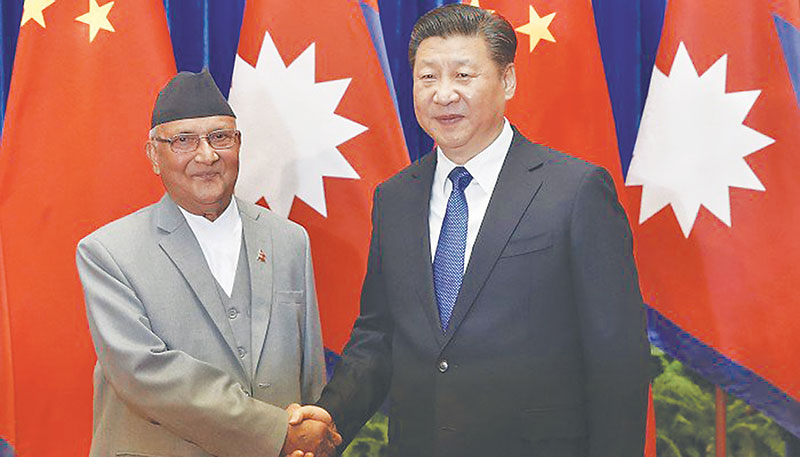
No agreement against national interest, Oli tells House
Delegation has 120 members
- ANIL GIRI,BINOD GHIMIRE

KATHMANDU,
Prime Minister KP Sharma Oli embarks on a six-day official visit to China on Tuesday. Deepening ties with the top Chinese leadership, exploring new areas of cooperation with Beijing and signing new agreements with China based on the 10 points of agreement reached during Oli’s visit in 2016 are high on the agenda.
PM Oli will meet Chinese President Xi Jinping at the Great Hall of the People on Wednesday and his counterpart Li Keqiang on Thursday. After the visit, officials said, China is likely to announce a significant aid or project for Nepal to showcase its deep attachment to Nepal at a time when a stable government in Kathmandu has pledged the people prosperity.
The two countries, however, are unlikely to sign the Protocol to Transit and Transportation Agreement signed during Oli’s visit to China two years ago. It may be signed in July, said officials.
Attracting Chinese investments in sectors of Nepal’s comparative advantage and minimising trade deficit will be the major focus of the visit.
Briefing the House of Representatives on his second visit to the northern neighbour in his two tenures as PM, Oli on Monday said every agreement and discussion in Beijing would be guided by “our national interests and dignity” in a transparent manner. At the invitation of Premier Li, Oli is paying the visit leading a 120-member delegation.
PM Oli will also meet with Jin Liquan, president of the Asian Infrastructure Investment Bank, to explore projects to be financed by the Chinese-led institution.
PM Oli informed the House that Nepal will be looking for Chinese support in three areas—direct aid, cooperation and joint investments. “China as a neighbour has always had cordial relations with us and has long been supporting us,” he said.
Without specifying projects, the PM claimed that there would be new agreements in energy and power transmission, railway connectivity, post-earthquake reconstruction and border entry points. He said focus would also be on reaping optimum benefits from China’s Belt and Road Initiative that promotes multifaceted and multidimensional connectivity with neighbours.
“We’ve identified some projects and forwarded the list. The funding modalities of these projects will be discussed in Beijing,” said a senior official privy to negotiations with the Chinese side.
“Expediting the pace of development is the sole agenda of the incumbent government. The visit will focus primarily on generating support from the northern neighbour in this regard,” PM Oli told Parliament. Attracting more Chinese tourists and investors in productive sectors is another priority.
The PM spent a significant part of his 20-minute address to highlight the gains his government made in bilateral relations with Nepal’s two immediate neighbours. Oli presented the closure of the Indian field office in Biratnagar, increasing air routes, survey of Kathmandu-Birgunj railways, homework in revising the 1950 Treaty by Eminent Persons Group and the joint study from Nepal and India on inundation in the Tarai as the major achievements of his government on that front.
“We understand the sensitivity of China and assure that we are committed to one China policy,” said Oli. “We don’t allow any activities against China on our land.”


On the agenda

  • Upgradation of two ‘friendship’ bridges in Tatopani and Rasuwagadhi
  • Formation of a joint mechanism to facilitate implementation of China-funded projects in Nepal
  • Private sectors of Nepal and China will sign agreement on developing power plants from the Marsyangdi cascade, pashmina promotion and agriculture
  • Memoranda of understanding on carrying out survey of Kerung-Kathmandu Railway, utilisation of RMB 1 billion Chinese reconstruction aid, formalisation of opening eight trading points with Nepal, and use of Tibetan highways for ferrying logistics and goods in northern parts of Nepal
  • New border check points at Uripas of Bajhang, two each at Rasuwagadhi and Tinkar of Darchula, two at Tiplapas of Taplejung and one at Hilsa of Humla for trade with China’s Tibet
  • Part of the Belt and Road Initiative—north-south corridors, exhibition centres, free trade zones, six integrated check posts on Nepal-China border, upgradation of some roads, rainwater harvest, Outer Ring Road in Kathmandu, establishment of a new city in Surkhet, and some irrigation projects


Itinerary of prime minister’s visit

Tuesday
9:00AM    Depart for Beijing by a Himalaya Airlines Special Aircraft
17:15PM    Arrive in Beijing
18:00PM   Attend reception hosted by Ambassador Leelamani Paudyal at the Nepal Embassy

Wednesday
8:00AM    Meeting with embassy officials and Nepalis living in China
19:40AM    Attend China-Nepal Business Forum-2018 at CCIPT
15:40PM    Visit to Tienanmen Square
16:00 to 16:40PM    Meeting with President Xi Jinping of China
17:00PM    Interview with CCTV
17:30PM    Meeting with Jin Liquan, president of AIIB

Thursday
8:30AM    Attend Nepal-China Friendship Run at Beijing University
of Sports
9:30AM    Visit to the Party School of CPC and hold discussion
16:00PM    Meeting with the Chairman of Standing Committee of National People’s Congress Li Zhanshu at the Great Hall of the People
17:00PM    Meeting with Chinese Premier Li Keqiang at the Great Hall of the People
17:15 to 18:00PM    Delegation level talks followed by signing ceremony of some MoUs and understanding
18:10 to 19:00PM    Dinner hosted by the Chinese Premier Li

Friday
08:15AM    Depart for Lhasa
14:55PM    Arrive in Lhasa
15:55PM    Arrive in Office of the Nepali consulate in Lhasa and interact with Nepali nationals
18:30PM    Dinner hosted by Nepal’s consular general in Lhasa

Saturday
9:30AM    Visit to Potala Palace
11:30AM    Visit to Jokhang Temple
15:20PM    Visiting QuShui Agriculture Project
18:00PM    Meeting with the Qi Zhala, chairman of the Tibet Autonomous Region, followed by dinner

Sunday
11:50AM    Leave Lhasa for Kathmandu
HOME PAGE

Half of NC Upper House members pick 2-yr term

- Post Report

KATHMANDU, 
National Assembly Chairman Ganesh Timilsina and Home Minister Ram Bahadur Thapa will serve their full six-year tenure in the Upper House while Finance Minister Yubaraj Khatiwada will retire after two years as their terms were decided by drawing lots on Monday.
The Parliament Secretariat used the lottery method to determine the two-, four- and six-year terms of the 59 NA members. Article 86 (3) of
the Constitution of Nepal states that the office of one third of the members of the National Assembly expires in two years.
Nineteen members of the Upper House will serve for two years while 20 each will be in office for four years and six years, respectively.
Elections will be held for 19 seats after the first lot retires in February 2020.
Fifty-six members of the House were elected—eight each from the seven provinces—by an Electoral College while three others including Khatiwada were nominated by the government.
Finance Minister Khatiwada’s membership will expire 20 months from now. “There is no legal hurdle for him to be nominated again if the government so wishes,” NA Secretary Rajendra Phuyal told the Post. To serve as a minister, one has to be a member of the federal parliament or elected member within six months of assuming the responsibility.
MPs from the main opposition Nepali Congress and the Rastriya Janata Party-Nepal were the most unlucky ones as seven of the 13 NC lawmakers picked two-year terms while the two RJP-N members had the same fate.
Among the 42 Nepal Communist Party (NCP) MPs, only nine will have two-year tenures. The NCP, NC, RJP-N and the Sanghiya Samajbadi Forum-Nepal have representation in the NA.

HOME PAGE

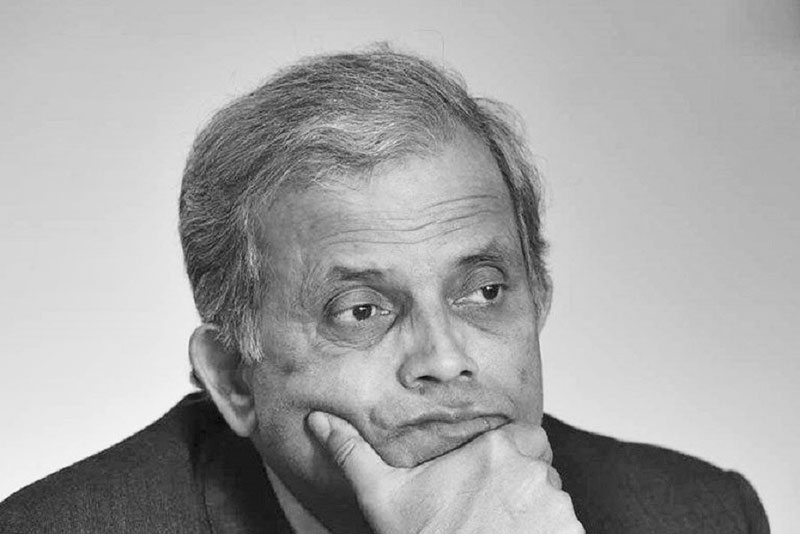
Pioneer neurosurgeon Dr Devkota no more

- Post Report
Upendra Devkota (1953-2018)

KATHMANDU,
Neurosurgeon Dr Upendra Devkota passed away at the Bansbari-based Neuro Hospital in Kathmandu on Monday. A pioneer in the field in Nepal, Dr Devkota had been undergoing treatment for gall bladder cancer. He breathed his last at 5:35pm, according to a statement issued by the hospital.
After six months of treatment at a hospital in the United Kingdom, Dr Devkota returned to Nepal on May 29 insisting that he would spend the rest of his life in his country.
On June 9, the Devkota family had taken him to Boharagaun in Palungtar Municipality-4, Gorkha, as the ailing doctor had wished to visit his birthplace.
Since then he had been receiving care at the National Institute of Neurological and Allied Sciences, also known as Neuro Hospital, that Dr Devkota had founded.
He is also known for expanding neurological health care at Bir Hospital, where he started the Neurosurgery Department for the benefit of the general public. His colleagues remember Dr Devkota as a dedicated professional and someone who could deliver even with limited resources. Dr Pawan Kumar Sultania, who worked with Dr Devkota for nearly 20 years, said he was a great leader with capability to deliver under difficult circumstances.
“Dr Devkota and his team, which included me, worked very hard to sustain the Neurosurgery Department at Bir Hospital, despite poor support from the government,” said Dr Sultania, adding that the department benefited common people visiting a government hospital.
Devkota was appointed the health minister during the royal regime of Gyanendra Shah in 2002. As the health minister, he transformed Bir Hospital into the National Academy of Medical Sciences.
After completing MBBS from Assam Medical College in India, Devkota returned to Nepal in 1978 before beginning his training at the Glasgow Institute of Neuroscience, UK, in 1983.
In his 34-year career as a neurosurgeon, he performed over 25,000 successful surgeries. As minister, he oversaw a number of important health reforms.
Dr Devkota had operated on Crown Prince Dipendra Shah following the palace massacre of June, 2001. The neurosurgeon had told media that the royal’s brain sustained massive damage as a bullet had passed through it. The incident that swept Nepalis emotionally for the deaths of the king, the queen, the crown prince and other royals was also controversial for its motive and the force behind it. Dr Devkota had often been asked about the incident and, in particular, if Dipendra was indeed responsible for killing his own parents and his kin as the royal probe commission had charged him with.
According to the hospital, Dr Devkota’s mortal remains will remain on its premises from 8am to 1pm on Tuesday for final tributes. He is survived by his wife Dr Madhu Dixit Devkota and three daughters Medha, Basudha and Manjari.

Page 2
NEWS

Landslide threat looms over Liping, Tatopani

- ANISH TIWARI
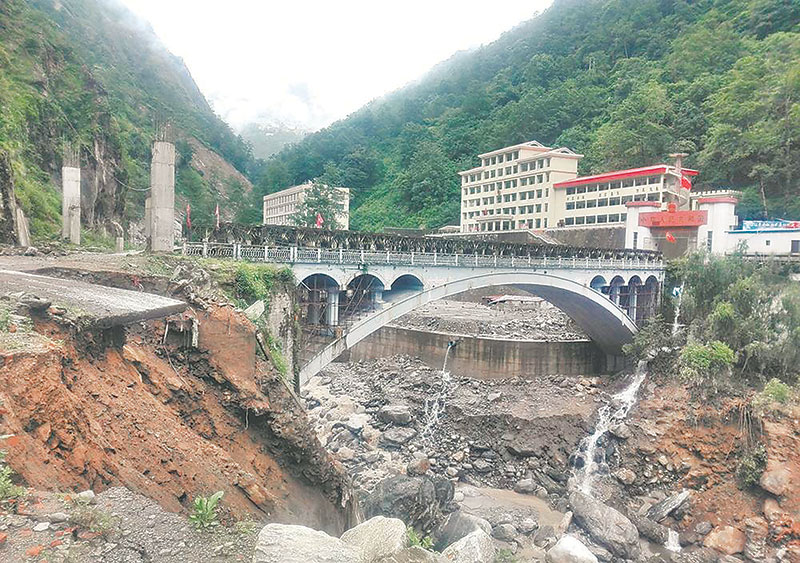
The Nepal-China Friendship Bridge of Tatopani, Sindhupalchok, following the 2016 flood. POST FILE PHOTO

SINDHUPALCHOK,
Liping Bazaar in Bhotekoshi Rural Municipality, Sindhupalchok, has witnessed several erosions and minor landslides in the recent days.
Some of the residents have vacated their homes and moved to Chowkidanda where they hope to be safe in case of major landslides.
The area, situated close to Tatopani, a town bordering Nepal and China, has suffered several disasters in the last three years, from the devastating earthquake of 2015 to the massive flood in the Bhote Koshi river that swept away 261 homes.
Locals said they were in a state of constant fear because of continuous erosions and landslides. What they do not want at the moment is heavy rainfall in the region that could trigger a host of landslides.
Meanwhile, the Kodari Highway is also not in a good condition. Every monsoon, the highway gets obstructed by landslides, cutting off supply of essentials. People fear that rescue work could be hindered if there is a disaster in the region and the highway is blocked.
“Things are already bad as they are. Our businesses have not recovered after the
disastrous earthquake of 2015. We have faced several calamities in the last three years. This year also seems no different,” said Dolma Sherpa, who runs a hotel in Liping Bazaar.
The Tatopani border point is closed since the earthquake of 2015. And without cross-border trading and mobility of people, many businesses in the region have folded in the last three years. The people are not sure if the border point will be opened.
“The main border crossing and the office buildings are particularly vulnerable to landslide and flood. But there has been no effort to mitigate the risk,” said an Armed Police Force Deputy Superintendent Hajarilal Jaiswal.
Tatopani is turning into a ghost town. Majority of its inhabitants have left the once bustling border town after the earthquake.
“The future of Tatopani and its adjoining areas like Liping Bazaar remains uncertain. The region remains prone to disasters like flood and landslide and its people are facing trouble due to frequent road obstruction and breakdown in communication system,” said Vice-chairperson of Bhotekoshi Rural Municipality Dabuti Sherpa.

NEWS

Govt to keep NA teams on standby for disaster response

- Post Report
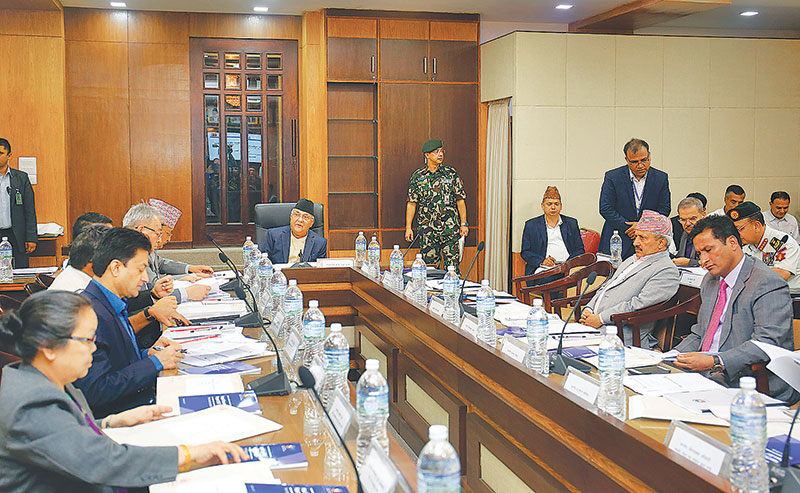
Prime Minister KP Oli presides over the meeting of Natural Disaster Rescue Committee in Singha Durbar, Kathmandu, on Monday.  Post Photo: Anish Regmi

KATHMANDU, 
The government has decided to keep search and rescue teams of Nepal Army (NA) with helicopters on a standby at three places to minimise casualties in monsoon-related disasters this year.
The first meeting of the National Disaster Risk Reduction and Management Council, chaired by Prime Minister KP Sharma Oli, on Monday decided to keep NA rescue and search teams on a standby in Itahari of Province 1, Pokhara of Province 4 and Surkhet of Karnali Province.
The meeting also urged all the ministries, security forces and concerned agencies to coordinate among one another to ensure effective response to disaster situations.
To keep the inhabitants of disaster-prone settlements safe, the meeting also decided to take necessary steps to relocate them.
The meeting also directed the Ministry of Physical Infrastructure and Transport and other concerned agencies to have the manpower and the equipment ready to clear road obstructions.
For effective early warning system, the Ministry of Communication and Information was asked to make arrangements for disseminating weather updates to local communities through various telecom operators.
The meeting also proposed forming disaster management committees and executive committees for disaster risk reduction and management at the provincial level, and empowering the existing committees at the local level by providing required resources, rights and capacity.

NEWS

35 Peace Corps volunteers sworn in

- Post Report
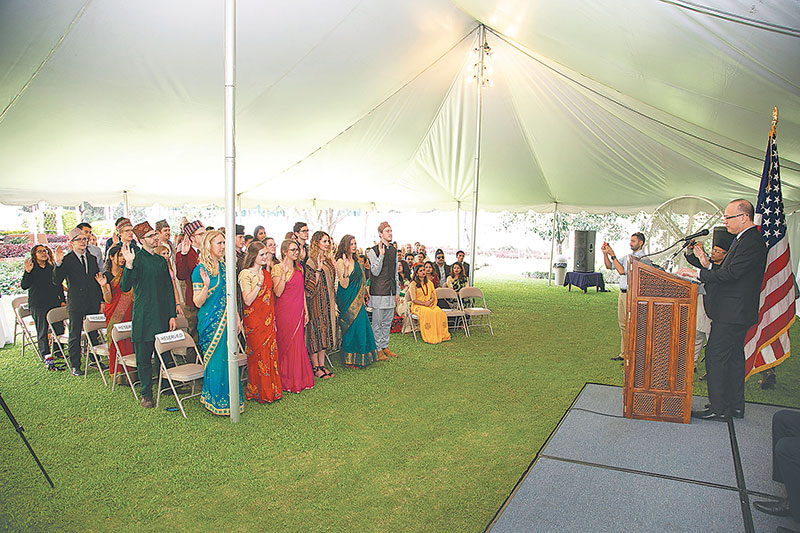
Peace Corps volunteers participate in a swearing-in ceremony in Kathmandu on Monday. They join over 3,800 volunteers who served before them in Nepal since 1962. POST PHOTO: PRAKASH CHANDRA TIMILSENA
KATHMANDU,
Thirty five Peace Corps volunteers were sworn in
at a function in the Capital on Monday.
The volunteers, who came with a wide variety of experiences and expertise, were sworn in by Chargé d’ Affaires Peter Malnak and the Peace Corps Nepal Country Director Sherry Russell.  
They will join over 3,800 volunteers who served before them in Nepal since 1962.  
The Peace Corps volunteer programme was established by US President John F Kennedy in 1951.  
Currently, there are over 7,200 Peace Corps volunteers serving in over 65 countries across the world. This is the seventh Peace Corps volunteers to arrive in Nepal since the programme re-opened in 2012. They will serve in the country for two years.
 “These trainees follow in the footsteps of over 3,800 previous volunteers, including some here today, who heeded the call to service and chose to come to Nepal to serve not only our own country, but also the people of Nepal,” Malnak said.
The latest batch of Peace Corps volunteers arrived in the country in April. They had undergone 11 weeks of language, cross-cultural and technical training in Kavre  in preparation for their service.
The volunteers have been assigned to seven districts in three provinces to work on food and nutrition security projects in coordination with the Ministry of Health and Population, Ministry of Agriculture, Land Management and other various Ministries of government.

NEWS

Bharatpur to become first mercury-free medical city

- Post Report

KATHMANDU, 
Bharatpur Metropolis has been working actively to encourage health care facilities and professionals in the city to phase out mercury-containing devices and the use of the toxic material in a bid to become the country’s first mercury-free medical city.
A total of 15 health facilities, including hospitals, private dental clinics, dental departments, committed in writing on Monday to provide mercury-free services in order to help the city achieve the feat. The Bharatpur Metropolitan City, Private Hospital Coordination Committee, District Public Health Office, a group of dedicated health care facilities, health care professionals in Bharatpur, Chitwan have been working for cause.
Puspanjali Hospital Pvt Ltd, Sapta Gandaki Hospital Pvt Ltd, Sunrise Dental Clinics, Smile Dental Health Care Center, Shree Dental Clinics, Padma Dental Clinics, and Dental Department of Bharatpur Hospital, Manakamna Hospital, Live Care and Trauma Center, National Hospital are among the city’s health care facilities which have declared to be providing mercury-free services.
Hailing the initiative of the health care facilities at the programme organised in the Capital on Monday, health experts said would help the city become the country’s first mercury-free medical city. “This has indeed set a precedent for other health care facilities, dental colleges, and health professionals to follow the mercury-free practices. If Bharatpur manages to completely eliminate the use of mercury, it will inspire other cities in its wake,” said Ram Charitra Sah, executive director and environment scientist at the Center for Public Health and Environmental Development .
Mercury, its compounds and equipment based on the toxic metal are widely used in various products and processes like sculpture making, lighting, health, cosmetic products and health sector. The use of mercury in the health sector, especially in dental filling, is relatively high around the world.
The Mercury-free initiatives, studies suggest, will help in protecting public health, vulnerable population like children and pregnant mother from hazard of mercury, which has adverse impacts on human health like memory loss, anxiety, hormonal disorder and mood swings.

NEWS

Nepali worker dies in India

- Post Report

DARCHULA,
A Nepali worker died after being hit by a rock at a road project   site at Lipu-Lekh area in Uttarakhand, India, on Sunday. Jaya Singh Dhami of Darchula, who was critically injured in the incident, died on the way to hospital. His body was handed over to the family after post-mortem on Monday.

This is a second death of a Nepali worker at the road project site in three months. Trilok Singh Bista of Byas Rural Municipality-4 was killed when a dozer fell into the Mahakali river three months ago. Bista’s relative said the project provided only IRs 25,000 for funeral and that the family had yet to receive insurance money.

NEWS

Pakistan defence force chief Hayat in Nepal

News Digest

KATHMANDU: General Zubair Mahmood Hayat, chairman of Joint Chiefs of Staff Committee of Pakistan Armed Forces, arrived in Nepal for a five-day official visit on Monday. Chief of Army Staffs General Rajendra Chhetri had extended his invitation to his counterpart during his official visit to Pakistan last month. According Directorate of Public Relations of Nepal Army, General Hayat will have meeting with President Bidya Devi Bhandari, Deputy Prime Minister and Minister for Defence Ishwar Pokharel and General Chhetri, among others. He will also visit various historic sites before returning home on June 22. (PR)

NEWS

Dahal leaves for Singapore for wife’s treatment

News Digest

KATHMANDU: Nepal Communist Party Co-chairman Pushpa Kamal Dahal left for Singapore on Sunday for the treatment of his wife Sita. A family source said Sita’s health started deteriorating after the death of her son Prakash and doctors had suggested her to visit Singapore for treatment. She will be treated at Mount Elizabeth Hospital. The Dahal couple is being accompanied by their daughter Ganga and the NCP leader’s aide Samir Dahal. (PR)

NEWS

Court jails two rapists for 10 yrs

News Digest

HETAUDA: The Makwanpur District Court has sentenced two men to 10 years in prison after finding them guilty of raping a teenage girl. The single bench of District Judge Khadananda Tiwari on Monday handed down the verdict against Rajendra Rumba, 21, and Tsering Ghising, 20, of Hetauda Sub-metropolis-10. The court also ordered the duo to pay Rs 40,000 each as compensation to the victim. Rumba and Ghising had raped the girl at a hotel in Hetauda last year. (PR)

NEWS

Rock lands on truck, kills driver

News Digest

CHITWAN: A truck driver died after being hit by a boulder hit him along the Narayangadh-Muglin road in Chitwan district on Sunday night. Police on Monday said that Krishna Dhungana of Tanahun district was fatally injured when a large rock landed on the moving truck. He died during treatment at Bharatpur Hospital. (PR)

Page 3
NEWS

Nepal hopes to boost China ties

Chinese experts urge China, Nepal and India trilateral relations to spur infrastructure development and trade in South Asia
- Post Report
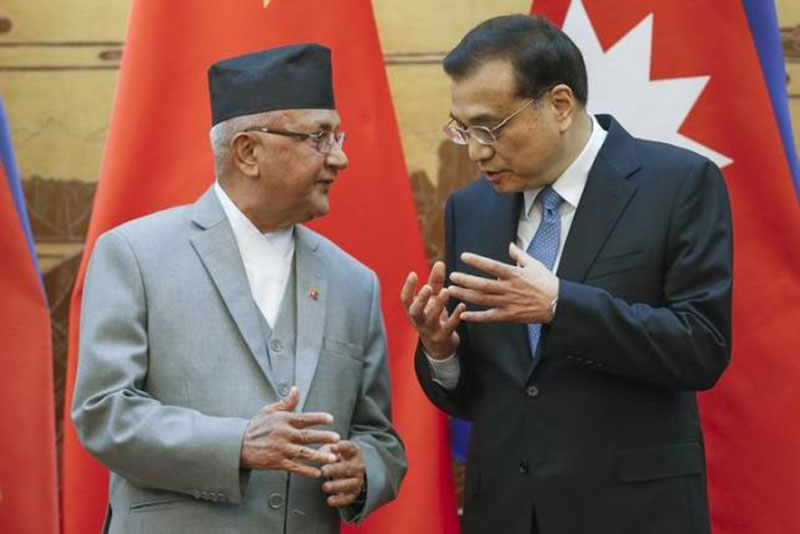
Prime Minister KP Sharma Oli with China’s Prime Minister Li Keqiang seenduring their previous meeting. PM Oli heads to China on a state visit on Tuesday. Post File Photo

KATHMANDU,

Nepal will hope to cement its bilateral relations and work on furthering socio-economic ties with China as Prime Minister KP Sharma Oli embarks on a state visit on Tuesday.


Chinese experts opine the visit is of ‘greater significance’ to both the countries. They say PM Oli is visiting China as a leader of Nepal’s strongest government post 1990s with comprehensive peoples’ mandate.


During his previous visit to China as prime minister, Oli had signed 10-point agreement, including a landmark deal on transit trade aiming to reduce Nepal’s significant dependence on India. If implemented, the transit agreement would give Nepal access to sea routes via the Chinese port of Tianjin.


This time, apart from discussing the Protocol to the Transit and Transport Agreement, several other pacts and memoranda of understanding on connectivity, linking China and Kathmandu via rail, energy, tourism, opening more border points with China and construction of petroleum storage facilities, among others, are expected to be signed.
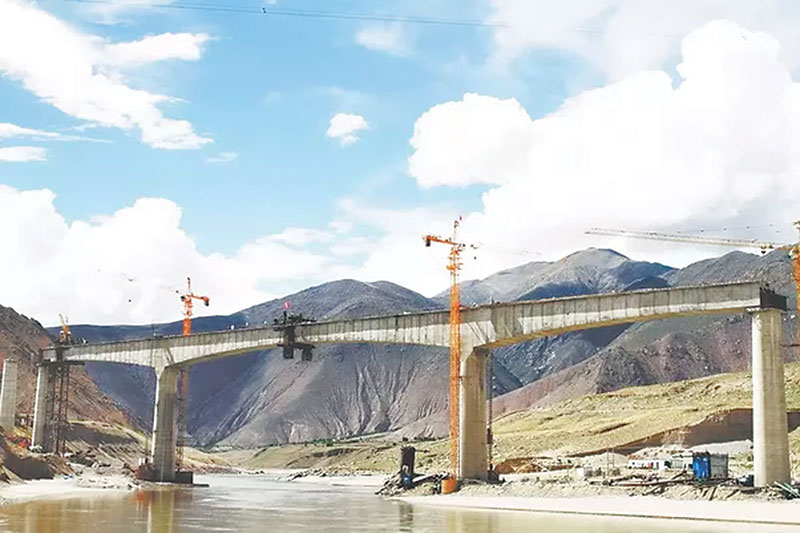

The recent unification of PM Oli-led CPN-UML and CPN (Maoist Centre) parties boosts his morale. This would reflect in his talks and meetings in Beijing, experts say.
China Institutes of Contemporary International Relations’ Institute of South Asian and Oceanian Studies Director Professor Hu Shisheng told Post, “China and Nepal both have higher expectations from this visit. Nepal’s practice of multiparty democratic system post-1990 proves it is not possible to achieve socio-economic development without political stability.
“Nepal now has the strongest government in its modern history. Therefore, it is optimistic to believe this government would focus on scaling up its past agreements.”


Chinese academia says political stability is the key to their own economic development, and is upbeat about the recent political developments in Nepal. They point to the formation of NCP that consolidated leftist forces in the country. This has increased China’s optimism and, consequently, it has significantly increased its engagement with Nepal in recently.
According to Hu, China currently is paying attention to two things: First, unity within the leftist party and second, Indian sensitivities in Nepal.


“China would like to encourage trilateral co-operation between the three nations. Therefore, these two factors would be the biggest concerns while formulating Nepal policy,” Hu said.
China’s optimism over political stability is not just related to Nepal’s internal situation, but is equally important for its ambitious Belt & Road initiative (BRI).


Sichuan University’s Institute of South Asian Studies Executive Director Professor Li Tao said, “A stable, open and developing neighbour would be conducive to promote China’s BRI, and for the stability and development of the western frontier of China.”


China hopes the Oli government would strengthen infrastructure construction in Nepal, and vigorously promote Nepal’s economic development and strengthen co-operation between Nepal and China so that Nepal would become an important transit country in the BRI framework, the professor said.


Stating that ‘Equality and mutual benefit’ is China’s most important interests in Nepal, Li opines Nepal opening to the world and attracting foreign investment are an important parts of its economic development. This way the Oli government would not only protect China’s interests, but also protect interests of other countries’ in Nepal.


“China’s ‘westward policy’ to enter the South Asia and India’s ‘act east policy’ to enter Southeast Asia are out of their own need for development. All sides would have their advantages and disadvantages. It is not necessary to make too much political interpretation,” she said.
PM Oli has earned ‘good reputation’ in China for agreements that have longer-term impact during his maiden stint as the Prime Minister.


Xu Liang a scholar, who writes articles on Nepal and India in the state-owned Global Times, and is a fellow at the Institute for higher research on Regional and Global Governance, Beijing Foreign University opined that the bilateral relations between China and Nepal are expected to progress by leaps and bounds during PM Oli’s tenure. “PM Oli should revisit previous agreements afresh. Many scholars in China believe PM Oli is a messenger of friendship between the two nations and that Nepal’s recent policy approach towards China is correct,” Xu said.


All Chinese experts have a common opinion that, not just the bilateral relationship between Nepal and China, but also a trilateral relationship that includes India should get an impetus under the current political regime.


“China-Nepal-India has golden opportunity to carry forward co-operation as these three nations have the strongest federal governments in past three decades. It would be blessings for citizens of these countries, especially for those living in the Himalayan region, if we succeed in working together to turn the Himalayan range to Development Bridge from natural barrier,” Hu said.

NEWS

Deluge turns Bouddha road into a ‘paddy field’

- RASTRIYA SAMACHAR SAMITI

Kathmandu,
Heavy rain has turned the road from Chuchchepati to Jorpati in the Kathmandu Valley into a muddy field as though it is being prepared for transplanting paddy seedling.
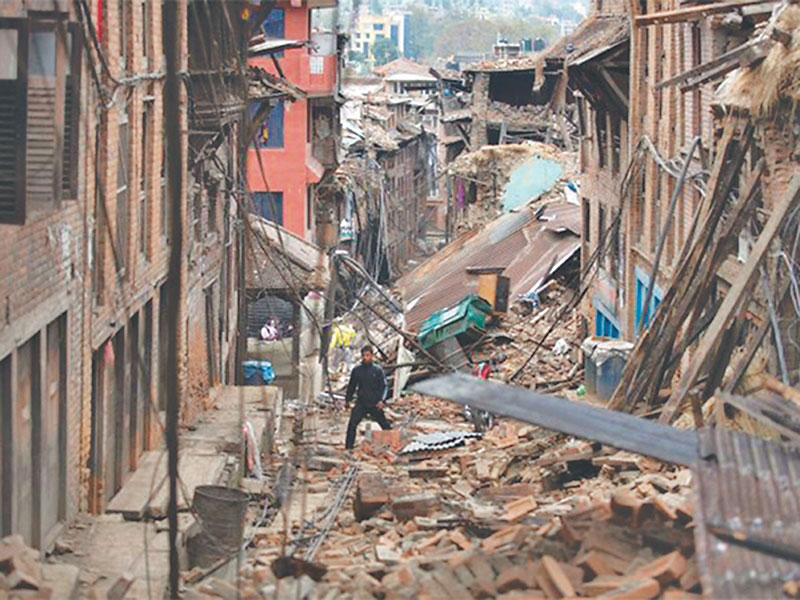

This road leads to Boudhnath Monastery. It is one of the popular World Heritage sites. Tens of thousands domestic and foreign tourists visit this site every month.


Vehicular traffic and daily commuters face difficulties because of the protracted repair and reconstruction work of the road.


The condition of the road between Chabahil and Chuchchepati was the same. Thanks to Indian Prime Minister Narendra Modi’s visit to Nepal on May 11, workers completed road repairs over night.


Local resident Parbati Tamang said, “Similarly, repair works of the road to Bouddha could also be done at the same pace.”


The authorities have demolished illegal structures on both sides of the road to expand.

NEWS

RJP-N meeting mulls joining central govt

- TIKA R PRADHAN

KATHMANDU,
After several postponements, a powerful political committee meeting of the Rastriya Janata Party-Nepal got under way in the Capital on Monday.
The initiation of the meeting has raised expectations among leaders that the
pending issues of the party, including the date of its national convention and joining government, would be sorted out.
On Monday, Coordinator of the presidium Mahantha Thakur briefed the leaders about the agenda to be discussed during the meeting that may go on for several days.
On joining the government, Thakur said that Prime Minister KP Oli had been inviting the RJP-N to come on board but he had not clarified about addressing the issues raised by the Madhes-centric party. “Therefore, I have urged fellow RJP-N leaders to come up with their views on it,” Thakur said.
Responding to the proposal, leader Rajendra Mahato, however, said the RJP-N would not join the government without statute amendment, administration of oath to Resham Chaudhary and withdrawal of all cases against the party’s leaders and cadres.
On the Election Commission’s letter, leaders said the party should seek six month’s time from the poll to hold the convention and start preparations accordingly. In another letter, the EC has asked the RJP-N to ensure the inclusiveness within its committees.
Mahato criticised the leadership for failing to select the parliamentary party leader, but claimed an election to the parliamentary party could resolve the issue after finalising its statute. He also proposed the meeting to adopt a provision to finalise major issues.
As well as finalising the leadership positions, the meeting needs to endorse the party’s statute. The RJP-N, which was formed last year with the merger of six fringe parties, had registered with the EC, promising that it would finalise the office bearers through national convention within a year. It had opted the system of presidium with a provision that would allow six chairpersons lead the party on rota.
The party has a six-member presidium and 133-member office bearers. It has a co-chairman, eight senior vice-chairs and 28 vice-chairps, 31 general secretaries 29 joint general secretaries 22 secretaries and nine treasurers.
After a brief discussion lasting around one and a half hours, Monday’s meeting was also postponed for Tuesday citing the meeting of the federal parliament.

NEWS

Ministry retracts decision on NGOs

- Post Report

KATHMANDU,
Home Ministry has backtracked on its decision to strictly scrutinise Non-Government Organisations (NGOs) while renewing their registration.
The ministry issued an official note on Sunday to all the district administration offices not to implement the two major points of its previous circular until further notice.


Home Minister’s Press Co-ordinator Kiran Bhattarai said, “In the note, the ministry informed DAOs not to implement points three and four of the ministerial-level decisions.”
Earlier, the ministry had directed all the DAOs to register only NGOs that work in a single sector and those registered to work in multiple sectors must amend their statute for renewal.
Besides, the ministry had told the DAOs to register and renew the NGOs, INGOs and Non-profit Distributing Companies only after receiving the property details of all members of their
executive committee and employees.


After acute pressure from the NGO sector and around a dozen formal and informal dialogues with government agencies, the government has backtracked from two of its decisions.
NGO Federation of Nepal President Gopal Lamsal said, “We discussed with concerned ministers, officials of National Planning Commission, secretaries of Prime Minister’s office, PM’s chief advisor and urged them to consider their decision.”


Officials of NGO Federation of Nepal had warned the government of protracted struggle and
fight a legal battle with the government.  


Home Ministry has formed a task force led by a joint secretary (Legal division) to study the issues raised by NGO Federation of Nepal and will present its report within a month.

Page 4
WORLD

Seoul: NKorea sanctions may be eased early

- AGENCE FRANCE-PRESSE
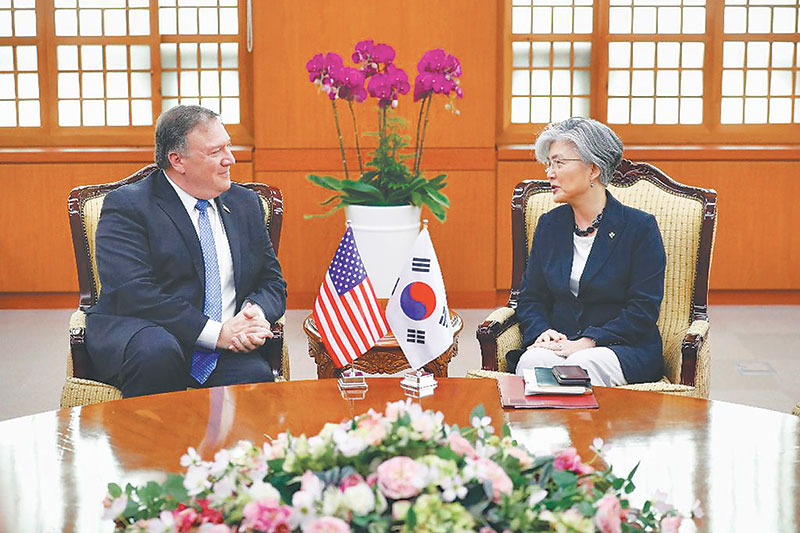
A file photo shows South Korean Foreign Minister Kang Kyung-wha with US Secretary of State Mike Pompeo in Seoul last week. AFP/rss

SEOUL,
South Korea said on Monday that sanctions against North Korea could be eased once it takes “substantive steps towards denuclearisation”, seemingly setting the bar lower than Washington for such a move.


Last week’s Singapore summit between US President Donald Trump and North Korean leader Kim Jong-un produced only a vague statement in which Kim “reaffirmed his firm and unwavering commitment to complete denuclearisation of the Korean Peninsula”.
Amid fears the summit would weaken the international coalition against the North’s nuclear programme, US Secretary of State Mike Pompeo stressed after the meeting that sanctions
would remain in place until North Korea’s complete denuclearisation.


But his South Korean counterpart suggested on Monday they could be eased sooner.
“Our stance is that the sanctions must remain in place until North Korea takes meaningful, substantive steps towards denuclearisation,” Foreign Minister Kang Kyung-wha told reporters.
Seoul and Washington shared the same “big picture” view and would continue close consultations, she added. The comments come just days after China’s foreign ministry suggested that the UN Security Council could consider easing the economic punishment of its Cold War-era ally.


Any reduction in tensions on its doorstep is welcome for China, North Korea’s closest ally, which accounts for around 90 percent of Pyongyang’s trade.
The same goes for the South’s dovish President Moon Jae-in, who supports engagement with North Korea and held his own summit with Kim in April.


Until recently Trump had pursued a “maximum pressure” campaign—with both China and South Korea on board—of tough rhetoric and tightened sanctions against Pyongyang.
But analysts say the Singapore summit has made it hard for the Trump administration to return to that policy even if its current diplomacy with North Korea proves to be a failure.
“The symbolism of the meeting ensures that the maximum pressure campaign has peaked,” said Scott Snyder, senior fellow for Korea Studies at the US Council on Foreign Relations, in a commentary.


“In practice, China and South Korea will push for relaxation of economic pressure on North Korea,” he added.

WORLD

Three dead, 200 hurt as strong quake jolts Osaka

- AGENCE FRANCE-PRESSE
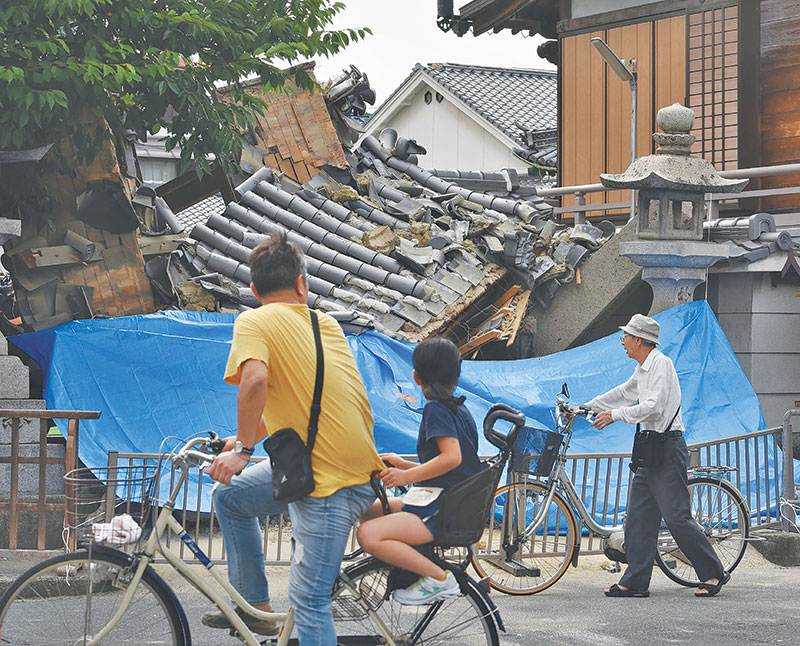
People pause to look at a collapsed house following an earthquake in Ibaraki City, north of Osaka prefecture on Monday. At least two people, including a child, were killed on Monday, after a strong quake rocked the second city of Osaka during the morning rush hour, Japan’s government said. AFP/rss

TOKYO,
A powerful earthquake rocked Japan’s second city of Osaka on Monday, killing three people including a nine-year-old girl and injuring more than 200, according to an official tally.
Television images showed buildings swaying and
burst pipes spewing water after the quake, which struck at the height of rush hour in the city of around two million.


However, there was no large-scale destruction and no tsunami warning issued after the earthquake, although commuters were stranded and tens of thousands were left without power.
Among the casualties was a nine-year-old girl who died in the city of Takatsuki north of Osaka, reportedly trapped by a collapsed wall following the 5.3-magnitude quake.


Local officials told AFP that the other two dead were an 80-year-old man—killed by a collapsing wall—and a 84-year-old man trapped under a bookcase in his home. The Fire and Disaster Management Agency said more than 200 people were injured in total.


Prime Minister Shinzo Abe told reporters the government was “working united, with its first
priority on saving people’s lives”.


And government spokesman Yoshihide Suga cautioned there was a possibility of strong aftershocks.
“Large-scale quakes are likely to happen in the next two to three days,” he told reporters. Japan sits on the Pacific “Ring of Fire” where many of the world’s earthquakes and volcanic eruptions are recorded.


On March 11, 2011, a devastating magnitude 9.0 quake struck under the Pacific Ocean, and the resulting tsunami caused widespread damage and claimed thousands of lives.


It also sent three reactors into meltdown at the Fukushima nuclear plant, causing Japan’s worst postwar disaster and the most serious nuclear accident since Chernobyl in 1986.


Local residents described the moment the quake jolted the highly urbanised area at 8:00 am, when platforms would have been heaving with passengers waiting to board their commuter trains. “The floor moved violently. It was a strong vertical jolt. Nearly all of the dishes fell and shattered on the floor,” said Kaori Iwakiri, a 50-year-old nurse in Moriguchi just north of Osaka city.


“My parents suffered a blackout and they have no water. I plan to take water to them now.”
Despite its relatively low magnitude, the quake caused quite a shake, registering a lower six on the Japanese experiential scale of up to seven—meaning it is hard to stay standing.


Eiji Shibuya, 52, said the tremor reminded him of the devastating 1995 Kobe earthquake, which killed nearly 6,500 people.


“I was stunned. I couldn’t do anything,” he told AFP from Itami, a city near Osaka.
“I was worried about my son as he had just left for his high school. I was relieved when I confirmed he was safe.”

WORLD

Python selfie puts Indian forest ranger in tight spot

- AGENCE FRANCE-PRESSE

KOLKATA,
An India forestry ranger found himself in a bind after a python briefly strangled him while he posed for pictures with the giant snake.


Wildlife officer Sanjay Dutta was called in Sunday by frantic villagers in West Bengal after they saw the 40-kilogramme (88-pound) python swallowing a goat alive. Instead of placing it safely inside a bag, the ranger wrapped it around his neck and posed for pictures with stunned villagers.


But panic spread as the huge snake wound itself around Dutta’s neck, forcing him to struggle to free himself from its vice-like grip. He escaped unscathed, but a little red-faced.
The Indian rock python is a non-venomous species, but it can quickly kill its prey by constricting blood flow and can grow up to 10 metres (33 feet) long.


West Bengal’s forest department has launched an official inquiry into the ranger’s conduct and flouting of safety protocols.


But Dutta said he only wanted to save the reptile from the villagers who were readying to club it to death with sticks.


“My first instinct was to rescue the snake. I carried it on my shoulders and held its mouth firmly,” Dutta told AFP. “I was not scared for even a moment (when the python tightened its grip) because had I panicked, it could have been fatal.”


Dutta said he did not have a bag to carry the snake, which he transported to a safe location in his car and released into the wild.

WORLD

Gaming addiction is mental health disorder: WHO

new argument
- REUTERS

LONDON,
Many parents will have thought it for a long time, but they now have a new argument to limit
their children’s ‘screen time’—addiction to video games has been recognised by World Health Organization as a mental health disorder.
The WHO’s latest reference bible of recognised and diagnosable diseases describes addiction
to digital and video gaming as “a pattern of persistent or recurrent gaming behaviour” that becomes so extensive that it “takes precedence over other life interests”.


The International Classification of Diseases (ICD), which has been updated over the past 10 years, now covers 55,000 injuries, diseases and causes of death. It forms a basis for the WHO and other experts to see and respond to trends in health.


“It enables us to understand so much about what makes people get sick and die, and to take action to prevent suffering and save lives,” WHO Director-General Tedros Adhanom Ghebreyesus said in a statement as the ICD was published. The ICD is also used by health insurers whose reimbursements depend on ICD classifications. This latest version—known as ICD-11—is completely electronic for the first time, in an effort to make it more accessible to doctors and other health workers around the world.


ICD-11 also includes changes to sexual health classifications. Previous editions had categorised sexual dysfunction and gender incongruence, for example, under mental health conditions, while in ICD-11 these move to the sexual health section. The latest edition also has a new chapter on traditional medicine.


The updated ICD is scheduled to be presented to WHO member states at their annual World Health Assembly in May 2019 for adoption in January 2022, the WHO said in a statement.

WORLD

Landslides and flash floods batter southern Myanmar

- AGENCE FRANCE-PRESSE

MAWLAMYINE (Myanmar),
Flooding in southern Myanmar has caused a landslide at a famed Buddhist pagoda, submerged homes and displaced hundreds of people as monsoon rains batter the country.
Several parts of Myanmar’s southern Mon state are facing flash floods due to heavy rains since the weekend with no relief in sight, according to a report in the state-run Global New Light of Myanmar on Monday.


Rains triggered a landslide that damaged the hilltop Kyeik Than Lan pagoda, whose golden stupa towers over state capital Mawlamyine.


Workers were seen helping to relocate Buddha statues and novice monks helping clean up debris at the religious site after a wedge of hillside slipped away.


Bo Win, a resident helping with the flood response, said around 1,000 people were sheltering in several sites around Mawlamyine. “This is the worst flood in the state that I have ever seen,” said Nyan Soe, another local resident.


About 150 residents further south of Mawlamyine were evacuated to a government school after dozens of homes and bridges were submerged, while a monastery was destroyed across the river from the city, the New Light reported.


So far no casualties have been reported in the state, but rains continue to pound swathes of the country.


Last week five people were killed after monsoon rains triggered a landslide in Mogok.

WORLD

Colombia prez-elect faces challenges

News Digest
- AGENCIES

BOGOTA: Colombia’s President-elect Ivan Duque has promised to unite a divided country behind his plans to toughen a peace accord with Marxist rebels and to rekindle economic growth, but he will face major challenges when he takes office in August. The right-wing former senator comfortably won Sunday’s election with 54 percent of votes against his leftist rival Gustavo Petro, who garnered 42 percent with his pledge to shake up Colombia’s economic model and tackle inequality. Market reaction to Duque’s victory is expected to be muted because he held a strong poll lead going into the election and investors are largely supportive of his business-friendly economic policies. It was the first presidential election since a 2016 peace deal with the Revolutionary Armed Forces of Colombia (FARC), which ended its part in a five-decade conflict that has killed more than 220,000 people and displaced millions.

WORLD

Cambodian prince flown to Thai hospital

News Digest
- AGENCIES

PHNOM PENH: A Cambodian prince hurt in a car crash that killed his wife was flown to Bangkok for treatment Monday and is expected to recover, a member of his political party said. Prince Norodom Ranariddh, a former prime minister and half-brother of the current king Norodom Sihamoni, suffered “some broken ribs” and leg injuries, Yim Savy, the secretary general of the Funcinpec party, said. “He was sent to Thailand as a precaution”, Savy said, adding that the 74-year-old was in good condition and “speaking normally”. Bangkok has some of the best medical facilities in Southeast Asia and Cambodians who can afford it often travel there for treatment. Ranariddh, the head of the royalist Funcinpec party, was riding with his wife Ouk Phalla in a convoy in southwest Cambodia on Sunday when a taxi going in the other direction hit their vehicle head-on.

Page 5
WORLD CUP SPECIAL

Sweden skipper Granqvist makes SKorea pay penalty

- REUTERS
 Andreas Granqvist

NIZHNY NOVGOROD,
Sweden won an opening World Cup game for the first time since 1958 and ended a worrying goal drought with a 1-0 victory over South Korea in a must-win match if they want to progress from a tricky-looking Group ‘F’.


After dominating the game but missing a string of chances, the Swedes won a 65th-minute penalty when Kim Min-woo brought down Viktor Claesson in the box. Salvadoran referee Joel Aguilar initially waved the Swedes away, before being called to consult the Video Assistant Referee (VAR) system.


In the second VAR-awarded penalty of the World Cup, Sweden’s 33-year-old captain Andreas Granqvist stepped up confidently to sweep the ball low and left of the otherwise impressively in-form goalkeeper Cho Hyun-woo. “The VAR took a while but we are very pleased they had it... I was pretty sure,” Granqvist said of the wait.


The result brought wild celebrations from the hordes of yellow-clad Swedish fans, fearful their team would draw another blank after failing to score in their last three games. Sweden had not won an opening World Cup game since 1958, when they were the hosts and eventual runners-up.


The Asians actually began the game brighter, pressing forward and harrying for the first 15 minutes against an initially sluggish-looking Sweden. But the Scandinavians quickly found their poise, coping comfortably with Korea’s attacks despite the absence of defender Victor Lindelof through illness. Sweden coach Janne Andersson said the penalty was “crystal-clear”, adding: “We played the match way we had intended, but I’m a little unhappy with the chances we didn’t put away.”

Sweden players applaud their fans as they celebrate victory over South Korea in Group ‘F’ match during the Fifa World Cup at the Nizhny Novgorod Stadium on Monday. REUTERS

In a game short on finesse, several of Sweden’s best chances fell to Marcus Berg, who had one close-range side-foot shot spectacularly saved by Cho off his knee in the 21st minute. As expected, both teams’ single star players provided their creative drive, the silky Son Heung-min busting a lung to try and drive Korea forward from the left flank, and the pacy Emil Forsberg constantly feeding Sweden’s big frontmen. Forsberg had a go himself early in the second half, but curled over a shot from outside the box.


Korea’s best chances fell to Koo Ja-cheol, who headed just wide in the second half and Hwang Hee-chan who saw his stoppage-time header also just miss as his team launched a late, desperate siege. But the Swedes held firm and rushed to celebrate with their fans as the Koreans trudged disconsolately off.


Although not the most attractive of the World Cup games so far, there was a terrific atmosphere in the 42,300-strong crowd at the blue-and-white Nizhny Novgorod Stadium next to a cathedral at the confluence of the Volga and Oka rivers. The Swedes, many in their now de rigueur Viking helmets, easily outnumbered and out-sang their red-clad rivals in the avant-garde, sun-kissed dome that is meant to evoke wind and water.


Sweden next face world champions Germany, where they can ill afford to miss chances like they did on Monday. “If we win against Germany, we are through. The pressure is on them now,” added the ebullient Granqvist. Korea next face in-form Mexico who shocked the Germans in their Group ‘F’ opener. Few will be giving a chance to Korea, who have now only won one of their last 10 World Cup games.

WORLD CUP SPECIAL

Lukaku brace steers Belgium to victory

- AGENCE FRANCE-PRESSE
Romelu Lukaku

SOCHI,
Romelu Lukaku netted a brace as a much-improved second-half performance gave Belgium an ultimately comfortable 3-0 victory over tournament debutants Panama in their World Cup opener in Sochi on Monday.
A moment of inspiration from Dries Mertens set the Belgians on their way two minutes after the break, his volley breaking the deadlock after a rather flat first period. Lukaku then converted assists from Kevin De Bruyne and captain Eden Hazard to secure victory in this Group ‘G’ clash, with the Central Americans succumbing to a defeat in their first-ever match at the finals.
Group rivals England will look to respond to Belgium’s win when they kick off their campaign against Tunisia but this was not entirely the statement of intent that Roberto Martinez’s side would have been hoping to make. A victory will do for a team who are, on paper at least, good enough to go far in Russia, especially after heavyweights Germany, Brazil and Argentina all slipped.

Belgium’s Dries Mertens (right) in action against Panama’s Jose Luis Rodriguez during their Group ‘G’ match at the Fisht Stadium in Sochi on Monday. REUTERS

Belgium are now unbeaten in 20 matches, although the nature of the first-half performance against weak opposition showed that Martinez’s men still have significant progress to make if they are to improve on quarter-final appearances at the last two major tournaments.
The Central Americans lined up with a team of journeymen featuring five thirty-somethings. Jaime Penedo in goal is 36, while Blas Perez up front is 37. But while the Belgians had the younger, talented players, other factors played in Panama’s favour. The heat and humidity on Russia’s Black Sea coast was one. The locals at the Fisht Stadium got behind the outsiders too. Hazard pulled the strings when he could, although the Chelsea star was denied by Penedo in the 38th minute.
At the other end, Panama tried to expose Belgium’s potential weaknesses at full-back. However, they struggled to score goals in qualifying and rarely looked capable of beating Thibaut Courtois. Belgium just needed a spark from somewhere, and they got it from Mertens in the 47th minute. The Napoli man’s cross looking for Lukaku was headed out by Torres and on by Fidel Escobar. But the ball dropped perfectly back to Mertens, whose volley from the right side of the box arced into the far corner.
Panama sought to regroup and right-back Michael Murillo came surging forward to finally force a save from Courtois. But the gulf in class began to tell as Belgium doubled their lead midway through the second half. Hazard found De Bruyne, and his sumptuous cross with the outside of the right boot was headed in by Lukaku.
With Panama forced to throw more bodies forward, they were punished on the break a quarter of an hour from the end. This time Hazard released Lukaku, and the Manchester United man beat Penedo to complete the scoring and take him to five goals at major tournaments, as Belgium get up and running.

Page 6
WORLD CUP SPECIAL

Poland gear up for Senegal test

- AGENCE FRANCE-PRESSE
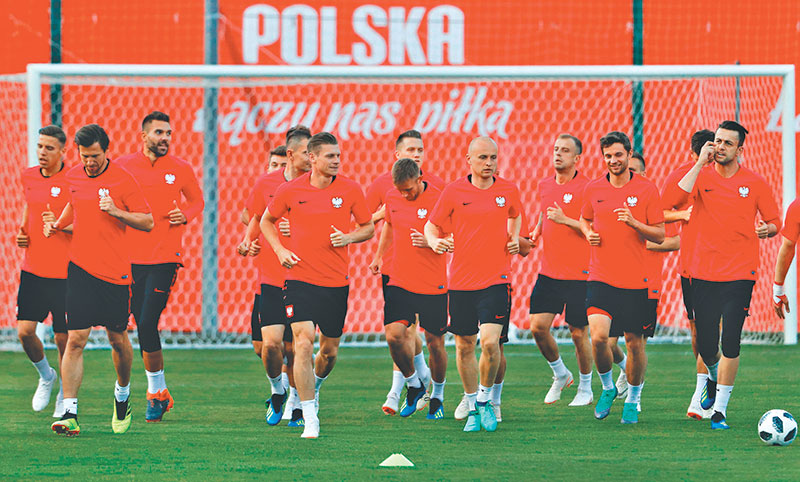
A file photo of Poland players during a training session at the Sputnik sports centre in Sochi. AFP/RSS

MOSCOW,
Robert Lewandowski and Sadio Mane face off in a mouthwatering World Cup shootout between two of European football’s most lethal forwards on Tuesday as Poland take on Senegal.
Bayern Munich’s Lewandowski finished the season as the Bundesliga’s top scorer for the third time with 29 goals, netting 41 times in all competitions. Mane scored 10 Champions League goals—including one in the final in Kiev—forming a devastating strike force at Liverpool alongside Mohamed Salah and Roberto Firmino. “I believe Sadio can be one of the stars of the tournament,” said former Senegal player El Hadji Diouf, who played in Japan and South Korea in 2002, the only previous time the country has reached the World Cup.
Poland go into the Group ‘H’ match at Moscow’s Spartak Stadium as favourites and are expected to emerge from a section also featuring Colombia and Japan. Ranked eighth in the world, it is Poland’s eighth appearance at the World Cup, with coach Adam Nawalka’s side desperate to improve on the third-place finishes in 1974 and 1982.
Lewandowski admits he has a point to prove after a disappointing Euro 2016, when he scored only once as Poland exited at the quarter-finals stage. The 29-year-old is finally reproducing his prolific club form at international level, setting a European qualification record with 16 goals in 10 matches to secure Poland’s place in Russia.
Lewandowski said he was entering the tournament in a different frame of mind from 2016. “I’m sure that training will be better now and that I’ll be fresh and dynamic at the right time,” he said. “I started preparing for the World Cup much earlier.” Poland received a boost in the lead-up to the tournament when defender Kamil Glik was cleared to play after an unexpectedly quick recovery from a shoulder injury. The centre-back is one of the team’s leaders and his job will be to keep Mane quiet.
Senegal will hope to emulate the pioneering team of 2002 captained by Aliou Cisse, now the national coach. Cisse’s men opened that tournament with one of the great World Cup upsets, a 1-0 win over defending champions France, and went on to become one of only three African teams ever to reach the quarter-finals. Cisse described it as “a great adventure” and wants his charges, ranked 27 in the world, to adopt the same fearless approach in Russia.
“That team already created its bit of history, and now it’s up to this one to create its own,” he told Fifa.com. “We’ll have to go there without an insecurity complex, play our natural game and stick to our African identity, which defines our football.”

WORLD CUP SPECIAL

Subdued Neymar kept in check

- REUTERS
Neymar

SOCHI,
Brazil’s opening match of the World Cup was supposed to be the game in which Neymar buried the ghosts of 2014 and bounced back from the foot injury that kept him out for most of this year.


Instead, as one of the pre-tournament favourites were held to a 1-1 draw by Switzerland he was a pale shadow of the crowd-pleasing showman widely recognised as the heir to Lionel Messi and Cristiano Ronaldo as the greatest player in the world. Neymar was carried out of the last World Cup in his homeland on a stretcher after being kneed in the back by Colombian Juan Zuniga in their quarter-final encounter. The injury meant he missed the 7-1 humiliation by Germany in the semi-finals but it also left him more determined than ever to make his mark on football’s biggest stage.


Sunday’s Group ‘E’ game was his first competitive start since February when he fractured a metatarsal and sprained his ankle in Paris St Germain’s league match with Olympique de Marseille. But unlike in the last two Brazil friendlies earlier this month, when he scored goals and inspired his team to victory, he looked out of sorts versus the Swiss and just not up for it. “Neymar hasn’t been bad, but he’s been quiet,” Brazilian TV analyst and former World Cup striker Walter Casagrande said.


It was not just that the 26-year-old had few chances. It was his reluctance to look for the ball deep in midfield and do what he does best, jink towards goal, teasing and tormenting far bigger defenders and creating chances and winning fouls. That may be something to do with one of the game’s more impressive statistics. Those towering Swiss players took no prisoners, committing 19 fouls to Brazil’s 12, 10 of which were on Neymar.


Brazil coach Tite refused to be drawn on whether Switzerland had set out to rough Neymar up but their physical superiority was evident—another standout statistic was that the Swiss covered eight kilometres more ground than the Brazilians. Tite must hope the malaise that affected his key player—and, it must be said, many of his teammates—will lift before their next game against Costa Rica on Friday.


Neymar is the team’s talisman and if Brazil are to win a sixth World Cup it is inconceivable they will do so with their best player in such lacklustre form. All bets will be on him producing sooner rather than later, as he has so many times for club and country. A nation awaits.

Page 7
WORLD CUP SPECIAL

Colombia sweat over James

- AGENCE FRANCE-PRESSE
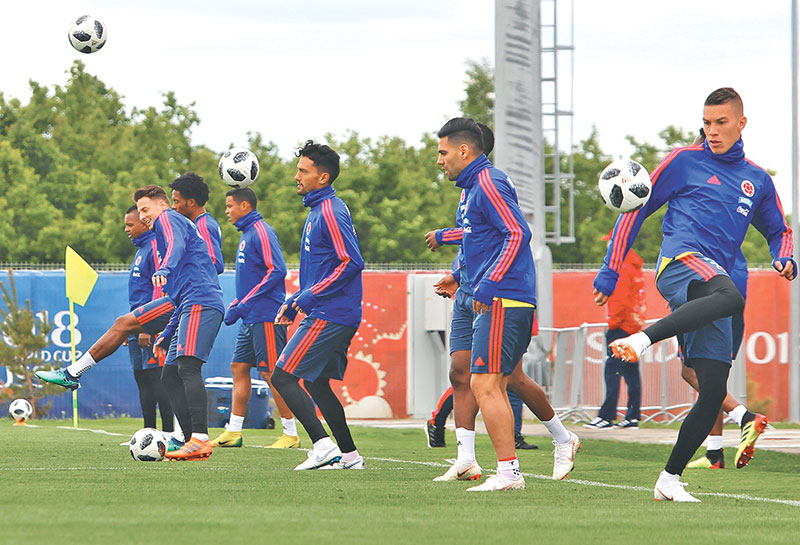
A file photo of Colombian players during a training session at the Sviyaga Stadium in Medvedkovo, Russia. REUTERS

SARANSK, Russia,
Despite sacking their coach just 71 days before the World Cup, Japan will attempt to prove their doubters wrong on Tuesday against a Colombia side sweating on the fitness of star midfielder James Rodriguez.
The top scorer at Brazil 2014 is a doubt for the Group ‘H’ opener at the Mordovia Arena in Saransk after struggling with a strain in his left calf, which also flared up last February. The Bayern Munich attacking midfielder is key to Colombia’s chances of repeating their run to the quarter-finals four years ago in Brazil. Rodriguez, 26, netted six goals and created four assists to help Colombia qualify for Russia, while midfielder Wilmar Barrios is also battling to be fit.
However, the South Americans face a Japan side who would struggle to avoid an early World Cup exit even if they were under Jose Mourinho, according to former coach Philippe Troussier. In a recent interview, Troussier suggested Japan have “no chance” of reaching the knockout stage after sacking Vahid Halilhodzic in April. “Even if they play with Mourinho or Arsene Wenger, it would be so difficult for Japan to get to the last 16,” said the Frenchman, who steered Japan to the second round in 2002 World Cup.
Troussier’s bleak prediction follows unsettling events in the national team. After Halilhodzic was sacked, the Japanese FA replaced him with former technical director Akira Nishino. The 63-year-old has plenty of experience in the J-League, but at national level has only ever worked with Japan’s Under-20 and Under-23 teams before.
With Robert Lewandowski-led Poland and Senegal also to come in the group, Japan need a good start. The high-risk move to install Nishino will be tested in Saransk as the Japanese try to improve on the 4-1 drubbing handed to them by Colombia at the 2014 World
Cup when Jackson Martinez scored twice.
Colombia marched into the last 16 and the result sent the winless Japan home after finishing bottom of their group, a record they are desperate to improve on despite the last-minute change of head coach. “Despite that, I think we will cope,” said Japan captain Makoto Hasebe. “We have three tough opponents. But they are not (defending champions) Germany, so we have a chance and we hope we can go further.”
Their form in the pre-World Cup friendy internationals gives Japanese fans hope. They romped to an impressive 4-2 victrory last week over Paraguay when midfielder Takashi Inui scored twice, after defeats to Switzerland, Ghana and Ukraine.
Colombia are unbeaten this year after seeing off France 3-2 in March before goalless draws against fellow World Cup contenders Egypt and Australia.

WORLD CUP SPECIAL

Salah appears stumbling block for hosts Russia

- AGENCE FRANCE-PRESSE
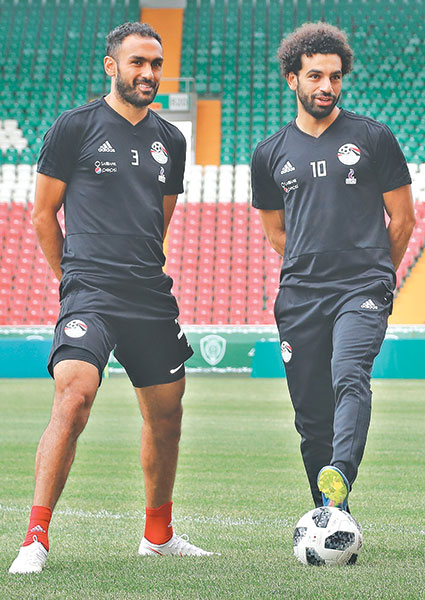
Egypt’s star forward Mohamed Salah (right) with his teammate Ahmed Elmohamady during a training session at the Akhmat Arena in Grozny on Sunday. AFP/RSS

SAINT PETERSBURG,
Mohamed Salah is a looming obstacle as Russia attempt to virtually secure their place in the knockout stages of the World Cup in Saint Petersburg on Tuesday.
Fears that poor performances from the home side could dampen enthusiasm in the host nation were blown away by a 5-0 demolition of Saudi Arabia in the opening game. The seven-time African champions will pose a much tougher task, but a lot will depend upon Salah’s fitness. Liverpool star Salah has not featured since leaving the field in tears early in the Champions League final just over three weeks ago after landing heavily on his left shoulder and had to watch from the bench as Egypt lost 1-0 to Uruguay in their opening game.
Salah has been declared 100 percent fit by team doctor and his agent, leaving little doubt he will be thrown back into action in the Pharaohs’ hour of need. However, as he returned to training on Saturday, Salah was seen in Grozny needing help from teammates to lift a training top over his head. “Salah participated in training with his teammates for the entire session and he is ready to play against Russia according to technical staff,” Egypt’s team manager Ihab Leheta told Fifa.com.
Egypt coach Hector Cuper’s decision not to risk Salah against Uruguay may have been influenced by the fact his side held out for 89 minutes before conceding to Jose Gimenez, by which time the Argentine had made all three of his substitutions. “Russia’s game is fateful and difficult because of our defeat against Uruguay,” said Leheta. “Winning is our only choice”.
If fully fit, the sight of Salah, who scored 44 goals in a remarkable debut season at Liverpool, will strike fear into the Russians. Concerns Russia could become just the second host nation to bow out of the World Cup at the group stage after a seven-game winless run ahead of the tournament have been alleviated by a perfect start.
With Uruguay favourites to top the group, though, Russia are keen not to have to rely on getting something from their final group game against the two-time former world champions. “The second game will be our most important one in the group stage,” said Russia’s deputy prime minister and former football federation president Vitaly Mutko after attending Russia’s training session on Sunday.
A close ally of President Vladimir Putin, Mutko oversaw preparations for the tournament at a cost of more than $13 billion. “In the first match, everyone saw how much the players cared. If we play up to our level, I don’t see any problems.” Denis Cheryshev was Russia’s hero against Saudi Arabia as he came off the bench to score twice.
And the Villarreal winger accepted it will be a more “interesting” clash if Salah is fit. “If he’s not there, does that mean our task becomes easy? Not at all,” he told FIFA.com “If he plays, it will be hard but more interesting. He’s one of the best and you always want to compete with the best and win.” Russia will be without one of their key players, with Alan Dzagoev expected to miss the rest of the tournament with a hamstring injury.

WORLD CUP SPECIAL

Maradona pours scorn on Sampaoli

corner
Diego Maradona

BRONNITSY: Argentina legend Diego Maradona issued a scathing assessment on Sunday of his country’s World Cup draw with Iceland, warning manager Jorge Sampaoli that he would not be welcome back home unless he changes his tactics. “Playing like that, he can’t come back to Argentina,” the 1986 World Cup winner told Venezuelan television after Lionel Messi missed a penalty in the 1-1 Group ‘D’ draw in Moscow. “It’s a disgrace. Not having prepared for the match knowing that Iceland are all 1.90m tall... I get the feeling there’s a general anger at the heart of the team,” said Maradona, himself a former national team coach. Argentina took the lead through Sergio Aguero in the 19th minute Saturday as a cigar-puffing Maradona looked on from the stands of the Spartak Stadium. But minnows Iceland, playing at their first ever finals, levelled four minutes later through Alfred Finnbogason. Messi, whose performances in World Cups are arguably the only blot on an other-worldly career, spurned a chance to take the lead when his 63rd-minute spot kick was saved by Hannes Halldorsson. But Maradona avoided criticising his heir apparent and instead pointed the finger at Sampaoli. Argentina play Croatia in their next game in Saint Petersburg on June 21. (AFP)

WORLD CUP SPECIAL

Mourinho expects top nations to recover

corner
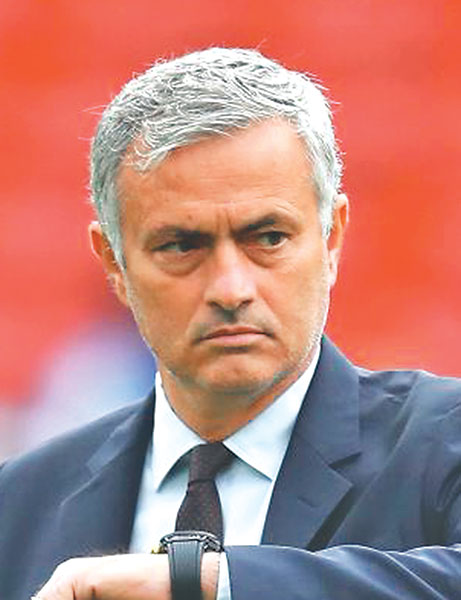
Jose Mourinho

MOSCOW: Jose Mourinho lauded an “amazing day for football” after heavyweights Germany and Brazil failed to win their opening World Cup fixtures on Sunday but the Manchester United manager expects them both to rebound from sluggish starts. Reigning champions Germany suffered a shock 1-0 defeat to an inspired Mexico in Moscow, while Brazil were held to a 1-1 draw against Switzerland in Rostov-on-Don. Mourinho, working as a television analyst for Russia Today, expressed his delight at the results but played down the prospect of premature exits for either side. “They all will qualify and the best of these top teams will come in the knockout,” the Portuguese said. “I think they all know how good they are. I think they all know they are going to improve. It’s probably good for them to put their feet on the ground and it’s probably good for their countrymen also to keep calm.” Germany take on Sweden in Group ‘F’ on Saturday while Brazil will need to improve upon their opening performance when they play Costa Rica in a Group ‘E’ encounter on Friday. (REUTERS)

WORLD CUP SPECIAL

German media sound alarm after shock defeat against Mexico

corner

BERLIN: Germany’s media reacted with concern and worry to the World Cup holder’s shock 1-0 defeat against Mexico on Sunday. Hirving Lozano hit the winning goal after 35 minutes in Moscow when the German defence was caught napping. This was the first time Germany have lost an opening game at a World Cup finals since going down 2-1 to Algeria when Spain hosted the 1982 tournament. Top-selling German daily Bild declared on their website: “Embarrassing performance against Mexico: this crash causes us World Cup worry”. Munich-based newspaper Sueddeutsche Zeitung agreed with “There are reasons to worry” over a picture of the dejected German team, who need to beat Sweden and South Korea to be sure of going through. The Frankfurter Allgemeine newspaper went for “Fiesta Mexicana: False start for Germany”. Magazine Sports Bild commented “There were no world champions to be seen on the pitch” in a damning verdict on the below-par performance. (REUTERS)

Page 8
EDITORIAL

All is not well

Lack of co-ordination among ministries not a good sign for the government

Minister for Physical Infrastructure and Transport Raghubir Mahaseth has assured construction project contractors that the government will no longer arrest them for non-performance or under-performance. Mahaseth’s assurance comes at a time when Home Minister Ram Bahadur Thapa has been taking action against public works contractors who have been sitting on projects for long, either not starting at all or lagging far behind the schedule agreed to in the contracts. Two contradictory statements coming from the ministers of the same government indicates that all is not well within the cabinet.
Last week authorities arrested two contractors in Sindhupalchok and Mugu districts as part of the Home Ministry’s crackdown against non-performing and under-performing contractors.

Following the arrests, a meeting convened on Friday at the request of the contractors who complained about “arbitrary” arrests. At the meeting, Mahaseth was quoted as saying “Contractors are not only to blame for the delays because preparatory tasks like clearing trees along the right of way, shifting the electricity poles and others works have not been done”. Mahaseth’s statement comes after a month-long silence on this issue and his remarks run parallel to the demand of contractors. The contractors want action against the firms in line with the contract agreement and the Public Procurement Act. The measures include fining, confiscating security deposit, terminating contract and blacklisting. The Home Ministry maintains that its actions are specified in the Local Administration Act.


It is important to note that Mahaseth’s actions when it comes to the BP Highway, syndicate and now contractors have all been contradicting government’s policies and that of the Home Ministry’s as well. These are not good signs. The government should take cognizance of this and make sure there is proper co-ordination and communication within ministries and among different government agencies. Should there be any differences—either within the ministry or among the ministers, it should be solved within the cabinet, not in the public realm.


People have huge expectation from the current government. At a time when the government is harping on the prosperity and development narrative, its cabinet members should be working in tandem with each other and not in competition.  Disagreements and differences in opinion among various ministries are not new but the onus lies on the Prime Minister to solve these issues. This particular case could be the first of its kind for the Oli government, but if the PM, as the head of the executive branch of the government does not intervene early, then perhaps such instances might occur again. The public have long waited to see substantial improvement in the areas of infrastructure and public transport, let infighting not jeopardise that.

OPED

On Nepal-China relations

This visit expects two leaders to create win-win cooperation, lasting relationship and exemplary friendship
- RAJESHWOR ACHARYA,DINESH BHATTARAI

Prime Minister KP Oli is embarking on a six-day official visit to the People’s Republic of China from June 19. China is Nepal’s close friend, trustworthy neighbour and a reliable development partner. The age-old relations were formalised on 1st August 1955. Since then they have been growing closer at the government, party and people’s level.  This is the first high-level visit from Nepal to China after the installation of new government following the historic elections under the new constitution. China even applauded the promulgation of the constitution in Nepal as a historic progress in its political transition.


Nepal-China relations have stood the test of changing times and challenges.  Irrespective of sizes, different political systems, level of development, and military and economic might, changes at home, region and beyond, Nepal-China relations provide an exemplary model, based as they are on the five principles of Peaceful Co-existence (Panchsheel). Nepal appreciates China’s long-standing respect for its independence, territorial integrity, stability and development.


China views this visit as an opportunity “to deepen our practical cooperation under the framework of the Belt and Road Initiative and enhance cooperation” in several areas “so as to scale our bilateral ties to a new height.”  With political stability, democracy and rule of law, Chinese support to Nepal remains valuable at this juncture to create a network of infrastructures, connectivity and expedite development in areas like tourism, agriculture, hydropower, and agro-forestry among others.


Of friendship
Neighbours occupy an important place in China’s strategic management. China has launched its peripheral diplomacy that combines politics, economics and security in its relations with neighbours. China wishes to secure assurances and actions from its neighbours that no anti-Chinese activities are allowed from their territories. Nepal unequivocally maintains the One China policy and does not allow any activities against China from its territory. 

Barbara W. Tuchman, in Notes from China (2017) writes, “in 1945, Mao-Tse-tung and Chou Enlai, for a working relationship with the United States, offered to come to Washington to talk in person with President Roosevelt,” the United States made no response to the overture. (p.57) On October 1, 1949, the People’s Republic of China was founded.  In the 1950s and 1960s, as a professor at Duke University Bruce W. Jentleson writes: Americans did not call that large country with lots of people over Asia “China” or the “People’s Republic of China”: it was “Red China.” Nepal’s Prime Minister B.P. Koirala understood the Chinese realities and made a forceful plea while addressing the 15th UN General Assembly on 29, September 1960 to accept the People’s Republic of China as a respected member. Referring to the representation in the United Nations, he said, “In our opinion, the United Nations can neither become universal nor can it reflect the political realities existing in the world today until the People’s Republic of China is given its rightful place in the Organization. The United Nations will not be able to fulfill effectively some of its most important purposes and functions until the People’s Republic of China is brought in.” He called for “greater imagination and foresight than the United Nations has thus far shown.”


In 1960, PM Koirala wrote to Premier Chou Enlai, saying “Nepal-China friendship is of paramount importance for maintaining peace in Asia in the first instance and the world peace in the last analysis. Nepal would spare no effort to make our relations closer and stronger every day.”  Subsequent developments stand as testimony to it. The roots of the present-day relations between Nepal and China go back to this period.  It


was then that decision was made to scientifically demarcate the boundaries and amicably settle all disputes including the ownership of Sagarmatha-the highest peak of the world in favour of Nepal, and also to open embassies in respective capitals. It is a matter of great satisfaction that Nepal and China have been working closely on issues of common interests and mutual benefit at bilateral, regional and international levels.


Balanced relations
China recognises the geopolitical realities of Nepal and wants Kathmandu to maintain good relations with India. Chinese leadership is on record to have advised Nepal to be “friendly with India without being hostile to China.”  China has consistently maintained this position with regard to Nepal’s relations with India. Nepal’s relations with neighbours and wider international community are independent of each other. Nepal judges every issue on its merit and takes positions in the larger interest of the country.


In March 2016 during PM Oli’s first visit to China, Nepal and China signed landmark agreements including the trade and transit treaty--the foundation for which was laid, and documents exchanged between the two governments in 2000, during the time of Nepali Congress led government.  Nepal formally joined the Belt and Road Initiative with the signing of a memorandum of understanding in May 2017 under the NC-Maoist Center coalition government. The agreements on construction of Syafrubesi-Kiyrong highway-the second highway linking Nepal with China and agriculture cooperation were two of the seven agreements signed in Kathmandu during the visit of Chinese Premier Zhu Rongji to Nepal in May 2001. Details of projects under BRI, and other agreements then signed and modalities for implementation of these projects with Chinese investments should be worked out during the current visit.



A success story
China’s economic transformation has been the success story of the twentieth century. The opening up and economic reforms launched by Deng Xiaoping have had far reaching impact on China’s diplomatic, economic and military strength. Recent developments in diplomacy in Asia, including the Singapore summit between the United States and North Korea and China’s stands on these issues carry huge implications for Asian and global geopolitics. These developments should be analysed in an integrated reality in official talks with Chinese side. PM Oli must raise the issue of ballooning trade deficit with China and take decisions on remedial measures. The inclusion of Lipu-Lekh in the China-India joint statement on May 15, 2015 is a breach of Nepal’s sovereignty and territorial integrity. It may be recalled that the Sushil Koirala government had written to both China and India in 2015 drawing their attention. As a follow up to that, PM Oli must raise this with Chinese government.


Asia has emerged as ‘the world’s brightest spot for the 21st century,’ and shaper of the world destiny. China looms large in global picture, with Beijing emerging as the most influential world capital. It behoves on Nepal to think seriously, have clarity and build reliability to make meetings in Beijing meaningful for relations, beneficial for prosperity and a secure future of Nepal. In charting out a future course of China-Nepal relations in the twenty-first century, the leaders of the two countries are expected to go beyond the ritual joint statement, and adopt a vision roadmap to erect a towering edifice of a win-win cooperation, lasting relationship and exemplary friendship.


Acharya is former ambassador to China. Bhattarai is former foreign affairs advisor to former prime ministers

OPED

Learning from Rwanda

There is a lot to learn from this African country that never ceases to surprise people
- SUJEEV SHAKYA

It was five years ago that I visited Rwanda for the first time, and it was full of surprises. The three key lessons I took away from my first trip was that, one, do not be scared to think big. Two, you may not be a rich country but you can still be clean and orderly. Three, you always eye the global stage. Five years later, it is amazing how much this country that is two-third the size of Bhutan and whose population is one-third that of Nepal, has been able to achieve.


Think big
The proud moment in Rwanda currently is about the deal Rwanda Tourism has signed with English Football Club Arsenal. In this three-year sponsorship deal, Visit Rwanda will feature on the jersey sleeves of the players. This will give a tremendous boost to the image of the country, similar to what Thailand got when it began sponsoring and later on buying football clubs in Europe. With a viewership of 3 billion people, reaching out to a large number of audiences is the dream Rwanda believes is important for tourism. This has led to backlash from poverty brokers, who feel this is wasteful spending. However, with a country that has reduced foreign aid to 12 percent and wants to eliminate it by 2025, it is very clear that they do not want to be aid dependent, which is creating chaos in the aid industry.


Rwanda’s national carrier Rwanda Air is all set to make its maiden direct flight to the US in August, and the new airport will be ready by end of 2019. It aims to position the country as an airline hub. More than 10 hotels managed by global management companies have started in the capital Kigali in the past five years. The convention centre that was completed in 2016 has positioned Kigali as a conference hub. Unlike in Nepal, where we budget $10 million for conference facilities with our ‘party palace’ mind set, this one was completed with an investment of $300 million. Lesson number one, learn to dream big and chase those big dreams. Your GDP then will automatically double every five years.


One of the first things that baffle anyone who visits Rwanda is how clean it is. At the airport, you are scrutinised for plastic bags. The streets are clean. Building good drainage and service ducts for wires is equally important as building roads. The key is that they have been able to maintain what they have built. Painting road markers is not an indication of the completion of building roads like in Nepal, it is a perennial exercise. The toilets in offices government or private are as clean as the ones in restaurants. Cleanliness is a day-to-day habit integrated into life, not once a year on World Environment Day. We have grown up learning that to be neat and clean are capitalist behaviours; therefore, if you are to be a socialist, there has to be a sense of disorder. Lesson number two, socialism is not about being dirty and disorderly; it can be clean and orderly too.


Eye on global stage
President Paul Kagame of Rwanda is seen at major global events. Last week, he was in Moscow at the opening of the FIFA World Cup 2018 as Rwanda will be hosting the FIFA Council meeting in October 2018. During every trip, Rwandan leaders are meeting people who matter. This is in contrast to our Nepali leaders who are obsessed with meeting fellow party workers and zillions of diaspora association members, getting decked in garlands and face smeared with vermilion and watching those pictures on social media.


Rwanda is currently the head of the African Union. Rwanda is hosting the Commonwealth Heads of Government Meeting in 2020. Rwanda joined the Commonwealth just eight years ago. The foreign minister of Rwanda is now a candidate to lead the Organisation of French Speaking countries. Despite a chequered past relationship between France and Rwanda since 1994, Rwandan President Kagame met French President Macron to renew relations. Rarely is a country at the middle of both Commonwealth and Francophone country activities.


Backed by security and safety records, the mindset is that of Singapore. It strives to be on the global centre stage as a country from Africa that strives to be a hub for business, trade, commerce and connectivity. A country, which a decade ago moved to English as its second official language from French, is creating a workforce that has the key value system engraved along with a great pride about the country they belong to. Lesson number three is that in today’s globalised world, it is not about appearing on social media pages of your fellow country people, but emerging at the centre of global discourse. Nepal need not talk about becoming a Switzerland or Singapore like nirvana or moksha that one knows is not achievable in this life. It is better to learn from countries like Rwanda about what they did right. We just need to recalibrate our thinking and shed some of our dirty habits in all forms.

OPED

The Dhaleshwari

- THE DAILY STAR

It is condemnable that solid waste from Savar Tannery Industrial Estate is seeping into Dhaleshwari river because a breach has developed in the embankment of the pond which is being used by the Central Effluent Treatment Plant (CETP) in the estate as a temporary dumping station. Reportedly, after the tannery estate was set up in the area, the pollution levels in the Dhaleshwari have increased. A recent test by the DoE has found that the dissolved oxygen level has decreased and Biochemical Oxygen Demand (BOD) has increased in the river water, which is making it hard for the aquatic life to survive. Although the chief consultant of the Savar tannery hinted of sabotage, we are not sure if that is the case. Because what we know is that the initial plan of the authorities was to generate power from the solid wastes and now we hear that the Chinese company that set up the CETP did not have the capacity to do that. Such inefficiency on part of the firm is totally unacceptable. Also, shouldn’t the authorities have done a background check in order to know the capacity of the firm before appointing it? And why isn’t there a permanent and modern waste dumping station instead of an open pond? It is obvious that there is a lack of monitoring and proper planning on part of the authorities.
Tanneries from Hazaribagh were shifted to Savar in order to save Buriganga from pollution. Given the level of pollution in Buriganga, it will take a long time to clean its water, even with proper planning. And now we are killing Dhaleshwari too. If our rivers live, we will live. Will we ever learn this simple truth?

Page 9
OPED

The lopsided discourse

The hegemonic account of conservation relies on unequal power relations
- SHRADHA GHALE
A conservation pamphlet in Manaslu Conservation Area. Photo credit: Shradha Ghale

In my last piece I argued that imported models of conservation have failed to address ground realities in Third World countries. Why, then, do governments in poor countries sign on to the agenda of international conservation organisations? In an August 2016 article in The Guardian, Victoria Tauli-Corpuz, the UN special rapporteur on the rights of indigenous peoples, said, “Governments like conservation because there is a lot of money in it. It brings money from the Global Environment Facility and elsewhere. But when your economic priority is to generate money from conservation, you want to get rid of people from these protected areas. That is what is now happening.”


Perks and prestige
Along with funding comes prestige and a range of opportunities. Big organisations regularly provide government officials opportunities to travel abroad and take part in global forums. Delegates at such forums are expected to demonstrate their commitment to a particular brand of conservation. A senior member of ForestAction Nepal recalled one such gathering: “They showed a clip of a bleeding rhino, its horn had been hacked off by poachers. The audience became very emotional. But there were no clips of people who were suffering because of wildlife attacks and park regulations.”
Further, many top-ranking officials at the Department of National Parks and Wildlife Conservation have worked for international conservation organisations, both during and
after the end of their tenure. For example, a number of park officials, including former wardens, have been on WWF’s payroll.
The government’s relations with conservation organisations might have been less harmonious had the latter called out powerful actors involved in environmental destruction. In India, Modi’s government launched a harsh crackdown on Greenpeace India for its activism against coal mining companies. The environmental group was accused of working against ‘growth’ and ‘development’. Imagine if conservation organisations in Nepal demanded that big hydropower projects meet all the environmental safeguard requirements before proceeding, or that companies involved in illegal sand mining and politicians who protect them be brought to book. No doubt they would be labelled enemies of ‘bikas’ and ‘samriddi’.


Trickle-down incentives
“Villagers destroy the forest because they lack awareness,” says Mangal Tharu, chair of Shiva community forest, which lies in an area that WWF branded as ‘Khata wildlife corridor’ in 2001. He was referring to another community forest that is used by many poor households including landless Dalits. “They cut grass, collect fuelwood, graze cattle. We need to hold more seminars and workshops to raise their conservation awareness. Conservation is for the country.”
In 2011 Shiva community forest won a global award for growing and selling chamomile and mint. The competition rewards community projects that use “business methods” to address social and environmental issues. It is sponsored by Newsweek and Shell, the oil multinational notorious for its contribution to climate change.
“We must spread conservation awareness among the locals,” says Krishna Chaudhary, an energetic young man who runs a homestay near Banke National Park. Asked whether the government made the right decision by placing national parks under the central government, he says he supports the decision “because national parks are our nation’s wealth.” Chaudhary is chair of the network of community-based anti-poaching units, which receive training and support from WWF and USAID.
In a 2012 article co-authored by Hemanta Ojha, he writes how transnational actors shape Nepal’s conservation policy by attaching “incentives and prestige” to the conservation model imported from the West. Such incentives also trickle down to the villages, where local actors are mobilised to propagate this model. Many people I met in the buffer zone villages frequently used the word “steal” to describe the act of collecting essential resources from the forest. This alone shows the extent to which they have internalised the dominant narrative. In this narrative, a good, responsible, ethical citizen joins hands on the conservation agenda rather than demanding his or her right to access resources or retaliating against wildlife attacks.


Mass media spectacle
In a 2011 article in Conservation and Society, Sian Sullivan writes how neoliberal conservation uses mass media to “sell its concerns and wares.” Mass media representations of nature foreground “the sensational, the picturesque, the exotic, and the unpeopled” while occluding the culture and livelihood of people who inhabit “wild” places. As Sullivan observes: “The modern conservation spectacle appeals to, and sustains, the relatively wealthy of the world, who also tend to be those with the greatest per capita global ecological footprint.”
A piece by Ryan Davy in last week’s Nepali Times is a small example. Anyone with even basic knowledge of Nepal’s mountain life knows the importance of yaks in the livelihood of people in the high Himalaya. Studies have shown how yak herders, who have long contributed in maintaining ecological balance, are gradually losing their way of life because of social and environmental pressures, as well as anti-poor conservation policies.
But such facts are of little use to those on a mission to explore the Himalayan “wilderness.” Davy is in the mountains of northern Nepal to capture the Himalayan wolf on camera. These wolves attack yaks and come into frequent conflict with yak herders. “Perhaps this is nature’s way of protecting the slopes from overgrazing,” Davy writes. One wonders whether he would sound as generous had his career depended on herding yaks in Nepal’s mountains rather than on collecting spectacular footage of Himalayan wolves. “It is human activity that has created a need for nature to compensate for the over-abundance of yaks,” he writes. In other words, yak herders’ way of life sustains more yaks than Davy thinks is appropriate, so it’s justified that the wolves sometimes kill those yaks. “If villagers have a stake in conservation, maybe they will not exterminate predators.” It is ironic that a white Westerner adventuring in the Himalaya should remind the marginalized yak herders of their conservation duty. Finally, Davy muses whether nature might have “summoned” the wolves to “take care of the problem of yak overpopulation.” A nice, wistful idea, only factually incorrect. Far from being overabundant, yak population is steadily declining; some studies suggest they face the threat of extinction.
As my recent articles have tried to show, conservation in Nepal has extracted the heaviest price from the poor and marginalised. The hegemonic discourse of conservation relies on unequal power relations between rich countries and poor countries, between Kathmandu and the rural populations, and between the relatively privileged locals and those at the very bottom. With the power of funding and knowledge production, as well as an extensive publicity campaign, conservation elites have thus far won the unequal battle of narratives.

OPED

Oli visits China

PM’s visit to China is an ideal time to deepen Nepal-China engagement
- LEKHNATH PANDEY

Nepal’s ruling left government may not be of everyone’s choice but for a communist country like China it can be an ideal time to enhance bilateral cooperation with Nepal where China’s ‘charm offensive’ counts hugely to contain India’s geo-political dominance.
China has been trying hard to find a stable regime and reliable partner in Nepal since the monarchy was overthrown in May 2008. Finally, after many decades Nepal has had a stable and strong government as Prime Minister KP Oli enjoys a two-third majority. The two countries  now have the  opportunity to explore and enhance areas of cooperation in multiple sectors like connectivity, infrastructure, energy and security. Many of them can be pursued under the framework of Belt and Road Initiative (BRI), a flagship Chinese project, of which Nepal is a party since May 2017.


Pragmatic foreign policy
As PM Oli is all set to embark on a six-day state-visit of China starting from June 19, these issues will be raised at the highest level. His entourage comprising four key cabinet-colleagues— Ministers for Home Affairs; Foreign Affairs, Water Resources and Irrigation; and Physical Infrastructure and Transport—reflects the importance given to and priority set for this trip. This is his second visit to Beijing since March 2016, when he was heading a fragile coalition and was perceived as an anti-Indian or a pro-Chinese. Now, he holds a strong government having the mandate to govern for five years. After his return to power in February, PM Oli has been trying to project a ‘pragmatic’ foreign policy and to win the confidence of both neighbors—India and China. All his diplomatic endeavors have been focused on not to be seen as siding with either one.
A month after PM Oli’s visit to India as his first port of call, his Indian counterpart Narendra Modi’s visit in the second week of May was widely perceived as an attempt to slow down Chinese influence in Nepal. Modi was able to divert attention from it by temple visits and soft diplomacy. Nevertheless, India pledged to construct a railway up to Kathmandu via Raxual and initiate a water-link project to pave the way for Nepal’s access to the sea. Such gesture from the southern neighbor was made keeping in mind the China’s interest in the trans-Himalayan railway project. However, there is slim chance of early realisation of such ventures given the poor track record of India’s development commitments and Indian joint-venture projects in Nepal.

PM Oli’s growing affinity with India is an issue of debate if this would affect Chinese faith and support to Nepal. However, China has taken his visit to India in a positive light and also shown its interest to capitalise the constructive vibes generated through the recent high level exchange of visits between Nepal and India. Chinese Foreign Minister Wang Yi during his meeting with his Nepali counterpart, Pradeep Gyawali in Beijing in April floated a proposal of China-Nepal-India economic corridor. India is yet to consider this idea affirmatively. If capitalised, this could help restore Nepal’s ancient glory as a Himalayan-transit. But this idea has as much economic prospects as geo-political implications.


Implementation is key
Despite being a next door neighbor, China’s foreign direct investment (FDI) in Nepal vis-à-vis other South Asian countries has remained meager. China’s pledging of Rs8.35 billion ($81 million) worth FDI to Nepal during the fiscal year 2016-17 topped India’s that stood at Rs1.99 billion. Yet China’s ongoing investments in Bangladesh ($23 billon) and Pakistan ($61 billion) is much higher. Nepal thus has to win Chinese trust to bring more Chinese investment in Nepal. Erstwhile, the Nepali Congress-led government quashed a multi-billion dollar contract with China’s Gezhouba Group for the construction of the much awaited Budhi Gandaki Hydropower Project citing lack of transparency. firm, which won’t be easy for him as previous government
Most agendas of the prime minister’s forthcoming visit are the same as his last trip in March 2016. Many of them are yet to be initiated. Therefore, problem of our engagements with China is not winning too many investment pledges, but executting them effectively. Besides, there is deep apprehension of possible behind-the-curtain deal, debt-trap or lack of benefits for locales. If such issues are ignored, Chinese projects will be no different than the Indian projects , thereby jeopardising Nepali’s positive sentiments towards China.
There is quite a resemblance between the current leadership in China and Nepal. Prime Minister Oli has become a powerful leader of Nepal in decades; while President Xi has been dubbed as the most powerful Chinese leader after Chairman Mao. The colors, contents and characters are also similar as both the leadership hold nationalist images and enjoy a strong mandate.  Further, Both are politically leftist and economically capitalist. No such resemblance was witnessed in modern history of Nepal and China, which could be a launching pad to deepen bilateral engagements and diversifying bilateral cooperation.


The author is an assistant professor at Tribhuvan University and writes on geopolitics and strategic issues

OPED

The new opium of Nepalis

It’s much easier to bind the minds of the middle class with the imagery of a giant ship
- SABIN NINGLEKHU

Let’s begin with a well-worn cliché: Unless politics, not the everyday ‘ordinary’ kind, but the kind that can shape the everyday life of the ordinary people, is infused with egalitarianism, ‘stability’ and ‘prosperity’ will always have a ‘class’ character. After nearly two decades of relative latency since the 1990s, infrastructure has re-emerged as a governing logic on the national scale that mediates discussions about bikas. In other words, the present time contains more currency than ever before for politicians of all hues that are commoditising politics as neatly packaged aesthetics high on elite steroids. Singapore, Smart City, Satellite City, Sky Rail, Mono Rail and Metro Rail could all coexist under the united colours of capitalism. This is the hegemonic time of high-tech railways and world class airports, after all.


The kind of aesthetics that these imageries conjure up has the power to reduce politics to the realms of spectacle, fantasy and entertainment. In the process, aesthetics also conceals the stuff of everyday life that matter: cheaper housing rent and affordable health and education services; accessible markets for farmers and accountable municipal and ward offices for the ordinary. But quite tellingly, this recourse to the politics of aesthetics also reveals laziness among those politicians that lack the imagination and hard work to rebuild politics.


Misplaced priorities
Ram Gopal Maharjan is a local in a Newar town destroyed by the earthquake which was subsequently re-declared as a Heritage Settlement amid much fanfare. To rebuild his house, Ram Gopal has to stick to two sets of governmental mandates:


One, structural safety measures prescribed in the building codes, and two, architectural requirements specified in the rebuilding bylaw which, among other things, mention that the façade should display Newar architecture.


These conditions mean that Ram Gopal needs to assemble a sizable amount of money. A five-foot deep foundation with re-bars laid horizontally and vertically would cost twice as much as they used to before the earthquake, because of new structural requirements. Ram Gopal has now stalled construction for two reasons: One, the foundation already cost much more than he had budgeted for, and two, the wooden doors and windows that the heritage bylaw mandates cost thrice as much as aluminium frames. The current dilemma is whether to sell his remaining farmland to complete construction, or to wait for the government-endorsed subsidised housing loan that may never arrive.


Taking the former option would mean being detached from the land that has historically sustained life for nearly half the year, every year, through grains produced. More importantly, it would mean being bereft of any fall-back option should there be another disaster of the same kind. Taking the latter option, of loan, is filled with uncertainties because being eligible to even apply for the government’s subsidised housing loan would mean, first and foremost, becoming worthy of the credit, to be evidenced through a consistent and documented flow of income.


Ram Gopal, the artisan, relies on occasional orders dispatched from Patan to produce woodcraft. The handicraft workshop is not registered because there was never the need for one. And then, there is this small issue of obtaining the building permit first, which the municipality will only provide after Ram Gopal has had his land title issued from the Land Office. The path to obtaining the title is littered with bureaucratic misgivings that Ram Gopal is unaware of. The subsidised loan with an interest of 2 percent is, therefore, a paper dream.
One way to look at Ram Gopal’s predicament is through the lens of governance. Wishful thinking would dictate that the Ministry of Urban Development could potentially coordinate with the National Reconstruction Authority (NRA) and the Department of Archaeology, alongside Nepal Rastra Bank, including the Nepal Bankers’ Association, to resolve
some of Ram Gopal’s dilemmas. But such a move would require a radically different kind of Nepali state. Further, if a top-level official of the NRA is to be believed, it is the World Bank’s distrust of Nepal’s local and municipal authorities’ capabilities that is preventing the NRA from decentralising the duties linked to disaster governance.


If that is the case, any move to decentralise governance in substantive terms to address Ram Gopal’s situation could involve jeopardising the government’s relationship with both the donor and its distant cousins who might be surreptitiously benefitting from the existing fix. And quite frankly, attempting to get rid of bureaucratic inertia is an invisible work devoid of individual gain. Instead, it is much easier, and definitely more heroic, to bind the minds of the middle class with the imagery of a giant ship; the waving sun and moon emblazoned on the red and blue of the Nepali flag announcing its eventual arrival in the Bay of Bengal. As such, the self-infatuation and delusions of grandeur that oil Oli’s infrastructure turn is the new opium of the Nepali people.


Ninglekhu is conducting a long-term ethnographic research on the everday politics of post-earthquake rebuilding in Kathmandu Valley

Page 10
HOROSCOPE

Horoscope

- Post Report

ARIES (March 21-April 19)
***
You’re passionate about what you believe in. Whether you’re convinced that an aspect of work should be handled in a specific manner, or in current events has your sensibilities inflamed. Express your views.
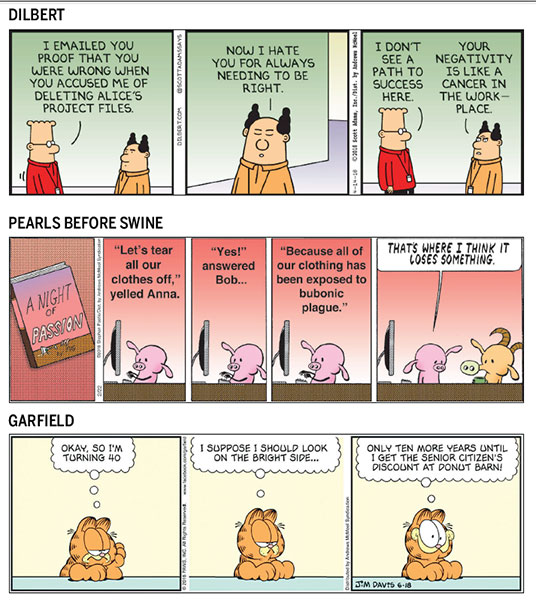

TAURUS (April 20-May 20)
**
Sometimes you tend to think others should be as stable and predictable as you usually are, but other people just act irrationally at times. It can be disconcerting, but jumping to conclusions about their motivations may be a bit premature.


GEMINI (May 21-June 21)
**
Financial matters are highlighted at the moment, particularly those that involve other people. If you’ve got a joint account with your babe or a business partner, make sure you’re on the same page about how those monies are being used (and how quickly).


CANCER (June 22-July 22)
****
The stars are shining their prettiest light right on you, and you look fabulous in the glow. Your natural tendency is to shy away from the cosmic limelight and modestly redirect the attention elsewhere. Be ready to smile, simply say ‘thank you’ and feel wonderful.


LEO (July 23-August 22)
*****
Modesty becomes you right now. You’re putting aside what kind of rewards you could be angling for and you’re simply operating on the strength of your desire to do right. The goodwill you’re creating is reflected, making your world both calm and bright.


VIRGO (August 23-September 22)
*****
Knowing you, you’ve made all manner of lists and already checked them twice, and you’re inspired to be even more organised than usual. You’ll want to expect the unexpected now. Have a special, elegant snack on hand.


LIBRA (September 23-October 22)
***
Getting involved in some kind of intrigue, as you’re likely to do right about now, may not sit very well with you. Your instinct may be to just get it all out on the table, but there may be unforeseen consequences to doing so. Keep your head down.


SCORPIO (October 23-November 21)
*****
Wow—the moment you decide to just let things happen instead of trying to guide them, they really start happening. Putting your strong sense of drive into neutral takes a lot of self-control, but right now it’s the best thing to do.


SAGITTARIUS (November 22-December 21)
***
You’re just being you, enjoying the hubbub all around you and following your mood. The funny thing is, your relaxed manner and optimistic attitude are far more alluring than other people’s best come-hither looks or tightest pants.


CAPRICORN (December 22-January 19)
*****
It’s just one of those days—or nights, where whatever it is you’re doing, suddenly something else sounds more appealing. If you’re out and about, the cozy comforts of home will likely start calling to you; if you’re nesting, a little stir-craziness could set in.


AQUARIUS (January 20-February 18)
*****
Your daily routine may not go quite as smoothly as usual now, especially with work interactions. Someone’s motives are likely not what they seem, and dealing with their hidden agenda is probably the last thing you want to do.


PISCES (February 19-March 20)
***
The world’s full of sparkly possibilities at the moment, with the potential for joy right around every corner. It’s time to open yourself up to something new, something completely of the present, something in which you let your expectations go.

Variety

GRAFFITI

GRAFFITI

Variety

WORD GAME

WORD GAME

Variety

RIPLEY’S BELIEVE IT OR NOT

RIPLEY’S BELIEVE IT OR NOT

Variety

STRIPS

STRIPS

Variety

FILMS

RACE 3
QFX Civil Mall: 08:30/11:45/12:15/16:00/18:00/19:45
QFX Chhaya Center: 12:00/13:00/16:15/18:30/19:30
QFX LABIM Mall: 09:15/11:45/16:15/18:45/19:45
QFX Kumari: 11:45/15:15/18:45
QFX Jai Nepal: 12:00/15:30/19:00


A QUIET PLACE
QFX Civil Mall: 12:00/15:00
QFX LABIM Mall: 12:15/18:15
QFX Chhaya Center: 15:00/18:00


KAALA KARIKAALAN
QFX Chhaya Center: 11:45/15:15
QFX Kumari: 15:00
QFX LABIM Mall: 15:15
QFX Civil Mall: 15:15


VEERE DI WEDDING
QFX Kumari: 12:00/18:30
QFX LABIM Mall: 12:45/15:00
QFX Civil Mall: 18:45

Page 11
LIFE & STYLE

90s stars unite for a cause

- Post Report

Chitwan,
A host of the biggest singing superstars of the 90s congregated in Narayangadh for a musical evening dubbed ‘Mega Old is Gold’ over the weekend. Ranging from Sanjay Shrestha who sang his famous ‘Musu musu haasideu na lai lai’ song to Kabindra Shrestha who wooed the audience with his popular number ‘Dandama mela lagechha’; the show saw 14 singers, including Babin Pradhan, Sachin Rauniyar, Bhim Tuladhar, and James Pradhan take the stage.
As the audience, both young and old, grooved to the tunes from the 90s—a playlist of almost 30 songs—it was attested that old really is gold and good music will always have a fan following, regardless of the time and era.
The get-together organised by the Narayangadh Rotary Club, however, was not just for fun. The 14 pop artists had gathered for a cause—to raise funds to support the education of Chepang children who live in the district.
“The Chepangs are one of the most marginalised groups in Nepal. They have been living in poverty and illiteracy for a long time now,” said Narayan Pradhan, president of the Club. “Whatever revenue is raised from the event will go to the cause, every artist who sang today did so pro bono as well.”

LIFE & STYLE

Last Jayer wine may fetch $13m

- AGENCE FRANCE-PRESSE

Geneva,
The last batch of late legendary winemaker Henri Jayer’s Burgundies—which include some of the world’s most expensive wines—go on auction in Geneva Sunday and could rake in up to $13 million.
In all, 1,064 bottles will go under the hammer at the Baghera Wines auction, which will take place at a gourmet restaurant in Geneva. They include Cros-Parantoux Vosne-Romanee Premier Cru, which ranks among the world’s priciest wines.
The 855 standard bottles and 209 magnums, dating from between 1970 and 2001, are from the personal wine cellar of the man broadly considered the king of the Pinot Noir.
“These bottles and magnums from his personal reserve were a bit like his laboratory... A way to see his vintage wines age over the years,” his daughters Lydie and Dominique Jayer, wrote to AFP in an email.
“It was natural for us, since we could not drink all of these bottles, to offer them up for sale so that wine lovers ... could buy them and drink them, in his honour,” they said.
The daughters will be present at the auction to watch the dispersion of their inheritance.
Frenchman Henri Jayer, who died in 2006 at the age of 84, established a name for himself in the 1970s, when specialised wine reviews ranked his wines among the best in the world.
Over the years, he became “the emblem of the Burgundy in the eyes of the public”, Swiss wine critic Jacques Perrin, who knew Jayer personally, told AFP.
It is this quality that has made Jayer’s wines some of the most sought after in the wine world—and brought them their sometimes astronomical price tags.
The most expensive lot at the auction—a series of 15 magnums of Vosne-Romanee Cros-Parantoux dating from 1978 to 2001—has been valued at between 280,000 and 480,000 Swiss francs ($282,000-$484,000).
The entire auction is expected to pull in between 6.7 and 13 million francs—an amount that has raised eyebrows in the business.

LIFE & STYLE

Beyonce, Jay-Z launch surprise album

- AGENCE FRANCE-PRESSE

Los Angeles,  
Music’s most famous couple Beyonce and Jay-Z pulled a surprise by releasing a joint album, a long-rumoured collaboration that celebrates their marital passion and black identity.
The pop diva and hip-hop superstar announced the album, Everything is Love, from the stage in London as they wrapped up the British leg that opened a global tour.
The album came out exclusively on Jay-Z’s fledgling Tidal streaming service.
The couple also put out an elaborately choreographed video that takes place inside the Louvre museum in Paris for a song off the album, Apeshit.
The video opens with the couple standing regally in front of the Mona Lisa—Jay-Z in a light green double-breasted suit, Beyonce in a lavender pantsuit—and features a squad of scantily clad dancers moving in front of Jacques Louis David’s The Coronation of Napoleon.
Driven by warm, sultry soul with a largely hip-hop cadence, Everything is Love marries the styles of the two artists but is more consistent with the recent direction of Jay-Z.
The album shatters any lingering innocence from the early days of Beyonce, with the singer of Say My Name and Single Ladies (Put a Ring On It) generous in the details of her married life with Jay-Z.

LIFE & STYLE

3 hurt in Dutch music fest hit-and-run

- AGENCE FRANCE-PRESSE

LANDGRAAF,
A van slammed into pedestrians near a Dutch campsite at a huge music festival early Monday, killing one person and seriously injuring three others just hours after headline act Bruno Mars wowed tens of thousands of fans. The four pedestrians were hit around 4:00 am Monday by the van which then fled the scene, only hours after the end of the three-day Pinkpop Festival in the southern town of Landgraaf, near the German border.
“The white van that was involved in the collision is still being sought,” police said in a statement, adding they had set up an emergency call centre for information. Police cordoned off the section of the road while an investigation is under way, and a police helicopter was deployed to take aerial shots of the crash site.
The Pinkpop festival was launched in 1970. This year as well as Mars, who closed the event on Sunday, other major bands including Pearl Jam, Foo Fighters, Snow Patrol and Noel Gallagher performed to sell-out crowds. The festival has drawn around 67,000 fans a day since opening on Friday, according to director, Jan Smeets, quoted by the Dutch news agency ANP.
The organisation said in a statement on Facebook that it was “shocked, and our thoughts are with victims and their families.”

LIFE & STYLE

Incredibles 2 shatters box office records

- REUTERS

Los Angeles, 
The opening weekend of Incredibles 2 was, well, incredible.
The Disney-Pixar movie flew to a record-breaking launch of $180 million in 4,410 locations, easily landing the superhero sequel the best debut of all time for an animated film. That title was previously held by fellow Pixar sequel Finding Dory, which bowed with $135 million in 2016.
Incredibles 2 also landed the eighth-biggest domestic opening of all time, and surpassed 2017’s Beauty and the Beast ($174.6 million) for the best debut for a PG-rated film.
Overseas, where it has opened in 26 percent of the international market, Pixar’s 20th film collected $51.5 million, bringing its global total to $231.5 million.
With 14 years since the original film, 2004’s The Incredibles, enthusiasm has been strong for the follow-up, and it seems that audiences and critics alike were not disappointed. The film boasts a coveted A+ CinemaScore, as well as a 94 percent fresh rating on Rotten Tomatoes.
“The film shows the drawing power of the superhero genre, whether in the live action or animated realm,” box office analyst Paul Dergarbedian said. “The combination of the Pixar brand and Disney’s perfectly executed marketing and distribution strategy made the film an instant classic and a box office juggernaut.”

LIFE & STYLE

Toxic love

agonyaunt

Dear Aunt,
I am an SEE-appeared 15-year-old. I have been in a relationship since I was 13. I didn’t know what love was then, and I don’t know what it is now—yet, I am still dating the guy. And I am extremely confused. He is completely different than I am, not just in habits and nature but also in how we were brought up. One year ago, when my parents learnt that I am dating somebody who comes from not just another caste but another region altogether, they were very angry. But I persisted and have been keeping the relationship afloat. However, in these two years, I still haven’t figured the guy out. I want to understand him but I never know what he wants. He is sometimes too concerned about my academic performance and my whereabouts. He gets mad at me when I talk to other guys, which I don’t like. I am a very friendly person and I make friends easily. But he just refuses to understand when I try to explain this to him. And I always give in because I don’t like fighting. Recently too, I deactivated all my social media accounts because of a fight we had just because he accused me of not blocking a boy. I am upset but I don’t want to break up. However, I also want these petty fights to end. Could you help me by telling me how I can change his character?
—Sahara

Dear Sahara,
At fifteen, it is natural to be confused about your feelings and about where a relationship is heading. This is an age where you are constantly growing and evolving, which also means that everything inside and around you is changing really fast. This is also an age where you start understanding yourself a little better than you did when you were younger. You start developing your own values and your own identity. It is great that you believe you have already found the love of your life, but you need to understand that even your beliefs are evolving. And while it is really wonderful that you want to make this relationship work, you need to figure out if it’s worth your time and energy. This may or may not be for forever. So as of now, you need to focus on your present and focus on your personal happiness and peace of mind rather than focusing on changing the young man’s character. I mean if you don’t like how he treats you, and he hasn’t really understood how he makes you feel in two years, do you really want to spend two more years trying to figure him out? From the information you have provided, it is clear that he is very possessive and controlling in nature. Now, I know, these are traits that films often use to portray the essence of love. But, that’s not how love works in real life. Love is much more sorted and healthier in reality. Love is warm but not suffocating. Love is protective but not possessive. Love is about wanting to be a part of your partner’s daily activities but not about controlling it. Love is about a significant bond between two people, but not at the cost of other bonds. If you already know that you two are very different in nature, and he never meets you half way, there’s no point in sweating over this relationship. You might feel like two years is already a lot of time to invest in a relationship and you might feel the pressure to make this work—but know that you don’t have to make this work. You don’t have to entertain people who bring you more sorrow than joy. Your time is too precious to waste on people who don’t acknowledge or celebrate the person you are and instead try to mould you into somebody they want you to be. That is not love. You have a whole life ahead of you to find men that respect you and love you in a healthy way.  


Blast from the past
Dear Aunt,
I am 24 years old. A friend that I went to school with is getting married this month. He’s the first in the batch to get married, which means this is going to be a reunion of sorts. I am going to meet people that I haven’t met for eight years straight and among them are people who I didn’t get along with very well. Around the time we graduated SLC we had a nasty row and we haven’t talked ever since. Now, I know that a lot of time has passed, and I have grown into a more mature human being, but I don’t know if it’s the same on their end too. I can’t help but feel sick to my stomach when I think of seeing them again. I am ready to let go of the grudge, but what if they are not? What if the past comes rushing back to the present and disturb the peace that I have worked so hard to maintain? I don’t want to see these people, but I know they will be there, neither do I want to miss the big day of a special friend. What do I do?  
—Rami


Dear Rami,
Eight years is a long time. And ideally, people change. But like you said, you can’t really speak for somebody else. It is great that you have grown as a person in all these years and that you are ready to let go of the grudge, but the only way to find out if they are ready too is confronting them. Go to the friend’s wedding, have fun, meet all the people and see how things uncover with your ‘friends’ from the past. If they have gotten past the phase like you did, it’s great. You can make peace. If they haven’t, sure it will bother you for a while, but it’s not your business. Every person takes their own time to heal from bad memories. They may not be ready to let go of the grudge now, but they eventually will. You need to understand that you are not the same person that you were eight years ago, and while there is no running away from the past, it’s in your hands to decide how much you allow your past to meddle with your present. Don’t stress over it too much. However, if you feel like you are just not ready to meet these people, then don’t. Just keep to yourself and avoid the wedding altogether. Sometimes it’s okay to protect your peace of mind from the unknown.

Page 12
SPORTS

Stokes, Woakes ruled out of One-Day series

- AGENCE FRANCE-PRESSE
England’s Eoin Morgan during a training session at the Trent Bridge, Nottingham, on Monday. Reuters

LONDON,
Talismanic England allrounder Ben Stokes and paceman Chris Woakes will miss the remainder of the One-Day International (ODI) series with Australia the England and Wales Cricket Board (ECB) announced on Monday.


Stokes’ hamstring injury—which he suffered in the lead-up to the second Test with Pakistan—the ECB says is progressing well and are hopeful the 27-year-old will be fit for the T20 series with India next month. England lead the five game series with Australia 2-0 with three matches remaining.


“He can bat fully and is now able to run at 90 percent capacity,” read a statement from the ECB. “He will commence his return to bowling programme this week. The plan is for Ben to continue his rehabilitation programme with the England squad during the 4th and 5th ODIs (against Australia on Thursday and Sunday) at Riverside and Old Trafford.”


Woakes, 29, injured a thigh muscle during the second Test with Pakistan in June which the ECB say “was at least in part due to a flare-up of a chronic right knee problem”. Aside from missing the ODI series with Australia he’ll also miss lone Twenty20 international against Australia on June 27 and the three T20s to India in July.


“He (Woakes) has had an injection for the knee issue last Monday and will now undertake a rehabilitation and conditioning programme to address both injuries,” read the ECB statement. “He will not be available before the India ODI series.” The three-match one-day series against India starts at Trent Bridge, Nottingham, on July 12.


Meanwhile, Jos Buttler said he will have no qualms about captaining England again should he be asked to lead the side when they seek a series-clinching win over Australia at Trent Bridge on Tuesday. The wicketkeeper found himself unexpectedly thrust into the role when regular ODI skipper Eoin Morgan pulled out shortly before the start of Saturday’s second match in Cardiff.


The extra responsibility did not appear to inhibit Buttler, who struck a typically blistering 91 not out in a total of 342-8 that also featured a century from Jason Roy. He then led the side from behind the stumps in the field as England won by 38 runs to go 2-0 up in a five-match series.
 Buttler previously led England during a series win in Bangladesh in October 2016 when Morgan refused to tour because of security concerns.

SPORTS

Farwest fight back to stun Manang 4-2

lalit memorial U-18 football
- Post Report
Sanjay Dhimal of Himalayan Sherpa Club celebrates after scoring a goal against Three Star Club during their Lalit Memorial U-18 Football Championship in Satdobato on Monday.  Photo Courtesy: Anfa

LALITPUR, 
Farwest FC rallied twice to earn their first win with a 4-2 success over Manang Marshyangdi Club (MMC) in their Group ‘D’ match of the Lalit Memorial U-18 Football Championship at the Anfa Complex in Satdobato on Monday.


The late match of the day saw Himalayan Sherpa Club hammer Three Star Club 6-2 to taste first victory in the five-team group, which also consists of Friends Club. Following the outcomes, four teams in the group--Himalayan Sherpa, Three Star, Farwest and Friends--have four points each while MMC are yet to open accounts. Himalayan Sherpa, Friends and MMC have played two matches each while Three Star and Farwest have a game more.


In the early kick off, Karlosh Barkhariya put MMC ahead in the 18th minute but Rajiv Chaudhary levelled the scores just a minute later. MMC retained their the lead two minutes before interval with a goal from Bijay Karki. But Farwest turned the match in their favour scoring three more goals after resumption. Kiran Bohara restored the parity for Farwest in the 78th minute before Bijay Chhetri made it 3-2 in the 80th. Nabin Bhattarai sealed the victory with fourth goal for Farwest in the 86th minute.


Himalayan Sherpa rode of a five-goal haul from Sanjay Dhimal in their comprehensive win over Three Star. Sanjay struck in the fifth, 50th, 52nd, 64th, and 68th minutes. Anil Ale Magar was also on target for the Sherpas in the 74th minute. Nirajan Maharjan netted in the 18th and Jenish Prajapati in the 46th minute for Three Star. Himalayan Sherpa assistant coach Bijendra Pudasaini said that their offensive approach paid rich dividend, especially after the interval.

SPORTS

Djokovic calls Murray to get mentally strong

- AGENCE FRANCE-PRESSE
Andy Murray & Novak Djokovic

LONDON,
Novak Djokovic has warned Andy Murray he must conquer his mental demons before rediscovering his best form as the former Wimbledon champion returns from almost a year on the sidelines.


Finally recovered after hip surgery in January, Murray will play his first competitive match for 11 months when the Scot takes on Nick Kyrgios in the Queen’s Club first round next week. Murray’s fitness problems, which flared up at last year’s Wimbledon and featured several aborted comeback attempts, have stuck a chord with his old friend Djokovic.


The Serb was hampered by an elbow injury for much of last year and has struggled since returning after surgery. Djokovic admits he has found it hard to feel confident on the court as he battles fears about the injury returning. And, speaking at Queen’s on Sunday, the 31-year-old told former world No 1 Murray not to expect an instant return to former glories.


“I’ve faced this major injury issue myself. You feel the consequences mentally more than physically,” Djokovic said. “I never knew it would take so long to feel comfortable with my game. He has been absent for longer than me. With hips I don’t know how tough it is to move around but I think the biggest challenge will be mental... If you don’t have mental clarity it is very difficult to play.”


Murray has three Grand Slam titles to his name, including two at Wimbledon, but he has already acknowledged it will be tough to recapture that form after so long on the treatment table. It is a feeling Djokovic can empathise with after the 12-time major winner’s troubled 2018. Djokovic is a lowly 21st in the ATP rankings and his wretched run continued with an embarrassing French Open quarter-final defeat against Italian Marco Cecchinato. He hasn’t earned a major title since competing his career Grand Slam by winning 2016 French Open.


Djokovic has failed to reach the semi-finals in any of his last five Grand Slams, prompting him to play Queen’s for the first time since 2010 in a bid to get grass practice before Wimbledon next month. Dealing with the reduced status of a fallen champion is another problem Murray must learn to handle according to Djokovic, who has known the Scot since the pair were aspiring 12-year-olds dreaming of Grand Slam glory.

SPORTS

Proteas call up spinners Maharaj, Shamsi

- AGENCE FRANCE-PRESSE

JOHANNESBURG,
Spin rivals Tabraiz Shamsi and Keshav Maharaj were both included on Monday in South Africa’s squad for a five-match one-day international (ODI) series in Sri Lanka starting next month.
But there was no place for fast bowlers Dale Steyn and Vernon Philander, although selection convener Linda Zondi said both could be contenders for a place in South Africa’s squad for Cricket World Cup in England next year. “We are looking to broaden our talent pool,” said Zondi. “Conditions in England are likely to be very different from those in Sri Lanka. We will be trying a lot of combinations before the World Cup.” Imran Tahir, South Africa’s leading one-day spinner, was not included for the Sri Lanka series but Zondi said this was because the selectors wanted to see left-arm wrist spinner Shamsi and orthodox left-armer Maharaj in action “so that we can get a clearer picture as to who our second-best spinner is.”


Both Shamsi and Test regular Maharaj were named last week in South Africa’s squad for two Test matches, which will precede the one-day series. The ODI squad includes opening batsman Reeza Hendricks and fast bowler Junior Dala, who have both played in Twenty20 internationals but not in ODIs.


Squad
Faf du Plessis (capt), Hashim Amla, Junior Dala, Quinton de Kock (wkt), JP Duminy, Reeza Hendricks, Heinrich Klaasen (wkt), Keshav Maharaj, Aiden Markram, David Miller, Wiaan Mulder, Lungi Ngidi, Andile Phehlukwayo, Kagiso Rabada, Tabraiz Shamsi

SPORTS

Koepka defends US Open title

- AGENCE FRANCE-PRESSE
Brooks Koepka celebrates with the US Open Championship trophy at Shinnecock Hills Golf Club in Southampton, New York, on Sunday. AFP/Rss

SOUTHAMPTON,
Brooks Koepka became the first player in three decades to repeat as US Open Champion here Sunday, firing a gritty final round 68 at Shinnecock Hills to beat Tommy Fleetwood by one stroke.


A year after he marched to victory with a 16-under total at Erin Hills, Koepka kept his nerve on the back nine to emerge with a one-over-par total of 281. “To go back to back, I really can’t even put it into words,” said Koepka, who was flirting with the cut line when he was seven-over par during the second round on Friday. “We grinded our tail off this week to come back from seven-over and do what we did. It was pretty special.”


The world No 9 is the seventh player to win back-to-back US Open crowns, and the first since Curtis Strange in 1988-89. After overpowering the wide-open Erin Hills, he kept his nerve through four brutal days at Shinnecock. “It’s much more gratifying the second time,” said Koepka, who had battled a partially torn wrist tendon that sidelined him nearly four months since his major breakthrough last year. “I don’t think I could have dreamed of this.”


A day after scores soared on the dried out greens, the US Golf Association admitted the course got out of hand, adding plenty of moisture and some slightly more forgiving pins. England’s 12th-ranked Fleetwood seized the opportunity to match the lowest round ever in the US Open with a brilliant seven-under 63 for a two-over total of 282. Fleetwood had stormed into the clubhouse with a round that included eight birdies, putting the pressure on overnight leaders Koepka, Dustin Johnson, Daniel Berger and Tony Finau.


Only Koepka met the challenge. He had broken out of the pack with three birdies in the first five holes. Koepka produced a string of clutch putts on the back nine. A six-foot birdie at the 10th gave him a two-stroke lead. A tough 12-footer limited the damage at 11 to what he called “a great bogey” after he hit over the green into deep rough and from there into a bunker. He got up and down for par at the 12th, and escaped with a par from deep rough at 14 before giving himself some breathing room with a birdie at the par-five 16th—where he stuck his third shot less than four feet from the pin.


By the time Koepka’s approach at 18 hit a grandstand and bounced off a closing bogey was academic. Fleetwood could only watch it all unfold. But after nearly equalling the best ever round in a major of 62 he was pleased with his day’s work. It was the first time since 2013 at Merion that no one broke par in the US Open, and of the four overnight leaders, Koepka was the only player to shoot an under par final round.


World No 1 Johnson saw the sure putting touch that had propelled him to a four-shot halfway lead desert him. He birdied the 72nd for an even par 70 that left him alone in third on 283. Finau with a double bogey at the 72nd hole for a 72 that left him fifth on 285—one stroke behind Masters champion Patrick Reed.

SPORTS

Federer wins 98th ATP title

Sports Digest

STUTTGART: Roger Federer claimed his 98th ATP title on Sunday and displayed his unrivalled superiority on grass with a 6-4, 7-6 (7/3) victory over Milos Raonic in the Stuttgart Cup final. The top-seeded Swiss beat his Canadian opponent for the 11th time in 14 meetings while winning a first Stuttgart title. Federer finally came good on the German grass on his third attempt after losing a semi-final in 2016 to Dominic Thiem and falling in the first round here a year ago to Tommy Haas. (AFP)

SPORTS

Semenya to fight IAAF ruling

Sports Digest

LONDON: World and Olympic 800m champion Caster Semenya is to challenge “unfair” rules affecting some female athletes. Athletics’ governing body the IAAF has ruled some female runners with naturally high testosterone levels will have to race against men, or change events, unless they take medication. Semenya will fight the ruling at the Court of Arbitration for Sport (Cas). “It is not fair. I just want to run naturally, the way I was born,” said the 27-year-old South African. “I am Mokgadi Caster Semenya. I am a woman and I am fast.” The rule, which comes into force on 1 November, applies to women who race in track events from 400m up to the mile. (AGENCIES)

Page 13
MONEY

Nepal, Japan sign pact for 14 weekly flights

The deal allows Nepali carriers to fly to any airport in Japan, except Haneda Airport
- SANGAM PRASAIN
Officials from Japan and Nepal during the air service agreement signing ceremony in Tokyo, Japan on Monday.

KATHMANDU,
Nepal and Japan on Monday revised their bilateral air services agreement (ASA), increasing the number of flights seven-fold from twice weekly to 14 weekly flights with any type of aircraft on a reciprocal basis.


As per the old ASA signed on February 17, 1993, airlines were permitted to operate 400 weekly seats or two weekly flights out of a single airport. The deal followed negotiations lasting nearly 12 hours.
Nepali carriers are now allowed to fly to any airport in Japan, except Tokyo International Airport, commonly known as Haneda Airport, Tourism Ministry Secretary Krishna Prasad Devkota told the Post over the phone from Tokyo.


“Due to traffic congestion at Haneda Airport, Japan said it was difficult for them to allocate a slot,” he said. “But we have many options. We can operate from Narita International Airport.” Haneda Airport, the busiest airport in Japan in terms of passenger traffic, is the fifth busiest airport in the world. Haneda is more desirable because it is just 15 km from Tokyo, compared to some 65 km for Narita International Airport.


The Japanese government also appeared flexible on fifth freedom traffic rights. According to Pramod Nepal, under-secretary of the ministry, Nepali carriers can operate three flights out of the allocated 14 weekly flights under fifth freedom traffic rights. For example, a Nepali carrier can land in Hong Kong or airports in other countries and pick up passengers and fly on to Japan.  


Similarly, Nepali carriers can operate two weekly flights from Japan to beyond airports. For example, a Nepali airline can land at any designated airport in Japan and fly to any airport in the world from there.


The move to amend the 25-year-old ASA follows the national flag carrier’s plan to spread its wings to Japan. Nepal Airlines wants to start services to Japan after receiving two long-range Airbus A330 jets, one of which is due to be delivered on June 27. NAC appointed ground handling service providers at Kansai International Airport in Osaka before the ASA was revised.
NAC recently said that under the old ASA, they had no option other than to land at Osaka. However, with Monday’s development, the national flag carrier can fly to Narita International Airport and other airports in Japan. Nepal Airlines is expected to re-launch flights to the land of the rising sun this year after a 10-year break.


Apart from Nepal Airlines, several private carriers like Buddha Air have plans to serve Japan to bring high-end tourists to Nepal in the near future. After Nepal and Japan signed the ASA in 1993, the national flag carrier launched its Japan service in 1994, flying to Osaka via Shanghai, China. In 2007, it was forced to suspend the route due to lack of aircraft.


A Nepal Air Traffic Analysis conducted by Airbus in 2015 forecasts a traffic growth of 77 percent in five years from nearly 48,000 one-way travellers from Japan to Nepal. Narita International Airport and Kansai International Airport account for 68 percent of the traffic from Japan to Nepal. The country received 27,326 Japanese tourists last year.


According to the Ministry of Foreign Affairs, the number of Nepalis living in Japan has swelled to more than 60,000 compared to only 31,531 at the end of 2013. The Nepali community is the fifth largest foreign community in Japan. As the 2020 Olympic Games approach, Japan will be an attractive destination for Nepalis, with the number of Nepalis in Japan likely to grow substantially in the coming years, the ministry said.


Every year, over 10,000 Nepali students go to Japan to pursue higher studies and learn the Japanese language. Japan is the second most preferred destination for Nepali students looking to study abroad, the ministry said. Since 1963, Nepal has signed bilateral ASAs with 38 countries.

MONEY

Milk holiday declared amid excess supply

- Post Report

KATHMANDU, 
The country witnessed a milk holiday after almost nine years as dairies stopped buying milk from farmers amid a supply glut. Farmers in various districts across the country were distressed with dairies declining to purchase their products.
Milk production in Parbat has swelled with an increase in the number of commercial farmers. However, a sharp decline in milk demand in the market was observed due to which cooperatives running dairy plants have declared a milk holiday.


Kaligandaki Cooperative in Kushma-5, Badagaun, which sold 800 litres of milk daily last year, has slashed production. According to Krishna Prasad Acharya, manager of the cooperative, they stopped collecting milk from once place following a fall in demand and also gave a three-day milk holiday last week. They used to collect milk from four different places. Likewise, Ramesh Sharma, operator of Gramin Bikash Krishi Cooperative in Kushma, said they used to sell 300 litres of milk this time last year. Now the cooperative has reduced sales. Other dairy operators who have been engaged in the sector for a decade said that demand for milk had decreased sharply.   


Farmers in Morang district have also been hit by a milk holiday after supply exceeded demand, as per the Ministry of Agriculture, Land Management and Cooperatives of Province 1. A milk holiday has been declared in the district after production exceeded demand, said Ashok Kumar Singh, chief officer at the livestock department at the ministry.


The district produces 80,000 litres of milk daily, but demand is lower than that. While a project run by Dairy Development Corporation is purchasing 47,000 litres of milk produced in the district, the market is not secure for the other producers.


Last week, farmers in Sharnamati, Jhapa dumped their milk on the road as a sign of protest after NMC Dairy of Mechinagar, Jhapa did not purchase their products.


The farmers started rearing cows with the help of NMC Dairy operated by Nepal Multipurpose Cooperative of Mechinagar. With the dairy declining to purchase the milk, the farmers are in a fix. They complained that the dairy has not purchased their milk for a month.


Although there is no milk holiday in Ilam, farmers complained that they were not getting a good price for their milk. Demand is high in Ilam will many milk related industries operating in the district. According to the district cottage and small scale industry development committee, registrations of firms related to milk has been swelling. Currently, 102 dairy plants, 22 lollipop factories, 11 cheese factories and 63 cow and livestock rearing firms have been registered.
However, the farmers are not happy with the prices they are getting for their products. “We have to pay Rs50,000 to Rs150,000 for a cow,” said Pramod Bhandary a farmer, adding that the low price of milk had been hurting them.


(With inputs from Aagandhar Tiwari, Biplav Bhattarai and Dev Narayan Shah)

MONEY

NEA cuts power imports as domestic output rises

rise in the water levels
- BIBEK SUBEDI
A general view of Upper Marsyangdi A Hydropower Plant in Lamjung.

KATHMANDU, 
The Nepal Electricity Authority (NEA) has slashed energy imports from India as domestic hydropower projects have increased their output following a rise in the water levels in the various rivers where the power plants are located.
Imports have been reduced by 20 percent, the state-owned power utility said. Nepal has been importing 500 MW of electricity from India during peak hours.


Until a month ago, the NEA was importing up to 501 MW from India via various cross-border transmission lines during peak hours. Average imports amount to 323 MW. Currently, power imports stand at 406 MW during peak hours and 236 MW at other times. The NEA said it expected to decrease electricity imports from India further as power generation by domestic hydropower plants is expected to rise.


Continuous rain with the beginning of the monsoon has increased the water level in the rivers, increasing electricity generation by around 30 percent compared to a month ago. Currently, domestic plants are generating 745 MW of electricity, up 171 MW from a month ago, according to NEA statistics. Domestic hydropower stations were producing 574 MW as of mid-May.
NEA-owned hydroelectric projects are generating up to 406 MW, up from 363 MW in mid-May. Similarly, private developers have boosted output by 128 MW to 339 MW. In mid-May, power plants owned by private developers were producing only 211 MW of electricity.


The power utility said electricity generation by domestic power plants would increase further with the monsoon gaining strength in the coming days. “Within a month we will be generating electricity equivalent to our installed capacity,” said Prabal Adhikari, spokesperson for the NEA. The total installed capacity of domestic power projects stands at 1,018 MW with NEA owned projects producing 507 MW and privately owned plants generating 511 MW.

 
All the hydroelectric projects in the country except Kulekhani 1 and 2 are run-of-the-river types, and their generation increases with a rise in the water level in the rivers. Similarly, the output drops with a drop in the water level in the rivers where the hydropower plants are located.
After energy generation plunged almost 60 percent due to a fall in the water level in most rivers, the NEA had to rely heavily on electricity imported from India to keep the Kathmandu Valley free from power cuts and minimize outages in the rest of the country. The power utility imports electricity from India from more than a dozen cross-border transmission lines.
The NEA said it would keep decreasing imports from India as domestic generation is expected to increase further in the coming days.


Electricity supply status
Supply    Mid-May 2018    Mid-June 2018
Electricity from NEA projects    363 MW    406 MW
Electricity from private projects    211 MW    339 MW
Imports from India    501 MW    406 MW
Total peak demand    1285 MW    1162 MW

Page 14
MONEY

China’s tariffs on US oil may disrupt $1b monthly business

- REUTERS

SINGAPORE, 
China’s threat to impose duties on US oil imports will hit a business that has soared in the last two years, and which is now worth almost $1 billion per month.


In an escalating spat over the United States’ trade deficit with most of its major trading partners, including China, US President Donald Trump said last week he was pushing ahead with hefty tariffs on $50 billion of Chinese imports, starting on July 6.


China said Friday it would retaliate by slapping duties on several American commodities, including oil.


Investors expect the spat to come at the expense of US oil firms, pulling down the share prices of ExxonMobil and Chevron by 1 to 2 percent since Friday, while US crude oil prices fell by around 5 percent.


“This escalation of the trade war is dangerous for oil prices,” said Stephen Innes, head of trading for Asia/Pacific at futures brokerage OANDA in Singapore.
“Let’s hope cooler heads prevail, but I’m not overly optimistic,” he added.


The dispute between the United States and China comes at a pivotal time for oil markets.
Following a year and a half of voluntary supply cuts led by the Middle East-dominated Organization of the Petroleum Exporting Countries (Opec), as well as the non-Opec producer Russia, oil markets have tightened, pushing up prices.


The potential drop-off in American oil exports to China would benefit other producers, especially from Opec and Russia.


The Opec kingpin Saudi Arabia and Russia indicated on Friday they would loosen their supply restraint and were starting to raise exports.


A cut in Chinese purchases of US oil may also benefit Iran’s sales, which Washington is trying to curb with new sanctions it announced in May.


“The Chinese may just replace some of the American oil with Iranian crude,” said John Driscoll, director of consultancy JTD Energy Services.


“China isn’t intimidated by the threat of US sanctions. They haven’t been in the past. So in this diplomatic spat they might just replace US crude with Iranian oil. That would obviously infuriate Trump,” he said.


China’s aggressive riposte to Trump took some in the industry by surprise.


US crude exports to China have been rising sharply, thanks to a production surge in the past three years that was a welcome alternative to make up for the cut in supplies from Opec and Russia.


“We’re caught by surprise that crude oil is on the list,” said an official with a Chinese state oil major, asking not to be named as he was not authorized to speak to media.


“We were actually preparing to raise imports according to an earlier government line,” he added, referring to a Beijing policy enacted earlier this year to help reduce the US trade deficit with China.


US oil exports, which have been surging thanks to a sharp increase in production in the past three years, were seen as a viable alternative to make up for the cut in supplies from Opec and Russia.


Shipping data in Thomson Reuters Eikon shows that US crude oil shipments to China have soared in value recently, jumping from just $100 million per month in early 2017 to almost $1 billion per month currently.


The threatened tariff would make US oil more expensive versus supplies from other regions, including the Middle East and Russia, and likely disrupt a business that has soared recently.
“With Trump’s politics, we’re in a world of re-aligning alliances. China will not just swallow US tariffs,” said Driscoll.


“This is tit-for-tat petroleum diplomacy,” he added. “The Opec/non-Opec cartel is the big beneficiary of all this oil diplomacy, as it will squeeze global spare oil capacity and likely push up crude prices.”

MONEY

Audi boss arrested in diesel probe

- AGENCE FRANCE-PRESSE
Rupert Stadler

FRANKFURT,
Audi chief executive Rupert Stadler has been arrested in connection with parent company Volkswagen’s “dieselgate” emissions cheating scandal, German prosecutors said Monday.


The dramatic development comes a week after Munich prosecutors raided Stadler’s home after charging him with fraud and the falsification of documents that allowed diesel vehicles equipped with cheating software to be sold to European customers. Prosecutors said the arrest was justified because of the “risk of concealment of evidence”. Audi confirmed the arrest to AFP, declining to give further details. “For Mr Stadler, the presumption of innocence continues to apply,” a spokesman said in a statement.
Stadler’s arrest is the most high-profile yet in the dieselgate crisis, which started when the Volkswagen group admitted in 2015 to equipping some 11 million diesels worldwide with “defeat devices” designed to dupe pollution tests. VW’s luxury subsidiary Audi has long faced suspicions that its engineers developed the software used in the scam.


Audi’s former head of engine development was taken into custody in September 2017.
German authorities earlier this month ordered the recall of some 60,000 Audi A6 and A7 cars across Europe to remove illegal emissions control software, using a different technique however than the one at the heart of dieselgate. Former VW chief executive Martin Winterkorn stepped down soon after the scandal broke in September 2015, while successor Matthias Mueller was hastily replaced earlier this year.


Both are suspected of knowing earlier than they have so far admitted about the cheating, meaning they may have failed in their duty to inform investors in the car giant about the financial risks.

MONEY

Volvo sets goal of 25pc recycled plastics in cars from 2025

- REUTERS

OSLO,
At least 25 percent of the plastics used in new Volvo car models from 2025 will be from recycled materials, the Chinese-owned company said on Monday in an anti-pollution plan praised by the United Nations.


Recycled plastics—such as from fishing nets or old bottles in car dashboards or carpets, would not affect safety or quality, Stuart Templar, director for sustainability at Volvo Cars, told Reuters.
“We think this makes business sense,” he said.
Many big companies are designing products that can be recycled after use to limit pollution. Volvo’s plan goes a step further by building ever more recycled materials into its production lines.


“Volvo Cars is committed to minimising its global environmental footprint,” Håkan Samuelsson, president and CEO of Volvo Cars, which is owned by China’s Zhejiang Geely Holding Group Co Ltd, said in a statement.


Volvo said it was in talks with plastics producers to achieve its “ambition that from 2025, at least 25 percent of the plastics used in every newly launched Volvo car will be made from recycled material.” Volvo sold 570,000 cars last year, with about five percent of plastics in its cars currently made from recycled materials.


Volvo unveiled a test model of its XC60 T8 plug-in hybrid SUV in Gothenburg, Sweden, that it said looks identical to the existing car except that some of its plastic parts were made from recycled materials.


The carpet, for instance, had fibres made from PET plastic bottles, old Volvo car seats were used in sound-absorbing material under the bonnet and fishing nets and ropes were used in the tunnel console—between the passenger and driver seats.

MONEY

Last of the Jayer wine sold for 30m euros

- AGENCE FRANCE-PRESSE
A file photo shows magnums of Vosne-Romanee 1er cru Cros Parantoux wine by late famous French winemaker Henri Jayer. AFP/rss

GENEVA, 
The last batch of late legendary winemaker Henri Jayer’s Burgundies—which include some of the world’s most expensive wines—was sold for a mouth-watering 30 million euros ($35 million) in Geneva on Sunday, well in excess of the estimated price.


In all, 1,064 bottles went under the hammer at the Baghera Wines auction at a gourmet restaurant in Geneva. They included Cros-Parantoux Vosne-Romanee Premier Cru, which ranks among the world’s priciest wines.


“Everything was sold and each one of the lots was extremely well bid” in an auction that lasted six and a half hours, said Emilie Drouin, spokeswoman for the Baghera Wines auction house.
The 855 standard bottles and 209 magnums, dating from between 1970 and 2001, were from the personal wine cellar of the man broadly considered the king of the Pinot Noir variety of grape.
Originally, their estimated price had been set at between 6.7 million and 13 million Swiss francs (5.7-11.2 million euros). “These bottles and magnums from his personal reserve were a bit like his laboratory... A way to see his vintage wines age over the years,” his daughters Lydie and Dominique Jayer, wrote to AFP in an email prior to the sale.


“It was natural for us, since we could not drink all of these bottles, to offer them up for sale so that wine lovers... could buy them and drink them, in his honour,” they said. The daughters were present at the auction.


Frenchman Henri Jayer, who died in 2006 at the age of 84, established a name for himself in the 1970s, when specialised wine reviews ranked his wines among the best in the world.
Over the years, he became “the emblem of the Burgundy in the eyes of the public”, Swiss wine critic Jacques Perrin, who knew Jayer personally, told AFP.


A Henri Jayer wine has “all the grace of the Pinot, the slenderness, the structure, the aromatic finesse. He did everything to preserve that”, he said. Baghera Wines chief Michael Ganne agreed.


“The great force of the Henri Jayer wines, when you have the chance to taste such wine, is really the fruit, (which) has just an incredible elegance and finesse,” he told AFP. It is this quality that has made Jayer’s wines some of the most sought after in the wine world—and brought them their sometimes astronomical price tags.


The most expensive lot at the auction—a series of 15 magnums of Vosne-Romanee Cros-Parantoux dating from 1978 to 2001—has been valued at between 280,000 and 480,000 Swiss francs ($282,000-$484,000, 237,000-406,000 euros). Even before the auction, the original price estimate of between 6.7 and 13 million francs had raised eyebrows in the business.
“I’m not sure it is really worth the price,” Perrin had said beforehand.


He said the price reflected “the speculation effect, which is undeniable”, but also “the collector effect”, spurred by an eagerness to acquire “this last vestige of a heritage, almost a relic”. Ganne meanwhile explained that “buyers of this kind of wine are generally fairly well-known collectors”, predicting that a number of Asian, American and some European wine auction regulars would show up.

MONEY

Boeing creates one-stop shop for jets and services in Airbus battle

new strategy
- REUTERS
A Boeing worker is pictured in the wing system installation area at their factory in Renton, Washington, US.  REUTERS

PARIS,
Boeing has reorganised its sales operations as part of a push into services that has helped it take a lead over rival jet maker Airbus this year.
Boeing set up a standalone division in 2017 to build a $50 billion business in services for civil and defence aircraft. These can include repairs, crew rostering, parts and even wind forecasts. It previously offered fewer, more dispersed services.


Now sales of jetliner services have been brought under the same umbrella as plane sales, headed by senior vice president Ihssane Mounir, Boeing Co’s overall commercial sales chief.
The previously unreported move, which started late last year, is designed to increase the number of deals and boost profits as it will make it easier for Boeing to sell high-margin services at the same time as it sells planes.


The change comes as airlines try to keep a lid on costs by planning jet purchases and long-term operations together.


“We approach the campaigns in a much more comprehensive way than we have ever done before,” said Mounir, whose role was expanded to include responsibility for jetliner-related services across the group.


“So the price and inherent capability of the airplane are just one thing that we are bringing to the table. I’m not going to go beyond that, or I will be divulging the secret sauce.”


Airbus and Boeing dominate the jet market, worth $5 trillion over 20 years. Airbus is also developing services but has not brought sales together yet—though it may do so in future.
Boeing officials say recent sales wins for Boeing’s 787 plane over Airbus’ A330neo have involved “multiple plays” of which coupling jets and services can be one element.


Mounir’s 600-strong sales team has won orders for 376 planes, or 70 percent of new commercial jet orders this year. Airbus has the rest of the main market with 161 planes.
Analysts say success for the 787 and a potential new mid-market Boeing jet depends in part on clipping the wings of the latest version of Airbus’ older competitor, the A330.


European industry sources say Boeing slashed 787 prices to “kill” the A330.


Mounir, 46, who was promoted to one of the industry’s most daunting jobs in October 2016, denied this.


“It has not been a price game (or) a price strategy,” Mounir said when asked about the claim, adding multiple factors including improved reliability had boosted the 787. “I am not out to kill anything; I am out to serve our customers ... I don’t wake up one day and say I am going to go and kill that product.”


Though Mounir will oversee certain services sales, income will still be reported under the Boeing Global Services unit.


Boeing has also sharpened its sales offensive by deploying both Mounir and Commercial Airplanes CEO Kevin McAllister, a former General Electric executive steeped in analytics.
The double-act attended a Sydney airline gathering last week and held back-to back meetings with airlines and lessors. Their Airbus counterparts appeared a less comfortable tandem, several delegates said.


“Between the two of us we are at the forefront of the battle...but in the backshop we have people who are really good,” said Mounir, speaking in his first in-depth interview since taking charge of Boeing jet sales.


Born in Morocco, Mounir left for the United States at 17 and studied and taught aerospace engineering in Kansas before joining Boeing as an aerodynamicist. Analysts say one of Mounir’s challenges is to keep the smaller single-aisle 737 thriving as a main source of profits. Airbus leads that crucial segment with the hot-selling A321neo.


Boeing launched the 737 MAX 10 at last year’s Paris Airshow to catch up. Around half the initial sales came at the expense of existing 737 variants, however.


Mounir said the 737 sales were on track and deflected questions about whether Boeing was ready to increase output.

MONEY

South32 to take over Canada’s Arizona Mining

News Digest

SYDNEY: Mining giant BHP’s spin-off South32 is set to buy the remainder of Canada’s Arizona Mining for US$1.3 billion to capitalise on “one of the most exciting base metal projects in the industry”. South32—which has aluminium, manganese, silver and selected coal and nickel assets—already owns 17 percent of the Canadian mineral exploration and development firm and is seeking to tap into its Hermosa Project. The project in Santa Cruz County, Arizona, has deposits of zinc, lead, silver and manganese. “Our all cash offer for Arizona Mining will allow us to optimise the design and development of one of the most exciting base metal projects in the industry,” South32 chief executive Graham Kerr said in a statement. (AFP)

MONEY

Google to invest $550 million in JD.com

News Digest

BEIJING: Google will invest more than half a billion dollars in China’s second-largest e-commerce company JD.com as part of a move to expand retail services around the world, the companies said Monday. The announcement comes as US giant is pushing Google Shopping, a platform allowing customers to compare prices between different sellers, which poses a challenge to Amazon. The firms will marry JD’s supply chain and logistics experience with Google technology to create “next generation” personalised retail in regions including Southeast Asia, the US and Europe, the joint statement said. “This partnership with Google opens up a broad range of possibilities to offer a superior retail experience to consumers throughout the world,” JD.com’s chief strategy officer Jianwen Liao said. (AFP)

MONEY

US imports push Japan into trade deficit

News Digest

TOKYO: Imports of US aircraft helped push Japan to a trade deficit in May, official data showed Monday, but experts said it was a temporary effect not linked to ongoing trade tensions. Japan’s imports rose 14.0 percent in May from a year earlier, according to finance ministry data. Exports also enjoyed an 8.0 percent rise but the overall effect was a net deficit of 578.3 billion yen ($5 billion). The deficit was nearly three times the size of the figure last year and came after two consecutive months of surplus. “The deficit came from a surge in imports from the United States,” said Takeshi Minami, chief economist at the Norinchukin Research Institute, noting a
quadrupling of Japan’s purchases of US aircraft. (AFP)

Page 15
MONEY

Nepal lands best travel booth award

korea world travel fair
- Post Report

KATHMANDU,
Nepal won the Best Booth Operation Award for ‘its outstanding booth operations with the warmest hospitality and excellent display’ at the Korea World Travel Fair (Kotfa) 2018. The four-day event concluded on Sunday at COEX Convention and Exhibition Center in Seoul.


Nepal’s participation at the fair was led by Nepal Tourism Board (NTB) in coordination with five private sector companies: Annapurna Treks and Expedition; Appointment Travels and Tours; Budget Travels and Tours; Pema Treks and Expedition and Wings Treks and Expedition.
Nepal used the platform to communicate fresh updates on tourism front and create visibility of Nepal as a destination in the Korean market, the NTB said in a press statement.


Kotfa, the largest international travel fair in South Korea, is an ideal platform to reach out to the target market of Korea. More than 50 countries and 50 domestic companies participated at the show to promote their destinations and products. The fair provided an opportunity to meet with Korean travellers and foster mutual relationship with local, regional and
global partners, according to the NTB.


South Korea, with 50 percent Buddhist population, is a steadily growing market for Nepal. Most Koreans view Nepal as the birthplace of Lord Buddha, a pilgrimage destination, spiritually healing and fulfilling. They usually visit Lumbini, Pokhara and trek in the Annapurna and Everest regions. Korean visitors to Nepal are usually high-end tourists who are educated and have spending power.


Nepal and South Korea have shared friendly diplomatic relations since 1974. With more Korean tourists visiting Nepal every year, and around 26,000 Nepalis living in South Korea for employment, cultural proximity has grown in the last decade.


In 2017, Nepal reached a milestone with the arrival of 1 million tourists. In 2017, 34,301 South Koreans visited Nepal--almost double the number that visited five years ago.


“With the vision of getting 2 million tourists in 2020, Nepal’s hopes are anchored on the growth in tourist arrivals from the countries in the neighbourhood and region. The trend of regional tourism has also been booming with dramatic growth of Asian low-cost carriers that has opened up new routes and spurred on the travel industry in the continent,” the NTB said.

MONEY

Young Iraqis use innovation to make a living in oil-rich south

- AGENCE FRANCE-PRESSE

BASRA, IRAQ,
From a roving cafe to scrap metal sculptures, young Iraqis unable to tap into the country’s oil wealth are having to find creative ways to make a living.


While their parents generally went straight into public sector jobs after graduation, the job market for Iraqi youths has become starkly different in the post-Saddam Hussein era.
In the decade which followed the US invasion and the dictator’s ouster in 2003, authorities continued to increase state hirings -- with a heavy dose of nepotism.
But now, as 26-year-old Karrar Alaa discovered, there are no more guarantees.


Three years ago, he was counting on his business degree leading to a public sector job in the southern port city of Basra. But tired of waiting, he has turned entrepreneur. After gathering up all of his savings and borrowing money from relatives, Alaa invested in a car and transformed it into a coffee shop on wheels.


“It’s the first of its kind in Basra. I got the idea from a video shot in Europe and posted on Facebook,” he told AFP. The “Coffee 2 Go” car has a giant plastic cup mounted on the roof, while an image of a cup of cappuccino and coffee beans is emblazoned on the body.


An initial investment of $20,000 has led to daily earnings of around 150,000 dinars, or $120, from cups of coffee made in a machine installed in the car boot. Mashreq Jabbar earns similar sums from his little bookshop squeezed into a corridor of a Basra fashion mall.


“Renting a shop costs $6,000 a month; I only pay $2,500 for my hallway,” said the slim 26-year-old, as he tidied shelves of school books, romantic novels and poetry collections. The geology graduate had also hoped to get a job as a public official, confident that his degree would make him employable in the local oil industry.


But even though the sector accounts for 89 percent of the state budget and 99 percent of Iraq’s export revenues, it provides only one percent of jobs as the majority of posts are filled by foreigners.


The lack of opportunities is nationwide; from the capital Baghdad to second city Mosul in the north, and from the agricultural east to the western desert.


It is not uncommon to find engineers working as taxi drivers, or sandwich stalls manned by literature graduates in a country of avid readers. Officially, 10.8 percent of Iraqis are jobless, while youth unemployment is twice as high in a country where 60 percent of the population are aged under 24.


A mushrooming number of private universities -- with Baghdad boasting around 30 -- has made the situation even worse among graduates.


The private sector which emerged after Saddam’s rule has failed to fill the employment gap, with many young Iraqis holding out for the coveted public sector posts.


“The common view is that there’s no choice but to work in the public sector,” said Ahmed Abdel Hassan, an economics professor at the University of Basra. “Young people who go to work in the private sector say it’s a temporary move before getting a post in the public sector,” he said. Even Basra’s entrepreneurs see the benefits, with Alaa noting the social security and pension perks, while Jabbar pointed to civil servants’ guaranteed salaries.

MONEY

Australia labour unions’ slump may be one reason for low wages growth

Divided we fall?
- REUTERS
Construction workers descend using temporary stairs on a major construction site in central Sydney.   REUTERS

SYDNEY, 
After a record 26 years of uninterrupted economic growth, Australian workers should be sitting pretty. They aren’t.


Their annual wage increases are, by some measures, lagging inflation, job security is an issue, and at least one survey shows their sense of overall wellbeing is at an all-time low.
Many policymakers and mainstream bank economists puzzle over the reasons for all this.
They point to Australia’s transition to more of a services economy, the impact of disruptive technologies, the lack of productivity growth, and the increase in the number of part-time and temporary jobs as among reasons.


But some labour experts have a better explanation: a plunge in trade union membership in Australia to less than 15 percent of the workforce now from more than 40 percent in 1991, much greater than declines in other industrialized countries.


They say that has allowed employers to dictate the size of wage rises without challenge.
“Unionisation has collapsed far more violently in Australia than virtually anywhere in other developed, rich countries,” said Josh Bornstein, Melbourne-based employment lawyer at Maurice Blackburn, who often represents workers in litigation.


“Unions have been disempowered and that is bad for wage outcomes,” he added.
The contrast between stellar growth – the nation’s economy expanded at a 3.1 percent annual rate last quarter to outpace the United States, Europe and Japan – and the lot of ordinary Australians is a major concern for policymakers.


It poses a big political challenge for Prime Minister Malcolm Turnbull who has been flagging in polls for more than two years now, and who will probably hold a general election by next May.
Average annual compensation per employee crawled up by 1.6 percent last quarter, below the inflation rate of 1.9 percent, as companies took a large slice of the income pie with operating profits surging to a record. A separate measure released in May showed the wage price index, which follows price changes in a fixed basket of jobs, rose 2.1 percent last quarter.


To be sure, low wage growth is a global phenomenon but it was exacerbated in the United States and Europe by big job losses in the 2008/09 financial crisis. By contrast, on the back of commodities demand from China, Australia grew through that period.


The weak wages growth could eventually undermine an economy that has done better than those of just about every other major nation in the western world over the past quarter century.


Household spending contributes 57 percent of Australia’s GDP, and if people are feeling squeezed then it won’t take much for them to postpone that purchase of a big ticket item, such as a washing machine or car, hurting retailers, distributors and manufacturers.


Philip Lowe, the governor of the nation’s central bank – the Reserve Bank of Australia – says structural changes in the labour market driven by technology disruption, leading to the rise of the so called gig or sharing economy and increasing numbers of part-time and casual jobs – may be critical factors.


Australia’s labour productivity has not been improving either, he noted in a speech last week.
But even Lowe says he is perplexed about the causes of low wage growth in economies like the United States where the jobless rate has tumbled.


While the labour unions have also lost their mojo in other major industrialised countries, the extent of the fall is much worse in Australia. In Britain, for example, union membership sits at about 23 percent of the workforce now, down from 37 percent in 1991.


A report jointly produced last month by Credit Suisse and the University of Queensland’s Australian Institute for Business and Economics suggested that unionisation and wage growth go hand in hand.


“Collective wage agreements, organised on behalf of union members, have delivered increases in wages ahead of the non-unionised employees,” according to the study.


For instance, from 1998 to 2008 collective wage agreements averaged an annual increase of almost 4 percent while the total labour market only managed 3.6 percent. The spread was even larger for the next ten years when the unionised workforce gained 3.4 percent versus 2.9 percent for the total pool.


Australian union membership has been plunging because of the demise of traditional manufacturing industries that were heavily unionized, and labour market deregulation in the 1990s which decentralised wage setting and reduced the powers of unions.


In addition, the millennial generation unlike some of their parents has not grown up in an atmosphere where joining a union was regarded as one of the rites of passage, and many newer employers actively campaign to prevent unions from getting a foot in the door.
Still, some economists think the impact of weaker unions on pay is modest.


Alicia Garcia Herrero, Hong Kong-based regional economist for French investment bank Natixis, says unions are more focused on retaining jobs than raising wages because of the hollowing out of key industries.

MONEY

Asian markets tumble on Trump tariffs

News Digest

HONG KONG: Fresh fears of a trade war between the world’s top two economies sent Asia markets tumbling on Monday after the United States and China imposed tit-for-tat tariffs on billions of dollars of imports. Energy firms were among the biggest losers as oil prices plunged ahead of a key OPEC meeting, where Saudi Arabia and Russia are expected to lift a two-year-old production cap. Donald Trump’s decision to hit China with 25 percent levies was met with an immediate retaliation, moving the two closer to a trade war that could potentially batter the global economy.
The announcement came despite weeks of talks between the two sides. (AFP)

MONEY

EU extends Crimea sanctions again

News Digest

BRUSSELS: The European Union on Monday rolled over for another year tough sanctions imposed over Russia’s 2014 annexation of Crimea from Ukraine. The measures prohibit certain exports and imports, and ban investment and tourism services by EU-based companies in Crimea. “The Council (of EU member states) extended the restrictive measures in response to the illegal annexation of Crimea and Sevastopol by Russia until 23 June 2019,” the bloc said in a statement. “Four years on from the illegal annexation of the Autonomous Republic of Crimea and the city of Sevastopol by the Russian Federation, the EU reiterated that it does not recognise and continues to condemn this violation of international law.”  (AFP)

MONEY

Russians sign petition against pension age hike

News Digest

MOSCOW: A Russian government proposal to hike the state pension age to 63 for women and 65 for men had as of Monday seen more than 1.5 million people sign a petition against the move. Russian Prime Minister Dmitry Medvedev proposed the highly controversial move, which would be the first raise to the pension age in nearly 90 years, last week as the World Cup kicked off in Moscow. The state pension age in Russia is the same as it was under the Soviet Union: 55 for women and 60 for men. With life expectancy on the rise, more than a quarter of the Russian population of 146.9 million is now over that age. Medvedev called for the pension age to be gradually increased from next year, reaching its targets in 2028 for men and 2034 for women. (AFP)

Page 16
MONEY

E-scooters struggle to make the mark in Nepal

- KRISHNA PRASAIN

KATHMANDU,
Despite rising oil prices, benefits to the environment and tax subsidies, buyers are showing little interest in buying electric scooters, dealers said.


“The government provides a 20 percent discount on the import duty and 10 percent discount on VAT, but customers are reluctant to buy battery-operated scooters as they think their performance is poor,” said Shyam S Sapkota, business head of Fair Auto, the authorized distributor for Terra Motors in Nepal. He added that e-scooter sales had swelled compared to the past, but they were lower than expected.


An electric scooter is operated by an electric motor and rechargeable battery, and has zero emission. “The cost of servicing, maintenance, mobil and spare parts is also lower besides its lower impact on the environment,” said Maaz Ashraf, marketing and communication manager of Eco Infinity, the authorized distributor of NIU e-scooters in the country. “E-scooters can deliver good performance and mileage on the roads of Nepal. NIU’s e-scooters give 70 km mileage on average.”


Terra Motors offers two models of e-scooters: Eco e-scooter based on a lead-acid battery and Acuto based on a lithium ion battery. A lithium ion battery has a long life of four to five years. The company offer the Eco e-scooter for Rs138,000 while the Acuto is priced Rs200,000. The Terra is a Japanese brand and is imported from Vietnam. It debuted in Nepal in 2014.
The Acuto is a premium scooter with a 3,000 watt motor and a speed of up to 95 km per hour. It has features such as GPS navigation system and auto remote. The company sells about 25 e-scooters per month, said Sapkota.


Terra Motors offers lifetime service on e-scooters and has 18 dealers across the country. Terra Motors has a market share of more than 25 percent in the Nepali e-scooter market, Sapkota claimed. The company has plans to build charging stations at major locations in the city.
Presently, e-scooter riders need to obtain a driving licence and observe all traffic rules strictly. Domestic e-scooter dealers make the necessary preparations. NIU has already implemented the policy while other dealers are in the process of doing so.


NIU, a Chinese e-scooter brand, started selling its e-scooters in September 2017 and has sold 100 units till date. The company sells 15 e-scooters monthly and provides financing options too. NIU offers two models of e-scooters: N1S Civic (2,400 watts) and M1 Pro (1,200 watts). The N1S Civic costs Rs235,000 while the M1 Pro costs Rs215,000. The company aims to sell 400 e-scooters in 2018.  


Sapkota said that the country’s fuel import bill could be reduced significantly if the government brings mandatory policies to encourage customers to buy e-scooters. For example, the government of Province 3 is planning to run only electric vehicles within 10 years.


Terra Motors said they would have set a target to sell 10,000 units of e-scooters if the budget had focused on a favourable policy for environment-friendly vehicles. “However, we are still expecting to sell 500 e-scooters by the next fiscal year,” said Sapkota.


Bela Motors, the authorized distributor for Bela e-scooters in Nepal, also offers four models: Astro, Dolce, Duro and Gloria. These models can cover 100 km on a full charge, said Rajesh Maharjan, an official at Bela Motors. The price of Bela e-scooters is Rs130,000. According to the company, sales amount to four to five units daily.

MONEY

Property crisis looms due to sea level rise, experts warn

risk of flooding
- AGENCE FRANCE-PRESSE
A file photo shows a building at a coastal home in the Indian Beach neighborhood of Sarasota. AFP/rss

SARASOTA (UNITED STATES),
Along Florida’s sun-splashed shorelines, home prices are on the rise, developers are busy building new complexes, and listings just blocks from the beach describe homes that are “not in a flood zone,” meaning no flood insurance is required.


But experts warn that ignoring sea level rise won’t prevent a looming economic crisis caused by water-logged homes that will someday become unsafe, uninhabitable and too costly to insure. A reality check may come sooner than many may think, according to a report out Monday by the Union of Concerned Scientists, which finds as many as 64,000 coastal residences worth $26 billion in Florida are at risk of chronic flooding in the next 30 years, the life of a typical mortgage.


Across the United States, 311,000 coastal homes with a collective market value of about $120 billion in today’s dollars are at risk of chronic flooding by 2045, it said. By century’s end, if current trends continue, more than $1 trillion in commercial and private US property may be at risk, “with Florida’s coastal real estate among the most exposed,” said the report.
And it’s not because of the increased risk of hurricanes or storm surge.


Rather, the danger comes from flooding due to hide tides—sometimes called sunny day floods, or nuisance flooding—when water pools into streets, sidewalks, storefronts and homes.
“This risk is relatively near term, well before places go underwater completely, and even in the absence of storms,” said Rachel Cleetus, lead economist and policy director with the Climate and Energy program at the UCS. Coastal real estate markets are not currently factoring in these risks, she told AFP.


“But market perceptions can shift and they can shift quickly in some places,” she added, describing a market correction as “inevitable.”


The online realty site Zillow provided data for the analysis but did not take part in the scientific research. The projections use a high-end scenario for sea level rise because that is an “appropriately conservative projection to use” when estimating risk to homes, often people’s largest asset, Cleetus said.


Chronic inundation is defined in the report as flooding that happens at least 26 times a year.
By 2045, rising seas are expected to bring an extra 1.8 feet (55 centimeters) of water along Florida’s coast, according to the UCS report. By 2100, Florida can expect an average of 6.4 extra feet of water—an awful lot given that the state’s average elevation above sea level is only about six feet, with many places three feet or below. “This is a slow-moving disaster,” said Cleetus.
The low-lying Tampa Bay area, Miami and the island chain known as The Keys face the most peril from sea level rise.


One worry is that insurance premiums will rise so much that coastal homes become unaffordable for those with fixed or lower incomes. Local governments may decide to cut power and water to flooded neighborhoods.


Many will risk losing their largest financial asset—their homes. And municipalities will forfeit huge amounts of revenue from property taxes.


In Florida alone, the “homes at risk by 2100 currently contribute roughly $5 billion collectively in annual property tax revenue,” said the report.


The problem of outdated flood maps long predates US President Donald Trump, who has called global warming a hoax perpetrated by the Chinese, quit the Paris climate accords and rolled back environmental protections since taking office.


According to Desiree Companion, a certified floodplain manager employed by Sarasota County, the US government-issued flood maps that people consult when building or buying a home are decades old in many places.


During a free seminar at a local library this month, she said residents often tell her they don’t need flood insurance because they aren’t in a high-risk zone.


“If it rains where you are, you’d best be getting it,” she told the seven people gathered in a library meeting room, where most of the 50 seats were empty.


Federal flood maps are based on risk of a “100-year-event,” defined as 10 inches (25 centimeters) of rain falling in 24 hours, she explained. Last year’s Hurricane Harvey dropped 51 inches over Texas in that amount of time. “Everybody is in a flood zone,” she said.


Inaccurate flood risk information is just one of many factors fueling the crisis, said Jeffrey Huber, an assistant professor in the school of architecture at Florida Atlantic University.
“Nowhere is a realtor required to actually tell someone that the property they are purchasing is vulnerable to sea level rise,” he told AFP.


“Who is telling them that their property is vulnerable if not a realtor? If not an architect?”