You internet speed is slow. Switch to text view mode

Switch
epaper logo
ST

Last Login:
Logout
+
Page 1
HOME PAGE

Secy-led team to hold dialogue with Dr KC
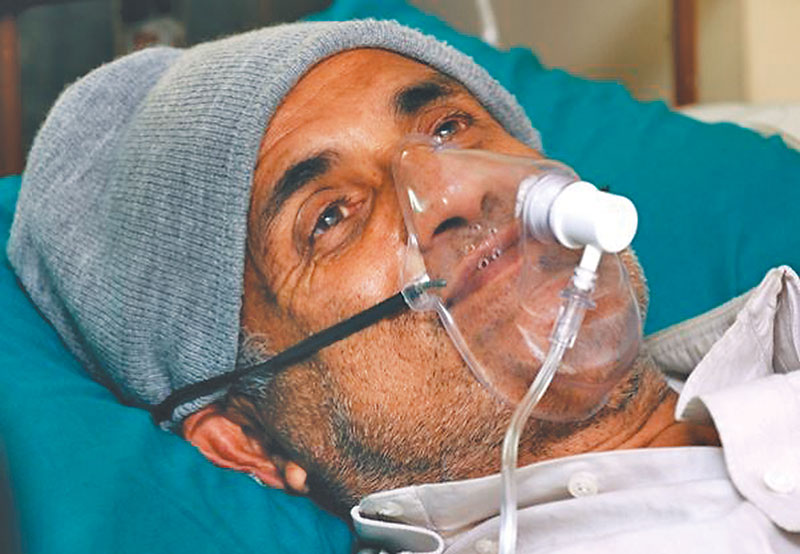
NMA ‘to bring agitating doctor to Capital if govt withdraws medical bill’
- TIKA R PRADHAN

KATHMANDU,
The government has formed a team led by the education secretary to talk to Dr Govinda KC, who has been staging a fast-unto-death in Jumla for the last 17 days demanding a medical education law in line with the recommendations of the Kedar Bhakta Mathema-led task force.


A Cabinet meeting on Monday decided to form the panel with joint-secretaries from the health and home ministries as members.
The communist-led government had been refusing to talk to Dr KC as long as he remained in Jumla on a hunger strike. However, the government commanding a two-thirds majority became flexible after the health of the senior orthopaedic surgeon deteriorated further on Monday.


The developments followed a series of discussions between Nepal Communist Party (NCP) Spokesman Narayan Kaji Shrestha and Dr KC’s representatives including Dr Abhishek Singh to find a way out of the crisis. According to Minister for Law, Justice and Parliamentary Affairs Sher Bahadur Tamang, the government formed the panel to save Dr KC.


Following the government’s move, a four-member team including Senior Advocate Dr Surendra Bhandary, Advocate Om Prakash Aryal, Dr Singh and a representative from the Nepal Medical Association was formed to negotiate on behalf of Dr KC.


According to Bhandary, they were waiting for the government team’s call for dialogue. Education Secretary Khagaraj Baral, the government team leader, said he would first enquire the Prime Minister’s Office about the developments.


Doctors attending Dr KC said his health further deteriorated from Sunday night. Senior Advocate Bhandary said the government should withdraw the bill and let Dr KC stay at a hospital of his choice so as to convince the fasting surgeon to come to the Capital. “The NMA will bring Dr KC to Kathmandu if the government is ready to withdraw the medical bill from Parliament,” said Dr Singh.


Education Minister Giriraj Mani Pokharel told the Post that the government would bring Dr KC to Kathmandu in view of his worsening health.


The government is adamant on tabling the National Medical Education Bill in Parliament without changes. Despite Dr KC’s strong reservations, the government has registered the bill in Parliament flouting a number of recommendations of the Mathema panel.
The panel recommended a 10-year moratorium on new medical schools in the Valley, requiring them to have a hospital operational for at least three years. Both the provisions are missing from the registered bill. Omitting the moratorium, according to critics, is a ploy to grant the Manmohan Academy of Health Sciences in Kathmandu and the B&C Medical College in Birtamod, among others, university affiliation.


However, the government has been opposing the provision not to allow medical colleges in Kathmandu Valley for the next 10 years and restriction on affiliation to medical colleges.


NMA warns of halting hospital services
The Nepal Medical Association has threatened to shut down all the hospital services except emergency from Thursday if the government fails to address Dr Govinda KC’s demands within 48 hours. In a statement on Monday, the NMA said all the services at state-run and private medical hospitals, nursing homes and clinics would be halted indefinitely.
HOME PAGE

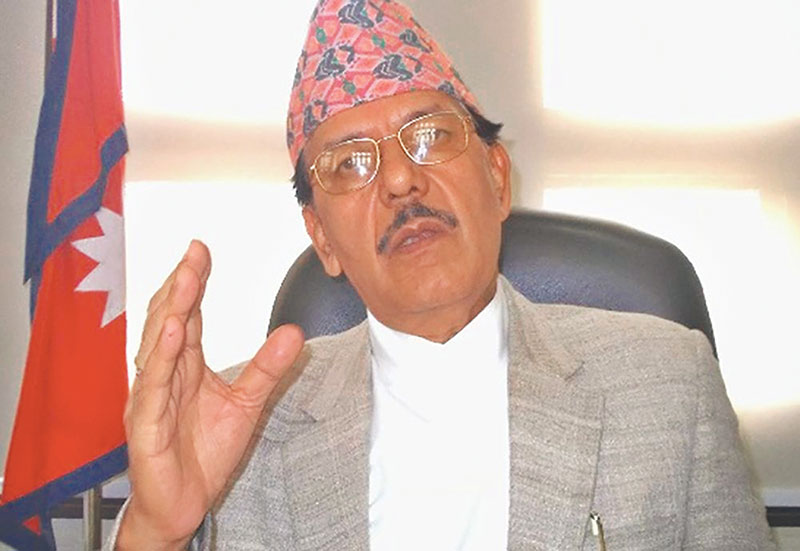
Uprety named envoy to India

- Post Report

KATHMANDU,
The government has named former chief election commissioner Neel Kantha Uprety as the ambassador to India.


The position in New Delhi, considered a plum diplomatic posting, had been vacant after Deep Kumar Upadhyay resigned last October to contest the federal parliamentary elections. A Cabinet meeting on Monday also picked Udaya Raj Pandey, former ambassador to Saudi Arabia, as Nepal’s envoy to Malaysia. The mission had been lying vacant for several months.


Both Uprety and Pandey are considered close to the CPN- UML, which was merged with the CPN (Maoist Centre) in May to form the Nepal Communist Party (NCP), the ruling party.
Uprety was at the helm of the constitutional Election Commission when the two Constituent Assembly elections were held in 2008 and 2013. He also served the United Nations electoral operations in Afghanistan during 2004-2005. Both the recommendations were made in line with the new criteria set by the government, according to Foreign Minister Pradeep Gyawali. The government has made it mandatory for the appointees to take their oath of office from the prime minister before taking up the assignment.


Uprety holds an MA in Economics from Tribhuvan University, Postgraduate Diploma in Public Administration from the TU, and MS in Computing Science from Staffordshire University, the United Kingdom.


The names will be sent to the Parliamentary Hearing Committee for hearing. After the panel endorses a nominee, the appointment is announced by the President’s Office. However, Upreti’s nomination has been questioned citing the constitution. Clause 245 (8) of the constitution says that an election commissioner will be ineligible for appointment to another government service. Government sources said Upreti’s nomination is based on this clause. Constitutional expert Chandra Kanta Gyawali contested the claim.


Legal rider? What Clause 245 (8) says
A person once appointed as the chief election commissioner and an election commissioner shall not be eligible for appointment to any other government service. Provided that nothing in this clause shall be deemed to be a bar to the appointment to any political position or to any position which has the responsibility of making investigations, inquiries or findings on any subject, or to any position which has the responsibility of submitting advice, opinion or recommendation after carrying out a study or research on any subject

HOME PAGE

Election a costly affair

Report says most candidates spent beyond EC limit
- PRITHVI MAN SHRESTHA

KATHMANDU,
In an indication of the elections becoming a costly affair, a study carried out by a domestic election observer group has shown that the government, political parties and candidates spent an estimated Rs131.63 billion in total during the three tiers of elections held last year.


The study by the Election Observation Committee, Nepal (EOC-Nepal) revealed that the government spent Rs34.72 billion while the candidates and their supporters spent as high as Rs96.91 billion in total.


The estimated poll spending by both sides for the local elections stood at Rs69.42 billion while that for the federal and parliamentary elections amounted to Rs62.21 billion.
The study was conducted in two phases: firstly by interviewing 216 candidates for the local elections in four districts. In the second phase, 189 candidates for the federal and provincial elections from 31 districts were asked about their expenditures. Data from the Ministry of Finance and the Election Commission (EC) were gathered to determine the government’s expenditures, according to the report.


The report showed that overall expenditure surged as most of the candidates spent beyond the limit set by the poll authority. For instance, average spending by a first-past-the-post candidate for the House of Representatives stood at Rs10.1 million while that by a candidate for provincial assembly under FPTP accounted for Rs8.1 million. The average spending by a mayoral candidate during the local elections amounted to Rs 1.73 million while a deputy mayor hopeful spent Rs1.38 million on an average.


The expenditure cap set by the EC was Rs2.5 million for an HoR candidate under the FPTP category while it was Rs1.5 million for a provincial assembly FPTP candidate. The ceiling for mayor and deputy mayor candidates was Rs750,000 and Rs550, 000, respectively.
“Although the average expenditure of an HoR candidate hovered above Rs10 million, we found several candidates spending between Rs150 million and Rs250 million,” said Binod Sijapati, the study team leader.


That winning candidates spent more than runner-ups in most cases underscored the role of financing in the poll outcome, the report stated. Average spending by winning candidates in the HoR was Rs21.3 million against Rs14.9 million by the runner-up. “This trend can facilitate elite capture of election results and access to political decisions,” the report said.


Even though large sums of money are funnelled into elections, political parties do not accurately report their costs, candidates seldom maintain records of campaign income and expenditures while business houses do not publish records of their contribution to the candidates and political parties, raising questions over the transparency of campaign financing, the report said.


With an aim to ensure transparency of election financing, the Election Commission had proposed a monitoring committee representing agencies such as the Nepal Rastra Bank and the Department of Money Laundering Investigation. “But the government didn’t take our proposal seriously,” said Chief Election Commissioner Ayodhee Prasad Yadav.
Former chief election commissioner Bhoj Raj Pokharel said checking election cost had emerged as a bigger problem than curbing poll violence lately. “There should be a legal mechanism from which the parties receive funds for campaign,” he said.


The report also pointed to increasing involvement of businessmen and contractors in politics. As many as 48 percent of total candidates for the HoR and the provincial assembly elections had political background while 18 percent came from the agricultural, 12 percent from business and 12 percent from social sectors.


In figures

Rs131.63 billion
Estimated amount spent by the government, political parties and candidates in the three-tier elections held last year

Rs34.72 billion
The government’s expenditure

Rs96.91 billion
Spending by the candidates and their supporters

Rs69.42 billion
Total expenditures of both sides during local elections

Rs62.21 billion
Expenditures for federal and local elections

Rs10.1 million
Average spending by a House of Representatives FPTP candidate

Rs8.1 million
Average spending by a provincial assembly FPTP candidate

Rs1.73 million
Average spending by a mayor candidate

Rs1.38 million
Average spending by a deputy mayor candidate


Source: EOC-Nepal

HOME PAGE

Stay order against rally ban continues

- Post Report

KATHMANDU, 6
The Supreme Court on Monday decided to continue its interim order against the government’s decision to ban public protests at key locations, including the Maitighar Mandala, in the Capital. A division bench of Justices Om Prakash Mishra and Kedar Prasad Chalise upheld the July 6 order.


A single bench of Justice Ishwor Khatiwada had served a show-cause notice to the government on its
decision to ban peaceful public rallies while staying
the ban. Monday’s order has rendered the protest ban ineffective until final verdict. The court stated that the prohibitory order of the District Administration Office goes against the Local Administration Act.


“The Local Administration Act says that such an order shall not be for more than two months at one time,” the bench stated. “Since the district administration’s order is against the Act, the court has decided to continue the interim order.”


Senior Advocate Dinesh Tripathi had filed a writ petition on July 5 seeking to stay the government’s decision to ban public rallies at places in the Capital. Tripathi argued that restricting people from staging peaceful protests violates their freedom of expression. Police had detained many protesters who defied the prohibition.


Home Minister Ram Bahadur Thapa on June 29 declared Maitighar Mandala as a protest-free zone effective from July 15, citing the Kathmandu District Security Committee’s April 13 decision.

Page 2
NEWS

PMO stalls Dharahara reconstruction plan

Contractor files complaint alleging fake documents submitted by rival contractor
- Post Report

KATHMANDU,
The Prime Minister’s Office (PMO) put on hold the Rs 4 billion reconstruction plan of Dharahara Tower just prior to the opening of contractors’ bids, following a complaint of malpractice.


The PMO’s directive derails plans of the National Reconstruction Authority (NRA), the nodal body to carry out reconstruction work in Nepal.


The current impasse follows a complaint made at the PMO. A Joint Venture (JV) of Kalika Construction, Rasuwa Construction Company and CICO, China, filed a complaint with the PMO alleging Raman Construction and its Chinese JV partner GIETC, the other contractor in the race, had filed fake documents.


The complainants have appealed to the authority to investigate the matter.
NRA Joint Secretary Rajuman Manandhar said. “The PMO directive to stall the tender process and investigate the allegation came just hours before the opening of the sealed bids made by these companies.”


Five contractors are bidding to win the rebuilding rights of the historic tower built by Bhimsen Thapa in 1832. The earthquake that struck Nepal on April 25, 2015 damaged it extensively.
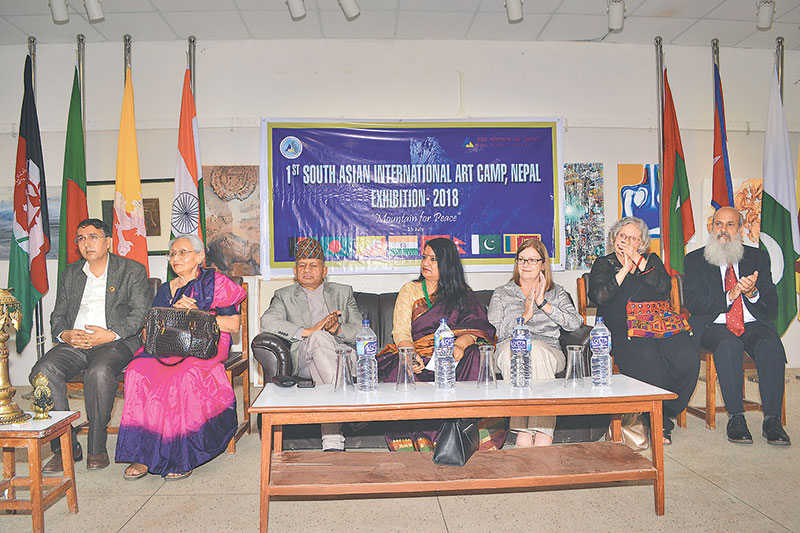

The documents submitted by Raman about its Chinese partner GIETC is fake, JV partners Kalika Construction, Rasuwa Construction Company and CICO allege.


The NRA insists it had informed all companies to present documents validated by a notary as well as told the applicants to take full ownership of documents they submit.


“With the sudden intervention of the, PMO we have no clue about the process from here on,” Manandhar said. However, he remains optimistic the issue would be resolved soon because Prime Minister KP Sharma Oli has pledged to reconstruct Dharahara at several public events.


The NRA had planned to award contract and lay the foundation stone for the tower in the current fiscal year.


To this end, the NRA did technical evaluation of six Nepal-based companies that responded to its Expression of Interest (EoI) call.


“We picked five companies for the next round of the contract-awarding process,” Manandhar said.


The companies had proposed rebuilding the historic monument through a JV with a Chinese company.


The NRA had said it would execute reconstruction work based on the vision of PM Oli, laid out during his first tenure as PM in 2016.


The NRA seeks funds from the public to reconstruct the historic site. It has also urged the Nepal Telecom (NT) that had earlier pledged Rs1 billion to rebuild the structure, to transfer the funds soon.


The state-owned telecom had backtracked on the project citing disagreement with the NRA on some issues.


The NT had earlier proposed investing around Rs8 billion for the property it would manage for the next 30 years.


The NRA and the Department of Archaeology do not agree with NT’s plan to use the structure for commercial purposes.

NEWS

Around 2,000 fake victims seek earthquake aid

- HARIRAM UPRETY

GORKHA,
Public abuse of federal government largess goes on with impunity as revelations of around 2,000 fake earthquake victims in Gorkha district putting their hand up to receive reconstruction aid emerge.


Many earthquake victims whose names were not included in the housing reconstruction aid list had filled up complaint forms in the district around 10 months ago.


Around 12,322 quake-affected families had submitted complaint forms in the district. Of these, officials could not identify 1,992 families as genuine earthquake victims. The National Reconstruction Authority (NRA) District Project Implementation Office believes the data of the fake quake victims is likely to increase as investigation progresses.


Project Implementation Office’s Non-gazetted First Class Officer Shiva Paudel said a committee formed in local wards has the authority to ascertain whether the victims are genuine or fake.


“Those families can even file complaints in the ward office again if they are dissatisfied,” said Paudel.


Technicians had surveyed quake-affected areas again from mid-August to mid-November of 2017. “We have addressed the complaints of quake victims from their local units,” said Paudel.


The earthquake that struck Nepal on April 25, 2015 destroyed more than 60,000 houses. Around half of demolished houses have been rebuilt in Gorkha.

NEWS

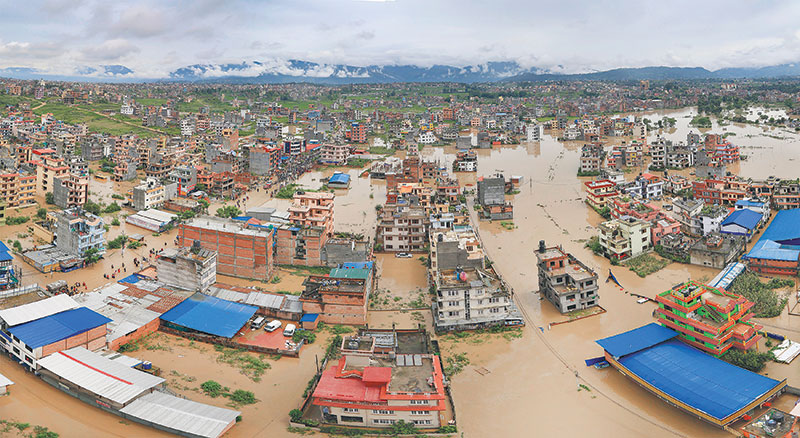
Floods cause damages worth Rs 119 million in Bhaktapur

- RASTRIYA SAMACHAR SAMITI
Heavy rain and floods have disrupted routine life in Bhaktapur. Many areas, including Madhyapur Thimi, have been inundated due to the flooding caused by swollen Hanumante River following torrential rains last week. Settlements including the temporary camp sheltering the earthquake victims at Jagati and Barahisthan faced the brunt of floods. Settlements in Radhe Radhe and the Kamerotar land pooling project in Madhyapur Thimi too were waterlogged. POST PHOTO:PRAKASH CHANDRA TIMILSENA

Bhaktapur,
The recent flood, landslide and inundation damaged property worth Rs 119.35 million in Bhaktapur, the Bhaktapur District Administration Office announced this at a press conference held here on Sunday.


Chief District Officer Narayan Prasad Bhatta said the flood, landslide and inundation triggered by the incessant rains on July 11 and 12 caused this extent of damage in the district. Landslide at Changunarayan Municipality swept away the house of a family, killing three members and injuring four people because of the inundation, he said.


Emergency team rescued 111 people from the inundated areas.
Flood and landslide damaged 522 houses, 15 sheds, 28 industries and factories including petrol pumps, 133 retail and wholesale shops, a bridge and a road each and two hospitals and schools each. The flood swept away 37 pigs and 825 chickens, Bhatta said.


The DAO estimates around Rs 39,395,125 worth of damage inflicted on industries, factories and petrol pumps. The estimated damage on wholesale and retail stores is around Rs 34.16 million.


The inundation damaged property worth Rs 300,000 at Marigold English School, Balkot. DAO estimates livestock and poultry loss around Rs 1.26 million.


The flood and inundation damaged properties worth around Rs 34.2 million in Bhaktapur Municipality; Rs 69.51 million in Madhyapur Thimi Municipality; Rs 27.91 million in Surya Binayak Municipality; and Rs 2.398 million in Changunarayan Municipality.

NEWS

Teachers join student protests against Agri Univ’s tie-up

- RASTRIYA SAMACHAR SAMITI

Ratnanagar (Chitwan),
Teachers have joined students protesting Rampur-based Agriculture and Forestry University’s (AFU) decision to affiliate seven private campuses.


Agitating university teachers on Monday demanded withdrawal of affiliations granted to seven private colleges in Nepal at a press conference. Earlier, only students protested against the Agri Univ’s decision. Now teachers back them.


Teacher Ananta Prakash Subedi says faculty members are determined to continue agitating until the university’s scraps the affiliations granted to seven colleges.


Student leader Nagendra Dahal reaffirms this belligerent stance. Scores of students are holding protests since July 10.


The Agri Univ recently granted affiliations to seven private campuses in Jhapa, Itahari in Sunsari, Lalitpur, Nawalparasi, Banke and Surkhet for running the Bachelor’s degree classes in agriculture.

NEWS

Road classrooms teach traffic lessons for free

Jaywalkers learn rules as road safety drive begins
- Post Report
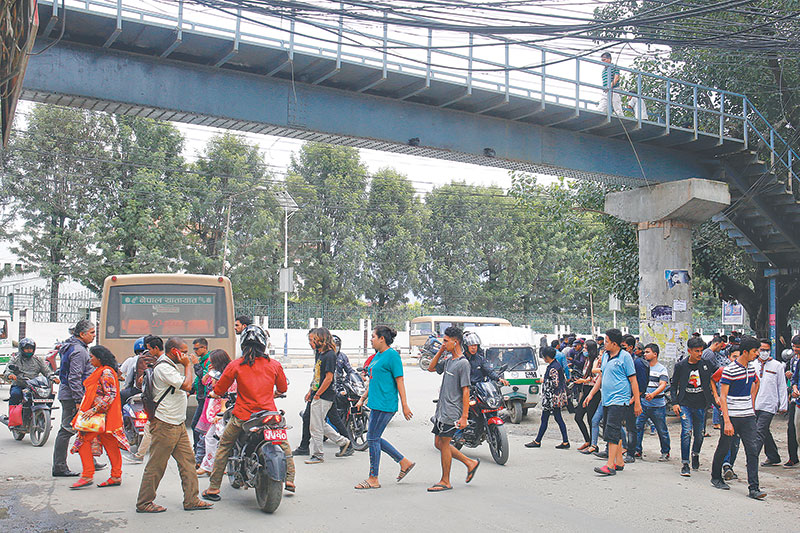
Jaywalkers cross a road ignoring the overhead crossing built for pedestrians at New Baneshwor in Kathmandu on Monday. Though the traffic police conduct safety campaigns to educate people about the crossing roads from zebra markings, most continue their callous behaviour with scant respect to civic and traffic rules. This is the major reason for the increase in road accidents. Post Photo: Anish Regmi

KATHMANDU,
The Metropolitan Traffic Police Division (MTPD) has started one-month road safety drive, including innovative on-road classrooms, starting from Sunday in a bid to reduce road accidents.


Over the last two days, Traffic Police officers have given 20 minute ‘on road’ classes to 1,106 pedestrians in the valley who habitually walk on roads or cross roads from anywhere.


Officers gave jaywalkers lessons on traffic lights, zebra crossings, subways, overhead bridges, traffic rules and regulation and general civic responsibility. MTPD data shows 45 percent deaths of road accidents in Nepal occur because people cross roads in a haphazard manner.


The MTPD has set up check posts at 22 zebra crossings in the valley and 12 places in over-head bridges.


On Monday, traffic officers gave 20-minute road lessons to 400 pedestrians who did
not use zebra crossings and overhead bridges in Kathmandu.  In Lalitpur, officers gave lessons to 153 rule violators.


On the first day of the drive, traffic police booked 400 people in Kathmandu and 189 in Lalitpur.


The MTPD has deployed 200 traffic police officers at various places in the valley from 9-11 am and 4-6 pm. The MTPD had run such a campaign initiative last year.


Officers had slapped jaywalkers with Rs200 fine for violating traffic rules. However, it was withdrawn later following severe criticism from public.  The then Home Minister Janardan Sharma instructed the MTPD to withdraw the decision.  


MTPD Spokesperson Surendra Mainali said, “This drive is more effective because we do not fine lawbreakers, instead, we make jaywalkers stand in a rectangular space on the spot, and teach them traffic rules using a public address system.”


Traffic police are running on road classes at Thimi, Koteshwor, New Baneshwor, Thapathali, Jorpati, Purano Bus Park, Gausala, Kalimati, and Kalanki including other places where there are zebra crossings are available.


Traffic police are also running the on road classes where there are overhead bridges such as in Bhotahiti, Jamal, New Bus Park, Ratnapark, and Sahid Gate.

NEWS

South Korea announces hike in wages

Migrant Nepali workers could receive Rs 20,000 more per month from next year
- CHANDAN KUMAR MANDAL
Many Nepalis applied online for jobs in South Korea after passing the Korean language test. post file photo

KATHMANDU, JULY 16
Nepali workers in South Korea are likely to get a pay hike of nearly Rs20,000 per month from next year as the government there has announced an increase in the basic salary.


The South Korean government on Saturday fixed the minimum wage at 8,350 won, approximately Rs 809, per hour, a 10.9 percent growth on the current pay.


After a marathon meeting of the Minimum Wage Council that lasted 19 hours, the decision was made to set a new hourly wage, the first time that the country’s minimum wage
will surpass the 8,000-won mark, the Korea Herald reported.


With the revision, monthly salary of a worker--based on a 40-hour workweek--will be 1,745,150 won. A Nepali worker, in the manufacturing or the agriculture sector, is paid 1,575,000 won per month at the hourly rate of 7,530 won. Nepali workers are getting slightly over Rs 150,000 in minimum pay, which will reach nearly Rs170,000 from the upcoming year.


Nepali workers in South Korea are elated with the latest surge in pay. Gokul Dorje Tamang, originally from Sailung Rural Municipality of Dolakha, said most of the Nepali workers are happy with the announcement. “This is another rise after the historic pay hike last year,” said Tamang, who works at a manufacturing company near Seoul.


Nepali workers, however, are concerned about falling overtime hours at the workplace, limiting their income to basic salary.


Both agriculture and manufacturing sectors have the same payment but opportunities for overtime are fewer for agricultural workers.


According to Tamang, agriculture offers less overtime and leave than factories where workers get a two-day weekend.


South Korean President Moon Jae-in has pledged to increase the minimum wage to 10,000 won by 2020 to drive income-led growth, according to the Herald.


South Korea is one of the most popular destinations for Nepali workers. More than 55,000 Nepalis have reached Korea under the Employment Permit System since 2008.

NEWS

Time-card system for goods carriers starts today

Rastriya Samachar Samiti
- Post Report

Kathmandu,
The Metropo- litan Traffic Police Division will launch time-card system for vehicles ferrying goods from Jagati, Bhaktapur to Koteshwor, Kathmandu beginning from July 17.


With the time card system, the traffic police bids to reduce traffic accidents in the Kathmandu Valley.


As per time-card system, lorries, tippers, vans and other vehicles carrying goods will have to maintain speed limit of 40kms per hour on the six-lane road from Jagati to Koteshwor.


The MTPD has brought a plan according to which the goods carriers and public transport vehicles will have to use the left lane while motorcycles, cars, taxis, tourist buses and buses operated on the right lane of the road from Jagati to Koteshwor. This rule comes into effect from Tuesday.


The MTPD has also prohibited entry of lorries and tippers in the Kathmandu Valley from 8 am to 12 noon and from 3 pm to 8 pm on view of traffic management.


Around 3,080,000 vehicles ply in Nepal. Of these, 1.1 million vehicles ply in the Kathmandu Valley.

Page 3
NEWS

Govt likely to give more time to transport operators

- Post Report

KATHMANDU, 
With the deadline to registering the existing transport committees and associations expiring on Monday, the government is likely to give
more time for private transport operators to do so as companies.


In a bid to dismantle the organised cartel in the country’s transport sector, the government on April 17 had decided to stop registration and renewal of public transport committees and associations operating as not-for profit organisations.


The decision, which  followed the amendment to the Transport Management Directives-2004, also required the transport entrepreneurs to register as private companies, which had been earlier registered with several transport companies and associations. They have been asked to register as companies within the fiscal year 2017-18.


Following the crackdown on the transport syndicate, the government had formed a task force to come up with recommendations on introducing overall reforms in the transport sectors, including ways to deal with the situation.


A preliminary report of the task force, submitted to the Ministry of Physical Infrastructure and Transport (MoPIT), has recommended more time for transport entrepreneurs to register as companies.  According to Minister for Physical Infrastructure and Transport Raghubir Mahaseth, the recommendation was made considering the time it would take to register thousands of vehicles.


“The legal status of the transport committees and associations has ended from today [Monday]. But the task force has suggested extending the deadline until Paush. We have yet make a decision,” said Mahaseth.


Clarifying a confusion over smooth operation of the public vehicles run by the now defunct committees, Minister Mahaseth said that imposing ban on such committees does not necessarily mean the public vehicles operating under them become illegal. “These vehicles are owned by individual entrepreneurs not the committees,” he said.


The MoPIT statistics show nearly 325,000 public vehicles are in operation across the country. Most of them have yet to be registered under a company.


“As those public vehicles still have the route permit and there will not be any problem in their operation, but they need to get registered as a company,” MoPIT Secretary Madhusudan Adhikari said.  


The task force has also suggested the government to allow those committee to withdraw money from the bank accounts to treat injured passengers, compensate the families of those who died in accidents and operational expenses of the erstwhile committees.


On May 4, the government had frozen bank accounts of 245 such transport committees for their involvement in enforcing strike in the public transport sector.

NEWS

Nepali Congress obstructs House

national medical education bill controversy
- Post Report
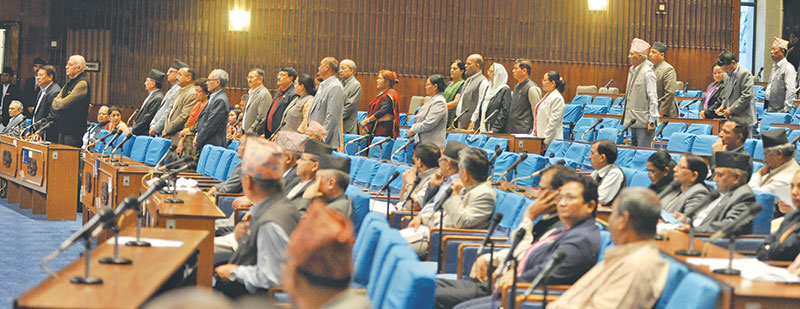
Nepali Congress lawmakers obstruct the Lower House in Kathmandu on Monday. The Congress has demanded that the government replace the controversial National Medical Education Bill by incorporating the demands of Dr Govinda KC, who has been on a hunger strike in Jumla for more than two weeks. Post Photo: Shaligram Tiwari

KATHMANDU,
Differences between the ruling and opposition parties over the controversial National Medical Education Bill have resulted in the disruption of the House of Representatives.


Dozens of laws necessary for a full-fledged implementation of the Constitution of Nepal await parliamentary approval.


Two sittings of the Lower House were obstructed on Monday. The opposition Nepali Congress demanded that the government replace the bill by incorporating the demands of Dr Govinda KC, who has been on a hunger strike in Jumla for more than two weeks.


He demands the National Medical Education Act in line with the recommendations of the taskforce led by Kedar task force Mathema, former vice-chancellor of Tribhuvan University.


The first meeting that started at 1pm was postponed after NC lawmakers stood at their seats saying they would not allow the House business as long as the government was reluctant to address the concerns of the agitating doctor. Congress lawmaker Min Bahadur Bishwokarma said the government must come up with a bill incorporating the recommendations by the Mathema-led task force to save the life of Dr KC. Speaker Krishna Bahadur Mahara had postponed the meeting by an hour.


However, the scene was no different when the House convened for the second time on Monday with both sides remaining adamant on their positions. NC lawmakers rose from their seats once again to disrupt the House. In parliamentary practice, lawmakers standing signals obstruction of the House business.


“The NC fought against the Ranas and the Panchayat. Now it will fight against the incumbent government which is turning out to be autocratic,” said NC Whip Pushpa Bhusal. “We won’t just wait and see the deteriorating condition of Dr KC.”


She charged the government with serving the interests of a small group of people by ignoring the concerns of Dr KC, who is fighting for the poor’s cause. Ruling party lawmaker Krishna Bhakta Pokharel, however, argued that the NC lawmakers’ approach was against the parliamentary norm. Opposition lawmakers did not allow even Minister for Education, Science and Technology Giriraj Mani Pokharel to answer their queries.


When his frequent calls to lawmakers for allowing the House proceedings turned futile, Speaker Mahara postponed the meeting until Thursday.

NEWS

Technical team to study inland waterways

- Post Report

KATHMANDU,
Nepal and India have agreed to form a team to carry out the field study on both sides to develop the inland waterway navigations from River Ganga in India to Nepali border via Kosi and Gandak (Narayani) rivers.


This is the first consultation meeting on Inland Waterways Connectivity after the two countries reached an agreement during Prime Minister KP Oli’s visit to India in April. The two-day meeting concluded with the two sides agreeing to deploy technical scoping missions to for techno-economic feasibility studies of riverine routes on either side, an Indian Embassy tweets read.
During the meeting, the Indian side had also offered to initiate capacity development of Inland Waterways professionals in Nepal.


“It is possible to develop inland waterways in Nepali rivers, especially in Narayani, probably after two years,” Foreign Minister Pradeep Gyawali told a press conference at the Foreign Ministry on Monday.


Initially, it is explored that cargo up to 300 metric tons can be navigate from India to Nepal via waterways.


“There is a scope of inland waterway navigation in Kosi and Narayani rivers which can be linked with third counties, including Bangladesh via Haldiya, India. It will contribute to Nepal’s economic development,” The Water and Energy Commission Secretariat said in a statement. The technical team will make a filed visit in appropriate time, the WECS added.


The Indian team will visit Kosi and Narayani rivers, while the Nepali technical team will visit Calcutta, Haldiya-Varanali section where India is developing the inland waterways.
After field visits, both sides will present their suggestions and form a bilateral mechanism to carry on the further works, the statement reads.


Officials from the two sides had discussed various dynamics of developing waterways in Kosi, Narayani and Karnali rivers of Nepal.  


They also discussed developing a modality of inland waterways and its procedure, with the Indian side agreeing to train Nepali manpower and build an institutional capability.


Joint Secretary at WECS Madhav Belbase led the Nepali delegation at the meeting, while the Indian side was headed by Vice-president of Inland Waterway Authority of India Prabir Pandey.

Page 4
NEWS

Missing girl, 17, found murdered following rape

One suspect held, another on the run
- Post Report

KANCHANPUR, 
Police have arrested a teenager in connection to the rape and subsequent murder of a 17-year-old girl in Krishnapur Municipality, Kanchanpur.


Deputy Superintendent of Police (DSP) Gyan Bahadur Sethi said the suspect, Madan Giri, was being investigated after the girl’s body was found buried on the bank of Amkhaiya stream in Krishnapur-2 on Sunday night, a week after she was reported missing.
She was last seen leaving for Attariaya Bazaar in Kailali district on July 10.
The girl’s body was recovered in a partially decayed state. She was identified based on her clothes.


The girl’s burial site was located after the girl’s family member received a phone call from a person believed to be another suspect in the crime.   

 
DSP Sethi said Giri accepted the rape charge but refused to take responsibility for
her death.


According to Giri’s statement, he had raped the girl in Laljhadi forest and fled the scene of the crime.  


Giri also told police that the girl was later found hanging from a tree, though this statement does not match the circumstance in which police found the body, buried in a shallow sandy grave.


DSP Sethi said Giri knew the person who called the girl’s family to inform about her burial site.


He added that the truth will be known once the second suspect is arrested.

NEWS

Police arrest four Siraha men in gang rape case

- Post Report

UDAYAPUR: Police on Monday arrested four men from Triyuga Municipality-6 in Udayapur district on charge of raping a 35-year-old woman on Sunday night. 

 
Superintendent of Police (SP) Nabaraj Bhatta said the suspects had abducted the woman from Lahan in Siraha district and raped her inside a car.


A police team from Lalpata Police Post had captured the perpetrators while they were taking the victim to Gaighat, the district headquarters of Udayapur, from Lahan.
Police identified the suspects as Nitesh Kumar Sah, Amit Sah, Sandesh Gupta and Bibek Sah.


The woman told police that she had gone to Lahan Bazaar to buy medicines when the four men abducted her and took turns raping her inside a car.


SP Bhatta said the District Court of Udayapur on Monday remanded the suspects to judicial custody pending investigation.


Two minor girls raped in Makwanpur
HETAUDA: Makwanpur police on Monday arrested two persons in separate rape incidents where the victims were minors. Police said involved the rape of a five-year-old girl by a 15-year-old boy in Bagmati Rural Municipality-8. The accused was arrested following a police complaint lodged by the girl’s family. In another incident, police have arrested a 28-year-old man from Hetauda Sub-metropolitan City-2 on charge of raping a 15-year-old girl. (PR)
NEWS

Incidence rate of malaria high in Righa village of Mugu district

- Post Report

MUGU, 
As many as 138 malaria cases have been reported in Khatyad Rural Municipality-8, 9 and 11, Mugu in the fiscal year 2017-18.


According to the District Health Office (DHO), malaria outbreak was first reported in Righa village in mid-April.


Around 120 people in the village had contracted the disease caused by Plasmodium parasite transferred to humans by mosquitoes.


Bali Bahadur Budha, the information officer at the DHO, said malaria cases in the district usually appear from August to November.


Growing malaria incidence rate has led the authorities to declare Khatyad Rural Municipality and its adjoining areas as a ‘high risk zone’.


Uttam Pyakurel, vector control officer at the Epidemiology and Disease Control Division (EDCD), said Righa was particularly vulnerable to malaria because of its weather that makes it ideal for mosquito breeding and, in turn, for malaria transmission.


Last year, malaria had claimed five lives and affected 85 people in Righa.


Chief District Officer Umakanta Adhikari said the DHO had been instructed to keep medicines and health workers available to treat malaria patients.

NEWS

Morang becomes fully immunised district

preventable childhood diseases
- RASTRIYA SAMACHAR SAMITI

BIRATNAGAR, 
The district of Morang in Province 1 has been declared fully immunised against childhood preventable diseases.


Social Development Minister of the province, Jeevan Ghimire, declared Morang as a fully immunised district at a programmed organised by the District Public Health Office on Monday.

A successful implementation of the immunisation programme has freed the children of Morang and other parts of Nepal of various preventable diseases such as measles, smallpox and polio, Ghimire said.


The minister also stressed the importance of regular exercise, clean hygiene
and sanitary practices for healthy life.


Province 1 is currently observing ‘Health Promotion Year’ under which the government health facilities have been organising free health camps and other programmes to encourage healthy living.


Around 15,000 people in the province have already benefited from free health camps.
Province Assembly member Jayram Yadav highlighted the contribution of the vaccination programme in reducing child mortality rate in the country.


A report on immunisation programme was also unveiled at the programme.
According to the report, 19,475 out of 20,075 children below five years of age in Morang have completed the full immunisation course.


There are 333 vaccination centres in eight rural municipalities, eight municipalities and one metropolitan city of Morang district.


Morang is the 55th district in the country to become fully immunised against preventable childhood diseases.


Chitwan follows suit
Meanwhile, Chitwan district in Province 3 was also declared fully immunised on Monday. Provincial Minister for Health and Population Padma Kumari Aryal declared Chitwan as fully immunised district amid a programme organised by Bharatpur Metropolitan City.
Most children in the district have completed their immunisation course, according to the health authorities.


Individuals and organisation who made contributions to achieve the immunisation goal were also honoured at the programme. Provincial Assembly members Dil Kumari (Parbati) Rawal, Krishna Khanal and Geeta Wagle, Bharatpur Mayor Renu Dahal, Chairman of the District Coordination Committee Krishna Kumar Dallakoti and Chief of the District Public Health Office Bijaya Kumar Jha addressed the function.

NEWS

150 Nepali women in ‘captivity’

- Post Report

BARDIYA:  One hundred and fifty Nepali women who were using illegal channel to go abroad for employment have reportedly been held hostage by their so-called agents in Banaras, India. The incident was revealed after one of the women from Madhuban Municipality in Bardiya phoned her husband and cried for help on Sunday. CDO Ram Bahadur Kurumbang said they were trying to locate the exact whereabouts of the women. The District Administration Office plans to coordinate with anti-trafficking organisations like Maiti Nepal for their rescue. (PR)

NEWS

Susta flood victims to get compensation

News Digest

NAWALPARASI: The government is providing Rs 24.61 million compensation to the flood-affected people in Susta, West Nawalparasi. Susta farmers had suffered a heavy destruction of their properties in last year’s flood. The compensation amount will be provided through the Ministry of Irrigation. The Gandak Irrigation Management Division Office will distribute the sums. Chairman of Susta Rural Municipality Ram Prasad Pandey said the flood-affected farmers from wards 1 and 2 and those from wards 6 and 7 of Binayi Tribeni will receive the compensation. (RSS)

NEWS

Mahottari gets flood rescue equipment

News Digest

GAUSHALA: Community Development Programme, Mahottari, has provided flood rescue equipment to the District Disaster Management Committee. Bishal Timalsina, programme coordinator of the organisation, said the committee was provided with rubber boats, life jackets, micro phones, ladders, stretchers, helmets, rope and raincoats in view of the monsoon floods that hit the district every year. Places like Jaleshwor and Matihani are among the most flood-prone areas in Mahottari. (RSS)

NEWS

Police arrest three men with firearm

News Digest

KATHMANDU: A joint police team from Kathmandu and Lalitpur districts has arrested three men with a pistol, five bullets and two magazines. Hemraj Poudel, 36, of Taplejung and Aanshuram Moktan, 36, and Krishna Bahadur Jogi of Ramechhap, 28, were caught with the firearm and ammunitions from Nakhipot area in Lalitpur Metropolitan City on Sunday. The trio was arrested during security check, police said. (RSS)

Page 5
WORLD

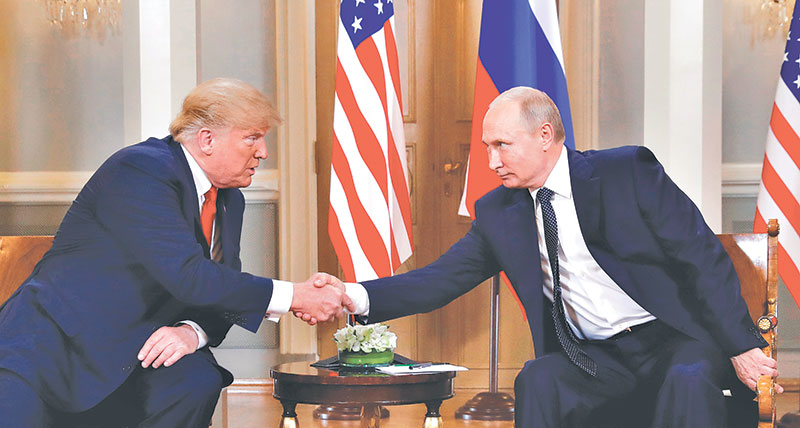
Prez Trump vows to reset troubled US-Russia ties

- AGENCE FRANCE-PRESSE
US President Donald Trump meets with Russian President Vladimir Putin in Helsinki, Finland, on Monday. REUTERS

HELSINKI,
Presidents Donald Trump and Vladimir Putin began an historic summit on Monday vowing their determination to forge a reset of troubled relations between the world’s greatest nuclear powers.


Trump, bent on forging a personal bond with the Kremlin chief despite allegations of Russian meddling in US politics, went into the summit blaming “stupidity” by his predecessors for plunging ties to their present low.
Looking sombre, the two leaders exchanged a few opening remarks in front of the press at the start of their summit in Helsinki.


Putin, basking in congratulations from Trump and other world leaders for the successful staging of the World Cup in Russia, said: “The time has come to talk in a substantive way about our relations and problem areas of the world.”


Before the two leaders went into a first session between just themselves and their interpreters, Trump said the summit would cover “everything from trade to military to missiles to nuclear to China”.


“Frankly, we have not been getting along for the last number of years. And I really think the world wants to see us get along. We are the two great nuclear powers,” he said.
“I’ve not been here too long (as president), it’s getting close to two years, but we’ll be having an extraordinary relationship, I hope so.”


Shortly before the summit opened, Trump was asked if he would press Putin over Russia’s alleged manipulation of the 2016 election that brought the mercurial property tycoon to power. He said only: “We’ll do just fine.”


Many US critics had called for the summit’s cancellation after new revelations surrounding the alleged election meddling.


But Trump has insisted it is “a good thing to meet”, as he attempts to replicate with Putin the sort of personal rapport he proclaims with the autocratic leaders of China and North Korea.


If the pair do find common ground, the summit may take the heat out of some of the world’s most dangerous conflicts, including Syria.


But there are many points of friction that could yet spoil Trump’s hoped-for friendship with the former KGB spymaster.


Trump began the day by firing a Twitter broadside at his domestic opponents, blaming the diplomatic chill on the investigation into alleged Russian election meddling.


“Our relationship with Russia has NEVER been worse thanks to many years of US foolishness and stupidity and now, the Rigged Witch Hunt!” Trump tweeted.


Russia’s foreign ministry tweeted in response: “We agree.”

Trump’s US opponents tried, in turn, to gain traction for the hashtag #BAF (Blame America First).


After a stormy Nato summit in Brussels last week, Trump was accused by critics of cosying up to Putin while undermining the transatlantic alliance.


But over breakfast with Finland’s President Sauli Niinisto, he insisted Nato “has never been stronger” and “never been more together” thanks to his insistence on all allies paying their fair share.


Trump, a brash 72-year-old billionaire, has been president for 18 months while Putin, 65, has run Russia for the past 18 years.


In a weekend interview with CBS News, Trump admitted that Russia remains a foe, but he put Moscow on a par with China and the European Union as economic and diplomatic rivals.


The Kremlin has also played down hopes that the odd couple will emerge from their first formal one-on-one summit with a breakthrough.


On Friday Putin’s adviser Yuri Ushakov said: “The state of bilateral relations is very bad.... We have to start to set them right.”


Indeed, after the bad-tempered Nato summit and a contentious trip by Trump to Britain, anxious European leaders may be relieved if not much comes out of the Helsinki meeting.
Those leaders are already fuming over Trump’s imposition of trade tariffs on various countries, including Russia.


Turning the tables, European Union President Donald Tusk said Trump was guilty of “spreading fake news” with his remark about foes, and warned that the trade tensions could spiral into violent “conflict and chaos”.

WORLD

US probe blamed for Russia rift

HELSINKI: Donald Trump on Monday blamed bad relations between Moscow and Washington on the US investigation into alleged Russian election meddling —and Russia promptly agreed.


Setting the scene just hours ahead of his summit with Vladimir Putin, Trump took to Twitter to lash out at US special prosecutor Robert Mueller’s probe. “Our relationship with Russia has NEVER been worse thanks to many years of US foolishness and stupidity and now, the Rigged Witch Hunt!” Trump tweeted, with a swipe at his White House predecessors.


Many Twitter users expressed anger or surprise that a US leader had blamed his own country for the rift, despite Russia’s interventions in Syria and Ukraine and alleged subversion of Western elections. But the Russian foreign ministry was delighted, jumping in through its official Twitter account to first “like” Trump’s message then to retweet it with a clear response: “We agree.” Last week, Mueller indicted 12 Russian intelligence officers accused of hacking computer servers used by Trump’s 2016 election rival Hillary Clinton, then leaking private emails to damage her campaign.

WORLD

Rights group warns of ‘blatant’ bid to manipulate Pakistan vote

- AGENCE FRANCE-PRESSE

ISLAMABAD,
Pakistan’s human rights commission Monday slammed “blatant, aggressive and unabashed” attempts to manipulate the upcoming election, as politicians expressed security fears following one of the country’s deadliest attacks.


A string of attacks has killed 175 people across the country in the past week, and there have been widespread allegations that the powerful military is meddling in the run-up to the July 25 vote.


The Election Commission has vowed to go ahead with the vote “at all costs”.
But the independent Human Rights Commission of Pakistan warned it was “gravely concerned over what it sees as blatant, aggressive and unabashed attempts to manipulate the outcome of the upcoming elections”.


“While it is critical that the polls are held as scheduled, there are now ample grounds to doubt their legitimacy — with alarming implications for Pakistan’s transition to an effective democracy,” it said in a statement.


A suicide blast at a political rally in the southwestern province of Balochistan last Friday killed 149 people.


It was the second deadliest militant attack in Pakistan’s long battle with violent extremism, surpassed only by an assault on a school in 2014 which left more than 150 people dead.
The attack and others have spurred a surge in criticism of the army. It has overseen a dramatic improvement in security but in recent months has been widely accused of what one think-tank termed a “silent coup”.


“The attacks are taking place because the security agencies are involved in politics and not doing their job,” Mushahidullah Khan, a senior leader with the Pakistan Muslim League-Nawaz (PML-N), told AFP.


“The elections are being contested in an environment of fear,” the chairman of the Pakistan Peoples Party, Bilawal Bhutto-Zardari, said during a visit to the Balochistan provincial capital Quetta on Monday.


“Security should be the top priority for the government,” he said, adding: “I hope that the election will be held on July 25”.


Other politicians from parties across the political spectrum have echoed his concerns.
The accusations against the military were heightened Friday, when former PML-N premier Nawaz Sharif returned to the country from London and was imprisoned, heightening political tensions.


Sharif was ousted from power last year following a corruption investigation.
He was sentenced in absentia to 10 years in prison for alleged corruption earlier this month.


He and his party say they are being targeted by the military, which has also faced accusations from the media, analysts and other politicians that it is using threats and intimidation to steer votes towards Imran Khan’s Pakistan Tehreek-e-Insaf party.


The military denies the allegations and says it is taking “no direct role” in the election.
It has already warned of a security threat in the run-up to the vote and said it will deploy more than 370,000 soldiers on polling day.

WORLD

UK parliament vote to reveal extent of anger

pm may’s brexit plan
- REUTERS

LONDON,
British Prime Minister Theresa May will face the anger of Brexit supporters in her party on Monday when they try to force her to change course on her strategy for leaving the European Union.


May is battling for her political survival after announcing a negotiating plan that enraged eurosceptics in her Conservative
Party, who see it as keeping Britain too closely tied to Brussels.


The size of the threat to her position should become clear on Monday when eurosceptic lawmakers put forward a series of proposals to toughen up the government’s customs legislation during a parliamentary debate.


May is not expected to be defeated on the amendments, and could even order her government to back some of the least controversial ones to neutralise the impact of the rebellion without watering down her exit plan.


But, if she chooses to fight and then sees a large number of her own party rebel, it would undermine her leadership and cast fresh doubt on whether she can deliver the Brexit plan agreed by her cabinet this month at her Chequers country residence.


The Chequers agreement, which is only a starting point for negotiations with the EU, has already led to the resignations of her Brexit minister David Davis and foreign secretary Boris Johnson, and the eurosceptic faction say it has to change.


“I suspect the Chequers deal is, in fact, dead,” Conservative lawmaker Bernard Jenkin told the BBC.


It has also been rejected by some in the pro-EU faction in her party, with former minister Justine Greening calling on Monday for a second Brexit referendum to end the stalemate in parliament over the best future relationship with the bloc.


May’s spokesman said there would not be a second referendum under any circumstances, and restated the prime minister’s position that the Chequers plan was the only way to deliver a Brexit that worked in the best interest of the country.

WORLD

Court acquits turkish journo in ‘espionage’ case

- AGENCE FRANCE-PRESSE

ISTANBUL,
An Istanbul court on Monday acquitted one of Turkey’s most prominent political journalists in a long-running case on espionage charges dating back to an arms interception on the Syrian border in 2014.


Erdem Gul, the Ankara bureau chief of the opposition Cumhuriyet daily, was acquitted by the Istanbul criminal court, the state-run Anadolu news agency said.


Gul had in May 2016 been sentenced to five years in jail and his then editor-in-chief Can Dundar to five years and 10 months for revealing state secrets over their front page story which alleged Turkish secret services sought to deliver arms to Syria rebels.


Despite spending time in pre-trial detention, neither was sent to jail immediately and both walked free pending appeal.


But in a hugely complex process, Turkey’s top appeals court in March quashed both convictions, saying that Gul should be acquitted but Dundar given a stiffer sentence of up to 20 years. A retrial then commenced.


The cases of Gul and Dundar have now been separated and Dundar remains on trial.

WORLD

Trafficking survivors push for new law, say sex worker fears unfounded

anti-trafficking drive in india
- REUTERS

CHENNAI/MUMBAI,
Human trafficking survivors are urging Indian lawmakers to support proposed legislation to fight the crime, after an opposition leader said it could be used to target consenting adults working in the sex industry.


Congress party leader Shashi Tharoor called for further consultations before the bill is presented to parliament, which resumes this week. He raised his concerns to Women and Child Development Minister Maneka Gandhi in a petition endorsed by thousands of sex workers, hundreds of activists and 30 civil society groups.


Trafficking survivors and activists have rejected the petition, saying the draft legislation focuses on victims and that the law would not be used against sex workers unless they were forcing others into the practice.


Campaigners noted the bill was drafted after years of consultations.
“We urge the government not to hold back passage of this law,” said a 23-year-old who was trafficked as a teenager.


“Our lives depend on this and we cannot be held hostage to demands of adult sex workers, who choose to work,” she said in a statement by the survivors’ organisation Uththaan, which has been advocating for the legislation.


Tharoor’s petition comes two years after the government released the first draft of the bill, initiating consultations with experts and feedback through social media.


The bill was scheduled to be discussed in March, during the last parliament session. But it was not tabled, raising concerns about further delays as political attention shifts to the general election scheduled in 2019.


Tharoor’s petition said the bill treats trafficking victims the same as consenting adults in the sex industry, and puts them at risk of forced rescues.


Anti-trafficking campaigner Sunitha Krishnan told the Thomson Reuters Foundation that those worries are misguided.


“Their apprehension is about livelihoods (of adult sex workers) being hit. If they are running a brothel and have trafficking victims, it will be hit,” she said. “But if not, why will it hurt them?”


The petition also said the proposed law should incorporate more measures aimed at investigating and prosecuting traffickers.


Campaigners point out that traffickers could be jailed for 10 years or for life under the law. It also prioritises survivors’ needs and prevents victims, such as women and girls found in brothel raids, from being jailed, they say.


It was in response to Krishnan’s legal petition that the Supreme Court in 2015 directed the government to draft victim-centred legislation to tackle trafficking. She said the implications of the current bill are unprecedented. “This is the first time India is acknowledging (in legislation) trafficking as an organised crime, has included a budget to fight it and has a mechanism to counter it at national and local level,” she said.

WORLD

China, EU reaffirm Paris climate commitment

- REUTERS

BEIJING/SHANGHAI,
China and the European Union on Monday reaffirmed their commitment to the Paris climate change pact and called other signatories to do the same, saying action against rising global temperatures had become more important than ever.


Following President Donald Trump’s decision last year to withdraw the United States from the agreement, China and the European Union have emerged as the biggest champions of the 2015 accord, which aims to keep global temperature increases to “well below” 2 degrees Celsius.


In a joint communique on Monday, the two sides stopped short of criticising the United States, but said the deal proved that “multilateralism can succeed in building fair and effective solutions to the most critical global problems of our time.”


The two sides said they remained committed to creating a mechanism to transfer $100 billion a year from richer to poorer nations to help them adapt to climate change.
The fund has been a major bone of contention for the United States.

WORLD

At least 15 dead in Myanmar jade mine landslide

News Digest
- AGENCIES

YANGON: At least 15 people have been killed and dozens injured in a landslide at an old jade mine in northern Myanmar, state media reported on Sunday, as rains complicate the search for more victims. The accident is the latest to strike the multibillion dollar industry centred in Kachin state, the source of most of the world’s jade. The poorly regulated and murky business is fuelled by demand across the border in China where the near-translucent green gem is prized. But the vast mines and deposits attract impoverished workers who are offered little in the way of protection as they risk life and limb to dig out profits from the soil.

WORLD

Germany tells Italy it will take 50 migrants

News Digest
- AGENCIES

BERLIN: Germany said on Sunday it had agreed with Italy to take in 50 of the 450 migrants aboard two EU border agency vessels, matching similar pledges by France and Malta. Italy has since Saturday requested that its EU peers take some of the migrants stranded aboard the Frontex ships off the Italian coast. A German government spokeswoman said in a statement that “Germany and Italy have agreed that, in view of the ongoing talks on intensified bilateral cooperation on asylum policy, Germany is ready to take in 50 people”. Italian Prime Minister Giuseppe Conte confirmed the deal on Sunday, writing on Facebook that 150 of the 450 migrants had now been accepted and the rest would soon be fairly distributed among other EU countries.

Page 6
EDITORIAL

Stinky affair

Solid waste management in the Capital warrants serious attention from the govt
- Post Report

Kathmandu has always had a garbage problem. The Capital’s rapid and unplanned urbanisation, poor municipal management and the absence of elected mayors for 20 years made it an enduring crisis. The trash produced in Kathmandu and Lalitpur is managed at the Sisdol landfill site in Nuwakot. The landfill site literally burst at the seams recently—the walls around the site fell owing to an overload of solid waste. Also, since a few days, the Kathmandu Metropolitan City (KMC) has not been collecting garbage. This has led people to dump their garbage in public places.


The mounting trash pile is not only an eyesore, the stench emanating from the dump has made it impossible for people to reside in nearby areas. The unmanaged waste is harmful to the health of the Valley’s residents as it increases the possibility of an outbreak of vector-borne diseases. Therefore, this situation warrants immediate attention from the government.


The Waste Management Act 2011 is supposed to regulate waste management in the cities. Under the act, local bodies, such as municipalities, have been made responsible for the construction, operation and management of infrastructure for the collection, treatment and final disposal of solid waste. It has also set rules for proper waste disposal and imposed a monetary fine for transgressors. But its biggest challenge has been its implementation. For example, according to the act, only 10 percent of the waste collected in a city should go to dumping sites. But in Kathmandu, almost 80 percent of the waste is dumped in landfill sites.


Sisdol was meant to be a makeshift landfill for three years, but it has been accepting the Capital’s trash for more than a decade. Preparations for a long-term facility in Bancharedanda, on the border between Nuwakot and Dhading districts, have been unsatisfactory.  “ KMC is supposed to collect solid waste. It is the responsibility of the central government to build landfill sites. If we don’t find an alternative in the next five months, there will be a crisis situation,” warned KMC spokesperson Gyanendra Adhikari.


As usual, the main problem is lack of coordination, in this case, between the municipality and the federal government. The issue has been aggravated by confusion over how much responsibility each of the three tiers of government (federal, provincial and local) has. Lack of political will to tackle garbage management and people’s negative attitude towards waste segregation too has exacerbated the problem.


According to sources, Kathmandu generates 800 tonnes of solid waste everyday, of which 60 percent is said to be organic waste. The organic waste could technically be composted. However, since garbage is not segregated into, say, bio-degradable and non-biodegradable wastes, that adds to the problem. In this regard, the general public also needs to play a responsible role in managing the garbage by separating bio-degradable and non-bio-degradable wastes and disposing them at the allocated site.


There needs to be serious rethinking of the way waste is being managed. The local bodies need to be proactive and they need to come up with an approach that looks at all aspects of waste management, collection and recycling and reuse. Also, the proposed landfill site in Bancharedanda should be completed at the earliest to avoid a looming garbage emergency.

OPED

Messy Nepal

There is confusion, chaos and frustration amid a period of supposedly stable politics
- SUJEEV SHAKYA

As the fiscal year ends, people are left with frustration over how money has been poured into sand in the last month. Billons of rupees went into buying goods and services from folks who have either paid their way to the politicians or are controlled by the politicians themselves. This is called Asare Bikas or development in the month of Asar, the last month of the Nepali fiscal year. Nepal, like being the only time zone in the world that has a 45-minute time difference which is a nightmare for fixing global conference calls, takes the cake for being the only country in the world where the fiscal year does not sync with any global calendar.


The spending spree in the last month of the fiscal year is an old phenomenon, but as the size of this spending increases, something ought to be done. We hear stories of how during the night, staff go to the office with a torchlight to figure out which budget heads have money left, and the next morning they use all available political clout to ensure that the project is sanctioned. Blacktopping on top of muddy soil lasting just days or digging to lay water pipes or sewerage pipes, or just laying brick in an inner city square, all are vivid images people carry courtesy social media now. But can a society that believes in no individual accountability make the government accountable? A big question that will have to be answered somehow!


Local mess
If you have had a good day and need a balance of miserable stories, just go to the nearest municipal ward office, or even better, the main offices of the metropolitan or sub-metropolitan city. After the collection of taxes, for instance, rental tax, was moved from the federal Inland Revenue Department to the tax offices at the metropolitan city offices, there has been complete disarray. The staff at these offices have little training or understanding of their jobs. The relationship is not of a service provider and someone seeking service, but of a law enforcement agency and someone who has committed a crime. Taxpayers are treated as if they are criminals by the collecting folks. There is no understanding of rule and law.


The many municipality officials who ruled the roost during the two decades when there were no politically elected leaders, convert everything into a money making opportunity. Every signature can have a price. In one of the offices of the metropolitan city in the Kathmandu Valley, a newly appointed government official complained about how he, coming from a different caste, has been ostracised by the old staff dominated by a certain community. Frustrations run high in these offices; visit one to get a sense of where the priorities are.


A social worker who has been associated with many initiatives with the local government in Lalitpur blames the impression created by the media for making mayors believe that they are equal to ministers in the federal government. With diplomats, heads of bilaterals, the private sector and social organisations and individuals making a beeline for the mayor and his team, and flashing photographs of courtesy calls on social and mainstream media, makes them believe that they have really arrived. They started behaving like ministers which means lots of speechmaking with zero accountability. It is very difficult to disagree with this observation.


Elsewhere in Nepal, we hear stories of mayors wanting security guards to stand behind them when they make speeches like ministers or demanding helicopters for travel. One year after the election to local governments and their coming to power, one starts wondering how we will fix this mess.


End to transition
When elections to the three tiers of government were completed in 2017, Nepalis pinned their hopes on stable politics. With the current Nepal Communist Party holding a two-thirds majority in Parliament, hopes of more stable policies were expected. But after six months of the new government, one still wonders what the difference is between the 12 years of transition and this supposedly stable government.


We are yet to see any stable policy emerge from any quarter that looks beyond a year or two. The budget and monetary policy did not provide any hopes for major transformational initiatives. Both were a continuation of the past, where Nepal sits as an isolated country with no intention to integrate with the global economy. This means keeping foreign investment at bay and not allowing Nepalis to invest or do business in foreign lands. The much talked about Integrity Policy and successive narratives from the government and the way they are being interpreted in the local media expresses a sense of disdain with foreigners and foreign institutions.


We have been used to watching the World Cup with no indication that we would like to either participate in one or host one in the next three decades. The government is happy with the increased taxes from alcohol sales during this time. The world over, there are expectations of stability dividends as countries emerge out of conflict and transition. Nepal has squandered such opportunities in the past, in 1950, 1990 and 2006. There are no indications to suggest that they will not squander this one too.


The government has fixed its agenda to benefit the constituency of the ruling party and the businesses that will help them fight the next elections. Therefore, energy has been dedicated to bringing about a new Medial Education Bill that will benefit medical colleges and hospitals run by cadres. Attempts are being made, for example, to see how one can convert the money flowing out from the government coffers for free dialysis for kidney patients to create a racket to fund private hospitals of choice.


Similarly, construction contracts are handed out based on who can be least accountable to the government but most accountable to the political masters. A lot of energy is being spent on how to benefit from chaos rather than how to bring about order. With disorder in stability amid the absence of an opposition and the mess at the local government level, there has to be some major transformational initiatives.

OPED

Reform school education

Formative assessment over summative assessment in schools is the need of the hour
- CHIRINJIBI NIROULA

Recently the Office of Controller of Examination (OCE) erroneously declared results of Secondary Education Examination (SEE). The moment was not only full of tension and unbearable for the candidates and respective parents but it was also embarrassing for all of us. Eventually, the OCE had to change results of almost 451, 532 candidates after its first announcement. According to the results, 435, 514 candidates were successful in the SEE in regular category of general education. Now, we witness that the SEE graduates have been in search of relatively improved schools for enrolling them in grade XI. Hence, it is a hard time for these students to choose the best school to have their aim treasured.


Nevertheless, 58, 688 students have been visibly barred to get the AAF as they scored Grade Point Average (GPA) from 0.8 and below 1.2. So, they are apparently declared as (un)successful candidates, and have been offered to re-sit in examinations. In fact, the OCE offered to those candidates, who obtained C grade or less than that can sit for re-examination on August 8 i.e. next month.


Except a few number of renowned schools, almost all schools like to indulge in unwanted bargaining in admissions with concerned parents. In a rush, ultimately many parents have to invest a substantial amount of budget to educate their wards. Besides this, the provision of admission procedures after the   announcement of the SEE results costs a lots to parents as they earlier had to enroll their wards in bridge course centers for about two and half month.


Provisional enrollment
The Education Act and the Regulation confine grades IX to XII into secondary level. According to the constitution of Nepal, schools are managed and supervised under the authority of local governments. Thus, National Examinations Board (NEB) can allow schools to grant provisional enrollment for prospective students in grade XI as soon as their SEE is over. If it is provisioned, parents will find some respite from the anxiety they have.
   Furthermore, students get enough time to enhance their standard in academics and other facets of life skills by getting early entry in the upper grade. It is imperative to provision to balance analogical privilege as like that of the prospective candidates of A-level and IB programs, who can enroll into the programs immediately after the SEE. It also automatically controls the manipulation of bridge course centers, which are less focused on enhancing knowledge and are more into profit making. In addition, the NEB is urgently expected to fix the quotas for admissions in various schools.


    A bitter fact is that many schools have been admitting as many students as they can attract. They also keep about fifty students or more in a section in most cases. In this scenario, how can we anticipate quality education in grades XI and XII? attaining it will be almost difficult. Thus, amassing students needs immediate controlling. For this, the NEB is expected to supervise the schools in terms of the physical infrastructure and capabilities, ambience and location, teaching faculty, facilities of various laboratories and resources, and modern teaching-learning equipments.

It is indeed essential to look after the real track records of their academic enhancement along with the facilities of several disciplines that incorporate with co-curricular and extracurricular events and activities. Besides, if the NEB itself upgrades to conduct the Common Entrance Examination (CEE) for the SEE appeared candidates in each province in collaboration of local and provincial authorities, parents won’t have to purchase the AAF from various schools. It consequently appeases the suffering of parents for fulfilling the several procedures for admitting their kids into upper grade. In this case, they could obtain the CEE certificate, and directly go to the schools for enrolling their wards.   


Holistic evaluation
The existing grading system in transferring digital marks into letter grading system does not advocate the standard of education. It needs to change scientifically. For this, the schools are to be undeniably authorised to apply the continuous evaluation system of students.


Acknowledging the fact that the most developed countries such as the US, Canada, Australia, the United Kingdom, and several other countries have proven this provision keeping in mind that a child matters for holistic evaluation and inspiration.
Regarding this provision, schools have to develop, and execute improved tools such as presentation skill, creative assignment to help students look beyond the curriculum, the critical thinking power in the subject matter and various project works.  


However, the local unit of education division must stand in tiptoe to inspect and regularise such parameters persistently to get rid of possible manipulation and discrepancies. Hence, performances of students are to be evaluated almost forty to fifty percent internally through such tools and external examination is held for the rest of the weight of the academic courses. Let the concerned stipulation be displayed in results soon.


Niroula is the academic coordinator at GEMS School

OPED

Redefining and growing

Voice of the People

The nineteenth and twentieth centuries saw many waves of feminism, with each wave as tasking as the last (“Redefining masculinity”, July 15, Page 8). It is common knowledge that countries around the globe are going through different stages of feminism, with their own pace and own complexities. This applies even in the case of Nepal. Currently in Kathmandu we are somewhere in between the third and fourth waves of feminism. Chauvinism and misogyny, among others, are the  main obstacle to gender equality.  Almost everyone agrees that women should get voting rights and education, but what most people cease to understand is that gender equality doesn’t just stop there. It is imperative that people understand that true gender equality lies within us—within our thoughts and our actions. This can be done through redefining what it means to be a “man” and it exactly means to be a “woman.” It starts when we shatter traditional norms and stereotypical values. To achieve this, be all genders need to work collectively to support and advance the society together.  As we empower women to thrive in this world, we should also focus on mobilising the young men around us.
- Swechhya Malla, Patan


It’s not coming home
As much as I am a fan of the Three Lions, a part of me is glad that England didn’t win the World Cup (“Croatia defeat England to advance to World cup finals”, July 12, TKP Online). With Britain at the brink of utter chaos, and Brexit looming over their heads the country was more divided than ever. The team, however, showcased a sense of patriotism and unity at a time of such divisiveness. This in my opinion would have overshadowed the mess that is Brexit. England got their moment of euphoria in their country’s hour of need, but now it’s time to get back to reality. Brexit still exists, and it needs to be dealt with immediately and it cannot be postponed.
- Saksham Chettri, Pokhara

OPED

Light engineering picking up

- THE DAILY STAR

Light engineering is showing potential as an emerging sector that supplies machinery to our principal foreign exchange earning garments manufacturing base. These small-scale factories make equipment used in washing, dyeing and finishing for use in the textile industry and are also involved transforming polythene into plastic film for packaging purposes. The fact that all major exporting companies have turned to local sources is testament to the increasing sophistication of local engineering companies. Bangladeshi companies are meeting roughly half the country’s demand for engineering and electrical products but are beset by a lack of sufficient skilled workforce. By recognising light engineering as an emerging sector and funding technical education, we can improve the quality of the current workforce and generate interest in the next generation of potential skilled workers to make a living in this area of industrial activity.

Page 7
OPED

The conundrum

Judicial committees were meant to be courts, and their members were meant to be judges
- NAMIT WAGLEY

Access to justice is a fundamental human right and a basic state service enshrined within the Nepali constitution. To mitigate the inefficiencies of the formal system; increase access to justice and bridge the formal/informal justice divide, the drafters of the constitution envisioned judicial committees at each of the 753 municipal and rural municipal level. Headed by deputy mayor at the municipal level and deputy chairperson at the rural municipal level, as per Article 217 of Constitution of Nepal and Local Governance Operation Act, 2017 (LGOA), the three-member committee has the mandate to settle disputes and refer cases for mediation at the local level based on their jurisdiction. The agreement or decisions can be appealed to district court and subsequently be appealed to higher courts. Judicial committees collectively exercise their jurisdiction, and the opinion of the majority is regarded as the decision of the committee. In cases of mediation, judicial committees keep a roster of trained and enlisted community mediators and refer the parties to the community mediation centres at the ward level.


In theory, the basic structure is in place for a well-oiled machine that eases the pursuit of justice for its denizens. However, in the absence of conceptual and policy clarity, guidelines and operating procedures, the function of justice delivery at the local level is suffering from a lot of inconsistencies and confusion.


In the current scenario, elected representatives are new and inexperienced. Some of them lack knowledge and experience in administrative, managerial and judicial processes. Due to their political affiliations, reports have started to emerge highlighting politicisation of the dispute resolution process. The overburdening of judicial work has also affected their meaningful participation across the various tiers of local government (i.e. legislative, executive and judiciary). In other areas, judicial committees have been found to be handling disputes outside their jurisdiction. To exasperate matters further, constitution and current legislative frameworks fail to establish adequate support and quality control mechanisms to sustain high quality dispute resolution services. This raises fears that the poor and marginalised will continue to be ostracized; politicisation and corruption will continue to persist; even in the new federal setup.


What needs to be done?
First and foremost, there needs to be a common understanding on the conceptual framework of judicial committees. The framers of the Constitution clearly did not envision judicial committees to be a court. If they had, they could have easily called it “local courts.” Similarly, judicial committees aren’t part of an integrated judicial system (i.e. district, appellate and supreme court) as they aren’t governed by judicial council and house elected representatives as members of the committees as opposed to judicial officers and judges. In addition, if we look at the traditional history of our justice systems at the local level, we had practices of settling disputes at the local level through panchayat led judicial committees as per the Village Panchayat Act, 1961. They were not considered courts, rather an alternative to the integrated judicial system that supplemented access to justice.
Second, the whole debate on the process and premise of “settling disputes” needs to be resolved. It is quintessentially an adjudication versus. arbitration question. Traditionally, alternative local systems exercised the mandate to mediate or arbitrate pre-defined classification of cases. In 1999, Local Self Governance Act, (LSGA) provisioned a med-arb concept to hear and settle cases relating to land, trespass, paupers etc. at the VDC level. The main feature of a med-arb approach is that it encourages parties to resolve their disputes through mediation. If that does not resolve it, then the process switches to a binding arbitration. Currently, the LGOA propositions a similar structure, however, in practice—the premise of settling disputes have been misinterpreted to mean litigatory adjudication.


This raises a whole host of issues ranging from separation of powers, competence, fairness and equality in legal process to being contrary to the premise of access to justice. The underlying question remains: If judicial committees weren’t meant to be courts and judicial committee members judges, why would they adjudicate? Even if we entertain the fact that judicial committees should be allowed to adjudicate, then adequate oversight, support and guidance mechanism needs to be established—in policy and practice. Whilst doing so, it is imperative that local dispute resolution process rid itself of all the complexities and
procedural hassles, inherent in the formal justice sector, whilst not compromising due process and thereby justice at the local level.


Third, the interface between judicial committees at the rural municipal and municipal level and community mediation at the ward level needs to be institutionalised. As a key cog of ensuring social harmony and holistic justice, community mediation needs to work in tandem with judicial committees. This will not only reduce the case settlement burden on judicial committees but truly allow citizens to access justice at their doorsteps. If we look at the spirit of the Constitution and the LGOA, mediation is given utmost priority as the pre-dominant form of dispute resolution at the local level. Judicial committees supplement
that with arbitrating cases that cannot be resolved through mediation. In recent times, a debate has emerged whether judicial committees can mediate cases themselves.


Multi-faceted intervention
This can be problematic for a variety of reasons. One, mediation and arbitration are specialised disciplines that require different skill set and procedures to resolve cases. Two, Mediation Act, 2011 has clearly stipulated the criteria to become a community mediator, one needs to attain 25 years of age and complete an eight-day training to be eligible. Even if we argue that should parties want, they can choose anyone as mediators irrespective of their age and credentials, having judicial committees mediate cases will raise issues of confidentiality and due process- -contrary to a mediator’s code of conduct. If the mandate of judicial committees is expanded to include mediation, there is a potential of conflict of interest for them to resolve the same case through arbitration should mediation not yield a resolution. Therefore, the scope of conflict of interest needs to be coherently defined to address issues of politicisation; balance separation of powers; maintain synergy between judicial committees and mediation, and demonstrate transparency and accountability.
Whilst impending regulations on Local Governance Operation Act will provide further clarity, institutionalising judicial committees will require multi-faceted interventions. From designing coherent policy frameworks; supplementing holistic trainings and practice sharing for committee members; developing physical infrastructure—for judicial committees at the municipal and rural municipal level and mediation centers at the ward level; establishing quality control and judicial oversight mechanisms; creating linkages with other access to justice service providers (such as town police, shelter homes, human rights based NGOs, quasi-judicial bodies) to installing integrated judicial support systems—such as legal officer and legal assistant to provide administrative and technical support (i.e. screening cases, registering disputes, drafting agreement papers etc.) to committee members at the local level.


Wagley holds a LLB and LLM in International Law and Human Rights from University of Sussex, UK

OPED

America first, hated, and alone

Trump intends to bring about the collapse of the liberal international order
- BRET STEPHENS

Some near-forgotten anniversaries are worth commemorating. One hundred years ago —Bastille Day, 1918—Theodore Roosevelt’s youngest son, Quentin, was killed in aerial combat at the Second Battle of the Marne. Twenty-six years later, Quentin’s oldest brother, Ted, also died in France, after landing at Utah Beach on D-Day.


Quentin and Ted are buried side-by-side at the Normandy American Cemetery and Memorial in Colleville-sur-Mer. It’s a moving sight for everyone who still believes in the cause for which they and their brothers in arms fought and died—above all, the idea, possibility and preservation of a free world, anchored and inspired by America but not subservient to it.


In other words, the things that Donald Trump has spent his presidency trashing under the historically sordid banner of “America First.”


That trashing reached some sort of climax this week with the president’s excruciating tantrum against Germany at the NATO summit in Brussels, followed by his gratuitous humiliation of British Prime Minister Theresa May via an interview in a Murdoch tabloid. Maybe next he’ll propose that Vladimir Putin rejoin the Group of 7—except he already did that in Canada more than a month ago, right around the time he launched a trade war with Canada, Mexico and the European Union.


What does all this achieve?

No doubt just what Trump intends: the collapse of the liberal international order, both in its animating commitment to open societies as well as its defining international institutions— the G-7, NATO, the European Union, the World Trade Organization. Seen in this light, the president’s wretched behavior isn’t—or isn’t merely—the product of a defective personality. It’s the result of a willful ideology.


So much should be clear by the president’s negotiating style, guaranteed as it is to elicit “no” for an answer.


It’s fair to expect that other NATO members should spend more of their gross domestic product on defense; and fair to expect, too, that they should reach the 2 percent benchmark sometime sooner than 2024. It isn’t fair to demand, as Trump does, that they reach the 2 percent mark by January, and then increase it to 4 percent.


It’s fair to say that the U.S. could use its leverage to negotiate more advantageous trade deals. It isn’t fair to insist on politically untenable trade concessions he knows other countries won’t make—a sunset clause for Nafta, for example—in order to destroy these agreements permanently while blaming the other side.


It’s fair to say that it will be difficult for Britain to negotiate an independent trade agreement with the U.S. if it maintains E.U. rules on trade in goods. But Trump’s goal isn’t to help steer May through Brexit. It’s to bring her government down and replace her with Boris Johnson, because the former foreign secretary “obviously likes me and says very good things about me.”


Above all, it’s fair to prod and cajole and quarrel with our core allie—in private. But Trump is out to embarrass them in public, putting them to the choice of becoming enemies or toadies, breaking up or sucking up. That’s no doubt fine with him: America First is America Feared. But it is also America hated, and hated with justification. Where’s the upside in that?


For Trump, the upside is the substitution of a liberal order with an illiberal one, based on conceits about sovereignty, nationality, religion and ethnicity. These are the same conceits that Vladimir Putin has long made his own, which helps explain Trump’s affinity for his Russian counterpart and his distress that Robert Mueller’s investigation “really hurts our relationship with Russia,” as he remarked Friday.


It also explains his undisguised contempt for contemporary European democracy and his efforts to replace it with something more Trumpian: xenophobic, protectionist and truculent. This is the Europe of Germany’s Alexander Gauland, France’s Marine Le Pen, Britain’s Nigel Farage, Hungary’s Viktor Orban, Poland’s Jaroslaw Kaczynski, and Italy’s Matteo Salvini. Note that the last three are already in power.


All this must be gratifying to Trump’s sense of his historical importance. For America, it’s a historical disaster. The United States can only lead a world that’s prepared to follow.
But follow what? Not the rules of trade that America once set but now claims are rigged against it. Not the democratic ideals that America once embodied but now treats with disdain. Not the example of fighting bullies, after it has now become one.


This will suit Americans for whom the idea of a free world always seemed like a distant abstraction. It will suit Europeans whose anti-Americanism predates Trump’s arrival by decades. And it will especially suit Putin, who knows that an America that stands for its own interests first also stands, and falls, alone. Surely the dead at Colleville-sur-Mer fought for something greater than that.

—©2018The New York Times

OPED

Learning from the Thailand cave rescue

Silicon Valley moguls like Musk believe they can fix almost anything
- ZEYNEP TUFEKCI

The tech billionaire Elon Musk was among the millions of people captivated by the plight of the 12 boys and their soccer coach recently trapped in a cave in Thailand. But Mr. Musk didn’t just follow the story on the news and social media; he has vast resources, so he also tried to help.


He directed his engineers to build a miniature “submarine” (basically a sophisticated metal cylinder) that he hoped could be used for the rescue. He shared videos of the submarine with his 22 million followers on Twitter. And he received widespread media coverage and encouragement from his many fans.


Mr. Musk’s desire to help was commendable. But when the head of the rescue operation, Narongsak Osottanakorn, declared that Mr. Musk’s contraption was impractical for the task at hand —a task that had been completed, at that point, by some of the world’s top cave divers —Mr. Musk responded with irritation. He insisted on Twitter that leaders of the operation had in fact welcomed his assistance and that Mr. Narongsak was not the “subject matter expert.” He also expressed frustration that he was being criticized while trying to help.


Instead of venting, Mr. Musk—indeed, Silicon Valley as a whole—can perhaps see the Thai operation as a lesson. This was a most improbable rescue against the longest odds. Safely navigating 12 kids and one adult, many of whom were not swimmers, through a dangerous cave relied on a model of innovation that Silicon Valley can and should learn from.
The Silicon Valley model for doing things is a mix of can-do optimism, a faith that expertise in one domain can be transferred seamlessly to another and a preference for rapid, flashy, high-profile action. But what got the kids and their coach out of the cave was a different model: a slower, more methodical, more narrowly specialized approach to problems, one that has turned many risky enterprises into safe endeavors —commercial airline travel, for example, or rock climbing, both of which have extensive protocols and safety procedures that have taken years to develop.


This “safety culture” model is neither stilted nor uncreative. On the contrary, deep expertise, lengthy training and the ability to learn from experience (and to incorporate the lessons of those experiences into future practices) is a valuable form of ingenuity.
This approach is what allowed the airline captain Chesley Sullenberger to safely land a commercial airplane on the Hudson River in 2009 after its engines were disabled. Captain Sullenberger’s skill and composure were, of course, a credit to him personally. But they also rested on decades of training and learning in an industry that had been government-regulated and self-regulated to such a degree that hurling through the atmosphere in giant metal cans at 35,000 feet is now one of the safest ways to travel.


By contrast, Silicon Valley moguls seem to favor spending money on improbable but impressive-sounding long shots. In 2010, Mark Zuckerberg, the chief executive of Facebook, donated $100 million to New Jersey schools as part of a multiyear plan to improve them. The centerpiece of the plan was teacher evaluation and charter schools, but it didn’t work well. Some aspects of the plan even made things worse. Education is a complex topic, and making a lot of money in tech is not a qualification for solving educational problems.


Silicon Valley also tends to ignore problems in its own house. Jeff Bezos, the founder of Amazon, has declared that space exploration is one of the main things he should spend his money on. But poorly paid workers in Amazon warehouses, who work under grueling conditions, may have other ideas about how Mr. Bezos might best spend his money.
In the case of Mr. Musk and his submarine, the Thai authorities understood that they needed to let the expert cave divers plan and direct the rescue operation (and Mr. Musk, to his credit, said he would take the lead from the divers). But the kind of publicity Mr. Musk created can take on a life of its own and exert undue influence.


I don’t mean to dismiss the role of technological innovation. Maybe in the future, some version of Mr. Musk’s contraption could be useful. But that would require long-term development, testing and collaboration with a variety of experts—not just a handful of Mr. Musk’s engineers.


If Silicon Valley wants to help the world, there is a lot it can do, starting with making its own products safer and its own companies more just. Perhaps most important, it can develop respect for hard-earned expertise in areas other than its own.


—©2018The New York Times

Page 8
ETCETERA

Making the right decision

tech talk with gadgetbyte

I want to buy a camera, and am debating between whether to buy a DSLR or a mirror-less camera. Which is better among the two?
—Suman Rai

Dear Suman,
To help you make your choice, I’ve listed out some of the key differences between DSLRs and mirrorless cameras. Hope they can help you decide which type of camera is more suited to your needs.


i. Mirror: The major difference is the presence of a mirror setup. In DSLRs, when light enters the lens, it hits the mirror and is reflected through the pentaprism to the viewfinder through which we can see the image. Since there is an optical setup involved in the viewfinder, it is also known as the optical viewfinder (OVF). When we take a picture through the DSLR, the mirror flips up allowing light to hit the sensor directly. That is how images are captured by traditional cameras. However, mirrorless cameras are well, mirror less and lack the pentaprism setup which means light hits the sensor directly and is transmitted electronically to a viewfinder.


ii. Delay: Since the electronic view finder (EVF) transmits light electronically, there might be some delay in the transmission. Consequently, problems may arise while taking shots of objects in motion. However, here EVF has its own set of advantages as mirrorless cameras are able to show the exposure level and the intensity of light in resulting images once the shutter button is pressed. There is no viewfinder lag in DSLRs but it is also harder to predict light intensity and exposure level when using them.
iii. Size: Due to the absence of the mirror and pentaprism setup, mirrorless cameras are smaller and more compact than their DSLR counterparts.


iv. Lenses: DSLRs have numerous options when it comes to lenses. However, mirrorless technology lacks such variety.


v. Battery life: Due to its smaller size, usually smaller batteries are squeezed into mirrorless cameras. Unlike the OVF, the EVF devours a considerable amount of battery juice and the battery backup in mirrorless cameras is minimal. DSLRs, on the other hand, have bigger batteries that last for much longer.

vi. Autofocus: In terms of picture taking abilities, DSLRs have always been faster at autofocusing but with the Sony a9 and a6500, mirrorless technology is fast catching up. So for the most part, the autofocus of both cameras is comparable these days but with DSLRs still maintaining a slight edge. Still, mirrorless cameras outshine DSLRs when it comes to taking videos as users tend to get better autofocus tracking.

vii. Silence: Because of the presence of movable parts like a mirror, DSLRs
are noisier while capturing images even when in silent mode. However, this is not a problem for mirrorless cameras. So if you wish to capture images quietly, say for wildlife photography, mirrorless cameras are probably better for you.
viii. Image Stabilisation: DSLRs do not usually have an image stabilisation mechanism. Only some DSLR’s are equipped in this way whereas, nearly all mirrorless cameras and their lenses are provided with a stabilisation mechanism, which is useful for taking stable shots even without a tripod or any sort of support.

ix. Connectivity: Unlike most DSLRs, mirrorless cameras are provided with Wi-Fi and NFC options because of which they can transfer photos and videos without an interfacing device.


What is a Gyro sensor and what are its uses in a smartphone?
—Raju Parajuli
A Gyro sensor is a type of motion sensor that detects things like tilts, shakes, rotations, or swings. This type of sensor is even able to identify the angular velocity. Gyro sensors can sense rotational motion and changes in orientation and augment them.


Having a Gyro sensor on your phone serves the following purposes:
1. The phone will be able to perform different tasks according to pre-assigned movements, eg shaking your phone to lock and unlock your device
2. The effect of vibrations will be reduced when taking photos or videos
3. When the phone rotates, the view changes its orientation
4. Mobile games can be played  in 3D
5.  Access to Virtual reality (VR)


I was planning to buy a mid-range smartphone and I came through Xiaomi Redmi Note 5 AI, which seems to fit my needs and budget. But I recently found out that it has another variant known as the Redmi Note 5 Pro. Which one should I buy?
—Sugal Bhattarai

That’s true, Sugal; most of the specs on both the variants are the same. However, one can notice a difference in the camera section. Also, keep in mind that only the AI variant is available in Nepal at the moment.


Redmi Note 5 Pro comes with a 20MP front camera, which enjoys f/2.2 aperture and 1µm pixel size. The Note 5 AI, on the other hand, is provided with a 13MP camera, f/2.0 aperture, and a pixel size of 1.12µm. So in terms of numbers, the Redmi Note 5 Pro may seem the better of the two. However, with f/2.0 aperture, the Note 5 AI performs better at low lights. Similarly, because of the larger pixel size, the AI variant carries sharper details of the subject in the images. Furthermore, due to the AI capabilities of the AI variant, its beauty mode is exemplary.


Similarly, at the back, both the variants are provided with a dual camera setup containing 12MP and 5MP cameras. The AI variant comes with a 12 MP primary camera with f/1.9 aperture and 1.4µm pixel size whereas the Note 5 Pro’s 12MP camera has a slightly narrow aperture (f/2.2) and slightly smaller pixel size (1.25µm). So the primary camera on the Note 5 AI captures sharper details even in a dim environment.


The 5MP secondary camera has further attributes in the Chinese variant (f/2.0 aperture, 1.25µm pixel size) over the Indian one (f/2.0, 1.12µm). So, the secondary camera on the Note 5 AI is a better performer and capable of gathering depth information with higher accuracy when compared to the Note 5 pro.


So when looked at closely, the Note 5 AI is probably better than the Pro variant and since only the AI variant is available in Nepal, it would for me be the convincing choice.

ETCETERA

Hazard alert

Agonyaunt

Dear Aunt,
I am in my mid 20s, and my parents and relatives have been looking for a groom for me because I am the last one in line to get married. On one hand I feel like this is the right time and on the other, I worry about losing the freedom I have now. I don’t think I am ready for more boundaries. Recently, I met a guy through my parents. He is a caring person and I have sort of started liking him and the feelings flow both ways, but there are some major challenges. For starters, if I get married to him I’d have to move with him to Biratnagar. I am from Kathmandu and I don’t think I am ready for such a huge change. And then after some background check, my parents also learnt that the guy’s parents aren’t all that great and I might have problems adjusting. There is no way I can be happy in that family. Now my parents suggest that I cut all ties with the guy. The guy on the other hand is adamant on marrying me. I am torn between giving him a chance and looking out for myself. The suggestions I am getting are also mixed—some say what matters is how the guy is, others say that you don’t just marry the man but his family too.  I am not all that invested in him, but looking at the effort he’s making to make this work … I feel like maybe I should marry this guy. What do I do? Please help me make the right decision.
—P Mahato


Dear P,
From what you’ve told me, you are not invested in the relationship and you are not committed to the guy yet. You only ‘sort of like’ the guy. You already know this is not love. You know for a fact that you are not ready for major changes or new boundaries. Your parents have done their due background check and figured out that you are not going to be happy in the family if you marry into it. The signs are loud and clear. There should be no confusion. It’s not like you are trapped. You still have the time to choose better for yourself. You still have the freedom to choose a good man that also comes from a good family. You can still find someone who doesn’t live that far and perhaps makes marriage more about new opportunities than new limitations. Yes, it’s not easy to break a heart. And it’s definitely not easy to cut all ties once you have bonded with a person. But you have to think about your future, your peace of mind and your emotional wellbeing. Why dive into a hazard zone that comes with warning in big signs? Listen to your parents and let go of the guy. It is only worth making a compromise when the other person in question is someone that you can’t stand staying apart from. Don’t throw your life apart for this guy.  Step back and explore other options when there’s still time. It’s never too late to find the love of your life. You’ll find the right man in the right time.


Heal what has been hurt
Dear Aunt,
About three years back, I was sort of dating this cute guy who I happened to meet through a cousin. We instantly hit it off and after a couple of dates, we realised that there was mutual fondness.  The first three months were amazing. But I was also vulnerable then and hence I started to rely on him emotionally. He was not ready for it all and since things were not working my way, I completely shunned him and started seeing someone else altogether (unfortunately, the second relationship too ended on a sour note). Now, after three years, this guy has resurfaced in my life—apologising and trying to make up for the past. Letting go of my reservations, I finally went out on a date with him a few days ago.  This date left me completely awestruck as this guy has changed for good. He paid for the dinner and dropped me home too; he has definitely grown more chivalrous. And now we are talking on our phones all the time and the conversations are much better than what we used to have. The new equation has left me confused. He keeps telling me that I’ve grown more beautiful and confident and I feel like he’s growing fond of me (like I am too).  But the past still kind of weighs heavy on me and I don’t know if I should take this forward. Aunt, do you think there is something possible between this guy and me? Or should I just keep it cordial?
—Shayu


Dear Shayu,
Chivalry is always charming but compatibility is a different thing altogether. It seems like the last time you two parted ways it was because you were not on the same page. And while it’s understandable that the sparks have resurfaced, the important questions now are: does he feel the same way about you? Is he equally awestruck? Is the attraction two-way or just one-way? Reading hints and trying to figure out somebody else’s feelings is always fun but if you want to make a hard and fast decision you need good and clear answers. Don’t keep lingering. Don’t keep guessing. If you really want to find out if you should keep it just cordial or you might have a chance to make this work…talk to him. Ask him if he feels the same way about you. Do more activities together to see if you are compatible and on the same page.

Page 9
LIFE & STYLE

EU Film fest draws to a close

The fest screened over a dozen films with motifs ranging from illegal immigrants to Berlin in the late nineties
- Post Report

Kathmandu,
Featuring over a dozen films revolving around themes ranging from the raw grit of a young Pakistani woman defending her home during the chaos of Latvian independence, the seventh iteration of the European Union Film Festival drew to a close on Monday at the Nepal Tourism Board, in Kathmandu.


The first day of the fest, on Saturday, saw the screening of four films—My Pure Land, Berlin Babylon, Tiger Theory and Defenders of Riga. The screenings were also followed by brief notes presented on the films by filmmakers.
Speaking after the screening of My Pure Land, Nepali filmmaker Parasar Wagle talked about how the film, which is based on a real story, could be a guide to aspiring Nepali filmmakers to pursue similar motifs in Nepal as well.


Directed by Sarmad Masud, My Pure Land tells the story of a young woman and her family’s unflinching quest to defend their home from a large group of armed men.
“I think it might be difficult for Western audiences to comprehend the context, magnitude and importance of our film and the significance of what the real Nazo (the protagonist) did,” the director Masud has said, “There are still some parts of Pakistan where girls are killed at birth, parts of Pakistan where girls are not allowed to go out of the house alone, or go to school, or choose who they marry, and yet here we have a strong, brave, proud Pakistani woman throwing all those conventions right out of the window.”
Likewise, Berlin Babylon documented Germany in the latter half of the nineties, during which the construction boom that started after the fall of the Berlin wall had reached its peak.


Another notable film of the fest, Taranta on the Road, tells the story of two illegal immigrants from North Africa to Italy and how a group of musicians help them navigate Italy and reach Paris.


The final day of the fest saw screenings of two anthology of Finnish Shorts, Atelier Luxembourg and Gazing into the Distance.


Prior to this, the fest held screenings in Pokhara as well.

LIFE & STYLE

Welcoming Shrawan with mehendi

- Post Report

Kathmandu,
Shrawan, the fourth month of the Bikram Sambat calendar, is a sacred month for Hindus in Nepal. Considered the ‘month of Shiva’, devotees pay visit to holy shrines across Nepal. Traditionally, Hindu bachelorettes fast every Monday of the month for a husband whose characteristics are as close as possible to what is depicted of Lord Shiva, and married women fast for the wellbeing of their family.


With changing times though, Shrawan has become more than just the month of Shiva or the devotees. It has become a month of vibrant colours—greens, yellows, and reds—that women take on all over the country. Shrawan has also become synonymous to Mehendi—a form of decorative body art made using a henna paste.


In this spirit, Open Space Network organised Namaste Mehendi Convention 2018 to welcome Shrawan at the Civil Mall in the Capital on Monday. The event, which happens
to be the second iteration of the convention, brought together women from various cultural and religious backgrounds to preserve and promote the tradition of Mehendi.
The Mehendi Convention featured around 10 different stalls where various henna artists experimented their art form on participants.

LIFE & STYLE

Art uniting South Asia

- Post Report

Kathmandu,
An exhibition of works that were created during the South Asian International Art Camp, Nepal-2018 and put on show at Nepal Art Council in the Capital wrapped up over the weekend.


The closing ceremony on Sunday saw the presence of dignitaries such as Minister of Foreign Affairs Pradeep Gyawali, Chancellor of Nepal Academy of Fine Arts Ragini Upadhyay and member-secretary of the Academy Navaraj Bhatta.


Speaking at the event, Minister Gyawali said that the exhibition highlighted the richness of South Asia’s arts and culture. “The exhibited works were inspiring and will encourage up and coming artists across the region,” Gyawali said, “Government of Nepal will work towards the promotion of artistic and cultural heritages strategically and institutionally.”
Speaking at the event, Chancellor Upadhyay said that Nepal is itself an open museum and events like this will help further strengthen the cultural relationships between the South Asian nations.


The South Asian International Art Camp, which took place at World Peace Pagoda in Pokhara, featured a total of 68 artists from eight South Asian countries.

LIFE & STYLE

Pussy Riot behind finals pitch invasion

- THE GUARDIAN

MOSCOW,
The Russian protest performance group Pussy Riot have claimed responsibility for a pitch invasion early in the second half of the World Cup final.


“Right now, there are four members of Pussy Riot on the pitch,” the group wrote on its Facebook page. Later a member of the band, Olga Kurachyova, told Reuters she was one of those who had run on to the pitch. She said she was being detained in a Moscow police station.


The Russian news website Mediazona reported that three women and one man had taken part in the protest and all four had been taken to a nearby police station.
The group said the pitch invasion had been a protest with demands including:


• Free political prisoners.
• Do not put people in jail for social media “likes”.
• Stop illegal detentions at political rallies.
• Allow political competition in Russia.
• Do not fabricate criminal cases and detain people for no reason.


Pussy Riot gained notoriety for a protest inside Moscow’s biggest cathedral in 2012, for which three participants were arrested and jailed. Since then, the three women who were put on trial have separated, with two of them—Nadezhda Tolokonnikova and Maria Alyokhina—still appearing separately using the Pussy Riot name. The group’s Twitter account said photographs and video would be posted soon. “Hi everyone from the pitch at Luzhniki, it’s cool here,” the tweet read.

LIFE & STYLE

Fake kindergarten gun scheme in Cohen satire

- REUTERS

LOS ANGELES,
In Sacha Baron Cohen’s provocative new comedy show, American politicians are filmed backing a fictitious programme to teach kindergartners how to use guns to defend themselves in school shootings.


In a seven-episode series launching on cable channel Showtime, the British prankster takes on four different personas as he satirises the political and cultural life of the United States in the era of President Donald Trump.
In the first episode of Who is America?, previewed for media by Showtime, Baron Cohen poses as an Israeli anti-terror expert who gets two US congressmen to voice support for his fake “Kinderguardians” scheme for children as young as three.


The scheme includes a fake instructional video featuring children’s songs and “gunimals”—weapons adorned with soft toys—that would purportedly help kids confront the school shootings that have plagued the United States for the past decade.


Republican congressmen Dana Rohrabacher of California and Joe Wilson of South Carolina, along with former Senate Republican leader Trent Lott, who is now a lobbyist at a Washington law firm, are shown enthusiastically backing the idea, alongside gun rights
advocates and a former congressman-turned-talk radio host, Joe Walsh.


Showtime and Sacha Baron Cohen both declined to comment on the series. Those shown endorsing the fake scheme, including the politicians, had not seen the finished show ahead of its Sunday premiere. Rohrabacher, Wilson and Lott did not immediately reply to requests for comment late on Saturday.


Walsh told CNN on Saturday that he was tricked into reading the words off a teleprompter.
The show marks Baron Cohen’s first television project in a decade after he launched his comedy career as subversive white English rapper Ali G, whose interviewees included Donald Trump and Newt Gingrich. His 2006 faux documentary film Borat ridiculed Kazakhstan and Middle Americans.

LIFE & STYLE

Hotel Transylvania books spot at top of box office

- AGENCE FRANCE-PRESSE

LOS ANGELES,
Sony’s Hotel Transylvania 3: Summer Vacation booked a stay at the top of the box office, taking $44.1 million in ticket sales, according to industry estimates Sunday. The animated fantasy comedy, whose voice cast includes Adam Sandler and Selena Gomez, follows Count Dracula and his family as they get away from their hotel for their own vacation.


It swatted away last week’s number one, Ant-Man and the Wasp, in at second with takings of $28.8 million over the three-day weekend, according to industry tracker Exhibitor Relations. The 20th release in Disney’s Marvel Cinematic Universe sees ex-con Scott Lang (Paul Rudd) languishing under house arrest in San Francisco after being caught, as his shrinkable superhero alter-ego, fighting some of the other Avengers in Captain America: Civil War (2016).


Struggling to balance home life and Ant-Man duties, he’s confronted by old flame Hope van Dyne (Evangeline Lilly), alias the Wasp, with an urgent new mission. Third place went to Universal’s new release Skyscraper with earnings of $25.5 million.


Packed with action, it sees Dwayne Johnson star as an ex-FBI agent who has to rescue his family from the newly built tallest skyscraper in the world, after terrorists set it ablaze.
In at fourth was Incredibles 2 dropping one place with takings of $16.2 million. After earning $28.4 million last week, it pushed past Pixar stablemate Finding Dory (2016) as the top-grossing animated film of all time in North America.


Disney’s Frozen still holds the global box office record for animated films. Ranking fifth was Universal’s Jurassic World: Fallen Kingdom taking $15.5 million. The movie, which has raked in more than $1 billion globally, sees Chris Pratt and Bryce Dallas Howard struggle to contain dinosaurs rescued from a tropical Pacific island and sheltered temporarily at a California mansion.

Page 10
Variety

Horoscope

ARIES (March 21-April 19)
***
An authority figure who’s been on your case pretty hard lately has really done you a favour. You’ve been toeing the line, doing everything just right and even forcing yourself to work a bit of overtime, without being asked.


TAURUS (April 20-May 20)
***
You’ve been worried about a dear one for what seems like forever. Finally, they asked for your advice, which you happily gave. Now they’re refusing to take it. It’s now officially time to give up. Some lessons just have to be learned.


GEMINI (May 21-June 21)
****
A loved one has recently shared a very special, very cherished and very secret dream with you—and you’re beginning to think that you can actually help make it happen for them, pull out all the stops and get it done, go for it.


CANCER (June 22-July 22)
***
Your loved ones absolutely will not know what to do with you today—or what to do about you, or what to do with the repercussions of what you’ve done. Your mouth is running full-tilt, as are your emotions.


LEO (July 23-August 22)
***
You promised yourself—and a certain person—that you’d never, ever say a word to anyone about a certain subject. Now, though, you’re tempted. Before you engage your mouth, however, examine your reasons.


VIRGO (August 23-September 22)
***
Keeping your opinions to yourself will absolutely not come easily now—in fact, it may actually be downright impossible. Fortunately, you’re witty enough to cover up any ‘innocent’ faux pas you happen to make.


LIBRA (September 23-October 22)
****
Finishing up that list won’t be a challenge. You’ll be on a roll, however, so convincing you to stop and take a break may be a problem, but getting you to quit and have some fun tonight won’t be. Just be sure to save some energy.


SCORPIO (October 23-November 21)
****
Now, isn’t there someone else you should be calling? Someone you haven’t spoken with  in far too long? Of course there is. And then it will be time to concentrate on other important things—like work, for example.


SAGITTARIUS (November 22-December 21)
****
The universe is perfectly primed to inspire everyone to be excessive, extravagant and out of. You’ll actually be able to suggest something risky without worrying about that oh so familiar disapproving frown.


CAPRICORN (December 22-January 19)
***
Your focus is currently on one-to-one relationships, and it will stay there for the next few days. But be careful that you don’t let a disagreement over something petty or irrelevant come between you.


AQUARIUS (January 20-February 18)
***
A call from someone you usually only see during the weekend could end up being a plea for help. Whether they’re after advice, company or a couple of bucks, you’ll want to help, and you’ll definitely find a way to do that.


PISCES (February 19-March 20)
*****
You’re just dying to get dressed up—in all your best—and craving some serious, elegant fun. The best part is that the heavens agree, and they’ve arranged for a charming companion to be right by your side.

Variety

GRAFFITI

GRAFFITI

Variety

WORD GAME

WORD GAME

Variety

RIPLEY’S BELIEVE IT OR NOT

RIPLEY’S BELIEVE IT OR NOT

Variety

STRIPS

STRIPS

Variety

FILMS

Sanju
QFX Civil Mall: 12:00/15:15/18:30/19:45
QFX LABIM Mall: 08:30/ 12:00/ 15:30/ 19:00
QFX ChhayaCenter: 12:30/ 16:00/ 19:30
QFX Jai Nepal: 12:00/15:30/19:00
QFX Kumari: 11:45


Hotel Transylvania 3: Summer Vacation
QFX LABIM Mall: 11:45/ 15:15/ 18:00
QFX ChhayaCenter: 12:00/ 16:15/ 18:30
QFX Civil Mall: 11:45/ 17:15
QFX Kumari: 15:00/ 18:00


Ant-Man and the Wasp
QFX Civil Mall: 08:45/ 12:15/ 14:15/ 19:00
QFX LABIM Mall: 09:00/ 14:15/ 16:45/ 19:30
QFX ChhayaCenter: 12:15/ 15:00/ 19:00
QFX Kumari: 12:00


Bobby
QFX Kumari: 15:15/ 18:15
QFX Civil Mall: 15:30
QFX LABIM MALL : 12 : 15

Page 11
SPORTS

Morgan puts India series victory above top ranking

- AGENCE FRANCE-PRESSE
England skipper Eoin Morgan (left) talks to head coach Trevor Bayliss during a net session at the Emerald Headingley on Monday. England are taking on India in their third and series deciding match of the ODI Series on Tuesday. REUTERS

LONDON,
Eoin Morgan has insisted England value a series win over India far more highly than remaining as the world’s top-ranked one-day international (ODI) side.


England will stay at No 1 in the International Cricket Council’s standings even if they lose their series-decider against India at Headingley on Tuesday. Morgan’s men squared the three-match series at 1-1 with an 86-run victory at the Middlesex batsman’s Lord’s home ground on Saturday. The England white-ball skipper, bidding to lead his team to World Cup glory on home soil next year, was in no doubt that a series win over India would be a bigger confidence boost than staying at the summit of the standings.


“Totally, totally,” he said. “They are a really strong side, like you’ve seen at times today (Saturday) and particularly at Trent Bridge (where India won the first ODI by eight wickets). So to beat them in a series would be quite significant, confidence-wise it would be quite significant. This winner-takes-all game, it’s brilliant. Having a game like this is crucial for us. It’s a significant game on Tuesday. Kuldeep (Yadav) might bowl really well again, (Umesh) Yadav might bowl well. We’ve got to give yourself that chance to play well.”


Kuldeep enjoyed a stunning return of 6-25 at Trent Bridge but England played the left-arm wrist-spinner with greater assurance at Lord’s, even though the 23-year-old still took three wickets. “We started better against him and the more we face him obviously the easier he got to pick. But you’ve got to play him well still,” said Morgan of Kuldeep.


England Test captain Joe Root scored a century at Lord’s as the hosts posted a competitive total of 322-7.


Morgan added: “I thought Joe was quite significant in that, his rotation of strike, his calm head and we did our basics well. Just emphasising similar points that we did after (a Twenty20 at) Old Trafford--have a look at your plan, make sure you’re clear then commit to it. All of our plans are about positive thinking, and we shouldn’t veer away from that,” explained Morgan, who has overseen a resurgence in England’s limited-overs cricket since their embarrassing first-round exit at the 2015 World Cup.


Morgan won the toss on Saturday and opted to bat--the first time England had done so at this level when the coin fell in their favour since October 2016. Asked why, Morgan replied: “Just home ground knowledge really. If it was a Middlesex game and I was captain or giving advice to the captain, that advice would have been to bat first. We thought it was hard on the top and soft underneath, the rain wasn’t significant enough yesterday (Friday) to have any consideration of sweat on top or soft on top,” he added.

SPORTS

Kings XI rope in UAE skipper Mustafa

everest premier league twenty20
- Post Report
Rohan Mustafa

Kathmandu, 
Kathmandu Kings XI, one of the six franchises in the Everest Premier League, has spiced up the tournament with the announcement of another big signing in United Arab Emirates skipper Rohan Mustafa for the upcoming edition.


Mustafa is one of the most experienced campaigners in the Associate cricket having represented the Emiratis in 26 One Day Internationals and 24 Twenty20 Internationals. The genuine all rounder had previously played for eventual champions Team Chauraha Dhangadhi in the Dhangadhi Premier League (DPL).


The 29-year old Mustafa was adjudged the man-of-the-series in the DPL and the genuine allrounder will join a Kings XI side that has already roped in Ireland star Kevin O’Brien for the professional Twenty20 league which is tentatively scheduled for November. “Rohan Mustafa is a left-handed batsman and a right-arm slow bowler, a perfect all-rounder for the team, with a proven track record in Nepal and loves playing in Nepal” Kings XI COO Raj Jung Thapa mentioned in a press statement.


“This batting all-rounder has the capacity to bat at any order and will be a key ingredient for Kathmandu Kings XI which is the biggest franchise in TVS EPL and Rohan has declared he is very happy to come back and play in Nepal,” added the statement.


Mustafa had lifted the DPL trophy under the leadership of Nepali pace bowler Sompal Kami who is also the marquee player for Kings XI. Acquired by Tele Holdings Pvt Ltd, Kings XI had finished in the previous edition with just one victory to their name. Kings XI had lit up the previous edition of EPL recruiting former Sri Lankan international Farveez Maharoof.


Under the EPL regulation, each team needs to include three foreign recruits in their squad. Kings XI are the only franchise to announce their international signing so far. Biratnagar Warriors, Lalitpur Patriots, Bhairahawa Gladiators, Chitwan Tigers and Pokhara Rhinos are the other six franchises in the EPL.


Paras Khadka-led Warriors had beaten Sharad Vesawkar’s Gladiators in a breath taking final in the last edition which was watched by over 12 thousand spectators at the Tribhuvan University Stadium.

SPORTS

Kim sets record in title win

john deere classic
- AGENCE FRANCE-PRESSE

LOS ANGELES,
Michael Kim made his long-awaited first US PGA Tour triumph a record-breaker on Sunday, winning the John Deere Classic by eight strokes with a final-round 66.


The South Korean-born American finished with a 27-under total of 257--one stroke better than previous tournament record set by Steve Stricker in 2010. Kim also posted the tournament’s largest margin of victory--by four strokes--since it moved to TPC Deere Run in 2000.


A day after celebrating his 25th birthday, Kim punched his ticket to next week’s Open Championship. Italy’s Francesco Molinari and Americans Joel Dahmen, Sam Ryder and Bronson Burgoon shared second on 265.


Kim took a five-shot lead over Burgoon into the final round and wasted no time in stretching his lead. He opened with three straight birdies rolling in a 24-footer at the third. Kim stuck his second shot two feet from the pin for a birdie at the eighth, and drained a 21-footer for birdie at 16 to reach 27-under.


He two-putted for par from about 80 feet at the last, holing a five-footer to complete a bogey-free final round and getting an emotional hug from his parents. Kim, a contemporary of young tour standouts Jordan Spieth and Justin Thomas, enjoyed an outstanding amateur career. But he didn’t get his first PGA victory until his 84th start--a win that certainly wasn’t looking likely when he missed the cut in five of six prior starts.


Kim, one shot off the lead after his first-round 63 on Thursday, moved atop the leaderboard in the second round and extended his lead in a third round plagued by two more weather delays. Molinari, a runaway winner at the Quicken Loans National two weeks ago, fired a final-round 64 to seize his share of second. Dahmen posted a 65 and Ryder a 66.


Burgoon, playing in the last group with Kim, was unable to mount a charge, finishing with three birdies and a bogey in his two-under 69 but making a solid up-and-down for par from a greenside bunker at the last to maintain his share of second.

SPORTS

Sampaoli stands down as Argentina coach

- REUTERS
Jorge Sampaoli

BUENOS AIRES,
Jorge Sampaoli has left his position as Argentina coach after a disappointing World Cup in which the South Americans were eliminated in the last 16 by eventual champions France.


“The Argentine Football Association and the ex-coach of the national team Jorge Sampaoli today reached a mutual agreement to rescind his contract,” the AFA said in a statement on Sunday. The AFA thanked 58-year-old Sampaoli and his assistants, who have also left their positions, for their services.


The decision means that Argentina, world champions in 1978 and 1986, are looking for their fourth coach in four years. Sampaoli took over a year ago charged with putting together a side to first reach the 2018 World Cup in Russia and then mount a challenge for the trophy. His team--thanks largely to the brilliance of Lionel Messi--qualified for the tournament with a win in their last match.


However, they struggled in a group where they faced first Iceland then Croatia and Nigeria--drawing the first match, losing the second and winning the third with a late goal to take them into the last 16, where they went down 4-3 to France. The AFA’s decision to split with Sampaoli was expected even though he had a contract until 2022.


Sampaoli inherited an ageing squad under a chaotic football federation and never looked like putting his stamp on a side that was inconsistent for most of his tenure. It means Argentina-are back to square one in their search for a first major international title since winning the Copa America in 1993.


Tottenham Hotspur coach Mauricio Pochettino, Diego Simeone of Atletico Madrid and River Plate’s Marcelo Gallardo, are among the coaches mentioned by local media as possible replacements.


Another two Argentines, Jose Pekerman, who managed Colombia in Russia, and Ricardo Gareca, who took Peru to their first World Cup in 36 years, have also been tipped as possible candidates along with Jorge Almiron of Atletico Nacional and Matias Almeyda, former coach at Mexican club Chivas.

SPORTS

Reborn Djokovic targets US happy hunting ground

back to form
- AGENCE FRANCE-PRESSE
Novak Djokovic

LONDON,
With his Grand Slam reputation and place back in the world top 10 restored, Novak Djokovic will now target a third career Wimbledon-US Open double after clinching his fourth title at All England Club.


Djokovic defied the odds and even stunned himself by cruising to a 13th major title on Sunday to go fourth on the all-time list of Slam winners. Only Pete Sampras (14), Rafael Nadal (17) and Roger Federer (20) are ahead of him following his 6-2, 6-2, 7-6 (7/3) victory over Kevin Anderson. Now the 31-year-old heads for the North America hard court season where he has traditionally thrived.


Of his 69 career titles, 51 have been on hard courts with 17 of those in the United States. When he won his first Wimbledon in 2011, he was to add his maiden US Open, repeating the grass court-hard court double four years later. His desire to repeat that feat burns even deeper after he missed last year’s New York showpiece with the elbow injury which threatened to torpedo his career after his 2017 Wimbledon bid ended prematurely at the quarter-final stage.


“Well, I understand that people are questioning whether I can consistently play at this level. Trust me, I am, too,” said Djokovic. “If you asked me a month and a half ago whether I think I can win Wimbledon, part of me yes, I hope, but maybe I wasn’t that sure at that time of my level of tennis. But this is going to be a huge confidence boost and springboard for whatever is coming up. I like to play on hard courts. The US Open was always a successful tournament for me. I didn’t played it last year. I’m looking forward to go out there and play my best.”


Djokovic’s title triumph on Sunday, against a weary Anderson who had spent 21 hours on court becoming the first South African man in the final in 97 years, was his first at the majors since Roland Garros in 2016 when he completed the career Grand Slam. He arrived at Wimbledon in a prolonged slump after undergoing elbow surgery and with his ranking at 21, his lowest for 12 years.


But with two-time champion Andy Murray missing, eight-time winner Federer defeated by Anderson in the quarter-finals and Djokovic beating world No 1 Nadal, the 2008 and 2010 champion in a 5-hour 15-minute semi-final, the stage was set for the Serb. He will head to the US boosted by his rejuvenation and knowing that he has a winning record against all his leading rivals.


He is 27-25 against Nadal, 23-22 when up against Federer and 25-11 in his head-to-head series with Murray. Despite his joy at winning his first Slam for two years, Djokovic admitted that there were times when he thought he would never return to the top. “Yeah, yeah, absolutely. There were several moments where I was frustrated and questioning whether I can get back on the desired level or not. But that makes this whole journey even more special for me.”

Page 12
SPORTS

Future seems bright after great final

Croatia face harsh reality after stellar show
- REUTERS
The crowd prepares to welcome the French national football team for a parade a day after they claimed World Cup title defeating Croatia 4-2 inParis on Monday. AP/RSS

MOSCOW,
“The greatest World Cup ever” got the final it deserved when a young, exciting France team swept aside Croatia with a pulsating 4-2 victory and performances that suggested a changing of the guard at the top of the sport.


Antoine Griezmann finally lived up to the star billing his immense talent has long promised, and Kylian Mbappe became the first teenager to score in a final since Pele 60 years ago. Paul Pogba scored a scorcher and the showpiece was the highest-scoring 90-minute final since 1958.


Croatia, a nation of just four million people, more than played their part but playing the French had been a match too far after they battled through three extra-time matches in a row—the equivalent of four games in 11 days. Host Russia had used the extravaganza to detoxify its global brand and enhance its reputation by breaking down a number of negative stereotypes, and showcasing itself as a nation that can host huge events and welcome tens of thousands of visitors.


Football, too, can now use this World Cup to focus on the positive and on the future as the sport’s governing body Fifa seeks to put behind it the 2015 corruption scandals which scarred the organisation’s reputation. Portugal’s Cristiano Ronaldo, Argentina’s Lionel Messi and Brazil’s Neymar all left the party early, but the youthful France team, and others, showed enough in Russia to suggest there are characters who can step into those giants’ shoes.


Gareth Southgate’s young England team also suggested a brighter future. The country had been seeking to reach the final for the first time since their home triumph in 1966, but fell to the Croatians in the semi-finals. More importantly, though, their honest, enthusiastic and down-to-earth approach was a million miles away from the jaded cynicism and paranoia which had hampered Englad’s previous campaigns.


Right from the opening match when Russia—the lowest-ranked nation to host the tournament (70)—excitement built and, after Ronaldo got a hat-trick as Portugal drew 3-3 with neighbouring Spain, mumbles about this being the greatest World Cup started growing. The fantastic goals, upsets and late drama was unrelenting and by the time Fifa President Gianni Infantino made his address ahead of the final, he said it was indeed the greatest—and plenty of pundits, commentators and visitors to Russia agreed.


France coach Didier Deschamps, captain of the 1998 side who won on home soil, became the third man to lift the World Cup as player and coach after Brazil’s Mario Zagallo and Germany’s Franz Beckenbauer. He might be forgiven for raving about the 2018 tournament. “I have never seen such a World Cup because there was a levelling at the top,” he said. “The small teams... arrived really well prepared. I don’t know if it was a beautiful World Cup—there were crazy scenarios sometimes.”


Beauty, though, is in the eye of the beholder and there was more than enough on show over the past month to suggest ‘the beautiful game’ is more than just a tired cliche for football. Certainly, there will be challenges ahead with the next World Cup being held in hot Qatar with the timng switched so the tournament runs over November and December 2022.
But the emergence of new, exciting talent, the challenging of the old guard—champions Germany finished bottom in the group stage—and new technology in the form of VAR (Video Assistant Referee) technology wiping out almost all cheating, points to a bright future for the tournament and the sport.


WC Awards

Best Player
Golden Ball: Luka Modric (Croatia)
Silver Ball: Eden Hazard (Belgium)
Bronze Ball: Antoine Griezmann (France)


Top Goalscorer
Golden Boot: Harry Kane (England), 6  goals
Silver Boot: Antoine Griezmann (France), 4 goals*
Bronze Boot: Romelu Lukaku (Belgium), 4 goals*
(* Griezmann takes silver boot on number of assists)


Best Goalkeeper
Golden Glove: Thibaut Courtois (Belgium)
Best Youth Player: Kylian Mbappe (France)  
Fair Play Trophy: Spain

SPORTS

Croatia face harsh reality after stellar show

- REUTERS
People wave flags as they gather for a ‘heroes welcome’ in tribute to World Cup runners up Croatian national football team at the Bana Jelacica Square in Zagreb on Monday. AFP/rss

MOSCOW,
It was a dream run that came agonisingly close to being crowned with a World Cup title but for Croatia now comes a return to a harsh football reality of sketchy infrastructure and scandals.


With Luka Modric most likely having played his last major international tournament at the age of 32, and several of his teammates, including Ivan Rakitic (30) and the 32-year-old Mario Mandzukic, in the twilight of their careers, Croatia’s presence in the World Cup final is an event unlikely to be repeated soon.


Modric was the standout of the team and can still earn the title of world player of the year, breaking the stranglehold of Cristiano Ronaldo and Lionel Messi. Croats took to the streets on Sunday to celebrate their national team despite their 4-2 defeat to France but the nation of 4.5 million knows its football future is all but secure.


Croatia almost failed to qualify for the tournament in Russia, needing a 2-0 victory at Ukraine in their last group match to earn second spot that sent them into a playoff against Greece. It was the start of Zlatko Dalic’s term at the helm and the coach managed to guide them to Russia.


Dalic’s future, however, is still unclear despite having a contract until 2020. “I will take a time out, take a breather. I never take decisions overnight,” the soft-spoken coach said on Sunday when asked about seeing out his contract. “At this moment I am not thinking of anything else but going back safely to Croatia and taking a rest.”


Dalic, however, knows any long-term decisions are difficult to take in Croatia, which is still engulfed in the biggest football scandal the country has seen. Only last month a Croatian court sentenced former Dinamo Zagreb chief Zdravko Mamic to six-and-a-half years in prison for fraud and corruption.


Croatia’s state attorney has also charged Modric with giving false testimony in the case, a major black spot on the player’s reputation. Coupled with the country’s limited resources to improve their football infrastructure, it was no wonder Dalic called their World Cup run a miracle.


“Something has to be started, if not now then when? We have character and pride but in all other aspects we have to improve,” Dalic said before the final. “This is the ideal moment to say ‘let’s do something’. Sport has brought so much joy to the people. We have definitely written ourselves into history, given the conditions and infrastructure back home, we are a miracle.”


It will take more than that to keep Croatia in the forefront of international football.

SPORTS

Ronaldo mania awaits superstar after Juve arrival

blockbuster signing
- AGENCE FRANCE-PRESSE
Portuguese footballer Cristiano Ronaldo arrives at the Alliance stadium in Turin on Monday. Ap/rss

TURIN,
A Turin hit by Cristiano Ronaldo fever awaits the striker as Juventus prepare to unveil the surprise signing, that after the end of the World Cup, puts all eyes on the Italian champions and Serie A.


Juventus shirts emblazoned with “Ronaldo” and the No 7 have been selling like hotcakes, while 5,000 shopkeepers in the north-western city are putting up posters that read “Bem-vindo!”—welcome in Portuguese. One ice-cream parlour in Turin has even invented a “CR7” cone, featuring a Portuguese cherry liquor and chocolate shavings.


“The wait is over”, wrote major sports daily the Gazzetta Dello Sport on Sunday ahead of the 100 million-euro man’s presentation as a Juve player to the world’s media at 1630 GMT—set to be a more sober affair than the one initially expected. After confirmation of the blockbuster signing, reports circulated of a Hollywood-style welcome in front of a packed-out Allianz Stadium throbbing with lights and noise.


Instead the five-time Ballon d’Or winner will take part in a more low-key event after surprising everyone by arriving in Turin on Sunday afternoon instead of Monday morning. He will complete his medical at the club’s stadium complex on Monday before facing journalists’ questions at a media conference.


Ronaldo is then due to jet back off to finish his holidays. La Repubblica reports that he will meet the team—who have begun pre-season training—on Monday, but will not join them officially until later in the month when they begin their summer tour of the United States. Such has been the demand from international media that Juve have had to move the presentation to the hall they usually reserve for their shareholders meetings, and the more sober introduction has done nothing to dampen the fans’ desire to catch a glimpse of their new star.


La Repubblica said that as many as 20,000 supporters would have greeted Ronaldo at the airport, before the attacker dropped his shoulder and swerved the crowds by arriving early. Juventus are hoping that Ronaldo’s arrival will push them onto Europe’s top table. Fresh from their seventh Serie A title in as many years and four straight domestic doubles, the Old Lady of Italian football have struggled to turn domestic dominance into European success as they strive for the continent’s holy grail—the Champions League.


Over the course of Ronaldo’s four-year contract Juve will reportedly spend 350 million euros ($409 million), a huge investment made after years of steady financial management that they hope will reap dividends at the highest level. Ronaldo has scored 120 Champions League goals, more than anyone else in the history of the competition, and won four out of the last five editions with Real.


Juve haven’t won the competition since 1996 but reached the final in 2015 and 2017, where they were bested respectively by Barcelona and Ronaldo’s former club Real Madrid. Massimiliano Allegri’s side were effectively knocked out of the Champions League by Ronaldo in the last two seasons, with the Portuguese scoring a brace in the 2017 final and slotting home the controversial stoppage-time penalty that thwarted an incredible Juve comeback from three goals down and saw them exit at the quarter-final stage.


That’s without forgetting the double he bagged in the first leg as Real ran out 3-0 winners in Turin—which included an scissor kick that led to the Allianz Stadium rising to its feet in appreciation. “I say this as a fan, Cristiano Ronaldo is an incredible signing,” Juventus midfielder Claudio Marchisio said on Instagram on Wednesday.


Ronaldo’s signing is an attempt to boost club’s brand globally and push them alongside Real. At a meeting last year Juve president Andrea Agnelli outlined his strategy by saying that he wanted the club—who lag way behind seven-time European champions AC Milan in continental trophies—to become more “pop”, and to point towards people who weren’t classic football fans.

SPORTS

America win inaugural athletics World Cup

- AGENCE FRANCE-PRESSE
Queen Harrison of the US with the Athletics World Cup in London on Sunday.Reuters

LONDON,
The United States of America recorded a comprehensive victory in the inaugural edition of the Athletics World Cup after dominating the second day of the event in London on Sunday.


It might have lacked the prestige and visibility of football’s World Cup final earlier in Moscow, hindered by the absence of many of track and field’s most recognisable names and an unfortunate clash of dates with the final of the greatest sporting show on the planet. Yet reasonable crowds, compared to much of the Diamond League circuit, and a rapid format with audience appeal, is worth extending, according to IAAF president Sebastian Coe, with three nations understood to have expressed interest in staging the next scheduled edition in 2020.


The USA were virtually unopposed in landing the platinum winners trophy on a final tally of 219 points. They were well clear of Poland in second on 162 with the hosts consigned to third place when their men’s 4x400 relay team were disqualified prior to the concluding event when first leg runner Cameron Chalmers pulled a hamstring in the warm-up.
Holding a 24-point advantage overnight, the Americans kept extending their margin with Paul Dedewo running a personal best of 44.48 seconds to win the men’s 400m. Kenny Selmon took the men’s 400m hurdles and Vashti Cunningham leapt to a season’s best of 1.96m to reign in the women’s high jump before their triumph was rounded off in the men’s 4x400.


Elsewhere, Jamaica’s Tyquendo Tracey recorded a lifetime best of 10.03 seconds to win the men’s 100m with South Africa’s world champion Luvo Manyonga taking victory in the men’s long jump with a leading effort of 8.51m. However at the conclusion, it was the Americans who took a lap of honour amid the fireworks at the London Stadium which will also host the next leg of the Diamond League circuit next weekend.


And among those in action, there appeared to be a consensus that the Athletics World Cup is an idea that could be replicated or extended in the future. “This sport needs one thing and that’s more exciting events and this was certainly that,” said Hendricks.


Final standings
1.     USA 219 points
2.     Poland 162
3.     Great Britain and NIreland 155
4.     Jamaica 153
5.     France 146
6.     Germany 137
7.     South Africa 135
8.     China 81

SPORTS

Ozil to travel with Arsenal

Sports Digest

LONDON: Mesut Ozil will travel with Arsenal for their pre-season tour of Singapore, the Gunners’ new head coach Unai Emery confirmed on Monday. Following the shock early exit of Germany from the World Cup, playmaker Ozil has been on holiday and has yet to return to pre-season training, with Emery instead working with those Arsenal players not involved in Russia 2018. Emery, appointed after the long-serving Arsene Wenger stepped down at the end of last season, saw his first game in charge of the North London giants end in a relaxed 8-0 win over non-league Boreham Wood on Saturday, with new signings Sokratis Papastathopoulos and Matteo Guendouzi both involved. (AFP)

SPORTS

Paris metro honours stars

Sports Digest

PARIS: Six Paris metro stations were temporarily renamed in honour of France’s World Cup winning champions after their 4-2 rollercoaster victory against Croatia. Among the changes, station Victor Hugo became “Victor Hugo Lloris”, named after the team’s captain and goalkeeper. The metro stop at Bercy has become “Bercy les Bleus”, a play on words to thank the team. The station Avron has taken the name “Nous Avron Gagne”, a play on the French to mean “We have won”. Charles de Gaulle-Etoile was turned into “On a 2 Etoiles”, meaning “We have two stars”—referring to the team’s two World Cup titles. (AFP)

SPORTS

Chandimal gets 2-match ban

Sports Digest

BENGALURU: Sri Lanka captain Dinesh Chandimal, coach Chandika Hathurusing-he and manager Asanka Gurusinha have been banned for four one-dayers and two Tests for acting against the spirit of the game, the ICC said on Monday. The trio admitted breaching the code of conduct, which relates to “conduct that is contrary to spirit of the game”, after the team refused to take the field on the third day of the second Test against West Indies. Match officials had accused the team of altering the condition of the ball. The visitors eventually resumed play under protest. The ban means the trio will miss the ongoing home two-Test series against South Africa and the first four ODIs. (REUTERS)

Page 13
MONEY

Remittances swell despite drop in migrant departures

The NRB report shows that 342,426 individuals were given approval for foreign employment in the first 11 months (mid-August to mid-June) of this fiscal year, down 8.2pc
- Post Report

KATHMANDU,
Remittance inflows swelled 7.3 percent to Rs679.73 billion in the first 11 months of the fiscal year 2017-18, despite a drop in departures of Nepali migrant workers, according to the latest Macroeconomic Report of Nepal Rastra Bank (NRB). The jump in the value of remittances has been attributed largely to a rising US dollar against the Nepali rupee.


The report said that 342,426 individuals were given approval for foreign employment in the first 11 months (mid-
August to mid-June) of this fiscal year, down 8.2 percent.


Foreign employment statistics show that Malaysia topped the list of destination countries for migrant workers. A total of 104,149 people left for Malaysia in the first 11 months of this fiscal year, up 15.37 percent as compared to the same period last year.


Similarly, Qatar emerged as the second most popular destination with 97,536 individual workers going to the oil-rich nation. However, the number of Nepalis going to Qatar dropped 18.57 percent during the review period. Departures to the UAE increased by 5.46 percent to 55,631 individuals.


According to the data, the number of Nepali migrant workers going to Saudi Arabia declined sharply by 46.60 percent to 38,680 individuals. Foreign job market analysts said Saudi Arabia faced problems like oil price and other economic issues that led to many companies being shut down. There were also reports of migrant workers getting low wages and payment delays, which might have led to the decline in the number of Nepalis going there for jobs, they said.  


According to migration expert Arjun Kharel, the growth in remittance shows that more and more Nepalis working abroad have been sending their money through formal or banking channels. Besides, the growth can be attributed to an appreciation of the US dollar against the Nepali rupee, he said.


“Remittance inflows have grown even though the number of Nepali workers seeking approval for foreign employment has been on a declining trend,” he said.


“The impact of the drop in worker departures will not be visible immediately. However, it could be reflected in remittance inflows next year.” Nepal has seen a dip in migrant worker departures for two consecutive years.


Remittance inflows began shrinking from mid-November. The trend continued till mid-January of the current fiscal year.

MONEY

Consumer price inflation hit 4.1 percent in June: Report

- Post Report

KATHMANDU,
Consumer price inflation reached 4.1 percent in June with people paying higher prices to buy food items, mainly vegetables, fruits, ghee and oil, milk products and eggs. Consumer price inflation stood at 2.8 percent during the same period last year.


The 11-month Macroeconomic Report of Nepal Rastra Bank (NRB) shows that food prices rose 3 percent, calculated on the constant price of 2014-15. The rise in prices of green vegetables was attributed mainly to a short supply with the start of the rainy season as downpours damaged vegetable crops.


Prices of fruits, which contributed 2.08 percent to the consumer basket, soared 11.4 percent. Likewise, cereal grain and products that contribute 11.33 percent to the consumers’ expenditure increased 3.9 percent. Over the period, the price of pulses plunged 22.7 percent.
The government has set a target of containing inflation at 7 percent in the current fiscal year. Average inflation so far has stood at 4.1 percent. Average annual inflation fell to a 12-year low of 4.5 percent in the last fiscal year.


Inflation started moderating in Nepal after India formally adopted flexible inflation targeting in June 2016, making price stability the primary objective of the monetary policy. As per this policy, India fixed the inflation target at 4 percent with an upper tolerance level of 6 percent and a lower limit of 2 percent. This policy has helped Nepal to maintain price stability as the country imports over 60 percent of its requirements from India.


Prices of non-food items increased 5 percent, down from 5.8 percent last year. “A slower growth in prices of education, clothes and footwear, furnishing and household equipment and housing and utilities, among others, led to a moderation in non-food inflation during the review period,” the NRB report said. Among non-food items, the price of education rose 7 percent, the highest in the sector.


Broken down by geographical region, inflation in the mountains reached 6.4 percent due to a sharp rise in prices of non-food items and services. The figure was 4.9 percent in the hills and 4.2 percent in the Tarai. In the Kathmandu Valley, the price rise stood at 3.1 percent.

MONEY

Nepal Stock Exchange goes fully online today

stock review
- RAJESH KHANAL

KATHMANDU,
The Nepal Stock Exchange (Nepse) will go fully online on Tuesday. The country’s sole bourse said the Nepse Online Trading System (NOTS) and the existing Computerised Trading System would both become operational.


Stockbrokers who have installed the Trade Management System can allow their clients to use NOTS, said Nepse spokesperson Murahari Parajuli.


“Investors can obtain their user ID and password from their concerned brokers when updating their Know Your Customer,” Parajuli said. Currently, investors can only observe the status of their trading but not post sale and purchase orders.


Nepse said in a press release that it had selected an Indian company to conduct user acceptance testing (UAT) for third party approval of the newly developed software to implement the NOTS. “The UAT will assess the technical specifications and system requirements specifications as stated in the bid document. It will also provide ISO certification to the new system following the assessment.”


Nepse is launching a fully automated system when a bearish trend prevails in the stock market. During the period mid-July 2017 and mid-July 2018, investors lost Rs421.69 billion following a slump in demand for stocks. The share market entered a slump due to an increased supply of shares and a fall in demand triggered by uncertainty following the elections to the three tiers of government and the landslide victory of the leftist alliance.
According to Nepse, market capitalisation on the last day of the fiscal year 2016-17 stood at Rs1,856.82 billion. On Monday, the last day of fiscal 2017-18, the market value of listed shares had shrunk to Rs1,435.13 billion.


The Nepse index plunged 370.13 points to close at 1,212.36 points during the period. The index hit a high of 1,667.92 points on August 7 before going into free fall and reaching a 26-month low of 1,168.62 points on March 26.


The market did not stir despite Nepse’s announcement that a fully automated online trading system would be launched on the first day of the new fiscal year 2018-19.


“Nepse’s preparations to start online trading failed to attract investors as they feared the government would launch stringent policies to promote the share market,” said a stockbroker who asked not to be named.


“Investors were further disappointed by the government budget and the recently issued monetary policy which, according to investors, failed to address their concerns.”


During the review period, the commercial banks index that dominates the stock market plummeted 395.25 points to close at 1,023.56 points. Similarly, the insurance group that has the largest face value plunged 2,150.84 points to close at 6,199.45 points.

Page 14
MONEY

China’s economic growth cools amid trade tensions

- ASSOCIATED PRESS

BEIJING,  
China’s economic growth slowed in the quarter ending in June, adding to challenges for Beijing as its tariff battle with Washington escalates.
The world’s second-largest economy expanded by 6.7 percent over a year earlier, down from the previous quarter’s 6.8 percent, the government reported Monday.


Key drivers of growth including spending on construction and other investments were weakening even before the dispute with Washington erupted. Forecasters have expected a slowdown since Beijing tightened lending controls last year to rein in surging debt.


Growth was “generally stable” but “the uncertainties of the external environment are mounting,” said Mao Shengyong, a spokesman for the National Bureau of Statistics.
Chinese leaders have expressed confidence their $12 trillion-a-year economy can survive the tariff war with US President Donald Trump. Beijing is resisting American pressure to change industrial policies Washington says are based on stealing or pressuring foreign companies to hand over technology and might threaten US industrial leadership.


But forecasters said the downturn is likely to deepen as Beijing tightens financial controls and trade tensions worsen.


“There are risks that Chinese growth will slow more abruptly,” Citigroup economists said in a report.


Washington imposed an additional 25 percent tariff on $34 billion of Chinese goods on July 6. Beijing retaliated with similar penalties on the same amount of US imports. Washington fired back last week with a threat of 10 percent tariffs on an additional $200 billion list of goods.


Trade contributes less to China’s economic growth than it did a decade ago but still supports millions of jobs. Even though Trump’s first tariff hike didn’t take effect the current quarter, exporters say American orders started to fall off as early as April.


More broadly, anxiety about tariffs “is already dampening business confidence and delaying investment,” said Louis Kuijs of Oxford Economics in a report.


Unless the two sides restart negotiations, “the conflict will escalate further, with major economic implications for themselves and the global economy,” said Kuijs.


Of greater concern than trade is “slowing domestic demand within China’s economy,” said Tom Rafferty of the Economist Intelligence Unit in a report.


China is the No. 1 trading partner for its Asian neighbors and buys oil, iron ore and other raw materials from Australia, Brazil and elsewhere.


Chinese consumers are an increasingly important market for food, clothes, electronics and other goods.


Investment in factories, housing and other fixed assets decelerated in the latest quarter. It rose by 6 percent in the first half, down 1.5 percentage points from the first quarter.
Chinese leaders are in the midst of a marathon effort to encourage self-sustaining growth driven by domestic consumption and reduce reliance on exports and investment.


Beijing has responded to previous downturns by flooding the state-dominated economy with credit. But that has swelled debt, prompting concerns about risks to the banking system. The ruling Communist Party has made controlling financial risks a priority this year, suggesting it will resist easing lending controls.


Consumer spending has risen more slowly than planned, leaving economic growth dependent on debt-supported investment.


Retail spending in June rose by 9 percent over a year earlier, a half-percentage point higher than in May. The increase was driven by rapid growth in the sales of higher-end consumer goods such as cosmetics and audio-video equipment.


Forecasters say if threatened tariff hikes by both sides are fully carried out, that could cut China’s 2019 growth by up to 0.3 percentage points.


Mao, the statistics bureau spokesman, declined to say how much the dispute might hurt Chinese economic growth.


“But generally speaking, trade frictions unilaterally started by US will have an impact on the economy of both countries,” Mao said.

MONEY

Plan unveiled to monitor threat on cryptocurrency

- AGENCE FRANCE-PRESSE

GENEVA,
A financial regulator on Monday unveiled a strategy to monitor whether cryptocurrencies such as Bitcoin pose a threat to world economic stability.


The plan follows on from a concerted drive by central banks and regulatory bodies to keep cryptocurrencies at bay. In a statement, the Financial Stability Board (FSB), which oversees regulation among G20 economies, said it believes “crypto-assets do not pose a material risk to global financial stability at this time.”


But, the FSB added, the speed at which cryptocurrencies are spreading, the lack of solid data on their use and uncertainty over which rules apply in the sector should spur major economies to redouble their scrutiny.


“Monitoring the size and growth of crypto-asset markets is critical to understanding the potential size of wealth effects, should valuations fall,” the FSB said.


The framework also calls of an examination of whether cryptocurrencies are evolving from a method of paying for goods and services into a securities product, which individuals are holdings as a savings device instead of a stock or a bond.


The FSB also underscored “the scarcity of reliable data on banks’ holdings of crypto-assets.”


That point serves as a chilling reminder of the 2008 financial crisis, which was made worse by the fact that some banks did not know their level of exposure to securities backed by junk mortgages, even after those mortgages started to fail.


The FSB said an affiliate called the Basel Committee on Banking Supervision was “conducting an initial stocktake on the materiality of banks’ direct and indirect exposures to crypto-assets.”


It warned that the exposure of financial institutions to cryptocurrencies will serve as a key measurement of the “risks to the broader financial system.”


The FSB said it expects its plan will face hurdles from the outset, given the “data gaps” and “lack of transparency” in the sector, especially concerning the individuals trading coins on a daily basis.


The FSB, currently chaired by Bank of England chief Mark Carney, said it will formally present the framework to G20 finance ministers when they meet in Buenos Aires later this month.


The call for tighter monitoring follows major swings in the value of assets like Bitcoin and the constant emergence of new cryptocurrencies, which has raised fears that the unregulated and opaque market could pose a rising threat to investors.

MONEY

EU urges big powers to avert trade ‘conflict’

- AGENCE FRANCE-PRESSE

BEIJING,
The European Union called Monday on the United States, China and Russia to work together to cool worsening global trade tensions, warning that they could spiral into violent “conflict and chaos.”


The comments from EU Council President Donald Tusk comes as Washington and Beijing stand on the brink of an all-out trade war many fear could hammer the global economy, while the US has also picked fights with allies in Europe and Canada.


“It is the common duty of Europe and China, but also America and Russia, not to destroy (the global trade order) but to improve it, not to start trade wars which turned into hot conflicts so often in our history,” Tusk said in Beijing.


“There is still time to prevent conflict and chaos.”
Tusk spoke after meeting Chinese Premier Li Keqiang as part of an annual EU-China summit that opened against the backdrop of the deepening global trade discord.


The EU—the world’s biggest single market with 28 countries and 500 million people—is trying to buttress alliances in the face of the protectionism unleashed by US President Donald Trump’s “America First” administration. The meeting between Chinese and European officials in Beijing, which also included European Commission head Jean-Claude Juncker, comes as Trump prepared to hold talks in Helsinki with Russian leader Vladimir Putin.
Trump sprinkled further spice on the rising rancour in a interview aired Sunday in which he labelled the EU, Russia and China as “foes” of the United States.


Tusk said in Beijing that the world needs trade reform, not confrontation.


“This is why I am calling on our Chinese hosts, but also on presidents Trump and Putin, to jointly start this process from a thorough reform of the WTO (World Trade Organization),” Tusk said.


“Today we are facing a dilemma, whether to play a tough game, such as tariff wars and conflict in places like Ukraine and Syria, or to look for common solutions based on fair rules.”


Tusk did not immediately specify what sorts of reform he was referring to.


French President Emmanuel Macron had called in late May for talks on overhauling the WTO. At the time, European companies were bracing for punishing US tariffs on steel and aluminium imports that ultimately went into effect on June 1.

MONEY

Planemakers plot course through trade, Brexit worries to air show deals

geopolitical uncertainty
- REUTERS
Britain’s Prime Minister, Theresa May, stands with British astronaut TimPeake at the Farnborough Airshow, in Farnborough, Britain on Monday. REUTERS

FARNBOROUGH (ENGLAND), 
Aerospace firms are setting out wares from luxury jets to lethal drones at back-to-back British air shows this week, hoping trade tensions will not deter airlines from buying jetliners even as geopolitical uncertainty allows them to sell more weapons.


The quintessentially English atmosphere of the Royal International Air Tattoo, where straw-hatted VIPs watch fighters thunder over picturesque Cotswolds villages, gives way on Monday to the Farnborough Airshow, where the hard-nose business deals in the $800 billion aerospace and defence sector will be done.
Trade tensions between the United States and both China and Europe, disputes over the consequences of Britain’s exit from the European Union and an increase in global protectionist rhetoric have barely dented a prolonged industry boom.
“The overall environment will reflect industry health, despite the dark clouds of Brexit and other global trade setbacks in the background,” said analyst Richard Aboulafia of Teal Group.


“In short, we’ll see more of what we’ve seen for years: aviation remaining a strangely protected and happy corner of a turbulent world.”


Boeing is expected to confirm demand for air transport is rising after Airbus lifted forecasts last week, citing strong economic growth in emerging markets and the need to replace older planes in Western markets.


The bullish outlook was underscored ahead of the show by forecasters Flightglobal Ascend.
The two giants will add to record orders for benchmark narrowbody jets, whose waiting lists underpin their near-record share prices, while seeking a recovery in sales of bigger jets.


After a lull, Boeing will be looking for a boost to its largest twinjet, the future 777X. Sources said recently it is in talks for an eye-catching deal with Saudi Arabia. Airbus will hope to end uncertainty over AirAsia’s support for its A330neo jet after a showdown on prices. That could also involve a deal for smaller planes, though doubts have been expressed over financial commitments to Airbus.


Farnborough is the first such event since Airbus and Boeing shook up the industry by agreeing to absorb key commercial programmes of smaller rivals Canada’s Bombardier and Brazil’s Embraer as they prepare for future competition from China.
The result should be a fierce contest for sales in the 100-150-seat sector even before Boeing closes its Embraer deal.


A new airline, Moxy, is expected to confirm a large order for the rebranded Airbus A220, the former Bombardier CSeries.


The event is also expected to provide new evidence of strong demand for freight planes as e-commerce drives up shippers’ profits despite global trade tensions. Analyst predictions for total commercial orders and commitments vary from last year’s 900 to about half that.
While high fuel prices make efficient new planes attractive, they hurt the bottom line of buyers, delaying some decisions.


“We are not blind: there are things that need to remain on watch,” the head of major engine-maker CFM said on Saturday. Farnborough will also be an opportunity for aerospace firms to plot next moves on civil and defence for decades to come.


The July 16-22 show is not only about order headlines but also about sending signals to investors, keeping competitors guessing and keeping potential buyers interested. Boeing will want to maintain interest in a potential new mid-market plane, while giving itself until next year to decide whether to launch the new 220-270-seat jet.


While it is further ahead in pre-development than at the same stage on earlier programmes, it must convince airlines it can be ready in 2025, the deadline for many fleet overhauls.


Airbus may talk up its possible new A321XLR, designed to address a shortfall in transatlantic performance of its longest-range single-aisle jet and targeted at US majors.


The aircraft, with an improved take-off weight of 100 tonnes and 4,500 nautical miles range, has already had an unannounced commercial launch in a bid to head off Boeing’s proposed new jet from 2021, industry sources said.

MONEY

Deutsche Bank to beat earnings forecasts

News Digest

FRANKFURT: Germany’s biggest lender Deutsche Bank said Monday it had far outstripped analysts’ estimates of its earnings in the second quarter, but its bottom line remained short of last year’s performance. The group said it would report net income of “approximately 400 million euros” ($467 million) between April and June—10.5 percent lower than the same period last year. But the result is much beefier than predictions from analysts surveyed by data company Factset, who forecast net income of around 120 million euros. Meanwhile, Deutsche Bank said second-quarter revenues would be stable year-on-year, at around 6.6 billion euros—higher than analysts’ forecast of around 6.4 billion. “Management
believes that these results demonstrate the resilience of the franchise,” the group said in
a statement. (AFP)

MONEY

Asian markets down as China growth slows

News Digest

HONG KONG: Asian markets mostly fell Monday as data showed that China’s economic growth slowed in the second quarter on the brink of a potential trade war with the United States. After a positive end to last week’s roller-coaster ride for equities, investors shifted back into defensive mode in early business, with concerns about the impact of tit-for-tat tariffs on the world’s top two economies. Beijing said growth in April-June came in at 6.7 percent, in line with forecasts in an AFP survey and better than the government’s annual target but a shade down from the previous three months. (AFP)

MONEY

World needs 43k more planes in next 20 years

News Digest

LONDON: The world needs to produce 43,000 new aircraft over the next two decades to meet booming demand, Boeing’s CEO forecast here on Sunday. Dennis Muilenberg, chief executive of the US aerospace giant, revealed the outlook upgrade to reporters in London before the sector’s Farnborough Air Show starting Monday.”We continue to see the aerospace market grow very strongly,” said Muilenberg. “We see $8.1-trillion marketplace in the next ten years” for commercial, defence and services, he added. “We further increased our estimates in the next 20 years. “We expect the world to need roughly 43,000 new commercial airplanes. That’s up from last year’s estimates.” Boeing will publish exact details of its latest outlook on Tuesday, the second day of the Farnborough event held southwest of London. (AFP)

Page 15
MONEY

US sales and employment likely to grow: Economists

- ASSOCIATED PRESS

DETROIT, 
Most US business economists expect corporate sales to grow over the next three months and hiring and pay to rise with them.


But a majority of the economists surveyed by the National Association for Business Economics say the corporate tax cuts that the Trump administration pushed through Congress have yet to affect their plans for hiring or investment. The administration had promoted its tax cuts, which were heavily tilted toward corporations and wealthy individuals, as likely to raise worker pay and promote corporate investment and expansion over time.


The NABE also said a majority of respondents from goods-producing companies said their companies were delaying investment, raising prices or taking other steps in response to the Trump administration’s trade conflicts with other nations.


The results of the quarterly survey being released Monday reflect responses from 98 of the NABE’s members between June 14 and June 27.


Sixty-eight percent of the business economists said they foresee sales growing over the next three months. And for a fourth straight quarter, a higher proportion of respondents reported rising sales at their companies. All the panelists expect the US economy, as measured by the gross domestic product, to expand over the next 12 months.
Goods producers—a category that includes manufacturers, farmers and construction—are most optimistic, with 94 percent saying they expect sales to rise over the next three months.


Fifty-one percent of the economists said wages rose at their companies between April and June, and they expect pay to keep rising over the next three months. It was the first time since the NABE began analyzing such data in 1982 that it has reported such strong wage growth over two quarters. Forty-one percent of respondents said their companies expect to hire in the next three months.


“Labor market conditions are tight, with skilled labor shortages driving firms to raise pay, increase training, and consider additional automation,” Sara Rutledge, chair of the NABE’s Business Conditions Survey, said in a statement.


Overall, the respondents reported little impact so far from the Trump administration’s tariffs against China, the European Union, Canada and Mexico. A majority—65 percent—said the trade disputes haven’t led their companies to change hiring, investing or pricing so far.
But among goods-producing companies—which are directly affected by the tariffs and the counter-tariffs by America’s trading partners—a majority said they had made one or more such changes. Twenty-six percent of the goods-producing companies said they had delayed investments, and 16 percent said they had raised prices.

MONEY

Kenya’s internal debt at $25b

- XINHUA

NAIROBI, 
Kenya’s domestic debt rose by 1.5 billion US dollars in the second quarter of this year to hit 25 billion dollars, latest data from the Central Bank indicated Monday.


The debt stood at 24.9 billion dollars at the end of June, up from 23.4 billion dollars in March on account of accelerated borrowing.


The government, during the period, intensified borrowing through Treasury bills and bonds, with the latter being sold again through tap sales after initial offers.


In April, May and June, the government put up for sale Treasury bonds worth 1.2 billion dollars, or 400 million dollars each month.


However, uptake of the bonds during the period was lackluster as compared to Treasury bills, which attracted huge interest from investors in search of higher yields.


The rise in domestic debt put Kenya’s overall public debt at slightly above 50 billion dollars, with external debt standing at 25.1 billion dollars.


However, according to analysts, the buildup in domestic debt in the second half of the year is expected to slow down.


“The government is likely to remain behind its borrowing target for the better part of the first half of the financial year. The 2018/2019 budget gives a domestic borrowing target of 2.72 billion dollars, 8.6 percent lower than the 2017/2018 fiscal year’s target of 2.97 billion dollars, which would result in reduced pressure on domestic borrowing,” Cytonn, a Nairobi-based investment firm, said in a brief on Monday. 

MONEY

Chinese ‘highway to nowhere’ haunts Montenegro

debt trap
- REUTERS
Cement pillars above Moraca river canyon are seen at a bridge construction site of the Bar-Boljare highway in Bioce, Montenegro. REUTERS

PODGORICA,
Perched atop massive cement pillars that tower above Montenegro’s picturesque Moraca river canyon, scores of Chinese workers are building a state-of-the-art highway through some of the roughest terrain in southern Europe.


The government has described the 165 km (103 mile) highway, with its imposing bridges and deep-cut tunnels, as the construction of the century and a pathway to the modern world.
It is designed to link the port of Bar on Montenegro’s Adriatic coast to landlocked neighbor Serbia. But once the first, challenging 41 km stretch through mountains north of the capital is completed, the government faces a difficult choice.


A Chinese loan for the first phase has sent Montenegro’s debt soaring and forced the government to raise taxes, partially freeze public sector wages and end a benefit for mothers to get its finances in order.


Despite those measures, Montenegro’s debt is expected to approach 80 percent of gross domestic product (GDP) this year and the International Monetary Fund says the country cannot afford to take on any more debt to finish its ambitious project.


“There is a big question about how they complete it,” said an EU official who requested anonymity. “Their fiscal space has shrunk enormously. They have strangled themselves. And for the time being this is a highway to nowhere.”


The road is at the heart of an intense debate about Chinese influence in Europe, both within EU member states and countries aspiring to join the bloc such as Montenegro and its Western Balkan neighbors Serbia, Macedonia and Albania.


As Beijing extends its economic reach under the ambitious Belt and Road Initiative (BRI), poor countries across Asia and Africa have seized on attractive Chinese loans and the promise of transformative infrastructure projects.


This has allowed them to develop in ways that may not have been possible without access to China’s vast foreign exchange reserves. But some countries, such as Sri Lanka, Djibouti and Mongolia, have found themselves weighed down by debt and ever more reliant on Beijing’s largesse.


Montenegro is the first country in Europe to find itself in this position as its government presses on with its dream of a gleaming new highway to lead the nation to a brighter future.


“This highway is a big deal in Montenegro. It reminds people of Tito and the days of grand socialist projects in the region,” said academic Mladen Grgic, referring to former Yugoslavia’s long-time communist leader Josip Broz Tito.


“But it’s a trap. Now that it’s been started, the politicians can’t stop it – no matter how harmful it might be. And frankly they don’t want to,” said Grgic, author of a 2017 study on the highway.


The idea of building a highway from the coast to Serbia can be traced back to 2005, a year before Montenegro’s vote for independence from its neighbor. The project was championed by Milo Djukanovic, who has served as president or prime minister of Montenegro nearly uninterrupted since 1991.


The government hopes the highway will give an economic boost to the country’s underdeveloped north, bolster trade with Serbia and improve road safety as Montenegro’s narrow, winding mountain roads are notoriously dangerous.


Having recognized that there is little scope to take on more debt, the government’s options for building the next three phases of the highway are limited.


The option it now favors is a public private partnership (PPP) in which an outside partner would build and operate the highway, then run it under a concession from the state for 30 years to get a return on their investment.


China Road and Bridge Corporation (CRBC), the large state-owned Chinese company that is building the first section, signed a memorandum of understanding (MOU) in March to complete the rest of the road on a PPP basis.


But European lenders worry that Montenegro would need to offer costly revenue guarantees to make that work, potentially deepening its financial woes.


“We told them that their PPP model was not bankable, that they would be taking on risks they don’t know how to manage,” said an official from the European Investment Bank (EIB), the European Union’s lender.


 The IMF cautioned the government in May against a PPP solution that could introduce large contingent liabilities. One official suggested Montenegro would be better off waiting until it joined the EU before finishing the highway. Once it is part of the EU, Montenegro would have access to more structural and cohesion funds from Brussels. But the process of joining the bloc could take a decade or more, despite a loose target date of 2025 floated by the EU this year.


Doubts about the highway surfaced after two feasibility studies, conducted in 2006 and 2012, showed it was not economically viable.


Reuters reviewed copies of the studies, the first carried out by French firm Louis Berger for the Montenegrin government, and the second by US company URS for the EIB. Both concluded there would not be enough traffic to justify a concession.


Louis Berger estimated the government would have to pay 35 million to 77 million euros a year in subsidies to make a toll-based system attractive to outside investors. URS looked at each section of the highway and concluded that all possible combinations were economically unworkable. It recommended a more modest upgrade of existing roads.


“The low current traffic volumes and the weak economic forecasts mean that the economic benefits of the proposed route do not provide adequate return on the investment,” URS said.


To justify the grand highway envisioned by the Montenegrin government, URS said internal rates of return of 8 percent would be required but it estimated they would be below 2 percent.


Ivan Kekovic, an engineer who was involved in the project in its early years but later issued an open letter to parliament warning against it, told Reuters that average traffic of 22,000 to 25,000 vehicles a day would be needed to justify a highway of the proposed scale.
Daily traffic on the busiest stretch, from the capital Podgorica to the port of Bar, is less than 6,000 vehicles.


Early attempts to build the highway, first with a Croatian consortium and then with a Greek-Israeli one, collapsed after both groups failed to provide bank guarantees in time.
Critics breathed a sigh of relief, convinced the project was dead. Then China appeared
on the scene.c

MONEY

Boeing begins air show with $4.7b orders

News Digest

UNITED KINGDOM: Boeing said on Monday it won an order for 14 freight aircraft for a value of $4.7 billion, firing the opening salvo against rival Airbus in a contest for business on day one of the Farnborough Airshow. Logistics group DHL placed the order for the 777 freighters and acquired purchase rights for seven more freighters, the US planemaker said. Boeing and Airbus are expected to make several announcements on the first day of the July 16-22 event, as they seek to bolster their already bulging order books. The latest order follows Boeing’s deal with FedEx Corp unit FedEx Express in June for 24 medium and large freighters. While global trade tensions are escalating, the industry is counting on e-commerce continuing to soar, with more people buying products online for quick delivery. Air freight demand is expected to increase 4 percent this year, according to the International Air Transport Association (IATA).  (REUTERS)

MONEY

Gold prices buoyed by weaker dollar

News Digest

BENGALURU: Gold prices recovered from a seven-month low on Monday, as the dollar traded below its recent highs and after sluggish GDP data from China weighed on Asian stocks. Spot gold was up 0.2 percent at $1,242.86 an ounce at 0730 GMT, after marking the lowest since Dec. 12 at $1,236.58 on Friday. US gold futures for August delivery were about 0.2 percent higher at $1,243 an ounce. “The CNH (Chinese yuan traded offshore) is a bit stronger versus the dollar and that’s giving gold some support,” a Hong Kong-based trader said. The absence of increased rhetoric out of Beijing or Washington over the weekend likely gave the CNH a bit of reprieve, the trader said, adding that technically gold was under pressure and would still be sold on rallies toward $1,250. The dollar seesawed versus the Chinese yuan even as official data on Monday showed China’s GDP slowed in the second quarter as expected. Against a basket of six major currencies, the greenback traded below a 10-day
peak. (REUTERS)

Page 16
MONEY

Smartphones dearer after hike in excise

- KRISHANA PRASAIN

KATHMANDU, 6
A hike in excise duty has made smartphones dearer. Prices of smartphones of all brands have gone up by an average of 5 percent, mobile dealers said. Some sellers have already raised their prices while others plan to revise the rates on Tuesday, the beginning of the new fiscal year 2018-19.


Authorized distributors of smartphone brands like Huawei, Oppo, Nubia, Colors and Mi have increased prices. Call Mobility, the authorized distributor of Huawei smartphones in Nepal, has hiked prices by 6 to 8 percent depending on the model. The company said that it had already implemented the revised prices on some mobiles and would do so on others too.


Tele Cell, the authorized distributor of Oppo phone, has not yet revised its prices but said it would they be hiked according to the model. “We are discussing the new prices so that they will have minimal impact on customers and the market,” said Bobby Zhao, CEO at OPPO Nepal. “The company will be implementing new prices soon.”


The company has been introducing at least one new model each month, said Suraj Maharjan, public relations manager at Oppo Nepal. “We will be coming up with one mid-tier phone along with some other models.”


Prices of Colors and Mi sets will be increased by 7 to 10 percent, said Sanjay Agrawal, CEO and director at Tele Talk, the authorized distributor of Colors and Mi mobile phones in Nepal. The company will unveil a new price list on Tuesday.


ITP Nepal, authorized distributor of Nubia, a newly introduced smartphone in the country, has increased prices by 3 percent, said Puskal Khatiwada, sales and marketing head at Nubia.


The company had planned to sell its M2 Lite at Rs19,800, but with the tax hike, the company has revised the price to Rs19,999. Similarly, the company increased the price of the Z17 Mini S model to Rs37,499 from the earlier Rs36,000. The price of the Z17 Mini which the company had fixed at Rs29,999 has been revised to Rs28,500.


Samsung has increased smartphone prices by 5 to 8 percent on specific models, the company said. The new prices have already been implemented.


Kumar Shrestha, a mobile shop owner at RNB Electro in New Road, said smartphones
prices had increased by around 5 percent.


According to him, the devices have become dearer by Rs1,000 to Rs2,000 each. Smartphone sales have dropped following the price hike, he said. “The impact, however, will be short-term.”

MONEY

Utilities place bets on robots

Power to the drones
- REUTERS
A drone is used to survey high-voltage power lines of electric company Westnetz near Wilnsdorf, Germany. REUTERS

MILAN/FRANKFURT, 
Flying robots that can travel dozens of kilometres without stopping could be the next big thing for power companies.


Utilities in Europe are looking to long-distance drones to scour thousands of miles of grids for damage and leaks in an attempt to avoid network failures that cost them billions of dollars a year. However the technology faces major safety and regulatory hurdles that are clouding its future in the sector.


Snam and EDF’s network subsidiary RTE have tested prototypes of long-distance drones that fly at low altitudes over pipelines and power lines.


Italy’s Snam, Europe’s biggest gas utility, told Reuters it is trialling one of these machines—known as BVLOS drones because they fly ‘beyond the visual line of sight’ of operators—in the Apennine hills around Genoa. It hopes to have it scouting a 20 km stretch of pipeline soon.


France’s RTE has also tested a long-distance drone, which flew about 50 km inspecting transmission lines and sent back data that allowed technicians to virtually model a section of the grid. The company said it would invest 4.8 million euros ($5.6 million) on drone technology over the next two years.


At present, power companies largely use helicopters equipped with cameras to inspect their networks. They have also recently started occasionally using more basic drones that stay within sight of controllers and have a range of only about 500 metres.


However an industry-wide shift towards renewable energy, and the need to monitor the
myriad extra connections needed to link solar and wind parks to grids, is forcing
utilities to look at the advanced technology.


“It’s a real game changer,” Michal Mazur, partner at consultancy PwC, said of drones. “They’re 100 times faster than manual measurement, more accurate than helicopters and, with AI devices on board, could soon be able to fix problems.”


In-sight drones cost around 20,000 euros each and BVLOS ones will cost significantly more, according to executives at tech companies that make the machines for utilities, and a fleet of dozens if not hundreds would be needed to monitor a network.


Power grid companies are expected to spend over $13 billion a year on drones and robotics by 2026 globally, from about $2 billion now, according to Navigant Research.
But that is still dwarfed by the amount of money the sector loses every year because of network failures and forced shutdowns—about $170 billion, according to PwC.


The growing demand from utilities is coming at a time of swift technological advances in civilian long-distance drones. The prototypes, which are about a metre long and wide, not only have aircraft systems but can avoid obstacles, detect other flying objects—from helicopters to hang gliders—while mapping grids with thermal and infrared sensors.


However the future of these flying robots in the utility sector hinges on regulation.
BVLOS drone flights are largely prohibited because of safety concerns. However over the past year European watchdogs have for the first time granted special permits to allow utilities—namely RTE and Snam—to test prototypes. The European Commission is working on new Europe-wide regulations to govern the use of civilian drones, including long-distance ones, but has disclosed few details. A Commission source said the EU executive expected to put forward the rules by the end of the year, with a view to adoption in early 2019. The new regulations should make it simpler for companies that need to operate BVLOS drones to receive clearance, the source said.


“The objective is to speed up the opening of the drone services market,” the source added.
Yet without any clear guidance as to how the new rules will look, or will work in practice, many companies have adopted a wait-and-see approach.


The situation is mirrored in the United States.


As in Europe, special permits are needed for BVLOS flights but the aviation regulator, the FAA, is looking to simplify and speed the process of winning such waivers, including by automating it.


Xcel Energy in April became the first American utility to gain approval for BVLOS flights.
ULC Robotics, which provides technology for the energy sector, said a growing number of US utilities were looking at the technology.


“While only a handful of beyond visual line of sight flights have been granted in the utility space, we believe developments in long-range flight are going to advance within the
next two to three years,” said business development manager Tom Barracca.