You internet speed is slow. Switch to text view mode

Switch
epaper logo
ST

Last Login:
Logout
+
Page 1
HOME PAGE

BIMSTEC aims institutional shape

- ANIL GIRI
Foreign ministers and heads of state or government from the Bay of Bengal Initiative for Multi-Sectoral Technical and Economic Cooperation member states at the signing ceremony of the Memorandum of Understandingon Regional Grid Interconnection, in Kathmandu on Friday. Post photo: Hemanta Shrestha

KATHMANDU,
The fourth summit of the Bay of Bengal Initiative for Multi-Sectoral Technical and Economic Cooperation, which concluded in Kathmandu on Friday, will be remembered for laying the foundation for institutional mechanisms to accelerate the BIMSTEC process, something that had been lacking for two decades since the bloc’s establishment.


 The regional forum criticised for its lack of a dedicated charter and institutional capability to fulfil its objectives reached a series of agreements and decisions in the past few days on building BIMSTEC’s institutional capacity.


According to the Kathmandu Declaration, leaders of the region resolved to leverage BIMSTEC’s unique position as a bridge between South and Southeast Asia, and to make it an effective platform to promote peace, prosperity and sustainability.


The summit also decided to draft the organisation’s charter, defining its long-term vision and priorities for cooperation. The draft will be considered by the BIMSTEC Permanent Working Committee for its adoption by the fifth summit to be held in Sri Lanka, the declaration read. The date of the fifth summit is yet to be decided.


Bangladesh, India, Myanmar, Sri Lanka, Thailand, Bhutan, and Nepal agreed to establish a BIMSTEC Permanent Working Committee to deal with the administrative and financial matters of its Dhaka-based secretariat and the BIMSTEC centres and entities as well as develop the Rules of Procedure for the BIMSTEC mechanisms.


There has also been agreement to enhance the institutional capacity of the secretariat by increasing the number of directors to seven, one each from the member states. The heads of state or government that met on Thursday and Friday agreed to explore the possibility of establishing a BIMSTEC Development Fund, with voluntary contributions from the member states.


One of the major achievements of the summit was signing the memorandum of understanding on BIMSTEC grid interconnection.


“This is my firm conviction that this Summit has been a significant step towards making BIMSTEC a dynamic, effective and result-oriented regional organisation,” Prime Minister KP Sharma Oli said in his closing remarks on Friday.
According to Oli, enhancing connectivity, fostering trade and investment, promoting cooperation on energy, and tourism are the key decisions of the summit.


As the two-day event emphasised multi-dimensional connectivity, trade, and investment as keys to economic integration, leaders of the bloc have directed officials to conclude the BIMSTEC Coastal Shipping Agreement and the BIMSTEC Motor Vehicle Agreement as early as possible.


The summit also called for early adoption of the BIMSTEC Master Plan on transport connectivity and assigned the BIMSTEC Transport Connectivity Working Group to prepare the modalities for its implementation. The $50 billion project would have 167 connectivity-related components.


The summit agreed to take concrete steps to promote intra-BIMSTEC tourism while reaffirming commitment to developing and promoting Buddhist Tourist Circuit, Temple Tourist Circuit, ancient cities trail, eco-tourism and medical tourism. Nepal proposed hosting a BIMSTEC tourism conclave in 2020 coinciding with the Visit Nepal Year.


Former foreign secretary and ambassador Madhu Ram Acharya argued that the Kathmandu summit had been crucial to BIMSTEC for its institutional growth. “The decision to strengthen the secretariat, formation of standing committee, creating development funds and setting up other mechanisms shows that it is headed for institutionalisation,” said Acharya.


Major agreements

  • To establish a BIMSTEC Permanent Working Committee
  • To draft the charter for the organisation
  • To develop the rules of procedure for the BIMSTEC mechanisms
  • To explore the possibility of establishing a BIMSTEC Development Fund
  • Early conclusion of the BIMSTEC Coastal Shipping Agreement and the BIMSTEC Motor Vehicle Agreement
  • To promote intra-BIMSTEC tourism
HOME PAGE

Nepal and India agree to survey cross-border rail

- Post Report

KATHMANDU,
In a first step towards materialising the Kathmandu-Raxaul Railway, Nepal and India on Friday exchanged a memorandum of understanding on preliminary survey of the cross-border connectivity project.


The development comes a week after Nepal and China agreed on the technical details of the ambitious Kathmandu-Kerung railway line. The MoU was signed on the sidelines of the Fourth BIMSTEC Summit that concluded in Kathmandu on Friday. As agreed, India will carry out preparatory survey of the railway line within one year.


Madhusudhan Adhikari, secretary at Ministry of Physical Infrastructure and Transport, and Manjeev Singh Puri, Indian Ambassador to Nepal, exchanged the MoU on behalf of their respective governments as Prime Minister KP Sharma Oli and Indian PM Narendra Modi witnessed the event.


India’s Konkan Railway Corporation Ltd has been tasked with conducting the engineering cum traffic survey of the railway project.


The broad gauge electrified rail line was announced during Prime Minister Oli’s visit to India in the first week of April. The neighbours were expected to sign the MoU during Indian Prime Minister’s Nepal visit in May this year, but it did not happen due to some differences. India forwarded a draft MoU as soon as Modi wrapped up his visit.
According to Secretary Adhikari, preparatory study of the proposed railway has already started. “This is just formalisation of the ongoing survey works,” he said.


Officials said the two countries will agree on implementation and funding modalities of the project based on the detailed project report. The Konkan Railway team had already discussed matters related to the survey with officials at the Railway Department. “We’ve held meetings with Konkan’s team including its Chairman Sanjay Gupta,” said a senior official at the department.


Subsequently, a technical team from India started initial study for the 100 kilometre line. The team identified Chobhar as the Kathmandu station of the proposed railway.


“The Raxaul-Kathmandu rail line is expected to expand connectivity by enhancing people-to-people linkages between the two countries and promoting economic growth and development,” the Indian Embassy said in a statement. The railway project is expected to be completed within five years.


Before signing the MoU, the two prime ministers held delegation-level talks. Also on Friday, Oli and Modi jointly inaugurated the 400-bed Nepal-Bharat Maitri Pashupati Dharmashala. The rest house was built with an Indian grant of Rs220 million.

HOME PAGE

Public, urban planners slam government

Summit Affects Public Travel
- NAYAK PAUDEL
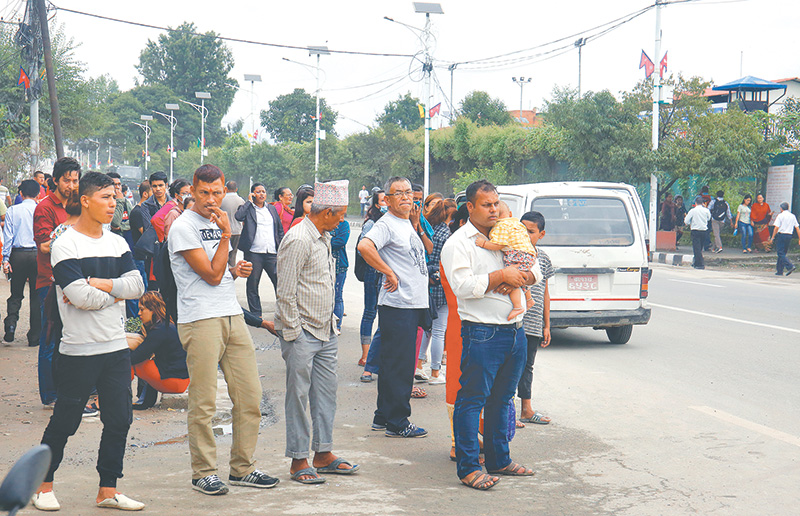
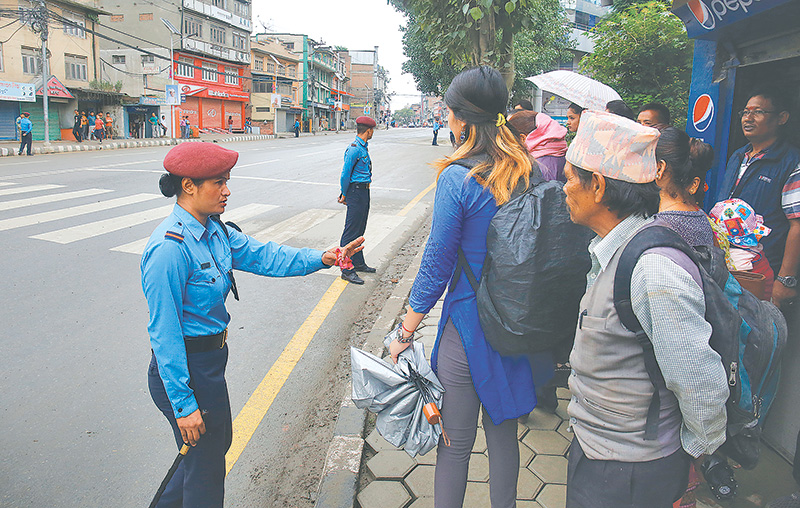
Commuters wait for public vehicles at Tinkune in Kathmandu on Thursday as traffic movement was disrupted. Post Photo: Anish Regmi

KATHMANDU,
On the concluding afternoon of the fourth BIMSTEC Summit, Prime Minister KP Sharma Oli published a tweet in which he thanked and appreciated the public for extending cooperation and coping with the difficulties while Kathmandu hosted dignitaries from six member states.


Outside on the road, the public continued to experience difficulties till late evening as roads were blocked and traffic was diverted or came to a standstill at various feeder roads of the Capital.


PM Oli posted a second tweet promising the government would work on long-term infrastructure planning to prevent such incidents.


Schools and colleges were shut down, public movement was suspended, vehicular movement was restricted with an odd-even rule and roads were completely blocked for hours. These were only some of the many nuisances faced by Valley residents.


Urban planners have slammed the casual manner in which the government carries out last-minute jobs and its failure to plan for the two-day summit, for which it had four years to prepare.


“Security of delegates is important but the government could have notified the public in advance. People could have opted for alternative routes and wouldn’t be stuck for hours on the road,” said Bhusan Tuladhar, an environmentalist and board member of Sajha Yatayat.


“Many countries across the world host such events but public life is not affected as they have effective planning and utilise modern security measures without deserting the cities,” added Tuladhar.


The week leading to the summit was also stressful to say the least as traffic came to a standstill at peak hours because of last-minute cleaning, blacktopping and installation of decorations along the lead routes of
dignitaries.


People expressed their ire on social media and also documented the government’s cosmetic and patchy jobs on the road. Even on the first evening of the summit, workers could still be seen on the streets, repairing potholes or using broomer machines to clean the streets.


“The government has welcomed international guests for years but by disrupting public life. It hasn’t learnt from its experiences. The government’s inability to plan eventually inflicts the general public as essential services like public transportation are affected,” said Kishor Thapa, a former government secretary experienced in urban planning.


“If road networks in the Valley were maintained regularly, there would have been many feeder roads for the people while the motorcades could have used the main route,” Thapa told the Post. “There would be no last minute panic had the government planned it well.”

Experts have pointed out time and again that the government’s priorities on infrastructure at the three tiers of government are misplaced. While there is big noise about time and massive resource consuming mega projects like metro, monorail and cable cars, there is little being done to repair or upgrade the existing infrastructure.


“With nearly two to three decades required to complete the government’s ambitious plans, they can focus on other infrastructural development like improving public transport that can reduce problems that we have witnessed in the last few days,” said urban planner Suman Maher Shrestha, urging the government to invest in construction of flyovers, underpasses and overbridges at major junctions to reduce traffic congestion.


As major infrastructure upgrades are likely to take years, Shrestha suggested that Rapid Bus Transit (RBT) can be an instant measure that can be adopted to deal with public transport issues and avoid disruption during events like BIMSTEC. In various metropolitan cities around the world, RBT has been a game-changer—able to offer quality, comfortable and inexpensive services to the general public.

HOME PAGE

Bista moves court against travel ban

- Post Report

KATHMANDU,
Former Maoist child soldier Lenin Bista on Friday moved the Supreme Court against the government’s act to stop him from travelling to Bangkok, claiming that his right to free movement had been curtailed.


In the petition, Bista argues that officials at the Tribhuvan International Airport immigration failed to give any reasons for the ban. Bista, who has long been advocating justice for former Maoist child soldiers, also claimed that the travel ban was an attempt to curb his freedom of expression. He has already filed a complaint with the National Human Rights Commission.


The rights watchdog has summoned Prem Rai, secretary at the Home Ministry, and Iswhor Raj Paudel, director general at the Immigration Department, to clarify why Bista was held while leaving the country. Both the officials will attend the commission on Sunday for their clarifications.

On August 24, Bista was stopped from flying to Thailand, where he was scheduled to attend a five-day event titled “Youth in Conflict Areas: Healing and Peace Building through Social Engagement.” Officials said the move was directed from the “higher authority”.


Bista has blamed Surya Subedi, advisor to Home Minister Ram Bahadur Thapa, for the bar fearing that he would raise the issue of child soldiers at the international forum. Following criticisms from several quarters, Prime Minister KP Sharma Oli on Tuesday asked the Home Ministry to clarify why Bista was stopped within 24 hour.


In its reply, the ministry accused Bista of embezzling funds allocated for disqualified Maoist combatants and involvement in running a call centre using the illegal Voice over Internet Protocol. The ministry said he was stopped since he could tarnish Nepal’s image at the forum in the name of raising the issues of former child soldiers.


Bista has been protesting under the banner Discharged People’s Liberation Army Struggle Committee demanding justice for himself and his peers.

Page 2
NEWS

Around 15,000 illegal Nepalis avail amnesty

- CHANDAN KUMAR MANDAL

KATHMANDU, 
Thousands of undocumented Nepali workers have returned home from Malaysia in a year under the general amnesty offered by the Malaysian government.


According to the Nepal Embassy in Malaysia, nearly 15,000 illegal Nepali workers availed the amnesty before the deadline ended on August 30.


Workers with expired visas and those absconding from their original employer and working elsewhere without valid work permits are termed illegal by Malaysian rules.  


The amnesty exempted such illegal workers from paying high fines Nepal Embassy Second Secretary Maheshwor Mani Tripathi said undocumented workers had shown interest to use the amnesty to avoid legal issues.


Malaysia had given options to illegal immigrants to either avoid legal actions choosing the Voluntary Deportation Programme, also called 3-plus-1 programme, or obtain legal status through rehiring programme that ended on June 30, 2018.


The opportunity to stay in Malaysia through the rehiring was valid up to December 2017, but the authorities extended it again up to July this year.


The amnesty permitted undocumented workers, who could not rejoin their workplace or failed to find a new employer, could leave the country by August 30 without facing any legal actions.


Malaysia launched massive clampdown on illegal workers and arrested hundreds for defying their immigration rules after the rehiring deadline lapsed.


Following the crackdown, illegal workers visited the Nepal Embassy in Kuala Lumpur to avail a temporary passport for one-way travel to Nepal issued to workers without valid passports. In the last eight months, the embassy issued 12,841 Travel Documents costing 160 Malaysian Ringgit (RM) for each worker.


Three thousand other workers who had valid passports also availed the amnesty and returned to Nepal. They paid RM 400 - RM 300 as fine and additional RM100 for the special pass. Malaysia will announce later the number of illegal workers who returned to Nepal.


Malaysian Immigration Department record showed 385,000 documented Nepali workers as of July 2018. The department estimates more than 1.7 million foreigners legally working in Malaysia during the same period.
Local authorities arrested 28,063 illegal immigrants and 799 employers in raids conducted between January and August 15, according to the Malaysian media reports.


From the 1,500 illegal workers arrested in Malaysian raids earlier this month, 100 were Nepalis, said Tripathi.
“Number of Nepali workers, arrested last August, ranked fifth among workers from other countries. This shows Nepali workers chose amnesty and returned home. The number of illegal Nepalis in Malaysia is not a big issue,” said Tripathi.


The embassy had organised two camps in Penang and Johor Bahru in a bid to encourage illegal Nepali workers to avail amnesty.


As per the Malaysian immigration rules, illegal workers could face fines up to RM 5,000 and banned from re-entering Malaysia up to five years.

NEWS

India to build Mahakali main canal

- RASTRIYA SAMACHAR SAMITI

Bhimduttanagar,
India has taken the lead to construct the main canal of Mahakali Irrigation Project after 22 years of the existence of Nepal-India Integrated Mahakali Treaty.


The Treaty mandates integrated development of Mahakali River, the boundary river between Nepal and India. The Pancheshwor Project under the Treaty expects to generate 6,000 Mega watt of electricity.


India is constructing the head regulator of the 1200-metre long and 13.60-metre wide canal from Tanakpur Barrage to Matena, Bhimduttanagar Municipa-lity-9 in Kanchanpur district.


The NHPC, hydroelectric power generation company based in India, on August 1 this year had opened a tender for the construction of the main canal and the head regulator, according to the Mahakali Irrigation Project Third Phase Office’s Senior Divisional Engineer (CDE), Bir Singh Dhami.


“India has issued a tender notice that the canal should be built within 18 months starting from December this year,” he said.


According to him, India has informed Nepal about the latest development concerning the project and the construction of the main canal.


The Treaty clearly stipulates the “Cost of the Project shall be borne by the Parties in proportion to the benefits accruing to them,” it also states about the construction of the main canal.


India has informed the Mahakali Irrigation Project Third Phase Office it would accelerate the construction of the main canal and the head regulator.


The first meeting of the Nepal-India Joint Committee on Water Resources (JCWR) discussed issues about the construction of the main canal in 2000, but there was no further progress.


Dhami said Nepal and India disagreed on the seal level of the head regulator. Iit took 11 years to reach an agreement.
According to him, the sixth and the seventh JCWR meetings in 2011 and 2013 respectively reached a decision to provide Nepal water from the 244.25 metre sea level.


The Government of Nepal has already constructed 13,000 metres of canal so far.


Contract winner companies are in the initial phase of constructing the 15 kms main canal in the three packages, said Dhami. The main canal’s contract is signed for Rs 2.1 billion. The land spread over 35 hectares is in the process of acquisition.


The canal would irrigate around 33,520 hectare arable lands, stretching from Malakheti in Kailali and all arable land in Kanchanpur.

NEWS

First Radio Nepal singer leaves artistic legacy

- Post Report
Obituary: Hari Prasad Rimal

KATHMANDU,
Legendary singer and ‘father’ of Nepali Radio drama
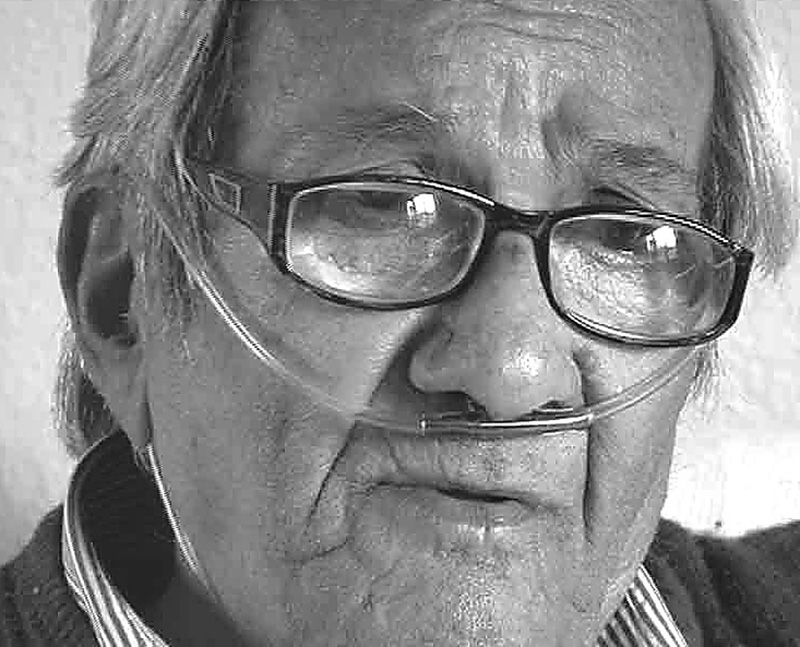
Hari Prasad Rimal died at the age of 92 on Friday at
his Baneshwor home in Kathmandu.


He is survived by his wife and four children. His last rites took place at Pashupatinath.


The singer’s soft tenor was the first Nepali voice to emanate from radios across the country. It was lilting enough to carry pathos and a hint of emotional heartaches.


At the age of 25 Rimal rose to fame from Lagantol in Lalitpur.  He composed the music for a song written by the famous lyricist Shankhar Lamichhane. The song ‘Mero Mann Tukra Bhayera Ekdin Aakhaako Baato Bahanechha’ is the first song recorded and broadcast by Radio Nepal. The song launched one of Nepal’s most acclaimed singers.


Growing up during the Rana years, young Rimal had coveted the opportunity to attend Durbar High School. However, he was interested more in music and the arts. He often missed classes to attend musical events and take part in theatre plays. An apocryphal story about him says he befriended a temple priest and learnt music from him.


Rimal’s ‘Fagat Ek Nazar Ma’ remains a popular folk tune that is reminiscent of the music of yesteryear Kathmandu, with its plaintive harmonica and melodious vocals. Music was not his only passion. He was equally interested in acting. His acclaimed performance was excelling in an early version of Bal Krishna Sama’s Mukunda Indira.

Impressed by his talent, Sama offered Rimal a role in his new play, Prahlad.


Rimal went on to sing many songs and act in a number of plays and films.


Rimal’s filmography includes ‘Aama’, Manko Baandh’, Ke Ghar Ke Dera’, Pariwartan, Sindoor and Santan, and dramas ‘Bhimsen Ko Antya’ and ‘Mukunda Indira’. During his long and illustrious radio career, he directed hundreds of dramas including celebrated works of Nepali litterateur such as Muna Madan.


Much of Rimal’s earlier work is lost. The Bhakta Raj Acharya Pratisthan honoured him along with lyricist Chandra Raj Sharma in July 2017 for their vast contribution to Nepal’s performing arts.

NEWS

CM Raut opens girls’ education campaign

News Digest

JANAKPUR: Province 2 Chief Minister Lalbabu Raut officially announced  “Beti Padau-Beti Bachau” campaign on Friday. The campaign aims to raise awareness on the importance of
education for girls.

CM Raut said that the campaign will be helpful in reforming the society. (PR)

NEWS

Park officials capture killer tiger in Chitwan

News Digest

CHITWAN: The Chitwan National Park (CNP) has captured the tiger that killed Jit Bahadur Rai, 56, of Madi Municipality-9 in Chitwan on August 23. Madi residents had pushed local administration to hunt the man-eater tiger. Information Officer of the CNP Nurendra Aryal said the adult male tiger was kept in captivity. (PR)

Page 3
NEWS

PM Oli lauds success of summit

- Post Report
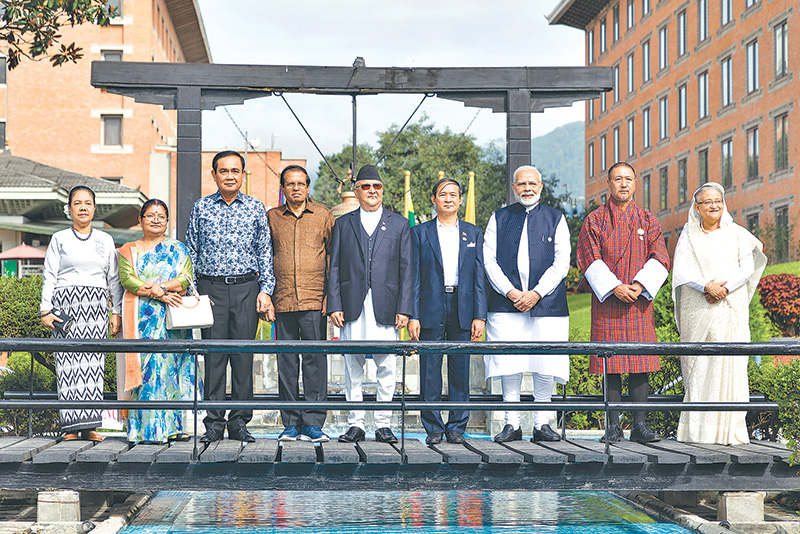
Heads of state or government of the seven BIMSTEC member nations pose for a photo during a retreat at the Capital’s Soaltee Crowne Plaza on Friday. Post Photo: HEMANTA SHRESTHA

KATHMANDU,
Prime Minister KP Sharma Oli and Foreign Minister Pradeep Gyawali lauded the success of the Fourth BIMSTEC Summit in Kathmandu that concluded on Friday.


In his closing statement, the PM stressed the  need for regional cooperation citing that today’s complex problems cannot be resolved with the efforts of an individual country alone.


“In the world that is witnessing multiple contradictions and uncertainties, our resolve to strengthen regionalism as a building block to multilateralism bears a particular significance towards a stable, predictable and rule-based world order,” PM Oli said, adding that during the Summit, the member states made a comprehensive review of the progress made and agreed to a future course of action to accelerate the process of regional cooperation.


“The Summit has been a significant step towards making BIMSTEC a dynamic, effective and result-oriented regional organisation. It has reinvigorated the BIMSTEC process to realise the vast potentials that are available in the region,” said Oli.


Prime Minister Oli reminded that enhancing connectivity, fostering trade and investment, promoting cooperation on energy and tourism are among the key decisions taken to achieve this goal. The signing of the Memorandum of Understanding (MoU) for the establishment of the BIMSTEC Grid Interconnection will facilitate greater cooperation in energy sector, he said.


Foreign Minister Gyawali also stated that the summit was a huge success where Nepal pushed for greater
economy, ecological conservation, sustainable development and poverty alleviation.  


The minister further said the member states promised to contribute to the BIMSTEC Development Fund as per their capacity and the Fund would be used to implement research-based and pilot projects.


“Nepal is the place of origin of Buddhism and Nepal has its concern over the proposed Buddha Circuit,” he said.
In his response to the issues of Bhutanese refugee, the Foreign Minister said, “We have some issues with Bhutan but will work on it after a new Bhutanese government is established.”


Prayut Chan-o- cha (Ret.), Prime Minister of the Kingdom of Thailand, gifted symbolic medicines and medical equipment worth 1.5 million US Dollars to the people of Nepal at the bilateral meeting with Prime Minister Oli on Friday. Thailand had committed the medical equipment to Nepal after the earthquake.

NEWS

House panel elections delayed again

- Post Report

KATHMANDU,
The voting for the leadership of Parliamentary Comm-ittees has been postponed yet again as parties sought more time for negotiations.


The election was originally set for August 8 before it was postponed for September 2 following the differences among the parties on sharing the leadership of 10 thematic committees. With the parties nowhere near consensus as of Friday, the voting process has once again been pushed back.


Nepal Communist Party, Nepali Congress, Sanghiya Samajbadi Forum-Nepal and Rastriya Janata Party-Nepal are vying for the leaderships of the committees.


The ruling NCP, which holds the majority in all the committees, is willing to give the leadership of Public Accounts Committee to the NC. It is a parliamentary practice worldwide to award the leadership of PAC to the opposition. The NC, however, wants leaderships over at least two more committees besides PAC.


Though the NCP is positive on the demand of the SSF-N, it does not want to grant the leadership of any committees to RJP-N.

NEWS

Civil servants criticise draft bill on federal services

- TIKA R PRADHAN

KATHMANDU,
The draft bill on Federal Civil Service which has proposed cutting down three civil service categories and barring inter-service transfer has drawn criticism from civil servants.


The bill which was recently registered at the Cabinet has removed three categories-- economic planning and statistics, education, and miscellaneous and recommended adjusting them in administrative service while inducting two new services – health and parliament, which were governed by separate acts earlier.


Under the new arrangement, there will be nine services under the civil service – engineering, judicial, foreign, forestry, agriculture, administrative, auditing, parliament and health.


The central issue of discontent among civil servants from the administrative service is proposed adjustment of existing three services – education, economic planning and statistics, and miscellaneous to administrative service.


Since the government in the past used to adjust civil servants of other different services to the administrative service, they said adjustment of these three services to the administrative category will hit their career growth prospects.


Currently, there are 22,000 civil servants under the administrative service while there are around 5200 civil servants under education, economic planning and statistics, and miscellaneous services.


“With the entry of more than 5,200 people in the administrative service, our career prospects could be hit,” said a section officer who didn’t wished to be named.


Two years ago, 508 employees assigned at former Royal Palace were brought into administrative service and prior to that, hundreds of employees of postal service were also adjusted in the administrative service.


Similarly, 157 computer operators belonging to miscellaneous service were promoted to section officers and adjusted at the administrative service in the last two years.

The concerned civil servants have also objected to the provision of barring civil servants from switching services, as well as the provision that states only those employees who have served at the province or local levels for six years will be eligible for promotion in any of the civil services at the federal level.

Bhupal Baral, joint secretary at the Ministry of Federal Affairs and General Administration, said the three removed service categories could be adjusted within the administrative service as sub-groups to ensure that the plan does not affect the promotion of the employees.

Bimal Koirala, former chief secretary, however, cautioned that the  new provisions could demoralise the fresh entrants of civil service.

“The three services should be given separate recognitions so as not to affect the morale of the civil servants,” he said.

On Friday, dozens of civil servants expressed their discontent over the new provisions before Minister for Federal Affairs and General Administration Lalbabu Pandit.

Page 4
HOROSCOPE

Horoscope

ARIES [March 21-April 19]
Sunday’s made for errands, paperwork, trips and communications. Aim for home, family Mon to Wed. Tackle chores, repairs. All goes well—though you might stumble onto a good-hearted disagreement with your spouse or a practical partner/associate. Romance visits Wed dawn to mid-morn Fri. Small things go well, but a big, perhaps invisible sign hangs over all. Tackle chores Fri/Sat—but cautiously, as tools, machines might ‘bite’—and others might argue with each other, complicating your efforts. Eat, sleep, dress sensibly.


TAURUS [April 20-May 20]
Sunday/Mon steer you toward home, family, rest and repair. Good progress here, though Mon afternoon can grow a bit disruptive, unpredictable. Visions of beauty, a bit of self-indulgent pleasure, romantic notions and love of children visit you Tue/Wed. Tackle chores Thurs/Fri. You’ll succeed, but watch Thurs night, when you might misunderstand directions and Fri morn, when an argument or tool mishap might occur. Saturday’s for relationships and opportunities—both of which are unlucky, face big barriers, before mid-afternoon.


GEMINI [May 21-June 20]
Chase money or go shopping Sun. Errands and easy chores slated Mon to Wed dawn. Avoid a political or religious argument Tues—otherwise, a great little interval, studded with affectionate meetings and happy friends. Head homeward Wed morn to mid-morn Fri. Hug the kids, do minor repairs, enhance security, and sidle up to Mother Nature. Small things go well; major things hit a financial, ownership or ‘missing advice’ wall. Your heart softens with love, romance, Fri/Sat—but step cautiously, as others are ready to argue, refuse intimacy.


CANCER [June 21-July 22]
Gather money and buy things Sun/Mon—but avoid computers, software, electrical items, daytime Mon. Visits, calls, trips, paperwork and errands fill Tues/Wed. Don’t argue at work or drive carelessly Wed. Head for home, or read the real estate ads Wed night through Friday. This interval might spark a tug-o-war between home and career, family and outside interests. Sidestep an argument Fri morning. Saturday triggers all your creative, pleasure, romantic urges.


LEO [July 23-August 22]
Lie low, rest and contemplate Sun. If you tackle things, you’ll tackle trouble. Your energy, charisma and clout surge upward Mon to dawn Wed. Your luck soars, too, so plunge in, drive forward, impress people, give projects a push. Buy/sell, chase money, compliment clients, etc, Wed morn to mid-morn Fri. Little things go well; big things meet obstacles. Easy chores, calls, emails, visits, paperwork—these fill Fri/Sat, but glitches, lost addresses, dropped calls, etc, fill this period also, so be cautious, do what you can.


VIRGO [August 23-September 22]
Sunday stirs your ambitions, but surrounds you with potholes and obstacles—but you can take good money actions. Friends, popularity, wish fulfillment, flirtations and optimism fill Mon to dawn Wed. Retreat to the background, watch, listen and think Wed morn to mid-morn Fri. Rest, deal with gov’t, company headquarters, advisors, charities and ‘old ghosts’. Your energy and charisma rise swiftly Fri/Sat, but many confrontations, glitches could slow you down. Still, you’ll attract attention, admiration.


LIBRA [September 23-October 22]
Sunday/Mon bring social joys, popularity, flirtation, optimism and entertainment. Sunday, love could appear. But Mon
daytime, after a lucky start, runs into an unpredictable barrier. Retreat from the crowd Tues/Wed—rest, contemplate and plan. Your energy and timing, charisma and clout, rise smartly late Wed night through Fri. Start things, ask favors, but even more, contact people you want to work with or love with.
Love could have beautiful results, especially very late Wed, Thurs pm, pre-dawn Fri, and Fri afternoon. Saturday’s for buying/selling, garage sales, pleasing clients.


SCORPIO [October 23-November 21]
Your energy remains high and strong Sun, but pitfalls outnumber lucky boosts, so step carefully. A sweet, lucky interlude might gladden your heart this afternoon. Chase money, shop, butter-up clients, angle for a pay raise, etc, Mon to dawn Wed. Luck rides with you! But remember, nothing brand new. Errands and easy chores slated Wed morn to mid-morn Fri. Travel, call, write, perform paperwork or filing. Steer toward home Fri/Sat. And when there, be diplomatic, relaxed. If you try to lay down the law, or demand obedience, you’ll inspire revolt.


Sagittarius [November 22-December 21]
Sunday/Mon and Thurs/Fri bring sweet affection. The earlier pair of days emphasize gentle love, major understanding, possible legal, travel or intellectual success. Monday afternoon sparks domestic disruption so remain alert. Be ambitious, dutiful and honest Tues/Wed. Success—but don’t insist on money details, nor start an argument with a child or someone else you love. Social delights, optimism, popularity, flirtation visit you late Wed night through Friday. Love might blossom, might bring a wish true. Retreat Sat, rest, contemplate and plan.


CAPRICORN [December 22-January 19]
Sunday’s philosophical, mellow, drawing you toward travel, culture, law, learning—but the day is disjointed. Be ambitious Mon to dawn Wed. Don’t start new projects, but do show your skills, meet with higher-ups. Your luck is strong. You could be praised, even rewarded, for something you accomplished in the past. Friends, popularity, wish fulfillment, optimism, flirtation and/or entertainment—all arrive Wed morn to mid-morn Fri. It’s not as buoyant as usual, partly because communications or distance get in the way. Retreat, lie low and rest Fri mid-morn and Sat.


AQUARIUS [January 20-February 18]
Sunday brings passion, romance, creative and speculative interests, beauty and pleasure. But only the afternoon brings luck here—don’t expect too much. Tackle chores and protect your daily health Mon to Wed dawn. Good luck hovers everywhere, so you’ll get those chores done. Relationships arise Wed morn to mid-morn Fri. Most goes well here, but don’t mix friends and money, nor be ‘hopeful’ about a money action. Life’s deeper side, finances, crimes, recreational drugs, surgery, and all commitments, fills Fri/Sat.  


PISCES [February 19-March 20]
A major change or sudden event might occur in earnings or a school program, perhaps around mid-week. Your money picture has been erratic, unpredictable for the last few days—and probably ‘slim’. Mid week will change this forever, and finally give you the chance to chase big bucks, and, probably, steady bucks. Errands, visits, casual friends, short trips, communications, paperwork and easy chores fill Mon/Tues—in a splendid, fortunate way. Focus on home, family, nature and nutrition, security and business territory Wed dawn to Fri dawn.

Variety

STRIPS

STRIPS

Variety

GARFIELD

GARFIELD

Variety

Big Screen Toppers


1)    Crazy Rich Asians
2)    The Meg
3)    The Happytime Murders
4)    Mission: Impossible- Fallout
5)    Mile 22
6)    Christopher Robin
7)    Alpha
8)    BlacKkKlansman
9)    A-X-L
10)    Slender Man

(Source: IMDb)

Variety

Airwave Toppers


1)    In My Feeling by Drake
2)    Girls Like You by Maroon 5 featuring Cardi B
3)    I Like It by Cardi B, Bad Bunny and J Balvin
4)    Fefe by 6ix9ine featuring Nicki Minaj & Murda Beatz
5)    Better Now by Post Molane
6)    Lucid Dreams by Juice WRLD
7)    No Tears Left To Cry by Ariana Grande
8)    God Is a Woman by Ariana Grande
9)    Sicko Mode by Travis Scott
10)    Taste by Tyga featuring Offset

(Source: Billboard)

Variety

FILMS


STREE
QFX Civil Mall: 08:30/12:00/17:30/20:30
QFX LABIM Mall: 09:15/12:00/15:45/20:30
QFX Chhaya Center: 09:30/12:30/15:30/18:30
QFX Kumari: 08:45/14:45/18:15
QFX Jai Nepal: 12:00/18:00


MERI MAMU
QFX Civil Mall: 08:45/11:45/14:45/20:00
QFX Kumari: 09:00/11:45/15:15/18:00
QFX Chhaya Center: 09:15/16:00/19:15
QFX LABIM Mall: 09:00/17:45


NAI NA BHANNU LA 5
QFX Civil Mall: 09:00/11:30/15:15/18:30
QFX LABIM Mall: 11:15/14:45/18:45
QFX Jai Nepal: 09:00/15:00
QFX Kumari: 12:00


ALPHA
QFX Chhaya Center: 13:00/19:00
QFX LABIM Mall: 14:15/19:30
QFX Civil Mall: 14:30/17:15


HAPPY PHIRR BHAAG JAYEGI
QFX Chhaya Center: 12:15
QFX LABIM Mall: 12:30


THE MEG
QFX Chhaya Center: 15:15
QFX LABIM Mall: 17:00

Page 5
ON SATURDAY

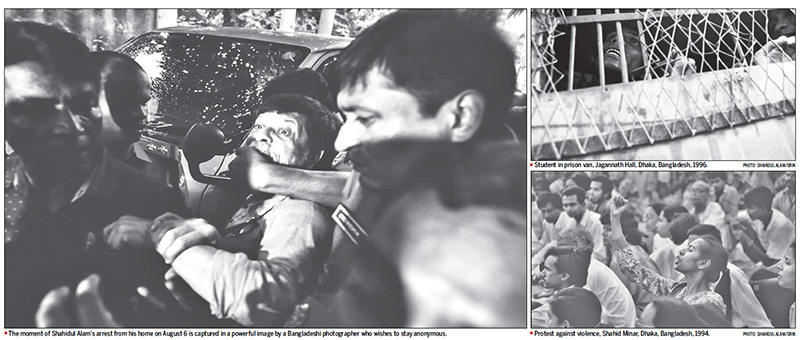
LESSONS FROM A BANGLADESHI MAN

If leadership had a sound, it might be the roar of Shahidul Alam’s courage as he tells us to carry forth while he stands behind bars for speaking truth to power
- NAYANTARA GURUNG KAKSHAPATI

Shahidul Alam is many things. He is a photographer, but also a writer, activist and teacher. Although I have never had the chance to sit with him in a classroom, he has taught me many lessons.  
I first met Shahidul at the opening of ‘A People War’ exhibition here in Kathmandu. It was 2007, I think. I saw him from afar, in his signature kurta and chappals, and hesitated to approach him for a few minutes. I was told he was the founder of many important institutions including Drik Picture Library, Pathshala South Asian Media Institute, Chobi Mela and Majority World—all in Bangladesh. Quickly though, in true Shahidul fashion, he had us completely at ease, asking questions, seeking to understand. That first encounter resulted in a follow-up meeting the next day, by the end of which he had invited one of our team members to Dhaka for a fully funded one-year South-to-South fellowship.

Institution building as a human enterprise
Over time, as we got to know Shahidul better, we learned that this is what this man does on a daily basis—connects individuals and institutions around the world, with resources and opportunities, to learn from each other, and grow together.
Watching Shahidul work, often times from a distance and sometimes when lucky, from close proximity, I have come to learn that institution building is not about the edifices we construct and the hardware we amass. Institution building is a slow process of nurturing people, our capacity to be more effective professionals, but also and perhaps more importantly, nurturing our spirit and convictions.
What does it take, in our socio-economic, cultural and political contexts, to do the work that we do? To nurture the institutions we are building and make them work, every day, over time, through resource crunches, political pressures, health crises and heartache? Shahidul has shown us that it takes courage, passion, perseverance and kindness to keep doing what we do, introspecting and re-calibrating while taking stock of our flaws as well as our collective magic.


Leadership, friendship, and building community  
Speaking of collective magic, I have been in wonderment these past weeks about the outpouring of support from people and institutions around the world against this brutal attempt to silence Shahidul. Who is this man that the entire world is standing up for? How did he make so many friends—from Nobel Laureates, lawyers, heavyweight institutions in his own field and beyond, to, of course, photographers and activists from around the world?
People who know Shahidul Alam will testify that the man is deeply rooted in Bangladesh, but constantly on the move and constantly connected. If you know him, it is not difficult to conjure up an image of him seated calmly somewhere, at an airport, on a boat, in a conference hall, furiously writing e-mails, proposals and poems. I have wondered how he does it and been concerned about the human phenomenon many of us refer to as ‘burn out’. But the concept somehow seems to escape Shahidul. He is relentless. He is constantly thinking forward, and backwards, and in every possible direction. He is building relationships and projects laterally but also creating of ripple effects everywhere he goes—instigating, inspiring, breaking down egos with his twinkling eyes and grizzly hugs. He sees value in all these multiple ways of working and being. He makes friends with everyone, organically and by choice—from the youngest person in the room to the VIP in the suit and the security guard who holds his door.
Shahidul has many critics too, of course. Somehow, he seems to be in touch with them, engaging, listening but constantly putting forth his convictions in the blogosphere, on the streets, in conference rooms and at dinners. Watching him, I have learned that it means nothing to have expansive reach with no depth and commitment. If leadership had a look, then it might be the kurta-chappal one. If leadership had a smell, it might be of Star Kebab in old Dhaka where we sit on a long table and he orders us the most delicious maach-bhat. And if leadership had a sound, it might be the roar of Shahidul’s courage as he tells us to carry forth while he stands behind bars for speaking truth to power.


Patriotism
It took me a while to understand why a man with a PhD in chemistry chose to move back to his land of birth and start a picture agency. In his book.
My Journey as a Witness, Shahidul writes about the first big flood he photographed in 1988: “What do you photograph in a flood? A submerged house, a boat on a highway, people wading in the water? The worst flood in a hundred years! Statistics are irrelevant. As those before them and after them, they will always face floods. What difference does it make whether 60 percent are starving or 75 percent have gone hungry? Does it matter which country sends the relief wheat? What’s relevant are the feelings kindled, the shared kilogram of rice, a solitary dry house for all, and that others have felt the pain. What’s significant is that when the roads are dry and the walls repainted, a nation that once cared quickly forgets.”


Among many other things, I have come to admire the ease and eloquence with which Shahidul switches from English to Bangla. The flair with which he wears his chappals—to class and meetings and award ceremonies, including the one in 2014 where he was awarded the Shilpakala Padak by the President of Bangladesh. Shahidul makes me think about what it means to belong, to a place and a people, to the majority world. What it means to grow roots and still be an engaged global citizen. His work and his life speaks to us that love for one’s country and people, often referred to as patriotism, means standing your ground and speaking truth to power, no matter the consequences.

Activism
Rebecca Solnit writes that “Activism is not a journey to the corner store, it is a plunge into the unknown.” Shahidul, his life partner Rahnuma, and their community are reminders that as individuals, collectives and institutions, we are often plunging into the unknown as we seek to create change and equality, whether in our personal or professional lives. His life is a lesson that despite the unknown, we keep at it. Activism is a life-long commitment to organising, speaking up when the need arises, doing, thinking, writing and marching on.


Solnit continues to say that “Anything could happen, and whether we act or not has everything to do with it. Though there is no lottery ticket for the lazy and the detached, for the engaged there is a tremendous gamble for the highest stakes right now.”


Shahidul is currently imprisoned for being a witness and telling the truth. From his jail cell, he continues to inspire, bringing so many together from around the world, to stand our ground, call for justice and act as a community. Even in this darkest of times, I continue to learn from him.  


Around that time, I met Abdul Malik, a young man in his early twenties, on an Aeroflot flight bound for Tripoli. He dreamt of somehow changing his destiny. I dreamt of somehow recording his dream. I have never seen him since and I don’t know if he made it back home, bought that piece of land he had hoped for, or had managed to arrange a marriage for his sister, but I have seen his dream in many eyes, both fresh and weary.
Photo: Shahidul Alam/Drik


Rejoicing at Ershad’s fall Mirpur Road, Dhaka, Bangladesh, 1990. Resistance to General Ershad was mounting and by the end of that year it all came to a head. The government had enforced strict censorship. Newspapers stopped publishing in protest and there were tanks on the streets. The adrenalin flowed as we marched through the teargas and my camera began to respond. Braving the curfew, I tried to capture the raw courage of a people against the cruelty of a tyrant. Photo: Shahidul Alam/Drik


The elections were a glorious site. People thronged to polling stations. I photographed a woman in a ballot booth, avenging Noor Hossain’s dealth with her voice. Sadly, it didn’t result in democracy, since democratically elected leaders are often scantily disguised autocrats. Photo: Shahidul Alam/Drik


Phalan and Iqbal in Lalmatia, Dhaka, Bangladesh, 1995.Photo: Shahidul Alam/Drik


Estemah, Tongi, Bangladesh, 1988. Photo: Shahidul Alam/Drik


Woman collecting flood water, Jinjira, Dhaka, Bangladesh, 1988.  Photo: Shahidul Alam/Drik


Remains of a home after cyclone, Hatia, Bangladesh, 1991. Photo: Shahidul Alam/Drik

- Gurung Kakshapati is a photographer, curator and co-founder of photo.circle

Page 6
ON SATURDAY

Big, fat Asian wedding

While the new Crazy Rich Asians might be a long-overdue symbolic leap forward in onscreen representation for a group generally relegated to stereotypical side roles in Hollywood, one wishes that move had come in service of a better film
- OBIE SHRESTHA

In preparing to watch Jon M Chu’s new Crazy Rich Asians—presently enjoying enormous hype as the first big Hollywood production to come out in a long, long time that features an all-Asian cast, and is directed by an Asian-American to boot—I decided to go straight to the source material, namely, the bestselling book of the same name by Kevin Kwan, on which the screenplay is based. Kwan’s book, the first of a series that seeks to give readers a glimpse into the lives and loves of Singapore’s unimaginably, ridiculously wealthy one percent, certainly lives up to its title—a fluffy, catty, cheeky ode to opulence and unchecked consumerism. And while Chu, and screenwriters Peter Chiarelli and Adele Lim have trimmed off some of the excesses of the book, the film is still pretty out there compared to your average rom-com, a smorgasbord of uber-lux lifestyle porn and escapist fantasy.


But though it’s hard to deny a sense of satisfaction, as an Asian, to see Asians occupying such a range of roles normally reserved for white actors, it’s unfortunate that the story itself is so very generic. I mean, we’ve been practically weaned on this sort of clash-of-the-classes, poor girl/boy meets rich girl/boy stuff to the point where there are few surprises in terms of the broad strokes—and Crazy Rich Asians doesn’t even try to deviate from well-trodden ground, happy to simply cling to tediously outdated rom-com conventions.   

Economics professor at NYU, Rachel Chu (Constance Wu) is feeling a little bit conflicted. Her boyfriend of over a year, Nick Young (Henry Golding) has just asked her to take a trip with him to his hometown in Singapore, ostensibly to be his date to his best friend’s wedding, but actually intended to introduce Rachel to his family—including mother Eleanor (Michelle Yeoh)—for the first time. While Rachel is excited that the relationship is progressing, she is also apprehensive; Nick has always been very, very tight-lipped about his life back home and has given her little clue of what to expect.


Turns out, he could never have adequately prepared her for the truth. Nick’s family, you see, is rich—not just “comfortable” as he’s been putting it modestly when asked, but an astronomically wealthy, old-money dynasty with business interests spanning multiple continents. So, as heir apparent to such vast fortunes—and not bad to look at, either—Nick is pretty much the most eligible bachelor in this elite circle, with young women throwing themselves at him at every turn. Rachel, who never suspected anything like this about her boyfriend—the same guy who borrows her Netflix password rather than paying for his own subscription—is stymied by it all, not to mention hurt by the icy treatment she receives from Eleanor. As the festivities get more and more extravagant, and the competition for Nick’s affections heats up, Rachel must decide whether what they have is worth the trouble, or if they are simply too
different to work. I’m sure you can guess which way this is going to go.


Coming over a decade after 2005’s Memoirs of a Geisha, one of the last Hollywood releases where Asians made up majority of the cast, the existence of Crazy Rich Asians does feel rather monumental in terms of a leaning towards more diversity onscreen. And there’s also some specific significance in its being a rom-com—watching Mr Golding strutting around in those impeccable suits, flashing that blinding smile, every bit the coveted leading man, feels very much like a purposeful jab against the pervasive Hollywood stereotype of Asian men as not-particularly-sexy or charming.


And while one also derives a perverse pleasure from the sheer novelty of seeing non-white folk indulge their every decadent desire on such a scale as they do here, as the larger-than-life set-pieces and self-conscious brand name-dropping piles on, the message, already flimsy, starts to get even more muddled. Crazy Rich Asians might kick off on a distinctly celebratory note—as something of a tribute to the Asians who have made it big—it slowly veers closer and closer to parody as it goes on, until you begin to question whether the representation so many have applauded the film for is actually even all that flattering to those it is supposed to represent.


There’s also the issue of who exactly the film’s titular ‘Asians’ refers to, because as far as this script is concerned, it’s a pretty homogenous group. Crazy Rich Asians has received criticism for this on several fronts, such as in a piece by Sangeetha Thanapal where she accuses the film of promoting the “systemic erasure” and disenfranchisement of racial and religious minorities in Singapore society. One can see her point—almost all the characters onscreen are of Chinese origin, while the few brown folks have been assigned blink-and-miss roles. Then again, you also have to wonder whether it’s really fair to place the burden of righting all these wrongs on Chu’s shoulders alone—this is just one film, after all, and such flimsy, frivolous fare at that, it never could’ve lived up to those kinds of expectations.


Speaking of not living up to expectations, Golding is clearly the weakest link in the chain here—he looks the part, but the performance is basic at best. Which is unfortunate given that Wu is pretty much perfect for a role like this—although I still much prefer her in her Fresh Off the Boat avatar—and really deserved better company. And while much has been made of the cameo by rapper/comedian Awkwafina, and she definitely gets a few cracks in, her part is such an exaggerated caricature that it’s a wonder she doesn’t have ‘comic relief’ tattooed on her forehead. At least there’s the ever-reliable Yeoh to pick up the slack—the actress plays Eleanor Young with practiced elegance and ease, a balm for sore, bling-fatigued eyes.


So there you have it: Crazy Rich Asians might be a long-overdue symbolic leap forward in onscreen representation for a group that has largely been relegated to stereotypical side gigs in Hollywood, but I do wish that move had come in service of a better film than this.


Crazy Rich Asians
Director: Jon M Chu
Actors: Constance Wu, Henry Golding, Michelle Yeoh
Genre: Romantic comedy

ON SATURDAY

The taste of yomari

Yomari, a word once associated simply with that sweet Newari dessert, has started enticing connoisseurs of Nepali music
- Abha Dhital

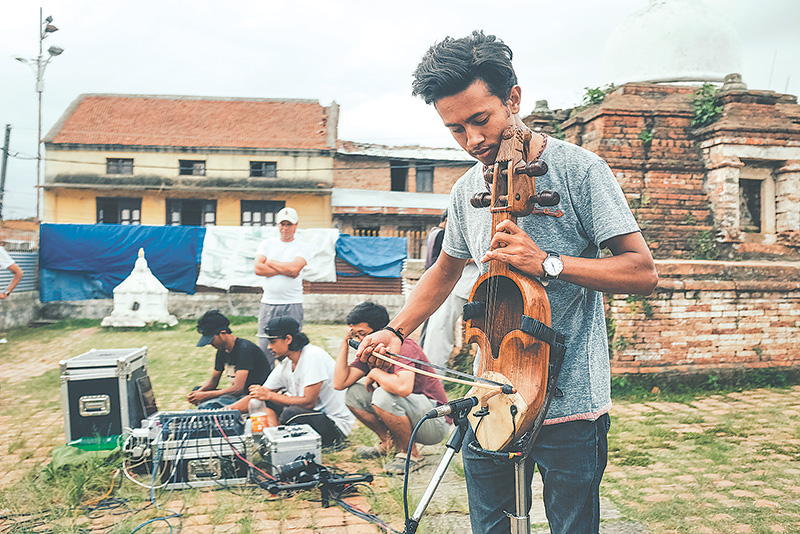
Easy, breezy Naya by Ladi, an American singer, and Bicky Adhikari, his Nepali accompaniment, is playing on the other tab as I write this piece. I have been listening to this song on a loop. Since it was released on Wednesday, I have also watched the video at least a couple of times. The two musicians, seated on mudas at a falcha, are jamming like nobody’s watching. But as the camera pans, you see a live audience who have accidentally become a part of the concert and yet look like they wouldn’t be anywhere else. You can also see the sound engineer and lensmen at work. There is something raw and organic about this video; it feels intimate.


I can’t get over Naya, just like I can’t get over many of the other songs featured on Yomari Sessions, an intimate one-take production of local music, shot informally but with verve. I can name Dreaming by Space, Cycle by Kta Haru, and Godhuli by Shreeti and Baaja from the top of my head—all unique in their own way.


If I were to describe Yomari Sessions, I would call it a place where you find sincere and soulful  songs that get stuck in your head. “It’s a platform where you find Nepali music that you should have on your radar,” says Shashank Shrestha of Katha Haru, the company that produces these sessions.


Over the years, many similar musical sessions from across the world have reached Nepali ears through YouTube. Along with the pioneering Take Away Shows, NPR’s Tiny Desk Concerts, and Sofar Sounds (which also has a leg in Kathmandu) have managed to gain a wide audience through their informality and the promise of a personal, unfiltered experience. There is something about these sessions that not only help us discover new artists, but also makes us fall in love with our favourites all over again. It feels like we know them, personally. It feels like we are just watching our friends perform.


If there were no such platforms in Nepal when Yomari Sessions first started, more have blossomed in the years since. “We thought it would be cool to do something similar to the Daytrotter Sessions or La Blogotheque’s Take Away Shows in Nepal,” says Shashank. The Katha Haru team wanted to showcase intimate presentations of independent and talented musicians. They didn’t know where to start until they met Yuvash Vaidhya, a musician who introduced to them a network of performers and artists. Katha Haru didn’t even know what to call these sessions until they finished recording their first ever session with the band Baaja.


One artist led to another, just like one viewer led to another, and from then, things progressed organically. Yomari Sessions has since had three seasons with 28 episodes and 15 featured artists. Yomari, a word once associated simply with that sweet Newari dessert, has of late started indulging connoisseurs of Nepali music.   


I have probably watched every single video there is from Yomari Sessions, but I wanted to learn about what it takes to bring these intimate sessions to life, what goes on behind the scenes.


“Minus the musicians and their brilliant music, it takes the entire 13-member Katha Haru team to bring these sessions to life,” says Shashank, revealing that it’s a process more strenuous than it appears.


The starting point for any session is artist selection. The whole team sits down to listen to samples submitted by the artists and decides unanimously on who to feature, based on the authenticity of the music but also on how they as an audience can connect to these artists. “The music they create has to feel different,” says Shashank. “From Flekke’s surreal experimentation to Manda’s folk tunes, they all bring something distinct to the table.”


One strict rule that Yomari Sessions has is that they don’t feature covers, “If you want to listen to cover songs, you can visit just about any platform! We want something original and we want to feature artists who have worked hard in creating a signature sound.”


Once the lineup is complete, the team finalises the shoot dates and the location. What sets Yomari Sessions apart the range of other live music shows is the space that they shoot in. From an old bahal in Patan and an open field on the outskirts of Kathmandu to a closed room in a rundown, old house, Yomari Sessions has shot across wonderfully odd locations. “This only adds to the authenticity,” reports Shashank. “When you place these artists in an unfamiliar setting and let them immerse themselves in their own sound, you can sense that they are in the moment. You can just feel the sincerity.”


But what about the disturbances that take place in public spaces? Wouldn’t artists prefer to be in their own closed space, uninterrupted, undisturbed? “We like that Yomari Sessions, while unannounced, are accessible. Anybody is welcome. People can just drop in and become a part of a concert they didn’t even know was happening. But we are also toying with the idea of letting the audience know,” shares Shashank.


There are challenges of course. For instance, for the session that featured the band Pahenlo Batti Muni, they had to get power to an open field and it was raining. The team could only record two songs instead of three, but at the end of the day, they managed to get what they wanted.


Yomari Sessions, which has around 8,000 subscribers, has yet to reach “critical mass,” in the director’s words. It has yet to penetrate the mainstream music market. If they have something to boast about, it’s finding and indulging in local music that is fresh and has a unique sound.


When you are an independent channel, the biggest challenge is to be consistent and surpass your own benchmark, says Shashank. “Because we are self-funded, we have autonomy, but budgeting is a hurdle, always. We cannot afford to be stagnant at this point. We have to keep pushing, keep growing.”


Yomari Sessions has just wrapped up its third season and expectations are only growing. “The challenge now is to find more artists, as many musicians as possible,” says Shashank.


Meanwhile, I can’t wait to see what the Yomari guys have in store for me next week.  As I move on from one song to other on YouTube and get on with editing this piece, I am left forlorn, but I know that new music is out there waiting to be discovered and Yomari Sessions is going to be there bringing it to the world.

Page 7
ON SATURDAY

Pride and no prejudice

- Post Report

Thamel is a night owl. It stays up till late, privy to all that goes on in its narrow night-time corridors, and sleeps till late into the day.


But on Monday, at noon, early for Thamel, its quiet quarters suddenly came alive, with its denizens, mostly those belonging to the transgender community, donning vibrant attire and handling colourful balloons and placards sporting salient messages. A few minutes on and people began to jostle each other, while others began to lose themselves to the tunes of the insistent, all-consuming band baaja. There was unmistakable pride in their eyes, lined up with a hint of concern, perhaps unwarranted on this day. It was their time, it was easy to surmise, a rather rare scene when all sexual minorities came together in celebration.


It was the annual rite of Gaijatra, a day when no authority figure is off limits for banter, when Newars who have had a death in the family in the past year parade about to commemorate the dead. This day has now taken on additional meaning—it hosts the annual LGBTI Pride Festival—bringing together members of all orientations and their allies for a day of revelry and open-armed acceptance. This year, under the theme ‘Alliances for Solidarity’, marked the 15th edition of the festival.

PHOTOS: KABIN ADHIKARI  
TEXT: TIMOTHY ARYAL


Page 8
ON SATURDAY

A Postcard from Paltan Ghar

Even as the neighbourhood around it transforms into a sea of steel and concrete, Paltan Ghar remains trapped in a time warp
- SANJIT BHAKTA PRADHANANGA

At face value, the Paltan Ghar in Asan is one more intriguing historical building in the Valley that is in dire want of upkeep. Hugging one of the six streets that feed into Asan Chowk, were this avant-garde 240-year-old building not caked by dust or camouflaged by the brass pots that line its walls, it would perhaps have been one of the most photographed quarters of old Kathmandu. But as it stands, as a privately-owned building bound to heritage conservation laws, Paltan Ghar has remained in a strange limbo for many decades—receding further into obscurity each year even as the neighbourhood around it twists and contorts towards the sky.


To call the Paltan Ghar a palace might be a stretch—though surely not by much. With an expansive complex that once opened up into eight different courtyards, this after all used to be one of the largest family homes besides the durbars themselves. Strategically located at equal distance from both the royal palace at Basantapur and the main entrance into the walled city at Bhotahity, the Paltan Ghar was occupied by Abhiman Singh Basnyat—the first commander of a unified Nepali army—following the sacking of Kathmandu in 1768. Here, as his family prospered and multiplied, he ordered a new wing to the Malla-era complex be built. This building, when completed in 1777, boasted a lavish Baithak lined by seven Mughal-inspired stained-glass windows—the first for a private home in the country. Below them, fresco reliefs of 72 soldiers marched across the building’s facade—one for each man, as a legend puts it, that sacked Kathmandu on an inebriated Indra Jatra midnight.


Though steeped in fascinating history, Paltan Ghar is not, however, just an edifice to one man’s victories or vanities. True to a city that has been built layer upon layer, this tiny corner of Kathmandu too peels away its stories like a willingly onion, even if much of it remains little more than hyperbole and conjecture.


Take for instance the fact that it has been a long while since the last Basnyat family actually lived at the Paltan Ghar. For two and a half centuries, this labyrinthine complex has changed hands numerous times—carved up and sold off each time a new wave of migration or exodus reshaped the city at large; with each new tenant moving in hoping to strike it big at what was (and maybe still is) the busiest marketplace in the land.


One such group of migrants, the Joshi clan—an enterprising Bhaktapuri business family—pitched their roots in at the oldest wing of the complex at the turn of the 20th century with a simple business plan in mind. They would sell metal, primarily iron bought on the cheap at auctions, to smiths, then buy back the utensils and tools they created. These karais, spades and hoes would then be distributed for a profit to vendors at the marketplace outside.The idea stuck and business flourished. Soon the neighbourhood was drawing Kamis from as far away as Rasuwa and Dolakha, while other merchants moved in to emulate the fortunes of the Phalam Sahus. Starting out with just household utensils and farming tools, these stores evolved to eventually having pipes, faucets, chains, mousetraps and sundry on offer as well, becoming a veritable hub for the city’s hardware needs.


It is said that hardware stores mushrooming in locality, like bullfrogs prophesising rain, precede an inevitable boom in construction. So, it is perhaps of little surprise that it was these vendors from the Paltan Ghar neighbourhood who were some of the first merchants to dabble with alternate construction materials—from corrugated metal sheets to concrete. One Nan’s tale even goes as far as to claim that cement was used for the first time [in a private residence in the Valley] on one of the inner wings of the Paltan Ghar complex.


Today, whether you see this as a necessary leap towards modernity or the original sin, you can’t help but feel it has all come a full circle at the Paltan Ghar. Asan is now changing faster than ever before as more and more residential homes are converted into commercial storefronts and godams; each new construction taller, bolder, more precarious, than the last. Hemmed in by these gangly, concrete structures that are cashing in on their prime location, the Paltan Ghar is the one of the few houses in the locale that can’t be knocked down. As a 100-year-old heritage building, the law mandates that if the house is demolished, it be built back in the exact form, using the same technology as the original. And while that might sound astute in the long run, in an age of instant turnovers, it holds little appeal to the building’s stakeholders.


Which is why, even as the neighbourhood around it transforms into a sea of steel and concrete, Paltan Ghar remains trapped in a time warp. Caked in a thick layer of dust, camouflaged by the brass pots that line its walls, it is a strange purgatory of sorts—a Janus caught in the headlights, neither able to reclaim the glories of yore nor free to chart a new course of its own.

ON SATURDAY

A big mistake!

While the rest of the world is going green and European netas ride around in bicycles, our government is busy promoting just the opposite
- Guffadi

Let us thank our Oli government for hosting the fourth BIMSTEC Summit here in Kathmandu and making our lives miserable for a few days. Was it a big mistake to host the summit here when we could have used the money spent to at least help those affected by the floods and landslides in the country? I think our government should not host any international summit for a decade until we finally become a prosperous nation as promised by our greatest communist government on Earth. Then, we can even prepare ourselves to host the Olympics and then the World Cup and waste billions of dollars. But for now, let us not waste our funds and shut down our schools and offices just to show our foreign guests that all is okay in the Capital.


It’s really about time our incompetent government shifted the capital as well as the international airport so that they can host their summits somewhere else. Our domestic planes do not have enough parking space at TIA and consumers have to wait for hours or even half a day to take a plane to other destinations in the country. TIA has to deal with cracked runways and inefficient management. I think our civil servants follow the formula of not fixing up things until it is broken. We are not into taking preventive measures but only taking action after things break down and taking our own time to finish the task. Look at our roads in the Valley. It’s been years since the government began the road widening project and it might take a decade before we finally get to be a dust-free city. Until then, we just have to buy gas masks, sturdy gum boots and even portable rafts because our Department of Roads blame the contractors while the contractors blame the common folks not tearing down their homes while the common folks just put up with all the nataks and go on with their daily lives.


And it’s about time our thulo mancheys seriously thought about moving the capital to a new place. Just ask the guys from Myanmar. They seem to be experts when it comes to shifting the capital from one place to another. Who cares if the new capital leads to nowhere? At least, our politicians, civil servants and contractors can make a bundle to build a new city.


BIMSTEC is an international organisation of seven nations with a population of 1.5 billion folks. If our civil servants had done their homework then we would be promoting Lumbini, Everest and other tourist destinations to a billion potential tourists through their head of states. But no, our government was busy fixing our roads in the capital and didn’t have time for promoting this beautiful country.


We could have hosted the summit at Lumbini and the valley residents wouldn’t have to stay home or spend hours to get to their offices. Our incompetent government thinks that closing down schools and placing an odd-even driving nataks will help them to show our visitors that Kathmandu is indeed a beautiful city. It was a beautiful city years ago but we have to thank our civil servants for destroying this valley. If only our municipality wallahs had done their jobs then we would not have to waste billions in the road widening project in the first place. If only our hakim sahebs had done their homework then our fertile lands would not turn into concrete jungles. Let us thank our government for cutting down trees in the name of road widening projects. Yes, while the rest of the world is going green and European netas ride around in bicycles, our government is busy promoting just the opposite. Yes, let us welcome more pollution, corruption and frustration in New Nepal.


A Chinese swami once said that if you are a rich person in a poor nation then you must be ashamed of yourself. But here in this beautiful land of ours, our corrupt evil doers who ride around in luxury vehicles and waste our government funds to fund their lifestyle stand tall with heads held high while law-abiding hard working citizens bow down their heads to make sure that they don’t break their ankles while walking in the valley.


Well, the BIMSTEC natak is over and we can now go on to our usual routine but it would be better if our Oli government continued the odd-even driving nataks in the valley forever. We can cut down a little bit on pollution. We can save a few Rupees on fuel we import from India. And whatever happened to the cycle lanes in the city. Our chor netas and lazy civil servants think fast cars and metro rails will make us modern. But even Western researchers now tell us that it is better for our health to squat and finish our business rather than using the Western-style sit natak!

Guffadi is a grumpy old man who blogs at guffadi.blogspot.com. You may contact him at [email protected]

ON SATURDAY

A tsundoku problem

Had I been tsundoku-ing without realising it? The unread books that were staring at me like a jilted lover evidently said that I was

- Ajit Baral

The late associate professor of English Shailendra Kumar Singh was one unique book collector. He would spend most of his earning from teaching on books. At times, when his savings weren’t sufficient enough, he would sell land to sustain his book-buying habit—a habit so egregious that it continued long after his failing eyesight incapacitated him to even read the titles of books. No wonder he left behind thousands of books honeycombed in his one story building.


I am not a book collector like Singh was. Nor do I buy books as compulsively as he did. Still, I have amassed quite a few books. While rearranging them on the shelves the other day it struck me that many of them (numbering in the hundreds) are unread. This pointed to a problem, which the Japanese word ‘tsundoku’ captures perfectly, of buying and stocking a large number of books but never getting around to reading them.
Had I been tsundoku-ing without realising it?


The unread books that were staring at me like a jilted lover evidently said that I was.
That’s strange, given that I used to think, especially when I had just started to read, that one shouldn’t keep the books one hasn’t read in one’s library. I was so firm in this belief that I had once sold back James Joyce’s Ulysses—a tome of a novel considered one of the best novels of the twentieth century—to the bookshop at half the price, as I hadn’t been able to wade through more than 21 pages of it, and bought another book—Cogito, Ergo Sum by Descartes—with the money.


But that was when I had all the time in the world but no money to splurge on books. I would scrounge what little money I could and buy books, mostly hefty ones, like War and Peace by Leo Tolstoy, Executive Orders by Tom Clancy, Chesapeake by James A Michener, The Brothers Karamazov by Dostoevsky,  so that I could read longer for more or less the same amount of money spent. Around that time, I read ravenously to improve my English. Still later, when I realised how little read I was, I read even more and diversely, clocking eight, nine hours a day, to make up for the childhood years that I spent without reading books. As long as my book reading habit outpaced my book buying, I didn’t have the tsundoku problem.


The problem, I think, set in when I started to have more money to spend on books. That is, when I started to earn a living. Now I didn’t have to cajole or beg anyone for money and could buy whatever book took my fancy. Naturally, the number of books in my collection grew quite rapidly. But earning a living did have a toll on my reading, as I could give only so many hours to books. Gradually, my reading failed to keep pace with my book buying. This problem, as far as I am concerned, was further compounded by the arrival of smart phones. While earlier I used to take out a book and read when travelling on a bus, waiting for someone in a restaurant or accompanying someone in hospital, I now take out my mobile phone and either read the stuff saved on the Pocket or scroll through the social media feeds.


That’s how the books started to pile up, unread.
But I wouldn’t have been able to do anything about the problem, even if I had realised that I was hoarding books, rather than reading them, because I would have been still buying books anyway.


After all, can you resist buying a book that a friend, an equally voracious reader, recommends as a must read? Can you resist buying a book which you had been searching for long if you found it serendipitously while browsing in a bookshop? Can you resist buying a book when you are at its launch function? Can you resist buying a book that seduces you with its beautiful cover? Can you resist buying a book set in the place where you have come a-visiting? Can you resist buying books on the list of the best books of the year? Can you resist buying books that are being sold for cheap at a book fair? And can you resist buying a book that is being raved about unanimously in the press?
But am I worried that I am tsundoku-ing too much?


No. The unread books will always act as furniture, giving a literary touch to the home. More importantly, I can be sure that half of the books, if not more, that I have failed to read, will be read by my wife (one of the benefits of having a reader wife!). And as AE Newton famously wrote, “Even when reading is impossible, the presence of books acquired produces such an ecstasy that the buying of more books than one can read is nothing less than the soul reaching towards infinity … We cherish books even if unread, their mere presence exudes comfort, their ready access reassurance.”

Page 9
ON SATURDAY

Folk and flawed

The stories in this collection show how the inhabitants of the Kailash region, despite being in three different nation-states today, relate to the land around them.
- WEENA PUN

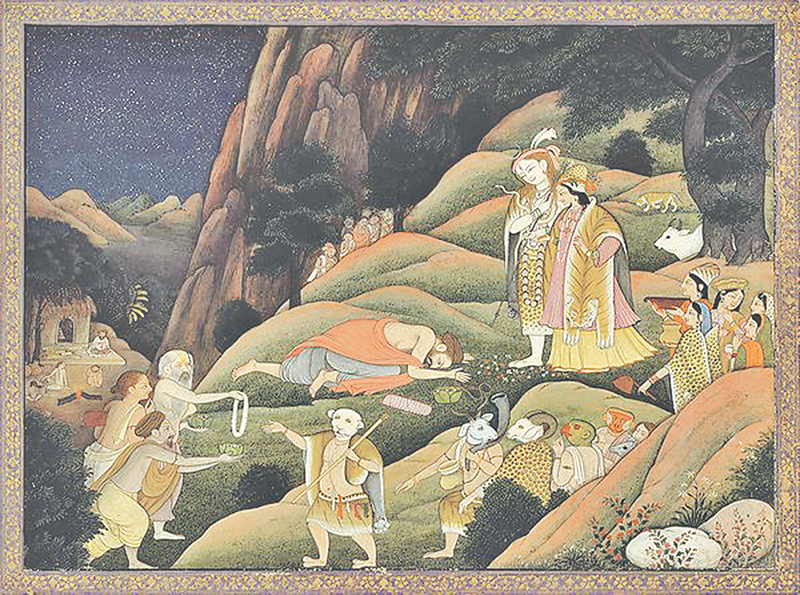
On the face of it, the ten stories in Folk Gods, a collection of tales from around the sacred Kailash region in Nepal, India and the Tibet Autonomous region of China, are just that—stories about gods and goddesses (if not them, their vessels or other supernatural beings) and their affairs, which usually involve battling demons, witches and ogres or helping humans do the same. In ‘The Hungry Ogre’, sage Padmasambhava subdues a child-eating monster that had been terrorising people in the Humla district of Nepal. In ‘The Fall of the Demoness’, a god in human form kills another child-eating monster. And in ‘Puchawa Selzong’, the eponymous heroine battles evil spirits until she loses her magical bird-skin and a witch tears out her heart.


Magic is central to almost all these stories—even in ‘The Clever Ancestor’, a fascinating perspective on the Gorkhali conquest of Garhwal. So are the themes of gods acting like humans, of good triumphing over evil, compassion over fear. What is extremely intriguing and warrants deeper reading, however, is the subtext, especially in stories like ‘Mortal Gods’, ‘The Fall of the Demoness’, and ‘Devbhumi’, where one has to wonder what it means when the gods too are shown to be complicit in perpetuating social ills such as the caste system; in ‘Devbhumi’, they actually maintain it.


In ‘The Fall of the Demoness’, gods too choose sides: the upper caste has their own gods and the lower their own. And in ‘Mortal Gods’, a god that (accidentally) defies the notions of purity and impurity by eating a grain of rice from the hands of beautiful human women is punished for this breach. His punishment is to suffer eternally as a human being with desires. The lesson: you want to be around ‘lesser’, ‘impure’ humans, but do not be one of them.


Of course, these gods are folk gods (as the title of the book suggests), and are, therefore, as flawed as the humans who imagined them. And in their flaws lies the book’s worth. Folk Gods, released recently on August 25, is the product of a three-year collaboration between the New School in New York, the Henry Luce Foundation, and ICIMOD in Kathmandu. According to the introduction by Ashok Gurung, Senior Director at the India-China Institute at the New School, researchers collected the stories by travelling to different villages in the Kailash region. Prawin Adhikari, author of The Vanishing Act, then retold these stories in English and respective translators translated them into Nepali, Hindi, Tibetan and Mandarin. Undoubtedly, as Gurung says, these stories show the readers how the inhabitants of the region, despite being in three different nation-states today, relate very similarly and yet differently to the land around them, and how their memories and perceptions are shaped by what their ancestors left behind in the form of tales. But, as Gurung also writes, these stories also invite readers to “reflect on their own land, air and stories”. A reflection, a study that illuminates the underlying socio-political and historical phenomena that unpacks the nuances in these stories, is what the book begs.


For instance, in ‘The Battle of Brothers’, the story on the outset seems, well, like a battle between two brothers, or two shamans jostling for space, for a voice, but those two shamans belong to two different ‘religions’—a local ancestor-god of the Rung people and a Hindu goddess. What does this simple story about brothers say about the history of religions, especially of the spread of Hinduism, in the area? How did a goddess worshipped in the plains of Nepal become a mountain deity? What does it mean when she defeats the mountain god? What does cholera (the brother who becomes a vessel for the Hindu goddess almost dies of the disease) have to do with it?


Similarly, every student of Nepali history must read and analyse ‘The Clever Ancestor’, a story about an old man who saves his children and grandchildren by throwing Gorkhali soldiers off a cliff. Miraculously, and quite funnily, none of them die. They all fall as a “single clump of limb, beard, teeth, swords and bellies”, but then they untangle themselves and walk away, albeit in fear of the old man. It is hard not to wonder about this strange, magical and compassionate ending. Why did the soldiers, described as cruel looters and murderers, not meet with death at the end of the tale? Is it because Gorkhalis did control Garhwal briefly and if the soldiers did die, the old man would be severely punished? Or is it because murder is against the old man’s (and the storyteller’s) values and, therefore, death has to be done away with when recounting the story? Or is it because, as the story says, the old man could become a god if enough people praised him?


The point is, although the stories in the collection are aimed at young readers, they are rich and fascinating for readers of any age. The collection opens a window to our shared past and history. It is now up to brave ones to peek through and see what lies beneath the stories. Some are simply about the battles everyone fights within, with a torturous but clear road to victory. Others, however, are about battles with forces where victory is not an option.

ON SATURDAY

Fiction carries heavy responsibility

Yogmaya is one of the most interesting characters in Nepali history—an early 20th century poet turned social activist who went to found the first women’s rights organisation, and then led 60-something of her followers to a mass suicide. This fascinating persona is the primary character in Yogmaya, novelist and poet Neelam Karki’s recent Madan Puraskar
winning novel. Karki, who writes under the nom-de-plume Niharika, is the author of books such as Beli, Hawaan and Cheerharan. In this interview with the Post, Karki talks about the book that won her Nepali literature’s highest honour and her journey as a young woman interested in reading to the centre of the Nepali literary stage. Excerpts:


What led you to writing?
I got into the world of literature since my early school days. Whether at school or at home, I was always with a book. My inclination towards reading helped a lot with my writing. There is something about literature that takes you into an imaginary universe. I then ventured into writing through my school magazine. Getting my poems published was a big deal for me and it encouraged me further to delve into the world of writing. I realised that I enjoyed sharing my perspectives and if it was written well, people would appreciate it.


What pushed you to become a full-time writer?
I always loved telling stories—good stories. There is nothing better than doing what you love. What fascinates me most is the thought processes of different characters within a novel. It is intriguing to be able to live so many different characters while writing fiction. There is a certain kind of independence and freedom attached to becoming a fiction writer.


You were shortlisted for the Madan Puraskar in 2016 too. How does it feel to win this prestigious award this time around?
Awards are never on your mind while writing. You write for yourself. If you begin to crave success and attention, you barely give a 100 percent to your work. If I had written any stories for the awards, it would have been a waste of my time and my love for literature. Having said that, it is my greatest honour to receive such a prestigious literary award for my novel Yogmaya—not as a writer but for the story. This award will probably raise expectations from readers but for me, it is a milestone and an inspiration to keep working and keep bringing more stories to my readers.


You have written many books in the past. What do you think is special about Yogmaya?
Yogmaya is very different from any of my previous work. It is one thing to write fiction but writing historical fiction carries much more responsibility. Born at a time when women were greatly limited within the boundaries of their family, Yogmaya was able to lead and inspire lot of people to stand up against an oppressive regime and the social norms of that time. She was able to see the root cause of problems and offer solutions to move toward a better future, not only for women but all sectors of society. When I heard about Yogmaya, I couldn’t stop thinking about her. It was a call that I had to answer.  


Among all the books you have written so far, which book remains closest to your heart?
All of my works are very close to my heart, but I will choose Yogmaya, because of the inspiration and her iconic stature. It is clear that if you put your blood and sweat in something, the universe will work in your favour.


Every writer seems to go through ‘writer’s block’ at one time or the other. Have you ever faced such a situation and how did you deal with it?
I have experienced my fair share of writer’s block. When I come to a point where my plot is not moving forward or I cannot find the solution to the issue I am tackling, I try to distract myself by reading the work of others and coming back to my problem with a fresh set of eyes. 

Page 10
ON SATURDAY

TRADING IN TRAGEDY

It was a disaster that left wildlife lovers around the globe appalled and baffled
- AGENCE FRANCE-PRESSE

Eleven of Kenya's precious black rhinos were transferred to a new home in what was supposed to be a routine operation in a country fabled for its conservation.


So how did all of them end up dead?
The primary cause of death, an official report found, was due to toxic levels of salt in the water of their sanctuary. But an AFP investigation has found that the problem was well known and deep concerns were ignored.


Experts sounded repeated warnings about the site's unsuitability. Yet the relocation project was pushed through—and officials are now blaming each other for the fiasco.
The translocation was launched with great fanfare in late June by Kenya's tourism and wildlife minister, Najib Balala, and the World Wildlife Fund (WWF), which donated a million dollars (860,000 euros) for the project.


Dubbed #TheBigMove, the operation would help ensure the survival of a species brutally depleted by poaching. The International Union for Conservation of Nature (IUCN) describes the black rhinoceros (Diceros bicornis) as Critically Endangered—just one step away from being extinct in the wild.


Rhino from parks in Nairobi and Nakuru were sedated, loaded and transported to a new sanctuary in Tsavo East, a project that the Kenya Wildlife Service (KWS) and WWF had spent six years preparing.


There, the rhino drank borehole water so salty that it corroded a metal grill around the pump valve, and no other wildlife would come near it, said Dr Benson Kibore, head of Kenya's Union of Veterinary Practitioners. The saline water made the animals only thirstier, pushing them to drink more, drawing water out of their body tissue, thickening and slowing their blood. They were "dessicated", said Kibore.


A rhino named Bolt was the first to die, and the others soon followed. The last, Jack, was so weakened he could not fend off a lion attack that left him wobbling and alone, with huge gashes in his side before he succumbed days later.
No way!


"I was horrified. I was very certain there was going to be a very big problem with those rhinos," said Nehemiah Rotich, a veteran conservationist and former KWS chairman.


At the time of the translocation, he was chief operating officer but had been tasked by the KWS board with looking closely into the project.


Rotich and some former members of the board—the oversight body which has to approve major management decisions—said they had blocked the transfer multiple times due to fears about the saline borehole water and the lack of vegetation.


"The site chosen wasn't a good one," Rotich said. He visited it twice, arguing it was too arid and far from a river, requiring the drilling of two boreholes. Discord came to a head in 2016, former board member Brian Heath said.
The board were told with just days' notice that a big ceremony was planned by KWS and the WWF to launch the transfer, just as a punishing drought was taking hold, he said.


"We said, 'No way!'" he recalled.


But pressure persisted, he said.
Both Heath and Rotich accused the WWF of "pushing hard" for the translocation. Their anger was echoed last week by prominent conservationist and former KWS chair Richard Leakey, who in a parliamentary submission slammed the WWF for "interference."


In October 2017, the board gave conditional approval for the translocation pending improved conditions at the site. The board's mandate expired in April 2018. By that time, the green light for the translocation had still not been given to the management. Even so, the operation went ahead three months later—in the absence of a new board.


Blame-trading
Evidence of the tussle over the translocation comes from a meeting in May 2017 attended by KWS officials and WWF's chief rhino expert, Martin Mulama.


Two sets of minutes were written, according to documents seen by AFP.


The first made no mention of concerns, but was amended after complaints from some present, leading to a second version that included the warning: "The prevailing habitat could not allow any translocation to take place." A series of 15 water assessments by KWS, conducted between February and May this year, indicated that the water was at times up to three times saltier than recommended levels.


But Kibore claims that these crucial documents were not provided to vets even when the first rhino fell sick.
As a result, the vets wasted valuable time looking for other causes, such as a snake bite.


WWF's Mulama strongly denied pressuring anyone to push ahead with the translocation and insisted that sole responsibility lay with the KWS. The WWF, he said, was not aware of problems with the sanctuary and had received "regular assurances from KWS that the site was suitable and safe."


"At no time would we do anything detrimental to the species we were trying to protect," Mulama said.


A dark time
Former KWS board members accuse Balala of using his ministerial powers to authorise the transfer in their absence. Some observers have called for his resignation.


However, the minister, an energetic pitchman with a penchant for colourful bow ties, denied any decision-making role and in turn blames the board, telling AFP that if it had been so unhappy with the site, it should have cancelled the project entirely.


"My invitation (to the launch) was purely ceremonial. Did I know about water? Did I know the board was objecting? I was not even aware," he said.


"If they want me to resign, just prove what role did I have in the process of the translocation," he said.
For Kenyan conservationist Paula Kahumbu, the problem is far greater than the wrangle of which individual signed off on the calamitous mission.


"Things failed at multiple levels, the lack of accountability from various authorities is of great concern," she said.
Kahumbu said the signs of turbulence within KWS, and recent developments such as the building of railways through national parks, and other encroaching infrastructure show it is "a very, very dark time for Kenya" and its wildlife.

ON SATURDAY

The many roles of women in war

A museum exhibit about the roles of women in World War II reveals how every person had an impact, for better or worse, at home and on the battlefield
- Andrea N Goldstein
A British World War II recruitment poster created by the graphic designer Abram Games to encourage women to join the Auxiliary Territorial Service during World War II.

Staring at the faded blue-and-white stripes of a woman’s concentration-camp uniform, I wondered how many members of my family died wearing one. I only know the names of those who lived. I arrived at the exhibit called “Women in World War II,” at the International Museum of World War II in Natick, expecting to see uniforms belonging to those who served in the armed forces during the war. As a former intelligence officer in the United States Navy, I was eager to encounter the stories of women who paved the way: code breakers, radio operators, spies and saboteurs. I wasn’t expecting reminders of just how unlikely it was that enough of my relatives survived that I got to be born, decades later, in New York.


My grandmother is a Holocaust survivor. My great-grandparents, along with my grandmother and her brothers, escaped Nazi Germany and arrived in the Boston area in 1939. For most of my life, I believed the duty to “never forget” was to remember the millions who perished in the Holocaust. Yet the stories my grandmother and her brothers told were about how their daily lives slowly changed as Nazism gained power. The museum’s exhibit is a reminder that authoritarian regimes start subtly, as well as a reminder that they could not take hold without the support of women. The duty of remembering also involves understanding how the banal becomes brutality. In Germany, a mother might have used a night light emblazoned with a swastika to make her child feel safe at night. In Japan, women participated in “spiritual mobilisation,” embroidering special belts for fighter pilots. “If the museum had a subtitle,” Kenneth Rendell, the museum’s director, said, “it would be that war is personal, and it’s complex.”


Displaying the role of women tells the story of the war itself: Everyone participated, and often in jobs that were once unheard-of for women. Most visitors are surprised to learn that women’s wartime roles went beyond Rosie the Riveter-style industrial work, according to Sue Wilkins, the museum’s education director. They were pilots and snipers, garbage collectors and window washers, concentration-camp guards and nurses. In the 1950s, the impulse to glorify the war and return to traditional values obscured the full extent of women’s contributions. Artifacts in the exhibit leave no doubt: a radio hidden under the false bottom of a baby carriage, used by the Resistance in occupied France; United States Army Capt. Alice Burger’s Distinguished Flying Cross, pinned to her uniform jacket. More than 350,000 women served in the United States military; British women were drafted into civil defense roles in the Auxiliary Territorial Service. (Queen Elizabeth, then an 18-year-old princess, volunteered.) In the Soviet Red Army, women served in front-line combat roles. Women’s functions were sometimes contradictory: The Nazi death machine was simultaneously obsessed with life, and to propagate the so-called “master race,” the government rewarded women with a medal called the German Mothers’ Cross of Honor, for having four children or more. The Lebensborn program created birthing centres for women of “Aryan” descent, who were encouraged to have children—typically out of wedlock—with SS officers.


In the United States, women’s wartime contributions were largely forgotten after the war, but not without a certain amount of quiet debate. Their military service was intended to be temporary. In 1948, the year that women were first accepted as regular members of the armed forces, Gen Dwight D Eisenhower testified before the House Armed Services Committee that he was initially “horror struck” by the idea of women in the military but changed his mind after he saw them in action. During the war, Gen. George C Marshall commissioned a study to measure the effectiveness of mixed-gender combat units. He and his staff were stunned by the finding that they performed better than all-male units. As the historian D’Ann Campbell discovered in 1993, the study was buried, because the general staff was concerned that the American public and Congress were opposed to expanding women’s roles in the armed forces. This debate had nothing to do with what women were capable of, let alone what they wanted. It was a matter of men being bothered by changing roles, Rendell observed. “When women were brought in to do jobs traditionally done by men, men had a big problem with it. It affected their own sense of what masculinity was.”


The museum doesn’t take positions on current debates, Rendell said; even so, it’s impossible to not see parallels with contemporary issues. When I joined the military in 2009, ground combat jobs were still closed to women by Department of Defense policy. But the sprawling post-9/11 conflicts had no definite front lines and no end in sight, and operational realities led commanders to exploit every loophole possible to deploy women in combat roles, even if it wasn’t reflected in their official job titles. I spent three years in a special-operations unit whose primary mission was to deploy alongside Navy SEALs and Green Berets. Women’s presence was seen as a necessary inconvenience: These units needed intelligence, medical and logistical support, and often the best person for the job was female. In some cases, women were specifically recruited in order to work with the local population. In the United States’ war efforts, special operations have been gender-integrated from their beginnings under the direction of the secretive Office of Strategic Services during World War II. When all roles were officially opened to women, in 2016, it was a case of policy formally recognising what had been practiced for decades. The commander of United States Special Operations Command at the time, Gen Joseph Votel, released a video message supporting the policy, citing the role of women in World War II.


In one of the last display cases, a playing card depicts a female Navy officer. She’s wearing the female-specific “bucket cover,” a hat developed for officers in the WAVES (Women Accepted for Volunteer Emergency Service) and still in service today. This item is much-beloved by female officers precisely because of its historical significance. Unlike other uniform items, which are often called “unisex” but are truly designed for men, the bucket cover was specifically designed for women. This October, female officers will be required to retire this uniform item in exchange for the men’s version. Many female officers, myself included, think that eliminating one of the few traditions unique to women amounts to an erasure of our history and heritage. It erases a connection to both the work that women did during World War II and how hard they had to fight to do it in the first place. At the end of my museum tour, I took stock of artefacts around me. The uniform of a female concentration-camp guard who might have killed my relatives. The summer camouflage uniform of a woman in the Red Army who served as a sniper 70 years before American women could. A wedding dress made from parachute silk. Images of women performing the everyday tasks that kept their countries running. Horror, heroism and daily life coexisted side by side. “The reality of war is very important to preserve,” Rendell said, “because otherwise you can get a whole generation of politicians who were never in a war, have no kids who served in the military and make decisions based on what appears to be simplistic fact.”


The march to war is conducted step by mundane step. Everyone has a role, whether through action or inaction. Driving home from the exhibit, I considered that perhaps the commitment to “never forget” is a responsibility to consider the everyday. I called my dad. I asked where he kept the memoirs my grandmother wrote to record her experiences in a country that was slipping toward dictatorship, genocide and war. The details that are most likely to be forgotten or erased contain the lessons that are most critical to learn.


—©2018 The New York Times

Page 11
SPORTS

Nepali judokas fail to impress

- DHRUBA TULADHAR
Shree Ram Makaju of Nepal fights against Komronshokh Ustopiriyon (white)of Tajikistan during their men's judo 90kg round-of-16 match at the 2018 Asian Games in Jakarta on Friday. AFP/rss

JAKARTA,
Nepal had pinned high hopes on judo at the 18th Asian Games but like boxing, taekwondo and karate, it too ended its campaign on Friday without a single medal in Jakarta.
Nepal had fielded eight judokas in Jakarta and none were able to win a single bout, let alone a medal. They play in the mixed team event on Saturday. On Friday, Shree Ram Makaju, Rabin Shrestha and Punam Shrestha all lost their first round bouts. In the men’s U-90kg division, Makaju failed to stand for even two minutes against Komronshokh Ustopiriyon of Tajikistan. Makaju conceded a wazaari and ippon (the biggest points is sufficient to win a bout) and lost 11-0.


In the U-100kg category, Rabin also faced the similar fate going down 10-0 against Sherali Juraev of Uzbekistan. He also conceded an ippon. Punam played two bouts in the women’s event and lost both of them. In the U-78kg division quarter-finals she lost to Yujin Park of South Korea 10-0. She was lucky to get a chance for repechage after the Korean made it to final. But in the repechage she conceded three sido, the negative points, besides an ippon to eventually lose the match.


Olympian Phupu Lhamu Khatri, Manita Shrestha Pradhan, Sanjit Dangol, Indra Bahadur Shrestha and Devika Khadka had already crashed out in the previous two days. Judo was hopeful of striking at least a medal owing to the recent performance of its athletes, particularly Khatri. The team was also boosted by inclusion of a foreign trainer for the last one year. The sixth Dan Romanian coach Dan Telerca has been looking after the Nepali judokas.   
The 12th South Asian Games gold medallist Khatri had been training in Japan for the last two months under the International Olympic Committee and International Judo Federation scholarship. Other players also had a short training spell in Hungary before leaving for Indonesia.


Coaches’ disputes divide players
Disputes among the three judo coaches in Indonesia came to the fore at the Olympic Village as well as in the playing arena in Jakarta. Along with foreigner coach Telerca, Chandra Kumar Dangol and Debu Thapa appeared to have their own say rather than uniting for the team’s cause. Dangol is the National Sports Council coach while Thapa is Nepal Police Club coach. The dispute between foreigner and Nepali coaches was there for everyone to see.


A judo official, who wants to remain anonymous fearing reprisal from the governing body, said the egos of coaches cost dear Nepal. More than concentrating on their games, it only contributed in creating a divided camp. He even said that one of the players demanded Thapa represent her as a coach or else she would not appear for her bout.
Telerca represent Nepal in the players’ box on the first day, but he was forced out the following day paving way for Thapa to take his place. “Pradhan said she would not play if the coach Thapa did not attend the players box,” informed the official. Telerca was furious over the incident and vented his ire on manager Suraj Dotel. Telerca and coach Dangol also came close to a brawl at the Olympic Village before the incident. Even manager Dotel believed that the egos of the coaches somewhat contributed to the players poor showing.


Following the angry confrontation of the coaches and managers on Thursday, Nepali team called on a meeting to sort out the issue. “We have now sort out the differences and Telerca will head the team on  Saturday,” said Rim Ranabhat, the chief of national team preparation committee.


Nepali coaches and players however remained tight-lipped over the saga. Nepal Judo Association President Dipak Harsha Bajracharya was aware of the dispute. While Bajracharya was disappointed with the team’s result, he said he will try to find out the weaknesses and work on it in future.


Judo was include in the Asiad since 1996 Seoul Games and Nepal have been participating ever since without any success so far. Like in the last two editions Nepal is set to return home with just a single medal from Indonesia. Boxing won a bronze in 2010 and karate also bronze in 2014. Paragliding, which was included in the Asiad for the first time, so far have saved the Nepali blushes in Indonesia. The men’s team struck silver in the cross country event. Apart from judo’s mixed event, Nepal is still to compete in the triathlon. Both the events will be held on Saturday.

SPORTS

New Star pip Church boys, set up Red Star title clash

- Post Report

TAPLEJUNG,
New Star Club of Jhapa send the holders Church Boys Club of Kathmandu packing with a 2-1 victory in the semi-finals of the Pathivara Gold Cup football tournament on Friday.


The victory lines up New Star against Red Star Club in the title match on Saturday. Red Star advanced to the final on Thursday after defeating Rastriya Jagriti Club of Itahari 4-3 in tiebreaker following a 1-1 deadlock in regulation time.


New Star rallied from a goal down to set up the all-Jhapa championship clash. Buddhiman Rai had provided the defending champions the 36th minute lead, converting a 25-yard attempt into spectacular goal.


New Star, however, fought their way back into the game third minutes after the restart courtesy an own goal. Church Boys skipper Ramesh Dangal inadvertently deflected the ball into his own.


Just as the game appeared destined for extra time and a possible a tiebreaker, New Star skipper Sanam Rai struck the winning goal, converting a freekick two minutes from the final whistle. The champions on Saturday will walk away with Rs 300,000 while the runners-up will get Rs 151,000.

SPORTS

Roma loan out D’Urso

Sports Digest

ATHENS: Italian midfielder Christian D’Urso has been loaned for this season by Roma to Apollon Smyrni, the Greek Super League club announced on Thursday. No financial details of the loan deal were announced by the Athens side. D’Urso, 21, has played for the Italian national youth teams (Under 18, Under 19 and Under 20). On a club level he has been loaned by Roma to Ascoli (2017-2018), Carpi (2017) and Latina (2016). (AFP)

SPORTS

Liverpool to face Chelsea in Cup

Sports Digest

LONDON: Liverpool will take on Chelsea in the League Cup third round, while holders Manchester City start their bid to retain the trophy at minnows Oxford. Jurgen Klopp’s Liverpool and Maurizio Sarri’s Chelsea both enter the competition at the third round stage due to their participation in European action this season. Their clash at Anfield will be a repeat of the 2005 League Cup won 3-2 by Chelsea. City beat Arsenal to win the League Cup at Wembley last season, securing the first trophy of Pep Guardiola’s reign at the Etihad Stadium. (AFP)

Page 12
SPORTS

Federer wins, Djokovic survives battle

Tsurenko topples second seed Wozniacki n Storm rages over umpire’s Kyrgios pep-talk n Kerber, Sharapova triumph
- AGENCE FRANCE-PRESSE
Roger Federer of Switzerland returns the ball to Benoit Paire of France during their US Open second round match in New York on Thursday. AFP/RSS

NEW YORK,
Roger Federer on Thursday set-up a US Open third round clash against Nick Kyrgios who found himself at the centre of an impartiality row after an umpire climbed down from his chair to tell him: “I want to help you”.


Second seed and five-time champion Federer, 37, made it 18 wins in 18 second round appearances in New York by seeing off error-plagued Frenchman Benoit Paire 7-5, 6-4, 6-4. “I think it’s always tricky against Benoit, never quite the same point. Sometimes he plays very deep in the court, then he plays up in the court,” said Federer.


Also going through were Wimbledon champion and two-time US Open winner Novak Djokovic as well as Maria Sharapova, the 2006 champion in New York. However, women’s second seed Caroline Wozniacki was knocked out by Lesia Tsurenko of the Ukraine. Kyrgios reached the third round by seeing off France’s Pierre-Hugues Herbert 4-6, 7-6 (8/6), 6-3, 6-0.


The match created a huge storm after respected umpire Mohamed Lahyani lost patience with the under-performing 30th seed and climbed down from his chair to tell the Australian, trailing by a set and 3-0, to try harder. “I want to help you,” Lahyani could be heard saying. “This isn’t you. I know that. You are great for tennis.”


A furious Herbert said that Lahyani had over-stepped the mark. “The umpire doesn’t have to talk to him at all. The only thing he can tell him is pay attention, because if you continue like this, I’m going to give you a warning,” said the 27-year-old, “They can tell him from the chair. He doesn’t need to go down. He doesn’t need to say the words he said on the video. That is not his job. I don’t think he’s a coach, he’s an umpire.”


Kyrgios, however, played down the incident. “He said he liked me. I’m not sure if that was encouragement,” said the Australian who nevertheless won 19 of the last 25 games following Lahyani’s unprecedented intervention. He just said that it’s not a good look. I know what I was doing out there wasn’t good.”


US Open chiefs didn’t help matters by claiming Lahyani was forced to step from his chair as the crowd noise meant that Kyrgios could not hear him. “Lahyani was concerned that Kyrgios might need medical attention,” said tournament referee Brian Earley. “He also informed Kyrgios that if his seeming lack of interest in the match continued, that as the chair umpire, he would need to take action.”


Djokovic downed Tennys Sandgren of the United States 6-1, 6-3, 6-7 (2/7), 6-2. “I thought I played very well for the first two and a half sets and then I just lost it mentally. I got pissed off,” said 2011 and 2015 champion Djokovic. Next up for sixth seed Djokovic is Richard Gasquet of France who he has beaten 12 times in 13 meetings.


German third seed Alexander Zverev made the third round for the first time in four tries after a 6-4, 6-4, 6-2 victory over lucky loser Nicolas Mahut. Australian Open champion Wozniacki went down 6-4, 6-2 to world No 36 Tsurenko who claimed a second top 10 win this month having also defeated Garbine Muguruza in Cincinnati. “She played the game I should have played,” said two-time runner-up Wozniacki who has endured a Grand Slam letdown since winning in Australia.


She lost in the fourth round at Roland Garros and exited in the second round at Wimbledon. She follows top seed Simona Halep, a first round loser, out of the tournament. Sharapova took her night time record at the tournament to 21 wins in 21 matches with a 6-2, 7-5 win over Sorana Cirstea of Romania. The Russian, who committed 33 unforced errors, next faces 2017 French Open champion Jelena Ostapenko.


Wimbledon champion Angelique Kerber kept her bid for a second US Open title on track, outlasting Sweden’s Johanna Larsson 6-2, 5-7, 6-4. Kerber will next take on Dominika Cibulkova after the Slovakian beat Taiwan’s Hsieh Su-Wei 7-6 (7/3), 4-6, 6-4 despite being docked two points for returning late from a heat break.


Belarus 26th seed Aryna Sabalenka continued her red-hot summer by seeing off 2010 runner-up Vera Zvonareva 6-3, 7-6 (9/7). Sabalenka, who won the New Haven tournament last week and reached the semi-finals in Cincinnati, has made the third round of a Slam for the first time.

SPORTS

England back in contention

England-India Test Series
- AGENCE FRANCE-PRESSE
England’s Stuart Broad appeals for a wicket against India on the second day of their 4th Test match in Southampton on Friday. AP/RSS

SOUTHAMPTON,
Bolwers pulled England back in contention during the second day of their fourth Test in Southampton on Friday.


The match was finely posed with India 181-5 at Tea with Cheteshwar Pujara batting on 70 after the fall of Rishabh Pant (0).


Earlier, Virat Kohli passed 6,000 Test runs as he again proved a thorn in England’s side. India were 100-2 in reply to England’s first-innings 246, a deficit of 146 runs, at lunch. Kohli and Cheteshwar Pujara added 50 runs going to lunch. But England fougth back with wickets of Kohli (46), Ajinkya Rahane (11) and Pant.


Stuart Broad removed openers KL Rahul and Shikhar Dhawan on his way to lunch figures of 2-34. Kohli, the world’s top-ranked Test batsman, scored exactly 200 runs in India’s 203-run victory in the third Test at Trent Bridge, a result that reduced England’s lead in the five-match series to 2-1, having managed the same feat in the first Test at Edgbaston.


England captain Joe Root deployed six bowlers in a bid to dismiss his opposite number but, significantly, Ben Stokes was not among them, with the hosts rejigging their side in a bid to compensate for the pace-bowling allrounder’s knee injury.


By scoring 6,000 Test runs in 119 innings, Kohli became the second quickest India batsman to the landmark after former opener Sunil Gavaskar (117). All-time great Sachin Tendulkar got there in 120 innings. India resumed on Friday on 19-0. Excellent swing and seam bowling, led by Jasprit Bumrah (three for 46) helped India make the most of helpful new-ball conditions as they reduced England to 86-6 on Thursday after Root won the toss.


But the recalled Sam Curran (78) revived England after their latest in a long line of batting collapses. James Anderson, England’s all-time leading Test wicket-taker, started Friday’s play needing six more wickets to equal retired Australia great Glenn McGrath’s mark of 563--the most taken by any fast bowler at this level.


But it was Broad who made the breakthrough when he had Rahul LBW for 19, with Sri Lankan umpire Kumar Dharmasena’s decision upheld on review. And 37-1 became 50-2 when Broad drew left-hander Dhawan (23) forward and diving wicketkeeper Jos Buttler took a good low two-handed catch.


Kohli’s duels with Anderson have been a feature of the series and the India star frustrated the England great only to be deceived by Curran.

SPORTS

Juve’s Ronaldo set for Old Trafford return

- AGENCE FRANCE-PRESSE

MONACO,
Cristiano Ronaldo can look forward to a return to Old Trafford in the Champions League this season after his new team Juventus came out in the same group as Manchester United in Thursday’s draw in Monaco.


Ronaldo, who was not in Monaco despite being nominated for an individual award, spent six years at United, winning the Champions League in 2008, before moving to Real Madrid in 2009. He will come up against his compatriot Jose Mourinho, under whom he played during his time at Real, while United midfielder Paul Pogba can also look forward to facing his old team.


While those sides will be favourites to progress to the last 16 from Group ‘H’, they will have to be wary of Valencia, with the Spaniards returning to the group stage for the first time in three years. Swiss champions Young Boys, group-stage debutants, look to be the makeweights in the section. “It’s a manageable group, but it all depends on us. Our destiny is in our own hands,” said Juve CEO Giuseppe Marotta.


Thursday’s draw ceremony at Monaco’s Grimaldi Forum, a stone’s throw from the Mediterranean Sea, threw up several other fascinating groups, with last season’s beaten finalists Liverpool set to have their work cut out alongside the Paris Saint-Germain of Neymar and Kylian Mbappe, as well as Napoli, in Group ‘C’.


A meeting between Liverpool and PSG means a confrontation between two German coaches, Jurgen Klopp and his successor at Borussia Dortmund, Thomas Tuchel. “I expected a difficult group, we have a difficult group and that’s what the Champions League is all about,” Klopp told Uefa.


Carlo Ancelotti, who became coach of Napoli in the close season, will return to the French capital, where he led PSG to the title in 2013. That group is completed by a famous old name in 1991 European Cup winners Red Star Belgrade. Holders Real begin their bid to win a fourth consecutive Champions League crown in a kind-looking Group ‘G’, featuring Roma, CSKA Moscow and Czech side Viktoria Plzen.


In contrast, Barcelona and Tottenham Hotspur will play each other in a testing Group ‘B’ along with Inter Milan and PSV Eindhoven, the 1988 European Cup winners. Inter are returning to the competition for the first time in seven seasons. They were in the same group as Tottenham in 2010-11, with the Italians memorably winning 4-3 at San Siro despite Gareth Bale scoring a hat-trick. “You want to test yourselves against the best players in the world, but we don’t want to just test ourselves, we want to compete against them. That’s definitely the case with Barcelona,” Tottenham’s Eric Dier told his club’s website.


The draw looks kind to Pep Guardiola’s Manchester City as they look to win the trophy for the first time. They will face group-stage debutants Hoffenheim as well as Lyon and Shakhtar Donetsk, coming up against the latter for the second year running. The draw was also kind on German champions Bayern Munich, although they will meet two great European names in Benfica and Ajax. But it was less so for another German club, with Dortmund coming up against Monaco and Atletico Madrid in Group ‘A’, along with Club Brugge.


Having won the Europa League last year, three-time finalists Atletico are hoping to go all the way in this competition, with the final to be played at their own Wanda Metropolitano stadium on June 1, 2019. Changes brought in for this season mean half of the clubs in the group stage were allocated to the top four sides in the four best-ranked leagues: Spain, England, Germany and Italy.

SPORTS

Man City’s Aguero sets sights on Newcastle

English premier league
- AGENCE FRANCE-PRESSE
Sergio Aguero

MANCHESTER,
Sergio Aguero is entering the autumn of his glorious career with Manchester City but the record books suggest there will be no let-up in his prodigious goalscoring when Pep Guardiola’s Premier League champions host Newcastle.


The 30-year-old Argentine has scored five goals in four games for City this season, including two in the Community Shield win over Chelsea and a hat-trick in his side’s last home game, a 6-1 stroll over Huddersfield. That marked his 13th hat-trick for the club he joined in what now appears a bargain £38 million transfer from Atletico Madrid in July 2011 and his ninth in the Premier League, a tally bettered only by Alan Shearer’s 11. His ecstatic manager said the forward was hitting new heights after his hat-trick. “I never saw him like this since I was here—he is in an incredible condition with the ball and without the ball,” Guardiola said.


City’s record goalscorer is entering the final two seasons of his contract at the Etihad, at the end of which he has stated he will return to his boyhood club Independiente in Argentina, where he is expected to see out his career. But it appears likely that more records will fall Aguero’s way, possibly as early as Saturday, given his liking for playing Newcastle.


In 11 previous Premier League games against the northeast club, Aguero has scored an astonishing 14 goals, including a five-goal display against them in a 6-1 victory in the 2015-16 season and a hat-trick in a 3-1 win in January. The five-goal performance was, many Aguero observers believe, one of the most outrageous performances of even his prolific career as he scored five times in 20 minutes either side of half-time against the hapless Newcastle defence.
Guardiola has so far started Aguero in every game although he partnered him with young Brazilian Gabriel Jesus in a two-man forward line for the visit of Huddersfield, something he may elect to do again against Rafael Benitez’s struggling side. And the fact that Aguero appears to have seen off Jesus in the competition for a guaranteed starting place—or as close to “guaranteed” as is possible among City’s star-studded squad—is just another notable feat.


Guardiola’s arrival, and the signing of Jesus, were widely interpreted as signs that Aguero’s days as City’s main striker might be numbered. When City were beaten 4-0 at Barcelona in the Champions League in October 2016, for example, Guardiola even selected little-used winger Nolito in preference to Aguero and Jesus’s productive start to his Premier League career three months later did not augur well.


Earlier this year, Aguero admitted that it had taken him time to embrace Guardiola’s demand for all his players, even the forwards, to concentrate on defensive work rate above all else. “Besides my responsibilities as a striker, he wanted to get me involved as the first defender on the team,” the Argentine said in an interview in his homeland.
He has clearly responded to those demands and remains as dangerous as ever. After dropping their first points of the season in the 1-1 draw at Wolverha-mpton last weekend, Guardiola may shuffle his squad. Kevin De Bruyne remains a long-term injury absentee, with a knee ligament problem, and club record signing Riyad Mahrez may be pressing for just his second start of the season.


Fixtures
Leicester vs Liverpool (1715 NST)
Brighton vs Fulham (1945 NST)
Chelsea vs Bournemouth (1945 NST)
Palace vs Southampton (1945 NST)
Everton vs Huddersfield (1945 NST)
Man City vs Newcastle (1630)
West Ham vs Wolves (1945 NST)

All matches on Saturday)

SPORTS

Luka Modric wins Uefa award

Sports Digest

MONACO: Real Madrid and Croatia star Luka Modric on Thursday received the accolade of Uefa Player of the Year in Monaco, beating his former teammate Cristiano Ronaldo and Liverpool’s Mohamed Salah to the prize. “I’m very happy to receive this great prize. I have worked hard for this, to get to the highest point possible,” said Modric, who starred in the Real Madrid side that won the Champions League for the third year running. (AFP)

SPORTS

Nelson set to join Hoffenheim

Sports Digest

BERLIN: Arsenal forward Reiss Nelson is set to be the latest England junior international to play in the Bundesliga with Hoffenheim on the verge of signing the 18-year-old on loan. According to German magazine Kicker, Hoffenheim are set to pay the Gunners 500,000 euros to sign the England Under-19 winger, who can also play as an attacking midfielder, until May. If the deal goes through, Nelson will be the next English starlet in the Bundes-liga after Jadon Sancho, 18, his England Under-19 teammate, who has impressed at Borussia Dortmund after switching from Manchester City. (AFP)

SPORTS

Marseille sign Serbian Radonjic

Sports Digest

MARSEILLE: Marseille on Thursday confirmed the signing of Serbian forward Nemanja Radonjic, who arrives from Red Star Belgrade on a five-year deal with the French league giants. No financial details of the move were given. The 22-year-old winger scored 11 goals in 46 matches, in all competitions, for Red Star last season as they won the Serbian league title. “A player who is fast and technical, he is a modern day winger who will have a real impact thanks to his dribbling, pace and ability to track back quickly,” Marseille said in a statement. (AFP)

SPORTS

Sandro joins Sociedad

Sports Digest

LONDON: Everton forward Sandro Ramirez has joined Spanish side Real Sociedad on a season-long loan, the Premier League club have said. Sandro had failed to hold down a regular playing role since joining Everton in July 2017 and spent the latter half of last season on loan at Sevilla, where he did not score in 18 appearances. Everton boss Silva had said he was keen to keep Sandro at the club this term after the Spaniard’s League Cup appearance on Wednesday but the following day it was said  he would be going out on loan. (REUTERS)

Page 13
MONEY

Centre eliminates dubious emergency operators

Insurance fraud
- SANGAM PRASAIN
A file photo shows a helicopter preparing to evacuate tourists at a helipad in Lukla Airport. post file photo

KATHMANDU,
The government has chucked out all ‘intermediaries’ arranging emergency evacuation services for trekkers and mountaineers, and made the agency handling the tour package legally responsible for looking after its customers from start to finish, following revelations of insurance fraud that tarnished Nepal’s image as a tourist destination.


Helicopter companies, travel and tour operators, hospitals and insurance companies will now be required to
submit details of rescue flights, medical treatment and insurance bills to the Tourist Search and Rescue Committee, Tourist Police and Department of Tourism.


The secretariat of the Tourist Search and Rescue Committee will be housed at the Tourism Department and its director general will be the coordinator. The committee will have representatives from the Home and Health ministries, Civil Aviation Authority of Nepal (Caan), Nepal Mountaineering Association, Himalayan Rescue Association and Tourist Police.


A panel formed to prepare guidelines to streamline the adventure tourism industry submitted its report to Tourism Minister Rabindra Adhikari on Friday. “The guidelines became effective from Friday,” said Ghanshyam Upadhyaya, spokesperson for the Tourism Ministry.


The government had planned to mobilize the police to rescue trekkers and mountaineers, but later dropped the idea. “We have decided that the private sector that has been leading the tourism industry should handle rescues. The police can be called in for special operations,” he said, adding that everything would be transparent from now onwards.


The intermediaries who have been acting as rescue agencies and cheating tourists have been virtually eliminated, he added.


Recently revealed insurance scams involving bogus helicopter rescues and hospital treatment of tourists
have rocked the tourism industry and embarrassed the government.


As per the Tourist Search and Rescue, Treatment and Monitoring Guidelines 2018, tour and travel agencies will be responsible for educating their customers on the potential risk involved in the adventure activities and they will be solely liable for adopting mitigation measures.


During a helicopter rescue, helicopter operators cannot transport other people except the sufferer and the helper or guide. The hospital concerned should ascertain the illness of the patient and prepare an initial cost estimate for treatment, details of which should be provided to the trekking or mountaineering handling agency.    


The guidelines require airlines and helicopter operators to provide details of the number of rescue operations, place and fee charged to the committee, Tourism Department and Tourist Police within 10 days following the end of the trekking and mountaineering season.


Hospitals must provide details of the cost of treatment seven days after the patient is discharged.
“This provision will give clear details of how many rescue operations are conducted annually, and what is the annual turnover of the rescue business in Nepal,” said a department official. The government has also directed Caan to fix a cap on flight fares based on flying hours, distance and height by coordinating with insurance companies and the Airlines Operators Association of Nepal.


Recently, international insurance companies had warned the government that they would stop issuing travel insurance policies for tourists visiting Nepal from September 1 if it did not move to eliminate insurance fraud hatched by brokers in trekking and mountaineering agencies.


They said that the fraudulent helicopter rescues that are happening throughout Nepal and overtreatment that is happening in some hospitals was costing insurance companies millions of dollars every year. Insurance companies have demanded that helicopter rescue costs be capped at $4,000 per flight.


On July 30, a government fact-finding committee submitted a 700-page probe report to Tourism Minister Adhikari which stated that unscrupulous operators had been pocketing thousands of dollars from insurance companies by making multiple claims for a single chopper ride or pushing trekkers to agree to airlifts for minor illnesses.


The committee had urged the government to investigate the transactions of eight travel, trekking and rescue agencies, namely Kailash Charter Rescue, Alpine Rescue, Mountain Heli Charter Service, Eagle Heli Charter Service, Easy Heli Charter Service, Flight Connection Domestic, Mountain Rescue Service and Himalayan Social Journey Trekking.


Four hospitals, Swacon International Hospital, Era Health Centre, CIWEC Hospital and Vayodha Hospitals, and three helicopter companies, Heli Everest, Manang Air and Air Dynasty Heli Services, are being scrutinized by the government for quoting exorbitant rates and making claims against tourist insurance policies.


The committee said in its report that there had been widespread complaints of dishonest companies serving adulterated food to make tourists sick so they can be evacuated by helicopter and they can receive commissions from helicopter companies and hospitals and clinics.


According to the report, a local agent was found billing the insurance company 50,000 euros ($57,972) for evacuating a group of trekkers.


In another case, they found that a local agent issued two separate bills for one rescue. The insurance company was billed 86,248 euros. The insurance company was billed $24,000 for minor treatment in a hospital.

MONEY

More sectors to get foreign currency loans

- Post Report

KATHMANDU,
Nepal Rastra Bank (NRB), on Friday, announced a new provision wherein tourism businesses, export-oriented industries and hospitals are permitted to take loans in convertible foreign currencies from domestic banks and financial institutions. With this new provision in place, these sectors can also use borrowed foreign currency to import goods.


As of now, exporters are allowed to take export loan on foreign currencies to import raw materials only, and the hospitality business is allowed to take loans only to meet their liabilities to foreign parties. With these new terms, hospitals, for the first time, can take loans in foreign currencies for medical services.


By issuing a circular on Friday, the central bank directed banks and financial institutions dealing with foreign exchange to flow the credit to the prescribed businesses and hospitals directly. “We have opened the door to these sectors because they are doing transactions using foreign currency,” NRB Spokesperson Narayan Prasad Paudel said.
According to Paudel, the central bank came up with the decision based on the growing demand of these sectors, and their dependence on foreign currency for business expansion. NRB in turn has revised the existing unified directive on dealing with foreign currencies to enforce the new provision.


As per the revised directive, tourism enterprises, hospitals and exporters need to pay back their liabilities in foreign currency.


A few months ago, NRB permitted only commercial banks to borrow from foreign banks and financial institutions to take loans in convertible foreign currencies. Besides this, the central bank, through the monetary policy for the fiscal year 2018-19, has also allowed the country’s leading commercial banks to borrow loans in Indian currency from Indian banks to make investments in different profitable sectors identified by the central bank.


The Executive Director of NRB, Bhishma Raj Dhungana, said they added hospitals in the segment because an increasing volume of the income of hospitals came in the form of foreign currencies. “However, they cannot take foreign currency loans to meet their day-to-day expenses,” said Dhungana, adding that the central bank has not fixed the ceiling of the loan that these businesses can take in foreign currencies.

MONEY

Oil slips amid trade war worries

- REUTERS

LONDON, 
Oil prices slipped on Friday as concerns over the impact of a global trade war depressed sentiment, although impending US sanctions on Iran and falling Venezuelan output limited losses.


Benchmark Brent crude oil was down 40 cents a barrel at $77.37 by 1100 GMT. US light crude was 50 cents lower at $69.75.
US President Donald Trump threatened in an interview with Bloomberg News on Thursday to withdraw from the World Trade Organisation, his latest salvo in a deepening dispute between the United States and its major trading partners.
Such a move would undermine one of the foundations of the global trading system, which the United States was instrumental in creating.


Economists are worried that rising trade barriers between the world’s major economies will drag on global growth and, by extension, erode energy demand. “You have to wonder if it (crude) can sustain these prices in a world where President Trump doubles down on his battle with the EU and China at the same time,” said Greg McKenna, chief market strategist at futures brokerage AxiTrader.


Trump is prepared to ramp up a dispute with China and has told aides he is ready to impose tariffs on $200 billion more Chinese imports as early as next week, Bloomberg reported on Thursday.


However oil markets are tightening with a recent surplus draining, trade figures show.


The volume of unsold crude stored in the Atlantic basin has dwindled from around 30 cargoes to just a handful in recent weeks, a Reuters analysis showed.


Brent is on track for a rise of more than 4 percent in August with US light crude gaining 2 percent.


“The contracts are in a strong uptrend,” said Robin Bieber, who watches price charts for brokerage PVM Oil Associates.

MONEY

India agrees to build gas pipeline to Nepal

cost savings
- POST REPORT

KATHMANDU,
India has agreed to build a gas pipeline to Nepal to help it save on fuel transportation costs. According to the Ministry for Industry, Commerce and Supplies, India expressed its willingness during recent talks between Commerce Minister Matrika Prasad Yadav and India’s Union Minister for Petroleum and Natural Gas Dharmendra Pradhan in New Delhi.


Joint Secretary Navaraj Dhakal said the two countries had agreed to discuss the modality of the construction during the meeting of the joint working group scheduled to be held on September 26 in Kathmandu. “The joint secretary level meet will discuss the possible alignment and construction modality of the pipeline,” Dhakal said.


Ministry sources said India had given its preliminary consent to lay a pipeline connecting Motihari, India and Amlekhgunj or Chitwan in Nepal. India said it may start the construction work after the project to extend the pipeline to Motihari is completed, Dhakal said.


India is currently building an oil pipeline linking Motihari and Amlekhgunj. So far, 17 km out of the 36.2-km section of the pipeline which lies in Nepali territory has been completed, according to Nepal Oil Corporation (NOC). The alignment of the pipeline lies on the Birgunj-Pathlaiya road that is undergoing expansion into a six-lane highway.


Nepal’s fuel imports have swelled sharply in recent years. In the last fiscal year, demand for cooking gas surged 18 percent to 370,560 tonnes, NOC said. The gas pipeline will result in savings of around Rs2 billion annually for Nepal by eliminating tanker trucks. Diesel and cooking gas accounted for 80 percent of the total fuel import bill of Rs170 billion in the last fiscal year, NOC spokesperson Birendra Kumar Goit said.


Goit, who also participated in the ministerial level meeting in New Delhi, said the joint working group meeting to be held in Kathmandu would fix the date to conduct a feasibility study for the proposed pipeline. According to him, the meeting is also expected to decide the issue of Nepali gas bullet movement in India that has remained pending for a long time.  


India has been reluctant to issue an explosive licence to Nepali gas bullets saying that the existing Indian laws do not permit movement of Nepali cargo trucks. Nepali entrepreneurs are said to have procured 52 gas bullets after obtaining approval from NOC. A gas bullet costs Rs7 million.

Page 14
MONEY

US ports fear tariffs could reduce ship traffic and jobs

- ASSOCIATED PRESS
Trucks travel along a loading dock at the Port of Long Beach in Long Beach, California. AP

CALIFORNIA,
Ports and ground terminals in nearly every state handle goods that are now or will likely soon be covered by import tariffs. Port executives worry that this could mean a slowdown in shipping that would have ripple effects on truckers and others whose jobs depend on trade.


The Associated Press analysed government data and found that from the West Coast to the Great Lakes and the Gulf of Mexico, at least 10 percent of imports at many ports could face new tariffs if President Donald Trump’s proposals take full effect.


Since March, the US has applied new tariffs of up to 25 percent on nearly $85 billion worth of steel and aluminum and various Chinese products, mostly goods used in manufacturing.


Trump said in a recent tweet, “Tariffs are working big time.” He has argued that the tariffs will help protect American workers and force US trading partners to change rules that the president insists are unfair to the United States.


In New Orleans, port officials say a tariff-related drop in shipments is real, not merely a forecast. Steel imports there have declined more than 25 percent from a year ago, according to the port’s chief commercial officer, Robert Landry.
The port is scouting for other commodities it can import. But expectations appear to be low.


“In our business, steel is the ideal commodity,” Landry said. “It’s big, it’s heavy, we charge by the ton so it pays well. You never find anything that pays as well as steel does.”


The port of Milwaukee imports steel from Europe and ships out agricultural products from the Midwest. Steel imports haven’t dropped yet because they are under long-term contracts, said the port director, Adam Schlicht. But there has been “an almost immediate halt” in outbound shipments of corn because of retaliatory duties imposed by the European Union on American products.


Much of the corn, he said, “is just staying in silos. They are filled to the brim.”
Many other ports have been humming along and even enjoyed an unexpected bump in imports during June and July as US businesses moved up orders to ship before the new tariffs took effect. That started with manufacturing goods and is now spreading to retail items for back-to-school and Christmas.


“Some of my retail customers are forward-shipping the best they can to offset proposed tariffs,” says Peter Schneider, executive vice president of T.G.S. Transportation, a trucking company in Fresno, California.


Port officials were encouraged by this week’s announcement that the United States and Mexico had reached a preliminary agreement to replace the North American Free Trade Agreement, hoping it might lead to reduced trade barriers. Canada’s participation in any new deal to replace NAFTA, though, remains a major question mark.


The port officials continue to worry, though, that Trump will make good on a plan to expand tariffs to an additional $200 billion in Chinese imports—a list that includes fish and other foods, furniture, carpets, tires, rain jackets and hundreds of additional items. Tariffs would make those items costlier in the United States.


And if Americans buy fewer of those goods, it would likely lead to fewer container ships steaming into US ports.
The impact will be felt keenly at West Coast ports like Los Angeles and Long Beach.


Los Angeles Mayor Eric Garcetti, relying on information from his port officials, said his port—the biggest in the United States—could suffer a 20 percent drop in volume if the additional $200 billion in tariffs are imposed against Chinese goods.


Jock O’Connell, an economist in California who studies trade, said he doubts a downturn would be so severe—that would match the slump that accompanied the global recession of 2008—“but we will see a definite impact.”

MONEY

Argentina’s interest rate hiked to 60pc

- AGENCE FRANCE-PRESSE

BUENOS AIRES,
Argentina’s Central Bank hiked its benchmark interest rate from 45 to 60 percent on Thursday in a dramatic but fruitless bid to shore up the peso, which plunged to a record low against the dollar.


Despite the bank’s extraordinary measure to impose one of the world’s highest benchmark rates, the currency lost a further 13.5 percent by the close—its biggest daily loss of the year. The Argentine currency has now lost 53 percent of its value since the beginning of the year, to trade at 39.87 to the dollar. It was worth around 18 to the dollar at the start of the year.


But the Merval index on the Buenos Aires stock market jumped 5.34 percent to 26,754.85 points on the back of a 13.5 percent rise in the share price of Brazilian petroleum giant Petrobras.


The weakening peso made stock prices tempting and drove sales.
Earlier Marcos Pena, President Mauricio Macri’s cabinet chief, was forced to deny the government was facing an economic disaster.


“We are not facing economic failure,” said Pena.
“This is a transformation, not failure. In that transformation there are difficult moments,” he said.
Ratings agency Moody’s said the Central Bank’s move “is a clear signal that economic policy approaches have not been sufficient to contain the financial pressures facing Argentina.”


Crisis gripped the South American giant’s economy over the previous 24 hours.
Macri had on Wednesday unexpectedly requested an acceleration to the IMF funding of $50 million agreed in June. The government has already drawn down a first tranche of $15 billion—some of which has been used to try and prop up the peso.


A statement from the president aimed at calming the markets appeared to have done the opposite after his request—effectively to get early access to the remaining $35 billion of the loan—sent the peso plummeting almost 7.0 percent by the close.


Despite explicit support from the International Monetary Fund for his policies, the peso opened a further 4.0 percent lower on Thursday—prompting the Central Bank’s intervention.


The bank pledged to keep interest rates unchanged at 60 percent until at least December. IMF chief Christine Lagarde said on Wednesday she had agreed to Macri’s request to speed up disbursement of the loan in a bid to shore up Argentina’s battered economy.


In return for IMF support, the government has committed to reducing its budget deficit to 2.7 percent this year, from 3.9 percent in 2017, and to 1.3 percent of GDP next year. But analysts said the government needs to provide more detail about how it plans to achieve aggressive IMF fiscal targets, if markets are to be assuaged.


On top of that, the government faces a major obstacle in November, when a $7 billion foreign exchange debt repayment is due.


“This will be a key flashpoint,” said Edward Glossop, Latin American specialist with Capital Economics.
“Regardless of what happens from here, the country’s weak balance sheets mean that Argentine markets will remain extremely vulnerable to swings in investor risk appetite,” added Glossop.


Speaking at the opening of the Council of the Americas business chamber in Buenos Aires, Pena attributed the market volatility to Argentina’s recent history.


“We are the country that has the most times violated its international contracts in the world, which has lied and cheated the rest of the time, and has shown again and again—until now—that it is not willing to seek fiscal balance and depend on its own resources,” he said.


He insisted the path taken by Macri, since he took office in December 2015 after the free-spending leftist government of Cristina Kirchner, is one “of fiscal balance, development and growth.”


The current exchange turbulence was attributable to “structural vulnerabilities” following a massive drought that affected agricultural production, the main generator of foreign currency, and a “change in the financial and commercial context in the world, notably due to tensions between the United States and China,” Pena said.


“There are no magic solutions, you have to go for the truth.” Macri had sought to soothe the turbulence in a statement before markets opened on Wednesday, assuring Argentines that help is on the way. “Over the past week, we have had new expressions of lack of confidence in the markets, especially over our ability to obtain financing for 2019,” Macri acknowledged.


He said the IMF would provide “all the funds necessary to guarantee the fulfillment of the financial programme next year.”

MONEY

Tencent loses $20b in value after gaming curbs

- REUTERS
Visitors attend the annual Tencent Games Carnival in Chengdu, Sichuan province, China. REUTERS

HONG KONG/BEIJING,
Tencent Holdings’ market value slumped by around $20 billion on Friday after China intensified a crackdown on online gaming citing rising levels of myopia, heightening regulatory risks for companies in the world’s biggest gaming market.
China’s Ministry of Education, in a notice late on Thursday, directed the publishing regulator to limit the number of new online video games, take steps to restrict the time young people spend playing games and explore an age-appropriate system for players.


Beijing’s directive was included in a document published on the website of the ministry outlining how China should respond to worsening rates of myopia, or near-sightedness, among young people, and blamed the spread of mobile phones and other electronic devices partly for it.


The curbs are the latest challenge for Tencent, China’s largest gaming and social media firm, which earlier this month blamed a freeze on new game approvals for the technology giant’s first quarterly profit fall in nearly 13 years.
Shares of Tencent, which has a market value of around HK$3.25 trillion ($414.12 billion), fell as much as 5.4 percent, leading a slide in Chinese video game companies. It closed down 4.9 percent. The main Hang Seng Index ended 1 percent lower.


Tencent has lost more than $160 billion in market value from its peak in January, chiefly on regulatory uncertainty, and now trails arch rival Alibaba Group to be Asia’s second biggest listed company by market capitalisation.
The massive plunge in its market value compares with Netflix’s current market capitalisation of $162 billion.


Beijing’s sometimes abrupt and haphazard regulatory measures have clouded the outlook for mobile games.
In July last year, Tencent announced plans to limit play time for some young users of its fantasy role-playing game “Honour of Kings”, responding to complaints that children were getting addicted to the popular mobile offering.
The limits came around the same time as Tencent drew scrutiny from China’s communist party mouthpiece, the People’s Daily, which described “Honour of Kings” as poison and called for tighter regulatory controls of online games.


The rising level of myopia cases in China has drawn attention from the highest levels. China’s leader Xi Jinping had earlier addressed the high incidence of myopia amongst China’s youth, saying governments at all levels should implement comprehensive and effective schemes to prevent and treat this problem, the official Xinhua news agency reported on August 28.

MONEY

Amazon to begin food and drink sales in Mexico

- REUTERS

MEXICO CITY,
Amazon.com Inc will begin selling food and drinks online in Mexico, including snacks, sweets and wines, it said on Thursday, a move that could intensify its competition with Wal Mart de Mexico to claim shoppers in a nascent e-commerce market.


Online shopping represents a fraction of total retail sales in Mexico but has grown swiftly, putting Amazon and its rivals in a race to ramp up investments in logistics, technology and product offerings.


Amazon views food and drink sales as key to growth, eyeing routine purchases to stock pantries as a way to generate other types of sales, but has yet to dominate the category. The new items on its Mexico site, which it launched in 2015, span coffees, teas, liquors, wines and beers, as well as cooking ingredients, non-perishable snacks and sweets. “We’re committed to offering our clients as many products as we can,” Fernando Ramirez, Amazon Mexico’s senior product manager, said in a statement.


The launch shows Amazon’s intent to claim more of Mexicans’ wallets, said Gene Munster, research head at Loup Ventures.


“Non-perishables are the first step to capturing food spending, and likely indicate Amazon’s ambitions to increase its offering related to fresh food,” he said.


In the United States, Amazon moved into online grocery sales through a $13.7 billion purchase of Whole Foods Market last year. It offers two-hour delivery and lets shoppers pick up Amazon products from Whole Foods stores. Walmart, meanwhile, aims to deliver groceries to over 40 percent of US households by year’s end.

MONEY

Bruised bankers seek consolation prizes after shelved Aramco IPO

off target
- REUTERS
An Aramco tank is seen at Saudi Aramco’s Ras Tanura oil refinery and oil terminal in Saudi Arabia. REUTERS

DUBAI/LONDON,
Investment banks which lost out on big payouts for the work on the shelved listing of oil giant Aramco are lining up for a raft of other projects as Saudi Arabia pursues reforms.


Banks including JPMorgan and Morgan Stanley worked for months to prepare what would have been the biggest ever stock market debut. But the plan to sell 5 percent of the company for a targeted $100 billion was pulled.


The bankers were paid retainer fees but were expecting around $200 million would be shared among all the banks involved when the deal was done.


Now, they are pinning their hopes on other projects from a privatisation programme that is part of Riyadh’s economic reform plan to loosen its reliance on oil. Without the funds from the Aramco sale, the government is looking to raise money in other ways, creating new opportunities for the banks, bankers say.


Teams from JP Morgan and Morgan Stanley that worked on the IPO, have been shifted to advise on Aramco’ planned acquisition of up to $70 billion in petrochemicals firm Saudi Basic Industries (SABIC), three people familiar with the details of the transaction told Reuters.


HSBC, which was also an adviser on the Aramco IPO, is expected to play a role in putting together the debt to fund that purchase, they said. One of the sources said the issue could exceed the 2016 sovereign bond issue of $17.5 billion, which was a record for the kingdom. Aramco said earlier this month it was in “very early-stage discussions” with the kingdom’s Public Investment Fund (PIF) to acquire the stake in SABIC but has not said how it will finance the deal.
Spokespeople for JP Morgan, Morgan Stanley and HSBC declined to comment on their role in the Sabic deal. None of those banks have confirmed they were involved in the Aramco IPO.


Other deals are expected to be forthcoming.
“The PIF (sovereign wealth fund) has had to reconsider its budget in the last three months, after finding out that they wouldn’t be getting $100 billion from the Aramco IPO right away,” said a banker in Saudi Arabia.


“So there’s been a flurry of activity as they look to raise cash in other ways. A lot of these are smaller deals, $1 billion here and there, but all geared toward financing their commitments for big infrastructure projects without slowing down their timelines.”


The banker did not give details of the other deals. PIF officials did not respond to a Reuters request for comment. After Reuters reported last week that the Aramco deal had been shelved, Energy Minister Khalid al-Falih said the government was committed to conducting the IPO at an unspecified date in the future.


The bankers are nevertheless wary after the Aramco experience. It highlighted the hurdles of doing business in a country governed by an absolute monarchy where public protest and political parties are banned. It also added to uncertainty after scores of top royals, ministers and businessmen were rounded up in an anti-corruption campaign last November.


The preparation for the listing was launched by Crown Prince Mohammed bin Salman two years ago and some bankers had flown to the kingdom hundreds of times to work in the Dhahran camp, a gated compound for the oil group’s residents.


A different source said Aramco had demanded it deal only with the very top bankers.


Another person familiar with the Aramco deal said he had made more than 20 trips to Dhahran over 18 months but with little to show for it. He said his team would “give the same presentation each time without getting much feedback.”

MONEY

Canada economy grew 2.9 percent in 2nd quarter

News Digest

OTTAWA: Canada’s economy grew at an annual rate of 2.9 percent in the second quarter, lifted by a rise in exports and
services, the national statistical agency said on Thursday. The increase was slightly less than expected by analysts, who had projected growth of three percent during the three months ending June 30. Growth was mainly driven by an increase in export volumes—up 2.9 percent and the largest gain in four years, according to Statistics Canada. Exports in the quarter were led by energy products. Foreign sales of pharmaceutical products and business jets also contributed to the rise and the outpacing of a small uptick in imports. (AFP)

MONEY

Indian Railways turns to natural gas to cut cost

News Digest

NEW DELHI: Indian Railways on Thursday signed a preliminary deal with gas firm GAIL (India) Ltd to use natural gas in some of its operations, part of a drive by the world’s third
biggest oil consumer to gradually shift to cleaner fuels. India is building infrastructure, including pipelines and import facilities,
to raise the share of gas in its energy mix to 15 percent in next few years from the current level of about 6.5 percent. Using
natural gas will be about 25 percent cheaper than the alternative fuels used by the railways at workshops and production units, said Ashwani Lohani, chairman of Indian Railways’ board. He said the company would strive to shift all 54 of its workshops to natural gas by June 2019. (REUTERS)

MONEY

Abercrombie & Fitch’s Q2 sales fall short

News Digest

NEW ALBANY: Abercrombie & Fitch Co on Thursday reported second-quarter sales that fell short of Wall Street estimates, hurt by its Hollister division selling out of its summer clothing too soon in an unusually hot summer in Europe. Shares in the company based in New Albany, Ohio, fell 17 percent, even as the teen retailer’s adjusted profit beat expectations. Abercrombie & Fitch and other teen retailers are reinventing themselves in the face of changing customer behavior. Teens are spending more online, and they’re also increasingly shopping at fast-fashion chains like Forever 21. A&F, which had long been the destination for teens, struggled during the Great Recession and has had to rework its clothing and get rid of ads featuring topless male models as it pursues an image that’s more inclusive. (AP)

Page 15
MONEY

London’s $19b train link faces lengthy delays

- REUTERS
Workers walk through a tunnel during construction on the the platform level of the new Crossrail section of Farringdon Station in London. London’s new train line, which was set to open through the city centre in December, has been put back for nearly a year. AFP/RSS

LONDON, 
The opening of Europe’s biggest infrastructure project, London’s new Crossrail train line, has been delayed by about nine months because the 15 billion pound ($19 billion) scheme requires more time for testing and for final work to be completed.


When fully open, the Elizabeth line, as it is officially known, will connect destinations such as Heathrow Airport in west London to areas such as the Canary Wharf financial district in the east. It will alleviate overcrowding and speed up journeys between key transport hubs in Britain’s capital city.
The central section was meant to open in December this year but it has now been delayed until next autumn.


“The original programme for testing has been compressed by more time being needed by contractors to complete fit-out activity in the central tunnels and the development of railway systems software,” Crossrail said in a statement. “Testing has started but further time is required to complete the full range of integrated tests.”


More than 200 million passengers are expected to use the Elizabeth line every year once it is operational.
Britain has a chequered past when it comes to delivering large infrastructure projects on time and within budget, including high-profile overspends such as the Millennium Dome and the 2012 Olympic Games.


It has taken decades for politicians to decide on building a new runway at Heathrow airport.
In January, a report issued by regulator Transport for London (TfL) said construction was “now 90 percent complete.” July board meeting minutes said: “Progress is being made across all areas of the programme; however significant

cost and schedule pressures remain across the project.” Crossrail received 11.7 billion pounds from the Department for Transport and TfL between July 2008 and May 2018, according to the British parliament’s website.


TfL said on Friday it was working closely with Crossrail to ensure all necessary work was completed.
“The delayed opening is disappointing, but ensuring the Elizabeth line is safe and reliable for our customers from day one is of paramount importance,” said Mark Wild, London Underground and Elizabeth line Managing Director.

MONEY

China-Africa summit to target investment

- AGENCE FRANCE-PRESSE
A boy walks past a flowerbed decoration for the upcoming Forum on China-Africa Cooperation in Beijing, China. REUTERS

BEIJING,
African leaders will gather in Beijing Monday for a summit focused on economic ties, granting China a feel-good photo opportunity as it comes under increasing fire for its debt-laden approach to aid in the developing world.


President Xi Jinping will host leaders from across the continent for the two-day Forum on China-Africa Cooperation, which will include talks on his cherished “Belt and Road” infrastructure programme.


The massive scheme, aimed at improving Chinese access to foreign markets and resources, and boosting its influence abroad, has already seen Beijing loan billions of dollars to countries in Asia and Africa for roads, railways, ports and other major building projects. “The initiative will probably be expanded to include the whole of Africa,” said Cobus van Staden, senior researcher on Africa-China relations at the South African Institute of International Affairs. hile some critics have branded the strategy a debt-trap, African leaders have long embraced Chinese investment, helping make Beijing the continent’s largest trading partner for the past decade. At the last three-yearly gathering in Johannesburg in 2015, Xi announced $60 billion of assistance and loans for Africa.


Chinese state-owned companies have aggressively pursued large investments in places like South Sudan and the Democratic Republic of Congo, where natural resources are cheap and abundant.


Africa’s resources have helped fuel China’s transformation into the world’s second largest economy.


Yet while relations between China and African nations are broadly positive, concerns have intensified about the impact of some of China’s deals in the region.

MONEY

US, Canada make late-night push for NAFTA; no deal yet

- REUTERS

WASHINGTON, 
Top NAFTA negotiators from Canada and the United States wrapped up a third day of two-way talks on Thursday, agreeing to meet the next day to resolve final differences before a deadline, with Mexican counterparts on standby to rejoin negotiations.


Despite some contentious issues still on the table, the increasingly positive tone contrasted with US President Donald Trump’s harsh criticism of Canada in recent weeks, raising hopes the year-long talks to revamp the North American Free Trade Agreement (NAFTA) will conclude soon with a trilateral deal.


“Canada’s going to make a deal at some point. It may be by Friday or it may be within a period of time,” US President Donald Trump told Bloomberg Television. “I think we’re close to a deal.”


Negotiations entered a crucial phase this week after the United States and Mexico announced a two-way deal on Monday, setting auto content rules and paving the way for Canada to rejoin talks to modernize the 1994 accord that underpins annual trade of more than $1 trillion.


Three-way talks were already underway at the technical level and Mexican Economy Minister Ildefonso Guajardo was expected to soon rejoin talks with US Trade Representative Robert Lighthizer and Canadian Foreign Minister Chrystia Freeland, people familiar with the process said.


There was no deal yet, said Freeland, who briefed reporters at the end of Thursday’s talks. “I had a brief conversation with Ambassador Lighthizer and his team. I had a couple of things to say and we’ll reconvene in the morning.”


Earlier Freeland said she had a “long, intensive conversation” with Lighthizer.


 “We covered a lot of ground,” she added. “The atmosphere remains constructive. There’s a lot of goodwill.”
Financial markets in US, Canada and Mexico have broadly risen this week on expectations of a new NAFTA deal. The NAFTA deal taking shape is likely to strengthen North America as a manufacturing base by making it more costly for automakers to import a large share of vehicle parts from outside.


The automotive content provisions, the most contentious, could speed a shift of parts-making away from China.
A new chapter governing the digital economy, along with stronger intellectual property, labor and environmental standards could also benefit US companies, helping Trump fulfill his campaign promise of more American jobs.


Trump has set a Friday deadline for an agreement by the three countries, which would allow Mexican President Enrique Pena Nieto to sign it before he leaves office at the end of November. US law requires Trump to wait 90 days to sign.


The US president has warned he could try to proceed with a deal with Mexico alone and levy tariffs on Canadian-made cars if Ottawa does not come on board, although US lawmakers have said ratifying a bilateral deal would not be easy.


Jim Carr, Canada’s minister for international trade diversification, who is not directly involved in the NAFTA talks, said there were risks to all if a deal were not reached because the economies have been dependent on one another for so long.


“There is a risk for everybody, and I think all the nations are aware of that, and that’s why we’re working literally around the clock to do whatever is possible to get the right deal, not any deal, but the right deal for all three countries,” Carr told Reuters in Singapore on the sidelines of a regional conference.


One sticking point for Canada is the US effort to dump the Chapter 19 dispute-resolution mechanism that hinders the United States from pursuing anti-dumping and anti-subsidy cases. Lighthizer said on Monday that Mexico had agreed to eliminate the mechanism.


Trump also wants a NAFTA deal that scraps dairy tariffs of up to 300 percent he argues are hurting US farmers, an important political base for Republicans.


But any concession to Washington by Ottawa is likely to upset Canadian dairy farmers, who wield outsized influence in politics, with concentrations in the provinces of Ontario and Quebec.

MONEY

Mexico-US trade deal unlikely to boost low Mexican wages

working conditions
- ASSOCIATED PRESS
A file photo shows employees working in the new multibillion-dollar Honda car plant in Celaya, in the central Mexican state of Guanajuato. ap/rss

MEXICO CITY,  
Many in the US government, and even some in Mexico, say the new trade agreement between the two countries will help increase the extremely low wages in Mexico’s auto industry.
But activists say the trade agreement won’t do that—or stop the steady flow of jobs south—until Mexico changes its labour laws and eliminates pro-company “protection contracts” that effectively leave workers helpless. The agreement announced Monday includes some vague promises in that direction, but essentially leaves it up to Mexico, where a web of government complicity so far has blocked progress.


Activist Pablo Medina says he and 57 fellow workers were fired from the Goodyear tire plant in San Luis Potosi on July 9 after trying to organise an independent union at the factory, where two years went by without employees even seeing the union that supposedly represented them. Goodyear employees staged a spontaneous strike on April 24 after an employee passed out and broke three ribs in the heat of the vulcanising department, and workers got news that the long-awaited increase to their $1.50-per hour wages would amount to only about 50 cents per day.


“The working conditions inside the Goodyear plant are very unsafe, the employee turnover is very high, and of course the wages are very low,” said Medina, who is now fighting to get his job back.


In an emailed statement, Goodyear Mexico denied the plant was unsafe, saying it is “a competitive employer within the area” on wages. It said this year’s wage increase was 6 percent—which is roughly equivalent to last year’s inflation rate. It acknowledged a group of employees was fired after the work stoppage, but denied there were 57.


One key reason why wages are so low—about one-tenth of wages at US plants—are “protection contracts” that workers have almost never signed, voted for or even seen. Goodyear, for example, signed a labour contract with the pro-government CTM union in April 2015, months before its San Luis Potosi plant even opened or the first worker was hired.


Goodyear didn’t deny that but said the contract “complies with all Mexican labour laws and regulations.”
The US Trade Representative’s Office said in statement Monday that the deal’s insistence on enforceable labour rights “represents the strongest provisions of any trade agreement.” Under the pact, “Mexico commits to specific legislative actions to provide for the effective recognition of the right to collective bargaining,” it added.


But Mexican Foreign Relations Secretary Luis Videgaray told The Associated Press that the agreement doesn’t oblige Mexico to do much at all, beyond implementing the vaguely worded constitutional amendment passed last year that requires workers be consulted and consent to labour contracts.


“But that requirement doesn’t come from the agreement, but from the constitutional reform adopted last year,” Videgaray noted.


And the first draft of the law Mexico is supposed to pass under the agreement was written by Tereso Medina, the pro-government union leader who signed the protection contract at the Goodyear plant. The law hasn’t passed, but it would have given people like Medina—who also served as a ruling-party senator—a key role on a board overseeing collective bargaining.


The USTR hailed another “key achievement” in the new accord: “To support North American jobs, the deal requires new trade rules of origin to drive higher wages by requiring that 40-45 percent of auto content be made by workers earning at least $16 per hour.”


That won praise even from Mexico’s leftist President-elect, Andres Manuel Lopez Obrador, who will take office December 1.


“We see it as a positive thing that it (the agreement) establishes an increase in the wages of workers in the automotive industry,” Lopez Obrador. “We have agreed with that from the start.”

MONEY

Japan’s jobless rate edges up to 2.5pc in July

News Digest

TOKYO: Japan’s jobless rate edged up to 2.5 percent in July, official data showed on Friday, with the number of available positions far outstripping job hunters as the country’s labour shortage persists. The July data from Japan’s internal affairs ministry is only a marginal increase from the 2.4 percent rate in June and 2.2 percent in May, a 26-year low. And the jobs-to-applicants ratio in July was the highest in 44 years, with 163 job offers going for every 100 job hunters, a separate survey by the labour ministry said. Japan’s unemployment rate has been declining since about 2010 when the rate stood around five percent. The government has proposed slightly loosening tight restrictions on foreign workers to help ease labour shortages. (AFP)

MONEY

United Airlines eyes business travelers

News Digest

MONTREAL: United Airlines on Thursday will announce three new daily routes to Europe as the third largest US carrier eyes higher-paying business travelers on transatlantic flights. The increase in transatlantic capacity comes as part of a broader company strategy that includes growing the margin-rich business-class service, Patrick Quayle, United’s vice president of international network, said in a telephone interview from Montreal. “We’re eyeing the business traveler, and Europe is doing very well for us,” Quayle said without offering further details. United’s larger rivals American Airlines and Delta Air Lines are also adding flights to Europe next year, even as they scale back 2018 growth plans to preserve passenger fares in the face of soaring fuel costs. (REUTERS)

MONEY

Eurozone inflation slips in August

News Digest

BRUSSELS: Inflation in the eurozone slowed to two percent in August, data showed on Friday, as high oil prices fell back slightly. Eurostat said consumer prices in the 19-country single currency bloc edged lower from 2.1 percent in July, leaving inflation on level with the European Central Bank’s (ECB) target of near or lower than 2.0 percent. Inflation was in line with forecasts and will confirm expectations that the ECB’s massive stimulus programme to prop up prices in the eurozone will come to a close in December. However, closely watched core inflation—which strips out energy, food, alcohol and tobacco—fell to 1.0 percent in August, from 1.1 percent in the previous month. Eurostat also said that unemployment in the eurozone remained stable in July at 8.2 percent. (AFP)

Page 16
MONEY

Oppo launches F9 in Nepal

- Post Report

KATHMANDU,
Oppo has launched the latest addition to their popular F-series, the Oppo F9 in Nepal. The company has priced the device at Rs 41,590 for the 4GB variant and Rs45,590 for the 6GB variant.


According to the press release issued by the company, the Oppo F9 will be available in gradient colour combinations—Sunrise Red, Twilight Blue and Starry Purple.


Equipped with a 6.3-inch screen with a resolution of 1080 x 2340 pixels, the Oppo F9 is expected to provide an immersive and amazing visual experience. Powering the device is an octa-core processor and Android 8.1 Oreo running out of the box.


Photography duties are handled by dual cameras on the rear, a 16MP + 2MP combination while the selfie camera is a
25MP unit. Another notable feature on the Oppo F9 is VOOC Flash Charging, expected to slash charging times, up to four times faster than a conventional 5V/1A charger. This method of fast charging comes with five layers of protection from the charging adapter to smartphone, including low temperature and voltage.   


The new Oppo F9 is billed as the first handset to sport a unique ‘waterdrop screen’ design. According to the company, the design allows the Oppo F9 to achieve a staggering 90.8 percent screen to body ratio. This is
made possible due to the notch, which houses components such as the camera, light sensor and more to give the smartphone a symmetrical look.


Oppo explained the design as two drops of water attracted to each other, hence the moniker ‘waterdrop screen’. The company is aiming to make the Oppo F9 more comfortable to hold while looking graceful, states the release.


Aside from the eye-catching design, Oppo claims to have designed the F9 with industry pioneering flip-LED technology, receiver TOP steering sound conduction, light sensation horn-shaped light conduction, gap approaching design and more.


CEO of Oppo Nepal Bobby Zhao was effervescent about the Oppo F9’s launch and said, “Delivering our valuable customers with the best solution for their requirement has always been our first priority at Oppo. With the F9 coming with VOOC Flash Charging, customers will be able to get two hours of talk time with just five minutes of charge.”


“We truly believe that we will succeed in our conquest of providing customers with the best solutions through technological innovations and advancement in a beautifully packaged design that is the Opp F9.”

MONEY

Apple buys firm focussed on lenses for AR glasses

- REUTERS

CALIFORNIA, 
Apple Inc has acquired a startup focussed on making lenses for augmented reality glasses, the company confirmed on Wednesday, a signal Apple has ambitions to make a wearable device that would superimpose digital information on the real world.


Apple confirmed it acquired Longmont, Colorado-based Akonia Holographics. “Apple buys smaller companies from time to time, and we generally don’t discuss our purpose or plans,” the iPhone maker said in a statement.
Akonia could not immediately be reached for comment.


The company was founded in 2012 by a group of holography scientists and had originally focussed on holographic data storage before shifting its efforts to creating displays for augmented reality glasses, according to its website.
In augmented reality, digital information is overlaid on the real world as in the popular game Pokemon Go. Mobile phones use their camera system to do this on the phone’s screen, but major technology firms are racing to create glasses that will show digital information on transparent lenses.


Akonia said its display technology allows for “thin, transparent smart glass lenses that display vibrant, full-colour, wide field-of-view images.” The firm has a portfolio of more than 200 patents related to holographic systems and materials, according to its website. Akonia also said it raised $11.6 million in seed funding in 2012 and was seeking additional funding.

MONEY

Coca-Cola makes foray into coffee

BUSINESS EXPANSION
- REUTERS
A woman walks past a Costa Coffee in Loughborough, Britain. REUTERS

ATLANTA , 
Coca-Cola Co has agreed to buy coffee chain Costa for $5.1 billion including debt to extend its push into healthier drinks and take on the likes of Starbucks and Nestle in the booming global coffee market.


The purchase from Britain’s Whitbread of Costa’s almost 4,000 outlets thrusts the world’s biggest soda company into one of the few bright spots in the sluggish packaged food and drinks sector.


Paying about 1 billion pounds ($1.3 billion) more than some analysts had expected, Coke will use its distribution network to supercharge Costa’s expansion as it chases current coffee chain market leader Starbucks and its almost 29,000 stores across 77 markets.


Beyond coffee shops, Coca-Cola CEO James Quincey, himself a Briton who is familiar with the Costa brand, said Costa would provide an important growth platform ranging from beans to bottled drinks in what is one of the world’s fastest-growing drink categories, growing 6 percent.


“Coca-Cola doesn’t have a broad, global portfolio in this growing category,” Quincey said, highlighting Costa’s retail footprint, roastery, supply chain and Costa Express vending system, which the company plans to expand.
But Coca-Cola will face a fight, as rivals are also bulking up in a fragmented market, keen to attract young people prepared to pay out for barista-made drinks and developing tastes for ever more exotic coffees.


Switzerland’s Nestle, for example, has sealed a $7 billion licensing deal for Starbucks’ retail business, while Europe’s billionaire Reimann clan has built an empire spanning coffee brands such as Kenco, Douwe Egberts and soft-drink maker Dr Pepper Snapple.


The purchase of the biggest coffee chain behind Starbucks adds to Coca-Cola’s drive to diversify away from fizzy drinks and expand its options for increasingly health-conscious consumers, after countries started introducing sugar taxes.


Whitbread shares leapt as much as 19 percent to a 2-1/2 year high of 48 pounds on news of the deal, which analysts said was priced at a punchy 16.4 times Costa’s latest annual earnings.


“Coca-Cola are one of the few companies in the world that could justify the valuation,” said Nicholas Hyett, equity analyst at Hargreaves Lansdown.


“Its global reach should turbo-charge growth in the years to come, and hot drinks are one of the few areas of the wider beverages sector where the soft drinks giant doesn’t have a killer brand. Costa will get lots of care and attention.”


Whitbread had been in the process of demerging Costa from its hotel group Premier Inn, and the sale marks the latest transformation in a business that was established in 1742 as a brewer and which has also owned sports clubs and restaurants.


Whitbread acquired Costa in 1995 for 19 million pounds when it had only 39 shops.

MONEY

Britain’s biggest payday lender Wonga collapses into administration

Bizline

LONDON: Wonga, which became Britain’s biggest payday lender but faced accusations of targeting vulnerable customers, has collapsed into administration. The company board “concluded that it is appropriate to place the businesses into administration”, it said in a statement on its website late Thursday. Corporate undertakers at Grant Thornton have been appointed to carry out the administration. Wonga, which employs 500 people, is thought to have around 220,000 borrowers. “Wonga customers can continue to use Wonga services to manage their existing loans but the UK business will not be accepting any new loan applications,” the lender said. “Wonga’s overseas businesses continue to trade and are not part of this announcement.” Wonga’s tumble comes after a rise in compensation claims following a government crackdown on the payday loans industry. Earlier this month, Wonga said its struggles were due to a “significant” increase industry-wide in people making claims in relation to historic loans. Wonga has faced a barrage of criticism over the high interest it charges on its loans and it has been accused of targeting the vulnerable. “There will be few tears shed over Wonga’s woes which have seen its chickens come home to roost over business practices likened to legal loan-sharking,” said Steve Turner, the assistant general secretary of Unite, Britain’s biggest trade union. “Wonga and the emergence of similar pay day loan vultures are a symbol of everything that is wrong with our economy which sees too many people trapped in insecure work and a spiral of debt because of shrinking incomes.” In 2014, the Financial Conduct Authority (FCA) regulator said it was bringing in stricter affordability checks to the industry and introduce a cap on the cost of payday loans on the amount borrowed per day. That year, Wonga introduced a new management team and wrote off £220 million ($286 million, 245 million euros) of debt belonging to 330,000 customers after admitting making loans to people who could not afford to repay them. The FCA said Wonga customers should continue to make outstanding payments. “All existing agreements remain in place and will not be affected by the proposed administration,” it said. (AFP)

MONEY

Half of VW models in Germany not compliant with new pollution standard

Bizline

FRANKFURT: German carmaker Volkswagen said only half of its VW branded passenger car models in Germany are compliant with a new pollution standard, thanks to a much tougher emissions testing regime. Cars in the European Union must comply with the new Worldwide Harmonised Light Vehicle Test Procedure (WLTP) from September, but Volkswagen has only gained regulatory clearance for seven of its 14 main model lines. “The new tests are more cumbersome and take two to three times longer than in the past, even limited edition models need to be tested separately,” Volkswagen’s Thomas Zahn said in a call with journalists on Thursday. “The coming months will be challenging for us,” said Zahn, head of sales and marketing for Volkswagen passenger cars. Volkswagen’s top-selling Golf model is among the vehicles still waiting to be cleared by authorities, Zahn said. He said he expected the Golf to pass the WLTP standards by the end of September. Shipments of cars are expected to slow down in September and October, but pick up again in the final two months of the year. “We expect very strong deliveries in December,” Zahn said. Carmakers including Daimler, Volkswagen and supplier Valeo have cut profit expectations, blaming a slowdown in global sales triggered in part by delays getting vehicles certified to the new standard. Analysts at Evercore ISI said the WLTP delays at the VW brand appear to be under control since the carmaker has not resorted to heavy discounting to keep sales flowing. Nonetheless delays will cause profitability of the brand to drop to around 2 percent in the third quarter, from 5.5 percent in the second quarter, Evercore said in a note on Thursday. (REUTERS)

MONEY

Vacuum maker Dyson plans expansion for UK electric car site

Bizline

LONDON: Dyson, the British company best known for its ground-breaking vacuum cleaners, said Thursday that it plans to build auto test tracks as it expands electric vehicle development at a former Royal Air Force airfield. The company said it plans to spend an additional 116 million pounds ($151 million) to build more than 10 miles (16 kilometres) of test tracks at the former Hullavington Airfield in southern England. The cars are expected to launch in 2021. It also plans new office buildings for more than 2,000 staff that will eventually be employed at the site. Overall, Dyson has said it will invest 2 billion pounds in its electric car programme. Billionaire founder James Dyson, one of Britain’s
most successful entrepreneurs, has been a prominent advocate of Brexit but has faced criticism for moving much of the firm’s production to Asia. Dyson has said that the British government should leave the European Union immediately, then work out trade deals with the bloc and others. The company has already spent 84 million pounds restoring two hangars dating from 1938, where 400 employees now work. In the next phase of development at the 750-acre site, the company is proposing to build tracks to put battery-powered vehicles through their paces, including handling and stability, off-road driving, a skid pan and a high speed runway for speeds above 100 miles per hour (161 kph). It will join an increasingly crowded field, as traditional automakers such as Mercedes-Benz, Audi and Jaguar Land Rover launch their own EVs to compete with Tesla. “Tesla has done some amazing things and survived against the odds but have failed to make a profit,” said David Bailey, an auto manufacturing expert and professor at Aston University. “My concern is that they’ve never made cars before.” The challenge for Dyson is to come up with a breakthrough technology, either in batteries or motors, he added. He also suggested that Dyson may be better off linking up with an established carmaker. (AP)

MONEY

Vodafone seals merger to become India’s biggest telecoms group

Bizline

NEW DELHI: The Indian offshoot of Britain’s Vodafone on Friday completed a merger with Idea Cellular to become the country’s biggest mobile phone company with more than 400 million customers. The new $23 billion Vodafone Idea giant deposes Bharti Airtel—with its 350 million subscribers—as India’s top mobile firm. Approval by the National Company Law Tribunal allowed the two companies to finalise their merger. “Following clearance of the transaction by the relevant competition and regulatory authorities, Vodafone Group Plc announces the completion of the merger between Vodafone India Ltd and Idea Cellular Ltd,” the company said in a statement. The two companies generated around 7.1 billion euros ($8.2 billion) in revenues in the year to June 2018, it said. Vodafone and Idea flagged the tie-up in March 2017 and the deal is expected to further shake up India’s giant telecom industry. India is expected to generate telecom service revenue of more than $50 billion by 2020, according to Market Research Store. The sector was jolted in 2016 when Asia’s richest man Mukesh Ambani launched Jio with market-defying tariffs for consumers. Jio’s arrival sparked a rush to market consolidation as competitors tried to match the resources of a firm backed by Ambani’s energy-to-chemicals conglomerate Reliance Industries. (AFP)