Nepal government clears legal hurdles to buying lethal arms from the US
The procurement process will expedite now, Nepal Army says
- BINOD GHIMIRE
KATHMANDU : Nepal government has cleared legal hurdles in order to import lethal rifles from the US government which has been pending for over a year following the differences over payment modality. The plan to buy over 6,000 rifles had been delayed after the supplier demanded the entire payment in a single sum, contradicting the procurement law in the country which only allowed payments in three tranches. The Nepal Army has long been planning to acquire M4, M-16, and A4 rifles to equip its squads deployed as blue helmets in war-torn countries. Despite the clearance from the Ministry of Defence to procure the arms from the US Army, it had not materialised since the Nepali side couldn’t pay the entire amount before the rifles were supplied. The Nepal Army was allowed to make the payment only in three transactions: an advance once the deal is signed, intermediate as delivery begins, and the final payment once all the consignment is delivered—before the Cabinet cleared the hurdles for the payment. But on Thursday, officials said the legal hurdles have been cleared by the Cabinet in a decision made last month. “Now the payment can be made as demanded by the US Army,” Babu Ram Gautam, spokesperson for the Defence Ministry, told the Post. As only the US Army produces the three variants of the rifles, the imports will be made on a government-to-government deal without bidding. The Nepal government for months tried to convince US authorities to receive the payment in three allotments. It was also on the agenda during Foreign Minister Pradeep Gyawali’s visit to Washington DC in December last year. Nepal Army spokesperson Brigadier General Bigyan Dev Pandey said the procurement process would expedite following the legal clearance. The new procurement is aimed at strengthening the Nepali peacekeepers serving on different UN missions. With 5,076 blue helmets, Nepal stands sixth among 127 countries contributing to UN peacekeeping missions around the world. The Nepal Army acquired the M16 rifles for the first time in 2003 as part of the US government’s support to contain Maoist revolutionaries. Washington provided around 17,000 sophisticated rifles as per the deal with the Sher Bahadur Deuba government in 2002. The 5.56mm rifles, which are attached to ammunition belts, can fire 30 rounds within the range of 300 to 350 metres. Andrea De Arment, the US Embassy spokesperson in Kathmandu, said the US government will proceed with the further steps for the supply once the funding is received. Although both the Nepal Army and the US Embassy refrained from disclosing the amount, an estimated Rs 2.19 billion will be required to import the modern rifles.
HOME PAGE
United in haste, ideological schisms appear in the ruling communist party
The merger between the former UML and Maoists was simply a marriage of convenience, say party leaders
- TIKA R PRADHAN
KATHMANDU : When the Public Service Commission recently put out a notice for over 9,000 local level positions, opinions within the ruling Nepal Communist Party were sharply divided. While party leaders from the former CPN-UML stood in favour of the notice, those from the former Maoist party were against it on the grounds that the notice did not follow the principles of inclusion on par with the constitutional provisions. Pampha Bhusal, Rekha Sharma and Janardan Sharma, all from the former Maoist party, have objected to the Public Service Commission’s notice. Even Shashi Shrestha, chairperson of the Parliamentary State Affairs and Good Governance Committee, which earlier this week instructed the Public Service Commission to terminate the vacancies, has said it violated the constitutional provision of proportional inclusiveness.Shrestha is also from the former Maoist party. However, lawmakers representing the former UML, including Bijay Subba and Jhapat Rawal, had stood in favour of the service commission’s competition for the jobs. Even former minister Mahesh Basnet, once chairman of the UML’s youth wing, was all for the notice. The division over the notice is but one of the numerous instances a schisms have appeared in the ruling party—all because the merger between the two parties was a “marriage of convenience”, say some leaders, and not an ideological union. On the controversial Guthi Bill, Basnet and lawmaker Krishna Rai, also formerly of the UML, were in support while lawmakers representing the former Maoists, including Pampha Bhusal and Agni Sapkota, vehemently opposed the bill. The primary bones of contention between the two former parties appear to be federalism and inclusion, which manifested in the divide over the constitutional commission’s notice. Former Maoist leaders say that the erstwhile UML was never really serious about federalism. “It seems that the party leadership, especially those representing the former UML, are not serious about making federalism successful,” said one former minister speaking on behalf of the Maoist faction. “The notice not only violates constitutional provisions but would ultimately lead to federalism failing as the local federal units would not be able to afford such a large number of employees.” Before the UML and the Maoist Centre merged last year to form the country’s largest Communist party, the two had often been at odds with each other, facing off on ideology, primarily the issue of inclusion and identity politics. This long-simmering argument appears to surface again, with recent statements from both co-chairs to opposite ends. Prime Minister KP Sharma Oli, who shares the NCP leadership with Pushpa Kamal Dahal, recently said at a programme in Pokhara that communal issues were being raised to weaken the government. “As power centres are actively attempting to derail unity in order to make the country unstable, the country needs to rise above narrow ethnic and regional issues with positive thinking,” Oli had said. Previously, after the fall of his government in 2016, Oli had admitted in a televised interview that his party had only “accepted” federalism and inclusiveness at Dahal’s insistence. And prior to the merger, Maoist leaders had said that they had “dragged” Oli and his party to federalism and republicanism. Co-chair Dahal, meanwhile, has taken to publicly saying that his fight for inclusion is not over yet. “The fight for identity is ongoing, as disadvantaged groups have not received their rights yet,” Dahal said at a function organised by the Kirat community at the Rastriya Nachghar on Wednesday. Identity and representation were largely Maoist agendas, ideological pillars on which they fought the 10-year-long insurgency. After the end of the conflict in 2006, the Maoists and the Madhes-based parties had brought these agendas into mainstream politics. The UML, on the other hand, was largely seen to be hesitant to embrace these ideals. When the two parties merged, their ideological divisions remained but were simply subsumed by practicalities, say leaders. As proper discussions were never held on the agenda, ideology and political line of the new Nepal Communist Party (NCP), misunderstandings, opposition and rifts are reappearing. “The differences that have surfaced among the party lawmakers have arisen because both sides have taken stances according to their schooling,” said Mani Thapa, an NCP standing committee member. Ideology was never a meeting ground for the two parties, according to party leaders. The Maoists, who were more certain in their agendas, agreed to the merger without the necessary preparations for it, attracted by the UML’s extensive organisational structure. The UML, on the other hand, wanted strength in numbers, which the unity with the Maoists could bring. A number of leaders, including Thapa, expressed little surprise that these were now coming to the fore. “This was inevitable,” said Mani Thapa. “The issue of identity has now erupted and the views of the lawmakers are contradictory.” This is all a result of the two parties merging in haste, he said. “It was just a marriage of convenience,” said Ghanashyam Bhusal, a standing committee member.
HOME PAGE
In Bhaktapur, healthcare comes to your door
For the past two years, Bhaktapur Municipality has been delivering free healthcare services—right to homes of the needy patients
- Arjun Poudel
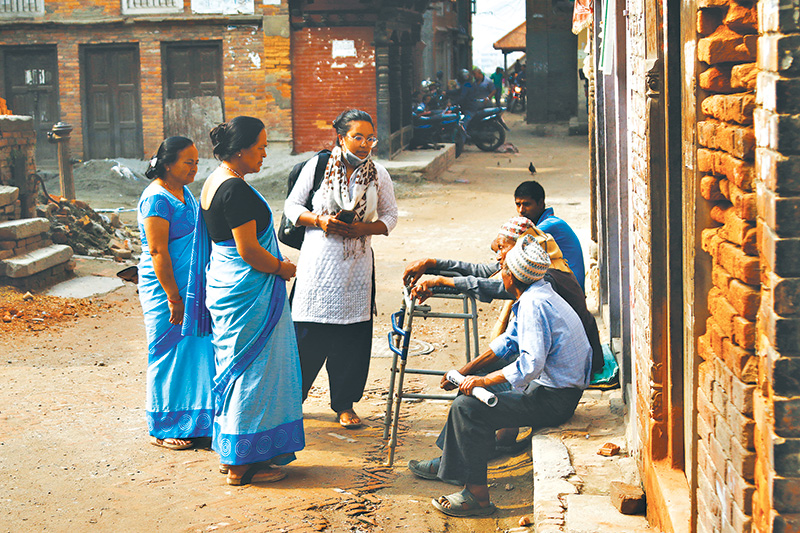
Female community health volunteers and a staff nurse go round Bhaktapur providing care.POST PHOTO: KESHAV THAPA
BHAKTAPUR : Every morning, Sabina Duwal leaves home with a medical bag containing the essentials for any health practitioner—a stethoscope, a thermometer, and a blood pressure monitor, along with everyday over-the-counter medication. She walks around the neighbourhoods in Bhaktapur Municipality, visiting every household that has sick people, elderly members, pregnant women, new mothers, and the physically and mentally challenged. Accompanied by two female community health volunteers—Shanti Maya Gainju and Maiya Keshari Kusi—Duwal, a nurse, makes certain that everyone is well and taken care of, offering advice, medication and simple home remedies. “We do our best to give proper nursing care to locals,” said Duwal, who was hired by the municipality office to provide health care services to locals—in their homes. For the last two years, the municipality has been employing 10 staff nurses, one for each of Bhaktapur’s 10 wards. The nurses are accompanied by female community health volunteers, like Gainju and Kusi, who are locals and are able to help identify patients who need assistance or treatment. This nursing team provides basic healthcare services, including measuring blood pressure, providing postnatal and antenatal care, and counselling new mothers on precautionary measures for the safety of both the mother and their newborns. On Monday, the nursing team of Duwal, Gainju and Kusi visited Samjhana Prajapati, 24, a new mother from Jagati-9. Duwal examined both the new mother and her baby and cautioned against possible infection. The baby was underweight and Duwal suggested that Prajapati eat a nutritious diet and breastfeed her infant every 15 minutes. Prajapati said that she had received all her antenatal care from healthcare facilities but all her postnatal care right at home, from staff nurses like Duwal. At a time with the Healthy Ministry is concerned that it will not meet maternal mortality targets, Bhaktapur in ensuring that its pregnant women and new mothers receive proper care and do not succumb to easily preventable infections and ailments. Currently, for every 100,000 live births 229 women die during or after childbirth, according to the Health Ministry. Among them, 24 percent die during or after childbirth while 19 percent die in the postnatal period. In order to meet the United Nations’ Sustainable Development Goal of reducing maternal mortality to 75 deaths per 100,000 live births by 2030, the current rate should be 125 per 100,000. One of the reasons Bhaktapur started its healthcare at home programme was to keep the maternal mortality low, especially when it came to postnatal complications. Since the programme began two years ago, there have been no recorded postnatal deaths, according to Dr Ratna Sundar Lasiwa, chief of the Bhaktapur Public Healthcare Centre. Along with providing postnatal care, nurses are also providing basic healthcare to those who need it most but are often unable to visit healthcare facilities, like the elderly, and the physically and mentally challenged. Laxmi Manandhar, a 64-year-old from Tilachhi of Ward 9, has been looking after her husband, 84-year-old Kaji Bahadur, for years now. Kaji Bahadur is partially paralysed and could barely move, but the nursing staff has been hard at work on him, teaching him exercises he can practices. Now, he can move slowly and go to the toilet by himself, said Manandhar. “I am fully satisfied with the service of nursing staff,” she said. “My husband does not listen to me, but he follows the instructions of health workers.”
According to Duwal, it is easier for patients to talk to the nursing staff at home rather than at healthcare centres and hospitals. Often, patients, especially the elderly, are uncomfortable visiting hospitals and telling doctors their problems, but they feel comfortable speaking to a nurse who visits their home often, she said. The nursing staff also ensure all children are up-to-date with their immunisations and are receiving proper nutrition. With the rate of immunisation declining across the country, since the implementation of federalism, health experts have been worried. But Bhaktapur not only declared itself a fully immunised municipality last year but is also preparing to declare that it has sustained that complete immunisation rate this year too. Health workers have verified that all children under 15 months of age have received all their vaccines, said Lasiwa. The nursing programme is part of a broader drive by the city of Bhaktapur to expand healthcare services, says Lasiwa. The municipality plans to open up its own public hospital while expanding services at the healthcare centre, including hiring 70 health workers. The municipality also provides consultant care for just Rs 50 for new patients and Rs 30 for follow-ups, hiring 14 consultant doctors, which include a gynaecologist, paediatrician, psychiatrist, dental surgeon, and physicians. “We know who is suffering from what ailment in Bhaktapur,” said Lasiwa. According to Lasiwa, the municipality has records of all patients suffering from hypertension, diabetes, thyroid, heart disease, gastritis, kidney stones, arthritis, chronic obstructive pulmonary disease, cholesterol, uric acid, mental health problems, neurological problems, and cancer. The city aims to provide healthcare accordingly. For many locals, Bhaktapur provides an example of how elected representatives can live up to their promises. During the 2017 local elections, the Nepal Workers and Peasants Party, which has maintained a stronghold in Bhaktapur for decades, had declared that it would provide healthcare services at home if it was elected. To no surprise, the party won. “And we simply implemented the party’s election manifesto,” said Lasiwa.
NEWS
Right to housing law must extend protection to tenants, squatters: Amnesty report
Director of Amnesty International Nepal Nirajan Thapaliya says the government has been increasingly enacting laws related to fundamental rights without any consultation with stakeholders
- TSERING D GURUNG
The report highlights how adequate housing for all remains a major challenge in Nepal. Nearly half of Nepal’s population lives in substandard housing and over 70 percent houses are structurally unsafe.Post file Photo
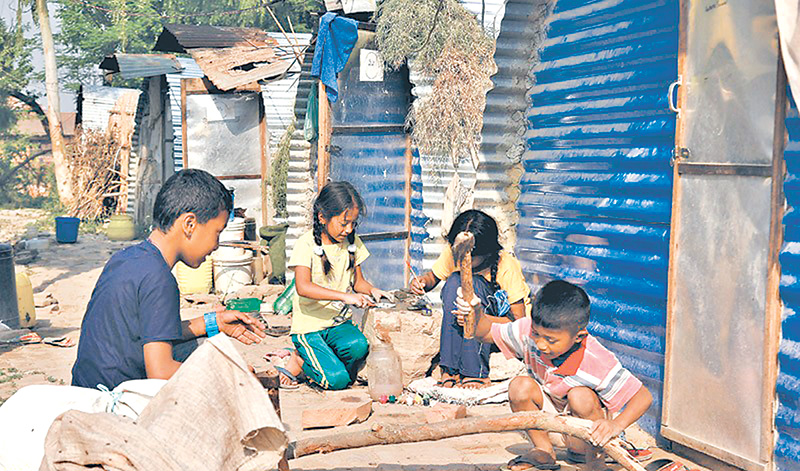
KATHMANDU : Amnesty International Nepal has called on the government to strengthen the new legislation on the right to housing needs for it to be fully realised by all individuals—irrespective of their status. While Amnesty International’s report “welcomes” the inclusion of right to housing as a fundamental right guaranteed under the Constitution, it notes the Right to Housing Act which came into effect last September, “has failed to fully meet Nepal’s international human rights obligations concerning the right to adequate housing.” “The government has been increasingly enacting laws related to fundamental rights without any consultation with stakeholders,” said Nirajan Thapaliya, director of Amnesty International Nepal. “Through this report we want to inform and advise the government about the shortcomings in the law and call for amendments.” One of the main problems with the current law is the lack of protection guaranteed to tenants against forced eviction, the report “Nepal: Adequate Housing for all: Analysis of the Right to Housing Act 2018” has pointed out. Article 37 (2) of the constitution states: “No citizen shall be evicted from the residence owned by him or her nor shall his or her residence be infringed except in accordance with law.” The report describes the provision as being “completely owner-driven.” “Only those who own the house or land they occupy are protected from forced evictions, and the same is not available to those who rent or lease the house or those who do not have security of tenure,” the report says. As per the provision, to claim protection against forced eviction, an individual must provide proof of land ownership. This is problematic, said Thapaliya, since a large number of the population, particularly those living in the urban areas, are tenants. “In the absence of guaranteed protection, tenants are vulnerable to exploitation and harassment by landlords,” said Thapaliya. “The authorities can also use this provision to forcibly evict squatters with impunity as the have done in the past.” Former chief justice Kalyan Shrestha, who was one of the speakers at an interaction programme organised to discuss the report, said no individual should be subject to illegal eviction. “Protection against forceful eviction should be offered to every individual,” said Shrestha. “No person should be made homeless in the name of development.” Another former chief justice, Susila Karki, echoed similar sentiments, and called for amendments to the Act. “The current act is incomplete and needs to be strengthened in order to ensure that the law protects the marginalised,” said Karki. Adequate housing for all remains a major challenge in Nepal. Nearly half of Nepal’s population lives in substandard housing, and over 70 percent of people’s houses are structurally unsafe, according to the 2011 National Population and Housing Census. “Occurrence of natural disasters and impacts of climate change frequently exacerbate the housing problem in Nepal,” the report says. Those worst affected by the disaster, according to Amnesty, are those already marginalised, including landless people, women, Dalits and other caste-based and ethnic minorities. The report highlights how landless people have been denied access to reconstruction grants provided by the government because they did not possess a land certificate—the main document required to apply for the grant. “Exclusion from government grants to re-build houses left those already marginalised in an even more disadvantaged position,” it says. “With less than a third of all homes structurally unsafe, nearly half the population living in substandard homes and one in ten people homeless, legal protections are urgently needed to ensure that people can live in safe, humane and durable conditions,” said Raju Chapagai, South Asia Researcher at Amnesty International. The reports also calls for the extension of the scope of constitutional protection under Article 37 to include non-citizens and notes the law’s failure in including a provision of accountability against acts that render someone homeless including through forced eviction and harassment of the tenant or occupant by landlord. “In view of the prevailing discriminatory practice against Dalits, people living with HIV, and sexual minorities in relation to rental housing, the Act should also have incorporated measures to tackle discrimination,” reads one of the recommendations.
NEWS
Shortage of antiretroviral drug affects HIV patients
Official at the national AIDS centre says the shortage was caused due to an ‘unexpected rise’ in number of patients needing Dolutegravir therapy
- Arjun Poudel
KATHMANDU : Shortage of Dolutegravir, an antiretroviral medicine for treatment of HIV infection, has affected many HIV patients in the country. There are 31,020 HIV patients throughout the country, according to the National Centre for AIDS and STD Control. Dolutegravir is a second-generation medicine which doctors in Nepal prescribe to HIV patients in case the first line of drugs fail to work. Dr Taranath Pokhrel, the centre’s director, told the Post that the shortage was partly due to an unexpected rise in the number of HIV patients needing Dolutegravir therapy. The number of HIV patients taking Dolutegravir, according to the centre, rose to 29 from 5 in the last one year. “We ran out of the drug because we had a supply for only five patients,” said Pokhrel. Srijana is one of the many HIV patients hit by Dolutegravir shortage. She has been getting her prescription from Sukraraj Tropical and Infectious Disease Hospital in Teku, Kathmandu. For this, she has to journey from her hometown in Nawalparasi to the Capital city every two months. When Srijana arrived in Kathmandu to get her prescription refilled recently, she was given a dose to last only five days. “I cannot afford to come to the Capital every week. I have two small children at home,” the 35-year-old said. Pokhrel, the centre’s director, said the Department of Health Services was working towards addressing the drug shortage. “Dolutegravir is not available in local market, so we have initiated the process to address the drug shortage ,”said Pokhrel. He added that Global Fund, an organisation working towards ending AIDS, tuberculosis and malaria as epidemics, was going to supply the drug this year.The government will start purchasing the medicine from next year onwards.
CD 4 count service halted for last six months Hundreds of HIV patients have been deprived of CD 4 count service after the CD4 counting machine at National Public Health Laboratory broke down six months ago. CD4 count is a test to measure the number of CD4 cells-a type of white blood cell called T-cells-that move throughout the body to find and destroy bacteria, viruses, and other invading germs.CD4 count is a must to start antiretroviral medicines for people living with HIV and to check the effectiveness of the medicines they are taking.An HIV patient must undergo a CD4 test for the doctor to be able to prescribe antiretroviral medicines.“Doctors ask us to conduct CD4 test, but the service has not been available for months now,” Dilip Bhusal, a volunteer of National Association of People Living with HIV/AIDS in Nepal, told the Post. He said up to 100 people visit the laboratory daily for CD 4 count service.
NEWS
Om Hospital doctors accused of medical negligence
Rampiyari Thapa Magar died after undergoing what doctors said was a ‘successful gallbladder surgery’
- Arjun Poudel
Relatives of Magar gather outside Om Hospital demanding a fair investigation into the death.post photo: Elite Joshi
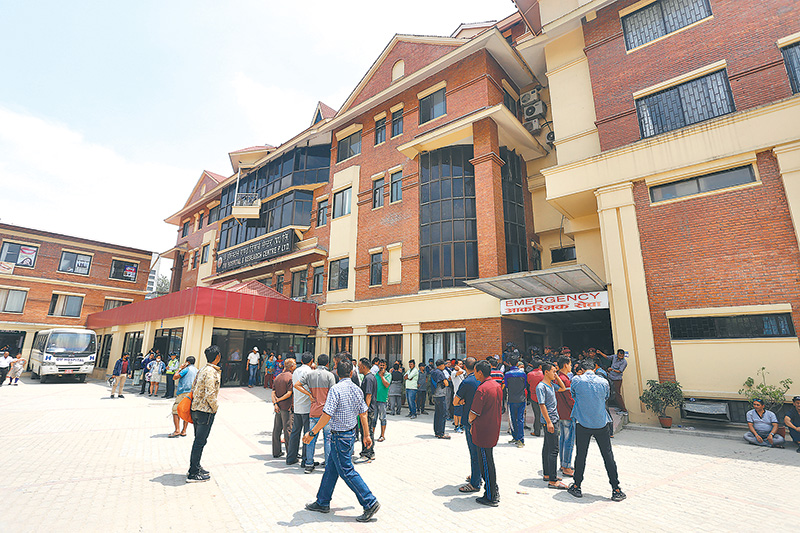
KATHMANDU : Family and friends of Rampiyari Thapa Magar have alleged that sheer negligence on the part of the medical team of Om Hospital and Research Center Pvt Ltd caused her death. Magar, 50, a resident of Indrawati Rural Municipality of Sindhupalchok, had undergone a gallbladder surgery. She died at 7am on Thursday. According to Magar’s brother-in-law Khadga Shrestha, she had visited the hospital a week earlier to seek treatment for back pain. After some tests, the doctors at the hospital confirmed multiple stones in her gallbladder and advised a surgery to remove them. Her surgery was scheduled for Friday, June 7. Post-surgery, her family members were informed that the surgery was successful. But Magar’s condition deteriorated the next day. Dr Rabin Koirala, the surgeon who conducted the surgery, asked Magar to undergo another round of tests including a CT-scan. The tests did not reveal anything out of the ordinary, according to Dr KP Devkota, Hospital Medical Director. But Magar’s condition worsened and she was shifted to the Intensive Care Unit on Saturday evening. The next day, the doctors opened her stitches to check her wound for possible signs of infection. The wound, they found, was filled with pus. The doctors say they immediately informed Magar’s family members about the infection and told them that the patient will have to undergo another surgery to treat a hole found in her intestine. In the second surgery, the doctors removed about one and a half metre of her intestine that was infected. “The doctors should have taken care of the hole in her intestine during the first surgery itself. The wound got infected because of the open hole,” Shrestha alleged. “Rampiyari died because of infection in her intestine.” Devkota conceded that the surgeons discovered the hole in Magar’s intestine only on Sunday and that they rushed her to the Operation Theatre for another surgery immediately. “There was no negligence on our part,” claimed Devkota. “The surgery was complicated, and we have shared every piece of information about the patient’s condition since the time of her hospitalisation to her family.” According to Devkota, the patient had already had three surgeries, and that her gallbladder was covered by a large part of her intestine. “There was no bleeding, no holes left during the surgery, and the surgeons were confident about the success of the surgery,” he added. “We tried all available antibiotics to control the infection but they didn’t work. The patient died due to the infection.” The family members and relatives of the patient refused to receive the patient’s dead body until Thursday evening. “We do not know much, but we do know that we lost our family member due to the negligence of the doctors, the medical team and the hospital. We want a fair investigation into this matter from concerned authorities,” said Shrestha.
NEWS
Army chief leaves for China on Sunday, but no confirmation on signing of any deal yet
Assistance for a defence university and joint military drill between the two countries are high on General Thapa’s agenda
- ANIL GIRI
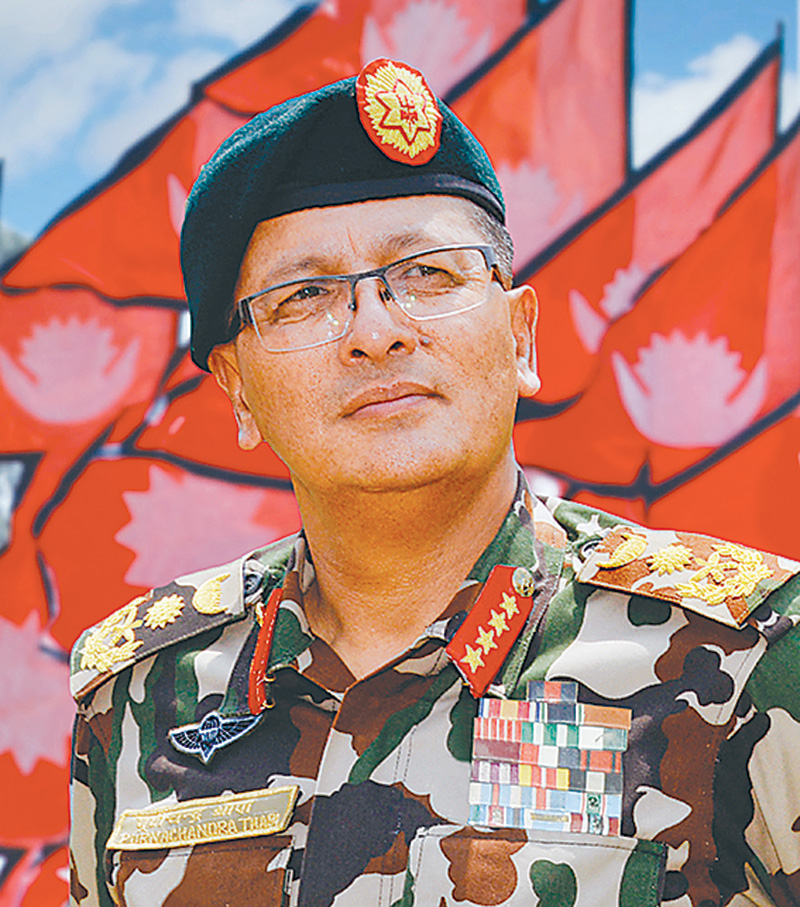
Purna Chandra Thapa
KATHMANDU : Chief of the Nepal Army General Purna Chandra Thapa is leaving on Sunday for China on a week-long visit, but as of Thursday, there was no confirmation from the Nepal Army about the agreements that he will be signing. The signing of a protocol agreement on non-lethal assistance to Nepal Army to be provided by China’s People’s Liberation Army, however, is expected. A protocol agreement on Chinese assistance to Nepal Army was announced during the visit of Deputy Prime Minister and Minister for Defence Ishowr Pokhrel to China in October 2018. This is the second foreign visit of Thapa after he became the chief of the national defence force on September 9, 2018. Earlier, he paid an official visit to India in the second week of January. In the southern neighbour, he was conferred the title of honorary chief of the Indian Army in line with the tradition of exchanging honorary titles between chiefs of the two armies. After returning from China, Thapa is preparing to pay an official visit to the United States of America. Apart from meeting with his Chinese counterpart Li Zuocheng, Thapa will also take a tour of several Chinese military installations, according to the Nepal Army. He is also scheduled to meet with Chinese Defence Minister Wei Fenghe. “As of Thursday, there is no confirmation regarding any agreement related to signing of the protocol,” Brigadier General Bigyan Dev Pandey, spokesperson for the Nepal Army, told the Post. As per a memorandum of understanding signed between Minister Pokhrel and his Chinese counterpart Wei on military cooperation between the two countries, China is to provide an assistance of RMB 150 million (approximately Rs 2.3 billion) to Nepal over a period of five years for the supply of humanitarian and disaster relief equipment. During Thapa’s visit, the Chinese side will hand over some logistics related equipment like armoured personnel carriers for Nepali peacekeepers, engineering equipment, logistics related to disaster preparedness, spare parts, medical equipment and some vehicles. The announcement was made during Pokhrel’s visit but protocols related to them and numbers and ways of delivering assistance were not agreed upon in October last year. In Beijing, Pokhrel had also requested the Chinese side to support the Nepal Army for its bid to establish a defence university. Some security and military experts in Kathmandu have expressed concerns over the government’s bid to seek foreign assistance in such a sensitive matter as establishing the defence university. Increasing the quota of military-related training for Nepal Army officials is also on Thapa’s wish list. “This is a routine visit, which aims to strengthen bilateral ties as well as military cooperation between Nepal and China. General Thapa will be meeting senior PLA officials,” said Pandey. “He will also visit Chengdu, Beijing, and Dujiangyan before returning home via the Shanxi province.” There is no information about the announcement of new Chinese assistance during the visit, Pandey added. During the meeting, according to the Defence Ministry sources, details of the joint military exercise between Nepal and China named “Sagarmatha Friendship” will also be discussed. The third series of Nepal-China joint military drill is expected to be held in August in China. Nepal and China have already conducted two rounds of military drill in the respective countries, mostly focusing on counter-terrorism. The main feature of the joint military drill is to jointly fight against international terrorism and the main subject is urban counter-terrorism operations.
NEWS
Household air pollution increases risk of cataract and other eye diseases
Experts suggest switching to clean energy and adopting improved cooking technologies
- CHANDAN KUMAR MANDAL
KATHMANDU : Household air pollution is not only affecting the respiratory system but also causing eye diseases in residents, a latest study shows. The study conducted by Dhulikhel Hospital under the Kathmandu University has found that indoor air pollution largely caused by burning solid fuels like firewood, dried leaves and cow dung, and twigs caused irritation and redness in eyes among household members across the country. A total of 400 households in Panchpokhari Thangpal Rural Municipality, Sindhupalchok, were selected to study the impact of metallic improved cooking stoves in reducing respiratory and eye diseases among mothers and children under 12. A majority of them complained of eye-related issues, according to Sudip Shrestha, a researcher associated with the Kathmandu University. “Most of the households that use traditional cooking stoves and fuels are found to be suffering from eye irritation and have complaints of respiratory health issues,” Shrestha said, sharing the findings of the study during a regional workshop on air pollution and health in Nepal and the Hindu Kush Himalaya on Thursday. The two-day event organised in Lalitpur by the International Centre for Integrated Mountain Development and the University of Nottingham brought together medical practitioners, atmospheric scientists, sociologists, and policymakers from across the region to discuss the current scientific understanding on air quality and the health effects of air pollution. Around 60 percent of households were using firewood as a source of energy. Among those relying on firewood, a whopping 82 percent admitted to collecting it from nearby forests. Around 32 percent respondents had reported eye irritation whereas coughing and sneezing were experienced by 31 percent of those burning biomass for energy. The effects of indoor air pollution were severe even for households that used traditional three-stone stoves (made of clay and stones). Among them, 78 percent respondents complained of eye irritation, according to the study. Deaths attributed to the household air pollution were estimated at nearly 11,200 in Nepal every year by the latest study by State of Air. Minimising deaths related to indoor air pollution remains a tough task for the country where a majority of households still use traditional sources of energy. The Biomass Energy Strategy (2017), which mentions that nearly 77 percent of the country’s energy is supplied by traditional biomass energy, envisions making the country air pollution-free by 2022 through the promotion of clean cooking technologies. The effects of worsening air quality, especially in Kathmandu Valley, are related to pulmonary and cardiac diseases and have also predicted shortening Kathmandu residents’ lifespans by 30 months. Both outside and indoor air pollutions have also given a rise in eye related problems--not often reported as effects of air pollution. A 2012 study also suggested household air pollution was causing eye diseases. The study conducted among 800 persons by Om Prakash Kurmi, currently an assistant professor with the Department of Medicine, McMaster University, Hamilton, Canada, along with the Tilganga Institute of Ophthalmology, showed that families exposed to biomass fuels have five times more chances of getting cataracts than other families using clean energy sources. “After studying various other factors that could develop eye cataract, we found that those using solid fuels had relatively higher chances of developing eye cataracts,” Kurmi told the Post. “There have been similar studies in South America and African countries showing women spending more time doing cooking would produce more tears and had eye reddening symptoms.” Kurmi said that as the country continues to rely on traditional means of energy, households continue to be at the risk of various other health issues other than damage to the respiratory system. “Besides respiratory problems, there are other serious health impacts on cognitive development in children which remain unexplored. These adverse impacts are severe for those using biomass energy,” added Kurmi. “So far initiatives taken are concentrated on introducing improved cooking stoves, which is not enough. For greater results, we have to adopt clean energy like solar and hydroelectricity,” said Kurmi. “It is never too late to switch to clean energy.”
NEWS
Senior citizens in rural areas deprived of citizenship certificate
Without citizenship, people are denied job opportunities and social security allowances
- Ramesh Chandra Adhikari
Muse Bista, 75, of Dhankuta-9 has not lost his hope for citizenship.Post Photo: Ramesh Chandra Adhikari
DHANKUTA : Mushe Bista, a native of Belharabesi in Dhankuta Municipality-9, is 75 years old, but does not have his Nepali citizenship certificate. Because he does not have the document, he has not been able to enjoy his ‘old age allowance’ and other facilities provided by the government. Bista, who has his voter’s ID card, has been living with his brother, Bhim Bahadur. “My brother obtained his citizenship certificate many years ago, but I have been struggling to get mine. I have been frequenting the ward office and the local administration office for a long time now but I always come back empty handed,” said Bista. Many people in rural areas, mostly senior citizens, still do not have citizenship certificates. Without citizenships, they are deprived of an education, job opportunities and social security allowance meant for the disabled, the elderly and single women. Chandramaya Bista, 67, a woman of Dhankuta-9, has also been running from pillar to post to acquire her citizenship certificate. She said, “I have received a recommendation letter from the ward office, but the District Administration Office (DAO) did not give me my citizenship certificate.” According to her, the DAO officials turn her back citing incomplete documentation. Kamala Dahal, manager of an old age home in Dhankuta, said that disabled and senior citizens staying at her home have not been able to make use of state facilities due to lack of citizenship certificate. “We have been taking initiatives to help them acquire the certificate so that they can enjoy these social welfare schemes,” she said. For Dilip Gurung, 35, and his mother, living in Dhankuta for a couple of decades now, acquiring their citizenship certificates has been an uphill task. “Forty years ago, my parents migrated to Dhankuta from Okhaldhunga. Now we don’t know where to go to acquire our citizenship certificates,” said Gurung. Manoj Raya, ward chairman of Dhankuta-9, accepted that many people in his ward are deprived of citizenship certificates. According to Raya, the DAO must first verify the documents submitted and only then grant the certificates--which is a long, tedious process. Sudhir Safi, an administrative officer of the DAO, said that the standing rule is that an individual’s documents must be verified before issuing them their citizenship certificates; however, he also agrees that different cases must be dealt in different ways especially for the disabled and the senior citizens. “The issue of citizenship is too complex. Some people in the municipality are living without their citizenship certificate due to lack of necessary documents,” he said.
NEWS
Blood shortage in Baitadi Hospital affects patients
Critical patients are being referred to Dadeldhura and Dhangadhi for treatment
- TRIPTI SHAHI
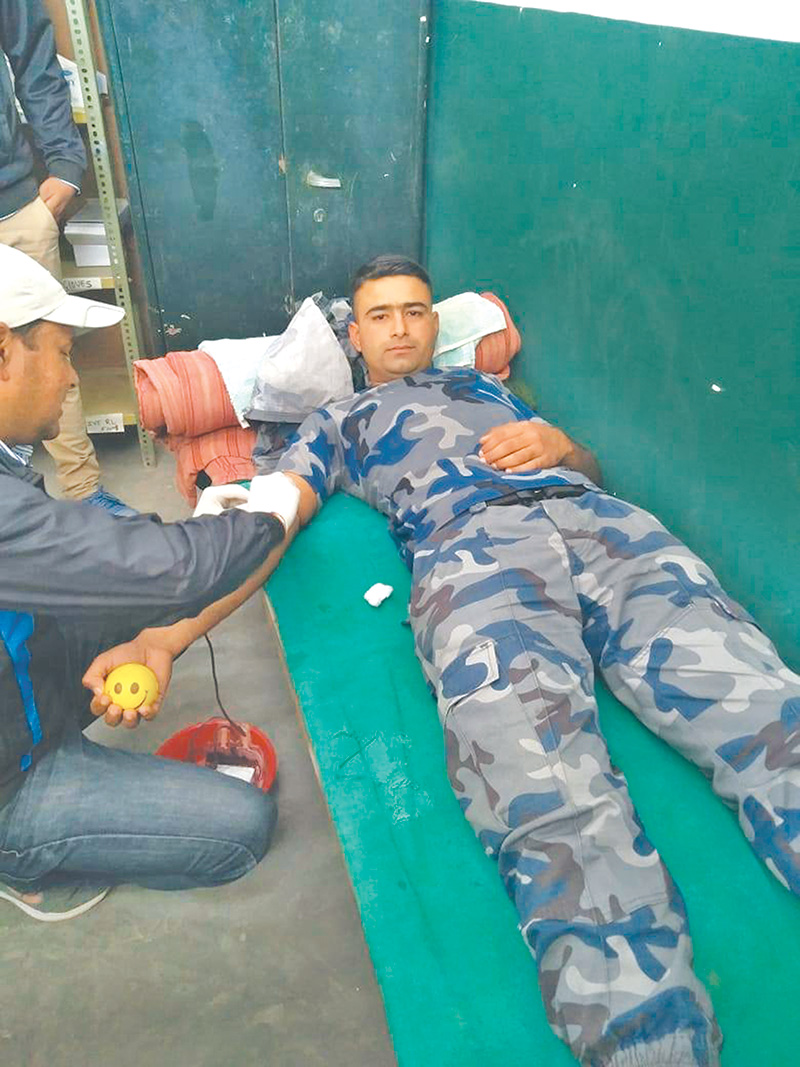
An Armed Police Force member donates blood to a woman.Post file Photo
BAITADI : With no blood bank and blood transfusion centre in Baitadi, health workers at the district hospital are currently having a tough time catering to patients in need of blood. Dr Devendra Lekhak, said that the hospital is ill equipped to deal with emergency situations. Every time the hospital receives critical patients or pregnancy related cases, it refers the patients to other districts. Usually, pregnant and new mothers are often diagnosed with low haemoglobin level, according to health workers. Madhav Bhatta, of Melauli Municipality, said he experienced the effect of the district’s lack of blood bank firsthand when his younger brother was critically ill and needed blood. “I had to call my friends and relatives to inquire what blood groups they were or if they knew anybody who had the same blood group as my brother,” he said. Ram Bahadur Ter of Dhasarathchand Municipality said he had to take his brother and sister-in-law to Dhangadhi for treatment because they needed blood and the hospital did not have blood facility. Santosh Padey, health assistant at the District Health Office, said they had been relying on security personnel for blood during emergencies, because most people do not willingly come forward to donate blood. “Most people believe that they will become physically weak if they donate blood,” he said. Dr Jagadish Chandra Bista, chief at the hospital, said that they were making efforts to establish a blood transfusion centre in the district, but it would take some time. “Setting up a blood bank in a hill district is a challenge. We have managed to purchase some equipment to open a blood bank facility, but it is going to be a long process,” he said.
NEWS
Chitwan court finds Maoist activists guilty of tearing ballot papersat local poll
Next hearing to hand down punishment
- RAMESH KUMAR PAUDEL
CHITWAN : Two activists of the then CPN (Maoist Centre) have been convicted of tearing ballot papers during a local election of Bharatpur Metropolis in 2017. The Chitwan District Court on Thursday convicted Drona Bahadur Siwakoti and Madhu Neupane for tearing ballot papers during the vote count of Ward 19. A single bench of Judge Murari Babu Shrestha passed the ruling against Siwakoti and Neupane, court Registrar Rudramani Giri said. However, the court has yet to hand down the punishment against the duo. “Both of them have been found guilty. The court will hand donw punishment in the next hearing scheduled for June 20,” said Giri. The Office of District Attorney filed the case against Siwakoti and Neupane demanding two years’ imprisonment and Rs100,000 fine. The CPN (Maoist Centre) activists tore as many as 90 ballot papers in May, 2017. The incident happened while the counting of ballot papers of Ward 19 was under way. Then CPN-UML’s Devi Prasad Gyawali was leading Maoist Centre’s Renu Dahal, daughter of party chief Pushpa Kamal Dahal, at that time. Both were vying for Bharatpur’s mayoral post. Dahal later won the re-election.
NEWS
Customs works in Jogbani halted after scuffle
Hundreds of Nepal-bound carriers stranded at the border point following dispute between India’s security personnel and customs agents
- BINU TIMSINA
BIRATNAGAR : Jogbani customs point remained closed on Thursday due to a dispute between the security personnel of Indian Shasatra Seema Bal (SSB) and agents at Jogbani Customs. On Wednesday night, customs agent Kailu Yadav was manhandled by the SSB men as he was trying to diffuse a heated argument between the security personnel and an Indian driver. The SSB men had beaten up the driver at the customs point. The agents halted works at the customs in protest of the incident. Maniram Paudel, information officer at the Biratnagar Customs, said the customs reopened only after 6pm. Hundreds of trucks were left stranded on the Indian side due to the resulting blockade. The SSB had also stopped movement of empty goods carriers to India citing traffic jams. According to SSB officials, a vehicle takes more than six hours to travel 20 km to Forbesganj from Jogbani. Meanwhile, Chief District Officer Ramesh Kumar KC said that they were in talks with the Indian side to send vehicles through a road constructed at Biratnagar-18. An integrated check post (ICP) is under construction in Biratnagar-18. According to KC, empty goods carriers are only allowed to cross the border from 7am to 7pm. However, officials said that the ban will be lifted after the ICP comes into operation. According to the customs office, revenue collection was affected on Thursday. The Biratnagar Customs Office collects Rs120 to 150 million in revenue every day.
WORLD
Tankers targeted near Strait of Hormuz amid Iran-US tensions
The timing of Thursday’s suspected attack was especially sensitive as Abe’s high-stakes diplomacy mission was underway in Iran
- ASSOCIATED PRESS
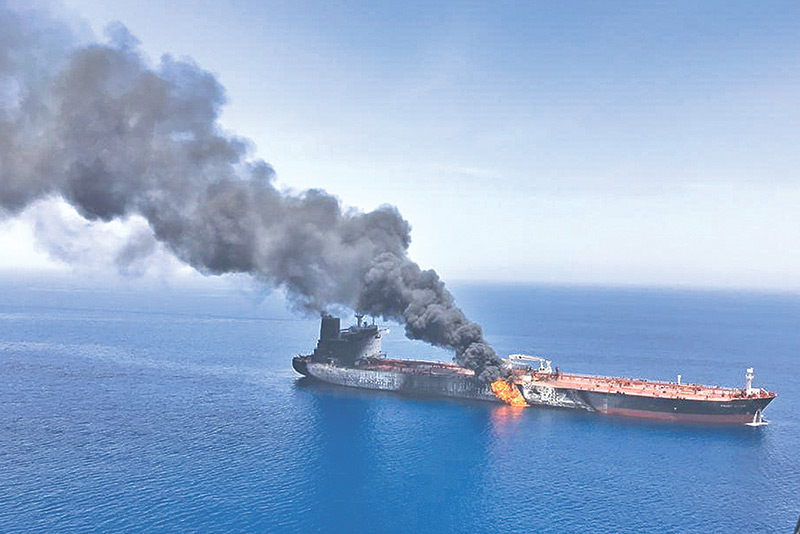
An oil tanker is on fire in the sea of Oman on Thursday. Two oil tankersnear the strategic Strait of Hormuz have been reportedly attacked. The alleged assault on Thursday left one ablaze and adrift as sailors were evacuated from both vessels. AP/RSS
DUBAI (UAE), Two oil tankers near the strategic Strait of Hormuz were damaged in suspected attacks on Thursday, an assault that left one ablaze and adrift as sailors were evacuated from both vessels and the US Navy rushed to assist amid heightened tensions between Washington and Tehran. The Navy and the ship’s owners offered no immediate explanation on what weapon caused the damage to the MT Front Altair and the Kokuka Courageous in the Gulf of Oman off the coast of Iran, though all believed the ships had been targeted in an attack. It marks the latest mysterious incident to target the region’s oil tankers. The US alleged that Iran used limpet mines to attack four oil tankers off the nearby Emirati port of Fujairah last month. Iran has denied being involved, but it comes as Iranian-backed rebels in Yemen also have launched missile and drone attacks on Saudi Arabia. Meanwhile in Iran, Supreme Leader Ayatollah Ali Khamenei warned that while Tehran doesn’t seek nuclear weapons, “America could not do anything” to stop Iran if it did. The comments came during a one-on-one meeting capping Japanese Prime Minister Shinzo Abe’s high-stakes visit in Tehran that sought to ease Iran-US tensions, suggested the efforts had failed. Benchmark Brent crude spiked at one point by as much 4percent in trading following the suspected attack, to over $62 a barrel, highlighting how crucial the area remains to global energy supplies. A third of all oil traded by sea passes through the strait, which is the narrow mouth of the Persian Gulf. Cmdr Joshua Frey, a 5th Fleet spokesman, said the US Navy was assisting the two vessels that he described as being hit in a “reported attack.” He did not say how the ships were attacked or who was suspected of being behind the assault. Dryad Global, a maritime intelligence firm, preliminarily identified one of the vessels involved as the MT Front Altair, a Marshall Islands-flagged crude oil tanker. The vessel was “on fire and adrift,” Dryad added. It did not offer a cause for the incident or mention the second ship. The firm that operates the Front Altair told The Associated Press that an explosion was the cause of the fire onboard. International Tanker Management declined to comment further saying they are still investigating what caused the explosion. Its crew of 23 is safe after being evacuated by the nearby Hyundai Dubai vessel, it said. The second vessel was identified as the Kokuka Courageous. BSM Ship Management said it sustained hull damage and 21 sailors had been evacuated, with one suffering minor injuries. Iranian state television said 44 sailors from the two tankers have been transferred to an Iranian port in the southern province of Hormozgan. The timing of Thursday’s suspected attack was especially sensitive as Abe’s high-stakes diplomacy mission was underway in Iran. Japan’s Trade Ministry said the two vessels had “Japan-related cargo.” On Wednesday, after talks with Iranian President Hassan Rouhani, Abe warned that any “accidental conflict” that could be sparked amid the heightened US-Iran tensions must be avoided. His message came just hours after Yemen’s Iranian-backed Houthi rebels attacked a Saudi airport, striking its arrivals hall before dawn and wounding 26 people Wednesday. A statement published by Khamenei’s website after Abe’s meeting Thursday with the supreme leader suggested a tense exchange between the two. “We have no doubt about your good will and seriousness, but ... I don’t regard Trump as deserving any exchange of messages,” Khamenei reportedly told Abe. Khamenei also said Iran remained opposed to building atomic weapons, but offered a challenge to Trump. “You should know that if we planned to produce nuclear weapons, America could not do anything,” said Khamenei, who has final say on all matters of state in Iran’s Shiite theocracy.
WORLD
Hong Kong protesters plan weekend rally after violent clashes
- AGENCE FRANCE-PRESSE
HONG KONG, Hong Kong protest leaders announced plans for another mass rally on Sunday, escalating their campaign against a China extradition bill a day after police cleared them from the streets using volleys of tear gas and rubber bullets. The move sets up a fresh confrontation with the city’s leaders who have refused to withdraw the proposed law and have the staunch backing of Beijing, which described the protests as “riots”. The international finance hub was rocked by the worst political violence since its 1997 handover to China on Wednesday as tens of thousands of protesters who had surrounded the city’s parliament were dispersed in chaotic scenes. Sporadic demonstrations broke out again on Thursday, with occasional scuffles with police, but crowds were much smaller and there was no repeat of the running battles of the day before. The government has indefinitely postponed a parliamentary debate on the bill which had been scheduled for Wednesday and was the trigger for Wednesday’s violence. But demonstrators have vowed no let up in their campaign until the law is abandoned entirely, calling for a rally on Sunday and a city-wide strike on Monday. “(We) will fight until the end with Hong Kong people,” said Jimmy Sham from the Civil Human Rights Front, the main protest group, adding that they had applied for permission to hold the weekend rally. “When facing ignorance, contempt and suppression, we will only be stronger, there will only be more Hong Kong people,” he told reporters. The CHRF organised a huge rally against the bill on Sunday which they said drew more than a million people. But it has little control over groups of largely leaderless, young crowds of more hardline demonstrators who have been at the vanguard of confrontations with police. The police response has drawn criticism from a range of influential bodies including lawmakers, journalists and legal groups, with calls for an independent inquiry into “excessive force” from a top legal body that helps elect the city’s leader. The Hong Kong Bar Association also weighed in, saying the police force “may well have overstepped its lawful powers” with “wholly unnecessary force against largely unarmed protesters who did not appear to pose any immediate threat to the police or the public”. But Beijing said it fully supported the city authorities’ handling of the protests. “What happened in the Admiralty area was not a peaceful rally, but a riot organised by a group,” Chinese foreign ministry spokesman Geng Shuang told reporters, referencing the district where the worst violence took place. Police chief Stephen Lo defended his officers on Thursday, saying they “had no choice but to escalate the use of force”. He said 11 arrests had been made so far and that 22 officers had been injured. At least 150 rounds of tear gas had been fired while 19 complaints of police violence had been reported and would be investigated.
WORLD
Protests were riots: Beijing
BEIJING: Beijing on Thursday described the mass protests against Hong Kong’s extradition bill as “riots”, and said it supported the local government’s response. Police used rubber bullets and tear gas to break up crowds Wednesday after demonstrators angry over legislation they say would leave people vulnerable to China’s politicised justice system blocked roads and brought the city to a standstill. Videos of Hong Kong police beating unarmed protesters have also sparked accusations of brutality. Chinese foreign ministry spokesman Geng Shuang said Hong Kong’s chief executive Carrie Lam and other city officials “have already spoken on the latest state of affairs, pointing out that what happened in the Admiralty area was not a peaceful rally, but a riot organised by a group.” “I think that any act that undermines Hong Kong’s prosperity and stability goes against Hong Kong mainstream public opinion,” Geng said at a regular press briefing. “We support the Hong Kong government’s dealing with the situation in accordance with the law.” Wednesday’s violence left 79 people hurt, with two in serious condition, in the worst political unrest since Hong Kong was handed back to China in 1997. Police insisted the force was necessary to fend off protesters throwing bricks and metal bars. But critics said officers used localised violence by small groups of hardcore activists to launch an unprecedented operation against the much larger mass of peaceful protesters who had taken over parts of the city on Wednesday.
WORLD
Turkish artist goes viral with misery/comfort images
- AGENCE FRANCE-PRESSE
Turkish artist Ugur Gallenkus works with his laptop at his home in Istanbul. AP/RSS
ISTANBUL, A Starbucks cup merging with a crowd around a dried-up well, or a yacht spliced with a boat full of refugees: powerful collages by a Turkish artist have taken the internet by storm. With over half a million followers on Instagram and thousands more on Facebook and Twitter, 29-year-old Ugur Gallenkus has stirred a huge reaction by juxtaposing photos of misery in war-torn countries with the comforts of the West. His digital collages bring together photos he finds in the media that have similar compositions but tell entirely different stories. One features a little girl dressed in a Wonder Woman costume spliced together with a girl covered in blood and bandages the sort of jarring contrast which Gallenkus hopes will raise awareness of a “parallel world”. “I would like to tell the world that people in developing countries live in war, hunger and pain. If we want to live in peace and harmony we must have knowledge about each others’ lives,” he told AFP. Gallenkus first started the project in 2016 in reaction to the photo of Aylan Kurdi, the three-year-old Syrian refugee who was found drowned on a Turkish beach the year before, which sent shock waves around the world and became one of the most searing images of Europe’s migrant crisis. “One morning while watching the news, I saw the fear and despair in the eyes of a group of immigrant families trying to cross the sea for a better life. “That shocked me and I decided to tell the world of their situation,” said the Istanbul-based artist. Gallenkus says his work covers subjects from all over the world, including war, famine, violence against women, income inequality and climate change. “But the war and instability in Iraq, Syria and Afghanistan are an important part of my work,” he stressed. In another piece, one side of the image shows a father bathing his children in the remnants of a bathroom destroyed by war, while the other side shows a clean, lavish bathroom with a fancy chandelier. “I only interpret the images in a different way. I try to find the value and meaning of the photos that I see in the news and add the message I want to give to the world,” he said. Thousands have commented on Gallenkus’ social media feeds, expressing their anger, sorrow and shock. “Art is powerful because it can express that which is beyond words. Praying for the healing of our world,” Subra, a Facebook user, wrote under one image. “I am from Syria. Every time I see your pictures and the destruction of my country compared to the comfortable life in the West, I cry. We used to have the same life, but war took everything from us,” Haroun, another user, wrote. With all the messages of support from across the globe, Gallenkus says he is determined to continue his work in the hope of making the world a “happy and beautiful place for all”.
WORLD
Second patient dies of Ebola in Uganda: health official
News Digest
- AGENCIES
BWERA (Uganda): A 50-year-old woman who tested positive for Ebola in Uganda has died, a health ministry official told AFP on Thursday, the second fatality since the virus spread from neighbouring Democratic Republic of Congo. “The deceased has been confirmed as the grandmother of the five-year-old boy who died. Both victims had attended the burial of an Ebola patient in Congo, but returned to Uganda”, the official told AFP on condition of anonymity. Arrangements are being made to bury the woman in Kasese, a district in western Uganda close to the DRC border, the official added. The health ministry announced Wednesday that Uganda had recorded three cases of Ebola infection in the first known cross-border spread since an outbreak began in eastern DRC last August. All three were from a single family that travelled to DRC to care for a relative, who also died of Ebola. The five-year-old later died and his three-year-old brother and 50-year-old grandmother tested positive for the virus upon returning to Uganda. The family was quarantined in a hospital in Bwera, in Kasese district. Eight others who had been in contact with them were also being monitored in an isolation ward. They, and frontline health workers, are due to be vaccinated Friday with a new drug designed to protect them against the virus, the health ministry said. East Africa has been on high alert since the outbreak was declared in the eastern DRC provinces of North Kivu and Ituri.More than 2,000 cases have been recorded in DRC around two-thirds of them fatal. The World Health Organization will hold an emergency meeting Friday to determine whether to declare the outbreak “a public health emergency of international concern,” a major shift in mobilisation against the disease.
WORLD
China says UN rights chief ‘always’ welcome in Xinjiang
News Digest
- AGENCIES
GENEVA: China said on Thursday that the UN human rights chief had an open invitation to visit Xinjiang, a region where some one million mostly Muslim minorities are held in internment camps. Beijing’s new ambassador to the United Nations in Geneva, Chen Xu, reiterated the government’s denial of the existence of camps there, insisting the region had “vocational education training”, especially for youth vulnerable to extremism. Chen added that he hoped the UN High Commissioner for Human Rights, Michelle Bachelet, would “pay a visit” to the region. “Seeing is believing,” Chen told reporters. “The invitation to the high commissioner is always there and we hope that we can find a time which is convenient to both sides.” Bachelet said in March that she had not yet been given the green light by China for a fact-finding mission to Xinjiang following a request made in December. Her office was not immediately available to comment on whether talks on a prospective visit had progressed. China has come under increasing global scrutiny over its treatment of ethnic Uighurs and other Turkic-speaking minorities in Xinjiang.
WORLD
Winds, rain batter western India as cyclone veers away
News Digest
- AGENCIES
AHMEDABAD (India): High winds and heavy rains pounded western India on Thursday as a major cyclone expected to hit the coast veered away instead into the Arabian Sea. Vayu, classified as a very severe cyclonic storm, moved north-northwestwards in the night over the Arabian Sea, and was around 110 kilometres (70 miles) from the coast of Gujarat state. It was “very likely” to keep moving in the same direction, but still skirt the coast, packing winds of 135-145 kilometres (84-90 miles) per hour and gusts of 160 kilometres (100 miles) per hour, the India Meteorological Department (IMD) said. “The threat of surge in wind, dust storm and rainfall remains very much. The centre of the storm known as the eye has slightly moved away from the Gujarat coast, but its diameter is well over 900 kilometres (560 miles),” an IMD official told local media.Heavy rains are likely to continue until Saturday, Gujarat IMD chief Jayanta Sarkar told AFP. On Wednesday, forecasters had been bracing for the system to hit Gujarat with full force winds equivalent to a category one or two hurricane. Authorities in Gujarat evacuated more than 285,000 people as a precaution. Schools have been closed, with officials fearing major damage to houses, crops, power lines and communications. Five people have been killed by lightning in Gujarat, mostly farmers and labourers working in fields, authorities said.
WORLD
US, allies accuse North Korea of violating UN cap on fuel imports
News Digest
- AGENCIES
UNITED NATIONS: The United States and dozens of allies have accused North Korea of breaching a UN sanctions cap on refined petroleum mainly through illicit transfers between ships at sea, according to a document seen by Reuters on Wednesday. The US-led complaint to the UN Security Council North Korea sanctions committee listed 79 illegal deliveries of fuel this year and concluded that the country - officially known as the Democratic People’s Republic of Korea (DPRK)- had breached an annual cap of 500,000 barrels imposed in December 2017. “The restriction on the DPRK’s refined petroleum imports is critical to maintaining pressure on the DPRK, including those parties responsible for its WMD (weapons of mass destruction) program, to achieve the final, fully verified denuclearization of the DPRK,” read the report to the committee. The accusation, dated Tuesday, coincided with US President Donald Trump announcing he had received a “beautiful” letter from North Korean leader Kim Jong Un. Washington is seeking to rebuild momentum in stalled talks with Pyongyang, aimed at getting North Korea to dismantle its nuclear weapons program. After exchanging insults and war-like rhetoric with Kim early in his presidency, Trump in the past year has repeatedly praised him. They have held two summits as Trump tries to convert what he feels is a warm personal relationship into a diplomatic breakthrough.
EDITORIAL
The process is flawed
Procurement process needs to be revamped
The government recently has been criticised by different sections of society for trying to push through multiple bills in Parliament without holding consultations with stakeholders. Among the many, the few to have received prominent coverage have been the Guthi Bill, the Media Council Bill, and the amendments to the public procurement process. It comes with little surprise that the one that has received immediate attention from the government has been the procurement regulations. Within a span of a month, the government has backtracked on regulations barring contractors from participating in bids beyond their capacity—regulations that the government had been lauded for introducing.
The way the government has seen fit to change regulations to suit the vested interests of some contractors is wrong. However, there is a larger problem here. In passing the sixth amendment to the Public Procurement Act, only to reverse it with the seventh amendment within such a short time shows how reactive the government has been—it has not allowed for enough discourse and thought on passing regulations at all. Moreover, the government had an opportunity here to complete a much needed revamp of the entire procurement process. Instead, it has jumped from one amendment to the next, patching up one controversial move after another without getting at the real issue—the country’s public procurement process is flawed.
Public procurement processes are often times complicated. But regulations are also required so that the public can be confident that government contracts are awarded fairly, giving every qualified bidder an equal chance, and that such transactions are free from corruption. We have often criticised the government for failing to adhere to procurement guidelines, for example when the Oli-led government attempted to pass a law in December 2018 that would allow the government to directly pick developers for projects valued over Rs50 billion without adhering to the bidding process.
Currently, the process allows state agencies to open a bidding process, and then select a pool of lowest bidding entities. The lowest bids are then analysed to see whether the entities have the technical and financial capability to complete the project on time. The lowest bid that is adjudged to have the capability to follow through on its plans is then selected. Now, the process inherently supports the lowest bidders. But on projects such as heritage infrastructure rebuilds and complicated building projects, the difference between doing the job on time and doing the job well and on time are two very different things. Moreover, delays and poor construction have plagued almost every major development project in the past decade, recent prominent examples being Narayanghat-Mugling highway, the Tribhuvan International Airport expansion project and the Melamchi Water Supply Project. These projects were mired with corruption, delays and the inability of the chosen contractors to complete the projects on the initially approved budget.
The sixth amendment had aimed to solve some of these issues by not allowing deadline extensions of over half the time period of the original deadline and discouraging contractors from overstretching their capacity over multiple projects. While the seventh amendment reverses even these small gains, anything short of a complete overhaul of the regulations would not make much difference anyway. For instance, nothing would have stopped contractors from abandoning a project after missing the extended deadline. It is clear that the government needs to learn from international practices and hold stakeholder discussions to form a completely new set of procurement regulations. Once regulations are formulated the bill must be debated in various parliamentary committees—which are essentially the people’s watchdogs—before being considered for a vote in Parliament. This step, too, has often been ignored in the recent past.
OPED
Understanding the modern Nepal-China border
Despite deepening relations, one cannot expect the northern frontier to be as open as the southern one.
- Amish Raj Mulmi
Anish Baniya/Shutterstock
Sometime in early 2000, locals in Lo Manthang were faced with an unusual sight at the Kora La border: a barb-wire fence. Kora La is not a Himalayan pass per se but a massive alpine plain that rises above the Nyichung valley and marked the traditional boundary between Mustang and Tibet, and formally demarcated in 1962. The Chinese erected the fence after the Karmapa used this route to escape from Tibet in December 1999, putting an end to all cross-border nomadism and trade (until China itself authorised an annual trade fair at the border). Last week, after four Nepali nationals were arrested for the murder of a Chinese woman in Taklakot (or Burang), China closed off the border for all Nepalis, and sent back those who were working as labourers in this western Tibet town. While Humla district officials were aware of the action, the Chinese Embassy in Kathmandu said that it did not have ‘any specific information’ on the murder or the decision by Taklakot authorities to bar Nepali labourers. However, after the intervention of the ministry of foreign affairs and the Nepali consul general in Lhasa, Chinese authorities rescinded the order. Since 2002, an agreement between the two nations has issued those who live within 30 km of the border a border citizens’ card that allows them to cross over without a passport and a visa and work in the two countries. This agreement was built upon earlier agreements, including the 1961 border treaty and a 1974 agreement, and the informal transnational mobility residents of the region had traditionally practised. It is under this agreement that labourers from Humla work in Taklakot. However, this ‘blurred citizenship’ is not uniform across Nepal’s northern borders in practice. For example, Mustang locals cannot go across and work; although the closest Chinese town to the border is less than the requisite 30 km distance, the closing down of the Mustang border halted any such possibility. On the other hand, Rasuwa locals work up to a year in Gyirong, while those from Humla can work in Taklakot for six months. As such, much of the movement on the northern border is dependent on Chinese authorities and their regulations, as was visible from the recent Taklakot episode. While several researchers have written on the mobility and sovereignty of these Himalayan ‘zomia’ regions, it is their inhabitants who are most affected by the deepening relations between China and Nepal. ‘Zomia’ is an anthropological term used to describe peripheral regions ‘whose peoples have not yet fully been incorporated into nation-states’. While it was originally used to describe the ‘South East Asian massif’, its underlying principles may well be used to describe the Himalayan regions. As anthropologist Sara Shneiderman has written, ‘For several generations, border citizens have engaged with the policies of both Nepal and China, as well as the prerogatives of the Tibetan polity, to make claims on—not evade—the multiple states that constitute the border zone in which they live.’ Essentially, the inhabitants of this region have traditionally seen themselves as belonging to both sides of the Himalayas while being notional subjects of a distant state that largely excluded them. However, the ‘zomia-ness’ of such regions is now changing, as modern states now attempt to bring such regions under their control through instruments of state authority. While the emergence of modern state boundaries first severed the informal practices of mobility in the Himalayas, subsequent decisions—based on geopolitics, local resistance and incorporation, and the state’s prerogatives—further brought these regions under control, as is most visible in post-1950 Tibet. In the early days of Chinese presence in Tibet, historian Sulmaan Wasif Khan has argued based on Chinese sources, ‘the center lacked the capacity to enforce its will in the borderlands’. But China would harden itself from ‘empire-lite’ to strengthening control over the borderlands after the 1959 Tibet crisis, the 1962 Sino-Indian war, and the existent border dispute with India. ‘[B]ecause Tibet was such a cosmopolitan frontier, the PRC’s attempts to bolster the state’s strength would have dramatic ramifications for China’s foreign policy.’ China would view its southern frontier as one rife with peril to its national mission and grand strategies; it would exert greater control over those who earlier crossed the borders with ease, and forbid or discourage its own nationals from doing so. It became a ‘hard’ state on its southern borders. And while relations with Nepal improve, China will not loosen its stance on the frontier in the foreseeable future. On our side of the Himalayas, regions like Mustang, Olangchung and Humla, and to a lesser extent Rasuwa, are the periphery that is slowly being integrated into the Nepali state after years of exclusion from bikas. At the same time, Kathmandu seeks to territorialise these border-regions with direct or indirect assistance from China and bring them within the national bikas narrative. The instruments of state authority are also internationalist rather than local in their nature: a dry port in Timure, a highway linking Kora La to Bhairahawa, and possibly other such inter-country linkages. The Nepal-China border in the modern day cannot be understood without keeping these in mind. It is an erstwhile ‘fourth world’ region that is being incorporated into a modern nation-state through practices of development. Such a region was once loosely governed and largely on the periphery, but the centre now wishes to hold. At the same time, China remains concerned about its own security, and there will be more unilateral decisions that may affect Nepali citizens like in Taklakot. What does it then mean for Nepal? It is clear that despite deepening relations, one cannot expect the Nepal–China border to be as open as its southern frontier. Freedom of movement across the border will remain a prerogative of the Chinese state and its concerns. As such, there will be moments when movement on the border will be affected, as the recent episode shows. At the same time, while the state-making project is slowly making inroads from the south, the north has begun to appeal to those on the border as a trade and employment destination. And now, China provides direct developmental assistance to 15 districts that border Tibet. There are now direct linkages between local district authorities in Nepal and China respectively, and locals have desired for more effective connectivity across the border. The aid to the border-districts is said to be ‘demand-based’—the local authorities will forward their needs to China International Development Cooperation Agency through the Nepali consul general in Lhasa—and one can see the results, such as in Lo Manthang’s solar power plant, which was part of this aid. Then there is the other, more visible aid. In Rasuwa alone, in a stretch of around 24 km, China and/or its companies has financially and/or technically assisted in the aforementioned dry port, the 110 MW Rasuwagadhi hydroelectric plant, the recently opened ‘Friendship’ Bridge, and the Rasuwagadhi–Syabrubesi road. While such targeted aid has been questioned by scholars on grounds whether it allows China an ‘extraterritoriality’ in Nepal, the larger infrastructural aid in the border regions also resembles the push in China’s western regions, including Tibet, through the xibu da kaifa—or ‘go west’—plan. ‘Such growth in the aid relationship between Beijing and Kathmandu also underscores how Nepali projects of bikas and concomitant processes of state making are (and expected to continue to be) underwritten by Chinese gifts of development.’ What essentially is happening on the northern border is that the Nepali state is making inroads into these former zones of exclusion with the direct or indirect assistance of the Chinese state. The exclusion of the borderlands from the national narrative of bikas has allowed Chinese aid and provisions of mobility and employment to be viewed in benevolent terms by locals. After all, the choices are few, despite new state-making projects in these regions. But such dependence on the north also leaves us vulnerable, and gives China leverage similar to India’s, especially in these districts.
Mulmi tweets at @amish973.
OPED
Calling a spade a spade
Pranesh simply said what he felt about the movie and is paying a hefty price for that.
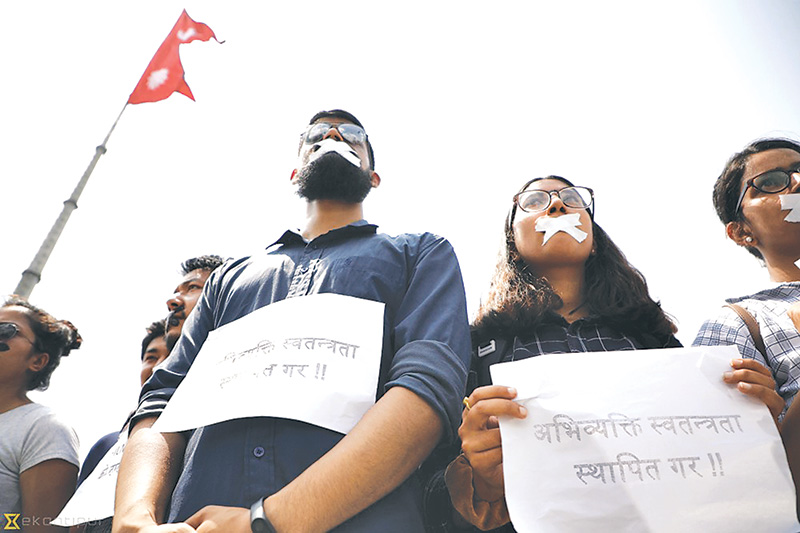
A strange thing is happening around me. A friend of mine, rather an acquaintance, Pranesh Gautam, has been in the custody of the Nepal Police for the past five days. He was arrested on cybercrime charges which, under its provisions, somehow happened to include making negative review videos of movies. I may be wrong, but not one other YouTuber in the entire 15-year history of YouTube has been arrested over a negative movie review that was posted on the website. YouTube has intolerance policies for abusive and derogatory contents, but removing such content and blocking access to the channel is the most that has been done against such videos. The man in question, Pranesh, is someone that I particularly do not have a liking for given the sexist and insulting tone he prefers to deliver his sets in. He has angered many females and males, even fellow comedians, due to his choice of words and use of the curtain of ‘comedy’ for saying things otherwise immensely inappropriate. This is a part of him that needs correction as a public figure and one that we believe he will fix soon, given his current circumstances. But the issue here is greater than whether or not he has a habit of using foul words or that he has used derogatory remarks in his work for as long as we can remember. The question here remains, and I am sure it is a baffling one to each one of us, whether his actions deserved the intensity of consequences that he is facing. Can making a movie review—albeit one full of derogatory remarks and slur words—be so criminal an act that the person making it should be arrested and kept in custody for a week despite attempts of bail, and forced to entertain people in the police station by singing and making jokes when he is under such pressure? It is as clear as day that this is abuse of power in an attempt to show the younger generation how the system in Nepal operates. The director of the movie, also the initiator of the case, said that the review had led to loss of audience for the movie that was already three weeks into its release when the review was uploaded. Three weeks is a long time for any Nepali movie in the theaters, and there’s a doubt the review video could have made any drastic influence on its sales. He also added that he was going to take this chance to show all YouTubers of Nepal how using foul language and derogatory remarks against artists is unacceptable. Meaning that the film industry of Nepal is using Pranesh’s case as an example of how one should not speak against Nepali movies, regardless of how awful the film is. Minus the fact that the video had derogatory remarks about people whose sentiments were possibly hurt, the video was about how the movie was not that great. I have not watched the movie, and I do not know whether or not the movie sucks, but isn’t it a matter of subjective thought anyway? Who’s to say what makes me laugh must make all others laugh too? Pranesh simply stated what he felt about the movie, and is paying a rather wrongful and hefty price for that. Each and every one of us should take this personally. I, as an amateur writer, am particularly fearful of the thought that this is how freedom of expression will slowly be killed. Last year, 63 journalists around the world were killed for doing their job. Amidst rising violation of press freedom and freedom of expression, I hope Nepal does not have to join the list of nations that have compromised their right to keep in touch with reality for the sake of a few powerful authorities. I hope this agonising incident comes to an end for Pranesh and for all of us who are hanging on the edge, keeping our faith in Nepal’s judicial system intact. I hope he will be released soon, and if not, a revolution is always waiting to happen. I have spent my entire childhood watching adults being forced to rally in protest, and do not wish to spend my adulthood protesting for my basic rights. The rally for #freepranesh today was the first one I have ever participated in, and wish for it to be one of the last.
- PRAJITA GUPTA
Gupta is a freelance writer.
OPED
On sex and citizenship
The debate on citizenship goes from nationalist rhetoric to plain misogyny.
- SUBINA SHRESTHA
On May Day, I woke up with a message; an old-school mate of mine had died. I’d just reconnected with Smita, ten days before her death, after a fifteen-year interval. She’d been living in Denmark. As she got up to leave the restaurant where we’d met, I realised that her body could hardly support her. She’d been recovering from cancer and had just had her uterus and ovaries removed. Leaning against me, she said she’d come back home to get her daughter a passport. Smita probably knew that her end was near and despite, or perhaps because of, this she came home to get her 22-year-old daughter Michelle a valid passport. Michelle left Nepal with Smita in 2009. Her hand-written passport was phased out in 2015. Michelle should have had no problems getting a Nepali passport. Nepal’s Constitution says that ‘any person whose mother or father was a citizen of Nepal at the birth of such a person’, shall be entitled to Nepali citizenship by descent. Michelle was born in Nepal to a Nepali mother. However, her birth certificate said ‘father not identified.’ And Smita was unaware of a constitutional clause; for a Nepali mother to be able to pass on her citizenship to her child, she has to prove that the sperm comes from a man bearing a Nepali citizenship certificate. Nepal is one of the 27 countries that limits a woman’s ability to pass on their citizenship to their children, according to the Pew Research Center, joining the ranks of countries including Libya, Sudan and Iraq. The Nepali state wants to ensure that Nepali women marry and bear children of certified Nepali men if they want their children to be citizens. In Nepal, Women have fought for their reproductive rights for decades. Abortion became legal in 2002. But should a woman choose to have a child on her own, or should she be abandoned by the man who impregnated her, the only way out is a legal battle in the courts. As many as 5.2 million people, 18 percent of the population of Nepal, do not have citizenship documents. This seems to be a curious inversion of the recent reversal of abortion rights in several US states, but it’s actually part of the same issue. The issue is, who gets to decide how women have babies? On May Day, I found myself sitting with Michelle, who herself is now the mother of a toddler, in my house. Like many modern families, Michelle is an unmarried single mother. In Denmark, she was capable of taking care of her baby while putting herself through college. Michelle managed to take her mother to the hospital when she had breathing difficulties. When Smita died of cardiac failure, Michelle spent half the night navigating the strange city of her birth, with her dead mother and a toddler, trying to find a morgue. Yet nothing had prepared Michelle for what followed next. When she went to apply for a passport with her old passport and birth certificate, along with her mother’s passport and citizenship, she was told to get her own citizenship certificate. The District Administration Office, which distributes this document, told her to get a recommendation from the ward office, the smallest local unit. The men in the ward office, who knew Smita and knew Michelle when she was a child, told her that they wouldn’t write it. I tracked down the ward chairman, Nabin Manandhar, who said that there was no precedent for giving such a recommendation for the child of a Nepali mother. ‘If the chief district officer recommends us to write such a letter, we shall do it,’ he told me. ‘Citizenship through mothers should not be a problem,’ a senior politician told me. In February 2011, in a landmark case, Nepal’s Supreme Court granted citizenship to Sabina Damai, whose father was not identified. But bureaucrats do not see the Supreme Court’s ruling as a precedent. One official told me that Michelle could get her citizenship if she files a case against the state. ‘Her mother should have just married a Nepali man,’ another official said. Lawmakers and opinion makers, mostly high caste men in Nepal, have diverted the discussion on citizenship from an issue of equality and human rights to one of national sovereignty. Nepal shares a 1,800-kilometre border with India. People from the southern plains, known as Madhesis, have cultural and marital links to those across the border. So, by restricting the rights of Nepali women, policymakers argue, foreign men won’t infiltrate Nepal. This warped logic means that the children of Nepali men married to foreign women automatically become full Nepali citizens, but not if it’s the other way around. The children of such Nepali women with foreign fathers can apply to be ‘naturalised’ citizens. Naturalised citizenship is a discretionary document, not a right. The debate on the Citizenship Amendment Bill, which is currently before parliament, goes from nationalist rhetoric to plain misogyny. Lawmakers have argued that ‘rape cases will increase’ if (effectively fatherless) children from rape are given citizenship, and that women should not be trusted when they say that they do not know the identity of their children’s father. We managed to trace Michelle’s biological father. At the district administration office, it was proven that Michelle was a fully qualified Nepali. But there was another curveball. According to the officials, Michelle still could not be a citizen because she was the mother to a foreign child. It did not matter that she’s unmarried, an official explained: ‘Under Nepali norms, she’s considered married’. Therefore, he said, ‘if a Nepali woman, at the time of marriage, does not have a citizenship, she has to get it through her husband.’ In April 2007, the Supreme Court of Nepal ruled that ‘even married women have the right to acquire citizenship through the father or mother.’ But officials say they are waiting for the new Citizenship Act. Nepal’s first civil code, the Muluki Ain (1854) was based loosely on the first Hindu code, Manusmriti, written in about the 2nd Century BCE. It says, ‘Her father protects her in childhood, her husband protects her in youth and her son protects her in old age; a woman is never fit for independence’. The 2015 Constitution has not deviated far from it. But beyond the Hindu code, Michelle had to be more than a son. In the midst of the painful legal debacle, Michelle, along with Smita ’s sisters and I, went to collect Smita’s body from the morgue. When we went to the crematorium, it was Michelle who performed the horrendous task that every Hindu son is supposed to do. She lit the pyre and bid her mother a final goodbye. When she took Smita’s ashes to the river, she stayed brave. ‘Mummy always told me to bring her ashes to Nepal if she died abroad,’ she said. Such was her attachment to her motherland. The ward office refused to register Smita’s death as the applicant, Michelle, was a non-citizen. The Nepali bureaucrats, who would not help her get citizenship or a passport, helped Michelle get a travel document and sent her off back to Denmark, where Michelle has a half-brother and a step-father. Michelle is on a fast track to becoming stateless.
Shrestha is an award-winning journalist and a filmmaker. She was a 2017 Nieman fellow at Harvard.
OPED
Sex, the World Cup and breaking up the boys’ club
Great sport requires only three things: Excellence of skill, uncertainty of outcome and a crescendo of drama until the last second. Gender or sex is irrelevant.
In a soccer match last year, a ball tumbled aimlessly into the penalty area—almost like a confused pedestrian—about 13 yards from the goal. Two players, caught off guard by its awkward bounce, missed it. But it was seized upon and, just as quickly, thumped into the top corner of the net by a storming attacker’s foot—hit with such zip that it seemed the goalkeeper couldn’t see it, much less stop it. It’s the kind of goal you watch again and again, pressing replay on your phone. It’s the kind of skill that led the attacker who scored the goal, the American soccer star Lindsey Horan, to be among the first players nominated for the first women’s Ballon d’Or prize, the sport’s most prestigious annual award for best player, that for 61 years was only awarded to men. While Horan and other Ballon d’Or nominees compete for their nations at this summer’s World Cup, which began on the weekend, the winner of last year’s Ballon d’Or prize—the Norwegian Ada Hegerberg—will not be attending. Hegerberg has refused to play for her national team since 2017, in protest over what she sees as discriminatory treatment of the women’s team by the Norwegian football federation. The women receive fewer resources than the nation’s men, who rarely qualify for top competitions like the World Cup, but have plenty. There’s arguably more excitement for this Women’s World Cup than any before it. But the specter of the best player in women’s soccer not participating on its biggest stage looms large. A battle being jointly led by the Australian and American teams to equalize the $370 million gap in World Cup prize money is making headlines too, as the American women are also separately suing their national federation over “purposeful gender discrimination” based on continued pay gaps—despite years-long periods they point to in which the women’s team appeared to earn more for the national federation than the men’s. The collective effect has been a reigniting of perennial debates over the nature and reception of women’s sport. We’ve all heard the comments about women’s soccer, and women’s sport in general—and maybe we’ve even thought them ourselves: that it’s a poor, substitute version of the real thing. Though perhaps more quietly expressed than in previous decades, that sentiment is widespread; and it’s behind the gender parity disputes that have also resurfaced in tennis, golf and other sports over contracts, prize money and institutional support. Men, on balance, are indeed faster and stronger than women. The physiological differences between the sexes are why sports are generally sex segregated in the first place. But often overlooked in these classroom and barroom debates are facts that many average Joes don’t like to admit: The top female sprinters and distance runners would easily outpace the vast majority of men; the top female soccer players would run rings around many male sides; and so on. Some fixate on the statistics that show the gap between the sexes at the elite level of most sports to be indisputable. Sure. But does that make women’s sport unworthy or unwatchable? Of course not. Just as any given match in men’s sport can be mind-numbingly boring, women’s sport can be just as heart-stopping as the very best men can offer: This year the National Football League’s Super Bowl finished 13-3—an absolute snoozer (with only one underwhelming touchdown), widely panned, despite its designation as the manliest of manly sports in the United States. Great sport requires only three things: excellence of skill, uncertainty of outcome, and a crescendo of drama that isn’t relinquished until the last second. A battle where players and fans are on edge, mettles are tested, and the game flows in favor of one opponent, then the other, then—depending on who you’re cheering for—back to the other side’s favor again. Those are the kinds of games we hunger to see and the ones that enter into the history books: Whether they’re played by men or women is neither here nor there. The semifinal between Serena Williams and Justine Henin in the 2003 French Open was as nail-biting a drama as any face-off between Roger Federer and Rafael Nadal has been at that same tournament. And the 1999 Women’s World Cup final at the Rose Bowl in California, in front of more than 90,000 fans, was electric: The American hosts defeating China thanks to a tournament-winning penalty kick by Brandi Chastain, who famously ripped off her kit’s top in celebration—landing her on the cover of news and sports magazines around the globe. Those are two remarkable moments among hundreds. Even so, women’s sport has had a poor rap, to put it gently. And lovers of sport fail to adequately account for the fact that women were denied professional, and even amateur, participation in sport for centuries. And when they did begin to participate, they were chastised for being unladylike or were officially banned. In the early 20th century, tens of thousands of people would turn up to watch women play soccer in England, after they filled the gap in sporting entertainment when most eligible men were abroad fighting in World War I. Then the nation’s official governing body, the Football Association, ruled that soccer wasn’t suitable for women. Almost overnight, women’s soccer was outlawed. The ban—and there were dozens like it across the world—wasn’t overturned until the 1970s. Title IX reforms in the United States didn’t come until then either. (Professional contracts are a recent phenomenon in even the top women’s soccer leagues.) If you keep in mind that women have rarely received any livable pay for playing professionally—and that many still pay to play as girls in countries where boys’ leagues are free—then it isn’t strange that the general standard of play does not match that of men. And that’s without accounting for the ambient forces that prevent girls from being fully engaged in sport as they grow up. There’s the oppressive pressure of gender roles as well as explicit exclusion: My 7-year-old niece recently told me she wanted to play soccer in the playground at school, but she was informed by the boys that she couldn’t—because she was a girl. In 2019! It’s unsurprising that our expectations for women’s sports are low. It’s more surprising, in light of pervasive sexism, that so many women’s sports are as objectively great as they are. Great without the fully funded systems, infrastructure and contracts that make the endless hours of youth training worth the return on investment. We should admire—not dismiss—the quality on display at this Women’s World Cup as well as the excellence of women in basketball, cricket, volleyball, track and field and much more. Advocates of women’s sport rightly argue that they are impressive precisely because of women’s relative lack of upper body strength: If you’re unable to muscle your way to victory, you have to think of alternative ways to get there. Because of this, women’s sport is often more interesting. I prefer watching Naomi Osaka’s finesse to Novak Djokovic’s more brute power. And soccer is soporific when it’s dominated by the shortcut of long balls slapped diagonally down the field. Tellingly, fans and broadcasters of male leagues find themselves lauding the femininelike grace of players such as Stephen Curry and Lionel Messi—whooping at how their studied elegance can outwit their bigger, more flat-footed opponents. Another notch in favor of professional women’s sports is that they provide a much more family-friendly environment. If you’ve ever had the experience of being at a men’s football game in Europe, you are well aware of the febrile atmosphere, the potential for violence. This summer’s Women’s World Cup is expected to be the most profitable ever, which shows that the sexist dynamics and old mindsets are slowly improving. But turning welcome change into greater equity will also need the men in gray suits, who still run all sports, to realize that women deserve more. FIFA announced a new agreement this month to promote women’s empowerment in soccer. It doesn’t even directly address pay parity. For now, the debacle of women’s mistreatment is likely to be temporarily forgotten—for 90 minutes at a time, at least—as the on-field drama kicks off. The upsets, triumphs and tears, while players like the Americans Alex Morgan and Lindsay Horan, the Brazilian maestro Marta and the Dutch sensation Vivianne Miedema scintillate audiences. Millions will be watching in the stadiums of France, at friends’ homes, in bars or quietly in their workplaces. Let’s hope a critical mass of those watching skeptically become new converts. Fans who recognize the beauty, and the badass, of the women’s game, too.
Bir Bikram 2 is sexist, poorly plotted and includes crudely drawn characters
Director Milan Chams wants to teach comedian Pranesh Gautam a lesson, but if Bir Bikram 2 is anything to go by, it is perhaps Chams who needs a lesson in respecting women
- ABHIMANYU DIXIT
At the time of writing this review, Pranesh Gautam, a comedian who posted a video review of the movie Bir Bikram 2 on Youtube, is behind bars, as the Kathmandu District Court has increased his judicial remand by two more days. Gautam, who used absurd humour and a few swear words to convey his disapproval of the movie, has been charged under the Electronic Transaction Act. After carefully watching both Gautam’s review online and the full movie, it is hard not to draw one conclusion: Gautam is on point. In Bir Bikram 2, directed by Milam Chams, the excessive amount of drone shots or characters who are unnecessarily loud (read: screaming) add nothing to the movie. In fact, Gautam was being generous, comparing the film to the Indian classic Sholay (1975), even though the latter was a much better film. You’re drawn to the lovable characters of Jay (Amitabh Bachchan) and Veeru (Dharmendra), and care about what happens to them. In Bir Bikram 2, the only emotion you feel for the leads is annoyance—you never really care for any of them. Sholay devotes it’s time building Jay and Veeru as thugs who have a human side to them. But the lead characters in Bir Bikram 2—Bir (Paul Shah) and Bikram (Najir Husen)—are bikers with little substance. In their introduction, they ride into the village they grew up in and we learn that they’re best friends because of exposition—we never really learn what they do; their likes or dislikes; and to top it off, they’re not even bikers, as there’s only a single, solitary scene with their bikes. (Side-note: if you watch the bike scene carefully, you’ll notice that there are two light stands left in the shot.) But back to the comparison with Sholay. Bir Bikram 2’s writer Pradeep Bharadwaj and director Milan Chams appear to have loved the coin toss trope in the Bollywood blockbuster so much that they’ve weaved the opening, an entire interval, and a huge character turning point around it. We really must applaud their creativity.
The film is about Bir and Bikram, two best friends who are both in love with Badal (Barsha Siwakoti). Badal washes the dust off their bikes and that’s when both men fall in love. A slow-motion hair flip really completes this scene. After some repetitive scenes forcing the point that both Bir and Bikram have fallen madly for Badal, we are introduced to Baag Bahadur (Buddhi Tamang). And to no one’s surprise, he too is in love with Badal. Baag Bahadur creates friction between the friends and kidnaps Badal when everyone is distracted. In his review, Gautam says that Najir Husen has a good role. But here’s the truth: Husen has definitely played better roles than this in his career. Husen’s Bikram is one of the most poorly crafted characters in the film. Bikram is so dumb that he trusts a stranger and picks a fight with his best friend, their history be damned. The stupidity doesn’t end there. He somehow becomes best friends with his mortal enemy, Baag Bahadur, whom he’d sworn to defeat just a few scenes prior. As justification for this change of character, a random man ‘narrates’ that Bikram is “someone who will do anything for a friend”. This, besides convenient plot points, is writer Bharadwaj’s formula to introduce character traits—tell, don’t show. Chams, the director of the film, took issue with Gautam because of his video review. He has accused Gautam of racism and personal attacks. Many filmmakers have also supported Chams in his endeavour to “teach them [reviewers, YouTube comedians] a lesson”. And, herein lies the hypocrisy. How often does Nepali commercial cinema portray racism, blatant sexism, misogyny, and homophobia? Nepali film audiences are the ones who should be taking offense. Even in Bir Bikram 2, both the male leads take sneaky pictures of Barsha Siwakoti’s character without her knowledge. Is this acceptable behaviour? In one scene, a character blatantly says “Budi ko fariya ho ra chyatna lai?” (Am I your wife’s skirt to tear?). How’s that not sexist? Maybe it’s the filmmakers who need a lesson on respecting women. Barsha Siwakoti herself should have been offended by her character at the script reading. At first, her character Badal is shown as this strong, independent woman who fights off a whole village with a sword because they accuse her mother of being a witch. She even slaps Bir on one occasion, saying “Samaan hun ma?” (Am I an object?) Then, in the second act, her character flips and she falls in love with the same person. And as the film progresses, she becomes this damsel-in-distress who waits for men to solve all her problems—whether it is selling her house or releasing her father from jail. She does nothing to make anything happen in the film. In the third act, Badal is degraded even more when she is kidnapped by Baag Bahadur. Her hands and legs are both cut up, her vocal cords damaged, and clothes torn. She spends the entire climax lying down, not able to shout or move. The imagery is that of a sexual assault victim, and it is absolutely degrading to any self-respecting woman watching the scene. But wait, there’s more. In the epilogue, she forgives Baag Bahadur for all his wrongdoings because women are supposed to be all-forgiving goddesses who have to take every injustice they’re put through. There’s glory in sacrifice and standing up for yourself is for the male lead. Since he’s been detained, Gautam has apologised and removed the video from YouTube. So it would only be fair for Chams to apologise for disrespecting his female characters. The things Gautam said in his review of this absurd film might be offensive to some, but a 24-year-old architect shouldn’t have a police record courtesy of a film review. Chams could have dealt with Gautam in a more creative, solution-oriented approach. He could’ve written an article in reply, given an interview, or even made a video of his own in reply. If a film is ‘intellectual property’, why isn’t a visual or written review the same? A filmmaker uses the cinema to portray the state of society. Likewise, the film critic portrays the state of the film industry. If we’re going to send each other to jail for expressing our views, then filmmakers too should take note because the audience finds many, many Nepali films offensive. What Chams has done is shut down—even if briefly—the potential of cinema criticism. What kind of a culture will we foster if people have to risk going to jail for criticising art?
CULTURE & ARTS
A Nepali drag show, with an American touch
‘We want to give the Nepali community the space to figure out what drag means for them.’
post photo: Chase Brush
Kathmandu : Jacob Johnston sat on a couch in Pink Tiffany, his head patiently tilted as a make-up artist brushed his cheekbones with a light bronzer. The 25-year-old, who normally dresses in men’s clothing, was donning the opposite gender’s for the first time—he was in drag. “I’ve always wanted to try it,” Johnston, a US resident currently volunteering in Nepal, told the Post. “But I never had the invite.” Johnston was one of several participants in the drag show—in which cross-dressing drag artists conduct elaborate performances in front of a live audience—held at Pink Tiffany in Thamel. Dubbed “Dragmandu,” the event was the first of its kind in Nepal, according to organisers who heralded it as an important moment for queer culture in the country. “It’s June, which is Pride Month,” said Meghna Lama, a 25-year-old transgender model, activist, and owner of Pink Tiffany, Nepal’s first openly LGBTIQ-friendly restaurant and bar. “And we have never had this kind of event in Nepal, so we decided to have it.” The event, which drew, over the course of the night, upwards of a hundred people to the cramped space on the second-floor of a building in Thamel, began with Johnston and others putting on make-up and women’s clothing. Eventually, they took to the stage, where they danced and lip-synced to pop songs as the audience cheered them on. Noah Emerson, another volunteer from the US, said he proposed the idea of hosting a drag show to Lama, but was surprised to find so many people turn up for it. He also called it a significant event for the LGBTIQ culture in Nepal, where gay and transgender individuals often face discrimination. “But we want to stress that we’re not a good representation of American drag queens,” Emerson, who identifies as bisexual, added. “We want to give the Nepali community the space to figure out what drag means for them.”
-Chase Brush
Food & Travel
The morning fry-up
Breakfast isn’t a meal in Kathmandu, traditionally speaking, it’s snack-time—tea and fried dough take precedence in the mornings.
- Thomas Heaton
Malpuwa, gwaramari and sel roti are fried morning staples around Kathmandu streets and alleys.Post Photos: thomas heaton
Picking through fried gwara mari as the cook drops more onto the platter, early morning eaters around Patan look for the crispiest morsels to take back home to their families. With the fried dough wrapped in newspaper and stuffed into small red or blue plastic bags, these blurry-eyed folk are still waking up as they walk home. Others sit inside the smokey shops, looking into the distance over their cups of tea. It’s a familiar scene in all corners of Kathmandu Valley, as the cities wake up early, and slowly. In a typical Nepali breakfast there is no morning bacon or eggs, no bowls of muesli and there is definitely no peanut butter on toast, rather a cup of tea takes priority. This is because Nepal doesn’t traditionally follow a three-meal-a-day schedule. Classically the first meal of the day is in mid-morning. The morning ritual rather revolves around freshly boiled and brewed chiya, with or without milk, with enough sugar to kickstart anyone’s heart. While tea is the cockle-warmer of choice is these days, just a few generations ago people might have been seen taking a few pegs of aila as their morning elixir. Most tea shops around the Valley have their own blend of chiya, some using cardamom or their own masala, and it is almost obligatory that some dunkable goods are on offer. Packaged pastries, doughnuts and cookies can be found in most tea shops, but it is worth seeking those serving freshly fried dough. On top of that, opting for two meals mainly consisting hefty plates of dal bhat constitutes enough carbohydrates to power any soul for 24 hours; western breakfast studies be damned. In Patan, one of many Newar cuisine hubs, gwara mari dough balls are most prevalent, found alongside typically Newar jeri-swari and malpuwa, accompanied by sel roti—a not-so Newar snack that has found its way to Newar households. ‘Gwara’ translates as round, while ‘mari’ means bread in Nepal Basa, so it makes no specific promises; it is sometimes spiced with coriander, cumin or turmeric, or a combination of all three, and fried in a pool of simmering oil.
Hard to find after 9am, fry cooks sell these morning specific dough balls by the dozen. Gwara mari might resemble gnarly Yorkshire puddings for some, maybe fried bread for others, and one could probably classify them as a doughnut. Less vapid than doughnuts however, gwara maris are filling and without a doubt have enough sustenance for the wait until mid-morning. It’s best not to forget about the doughnut—pronounced “doo-nut”—which is also an extremely popular and more available morning bite. There are specific doughnut spots tucked into little shops around the valley, but many are sold at tea shops from the packet. Alongside the endlessly replenished platters of gwara mari, one can find sel roti. These sweet rings of fried dough may look like the doughnut’s gaunt cousin, but their make-up is something quite different. The use of pounded rice and rice flour lends a glutinous interior and course exterior to the rings. It’s easy to spot people making them too, either by the high stacks of sel roti or by the way in which they are made—in a specific kadai with a raised centre, poured out of a cup with a small hole in the bottom. They are, despite being associated with special occasions, omnipresent in the Valley—not just in Patan—and are imbued with different spice combinations. Then there’s jeri, familiar for those who have had Indian jalebi, which resembles the wire mandalas hawked around Thamel. Steeped in sugar syrup after frying, the sturdy dough gives way to gushing saccharine wave when chewed. While many might sandwich them in swari—fried, thin puris made from flour—to make a sort of jeri taco, they’re more than enough by themselves. Finally, there are malpuwas, sweet and stodgy fried pancakes. Akin to a lumpy pillow with starched corners, the discs of batter’s edges are crispy while pockets of air fill the bready stodge inside.
It’s not just oil that bubbles early however, pressure cookers start hissing as the sun rises too. Many small shops will start selling early. Their mustard-coloured jhol tarkari, laden with legumes and potatoes; chana tarkari, sticky and stodgy black chickpeas cooked in spices and served with fresh red onion and coriander; and boiled and fried potatoes, mixed with a highlighter yellow mix of turmeric and other spices, lie waiting for ahead of the mid-morning rush. These are already prime for the taking, and can be found city-wide—not just in Patan. While breakfast is not the most important meal of the day, or traditionally even a meal, the food available is enough to make one want to wake up for. Piping hot chiya paired with steaming oil-fried dough, sweet or savoury, is a great way to tide oneself over until the morning’s main meal.
Food & Travel
What to do after your trek
Twenty-four hours is not enough time to witness what Kathmandu truly has to offer, but here’s how you can try
A stroll around the Bouddhanath stupa can be a soothing experience—it is one of the places that shouldn’t be missed. Post file Photo
Kathmandu is the start and end of the journey for many tourists visiting Nepal. With eight of the tallest mountain peaks in the world, breathtaking scenery, and numerous temples and monasteries, this country attracts pilgrims and trekkers alike. However, coming back from a trek can be daunting. The excitement and thrill of the adventure will have ended, leaving you tired and exhausted. You might feel discouraged from heading out into the pollution, crowds and the constant honking of vehicles. Instead of spending your last day in Kathmandu sleeping, go witness the diverse cultures and lifestyles this city has to offer. Start your last day in Boudha with a short walk. Taking a stroll around the Tibetan-Buddhist stupa, listed as a UNESCO world heritage site, can be a perfect start to the day. The largest stupa in Kathmandu Valley, and one of the largest in South Asia, was inspired by the mandala design of Pelkor Chode monastery in Gyangtse, Tibet, according to Discover Nepal, an official travel website hosted by Nepal Tourism Board. Around this stupa, you can find numerous cafes, shops, and restaurants. Here you can light butter lamps, walk around the stupa, and have a light breakfast in a rooftop restaurant. Himalayan Java is a popular coffee place, with views overlooking the sacred spot. During your stroll, you will have a chance to look around and pick souvenirs that you would like to take home. After having a light breakfast, head towards a spa to get rid of the aches from your time on the trails. Trekking can leave your muscles cramped and sore, especially in your legs and back. Getting a massage can help ease the pain, release muscle tensions and soothe sore legs. Wait for at least an hour after eating to get a massage. It is crucial to hydrate yourself before and after your session to get the best results. Heritage Spa located in Basundhara is a good spot to get a specialised package for trekkers. This package includes a body scrub, a massage, pedicure and a facial for only Rs 6,200. Make sure you book an appointment in advance. Besides Heritage Garden, Nectar Spa, located in Thamel, has a massage made for hikers for Rs 7,780. This Wellness and Yoga centre is also known to provide great services making you feel rejuvenated and relaxed. The three-hour trekkers’ package will make you hungry. Head to Le Sherpa, Mahargunj for brunch. The fine-dining is worth your time. If you are there on a Saturday, be sure to check out the Farmers’ Market where you can find a variety of organic products from vegetables and fruit to organically produced European cheese. This restaurant, filling an acre of land, is known for its excellent food and service. Showcasing locally produced coffee, food and crafts, this restaurant aims to promote quality Nepali goods. If, however, you want to try authentic Newari food, a traditional meal for the inhabitants of Kathmandu, head towards Bhojan Ghriha. This place serves mouth-watering local cuisine in a 150-year old building with folk dance performances and Nepali music. Be sure to try out the vegetable pakoda—a deep-fried snack, favourite among Nepalis. After brunch, head towards Garden of Dreams in Thamel. This park is an escape from the city inside the city and is one of the few green spaces here. Inside a former Rana-dynasty palace, you can relax with a book, browse through the small photo gallery, where you can learn about the park’s renovations, or check out the museum. Families, tourists, friends and couples come here to hang out and enjoy the view. Your hike around different mountain trails during your stay here has probably limited your meal options. So take advantage of the cuisine Kathmandu has to offer. While you might want to unwind with an easy dinner, it’s certainly best to finish by heading out for your last dinner in Nepal. Have your last Nepali thali at Thakali Kitchen in Jawalakhel. Unlike, the regular dal-bhat-tarkari (rice-lentils-vegetables) Thakali Thali has the authentic flavours of ethnic Nepali food, making it taste different. This Thakali thali consists of 11 different Nepali dishes such as rice, vegetables, saag (greens) and gundruk (fermented greens)—it will leave you savouring every spoonful. This dimly lit restaurant’s décor and homely food will make you feel welcome. Since this eatery is popular among both Nepalis and tourists, make sure to book a table in advance. If you want to have a taste of American food, Southern Comfort is a great option. This restaurant is known for its delicious food and greats services. Located in Jhamsikhel, this restaurant has a comfortable lodging and a piano which you can play. If you want to call it a night, do so, or head out for some drinks to celebrate the end of your trip. Visit Jhamsikhel, Thamel or Durbar Marg to go bar-hopping. A popular spot is Sam’s Bar in Thamel, a place known to be a crowd-pleaser with friendly staff and eccentric décor—the walls are full of graffiti from past travellers and the open-air patio is a great place to unwind. Another popular drinking spot is Irish Pub, located in Lazimpat. By the end of the night, you will have come to realise Kathmandu is a melting-pot for Nepali people from different backgrounds, castes and cultures. The diversity seen in the valley provides a glimpse of the different lifestyles from the mountains to the flatlands of Nepal. Spending 24-hours is not enough to witness what Kathmandu truly has to offer, but it’s better than nothing.
- Diya Rijal
Variety
Horoscope
ARIES (March 21-April 19) *** Not everyone needs to be aware of your intellect. It’s okay to let people underestimate your skills. When the time is right, you can save the day with your brilliance. The drama of such a strategy cannot be overvalued.
TAURUS (April 20-May 20) **** Today do not be shy to show your affection for someone else. Words are important, but it’s the tender little gestures of affection-the hugs, the hand-holding, and even the shoulder squeeze-that confirm personal connections.
GEMINI (May 21-June 21) ** Some of your inner thoughts are leaking out into your actions right now without, and you’re probably not realizing it. Make an effort to clarify your stance on an issue otherwise it could be misread. Face up to what you’ve been putting off.
CANCER (June 22-July 22) **** Today, try to appreciate all the little things that make life so special. The goofy laugh of a friend, smile of your loved ones or the odd expressions your co-worker uses to boost team morale. Soak them in, because they’re the real substance of life.
LEO (July 23-August 22) *** It’s good to be aware of the reality of your financial situation. In this way you’ll be better prepared. However your desire to be thriftier or more conservative isn’t a panic-based reaction to a shortage of funds. Listen to your gut.
VIRGO (August 23-September 22) *** Helping others today will take you a long way tomorrow so try to free up time and give priority to someone’s needs. Take the initiative and talk to shy people who don’t know how to approach you, that extra effort will be worthwhile.
LIBRA (September 23-October 22) *** If you’ve been meaning to confess something to someone, do it today. Open up and admit what you’re doing or what you’re feeling. There will be no grudges held instead it will create a new beginning for you and your relationship.
SCORPIO (October 23-November 21) **** You are in a contemplative phase. Utilize your organizational skills to create a peaceful, creative calm out of the chaos that is swirling around. There’s nothing like starting the day with a mess and ending the day with a neat and orderly plan.
SAGITTARIUS (November 22-December 21) ** A friend experiencing relationship problem may reach out for your help. Hold back and let your friend handle it and learn the lesson. It’s an issue that you aren’t fully aware of which needs to be taken care of without your involvement.
CAPRICORN (December 22-January 19) *** Today, an intriguing development pops up. This situation requires you to do a little more research to find out how you can actually get involved. Keep your afternoon schedule free. An invitation could arrive and you will want to accept it.
AQUARIUS (January 20-February 18) ** Prioritise your emotional health along with your physical health. Locking away your negative feelings is just as bad for you as that pint of ice cream, if not worse. Exercising your heart is just as vital as exercising your other muscles.
PISCES (February 19-March 20) *** Be more compassionate to yourself. It’s healthy to be realistic and have goals, but it’s not healthy to keep beating yourself up and holding yourself to impossible standards. Cut yourself some slack and realize that you are a rock star.
Variety
Films
3D: The Secret Life of Pets 2 QFX LABIM Mall: 09:00/17:45 QFX Chhaya Center: 12:00/15:00 QFX Civil Mall: 14:30
3D Men in Black: International QFX Civil Mall: 08:45/11:30/20:15 QFX LABIM Mall: 09:15/14:15/17:00 QFX Chhaya Center: 12:15/18:30/20:00 QFX Kumari: 08:45/15:15
England take on the West Indies in Southampton on Friday
- AGENCE FRANCE-PRESSE
England’s Chris Woakes (left) and Mark Wood (right) during a training session in Southampton on Thursday ahead of their World Cup match against the West Indies.Reuters
SOUTHAMPTON : England fast bowler Mark Wood could miss the World Cup match against the West Indies in Southampton on Friday following a recurrence of his longstanding ankle problems. Wood suffered discomfort in his left ankle after England’s win over Bangladesh in Cardiff on Saturday, when the Durham quick recorded the fastest delivery of the tournament so far at 153.9-kmh. The 29-year-old, who revived his England career with some fiery spells during this year’s tour of the West Indies, has undergone three major operations on his ankle. He experienced further problems on the eve of the World Cup, pulling out of a warm-up game against Australia. England captain Eoin Morgan said Wood’s latest injury problem did not mean he was facing the end of his World Cup. “It’s nothing too serious, he just pulled up a little bit sore from the game in Cardiff—he’s the only concern at the moment,” Morgan said on Thursday. “Mark is going to have a fitness test in the morning. If it is still sore, we probably won’t take a risk.” Morgan said all teams at the World Cup would need to look after their quicks in particular. “It’s part of the plan, because they are fast bowlers. It will happen to other bowlers throughout the tournament,” he said. “We’re well aware of that. We will have to manage them as we would normally, as we do with Chris Woakes if there’s back-to-back games,” Morgan added. “It’s not a problem, it’s just what happens.” Wood’s place could go to Moeen Ali, who did not play against Bangladesh, should England again decide to play a second specialist spinner alongside leg-break bowler Adil Rashid. Moeen’s wife gave birth to a daughter on Wednesday but the off-spinner was back with the England squad on Thursday. Morgan confirmed that the big-hitting Jos Buttler had been cleared to play, and keep wicket, after sitting out the Bangladesh innings with a right hip problem. Buttler hurt his right hip while batting against Bangladesh, hobbling for the remainder of his knock and passing on wicketkeeping duties to Jonny Bairstow. Friday’s game will mark a first outing for Barbados-born Jofra Archer against a West Indies side containing several of his Caribbean friends and peers. The 24-year-old suggested at the weekend he would be treating the game like any other, but Bayliss believes it would only be normal if the stakes were slightly elevated. Archer was offered a chance to make it in English county cricket after being overlooked for the West Indies Under-19 World Cup squad in 2015 and a late bid to bring him back into the fold failed after E ngland’s interest became clear. “He’s looking forward to it, obviously knows a few guys in their team,” said England head coach Trevor Bayliss. “It’s always bragging rights. Both sides of the argument would like to gain the upper hand in that argument. Let’s wait and see. It will be the first time he has come up against those guys, but I am sure he is wishing to do well. I am not sure he could be any more confident—he is a confident young man who has fitted into the group very well. He is a typical young fast bowler. He wants to bowl fast, he wants to take wickets and that has to be a good thing for England.”
SPORTS
Rain washes out India-New Zealand game
NOTTINGHAM: India and New Zealand were awarded a point each after persistent rain in Nottingham forced the abandonment of their World Cup match without a ball being bowled on Thursday. After several inspections the umpires finally called the game off at 3:00 pm local time. It was the fourth match of the 50-over showpiece event that has been ruined by bad weather. The International Cricket Council has faced criticism over the lack of reserve days. New Zealand, who have won all three of their completed games, and two-time champions India, with two wins and a washout, remain the only two unbeaten sides in the 10-team tournament. (AFP)
SPORTS
ICC wants commentators to be fair after Holding remarks
- REUTERS
NOTTINGHAM : The International Cricket Council (ICC) wants commentators at the World Cup to be fair in their observations and has denied censoring West Indies great Michael Holding for criticising match officials on air last week. The Caribbean great was aghast at the string of umpiring errors during the West Indies-Australia match at Trent Bridge and termed the standard of officiating ‘atrocious’. According to a Times of India report, Holding’s outburst prompted a letter from ICC’s production partner asking the 65-year-old to tone down his criticism on air. The report said Holding, a former pace great and a respected TV pundit, has replied to that mail saying he did not intent to “go down that road”. “We have no intention of censoring anyone,” a source in the ICC, who declined to be named, said. “We have only requested them to be fair in their comment. We want different views, that’s why we have former players in our commentary panel.” The issue has since been sorted out and Holding will continue commentating, the source added. In the match at Trent Bridge, West Indies opener Chris Gayle received two reprieves on review after being given out on both occasions. He was unlucky to be dismissed leg before wicket to a Mitchell Starc delivery which should have been a free-hit but the umpires missed the front-foot no ball. Later in the match, West Indies skipper Jason Holder successfully reviewed two leg-before decisions and got both overturned. Holder later said it was “ironic” to be at the receiving end of the umpiring howlers. “I guess honest mistakes from the umpires, I don’t want to get into the officiating part, but it’s just ironic,” the allrounder said after his team’s defeat. “I don’t even know what to say about it, but it is a funny situation where all of them went against us, and then we had to review them, but I guess that’s part of the game again.”
SPORTS
Warner’s comeback century a welcome change
The opener and Smith were banned for a year and Bancroft for nine months for their roles in ball-tampering
- ASSOCIATED PRESS
Australia’s David Warner poses for a photo with fans after their match against Pakistan on Wednesday.Reuters
TAUNTON : Crowds booing. Chants of “Cheat, cheat, cheat!” It became the background noise at the World Cup for David Warner, something he expected in England in the wake of a 12-month ban from the Australian team for his involvement in a ball-tampering saga last year. He’s been methodically walking the road to redemption with the Australian cricket public, which was rocked by the cheating scandal, but in hostile territory he needed to let his cricket do the talking. Even when he was scoring runshe’d scored two half-centuries in Australia’s first three games at the tournamentcritics questioned why he wasn’t scoring quickly. So when Warner squeezed a shot between wicketkeeper and slip in the 36th over of Wednesday’s game against Pakistan to post his first century for Australia since December 2017, he sprinted up the pitch with his helmet in one hand and his bat in the other and leaped in the air to celebrate. He scored his hundred from 102 balls, stroking 11 boundaries and a six, but was out soon after for 107, a good proportion of the Australia’s total of 307. Warner was actually applauded as he left the field at Somerset’s County Ground. Pakistan captain Sarfaraz Ahmed said before the game that the Pakistani people wouldn’t boo the Australians because they loved cricket and respected the players. It turns out, he was right. Of course, there was raucous cheering in Australia’s dressing room for Warner, Australia’s vice-captain Pat Cummins noted after the defending champions finished off their 41-run win over Pakistan. They were so proud, Cummins said of the Aussie squad, after the tumultuous 15 months for Warner and for his family. “Going through those tough times and sort of regrouping with myself to put myself in the best position to come back to international cricket, I did everything I could,” Warner said. “Really, really knuckled down and trained my backside off. And I’m just grateful for this opportunity. We’ve got a great sort of group harmony, a lot of smiles on the faces as you can see in a lot of the training sessions and out in the field. So, look, I’m pumped.” Warner and former skipper Steve Smith were banned for a year and Cameron Bancroft for nine months amid massive backlash in Australia for their roles in a clumsy plot to change the condition of the ball in a Test match in South Africa by rubbing it with sandpaper. Bancroft was caught in the act by South African broadcasters. It later emerged that he and Warner hatched the plan, and Smith didn’t do enough to stop it. Cricket Australia dished out the harshest penalties ever imposed for ball-tampering. It cost Smith and Warner millions of dollars in salary and endorsements, and their positions as leaders of the revered national cricket team. There were tearful news conferences on their returns to Australia after the scandal broke in March last year. That was the last time Warner really faced a news conferenceuntil Wednesday. Smith and Warner, both recalled in time for the World Cup, haven’t exactly been front-and-centre in public appearances for the team. Now a year older, with a beard, and with his wife due to have their third child any week, Warner couldn’t conceal his satisfaction with his milestone innings. It was only a matter of hours before he was due to reunite with his wife, Candice, and two daughters as the Australian players headed back to London to gather with their families again. “I was always coming back to international cricket if selectedthe thing that kept me going was my wife and my kids,” Warner said. “Got great support at home, my family. And my wife is just, she’s just my rock. She’s unbelievable. She’s determined, disciplined, selfless. And I hold a lot of credit to her. She’s a strong woman. She got me out of bed a lot in those first 12 weeks, and got me back running and training hard as I could.” An often abrasive character who’d had the odd run-in with rivals, fans, and cricket authorities in an international career that commenced in 2009, Warner was never popular with crowds when Australia toured abroad. He reckons the booing is “water off a duck’s back,” and something “I’ve heard my whole career... makes us knuckle down and try to score more runs if anything.” Warner isn’t expecting the booing to stop. But he’s not playing for anyone who doesn’t support his team. “As I’ve said before, I’m just really looking forward to what’s coming ahead of us here in the World Cup,” Warner said. “Pumped to be back, and the boys are on fire here.”
SPORTS
Neymar saga overshadows Copa America start
Coach Tite insists Brazil are still in fine fettle ahead of the tournament, which they haven’t won since 2007
- AGENCE FRANCE-PRESSE
Brazil goalkeeper Alisson during a training session at the Pacaembu Stadium in Sao Paulo, Brazil, on Tuesday.AFP/RSS
RIO DE JANEIRO : Brazil should have been gearing up for another major home sporting spectacle with renewed optimism that star forward Neymar would help bring to an end a 12-year trophy drought. But instead, the Selecao’s golden boy is dominating the build-up to a tournament he will miss due to an ankle injury for all the wrong reasons. Neymar is embroiled in a rape scandal in which he has been accused of forcing himself on a model he met through social media in a hotel room in the French capital, where he plys his club trade for Paris Saint-Germain. It’s tarnished the festive atmosphere of South America’s footballing showpiece with an ugly affair that shows no sign of going away, despite Najila Trindade Mendes de Souza’s rapidly unraveling case. It all blew up on June 2 when Neymar published a seven-minute video on Instagram, where he had first been in contact with Trindade, revealing that he had been accused of rape. The scandal quickly snowballed and three days later, after a senior Brazilian federation official had said he would “bet” that Neymar would pull out of the Copa, the PSG forward injured ankle ligaments in a 2-0 friendly victory over tournament invitees Qatar. Even so, Brazil’s ability to concentrate on the task at hand has been hampered by the Neymar rape soap opera. After the debacle of Brazil’s 7-1 semi-final humbling at the hands of Germany in their home World Cup five years ago, and the fall out from the huge amount of money wasted on hosting both the global football showpiece and the Olympics in the space of two years, the country could have done without such a sordid affair. Coach Tite insists that Brazil are still in fine fettle ahead of the tournament, which they haven’t won since 2007 when a team inspired by former Real Madrid and AC Milan forward Robinho outclassed Lionel Messi’s Argentina 3-0 in the final. Tite admitted Neymar would be missed, saying “it’s a shame to not have one of the three best players in the world.” “After Messi and Cristiano Ronaldo, he’s comparable only to (Eden) Hazard, with one advantage: he’s quicker. That’s the player we’re missing,” said Tite last week. But he said that rather than reflect on what they’re missing, “inside the squad we’re much more focussed on working hard, training well, preparing for matches, which has been our main focus.” The Selecao’s last warm-up match was a 7-0 thrashing of 10-man Honduras in which Neymar’s absence certainly wasn’t felt, with his substitute David Neres scoring in the rout. Manchester City forward Gabriel Jesus and Liverpool’s Roberto Firmino also got in amongst the goals while Everton’s Richarlison provided several assists. “We’re in good shape, confident, because we played well in both friendlies,” Jesus told Sport TV. The hosts open the tournament in Sao Paulo on Friday against Bolivia, winners on home soil in 1963. With Neymar out, the tournament’s biggest star will be Messi, who at 31 is running out of time to finally land a major international honor with Argentina. He has been on the losing side in three finals, including the last two against Chile, and the 2014 World Cup in Brazil when Germany triumphed. They warmed up for the tournament in similar style to Brazil, thumping Nicaragua 5-1 in a friendly with Messi, recently named the world’s highest paid sportsman, bagging a brace. Two-time reigning champions Chile, who beat Argentina on penalties in 2015 and the one-off Centenario tournament in the United States in 2016, will have their work cut out to claim a hat-trick of titles. Star forward Alexis Sanchez, known as the “Nino Maravilla” or wonder kid, at home has been in poor form for the last 18 months since moving to Manchester United from Arsenal, although Barcelona midfielder Arturo Vidal had a strong finish to the club season. Chile are in a tough group ‘C’ alongside record 15-time winners Uruguay and guests Japan, competing for the second time after a poor showing in 1999 when they failed to win a match. Qatar are the other invitees, for the first time, in the 12-team tournamentwa significant opportunity for the newly crowned Asian champions ahead of hosting the next World Cup in 2022. Their Spanish coach Felix Sanchez has described this as a “significant step in our journey towards the World Cup”.
SPORTS
Real Madrid sign Mendy from Lyon
Madrid club’s summer spending is already worth around 300 million euros
- AGENCE FRANCE-PRESSE
Ferland Mendy
MADRID : Real Madrid continued their summer spending spree on Wednesday by completing the signing of left-back Ferland Mendy from Lyon. Mendy has signed a six-year contract with Madrid, who have now added four new players for next season following the arrivals of Eder Militao, Eden Hazard and Luka Jovic. Hazard was the most expensive of the quartet, joining in a deal that could reach up to 145 million euros, while Militao and Jovic each cost around 50 and 65 million euros respectively. The fee for Mendy was reportedly set at around 50 million euros, which would mean Real’s summer spending is already worth around 300 million euros in total. “Real Madrid and Lyon have agreed the transfer of Ferland Mendy,” an official club statement read. “The player will be contracted to Real Madrid for the next six seasons, until June 30, 2025.” Mendy will be presented at the Santiago Bernabeu on June 19 and the 24-year-old may have to compete with the experienced Marcelo and talented Sergio Reguilon for a starting place at left-back. Whether his arrival impacts the future of either Marcelo, who has just endured a torrid season and been linked with Juventus, or Reguilon, remains to be seen. Mendy enjoyed an impressive campaign last year, playing 30 Ligue 1 matches for Lyon and helping the French side reach the Champions League round of 16. He also was handed his first call-up to the France squad in November. “He has enjoyed a meteoric progression,” said France coach Didier Deschamps on Monday. “Two years ago he was in Ligue 2 and now he will play for Real Madrid.” Mendy came through the youth system at Paris Saint-Germain but an arthritic hip threatened to cut short his career. Instead, he moved to Le Havre before joining Lyon for just 5 million euros in 2017. Confirmation of Mendy’s arrival came hours after Jovic was unveiled to his new fans at the Santiago Bernabeu. Jovic kissed the badge and applauded around 4,500 supporters that turned out to welcome him. Hazard will also be presented at the stadium on Thursday.
SPORTS
Bonansea whips up World Cup frenzy in Italy
- AGENCE FRANCE-PRESSE
Italy’s midfielder Barbara Bonansea during their Women’s World Cup match against Australia.AFP/RSS
TURIN : A brace against Australia and the praise of Italy legend Paolo Rossi, Juventus striker Barbara Bonansea ensured the Azzurre made a dramatic return to the Women’s World Cup after a 20-year absence. Bonansea’s stoppage-time winner gave Italy a 2-1 last-gasp victory over one of the tournament favourites Australia, and they next face debutants Jamaica in their Group ‘C’ game in Reims on Friday looking to book their ticket to the knock-out rounds. “The Paolo Rossi of women’s football? Yes, I see myself a little in her,” insisted Italy’s 1982 World Cup hero Rossi of comparisons with Bonansea, who turned 28 on Thursday. “She’s talented, fast, and she scored two goals.” Italy failed to qualify for the men’s World Cup in Russia last year, with Milena Bertolini’s side now carrying the nation’s hopes on the world stage. The Italians have qualified for the women’s World Cup just three times, the last appearance in 1999 in the United States where they placed ninth, having reached the quarter-finals of the inaugural edition of China 1991. In Valenciennes on Monday, Bonansea was the stand-out player with her speed and technical skills in what was an unexpected success against the much-fancied Australians. She scored the winner in the fifth minute of additional time, after also having a third goal ruled out for being marginally offside. She was carried triumphantly aloft by her teammates, all under the eyes of her parents, who drove the 1,000km from Pinerolo, near Turin, to the north of France in a camper van as her father was afraid to take the plane. But even if many, also in Italy, are only discovering the talented forward, Bonansea’s success has not come overnight. After an excellent Euro 2017, she had been contacted by French club Lyon, the best team in Europe. The opportunity seemed impossible to refuse for an Italian, not having access to professionalism in her own country. But at the same time, Juventus launched their women’s team and Bonansea, born 20km from the city, could not ignore the call of the black and white striped jersey. Two seasons, 50 matches and 37 goals later, she has won two Italian league titles with Juventus and one Italian Cup. Above all, her success has mirrored the rise of women’s football in Italy, where the discipline, which still has a long way to catch up, started from very far. For only four years ago, the player who appeared three times in the Gazzetta dello Sport one week ago, was in the newspapers for another reason, less joyful. She was then part of the Brescia team that threatened not to play the Italian Cup final in protest to the words of the President of the Amateur League Felice Belloli. Regarding the financing of women’s football, which he was responsible for, he had explained not wanting to “give money to four lesbians”. How things have changed.
SPORTS
Campbell eyes world title after super-fast 100m freestyle
- AGENCE FRANCE-PRESSE
BRISBANE : Cate Campbell shored her up standing as a gold medal favourite at the world championships next month with a sub-53 second swim in the 100m freestyle at the Australian trials on Thursday. The former world record holder, who owns the fastest time this year, hit the wall in 52.12 to throw down the gauntlet to Sweden’s Sarah Sjostrom, who holds the current world mark of 51.71. Campbell’s time in Brisbane was faster than the 52.27 swum by American Simone Manuel to win the world title in 2017. “I’m really pleased with the race I put together tonight,” said the 27-year-old, who famously flopped in the 2016 Olympic final as the red-hot favourite. Emma McKeon came second in 52.41, continuing her sensational week. She had already won the 100m butterfly to book her place in South Korea then upstaged Australian swimming’s new golden girl—Commonwealth record holder Ariarne Titmus — in the 200m freestyle.
MONEY
Public transportation fares go up 20 percent
Commuters in Kathmandu Valley will now have to pay a minimum of Rs 17 for short commutes, up from Rs 14
- PRAHLAD RIJAL
People wait for public transport in Kathmandu. Post file photo
KATHMANDU, The Department of Transport Management on Thursday raised fares for public transportation and taxies by up to 20 percent. The new fare structure will come into effect from Sunday. The fare revision comes less than nine months since it was revised just before Dashain festival last year. The move from the department comes amid a flurry of price hikes following the budget announcement. According to department Spokesperson Tirtha Raj Khanal, following the revision, fares for both freight carriers and passenger vehicles will rise by a minimum of 12 percent nationwide. Commuters travelling on local routes in Kathmandu Valley will bear the brunt of increased charges as they will now have to pay a minimum of Rs 17 for short commutes, up from Rs 14. And a maximum rate of Rs 32 has been levied on commuting across a distance of more than 19 kilometre inside Ring Road. The transportation sector regulator has hiked the fares on short distance by 12 percent while long distance travelers will have to pay 20 percent extra. Authorities have set the standards as 25 kilometre for short distance commute and more than 25 kilometre as long distance. “The fares have been reviewed in line with the department’s systematic fare adjustment mechanism after the last revision in 2012,” said Khanal. According to the department, it has put 35 percent weightage to fuel price and 65 percent weightage to market prices of other indicators while calculating the public transportation fare. However, the government in 2018, under pressure from transport operators had increased the fares by 10 percent just before the Dashain festival. Also, the department has increased the taxi fares from Rs 39 per kilometre to Rs 44 per kilometre and increased the flag down rate from Rs 14 to Rs 50 for the first kilometre. And the taxi fares have been set at Rs8.80 for every 200 meters after the first kilometre from the previous rate of Rs 7.80. Consumer rights activists say that fare revision in taxi service is justified and is in line with the rising prices. “The taxi fares have not been revised since 2012 while inflation has risen steadily during the review period,” said Prem Lal Maharjan, president of National Consumers Forum. “The flat rate of Rs50 for the first kilometre and the additional charges are justified in case of taxi service.” Meanwhile, the department has also permitted 12 private transportation companies to operate night bus services in 16 routes in Kathmandu from Sunday. Public vehicles that will operate in the night have been allowed to take higher charges than vehicles operating in the day. The night service will begin from 9 pm. Commuters travelling during the night will have to pay Rs 25 for short commutes inside the ring Road. And those who travel more than 19 kilometre will have to pay Rs50.
MONEY
Gautam Buddha Airport slated to be second fully solar-powered airport in the world
The project aims to produce 10 MW of solar power and is estimated to cost nearly $10 million, or $1 million per MW
- SANGAM PRASAIN
A general view of the under construction control tower in Bhairahawa. Post courtesy: asian development bank
KATHMANDU, Gautam Buddha International Airport in Bhairahawa could become the second fully solar-powered airport in the world when it opens in early 2020, after India’s Cochin International Airport which earned the distinction in 2015. A fully solar-powered airport means that the entire airport—from the air traffic control room, baggage claim and runway lights to ground control rooms and passenger terminals—operates on energy from the sun. “The airport premises contain plenty of vacant space that can be used to set up solar panels. The Asian Development Bank has agreed ‘in principle’ to fund the ‘green airport’ project,” said Naresh Pradhan, project officer-transport at the Asian Development Bank. The multilateral lending agency may provide a separate grant for the project. The airport covers an area of 787 bighas. The project aims to create a power neutral airport which means that it can produce as much energy as it consumes. A round of discussions with the Tourism and Finance ministries, Nepal Electricity Authority and Nepal Civil Aviation Authority of Nepal have been completed, said Pradhan. The stakeholders may also visit some airports operated by solar power. According to Pradhan, the project aims to produce 10 MW of solar power. “The surplus energy will flow into the national grid.” The solar plant is estimated to cost nearly $10 million, or $1 million per MW, and take around six months to complete. The airport will not have to pay any electric utility bill, and it can earn revenue by selling extra energy. Its only expenses will be repair costs. “The green airport can set an example for the rest of the world by contributing to the protection of the environment,” said Pradhan. “It’s a preliminary plan. But we expect to see it materialise within the next six months when the airport comes into operation.” Located in south central Nepal, the airport is the gateway to the international pilgrimage destination of Lumbini, the birthplace of Gautam Buddha. The civil works contract worth Rs6.22 billion was awarded to China’s Northwest Civil Aviation Airport Construction Group in November 2013. The airport was initially slated to be ready by December 2017. However, fuel and building material shortages due to the months-long Tarai banda in 2015 delayed the upgradation work by six months, and its operation deadline was revised to June 2018. Subsequently, a dispute over payment between the Chinese contractor and the Nepali sub-contractor, Northwest Infra Nepal, stalled work at the construction site for more than six months. As a result, the project deadline was extended many times after the initial extensions. The project is expected to come into operation by early 2020. In March, the Civil Aviation Authority of Nepal awarded a $4.83 million contract to install communications, navigation and surveillance and air traffic management systems at the airport to Aeronautical Radio of Thailand. The Thai company needs to complete the navigation system by December. After the equipment is installed, tested and commissioned, flight calibration of the navigation and communication systems needs to be done. This will take at least two more months, according to the Civil Aviation Authority. Two weeks ago, the cabinet had given an in-principle approval to the Tourism Ministry to appoint international firms for the operational readiness and airport transfer (ORAT) operation of the airport in Bhairahawa through a government to government deal. ORAT is the best way to ensure that every aspect of a new facility functions flawlessly right from day one. ORAT consultants work with airport stakeholders to formulate new processes, train staff, and test every single new system and procedure from passenger and baggage handling to airside operations.
MONEY
Banks reluctant to take foreign currency loans for lack of hedging solutions
- RAJESH KHANAL
KATHMANDU, Commercial banks are reluctant to take foreign currency loans as Nepal Rastra Bank has not launched hedging solutions to reduce investment risks. Hedging is a risk management strategy used to reduce the risk due to fluctuations in the asset price. It is also a type of insurance that will cover additional liability created to any party (investor or government) due to exchange rate fluctuations. After the hedging regulation was implemented last February, Nepal Rastra Bank had planned to launch hedging solutions. Four months have already passed since the regulation was enforced. Laxmi Prapanna Niroula, spokesperson for the central bank, said they had started consultations with stakeholders to launch hedging solutions in the next fiscal year. “However, the hedging solution will be effective only after the country receives a credit rating from international credit rating agencies,” said Niroula. Finance Minister Yuba Raj Khatiwada had time and again stressed the need to implement a credit rating system to attract foreign investment. Niroula said that the credit rating would help to boost investor confidence in the country. Nepal Rastra Bank has been encouraging commercial banks to obtain loans from foreign companies in a bid to ease the liquidity crunch. However, only a few banks have followed the advice due to the absence of a hedging solution, said bankers. NMB Bank has taken a Rs16 billion project loan, the largest so far, from Netherlands Development Finance Company, a Dutch development bank. As Nepal Rastra Bank is preparing to introduce the annual monetary policy for 2019-20, bankers have urged the central bank to immediately launch hedging solutions. Gyanendra Prasad Dhungana, president of the Nepal Bankers’ Association, said the implementation of hedging solutions would encourage banks to obtain loans from foreign banks. As per the plan, the central bank will provide hedging solutions by insuring the loan amount that banks borrow in foreign currency. Dhungana said the central bank would share risks by charging an insurance premium. The central bank has allowed Nepali banks to take loans from Indian banks and financial institutions from last December. Domestic banks will use these loans to issue credit in the tourism, agriculture and micro finance sectors. However, domestic banks have been unable to benefit from this provision as the Indian central bank has barred Indian banks from providing loans to foreign banks. “We have asked the central bank to initiate talks with the Reserve Bank of India on the issue,” said Dhungana. Nepal Rastra Bank allows banks to take foreign currency loans equivalent to their primary capital. The association has urged the central bank to remove restrictions regarding eligible sectors when banks issue loans using funds obtained from foreign organisations. Similarly, they have also urged the apex monetary institution to extend the time frame of such investments to up to 10 years from the existing limit of two years. Revising the threshold of risk weighted loans, annulling the mandatory provision to maintain a capital redemption reserve by banks while issuing bonds and debentures, simplifying the transaction of government bonds and revising the interest rate corridor are in the wish list that the association has submitted to the central bank for the upcoming monetary policy.
MONEY
Alibaba files for HK listing that may raise $20 billion as soon as Q3
- REUTERS
The logo of Alibaba Group is seen at the company’s headquarters in Hangzhou, Zhejiang province, China. reuters
HONG KONG, China’s biggest e-commerce company Alibaba Group Holding Ltd has filed confidentially for a Hong Kong listing that could raise up to $20 billion as early as the third quarter of this year, a person with direct knowledge of the matter said. A deal of that size would be the biggest follow-on share sale globally in seven years and give Alibaba funds for technology investment—a priority for China as economic growth slows and a trade spat with the United States intensifies. Alibaba holds the record for the world’s largest initial public offering with its $25 billion float in New York five years ago. Then, the company had initially hoped to float in Hong Kong but the tech firm’s management structure clashed with the city’s listing rules. Hong Kong Exchanges & Clearing, the city’s bourse operator, changed its listing rules last year - primarily with the aim of attracting Chinese tech groups. Alibaba declined to comment on the deal when contacted by Reuters. Japan’s SoftBank Group, which is Alibaba’s largest shareholder with a 28.7% stake, did not immediately respond to a request for comment. The person with knowledge of the matter was not authorised to speak with media and so declined to be identified. News of the filing was first reported by Bloomberg. Investment banks China International Capital Corp Ltd and Credit Suisse Group AG are leading the deal. Both banks declined to comment. No other banks have been formally mandated as yet. A listing by Alibaba in Hong Kong will be seen as a victory for the city by its stock-focused market professionals, who mourned the lost trading revenue when the e-commerce group chose to float in New York. Trading in Alibaba shares averaged $2.2 billion a day in the first quarter of this year, according to Refinitiv data, compared with average daily turnover on the Hong Kong exchange of $12.9 billion in the same period. Listing in Hong Kong would also give mainland Chinese investors their first direct access to one of their country’s biggest success stories, via the stock connect trading link between Hong Kong, Shanghai and Shenzhen. Since its US listing, Alibaba’s market value has nearly doubled and is now $423 billion, the largest in Asia-Pacific. The filing comes amid growing political unrest in Hong Kong this week that raised concerns over the potential impact on the city’s financial market and businesses. Thousands of protesters have taken to the streets in the southern Chinese territory this week over a planned extradition agreement with mainland China. Logistics real estate developer ESR Cayman Ltd on Thursday pulled what would have been the largest Hong Kong listing so far this year, citing “current market conditions”. So far this year, the benchmark Hang Seng index has gained 5.6% compared with a 22.4% jump in China’s blue-chip CSI 300 and a 14.9% rise in the US S&P 500.
MONEY
France pledges to reform economy, boost competitiveness
- ASSOCIATED PRESS
France’s Prime Minister Edouard Philippe delivers a speech at the National Assembly, in Paris, on Wednesday. ap/rss
PARIS, France’s prime minister said Wednesday that the government of President Emmanuel Macron plans to keep reforming the economy to boost its competitiveness, with changes to unemployment benefits and the pension system and plans to help out middle-class workers with tax cuts. Addressing the lower house of parliament, Prime Minister Edouard Philippe laid out the government’s upcoming priorities after two years in office. Responding to often violent yellow vest protests against Macron’s policies that started in November, Philippe acknowledged it was “a mistake” that the government sometimes took decisions too quickly and without enough public consultation. “We want to change our manner of governing. We are and will remain reformers. But we must further involve the French in the decision-making,” he said. Critics say Macron’s economic policies tend to favour the wealthy and big businesses and are out of touch with everyday life. In what he called the “Act II” of Macron’s term —which runs until 2022— Philippe listed a series of economic reforms which he said aimed to make France’s economy more competitive. Philippe said tax cuts will focus on middle-class workers, including 18 million French households who will see their annual incomes increase by about 180 to 350 euros ($204 to $396) next year on average. “With the President of the Republic, we received loud and clear the message of exasperation against taxes that the French people sent us. They no longer want words but acts,” he said. A reform of France’s generous unemployment benefits system will be presented next week — notably reducing benefits that wealthier workers are entitled to. France’s unemployment rate has decreased, falling to 8.4 percent at the beginning of the year, its lowest in 10 years, Philippe said. Moves to reform the pension system will keep the legal retirement age at 62 — but benefits for those who do so will decrease, to encourage people to work longer. Details are expected to be unveiled in July. Another bill later this year will grant single women and lesbian couples access to medically assisted reproduction, a campaign promise from Macron. The procedures are currently restricted to heterosexual couples. Philippe confirmed France will remain militarily involved in the fight against the Islamic State group and in Africa’s Sahel region. At home “we will maintain constant vigilance against the terrorist threat”, he said. A debate followed the prime minister’s speech at the National Assembly, where Macron’s party has a strong majority.
MONEY
Trade tensions boosted euro’s global role in 2018
- AGENCE FRANCE-PRESSE
US dollar and Euro notes are seen in this picture illustration. reuters
FRANKFURT AM MAIN, Fear of trade conflicts, sanctions and challenges to the multilateral order contributed to a rebound in worldwide use of the euro in 2018 from historic lows, the European Central Bank said on Thursday. “It’s primarily the diversification out of the dollar which benefits the euro, because it is the second-most used currency and second-most liquid for investors,” ECB board member Benoit Coeure told reporters in Frankfurt. Aside from commercial tensions, internal reforms within the eurozone to deepen the economic and monetary union between the members also helped, the ECB found in its annual report on the euro’s global role. Euros made up some 20.7 percent of global foreign currency reserves in 2018, measured at constant exchange rates—up 1.2 percentage points year-on-year. Meanwhile, the US remained top dog, but fell to its lowest share since the euro’s launch 20 years ago, at 61.7 percent. “Some central banks might have started to consider reducing their positions in financial assets exposed to the risks of unilateral actions,” the ECB said. Russia—one of the world’s biggest holders of reserves—sold $100 billion in 2018 after a new round of American sanctions, instead buying up $90 billion worth of euros and Chinese yuan. The central bank also found that the proportion of new euro-denominated debt from non-eurozone issuers grew 2.5 percentage points last year, to 22.7 percent, while the dollar’s share shrank by eight points to below 61 percent. And the proportion of international payments for goods and services in euros held steady. Looking ahead, “the international role of the euro should be decided by market forces,” Coeure said, although the ECB is able to support it “in the technical field”. “For instance by supporting the integration of European payments, that can make it easier, faster and cheaper for international investors to use euro denominated assets.” Meanwhile, strengthening the economic and monetary union between euro member countries should also provide the foundation for use of the currency to grow internationally. The European Commission prodded member states Wednesday to complete reforms to the single currency bloc, including an embryonic joint budget for the 19 member states—on the agenda at a “Eurogroup” finance ministers’ meeting Thursday.
MONEY
Finance Minister says French state ‘did not derail’ Renault-Fiat deal
- AGENCE FRANCE-PRESSE
PARIS, French Finance Minister Bruno Le Maire said Thursday that the government was not to blame for a failed “merger of equals” between Renault and the US-Italian automaker Fiat Chrysler, denying claims by Renault’s chairman. “We did not derail the wedding between Renault and Fiat,” Le Maire told France Info radio, ahead of a meeting with Renault chairman Jean-Dominique Senard. Senard told shareholders at Renault’s AGM on Wednesday that board directors representing the French state, which owns 15 percent of the carmaker, had demanded more time to study the tie-up, preventing a vote on the deal from taking place. “We didn’t veto the project,” said Le Maire, who has focused on Renault’s strained alliance with its Japanese partner Nissan. “We simply asked, after seeing that Nissan was not going to give its backing, for five more days to study the operation.” Just over a week after proposing a merger that got a warm welcome from Renault and its investors, Fiat walked away last week, with its president John Elkann saying trying to push ahead with the deal would be “unreasonable”. But Le Maire defended his request for more time as “reasonable,” saying the scope of the merger “required that the Japanese partner be associated with it and in the end in favour of it.” “Our strategy has always been... the reinforcement of the Renault-Nissan alliance. It’s at the heart of Renault’s as well as Nissan’s profitability. We’re not going to change our strategy every five minutes,” he said. “The state will never act under pressure or in haste in this matter,” Le Maire added. He will meet later Thursday with Senard, who on Wednesday told investors he considered the French state’s move “disappointing.” “Rarely have I seen a merger project able to produce such significant synergies, and without having negative consequences in terms of jobs and livelihoods,” he said. The merger would have created the world’s third-largest automaker, behind Volkswagen and Toyota. But including Renault’s alliance partners Nissan and Mitsubishi, it would have been an industry behemoth selling some 15 million vehicles a year.
MONEY
Venezuela’s massive blackout sparks boom in generator sales
- ASSOCIATED PRESS
A vendor shows a power generator to customers at the Maracaibo flea marker, in Venezuela. ap/rss
MARACAIBO (Venezuela), Wilfido Briñez considers himself lucky to live with the roar of electric generators outside his front door in Maracaibo, Venezuela’s second largest city and ground zero for the nation’s rolling blackouts. While many of his neighbors sit in the dark waiting for the lights to come back on, the university professor charges his phone and grades students’ papers on his laptop. Food in his refrigerator stays cold and the air conditioner hums. “The decibel level is quite high,” said Briñez, speaking above three gas-fueled motors. “Either we have noise or we don’t have electricity.” As Venezuela’s crisis deepens, the sale of electric generators is one of the few growth industries in the once-wealthy oil nation, whose residents struggle to get through each day as public services crumble. Millions of poor live at the mercy of Venezuela’s unstable power grid, but middle- and upper-class residents able to scrape together enough dollars are buying backup generators in an attempt to regain a normal life. Even this solution isn’t foolproof. Gasoline shortages are creeping across the country, imperilling access to fuel for newly bought generators. “Here, things have gone from bad to worse,” said Junior Cansas, who owns an electronics shop in Maracaibo. “That’s why people are buying generators.” Venezuela holds the world’s largest oil reserves as well as vast water resources to fill hydroelectric dams. It long had a state-of-the-art power grid that sold excess electricity to neighboring countries. However, the country’s growing dysfunction crossed a dark milestone on March 7 when a catastrophic power failure left most of its 30 million residents without electricity for days. It even reached the capital of Caracas, knocking out communications, water services and public transportation. That led to a scramble for generators by residents and small businesses fearing another big outage could hit without warning, plunging their lives once again into chaos. Some have opted for small units costing a few hundred dollars that can pump out enough power to run a few appliances at a time, such as using the lights and water heater for a shower. A household living with all the amenities requires a large generator that can cost upward of $1,000 — a small fortune in a country where the typical worker earns $6.50 a month. Critics blame Venezuela’s crisis on the socialist “revolution” President Hugo Chávez launched 20 years ago, saying he allowed corrupt officials to loot the national coffers while public infrastructure fell into disrepair. For his part, current President Nicolás Maduro accuses the Trump administration of sabotaging the power grid in a bid to overthrow him and install a puppet government led by opposition politician Juan Guaidó. Elio Burguera runs an engineering firm based in Caracas that installs electrical systems for factories, luxury apartment buildings and five-star hotels. But these days, his phone constantly rings with clients desperate to install fuel-powered generators in homes. He’s even bought one for his own family. “We are in a difficult economic situation, not for just the poor people,” Burguera said. “The middle class is suffering a lot.” Ana Lucia Gomez, a personal shopper based in Orlando, Florida, recently launched a business shipping hard-to-find comfort items like M&M’s, bed sheets and laundry detergent to customers struggling in her native Venezuela. After the massive blackout, she was surprised to start getting requests for generators. Now it’s about a third of her business. “They’re living in a state of mental chaos,” said Gomez, who purchases the items at local retailers like Home Depot. “They say it’s unbearable to go so many hours without electricity.”
MONEY
Swiss central bank ditch Libor as rate reference
News Digest
BERN: Switzerland’s central bank said Thursday it was dropping Libor as a reference in setting interest rates in another blow to the scandal-plagued benchmark. The Swiss National Bank, following a regular monetary policy meeting, said it was maintaining its expansionary stance aimed at stabilising price developments and supporting economic activity, a key element of which is forcing commercial banks to pay to keep deposits at the central bank. In a change, the SNB said it was introducing its own policy rate in place of using the three-month Libor rate as a reference point in making its decisions. The -0.75 percent policy rate is unchanged and corresponds to the rate on commercial bank sight deposits at the SNB. “The reason for introducing the SNB policy rate is that the future of the Libor is not guaranteed,” the SNB said in a statement. (AFP)
MONEY
Volkswagen to take stake in battery cell maker Northvolt
News Digest
FRANKFURT: Volkswagen says it is taking a stake in Swedish battery cell producer Northvolt AB and plans a joint factory in Germany ahead of increased production of electric vehicles next year. Wolfsburg-based Volkswagen said Wednesday that it would invest around 900 million euros ($1 billion) in joint battery activities with Northvolt that include acquiring an initial 20 percent in Northvolt. Volkswagen plans to step up production and sales of E-cars next year with its forthcoming ID. 3 compact. VW said it planned a 50-50 joint venture to build a battery cell factory in Salzgitter in its home region of Lower Saxony, whose government is a stakeholder in Volkswagen. (AP)
MONEY
More than 3,200 workers at Chile state-run miner Codelco to strike
News Digest
SANTIAGO: More than 3,200 workers at Chile’s huge Chuquicamata copper mine plan to go on strike this week after union-management talks broke down, state-run miner Codelco—the world’s largest copper producer—said Wednesday. The company said in a statement it regretted the decision of the workers, who decided to reject an improved contract offer after talks aimed at averting the strike. “The company regrets the decision of the assembly. The offer made by Codelco is serious, responsible and realistic,” it said. A video circulating online shows workers at a union meeting shouting “strike! strike!” and voting to put down tools. (AFP)
MONEY
Germany raises over $7 billion from sale of 5G frequencies
- AGENCE FRANCE-PRESSE
BERLIN, Germany has raised some 6.5 billion euros ($7.3 billion) from the sale of 5G frequencies to telecoms firms, the Federal Network Agency, said Wednesday, announcing the result of a three-month auction. The sale far exceeded expectations of between three billion and five billion euros, and the windfall will go towards closing the digital gap in a country whose wireless networks rank only 46th in the world for download speeds. Germany’s three main mobile network providers—Deutsche Telekom, Vodafone and Telefonica Germany (O2)—and 1&1/Drillisch, which specialises in internet services, bought the 41 frequency blocks on offer, with Deutsche Telekom taking the lion’s share, the network agency said in a statement. 5G is the latest high-speed generation of cellular mobile communications. It promises radically quicker transfers of data, making possible widespread use of artificial intelligence and other high-tech advancements such as self-driving cars and “telemedicine”. Berlin will require the winning bidders to offer the service to at least 98 percent of German households and along motorways and rail lines.
MONEY
Chinese vice premier urges more support for economy
- REUTERS
Vice Premier Liu He. REUTERS
SHANGHAI, Chinese regulators should step up support for the economy and keep ample liquidity in the financial system, Vice Premier Liu He said on Thursday, suggesting Beijing would soon unveil more policies to bolster growth amid rising U.S. trade pressure. Trade talks between the world’s two largest economies collapsed last month, with U.S. President Donald Trump accusing China of watering down commitments it had made. Trump raised tariffs on Chinese goods and has threatened even more. Beijing has plenty of policy tools and is capable of dealing with various challenges, Liu, who is also the lead negotiator in the U.S.-China trade talks, told a financial forum in Shanghai. Despite a slew of support measures and policy easing since last year, China’s cooling economy is still struggling to get back on firm footing, and last month’s sudden escalation in U.S.-Sino tensions has raised fears of a full-blown trade war that could trigger a global recession. Liu’s comments came a day after data showed China’s credit growth was weaker than expected in May, reinforcing market expectations that more monetary easing is needed. Factory activity contracted in May and imports fell the most in nearly three years, highlighting sluggish demand. “At present, we do have some external pressures, but those external pressures will help us boost our self-reliance in innovation and accelerate the pace of high-speed development,” said Liu. The government will announce more strong measures to promote reforms and opening up of its markets, added Liu. The prospect of more economic support helped Chinese stock markets recover from early losses. People’s Bank of China chief Yi Gang said last week that there was “tremendous” room to make policy adjustments if the trade war worsens. Earlier on Thursday, China Daily, citing economists, said China is expected to adjust money and credit supply in coming weeks, including cuts to interest rates or reserve ratio requirements, to counter risks if the trade outlook deteriorates. The commerce ministry said on Thursday Beijing will not yield to any “maximum pressure” from Washington, and any attempt by the United States to force China into accepting a trade deal will fail. “Cooperation is based on principles, and negotiations do have a bottom-line, and the Chinese side will not make concessions on important matters of principle,” ministry spokesman Gao Feng told reporters at a regular briefing. Further cuts in Chinese banks’ reserve requirement ratios (RRR) and various forms of cash injections by the central bank had already been expected this year before trade ties soured. Last month, the PBOC stepped up efforts to increase loan growth and business activity, announcing cuts in regional banks’ reserve requirements to reduce financing costs for small and private companies. It has now cut RRR times six since early 2018, and has also guided short-term interest rates lower. Unlike previous downturns, however, the central bank has been reluctant to cut benchmark interest rates so far. Analysts believe it has held off on more aggressive measures due to concerns that such a move could risk adding to a mountain of debt leftover from past stimulus sprees. Sources told Reuters in February that the PBOC considered a benchmark cut a last resort. But some analysts now think one or more cuts are likely if the trade dispute spirals out of control and the U.S. Federal Reserve starts cutting its rates, giving the PBOC more room to manoeuvre. Some analysts believe the chances of a lasting trade deal are receding as both sides show signs of digging in. But U.S. President Donald Trump has said he plans to meet his Chinese counterpart Xi Jinping at a G20 summit later this month. More forceful policy easing could also trigger capital outflows and add pressure on the Chinese yuan. The yuan has fallen nearly 3 percent since early May and is nearing the closely watched 7 per dollar mark, a level last seen during the global financial crisis a decade ago. “China is capable and confident of maintaining stable operation of the foreign exchange market and keeping the yuan basically stable at reasonable and balanced levels,” Pan Gongsheng, head of the State Administration of Foreign Exchange, said at the forum. Citing experts, China Daily said financial institutions were facing tighter liquidity in June, and said authorities want to spur faster credit growth to meet economic targets.
MONEY
Huawei files to trademark mobile OS around the world after US ban
- REUTERS
People visit the Huawei stand at the Mobile Expo in Bangkok, Thailand. REUTERS
LIMA/SHANGHAI, China’s Huawei has applied to trademark its “Hongmeng” operating system (OS) in at least nine countries and Europe, data from a U.N. body shows, in a sign it may be deploying a back-up plan in key markets as US sanctions threaten its business model. The move comes after the Trump administration put Huawei on a blacklist last month that barred it from doing business with US tech companies such as Alphabet Inc, whose Android OS is used in Huawei’s phones. Since then, Huawei—the world’s biggest maker of telecoms network gear—has filed for a Hongmeng trademark in countries such as Cambodia, Canada, South Korea and New Zealand, data from the U.N. World Intellectual Property Organisation (WIPO) shows. It also filed an application in Peru on May 27, according to the country’s anti-trust agency Indecopi. Huawei has a back-up OS in case it is cut off from US-made software, Richard Yu, CEO of the firm’s consumer division, told German newspaper Die Welt in an interview earlier this year. The firm, also the world’s second-largest maker of smartphones, has not yet revealed details about its OS. Its applications to trademark the OS show Huawei wants to use “Hongmeng” for gadgets ranging from smartphones, portable computers to robots and car televisions. At home, Huawei applied for a Hongmeng trademark in August last year and received a nod last month, according to a filing on China’s intellectual property administration’s website. Huawei declined to comment. According to WIPO data, the earliest Huawei applications to trademark the Hongmeng OS outside China were made on May 14 to the European Union Intellectual Property Office and South Korea, or right after the United States flagged it would stick Huawei on an export blacklist. Huawei has come under mounting scrutiny for over a year, led by US allegations that “back doors” in its routers, switches and other gear could allow China to spy on US communications. The company has denied its products pose a security threat. However, consumers have been spooked by how matters have escalated, with many looking to offload their devices on worries they would be cut off from Android updates in the wake of the US blacklist. Peru’s Indecopi has said it needs more information from Huawei before it can register a trademark for Hongmeng in the country, where there are some 5.5 million Huawei phone users. The agency did not give details on the documents it had sought, but said Huawei had up to nine months to respond.
MONEY
Is bitcoin growing up? Regulated futures boom as investors seek a safer ride
- REUTERS
Tokens of the virtual currency Bitcoin are seen placed on a monitor. REUTERS
LONDON, When bitcoin was born it was a symbol of counterculture, a rebel currency with near-anonymity and a lack of regulation. A decade later, there are growing signs it’s entering the establishment its creators sought to subvert. As the cryptocurrency has surged in value bigger investors, from trading firms to hedge funds, have increasingly turned to exchanges regulated in traditional financial centres. They are buying bitcoin futures to gain exposure to the asset while avoiding the hacks and heists that plague the industry. The crypto market, associated by many with the dark web, money laundering and the Wild West, is beginning to be discussed by financiers in the same breath as derivatives, hedging instruments and compliance. Investors ploughed record levels of money into bitcoin futures at regulated exchanges in the United States and Britain last month, hungry for a piece of the action but seeking the kind of protection that will satisfy their compliance officers. Between March and May, bitcoin more than doubled in price, an ascent peppered by double-digit price swings reminiscent of its 2017 bubble, which was driven by smaller retail investors. During that period, Chicago-based CME Group Inc’s average daily volumes of futures contracts climbed over seven-fold to a record $508 million in May. The number of open interest contracts—those that haven’t been settled—also hit a record. CME said bitcoin’s price gains, and the subsequent increase in volatility, attracted new investors seeking to hedge risk. Crypto Facilities, a London-registered platform bought this year for over $100 million by major US cryptocurrency exchange Kraken, said bitcoin futures daily trading volumes jumped over three-fold from March to a record $84 million in May. In a sign of the growing mainstream market, the owner of the New York Stock Exchange, Intercontinental Exchange Inc (ICE), plans to offer bitcoin futures in the coming months through a new crypto-trading platform, Bakkt. “It’s logical they (institutional investors) would want to be moving in this direction, especially considering their size and how much more there is at stake,” said Joel Kruger, currency strategist at LMAX Exchange Group. Futures—financial contracts that lock buyers and sellers into trading an asset at a set date and price—are seen as key components of any mature market, as they boost market liquidity and allow investors to bet on the direction of prices. “It’s a useful hedging instrument,” said Daniel Matuszewski, head of trading at Goldman Sachs-backed crypto firm Circle. “Futures are much easier to trade, much easier to use for hedging, much easier to get leverage on.” Playing out in the spiking demand is the emergence of a twin-track global bitcoin futures market—on “onshore” exchanges like CME and “offshore” exchanges, which are more lightly regulated and still command the bulk of the multi-billion-dollar daily market. Onshore exchanges—those regulated in established financial centres—are usually subject to strict checks on governance, technology and client vetting. They demand a high degree of transparency. Offshore platforms, in contrast, are typically registered in jurisdictions with less onerous rules. They tend to accept business from investors who can sign up with few checks on their identity or the provenance of their funds. Larger investors, bound by strict compliance rules, are heading to regulated platforms in financial hubs like CME, according to industry players. Traders with more tolerance for risk—including retail investors from north Asia and companies earning money in cryptocurrency, from miners to gaming firms—use of offshore exchanges. “Offshore exchanges aren’t really exchanges—they are more like private markets,” said Vladimir Jelisavcic of trading firm Cherokee Acquisition in New York.
MONEY
British retailer Tesco logs subdued quarterly sales
News Digest
LONDON: Britain’s biggest retailer Tesco on Thursday posted subdued sales for the first quarter of its financial year, citing poor consumer sentiment in its Brexit-facing home market. Sales rose 0.4 percent to £14 billion ($18 billion, 16 billion euros) in the three months to May 25 from a year earlier, Tesco said in a trading update. In Britain, sales fell 0.4 percent in the first quarter but rose 0.4 percent on a like-for-like basis—which strips out the impact of new floor space. The same period of the company’s previous financial year had been boosted by a royal wedding and hot weather conditions. However, recent volatile weather has impacted sales of seasonal products, such as clothing, according to Tesco. “There’s some weakness in consumer sentiment in the UK,” said chief executive Dave Lewis. (AFP)
MONEY
Toymaker Mattel rejects renewed merger bid from rival
News Digest
CALIFORNIA: Toymaker Mattel Inc last week rejected another merger offer from Bratz doll maker MGA Entertainment Inc, MGA’s chief executive officer, Isaac Larian, said on Tuesday. MGA Entertainment made the proposal in a letter to Mattel CEO Ynon Kreiz dated May 21, according to emails that Larian shared with Reuters. In response, Bob Normile, Mattel’s chief legal officer, wrote to Larian on June 7 that the company’s board unanimously concluded that the proposal was “not in the best interests of Mattel and its shareholders.” (REUTERS)
MONEY
US consumer prices edged up 0.1 percent in May
News Digest
WASHINGTON: US consumer prices increased a slight 0.1 percent in May, as inflation was tempered by lower costs for gasoline, electricity and used cars. The Labor Department said Wednesday that the consumer price index rose 1.8 percent during the past year. Excluding the volatile food and energy categories, core prices rose 0.1 percent in May and 2 percent from a year ago. Inflation has been consistently muted, slightly below or near the Federal Reserve’s target of 2 percent even though the economy is poised in July to set the record for the longest expansion in US history. Falling unemployment rates and a pick-up in wages have done little to push prices higher. Adjusted for inflation, average hourly earnings have climbed 1.3 percent in the past year. That same annual figure was up just 0.2 percent in May 2018. (AP)
MONEY
Cocoa prices soar as Ivory Coast, Ghana threaten supply cut
- AGENCE FRANCE-PRESSE
A farmer opens a cocoa pod at a farm in Toumodi, Ivory Coast. REUTERS
LONDON, Cocoa prices rose sharply on Wednesday after key producers Ivory Coast and Ghana threatened to stop selling their production to buyers unwilling to meet a minimum price. The threat pushed the September forward contract for the commodity, listed in New York, to $2,540 a tonne, up 1.4 percent on the day. The two African nations, which together account for 60 percent of the world’s cocoa production, summoned buyers to Accra for a two-day meeting demanding a price of $2,600 per tonne. At the end of the meeting, Joseph Boahen Aidoo, chief executive of the Ghana Cocoa Board, told a news conference that their demands had been accepted in principle by the participants, but that there would be a follow-up meeting to work out how to implement the agreement. “Ivory Coast and Ghana have suspended the sale of the 2020/2021 crop until further notice for preparation of the implementation of the floor price,” he said. Calling the move “historic”, he said that “this is the first time when the producers have called consumers and the first time whereby suppliers have called buyers to come and engage on price,” he said. “Over the years it has been the buyers who have determined the price for the suppliers.” Earlier, on the sidelines of the meeting, the chief of Ivory Coast’s coffee and cocoa council, Yves Kone, said the industry needed a price that amounted to “a decent compensation” for workers’ efforts. The world’s chocolate market is worth around $100 billion, of which only $6 billion go to cocoa producers. But Casper Burgering, commodities analyst at ABN Amro, told AFP that the current price rise may turn out to be temporary, as supply was more than sufficient to meet world demand. Another analyst, at Commodafrica in Paris, said however that drought in Ivory Coast could lead to a shortfall in the coming cocoa harvest, putting upward pressure on prices.
MONEY
Uber eyes drones for food delivery, unveils new autonomous car
- AGENCE FRANCE-PRESSE
WASHINGTON, Uber said Wednesday it plans to speed up restaurant meal delivery by using drones for its Uber Eats service, in the latest effort by the ride-hailing giant to disrupt the transport sector. At its Uber Elevate Summit, the company said it had regulatory approval to begin tests of delivering food by drone in the region of San Diego, California. “Our goal is to expand Uber Eats drone delivery so we can provide more options to more people at the tap of a button,” said Luke Fischer, head of flight operations at Uber Elevate. “We believe that Uber is uniquely positioned to take on this challenge as we’re able to leverage the Uber Eats network of restaurant partners and delivery partners as well as the aviation experience and technology of Uber Elevate.” For logistical reasons, the drones will not deliver directly to customers, but to a safe drop-off location where an Uber Eats driver will complete the order. In the future, Uber hopes to land the drones on parked vehicles located near each delivery location to allow the final delivery by hand. Uber said it had developed a proprietary airspace management system called Elevate Cloud Systems that will guide the drones to their location. While not the first food drone delivery service, Uber is aiming for a potentially large-scale service through its food service partners across the United States. Initial testing in San Diego was done with McDonald’s, and will be expanded to include additional Uber Eats restaurants later this year. The drone service is part of Uber’s move to the skies as it seeks to develop an aerial ride-sharing network tied in with its smartphone app to help people avoid traffic congestion on the ground. Uber said the drone service will provide data that will help manage its air network, and eventually allow the aircraft to operate autonomously. Separately, Uber unveiled its newest self-driving vehicle produced by Volvo Cars.
MONEY
14th Samsung Digital Plaza opens in Butwal
Bizline
KATHMANDU: The 14th Samsung Digital Plaza opened its doors in Butwal, on Thursday. Samsung Digital Plazas are exclusive Samsung showrooms where the brand’s latest digital products like TVs, mobiles and other appliances are displayed and sold. It is operated by Him Electronics and Bhagawati Multi Suppliers. “We are confident in winning the hearts of our customers in and around Butwal”, said Sapan Pandey and Top Bahadur proprietors of Bhagawati Multi Suppliers. “We are proud to be opening the 14th Samsung Digital Plaza in Butwal. We would like to thank all our partners for their support and wish Bhagawati Multi Suppliers a very successful future,” said the communiqué from the company.
MONEY
Radisson Hotel Kathmandu offering authentic Italian pizza and pasta
Bizline
KATHMANDU: Radisson Hotel Kathmandu is presenting a two-week long authentic Italian pizza and pasta celebration from 14 to 29 June at 6:30pm-10:30pm at Olive Garden. The event will give food enthusiasts a unique opportunity to explore traditional Italian food. The experts have selected special wines to go with the dishes.
MONEY
Hyatt Regency Kathmandu marks Global Wellness Day
Bizline
KATHMANDU: To mark Global Wellness Day, Hyatt Regency Kathmandu organised events like yoga and pranayama classes, football, and healthy meals for guests and associates. It was part of their ‘Feel, fuel and function’ theme to celebrate the day. Global Wellness Day is celebrated around the globe every second Saturday in June. The hotel celebrated this initiative by supporting with more than 500 meal programmes in two schools and one child protection home.
MONEY
Eicher inaugurates state of the art facility in Jagati, Kathmandu
Bizline
KATHMANDU: Eicher Trucks and Buses inaugurated its new service and spares facility in Jagati, Kathmandu. The state of the art facility has been set up in association with Eastern Management to provide world-class service and support to Eicher customers. In an effort to foster a long term relationship with the customers, the new facility will cater to the availability and after-sales services for Eicher’s heavy duty, light and medium duty trucks and bus range in the region. With the new facility, Eicher Trucks and Buses is working towards increasing its presence in Nepal with the new range of proven products, state of the art dealership and service facilities which is focused towards building excellent sales and service experience.