You internet speed is slow. Switch to text view mode

Switch
epaper logo
ST

Last Login:
Logout
+
Page 1
HOME PAGE

Tourism Ministry is preparing bill with new provisions on plane crash compensation
Government move to fix a uniform liability amount equal to international airlines is unfair, domestic airlines say.
- SANGAM PRASAIN

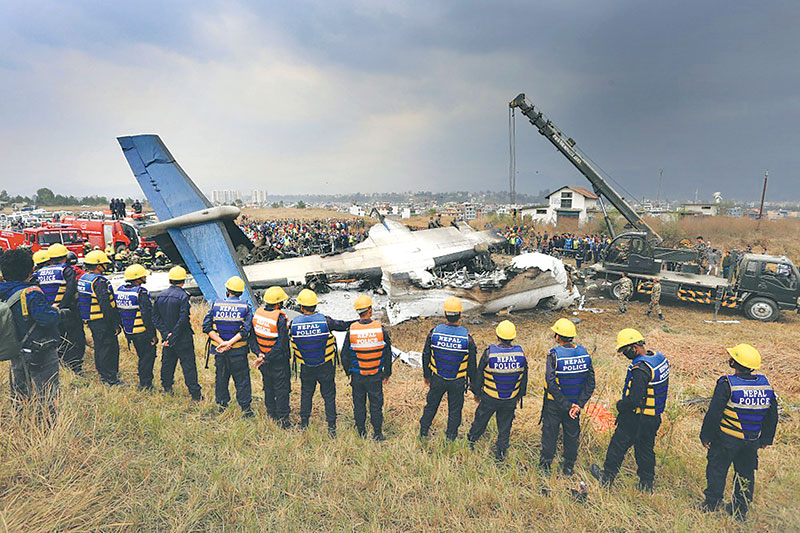
Security personnel seen at the US-Bangla Airlines plane crash site in Tribhuvan International Airport, Kathmandu, on March 12, 2018.Post file Photo

KATHMANDU : Just as the Civil Aviation Bill with a provision for compensation of domestic air passengers is set to be tabled in the Cabinet, the Tourism Ministry is drawing up a new bill envisioning unlimited compensation in the case of death or injury to passengers, as well as in cases of damage or loss of baggage.
The Civil Aviation Bill has a provision for compensation of up to Rs10 million for the death of domestic air passengers.Drafting of the new bill is one among the many plans Tourism Minister Yogesh Bhattarai announced earlier this week.
One of the crucial policies includes preparing a draft of a modified version of the Montreal Convention 1999, a separate law applicable for domestic carriage within Nepal. The ministry has promised to complete a draft bill and table it in the Cabinet within four months.
The Montreal Convention 1999 imposes strict liability on airlines in three cases: Accidental death or bodily injury of a passenger while on board, embarking, or disembarking the aircraft, damage to cargo and damage resulting from delay of passengers, baggage, or cargo. Nepali domestic airlines have been opposing the government’s move to fix a uniform liability amount equal to international airlines.Multiple officials at the Tourism Ministry with whom the Post talked to said they were locked in a dilemma.
One official involved in preparing the draft of the Civil Aviation Bill said it was complicated to bring a separate law in the domestic sector as a modified version of the Montreal Convention 1999 because there are a number of clauses that airlines would not be able to comply with.
For example, in any crash under the Montreal Convention 1999, the families of the victims have a right to claim unlimited compensation if it is a wrongful death. “But in the case of domestic airlines, they cannot afford to bear the unlimited compensation,” the official told the Post on condition of anonymity because he was not authorised to speak to the media.
Recently, the families of the US-Bangla Airlines crash victims sued the airline for $19.09 million in the Kathmandu District Court.
Under the Montreal Convention 1999, in the case of airline passenger deaths involving international flights, the family of the victims are paid $158,565. This works out to approximately Rs18.23 million at the current exchange rate ($1=Rs115). For domestic carriage within Nepal, the minimum liability is $20,000.
“We can force domestic airlines to pay $80,000 to $100,000 per passenger in case of death,” said another official at the ministry who also requested anonymity.
Under the Montreal Convention 1999, the liability for delay is limited to $6,580.94 or Rs723,903 per passenger. A carrier’s liability for damage or loss of baggage is limited to $1,585.65 or Rs174,421 per passenger. The carrier’s liability limitation for cargo lost, damaged or delayed shall be $26.63 or Rs2,929 per kilo.
“But given Nepal’s geographical terrain, climatic behaviour and airport facilities, Nepali airlines cannot afford to bear liability for delays and other mishaps,” the official added. “If a separate law is enforced, it should replicate the provisions of the Montreal Convention 1999. That’s why the ministry has incorporated provisions for paying compensation for passenger death on a domestic carriage in the Civil Aviation Bill,” said the official.
According to the official, after the bill becomes law, the government plans to announce a compensation amount of up to $100,000 per passenger in case of death.
“But Monday’s announcement for a separate law has complicated things,” he said.Ghanshyam Acharya, senior general manager of Sita Air, said the Montreal Convention boosts consumer confidence in air transport and that domestic airlines welcome the government’s decision to introduce new laws applicable to the domestic carriage.
“We are ready to increase the compensation for passenger death or injury in line with the policy that the government will adopt,” said Acharya. “But there are some clauses that need to be discussed extensively before making any decision.” According to Acharya, who is also the spokesperson for Airlines Operators Association of Nepal, the aviation context in Nepal is different.
“Penalties like claims for loss or damage to baggage and delayed flights in the domestic sector should be practicable because of the geographical difficulties and harsh climatic conditions,” said Acharya. “Clauses like unlimited liability are not practical in Nepal.”
The Indian government implemented a modified version of the Montreal Convention in January 2014 by publishing it in the Gazette Notice. It has set cargo claims in Indian currency where the domestic limit is less than a third of the equivalent international limit. In case of death on domestic flights within India, it has set the compensation at only INR2 million ($33,000).Nepal submitted its ratification instrument to the International Civil Aviation Organization in Montreal, Canada on October 16 last year. The Montreal Convention 1999 came into force in Nepal on December 15, 2018.
“We have an obligation when it comes to the international airlines, but in the domestic sector, the state can make a separate law for liabilities based on the business and size of the industry,” said Sanjiv Gautam, former director general of the Civil Aviation Authority of Nepal.
According to Gautam, domestic airlines cannot bear the uniform liability amount equal to international airlines, but it has rights to enact law and fix a small amount of compensation.
“The best option will be,” said Gautam, “incorporating some provisions of compensation in the appendix of the Civil Aviation law and publishing the amount in the Nepal Gazette.”
HOME PAGE

India, Pakistan confirm participation in SAARC Council of Ministers’ meeting in New York

This could be the first high-level engagement between foreign ministers of the two countries since New Delhi’s move on Kashmir.
- ANIL GIRI

KATHMANDU : Amid escalating tensions between India and Pakistan over New Delhi’s move on Jammu and Kashmir, both countries have confirmed their
participation in the meeting of SAARC Council of Ministers’ at Foreign Minister level to be held in New York.
Since August 5, when India abrogated Article 370 of its constitution,
the two South Asian countries, which have fought two wars over Kashmir, have been trading barbs.
Against this background, the confirmation from the nuclear-armed rivals to participate in the meeting called by Nepal as the chair of South Asian Association for Regional Cooperation (SAARC) can result in some positives, officials familiar with the development told the Post. The meeting will be held on the margins of the 73rd United Nations General Assembly on September 26.
Both India and Pakistan have already sent their concurrence to the Ministry of Foreign Affairs and SAARC Secretariat in Kathmandu, at least two officials told the Post.
India and Pakistan were the first to confirm their participation in the meeting informally, said one director at the SAARC Secretariat on condition of anonymity because he was not authorised to speak to the media.Foreign Ministry Spokesperson Bharat Raj Poudyal said that the ministry had received concurrence from some member states while it is in the process of receiving confirmation. Informally all member states have given the consent on the date, and now the Foreign Ministry and SAARC Secretariat are waiting for the same in the written form, said Poudyal.
Though the meeting of SAARC Council of Ministers is an annual affair and usually takes place on the sidelines of the United Nations General Assembly, this time, there were speculations it might not happen due to escalating diplomatic tensions between India and Pakistan and India’s disinterest towards the SAARC process.
More than three decades since its inception, the regional grouping, originally comprising seven countries before the addition of Afghanistan in 2005, has failed to make desired progress, largely due to rivalry between India and Pakistan.Indian Prime Minister Narendra Modi’s push for another regional bloc, BIMSTEC, which does not have Pakistan as a member, has also stoked concerns over SAARC’s future.
The 19th SAARC Summit has failed to take place since India decided to pull out of it in 2016 following a terrorist attack in Uri, Kashmir.
After his re-election, Modi, who had invited leaders of all SAARC member states in 2014, invited leaders of BIMSTEC for his swearing-in May this year, in what looked like his firm push against Pakistan.
Amid this, a meeting at foreign minister’s level could be helpful in laying the ground for expediting the SAARC process, said experts but with a caveat that given the nature of the meeting, all will depend on how the situation unfolds.
“It is an informal meeting, and no structured agendas are being tabled,” said Arjun Bahadur Thapa, former secretary-general of SAARC.
Though such meetings have taken place regularly in the past, the India-Pakistan rivalry is often reflected there.
During last year’s meeting in New York, India’s then external affairs minister, late Sushma Swaraj, had walked out of the meeting hall after finishing her statement without listening to the remarks of her Pakistani counterpart.
India has defined the abrogation of Article 370 from its constitution as its internal matter, and some SAARC member states have already spoken in support of that.
Nepal has not issued any official statement, but Foreign Minister Gyawali told the media earlier this month that both the nations should engage in dialogue for regional peace and stability.Nepali polity is largely divided over whether Nepal should make any official position on New Delhi’s move on Jammu and Kashmir. A section of foreign policy experts in Nepal believes Kathmandu must make an official position on the issue as the chair of SAARC. Both the nations have ramped up diplomatic efforts in the region and beyond to seek support in their favour after August 5.Indian Foreign Minister S Jaishankar visited Nepal on August 22-23 and sought Nepal’s clearer position on Jammu and Kashmir.
The day Jaishankar left from Kathmandu after concluding his Nepal visit on August 23, Pakistani Foreign Minister Makhdoom Shah Mahmood Qureshi had held a telephonic conversation with Gyawali, apprising the latest situation in Jammu and Kashmir and urging Nepal to play its role as SAARC chair for peace and stability in the region.If the foreign ministers from India and Pakistan meet at the SAARC Council of Ministers’ meeting which will be presided over by Nepal, this could probably be the first high-level engagement between them since August 5.
The meeting in New York, however, will not have much of its impact when it comes to reviving the SAARC process and holding the summit anytime soon, say experts.
“I do not see any possibility of SAARC summit in the near future,” Thapa told the Post. “There is no such hard and fast rule that foreign ministers of India and Pakistan should talk. If we go through the recent tension between India and Pakistan, I do not see any breakthrough in the meeting. But then again who knows.”
Besides reviewing the progress made by SAARC in the last one year, the meeting of SAARC Council of Ministers will endorse the name of new SAARC Secretary-General from Sri Lanka, Esala Weerakoon, as the next head of the regional body as incumbent Secretary General Amjad Hussain B Sial of Pakistan will complete his term in March 2020.
Gyawali will lead the Nepali delegation in New York, as Prime Minister KP Sharma Oli is skipping the UN General Assembly this year due to his health conditions.

HOME PAGE

For hawkers, Koteshwor’s traffic jam is a blessing

Dozens of roadside vendors wait a vehicles to come to a halt and linger for minutes so that they can earn their living.
- ANUP OJHA

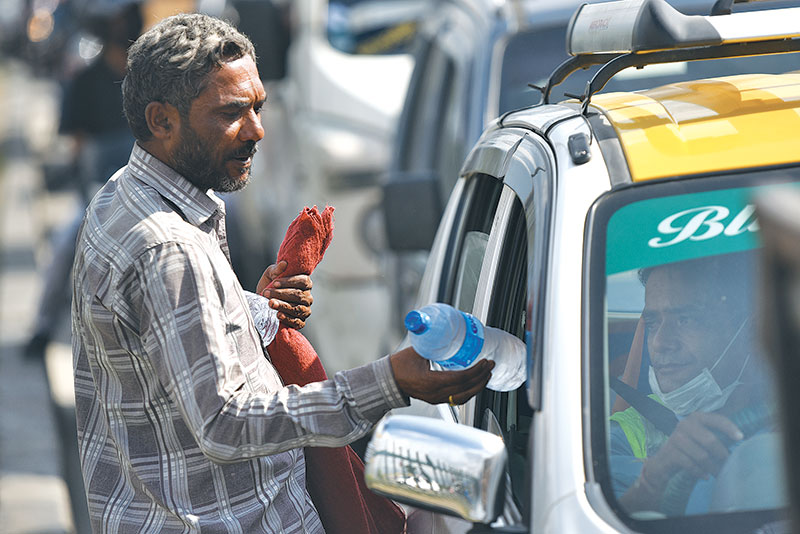
A hawker sells bottled water to a taxi driver during a traffic congestion at Koteshwor Chowk.Post Photo: angad dhakal

KATHMANDU : Koteshwor Chowk is notorious for traffic jams. During peak hours, vehicles slow to a crawl, creating a long traffic snarl along the three roads that lead to Baneshwor, Jadibuti and Gwarko.
For commuters, Koteshwor traffic is the bane of their daily lives. But for some, who earn a living by selling knick-knacks just when vehicles stop, it has become a boon.
On a recent afternoon, just as vehicles were brought to a stop by a traffic policeman, 13-year-old Hari Budhathoki picked up water bottles and dashed towards the vehicles. He managed to sell two to three cases of bottled water. He repeats the cycle every time traffic comes to a halt.
When the cars and buses begin to move, he returns to his mother who sells a medley of stuff on the roadside.
Budhathoki is one of dozens of such hawkers in the Koteshwor area who earn money by selling an assortment of products—bottled water, chewing tobacco, cigarettes, packaged noodles—during traffic jams.
“I am too old to run around,” said Khuma Kumari, the mother. “My son helps me out to sell stuff.”
Budhathoki alone makes around Rs600 a day, contributing to his mother’s income. But in doing so, he is also missing school. Khuma, however, does not see that as a problem.
“That’s okay as long as he can earn,” she said.Traffic police say the number of hawkers doubles during evening hours.According to the data provided by the Metropolitan Traffic Police Division, every day from 8am to 6pm, at least 971,000 vehicles pass through Koteshwor Chowk.
“Traffic jams have become chronic in this area,” said Suresh K Thakur, chief of Koteshwor Traffic Police. “Managing the smooth movement of vehicles is a big headache for us.”
Well, what’s a headache to many is a soothing relief for some, like Parsuram Kaphle, who has been living in Kathmandu for the last five years.
The 53-year-old from Bardibas used to work at a paper factory in Bagbazar. “But two months ago, I left that job to sell bottled water and other small stuff here,” said Kaphle, who lives with his wife and their three-year-old son in Gwarko. “The income is better here.” He sells a bottle of water for Rs25. “I can buy a case of water which contains 11 bottles at Rs120. There’s a good profit margin,” said Kaphle. “I make around Rs800 selling water and another Rs200 from other items, which include cigarettes, tobacco, wafers and noodles.”

Traffic police say there is a need to manage such roadside hawkers because they add to the congestion and increase chances of accidents.
“They rush towards vehicles just as they begin to stop. But they do not care when the on-duty traffic policeman gives the green signal for vehicles to move,” said Thakur. “We can only tell them not to get into the middle of the roads. But it’s interesting that what has become a nuisance to commuters has become an opportunity for others to earn.”

Page 2
MEDLEY

Horoscope

ARIES (March 21-April 19)
**
Someone’s remark may leave you feeling emotional today. What they said might have triggered something deep inside of you that you’re not sure how to identify. Let it sink in and don’t overanalyse it. You’ll slowly begin to understand why the comment bothered you—by tonight you’ll have solved the mystery.


TAURUS (April 20-May 20)
***
Today you will start feeling a new sense of peace in your solitude. Move away from the hustle and bustle of the rest of the world, and think about the issues that are important to you. It will help build up your intuitive skills. You’re in a highly suggestible phase, you should count on your own compass for guidance.


GEMINI (May 21-June 21)
**
Someone that you’ll be dealing with today might get moody if they don’t get what they want. But you’re not in charge of giving it to them, so don’t take on the burden of trying to make them happy. If they choose to throw a fit or sulk in a corner, let them. Don’t waste energy on someone who’s choosing to be miserable.


CANCER (June 22-July 22)
****
A huge dose of high energy your way will hit  you today but after lunchtime. So if you were planning to hit the gym in the morning, try to switch it to the afternoon—you’ll have a lot more fun while you huff and puff if you’ve got the energy to back it up. Good physical energy will boost your emotions too.


LEO (July 23-August 22)
*****
Being modest won’t do you any good today so step out into the spotlight. Whatever you choose to say or do, everyone will be behind you. In a work context, you have money-saving ideas that will get you some long-lasting praise. In terms of love, your opinions are ultimately going to help you get exactly what you want.


VIRGO (August 23-September 22)
****
Let go of your preconceived notions about what fun can be, and try something new! There are opportunities for fun social events everywhere, dive right into one of them. Start today by just saying yes to more invitations. Walk on the wild side a bit more, and you’ll be exposed to many interesting people.


LIBRA (September 23-October 22)
***
Your close friends and family members will always be in your life—but you are the only person who can completely understand your battles, lessons you’ve learned, and skills you possess. So if you need to get some clarity on where you are and where you’re going, consult the best expert possible—yourself!


SCORPIO (October 23-November 21)
***
Today you’ll be given an opportunity to take control—but you should not necessarily take it. You have a lot of drive right now, but there is no point in moving forward if you’re not totally sure where you’re going. You’ll only end up lost and frustrated. So try not to control anything right now—just let whatever will be.


SAGITTARIUS (November 22-December 21)
**
You and someone you usually work quite well with might hit a bit of a rough patch today. It seems that you two are mismatched in terms of your attitudes. Your energies are different, but that isn’t necessarily a bad thing. Think of it as an opportunity to help the other person perfect their ideas and choices.


CAPRICORN (December 22-January 19)
***
You’ll have some tunnel vision when it comes to a new relationship today. All you’ll want to think about is how you can get closer to them. The good news is that if you are this focused on one person, you will definitely get results. But on the other hand, you’ll be depriving some other people of having any time with you.


AQUARIUS (January 20-February 18)
***
You might think you’ve got your daily routine down to a science, but today it won’t be easy. Little mishaps and some miscommunication will throw a few wrenches in your plans. You will probably enjoy the disruption, though. Think of it as a reminder that you that you can’t take anything for granted.


PISCES (February 19-March 20)
****
Today you’ll realise that there are different types of love—the kind you have for another person, the kind you have for yourself, and the kind you have for that new car you’re dreaming of buying. Focus on the type of love you have for other people today, and try expressing it as openly and as honestly as you can.

Page 3
NATIONAL

Media Council Bill tabled in the Upper House amid uproar

Minister for Communication and Information Technology Gokul Baskota says the government is ready to refine it.
- BINOD GHIMIRE

KATHMANDU : Despite reservations from the main opposition, the government on Tuesday tabled the controversial Media Council Bill in the National Assembly.
The bill, which will replace the existing Press Council Act, was registered in the National Assembly on May 10. Though the government wanted to get the bill endorsed, it backtracked following strong reservations from the Federation of Nepali Journalists, Nepal Media Society and the Nepali Congress.
After commitments from some senior leaders of the ruling Nepal Communist Party that the bill would go through a revision, the federation had withdrawn its protest. Subas Nembang, deputy parliamentary party leader of the NCP, and Khim Lal Bhattarai, chief whip of the party in the National Assembly, had assured the federation of amendments to the bill as per its demand.
The National Assembly will now hold a discussion on the bill before it is sent to the Legislation Committee for finalisation. Deliberations will begin on Friday.
Lawmakers can submit amendment proposals on the bill once it lands in the House Committee.
“We are still holding discussions with the federation and the main opposition,” said Minister for Communication and Information Technology Gokul Baskota while tabling the bill in the House on Tuesday. “It can be revised based on the feedback.”
Before it was tabled, Nepali Congress Lawmaker Radheshyam Adhikari had said the regressive bill should be stopped from being presented. He said despite the established principle that the Media Council should be an autonomous body, the bill envisions it as a subordinate body of the government.Adhikari said a committee either led by the chairman of the National Assembly or by the Speaker of the House of Representatives must be formed to recommend the name of the chairperson of the council.
“I also oppose the provisions of hefty fines to journalists,” said Adhikari. The bill proposes that the council can slap a fine up to Rs1 million on journalists.The Nepali Congress, however, allowed to present the bill after Baskota assured changes after consultation with the concerned parties.
The leaders of the federation say they are hopeful that the bill will be revised as per the commitment from the ruling party before it gets endorsed by Parliament.
“We have been told the bill will be revised based on the understanding reached with us,” Ramesh Bista, general secretary of the federation, told the Post. “We are closely watching the development.” The ruling party had agreed in writing with the federation that the provisions regarding hefty fines and making council an autonomous body would be revoked and that consultation with the concerned parties would be held before drafting any law related to the media.Bista said the federation has learnt that both the ruling and the opposition parties will jointly register amendments in the bill. The lawmakers will get 72 hours to register the amendments once the Upper House completes the deliberation. The Legislation Committee will then finalise it after the discussion on the amendments. It has to be endorsed by both the Houses before it comes into implementation.

NATIONAL

Minister Baskota contradicts PM Oli and himself in Parliament

The government spokesperson asserts Monday’s gathering was not a teleconference Cabinet meeting, but Oli’s and his own tweets say otherwise.
- TIKA R PRADHAN

KATHMANDU : Minister for Communication and Information Technology Gokul Baskota, who is also the government’s spokesperson, on Thursday told the House of Representatives of the Federal Parliament that the government had not convened its Cabinet meeting on Monday through video conferencing.
But Baskota’s denial invited criticism when tweets from Prime Minister KP Sharma Oli and his chief advisor Bishnu Rimal confirmed that teleconferencing had indeed been used for the meeting.
Oli and Rimal both tweeted photos of the meeting, stating that the Cabinet’s first teleconference meeting had successfully been conducted from Singapore. “I would like to thank technology and technicians. For the first time, we could hold the cabinet meeting from Singapore through telepresence. Thank you to all the members of the cabinet and all the helping hands of the secretariat of the office of the prime minister and council of ministers,” Oli tweeted.
While Rimal tweeted, with some photos, “From Singapore to Kathmandu: For the first time Cabinet meeting is sitting through teleconference.”
However, Baskota outrightly denied to the federal parliament that the Cabinet meeting was held through video conferencing.
He insisted that the prime minister was just saying hello to his ministers from Singapore.However, many lawmakers including Pushpa Bhusal, Prakash Rasaili Snehi and Prem Suwal are unconvinced. Lawmakers are also questioning the legality of the presence of the acting Prime Minister Ishwor Pokhrel in the meeting. “How can a Cabinet meeting have two prime ministers?” said Rasaili in Parliament.
Baskota, however, reiterated that the meeting was not of the Cabinet and Pokhrel’s position as acting prime minister would not remain once Oli returns home. Despite Baskota’s denial, his own tweet, on Thursday, seemed to confirm that Monday’s meeting was indeed a Cabinet meeting.
“This is to inform all that today’s press meet has been stalled because the last Cabinet meeting did not take any decision after last week’s press meet,” Baskota tweeted. Following Tuesday’s parliamentary meeting, Nepali Congress leader and former minister Gagan Thapa questioned who was saying the truth: Prime Minister Oli or Minister Baskota. “Dear PM, spokesperson Gokul Baskota has claimed that Monday’s meeting was not a Cabinet meeting. Who among you two is the liar?” Thapa posted a tweet, retweeting the prime minister’s tweet from Monday.A lawmaker representing Nepal Workers and Peasants Party Prem Suwal said that lying in Parliament was a serious betrayal to the people. “It’s a serious betrayal to the people’s verdict with which government has been formed,” Suwal told the Post.

NATIONAL

Health ministry to seek assistance of security agencies to combat dengue

The mosquito-borne disease has spread in 42 districts, infecting more than 4,600 people so far this year.
- Arjun Poudel

KATHMANDU : The Ministry of Health and Population has decided to seek assistance from all security agencies to deal with the dengue infection spread in 42 districts of the country.The decision of the ministry comes after its efforts thus far failed to contain the spread of the virus.
“We will write formal letters to the Nepal Army, Nepal Police, Armed Police Force and other concerned agencies for their help,” Mahendra Prasad Shrestha, spokesperson at the Health Ministry, told the Post.
“We have taken their help in the past to run a search and destroy drive in Chitwan district.”
During the 2009 dengue epidemic in Chitwan, the government had mobilised security forces to sensitise the local population about the risk of dengue infection. The move had succeeded in containing the virus, according to Shrestha.
Over 4,600 people have been infected with dengue virus as of Tuesday this year. Of then, 1,536 cases were reported in the last 40 days, including 563 in Province 1, 559 in Province 3, 339 in Gandaki Province, 56 in Province 5, 14 in Province 2 and six in Sudurpaschim Province. Karnali remains the only province where dengue has not been reported so far.
“Containing the dengue spread is the responsibility of all state agencies as well as individuals,” Health and Population Minister Upendra Yadav, told a multi-sectoral meeting in Kathmandu on Thursday. “The Health Ministry alone cannot do everything.”
The meeting was called to discuss ways to improve coordination and cooperation among various government and non-government agencies to deal with the growing dengue cases.Health Secretary Pushpa Chaudhary said that she told the high-level meeting of secretaries that the Health Ministry alone could not control the virus spread.
“Role of each and every individual is important to control the virus,” said Chaudhary. “I have made it clear to all the secretaries that both inter-sectoral, as well as multi-sectoral efforts and political willpower, is needed.”Representatives of the Office of the Prime Minister and Council of Ministers, Ministry of Home Affairs, Ministry of Education, Nepal Army, Nepal Police, officials from Provincial Health Directorates and local levels were present in the meeting.

Page 4
NATIONAL

Make Kalanki-Maharajgunj stretch of Ring Road environment and public-friendly, activists demand

Activists oppose the road department’s plan to cut over 2,000 trees along the stretch.
- CHANDAN KUMAR MANDAL

KATHMANDU : As the government is gearing up to axe down hundreds of trees along the Kalanki-Balaju-Maharajgunj stretch, as part of the Ring Road Expansion Project, activists reminded the government to not repeat the same mistakes it committed during the expansion the Koteshwor-Kalanki section.
Environmentalists, urban planners, students and other campaigners organised a protest along the Ring Road on Thursday evening to press the government to make the new section more public centric than vehicle centric.
The Koteshwor-Kalanki section, which was handed over to the Nepal government by the Chinese government earlier this year, has become infamous for being a killer road inside the Kathmandu Valley. There have been several reports of deaths and injuries along the section since it was opened for operation. The stretch has long been criticised for not being friendly for pedestrians and cyclists.
“We all have seen what happened with the Koteshwor-Kalanki section. It has turned into a killer road. The eight-lane road has a faulty design, and we are worried that authorities will repeat the same again,” said Ratna Shrestha, a cycling activist and president of the Nepal Cycle Society. “There should be a dedicated bus-lane, a cycle lane and a wide enough footpath for pedestrians.”
Last week, the Department of Road unveiled its plan of chopping down 2,057 trees along the 8.2km Kalanki-Balaju-Maharajgunj road section; however, there is no concrete plan of when the road expansion drive will begin.
Activist criticised the government for hurrying to cut down hundreds of trees for the project especially when the design and initial environmental examination report of the project are not yet been made public.
“I am so surprised that the public was not informed about what is going on here. Why are these trees are being chopped down without any concrete design?” Bindhu Bhandari, a climate change campaigner told the Post. “They are so much in a hurry to cut down the trees. As a climate change campaigner, I am concerned about how much carbon these trees capture. They are not just the trees but the lungs of the ring road.”
During an hour-long protest, participants were seen hugging the trees; some were standing with banners saying they were not against the development but haphazard development that ignores the environment and public safety.
According to Nivesh Dugar, an environmental engineer, one tree can absorb 22kgs of carbon dioxide and provide nearly 55kgs of oxygen in return in a year.
“Two trees can produce enough oxygen for a family of four members. For urban areas like Kathmandu valley, where there are only fewer trees now, these trees are valuable as they can provide shades and also help in cooling down the temperature,” said Dugar. “Even if we can save 1,500 trees, it will be a big save for all of us.”
Although the government has said that they will be planting the same number of trees that are being cut down, activists express doubt over such claims. As part of the nationwide plantation drive, tree plantation was launched along the Koteshwor-Kalanki stretch, but saplings had started dying in the absence of proper care.
“We saw how massively trees were felled last time. There are always false hopes that the government will plant more trees,” said Abhishek Shrestha, an environmental campaigner.
“The trees that were cut down in 2013 were planted only in 2019. If they plan to plant trees, they should immediately start planting along the stretch so that by the time project concludes, there will be mature trees in the area.”

NATIONAL

A majority of public schools don’t have ideal teaching-learning environment: Study

Even the government model schools have below-average performance.
- BINOD GHIMIRE

KATHMANDU : A majority of the country’s public schools do not provide appropriate teaching-learning environment which has lead to poor student performance, a recent study shows. The performance audit report of the Education Review Office under the Ministry of Education shows that most public schools lack investment and have poor records in teachers’ delivery, student evaluations, teacher development and extracurricular activities.
The performance audit, published on Monday, shows that 84.4 percent of the public schools do not have ideal learning environment.
The share of schools with appropriate teaching-learning environment took a dive from 23.3 percent in the fiscal year 2017/18 to 15.6 percent in the fiscal year 2018/19, suggesting that the number of schools with conducive learning environment is decreasing.
Just one school from Kanchanpur had an excellent performance, according to the study.
“The report reveals the disappointing facts and the urgency to act immediately,” said Tek Narayan Pandey, director-general at the review office.
The performance audit was conducted in 1,999 public secondary schools of 29 districts, which is around 30 percent of the country’s public high schools. The study shows that even the government model schools are doing poorly. Among the 32 such schools, only eight (25 percent) have conducive learning environment.
Pandey said poor student performance was a result of dismal learning-teaching environment in state-run schools. The public schools from Manang and Kathmandu were the best performers, while those from Bajhang and Bhojpur were the worst, according to the study.
Another study report by the review office on August 5 had shown that the learning achievement of fifth graders was gradually decreasing. Only 28 percent of grade five students grasp the mathematical concepts, while 32 percent of the students do not even learn five percent of their course by the time they complete the grade, the study found.
Similarly, the Secondary Education Examination results published in June showed a dismal performance of students from public schools.
“There is an urgent need to develop a policy for the professional development of teachers,” concludes the performance audit report. “A large number of schools still lack basic learning tools and facilities like computer, library and laboratory.”
Educationists say it is disheartening to see that the government is not taking any steps to improve the quality of education in public schools.
“Now all three tiers of government need to collaborate for the fundamental reformation in the school education,” Min Bista, a former professor at Tribhuvan University, who has conducted several researches on school education, told the Post.
He said a proper analysis of the reasons behind the underperformance needs to be analysed and the policy for improvement need to be formulated accordingly.

Page 5
NATIONAL

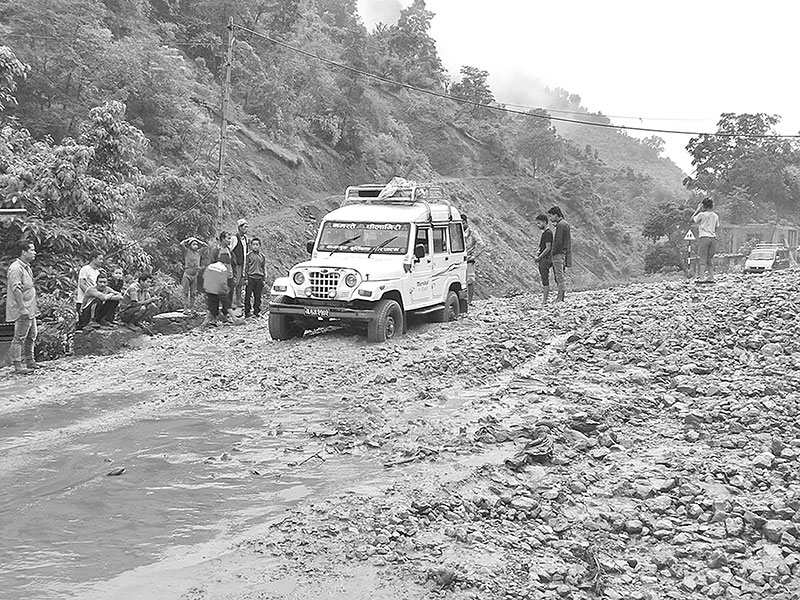
Most rural roads in Baglung are swept away by landslides during monsoon

Repair works start in the winter only to be severely damaged in the rainy season.
- PRAKASH BARAL

A section of the Gwalichaur-Jaljala-Ranasinkiteni road has been damaged because of the rains in Badigad. Post Photo: PRAKASH BARAL

BAGLUNG : Last year, Badigad Rural Muni-cipality enlisted Gwalichaur-Jaljala-Ranasinkiteni road as a pride project of the municipality. In the fiscal year 2018/19, the rural municipality had allocated a budget of Rs 10 million to upgrade the road after which it was widened and gravelled in some sections. Around 25km of the road section is in operation currently.
The upgradation work was underway during the winter season, but the monsoon, which brought floods and landslides, has left the entire road section heavily damaged. “Every year, we repair the road after the rains and initiate upgradation work again in the dry season. The entire stretch of the road is windy and risky and poor construction makes it all the more dangerous,” said Mehar Singh Paija, mayor of the rural municipality.
According to the representatives of the rural municipality, the local
unit allocates budget to upgrade and repair the road every year. “We don’t have the exact figure but the municipality has spent millions on repair works,” said Paija.
The locals of Jaljala, Gwalichaur, Ranasinkiteni and Sishakhani depend on this road stretch to stay connected to Baglung bazaar where most of the trade happens for the villagers. But constant repair works on the road section leaves hundreds of villagers seeking for an alternative to using the dangerous road. “We have to risk our lives while travelling through the road from mid-June to mid-November,” said Hira Bahadur Paija, a local man.
Maya Malla, a native of Ranasinkiteni, said that pregnant women, senior citizens and patients are the worst hit by bad road conditions in the area. “I move to Baglung bazaar before the monsoon start and return only during the dry season,” said Malla, stating that villagers would rather move to
safer locations than to commute through the risky road during monsoon. “Every year landslides caused by construction work on the road section sweeps away farmlands and villages are cut off.”
Pradeep Chandra Subedi, chief administrative officer of the rural municipality, put the blame squarely on contractors who are notorious for using heavy-equipment on roads vulnerable to landslides. “The contractors use heavy machinery for clearance and construction of roads which has over the years weakened our land,” said Subedi. “We have done what we can to control landslides by constructing retaining walls, roadside drains, and causeways.”
Amar Bahadur Shrisha, ward chairman of Badigad Ward No 8, said that most of the rural roads dug in winter gets swept away during the monsoon.
In Baglung Municipality too roads get swept away every year by landslides. Gyanendra Gautam, ward chairman of Baglung Ward No 11, said that most of the rural roads have been swept away by landslides in this monsoon. “Forget vehicles, even people can’t walk through these rural roads,” said Gautam.The monsoon this year also triggered landslides in Dhullu, Kushmisera, Sigana and Gaja Daha of Jaimini Municipality.

NATIONAL

Biratnagar campus chief under fire for selling campus books to scrap dealer

- BINOD BHANDARI

BIRATNAGAR : The chief of the Biratnagar-based Post Graduate Campus, Mahesh Kumar Khatri, has sold campus’ library books and thesis papers submitted by students to a scrap dealer.
Established in 1985, the institute also known as Degree Campus had an archive of books dating back to its establishment days. Khatri admitted to selling a total of 12 quintal books and thesis papers at the rate of Rs 8 and Rs 4 per kilo respectively.
“The books and theses were damaged, eaten up by mites,” Khatri told the Post on Thursday. “I didn’t want to take the risk of the mites destroying the newer lot of books. It’s true I sold the damaged books to prevent other books from getting damaged.”
The books and thesis papers were sold to one Kariya Miya, a scrap vendor in the neighbourhood. “I resold the books and thesis papers from the campus on Wednesday itself. I sold it to another vendor in Sarauchiya at a profit of Rs2 per kilo,” said Miya.
The archived books and thesis papers should not have been sold, let alone without consultation with the teachers concerned and department chiefs, said Tuna Raj Bhattarai, chairperson of the Lecturers’ Association at the campus. “This is a reckless, irresponsible act of the chief,” Bhattarai said.
Bhattarai said that the library contained rare books related to Social Science and over 5,000 thesis papers. But Khatri said that the books he sold off were not from the campus but received from outside agencies.
Prices of the books range from Rs250 to Rs5,000. Students pursuing a master’s degree are required to submit a copy of their thesis paper to the campus. Junior students then use such documents for research.
“Selling all those important documents is a shameless act by the campus chief,” said Ram Prasad Pokharel, secretary of the association.
The Lecturer’s Association on Thursday issued a statement denouncing Khatri’s act, noting that this has disgraced all the lecturers working at the campus.

NATIONAL

Landslides affect Baitadi villagers

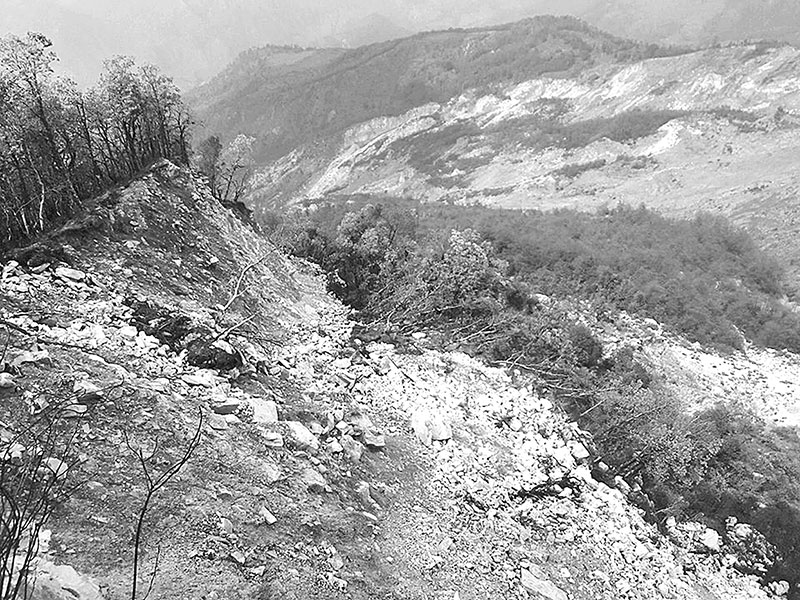
Water sources have already dried up and fertile land have been buried under debris.
- TRIPTI SHAHI

The landslides have put at risk more than 200 families in the area.Post Photo: tripti shahi

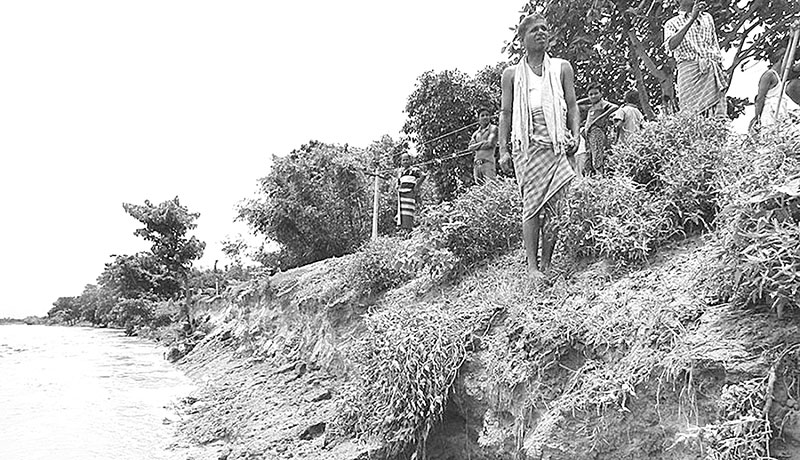
BAITADI : Residents of Melauli Municipality Ward Nos 8 and 9 Baitadi district have been forced to deal with dry landslides throughout the year for the last 26 years.
Although the allocation of budgets to control the landslides in the last two decades, the measures taken to do so have been ineffective. More than 200 families are at high risk of landslides.
Villagers said that more than 24 families have moved to safer locations since the landslide started.
Biruwa Luhar, one of the victims, said that the Sunarya river has been eroding land below the settlement even as debris continues to fall from hills overlooking their settlements.
Most of the water sources have already dried up and the continued landslides have rendered 100 hectares of fertile land useless. Residents of Kotigaun, Asur, Tallonaya, and Kanithha, among other villages, have been hit hardest.
Radha Ojha, deputy mayor of the Melauli Rural Municipality, said that the local unit does not have sufficient budget to control landslides this year.
Although the authorities concerned do not have exact data on the funds spent on controlling the landslides, locals estimate that Rs 70 million has been spent for the purpose in the last two decades.
The Water Induced Disaster Management Office in Dhangadhi and District Soil Conservation Office has also spent more than Rs 50 million to control the Melauli landslides. The village development committees and District Development Committees also spent more than Rs 20 million for the same. But, the situation is still the same as it was 26 years ago.
Nariram Luhar, a local man, said that villagers that they have installed gabion wires to protect their houses and properties from the landslide.
Padam Singh Thagunna, ward chairman of Ward No 8, said that villagers are facing difficulties due to continuous dry landslides. “The municipality has no budget to control landslides this year,” said Thagunna, adding that he doesn’t have information about the budget used to control the landslides in the past.
Krishna Singh Nayak, mayor of Melauli Municipality, however, said that the municipality has a plan to allocate budget to plant trees in the affected areas. “We don’t know how much budget has been in the past used to control landslides,” said Nayak.
In the last fiscal year, the provincial government had allocated Rs 5m to control landslides. The provincial government has also allocated Rs 5 million to control landslides in the running fiscal year. “We don’t know the works that were carried out to control landslides last year,” said Ojha.

NATIONAL

Local unit constructing its office without meeting due legal process

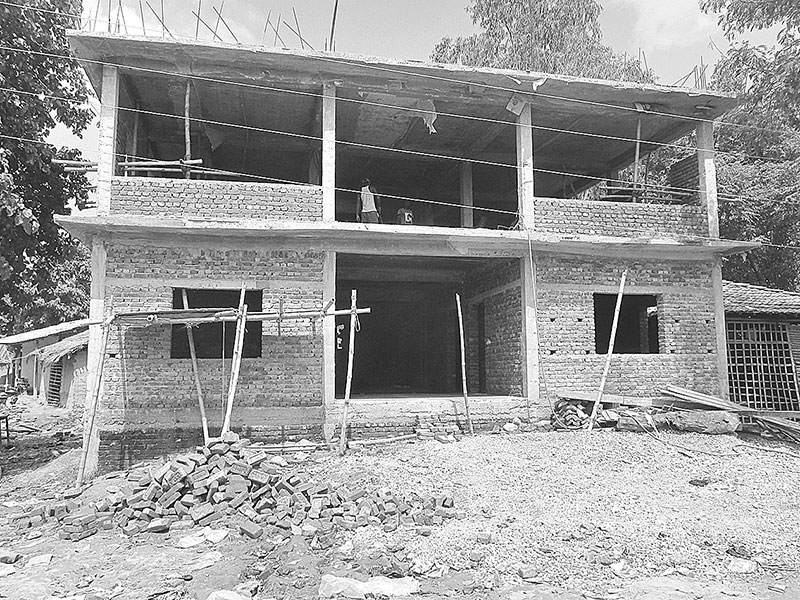
The rural municipality admits to building its office without adhering to the design rules.
- OM PRAKASH THAKUR

Locals are demanding construction be halted, citing the building’s foundation is shaky.Post Photo: om prakash thakur

SARLAHI : An individual can construct a house or any other structures only after the local unit approves its design. However, a rural municipality in Sarlahi district has been constructing its office building without meeting the due legal process.
Chakraghatta Rural Municipality in the southern part of the district
has been constructing its two-storey office building near the Dhangra stream without getting the design approved by a technician as required by law.
The locals complained that the public building was being constructed carelessly without meeting the building code. “The rural municipality office building is being constructed on the bank of the Dhangra stream, a flood-prone area. The building neither has adhered to building design
nor is it earthquake-resilient,” said Ramji Sah, a local resident.
According to him, the villagers repeatedly requested the local unit not to construct its office building in
the flood-prone area, but the latter paid no heed.
Chakraghatta Rural Municipality started construction of the office at the cost of Rs6.5 million by forming a consumers’ committee. The local people claimed the foundation of the under-construction building is also very shaky. “The building is being constructed on a weak foundation. It can collapse anytime,” said Jawahar Prasad Chaudhary, demanding a halt to construction until the due process is followed.
Basoda Devi, the deputy chief of the local body, added that the office building was being constructed against the decision of rural municipality’s meeting. Bikram Yadav, chief of the rural municipality, admitted to constructing the office building without adhering to the design rules as required. “House and building construction standards have not been prepared yet. So we started the construction without approval,” said Yadav.

NATIONAL

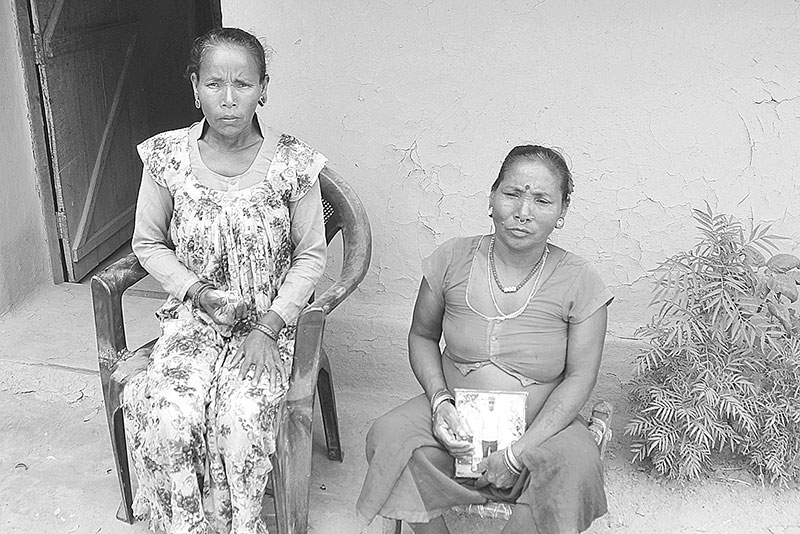
A family in Kanchanpur talks about the misery of being torn apart

- BHAWANI BHATTA

Astani Chaudhary and Sitapati Chaudhary have no idea where their children are.  Post Photo: bhawani bhatta

KANCHANPUR : The decade-long armed insurgency that began in 1996 came to an end when the rebel CPN (Maoist) entered mainstream politics in 2006, almost 13 years ago. But for Astani Chaudhary of Pipaladi, Kanchanpur, the insurgency that tore his life apart feels like it happened yesterday. “The insurgency period still haunts me; all the lives lost, families torn apart,” said Astani, a father of three sons and a daughter.
Astani’s house is next to a busy thoroughfare in Pipaladi and he can usually be found seen sitting outside with his eyes on the road. Every time he sees an adolescent approaching his house, his heart skips a beat. “I see my daughter, Madhu, in every young girl I see. It has been 17 years since her disappearance, but I still hope for her return,” said Astani.
It was the dawn of September 12, 2002, when a joint security force raided Astani’s house. Madhu, and her cousins Sundar and Prakash, were still asleep inside the house when security forces, according to Astani, had detained the trio for their alleged affiliation with the Maoists.
“We heard that security personnel had paraded them around the village and then took them to the Area Police Office in Jhalari at around 10 am. We had gone to the post to inquire about them but the police denied having them in their custody. We don’t know where the security personnel took them and what they did with them,” said Astani.Madhu was the eldest daughter among Astani’s four children. She was a grade six student. Sundar’s elder brother Narendra was an active member of the Maoist party at that time and his older brother, Kalang, had also been detained by the police for the same charge. He was released after 17 months. “The security personnel did not only arrest my son but would frequently raid my house. I lost my family as one son was with the Maoist, another was in prison while the third was taken by the army,” said Sitapati Chaudhary, Sundar’s mother.
Because of the torture inflicted on her family by the security personnel, Sitapati left her village.
“My two sons later returned home, but Sundar never came back. I don’t know whether he is still alive or dead,” she said. Her eldest son Narendra
was elected as ward chairman during the local elections held in 2017 and he tried his best to find the whereabouts of the trio that had gone missing 13 years ago but hasn’t been successful. “The villagers used to blame me for the disappearance of my brothers and sister. It all happened because of me, they said,” he added.
The two families aren’t the only ones who were torn apart during the insurgency period. Many families in Kanchanpur had “disappeared” in the war between the security forces and Maoists.Sanam Chaudhary of Baluwaphant, in Krishnapur, does not remember his father’s face. He was just 11 when security personnel had detained his father, Taranath Chaudhary, in 2001. A police team from the Area Police Office in Krishnapur had arrested him and he never returned. “I was at school when my father was arrested. I didn’t even say goodbye to him. We know nothing about him,” said Sanam.According to the data available at the district administration office, 53 people had “disappeared” in Kanchanpur district, but the number is not exact, as different human rights organisations have different records of the disappeared people.
“We don’t have the exact number of “forced disappearances” that happened 13 years ago. We are working to find out the exact figure,” said Dharma Chaudhary, the district chairman of Conflict Victims’ Society for Justice. According to him, 98 complaints have been registered at the Commission for the Investigation of Enforced Disappeared Persons.

NATIONAL

Viral fever grips Baitadi

Briefing
- Post Report

BAITADI: The number of patients suffering from viral fever is increasing in several villages of Baitadi district for the past few weeks. Around 35 patients of viral fever are visiting the district hospital each day. According to the district health office, the number of viral patients is also on the rise in other health institutions.


NATIONAL

Nearly 13,000 households enlisted for retrofitting

Briefing
- Post Report

HETAUDA: As many as 12,946 households in Makwanpur district have been included in the beneficiary list for retrofitting their quake-affected houses. Among them, 7,327 families received the first tranche of aid after signing an agreement with the National Reconstruction Authority.


NATIONAL

Koshi flood victims continue relay hunger strike

Briefing
- Post Report

ITAHARI: Koshi floods victims, who were displaced around four decades ago, continued their relay hunger strike for the past two weeks near
the Koshi Barrage. The victims warned to continue their agitation until the authorities provided them suitable compensation for their land and properties that were swept away by the floods.


NATIONAL

Two dengue cases found in Lamjung

Briefing
- Post Report

LAMJUNG: Two dengue cases have been found in Lamjung district. According to Keshav Prasad Chapagain, two patients were diagnosed with dengue fever in the district. We have kept all health institutions in the area at high alert in a bid to control the disease, he added.

Page 6
EDITORIAL

Suicide is preventable

Mental health should be respected as a fundamental right.

A recent news report mentioned that more than 5,000 Nepalis commit suicide every year. We cannot let the headlines go unnoticed anymore. Mental illness continues to plague people across the spectrum—men, women, boys or girls. The impact of suicide on families and communities is devastating and long-lasting, yet it has not received the attention it warrants.

The act of killing oneself intentionally is very much a medical problem associated with mental illnesses such as depression, anxiety or, at times, even substance abuse. Often these problems are a precursor to suicide. But owing to the stigma attached to talking about depression and anxiety, such medical conditions are often brushed under the carpet. In fact, suicide should be preventable if we start talking more openly about psychiatric illnesses and deliver the required treatment to people who have them.

According to police data, the number of people who have died by their own hand is increasing, but the actual figure may be even higher, given that not all cases get reported to the police. Depression causes mental anguish and has devastating consequences; it affects people worldwide, irrespective of race, age or occupation. Data from the World Health Organisation shows that mental illness accounts for 13 percent of the world’s disease burden—a figure that is estimated to rise to nearly 15 percent by 2030.

Although mental illness is on the rise and suicide rates have increased over the years, we have made little progress in dealing with the public health crisis of suicide. There are neither prevention strategies in place nor is there any progress in addressing growing mental illness issues. While other diseases like cancer, or even contagious seasonal diseases (such as malaria, typhoid and so on) get marquee recognition, mental illness is often looked.

Approximately 30 percent of Nepalis suffer from psychiatric problems, and over 90 percent of them have no access to treatment, according to the Health Research and Social Development Forum. And a paltry 2 percent of medical and nursing training is dedicated to mental health. These statistics paint a dismal picture. Suicide is as much a public health threat as any other disease that has been unfolding for many decades. Generations even.

The news report also mentioned that programmes aimed at suicide prevention are primarily led by mental health professionals and non-governmental organisations. The government, on its part, can intervene by reforming the health sector and establishing mental health system governance procedures and a ministry-level coordination unit by providing a range of resources and services aimed at preventing suicide and addressing broader mental health issues. Countries like New Zealand and the United Kingdom have well thought out preventive strategies in place to save lives. Mental health should rightly be respected as a fundamental right, and maintaining silence around it will do more harm than good.

OPINION

Teej and the changing definition of womanhood

With the expansion of urbanisation, women will continue to resist subordination.
- Mira Mishra

The District Administration Office (DAO) of Kathmandu has recently urged women to celebrate the Teej festival in a ‘decent, disciplined, traditional, and peaceful manner’. Several other DAOs in the country have published similar ‘orders’.
The orders raise these questions: Why is the government seeking to intervene in the manner in which a festival is observed? Has something seriously and legally wrong been taking place in recent years in the manner Teej is celebrated? Why is the government reminding women to observe Teej in a ‘traditional’ way even as the polity, economy and culture, i.e. the society as a whole, is changing?
Teej has long been celebrated, particularly by Hindu women, as an important religious festival and ritual. It is a ritual where women, mostly married ones, fast and worship Lord Shiva for the health and happiness of their husband. The belief is that married women who fast for a whole day and night, worship Lord Shiva and break their fast with designated ‘pure’ foods contribute to their husband’s health and longevity. For a long time, the festival has also remained an occasion where women mutually shared, through songs, dance etc. accounts of their subordination and oppression. The most congenial setting for such sharing was among friends and matri-relatives at the natal home, which women would visit during the festival. Songs would often be loaded with stories of suffering experienced in patrilocal households where married women spent their life.
The preceding regime, however, is changing. Earlier, most women did not go to school, were not members of savings-credit unions, community forestry, mothers’ groups and other local as well as more encompassing associations, had no agency in childbearing and other routines of householding, did not hold electoral office, had no income and, most importantly, were not regarded as public beings. Within the regime of patrilocal post-marital residence, which was almost universal in Nepal, women strictly adhered to rituals and other regimes of such households.
There are many women today who have not been affected by these changes. However, the lives of many other women, particularly in urban areas, has undergone a profound shift. As a corollary, with the change in the lives of women, the observation and celebration of Teej has taken on a much more public, urban, among-friends-than-among-relatives quality. Earning and independent women also observe and celebrate it in novel and ‘non-traditional’ ways. The government acknowledges the importance of Teej by, among others, regarding the day as an official holiday. But it is amiss and high-handed in asserting that the practice be limited within traditional bounds. This order is discriminatory. It may also be illegal.
Teej today encompasses several ‘modern’ themes of expression. Modern-day Teej songs are loaded with descriptions and slogans of women’s empowerment, and not merely with stories of subordination. The songs today also take up issues of sexual relations. In addition, urban women, in particular, exhibit their economic and social status by wearing new clothes and jewellery and exchange gifts with other women. Occasionally, the location of the celebratory gatherings has moved to restaurants rather than being limited to the home. There is undoubtedly a new focus on consumerism here. Teej has also become a more pronouncedly social rather than religious occasion. The prominence of religious rituals, as such, is far less visible than was earlier the case. All of this is attributable to the emergence of a new womanhood and a new society.
Not all women share the same characteristics or the same definition of womanhood. That is why there is, as noted, considerable variation in the manner in which Teej is observed. Nor is Teej something that is static. As such, one should expect to see variation in the observation and celebration of Teej across time and generations. Grandmothers, mothers and granddaughters within a single household, therefore, interpret and practice Teej differently. In fact, given the weight of ‘modernity’ that grownup granddaughters carry with them, even mothers and grandmothers are changing their interpretation and practice of Teej.
Additionally, the creation of new womanhood has to do with democracy, urbanisation, growth, inclusionary policies within the government, political parties and other agencies, feminist movements as well as global and international efforts for the betterment of women’s lives. Further, the relatively rapid social change, which means the weakening of tradition and grafting of new ways of thinking and doing also encourage women to take on agency roles.
Women’s agency was and remains severely limited within patriarchal boundaries. This is less the case for a majority of urban women today. Among households and groups that are re-shaped by various social changes, mothers and mothers-in-law who were used to celebrating Teej in a traditional manner and who possibly had motivated or forced daughters and daughters-in-law to do likewise are changing themselves. In the urban areas, even the older generation, tired of domesticity, enjoys celebrating Teej outside of the family setting and in a public venue.
Many women today, unlike in the past, tend to question whether religious rituals make their husband lead a healthier and longer life at all. They are also attempting to find lifestyles that would make themselves enriched and healthier. This does not imply that women are rejecting Teej altogether. They are, however, trying to redefine Teej in a way that empowers them.
The advisory and warning statements issued by the District Administration Offices suggest that the government is unaware of the rapid changes taking hold in women’s lives in the country. To the extent that it is aware, it finds the changes difficult to accept. It may also be the case that a section of politicians and administrators within the government are strongly beholden to tradition, and wish to bind women in the ‘old ways’.
It is always the case, everywhere, that independent women threaten patriarchy. Traditions in general and religious ritual in particular, on the other hand, are institutions and strategies that sustain and strengthen patriarchy. A call to maintain tradition is mostly a call to maintain the subordination of women. Any challenge against patriarchy, on the other hand, leads to resistance from institutions that are grounded in patriarchal relations. To varying extents tradition, religion, bureaucracy and even ‘progressive’ political parties and governments remain complicit with institutions that uphold patriarchy. Tradition carries with it powerful inertia fueled by these institutions and forces.
It is important to note that the DAOs did not see the need to publish an advisory warning as long as women observed Teej in the traditional manner and within the confines of the household, family and neighbourhood. Singing and dancing, sometimes seen as un-befitting married women, was nonetheless accepted during a traditional observation of Teej. Not so, however, once the celebration of Teej left the confines of the family hearth and neighbourhood and became public. The expansion of women’s space, circle, capability and financial clout was enough to challenge all of the structures and agents of patriarchy and, in the wake, invite admonition from the government.
Women are unlikely to remain subordinate. With the expansion of urbanisation, schooling, migration and other forces recently unleashed, women will put up questions and resistance against subordination. They will seek to lead new lives, including in the ways they observe Teej.

Mishra teaches Gender Studies at Tribhuvan University.

OPINION

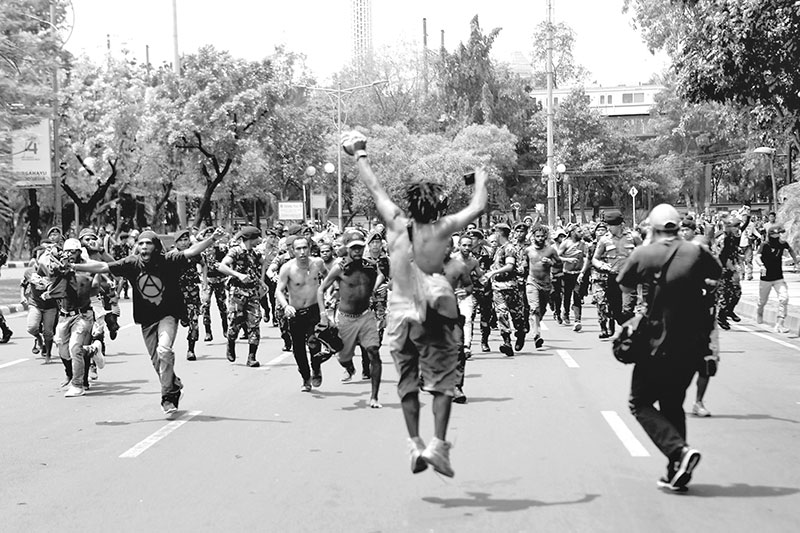
Papua and the need to revisit nationalism

Papuan crisis provides a valuable opportunity for the enlightened redefining of the nationalism concept.
- Post Report
Jakarta Post/Seto Wardhana

The recent Papua protests, triggered by racial abuse against Papuan students in Surabaya, East Java, reminds me of my father’s decades-old message: Write down Aceh’s place in the Indonesian independence struggle. Let it be public knowledge that Indonesia was not established by one group of people only.
My late father was one of the independent fighters in Aceh during the 1945-1949 Indonesian Revolution.
Today, it seems to me that his ‘instruction’ reflects an idea of ‘egalitarian nationalism’. No one can claim to have contributed the most to the birth of Indonesia. To put this in
perspective, we must firmly state that Indonesia is a ‘collective creation’. Why? Because soon after our proclamation of independence on August 17, 1945, numerous peripheral regions greeted the birth of this new nation. In Aceh, the ulema read the Ulema Declaration to state their steadfast support for the proclamation. In his speech in the Banda Aceh Grand Mosque, prominent ulema Teungku Muhammad Daud Beureu’eh declared the people of Aceh who had died in defence of Indonesian independence as martyrs. This was followed by several youth independence fighter groups.
A bit earlier in West Sumatra, Muhammad Sjafi’e of the Kayu Tanam Education Institute read the West Sumatran version of the proclamation and declared total support for the Sukarno-Hatta independence proclamation. In Gorontalo, a local fighter named Nani Wartabone went a step ahead of Sukarno-Hatta as she had proclaimed Indonesia’s independence shortly after the Dutch left Indonesia in 1942.
Despite the threat of the Australian army, two members of the Bugis aristocracy, Andi Djemma and Andi Mappadjuki, bravely opted to align themselves with the Republic of Indonesia. This alignment remained unchanged, although there had been an agreement between Dutch leader Van Mook and Indonesian prime minister Sjahrir on the principles of what Anak Agung Gde Agung called ‘the March 27, 1946 Concept’.
Under these principles, the Dutch recognised the sovereignty of the new republic, consisting only of Java-Madura and Sumatra, without mentioning South Sulawesi.
These facts vividly show that Indonesia was and is a collective creation. It automatically rejects a hierarchical point of view upon a nationalism concept. As a consequence, the structure of centre-periphery relations in the socio-economic and political realms should not only be constructed on the horizontal or egalitarian basis. More importantly, it should be marked by a dialogic structure where the regions are treated as equal partners of the centre. The reordering concept of nationalism could then be conceived from this framework.By sticking to this idea, the recent Papuan demonstrations are logically a product of the conspicuous absence of this enlightened model of nationalism. The abuse of both security officers and some youth organisations against the Papuan students in the Surabaya and Malang incidents reflects the remnants of old-fashioned nationalism. That is, the ones modelled after early European state formation experiences—the states they created structurally needed an aggrandised and centrally concentrated power.
Cloaked with the idea of efficiency in managing a modern state, the model not only found its rationale but also was copied by almost all non-Western, newly independent states. It is within this old-fashioned model that the seeds of fascism were and are bred.Borrowing loosely the idea of Alexander J Groth, combined with the spirit of militarism, which was seen as the pure expression of patriotism, this approach to nationalism is formatted in a hierarchical nature. Consequently, until today, this hierarchical nationalism concept tends to be anti-dialogue.
The concept assumes that the central authority is ‘the single producer of truth’. In the framework of the aggrandised and centrally concentrated power, it cannot see the different points of view pronounced by its constituents. This is what really marks today’s Jakarta-Papuan relations.
Today’s Papuan crisis thus provides a valuable opportunity for the enlightened redefining of the nationalism concept. Given that it develops horizontal and egalitarian centre-regions relations, Papua’s place in the framework of today’s Indonesia is structurally lifted on par with other regions as well as the centre itself. In this enlightened framework, Papuans are an equal dialogue partner of Jakarta, rather than a subordinated one.If it takes effect, this new nationalism concept will support and sustain national stability.

The article was previously published in The Jakarta Post, a part of Asia News Network.

Page 7
OPINION

A day for the victims, and for the future of transitional justice

This day serves as a reminder for the need to continue working towards transitional justice.
- NAVARAJ PUDASAINI

On August 30, the United Nations, families of the disappeared, and activists around the world commemorate the International Day of the Victims of Enforced Disappearances. The day was established by UN General Assembly resolution 65/209 on December 21, 2010. The International Convention for the Protection of All Persons from Enforced Disappearance adopted by the United Nations General Assembly on Dec 20, 2006, represents a significant development in the fight against enforced disappearances and for the protection of victims and their families. It recognises the right of victims and their families to know the truth regarding the circumstances and fate of their disappeared loved ones.

A global problem
Enforced disappearance has been a severe violation of human rights for decades. It is a violation not only of the rights of the victims, but also those of their relatives. The Preamble to this Convention acknowledges the extreme seriousness of enforced disappearance which constitutes a
crime and, in certain circumstances defined in international law, a crime against humanity.In spite of the International Convention being in place, enforced disappearance has become a problem worldwide. The global picture exposes the fact that many states lack the commitment to protect their citizens from this crime against humanity. The United Nations Working Group on Enforced or Involuntary Disappearances (WGEID)—a special procedure of the UN Human Rights Council—alone, since its inception, has handled 57,149 cases of enforced disappearances worldwide, with 45,499 cases from 92 States still unresolved as of 2 May 2018. As a matter of fact, the actual number of enforced disappearances is many times higher than this figure. Among the cases handled by the WGEID, 5,590 are from Africa; 26, 840 from the Asia Pacific; 819 from Eastern Europe; 108 are from Western Europe and other groups; 12,138 disappearances are from Latin American countries and the Caribbean; and 4 cases are from observer states.
No doubt, states are required to lead prompt, impartial and thorough investigations into human rights violations—an indispensable first step towards shedding light on possible criminal behaviour—to examine the circumstances in which it took place and identify the persons responsible for the abuses. Whenever these abuses constitute crimes, states must also take necessary measures to ensure that the perpetrators are brought to trial and, when applicable, sentenced to a punishment commensurate with the crime committed. The belief is that the past cannot, indeed must not, be forgotten. Forgetting or ignoring the past means we cannot learn lessons from it and are at great risk of repeating it.

Liable to uphold
Nepal, having ratified various international human rights treaties, has an international obligation to protect its citizens’ right to life, safety and security. Along with the end of the decade-long armed conflict following the signing of the Comprehensive Peace Accord, the Transitional Justice mechanism including the Commission of Investigation on Enforced Disappeared Persons was formally set up in 2015, albeit belatedly, to deal with the past injustice and to work towards finding the truth about missing persons. The victims’ families had enormous hope that they would get justice by knowing the truth about what actually happened to their loved ones. Each family has the right to know the truth regarding the circumstances of the enforced disappearance, the progress and results of the investigation and the fate of their disappeared kin. The commission was supposed to deliver truth, justice and reparations for violations committed during the conflict. Contrary to this, the process has not progressed as expected. Rather, its functionality has been questioned both inside and outside the country, including by the United Nations special rapporteurs who raised serious concerns over the slow progress in the transitional justice process. The special rapporteurs have actually been saying that the legislation governing the transitional justice bodies should be amended in line with the Supreme Court verdict; not doing so is one of the primary reasons for the failure of the commissions to make significant progress in investigations.The tenure of the two commissions, namely the Truth and Reconciliation Commission (TRC) and the Commission on the Investigation of Enforced Disappeared Persons (CIEDP) expired on February 9, 2019. The tenure was again extended till April 13, after which all posts have remained vacant. Now, a committee led by a former chief justice of the Supreme Court has been busy in selecting and nominating the members for both commissions for a renewed term, but it has been plunged into a political quagmire—the major parties have failed to reach the consensus to get it done.Dealing with the past is key for Nepal to advance peace and to find a common ground on which to stand. The more prolonged past injustices remain unaddressed, the higher the risk. Moreover, concerns have been now raised over the selection of members for the transitional justice bodies. Will the commissions, when they are formed, indeed be independent bodies? Can they sincerely dig out old cases and publish their findings? Can they carry out their tasks without fear or favour? Many doubts remain.
Faced with the worrisome fact that the many cases of enforced disappearances remain unaddressed, it is vital that today is not only a day to remember the victims of enforced disappearances and their families, important as this is. Instead, this day should also be about the future and serve as an occasion to remember the need to continue working towards changing the present circumstances. The need, therefore, is to make the commissions impartial, accountable, effective, and free from political interventions. While there is still a long way to go and numerous obstacles lie ahead, with the necessary will, commitment, and determination, the victims’ families may finally have the answers that they are looking for, and may, at last, begin to heal. The state should no longer delay in ratifying the International Convention for the Protection of All Persons from Enforced Disappearance. A country which is not dedicated to putting a stop to abuses perpetrated under its administration is not in a position to claim that it guarantees the rights of its citizens.

Pudasaini is a human rights lawyer.

OPINION

Opposing the EU elite is not anti-European

Leading Brexiteers have sought to portray Greece’s former finance minister as one of their own.
- YANIS VAROUFAKIS

Ever since Boris Johnson moved into 10 Downing Street vowing to renegotiate the United Kingdom’s withdrawal agreement with the European Union, the conventional wisdom among many Brexit opponents has been that the UK’s new prime minister is ‘doing a Varoufakis’ and will be crushed in a similar fashion.
The BBC’s Katya Adler reported from Brussels that EU officials spoke of ‘Varoufakis the sequel’—namely, ‘“lots of pointless meetings” with Prime Minister Johnson—as they believe was the case with Greece’s controversial finance minister at the height of the Greek debt crisis.’ Lord Adonis, a former Labour transport secretary and schools minister, added to the comparison his admiration for Germany’s Chancellor: ‘[Angela] Merkel is treating Britain like Greece and Johnson like Varoufakis,’ he tweeted.
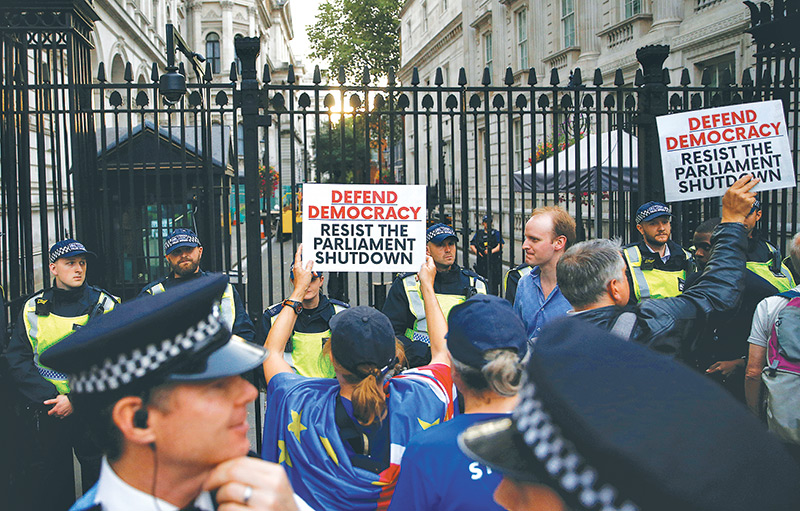
Johnson must be greatly amused by all this. He knows that in the run-up to the June 2016 Brexit referendum, we were in opposing camps. While he was touring Britain in his infamous bus leading the Leave campaign, I was running up and down the UK alongside politicians like Labour’s John McDonnell and the Greens’ Caroline Lucas, calling on voters to resist the Brexit sirens.
But Johnson is too smart to care. Confirming that hard Brexiteers are far more strategically savvy than Remainers, Johnson, his right-hand man Dominic Cummings, and Michael Gove, a senior cabinet minister and arch-Leaver, know how to divide and rule over their opponents.
Writing for The Times two months before the Brexit referendum in 2016, Gove waxed lyrical about a book in which I sketched the evolution of the EU from a common market into a harsh, anti-democratic monetary union—conveniently neglecting to mention that I opposed Brexit or any other move to break up the EU or the euro. Likewise, a year ago, Johnson, referring to my book Adults in the Room, wrote in his Telegraph column: ‘As … Varoufakis has explained, the tragedy of the Greeks was that they never had the nerve to tell their EU masters to get lost,’ forgetting to mention that Grexit was not my aim.
More recently, the pro-Brexit Telegraph reminded its readers that: ‘Early on in the Brexit process … Varoufakis predicted that, if the UK entered negotiations over Brexit, Brussels would seek to browbeat us in the same way and that we would do better just to walk away …’ Then it added: ‘Boris Johnson … has taken his message on board.’
The only lesson that Johnson seems to have learned from me is that one should never enter into a negotiation unless one is prepared to walk away without a deal. But surely this is a lesson that all sensible people know, with the sad exception, evidently, of Johnson’s predecessor, Theresa May, and former Greek Prime Minister Alexis Tsipras. The bigger lesson that needs to be learned now is that the stand-off between a resolute Johnson and a constitutionally inflexible EU is about to inflict great damage across Europe.
Commentators and politicians love to milk the Brexit-Grexit parallel for all it is worth. The fact that both countries held referenda that went against EU leaders’ wishes makes the parallel easier to peddle. But the analogy is a lazy one that impedes understanding the crucial issues facing our countries, and, worse, could bring a mutually damaging no-deal Brexit closer.
To be clear, I never espoused Grexit (and I have lost countless friends on the left as a result). Greek voters elected us in January 2015 to end the unnecessary misery imposed on them by ridiculous policies that turned an economic recession into a humanitarian crisis. Neither they nor I, as official negotiator with the EU, wanted to clash with the bloc. All we demanded were sensible policies that would allow us to remain in the monetary union viably and with a modicum of dignity.
Three days into my tenure, the president of the Eurogroup of eurozone finance ministers, Jeroen Dijsselbloem, threatened me with Grexit if I insisted on renegotiating our impossible public debt and the self-defeating austerity that went with it. I replied: Do your worst! It was no bluff. While I did not want Grexit, a majority of Greeks believed, as I still do, that debt bondage within the euro was a worse outcome.
Grexit, in short, was the weapon the EU forged and used to force successive Greek governments into accepting their country’s incarceration in the neoliberal equivalent of a Victorian workhouse. Brexit, by contrast, was a home-grown aspiration, rooted in the structural incompatibility between laissez-faire Anglo-Saxon capitalism and continental corporatism, and invoked by a coalition comprising sections of Britain’s aristocracy that successfully co-opted working-class communities wrecked by Margaret Thatcher’s industrial vandalism. These voters desperately wanted
to punish the cosmopolitan London elites for treating them like long-devalued livestock.Ironically, the EU establishment’s treatment of Greece contributed considerably to Brexit’s wafer-thin majority. Many sympathetic attendees at my anti-Brexit rallies, especially in England’s North, explained why they would ignore my pro-Remain pleas: ‘After seeing how the EU treated your people, we can’t vote to stay,’ many of them told me.
Conflating the two acts of opposing the European establishment is, therefore, pure folly. When Remainers, like Lord Adonis or a BBC journalist embedded in the EU bureaucracy, depict Johnson as the new Varoufakis, they do their cause no favours. Theodore Roosevelt rightly said it was unpatriotic not to oppose a US president who fails his country. Similarly, succumbing to the Eurogroup’s Grexit threat would have been the most anti-European thing I could do. My goal was to strengthen Europe by turning it from an austerity union into a realm of shared prosperity. Unlike Johnson’s government, we had a fresh democratic mandate and a large majority, as evidenced by the July 5, 2015, referendum in favour of a progressive Europeanist strategy that told Europe: we do not want Grexit, but are prepared to take it if necessary.
Had I succeeded, Europe today would be stronger, more united, and better able to oppose Johnson’s natural ally in the White House. But, of course, unlike Johnson, I was a mere finance minister. Tsipras folded, and the result was another four years of crisis, fresh wind in Brexit’s sails, and a weaker EU as comprehensive austerity contributed to the eurozone’s economic malaise.
Those who assume that opposing the EU elite is axiomatically anti-European don’t understand that lazy acquiescence to that elite is a hard Brexiteer’s best ally. They are helping Johnson do a Dijsselbloem, not a Varoufakis.
—Project Syndicate

Page 8
CULTURE & ARTS

‘Joker’ gets a prestige makeover

He’s a villain that is presented in an empathetic way.
- LINDSEY BAHR
Joaquin Phoenix in a scene from ‘Joker’, a spin on the quintessential Batman villain, which hits theatres on October 4. AP/RSS

The Joker has been around for almost 80 years and there’s no shortage of portrayals. There are even some legendary ones by Jack Nicholson and Heath Ledger. But by most accounts, Joaquin Phoenix’s spin on the quintessential Batman villain is unlike anything audiences have seen.
It’s why Joker isn’t being treated like a standard comic book movie release and instead getting the rollout of an Oscar contender with high-profile premières at the most prestigious fall film festivals—Venice and Toronto—before it hits theatres on October 4. Even Warner Bros, the studio with the keys to the DC Comics universe, largely left writer-director Todd Phillips alone to do what he wanted to do with the character: Make a realistic character study in the vein of Martin Scorsese’ 1970s films about how struggling stand-up comedian Arthur Fleck became the Joker.
“He doesn’t fall into a vat of acid and come out laughing,” Phillips said. “That’s a comic book thing.”
So, Phillips and his co-writer Scott Silver (8 Mile, The Fighter) ran all the elements of what we know about the Joker, a character without an origin story, through a “real world filter”—his look, his laugh and his personality. For the most part that meant ditching the source material. Even the comedian element, which actually has some basis in the comics, was kind of accidental.
 “We didn’t even really know that when we wrote it,” Phillips said of its convenient tie-in with The Killing Joke graphic novel.
He’s a “villain” that is presented in an empathetic way.
“You’re kind of on his side until you can’t be any longer,” Phillips said. That point has been different for everyone he’s showed it to so far.
Their unique approach, and that their No 1 choice agreed to do it, also helped attract talent who wouldn’t necessarily do a movie based on a comic character, including two Scorsese mainstays: Robert De Niro and producer Emma Tillinger Koskoff, who has been working with Scorsese since The Departed.
“It’s not my preferred genre, the comic book genre,” Koskoff said. “I literally can’t watch those movies. I try but I can’t. I should but I can’t. But I love this movie. Even if I didn’t work on this movie I would love this movie.”
She helped make Joker a real New York movie, bringing along some of her best crew from The Irishman and using her deep knowledge of filming in the city that she describes as both the best and the toughest. They shot in over 30 locations in the Bronx, Queens, Brooklyn, Manhattan and the surrounding areas, like Newark, New Jersey, which served as the “Times Square” of Gotham City.
“What Todd did here is really unique and special,” she added. “I think it’s going to catapult him to another level and take him out of the comedy world.”
Phillips became a Hollywood success for making massively popular grown-up frat boy comedies like Old School and The Hangover series. In other words, a serious spin on a comic book character is a departure for him too. And he’s getting used to all the attention and scrutiny in the lead up to the release.
With a character this known and a film that doesn’t seem to fit any mould of what’s come before, some wildly inaccurate information has circulated around the internet. For one, Scorsese was never set to produce. The two had emailed about the script privately, but Scorsese was always going to be tied up with post-production on The Irishman right when Joker was shooting. Also, Phillips didn’t call the programming director of the Venice International Film Festival and ask for Joker to be in competition—they were simply invited and accepted. And that leaked script going around? If it’s what Phillips thinks it is—a draft from April 2018—he said, “They’re in for a big surprise when they see the movie.” The script changed quite a bit between that version and when they began shooting last September.
Warner Bros made him jump through “many hoops” before they said yes, but once they settled on a budget number, which Phillips will only say is low for the movie world and enormous for the real world, he said they stepped aside.
“They were incredibly bold in just saying, ‘Ok there are no rules just go do your thing,’” he said. “It was amazing.”
It’s fairly extraordinary considering the character happens to be tied up in the current iteration of the DC Extended Universe films and played by Jared Leto. Imagine Marvel allowing a gritty Thor origin story with someone other than Chris Hemsworth. But still, people have told him he’s crazy to mess with a character this iconic.
“What we’re trying to do with this film is do something entirely different from the comic book movies that have come before. And not because those aren’t cool but just because we want to try something different,” Phillips said. “But this won’t be the last Joker movie ever made. Something tells me that in 10 years someone else is going to do something. There have been five iterations of this character already and they’re all brilliantly unique. This is one more group’s interpretation of a character that can be infinitely interpreted.”
The film is already in the Oscar conversation too, although whether that continues will all depend on how it’s received in Venice and Toronto and throughout the gruelling awards season. Phoenix, for being widely known as one of the best actors working right now, has never won an Academy Award.
“Joker is basically set to 11. He’s always at 11. But to see him set to 2 and gradually become an 11 is where the performance is so beautiful. It’s this slow transformation,” Phillips said. “(Phoenix) was deep into the character and it made every day really exciting.”
An Oscar wouldn’t be unprecedented for the character. Ledger won a posthumous supporting actor award for The Dark Knight.
It could also signal the start of a new era for comic book films. As Phillips said, they’ve, “become our Shakespeare.”
“They’re kind of a great launching off point to do something interesting,” he said.


—Associated Press

CULTURE & ARTS

Straight outta Karachi: Pakistan’s surprise hip hop hub

The rise of hip hop in Lyari mirrors the genre’s own birth decades ago in New York’s Bronx borough.
- David Stout
Eight-year-old rapper Waqas Baloch (top centre) and rappers Mohammad Omar (bottom right) and Wasim Masih perform in Lyari, Karachi. AFP/RSS

Haunted by gang violence and poverty for decades, Lyari was once considered one of Pakistan’s most dangerous areas, but those grim realities also inspired a generation of artists and spawned a burgeoning hip hop scene.
With its close proximity to the sea and history of smuggling, the largely ethnic Balochi neighbourhood in Karachi stands apart for its history of violence and lawlessness—even by Pakistan’s standards. When Karachi served as a major transport hub during the Afghan jihad against the Soviets, Lyari was hit hard by the influx of weapons and drugs—and the surge in brutality such black market businesses bring.
Heavily armed gangs and political hit squads exerted iron-fisted control over large swathes of Lyari, squashing economic growth while residents battled with the fallout, including rampant drug abuse and poverty.
“Lyari was a notorious place because of the gangs and the war. It was almost impossible for outsiders to even think about entering,” explains resident and new rapper Mohammad Omar.
But in recent years, the gangs have been brought to heel following a heavy-handed operation by paramilitary forces that kicked off in 2013 and saw the streets turned into virtual war zones.
In the battle for Lyari, gangs infamously used rocket propelled grenades and assault rifles to fight security forces, with the crossfire shuttering schools and businesses and also keeping kids off the streets.
“Children used to cry listening to the fierce gunfire,” says Omar, adding: “The poor people were the victims of those gang wars. We witnessed all those things.”


Showing reality
But the worst of the violence has abated, and an increase in security has led to flowering creativity.
The embattled neighbourhood now clings fiercely to its reputation for producing top footballers, iron-chinned boxers, and most recently socially conscious rappers.
The rise of hip hop in Lyari mirrors the genre’s own birth decades ago in New York’s Bronx borough, where it largely centred around street performances and featured lyrics that addressed social ills and life in urban ghettos.
Hip hop became a global phenomenon, but the genre initially failed to generate much traction in Pakistan where music fans tended to listen to pop, Bollywood soundtracks or traditional Sufi music.
The occasional forays by Pakistani musicians into hip hop over the years largely served as interludes in pop songs that veered closer to comedy. Not so in Lyari where rappers were influenced by the likes of Tupac Shakur and looked to their own experiences for lyrical inspiration.
“In other cities and provinces, there’s rap but it’s mostly about beautiful women and luxury cars,” says producer Qammar Anwar Baloch.
“We are showing reality.”
This artistic expression with a bass line first burst onto the nation’s airwaves in 2017 following the release of the hit song and video “The Players of Lyari” by the Lyari Underground.
The anthem doubles as an ode to the neighbourhood’s love for football in cricket-obsessed Pakistan along with a fiery rant lambasting the country’s sporting authorities for neglecting the neighbourhood’s football talent.
“The young people in Lyari represent one of the first times in Pakistani history where kids from the working classes are contributing to the music that upper classes listen to as well,” explains writer Ahmer Naqvi. “They’re using this moment to sort of assert their own place within Pakistani society, to not be content with being on the margins.”


Digital underground
For years, their voices and stories were largely invisible in Pakistan.
With little performance space available Lyari’s rappers have largely turned to the internet to share their clips of their songs, which generate millions of views online.
“I want to highlight the issues in Karachi and my own area in Lyari,” explains eight-year-old rapper Waqas Baloch, who released a video under the moniker Thousand earlier this summer.
The young MC is just one of dozens of rappers to pick up a microphone in recent years, according to residents following the scene closely.
For cleric Jameel Ahmed—who runs a madrassa in Lyari—youth interest in music and personal expression is a welcome relief after years of tough times.
“It is far better than drugs, booze and other such menaces. Music is helping them stay away from such things,” says Ahmed.
He adds: “Now, their minds are opening up.”


—Agence France-Presse

Page 9
Food & Travel

The right place for rainy respite

Bardev offers travellers a slice of rural life, a fast-vanishing lifestyle.
- TSERING NGODUP LAMA

Sitting on the front porch of a rural hotel in Bardev Village and watching the torrential downpour, I began to wonder if not postponing the trip was a mistake. Right before I left Kathmandu for Bardev, a quick check of the weather forecasted a few days of rain.
“It has been raining intermittently since yesterday,” said Subash, the owner of the hotel. I scanned the overcast sky and, convinced the rain wasn’t going to stop, headed to my room to take a nap. When I woke up, almost an hour later, the torrential downpour had petered to a light drizzle—I decided to settle for a quick jaunt around the village.    
Bardev is a small village in Konjyosom Rural Municipality, in the southeastern realms of Lalitpur district. The municipality, which has a majority Tamang population, was recently named Konjyosom, which translates to three precious jewels/three main gods in Tibetan Buddhism—Buddha, Guru Rinpoche and Chenrezig.
As soon as the rain stopped and the clouds shrouding the nearby hills lifted, I realised Bardev was not at all a bad place to visit during monsoon. The sloping hills, on which the village’s houses were set, emanated lush green. The lower ridges of the hills had dense chilauney trees, and the higher sections were blanketed with pine. What was also very particular about the village were the colourful traditional houses, which outnumbered the modern concrete houses. After the earthquakes of 2015, sights of traditional houses in villages in and around Kathmandu have become rare.
Even though Kathmandu was only a little over 30 kms away, the village felt several decades behind the city in so many ways. Apart from the sound of a lone public bus—which connects Kathmandu to the village—and occasional motorbikes, only crickets chirping, goats bleating and the noisy monsoon-fed river flowing through the village filled the air.


When I reached the village’s junction, the rain resumed. I walked into what looked like a small grocery shop or khaja ghar, the kind common in these satellite villages. Inside, a few men sat on one of the two tables. Spread on the table were glass and steel cups of tea, raksi and chhyang. At the far corner, the shopkeeper chopped pieces of chicken for a waiting customer. “It’s one of the shops where villagers come to buy everything from soap and Wai Wai, to meat to cigarettes,” said Chandra Bahadur Yonjan Tamang, a villager. “At the end of a day of toiling in the fields, villagers come here to drink tea, raksi and chhyang and just talk. Do you want to try the chhyang? I don’t drink, but I hear that it’s good?” I declined his offer.
When I told him I had come to the village and it would be the subject of a travel article, Tamang told me tourism wasn’t new to the village. According to him, the village had a hotel almost three decades ago. “It was called Gabila Hotel, and one of the owners was a Swiss woman. We used to see quite a few Swiss tourists here in the village,” said Tamang. “But when the Maoist insurgency started, the hotel closed, and with it, the village’s tourism died.”
But a few years ago, a hotel opened in the village and weekenders from Kathmandu looking to escape urban chaos started visiting for short weekend trips. There are now five houses in the village converted into hotels, offering spartan rooms.
It was only after finishing several cups of tea that the rain finally stopped. Tamang took me to his farm where he seasonally grows cabbage, maize, cauliflower, coriander, garlic, onion and radish.
From the farm, I started walking back to the hotel, and midway, it started raining again. I took shelter in a nearby restaurant. Unlike the first place, the crowd in this restaurant was younger. I ordered a Wai Wai soup and lemon tea. The orders were brought in swiftly, and soon, a man in his early 40s strutted in and sat at a nearby table. We were the only two in the dining area. He prompted conversation by saying he was the second-best farmer in the village—a peculiar claim. Before I could tell him I had no interest in knowing who sits where in the agrarian leaderboard, he had already started talking about his agricultural adventures in Birgunj—how he once walked across India border, how there he trained a local landlord on various farming techniques. From Birgunj, his story’s setting changed. He started talking about how he worked for a farmer in Manang and then in Darchula, at the late former Prime Minister Girija Prasad Koirala’s farm. With each crop and circling of his stories, he became harder to trust. When the rain stopped, it was getting dark, I bade him farewell. “I am the fourth-best farmer in the village,” he declared as his parting line. From second-best farmer to the fourth-best, the man’s standing had dropped two ranks in less than 30 minutes.


Early the next morning, on the suggestion of Subash’s grandfather, I headed to Baleshwor Mahadev. As I walked out of the hotel, a dog with huge lumps of eye boogers started following me. I was happy to have company. Together, we climbed concrete steps that climbed up from the north of the village. Soon the trail meandered into the jungle, and the concrete steps faded into a slippery, single-track trail wide enough for one. The further we went, the denser the forest got. After more than thirty minutes inside the jungle, the temple was still nowhere in sight. A bit spooked and tired, I looked at the dog, who seemed as clueless as I was, and abandoned the idea of making it to the temple. The dog seemed relieved with the change in plans, dashing ahead of me.
Back at the hotel, after a quick breakfast, it was time to leave. Unlike the previous day, the sun’s rays lit up the landscape, and the sky was a deep blue hue. But in the distance, ominous dark clouds had already gathered. Subash looked up at the sky and said, “It looks like we will see heavy rainfall today.” I told myself I wouldn’t mind getting stuck for another day.

Food & Travel

Welcome to Kathmandu! Have you tried our pizza?

A handful of eateries have become synonyms for pizza in Nepal, but where else should people venture for the perfect slice?
- Thomas Heaton

Pizza is the perfect canvas for a meal, offering a blank slate to paint with a wide-ranging palette of colourful flavours and ingredients—but what exactly makes Nepalis love it so much?  
The dish is a mainstay on most restaurant menus around the country, found alongside the likes of chow mein, momos and fried rice, and it certainly varies in quality and style. At Annapurna Base Camp one might find a bready pie with an ungodly amount of yak cheese, but in Kathmandu, there’s a bit more choice.   
It’s hard to pinpoint when exactly pizza became so popular in Nepal. There are many names when it comes to pizza in Kathmandu, and many different styles, with many throwing in everything—but the kitchen sink in the pizza—perhaps informed by The Bakery Cafe and its contemporaries. While Pizza Hut loafed into Nepal alongside KFC in 2009, bringing its terrible brand of pizza with it, there are plenty of places where palates can be better pleased for less.  
While that is the case, there are some that try to keep their pizza close to the Italian styles, such as Napoletana or Romana. At La Dolce Vita, owners Chandan and Ranjan Kayastha have hosted several Italian chefs since they took over the restaurant in 1996. Employing Italian chefs provided them with a chance to try and perfect their pizza—a never ending pursuit—using simple combinations on their pizza with the best ingredients they could find, whether imported or local.
“We wanted to focus on Italian because there weren’t many restaurants like there are today. We wanted to create an Italian space in Nepal,” says Chandan Kayastha.
The pizza’s current popularity in Kathmandu is easily attributable to how social it is to eat and how versatile it is, says Kayastha. But while pizzas made with many ingredients are popular, La Dolce Vita’s focus is firmly on simplicity.
“It’s close to Romano-style, but we have our own recipe,” he says.
Romano-style pizza, something the restaurant aims to provide its customers, is divided into two realms: one could be by the slice, or—like La Dolce Vita—round pies with a paper-thin crust.
That recipe, Kayastha says, which includes their sauce and dough, is a closely guarded secret.
The result is a simple pizza, pronounced only with milky cheese, a slightly sweet and acidic tomato sauce base, and a slightly chewy crust flecked with blistered and black leopard spots on its border. Above the cheese and tomato base, the ingredients are generally restrained in both choice and variety.
The Kayastha brothers also run the Roadhouse cafes, the first of which opened in 1991, where they experiment more with non-traditional flavours in wood-fired ovens. Wood-fired is the most traditional means of cooking pizza, which lends a smokiness to the base, and is becoming more and more popular by the day.
Fire and Ice came after La Dolce Vita, opened by Italian Annamaria Forgione in 1995. While the restaurant does not use wood-fired ovens to cook its pies, they have brought a taste of Naples to Nepal, says Forgione. “I try to be as authentic as I can,” she says.
That means she imports her pizza-based mainstays from around the Mediterranean, such as olive oil and cured meats, while other ingredients abide by the seasons and her admittedly “strict” standards—including mozzarella made especially for her restaurant.
There is a variety of different pizzas in Fire and Ice, from the spicy rompipalle, translating to “a pain in the backside”, to its namesake pizza, a herb-rich pie topped with fried potato and pesto, this joint mostly specialises in simplicity. The mellanzane is a classic Italian pie topped with eggplant, olives and garlic, on a bed of locally-made cow’s mozzarella.
With a nice char—or leopard spotting as some call it—on the slightly chewy crust, the base of the pizza is crisp thanks to being cooked directly on bricks. With 30 varieties of pizza, there is plenty to choose from at this relatively peaceful Thamel spot.
Another thing that sets Fire and Ice apart is they don’t use pans, rather they cook their pizzas directly on the brick floor of their electric ovens. The restaurant cooks some 400 pizzas per day, and has become a hot spot for tourists and locals alike, and has paved the way for Fire and Ice to open in several locations outside Nepal.
The pizza obsession is a global phenomenon, but for Nepal it’s all about communal eating.
“It’s easy to eat with your hands, it’s casual and it’s social too. Then, there’s the taste,” she says, adding that there seems to be no sign of the trend waning.
Kayastha agrees, and believes the versatility of the pizza is what people truly love—whether it’s a Mexican or Greek-Italian fusion pie, or the most traditional Margherita, there’s a pizza for everyone.


Five pizza spots to try:

Fire and Ice
Where: Tridevi Sadak, Thamel
Price: from Rs 570
Hours: 8am-10:30pm

The all-Italian menu has various unique tastes interspersed, like the rompipalle—an ode from its italian owner to Nepal. The restaurant also has plenty of other Italian specialties, such as pastas, antipasti, panini, and baked dishes such as lasagna, and salads. The recipes speak for themselves and show just why it’s such a popular spot in Kathmandu, which has become a stalwart in the city’s restaurant scene.


La Dolce Vita
Where: Chaksibari Marg, Thamel
Price: from Rs 520
Hours: 11am-10pm
Margherita, quattro formaggio, ortolana—La Dolce Vita’s menu is as Italian as its name. This country-style trattoria was one of the first dedicated Italian joints to grace Kathmandu Valley. While it specialises in traditionally restrained pizza pies, the restaurant uses an electric oven, similar to Fire and Ice.


Roadhouse Cafe
Where: Thamel; Jhamsikhel Road, Jawalakhel; Labim Mall, Pulchowk; Boudha; Baidam Road, Pokhara
Price: from Rs 550
Hours: 11am-10pm
Roadhouse cafes can be found sprawled across Kathmandu—as far as Pokhara, in fact—and it’s the wood-fired pizza that found its fame. While the folded pizza, known as a calzone, might provide something novel for the masses, the Mexicana is their most popular pizza. Topped with corn, smoked chicken, olives, onions, pickled jalapeños and bell peppers, it’s a firm favourite among Roadhouse revellers.


Cafe Jireh
Where: Bhaisepati, Lalitpur
Price: from Rs 560
Hours: 11am-8pm
This restaurant is a little farther flung than others, sitting outside the ring road in Bhaisepati. But with a mix of both traditionally inspired and newer styles of pizza, there is plenty of choice for everyone at the place. Cooked in a wood fire oven, the crusts are thick and crispy, with a nice yeasty chew, and the tomato sauce is balanced. The singed, smoky, crusts on their pizza make a world of difference, providing a crisp base for the mostly restrained combinations.


Bricks Cafe
Where: Kupondole Road, Kupondole
Price: from Rs 489
Hours: 12pm-10pm
Here, the pizza-cooking method is as traditional as it gets, but the toppings are not for the orthodox pizza evangelists. Dropping a taste of Nepal onto its Italian pizza canvas, Bricks looks to satisfy its patrons with flavour and fullness. Two of the pizzas are distinctly Nepali: chicken gala, topped with chicken sadeko, and chicken magesty (sic), topped with chicken choila. Although the Bricks Supreme is generously topped, it is luckily supported by a robust and crisp dough thanks to the wood oven. There are just a couple of options for the pizza traditionalist, so it is best to go with a taste for something different.

Page 10
WORLD

Melting glaciers, as well as ice sheets, raising Earth’s seas, a UN report says

- AGENCE FRANCE-PRESSE

PARIS,
As the planet’s polar ice sheets destabilise amid rising temperatures, a landmark UN assessment of Earth’s retreating frozen spaces is also set to spell out how melting mountain glaciers will impact humanity in the decades to come.
AFP has obtained an official draft summary of the forthcoming Intergovernmental Panel on Climate Change’s report on oceans and the cryosphere.
It says that the Greenland and Antarctic ice sheets lost roughly 400 billion tonnes of mass annually in the decade to 2015, corresponding to a sea-level rise of around 1.2 millimetres each year.
But glaciers high up mountains also lost around 280 billion tonnes of ice each year during the same period, raising seas a further 0.77 millimetres annually. “In the past 100 years, 35 percent of global sea-level rises came from glacier melting,” Anders Levermann, climate professor at the Potsdam Institute for Climate Change Impact, told AFP.
He said that future sea-level rises from glacial melt alone would be limited to 30-50 centimetres as they contain a limited amount of ice.
By comparison, there’s enough frozen water in the Greenland and Antarctic ice sheets to lift global sea levels several dozen metres.
“(Melting glaciers) contribute significantly to sea-level rise, it’s just not this huge number that Greenland and Antarctica could contribute,” added Levermann, who was not involved in the IPCC report.
There are roughly 200,000 glaciers—vast, ancient reserves of ice—on Earth and their relative smallness compared to the polar ice sheets makes them especially vulnerable to rising temperatures.
Their retreat is likely to impact inland communities the world over, for whom glaciers are a key water source.
The glaciers nestled high in the Himalayas provide water for 250 million people in nearby valleys and feed the rivers upon which a further 1.65 billion people rely for food, energy and income.
One study referenced in the IPCC report warns that Asian high mountain glaciers could lose more than a third of their ice, even if humans slash greenhouse gas emissions and limit global warming to 1.5 Celsius (2.6 Fahrenheit).
A continuation of “business-as-usual” in the coming decades with a global economy still powered mainly by fossil fuels could see two thirds lost.

WORLD

PM Johnson’s government dares Brexit opponents: Collapse us if you can

Opposition Labour Party seeks emergency debate; Scottish Conservative leader resigns.
- REUTERS
Anti-Brexit protestors hold placards, outside Downing Street in London, on Wednesday. REUTERS

LONDON,
Prime Minister Boris Johnson’s government on Thursday challenged opponents of Brexit in parliament to collapse the government or change the law if they wanted to thwart Britain’s exit from the European Union.
More than three years since the Brexit referendum, the United Kingdom is heading towards its gravest constitutional crisis in decades and a showdown with the EU over Brexit due in just 63 days time.
In his boldest step since becoming prime minister last month, Johnson enraged opponents of a no-deal Brexit on Wednesday by ordering the suspension of parliament for almost a month.
The speaker of the lower house of parliament, John Bercow, said that was a constitutional outrage as it limited the time the 800-year-old heart of English democracy has to debate and shape the course of British history.
But Jacob Rees-Mogg, the Brexit supporter who is in charge of managing government business in parliament, dared opponents to do their worst. “All these people who are wailing and gnashing of teeth know that there are two ways of doing what they want to do,” Rees-Mogg told the BBC.
“One, is to change the government and the other is to change the law. If they do either of those that will then have an effect. “If they don’t have either the courage or the gumption to do either of those then we will leave on the 31st of October in accordance with the referendum result.”
Johnson’s move to suspend parliament for longer than usual at one of the most crucial junctures in recent British history was cheered by US President Donald Trump but provoked criticism from some British lawmakers and media.
Ruth Davidson quit as leader of the Conservative Party in Scotland on Thursday, saying she could no longer juggle the demands of being a mother with the balancing act of Brexit.
“I have attempted to chart a course for our party which recognises and respects the referendum result, while seeking to maximise opportunities and mitigate risks for key Scottish businesses and sectors,” she said.
After years of tortuous negotiations and a series of political crises since the United Kingdom voted 52 percent to 48 percent to leave the EU in the 2016 referendum, Brexit remains up in the air. Options range from an acrimonious divorce on Oct. 31 and an election to an amicable exit or even another referendum.
In effect, Johnson’s order to suspend parliament forces opponents of a no-deal Brexit in parliament to show their hand and act in as few as four days sitting next month. Parliament returns from its summer holiday on Sept. 3. “Boris is obviously preparing for an election,” said Conservative lawmaker Ken Clarke.
“He’s decided that he wants a people versus foreigners election, and a people versus parliament election, and he’s blustering away with ‘making this country the greatest country in the world’, patriotism, Donald Trump-style stuff.”
Johnson is also trying to convince the EU that his threat of a no-deal exit is real.
Britain’s opposition Labour Party will seek an emergency debate on Brexit next week, the party’s trade spokesman Barry Gardiner said, outlining plans which could give them an opening to pass legislation to block a no-deal Brexit. “On Monday, we will introduce what is known as a Standing Order Section 24 Motion and that would be to try and have an emergency debate,” Gardiner told Sky News.
There is a small majority against a no-deal Brexit in the 650-seat House of Commons though it is unclear if opponents of Johnson within the Conservative Party would collapse his government in a vote of no confidence.

WORLD

‘War on nature must end,’ says activist Greta Thunberg in New York

- AGENCE FRANCE-PRESSE
Swedish climate activist Greta Thunberg, 16, arrives in the US after a 15-day journey crossing the Atlantic in the Malizia II, a zero-carbon yacht, in New York on Wednesday. AFP/RSS

NEW YORK,
Teenage climate campaigner Greta Thunberg said the “war on nature must end” and called on Donald Trump to listen to science after she sailed into New York on a zero-emissions yacht on Wednesday.
The 16-year-old completed a 15-day journey across the Atlantic shortly after 4:00 pm (2000 GMT), stepping off the boat onto a Manhattan dock to cheering crowds chanting her name.
“It is devastating and so horrible. It’s hard to imagine. They are a clear sign that we need to stop destroying nature,” she told waiting reporters when asked how she felt about raging fires in the Amazon, the world’s largest rainforest.
The Swede also rebuked Trump, a notorious climate change skeptic.
“My message for him is listen to the science and he obviously doesn’t do that,” she said, as she brought her environmental message to the United States for the first time.
Thunberg poked fun at the president too by saying she was “pretty sure” windmills don’t cause cancer,
in reference to a comment Trump made at a Republican fundraising event in April.
The teenager has become a symbol for climate action with her stark warnings of catastrophe if the world does not act now to cut carbon emissions and curb global warming.
Thunberg, who was diagnosed with Asperger syndrome at the age of 12, began sitting outside the Swedish parliament in August 2018 to get members to act on climate change.
She was quickly joined by other students around the world, as word of her strike spread through the media, and the “Fridays for future” movement was born.
She will attend a summit on zero emissions at the United Nations next month but refused to fly because of the carbon emissions caused by planes.
The Swede was offered a ride on the Malizia II racing yacht skippered by Pierre Casiraghi, the son of Monaco’s Princess Caroline, and German round-the-world sailor Boris Herrmann.
Thunberg has received criticism and abuse for her uncompromising attitude, however.
Her voyage sparked controversy after a spokesman for co-skipper Herrmann told Berlin newspaper TAZ that several people would fly into New York to help take the yacht back to Europe.
Hermann himself will also return by plane, according to the spokesman.
Team Malizia’s manager insisted, though, that the young activist’s journey would be climate neutral, as the flights would “be offset.”
A few hundred well-wishers and activists clapped and chanted “Greta, Greta, Greta” as she completed her 3,000-nautical-mile (5,550 kilometers) trip under overcast skies.
She passed the Statue of Liberty and headed up the Hudson River before docking at North Cove Marina near the World Trade Center.
The United Nations sent a flotilla of 17 sailboats, one for each of its sustainable development goals for 2030, to welcome her.
Thunberg endured rough seas and cramped conditions but said she never felt seasick once. She ate freeze-dried food and used a bucket as a toilet.
“It’s insane that a 16-year-old has to cross the Atlantic Ocean to make a stand. This, of course, is not something that I want everyone to do,” she said, smiling.
Thunberg added that she planned to rest before joining youngsters striking outside the UN on Friday.
The Malizia II yacht left Plymouth in southern England on August 14, and the teenager marked the first anniversary of the start of her school strike on August 20.
The 18-meter yacht features state-of-the-art solar panels on its deck and sides, and two hydro-generators provide the vessel’s electricity.
It can travel at speeds of around 35 knots (70 kilometers an hour).
Thunberg has said that she does not yet know how she will return to Europe.
Ahead of the UN summit on September 23, Thunberg will take part in youth demonstrations, before heading to Canada, Mexico and then to Chile for another UN conference in December.

WORLD

Measles making a comeback in Europe, WHO reports

- ASSOCIATED PRESS

LONDON,
The World Health Organization says there has been a “dramatic resurgence” of measles in Europe, in part fueled by vaccine refusals, with nearly 90,000 people sickened by the virus in the first half of 2019.
In a report issued on Thursday, the UN health agency said the number of measles cases from January to June this year is double the number reported for the same period in 2018. Measles is among the world’s most infectious diseases and is spread mostly by coughing, sneezing and close personal contact.
Although numerous European countries have introduced stronger vaccination policies, stubborn pockets of vaccine refusal have fueled epidemics across the continent. Last month, the German government proposed making measles immunization mandatory for children and employees at kindergartens and schools; there have been more than 400 cases of measles in Germany this year.
With more than 84,000 cases, Ukraine accounted for the vast majority of measles in Europe, followed by Kazakhstan and Georgia. In February, Ukraine’s health ministry said eight people had died of measles.
An expert WHO committee said four countries—Albania, the Czech Republic, Greece and the U.K.—have now lost their status as having eliminated measles. Measles is preventable with two doses of the vaccine, but there is no effective treatment once people are infected.
“If high immunization coverage is not achieved and sustained in every community, both children and adults will suffer unnecessarily and some will tragically die,” said Dr. Guenter Pfaff, chair of a WHO expert committee on measles in Europe.
In some developed countries, measles vaccination rates dropped sharply following the publication of a flawed study in the late 1990s that linked the combined measles, mumps and rubella vaccine to autism. Health officials have struggled to debunk misperceptions about the vaccine’s safety ever since.
“Misinformation about vaccines is as contagious and dangerous as the diseases it helps to spread,” WHO Director-General Tedros Adhanom Ghebreyesus in a statement this week.

WORLD

Conte to lead ‘more united’ Italy after far-right fall from power

Briefing

ROME: Italy’s premier-designate Giuseppe Conte said on Thursday his new coalition would lead a “more united, inclusive” country after a deal was struck which cuts the anti-immigrant far-right out of power. The anti-establishment Five Star Movement (M5S) and the centre-left Democratic Party (PD), once bitter foes, agreed Wednesday to govern in coalition in order to stave off snap elections in the eurozone’s third largest economy. The crisis was triggered on August 8 when popular far-right leader Matteo Salvini pulled his far-right League party out of the governing coalition with M5S, calling for fresh elections he thought would make him premier.  (Agencies)

WORLD

France climbs aboard hydrogen train revolution

Briefing

TOULOUSE: France is joining the hydrogen train revolution, the head of state rail operator SNCF said on Thursday, announcing an order for 15 emissions-free regional trains to replace polluting diesel models.Hydrogen trains are equipped with fuel cells that produce electricity through a combination of hydrogen and oxygen. Germany was the first country to roll out the technology a year ago, deploying two trains built by French TGV-maker Alstom on a 100-km stretch of rail in the country’s north. “We hope that in a few weeks... we will sign an order to build 15 hydrogen trains,” SNCF chief executive Guillaume Pepy told France’s BFM news channel.  (Agencies)

WORLD

Former Colombian rebel leader says taking up arms again

Briefing

BOGOTA: A former senior commander of the dissolved FARC rebel army in Colombia said on Thursday he is taking up arms again along with other guerrillas who have distanced themselves from a peace accord signed with the government. “We are announcing to the world that the second Marquetalia has begun,” Ivan Marquez, dressed in military fatigues, said in a video posted on YouTube, referring to a rural enclave considered a birthplace of the FARC in the 1960s. The whereabouts of Marquez, the Marxist FARC’s number two leader, had been unknown for more than a year. (Agencies)

Page 11
ASIA

Pakistan prime minister calls for nationwide protest over Kashmir

- AGENCE FRANCE-PRESSE
Imran Khan. AFP/rss

ISLAMABAD,
Pakistani Prime Minister Imran Khan called on the country on Thursday to join mass demonstrations to protest Delhi’s actions in Indian-administred-Kashmir as tensions between the nuclear-armed rivals continued to boil.
“I want all Pakistanis to come out tomorrow 12 noon-12.30 pm to show solidarity with the Kashmiri people,” Khan wrote on Twitter, adding: “We must send a strong message to Kashmiris that our nation stands resolutely behind them.”
The call to join protests Friday repeated earlier demands from Khan for Pakistanis to begin holding weekly nationwide rallies until the prime minister departs for the United Nations General Assembly next month, where he vowed to act as an ambassador for all Kashmiris.
Tensions have been soaring between Islamabad and Delhi for weeks in the wake of Prime Minister Narendra Modi’s move to strip India’s portion of Kashmir of its autonomy and bring it under direct rule.
Kashmir has been divided between the two countries since independence, and has been the spark for two major wars and countless clashes between the arch-rivals.
In February, the neighbouring countries again came close to all-out conflict, after a militant attack in Indian-held Kashmir was claimed by a group based in Pakistan, igniting tit-for-tat air strikes.
Khan’s renewed calls for protests came as the Pakistani military announced earlier Thursday the testing of a surface-to-surface ballistic missile, with the army’s spokesman saying the weapon was “capable of delivering multiple types of warheads”.

India’s top ports on alert for attacks from ‘Pakistan-trained commandos’
NEW DELHI: India’s two main ports said on Thursday they had been warned by the coastguard and intelligence officials that Pakistan-trained commandos have entered Indian waters to carry out underwater attacks on port facilities.
The Mundra Port, run by Adani Ports and Special Economic Zone Ltd, and the state-owned Kandla Port had asked their employees and ship operators to be vigilant, port officials and the ports said in advisories seen by Reuters.
Tensions between India and Pakistan have escalated since India revoked the special status of its portion of the Himalayan region of Kashmir on Aug. 5 and moved to quell objections by shutting down communications and clamping down on local leaders.
Pakistan reacted with fury to India’s decision, cutting trade and transport ties and expelling India’s ambassador. Both countries claim Kashmir in full but rule it in part.
On Thursday, Pakistan successfully carried out a training launch of a surface-to-surface ballistic missile,
an exercise viewed as hostile by some in India.
In recent weeks, both countries have repeatedly accused each other of violating ceasefires and seeking to provoke conflict in what is one of the world’s most dangerous nuclear flashpoints.
Intelligence inputs shared by government officials suggested that “Pakistan-trained commandos”
had entered the Gulf of Kutch on the west coast to foment violence, the Kandla Port said in an advisory.

(Reuters)

ASIA

China rotates troops in Hong Kong as police prohibits new protest rally

The rotation came less than 24 hours after police denied permission for a new mass rally planned for Saturday.
- AGENCE FRANCE-PRESSE
Armored personnel carriers of China’s People’s Liberation Army (PLA) pass through the Huanggang Port border between China and Hong Kong, on Thursday.  AP/RSS

HONG KONG,
China sent fresh troops to Hong Kong Thursday as part of a “routine” garrison rotation, as the financial hub braced for a new round of violent protests after police refused permission for a mass rally at the weekend.
Hong Kong has been mired in over three months of political crisis, with police and protesters engaging in increasingly violent clashes, prompting Beijing to ramp up its rhetoric and a public relations campaign against the anti-government movement.
Chinese state media on Thursday broadcast a video of armoured personnel carriers and trucks driving across the Hong Kong border, describing it as a routine rotation of the garrison stationed in the semi-autonomous city. “The Hong Kong Garrison of the Chinese People’s Liberation Army on Thursday morning completed the 22nd rotation since it began garrisoning Hong Kong in 1997,” Xinhua news agency reported.
“Before coming... we learned about the situation of Hong Kong,” PLA officer Lieutenant-Colonel Yang Zheng, said in a slick PR video. “We’ve strengthened our training... to make sure we can fulfill our defence duties.”
The rotation came less than 24 hours after police denied permission for a new mass rally planned for Saturday that was expected to draw hundreds of thousands of people to the streets—the 13th consecutive week of protests.
Police have previously denied permission for rallies to take place, but the orders have largely been ignored.
In a letter to the rally organisers, the Civil Human Rights Front (CHRF), police said they feared some participants would commit “violent and destructive acts”.
Protesters have so far carried out “arson and large scale road blockades” and “used petrol bombs, steel balls, bricks, long spears, metal poles, as well as various self-made weapons to destroy public property”, the letter said of previous rallies.
Last Sunday police deployed water cannon for the first time and one officer fire a live-round warning shot from his sidearm to fend off radical protesters after a sanctioned rally erupted into some of the worst violence of the past three months.
This Saturday’s rally was called to mark five years since Beijing rejected political reforms in Hong Kong, a decision which sparked 79 days of political protests that became known as the Umbrella Movement.
CHRF leader Jimmy Sham—who said he escaped unhurt after being set upon by masked men with a baseball bat and knife earlier Thursday—said the group would appeal against the police decision. “You can see the police’s course of action is intensifying, and you can see (Hong Kong leader) Carrie Lam has in fact no intention to let Hong Kong return to peace,” he said.
Anti-government demonstrators have been urged to gather in the city centre and march to the Liaison Office, the department that represents China’s central government in Hong Kong, but both aspects, which need permission from authorities, have been banned.
The last rally organised by the CHRF on August 18 brought hundreds of thousands of people to the city’s main public space.
Despite being banned by police from leaving the area, they later marched peacefully through the streets in one of the first recent protest gatherings to end without major incident.
The protests were originally ignited by the city’s Beijing-backed government trying to pass a bill allowing extraditions to mainland China, but they have evolved into a wider call for greater democracy and an investigation into allegations of police brutality.

ASIA

India seeks to ease concerns on ‘citizens register’

- AGENCE FRANCE-PRESSE
Workers at the National Register of Citizens office check documents submitted by people ahead of the release of the register’s final draft in Guwahati, the capital city of India’s northeastern state of Assam. AFP/RSS

NEW DELHI,
India’s government sought on Thursday to ease concerns about an imminent “citizens’ register” in the state of Assam that has left several million people, mostly Muslims, fearful of becoming stateless.
A draft register last year left off more than four million people living in the north-eastern state, and India’s
Hindu nationalist government has indicated it wants to replicate the process nationwide.
“DO NOT BELIEVE RUMOURS ABOUT NRC,” a spokesperson for the Indian home ministry tweeted in capital letters, referring to the final National Register of Citizens (NRC) due to be published on Saturday.
“Non-inclusion of a person’s name in NRC does NOT amount to his/her being declared a foreigner. Every individual left out from final NRC can appeal to Foreigners Tribunals, an increased number of which are being established,” the tweet added.
Assam is an isolated state of 33 million people in the northeast of India, largely cut off from the rest of the country by Bangladesh, which was formed after East Pakistan declared independence from Islamabad in 1971, sparking a brutal war.
Hundreds of thousands of people fled to India during the fighting.
Officials say those appealing against exclusion from the NRC need to be able to prove they or their forebears were in India before 1971—a huge challenge for people in a state where illiteracy is rife and where many lack the necessary documentation.
The roughly two million people who are expected to be left off the final register being published on Saturday will have 120 days to appeal.
Those rejected can then be declared foreigners and face being stripped of their Indian citizenship and rights, put in a detention camp and even deported.
A majority of those affected are Muslims, and critics of Prime Minister Narendra Modi’s Hindu nationalist Bharatiya Janata Party (BJP) say this reflects its aim to serve only its co-religionists.

ASIA

Bangladeshis speak up about ‘rampant’ rapes in Islamic schools

- AGENCE FRANCE-PRESSE
Hojaifa al Mamduh, a former madrasa student who is now studying journalism at a Dhaka university, poses for a photo in Dhaka. AFP/RSS

DHAKA,
Former Bangladeshi students are turning to social media to detail allegations of “rampant” sex abuse at the hands of teachers and older pupils in Islamic schools, breaking their silence on a taboo topic in the conservative country.
Child abuse in madrasas has long gone unreported in Bangladesh, a Muslim-majority nation where hardline Islamist groups draw their support from the tens of thousands of schools across the nation of 169 million people.
But in the wake of a brutal murder of a teenage girl who was burnt to death in April after accusing her headteacher of sexual assault, such incidents have been subject to national scrutiny and debate for the first time.
In July alone, at least five madrasa teachers were arrested on rape charges against boys and girls under their care.
Several senior students were also held by police over the rape and beheading of an 11-year-old orphan, while a Dhaka cleric and seminary teacher was charged with sexually assaulting a dozen boys aged between 12 and 19.
The accusations reveal how students from poorer and rural backgrounds, whose parents send them to madrasas as they are more affordable than secular schools, are disproportionately affected by the abuse.
Rights activists said the assaults—which range from violent rapes to forcible kissing—are so pervasive that the cases reported in the media are just the tip of the iceberg.
“For years these crimes eluded spotlight due to sensitivity of the subject,” Abdus Shahid, the head of child rights’ group Bangladesh Shishu Odhikar Forum, told AFP.
“Devout Muslims send children to madrasas, but they don’t speak up about these crimes as they feel it would harm these key religious institutions.”
Hojaifa al Mamduh, who studied in three madrasas in the capital Dhaka, published a series of posts on Facebook in July detailing the abuses endured by students including himself.
The assaults were “so widespread in the madrasas, every student who has studied there knows about it”, Al Mamduh, now a journalism student at a Dhaka University, told AFP.
“Many madrasa teachers I know consider sex with children a lesser crime than consensual extramarital sex with women. Since they live in the same dormitories, the perpetrators can easily hide their crimes and put pressure on their poor students to keep mum.”
The 23-year-old’s posts generated heated debate in the country, and he was personally threatened.
He was accused of being “an agent of Jews and Christians” and smearing the “sacred image” of a madrasa by one social media user.
Another reminded him of the fate of Avijit Roy, a top Bangladeshi atheist blogger and writer who was hacked to death by Islamist extremists in 2015.
But his posts encouraged others to share their own experiences of alleged sex crimes.
Mostakimbillah Masum, who published his story on a feminist website, said he was “first raped by an elder student in my madrasa when I was just seven”.
The 25-year-old told AFP that another one of his rapists was “a teacher who made me unconscious and raped me. It traumatised me permanently”.
“Dozens of madrasa students I know were either raped or witnessed rapes and sexual assaults of their fellow students,” he added. “It is so rampant almost every madrasa has a fair share of such stories.”
Madrasa teachers have strongly denied the allegations, calling them “negative propaganda”.
Mahfuzul Haq, a principal of a madrasa in Mohammadpur where Al Mamduh studied, told AFP “one or two isolated incidents can happen” as there were 20,000 madrasas in the South Asian nation.

ASIA

UN chief moots summit to tackle Amazon fires

Briefing

YOKOHAMA: The head of the United Nations on Thursday mooted a meeting of key countries to drum up support to tackle the devastating Amazon forest fires, which he called a “very serious situation.” Speaking on the sidelines of an African development conference in Yokohama, Antonio Guterres urged the international community to do more to quell the more than 83,000 fires set this year, more than half of which are raging in the massive Amazon basin. “We are strongly appealing for the mobilisation of resources and we have been in contact with countries to see whether, during the high level session of the General Assembly, there could be a meeting devoted to the mobilisation of support to the Amazon,” Guterres told reporters. World leaders are expected to gather in New York for the annual UN General Assembly from September 23 to 30.  (Agencies)

ASIA

US military aircraft flies over Taiwan Strait

Briefing

TAIPEI: A US military plane flew over the Taiwan Strait on Thursday, the island’s government said, just days after one of its navy ships sailed through the waters and the latest arms sale between Washington and Taipei. Taiwan’s defence ministry said in a statement that the transport aircraft flew south along the “median line” of the narrow strait, a traditionally respected maritime line dividing self-ruled Taiwan and mainland China, in a move likely to provoke Beijing. “Nothing unusual” occurred, the statement added. A USS transport ship passed through the strait last Friday, a few days after US State Department approved the transfer of 66 F-16 fighter jets to Taiwan in an $8 billion deal, the latest huge military hardware sale.  (Agencies)

ASIA

Rioters torch government building in Indonesia’s Papua

Briefing

JAKARTA: Indonesia’s Papua was plunged into chaos again on Thursday as angry protesters torched a government building and damaged businesses, according to an AFP reporter, after nearly two weeks of riots across the island. Hundreds of demonstrators marched near Papua’s biggest city Jayapura where they set fire to a regional assembly building and hurled rocks at shops and hotels, the reporter said. Many called for independence from Indonesian rule and an end to racism against the minority group.  (Agencies)

Page 12
MONEY

New China tariffs a ‘job killer,’ US industry tells Trump

Manufacturers and retailers, including Nike and Foot Locker, alerted that new tariffs could cost consumers extra $4 billion.
- AGENCE FRANCE-PRESSE

Shoppers at an outlet mall exit a Nike store in Los Angeles.AFP/rss

WASHINGTON : President Donald Trump’s new tariffs on Chinese goods are a “job killer” that will slam consumers and could make a recession more likely, industry groups said on Wednesday.
The latest cry for peace in Trump’s year-long trade war came just days before the first in series of tariff increases is due to go into effect—potentially raising prices ahead of the crucial holiday shopping period.
In a sharp deterioration in the US-China trade war, Trump last week ramped up the punitive duties for the vast majority of US imports from China.
The five percent increases, which will take the tariffs to 15 percent and 30 percent, are due to roll out in stages through December and target some popular items, such as laptops, mobile phones and some shoes.
More than 200 footwear manufacturers and retailers, including major brands such as Nike and Foot Locker, signed onto the letter alerting that the new tariffs could cost US consumers an additional $4 billion a year and increase the chances of an economic downturn.A broad array of 160 other trade groups—including software and electronics manufacturers, as well as retailers, liquor producers and others—also warned Trump of higher prices and damaged consumer confidence and urged him to abandon the tariff strategy.
“We’ve been telling the White House since the beginning that tariffs will be paid by Americans in the form of higher prices, and that due to our already high import taxes, this will be a job killer,” Matt Priest, president of the Footwear Distributors and Retailers of America, said in a statement.
The footwear group directly disputed Trump’s claim that China is bearing the cost of the tariffs.“There is no doubt that tariffs act as hidden taxes paid by American individuals and families,” its letter said.Long a powerful voice in Washington, US industrial lobbies have been unable to persuade Trump to avoid escalating his year-old trade war with China.
The Information Technology Industry Council agreed China needs to change its unfair trade practices, but said in a statement Wednesday that “the current tool of tariffs has simply not worked, and we’re continuing to see the negative results.”The companies agreed with economists that recession risks are rising, warning Wednesday that uncertainty caused by the confrontation with Beijing was rattling the wider economy—a sensitive subject as Trump seeks reelection next year.
“An economic downturn will take away disposable income from US consumers, even as they have to pay more for products,” they said.
Already high US import duties on footwear have continued to rise in recent years even as shoe prices have eased, according to the letter, meaning new tariffs almost certainly will be passed onto consumers.US officials have delayed or canceled tariffs on some popular items until December, including some shoes, preventing price hikes from hitting just before the holiday shopping period.But, even before they take effect, the tariffs threaten to drive up prices by straining manufacturers outside China to meet a sudden rush of demand, the letter said.Trump has blown by turns hot and cold this month, thundering last week that US companies should withdraw from China but optimistically predicting a deal on Monday.
Trump’s recent, more moderate tone helped stanch bleeding on Wall Street but was quickly met with skepticism by investors since Beijing did not seem to share that optimism.

MONEY

Japan-South Korea spat an economic lose-lose

- AGENCE FRANCE-PRESSE

TOKYO : A diplomatic spat that prompted Japan and South Korea to downgrade trade and military ties is an economic lose-lose, experts say, with both countries already feeling the impact.
South Korean firms are now scrambling to find alternative suppliers beyond Japan, while Japan’s tourism industry is counting the cost of plunging visitor numbers from South Korea.
The dispute stems from of a long-running disagreement over Japanese use of forced labour in South Korea during World War Two.
A series of South Korean court rulings have demanded Japanese companies compensate victims, but Tokyo says the issue was settled by a reparations package agreed decades ago.
As ties worsened, Japan imposed restrictions on the export of chemicals key to the South Korean chip and phone industries, and this week removed Seoul from a favoured trading partner ‘white list.’
The moves have forced South Korean electronics giants like Samsung, LG and SK Hynics to hunt for suppliers elsewhere in the hope of reducing their dependence on Japanese manufacturers.In early August, the South Korean government promised the sector a major injection of funds—around $37 billion—to help achieve a long-term goal of self-sufficiency for 100 components for the country’s industry.
In the meantime however, South Korea’s “overall business ecosystem” remains vulnerable, particularly small and medium-sized businesses, according to Kwon Tae-shin, head of the Korea Economic Research Institute.
The country’s export-oriented economy was already suffering the effects of the US-China trade war and the global economic slowdown.
“Six out of 10 small and mid-sized firms will not be able to stand the measures for more than six months,” he warned.On the Japanese side, authorities have played down the impact of the moves, insisting the new rules simply put South Korea on the same level as many other trading partners.Japanese industry is also not likely to suffer “serious damage” from retaliatory measures South Korea will implement from September, Yasuo Imanaka, chief analyst at Rakuten Securities, told AFP.
That is in part because Japan is much less dependent on South Korean products than vice-versa. A senior official at a leading Japanese firm said the economic impact for both countries was “very overestimated.”South Koreans were the second largest contingent of foreign visitors to Japan last year, just behind visitors from China, according to the Japan National Tourism Organisation.But their numbers fell 7.6 percent in July from a year earlier, according to JNTO figures, with the trend expected to worsen given the plunge in August and September reservations seen by major Japanese tourism agency JTB.In the short-term, the sector can count on a boost from the Rugby World Cup being hosted from September, which is expected to draw 400,000 foreign fans. And a rise in Chinese visitors—numbers were up 19.5 percent in July—as well as next year’s Olympic Games in Tokyo may also provide solace.

MONEY

Huawei plans phone launch under cloud of Google ban

- REUTERS

NEW YORK/FRANKFURT : Huawei Technologies plans to forge ahead with the launch of new high-end smartphones in Europe even though it may not be able to offer Google’s official Android operating system and widely used apps such as Google Maps, company executives told Reuters.
The world’s No. 2 smartphone maker is set to unveil its new Mate 30 line of phones on Sept. 18 in Munich, according to a source familiar with the matter, though it is not clear when the devices would go on sale.
The Mate 30, made to work on new 5G mobile networks, is Huawei’s first major flagship smartphone launch since US President Donald Trump’s administration effectively blacklisted the company in mid-May, alleging it is involved in activities that compromise US national security, a charge the company denies.
A Google spokesman told Reuters the Mate 30 cannot be sold with licensed Google apps and services due to the US ban on sales to Huawei. A temporary reprieve that the US government announced last week does not apply to new products such as the Mate 30, the spokesman said.
US companies can seek a license for specific products to be exempted from the ban. Google, a part of Alphabet Inc , would not say whether it had applied for a license to offer its apps and services known as Google Mobile Services, though it has said in the past that it wants to continue supplying Huawei. Reuters reported this week that the US Commerce Department has received more than 130 applications from companies for licenses to sell US goods to Huawei, but none have been granted. The uncertainty surrounding the Mate 30 shows the confusion that reigns for Huawei and its business partners as a result of the escalating trade war between China and the United States. While the Huawei blacklisting was cast as a response to security concerns, President Trump has indicated it could be lifted as part of a trade deal.
“Huawei will continue to use the Android OS and ecosystem if the US government allows us to do so,” Huawei spokesman Joe Kelly told Reuters. “Otherwise, we will continue to develop our own operating system and ecosystem.”

MONEY

Argentina asks IMF to restructure debt payments

- AGENCE FRANCE-PRESSE

BUENOS AIRES : Argentina asked the International Monetary Fund to restructure its debt payments on the $56 billion bail-out loan agreed last year in a bid to calm market turbulence, Finance Minister Hernan Lacunza said on Wednesday.
Following the announcement, the IMF said in a statement that it will “continue to stand with Argentina during these challenging times.”Recession-hit Argentina has suffered market volatility since business-friendly President Mauricio Macri was trounced in party primaries three weeks ago by leftist challenger Alberto Fernandez.
Debt repayments are due to begin in 2021 while the latest loan disbursement of $5.4 billion is expected next month. Lacunza said the government has “proposed the start of a dialogue to roll back the debt repayments.”
However, he said that while those talks would begin before the October 27 general election, they would not be finished until after the new government takes over on December 10. The request for repayment extensions aims to allow the next government to “deploy its policies without financial restrictions.”
An IMF delegation was visiting Argentina this week to review the loan, but is now returning to Washington as scheduled, the fund’s spokesman Gerry Rice said in a statement that described talks with Lacunza and others as “productive.”“Regarding the debt operation announced by the Argentine authorities today, Fund staff is in the process of analyzing them and assessing their impact,” Rice said. “Staff understands that the authorities have taken these important steps to address liquidity needs and safeguard reserves.”

MONEY

Private health firms plan ‘conquest’ of Eastern Europe

- REUTERS

A medical worker looks through a microscope at an embryology laboratory at Robert Karoly Private Hospital in Budapest, Hungary. Reuters

BUDAPEST : Csilla Balla became anxious after her doctor told her she would need surgery to remove a benign skin growth on her face, and she decided to go back to see her to discuss other options.
“They told me the next available appointment was two weeks later,” said the 46-year-old teacher from Budapest. “It would have taken
two weeks just to have another discussion on whether surgery was really necessary.”
Frustrated with the public health service, Balla sought a second opinion from a doctor at a private practice, where she was offered an appointment within a few days. The doctor told her she did not need surgery and burned off the growth in five minutes.
The treatment cost Balla 15,000 forints ($51) and she hasn’t had any problems since.
Her experience reflects a broader trend in Eastern European states, from Hungary and Poland to Romania, where growing numbers of people are opting for faster access to medical care at private clinics and hospitals.The change is being driven by low public health spending as a share of the economy—which has often led to staff shortages and longer waiting times for tests and surgery—coupled with rising wages, which is making private care a viable alternative.
Employers are increasingly offering private medical cover as a perk to attract or retain employees at a time of falling unemployment and record labour shortages.As a result, business is booming for private healthcare providers.
“This is a period of conquest for private clinics,” said Peter Pal Varga, director of Budapest’s Buda Health Centre, in which billionaire investor Sandor Csanyi acquired a majority stake in 2017.Varga told Reuters his company planned to build a new general hospital in Budapest, and modernise its one existing hospital which specialises in spinal surgery, at an estimated total cost of about 20 billion forints ($70 million).
“Our current private inpatient capacities are no longer sufficient,” he added.There are no comprehensive figures for the size of the private healthcare market in Eastern Europe, but four of the biggest players in the region had combined revenues of almost $660 million last year, up by nearly a fifth on average, and forecast similarly strong growth in 2019.
Like Buda Health, all five major healthcare providers interviewed by Reuters said they were expanding their operations to keep up with demand.
Poland’s top private health player Lux Med, for example, has recently acquired two hospitals, in Warsaw and the southern city of Katowice, which will bring its total to nine, pending regulatory approval of its latest acquisitions. Romanian market leader MedLife is meanwhile looking to make acquisitions this year or in early 2020. However the healthcare business is fraught with risk, with companies having no guarantee of recouping the large initial investments required for hospitals and clinics as the market becomes increasingly crowded and competitive.
Major challenges include finding and retaining staff, due to an emigration of doctors and other medical workers to western Europe, and rising costs for equipment and maintenance.In the social context, meanwhile, some analysts warn the private healthcare boom could widen inequality in a region where, in many parts, those on lower incomes already have lower life expectancies.
Poland’s health ministry said it was working to improve access to medical services and cut waiting times, adding that spending on state healthcare was expected to rise by nearly 9% this year. The Romanian and Hungarian health ministries did not respond to requests for comment. Public health spending in Eastern Europe is well below the EU average according to the latest European Commission surveys in 2017, which said the health systems of Hungary, Poland and Romania were underfunded.Total health expenditure stood at 7.2% of GDP in Hungary, 6.7% in Poland and 5.2% in Romania compared with an EU average of 9.6%.Many Eastern Europeans, whose net wages pale in comparison to Western Europeans’, even after rapid rises in recent years, have responded by shelling out their own money so they can cut waiting times for procedures or screening services.
Private health spending amounted to 2% of GDP in Hungary and 1.8% of GDP in Poland last year, comparable or outstripping wealthier nations like Germany at 1.7% and France at 1.9%, according to data from the Organisation for Economic Co-operation and Development.

Page 13
MONEY

Energy Ministry clears the way for investors to open vehicle charging stations

Service providers may be allowed to add a markup of up to 20 percent as service charge.
- PRAHLAD RIJAL

A file photo shows a charging station in Ratnapark, Kathmandu.Post file photo

KATHMANDU : Amid growing concerns over lack of charging infrastructure deterring the growth of electric mobility in the country, the Energy Ministry has outlined a business model paving the way for private investment in building charging stations for commercial operation.
“The outline which, once incorporated by the Nepal Electricity Authority in a concrete technical and financial work procedure, will guide many commercial entities to build and profit from charging stations,” said Prabin Raj Aryal, spokesperson for the Energy Ministry. “It is up to the power utility to come up with standards which will govern commercialisation of the infrastructure.”
As per the outline, service providers will be allowed to set up charging points at public spheres, government offices, public entities and businesses, and commercial and residential buildings.
“Hoteliers and restaurant owners can also build the facility at their premises, and electric vehicle producers or distributors can also build charging stations dedicated to serving their consumer segment,” states the outline.
The ministry’s move comes just four months before the 2020 deadline set by the government to convert 20 percent of the transport fleet into electric as compared to the 2010 level. Despite action plans, the country is yet to see a sizeable mass of people switching from gas guzzlers to electric vehicles. According to the government’s National Plan for Electric Mobility, lack of charging infrastructure is one of the main reasons that could discourage consumers from switching to electric vehicles, and potential charging station operators too may not invest in them unless there is a sizeable mass of electric cars on the roads.
The situation is expected to change in line with the development of a business model ensuring commercial operation of the infrastructure by private entities.In its outline, the Energy Ministry has recommended allowing authorised service providers to take up to 20 percent more as service charge from electric vehicle owners apart from the standard electricity tariff.
As the Electricity Regulatory Commission is yet to come up with tariffs for selling power through charging stations, the ministry has suggested that the Nepal Electricity Authority take current electricity surcharges collected under the heading ‘other transportation sector’ by the power utility.
The sector pays Rs4 per unit during nighttime, Rs8 per unit in the afternoon and Rs9 unit during peak hours.
Businesses or persons building charging stations can collect 15 to 20 percent in service charges from electric vehicle owners, depending on the nature of such stations.
A service provider who has installed a slow charging station can take only 15 percent as service charge while a level 4—fastest charging point—operator can collect 20 percent as service charge from consumers. Also, general consumers of the Nepal Electricity Authority can get permits for installing charging ports for private vehicles at their residences by paying the usual electricity tariff currently imposed on household consumption.
“The charging infrastructure will help to utilise surplus power during nighttime,” said Kulman Ghising, managing director of the Nepal Electricity Authority.
The persons or institutions that plan to invest in charging infrastructure must obtain a permit from the Nepal Electricity Authority while no licences will be required for setting up a household charging system unless the household consumption goes beyond an approved load level.
As the ministry has designated the power utility as the regulatory authority for charging infrastructure, all charging service providers are required to follow the parameters set by the electricity authority while installing and commissioning the facility. “The developers must test and commission the facility in the presence of a technical officer of the electricity authority and obtain a test certificate before beginning commercial operation,” states the outline.

MONEY

Nepal Bhutan prepare draft of bilateral trade agreement

- RAJESH KHANAL

KATHMANDU : Nepal and Bhutan on Thursday agreed to prepare major lists of export items to provide duty free access in both countries.
In the joint-secretary level talks held in Kathmandu, both the countries have also expressed their consent to taking forward the trade protocol. “We have finalised the draft of the trade agreement and are carrying out discussion to finalise number of bilateral trade issues to incorporate in the proposed trade protocol,” said Navaraj Dhakal, spokesperson for the Ministry of Industry, Commerce and Supplies.
In the one-day talk, Dhakal led the team of Nepali delegates while Sonam Tenzing, joint-secretary of the commerce ministry, Bhutan, led the Bhutanese team.
The two countries are members of a number of multilateral trade initiatives-South Asian Association for Regional Cooperation (SAARC), Bay of Bengal Initiative for Multi-sectoral Technical and Economic Cooperation and Bangladesh-Bhutan-India-Nepal-but they have not signed any bilateral trade agreement till date.
According to the ministry, Nepal and Bhutan have been mulling to sign a trade agreement citing the expanding trade volume between the two countries. The first meeting of Nepal-Bhutan Bilateral Trade at the level of joint secretaries of the Ministries of Commerce was held in Kathmandu on 17 March 2010 and the second meeting was held in Thimpu on 24-25 May 2011 to discuss the on the bilateral trade agreement.
Failing to reach consensus in finalising the products lists and the burning issue of Bhutanese refugees then had kept signing of the trade agreement in shadow, said the ministry officials.
Dhakal said two countries have revived the talks in the new line of the products lists. “In the new scenario, the products list has been prepared as per the internationally accepted Harmonised System codes revised in 2017,” said Dhakal adding that Nepal has forwarded the fast selling products having high comparative advantage in to be drafted proposal of trade protocol.
A rule of origin is also among the major issues discussed in the bilateral talk, according to the ministry. The officials said Nepal has asked Bhutan to provide duty-free access to local products with a value addition of 25 percent and above under the rules of origin. “However, the two countries are yet to reach a consensus over the issue,” said an official talking to the Post that the discussion would be held till the late hour of Thursday evening.
Nepal has signed trade agreements with 17 countries including India, China, Bangladesh, South Korea, Pakistan, Sri Lanka, the US and Mongolia. Nepal has a bilateral preferential treatment arrangement with India while it receives preferential treatment from China, the US and European countries. Trade analysts see little prospect that Nepal could benefit out of signing a trade agreement with Bhutan.
“As Bhutan is a small market being dominated by the products from India and Bhutan and Nepal has small basket of exportable items, there is little hope that Nepal can maximise out of the trade agreement,” said Purushottam Ojha, former commerce secretary.
For the past few years, Nepal has been facing a growing trade deficit with Bhutan. According to the Trade and Export Promotion Centre, in the last fiscal year, Nepal exported goods worth Rs162 million to Bhutan against imports of Rs1.67 billion, resulting in a trade deficit of Rs1.51 billion. In the fiscal year 2014-15, the trade deficit with Bhutan stood at Rs284.41 million.Nepal imports gypsum, coal, heavy equipment, boring machinery, juice and industrial equipment, among others, from Bhutan.

MONEY

Datsun Festive Hot Deal launched

bizline

KATHMANDU: Pioneer Moto Corp, the authorised distributor of Datsun vehicles, announced the launch of its Datsun Festive Hot Deal. The scheme is valid till the end of the NADA Auto Show 2019. The company offers a trip to Thailand for 10 lucky couples, a gold coin weighing 10 grams for five lucky customers, MI 8 Lite, a cash discount of up to Rs125,000 on bookings made during NADA and up to Rs50,000 during the festive season. Similarly, accessories worth Rs99,000, on the spot finance, one year free road tax, three-year warranty and servicing, best valuation and exchange and best buy back offer have been added as extra benefits for buyers. The benefits are worth a total of Rs340,646 for buyers of the Datsun New GO and Rs322,696 for buyers of the Datsun Redi GO.

MONEY

OYO Lite consumer app released

bizline

KATHMANDU: OYO Hotels and Homes, India and South Asia’s largest chain of hotels, homes and spaces, announced the launch of OYO Lite, a lighter version of the consumer app, in Nepal. The app is also available globally. The new Lite app incorporates all the functionalities of the OYO app and has been designed to work in low connectivity areas or low networks to enhance the user experience. With a size of less than 800 KB, OYO Lite app consumes less space while offering an optimised user interaction time and a seamless experience no matter how connected the user is. With this launch, OYO reiterates its commitment to providing quality living spaces to travellers.


MONEY

Everest Bank ties up with OM Samaj Dental Hospital

bizline

KATHMANDU: Everest Bank has tied up with OM Samaj Dental Hospital for providing discounts and special packages to the bank’s customers. As per the agreement, customers will get a 15 percent discount on all services excluding X-ray. Everest Bank customers have to produce their ATM or credit card to get the discount as per the agreement.

MONEY

Nepal Investment Bank offers connectIPS e-Payment

bizline

KATHMANDU: Nepal Clearing House has onboarded Nepal Investment Bank in the connectIPS e-Payment System and its customers will now be able to initiate online payments through connectIPS with all transactions processed directly through their bank accounts. This is expected to support the bank in providing alternate digital channels to its customers through which bank customers can avail themselves of services like online fund transfer, e-commerce payment, creditor, biller payments including government tax, Public Service Commission application fee, Office of Company Registrar payments, Citizen Investment Trust loan repayment, Social Security Fund payment, credit card bill payment, mobile wallet top-up, capital market related payments and other payments. Nepal Investment Bank will also be able to add services within connectIPS by enrolling its merchants as global creditors, which will be accessible to customers of other member banks also. The bank maintains 82 branches, 120 ATMs, 14 extension counters, 10 revenue collection counters and 54 branchless banking counters.


MONEY

Daraz announces company mission

bizline

KATHMANDU: Online marketplace Daraz highlighted the agenda on ‘How Daraz is Creating Change in Nepal’s E-commerce Industry’ at a press conference hosted by Daraz Global CEO Bjarke Mikkelsen and managing directors Lino Ahlering and Jai Kavi. During the press conference, Daraz announced the company’s mission to ‘Make it easy to do business anywhere in the era of the digital economy’ and how it aspires to lead Nepal into the digital era by 2022. As of now, Daraz empowers 2,500+ sellers in Nepal to transact through its technology. “Daraz is a mall, a marketplace, and a community in your pocket. We provide immediate and easy access to 250,000 plus products in more than 100 plus categories. We deliver more than 100,000 packages every month to all corners of Nepal. We estimate that Daraz has created 5,000 jobs in Nepal, and every month 500 new sellers are educated through our university,” said Daraz Global CEO Mikkelsen on the current status of Daraz in Nepal. During the press conference, managing directors Lino Ahlering and Jai Kavi announced. Daraz’s six aspirations to lead Nepal into the digital era by 2022.

MONEY

Renault opens bookings for TRIBER

bizline

KATHMANDU: Renault announced the launch of bookings for its all-new brand product ultra modular SUV-Renault TRIBER ahead of its unveiling in Nepal. The Renault TRIBER is now showcased at the NADA Auto Show 2019 at Bhrikutimandap. Renault Triber comes with a stylish look along with modern and well equipped features like push start-stop button, keyless entry with which the door can be opened and closed without making any physical contact with the key, and ultra modular SUV enable space for everything. With an 182 mm ground clearance, rear parking camera with 8-inch touch screen features Media NAV Evolution connected multimedia system which is compatible with Apple and Android support system. Renault TRIBER is fitted with a 1.0-liter 3-cylinder petrol energy engine generating 72 Ps with 96 Nm torque. It can be paired with a five-speed manual transmission or five-speed EASY-R AMT. It is a fuel efficient vehicle and its tank has a capacity of 40 litres.

Page 14
SPORTS

Chemjong, Chand back into national team

Kalin announces 23-member squad for the joint World Cup and Asian Cup Qualifiers against Kuwait and Taiwan.
- PRAJWAL OLI

National football team players during a training session at the ANFA Complex in Satdobato, Lalitpur. POST PHOTO: KESHAV THAPA 

KATHMANDU : Goalkeeper Kiran Chemjong and midfielder Rohit Chand are back into national football squad on Thursday after missing out on a recent friendly match against Malaysian Super League champions Johor Darul Ta’zim.
Nepal’s Swedish head coach Johan Kalin included the duo in the 23-member final squad for the first two matches of the 2022 FIFA World Cup and 2023 AFC Asian Cup Preliminary Joint Qualifiers. Kalin again left out regular skipper Biraj Maharjan, who was also ignored for Nepal’s friendly against Johor Darul Ta’zim on Monday. Nepal lost the friendly match 1-0 in Johar Bahru.
Nepal are set to visit Kuwait for the first match of their Group ‘B’ campaign on September 5 and Taiwan on September 10. The Group ‘B’ also included Asian heavyweights Australia and Jordan. The Nepali team is travelling to Kuwait on Sunday.
Chand, who plays professional football in Indonesia for Persija Jakarta, was excused for the Darul Ta’zim friendly due to his club commitments. Chemjong was left out for the friendly as he was in Japan for training. Chand arrived in Nepal on Thursday and will join the training camp from Friday. Chemjong joined the team on Thursday after arriving in Kathmandu on Wednesday.
Kalin had left out Maharjan for Darul Ta’zim match citing concerns over his fitness. The 29-year-old is the most experienced player in the Nepali squad having won the highest 77 caps but was out of form lately. He was also benched for a match against Taiwan on June 6, Nepal’s most recent international friendly match.
Apart from Maharjan forward Bimal Rana and goalkeeper Alan Neupane, who were part of the friendly match against Darul Ta’zim, have been left out. Experienced forward Bharat Khawas also misses out as the Armyman is currently undergoing military training in Thailand.
In the international friendlies since Kalin took over the national team rein on March 1, the Swede is yet to taste victory. The match against Kuwait will be his first official competitive tournament. Nepal were originally drawn to host Kuwait on September 5 and Taiwan on September 10 in their first two matches.
But due to unavailability of Dashrath Stadium, which is currently undergoing renovation for the 13th South Asian Games, Nepal flipped the fixtures on mutual consent with their opponents.In all, 40 teams of Asia are divided into eight groups of five teams each. Eight group winners and four best runners-up will secure places for the 2023 AFC Asian Cup Finals in China as well as the final round of qualifying for the 2022 FIFA World Cup in Qatar.
The remaining 24, except for the four bottom-placed teams who fail to pass the joint Qualifier hurdle, will have another shot at earning tickets to the AFC Asian Cup. The 24 teams will fight it out for another 12 berths for the Asian Cup.

SPORTS

Preliminary cricket team called up for the South Asian Games

- Sports Bureau

Kathmandu : A national selection committee headed by coach Umesh Patwal and skipper Paras Khadka on Thursday announced a 35-member preliminary cricket squad for the 13th South Asian Games.
Nepal is hosting the multi-event sports meet on December 1-10 in Kathmandu in Pokhara. The preliminary squad is a mix of senior and age-group national team players. The regional sports extravaganza offers competition in 27 sports disciplines. The closed camp training starts in Kathmandu from September 1.
Apart from skipper Khadka, the squad includes Gyanendra Malla, Sharad Vesawkar, Basant Regmi, Raju Rizal, Jitendra Kumar Mukhiya, Pradeep Airee, Sunil Dhamala, Saurabh Khanal, Lalit Singh Bhandari, Bikram Sob, Ishan Pandey, Karan KC, Mahamad Asif Sheikh, Binod Bhandari, Sundeep Jora, Kushal Malla, Rit Gautam and Pawan Sarraf.
Amit Shrestha, Kishor Mahato, Md Arif Sheikh, Sushan Bhari, Anil Kumar Sah, Abinash Bohara, Sandeep Lamichhane, Lalit Narayan Rajbanshi, Nandan Yadav, Rohit Kumar Paudel, Bhim Sharki, Kushal Bhurtel, Dipendra Singh Airee, Sompal Kami, Sagar Dhakal and Shahab Alam complete the preliminary squad..
Meanwhile, Amit Shrestha and Kishor Mahato on Thursday left for Singapore to play a match against Singapore national cricket team. The Nepali duo will represent Visitor Team who will play four 50-over matches against the hosts. Players of three nations—Nepal, Malaysia as well as some from the hosts—will form the Visitor Team.

SPORTS

Nepal hammer Bhutan, set up India title clash

Coach Sunil Kumar Shrestha is gunning for the title having lost to the same team in the 2017 final.
- Sports Bureau

Nirajan Khatri (right) of Nepal in action against Bhutan during their SAFF U-15 Championship match in Kalyani, West Bengal, on Thursday.Photo courtesy: ANFA

KATHMANDU : Nepal thumped Bhutan 6-0 in their last group match of the SAFF U-15 Championship to set up a title clash against hosts India in Kalyani, West Bengal, on Thursday.
Nepal, who lost 5-0 against the hosts in their opening match, won three matches of their round-robin league to ensure they advance to the final as runners-up to India. The top two teams made it to the final after the round-robin league played between five nations.
Nepal struck twice in the first half on Thursday before running riot with four other goals after the interval. Pradip Lamsal, who gave an early fifth-minute lead, struck twice for Nepal. Nirajan Khatri made it 2-0 in the ninth minute.
But Nepal were made to wait until the second half to add to their goal tally. Lamsal netted his second
goal three minutes after the restart. Asim Rai made it 4-0 in the
75th and Krish Sapkota added another 10 minutes later. Sugan Jimee completed the comprehensive victory scoring another in the stoppage
time. India defeated Bangladesh 4-0 in their match riding on a hat-trick from Himansu Jangra as they entered the championship match with 100 percent winning record. The final is on Saturday.
Nepal coach Sunil Kumar Shrestha said his team has come a long way since their 5-0 loss to India on August 21. “We had not settled as a team on the first day of the tournament against India. That was the reason for the heavy defeat,” said Shrestha. “As our boys found it hard acclimatising themselves with the local condition, they performed well below par against India.”
“But our boys found their feet in the next three matches winning all those games to secure a path to the final. Bangladesh are strong opponents and we beat them 4-1. We take it as a huge morale booster ahead of our re-match against India in the final. Our objective is to beat India at the own backyard and lift the trophy,” said Shrestha who dubbed the hosts as the strongest team of the tournament. Nepal had lost to India 2-1 in 2017 final in Kathmandu.

SPORTS

Karate picks 32 players for the South Asian Games

- Sports Bureau

Sangita Magar performs kata during the national karate team selection on Thursday.Photo Courtesy: nsjf

KATHMANDU : Nepal Karate Association picked up a 32-member squad on Thursday for the 13th South Asian Games to be held in Kathmandu on December 1 to 10.
Monday Kaji Shrestha was selected for both the men’s singles and team kata. In team kata, Shrestha will be paired with Prabin Manandhar and Malbhus Tamang. Chanchala Dunwar was selected in women’s singles kata while Nirmala Tamang, Sangita Magar and Saru Karki were selected for women’s kata.
The men’s kumite will see Sonam Lama (50kg), Laxman Tamang (55kg), Rajiv Pudasaini (60kg), Nabin Rasaili (67kg), Gangaram Kushwar (75kg), Diwas Shrestha (below 84kg) and Biplav Lal Shrestha (above 84kg) represent Nepal in the sub-continental sports meet. The runners-up of the weight categories: Raj Kumar Rasaili (60kg), Arjun Baghchand (67kg), Mukundra Maharjan (75kg), Sushil Paudel (below 84kg), and Lekhraj Mainali (above 84kg) will contest in men’s team kumite. Additional two members of team kumite will be picked up among the best players who have secured berths for individual kumite.
Kusum Khadka (45kg), Anu Adhikari (50kg), Manisha Chaudhary (55kg), Anu Gurung (61kg), Sunita Maharjan (below 68kg) and Anupama Magar (above 68kg) are selected in women’s kumite. Sushmita Waiba (55kg), Aster Rai (61kg), Sunny Tamang (68kg) and Rita Karki (68kg), who finished runners up in their respective category, will play in the women’s team kumite event which will have four members.
Karate will offer 19 gold medals: nine in women’s and 10 in men’s category. While male individual kumite will have seven gold medals, one gold each will be on offer for individual kata, team kata and team kumite. The women’s event will have six weight divisions in kumite apart from individual kata, team kata and team kumite.

SPORTS

Nepal defeat Baduraliya Cricket Club in a friendly cricket

Rit Gautam and Hari Bahadur Chauhan hit half centuries in their 84-run victory.
- Sports Bureau

Kathmandu : Rit Gautam and Hari Bahadur Chauhan struck half centuries as Nepal U-19 cricket team beat Baduraliya Cricket Club by 84 runs in Colombo in a warm-up match on Thursday.
The match was part of Nepal’s preparations for the ACC U-19 Asia Cup to be held in Colombo on September 5-14. The victory comes two days after the Nepali team lost to the U-23 Sinhalese Sports Club by three wickets in a last-ball thriller. On Tuesday, Nepal posted 240 runs in 42 overs and Sinhalese Sports Club completed the chase for the loss of seven wickets in the last ball of their innings.
On Thursday, Nepal were bowled out for 206 runs before restricting Baduraliya for 84 runs in 23.1 overs. Gautam and Chauhan did the bulk of the
scoring for the touring team. Gautam top scored with 76, his 126-ball innings included just four boundaries. Chauhan struck two fours and a six in his 78-ball 56.
Sundeep Jora (24) and Mohamad Asif Sheikh (14) also chipped in valuable runs to the total. Malinda Karunarathne, Avishka Lakshan and Thilina Chamath took two wickets each for Baduraliya.In reply, the local team failed to cope with the disciplined Nepali bowling and were bowled out in the 24th over without putting up any fight. Sagar Dhakal was the chief tormentor as the bowler completed a five-wicket haul in his miserly 5.1 overs that cost him just 18 runs. Pawan Sarraf and Kamal Singh Airee also took two wickets each for Nepal.
Nepal are pitted in Group ‘B’ against the hosts Sri Lanka, Bangladesh and the United Arab Emirates in the ACC U-19 Asia Cup. The Group ‘A’ consists of India, Pakistan, Afghanistan and Kuwait. Nepal qualified for Asia Cup after winning the ACC U-19 Eastern cricket tournament in Kuala Lumpur in July. Nepal had reached the Asia Cup semi-final of the tournament in 2017, their best run in the tournament till date. It was the same year, Nepal defeated India for the first time to register their only victory so far against the cricketing giants.

Page 16
TIME OUT

Viet nom: Boudha gets a slice of something new

Funky and fresh, Bami Vietnamese Cuisine is bringing some authenticity and freshness to the table.
- HANTAKALI

It’s tiny, cosy and cute, which in this day and age means Instagram-worthy. As far as interiors go, it’s hard not to be impressed by Bami Vietnamese Cuisine’s decor. Searching through Pinterest for restaurant inspiration, it’s likely one will find something not dissimilar from Bami.
A few weeks ago, the Boudha food circle was abuzz with the restaurant’s opening. It isn’t the first Vietnamese restaurant in Boudha, that title goes to Pho 99, which is located inside the stupa circle—much sought after business real estate. Unlike Pho 99, however, Bami is tucked away in the less touristy area of Fulbari road, a five-minute walk from the stupa.
The first thing diners will notice is the funky colourful wallpaper, which adorns a wall right opposite the restaurant’s entrance. The furniture used is minimalist in design, the cushions on the chairs and benches have colourful patterns on them. The liberal use of green plants and flowers further adds vibrancy, and the lighting used is warm and inviting.
The menu is simple, and the options are quite limited, but features some of the most popular dishes from Vietnamese cuisine. For the lovers of sandwiches, an entire page of the menu is dedicated to bánh mì, the famous Vietnamese sandwich, will leave them delighted. Half a page is for fried pho and what they call Vietnamese pasta. For some reason, broth-based pho has been given a miss on the menu, but it can still be ordered depending on the availability of the time-consuming soup. The snacks section features the classic spring rolls. Dulcet condensed milk-based Vietnamese coffee is also on the menu, along with a range of teas.
The first dish to arrive at the table is Bánh mì combo skillet meatball. The dish, as the name suggests, is served on a skillet and includes a patty of chicken pâté, a couple meatballs, an egg, sliced cucumber and a bánh mì. The chicken pâté is cooked and blended into an appropriate silken texture. On top the mild livery flavour of the pâté there’s a range of flavours for the palate to explore, from hot and sour to sweet. The bánh mì, Vietnam’s version of its former French coloniser’s baguette, has a brittle exterior, which makes a comforting crackling sound when broken. The interior is soft and airy, mimicking the Vietamese rice flour-based loaf.
Lather the pâté on the bánh mì like you would with mayonnaise, or dip it into the pâté, and the combination works delightfully. The two are the stars of the dish. The meatballs lack the flavour complexity of the pâté, but are in no way bland. The egg feels out of place, however, stuck somewhere in purgatory—it’s half-fried and half-poached because it was cooked alongside everything else in the skillet—it seems to be added to the dish to justify the word ‘combo’.


Next to come to the table is buff pho. At Rs580 for a bowl, the pho is quite expensive, and it doesn’t help that Bami’s bowl is smaller than the basins served in other Vietnamese restaurants in town. Even though there are sizable slabs of meat draped over the noodles, one must wonder whether the portion justifies the cost.
Sprinkled on top of the gorgeous meat are flecks of crushed Sichuan pepper, chopped coriander and green onions, which add some grazzy zing to the meaty mass of noodles. But any lingering cost-to-portion-ratio guilt you have dissipates immediately with the first sip of the broth. As it should be in all good phos, the broth is deeply meaty and savoury, minus the unpleasant smell of unclean bones. The chef later informs that the bones are appropriately soaked in salted water for two hours, leaching out any impurities. The bones are then slow-cooked in star anise, cinnamon and a few other spices for six hours—perhaps this is the reason it’s not a permanent fixture on the eatery’s menu. The rice noodles are slippery and firm, not the well-cooked thukpa noodles one might find in other Boudha spots. The buff is well cooked, but not well-done, alluding to a slow-cook. The caramelised onions, which are an integral part of all pho broths, lend a faint hint of sweetness, which teeters with the mild spice of crushed peppers. By the time every drop of the broth is greedily sipped and every strand of the noodles joyously slurped, you will likely be grinning from ear to ear.
Amidst the chorus of sips and slurps, fried spring rolls arrive at the table, but the dish remains ignored until the bowl of pho is wiped clean.
The chef says the spring roll originates from southern Vietnam, and at Bami, six fingers of mung bean flour wrappers encase minced pork, mushrooms, glass noodles, carrots and onions. The wrappers are delicately crispy and disintegrate at the slightest touch. It is several worlds and several grams of dough away from the dense wrappers of spring rolls we Nepalis are used to. The fillings are kept simple with minimal use of spices. The only discernible addition is pepper, which the staff says is toasted beforehand. There’s an added saccharine hit courtesy of caramelised onions too. The dish’s disappointment comes in the form of its lazy dip—tomato ketchup and mayonnaise. A dunkable, acetic mix of fish sauce, sugar, chilli and lime or vinegar would have lended some balance to the unctuous stogies.


Impressed by the undressed bánh mì of the first dish, bánh mì grilled chicken, a fully constructed sandwich, is ordered. The bánh mì is bisected, and the top half is lathered with mayonnaise, while the foundation is covered in chicken pâté. Between the halves are slices of crunchy carrots and cucumber, strips of radish, fresh cilantro, grilled chicken, and the restaurant’s special pickle, made using green and red chilli. The pickle packs heat, but there’s a hint of sweetness hiding in the stuffing that balances the sting. The bánh mì, like the one before, gives the illusion of a tough exterior, but its duplicity is revealed in its light core.
Up next is a dish popular from Ha Noi, fried pho. It’s essentially an omelette stuffed with slight pan-fried pho, topped with shredded buff, spinach, crushed pepper and a sweetened sauce. A lot of Vietnamese cuisine is about playing with soft and crunchy, the chef says, and this dish is testament to that—forest green spinach still has texture, ponds of sauce pool in the thinly sliced buff, and pan-fried noodles add a crunch to the omelette’s moist and soft landscape.
Nepal’s perceptions of Vietnamese food have long-been dictated by Pho 99 and a couple of others, but Bami is bringing something new to the table—banh mi. While portion-weary and penny-thrifty folks might opt against the more meager morsels of noodles, the rest of the menu offers a part of Vietnam previously unknown. Bami is clearly trying to be itself, rather than copying the successful recipes of other places, and that’s why it’s worth the extra five minutes’ walk.