Gyawali changes stance on Kashmir, says it is the domain of ‘that government’
After refusing to take a position on India’s Kashmir move, minister appears to support India in a new statement.
- ANIL GIRI
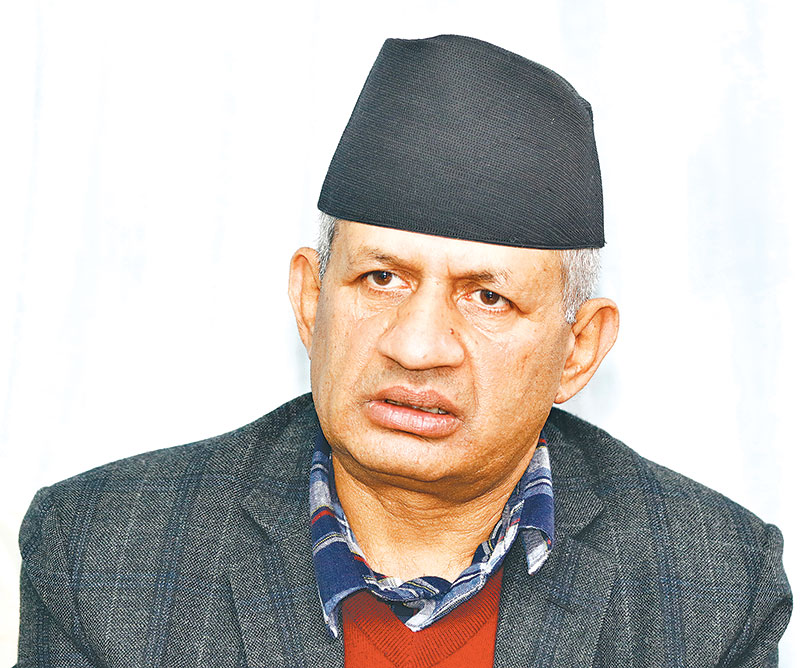
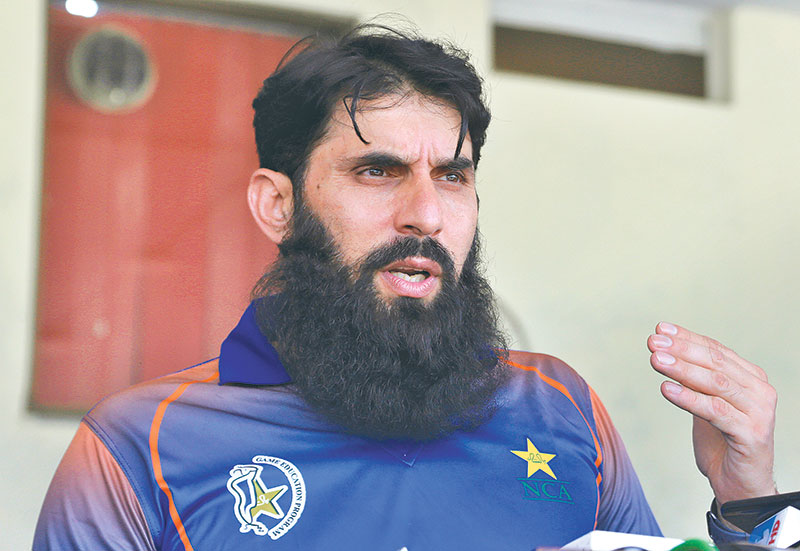
Foreign Minister Pradeep Gyawali
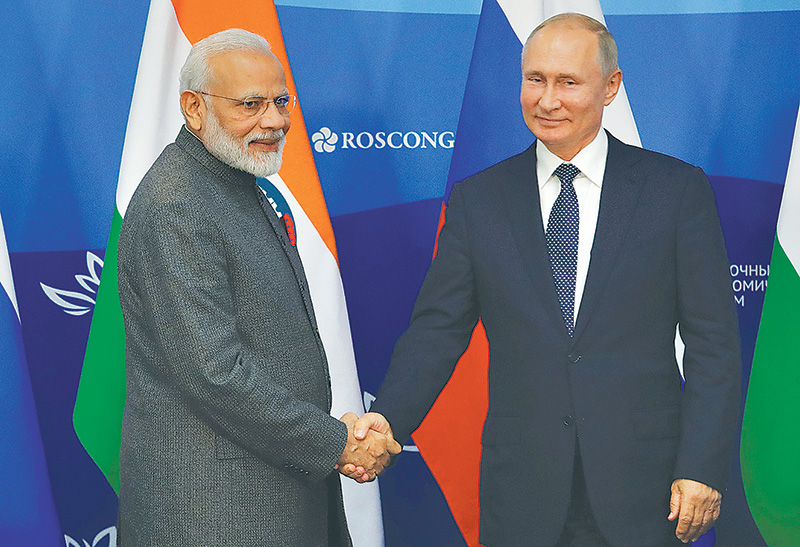
KATHMANDU : A month has elapsed since India stripped the state of Jammu and Kashmir of its special status, but Nepal has not issued any public statement regarding the controversial move. But Foreign Minister Pradeep Gyawali has made two statements, each appearing to contradict the other. On August 19, Gyawali had told the media that the Kashmir dispute should be resolved through dialogue, as it is linked to regional peace and stability. He had stopped short of elaborating further. But on Tuesday, while in the Maldives for the Indian Ocean Conference, Gyawali told ANI, an Indian news agency, affirming a position that numerous other South Asian countries have taken. “Changing the constitution is entirely the domain of that government,” Gyawali said in the Maldivian capital Male, referring to India’s abrogation of Article 370 of the Indian constitution. “So we have no comment on that decision.” On August 5, India repealed Article 370, putting an end to the special status that Indian-administered Kashmir had enjoyed and giving the central government direct governing authority. Indian-administered Kashmir has since been under virtual lockdown, with movement and communications heavily restricted. Gyawali’s statement comes weeks after India’s Minister for External Affairs S Jaishankar’s visit to Kathmandu on August 21-22. According to Foreign Ministry officials, Jaishankar had sought a clear position from Nepal on New Delhi’s move. Two days ahead of Jaishankar’s visit, Gyawali had told media persons that the “Nepal government is in favour of regional peace and stability. The dispute should be resolved through talks and we firmly believe that the government of India has the acumen to resolve the dispute peacefully.” While Jaishankar was in Kathmandu to attend the fifth meeting of the Nepal-India Joint Commission, foreign policy analysts said that the minister had made a series of whirlwind trips to rally the region around India’s controversial decision. Pakistan, on the other hand, had asked Nepal as chair of the South Asian Association for Regional Cooperation to play a more proactive role. On August 22, Pakistani Foreign Minister Makhdoom Shah Mahmood Qureshi, in a telephone conversation with Gyawali, had urged Nepal to play its role for peace and stability in the region and ask India to “ease the suffering of the people of Indian Occupied Jammu & Kashmir.” Foreign policy analysts say that Gyawali has shifted his position and that there is confusion over which of his statements are to be believed. Ramesh Nath Pandey, a former foreign minister, said that if Kashmir is entirely an internal matter then why was India negotiating with Pakistan. “What prompted Nepal to change its position?” Pandey told the Post. “Which of Gyawali’s statements is true?” According to Pandey, either he lied to Nepali journalists in Kathmandu or to the Indian news agency in Male. “He had made a similar confusing statement on the Indo-Pacific [strategy] as well after his visit to the United States in December,” said Pandey. “Nepal should know about the sensitivity of Kashmir because it is related to India, Pakistan, China and the rest of South Asia.” Officials in Kathmandu, however, expressed ignorance about Gyawali’s remarks in the Maldives and Gyawali himself was not immediately available for comment.Madhu Raman Acharya, a former foreign secretary, said that refusing to comment was itself a big comment in diplomacy. “Nepal, however, has moved its goalposts time and again on various incidents and issues—whether it was the trilateral boundary dispute between India, China and Bhutan, or a terrorist attack in Uri, India in 2016,” said Acharya. “Coming up with an independent position has always been difficult for us.” But analysts say that statements on foreign policy matters require specifics and should not be generic or vague. “Changing statements can impact Nepal’s international relations,” said Pandey. “Trustworthiness can be our strength. So we have to maintain consistency in our foreign policy conduct.” Both Pandey and Acharya, however, agreed that Gyawali’s latest statement is an indication that Nepal stands with other South Asian nations who have concluded that New Delhi’s move is an internal matter of India. The latest remark shows that Nepal supports India’s position, according to Acharya. “It’s clear that Nepal stands with other South Asian nations when it comes to India’s decision on Jammu & Kashmir,” said Pandey. “However, before making a statement on such a sensitive issue, we should hold an all-party meeting and make a formal position so that it can be seen as having as national backing.”In Male, Gyawali also said that Nepal hopes for a de-escalation of tension between India and Pakistan. “As the current chair of SAARC, we urge all member nations to settle disputes through negotiations,” said Gyawali. “Escalation of tension is not the solution. Conflicts are the worst options, which every nation should avoid.”
HOME PAGE
India’s citizenship check excludes nearly 100,000 Nepali-speaking people in Assam
New Delhi’s plan, which arrived as news at the doorsteps of the northwestern state’s residents last week, could declare close to two million people as foreigners.
- PARBAT PORTEL
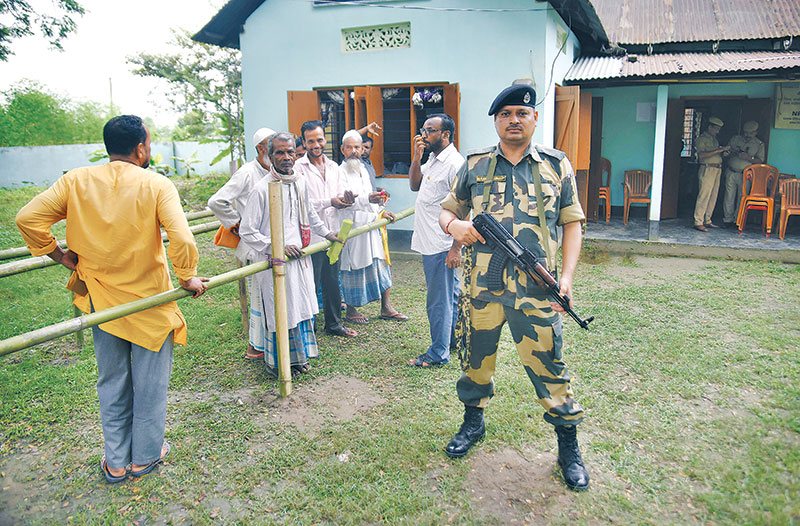
People stand in a queue to check their names on the draft list of the National Register of Citizens outside an NRC centre in Rupohi village, Assam, India, on August 31.REUTERS
KAKADVITTA : Around two million people in the northeastern Indian state of Assam could become stateless after being excluded from the National Register of Citizens, in a gargantuan citizenship check exercise, backed by the Hindu nationalist government led by Narendra Modi. Among them are about 100,000 Nepali-speaking people, who, according to officials, could be included in the world’s largest-ever instance of forced statelessness. Although Indian authorities have said those excluded from the National Register of Citizens—the government defines it as a list of “genuine” citizens—will not immediately be declared foreigners and they will have 120 days to file an appeal, it is not clear what will happen if they lose the appeal. Assam is home to 35 million people. RP Sharma, the chairperson of the Assam Gorkha Conference, said that the list discriminates against Nepali speakers and other indigenous Indians. “The list is discriminatory and faulty,” Sharma told the Post over the phone. “We appeal to the government to immediately correct it.” Nepali speaking people in Assam are largely known as Gorkhas, as most are descendants of soldiers recruited by the Assam Rifles in 1835. According to estimates, there are some 2.5 million Gorkhas in Assam. The Gorkha organisation said even the families of the first woman martyr of the Assam Movement have been excluded, which has baffled the community. In the 1980s, Assam saw “an anti-foreigner” movement, which has come to be known as the Assam Agitation. Championed by the All Assam Students Union and the All Assam Gana Sangram Parishad, the movement spearheaded protests and demonstrations targeted at illegal immigrants, seeking to expel them. Baijayanti Devi, a Nepali-speaking Assamese, was killed during the riots. The Assamese revere Devi as a martyr. Devi’s sister, Manju and her family have been excluded from the national register.According to Assam-based journalist Rohit Gautam, it’s mostly the elderly population over 70 years of age who have been left off the list. The number of women excluded is also high.To be included in the register, the government requires documentation from residents proving they were legal citizens before 1971. “Most people have been excluded because they couldn’t prove their citizenship by descent,” said Gautam. “But some have faced exclusion owing to the negligence and prejudice of officials.”Most Nepali speakers, however, have valid voter identity cards that they have been using every four or five years, and yet, they find themselves excluded for lack of citizenship by descent documentation. “The Assam government is setting up Foreigners’ Tribunals to deal with those excluded. They can petition the tribunal for inclusion,” said Gautam. “It is believed that most of those who claim their inclusion with the tribunal will be included in the final register.”The National Register of Citizens is a list designed by the government to identify “genuine” Indian citizens. It was first published after the 1951 census and since then had not been updated. The register aims to expel illegal immigrants, primarily from Bangladesh, who entered the state of Assam after the India-Pakistan war of 1971.This, however, is not the first time that Nepali speakers in Assam have found themselves labelled “foreigners”. Assam’s government has time and again deemed Nepali speakers “suspicious” and “D-voters (dubious or doubtful voters)”. The discriminatory behaviour dates back at least two centuries, according to Shivanath Sharma, former dean and professor of Guwahati University. “We have been in India for over 200 years,” said Sharma. “But the Indian state still views us with suspicion and doesn’t consider us Indians.” Nepali speakers in other Indian states such as Manipur, Nagaland, Arunachal and Darjeeling, also feel distrusted and insecure, according to Sharma. “The constitution considers us equal to any other Indian citizens,” Sharma said. “But we have been deprived of that right.” In view of the Lok Sabha elections in April-May, the central Home Ministry had issued a directive to the Assam state government stating that Nepali-speaking people were not foreigners but Indians, and to not view them with suspicion. That had given the Gorkhas a ray of hope. But when the final list was out, according to Prem Tamang, chairperson of the All Assam Gorkha Students’ Union, the “discriminatory stance” of registry officials was obvious. “We are planning demonstrations and demanding inclusion,” said Tamang.When officials had called applications for the national register, most of the Nepali speakers in Assam had submitted their “grazing permits” and land ownership certificates. But the register did not consider those certificates adequate proof of citizenship. Now with statelessness staring at around two million people, rights campaigners have warned of a humanitarian crisis. There are chances that many will end up in detention centres that the government has been building. “It’s unfortunate that so many Nepali speakers are excluded from the list,” said Kishore Upadhyay, Assam state secretary for the ruling Bharatiya Janata Party. According to him, out of the nearly 100,000, about 30,000 are at risk of never being on the list. “Those 30,000 do not have the necessary documents,” Upadhyay said. “These people also have their Nepali certificates. Those who have been living here since before 1971 won’t face any problem. Those who have migrated after 1971 will face difficulties.”But many Nepali speaking people in Assam say authorities have grossly misunderstood or refused to understand the actual scenario, largely due to centuries-old prejudices. Munish Tamang, national chair of the Indian Gorkha Association, an organisation working for the rights of Gorkhas, said that the exclusion of Gorkhas from the recently published register is a manifestation of that age-old discriminatory stance. “We speak Nepali but that doesn’t mean we come from Nepal,” said Tamang. “This is where the Indian state gets us wrong.”
Workers at the National Register of Citizens office check documents submitted by people for the NRC ahead of the release of the register's final draft in Guwahati, the capital city of Assam. AFP/RSS
HOME PAGE
How the Nepali press took a fictional spy thriller for fact
A novel about Nepali politics by a former RAW officer is being touted as a work of nonfiction by the Nepali press and social media.
- BHRIKUTI RAI
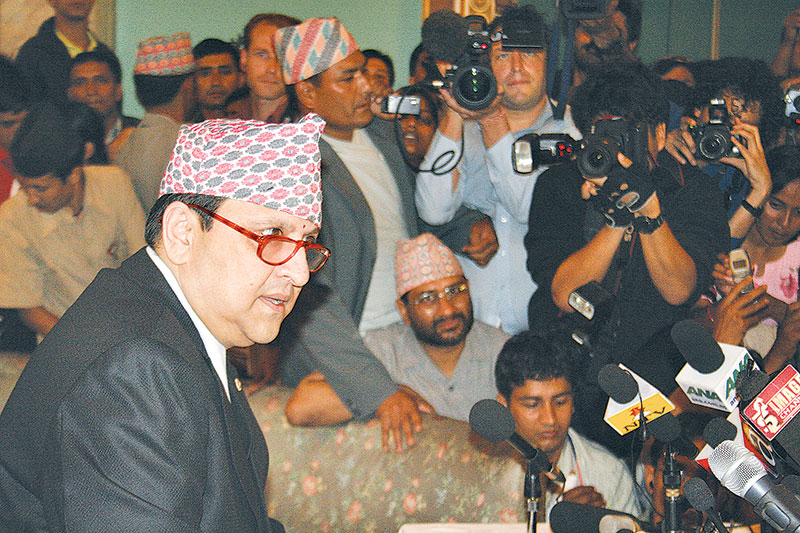
Gyanendra Shah’s stepping down in 2008 marked the end of 240-year-old monarchy.Post file Photo
KATHMANDU : A book written by a former Indian intelligence officer has sent Nepali and Indian social media into a frenzy, with wild theories about how India’s Research and Analysis Wing (RAW) was behind the fall of the monarchy in Nepal. Many took the theories as fact, repeating them over tweets and Nepali-language articles. But there’s a catch: the book is fiction. The alleged role of Indian actors, especially those from RAW, in shaping Nepal’s politics has spawned countless conspiracy theories over the decades. And thanks to the internet, these theories continue to captivate the imagination of millions of Nepalis, and some Indians. So it came as no surprise when publishing giant Harper-Collins India roped in Amar Bhushan, former RAW special secretary-turned-writer, for a spy thriller series. The latest instalment in Bhushan’s “spy catcher series”—Inside Nepal/The Walk-In, which was released a few months ago—has led to newspapers and online outlets dedicating space to the workings of Indian intelligence agency spies to overthrow Nepal’s monarchy, carefully omitting the fact that the excerpts they’ve shared are from a crime thriller, a work of fiction. The inside cover of the book clearly states it is “inspired by a true story,” as journalist Shubhanga Pandey pointed out in a series of tweets. The first story appeared in the Indian newspaper DNA on Monday, which was immediately translated into Nepali and published on Deshsanchar.com the same day. The article, which has been shared over 120 times, was titled ‘A former India spy reveals how RAW helped overthrow monarchy’ and when a handful of people questioned the credibility of the piece, Deshsanchar editor Yubaraj Ghimire tweeted in its defence stating: “Sir, we’ve only quoted what is in the autobiography.” But it’s not an autobiography. Pandey actually bought an electronic copy of the book to clear the air about whether or not it was a work of nonfiction.
He tweeted a picture of the first page of the book and wrote: “So I got myself an electronic copy of the book. Here’s what the first inside page looks like. Notice the lines: “This is a work of fiction....” Speaking to the Post over Twitter’s messaging platform, Pandey, who is with Himal SouthAsian magazine, said that his actions were motivated by seeing “Nepal’s public sphere go into overdrive following the publication of Amar Bhushan’s ‘Inside Nepal.” He said he was only “mildly curious” about who had published it, but when he found out it was Harper-Collins India, he bought the book to check out what it really was. He wasn’t surprised about the uproar on Twitter fuelled by misleading reports about the book, but says it’s “worrying” how things unfolded. “I think they [journalists and editors] are a bit trigger happy when it comes to ‘news’ that conforms with the biases, whether their own or those of their readers,” said Pandey. “It is not like our editors and journos don’t know about how compromised sections of mainstream media in India are (not just politically, but in terms of facts). So to do stories without even looking at the book (or its cover!) seems lazy and irresponsible.” Last June, the Indian Express reviewed Bhushan’s Inside Nepal/The Walk-In saying “... the reader is left guessing about whether these were intelligence operations mounted by Bhushan himself or by other RAW officials.” The review goes on to say that according to Bhushan, “several former RAW officials reached out to him and recalled their own espionage operations, and thus, his repertoire of spy stories which he could fictionalise crossed 39.”
MEDLEY
Horoscope
ARIES (March 21-April 19) ** Too many details will be crowding your brain today, making it difficult for you to relax. Quiet the ruckus by distracting yourself. Spend time with people you love to laugh with, and talk about lighthearted matters. Forget about things you have no control over—by obsessing about it, you are sacrificing your strength.
TAURUS (April 20-May 20) *** Since you have many people in your life, you always have tons of feedback available at your fingertips. So take advantage of it. Reaching out for the opinions doesn’t mean that you don’t know what to do. Integrating their ideas and listening without criticism is something they’ll really appreciate.
GEMINI (May 21-June 21) *** After a big shake-up in your work or school life, today you’ll discover that you had nothing to worry about. Either your flexibility skills are at an all-time high, or the changes you expected weren’t so drastic. So, breathe a great big sigh of relief today. This new way of doing things is just as good as the old way—if not better.
CANCER (June 22-July 22) ** Today someone’s honest reaction may disappoint you, but you’ll have to accept the fact that you can’t love everything about the people you love. Ending a relationship because of one event or conversation is shortsighted. Embrace differing opinions and contrary viewpoints. Let them make you wiser and more compassionate.
LEO (July 23-August 22) *** There will always be obstacles in your life but your attitude will make all the difference. If you need a lift in life, just remember all the successes you’ve had and recall the smiling faces of people who love you. Today would be a great day to get back in touch with some of those smiling faces. Make a long distance call or two today.
VIRGO (August 23-September 22) **** You are extremely open to new ideas right now. So try a few new things. If you’re shopping for a new outfit, try a look that you wouldn’t normally go for. If you’re planning a meal, pick out some exotic ingredients. There’s no telling what you can come up with once you start working with unfamiliar materials and tools.
LIBRA (September 23-October 22) *** Today, don’t worry about people basing assumptions about you—your true personality is too potent to camouflage, and it will shine brightly through boring meetings, silent travel, and meaningless small talk. Be confident that by always being the person you want to be, you are encouraging other people to do the same.
SCORPIO (October 23-November 21) **** As the people in your life are a bit distracted with other things, use this time to separate yourself from people and think things through. Act how you like and do what you want—for as long as you want to do it. This alone time will enable you to get back in touch with what you really want to do with your life.
SAGITTARIUS (November 22-December 21) *** Your daily life is being polluted by someone whose maturity level leaves a lot to be desired. Luckily, you will find the right words today to help this person grow up a bit. Your hilarious wit will turn a potentially frustrating episode into a funny one. Use your sense of humor to alleviate the tension of confrontation.
CAPRICORN (December 22-January 19) **** Right now your schedule is under your exclusive control for a limited period of time so you should make the most of it! If you need time to get back with your people, share some laughs and catch up on the latest friendly gossip, you just have to make it! Reschedule an appointment and move some things around.
AQUARIUS (January 20-February 18) ** You are full of vitality and ready to move forward on something new, but this is not the day for it! There are way too many variables in your life right now. You are strong but you’re vulnerable to a lot of potential problems that could pop up today if you aren’t careful. Focus your energy on fixing up something around your house.
PISCES (February 19-March 20) *** Today will serve as both a starting point in your life and as a great big finish line! Just as you finish something you’ve been working on for a while, a new task will be tossed on your desk or arrive in your email inbox. It will be a little hectic but at the same time it will provide you a sense of fulfilment in your name.
NATIONAL
Human trafficking still remains a major challenge for the country
Despite legal protections and law enforcement agencies in action, Nepali girls, women and children are vulnerable to trafficking.
- CHANDAN KUMAR MANDAL
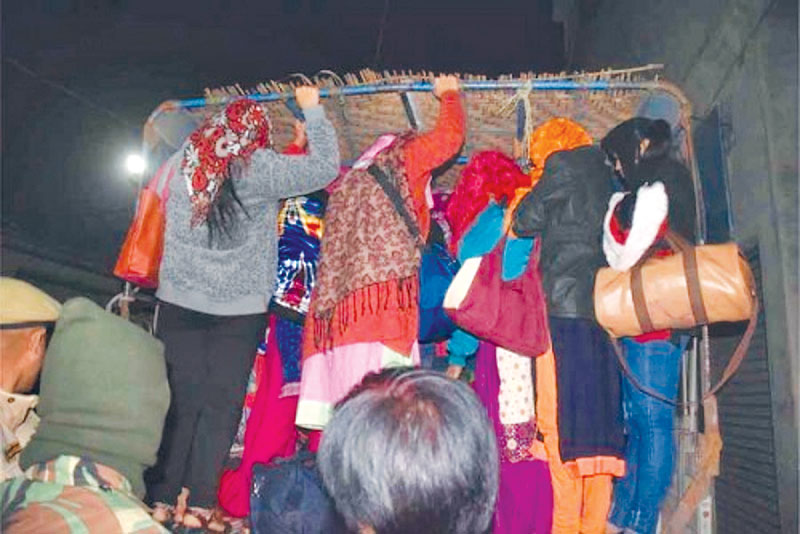
A file photo shows girls, including 40 Nepalis, after being rescued by an anti-human trafficking operation in February. Photo via Imphal Free Press
KATHMANDU : Six years ago, Sanju, then a tenth grader, fell in love with an army man in her hometown Itahari. They married two years later. Sanju was just 15 at the time, thus making their union illegal. After staying in Itahari for a month, the couple moved to Kathmandu. Within a month of their arrival in Kathmandu, Sanju’s husband ran away, leaving her alone in their rented room. “He went out of contact,” she told the Post on Wednesday. “There was hardly anyone whom I knew in Kathmandu. I could not go back home, as I had got married against my family’s wishes.” The 21-year-old from Itahari spoke to the Post on the condition that she be identified by a pseudonym because she feared being ostracised by the family and the community. Unable to pay monthly rent, the landlord threw away Sanju’s belongings. One day, a man approached her at a nearby eatery, whose owner allowed her to eat on credit. “He told me that he knew everything about me and my life. And he offered me help get into some kind of business,” said Sanju. Unaware of consequences—and with no immediate help forthcoming—she fell for it. Sanju was thrown into the dark world of sex trade. The deal was that the man would get 25 percent of her income from each client. Sanju agreed. She was asked to create a fake account on Facebook through which he would connect her with new people. This went on for the next six months until she was finally picked up by a police team in Sundhara, where she was supposed to meet a client. Sanju is one of the hundreds of human trafficking victims in the country who often fall into the trap of human trafficking. “Many people ask me how can I be a victim of human trafficking since I was not trafficked to anywhere,” said Sanju, who is now doing her graduation in Kathmandu. “The law clearly states that if anyone takes advantage of someone’s condition, or uses any threat, influence, and lure them into doing sexual activities, it is also human trafficking.” According to the Human Trafficking and Transportation (Control) Act, 2007, to use someone into prostitution, with or without any benefit, is also one form of human trafficking. Sanju could get out of the nexus of human trafficking and start a new life after she came in touch with Shakti Samuha, a non-government organisation run by the survivors of human trafficking and working for the welfare of survivors and protection of those at risk. A large number girls and young women can never run out of the nexus. In an annual gathering of human trafficking survivors held in Kathmandu on Wednesday, survivors, anti-human trafficking activists, political parties leaders, security forces agencies and others agreed that human trafficking continues to be a challenge for the country. “Despite efforts at the national and international levels, women and children are at the risk of human trafficking,” said Anjana Shakya, chairperson of Alliance Against Trafficking In Woman And Children In Nepal. “There are regular reports of trafficking for sex trade and also via labour migration. Protection of those at risk, and rescue, rehabilitation and reintegration of survivors, which is the responsibility of the state, is still a big challenge.” The US Department of State, in its ‘Trafficking in Persons Report 2019’, released in June placed Nepal in Tier 2. According to the report, the countries belonging to Tier 2 have governments that do not fully meet the minimum standards of the Trafficking Victims Protection Act. The law provides tools to combat trafficking in persons, both worldwide and domestically. According to Shashi Shrestha, chairperson of State Affairs and Good Governance Committee of Parliament, the problem of human trafficking persists because the root cause of the problem is yet to be discovered. “The country went through a massive political change, but the continuation of trafficking in person shows that political change alone cannot do much,” said Shrestha. “Discriminatory social structure that considers women as objects of use is the main cause. As long as this mentality remains, we cannot eliminate this problem.” A recent report by the National Human Rights Commission says nearly 1.5million Nepalis are at risk of various forms of human trafficking. According to the report, aspiring migrant workers, Nepalis working abroad, people in the entertainment sector, girls and women from rural areas, missing persons and child labourers are among the groups most vulnerable to trafficking, making the country a source, as well as a transit and destination for human trafficking. The report estimated that nearly 35,000 Nepalis were trafficked last year. Niru Devi Pal, the chairperson of Women and Social Committee of Parliament, said the government should provide jobs to girls and women to protect them from potential trafficking. Activists pointed out that human traffickers were getting political protection when existing laws fail to adequately protect human trafficking survivors and those at risk of trafficking. “Human trafficking issue has not got the attention it deserves. Despite strong legal protection to protect women from all kinds of violence, they continue to be vulnerable,” said Tham Maya Thapa Magar, minister for women, children and senior citizens. “At times, culprits also get political protection. We need to boycott such persons from society. The government is committed to eliminating all forms of human trafficking.” For law-enforcing agencies, human trafficking has turned even more complicated as it also takes place in the guise of labour migration, overseas jobs and studies, and traffickers adopt new tricks and technologies. The problem has gone beyond its fundamental purpose of sex trade and also gone far from India-Nepal cross border trafficking. “These days, human trafficking is not limited to women and girls sold to brothels in India. Traffickers are taking advantage of people’s condition, poverty, illiteracy, among others,” said Sanju. “Traffickers and agents use social media, where everyone is these days. So, posting guards at the India-Nepal border doesn’t help entirely. We need to make people aware about online safety and how human trafficking takes place.”
NATIONAL
Instead of implementing law, government uses force to break padlock to hold entrance tests
Students to file writ against the government demanding implementation of the National Medical Education Act.
- BINOD GHIMIRE
KATHMANDU : While the MBBS entrance examinations are due to start on Saturday, the Ministry of Education, Science and Technology is non-committal to implementing the several reformative measures envisioned in the National Medical Education Act that came into effect in February. The students have been resorting to demonstration and padlocking at the Institute of Medicine under Tribhuvan University and the Kathmandu University School of Medical Science demanding implementation of the Act, which envisions common entrance exams and 75 percent scholarships in the state-run medical colleges. The Act also requires private medical colleges run with domestic resources to provide 10 percent scholarships and 20 percent by those run with foreign investment. The ministry, however, used police on Wednesday evening to break the padlocks in an attempt to hold the entrance tests forcibly. It was prepared to address the agreements with Dr Govinda KC, an orthopaedic surgeon who has staged hunger strikes several times calling for an end to malpractices in the country’s medical education sector. The ministry, however, is not ready to implement the provisions for now, saying that different committees are working to finalise the modalities of implementing the legal provisions. It has said the different subcommittees under a panel led by Deputy Prime Minister and Minister for Health and Population Upendra Yadav are on the final stage of formulating the criteria for holding the common entrance and enforcing the scholarship provisions. The ministry, therefore, has asked the students to wait until the panels come out with their reports. “The entrance exams are due to start in a few days, but the government is asking us to wait,” said Anit Sinha, secretary of the struggle committee which is resorting to demonstrations demanding the implementation of the Act, told the Post. The entrance tests for the colleges under Tribhuvan University start on Saturday while the Kathmandu University is preparing to hold the exams in the third week of September. Two rounds of dialogue between the government representatives and the students’ struggle committee ended inconclusively as the former didn’t commit to addressing the demands. The government representatives said the Ministry of Finance’s consent is necessary for increasing the scholarships as it burdens the state coffers extra, hinting that it can’t be implemented immediately. “The Act needs to be implemented but challenges remain. The problems will be resolved once the Medical Education Commission becomes operational,” said Hari Lamsal, joint-secretary at the ministry during the dialogue with the students on Wednesday. The commission hasn’t come into an operation as the appointment of its vice-chair, who is an executive head, is yet to be appointed. A recommendation committee led by Umesh Prasad Mainali, chairman of the Public Service Commission, has suggested three names for the post of vice-chair. The prime minister will appoint one of the three individuals recommended by the committee. Sinha said they will file a writ in the Supreme Court in a couple of days as the government doesn’t want to implement the provisions of the law. However, issuing a statement on Wednesday, the ministry asked all the concerned parties to cooperate in conducting the entrance tests.
NATIONAL
Dengue spread continues as reported cases top 800 in a week
More than 2,500 new cases have been detected in the last 47 days, with Province 3 recording the highest number of cases.
- Arjun Poudel
KATHMANDU : Despite the government’s promise to mobilise security personnel to contain dengue, the disease is still spreading to more districts with over 800 cases reported within a week. According to the Epidemiology and Disease Control Division, the deadly disease has spread to 48 districts across the country, including those in Karnali Province, which had remained untouched by the virus until a few days ago. At least three people have died and over 6,000 people hospitalised since the first case was reported in May this year. According to the division’s data, 2,559 cases have been reported in the last 47 days. Among them, over 800 people have been infected in a week The data shows that the number of dengue cases have raised significantly in the last few days in Province 3. A total of 1,093 dengue fever cases have been reported in the last 47 days in Province 3, followed by 753 cases in Province 1. Similarly, there were 572 reported cases in Gandaki Province; 104 cases in Province 5; 23 in Province 2; 12 in Sudurpaschim Province; and two in Karnali Province. In Kathmandu Valley, 89 people have been infected since July 17. Among them, 76 cases were reported from Kathmandu district, seven from Lalitpur and six from Bhaktapur. “The number of cases could go up, as post-monsoon season is yet to start,” Dr Prakash Kumar Shah, senior public health administrator at the division, told the Post. “There are more challenges ahead, as we expect more dengue cases in coming days.” All local level governments of 48 districts, where dengue cases have been reported, are running mosquito search and destroy drive, the division said. Meanwhile, the Ministry of Home Affairs has issued a circular to chief district officers of all 77 districts to coordinate and cooperate with local levels in launching ‘dengue search and destroy’ drive in their respective districts. “The constitution has given the responsibility of coordination and cooperation with local level governments to chief district officers,” Uma Kanta Adhikari, information officer at the Home Ministry, told the Post. “We have issued the circular accordingly, asking them to fulfil their constitutional duty.” Dengue is a mosquito-borne viral disease, which is transmitted by the female Aedes aegypti and Aedes albopictus mosquitoes. The vectors breed in clean water and are active during the day. The same mosquitoes also transmit chikungunya, yellow fever and Zika virus, according to the World Health Organization. According to doctors, mild to high fever, severe muscle pain, rashes, severe headache, and pain in eyes are some of the symptoms of dengue. The UN health agency says there is no specific treatment for severe dengue, but early detection and access to proper medical care can lower the fatality rate.
NATIONAL
Pre-booking of Dashain travel tickets still uncertain
Officials to meet again next week to fix the advance booking date.
- ANUP OJHA
KATHMANDU : The option of pre-booking Dashain travel tickets remains uncertain as a meeting among concerned officials on Wednesday ended without a decision. Representatives from the Federation of Nepalese National Transport Entrepreneurs, Department of Transport Management, and other stakeholders attributed their inability to fix the pre-booking availability date to lack of adequate homework and better planning. Officials at the Department said the advance Dashain ticket booking date would be announced only after another meeting that is going to be held next week. “We wanted to open the ticket booking in a well-managed way, but due to lack of better homework and planning, we could not announce the pre-booking date. The date will be fixed only after assessing the number of public vehicles that will be operating during that time so that the public won’t face any inconvenience to get a ticket,” said Gogan Bahadur Hamal, director general at the Department. He further said the Department has asked transport entrepreneurs to provide last year’s data on how many vehicles were operated on different routes outside the Valley during the festival. However, Yogendra Karmacharya, president of Transport Entrepreneurs, said with no new buses being added, lack of adequate capacity will pose problems for festival travel out of the Valley. “After the government dissolved the transport committee under the Company Act, entrepreneurs were discouraged from buying new vehicles, and this created new problems,” said Karmacharya. “Earlier, before Dashain, 400 to 500 new buses used to be added in different routes, but now the situation is different. ” Last year, the government had amended the existing Transport Management Directives, 2004, to break the syndicate in the public transport sector that was growing under the transport committees and associations. Saroj Sitaula, general secretary at the Transport Entrepreneurs, said to know the actual number of total public vehicles, they have called all the chairpersons of private companies for a meeting on Thursday. Metropolitan Traffic Police Division estimates that over 3 million people are expected to leave the Valley during Dashain.To address potential shortage of public vehicles to meet the needs of those heading to their hometowns from the Valley, government officials have also said they are going to use school and college buses. To make that happen, the Department is meeting with the Private and Boarding School Organisations Nepal and National Private and Boarding School Associations Nepal later this week.Traffic police estimates that every day over the ten-day festival, over 9,000 public buses will be needed to ferry passengers from the Valley to their hometowns.
NATIONAL
Rift surfaces in committee to select transitional justice commission officials
Committee members are at odds over the selection criteria, chairman fails to rise to the occasion.
- BINOD GHIMIRE
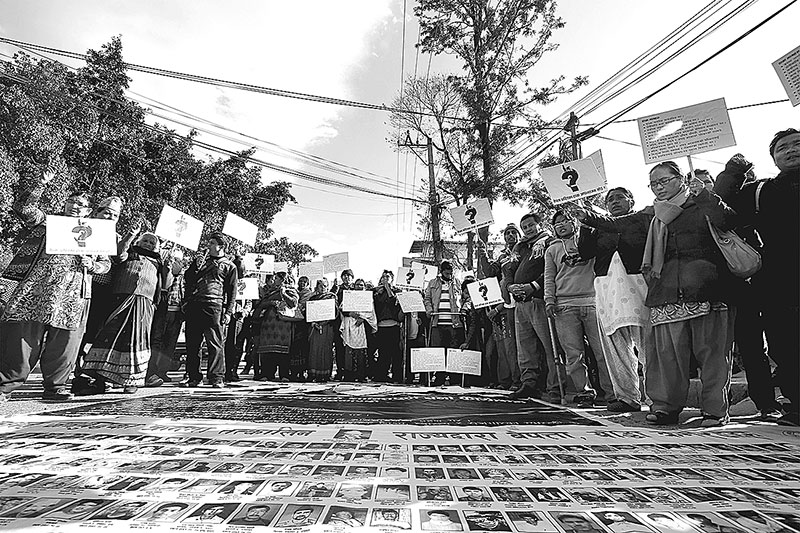
In this file photo, families of the enforced disappearance victims take part in a rally, demanding information about the whereabouts of their loved ones, in Kathmandu. Post Photo
KATHMANDU : Disagreement among some members over the selection criteria has created a rift in the recommendation committee that was formed to select new officials for the two transitional justice commissions. Following demands from the victims and some members, the committee in July had assigned its member Prakash Osti to prepare the criteria. Osti, who represents the National Human Rights Commission in the committee, formulated the selection criteria for the new leadership. Ram Nath Mainali, who is close to then CPN (Maoist Centre) and Prem Bahadur Khadka, who was picked under Nepali Congress quota, sought 15 days to study the proposed criteria which is just two pages. But after 15 days, the two members said the proposal from Osti was not complete, hence one more criterion needs to be formulated. The committee then assigned Mainali to draft another one. When he presented the draft, the committee assigned Khadka and another member Sharmila Karki to finalise the report on the basis of the one presented by Osti and Mainali. Though they have finalised the criteria, the meeting of the committee has not been called for the last three weeks. The meeting scheduled for Tuesday was postponed without any reason. “We could have endorsed the criteria had the meeting been held on Tuesday,” Karki told the Post. Officials familiar with the development say the motive behind assigning one after another member to draft the selection criteria is for recommending the name without the standard in place. “The members close to the parties say having the criteria in place will bar the committee from recommending the names directly picked by their parties,” said an official seeking anonymity because he feared retribution. The committee, formed in March under former chief justice Om Prakash Mishra, has not recommended the names even five months after its formation, as it waits parties to finalise the names. “The meetings are called and postponed without giving us any reasons. In principle, the committee is independent, but in practice, it does not look so,” Osti told the Post.Officials say Mishra has been working as per the wish of Mainali and Khadka who want the committee to function at the behest of their parties. “I am surprised how feeble the former chief justice is. He has completely failed as a leader,” said an official, requesting anonymity. Mainali denied the claim but said the criteria prepared by Karki and Khadka might not be endorsed. He said the names of chairpersons and members could be recommended without the criteria in place.Repeated attempts to reach out to Mishra went in vain, as his mobile phone was switched off. The parties on August 27 had agreed to name former attorney general Raman Shrestha as the chairperson of the Truth and Reconciliation (TRC) though he has publicly rejected the offer. The TRC and Commission of Investigation on Enforced Disappeared Persons are vacant since April 14 after the chairpersons and members were relieved of their duties through an amendment to the Enforced Disappearances Enquiry, Truth and Reconciliation Commission Act-2014.Following the politicisation in the appointment process, the constitutional human rights watchdog has warned of recalling its member, Osti, from the committee if the recommendation committee fails to maintain its impartiality. The victims of the decade-long Maoist insurgency are also demanding that the new leadership be picked on merit. They have warned that they will not accept the leadership selected as per political parties’ wish.
NATIONAL
Parbat villagers get water through a lucky draw
Local governments say lack of budget has stalled many water supply projects in the district.
- AGANDHAR TIWARI
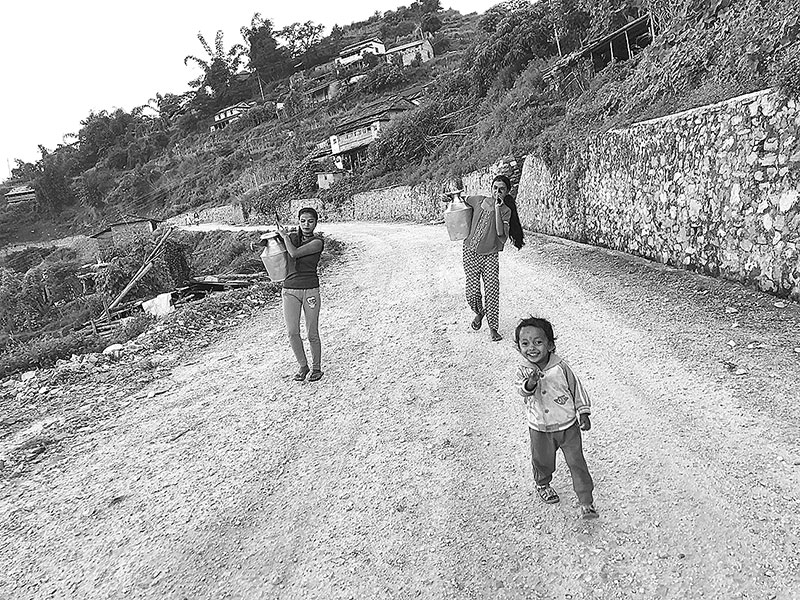
Villagers of Hanumandanda have been reeling under water scarcity for the last 40 years. Post Photo: AGANDHAR TIWARI
PARBAT : Every last Saturday of the month, villagers of Hanumandanda in Parbat district hold an assembly to take part in a lucky draw to decide their turn and the time to collect water from the community tap. The lucky draw is held around the year, and the representatives from some 40-odd households in the village participate in it. This novel idea was born out of a decades-long water crisis in the area. “It was very difficult to get a turn at the tap. Our days would be spent fighting with each other for a jar of water. The lucky draw system may not have resolved water crisis in the village, but it definitely has diffused tension among villagers,” said Goma Devi Bhattarai, a resident of Hanumandanda that lies in Bihadi Rural Municipality Ward No. 6. Many families in the village have been living with an acute water crisis for the last 40 years, from the Panchayat era to the current days of federalism, according to Madhav Bhattarai, another local resident. “We always had a shortage of water, but over the years, it has become more pronounced. While the water sources are drying up, the village population is growing at a rapid pace,” he said. The villagers of Hanumandanda had expected that their drinking water problem would be solved with a local government in place. But more than two years since the elections, they are still dependent on one community tap for their water needs. “The other nearest water source is around 30 minutes walk from the village. It’s too far for us to go there every day,” said Bhattarai According to Anil Bhattarai, a teacher at a local school, the local unit had surveyed the area for the development of a new drinking water supply facility, but the project never took off after the district’s Drinking Water and Sanitation Division Office was shifted. “We know that some authorities concerned were planning to build a water supply facility for the village, but after the Drinking Water and Sanitation Division Office moved, nobody has taken up the issue,” he said. Most of the drinking water projects in Parbat district are incomplete due to the lack of budget. According to Prem Dotel, chief at Drinking Water and Sanitation Division Office in Baglung, 53 drinking water projects are currently under construction in Parbat. “The progress of many of these water projects have stalled mid-way because the authorities did not allocate the necessary budget. We need a budget of around Rs 1 billion to complete these projects. But the provincial and federal governments allocated only Rs 130 million in the current fiscal year,” said Dotel. The incomplete state of drinking water projects in Parbat has affected not only Hanumandanda. Several other settlements are also going through the same problem. Khaulatol village in Kushma Municipality Ward No. 13 is one of them. Sangita Pariya, a school student from the village, said that the water shortage in her village has also affected her studies. “I get up early in the morning and go to the community tap to fetch water. I have to wait long hours for my turn, and more often than not, I miss my classes.” The villagers of Khaulatol have been reeling under water crisis for as long as they can remember. “We have been demanding for a drinking water project for years. We had asked the District Panchayat during the Panchayat regime, and then the District Development Committee and the municipality to solve our problems, but the problem still persists,” said Junga Bahadur Sunar, a local man. Like the villagers of Hanumandanda, Khaulatol residents also had high hopes from their local government when the village became a part of the Kushma Municipality, which is also the district headquarters of Parbat, but they continue to face the problem of water scarcity. “All the municipality has managed to do is enforce taxes on us under various pretexts. They do not care about our problems,” said Durga Bahadur Pariyar.The municipality, however, claims that it has taken the drinking water crisis in the settlement seriously. “The municipality is working towards solving the drinking water problems at the earliest. We have prepared a detailed project report and sent it to the provincial and federal governments. The municipality’s budget will not be enough to construct a drinking water project in Khaulatol,” said Mayor Ramchandra Joshi.Unlike Hanumandanda, Khaulatol has not introduced the lucky draw system for drinking water collection. But it’s never too late to adopt the system to prevent overcrowding at the community tap and occasional fights among the villagers. “The introduction of the lucky draw system is a boon for us,” Goma Devi Bhattarai of Hanumandanda said. “Although it’s quite another thing when you pick your turn to collect water at an ungodly hour.”
NATIONAL
Ex-Karnali minister Khatri released on bail in banking offence case
- PRITHVI MAN SHRESTHA
KATHMANDU : The Patan High Court on Wednesday released Khadka Bahadur Khatri, the sacked minister for physical infrastructure development of Karnali Province who is facing a banking offence case, on Rs500,000 bail. Khatri, who is also a contractor, is one of the five defendants in the case filed by the Agriculture Development Bank Limited for submitting a fake bank guarantee of the bank to the Bhojpur District Technical Office to receive mobilisation advance from that office. Mobilisation advance is given to start construction work against the advance payment guarantee. He appeared in the court 22 days after the court, on August 13, ordered the police to hand him in within three days. When the court issued the order three weeks ago, he was the sitting minister of Karnali. Since then, Karnali Chief Minister Mahendra Bahadur Shahi sacked him and Khatri went into hiding for three weeks before appearing in the court on Wednesday. A joint bench of judges Nahakul Subedi and Tek Prasad Dhugana on Wednesday ordered that he should submit a bail amount of Rs500,000 to be released or serve a jail term for the failure to post the amount. “He duly submitted a bank guarantee equivalent to the amount and got released but he has to attend the court on the date given by the court,” said Baburam Dahal, registrar at Patan High Court. “The Nepalgunj branch of Nepal Bangladesh Bank gave a bank guarantee for his release.” According to the charge sheet, Khatri as a shareholder of MK Nirman Sewa, whose joint venture with YP Construction had got the contract of improving the Bhojpur Taskar-Gogane-Lekkharka Road in Bhojpur, was involved in submitting two separate fake bank guarantees in collusion with the other defendants—Raju Prasad Shrestha, Chhabi Lal Dhakal, Randhir Tumba and Dev Jung Shahi. They were involved in creating two separate advance payment guarantees of the Agriculture Development Bank worth Rs5.55 million and Rs5.53 million and presenting them to the District Technical Office Bhojpur on June 10 and November 4, 2016, respectively. By submitting the fake bank guarantee, Tumba had received Rs5.53 million and Shahi Rs5.55 million from the Bhojpur District Technical Office, according to the charge-sheet. The amount was transferred to a joint account of five defendants at the Rastriya Banijya Bank, Bhojpur, which they used for themselves, the charge says. According to the court order on Wednesday, Khatri accepted that he had a joint account with other defendants at Rastriya Banijya Bank, Bhojpur where the advance payment released from Bhojpur District Technical Office was deposited.Khatri didn’t reject that the amount was also withdrawn from the Rastriya Banijya Bank using the cheque also signed by him, the court order says. Considering this, the court said that it could not deem Khatri innocent in the case based on immediately available evidence.Earlier, in July, Chhabi Lal Dhakal, Randhir Tumba and Dev Jung Shahi were released on bails of Rs600,000 each. Among the defendants, Raju Prasad Shrestha is still at large, according to High Court Spokesperson Mohan Subedi. Ex-minister Khatri was elected to the Provincial Assembly from Surkhet-1 (B) in the 2017 elections of the ticket of the erstwhile CPN-UML, which became the Nepal Communist Party (NCP) following the merger with the erstwhile CPN (Maoist Centre). He eventually became a minister in the Karnali government. Even after becoming the minister, Khatri continued his construction business. His company, KSK Construction, a ‘B’ class construction company, in Surkhet, undertook a number of projects under his own ministry, in a clear case of conflict of interests. His company is reportedly working on over a dozen contracts under the Water Resources and Irrigation Development Division of his ministry. Of them, seven contracts were awarded to his company before the division came under the provincial government. After he assumed office, the ministry awarded his company four contracts--Chingadkhola Control Project, Itramkhola Control Project, Sotkhola Control Project and Bheri River Control Project. Another three road projects under the Division Road Office, Surkhet where his company was involved as a contractor, were also brought under his ministry after the handover of these projects to the provincial government.
NATIONAL
869 homes handed over to windstorm victims in Bara
- LAXMI SAH
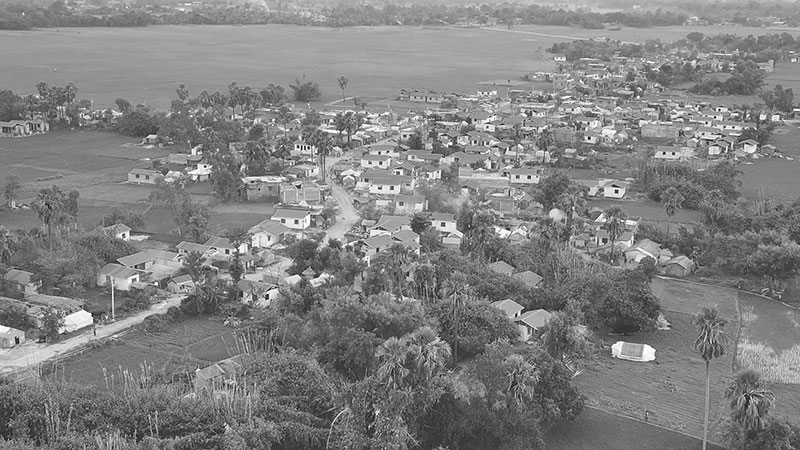
The homes were built by the Nepal Army for the families displaced by the windstorm. Post Photo
BARA : The Nepal Army has completed the construction of 869 houses for the windstorm victims of Bara district and handed them over to the local authority. Twenty-eight people were killed, while hundreds of houses were blown away by the catastrophic storm in Bara and Parsa districts on March 31. The federal government had tasked the Army with the responsibility for the construction of houses for the windstorm victims of Pheta, Subarna, Parwanipur, Prasauni, Pachrauta, Mahagadhimai and Kalaiya local units in Bara district. The government allocated Rs 846.87 million to the Army for the construction of 1,453 houses in Bara and Parsa districts. The acting Prime Minister and Defence Minister Ishwar Pokharel handed the detailed documents of the reconstructed houses to Chief Minister of Province 2 Mohammad Lalbabu Raut amidst a function organised in Birgunj on Wednesday. The documents of the newly built houses were then given to chiefs of the respective local bodies. “We now finally have houses. It’s such a relief,” said Haidar Ali of Purainiya in Pheta Rural Municipality. The government allocated a budget to construct 1,453 houses initially but later verified that only 881 houses needed reconstruction. Construction of 12 houses is on hold due to technical issues, according to Army officials.
NATIONAL
Man injured in police firing
Briefing
- Post Report
BIRGUNJ: An armed man sustained bullet injuries in the police action at Radhemai of Birgunj on Tuesday night. Police said Santosh Tatma of Birgunj shot at his right leg as he attempted to flee brandishing a pistol at security personnel. A pistol and 17 rounds of bullets were seized from Tatma.
NATIONAL
Dengue cases found in Parbat
Briefing
- Post Report
PARBAT: Four patients have been diagnosed with dengue in the district. The district hospital referred 10 patients to Pokhara suspecting dengue infection. Laboratory test of four among the referred patients tested positive for dengue till Tuesday, said the hospital.
NATIONAL
Writ filed challenging a federal law
Briefing
- Post Report
MAKWANPUR: A writ petition has been filed at the Supreme Court challenging a provincial law that has the provision of providing a monthly allowance to the elected representatives of the local units. Advocate Lokendra Oli had filed the petition against Provincial Assembly secretariat and Ministry of Internal Affairs and Law of Province 3 on August 25.
NATIONAL
Bridge construction left incomplete for six years
Briefing
- Post Report
ACHHAM: A bridge project over Budhiganga River in Achham remains incomplete even after six years since the work started. The contractor had agreed to complete the construction of the bridge within two years. But only 50 percent of the work has been completed so far.
EDITORIAL
Another brainwave
Requiring aspiring journalists to take an exam is meaningless.
At a time when the government was already facing criticism from the press and the larger public for attempting to pass a draconian Media Council Bill, it has attempted to insert a clause in the proposed law that has been called unnecessary. The planned amendment will require aspiring editors and reporters to take an exam to be allowed to join the profession. But it is not convincing that such a move will improve journalism. Most democracies do not have such exams and licences in place, and it is a wonder what type of state the government is trying to emulate. The government needs to scrap the proposed amendment; information dissemination is guaranteed, under the right to free expression, by the constitution and it can be exercised by anybody. The idea of making journalists sit for a licensing exam is not new. In Nepal, it was first floated about four years ago when a task force formed by Press Council Nepal decided that it was a good idea. Criticised by the Federation of Nepali Journalists as an infringement upon the journalists’ right to expression, the recommendations of the task force went unused, until now. The practice is not a popular one across the world either. There are only a handful of countries in the world that prescribe any tests or hard requirements for their journalists, and the ones that do have not seen any discernible change or improvement. In fact, in Italy, where journalists are required to go through an 18-month internship followed by written and oral tests, newsrooms have been ignoring the cumbersome procedure altogether—without any perceived deterioration in quality. The government’s recent move comes after a section of the public began complaining about the penetration and proliferation of unreliable sources of information through social media and the internet. But a licensing exam will hardly be able to block the spread of ‘fake news’. It is the very nature of social media that allows it to be such a potent medium to spread information and disinformation. In this era, a free and responsible press is all the more important to show the public what factual information and quality journalism can be. Were a journalism licence to be put in place, it would still not stop any individual or group from spreading news online—journalism or dissemination does not belong exclusively to media houses anymore. Moreover, the examination would have to be carried out by a regulatory agency. Who should be in charge of this? If journalists make up the body, it will not be any better at enforcing a code of conduct than media houses doing so independently. If the government is the entity in charge, it would have the potential to misuse and abuse its power to suppress factual and critical news. No matter how the matter is looked at, a licensing body will not improve the quality of journalism. However, there has been an issue of media entities working without codes of ethics and conduct. The media has an equal responsibility to adhere to high standards so that the public does not have reason to complain about the quality of the news. Such self-improvement is especially important in times like these, where the government may take any chance to curtail press freedom.
OPINION
The mysterious case of bank lendings
Banks continue to make handsome profits yet fail to lend money to the most vulnerable groups.
- DEEPAK THAPA
Around this time every year, various news media inform us matter-of-factly which of the Nepali banks made the highest profits and what those amounts were. Accordingly, we learnt that in the fiscal year just past, the 10 top-earning banks raked in a cool Rs35 billion, up from Rs28 billion the year before. With such a performance, stockholders are surely laughing all the way to their respective banks with equally gleeful employees in anticipation of the big fat bonuses soon to come their way. This year, Nepal’s 28 commercial banks earned a staggering Rs65.2 billion in profit. Add to that the Rs7.3 and 1.8 billion net taken in by 29 development banks and 23 finance companies, respectively, and we are up to Rs74.2 billion. Again, add the 90 microfinance institutions (MFI), which together earned a profit of Rs6.6 billion, bringing the volume of profit from the banking sector to a total of Rs80.8 billion. What’s more, there are savings and credit cooperatives as well. In sum, there is a lot of money to be made through the provision of credit in Nepal. It has always been a source of wonderment to me that an economy like ours can generate such astronomical profits. Especially when, all year round, the common refrain about Nepal’s banking sector has always been of the perennial liquidity crisis. In other words, the banks continue to complain that they have no money to lend, yet miraculously manage to pull in a pretty pile year after year.
Where’s the credit? I do not quite understand the world of finance, but somehow I cannot shake off the feeling of something not being all right. Just in the past few days, we have learnt of this loan shark from Sarlahi district who has been preying on a whole village. Thanks to the massive publicity provided by the media, the man has been arrested, and an investigation is ongoing. Given how things work out in Nepal, and the chap probably has all the paperwork worked out in any case, I would not bet on his receiving his comeuppance. But even if he were only to learn a lesson and his exploited loanees granted some reprieve, his time in custody would have been worth it. Such stories are legion in this part of the world and memorialised over and over again in popular culture. Yet, it was a sentence in the Kantipur story that stood out: this modern-day Shylock was apparently always ready to provide loans to ‘the poor, illiterate and Dalits’. While there is an overlap among these three categories, he must have preferred such debtors since that allowed him to inflate the loan amounts on the sly. The whole episode, however, begs the question of why it is that the government has not been able to expand the formal sector to provide loans to these most vulnerable groups. Particularly since, for nearly 30 years, the Nepal Rastra Bank (NRB) has made it mandatory for banks and financial institutions (BFIs) to provide loans to what it has termed the ‘deprived sector’. At present, such loans have to comprise at least 5 percent of the total loan portfolio. Not counting the microfinance institutions (MFIs), disbursements by BFIs stood at 6.6 percent last year, with Nepal Bank Limited even reaching 10.2 per cent. There appears to be a clear disconnect between this impressive proportion of credit being extended by the BFIs to the most marginalised and what was going on in Sarlahi, itself only representative of the reality of rural life all over Nepal. In order to understand what might be going on, a little foray into what passes for the deprived sector is necessary. An NRB paper from 2010 described the group of beneficiaries as being ‘low income people especially socially deprived women, endogenous [indigenous], lower caste, blind & hearing impaired, disabled, craftsman, artisan, small & marginal farmer and landless people’. It describes the rationale for this provision thus (with sics throughout): ‘From the very beginning, these people are excluded from the formal banking services. Basically, the lending to those people who are deprived of lending from formal financial sector is comes under deprived sector credit. The main objective of deprived sector credit is to uplift the socio economic status of these people.’ So, what has been happening? A news report from 10 years ago reported that more than 50 BFIs had been penalised for not reaching the-then lower threshold of deprived sector loans. Three of these were commercial banks, which were fined Rs2.6 million by Nepal Rastra Bank. In the intervening decade, the banking sector appears to have improved its performance in this regard impressively. Unfortunately, that seems to have come about more by redefining what the deprived sector consists of than by making active efforts to provide services to the deprived. A couple of representative examples are as follows. In 2018, it was announced that loans issued against academic certificates, and loans to students of marginalised and Dalit communities could be counted as falling within that category. Even earlier, loans for alternative sources of energy had been included. A Google search with the keywords ‘deprived sector loan nepal’ showed 219,000 results. Going through the links to the first three commercial banks that showed up took me to their sites on deprived sector loans. It was revealing that almost every bank had its own definition of the deprived sector. Hence, NCC Bank had ‘Mahila, Janjati, Dalit, Farmers and foreign workers etc’; Prime Bank, ‘Institutions/Microfinance Comp-anies working for the deprived sectors’ and ‘Skilled Nepalese craftsmen doing Handicraft business since last one year (metal, stone paving, wood paving, jewelries and similar business)’; Himalayan Bank was ‘providing deprived sector financing (directly or through intermediary) to various organizations that falls under the deprived sector financing as prescribed by Regulatory Authority’.
Reforming MFIs By far, the most common medium of meeting the 5 percent target appears to be lending to MFIs, who do the actual lending to the deprived sections of the population. And, by definition, the interest rate of MFIs, although much lower than informal sources, is pretty high. This is mainly due to the high administrative costs involved in the very small transactions they deal with. Sadly, combined with the extremely fierce competition for clients among the ever-increasing number of MFIs, it has resulted in large numbers of people burdened by loans they have no means of repaying, as detailed in the cover story of Himal Khabarpatrika recently. That part of the billions of rupees in profit generated by the banks also includes contributions by the most vulnerable sections of society is a sad commentary on us all. Given the clout commercial banks have over MFIs, the least they could do is use it to ensure that the latter do not overcharge their clients or provide multiple loans to those without the ability to pay. Or else, how would the banking sector be any different from the money-lender from Sarlahi?
OPINION
Industrialisation the key to development
The World Bank has described Nepal’s peculiar growth as a low-growth, high-remittance trap.
- NIRAJ KC
The annual data published by the government of Nepal shows the economic growth rate in the fiscal year 2018-19 at 14 percent (at current prices). While the growth rate seems encouraging from a macro perspective, the details become blurry as we streamline the scope of analysis. Expectedly, the service sector remains the dominant contributor with approximately 57 percent, followed by agriculture with 27 percent and industry with 16 percent. These figures reveal that Nepal’s economic growth has followed an atypical path. Normally, when countries grow, they tend to industrialise and move out of agriculture into manufacturing, which has higher productivity or output per worker, thus generating higher wages. So industrialisation is the key for an economy to become middle class and prosperous. Once the economy becomes advanced, industry gives way to the service sector in the same way manufacturing overtakes agriculture. Nepal’s economic growth, in this context, has a perplexing feature as it has jumped from agriculture directly to service without gaining a firm foothold in the middle-income stratum. This obfuscating growth could actually bring worrying consequences. For instance, if anything goes wrong in the Middle East (which is not entirely unlikely given the current geopolitics), a large number of Nepali workers will flock back to the country; and without the stronghold of manufacturing industries, the economy will not be able to sustain the sudden influx of labour, which subsequently could invite myriad economic and social problems.
Unconventional growth Nepal’s unconventional economic growth pattern has caught the attention of international organisations as well. The World Bank recently termed our peculiar growth as a low-growth, high-remittance trap. In this context, by not prioritising the manufacturing sector and simultaneously encouraging domestic labourers to migrate, the government is inadvertently promoting the manufacturing industries of foreign countries as remittance is mostly spent on imported goods. Therefore, the sector which should have been the primary instigator of growth remains in the doldrums. In fact, compared to the previous fiscal year, the output of the manufacturing and construction sectors has increased only by approximately 1 percent, highlighting that the economy is continuously being fuelled by the service sector. The 2008 global financial crisis was the consequence of a complex service sector. In fact, the crisis revealed the limitations of having an economy with a large and complex financial service sector. In Nepal’s case too, banks and financial institutions are becoming more interconnected, and their business harder to understand and regulate. After the encouraging success of the major developed countries including the UK and the US as service-oriented economies, the 2008 financial crisis came as something of a reality check. Immediately, the US and UK governments introduced a policy to rebalance their economy by the process of reindustrialisation. The then British prime minister David Cameroon initiated policies like March of Makers under which the UK attempted to rebalance the economy by manufacturing tradable merchandise and selling its wares overseas. The US, despite being the second biggest manufacturer, endorsed similar policies like Made in America. However, over the years, it became apparent that neither the US and nor the UK were successful in reversing the process of deindustrialisation as these rich countries just could not compete with low-cost producers. Emerging economies like China and India started to produce goods cheaply, and information and communication technology also decreased the cost of the supply chain. Yet, the US is still aggressively pursuing a reindustrialisation policy.
Long-term solutions Though the impetus for industrialisation in Nepal is much greater, the government is not willfully and ambitiously pursuing the sector. The authorities regularly clamour about curtailing the current account deficit (notably by imposing high tariffs), but they do not think about creating long-term solutions. Considering a favourable demographic status and relatively low-wage labourers, Nepal is fertile ground to unbridle the growth of industrial engineering. We often hear claims that the wage rate in Nepal is high; but we need to understand that if the number of unskilled labourers is to decrease sufficiently, as has been the case in Nepal due to rampant immigration, those engaged in unskilled work should be paid good wages. So with the right incentives, which include encouraging migrant workers to return, foreign companies will come to Nepal, and the success story of one company could open the floodgates of interest. In this context, a foreign direct investment can be uniquely tailored to the country’s circumstances. Like special economic zones, the government can endorse ideas like export processing zones where foreign entities can be explicitly geared to promote exports and help in technology transfer. Only such a robust economic policy could probably help Nepal in achieving the ambitious target of becoming a middle-income nation by 2030.
KC is the coordinator of Nepal Economic Forum.
OPINION
Tourism thrives on teamwork
Visit Nepal 2020 can accommodate all for the common goal of solidarity for prosperity.
- YOGESH BHATTARAI
Shutterstock
Topped by eight of the world’s 14 highest peaks with Everest as the jewel in the crown, sanctified as the birthplace of the Buddha, adorned with spectacular art and architecture, blessed with diverse flora and fauna, and inhabited by 125 ethnic groups speaking 123 languages and dialects, Nepal is a great tourist destination. It is also situated in an enviable location between the two most populous countries in the world, both of which have booming economies. This Himalayan country has been a favourite destination for tourists from across the world for more than six decades. International arrivals are rising and tourism’s contribution to the national economy is increasing year by year. Tourism is now gaining momentum as a phenomenal business activity and is spreading across the country. It is being taken as a source of employment generation, a dependable contributor to national revenue and a catalyst for socio-cultural development. Tourism is one of the most appropriate economic activities, with Nepal having a competitive advantage. It can support businesses ranging from enterprises with a small investment to large projects with international investment. The tourism sector thus, has a trickle-down effect which reaches even the lowest strata of society.
Priority sector For these reasons, the government of Nepal has designated tourism a priority industry, and has formulated laws and policies conducive to it. It has adopted an open sky policy, encouraged foreign direct investment and sensitised the public about the importance and benefits of tourism. Provincial and local governments have also joined the bandwagon, thus making tourism a common agenda for Nepal’s economic prosperity. Tourism thrives on teamwork which requires synergy between basically three major components: the government, private investors and business people, and the community. Unlike other businesses, tourism is rather sensitive, as it is prone to natural, manmade, domestic and international circumstances. On both sunny and gloomy days, Nepal’s tourism industry has always steadfastly taken up a strategy riding the vehicle of campaigns to put tourism in the spotlight. Be it Visit Nepal Year 1998, Destination Nepal Campaign 2002-03, Visit Pokhara Year 2007, Nepal Tourism Year 2011 or Visit Lumbini Year 2012, all these past campaigns have served the purpose of drawing international attention to Nepal—that it fondly embraces tourism as an important economic stimulant. Visit Nepal Year 2020 is at our doorstep, with an array of ambitious objectives—a target of 2 million international arrivals, extension of stay, distribution of tourism across the nation, and above all, enhancing Nepal’s international image. The challenges are numerous; the commitment is one—making Visit Nepal Year 2020 a grand success. We are focusing on development and upgradation of infrastructure, professionalism in services, smartness in management and inclusiveness in participation. At this juncture, the focus should be on aviation infrastructure like completing and operating the Gautam Buddha International Airport and Pokhara International Airport, upgrading and expanding Tribhuvan International Airport and other domestic airports,along with starting the construction of Nijgadh International Airport. Progress is speedy, yet we need to keep our eyes on it constantly. Improving Nepal Airlines Corporation is extremely urgent. Several initiatives have been launched to improve the management of Nepal Airlines and expand its services to various foreign cities. Assuring the international community, aviation experts and travellers about Nepal’s aviation safety is the government’s utmost priority. For this, necessary policy reforms have been initiated. Another very important aspect is physical infrastructure like construction and upgradation of roads, public transport and complementing facilities and services. This involves multiple stakeholders as well as agencies. It demands a coordinated approach to put our joint efforts to effective results. The reconstruction of most earthquake damaged historical, archaeological and cultural monuments is nearing completion, thanks to the people, agencies, donors and international community who have shown their support for various reconstruction projects. The existing products and activities need to be enhanced and expanded, and new ones should be developed. There is a need to explore and research new products and experiences to offer to our guests, otherwise repeat visitors—which is a trend in Nepal—will be bored by the same monotonous offerings and the country will fall victim to tourism stereotypes. Skilled and techno-savvy human resources are the need of the hour. The impression of a destination is not a place or a monument alone, it is a composite whole consisting of various elements covering people, facilities, food, comforts, and above all, a sense of security. Developing human resources or training them should be the common agenda of all stakeholders. Put all these things in a spectrum, and the Visit Nepal Year 2020 campaign comes up as a common platform which can accommodate all people and institutions for the common goal of solidarity for prosperity.
Come together The Visit Nepal Year 2020 campaign aims to send a message that Nepal is a must-visit destination because it offers all kinds of tourism products and activities—nature, culture, adventure, pilgrimage and peace. It has settled the political deadlock in the most efficient way by institutionalising a federal democratic republic that ensures inclusiveness and complies with all democratic values and principles. The country has rebounded from the setback caused by the 2015 earthquake to its previous glory and is marching on the path of prosperity with the lofty vision of Prosperous Nepal and Happy Nepali. Let us all unite, and allow tourism to thrive.
Bhattarai is the minister of culture, tourism and civil aviation.
OPINION
Two systems, one world
The idea that freedom and democracy will prevail can no longer be taken for granted.
- JOSCHKA FISCHER
Shutterstock
With the 30th anniversary of the fall of the Berlin Wall approaching, the issue of freedom has returned to the fore in Moscow and Hong Kong, albeit under very different historical and political circumstances. We are reminded that the modern era was built on freedom, and on the recognition that all people are born equal. This radical Enlightenment idea, when it took hold, constituted a break from all previous history. But times have changed. In the twenty-first century, we are confronted with a fundamental question: Could a modernised form of authoritarianism represent an alternative to liberal democracy and the rule of law? In 1989, the obvious answer to that question would have been no, not just in the West but around the world. Since then, however, we have witnessed the revival of nationalism in Europe, the failure of the Arab Spring, the election of US President Donald Trump, Russia’s relapse into revanchism, and the emergence of a global China. Now, all bets on liberal democracy are off. China’s emergence as a second military, economic, and technological superpower suggests that there is now an alternative development model. In modern China, the rule of law and democracy are regarded as a threat to one-party rule. Hence, the ongoing protests for freedom and democratic accountability in Hong Kong expose a division not just between two normative frameworks, but between two systems of political power. For a while, China appeared to have found a formula for bridging this divide. The principle of ‘one country, two systems’ was supposed to allow for the orderly reintegration of Hong Kong and (more aspirationally) Taiwan. Should this formula now fail in Hong Kong, there will be an immediate escalation of military tensions across the Taiwan Strait, because the island’s continued special status will become impossible for the Chinese government to accept or ignore. Still, the formula has indeed worked so far. Hong Kong has become extraordinarily important to the Chinese economy, because it provides access to global capital markets and serves as a financial gateway for inward foreign direct investment. And the relationship with Taiwan has, for the most part, remained relatively quiet. The arrangement with Hong Kong worked because the government in Beijing showed ample consideration for the city’s semiautonomous status. But as China has grown stronger, its perception of itself as a new global superpower has produced a change in behaviour. The Chinese authorities are exerting ever more influence in Hong Kong, suggesting that they want to move in the direction of ‘one country, one system’. The proposed law to enable the extradition of people arrested in Hong Kong to mainland China was widely seen as a threat to democracy and the rule of law in the former British colony. The authorities in Beijing know perfectly well that this attempt to weaken Hong Kong’s autonomy—not covert operations by foreign intelligence services—is why millions of people have taken to the city’s streets. Given the current power structures in China (and Russia), the mass protests this summer in Hong Kong (and Moscow) have little to no chance of success in the short term. Yet they are significant nonetheless, because they provide a foil for the democratic malaise that has spread throughout the West. More broadly, the division of the world into two systems immediately brings back memories of the Cold War. But in that conflict, the main issue was military strength—hence the centrality of the nuclear arms race. When it came to living standards, the Soviet Bloc never really had a chance (as was obvious in the so-called Kitchen Debate between then-US Vice President Richard Nixon and the Soviet leader, Nikita Khrushchev, in 1959). The competition with China, however, will be precisely about the question of which system delivers more in terms of technological and material progress. China’s ascent from a poverty-stricken developing country to an economic powerhouse is one of the greatest achievements of the modern era. Millions of people have been lifted out of poverty and into a growing consumption-oriented middle class, and millions more could soon follow them. At the same time, although China has been building up its military, it has not exerted force beyond its immediate neighbourhood, unlike the Soviet Union. When China pursues its strategic interests in Africa and Eastern Europe, it does so through economic and financial means. It owes its growing global influence not to its military, but to its economy and its growing capacity for rapid technological innovation. For the West, the ‘Chinese Challenge’, then, is to show that its model of democracy is still better suited than Eastern-style authoritarianism for the majority of humankind. In this larger contest, US President Donald Trump is something of a Chinese Trojan Horse. Although he is waging an aggressive trade and technology war against China, he is also doing everything he can to undermine the credibility of the Western model. In historical terms, his attacks on democracy will prove far more consequential than his tariffs. Making matters worse, Europe, with its obvious economic weaknesses and geopolitical naiveté, is also failing to marshal a defense of the Western model. At this stage, China’s ascent cannot be prevented. The country is simply too large and too strong to be boycotted or contained; at any rate, the Chinese people’s desire to share in global prosperity is entirely legitimate. The West has little choice but to maintain good relations with the new superpower, while at the same time defending its values. The rise of China—and of the Chinese system—will inevitably create more competition, and these new rivalries must be handled peacefully at all costs. A world with eight billion people cannot afford a global conflict. Whether China’s model of authoritarian modernisation can succeed in the long term is a question for future generations of Chinese. Those with no memories of past horrors such as the Cultural Revolution may simply regard the Chinese model as a matter of course. But the modern age was built on liberty. As we have seen in this summer in Hong Kong and Moscow, that lesson will not be forgotten anytime soon.
— Project Syndicate
HEALTH & LIVING
Prescribed and pre-ordered—what’s behind the latest health food trend?
An increasing number of people have become health-conscious in Kathmandu, and some have businesses have capitalised.
- Alisha Sijapati
A chef at Fit Box Nepal prepares prescribed meals for clients. Post Photos: Anish regmi
Lalitpur, Neha Chaudhary has been using Fit Box Nepal meals for a little over four months now. A basketball player and a full-time researcher, Chaudhary’s lunches often consisted of momos and parathas—basically fast food that she could easily find in restaurants around her workplace. She has a busy lifestyle, and thus had resorted to eating such meals that have little nutritional value. But as soon as she realised enough was enough, she started subscribing to healthier meal options from Fit Box —a company that offers healthy diet meals during lunch hours. And for many health-conscious people like Chaudhary, companies like Fit Box have become a godsend—as these companies plan and pack meals that not just maintain their customers’ weight but also to keep a check on the nutritional value of the food they are consuming on a daily basis. And Fit Box is just one of the many companies that are currently operating in Kathmandu. As the people of Kathmandu have become more conscious of their health and their eating habits, a flurry of such companies have begun business in the capital—all of them banking on this increase in the number of health-conscious people.
And then there are others who are completely dedicated to their fitness routines, like Rahul Moktan, the co-founder of Maharajgunj-based Gymkhana, who say that nothing beats making your own food. “Opting to depend on such companies works for working individuals who want to eat right but don’t have the time to cook,” he says. “But when you make your own food, you know exactly what you put and need.” But Denim Shrestha, CEO of Fit Box Nepal, says he is a fitness enthusiast himself, and has been heading to the gym since he was 18. At the gym, he’d often hear people complain about not having the time to eat properly. Shrestha saw that this was an emerging market he could tap into, and thus he started Fit Box in 2018. The company currently caters to over 150 customers. “When I started the company, I only offered two types of meals: one for those who wanted to lose weight and one for those who wanted to gain weight,” says Shrestha. With rising demand, and people’s varied requirements, Shrestha started providing more options. Within a year of its launch, Fit Box started offering five diet meal plans—basic, low- and-high calorie, deluxe, vegetarian, and keto—with a range of items like shredded chicken, chicken casserole, quinoa chicken salad, kidney bean bowl with tofu and brown rice, and others. Another company, Foodmario, an online food delivery service that delivers homemade food to its clients, has also recently started providing healthier meal options for their customers. They have even added vegan meals to their menu. “We see a lot of people turning vegetarian and vegan, and we at Foodmario, from the very beginning, knew that we would eventually have to incorporate such meals into our menu, considering how health conscious people have become,” says Rohit Tiwari, the founder of Foodmario. Tiwari says currently Foodmario has clients constantly calling to order for healthier meals and the demand for such diet plans has motivated Tiwari and his team to work on creating a wider menu with their home chefs. Similar to Fit Box and Foodmario, another company Good Cal is also fast gaining popularity for their menu and their taste. Ashish Pradhan, director at Evolution Beverages, a regular customer, says he has been more than satisfied with the timely service and variation in their menu. “I loved the food offered by Good Cal. They have good portions and their meals are delicious,” says Pradhan. Even Chaudhary says she is happy with FitBox’s delivery. Since she started eating Fit Box’s meals, she says her meals have become much more balanced, with controlled portions. “I am doing the low-calorie meal plan and they send a nice variety—whole wheat pasta, brown rice, sandwiches and salad,” she says. “It may not be delicious, but it’s decent.”
While Pradhan and Chaudhary are happy with their healthier meal choices, there are many who don’t share the same feeling. Twenty-one-year-old Sarina Shrestha, a marketing professional, says opting for healthy meals every day was a habit she could not set. “Of course it’s good to be healthy, but I found eating the same type of food every day boring. That’s why I stopped,” Sarina says. Shrestha of Fit Box, also agrees that the meals may become monotonous for people after a period of a month because they only have 15 sets. “We are just starting out and we are working on making our menu and dishes more creative,” he says. To do that, Shrestha has two chefs who bring in more than two decades of experience to expand and design the menu. At Fit Meal Pro, however, David Pradhan, the founder of the venture and also the owner of Baluwatar-based Belleville Restaurant, meals are customised according to his clients’ preferences. The company was established with an intent to cater exclusively to athletes, but it evolved to customising healthy meals—both for lunch and dinner—to all its customers. “Clients are already spending too much money on their fitness training. We want to make healthy living available and not too expensive for our customers,” says Pradhan. Fit Meal Pro charges up to Rs 12,000 for 13 lunch and dinner packages, while prices for FitBox’s basic meals start from Rs 3,250 (for two weeks). The prices for Foodmario’s healthy meals start from Rs 300 onwards. “The diet plan that one follows is very important, in fact, it is more important than exercise,” says Tiwari, of Foodmario. And with people becoming more and more aware of their health choices, Tiwari believes that business will only continue to grow. “We are looking forward to bringing meals for people as per the demand and need,” he says.
HEALTH & LIVING
Hormone therapy during menopause raises breast cancer risk for years: Study
Medication for menopausal hormone therapy increased the probability of developing invasive breast cancer.
- MEGAN THIELKING
A sweeping new analysis adds to the evidence that many women who take hormone therapy during menopause are more likely to develop breast cancer—and remain at higher risk of cancer for more than a decade after they stop taking the drugs. The study, published in the Lancet, looked at data from dozens of studies, including long-term data on more than 100,000 women who developed breast cancer after menopause. Half of those women had used what’s known as menopausal hormone therapy, or MHT. The longer women took the medicine, the more likely they were to develop breast cancer. Experts say the findings could shape how women and their health care providers decide how to manage symptoms of menopause. “This is a consensus of many researchers and many studies all around the world. These are important new results,” said Valerie Beral, a cancer epidemiologist at the University of Oxford and one of the lead authors of the new study. For years, research has suggested a potential link between MHT and an increased risk of breast cancer. In 2002 and 2004, the Women’s Health Initiative released reports that showed women who used combination MHT were more likely to develop breast cancer. MHT use fell after the reports received widespread coverage. That was followed by a decline in breast cancer rates. But there wasn’t much information on whether that risk persisted, or how it differed based on the type of MHT a woman took. So an international group of researchers pulled together data from dozens of studies—published and unpublished—to examine the issue more closely. They took a woman’s age at first use of MHT, how long she used the medication, and the time elapsed since she last used it into account. The mean age of women starting menopause was 50, which was also the mean age at which women started using MHT. The researchers found that compared with women who never used MHT, women who did had a significantly higher risk of developing invasive breast cancer. They estimated that 6.3percent of women who never used MHT developed breast cancer, compared to 8.3percent of women who used the combination drug continually for five years. That’s roughly one extra cancer diagnosis for every 50 users. The longer women used MHT, the greater their risk of breast cancer. Women who were no longer using MHT had a lower relative risk than women who were currently using it—but they remained at an elevated risk for more than a decade after they stopped taking the drug. The level of risk was dependent on how long a woman took MHT. The study also found that women who took the combination drug were more likely to develop cancer than women who took the estrogen-only drug. “The findings are significant,” said Joanne Kotsopoulos, a breast cancer researcher at Women’s College Research Institute in Toronto. “The longer you use it, the higher the risk,” added Kotsopoulos, who wasn’t involved in the research but wrote a commentary on the study, also published in the Lancet. Related: Menopause hormones don’t shorten lives, long follow-up says The new analysis doesn’t show that MHT directly causes breast cancer. But researchers suspect the association has to do with the hormonal changes of menopause. The level of hormones produced by the ovaries dramatically drops during menopause. Going into menopause early is thought to lower the risk of breast cancer. But using MHT might keep women in something like a pre-menopausal state, keeping them from getting the protective benefits of menopause on cancer risk. “Estrogens stimulate activity in the breast and increase the risk of breast cancer. [MHT] is just putting that stimulus, which had gone after menopause, back,” said Beral. The caveat: The findings, broadly speaking, apply to women of average weight in developed countries. The researchers found that MHT didn’t have a significant adverse effect on women who were obese, though obesity is also a risk factor for breast cancer after menopause. For now, experts say patients and providers should carefully consider when the potential benefit of using MHT outweighs the risks. Alternatives to MHT—like taking vitamin D and calcium supplements or keeping rooms cooler—should be a part of that conversation, experts said. It’s also critical for doctors to check in with women on MHT about whether the medication is actually easing their symptoms—and if it isn’t, clinicians should consider taking them off the drugs. “It’s a balance. Every woman is different,” said Kotsopoulos. “But the risk is high for breast cancer, so they need to take a very serious approach.”
The article was originally published on STAT, a Boston based health news publication. Find more stories on statnews.com.
CULTURE & ARTS
In Gorkha’s highlands, the bakhu-weaving tradition is slowly dying
Because the task demands a lot of labour, many villagers are looking for easier alternatives.
- HARIRAM UPRETY
Bakhu is hand-weaved and is akin to a large shawl or poncho that people wrap around their body. Post Photos: prakash chandra timilsena
GORKHA, After walking a day and a half uphill from his village in Gumda, Maila Gurung reaches Lapsibot, where he shepherds his 250 sheep in grazing land—known as Kharka in the local tongue. Although it is tough to live away from his home and family, Gurung comes up here twice a year with his sheep, because he needs them to eat well. If his sheep eat well, Gurung will be able to sell their wool in his village—where it will go like hot cakes. “We earn a decent income by just selling the wool,” says Ram Maya, Maila’s wife, who sells the wool that her husband sends her from Lapsibot. “Everyone needs sheep wool to produce bakhu, which is used by almost everyone in every household.” But the Gurungs are just one of the few families in Gumda who are still taking up traditional shepherding to sustain their livelihoods. The village that is located in the north of the Gorkha district requires one to take a day’s walk from Barpak during summer and monsoon. During winter, off-road vehicles occasionally reach this mountainous village. Because the work demands so much labour, many have moved to easier options of livelihood and education. This has resulted in an acute shortage of sheep wool in the village, which is the primary raw material to weave Bakhu, a traditional garment used by the villagers of Gumda facing an acute shortage. “I weave two bakhu over the course of a year,” says Ram Maya. According to her, bakhu is a necessity for people living in and around her village. Locals from many villages in Dharche and Chumanubri rural municipality wear the traditional piece of clothing.
Bakhu is akin to a large shawl or poncho that people wrap around their body to protect themselves from harsh weather conditions in the mountains. Its ubiquity is unparalleled. “Every household should compulsorily have bakhu. Apart from wearing it as a shawl, it is used as a carpet for guests to sit on, laid over beds or used as blankets during winter,” says Bal Maya Gurung, a 60-year-old native. “Sometimes, we even use it for decoration.” Although women from the village prefer to make their own bakhu, they occasionally also sell them, for Rs15-20 thousand per piece. But Bal Maya, who has been weaving bakhu since she was 14 years old, says that they have never weaved bakhu to specifically sell it to others. “It is not easy to weave bakhu, as it is a very hard and long process,” she says. “And with the scarcity of sheep wool in recent years, we don’t get the value of our hardships anyway.” The process of making bakhu is laborious: after receiving the sheep wool, women drench it in cold water and air-dry it. The wool is then combed thoroughly to get rid of any dust or foreign particles. When the strands of the wool are thinly separated, the women then make thread from it—which is then fixed in the yarn, ready to weave. The work, however, doesn’t stop there. After the weaving is complete, the bakhu is washed with hot water and dried over fire for the following weeks before it is ready for use. Locals say that after the bakhu goes through all these steps, it can become water-resistant. “It takes around a month to six months to weave one bakhu,” says Ram Maya. “We only sell if we can produce in excess.”
The women in Gumda are able to make bakhu only after they are done with household chores, which means it takes them longer to complete weaving one bakhu. There are two types of bakhu—plain and coloured. The locals don’t use any artificial colouring but the colour depends upon the colour of the wool. “The purpose of bakhu remains the same, the coloured ones only add aesthetic value,” says Bal Maya. Apart from its practical use in the mountain region, the bakhu also carries cultural significance, say locals. “When I was young, one of the major questions asked by the families from possible groom side was whether the girl knows how to weave Bakhu,” Bal Maya says. Despite its importance, Kanchhi Gurung from Laprak also agrees with Bal Maya: the production of bakhu has reduced significantly. bakhu used to be produced far more in number than what the villagers have been producing lately. “For the younger generation, it has also become something that needs a lot of time and effort but doesn’t yield any monetary value,” she says. With the growing scarcity of sheep wool to weave bakhu combined with easy accessibility to ready-made garments in the nearby markets, Kanchhi says the trend is slowly dying. “If villagers could see that sheep herding as a lucrative business, and if new technology that would weave Bakhu faster was introduced, then maybe the tradition can be saved,” says Kanchhi.
CULTURE & ARTS
Holocaust ‘masterpiece’ causes uproar at Venice film festival
In the very first scene of ‘The Painted Bird’, the boy’s pet ferret is taken from him by boorish peasants and burned alive.
- FIACHRA GIBBONS
A searing adaptation of one of most controversial books about the Holocaust divided critics at the Venice film festival Wednesday, with some fighting each other in the dark to get out of its first screening. The Painted Bird, based on Jerzy Kosinski’s highly contentious 1965 novel about a Jewish boy surviving the worst human nature can inflict on him in an unnamed Eastern European country, was hailed as a masterpiece by some and an unwatchable ordeal by others. But its staggering central performance from nine-year-old Czech Roma boy Petr Kotlar—who witnesses a panoply of depravity from incest, bestiality and rape to mutilation and murder—has had co-stars Harvey Keitel and Stellan Skarsgard as well as the critics in raptures. That did not stop some running for the exits at its first screening. In the very first scene, the boy’s pet ferret is taken from him by boorish peasants and burned alive. The Hollywood Reporter called the black-and-white epic “heart-wrenching... and the ideal film treatment” of the novel, which itself sparked outrage in Kosinski’s native Poland when the writer first hinted that the story was autobiographical.
‘Monumental work’ The Guardian’s Xan Brooks also heaped praise on Czech director Vaclav Marhoul for “never putting a foot wrong”, adding: “One day they’ll make a film about the first public screening” at Venice. “It will feature the man who fell full-length on the steps in his effort to escape and the well-dressed woman who became so frantic to get out that she hit the stranger in the next seat,” he wrote. “The centrepiece will be the moment 12 viewers broke for the doors only to discover that the exit had been locked,” he added. Brooks declared the film “a monumental piece of work and one I’m deeply glad to have seen. I can also say I hope to never cross its path again.” Deborah Young of The Hollywood Reporter also hailed it, but warned that it was an “emotional three-hour punch in the stomach”. Marhoul defended the unremitting darkness of his adaptation—which has a happy ending, of sorts—insisting that “only in darkness can we see light. Shining through all the horrors is, for me, hope and love.” He said the film was a warning of what can happen when Europe turns inward as it was doing now, drawing a parallel between the attitudes to migrant children fleeing wars in Syria, Libya and Afghanistan and the rejection and abuse his hero suffers.
‘Kosinski lied’ “Bad times are coming to Europe,” he told reporters. “Looking at the populists who are running so many European countries at the moment like Hungary, Poland, Russia, in the Czech Republic too and of course the US.” Marhoul said the film took 11 years to make. “I didn’t know when I started that this story would become much more accented by what happened in Europe three years ago, when so many people came here to save their lives,” he said. Because of the fury Kosinski sparked in Poland, the director decided to have most of the film’s sparse dialogue in Slavic Esperanto “so no nation would be associated with villagers” who mistreat the boy and hand him over to the Nazis. Despite being accused of plagiarising other Polish books, Kosinski’s novel is still seen by many as a classic. “When Kosinski said it was his autobiographical story he was lying,” Marhoul said. “In fact he spent the World War II with his parents among Polish villagers. And those villagers tried to save them... That’s not a big problem for the book (because it is fiction). But many people in Poland still think this book is about them.”
—Agence France-Presse
WORLD
Johnson faces new Brexit battle after stinging defeat
The European Commission says the risk of a no-deal Brexit has increased, warning that it sees no alternative to the current withdrawal deal.
- AGENCE FRANCE-PRESSE
Britain’s Prime Minister Boris Johnson gestures as he speaks during the weekly question time debate in Parliament in London, on Wednesday. REUTERS
LONDON, Prime Minister Boris Johnson headed into a fresh Brexit showdown in parliament on Wednesday after being dealt a stinging defeat over his promise to get Britain out of the EU at any cost next month. The Conservative leader said he wanted an early general election on October 15 if lawmakers vote against him again on Wednesday and force him to seek a three-month Brexit extension from Brussels with a new law. “I will never allow that,” Johnson said, calling the draft law a “surrender bill”. Johnson argues that his threat to take Britain out of the EU with or without a divorce deal on October 31 will eventually force the bloc’s 27 other leaders to agree better terms. His critics counter that Johnson is playing with fire because of the economic damage such a breakup could cause after almost half a century of close ties with Britain’s closest neighbours. The European Commission also on Wednesday said the risk of a no-deal Brexit had increased, warning that it saw no alternative to the current withdrawal deal. Johnson suffered a defeat in parliament on Tuesday when he lost his wafer thin majority and rebel Conservatives joined opposition MPs in voting against a no-deal departure. “Humiliation for Johnson as Tory rebels turn against him,” read the front page of the left-wing Guardian newspaper, while The Independent wrote: “Johnson loses control”. But the strongly eurosceptic Daily Express accused MPs of voting “to betray Brexit” and called Tuesday’s vote “another shameful day in our so-called democracy”. Johnson got some respite on Wednesday when a court in Scotland ruled that his decision to suspend parliament for over a month starting next week was lawful. The 75 parliamentarians behind the legal challenge accused Johnson of curbing opposition attempts to block his Brexit strategy and bring down his government. A similar case will be heard in London on Thursday. Yet Johnson’s six-week-old government now stands in complete disarray. It lost its working majority in parliament on Tuesday after one of its MPs switched to the anti-Brexit Liberal Democrats. It then expelled 21 MPs from the Conservative party for voting against the government a few hours later. The Conservative rebels supported an opposition motion temporarily allowing parliament to decide what legislation is put up for a vote—a power traditionally held by the government. Johnson now enters what promises to be one of the more consequential days of the entire three-year Brexit saga. Johnson’s opponents hope to pass legislation forcing him to seek a Brexit extension until January 31 if no new deal emerges from an October 17-18 EU summit. MPs would like to vote through the Brexit delay bill in all three required readings by Wednesday evening. It would then move on to the upper House of Lords for final approval. Johnson argued on Tuesday that the proposed legislation would only cause “more dither, more delay and more confusion”. The government has pencilled in an election for October 15 should Johnson lose. This raises the prospect of a brand new government—one that might like to see Brexit watered down or even cancelled—taking over less than three weeks before the exit deadline. “I don’t want an election but if MPs vote tomorrow to stop the negotiations and to compel another pointless delay of Brexit, potentially for years, then that will be the only way to resolve this,” Johnson said on Tuesday. A parliamentary majority of two-thirds is required to hold an early general election. This means that the government would need the support of the main opposition Labour Party. But Labour fears that Johnson might go back on his word and reschedule the polls until after the October 31 deadline to make sure that Britain leaves the bloc—deal or no deal. “When he says we are going to have an election on October 15, nobody believes him because the levels of trust in Boris Johnson are very, very low,” Labour’s Brexit spokesman Keir Starmer told ITV.
WORLD
Blessed with fertile soils, Lesotho is cashing in on medical cannabis boom
- AGENCE FRANCE-PRESSE
A women worker picks up leaves from cannabis plants inside a greenhouse of Medigrow, a Lesotho-Canadian company that grows legal cannabis, located near Marakabei, in Lesotho. AFP/RSS
MARAKABEI (Lesotho), Vast white greenhouses sit high up on the slopes of Lesotho’s Marakabei town, hidden from view. It’s not fruit or vegetables, however, growing under the 18 plastic covers, but thousands of cannabis plants. The cannabis is grown legally by the Lesotho-based company Medigrow and is regulated by the government. “We have three rows that contain 1,200 plants each. That’s 3,600 plants across the whole structure,” said Medigrow’s head of production Albert Theron, gazing proudly over the crop. In 2017, the tiny landlocked kingdom of 2.1 million people decided to tap into the booming medical marijuana industry, becoming the first country in Africa to allow the cultivation of cannabis for medicinal purposes. In order to meet legal standards, most traces of tetrahydrocannabinol (THC)—the main psychoactive constituent responsible for marijuana’s intoxicating effects—are removed from the seeds. The remaining medical version is primarily made of the non-psychoactive substance, cannabidiol (CBD), and can only be 0.03 percent THC. Medigrow has invested $19.3 million (17.4 million euros) in cannabis-growing facilities around the country’s capital, Maseru. A heliport is also being built to ensure the cannabis—commonly referred to as “green gold”—is shipped safely and swiftly, said head of operations Relebohile Liphoto. The investment is spurred by the industry’s positive outlook. The global market for medical cannabis is currently estimated at $150 billion (135 billion euros) and could reach $272 billion in 2028, according to Barclays Bank. “At the moment we have almost 2,000 kilos (4,400 pounds) of biomass and we are going to produce more than 1,000 litres (260 gallons) of CBD oil,” said Liphoto. “Depending on the market, we can sell cannabis oil at between $6,000 and $21,000 per litre.” Nicknamed “Kingdom in the Sky”, Lesotho is the only country in the world whose entire territory sits higher than 1,400 metres (4,620 feet) above sea level. Deputy health minister Manthabiseng Phohleli told AFP that the legalisation of cannabis presented “a huge opportunity for the country”, which boasts 300 days of sunshine per year. “It attracts investors,” she said. “So far we have around 10 businesses operating on the territory.” Entirely surrounded by South Africa, Lesotho is also one of the poorest countries in the world, ranking 159 out of 189 in the latest UN Human Development Index. Unemployment is high, public services are scant and almost a quarter of the population is infected with HIV. The government charges 30,000 euros for a one-year renewable licence to grow cannabis. But the cost is too steep for most locals, and the market is dominated by foreign companies, mainly from Canada and the United States. Mothiba Thamae has been growing apples, peaches and raisins on 7.5 hectares (18.5 acres) of land for over two decades. He cannot afford the “green gold” licence. “We hoped the government would give small Basotho farmers the opportunity to cultivate (cannabis) legally,” said the 38-year old, referring to Lesotho’s main ethnic group. “Unfortunately they did not.” Year-long sunshine and fertile soils make Lesotho ideal for cannabis plants. Known as “matekoane” in Sesotho, the country’s national language, it has been grown for centuries in rural areas. “The first historical trace of matekoane dates back to the 16th century,” said Laurent Laniel, a researcher at the European Monitoring Centre for Drugs and Drug Addiction. “The Koena (people) are believed to have settled in Lesotho around 1550 by buying land from San groups in exchange for marijuana.” - ‘Cannabis money is a bonus’ - To this day, cannabis remains an important source of revenue for many small-scale farmers. Shasha owns a corn field in the centre of the country, on which he has also been growing cannabis illegally for around 20 years. “The vegetables feed my family. Cannabis money is a bonus,” said Shasha. “It allows me to survive and pay for my children’s education.” He sells his “matekoane” to a network of dealers like Jama, who smuggles up to 80 kilos of cannabis across the border to South Africa each month. “That yields between 400 and 500 euros,” Jama told AFP. The United Nations Office on Drugs and Crime estimates that 70 percent of marijuana consumed in South Africa is grown in Lesotho, making cannabis the country’s third source of revenue.
WORLD
Putin and Modi vow to boost military, trade and energy ties
- AGENCE FRANCE-PRESSE
Russian President Vladimir Putin (right) shakes hands with India’s PrimeMinister Narendra Modi ahead of the Eastern Economic Forum in Vladivostok, Russia, on AFP/RSS
VLADIVOSTOK (Russia), Indian Prime Minister Narendra Modi praised his “close friend” Russian President Vladimir Putin on Wednesday as the pair said they would work to boost military, trade and energy ties. The leaders met on the first day of Russia’s economic forum in the Pacific coast city of Vladivostok, an annual event since 2015 as Moscow looks to bolster relations with Asia amid tensions with the West. “I’m very grateful to my close friend Vladimir Putin for this opportunity,” Modi said at a press conference following talks and a tour of a naval shipyard. “We have reached a new stage in collaboration,” he said, adding that the pair discussed “unprecedented” mutual investment in oil and gas industries. A joint statement called for cooperation in military and technological spheres, with the possibility of creating joint ventures in India to develop and manufacture civilian aircraft. It also called for a reorganisation of the UN Security Council to reflect the “global realities” of a multipolar world. For his part, Putin hailed his “great friend, Mr Modi” and said India was “our strategic partner.” “Special attention was paid to trade and economic cooperation in the talks,” he said, though details of major trade deals were not immediately announced. Japanese Prime Minister Shinzo Abe was also to visit Vladivostok, along with Mongolian President Khaltmaa Battulga and Malaysian Prime Minister Mahathir Mohamad. But Putin was spending most of his time on Wednesday with Modi, who in an interview ahead of the meeting spoke of the “special chemistry” he shared with the Russian leader. “With each meeting with President Putin, we get closer and our relationship grows,” he told the newspaper Rossiyskaya Gazeta. Modi pointed out that mutual ties also extend to nature, as every year “Siberian cranes migrate to my home state Gujarat”. The Indian leader said he wanted to discuss tiger conservation with Putin, a lover of big cats. After shaking hands warmly on Modi’s arrival, the two men boarded a Russian navy patrol ship and headed to the Zvezda shipyard about 40 kilometres (25 miles) across a bay from Vladivostok. India is a key client for Russia’s arms industry and trade between the two countries amounted to approximately $11 billion in 2018. Russia and India in 2015 signed a $1 billion agreement to jointly make Kamov Ka-226 military helicopters, part of the “Make in India” initiative to encourage foreign companies to manufacture their products there. But the deal has been pushed back repeatedly.
WORLD
South Africa, Nigeria step security after attacks
Briefing
JOHANNESBURG: South Africa and Nigeria stepped security on Wednesday after deadly attacks on foreign-owned stores in Johannesburg triggered reprisal assaults on South African businesses in Nigerian cities. The centre of Johannesburg and the impoverished suburb of Alexandra were calm as police stepped up patrols following two days of looting, AFP reporters saw. Shops cautiously began to open again, as some residents sifted around in wrecked stores, looking for food. Amid mounting concern for relations between South Africa and its neighbours and Nigeria—the continent’s most populous market—President Cyril Ramaphosa reiterated his condemnation of the violence. (Agencies)
WORLD
UN rights chief slams US move to detain migrant children
Briefing
GENEVA: The US government’s recent decision to remove legal limits on how long migrant children can be detained clearly flouts international law, the UN rights chief said on Wednesday. UN High Commissioner for Human Rights Michelle Bachelet voiced concern over the move by the administration of President Donald Trump last month to allow migrant children and their families to be detained for unlimited periods. She pointed to the Convention on the Rights of the Child, which states that children can be detained only “as a measure of last resort and for the shortest appropriate period of time.” “If they are going to make it indefinite, that is much worse,” she told reporters in Geneva. “It’s against all the legal conventions and international human rights law and the laws for the child.” (Agencies)
ASIA
Hong Kong withdraws extradition bill that sparked months of demonstrations
City chief Carrie Lam said the government would not accept other demands, including an independent inquiry into alleged police misconduct against protesters and the unconditional release of those detained.
- ASSOCIATED PRESS
People watch telecast that Hong Kong Chief Executive Carrie Lam makes anannouncement on an extradition bill, in Hong Kong, on Wednesday. AP/RSS
HONG KONG, Hong Kong Chief Executive Carrie Lam announced on Wednesday the government will formally withdraw an extradition bill that sparked months of demonstrations, bowing to one of the protesters’ demands in the hope of ending the increasingly violent unrest. But a pro-government lawmaker warned that the bill’s withdrawal was not enough to end the protests, which have increasingly focused on greater democracy and demands for Lam’s resignation. The bill would have allowed Hong Kong residents to be sent to mainland China for trials. It prompted massive protests since June and caused the airport to shut down earlier this month. Lam said the government would not accept other demands, including an independent inquiry into alleged police misconduct against protesters and the unconditional release of those detained. Instead, she named two new members to a police watchdog agency investigating the matter. “The government will formally withdraw the bill in order to fully allay public concerns,” she said in a recorded television message. “Our foremost priority now is to end violence, to safeguard the rule of law and to restore order and safety in society. As such, the government has to strictly enforce the law against all violent and illegal acts,” she said. Lam said it was clear that public frustration has gone far beyond the bill and that her government will seek a dialogue with aggrieved groups to “address the discontent in society and to look for solutions.” She said she will also invite community leaders, professionals and academics to examine deep-seated problems in the society and advise the government on solutions. “Let’s replace conflicts with conversations, and let’s look for solutions,” she said. Lam made the announcement after meeting with pro-government lawmakers and members of the National People’s Congress and the Chinese People’s Political Consultative Conference. Lawmaker Michael Tien, who was at the meeting, said the withdrawal of the bill would not change public sentiment if it isn’t accompanied by other concessions, especially an independent inquiry into alleged police misconduct. “It is too little, too late. The focus now has completely shifted. Most people do not remember what the bill is about but are more concerned about the escalating violence and alleged police heavy-handedness against protesters,” he said. The Hong Kong stock market soared 4%, boosted by reports of the bill withdrawal. Lam has come under withering criticism for pushing the extradition bill, which many in Hong Kong see as an example of the city’s eroding autonomy since the former British colony returned to Chinese control in 1997. She was elected as Hong Kong’s chief executive by a pro-Beijing committee of Hong Kong elites, and the mainland government has spoken in support of her government and the city’s police force throughout the protests. Clashes between police and protesters have become increasingly violent, with demonstrators throwing gasoline bombs and rods at officers in protests last weekend. Authorities in turn have employed water cannons, tear gas, rubber bullets and batons. More than 1,100 people have been detained. The mostly young protesters say that a degree of violence is necessary to get the government’s attention after peaceful rallies were futile. Lam’s administration says the violence must end before any dialogue can begin. In Beijing, the mainland office responsible for Hong Kong slammed the escalating violence and warned that China will “not sit idly by” if the situation worsens. The prolonged protests have hurt Hong Kong’s economy amid a slowdown in the Chinese economy and its trade war with the United States.
ASIA
Rohingya man killed in suspected landmine border blast
- AGENCE FRANCE-PRESSE
Dhaka, A man believed to be a Rohingya refugee has been killed in a suspected landmine explosion along the Bangladesh-Myanmar border, officials said on Wednesday. Nearly a million of the Rohingya muslim minority live in camps in southeast Bangladesh after fleeing military violence in Myanmar and typically use the porous border to travel back to Rakhine state. Bangladesh officials have accused Myanmar security forces of planting mines along border areas to prevent the refugees from returning to their villages. Bangladesh border guards said they heard a loud explosion on Tuesday and saw several men leaving behind a badly wounded person at the border village of Ghumdum. “We suspect he was killed in a landmine explosion inside Myanmar and then these people carried the body to Bangladesh territory,” a senior Border Guard Bangladesh (BGB) official told AFP on Wednesday on condition of anonymity. BGB regional commander Ali Haider Azad Ahmed said the dead man is believed to be a Rohingya refugee. The man, believed to be in his 30s, has not yet been identified. A spokesman for the nearby state-run hospital said parts of his legs were blown off in the blast. “The injuries bore hallmarks of landmine explosions,” local police chief Anwar Hossain told AFP. Myanmar troops have been accused of waging an ethnic cleansing campaign against the country’s Rohingya Muslim minority, with some 740,000 fleeing to Bangladesh since August 2017. At the height of the mass exodus when tens of thousands of Rohingya poured into Bangladesh every day, several were killed or seriously hurt in suspected landmine explosions along the border. Anti-personnel mines were banned under a global treaty in 1997.
ASIA
Rouhani says Iran will make new cut in nuclear commitments
- AGENCE FRANCE-PRESSE
Iran’s President Hassan Rouhani addresses parliament in the capital Tehran. AFP/RSS
TEHRAN, President Hassan Rouhani said Iran will announce a new step in scaling back its nuclear commitments by Thursday despite a diplomatic push for relief from US sanctions. Iran and three European countries—Britain, France and Germany—have been engaged in talks to save a 2015 nuclear deal that has been unravelling since the US withdrew from it May last year. The efforts have been led by French President Emmanuel Macron, who has been trying to convince the US to offer Iran some sort of relief from crippling sanctions it has reimposed on the Islamic republic since its pullout. “I don’t think that... we will reach a deal so we’ll take the third step and we will announce the details today or tomorrow,” Rouhani was quoted as saying Wednesday by the presidency website. The Iranian president said the two sides were getting closer to an agreement on a way to resolve burning issues. “If we had 20 issues of disagreement with the Europeans in the past, today there are three issues,” he said. “Most of them have been resolved but we haven’t reached a final agreement.” Iran has hit back with countermeasures in response to the US withdrawal from the 2015 deal, which gave it relief from sanctions in return for curbs on its nuclear programme. In July, it said it had increased its stockpile of enriched uranium to beyond the maximum set by the deal. It later announced it had exceeded a cap on the level of enrichment of its stocks. Iran has long been threatening to carry out a third step by Friday unless other parties to the deal offset the effect of US sanctions in return for its continued compliance. - Oil credit - A deputy foreign minister said Iran would resume full compliance with the Joint Comprehensive Plan of Action (JCPOA) if it is allowed to sell its oil or get a $15-billion credit line guaranteed by future crude sales. Abbas Araghchi expressed doubt, however, that such a plan could be agreed by the deadline set by Iran for sanctions relief. “Iran... will return to full implementation of the JCPOA only if it is able to sell its oil and to fully benefit from the income from these sales,” said Araghchi. “The French proposal goes in that direction,” the deputy foreign minister was quoted as saying by state news agency IRNA. Araghchi, speaking days after leading an economic delegation to France, ruled out any renegotiation of the JCPOA, but said Iran was open to talks on how to implement it better. “Returning to full implementation of the JCPOA is subject to receiving $15 billion over a period of four months, otherwise the process of Iran reducing its commitments will continue,” he said. The 2015 nuclear deal was agreed between Iran and the so-called 5+1—UN Security Council permanent members Britain, China, France, Russia and the United States plus Germany.
ASIA
First official death in Indian Kashmir protests prompts tighter security in Srinagar
- REUTERS
SRINAGAR (India), An 18-year-old man has died in Indian Kashmir nearly a month after he was injured during a protest, the first official death since India flooded Kashmir with troops, prompting tighter security in parts of the city of Srinagar fearing a reaction. Asrar Ahmed Khan, a resident of Srinagar’s Ilahibagh area, died on Tuesday night, succumbing to wounds he suffered on Aug 6, three officials said. “He was reportedly injured with a blunt object in a law and order situation where a violent crowd was indulging in stone pelting,” Jammu and Kashmir Director General of Police Dilbag Singh told Reuters. Khan had been admitted to Srinagar’s Sher-i-Kashmir Institute of Medical Sciences with wounds to his head, and was undergoing treatment in an intensive care ward, a government official said, declining to be named. Singh said there were allegations from protesters that Khan had been hit by a tear gas shell, though authorities suspect it may have been a stone thrown by protesters. “Matter (is) under investigation,” Singh said. There have been two deaths reported earlier by media but they been challenged by authorities. The Indian government flooded the Kashmir valley with troops, introduced movement restrictions and cut off most communication as Prime Minister Narendra Modi announced the withdrawal of special rights for the Himalayan region on Aug 5. There have been sporadic protests against Modi’s withdrawal of special status, which gave Kashmir more autonomy than any other Indian state, and security forces have used pellets and tear gas to quell these. Parts of Srinagar’s old quarter, which has often been a centre for protests, were locked down on Wednesday, a government official and a Reuters witness said. Concertina wire barriers have been strung across roads, manned by armed paramilitary in full-riot gear, and movement of people had been tightened, the witness said. “These are normal day restrictions in that area and some extra precautions on likely law and order scenario,” said Singh. A communication blackout, including severing of mobile phones and internet connections, has now entered its 31st day. Hundreds of political leaders and workers, including three former chief ministers, have also been detained. By stripping Indian-controlled Kashmir of its special status, New Delhi blocked its right to frame its own laws and allowed non-residents to buy property. Delhi said the change would help Kashmir’s development, to the benefit of all, but its move angered many residents of the region and was strongly condemned by Pakistan, which also claims Jammu and Kashmir. Muslim-majority Kashmir has long been a flashpoint between India and Pakistan. Both countries rule parts of Kashmir while claiming it in full. Two of the three wars they have fought have been over it.
ASIA
Asia’s growing coal use could negate global climate change progress: UN
- REUTERS
A file photo shows a tug boat pulling a coal barge along the Mahakam River in Samarinda, East Kalimantan province, Indonesia. REUTERS
BANGKOK, Asia’s heavy and expanding reliance on coal power risks cancelling out global progress towards preventing catastrophic climate change, a top United Nations official warned on Wednesday. While developing economies such as India, Indonesia, the Philippines and Vietnam increasingly turn to cheap coal to meet fast-growing demand for electricity, some nations are ramping up use of renewable energy, although its share of the total fuel mix for power generation is still small. Asian countries must set more ambitious goals to contribute to global efforts to curb climate change, said Ovais Sarmad, the deputy executive secretary of the United Nations Framework Convention on Climate Change. “There are certain countries in this region still relying heavily on coal and fossil fuels as sources of energy, and in some areas that is growing,” he told Reuters in an interview. “That’s a very, very serious problem because ... all those gains that had been made in other parts of the world would be completely negated.” The comment came as officials of Asian nations met in the Thai capital of Bangkok this week to discuss ways to spur regional, and global, efforts to fight climate change. The Paris Agreement aims to limit the global average temperature increase to “well below” 2 degrees Celsius, while seeking to tighten the goal to 1.5 C. Current policies put the world on track for a rise of at least 3 C by century’s end. Further warming could push the climate system closer to irreversible tipping points, scientists warn, raising the risk of harvest failures, forced migration, mass extinction of species, ecosystem collapse and societal breakdown. Some major Asian cities, such as Bangkok, Jakarta and Manila, are also at risk of submersion, as sea levels rise. “Radical, transformative and highly ambitious actions need to happen at all levels,” Sarmad said. “We have very little time.” The Bangkok conference comes ahead of a climate summit in New York this month, and December’s UN Climate Change Conference (COP25) in Chile.
ASIA
Kabul seeks clarification over US-Taliban deal
Briefing
KABUL: The Afghan government expressed doubts on Wednesday about a prospective deal between the US and the Taliban, saying officials need more information about the risks it poses. US special envoy Zalmay Khalilzad was in Kabul this week, when he shared with Afghan officials an agreement “in principle” that Washington has forged with the Taliban and would lead to a pull-out of American troops. The prospect of a US-Taliban deal has caused much concern among many Afghans, who feel sidelined from the process, worry the hardline Islamists will return to power, and see a beaten America selling out their interests in a bid to escape Afghanistan after 18 years of gruelling war. (Agencies)
ASIA
Yemen government rules out talks with separatists
Briefing
DUBAI: Yemen’s internationally recognised government on Wednesday ruled out talks with separatists who have seized key parts of the south, saying it will talk only with their main backer, the UAE. “If there is to be a dialogue, it will be with the United Arab Emirates under the supervision of Saudi Arabia, taking into consideration the Emirates is the main factor in the conflict between us and them,” Yemen’s vice prime minister, Ahmed al-Maisari, said. “There was not and there will not be any sit-down with the so-called Southern Transitional Council (STC) whatsoever,” he said. (Agencies)
ASIA
Pakistan, India officials meet to talk Sikh border crossing
Briefing
LAHORE: Pakistani and Indian officials are meeting to finalise a draft agreement for the opening of a border crossing to allow Sikh pilgrims from India to cross easily into Pakistan and visit shrine there. The meeting Wednesday on Indian side of the land border at the town of Wagah-Attari is taking place despite increasing tensions between Pakistan and India over disputed Kashmir region. Pakistan wants to open this corridor in November. The two sides plan to give special permits instead of issuing visas to Sikh devotees to enable them visit the shrine of Gurdwara Darbar Sahib in Pakistan’s Narowal border district. (Agencies)
MONEY
India’s economy suffers car crash, pain spreads to villages
Automakers, component manufacturers and dealers have laid off about 350,000 workers since the start of the year, in response to plunging car sales.
- REUTERS
Cars are seen parked at Maruti Suzuki’s plant in Manesar, India.reuters
MANESAR (India) : The narrow lanes in Aliyar and Kasan villages in Manesar, an automotive manufacturing hub on New Delhi’s southern outskirts, would usually be packed on Sundays with migrant workers employed at the nearby plants enjoying their day off, but not anymore. These are hard times for an area dependent on the fortunes of companies like Maruti Suzuki, the carmaker with the largest market share in India, and motorbike maker Honda Motor Co’s local unit. The auto and component makers in and around Manesar, have shed thousands of jobs. Nationwide, according to industry estimates, automakers, component manufacturers and dealers have laid off about 350,000 workers since the start of the year, in response to plunging car sales. Figures for August, like July, are expected to show a drop of more than 30 percent, making a 10th straight month of decline. As the crisis in the sector bites harder small businesses in the towns and villages around Manesar, home to one of the three plants where Maruti Suzuki cars are made, have seen a falloff in trade. “There are already fewer workers in the village and those who still have jobs are either not getting paid for working overtime or are not spending as much out of fear they may lose work and need the money,” said grocer Rahul Jain, his shelves stacked with toothpaste and soaps from fast-moving consumer goods companies like Hindustan Unilever, Colgate-Palmolive and Dabur India. Even sales of products like cooking oil and flour have fallen. On the lower rungs of the service sector, barbers and tea stall owners said they had fewer customers.Shoe seller Subhay Singh, in Manesar’s Aliyar village, has days when he doesn’t make a single sale. “My monthly earnings have halved,” said Singh, who a year ago made an average 8,000 rupees a day. “I don’t know what’s happening.”In the United States there was an old adage: “When General Motors sneezes, the Wall Street catches a cold.”In India, the impact goes well beyond the stock market.India’s automotive industry is the fourth largest in the world, employing more than 35 million people, directly and indirectly, and accounting for nearly half of India’s manufacturing output.The industry has three main centres; Gurugram in the North, Chennai in the South, where among others Ford Motor and Hyundai Motor have plants, and Pune in the West, where Tata Motors and Fiat are located.All of them are hurting, and the pain is radiating outwards.Before suffering the steepening slump in sales, the auto industry provided one of the few bright spots for manufacturing. Its troubles stem in part from banks’ and non-banking finance houses’ reluctance to extend consumer loans, as well as subdued demand, particularly in the countryside, where two-thirds of Indians live.Laid-off workers returning to their villages are now putting more burden on a rural sector already suffering falling income from low crop prices, and dampening consumer sentiment and growth across the country. Gurmeet Singh had been earning 10,000 rupees a month until he lost his job at auto component maker Bellsonica in Manesar. Six months later, back in his hometown of Ambala in Haryana state, Singh is still looking for a job, and catastrophising about the future. “I haven’t had a hair cut in months, my shoes are torn and I’ve been using the same pair of clothes since I lost my job. Only I know how I am surviving,” said the 26-year-old. “If I don’t get a job, how will I build a house for my family, get married and pay off the loan my parents took to educate me?” he said. His bleak outlook reflects an increasingly grim big picture. India’s economic growth slipped to a six-year low of 5 percent in the April-June quarter and Prime Minister Narendra Modi, who was re-elected to a second term in a landslide in May, is under pressure to provide a stimulus for an economy that is seriously undershooting the growth rate needed to generate enough jobs for the millions of young Indians entering the labour market every month. All this is cast against a backdrop of a weakening world economy, and uncertainties arising from the trade war between the United States and China. Things are so manifestly bad that even one of the nation’s most popular biscuitmakers, Parle Products Private Limited, is worried about the impact of the auto industry’s troubles on sales. “If the economy is buoyant then even the rural consumer will not mind paying a little extra. But this (slowdown) has acted as a catalyst to the drop in demand,” said Mayank Shah, product category head at Parle.Britannia Industries Ltd, which controls a third of the biscuits market in India, said it has “never seen this kind of a slowdown” where people are hesitant to buy a pack of biscuits costing just 5 rupees ($0.07). “If the consumer is thinking twice before buying, then obviously, there is some serious issue in the economy,” Varun Berry, the company’s managing director told analysts in a post-earnings call last month.Under pressure from businesses and investors to provide more stimulus, Finance Minister Nirmala Sitharaman proposed a series of measures last month to help the economy and financial markets but some economists said it would not be enough to revive long-term demand.On Aug 23, foreign investment rules were eased for several sectors, and sources say the government is expected to come up with more measures such as tax cuts for autos and real estate. “The real revenue growth for auto and consumer goods sectors started declining nearly two years ago. The slowdown has merely gained prominence now,” said Arindam Som, analyst at India Ratings, a Fitch group company, adding that he expects auto companies to further cut production.
MONEY
US factories shrink for 1st time in three years amid trade war
- ASSOCIATED PRESS
General Motors employees work on the chassis line as they build the frame, power train and suspension onto the truck’s body at the Flint Assembly Plant in Flint, Michigan, United States.ap/rss
WASHINGTON : The US-China trade war and slower global growth are weighing on the US economy, reducing factory output in August for the first time in three years. A survey by the Institute for Supply Management, an association of purchasing managers, on Tuesday showed that factory production and new orders fell sharply last month and are now shrinking. US manufacturers also cut jobs, the survey found. The data has fuelled concerns that the broader US economy is weakening. Other recent data has shown factory output is decreasing in Europe and much of Asia, in large part because of the U.S-China trade fight. That has weakened global demand for US exports. Manufacturing activity is declining in 17 out of 30 countries surveyed by the consulting firm IHS Markit. More than half of the public comments from companies surveyed by ISM pointed to the economic uncertainty as a drag on their businesses. The ISM’s manufacturing index slid to 49.1 last month, from 51.2 in July. That’s the lowest reading issued since January 2016. Any reading below 50 signals a contraction in the sector. While consumer spending in the US has remained strong, the deterioration in US manufacturing could slow job growth and weaken the economy. Investors were dismayed by the news. Stock prices, which had already fallen at the market’s open, dropped further after the report’s release. The Dow Jones Industrial Average slumped 372 points, or 1.4 percent, in afternoon trading. The report suggested manufacturing will likely continue to struggle, raising concerns among some economists about a recession.Along with the lower factory production figure, a measure of new orders also fell below 50, a sign that output will likely remain weak in the coming months. “Another couple of months of declines on this scale would leave the US facing an entirely unnecessary and self-inflicted recession,” Ian Shepherdson, the chief economist at Pantheon Economics, wrote in a research note. Yet that is not a foregone conclusion. A similar downturn in manufacturing in 2016 didn’t pull the broader US economy into recession. A sharp drop in oil prices in 2015 and lower prices for many agricultural products caused oil drillers and farmers to cut back the following year on their investment in tractors, machinery and drilling rigs. That, in turn, lowered output all along the manufacturing supply chain, from steelmakers to heavy equipment companies such as Caterpillar. Business spending plunged and economic growth fell to just 1.6 percent in 2016, barely half the 2.9 percent increase the year before. Similar dynamics are at play now: The trade war is discouraging businesses from investing in new equipment and expanding. Business spending fell in the April-June quarter for the first time since 2016.In Europe, German manufacturing activity remained close to July’s seven-year low, as new orders fell, producers scaled back output, and job losses rose steeply.
MONEY
Chinese shoppers adopt facial payments in cashless drive
Customers simply make a purchase by posing in front of point-of-sale machines equipped with cameras.
- AGENCE FRANCE-PRESSE
A woman buys groceries at an IFuree Go self-service supermarket in Tianjin. AFP/RSS
BEIJING : No cash, no cards, no wallet, and no smartphones: China’s shoppers are increasingly purchasing goods with just a turn of their heads as the country embraces facial payment technology. China’s mobile payment infrastructure is one of the most advanced in the world, but the new systems—which require only face recognition—being rolled out nationwide could make even QR codes seem old-fashioned. Customers simply make a purchase by posing in front of point-of-sale (POS) machines equipped with cameras, after linking an image of their face to a digital payment system or bank account. “I don’t even have to bring a mobile phone with me, I can go out and do shopping without taking anything,” says Bo Hu, chief information officer of Wedome bakery, which uses facial payment machines across hundreds of stores. “This was not possible either at the earliest stage of mobile payment—only after the birth of facial recognition technology can we complete the payment without anything else,” he explains. The software is already widely used, often to monitor citizens—it has been credited with nabbing jaywalkers and catching criminals. But authorities have come under fire for using it to crack down and monitor dissent, particularly in China’s surveillance-heavy region of Xinjiang. “There’s a big risk... that the state could use this data for their own purposes, such as surveillance, monitoring, the tracking of political dissidents, social and information control, ethnic profiling, as in the case with Uighurs in Xinjiang, and even predictive policing,” says Adam Ni, China researcher at Macquarie University in Sydney. “This is certainly one of the more contentious aspects of the gathering of facial recognition data and the usage of them.” Despite the concerns over data security and privacy, consumers seem unperturbed as facial recognition payment hits the high streets. Alipay—the financial arm of ecommerce giant Alibaba—has been leading the charge in China with devices already in 100 cities. The firm is predicting enormous growth in the sector and recently launched an upgrade of its “Smile-to-Pay” system, using a machine roughly the size of an iPad.Alipay will spend three billion yuan ($420 million) over three years on implementing the technology. Tencent, which runs the WeChat app with 600 million users, unveiled its new facial payment machine called “Frog Pro” in August, while a growing number of start-ups are trying to tap into the burgeoning industry. “(Facial payment) certainly has the potential to become popular with the wide push from major mobile payment players,” says Mengmeng Zhang, an analyst at Counterpoint. “Alipay is spending (billions) to popularise facial payment technology through giving out subsidies for vendors and rewards for consumers that use facial payment,” she adds. At the IFuree self-service supermarket in Tianjin, a 3D camera scans the faces of those entering the store—measuring width, height and depth of the faces—then another quick scan again at check-out. “It’s convenient because you can buy things very quickly,” says retiree Zhang Liming after using facial payment for her groceries. “It’s different from the payment in the traditional supermarket, in which you have to wait in the checkout line and it’s very troublesome,” she argues.Bo Hu says 300 of his bakeries have facial payment systems, and he plans to introduce them in 400 more. He believes it makes the checkout process more efficient, but concedes the numbers using the new technology are still modest. The new technology also offers a way to collect more data. “Much of the smart retail trend is company-driven for two ends in particular: to prevent shoplifting and to get better data on consumer preferences for analytics and marketing,” says Jeffrey Ding, researcher at the Center for the Governance of AI at Oxford University.The technology also feeds into a broader state drive in China for smart tech and Artificial Intelligence. “Implementation (of facial payment technology) at scale would fit with government’s broader plan to develop facial recognition as one of the pillars of the AI industry by providing tech companies with huge amounts of data—the faces themselves and use cases,” says Adam Segal, director at the Council on Foreign Relations.
MONEY
Australian economic growth hits 10-year low
- AGENCE FRANCE-PRESSE
SYDNEY : The Australian economy has recorded its weakest annual growth in a decade, official data released Wednesday showed, expanding just 1.4 percent in the year to June. The Australian Bureau of Statistics reported the economy grew 0.5 percent between April and June compared with the previous quarter, a small increase driven by mining exports and government spending. Australia has avoided recession for almost 28 years but Wednesday’s figures will fuel concerns about the economic outlook with growth falling to its lowest levels since the global financial crisis in 2009. No other OECD nation has enjoyed such a prolonged uninterrupted period of economic growth, in part thanks to a mining boom in the 2000s on the back of strong demand for resources from China. The central bank kept the main interest rate at a record low of 1.00 percent on Tuesday owing to subdued consumer spending and a slump in the housing market. “It is reasonable to expect that an extended period of low interest rates will be required,” Reserve Bank of Australia chief Philip Lowe said. But Prime Minister Scott Morrison was upbeat about the weak data, telling local radio on Wednesday he was confident recent tax cuts would stimulate the economy in the current quarter. “That happened in the September quarter and the figures we’re talking about today were for last year,” he said. “So you can’t govern by rear-vision mirror. You have to look forward.”
MONEY
Cross banking transactions via ATMs put on hold after hack
A task force formed by Nepal Rastra Bank has ascertained that the hackers stole a total of Rs18.9 million from 13 Nepali banks.
- RAJESH KHANAL
Officials display a portion of the stolen cash.Post file Photo
KATHMANDU : The Nepal Electronic Payment Systems Limited (NEPS) on Wednesday urged cards users to only conduct transactions at the issuing bank’s ATM after the hack by Chinese nationals caused many banks to limit cross banking transactions. NEPS is the service provider interface that allows the transaction of money deposited in a bank by using cards issued by other member banks. It facilitates the ATM system to work in coordination with the Visa card system and the core banking software. NEPS has come up with the move after a large number of bank customers faced problems in carrying out cross banking transactions via ATMs following the cash-out hack. NEPS incorporates 11 commercial banks including Prabhu Bank, Sunrise Bank, Machhapuchchhre Bank, Janata Bank Nepal, Siddhartha Bank, Citizens Bank International, NIC Asia Bank, Prime Bank, Nepal Bangladesh Bank and Global IME Bank as its members. Similarly, seven development banks have shared this common platform to provide their services. In the recent case of stealing cash, hackers were found to have used the cards issued by a bank in ATMs operated by other banks to withdraw the money. The hackers had used fake cards to spoof the link of NEPS with the software used by Visa card and software with banks. The cloned card had verified all the details of the bank’s customers on its own and allowed the hackers steal money from the vending machines. In its notice, NEPS has asked card holders to use only machines installed by the card issuing bank. Laxmi Prapanna Niroula, spokesperson of Nepal Rastra Bank, said the NEPS has temporarily stopped the service of cross banking transactions via ATM cards due to the undergoing investigation. Niroula said NEPS is carrying out a digital forensic analysis to find out technical details about the incident. According to him, two digital forensic analysts are arriving in Kathmandu on Wednesday evening to conduct an investigation. “The experts from Singapore will be analysing the evidence to find loopholes in the system,” said Niroula. A digital forensic analyst is an expert who explores the causes behind high level cyber crimes.Hempal Shrestha, member of the Federation of Computer Association Nepal, said the forensic experts will analyse digital footprints left by the hackers. “They will assess the server details, user id platform and browser history, among others to collect evidence of possible loopholes,” said Shrestha. Shrestha said the government installed digital forensic lab is in the preliminary stage and lacks skilled manpower and necessary equipment. Stressing on the need for an efficient digital forensic lab, Shrestha said a lab could also help study the weak points in the existing system to prevent similar incidents in the future. Meanwhile, the task force formed by Nepal Rastra Bank has ascertained that the hackers stole a total of Rs18.9 million from 13 Nepali banks. According to the team, hackers had used ATM cards of nine banks to withdraw the cash. Bam Bahadur Mishra, executive director and chief of Payment Systems Department of Nepal Rastra Bank, who also led the team, said the team however was unable to find the process through which the money was stolen. “The digital forensic analysts are expected to find the hacking mechanism,” said Mishra. According to him, the central bank through the study had pinpointed that customers’ details were leaked through the magnetic strip found in ATM cards issued by banks here. Although many banks have been using microchips in their cards, the traditionally used magnetic cards are still used to store the customers’ details, according to the central bank. Mishra said the study has come up with the recommendation to make banks use visa cards of the European standards that use microchips to store the data. “However, since many Nepali card holders use their ATM cards in India—which also uses cards with magnetic strips—it is difficult for banks to switch to microchip alone,” he said.
MONEY
Nepal Airlines slashes flight frequency to Japan within a week of resuming services
Official says inadequate publicity led to poor bookings.
- SANGAM PRASAIN
A Nepal Airlines plane is seen at Kansai International Airport, Osaka in Japan.rss
KATHMANDU : Nepal Airlines Corporation slashed flight frequency to Japan within a week of resuming services due to poor bookings. The national flag carrier said it had cut flights to Osaka to twice weekly from thrice weekly in line with demand. Nepal Airlines resumed flights to Osaka last week after a break of more than a decade with three weekly flights--on Tuesdays, Thursdays and Saturdays--using Airbus A330 aircraft that can accommodate 274 passengers. “We were not able to get passenger numbers as expected. On some days, there aren’t even five to six passengers,” said Ganesh Bahadur Chand, spokesperson for the corporation. “So we decided to stop the Thursday flight. Passenger bookings on the other two flights are also poor, but we are forced to operate them despite losses,” he said. However, October bookings look good, said Chand. Nepal Airlines is offering one-way flights to Osaka at a throwaway price of Rs36,900, which is 25-30 percent cheaper than the going rate. But even that has failed to attract passengers. Officials admitted that Nepal Airlines’ reputation for inefficiency, a decade-old hallmark of the flag carrier, was behind the lacklustre sales. Chand ascribed the poor bookings to inadequate publicity. “But we hope to get full occupancy during the festival season as many Nepalis are expected to return from Japan to celebrate Dashain and Tihar,” he said. October and November are also peak tourist months in Nepal. Last June, Nepal Airlines postponed the re-launch of its Osaka service slated for July 4 till the end of August due to ‘very poor’ bookings during the low season. At that time, the carrier said that moving flight resumption to September was a risk-mitigating approach, as it could incur heavy losses. The June-August or monsoon period is the off-season for travelling in Nepal. Nepal Airlines used to temporarily suspend its Osaka flights during this time of the year when it was operating its Japan service regularly over a decade ago. The carrier had planned to resume flights to Osaka in September last year, but preparations were incomplete, leading to delays in approval from the Japan Civil Aviation Bureau to use Kansai International Airport. The Japan Civil Aviation Bureau only granted flight authorisation to Nepal Airlines in mid-April. The carrier is mulling to operate flights to Narita International Airport in Tokyo from January 1. Nepal Airlines launched its Japan service in 1994, flying to Osaka via Shanghai, China. In 2007, it was forced to suspend the route as it did not have enough planes. The carrier expects the resumption of its Japan service to help improve its financial health. Nepal Airlines has found itself in the midst of a financial crunch as it has not been able to fly its newly acquired Airbus A330 jets on profitable long routes like Japan and Europe.
MONEY
Nepal Airlines mulling direct negotiations to sell its 757
- Post Report
KATHMANDU: Nepal Airlines Corporation said it may issue a notice for ‘direct negotiations’ for the sale of its vintage Boeing 757 since there were no takers even after publishing two consecutive auction notices. The corporation had put the 31-year-old Boeing named Gandaki with registration number 9N-ACB and its spare parts up for auction on June 26, with the minimum sale price at $7.8 million. The jet is valued at $5.4 million out of the total sale price, the carrier said. Two firms had submitted bids to buy the plane, but the price quoted by them was lower than the asking price. On August 14, the corporation issued a second auction notice and received two offers. “Both bidders were disqualified as the price quoted by one company was too low while the other company did not meet the eligibility requirement,” said Ganesh Bahadur Chand, spokesperson for the corporation. “Now, we will be issuing a direct negotiation notice,” he said. “But a formal decision has not been made.” The 9N-ACB joined the fleet of the then Royal Nepal Airlines in September 1988. This special Combi model is capable of seating passengers and carrying two pallets of cargo. According to Nepal Airlines, the Gandaki’s frame is the only pure 757 Combi built by Boeing.
MONEY
Farmers hit as feed prices jump but egg prices remain unchanged
- KRISHANA PRASAIN
A farmer collects eggs at his farm in Myagdi. Post FILE Photo
KATHMANDU : Egg farmers are having a hard time as feed prices have nearly doubled in the last two years, but egg prices have not changed for the past five years, Nepal Egg Producers Association said on Tuesday. Expenditure on chicken feed accounts for more than half of the egg production costs, the association said. “Farmers are seeing an increase in production costs which has eaten into their profits, but there is no sign of wholesale egg prices rising,” said Shiva Ram KC, president of the association. “Farmers could get chicken feed for Rs26 per kg two years ago, but now it costs Rs55,” he said at an interaction programme on Tuesday. According to him, Nepali egg farmers produce 2.8 million eggs daily. “The cost of production for farmers is Rs10 per egg, but they get paid only Rs7 per egg,” said Balaram Satyal, a poultry entrepreneur. “Farmers who toil hard are not getting value for their products. How can farmers survive in such a situation?” The retail price of an egg is Rs12. Satyal said poultry farmers were going through tough times as their income barely amounts to Rs30,000 to Rs40,000 annually. According to Satyal, egg producers are being shortchanged by distributors. Distributors in Chitwan procure eggs from farmers and sell them to entrepreneurs in Kathmandu for Rs1,300 per carton. The dealer in Kathmandu sells the eggs to wholesalers for Rs1,700 per carton. Each carton contains 210 eggs in seven trays. This means that the price of an egg doubles by the time it reaches the customer in Kathmandu. An egg which costs Rs6-7 apiece in Chitwan is sold for Rs12-14 in the retail market in Kathmandu. “If this situation continues, one day we will be compelled to dump our products on the road,” Satyal said, adding that the government should fix the price of eggs that is fair to both farmers and consumers. Pahal Deuba, the proprietor of Ghoda Ghodi Poultry in Kailali, said unhealthy competition in the poultry sector had also affected prices. “Even if egg prices go up, farmers will not get the increased rate,” he said. Large quantities of eggs and chickens are smuggled into Nepal through the border points, he added. Poultry entrepreneurs claimed that middlemen were involved in the sector and they influenced prices. Ganesh Bahadur Kunwar, president of the All Nepal Poultry Farmers Association, said the number of small farmers who rear 1,000 to 20,000 chickens had been declining for the last few years. Commercial poultry farms are proliferating, and they have pushed out small players, he said. According to entrepreneurs, the feed industry has been jacking up the price of chicken feed citing increased maize prices. “Although the government has announced that the country will be made self-reliant in poultry, imports have been increasing,” said Kunwar. Entrepreneurs said that proper distribution channels should be set up so that farmers and customers are not cheated.
MONEY
anima Bank donates Rs 1 million to Teach For Nepal
bizline
KATHMANDU: Sanima Bank has supported Teach For Nepal with financial aid of Rs 1 million with an objective to provide quality education to students of government schools. Teach For Nepal has been working for the last 6 years. Currently, 138 Teach For Nepal Fellows have been serving in 65 public schools in 7 districts to educate more than 10,000 children. Realising “education is the foundation for building a nation” the bank has been providing scholarships to students of grade 11 and 12 for the last 7 years under its corporate social responsibility programme, the bank said in a press statement. Sanima Bank has been providing banking services from 79 full-fledged branches, 1 extension counter and 75 ATM networks in all 7 provinces.
MONEY
IME launches ‘Dashain double ko double ko double’ offer
bizline
KATHMANDU: IME has announced “Dashain double ko double ko double” offer for the coming festive season. The customer oriented offer was made public during a special event held in Kathmandu, for a period of 77 days, starting from September 1. According to the offer, all customers who send and receive money via IME Pay will get double reward points in their IME Pay Mobile Wallet every day, two lucky IME customers will win double the amount remitted each week, two lucky IME customers will win four times the amount remitted each month, and for the bumper prize one lucky IME customers will win 8 times the amount remitted. Chief Executive Officer of IME, Suman Pokhrel, said that the participation of IME customers has been significant in previous years and predicts that the trend will grow further in this year’s scheme. According to the terms and conditions, the lucky winner will be selected through a ‘lucky draw’ based on the system.
SPORTS
Dimitrov stuns Federer to reach US Open semi-finals
Serena grabs 100th US Open win as record title nears. Svitolina beats Britain’s Konta to become the first Ukrainian to reach the semi-finals.
- AGENCE FRANCE-PRESSE
Grigor Dimitrov of Bulgaria serves against Roger Federer of Switzerland during their US Open quarter-final match in New York on Tuesday. AFP/rss
NEW YORK : Grigor Dimitrov rallied for a shocking upset of 20-time Grand Slam champion Roger Federer at the US Open on Tuesday, the lowest-ranked New York semi-finalist in 28 years advancing to face Daniil Medvedev. The 78th-ranked Bulgarian, who had dropped all seven prior meetings with Federer, made a dramatic fightback to defeat the Swiss third seed 3-6, 6-4, 3-6, 6-4, 6-2 at Arthur Ashe Stadium and will face Russian fifth seed Medvedev in Friday’s semi-final match. “I’m just happy,” Dimitrov said. “The only thing I was telling myself was to stay in the match. Physically I was feeling pretty good. I was hitting some shots against him that were hard to hit.” Dimitrov reached his first US Open semi-final to match the deepest Slam runs of his career from Wimbledon in 2014 and the 2017 Australian Open. Not since 174th-ranked Jimmy Connors reached the 1991 quarter-finals had New York seen so lowly a figure on the ATP ratings list reach the last four. Dimitrov is also the lowest-ranked Slam semi-finalist since 94th-rated Rainer Schuettler of Germany at Wimbledon in 2008. Federer, a five-time US Open champion who has not won at Flushing Meadows since 2008, breezed through the first set in 29 minutes and appeared to have withstood the danger until Dimitrov opened the fourth set with a break. Federer was denied on five break points in the 10th game of the fourth set and Dimitrov held to force a fifth set. Dimitrov broke Federer twice on the way to a 4-0 lead in the final set and the 38-year-old Swiss star had no effective reply, foiled by 61 unforced errors in falling after three hours and 12 minutes. Federer would have become the oldest Slam semi-finalist since Jimmy Connors at age 39 at the 1991 US Open. Medvedev defeated three-time Grand Slam champion Stan Wawrinka 7-6 (8/6), 6-3, 3-6, 6-1 to reach his first major semi-final, shaking off a sore left quadriceps that made him contemplate quitting the match. Now he gets two days of rest. Medvedev has maintained momentum from a sizzling August in which he reached three ATP finals, winning a title at Cincinnati and finishing runner-up in Montreal and Washington. Medvedev, 23, is the youngest US Open semi-finalist since Novak Djokovic in 2010 and Russia’s first Slam semi-finalist since Mikhail Youzhny at the 2010 US Open.
Serena Williams, meanwhile, earned her 100th win at the US Open on Tuesday with a brutal 44-minute demolition of Wang Qiang, firing an ominous warning to rivals in her pursuit of a record-tying 24th Grand Slam title. Six-time US Open champion Williams dismantled Chinese 18th seed Wang 6-1, 6-0 in a complete mismatch that was the quickest at this year’s tournament to set up a semi-final clash with Ukrainian trailblazer Elina Svitolina. Williams brought up a century of US Open wins to move to within one of the all-time leader Chris Evert. The 37-year-old American is seeking a 24th major title to match Margaret Court’s longstanding record, and smacked 25 winners against first-time Slam quarter-finalist Wang, who failed to hit a single one. The 27-year-old Wang had not lost a set during her best Slam run that included a defeat of reigning French Open champion Ashleigh Barty in the last 16, but she was powerless to stop a Williams onslaught at Arthur Ashe Stadium. Fifth seed Svitolina defeated Britain’s Johanna Konta 6-4, 6-4 to become the first Ukrainian to reach the US Open semi-finals, matching her run to the last four at Wimbledon in July. “It feels amazing. It was a very, very tough match. We were both striking the ball well. It was quite even,” Svitolina said. “I’m very, very happy the way I handled the pressure.” Svitolina watched a pair of match points pass her by at 5-3 on her opponent’s serve as Konta gamely fought to stay alive, but the Ukrainian closed out victory in the following game. Svitolina had already knocked out two-time former champion Venus Williams and 2017 runner-up Madison Keys and is in a class of her own as the only Ukrainian woman to reach this stage at a major. She will attempt to emulate Medvedev as just the second Ukrainian to play in a Grand Slam final. Medvedev lost the men’s 1999 Roland Garros final in five sets to Andre Agassi. Williams, the lone former Grand Slam champion remaining in the draw, has defeated Svitolina in four of five previous meetings, although the latter won their most recent encounter at the 2016 Rio Olympics. Konta, who took out third seed and 2016 runner-up Karolina Pliskova in the last 16, was denied in her bid to be the first British woman to make the US Open semis since Jo Durie in 1983.
SPORTS
Lloyd at the double as US defeat Portugal
- AGENCE FRANCE-PRESSE
LOS ANGELES : Carli Lloyd made it four goals in three games as the United States romped to a comfortable 3-0 win over Portugal in their World Cup victory tour on Tuesday. Veteran striker Lloyd took her international tally to 117 in 284 games with two first half goals at Allianz Field in Saint Paul, Minnesota. Lloyd, 37, had scored in the US women’s friendly win against the Republic of Ireland last month before netting again in the first of two games against Portugal in Philadelphia last Thursday. And the veteran forward did not have long to wait before getting back on target in front of a sell-out crowd of 19,600 on Tuesday. Lloyd fired the newly crowned World Cup champions ahead after only 22 minutes, sweeping home a rebound from close range after a goalmouth scramble. Lloyd then doubled her tally from the penalty spot in the 32nd minute, giving Portugal goalkeeper Ines Pereira no chance after Ana Borges had brought down Tobin Heath with a clumsy challenge. Lindsay Horan completed the scoring with a header from a corner seven minutes from time. The US women’s five-game victory tour was arranged following the team’s defence of their World Cup crown in France in July. The US complete the series with back-to-back games against South Korea on October 3 and 10.
SPORTS
Misbah named Pakistan head coach
The former captain will be Pakistan’s 30th head coach but it is the first time that the head coach will also be the chief selector.
- AGENCE FRANCE-PRESSE
Misbah-ul-Haq .AP/rss
LAHORE : Pakistan on Wednesday appointed former captain Misbah-ul-Haq as head coach and chief selector in a bid to lift the national team’s performance. The cricket-mad nation failed to reach the semi-finals of the 2019 World Cup in July, prompting the Pakistan Cricket Board (PCB) not to renew head coach Mickey Arthur’s tenure. Bowling coach Azhar Mahmood and batting coach Grant Flower were also shown the door. The PCB said Misbah will be head coach for three years. “Former captain Misbah is confirmed as Pakistan men’s national team head coach in all three formats on a three-year contract,” said a statement. “In line with the PCB’s commitment to ensure transparency, accountability and role clarity at all levels, Misbah was also named as the chairman of selectors with head coaches of the six first-class cricket association sides as his fellow selectors.” Misbah will be Pakistan’s 30th head coach—but it is the first time that the head coach will also be the chief selector, along the lines of the system in New Zealand. Another former captain, legendary paceman Waqar Younis, was named as bowling coach for three years. He had two previous stints as head coach. A five-man PCB committee also interviewed former Australian batsman Dean Jones and former Pakistan coach Mohsin Khan before deciding unanimously in Misbah’s favour. Misbah and Younis will start with a three one-day internationals and three Twenty20s at home against Sri Lanka from September 27 to October 9. Pakistan travel to Australia in November for Tests in Brisbane and Adelaide. Misbah is Pakistan’s most successful Test captain with 26 wins in 56 Tests and 11 draws. He played 75 Tests, 162 one-day internationals and 39 Twenty20 matches for Pakistan in a career which ended in 2017. Misbah described the role as challenging.”I know expectations are high, but I am absolutely ready and up for the task otherwise I would not have thrown my name in the hat for one of the most challenging and coveted roles in Pakistan cricket,” he said in a press release. “We have some of the most talented and exciting cricketers, and I will like to help them train and prepare in such a way that they can play intelligently, smartly and fearlessly. I am aware this will require a change in the dressing room culture but if we have to compete consistently at the highest level, we have to embrace these modern day requirements.”Pakistan are seventh in Test rankings, sixth in ODIs but are top ranked in Twenty20s.
SPORTS
Steve Smith holds firm in Ashes return after Broad double strike
- AGENCE FRANCE-PRESSE
Australia’s Steven Smith gestures to teammate Marnus Labuschagne during the first day of their fourth Ashes Test match at the Old Trafford in Manchester on Wednesday.AP/rss
MANCHESTER : Steve Smith marked his Test return after suffering concussion by helping Australia recover from the early loss of their openers on the first day of the fourth Ashes Test at Old Trafford on Wednesday. Australia were 98-2 off 26 overs at lunch after Stuart Broad’s double strike, which included David Warner’s exit for a duck, reduced them to 28-2. Marnus Labuschagne was 49 not out and on the verge of his fourth successive Test fifty since coming in as Smith’s concussion substitute. Smith, felled by a 148kph Jofra Archer bouncer in the drawn second Test at Lord’s, was 28 not out after adding an unbroken 70 for the third wicket with Labuschagne. Ashes-holders Australia were looking to bounce back from a stunning one-wicket defeat in the third Test at Headingley where Ben Stokes’s 135 not out saw England square the five-match series at 1-1. Australia captain Tim Paine took the bold decision to bat first after winning the toss, even though both top orders have struggled this Ashes. But just four balls into the innings Broad, again leading England’s attack in the ongoing absence of regular new-ball partner James Anderson, had Warner caught behind for nought as he tried to withdraw his bat—a carbon copy of one of the left-hander’s dismissals earlier this series. It was the fifth time Broad had snared Warner this series. Marcus Harris had kept his place alongside Warner at the top of the order after Australia dropped the struggling Usman Khawaja. But the left-hander fell for 13 when Broad trapped him leg before wicket from around the wicket with a ball that nipped back. Kumar Dharmasena eventually responded to Broad’s prolonged appeal by raising his finger, with his decision upheld on umpire’s call after Harris’s review, leaving Australia in trouble at 28-2. Harris’s exit brought Smith to the crease for his first Test innings since Lord’s, a match where he made 92 despite being struck by Archer. Smith, who had scored 144 and 142 in Australia’s 251-run win in the series opener at Edgbaston—his first Test since a 12-month ball-tampering ban—left his first ball, from Archer. But Smith, top of the world Test batting rankings, got off the mark fifth ball by expertly driving Archer through extra-cover for four. Allrounder Stokes did cut one back sharply to Labuschagne but England’s review of Marais Erasmus’s not out LBW decision foundered on umpire’s call. Smith was soon back in the old routine, pulling Stokes for four, with Labuschagne square-driving fast bowler Craig Overton, the only change to England’s side, for his eighth boundary.
SPORTS
Nepal coach Khadka takes Nadezhda Cup as test event
The tournament serves as an exposure for the Nepali women footballers ahead of the 13th South Asian Games.
- PRAJWAL OLI
Nepali women’s national football team with officials during a farewell programme at the ANFA Complex in Satdobato, Lalitpur, on Wednesday.Post Photo
KATHMANDU : A four-team Nadezhda Cup in Kyrgyzstan will be a good platform for Nepali national women’s football team to find out their strengths and weaknesses in the lead up to the impending 13th South Asian Games. Nepal will take on the hosts Kyrgyzstan, Uzbekistan and Tajikistan in the four-team invitational tournament starting on September 8. The tournament will serve as an international exposure ahead of December 1-10 Games that Nepal is hosting. Nepal had lost to India in the final of the last two editions of the regional sports meet. The women’s football was only including at the Games in the 11th edition in 2010. Nepal’s misery is not just limited to the Games. They also lost to India in the SAFF Championship final in March in Biratnagar. In fact, Nepal had lost to the South Asian giants in the finals of four out of five editions of SAFF Championship since its inception in 2010. The only occasion, Nepal failed to make into final was during 2016 edition in India, where they succumbed to hosts in the semi-finals. Of the 12 matches played so far against India, Nepal have lost nine, drawn two and won one. “The Nadezhda Cup is basically a preparation event for the South Asian Games. Our primary objective will be to find out our weaknesses and try to fix them ahead of the Games,” Nepal coach Hari Khadka said ahead of their departure to Kyrgyzstan on Wednesday. “Our players are gradually finding their feet,” said the former national men’s football team captain, the architect of the team’s only win over India during the group stage of Hero Gold Cup in India in February. The tournament will be played under the round robin league format and the top two teams will qualify for the final. The two other teams will fight it out for a third place. Uzbekistan appears the top team of the tournament considering their ranking in FIFA at 44th. Nepal are placed in 101st position while Tajikistan stand on 129th. Kyrgyzstan are a non-ranked team. Nepal coach Khadka is aware of the Uzbekistan strength but believes Tajikistan and Kyrgyzstan are on par with Nepal in terms of quality. During a two-match friendly series against India, Uzbekistan had defeated the South Asian giants 5-1 in the first match on August 29 before settling for a 1-1 draw on September 2. Unlike the standard practice of fielding 23-member team, Nepal is leaving with 18 players due to quota restriction by the hosts, informed ANFA. Nepal open their campaign with a match against Kyrgyzstan on September 8 before taking on Uzbekistan the following day. They wrap up their league campaign with a clash against Tajikistan on September 10. The final and third-placed match will be played on September 12.”Like any other team, we will obviously have our eyes on the title. We believe in our ability to beat Kyrgyzstan and Tajikistan but we have to be practical against Uzbekistan and so will be adopting defensive tactics against them,” said Khadka. Khadka is counting on his star forward Sabitra Bhandari and skipper Niru Thapa to deliver goals. He also has high hopes from his pacey winger Anita Basnet. But he was susceptible about his defensive line up. “We need to be really strong in the back,” said Khadka. All Nepal Football Association bade farewell to the team on Wednesday, a day before their scheduled departure.
De Grandhomme, Bruce help New Zealand clinch Twenty20 series
- AGENCE FRANCE-PRESSE
New Zealand's Colin de Grandhomme (right) plays a shot as Sri Lankan wicketkeeper Kusal Perera looks on during their second Twenty20 match in Kandy on Tuesday. AFP/rss
KANDY : A century partnership between Colin de Grandhomme and Tom Bruce helped New Zealand to a series-clinching four-wicket win over Sri Lanka in the second Twenty20 international on Tuesday. De Grandhomme and Bruce put on 109 runs for the fourth wicket as the Kiwis chased down their target of 162 with two balls to spare in Kandy and take an unassailable 2-0 lead in the three-match series. De Grandhomme, who was dropped on 36, completed his fifty before falling to Isuru Udana for 59. He hit two fours and three sixes in his 46-ball blitz. Bruce, who made the XI in place of injured Ross Taylor, made the most of the opportunity, scoring 53, but was run out at the start of the final over with the team needing seven. Daryl Mitchell was out next ball and Mitchell Santner was nearly caught near the boundary by Shehan Jayasuriya on the third delivery but the fielder tripped after a collision with his teammate and hit the rope with the ball in hand. Jayasuriya and Kusal Mendis were injured in the clash that cost Sri Lanka six runs and ended the final-over drama as Santner hit the winning boundary on the fourth ball off Wanindu Hasaranga. Skipper Lasith Malinga said the two fielders “are alright and will play the next game hopefully”. Earlier New Zealand bowlers led by pacemen Seth Rance and skipper Tim Southee restricted Sri Lanka to 161-9 to set up the win. Sri Lankan spinner Akila Dananjaya hurt the opposition chase with his three wickets including two in over as the Black Caps slipped to 38-3. New Zealand were also hurt by the absence of opener Martin Guptill who was not available to bat after being injured while fielding. For Sri Lanka, Avishka Fernando and Niroshan Dickwella put on 68 runs for a crucial third-wicket stand but the rest of the batting did not make an impression. Rance claimed three wickets while fellow paceman Southee returned impressive figures of 2-18 from his four overs. The third match will be played in Kandy on Friday.
SPORTS
European Championship resumes with a reshuffled all-star cast
Among the heavyweight clashes, Germany pit against the Netherlands on Friday.
- AGENCE FRANCE-PRESSE
France’s forward Antoine Griezmann during a training session on Tuesday.AFP/rss
PARIS : Euro 2020 qualifying resumes on Thursday with several of the biggest teams such as world champions France sporting a changed look for the new season, in some cases not by choice. Less than a month into the new European season, France have been particularly hard hit by injuries ahead of home matches against Albania on Saturday and Andorra next Tuesday in Group ‘H’. They will be without four members of their 2018 World Cup-winning squad—Paul Pogba, N’Golo Kante, Kylian Mbappe and Ousmane Dembele—as well as emerging stars Aymeric Laporte and Tanguy Ndombele. Coach Didier Deschamps blamed football’s “crazy schedules”, saying he always expects to lose players, but this was exceptional. “At one time it is one of them, at another time it is another,” Deschamps said, before adding: “Now I’m not hiding from you that I have a lot of them at the same time and I could have done without that.” While Group ‘H’ is one of the tightest, with France, Turkey and Iceland level at the top in the pursuit of one of two qualifying berths, Deschamps faces Albania and then Andorra at home. The real test will come in October when France travel to Iceland and then host Turkey, who beat Les Bleus 2-0 in Konya in June. The heavyweight clash in this batch of games pits Germany against the Netherlands in Hamburg on Friday in Group ‘C’. It will be the third meeting of the old rivals in less than a year. The Dutch thrashed the Germans 3-0 in the Nations League in Amsterdam last October, with Virgil van Dijk scoring once. In Schalke in November, the Liverpool defender’s 90th minute equaliser put the Dutch through to the finals of that competition in Portugal. Back in Amsterdam in March, Germany won a Euro qualifying match 3-2, with a 90th minute goal. This time Germany will be without Leroy Sane, who scored in the last two encounters. Yet absences create opportunities. “There’s a space free in attack now because of Leroy Sane’s unfortunate injury,” said Timo Werner, a scorer against the Dutch last November. The 1.93 metre Van Dijk, recently voted European male player of the year, looms large. “If I stand next to him, it gets dark pretty quickly,” said Werner, who is 1.80m. Victory would put Germany, who have won all three of their games, nine points clear of the Dutch. But there is another perfect team in the group. Surprising Northern Ireland, who have won all four of their games, host Germany in Belfast on Monday. Most teams will pass the halfway point in their schedules over the next week. Poland, Belgium, Italy and Spain, all in six-nation groups, are also perfect after four matches. England, in a five-team group, have won the two games they have played. For Spain, the change is at coach, with Roberto Moreno, a career assistant, confirmed as head coach. He took over on an interim basis when Luis Enrique quit in March because his daughter Xana was ill. She died, aged nine, last week. Spain, another team to have won all four games, take on Romania in Bucharest in Group ‘F’ on Thursday. Moreno said he was worried his players “might think we think we are superior.” England also have a perfect record after four games and are at home to Bulgaria on Saturday and minnows Kosovo on Tuesday with coach Gareth Southgate focused on building squad depth. “We have got a depth of talent now because we have approached it slightly differently to look at younger players,” said Southgate, after adding youngsters James Maddison, Mason Mount and Aaron Wan-Bissaka to his squad. “We can’t stand still and there are young players coming through,” Southgate said. “We need to start integrating them.” Southgate’s plans hit an injury bump on Tuesday when defender Wan-Bissaka had to drop out.
SPORTS
World champion Gatlin limps out of Zagreb race
Briefing
PARIS: World champion sprinter Justin Gatlin ended a 100m race limping and holding his left thigh just three weeks ahead of the defence of his title at the Doha World Championships. In the race at Croatian capital Zagreb the 37-year-old Gatlin suddenly winced in pain around the 80m mark, finished fourth with a time of 10.29sec and left the track supported by a fellow athlete. Another American Michael Rodgers won the race with a wind assisted 10.04sec time. The veteran sprinter, the 2004 Olympic 100m gold medallist who served a doping ban between 2006-10, is a long-standing fixture on the track who continues to show his enduring prowess.
SPORTS
North Korea’s Han completes Juventus loan move
Briefing
MILAN: North Korea international striker Han Kwang Song has completed his loan move to Italian champions Juventus from league rivals Cagliari, both teams have confirmed. The 21-year-old—the first North Korean to play in Serie A—has spent the past two seasons on loan from Cagliari to Serie B side Perugia where he has scored 11 goals in 39 matches. New coach Maurizio Sarri has long been a fan of Han, who will spend this season playing for Juventus’s Under-23 team, currently 18th in Serie C after two defeats in as many matches. Cagliari said Han will join Juventus on a two-year loan deal with an obligation buy.
SPORTS
Chiellini out six months after knee operation
Briefing
ROME: Veteran Juventus captain Giorgio Chiellini underwent successful surgery on a torn knee ligament the club said on Tuesday, saying they expected him back in action in six months. The eight-time reigning champions have signed 20-year-old Dutch defender Matthijs De Ligt. The young Dutchman had a poor Serie A debut at the weekend as Juventus conceded three goals in the second half at home to Napoli before escaping with a 4-3 victory. The defensive display suggested that the loss of the 35-year-old Chiellini, who watched from the stands with his knee in a brace, will be a blow. (AGENCIES)
SPORTS
Masakadza announces international retirement
Briefing
HARARE: Zimbabwe captain Hamilton Masakadza has called time on his 18-year international career after announcing his retirement from all formats of the game at the end of the upcoming Twenty20 international triangular series in Bangladesh. Masakadza, 36, set a world record in 2001 when, at the age of 17 years and 354 days, he scored 119 against the West Indies in Harare to become the youngest player to make a century on Test debut, a mark beaten months later by Bangladesh’s Mohammad Ashraful. Masakadza bows out having played 38 Tests, 209 ODIs and more than 60 Twenty20 internationals. (REUTERS)
EXPLAINED
Why floods and landslides batter Nepal every year
Loss of lives, property, livestock, and infrastructure continues to amount to millions of rupees, but the efforts to minimise the destruction remain inadequate and inefficient.
- CHANDAN KUMAR MANDAL
A massive landslide blocked Sunkoshi River in Sindhupalchok district in 2014.Post file Phot0: KIRAN PANDAY
Nepal is one of the most disaster-prone countries in the world because of its rugged topography and climatic conditions. It is ranked fourth in terms of vulnerability to climate change impacts and 11th for earthquakes. According to government reports, more than 80 per cent of the country’s total population is at risk of some kind of natural disaster, putting Nepal among the top 20 most disaster-prone countries in the world. The country is susceptible to all sorts of disasters--man-made and natural disasters, like floods, landslides, windstorms, hailstorms, earthquakes and Glacial Lake Outburst Floods. However, water-induced disasters like landslides and floods, which have become regular phenomena, continue to wreak havoc more than any other disaster in the country. Loss of lives, property, livestock, and infrastructure in a calamity continue to amount in millions of rupees, but the efforts to minimise the devastation and manage the risk of disasters have remained inadequate and inefficient.
Why are floods and landslides common in Nepal? Floods and landslides are the most common yet highly devastating disasters in Nepal. Every year, the southern parts of the country are battered with monsoon floods whereas the hilly districts are affected by landslides every year. Most of these water-induced disasters occur during the monsoon season (June-September) which receives 80 percent of the country’s total annual rainfall. Both natural and anthropogenic activities are equally responsible for the frequent floods and landslides in Nepal. When the water level in Nepal’s over 6,000 rivers and creeks, flowing north to south, swells up during the monsoon season, they wreak havoc in the downstream communities of the plains. Extreme and incessant rainfall trigger massive landslides in a comparatively weak topography of the hilly region. Changes in the regular rainfall pattern, which has become severe and erratic in the past few years, also give rise to extreme weather events like floods and landslides. With rising population, man-made activities have gone up, which means there is more encroachment of land and more deforestation in the Chure and Tarai range, which causes floods in the Tarai. In the hills, deforestation, unplanned settlements along slopes, haphazard road construction, and improper land use for farming and human settlements lead to landslides.
Why do people suffer? Like any other natural and man-made disaster, floods and landslide mete out unprecedented devastation to vulnerable communities. Adverse impacts of these water-induced disasters are felt across the sector. Loss of lives, damage to property, and loss of crops and arable land are some of the common effects of landslides and floods. Once floods and landslides sweep across human settlements, affected families turn homeless. The aftermath of these disasters is more terrible, as there is a risk of infectious disease outbreaks, scarcity of safe drinking water and food. The suffering only gets worse in countries like Nepal, which is infamous for its response and recovery mechanism after the disaster. What is the scale of devastation and fatalities? Over the years, landslides and floods have remained the major killer disaster in the country. Between April 13, 2016, and April 12, 2017, 482 Nepalis lost their lives in various disasters, among them floods and landslides claimed 282 lives. The following year, landslides and floods killed more than 171 people. The devastating flood of 2017 in Tarai districts claimed more than 150 lives. Last year, between March April 14, 2018, and April 13, 2019, when the number of disaster incidents in the country rose up by over 50 percent, 455 people died across the country, with two catastrophes killing 105 people. This year, extreme rainfall killed nearly 100 people in various landslide and flood incidents across the country.
How much property is lost to rain-induced disasters? Besides claiming lives, water-induced disasters also trigger massive property losses across the country. During monsoon season, these disasters cause huge property losses in the form of damage to private and public infrastructure like individual houses, schools, bridges, dams, roads, and telecom towers, among others. Every year, floods and landslides disturb road networks, which requires a tremendous amount of money for repair works. As these disasters take place during and post-monsoon, which is also the time for paddy plantation, crop losses are reported mainly in the Tarai region. From April 2016 to April 2017, losses due to floods and landslides were estimated at Rs841million, which slumped down to Rs88 million the following year before rising up to Rs168 last year.
What is the impact on wildlife? Natural disasters do not discriminate between humans and animals and their respective settlements--they are equally affected. When water from nearby rivers and rivers inside protected areas gushes into a wildlife habitat, it damages their natural habitat for a long time. In 2017, many wild animals from protected areas in the Tarai, mainly in Chitwan National Park, had died after the water from Narayani river entered the park. At least 11 one-horned rhinos were swept down to India, and later brought back to Nepal. The floodwaters also damaged the grassland for rhinos and other wild animals. Similar deaths were reported in other parks like Bardiya National Park during floods. According to the annual report of the Department of National Park and Wildlife Conservation, 18 blackbucks died in Blackbuck Conservation Area in 2017. Besides, various structures erected inside and outside protected areas such as range post, guard post, and crocodile breeding centers were also damaged.
Besides natural reasons, are other factors responsible? The country’s topography, climatic conditions, fragile geology and other natural reasons are mainly responsible for natural calamities. But they are not the only factors triggering natural disasters. Human activities like deforestation, unchecked exploitation of natural resources from rivers, unplanned infrastructure development like roads in hilly regions, the encroachment of riverbanks and floodplains, among others, play their part in triggering water-induced disasters or at least exacerbating these natural disasters.
Why is the Tarai particularly prone to flooding and inundation? Every year, Tarai districts witness flooding and inundation during the rainy season. From small villages to sprawling big cities, settlements in the Tarai region get deluged. Another reason the Tarai region experiences annual flooding is because of the country’s topography in which rivers originate in the upper Himalayas and flow south through the plains. Whenever heavy rain increases water level in these rivers, the devastation in the form of flood is suffered by millions of people living in low lying Tarai districts. Years of Chure degradation for natural resources like timber and riverbed materials such as sand, concrete, and boulders have increased the flood threat for districts below the Chure belt. Excavation of riverbed materials and deforestation in the Chure-Bhavar range have weakened its water-holding capacity and disturbed the water recharge system, leaving all the floodwaters to inundate low-lying areas. But the problem is caused not only by precipitation in the upper region. Unchecked urbanisation and unmanaged and blocked drainage system in cities of the Tarai also result in inundation. Encroachment of riverbanks, shrinking of traditional width and course of rivers and streams, and blocked floodplains of those rivers have also contributed to the perennial flooding in the plains.
Is the government’s response effective? The government’s response towards avoiding or minimising the impacts of water-induced disasters has been focused in the aftermath rather than on prevention. Government agencies and their efforts are seen to be focused on rescue and rehabilitation of victims whereas the root cause of frequent incidents of flood and landslide remains unaddressed. Once a disaster strikes any part of the country, all three levels of government scramble for rescue work and relief distribution. The rescue and rehabilitation process also remains highly ineffective and sluggish as there are incidents of affected families staying without proper support, food and shelter for a long time. Government’s effort towards disaster risk reduction have been ineffective in this regard.
What are the obstacles to delivering aid to affected people? Nepal’s topography, which is also blamed for the frequent occurrence of natural disasters, suffers disconnected road networks and broken communication lines in the event of a massive disaster. Politicisation of relief materials and resources leading to corruption hampers smooth delivery of aid to the needy.
Is the three-layer government aiding or complicating works in the aftermath of such disasters? The Disaster Risk Reduction and Management Act 2017 clearly demarcates the roles and responsibilities of the three levels of government. But the experiences show that the assigned roles and responsibilities are neither communicated nor executed by the governments as most of the time they appear concerned about rescue and relief operations.
Is the early warning system effective? The country does have early warning systems operated by the government and non-government agencies at the community level. The governmental Department of Hydrology and Meteorology collects and analyses meteorological and hydrological data, and disseminates information on water discharge, weather forecasts and early warning. The department has established flood forecast, water level monitoring and early warning systems in major rivers of Nepal. The department watches over the rainfall level at major river basins and alerts concerned authorities and communities. This has been effective in saving lives during monsoon floods in the last couple of years. The department sends alerts on the water level in rivers using its social media platforms, updates bulletins twice a day, and forecasts the possibility of rainfall and flooding for three days. At times, it also sends SMSes en masse to the communities living around a particular river basin, which is likely to see flooding due to heavy rainfall. However, the early warning system is limited as the knowhow only allows three days of weather forecast.
The massive floods in the summer of 2017 had devastating effects in the Tarai.Post file Phot0s: Angad Dhaka & Hemanta Shrestha