You internet speed is slow. Switch to text view mode

Switch
epaper logo
ST

Last Login:
Logout
+
Page 1
HOME PAGE

Less than a year later, Nepal’s men of #MeToo are back to work
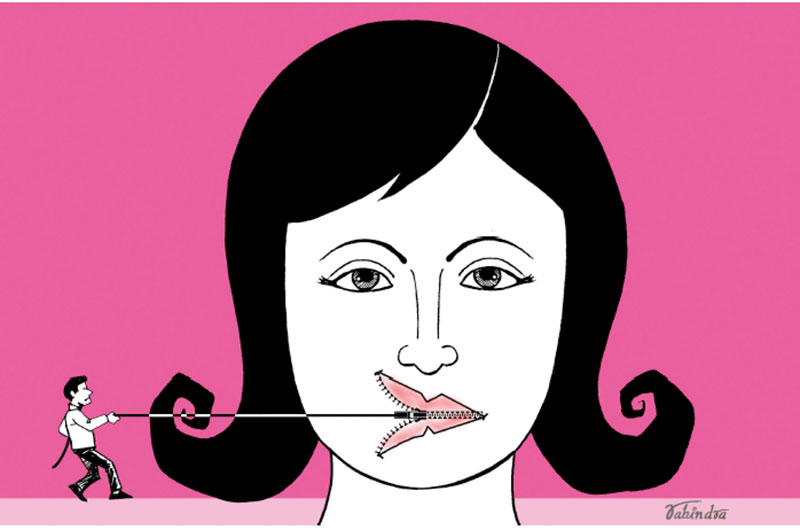
When women came forward to share stories of sexual harassment, there was hope that powerful men were finally going to be held accountable. But today, it’s business as usual.
- BHRIKUTI RAI

Earlier this year, when reports about sexual harassment in the Kathmandu theatre community became public, there was a flicker of hope that Nepal’s MeToo movement was finally taking off. Unlike MeToo stories from Nepali academia or politics, which had led to more counter-accusations than introspection, Nepal’s theatre fraternity publicly came out with statements condemning sexual harassment, and said they were in solidarity with the women who decided to speak out.
Even the men who were accused of harassment—Raj Kumar Pudasaini of One World Theatre and Rajan Khatiwada of Mandala—apologised and released remorseful statements. But Sunil Pokharel, the venerable founder of the now-defunct Gurukul Theatre, remained silent, despite also being accused of impropriety. Mandala and One World Theatre went a step ahead and suspended Pudasaini and Khatiwada from several of its projects for a year.
It was a rare instance of men being publicly held accountable by their own institutions. But just a few months later, Khatiwada and Pokharel had already found a stage and an audience at Mandala. According to at least half a dozen people who saw Khatiwada’s apology post on Facebook in April, the post is no longer available. Allies of the MeToo movement, who had initially cheered on the efforts made by the theatre fraternity to address sexual harassment, are now calling out double standards, saying the space being given to the accused is a huge blow to whatever little the movement had gained in the past year.
“These men continue to get space, if not here then there,” said writer Anbika Giri, who was one of the few people to call out Mandala Theatre for casting Rajan Khatiwada in its most recent production Mahabhoj. “It is infuriating and also disappointing to see how institutions are complicit in enabling these men to get away with their abuse of power, without stern repercussions.”
Allowing powerful men make a comeback without any repercussions or without losing their social capital has implications for women who come forward with their stories, and also those who might want to tell their stories in the future.
“I cannot imagine how some of the women who said they were harassed by Khatiwada must have felt when they saw him on stage,” said Giri. “It’s easy to get disheartened because it does seem like nothing happens when you speak and you only become a source of gossip among your peers.”
But Mandala has defended its decision to cast Khatiwada in the play. The theatre company’s director Srijana Subba, who in April had released a statement expressing solidarity with the MeToo movement and vowing to investigate allegations of sexual harassment against Khatiwada, said Mandala did what they could by accepting his resignation as general secretary of the company for a year.
“We let him go from his official position at Mandala and he hasn’t been involved in anything, but we cannot keep an eye on what people do outside of work,” said Subba. “Does the MeToo movement have a rule that says perpetrators need to be boycotted from everywhere?”
Subba further said that the women who had accused Khatiwada of sexual harassment didn’t come forward publicly, making it difficult for them to take further action.
Speaking to the Post in May, Somnath Khanal, another actor with Mandala, had said the theatre company would formulate guidelines to make it clear that it would not tolerate harassment. Nearly five months later, Mandala still doesn’t have much to show, although it has said it will put together a gender and diversity workshop in the coming weeks.
“We are working towards formulating a mechanism in Mandala to ensure that victims know where to go to take action,” Srijana said, without getting into the details.Subba, who is also one of the actors in Mahabhoj, said that sharing the stage with Khatiwada post the allegations and his apology didn’t feel any different.
“We’ve always worked together and this was no different,” she said tersely. “We needed an artist, he was there and we approached him.”

Subba isn’t the only one in the theatre community to not shy away from working with alleged perpetrators of sexual harassment. Raj Kumar Pudasaini and Sunil Pokharel, who, according to a report in Shukrabar weekly, showed up drunk for rehearsals and touched women inappropriately, recently starred in a play called Mimansha. The play was also shown at Mandala.
Mimansha’s director Prabin Khatiwada defended his decision to cast Pokharel as the lead actor in the play, saying that while he thinks it’s important to keep the conversation about sexual harassment in the workplace alive, it’s not his responsibility to judge or hold people accountable “based on rumours.” He said that news reports about sexual harassment allegations against Pokharel didn’t cross his mind at all when he was working on the play.
“I am just a theatre person who wants to work with good actors, and that’s what I did by casting Sunil Pokharel in my play,” said Prabin, who was also Pokharel’s student at Gurukul several years ago. Unlike some of the criticism towards Mandala for casting Khatiwada in Mahabhoj, Prabin’s play Mimansha escaped scrutiny. And this lack of questioning is what Prabin frankly says is the reason he doesn’t regret casting Pokharel in his play, and would happily continue working with “good actors” like him.
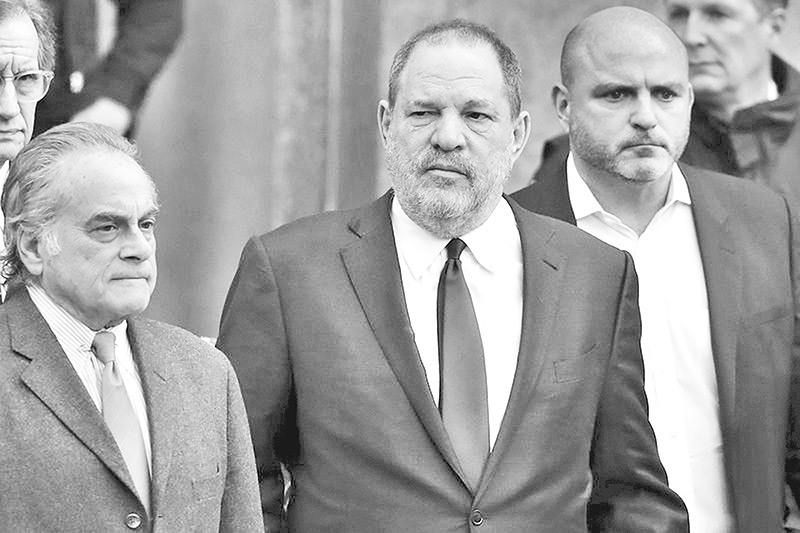
“All I can do is do my job sincerely,” he said. “Nobody questioned me, if they had maybe I would’ve thought about it.”Questions about redemption after MeToo—should they? can they?—have been a conversation not just in Nepal, but around the world where powerful men have attempted to make a comeback. In the US, where the MeToo movement kicked off two years ago with explosive investigative reporting that led to the downfall of several powerful men, like Hollywood heavyweight Harvey Weinstein, have faced legal consequences. But others, like comedian Louis CK and American journalist Charlie Rose, who also faced multiple accusations of sexual harassment, are already plotting their return.
Next door in India, well-known actor Nana Patekar and filmmaker Vikas Bahl, who were accused of sexual harassment, have already returned to work. The MeToo movement in India hasn’t just been marked by a lack of accountability from institutions, but also by the strong pushback from the accused men. Former minister of state for external affairs, MJ Akbar, who was accused of sexual misconduct by journalist Priya Ramani, stepped down from office last year to pursue a defamation case against her.

A lack of sincerity
Subba, in her defence of Khatiwada’s comeback, said that apologising and moving on should be the way forward for perpetrators of sexual harassment.
“If an artist apologises for their behaviour and wants to work, I don’t think we need to boycott them from all public spaces,” said Subba.
But vocal champions of the MeToo movement say it is the very nature of Nepal’s limited public space—comprising of a handful of influential men—which has pushed back on MeToo stories and the ripples it could create in shifting attitudes towards sexual harassment in the workplace.
Writers like Sabitri Gautam, who has been one of the most critical voices in pushing forward conversations around Nepal’s MeToo movement, feel that people with influence don’t want to poke the issue because they fear reprisals from powerful men.
“These people who endorse the work of perpetrators on social media and in real life are implying that they aren’t supportive of the MeToo movement,” said Gautam, referring to the praise heaped by the who’s who of Nepal’s literary and intellectual circles on the Mahabhoj play. “These endorsements weaken the overall movement.”And the media has been just as complicit, she says, continuing to give prominent space to men who have been accused of sexual harassment.
“For the media, these stories of sexual harassment are just occasional scoops, because the kind of space they give these men is symptomatic of how the media continues to perpetuate structures, which then give leeway to such behaviour,” said Gautam.
While a handful of social media users have called out organisations like Mandala and a section of the Nepali press on their silence and inaction in addressing harassment, for others, not much has changed. Gautam points towards recent examples of how men—like former Tribhuvan University lecturer Krishna Bhattachan and former Kathmandu mayor Keshav Sthapit, who were accused of sexual harassment but dismissed the allegations—continue to be invited and honoured in public forums.
The allegations against Bhattachan, an influential academic and indigenous rights activist, ranged from him making lewd remarks to inappropriately touching students during advisory sessions at his residence. After the Post reported on these incidents last January, Bhattachan accused the women of trying to attack the indigenous people’s movement with “baseless allegations”. After keeping a low profile on social media when the allegations began surfacing late last year, Bhattachan’s social calendar has remained full in recent months. Just last week, he spoke about indigenous rights at an event in Kathmandu, sharing the stage with some of Nepal’s most progressive writers and thinkers.
“The fact that these organisations working for marginalised groups invite Bhattachan speaks volumes about how these perpetrators’ actions are swept under the rug by powerful individuals and groups,” said Gautam. “How do we get take this movement forward when there is a dearth of sincerity?”
People from within and outside the theatre community who have witnessed the MeToo movement spark a debate—only to see it fizzle without any concrete action—say pressuring corporations and donor agencies that extend support to theatre groups like Mandala could lead to some accountability. The play Mahabhoj, currently being shown at Mandala, has a number of sponsors and supporters, with GIZ, the German development agency, leading the pack.
GIZ, which has supported many arts and culture initiatives in Nepal, including extending different kinds of support to Mandala Theatre, adopted a zero-tolerance policy on sexual harassment in the workplace back in 2013. In an email reply to the Post, GIZ said that it ensures its zero-tolerance-policy on sexual harassment also applies to the activities and partners it supports, and a non-fullfillment leads to the termination of the contract. However, it refrained from commenting on Mandala’s decision to give space to the accused Khatiwada and Pokharel in plays the company has produced and showcased, citing their contract’s timeline.
“The cases Mr. Khatiwada was accused of and which were covered by the media happened years before GIZ-CPS partnered with Mandala Theatre and they were revealed after the partnership had started,” Elke Foerster, country director of GIZ Nepal told the Post. “Mandala Theatre dealt with the case in transparent ways and in a close and sensitive dialogue with the affected person.”
But some in the theatre community say this issue has been anything but transparent. Earlier this month, Akanchha Karki of Kausi Theatre shared a message on Twitter about the bullying and threats some theatre actors are facing for raising the issue of sexual harassment.
“We’ve been asked to stay quiet for a few days because there is a conspiracy to exclude anyone in the theatre community who speaks up about #MeToo,” she wrote. “Where are the responsible seniors in our fraternity at a time MeToo has been politicised to such an extent?”
Others say GIZ as donors need to do more to ensure the projects and organisations they choose to work with adhere to the same policies when it comes to sexual harassment.
“If organisations supporting places like Mandala have zero tolerance for sexual harassment, they better find ways to implement it,” said Manushi Yami Bhattarai, a leader of the Naya Shakti political party. “They can’t get away with double standards.”

Light at the end of the tunnel?
Less than a month into his new job as coordinator of Annapurna Post’s Saturday supplement, Bimal Acharya decided to do something unusual last March. Instead of focusing on major events in politics and entertainment reported in the media for the Nepali New Year special, he did something unusual by Nepali newspapers’ standards—he dedicated the entire supplement to MeToo stories.
“Stories about sexual harassment were making noise, if not on mainstream media, then on social media and beyond for sure,” said Acharya. “For me, this was the biggest story of the year.”
There weren’t any reported stories in the supplement, just personal narratives from women who spoke about the countless times they had been touched, groped, and felt humiliated and helpless. Since then, Acharya has received countless stories about similar episodes, which he says have been pushing forward conversations about sexual harassment in public and private spaces.
“Maybe it’s reading these stories and experiences of other women which has encouraged others to talk about their own,” he said.
And among readers who found the courage to share their own stories of experiencing harassment was writer Shivani Singh Tharu. Before the MeToo movement kicked off, and personal accounts of harassment gained space in Nepali newspapers, Tharu thought her story wouldn’t be relatable to others because of the shame she had been conditioned to associate it with. So she was pleasantly surprised by the response her widely-read personal essay, 34 inch D, received. In the piece, Tharu writes about her relationship with her body, shaped by the harassment she endured as a young woman in different stages of her life.
“Even men reached out to me for sharing this story, which was something I hadn’t anticipated,” said Tharu. “But these stories need to go beyond helplessness, and hopefully in the future, we will hear stories of women who fought and won these battles of sexual harassment.”
But Tharu says that isn’t possible unless the media changes the way it writes about woefully underreported stories of sexual harassment. She says the media, and the male readership, need to stop treating these stories as sensational pieces.
“Since these stories are about taboo subjects like sex, people’s reading of these stories might contain an element of voyuerism, which will not take the conversation forward,” said Tharu.
Acharya says he is aware of how Nepali newsrooms have shied away from investing time and resources to report these stories. But he admits it might just be a matter of self-preservation.
“Maybe there is a sense of fear in our media and our newsrooms that if we start writing about harassment, similar stories might come back to bite us as well,” he said. “There are skeletons in our closet, too.”
After Annapurna Post published stories of women speaking about being harassed, Acharya says many of his male colleagues and friends have mocked him for “only publishing women’s stories,” but he says such remarks don’t bother him.
“For years, we didn’t have that space or the vocabulary to talk about these violations to our body and dignity, but now we finally do,” said Bhattarai, who has been talking about the need for structural reforms to address sexual harassment head on. “It’s time we make strategic use of this momentum to make tangible gains.”Some progress is slowly being made.
More than six months after a programme was first held at Tribhuwan University to start the conversation about sexual harassment in the wake of reports about continued harassment in its sociology department, the university finally formed a committee to set up a mechanism to deal with these concerns earlier this month.
“While we wait for structural changes to address sexual harassment at workplace, we need to do whatever we can on a personal level,” said Gautam, the writer. “We need unity among the few allies we now have.”

Sunil Pokharel (above) was accused of sexual harassment by several female theatre actors; Raj Kumar Pudasaini (below left) and Rajan Khatiwada (below right) had both apologised and released remorseful statements after being accused of sexual harassment.Post Photos

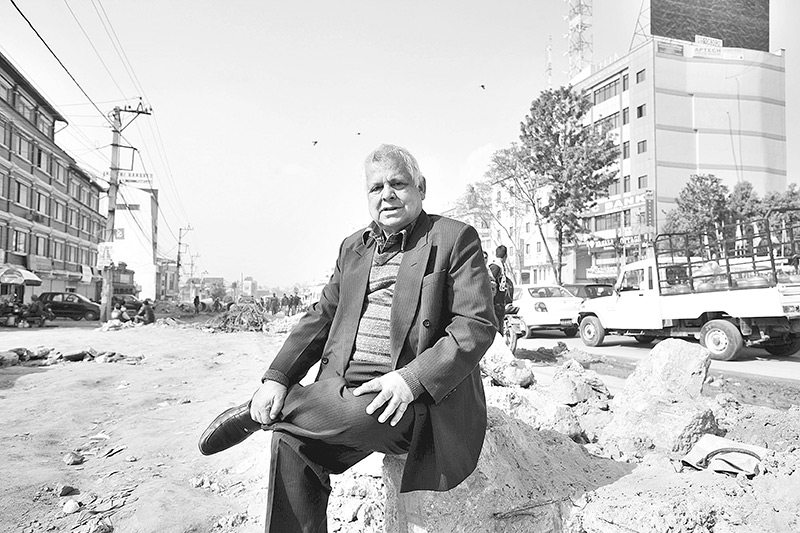
Krishna Bhattachan (left) and Keshav Sthapit (right) continue to be invited and honoured at public forums.
HOME PAGE

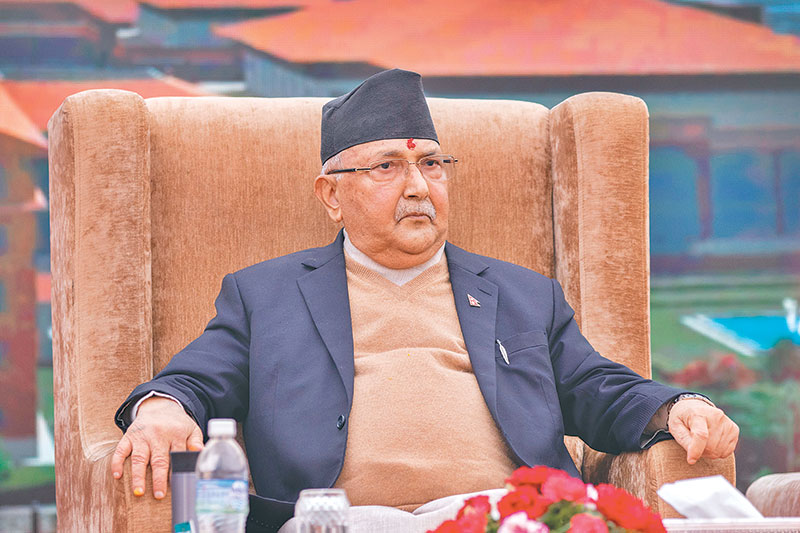
Inside the Oli administration’s culture of decision making

When the prime minister is not acting unilaterally, he is reliant on a few people for advice on policy and decisions, ignoring party members and even his own Cabinet members.
- ANIL GIRI
 POST PHOTO: PRAKASH CHANDRA TIMILSENA

KATHMANDU : On August 28, when Prime Minister KP Sharma Oli, who was in Singapore for medical treatment, sent a message asking the Cabinet to hold a teleconference, Deputy Prime Minister and Minister for Defence Ishwar Pokhrel immediately called on Nepal Communist Party General Secretary Bishnu Poudel.
According to several party insiders, Pokhrel, who was acting prime minister in Oli’s absence, had no idea about the teleconference, and had to ask Poudel whether he knew why the prime minister was calling a Cabinet meeting from Singapore.
The fact that the acting prime minister had to call on the party general secretary for clarification on Oli’s decision was a telling example of how the prime minister, and Singha Durbar, functions on a daily basis. According to a number of ruling party leaders, parliamentarians and political analysts
that the Post spoke to for this story, Oli has surrounded himself with a close circle of advisors and favoured leaders and ministers, on whose advice alone he makes decisions and acts. Outside this inner circle, Oli does not take suggestions, advice or input from anyone else in the government, or the party, they said.
“The prime minister does not trust his own ministers,” Nepali Congress President Sher Bahadur Deuba said at a programme in Kathmandu on Friday.
“How can the prime minister run the country if he does not trust his own Cabinet colleagues?”As soon as he was elected, Oli had announced that he would cut down on the number of advisers. He eventually announced four advisers and two officials in his secretariat.However, in the months since, around a dozen Nepal Communist Party leaders and supporters have been working at the Prime Minister’s Office and the Secretariat in Baluwatar, according to officials from the office. Most of them are former UML party members.But even among them, Oli hardly consults anyone, except for Chief Adviser Bishnu Rimal and Foreign Relations Adviser Rajan Bhattarai, party insiders told the Post. Besides these two, Oli takes advice from Rajesh Bajracharya, who is also his close relative. Rimal and Bajracharya are Oli’s closest confidants while Bhattarai and Press Adviser Kundan Aryal consist of the second rung of advisers. On both the government and party fronts, Oli takes advice from Poudel, the party general secretary.
When the prime minister holds sensitive meetings with foreign dignitaries, he mostly consults Rimal, Bhattarai and Poudel, an aide who is familiar with meetings in Baluwatar, told the Post.
“Oli only takes advice and suggestions from a limited number of people. This is his old way of working,” said Bishnu Rijal, deputy head of the party’s foreign department.The practice of having specialised advisers was started in 2006 by the late Girija Prasad Koirala. Since then, successive prime ministers—and even ministers—have had a coterie of advisers.Relying solely on a small circle of advisers can have consequences, as was evident in the recent pesticide fiasco with India. After Nepal halted the import of vegetables and fruits from India in July, New Delhi voiced its concern, with the Indian Embassy in Kathmandu asking for clarification over a move that contravened bilateral agreements and the World Trade Organisation regime. Despite media reports, Oli repeatedly denied receiving any letter from India. When the letter was leaked to the press, the prime minister was forced to apologise.
In all of this, many had criticised Oli’s advisers for not informing him about such pressing issues. The prime minister often appears clueless or misinformed, which, many say, is the responsibility of his advisers.Oli had made similar admissions about sugarcane traders misleading him. Whether it is Kathmandu’s air pollution, the Guthi Bill or the Melamchi Water Supply Project, Oli’s administration has been criticised for constant backtracking on public statements.Fed up with Oli’s unilateral way of working without holding discussions within the party, senior party leaders Madhav Nepal and Bhim Rawal have time and again called on the party co-chair to correct his working style, especially since the government has courted several controversies and is becoming unpopular by the day.
However, Oli never respected Nepal and Rawal’s calls, continuing to skip the party system while leading the government, said a leader from the Nepal camp.According to Dinesh Bhattarai, former foreign relations adviser to two prime ministers, the role of advisers should be institutionalised, like in India and the West.
“In India, every file reaches the prime minister’s table through his advisers, but we have not built that culture,” said Bhattarai. “In our case, whenever the prime minister or ministers need any inputs or suggestions, they look for their advisers. But we need to develop a culture of providing feedback, suggestions and regular briefings to the prime minister and ministers on a regular basis.”
Oli, however, is not just reliant on his advisers. Although he appears partial to his old UML party members, chief among the old hands that Oli still trusts is President Bidya Devi Bhandari. According to two party insiders, the recent power-sharing deal inside the party and the re-entry of Bamdev Gautam into the Oli camp were all at Bhandari’s initiative.Bhandari has been quietly manoeuvring people inside the party, according to one ruling party leader, placing Gautam inside Oli’s circle of advisers.
With his proximity to Gautam growing, Oli, when he was in Singapore for treatment, had called both Poudel and Gautam and held a serious discussion on how to manage the growing rift with party Co-chair Pushpa Kamal Dahal. Political commentator Tika Dhakal, who has close relations with the ruling party leadership, told the Post that Oli relies on a limited number of leaders and officials while taking decisions.
“In the first layer, there are Rimal, Bajracharya and Bhattarai on the governmental front while for issues related to the party, he mostly relies on Bishnu Poudel,” said Dhakal. “In recent months, he has also been consulting with Dahal and Gautam.”
For political appointments, Oli sometimes asks Dahal, Madhav Nepal and other leaders to forward suggestions for names. Otherwise, most of the time, Oli takes advice from Poudel, Rimal and Bajracharya. The party’s general secretary is seen most frequently at Baluwatar and he is the one whom Oli consults the most on party-related issues, said party insiders.
When it comes to governance, Oli seems to rely more on secretaries, a number of whom report directly to the Prime Minister’s Office. On administration and governance, Oli relies on Home Secretary Prem Kumar Rai while on foreign affairs and international relations, Oli relies on Foreign Secretary Shankar Das Bairagi, adviser Bhattarai and Foreign Minister Pradeep Gyawali. Since foreign affairs is one of Oli’s areas of interest, he gives it more emphasis, said an official at the Ministry of Foreign Affairs.
In the Cabinet, Oli does not speak consistently with all his ministers. The few ministers that he takes seriously are Communication Minister Gokul Baskota, with whom Oli shares a long history, and Finance Minister Yubaraj Khatiwada.It had been rumoured for nearly the past year that some ministers, like Baskota, would be removed for introducing several unpopular bills. Baskota has also been facing criticism for some absurd remarks, with even some ruling party leaders urging Oli to remove him. Baskota, however, remains very much in position and is unlikely to get removed any time soon.
“Baskota lives in Oli’s home in Balkot, and the prime minister is comfortable with him,” said the ruling party leader. “He is one of Oli’s favoured ministers despite all the criticism directed at him.” Last year, when Finance Minister Khatiwada presented the first budget of the Oli administration, senior party leaders, mostly former Maoists, had expressed serious reservations over the fiscal allocations. Dahal and other leaders had even sought Khatiwada’s resignation for not incorporating the party’s suggestions and inputs and bypassing them all the way. However, nothing came of their protests as Khatiwada also has a strong support of Oli.Besides these dozen-or-so leaders and advisers, Oli tends to act alone, a style that has frequently been criticised even within the party. “The thing about the prime minister is,” a member of the party secretariat said, “he thinks he knows everything.”

Bishnu Poudel (top) and Bishnu Rimal are two of Prime Minister KP Sharma Oli’s key advisors.post photos

HOME PAGE

Government celebrates Constitution Day while Madhesis and indigenous groups protest

While many donned t-shirts with the national flag, protesters wore black vests and black headbands protesting what they called a ‘black day’.
- TIKA R PRADHAN

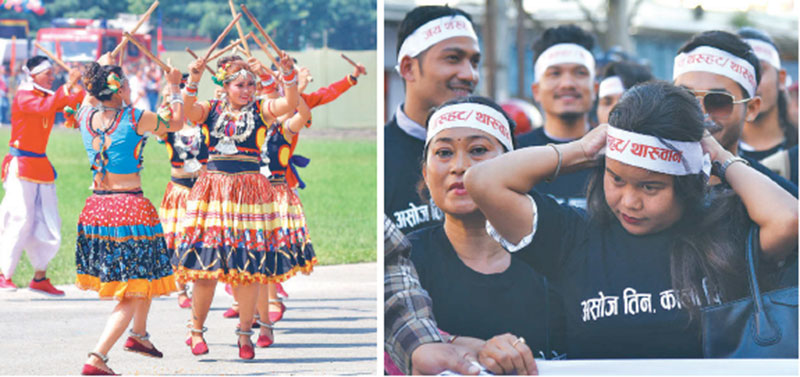
Inside Tundikhel, there were celebrations showcasing various ethnic groups. Outside, members of the same ethnic groups protested against the constitution.

KATHMANDU : On Friday, the government marked Constitution Day with pomp and ceremony, at Tundikhel, as members of the Nepal Army donned the garb of various ethnic groups and performed for officials. However, in Kathmandu and pockets across the country, many of those very ethnic groups were protesting the constitution as discriminatory, demanding amendments.
At the Army parade ground, Prime Minister KP Sharma Oli said that the day should create a feeling of celebration among all Nepalis. “We Nepalis were starving for this day for the past seven decades. The day when we were liberated from suppression is also an independence day and a day to celebrate our achievements,” Oli said.
But not everyone felt the same way, as many Madhesis, Tharus and indigenous groups marked September 20, Constitution Day, as a ‘black day’.
For nearly a month, the government has pushed for an all-out celebration, providing a national holiday, requiring civil servants to attend celebratory programmes and asking the public to don t-shirts emblazoned with the Nepali flag. But protesting indigenous groups wore black vests with ‘Asoj tin kalo din’—Asoj 3, a black day—written across it.
At Basantapur, three indigenous protestors were arrested while preparing to burn discriminatory articles of the constitution. In Dang, six protestors were arrested even as indigenous groups burnt copies of the constitution at different parts of the country, including Itahari, according to Govinda Chhantyal, vice-chairman of the Nepal Federation of Indigenous Nationalities (NEFIN).
NEFIN, the umbrella organisation of indigenous nationalities, has been leading protest programmes against the constitution ever since it was promulgated in 2015. Janajati leaders speaking at Basantapur raised questions over the government’s failure to amend the constitution in the four years since its promulgation.
“On Asoj 3, discrimination was imposed on us so we cannot follow the government’s orders and celebrate this day,” said NEFIN Chairman
Jagat Baram. “Prime Minister Oli talks about peace and prosperity but neither will be possible unless the discriminatory constitution is amended.”
Protest programmes were visible especially in Province 2, where the Madhes-based Rastriya Janata Party Nepal led a rally in Janakpur with black headbands and black flags as symbols of protest. Addressing the rally, RJP leader Mahanta Thakur said that protests would continue as long discrimination persists.
“The Madhesi people have been fighting against oppression, injustice and discrimination for a long time,” said Thakur. “We are against the demarcation as the entire Madhes has been split into different provinces. That’s why we consider this day a black day.”Madhesis, indigenous nationalities, Dalits, women, Tharus and Muslims are preparing to form a united front to demand amendments to the constitution, said Minraj Chaudhary, a Tharu activist.
“Today, the government has suppressed our peaceful struggle by arresting protestors in different parts of the country,” said Chaudhary. “But we will launch a stronger protest after the end of the festival season.”Santosh Singh contributed reporting from Dhanusha.

Page 2
MEDLEY

Horoscope

ARIES (March 21-April 19)
***
Your sweet disposition is making you very popular with the people who are in power right now, therefore you are in a good position to have them give you just about whatever you want—time, advice, affection, even money! But you need to be wise with this power and use it judiciously.


TAURUS (April 20-May 20)
**
Of course you really want to get the perfect gift for someone’s birthday or anniversary, but the-perfect-gift ideas have been eluding you so far. Before you panic and just purchase something flashy or expensive because you’re at a loss, ask around. Mutual friends might have a good suggestion about what you should get.


GEMINI (May 21-June 21)
****
Just when you thought you had given up hope that that certain someone would ever notice you, today brings some promising attention. Perhaps you’re wondering when on earth that cutie will give you the time of day. Whoever has been testing your patience will finally come to their senses and see you for who you are, today.


CANCER (June 22-July 22)
**
An authority figure in your life could create some friction within your group—they are encouraging in some dastardly in-fighting. You are probably going to escape any real conflict with another person, but the day’s energy will have some stress in it. To combat this, keep in contact with your friends throughout the day.


LEO (July 23-August 22)
****
 Time spent learning something new is always time well spent—so focus your free time today on feeding your brain. It doesn’t have to be highfalutin learning, either. As long as you put some information into your brain that wasn’t there before, you’re doing yourself some good. Learn how to bake or how to dance.


VIRGO (August 23-September 22)
****
Why keep your combative feelings to yourself? You should feel free to unleash your bold, opinionated side today—it will generate some surprising results. People might not be used to seeing you like this, but it is a legitimate part of who you are and you should definitely stop hiding it.


LIBRA (September 23-October 22)
*****
There will be a wonderful win-win situation developing today for you and someone you often have to negotiate with. The two of you make a good partnership, but from time to time you do have to bargain your way through things. Luckily, this time what you want is almost identical to what they want!


SCORPIO (October 23-November 21)
***
Your reaction time will be extremely fast today—but there is such a thing as too fast, so be very careful. Make sure that you’re only applying your swiftness in the appropriate situations. In order to make sure of this, you would be wise to think out every choice you make, carefully and methodically.


SAGITTARIUS (November 22-December 21)
****
Any time you spend with children today will be especially rewarding—their curious nature will rub off on you, and remind you that the world is still a wonderful place, full of mysteries to explore. This is a great day to back in touch with your inner child, too. Your youth will always be a part of you.


CAPRICORN (December 22-January 19)
**
An exciting invitation is coming your way today, but before you accept it right away, wait a few more days. You need to make sure you can take it on before you actually commit to it. Ask yourself all the pertinent questions and try to get a better grip on what impact it could have on your life.


AQUARIUS (January 20-February 18)
****
Your busy lifestyle has been netting you some wonderful rewards lately, but it has also been robbing you of precious time with all your favourite people! So today, make time to try to organise an informal outing for all your favourite people. You all need a chance to relax and share the latest news in your lives!


PISCES (February 19-March 20)
**
If a friend or coworker’s bewildering behaviour is frustrating you, talk to them about it! There could be something going on that you need to know about. Of course, there also could be something going on that is none of your business, but that doesn’t matter. Patience may be required in this situation.

Page 3
NATIONAL

Consumer committees to be barred from major projects

The government’s decision comes in place as the committees have been found to be misusing funds and sub-contracting in collusion with contractors.
- PRITHVI MAN SHRESTHA

KATHMANDU : The government has sought to discourage the use of consumer committees to implement projects chosen by lawmakers after discovering widespread irregularities.
A working procedure endorsed by the latest Cabinet meeting stated
that consumer committees should not be used to implement major
projects under the Local Infrastructure Development Programme.
This programme, previously run under two separate headings, Constituency Infrastructure Special Programme and the Constituency Development Programme, has remained controversial since its inception in the early 1990s because of reports about massive misuse of funds.
“We received complaints that consumer committees have been using contractors to implement the projects instead of doing the works themselves,” said Yadav Prasad Koirala, secretary at the Ministry of Federal Affairs and General Administration. “The committees have appointed contractors through collusion in such a way that the contractors would get the job and the consumer committees would get commissions.”
According to Koirala, considering the number of complaints about the programme, the ministry had proposed reducing the role of the consumer committees. Although the Public Procurement Act has allowed government entities to award contracts up to Rs10 million, the newly endorsed working procedure on Local Infrastructure Development Programme has barred the use of consumers committees for projects above Rs5 million.
“At least half of the total Rs60 million allocated to each constituency should be used in projects that cost over Rs5 million, as per the approved working procedure,” said Koirala. “In these projects, consumer committees cannot be used and the contract should be awarded by calling tenders.”
According to Koirala, even in smaller projects, the use of consumer committees should be avoided as far as possible. The remaining projects should have the cost ranging from Rs1 million to Rs5 million, according to the new rules.
Some lawmakers, meanwhile, have claimed that consumer committees perform better than contractors. Gauri Shankar Chaudhary, a lawmaker from Kailali-3, told the Post that the fund allocated for his constituency under the programme was mostly being used through consumer committees with notable progress.
“In the consumer committee-implemented projects, people contribute their labour for which the government is not required to pay them. So, the projects handled by consumer committees have been better,” Chaudhary, who is a lawmaker from the ruling Nepal Communist Party, said.
The federal government has allocated Rs 60 million—50 percent up from last fiscal year—for each constituency this fiscal year. The federal government has allocated a total of Rs9.9 billion under the programme.
Due to strong pressure from lawmakers, the government has been increasing the fund under the programme almost every year. Lawmakers have been claiming that they need the fund to implement the development projects as per the promises they made to the people during the elections.
Past studies have shown that resources marked for special programmes of constituencies have been used to finance party-centric projects, academies run in the name of leaders, implementation of projects through consumer committees led by party cadres and creating personal
seed funds.
A special audit conducted by the Office of Auditor General Office in the fiscal year 2016-17 found that the projects related to political parties and their sister organisations as well as non-government organisations related to political parties were selected going against the working procedure. As many as 126 such projects worth Rs53.51 million were selected in 11 districts, according to the auditor general’s report.
In the last fiscal year, the working procedure was amended to stop the fragmentation of resources to some extent by making provisions that
stated a maximum of 20 projects can be chosen for implementation with at least two having the cost over Rs5 million.
“But in the current fiscal year, fragmentation has been further discouraged by making it mandatory for lawmakers to use half of the budget in the projects which are relatively large,” said Koirala.

NATIONAL

Panta announces his candidacy for the president of NRNA

- Post Report

KATHMANDU : Kumar Panta announced his candidacy for the president of Non-Nepali Resident Association (NRNA) on Friday.
The association is set to hold its general assembly in Kathmandu on October 15-17.
Organising a press meet to announce his candidacy in Kathmandu on Friday, Panta, who is also the incumbent vice-president of the NRNA, vowed to promote investment, dignified foreign employment, citizenship and voting rights, and strong organisation and comprehensive participation if he is elected.
Applying skills and knowledge acquired in foreign countries, expanding the foundation and reach of the NRNA, and realising the association’s pledge of establishing a collective investment fund worth Rs 10 billion are among the priorities set by Panta for his tenure. The collective investment fund would be spent on infrastructure development projects.
Panta has been associated with the NRNA since 2004, when he became the coordinator of the association’s chapter for Hesse, Germany. Between 2009 and 2011, he was a member of the NRNA’s executive committee, International Coordination Council. Panta became the NRNA general secretary in 2013. After a two-year term as general secretary, he was elected to the post of the vice-president.

NATIONAL

Controversy brews over Medical Commission’s new appointment

Critics say Krishna Giri, the new executive vice-chairman, does not meet criteria.
- BINOD GHIMIRE

KATHMANDU : The appointment of Dr Krishna Giri as the executive vice-chairman of National Medical Commission, the government entity authorised to oversee the medical education sector, has been dragged into a controversy over his qualifications.
The government last week appointed Giri, a senior orthopaedic surgeon, to the post from among three candidates recommended by a committee led by Umesh Mainali, chairman of the Public Service Commission. Along with Giri, who was ranked third, the Mainali-led panel had recommended Dr Surendra Sherchan and Dr Sambhu Kumar Pahari for the position.
Clause 24 of the National Medical Education Act mandates at least 20 years of experience as a specialist after completing a graduate degree in any stream under medical education, or 10 years of experience as a faculty of medicine.
Critics say that Giri does not meet these criteria as he has only been working as a specialist doctor since 2002 and it hasn’t been 10 years since he started teaching at the National Academy of Medical Sciences at Bir Hospital.
Giri, who was a doctor based in Butwal, was transferred to Bir Hospital in August 2008 by Education Minister Giriraj Mani Pokharel, who was the health minister then.
“He became part of the faculty a year after he joined Bir Hospital,” said a doctor at the academy on condition of anonymity. “He also left teaching for around a year to become a spokesperson at the Ministry of Health.”Giri was transferred to the Health Ministry in 2017 when Pokharel became minister for the second time. Giri used to be a cadre of the Janamorcha Nepal party, which later merged with the then CPN (Maoist), in which Pokharel was a vice-chairman.
The academy doctor said that the only reason Giri was appointed vice-chairman of the National Medical Commission despite being ranked third was because of his close relationship with Pokharel.Giri, however, refuted any allegations of political influence and argued that he was appointed on
merit. He also denied being a member of the Janamorcha party.
“I meet all the qualifications for the position. I was appointed on merit,” Giri said in a statement on Thursday. In response to the allegations
that he doesn’t have the required years in experience, Giri said that the Nepal Medical Council only started registering specialist doctors in 2001
so it was not possible for him to gain certification 20 years ago.Following the appointment, Dr Govinda KC, an orthopaedic surgeon who has staged hunger strikes several times calling for an end to malpractices in Nepal’s medical education, has demanded clarity over the dispute in the appointment process.
“There are confusions over the qualification, which need to be cleared,” Dr Abhishek Singh, a close aide to KC, told the Post.The National Medical Commission was conceptualised based on the recommendations of a task force led by Kedar Bhakta Mathema, former vice-chancellor of Tribhuvan University. The commission’s formation was one of KC’s demands. It is tasked with checking malpractices in the medical education sector.
The selection process for the appointment of the vice-chairman began on June 24. The first phase of selection was cancelled due to a lack of applications from qualified persons, prompting the recommendation committee to call for applications for a second time. Nine doctors, including Giri, had applied in the second phase.

Page 5
NATIONAL

Dengue cases reported in hill districts of Province 1

Over 4,000 people have been diagnosed with dengue in the province since its outbreak some two months ago.
- Ramesh Chandra Adhikari

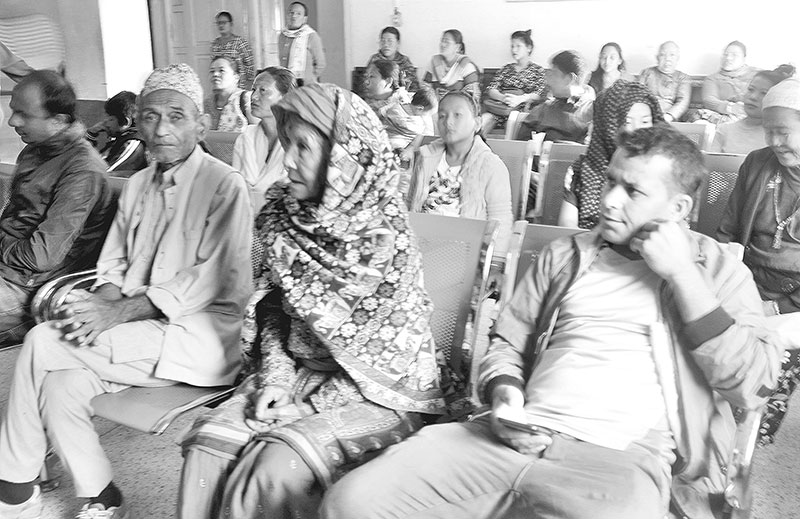
Patients wait for their turn to see the doctor at Dhankuta District Hospital. Post Photo: RAMESH CHANDRA ADHIKARI

DHANKUTA : Dengue has spread to eight hill districts in Province 1, according to the data of the Health Directorate in Dhankuta. The count of dengue patients in the hill districts reached 167 last week, while 4,247 people have been diagnosed with the disease in the entire province since its outbreak some two months ago.
Chandra Dev Mehata, the director at the health directorate, said 79 dengue patients were reported in Udayapur, 60 in Panchthar, 13 in Tehrathum, five in Sankhuwasabha, four in Dhankuta, three in Bhojpur, two in Ilam and one in Khotang districts.
“There are fewer dengue cases in the hills as compared to the Tarai. We hope to contain the disease in the hill districts soon,” said Mehata.Meanwhile, health workers say adopting control mechanisms to curb dengue spread in the hill districts could be challenging.
“There is still a lack of awareness on dengue in the districts, and the local health posts are not well-equipped to deal with the disease. Recent rainfall in has also raised concerns about the spread of the disease,” said Abhitabh Thakur, the medical superintendent at the District Hospital in Dhankuta.
“We had to refer two dengue patients to BP Koirala Institute of Health Sciences in Dharan on Monday.”According to Mehata, there are 3,455 dengue patients in Sunsari, 460 in Jhapa and 153 in Morang.Dengue, a mosquito-borne disease, has been found in 64 districts of the country, including Chitwan and Kaski. According to the health authority, dengue-carrying mosquitoes breed in clean water and are active during the day. Uncovered water tanks and discarded plastic cups and bottles are also a breeding ground for the mosquitoes.
The Health Directorate has launched various awareness campaigns in the dengue-affected areas to destroy the mosquito breeding grounds.
Krishna Bahadur Ghimire, chief district officer of Dhankuta, said the local administration has also been conducting awareness campaigns to contain the disease.
“Various organisations are conducting door-to-door campaigns to sensitise the people about dengue and destroy mosquito breeding grounds,” said Ghimire.

NATIONAL

Delay in distribution of smart driving licence affects service seekers

Applicants have been waiting for smart driving licences in Baglung for nearly two years.
- PRAKASH BARAL

BAGLUNG : Mohanhari Koirala of Chitwan passed his driving test around a year and a half ago. Since then, he has been frequenting the Transport Management Office in Baglung to receive a smart driving licence. But he has not obtained the licence yet.
Basudev Acharya of Parbat passed his driving trial examination a year ago. For the past year, he has been riding his motorcycle carrying with him a receipt, as proof that he passed the examination and is in the process to get a licence.
Like Koirala and Acharya, around a hundred people visit the Transport Management Office in Baglung to inquire about their digital driving licenses on a daily basis. But the office has no explanation as to why there is a delay in the distribution of smart driving licences.
According to the officials of the Transport Management Office, the Department of Transport Management, the government body that issues driving licences, has not sent the smart cards yet; however, it has already stopped the issuing of paper licences.
For the lack of a licence, service seekers are being compelled to laminate receipts and keep them as proof. “The Transport Management Office has cheated us,” said Ramesh Chhetri, a service seeker who has been waiting for the smart driving license for the last year and a half.
Paras Singh Thapa, chief at the Transport Management Office in Baglung, said that there are few machines to print the licence in the department. “There are too many service seekers. We have a difficult time attending to everyone regarding the licence,” says Thapa.
Two years ago, the then director of the department had announced to distribute smart driving licenses from all transport management offices across the country. As per the rule, service seekers have to obtain the smart licence within 45 days. But in Baglung’s Transport Management Office, service seekers have been waiting for licence for the last 21 months.

NATIONAL

Seven people held in a week for drug possession

- SHUVAM DHUNGANA

KATHMANDU : The Narcotics Control Bureau of Nepal Police arrested three Indian men in the Capital on Wednesday for drug trafficking.
The arrested Indian nationals have been identified as Raja Kunal, 37, of Bihar, Rajesh Kumar Jayashwal, 32, of Bairgania, and Abhisek Kumar Jayashwal, 37, of Purushotampur.
According to Senior Superintendent of Police Basanta Kumar Lama, a team from the bureau, following a tip-off, intercepted a vehicle with an Indian licence plate at Shantinagar, Kathmandu, and discovered a large number of prescription drugs.
“While searching the vehicle police discovered 1,047 ampoules of Diazepam, 1,037 ampoules of Buprenorphine and 1,042 ampoules of Phenergan. The drugs were hidden in a rice bag,” Lama to the Post.
All three occupants in the vehicle and the drugs were seized on the site.
The preliminary investigation has found that the trio used to buy the drugs in different parts of India and sell them to the Nepali market.Barely a week back, on September 13, police had detained four Nepali from Gokarneshwor in Kathmandu in possession of drugs.They were caught with 410 ampoules of Diazepam, 375 ampoules of Phenergan and 415 ampoules of Buprenorphine.
The arrestees were identified as Sujendra Lohani, 34, of Udayapur, Pema Lama, 28, of Kavre, and Ashok Tamang, 23, and Utim Lal Shah, 42, of Siraha.
According to police, a large quantity of illegal prescription drugs are being smuggled into Nepal via India.
“A drug that costs just IRS 15 in India is being sold for as much as Rs 1,500 in Nepal. There could be many Nepalis and Indians who are involved
in smuggling prescription drugs from India to Nepal to make easy money,” said Superintendent of Police Krishna Prasain, the spokesperson for the bureau.
The bureau’s data of the last three years show that drug smuggling cases and arrests are on the rise. In the fiscal year 2016/17, police arrested 3,607 people on drug smuggling charge; 159 of them were foreigners. In the fiscal year 2017/18, police arrested 4,754 people including 149 foreigners. Similarly, in the year 2018/19, police arrested 5,558, including 201 foreign nationals.
“In the festive season, lots of goods enter Nepal from India. And during this time, border security is usually lax, allowing drug smugglers to cross the border without getting caught,” said SSP Lama.

NATIONAL

Doctor appointed in Doramba

Briefing
- Post Report

RAMECHHAP: The government has appointed a doctor at Doramba Health Post in Ramechhap for the first time. Locals have started receiving health services at the health post, which receives around 30 to 35 patients daily these days.


NATIONAL

French trekker rescued from Manaslu region

Briefing
- Post Report

GORKHA: A 71-year-old French national, who had fallen sick at Laprak in Dharche Rural Municipality Ward No. 4, was brought to Kathmandu by a helicopter on Friday. According to police, Yan Maire was trekking the Manaslu region when she fell ill.


NATIONAL

Services at Likhu Tamakoshi Rural Municipality halted

Briefing
- Post Report

RAMECHHAP: Daily administrative works of Likhu Tamakoshi Rural Municipality in Ramechhap have been halted for the last one and a half months due to a dispute between the municipality’s chief and deputy chief. Service seekers have been affected after the administrative and development activities of the rural municipality were halted.


NATIONAL

Goods stuck in Kerung

Briefing
- Post Report

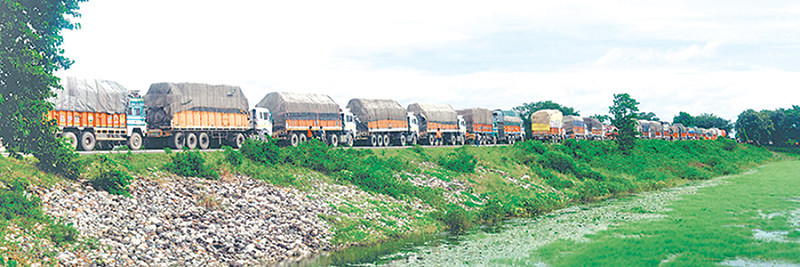
RASUWA: The obstruction of the Ramche-Grang road section along the Pasang Lhamu Highway has created a shortage of container trucks in Kerung. Because of this, goods meant for Dashain and Tihar festivals are stuck in godowns, customs officials said.

Page 6
MONEY

No crowds as Apple’s iPhone 11 hits stores in China

Hundreds used to wait for hours outside to be the first to grab Apple’s latest offerings.
- REUTERS
A customer touches an Apple’s new iPhone 11 Pro Max after it went on sale at the Apple Store in Beijing, China on Friday. Reuters 

BEIJING/SHANGHAI, 
Apple’s latest iPhone 11 range hit stores in China on Friday, with short queues of die-hard fans contrasting with the hundreds who camped out ahead of some previous launches.
The sales performance of the US tech giant’s latest line-up is being closely watched in the world’s largest smartphone market, where Apple has been losing ground to competitors with cheaper and feature-packed handsets in recent years.
The queues at the Shanghai and Beijing stores, which combined added up to few dozen customers, were in sharp contrast to previous years, when hundreds used to wait for hours outside Apple’s shops to be the first to grab its latest offerings.
But much of the fanfare in China has moved online where the pre-sales for iPhone 11, priced between $699 and $1,099, started last week.
Analysts said they had gotten off to a better start than the last cycle a year ago. Chinese e-commerce site JD.com said day one pre-sales for the iPhone 11 series were up 480 percent versus comparable sales for the iPhone XR last year. Among customers that took to a store in Beijing on Friday to make a purchase in person was a programmer who only gave his surname as Liu, who said he had a model from every Apple series since the 3G range.
He said he was particularly attracted to the more expensive iPhone 11 Pro, which has three cameras on the back. “When it comes to taking photos, it’s better for night shots and the image is clearer,” he told Reuters.
Other customers, however, said that they were concerned that the range was not enabled for fifth-generation networks, putting them behind 5G models already released by China’s Huawei Technologies and smaller rival Vivo, and expressed hopes that Apple could make it happen for its next line-up.
“I think by the end of next year, especially in big cities like Beijing, 5G will be commonplace,” said civil servant Liu Liu. “If they don’t research this then they’ll lag way behind.”
The in-store launch of the iPhone 11 in China came a day after Chinese smartphone maker Huawei unveiled new smartphones which it said were more compact, with more sensitive cameras and wraparound screens more vivid than those of the latest iPhone, though it played down concerns about the lack of access to Google’s popular apps.
Huawei has experienced a surge in support from Chinese consumers after the brand was caught up in a trade war between the United States and China, which has in turn eaten into Apple’s market share in the country.

MONEY

Indian government slashes corporate taxes

- AGENCE FRANCE-PRESSE

MUMBAI,
India slashed corporate taxes on Friday to among the lowest in Asia as part of its drive to kickstart the stuttering economy, sending stock surging as analysts predicted a renewal of interest in the subcontinent.
Finance Minister Nirmala Sitharaman said the main
rate for domestic firms would fall to 22 percent from 30 percent as New Delhi aims to attract companies spooked by the China-US trade war that has hammered global supply chains.
The move looks to give a lift to Prime Minister Narendra Modi who faces increasing pressure to relight once-stellar economy after five consecutive quarters of slowing growth saw India this year lose its status as the fastest-expanding major economy to China.
Modi tweeted that the announcements “clearly demonstrate that our government is leaving no stone unturned to make India a better place to do business, improve opportunities for all sections of society and increase prosperity to make India a $5 Trillion economy.”
Sitharaman said that to “attract fresh investment in manufacturing and boost Make In India” the tax rate for new companies would be cut to 15 percent from 25 percent, the Press Trust of India news agency (PTI) said.
She told reporters the new rates would be “comparable with the lowest tax rates in South Asian region and in South East Asia”.
The announcement sent shares soaring more than five percent in Mumbai—the biggest jump in 10 years—while the rupee and firmed against the dollar.
Indian stock markets have been on course for the biggest quarterly exodus since at least 1999, with foreign funds having dumped a net $4.9 billion worth of stocks since June, Bloomberg News said.
Jeffrey Halley at OANDA said the cuts were “likely to re-energise investor interest in the sub-continent” after two and a half years “of slowing growth and disappointment in PM Modi’s reform progress”.
Authorities have in recent weeks rolled out a series of measures to boost the economy and battle grinding unemployment, which is at its highest since the 1970s.
Among its latest measures are lifting a ban on government departments buying new cars as it looks to support the auto sector, which saw sales dive 41 percent last month, the biggest drop on record.
The Reserve Bank of India (RBI)—reportedly under government pressure—has cut interest rates four times this year to a nine-year low, while New Delhi has also announced the merger of 10 state banks to try to crank up lending.
The government has also eased restrictions on foreign investment in four key sectors, including coal mining, in an effort to attract more overseas capital.

MONEY

RBS picks first woman to lead major UK bank

- AGENCE FRANCE-PRESSE

LONDON,
Britain’s bailed-out Royal Bank of Scotland on Friday appointed long-serving banker Alison Rose as chief executive, making her the first female boss of a major UK lender.
Rose, currently deputy head of the group’s NatWest Holdings retail business and its commercial and private banking division, will replace Ross McEwan on November 1, the company said in a statement.
She will become the only woman to have lead one of Britain’s so-called “Big Four” banks that comprise Barclays, HSBC, Lloyds Banking Group and RBS.
The incoming CEO, an advocate of gender equality in business, has risen to the top in a traditionally male-dominated arena after working for 27 years at Edinburgh-based RBS.
“She brings extensive experience and a track record of success from her previous roles at the bank,” said RBS chairman Howard Davies.
Rose will assume the helm just one day after Britain is scheduled to leave the European Union—with or without a divorce deal. She also takes the reins amid global turmoil surrounding the US-China trade war and faltering economic growth.
“This is an exciting time as we enter a new chapter for this bank,” Rose noted in the statement.
“Our industry is facing a series of challenges; from the ongoing economic and political uncertainty to shifts in the behaviour and expectations of our customers, driven by rapid advances in technology.
The new boss will be paid a base annual salary of £1.1 million ($1.4 million, 1.2 million euros).

MONEY

FAA chief meets Boeing officials, tries out Max simulator

- ASSOCIATED PRESS
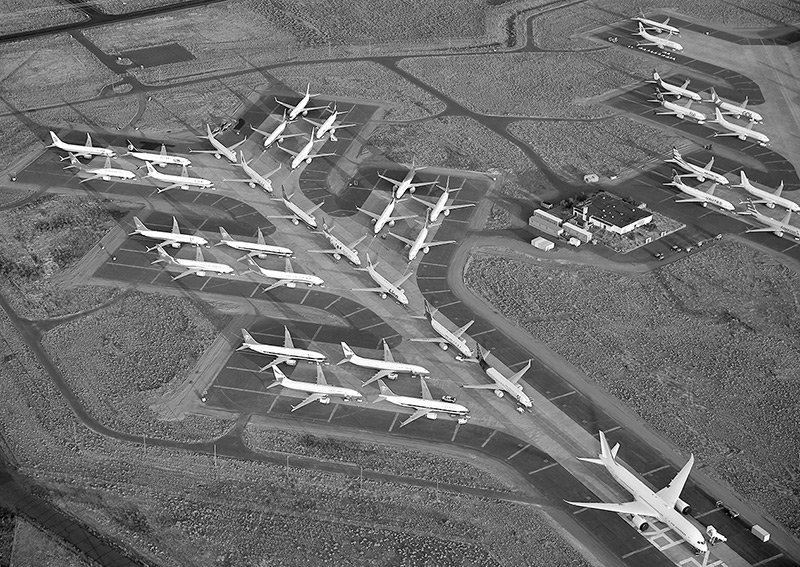
An aerial photo shows Boeing 737 MAX aircraft and a Boeing 787 aircraft (right)at the Grant County International Airport in Moses Lake, Washington. Reuters

DALLAS, 
The chief of the Federal Aviation Administration tested the Boeing 737 Max in a flight simulator on Thursday, but the FAA declined to say how its updated anti-stall software performed.
That software kicked in before two Max jets crashed, and fixing it is central to Boeing’s effort to get the grounded airplane flying again.
New FAA chief Stephen Dickson said his agency has no timetable for reviewing changes that Boeing is making to the plane.
Dickson also toured the Max assembly line near Seattle and met with senior Boeing officials.
Boeing has not yet submitted its safety analysis of the changes. Dickson said he has seen draft materials that still need more work. He did not provide details.
The FAA’s reputation was damaged by revelations it didn’t take part in determining the safety of a key flight-control system called MCAS before certifying the Max for flight in 2017. The system pushed the aircraft nose down in both crashes, one off the coast of Indonesia last October, the other in Ethiopia in March, which killed 346 people in all.
Dickson, a former Air Force fighter pilot who flew earlier versions of the 737 during a long career at Delta Air Lines, had two sessions in a flight simulator to test changes Boeing has made to MCAS—making it less powerful and easier for pilots to control. In the first session, he practiced simulations of normal flights.
“It handles like a 737,” he told The Associated Press after an initial simulator run replicating normal flight conditions. “The airplane handles very well from everything I can tell.”
Later Dickson tested situations in which MCAS kicked in and pushed the nose down, but the FAA declined to make Dickson available for comment on that simulation.
Dickson said he will fly a Max jet—not just a simulator—before the plane is ungrounded.
Dickson also toured the Max assembly line in the Seattle suburb of Renton and spent “a couple hours” meeting with top officials of Boeing’s commercial airplanes business. Boeing CEO Dennis Muilenburg was not present, he said. Critics, including Democrats and some Republicans in Congress, have questioned the FAA’s practice of delegating many inspection and safety tasks to designated employees of aircraft manufacturers.
Backers of delegation say it takes advantage of industry’s expertise. However, at Dickson’s Senate confirmation hearing in May, Sen. Richard Blumenthal, D-Conn., called it “safety on the cheap” and self-policing. Sen. Ted Cruz, R-Texas, said bureaucrats tend to become captives of industries they oversee, and he implored the mild-mannered Dickson, “Be pissed off that 346 people died.”
Dickson did not hint at any change in the FAA’s approach to aircraft certification either at that hearing or in a telephone interview.
The FAA, once unchallenged as the world’s foremost aviation regulator, now faces the very real—and embarrassing—possibility that other countries won’t immediately go along when it approves the 737 Max for flight.
The CEO of Ireland’s Ryanair said Thursday he doesn’t expect the plane to be back in service until February or March.

MONEY

Amid crippling sanctions, Cuba deploys oxen to overcome fuel crisis

- REUTERS
Car drivers line up to get their tanks filled at a gas station in Havana. AFP/RSS 

HAVANA, 
Cuba is deploying oxen to replace tractors, using wood instead of gas at many state bakeries and advising
citizens to save electricity by making the most of daylight as it grapples with an acute fuel shortage amid US sanctions.
The government says it is prioritising what little fuel it has this month to sustain critical services such as hospitals and sectors such as tourism, which generate much-needed hard currency. In other areas, it is seeking alternatives or scaling down.
Some cement factories have decreased production, the construction minister told a state broadcaster this week. A large steel factory in Havana has stopped operating altogether, a worker there told Reuters.
Supervisors at two large hotel construction sites in Havana said building brigades from outside the city had been ordered to stay home because of a lack of fuel for transport and for working all the machines at full capacity. The sites were operating with one shift instead of two or three. Other branches of the dominant state sector are also telling workers to stay at home until further notice because of drastic cuts in public transport.
“If they don’t need me right now, then I’d far rather not have to fight to catch a ride from a bus top overflowing with people, especially given this heat,” said Rosario, 32, who said her state news outlet had sent her home with her full salary.
She declined to give her full name for fear of retribution.
Some state workplaces, universities and schools have simply cut hours to save electricity and provide some relief to public transport at peak commute hours.
Cuba’s Communist government last week announced that US sanctions on oil shipments to the island meant it had not secured enough for September.
President Miguel Diaz-Canel said this was not a return to the depths of the crisis Cuba suffered in the 1990s after the collapse of its former benefactor, the Soviet Union. Sufficient fuel shipments have been secured for next month.
Pavel Vidal, a former Cuban central bank economist who teaches at Colombia’s Universidad Javeriana Cali, said a rare advantage of a centrally planned economy like Cuba’s was that is did enable the government to “orientate what little resources it has to the country’s essential priorities” in a crisis.
Many Cubans fear the government is bracing for the economic situation to remain dire or worsen.
Diaz-Canel has repeatedly said Cuba could learn from the energy efficiency measures and should seek to keep some in place after the crisis is over.
“It’s just not clear how things will get better given the uncertain circumstances,” said Pablo Ramirez, 57, as he waited in line at a gas station in the hope of a fuel delivery.
Queues at gas stations in Havana snake for blocks, with some Cubans even sleeping in their cars overnight to have a chance of filling up.
Ramirez said his family needed their car to buy produce for their restaurant.
“It’s just very tiring and frustrating,” he said.
The government has been implementing austerity measures since 2016 because of a decline in cheap oil shipments from ally Venezuela and the Trump administration’s tightening of US sanctions on Cuba, although nothing as severe as these.
“We have adopted measures like including around 4,000 yoke of oxen in the sugar cane work and production of food,” Julio García Pérez, president of state-run sugar monopoly Azcuba, told state-run media.
Agriculture Minister Gustavo Rodriguez Rollero said on Wednesday that irrigation machinery was being turned off at times of peak electricity usage to reduce the burden on the power grid.
Diaz-Canel has said that he hopes to avoid the long power outages that characterised the euphemistically named “special period” of the 1990s by using such measures, but that if any are required they will be planned and announced ahead of time.
Ordinary Cubans, meanwhile, are handling the shortages as best they can.
“I’m thinking of getting a bike,” said schoolteacher Yanet Sanchez, 27, after queuing for three hours to get from central Havana to her western neighbourhood by bus, a trip that should take just 20 minutes.

Page 7
MONEY

Government revenues take a hit as imports decrease

Traders cite weak demand and high import duties for the decline.
- PRAHLAD RIJAL
Customs and excise duty collection was down Rs2.07 billion from the previous year. Post file Photo

KATHMANDU,
Government revenues took a hit as imports of major commodities dropped 12 percent year-on-year in the first two months of the fiscal year, said officials.
“Imports of major revenue generators such as automobiles, gasoline, gold, cement, retail garments, billet and iron rods fell below forecasts,” said Manish Kumar Mahato, information officer of the Birgunj Customs Office. “The fall can be attributed to a stringent valuation and clearance policy adopted by the government to curb revenue leakage and decline in trade.”
Last month, the Customs Department enforced the maximum retail price declaration rule which requires importers to disclose and record online the maximum consumer prices of 12 highly traded commodities including automobiles before clearing the shipments through customs.
“Around 90 percent of the products entering through Birgunj have posted genuine manufacturing bills and prices while issues have cropped up in clearing some automobiles, garments and cosmetic items,” said Mahato. “The issues will be sorted out before the Dashain festival begins.”
Birgunj Customs, a major entry point for imported goods, reported an 8 percent drop in revenue collection in the first two months of the current fiscal year compared to the corresponding period in the last fiscal. Customs and excise duty collection was down Rs2.07 billion from the previous year. Other major custom points like Biratnagar and Bhairahawa also missed their revenue collection targets. Traders said that apart from customs clearance hassles, weak consumer demand ahead of the festivals compared and high import duties and interest rates also led to a decline in imports.
“The market is not vibrant as consumers have not got into a festival spending spree yet,” said Shreeyans Jain, a garment trader in Biratnagar. “Also, high interest rates on overdraft loans and steep taxes on imports have made life difficult for importers.”
Imports and sales of gold, which is heavily traded ahead of the festivals, fell drastically as prices escalated owing to rising global demand for safe-haven assets as the trade war between the US and China prolonged.   
With gold prices going sky-high, both sellers and buyers are in a gloomy mood. Jewellery shops on New Road and Asan look forlorn in the midst of the festival shopping season while sales of imitation jewellery are on the rise. Though the vehicle sector remains a top contributor to government revenue, the market has shrunk compared to previous years because of the higher down payment on auto loans, car traders said.
“The market has seen a slower growth rate because of the increased down payment on four-wheelers,” said Ramesh Danekhu, assistant manager, corporate communications and marketing at MAW Enterprises, the authorised distributor of Yamaha motorcycles and Skoda cars.

MONEY

Lured by discounts and flush with bonuses, consumers are ready to spend during Dashain

Sales of consumer electronic goods peak during the month-long festival, retailers say.
- KRISHANA PRASAIN

KATHMANDU,
Ambika Prasad Aryal already has a refrigerator at home but during the upcoming Dashain festival, he plans to buy another one, for which he has saved around Rs45,000.
“Since a good brand of refrigerator with multiple features is costly, I waited for Dashain to get a cash discount and buy the latest model,” said 39-year-old Aryal who works
in a bank.
Like Aryal, many consumers from across the country tend to wait for the festival season to purchase consumer goods, largely driven by the attractive discounts that most retailers provide. Sales of televisions, refrigerators, washing machines and microwave ovens are already seeing an upswing, according to dealers.
These purchases are also driven by the bonuses that most companies offer their employees during the month-long Dashain-Tihar festival, increasing their purchasing capacity.
Shailendra Jha, senior manager at CG Electronics, said that sales of consumer electronic goods peak around a week or 10 days before Bijaya Dashami and continue till Chhath.
“Dashain accounts for 25-30 percent of our annual sales,” said Jha. “Anticipating this sales growth, electronic brands introduce new products and models during the festival time.”
The festival is also generally a time when the inflow of remittance from expatriate workers increases, providing a bigger disposable income for consumers, said Bishnu Thapa, manager at Him Electronics.
“Dashain accounts for up to 40 percent of our annual sales,” said Thapa. “Customers go for moderately priced electronic goods, whose prices range from Rs20,000-Rs40,000. But given the greater spending capacity and decreasing prices of electronic goods due to continuous upgrades in technology and competition, goods are now increasingly becoming affordable for customers, especially the middle-income people.”  
According to economist Keshab Acharya, during Dashain, the economy is driven by supply rather than demand.
“Dashain is also known as the festival of expenditure due to cultural pressures, where one feels obligated to spend on garments, goats and other items,” said Acharya.  
The national economy gets a boost, as the majority of Nepalis celebrate Dashain across the nation in their own way.
“Everyone, from people in the middle income level to lower incomes, manage to celebrate the festival by following their own respective traditions,” he said.

MONEY

Four airlines poised to launch Kathmandu-Delhi flights, fares likely to drop

The additional services may ignite fierce competition and benefit consumers, say travel traders.
- SANGAM PRASAIN
The Kathmandu-Delhi route will see at least 10 flights daily, producing more than 1,500 seats one way. Post file Photo

KATHMANDU,
Competition for passengers on the Kathmandu-Delhi flight is likely to intensify as several airlines are getting ready to launch services between the two South Asian capitals this year.
Indian carriers Vistara, GoAir and Spice Jet, and Nepali carrier Shree Airlines are poised to operate flights between Kathmandu and Delhi. Currently, Nepal Airlines flies thrice daily and Air India flies twice daily on the sector. Indigo operates a daily flight while Bhutan Airlines conducts two weekly flights.
If the proposals of these airlines are approved, the Kathmandu-Delhi route will see at least 10 flights daily, producing more than 1,500 seats one-way. The additional flights may ignite fierce competition and benefit consumers, according to travel trade entrepreneurs.
While India’s full-service airline Vistara and low-cost airline GoAir are preparing to fly to Kathmandu for the first time, budget carrier Spice Jet will be resuming its service which was suspended in 2014, said Tourism Under-Secretary Pramod Nepal.
Nepali private carrier Shree Airlines has been cleared by the Tourism Ministry to fly on the Kathmandu-Delhi sector and is awaiting clearance from the Civil Aviation Authority of Nepal.
“We have received applications from Vistara and Spice Jet,” said Nepal. “These two airlines have applied for daily flights, and we are currently processing their applications.” He said that Indian budget carrier GoAir reportedly plans to connect Kathmandu too.   
Vistara, a joint venture between Tata Sons and Singapore Airlines, commenced operations in January 2015 making its inaugural flight between Delhi and Mumbai. Spice Jet started scheduled flights to Kathmandu as its first international destination in 2010.
Anil Manandhar, corporate manager of Shree Airlines, said they planned to launch Kathmandu-Delhi flights this year. “The traffic on the sector is good,” he said, adding that competition would obviously become intense.
New Delhi is the major gateway for flights to Nepal, accounting for nearly 25 percent of the 4.34 million annual air passenger movements to and from Nepal.
The route is considered a lucrative sector as flight occupancy reaches more than 95 percent during the peak season, said Shyam Raj Thapaliya, managing director of Osho World Travel Nepal.
“If you look at the October and November flight status on the Delhi-Kathmandu route, it’s almost sold out,” said Thapaliya. “It may be due to the occurrence of the festival and tourist seasons in Nepal. At other times too, the sector is very busy.”
Travel demand is so high, 1,500 seats daily are not enough, he added. “Nepali students and patients going for medical treatment occupy most of the flights to New Delhi. Besides, more Indian tourists are visiting Nepal.”
This season, the cost of a one-way economy ticket on the route started at Rs8,000 and went up to Rs29,000, according to travel agents. “The usual airfare for the hour-long flight is Rs10,000, so it is a very profitable route for airlines,” said Thapaliya.
Tourism Ministry officials said that the additional flights would increase competition and benefit consumers with cheaper flights. “It will also vitalise the tourism industry by bringing in more visitors to the country.”
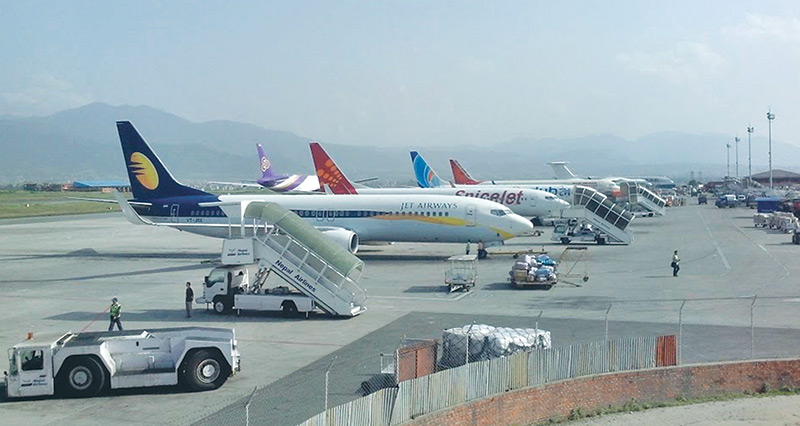
After India’s Jet Airways suspended its Nepal’s flights in April, many carriers have been showing interest in the route.
The suspension of services by Jet Airways resulted in a 40 percent reduction in weekly flight capacity.
Jet Airways used to fly thrice daily on the Delhi-Kathmandu sector and twice daily on the Mumbai-Kathmandu sector.
Jet’s departure proved a bonanza for another Indian carrier Indigo Air with airfares going up to Rs50,000 from the normal Rs15,000 for a one-way trip during the April-May period.
The Tourism Ministry said that it had received a proposal from Kuwaiti carrier Jazeera Airways to conduct daily flights to Kathmandu.

Page 9
CULTURE & ARTS

Expanding the divine rite of education

Religious institutions that used to teach only religious texts, today provide children with a more comprehensive education in order to help them grow in this ever-evolving social structure.
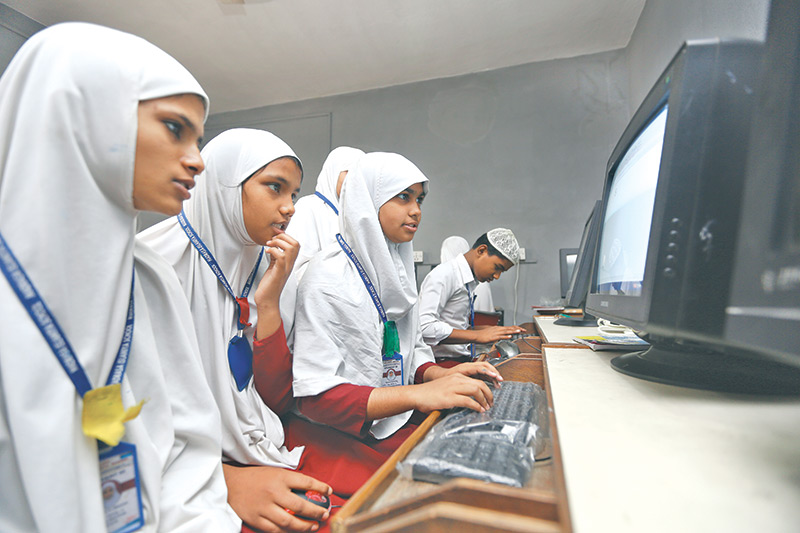
Students at Madrasa Islamiya School in Baghbazaar during computer class.

Kathmandu,
Utsav Neupane is among the 225 students who study in Nepal Ved Vidhyasram Sanskrit Mahabidhyalaya, Gaushala. The 14-year-old aspires to pursue a doctorate degree in the Sanskrit language in the future.
Sanskrit is the primary liturgical language of Hinduism and Hindu philosophy, and this is the language that is primarily taught at the Sanskrit Mahabidhyalaya. Students who study this language usually become Hindu priests, but the language’s scope is broader and is taught in Germany, the US, the UK, and Australia, says Keshav Prasad Adhikari, the principal of Sanskrit Mahabidhyala.
At this school, although the study of Sanskrit language, literature and grammar is given priority, other subjects like Nepali, English and social studies are also taught.
Before the formal education system was introduced in Nepal, people received education only through their respective religious institutions. Initially, these institutions offered education related only to religion, but as people became aware that children required a more comprehensive education in order to grow in this ever-evolving social structure,  religious institutions also started offering formal education with an array of subjects.
This has been a blessing for those families who still prefer to enrol their children in religious schools.
Mehnur Khatun, a 15-year-old from Thamel, is elated because her school, Madrasa Islamiya School in Baghbazaar, offers diverse subjects other than the ones related to Islam, which are disseminated in the Urdu and Arabic language.

The male students at Madrasa Islamiya School are required to wear a white t-shirt and purple pants, and hijab and kurta suruwal for females.


“My educational environment makes me aware of worldly things while at the same time also helps conserve my culture,” she says. It has made things easier for her to relate to her friends from her neighbourhood, who come from different religious backgrounds. Her favourite subject is Occupational Business Technology and Education, she says.
Madrasa Islamiya School offers education from kindergarten to grade 8 and currently hosts 250 students. Although it’s run by a religious institution, the school offers English, Nepali, maths, and science in order to promote comprehensive education for its students.
The school is also open for students who are not from the Islamic community, but they have to abide by the rules, including following a dress code and chanting prayers. The teachers employed by the school also come from diverse cultural and religious backgrounds.
“The day at the school begins with a prayer and the national anthem,” says Principal Firoj Khan.
Similarly, students at Serkong Dorjee Chang Academy in Swayambhu, which is run by a monastery, are also taught subjects like maths, science and English in addition to Buddhist culture, methods of worshipping and Buddhist grammar. But this is only offered to students from kindergarten to grade two, after that all the students are required to pursue Buddhist education.
The school currently hosts 35 students and according to the school administration, most of the parents want their children to be monks—which is what the majority of the students who continue their education at the academy become. Only a handful of students pursue university education on Buddhist philosophy.
The common characteristic of all three schools is that they host students from 77 districts of Nepal and are open to students from any cultural and religious background.
At Sanskrit Mahavidhyalaya, the students are required to wear daura-suruwal and dhaka topis. Students at Serkong Dorjee Chang Academy wear maroon robes and shave their heads and at Madrasa Islamiya School, the male students are required to wear a white t-shirt and purple pants, and hijab and kurta suruwal for females.
But of these three schools, only the students from Sanskrit Mahavidhyalaya can appear and graduate from SEE exams.
Regardless of these schools offering formal education only during the formative years, it is a positive step, says Balkumari Tamang, a teacher at Serkong Dorjee Chang Academy.


A day at Sanskrit Mahavidhyalaya starts with prayers.
As people became aware that children require a more comprehensive education to grow in this ever-evolving social structure,  religious institutions also started offering formal education with an array of subjects.


Students learning to chant Sanskrit verses, which is the primary liturgical language of Hinduism and Hindu philosophy.


Students at Serkong Dorjee Chang Academy learning English.


Maroon robes and shaved heads are part of the school uniform.
Among these three schools, only the students from Nepal Ved Vidhyasram Sanskrit Mahabidhyalaya can appear and graduate from SEE exams.


Text & Photos: Kiran Panday

Page 10
EXPRESSION

Once upon a time in Mustang

This mystical area is a must-visit district for any lover of trans-Himalayan adventure.
The Kali Gandaki river flows south of Jomsom in 1968.

It’s hard not to be fascinated by the mysteries of Mustang. Whether it’s the walled city of Lo Mangthang or the ever-vibrant Muktinath, the picturesque alpine landscapes or the ancient sky caves, the riches of the Mustang region are enough to lure any lover of trans-Himalayan adventure to the country’s north.
As one of the most popular tourist destinations in the country, Mustang, one of the two districts “beyond the mountains,” welcomes thousands of domestic and international tourists every year. So it was no surprise that when volunteers for the US Peace Corps programme arrived in Nepal in the 1960s, they didn’t miss the opportunity to trek north.
Though the country has seen significant change and development since the 1960s, time appears to have stood still in parts of Mustang. Today’s Mustang has roads, better schools and health services, but the old flavour of life still lingers in the district’s thin air. These photos, taken by those US Peace Corps volunteers, show Mustang’s undying mystique.

This photo essay is part of our Once Upon a Time series, featuring photographs taken by US Peace Corps volunteers in the 1960s. To see more photo essays in the series, visit tkpo.st/eka-deshma


Porters from Jomsom, along with their mules, cross the Kali Gandaki River on a traditional seasonal bridge in 1970.


A southward view of Nilgiri Himal from Samar in 1964. The trail centre-right leads to Tiri Gaon on the west side of the Kali Gandaki, just north of Kagbeni.


Children in Upper Kali Gandaki river valley in 1967.


A family from Manang on the trail from Jomsom to Jharkot in 1964. The mule carried belongings and walked with a limp. The family was returning to home via Muktinath and Thorung La Pass, at an altitude of 5,416 metres.


The old main trail to Lo Manthang in 1964. A small wooden cantilever bridge crossed the river from east to west here, where the river passes through a natural rock tunnel.


Sheep rest from carrying salt to Pokhara for sale, on a trail north of Tatopani, in 1968.


Three Thakali boys re-enact ‘hear no evil, see no evil, speak no evil’ in Kalopani in 1968.


A street in Marpha village, just south of Jomsom in 1968.


The trail from Kagbeni to Muktinath passes an old fort, in 1975.


Houses built on a hillside in Mustang, in 1968.


Loba children harvest potatoes in the town of Jharkot in 1964.


Water spouts in the shape of cow heads at Muktinath shrine in 1976.


The expansive view from the flat rooftops of Jomsom, looking up the Kali Gandaki River Valley towards Mustang in 1968.


A view of the northern side of Dhaulagiri’s eastern ridge can be seen from Marpha village, in 1968.


An ancient trading route, carved into cliffs, follows Kali Gandaki River in 1967.


PHOTOS: NEPAL HISTORY PROJECT/US PEACE CORPS

Page 11
CULTURE & ARTS

Password’s plot is as confusing as the actors’ performances

Sunny Leone is the best thing about this film, and that’s not saying much.
- ABHIMANYU DIXIT
screengrabs via youtube

When they say money can buy you anything, they’re right, but they’re also wrong. Money can get you shooting permits in foreign locations, an international calibre stunt team, a top-notch CGI team and also the most Googled celebrity in India lip-syncing to your song. But what money can’t buy is your audience’s love or attention.
Despite all the money that Password has spent, the film is confusing, frustrating and very difficult to sit through.
It starts off as a sleuth movie. A statue is stolen from the Pashupatinath temple. Elsewhere, a gold Shiva Linga is placed inside a CGI safe with a password. The police DIG (Dhiren Shakya) suspects Bikash Joshi or Bikki (Bikram Joshi) but the police discover that Bikki has murdered his father and escaped to London. Three police officers (read: comic relief), Chatur (Prabin Khatiwada), Kanhaiya (Rabindra Jha) and Balaram (Bikrant Basnet), are sent after Bikki all the way to London.
Meanwhile, on the streets of London, Bikki bumps into Sanju (Pari Rana) and conveys his affection—by following her. She, in classic Nepali heroine mode, finds this romantic. On the very first date, she takes her stalker home. There, Bikki discovers that his and Sanju’s father were friends and that both are dead now.
There’s a flashback, explaining that Sanju’s father was murdered by the baddie of the film, Jojo (Anoop Bikram Shahi). Jojo is coercing Sanju’s father for the password to the CGI safe when his phone rings, flashing ‘Sanju my daughter’. I’m not making that up, that’s the actual name of the caller, ‘Sanju my daughter’. Jojo intercepts the call, puts her on speakerphone where she
conveniently says, “Daddy, what is this password you’ve sent me?” Jojo now knows what to do.
Let’s not get too deep into the plot because honestly, it’s not worth it. What starts out as a crime caper turns into a love story and then a revenge drama, and then into whatever is convenient for the writers. Sima Gurung is credited with the story as writer, while the script is penned by Mahesh Dawadi and Samrat Basnet, who is also the director. The team’s lack of effort in writing results in inconsistencies—in character design, dialogue and plot.  For example, Jojo, the big baddie, befriends Sanju and gets Bikki arrested. His reasoning is ‘Haat khutta todnu bhanda, mann todnu besh’ or ‘It’s more
effective to break hearts than to break bones’. Many times, dialogue is used as emotionless exposition tools, but the filmmakers’ gravest sin is that they use dialogue to insult the audience. In one instance, comic relief cop Kanhaiya says out loud, “She is a sex worker because she wears pink lipstick.” This misogynist comment was clearly designed for laughs, but in the cinema hall, it only evoked uncomfortable sighs.
With this big of a budget, you expect the film to deliver if not in the writing then at least in its presentation. But you are left begging. On multiple occasions, the film looks like one of those overly bright pre-wedding videos. Well-dressed actors pose in picturesque locations and provide cheesy, uncomfortable performances to unmotivated camera movements and lazy direction choices.
But there’s more. The editing by Arjun GC will bewilder you. At times, you’re confused about the screen direction. Before one fight scene, Jojo and his minions walk from left to right but immediately, we are shown a mirror image where they now walk from right to left and then vice-versa.
But the most disastrous aspects of the film are the awful performances by the actors, especially the leads Bikram Joshi and Pari Rana. In the film, Bikram is brooding and moping, lacking any charisma. He is stone-faced when his lover comes running into his arms, or after the death of a friend, or even when he finds out who framed him for his father’s murder. He reacts to every situation with a monotone expression, wearing sunglasses. The CGI safe and Bikram’s acting, combined with his glasses, might lead you to think that he is a robot. But this is not science fiction, it’s just bad acting.
Pari Rana seems to just stand there. Her character has room to feel betrayed and hurt. But any effort she’s put into portraying human emotions never comes across.
Compared to the two leads, Anoop Bikram Shahi carries a whole lot of charisma. But he’s not given much to do in the film. He smokes a cigar, kicks like a professional and delivers his dialogue angrily. There is space for this actor to actually perform, but inconsistent writing and poor character design turn him into another campy villain with over-the-top makeup.
Surprisingly, the best part of this film is Sunny Leone. The film is marketed as Leone’s first Nepali film and her name pops out in the opening credits. But she doesn’t show up until after the interval, and that too for a single song.
But credit where it’s due. It is quite refreshing to see an international celebrity lip-sync to a Nepali song. The number of crowds, the background dancers, Leone’s makeup, hair, and costume are on par with any Bollywood dance number. But there’s no originality from the filmmakers. Lens flares, background spotlights, occasional flashes, and camera shakes added in post-production turns this sequence into any other Bollywood club song from the last 10 years.
According to the filmmakers, this is one of the most expensive Nepali films ever made but I watched it with just nine others in the 200-or-so seater Kumari theatre for a 6pm show. This was the smallest audience for any film I’ve seen this past year. If the reports are correct, you can make around 15 low-budget indie films from Password’s budget alone. Or even better, you could invest in film school graduates who are dedicated to making films but are stuck with wedding videos, some of which are honestly better than this film.
You can tolerate pre-wedding videos because they’re short, you know the emotions are genuine, and you’re watching them for free. But this is a feature-length film that you have to pay to watch, and these are professional actors. Is the audience asking for too much when we demand just a little more conviction?

Dixit is a filmmaker, film educator and film campaigner based in Kathmandu.


Password
Actors    Bikram Joshi, Pari Rana, Anoop Bikram Shahi
Story:    Sima Gurung
Director:    Samrat Basnet

AS IT IS

The constitution context

It is our constitutional right not to even celebrate Constitution Day and that doesn’t make us traitors.
- Guffadi

Illustration: krishna gopal shrestha

We have the best constitution on earth and we have no one but our great leaders to thank for it. If it weren’t for our great netas, then the Ranas would continue to build palaces all over the city wasting billions of our rupees and then it would fall on this ‘great’ government to repair them. Look at Singha Durbar today. Our ‘poor’ government can’t even maintain the front gate. It is not Oli’s fault. Just blame the Ranas for building such palaces which are now difficult to maintain. So let us demolish them all and build new modern buildings so that our contractors, civil servants and corrupt clowns can all share the chiya kharcha from our sarkari budget. The new parliament building which will be completed in five or so years will cost this government more than 700 karods but if you ask any architect to come up with a bid then he or she can do it for less than half the money.
This ‘Oli’ sarkar is hell-bent on not only raising our taxes to feed their own hungry stomachs and souls but are also making sure that all projects make them lots of chiya kharcha because they must probably know that, we Nepali voters are not blind like some folks in the West. We keep changing the players just for fun and next time around, our comrades might be on the wrong side of the fence. Let us hope that our comrades will see the light soon or else we will have to put up with the king of Dadeldhura next time around.
If it weren’t for our great netas, the House of Shah would continue to waste 60 karods of our taxpayers money every year and leave us high and dry. We now know that late king Birendra was too laid-back while our former king Gyanu uncle was never really a businessman. If he were a business person then he would have hired consultants from Mckinsey or other consulting firms here and abroad. But what did he do? He tried to bring back the mandaleys from the 80s twenty years later. That was like trying to open an institute that teaches how to use typewriters when you already have IBM PCs in town. And Kamal Thapa is still trying to be relevant today with his nataks. I think Gyanu uncle should just go ahead and open his own political party. Then maybe people like Kamal Thapa and all those so-called ‘Bring back monarchy’ crowd will not get their 15 minutes of talk time at Reporter’s Club. After all, if Gyanu Uncle is the party head they still think of him as the king then they will always be at the second seat and not in the front, unlike today.
If it weren’t for our netas, Nepal would already have been a failed state and we would have 24 kingdoms and two dozen kings. But, today, we are moving towards peace and prosperity and we have hundreds of kings who rule over us. But it seems that our netas are still scared of a former king who is now busy wearing garlands and walking around temples. Let the man enjoy his free time. He had his chance and he couldn’t hack it but our netas have had theirs and we are still willing to give you guys the opportunity to stay on the right track but it looks like our buffoons want to invite the right-wingers back into the game again and again.
It wasn’t hundreds of our lawmakers who discussed, debated and decided to come up with our ‘new’ constitution for our ‘new’ Nepal. It was just a bunch of old fogies who decided it was time to get us a new book because the old one was out of date. Well, we could have just amended a few things and saved us billions of rupees but then our netas wouldn’t get their perks and benefits from the state would they?
Our Minister of Disinformation and Miscommunication Gokul dai is not so cool and our great tabloid journalist thinks he knows more about the press than the rest of us. How can a journalist who becomes a mantri turn his back and be so arrogant and want to curtail press freedom? I guess Gokul dai doesn’t need a job when he is out of power. Our ministers make enough to last seven generations. They can no longer live normal lives, go on a morning walk, buy vegetables and drink dudh chiya at the local pasal after once gets to sit on a kurchi. Then, he or she is a king or the empress. Do you think our madame president will make a cup of tea for herself and work on her memoir once she is out of the president’s house? She will get free housing, vehicles, security and assistants. But Obama has to get back to the grind. That’s the difference between us and the rest of the world.
If our netas abided by our ‘best’ constitution then we would not be in such a mess. Our lawmakers are lawbreakers themselves. We have had our constitution since the Ranas left the building but the players used it for their own good and violated the constitution time and again. The ‘Oli’ regime is no better. This government has violated our constitution left and right. Our ministers act like bouncers instead of leaders. Poor Yogesh dai. We want him to be our Justin Trudeau but the man is having a tough time not being viral on YouTube. Another Gyanendra with the extra ‘I’ in his last name is continuing to have his 15 minutes of fame.
Well, I think it will extend for another 15 weeks or even months. I think our Gyanendra bhai, our YouTube activist needs to tone down a little bit as well. It starts to get boring if you are only bitching and whining everywhere. Now, it’s time to wake up and walk away from the camera and do your thing instead of only blabbering about what’s wrong with our netas. If the minister is late to board the aircraft then when he shows up, you and your fellow passengers should clap and thank him for finally letting all of you fly back to Kathmandu. Let us show our politicians, we are peaceful, submissive folks not angry frustrated folks.
This government wants us to stand up for national anthem at Pashupatinath while we cremate our loved ones. It is my constitutional right not to stand up during such times. This government does not want me to go on a picnic or party or in Gokul’s words ‘do not hang out with your girlfriend or boyfriend’. I think we need to ask Nepal Bar Association (NBA) to send their lawyers to teach a thing or two about constitutional matters.
It is our constitutional right not to even celebrate Constitution Day and that doesn’t make us traitors. Our netas should be the ones to preserve, protect and defend the constitution but it is sad that they are the ones who want to attack and destroy the constitution. Gokul dai, please do ask your netas to not party and drink like you will drop dead tomorrow during government holidays. We all know what our loafers are up to during off days.


Guffadi is a grumpy old man who blogs at guffadi.blogspot.com You may contact him at [email protected]

Page 12
BOOKS

‘Reading and writing are as important as breathing’

Dhurba Chandra Gautam talks about his love for writing and how the ‘Mahabharat’ shaped his fascination with weaving stories.
Post photo: Kiran Panday

Dhurba Chandra Gautam was brought up in a family that thoroughly enjoyed reading and writing. As a teenager, he’d already published his first poem in the newspaper Kalyan, which was followed by publications of his stories in Rooprekha. The 75-year-old writer, who is a recipient of the Madan Puraskar and the Sajha Puraskar, says his biggest inspiration in writing is Jagadish Shumsher Rana, who was the first to appreciate his work when Gautam was a novice. Some of Gautam’s works include Alikhit, Tathakathit Asafalta, Kattel Sir ko Chot Patak and Tyo Euta Kura.
In this interview with the Post’s Alisha Sijapati, Gautam talks about his love for fiction and shares five books he thinks everyone must-read. Excerpts:


How did you first come to love books?
I have grown up with bookworms around me. My father loved reading books, the same passion was passed on to my brothers and me. During those days, there were no other means for entertainment also, so I immersed myself in fiction. My contemporaries and I have grown up reading the Mahabharata, the Ramayana and the Swasthani. These three epics are so deep in knowledge and creativity that it makes you go deeper into the world of storytelling.


As you said, many of your contemporaries grew up reading epics like the Mahabharata. Did these books create a long-lasting impact on you? How?
These three books are epics that take you on a rollercoaster ride of emotions. These are the books that compelled me to explore the world of fiction writing. They have all the elements to take you to a wonderland.
More than the Ramayana and the Swasthani, the Mahabharata has played a crucial role in making me a fiction writer. I still have my old copy of the Mahabharata that consists of 18 khandas, and yes, it is not an easy read, and that makes it more beautiful. The book has 100,000 verses.
The current generation may discard the Mahabharata as a boring epic and its mythological shows that are transpired on screen, but to tell you the truth, the Mahabharata is more relevant today than ever. It talks about the future of Kalyuga and our state in this yuga. The characters give you life lessons that you’ll never forget for the rest of your life.
I am glad that I read the Mahabharata at an early age of my life, as it helped me understand the reality of the world. Even today, I sometimes read the Mahabharata shlokas (verses) to remind myself of the lessons I had learnt in my initial reading years.


What was the last book you read and did you like it?
I am currently reading Yogesh Raj’s Ranahar. I am glad that the writer has been felicitated with the Madan Puraskar this year. It is an interesting book. The plot is very gripping. I haven’t yet concluded reading it, but so far, so good.


What are the five books you read that you would recommend as must-reads?
Like I said before, everyone should have copies of the Mahabharata, the Ramayana and the Swasthani. The other book is Amar Kosh, written by Amar Simha. This book is the father of all mythological books and TV shows that are available today. I have always thoroughly enjoyed reading Margaret Mitchell’s Gone with the Wind. This book is one international novel that has all sort of emotions and historical events. The last one is Anthony Burgess’ A Clockwork Orange—it’s quite an interesting read that can always be relevant to young readers.


What books are currently on your wish-list?
I have been wanting to read C’est La Vie, the English translation of the French book, for the longest time. But unfortunately, I haven’t managed to get a hold of it. Hopefully, that wish will be fulfilled in the future.


Why do you think reading and writing is important?
I don’t know how others would convey the importance of reading and writing, but for me, these two are as important as breathing. There shouldn’t be such a question. Reading and writing is the biggest source of gaining and spreading knowledge.


What book has influenced you the most and why?
The most influential book that I have read has to be the Mahabharata. Also, Laxmi Prasad Devkota’s poems and prose have inspired me to write. I have always written stories, poems or books with out-of-the-box ideas, and Devkota is one such writer who offers that versatility in his writing. His short story Teej is something that everyone should read.  


How do you draw inspiration for writing?
Some say writing is an inherent quality, but I feel it has a lot to do with the environment you are brought up in. I come from a household where everyone loved reading and writing. My love for reading and writing is natural. Also, once your story or article is printed—the appreciation can motivate you to work better, write more.

BOOKS

Old-fashioned reporting most compelling aspect of ‘She Said’

The book centers mostly around the Weinstein story and the accusations of sexual harassment and abuse by A-list actors.
- DONNA LIQUORI
Details on Harvey Weinstein’s (center) attempts to stop New York Times from publishing the story against the movie mogul’s sexual misconduct accusations is also covered in this book.  Ap/rss

Jodi Kantor and Megan Twohey’s She Said: Breaking the Sexual Harassment Story that Helped Ignite a Movement, the behind-the-scenes book about how these reporters investigated Harvey Weinstein, is jarring, riveting and, for journalism, necessary.
The book’s most compelling aspect is old-fashioned reporting—knocking on doors, obtaining records, clandestine meetings, tapping sources—and is the structure that holds up this book and is what earned The New York Times’ Twohey and Kantor the 2018 Pulitzer Prize in Public Service.
“She Said” centers mostly around the Weinstein story and the accusations of sexual harassment and abuse by A-list actors like Ashley Judd and Gwyneth Paltrow, as well as those working for Weinstein at Miramax and the Weinstein Co. There are also pages dedicated to Donald J. Trump and Brett Kavanaugh and the accusations against them.
Because of the investigative reporters’ work, Weinstein was arrested and is now free on $1 million bail, pleading not guilty to charges of rape and sexual assault. He has denied all charges of non-consensual sex. A trial is scheduled for January.
The number of lawyers mentioned in the book brought in to cover up, smear or throw off reporters is also impressive. Emails are included and they are incendiary, like the one from Weinstein’s brother, Bob, confronting Harvey and urging him to get help.
“You have hurt many people with this behaviour as well. You have picked on people and used your power over them. You have brought shame to the family and to your company through your misbehaviour,” Bob Weinstein writes.
Kantor and Twohey persisted, tracking down stories and allegations even when the sources wouldn’t go on the record. In writing the book, well after the story broke, they revisited those used for background and information, but weren’t mentioned in the published stories. Here they are on the record. There’s a cathartic last chapter in which accusers gather in California to discuss the #MeToo movement.
It’s important to note the tactics that Kantor and Twohey used for the delicate task of communicating with accusers, often reticent about coming forward, especially “what to say in the very first seconds of a phone call with a stranger who might be a victim.” Twohey’s approach for getting rape victims to share their experiences was “I can’t change what happened to you in the past, but together we may be able to use your experience to help protect other people.” The pitch centred on helping others. “This was always the truest, best reason to talk to a journalist,” the women wrote in “She Said.”
One of the best scenes in the book is when they are getting ready to publish their bombshell story that ran on October 5, 2017, that documented the accusations against Weinstein.
They present their findings to Weinstein and his people for a response. As the clock ticks toward their deadline, they worry about whether another organisation will break it and if sources will be intimidated into withdrawing their accounts. Judd comes forward, agreeing to go on the record, during the wait: “Jodi lost it, like a marathoner collapsing at the finish line. ...Weeping, Jodi searched for something to say to Judd that was equal to the moment but still professional.”
The nuts and bolts reporting techniques add to the drama: slugging their story in a cryptic way to keep it hidden even from other reporters, the back and forth with editors and figuring out how much time to give Weinstein and his team to respond.
The mechanics of the deadline reporting, with the knowledge that Ronan Farrow of The New Yorker (also a Pulitzer-Prize winner for his work on this subject) wasn’t too far behind them, also makes for a compelling narrative.
Having this in all one place is overwhelming and historic and disturbing. Just the number of mentions of Weinstein in a bathrobe allegedly asking actresses and employees for a massage is difficult to take.
The depictions of Weinstein meeting with the Times reporters are also unsettling. Earlier in the book, Kantor approaches him in the lobby to introduce herself. He had just left a meeting to address accusations in another story regarding AIDS research funds. He is described as leaning into Kantor “with such intensity that she had to remind herself not to show any signs of intimidation.” He mocks their investigation and proposes to sit down at that moment. Kantor tells him that they would reach out when they were ready. According to “She Said,” he tells her that he hadn’t done those things, adding “I’m worse.”


—Associated Press

Page 13
WORLD

What happens when the Indus doesn’t reach the sea?

The Indus Delta was once prosperous, today, it is home to suffering, despondency and death.

The Indus Delta, the fifth largest in the world, is shrinking and the consequences could be devastating. dawn

The Indus River, the vertebra of Pakistan, runs 3,200 kilometres in total and, if cared for, is capable of providing sustenance to all, from Kashmir to the Arabian Sea. But without the release of freshwater into the Indus, the coastal region of Pakistan is running dry. The fifth-largest delta in the world is shrinking.
A delta is formed at the mouth of a river, when the river sheds its sediment load, before meeting a slower moving water body such as an ocean, sea, lake and sometimes another river.
The currents of a fast moving river eventually become weak, making it difficult for the river to carry its sediment load any further. The sediment is then dropped at a delta, making it a highly fertile area, before the river concludes its journey by joining another water body.
The Indus Delta, this meeting between the Abasin (Pashto for ‘Father of Rivers’) and the Arabian Sea, was once a union of prosperity. Residents there used to be traders, agriculturalists and fishermen. Today, it is home to suffering, despondency and death.
Spread out in the shape of a fan, the Indus Delta covers an area of 41,440sq km and approximately 210km where it meets the sea. It has shrunk manyfold over the decades. It is a complex ecosystem, consisting of swamps, streams and the seventh-largest—and now threatened—mangrove forest in the world.
It is also home to various species of fish and the famous pink Indus dolphin, along with being an important stop on the route for migratory birds. A dying Indus Delta restricts migration and may lead to the extinction of many species of rare birds.A source of ecological services and economic benefits, the Indus Delta was added as a wetland site to the 1971 Ramsar Wetland Convention, an international treaty for the conservation and sustainable use of wetlands. Pakistan currently has 19 wetlands designated as areas of international importance under the convention, and nearly half of them are under medium or prominent levels of threat.

Villain one: Government
Discriminatory water policies in Pakistan have left the Indus Delta dry. Data reveals that water flow below the Kotri Barrage gradually decreased after the construction of the Mangla and Tarbela dams, except in high flood years.As per the Water Apportionment Accord of 1991, Sindh demanded at least 10 million acre feet (MAF) of water to be released below the Kotri Barrage. But between the years 2000 and 2010, the highest number was 5.8 MAF in 2008-9, with the lowest being 0.2 MAF in 2004-2005.
The flow of water from the Indus into the delta is controlled through the Kotri Barrage, situated around 174km from the mouth of the river. This flow is now only seen during the rainy season or in high flood years, when surplus water is supposed to be drained below the barrage in any case.
Without the release of freshwater into the Indus—a consequence of the construction of dams—the river loses its velocity by the time it meets the Arabian Sea. In the absence of flowing freshwater acting as a rival shield, opposing saline seawater forcefully invites itself into the delta and hurts the soil, plants, animals and fish species there.
Without freshwater, depleting fish stock and mangrove forests are causing loss of livelihood and food sources for communities dependent on it. 80pc of fish caught off the coast in Pakistan spend at least a part of their life cycle dependent on the mangrove creeks. Freshwater flows are also supposed to help resist cyclones and tsunamis.
Furthermore, as seawater intrusion submerges and erodes large tracts of land, saltwater starts creeping into the ground aquifers rendering them unfit for human consumption. A direct consequence of all this is migration, generally to already over-populated urban areas.
The link between lack of freshwater flow and seawater encroachment is not rocket science. If I were to take a guess, the government has made a calculated choice to ignore the need of releasing freshwater into the Indus under the pretense of saving it for agricultural needs. If managed properly, there is plenty of water for both.
The Hindu Kush-Karakoram-Himalayan glaciers—our largest sources of freshwater—are melting at an unprecedented rate. Logic dictates that this glacier-melt should be entering into our rivers and creating a surplus. But we are told that apparently Pakistan has no water. If the country can’t manage and conserve water now, imagine what we’ll do once we lose our treasured and neglected glaciers—which we will, as things stand.
While many parts of the country were falling victim to a bogus ‘dam awareness scheme’, the people in Sindh were dreading further water diversion. Inequitable water distribution policies that typically serve the interests of only two provinces are a massive policy failure on the part of our successive governments.


Villain two: Climate change
Climate change has further exacerbated the issue, with rising sea levels a glaring consequence of it.According to the Pakistan Fisherfolk Forum, sea intrusion has eroded nearly 3.5 million acres of agricultural land since 1956 and more than 2.2 million acres of farmland in the districts of Thatta and Badin. On top of it, mangrove forests that serve as a barrier between the sea and the coastal region and assist in reducing soil erosion, are steadily depleting.
An Asian Development Bank report suggests that sea levels are expected to rise by further 60 centimeters by the end of the century and “will most likely affect the low-lying coastal areas south of Karachi toward Keti Bander and the Indus River Delta.” Seawater intrusion will also cause water-logging and large-scale soil erosion in upland areas due to higher tides. The creation of dams on the Indus will drastically aggravate the situation by reducing sediment load and river flow downstream.Furthermore, reports suggest that by 2050, Thatta will be completely underwater. In fact, many coastal areas in Badin and Thatta have already been submerged by rising sea levels.As the third-largest ice mass outside the global poles—the Himalayan-Karakoram-Hindukush glaciers—melt, they may initially bring more water into the Indus Delta (and also fuel sea level rise), but will eventually leave the area at the mercy of rains.
The Indus Delta already experiences low rainfall, with an estimated average of 25cm to 50cm annually. With altered weather patterns, including prolonged heatwaves and persistent droughts, depending on rainfall alone for agriculture in the region is rather impossible.Erratic, climate change-induced weather patterns—altered precipitation levels, heightened frequency of torrential rains and frequent tropical cyclones—are another episode of misery for the inhabitants of the Indus delta. A five degree Celsius rise in temperature is expected over the deltaic region by the end of this century. This would increase the amount of water required for domestic consumption, animals and crops by almost 1.5 times.Caught in a unique cross-road between being submerged by seawater and living through a state of drought, the Indus Delta and its inhabitants are suffering the most intense impacts of climate change.

A possibly happier chapter?
The National Climate Change Policy, 2012 acknowledges the vulnerability of the Indus Delta to climate change. When exactly the government intends to adopt the measures mentioned in the policy, though, remains a mystery.
The construction of dikes that work as walls to stop sea intrusion along the coastal belt has been a partially successful measure. They are cheap and effective solutions in the short term. However, the problem is that dikes do nothing to prevent seawater seepage into the ground aquifers.
A Rs125 billion Sindh barrage project was approved by the federal government this August. This would include the construction of a 12-metre-high barrage on the Indus at a distance of 45km from the sea. The project, expected to be completed by 2024, is aimed at addressing the issues of land erosion and degradation due to seawater intrusion.

A sad conclusion
While tireless efforts by some organisations to revive the delta continue, we need to make a promise to ourselves: that other fragile ecosystems in Pakistan shouldn’t end up this way.In July this year, almost 1,500 farmers marched 140km to Thatta to protest against water shortage in the Indus Delta. They sang a song that translates to: Wake up, O’heirs of Sindhu, save her, help us cross on this broken boat to the other side.If things don’t drastically change, there will be no need for any boats. We’ll have nowhere left to go.

- Sara Hayat
—Dawn

WORLD

Abe, Trump head for trade deal; auto tariffs a sticking point

Here are some key elements about the pending US-Japan agreement.

Japan’s Prime Minister Shinzo Abe and US President Donald Trump at a bilateral meeting during August’s G7 summit in Biarritz, France. REUTERS

US President Donald Trump and Japanese Prime Minister Shinzo Abe are expected to clinch a deal on farm tariffs and digital trade when they meet in New York next week. Full details of the agreement have not been disclosed. Below are some key elements about the pending agreement.

US auto tariffs
Trump’s announcement of an initial deal earlier this week left unanswered questions over whether the agreement would deliver Japan one of the main prizes it seeks: a US pledge not to impose national security tariffs of up to 25percent on Japanese vehicles and auto parts under Section 232 of US trade law.
Japanese Foreign Minister Toshimitsu Motegi, who is in charge of talks with US Trade Representative Robert Lighthizer, has said he wanted to reconfirm in writing that the tariffs would not be imposed.
Japanese officials have said that under a September 2018 agreement, the United States would not impose added auto tariffs while trade talks were under way. Fresh assurances could echo the vague wording then, that both sides would “refrain from taking measures against the spirit of this joint statement during the process of these consultations”.Japanese auto exports account for about two-thirds of its trade deficit with the United States and the added tariffs would deal a blow to Japan’s trade-reliant economy.A preliminary deal announced on August 25 included reduced US tariffs on unspecified industrial products but Lighthizer said these did not include autos. Tokyo has sought removal of a US 2.5 percent tariff on autos and auto parts.

Beef and pork
Japan is expected to agree to cut tariffs on imports of US beef and pork to around levels granted to signatories of the multilateral Trans-Pacific Partnership (TPP) pact, officials have said.Japan will permit low import tariffs on about 240,000 tons of US beef, with the quota covering about 90percent of the amount Japan imports from America, the Nikkei business daily said, adding it would eventually rise to 290,000 tons.
Lower tariffs would allow Trump to please US farmers ahead of next year’s presidential election. The farmers had been disadvantaged in Japan’s market after the United States withdrew from TPP after Trump took office in 2017. It would also let Abe keep a pledge to domestic producers.
Lighthizer said last month that wheat, dairy products, wine and ethanol would also benefit from the deal.Washington, meanwhile, will make it easier for Japan to increase US-bound beef exports by scrapping a 200-ton annual low-tariff quota, affording Japan the same beef trade status as Australia, New Zealand and Canada, Japanese media reported.

Japan-bound corn purchases
In announcing the initial agreement last month, Trump made reference to Japan’s decision to front-load planned purchases of US feed corn imports to cope with crop damage from an armyworm infestation. However, Japanese officials said the country’s total feed corn imports wouldn’t increase.

Wine, rice
Japan has agreed to phase out tariffs on US wine imports over five to seven years, about the same as the eight-year TPP time-frame, media said, potentially cutting the cost of US wine by about 13percent for wine distributors. However, the amount of US rice that will be allowed to enter Japan tariff-free would be much less than the 70,000 metric tons accepted under the TPP, a Japanese source familiar with the matter said on condition of anonymity.

Currency devaluation
Japanese Finance Minister Taro Aso has said that a currency provision aimed at preventing competitive devaluation would not be included in the final deal. That demand by US lawmakers would tie Japan’s ability to intervene in currency markets should the yen spike and threaten the country’s export-reliant economy.

Digital trade
US technology industry officials say they expect a digital trade agreement with Japan to be closely aligned with provisions in the new US-Mexico-Canada Agreement (USMCA), which follow the US model for internet development.Those provisions aim to ensure the free flow of data across borders without taxation, prohibit data server localisation requirements and limit governments’ ability to demand companies disclose their source code.

-Linda Sieg, Kaori Kaneko
—Reuters

Page 14
SPORTS

Man United, Arsenal, Rangers win in Europa League

Youngsters Willock and Saka shine for Arsenal. Greenwood saves United blushes as Solskjaer makes nine changes.
- AGENCE FRANCE-PRESSE

Manchester United’s Mason Greenwood celebrates after scoring a goal against Astana during their Europa League match at the Old Trafford in Manchester.ap/rss

Paris : Last season’s runners-up Arsenal romped to an impressive 3-0 victory at Eintracht Frankfurt in their Europa League opener on Thursday as Mason Greenwood spared Manchester United’s blushes and Rangers got the better of Feyenoord.
On a night which featured five British clubs in action, Unai Emery’s much-changed side enjoyed the best result of all with youngsters Joe Willock and Bukayo Saka scoring in Germany. In between, Dominik Kohr was sent off for last season’s beaten semi-finalists Frankfurt, and Pierre-Emerick Aubameyang made sure of the win for Arsenal in the Group F clash. “Everybody can be happy and continuing in this competition is important, so it was good to get a good win, especially away from home,” said Emery. Their next game will be at home to Standard Liege, who beat Vitoria Guimaraes 2-0 on Thursday.
At Old Trafford, United had teenager Greenwood to thank as the 17-year-old’s goal gave them a 1-0 win over Astana of Kazakhstan in Group L. Greenwood became the youngest goalscorer for United in European competition with a composed finish 17 minutes from time. Victory justified Ole Gunnar Solskjaer’s decision to make nine changes from Saturday’s Premier League win over Leicester City with a host of youngsters given their chance to impress. “You could see some of our lads needed games but it’s pleasing we got the three points,” Solskjaer said.
The group’s other game saw AZ Alkmaar come from behind to draw 2-2 with Partizan Belgrade in Serbia despite playing more than an hour with 10 men. Wolverhampton Wanderers were unable to make it three wins out of three for Premier League clubs as they slumped to a 1-0 home defeat against Braga at Molineux. Ricardo Horta’s second-half goal gave the Portuguese club all three points in Group K and it was a disappointing night for a Wolves team who are still without a win in the Premier League this season. In the same group Slovan Bratislava were 4-2 winners at home to Besiktas, who welcome Wolves to Istanbul in a fortnight.
Meanwhile, Steven Gerrard’s Rangers started in fine fashion as they edged out Feyenoord 1-0 at Ibrox in Group G with Sheyi Ojo scoring the only goal of the game midway through the first half. James Tavernier missed a penalty before that for the Glasgow side on an emotional night as a minute’s silence was held in memory of Fernando Ricksen. The former Rangers and Netherlands defender died aged 43 on Wednesday after a long battle with motor neurone disease. It is an ideal start for Rangers in a tough group and their next match will be away in Switzerland against Young Boys, who lost 2-1 at Porto on Thursday with Tiquinho netting twice for the hosts.
Celtic battled to a 1-1 draw with Rennes in France in a fiery Group E encounter, with Ryan Christie’s second-half penalty cancelling out M’Baye Niang’s 38th-minute spot-kick for the hosts before the visitors had Vakoun Issouf Bayo sent off at the death. “I asked for a reaction from the players at half-time and we certainly got that and we thoroughly merited the point if not the three points,” said Celtic manager Neil Lennon of his team’s fightback. They now host CFR Cluj, the same side who eliminated them in Champions League qualifying. The Romanians shocked Lazio 2-1 on Thursday.
Elsewhere, Sevilla, who won the Europa League three years running from 2014 to 2016, beat Qarabag 3-0 in Azerbaijan in Group A with Javier Hernandez getting their opening goal. PSV Eindhoven opened up Group D with a 3-2 victory against Sporting Lisbon while Roma crushed Istanbul Basaksehir 4-0 in Group J. In the same group Borussia Moenchengladbach were stunned by Wolfsberg, losing 4-0 at home to the unheralded Austrian side who were making their group-stage debut. It was a heaviest ever home defeat in Europe for Gladbach, the two-time former UEFA Cup winners. The biggest winners on the night were Basel, as the Swiss side hammered FC Krasnodar 5-0.

SPORTS

Australia hopeful of touring Pakistan in 2022 but security remains a concern

Most teams have refused to visit the nation since gunmen attack on Sri Lankan team bus.
- AGENCE FRANCE-PRESSE

A groundsman works at the Dashrath Stadium football pitch in Tripureshwor, Kathmandu, on Friday.Post Photo: Beeju Maharjan

SYDNEY : Cricket Australia is hoping to tour Pakistan in 2022, but chief executive Kevin Roberts said security remains a concern and he would never jeopardise the safety of players.
Most international teams have refused to visit the South Asian nation since the Sri Lankan team’s bus was attacked by gunmen during a Test in Lahore in March 2009, leaving six players injured. Six policemen and two civilians were killed.
Roberts returned from Pakistan on Thursday after the first trip by a high-level Australian cricket delegation in more than a decade. The team has not played there since 1998 but is next scheduled to tour in early 2022 and Roberts told Melbourne’s SEN radio he wanted to see for himself the situation on the ground.
“The purpose was really to understand the landscape, look at the plans they have in place around security and then start expressing our expectations for the safety of our players and our support staff well over two years away from when we’re due to tour,” he said. “Things are heading in the right direction. In saying that we were travelling in armoured cars and escorted by police and felt very safe over there. But certainly that level of security is still required at this point.” Roberts said “We would love to see international cricket return to Pakistan”, but cautioned that “We would never put our people in jeopardy”.
His comments came as Sri Lanka’s cricket board this week said they would press ahead with an upcoming six-match tour of Pakistan despite fears that players could be the targets of terror attacks. Asked if he could realistically see Australia touring Pakistan during his tenure, Roberts said: “I really hope we do for the sake of world cricket and Australia’s important relationship with Pakistan. “As I said to Pakistan, we share their desire for international cricket to return to their country. We have got the next couple of years to hopefully plan for a tour in 2022 but we have just got to set that out carefully, bit by bit, rather than rushing into it.”
Roberts is in touch with other cricketing nations over the issue and said his trip had triggered plans for similar visits by the chief executives of England and Ireland over the next month. “It’s really good that the cricket world is opening its hearts and minds to the role of Pakistan and looking proactively at what it will take to return international cricket to Pakistan,” he said. “Certainly, there’s parts of the country that are very unsafe, but there’s other parts where I think a number of nations will contemplate playing again in future when Pakistan are ready.”

SPORTS

Tottenham must do better to hold off ambitious Leicester charge

Pochettino questioned his players’ attitude for not matching the standards of a 4-0 win against Crystal Palace last weekend.
- AGENCE FRANCE-PRESSE

 A file photo of Tottenham Hotspur’s Harry Kane (left) and Son Heung-min during a training. REUTERS

LEICESTER : Tottenham’s ambitions after reaching the club’s first Champions League final and moving into a stunning new stadium were to kick on and challenge Liverpool and Manchester City for major honours this season.
However, Mauricio Pochettino admits his side need to make major improvements and learn from their mistakes just to maintain their status as Champions League regulars. “We need to improve and I think all the players in the squad feel the same that we need to improve if we are to be a contender for big things,” said Pochettino on Thursday.
Spurs travel to Leicester on Saturday already seven points off Premier League leaders Liverpool having won just two of their opening six games to the season. After blowing a 2-0 lead to draw 2-2 away to Olympiakos in their Champions League opener on Wednesday, Harry Kane bemoaned the lack of maturity from a squad that should have been hardened by the progress made during Pochettino’s five years in charge.
“We’re not young any more, we’re not inexperienced,” said the England captain. “We’ve played in big games for club and country. I can see why the manager is frustrated because he’s been here for six years now and we’re still making similar mistakes to the ones we were in his first year. We’ve got to find a way to get around it, improve and get better.”
Pochettino questioned his players’ attitude for not matching the standards of a 4-0 win against Crystal Palace last weekend on their visit to Greece in midweek. “It’s not about tactics, it’s not about quality players, it’s about the quality of preparing yourself to be ready to fight,” said Pochettino. “At this type of level you need to match the opponent in terms of intensity, aggression, in excitement and motivation and then is going to appear your quality when you are connected with the game.”
Pochettino has often surpassed expectations during his time in charge. He successfully guided the club through nearly two years at a temporary home at Wembley, while maintaining Spurs in the Premier League’s top four, and make progress in Europe on a shoestring budget compared to the Champions League elite. But a return of just 19 points from Spurs’ last 17 league games shows how their progress has stalled. Instead of looking up to challenge Liverpool or City, Spurs immediate priority is to make sure their place in the top six does not come under threat from a chasing pack.
Leicester are level with Spurs, Arsenal, Manchester United and Chelsea on eight points from their opening five league games and are confident of upsetting the ‘top six’ applecart again, three years on from their remarkable Premier League title triumph. And while a return to European football is the Foxes’ aim, Leicester manager Brendan Rodgers hopes not having those exertions this season can help his side’s challenge for a top-six finish.
Spurs have little more than 48 hours to prepare between arriving home from Athens in the early hours of Thursday morning and 1130GMT kickoff at the King Power. “It can help, but you have to make it happen, that’s important,” said Rodgers. “It’s not easy, with all the travelling and the games, but they will bring a very, very top team. They have robust players, a good squad, where they can interchange and swap players, but we’ve had a great training. We’ll finish our preparation and we’ll be ready.”

Page 15
SPORTS

Nepal rues missed chances in Maldives stalemate

Manish Dangi scores an equaliser to salvage a point for the two-time defending champions.
- Sailendra Adhikari

Manish Dangi (right) of Nepal chases the ball against Maldives during their SAFF U-18 Championship match at the APF grounds in Halchowk, Kathmandu, on Friday.Post Photo: Hemanta Shrestha

KATHMANDU : Nepal were held to a frustrating 1-1 draw against Maldives in their opening match of the SAFF U-18 Football Championship match at Halchowk grounds in Kathmandu on Friday.
Nepal created plenty of chances but failure to convert those into goals saw the defending champions share the spoils in their first match. Maldives drew first blood through a penalty in front of hundreds of Nepali supporters in the 13th minute when Roshan Dong brought down Maldives captain Hassan Nazeem inside the box. Nazeem stepped in to take the resulting penalty and beat goalkeeper Bishal Sunar with his powerful right-footed shot.
Seven minutes later, Nepal had a wonderful chance to level the scores but Brijesh Chaudhary’s double shot was foiled by Hassan Aleef. Aleef also stopped the rebound when the initial shot fell right into the feet of Chaudhary. Apart from Chaudhary’s chance, it was an uneventful first half for both the teams.
Nepal turned on the screw in the second half creating string of chances but missed the finishing touch to level the scores. Chaudhary saw his 53rd minute shot sailing wide and another opportunity by Nepali skipper Jaya Gurung was denied by Aleef. The best of the chances probably fell to Manish Dangi in the 66th minute. Dangi ran past Maldives defender on the left and instead of passing the ball to his partners waiting inside the box, Dangi went for glory only to hit a poor shot straight to the goalkeeper. Five minutes later, Nitin Thapa’s powerful drive from a corner came off the bar.
Dangi finally atoned for his earlier mistake by rising to meet Chaudhary’s cross from the left and headed it behind Aleef’s clutches to level the tie in the 74th minute. Following the equalizer, Nepal pressed hard for the winner with substitute Darshan Gurung, Nitin Thapa all coming close but were undone by Aleef, who stood against all of them and received a good support from his stubborn defence lineup.
Maldives coach Shazly Mohamed was happy to share the spoils. “We knew Nepal were strong and had prepared accordingly. Our target was not to lose against Nepal and we played a defensive match which paid off,” said Shazly. Shazly also praised his defenders, saying they were lucky to see some of the strikes come off the post. He criticised the pitch saying it was not good enough to host such a tournament. “The pitch was poor. Luckily it did not rain today,” he added.
Nepal head coach Chet Narayan Shrestha also agreed on the condition of the pitch. “It became soft due to the rain. It is very hard to run with the ball in such a pitch,” said Shrestha. Shrestha said they adopted an attacking strategy against Maldives with the wingers crossing in the middle for the striker to score. “Unfortunately, we could not play as we planned in the first half. We improved in the second half but were unlucky not to score more,” said Shrestha.
Defending champions Nepal will now play against Bhutan on Sunday. India, Sri Lanka and Bangladesh are in the other group. Nepal have won the past two editions of the tournament defeating India on penalties in 2015 and Bangladesh in 2017. The first time Nepal won the title was when the tournament was played as the U-19 event. The second in 2017 turned as the U-18 tournament.

SPORTS

Ballon d’Or organisers introduce goalkeeper award

- AGENCE FRANCE-PRESSE

PARIS : A Ballon d’Or award for goalkeepers will be handed out for the first time this year, the organisers, France Football magazine, announced on Thursday.
The Yashin Trophy will be named after the Soviet international, Lev Yashin, the only goalkeeper to have won the Ballon d’Or itself. The Ballon d’Or for best male player was first awarded in 1956, to Stanley Matthews. It is voted on by journalists. Last year, an award for best female player was added. It was won by Norway’s Ada Hegerberg.
A shortlist for the prizes in the three categories will be announced on October 21. This year’s winners will be revealed in a ceremony on December 2. The Ballon d’Or also served as the FIFA player of the year award from 2010-15 but was then replaced by the governing body’s The Best awards in 2016.
A Moscow native who played 21 seasons with local outfit Dynamo, Yashin won the Ballon d’Or in 1963 and was revered in his day as the world’s finest ‘keeper. With the Soviet team he was in goal at the Melbourne Olympics in 1956 for a 1-0 win over Yugoslavia at the Melbourne Cricket Ground.
Starting out as a hockey goaltender Yashin, often sporting a flat cap and dressed from head to toe in black, helped the Soviets to their greatest victory in 1960, winning the inaugural European Championship 2-1 after extra-time.
He would also take part in four World Cups and later worked in various roles at Dynamo Moscow and for the Soviet sports ministry.
Sadly in the mid 1980s, he contracted phlebitis and had to have one of his legs amputated. More misery followed when Yashin was diagnosed with stomach cancer and he died in March 1990 aged 60.
He held the rank of colonel in the Red Army and was awarded the prestigious Order of Lenin, the highest civilian award in the USSR and obtained a degree from the Higher Institute of the Soviet Communist Central Committee.

SPORTS

Lewandowski out to add to dream season start for Bayern Munich

The forward , Bundesliga’s top-scorer for the last two seasons, is no stranger to league scoring records.
- AGENCE FRANCE-PRESSE

Bayern Munich’s Robert Lewandowski reacts during their Champions League match against Red Star Belgrade in Munich on September 18. AFP/rss

BERLIN : Bayern Munich striker Robert Lewandowski is poised to extend his dream start to the season this Saturday with the Polish star striker in the form of his career.
Unusually for the defending champions, Bayern are not having things their own way in the Bundesliga and are fourth in the table after four matches before hosting Cologne on Saturday. However, it’s business as usual for Lewandowski in front of goal, scoring nine times in his last six games in all competitions.
After hitting the back of the net in last Saturday’s 1-1 draw against league leaders RB Leipzig, Lewandowski warned he is just warming up: “I will play better in the coming weeks.”
He has seven league goals from four league games, but both Leipzig’s Germany striker Timo Werner and Dortmund’s Paco Alcacer are on his tail with five each. Werner can add to his purple patch of seven
goals in six games in all competitions at Werder Bremen on Saturday evening. Lewandowski, the Bundesliga’s top-scorer for the last two seasons, is no stranger to league scoring records since his jaw-dropping five goals in nine blistering minutes for Bayern in September 2015. He racked up his 200th Bayern goal on Wednesday, a classic poacher’s effort after capitalising on mistakes by Red Star Belgrade defenders in a 3-0 win in their opening Champions League match. If he scores against Cologne at the Allianz Arena, he will become the first Bayern player for 19 years to have scored in each of the first five rounds of German league matches since ex-Germany striker Carsten Jancker.
Lewandowski’s magnificent seven in the league includes a hat-trick in last month’s 3-0 romp at Schalke and he has never started a season in such impressive form. He also has a habit of scoring against Cologne, who he has never lost against, with nine goals in 12 games. Lewandowski has 209 Bundesliga goals for Bayern and ex-club Borussia Dortmund, still way behind 1970s goal-machine Gerd Mueller, who scored 365 times in Germany’s top flight.
However, the prospect of breaking Mueller’s mind-blowing record of 40 league goals in the 1971/72 season is still the stuff of legends, even for Lewandowski. “It’s still too early in the season to think of that,” he said recently on the matter.

SPORTS

Players’ union wants matches postponed in extreme heat

- REUTERS

ZURICH : The world players’ union FIFPRO says it is time to stop matches being played in extreme heat after seeing some of its members struggle in torrid conditions at the African Nations Cup and in Spain’s La Liga during the summer.
FIFPRO, already concerned at the possibility of 2026 World Cup matches being played in suffocating conditions in cities such as Atlanta and Dallas, has asked FIFA to stipulate a temperature limit at which matches would have to be postponed. “We would like to have this cut-off point above which the match does not go ahead, and it doesn’t matter if it is the World Cup final or a league match,” FIFPRO medical officer Vincent Gouttebarge told Reuters. “It should be postponed.”
FIFA says its guidelines allow for cooling breaks in the 25th and 70th minute of matches when the Wet Bulb Globe Temperature, a combination of factors including air temperature, humidity, sun direction, cloud cover and stadium location, exceeds 32 Celsius, or 28 Celsius for under-20s and lower categories. However, FIFPRO said it would like to see cooling breaks at 28 Celsius and no play at all if the WBGT exceeds 32 Celsius. “The guidelines do not do enough to protect the health of the players and allow them to perform at their best,” said Gouttebarge.
FIFPRO was particularly concerned by some Spanish league matches played at midday in late August and African Nations Cup games in Egypt in June and July. “Some matches were scheduled to be played in the sun where there was an air temperature of 34/35 Celsius and the humidity was over 50 percent,” he said, adding that FIFPRO also gets complaints from players in North and South America over midday kickoffs in hot, humid conditions.
Gouttebarge said it also a matter of allowing players to perform at their best. “It’s crazy to give employees this kind of bad environment because they cannot perform to their optimal level and this is also not fair on the spectators who want to see the players at their best,” he said.
Qatar, which will host the 2022 World Cup, has developed cooling technology for its stadiums although it will not be needed after FIFA switched the tournament from the traditional June-July slot to November-December.

Page 16
DESTINATIONS

Seven lesser-known historical sites to visit in Kapilvastu

- MANOJ PAUDEL
Buddhist followers in Nigrodharam, where Lord Buddha delivered his first discourse after enlightenment. 

KAPILVASTU : Kapilvastu is often dubbed an ‘open museum’—and for good reason. This historical district is home to all manner of monuments and sites of profound archaeological importance. Last year, the Department of Archaeology reported that Kapilvastu is the district with the largest number of archaeological sites, totalling 136. After all, it is where Siddhartha Gautam was born and brought up. Kapilvastu, also called Kapilavastu, was the capital city of the Shakya Kingdom, located 29 km west of Lumbini, the Buddha’s birthplace.
To get to Kapilvastu, one can either take a 45-minute flight from Kathmandu to Bhairahawa, and about an hour-long bus ride from there. Or, if one opts to travel by road, it can take about eight hours to reach Taulihawa, Kapilvastu’s district headquarters.Once there, there are a host of sites you might want to visit. Here’s a list seven unmissable sites while visiting Kapilvastu.

Tilaurakot
This is where the young Siddhartha Gautam spent 29 years of his life, living as a prince before leaving his life of luxury to become the Buddha.
Tilaurakot lies on the banks of the Banganga River in the Chure region. Excavation works have been carried out at Tilaurakot for the last six years, yielding remarkable results. Newfound evidence proves there was a human settlement in Tilaurakot 300 years before Gautam Buddha was born. According to the archaeologists involved in the excavation project, human civilisation in Tilaurakot started in 800BCE and the settlement underwent a major facelift in 600BCE. Furthermore, archaeologists have found evidence to support the existence of historical stupas, monasteries, palaces, a coin minting factory, ponds, roads, forts, and, in one case, an entire city dating to 600BCE. “These findings match what the two Chinese travellers—Fa Hian and Hiuen Tsang—wrote in their travel accounts,” said Kosh Prasad Acharya, a senior archaeologist involved in the excavation project.

Nigrodharam
An important site for Buddhists, Nigrodharam, also known as Kudan, lies about 2.5km south from Taulihawa. It is here that King Suddhodan Shakya, the Buddha’s father, constructed a large vihara to meet his son for the first time after Siddhartha achieved enlightenment. It is also the place where Lord Buddha delivered his first discourse following enlightenment to his followers, including his wife Yashodhara and son Rahul. Recent excavation projects have discovered a wooden post-hole dating to the eighth century BCE which they believe will be instrumental in yielding new information about the Buddha’s life.

Gotihawa
This is where the Krakuchhanda Buddha was born. Krakuchhanda is the 25th of the 29 Buddhas mentioned in Buddhavamsa, a hagiographical Buddhist text. Gotihawa is situated about four kilometres southwest of Taulihawa. Its significance is marked by a pillar commissioned by Indian emperor Ashoka during his pilgrimage to the place in the third century BCE. Ancient relics and artefacts dating back to the period of Krakuchhanda Buddha are protected in Gotihawa. A 1993-94 excavation discovered relics dating as far back as 900BCE. Archaeologists believe the infrastructures in this site were developed in the sixth century BCE. The site also preserves several ancient pottery, brick structures of stupas and monasteries.

Sagarhawa
Sagarhawa is the site of the Massacre of the Shakyas, lying about nine kilometres north of Taulihawa. Archaeologists say that 77,000 Shakyas were killed here by King Virudhaka, son of the Prasenajita Raja of Kosala, for revenge. There are several stupas commemorating the members of the Shakya tribe who were slaughtered.

Niglihawa
Niglihawa is the birthplace of the Kanakamuni Buddha. The site features the remains of the Ashoka pillar in Niglihawa built by the Indian emperor Ashoka in 249BCE. The pillar is now in a broken state. It was only in 1895 AD that Alois Fuhrer, a German Indologist, discovered this pillar. The site lies seven kilometres north of Taulihawa.

Dhamnihawa Stupas
The Dhamnihawa Stupas are believed to have been built to commemorate the Lord Buddha's parents, King Suddhodan and Queen Mayadevi. The twin stupas are located on the banks of Banganga river, around 800 meters north of Tilaurakot. The stupas were unearthed between 1968 and 1969.

Jagadishpur Lake
Besides these sites of archaeological importance, there is also a magnificient lake called Jagadishpur, located 11km north of Taulihawa. Spread over 157 hectares, the lake hosts thousands of birds that migrate from countries such as Siberia, China, Russia, Mongolia, Turkmenistan and Kyrgyzstan with the onset of winter. The birds stay here until February. The pond also provides a habitat for more than 22,000 birds, including Gadwall, Lesser Whistling duck, Tufted duck, Ferruginous duck, Northern pintail, Northern shoveler, Eurasian Wigeon, Common Pochard, Cotton Pygmy-goose.

Excavation works in Tilaurakot have yielded remarkable results. 

Relics of the palace where Buddha spent 29 years of his life, in Tilaurakot.

Local women welcome guests in Jagadishpur Homestay.

Sagarhawa, the site of the Massacre of the Shakyas.

Remains of the Ashoka pillar built by the Indian emperor Ashoka in Niglihawa.