You internet speed is slow. Switch to text view mode

Switch
epaper logo
ST

Last Login:
Logout
+
Page 1
HOME PAGE

Lottery for language test leaves candidates worried about Japan job prospects

Thousands of Nepali youths are studying Japanese, but only a fraction of them will be able to sit the examination.
- CHANDAN KUMAR MANDAL

KATHMANDU,
Ramesh Dawadi from Gorkha wanted to go to work in South Korea. A few months later, he changed his mind after learning that Japan would soon be hiring Nepali workers.
“I thought Japan could be a good destination. I searched everything on the internet,” said Dawadi.
Soon, Nepal and Japan governments signed an agreement, allowing Nepali workers to live and work in Japan as part of its plan to deal with an acute labour shortage in the country.
As per the requirement of fluency in the language for working in Japan, Dawadi enrolled for the Japanese language course at an institute in Bagbazar, Kathmandu.
But what looked like a smooth trip to Japan could now become a bit difficult for Dawadi. “Initially, I thought I would learn the language, pass the test and fly to Japan,” Dawadi told the Post. But he slowly started losing hope and confidence. Lack of clarity over the number of Nepali workers getting to work in Japan, the sectors they would be employed at, and language test are now making his journey to Japan difficult.
His latest headache is the Japanese language examination module.
The Japan Foundation, which will be conducting the Test for Basic Japanese, has said that applicants for the test will be selected through a lucky draw.
The language test, which is required for working in Japan as per the latest agreement, will take place on October 27-29 and November 5-7 and 12-14 for Nepali applicants. However, applicants like Dawadi have to be lucky to even be sitting in the examination, let alone working in Japan, as only 1,000 applicants will be selected for the
language test.
“It depends on luck now; I might be able to sit for the language test or might not,” said Dawadi, who’s been learning the Japanese language for the last six months. “I quit everything to prepare for the test. I have spent nearly Rs70,000. This is not fair.”
The Japan Foundation on Friday announced the opening of registration for the test. As per the procedure, an online lottery will be held among registered candidates. Only those selected through the lottery will be provided with further information on examination fees and receiving the examination voucher or admit card.
The system is likely to deprive thousands of aspirant Nepali workers, who have been taking language and other skill courses, of an opportunity to work in Japan even after investing time and money.
According to Kishore Tiwari, managing director at Shubhangee Educational Consultancy, which also provides training on the Japanese language, around 60,000 Nepalis are currently learning the language in various institutes across the country.
“There is a craze among Nepali youths for the Japanese language,” said Tiwari. “The agreement between Nepal and Japan saw more Nepalis taking up the language.”
The aspirants are expected to demonstrate an A2 level of Japanese language proficiency, which is equivalent to ‘N4’ on the standardised Japanese Language Proficiency Test (JLPT). Students at the ‘N4’ level, which can be achieved with about 300 hours of learning, can understand conversations in day-to-day life.
Tiwari’s institute charges Rs15,000 for a six-month course. Now, candidates are getting frustrated, as they fear their chances of appearing in the test have become slim, according to Tiwari.
“Candidates are anxious whether they would even get to sit in the test. In a lucky draw, someone who has never prepared for the language test could be selected, but he or she might fail the test, depriving the qualified ones of the seat they deserve,” said Tiwari.
“I have been telling candidates that Japan will take the online test and will not hire many Nepali workers so they should be prepared for that. Also, not many Nepali candidates can pass the N4 level. Personally, we can’t do anything.”
Last year, Japan had decided to hire an estimated 345,150 foreign workers from nine countries, including Nepal, in 14 sectors over five years.
For this year, Japan will only be hiring Nepali workers for the nursing care sector. But, the yearly quota—the maximum number of Nepali workers reaching the developed Asian country, which is considered one of the most lucrative labour destinations for Nepali workers in recent times—is still not fixed. According to Dipak Dhakal, undersecretary at the Ministry of Labour, Employment and Social Security, the government was not yet officially informed about the registration for the language test.
“They had initially said that they would open registration on a first-come, first-served basis which would create an even bigger problem,” said Dhakal. “Many people would not even get the chance to register for the test. Now under the lottery system, they at least have a chance of selection.”
Since the start of the negotiations between the two countries leading up to the agreement, there has not been any information on the number of workers Japan would hire from Nepal, although they have said Nepal would be given priority.
“Japan will hire workers as per their need. The Japanese side has developed the language examination system,” said Dhakal. “If more of our workers can clear the test, it will mean more Nepalis can get to work in Japan. This year’s experience will enable us to improve the system in the future.”
Workers like Dawadi blame the government for not communicating effectively regarding various aspects of labour migration to Japan.
“There is no official statement from the Nepal government regarding the number, language and skill test and institutes for training,” said Dawadi. “People are doing various things in their desperate bid to land a job in Japan but are ending up getting frustrated.”

HOME PAGE

Rein in your rage; angry outbursts can raise the risk of heart attack, doctors say

While unhealthy diets and sedentary lifestyles are the main culprits, psychosocial and behavioural factors are also associated with cardiovascular diseases.
- Arjun Poudel
shutterstock

KATHMANDU,
A few months ago, a 45-year-old man from Kathmandu was admitted to a private hospital for a minor ailment. Doctors told him he was recovering well and that he would be discharged soon.
On the afternoon of the day he was supposed to be discharged, the patient had an argument with his wife and
he lost his cool, said Dr Om Murti Anil, a senior cardiologist who attended to him. “Immediately after, he complained of uneasiness in his chest. Then he lost consciousness,” Anil told the Post.
According to Anil, an electrocardiogram showed an arterial blockage in his heart. “We had to perform an angioplasty to remove the blockage,” said Anil.
This case is not unique, however, according to doctors, as people who usually look fit and fine, do regular exercise and are conscious about their health and food habits have been found to be increasingly suffering from heart diseases these days.
“Though there are no detailed studies in the country yet, people seem to be less aware of cardiac risks due to negative emotions—anger, hatred, sadness, mental stress, anxiety and depression,” said Anil.
The World Health Organization says cardiovascular diseases kill 17.9 million people every year, 31 percent of all global deaths. Eighty-five percent are due to strokes and heart attacks. According to a study on Nepal Burden of Disease conducted in 2017, ischemic heart disease—related to the narrowing of arteries—accounts for 16.4 percent of the country’s total deaths.
Changing age structure and lifestyle—increasing sedentary behaviour, tobacco and alcohol use, and unhealthy diets, high cholesterol level, obesity, physical inactivity, stress, and diabetes—are said to be the leading causes for the rise in non-communicable diseases, including cardiovascular diseases.
According to Anil, psychosocial and behavioural factors are also associated with cardiovascular diseases, but people tend to ignore them.
“When one becomes angry, his/her blood pressure spikes, which tightens blood vessels, resulting in clotting,” said Anil. “When one has negative feelings all the time, stress hormones flood the bloodstream, affecting the heart and other vital organs.”
Cardiovascular diseases are disorders that affect the heart and blood vessels. Coronary heart diseases, deep vein thrombosis and congenital heart disease are common conditions. But strokes and heart attacks are acute incidents, which are triggered by a build-up of fatty acids in blood vessels that block blood flow to the heart or brain. “In urban centres, where people may look quite conscious about their health and food habits, due to intense stress associated with responsibilities at home or work or multiple roles, they at times cannot control their behaviour,” said Anil. “And this can be dangerous.”
Doctors agree that despite the fact that cardiovascular diseases are on the rise, there continues to be confusion among people as to how to prevent them, and at times there is negligence on the part of people.
“Behavioural change is key,” said Dr Shivaji Bikram Silwal, a consultant cardiologist at Norvic International Hospital. “Even though people are aware of the consequences of neglecting their health, they are reluctant to change their behaviour. And, more than the diseases, it is negligence that kills.”
According to Silwal, many people do not go for routine health check-ups despite knowing they are at risk.
At times, people mistake heart problems with normal pain, like gastritis or heartburn.
“When a 38-year-old patient visited my clinic recently, he told me he was having chest pain for the last three days. But he thought it was due to gastritis. He came to me only after the pain became intense,” Silwal told the Post. “He fell at the door while waiting for his turn. He was rushed to a private cardiac care facility where doctors opened his blocked right coronary artery.”
Doctors say that in recent times, people as young as 30-year-olds also are found to have been suffering from some sorts of heart problem.
Among the patients of high blood pressure, diabetes or high cholesterol levels Anil examines each day, at least 10 are younger than 30.
“There is no doubt people need to pay more attention to their diets and exercise,” said Anil. “But they also need to avoid situations that could trigger intense confrontations to prevent the risk of heart attacks.”

HOME PAGE

Traffic police have a difficult job, but many say they could be a bit friendlier

Traffic police are woefully under-equipped to deal with the city’s chaotic traffic and this can lead to accidents, injuries and even deaths of the personnel.
- SNEHA DAHAL
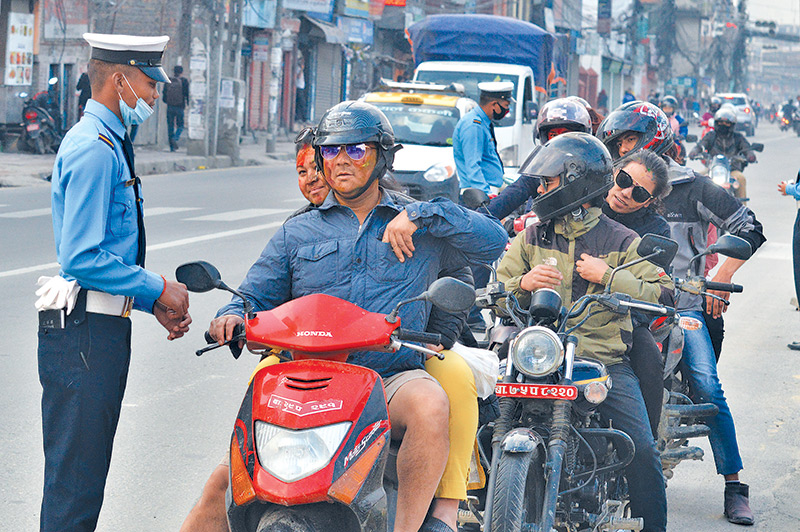
Traffic police work on chaotic streets, attempting to manage traffic and prevent accidents. Post file Photo

KATHMANDU,
On September 10, at around 8:30 pm, police constable Manita Chemjong was rushed to Kathmandu Medical College Hospital after getting dragged by a motorbike while trying to stop a drunk driver near the Tribhuvan International Airport.
The Metropolitan Traffic Police Division conducts random roadside checks for alcohol with a breathalyser that shows the Blood Alcohol Concentration (BAC) through analysis of a driver’s breath.
Chemjong was on duty conducting random checks when a drunk driver, afraid of getting caught, sped off and escaped.
“I was holding a red magic light and had my hand extended when the drunken-driver suddenly sped up his motorbike and hit me,” said 22-year-old Chemjong. “My arm got caught and I was dragged for a good 30 seconds before ending up on the side of the road.”
Chemjong suffered no internal injuries but the driver is yet to be found and the police are investigating the case. As the incident took place at night with only Chemjong at the incident site, she didn’t get a chance to note the number plate. Even after reviewing CCTV footage, police haven’t been able to identify the motorbike.
For traffic police personnel like Chemjong, this is all part of the job. Braving Kathmandu’s dirt and dust, the traffic police diligently work on the city’s chaotic streets, attempting to manage traffic and prevent accidents, even while facing physical and verbal assault from unruly motorists. While the traffic police themselves don’t have a reputation for fairness or polite conversation, there is no doubt that they are on the frontlines of Kathmandu’s mayhem.
Jeevan Shrestha, superintendent of police at the Kathmandu Metropolitan Traffic Police Division, recalled his days of trying to stop vehicles for speeding.
“When speeding drivers spot traffic police officers, they speed up even more in order to escape, which at times results in accidents and injuries to both the police and the drivers,” Shrestha told the Post. “Many police officers have been handicapped, severely injured and some have even died on duty.”
In 2016, a severe accident resulted in the death of civil police constable Sajan Thapa and serious injury to head constable Shyam Thapa, according to incident record files that were provided to the Post. Bus driver Subash Thapa hit the two police officials who were patrolling on a motorbike on the way from Banepa to Bhaktapur.
According to Senior Superintendent of Police Bhim Prasad Dhakal, chief of the Metropolitan Traffic Police Division, each officer spends around 14-15 hours per day on duty, battling all sorts of weather conditions and managing traffic movement during protests, VIP arrivals, natural disasters and accidents. And although the traffic office has adopted CCTV cameras, traffic lights, street lights and traffic monitoring rooms in public places in recent years, the traffic police personnel continue to face risks.
“Nepal’s traffic policing is manual, where we have many police officers working tirelessly at every checkpoint, highway and busy streets because we lack technology,” said Dhakal.
“Although the government has provided relief accessories like sunglasses, masks, boots, raincoats, gloves and hats, I believe if we can work on advancing technology, the human resource being used on the roads can be used somewhere else.”
According to Manisha Budhathoki, a traffic police inspector, although every police officer is reachable via walkie talkie and mobile phone, without advanced technological gadgets besides CCTVs and Go-pro cameras, Nepal will continue to have manual traffic policing, which isn’t always accurate and fast.
“The reason we haven’t yet caught the individual who tried to avoid the checking and hit Chemjong is that we didn’t have a local CCTV monitoring unit. There was no proper street lighting in that part of the road as well, and we have no drones or automatic licence plate recognition devices,” said Budhathoki.  
While few disagree with the fact that the traffic police have an unenviable and difficult job, many drivers take issue with the way they conduct themselves.
Thirty-eight-year-old Ramesh Gurung has been driving a bus for Nepal Yatayat for the past 15 years and his complaint is that traffic police officers often give bus drivers tickets in circumstances in which they’re not at fault.
“I understand that the job of the traffic police is very difficult and I also understand how small delays might cause frustration,” said Gurung. “But we always speak to them with respect and politeness while they raise their voices at us and speak in a demeaning manner. If we try to put a point across, they slap us with a fine.”  
Dhakal agrees that there are traffic personnel who might not be polite and respectful towards public vehicle drivers. Ten years ago, behavioural training wasn’t in practice but after citizens started complaining about the traffic police’s behaviour, they’ve started communication and human relations training as a focal area in both practical and academic sessions,  said Dhakal.  
“We respect the public but we have to hold them accountable when they’re at fault because an offence is an offence regardless of the class, caste, colour, age and gender of the individual,” said Dhakal.
Raju Regmi, a 38-year-old taxi driver, echoed Gurung that some traffic police officials tend to vent their anger on public vehicle drivers for no reason.
“I have no bitterness towards the traffic police. They have a tough job and all taxi drivers and bus drivers understand that, but if the police spoke to us normally instead of demeaning and ordering us, we would respect them a lot more,” said Regmi.     
According to these drivers, the use of technology would not just help traffic police but also drivers like them. Gurung pointed out that neither the Traffic Police Nepal app nor the Traffic Police website has a separate section where the public can officially file online complaints against the police officers and not just leave feedback.
There are thousands of complaints registered every day using the same registration section where complaints against the police’s bad behaviour and injustice tends to get neglected amongst other public complaints. Having a separate registration section to file complaints against the police officers will help the public as well as the police to proceed with an unbiased investigation, said Gurung.

Page 2
MEDLEY

Horoscope

ARIES (March 21-April 19)
***
Toss out all restrictions you’ve put on yourself. You should say whatever you feel like saying, feel whatever you feel like feeling, and go wherever you feel like going. Holding back about what you really think—for the sake of sparing someone’s ego or for the sake of saving face—is not a good idea today.


TAURUS (April 20-May 20)
****
Sometimes, a well-fed spirit is as easy as a well-fed belly. So get some friends together and plan a dinner party or a dinner out.  Who says you need to wait until someone’s birthday or anniversary? Socialising over food is a great way to catch up, relax and have a great meal without having to help with the dishes.


GEMINI (May 21-June 21)
****
Today is a wonderful day to start getting all your accounts organised. Retirement, refinancing, and other financial goals have been on your mind lately, now is a good time to investigate new options—it won’t be as confusing as you fear! Asking friends for advice is a good place to start, but don’t take opinions as commandments.


CANCER (June 22-July 22)
****
Being forceful will benefit you today. If you tell him or her how you feel, you’ll get the answer you’ve been waiting for. If you walk into your boss’s office and finally demand what you know you’re worth, you’ll be justly rewarded. The only thing holding you back is your closed mouth. Open it up and say what you think.


LEO (July 23-August 22)
**
You’ve had the same goals for a long time—why aren’t you making any progress? Take a good long look at your aspirations, and admit that some of them are mere wishful thinking. Turn your energy toward the realistic goals that you can tackle with confidence, and you’ll make some real progress.


VIRGO (August 23-September 22)
**
A family gathering may stir up unfamiliar emotions, but this is something that you need to experience. Do not push your emotions away. Talk about them and understand they are not as scary as you think. Effective communication is a skill everyone should learn—you are extremely capable of teaching it someone you love today.


LIBRA (September 23-October 22)
****
If a friend wants you to get involved in something that you have serious doubts about, just say no. Make it clear that you’re not going to change your mind. The good news is that your friend will eventually respect your decision. This is yet another example of how lucky you are to have these wonderful people in your life.


SCORPIO (October 23-November 21)
*****
Think up your plan in the morning and carry it out throughout the day. Need to get attention of that cutie? Dress up, you certainly will. Want to show your boss what a rockstar you are? Get to the office early and wow everyone with your dedication. Getting what you want is about the groundwork and following through confidently.


SAGITTARIUS (November 22-December 21)
***
A series of missed connections may frustrate you today—plus, all these misses are adding to your anticipation. Keep this in mind when the rendezvous finally takes place. You two might have some mismatched energies that take a while to get in sync. Keeping the conversation light  will help you both find your equilibrium.


CAPRICORN (December 22-January 19)
***
Focusing on the future might seem like a wise way to spend your day. However, there’s also a lot to be said for taking things as they come so you can roll with the punches. Today, try to focus on the issues at hand. Think about tonight’s events and what you need to get done this afternoon.


AQUARIUS (January 20-February 18)
***
Don’t worry that a past health issue is popping up again. Chances are this physical change you’re feeling is merely a manifestation of some issues you’ve been tossing around. Get out and exercise some of these worries away. Socializing while you exercise is easier than ever, so get with your friends and enjoy an outing.


PISCES (February 19-March 20)
****
You have a real knack for innovation today, whether it’s thinking up a better way to do an everyday task at work or whipping up a delicious dinner. You’re thinking on your feet like never before. You are empowered to change your surroundings and affect the world around you—so go forward and shake things up today!

Page 3
NATIONAL

Authorities rescue children from squalid childcare homes

- BINOD GHIMIRE

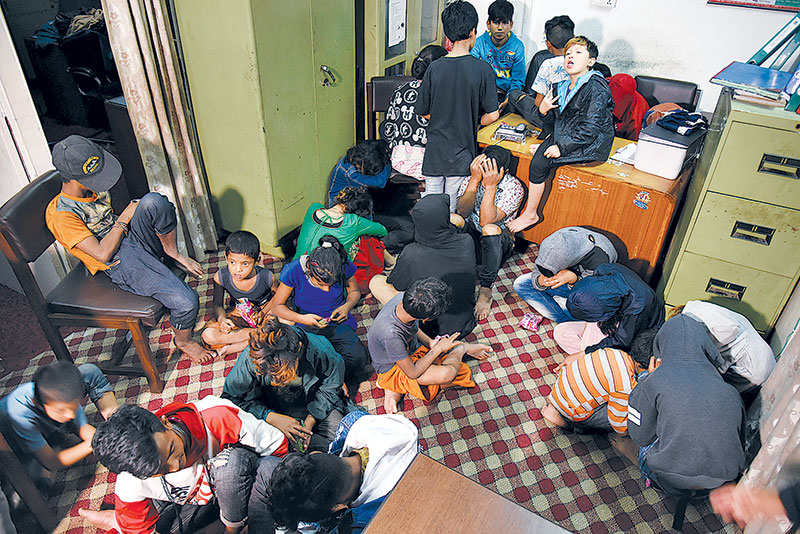
Eleven children were rescued from various childcare centres in the Capital on Wednesday.Post Photo: angad dhakal

KATHMANDU : The Central Child Rights Council together with the local administration have rescued 11 children from Samajik Tatha Manawiya Sarokar Kendra, a childcare home, in Kageswari Manohara Municipality. The children at the childcare home were living in squalid conditions.
The nine boys and two girls, from Mugu district, were brought to the home promising a good life and better education. However, when the joint team raided the home on Wednesday night, the children were not getting what they were promised.
They were not getting proper food while the operators had failed to maintain minimum hygienic conditions.Following complaints that many childcare homes had brought the children illegally, a joint monitoring team led by the council has been inspecting such childcare centres and rescued the children from seven such homes since May.
On May 17, a total of 122 children—77 boys and 45 girls—were rescued from Budhanilkantha-based Aishwarya Orphanage Home alone. Similarly, nine children were rescued from Kalanki-based Namuna Pragatisil Mahila Samaj on August 21. The monitoring team also rescued around 50 other children from different childcare homes in Ekantakuna, Tathali and Bhaktapur in the last couple of months.One thing that is common in all these rescue operations: the majority of children are from Karnali. “Most of them are either from Mugu, Humla and Kalikot,” Krishna Prasad Bhusal, chief at the council, told the Post.
According to the government’s Operation and Management of Residential Childcare Homes Procedure-2012, only those children who don’t have their parents or are challenged physically or mentally can be kept in such centres. However, a majority of the rescued children are found to have their parents in their home districts.
“It seems there is a network to bring the children to the Capital or other big cities from rural districts promising their parents of better education and better lives,” said Bhusal. “However, the situation is entirely different in reality.”The people working for child rights say there is a tendency to bring children from Karnali. As a majority of the people from the area are living in poverty, they readily agree to send their wards in the hopes of a better future for them. Bharat Adhikari, who is working with Child Workers in Nepal Concerned Centre (CWIN) for around two decades and leads Child Helpline, said “agents” are actively working to bring poor children from rural districts.Such agents, according to him, on an average collect around Rs50,000 from the parents, saying they will provide education and residence until they complete school education. They bring the children here and handover them to the childcare centres for monetary gains.
“It is easier for the centre to collect funds if they have children from Karnali,” he told the Post. “The children get decent treatment until there is proper funding. As the funding tapers off, such centres do not treat the children properly.”Adhikari says there are incidents where operators of such centres have escaped leaving no one to care for such children.
There are 14,864 children residing in 533 childcare centres operating in 46 different districts of the country, according to the council. According to him, legal lapses and the lack of awareness among the local people are also to blame for such a situation. The operators of the childcare homes don’t face stern action unless they have tortured the children.Officials from the districts, who also have the authority and responsibility to control the practice of children being taken illegally, say they are helpless as they don’t get information about such incidents beforehand.
“Our’s is a remote district,” Chief District Officer of Humla Binita Bhattarai said, “therefore, getting information from the local level is a challenge.”

NATIONAL

Stern action planned against companies failing to develop anti-money laundering mechanism

Ahead of Nepal’s compliance evaluation next year, the government moves forward to strengthen enforcement mechanism.
- PRITHVI MAN SHRESTHA

KATHMANDU : The Office of Company Registrar has drawn up a draft
proposal on anti-money laundering which requires companies to develop a customer identification mechanism and make reporting of purchased goods or services worth over Rs1 million.
The office said it was currently discussing the draft with various government agencies and the private sector. The draft proposal prescribes severe punishment for the companies that fail to develop anti-money laundering mechanism.
The proposal was drafted as the government is racing against time to strengthen its enforcement mechanism of anti-money laundering laws and rules ahead of Mutual Evaluation of Nepal’s Performance by Asia Pacific Group on Money Laundering, a regional anti-money laundering body, in 2020-21. Nepal is a member of this body which evaluates the performance of member countries based on a peer review system.Faring badly during the evaluation could lead to blacklisting of the company by Financial Action Task Force, a global anti-money laundering body. International financial institutions would stop conducting transactions with the country which is blacklisted. In the modern banking system, import and export would be shut if any bank rejects transactions.Although the anti-money laundering law was first introduced in 2008, it took more than a decade for the Company Registrar Office to prepare for issuing directive regarding money laundering and terrorist financing.
“After the government categorically instructed us to issue the directive recently, we came up with the draft of the directive,” said Bhuwanhari Aryal, the registrar. Aryal said that his office plans to introduce the anti-money laundering directive soon after securing clear direction from the higher authority. The proposed directive is a part of the government’s recent push to improve the number of deficiencies related to Anti-Money Laundering and Combating Financing to Terrorist (AML/CFT). Recently, the government unveiled a five-year ‘National Strategy and Action Plan for Combating Money Laundering and Financing of Terrorism,’ which allows anyone accused of financial impropriety to be investigated for money laundering.
This means that any complaint registered with government agencies such as the Commission for Investigation of Abuse of Authority, Nepal Police, Department of Revenue Investigation, and the Department of Foreign Employment, will automatically be up for investigation for money laundering.
The proposed directive says that a company will have to conduct a detailed identification process about the customer (a person or an institution) who has done transactions over Rs2.5million in a day or over Rs10 million in a year. The directive states that such transaction should be considered unnatural and requires detailed customer identification.
According to the proposed directive, failure to maintain a Know Your Customer (KYC) record would also lead to a fine up to Rs10 million and the abolition of the company. A reporting entity should maintain record up to five years since the suspicious transaction or transactions above threshold takes place.
The penalty is as high as Rs10 million for the failure to develop an institutional mechanism including capacity enhancement of employees to deal with money laundering and terrorist financing.
Likewise, a company will face a fine up to Rs1 million for failure to submit a report about transactions above threshold (Rs1 million) and suspicious transactions.
A company which cannot prepare an anti-money laundering policy and one which does transactions with an unnamed company will also face penalty, according to the draft proposal.
The Office of the Company Registrar has proposed different penalty provisions based on the number of times a company violates the directive.
Firstly, the company registrar office can issue a warning notice, followed by denial of the government services and fines.
“The provisions on penalty have been proposed in line with the law,” Aryal said.The private sector, meanwhile, is uncomfortable with the proposed provision of requiring to maintain KYC for any transactions above Rs1million.
“This will complicate doing business,” said Pashupati Murarka, former president of the Federation of Nepalese Chambers of Commerce and Industry, the apex private sector body, commenting on the draft proposal.

Page 4
NATIONAL

Ruling party Co-chair Dahal wants people to restrain themselves on social media

Analysts say Dahal’s statement might be indicative of the current government’s intention of controlling social media.
- TIKA R PRADHAN,BHRIKUTI RAI
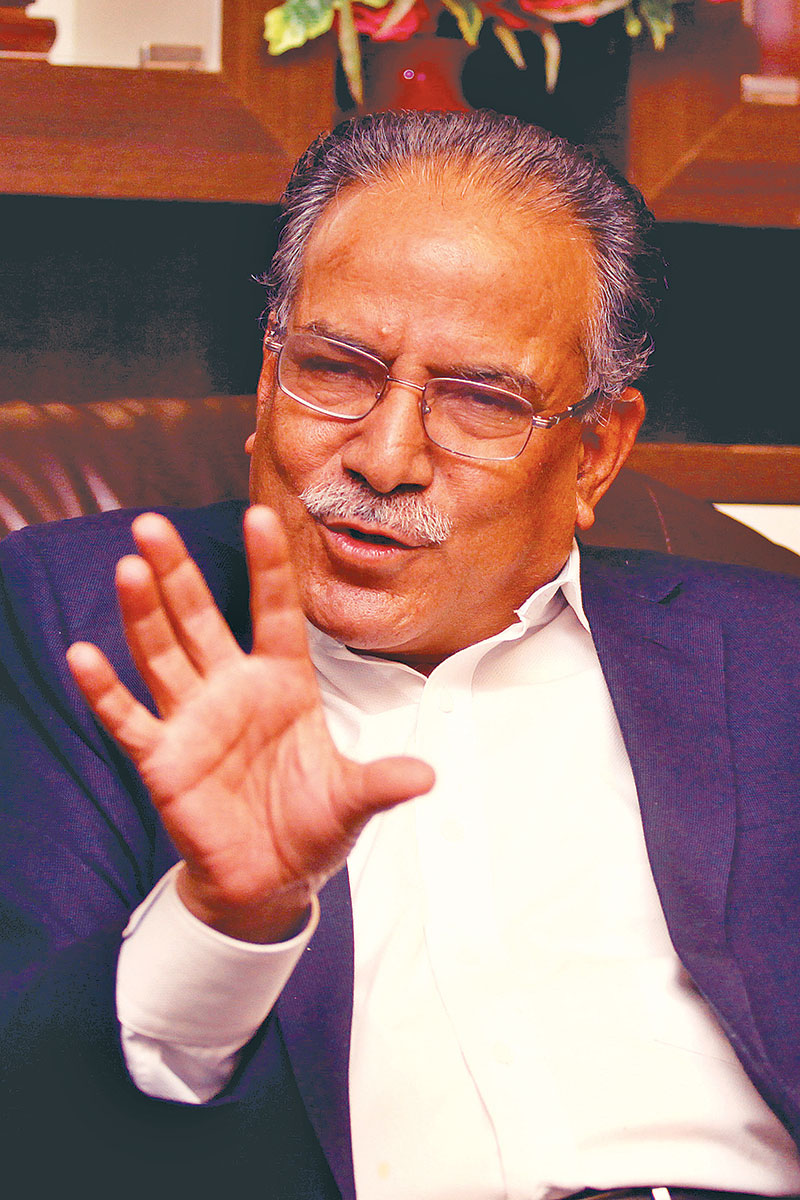
Pushpa Kamal Dahal.

KATHMANDU : Ruling Nepal Communist Party Co-chair and former prime minister Pushpa Kamal Dahal lashed out at social media users on Saturday, saying that the onslaught of negative comments directed at him and other leaders is unfair.
Speaking at the launch of a news site in the Capital, Dahal expressed serious concern over negative and critical comments against politicians on social media and asked media persons to empathise with leaders.
“People say all kinds of nasty stuff to us on social media and also propagate misleading things about us,” said Dahal. “I hope you reporters will think about giving us some justice.”
He spoke at great lengths about freedom of the press being enshrined in the constitution and that no legislation would ever take the freedom away.
“In some countries, Facebook does not work but we don’t want to control it here, although everyone seems to be attacking us on social media platforms,” Dahal said. But he was also quick to call out the press advising them against acting irresponsibly.
“Freedom doesn’t mean anarchy,” he told the room full of reporters. “Instead of the state regulating and controlling them, journalists themselves need to do some serious thinking about how to move forward with their code of conduct.”Dahal’s statement comes just days after the Press Council and Nepali journalists’ umbrella association, the Federation of Nepali Journalists, amended the Journalists’ Code of Conduct, in an attempt to monitor what reporters say on social media. But political analysts say politicians themselves are to blame for the negative comments and the very nature of social media, which gives a wide reach to a larger audience while also opening floodgates of comments and reactions—both positive and negative—cannot be tamed.
“Social media is actually an asset of a free society,” said Prof Krishna Khanal, a political analyst. “Politicians tend to regulate or control media that is critical of them, but with social media, they cannot escape criticism for their questionable conduct.”While some politicians and ministers in office blame social media for their unflattering portrayal, the same platforms have also been a place where good deeds of the people in government garner well-deserved accolades. Analysts point towards people like Kulman Ghising, who as the head of Nepal Electricity Authority was able to fix the issue of endless power cuts plaguing Nepal until a few years ago.Rajendra Maharjan, a political commentator, said the mindset of the leaders to regulate social media is not a new phenomenon, especially in the current government where ministers regularly lambast the press and critical voices on social media.
Not only Dahal, Prime Minister KP Sharma Oli has also expressed serious concerns over the negative comments on social media against the activities of the government. Maharjan said Dahal’s statement on Saturday might be indicative of the current government’s ill-intention of controlling social media and online news portals, which it has tried through numerous stern laws like the Media Council Bill and the IT Bill.
“The government has been trying to control the media like it has controlled institutions like Tribhuvan University,” said Maharjan. “It’s obvious that leaders are intolerant of criticism.”
Internet policy experts say social media has become a challenge for politicians, who tend to have an autocratic streak. “Social media has become the best platform to challenge the autocratic ways of politicians, making them loathe the platform,” said Baburam Aryal, an internet and media law practitioner.
According to Aryal, parties across the spectrum, whether they are in the government or in opposition, tend to view social media as a threat to their popularity.
“Not just the ruling party but opposition parties also tend to control social media just to conceal their partisan interests, ” said Aryal, “without understanding the power of social media to spur positive change.”

NATIONAL

City officials to monitor market around the year to curb anomalies

- SHUVAM DHUNGANA

KATHMANDU : Kathmandu metropolis, in a bid to curb market anomalies, has intensified market monitoring in the city.
The Kathmandu Metropolitan City (KMC) on Friday organised a meeting to discuss the issue of market monitoring. Later the same day, it decided to inspect the market throughout the year as occasional monitorings were not effective.
KMC in June last year formed an inspection committee led by Deputy Mayor Hari Prabha Khadki but the team was inactive after some weeks of its formation.
The municipal office has activated the committee for monitoring the market after receiving complaints from customers in the festive time regarding the price of goods, and quality of food products and other essential goods sold in the market.
According to Deputy Mayor Khadgi, the committee was active only occasionally. “KMC has attached priority to it as it is a matter of public interest. Now the committee will inspect the market around the year and if we find anomalies during inspection, they will be punished as per the law,” Khadgi said at a meeting on Friday.
Market monitoring has been regulated in all the wards of Kathmandu. According to the KMC, a majority of the shops and enterprises in Kathmandu do not meet the government’s minimum standards. “In a recent inspection of the market by the committee, there were seven mismatches among the 10 minimum standards set by the government,” said Dipak Pokhrel, a committee member.
The KMC monitoring team comprises the representatives of the District Administration Office, the Supply Management Department, Food Technology and Quality Control Department, Nepal Bureau of Standards and Metrology, Metropolitan Police, the Central Animal Quarantine Office, Veterinary Public-Health Office and the Consumer Protection Forum.
After the meeting on Friday, the committee immediately inspected shops near Sundhara and found that a majority of them had issues regarding the cleanliness, registration and renewal of shops, and |the quality of goods. “This time, we have given them a chance to improve but from next time they will be punished,” said Hari Bahadur Bhandari, chief of the Livestock Service Department.
The Consumer Welfare Protection Act provisions fines in case any firm is found to be breaching the law. The inspection officer can impose a fine of Rs 5,000 to Rs 300,000 maximum if the producer of goods, transporters, importers, sellers or service providers are found at fault on the basis of spot evidence in the course of market monitoring, inspection, checking or searching.
The Consumer Protection Act-1998 protects consumers from irregularities concerning the quality, quantity and prices of consumer goods or services and misleading propaganda regarding the use and usefulness of consumer goods or services.

Page 5
NATIONAL

Conducting surveys after staff adjustment creates problems in health facilities

Officials say additional posts are being created for those who have political connections.
- Arjun Poudel

KATHMANDU : Kirtipur Municipality last week sent back two doctors, transferred by the Ministry of Health and Population Bishnu Devi Hospital. This was because the municipal-run hospital already had four doctors, which was more than what the hospital needed.
“We sent the doctors back because we already have more than enough doctors,” Dhurbaraj Acharya, chief executive officer of the municipality, told the Post. The hospital needs only two doctors.
The Ministry of Health and Population has transferred doctors and health workers to several health facilities in Kathmandu Valley, even to those health facilities that already have enough staff. Concerned health facilities say that unplanned transfer of health professionals has created confusion.
Following the concerns raised by several health facilities, the ministry is currently conducting an organisation and management survey. But some health professionals are not convinced.
The survey, according to them, is aimed at adjusting staff at health facilities at accessible areas like Kathmandu Valley.
“We learned that the Department of Health Services had transferred four more doctors to our hospital, but we could not accommodate them,” Acharya said. “Doctors should be deployed proportionally since a lot of health facilities lack doctors.”
Many health workers wish to work in areas that are easily accessible, including Kathmandu Valley, and some of them are using their political connections to secure convenient postings, according to some officials at the health ministry.
Several health facilities in remote regions of the country lack doctors and health workers, which has forced patients to seek treatment in big cities. In some places, a transfer of trained staff and specialist doctors has led to the closure of medical services, including cesarean delivery.
The Health Ministry has been accused of transferring doctors and other medical staff on an ad hoc basis.“While other ministries carry out the organisation and management survey before transferring staff, the health ministry is doing the opposite,” said Jagat Nepali, a senior health assistant.
The Provincial Health Office in Kathmandu said that the number of health workers had increased in some health facilities, as the Health Ministry halted the transfer of serving staffers due to the dengue epidemic.
“The doctors and health workers transferred to Kathmandu Valley from other districts have joined their new jobs, but those who have been transferred have not left,” said Indira Pandey, an official serving at the Provincial Health Office.Mahendra Prasad Shrestha, the spokesperson for the health ministry, said the organisation and management survey was essential to determine the health worker’s requirements in health facilities.
“It would have been better had we carried out the study before the adjustment,” Shrestha said. “We could not do it earlier because there was a rush to fill the vacant positions.”According to him, doctors and health workers who have been turned back from their new postings would be adjusted by creating new posts in health facilities that lack staff.

NATIONAL

Students attend school regularly after new buildings were constructed in Sindhupalchok

- ANISH TIWARI

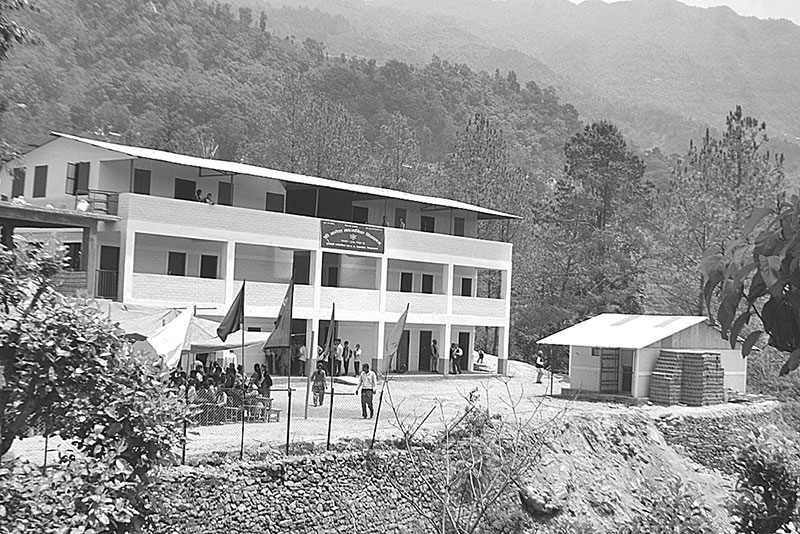
The new building of Janajagriti Secondary School was constructed after the old structure was destroyed in the earthquakes of 2015. Post Photo

SINDHUPALCHOK : Students of Janajagriti Secondary School in Sindhupalchok have shifted into a newly constructed school building after four years of studying in makeshift classes. Their previous school building was destroyed in the Gorkha Earthquake of April 25, 2015.
“Now that we have moved into a new building, students are regularly coming to school. The new building is both earthquake-resilient and disabled-friendly, and has proper toilets and a library” said Madhav Prasad Khanal, the school headmaster.
The construction of the building was funded by the Japanese Embassy, which recently handed over the Rs 20 million building to the school authorities.
According to the data of the District Project Implementation Unit, the construction of 290 school buildings in Sindhupalchok has been completed so far. The devastating 2015 earthquake had destroyed 528 school buildings in the district.
Devya Thapa, a 10th grader at Thangpaldhap Secondary School in Sindhupalchok, said she is looking forward to attending classes in the new school building.
“We faced difficulties for a long time due to a lack of toilets and other infrastructures. But now we don’t have to face such hardships. Our classes will continue even if it rains or gets too cold,” said Thapa. Yam Bahadur Khadka, chief at the District Project Implementation Unit, said, “School buildings in the district are being constructed with the assistance of various government and non-government organisations,” said Khadka, adding that the reconstruction of the quake-affected schools in Sindhupalchok is expected to complete in two years.

NATIONAL

Construction of Mid-hill Highway mired in dispute

Over 800 households will be affected if the highway project is implemented.
- AASH GURUNG

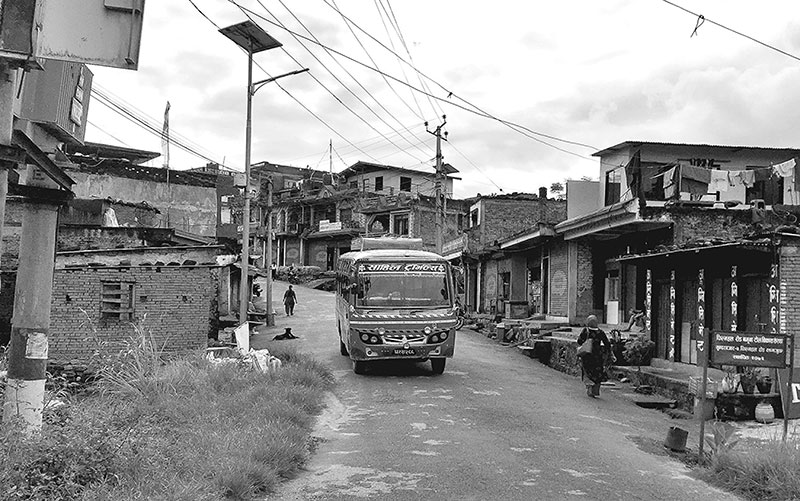
The road runs through a settlement (as seen in the picture) and was constructed by locals for their use and not as a part of the highway.Post Photo: Aash gurung

LAMJUNG : Residents of Sundarbazaar in Lamjung for the past five years have been protesting the government’s plan to construct a section of the Mid-hill Highway through the settlement. The protest flared up recently after the locals obstructed road officials from surveying the road project.
The government plans to use a road section that runs through the settlement as a part of the Mid-hill Highway. However, the road was constructed by the community for their personal use and not as a part of the highway project, said Nabin Shrestha, a resident of Khatrithanti.
“The Mid-hill Highway cannot run through this way,” said Shrestha. “The government should find other alternatives to construct the highway.”
According to locals, they also met with the Minister of Physical Infrastructure and Transport a few weeks ago to discuss the issue, but
the minister did not pay heed to their concerns. Over 800 households in Sundarbazaar area stands to be affected if the highway runs through the settlement. Uttam Gurung, the coordinator of the struggle committee formed to protest against the government’s plan, said Sundarbazaar residents will not allow authorities to run the Mid-hill Highway through the middle of the settlement.
“The government find alternatives to run the road from the upper or lower part of the settlement. They should not be allowed to cut through the main town area,” Gurung said.
The authorities plan to construct a road section from Paundi to Sundarbazaar. Around 8km of the road stretch goes through the Sundarbazaar area.
According to the Ministry of Physical Infrastructure and Transport, settlements that run along national highways should leave a minimum space of 31 metres (on both sides from the centre of the road) while constructing physical infrastructures, including houses.
“Our houses and properties will be destroyed if we let authorities open a national highway through our settlement. We cannot spare our land to the road project and turn into landless squatters,” Shrestha said.Galu Miya, former chairman of Sundarbazaar Unit of Chamber of Commerce and Industry, said the unit has submitted a memorandum to the ministry and Gandaki Province through the chief district officer.
“If authorities do not address our demand, we will intensify our protest programmes,” said Miya.Janakraj Mishra, mayor of Sundarbazaar Municipality, said the municipal office does not agree with the government’s plan for the Mid-hill Highway.
“We will not allow the construction of the road through the settlement. That will make the locals landless, and we are committed to stopping that from happening,” said Misha at a press conference on Thursday. Dwarika Prasad Mishra, a resident of Sundarbazaar, said the concerned authorities have not paid attention to the locals’ problems. “We have never been against development. All we want is to keep our land and properties intact,” Mishra said. A task force led by Ram Sharan Basnet, provincial minister of Gandaki Province, was also formed to address the issue. A few months ago, the task force had collected details from Sundarbazaar and submitted a report to the central government, but the locals haven’t been brought abreast to the recommendation provided by the task force.

NATIONAL

Syaphrubesi-Rasuwagadhi road upgradation begins

According to the Department of Roads, round 16km road will be upgraded to a two-lane, all-weather highway.
- BALARAM GHIMIRE

Officials inaugurate the project with a ribbon-cutting ceremony on Saturday. The project is expected to be completed within three and a half years.Post Photo: balaram ghimire

RASUWA : Upgradation work of the 16-km Syaphrubesi-Rasuwagadhi road
section started on Saturday.According to the Department of Roads, the road will be upgraded to a two-lane, all-weather highway. This road section makes up the final stretch of the crucial Galchhi-Trishuli-Rasuwagadhi highway linking Nepal and China.
The road is being upgraded with Chinese financial assistance. The road upgradation work officially started on Saturday, Project chief Narayan Datta Bhandari said, adding, “The construction work will gather momentum
from October 8. China’s Tibet Tinalu Company Limited has been awarded the contract to upgrade the road.”
According to project officials, the process to provide compensation for the land acquired by the project has already begun. Workers are clearing structures on either side of the road. Around 82 houses and huts, along with 323 utility poles should be removed from the road area.
The Chinese side has assured that the project office that it would be completed within 39 months. The total cost of the project is Rs4.5 billion. As per the bilateral assistance agreement signed in December 2016 between Nepal and China, a portion of the Rs15.7 billion (RMB 1 billion) fund
will be used to repair and improve the Syabrubesi-Rasuwagadhi section of the highway.
Likewise, road upgradation work along the Galchhi-Trishuli-Mailung-Syphrubesi-Rasuwagadhi road is scheduled to be carried out in three phases. The road expansion work, construction of the retaining wall and the drainage canal are underway along the Mailung-Syaphrubesi section in the first phase. More than 50 percent work has been completed so far in this section, project officials say. The Nepal Army has also opened the track along the 18-km Mailung-Syabrubesi section and handed over the project to the Department of Roads.
The Galchhi-Trishuli-Mailung-Syphrubesi-Rasuwagadhi is a national pride project that has been deemed as a strategic road network connecting the southern and northern neighbours. This 82-km highway is key to implementing the Transit Transport Agreement signed between Nepal and China in 2016.

NATIONAL

Activist Gyanendra Shahi attacked in Chitwan

- RAMESH KUMAR POUDEL

CHITWAN : Gyanendra Shahi, a self-styled anti-corruption campaigner, was manhandled in Bharatpur, Chitwan, on Saturday afternoon. Shahi, who was in Chitwan to address a function organised by a group called ‘Nepal Ka Lagi Nepali’, has sustained injuries on his skull and right leg.
Shahi underwent preliminary treatment at Chitwan Medical College after which he was taken to Kathmandu for further treatment, according to the spokesperson of Chitwan Police Ek Narayan Koirala. The hospital’s chief administrator Pratap Devkota said the injuries don’t seem that deep, and more details will be revealed after conducting a CT Scan.
Shahi was attacked with stones, rods and sticks by a group of local youths, Koirala said. Police have detained a man in connection with the attack. A group of youths close to the ruling party had obstructed the programme earlier, following which the police had ordered the organisers to cancel the programme being held in Chaubiskothi. After the programme got cancelled, Shahi was returning home on a microbus when he got attacked, according to the police.
“While we were focusing on the programme venue, we came to know that a scuffle broke out in a microbus,” said Koirala. “We are investigating the incident.”Of late, the youth wings of the ruling party have been venting ire against Shahi, saying they would not let him organise any programmes.
Shahi was one among the passengers who criticised Minister of Tourism Yogesh Bhattarai for causing a delay to a Kathmandu-bound Buddha Air flight in Nepalgunj earlier this month.Pramita Dhakal contributed reporting.

NATIONAL

Five passengers hurt in rockfall

Briefing
- Post Report

PALPA: Five passengers sustained injuries when rocks fell on a running bus along the Dobhan-Siddababa road section in Palpa on Saturday. The injured were taken to the Provincial Hospital in Lumbini for treatment, said police. There were 22 passengers in the Butwal-bound vehicle.


NATIONAL

Busts of Sherpa and Hillary installed in Jiri

Briefing
- Post Report

DOLAKHA: Former Prime Minister and Co-chairman of the Nepal Communist Party Pushpa Kamal Dahal unveiled the statues of Tenzing Norgay Sherpa and Sir Edmund Hillary in Jiri, Dolakha, on Saturday. The busts of the mountaineering legends have been installed near the Jiri Airport.

NATIONAL

Three persons held with opium

Briefing
- Post Report

SALYAN: Police arrested three persons in possession of opium from Setigurans in Salyan district on Friday evening. Acting on a tip-off, security personnel detained the suspects with 884 grams opium. Investigation into the case is underway, said police.


NATIONAL

Historical Liglige Race to take place on October 2

Briefing
- Post Report

GORKHA: Palungtar Municipality announced on Saturday that the historical Liglige Race will take place on October 2. Mayor Dipak Babu Kandel said the race will help preserve traditions and promote tourism in the district.


NATIONAL

Colleges run out of budget in Ramechhap

Briefing
- Post Report

RAMECHHAP: A majority of government-funded colleges in remote areas of Ramechhap district will soon be out of operation due to a lack of budget. Stakeholders have demanded the local units to formulate policies to fund the district’s colleges.

Page 6
OPINION

A long way to go

Nepali cinema is grappling with the fundamental questions of experiments marketing them.
- ABHI SUBEDI
Shutterstock

Neer Sha, the veteran Nepali cinema icon, has made some crucial interventions in the ongoing discourse about the identity and the entire oeuvre of Nepali cinema. What Shah said at a conference about Nepali cinema in the capital last month deserves attention for several reasons. First, in his long career spanning 55 years in all aspects of Nepali film production, he has participated in the crucial modes of the historicity of this very important, and in his words, not a very thriving industry. Secondly, he is firmly in favour of opening academic discussions about Nepali cinema starting with the first Nepali film (DB Pariyar’s Satya Harischandra released some 70 years ago in September 1951). The moral is that this industry is old, but it has not made any avant-gardist breakthroughs, nor has it established a comfortable standard culture of making cinemas for the evolving Nepali audience regularly. Instead, as we understand from the intervention of this esteemed Nepali cinema veteran and insider, the history of Nepali cinema is a history of jolts, claims and counterclaims.
The genesis of Nepali cinema speaks volumes. One, as Shah says, is the question of originality of the text and drama. He recalls how Debu Sen of then Bombay was made to write the screenplay for the film Manko Bandh, whose authorship in Nepali translation was owned by a member of the Nepali Chalachitra Sansthan. The bitterest confession of Shah can be found in these words, ‘It seems, I have wasted my life, but today’s energetic and vibrant youths engaged in this industry should not waste theirs.’ The other point Shah makes is that Nepali cinema makers were not aware of the works of Nepali literary writers who had established a robust literary tradition starting with Bhanu Bhakta Acharya whose Ramayana, he appears to believe, could have been used for a cinema.
Shah’s speech coincides with the screening of Kabbadi—a blockbuster movie whose recent sequel just came out. Pushkar Gurung, my long-time theatre associate, claimed that this was the most significant commercial success achieved by a film in a day. Kabbadi and its sequels attracted me because a large ensemble of its cast consisted of actors who previously worked in the theatre. The director, Ram Babu Gurung’s techniques, align with the styles and theatrical openness of the artists who have been working with him. The strength of Kabbadi Kabbadi Kabbadi is its theatrical effect—simplicity, shifts of screenplay moments without jerks, its entire reliance on the native, or indigenous ethos and the non-Bollywoodian acting of the artists, which deconstructs a set pattern that Neer Shah has criticised as the non-productive and unoriginal exercise. Jatrai Jatra (2019) written and directed by Rhythm Paudel, similarly is a comedy-drama played by theatre artists. The theatre artists’ flexibility with some of the latest techniques of films should be seen as the moments of shifts in Nepali films.
I do not want to advocate Nepali films made so far have no role in carving out a history of film production involving good stories and screenplays, as well as directors and actors. Ashis Nandy, a scholar of India in his introduction to the famous book about Indian film The Secret Politics of Our Desires: Innocence, Culpability and Popular Cinema (1998) says Bombay cinema is made for all, and it is everybody’s subject. And that is what I am trying to say as well. Nandy adds, in the context of modernism, the Indians have made their caricatures, their self-acting in Indian films. Cinema is the reflection of what the middle-class Indians would want to have for themselves and India. But Nandy also sees the production of shaking fantasies in what he calls Bombay cinema. But Nandy ‘laments the loss of its multicultural ethos, erosion of its self-reflexivity and decline of its literary content.’
The irony is that the Nepali film production and consumption suffer from that very elision. Ironically, Nepali audience and film producers want to see their caricature through the Indian caricatures of the Indian middle class. As a result, the Nepali film producers and directors, as Shah complains, did reflect neither on the natural desire of the Nepali middle class, which has remained the primary consumer nor on the shaking fantasies. Nepali filmmakers and producers have learnt to live with these tacitly sanctioned exotic caricatures. One way out for that was that they would seek the Nepali national models in the Hindi film. And nobody but the Nepalis who were engaged in this field, as well as those who never discussed this subject seriously, are responsible for that.
The question of scholarship on cinema everywhere is a subject of discussion. The question of reference dominates our own conversations. From the very beginning, because of the non-existence of the filmmaking techniques, expertise and talents, we have used the Bombay film for reference. We referred to the Hindi films even to evoke the Nepali sense and to seek the creative domains. We produced some mimicry and some original works, no doubt. But the Nepali cinema despite many efforts is grappling with the fundamental questions of experiments and marketing the movies.
Nepali film should overcome the psyche of working as peripheral art. The best way to overcome that psyche is first and foremost, the proper education of those who are involved or would like to engage in cinema making and production. Secondly, the exploration of a multitude of diverse cultures, folklores, historical or political realities, myths and mythopoetic traditions is significant. Good indications and trends have strongly begun to appear in new cinemas, and this must continue.

OPINION

What does the word ‘recession’ say about a recession?

An increasing number of articles using the word has preceded any actual one in the US economy since 1981.
- JAGADISH PRASAD BIST
Shutterstock

The term recession has been in the limelight recently. The fear of a global slowdown could be seen in the opinion articles and editorials in renowned newspapers the world over. The fear of a looming recession can be seen in different economic forums also. Economic indicators and the political environment around the world are also fueling such arguments. According to the National Association for Business Economics, 74 percent of economists supported the view that there would be a recession by the end of 2021. The father of the ‘inverted yield curve’, Campbell Harvey, also warned for a possible recession. Some economists, such as David Solomon argued that the chance of a recession in the near term is still relatively low. But, in most other cases, it is interesting to see that the word recession is so entrenched in different stakeholders’ minds. In fact, in 2019 alone (until now, of course), the term ‘recession’ was repeated more than 900 times in The New York Times.
The obvious question to ask is whether the usage of the term actually coincided with an actual economic slowdown. Here, it is important to understand how economists predict a recession. And the inverted yield curve model is a pioneer in doing this job: it has accurately predicted some of the previous recessions. The inverted yield curve, developed by Campbell Harvey, occurs when the yield on short-term Treasury bonds exceed the yield on long-term Treasury bonds. Harvey argued that if an inverted yield curve lasts for more than three months, then a recession occurs over the next nine to 18 months. The yield curve followed this trend in the US bond market during the first quarter this year. Similarly, rising unemployment rate, plunging stock markets, waning consumer confidence, declining performance of manufacturing companies, and so-called misery index are some of the barometers construed by economists to predict a recession.
The theory here is that the repetition of the term ‘recession’ usually has some reason: maybe a persistence economic downturn. This may be because businesses might be slowing, return on investment might be plunging, or other political and economic tensions might be rising. While business leaders may base their decisions on data and fact, they may be biased because of the opinion of others, as prescribed in news pages. Consumers, investors, and other stakeholders may take the repetition of the term seriously. For example, an investor may postpone his investment plan due to an article written by economists conveying the fear of a recession in the economy. Similarly, the same article may restrain consumers from purchasing a new house or apartment. Or, the general public may reduce consumption to save for the recession period. It can be argued that the repetition of the word recession has some indirect impact on an actual recession.
In fact, an increasing number of news reports and opinion articles using the word ‘recession’ has preceded any actual recession in the US economy since 1981. The data shows that a recession has followed a three-year period of persistent increment in the use of the term ‘recession’ by leading newspapers such as The New York Times. Moreover, news and articles consisting of ‘recession’ decline consistently in the post-recession period. It is interesting to note that when the usage of the word hits over 3,000 repetitions in a year, a recession occurs in the subsequent year. This case has held true in the recessions of 1981-82 and early 1990s in the United States, the early 2000s, or even the Great Recession of 2007-09. Now, the use of the word in the Times has not only been increasing for the last two years but has also reached a level of usage similar to 2007. Does this mean that we are heading towards a recession? Following the pattern of the past, it can be argued that use of the term ‘recession’ by The New York Times may be a prelude to one in the next year or two.
As Casselman stated, it is difficult to predict with certainty when the next recession is likely to hit the world economy. The relationship between the term recession and actual recession may not be sufficient to offer concrete predictions. But it is more than enough to perceive that the world economy is not performing as expected. Thus, world leaders need to be cautious. Current economic and political indicators worldwide are further reinforcing this fact. The trade war between China and the US, plunging manufacturing industry in America and the Brexit impasse are signs. So are the falling return on long-term treasury bills (inverted yield curve), the economic slowdown in India, China, and Europe and the attacks on oil facilities in Saudi Arabia and hence. All of these issues are further increasing the fear of a global recession.


Bist is part of the faculty at The British College.

Page 7
OPINION

Amazon too will become a Thomas Cook one day

The world’s oldest travel agency collapsing delivered a warning of choice—evolution or extinction.
- Raja Murthy
Shutterstock

Thomas Cook vanishing into history on September 23 left 600,000 customers stranded, tormented tourists such as a young mother with a toddler thrown out of her hotel room in Turkey, thousands jobless. The ripple effect worldwide damaged tourism business in Germany, Turkey, Spain, Greece, Cyprus, Egypt. In India, Goa has to suffer over one lakh tourists disappearing.
This unprecedented crisis in the $8 trillion global travel industry served another reminder on impermanence. Everything changes, nothing lasts forever. Having a successful future or being buried in the graveyard of time depends on how effectively we adapt to changes. At one level Thomas Cook collapsed under the burden of a $2.1 billion debt. It needed to sell three million holidays annually only to pay interest on that debt. But that was only an apparent cause. Established in 1841, Thomas Cook was a legendary success, survived across two centuries, but had to at some point bow down to the universal law of impermanence. The death signs were clear. In 2018, nearly 700 travel agencies shut down in Britain due to competition from online travel sites.
But when the edifice was tottering, Thomas Cook chief executive Peter Fankhauser pocketed $10.3 million, including a $5.3 million bonus in 2015. The UK government is spending $124 million to bring its citizens back home, in yet another chapter of taxpayers paying for corporate greed and incompetence. Incompetence includes an inability or refusal to see the reality of changes, such as the multiplying impact of technology in our lives. The Internet is the latest revolution of the current world cycle of human existence, with the new continuously replacing the old.
Austrian-American economist Joseph Schumpeter (1883-1950) used the German term, schöpferische zerstörung, creative destruction, to describe the tumultuous changes that periodically shake up human history. In his 1942 book Capitalism, Socialism and Democracy, Schumpeter described how ‘creative destruction’ works, with emerging technologies destroying old industries, jobs, lifestyles—and creating new industries, jobs, lifestyles. It’s an endless process that will last until the present world system or the solar cycle lasts (until our solar system gets destroyed with the sun becoming a dead star), and another world system gets born with the destruction of the old.
 We have seen ‘creative destruction’ at work: the industrial revolution replacing agriculture-oriented life on the planet across millennia; the computer age impacting industries, and now the Internet influencing and changing our life. Traditional travel agencies like Thomas Cook have given way to online ticketing services such as Expedia, and through airlines selling tickets on their websites. Likewise, the traditional retail industry faces its biggest challenge. More people buy all they need online, including groceries. ‘Retail Apocalypse’ has become the term to describe the decline and disappearance of brick-and-mortar shops that were once a familiar part of our lives. In the US, the term ‘ghost mall’ is a now common phenomenon. Once bustling mega shopping centres are now abandoned, eerily empty.
Suffering and insecurity become part of these changing cycles, with thousands of jobs lost in industries rendered redundant. We have seen how the mobile phone has taken over multiple uses: the land-line telephone, torch, FM radio, music player, television, video player, camera, wristwatch, fax and photocopying machine—and thereby reducing or closing down industries manufacturing those devices commonly used 20 or 30 years ago.
Thomas Cook joined the extinction list of giants such as Eastman Kodak that once employed tens of thousands of workers. Book librarians, secretaries, shop assistants, postmen are disappearing. Driverless cars and drones are appearing to deliver goods, robots are replacing factory workers. Traditional factories might also disappear. Evolving 3D printing technology is revolutionising manufacturing. Within 20 years, 3D printing will enable people to make at home customised goods. The world’s first 3D printed car, Starti was printed out in two days (with three days of milling and assembly) and test-driven in September 2014. It’s no longer a fantasy to make your own car at home through 3D printing.
The code of life through these changes needs a fearless mindset, a spirit of happy adventure of being open to change. We cannot fear the familiar giving way to the unfamiliar. Rejecting positive change is rejecting progress in life. If our Stone Age ancestors had chased way the unknown mega-genius who first invented the fire and the wheel, we might still be living in caves, dining on tree leaves and raw meat. ‘Change is inherent in all compounded things’, said the Buddha. Nature effects change through the law of cause and effect. Creation and destruction are part of the changing balance of life.
Schumpeter explained ‘creative destruction’ through economic doctrines such as ‘Marxism’ and ‘Capitalism’. But I am inventing a new and more accurate term ‘Technonomic Re-distribution’—the re-distribution of wealth through new technology-driven changes in the economy. Wealth has to change hands, to be shared, and cannot be hoarded forever in the hands of the few dominant. The wiser among the wealthy realise this, donate generously and even renounce all their wealth for the good and welfare of many. They realise they are custodians of wealth, the conduit for distribution. If we do not voluntarily share, we will experience despair. What is selfishly hoarded will be taken away.
Such a change is inevitable. What happened to Thomas Cook will happen to Amazon and other mega online entities now earning billions. In every field of work and life, remembering impermanence helps reduce pain and suffering from attachment to things that are bound to change. No business, job, relationship, possession, status is permanent. Accepting this fundamental reality of change helps develop the mindset to be prepared for change. Losing the fear of change enables living life without fear and insecurity. We live with detached
happiness, of tranquillity amid turmoil, with equanimity to the inevitable reality of change.


Murthy is a journalist who contributes regularly to The Statesman, which is a part of the Asia News Network.

OPINION

Investing in frontline health workers

They work to improve global health, yet the world continues to underestimate their contributions.
- Maha Barakat
Shutterstock

Frontline health workers provide essential services—from administering vaccinations to collecting the data needed to anticipate disease outbreaks—where they are most needed. These workers brave difficult, often dangerous, conditions to reach the one billion people around the world with limited access to health services, whether in remote rural villages or conflict zones. And they are not getting enough support.
The power of frontline health workers to improve global health has been proven time and again. For example, in the early 2000s, Rwanda and Ethiopia recruited and trained thousands of such workers to lead the fight against malaria by educating communities on prevention and detection, distributing tools like bed nets, and administering treatment. As a result, the incidence of malaria fell by 75% in the two countries from 2000 to 2015.
Yet the world continues consistently to underestimate the capabilities and contributions of frontline health workers. This not only undermines their ability to do their jobs effectively; it also puts them at significant risk, with widespread misinformation about vaccines, for example, fueling attacks against those who provide them.
Consider Pakistan, where hardline clerics and militants view polio vaccination programs as Western ploys to sterilise and spy on Muslims. In April, two gunmen attacked a team of health workers, killing one and critically injuring another. Similarly, in Nigeria, the Islamist militant group Boko Haram—which has claimed that the polio vaccine can lead to infertility and bone injuries— is credited with a 2013 attack on vaccination-team members that left nine dead.
Such conditions are discouraging skilled people from joining the ranks of frontline health workers. The World Health Organisation warns that, by 2030, there will be a shortfall of 18 million health workers, with low- and lower-middle-income countries hit especially hard.
Without enough frontline health workers, the world will not be able to fulfill the target of ending malaria, tuberculosis, and neglected tropical diseases by 2030—part of United Nations Sustainable Development Goal (SDG) 3. The 2018 commitment by 53 leaders of the Commonwealth countries to halve the malaria burden by 2023 will also remain out of reach. In fact, by crippling primary health-care systems, a shortage of frontline health workers could reverse past progress, particularly in poor and marginalised communities.
Fortunately, the international community has started to recognise this. In May, the World Health Assembly concluded with three resolutions: on universal health coverage (focusing on community health workers), primary health care, and next month’s High-Level Meeting on Universal Health Coverage.
Moreover, on the WHA’s sidelines, the WHO co-organised, with the International Pharmaceutical Federation, a meeting to address the health-worker shortfall, producing six key messages to guide such efforts. The first message is to foster collaboration among health-care professional associations, in order to mobilise a multi-sector strategy.
Such cooperation is imperative. But to ensure adequate funding, it must go further. In the past, major donors like France, the United Kingdom, and the United States have played a significant role in driving progress in global health, both directly and through the Global Fund to Fight AIDS, Tuberculosis, and Malaria. Their work has been supplemented by non-governmental donors, such as the Bill & Melinda Gates Foundation, the Carter Center, and His Highness Sheikh Mohammed bin Zayed, Crown Prince of Abu Dhabi. More recently, the private sector has also been increasing its contributions; for example, some pharmaceutical companies have donated vaccines and medications.
Given the scale of the problem and the frequent scarcity of domestic funding, all stakeholders must ramp up their contributions. To that end, we must make better use of innovative financing mechanisms that mobilise private capital to support the creation of resilient health systems and a strong frontline health workforce.
At the same time, steps should be taken to ensure the most efficient possible use of funding. That means heeding another key message of May’s WHO meeting: ‘implement what works,’ from community engagement to people-centred approaches.
Frontline health workers are crucial to such a strategy. That is why yet another key message is to ‘ensure decent work’: proper training, fair compensation, adequate support, and personal safety. Experts estimate that every dollar invested in the community health workforce could generate $10 in increased productivity.
The final piece of the puzzle is technology, which can support health workers on the ground. For example, mobile phone apps can help connect workers to the most remote patients, enabling faster diagnosis and real-time health advice. Moreover, digital technology can facilitate accurate analysis of the data health workers collect, thereby strengthening service delivery and outbreak detection.
Frontline health workers are the unsung heroes of global health. It is time to sing their praises—and implement policies that reflect their value.


—PROJECT SYNDICATE

Page 8
THE BLACKBOARD

Personal space in Nepali culture

- Raman Budhathoki
chetan menaria/unsplash

“Hey mom! I’m going out for a friend’s birthday today, would you give me some money?” This is one of my most common lines when it comes to persuading my mom, whenever I have to go for a day out with someone special.
“How many friends do you have? Do your friends have birthdays every week?”
Of course, I wouldn’t be attending someone’s birthday every week, but I’m skeptical whether I’d be allowed to leave if I was honest enough to tell the truth. I hope you have one of yours as well. And why wouldn’t you have one if you’re a typical teenager from a Nepali family. To this day, we aren’t courageous enough to ask our parents for permission if we are to go on a date.
Perhaps we would, but will our personal space be respected then? I guess not. Being a teenager myself, I feel I lack personal space, and I’ve come to know that I’m not the only one who feels this way considering what I’ve heard from my friends. Personal space can be defined as the physical as well as the psychological space immediately surrounding someone, into which encroachment can feel threatening or uncomfortable.
The early years of childhood are most crucial to shaping a person for the future, and the relationships of children with their parents or guardians are most important. When a child transitions into adolescence, the desire for personal space increases, and keeps on increasing when an adolescent transitions to teenager and a teenager to adulthood. With the advent of making their own decisions, the search for freedom increases among teenagers and so does the risk be it beneficial or not. The personal space for an individual is like a bubble, which is essential for every individual to breathe in and be their own. The bubble includes our choices and social life, our feelings, our thoughts and perceptions over things with their expression. Although differences in attitude may increase between teenagers and parents, mainly due to the generational gap and lack of understanding, teenagers depend largely on them for emotional support. But its parents who still set the limits of freedom for us.
Setting limits for freedoms should be on the grounds of a mutual understanding between teenagers and parents. After all, who else but our parents know us more? It is not to be misunderstood that parents need to overlook even though their children are on the wrong path in the name of providing freedom. Although we always seek for more, what teenagers feel is that they are not able to fully harness the freedom within that range of liberty set by our parents.
And, conflict arises when our parents interfere, although we’re within the range they set, mainly due to misunderstanding. Perhaps, it is due to the immense love that they have for their children, our guardians tend to forget that we are growing into adults every day. But isn’t love about letting go at times? On the other hand, it is our bubble that gets poked when we get restricted freedom despite being within the domain provided.  Quoted beautifully, “Mistakes are the best lessons, while experience is the best teacher.” Are our parents unknowingly denying this fact and restricting our grooming? If it is so, maybe it is high time that they realise that leaving the ground first is mandatory if their children are to ever take a flight. The need for personal space may vary from person to person, depending on their nature but it is something that not only parents but every individual must respect.
“How compromising are you?”  Well, for me, I have been brought up in a way that I have learnt to compromise over stuff, and this has been a habit such that I compromise even when someone pokes my bubble of personal space. But is it really worth compromising? Maybe it is now time we learn to say no when someone, including our parents, pokes our bubble of personal space. I’m sure it’ll be difficult initiating but believe me, it takes 21 days to form a habit.  
The habit we form today is going to be the culture we’ll impart to our children tomorrow. Wouldn’t we be happy if our children didn’t face the issues we face today?


Budhathoki is a student at Kathmandu University.

THE BLACKBOARD

This will be missed

- Aashriti Shrestha
pixabay

This will be missed
Walking into an empty classroom
Or entering an hour late
One guilty smile and notebooks on the desk
While syllabus is discussed
In the mind, whole movie is casted
From the food to eat in lunch break.
To the place to visit on the weekend
Trips to unknown places
While we laughed and joked
Memories were made without our consciousness
This will be missed,
Entering the college
And the feeling of being at home
From the professor who teaches you,
To the canteen didi,
Everybody feels like your own
This will be missed,
The tours with crazy nights
Dancing our hearts out with delight
And the moments change with deep conversations
You have fun and you earn a friend
Add one more person
While the journey of being in the classroom ends here
A never ending relationship has been established
This will be missed
From the teacher who taught me in the first year
To the supervisor of the final year project
This will be missed dearly
By me, by you, by every one of us...
Farewell to the wildest four years
Farewell to our bachelor.


Shrestha is a student at the National College of Engineering

THE BLACKBOARD

Terror in the day

- Pratik Mainali
pixabay

The wind whistled through the gentle fields and noble trees. The tree branches swayed softly, and the leaves fluttered with kindly tremor. The birds sailed in the sky, like drifting leaves. The clouds blocked the sun. But soon, the sun rays managed to penetrate the clouds, and golden rays of the sun graciously glittered the world. Mr Sharma stood on the balcony, which overlooked the rolling lawns and dreamy fields, and looked admiringly at the natural beauty of his delightful village. The lush green fields were oozing with warmth, and a gentle breeze blew. The smell of the baked earth lingered in the air, and it filled the secluded chambers of his lungs with an uplifting vigour. It was then that a deep admiration for the one who created the earth. How fascinating, how delightful, how splendid it is of god to create such sprawling, rich and vibrant nature. He gripped the cold steel railings of the balcony and took a deep breath until his lungs expanded fully. He then headed back in his room.
Mr Sharma was feeling fit. The air seemed to be charged with electricity, and he wanted to jump and scream and felt the blood in his veins throb against his skin. He had never felt so youthful. Glowing a genial glow, Mr Sharma gracefully sank into his seat. His scanned the room, and outside the window, he saw something and caused him to get up from his chair. The sight made him jump out of his skin. Not believing what he was seeing, he closed his eyes and rubbed them with his fat knuckles. He opened his eyes and looked again. Monstrously dark clouds covered the bright blue sky. It was morning, but ominous darkness blanketed everything. A scent of gloom hung in the air. For a second, all was black and bewildering; then something white oozed out from the darkness.
Thinking that he heard a tapping sound, Mr Sharma scratched his ears, only to realise that it was the sound of his pounding heart. Unable to see in the thick darkness, he ran straight into the wall. The impact of the collision had him lying sprawled with his back on the ground. Clutching his swollen forehead, he stood up. The black silence of the day was shattered time and again by the streaks of lightning. The lightning were followed by thunders, which shook the earth and the foundation of Mr Sharma’s house. The louder the roar, the more violent the shaking. Standing in the corner of the house, Mr Sharma saw a bolt of bright lightning, and then his home melted. He found himself standing under a tall, thin tree, with far-reaching branches. It was all surreal. The air was blue, and the sky was light purple. Giant odd-shaped creatures rose from the ground, and large monstrous birds floated in the air. The trees were large and mushroom-like, with strange hideous pimple-like boils protruding from all their pores. Mr Sharma’s head was still throbbing with pain from the crash, and his stomach rumbled with fear. Harsh light seemed to be assailing his eyes.
With terror creeping from every corner of his soul and fear stirring in his stomach, Mr Sharma froze. There was a crunching and cracking sound. The tree seemed to be swaying to and fro, and heat mists rose from their roots. The hideous pimples cracked open, and frothy green slime oozed out of them. The slime gathered at the edge of the pimples and then slowly dripped down into the ground. Soon, rivers of slime were slithering on the ground like green snakes. The nerves on his wrist began to tap. Terror-stricken, Mr Sharma began to climb the tree, and he leapt from one branch to another, and then he fell on the ground with a loud thud. He felt like he had broken multiple bones and was in immense pain. Mr Sharma sat motionlessly on the ground and watched the waves of frothy green slime cover him. Unable to bear the pain and the sight, Mr Sharma closed his eyes, and just then, he heard a booming voice. The darkness, the tall ugly trees, the purple skies, the blue air, the frothy green slime had vanished. He found himself lying on his bed, and he overheard two people talking.
“What happened, dear?” inquired an urgent voice.
“Mr Sharma got out of bed and ran straight against the wall. He then went berserk.”
“Did he?”
“He did. He started climbing the wall, upsetting the pictures and crashing the frames. Then he jumped straight onto the wall and thumped his head against it. I think he has gone cuckoo.”
Lying on his bed, Mr Sharma felt the words hard to digest. The sun seemed to stream down the window, and the gentle breeze seemed to clear up his clouded head. He had never felt saner. He had never felt more present and aware of what was happening around him. He felt alert and intelligent. He felt like the old himself. Then suddenly, he found himself being placed on a hard stretcher and being lugged into an ambulance. Then he shut his eyes and thanked God that he was no longer insane.

Page 9
CULTURE & ARTS

‘Ideal Palace’ still delivers on French postman’s dream

Ferdinand Cheval created the monument by hand, picking up oddly shaped stones on his postal rounds over a period of 33 years.
- Myrian Chaplain Riou
The tomb of French postman and self-taught visionary Ferdinand Cheval, better known as Facteur Cheval. AFP/rss

With twisted stonework, exotic-looking statues and breathtaking flights of the imagination, it would not look out of place in the hot climes of southeast Asia or in a surrealist painting.
But this is not India or Cambodia but southeast France and this extraordinary edifice was not dreamt up by an ancient mystic or Salvador Dali but over a century ago by a humble French provincial postman. The “Ideal Palace” was created by Ferdinand Cheval, known as Facteur Cheval (Postman Cheval), in his home town of Hauterives south of the city of Lyon.
Cheval created the monument by hand, picking up stones especially oddly shaped ones on his postal rounds and elsewhere over a period of 33 years from 1879 to 1912.
And after finally finishing his life’s work, he set about designing and building his own tomb next door.
In recent years, the site has attracted tens of thousands of visitors a year as one of the most extraordinary examples of naive art architecture anywhere in the world, a fact that would no doubt delight its creator, who died aged 88 in 1924.

 
‘Saved from ruin’
But its survival is in no small part due to the novelist Andre Malraux, who exactly half a century ago won protection for the Ideal Palace as a historical monument while serving as culture minister.
Malraux defied experts at the time, who denounced the edifice as hideous, to bestow the protection on the Ideal Palace on September 23, 1969.
“The tenacity of Malraux saved the palace from ruin,” said Frederic Legros, the palace’s current director.
Walking round the edifice, an extraordinary melange of influences from east and west, Legros pointed out inscriptions in the palace by Cheval to guide visitors.
“’By creating this rock, I wanted to prove what the will can do’,” one inscription reads.
“It is true that there is a dimension to wanting to overcome your social condition,” said Legros.
“It is this idea that this man, who was very poor, built himself a palace, the perfect palace,” he added.
After finishing the Ideal Palace—whose name simply comes from a poem left by a young visitor from Grenoble describing a visit—Cheval embarked on building his own mausoleum.
He had originally wanted to be buried in the palace but both the Church and local state authorities made clear this would not be acceptable.
Cheval spent the next seven years sculpting his own tomb, another wildly ornate structure, where he is buried. Legros said it was “his masterpiece”.

‘A total mixture’
The Ideal Palace contains representations of a mosque, a Hindu temple and a mediaeval castle.
It has sculptures portraying figures like the Gallic King Vercingetorix, Roman Emperor Julius Caesar or Greek inventor Archimedes.
“It is true that it is a total mixture without any superiority of one culture over another. Everything is mixed and everything is made equal,” said Legros.
Cheval, who was born in 1836, began the building when he tripped over a stone with an unusual form.
The first stone retains a prominent position to this day.
“He discovers these rather exceptional shapes and marvels at what nature can do and this encourages him to throw himself into the Ideal Palace,” said Legros.

‘Never saw them’
Cheval, who proudly described himself as a peasant and the son of a peasant, had of course never seen an elephant or a leopard in real life, still less travelled to see oriental temples.
A self-taught visionary, Cheval drew his inspiration from postcards or illustrated magazines.
“He has never seen them, but he reproduces them anyway in his palace, sometimes with a certain amount of reality because it’s the interpretation of an image,” said Legros.
The fame of the monument grew even during Cheval’s lifetime.
Pablo Picasso visited the palace with fellow artist Dora Maar, with whom he had a years-long relationship, and his friend the poet Paul Eluard.
An all-star biopic directed by prominent French moviemaker Nils Tavernier released in 2018—L’Incroyable Histoire du facteur Cheval (called simply the “Ideal Palace” in English)—further increased interest in his life. According to Legros, last year’s visitor numbers of 180,000 was already reached on July 31 this year.


— Agence France-Presse

CULTURE & ARTS

A journey to find memories, origins

‘If silver disappears at a certain point and if we won’t be able to take photographs in the ways we did in the past, we would be deprived of a precious way of storing our memories.’
- Shim Woo-hyun
Daphne Nan Le Sergent at her solo exhibition ‘Silver Memories: How to Reach the Origin’ at Atelier Hermes in Gangnam-gu, Seoul. Photos: Atelier Hermes/the Korea Herald

Global silver reserves are shrinking fast and may run out as early as 2029 if we continue to mine the metal at the current rate without finding any new deposits, according to some experts.
Korean-French artist Daphne Nan Le Sergent recalled reading reports about diminishing silver supplies earlier this year and worrying if the depletion of silver would mean the disappearance of traditional photography.
Sergent’s exhibition “Silver Memories: How to Reach the Origin” at Atelier Hermes in Seoul started with her concerns about the imminent extinction of both the terrestrial silver deposits and the gelatin silver photographic process—the main form of photography in the 19th century, which remained popular until the introduction of colour and digital photography in recent decades.
The depletion of silver could be seen as a calamity not only because it could lead to the extinction of the old way of processing photographs, which produces images with greater clarity and sharpness, but more because it could lead to the annihilation of a way of recalling the past.
The old photographic process, which uses silver, remains a unique tool to remember the past for many people, including the artist.
“If silver disappears at a certain point and if we won’t be able to take photographs in the ways we did in the past, we would be deprived of a precious way of storing our memories. The digital photographs are easy to manipulate. If so, can we say that those are real representations of the past and our memories?” Sergent said during a recent interview with The Korea Herald at Atelier Hermes in Gangnam-gu, Seoul.
Old-style photography is a medium that can provide brief flashbacks or spur longing for the past—like the narrator who goes on a journey of memory after he bites into a madeleine dipped in tea in Marcel Proust’s “In Search of Lost Time,” the artist explained.


Entering the exhibition space, visitors are first invited to join the artist’s journey to look for silver.
On the bright side on the right, a set of 10 wooden logs has been placed on the floor. In between the logs, there are film-framed photos. You can listen to the sounds of a stream, and you can walk over the logs as if jumping over bumpy hurdles near a stream to look for silver.
Shown on the walls are photographs of rocky terrain, juxtaposed with photos of retinas that show the capillaries in detail—all in black and white.
There is also a lengthy video work, titled Travels to our Inner Indias (2019). This video work includes a narrative that makes connections to the history of Europeans’ accidental discovery of South America, as well as the colonization of the land and the discovery of silver mines, which later brought huge wealth.
When the video finishes the narrative of the European explorer, another narrative starts on the other side of the screen, shown in the dark side of the exhibition space.
The other half of the video is a narrative of a person seeking her memories and origins, which connects to the artist’s own journey as a French artist whose ethnic identity is Korean. Sergent, born in 1975, was adopted by a French family when she was 7 months old.
The journey to find the origin of silver and the concerns about the extinction both of silver and the old photographic process run parallel to her efforts to seek her origins and her lost memories.


—The Korea Herald

CULTURE & ARTS

Double amputee girl aged 9 debuts on Paris fashion catwalk

- AGENCE FRANCE-PRESSE
REUTERS

A British girl who lost both her legs when she was just 18 months old has made her Paris catwalk debut on the Eiffel Tower.
Nine-year-old Daisy-May Demetre from Birmingham walked for a luxury French children’s brand in the show high on the Paris landmark Friday and told AFP the experience “makes me feel pretty and special”.
Daisy-May was born with fibular hemimelia, where part or all of the bone in the lower leg is missing.
She had to have the double amputation while still a baby and later received prosthetic legs on which she learned to walk.
The Paris show was her third appearance as a model for the label Lulu et Gigi, after New York and London fashion weeks. Her father Alex Demetre said the disabled community were behind his daughter. And he said he was not surprised at all the attention.
“I’m not surprised because I know what Daisy is like, she’s an exceptional young girl proving that disability doesn’t hold you back and she’s a great role model for anybody trying to pursue their dreams.
“Any goal she has in her head I think she can achieve, anything she chooses to do. That’s a great feeling as a parent,” Demetre added.
“Obviously coming back from a situation when she was born, when you see no future, where you see no hope... (now) anything is possible, that’s an amazing thing,” he told AFP after the show.

Page 10
WORLD

Democrats move ahead with subpoenas in Trump impeachment inquiry

House Secretary of State Mike Pompeo asked to turn over Ukraine-related documents and scheduling testimony for witnesses to alleged abuse of power by the US president.
- ASSOCIATED PRESS
Secretary of State Mike Pompeo listens as President Donald Trump speaks during a news conference at the InterContinental Barclay New York hotel during the United Nations General Assembly in New York on September 25. AP/RSS

WASHINGTON,
House Democrats took their first concrete steps in the impeachment investigation of President Donald Trump, issuing subpoenas demanding documents from Secretary of State Mike Pompeo and scheduling legal depositions for other State Department officials.
At the end of a stormy week of revelation and recrimination, House Speaker Nancy Pelosi framed the impeachment inquiry as a somber moment for a divided nation.
“This is no cause for any joy,” she said on MSNBC.
At the White House, a senior administration official confirmed on Friday a key detail from the unidentified CIA whistleblower who has accused Trump of abusing the power of his office. Trump, for his part, insisted anew that his actions and words have been “perfect” and the whistleblower’s complaint might well be the work of “a partisan operative.”
The White House acknowledged that a record of the Trump phone call that is now at the center of the impeachment inquiry had been sealed away in a highly classified system at the direction of Trump’s National Security Council lawyers.
Separately, Trump adviser Kellyanne Conway told reporters that the whistleblower “has protection under the law,” something Trump himself had appeared to question earlier in the day. He suggested then that his accuser “isn’t a whistleblower at all.”
Still at issue is why the rough transcript of Trump’s July 25 phone call with Ukraine’s president was put on “lock down,” in the words of the whistleblower. The CIA officer said that diverting the record in an unusual way was evidence that “White House officials understood the gravity of what had transpired” in the conversation.
The whistleblower complaint alleges that Trump used his office to “solicit interference from a foreign country” to help himself in next year’s US election. In the phone call, days after ordering a freeze to some military assistance for Ukraine, Trump prodded new Ukrainian President Volodymyr Zelenskiy to dig for potentially damaging material on Democratic rival Joe Biden and volunteered the assistance of both his personal attorney, Rudy Giuliani, and US Attorney General William Barr.
Pelosi refused to set a deadline for the probe but promised to act “expeditiously.” The House intelligence committee could draw members back to Washington next week.
Pelosi said she was praying for the president, adding, “I would say to Democrats and Republicans: We have to put country before party.”
At the White House, it was a senior administration official who acknowledged that the rough transcript of Trump’s conversation with Ukraine’s Zelenskiy had been moved to a highly classified system maintained by the National Security Council. The official was granted anonymity on Friday to discuss sensitive matters.
White House attorneys had been made aware of concerns about Trump’s comments on the call even before the whistleblower sent his allegations to the intelligence community’s inspector general. Those allegations, made in mid-August, were released on Thursday under heavy pressure from House Democrats.
One former official said memos of Trump calls with foreign leaders had to be severely restricted after leaks in 2017. Calls with Saudi Arabia’s Crown Prince Mohammed bin Salman and Russia’s Vladimir Putin were among those whose distribution were kept to a minimum.
US envoy on Ukraine, named in Trump scandal, resigns, a source saysWASHINGTON: US special representative on Ukraine Kurt Volker resigned on Friday after Congress ordered him to answer questions in an impeachment investigation on President Donald Trump, a source said.
A person familiar with the matter who requested anonymity confirmed Volker’s resignation, which was first reported by the student newspaper at Arizona State University, where he directs an institute.
A whistleblower complaint released on Thursday said that Volker met senior Ukrainian officials on how to “navigate” Trump’s demands of President Volodymyr Zelensky.

WORLD

Venezuela opposition leaves UN with ‘gestures of support’ but no breakthrough

- REUTERS

UNITED NATIONS (US), 
During their week representing Venezuelan congress chief Juan Guaido at the UN General Assembly, an opposition delegation received words of support from US President Donald Trump, funding from the United States, and pledges of stronger action from Latin American and European countries.
But Guaido’s chief diplomat, Julio Borges, expressed frustration on Friday that the European Union had not done more to match Washington’s tough stance, arguing its lack of tougher sanctions allowed officials in President Nicolas Maduro’s government to keep their families and stolen assets safe.
“We cannot allow Spain to be a paradise for Maduro’s bagmen,” Borges told reporters.
“We cannot allow Europe to be a sanctuary for the relatives of those who torture us and steal from us to hide.”
The weeklong annual gathering of world leaders ended without a major breakthrough in the opposition’s stalled eight-month struggle to
oust Maduro, a socialist who has overseen an economic collapse in the once-prosperous OPEC nation and is accused of corruption and human rights violations.
The opposition had been hoping the EU would implement wider sanctions on members of Maduro’s government following the collapse earlier this month of a round of negotiations, mediated by Norway’s foreign ministry, aimed at resolving the South American country’s deep political crisis.
On Friday, the EU slapped sanctions on seven security and intelligence officers, and threatened to impose more to help “foster such a negotiated transition.”
“More is needed,” Borges said.
“We need to increase pressure on people in the military and political hierarchies, and Maduro’s inner circle, so that they know they will not go unpunished.”
Guaido in January invoked Venezuela’s constitution to assume an interim presidency, arguing Maduro rigged a 2018 presidential election. He has been recognized by most Western countries, including the United States, as the rightful leader.
Maduro calls Guaido a US puppet seeking to oust him in a coup.
Venezuelan Executive Vice President Delcy Rodriguez, speaking before the General Assembly on Friday, called Guaido an “artifice” of the United States, and criticized US sanctions on the country. Maduro did not travel to New York for the event.
Washington in January slapped sanctions on state oil company PDVSA, effectively preventing exports of Venezuelan crude to the United States and cutting off the government from its main source of revenue.
“There is a new type of state terrorism being imposed on the world’s peoples,” Rodriguez said, arguing that US sanctions had cost Venezuela $130 billion between 2015 and 2018. “The Treasury Department, the economic Pentagon, is militarizing international relations and punishing millions of people.”

WORLD

Moment of truth coming for Brexit with time running out, EU and Britain say

- REUTERS

BRUSSELS/LONDON, 
Irish Foreign Minister Simon Coveney warned on Friday that time was running out for Britain and the European Union to hammer out a divorce deal with the British Brexit minister also saying the moment of truth was approaching.
Prime Minister Boris Johnson has vowed Britain will leave the EU on Oct. 31 whether or not a deal has been agreed with the bloc, and while both sides say they are keen to reach an agreement, there is little sign of the deadlock being broken.
Johnson’s opponents say leaving the EU without a deal to keep most of its trading arrangements in place would plunge Britain into economic chaos. The government says it has made preparations to avoid serious disruption.
The EU agreed a withdrawal package with former Prime Minister Theresa May but this was rejected three times by the British parliament over the “Irish backstop” - an insurance policy to prevent the return of a hard border between the British province of Northern Ireland and the Irish Republic.
After a meeting with EU Brexit negotiator Michel Barnier in Brussels, Ireland’s Coveney said negotiations had to be on the basis of a “serious proposal” from the British on how they would replace the backstop.
“That hasn’t happened yet and until there is a serious proposal in writing ... then the gaps that are wide at the moment will remain.
And time is running out,” he told reporters.
Barnier said the bloc was firmly united on insisting on a legally operative fix for the Irish border issue, saying it needed to avoid a hard border and protect the integrity of the EU’s single market.
“The onus is on the British prime minister and his team,” Coveney said, adding that Ireland was open to extending the Brexit departure date. “An extension is preferable to no deal,” he said.
Britain is due to present concrete legal texts on their Brexit plans next week after the Conservative Party conference.
This month, British lawmakers forced through a law which compels Johnson to seek an extension to
Brexit unless he has agreed a new deal with the EU by Oct. 19 or got parliament’s approval to leave
without an agreement, an outcome a majority of lawmakers and many businesses believe would be calamitous.
Johnson has repeatedly said he would abide by the law, which he has dubbed the “surrender act”, but Britain would definitely leave on Oct. 31, without explaining the apparent contradiction.
“We will obey the law, but we’re confident we can come out on Oct. 31 and the best way to do that is to get
a deal,” Johnson told reporters on Friday.
“That’s why the surrender act is so damaging,” he added.
“It has had the effect with our European friends making them think: ‘maybe parliament can block this thing, maybe they will be forced to extend.’ If you’re in a negotiation that obviously makes it more difficult.”
Britain’s Brexit minister Stephen Barclay also met Barnier on Friday and said there was a long way to go until they reached a deal.
“I think we are coming to the moment of truth in these negotiations,” Barclay said in a television interview, repeating the message that the backstop had to go but a deal could be struck with good will on both sides.

WORLD

Going underground in Slovenia’s UNESCO-listed cave ... to prepare for outer space

- AGENCE FRANCE-PRESSE
Astronauts from the US, Japan, Canada, Russia and Germany during a meeting with journalists at the end of a six-days training organised by the European Space Agency’s CAVES programme in the Divaska cave, southern Slovenia. AFP/RSS

DIVACA (Slovenia),
In Slovenia’s dramatically beautiful Karst region, six astronauts have been put through their paces for future missions—not in a flashy futuristic space centre but deep underground in the area’s network of cold, dark and muddy caves.
This Wednesday they emerged blinking into the light after swapping their space suits for caving gear and spending six full days underground in the UNESCO-listed Skocjan cave system.
All in all they completed six weeks of training organised by the European Space Agency’s (ESA) CAVES programme.
But why were they heading underground?
“Living in a cave is very similar to living in space, mentally. Actually, I thought it was much harder than living in space,” 43-year-old Japanese astronaut Takuya Onishi told AFP.
Onishi’s harsh tone is unsurprising given temperatures in the cave fluctuate between six and 10 degrees, not to mention 100-percent humidity and the fact the participants only had the light of their head lamps to guide them.
“Caves are a fantastic alien world. You actually live in an environment which is terrifyingly difficult, different and risky,” said Loredana Bessone of the CAVES programme.
This was the sixth time the programme had been run, but the first outing in Slovenia’s caves.
After two weeks of learning about speleology, or cave exploration, the “cavenauts” are dispatched to explore and map the underground maze, gathering scientific material and relying on teamwork to solve various problems.
The experiments include monitoring life in the caves such as microscopic organisms as well as assessing atmospheric conditions.
“The main goal for the astronauts is to work together as a team and achieve a mission in a very complex environment, to prepare better for an analogous situation, which is space,” the head of the programme’s science component Francesco Sauro said.
One of the astronauts, Germany’s Alexander Gerst, told AFP about the feeling of complete isolation from the world outside in the silent darkness.
You feel “deprived of all sensual input, out of your comfort zone”, said 43-year-old, who has already completed two missions on the International Space Station.
Onishi and Gerst were joined by colleagues from the United States, Canada and Russia.
NASA’s Jeanette Epps admitted that when it came time to finally leave, she was “kind of sad” despite the cold, slippery conditions which had been made more dangerous by rainy weather.
“But then I looked up and... it was beautiful,” she said.
“Just the smell alone and the sunlight on your face, I didn’t realise how different I felt being in the cave,” 48-year-old Epps said.
Onishi had slightly prosaic concerns once he was “back on the ground”.
“Honestly speaking I was a little timid because I didn’t know how badly I smelled after six days of life in a cave,” he said.
“So, when I saw people on the ground of course I was happy to see them but I tried to be far from them,” Onishi said, laughing.
Despite the hygiene concerns, he said the programme had been unique in the opportunities for learning non-technical skills needed for space voyages.
Bessone agrees and says astronauts from all over the world are queueing up to participate in the programme and that few others can create an experience so valuable in preparing for conditions in space.
“We’re coming back next year!”
she said. For Gerst coming back out into nature after the experience was also valuable on a deeper level.
“It reminds me of what a fantastic planet we have, the same as looking from a space station looking down on this blue planet.
“You realise that our planet is very special, unique in space”.

WORLD

British PM referred to police watchdog over links to US businesswoman

Briefing

LONDON: Embattled British Prime Minister Boris Johnson has been referred to a police watchdog over his links to a US businesswoman whose firms reportedly received grants when he was mayor of London, the body said on Friday. The referral follows allegations in the Sunday Times of potential conflicts of interest over his dealings with Jennifer Arcuri, described as a former model turned tech entrepreneur, who reportedly took part in three foreign trade missions alongside Johnson in a year despite not being eligible for inclusion. (Agencies)

WORLD

French ‘spiderman’ arrested in Frankfurt

Briefing

FRANKFURT AM MAIN: Alain Robert, dubbed the French “Spiderman” for his exploits in climbing buildings around the world, was arrested on Saturday in the German city of Frankfurt after scaling the “Skyper” tower, an AFP journalist reported. Robert, 57, reached the top of 154-metre (500 feet), 42-floor building in just half an hour—without permission nor safety equipment—causing passersby to stop, stare and take photos. Back on the ground, police moved into to arrest Robert who has chalked up a series of similar stunts across the globe since 1994, among them the world’s tallest building, the Burj Khalifa in Dubai, and the Eiffel Tower in Paris. (Agencies)

WORLD

US travel warning adds to pressure on Tanzania

Briefing

DAR ES SALAAM: The United States has warned its citizens to take extra care when visiting Tanzania amid concerns over Ebola, adding to calls for the East African country to share information about suspected cases of the deadly disease there. US travellers should “exercise increased caution”, the State Department said on Friday in an updated travel advisory that cited reports of “a probable Ebola-related death in Dar es Salaam”. Tanzania denies the reports, saying no cases of Ebola have been confirmed, but with transparency key to combating the deadly and fast-spreading haemorrhagic fever, the government is under mounting pressure to provide clarification. (Agencies)

Page 11
ASIA

Afghans head to polls amid deadly violence

Some 9.6 million Afghans are registered to vote, but many have little faith that after 18 years of war any leader can unify the fractious country and improve basic living conditions.
- AGENCE FRANCE-PRESSE

A woman casts her vote at a polling station in Jalalabad, Afghanistan on Saturday. AFP/RSS

KABUL : Afghans voted in presidential elections amid tight security on Saturday, even as insurgents attacked polling centres in a series of blasts across the country that left at least one person dead.
The first-round vote marks the culmination of a bloody election campaign that is seen as a close race between President Ashraf Ghani and his bitter rival Abdullah Abdullah, the country’s chief executive.
Wary authorities placed an uneasy Kabul under partial lockdown, flooding streets with troops and banning trucks from entering the city in an effort to stop would-be suicide bombers targeting residents as they cast their votes.
By midday, the toll appeared relatively light compared to previous elections, though Afghan national authorities provided little, if any, information about reported blasts.
One person was killed and two others wounded in an explosion near a polling centre in Jalalabad in the eastern province of Nangarhar, provincial governor’s spokesman Attaullah Khogyani said.And at least 16 people were wounded in the southern city of Kandahar when a bomb went off at a polling station, a hospital director told AFP, while officials across the country reported several small explosions at other election sites.
The Taliban, who unleashed a string of bombings during the two-month election campaign, claimed to have hit several polling stations.
Having voted at a high school near the presidential palace in Kabul, Ghani said the most important issue was finding a leader who could bring peace to the war-torn nation.
“Our roadmap (for peace) is ready, I want the people to give us permission and legitimacy so that we pursue peace,” Ghani said.Some 9.6 million Afghans are registered to vote, but many have little faith that after 18 years of war any leader can unify the fractious country and improve basic living conditions, boost the stagnating economy or bolster security.Still, voters braved insurgent attacks and long queues to cast a ballot.
“I know there are security threats but bombs and attacks have become part of our everyday lives,” 55-year-old Mohiuddin, who only gave one name, told AFP.“I am not afraid, we have to vote if we want to bring changes.”Abdullah and Ghani both claimed victory in the 2014 election—a vote so tainted by fraud and violence that it led to a constitutional crisis and forced then-US president Barack Obama to push for a compromise that saw Abdullah awarded the subordinate role.
“The only request I have from the election commission is that they ensure the transparency of the election because lots of people have lost their trust,” Afghan voter Sunawbar Mirzae, 23, said.Voting in Afghanistan’s fourth presidential election was supposed to take place at some 5,000 polling centres across the country but hundreds have been closed to the abysmal security situation.Many Afghans said voting had gone smoothly, triumphantly holding up fingers stained in indelible ink to show they had cast a ballot, but several said they had experienced problems. “I came this early morning to cast my ballot. Unfortunately my name was not on the list,” said Ziyarat Khan, a farmer in Nangarhar.
“The whole process is messy like the last time.”Campaigning was hampered by violence from the first day, when Ghani’s running mate was targeted in a bomb-and-gun attack that left at least 20 dead.Bloody attacks have continued to rock Afghanistan, including a Taliban bombing at a Ghani rally last week that killed at least 26 people in the central province of Parwan near Kabul.
The interior ministry says 72,000 forces will help to secure polling stations.Election officials say this will be the cleanest election yet, with equipment such as biometric fingerprint readers and better training for poll workers to ensure the vote is fair.Still, the US embassy in Kabul has said it is “disturbed by so many complaints about security, lack of an equal playing field and fraud” and many Afghans say they have no intention of voting, citing fraud and security fears.

ASIA

Pakistan’s Khan warns of ‘bloodbath’ when Kashmir curfew is lifted

- REUTERS

Pakistani Prime Minister Imran Khan speaks during the 74th Session of the General Assembly at UN Headquarters in New York on Friday.AFP/RSS

UNITED NATIONS : Pakistan Prime Minister Imran Khan has warned there would be a bloodbath once India lifts its curfew in disputed Kashmir and that any all-out conflict between the two nuclear-armed nations would reverberate far beyond their borders.
Khan made the remarks in an impassioned speech to the annual United Nations General Assembly after India last month removed the decades-old autonomy in the part of Kashmir it controls and detained thousands of people.
“If this goes wrong, you hope for the best, but be prepared for the worst,” Khan said on Friday.
“If a conventional war starts between the two countries ... anything could happen. But supposing a country seven times smaller than its neighbour is faced with the choice--either you surrender or you fight for your freedom till death?
“What will we do? I ask myself this question ... and we will fight. ... and when a nuclear-armed country fights to the end, it will have consequences far beyond the borders.”
In its clampdown in the Indian-controlled part of Kashmir, which has a Muslim majority, India flooded the territory—already one of the world’s most militarized zones—with troops.
It imposed severe restrictions on movements and cut all telephone, mobile phone and internet connections. Thousands of people were arrested.
New Delhi has since eased some of the curbs, although no prominent detainees have been freed and mobile and internet connections remain suspended.
While warning of the consequences of lifting what he described as an “inhuman curfew,” Khan demanded India do so and free all detainees.
He sketched out a scenario under which he said he would pick up arms if had been forced to live under curfew, to witness rapes and to suffer humiliation.
“I picture myself. I am in Kashmir. I have been locked up for 55 days ... and there are rapes, Indian army going into homes, soldiers. Would I want to live this humiliation? Would I want to live like that? I would pick up a gun,” he said.
“You are forcing people into radicalisation.”Muslim-majority Kashmir has long been a flashpoint between nuclear-armed India and Pakistan, which have fought two of their three wars over the divided territory. Both countries rule parts of Kashmir while claiming it in full.Khan addressed the United Nations a day after the senior U.S. diplomat for South Asia called for a lowering of rhetoric between India and Pakistan, while saying that Washington hoped to see rapid action by India to lift restrictions it has imposed in Kashmir and the release of detainees there.Khan took direct aim at Indian Prime Minister Narendra Modi in his speech and accused him of being a “life member” of Rashtriya Swayamsevak Sangh, a Hindu nationalist organization that he said believed in the “ethnic-cleansing” of Muslims.
The RSS denies any prejudice against Muslims but says it is opposed to appeasement of any community.Modi, in his address to the UN assembly shortly before Khan spoke, made no mention of Kashmir, or Pakistan, concentrating mainly on Indian’s efforts to protect the environment.
In Pakistan’s portion of Kashmir where many in recent days have been waiting keenly for Khan’s address, people were glued to their television sets.
Sohail Iqbal Awan, a lawyer and political activist from the PML-N party, a rival to Khan’s, praised the speech and predicted that the United Nations would have to “open its closed ears, eyes and mouth” on the Kashmir issue.
“As a Kashmiri, I felt proud at his balanced, comprehensive and well grounded speech ... despite being his political opponent I am compelled to shower praise on him,” he said.US President Donald Trump met separately with both Modi and Khan on the sidelines of the UN gathering. Trump urged Modi to improve ties with Pakistan and “fulfill his promise to better the lives of the Kashmiri people,” the White House said.

ASIA

No vaping ban U-turn, says official, as protests fizzle

- REUTERS

NEW DELHI/BENGALURU : India’s government has no plan to roll back a ban on electronic cigarettes, an official told Reuters on Saturday, as protests against the move by vapers in six cities drew scant support.
India banned the sale and import of e-cigarettes this month, warning of an “epidemic” of vaping among young people. The action has affected users nationwide and the plans of international companies including Juul Labs Inc and Philip Morris International, as well as triggering court challenges by local firms.
Protesters convened on Saturday to call for vaping devices to be regulated rather than prohibited. But organisers Association of Vapers India said only about 400 people turned up across six cities, adding that some opponents of the ban feared being targeted by police. At one protest in the capital New Delhi, several people used vaping devices. Among them sat a child with a poster that read: “I don’t want my dad to be a smoker”.
The government argues the ban is essential to protect people as vaping can lead to nicotine addiction and push users towards consuming tobacco. Vapers say the devices help them stay away from more harmful tobacco cigarettes.More than 900,000 people die each year due to tobacco-related illnesses in India, the government estimates. But the country has 106 million adult smokers, second only to China, making it a lucrative potential market for companies selling both tobacco and vaping products.An Indian health ministry official said the government was determined to stick by its ban, despite the protests and court challenges. “There is no question of a rollback or anything like that,” the official said.
Two court challenges that could be pivotal for whether the ban can continue to be enforced are under way in the eastern city of Kolkata, including one by e-cigarette importer Plume Vapour. The company, in a court filing seen by Reuters, argues that the ban will allow cigarette companies to flourish while putting e-cigarette firms out of business.New Delhi protester Aryaman Chaudhary, 25, said he stocked up on vape refills ahead of the ban, but was worried he would eventually run out. “I just want this regulated, not banned ... Everybody has an addiction.”

ASIA

China aims to join US-spurned arms treaty as soon as possible

- REUTERS

Wang Yi .  AFP/rss

BEIJING : China wants to join as soon as possible an international arms treaty that the United States has spurned, the Foreign Ministry said on Saturday, adding it was China’s responsibility to take part as a member of the international community.
US President Donald Trump has said he intends to revoke the US signature to the treaty, which regulates the $70 billion global cross-border trade in conventional arms and seeks to keep weapons out of the hands of human rights abusers.
So far, 104 countries have joined the pact, which the General Assembly approved in 2013. Then-US President Barack Obama had signed it but it was opposed by the National Rifle Association and other conservative groups and never ratified by the US Senate. Speaking at the United Nations on Friday, the Chinese government’s top diplomat State Councillor Wang Yi said China has initiated domestic legal procedures to join the Arms Trade Treaty.
China’s Foreign Ministry said in a statement following Wang’s announcement that the country was striving to join the treaty “as soon as possible”.
This is an important action for China to actively participate in the governance of the global arms trade governance and reflects China’s determination to support multilateralism, it said.
China has always attached great importance to the issue of illegal arms sales and their misuse, and supports the purposes and objectives of the treaty, the ministry added.
“As a responsible member of the international family, China is willing to continue to strengthen exchanges and cooperation with all parties and work together to build a standardised and reasonable arms trade order and make positive contributions to maintaining international and regional peace and stability.”
Since the two countries embarked on a trade war, China has frequently rebuked the United States for its withdrawal from international treaties and not playing by the rules, seeking to portray China as a staunch defender of multilateralism.
China was the fifth-largest global arms exporter between 2014 and 2018, according to the Stockholm International Peace Research Institute, though China itself does not publish figures for how many arms it exports.
During that period China delivered major arms to 53 countries, with Pakistan the main recipient followed by Bangladesh, according to the think-tank. After years of steep increases in military spending and cash injections into domestic contractors, experts say some Chinese-made equipment is now comparable to Russian or Western counterparts, though accurate information about the performance of Chinese weapons is scarce.

ASIA

Huge tanker blast sparks fire injuring 18 in South Korea

Briefing

SEOUL: A huge blast on an oil tanker in a South Korean port on Saturday sparked a raging fire that spread to a nearby vessel, leaving 18 people injured, authorities said. A ball of fire shot up high above the ship and thick black smoke billowed into the air, dramatic images showed. Firefighters struggled to contain the blaze and prevent it spreading, shooting streams of water up onto the deck from beside the vessel in the southeast port of Ulsan. All 25 of those on board the Cayman Islands-flagged tanker and the 21 people on the second ship have been rescued, according to the Coast Guard. Twelve sailors and six rescue workers were injured, Yonhap news agency said, quoting local authorities. Nine of the injured were South Korean. The Russian vice-consul in Busan said the tanker crew comprised 10 Russians, including the captain, and none had been seriously injured.


ASIA

At UN, Malaysia PM seeks to curb use of sanctions

Briefing

UNITED NATIONS: Malaysian Prime Minister Mahathir Mohamad on Friday urged greater international control of sanctions, criticizing US attempts to force all countries to stop doing business with Iran. “We do not know under what laws sanctions are applied. It appears to be the privilege of the rich and the powerful,” the outspoken 94-year-old leader said in an address to the UN General Assembly. “If you want to have sanctions, let us have a law to govern them,” he said. “The fact is that when sanctions are applied to a country, other countries get sanctioned as well. Malaysia and many others lost a big market when sanctions were applied on Iran.”


ASIA

The Muslim looking after a Hindu shrine in India

Briefing

GUWAHATI: Even in the topsy-turvy world of Indian religion, Motibar Rahman stands out as a Muslim looking after a Hindu shrine, as his family has done for centuries—on the orders of Lord Shiva himself. Like his forefathers, Rahman, 73, sweeps the Burha Gosair Than shrine every morning and lights candles for Shiva, one of Hinduism’s foremost deities, who many believe resides inside. “Before me, my father used to do this work and his father before him. Our family has been the keepers of this holy place for the past 500 years,” the 73-year old told AFP. The shrine is in Assam state, long a melting pot of ethnic groups and religions.(Agencies)

Page 12
MONEY

After WeWork debacle, IPO market slams brakes on unprofitable companies

Five of this year’s eight deals of $1 billion or more were trading below their IPO price, according to research firm Dealogic.
- REUTERS
People stand outside a WeWork co-working space in New York City. REUTERS

NEW YORK, 
Companies making their debut on the US stock market are getting a rough welcome, especially if they are losing money, casting a shadow over the calendar for initial public offerings for the rest of the year.
The surprise postponement of the WeWork IPO has underscored how confidence is eroding in the market both for companies looking to raise capital and investors.
A more discerning market for initial public offerings continued to punish Peloton Interactive Inc on Friday, a day after it began trading. Shares of the fitness startup closed down 2 percent at $25.24 and are now off 13 percent from their IPO price. The company is now trading 15 percent below its Wednesday IPO price.
Before trading began on Friday, five of this year’s eight deals of $1 billion or more were trading below their IPO price, according to research firm Dealogic. On a broader scale, only about 27 percent of the 112 deals of $100 million or more were trading below their IPO price.
Venture capital firms and other backers of many of these high profile “unicorns”—companies valued at $1 billion or more in the private market—had a higher tolerance for the path to profitability, but eventually they wanted to monetise their stakes.
In the past, public market investors have typically expected companies to become profitable within 18 months or so of an IPO.
This timeline has been relaxed with money managers eager to add businesses with fast-growing revenue to their portfolios.
Recent deals, however, suggest an uncertain economic outlook is pushing investors to be more selective about which loss-making companies they are willing to back.
Peloton reported rapid top-line growth of 110 percent during the fiscal year that ended June 30. But the company also showed negative operating leverage, with operating expenses surging 147 percent over the prior year.
Loss-making teeth-alignment company SmileDirectClub this month became the first US IPO in three years to price above its target range and close down on its first trading day, according to research firm Renaissance Capital.
SmileDirectClub is the worst performer among $1 billion-plus IPO deals, with its stock down 43 percent since its debut earlier this month, according to Dealogic.
The best performer in that group is social media company Pinterest Inc, whose shares are up 39 percent since their April debut. Revenue at Pinterest surged 58 percent to $463.2 million in the first half of 2019. Net cash used in operations during that period narrowed to $16 million from a year-ago $29 million, according to Pinterest’s financial statements.
Shares of Beyond Meat Inc, which came to market in May in a small $277 million deal, have surged more than 500 percent since the IPO. The company’s operating expenses more than doubled during the first half of the year, but that was outpaced by top-line growth that more than tripled.
Meanwhile, the average IPO return in 2019 was now about 6 percent at the end of trading Friday, down from more than 30 percent at the end of June and more than 18 percent about two weeks ago.
In the United States, much of the attention in the third quarter has focused on a deal that failed to come to fruition—the planned IPO of WeWork parent We Company.
The company had aimed to launch its IPO earlier in September, then postponed plans to list until later in 2019, before replacing its chief executive officer and saying it was reviewing its timetable to go public.
Endeavor Group Holdings, an entertainment and talent agency company backed by Hollywood power broker Ari Emanuel with a track record of losses, made a last-minute decision to abandon its IPO due to the tough market conditions.
Home rental giant Airbnb has said it plans to list its shares in 2020 but provided no details and is widely expected to do a direct listing to go public. In a direct listing no new shares are created and investors can sell their stakes while saving millions of dollars in underwriting fees.
This month the company said it raked in more than $1 billion in second-quarter revenue. It has not given details on whether it was profitable.
Taking a lesson from the struggles earlier in 2019 of ride-hailing companies Uber Technologies and Lyft Inc, which have no stated timetable for becoming profitable, investors have started to push back on companies with a history of steep losses.
 “It will be a dialogue among bankers and boards and senior management teams where they say, ‘these were isolated and not comparable,’ or say ‘we have a sentiment shift and we need to be more conservative and use a different strategy,’” said David Ethridge, US IPO services leader at audit firm PwC.
While WeWork’s stock never made it to the market, it did float a $669 million junk bond in May 2018, and that plunged to near a record-low price on Friday.
The 7.875 percent note due in May fell 4 cents on the dollar to 87 cents, just 1.5 cents from its record low of 85.5 cents in early January.
Its yield, which moves in the opposite direction, shot above 11 percent. The spread of its yield over US Treasury debt, a measure of the added compensation demanded by investors to hold the risky paper relative to safer government securities, mushroomed to nearly 9.50 percentage points, the widest ever.
A month ago, the bond had rallied to a record high price of 105 on We Co’s preparations for the IPO. As the deal fell apart in recent weeks, the bond has slid on concerns about the company’s lack of access to fresh funding.

MONEY

Saudi Arabia unveils new tourist visas

It marks the first time the country is allowing foreigners to visit solely for the purpose of tourism.
- ASSOCIATED PRESS
A man watches the sun setting over Dhiriyah, a UNESCO World Heritage site that includes a 17th-century fortress, mosques and clay-colored structures in Saudi Arabia. Ap/rss

DUBAI (United Arab Emirates),
Saudi Arabia has announced a new tourist visa scheme, as part of efforts to open up the ultraconservative Muslim kingdom to foreign visitors and diversify its oil-reliant economy.
The kingdom says allowing more foreign visitors is “a key milestone.” It is seeking to increase international and domestic visits to 100 million a year by 2030, by which time it aims to have tourism contributing up to 10 percent of gross domestic product compared to the current 3 percent.
The one-year, multiple-entry visa scheme unveiled late Friday allows for stays of up to 90 days at a time, and marks the first time the country is allowing foreigners to visit solely for the purpose of tourism. Until now visitor visas were issued for specific reasons such as for Muslim religious pilgrimages, to visit family or for business.
The visa information website indicated an easing of strict dress codes for visiting women, requiring shoulders and knees to be covered but not demanding they wear the full-body abaya.
“From this historic place and during this special day—Tourism Day—we are pleased to announce that we will receive tourists from several places of the world. We are a people of hospitality,” said Ahmed Al-Khateeb, chairman of the Saudi Commission for Tourism and Heritage, speaking from in Ad-Diriyah, which houses a UNESCO World Heritage site.
Saudi Arabia saw profound change last year as part of reforms by Crown Prince Mohammed bin Salman, including opening the first movie theatre and lifting the world’s only ban on women driving.
But there is a hard limit to the reforms, as revealed by last year’s killing of Saudi writer Jamal Khashoggi in Turkey by Saudi agents and the reported torture of several detained women’s rights activists.
For the launch of its new visa, the country was highlighting five UNESCO World Heritage sites, contemporary art sites and natural beauties including the Red Sea, desert and mountains.
Visitors from 49 eligible countries will be able to apply for the tourist visas online or on arrival at airport visa kiosks, while those from other countries will have to apply via Saudi consulates or embassies before travel.

MONEY

Most Thomas Cook holidaymakers back in UK

- AGENCE FRANCE-PRESSE
A man with a suitcase walks past a closed Thomas Cook branch in London. Post Photo

LONDON,
More than half of of the 150,000 holidaymakers left stranded abroad after the collapse of travel firm Thomas Cook have been repatriated to Britain, the Civil Aviation Authority regulator said Saturday.
The CAA said 76,000 people had been returned in the first five days of Operation Matterhorn—Britain’s biggest peacetime repatriation.
Debt-plagued Thomas Cook, which struggled against fierce online competition for years and blamed Brexit uncertainty for a drop in bookings, declared bankruptcy Monday after failing to secure fresh funds.
The CAA said 95 percent of passengers were coming home on the day they were originally scheduled to return.
The operation will continue until October 6, with more than 1,000 flights planned in total.
Some 76 flights were scheduled Saturday, bringing 16,700 people back to Britain.
“After five days, Operation Matterhorn has now flown home over half of the 150,000 customers who were abroad at the time Thomas Cook stopped trading,” said CAA chief executive Richard Moriarty.
“We aim to bring home the rest at the end of their holiday.
“An operation of this scale and complexity will inevitably cause some inconvenience and disruption and I would like to thank holidaymakers for bearing with us as we work around the clock to bring them back.”
The CAA said it was processing hundreds of payments to hotels hosting Thomas Cook customers to ensure they could stay on and complete their holidays.
Monday’s bankruptcy followed a lengthy period of chronic financial turmoil after a disastrous series of mergers left it burdened with soaring debt, a large branch network and high costs.

MONEY

Amid trade war, US consumers, industry falter in August

- AGENCE FRANCE-PRESSE
Engines assembled are pictured as they make their way through the assembly line at the General Motors manufacturing plant in Spring Hill, Tennessee, US. Reuters

WASHINGTON,
US consumer spending slowed sharply in August, according to the latest government data Friday, suggesting turmoil from President Donald Trump’s trade wars was hitting home for the general public.
And in another sign trade tribulations are weighing on American industry, demand for big-ticket manufactured goods also showed unwelcome weakness, economists said.
The new data Friday caused some economic forecasters to cut their third-quarter GDP growth estimates sharply, and they also were likely to exacerbate disagreements among US central bankers over the path of interest rates.
Federal Reserve policymakers are increasingly divided over the direction of monetary policy but markets expect they will vote to cut the benchmark lending rate again this year to cushion the trade war’s impact on the economy.
On one hand, a key component of the Federal Reserve’s preferred inflation measure of ticked higher in August for the third month in a row, although it remains below the Fed’s two percent target, according to Commerce Department data. That could bolster arguments against cutting interest rates again.
But on the other hand the decline in consumer spending and weakness in durable goods orders suggest the world’s largest economy is slowing faster than expected, suggesting easier interest rates are needed to boost it.
Ian Shepherdson of Pantheon Macroeconomics said Friday said the trade war made consumers “nervous” and “the consumer boom is coming to an end, rapidly.”
The Commerce Department said disposable incomes adjusted for inflation rose 0.4 percent in August, the biggest increase since February, suggesting consumers have plenty of cash available.
But spending slowed to show a tepid 0.1 percent gain, its smallest monthly pace since February. Compared to the same month last year, the increase was the weakest recorded since December 2018.
As a result, savings rose to $1.36 trillion, the highest level since March, meaning American consumers are holding onto their cash.
Meanwhile, August appeared at first glance to be a better-than-expected month for US manufacturing, with a second straight sales gain for military aircraft and equipment, according to a Commerce Department report.
Together with a boost in sales of primary metals, overall new orders for big-ticket, US-made items rose 0.2 percent, far better than the one percent drop economists had expected.
But the data show other industries had a painful month, with notable declines for civilian aircraft, autos, communications equipment, electronics and appliances.
A measure seen as a proxy for business investment, and a sign of future business activity, also fell in August after recording a flat July.
Taking the developments into account, Macroeconomic Advisers slashed their third-quarter GDP forecast by 0.6 percentage point to 1.6 percent—about half what it was at the start of the year.
Oxford Economics cut their forecast to an even-lower 1.3 percent.
That would be a sharp slowdown in an economy that grew 3.1 percent in the first three months of the year and 2.0 percent in the second quarter.
Federal Reserve regional branches in New York and Atlanta, however, said the new data pointed to stronger 2.1 percent growth for the July-September period.
Elsewhere, tumbling energy prices kept a lid on overall price gains for last month, as the Personal Consumption Expenditures price index was unchanged from July, falling short of economists’ expectations.
Compared to August 2018, the PCE price index, which tracks costs for goods and services purchased by individuals, rose 1.4 percent, holding at the same rate for four months in a row and well below the central bank’s two percent target.
When volatile food and fuel prices are stripped out, the “core” price index for August gained a trivial 0.1 percent over July, but rose by a hotter 1.8 percent from a year ago.
That closely-watched measure was fuelled by steady gains in the costs of US services which pushed it to its highest level since January.

Page 13
MONEY

Stockbrokers say they will start margin trading before Dashain

Margin trading enables investors to borrow money from their broker to buy shares.
- RAJESH KHANAL
shutterstock

KATHMANDU,
Brokerage companies are set to offer margin trading option to investors this week, as stockbrokers licensed to operate the platform are done with the necessary preparations.
Nepal Stock Exchange, on Friday had sent letters to the brokerages to operationalise margin trading, immediately.
“Having taken consent of the Securities Board of Nepal, we asked stockbrokers to operationalise the facility as soon as possible,” Murahari Parajuli, a spokesperson for Nepal Stock Exchange told the Post.
Margin trading is a platform that enables investors to borrow money from their broker to buy shares. Both stockbrokers and investors have long been demanding the regulator to allow them the margin trading option to carry out their share transactions, citing that it could boost trading on the stock market.
So far, 21 out of 50 brokerage companies have received license to offer the margin trading facility to their clients.
Bharat Ranabhat, president of Stockbrokers’ Association of Nepal, said the brokerages have maintained a backup station to manage the accounting record of investors who would be involved in margin trading.
“We are now ready to take off with the facility, hopefully we can start operating the feature before Dashain,” said Ranabhat adding the brokerages plan to start pilot  services by offering loans to a few investors, at first.  
Ranabhat said the stockbrokers have also integrated their backup interfaces with the software used by the CDS and Clearing. CDS and Clearing, a subsidiary of Nepal Stock Exchange, looks after settling the money transactions carried out in sale and purchase of shares.
“The organisation has informed that it has added necessary features in its software that will help maintain the margin trading account of those who wish to conduct margin trading,” said Ranabhat.  
Until now, the investors have had no other option but to take a loan from banks to buy shares. In doing so, they have to undergo long procedures to receive loans. Enforcement of margin trading is expected to end such hassles and provide investors with an easy avenue for funds.
Securities Board of Nepal officials, however, say the brokers are reluctant to start margin trading service, citing the low demand for shares at a time when the secondary market is reeling under bearish investor sentiments.
“Stockbrokers might be wishing to stay back as they have to take higher risks on lending money at a time
when very few investors are investing in shares,” said a source at the Securities Board.
For around the last two months, the country’s only stock market has been witnessing a bearish trend. Last week, the average daily turnover fell to as low as Rs200.39 million, which is just half of what it used to be a few months ago.
In a period of less than two months, the market capitalisation has come down to Rs1,435.31 billion from Rs1,581.19 billion, wiping Rs145.88 billion from the book value of investors’ portfolios.
In August 2018, Nepal Rastra Bank gave a green signal to the board to Securities Board to carry out margin trading.
In the rule enforced by the central bank, stockbrokers are allowed to fix the interest rate on the loans they would provide the investor. However, the Securities Board can impose a cap, if necessary.

MONEY

Stock market sinks as investors offload shares ahead of Dashain

Stockbrokers said the market’s behaviour is in line with sentiments that usually prevails each year.
- RAJESH KHANAL

KATHMANDU,
The Nepal Stock Exchange index last week fell 25.49 points compared to the previous week to close at Rs1,129.81 points as investors sold shares ahead of Dashain to manage incremental expenses ahead of the festive month.
Given the prevailing bearish sentiments on the market, its average daily turnover also fell last week to Rs200.39 million from Rs378.55 million the previous week.
The market index had opened at Rs1,155.30 points on Sunday, but fell 16.04 points to close for the day at Rs1,139.26 points. On Monday, the market index ended with a marginal
gain of 1.73 points. On the remaining trading days of the week, the market went down again. During the week, the stock valuations fell 0.22 percent, overall.
Stockbrokers said the market’s behaviour is in line with sentiments that usually prevails each year ahead of the start of the festive season.
“Apart from this, certain investors rushed to book profits in shares that had risen in the week earlier. This adversely impacted market sentiments last week,” said Bharat Ranabhat, president of Stockbrokers’ Association of Nepal.
In the previous week, the market’s index had risen 50 points cumulatively over two trading days after Finance Minister Yuba Raj Khatiwada had urged fundraisers such as Employee Provident Fund and Citizen Investment Trust to invest on the stock exchange.
“In recent weeks, the market has been on a downward spiral despite a number of listed companies announcing a good amount of dividend,” said a stockbroker on the condition of anonymity.
Last week, the sensitive index that measures the performance of blue chips companies went down 4.89 points week-on-week to close at 247.32 points. The sensitive index was impacted by a decline in the indices of a majority of the trading groups.
Last week, the investors lost Rs32.14 billion in the book value of their investment portfolio, after market capitalisation declined to Rs1,435.31 billion from Rs1,467.45 billion.
During the review period, out of 11 trading groups, nine witnessed a downswing in their indices. Non-life insurance and life insurance companies were the biggest losers. While non-life insurance companies’ index lost 184.52 points, the index of life insurance went down 125.96 points.  
Manufacturing, hotels, hydropower, microfinance, development banks, commercial banks and finance
companies were among other losers, all of which observed a fall in double digits. Last week, stocks worth Rs1 billion were traded which was almost half the trading volume the previous week. 

MONEY

Province 3 invests Rs 450 million to build cold storages

- PRATAP BISTA

HETAUDA,
The Provincial Ministry of Land Management, Agriculture and Cooperatives has committed Rs450 million to build 11 cold storages to stock fruit and vegetables.
Some of the facilities are under construction while some are in the pipeline with the ministry aiming to operate all 11 facilities within the current fiscal year.
For storing purposes, the ministry has funded the construction of the largest cold storage of Province 3 in Thaha Municipality, Makwanpur. The facility, with the capacity to hold 1700 metric tonnes of fruit and vegetables, has reported physical progress of around 25 percent, as of date.
According to Nirmal Poudel, an officer at the ministry, construction work of the cold warehouse with the lowest storage capacity of 200 metric tonnes at Bhimeshwor in Dolakha has also begun.
And the ministry has also initiated building works at Khairahani in Chitwan and Benighat in Dhading poised to boast cold storages with the capacity to stock 1500 metric tonnes of farm produces.
According to the Ministry, out of the 11 warehouse locations, works at Kavre and Rasuwa facilities—able to hold 300 metric tonnes each—have been expedited while facility construction has begun in two areas in Sindhupalchok, one each in Ramechapp and Sindhuli districts.
Operation and maintenance of the cold warehouses will be handed over to the local levels once the facilities are ready for business.
The provincial assembly members of respective locations, district coordination committee and the ministry have been delegated the responsibility to keep tabs on the progress of construction-related works.
The provincial government has allocated grants to fund the construction of such facilities as per the clauses of the Cold Storage Construction and Operation Work Procedures issued by the ministry in 2018-19.
As per the Work Procedures, the land made available by the local levels would be utilised to build cold warehouses and the local agricultural cooperatives are required to invest in the infrastructure.
The under-construction warehouses are being built with 70 percent of grant money infused by the provincial government and 30 percent local investments.
The ministry claimed that the cold storage will help avert wastage of large quantities of agricultural produce and help farmers to get better prices.

MONEY

First consignment of imported goats arrives in Kathmandu

Imports had fallen to nil in the past five months with the strict enforcement of quarantine measures.
- KRISHANA PRASAIN
A vendor handles goats at Khasibazar in Kathmandu.  Post Photo: Anish Regmi

KATHMANDU,
The  first consignment of goats imported from India has arrived in Kathmandu ahead of the festive season with more expected in the coming days, says the Ministry of Agriculture and Livestock Development.
An increase in supply is expected to keep tabs on prices of livestock during the festive season.
“Goat imports from India resumed on Tuesday after a months-long hiatus with livestock traders hauling 150 live goats through the Krishnanagar Customs after passing quarantine checks,” said Banshi Sharma, director-general of the Department of Livestock Services. “Imports had fallen to nil in the past five months with the strict enforcement of quarantine measures but the situation has been eased ahead of Dashain.”
Earlier, the livestock traders had warned of a possible price hike citing a shortage of goats.
To receive the quarantine certificate, importers need to vaccinate the goats against goat-pox, foot and mouth disease 21 days before importing the livestock from India and only after veterinary approval.  
According to the ministry, Kathmandu witnesses a demand of 50,000 goats, billy and mountain goats during the week-long Dashain festival. As per the supply plan of the ministry,  51,000 goats will be available for trade this year.
As per the supply plan, Hefier International is expected to supply 5,000 goats through associated cooperatives. Federation of Livestock Entrepreneurs is expected to supply 13,000 goats and independent traders are expected to haul 15,000 goats.
Also, the state-owned Food Management and Trade Company estimates to bring in 2,500 goats and 2,500 mountain goats. And the independent livestock farmers from the upper hills are expected to sell 8,000 mountain goats to the company.
Goat markets will be set up at Kalanki, Balaju, Pharping, Sanga, Jagati, Tokha, Tukucha and Sitapaila.
“The federation has started supplying goats from Friday and will continue to trade goats till Fulpati, the seventh day of the festival,” said Shyam Kumar Pokharel president of the Federation of Nepal Livestock Entrepreneurs. “The federation has mobilised its personnel in supply zones across the country to coordinate with the livestock farmers to ease the demand.”
“We have fixed the price at Rs600 per kg for live goat,” said Pokharel. “There is no reason to hike the price on the pretext of shortage.”
Goats are being supplied from Taplejung, Shankhuwasabha, Ropla, Rukum, Mustang, Salyan, Pyuthan, Dhangadhi, Jhapa, Morang, Panchthar, Bara, Khotang districts, among others. And the ministry is deploying additional resources at quarantine checkpoints at Bhalubang in Dang, Rampur in Chitwan, Pathalaiya in bara as a safe-side measure.

Page 15
SPORTS

Khadka century secures Nepal’s victory over Singapore

Nepal avenge the ICC T20 World Cup Asia Qualifiers loss against hosts as skipper Khadka adds more records to his name.
- Prarambha Dahal

Nepal’s Paras Khadka celebrates his maiden T20 international century.Photo courtesy: raman shiwakoti

Kathmandu : A century from skipper Paras Khadka guided Nepal to a convincing win over Singapore as they thumped the hosts by nine wickets in the T20 Tri-Series at the Indian Association Grounds in Singapore on Saturday.
Skipper Khadka played a scintillating innings remaining unbeaten at 106 runs off 52 as Nepal chased down the modest target of 152 runs for the loss of one wicket with four overs to spare. Khadka’s century, the first for a Nepali batsman at an international Twenty20 match, included nine sixes and seven fours. Prior to this, Khadka himself held the highest run record for Nepal in Twenty20 internationals scoring 86 runs against Malaysia during a bilateral series three months ago.
Khadka who opened the innings today with Ishan Pandey appeared determined right from the beginning to secure a victory for Nepal after suffering a defeat against Zimbabwe on Friday. While Nepal had wasted their opportunity against Zimbabwe following an early tumbling of wickets for the African nation, sour was never to be the fate on Saturday.
Despite losing Pandey on the third ball of the second over, Khadka paired with Aarif Sheikh to ensure the victory with his hard hitting knock. Khadka and Sheikh featured in the 145-run partnership, fifth highest partnership in Twenty20 internationals. Pandey, who had debuted for Nepal in the first match of the series, returned to the pavilion with five runs under his belt. When Nepal had just nine runs on the board, Sheikh came in, went on to build a solid partnership with Khadka and was composed himself scoring 39 runs from 38 balls hitting the fence five times.
Earlier, winning the toss Singapore elected to bat first. Rohan Rangarajan was the first Singapore wicket to fall as he was caught behind by Binod Bhandari off Karan KC. Surendran Chandramohan was looking dangerous with five boundaries in his score of 35 runs before he was bowled by Sushan Bhari. Skipper Tim David continued to lead the Singapore charge scoring the highest 64 runs while remaining unbeaten. The-23-year-old’s matured innings included four sixes and three fours.
David plays in the Big Bash, Australia’s franchise league, where he debuted for Perth Scorchers in the 2017-18 season. When Manpreet Singh fell leg-before-wicket to KC, Singapore were in a commanding position of 102 runs in 14.3 overs. However, a disciplined bowling thereafter curtailed the flow of runs and Nepal were able to contain Singapore from posting a massive target.
Hosts Singapore had earlier pipped Nepal in the ICC T20 World Cup Asia Qualifiers, the final gateway to the Global Qualifiers. Nepal will now aim to avenge the first match defeat against Zimbabwe as the two sides go head to head again on Tuesday. The tournament featuring three teams is being played in the double round robin format and the group topper will claim the championship trophy.Following the conclusion of the triangular series in Singapore, Nepal will head to Muscat, Oman to feature in the five nation series. Hosts Oman, Hong Kong, the Netherlands and Ireland and Nepal will compete in the tournament.

SPORTS

Shuttler Dahal crashes out from semi-final

- Sports Bureau

Prince Dahal of Nepal returns to Swarnaraj Bora of India on Saturday. Post Photo

Kathmandu : Nepal’s teen prodigy Prince Dahal has crashed out from the men’s singles semi-final round of the Annapurna Nepal International Series badminton championships currently underway at the Dashrath Stadium Covered Hall in Kathmandu.
The 16-year-old Dahal suffered a 21-17, 21-13 loss against India’s Swarnaraj Bora, the tournament fourth seed, in the first semifinal match played today. Dahal was the only Nepali player to make into semi-final of singles category. Though Dahal was leading 17-13 at a point in the first set, the Indian staged heroic comeback to stun the home favourite.
“I conceded too many negative points and the opponent was also better than me,” said Dahal who also became the first Nepali shuttler to make into the semi-final of international series in the men’s singles open category. “He gained confidence after he overcame 13-17 deficit,” said the ninth grader adding that playing against a tough opponent like Bora will shape him to become a better player in the future.
In another semifinal, Seng Zoe Yeoh of Malaysia dispatched India’s Kartikey Gulshan Kumar in straight sets of 21-13, 21-12.
The women’s singles saw Malvika Bansod of India storm past Yu Chieh of Taiwan 21-6, 22-20 while her compatriot Gayatri Gopichand secured her berth in the final following walkover by Yuri Nakamura of Japan.
Nepal had yet another heartbreak as the duo of Ratnajit Tamang and Dipesh Dhami, the top two ranked shuttler of the country, failed to capitalise on their first set win in the men’s doubles semi-finals. They went down 18-21, 21-10, 23-21 to Izzat Farhan Azhar and Zachary Chiong Shen Sia of Malaysia. The Malaysians will play against Rohan Kapoor and Saurabh Sharma of India who caused yet another disappointment for hosts Nepal having secured an identical 21-13, 21-13 win against Bijeet Thapa Magar and Bikash Shrestha.
In all Nepal women’s doubles semi-finals, Pooja Shrestha and Nangsal Tamang thumped Nita Lamshal and Sima Rajnbanshi 21-15, 21-14 while the team of Jessica Gurung and Anu Maya Rai, despite losing the second set, edged past Sita Rai and Samjhana Sharma 21-15, 15-21, 21-8.
The Nepali mixed doubles team of Ratnajit Tamang and Nangshal Tamang bowed out from the semi-final round as they could not provide continuity to the spirited comeback of second set. They eventually lost the match 21-17, 18-21, 21-12 against Venkat Gaurav Prasad and Juhi Dewangan of India. In another mixed doubles last-four clash, Bowornwatanuwong Phuttaporn of Thailand and Ririn Amelia of Indonesia fought for a three set win of 21-16, 16-21, 21-19 against Saurabh Sharma and Anoushka Parikh of India.

SPORTS

Hosts Japan shock Ireland 19-12 at Rugby World Cup

- AGENCE FRANCE-PRESSE

SHIZUOKA : Kenki Fukuoka struck the killer blow as hosts Japan stunned Ireland 19-12 on Saturday to take a giant step towards the Rugby World Cup quarter-finals. The replacement winger wriggled over on the hour mark to score the winning try of a frenetic Pool A clash as the Brave Blossoms pulled off a breath-taking upset.
Japan’s Brave Blossoms can now add the “Shizuoka Shock” to the “Brighton Miracle” after toppling South Africa at the 2015 tournament. Ireland, who thrashed Scotland 27-3 in their opening game, had looked in control after first-half tries from Garry Ringrose and Rob Kearney. But they went off the boil as Japan grew into the match, roared on by a partisan crowd of 47,000.
Fukuoka made the difference, wriggling over on the overlap to complete a stunning team try and put the home side in front — where they stayed, leaving Ireland’s players slumped on the turf in disbelief. Kotaro Matsushima, hat-trick hero of Japan’s 30-10 win over Russia in last week’s tournament curtain raiser, posed an early threat on as Japan edged a cagey opening. Fly-half Yu Tamura fluffed a makeable penalty, before Ireland took the lead after 13 minutes when the rampaging Ringrose rose brilliantly to snaffle Jack Carty’s hanging kick into the corner.
Carty, stepping into for Ireland’s talismanic playmaker Johnny Sexton, produced another moment of magic seven minutes later, dinking a clever chip that he managed to tip back to full-back Kearney to crash over. Japan refused to buckle, however, and Tamura kept them in it with three clutch penalties. Regular captain Michael Leitch’s introduction after half an hour provided an instant impact, but Ireland survived to go into halftime up 12-9.
Tamura missed a three-pointer 14 minutes after the interval that would have tied the game. But Japan’s swarming pressure soon told, Fukuoka showing superb footwork to sneak over and give Japan the lead, triggering deafening cheers at Ecopa stadium.Another Tamura penalty extended Japan’s advantage to 19-12 with eight minutes remaining before Fukuoka effectively sealed the result with another tremendous burst that kept the ball in Irish territory until the final gong.Ireland, who came into the tournament as the world’s top-ranked team but have never won a World Cup knockout match, will look to bounce back against Russia. Japan, whose target is a first-ever place in the last eight, know they still have no margin for error with games against Samoa and Scotland to come.

SPORTS

Chand faction clean sweeps cricket body polls

The election is expected to inject new life into Nepali cricket that is reeling under ICC suspension since April 2016.
- Sports Bureau
Newly elected Cricket Association of Nepal secretary Ashok Nath Pyakurel and president Chatur Bahadur Chand after the election on Saturday.

KATHMANDU : Chatur Bahadur Chand was elected the president of the Cricket Association of Nepal as his faction clean swept the election for the 17-member executive committee of the cricket governing body in Naxal on Saturday.
Chand, the controversial president of the previous committee, secured 44 votes against 15 of Binay Raj Pandey, the former president, out of total 59 votes. In the election held under new statute of CAN, Chand faction’s Raj Babu Shrestha was elected vice president, Ashok Nath Pyakurel secretary and Roshan Kumar Singh treasurer.
The election conducted under the supervision of international cricket governing body — International Cricket Council (ICC) — is expected to inject new life into Nepali cricket that has been reeling under ICC suspension since April 2016. The suspension is expected to be lifted by ICC board meeting scheduled for October 12
and 13.
“We reached this stage for the betterment of Nepali cricket after making big sacrifice,” said Chand after he was elected. “Now we are in a completely new situation and we need to start from scratch. We will initiate efforts to lift the ban during ICC’s next meeting set for October 13,” he said.
Chand faction’s Shrestha earned 40 votes against 17 of Mingma Dandu Sherpa for the vice presidential post and Pyakurel received 43 against 15 of his opponent Binod Kumar Mainali for the secretary’s post. Singh beat Upendra Bhattarai 45-12 in the race of treasurer.
Daud Ansari of Province 2, Rishi Ram Gautam of Gandaki, Prashant Bikram Malla of Province 5, Padam Khadka of Karnali and Bikmra Bista of Sudurpaschim were elected unanimously as members from the respective provinces. Jayanti Bhatta was elected unopposed under the women’s quota. Kailash Bista was elected from Province 1 defeating Lakpa Lama 37-21 and Amit Bir Pandey secured 39 votes against 19 of Kailash Pradhan to win the executive member race from Province 3.
Altogether 10 candidates had filed nominations for five members in the open category. Among them, Durga Raj Pandey was elected with highest 42 votes followed by Birendra Bahadur Chand (36), Madhav Kumar Karmacharya (35), Sanjay Raj Singh (34) and Karan Mahotra Chhetri (30). Dhirendra Saud (28), Pawan Kumar Agrawal (20), Naresh Rana (17), Prafulla Baidhya (16) , Jagat Tamata (15) faced defeats in the election of members.
ICC had suspended CAN on April 2016 owing to duel existence of the cricket governing body and government interference in the election. Nepali cricket has long been in crisis after a faction of the previous CAN committee led by Tanka Aangbuhang held its general assembly and subsequently went on to the polls without the support from the National Sports Council (NSC), the country’s top sports governing body. The Council had refused to give legitimacy to the new body under Chand, which was formed on December 15, 2015, following a controversial mid-night election not contested by then CAN president Aangbuhang and his faction.
NSC, in February 2016, formed an ad-hoc committee under Ramesh Silwal which prompted ICC to suspend CAN. Later ICC had formed an advisory committee in 2016 entrusting it with the responsibility of drafting a new statute of the cricket governing body and facilitating in holding a fresh election. The new statute was unanimously approved by CAN in April 2018. ICC had formed the Independent Committee in July last year and tasked it to oversee the elections of districts and provinces under the newly adopted statute. The election process of districts and provinces concluded earlier this month. ICC and NSC had jointly announced the date of election on September 15.

SPORTS

Liverpool grind out win to extend perfect start

- AGENCE FRANCE-PRESSE

Liverpool’s Georginio Wijnaldum shoots to score a goal against Sheffield United during their English Premier League match in Sheffield on Saturday.REUTERS

SHEFFIELD : Jurgen Klopp said he was happy to win ugly after Liverpool extended their perfect start to the Premier League season thanks to Georginio Wijnaldum’s fortunate strike in a 1-0 victory at Sheffield United on Saturday.
The European champions looked short on invention against the well-organised Blades until Wijnaldum’s shot from the edge of the box 20 minutes from time trickled between the legs of United goalkeeper Dean Henderson. The win — Liverpool’s 16th consecutive victory in the top flight — moved Klopp’s men eight points clear of champions Manchester City ahead of City’s game against Everton later on Saturday.
Liverpool missed out on winning the Premier League by a single point last season but are now setting a searing pace as they chase their first top-flight title since 1990, with seven victories in as many matches. “For us it was important to win, we had unbelievably big chances,” Klopp told BT Sport. “In the first half we had two big chances and in the second one which we scored from. These games, they are not all beauties and you have to work hard for the results. You have to respect the opponent. We had good moments and it was one of these games you have to win but not think too much about it. One team deserved to win, which was us, but all respect to Sheffield United, they were tough.”
Chances began to come for Liverpool towards the end of the first half as Sadio Mane sliced horribly wide with just Henderson to beat and then hit the post when it seemed easier to score from Roberto Firmino’s pass. Mane was unfortunate minutes into the second period, though, as he was taken out by John Lundstram as he broke into the box. Referee Anthony Taylor was unimpressed and it was another example when VAR backed the official’s decision when it should have been overturned.
The hosts had their chances to spring a huge shock as Adrian turned behind a long-range drive from Oliver Norwood before Andy Robertson made a brilliant block to deny John Fleck the opener. All of Sheffield United’s good work was undone with one mistake when Wijnaldum pounced on a loose ball 20 yards from goal, but his strike should have been easily handled by Henderson, who instead watched on with horror as the ball slipped under his grasp.
The Manchester United loanee made some amends 11 minutes from time when Mohamed Salah broke clean through, but could not beat Henderson with a low finish. That save could still have salvaged a point had substitute Leon Clarke not blazed over with the goal at his mercy late on. Instead, Liverpool held on to grind out the sort of win that could finally make them champions come May.Sheffield United boss Chris Wilder was irritated his side did not take advantage of a sub-par Liverpool. “I am not bothered about pride, I am bothered about the result,” he said. “Liverpool had an off day and I think we missed an opportunity. In pressurised situations we need to remain composed. We were delighted with the shape but their chances came from our mistakes.”

Page 16
BRUNCH WITH THE POST

Deepak Bajracharya: If you’re good at something, you can succeed anywhere

The rockstar on his musical career, the time he ate snake, and commanding stardom even after more than two decades in the industry.
- PRANAYA SJB RANA
Post illustration: Rabindra Manandhar

Deepak Bajracharya remembers the time he ate snake in Hong Kong. It was long ago, he says, when he was just starting out as a musician and it was his first trip abroad. Bajracharya and a bunch of musicians were partying in their hotel room when a friend went out to get some food, and came back with a container full of chopped snake meat. Bajracharya, a little drunk and in search of something salty, scooped up the pieces and ate them all before he knew what it was.
It’s not a particularly special story but Bajracharya tells it with earnestness. It’s just the kind of person he is. The story comes spontaneously, as we peruse the menu at Roadhouse in Jhamsikhel. We decide on a simple pizza and order coffee, while Bajracharya continues to talk in a fashion beguiling his status as Nepal’s quintessential rockstar.
In a career spanning over two decades, Bajracharya has come a long way—from introducing Latin rhythms through songs like ‘Oh Amira’ to the ethnic Newar bent of more recent fare like ‘Man Magan’. He’s been a fixture on the roving tour scene, travelling across the country and across the world, playing sold-out shows with a frantic manic energy that belies his age and experience. Even now, he plays like a young rockstar, just on the cusp of stardom.
“People say, chalis puge pachi aucha palish,” says Bajracharya, who is now in his mid-forties. “I feel like I’ve become much more serious since turning 40.”
For about 20 years, Bajracharya says he treated music as a hobby, something that he did because he enjoyed it, not as a career. He performed if he wanted to, sometimes even for free, and if he didn’t want to, he didn’t, even if he was offered a lot of money.
“I only realised later that if I was going to pursue music professionally, I would have to perform even if I didn’t want to. It had to be a career, not a hobby,” he says.
He’s just returned from a concert in England and he performed a sold-out show in Thamel on Friday. He still dresses in black and he still rocks his iconic black shades. But there has been an evolution in his vocal style and an expansion to his musical oeuvre.
“At the beginning, I didn’t know much about singing,” he says. “I didn’t know what abdomen voice was or what head voice was, I would just sing for hours.”
It was another musical legend, Deep Shrestha, who turned him onto vocal registers and how to sing and not tire yourself out.
“Deep dai warned me that I would destroy my voice if I continued to sing without technique,” says Bajracharya. “These days, singing for an hour at full power will tire me out so I have to use certain techniques so that I can sing for hours without getting tired.”
His music now incorporates more folk and ethnic stylings, like in the uber-popular Man Magan, which fuses vocal stylings from Western Nepal.
“Man Magan has become another milestone in my career,” he says. “When we released that song, I didn’t think that it would be so popular. We had expected that another song, ‘Wora Para’, which was really catchy, to become a hit.”
Bajracharya attributes the popularity of ‘Man Magan’ to an evolving preference among the public. There has been a recent resurgence in folk tunes and the use of ethnic instruments. While western-influenced music still remains popular, the rise in consciousness of diverse musical stylings from across the country has meant that the Nepali public is exposed to local flavours.
Bajracharya believes that Man Magan’s video, which currently has over 18 million views on YouTube, also has a lot to do with its popularity. The idea for the video came from Bajracharya’s daughter Cherisa, who correctly identified the song as sounding like a festival in itself.
“We decided on a video that would showcase our culture and heritage and because I am a local,” he says, “they trusted me to use Newar symbols and heritage elements in the video in a respectful manner.”
The song has become so infectious that Bajracharya was even asked to do a Hindi version, in addition to one in Nepal Bhasa. He’s also recorded an English version, which he’s waiting for the right time to release.
But Bajracharya is not one to let success go to his head. He is humble and friendly, with none of the swagger and ego of rockstars. His charm is disarming in its openness. But  despite a string of hits in the 90s, like ‘Ritu’, ‘Kali Kali’ and ‘Maya ko Dori’, he disappeared for a while.
“I was confused,” he explains. “All my friends had gone abroad and I thought maybe I should do the same. I even tried to live in the US for a bit with my family, but it just didn’t feel right.”
Bajracharya said it seemed unwise to start from scratch at that age, in an entirely new country. “People said I should do it for my kids,” he says, “but I thought if I was struggling to work and didn’t have enough time for my kids, how would that help them?”
Even his children didn’t want to stay, he said, and so, he returned home, back to his friends, his community and his music.
“Our schools also seem to instill this idea in our children that America or Australia is not just a country but a gateway to heaven,” he says. “But I believe that if you are good at something, you can succeed anywhere.”
His new music is different but a lot of it is still the same Deepak Bajracharya. In songs like ‘Allare’, he has the catchy Spanish guitar-influenced rhythm that made him popular in the first place.
“As a musician, I get the tune first,” he says, explaining his process. “It’s become easier these days because I can just record the tune on my phone but earlier, I would get a tune in the car and then I would’ve forgotten it by the time I got home. First I compose the tune and the lyrics get written. But sometimes, the reverse is true, too.”
He works with his drummer, Ricky Shakya, on the lyrics, where he provides Shakya with the tune
and some guidance. Shakya is behind all of Bajracharya’s recent music, adopting an easy-going, melodic style of writing.
Today, Bajracharya remains as popular as ever, selling out shows and commanding a massive following, who call him a Nepali rock legend. But he’s too humble to ever take up the moniker seriously.
“To hear that people consider me something of a legend gives me energy,” he says. “But I’m still learning so I like to put out what I’ve learned and it makes me feel good to see that people appreciate it.”
Unlike the words to one of his hits ‘Ritu’, Bajracharya returned—just like the seasons. There aren’t many others like him. Musicians who were once popular in the 90s have disappeared into other work, family life or have moved abroad. Bajracharya has carved out a niche for himself and it’s a comfortable one.
“I don’t want to say that you can’t make a living making music,” he says. “You still can’t be a billionaire in Nepal by making music but you can make a living. I have a car, I’ve built a house, I’ve sent my kids to good schools and colleges, I can afford to drink good alcohol, all by making music. I’ve met my basic needs, and I’m satisfied, what else do I need?”


Roadhouse Pizza, Jhamsikhel
ON THE MENU
Americano:    Rs 170
Cafe Latte:    Rs 225
Iced Latte:    Rs 250
Formaggino Pizza:    Rs 880