Mahara to remain in police custody for three more days
DNA tests will be conducted on Mahara and things collected from complainant’s home.
- TIKA R PRADHAN
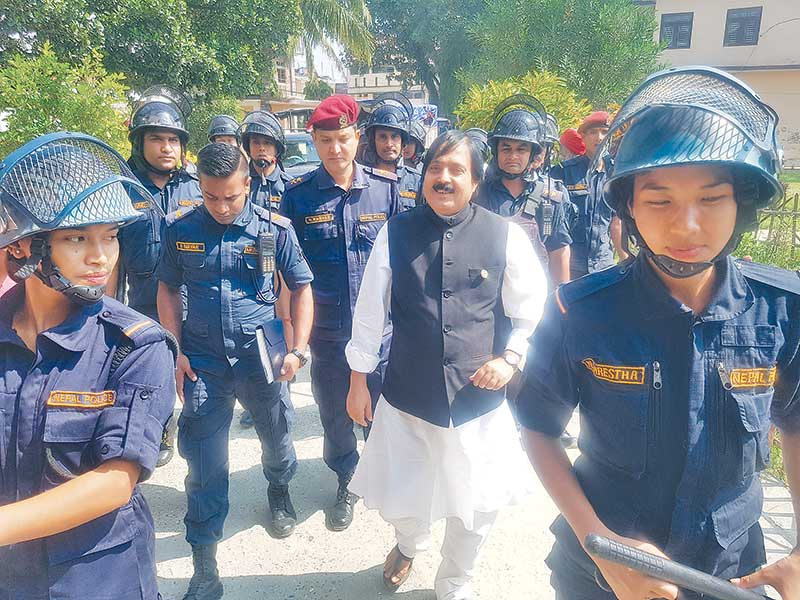
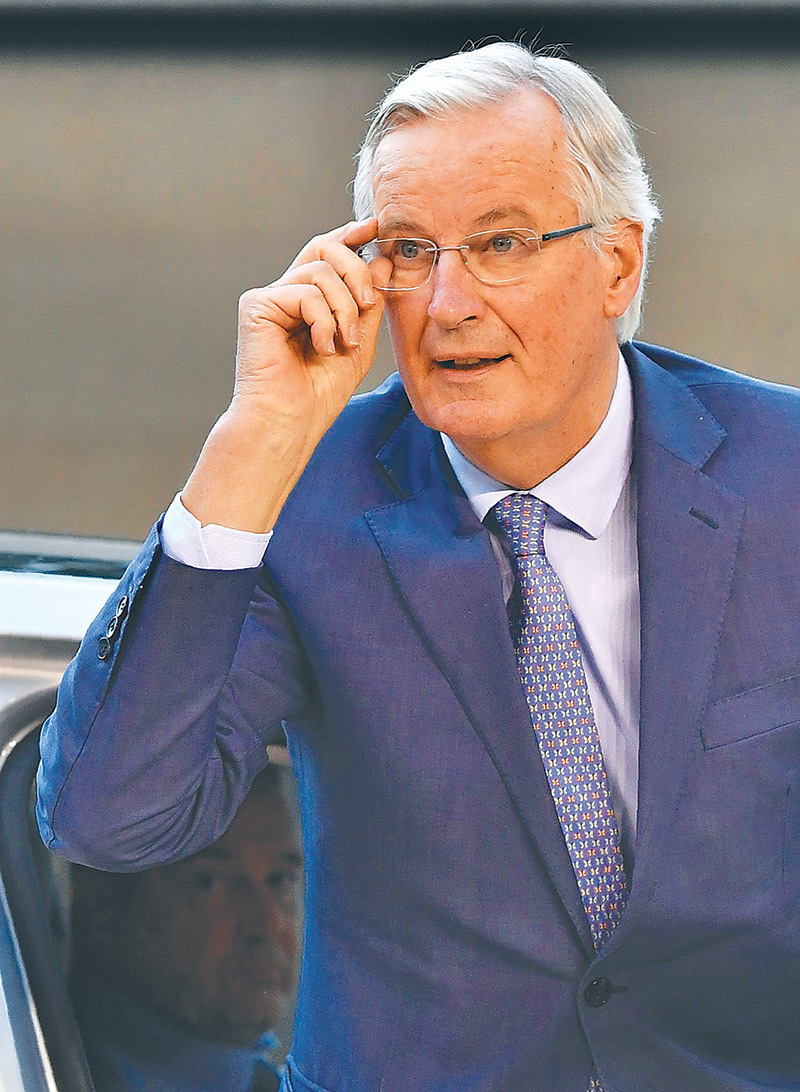
Krishna Bahadur Mahara (centre) was presented to the Kathmandu District Court on Tuesday.Post Photo: Elite Joshi
KATHMANDU : Kathmandu District Court on Tuesday remanded Krishna Bahadur Mahara to 13-day judicial custody, which means the former House Speaker has three more days in police custody since he was arrested 10 days ago. Mahara, however, is currently at Norvic International Hospital after doctors advised admission last week. Police had arrested Mahara from the Speaker’s official residence in Baluwatar on October 6 after a woman who works at the Parliament Secretariat formally filed rape charges against him on October 4. “The court has remanded Mahara to 13-day custody,” said senior advocate Raman Kumar Shrestha, who argued on behalf of Mahara in the court. “Since he has already spent 10 days in police custody, he will be there for three more days, until Friday.” Shrestha, along with five advocates, pleaded that it was unconstitutional and illegal to keep Mahara in custody without presenting him to the court within 24 hours and that therefore the court could not allow the police to hold him further. A single bench of judge Dipak Kumar Dahal, however, allowed the police to hold Mahara for three more days as the government’s attorney demanded time for the police to complete their investigation. Police, however, had demanded 10 extra days’ judicial custody for Mahara. According to Umakanta Poudel, the government prosecutor, the courts can allow police to remand an adult to 25 days in custody for investigation. “Once we register the charge sheet against Mahara, he will be allowed to defend himself,” Poudel told the Post. “We are collecting the necessary evidence to file the charge sheet at the earliest.” Despite his arrest, legal proceedings had not moved forward because the courts were closed until Sunday for Dashain holidays and Monday had been declared a holiday for the courts in honour of a retired justice. In the next three days, police will record his statements, a police official told the Post. Police have already conducted forensic tests on Mahara and the complainant at Tribhuvan University Teaching Hospital. Though rape allegations against Mahara surfaced for the first time on September 30, the police had been slow to act. In an interview with an online portal, the woman had said that Mahara had come to her Tinkune apartment on the night of September 29 and raped her. Mahara’s office was quick to issue a rebuttal. The case took a new turn after the woman withdrew all charges against Mahara in an interview with yet another online portal. Many believed that her recantation was made under duress. Police had failed to make any progress in the case, citing the lack of a formal complaint and the woman’s disavowal of her initial allegations.Mahara stepped down as the House Speaker on October 1, but stopped short of resigning as Member of Parliament. Again, on the evening of October 4, the woman filed a formal police complaint against Mahara, paving the way for his arrest. Since October 5 was a Saturday, police arrested him on Sunday, just ahead of the Dashain holidays.Mahara is the first high-profile politician to face rape allegations and arrest. Though the complaint was filed at Baneshwor police station, Mahara was held at the Singha Durbar police station. He was shifted to Norvic Hospital on October 10 after he complained of chest pains.The Metropolitan Police Range is investigating the rape allegations against Mahara. “We will start recording statements of the accused from tomorrow,” said Deputy Superintendent Hobindra Bogati, spokesperson for the Kathmandu Metropolitan Police Range. “Meanwhile, the ongoing investigation includes forensic tests.” According to Bogati, after forensic tests of the evidence collected from the complainant’s apartment, which include a glass Mahara is believed to have drunk out of, his glasses and the inner sole of his shoe, police will conduct DNA tests.
HOME PAGE
In another attack on the media, Oli singles out the language of journalists
The prime minister expresses displeasure over the media’s use of the informal Nepali pronoun ‘timi’.
- ANIL GIRI
Post Photo
KATHMANDU : Prime Minister KP Sharma Oli on Tuesday launched a vitriolic attack on journalists, saying media persons have forgotten civility and decorum. Speaking at a programme in the Capital, Oli said that journalists do not even show respect to their parents, as they do not call their father “tapai”, a respectful form of address in Nepali. “Journalists do not use ‘tapai’ even for their fathers. They use ‘timi’, as they have developed a penchant for using ‘you’ from the English language,” said Oli. In English, the ‘you’ applies to all and has no connotation with respect, but in Nepali, there are at least five words that can be used as the second person pronoun. A majority of vernacular papers in Nepal, except for Gorkhapatra, the government’s mouthpiece, refers to politicians as ‘timi’ in the news. Everyone, including the president and the prime minister, is identified as ‘timi’ and its relevant verb modifiers. “Nepali media has been using ‘timi’ as the second person pronoun for the last 13 years,” said P Kharel, a former editor who teaches journalism and mass communication at Tribhuvan University. “If the media sets the trend, we should accept it, as it does not disparage anyone.” Kharel said that Oli should read the newspapers published by the office bearers of the Press Council, the government-sanctioned body that looks after complaints against the media, before disparaging the language used by the media. Members of the Press Council all have their own newspapers, which they own and edit, and where they use ‘timi’ to refer to politicians and all individuals. “If the prime minister feels uncomfortable with the language used by the media, the Press Council is the proper agency where he can file his complaints,” said Kharel. During the Panchayat days, the private sector had yet to make a foray into mainstream journalism, and most weekly tabloids did what they called “mission journalism”, where they advocated causes like democracy during the autocratic Panchayat system. Gorkhapatra and the English-language The Rising Nepal were the only two daily broadsheets, and since they were owned by the government, they published stories extolling the royals and the prevailing system.
After the restoration of democracy in 1990, the private sector started publishing newspapers and the burgeoning media industry had to incorporate new democratic values, not just in their journalism but also in their language. In those days, when the constitutional monarchy still existed, the king, queen and royals were referred to with ‘mausuf’, the highest second person pronoun in Nepali, while leaders were referred to as ‘tapai’, the next highest. In 2008, Nepal abolished monarchy and adopted a federal republican set-up. With the monarchy gone, the newspaper had to yet again adapt to a new system with new values. A little over a decade ago, consensus was reached among the vernacular papers that everyone should be referred to with ‘timi’, which is informal, colloquial and can apply to everyone regardless of stature. Oli’s lamentation of a bygone era and his remarks over how the media—and journalists—should refer to individuals in writing come at a time when ruling party politicians have been facing criticism for acting like “new kings”. Suresh Acharya, former president of the Federation of Nepali Journalists, the umbrella body of journalists in Nepal, said that Oli’s unhappiness with the media stems not from the language employed but its content. “Oli does not like the content of the Nepali media,” Acharya told the Post. “He thinks that he is doing a great job and the media should exalt him and his government.”While criticising the media, Oli also expressed displeasure over social media. “If we look at Nepali society and social sites, the walls of civilisation are being demolished. There is no decency left,” said Oli. Social media was quick to respond to Oli’s jabs. “His highness Oli’s ego and expectations have soared. Respect needs to come from within others, so there is no point in having expectations in this regard,” one Facebook user wrote facetiously. Journalist Shiv Dahal, sharing a video clip of Oli’s criticisms, said that the prime minister has now started taking journalism classes. However, Kundan Aryal, Oli’s press adviser, defended the prime minister, saying that the language employed by the media has long been an issue. “Such an insulting word kills the Nepali language. Nepali language is not as easy as English,” said Aryal, who also teaches journalism. “It’s easy in the English language because it does not have a hierarchy, but in Nepali we follow a hierarchy.” That is exactly what the media deliberated on when they came up with the idea of referring to all individuals with the same pronoun and its associated verb modifiers, as referring to different individuals with different forms of address would reify a class system. A politician is referred to with a pronoun and verb of a “higher degree” and a regular individual referred to with a lower one would lead to the creation of an implicit hierarchy. Aryal does not agree. “A section of the Nepali media has failed to give respect to individuals,” he said. Acharya, the former president of the journalists’ umbrella body, said that the kind of language the media uses is guided by ethics and individual style books, not by the government’s dictates. “The prime minister’s repeated vilification of journalists and the media clearly shows that he is intolerant of criticism,” said Acharya. The Oli administration’s increasing aversion towards the media has been evident in a number of controversial bills it has introduced in recent months. The Media Council Bill has been met with great criticism, as some of its provisions, media freedom advocates say, are aimed at stifling press freedom and freedom of speech. But it’s not just Oli. Most Cabinet ministers do not hold the media in high regard, despite the fact that the Nepali media played a huge role in the reinstatement of democracy. Gokul Baskota, the minister for communication and information technology, who is considered Oli’s right hand, has made it a habit of seizing every opportunity to criticise the media. Freedom of expression activists have long been drawing attention to the Oli administration’s tendency to muzzle dissent. Immediately after its formation in February last year, the Oli government tried to put a ban on protests at Maitighar Mandala, a central gathering point for protesters. It was only after protests and criticism that it relented.
Prime Minister KP Sharma Oli (centre) talks to the media.POST file PHOTO
Bhrikuti Rai contributed reporting.
HOME PAGE
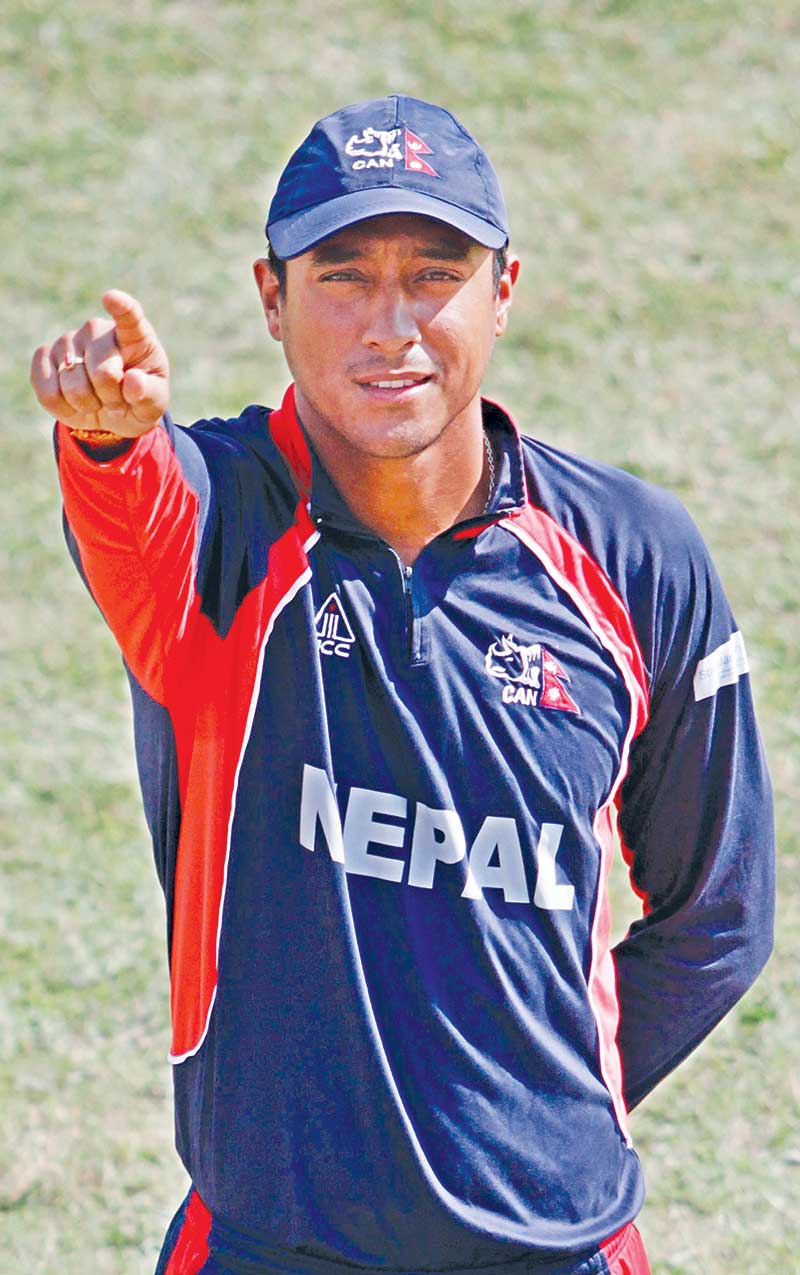
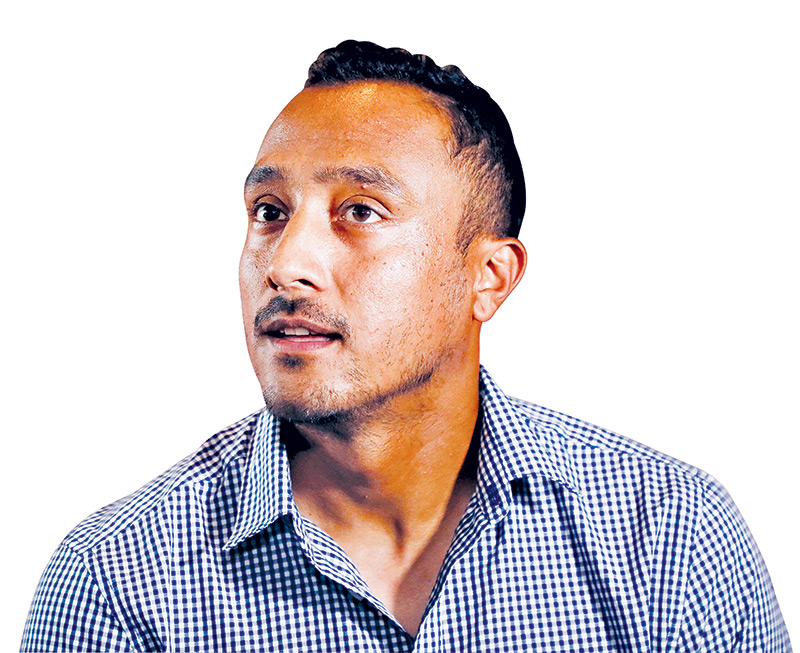
Paras Khadka, Nepal’s most accomplished cricketer, steps down as captain
In a decade, Khadka led the national team from minor cricket leagues to the ODI status.
- PRAJWAL OLI
KATHMANDU : Paras Khadka, who led the golden generation of Nepali cricket, stepped down as captain of Nepal’s cricket team after 10 years on Tuesday. Khadka announced his resignation via a Facebook post. “I have hereby decided to resign from my post as the captain of Nepal cricket team as there has to be a new way of taking things forward with a fresh start and a committed vision with everyone involved,” Khadka said in the post. His resignation came a day after the International Cricket Council lifted a ban on the Cricket Association of Nepal, albeit conditionally. “Great to know that the suspension of Nepal cricket has been lifted, and would like to wish the new committee to work for the betterment of Nepal cricket, players and its stakeholders,” said the 31-year-old allrounder who played an influential role in Team Nepal’s elevation from Division 5 in 2010 to One-Day International (ODI) nation in 2018. “Resigning from my position is not an abrupt decision and made overnight. I was waiting for the suspension to be lifted and it was lifted yesterday. It was good news and as a captain, it was a right time to resign,” said Khadka. Under Khadka’s leadership, the Nepali cricket team finally became something that Nepali sports fans could be proud of. After decades of languishing in minor leagues, the team has hop-skipped its way into the international playoffs after acquiring ODI status in 2018. A middle-order batsman, Khadka, who also bowled medium pace, enjoyed an illustrious career ever since he made his foray into cricket. Khadka represented the country in the Under-19 World Cups of 2004, 2006 and 2008 while also being a part of the senior side. He took over the senior side in 2009 when he was 22 years old, replacing Binod Das. In the 10 years since, he has broken records and elevated Nepali cricket to heights unseen. Last month, he became the first Nepali cricketer to score a Twenty20 International (T20I) century (106 not out) as Nepal defeated hosts Singapore in the tri-series alongside Zimbabwe. This was also a world record, as he became the first captain ever to score a century while chasing in a T20I. In addition to the T20 century, Khadka also became the first Nepali player to hit an ODI hundred when he slammed 115 runs against the United Arab Emirates in January this year. Khadka’s job in recent years, however, was not limited to the pitch. He had been fighting the country’s inefficient cricket administration since 2014, which was the year Nepal established itself as a cricketing nation, following the ICC World Twenty20. “I wanted to take a break for a certain time,” Khadka told a press conference on Tuesday. “I have not only been performing as a captain but also as a mentor, selector and coordinating off the field with the ICC.” Khadka, along with his teammates, had even publicly denounced the Cricket Association of Nepal for corruption and inefficiency. In 2016, the cricket’s world governing body suspended the Cricket Association of Nepal, citing government interference. In the association’s absence, Khadka worked as the national selector on an Independent Selection Committee formed by the ICC. Khadka played for Nepal in six One-Day Internationals, 27 T20 Internationals and 50 T20s. As Nepal’s premium allrounder, he’s been leading by example. “As a player, he is a dominant batsman. Even though he’s been focusing more on batting for the past two years, he’s been a consistent all-round performer,” said Devendra Subedi, one of Nepal’s international umpires. Former captain Das, however, believes that it is not the right time for Khadka to step down. “None of the members of the current team has stood to take over the captaincy. None of the senior players has cemented their place as of now,” said Das. When asked about who would take over the national team, Khadka said that it was up to the Cricket Association Nepal and the coaches to decide that. “It is not up to me to decide who will be the next captain,” said Khadka. “I was never told I would become captain in 2009. But Gyanendra Malla is the senior-most player in the squad, and he should lead the team at least until next year.” Malla, Khadka’s deputy on the national team, had nothing but praise for his captain. “He is a great leader on and off the field,” said Malla. “His absence will be a loss for the team. His statistics speak about his quality as a player.” Khadka was not just a celebrated sportsman but also commanded a fan following rarely seen before. He was a decorated batsman and is the most accomplished player in the history of Nepali cricket. “It is his sound decision-making ability that made Paras what he is today, be it on the pitch or in administrative matters,” said Das. “As far as I know him, he is a man of principle. He was not only one of the top performers on the pitch, but his dealings with his teammates were excellent too.”
MEDLEY
Horoscope
ARIES (March 21-April 19) ** Even if novels aren’t quite your cup of tea, flipping through some books on the bestseller shelf or looking through a short story collection could give you a brand new idea about how to handle a real-life problem. Often, mysterious feelings can be better understood if you can see them from a more dramatic point of view.
TAURUS (April 20-May 20) *** One of your friends is experiencing some relationship problems and they are letting them affect your friendship a bit too much, in your opinion. They’re distracted when they’re with you, and can only seem to talk about what’s bothering them. Don’t feel guilty about your frustration—start a conversation with them.
GEMINI (May 21-June 21) *** Coworkers can certainly help you get ahead in your career life, but as far as your social life is concerned, you shouldn’t look to them for help right now. Sure, they might know someone you’d be interested in getting know, but it’s not wise to mix the workday with your weekends at this point in your life.
CANCER (June 22-July 22) ** The only problems you will have today will be caused by your unpredictable energy level. Your mood will be swinging a bit wildly, and it could be difficult for people to hang on for too long. But don’t worry—these rapid changes are nothing that you can’t get a handle on before the end of the day.
LEO (July 23-August 22) *** Taking people at their word is not a very wise thing to do today, because all that glitters is definitely not gold! Turn up your skepticism a little bit, and don’t hesitate to doubt what you hear. Especially if it sounds too good to be true! Being critical of someone doesn’t mean you don’t trust them.
VIRGO (August 23-September 22) *** Not everyone can be as informed and as experienced as you are, and it’s not always their fault. Cut some people some slack when they frustrate you with their questions. They are just working at their own pace, and they are doing their best—you can’t fault them if their best isn’t good enough for you.
LIBRA (September 23-October 22) ** You must be on the same level as the people in your life if you want to find complete harmony. If you’re finding yourself attracted to an ‘opposite’ personality, be careful. When your energies are different from someone else’s, it can be hypnotic and appealing—but these differences can also lead to a lot of conflict.
SCORPIO (October 23-November 21) *** This is a good day to play things cool. Be low key, and you’ll end up getting much more attention than you would if you were running around schmoozing with everyone. You don’t get yourself noticed by being loud and aggressive—you get yourself noticed by being different from everyone else around you.
SAGITTARIUS (November 22-December 21) ***** Your old ideas are getting musty! It’s time to get a fresh perspective on your job, your family, and your relationships. It’s not that there is anything wrong with any of them, it’s just that every now and then you need to re-evaluate things. New perspectives are not always better ones, but they are always worth investigating.
CAPRICORN (December 22-January 19) **** If you’re hit with a financial windfall, you shouldn’t invest it all in one place—or spend it all on one thing! Show your gratitude to the universe by spreading the love around! Give some of your money to a cause you feel is important for the future. You will get back way more than you give.
AQUARIUS (January 20-February 18) *** Just because someone you know is looking for answers in their life does not mean that you need to give them to them. You might know what they need to do, but they might not agree. Don’t come off as preachy with them. Just listen to their complaints and instead of telling them what to do.
PISCES (February 19-March 20) **** There are going to be many tantalizing options for self-promotion today—but the question is, will you be bold enough to grab them? Volunteer. Raise your voice. Make a scene. Do whatever you need to break through the crowd and show the world just who you are. No one else is going to do it for you.
NATIONAL
Universities are headless as government fails to agree on vice-chancellor candidates
- BINOD GHIMIRE
KATHMANDU : Top jobs in more than half a dozen universities, including Tribhuvan University, have been lying vacant for nearly two months as the government struggles to appoint vice-chancellors due to a lack of a political consensus, say government officials. “If the prime minister and education minister had been on the same page, the university would have already gotten its executive head,” a senior official at the Ministry of Education told the Post on condition of anonymity. It has been 11 days since three names were recommended to Prime Minister KP Sharma Oli as possible candidates for the post of vice-chancellor at Tribhuvan University, but no progress has been made so far. Dr Bhagwan Koirala, Dr Dharma Kant Banskota and Chandra Mani Poudel were recommended for vice-chancellor at Tribhuvan University. Among the eight universities that have been without executive and administrative heads since the third week of August, names have only been recommended for Tribhuvan University. Search committees formed to recommend names for the other seven universities haven’t yet found appropriate persons to lead the universities, said the Ministry of Education official. The laws regulating Nepal’s universities mandate that the prime minister, as ex-officio chancellor, must appoint vice-chancellors from among names recommended by search committees led by the Education Minister. The committee led by Minister for Education Giriraj Mani Pokharel has recommended Koirala, a pioneering cardiac surgeon, as their first choice for vice-chancellor. However, Banskota, former chairperson of the Nepal Medical Council, is Oli’s favourite as he hails from the prime minister’s home district of Jhapa. Banskota was appointed chair of the council under the CPN-UML quota, which was Oli’s party before its merger with the CPN (Maoist Centre) to form the Nepal Communist Party. Along with the vice-chancellor, the positions of rector and registrar are also shared among the political parties in direct proportion to their political clout. Four years ago, when Sushil Koirala was leading the government, the highest number of portfolios went to the Nepali Congress. Vice-chancellors of Tribhuvan University, Purbanchal University, Nepal Sanskrit University, Far Western University and Lumbini Buddhist University were appointed on the Congress quota. The CPN-UML had its appointees at Pokhara University and Mid-Western University, while Agriculture and Forestry University was allotted to the CPN (Maoist Centre). The Maoists also got the Open University later on. In universities where the Congress has its vice-chancellors, the positions of rector and registrar were given to the UML and the Maoists. While the Nepal Communist Party itself is struggling internally with UML and Maoist factions, the opposition Nepali Congress is also demanding its share. Jagat Timilsina, chairman of the Democratic Professors’ Association which is affiliated with the Congress, has asked the government to keep in mind that the association commands a majority among professors in all universities. “The association will resort to non-cooperation if we are ignored in the appointment process,” Timilsina told the Post. “Even holding examinations will not be possible without our support.” The association has asked Congress President Sher Bahadur Deuba to place pressure on the government to make appointments as per political consensus. The main opposition party is eyeing vice-chancellor posts in at least three universities, equal to those given to the UML and the Maoists during Koirala’s time.The officials of the search committee say their quest to find better people to lead the universities is delaying the recommendation. “We are against the political sharing though the consultation could be held with different professors association,” Usha Jha, a member of the National Planning Commission and a member of a search committee, told the Post.The leaders of the professors, however, aren’t convinced with Jha’s claim. They say it would be a big surprise if there’s no political sharing of positions lying vacant. “I fail to believe that there would be no sharing this time. I am sure, the sharing within the NCP and with the main opposition is delaying the appointment process,” said Rameshwor Upadhyay, a former chairman of Nepal Professors Association, an umbrella body of the university teachers, told the Post.
NATIONAL
Road department rejects the recommendation for load test on bridge built by Pappu
- PRITHVI MAN SHRESTHA
KATHMANDU : The Department of Roads has rejected the recommendation of the Board of Dispute on defective construction of a Rs200 million bridge on Bishnumati river in Teku, built by the controversial contractor--Pappu Construction. Kailash Shrestha, chief of Kathmandu Road Division, told the Post that a single-person board under Sanjeev Koirala had suggested that the department take ownership of the abandoned 62-metre bridge after conducting a load test. Shrestha said that the dispute board didn’t have the mandate to certify the quality of the bridge. “The dispute board was formed to settle the issue related to the seizure of performance bond by the department, but instead, it recommended load testing on the bridge,” said Shrestha, citing the reason why Koirala’s recommendation was rejected. The dispute between the department and the contractor erupted after the department refused to accept the bridge, terming the structure as substandard. The bridge, which was completed in July last year, has remained unused. After the department confiscated the performance bond put up by the contractor, Pappu Construction sought a legal remedy which led to the formation of the Board of Dispute. The Post’s efforts to contact Hari Narayan Rauniyar, suspended lawmaker and owner of Pappu Construction and his son Sumit, were in vain as their mobile phones had been switched off. Long before the issue went to the dispute board, the contractor had been asking the department for the load test, while assuring that the bridge would be re-built if it failed the load test.But the department had said that the issue was not only about the bridge withstanding the load, but also of design violation. The contractor, according to the department, had not followed the design approved by the consultant. The design required a cable with a 15.7mm diametre but the contractor used a 15.2mm cable. The contractor claimed that cable having low diametre was used because of unavailability of thick cable. In fact, the consultant had sought details of the construction materials used, and their source and quality from the contractor, according to the department officials.But the contractor—ZIEC-Pappu JV— had carried on with the works on the bridge regardless, refusing to share the details. The refusal of the contractor forced the consultant to test the samples at the lab of the Institute of Engineering, Tribhuvan University. The test found the cable to be thinner than the approved design. Thereon, the authorities immediately asked the contractor to stop further work on the bridge. Instead of stopping the work, Pappu constructed the pre-stress concrete girder and jacking of cable wire without meeting the specified requirements, according to the department. It is not the only project where Pappu faces accusation of substandard construction. Last year on August 6, the Commission for Investigation of Abuse of Authority had registered a corruption case against the Rauniyars for building a substandard bridge over the Babai river in Jabbighat following which the elder Rauniyar was suspended as a lawmaker as per law. Likewise, Kathmandu Valley Road Expansion Project had ordered Pappu Construction to dismantle the under-construction structure of Tinkune based bridge after the Parliamentary Development and Technology Committee discovered that the construction company had built a “substandard underground structure” for the bridge. Additionally, the House committee in July this year found that the two piles out of 16 in the foundation on the Tinkune side of the bridge had cracked in a technical test. Piles are long concrete poles that support a bridge. They are hammered into the ground until they reach a hard rock or soil layer. As well, last year, a committee formed by the Ministry of Physical Infrastructure and Transport had found defects in the Babai bridge in Bardiya, Lalbakaiya bridge in Rautahat, Kamala bridge in Sindhuli, and Ratu bridge in Mahottari, after examining as many as seven bridge projects awarded to Pappu.
NATIONAL
Passengers rarely report taxi drivers for overcharging, traffic police say
Most cabbies in Kathmandu refuse to go by taximeters and set their own fares.
- SHUVAM DHUNGANA
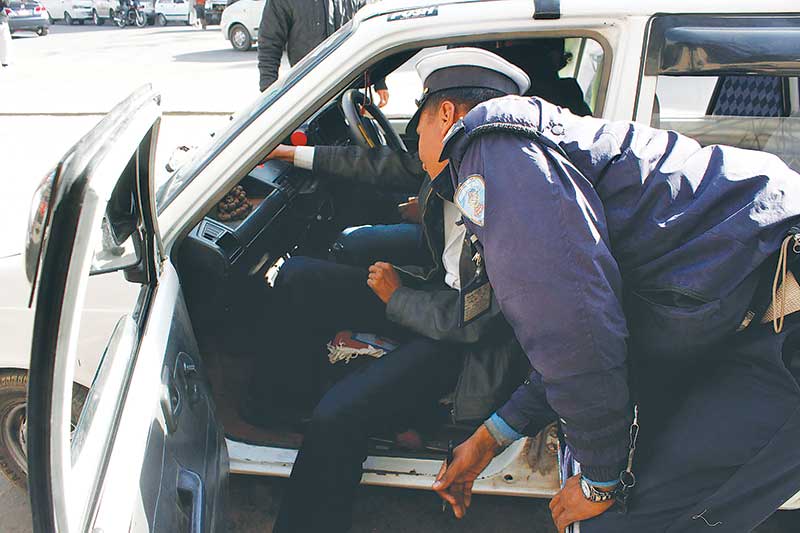
A traffic officer checks a taximeter of a cab in Kathmandu.POST file PHOTO
KATHMANDU : Kedar Dangal, 36, of Mulpani was looking for a taxi to take his 17-year-old daughter to a hospital-based at Baneshwor. After waiting for nearly half an hour, a taxi approached them. When Dangal asked the driver to take him and his daughter to Baneshwor, the cabbie demanded Rs 1,000. Dangal then proposed paying as per the taximeter, but the driver refused to oblige. “If you want to go then pay Rs 1,000 otherwise wait for another taxi,” the taxi driver told Dangal. Since his daughter was not well, Dangal took the taxi and paid the amount demanded by the cabbie. Despite being overcharged, he never thought of filing a complaint with the traffic police. “I know I was overcharged by the taxi driver, but there was no other option available at the time. Complaining to the traffic police would have been worse as I simply didn’t have the time,” Dangal told the Post. Taxi drivers in Kathmandu continue to fleece passengers by refusing to turn on the fare meters. The traffic police, meanwhile, seems unable to control the rampant fraud in taxi business. The traffic police book up to 30 taxi drivers daily for overcharging passengers. But the cabbies in Kathmandu seem unaffected and undeterred by law enforcement. Superintendent Rabi Kumar Poudel, spokesperson at the Metropolitan Traffic Police Division (MTPD), says this is because most passengers enable the fraud cabbies by agreeing to travel on quoted fares and not the fares determined by taximeters. Then there are passengers who do not file complaints against errant cabbies. “They’d rather bargain the fare than file a complaint with the traffic police,” Poudel told the Post. During the Dashain holidays, the MTPD booked 475 cabbies for violating fare rules, while a total of 1,304 cabbies were charged for various offences in the last three months of this fiscal year 2019/20. “Cabbies who refuse to turn on fare-meters are fined from Rs 500 to Rs 3,000. For repeat offenders, the fine is five times more and the possible suspension of licence,” said Poudel. “If passengers, without any hesitation, start to file complaints, it would help a lot to curb fraud cabbies.” According to the MTPD, anyone could contact the traffic police through the hotline (103), SMS (9851295100), or the MTPD’s Facebook page to file a complaint against dishonest taxi drivers. According to Lopsang Tamang, a cab driver, many passengers do not prefer going on taximeter as the destination prices are not fixed. Before travelling anywhere, a majority of the passengers first fix the price and only then travel, he added. The data provided by MTPD shows that in the fiscal year 2018/19, a total of 12,749 cabbies were booked for refusing to run fare-meters. In the fiscal year 2017/18, the number of lowered to 8,120. “Traffic personnel, both in uniform and civvies, have been deployed in busy areas, even during the festive season, to monitor rule violations,” said Senior Superintendent of Police Bhim Prasad Dhakal at the MTPD. “Traffic police have been keeping a close watch on taxis in the daytime and at night, whenever they try to fleece passengers, taking advantage of emergencies and non-availability of public vehicles,” Dhakal added.
NATIONAL
Suspended Congress MP Alam remanded in custody for seven days
- SHIVA PURI
Security personnel surround Alam as he is brought to the Rautahat District Court on Tuesday.POST PHOTO: SHIVA PURI
RAUTAHAT : The Rautahat District Court has remanded suspended Nepali Congress lawmaker Mohammad Aftab Alam in custody for seven days. Alam, who was detained on Sunday for his alleged involvement in 2008 bombing and the subsequent murder of at least 23 people in the district, was presented at the court amid tight security on Tuesday. A single bench of Judge Chitra Bahadur Gurung ordered the police to keep the accused federal parliament member in custody for seven days and investigate the case. Talking briefly to reporters while he was being returned to the District Police Officer from the court, Alam said that everything would be clear within a few days. “Have patience. Fair justice will be delivered in a few days,” he said. Alam had told the court that he was surprised when police arrested him without any evidence in connection to the incident that occurred 12 years ago. At least two people had died and two dozen others were injured in an explosion in Fardahawa, Rautahat, on the eve of the first Constituent Assembly elections on April 9, 2008. Police have linked Alam with the explosion and the deaths, as well as accused him of murdering the injured survivors by burning them alive in a brick kiln to get rid of witnesses and “destroy the evidence”.
NATIONAL
Land acquisition in Arkhet Khahare and Arughat for Budhi Gandaki hydel project in limbo
Process failed to gather momentum as locals have higher expectations but the state can only offer so much.
- HARIHAR SINGH RATHOuR
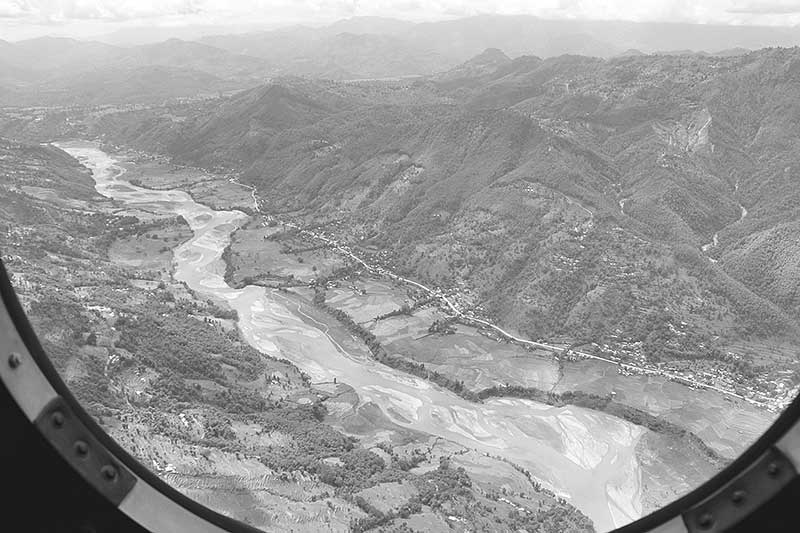
An aerial view of the Budhi Gandaki river. Post Photo: HARIHAR SINGH RATHOUR
DHADING : It’s been two years and counting that the residents of Arughat and Arkhet in Gorkha and Khahare in Dhading have been seeking compensation from the Ministry of Energy for the construction of the 1,200MW Budhi Gandaki Hydropower Project. The project stands to inundate these areas if works move forward. The locals of Khahare, Arughat and Arkhet have been frequenting the offices of the concerned authorities with demands for completing the land acquisition process with due compensation in the project-affected areas. Sanju Shrestha, a local of Salyantar, said they have already met the CDOs, people’s representatives, lawmakers, the energy minister and the prime minister to settle the compensation issue as soon as possible, to no avail. The government has spent around Rs26 billion so far acquiring land from 27 settlements in Gorkha and Dhading districts. The CDOs of Dhading and Gorkha jointly coordinate the Compensation Determination Committee. But the land acquisition process has been stuck due to the administration’s lackadaisical approach to the matter, locals say. The compensation rate for these three areas remains to be fixed, according to Krishna Karki, the project chief. Asman Tamang, the chief district officer of Dhading, said they will fix the compensation rate after the project holds a meeting. Tamang said, “We have no intention to make the citizens landless or the state bankrupt.” According to him, the land acquisition process could not gather momentum as the locals have more expectations in terms of the compensation amount but the state can only offer so much. Locals in Arughat have claimed compensation up to Rs 2.5 million for one aana of land. But the administration is trying to fix the compensation rate according to the valuation of the Land Revenue Office and the going rate. Preferring anonymity, one of the project officials said that the committee could have fixed the compensation rate for the land long ago, but the local administration is wary of legal proceedings that may ensue if the locals reject the offer. Last week, lawmakers, people’s representatives and land revenue officers of both Dhading and Gorkha districts and project officials held discussions on the matter. Karki said that the project officials are having a hard time settling on the compensation amount because of the high price quoted by the locals. “However, we are at the final stage of discussions. This time we may be able to fix the compensation rate.” However, Shambhu Thapa, chairman of Tripurasundari Rural Municipality, said that people from other areas who received compensation two years ago have already moved out and settled down in other places. Thapa said, “The price of land has increased now. The rate of compensation cannot be the same as two years back.” According to him, the project should provide compensation for the loss in business activities as people moved out. He said, “Banks have stopped providing loans after the project started the land verification process. We have been demanding compensation and have asked for a certain amount evaluating all these aspects.”
NATIONAL
Free Kamalaris becoming self-reliant in Dang
A body of former Kamalaris is providing monetary help and skill training to Kamalaris to make them financially secure.
- DURGALAL KC
Former Kamalaris participate in a skill training programme organised by The Freed Kamalari Development Forum in Ghorahi, Dang. Post Photo: durgalal kc
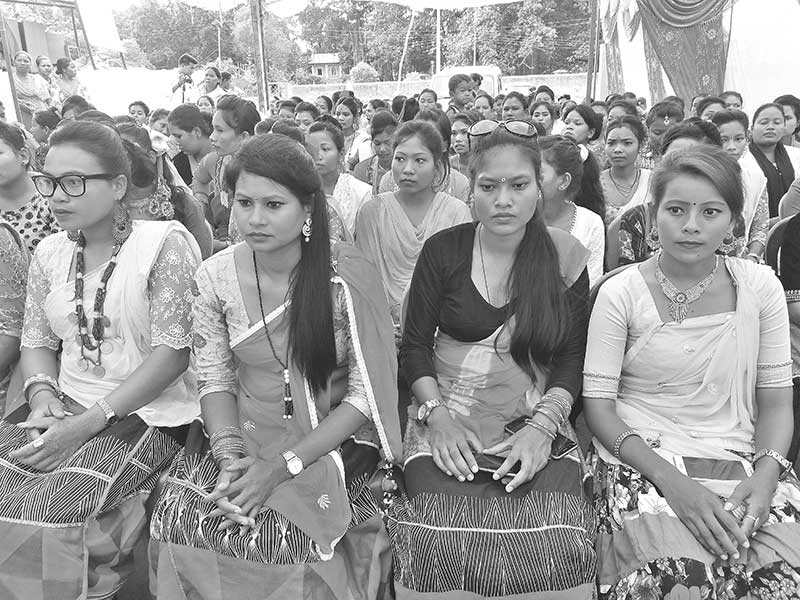
DANG : Namita Chaudhary of Bagarapur in Rapti Rural Municipality, who was a former Kamalari, an indentured girl child labourer, is preparing to start a business. She recently underwent training to be a cook which has enabled her to look into starting something on her own. “I had spent my childhood working as domestic help. But now I am opting for various income-generating ideas through skills and training. I have received training to operate a hotel. Finally, I don’t have to rely on others for survival,” said Namita. Namita had stayed in Ghorahi, the district headquarters of Dang, for 18 days to complete her training. Like Namita, other 31 former Kamalaris of western Tarai received the same training. The Freed Kamalari Development Forum, a joint effort of former Kamalaris, trained them and also provided utensils worth Rs 15,000-Rs 21,000 and Rs 25,000 cash to each of them to operate a hotel. Sabitri Chaudhary of Bansgadhi in Bardiya said she had to endure hardships and face humiliation in society due to her poor economic condition. “Despite such hurdles, I did not give up on my struggle. Now that I have received the training, I’m confident enough to start a business,” said Sabitri. Geeta Chaudhary of Dangisharan said that she too will run an eatery in her own village with the help she has received. Geeta said, “We have been trained to prepare various snacks and meals and also received utensils and cash to operate a business.” The government declared Kamaiyas free back in July 2000. Sushila Chaudhary, treasurer of the Freed Kamalari Development Forum, said that they have been providing training to former Kamalaris to make them self reliant and show them the way to financial independence. She said, “The forum has been advocating for the education, employment and empowerment of former Kamalaris.” According to Sushila, freed Kamalaris constructed a three-storey building at Chaughera in Ghorahi at a cost of around Rs 9.7 million. The building is where the training and the programmes for the Kamalaris are conducted. She said, “The construction was completed some four months ago. The government provided Rs 8 million under the Tarai-Madhes Prosperity Programme and the rest while the former Kamalaris put together the remaining amount from their own savings.” Sunita Chaudhary, the central chairperson of the forum, said freed Kamalaris gather in the building and prepare various plans and policies to launch various income-generating programmes. “We did not have our own houses in the past. The building now not only works as a place of learning for us, but as our identity,” said Sunita. “Many friends have initiated their own businesses by learning various skills here. The number of the former Kamalaris who have become self-reliant is gradually increasing.” According to Sunita, around 50 percent of the income the forum generates by providing training and skills is spent on managing the building, and the other 50 percent is used to assist former Kamalaris who need help. Forty-three cooperatives have been established in five western Tarai districts for the upliftment of the economic status of former Kamalaris. According to the forum, around Rs95 million has been mobilised through the cooperatives to uplift the status of the freed Kamalaris. Some former Kamalaris have started their own businesses by taking a loan from the cooperatives. As many as 9,661 former Kamalaris are members of the forum now. Three hundred and thirty-one people have received short-term training for income generation so far. And from a total of 270 people who received long-term training by the forum, 72 are working in various institutions currently.
NATIONAL
Budget for target groups used unproductively
Half of the budget allotted for women, children, and the elderly has been invested in campaigns and seminars.
- SUBASH BIDARI
MAKWANPUR : The budget allocated by Province 3 government targeting select groups of people failed to yield any result in two years. Half of the budget allotted for women, children, disabled and elderly in the fiscal years 2018-19 and 2019-20 has been invested in unproductive purposes, such as training, seminars, monitoring and campaigning. In the last fiscal 2018-19, the Ministry of Social Development of Province 3 had allocated Rs 480 million under the headings of the target group. Of the total, about Rs 300million was invested in unproductive headings that are unlikely to bring any significant change to the lives of the target groups of people. This fiscal year, the total budget has plunged to Rs 360million, the majority of which is slated for investment in headings such as industrial exhibits, report publishing, leadership development training, skill-based training and publishing and broadcasting of informative material. Indira Ojha, chief of women’s development at the Ministry, said that the implementation of the programmes is lacking because of a shortage of officials. “Last year, the implementation was met with legal hassles, employee adjustment programmes, and lack of a detailed working procedure,” Ojha said. “In my own department, out of a total of five vacancies, only two are filled. We are sure to face the same hurdles this year again.” While a few programmes such as skill-based training and leadership training look impactful, the ministry lacks a prudent mechanism to implement the programmes at the local levels, Ojha added. According to her, additional programmes this year include rehabilitation of the disabled, campaign against child marriage, buildings for elderly and victims of gender discrimination and declared of child-friendly local levels. Among the goals, the toughest one to meet is to make the province ‘child-marriage free’. The provincial government lacks statistics about the status of child marriage in at least 119 local units across 13 districts in the province. According to 2011 census, out of the total number of marriages in the province, 29 percent are child marriages. “We don’t have statistics, so the current status of child marriage in the province can’t be ascertained,” Ojha said. “To achieve this goal, too, what we lack is proper workforce.”
NATIONAL
Police patrol along Annapurna trail to ensure travellers’ safety
More than 250 tourists visit the Annapurna region every day, and police have been mobilised in Pisang, Humde, Khangsar, Shreekharka up to Tilicho lake, Manang police say.
- AASH GURUNG
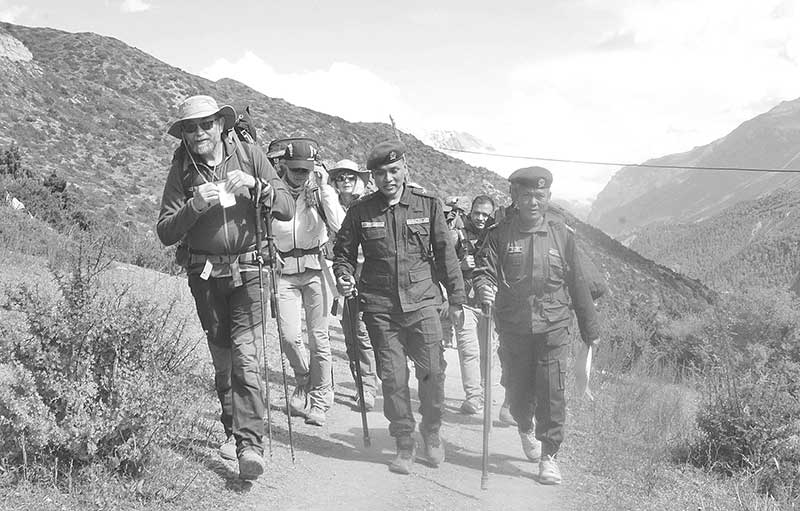
Police personnel walk with tourists trekking the Annapurna Circuit.Post Photo: aash gurung
LAMJUNG : Manang Police have started to conduct regular patrols along the Annapurna Circuit trekking route to ensure the safety of the trekkers and travellers. Although the trail is not technically dangerous, the increase in the number of trekkers—both domestic and international—prompted police to take precautionary measures, said Tika Bahadur Karki, deputy superintendent of police in Manang. According to Manang Police data, more than 250 tourists are arriving in the Annapurna region every day. A couple of German travellers, who were in Chame last week enroute to Tilicho Lake, welcomed the move. “We are happy to have police personnel accompanying us along the foot trail,” a traveller said, adding, “This time, we aren’t afraid of losing our way and we feel more secure than before.” Thorang La (5,416 metres) and Tilicho Lake (4,919 metres) are the main destinations of most of the travellers. According to Karki, police personnel have been mobilised with small arms. “Police posts along the route are also monitoring travellers to ensure their safety. Police personnel have been helping travellers to reach their destinations,” he said. Police patrols are being conducted in Pisang, Humde, Khangsar, Shreekharka up to Tilicho lake, Karki explained. “We have been organising awareness programmes with the locals, tourism entrepreneurs and guides to create a safe environment and help travellers reach their destinations.” Police teams, each made up of four to five personnel, have been spending four to five days with a group of travellers on the trekking route. Karki said, “Providing security to tourists has been our top priority. We have also set up volunteer groups and put ‘search and rescue’ teams on stand by.” Through these exercises, Manang Police aims to disseminate a message that mountainous areas are safe for tourists, thereby attracting more tourists to the region. Manang Police have also had discussions with Chame Rural Municipality and other stakeholders concerned to ensure the safety of tourists in Lamjung Himal base camp. “We have also rescued many travellers who lost their way enroute to the base camp,” said Karki. Brija Gurung, an assistant at the Manang Area Conservation Office of Annapurna Conservation Area Project (ACAP), said the police’s move a positive one for tourism development in the region. “The Annapurna region receives more than 110,000 foreign trekkers annually. Ensuring the safety of visitors will encourage more to come and will send out a positive message across the world,” he said. Meanwhile, Chairman of Manang Nisyang Rural Municipality Kanchha Ghale said they have been helping police personnel in maintaining security in Annapurna region. “Everyone should feel safe while travelling and what police are doing for travellers in the region is commendable,” he said.
NATIONAL
Nepal-India border sealed
Briefing
- Post Report
DARCHULA: The Nepal-India border abutting Pithoragarh district of India has been sealed for three days starting Monday evening. Local authorities of both the countries decided to close the border in view of the local level elections in Pithoragarh scheduled for October 16.
NATIONAL
Pramod Sah arrested for vandalising airport counter
Briefing
JANAKPUR: Rastriya Janata Party Nepal lawmaker Pramod Sah, who vandalised the counter of Buddha Air in Janakpur Airport on Monday, was arrested in Kathmandu on Tuesday. According to police, he is in custody of the District Police Office, Janakpur for investigation.
NATIONAL
Indian national held
Briefing
- Post Report
MORANG: Biratnagar Customs Office arrested an Indian national in possession of 200,000 Indian currency in Morang district on Tuesday. Aasutosh Sahani of Uttar Pradesh, India, was held with the amount while he was entering Nepal, said police.
NATIONAL
Simakdhuri a travel destination in Badigad Rural Municipality
Briefing
- Post Report
BAGLUNG: Badigad Rural Municipality has listed Simakdhuri as a travel destination in Baglung. One has to trek up to two hours to reach Simakdhuri from Jaljala. The rural municipal office plans to allocate Rs 20million to develop the area as a travel hotspot.
NATIONAL
Hundi operator arrested
Briefing
- Post Report
MORANG: Umakanta Raya, a resident of Barju in Sunsari district, was arrested in Biratnagar on Tuesday on the charge of his involvement in operating the illegal hundi business. Acting on a tip-off, police seized Rs 1 million from the suspect.
EDITORIAL
Lawbreakers, not lawmakers
Members charged with a crime should be removed forthwith.
The police arrested Nepali Congress lawmaker Mohammad Aftab Alam on Sunday in connection with a bomb explosion and subsequent murder of at least 23 persons that occurred in Rautahat 12 years ago. Alam was elected to the federal Parliament from Rautahat constituency-2 in the 2017 elections. Two months after the incident, on June 23, 2008, Alam had turned himself in to the police when a first information report was filed identifying him as the primary accused. However, the Office of the Attorney General, on July 14, 2008, decided against pursuing a criminal case against Alam and five others.
In a multi-party democracy, where members are elected on party lines and are subject to party discipline, Parliament must bring out a strong law making it mandatory for the political parties to revoke the membership of persons charged with heinous and grievous offences. Previously, this provision was included in the House Regulations, but it was dropped when it was amended last year; and Members of Parliament charged with crimes were allowed to remain in their posts.
The House Regulations were changed to suit the interest of a few parties and their members; but Parliament, in some way, passed a law that would encourage the criminalisation of politics, unanimously. The criminalisation of politics is a threat to the basic structure of the constitution, but the amended regulation allows lawbreakers to continue as lawmakers.
Just a few weeks ago, Krishna Bahadur Mahara, former speaker of the House and a Nepal Communist Party lawmaker was arrested on rape charges. But all along the while, the ruling party has maintained a conscious silence regarding the issue. But while the Nepal Communist Party has been mum in case of Mahara, Nepali Congress activists have been staging protests demanding the ‘unconditional’ release of lawmaker Alam. The opposition, by extending patronage to crooks, has engaged in the politicisation of criminals.
The criminalisation of politics and the politicisation of criminals both stem from the degrading ethics of politics. And this tells the kind of society we live in. Mainly when it comes to the short-sightedness of those in charge of running the country. What’s more, when laws and regulations are amended to suit the interest of a few, the rule of law ceases to matter. When those charged with criminal offences continue being addressed as lawmakers, what sort of moral force will they be able to wield? As representatives of the people, it is imperative for them to be perceived clean by the public.
Politicians run for elections claiming to serve the public. But elections and representatives lose their meaning if the chosen ones fall in the eyes of the public they have sworn to serve. As Nepal has undergone significant state restructuring following federalism, old practices need to change too. The first would be to cleanse the polluted stream of politics by prohibiting people with criminal antecedents so that they do not even conceive of the idea of entering politics. Such malignancy must be cured before it proves to be fatal for democracy altogether.
OPINION
Fighting crime and gaining public trust
The government can show its sincerity by conducting a fair probe into Mahara’s case.
- UDAYAN REGMI
The Nepali people have demonstrated their avid interest, and fairly so, in the events that unfolded since rape allegations were made against the then speaker of the House of Representatives, Krishna Bahadur Mahara. It all began on September 30 when news of the accusation of rape against Mahara spread like wildfire on social media and online news portals. The news garnered more attention when the accuser, a staffer at the Parliament Secretariat, told one of the lawmakers on the phone that she had been raped by Mahara in her rented room at Tinkune. Mahara has refuted the allegation. Amid the ensuing blame game, Mahara said that the accuser was trying to take revenge for not helping her become a permanent employee at the Parliament Secretariat which would ensure that she would not get transferred. What is important here is whether the state agencies will conduct a fair investigation by following the principles of the criminal justice system. As the case is a high profile one and has political attachments, talk has surfaced among the general public if there will be a free and fair investigation devoid of undue influence from the executive branch and the political parties. Despite Mahara’s arrest, people doubt the government’s efforts to address the case with fairness and honesty. Scepticism first emerged when the investigating agency refused to carry out an investigation and detain the accuser after visiting the crime scene where they had come across enough evidence to suspect that rape had been committed. The investigating officer refused to examine the case for the first few days saying that no written complaint had been filed against Mahara. Chapter 2 of the Muluki Criminal Procedure Code 2017 empowers the investigating officer to start an investigation without a written complaint if there is enough room to suspect that a person was involved in a crime after examining the prima facie evidence or upon receiving information over the telephone, internet or postal service. Lack of intention and willingness to investigate the case was not difficult for the public to read. The public wonders if the investigating officers who hesitated to initiate the investigation at the beginning would carry out the investigation in a fair manner. The accused in this case is the fifth highest ranking official of the government which exhibits high chances that investigating officers might face undue influence from political actors. To support the above scepticism, the public still has a vivid memory of the rape case in Kanchanpur which remains unsolved after more than 15 months because of the failure on the part of the investigating officer to collect evidence properly. Impunity even in one case creates an environment to bolster impunity in the future. People also doubt the actions of various agencies like the National Human Rights Commission and the Women Commission which are responsible for keeping tabs on the work of the executive branch. These constitutional bodies established with a mandate to check the actions of the executive have remained paralysed for a long period due to the influence of politicians. People are aware about how the government has been trying to amputate the National Human Rights Commission’s functionality when they introduced a bill curtailing certain roles in the recent past. Regarding the Women Commission, it has already come under attack from the public for the absence of a chief. After Bhagwati Ghimire retired in October 2017, the top post has remained vacant till date. For a commission which has received 70,000 complaints over its hotline since December 2017, it is crucial to pressure the investigating authorities for the conduct of a fair and transparent investigation. The Nepal Police recorded 12,225 cases of domestic violence in 2017. The data reflects the need for the prompt and independent operation of organisations working for the protection and promotion of women’s rights. Even then, seven other thematic commissions remain non-functional. Among the seven, four bodies do not have any office bearers and three do not have chairpersons. There is scepticism over the role of the judiciary too. The judiciary may misuse its discretionary power while hearing a plea for bail due to political and executive interference. The court cannot set bail in cases of rape or rape attempt where circumstantial evidence supports the accusation. The use of such discretionary powers would rather open the door to arbitrariness, which is the antithesis to the rule of law. There is a view that public trust in democratic governance and its institutions is considered vital to the functioning of democracy itself. The government’s efforts to conduct a fair investigation will not only show that it is sincere in fighting crime but also restore public faith.
Regmi is an advocate.
OPINION
Highs, lows of coworking space in sharing era
Growing rapidly, coworking spaces have considerable social, urban and financial effects.
Swift technological developments are continuously transforming the relationship between assets, spaces and economic activities. Spearheaded by the ride hailing app Uber and Airbnb renting space, the rise of sharing and collaborative forms of the economy is innovating the way people consume services and products and our lives in general. A more recent phenomenon is the coworking space. Their innovation is in the value propositions of hot desks and open spaces, all based on a flexible or short-term lease. Flexible office spaces also create a sense of community, sharing knowledge and facilitating innovation among all their members. Subsequently, coworking also affects socioeconomic, commercial and urban aspects. However, there is still little to no evidence of the economic viability of the industry and its social effects. Studies show that the coworking industry grew from 70 people in 2007 to an average of 1.5 million worldwide in 2017, and the figure is projected to reach 5 million by 2023. There is a new wave of coworking start-up businesses such as WeWork, ImpactHub, SpaceHub, and some Indonesian coworking start-ups such as CoHive, Conclave, Kolega etc. They are all now attempting to challenge the commercial property market and respond to the changing nature of the workplace. Coworking facilitators have taken advantage of the freelance trend and there are more venture capital fund start-ups that need renting contract flexibility. WeWork is now the largest tenant in several major big cities—London, New York, Washington DC, etc. WeWork, which is in the spotlight in this article, managed to create a brand and position the company as the leader of this social and urban change. Established in 2010, by 2018, the company operated over 30 million square meters of space globally in 528 locations across 29 countries. WeWork became famous for providing a glimpse of professional paradise for its members. They offer free cereal and coffee, ping pong, among other things—perks and facilities designed to encourage interaction. However, WeWork came under fire recently, after drastic valuation cuts from US$47 billion to merely between US$10 billion and US$20 billion. The chief executive officer, Adam Neumann, has stepped down from his post and lost his majority of votes. To top it all off, WeWork delayed its initial public offering plan. Nevertheless, we should not undermine the rapid growth and benefits of the overall coworking industry. Coworking can save companies around 20 to 40 percent in overhead costs compared to a lease for regular office space by avoiding setup costs. This is especially true for a company aiming to expand into a new market in a short space of time. These deals are often overlooked by many; the cost benefits and financial structures are some of the significant drivers for corporations to use a coworking space. Some Fortune 500 companies are also taking advantage of having a flexible workspace. The end goal is to get the same energy and collaboration vibe created at coworking spaces. Blue-chip companies comprise around 40 percent of WeWork members, including companies like Amazon, Airbnb, IBM, UBS, etc. Coworking helps digital nomads with their business needs by providing an area where they can collaborate with other workers who can give business referrals and make introductions. It provides enterprises an avenue to associate with the sharing economy opportunity. According to Accenture’s report, around 70 percent of corporate leaders believe it is essential to collaborate with start-ups and entrepreneurs to encourage innovation. While coworking start-ups are on pace to grow dramatically, they are also facing pressure and criticism. It is due to the long rental lease they require and the shorter rent leases they allow for their members. Then, there is no significant innovation with the business model, but they operate with much higher business risks. A company called IWG owns brands like Regus and Spaces—also providing shared office space and which has been around since 1998. A variety of firms utilise the same business model. WeWork commits to an average of 10- to 15-year leases, but their members only invest an average of 15 months. Furthermore, WeWork’s obligation was around US$47 billion, and its members only signed contracts on US$3.4 billion worth of space. Additionally, many flexible space operators burnt a lot of cash at this rate, WeWork had a loss of US$1.9 billion last year. During the economic downturn in the early 2000s, IWG filed for bankruptcy in the United States as revenues fell significantly, but long-term leases have remained in place. The big chunk of the revenue for these coworking firms comes from freelancers and start-ups. However these are the type of workers who likely will first go bankrupt in an economic crisis. Arguably, it is hard for coworking companies to withstand recession because they still must pay long-term leases. Generally, it is easy to replicate the shared office space business model. Any business with enough cash can lease out industrial office space, remodel and lease. Hence, this is one of the many reasons why many coworking spaces are around now. An increasing concern for coworking spaces is security. Obviously, you cannot choose your neighbours in a communal environment. Data privacy and security are also crucial, because of the shared space and the potential threat of theft. Moreover, working in a communal environment can be challenging, particularly when noise and activity from other members becomes too distracting. Some say the vibe of the community and the energy changes depending on the location and the tenants. Regardless of the casual culture or flexibility, it is all about business, and real tasks need to be completed. Unfortunately, some people in the coworking space are just there for fun.
- Nidya Ramalia Novita
This article was previously published in The Jakarta Post, a part of the Asia News Network.
OPINION
Reinvent the wheel
Nepal can learn a few lessons from its neighbours and develop its own narrative of development.
As Nepal strives for long-term sustainable economic growth, its neighbouring countries can offer valuable lessons. Countries like Bhutan, India, Bangladesh, and China, have managed to post spectacular growth spells in recent history, each with distinctive ‘characteristics.’ Similar demographic, geographic, and socio-political conditions make the neighbouring countries a suitable development role model. First up, Bhutan, the land of happiness. This mountainous country of fewer than 800,000 people has managed to draw the world’s attention to its development narrative of Gross National Happiness (GNH). Since the 1970s, the country has adopted the GNH as guiding principles for all developmental activities. GNH takes a holistic approach to prioritise factors that contribute to the general happiness of the people above the Gross Domestic Product (GDP), the popular measure of prosperity. In recent times, GDP has come under severe criticism of not caring about inequality, environmental degradation, or the general wellbeing of the people. Bhutan’s care for these intrinsic values reflects in various policies, like mandatory constitutional provision for the conservation of forest to cultural preservation to the pursuit of good governance. The takeaway here is not about replicating GNH, but realising that a country ought to set its development narrative. Such an endeavour needs a shared vision of the future for the country and route to get there. Bangladesh’s story is a paradox. Despite being among the most corrupt countries with low human- and physical capital, its growth has been among the fastest in the world. From being a poster child of poverty in 1971, when the nation was founded, Bangladesh is now estimated to be among the top-30 economies by 2030. The key to success for Bangladesh is to leverage its vast population to produce readymade garments at cheap costs and sell them globally at a competitive price. In course, it allows millions of low-skilled labourers, including women, to participate in the job market, thus improving their economic and social wellbeing. Nepal’s southern neighbour is an economic reformer. India has been slowly but steadily reforming its economy since the country revamped the system in the early 1990s. Over the period India has liberalised foreign trade, facilitated inflow of foreign investment and technology, and ended foreign exchange controls. The recent Bankruptcy and Insolvency Code is expected to make firms’ exit easier while Goods and Service Tax (GST) is expected to make taxation more efficient. These reforms have effectively altered characteristics of the Indian economy from one of ‘crony socialism’ on course to a more free and fair market economy. As a result, large multinationals like Hyundai, Walmart, and Amazon are now operating in the Indian market, creating thousands of jobs. Gradual and continuous reform has allowed India to connect its economy to the global value chain, facilitate the transfer of technology, and provide access to capital and market. Finally, the discussion would be incomplete without mentioning China. The country has managed to combine all the conditions discussed above and achieve economic development that no country in history has ever accomplished. It adopted ‘socialism with the Chinese characteristics’ a new development that reformer Deng Xiaoping championed. The narrative has been updated under every president to adapt to the changing environment. The reforms helped the Chinese economy escape the inefficiencies of the centrally planned economy while maintaining state control over the market. China opened-up and invited global companies with capital and technology to produce in China and virtually became the factory of the world. The manufacturing base allowed China to give employment to a largely unskilled population coming out of agriculture. As China is getting more prosperous, it is moving up to the value chain of production, and now focusing on high-tech manufacturing and innovation. The country is the world leader in speed-railways, solar photo-voltaic systems, electronic retail payment, and artificial intelligence. Its reform has been gradual and sustained. This is not to suggest all is well in these countries. Bhutan is criticised for the expulsion of the Nepali-speaking population in the country in the early 1990s and discriminating against others who stayed back. It seems hypocrite to concern itself with the happiness of one group of the population while ignoring the suffering of the other. For Bangladeshi, gaining economically means losing out politically. Democracy is on a downward spiral, particularly in the last decade. The likes of Rana Plaza accident that took the lives of more than a thousand workers in the garment factory because of hazardous working conditions continue to take a toll on people’s lives. For India, not all reform has worked. Its 2016 demonetisation experiment was a disaster. On top, the dividend of growth brought by reforms has not been distributed broadly. Growth has not translated into good jobs for many ordinary Indians. China’s growth has come at the cost of increased economic inequality and severe environmental degradation. For Nepal, the narrative of ‘Prosperous Nepal and Happy Nepali’ is a good starting point. Next is to define them and devise a definite programme of reform to realise the dream. The economy needs structural transformation. Policymakers should prioritise agriculture sector reform to improve production surplus and get as many people out of the sector as possible into the more productive sectors like manufacturing and services. This requires a renewed focus on new agriculture infrastructure like irrigation, establishing a better supply chain to domestic and international markets and price stability of agro-products to incentivise farmers. Simultaneously, strengthening the industrial sector is required to propel growth and create jobs. The task is to identify industry or products that Nepal can offer in a structurally competitive way to the international market. The critical question is how to bring the policy and institutional reform, or the technology and capital needed, to invigorate the economy. A close reading of our neighbours’ experiences would shed many lights.
- Bishal K Chalise
Chalise is a Senior Program Officer at the Niti Foundation.
OPINION
Karachi’s polluted sea
Pakistan’s largest city is like a sinking ship that is plunging deeper into its own waste.
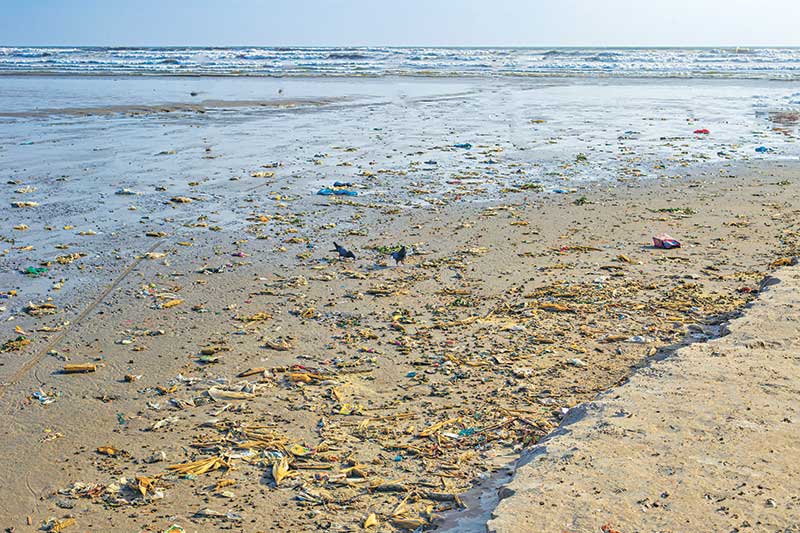
Plastic isn’t the only issue Pakistan is faced with along its coastline; it is also the industrial effluent and untreated sewage. It is estimated that almost 500 MGD of untreated effluent is released into the Arabian Sea. The Karachi Port contributes a shameful 275 MGDs, Karachi’s Lyari River another 100 MGDs, while recent figures showed that 136 MGDs is dumped by the Defence Housing Authority; the rest comes from other tributaries including Nehr-i-Khayam, Malir River, and the Korangi Industrial Area. This has resulted in a staggering drop in marine life populations by 40 percent. A recent study Exploring Sustainable Solution For Wastewater Treatment: A Case of Lyari River concluded that there are hazardous levels of metal found in the river’s untreated effluent; these include nickel and chromium. Four decades back; the Lyari River was home to fish and migratory birds. Are the 10,000 industrial units in Karachi that manufacture a variety of products ranging from textiles to chemicals installing water treatment plants? If so, are these functional? A lot needs to be done unless we want to walk amidst heaps of fish carcasses. Strict check are needed lest environment is lost forever. However, ultimatums by the authorities fall on deaf ears. Why else would we go to Karachi’s Seaview beach only to witness sewer water winding its way towards the sea, amidst the few remaining migratory birds that now nest here? Industrial waste entering creeks is adversely impacting Pakistan’s wildlife and mangroves are dying as water becomes poisonous. Marine life such as shrimps are getting contaminated while the already few numbers of flamingoes will dwindle further. Fish being netted around our few lingering mangroves are mostly contaminated as well. If we are what we eat, are we waste too? During a seminar held on the industrial waste water management in December 2018, the water commissioner, retired Justice Amir Hani Muslim, stressed the need for all industrial units to have wastewater treatment plants. He mentioned that a treatment plant in Karachi was being used to treat up to 80 MGDs of effluent while approximately 4,000 industrial units were operating without such water treatment plants in the province. For this fiscal year, Pakistan’s province Sindh had earmarked Rs2 billion for the installation of sewerage lines in industrial areas and the construction of five combined effluent treatment plants (CETP) in Karachi whose completion is expected by June 2021. The aggregate cost has been estimated at Rs11.7bn out of which 67 percent of the cost will be borne by the provincial government and the remaining by the federal government. These plants are aimed at filtering 94 MGDs of effluent before it is dumped into the sea. However, there is already a corruption investigation taking place regarding the Rs1bn CEPT in Kotri, Jamshoro. Keeping this picture in mind, it is no surprise that there remains a gargantuan gap between the need for efficiently treating wastewater and what is actually being done to rid our water bodies of this waste. Back in 2015, Karachi’s three treatment plants with a combined capacity of 150 MGD had become dysfunctional, paving the way for all raw sewage to be released into the sea. Compare this with Istanbul that has 154 functional treatment plants that process the entire 326 MGD of wastewater generated by its 15 million citizens who are probably living a guilt-free life. Iran uses nanotechnology for wastewater treatment; this is a far-fetched goal for Pakistan. Earlier in July 2018, the Defence Housing Authority had informed the commission on water and sanitation that untreated wastewater from four of its phases would not be discharged into the sea after April 2019, and that effluent from its remaining phases would be treated through integration using treatment plant-VI by 2020. There are undoubtedly more unidentified areas where sea pollution continues. The dead fish often found and medical waste lying about is proof of the pollution that we allow. Take a walk around Seaview and you will come across corn chaffs and husks littering the beach apart from single-use plastics and glass bottles, and even clothes! If we were to look at the overall picture of the world, according to the UN’s World Water Development Report, only 8pc of wastewater undergoes treatment in low-income countries as compared to 70pc by high-income countries. We can hope that the five water treatment plants, in which hefty investment has been made, will become operational in the projected time frame and that the technology being used is tailored to suit not just the city’s climate but the water quality too. In other words, it should be compatible with the needs of a developing country like ours. Developed nations have been using biological treatment of wastewater, i.e. aerobic and anaerobic, helping to generate biogas to produce electrical energy thus leading to an energy-efficient system. A technological advance of this calibre if applied to water treatment plants would lead to a cleaner Karachi. However, going by our present state, it can be concluded that we have collectively become a massive burden on our environment and Karachi is like a sinking ship that is plunging deeper into its own waste.
- Heba Moeen
This article was previously published in Dawn, a part of the Asia News Network.
LIFE & STYLE
The number of young people taking barista courses is increasing, but mostly to find jobs abroad
Although it is uncertain whether Nepali students are actually finding jobs abroad with the training they receive at these barista schools, the popularity of such schools is on a constant rise.
- JUNE KARKEE
Many young people are drawn towards barista training in recent years, but it isn’t just the growing coffee culture that has led to its popularity.Photos Courtesy: The School of coffee beans
Kathmandu : Bandita Magar considers herself an avid coffee drinker. She enjoys drinking coffee so much that she recently decided to undergo a 19-day training at The Barista’s Coffee School in Gathaghar, Bhaktapur. She picked up the essentials quickly, on how to become a barista and make 21 different beverages, from basic drinks like lemonade to coffee specialities like lattes and frappes. “I have always been interested in learning about making different versions of coffee and felt that this training is a great opportunity,” said Magar, 23, who spent Rs15,000 for the course. With the coffee-drinking culture growing in Kathmandu, many young people like Magar are taking barista courses offered by a number of schools and training institutes mushrooming in the Valley. But unlike Magar, who chose to take up the course out of her affinity for the beverage, the majority of people are attracted to barista courses because they believe that the skill will be helpful to land them jobs abroad—whether they are planning to move abroad for studies or for foreign employment. The number of people training to step into Nepal’s coffee market is significantly smaller. “Many students also think that it can be a transitory profession for them when they move abroad,” says Manoz Shahi, training director at the Barista’s Coffee School. Shahi started his coffee school in 2017 in Dillibazaar and Bhaktapur, and has since trained more than 2,000 students so far. Although a majority of his students take the training courses as a part of their preparation to move to a foreign country, he says that clearly wasn’t his primary vision with which he started providing the courses. “Our courses not only focuses on coffee making but also on providing basic customer service skills as well as entrepreneurial skills,” he says. “This is to foster an environment where people can establish their own coffee ventures.” The 15-day barista training package at Shahi’s school provides students with basic theoretical knowledge on the history and culture of coffee, as well as practical classes on things like how to make espresso and develop tasting skills. A shorter three-day latte art class, on the other hand, focuses solely on preparing and presenting lattes. At the end of the course, students are required to take an objective test and are provided with a certificate of completion if they are able to pass the test. Those who do not perform well in the test need to undergo additional training. “The trainers were really helpful, and the school was well equipped with high-end machines,” says Magar, who also shared that she scored the highest from her batch on the objective test.
But for others, who are specifically taking courses to move abroad and find jobs at coffee shops, a certificate alone isn’t enough to guarantee a job, says Suman Singh Thapa, who currently works as a barista at Pasta Pantry, a cafe in Sydney, Australia. While the training provided by these barista schools are thorough and extensive, in many cases, the employees demand work experience. “I wouldn’t say that the training wasn’t helpful, but it was not enough for me to find a job in Sydney,” he says. “Even here, cafe owners usually look for people who have already had experience in Australia.” But Sanjeev Shrestha, founder and trainer of The School of Coffee Beans, another barista training school, says that the art of coffee making also depends on the individual. Even after undergoing training at barista schools, it is important to keep practising to hone one’s skills. And although it is uncertain whether students are actually finding jobs abroad with the training they receive at these barista schools, the popularity of such schools are on a constant rise, says Shahi of Barista’s Coffee School. According to him, around seven to eight new barista training schools have been opened within the last three months in Kathmandu alone, and they mostly tend to attract younger people. “When we first opened, there were just a few schools and most of them were situated at reputed coffee places like Himalayan Java, but now people are treating it more like a lucrative business,” he said. “But coffee is an art, not something that should just be profitable.” However, Shrestha says that at least 40 of his students who underwent training at The School of Coffee Beans have already found employment inside the country, with some even opening up their own businesses.
But Shahi believes that such number barely account any significance. He says that many things still need to be improved to really develop a coffee culture in Nepal, the way it is established in other countries. Although young people’s growing interest is encouraging, their lack of interest in planning their future in the country is disheartening, he says. “A lot of young people join these training schools because they seek opportunities abroad,” he said. He also believes that this has also hindered baristas in the country to grow as a community and is consequently stalling the growth of the coffee culture. “In a few years, many international organisations may enter the Nepali coffee market,” says Shahi. “By then, we need to be prepared. So, it’s important to share and provide everyone with the same amount of knowledge and skills.”
LIFE & STYLE
What’s in a gift?
Agony aunt
Dear Aunt, I have been friends with this girl for 14 years now. We were neighbours so we basically grew up together. We studied together, played together, watched movies together and had countless sleepovers together. She is a great person. She’s kind, smart, caring and funny, so I never had an issue spending time with her. I wouldn’t call her my best friend, but she is a good friend of mine and I really treasure having her in my life. She is also extremely crafty. Be it DIYs or origami, she does it all, that too pretty well. She makes exaggerated greeting cards, gift-boxes, room decoratives for herself and for everyone else. Recently, she discovered her interest in handmade jewellery. And then she started making bracelets and necklaces from straws, wires, strings, beads and shards of glasses. It takes her about two days to make one necklace, and as much as I hate to say it, they are ugly. She gifted me a necklace on my birthday last month, and she gifted me a bracelet this month as well. I’m actually really thankful for her gifts. Handmade gifts are very thoughtful, and also take a lot of time to be made. So I appreciate the handmade jewellery and the love and effort she puts in them. However, the problem arises when she starts insisting that I wear that jewellery. Now, that wouldn’t be a problem if she wanted me to wear jewellery when it’s just the two of us hanging out, but she wants me to go out and about wearing it. I don’t want to be disrespectful, but I really don’t want to go out wearing jewellery that looks like it came straight out of a 70s movie. I have been distracting her and changing the topic every time she brings it up to avoid it, but it seems like she’s starting to notice that I am avoiding wearing her gifts. The other day, she asked me if her necklaces were over the top. I didn’t know how to tell her, or if I wanted to tell her at all, so like always, I quickly changed the topic. However, I came to know that she’s making one more bracelet for me as a goodbye gift, and as much as I’m going to miss her once she flies to Sydney, I don’t want any more ugly jewellery. I don’t know what to do, Aunt. Should I tell her that her jewellery sucks? And if so, how do I say it without being too harsh? Or should I just accept the gift, as it’s the thought that matters? How do I politely refuse the present and not hurt her feeling? Please help me. —Jyoti
Dear Jyoti, Reading about your friendship with this girl reminds me of my own neighbourhood friends. Every evening all of us used to come out to the street to play hide and seek. We weren’t the closest of friends, we understood that we were just growing up together, so we didn’t have any expectations from each other when we later drifted apart. But it looks like you are closer with this friend of yours, as you both have kept in touch with each other for so many years. And therefore, it’s important that you give her your honest feedback even if you don’t want to hurt her right now. You must understand that by not telling her how you feel you are not helping her grow. Good friends always tell their honest opinion, and this doesn’t mean blatantly blurting out your views. You need to tell her your opinion in a way that encourages her to work on her craft. In life, we make friends everywhere and from all circles of life, some are closer than others but most of the time they become good friends. And in the various exchanges of life and the experiences you go through, you will have to tell them the most absurd, awkward and difficult truths. And trust me, these situations and conditions are what help us become a better person. These tested times are when we learn the important lessons of life: of why we need to choose our words carefully. But that doesn’t mean that you be outright blunt and hurt her feelings. There is a thin line between being mean and being honest. And it is for you to decide whether you want her to know what has been going on in your mind. But if you decide to talk to her, wait for an appropriate situation, most suitably when you two are alone (which I don’t think will be a problem) and have a heart-to-heart conversation with her. You also need to gauge her emotional reaction and her body language when you decide to offer her your honest opinion. But most importantly, as I’ve said before, choose your words wisely and carefully. As she has been asking for feedback from you regarding her crafts, I feel that she is open to understanding another person’s perspective. It is important that you give her your honest feedback in a way where she doesn’t feel humiliated or attacked before someone else embarrasses her for her crafts. But like time and truth, fashion choices are also relative. Right now, you may feel that her jewellery is ugly and tacky but they are also made with love and care. After she moves to another part of the world, who knows, those souvenirs will be the one you will hold onto along with her memories. There also may be a time where you will want to wear that jewellery, regardless of how imperfect they are. Just remember that like her gifts to you, people and situations will never be perfect but we can try to have strong, solid relationships that are built on honesty. So try to prioritise how you would want to build your relationship with her. Good luck!
CULTURE & ARTS
The traditional weapon that is losing its edge
The popular Bhojpure khukuris are exported all around the world, particularly to the US, the UK, Germany, France, Italy, and Spain. But in recent years, its production has been largely stifled.
- ALISHA SHRESTHA
The manufacturers of famed Bhojpure khukuri say that they are unable to meet the demands of the traditional weapon in recent years. Post Photos: Alisha Shrestha
Bhojpur, Ganesh Gajmer rises with dawn. He freshens up, prepares for himself a morning snack and then enters his workshop, which is right behind his house. Inside, he heats the furnace, and then sits down to sharpen khukuris and other agricultural tools, like sickle, spade and hoe, all day. This has been the 55-year-old’s daily routine for the last four decades. Gajmer, who inherited the profession from his ancestors, is one of the few people in Bhojpur still producing the famous ‘Bhojpure khukuri’, a type of traditional Nepali weapon popularised globally due to its usage by British Gurkhas. But with the advancement of weaponry, young people’s disinterest in ancestral occupation and scarcity of woodfire to make coal, an imperative ingredient in crafting the traditional weapon, has led to Bhojpure khukuri becoming a scarce possession. “Every month, we get around 500-2,000 people asking for khukuris. But due to lack of raw materials, we cannot even produce that,” says Gajmer. In order to create a khukuri, you first need to determine the amount and type of steel you need. And that depends on what kind of khukuri a customer wants. Bhojpure khukuris come in different variations, such as Baduna, Banspate and Sirupate. The dimensions, shape and thickness of the blade of these variations of khukuri vary according to the intended tasks of the weapons as well as the region of their origin. Baduna is thick and wide. Sirupate is sleek with a sharp tip, and is shaped like a leaf. Banspate is thick and is shaped like a bamboo leaf. In order to wield a khukuri, the metal needs to be heated inside an oven filled with coal. After the metal is heated, it is hammered until the required thickness and shape is achieved. The metal is then shined with the use of chemicals and lastly the blade is sharpened. Coal is imperative in forging a khukuri, but due to recent forest conservation laws, which restrict open access to wood, blacksmiths like Gajmer have been facing difficulty producing the traditional weapon. If the difficulty pertains, Bhojpure khukuri will soon be on the verge of extinction, says Gajmer. The blacksmiths in Bhojpur claim that Bhojpure khukuri is more popular, both nationally and internationally, than khukuris made in other districts. But despite its importance, its production has been largely stifled in recent years, says Gajmer.
In Bhojpur alone, blacksmiths from around the districts like Kot, Dalgau, Gogane, Khawa, Khairang, Bhokhim, Dawa, Timma, Dingla, Deurali, Jarayotaar and 35 other places are known for producing the famous khukuri. The district headquarters hosts two metal work factories, specifically to forge Bhojpure khukuris. Bhojpure khukuris have been exported in millions of rupees to Dharan, Biratnagar, Kathmandu as well as to China, Bangladesh, Pakistan, Brunai, Singapore, Hongkong, Japan, Korea, and the United Kingdom since the 90s. The khukuri manufacturers say that there is still a very high demand from neighbouring countries like India, China, Singapore, Hongkong, Bahrain, Japan, and Korea. “But the lack of open trade policies has reduced the export of khukuris,” says industrialist Hira Shrestha. Shrestha says that the government too hasn’t helped much with promoting and preserving these khukuris. It is yet to come up with plans and policies that will help promote this industry nationally as well as internationally. It has also shown no interest in establishing any industries and factories to manufacture khukuris, he says. According to him, in neighbouring countries like India and China, there is a partial ban on khukuris. This is because khukuris are considered as weapons, but at the same time, swords and spears are completely legal. “The government should be able to have talks with the representatives of both countries to increase the export of khukuris,” he says. The locals believe that khukuris were made in Bhojpur from as early as 1908. In 1970, when then King Mahendra visited Bhojpur, a local blacksmith Singh Bahadur Bishwakarama ‘Sine’ gifted a khukuri to the king. Impressed by his ability to make khukuris, King Mahendra awarded Rs1,000 to Bishwakarma. After that, Bhojpure khukuris found more fame across the national and international market. In recent years, Bhojpure khukuris have also become popular decorative and gift options. According to local manufacturers, around 80 percent of khukuris manufactured here are used for gifts and decorations and the rest is used for household purposes. Domestic and foreign tourists also get one as a souvenir from the district. Khukuris ranging from 4 inches to 2 feet are produced in the district. Popular for its attractive and decorative handles, these are also exported to the US, the UK, Germany, France, Italy, and Spain among other countries. But while people from other districts and foreign countries seem interested in Bhojpur’s prized possession, the youth in the district are not charmed by it. As this profession requires a lot of effort and one is forced to work near coals, most youth who were in this profession have opted for foreign employment instead, says Ghanshyam Bishwakarma from Bhaisipanka of Bhojpur municipality. “There is also a dearth of skilled technicians who can manufacture the famed khukuri,” he says. Without government intervention, the future for these khukuris is bleak. “If the government can make this occupation more professional, it can create job opportunities for thousands of youths inside the country,” he says.
CULTURE & ARTS
It’s a tie: Atwood and Evaristo share fiction’s Booker Prize
Judges tore up the rule book, awarding the prestigious Booker Prize for Fiction jointly to Canadian author Margaret Atwood and Anglo-Nigerian author Bernardine Evaristo.
- JILL LAWLESS
Margaret Atwood and Bernardine Evaristo jointly win the Booker Prize forFiction 2019 at the Guildhall in London, Britain October 14. Reuters
Canadian writer Margaret Atwood and British author Bernardine Evaristo split the Booker Prize on Monday, after the judging panel ripped up the rulebook and refused to name one winner for the prestigious fiction trophy. Chairman Peter Florence said the five judges simply couldn’t choose between Atwood’s dystopian thriller The Testaments and Evaristo’s kaleidoscope of black women’s stories, Girl, Woman, Other. Partly inspired by the environmental protesters of Extinction Rebellion, who were demonstrating near the prize ceremony’s venue in London’s financial district, Florence said the judges refused to back down when told the rules prohibit more than one winner. “Our consensus was that it was our decision to flout the rules,” he said. “I think laws are inviolable and rules are adaptable to the circumstance.” Prize organisers didn’t see it that way. Gaby Wood, literary director of the Booker Prize Foundation, said prize trustees repeatedly told the judges they couldn’t have two winners, but they “essentially staged a sit-in in the judging room” as deliberations dragged on for five hours. Wood insisted the decision “doesn’t set a precedent.” It means Atwood and Evaristo will split the 50,000 pound ($63,000) Booker Prize purse. Florence said both of the winning books “address the world today and give us insights into it and create characters that resonate with us.” “They also happen to be wonderfully compelling page-turning thrillers,” he added. Both winners said they were happy to share the prize. “It would have been quite embarrassing for a person of my age and stage to have won the whole thing and thereby have kept a younger one, at different stage of their career, from going through that door,” said Atwood, who at 79 is the oldest-ever Booker winner. Evaristo said winning the Booker was something that “felt so unattainable for decades.” “So I’m just absolutely delighted to have the prize and to share the prize,” she said. Atwood, who won the Booker in 2000 for The Blind Assassin, had been the bookmakers’ favourite to win the coveted trophy for a second time with her follow-up to The Handmaid’s Tale. Like that book—now a hit TV series—The Testaments is set in Gilead, a theocratic republic taken root in the United States, where young women are forced to bear children for powerful men. Florence, founder of the Hay literary festival, said Atwood’s novel “does massively more” than just continue the story started in The Handmaid’s Tale. “It’s beautiful in its depth and exploration of the world of Gilead,” he said. It might have looked like science fiction back in the day . Now it looks more politically urgent than ever before.” Evaristo, who is of Anglo-Nigerian heritage, is the first black woman to take the trophy. “I hope that honour doesn’t last too long,” she said. She has published seven previous books but is less known than her co-winner. Florence said he wasn’t worried Evaristo, 60, would be overlooked as people focused on Atwood. He said that “there is something utterly magical” about the 12 characters from many walks of life who narrate Girl, Woman, Other. “They give a wonderful spectrum of black British women today,” he said. “In that sense this book is ground-breaking—and I hope encouraging and inspiring to the rest of the publishing industry.” Founded in 1969, the prize is open to English-language authors from around the world. It has been split between two winners twice before, most recently in 1992, when Michael Ondaatje’s The English Patient and Barry Unsworth’s Sacred Hunger shared the trophy. The rules were changed after that to stipulate there can only be one winner each year. Judges chose the two winners from a six-book shortlist that included British-Turkish author Elif Shafak’s Istanbul-set 10 Minutes 38 Seconds in This Strange World; U.S.-British writer Lucy Ellmann’s stream-of-consciousness novel Ducks, Newburyport; India-born British writer Salman Rushdie’s modern-day Don Quixote story, Quichotte; and An Orchestra of Minorities, a saga of love and exile by Nigeria’s Chigozie Obioma. The prize, which often delivers a big boost in sales and profile to the winner, was sponsored for 18 years by investment firm Man Group and was known as the Man Booker Prize. This year it reverted to its original name, the Booker Prize, under a new sponsor: the Crankstart Foundation, founded by Silicon Valley venture capitalist Michael Moritz and his wife, writer Harriet Heyman.
WORLD
Trump sanctions fail to slow Turkey assault
Standoff looms in northern Syrian town of Manbij; Kurds say Syrian deployment is ‘emergency measure’.
- REUTERS
Smoke rises over the Syrian town of Ras al-Ain as seen from the Turkish border town of Ceylanpinar, Sanliurfa province, Turkey, on Tuesday. REUTERS
ANKARA/WASHINGTON, Turkey ignored new sanctions from the United States to press on with its assault on northern Syria on Tuesday, while the Russia-backed Syrian army entered one of the most hotly contested cities, filling a void created by Donald Trump’s abrupt retreat. A week after reversing US policy and moving troops out of the way to allow Turkey to attack Washington’s allies in northern Syria, Trump announced a package of sanctions to punish Turkey. But financial markets shrugged off the announcement, and Trump’s critics said the moves were too feeble to have an impact. The Turkish lira actually went up, with traders noting Trump had spared Turkish banks from punishment. Trump’s unexpected decision to withhold protection from Syria’s Kurds after a phone call with Turkish President Tayyip Erdogan a week ago swiftly upended five years of US policy in the Middle East, giving a free hand to Washington’s adversaries in the world’s deadliest ongoing war. The United States announced on Sunday it was withdrawing its entire force of 1,000 troops. Its former Kurdish allies immediately forged a new alliance with the Russia-backed Syrian government of President Bashar al-Assad, inviting the army into towns across the breadth of Kurdish-held territory. One of the most important flashpoints is the city of Manbij, west of the Euphrates river, which Turkey has vowed to capture. The area had been patrolled jointly by US and Turkish forces under a deal aiming to persuade Turkey not to invade. The Russian-backed Syrian forces appear to have moved swiftly to fill the void left by departing Americans. State television broadcast footage of what it said was government troops entering the city on Tuesday. A resident inside the city told Reuters the Syrian troops were on its outskirts. Turkey-backed Syrian fighters said they would continue their advance towards Manbij, and said the troops that had entered were mostly Kurdish fighters now allied to the government. A Reuters cameraman on the Turkish frontier reported heavy bombardment on Tuesday morning of the Syrian border town of Ras al Ain, where a spokesman for the Kurdish-led Syrian Democratic Forces reported a fierce battle was taking place. Trump has defended his reversal of US policy as part of a plan to withdraw the United States from “endless” wars in the Middle East. But his critics, including senior figures in his own Republican Party, cast it as a betrayal of the Kurds, loyal allies who lost thousands of fighters in battle against Islamic State with Washington’s support. The Democratic speaker of the House of Representatives, Nancy Pelosi, said Trump’s sanctions were too little, too late. “His announcement of a package of sanctions against Turkey falls very short of reversing that humanitarian disaster.” Turkey says it aims to defeat the Kurdish YPG militia, which it sees as terrorists for its links to separatists in Turkey, and to create a “safe zone” where millions of Syrian refugees can be resettled. The United Nations says 160,000 people have fled their homes as Turkish forces advance. The Kurdish administration puts the number of displaced at 270,000. Erdogan, who has pledged to continue military operations come what may, said Turkey was giving the world a “second chance” to bring peace to the region. “The international community missed its opportunity to prevent the Syrian crisis from pulling an entire region into a maelstrom of instability,” he wrote in the Wall Street Journal. “The European Union—and the world—should support what Turkey is trying to do.” The Syrian army deployments into Kurdish-held territory are a victory for President Bashar al-Assad and his most powerful ally, Russia, giving them a foothold in the biggest remaining swath of the country that had been beyond their grasp. Trump allies insisted Washington had not given its blessing to the Turkish offensive and demanded a ceasefire. “The United States of America simply is not going to tolerate Turkey’s invasion in Syria any further,” Vice President Mike Pence said. “We are calling on Turkey to stand down, end the violence and come to the negotiating table.” Trump’s sanctions include reimposing steel tariffs and halting talks on a $100 billion trade deal. But the decision not to hit Turkish banks led to a rally in Turkish financial stocks: “The sanctions are not related to banking, so the markets will have a positive perception,” said Cem Tozge, asset management director at Ata Invest. In a potentially more damaging blow, German carmaker Volkswagen said it was postponing a final decision on whether to build a 1 billion euro ($1.1 billion) plant in Turkey, citing concern over “current developments” after international condemnation of the incursion. Trump said US troops would remain at a small garrison at Tanf in southern Syria “to continue to disrupt remnants” of Islamic State. But the base would do little to support operations elsewhere in the country. Turkey may be ‘responsible’ for executions of Kurds in Syria: UN GENEVA: The UN warned on Tuesday that reported summary executions of civilians in northeastern Syria carried out by pro-Turkish fighters could amount to a “war crime” and that Ankara could be “deemed responsible”.
WORLD
Jailed Catalan separatist leader says new referendum inevitable
- REUTERS
AFP/RSS
BARCELONA, The jailing of Catalan separatists for their role in a failed secession bid will only galvanise the region’s independence movement and another referendum is inevitable, the leader hit by the heaviest jail sentence told Reuters. Former regional government deputy leader Oriol Junqueras and eight others were convicted of sedition on Monday by the Supreme Court and sentenced to terms ranging from 9-13 years. The ruling triggered protests across the wealthy northeastern region whose independence drive plunged Spain into full-blown political crisis in October 2017, when the leaders organised a referendum that courts had ruled illegal and made a short-lived declaration of independence. “This sentence will not weaken the independence movement, quite the contrary,” Junqueras told Reuters in his first interview after the sentence. “We’re not going to stop thinking what we think, ideals can’t be derailed by (jail) sentences.” All the defendants were acquitted of the gravest charge, rebellion, but the length of the prison terms - which Junqueras said they planned to appeal in a European court - prompted anger in Catalonia. On Monday, demonstrators blocked roads and regional railways there and thousands descended on Barcelona’s international airport, where some clashed with police. Those behind the airport protest, the Tsunami Democratic group, called for protesters to keep returning to the street. A spokesman for the airport said it had cancelled 110 flights on Monday and a further 45 on Tuesday. “Never, never, never have separatists acted violently, never,” added Junqueras, in emailed answers to questions passed on to Reuters by his staff late on Monday. “What I’m sure of is that this conflict is to be resolved via ballot boxes ... we are convinced that sooner or later a referendum is inevitable because otherwise, how can we give a voice to the citizens?”. Catalan regional leader Quim Torra said on Tuesday his government would continue to defend the right to self determination, and that another referendum was “(the) most positive solution for trying to solve this.” Two years after the debacle of the first plebiscite, Catalonia’s independence drive still dominates much of Spain’s fractured political debate. The country’s main national parties are divided on whether to grant the region additional autonomy on top of the administrative and budgetary controls it already holds - but all except the far-left Podemos oppose holding a referendum on independence. Besides, sharp divisions within Catalonia itself over the issue of independence have contributed to taking the steam out of the independence movement in recent months, with protests drawing smaller crowds.
WORLD
Poland’s nationalists seal election majority, lose Senate
- REUTERS
WARSAW, Poland’s nationalist Law and Justice (PiS) party narrowly won a second term in power, final results from Sunday’s parliamentary election showed, but its drive to push through its conservative agenda may be hampered by a loss of the upper house. PiS has campaigned on a promise to expand its massive welfare programme and deepen reforms of the judiciary, an overhaul that has sparked unprecedented legal action from the European Union and drawn criticism of subverting democracy. Speaking after a final count showed PiS had secured 235 seats in the 460-seat legislature, party chief Jaroslaw Kaczynski said “everything we consider important will be fulfilled, with all certainty.” The Electoral Commission said PiS, a eurosceptic group with a left-leaning economic agenda, had won 43.6 percent of votes, more than the 37.6 percent it secured in an election four years earlier. Under Poland’s complex electoral rules, the wider victory did not translate into any gains in the legislature. The main opposition grouping, the Civic Coalition, an umbrella organisation that includes the Civic Platform (PO) formerly led by EU Council President Donald Tusk, secured 134 seats in parliament, with 27.4 percent of votes. Four years of PiS rule have shifted the political climate in Poland, dividing the country over issues such as gay rights and media freedom, with critics saying PiS has fomented homophobia and turned public broadcasters into a mouthpiece for its agenda. Tapping in to widespread dissatisfaction with economic prosperity among many Poles since the collapse of communism, PiS told voters it will aim to replace the business and cultural elites to ensure fair distribution of the nation’s wealth. Underlying divisions, election turnout at 61.7% was the highest in any parliamentary vote since a 1989 vote that ushered in the end of communism. “There is a shift in the people’s consciousness, which moves in the direction of blocking PiS’s authoritarian tendencies,” Izabela Leszczyna, a PO lawmaker who kept her mandate, told Reuters.
WORLD
EU keeps hopes of Brexit deal alive, for now
- AGENCE FRANCE-PRESSE
EU Brexit negotiator Michel Barnier arrives to answer journalists prior to a summit on Brexit in Luxembourg on Tuesday. AFP/RSS
LUXEMBOURG, A Brexit deal could yet be reached this week, the chief EU negotiator said on Tuesday, but member states warned they will not allow Britain to open a back door to their single market. British and EU officials are scrambling to draft a deal on Britain’s exit terms before the European summit on Thursday, as Prime Minister Boris Johnson seeks to fulfil his vow to take Britain out on October 31. European diplomats said Britain has already given ground on customs rules for Northern Ireland, but must go further quickly if a deal is to be done this month. As he arrived in Luxembourg to brief the other 27 EU states on the progress of the closed-door talks, chief EU negotiator Michel Barnier struck a cautiously upbeat note. “This work has been intense all along the weekend and yesterday because even if the agreement will be difficult—more and more difficult to be frank—it’s still possible this week,” Barnier told reporters. “Obviously any agreement must work for everyone—the whole of the United Kingdom and the whole of the European Union. Let me add also that it is high time to turn good intentions into legal text.” A European diplomat told AFP that the “goal” was to get a draft text of a deal ready later in the evening Tuesday, but warned: “Time is running out, but the window for agreement is still narrowly open.” Another diplomat explained that if Britain wants a deal agreed at the summit this week, then a text would need to be ready “today or tomorrow morning” to allow EU and member state parliamentary procedures to be completed. British Brexit Minister Stephen Barclay joined Barnier in Luxembourg in what was seen as a positive sign for progress in the talks—which have been shrouded in secrecy since the weekend as the two sides seek to avoid potentially damaging leaks. “The talks are ongoing. We need to give them space to proceed but detailed conversations are under way and a deal is still very possible,” Barclay said as he arrived. After weeks of gloom and growing fears Britain would crash out of the bloc with no divorce arrangements in place, the last few days have given a glimmer of hope that an agreement can be reached—though there has so far been no decisive breakthrough. More than three years after Britain’s 2016 referendum vote to leave, talks remain stuck on how to avoid customs checks on the border between British-ruled Northern Ireland and EU-member Ireland. The EU has reservations about London’s proposed customs arrangements and the role for Northern Ireland’s Stormont assembly in giving consent to the plans.
WORLD
Electricity a luxury in Madagascar where only 15 percent have power connection
- AGENCE FRANCE-PRESSE
Rakotondrasoa’s village of Ambohimasindray, just 20 km north of the capital Antananarivo, requested access to the power grid nearly 20 yearsago. Reuters
AMBOHIMASINDRAY (Madagascar), Raymond Rakotondrasoa surveys the charred remains of his mud and thatched-roofed house in Madagascar. “I left a candle burning on my bedside table,” the 70-year-old says. “It fell and set fire to my clothes before spreading.” The retired construction worker is lucky to be alive. “If it had happened during the night I could have died,” says Rakotondrasoa, who lost all his worldly possessions in minutes that terrible day in August. Only 15 percent of the country’s 26 million inhabitants have access to electricity. Everyone else, like Rakotondrasoa, relies on candles, oil and kerosene lamps. Says Rakotondrasoa: “I can’t stand the smell and the fumes given off by kerosene, so I use candles and an oil lamp.” His neighbour Louise Rasoahelinivo prefers kerosene because it is cheaper. “I use two candles a day, whereas one litre of kerosene lasts more than a month,” says the 70-year-old seamstress. Candles cost between 6 and 12 euros cents (13 US cents) each in the island nation off of southeastern Africa, compared with 50 cents for a litre of kerosene. The difference is significant in a country where two-thirds of the population lives below the poverty line. Rakotondrasoa’s village of Ambohimasindray, just 20 kilometres north of the capital Antananarivo, requested access to the power grid nearly 20 years ago, he says. But the village is still waiting to hear back from Jirama, the troubled state-owned power company. Jirama told AFP that Ambohimasindray’s application was “too old” to warrant comment. Madagascar’s energy situation is “catastrophic”, said the director general of the energy ministry, Andry Ramaroson. “The rate of access sits at 15 percent and it has not moved in eight years,” he told AFP. According to the World Bank, Madagascar ranks 184th out of 190 countries in terms of access to electric power. One solution would be to replace the crumbling hydropower plants built during French colonial rule, which ended in 1960. But Ramaroson said presidents are reluctant to take on lengthy and costly construction projects likely to drag on beyond their five-year mandates. Meanwhile, Jirama is indebted to the tune of 400 million euros ($438 million) and is operating at a loss of 75 million euros, according to the World Bank. It has long been accused of mismanagement, selling power at a loss and buying kilowatt hours from private suppliers at twice the price it charges consumers. Madagascar’s distribution network has not been expanded in four decades. The country about the size of mainland France has only 400 kilometres of high-voltage lines and 1,000 kilometres of medium-voltage lines to distribute the 417 megawatts generated per year. Jirama has little economic incentive to provide power to tiny villages like Ambohimasindray, which would require a major investment with little return. “Jirama is an operator that reasons in terms of costs and losses,” Ramaroson said. Rasoahelinivo may never be able to watch the television she was given by her children in 1989. “Electricity remains a luxury product only city dwellers can afford,” she says. Some, like Rasoahelinivo’s neighbour Isabelle Ramiadanary, have turned to solar power instead. But her flimsy panel gave out after eight months and now has only enough power to charge mobile phones, so she is back to using candles and kerosene. Indeed, solar power is an obvious alternative in a country that enjoys some 2,800 hours of sunlight annually. The government is counting on this potential to reach its goal of providing energy to 70 percent of households by 2030, according to the World Bank. Meanwhile, the private sector has stepped in with a major hydroelectric power project. This month, French engineering firm Colas, Norway-based SN Power, local company Jovena and the Africa50 investment platform signed an agreement to develop a hydropower plant on Madagascar’s Ivondro river, 40 kilometres from the eastern city of Toamasina. The 120-megawatt plant, to be commissioned by 2023, is so far the largest private-sector investment in the electricity sector.
WORLD
Russia bids farewell to first man who walked in space
Briefing
MYTISHCHI (Russia): Hundreds of people including Russian and US astronauts and top officials bid farewell on Tuesday to Alexei Leonov, a legendary Soviet cosmonaut who was the first man to perform a spacewalk. Thomas Stafford, an 89-year-old retired NASA astronaut, Valentina Tereshkova, the first woman to travel into space, and Russian Defence Minister Sergei Shoigu were among those gathered for a funeral with military honours just outside Moscow. Fellow astronauts took turns praising the Soviet space icon next to a flag-draped casket that bore Leonov’s body at the military memorial cemetery in Mytishchi. Soviet cosmonaut Tereshkova called Leonov, who died in Moscow on Friday aged 85 after a long illness, a true friend. (Agencies)
WORLD
Nearly 1 billion euros raised, pledged for Notre-Dame
Briefing
PARIS: Six months after a blaze caused devastating damage to Paris’ Notre-Dame cathedral, nearly one billion euros have been paid or pledged to rebuild the edifice, France’s culture minister said on Tuesday. Of the total, 104 million euros have already been paid over by 350,000 donors, Franck Riester told journalists in Paris. “It is far too early to say whether the amount will be enough,” the minister said, adding “the government will assume its responsibilities; we will not leave Notre-Dame in the lurch.” Riester said the total had reached 922 million euros. Three foundations and France’s National Monuments Centre have been charged with raising money for rebuilding the cathedral. (Agencies)
WORLD
Hunter Biden admits error but insists no wrongdoing
Briefing
WASHINGTON: Hunter Biden denied any wrongdoing in his business dealings in Ukraine and China but acknowledged he exercised poor judgment and cashed in on the fame of his last name. In an interview to be aired Tuesday on ABC News, Biden said he had failed to anticipate how those activities would be become fodder for critics of his father, former vice president Joe Biden, as he runs for the Democratic presidential nomination. (Agencies)
ASIA
Hong Kong leader rules out making any concessions to protesters
Police say violence now ‘life threatening’; city’s real estate rents hit by unrest.
- REUTERS
Hong Kong Chief Executive Carrie Lam speaks to journalist before a weekly Executive Council meeting in Hong Kong, China, on Tuesday. REUTERS
Hong Kong : Embattled Hong Kong leader Carrie Lam on Tuesday ruled out making any concessions to pro-democracy protesters in the face of escalating violence, which police said was now “life threatening” citing the detonation of a small bomb. “I have said on many occasions that violence will not give us the solution. Violence would only breed more violence,” Lam told a news conference. “For concessions to be made simply because of escalating violence will only make the situation worse. On the other hand, we should consider every means to end the violence.” Protesters have five main demands, which include universal suffrage and an independent inquiry into what they say has been excessive force by police in dealing with the demonstrations. Hong Kong has been rocked by four months of unrest, with massive marches and at times violent protests involving tear gas, petrol bombs and live rounds, over concerns Beijing is tightening its grip on the city and eroding democratic rights.Beijing rejects the charge and accuses Western countries, like the United States and Britain, of stirring up trouble. The unrest poses the biggest popular challenge to Chinese President Xi Jinping since he came to power in 2012. He has warned that any attempt to divide China would be crushed. The violence has escalated since the government brought in colonial-era emergency powers on Oct. 4.On Sunday night, protesters and police clashed in running skirmishes in shopping malls and on the streets. Black-clad activists threw 20 petrol bombs at one police station. A crude explosive device, which police said was similar to those used in “terrorist attacks”, was remotely detonated as a police car drove past and officers cleared roadblocks. A police officer also had his neck slashed by a protester. An 18-year-old school student has been charged with attacking the officer with a box cutter intent on causing grievous bodily harm. Police have arrested more than 2,300 people since June when the unrest escalated, scores of them teenagers, some as young as 12, according to Lam. Hong Kong was guaranteed 50 years of freedoms under the “one country, two systems” formula when Britain returned its former colony to China in 1997. A failed attempt to create a China extradition bill, which could have seen residents sent for trial in Communist Party-controlled courts, was seen as the latest attempt to reduce those freedoms, and ignited the unrest. The protests have at times attracted millions onto the streets as the movement widened to include residents angry at growing inequality in Hong Kong, which boasts some of the world’s most expensive real estate. Lam said she would focus on land and housing initiatives in her annual Policy Address on Wednesday, seeking to restore confidence in the city’s future. Hong Kong is facing its first recession in a decade, with tourism and retail hit hard by the unrest. High street retail rents have experienced the sharpest quarterly decline since the first quarter of 1998 at the time of the Asian financial crisis, says commercial real estate investment firm CBRE. Protesters, residents and some lawmakers have accused police of excessive force. Police have fire more than 3,000 rounds of tear gas, more than 600 rounds of rubber bullets and 3 live rounds. Two people have been shot and wounded and thousands injured. US Senator Josh Hawley, visiting Hong Kong on Sunday, warned the city was in danger of sliding into a “police state”. Lam rejected such criticism on Tuesday. “The Hong Kong police force is a highly professional and civilised force,” she said. “I would challenge every politician to ask themselves if the large extent of violence acts and all those petrol bombs and arson and really deadly attacks on policeman happened in their own country, what would they do?” According to media, Hawley responded on Tuesday saying: “I chose the words ‘police state’ purposely – because that is exactly what Hong Kong is becoming. I saw it myself. If Carrie Lam wants to demonstrate otherwise, here’s an idea: resign.”
ASIA
Rajapakse vows to scrap Sri Lanka war crimes probe if elected
- AGENCE FRANCE-PRESSE
COLOMBO : Sri Lanka’s front-running presidential candidate Gotabhaya Rajapakse vowed on Tuesday that if elected he will scrap Colombo’s pledge to investigate war crimes committed during his brother Mahinda’s decade in power. Gotabhaya was defence secretary during his brother’s rule, when troops were accused of killing up to 40,000 Tamil civilians while crushing the Tamil Tigers. A later government co-sponsored a US-led resolution to appoint an independent panel to look into the actions of both sides in the final stages of Sri Lanka’s bloody separatist conflict, although it was never formed. But on Tuesday the 70-year-old Gotabhaya said he would not honour the commitments made to the UN Human Rights Council, saying people needed to “move on” In response to questions by AFP about Sri Lanka’s wartime human rights record, he said: “Why are you talking all the time on the past. Ask (about) the future. “I am trying to become the president of the future Sri Lanka. So if you concentrate on the future, it is better.”He said even the Tamils were more interested in jobs, education and infrastructure than raking over the past. The Rajapakses insist no civilians were killed by government forces in the latter stages of the war, and accuse the rebels of using tens of thousands of civilians as human shields. At least 100,000 people were killed in the conflict between 1972 and 2009.Mahinda Rajapakse’s administration was on the verge of international sanctions because of its refusal to investigate the alleged war crimes when he was defeated at the January 2015 elections.Gotabhaya Rajapakse was addressing the press Tuesday for the first time since launching his bid to become president in an election scheduled for November 16.
ASIA
Britain’s William and Kate begin ‘complex’ tour of Pakistan
- AGENCE FRANCE-PRESSE
ISLAMABAD : Prince William and his wife Kate arrived in Pakistan to a red carpet welcome late on Monday for their “most complex” tour to date, with Islamabad eager to tout improved security after years of violent militancy. The couple—the Duchess of Cambridge in a sea-green shalwar kameez, and the Duke in a dark suit—were greeted by Foreign Minister Shah Mehmood Qureshi and presented with flowers after they landed in a British government plane at a military base in Rawalpindi, the garrison city adjacent to the capital Islamabad, state television images showed. Details of the five-day visit are being kept under wraps. Security is expected to be tight for the couple’s first official trip to Pakistan, and the first visit by a British royal since William’s father Charles and his wife Camilla came in 2006. In addition to Islamabad they are set to visit the ancient Mughal capital of Lahore, as well as the mountainous north and the region near the border with Afghanistan in the west. Kensington Palace has called the trip “the most complex tour undertaken by The Duke and Duchess to date, given the logistical and security considerations”. The couple are also expected to meet Prime Minister Imran Khan, who was close friends with William’s mother, the late Princess Diana. “I’ve always been struck by the warmth in Pakistan towards the Royal Family,” British High Commissioner Thomas Drew said in a video published to Twitter late Sunday. The couple’s programme will pay respect to Britain’s historic relationship with Pakistan, once part of colonial India, he said. “But it will focus largely on showcasing Pakistan as it is today, a dynamic, aspirational, and forward-looking nation,” Drew continued. They are expected to see Pakistan’s efforts to combat climate change and learn about the “complex security” of the region, among other issues, a statement from Kensington Palace said earlier this month.Pakistan has waged a long battle with militancy which has seen tens of thousands of people killed in the past 15 or so years. Charles’ and Camilla’s 2006 trip was tainted when they were forced to pull out of a visit to Peshawar over safety concerns after the military launched an airstrike on a religious school that killed 80 people.
ASIA
Bangladesh gets first transgender councillor
- AGENCE FRANCE-PRESSE
Pinki Khatun (2nd right), the first transgender candidate elected in Bangladesh, poses with local women in Kotchandpur. AFP/RSS
DHAKA : A transgender candidate has been elected as councillor for a rural Bangladeshi town, the first in the ultra-conservative Muslim-majority nation where laws still discriminate against sexual minorities. Pinki Khatun was elected as vice chair of a town council in the country’s west on Monday after beating her nearest rival by more than 4,000 votes, local police chief Mahbubul Alam said. “I am very delighted. I campaigned door-to-door and people have responded positively,” the garment shop owner told AFP. “I did not face any discrimination or hate campaigns.” Bangladesh has allowed transgenders, known as hijra—an umbrella term referring to someone who is born male but does not refer to themselves as a man or woman—to identify as a separate gender since 2013. This year, they were allowed to register to vote identifying as this gender. The 37-year-old councillor is a youth wing official of the ruling Awami League and campaigned as an independent candidate in the 200,000-population town of Kotchandpur after the party did not back anyone. “My aim is to work for the betterment of women and protect their rights,” said the councillor, who previously identified as a woman. “I’ll work for hijras so they can live honourably in society.” The government says there are some 10,000 hijras in Bangladesh but independent estimates say they could number up to 500,000, with many hiding their identity to avoid discrimination. Bangladesh still has a British colonial-era law where anyone who engages in gay sex faces life in prison, although the legislation is rarely used. The LGBT community also faces social discrimination.Transgender rights activist Anonnya Banik said the election of the country’s first transgender politician was a “big achievement”. “It will create positive impact in the society and inspire other trans-people. I think it reflects change in Bangladesh people’s attitude towards trans-people,” Banik told AFP.
ASIA
High on ease, low on nutrition: Instant-noodle diet harms Asian kids
- AGENCE FRANCE-PRESSE
The noodles are low on essential nutrients and micronutrients like iron and are also protein-deficient while having high fat and salt content, according to nutritionists.reuters
MANILA : A diet heavy on cheap, modern food like instant noodles that fills bellies but lacks key nutrients has left millions of children unhealthily thin or overweight in southeast Asia, experts say. The Philippines, Indonesia and Malaysia have booming economies and rising standards of living, yet many working parents do not have the time, money or awareness to steer clear of food hurting their kids. In those three nations, an average of 40 percent of children aged five and below are malnourished, higher than the global average of one-in-three, according to a report out Tuesday from UNICEF, the UN children’s agency. “Parents believe that filling their children’s stomach is the most important thing. They don’t really think about an adequate intake of protein, calcium or fibre,” Hasbullah Thabrany, a public health expert in Indonesia, told AFP. UNICEF said the harm done to children is both a symptom of past deprivation and a predictor of future poverty, while iron deficiency impairs a child’s ability to learn and raises a woman’s risk of death during or shortly after childbirth. To give some sense of scale to the problem, Indonesia had 24.4 million children under five last year, while the Philippines had 11 million and Malaysia 2.6 million, UNICEF data show. Mueni Mutunga, UNICEF Asia nutrition specialist, traced the trend back to families ditching traditional diets for affordable, accessible and easy-to-prepare “modern” meals. “Noodles are easy. Noodles are cheap. Noodles are quick and an easy substitute for what should have been a balanced diet,” she told AFP. The noodles, which cost as little as 23 US cents a packet in Manila, are low on essential nutrients and micronutrients like iron and are also protein-deficient while having high fat and salt content, Mutunga added. Indonesia was the world’s second-biggest consumer of instant noodles, behind China, with 12.5 billion servings in 2018, according to the World Instant Noodles Association. The figure is more than the total consumed by India and Japan put together.Nutrient-rich fruits, vegetables, eggs, dairy, fish and meat are disappearing from diets as the rural population moves to the cities in search of jobs, the UNICEF report said. Though the Philippines, Indonesia and Malaysia are all considered middle-income countries by World Bank measures, tens of millions of their people struggle to make enough money to live. “Poverty is the key issue,” said T Jayabalan, a public health expert in Malaysia, adding that households where both parents work need quickly made meals.Low-income households in Malaysia depend largely on ready-made noodles, sweet potatoes and soya-based products as their major meals, he said.Sugar-rich biscuits, beverages and fast food also pose problems in these countries, according to experts.Rolling back the influence instant noddles have on the daily lives, and health, of people in southeast Asia will likely require government intervention, they said. “Promotion and advertising is extremely aggressive,” said Thabrany, the Indonesian public health expert.“There is massive distribution. They (instant noodles) are available everywhere, even in the most remote places.”
ASIA
Japan PM promises action after homeless denied typhoon refuge
Briefing
TOKYO: Prime Minister Shinzo Abe promised Tuesday to take action after reports emerged of two homeless men being denied access to a Tokyo typhoon shelter as a powerful storm, which killed nearly 70 people, battered Japan. The men had sought refuge at a shelter in Taito, eastern Tokyo, when typhoon Hagibis made landfall and barrelled through the capital and its surrounds. A Taito spokesman told AFP that officials refused them entry because the shelters were meant for residents of the ward. Asked about the incident, Abe told parliament the homeless men should have been given refuge. Hagibis unleashed fierce winds and unprecedented rain that triggered landslides and caused dozens of rivers to burst their banks.
ASIA
85 civilians killed during Afghan election campaign: UN
Briefing
KABUL: Hundreds of people were killed or wounded in violence related to Afghanistan’s recent presidential election season as the Taliban sought to undermine the democratic process, a UN agency said on Tuesday. The United Nations Assistance Mission in Afghanistan (UNAMA) reported that 85 people were killed and another 373 wounded in election violence during the period from June 8 to September 30. On polling day alone, 28 civilians were killed and 249 injured. Children accounted for more than one-third of the victims. Despite the high toll, Afghan security forces said election day was a success because the Taliban failed to pull off any large-scale attacks that stole the headlines.
ASIA
India blocks SMS services in Kashmir after trucker killed
Briefing
SRINAGAR (India): Text messaging services were blocked in Indian-administered Kashmir just hours after being restored when a truck driver was killed by suspected militants and his vehicle set ablaze, authorities said on Tuesday. Security sources said the decision to cut text services was taken to reduce the ability of militants to communicate. Indian authorities had only restored call and text services for mobile phones on Monday, following a 72-day blackout in the restive northern territory imposed after New Delhi scrapped the region’s semi-autonomous status. The seven million-plus people of the Kashmir Valley are still cut off from the internet, however. (Agencies)
MONEY
London retains global finance throne amid Brexit chaos
It has overtaken New York as destination for fintech investment.
- REUTERS
A view of the Canary Wharf financial district in London, Britain.reuters
LONDON : From the pinnacle of the City of London’s largest skyscraper, Stuart Lipton is wagering a $1.2 billion bet that the British capital remains a master of the international financial universe no matter what happens with Brexit. The 76-year-old property developer is not alone. Bankrolled by a host of global investors, including France’s Axa, his big-ticket gamble in London’s financial district is—so far—on the money. The cataclysmic warnings during the 2016 referendum that London would lose its financial throne if it voted to leave the European Union (EU) have, so far, been proven wrong. London is still the world’s banker, only bigger by some measures. “London is extraordinarily resilient and its future as a finance centre is secure because what we have here is unique,” Lipton told Reuters on the 61st floor of 22 Bishopsgate, set to become western Europe’s second tallest skyscraper when it opens next year. In the year to June, London has attracted more cross border commercial real estate investment than any other city. It has overtaken New York as destination for fintech investment and it has increased its dominance of the world’s $6.6 trillion daily foreign exchange market. Since the vote to leave the EU, Britain has leapfrogged the United States to become the largest centre for trading interest rate swaps, despite calls by ex-French President Francois Hollande to end London’s dominance in clearing euro-denominated derivatives. That London has expanded its influence as an international finance centre is one of the biggest riddles of the United Kingdom’s tortuous three year Brexit crisis. The city’s standing ensures the United Kingdom keeps one of its last big chips at the top table of world politics just as it splits from the EU. It also means EU companies will still come to London to raise finance outside the bloc after Brexit, a fact not lost on Wall Street heavyweights such as Goldman Sachs and JP Morgan. Just a mile away from 22 Bishopsgate, Goldman opened its new 1 million square foot European headquarters—complete with mothers’ rooms and wildflowers on the roof - in July, three years on from the 2016 referendum. Largely abandoned by the British government during Brexit talks, ten senior industry officials told Reuters London’s financial services sector has grown since 2016 because there is no realistic competitor in its time zone. And high-rolling bankers are too attached to its Anglo-Saxon, work-hard, play-hard culture. The chief executive of the British division of one of Europe’s largest banks said although some business will move to the EU, most senior bankers will be reluctant to leave London. He would consider taking a 20 percent pay cut to remain in the city. “If you are an Italian banker, who moved out to London 20 years ago, and your kids go to private school around the corner then you are not going to move to Frankfurt,” he said. A global hub for trading, lending and investing, London is the largest net exporter of financial services in the world, with the EU accounting for a quarter of the business. The 2016 referendum shocked many of the masters of London’s financial universe, triggering the biggest one-day fall of the pound since the era of free-floating exchange rates was introduced in the early 1970s.But so far, most major financial institutions have opted against moving large numbers of people and activities until the loss of access to the EU’s lucrative single market is confirmed. Banks, insurers and asset managers have shifted over a trillion euros of assets such as derivatives and bonds from London to the continent and opened new EU hubs as a hedge against London suddenly being cut off from the bloc if Britain exits the EU without a formal agreement.
MONEY
No choice but to invest in oil, Royal Dutch Shell CEO says
- REUTERS
LONDON : Royal Dutch Shell still sees abundant opportunity to make money from oil and gas in coming decades even as investors and governments increase pressure on energy companies over climate change, its chief executive said. But in an interview with Reuters, Ben van Beurden expressed concern that some shareholders could abandon the world’s second-largest listed energy company due partly to what he called the “demonisation” of oil and gas and “unjustified” worries that its business model was unsustainable. The 61-year-old Dutch executive in recent years became one of the sector’s most prominent voices advocating action over global warming in the wake of the 2015 Paris climate agreement. Shell, which supplies around 3 percent of the world’s energy, set out in 2017 a plan to halve the intensity of its greenhouse emissions by the middle of the century, based in large part on building one of the world’s biggest power businesses. Still, the amount of carbon dioxide emitted from Shell’s operations and the products it sells rose by 2.5 percent between 2017 and 2018. A defiant van Beurden rejected a rising chorus from climate activists and parts of the investor community to transform radically the 112-year-old Anglo-Dutch company’s traditional business model. “Despite what a lot of activists say, it is entirely legitimate to invest in oil and gas because the world demands it,” van Beurden said. “We have no choice” but to invest in long-life projects, he added. Shell and its peers have long insisted that switching away from oil and gas to cleaner sources of energy will take decades as demand for transport and plastics continues to grow. Investors have warned, however, that oil companies often rely on forecasts that underestimate the pace of change. Shell plans to greenlight more than 35 new oil and gas projects by 2025, according to an investor presentation from June. Oil and gas remain the backbone of profits for Shell, the largest listed company on London’s main FTSE index. While oil and gas account for the entirety of Shell’s free cashflow today, it foresees a gradual diversification over the next two decades. Oil and gas are each still expected to provide a third of free cashflow, however, with the rest coming from power and chemicals. Many oil and gas projects such as gas-processing plants, deepwater platforms or chemical plants take billions of dollars to develop and operate for decades. Shell, like many rivals, has become more selective in its investments as the outlook for oil prices and demand remains unclear. It targets new projects that can be profitable at oil prices of $20 to $30 a barrel and which emit relatively low greenhouse emissions. Oil is trading at around $60 a barrel. “We can sustain an upstream portfolio all the way into the 2030s if there is an economic rationale for doing that and a societal rationale for doing that,” van Beurden said. “Fortunately enough, we have more of those than we have money to spend on them.” Van Beurden rejected as a “red herring” arguments that Shell’s oil and gas reserves, which can sustain its current production for around eight years, would be economically unviable, or stranded, in the future. A lack of investment in oil and gas projects could lead to a supply shortage and result in price spikes, he said. “One of the bigger risks is not so much that we will become dinosaurs because we are still investing in oil and gas when there is no need for it anymore. A bigger risk is prematurely turning your back on oil and gas.” Shell plans to increase its annual spending to around $32 billion by 2025 from the current $25 billion, with up to one tenth allocated to renewables and the power business. The company, the world’s largest dividend payer, plans to return $125 billion to shareholders in the five years to 2025. On liquefied natural gas, of which Shell is the world’s biggest trader, van Beurden said the market would exhibit oversupply in the near term. “But (LNG) demand will continue to grow at a pace that is roughly four times that of oil,” he said. Shell has become a focal point of environmental protests, particularly in Europe, with regular demonstrations outside its London headquarters and the British National Theatre dropping Shell’s sponsorship in recent months. At the same time, investors have sharply increased their scrutiny of companies’ environmental performance. Amid growing uncertainty over future demand, the share prices of Shell and its peers have underperformed relative to other sectors. Van Beurden expressed concern that some investors could ditch Shell, acknowledging that shares in the company were trading at a discount partly due to “societal risk”. “I am afraid of that, to be honest,” he said.“But I don’t think they will flee for the justified concern of stranded assets ... (It is) the continued pressure on our sector, in some cases to the point of demonisation, that scares asset managers.” “It is not at a scale that the alarm bells are ringing, but it is an unhealthy trend.”Van Beurden put the onus for achieving a transformation to low-carbon economies on governments, warning that not enough progress had been made to reach the Paris climate goal of limiting global warming to “well below” 2 degrees Celsius above pre-industrial levels by the end of the century.
MONEY
China wants centralised digital currency after bitcoin crackdown
- AGENCE FRANCE-PRESSE
BEIJING : As Facebook readies to launch its answer to bitcoin, China is set to introduce its own digital currency—one that could allow the government and the central bank to see what people spend their money on, according to analysts. Far from the libertarian ideals of cryptocurrencies, whose anonymity allows users to buy and sell without leaving a digital trail, China’s mooted e-cash system will be tightly regulated, experts say, and run by the People’s Bank of China, the central bank. It “would give the PBoC greater insight into transactions throughout the country,” analysts at Beijing-based research firm Trivium China said in a note. In late September, central bank governor Yi Gang said China’s new currency may be associated with existing electronic payment systems, such as the popular WeChat and AliPay phone apps, which are widespread and allow yuan transactions via bank accounts. While he gave no timetable, Chinese media are putting their money on a November 11 launch to coincide with “Singles Day”—a massive, annual online sales event.Yi did not say what shape the currency would take. “We will not predetermine the technical path,” he said.“We may consider blockchain technology or another technology that evolves from existing electronic payments.” It is likely to be more akin to electronic money, stored on a physical medium, than a cryptocurrency such as bitcoin which is based on a computer network. One thing is certain: “We will adhere to centralised management,” Yi said, the polar opposite of the philosophy behind cryptocurrencies like bitcoin. China was once a stronghold of bitcoin. Just two years ago, the three major Chinese bitcoin trading platforms—BTC China, OKCoin and Huobi—accounted for more than 98 percent of world trade, according to the benchmark site bitcoinity.org. But the sector was unregulated and transactions were invisible to the authorities—anathema to Beijing, which shut down the trading platforms in 2017. In a country where social credit systems and facial recognition cameras are becoming widespread, a new Chinese cryptocurrency could allow the government to “more closely monitor the actions of its population,” he said. Its purpose is to “replace cash,” he explained, “the last bastion of privacy.” “The digital currency will allow the PBoC to collect new information that is impossible to collect when a transaction is through paper currency,” said Song Houze, a research fellow at think tank MacroPolo, which specialises in the Chinese economy. China’s moves coincide with Facebook’s plans to launch a cryptocurrency called Libra. The emergence of Libra was an “alert” for Beijing, according to a former senior central bank official quoted in the Chinese press. Due to roll out next year, Libra should offer a new payment method outside traditional banking channels to buy goods or send money as easily as an instant message. Like bitcoin, Facebook’s virtual currency “represents a competition and threat” to the yuan when Beijing is anxious to stabilise its currency, said Song.
MONEY
India’s Reliance resumes Venezuela oil imports
- AGENCE FRANCE-PRESSE
MUMBAI : India’s biggest private oil refiner Reliance Industries has resumed crude imports from crisis-hit Venezuela, using diesel exports to pay for them under a barter system that the company said Tuesday complies with US sanctions. The Mumbai-based company owned by Asia’s richest man Mukesh Ambani was forced to cap crude imports from the South American country in March following pressure from the United States. It also stopped exporting diluents needed to process thick Venezuelan crude to the country. But under the terms of the barter arrangement, the energy-to-telecoms conglomerate has resumed crude imports from the Latin American country, Reliance spokesperson Tushar Pania told AFP. The deal will help ease Venezuela’s inventories after US sanctions left its state-owned oil company PDVSA with huge volumes of unsold crude. “Reliance Industries is exporting diesel and importing crude oil from Venezuela in a barter arrangement,” Pania said. “This is in compliance with US sanctions and Reliance is confident of adhering to them,” he added, declining to say when the company had resumed the shipments. Venezuela—a once-rich oil-producing nation—is in the grip of an economic crisis and a political standoff between President Nicolas Maduro’s government and opposition leader Juan Guaido. The situation has worsened with successive rounds of US sanctions against Maduro’s government, including steps that have severely curbed its oil exports. PetroWatch editor Madhu Nainan told AFP the barter agreement was “a win-win situation for both as Venezuela is battered with crippling sanctions while Reliance aims to boost its profitability”. “With this barter deal, Reliance can procure cheap crude... which will help their refining margins.”Refining margins are a key profitability gauge for Reliance, which operates the world’s biggest refining complex in Gujarat state.India became the top importer of crude from Venezuela in February after US President Donald Trump issued a de facto ban on imports.
MONEY
Nepal, India agree to build New Butwal-Gorakhpur transmission line with equal equity investment
A company is expected to be formed under the modality within three months.
- PRAHLAD RIJAL
Nepali and Indian officials during the 7th India-Nepal Joint Steering Committee meeting on cooperation in power sector in Bengaluru, India on Tuesday. PHOTO via INDIAN EMBASSY TWITTER
KATHMANDU : Nepal and India have agreed to fund a second high-capacity cross-border transmission line connecting Butwal to Gorakhpur in India through a commercial entity with both countries pledging equal equity in funding of the project. The agreement on Tuesday followed a two-day, Seventh Joint Steering Committee and Joint Working Group meeting on Nepal-India Cooperation in the Power Sector in the southern Indian city of Bengaluru. The meeting concluded with agreements on implementation and financing modality of the 135 kilometre-long, 400 kV transmission line and formalisation of an energy banking mechanism between the two South Asian neighbours. “The sides have agreed to build the transmission line with 20 percent of equity investment and 80 percent debt,” said Energy Minister Barsha Man Pun. It was decided that a company would be formed under the modality within three months and to have a project implementation agreement, within six months. The decision came a month after the Nepali and Indian energy ministers expressed optimism over both sides coming to terms on the development modality of the proposed 400 kV New Butwal-Gorakhpur transmission line project. The proposed transmission line is a major component of the $630 million ‘Nepal Compact’—an agreement between the government of Nepal and Millennium Challenge Corporation of the US to fund electricity and road projects of strategic importance in Nepal. Earlier, officials from the two countries had reached a broad agreement that the portion of the transmission line passing through Indian territory would be built by a commercial entity after India rejected Nepal’s proposal to develop the line under a government to government financial model. Following the refusal, Nepal proposed to build the line with an equal equity investment from Nepal Electricity Authority and Power Grid Corporation of India and book the use of power lines for seven years to which the Indian energy officials have now agreed. An agreement between officials of the two neighbouring countries on implementing the transmission line is also a pre-requisite for the multi-million dollar MCC-Nepal compact—viewed by many in Nepal as a counter-initiative under the Indo-Pacific Strategy of the US against China’s Belt and Road Initiative—to become effective. Though the Compact, which will prevail over the domestic laws, has been tabled in Parliament, it is yet to be ratified, reportedly due to the differences within the ruling party lawmakers and leaders over Nepal’s degree of involvement in the USA’s Indo-pacific Strategy and China’s Belt and Road Initiative. According to Energy Secretary Dinesh Ghimire, the Compact is expected to be ratified by the Parliament by the time Millenium Challenge Account-Nepal—the implementing agency of the project—completes an environmental impact assessment of the infrastructure. Millennium Challenge Account-Nepal announced in August that the Compact would go into effect from June 2020. According to the Nepal Electricity Authority, the detailed project report of the cross-border transmission lines has been updated and revised by India in consultation with power utility officials which has led to a cost reduction of around $18 million on the Indian portion of the transmission line. “The cost reduction and decision to evacuate or relay power from the existing substation in Gorakhpur rather than building a new substation for power exchange has added to the commercial viability of the project,” Prabal Adhikari, spokesperson of the Nepal Electricity Authority recently told the Post. Around 120 km out of the Butwal-Gorakhpur Transmission Line’s 135-km length lies in Indian territory. According to Adhikari, the project is of high strategic importance to both Nepal and India as it will set up a reliable route for energy banking by synchronising Nepal’s power grid with India’s and allow the power utility to sell large quantum of surplus power, which Nepal is poised to generate in the coming years. According to a report by the National Renewable Energy Laboratory’s Strategic Energy Analysis Centre of the US, Butwal is a strategic location for cross-border energy trade between India and Nepal because of its proximity and ability to connect with India’s Uttar Pradesh state and the Northern Regional Load Dispatch Centre via Gorakhpur where power demand is high during the monsoon. As per the power utility’s estimate, Nepal will have a surplus of around 8,000 megawatts by 2025 as the country’s generation capacity is expected to reach 10,924 megawatts while peak demand is likely to be 2,981 megawatts. In line with the multiple requests from Nepali authorities and the surplus power projections, India has also agreed to formalise the terms related to energy banking mechanism which will allow Nepal and India to exchange power on a need basis. “At present, energy banking between Nepal and India is done through mutual agreements under the purview of the Nepal-India Power Exchange Committee. Indian energy officials have now agreed to formalise energy banking through cross-border power trade regulations of India,” said Kulman Ghising, managing director of the Nepal Electricity Authority.According to Ghising, the Bengaluru meeting also decided to permit Nepal Electricity Authority to trade in Indian Energy Exchange, an automated power trading platform which Nepal is keen on joining.As well, the meeting approved the detailed project reports of Lumki-Bareilly and Inaruwa-Purnea cross border transmission lines between Nepal and India proposed to be built by 2025.
MONEY
Interest rates unlikely to rise despite shortage of funds
Credit demand swelled during the festival season to purchase consumer items.
- RAJESH KHANAL
KATHMANDU : Banks say a shortage of loanable funds persists even though Nepal Rastra Bank has introduced several tools to address the scarcity and high interest rates. They added that interest rates would not rise immediately despite the liquidity crunch. According to the central bank, loan issues by banks amounted to almost double their deposit collection during the two and a half months from mid-July to September-end. During this period, banks received Rs61 billion in deposits and lent out Rs112 billion. Gyanendra Prasad Dhungana, president of the Nepal Bankers’ Association, said banks were having a hard time managing funds to provide loans. “Since the start of the fiscal year, banks have been facing an overwhelming demand for loans, mainly for the construction of infrastructure, hydropower plants and hotels,” said Dhungana, adding that this had prompted banks to resort to aggressive lending. According to Dhungana, credit demand also swelled during the festival season to purchase consumer items. “During the one-month Dashain-Tihar period, depositors withdraw large sums of money from their accounts, adding to the shortage,” he said. Dhungana ruled out the possibility of an immediate rise in interest rates as banks expect the shortage of loanable funds to ease next month after the Tihar festival. “Customers could redeposit their money after the conclusion of the festivals, so banks are in a wait and watch mode,” he said. Nepali banks have been encountering a persistent dearth of loanable funds for almost the past three years. The central bank claims to have resolved the chronic liquidity shortage through the monetary policy, but this has not happened in the domestic banking system. With Nepal Rastra Bank adopting a policy to boost the amount of funds available for investment in the productive sector, credit demand has increased sharply, said bankers. The central bank has expanded projected credit to the government by 24 percent, up from the last fiscal year’s target of 22.5 percent, through the monetary policy. It has also raised the projected loan amount to the private sector by 1 percentage point to 21 percent.Bhuwan Dahal, chief executive officer of Sanima Bank, said some banks had even started taking interbank loans to fulfil their cash reserve requirement. The cash reserve ratio is a percentage of the total deposits commercial banks are required to maintain in the form of cash reserve with the central bank. Nepal Rastra Bank has asked banks to maintain the cash reserve ratio at 4 percent. The growing shortage of loanable funds has prompted several banks to hike the interest rate on savings to attract deposits. “When the interest rate on deposits increases, it is likely to affect the interest on loans,” said Dahal, adding that the interest rate on loans might go up by a nominal amount.
MONEY
Kulekhani III stirs to life after 12 years in development
- PRAHLAD RIJAL
KATHMANDU : The perpetually under construction Kulekhani III hydropower plant has finally started producing electricity. The state-owned scheme, which spent 12 years in development, is the last project in the Nepal Electricity Authority’s sick list to stir to life. The Nepal Electricity Authority commissioned the 30-megawatt Chameliya Hydropower Project in 2018 and the 60-megawatt Trishuli 3A last May. The power utility had seen its generation capacity stalled at 531.4 megawatts for over a decade with these projects in limbo when the country was reeling under a severe energy crisis. Learning a few lessons from these fiascos, the Nepal Electricity Authority announced that upcoming projects in its portfolio would not be built through its direct involvement, but by setting up independent power companies. According to project chief Subash Mishra, technicians at Kulekhani III have started trial generation and evacuation of energy to the national grid. They are testing its two units with an installed capacity of 7 megawatts each in turn. “We expect the plant to go full throttle with the final commissioning of both units within 20 days,” Mishra told the Post. “The crew is checking for malfunctioning parts and replacing them. No major issues related to equipment have surfaced during the trial generation.” The plant which utilises the regulated flow of the Kulekhani reservoir and additional water from Khani Khola in Makwanpur, has fed 1,65,000 units of electricity worth Rs2 million into the national grid over the week since the trial run began. With this, the installed capacity of the main plant at the Kulekhani reservoir and two of its cascade projects has reached 106 megawatts. The state-owned power utility usually runs Nepal’s only reservoir scheme and its cascades at full capacity during the dry season to make up for decreased production at its run-of-the-river schemes. The 14-megawatt Kulekhani III can churn out 40.85 gigawatt hours of electricity annually. Launched in April 2008, the scheme was initially scheduled to be finished by 2012, but officials could only initiate civil component tests in July 2019. Work related to civil structures, installation of pylons and cables concluded in September, and the project office has been running tests on civil structures and other electro-mechanical equipment for the past three months. The project which saw a cost escalation of over Rs2 billion, faced multiple setbacks and missed the deadline for the seventh time owing to dilly-dallying by the Chinese developer Jheijian Jialin Company and the Nepali subcontractor Hulas. The project was expected to witness a trial run in December 2018. Delays by the contractors hindered commissioning of the plant even nine months after the passing of the sixth deadline. In May 2014, the National Planning Commission declared Kulekhani III a troubled project after the project’s cost per megawatt ballooned to Rs310 million from Rs173.6 million. The project, which was estimated to cost Rs2.43 billion when it was launched 11 years ago, has cost the power utility Rs4.63 billion. According to the electricity authority, a half-kilometre-long transmission line has been extended from the powerhouse to connect it with the national grid. After Kulekhani III goes fully online, 128 MW will be produced from Makwanpur district alone with the three Kulekhani projects generating 106 MW and the Bagmati hydroelectric project pumping out 22 MW. Water is conveyed to the plant through a 4-kilometre tunnel extending from the 60-megawatt Kulekhani I and the 32-megawatt Kulekhani II.
MONEY
Pound surges as EU’s Barnier fans Brexit deal hopes
- AGENCE FRANCE-PRESSE
LONDON : The pound rallied Tuesday after the European Union’s top Brexit negotiator flagged the possibility of a divorce agreement this week, reviving hopes that Britain might yet avoid crashing out of the bloc without a deal. With the exit deadline on October 31, Michel Barnier’s comments rekindled hopes that a compromise might be taking shape. Ahead of a meeting to update EU countries on negotiations, he told reporters: “This work has been intense all along the weekend and yesterday because even if the agreement will be difficult—more and more difficult to be frank—it’s still possible this week.” Sterling surged 0.7 percent against the dollar to $1.2698, close to levels last seen in July, before easing back slightly. It also firmed against the euro. Before Barnier spoke, the pound had already been rising after Britain’s Daily Telegraph said a divorce agreement was forming, with EU and British negotiators hailing a positive day of talks on the Northern Ireland issue.
SPORTS
Ukraine secure Euro berth as racism blights England
The qualifying match between Bulgaria and England was halted twice due to racist abuse of English players.
- AGENCE FRANCE-PRESSE
Portugal’s Cristiano Ronaldo (centre) attempts a shot against Ukraine in their Euro Qualifier match at NSC Olympiyskiy in Kiev on Monday.REUTERS
PARIS : Ukraine booked their place in Euro 2020 after squeezing past Portugal as Cristiano Ronaldo scored his 700th career goal on a night stained by Bulgaria fans racially abusing England players while their side were hit for six in Sofia. Andriy Shevchenko’s unbeaten team are through to next summer’s finals with a match to spare as Group B winners thanks to first-half goals from Roman Yaremchuk and Andriy Yarmolenko, which meant that Ronaldo’s 72nd-minute penalty wasn’t enough for Portugal. Ukraine join Poland, Russia, Italy and Belgium in the multi-host tournament which kicks off in Rome on June 12, with Shevchenko — who scored 48 times for Ukraine in 111 matches — proving a similar success on the bench as he was on the pitch. Second-placed Portugal’s fate is still in the balance, with Serbia just a point behind them with two matches remaining after they beat Lithuania 2-1. Portugal dominated the second half and pulled one back when Ronaldo blasted home the spot-kick to make it 700 goals for club and country, but they couldn’t find an equaliser despite some good chances. “There are days like these, when the ball just doesn’t want to go in,” said Portuguese midfielder Danilo. “No need to do the maths now: we just need to win the next two games to reach Euro 2020.” Group A leaders England still have to wait for their place at the Euros despite hammering hapless Bulgaria 6-0, but the focus of attention was again on the stands as the home fans caused mayhem with racist chanting that twice caused the match to be halted. It was another England match blighted by racism from opposition fans after England’s black players were targeted with monkey chants during their 5-1 win at Montenegro in March. - Racism mars England win - The level of abuse from a section of the Bulgarian support led the English Football Association to demand an investigation from UEFA, asking European football’s governing body to open a probe “as a matter of urgency”. Tyrone Mings was one of those targeted on his England debut, and he said that stopping the game did have the desired effect of reducing racist abuse in the second half. “We made the decision at half-time to come out and play the game which we thought was the right decision,” said Mings. “If anything else happened, we would have taken appropriate action.” England led 2-0 through early goals from Marcus Rashford and Ross Barkley when play was first stopped and an announcement made to supporters that the game could be suspended the abuse continued. Once restarted, England quickly made it 3-0 through Barkley before a second stoppage, with Croatian referee Ivan Bebek holding discussions with players and coaching staff from both sides. Raheem Sterling then netted twice either side of half-time before Harry Kane rounded off the scoring to take England to the brink of qualification. Gareth Southgate’s men have now scored 26 goals in 6 qualifying matches and are four points ahead of third-placed Kosovo with two matches to play. However Kosovo’s 2-0 win over Montenegro means England need a win from one of their remaining two matches to ensure qualification. - Ayhan denies France - France also missed a spot in the Euros when Kaan Ayhan’s leveller snatched a point for Turkey in a match played against a backdrop of diplomatic tensions after Paris condemned Ankara for its military offensive against Kurdish forces in Syria. Substitute Olivier Giroud headed France in front on 76 minutes at the Stade de France. Ayhan nodded home six minutes later — and celebrated with a military salute in front of the Turkish supporters — to leave Didier Deschamps side waiting. “We did what we needed to win the match based on the play and number of chances. They didn’t have many but put away a set-piece,” said Deschamps, whose team lost 2-0 to Turkey in June. “We should have been more clinical even if it’s still a good point. We’re still on track and need to finish to job in November.” Turkey remain top of Group H above the world champions on the head-to-head rule. Although France can qualify for the finals with a win at home to Moldova next month, Turkey would clinch their place by avoiding defeat against third-placed Iceland, who are four points back after beating Andorra 2-0.
SPORTS
Ronaldo scores 700th career goal in Ukraine defeat
- REUTERS
KIEV : Cristiano Ronaldo has lost count of the number of records he has broken, the Portugal forward said after scoring the 700th goal of his career during a 2-1 defeat to Ukraine on Monday. “The records come naturally, I don’t look for them, the records look for me,” he told reporters after scoring his 95th goal for his country. “It’s not for anyone to reach this number and I thank everyone, team mates, colleagues, coaches and everyone who helped Cristiano become the player that he is.” However, Ronaldo said that the defeat to Ukraine in a Euro 2020 qualifier took some of the shine off the achievement. “It’s a nice moment in my career but there was a bitter taste because we didn’t win,” he said. “We played well, but we didn’t win. We did everything we could and we had plenty of chances.” Ronaldo is the all time leading scorer in the Champions League with 127 goals, holds the record for the most goals in a single Champions League season, is Real Madrid’s all time highest scorer and Portugal’s most capped player and record scorer. The first five goals of Ronaldo career were scored for Portugal’s Sporting in 2002-03. He then scored 118 goals in 232 appearances during six seasons with Manchester United and, remarkably, averaged over a goal a game for Real Madrid, scoring 450 in 438 appearances over the course of nine seasons. In just over one season with his current club Juventus, he notched a further 32 goals in 51 matches. Despite the defeat, Portugal remained second in Group G with 11 points from six games and will qualify for Euro 2020 if they win their remaining matches, at home to Lithuania and away to Luxemburg.
SPORTS
Rocketing star Medvedev revives Russia’s hopes
Russian tennis is now infused with new generation of young tennis players.
- AGENCE FRANCE-PRESSE
Daniil Medvedev of Russia celebrates after winning against Alexander Zverev in the final of Shanghai Masters on Sunday.REUTERS
MOSCOW : Daniil Medvedev, Russia’s number one tennis player, on Monday signed caps and tennis balls for fans in his native city of Moscow, hours after landing from China, where he won the Shanghai Masters Sunday. After a period in the doldrums, Russian tennis is now infused with a new generation of young male players and Medvedev, 23, is leading the pack, now at a career-best of fourth in the world. Tired after a long flight and admitting he was surviving on coffee, Medvedev posed for selfies with fans. “I do feel there’s a lot of support coming from Russia. it’s huge and it’s great,” he told AFP. “A lot of support coming from social media and support from my friends, because most of my friends are still Russian guys.” Fans hailed his influence. “The main thing is that tennis is becoming more popular in Russia thanks to him,” said one fan, 19-year-old student Daniil Trefilov. Trefilov hopes to watch Medvedev play in the city’s Kremlin Cup this week — Medvedev said he will decide on Tuesday if he will participate. Another fan, David Umarkhadzhiyev who leads an online group of Russian supporters, said he “fell in love with the game” from watching Medvedev play. “After Marat Safin and Yevgeny Kafelnikov there was a kind of stagnation,” Umarkhadzhiyev said, referring to top players of past decades. “There were no men and suddenly one or two years ago, Medvedev, Karen Khachanov and Andrei Rublev appeared.” The trio are Russia’s top-ranking men’s players and Medvedev says they share a healthy rivalry. “We have a great competition between us three guys and we really push each other.” Speaking fluent English and French as well as Russian, he looks tanned and relaxed but his eyes sometimes half-close from fatigue. Beyond rivalry with fellow Russian players, Medvedev is now challenging the dominance of tennis’s big three much older players: Rafael Nadal, Roger Federer and Novak Djokovic. “These guys are just from another planet, we have to admit it, they are really strong and we are trying our best to beat them,” he said. He did not attach much significance to claims by commentators such as Boris Becker that the younger generation of players may not be strong enough mentally to seize the crown from the old guard. “I just can continue to work hard, to improve every day and to try my best to be at the top of the tennis world,” he said. “If it works out, I will be extremely happy, if it doesn’t, I know I did my best.”
SPORTS
Koreas draw 0-0 in World Cup qualifier
The game had no live broadcast, no supporters and no foreign media in attendance.
- AGENCE FRANCE-PRESSE
SEOUL : North and South Korea drew 0-0 in a historic but surreal World Cup qualifier on Tuesday, played in front of an empty stadium and almost completely blocked off from the outside world. The showdown between the two sides took place at Pyongyang’s Kim Il Sung Stadium with no live broadcast, no supporters and no foreign media in attendance. Tottenham Hotspur star Son Heung-min captained South Korea in the first competitive men’s match to be played in Pyongyang but frustrated South Korean fans, who were not allowed to travel to the game, will have to wait days to see it on television — after officials bring back a recording on DVD. “North Korea promised to provide a DVD containing full footage of the match before our delegation departs,” the South’s unification ministry, which handles cross-border affairs, said in a statement. The only simple way to follow the match, which the Asian Football Confederation (AFC) had billed as “one of the most eagerly anticipated fixtures” for years, was via the limited online text commentary posted on FIFA and AFC websites. The minimal updates available, however, were limited to yellow cards and substitutions. A photo posted on the website of the South’s Korean Football Association (KFA) showed the match in progress with giant floodlights illuminating the empty stands. Among the tiny number of spectators was FIFA President Gianni Infantino, who flew in to Pyongyang earlier in the day. “It’s a great pleasure to be here,” Infantino, sporting a North Korean flag lapel pin, said as he was welcomed at the airport by the head of the North Korean Football Association, Kim Jang San. The South Korean team had arrived in Pyongyang on Monday accompanied only by their coaches and support staff. The delegation had to leave their mobile phones at the South Korean embassy in Beijing ahead of their departure, and reaching the team in Pyongyang has been a struggle. “Nothing is guaranteed in terms of communication so we have to use whatever works at any given moment,” a KFA official said, adding they were currently relying on emails. A Monday evening press conference by South Korean coach Paulo Bento was attended by five North Korean journalists and two KFA staff, who had to return to their hotel to get an internet connection before posting details of the briefing on the association website. AFC general secretary Windsor John said the restrictive arrangements were only to be expected. “We understand DPR Korea’s situation,” John told AFP, using the official name for North Korea. “We are not surprised.” The match comes in the wake of a series of North Korean missile tests that raised tensions in the region, and after the breakdown of talks with the United States over Pyongyang’s weapons programmes. Since the collapse of the Hanoi summit between leader Kim Jong Un and US President Donald Trump in February, Pyongyang has regularly excoriated Seoul, ruling out prospects of inter-Korean dialogue. South Korean football fans were outraged over the blackout and demanded that the North be held accountable for not following international standards.
SPORTS
The decision to quit captaincy not made overnight: Paras Khadka
- Post Report
POST PHOTO: SANJOG MANANDHAR
National cricket team captain Paras Khadka stepped down from his role on Tuesday. The 31-year-old who led the team for a decade since 2009 is one of the most successful cricketers the country has ever produced. He resigned as the national team captain a day after the International Cricket Council lifted the conditional suspension on Cricket Association of Nepal that was imposed in April 2016. An edited version of Khadka’s press conference during the unveiling of Women’s Champions League trophy in Kathmandu on Tuesday.
Wasn’t it an abrupt decision to quit the captaincy of national cricket team? No, not at all. I have been leading this team for the last 10 years. Personally, I was waiting for the International Cricket Council to lift the ban so that I could resign. We got the news yesterday and everyone including players, coaches and the whole cricket fraternity are happy with the decision. I am not where I am because of captaincy and it is not that Nepali cricket will suffer if I am not the team captain. I wanted to take a break as a captain, mentor, selector and contact person with the ICC for some time. I now wish to play and contribute as a player. But, of course, it depends upon the selection committee, coach and the team for me to play.
Has the new leadership in the Cricket Association of Nepal anything to do with your decision to step down? I always wanted to leave on a high note. The decision to quit captaincy was not made overnight. I had a lot of discussions with people close to me. And the current situation seems favorable for me to leave. The new leadership has come in CAN and it is essential to make a fresh start. We have got a new challenge in front of us. We, as players, are on the pitch playing, but everyone including us and the management should fulfil their responsibility properly. Rather than becoming the captain of the national team, our main concern should be to take Nepali cricket forward and develop institutional structure in Nepali cricket. The new leadership has been elected for off the field works and we must work together to take Nepali cricket to greater heights.
Who do you think would be the ideal candidate as the next captain? It is not me who picks the captain. Back in 2009, I was not told that I would become the next captain by my predecessor. It is up to the CAN office-bearers and the coaches to decide. Whoever takes up the role, Nepali cricket has to win. Nepali cricket must get results irrespective of who the players or officer-bearers are. As a player, I always want to contribute if I am on the team. But considering the leadership quality in the current squad, Gyanendra Malla would be the ideal player to take over the captaincy. He should lead the team for at least one year as he is the senior-most player in the squad. Whoever gets the role, I wish him all the best and lend my full support to him.
How do you take your journey as a national team captain? The support of players and coaches were vital. Foreign Coaches Roy Luke Dias, Pubudu Dassanayake and Umesh Patwal were very much supportive. Coach Jagat Tamata has also been the same. Besides, I also got unlimited support from players. As a team, we always had a clear vision of uplifting Nepali cricket in a collective manner. That is why we are here today. I am happy and fortunate to be part of the team. I had never dreamt of playing cricket for the country. But I was destined for it and even got a chance to lead the team after making into the national team. It has been an incredible journey so far. But all good things come to an end someday.
What were the highs and lows during your captaincy? Gaining the ODI status was obviously high point. But qualifying and playing in the ICC T20 World Cup in Bangladesh was the biggest one. Losing matches would be lows.
What importance does cricket hold in your life? The game has given me everything, which I had not imagined and dreamt of. As long as I am alive, I will definitely do everything from my side for Nepali cricket. I cannot take this game away from me and I will always be involved in cricket in one way or other.
KHADKA’S TIMELINE AFTER CAPTAINCY 2009 Appointed captain in ACC T20 2010 Win the WCLC Division 5 2011 Semi-final in ACC T20 Cup 2012 Win WCLC Division 4 2012 Seventh in T20 World Qualifier 2013 Win WCLC Division 3 2013 Final of ACC T20 2013 Qualifier for World T20 after third place finish in T20 Qualifiers 2014 Crashed out from group round of World T20, beat Hong Kong and Afghanistan 2014 Relegated from Division 2 after ninth place finish in ODI World Cup Qualifier 2014 WCLC Division 3 title 2015 to 2017 World Cricket League Championship 2017 WCLC Division 2 final 2018 Got ODI status through ODI World Cup Qualifier 2019 Lost to Singapore in the World Cup Asian Qualifier
SPORTS
Federer to chase Olympic gold in Tokyo
- AGENCE FRANCE-PRESSE
Roger Federer
PARIS, Roger Federer announced Monday he will compete at next year’s Tokyo Olympics in a bid to claim the men’s singles gold medal, the only major prize he has yet to win. “I’ve been debating with my team for a few weeks now, months actually, what I should do in the summer time (of 2020) after Wimbledon and before the US Open,” he said at a promotional event. “At the end of the day my heart decided to play the Olympic Games again.” Federer has won all four of the Grand Slam tournaments, as well as the ATP Tour Finals six times, but is still waiting to grab Olympic singles gold. The 20-time Grand Slam champion did win a doubles gold alongside fellow Swiss Stan Wawrinka at Beijing in 2008, but when he got to the London singles final in 2012 he was hammered 6-2, 6-1, 6-4 by an inspired Andy Murray. Federer did not compete at Rio 2016, where Murray won again, but has since twice won the Australian Open and took the 2017 Wimbledon title before losing an epic final in the grass-court Grand Slam to Novak Djokovic earlier this year. Serbia’s Djokovic, and Federer’s eternal rival Rafael Nadal, have both already said they will compete at Tokyo, the trio setting the scene for a highly competitive tournament. Nobody will be writing the ageing triumvirate off. The 32-year-old Djokovic is world number one and the player poised to take top spot off him in the coming weeks is Nadal, 33. The 38-year-old Federer is third in the world rankings, while Nadal and Djokovic won all four Grand Slams between them this year. The two-time defending Olympic champion and three-time Grand Slam winner Murray, coming back from his January hip surgery, is yet to announce his intentions for Tokyo.
WHEELS
Suzuki Gixxer SF 250: The best quarter-litre sports bike
The design of the Gixxer SF 250, especially in the Moto GP livery, stands out from the monotonous colour schemes of most two-wheelers.
- AJEEJA LIMBU
Post photo: Elite Joshi
It’s not easy to design a bike—especially a sports bike—that has style, refined performance and, most importantly, is affordable to the masses. Suzuki has managed to pull it off with their Gixxer SF 250. The Suzuki Gixxer SF 250 is one of the hottest bike launches of 2019. From its European inspired design to modern electronics, it is what a proper quarter-litre sports bike should look like. And in a price-sensitive market like Nepal where every rupee matters, Suzuki has managed to fit in all the bells and whistles at a pocket-friendly price of just under Rs500,000.
So what do you get for your money?
You get an eyeball grabbing machine. The design of the Gixxer SF 250, especially in the Moto GP livery, stands out from the monotonous colour schemes of most two-wheelers. No matter which angle you look, the bike looks gorgeous. From the front, the LED headlamp looks like the eye of Sauron and provides great illumination at night. The side profile is neat with the fairings flowing seamlessly to the centre of the bike. The brushed finish alloy wheels complement the premium look. And at the rear, you are greeted with a compact LED tail lamp and a massive 150 section tyre. The double-barrel muffler with chrome finish is a nice touch as well. There are no unsightly welds or uneven gaps in the bodywork. The bike did not rattle or waver even at triple-digit speeds. Power delivery on the Gixxer SF 250 is very linear thanks to its newly developed engine. The single-cylinder powerplant produces 26 bhp and 22.6 Nm of torque. Suzuki claims that the all-new motor is designed to maximise output and improve engine durability. I put the bike through a variety of situations from slow-moving traffic to riding with a pillion and I have to say, Suzuki has created a gem of an engine. The bike did not struggle one bit and with every twist of the throttle, I was grinning ear to ear. When I was reading the paper specifications of the bike, I raised an eyebrow when I saw that the engine was oil-cooled. It is basic science that an internal combustion engine will generate heat. And that oil-cooling a large single-cylinder engine like the one found on the Gixxer SF 250 is going to be tough. But Suzuki’s oil cooling system proved me wrong. Even though I left the bike idling on neutral when I was stuck in traffic on my way to work, I felt little to no heat radiating from the engine. So I wrung the throttle and pushed the bike till it redlined but the engine remained as cool as a cucumber. And with no radiator fan noise to speak of, it allowed me to enjoy Macklemore’s ‘White Walls’ on my helmet intercom. However, while the engine and cooling system are top-notch, I was slightly disappointed by the six-speed gearbox with shifts not being as smooth as I would have liked. The bike also gets a fully digital instrumentation cluster which is small in footprint but displays a trove of information. The console is easy to read and shows the gear position indicator, fuel gauge, speed, rpm and even an oil change interval reminder. Despite the aggressive stance, you sit fairly upright and the riding position is not as committed as Yamaha’s R15 V3. The low seat height and slightly rear-set footpegs allow for a comfortable seating posture. You can easily go for long rides on the Gixxer SF 250 without wrist or backaches. While the split seats are plush, getting on the rear as a pillion can be a challenge though. The suspension is also on the stiffer side. Once you are in the saddle, pull in the clutch and press the ignition. The fuel-injected motor springs to life instantly even when it is cold. The bike feels light even though it tips the scale at just over 160kg. With a short wheelbase, the Gixxer SF 250 is agile and slices through traffic like butter. For comparison, the KTM Duke 250—a streetfighter and one of the most agile bikes in the market—has a longer wheelbase (1357mm vs 1345). And with great agility comes the need for an equally potent braking system. Thankfully, the Gixxer SF 250 comes with dual-channel ABS and disc brakes on the front and rear. The brakes have a sharp bite and you do not have to worry about locking the wheels when you pull the brake lever abruptly. However, one thing that I would instantly change on the bike is the meek sounding horn, because if you are planning to ride on the highway, a loud horn is necessary to warn oncoming vehicles and people crossing the road willy-nilly. With the comfortable riding dynamics of the Gixxer SF 250, it can easily double up as a sports tourer when you need to take a break from the hustle and bustle of daily life.