You internet speed is slow. Switch to text view mode

Switch
epaper logo
ST

Last Login:
Logout
+
Page 1
HOME PAGE

Supreme Court directs information commission to respond to writ regarding Lal Commission report
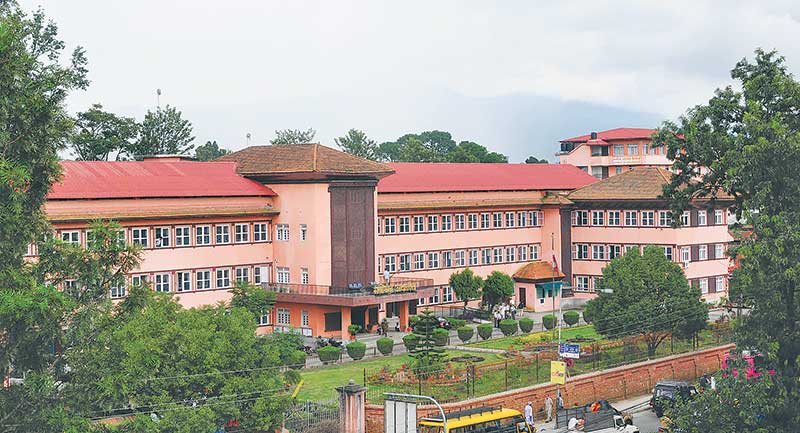
Report includes findings of probe into deadly violence in 2015 that killed nearly 50 people.
- TIKA R PRADHAN

KATHMANDU : The Supreme Court on Thursday ordered the National Information Commission to respond to an application regarding the publication of a report by the Lal Commission, which was formed to investigate the deadly violence involving police and protesters in the run-up to the promulgation of the 2015 constitution. Nearly 50 people, including both protesters and police, had died in confrontations.
The mandamus order by a joint bench of Chief Justice Cholendra Shumsher Rana and Justice Sapana Pradhan Malla to the information commission has brought to the fore two crucial facts: the government’s delay in making public critical reports of public interest and complications in honouring the Right to Information.
“The bench issued an order to the information commission asking it to respond to the appeal of the writ petitioners within three months,” said Devendra Dhakal, an information officer at the Supreme Court.
The commission was formed by the government on September 18, 2016 under Girish Chandra Lal, a former Supreme Court justice, to investigate deadly violence in the Tarai in 2015. The report covers several weeks of violence in the plains when the Constituent Assembly in Kathmandu was trying to finalise the constitution.
The commission had presented its report to the Sher Bahadur Deuba government in December 2017. Despite repeated calls to make the report public, the government has refused to do so, even turning down a House ruling.Advocate Sunil Kumar Chauhan had registered the writ petition at the Supreme Court on August 22 last year on behalf of four victims of the violence—Shashidhar Pandeya, Dharmendra Murau, and Gita Kumari Barai of Rupandehi and Awadesh Prasad Kurmi of Parsa.
The petitioners had initially demanded on December 31, 2017 that the Prime Minister’s Office provide the report. But after nine days, the Prime Minister’s Office said that it had already sent the report “for necessary action” to the Home Ministry as per a Cabinet decision on December 28, 2017.
When the petitioner approached the Home Ministry on January 14, 2018, it responded after 15 days that it did not have the report. This led the petitioner to appeal at the National Information Commission.
In response to the information commission’s enquiry, according to Chauhan, the Prime Minister’s Office said it had already provided the information the petitioners were seeking. This led the petitioners to apply afresh to the information commission. After there was no response from the commission, they approached the court on August 22 last year.
“It’s unfortunate that victims of the violence have had to suffer for the last two years to get general information about the report of a commission formed by the government,” said Chauhan.
The process to file a Right to Information application appears simple but it is often made cumbersome by bureaucracy. According to the Right to Information Act, a petitioner must first file an application with the information officer of the concerned agency.
The information must be provided immediately if possible and within 15 days at the latest. If the information is not provided, the petitioner must file an application with the Information Commission, who will then ask the concerned agency to provide the information within 60 days. If the information is still not provided, the Information Commission can take action.
Advocate Baburam Aryal, who surveyed the Right to Information Act and its application in 2009, said there was a tendency among bureaucrats to hide information instead of disseminating it.
“Most bureaucrats tend to hide information as they believe they have taken the oath of office and secrecy just to keep information secret,” Aryal told the Post.
Aryal also said officials at the National Information Commission seem to take a selective approach when it comes to applications.
“Why can’t the information commission take action against the Prime Minister’s Office when it comes to the Lal Commission report while in the past it warned the secretary of the Judicial Council for not providing information,” said Aryal.
As far as the Lal Commission report is concerned, even international rights bodies have demanded that the government make it public. Earlier this month, Human Rights Watch, an international non-governmental organisation, called on the government of Nepal to make the Lal Commission report public.
“Selective leaks in the media are causing confusion about the findings. The government should instead release the full report and explain how it will respond to recommendations,” the rights body quoted its South Asia Director Meenakshi Ganguly as saying. “Victims and their families placed their faith in government commitments to an independent investigation, and there can be no possible justification for keeping the findings under wraps.”
The commission, set up in September 2016, had its six-month tenure extended twice.
Other members on the commission were Deputy Attorney General Surya Koirala, advocate Sujan Lopchan, former assistant inspector general of Police Navaraj Dhakal, and Home Ministry Joint Secretary Narayan Prasad Sharma Duwadi. They investigated 3,264 complaints registered with the commission.
According to Human Rights Watch, the commission, composed of highly respected senior officials, struggled to produce independent findings as it faced a lack of cooperation from state authorities.

Activists from indigenous and Tarai groups participate in a rally in support of the Madhes movement.Post file Photo
HOME PAGE

China to provide Rs 2.5 billion in military aid to Nepal

Defence cooperation appears to be prioritised in ‘strategic partnership’ between Nepal and China, analysts say.
- ANIL GIRI

KATHMANDU : Just days after Chinese President Xi Jinping returned to Beijing after completing a two-day state visit, Nepal and China are already set to sign a fresh agreement regarding 150 million RMB (approximately Rs 2.5 billion) military aid to the Nepal Army.
This is the first time that China has pledged back-to-back annual military support to the Nepal Army. Beijing extended a similar kind of military assistance to the national defence force in October last year.
Deputy Prime Minister and Minister for Defence Ishwar Pokhrel flew to China on Thursday to sign the deal after a decision to this effect was taken earlier that morning by a Cabinet meeting, according to officials familiar with the negotiations. Pokhrel has been authorised to sign the deal with China, according to a Cabinet decision released on Thursday.
This military assistance was not discussed in the delegation-level talks held during the Chinese president’s visit, said officials. The Ministry of Foreign Affairs and the Ministry of Defence “quietly” worked out the deal and gave it final touches after Xi returned to Beijing, they said.
Santa Bahadur Sunar, spokesperson for the Ministry of Defence, confirmed that Nepal and China will sign the 150 million RMB military deal during Pokhrel’s visit to China.
“We, however, do not have the details of the agreement,” Sunar told the Post. “The Nepal Army will later correspond with their Chinese counterparts about their military and equipment requirements.”
The deal on military assistance follows Nepal and China’s agreement to elevate ties from a “comprehensive partnership of cooperation” to a “strategic partnership of cooperation”, a change in terminology that has been widely speculated on in the media.
Apart from extending and expanding on economic cooperation, a joint communiqué issued after Xi’s visit said that China had offered cooperation in the security sector.
“The two sides will continue to strengthen cooperation in the exchange of visits of the security personnel, joint exercises and training, disaster prevention and reduction and personnel training,” read the joint communiqué. Nepal and China also signed a Mutual Legal Assistance Treaty during Xi’s time in Kathmandu.
Experts say that this new military pact between Nepal and China shows that defence cooperation will be prioritised in this ‘strategic cooperative partnership’ between the two nations as agreed upon during Xi’s visit.
The military aid shows China’s growing interest in Nepal’s defence sector, said Binoj Basnyat, a retired Army General.
“Defence pact and cooperation in security sectors is a key pillar in any strategic partnership,” Basnyat told the Post. “This shows that China values its defence cooperation with Nepal and is keen on upgrading Nepal’s defence capability.”
The agreement to elevate Nepal-China bilateral ties to a “strategic partnership” has already caused some concern. While experts cautioned against a hasty interpretation, they told the Post earlier this week that a strategic partnership entails some security and military components.
Experts have also cautioned that Nepal’s cosying up to China—with deals on connectivity and projects under the Belt and Road Initiative—may cause some unease among older partners like India and the United States. Kathmandu’s desire to cultivate its relationship with China mainly stems from its bid to countervail its dependence on India. But some believe that a partnership with China when it comes to security and military components could raise alarm bells in New Delhi and Washington.
The last time Kathmandu irked New Delhi was in 1989 when then king Birendra considered an arms purchase from Beijing. India had then imposed a crippling blockade.
There are now newfound concerns whether an ambitious leadership in Kathmandu could lead Nepal into a geopolitical quagmire.
The United States has included Nepal in its broad Indo-Pacific Strategy and although American officials have attempted to qualify that the strategy is not targeted at any particular country, many, including the Chinese, see it as an attempt to counter China. India, on the other hand, has stopped short of joining China’s Belt and Road Initiative, but it is an active partner in the Wahington-led strategy, which aims at a grouping of four “like-minded” democracies—the US, India, Japan and Australia—known as Quadrilateral Security Dialogue, or QUAD.
Experts caution that while Nepal should seek support from all friendly nations, it should tread carefully when it comes to the tussle between the great powers. According to Basnyat, Kathmandu should first understand why China values Nepal so highly in defence and security cooperation.
“In any strategic partnership, defence and security issues matter a lot,” said Basnyat. “We have to see what other agreements and pacts will be signed during the defence minister’s visit.” The Nepal Army, however, expressed ignorance about a new military assistance deal with China.
“I do not have any idea about the new agreement to be signed with China,” Brigadier General Bigyan Dev Pandey, spokesperson for the Army, told the Post. “As of now, we have received various kinds of non-lethal military equipment and logistics for our Army personnel serving in various conflict flashpoints and for disaster preparedness. These were agreed upon during the visits of Defence Minister Pokhrel [last year] and our Chief of Army Staff [in July] to China.”

HOME PAGE

Nepali citizens detained during Xi Jinping’s visit for Tibetan signage on clothes and accessories

All citizens have a right to political opinion and the right to criticise and protest Nepal’s foreign policy, irrespective of the country’s formal position, rights activists say.
- BHRIKUTI RAI

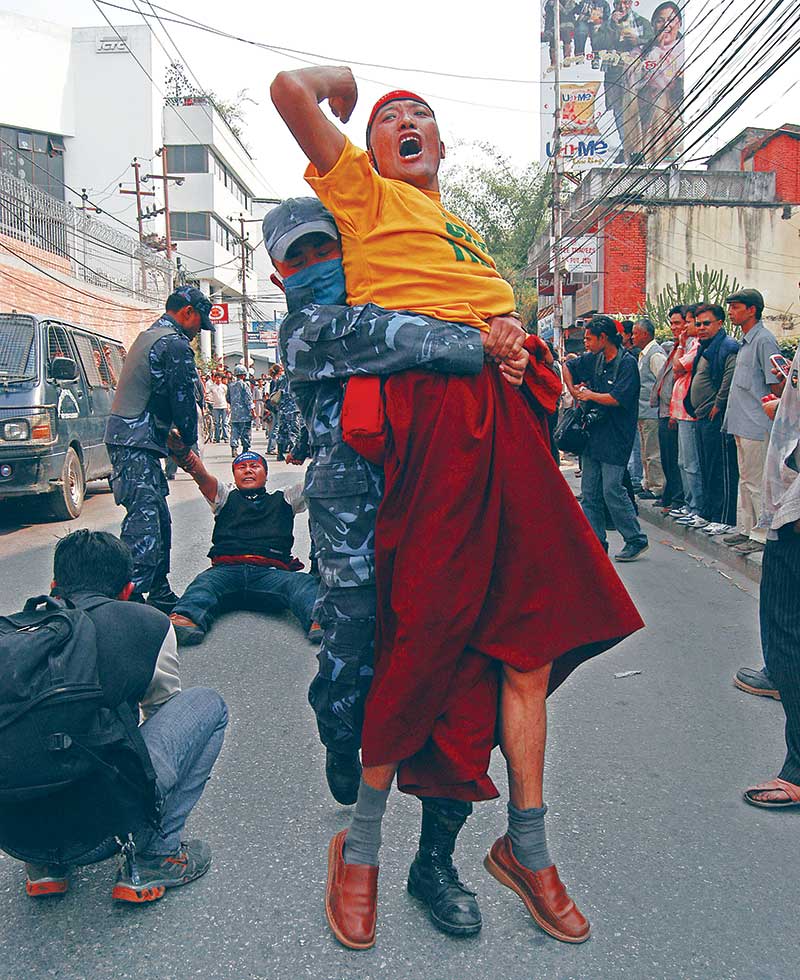
Police arrest protesters in front of the Chinese Embassy in Kathmandu.Post file Photo

KATHMANDU : At least a week before Chinese President Xi Jinping was scheduled to arrive in Kathmandu, Nepal’s security forces were already on high alert, detaining dozens of people, primarily Tibetan refugees. But also caught in the dragnet were a number of Nepalis, who were taken into custody for sporting signage related to Tibet.
Although there were informal reports of numerous such instances, the Post was able to corroborate at least two incidents, one involving a 14-year-old Nepali girl and a 65-year-old Nepali woman who were both detained by police for their clothing and accessories. The teenager was wearing a shirt that said ‘Free Tibet’ and the woman was carrying a bag that had Tibetan lettering, which she couldn’t read.
The 14-year-old girl, who is from Gorkha, was called in for questioning to Boudha police station last week, a few days before Xi’s visit when she was spotted wearing a shirt that had Free Tibet emblazoned on it, according to Phurba Sherpa, her teacher who accompanied her to the police station. The seventh-grader was also asked to report the day after. But as she left for boarding school in Sundarijal, two male police officials went looking for her at the school last weekend. She was removed from school and taken to the Gagalphedi police station on the outskirts of Kathmandu.
According to Gagalphedi Police Station in-charge, Sub-Inspector Dev Prasad Bhattarai, they received an order from the Boudha Police Station to hold the minor in the station for the duration of Xi’s visit as she was wearing a Free Tibet shirt. “We detained the minor last Saturday and Sunday for around six hours, as per orders from the Boudha Police Station,” Bhattarai told the Post.
Sherpa said that the minor was held in custody for two days but wasn’t “mistreated”.
“I was with her at the station all day and brought her back to the hostel in the evening just to sleep,” said Sherpa. “The police should have been considerate about keeping a child in the police station for just what she was wearing. This might have a psychological effect on her.”
Police say the arrests were part of their security exercise in view of a high profile visit.
“The dress worn by the girl was an indicator of being against the Chinese government during the Chinese president’s two-day visit in Nepal,” said Deputy Superintendent Ramesh Bahadur Singh of the Boudha Police Station. “We have repeatedly warned about this, and it wasn’t just the girl, we detained around 25 people during Xi’s visit and later released them.”
In the lead-up to Xi’s visits, police had admitted that only some of those arrested over the weeks were Tibetan refugees.
“Of the 18 people arrested for questioning, some are Tibetan refugees,” Deputy Superintendent Hobindra Bogati, spokesperson for the Kathamndu Metropolitan Police Range, had told the Post on October 11, a day before Xi’s arrival.
The Nepal Police regularly arrests Tibetans in Kathmandu for “questioning” during such high profile visits by Chinese officials, and increases surveillance in Tibetan refugee settlements during cultural celebrations like the Tibetan New Year or Tibetan spiritual leader-in-exile Dalai Lama’s birthday. But the police appear to have increased their arrest radius, even taking into custody Nepalis who might resemble Tibetans because of their ethnicity and live near Tibetan settlements. The 65-year-old woman, who is from Marang village in Mustang, was taken into custody at around 8am from the Swayambhu area on Saturday, the day of Xi’s arrival, for carrying a bag with Tibetan lettering. She was held for more than 12 hours before being let go at 9pm, said Yangchen Loba, who hails from the same village. The woman, who cannot speak Nepali very well, was also asked to report to the police station the next day at 10am, 2pm and 6pm, said Loba.
“She’s afraid to even answer the phone now because it might be the police,” said Loba. What is especially concerning is that Nepali citizens are being prevented from exercising their right to free speech, which is guaranteed by the constitution, according to human rights activists. All citizens have a right to political opinion and the right to criticise and protest Nepal’s foreign policy, irrespective of what the country’s formal position is on certain issues, say rights activists.
“Speaking about Tibet or Kashmir in Nepal isn’t a crime because it doesn’t undermine Nepal’s sovereignty,” said Taranath Dahal of Freedom Forum, a civil liberties organisation. “It was absolutely wrong to harass people simply for what they said or wore.” Human rights activists say the arrest of Nepali citizens and Tibetans last week before and during Xi’s visit was simply a result of Nepal’s stance on Tibetan refugees in Nepal which has hardened over the years.
Earlier in May, three journalists from the Rastriya Samachar Samiti, Nepal’s national news agency, were investigated by the Ministry of Communication for translating and disseminating a wire report about the Dalai Lama’s health. Later, in June, the Samajbadi Party Nepal suspended its lawmaker Pradip Yadav for six months, more than 45 days after he attended a programme on Free Tibet in Europe without informing the party.
During Xi’s visit, Nepal and China signed the Treaty on Mutual Legal Assistance in Criminal Matters and China has pushed for the signing of an Extradition Treaty. Refugee rights activists fear that an extradition treaty could be used against Tibetans in Nepal. “There is visible discrimination towards Tibetan refugees in Nepal,” said Gopal Krishna Shiwakoti, former chairperson of the Asia-Pacific Refugee Rights Network. “We need to treat every single refugee group equally on humanitarian grounds. Safeguarding Tibetan refugees’ rights is wrongly perceived as annoying the Chinese, which is not true. That mindset needs to change in our politicians and bureaucrats.” Shuvam Dhungana contributed to this report.

Page 2
MEDLEY

Horoscope

ARIES (March 21-April 19)
**
A major shakeup is happening in your world today—and just like when tectonic plates shift, these changes could create quite an earthquake. But instead of freaking out and running for cover, you should run right out into the open so you can be the first person to take in the new landscape once everything settles down.


TAURUS (April 20-May 20)
***
Are you in the mood to revamp or update your personal style? Look at your current wardrobe and see how you can mix it up. You have more options than you think you do, you have just not been making the most of them. Remind yourself of the great things you’ve got that you never utilize!


GEMINI (May 21-June 21)
***
Your casual acquaintances are suddenly much more fun to be around than your tried and true old buddies. From time to time, you need a fresh atmosphere for your socializing—and there is nothing wrong with that. Plus, it’s more exciting to learn more about the people you don’t know very well.


CANCER (June 22-July 22)
**
You aren’t responsible for making other people happy—you can only support them in their quest to find their own bliss. So don’t buy a ticket for that guilt trip a friend is trying to send you on! Don’t react emotionally to this person’s plight. Be a good friend by keeping yourself emotionally healthy and content.


LEO (July 23-August 22)
***
You’ll meet a smiling someone today who seems a little bit too good to be true. What’s their secret? Tail them today and find out what they do differently from you. By the end of the day, you’ll finally understand why they seem to have the whole world at their fingertips. Tomorrow, put this knowledge into practice.


VIRGO (August 23-September 22)
***
A spat could get blown out of proportion today, but luckily you won’t be in the direct line of fire. You’re not on the radar screen of the particularly combative person who’s kicking up all the dust—and you should do whatever it takes to stay out of it! Play nice and carry on with your day.


LIBRA (September 23-October 22)
****
The annoying or rude actions of the people around you will actually have some positive effects on your day. When someone holds the elevator door for a straggler, they might be doing you a favor—expect to enjoy a few floors of one-on-one time with someone you’ve been dying to get to know better.


SCORPIO (October 23-November 21)
****
A big decision has got you feeling confused, but there really is no need to be scratching your head about it. All you have to do is get organized and everything will fall into place. Keep in mind that your next steps in life should be focused on achieving a long term gain.


SAGITTARIUS (November 22-December 21)
*****
You’re going to be surrounded by adults all day long, but it might feel like you’ve been plopped down in the middle of a day care center! Everyone’s childlike behavior won’t bother you too much—because when everyone is doing nothing but goofing off or having tantrums, you can step up and get a lot done.


CAPRICORN (December 22-January 19)
**
You are very focused on one issue right now, and you have strong feelings about it. That’s wonderful. But just because you feel strongly about this does not mean that anyone else will—even if you can’t believe that they don’t. Resist lecturing them or trying to get them as interested as you are.


AQUARIUS (January 20-February 18)
****
It’s time to change your life patterns. Not only will it make life more interesting, but it will also keep that certain someone much more intrigued by you. After all, if you make it impossible for them to pin you down, you’ll keep them interested. Ensure that you are not getting stuck in a rut.


PISCES (February 19-March 20)
*****
One of the groups you belong to has been feeling like an imposition in your life for a while, but today you can expect this obligation to start to feel more like something that you’re lucky to be a part of. You are feeling much more in synch with these other group members.

Page 3
NATIONAL

Nearly two dozen Chand cadres arrested in biggest police raid yet on the outfit

Around 6,000 private sector firms and over 90,000 workers registered before Thursday’s deadline.
- CHANDAN KUMAR MANDAL

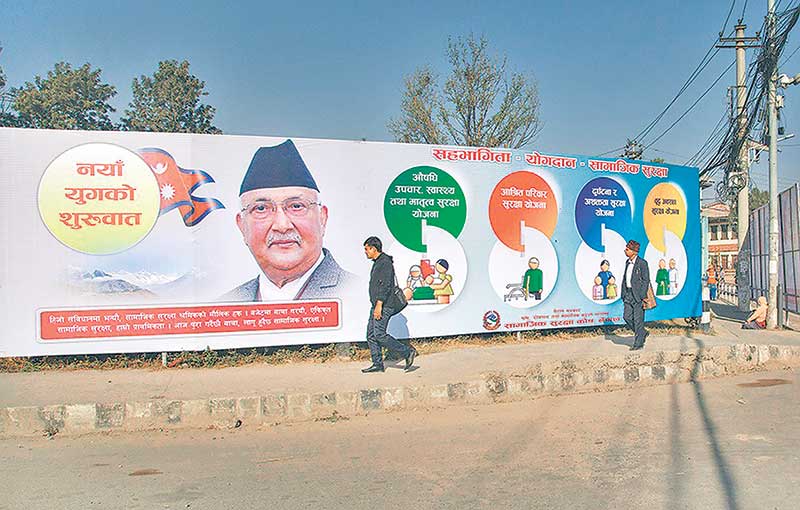
People walk past an advertisement commissioned by the government on the Contribution Based Social Security Scheme which was launched in November last year.  post file photo

Kathmandu : The government’s ambitious social security scheme which covers formal private-sector workers has fallen abysmally below its target, primarily because of the tardiness of employers and confusion surrounding how the employee funds would be managed under the scheme.
To avail the scheme, both employers and employees had to register before the deadline. An amount equivalent to 31 percent of the workers’ basic monthly salary—11 percent deducted from their monthly salary and
20 percent employer’s contribution—will go to the Social Security Fund, as per the scheme envisioned by the government.
The deadline for registrations ended on Thursday. Since the scheme went into nationwide implementation, just over 6,000 organisations from the formal private sector had registered with the Social Security Fund (SSF)—the government body ensuring rights of social security protection—before the deadline.
The Contribution Based Social Security Scheme, which was rolled out amidst much fanfare in November last year, continued to receive a lukewarm response throughout its validity period.
The Social Security Fund had aimed to bring in at least 45,000 to 50,000 private sector firms under the scheme under which the government will provide health, accident and maternity coverage to workers employed in the formal private sector.
According to a preliminary report of the National Economic Census-2018, nearly 900,000 private firms, factories, business establishments and service providers are operating in the country. However, the Social Security Fund claims that not all of them are in operation, but are merely registered on the paper.
“We have to see this response positively as these firms have come to register voluntarily without the government taking any strict action against them,” said Rama Bhattarai, a spokesperson for the Social Security Fund.According to Bhattarai, more than 90,000 workers involved with the private sector have been enrolled under the scheme.
“Many firms are still rushing at the office for registration on the last day,” Bhattarai told the Post. “However, the number of companies and workers registered under the scheme has stayed below our expectations.”With the completion of registration and regular contributions, the private sector workers will be entitled to old-age pension, medical treatment, health protection, maternity coverage, accidents, and disability compensation.
Labour rights activists and government agencies have criticised employers for not being committed enough to the welfare of their workers.
Janak Chaudhary, general secretary of the General Federation of Nepalese Trade Unions (GEFONT), said that registration of over 90,000 workers in the last six months is satisfactory, although they had set a target of completing the registration of 500,000 workers across the country in a year.
“Some private firms have enrolled under the scheme, but their workers are yet to be registered. Therefore, the number of workers registered under the scheme is likely to go up soon,” said Chaudhary. “There are confusions among workers, such as whether they will get their money if they quit the job in one workplace.”
Bhattarai also admitted that there had been confusion among workers about the concept of the social security scheme which resulted in their lukewarm response.
“While workers are not clear about the scheme and its long-term benefits as this is happening for the first time, employers who have not abided by provisions in the Labour Act are reluctant to register,” said Bhattarai.
Private schools have already refused to follow the Contribution Based Social Security Scheme, arguing that the programme is not feasible for small and middle-level schools. The National Private and Boarding Schools’ Association Nepal—an umbrella organisation of nearly 3,000 private schools—released a statement on Thursday, saying that they cannot implement the contribution-based social security scheme.
The government does not have any plans of extending the deadline for employers to register under the scheme. However, it will take strict action against those who have not registered before the deadline.
“We will soon set criteria for taking action against those private firms. We will deprive them of government facilities,” said Bhattarai.
Labour rights activists who have long been pressing for the implementation of the scheme for comprehensive welfare of workers and benefits of employers also argued that those firms not registering within the deadline should be penalised.
“Legally operating organisations are positive about the scheme as the liabilities on them have been transferred to the scheme. Likewise, new firms are also happy with this. Only those firms which have flouted government rules are worried about the new scheme,” said Chaudhary.
“The government should swing into action because they have not abided by the policy even after being informed multiple times. If they had any issues, they should have complained.”

NATIONAL

Nearly two dozen Chand cadres arrested in biggest police raid yet on the outfit

The arrests were based on a tip-off that the group was planning ‘something big’ for the upcoming by-elections.
- DURGA LAL KC
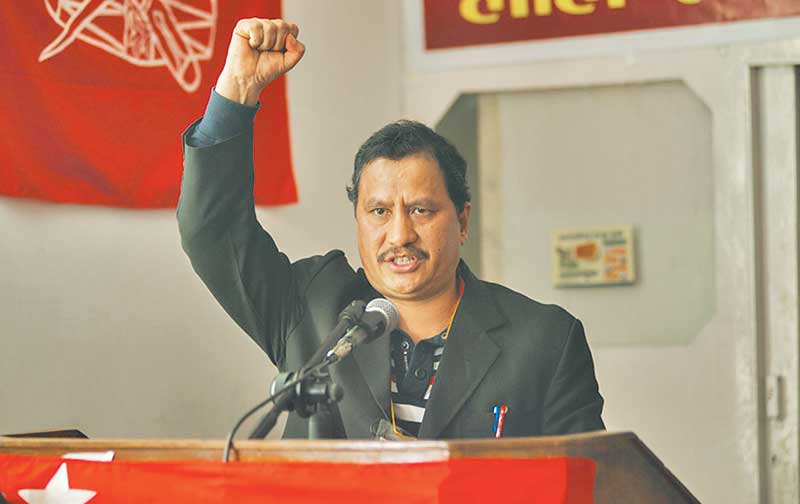
Netra Bikram Chand formed his party in 2014 to launch ‘unified revolution’. 

DANG : In one of the biggest mass arrests, police rounded up 21 leaders and cadres of the Netra Bikram Chand-led Communist Party of Nepal in Dang district late Wednesday night.
“The arrests were made from a jungle in Dang’s Mugretha Khola of Rajapur Rural Municipality, which borders India, past midnight on Wednesday,” said Deputy Superintendent Binod Bikram Shah of the Dang District Police Office.
According to police, the Chand party members had just concluded a meeting when the police raided the building, which is around five hours’ walk from the nearest police station. The party was reportedly preparing a strategy for the upcoming by-elections. Acting on a tip-off, the Provincial Police Office in Tulsipur, District Police Office, Area Police Office in Gadhawa, and Lamahi ward police office deployed security personnel in the area in plainclothes.
A police team led by Bharat Rathour, an inspector at the Gadhawa Area Police Office, surrounded the house after party members had gone to bed. Around 60 police personnel, along with 21 others from the Armed Police Force, were deployed as reinforcements. Upon encirclement, seven or eight armed sentries fled the scene, according to police.
The forests around the Maretha stream are considered a safe space for rebels. Police said they travelled around six kilometres by road and walked around three hours to reach the meeting site. This area was also used by the CPN (Maoist) during the decade-long insurgency.
Wednesday night’s police action follows months of calm regarding the activities of the Chand party. Sources in the government said the arrests were based on a tip-off that the outfit was planning “something big”.
The government declared the Chand party a criminal outfit and banned its activities in March following two explosions in the Capital that killed one person and injured two others in February. The party has long been involved in extortion and attacks on private companies.
It has turned down the government’s call for talks, putting forth three conditions instead—lifting of its ban, unconditional release of its arrested leaders, and an “official invite” for talks.
The Communist Party of Nepal is a breakaway faction of the Maoist party that waged a decade-long war against the state from 1996 to 2006.
Chand formed his party in 2014 to launch what he calls “unified revolution”. Chand, along with Mohan Baidya, had left Pushpa Kamal Dahal’s Maoist party in 2012, six years after the end of the war, saying that the Maoist chief had deviated from their ideology and had abandoned the revolution halfway.
But Chand too decided to walk away from Baidya after “ideological differences” emerged, especially with Ram Bahadur Thapa, the incumbent home minister. Thapa had also left Dahal’s party along with Chand and Baidya.
So far, at least eight Chand party cadres have died. Two were killed in police action while five others died when cooking gas cylinders they were trying to rig as explosives went off in Kathmandu. One cadre was killed in Dhangadhi when an improvised explosive device he was carrying went off suddenly.
Government officials believe that the Chand party has lately been quiet as it was trying to strengthen its organisational structure with a view to launching a “major action”, targeting the upcoming by-elections scheduled for November 30.
“Police swung into action after a tip-off that some major leaders of the Chand party were planning a gathering,” said Indrajit Rai, security adviser to Home Minister Thapa. “The Chand party had been planning to head towards confrontation [with the state].”
Those arrested include Chand’s elder brother Chandra Bahadur Chand ‘Birjung’, a central committee member who is also Lumbini bureau and mid-western command in-charge of the party.
Other leaders arrested during the raid include Rapti bureau in-charge Kesh Bahadur Bantha, Rapti bureau coordinator Ram Bahadur Thapa, Rapti bureau secretary Sabin Pokhrel, Dang district in-charge Yamlal Katuwal, district secretary Pradip Oli, the youth organisation’s central chairman Babin KC, party’s intellectual organisation member Sunil Poudel, district civil council member Ek Rak Chaudhary, and Rajapur Rural Municipality secretary Dhan Bahadur Bohara.
Likewise, district in-charge of Rastriya Dalit Morcha Suraj BK, Rapti bureau members Tilak Pun, Hit Prasad Rokka, Post Man Gharti, Dal Bahadur Khatri, Amit Gharti Magar, Bal Krishna Sharma, Jit Chhetri, Ramesh Acharya, Bishnu Thapa, and Kul Bahadur Oli were also arrested by police.
With the arrests of nearly two dozen leaders in a single raid, there are concerns about retaliatory action from the Chand party.
On multiple occasions in the past, security experts have told the Post that the government needs to avoid its confrontational approach and convince the Chand party to come to the negotiating table.

NATIONAL

Second phase of Ring Road expansion project likely to start from next year

The Department of Roads expects to clear road section of trees and electric poles within the next two months.
- ANUP OJHA

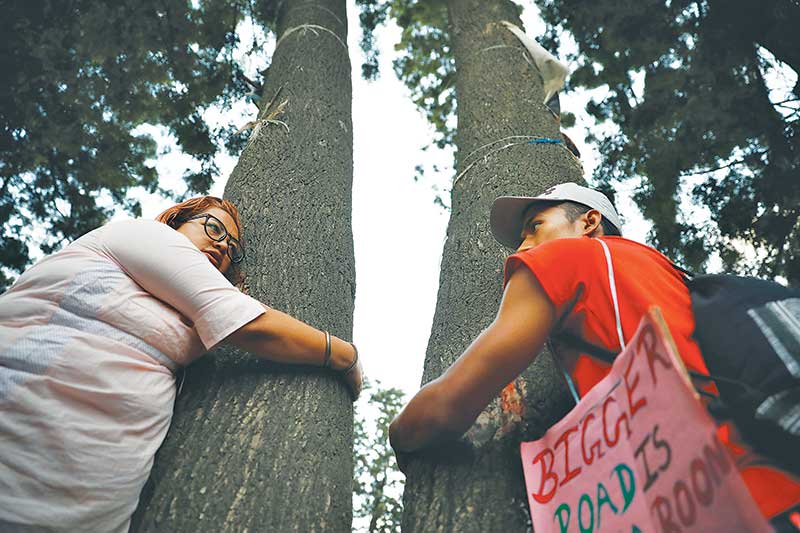
Environmental activists hug trees along the Kalanki-Maharajgunj section of Ring Road in a symbolic protest against the road department’s decision to cut down more than 2,000 trees for the second phase of the Ring Road expansion project.post PHOTO: SANJOG MANANDHAR

kATHMANDU : The second phase of expansion of 8.2 km Kalanki-Balaju-Maharajgunj road section is likely to start from early 2020, according to a senior official at the Department of Roads.
Amrit Mani Rijal, a senior divisional engineer at the department, told the Post that the two-day state visit of Chinese President Xi Jinping last weekend has given hopes to project starting on time.
He said the department would clear all trees and electric poles along the stretch of the road within a timeframe of two months.
The Chinese government had been expected to submit the design of the project before October 2018.
“The department has chopped 200 trees. We have already marked 2,057 trees for cutting within two months,” said Rijal. He also said the department is working to remove electric poles on the road sections.
Many city residents and environmental activists have protested cutting down of the trees along the road section.
“They are protesting just in the name of protest. The government will plant double the number of trees that will be axed. We need a better and larger infrastructure of road,” said Rijal.
The road expansion will be taking place under the Chinese government’s funding. Earlier the Chinese government had officially handed over the 10.5km Kalanki-Koteshwor road expansion project in late January this year.
It took five years to complete the first section for which China had spent Rs 5.13 billion but the road has been termed a killer road as this road has witnessed several deaths and injuries due to the lack of crosswalks and overhead bridges, among other road safety infrastructure.
The road’s design has long been criticised for not being pedestrian and cyclist friendly.
Arjun Jung Thapa, chief of the foreign coordination division said, the past mistake will not be repeated in the second phase of the road expansion. “We have learnt the lesson from the first project; we will try our best not to get any complaints about the second project,” said Thapa.
He, however, said that it can’t be said immediately how the structure of the road is going to be as the department has not got the complete road design yet.
Thapa further said that for the expansion of the road, the statues of Buddha in Swayambhunath and the 132 kv transmission line that lies between Banasthali and Swayambhu will need to be removed. For the transmission line, the department is consulting with the Nepal Electricity Authority.
Thapa said the road department is facing difficulties for the expansion of road in Maharajgunj as the road on both sides is narrow.
As per the information provided by the Ring Road Improvement Project, as many as 100 electric poles have already been removed from the area in coordination with the electricity authority.
Amrit Mani Rimal, a senior official at the project, said that for the removal of the electric poles, the project office has allocated Rs107 million, while there has also been talk about offering compensation to houses and hotels that lie within 250-metre periphery of the road in the area for the road expansion.

Page 4
NATIONAL

Nepal shows promise in reducing child mortality rate

But children’s risk of dying before their fifth birthday varies nearly three-fold, a new study finds.
- Arjun Poudel

KATHMANDU : Nepal may be in line to achieve the Sustainable Development Goal on reducing child mortality rate, but the likelihood of child reaching the age of five still varies about three-fold in some districts and provinces, according to a new study.
The detailed study carried out for mapping child deaths from 2000 to 2017 by the Institute for Health Metrics and Evaluation (IHME) suggests that tackling inequality of source distribution could save millions of lives. The institute is an independent global health research organisation at the University Of Washington School Of Medicine.
The study, published on Thursday, shows that 18,698 children died before their fifth birthday in 2017. In 2000, the number was 58,633. The highest mortality rate in 2017 was 57.2 in the districts of Karnali Province, whereas the lowest was 21.3 in the districts of Province 3.
“Study shows hundreds of child deaths can be averted if all districts and provinces rose to the level of best performing districts,” Dr Megnath Dhimal, co-author of the study, told the Post. “Without tackling the unequal distribution of the sources, we cannot make further progress to meet health targets.”
Along with Nepal, the study was carried out in 99 low and middle-income countries, in which 90 percent of child deaths occurred in 2017.
Nepal has to bring down child mortality to 25 per 1,000 live births to meet the United Nation’s Sustainable Development Goal target. The country’s current neonatal mortality rate is 21 per 1,000 live births, and the infant mortality rate is 32 per 1,000 live births. The numbers have remained stagnant for the last several years. Moreover, under-five mortality rate of 39 per 1,000 live births has remained constant since 2016.
Dhimal said that the government and concerned agencies should bring intervention measures to lift social, economic status of remote and backward places.
“Such studies help the government and policymakers to bring targeted intervention measures and change the policies, which are not working properly,” Dhimal added.
The report says Nepal significantly decreased inequalities among its districts over the study period.Child health experts say the country has to do a lot to bring under-five mortality rate down and achieve the United Nations’ health targets.
“Under-five mortality rate and neonatal deaths are still high and disparity among different communities and geographical areas are very high,” Dr Atul Upadhyay, senior project manager at Helen Keller International, told the Post. “All concerned agencies should work in a uniformed way to address such disparities.”
Costly nutritious foods, poor hygiene conditions, lack of awareness about health, declining breastfeeding practices, and high prevalence of junk and processed foods are among the challenges that should be overcome to reduce the existing child death rate, according to him.
The districts where the child mortality rate was found to have been high are also struggling to find malnutrition, one of the causes of deaths of children.
Malnutrition is a silent crisis in Nepal. The Nepal Demographic Health Survey-2016, shows 60 percent of children under-five in the Karnali region and Solukhumbu district are stunted, which is an indicator of chronic undernutrition. Karnali and Solukhumbu are also the poorest and most food insecure compared to the national average, according to the survey. The survey states that 36 percent of children under five years of age in the country suffer from chronic malnutrition (stunting or low height-for-weight) and 10 percent suffer from acute malnutrition (wasting or low weight-for-height).
Another 27 percent of children are underweight and one percent are overweight.
According to a UNICEF report published earlier this week, 43 percent of children under the five years of age are either stunted or wasted or overweight and that one in every two Nepali children are eating a poor diet.
Doctors say nutrition deficiency in mothers during pregnancy increases the risk of complications during childbirth and increases the likelihood of maternal and neonatal deaths as well as chances of low birth weight.
Report of the Global Burden of Disease study published recently also shows neonatal disorders were the biggest cause of deaths before the age of five both in 2000 and 2017.
Dr Shyam Raj Upreti, a child health expert, said that the country could have done a lot more in the child health sector.
According to Upreti, the focus of the government and other stakeholders has diverted towards political transition and implementation of three tiers of government.
“Countries like Vietnam and Cambodia have made enormous progress and achieved SDG target in 2017,” said Upreti. “We could also have done far better, but the fact is we have been struggling to follow SDG targets.”

Page 5
NATIONAL

Budhi Ganga remains the sorrow of Sera Jyula

In 20 years, at least 2,000 ropanis of land have been swept away by the river, according to Agriculture Knowledge Centre.
- ARJUN SHAH

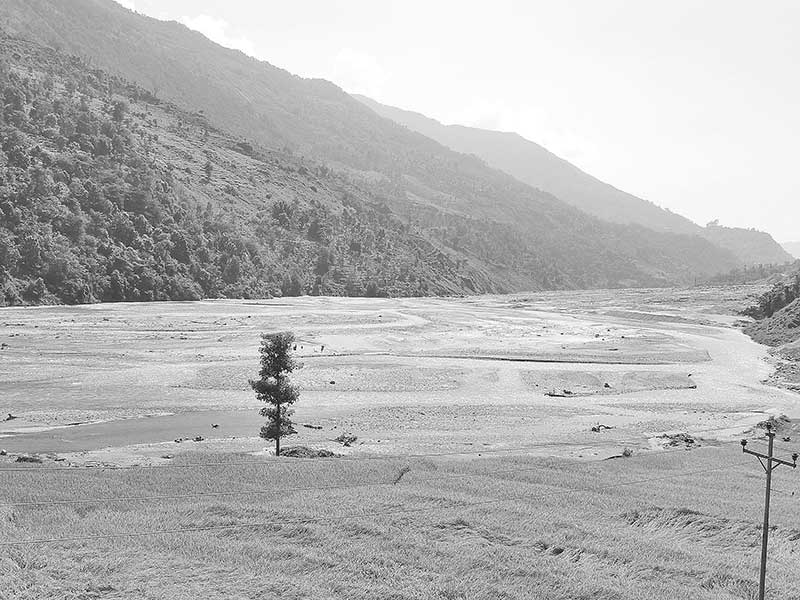
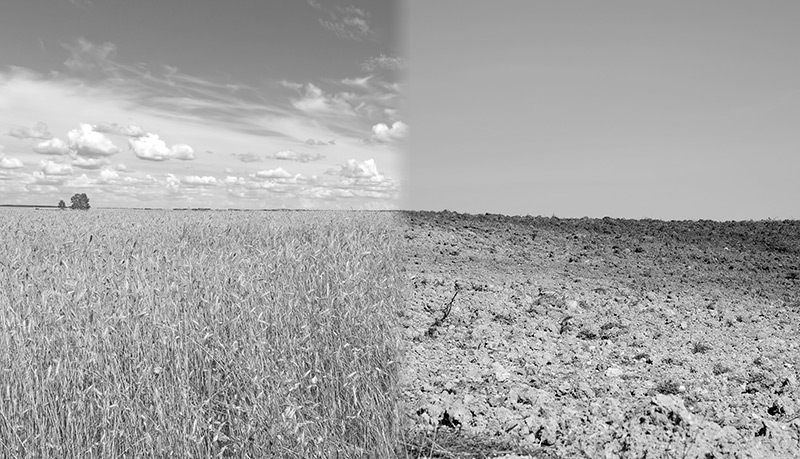
The vast fields of Sera Jyula are today filled with sand and pebbles washed in by the river.Post Photo: arjun shah

BAJURA : The Budhi Ganga River in Bajura has been eroding paddy fields for the last two decades. Sera Jyula in Belkatiya is the most affected by the erosion with thousands of ropanis lost to the river.
“The entire area is deserted now. Around 99 percent of the paddy fields have been swept away by the river in the last two decades,” said Bal Bahadur Thapa, a local. “Only a small part of land near Ghattekhola is above water now. But that patch too is at risk of erosion.”
According to the Agriculture Knowledge Centre in Bajura, at least 2,000 ropanis of land in Sera Jyula have been swept away by the river.
Min Prasad Jaisi, an officer at the centre, said there was good arable land in Sera Jyula where villagers used to cultivate paddy and wheat. Jaisi said, “This land used to produce around 3,500 quintals of paddy and 3,000 quintals of wheat worth around Rs 20 million every year.”
People of four major settlements of two villages (Brahmatola and Kuldevmandu) owned the land. Nara Bahadur Rana, a local, said that his life has become difficult after he lost his fields to the river. “We are going to move away from this area. There’s no other alternative now,” he said.
Although the victims who lost their land to erosion have frequented the concerned authorities demanding measures to control erosion, none of the authorities has paid heed to them so far. “We have informed various political parties and their leaders about our situation; we ask them to help us every election. But they only provide us with false assurances,” said Shuvaraj Padhyay, a local.
Despite their land being washed away, residents of Sera Jyula have been paying land revenue. Hemanta Padhyay said he has been paying tax for his piece of land every year. He said, “I paid Rs 1,500 for the land last fiscal year although my plot has been swept away in the hope for compensation.”
The entire Sera Jyula area is today filled with sand and pebbles washed in by the river. As they have no other alternatives, some of the locals have started extracting sand and pebbles from their land and selling them to contractors. Lilaram Padhyay, a local man, said they collected Rs 150,000 by extracting sand and pebbles and distributed it among 35 families last year.
A landslide in Guigad has also added to the woes of the locals in Belkatiya. The landslide which has reached up to 7 km high deposits debris into the river and blocks its flow. This causes soil erosion not only in Sera but also in Kailashmandu area, locals say.
According to Khadkaraj Joshi, a teacher, locals from Bajedi, Guiwan, Nimani, Gumlagaun, Densayal, Hatelek and Basali have been already displaced from their settlements. Joshi said, “No authority has paid any attention to controlling either the landslide or erosion.”

NATIONAL

Police in Banke arrest a sub-inspector over attempt to rape charge

Bam Bahadur Rana was arrested based on a complaint filed by a woman police trainee earlier this week.
- MADHU SHAHI

NEPALGUNJ : A female trainee at the Karnali Province Police Training Centre on October 14 lodged a complaint saying Sub-Inspector Bam Bahadur Rana attempted to rape her in his room inside the training centre.
Rana was arrested the same day, said Deputy Superintendent of Police Shiva Singh, spokesperson for the District Police Office, Banke.
In her complaint, according to the police office, the trainee said Rana called her to his room on the pretext of letting her use his mobile phone to call her parents. When she entered the room, Rana locked the door and made inappropriate advances, according to her.
As per the rules, trainees are not allowed to keep mobile phones with them during the training period.
The accused is the accuser’s brother-in-law, said Singh. According to Singh, more details will be unveiled after the investigation is completed.
“The family of the accuser is not convinced that such an incident took place, but we have already launched an investigation,” Singh told the Post.
“The victim has filed an attempt to rape complaint and investigation is ongoing as per the complaint,” said Singh. The court is set to start the proceedings.
According to DSP Madhusudhan Neupane from the Police Training Centre, the woman is still coming to training despite being subjected to such behaviour. “She comes to the training in tears, and has refused to meet or talk to anyone, including her relatives,” said Neupane.
This incident is the first attempt to rape case relating to a police official, and it comes amid concerns over the high prevalence of cases that show sexual assaults against women in the country, particularly by men in power.

NATIONAL

Parsa park to conduct Gaur census this winter

- SHANKAR ACHARYA

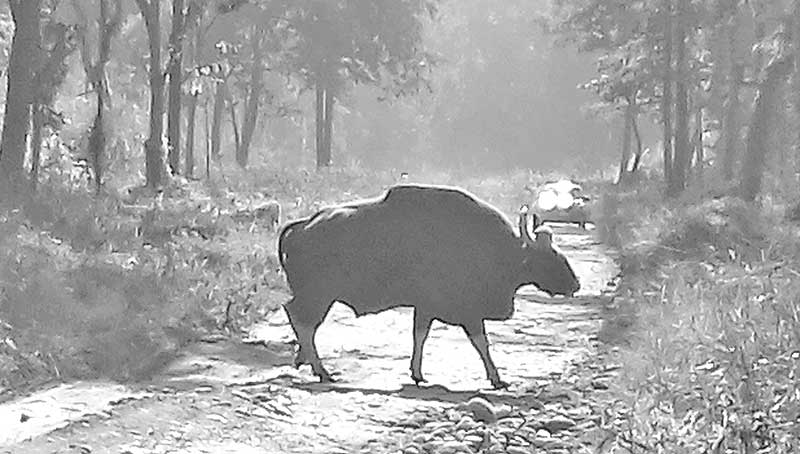
Officials at the park believe that the number of Gaurs currently in the park is 150.Post Photo: shankar acharya

PARSA : Parsa National Park is going to conduct a census of Gaur (Bos gaurus), commonly called Gaurigai, a protected wildlife species.
According to Amir Maharjan, chief conservation officer of the park, the census will be conducted with the help of National Trust for Nature Conservation. Maharjan said, “We are going to conduct the census in winter this year, as it is a suitable time to conduct the census.”
Conservationists said that they are going to use ‘Direct Sighting Method’ (which, as the name implies, means counting the animals as you see them) to count Gaurs. Maharjan said, “Technician teams will be deployed in different teams to count the animals. They will use tamed elephants to count
the animal.”
Officials at the park believe that the number of Gaurs has been increasing every year in the protected area. “We have estimated that there are currently 150 Gaurs in the park,” said Maharjan.
Gaurs prefer to live in dry elevated areas, like in the Chure region. As per the census carried out by the park last year, there were 105 Gaurs in the park. This animal is the largest wild cattle species in the world, measuring up to two metres up to the shoulders and weighing up to 250 kg. Gaur is also found in Chitwan National Park. Conservationists said that the number of the species has been declining due to hunting, habitat loss and exposure to various diseases.
The species is included as a protected mammal species list under the National Park and Wildlife Conservation Act 2029 (1973). It has also been listed in Appendix I of CITES. According to the World Wildlife Fund, Gaurs are found in eastern India, Nepal, Bhutan, Myanmar, Thailand, Laos, Cambodia, Vietnam, southern China, and the Malay Peninsula.

NATIONAL

Saptari locals urge Nepali side to raise issue of Koshi channelat joint meeting

- ABDHESH KUMAR JHA

RAJBIRAJ : The people of Saptari and their elected representatives have urged the Nepali side to raise the issue of a pilot channel of the Koshi river at the meeting of the officials from Nepal and India.
The locals claimed that the recently dug pilot channel diverted the water towards the western embankment, leaving many Nepali settlements at high risk of flooding.
The high-level technical teams from the two countries will meet on Friday.
Dev Narayan Yadav, chairman of the Koshi Floods Victims Society, said the pilot channel has posed flooding threat in various settlements in Hanumannagar Kankalini and Tilathi Koiladi.
“Nepali officials who will represent us in the meeting should not remain silent. They should ask the Indian side about the problem and seek its possible solution,” said Yadav.
In May, Gobargadha settlement in Hanumannagar Kankalini Ward 13 of Saptari was cut off from other parts of the district after the Indian authority released water along the pilot channel that was recently dug in the western side of Koshi.

NATIONAL

Curriculum introduced to raise awareness about sickle cell anaemia

The disease—which is a group of blood disorders—spreads like an epidemic every year in several Tharu villages in Bardiya.
- THAKUR SINGH THARU

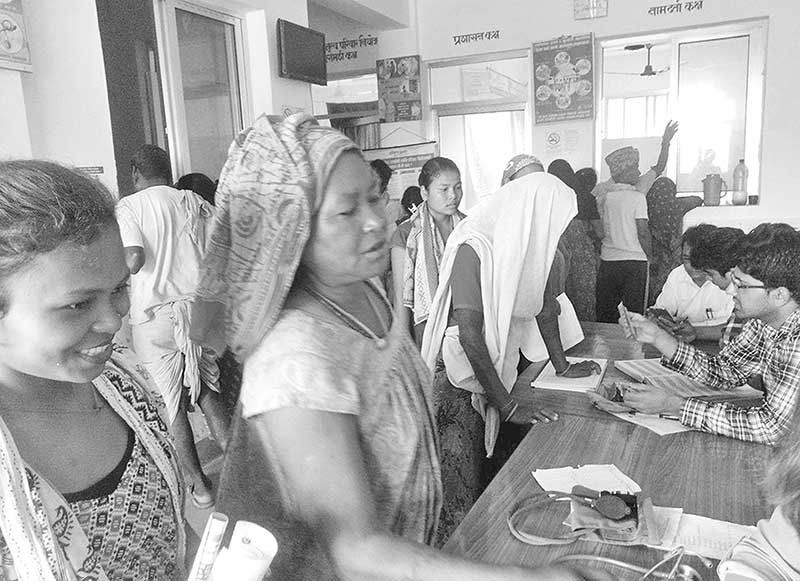
Tharu people wait to get examined for sickle cell anaemia at a health post in neighbouring district Baijnath, in Bardiya. Post Photo: thakur singh tharu

BARDIYA : Barbardiya Municipality has started incorporating a curriculum centred around awareness about the epidemic of sickle cell anaemia (SCA) disease. The curriculum will be taught in various schools in the district.
The incorporation of the curriculum is expected to raise awareness among students about the symptoms and precautions of the disease. Sickle cell anaemia is a group of blood disorders that a person usually inherits from his/her parents.
The curriculum has been designed by Dr Rajan Pandey, a doctor at Bheri Hospital, who has led the teachers through teaching procedures.
“With the incorporation of the curriculum, many have felt it necessary to examine their blood before marriage,” said Durga Chaudhary, the mayor of Barbardiya. “Students are getting aware and they have started teaching their parents as well.”
The disease spreads like an epidemic every year in several Tharu villages in the district. If both parents have sickle cell disease, there is a 25 percent chance the couple’s child will be born with the disease. While 50 percent of them contract the disease one way or the other, only 25 percent will remain free from it. Those affected with the disease die prematurely.
The best way to eradicate risk is to examine the blood before marriage, Pandey said. “About 50 percent of infants below five who contract the disease die every year,” he said.
Also recently, Bansgadhi Municipality launched a campaign to transfer students from private schools to public schools. As part of the campaign, about 700 students enrolled in public schools in the current academic year. The campaign has put pressure on public schools to ramp up their educational standards, said Shalik Ram Adhikari, the mayor of Bansgadhi.
Dhani Ram Chaudhary, a secondary-level student at Jana Sewa Secondary School, said that while he used to ingest medicines for jaundice until now, he now has started taking medicines for sickle cell. “The disease was strange to me,” Chaudhary said. “It is only after reading about it on my book that I got to know about sickle cell and ways to diagnose it and precautions I need to adopt to prevent it in the future.” In addition to awareness about anaemia, the redesigned curriculum, which targets primary-level students, also includes lessons on local culture and tradition.

NATIONAL

Girl student crushed to death

Briefing
- Post Report

JANAKPUR: Seven-year-old Chanchala Sada, who was studying at the Early Childhood Development Centre in Kaji Swarup Singh Hajari Sah Bauyelal Secondary School, in Dhanusha, was crushed to death after a wall of the centre collapsed inside her class. Another child Samir Safi, 4, sustained serious injuries on his head. The wall was constructed 32 years ago.


NATIONAL

New helipad in Bhojpur to operate at night

Briefing
- Post Report

BHOJPUR: Local administration in Bhojpur Bazaar has constructed a new helipad that will carry out operations in the night in case of emergencies. The helipad has been constructed inside the compound of Nepal Army’s battalion. Chief District Officer Nurhari Khatiwada said that the helipad will be particularly useful for pregnant women and victimsof disasters.


NATIONAL

Municipality to provide health insurance to poor people

Briefing
- Post Report

SINDHULIMADHI: Kamalamai Municipality in Sindhuli has
decided to provide health insurance to landless, poor people. The
local unit allocated a budget of Rs 3 million for health insurance. “We are planning to provide free health insurance to around 900 impoverished families in the current fiscal year,” said Sagar Kumar Dhakal, chief of social development unit of the municipality.


NATIONAL

Assistant sub-inspector held with bribe at police station

Briefing
- Post Report

MAHOTTARI: The Commission for the Investigation of Abuse of Authority (CIAA) on Thursday arrested an assistant sub inspector of a temporary police post in Gaushala Municipality for taking a bribe. According to CIAA officials, ASI Brijesh Kumar Chaudhary was caught red-handed with Rs 13,000 bribe from the police post.


NATIONAL

People’s representatives finally receive Dashain allowance in Jhapa

Briefing
- Post Report

BIRTAMOD: People’s representatives in Jhapa have finally received Dashain allowance after several complaints of locals in various local units. From the 15 local units, 618 representatives of 13 local units and nine representatives of the District Coordination committee received the allowance.

Page 6
EDITORIAL

The illicit organ trade

Disclosures of illegal kidney transplants highlight the need for tougher controls.

It has been reported that five people were arrested on October 16 for their alleged involvement in illegal kidney trade. The case is a bizarre one, where everyone involved seems to be in the wrong and could face up to five years in jail. The case highlights the height of immorality and corruption prevalent in the system set up to prevent such illegal trade in the first place. It also shows how doctors, supposed to be in the profession to care for people, can also forget their many oaths, to serve and to protect, for personal gains. It points to cases where poor Nepalis can be duped into selling their organs for much-needed cash. This not only puts their health at risk but also ultimately puts them on the wrong side of the law. It is, after all, as illegal to sell a kidney as it is to buy one. Lastly, this case highlights the need for stricter regulation of kidney donations, and a change in the law to
allow for a kidney ‘swap’ programme to mitigate incentives to trade illegally.
In the present case, the five people arrested include three personnel attached to Nidan Hospital in Lalitpur. They also include a section officer of the District Administration Office in Lalitpur and the kidney recipient himself. Alarmingly, every one of the accused and arrested, besides the patient, is a member of Nidan’s Kidney Transplantation Approval Committee. All hospitals offering kidney transplant services are required by law to set up such panels to check the authenticity of the donors and recipients. Nepal’s law states that only close relatives are allowed to donate organs to those that are in need. The exception to the rule is when the donor and recipient are not related, but the donor is willing to provide the organ free of duress and without any compensation; the immediate family members of both parties have to sign a release. It seems that the transplant approval committee first consented to let the patient receive a kidney donated by his nephew. However, on the day of the surgery, the family brought in an impostor, the victim, with falsified documents identifying him as the nephew. When suspicions arose and a complaint reached Nidan’s management, the transplant committee stood by the forged documents and assured the hospital that the donor was an authentic one. The surgery went through as planned on August 8, and it took the police some time to find the real donor and build a case against members of the committee and the recipient.
This is not the first time such an incident has occurred in Nepal. In fact, the Daily Mail in 2015 exposed that the entire population of a village in Kavre had sold their kidneys on the black market to buy land and build houses. The victim in this case, too, was a man from Kavre living in ‘abject poverty’ in Bhaktapur who had been a patient at Nidan before the transplant. When people are living in poverty and lack credible information, it is easy to dupe them into selling one of their kidneys illegally to make some money, no matter the risk. And with the need for kidneys growing—a 2012 estimate puts the number of illegal transplants per year at over 10,000, or more than one every hour—the problem will only grow.
For this case to have occurred in the Capital, in a private hospital, shows the seriousness of the issue. This very instant, there may be many poor patients across the country being approached by hospital personnel and being pressured to sell their organs. The thought is chilling. The need of the hour is stronger regulation of the kidney transplant committees. There is further need to research and implement kidney exchange markets, such as those designed by economist Alvin Roth and implemented all across the US, which allows for a safe, ethical and money-free exchange of kidneys.

OPINION

Achieving zero hunger

Nepal requires strategies in place to support the enhancing of production based food systems.
- MADHUKAR UPADHYA
Shutterstock

The Nepal government has committed to ending all forms of hunger and malnutrition, along with the rest of the Sustainable Development Goals (SDGs), by the year 2030. It means that by 2030, everyone, including children and vulnerable communities, will have access to sufficient and nutritious food all year round. Meeting SDG 2—the eradication of hunger—also implies that sustainable agriculture practices will be promoted, and agricultural productivity and small-scale food producers’ incomes will double. The Government of Nepal’s roadmap has identified several targets, but the most prominent of them is increasing per capita food grain production by 65 percent (320 kg of 2015 to 530 kg in 2030).
Given the climate-related uncertainty that the agriculture sector entails, it is hard to imagine how the intended goals will be achieved. If successive weather events since March this year are anything to go by, a worrying situation seems to be unfolding for Nepal’s agriculture. The tornado in March this year,  a first for Nepal, destroyed maize, lentil, wheat, fruits and vegetables in Bara and Parsa districts in central Nepal. Another wind storm in June destroyed seasonal crops in Kailali, Kanchanpur area in the far-west. Droughts in August destroyed maize and other staple crops in Panchthar and Terhathum in the east. A hailstorm destroyed ready-to-harvest paddy in Myagdi in October. To add to this growing list of problems came the Armyworm, which caused extensive damage to maize in the eastern hills in August and paddy in the western Tarai in October. These are some signature climate-related events affecting agriculture production that hit the headlines this year. The amount of food lost to these events will never be known.


Dangerous dependency
Our domestic food production has increasingly become insufficient to meet our requirements, leaving us with no option but to import food to feed the population. Importing food is not always possible and, therefore, will not be helpful in the long term. We have repeatedly experienced hurdles in importing food items. The year 2008 was one of the global food crisis caused by price rise and several other factors. 29 countries, including India, restricted food exports to ensure their domestic supply was not affected. When India banned the export of rice, except Basmati, following the global crisis in March 2008, it caused food shortages in Nepal. In order to address the problem, while visiting India on an official visit in September that year, then prime minister Pushpa Kamal Dahal requested the Government of India to provide concessions, to which India responded by revoking the ban on the export of rice, wheat, maize and sugar to Nepal for agreed quantities.
Given the short supply and the rising price of onions, the Indian government recently prohibited the export of onions, which affected the Nepali market. The cost of onions increased about threefold in as many weeks during Dashain. It is a reminder of how vulnerable an import-based food system can be. Unlike the ban on the export of rice in 2008, which was primarily due to higher demand, rise in oil prices and droughts, the prohibition on export of onions this time is due to excessive and untimely rains that destroyed crops. The scenarios are likely to repeat more frequently with climate change.
The onion crisis has reminded us, once again, that there is no alternative to local production. However, the state of the local output doesn’t seem to be highly promising; that a rising number of youths have opted for foreign employment in labour markets abroad is a testimony to the fact that farming has become increasingly unexciting. Large swaths of farms have turned into shrubs and forest lands after farmers abandoned them when they found labour markets to be more profitable than farming. The exodus of farmers for employment abroad has taken place at the cost of food production. There are some who view this as beneficial because of the forest coverage that have been recovered as a result. From the perspective of food production, however, it is an utter failure of our policies, which should have assured farmers that their contribution to food production was more valuable. Planners should have taken steps to ensure that the farmers continued farming. Unfortunately, when a farmer is faced with the sequence of weather-related events such as those of this year, anyone would be convinced to look for alternatives. It is, thus, not surprising that the amount spent on food import in Nepal has increased fivefold since 2009.


Towards sustainable food production
Nepal’s domestic food production will continue to dwindle as more farms get abandoned. Regrettably, the state of these farms is unlikely to change soon. There’s no space to increase agricultural holdings. Neither do we have the luxury of venturing into off-shore production that some countries have. The fact remains: when it comes to food, there is no compromising. Two square meals a day is a must for every family.  Expanding markets and transport networks make food produced by someone, somewhere, available to us, at a cost. But the fact we must face, a serious one at that, is even with money earned as remittance, it may not be possible to continue importing food when reasons beyond our control disrupt imports.
Our agriculture plans do emphasise the need for large irrigation, better roads, extension services, access to finance, and provisioning of inputs like seeds and fertilizers for agriculture to take-off. What is missing in the plan, perhaps, is the runway—the biophysical component comprising land, water, and its surrounding. A runway mired with potholes and puddles in the form of erosion, soil degradation, declining water sources, insect pests, diseases, floods, and droughts have continuously slowed down the speed our economy needed to take-off. Without fixing the potholes and puddles, which are further exacerbated by climate change, it will be challenging to achieve sustainable domestic production for decades to come.  
Climate change debate primarily focuses on mitigation; how it has affected food production hasn’t yet received the attention it needs. Emphasis only on mitigation so far has obfuscated the problem that has increasingly affected food production and, subsequently, the food price, disproportionately hurting low-income people. Achieving SDG 2 realistically requires plans and strategies in place to fix the potholes and support enhancing production-based food system. One way to begin fixing the system is to implement an effective and cost-efficient approach of nature-based solutions, such as micro-watershed management, which Nepal has some experience implementing on a small scale, but on a larger scale.


Upadhya tweets at @madhukaru.

OPINION

Mental health anxieties

Experts agree that reports on suicides in Pakistan are not reliable.
- I A Rehman
Shutterstock

This year, World Mental Health Day (Oct 10), with the focus on ‘preventing suicides’, received more attention in Pakistan than in the past, and what leading psychiatrists said at various events increased public anxiety at the scale of mental health problems in the country.
A Peshawar gathering was told that over 34 percent of Pakistanis suffer from anxiety, and that the incidence of mental health problems is increasing day by day. The psychiatrists attending the meeting said the incidence of suicide in KP was increasing, with the highest number of cases being reported from Chitral.
The Punjab health minister told a meeting in Lahore that depression is the root cause of mental disorders and that the trend towards suicide is highly deplorable. At another meeting in Lahore, the audience was told that the number of people suffering from mental illness in Pakistan is increasing, that mental illness is the most common disease in the world, and it could become the number one disease by 2030.
Perhaps the most meaningful of all events, with focus on the theme of the day—‘preventing suicides’—was organised in Karachi by the Pakistan Association for Mental Health. Three detailed presentations on factors contributing to suicides, another three on the sufferings of the survivors (the bereaved families), and the story of efforts to decriminalise taking one’s own life facilitated a comprehensive understanding of suicides in Pakistan.
The struggle to have Section 325 (which says attempting suicide is a criminal offence, punishable with imprisonment) deleted from the Pakistan Penal Code is worth recalling. In 2017, a bill was moved in the Senate for omitting Section 325 from the PPC. The reason offered was that suicide indicated an extreme form of depression and that those who attempted but failed to take their own lives deserved treatment and not punishment. The bill was adopted by the Senate but it lapsed as it was not passed by the National Assembly before it was dissolved. There was near-consensus among the audience on the renewal of efforts to decriminalise suicide attempts. In view of the resistance from the conservative lobby, the passage of a new bill may not be easy but the attempt to push it through should still be in order.
According to a 2018 report by WHO, the suicide mortality rate (that is, suicides per 100,000 deaths) in Pakistan in 2016 was 2.9, while it was 15.3 in the US, 15.6 in Austria, 12.5 in Canada, 12.8 in Denmark, 15.9 in Finland, 17.7 in France, and 26.9 in South Korea. This reveals among other things a more factual reporting of suicides by developed countries than by developing states.
Experts agree that reports on suicides in Pakistan are not reliable; on the one hand, suicides are underreported, and on the other, many murders, especially of women, are wrongfully put down as suicides. Even then, the latest figure for the suicide rate in Pakistan is 7.5, more than twice the 2016 figure, and the conclusion is obvious.
The whole world realises that suicide can be prevented. Describing suicide prevention as a global imperative, the WHO member states in 2013 committed themselves to reducing suicide rates by 10 percent by 2020. While drawing up the Sustainable Development Goals, the United Nations perhaps chose to be realistic and only called for the promotion of mental health as one of the targets to be achieved under SDG 3 to ensure healthy lives and promote well-being for all.
Unfortunately, the realisation of the SDGs has become uncertain at the global level because of resource constraints. The latest studies say that the annual shortfall in funds needed for the SDGs the world over is estimated at $2.6 trillion. In view of the acute economic crises it faces, and its long tradition of giving health low priority, the government of Pakistan is unlikely to be able to seriously address mental health issues.
Under these circumstances, the organisations of psychiatrists in the country and their allies in civil society will have to seek increasing support from philanthropic associations and public-spirited citizens to raise the level of mental health in the country. They will also be required to address, in addition to arranging for treatment of mental disorders, the factors that contribute to these illnesses, including the signs of a death wish.
Considerable help can be received from the research done in various parts of the world on the specific causes of mental illnesses that include poverty, unemployment, feeling of social failure, poor nutrition, the plight of abandoned children, reliance on witchcraft or religiously inspired ‘exorcism’ of ‘evil spirits’, the stigmatising of mental illness, exposure to violence at workplace (sexual harassment, bullying, rude behaviour, physical or even verbal aggression and threats to one’s physical/ mental integrity), and the alienation of members of a family from one another.
The level of mental health should improve if we start caring for every other human being and don’t leave him or her to drift from frustration to mental illness.


This article was previously published in Dawn, a part of the Asia News Network.

Page 7
OPINION

Cybersecurity: A strategic imperative

Digital advancements are proceeding in the absence of an integrated approach to managing cybersecurity.
- Narayan Koirala
Shutterstock

At its core, cybersecurity is prudent risk management for a digital world. With an increasing number of Nepalis adopting digital platforms, this is the domain to which service providers, consumers and policymakers need to dedicate more time and serious resources. The stakes are high as Nepal’s reputation as a credible partner in the global digital economy rides on our ability to adequately safeguard the bits and bytes of information that travel across our networked infrastructure. To the credit of Nepal’s banking community, the Nepal Police and Central Bank, the impact of cyber events thus far have been contained through combinations of early detection and rapid response. But far more needs to be done to guard against increasingly complex cybercrimes proactively.
Thus far, the tactical approach to cybersecurity as a compliance issue has sufficed, but this will not always be the case. As events of the recent past have shown, markets like Nepal are more exposed to sophisticated, resourceful and motivated groups of individuals whose sole purpose is to exploit digital vulnerabilities; mostly for financial gain. This is a serious issue that requires a well-coordinated and strategic approach rather than discrete, event-driven, and reactive responses. Nepali institutions have come a long way over the past five years, but a decisive shift to proactive prevention, sound methodology, and post-incident remediation remains to be realised.
The case of ATM heists resulting from a compromised switching system; the case of distributed fund transfers into legitimate user accounts; and the hacking of the SWIFT system are the best-known cyber events from the recent past. These schemes were discovered and well-publicised but there are dozens of instances of card skimming, loss of personally identifiable and proprietary data, money laundering, etc. that were either resolved and unreported, or proceeding undetected.
The point here is not to engage in hyperbole but to confront a new reality: that cybercriminals are some of the most innovative individuals alive and are at least as determined to succeed as those who are out to stop them. Unfortunately, the nature of information technology and digitisation is such that the odds are overwhelmingly in favour of the criminals. These individuals only have to succeed once but the protectors of the private and public interests have to succeed always. At a minimum, efforts directed at monitoring and mitigating cyber risks should be prioritised and adequately resourced; especially so in countries like ours that are fertile stomping grounds for cybercriminals.
Private sector or public sector, the stakes are high. From where the private sector sits, the need to guard against cybercriminals is front and centre and a reputational imperative. The damage that cyber events can inflict on financial institutions goes beyond monetary losses and includes the opportunity cost of foregone future business. Once a counterparty’s credibility is called into question, the mission of re-establishing trust can’t be accomplished easily. But the process of losing that trust, if not sufficiently guarded, can be less than a few keystrokes away.
In essence, the electronic payments industry is a digital superhighway of networked nodes and capillaries, each with its vulnerabilities. No one wants to be connected to a poorly guarded financial institution because the entire network is only as strong as its weakest link. The private sector must move beyond its reliance on point-in-time audits and compliance checkboxes to a continuous and systematic programme of internal threat monitoring and mitigation supplemented by random (and frequent) external, third-party validation. There are signs of movement in this direction but the speed at which change is taking place is inadequate.
The analogy of the weakest link applies equally to the public sector. The trust that any citizen puts in the Nepal government’s ability to manage cyber risks goes as far as the last known event and is disproportionately influenced by the government’s handling of the incident. From national IDs to machine-readable passports, to the central bank’s newly installed real-time gross settlement system, the pace of digitisation is growing. Great news, indeed, but also worrisome because digital advancements are proceeding in the absence of a holistic and integrated approach to managing cybersecurity threats.
There are also layered perspectives when it comes to private data that is under government stewardship. There are national security imperatives that should require certain data sets and networks to be tested and secured at all times, using national assets and resources. There are also political imperatives including the very fabric of how democracies function that need to be safeguarded (also using national resources), continuously.
As digitisation grows in Nepal—and this is inevitable—so will the collection of increasingly vast amounts of data across the public and private domains. Preventing this data from being used for nefarious purposes and/or our systems from being penetrated is a national security priority. And this can only be accomplished through the drafting and implementation of cybersecurity policies and procedures that are designed to protect every aspect of digital infrastructure-software, hardware, personal devices, government-issued assets, etc. across the public and private domains. Policy drafting must proceed in earnest and be driven centrally by the national government with feedback from national, international parties and standard-setting bodies.
Also, our current approach to managing cyber risks is too fragmented, compliance-driven, and resource-starved to be effective beyond the boundaries of any single organisation, which in our highly networked world, does little more than provide a false sense of security. Our attitudes must evolve from a tactical to a strategic outlook on cybersecurity, and our chronic over-reliance on international brands to build, deploy and test systems of national significance must also change decisively.


Koirala is the Co-Founder of Eminence Ways Pvt Ltd.

OPINION

India’s Modi slowdown

No one should believe the Modi government has the ability or the will to fix what it broke.
- SHASHI THAROOR
Shutterstock

Until recently, Indians had gotten used to taking economic growth for granted. After a decade of annual growth averaging over 9 percent, India’s economy weathered the post-2008 worldwide recession and grew at a still impressive rate of 7 percent until 2014-15. Nothing, it seemed, could stop the gravy train from rolling on.
And then came Prime Minister Narendra Modi’s government and his biggest economic blunder, demonetisation, which took 86 percent of India’s currency abruptly out of circulation (in an effort, Modi claimed, to flush out undeclared wealth). The economy is yet to recover. Millions of jobs were lost and hundreds of thousands of small and micro enterprises—employing 2-7 workers and dependent on daily cash flow to sustain themselves—went under. All that was achieved was that Modi, who prizes appearances above actual results, managed to look bold and decisive.
If demonetisation was a bad idea badly implemented, next came a good idea badly implemented: a nationwide Goods and Services Tax (GST). Instead of a simple, flat and all-inclusive GST—as applied in every country where the concept has worked well—the government unveiled a multi-tier GST. Despite having five different rates and a luxury tax on top, the government’s hasty and botched rollout retained a number of key exclusions (including alcohol and petrol) and continues to confuse all who are subject to it. These two initiatives derailed economic growth, which is now expected to slow to 5 percent this fiscal year.
Bad news is everywhere: unemployment is at a 45-year high of 8.4 percent and rising; the distressed agriculture sector was driving record numbers of farmers to suicide (which is why the government now suppresses the figures); and manufacturing, exports, and the index of industrial production are all down. Output in India’s eight core industrial sectors—coal, crude oil, natural gas, refined petroleum products, fertiliser, steel, cement, and electricity—declined 0.5 percent in August.
Meanwhile, India’s banks are reeling under a huge burden of non-performing assets (NPAs), with debts exceeding $150 billion and one financial institution after another coming under the scrutiny of regulators and law-enforcement authorities. Loans have dried up, owing to banks’ leeriness of piling up more NPAs; investment has slowed to a trickle as a result. With sinking demand for new housing causing a slump in the residential property market, many builders are struggling to repay their loans to banks, worsening the crisis. With consumers lacking resources, banks unwilling to lend, and investors afraid to borrow, it is unclear where the much-needed fillip to economic growth will come from.
Car sales have collapsed, plummeting 32 percent in August, the largest annual drop in two decades. The decline continued for an eleventh straight month in September, when sales fell 23.7 percent, and persisted in October, when three back-to-back Hindu festivals normally loosen consumers’ purse strings. A major wave of layoffs by carmakers has followed, with Ford announcing factory closures and an estimated one million jobs in jeopardy.
As with other economic setbacks, policy decisions by India’s central and state governments are principally responsible for this outcome. Higher car prices reflect not only luxury taxes on higher-end models and the effects of higher safety and emissions standards, but also hikes in sales taxes on cars in nine states. And the large volume of NPAs means the banks and finance companies that dealers rely on to provide car loans to many purchasers are pulling back. The automobile sector is proof of the extent to which India’s economic downturn is the result of policy ineptitude.
The signs of the downturn are everywhere, affecting ordinary Indians’ daily lives. Indians are fond of cookies (which we call ‘biscuits’) with our omnipresent cups of tea, but even biscuit sales are down 8 percent, prompting the popular biscuit manufacturer Parle to announce thousands of layoffs. And the famous ‘underwear index’ proposed by Alan Greenspan, the former US Federal Reserve chairman, confirms the extent of India’s slump. Greenspan posited that declining sales of men’s underwear was an accurate indication of consumer distress. According to some reports, men’s underwear sales are down 50 percent in Tirupur, the capital of the garment industry in the southern state of Tamil Nadu.
The recent increase in oil prices has compounded India’s problems in the short term. Advances in robotisation and artificial intelligence represent a longer-term drag on growth because they have reduced many Western countries’ dependence on outsourced Indian skills in such areas as code-writing, medical transcription, and business-process offshore call-centres. And with the Indian rupee plumbing record lows against the US
dollar, essential imports have become more expensive.
It hasn’t helped that in the midst of all this, US President Donald Trump has made India a target of his increasingly acrimonious approach to trading partners. The bonhomie Trump and Modi recently displayed in Houston did not translate into a resolution of the issues the United States has been griping about.
Through it all, the government has appeared clueless. Its proposed budget has prompted despair in the business community, with an unexpected tax increase on foreign investors leading many of them to sell their Indian
holdings and leave. Then—as its negative impact became increasingly evident the government announced a series of U-turns on tax increases and business incentives.
After Modi was overwhelmingly re-elected in May with an even larger majority for his party, many economists expected him to take bold steps to remove the many bottlenecks that have discouraged investors, both Indian and foreign. There have been none, and no short-term stimulus, either. Longstanding issues such as agricultural stagnation, rigid labour laws, and prohibitive land costs are simply absent from the government’s agenda.
With the economic downturn leaving revenues well short of projections, pressure on India’s tax officials to catch evaders has mounted, prompting intrusive investigations that have been decried as ‘tax terrorism.’ Many Indian millionaires are voting with their feet; 5,000 migrated last year, and the number this year is likely to be much higher.
The conclusion is inescapable: the Great Indian Growth Story is on hold. And no one should expect the Modi government to get the gravy train back on track.


—Project Syndicate

Page 8
CULTURE & ARTS

Finding fame, and the right words, on the right social medium

After a global takeover by Instagram poets, Nepalis are also making their way to the social media platform.
- Sweksha Karna
photos courtesy : Instagram

Kathmandu,
Over a plain white background, subtly outlined with a spade, a few lines in the centre read, “We feed the dead artist while the living one dies.” The photo is posted from Ashim Sharma’s Instagram account @wolves.of.words, where he posts similarly-styled posted with poetry. Although his prose is typically short, akin to quotes, this particular post has garnered more than 430 likes, and has comments like “Brilliant” and “I don’t know how I found you on IG but I’m glad I did.”

The trend of posting poetry on Instagram gained traction after Cambodian-Australian poet Lang Leav, who mostly posted poetry on Instagram, sold more than 150,000 copies of her book Love & Misadventure in 2013. Additionally, with Canadian poet Rupi Kaur’s Milk & Honey listed as a #1 New York Times bestseller in 2017 and Atticus’ The Dark Between Stars nominated for Goodread Choice Awards for Best Poetry in 2018, both Instagram poets having more than a million followers on Instagram, ‘Instapoetry’ has cemented its place in the social media platform worldwide. In Nepal too, Instagram poetry has started to attract a large audience, with more than a dozen poetry accounts catering to poetry lovers.
Sharma, who has almost 8,000 followers on his Instagram account, has also published a poetry collection, Poetry in Denim. While his 2018 work didn’t gain as much attention in mainstream media as his international counterparts, he has not been deterred.
“I started posting in 2015, right after the earthquake. It just started out as an outlet to express the emotional turmoil I was going through,” Sharma says. “But now, I realise that I can be a voice. People started commenting that they related to my writing, and it has become a platform that pushes me to sharpen my skills.”
Instagram, which was primarily designed to be a platform for sharing photos and videos, has become a portal for creative people to show-off their aesthetic sensibility. Like sharing photos of food, travel and everyday photography, Instagram poetry started to thrive in the same course, birthing a whole new genre, now popularly known as Instapoetry—and it’s especially popular among young people.
“I have neither the time, nor a very good sense of literature, to read long, metaphorical poetry,” says Priyanshu Rai, a 21-year-old MBBS student. “Instagram poetry is short, relatable and appealing, which is why I prefer it.”
For decades, poetry was thought of as a slow and dusty artform. But many consider the advent of Instagram poetry to have a larger democratic effect on the entire genre. The young audience, especially millennials, seem to have connected with this form, which shirks the usage of convoluted or complicated language. However, the trend may have transcended its seemingly young audience base, with Nielsen BookScan, which gathers data for the book publishing sector, pointing out poetry book sales jumped 66 percent between 2012 and 2017. Many have taken this as proof that Instagram has helped poetry come back into favour.
But not all share the similar sentiment. Some disagree with the legitimacy of Instagram poetry in its entirety. Teacher Menka Adhikari says that Instagram hosts nothing but random assortments of words, assembled without thought. “If you ask me, Instagram poetry is pretentious. It’s for kids who think that going through some trouble in life automatically makes them a poet.”
Texas-based poet Thom Young even made a parody account for instapoets and Andrew Lloyd made a fake instapoetry  account to mock poets on Instagram and prove the work is redundant. Both wanted to prove that Instagram poetry accounts were only aimed at gaining followers and rarely put any thought into poetry.  
But it isn’t just the followers or the audiences that question the relevance of Instagram poetry.  Astha Bhandari (@infinity.poetry) who is one of the first Nepalis to post poetry on Instagram agrees that when she first started
posting, it wasn’t necessarily poems. “If I’m being very honest, I posted what I felt like posting. They were just quotes and ideas,” she says.
Some are still not deterred, with many Nepali Instapoets like @themayushrestha with over 2,200 followers and @thangbalay, with 201,000, who are still very active and have considerable audience engagement.  
“My question for people who question Instagram poetry would be, what is real poetry?” says Ashim Sharma. “Poetry is way up there among the undefinables.”
According to him, Instagram has contributed to reviving a love of poetry among people. “Poetry has become reachable and accessible due to these platforms. They serve as a mediator, even an amplifier in a way, they are reviving love for poetry.”
Sharma’s belief has been supported by the global wave that has come to accept Instagram poetry. The UK’s National Poetry Library even held its first-ever exhibition devoted to the social media poetry last year.
Instapoetry found popularity because of the shortened length of the verses that work well on a phone, and because they’re easy to share. This not only gives poets a platform to share their work but also to build their brands on their own volition. Rather than relying on publishers, the poets can control their aesthetic, content and audience, where ever they are.
But this can be a double-edged sword, some poets say. With the fast-paced nature of social media, sometimes creators’ hunger to build their following can not only compromise the quality of their content but build unhealthy amounts of pressure on them to stay relevant.
“I posted every thought that crossed my mind. At one point, it got really exhausting because I couldn’t stop myself  from chasing numbers,” says Bhandari, who goes by @infinity.poetry. “Then I decided to take a two week break. But when I came back, I had lost a considerable amount of followers. I guess I could never recover from that.”
Her current follower count doesn’t even reach 50, but it used to be more than 1,200 in 2016.
Sharma, who strongly believes Instagram had been a great launching pad for poets, also agrees there are some drawbacks.
“Artists need to change their style and voice to suit their audiences, so much so that they lose their identity,” he says. “It can also affect their sense of self-worth; if they are too focused on numbers, negative comments, and the algorithm. Then there’s the frustration of not being able to grow the page.”
With this pressure of constantly feeding the audience, many instances of plagiarism have come to light. In July 2017, Rupi Kaur was accused of plagiarism by another Instagram and tumbler poet, Nayyirah Waheed. Waheed went on to write about how she was upset as the issue wasn’t addressed, despite reaching out to Kaur personally. Kaur remained silent and did not talk about the incident at all.
“It’s not that difficult to plagiarise on Instagram. I’ve seen people copying poems from bigger accounts and sharing them shamelessly,” says Bhandari. “Smaller accounts do this to gain more attention and more followers, and big accounts do it when they’re running out of things to post.”
Like in Rupi Kaur’s case, sometimes these issues have no consequences at all.
But both Sharma and Bhandari say the best way to keep an audience engaged and build a brand is to focus on the content, rather than advertising, collaborations or aesthetics.
“It’s ultimately our poems they are following us for,” says Bhandari, who admits she has no intention of returning to Instagram poetry.
The growing global phenomenon has promoted discourse surrounding the validity of Instagram poetry, compared to the artform’s ink-and-paper predecessors. Although Nepal hasn’t seen the same amount of debate yet, Sharma says it is even more useful as hardly any publishers are encouraging young poets or publishing their work.
“Hopefully we will have more poets on Instagram in the future and we can grow as a community,” says Sharma. “But with the fast-paced nature of the world and technology, anything is almost impossible to predict.”

CULTURE & ARTS

Earth and fire: India pottery village lights up for Diwali

In many households, entire families are involved in the steps to make the finished products.
- BHUVAN BAGGA
The narrow lanes of Kumhar Gram are buzzing with activity ahead of Diwali as generations of potters race to create clay decorations for customers across the country. afp/rss

The narrow lanes of Kumhar Gram are buzzing with activity ahead of Diwali as generations of potters race to create clay decorations for customers across the country—and beyond.
Known as the “Potter’s Village”, the settlement is home to around 500 families from India’s traditional pottery community, who moved to the area half a century ago.
Their skills and artistry have made Kumhar Gram one of the most popular spots for earthenware in the nation but in the run up to Diwali —October and November depending on when it falls—the place transforms.
The streets throng with shoppers buying every type of clay decor from pots and lamps to flower vases and statues of Hindu gods and goddesses.
Diwali, known as the “festival of lights”, is a Sanskrit word meaning rows of lighted lamps. The “diya” oil lamps have traditionally been made out of clay and placed around a home during celebrations.
Potter Dinesh Kumar, like many others in the village, learnt about clay from his father and is now passing on the skills to his young children.
“I am teaching them the same way I learnt from my father, he learnt from his father and so on,” Kumar tells AFP as he sat at a wheel with many fresh clay pots behind him.
“People come to us from across India and not just Delhi,” he added.
In many households, entire families are involved in the steps to make the finished products.
Jagmohan, who only goes by one name, shares the process with his brothers, their wives, his parents and their children.


The 48-year-old sits at the wheel churning different types of pots, lamps and flower vases throughout the day, particularly in weeks leading up to the famed Festival of Lights.
One of his brothers carves designs on them, then the women of the family take the finished works to the roof, where they are left to dry under the sun. Once dry, they are placed in a rooftop wood oven to bake.
The finished products are loaded onto rickshaws dotted around the congested pathways to be taken to nearby markets and other buyers.
The rickshaw drivers must carry their cargo while navigating the winding alleys filled with stacks of dry clay, finished or unfinished products, and people painting them.
At a market in the village, Sushil Panwar is buying decorations for his home as he gears up for the festivals.
“I have been coming here for a decade now. We take all clay decoration items for our home, like flower pots and earthen lamps from here,” Panwar tells AFP.
Besides him, his wife Pratibha holds their purchases which have been carefully wrapped in worn newspapers.
“People come here from all over India around festivals because the (clay) oil lamps here are special,” market vendor Kumar Prajapati explains.
He adds: “Whatever you need is available here... which you won’t find anywhere else.”


—Agence France-Presse

Page 9
Food & Travel

Muktinath, an old nun, and a lesson in being present in the moment

Living in the present in the foothills of Thorong La, at one of the world’s highest temples.
- TSERING NGODUP LAMA
post photos: Tsering Ngodup Lama

Muktinath,
Sitting in the last row of a rusty jeep packed with weary travellers, carrying them from Lo Manthang to Chusang, I started writing a mental note of things to do in Kagbeni, my destination for the night. First on the list was a hot shower. I had spent the previous six days in some of the most remote villages in Upper Mustang where hot showers did exist but cost a substantial amount of money, which I didn’t have much. The second thing on that list was a quick pilgrimage to Muktinath, roughly 14 kilometres from Kagbeni. Muktinath had long been on my travel bucket list, and I was glad to be finally ticking it off.
A nudge to my knee broke my chain of thought. The nudger was a young man from Rolpa heading back to his village. In my conversations with him, I learned he was heading back to his village after working as a labourer in Lo Manthang for four months. “It’s going to be a long journey, three to four days,” he told me. “Lo Manthang is an expensive place to live and work. I get paid Rs1,100 a day, and after my mandatory two-quarters of Khukuri Rum every evening, I save very little.” He had nudged me to ask if I would like to have some of his khaini. I declined, but thanked him.
By the time we reached Chusang, it was mid-afternoon. It had been a bumpy and dusty ride. As the passengers disembarked the jeep and started walking towards the awaiting bus headed to Jomsom, I noticed all of us had a thin sheet of light brown dust covering our clothes, our shoes, and our hair. After the six hour jeep ride, we now looked like the landscape—dusty and ragged.
At the bus’s ticket counter, a drunk man started hurling abuses at us travellers. He looked as if he were in his 70s. One of the locals told me the man was much younger. “Alcohol ages you,” he added. Too tired from the journey, nobody bothered with the man’s abuse, which seemed to anger him more and encourage him to get nastier with his word.


From Chusang, Kagbeni is just a little over 20 minutes away. The landscape gets a bit greener, with tiny shin-length bushes dotting the hills—but still no sign of trees. As the bus arrived at Kagbeni, I heaved a sigh of relief. I bade farewell to my friend from Rolpa and wished him a pleasant journey ahead. I had been instructed by a friend to stay at Lhasa Hotel. “The rooms are clean, and the hot shower is reliable,” he had told me.
After a long, hot, shower, I climbed my way onto the main road leading to Muktinath. I wished I could have ridden a motorcycle to Muktinath, but after learning a motorcycle would cost me Rs3,000 to hire, I went with a more economical option, by getting a ride on one of the jeeps that often ply to the road to the sacred spot. After standing at the side of the windswept road for nearly 30 minutes, a jeep arrived. It was a brand new Bolero with a pimped out stereo blaring Dohori tracks, interspersed with cheeky Bollywood numbers. The passengers made for a strange mix. In the front seat was a tantric sadhu from Ireland. He was barefoot, and for clothes, he had draped himself in black knee-length cloth. In the second row was a couple from Gujarat and two women from Baglung. The two women and the driver flirted throughout the journey. For Rs150, the driver dropped me to Muktinath. When I told the driver I was returning to Kagbeni after visiting Muktinath, he said I was unlikely to get any vehicle. “It’s already late, and it’s also the off-season. Chances of getting vehicles to Kagbeni are slim. But you can still hike to Kagbeni. It won’t take you more than two hours,” he told me.
From the jeep stop, Muktinath, also known as Chumig Gyatsa to Buddhists, is nearly 30 minutes of mostly easy uphill hiking. Just as I began my hike to the temple, it started drizzling. The higher I got on the trail, the greener the landscape became. After days of being in Upper Mustang’s desert-like landscape with its arid brown hills, the greenery of Muktinath sparked joy in me. The higher I climbed, the more the hubbub of bustling Muktinath bazaar and its many restaurants, hotels, and shops, disappeared.
Muktinath is an important religious site for both Hindus and Buddhists. The Hindus come to worship Lord Vishnu at the temple, and Buddhists believe that the Guru Rinpoche, an Indian Buddhist scholar who helped spread Buddhism in Tibet, meditated in the area on his way to Tibet. Inside the temple premises, a sense of relaxed calm prevailed. I found myself slowing down my pace, and reminding myself not to worry too much about how I would get back to Kagbeni. Instead I became present in the moment, enjoying the serenity and offer prayers at the holy site. The area was not only leafy but also had several gurgling streams.
Soon, that light drizzle turned to showers, I sought shelter in a quaint monastery north of the temple and got talking to the monastery’s only nun. I told her that if the rain continued, I might have a problem getting back to Kagbeni. “You have come from far to this holy site. Don’t let your worries about getting to Kagbeni bother you and not let you enjoy this place to the fullest. Don’t worry, bhu la. You’ll be fine,” she said. With the rain showing no sign of stopping, she took me to the monastery’s main hall and showed me some of the monastery’s old statues, many of which, she said, were several centuries old.


“It’s now time for my evening prayers. Since it’s still raining, you can stay in the hall as I recite mantras,” she said. I agreed, and sat in one of the corners of the hall and listened to the nun’s prayers and the rain lashing the monastery’s grounds.
When the rain stopped, I got up, prostrated three times to the gods and deities, and quietly slipped away, making sure I didn’t disturb my wise host. At the suggestion of the nun, I headed south-east of the temple, where there’s a giant statue of Buddha and offered my prayers. On my way out of the temple grounds, I stopped at another quaint Buddhist temple, which had a giant prayer wheel spun by rushing stream. The temple’s main prayer hall was an old stone house with creaking wooden floor and ancient mud statues of different Buddhist deities. Soon, it started raining again, and I had no choice but to wait. I tried to meditate in the old hall, but thoughts of how I would get back to Kagbeni kept resurfacing. As soon as the rain abated I dashed downhill to the bus stop, only to find it completely deserted.
I slowly started hiking downhill, asking the few villagers I met along the way how long it would take me to reach Kagbeni. The answer varied from one-and-a-half to two hours. But, almost twenty minutes into the hike, I saw a bus in the distance. It was heading to Muktinath. The driver stopped near me and asked where I was heading. “I am dropping supplies to Muktinath, and then heading to Kagbeni. I’ll be back in 10 minutes, and I can give you a lift,” he told me. The old nun from the monastery was right all along; I should focus on being present in the moment and not burden myself too much with the future. There was no need to worry about how I would return to Kagbeni.

Food & Travel

Mubarak Biryani: slow-cooking a 65-year biryani legacy

The Nepalgunj restaurant is famed for its food, but it was not always smooth sailing for the family behind the biryani.
- MADHU SHAHI
post photos: Madhu shahi

Banke,
Mubarak Ali Ansari and his entire family are ready to start their day as soon as the alarm clock rings at 6am. The family of 10—consisting of two daughters, five sons, Mubarak, his wife, and his sister—all work synergistically to prepare the constituent essentials to prepare biryani.
The family restaurant, Mubarak Biryani, is now firmly established as one of Nepalgunj’s food institutions and people flock to the restaurant for its famous mutton biryani from as early as 9am.
While Mubarak Ali Ansari and his sons are the face of the business, slinging plates of Biryani as soon as they’re ready, the magical biryani touch comes from the main cook—Mubarak’s wife. Mubarak Biryani is known for its fragrance and distinct flavour, and has thus created a brand that wafts throughout the country. The biryani here is hygienic, less oily and consists of good quality meat.
Unlike other shops, Mubarak Biryani only serves biryani from 9 am to 2pm. Mubarak says the extra time after 2pm gives him plenty of lee-way to select quality meat for the following day.
“While we serve less, we serve quality biryani,” says Mubarak.
Unlike many of its counterparts across the country, this restaurant’s mutton is lean. Mubarak’s discerning eye, and fastidious and hours-long meat-selection means the meat has hardly any fat. After selecting the meat, Mubarak cleans the meat for four hours, then prepares the spices. The spices for the famous dish are distinct from others in the city. What exactly they are, and what makes them different, is a secret between the husband and wife.
They seem fastidious when it comes to the cooking method, and the amount of spice used, as the establishment remains true to a generations-long recipe.
While the restaurant is undoubtedly successful, it has had a long and bumpy history. It all started in India, where Mubarak’s father and grandfather cooked for a British Officer on a Farukawad railway. Mubarak says his father, Khudawaks Ansari, used to help his grandfather with the cooking. “But, one day, my grandfather had a fight with the officer. So, my father and grandfather left and moved to Kanpur. It was there that my father started his own biryani shop,” says Ansari. “He had good business over there.”
Mubarak’s father was even able to cover the expenses of his own marriage with the money he earned from his business. But after Mubarak was born, his father moved to Baharaich in Uttar Pradesh and opened up another biryani business. But the business was a flop, so they moved once more. This time to Nepalgunj.
Mubarak’s father opened in Eklaini Bazaar around 65 years ago. It was not the bustling bazaar it is today, so it took a while for the business to take off. The shop, a small hut, had no flashy signs or advertising—just a beautiful aroma wafting into the street. That aroma eventually led to the small business’s success.
He remembers preparing 30kg of biryani in a single hour when demand was high, and it was pretty cheap too. According to Mubarak, a plate of biryani, kebab and roti-tarkari, sold for just 10 paisa back then. Like all things, however, some things have changed. The price started hiking up slowly, a plate of biryani fetches Rs250 now, and people’s eating habits are slowly changing too. Lately, because of the sheer amount of choice people have when it comes to food, it has been a challenge to attract customers of the younger generation, said Mubarak. “This generation seems to love spicy foods,” says Ansari. “We tend to meet the need along with equal attention to the health of the customers.” Now, on average, 10 to 15kgs of biryani is sold each day. But his family’s biryani legacy continues.


Mubarak’s father used to prepare biryani without meat, but the son had a vision—for a meatier variety and new digs. He shifted the shop from Eklaini Bazaar to his own home, and the recipe and ingredients have changed. While the dish used to be prepared with exclusively Nepali rice, more specifically, samajira rice, now they’re using a hybrid variety that requires a bit of extra love.  
While some things have changed, it seems the clientele is not that different from decades ago. “I try to make my customers return to my shop once they taste the biryani of here. That happens because of quality food and warm hospitality,” says Mubarak.
Local Shyam Thapa have been visiting Mubarak Biryani for almost 25 years. Thapa reminisces about all the times he had to eat biryani while standing, when the shop was in a hut.
“There was a different type of pleasure to eating Biryani back then; standing alongside the road when you were hungry,” says Thapa. “Although a new space has been constructed, there isn’t the same amount of excitement as before. But the taste and quality of biryani remains great.”
Because he has such loyal customers, and they’re never going to stop coming, Mubarkak likes to focus on first-timers to his shop. Mubarak says his old customers are like family, so he can trust them to visit him regularly. But, he says, in order to attract new customers, he must make them feel welcome.
“Old customers are already accustomed to the taste of the biryani. I especially focus on new customers to make them feel homely here,” said Mubarak.
And, if he’s successful in attracting the next generation of biryani-loving folk, maybe the restaurant will live on for another 65 years.

Page 10
WORLD

Britain clinches Brexit deal, PM Johnson now faces parliament challenge

Northern Ireland’s Democratic Unionist Party and Britain’s opposition Labour Party say they won’t approve the deal.
- REUTERS

British Prime Minister Boris Johnson (right) and Democratic Unionist Party leader Arlene Foster. AFP/RSS

BRUSSELS : Britain clinched a last-minute Brexit deal with the European Union on Thursday, but still faced a challenge in getting it approved by parliament.
“Where there is a will there is a deal—we have one. It’s a fair and balanced agreement for the EU and the UK and it is a testament to our commitment to find solutions,” European Commission President Jean-Claude Juncker said in a tweet a few hours before an EU summit in Brussels.
He said he would recommend that leaders of the other 27 member states approve the deal.
“I believe it is high time to complete the divorce process and move on, as swiftly as possible, to the negotiation on the European Union’s future partnership with the United Kingdom,” Juncker said in an attached letter.
Separately, British Prime Minister Boris Johnson said “we have a great new Brexit deal”.
Johnson is hoping to get approval for the agreement in a vote at an extraordinary session of the British parliament on Saturday, to pave the way for an orderly departure on October 31. However, the Northern Irish party that Johnson needs to help ratify any agreement has refused to support the deal that was hammered out over weeks of negotiations.
The head of the main opposition Labour Party, Jeremy Corbyn, said in Brussels he was “unhappy” with the deal and would vote against it. Lawmakers in his party said they had been told to vote for another referendum on Saturday.
Nevertheless, sterling surged more than 1 percent and British share prices rallied after the announcement that an agreement had been reached.
Negotiators worked frantically this week to agree a draft compromise on the question of the Irish border, the most difficult part of Brexit, haggling over everything from customs checks to the thorny issue of consent from the Northern Irish administration.
The conundrum was how to prevent the frontier becoming a backdoor into the EU’s single market without erecting checkpoints that could undermine the 1998 Good Friday Agreement—which ended decades of conflict in the province.
The agreement reached will keep Northern Ireland in the UK customs area but tariffs will apply on goods crossing from mainland Britain to Northern Ireland if they are deemed to be headed further, to Ireland and the bloc’s single market.
However, the Democratic Unionist Party (DUP), which supports Johnson’s government, said the text was not acceptable—a step that could spur hardline Brexiteers in his own Conservative party also to oppose ratification unless he secures additional changes.
“As things stand, we could not support what is being suggested on customs and consent issues, and there is a lack of clarity on VAT (value-added tax),” DUP leader Arlene Foster and deputy leader Nigel Dodds said in a statement. “We will continue to work with the Government to try and get a sensible deal that works for Northern Ireland and protects the economic and constitutional integrity of the United Kingdom.”
Johnson has no majority in the 650-seat parliament, and in practice needs 320 votes to get a deal ratified this Saturday—in what will be the first Saturday session since the Argentine invasion of the Falkland Islands in 1982. The DUP have 10 votes.
The British parliament defeated similar deals struck by Johnson’s predecessor, Theresa May, three times.
“The ball again is in the British parliament’s court ... I hope it goes through this time,” Finnish Prime Minister Antti Rinne said in Brussels. “I hope we are now at the end of this process. But there are still many doubts - for instance, inside the British parliament.”
Johnson won the top job by pledging to renegotiate May’s agreement, though he is reviving the bulk of it now, with changes to the protocol on how to treat the border between EU member Ireland and the British province of Northern Ireland.
The uncertainty over parliament’s approval means that, two weeks before the latest date for the United Kingdom’s departure from the world’s largest trading bloc, the possible outcomes still range from an orderly departure to a chaotic exit or even another referendum that could reverse the entire endeavour.
It is unclear what Brexit will ultimately mean for the United Kingdom and the European project—built on the ruins of World War Two as a way to integrate economic power and thus end centuries of European bloodshed.

WORLD

Fresh protests in Catalonia after third night of violence

- AGENCE FRANCE-PRESSE

BARCELONA : After a fresh night of violence that rocked Barcelona, Catalan separatists Thursday pressed on with their protests against the sentencing of nine of their leaders by blocking roads and railways across the Spanish region.
University students began a strike, while several roads and highways were closed across Catalonia because of mass marches which departed on Wednesday from five Catalan towns heading for Barcelona.
The marchers plan to converge in Barcelona on Friday when unions have called a general strike in the region, and a massive protest is planned in the evening.
State rail company Adif said a train linking Barcelona to Lerida suffered a delay of half an hour blamed on “sabotage”, while commuter rail service in the Catalan capital was temporarily stopped on three routes early Thursday because demonstrators had gathered on the tracks.
Cleaning crews on Thursday morning cleared the streets of central Barcelona of debris left over from overnight clashes between protesters and riot police which left 58 people injured, including a 17-year-old who was hit by a police van, according to emergency services.
The demonstrators, many of them masked, torched cars and garbage bins and hurled rocks and Molotov cocktails at police.
Another 38 people were injured in protests in other Catalan cities, including Lerida and Girona, a separatist stronghold.
The violence erupted on Monday just hours after Spain’s Supreme Court handed down long prison sentences to nine Catalan leaders for their role in the failed independence bid in 2017.
The violent protests marked a break with the mainly peaceful and festive pro-independence rallies held in Catalonia since the separatist movement gained momentum nearly a decade ago.While Catalan president Quim Torra has sanctioned and even encouraged civil disobedience, his government is also responsible for the regional police who are charged with controlling demonstrations, putting him in an uncomfortable position.Torra had not commented on the unrest for days, but overnight he called for an immediate halt to the violent clashes.
“This has to stop right now,” he said.“There is no reason or justification for burning cars, nor any other vandalism. Protest should be peaceful.”
Spanish Prime Minister Pedro Sanchez’s Socialist government, which sent police reinforcements to Catalonia ahead of the court ruling, has so far shown little appetite for taking matters into its own hands despite pressure from the conservative opposition to do so.
After meeting with opposition leaders on Wednesday, Sanchez said the government would respond “proportionally” and was “considering all scenarios”.Sanchez met in Madrid on Thursday with a committee which is monitoring the crisis before he is set to fly to Brussels to attend a European Union summit.

WORLD

Mike Pence-led US delegation seeks truce between Turkey and Kurds

- ASSOCIATED PRESS

Vice President Mike Pence and Secretary of State Mike Pompeo arrive at Andrews Air Force Base, in Maryland, US, on Wednesday as they depart en route to Turkey. AP/RSS

ANKARA : A senior US delegation faces the herculean task of pressuring Turkey to accept a cease-fire in Northern Syria, hours after President Donald Trump declared the US has no stake in defending Kurdish fighters who died by the thousands as America’s partners against Islamic State extremists.
Vice President Mike Pence, heading a US delegation that includes Secretary of State Mike Pompeo and White House national security adviser Robert O’Brien, arrived in Turkey on Thursday, a day after Trump dismissed the very crisis he sent his aides on an emergency mission to douse.
Trump suggested on Wednesday that a Kurdish group was a greater terror threat than the Islamic State group, and he welcomed the efforts of Russia and the Assad government to fill the void left after he ordered the removal of nearly all US troops from Syria amid a Turkish assault on the Kurds.
“Syria may have some help with Russia, and that’s fine,” Trump said. “They’ve got a lot of sand over there. So, there’s a lot of sand that they can play with.”
He added: “Let them fight their own wars.”The split-screen foreign policy moment proved difficult to reconcile and came during perhaps the darkest moment for the modern US-Turkey relationship and a time of trial for Trump and his Republican Party allies. Severe condemnation of Trump’s failure to deter Turkish President Recep Tayyip Erdogan’s assault on the Kurds, and his subsequent embrace of Turkish talking points about the former US allies, sparked bipartisan outrage in the US and calls for swift punishment for the NATO ally.
Republicans and Democrats in the House, divided over the Trump impeachment inquiry, banded together for an overwhelming 354-60 denunciation of the US troop withdrawal. Many lawmakers expressed worry that the withdrawal may lead to revival of IS as well as Russian presence and influence in the area—in addition to the slaughter of many Kurds.
Senate Majority Leader Mitch McConnell, R-Ky, publicly broke with Trump to call the US relationship with the Kurds “a great alliance.”
“I’m sorry that we are where we are. I hope the vice president and the secretary of state can somehow repair the damage,” McConnell said Wednesday.
Even among top administration officials, there were concerns that the trip lacked achievable goals and had been undermined by Trump even before it began. While Erdogan faces global condemnation for the invasion, he also sees renewed nationalistic fervor at home, and any pathway to de-escalation likely would need to delicately avoid embarrassing Erdogan domestically.

WORLD

Scientists back wider family-planning access to ease climate threats

- REUTERS

LONDON : Making affordable contraception available to women who want it
would be a cheap, effective way to curb climate change and fast-rising risks in a hotter world, scientists said on Tuesday.
Worldwide each year, close to 100 million pregnancies are unintended, or 44 percent of the total, scientists at the New York-based Population Council wrote in an opinion piece in the BMJ Sexual & Reproductive Health medical journal.
Because each new person born needs food, energy for cooking and warmth, transport and other resources, population increases generally add to climate-changing emissions, so curbing unwanted births could help contain their rise.
But efforts to expand access to contraception run into obstacles, from objections by some faith leaders to worries about medical side-effects, said John Bongaarts, a vice president at the Population Council.
The international non-profit, with offices around the world, conducts research to develop contraceptives and to better understand issues related to contraceptive access and policy.Bongaarts said objections to expanding access to contraception cross political lines, with some women’s rights activists, for instance, fearful that encouraging smaller families could turn into stronger pressure to restrict births.
“The one-child policy in China is something nobody ever wants to repeat, so there’s significant worry that some government will take an approach that is too coercive,” the demographer told the Thomson Reuters Foundation.But with the world’s current population of 7.7 billion expected to hit 10.9 billion by 2100—with the fastest hikes in sub-Saharan Africa and South Asia—finding ways to reduce unwanted births should be a priority, the scientists said.
That is already happening in countries such as Ethiopia, where thousands of young women have been trained as community health workers. They travel from village to village, offering basic healthcare, advice and free contraception, Bongaarts said.Contraceptive use is now close to 40 percent in the country, he noted, and the lower birth rate has cut demand for construction of more schools, roads, clinics and other government facilities.
But other countries like Nigeria still have very low rates of contraceptive use, Bongaarts said. There, some Islamic ethnic groups in the north are opposed to birth control.Policies that allocate income from the country’s oil resources by numbers of people also give its provinces little incentive to hold down population, though some are trying, he added.
The United Nations estimates Nigeria’s population is likely to rise to about 750 million by 2100, from 180 million today.Across the region, sub-Saharan Africa’s population could grow from 1 billion now to about 4 billion by the turn of the century unless birth rates fall, Bongaarts said.
That raises the prospect of greater hunger, migration and unrest as young people fail to find enough work and governments struggle to provide services, particularly as climate pressures such as droughts and harvest failures grow.
“I think there will be many, many problems in sub-Saharan Africa and they will spill over to the rest of the world” if populations soar, Bongaarts predicted.Funding to improve access to contraception is widely available, he said, with major donors from the Bill and Melinda Gates Foundation and the Buffett Foundation to the British government’s aid programme making it a focus.Ann Starrs, who is director of family planning at the Gates Foundation and did not contribute to the BMJ commentary, noted that “helping women and adolescent girls everywhere access and use contraception is crucial to achieving a more prosperous and sustainable future for all of us”.
She said contraceptive access improved women’s health, gave them more power in their communities and boosted their economic situation.
What is largely missing in expanding that access, Bongaarts said, is backing from top political and community leaders with the standing to promote new ideas—something that has happened in nations from Bangladesh to Rwanda.
“Leaders have to say this is important. That’s how social norms change,” he said.

WORLD

Democrat Cummings, at centre of Trump inquiry, dies at 68

Briefing

WASHINGTON: Senior Democratic Congressman Elijah Cummings, who was at the centre of the Trump impeachment inquiry, died early Thursday at the age of 68, US media reported. The veteran Baltimore representative passed away at Johns Hopkins Hospital “due to complications concerning longstanding health challenges,” reports said, quoting a statement from his office. As chairman of the House Oversight and Reform Committee, Cummings was at the centre of the impeachment inquiry into President Donald Trump and had clashed with him. In July, the president described Baltimore as a “rat and rodent infested mess” unfit for humans and blamed it on Cummings.


WORLD

Protester flees Russia to avoid jail after opposition rallies

Briefing

MOSCOW: A Russian protester who faces up to five years in prison for throwing a plastic bottle at police said on Thursday he fled the country amid an unrelenting crackdown on the opposition. Aidar Gubaidulin, a 26-year-old programmer, was among more than a dozen people who were arrested following anti-government protests demanding fair elections this summer. He fled the country this week after realising he could soon be given a lengthy jail term, his lawyer Maxim Pashkov told AFP. “This decision did not come easy to me but the events of the last few days left me no choice,” Gubaidulin said on Facebook. “I’ve left the country and will not return anytime soon.”


WORLD

Epstein-linked modelling agent accused of sexual harassment

Briefing

PARIS: A French modelling agent suspected of procuring young women for the disgraced US billionaire Jeffrey Epstein has been formally accused of sexual harassment, French judicial sources said on Thursday. Confirming the complaint against Jean-Luc Brunel, one source told AFP that the Paris prosecutor’s office had received a letter of complaint “involving actions defined as sexual harassment”. Officers in France will soon question the woman who filed the complaint. Brunel, founder of Karin Models and MC2 Model Management, is accused of rape and of obtaining young women for Epstein. (Agencies)

Page 11
ASIA

Qatar approves minimum wage law, scraps worker exit permits

New reforms were expected to come into force by January 2020, Doha says.
- REUTERS

Workers are pictured at a construction site near the Khalifa International Stadium on November 18, 2018, in Doha. AFP

BEIRUT : Qatar’s government said on Thursday it adopted a new minimum wage law and will scrap mandatory exit visas for all workers, part of a broad labour reform programme ahead of its hosting of the 2022 World Cup.
The Gulf state, which relies on about 2 million migrant workers for the bulk of its labour force, is also planning to ease curbs on changing employers, Qatar’s administrative development, labour and social affairs ministry said.
Qatar, along with other wealthy Gulf Arab states, has come under fire for what rights groups describe as poor labour conditions. Doha is keen to show it is tackling allegations of worker exploitation as it prepares to host the 2022 soccer World Cup, which it hopes will boost its economy and development.
The statement said the cabinet had adopted new legislation related to the draft law on a minimum wage, though it did not disclose what level the wage could be.
It added it passed another draft law which will lead to the scrapping of exit permits for all workers, adding work was also underway to enable employees to change employers more easily.
Qatar last year eliminated exit visas for some foreign migrant workers, but rights groups considered the reform incomplete as it did not apply to domestic workers and allowed companies to keep the visa requirement for up to 5 percent of staff.
The International Labour Organization described the measures as “a momentous step forward in upholding the rights of migrant workers” and said they were aimed at ending the “kafala” (sponsorship system).
This system is common in Gulf states where large portions of the population is foreign. In Qatar it requires workers to obtain their employers’ consent before changing jobs, which advocate groups say leaves them open to abuse.
“These steps will greatly support the rights of migrant workers, while contributing to a more efficient and productive economy,” the ILO said in a statement late on Wednesday.
It said these new reforms were expected to come into force by January 2020. Many of the workers toiling on Qatar’s building sites, sweeping its streets and cleaning private homes come from Asian countries like Nepal, India and the Philippines.
Doha has responded to criticism by rights groups by enacting a broad reform program to guard worker rights and improve its image abroad.

ASIA

Hong Kong assembly in chaos; attack on democracy leader a ‘chilling signal’

Lawmakers dragged from chamber by security; Amnesty says attack sends chilling signal.
- REUTERS

Members of security try to block pro-democracy lawmaker Lam Cheuk-ting (centre-facing) as he chants slogans in protest as Hong Kong Chief Executive Carrie Lam (not pictured) holds a question and answer session at the Legislative Council in Hong Kong on Thursday. AFP/RSS

HONG KONG : Hong Kong’s parliament descended into chaos on Thursday with lawmakers dragged out by security guards for heckling leader Carrie Lam as they demanded an inquiry into a brutal attack on a prominent human rights activist ahead of a major rally.
The knife and hammer attack on Jimmy Sham, which left him bloodied and lying in the street on Wednesday night, was designed to intimidate protesters and incite violence ahead of Sunday’s march, pro-democracy lawmaker Claudia Mo told reporters.
“This very vicious attack took place practically on the eve of the call for yet another massive protest in Hong Kong on Sunday. We can’t help feeling that this entire thing is part of a plan to shed blood on Hong Kong’s peaceful protests,” she said.
The second day of turmoil in the Legislative Council, after Lam was forced to cut short her annual policy speech on Wednesday due to heckling, and broadcast it via video instead, underscores the political rift in the city, with no end in sight to more
than four months of anti-government protests.
“Regarding the current situation we are facing, we need to be united against violence, say no to violence,” Lam said in the chamber and again defended her efforts to end the crisis.
“I have mentioned that we will be humble, listen to different voices and set up an expert commission to find a way out of the current situation we are facing,” she said.
Hong Kong has been battered by four months of pro-democracy protests over concerns Beijing is eroding freedoms granted when Britain handed the city back to China in 1997.
The crisis in the Chinese-ruled city is the worst since the handover and poses the biggest popular challenge to China’s President Xi Jinping since he took office.Lam offered no olive branch to protesters in her policy speech on Wednesday but sought to ease resentment by announcing measures to ease Hong Kong’s chronic housing shortage which has partly fuelled protests - a move widely rejected by pro-democracy leaders.
Pro-democracy lawmakers again accused Lam of having “blood on her hands” for not meeting protesters’ demands to end the unrest, introducing colonial-era emergency laws and allowing police to use what activists say is excessive force.Protesters have five core demands, which include universal suffrage and an independent inquiry into police behaviour.
Rights group Amnesty International said the “horrifying attack” on Sham, head of the Civil Human Rights Front (CHRF), would send a chilling signal and urged authorities to investigate. Police said they would.Sham was attacked in the gritty Mong Kok district by five men with knives and hammers. Photographs on social media show him lying sprawled on the ground, bleeding from his head.

ASIA

Thai opposition leaders protests emergency troop transfer to king

- REUTERS

BANGKOK : Opposition members of Thailand’s parliament objected on Thursday to an emergency decree transferring two army units to the command of King Maha Vajiralongkorn, with one politician saying it does not follow the laws of the constitutional monarchy.
The disagreement heightened tensions in the Southeast Asian country’s transition from military rule, in which pro-army and royalist parities have portrayed their opponents as a threat to the monarchy.
This is the first time that lawmakers publicly challenged a legal procedure related to royal affairs.
King Vajiralongkorn was crowned in May as Thailand’s fourth constitutional monarch after taking the throne after the death of his revered father in 2016.
A leader of the opposition Future Forward Party said the royal troop decree, which took effect on Oct. 1, inappropriately used an emergency provision of the constitution to bypass parliament, although it was confirmed by a majority of lawmakers on Thursday.
The decree https://www.reuters.com/article/us-thailand-king/thailands-king-takes-personal-control-of-two-key-army-units-idUSKBN1WG4ED transferred command of the Bangkok-based 1st and 11th Infantry Regiments from the military chain of command to the king’s Royal Security Command. Future Forward’s secretary-general, Piyabutr Saengkanokkul, said there was no immediate emergency that justified the decree.
He accused Prime Minister Prayuth Chan-ocha of continuing to act like a military junta leader.
Prayuth, who as army chief overthrew an elected government in 2014, took office as a civilian prime minister in July after his pro-army party won disputed elections that the opposition says were structured to ensure continued army dominance.
Future Forward, which came in third in the March elections, said the government must follow the constitution. “Thailand is a kingdom with the king as a head of state, the people have the power and the king exercises that sovereignty through parliament, cabinet, and courts as specified by the constitution,” Piyabutr said.
A lawmaker from the pro-establishment Democrat Party, however, defended the decree. “Thailand is a unique kingdom,” said Peerapan Saleerattavipak.
“The monarchy is a representation of national security so in the Kingdom of Thailand, we could not separate national security from the monarchy,” he said.
A vote later confirmed the decree by 376 votes to 70 with two abstentions, according to the final tally read out by the speaker. Screens in parliament had initially given the vote tally as 366-70. All the votes against it were from Future Forward.King Vajiralongkorn has moved to consolidate his personal authority since taking the throne in 2016.In July 2017, the military-appointed legislative assembly amended a 1936 law to give the king full control of the Crown Property Bureau, which manages the crown’s multi-billion dollar holdings.

ASIA

Afghanistan to ‘miss October 19 deadline’ for presidential poll results

- REUTERS

KABUL : Preliminary results in Afghanistan’s presidential election will be delayed beyond Saturday’s deadline, two officials from the independent election commission told Reuters, probably for more than a week, fuelling chances of political uncertainty.
War-torn Afghanistan has battled poll-related violence that killed dozens, low voter turnout and fraud accusations in September’s election. Hundreds of thousands of voters have still to be added to an electronic database used to tally votes.
“The data entry of the voters to the main database of the commission has not been completed yet,” said Abdul Aziz Ibrahimi, a spokesman of the Independent Election Commission of Afghanistan (IEC).
“Transparency is important: we don’t want to sacrifice transparency for the sake of speed. The data entry has taken longer than was expected.”
Nearly 1.8 million voters have been added to the database, he added. This compares with a figure of 2.6 million Afghans who voted, or about a quarter of the electorate.
“Due to slow work on the data entry, the result will be announced with a delay of one week to ten days,” said the second official, who sought
anonymity as he was not authorised to discuss the precise length of the delay.It was not immediately clear why the database had not been updated during voting preparations ahead of the election.Violence linked to polling last month left 85 civilians dead and more than 370 wounded, the United Nations said on Tuesday.
The two presidential front-runners, Ashraf Ghani and Abdullah Abdullah, both claimed victory before ballots were tallied and signalled they
would not accept defeat, factors that had already pointed to political uncertainty.

ASIA

Diplomatic stalemate fuels dangerous Saudi Arabia-Iran standoff

- AGENCE FRANCE-PRESSE

The Iranian oil tanker Sabiti is the latest target in a still unexplained series of apparent tit-for-tat attacks involving Iran and Saudi Arabia on shipping and oil facilities in and around the Gulf and the Red Sea. AFP

ABU DHABI : The dangerous rivalry between Saudi Arabia and Iran, played out in proxy wars and mystery strikes, is destined to fester as long as neither reaches across the gulf that divides them, observers say.
At the Beirut Institute Summit in the United Arab Emirates this week, heated sessions dominated by the hostilities in the region warned of drawn-out disputes in the strategic region as Riyadh and Tehran vie for influence.
Former US ambassador Robert Blackwill lamented the fact that despite nearing a military confrontation in recent weeks, the two are “are not systematically talking to one another to reduce their differences”.
“If there is no diplomacy, we will be in a war. And one thing about war is that once it begins, you can’t always see its outcome and that should worry us all.
“I see a minority here in wanting diplomacy with Iran,” Blackwill said, after influential Prince Turki al-Faisal defended Saudi Arabia’s shutting the door on talks with Iran, regarding it as an existential threat to the kingdom. “How can we hold discussions with a regime that openly declares it is our enemy?” asked Prince Turki, the former head of Saudi Arabia’s intelligence agency, who also served as ambassador to Washington.
Riyadh, the Sunni power which rules the birthplace of Islam, has been at odds with Tehran since the Islamic revolution of 1979 ushered in a Shiite theocracy and set the two on a collision course.
Saudi Arabia cut diplomatic relations following 2016 attacks by demonstrators on its missions in Iran after the kingdom executed revered Shiite cleric Sheikh Nimr al-Nimr. But their decades-long struggle for regional dominance has flared in recent months, with a series of attacks on oil infrastructure and tankers which have raised fears of an all-out war.
Despite the seriousness of the attacks, which have sent shockwaves through the energy markets as well as global shipping, the circumstances remain vague with the two countries tip-toeing around key issues including who is to blame.
Riyadh accuses Tehran of being behind September 14 attacks on two vast oil facilities in the east of the kingdom that were claimed by Iran-backed Yemeni rebels.
But Saudi Arabia has not adopted the American version that claims the attacks were launched from Iranian territory, and says it awaits the conclusion of a probe being conducted in collaboration with the United Nations.
Riyadh’s position seems to suggest that the Saudis are avoiding blaming Iran directly, so they are not obliged to mount a military response that could have catastrophic repercussions.
Tehran meanwhile has been economical with details after the state firm which owns the Iranian tanker Sabiti said its hull was hit by two explosions last week off the Saudi port of Jeddah.
Iran accused a foreign government of being behind the attack but did not point the finger at a specific one. And the company denied reports the attack had originated from Saudi soil.
In May, another Iranian vessel broke down at about the same location and was repaired in Saudi Arabia, where it was held until its release
in July.
The incidents were the latest in a spate of unexplained attacks on shipping in and around the vital seaway to the Gulf involving Iran and Western powers.
Washington accused Tehran of attacking vessels with mines, something Tehran strongly denied.While Saudi is wary of a fight, Iran—which has expanded its footprint across the region thanks to its allies in Yemen, Lebanon, Syria and Iraq—appears to have no interest in a dialogue that could disrupt its sphere of influence.
“Iran will never accept the idea that it is locked in its borders,” said Andrei Fedorov, chairman of the Fund for Political Research and Consulting.

ASIA

Japanese minister visits controversial Tokyo war shrine

Briefing

TOKYO: A Japanese minister on Thursday visited the Yasukuni war shrine at the centre of long-running tensions with regional neighbours—the first cabinet-level official visit in over two years. Seiichi Eto, the minister in charge of Okinawa and what Japan calls “the Northern Territories”—disputed with Russia—visited the shrine at the start of the annual autumn festival, an official at Eto’s office told AFP. Prime Minister Shinzo Abe meanwhile continued his recent practice of staying away from the shrine, instead sending a ritual offering, public broadcaster NHK reported. The Yasukuni Shrine honours 2.5 million war dead, mostly Japanese, who perished in the country’s wars since the late 19th century. It also enshrines senior military and political figures convicted of war crimes by an international tribunal after World War II.


ASIA

Palestinian in car ramming shot by Israel forces: Police

Briefing

JERUSALEM: A Palestinian was shot by Israeli security forces after ramming his car into a vehicle for undercover policemen in the occupied West Bank, police said on Thursday. Police were carrying out arrests overnight in the Al-Amari refugee camp near the West Bank city of Ramallah when the Palestinian “attempted to run over the officers” and hit the armoured police car, a statement said. The officers saw the driver holding a knife and shot him. Police said he was a Palestinian from Israeli-annexed east Jerusalem. The Palestinian Prisoner Club, a Ramallah-based NGO, identified the suspected assailant as
Firas al-Halaq, 25, from Beit Hanina. There were no Israeli casualties in the incident.


ASIA

Five dead in Philippine quake

Briefing

MANILA: Five people were killed and dozens were injured after a powerful earthquake hit the southern Philippines, authorities said on Thursday. The 6.4-magnitude quake struck the Mindanao region on Wednesday night, reducing dozens of houses to rubble on the southern third of the Philippines. On Thursday afternoon, authorities said five people were killed and 53 injured, mainly in a cluster of small farming towns. Three people were killed in landslides while another was crushed by the collapsed wall of a house. The fifth suffered a fatal heart attack, the National Disaster Risk Reduction and Management Council said. No fatalities were reported in Mindanao’s major cities. (Agencies)

Page 12
MONEY

Dubai bets billions that Expo 2020 won’t be a desert mirage

The city expects that the expo will draw 25 million visitors, encourage business and spur further development.
- ASSOCIATED PRESS

An employee of the Dubai Expo 2020 visits the Al Wasl Dome at the under construction site of the Expo 2020 in Dubai, United Arab Emirates. AP/RSS

DUBAI (United Arab Emirates) : It rises out of what were once rolling sand dunes stretching toward the horizon, a feverish construction site by tempo and temperature that has tens of thousands of workers building what looks like a new city in the desert of Dubai.
This is the site of Expo 2020, a world’s fair that will be hosted by a city-state that is already home to the world’s tallest building, the busiest airport for international travel, an indoor ski slope and other modern marvels.
Dubai is betting billions of dollars the expo will draw 25 million visitors, encourage business and spur further development of the city.
However, the preparations for Expo 2020 come as Dubai’s real estate market show signs of faltering amid global economic woes. Fears of military conflict across the Persian Gulf cloud organisers’ sunny projections. And the planning for the event, now a year away, highlights the contradictions of Dubai and the wider United Arab Emirates, a nation governed by hereditary rulers, wildly enriched by its oil reserves and built by foreign labourers.
“We can only again invite, we can only be open, we can only facilitate, we can only give discounts to incentivise them to come,” said Tarek Oliveira Shayya, a board director for Expo 2020 and its chief spokesman. “The response, however, will come from them.”
At the center of the Expo 2020 site is the Al Wasl Dome, a 65-metre-high (213-foot) structure that will see videos and designs projected across it. Its Sustainability Pavilion will be covered in solar panels and surrounded by similarly panelled “energy trees” to make it a zero-energy structure.
All told, construction costs around the event are estimated at $7 billion.
“We are building a city,” Shayya said. “We are not building an Expo site. We are building a city and it’s a city that is going to be one of the smartest cities in the world.”
While estimating Expo 2020 will account for as much as 2.5 percent of Dubai’s gross domestic product during its 6-month run starting Oct. 20, 2020, even the government-backed bank Emirates NBD has warned that world’s fairs “have also resulted in higher than expected costs, increased debt for host cities, ‘white elephants’ and abandoned buildings.”
Real estate speculation and the Great Recession helped drag down Dubai’s economy in 2009. A sharp drop in oil prices in 2014 also hurt its economy, as has tension between the US and Iran and the war in Yemen.
Dubai’s real estate market, which has been a major economic driver since it allowed foreigners to own property beginning in 2002, has seen its value drop by a third since their 2014 peak. While apartments, villas and office space stand empty, even more properties are due to come onto the market in the coming years, sparking enough alarm for Dubai’s government to set up a commission to come up with ways of heading off the
problem.
Expo officials point out that the German industrial conglomerate Siemens plans to open an office at the site after the expo closes. They believe other businesses, drawn by the expo, will follow suit.
Success for the event may also hinge on events beyond Dubai’s control. Flights out of the country already swing wide around the Strait of Hormuz, the mouth of the Persian Gulf, because of US-Iranian tensions. Yemen’s Houthi rebels, whom the UAE has been battling in a Saudi-led coalition for years, have repeatedly threatened to target the country.
Yet Expo 2020 officials say their event will be “apolitical.” Iran will take part, officials say. Qatar, the energy-rich nation that the UAE and three other Arab countries have been boycotting over a political dispute since 2017, has been invited, and discussions are under way, said David Bishop, an Expo 2020 spokesman.
Also taking part is Israel, which Gulf Arab countries don’t recognise in protest against its occupation of territory Palestinians claim for a future state.
Construction continues unabated. Parts of the UAE’s pavilion, which will look like a falcon in flight, and Saudi Arabia’s exhibition, which will resemble a window looking up to the sky, are up. Others have begun construction under the relentless heat and humidity of Dubai, where temperatures can go over 45 degrees Celsius (113 degrees Fahrenheit) in the summer. Two workers have been killed on the site, and there have been 43 other “serious incidents” resulting in injuries, said Rob Cooley, the vice president of safety and environment at Expo 2020. That’s over the course of some 140 million man-hours of labour expended so far, he said.
“When these incidents happen they are absolutely tragic, but they are subject to a very, very detailed, thorough independent investigation,” Cooley said.

MONEY

China to scrap business curbs on foreign banks, brokerages

The move could have a limited impact on the competitive landscape of an industry dominated by China’s state firms.
- REUTERS

BEIJING : China will remove business restrictions on foreign banks, brokerages and fund management firms, a cabinet meeting chaired by Premier Li Keqiang said on Wednesday, state television reported.
But the move, which comes nearly 18 years after China joined the World Trade Organisation (WTO), could have limited impact on the competitive landscape of an industry dominated by China’s state firms.
China has stepped up efforts to open its financial sector amid a festering trade war with the United States, with increased access to its financial sector among a host of demands from Washington.
Last week, China announced a firm timetable for opening its futures, brokerage and mutual fund sectors fully to foreign investors next year, as Beijing and Washington reached a tentative deal to resolve their trade dispute.
The cabinet did not elaborate on what effect the removal of the curbs would have. On Tuesday, the cabinet relaxed management rules for foreign insurers and banks, giving them easier access to China, and wider business scope.
China will also support local governments’ efforts to attract more foreign investment and allow foreign companies to be more flexible in choosing how they borrow funds from abroad, the cabinet said.
China will not allow forced technology transfers by foreign firms, it said.Stabilising foreign investment is part of Beijing’s policies to support the slowing economy that has been hit by the country’s trade war with the United States.
In 2007, HSBC Holdings, Standard Chartered Bank, Bank of East Asia and Citigroup became the first foreign banks allowed to set up locally-incorporated subsidiaries in China as Beijing gradually opened up the sector.But hampered by numerous restrictions on business scopes and operations such as outlet openings, the roughly 40 foreign banks with local units operating in China account for a tiny fraction of a market dominated by state-owned rivals such as Industrial and Commercial Bank of China and Bank of China .
“Many people say ‘the wolves are coming’, but my observation is that...through opening, Chinese regulators intend to introduce technology and talents, but it doesn’t mean foreign players can grab a big market share in China,” Xin He, Societe Generale’s China head of global markets told a
financial conference over the weekend.
He added that the French bank has retreated from its retail business in China after realising that “foreign banks cannot compete with Chinese players in this business segment.”In the securities sector, China last year relaxed rules to allow foreign brokerages to own a majority stake in Chinese ventures. China said last week foreign ownership limits in the sector will be scrapped completely on Dec. 1, 2020. UBS Group, JPMorgan Chase and Japan’s Nomura Holdings have obtained regulatory approval to set up majority-owned China ventures.But China has yet to open more
sensitive areas of its financial industry. US payments card giants Mastercard Inc and Visa Inc are still awaiting regulatory approval to conduct yuan clearing business in the country.
China’s economic growth is expected to slow to a near 30-year low of 6.2 percent this year and cool further to 5.9 percent in 2020, a Reuters poll showed, even as Beijing steps up policy stimulus.

MONEY

UK retail sales growth softens as department stores disappoint

- REUTERS

Customers shop for fruit and vegetables inside a supermarket in London.reuers

LONDON : British shoppers grew more cautious about their spending in the three months to September despite rising wages, official figures showed on Thursday, raising concerns about the health of the economy in the run-up to Brexit.
Consumer spending has been the biggest driver of British economic growth since June 2016’s referendum to leave the European Union, but there have been increasing signs that this is starting to soften.
Looking at the third quarter as a whole, which strips out monthly volatility, quarterly sales growth held steady at 0.6 percent while the annual pace of expansion dropped to 3.1 percent from 3.6 percent in the second quarter, the weakest since the late 2018.
Stripping out inflation adjustments, growth in retail spending was the weakest in more than three years.
Sterling showed little reaction to the data, with markets focused on whether Prime Minister Boris Johnson can broker a Brexit deal that is acceptable both to Brussels and Britain’s parliament before the country is due to leave on Oct. 31.
“September’s retail sales figures were perhaps a bit of a relief given the intense Brexit uncertainty, but were hardly a picture of strength,” economist Ruth Gregory of consultancy Capital Economics said.
Monthly retail sales volumes were flat in September and annual sales growth picked up to 3.1 percent from a weak 2.6 percent in August, the Office for National Statistics said—slightly less of a recovery than economists had forecast in a Reuters poll.
“Food shops bounced back after a weak few months, but there was yet more bad news for department stores, with sales continuing to fall in September,” ONS statistician Rhian Murphy said.Some retailers said unusually rainy weather had hurt demand too, the ONS added.
Sales in the ‘non-specialised stores’ category—which includes department stores—dropped by an annual 2.0 percent in the third quarter, the biggest decline since the first three months of 2009 when Britain was mired in recession. At the start of this month, major retailer John Lewis Partnership said it would cut a third of senior managers and merge its supermarket and department store divisions to better tackle challenges from online stores.
The lacklustre ONS figures are less bleak than a British Retail Consortium survey that showed the biggest fall in retail spending of any September since at least the mid-1990s.In recent months, surveys by the BRC and Confederation of British Industry have painted a weaker picture of the retail sector than subsequent official data—in part due to the former focusing more on large high-street chains.

MONEY

EU-US airliner war in nobody’s interests: Airbus chief

- AGENCE FRANCE-PRESSE

PARIS : Airbus chief executive Guillaume Faury urged the European Union and United States Wednesday to reach a negotiated solution to a long-running dispute over airline subsidies and tariffs, saying there would be no winners in a trade war in the sector.
“The EU and US administrations should freeze all tariffs and sit round the table to negotiate a mutually acceptable solution,” Faury said in an article to be published in Thursday’s edition of the French economic daily, Les Echos, but released in advance.
On Monday, the World Trade Organisation arbitrator gave Washington the green light to slap tariffs on $7.5 billion (6.8 billion euros) worth of EU imports, in retaliation for illegal EU subsidies to Airbus.
It was a landmark moment in the 15-year legal battle between the European planemaker and US counterpart Boeing.In the immediate line of fire are civilian aircraft from Britain, France, Germany and Spain—the countries which formed Airbus—which will cost 10 percent more when imported to the US from October 18.

MONEY

Tariffs threaten livelihoods of Spain’s olive farmers

- REUTERS

Workers harvest olives in an olive grove in Porcuna, southern Spain.reuters

PORCUNA (Spain) : A double whammy of US import tariffs kicking in on Friday and a recent steep drop in global olive oil prices is threatening the subsistence of thousands of families in southern Spain who fully depend on “liquid gold”, as the oil is known here.
The southern Andalusia region is home to the world’s largest olive oil industry, accounting for about half the global output.
US President Donald Trump’s administration imposed 25 percent import tariffs on several European agricultural products, including Spanish olive oil, as part of WTO-authorised countermeasures in a long-running spat over subsidies to planemaker Airbus.
“I don’t get it why an agreement that politicians have with Airbus has to be paid by olive farmers. I just don’t understand,” 54-year-old Pablo Casado, who has grown olives for 40 years, told Reuters.
They start working in the groves before the sun rises so that the cool temperature preserves the olives’ best properties. By hand or with the help of simple mechanical “combs”, they shake the trees for hours, collecting tonnes of olives to then quickly transport them to the cooperative for pressing.
“In these 40 years, we have never had a situation like this ... The survival of the olive grove is in danger,” Casado said, explaining that the price of extra virgin oil, of around two euros ($2.20) was already below his production cost of at least 2.4 euros.On top of tariffs, olive oil prices have fallen 44 percent in the last year after a record harvest.In his small town of Porcuna, most of the 7,000 inhabitants grow olives or make the oil sticking to traditional methods that confer a supreme quality to the end product. Most of the work is done by hand in the field and at the presses.
They are already immersed in the production of a premium oil made from the greenest olives before the main harvesting campaign starts in mid-November.Casado said producers like himself were unable to compete with cheap imports or with big modern intensive plantations, so the tariffs could put him out of business.

Page 13
MONEY

Agriculture Ministry proposes to hike paddy floor price by 7 percent this year

The ministry has recommended a minimum support price of Rs26 per kg for common paddy.
- RAJESH KHANAL

KATHMANDU : With paddy farmers in some Tarai districts already starting to collect crops from the field, the Agriculture Ministry has proposed to hike the minimum support price for this year’s paddy harvest by an average of 7 percent.
Tej Bahadur Subedi, spokesperson for the Agriculture Ministry, said the ministry had proposed a minimum support price of Rs26 per kg for common paddy. Last year, the government had fixed the floor price at Rs24.60. The floor price is the lowest price that can be charged for a commodity.
The minimum support price for ‘mota dhan’ has been set at Rs25 per kg, up from Rs23.31 last year.
Subedi said the new pricing proposal had been sent to the Ministry of Industry, Commerce and Supply which will submit it to the Cabinet for final approval. An anonymous Commerce Ministry official said it would be sent to the Cabinet next week.
The minimum support price is an intervention by the government to protect farmers against sudden slumps in the market price. It is what the government will pay the farmers for their crops when there are no other buyers in the market.
The intervention is intended to encourage farmers to grow crops. The price is computed based on the cost of production, transportation charges and inflation.
The government resumed setting the minimum support price for paddy since 2016 after suspending the practice for nearly two decades.
Normally, the government announces the minimum support price for paddy in time for farmers to make their production plans before the beginning of the planting season. The support price fixed by the government means that farmers will get a reasonable price for their harvest even if there is a huge drop in prices.
In case the market price of paddy drops below the base rate fixed by the government, it is obliged to purchase it from farmers at the support price.
Last year, the government had fixed the minimum support price of paddy in the last week of July. This year, it is overdue by almost three months, and some farmers have already started to gather in their crops.
Subedi said that most farmers would be harvesting their produce only from next month. He admitted that fixing the minimum support price had been delayed due to holdups in the collection of information by the Department of Agriculture.
The government projected a fall in paddy output this year due to a late and ‘below normal’ monsoon and a critical shortage of chemical fertilisers caused by delays in imports during the peak season.
Nepal’s paddy harvest hit a record high of 5.61 million tonnes in 2018-19, with an all-time high productivity of 3.8 tonnes per hectare. Nepali farmers produced 5.23 million tonnes of paddy in 2017-18 and 5.3 million tonnes in 2016-17. In 2015-16, paddy output was recorded at 4.3 million tonnes.
The agriculture sector contributes 27 percent to the country’s gross domestic product, while the contribution of paddy alone stands at 6 percent. According to the Agriculture Ministry, the paddy acreage shrank to 1.37 million hectares this year, a sizeable reduction from last year’s 1.55 million hectares.
Rapid unplanned urbanisation and road construction have been identified as the root causes behind the decline in the land available for growing paddy.

MONEY

Unilever sales growth slows in emerging markets

- REUTERS

LONDON : A slowdown in India and China put a brake on Unilever’s quarterly sales growth, highlighting the challenges facing Chief Executive Alan Jope as he tries to boost the consumer goods giant’s business in emerging markets.
Since taking the reins in January, Jope has promised accelerated growth through investment in the likes of Vietnam and Bangladesh, where growing populations and an emerging middle class are driving demand for household products.
Yet two of the Dove soap and Ben & Jerry’s ice cream maker’s biggest emerging markets show signs of slowing growth, with the impact of trade wars hitting domestic consumption in China and irregular monsoons curbing rural spending in India.
“There have definitely been signs of slowing markets in India and China ... In India, we are going from very high rates of market growth to growth rates in the mid-single digits of growth,” Unilever finance chief Graeme Pitkethly told Reuters.
In China, sales growth within bricks-and-mortar retailers slowed to 1 percent from 2 percent a year earlier, he added.
In Argentina, another of its big emerging markets, hyperinflation has kept shoppers away from stores and led to a 4 percent drop in volumes.
These factors contributed to a sharp slowdown in emerging market sales, which were up 5.1 percent in the third quarter but a far cry from the 7.4 percent growth in the previous quarter. Emerging markets contribute 60 percent to the company’s overall sales.
Growth in developed markets also stalled, falling 0.1 percent as shoppers shift to more niche products and Europe faces tougher comparisons with last year, when a warm summer boosted ice cream sales in the region.
Overall, underlying sales growth rose to 2.9 percent in the quarter, missing an average forecast of 3 percent, according to a company supplied analyst consensus. That lagged rival Nestle, which reported 3.7 percent sales growth for the period.Nestle also reported flat growth in China and said it has been unable to raise prices in competitive markets globally.
Still, Unilever reported a 5.8 percent rise in turnover to 13.3 billion euros, ahead of analyst estimates, helped by acquisitions and a weaker pound.
It also stuck to its full-year target for underlying sales growth in the lower half of a 3 percent to 5 percent range and a 20 percent operating margin in 2020.
Shares in the Anglo-Dutch company were up 1.7 percent at 46.89 pounds in morning trade and were the third-biggest gainer on the blue-chip FTSE 100 index. The stock is up 11.2 percent this year.Nestle shares were down 0.5 percent at 105.54 Swiss francs.

MONEY

Oil falls but losses limited by new Brexit deal

- REUTERS

LONDON : Oil prices fell on Thursday as industry data showed a larger-than-expected build-up in US inventories but losses were limited after the United Kingdom and the European Union announced they had reached a deal on Brexit.
Global benchmark Brent crude oil LCOc1 was down by 15 cents at $59.27 a barrel by 1045 GMT. US WTI crude oil CLc1 was down 23 cents at $53.13.
US crude inventories soared by 10.5 million barrels to 432.5 million barrels in the week to Oct. 11, the American Petroleum Institute’s weekly report showed ahead of official government stocks data due on Thursday.
Analysts had estimated US crude inventories rose by around 2.8 million barrels last week. The US Department of Energy is scheduled to publish the official inventory data on Thursday.
“The US sanctions imposed on the Chinese shipping company COSCO are seriously denting demand for imported crude oil... This has a profound impact on US crude oil inventories as reflected in last night’s API report,” said Tamas Varga, an analyst at PVM Oil Associates.
“US refinery maintenance is not helping to reverse the current trend and further builds in US crude oil inventories can be expected in the next few weeks.”
The United States imposed sanctions on COSCO Shipping Tanker (Dalian) Co and subsidiary COSCO Shipping Tanker (Dalian) Seaman & Ship Management Co for allegedly carrying Iranian crude oil.
Adding to concerns about the global economy—and therefore oil demand—data from the United States showed retail sales in September fell for the first time in seven months. Earlier data showed a moderation in job growth and services sector activity.
Still, the new Brexit deal helped limit the fall in oil prices. Prime Minister Boris Johnson said that Britain and the EU had agreed a “great” new Brexit deal and urged lawmakers to approve it at the weekend. European Commission President Jean-Claude Juncker also said Britain and the EU had agreed a deal.
However, the Northern Irish party Johnson needs to help ratify any agreement has refused to support the deal. Hopes of a potential US-China trade deal also supported crude prices. China’s commerce ministry said on Thursday that China hoped to reach a phased agreement with Washington as early as possible.

MONEY

Nepal second fastest improver in power equity: Energy council

Cambodia, Nepal and Myanmar have made access improvements of over 100 percent above their 2000 baseline according to Energy Trilemma Index.
- PRAHLAD RIJAL

KATHMANDU : Energy Trilemma Index 2019 has named Nepal as the second fastest improver with 131 percent progress in energy equity.
“The fastest improvers include Cambodia, Nepal, Bangladesh, Myanmar, Ethiopia and Kenya, where policies and investment have prioritised access to the grid and off-grid electricity and households have become progressively wealthier,” states the report published by the World Energy Council.
“These countries have seen rates of electricity access increase in the range of 2 percent to 4 percent of the population per year and significant increases in household electricity consumption, contributing to increased prosperity and higher standards of living.”
As per the report, the historical improvement story for equity highlights countries that have placed significant focus on advancing UN Sustainable Development Goal 7, which aims to achieve universal access to basic energy needs.
Cambodia, Nepal, and Myanmar have made access improvements of over 100 percent above their 2000 baseline, Nepal has improved access from 27 percent to 90 percent, Cambodia from 17 percent to 89 percent.
The annual index by the UN body provides ratings of national energy policy and performance of 128 economies across three dimensions of energy security, energy equity and environmental sustainability of energy systems. Equity is measured in terms of a country’s ability to provide universal access to affordable, fair priced and abundant energy for domestic and commercial use.
Security and sustainability indicators gauge capacity to secure reliable supply, a swift revival from system disruption without affecting supply and avoiding potential environmental harm from the energy system.
Despite the improvement in energy access and power pricing, Nepal is ranked 117th among 128 economies because of high import dependence, low diversification of generation system and lack of energy storage capabilities, affecting energy security.
The country is yet to realise self-sufficiency in electricity during the dry season when most run-of-the-river schemes fail to churn out optimum power. The 106 megawatt Kulekhani reservoir scheme and its two cascades are the only storage type projects in the country. The poor status of energy security has led to an increase in energy imports from India, particularly during the winter.
The Nepal Electricity Authority imported 653 megawatts over the fiscal year 2018-19, up from 521 megawatts in the previous year, which has cost the country over Rs22 billion in import bills, records show.
Nepal with a score of 44 out of 100 is ranked behind other South Asian economies Sri Lanka (85th), India (109th) and Pakistan (110th). According to the Index, while significant strides continue to be made in terms of energy equity, Asia as a whole still struggles with energy security and sustainability.
Also, instances of poor transmission and distribution infrastructure leading to intermittent supply and poor voltage has adversely affected the productivity of industries in the southern plains, and general households in the major cities complain of frequent outages because of breakdowns in the near-obsolete distribution infrastructure.
Officials of the Nepal Electricity Authority say that the status of energy security and sustainability will take a positive turn in the upcoming years.
According to Nepal Electricity Authority Managing Director Kulman Ghising, the focus has shifted to improving the reliability of energy supply; and with the commissioning of the 456 megawatt Upper Tamakoshi hydropower project and an additional 1,000 megawatts flowing into the national grid from multiple hydropower projects by the next fiscal year, Nepal will improve on energy security.
“Energy imports will go down from next year as the country will see surplus power, at least in the wet season,” said Ghising. “Also, we are upgrading substations, reinforcing transmission systems and building new high capacity lines and distribution systems to increase the reliability of electricity supply.”
The power utility has expedited work to upgrade the existing substations and build new transmission lines and distribution grids as per the government’s policy of enhancing distribution capacity in strategic industrial zones, and to improve the reliability of electricity transmission throughout the grid.
In the last fiscal year, Nepal added more than 600 kilometres of power lines to the country’s domestic transmission network and built 30 new distribution substations, records show.

Page 14
SPORTS

Cyclists aim big despite dearth of domestic tournaments

Lack of proper equipment and course is holding Nepali cyclists back. But they still expect to perform well in the upcoming South Asian Games.
- Sailendra Adhikari

Nepali cyclists attend a training session conducted by coach Prayas Raj Tamang at Seto Gumba, Kathmandu.Post Photo: Anish Regmi

Kathmandu : For beginners, cycling is an expensive sport. “Cycles are very expensive and it is difficult to start with,” says cyclist Okesh Raj Bajracharya. Another cyclist Usha Khanal says cycling, especially, cross country is also risky and not everyone can afford it given the high expenses in maintaining the cycle and purchasing necessary gears.
Bajracharya, Khanal and around 14 other cyclists are currently in closed camp training for the upcoming South Asian Games where they hope to win some medals in the sport. Cyclists Bajracharya and Khanal will both contest at the mountain bike competitions in the upcoming South Asian Games from December 1-10 in Nepal. They say they are training well and are aiming to win the medal. “There are a number of factors one should consider to win and I can’t say I am going to win simply because I am training well. But I will give my best and hopefully win something,” said Bajracharya.
Khanal too is optimistic about winning the medal as they have been in the closed camp for well over three months now. “We have been preparing well during this time. We hope to put on a good display in our race,” said Khanal.
Their coach Prayas Raj Tamang said they pinned high hopes from cyclists in the mountain bike competition. “When it comes to road race, I don’t think we are very good at it. But our mountain cycling team is a good one,” said Tamang.
Tamang said lack of a good team in road event was largely due to the lack of a proper place to train. “We need to train on the road for that event. But given our road conditions, it is very risky for one to train. We can’t ask cyclists to train outdoors with such a threat looming over them. We do conduct indoor training though,” he said. Tamang said they don’t expect to win gold in road cycling but are hopeful to win either silver or bronze in the event.
Cyclists for cross country and downhill events have been training in Chovar, Seto Gumba, Dhulikhel and other areas around the capital city as part of their preparations. They also undertake regular indoor training sessions. “It would have been easier for us if the cycling course in Gokarna was completed on time. That is making difficult for us to train,” said Tamang.
The cycling course in Gorkana was previously used for the national championship. Nepal Cycling Association said they wanted to upgrade the course for South Asian Games. But delay in budget release by the National Sports Council is halting the work.
All Bajracharya, Khanal and Tamang say is that there are not enough competitions in the country for cyclists to take part in. “Without competition it is difficult to stay in shape. However, we train regularly and that helps us maintain our stamina required for the sport,” said Khanal. Khanal who started cycling initially for fun or to commute in her schooling days later became a full-timer in the sport.
Bajracharya also started cycling as a hobby and even won his first cross country race he had taken part in. “In 2012, I won the first race I had taken part in and the victory encouraged me to start cycling,” he said, who is also a Nepal Army soldier. He also won gold in the Eighth National Games and thinks there are not enough tracks to train and the association is not able to provide the cyclists with proper gears and equipment.
Tamang says the completion of cycling course in Gorkana would be a huge boost for their medal ambitions in mountain cycling. “We can expect to win only after we get a chance to train in that track,” said Tamang. He says not much have been done in developing road cycle events in the country. “It is difficult to promote road cycling events in a country where the roads are in pathetic condition.”
Nepal Cycling Association President Gopal Sunder Lal Kakshapati admits they have not been able to promote events or provide gears to cyclists largely due to budget crunch. “We are doing as much as we can but we need adequate funding to provide better facilities to our cyclists which we severely lack,” said Kakshapati.
He said the previous leadership in the National Sports Council did not seem particularly keen on promoting cycling in the country but this might change with new leadership at the apex body responsible for regulating sports in the country. “We have asked for funds which they have positively responded to. Let’s hope it gets released without any further delay,” he said.
President Kakshapati said they have already created a roadmap to promote cycling and conduct regular events in future. He said the only thing due was to discuss and endorse it with their district representatives. “We need to call our friends from the district and discuss the events. We are moving ahead to conduct at least a dozen events starting next year,” he said.

SPORTS

UAE captain Naveed among three charged with corruption

- AGENCE FRANCE-PRESSE
Mohammed Naveed

DUBAI : United Arab Emirates captain Mohammed Naveed was on Wednesday charged with corruption ahead of the World Twenty 20 qualifiers and admitted: “I have let everybody down”. Naveed was one of three UAE cricketers charged by the International Cricket Council (ICC).
Batsman Shaiman Anwar and right-arm pace bowler Qadeer Ahmed have also been charged by the ICC, the three players facing a total of 12 counts of breaching the governing body’s anti-corruption rules. All three have been provisionally suspended with immediate effect and axed from the UAE squad for the 2020 World T20 qualifying event which starts in Dubai and Abu Dhabi on Friday. “My family is let down, my friends are let down. Everybody is let down. This was my mistake,” 32-year-old Naveed told The National newspaper.
“I am very sincere about my game, I am very sincere about my career. I have been successful for the UAE around the world, in leagues, for franchises. That is because I am very sincere about my game. Now this has happened, I feel guilty. Why did I not talk to the board, why did I not talk to the ICC? It is my mistake, and I feel guilty,” he added. Naveed told The National he had blundered in failing to report an approach made to him by “a fixer” who had pretended to be an official representing a franchise in the T10 League also slated for the UAE in November. He said he ended the conversation as soon as he realised he had been misled, but admitted he did not report the approach to the ICC. A fourth individual, Mehardeep Chhayakar, was also charged for refusing to cooperate with the ICC.
“Three UAE players and a participant in cricket from Ajman have been charged with 13 counts of breaching cricket’s anti-corruption rules and the players have been provisionally suspended with immediate effect,” the ICC said in its statement. The UAE selectors offered no explanation earlier this week when Naveed was left out of the squad for the T20 qualifiers, replaced as skipper by spinner Ahmed Raza. Naveed, who has played 39 ODIs and 31 T20s, has been charged on four counts revolving around match-fixing at the T20 qualifiers and the T10 League.Qadeer has been charged with six breaches of the ICC’s Code relating principally to the series against Zimbabwe in April and the Netherlands in August.

SPORTS

Indian captain Kohli hot on Steve Smith’s heels as India eye clean sweep

- AGENCE FRANCE-PRESSE

A file photo of Indian captain Virat Kohli batting against South Africa during their second Test match in Pune, India.AP/RSS

RANCHI : On-song Virat Kohli is looking to topple Aussie run machine Steve Smith in the international batting rankings as India push for a whitewash over South Africa in the third Test starting Saturday.
Kohli’s career-best 254 not out in India’s second successive win in the three-match series moved him to within one point of Smith in the International Cricket Council Test chart. Smith replaced Kohli at number one last month following his blazing Ashes series against England and after the Indian star made a golden duck against the West Indies. The Australian, who only returned to Tests in August after a year-long ban for ball-tampering, is out of action in the five-day format until November 21 when Australia host Pakistan.
Kohli regained lost ground against the struggling Proteas in the current series as he registered his seventh Test double century, joining England great Wally Hammond and Sri Lanka’s Mahela Jayawardene. He also went past Don Bradman’s tally of 6,996 runs in 52 Tests that led India to register their record 11th straight Test triumph at home. Australia had two streaks of 10 wins in a row.
“I’m just happy to be where I am. Putting the team in a commanding position is the only thing I strive for,” Kohli, who tops the ODI batting chart, said after India took an unassailable 2-0 lead in Pune on Sunday. “Of course I enjoy scoring runs, but if they come in a winning cause, nothing like it.” Kohli meanwhile has even won praise from former Pakistan speedster Shoaib Akhtar who praised the Indian for his “fearless” brand of cricket. “He will score 250 in future as well,” Akhtar said on his YouTube channel. “Kohli has learnt from his mistakes and has become a good captain.”
South Africa skipper Faf du Plessis will be hoping to give his team more of a chance from the get-go in Ranchi after losing the toss in the first two Tests. This allowed India to amass a mammoth first-innings total of 502 in Visakhapatnam as South Africa’s bowlers toiled, a feat outdone in Pune when the hosts declared on 601. This prompted former England captain Michael Vaughan to call Indian Test pitches “boring”. “The first 3/4 days the contest is far too in favour of the bat... needs more action for the bowler,” Vaughan tweeted last Friday. Dean Elgar’s 160 has been the visitors’ only standout show in the series so far.
Paceman Kagiso Rabada said the up-and-coming team — following the retirements of Hashim Amla and Dale Steyn — should pick up the positives and move ahead. “Our team is young, so the best thing we can do is look at where we can improve and remember our strengths and build on them,” he said. He added, “From a physical point of view we need to execute our skills and from a mental point of view, we need to believe we can do it. It’s a balance we’re working on.”

Page 15
SPORTS

Skipper Chhetri knock lifts Kat Queens past Paltans

Rubina Chhetry and Jyoti Pandey scored half-centuries for their respective team’s victory on the second day.
- Sports Bureau

Kat Queens Kathmandu skipper Rubina Chhetry plays a stroke against Pokhara Paltan during their Women’s Champions League T20 cricket match in Kirtipur on Thursday.Post Photo: KESHAV THAPA

Kathmandu : Skipper Rubina Chhetry scored a blistering half-century as Kat Queens Kathmandu bounced back from their opening day defeat against Chitwan Rhinos to secure an 82-run win against Pokhara Paltan in the Women’s Champions League Twenty20 cricket tournament at Tribhuvan University Cricket Ground on Thursday. In another match, Biratnagar Titans registered a four-wicket win against Lalitpur Falcons.
Chhetry hit two sixes and 14 fours scoring 83 runs from 67 balls to take her team total to 152-5. Queens lost the toss and were put to bat first but lost openers Sobha Ale on 12 and Rashmi Chaulagain for two with just 22 runs on the board inside the third over.
However, Chhetry and Roma Thapa provided stability to the Queens’ innings as they featured in a 64-run partnership for the third wicket to lay the foundation for the big total. Player-of-the-match Chhetry then stitched another 61-run stand with Ishwori Bist for the sixth wicket to put up a commanding total.
Thapa scored 19 and Bist scored 10 runs. Paltan’s Anuradha Chaudhary picked four wickets but their bowlers were brutally hammered by Queens’ batters.
Chasing the huge total, Paltans crumbled and were bowled out for a paltry 70 runs in the 17th over. Sita Rana Magar with 17 and Bindu Rawal with 13 runs were the only double-digit scorers for Paltans. Saraswati Kumari and Apsari Begam had two wickets each to their name for the Queens.
In the second game, Biratnagar Titans’ Jyoti Pandey also scored a half-century to secure her team a four-wicket victory over Falcons.
The Titans elected to field first after winning the toss and their decision was justified when they reduced the Falcons to 35 taking four wickets in the 10th over. Mamata Chaudhary scored 28 and Karuna Bhandari added 21 runs for their total of 122 runs. Titans conceded 23 runs in extras.
There were five run outs in the innings thanks to some brilliant fielding by the Titans and lapse in communication between the Falcons’ runners between the wickets. Sabnam Rai and Aarati Bidari took a wicket each.
Titans were once sailing in their target chase with openers Pandey scoring 65 runs and Sonu Khadka putting 24. Pandey and Khadka scored runs at almost eight runs per over to put an opening stand of 83 runs. Khadka was run out in the 10th over and there were few nervy moments when Pandey was caught in the 13th over. Laxmi Chaudhary was run out for a duck and Sarita Magar bowled on four. But Asmina Karmacharya resisted the increasing pressure on her team and scored 12 runs to guide her team home for the win in the 16th over. Sonu Khadka picked two wickets for the Falcons.
The Queens had lost their opening day match against Chitwan Rhinos by five wickets. The Titans will face the Paltan on Friday in the first match while the Rhinos will look to maintain their winning run against the Falcons in the second clash.Five franchise teams are competing at the tournament. Top two teams will play for title after a round-robin league. The tournament is being organised by Queen’s Event Management Pvt who previously have organised Pokhara Premier League.

SPORTS

Boxer Day dies from brain injuries

The 27-year-old had undergone emergency surgery after being knocked out by Conwell on Saturday. He became the third boxer to die from injury this year.
- AGENCE FRANCE-PRESSE
Patrick Day

LOS ANGELES : American boxer Patrick Day died Wednesday after suffering a serious brain injury during his knockout defeat to Charles Conwell last weekend, promoter Lou DiBella said in a statement.
The 27-year-old super welterweight had undergone emergency surgery after being knocked out by Conwell on Saturday at Chicago’s Wintrust Arena. “On behalf of Patrick’s family, team, and those closest to him, we are grateful for the prayers, expressions of support and outpouring of love for Pat that have been so obvious since his injury,” DiBella said. Day, who had been in a coma following surgery at Northwestern Memorial hospital, died surrounded by family and friends.
The American fighter had been carried unconscious from the ring on a stretcher on Saturday following his 10th round knockout. Conwell, a 2016 American Olympian, dropped Day in the fourth and eighth rounds and then landed a right hand in the 10th which caused Day to stumble. Seconds later Conwell rocked Day with a massive left hook that resulted in Day falling backwards and his head bouncing off the canvas. Referee Celestino Ruiz called off the fight at one minute, 46 seconds of the round. Day lay on the canvas for several minutes receiving medical treatment before being removed from the ring.
Day is at least the third boxer to die from injuries sustained in the ring this year. Argentine boxer Hugo Santillan died in July following a bout in San Nicolas, just north of Buenos Aires. Santillan’s death came just two days after Russian fighter Maxim Dadashev died from brain injuries suffered in a fight in Maryland.
In his statement on Wednesday, DiBella said he hoped Day’s death would prompt US authorities to adopt tougher safety standards. “It becomes very difficult to explain away or justify the dangers of boxing at a time like this,” DiBella said. “This is not a time where edicts or pronouncements are appropriate, or the answers are readily available. It is, however, a time for a call to action. While we don’t have the answers, we certainly know many of the questions, have the means to answer them, and have opportunity to respond responsibly and accordingly and make boxing safer for all who participate.”

SPORTS

Preparations over for national open taekwondo

- Sports Bureau

Kathmandu : A total of 700 athletes have reached Chitwan to contest at the Third National Open Friendly Taekwondo Competition as all preparations for the event are over. The two-day competition is slated to commence on Friday at Ratnanagar in East Chitwan.
The players will compete in a total of 46 weight categories including 24 in men and 22 in women. Eight weight categories have been identified for Pumse in the event organised under joint cooperation of International Open Friendly Taekwondo Championship (IOFTC) and Lalitpur Friendly Taekwondo Dojang. Athletes from 40 districts, departmental teams Nepal Police Club and Tribhuvan Army Club and several other Dojang players will compete for 54 gold medals.
The men’s category includes U-54kg, U-58kg, U-63kg, U-68kg, U-74kg and U-80kg while the participants in the women’s category will contest at U-46kg, U-49kg, U-53kg and U-57kg.
Five best athletes in above 18 years, three in the men’s and two in the women’s category will be awarded Rs 100,000 each in cash award. Meanwhile, the IOFTC has said that the best three players in the men’s category and two from the women’s category will be sent to participate at the International Open Friendly Taekwondo Championship scheduled for May next year in Michigan in the United States of America.
According to the organisers, best player, referee, coach, best team and best taekwondo performer are also to receive 25,000 rupees each. The tournament is being organized at an investment of Rs 1.4 million.

SPORTS

Pyongyang football match like war, says Choi

- AGENCE FRANCE-PRESSE

South Korea’s Son Heung-min speaks at the Incheon airport on Thursday. AFP/RSS

INCHEON : South Korea’s footballers had no idea their surreal World Cup qualifier in Pyongyang would be played in an empty stadium -- a match Tottenham Hotspur star Son Heung-min described as “very aggressive” and one official likened to warfare. The contest against North Korea ended 0-0 on Tuesday, with FIFA president Gianni Infantino one of just a handful of spectators at a match almost completely blocked off from the outside world.
It was the first ever competitive encounter between the men’s sides hosted by the North -- a historic face-off between two countries still technically at war -- but took place with no live broadcast and no foreign media in attendance. The debacle raises doubts over the prospects for further North-South sporting co-operation, once a driver of nuclear diplomacy. Until the very last minute, the South’s team had no idea that even North Korean spectators would be absent.
“We expected 50,000 people to come pouring in once the door opened but they didn’t come,” said Korea Football Association vice-president Choi Young-il as the team arrived back at Incheon airport early Thursday. “The gates never opened. I was really surprised. The players and coach were surprised too.” Choi said he had asked a North Korean official about the absence of local fans, who retorted: “Maybe they didn’t want to see it.”
Tottenham’s Son, who captained the South Korean team, was taken aback by the Northerners’ rough tactics. “The match was very aggressive to a degree that I think it’s a huge achievement just to return safely without being injured,” Son said. “There was a lot of severe swearing.” Choi added he had never seen such aggression on the pitch before: “It was like war.”
Tuesday’s match came in the wake of a series of North Korean missile tests that raised tensions in the region, and after the breakdown of talks with the US over Pyongyang’s weapons programmes. Since the collapse of Hanoi summit between North Koren leader Kim Jong Un and US President Donald Trump in February, Pyongyang has regularly excoriated Seoul, ruling out prospects of inter-Korean dialogue.
It is a far cry from the cross-border warmth of last year, when South Korean President Moon Jae-in seized on the Pyeongchang Winter Olympics to broker the Pyongyang-Washington discussion process. At the time, Moon and Kim discussed and agreed on further sports exchanges including a joint bid to host the 2032 Olympics. But the North’s official Korean Central News Agency issued only a two-line dispatch on Tuesday’s match, saying: “The game of attacks and counterattacks ended in a draw.” In a commentary Thursday the South’s Joongang Daily said: “We may just have to thank North Korea for sending our football team back home safely. How can South Korea think of co-hosting the Olympics with such a treacherous counterpart?”
FIFA president Infantino said he was “disappointed” after attending the event and “surprised” by the absence of fans.

SPORTS

Fearless Aussies to unleash teen Petaia on England

- AGENCE FRANCE-PRESSE

Australia’s Jordan Petaia attends a training session in Oita on Thursday. AFP/RSS

OITA : Australia coach Michael Cheika on Thursday named teen sensation Jordan Petaia in his starting side to face England in this weekend’s Rugby World Cup quarter-final in a bold gamble. Cheika’s surprise decision to field the explosive 19-year-old at centre is one of five changes for Saturday’s clash in Oita with wing Reece Hodge back from a three-game ban and centre James O’Connor dropping to the bench. Allan Ala’alatoa, Michael Hooper, Will Genia, Christian Lealiifano also return to the starting line-up after Australia beat Georgia 27-8 in their final pool game.
Petaia has played just two Tests, both on the wing, but Wallabies selectors have backed him to make an impact at outside centre, where he has played for Super Rugby side Queensland Reds. It represents something of a risk by Cheika, who also named centurion Genia at scrum-half in place of Nic White, with Kurtley Beale poised to start at full-back. “I trust him infinitely,” Cheika said of Petaia. “He’s looking good as gold. It’s going to be fast and aggressive but I just know he will rise to the challenge -- I’ve seen it in him.”
Petaia became Australia’s youngest-ever World Cup player with a lively Test debut -- when he scored one try and made another -- in the 45-10 thrashing of Uruguay two weeks ago. But he will come under heavy fire from England, whose coach Eddie Jones has promised to defend with “brutality” as he looks to extend a six-game win streak over the Aussies. O’Connor, meanwhile, has paid the price for a dip in form after a decent start in Australia’s opening Pool D win over Fiji.
Petaia will be 19 years 218 days on Saturday, when he will become the second-youngest player to feature in a World Cup knockout match after Wales’s George North in 2011.
England, who beat Jones’s Australia in the 2003 final, sprung a surprise by dropping fly-half George Ford to the bench and giving Henry Slade his first start of the tournament. Slade also tipped Petaia to have an impact this weekend. “Yes he’s a young lad but he’s a strong lad, good footwork and is strong in the outside channels so we know he will definitely be a threat,” he said. “He has been picked because he’s a bloody good player -- we have got to keep an eye on him.”

SPORTS

Handball players picked for South Asian Games

Briefing
- Post Report

KATHMANDU: Nepal Handball Association has picked the 16 member teams in both men’s and women’s category for the upcoming South Asian Games (SAG) in Pokhara on Thursday. The selection committee has also picked five alternate players each. The selection committee included the association Vice President Jiwan Basnet, Secretary Keshav Pathak, foreign coach Joao Florencio (Portugal), head coach Himal Raj Dahal and senior coach Arun Lal Karna. The men’s and women’s team are under closed camp training for the upcoming South Asian Games since October 3. The Games is set to be held from December 1 to 10 in Kathmandu and Pokhara. (SB)


SPORTS

Pogba out of Man United’s clash with Liverpool

Briefing
- Post Report

LONDON: Manchester United manager Ole Gunnar Solskjaer has admitted midfield star Paul Pogba will miss Sunday’s Premier League clash with bitter rivals Liverpool while goalkeeper David De Gea is also a major injury doubt. French World Cup winner Pogba, 26, has failed to recover from an ankle problem while De Gea was forced off in Spain’s Euro 2020 qualifier against Sweden on Tuesday. “Paul had an injury,” Solskjaer said. “He had a scan after the Arsenal game and maybe needed a few weeks’ rest in a boot so hopefully he won’t be too long, but he won’t make this game, no.” On De Gea, he added: “I think he’ll be out.” (AFP)

SPORTS

Boxer Spence faces drink-drive charge after crash

Briefing

LOS ANGELES: Undefeated welterweight boxing world champion Errol Spence faces a driving while intoxicated charge after his frightening crash last week, Dallas media reported Wednesday. Spence was thrown from his Ferrari when he lost control of the vehicle at high speed shortly before 3:00 am last Thursday. The car crossed the center divider and flipped several times. He was treated in hospital for facial lacerations, his management team said last week, adding that he was expected to make a full recovery. Police said that because the crash involved just one vehicle, they will not release the speed of the Ferrari at the time of the accident. (AFP)

Page 16
TIME OUT

One restaurant in Thamel puts Chinese firepower on full display

Cleanliness may not be Jiu Ding Xiang’s strong suit, but its food is surprisingly good.
- HANTAKALI

There’s a piece of colloquial wisdom that goes something like this: “If you are visiting a Chinese restaurant in Thamel, do yourself a favour and don’t visit their washroom.”
The rest of the city might have rolled out a potted-plant-lined red carpet for Chinese President Xi Jinping, at Thamel’s Jiu Ding Xiang restaurant, nothing is changed and everything is as expected.
Jiu Ding Xiang is one of the many Chinese restaurants that can be found in Thamel, and it comes with its requisite untidy bathrooms. The bin in the toilet is overflowing with waste; the tap water is laden with iron and leaves a strange taste in the mouth. The interior of the restaurant is like every other Chinese restaurant in the neighbourhood, which means no thought or money has been spent on frills. But there are several miniature Chinese flags placed all over the restaurant—on the staircase, the pillars and the cash counter. The huge wall-mounted television plays a Chinese military drama, which shows a group of very good-looking gun-toting Chinese female soldiers.
Just as one of the female soldiers in the drama draws her gun and starts firing, a plate of laziji, the Chinese version of chicken chilly, arrives. The dish looks more fiery than the actor’s gun. The laziji at Man Tang Hong, which we reviewed a few months ago, had chunks of chicken, heaps of dried red chillies and a generous amount of Sichuan peppercorns. But Jiu Ding Xiang’s version plays with a lot more ingredients. There are large pieces of capsicum, whole pieces of flattened garlic and singed slices of onion. The chunks of chicken at Jiu Ding are also larger and not deep-fried, which leaves them slightly crispy on the outside but moist and juicy inside. The innocuous Sichuan peppercorns add a numbing tinge to the dish, but it is the dried red chillies that pack heat. Just a single piece of one of these tiny suckers is enough to send your nose running. The soldiers on the TV drama are now in a helicopter, which sports a huge red Chinese flag. Two diners, who have just finished placing their orders, are now immersed in the action. One by one, the soldiers jump from the helicopter into a river.
Once the last of the soldiers has jumped, a server walks to our table with a gigantic bowl in his hands. “This is the boiled meat,” he says, and leaves with no further explanation. Unable to decide which curry to order, we had gone with the staff’s recommendation. But what he had forgotten to tell us—and we had failed to ask—was the size of the dish. So now we have a massive bowl of thin sheets of pork swimming in a thick red oily gravy—several shades deeper than the Chinese flag—with menacing whole red chillies, and more chillies in the form of tiny flakes. Shredded cabbage and lumps of garlic stare intimidatingly out from the dish’s ungodly portion.


The rich oily gravy might be artery-clogging but does wonders to the rice, coating every grain a glistening shade of rouge. The Sichuan peppercorns add an oddly satisfying mild numbness, but the devilish amount of chillies violently overcome the desensitising pepper and assault the palate. The abundant use of red beans adds a mild nuttiness. The generous cabbage in the dish adds a pleasing crunchiness and the thin sheets of pork, which have probably been tossed and fried in a searing wok, have curled satisfyingly against the heat. But the flavour that monopolises the dish is the chilli’s heat. The portions mean that more than half of the dish is left uneaten, and is packed to go.


Kung pao chicken, which arrives at the table shortly after the boiled meat, provides a much-needed respite from the fervour of the two dishes that preceded it. Chunks of stir-fried chicken, carrot and cucumber, cut into small square-shaped cubes, dried red chillies and peanuts, glazed in a sweet sauce, are a soothing escape following the spice of the other two dishes. There’s a hint of garlic that adds a mild mouth-filling flavour from the
otherwise sweet dish. The cubed chicken pieces are tender; the peanuts and carrots add varying levels of bite, and the cool cucumber does what it does best, providing a slightly watery but crunchy texture.
The next dish to arrive is the braised eggplant. Skinned eggplant has been braised with chopped red chillies and garlic so that it is soothing to the taste buds. Some might find the sticky dish rather bland, but after all that firepower, the relative flatness of the eggplant is appreciated.
By the end of the meal, it’s hard not to like what Jiu Ding Xiang has to offer. The food is reasonably priced, the portions are generous, the service is casual and quick—all of which are essential ingredients for a pleasant restaurant dining experience. But also important is a tidy bathroom with tap water that doesn’t leave your mouth feeling like rusted iron. But anyone who’s dined at a Chinese restaurant in Thamel knows that trade-offs and compromises are a must.