You internet speed is slow. Switch to text view mode

Switch
epaper logo
ST

Last Login:
Logout
+
Page 1
HOME PAGE

A private hospital’s negligence has an infant on the verge of death
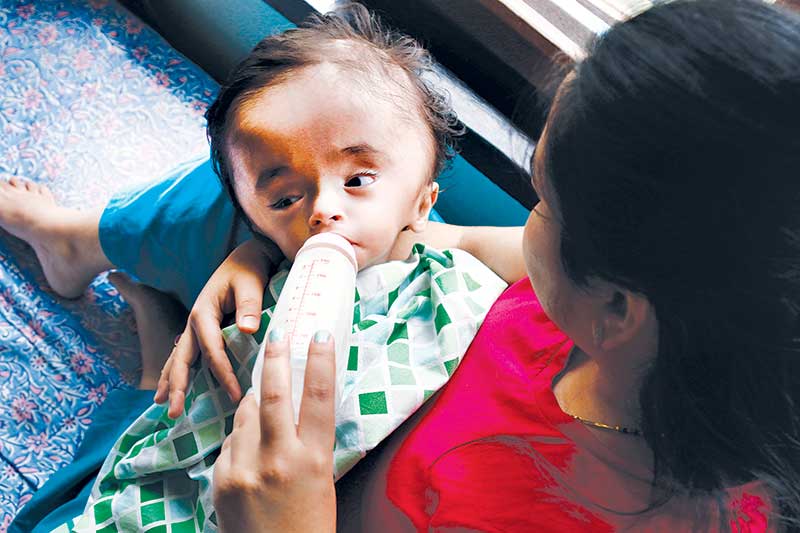
A string of errors and oversights by doctors at Grande International Hospital has destroyed a 15-month-old child beyond repair, his parents allege.
- SWARUP ACHARYA

From the moment he was born, Rihan suffered from a series of complications, which, his parents say, were exacerbated by doctors at Grande International.Post Photo: keshav Thapa

KATHMANDU : On the third floor of a house in Kapurdhara, behind the British Embassy in Lainchaur, 15-month-old Rihan is lying on his side. His head is disproportionately large and his body is dangerously thin and malnourished. His arms and legs appear wasted and his eyes have narrowed. He stares out of the window but it is difficult to tell whether he can hear or not. He doesn’t seem bothered by the noise even when a lot of people enter his room. In the past five months, ever since he was discharged from the hospital, his daily routine has been to wake, eat, sleep and repeat.
Rihan was born to Ekata Ghimire and Sanjeev Neupane on June 26, 2018
at Grande International Hospital in Dhapasi. They had been visiting the
hospital ever since Ekata conceived, regularly meeting and following up with their attending consultant Dr Abha Shrestha Shakya. Rihan was born slightly early, at 36 weeks and a day, weighing 2.85 kgs.
But from the very moment he was born, Rihan suffered from a series of health complications, which, the parents say, were exacerbated or mistreated by a team of doctors at Grande International. In nearly a year at the hospital, Ekata and Sanjeev watched helplessly as the hospital committed malpractice after malpractice, often due to simple oversight and at other times, carelessness. In the end, their newborn would end up the way he is today—catatonic. Rihan’s struggles began just as he was born with a pneumonia infection and had to be placed in the Intensive Care Unit of the hospital immediately. After no signs of improvement, he was moved to a mechanical ventilator, which would turn out to be the biggest misfortune of his new life.
“I was ready to be discharged in three days after a Caesarean operation,” said Ekata. “But I wasn’t ready to go home without my baby so I stayed at the hospital after asking the doctors to not discharge me for a few extra days.” After six long days, Rihan was ready to be taken off the ventilator and Ekata too was going to be discharged.
“I had expected that the hospital would hand over my baby after taking him off the ventilator,” said Sanjeev.
“But instead, they told us that another complication had surfaced.”Rihan had a Klebsiella bacterial infection, said the doctors. He had acquired it while on the ventilator, a hospital-imparted infection.
The doctors, however, told Sanjeev to keep this information to himself. Ekata, who was still recovering from the Caesarean operation, would only be worried, they said. To control the infection, Rihan had to be given antibiotics for 14 days and placed in the ICU. Sanjeev and Ekata thus returned home leaving their baby in the care of the hospital’s doctors and nurses.
Over the next two weeks, Sanjeev and Ekata developed a new routine to their day. They would reach the hospital every morning, enquire about Rihan’s condition, spend the entire day at the hospital, and return home in the evening. Rihan’s ‘nwaran’, or naming ceremony, was done at the hospital itself, on the eleventh day.


After 21 days in the hospital, Rihan was finally discharged. The new parents were elated to be able to finally bring their baby home after such a harrowing stay at the hospital. The first two days went by without incident, but on the third day home, Rihan developed a fever. Sanjeev anxiously called a doctor, who advised that the child be admitted to the hospital.Once again, Rihan was admitted to Grande Hospital for 24-hour observation.
“When I saw the pus pulled from Rihan’s spinal cord, I was terrified,” said Sanjeev. “But I consoled myself, thinking at least I had brought him to the hospital on time.”Rihan had meningitis, the doctors told him.
Rihan’s next stay at the hospital would extend to 42 days, during which time Sanjeev learned the vocabulary of medicine. An ultrasound was conducted to see if the meningitis had had any impact on Rihan’s brain. Radiologists looked at the report and said that there could be pus accumulated in the brain, said Sanjeev, but the doctors didn’t pay much attention to the radiologists’ report and continued to administer antibiotics. With no sign of improvement, a Magnetic Resonance Imaging (MRI) test was conducted. By then, Rihan had already been in the hospital for 40 days.

The night after the MRI test, doctors told Sanjeev and Ekata that a brain operation was required to remove the pus. Neurosurgeon Dr Amit Thapa took the responsibility for the surgery.
“As soon as the MRI report came, Dr Amit said there was an abscess in Rihan’s brain and that it needed to be removed without delay. He said he would operate on the baby immediately,” said Sanjeev. “We had no option but to comply.”
Five days after the operation, Thapa and his team told Sanjeev that another surgery was required as the pipe installed in the baby’s brain to drain the pus had become clogged.
“There is a lot of pus. We were planning to remove it all but we couldn’t,” Sanjeev recalled Thapa saying. Sanjeev had hit rock bottom. His child had to undergo a brain surgery twice within 50 days after birth. To further worsen matters, Sanjeev’s father had died suddenly less than a month after Rihan was born.
“On the one hand, my wife had undergone surgery, and on the other, my infant son was battling for his life after two brain surgeries. And in these circumstances, my father passed away,” said Sanjeev, tears welling up in his eyes. “I didn’t even do the mourning rituals for my father. How could I?”
Two weeks after the second surgery, Rihan was taken to the operation theatre for the third time with doctors saying that they had failed to drain the pus completely. And then, a fourth surgery was performed. Two pipes fitted to drain the pus in the third surgery were removed and new ones placed. The process is called VP shunting, where pipes are placed to collect excess cerebrospinal fluid from the brain.
After the fourth surgery, Rihan’s condition improved. By this time, Rihan had been in the hospital for 67 days. He was permitted to be taken home on October 9, 2018. But it took some time for Rihan, who had been in the hospital for four months after his birth, to adjust to his home environment.
“He was accustomed to living in the constant temperature of the hospital. He became restless after arriving home. Sometimes, I wondered if I should take him back to the hospital again,” Ekata said.Ekata and Sanjeev had spoken to a lot of people and done their own research. They knew that their child might never be completely normal, given the infection, the multiple surgeries and the prolonged stay in the hospital. In spite of all that, as Rihan started to respond to external stimuli, they had hope. Disillusioned with Grande, the parents took Rihan to other hospitals for check-ups. At Tribhuvan University Teaching Hospital, he underwent an ear check-up and an eye check-up at the Tilganga Institute of Ophthalmology.
“The condition of his eyes’ outer portion was fine but we were told that nothing could be said about the condition of the nerves connected with the eyes until Rihan reached one year in age,” said Sanjeev. Rihan’s condition was slowly improving and Sanjeev and Ekata were happy to see their infant getting better. But despite the improvements, Rihan appeared malnourished.
“His head was too small when he was brought home. People who came to see him never stayed very long because they felt uncomfortable. We were heartbroken,” said Ekata. “But we had hope that our son was getting better.”
On the advice of the doctors, Sanjeev was regularly measuring Rihan’s head size. They had also been told to consult with the doctors and carry out health check-ups every month. Between the fourth and sixth months since birth, Rihan’s head was normal. It was in the seventh month that his head suddenly started to enlarge.
An ultrasound showed hydrocephalus and an 8.2 cm long and 1 cm wide build-up of cerebrospinal fluid in the brain, said Sanjeev. But Amit Thapa, the chief doctor involved in Rihan’s surgery, disagreed with the radiology report, saying that the build-up should be 8 mm long, not 8 cm.
“We were afraid when the radiologists said that the length of fluid was 8 cm long,” Sanjeev said. “But Dr Amit assured us that it can never be that long, that it was only 8 mm. We believed the doctor.”
Rihan’s head started growing bigger and bigger every month. In the ninth month, an MRI was conducted. Rihan underwent a fifth surgery to place another shunt to drain the fluid.
“In the beginning, we were told that the fluid build-up was small,” said Sanjeev. “Later, they told us to carry out an MRI and when the report came, we were told that the build-up was bigger and needed to be operated. We agreed. We wanted to do everything for the welfare of our child.”
In the end, it turned out that Thapa was mistaken and that radiology report was right all along—the build-up was 8.2 cm long.
It was after this surgery that tensions began to grow between the parents and hospital. Sanjeev and Ekata had so far trusted the doctors and Grande Hospital but one incident led Sanjeev to doubt just how well the hospital was treating his child.
“We were in the cabin with Rihan when a nurse came to give him medicine,” said Sanjeev. “The doctor had said that much medication was not required since it had been a bloodless surgery so we asked the nurse what she was giving to the child. She told us that it was paracetamol, but we were alarmed by the amount.”
Sanjeev saw that the nurse was attempting to give Rihan, a months-old infant, a paracetamol dose of 66ml, which is a heavy dose even for a fully-grown adult.
“We asked her to check with the doctor and confirm the amount,” said Sanjeev. “The nurse was visibly angry because of our request but when she came back after asking the doctor, she said that she was mistaken and gave a much smaller dose.”
Sanjeev and Ekata were relieved, but when they overheard that Rihan must’ve received a 66ml dose in the ICU, they were shocked.
“The news had already reached the doctors,” said Sanjeev. “We became puzzled after almost all of the doctors came one after another to see Rihan.”
Dr Chakra Raj Pandey, a famed orthopaedic surgeon and director of Grande Hospital, himself came to enquire after Rihan’s condition. Pandey accepted that there had been an overdose of paracetamol and that the hospital took full responsibility, said Sanjeev.
Pandey assured the parents that the hospital would do whatever it took to avert the danger the child was going to face, according to Sanjeev.
But problems compounded further when the hospital initiated efforts to reverse the effects of the overdose. An infection was seen in Rihan’s urine, causing a fever. But because of the overdosing, Rihan could not receive any more paracetamol. The parents were told to regularly place a cold compress on Rihan’s forehead to bring his temperature down. Sanjeev and Ekata spent long nights alternatively placing a cloth soaked in cold water on their son’s forehead.
“But the fever became severe and when we asked the doctors, they said the only thing that could be done to bring down the temperature was to use a wet cloth,” Ekata said. “We spent the whole night replacing the water-soaked cloth. None of the nurses came to help.”
The next morning, an argument ensued between the parents and the hospital administration, which then arranged a room in the pediatric intensive care unit for Rihan. But Sanjeev had had it with Grande and its doctors. He suspected malpractice and took his child’s medical reports to get a second opinion from doctors at other hospitals. While the doctors were unable to say if Grande had done anything wrong, they advised against moving Rihan to another hospital as that would only cause him more pain.
Sanjeev and Ekata reluctantly agreed to continue with the treatment at Grande but they also lodged a complaint with the Nepal Medical Council, accusing Grande Hospital and its doctors of serious negligence in the treatment of their child.
The council asked Grande International Hospital for an explanation and formed an ethical committee under Dr Ganesh Rai with Dr Gopal Raman Sharma and Dr Ganesh Dangal as members. During investigation, the committee discovered many mistakes on the hospital’s part, including administration of an unnaturally high dosage of paracetamol to the infant, miscommunication between the hospital’s radiologists and neurosurgeons, and withholding information from the patient’s guardians regarding treatment procedures.
Based on the committee’s findings, the council has announced that appropriate action will be taken against the medical personnel involved in Rihan’s treatment.
However, Grande International Hospital’s Medical Director Pandey has refuted any negligence on the part of the hospital while treating Rihan.
“We took good care of the child ever since the day he was born,” said Pandey, “The child was suffering from neonatal pneumonia. The case took a wrong turn when the child acquired an infection while the doctors were treating him for pneumonia. The doctors involved in the child’s treatment did everything that was medically possible.”
Pandey said that the hospital cannot be blamed for the Klebsiella bacterial infection as it is a common gut bacteria that is primarily found in hospitals. Anyone visiting a hospital for treatment can contract an infection from Klebsiella, said Pandey.
“The chances of patients being infected by Klebsiella or other hospital-borne diseases is very low at Grande,” he said. “We are ready to present our data, but some people are trying to defame the hospital by cherry-picking one or two instances of infection. We strongly object to this.”
Pandey also claimed that there had been no misunderstanding between the hospital’s radiologists and neurosurgeons.
“The doctors involved in the treatment took their decisions after reviewing multiple options and I don’t think the doctors took any wrong decisions,” said Pandey.
However, Pandey admitted that the paracetamol dosage had been bungled and that he would review the matter seriously. But even here, Pandey had a caveat.
“I reviewed the child’s health condition and conducted all possible check-ups. The overdose did not harm the child in anyway,” he said. “There is no doubt that the child was administered a high dose of paracetamol but we are certain that it did not cause any harm. Sometimes mistakes happen during treatment but it is not right to make an issue out of it.”
Pandey and Grande might get away with their defence that “mistakes happen,” but for Ekata and Sanjeev, these mistakes are unforgivable. Initially, Sanjeev only wanted the hospital to admit to its mistakes and apologise but they are now infuriated by Pandey’s response and are consulting with lawyers to take the hospital to court.
For now, Rihan sleeps quietly, opening his eyes occasionally and looking around. But he is mostly unresponsive. His parents have done all they can, going through a harrowing ordeal in order to save their son’s life. But now, there is little they can do but wait for the ultimate end: death.

Rihan with his mother Ekata, whose life for the past few months has been a constant fight to save her son’s life.Post Photos: keshav thapa

This story was originally published in Nepali in Kantipur Daily, where Swarup Acharya is an online editor.

HOME PAGE

Constitutional bench of Supreme Court repeals provincial laws for the first time

The legislation, which related to salaries that local representatives were receiving, contradicted the constitution, according to the bench.
- TIKA R PRADHAN

KATHMANDU : In a major decision, the constitutional bench of the Supreme Court on Friday repealed the laws provincial governments had enacted to allow elected representatives at the local level to receive salaries.
This is the first time since its formation on September 1, 2017, that the constitutional bench has repealed laws enacted and implemented by the provincial governments.
Six out of seven provincial governments, except for Province 1, had enacted such laws a year after their formation. With the bench’s order, around 30,000 local-level officials won’t be able to receive monthly salaries and allowances. The timeline for the implementation for the order, however, is unclear.
Advocate Lokendra Oli had filed a writ petition on August 18, demanding that legal provisions of the six provinces allowing local representatives to draw monthly salaries be quashed as it contradicted the constitutional provisions and burdened the state coffers. The specific wording of the constitution only allows for “facilities” for local representatives, not “salaries” as enumerated in the provincial laws.
During the constitution-writing process, the drafters had debated over the system of governance in the federal set-up—whether to adopt three-tiers or two-tiers of government. Later, politicians opted for a three-tier administration—federal, provincial and local.
“But the drafters came to the conclusion that it would be difficult to manage salaries for more than 30,000 elected representatives at the local level. That’s why they inserted a provision of only providing them with facilities,” said senior advocate Chandra Kanta Gyawali, who argued on behalf of the petition.
The bench, comprising Chief Justice Cholendra Shumsher Rana and Justices Deepak Kumar Karki, Kedar Prasad Chalise, Mira Khadka and Hari Krishna Karki, ordered that the provincial laws be annulled, saying they contradicted provisions laid out in Articles 220 (8) and 227 of the constitution.
Office bearers and members of the local level and the district coordination committees were benefitting with the monthly salaries besides allowances on different topics, as per the provinces’ Acts Related to Benefits for the Office Bearers and Members of the Local Level.
The local level in the country is made up of 293 municipalities, 460 rural municipalities and 6,743 wards.
Ashok Byanju, chairman of the Municipal Association of Nepal, the umbrella organisation of all the municipalities of the country, said that local representatives had not demanded any salary and “were ready to serve the people without a monthly salary”.
However, chairpersons of the local federal units have expressed their discontent at the court’s decision, saying that the move could affect their performance.
“It’s fair to say that such benefits to local representatives were a burden on state coffers. But those benefits had also motivated them to work proactively,” said Raju Gurung, chairman of Siranchowk Rural Municipality of Gorkha. “It would be idealistic to ask a person to work without benefits.”
Constitutional experts, however, blamed the federal government for not supporting the provinces to draft necessary laws in a proper manner.
Khim Lal Devkota, who served as the head of the planning commission of Province 3, said that Friday’s court decision was the result of the federal government’s failure to extend support to provinces in drafting crucial legal frameworks.
“It was the federal government that sent its civil servants to the provincial ministries of internal affairs and law and it was they who made these flawed laws,” Devkota said.
According to Devkota, a number of local governments had already decided on their representatives’ perks and benefits on their own, instead of waiting for legal provisions from the provincial assembly.
“Things will get out of hand if the Office of the Financial Comptroller General starts carefully looking into their expenses,” said Devkota.
This incident shows a lack of uniformity in the laws of the various provinces and a failure of the federal government to facilitate the formation of laws at the provincial level, according to Devkota.
“Many provincial laws have flaws,” he said. “These flaws will surface gradually.”

HOME PAGE

A commission formed to deal with controversies in medical education sector is itself mired in controversy

The Medical Education Commission is allowing affiliations to nursing colleges, despite a law that disallows any affiliations until existing medical institutions are mapped.
- BINOD GHIMIRE

Even before office-bearers had been appointed to the commission, a fleet of luxury vehicles stood ready to welcome them.Post File Photo

KATHMANDU : After much political wrangling and a series of protests in the form of hunger strikes and doctor walkouts, a Medical Education Commission was finally formed earlier this year to deal with anomalies rampant in the medical education sector. However, instead of cracking down on the exorbitant fees charged by medical colleges and the nepotistic granting of licences and affiliations, the commission itself is indulging in controversies.
Even before office-bearers had been appointed to the commission, a fleet of luxury vehicles stood ready to welcome them. Seven luxury vehicles worth around Rs 50 million were purchased weeks before the executive chief and commission members were appointed. A Kia Sportage for the vice-chairman, three Hyundai Cretas, two electric BYD vehicles and a Nissan Urvan comprised the fleet of SUVs for the commission members.
Now, contravening provisions in the National Medical Education Act, the commission has authorised the Council for Technical Education and Vocational Training to grant affiliations to nursing colleges that had applied for permission to operate before 2012. Educationist Kedar Bhakta Mathema, who had led the drafting process of Health Profession Education Policy based on which the Act was formulated, says the commission has deviated from its role.
“It is unfortunate to see the commission working against the spirit of its formation. Allowing the council to grant affiliation to nursing colleges contradicts provisions in the Act,” Mathema told the Post.Clause 6 of the Act requires medical education institutions to be mapped before new ones are added. The commission has the authority to standardise medical education, decide on integrated entrance tests, issue letters of intent, and develop policies to grant and cancel affiliations. Medical education institutions are required to draft a letter of intent before they can be granted affiliation, and the letter can only be given after the mapping.
The commission, however, has delegated the authority for granting affiliations without conducting the mapping, which would ascertain the places where medical institutions are already established and where such institutions are required.Officials at the commission, however, say that the council will decide on affiliations for institutions that had applied prior to the establishment of the commission.
“It is wrong to say our decision is against the Act,” Dr Krishna Giri, vice-chairman of the commission, told the Post. Though the commission was set up earlier this year, it only came into operation after the appointment of Giri, its executive vice-chairman.Sources at the Ministry of Education say that the council is already preparing to grant affiliations to 29 nursing colleges to operate proficiency certificate-level education.
“Minister for Education Giriraj Mani Pokharel wants the council to permit them,” said a senior official at the ministry on the condition of anonymity as he feared retribution.
The commission has also increased the fees for MBBS and BDS education. Now students pursuing an MBBS degree will have to pay Rs 183,000 higher than the present fee and the BDS students must pay Rs 87,000 higher.The commission has increased the fees for MBBS in the Kathmandu Valley to Rs 4.03 million from Rs 3.8 million. Similarly, fees for outside the Valley are set at Rs 4.43 million, up from Rs 4.2 million previously.
Private medical colleges can now charge Rs 2.019 million for BDS students, up from Rs 1.93 million.
“The fees were increased based on the inflation rate determined by the Nepal Rastra Bank,” said Giri. The inflation rate for the previous fiscal year was 4.5 percent.
Following much controversy over the rates that medical colleges are charging the students, the commission has arranged for students to pay their fees at the respective universities which will coordinate their colleges. Students who are demanding a refund of the amounts they were overcharged say it’s natural to increase fees but the fees need to be implemented as decided by the commission. In the past, private medical colleges have been discovered charging as much as Rs 6 million for MBBS students.
“We expect the commission will be bold enough to implement its fee ceiling,” Anit Sinha, secretary of the Medical Students’ Struggle Committee, told the Post.

Page 2
MEDLEY

HOROSCOPE

ARIES (March 21-April 19)
***
The shopping bug has bitten you, and it has bitten you hard. And it could do some damage. This fascination for new clothes, new gadgets, or new furniture is a passing one, so if you are feeling a bit strapped for cash, just hang on and avoid the malls. But if you have some money to spend, this will be a very day to spend it!

TAURUS (April 20-May 20)
**
One of your friends is in quite a hurry to move forward on some plans, and you can expect them to put pressure on you to commit. If you’re not ready, you’re not ready—so tell them to give you more time. They should be cool with that, as long as you can give them an idea of when you will able to give them an answer.


GEMINI (May 21-June 21)
***
Focusing on what is holding you back is not going to get you anywhere. You need to forget about the things you don’t like about your life—because the more you think about them, the more power you are giving them. So today, put a smile on your face and be confident. And if you can’t feel confident, then fake it until you do!


CANCER (June 22-July 22)
****
You are in a prime position to learn. So go out and get busy looking for something that will keep your brain humming—a long historical novel, an intellectual foreign film, or an avant-garde art exhibit are the types of things that will feed your intellect. Challenge yourself today, and you won’t be disappointed.


LEO (July 23-August 22)
***
When you encounter an unfamiliar situation today, don’t freak out. Instead, mine the episode for insight that can enrich your life. Ask a lot of questions to orient yourself and figure out how to proceed. Don’t take a simple ‘yes’ or ‘no’ for an answer—make sure you are clear about what is going on and about what needs to happen.

VIRGO (August 23-September 22)
****
Today you will be having plenty of energy. So what are you going to do—channel all of this energy toward cooking up some new adventure, or jump into a coworker’s stressful situation and help them sort it out? It’s basically a question of whether you feel selfish or selfless. The universe says that either option is acceptable.


LIBRA (September 23-October 22)
***
You are approaching a critical point in one of your relationships—things are evolving toward the professional and away from the romantic. You can still correct this course—and the
sooner you realise this, the better. But if you
are not certain, you need to have a tactful
conversation today.

SCORPIO (October 23-November 21)
****
Getting involved with a cause doesn’t always bring you any reward other than the good feeling of helping others. So if you are contemplating volunteering, you can’t expect to gain more than a feel-good vibe. Your aim should be to grow as a person in these types of experiences—not meet a new cutie or prove something.


SAGITTARIUS (November 22-December 21)
****
Something very unexpected and exciting is coming your way today. This could mean that there is a new romance coming your way, a new job opportunity landing in your lap, or maybe just some wonderful news you’ve been waiting for. Any scheduling hassles it causes will be no big deal—the inconvenience will be worth it.


CAPRICORN (December 22-January 19)
****
Being among the people you respect will provide you with positive reinforcement and remind you of what a special person you are. Make sure you have contact with these good people with some regularity. It might be time to reconsider your key friendships and why you have them.

AQUARIUS (January 20-February 18)
****
Pay closer attention to your dreams—they may help you identify patterns that could shed a lot of light on your life. Your subconscious mind is showing you alternate ways of looking at the world. Most of the images might be disturbing, but sometimes being disturbed is the best way to break the monotony of routine.


PISCES (February 19-March 20)
***
Veils are being lifted today and quite a few juicy secrets are going to be shared with you! Unfortunately, most of what you hear will be things that you pretty much knew anyway. Once you hear the news, do your best to keep from spreading it. It’s not worth the risk— you might get a reputation for being a blabbermouth.

Page 3
NATIONAL

Nepal seeks China’s support for human resettlement in mountainous regions

- PRITHVI MAN SHRESTHA

KATHMANDU : Nepal sought China’s support for an integrated development, including resettlement of scattered population in the Himalayan region, during Chinese President Xi Jinping’s visit to Nepal last weekend.
But the government’s preparations on the ground toward an integrated development of the region which is backward in terms of human development and infrastructure connectivity is next to nothing, admit Nepal government officials.
“No detailed plan has been prepared so far, though we have been holding discussions on how to relocate the scattered population to a single location and deliver infrastructure and other government facilities to them,” said Puspa Raj Kandel, vice-chairman of the National Planning Commission.
According to Kandel, there is a need for such an approach as the settlements in the region are becoming thinner due to migration of people to the hill and Tarai regions.
“As per our envisioning, resettlement will not happen in the entire mountain region, but only in the areas where there is extremely scattered population,” he added.
According to the Population Census 2011, only 1.7 million people were residing in the mountain region out of 26.49 million people in the country.
Despite plans to resettle population, the government has not yet identified the areas with scattered population, where they should be resettled and how it should be done. The Ministry of Federal Affairs and General Administration said that it was currently preparing a guideline on how to go ahead with the integrated development of the region.
“The guideline which we are drafting will provide a roadmap for the purpose,” said Yadav Raj Koirala, secretary at the ministry. “We have aimed to have the guideline within one and a half months.”
According to the Human Development Report 2014, the mountain region lags behind both Hills and Tarai in human development. According to the report, the mountain region has the lowest human development index (HDI) value at 0.440 followed by 0.468 in the Tarai and 0.520 in the Hills.
Considering the cost and the efforts required to deliver government services to the scattered population in the mountainous region, the government has envisioned developing the region in an integrated way by resettling scattered population to a single location and providing various facilities and infrastructure in an integrated way.
The government has allocated Rs1 billion for implementing the Northern Region Infrastructure Development and Livelihoods Improvement Programme aimed at infrastructure development and livelihoods improvement in the current fiscal year.
“Under the programme, local governments are supported to initiate integrated development plans,” said Kandel of the National Planning Commission.
The government officials said they plan to resettle the scattered population, run employment-generation programme, and build schools and health posts as part of an integrated development modality. With the government preparing plans for integrated development in the region, it wants to learn from China on the issue.
“Considering China’s experiences of fast-tracking rapid development in mountainous Tibet and other regions, cooperation was sought from China,” Kandel added.

NATIONAL

Police blame mushrooming party palaces with insufficient parking for traffic woes

Division office writes to city office and the district administration office to set criteria and monitor burgeoning banquet halls.
- ANUP OJHA

KATHMANDU : The Metropolitan Traffic Police Division has come up with a new finding that mushrooming party palaces such as banquet halls with insufficient parking space for their clients’ vehicles are one of the main causes of traffic congestion in Kathmandu.
A meeting of senior traffic officials at the division on Friday led to letters being sent to the Kathmandu Metropolitan City and the District Administration Office to monitor party palaces.
“Most of the party palaces are being run without having proper parking spaces. They are using the roadsides and footpaths to park their clients’ vehicles. This has long been causing disruptions on the road,” said division chief and Senior Superintendent of Police Bhim Prasad Dhakal.
“We are asking for cooperation from the concerned stakeholders in solving this issue,” said Dhakal.
In recent times, with shrinking open spaces, party palaces are mushrooming in Kathmandu. People host social gatherings for marriage, bratabandha, birthday and get-togethers in festive seasons, but they are unable to find space to park cars and two-wheelers of their guests.
“Almost every day, it’s difficult to pass through Babarmahal Chowk in front of the Nepal Art Council because you are stuck by the haphazardly parked vehicles covering half the portion of road and footpath by guests attending the Karki Banquet,” said Nawaraj Pandit, a teacher who has been staying in Babarmahal for more than five years.
Traffic police say they face a hard time managing the wrongly parked vehicles of party-goers in New Baneshwor, Thapagaun, Babarmahal, Tripureshwor, Lainchaur, Maharajgunj, Kalanki, Sitapaila, Swayambhu, and Soltimode, among other places in Kathmandu.
When the Post contacted the Kathmandu Metropolitan City that manages open spaces in the city, it pleaded ignorance. The city also did not have a record of the party palaces registered with it.
“This is a new issue. Nobody had raised this before. We will look at it. We will soon set the criteria for party palaces,” said Kedar Neupane, chief executive officer at the municipal office. Chief District Officer Janak Raj Dahal admitted the weakness of the district office in punishing the wrongdoers. “I am also aware of that but this is a sensitive issue. There are many party palaces that cannot accommodate even five vehicles,” said Neupane. “We will soon make the criteria for running banquets, in consultation with stakeholders. We will not allow party palaces to operate until they meet certain criteria.”Dahal said the district administration will soon coordinate with the metropolitan city to keep a record of party palaces and their status in all the 32 wards.

Page 4
NATIONAL

A discrimination case riles up Dalit activists in Morang district

- BINU TIMSINA

BIRATNAGAR : Dimune Kami, 60, was abused based on his caste recently when he went to a tea shop operated by Talak Bahadur Pandey in Pathari Sanischare in Morang, according to a complaint filed by Kami at the Area Police Office in Pathari on October 14.
Pandey and a few other customers belonging to the so-called high caste barred Kami from entering the shop and manhandled him in the process.
Following the incident, Kami filed a police complaint against the perpetrators for abusing him based on his caste. Caste-based discrimination in any form is a punishable offence, according to Caste-based Discrimination and Untouchability Act 2011.
Pandey denies Kami’s allegation. Moreover, he has accused Kami of racking up Rs 10,000 debt in his shop and not paying up. Pandey has filed a police complaint, appealing for recovery of the money that Kami owes him.
Based on the complaints, police have detained Kami, Pandey and the others for investigation.
But Kami’s arrest has riled the Dalit rights activists in Morang. They have claimed that Kami has been wrongfully charged and demanded for his unconditional release.
A delegation, led by Kuberman Ghatani, has submitted an application to Chief District Officer Suresh Sunar, demanding that the authorities concerned withdraw the case against Kami and launch a fair investigation into the case. The Dalit rights activists have also demanded action against the police officers who detained Kami under a false charge. Meanwhile, Sunar has promised to launch a fair investigation into the case.
“If the cases were false, the accused individuals will be punished,” he said.According to the Caste-based Discrimination and Untouchability Act 2011, perpetrators of caste-based discrimination are liable to up to three years jail sentence and a fine up to Rs200,000 or both.

NATIONAL

Climate change is posing threats to Nepal’s biodiversity and agriculture sector

The adverse effects of climate change are already visible in various sectors across the country, scientists say.
- CHANDAN KUMAR MANDAL

KATHMANDU : In the summer of 2016, Tuta absoluta—a devastating tomato pest—was reported for the first time in the country. The pest invasion left farmers, government and non-government agencies worried. It was estimated that Tuta absoluta would cause tomato yield losses in Nepal up to 80 to 100 percent.
Climate change experts and scientists gathered in Kathmandu say that climate change will have severe impacts on agriculture and biodiversity sectors with the changes in temperature, rainfall patterns, new diseases and pests like Tuta absoluta.
“Climate change will have more impacts on agro-biodiversity. Agriculture will be highly affected. Climate change and heat stress are already killing bee population and equally affecting other animals,” said Arun Prakash Bhatta, an under secretary at the Climate Change Management Division under the Ministry of Forest and Environment. “There will be new diseases and pests emerging. Tuta absoluta, which was first identified in Kathmandu and surrounding districts like Bhaktapur and Kavre, has spread across the country now.” Nepal has been termed the fourth most vulnerable country in the world in terms of climate change effects. The adverse effects of climate change are already visible in various sectors across the country.
As a mountainous country lying in the Hindu Kush Himalayan region, a zone highly vulnerable to climate change, Nepal is likely to witness a harsh future receiving effects on health, agriculture and livelihood, among other sectors.
Impacts of climate change in the form of increased extreme weather events, spiked temperature, altered rainfall pattern, drop in crop production, and growth of invasive alien plants are felt in the country, according to climate scientists gathered at a tw0-day event in Kathmandu.
“Mountains are more vulnerable to climate change than any other ecosystems. The magnitude of the warming increases with altitude. Mountains are warming faster than plains thus our lives and livelihood are directly under a hanging sword,” said Tirtha Bahadur Shrestha, a botanist and conservationist.
According to Shrestha, some 30 years ago, the country had vast grazing areas above the treeline—the line or altitude above which no trees grow—which has shrunk due to the invasion of shrubby plants. The phenomenon can be linked to climate change.
“There is a whole new challenge for conservation biologists to monitor these changes. Mosquitos are already climbing upwards and have reached as high as Humla and Jumla,” said Shrestha. “We may expect the treeline to move higher and higher, reaching closer to high mountains or areas where snowfall begins.”
According to the government report, Nepal’s average annual maximum temperature has gone up by 0.056 degrees Celsius every year, signs that the country’s climate has been warming up.
The latest landmark study in the Hindu Kush Himalaya region, which covers 3,500 kilometres across Afghanistan, Bangladesh, Bhutan, China, India, Myanmar, Nepal and Pakistan, has projected an alarming future for countries like Nepal.
The region is known for drinking water and fresh air, among other environmental services, to the region’s 240 million population and serving a total of 1.65 billion people dependent upon 10 major rivers that originate in the Hindu Kush Himalaya region.
The study concluded that even the most ambitious Paris Agreement goal—of limiting global warming to 1.5 degrees Celsius—by the end of the century would lead to an increase of 2.1 degrees and the melting of one-third of the region’s glaciers.
“The region including Nepal will warm up even if the world stabilises by 1.5 degrees Celsius,” said Arun Bhakta Shrestha, senior climate change specialist at the International Centre for Integrated Mountain Development. “Most of the people live downstream, but whatever happens in the upper mountains spills down and affects people living in the plains.”
According to Shrestha, climate change has thrown up lots of challenges for the region which can only be dealt with by minimising the risk.
“There is a huge knowledge gap. We need more knowledge and understanding of climate change. However, the current level of understanding also allows us to respond and work positively towards climate change,” said Shrestha.

NATIONAL

Authorities are installing more CCTV cameras to increase surveillance in the Capital city

The camera footage will be used to identify and capture criminals and litterbugs.
- SHUVAM DHUNGANA

KATHMANDU : Installation of an additional 165 CCTV cameras in the Capital city in a bid to keep a closer eye on criminal activities has begun. The move comes nearly eight months after the Metropolitan Police Range, Kathmandu, and Kathmandu Metropolitan City (KMC) signed an agreement.
“After installing an additional 165 cameras, we will have a total of 1,414 CCTV cameras in Kathmandu Valley,” Deputy Inspector General of Police Shailesh Thapa Kshetri told the Post. “Crimes can occur anywhere and we need evidence to arrest criminals and for that CCTVs will be of great help.”
“The CCTV cameras have been installed after identifying sensitive locations in the Capital where camera surveillance is needed more,” said Senior Superintendent of Police Kiran Bajracharya, spokesperson at Kathmandu Metropolitan Police Range. “We have focused more on those areas where accidents frequently take place and also in the areas where the movement of people is high. We are planning to add cameras at heritage sites, too.”
KMC spokesperson Ishwar Dangol said the city office had decided to coordinate with the police under the new Community-Police Partnership Programme.
The CCTV will not only be monitored by the police to capture criminals but also by the KMC staff to identify and prosecute litterbugs.
The KMC will also rely on CCTV cameras to keep tabs on garbage collectors to check if they are doing their jobs efficiently.
“KMC has allocated a budget of Rs58 million in order to install cameras,” said Dangol.
According to Nepal Police records, there are currently more than 3,000 CCTV cameras installed across the country of which 1,249 are in the Valley. There were only 474 cameras in the Valley until last year.
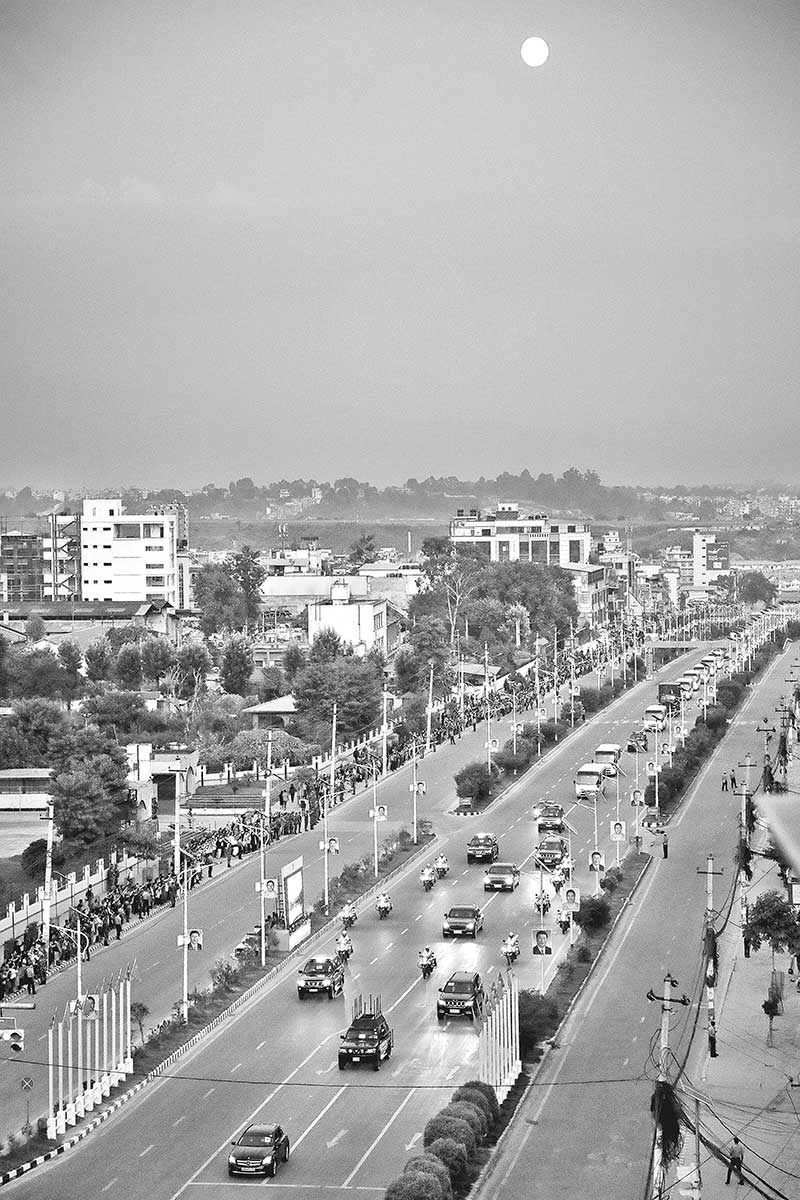
In the wake of Chinese President Xi Jinping’s state visit to Nepal recently, the police had added more cameras in Kathmandu.
“Over 150 cameras were utilised by police to monitor Xi’s visit. The installation of CCTV cameras in as many areas as possible will allow us to monitor criminal activities,” said DIG Kshetri.
There are currently two control rooms in the Capital to monitor the footage captured by CCTV cameras, one is in Metropolitan Traffic Police Division and another at the Kathmandu Metropolitan Police Range. “We are monitoring 536 cameras from our office at Ranipokhari while remaining 617 cameras footages are being monitored from various police stations,” said Kshetri.
Nepal Police is giving high priority to the use and expansion of modern technology for maintaining peace and security, crime control and criminal investigation. Through CCTVs, the police have also been monitoring vehicular movement, traffic rule violations and hit-and-run cases in sensitive locations of the Valley from the control room of the Metropolitan Police Office, the police officials said.

Page 5
NATIONAL

Labour office stops pursuing fraud cases

Victims despair as authority to probe foreign employment swindling cases transferred to District Administration Office.
- BINU TIMSINA

BIRATNAGAR : Manish Kumar Rajbanshi, a resident of Kanepokhari in Morang district, has fallen victim to a swindling case in his bid to fly to Canada. According to him, he provided Rs 1.3 million to Asim Gurung of Kathmandu in February after the latter assured him to send him to Canada. Gurung is out of contact now.
Upon learning that victims of foreign employment fraud like him got justice after Prem Sanjel was transferred at Labour Office in Biratnagar, Rajbanshi lodged a complaint at the labour office on September 1. But to his dismay, the labour office did not pursue his case.
Hemnarayan Chaudhary of Gramsthan had also paid Rs 770,000
to Bibek Pokharel to go to Mauritius a few months ago. He too was swindled.
“I was called to Kathmandu and stayed there for three months waiting to fly to Mauritius. I was later taken to New Delhi and kept there for another two months. It was only then that I realised that I’d been cheated,” said Chaudhary. Like Rajbanshi, Chaudhary also reached the labour office in Biratnagar with his complaint, only to be turned away.
The office no longer looks after foreign employment fraud cases. Last year, the office, under Sanjel’s leadership, had recovered around
Rs 21.5 million from foreign employment scammers. Many victims at the time had heaved a sigh of relief by the initiative.
But their relief was short-lived as the authority to look into foreign employment fraud cases was removed from the labour office and entrusted to the District Administration Office.
“We don’t look into swindling related cases anymore. It’s not in our ambit. It is with the centre,” said Sanjel. On May 14, the Department of Labour and Occupational Safety had written a letter to the Biratnagar labour office, instructing not to pursue fraud cases related to foreign employment.
The labour office can no longer help hundreds of foreign employment fraud victims like Rajbanshi and Chaudhary. They say they have little hope from the District Administration Office recovering their lost money.

NATIONAL

Province 4 ministers yet to disclose assets

- PRATIKSHA KAFLE

POKHARA : Property details of Chief Minister Prithvi Subba Gurung and six ministers of Gandaki Province are yet to be made public though they assumed office around a year and a half ago.
A Cabinet meeting held on March 16, 2018, had issued a 30-point code of conduct which included “making the property details of the Chief Minister, ministers and high-level government officials public” in accordance to the existing legal provisions. But the provincial government has blatantly ignored its own code of conduct.
However, all the ministers submitted their property details to the
Chief Minister’s office on time. “All the ministers submitted their property details on time. We will discuss the matter in the upcoming Cabinet meeting and make public the details,” said Physical Infrastructure Development Minister Ramsharan Basnet, who is also the government spokesperson. Discussions are being held between the CM and chief secretary of the province in regards to making the property details public, he added.
Section 50 of the Corruption Prevention Act 2000 states ministers and other high-level government officials must make public their property details within 60 days from the date of assuming office. As per the Act, the people holding public posts should update the property details within 60 days of the end of each fiscal year. The seven-member Cabinet is found to be flouting the laws.
Chief secretary Hari Prasad Basyal confirmed that the ministers and government employees had submitted their property details on time but such details were yet to be made public. “The discussion is on. The property details will likely be made public before Tihar,” said Basyal.

NATIONAL

Darma Rural Municipality in Salyan continues employment drive

- DURGA LAL KC

DARMA (SALYAN) : The Prime Minister Employment Programme which promised a minimum 100 days of job in a year to all unemployed population of working age ended within a month of its initiation in most parts of the country. But Darma Rural Municipality in Salyan district has continued the programme with its own investment. The rural municipal office has used its capital budget to conduct the programme.
Nim Bahadur KC, chairman of the rural municipality, said that they have used part of the budget to provide jobs to villagers. “The programme ended within a month leaving villagers jobless again. So we decided to give continuity to the programme and create jobs at the local level,” said KC.
According to Darma Rural Municipality, a total budget of Rs 10.8 million has been allocated for the employment programme this year. “We have prioritised jobs for the impoverished and distributed budget in all six wards of the rural municipality. One worker can work for 100 days after being selected for the job. In every ward, 60 employees are currently busy repairing and cleaning roads, foot trails and drains,” said KC.
The programme has come as a blessing for 40-year old Nirmala Pandey. “My husband is blind and hence cannot find work easily. This programme has given me a job and I don’t have to worry about money for the next 100 days at least,” said Pandey. “However, I would request the local unit to provide employment for a whole year to people like us who depend on it. I don’t know how to manage my expenses after 100 days.”
Tara BK, 30, of Farula, is also currently employed under the programme. A widow and a mother of two, BK has the responsibility of providing for her family. “Our corn stock will only last for two months. There’s no other option but to work as a daily wage worker to support my children.”
Kiran Gautam, the coordinator of the programme, said that the programme has received positive feedback from the locals. “More than 4,507 applicants have filled up the unemployment forms. For now, we have prioritised families who cannot afford food even for three months.”
According to him, the local unit provides Rs 300 to 500 per day to each employee on the basis of their skills and capacities.

NATIONAL

Delay in the issuance of smart driving licence a nuisance in Morang

Applicants have not received their smart driving licences even after 21 months of passing their driving tests.
- DEO NARAYAN SAH

MORANG : Brisha Bahadur Budha, of Udayapur, who is currently living in Itahari Sub Metropolis, passed his driving test 21 months ago. Since then, he has been frequenting the Transport Management Office in Itahari to receive a smart driving licence. But he has not obtained the licence yet.
Budha has been compelled to drive around carrying a receipt as proof of him passing the driving licence test. He said, “Traffic police slaps a fine of Rs 1,000 if I carry my receipt only. They ask for my citizenship certificate as well, even though the receipt in itself is proof of my identity.” According to him, he has already paid Rs 4,000 fine to the traffic police in the last 21 months.
Tek Bahadur Bhujel, of Itahari Sub Metropolis, also has a similar story to share. He had filed an application to renew his motorcycle licence on July 13, 2018, but he is yet to receive his licence.
Like Budha and Bhujel, around 30 to 35 individuals visit the Transport Management Office in Itahari to inquire about their digital driving licenses on a daily basis. But the office blames the Department of Transport Management (DoTM) for the delay in the distribution of smart driving licences.
“The DoTM in Kathmandu has to print the licences. Around two percent applicants from 2017 and 30 percent from 2018 are yet to receive the licence,” said Binda Kumari Nepal, chief at the Transport Management Office in Itahari. According to Nepal, her office has repeatedly notified the DoTM to print the licences on time.
The Transport Management Office in Itahari has also requested the Ministry of Physical Infrastructure Development to take initiatives to solve the problem but to no avail. Rewati Raman Parajuli, the spokesperson of the ministry, said that they have been requesting the federal government to hand over all of the responsibilities that are currently with the DoTM to the province based Transport Management Offices.
Parajuli said, “The problem has arisen as the DoTM is the only authorised agency for printing licences. We have already allocated the budget to print licence and blue book in the current fiscal year. If the central level hands over the system to the province, we can print the licence here itself.”
Two years ago, the then director of the department had announced the distribution of smart driving licenses from all of the transport management offices across the country. As per the rule, service seekers should be able to obtain their smart licence within 45 days of passing the test.

NATIONAL

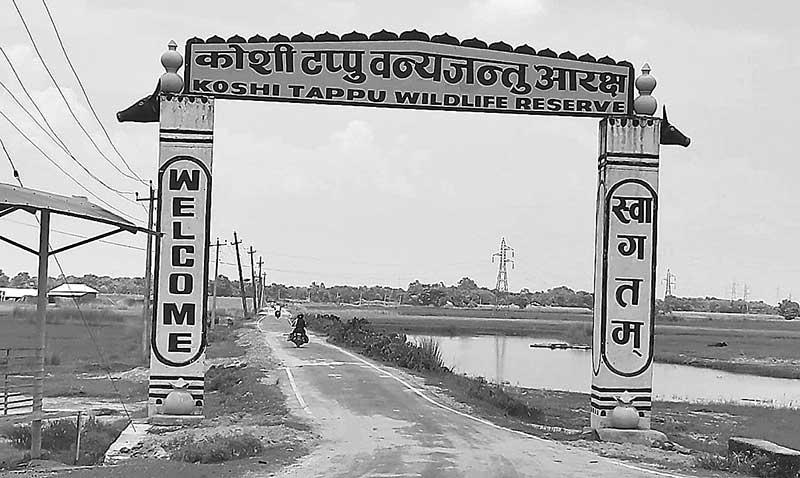
After locals’ protests, Koshi Tappu’s elephants shifted to Bhagalpur

17 people of Kushaha and Jutwan were killed in elephant attacks in the last two years.
- Pradeep Menyangbo

Out of 17 indigenous wild elephants in the reserve, nine are male. Post Photo: pradeep menyangbo

SUNSARI : Koshi Tappu Wildlife Reserve has shifted five elephants to
Bhagalpur Post in Udayapur district following a pressure campaign launched by the villagers of Koshi Rural Municipality.
The villagers have long been exerting pressure on the reserve authority to move the Hattisar (elephant stables) away from their settlements due to frequent elephant attacks on human lives, crops and homes.
Elephants, particularly males, tend to become violent during mating
season and enter human settlements, destroying crops, houses and
even killing people, according to some villagers.
To put an end to recurrent elephant menace, the people of Koshi Rural Municipality had formed a struggle committee to put pressure on the reserve authority to shift the Hattisar.
Ayub Ansari, chairman of the rural municipality, said that 17 people of Kushaha and Jutwan settlements were killed in separate elephant attacks in the last two years.
“Around 14,865 families live at the reserve’s buffer zone, and they all are at risk of elephant attacks,” Ansari said. “We had to prioritise human life to the conservation of wildlife. Every year, the residents of Kushaha (West) suffer from elephant menace.”
On Monday, a stakeholders’ meeting was held at the District Administration Office, which decided to shift the stables to Bhagalpur for the time being.
The people of Koshi Rural Municipality had demanded that the elephants be moved to the national parks in Bardiya or Chitwan.
Ramdev Chaudhary, conservation officer at the reserve, said shifting the stables was not a solution to stop elephant attacks.
“We have been planning to mobilise security personnel and employees of the reserve to limit the harm caused by wild elephants. The meeting has also decided to compensate victims’ families immediately.”
Out of 17 indigenous wild elephants in the reserve, nine are males. According to the data of the reserve, seven people were killed and 27
sustained injuries in separate elephant attacks in the last fiscal year.
Officials said that the local unit should help them construct a permanent wall along the buffer zone area to mitigate human-wildlife conflicts. “This will lower the risk of wild animals attacks,” said Chaudhary.
The reserve, which spreads over an area of 175 sq km in Sunsari, Saptari and Udayapur districts, was established in 1976.

NATIONAL

A local unit in Rukum (West) to start its own hospital

- HARI GAUTAM

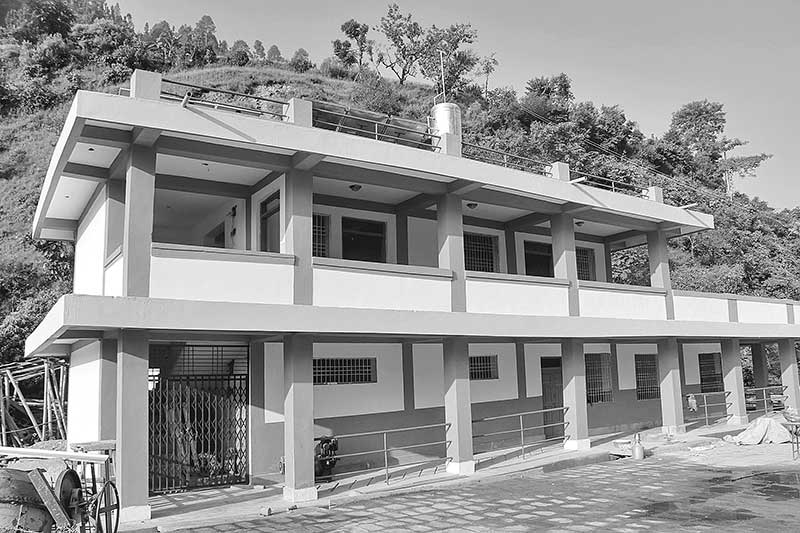
The 15-bed hospital in Sanibheri Municipality has completed construction.Post Photo: hari gautam

RUKUM (WEST) : A local unit in Rukum (West) is all set to operate a hospital in a bid to provide quality health services to its people.Sanibheri Municipality in the district has completed construction of a building at Chhotebagar to
run a 15-bed rural municipality level hospital. The construction of another 12-room building is currently underway at a cost of Rs 23million provided by the federal government. The local unit has also allocated Rs 10.5 million budget for the hospital.
Chhabilal KC, the health coordinator of the local unit, said the health services at the hospital would be provided within the current fiscal year.
According to him, the upcoming executive committee meeting of the local body will take important decisions to purchase tools, machines, furniture and other infrastructures required.
“Preparation is on to run the hospital soon. Construction of other remaining infrastructures is in full swing now,” said KC. To run operations, the rural municipality is planning to appoint a doctor and some auxiliary health workers, staff nurse and auxiliary nurse midwife on a contract basis.
Nara Bahadur Pun, the chairman of the local unit, said that perks and salary for the health employees will be managed from the rural municipality’s annual budget and with financial assistance provided by the federal government.

NATIONAL

Journalist abused and threatened in Baglung

Briefing
- Post Report

BAGLUNG: Yuwa Samuha, a group of youths in Burtibang, has threatened and manhandled a broadcast journalist, Lokendra Sunar. The journalist had written a news article on an online portal about the “irregularities in the organisation” of a sports event by the group. The Federation of Nepali Journalists, Baglung, has condemned the incident. Sunar is associated with Paribartan Radio, Baglung.


NATIONAL

Police make public weapons seized from Chand cadres

Briefing
- Post Report

DANG: Dang Police on Friday made public arms and ammunitions seized from leaders of Netra Bikram Chand led Communist Party of Nepal. Police arrested 21 leaders and cadres of the party in the district past midnight on Wednesday. DSP Binod Bikram Shah said that they have seized two pistols, four muskets and bullets with various other explosives.


NATIONAL

Rafting resumes in Kaligandaki

Briefing
- Post Report

PARBAT: Rafting in the Kaligandaki river has resumed after a month’s delay. According to Hom Pun, a tourism entrepreneur, the bookings took place months prior but activity had to be held back by a month because monsoon lasted longer than usual this year.


NATIONAL

Police seize 20 sal logs in Gorkha

Briefing
- Post Report

GORKHA: Police seized 20 logs of sal trees from Chhebetar in Gorkha on Friday. The illegal woods have been handed over to the Division Forest Office for further investigation. According to police, they are searching for the smugglers.


NATIONAL

Irregularities detected in road construction in Baglung

Briefing
- Post Report

BAGLUNG: Irregularities have been detected in the blacktopping of the Ramrekha road section in the district headquarters. According to engineer Manoj Sharma, the labourers had skipped the process of blacktopping, leading the newly constructed road to developing cracks. Baglung Municipality and Department of Roads had undertaken the construction.

Page 6
MONEY

China’s growth slows to 6 percent in third quarter, weakest in 27 years

Beijing has stepped up support for the economy with tax cuts and other measures.
- AGENCE FRANCE-PRESSE
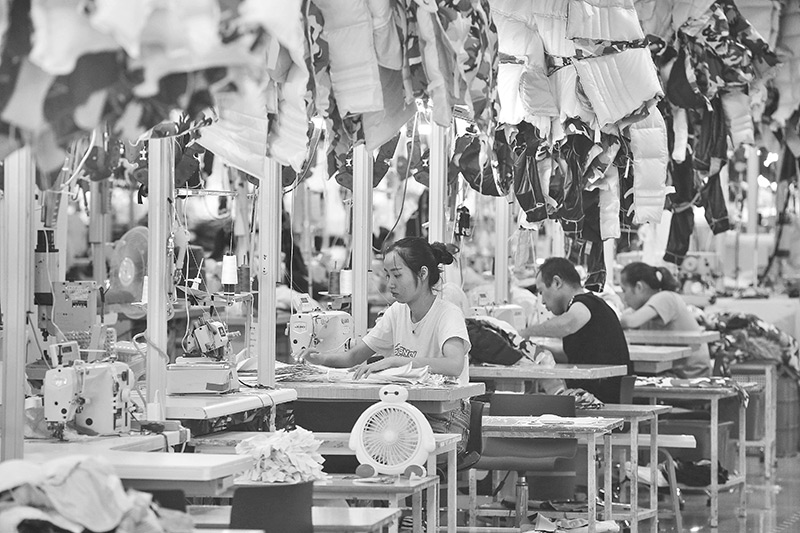
Employees produce down coats at a factory for Chinese clothing company Bosideng in Nantong in China’s eastern Jiangsu province. Afp/rss 

BEIJING,
China’s economy expanded at its slowest rate in nearly three decades during the third quarter as it was hit by the long-running US trade war and cooling domestic demand, data showed Friday, with an official warning of “mounting downward pressure”.
With China a key driver of global growth, the soft reading added to concerns about the world economy and prompted speculation that authorities will unveil fresh stimulus following a series of other measures in recent months.
Gross domestic product expanded 6.0 percent in July-September, from 6.2 percent in the second quarter, according to the National Bureau of Statistics (NBS).
The reading—in line with an AFP survey of 13 analysts—is the worst quarterly figure since 1992 but within the government’s target range of 6.0-6.5 percent for the whole year. The economy grew 6.6 percent in 2018.
While NBS spokesman Mao Shengyong said the economy was showing stability, he warned:
“We must be aware that given the complicated and severe economic conditions both at home and abroad, the slowing global economic growth, and increasing external instabilities and uncertainties, the economy is under mounting downward pressure.”
Services and high-tech manufacturing were the key areas of growth, while employment was “generally stable”, he added.
Beijing has stepped up support for the economy with major tax cuts and measures making it easier for banks to increase lending, including a reduction in the amount of cash they must keep in reserve.
And on Wednesday the central People’s Bank of China said it would pump 200 billion yuan ($28 billion) into the financial system through its medium-term lending facility to banks, to maintain liquidity.
But the efforts have not been enough to offset the blow from softening demand at home, which highlights the struggle leaders have in their drive to recalibrate the economy from one driven by exports and investment to one built on consumer spending.
The trade conflict and weak domestic demand prompted the International Monetary Fund to lower its 2019 growth forecast for China to 6.1 percent from 6.2 percent on Tuesday.
The figures are the latest to indicate a softening in the economy.
This week, Beijing posted weaker-than-expected import and export figures for September, after Washington imposed new tariffs in their long-running trade war.
And on Friday data showed industrial output rose 5.8 percent, from 4.4 percent in August, led by a surge in demand for solar panels and electric vehicles, according to the NBS.
But fixed-asset investment slid to 5.4 percent on-year in January-September, from 5.5 percent in January-August, as the government warned against risky borrowing to build roads and bridges that could artificially pump up GDP in the short run.
China’s army of consumers were starting to open their wallets again, with retail sales edging up 7.8 percent on-year in September, compared with 7.5 percent in August.
Figures last week showed activity in the crucial manufacturing sector continued to contract last month as a result of the trade spat.
The readings show an economy that is “struggling to generate demand on a domestic level”, said Michael Hewson, an analyst at CMC Markets UK.
Infrastructure spending—a major pillar of growth—is also expected to decline as China tries to rein in toxic debt, said Julian Evans-Pritchard of Capital Economics, The recent boom in property development is also “set to unwind,” he added.
“We expect monetary policy to be loosened before long in response, but it will take time for this to put a floor beneath economic growth,” Evans-Pritchard said in a note.
A “phase one” deal announced by US President Donald Trump last Friday after he met China’s top negotiator Liu He in Washington offered a temporary reprieve from further tariff hikes.
NBS spokesman Mao said the mini-deal was “good sign” for global markets.
“We feel that the global economy and global trade are increasingly moving towards reducing protectionism and... freedom,” he said.
The deal, however, did not roll back any of the stinging tariffs already imposed on hundreds of billions of dollars in trade between the economic powers, nor did it address another round of import taxes planned for December.
“A limited agreement will not resolve the underlying areas of disagreement between the two sides as long-term divergence in US and China national interest remains across trade, technology, investment and geopolitics,” said Michael Taylor, a managing director for Moody’s Investors Service.
China’s commerce ministry spokesman Gao Feng said Thursday its negotiators have “accelerated efforts” to hammer out the details of this mini-deal, and the two sides were aiming for an “early agreement”.
Trump had said Wednesday that he hopes to sign the deal with Chinese President Xi Jinping at the APEC summit in Chile next month.

MONEY

G7 says Libra should not launch until risks ‘adequately addressed’

- AGENCE FRANCE-PRESSE

WASHINGTON,
Facebook should not launch its global digital currency Libra until proper regulations are in place to handle the potential risks, the Group of Seven said Thursday.
And France’s Economy Minister Bruno Le Maire warned that a currency like Libra could undermine sovereign nations’ control over their exchange rates.
“It’s a matter of democracy, not just a simple economic question,” Le Maire told reporters, saying Facebook’s currency could have an “immediate global reach” through the social network’s huge membership.
Le Maire presented the Group of Seven nation’s statement on Libra, saying “no global stablecoin project should begin operation until the legal, regulatory and oversight challenges and risks are adequately addressed,” including the potential for money laundering and terror financing.
But, he told reporters, “The key question is the question of sovereignty.”
“Do we want a private company to have... the same power, and the same sovereignty, as democratic states” over currencies.
Libra, which would be backed by reserve assets unlike cryptocurrencies like Bitcoin, has faced a steady drumbeat of stern warnings from central bankers and financial regulators.
European Central Bank board member Benoit Coeure presented a report on digital currencies to the G7 finance ministers, who are gathering on the margins of the annual meetings of the International Monetary Fund and World Bank.
The report said a framework for oversight of Libra “is an absolute prerequisite,” and urged regulators to coordinate their work to prevent issuers from seeking out the most favourable country from which to operate.
If it enters circulation, Libra would offer an alternative to traditional bank financial transfers, a disruptive change that has aroused resistance and scepticism.
Facebook’s digital currency chief David Marcus told reporters in Washington that the issues raised by Le Maire are “legitimate concerns.”
“We’re determined to answer these concerns with real solutions that will meet or exceed the standards of the current system,” he told a small group of reporters at an event in Washington.
Mark Zuckerberg, Facebook’s co-founder and chief executive, was in Washington as well Thursday, and is due to testify before the US Congress next week on the social media network’s impact on financial services.
The Libra Association, which will oversee Facebook’s proposed currency and officially launched Monday in Geneva, also said in a statement that Libra “is being designed to respect national sovereignty over monetary policy in the digital space, not undermine it.”
Lael Brainard, an influential member of the US Federal Reserve board, said Facebook’s proposed currency presented a host of risks and regulatory challenges for preventing money-laundering and assuring financial stability, and could be a challenge to the traditional role played by banks.
“There are likely to be financial stability risks for a stablecoin network with global reach,” she said in a speech Wednesday. ”
China, which is not a G7 member and decided two years ago to block cryptocurrency transactions, has recently sped up plans to introduce its own digital money.
Libra also has faced challenges from within after major financial and commercial players in recent weeks have backed out of the project, including Visa, Mastercard, eBay, Stripe, PayPal and the online travel firm Bookings Holdings.
The 21 founding members include the online payments company PayU, the telecoms firms Vodafone and
Iliad, as well as tech outfits Uber, Spotify and Farfetch, blockchain operations such as Anchorage, Xapo and Coinbase and the venture capital firms Andreessen Horowitz, Ribbit Capital and non-profits Kiva and Mercy Corps.

MONEY

US imposes tariffs on EU goods, targeting Airbus, wine and whisky

- AGENCE FRANCE-PRESSE

WASHINGTON,
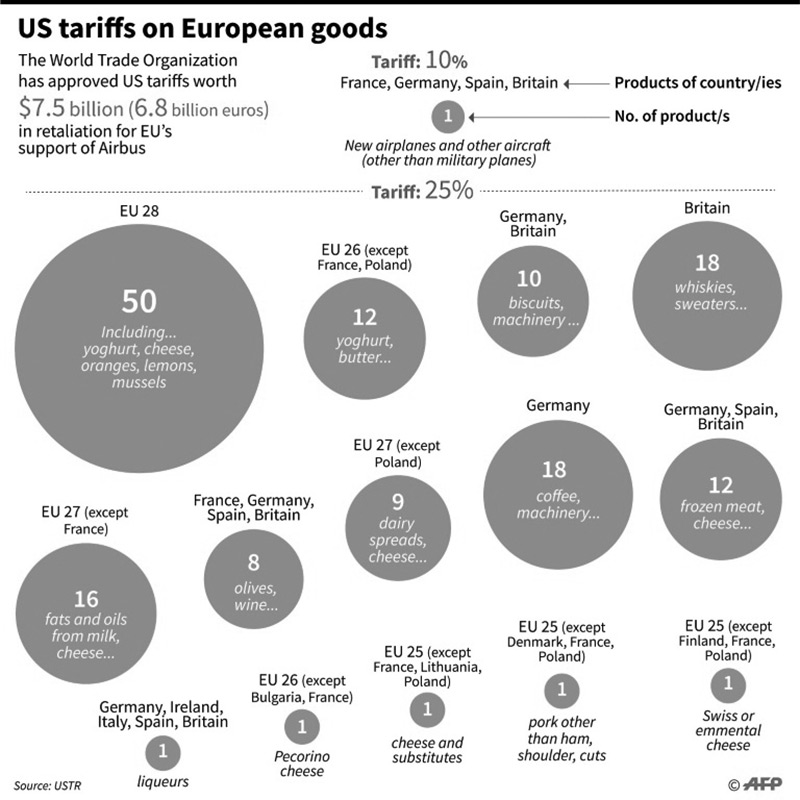
The United States imposed tariffs on a record $7.5-billion worth of European Union goods on Friday, despite threats of retaliation, with Airbus, French wine and Scottish whiskies among the high-profile targets.
The tariffs, which took effect just after midnight in Washington (0401 GMT), came after talks between European officials and US trade representatives failed to win a last-minute reprieve.
The WTO-endorsed onslaught from US President Donald Trump also comes as Washington is mired in a trade war with China and could risk destabilising the global economy further.
In the line of fire are civilian aircraft from Britain, France, Germany and Spain—the countries that formed Airbus—which will now cost 10 percent more when imported to the US.
But the tariffs also target consumer products such as French wine, which Trump had vowed to attack in recent months. Wine from France, Spain and Germany will now face 25 percent tariffs.
Speaking in Washington hours before the tariffs were due to come into effect, France’s Economy Minister Bruno Le Maire warned the move would have serious repercussions.
“Europe is ready to retaliate, in the framework of course of the WTO,” he told reporters shortly after meeting with US Treasury Secretary Steven Mnuchin on the sidelines of the International Monetary Fund annual meetings.
“These decisions would have very negative consequences both from an economic and a political point of view.” Le Maire was due to meet US Trade Representative Robert Lighthizer later on Friday.
He also warned the US against starting another front in its trade conflicts and again called for a negotiated solution.
At a time when the global economy is slowing, “I think that our responsibility is to do our best to avoid that kind of conflict,” Le Maire said.
The Europeans have long advocated negotiation over conflict and they themselves will be able to impose tariffs next year to punish the United States for subsidising Boeing.
But EU officials had already offered in July to call a truce on subsidies for planemakers, in which both sides would admit fault and agree to curtail state aid—to no avail. The two sides have been involved in a row over the subsidies for 15 years.
The tariffs kick in just days after the United States was given the formal go-ahead by the World Trade Organisation.
As recently as Wednesday, Trump singled out the Europeans for being unfair with the US on trade, but said his door was open to negotiate a settlement. The Europeans fear above all that Trump will impose heavy duties on imports of European cars around mid-November. This would be a serious blow for the German automotive sector in particular, even if giants such as Volkswagen or BMW also manufacture in the United States.
“Our products are very hard to bring in (to Europe)” when Europeans easily import their cars into the United States, Trump said.
The Airbus-Boeing row is just one of several issues stoking transatlantic tensions that quickly descended into acrimony when Trump took office in 2017. Trump embraced a protectionist agenda, slapping import duties on steel and aluminium from the EU and other allies, while also threatening tariffs on cars.
Trade groups in Europe such as winemakers, German tool manufacturers and whisky producers in Scotland have kept a clamour of protest, demanding Washington reverse tack.
The US leader and European Commission President Jean-Claude Juncker agreed in July 2018 to a ceasefire in the conflict to hold trade talks that have so far led nowhere.
The epic legal battle between Airbus and Boeing at the World Trade Organisation began in 2004 when Washington accused Britain, France, Germany and Spain of providing illegal subsidies and grants to support the production of a range of Airbus products.
A year later, the EU alleged that Boeing had received $19.1 billion worth of prohibited subsidies from 1989 to 2006 from various branches of the US government.

MONEY

Cathay Pacific shelves US dollar bond plans amid Hong Kong unrest

- REUTERS

SINGAPORE, 
Cathay Pacific Airways Ltd has shelved plans for its first US dollar debt deal in 23 years, the airline said on Friday, after sources told Reuters that global investors had baulked at the pricing due to civil unrest in Hong Kong.
The airline, the biggest corporate casualty of widespread anti-government protests in the Asian financial hub, on Friday lowered its second-half profit expectations, citing “incredibly challenging” conditions in its home market.
Cathay had started meeting investors in Hong Kong and Singapore on Sept. 24 after it mandated four banks to explore carrying out a US dollar denominated bond, according to a term sheet issued at the time, seen by Reuters.
It would have been the first US dollar debt deal for Cathay since 1996 and had been touted as a landmark transaction for the airline given all of its debt is denominated in Hong Kong dollars.
The issuance was to be unrated, and two sources with knowledge of the matter said that Cathay was willing to pay 200 basis points over the US Treasuries rate to secure three-year or five-year funding, with the size and term of the placement dependent on demand.
However, investors demanded a higher price of at least 300 basis points over US Treasuries, which made the deal more expensive for Cathay, said the sources, who were not authorized to speak publicly about the matter.
Cathay’s term sheet had said the transaction would be reliant on market conditions.
A Cathay spokesman on Friday said the Hong Kong dollar private placement market was providing more funding opportunities and a debt issuance in that market was completed last month.
“We will continue to monitor the US dollar bond market in future,” he said in a statement.
Dealogic data showed that Cathay raised $102 million in October and $64 million in May through Hong Kong dollar denominated deals.

Page 7
MONEY

Technical and legal issues delay Nepal’s participation in Indian power market

An official said the Nepal Electricity Authority has to ensure Nepal’s grid is reliable and fully synchronised with India’s.
- PRAHLAD RIJAL
shutterstock

KATHMANDU,
India has reiterated that it is committed to allowing Nepal to participate in its power exchange market, but Nepali energy officials say it might take some time for that to happen owing to technical and legal complications.
“Before we start exporting large amounts of power to trade on the Indian power exchange, we have to ensure that our grid is reliable and fully synchronised with India’s, and the southern neighbour must validate Nepal’s participation in the energy exchange through its regulations,” said Prabin Raj Aryal, spokesperson for the Ministry of Energy, Water Resources and Irrigation.
“Our Indian counterparts were forthcoming about framing a Conduct of Business Rules ensuring Nepal’s participation in the market at the recent secretary-level meeting held between the two countries,” Aryal said.
In line with the power trade commitment, Nepal and India have agreed to enforce technical reforms on strengthening and protecting the existing and under-construction cross-border transmission lines and operate their grids in synchronous mode within six months.
“Once the grids are synchronised, Nepal and India can flow power back and forth seamlessly in line with demand and supply requirements,” said Aryal.
According to Aryal, the Nepal Electricity Authority, in line with its projections of surplus power generation in the country, has started work to reinforce the power exchange infrastructure.  
In January, Nepal had requested India to allow transaction of power through India’s power exchange market in the form of Day-Ahead and Term-Ahead market through the 400 kV Dhalekbar-Muzaffarpur and Tanakpur-Mahendranagar transmission lines.
The Indian side had said that the process could be initiated by appointing an Indian trading company as the agency representing Nepal’s power utility in the Indian market as per guidelines issued by India’s Central Electricity Regulatory Commission.
“Any electricity trading licensee of India may, after obtaining approval from the Designated Authority, trade in the Indian Power Exchanges on behalf of any Participating Entity of neighbouring country, for the specified quantum as provided in the Approval subject to compliance with the applicable regulations of the Commission,” state the guidelines.
In line with the guidelines, the state-owned power utility has signed a memorandum of understanding with India’s NTPC Vidyut Vyapar Nigam, a registered exchange member, on representing Nepal in the Indian power market, four months ago.
And during the recent meeting between Nepali and Indian energy officials, Indian officials agreed to draft business rules for Nepal to participate in the market. Once the rules are approved, the power utility, if allowed by the Energy Ministry, will be able to trade energy in the Indian Day-Ahead and Term Ahead markets through NTPC Vidyut Vyapar Nigam.
Access to the Day-Ahead market will allow the power utility to transact electricity a day in advance and Term-Ahead market will allow it to enter into buy-sell contracts 11 days ahead of the delivery day through a closed auction bidding process.
As per the arrangement between Nepal and India, Nepal will be liable to pay wheeling charges for the use of India transmission lines while selling or buying power on Indian power exchange markets.
According to energy officials, Nepal is mulling to participate in power exchange through Indian Energy Exchange, India’s largest power trading platform with the involvement of more than 56 distribution companies, over 500 electricity producers and 4,000 open access consumers including metal, food processing, textile, cement, ceramic, automobile and other commercial entities of India.
The decision to participate in the market follows surplus power projections in the country. According to the Nepal Electricity Authority, Nepal will see 649 megawatts of surplus power in the fiscal year 2021-22 and 7,943 megawatts of additional energy by 2025.

MONEY

Renault shares slump as profit warning deepens carmaker’s issues

- REUTERS

PARIS, 
A profit warning sent Renault’s shares as much as 15 percent lower on Friday, capping a turbulent year for the French carmaker since the arrest of long-time boss Carlos Ghosn and adding to signs of a sharp global auto industry slowdown.
Renault and Nissan both announced leadership changes last week, seeking to reboot their alliance which was thrown into crisis last year by the arrest of Ghosn in Tokyo on financial misconduct charges, which he denies.
But the companies are struggling amid a global slowdown and a fall in emerging market demand, with pressures also coming from tougher emissions regulations in Europe and the need to invest in electric and self-driving technologies.
Rivals including Daimler and French Peugeot-maker PSA are set to add to the picture next week in sales updates, while Swedish truckmaker Volvo on Friday reported a sharp drop in orders.
Renault said late on Thursday that sales were likely to drop between 3 percent and 4 percent this year, compared with its previous forecast for a similar outcome to 2018. It blamed difficulties in Argentina and Turkey in particular.
The company also said its operating margin was set to come in at 5 percent, versus a previous 6 percent goal, as it struggles to keep a lid on research and development costs.
Analysts, who said they had expected sales targets to be revised, added that the margin guidance, equivalent to a steeper-than-expected 500 million to 600 million euro cut to Renault’s operating profit, was the main shock.
 “Renault guiding down for the full year should not be a major surprise, although the magnitude is,” analysts at Jefferies said in a note.
Renault shares dropped to a six year low of 46.7 euros.
While Renault is not alone in suffering from an auto market downturn, its capacity to react was also thrown off kilter by the Ghosn turmoil, with industrial projects planned with Nissan placed on the backburner.
In its latest management revamp, sealed last week, Renault ousted Ghosn protegee Thierry Bollore as CEO and appointed financial chief Clotilde Delbos in the interim, billing the changes as a reset for the alliance.
Nissan also has new faces at the helm. Delbos said on Thursday the two groups would now be able to focus on ways to cut costs after the shake-up, though the worsening backdrop for carmakers adds urgency for the alliance. “Needless to say that this profit warning comes at a time of major instability at Renault and its partner Nissan,” analysts at Evercore said in a note.
Carmakers also face billions of euros in fines if they fail to comply with EU emissions targets by 2021. Many are behind the scenes thinking of further tie-ups with rivals to face these challenges, according to industry sources.

MONEY

Saudi Aramco delays planned IPO until after earnings update

- REUTERS

DUBAI/RIYADH, 
Saudi Aramco has delayed the planned launch of its initial public offering in hopes that pending third-quarter results will bolster investor confidence in the world’s largest oil firm, two sources familiar with the matter said on Thursday.
Aramco had been expected to announce plans next week to float a 1 percent to 2 percent stake on the kingdom’s Tadawul market, in what would have been one of the largest ever public offerings, worth upwards of $20 billion.
However, after a Sept. 14 attack on its Abqaiq and Khurais plants temporarily knocked out half its crude output, the world’s top exporter wants to reassure investors by first presenting results covering the period, the two sources said, speaking on condition of anonymity as the information is not public.
“They want to do all that they can to hit the valuation target. Solid results after the attack will put them in a stronger position,” said one of the sources.
The second source confirmed the offering had been postponed, and there was currently no new date set for the listing. Neither source knew when third quarter results were likely to come out.
In a statement to Reuters on Friday, Saudi Aramco said: “The company continues to engage with the shareholders on IPO readiness activities. The company is ready and timing will depend on market conditions and be at a time of the shareholders’ choosing.”
The news comes after Reuters, citing sources familiar with the IPO, reported on Sept. 24 that the offering was unlikely to happen this year in light of the attacks.
The Financial Times, which initially reported the IPO delay on Thursday, cited a source as saying the listing was delayed by “weeks”. The prospect of Aramco selling a piece of itself has had Wall Street on tenterhooks since Crown Prince Mohammed bin Salman first flagged it three years ago.
However, his desired $2 trillion valuation has always been questioned by some financiers and industry experts who note that countries have been accelerating efforts to shift away from fossil fuels to curb global warming, putting oil prices under pressure and undermining producers’ equity value.
Then came the September attack, which initially knocked out 5.7 million barrels per day (bpd) of production, or more than 5 percent of global oil supply.
Aramco executives have insisted since the attack that it would have no impact on its plans to list the company. The full restoration of oil output as declared by Energy Minister Prince Abdulaziz bin Salman on Oct. 3 was seen boosting the company’s image.
“The official line was that the Q3 results were very good, so they want to update the analysts and market the IPO after the Q3 numbers,” the second source said. Aramco halted plans for a blockbuster international listing of around 5 percent last year amid debate over where to list overseas, but talks resumed this summer.

MONEY

Slump in production and imports sends vegetable prices soaring

- KRISHANA PRASAIN
Prices went up by an average of 34 percent over a month, traders said. post file photo

KATHMANDU,
Vegetable prices went up by an average of 34 percent over a month due to lowered domestic production and a drop in imports from India, traders said.   
Tomato big and small, potato red and white, onion, cabbage, cauliflower, eggplant, cowpea, bitter gourd, bottle gourd, pointed gourd and okra have all become dearer.
Traders attributed the price rise to a decline in local output, but consumer rights activists accuse middlemen of inflating the price by adding excessive mark-ups.
Resham Tamang, administrator of the Balkhu Fruits and Vegetables Market, said that shrinking production and reduced imports from India were the main reasons behind the higher price tags. “The domestic vegetable production system is more price-oriented than demand-oriented; and as a result, prices swing wildly from very high to very low.”
Binaya Shrestha, deputy director of the Kalimati Fruit and Vegetables Market Development Board, said 700-800 tonnes of vegetables were being delivered daily. Prices are down from pre-Dashain highs, but they are still expensive, he said.     
According to the price list of the Kalimati Fruit and Vegetables Market Development Board, the price of cowpea long has surged by 70 percent to Rs145 per kg, while okra costs Rs125 per kg, a 66 percent jump over one month. Potato red now costs Rs78 per kg, up from Rs68 per kg a month ago.
Bitter gourd that cost Rs75 per kg last month has increased by 40 percent to Rs105 per kg, while the price of eggplant has increased by 26 percent to Rs95 per kg. Tomato big costs Rs105 per kg, an increase of 23 percent.
The vegetable market inspection done by the Department of Commerce, Supply and Consumer Protection Management on October 2 found that vegetable traders have not been issuing bills of sale to their customers. The government has made it mandatory for merchants to issue bills of sale, but vegetable traders have not been doing so, said rights activists.
The department said that it had not been able to conduct regular market inspection due to lack of resources, especially during festival time.
The price of onion has been on the high side since the Indian government banned exports of the vegetable. Onion dry costs Rs125 to Rs135 per kg. During the market inspection conducted before Dashain, officials saw that traders had started hoarding onions after finding out that the Indian government had banned exports. Nepal imports 99 percent of its onion requirements from India.
Tamang said that onions imported from China had slowly started arriving in the market. Nepal imports potato, onion and lemon throughout the year and green vegetables according to season and demand, said Tamang.
Vegetable prices fluctuate depending on the season and output, but they have consistently been on an upward trend for the last three months, with traders citing diverse reasons ranging from heavy rainfall to increased festival consumption. Consumer rights activists blame lack of regular and effective market inspection for the ever increasing prices.
Former agriculture secretary Suraj Pokharel said local market prices tend to increase with a fall in production in India. Since there are no production plans or a contract farming system, alternating overproduction and underproduction cause prices to swing widely.
For example, the price of tomato has remained at around Rs100 for three months. The high price encourages farmers to plant tomato during the same time next year. The resulting overproduction causes the price of tomato to crash. Lack of a contract farming system has also been a major reason behind fluctuating prices. “Vegetable traders and middlemen are taking these lapses as an opportunity to make a killing in the market,” Pokharel said.   
Nepal imported vegetables worth Rs1.14 billion during the period mid-July to mid-August, according to a report of Nepal Rastra Bank. During the same time last year, imports amounted to Rs1 billion.

Page 8
Page 9
CULTURE & ARTS

Yet another film to add to the growing Deepak-Deepa universe

Deepak Raj Giri is the star, the film tackles a social issue, and there are laughs galore—that’s all you need to know about Cha Maya Chapakkai.
- ABHIMANYU DIXIT

Going in to watch a Deepak-Deepa film, you know what you’ve signed up for. This duo produces ensemble comedies with the word ‘cha’ in their title—Cha Ekan Cha, Woda Number Cha, and the Chakka Panja series—all of which have mostly the same set of actors playing similar characters. Deepak Raj Giri is always the traditional lead, meaning the audience is supposed to root for his success. His is the most thought-out character arc. Kedar Ghimire is always the comic relief and Jeetu Nepal is the hero’s friend, who the audience is meant to pity.
Deepak-Deepa have apparently found the formula for a commercially successful Nepali film. The Chakka Panja trilogy is touted as the biggest commercial success in Nepali cinema history. What separates Chakka Panja from other commercially successful film series like Kabaddi, A Mero Hajur, and Nai Nabhannu La is the duo’s selection of issues. While all others suffer from redundancy and implausible storytelling, the Deepak-Deepa team focus on tackling social issues with humour. And for a team that has made over 600 episodes of social issue-based comedy for TV, films feel like a natural progression.
So naturally, their new film Cha Maya Chapakkai, as the title suggests, is a romantic comedy centred around a water crisis. The film is under the same banner, with mostly the same actors doing what they always do.
Dipendra Lama is credited with the story and is also the director. His last films, Ghampaani and Gopi were social commentaries on interracial marriage and Nepali entrepreneurship, respectively. They were critically praised for their relative depth in character design and storytelling. But this is the Deepak-Deepa universe. And evident from the credit roll, they are very much involved in the production side. The screenplay is written by Deepak Raj Giri and Deepa Shree Niraula is credited as ‘direction advisor’. So, all the aforementioned qualities of the duo’s style stay intact.
Deepak Raj Giri plays BP, and sure enough, the film weaves around his character. He is a brainwashed politician, with his father (Prakash Ghimire) training him to become a communist from a very young age. He is an atheist and is told to stay away from love affairs. This is the reason he is still single even at 42.
BP has two friends—Prabin (Jeetu Nepal) and Goli Kancha (Kedar Ghimire). Prabin is a lover and is at odds with BP’s values while Goli Kancha was shot in the leg in the 2006 people’s movement. That’s all the back-story they get. Prabin gets something of a villainous character arc, but Goli Kancha is the comic relief.
BP and his minions extort donations for their ‘Pragatisheel Janawadi Party’, hoping that the seniors give BP’s father a ticket in the next elections. If they win, they hope to provide their village, Ghaderi, with a proper water supply. The water source for the villagers is quite far and the people are suffering. The women of Ghaderi carry water pots through a very dangerous road and the men are mostly single, because no woman wants to marry into a village without a water supply. This film chronicles BP’s political tussles to bring water to his village.
A local bureaucrat tells BP that their best bet is the water source of the neighbouring village, Todke. But Todke is the political stronghold of the communists’ rivals, the democrats. Jal (Keki Adhikari) is the daughter of the democratic village leader.

screengrabs via youtube

Besides being Juliet to BP’s Romeo, Jal sometimes dons a doctor’s white apron and is seen carrying a stethoscope. But she never does anything doctor-like. She is seen feeding a patient, sitting behind a hospital counter, and teaching villagers how to wash their hands. Maybe she is a public health specialist or a nurse or a receptionist who likes to wear stethoscopes with a white apron.
At first, BP and Jal hate each other. He scolds her when she protests his sticking political posters on school walls, and he scolds her again during a hand-washing campaign that she’s organised. But in the next scene, she happens to hear BP’s story and the 24-year-old Jal, for no discernible reason, starts chasing after the 42-year-old. That is the biggest fault in writing this character—there are no justifications for what changed her mind about BP. Maybe the question itself is invalid in this universe, as in all previous films, Deepak Raj Giri’s character gets to bully women around but somehow all of them fall in love with him.
The age gap between the two leads is a running gag throughout the film. Sadly, that’s all it is—a joke. Even BP’s character doesn’t seem fully realised. For just one scene, BP meets his classmate who’s returned from the US. On being asked what he’s up to, BP tells this friend that he is fulfilling his father’s dream. Then, the friend questions, ‘What about your dream?’ This leads us to believe that BP has dreams of his own but the audience’s intelligence be damned—this is never mentioned again in the film. As a matter of fact, this very scene ends with a joke about BP’s age when he’s invited to his classmate’s grandson’s rice feeding ceremony.
There are four dialogue writers in the film—Deepak Raj Giri, Kedar Ghimire, Jeetu Nepal, and Abhimanyu Nirabi. And they leave no stone unturned when it comes to jokes. One of the high points is the film’s assumption of how politicians speak. Their dialogue is perplexing and everyone else in the film begs them to be simple and clear. These politicians are caricatures, and as expected, we laugh at them.
There are also double entendres in the film but these are relatively fewer and honestly, this is progress for a contemporary Nepali film. The writers, however, have a lot to learn about being sensitive.
Many of the jokes in the film are still demeaning to others. For example, in Jal’s introductory shot, her brother (Anurag Kunwar) randomly calls her fat. There’s no point to this insult—it’s a one-off body-shaming for no reason whatsoever. Prabin’s height is also made fun of constantly, especially as his lover Pooja (Supuspa Bhatta) is quite tall. The pair is called ‘Ghantaghar’ and ‘Dharahara’. Physical appearance and skin colour are butts of jokes, as in all other Nepali films I’ve watched this year.
On the positive side, technically, the production value of Cha Maya Chapakkai feels massive. A lot of money has been spent and it shows. The locations are beautiful and the villagers are well-dressed. Notice how big the crowds are during the protest scenes. These production achievements require a lot of money but they definitely add to the scale of the film. Hari Humagain’s cinematography beautifully compliments the massive production value. Technically, the film feels big and bright.
The audio department, however, could have done better. The dubbing is off in multiple scenes and sometimes, the ambient sounds are missing. The background score and mixing is quite loud. Also, adding the same old exaggerated sound effects (or musical cues) after every dialogue is starting to get irritating.
In all, this film is a very typical Deepak-Deepa film. Even with a new director, one who is celebrated as a veteran journalist and a sensible filmmaker, Lama’s social commentary takes a back seat. But when you go to watch a Deepak-Deepa film, you know what you’ve signed up for. You’ll laugh during the film, but you won’t do much else.  

Cha Maya Chapakkai
Starring:     Deepak Raj Giri, Keki Adhikari, Kedar Ghimire, Jeetu Nepal
Director:    Dipendra Lama
Direction Advisor:    Deepa Shree Niraula


Dixit is a filmmaker, film educator and film campaigner based in Kathmandu.

CULTURE & ARTS

How an obscure Japanese anime made a genuine attempt to understand Pakistan

Yugo saw Pakistan as a real country where human beings live and breathe.
- Hamza Sarfraz
screengrab via youtube

One of fiction’s most enduring appeals is the possibility of representation it offers.
Pakistanis feature in global screens largely through the prism of a few limiting themes—terrorism, militancy, backwardness, poverty—that do not capture the rich cultural and social fabric of the country. It is in this context that I look at Yugo the Negotiator, possibly the first and only international anime set in Pakistan.
Yugo started off as a manga in 1994, written and illustrated by a duo from Japan. It was published by Kodansha, the largest manga producer in Japan, in its monthly Afternoon anthology. Yugo was envisioned as a seinen story—manga directed at adults aged above 18. The first run of the series lasted from 1994-2004 after which it was moved to another anthology where it ran till 2015.
At the end of the first run, Yugo’s rights were bought by a smaller animation studio in Tokyo which adapted it into an animated series, Yugo the Negotiator. The studio hired an up-and-coming director and screenwriter to adapt the first arc of the manga, which was set in Pakistan. This arc lasted six episodes. The rights then passed on to another studio which adapted the manga’s Russia arc.
The premise for Yugo is: protagonist Yugo Beppo works as a hostage negotiator for different clients and uses his skill set to rescue hostages. The stage for the story is set when a Japanese trader working in Pakistan gets kidnapped in Sindh by anti-government dacoits. The trader’s initial release fails because the Pakistani military intervenes in the negotiations and consequently puts the dacoits on edge. The wary dacoit leader refuses to return the hostage until all his demands are met.
At this point, the trader’s daughter contacts Yugo in Tokyo and asks him to negotiate for his father. Yugo agrees but with the added condition that this will be done covertly and without attracting the Pakistani military’s attention. Thus, the main story begins as Yugo arrives in Pakistan.
The show never achieved a high level of popularity in its time. First, the show’s entire premise was unique. In an era where energetic action animes were the norm, this was a story where the protagonist saved lives through what basically amounted to talking. Second, Yugo was a seinen story decidedly targeted at adults and, therefore, was firmly committed to a gradual thematic exploration of the narrative instead of fast-plotting. Third, Yugo was set in a country that most anime fans had no interest in or knowledge of.
So, how exactly does Yugo perceive Pakistan? The answer is complicated. In some ways, it follows a Hollywood template for Pakistani representation. Yugo applies certain stereotypes to the country as it highlights militancy, faith, unequal gender relations and power politics.
However, where other stories often just stop at stereotypes, Yugo goes further. In this series, Pakistan is not an exotic and dangerous land full of tyrannical terrorist warlords, but a real country where human beings live and breathe.
The animated landscape of Pakistan shows a reasonable level of detail. The first two episodes are set in Karachi, where there is a distinct style visible in the form of art-laden trucks, horn-blazing cars, tight bazaar gullies, graffiti, eateries and shouting street vendors. There are constant sounds of the city buzzing with voices of children, azan, motorbikes and random background conversations.
Of course, the anime still doesn’t capture the complete pulse of Karachi, but the place never feels like the desolated wasteland that Hollywood movies imagine Pakistani cities to be. This may have something to do with the medium itself where the animators have to actually study the images of a city to draw it.
Character designs in the anime follow the same pattern. There is a good bit of detail present in how Pakistani characters are drawn. Of course, historically speaking, anime as a medium has had a distinct way of drawing ‘Indian’ characters with brown skin and slightly hardened faces. Yugo uses the same template for Pakistani characters. More importantly, every Pakistani character has a different face and no-one has been caricatured as an evil-looking native.
Yugo’s approach to faith is fascinating. The anime presents many characters as strong believers and yet, refuses to make belief their entire personality. Faith is given more thought by the story-tellers here: it is this raw force that helps characters make sense of things and to find their way in this world.
There is a lengthy philosophical conversation in the first episode between Yugo and a Japanese professor where they suggest that historically, the strength of faith is often felt by oppressed people as a mechanism for resistance against the powerful. This oppressed/oppressor allusion repeatedly pops up as we get to see the fragile balance between the military and the dacoits.
Given that this anime is most likely set in the Musharraf era, the story also does a good job at contextualising Pakistan’s domestic situation and the hold that the military had on the country. The political situation is always in the background, but it has significant implications for all characters involved. Fortunately, the story makes it clear that the show’s entire conflict is domestic and firmly situated in a local context. There is no global terrorist conspiracy at play and no global powers vying for power.
Unfortunately, there is one major flaw in the series. Even though the whole plot kickstarts with a woman’s plea and there is lots of talk about women’s honour and protection, Yugo seems to follow an exclusively male narrative. The only female Pakistani character featured in the story is Laila, a dancing woman Yugo and Ahmad rescue from her captors.
Laila’s character is where the story lags the most. In a show which seems to gradually break down typical perceptions of Pakistan, Laila is stereotypically featured as a damsel in distress who gets attached to her liberator, Yugo. On the other hand, and this is to the credit of the show-makers, she definitely gains more agency as the story progresses and ends up being integral to Yugo’s attempts in rescuing the hostage. Moreover, she makes deliberate choices in the story that go against what her male companion asks her to do. This is still not enough, though. The series needed to do a lot better with regards to its female characters.
Despite this major flaw, Yugo is not a bad show by any means. By industry standards, it was considered a good-ish anime, with a decent storyline and above-average visuals. Although, as far as the representation of Pakistan goes, it is superior to what most of Hollywood and Bollywood attempts have to offer.
While the show still imagines Pakistan with the same basic tropes, it affords respect to the country and its people. Of course, better representation will have to wait for a while. Yugo couldn’t have possibly diverged a lot from the global perspective on Pakistan, especially back in 2004. Nonetheless, the show offers a chance to see Pakistan in a slightly different (but not-so-different) form.


  —Dawn

Page 10
EXPRESSION

The Indian children who need to take a train to get to water

A train passes by Mukundwadi railway station.PHOTOS: Francis Mascarenhas

As their classmates set off to play after school each day, nine-year-old Sakshi Garud and her neighbour Siddharth Dhage, 10, are among a small group of children who take a 14 km return train journey from their village in India to fetch water.
Their families are some of the poorest in the hamlet of Mukundwadi, in the western state of Maharashtra, a village that has suffered back-to-back droughts.
India’s monsoons have brought abundant rain and even floods in many parts of the country, but rainfall in the region around Mukundwadi has been 14 percent below average this year and aquifers and borewells are dry.
“I don’t like to spend time bringing water, but I don’t have a choice,” Dhage said.
“This is my daily routine,” said Garud. Their cramped shanty homes are just 200 metres from the train station. “After coming from school, I don’t get time to play. I need to get water first.”
More than 100 families in Garud and Dhage’s neighbourhood do not have access to piped water and many depend on private water suppliers, who charge up to 3,000 rupees ($42) for a 5,000-litre tanker during summer months.But a private water supply is something Garud and Dhage’s parents say they cannot afford.
“Nowadays, I don’t get enough money to buy groceries. I can’t buy water from private suppliers,” said Dhage’s father, Rahul, a construction worker. “I am not getting work every day.”The children take the train daily to fetch water from the nearby city of Aurangabad.
The train is often overcrowded, so a group of small children jostling to get on board with pitchers to fill with water is not always welcome. “Some people help me, sometimes they complain to the railway officials for putting pitchers near the door. If we don’t put them near the door, we cannot take them out quickly when the train stops,” Dhage said.
When the train pulls into Aurangabad thirty minutes later, they scramble to fill the pitchers at nearby water pipes. Garud can’t reach the tap, so she relies on her taller sister, Aaysha, 14, and grandmother.Others, like Anjali Gaikwad, 14, and her sisters, also board the train every few days to collect water and wash clothes.
Their neighbourPrakashNagre often tags along with soap and shampoo. “There’s no water to bathe at home,” he says.

Siddharth carries empty water containers along railway tracks.

Prakash Nagre washes himself at Aurangabad railway station.

A well is seen in a field.

A woman carries a plastic drum.

Sakshi Garud looks on as mother Swati ties sister Aaysha’s hair.

Jyoti Dhage holds daughter Akansha, as Gaurav Ganesh, 13, helps fill water cans.

Siddharth Dhage waits to board a train with empty water containers.

TEXT: RAJENDRA JADHAV 

—Reuters

Page 11
AS IT IS

A time warp

We fill our lives with the memory of absences, and mine is filled with Kathmandu’s images.
- Prateebha Tuladhar

Kathmandu in my memory is now imaginary. It is rife with the feelings I have attached to it, most of which is love for persons and things I left behind when I moved to this new temporary home of mine. In my imagination, Kathmandu is made up of misty mornings, torrential rainfall, nippy evenings and people around you all the time, offering you love in their constant presence. The Kathmandu of my memory is made up of gwaramari that I never liked eating, the woh and chatamari cooked by Baa that I devoured for dinners and the unbeatable maakku taste of daal that Mamu makes.
Kathmandu is a motely of footsteps trampling the city streets at all times of the day. In my mind, Kathmandu is also Safa tempos, Sajha buses and hundreds of Tootle and Pathao riders. But most of all, Kathmandu is people I seek.
Away from Kathmandu, the place itself, really does feel like an imagination.
When I see pictures of Kathmandu on the news, it is a bit jarring, however. My imagination is jolted by reality. I’m reminded again of how much anxiety I have experienced because of everything around me. The stray dogs and cows, and their suffering of abandonment and un-belonging-ness. At times I felt the state of animals in Kathmandu would drive me out of my wits. If I died of something, animals would be my death. My anxiety over their safety. Environment is not humans only. But there, I have been laughed at for putting animals before other things.
Kathmandu had closed in on me over the years like an oyster shell packed with stress. The stress to get to work on time and not be late as I manoeuvred potholes, traffic and people. People. When I wasn’t rushing to work, there was this pressure from different people around me to do things or to deliver this and that. This and that. Literally. There were requests from family and friends for time, which I always seemed to run out of in that little valley. Never enough time to meet anyone. Every meeting had to get rescheduled and then re-rescheduled. And often, they spanned across time and space into oblivion until I lost some very close and loved friends. It wasn’t me. It was just me in that city to which I have all my strings tied to. It renders me immobile at times.
I was trying to cram in so much into my days that it felt limiting. There never seemed to be enough time for anything. Every morning, I’d wake up to the sparrows and the pigeons outside my window, and beyond the window, my neighbour’s wall. Blocking the sight of the sky. By the time I figured a way out of bed, I would have run out of time for breakfast and then I’d be rushing to work. Entire days were spent on commute. By the time I got home, the only thing I wanted to do again was to crawl back into bed, turn on my bedside lamp and bury my face in a book or watch my phone screen and tire my eyes to sleep. And then repeat.
But here, I seem to have so much time. Ironically, noone to meet or to do anything for. My days are usually spread wide across space and time. Space—which would literally translate into wide open spaces and un-fragmented skies and thick foliage. Time—which is just about punctuating my day with things to do. I try to cram time into work now, and not the other way around. I’m slipping into this old habit of making work my therapy. That’s why humans invented it, right? So, we can while our time away. That’s why we invented work. But also things. And by that, I mean inanimate objects that sometimes dot our window panes and shelves. Sometimes even our balcony. Because, how else would you fill the emptiness around you? We buy all kinds of little things that fill out time. A miniature elephant. Candle holders. Tea pots. Vases. Mats.
You know how ironic this sounds—humanity has always tried to save time; get things done within so little time. But I no longer think of saving time. I only want for time to touch my days, see me through my brand new reputation and vulnerability and pass me by. I have enough time to just sit and stare at the sky, at strangers, do whatever might help me pass my days. Have you ever known of this kind of trapping of time? I want to call it a time warp.
I guess that’s what moving to new cities is supposed to be. They’re a way of trapping yourself in a time warp, so that you get the feeling of beginning your life all over again. You stand up, stagger, learn to crawl, to speak in a language you do not know, a word here, another there. You can no longer take language for granted, because words have lost their meaning.
When Joe gives me rides to the town, I speak to him in English and he speaks to me in Karen. And since neither of us make sense to each other, we just look at each other and laugh at intervals. If we’re going to a new place, I open the google Maps for him and hold up my phone for him and help him navigate. And then we turn to each other and laugh some more when we make the wrong turns. We smile when we arrive at our destination.
While he drives, I look at the road stretching before us and everything I see becomes so pronounced—the trees, the sky, the walls, the flowers, the houses.
“I want to borrow your eyes,” Namfon says to me. “You seem to think of everything you see as beautiful. And they are,” I tell her. I say people and places and things intrigue me. I say, as I’m learning the lay of the land, I’m smitten by the beauty of her country and that’s what makes me stare.
Then she tells me about her grandparents. A poem she wrote for them when they were apart, with one of them hospitalised. She explains how they couldn’t live together without fighting, but when one of them was away, the other would suffer in silence and search for different things stored in the house by the one absent. This searching for the presence of another in tangible things like rice and beans stored away in jars, and the pumpkin seeds above the fireplace— this kept them alive.
And this is what we do. We fill our lives with the memory of absences. It’s what I’m doing with my days here. I fill my days with the images of Kathmandu. Often, it appears to me in the form of a distant hill, which they call ‘mountain’ here. At times, it’s a packet of lapsi candy that peeps at me from a drawer. Sometimes, it’s Mamu’s stole that I brought with me. I put my nose to it and try to see if I can smell her in it; if I can still smell something of Kathmandu. But it has caught on a new smell now. It smells like the scented camphor in my closet here. Kathmandu, caught in the mesh of its weaving, is there, but no longer tactile.

Tuladhar has worked as a journalist for over a decade, with affiliations to Kantipur TV and German Press Agency.

AS IT IS

The ‘Xi’ effect

China will probably take over the world in the next 20 years, and India will be an economic giant. But what about us?
- Guffadi

The Chinese President was in town briefly and we got ourselves a few repaired roads along the route the president would be driving and a temporary grassland in Tinkune. Maybe our government should invite world leaders every other week and we will probably get done with potholes and cracked roads in the city.
Xi was here for less than 24 hours. And if our government was creative and really wanted to promote Nepal and impress Xi, then he would not be holed up in a five-star hotel. We would have taken him for a mountain flight, or even better taken him for breakfast with Oli at Everest Base Camp. Then, we could have asked him to tell his people to visit Nepal in 2020, instead of France, America or other western countries. If we could have pulled that off, maybe we could have even beat the target of getting two million passport-stamped tourists in our land.
Before Xi dropped in Nepal for a quickie, Xi was in India. The Chinese have now invested billions of dollars in India and the Indians have also invested in China. And they both know that our incompetent politicians and chiya-kharcha seeking civil servants have not done their job to uplift this country and its people. Our politicians still think we can play the ‘India’ or ‘China’ card against our chimekis but the rest of the world knows that India will always be a major player in our domestic affairs and China has accepted that as well. But our ignorant clowns never do their homework and we fail to get a good deal with our chimekis.
Our communists look at the Chinese Communist Party and dream of a one-party rule, but what they fail to understand is that you can’t do that unless you bring an economic revolution in this country and our youth can make a living here instead of going to foreign lands to earn a few Dinars and Ringgits. And when it comes to corruption, the Chinese are different from the Indians. They either send the corrupt to jail for life or end the person’s life. We are lucky that we do not have capital punishment in this land because if we did then the innocent common folks would be sent to death while the corrupt would continue to have fun. China will probably take over the world in the next 20 years. India will be an economic giant but will have to deal with inadequate infrastructure, poverty, religious and caste conflict and free-roaming animals on the streets. If India wants to catch up with China then it has to invest heavily in infrastructure and handle its internal conflicts with care. But what about us? Well, we have to deal with our lawmakers who are actually lawbreakers themselves, who are getting arrested left and right for sexual assault, murder, extortion and other illegal activities. We have no one to blame but our political parties who have sidelined their honest and hardworking cadres and have chosen slimy contractors and criminals to represent the party in the House.
We have new ambassadors sworn in for Australia and Spain. What can we say about our government when it goes against the recommendation of its own Ministry of Foreign Affairs and appoints people with no diplomatic or government experience? If you are above the age of 35 and have an undergraduate degree, no criminal record and conflict of interest then you are eligible to be an ambassador. The person who will be heading to Australia is a Dahal. Nothing against all honest and hardworking Dahals in this land, but Prachanda is giving your clan a bad name. Winter is coming, and if our Emperor had his way then most of the top positions in our government agencies would go to his cousins and cadres.
Our new Ambassador to Spain is Dawa Futi Sherpa. She is the daughter of late Pasang Lhamu Sherpa, the first Nepali woman to climb Everest. She meets the bare requirement but it helps when your family is worth billions of rupees and is close to Oli Ba. Nothing against Dawa but all she can do in Spain is visit the office of Barcelona FC and probably invite Messi to play a minute or two of football in Everest Base Camp. We should have sent her to the US or some other European country where she could promote Nepal and especially target a package to those who want to climb Everest. And her relatives own Yeti Airlines and other reputed tour and travel agencies. Would it be a conflict of interest or maybe that would help us bring in an extra million high paying ‘climbing’ crowd?
There is nothing wrong with sending byaparis and near and dear ones to foreign lands as ambassadors. The Amrikis do it. Many major political donors, who are mostly byaparis there get appointed as ambassadors. So maybe we are just following the US model instead of the Chiniya model where they send the best of the best to represent their land.
And the future King and Queen of England are busy visiting Pakistan. Where did we go wrong? We got Harry while his big brother has no plans to visit our land. I think we are getting disrespected by the House of Windsor. This is what we get for more than 200 years of loyal service to the British Crown by our brave gurkhas?
I think Prince William only wants to visit places the British colonised. If Prince William had an ounce of respect for the Gurkhas then he should have visited Nepal too and told the Brits to visit Nepal in remembrance and respect for the thousands of young Nepali men who lost their lives fighting for the British Empire in the two major world wars.
Suraj Vaidya dai should visit the UK, India and Singapore and play TV ads there saying ‘The Gurkhas have saved your ass and now it’s time to move your ass and visit the Land of the Gurkhas’. Suraj dai can bet the target if he does that!

Guffadi is a grumpy old man who blogs at guffadi.blogspot.com. You may contact at [email protected]

Page 12
BOOKS

‘Litterateurs, in the beginning, are writers, and in the end are themselves, readers’

Sarubhakta reflects on the reading culture in Nepal from his four decades of experience as a celebrated writer in Nepali literature.
- Post Report

Litterateur Bhakta Raj Shrestha, who is known by his pen name Sarubhakta in the Nepali literature world, after a long hiatus recently unveiled his new novel Pratiganda at his hometown, Pokhara. His recent literary work is already being appreciated by many readers, for its true depiction of the contemporary culture of out-migration in Nepal.
Since he first began writing around four decades ago, the novelist, poet, playwright, lyricist and essayist has penned and published over four dozen literary works and one of them, Pagal Basti, was awarded the Madan Puraskar in 1990. In an interview with the Post’s Samuel Chhetri, Sarubhakta shares how creation and study of literary works are the foundation for the transformation of society. Excerpts:

What attracts you to read works of other writers and what inspires you to create your own?
I love reading because it broadens my knowledge of human history. This is true for any books, from literature, science or philosophy. The study of history, in turn, helps me understand our future. I believe that much of the transformation that any society goes through is achieved by reading books. As a person in the field of literature, I go by the idea that litterateurs, in the beginning, are writers, and in the end are themselves, readers.
When it comes to writing, I believe every individual has an innate desire to express their emotions. I draw my inspiration from our predecessors, whose writings presented natural emotions, evoking positive transformations in society by sharing their ideologies and philosophies for the betterment of humankind.

Could you tell us something about your new novel Pratigandha?
Pratigandha is my seventh novel and it revolves around the lives of people who have migrated abroad in search of jobs and higher education, in this case, New York, USA. The backdrop of the story deals with characters who live their lives following the fateful events of the 9/11 terrorist attacks in the financial capital of the world’s most powerful nation. The novel talks about how migrating Nepalis are losing their primal racial and lingual essence which I have attributed to gandha (essence). And by leaving their motherland and living in a foreign land, Nepalis are losing that good gandha, hence the title Pratigandha which roughly translates to ‘anti-essence.’

You have been in this field for over four decades. Have there been any changes in the publication and distribution of literary works?
A lot has changed for publication and distribution of books after the introduction of democracy in 1951. Apart from some restrictions during the Panchayat era, the publication and distribution sectors have seen a significant boost. The establishment of new publishing houses, new technology and increasing literacy rates have added to the growth of the sector. However, the recent government policy to impose a tax on imported books is something that we don’t need now, especially when the readership is growing. The government must encourage the intellectual development of its citizens, which can be achieved through an uninterrupted supply of books. Adding the burden of additional tax has affected the distribution process and it may prove to be discouraging to the growing readership.

You talk about growing readership in Nepal. Do you think there is significant growth?
The growth in readership eventually happens with time; however, I don’t see the increase in Nepali readership culture as a significant achievement. Yes, we are doing great locally, but on an international level, we do not have the means and resources, including good translators of Nepali literature, to cater to readers’ need globally. However, keeping in mind that the significant growth of readers here, I would say that it is a good beginning for Nepali literature and as the adage goes—a good beginning is half the battle won.

Are there any new-age writers whom you follow? What message would you give to aspiring ones?
I have high regard for talent. Time gives birth to a writer, and in my view, as per the need of the society. I recently went through Tirtha Tamang’s Pathshala. His take on student life was extraordinary. Also, Saraswati Pratikshya’s Nathiya, which shed light on the discrimination against the Badi women of Nepal’s mid- and far-western regions. Ganesh Poudel’s surrealistic novel Paitala was also a good read, as it raised questions about science, religion, and spirituality.My message to the new generation is, in order to become a good writer in this day and age of development and malpractices, one must be willing to sincerely study and do labour intense work. I feel that sincerity is the greatest wealth a writer can have.

Which five books would you advise everyone to read?
I read books that have left a mark across the world, as it helps me understand the transformations that were brought through those writings. One of my favourites is Mahabharata, written by Bed Byas. It is an epic saga and anyone who is a serious reader must read and study Mahabharata. Another book that I would suggest is the novel War and Peace by Leo Tolstoy, who has been influential in my writing.As a reader, one must not just look to read literary works but also writings from other sectors. One such book that comes to mind is On the Origin of Species by Means of Natural Selection by Charles Darwin. Karl Marx’s Das Capital that helped shape various ideologies is another book I would recommend everyone to read. Also, for any avid reader, I would suggest The Interpretation of Dreams by Sigmund Freud. I admit that some of the books I mentioned are difficult to comprehend, but they have had a significant impact on my journey towards becoming a writer.

BOOKS

Truth has multiple interpretations, and no interpretation

The Man Who Saw Everything is a novel that treads into the unknown, it has fun with its own form but fails to create a coherent narrative for the reader.
- Richa Bhattarai

It is 1988—a year later, the Berlin Wall will come crashing down. Unaware of this relatively optimistic future, a young girl, Luna, in East Berlin craves for the syrup enclosed in a tin of pineapples, something that is unavailable in her part of the country. She usurps a guest’s jeans, excitedly plotting with her mother on how best to alter it to suit her slender frame. A while later, this spirited, ballet-dancing nurse falls in love with the guest, a beautiful British man with oceanic eyes. The problem? The man, Saul Adler, lusts after Luna’s brother, Walter.
This love triangle isn’t even the most interesting of plots in playwright, poet and novelist Deborah Levy’s latest novel The Man Who Saw Everything. The novel has the formidable reputation of being the author’s third novel to be nominated for the Man Booker Prize, and it is easy to see why. Her thoughts have a freshness about them, a surreal and almost careless splendour that must have been carefully cultivated, but they come across with great ease. The characters are intriguing, the premises exciting. There is history and psychology and a romance woven in that spans three countries and several decades.
But the novel cannot be contained in these mere words. It is quite inexplicable, and honestly exasperating. It is not a lazy book, but it demands from the reader much more than it offers—it requires individual interpretations and a multitude of meanings that could easily expand into a million different understandings. All books seek for personal interpretations, but you could call this novel the height of a writer’s expectations. Indeed, Levy has mentioned that her books are ‘conversations with readers’, so the readers are expected to provide their own ripostes to Levy’s volley of words.
The novel begins in Abbey Road in London, as Saul is walking across a zebra cross—to replicate the Beatles exactly as they were, fifty years ago this year. His photographer girlfriend, who forbids him to describe her beauty in any way, is taking his pictures. Then he meets with an accident, his girlfriend rejects his marriage proposal, and he moves to German Democratic Republic (GDR), where he meets the aforementioned siblings Luna and Walter.
Straightforward story until halfway, with some sentences soaked in delightful beauty, a few descriptions to reveal the yesteryear, an exploration of the characters. Then suddenly, something shifts. It is 2016, nearly 30 years after our story opens. Saul meets with another accident on the same street, seemingly hit by the same person, Wolfgang. Things grow strange, then bizarre, then incredulous. There is an attempt to account for the lost years that aren’t convincing, and that trip to GDR begins sounding like a chimera, a figment of imagination. Except it isn’t, because the characters from the past keep popping up to wish him luck and nurse him to good health and reveal having his babies after one passionate encounter.
Time ceases to have any meaning. Back and forth it goes, like a restless being, up and down. Truth, too, stops existing. Saul could have woken up from a coma, he could have been imagining his past life, he could be lying. Anything could be true, and everything could be false. This is where the novel arrives in its full form. This sleight of words and time, of fiction and farce, can be exulting in spurts, and immensely tiring during the longer lulls.
The tiredness arises most certainly from trying to keep in step with the flitting mind of the narrator. From the very start, the narration is rambling and slightly mysterious and very self-centred, much like the innards of a multitasking mind. It creates a faintly anticipatory and unpleasant buzz, which gradually builds up and whines enough to induce a dull ache on one side of the head. The novel resembles the inside of a millennial’s head in its essence, though the character is far from being an actual millennial.
He is a mostly unlikeable person, which is a risky gamble to take on the protagonist. His girlfriend calls him ‘detached and absent’, and he is more—he is quite irritating. He is unlovable and distant, preening and narcissistic, almost cold. Every ten pages of the book, we are reminded of just how angelic he looks, how obscenely beautiful with his soft lips, how everyone immediately begins lusting for him because they can’t help being attracted by his charisma.
When Saul sees (or thinks he sees) his son, his fatherly instinct only extends as far as his comely outer appearance. “I wondered how he would use his extreme beauty,” Saul says smugly, “which is always useful and always a burden, sometimes even freakish.” This humblebrag is Saul’s most telling character, whose world revolves around me, mine, I. He is so selfish that he finds spending time with a normal family ‘boring’ and ‘dull.’ Not a pleasant companion to have, though he does chastise himself at times.
His character is made bearable by his curiosity and acceptance of the feminine in him, his explorations in sexuality, the company he keeps. His beauty is described as ‘sublime’, his father calls him ‘nancy boy’, he toys with mascara, flaunts an orange silk tie, wears a pearl necklace to a wedding. He carries his father’s ashes (who is later revealed to be alive) in a matchbox to bury in GDR. His girlfriend, who creates flighty, whimsical art, has favourite sandals made from car tyres, while her friend is always soaking “some sort of seaweed in a bowl of water.” The “upside down” Luna reading Allen Ginsberg’s Howl reveals the heart of the novel—people finding themselves in Beat poetry, bohemian music, the need to break free, to rebel, to stand out. The characters are distinct and lovingly introduced, each with hard to miss quirks and foibles. Must every character be so eccentric and wild and dramatic? Then again, aren’t we all?
Within all this muddle, lessons and descriptions and meanings are submerged and revealed, seen and hidden. There is an abhorrence towards surveillance and limitations, a desire for unbridled freedom. The novel treads into the unknown and fantastic, it has fun with its own form, it enjoys travelling with the narrator. It fails to create coherence, but then this restlessness and cartwheels are its identity, the convolutions it is trying to navigate.
This novel is, in the end, “a reality that is so rational it is a little bit mad.” Saul’s mind is almost a mirror to all of our goldfish memories and attention spans today, the way we Google something and then fall into a labyrinth. Read for your share of mania and lunacy (Luna is short for Lunatic, we often hear).

Page 13
WORLD

Trump blasts ‘crazy’ Nancy Pelosi and Democrats, defends Syria pullout

The U.S. House of Representatives speaker accused Trump of having a ‘meltdown’.

U.S. President Donald Trump defended his Syria pullout at a campaign rally on Thursday and lashed out at “crazy Nancy” Pelosi and other Democrats who are trying to remove him from office through impeachment.
“The more America achieves, the more hateful and enraged these crazy Democrats become. They’re crazy. They’re crazy,” Trump said at a packed American Airlines Center in downtown Dallas.
Pelosi, speaker of the U.S. House of Representatives, accused Trump of having a “meltdown” after walking out of a White House meeting on Wednesday during which Trump called her a “third-rate politician.”
She and other Democratic leaders had complained about his decision to pull U.S. troops from northeastern Syria and allow Turkey to attack America’s Kurdish allies in the area.
“Crazy Nancy. That crazy Nancy, she is crazy,” Trump said of Pelosi.
Trump has faced a backlash from his own Republican allies in Congress for the Syria pullout but he said on Thursday a ceasefire negotiated by Vice President Mike Pence with Turkish President Tayyip Erdogan had helped ease the crisis.
He told the Dallas crowd his approach was “unconventional” but he believed it worked. The death toll from Turkey’s week-long incursion into northeastern Syria was unclear.
“Without spilling a drop of American blood, not one drop of American blood, we’ve all agreed on a pause, or a ceasefire, in the border region of Syria,” Trump said. “Sometimes you have to let ‘em fight for a while. Then people realize how tough it is.”
Pelosi opened an impeachment inquiry in the House on revelations that Trump pressed Ukrainian President Volodymyr Zelenskiy to investigate unsubstantiated allegations against former Vice President Joe Biden, a leading Democratic presidential contender, and his son Hunter Biden, who was on the board of a Ukrainian gas company.

‘Witch Hunt’
Trump dismissed the impeachment inquiry as a “witch hunt” and said Democrats are trying to overturn the results of the 2016 election.
“At stake in this fight is the survival of American democracy itself,” he said. “That’s what they want. But we will never let it happen.”
Trump reviewed the Democratic presidential candidates who debated in Ohio on Tuesday night and accused them of seeking to give free benefits to migrants, saying they would “utterly eviscerate Medicare.”
“They want to give more to illegal aliens than they do to American citizens,” he said.
Trump’s appearance in Dallas was aimed at rallying his core base of voter support in a state that he is favored to win in the November 2020 presidential election.
Texas has not voted for a Democratic presidential candidate since Jimmy Carter in 1976 but an increase in Democratic voters in big cities such as Austin and Houston could make it a closer race in 2020 than it has been in the past.
Trump, who would have trouble winning re-election were he to lose Texas’ 38 electoral votes, mocked those pundits who say Texas could turn Democratic and said he believed he will win the state. Trump was concluding a long day in Texas in which he raised $5.5 million for his re-election campaign and the Republican National Committee at two events.
He also cut the ribbon on a Louis Vuitton factory in Alvarado, Texas, where workers will produce the high-end fashion products made famous by the French company. The company’s billionaire controlling shareholder, Bernard Arnault, joined Trump for the event at the 100,000-square-foot (9,290-square-metre) plant.
“Louis Vuitton, a name I know well - cost me a lot of money over the years,” said Trump.Former U.S. Representative Beto O’Rourke, a Democratic presidential candidate from Texas who is lagging in the polls, staged a competing event in Grand Prairie, Texas, featuring performances by Lil’ Keke, Cure for Paranoia and NuFolk Rebel Alliance.

- Steve Holland

—Reuters

WORLD

Kurds accuse Turkey of using banned incendiary weapons

The accusers say white phosphorus was used a weapon, which is prohibited under international law.
- AGENCE FRANCE-PRESSE
Smoke and fire rises from the Syrian town of Ras al-Ain during the Turkish offensive.

Beirut : The embattled Kurdish authorities in northeastern Syria on Thursday accused Turkey of resorting to banned weapons such as napalm and white phosphorus munitions, a charge Ankara has denied.
The use of such weapons since the start of the cross-border assault by Turkey and its Syrian proxies could not be confirmed independently.
In a statement issued eight days into the deadly offensive, the Kurdish administration said Turkey had resorted to their use because of unexpectedly stiff resistance by Kurdish fighters in the key border town of Ras al-Ain.
“The Turkish aggression is using all available weapons against Ras al-Ain,” the Kurdish statement said.
Turkish President Recep Tayyip Erdogan has so far ignored international pressure to halt the offensive, which has killed dozens of civilians and forced more than 300,000 people to flee their homes.
“Faced with the obvious failure of his plan, Erdogan is resorting to weapons that are globally banned such as phosphorus and napalm,” the statement added.Turkish Defence Minister Hulusi Akar on Thursday denied the charges.
“It is a fact known by everyone that there are no chemical weapons in the inventory of the Turkish Armed Forces,” he told reporters.
He accused Syria’s Kurds of “using the chemical weapons (themselves) in a bid to blame us.”Call for international experts The Syrian Observatory for Human Rights, a Britain-based monitoring group with a wide network of sources on the ground, could not confirm the use of napalm or white phosphorus.But Observatory chief Rami Abdel Rahman said there had been a spike in burn wounds over the past two days, mostly casualties brought in from the Ras al-Ain area.
Kurdish officials posted a video on social media showing children with burns one doctor in Hasakeh province argues are consistent with the use of banned weapons.
Made notorious by their widespread use by US forces in the Vietnam War, napalm and related chemicals are mixtures of a gelling agent and a volatile petrochemical used in incendiary bombs.
White phosphorus can be used to create a smoke screen or as a battlefield marker, but it can also be deployed as a deadly incendiary weapon, a use prohibited under international law.
A spokesman for the Syrian Democratic Forces, the autonomous Kurdish region’s de facto army, called on international organisations to send in experts.
“We urge international organisations to send their teams to investigate some wounds sustained in attacks,” Mustefa Bali said on social media.
“The medical facilities in NE Syria lack expert teams,” he added.

WORLD

Venezuela wins seat on UN rights body despite opposition

The country’s success is ‘a slap in the face to the country’s countless victims who’ve been tortured and murdered by government forces’, according to Human Rights Watch.

Venezuela’s President Nicolas Maduro speaks during a press conference at the Foreign Ministry in Caracas, Venezuela. International reaction to the country’s winning of a seat on the Human Rights Council was strongly opposed by 50 organisations. AP/rss

Venezuela won a contested election for a seat on the UN Human Rights Council on Thursday despite a campaign by over 50 organisations and many countries opposed to Nicolas Maduro’s government and its rights record.
There was scattered applause in the General Assembly chamber when its president announced the results of the voting for two Latin American seats. Brazil topped the ballot with 153 votes, followed by Venezuela with 105 votes and late entry Costa Rica with 96 votes.
Venezuelan Foreign Minister Jorge Arreaza called the vote “a victory” that followed “a fierce and brutal campaign by the United States ... and its subordinate nations.”
The Trump administration has recognised opposition leader Juan Guaidó as Venezuela’s interim president and U.S. Ambassador Kelly Craft called the placing of Maduro’s government on the council “an embarrassment to the United Nations and a tragedy for the people of Venezuela.”
“That one of the world’s worst human-rights abusers would be granted a seat on a body that is supposed to defend human rights is utterly appalling,” Craft said in a statement after the vote.
Philippe Bolopion, Human Rights Watch’s deputy director for global advocacy, called Venezuela’s election undeserved and “a slap in the face to the country’s countless victims who’ve been tortured and murdered by government forces, as well as the millions who have fled largely because of a humanitarian emergency the government unleashed.”
Brazil’s foreign ministry said its re-election to the council marked an “important victory” but criticised Venezuela’s selection.
Venezuela’s election “shows that there is still a lot to do to create awareness in the international community about the catastrophic state of human rights in that country,” the ministry said in a statement.
The 193-member world body elected 14 members to the 47-member Human Rights Council for three-year terms starting Jan1. Under its rules, seats are allocated to regions to ensure geographical representation.
In other contested races, Iraq lost out in the Asian group contest for four seats to Japan, South Korea, Indonesia and the Marshall Islands, and Moldova lost in the Eastern Europe group race for two seats to Armenia and Poland.
The Africa region had four countries on the ballot—Benin, Libya, Mauritania and Sudan—for four seats. But diplomats said the regional group did a last-minute switch, putting Namibia on the ballot instead of Benin to include a nation from southern Africa, so Namibia, Libya, Mauritania and Sudan were elected.
There was no competition for the two Western group seats and Germany and the Netherlands were overwhelmingly elected.
The Geneva-based Human Rights Council can spotlight abuses and has
special monitors watching certain countries and issues. It also periodically reviews human rights in every UN member country.
Created in 2006 to replace a commission discredited because of some members’ sorry rights records, the new council soon came to face similar criticism.
The United States left the council partly because it saw the group as a forum for hypocrisy about human rights, though also because Washington says the council is anti-Israel.
Craft, the US ambassador, said Thursday’s vote “provides ironclad proof that the Human Rights Council is broken and reinforces why the United States withdrew.”
Israeli Ambassador Danny Danon said in a statement immediately after the results were announced that the “Human Rights Council continues to abandon human rights and is now in the business of protecting dictators and war crimes.”“In Venezuela, a dictator starves his people, and in Libya there are camps that torture African migrants,” Danon said.Venezuelan officials regularly reject any criticism of the country’s human rights record.
When the UN’s high commissioner for human rights, Michelle Bachelet, chronicled cases of torture, sexual abuse and extrajudicial killings in the country, Deputy Foreign Minister William Castillo said her report “does not reflect the reality in our country.”
He called it a “biased vision” of Venezuela and demanded it be “corrected.”Guaidó, the head of Venezuela’s opposition-controlled congress who seeks to oust Maduro with backing from the U.S. and more than 50 other nations, said the U.N. has been “tarnished” by the vote and “loses credibility” by validating Maduro.Maduro’s attorney general, Tarek William Saab, meanwhile, announced the release of 24 people he called “political prisoners” in a gesture stemming from a new round of negotiations with minority parties that don’t include Guaidó.However, Saab did not immediately release the prisoners’ names.
Human Rights Watch’s Bolopion said the UN Rights Council should continue to scrutinise the Maduro government’s “abuses,” even with Venezuela at the table, and hold those responsible to account.
“The UN General Assembly should recognise that electing serial rights abusers like Venezuela betrays the fundamental principles it set out when it created the Human Rights Council,” he said.
Before the vote, Human Rights Watch also criticised Brazilian President Jair Bolsonaro for embracing “rhetoric hostile to human rights norms” and for giving “a green light to criminal networks destroying the Amazon rainforest.”
It criticised Poland for systematically eroding “the independence and effective functioning of its judiciary,” Indonesia for rising “religious intolerance” and Mauritania for using laws on criminal defamation, spreading “false information and blasphemy to prosecute human rights activists, bloggers and political dissidents.”
And it urged Sudan’s new transitional government to “set an example on human rights promotion by taking concrete steps toward accountability and reforms.”

- EDITH M LEDERER

—Associated Press

Page 14
SPORTS

Liverpool eye more misery for Manchester United

The European champions have shot into an eight-point lead even over their closest challengers in Manchester City.
- AGENCE FRANCE-PRESSE
A file photo of Liverpool players during a training session in Melwood, Liverpool. Reuters

LONDON,
Liverpool can rub more salt into Manchester United wounds with a first victory at Old Trafford in five years on Sunday, while Manchester City will try to haul themselves back onto the leader’s coattails with victory at Crystal Palace.
Just eight games into the season, 15 points separates Liverpool at the top of the table from United down in 12th. The European champions have shot into an eight-point lead even over their closest challengers in City, thanks to a run of 17 straight Premier League wins stretching back to last season. By contrast, United have won just two of their last 13 league games.
Injury problems that have contributed to the Red Devils’ early season struggles have struck again with influential duo Paul Pogba and David de Gea absent. However, Ole Gunnar Solskjaer has called on his players to rise to the occasion of a clash between the two most successful sides in English football history. “I always look at the next game as a chance. The Liverpool game is a great chance for us to go the other way,” Solskjaer told Sky Sports. “It’s in my nature to think of the best-case scenario. I know the fans and the players will be up for it. We need to step up to the plate, and these are the big games that you sign up for at Man United - you have to show your quality.”
Jurgen Klopp celebrated his fourth anniversary at Anfield earlier this week, but for all the German’s achievements in transforming Liverpool’s fortunes, he is yet to taste victory at Old Trafford. Liverpool have not won on their past six visits to United and left-back Andy Robertson warned that form will not count for much given the historical rivalry between the sides. “I don’t think it matters what your form is like in these games. It doesn’t matter that we’ve won eight on the bounce and they’re struggling. It’s Man Utd v Liverpool,” said the Scotland captain. “It’s genuinely a different atmosphere when you play against them.”
In contrast to United’s misfortune, Liverpool have been handed an injury boost with the news Joel Matip is fit to return at centre-back, but Mohamed Salah remains a doubt after suffering an ankle injury in a 2-1 win over Leicester before the international break. City must bounce back to winning ways after a shock 2-0 home defeat to Wolves two weeks ago to at least apply some pressure on Liverpool when they visit Crystal Palace on Saturday.
The champions badly missed Kevin de Bruyne a fortnight ago and should have the Belgian international back from a groin strain as they look to become the first visiting side to win at Selhurst Park this season. City have scored 25 goals in the six Premier League games De Bruyne has started this season, but been beaten in two matches he has not. Palace have confounded pre-season predictions to sit level with fourth-placed Leicester and Chelsea on 14 points.
The international break may have come at the right time for Tottenham after a 3-0 thrashing at Brighton followed a humiliating 7-2 defeat by Bayern Munich in the Champions League. Spurs have won just three of their opening 11 games in all competitions, but the visit of Watford this weekend could offer some blessed relief for Mauricio Pochettino’s men. The Hornets are the only side yet to win in the league this season and sit rock bottom of the table having conceded 20 goals in their opening eight games.
“We need to start believing in ourselves again. We have the quality in the squad and can fight for everything,” said Pochettino. “We are still there, we have one point more than last season in the Champions League and we are three points from the top four.”

SPORTS

Pakistan sack Sarfaraz as Twenty20, Test skipper

- AGENCE FRANCE-PRESSE

LAHORE,
Pakistan sacked Sarfaraz Ahmed from his post as Twenty20 and Test skipper on Friday, a week after he led the side to a shocking 3-0 home defeat against an inexperienced Sri Lanka.
The showdown in Lahore gave the visitors their first Twenty20 series win against Pakistan in seven attempts while missing 10 of their top players — including regular T20 skipper Lasith Malinga, who refused to tour Pakistan over security fears. Senior batsman Azhar Ali will replace Sarfaraz as Test skipper, while Babar Azam will lead the Twenty20 side, the Pakistan Cricket Board (PCB) said. “Sarfaraz has been replaced... on poor performance,” said a board press release.
Azam has been appointed skipper until next year’s Twenty20 World Cup in Australia, while Azhar will remain in charge for the 2019-2020 season. Squads for the tour will be announced on October 21. The change is seen as surprising despite the Sri Lanka whitewash. Pakistan had reached number one in the Twenty20 rankings under Sarfaraz, winning 11 series along the way. Sarfaraz also topped the batting chart with 67 runs across the series.
Sarfaraz congratulated both new captains on the honour. “I wish Azhar and Azam the best of luck and thank all the coaches, selectors and officials for helping me in the journey,” he is quoted as saying in the release.
Azhar previously skippered Pakistan in one Test and 31 one-day internationals between 2015 and 2017, losing 18 and winning 21 with one no result. “It’s an honour to lead my country,” said Azhar, who was himself sacked after losing 4-1 against Australia in a one-day series in 2017.
Pakistan will next play three Twenty20 internationals in Australia in November ahead of two Test matches.

SPORTS

Rugby quarter-final adds new chapter in England, Australia’s sporting rivalry

According to cliched views in both countries, the English or Poms ‘whinge’ while the ‘ugly’ Australians care only for winning at all costs.
- AGENCE FRANCE-PRESSE
Australia’s flanker Michael Hooper takes part in the Captain’s Run session at Oita Stadium in Oita on Friday, ahead of their Rugby World Cup quarter-final match against England.  AFP/RSS

OITA,
When England face Australia in Saturday’s Rugby World Cup quarter-final in Oita it will be the latest chapter in a sporting rivalry stretching back over 140 years.
Cricket — the national summer sport of both countries — has been the cornerstone, with England and Australia playing the first Test match at Melbourne back in 1877. This year alone England beat Australia in a men’s World Cup semi-final before lifting the trophy for the first time, while the two sides shared a five-match Ashes Test series 2-2 with one draw.
When Douglas Jardine was named England captain for the 1932/33 tour of Australia, Rockley Wilson, his old cricket master at the elite Winchester school, quipped: “We may well win the Ashes, but we may very well lose a dominion.” Wilson’s words were very nearly proved correct, with Jardine’s use of controversial ‘Bodyline’ bowling tactics, primarily designed to curb Australian run-machine Don Bradman, helping England to a series win but also leading to an off-field crisis that almost provoked a breakdown in diplomatic relations.
According to cliched views in both countries, the English or Poms “whinge” while the “ugly” Australians care only for winning at all costs.
There is some truth, however, in the view held by many Australians that “England don’t have a problem with losing — they have a problem with winning”, with sport more central to the way Australia projects itself to the world than in Britain, the “mother country”.
Rugby Union came relatively late to Anglo-Australian sport. The first Test between England and the Wallabies didn’t take place until 1909. Matches between the two countries, unlike the Great Britain-Australia rugby league clashes that started at the same time, were sporadic affairs for many years afterwards.
Indeed the widespread view within English rugby for decades was Australia were a a second-tier nation compared to the traditional southern hemisphere union giants of New Zealand and South Africa.
Attitudes were not helped by the infamous ‘Battle of Ballymore’ at Brisbane in 1975 when Mike Burton became the first England player to be sent off in a Test, with Australia going on to win a spiteful match 30-21.
English opinions of Australian rugby were changed dramatically, however, by the 1984 Wallabies side that completed a Grand Slam — beating England, Scotland, Ireland and Wales on a single tour.
The superb attacking play of the likes of Mark Ella — a childhood friend of England coach Eddie Jones — and David Campese, made a huge impression on a generation of British followers of the 15-a-side code.
Since then England and Australia have contested two Rugby World Cup finals, both resulting in wins for the away team. The Wallabies triumphant at Twickenham in 1991 before England, thanks to Jonny Wilkinson’s drop goal in the dying seconds of extra time in Sydney, beat a home side coached by Jones. England have also enjoyed quarter-final wins over Australia at the 1995 and 2007 editions.
That Jones was appointed to the England post is a direct consequence of Australia — then as now coached by Michael Cheika, a former team-mate at Sydney club Randwick, knocking the hosts out in the first round of the 2015 World Cup with a 33-13 pool success at Twickenham.
Nor is it in union alone where England have been coached by an Australian with Wayne Bennett in charge of the rugby league side, and Trevor Bayliss stepping down from his post with the England men’s cricket team after the Ashes following several years at the helm.
Meanwhile Cheika has been riled by the “weird” presence of Ricky Stuart, the coach of the Canberra Raiders rugby league side, within the England camp this week — although England insisted the visit was arranged long before the quarter-final line-up was known.

SPORTS

Murray storms into Antwerp quarters

- AGENCE FRANCE-PRESSE
Andy Murray. stadiumastro.com

ANTWERP,
Former world number one Andy Murray cruised into the quarter-finals at Antwerp on Thursday with a 6-4, 6-3 defeat of Uruguay’s Pablo Cuevas.
Murray, a three-time Grand Slam champion, is attempting to work his way back to form almost 10 months after career-saving hip surgery. The Scot, currently ranked 243rd in the world, held serve throughout against eighth seed Cuevas before sealing victory in 84 minutes. He will take on Romania’s Marius Copil — who hit 13 aces past third seed Diego Schwartzman in a 6-4, 5-7, 7-6 (9/7) win — on Friday for a place in the last four.
“I felt a bit better today. I thought I served quite well for most of the match and when I was able to get into the baseline rallies, I felt I was hitting the ball quite clean, which is good,” Murray said. “He served very well, which made it difficult for me to get the breaks, but I thought for me it was a good match.”
Italian teenager Jannik Sinner dumped out top seed and 2018 runner-up Gael Monfils 6-3, 6-2 to reach his first ATP quarter-final. Next up for the 18-year-old Sinner is American Frances Tiafoe, a straight-sets winner over seventh-seeded German Jan-Lennard Struff. “I played a very solid game. He didn’t play his best tennis for sure. It’s not easy if you make the final the year before and then to come here to play a young player and wild card,” world number 119 Sinner told atptour.com “I think I played solid today. I served good on the important points and I think that was the key today.”

Page 15
SPORTS

Rhinos win second match as Paltan remain winless

Paltan’s captain and players fined for slow over rate against Biratnagar Titans and Lalitpur Falcons.
- Sports Bureau
Ritu Kanoujiya  of Chitwan Rhinos plays a stroke against Lalitpur Falcons during their Women’s Champions League T20 Cricket match at the TU ground in Kirtipur on Friday. Post Photo: Keshav Thapa

KATHMANDU,
A half-century by Ritu Kanoujiya helped Chitwan Rhinos register their second consecutive win in the Women’s Champions League Twenty20 tournament as they registered an empathetic 89-run  victory over Lalitpur Falcons on Friday while Biratnagar Titans edged past Pokhara Paltan by six wickets for their second win.
Winning the toss and batting first, Kanoujiya’s 58 from 55 balls helped the Rhinos post 135-3 in the match played at the Tribhuvan University cricket ground. Rhinos then bowled out the Falcons for 46 runs for the convincing victory.
Pyari Chaudhary also added 22 runs for Rhinos while opener Kajal Shrestha contributed 15. Captain Nary Thapa, the only batter to score in double digits, was the highest contributor for Falcons with 17 runs under her belt. Kabita Gautam picked three wickets for Rhinos to bundle out the Falcons cheaply. Kanoujiya also grabbed two wickets while Rekha Rawal and Suman Khatiwada had one each.
The second victory in a row meant Rhinos stand jointly atop the standings with four points along with Biratnagar Titans. But Biratnagar Titans enjoy top position by the virtue of better run rate. In quite a sharp contrast, Falcons remain without a win from their two matches. Rhinos had also won their opening day match against Kat Queens Kathmandu while Falcons had lost against the Titans on Thursday. Paltans, meanwhile, are winless having lost their two matches. Titans had defeated the Falcons for their first victory on Thursday. Paltans had also lost to Kat Queens Kathmandu the same day.
In another match, Kabita Kunwar’s 22 runs late in the innings and another 16 by opener Sita Rana Magar helped the Paltans post a paltry 94 runs total after they won the toss and elected to bat first. Titans’s Sabnam Rai took two wickets and Sonu Khadka had one.
In reply, Jyoti Panday scored 22 and Laxmi Chaudhary hit 23 before the Titans made 95-4 in the 15th over.
In another context, Titan’s captain Sarita Magar was fined 10 percent of her match fee and other players and five percent respectively for the slow over rate while defending their total against the Falcons and Pokhara Paltan. Match umpires had reported the slow over rate to match referee Sameer Khan who then imposed the fine. Titans captain Magar pleaded guilty to the offence and accepted the proposed action. The team were also given one demerit point for the offence.
Paltan have an uphill task to register their first win as they play against the undefeated Rhinos while the Titans will also look to continue their winning streak against the Queens in the other match slated for Saturday.

SPORTS

El Clasico postponed over Catalonia protests

- AGENCE FRANCE-PRESSE

MADRID,
The Clasico between Barcelona and Real Madrid, Spain’s biggest football match, has been postponed due to protests in Catalonia, the Spanish Football Federation (RFEF) announced on Friday.
The two clubs have until 10:00am (0800 GMT) on Monday to find a new date, which will be decided by the RFEF if they cannot reach an agreement. The original fixture was due to take place at Barca’s Camp Nou on October 26. “FC Barcelona and Real Madrid must agree on the new date of the meeting before October 21,” an RFEF statement read. “In case of not reaching an agreement, the Competition Committee will be responsible for determining the date of the meeting.”
Two dates reportedly being considered are Wednesday, December 18, when other Spanish teams are involved in the Copa del Rey, and Saturday, December 7. The Clasico was set to be Barcelona’s first home game since nine pro-independence leaders were sentenced to imprisonment on Monday for their role in the illegal referendum over Catalan independence in 2017. The ruling has sparked violent demonstrations across the city and there were fears protesters would use the match against Madrid to stage further acts of unrest.
Barcelona’s football club, which is regarded as a symbol of Catalanism, responded on Monday with a statement insisting “prison sentences are not the solution”. La Liga then proposed to the RFEF that the venue of the Clasico be changed from Camp Nou to Madrid’s Santiago Bernabeu but neither club were keen to accept the switch. “The RFEF agrees to dismiss the request made by La Liga in relation to reversing the order of the matches played between Barcelona and Real Madrid,” the statement added.
Instead, it has been decided that a change of date is necessary due to what the RFEF described as “exceptional circumstances”. After the Catalan independence referendum in 2017, Barca played a league match against Las Palmas behind closed doors in protest, after their request for a postponement was rejected. Barca play away at Eibar in La Liga on Saturday and planned to make the 589-kilometre journey by bus to avoid demonstrations at El Prat airport. Real Madrid also play on Saturday, away at Real Mallorca.

SPORTS

Lama hat-trick earns big win for Police

- RAMESH KUMAR POUDEL

Chitwan,
A hat-trick from Suman Lama guided Nepal Police Club to a 5-0 thumping of Saraswoti Club in Jaycees Bikash Running Shield match played in Campachaur, Narayangadh on Friday.
Lama put Police ahead in the very first minute of the match which was completely dominated by the departmental side. Nir Kumar Rai doubled Police’s lead in the 24th minute as the first half ended with a two goal cushion for them. There was no respite for Saraswoti in the second half as Police continued with their dominance. Hem Tamang found the back of the net in the 53rd minute, Lama was yet again involved with an assist as Tamang had converted his pass.
The second half witnessed Lama complete his hat-trick as he added two more goals in the 78th and the 84th minute. Lama, who scored the tournament’s first hat-trick, was adjudged the player-of-the-match and bagged Rs 10,000 in cash prize.
Saraswoti had very limited opportunities against the departmental side. A Ramesh Ghishing free-kick in the 62nd minute was saved by Police custodian Sudarshan Choudhary. Saraswoti have themselves to blame for a few other wasted chances.
Bikash Running Shield, the tournament which has been in existence for the past 45 years in Narayangadh and previously hosted by Bikash Shield Committee, is being organized by Jaycees Narayangadh this year. Winners of the tournament will walk away with Rs 666,666. Armed Police Force take on Jhapa XI on Saturday.

SPORTS

Pro Corporate League from October 20-26

Briefing

KATHMANDU: Worldlink, Naya Patrika, Cricket Himalaya, Appon and Reliable Life Insurance are to compete at the first season of the Pro Corporate League, a T10 cricket tournament announced by the Bhairahawa Queens Pvt Ltd. League round of the tournament will be played at Mulpani ground on October 20 and 21 while the semifinal and final will be contested at Tribhuvan University ground in Kritipur on October 26. Organizers have said the revenue generated through ticket sales of the tournament decider will be donated to Dhurmus Suntali Foundation for the under construction Gautam Buddha International Stadium. (SB)

SPORTS

UEFA fines Liverpool, Man City for fan misconduct

Briefing

LONDON: Liverpool and Manchester City have both been fined by UEFA for incidents in recent Champions League matches. European champions Liverpool were fined 10,000 euros for “field invasion by spectators” after a couple of fans ran onto the pitch both during and at the end of their game at home to Red Bull Salzburg. City have been ordered to pay 15,750 euros for the throwing of objects by their fans in the home match against Dinamo Zagreb earlier this month. Scottish champions Celtic have also been fined 12,000 euros. (AFP)

Page 16
DESTINATIONS

Two weeks in Mundhum Trail, the preeminent destination of Kirati culture

Khotang hosts one of the newest trails—Mundhum trail—that charts through many eastern hilly districts.
- DAMBAR SINGH RAI

KHOTANG,
The word “Mundhum” finds its roots in Kirati culture and history; it’s an oral guide to the Kirati way of life and holds more traditional implications than religious tones.
It is this fact that’s behind the christening of a new and up-and-coming trekking trail in Nepal’s eastern hills, the Mundhum Trail. The trail charts hilly districts such as Khotang, Solukhumbu, Bhojpur and Sankhuwasabha.
The trail begins at Halesi, 223km from Kathmandu. There are rewards here from the get-go. Halesi, arguably the most prized destination in the trail, is most famous as a religious site for Hindus, Buddhists, and Kiratis, coming alive during festivities such as Sakela, Shivaratri, Bala Chaturdashi, Ram Nawami and Teej, among others. Places such as Panchadevi, Kakani, Bhairavthan, Kalikasthan, Murdhum Cave, Maratika Gompa and Mahadev Cave see visitors in droves during these festivals. It is believed that the Mahadev Cave hosted Gautam Buddha for his penance. Most visitors to Halesi like to take a dip in the Dudhkoshi River in Jayaram Ghat in the town.
But there’s more to Halesi than its religious heritage.
The Halesi area is often called a “world of caves”, an apt moniker given that it is home to about a dozen caves. Mythologies associate these caves to tales related to gods and goddesses. Gupteshwore cave, a three-hour walk east from Halesi, for instance, is believed to be a haven for the fugitive Lord Shivaji. After about an hour’s walk uphill, one can get to a place called Tuwachung Jayajum, which is popular for mountain sights. This is one of the veritable detours one ought to consider while taking the trail. This historical place is where Kirati tradition originated from according to Kirati text, which is why the place is held in high regard by the Kirati people.
Likewise, a two-hour walk from Halesi gets one to Satteshwore Cave, and Sitaleshwore Cave closeby. Both of these caves are believed to have been blessed by Lord Shiva, according to Gajurman Rai, chair of Halesi Mandir Committee. A few hundred metres uphill is Kakanithan and Kotdanda, both making for a vantage point overlooking distant hills towards north and verdant fields towards the south.
Equally popular destinations are the Temke peak, Mainyu peak, Silichung peak, and Salpa Lake, the highlands
offering majestic views of the sunset, snow peaks and wildlife. In the short span since it opened, Mundhum trail is placed as one of the foremost 100 tourist destinations in Nepal, according to Ramesh Kumar Rai, a tourism enthusiast.


The trail’s cool atmosphere and soul-enriching sceneries is the cherry on top. Given the trail is a relatively recent addition to Nepal’s trekking trail circuit, it is fairly well-facilitated; hotels and resting spots abound, so one need not worry about lodging and food, according to Iwan Rai, mayor of Halesi Tuwachung Municipality.
After spending the first few days in Halesi, depending on the time schedule, the next destination on the trail for trekkers is Diktel, the district headquarters. It is advisable to stay the night in Diktel and then trek to Rupakot the next morning which is a hotbed for medicinal herbs of various kinds and is most frequented for the mountain sights it offers. The same day trekkers can head to Chakhewa, which lies in the foothills of Temke peak. The peak itself is 3,165m above the sea level. There are several hotels at Chakhewa to spend the night in but for those looking for a more adventurous stay can pitch a tent in the area and spend the night under the open sky. You can choose to stay a couple of days at Chakhewa and make a trip to Temke Peak which features on almost every mountain lover’s must-visit peaks.
Dhotre Deurali is the next rest stop on the trail, which could fall on the third or the fifth day depending on the time spent at Halesi. Dhotre Deurali is popular for local food and drinks. Trekkers, however, have to make their own arrangement for stay since there are no hotels or homestays here. A night of camping sounds like the best option while here.
After a night’s rest at Dhotre, start early morning towards Maiyu peak in Hanspokhari via Bhedigoth. Hanspokhari is popular for chauri milk, ghee, and curd among other local culinary items. It is quite scenic as well, overlooking many mountain peaks across the hill.
From Hanspokhari the trek to Rawadhap through Lauribina is a relatively hard trek with rocky trails. Trekkers are advised to take multiple rest stops on the way to avoid exhaustion. The next day you will be on your way to Salpa Base Camp where a day’s rest is recommended as preparation for the next phase of your trek.
The next day, start early towards Salpa Lake which is only a 20-minute hike from the Base Camp. This lake holds religious significance with Salpa Devi mandir located in the vicinity of the lake area.
A trip to Salpa Lake is incomplete without a trek to Silichung peak which is the highest peak in the trail, so if you have time in your hands and adventure in your soul, take a trip to the peak. Head to the Base Camp after your peak visit and take a night’s rest. The next morning retrace your steps back to Hanspokhari with a night stop at
Hyakule peak.  
After Hanspokhari your next stop will be in the neighbouring Bhojpur district and while at Bhojpur stop by at the Mundhum Homestay. This homestay is highly recommended for a wholesome experience of the Kirati food, culture and lifestyle that sums up this extensive trail across the east. Here on, charting a route is entirely up to you. You can either go back towards Diktel retracing your steps on the trail or spend a few days in Bhojpur and fly back to Kathmandu.
From several points across the trail, one can observe mountains over 8,000m height such as Everest, Kanchenjunga, Makalu, Lhotse, Cho yu, and 45 more peaks of lesser height. The trail features expansive grasslands, sheep dens, and dense forests that inhabit endangered species of birds, red panda, wild honey bees, pangolins, and black bear, among others.
Ramesh claimed that Tenzing Norgay Sherpa and Edmund Hillary used a portion of this trail when they summitted Everest. “This is a virgin trekking route, unsullied by urbanisation,” he said. “This trail could be instrumental in promoting the Kirati culture, society and lifestyle.”
The trail has several hotels that serve food such as pork curry with leafy greens, thepla (made of maize), jaukosaatu (powdered barley), kodokoraksi (millet alcoholic brew), and kaalij sukuti (wild pheasant dry meat) and local chicken. One can also taste Yak milk and ghee, and honey from wild honey bees.
According to Ramesh, the trail is undergoing a facelift currently. There are signboards, resting spots, and homestays being constructed and developed with financial aid from the Tourism Board and the Ministry of Tourism. New facilities like drinking water taps and latrines are being added. Rai added the trail also holds the potential to host adventure sports such as ultra-marathon, sky race, mountain cycling, and paragliding, among others.
Ram Kumar Rai, a lawmaker representing the region, said that Mundhum trail’s development and promotion will translate to the development and prosperity of the whole region.
The 100km long route takes about 12 days to complete and, needless to say, it’s totally worth it.


Top TIps

Getting there
To get to Halesi from the capital, one can either opt to take a bus or a 25-minute flight to Lamidanda Airport.


Where to stay
Given the trail is recently-opened, it is well-facilitated; hotels and homestays abound across the trail.


What to eat
The trail has several hotels that serve pork curry with leafy greens, thepla (made of maize), jau ko saatu, kodo ko raksi (millet alcoholic brew), and kaalij ko sukuti (wild pheasant dry meat) and local chicken. One can also taste Yak milk and ghee, and wild bees honey.


Detours
The trail features plenty of caves that experts say have relation to Hindu gods and goddesses.


Budget
For organised trek for Nepalis Rs 50,000-60,000 per person for 12 days; for foreigners USD 1,500 to 2,000 per person for 12 days.