Even as pressure mounts, Oli administration remains silent over Kalapani
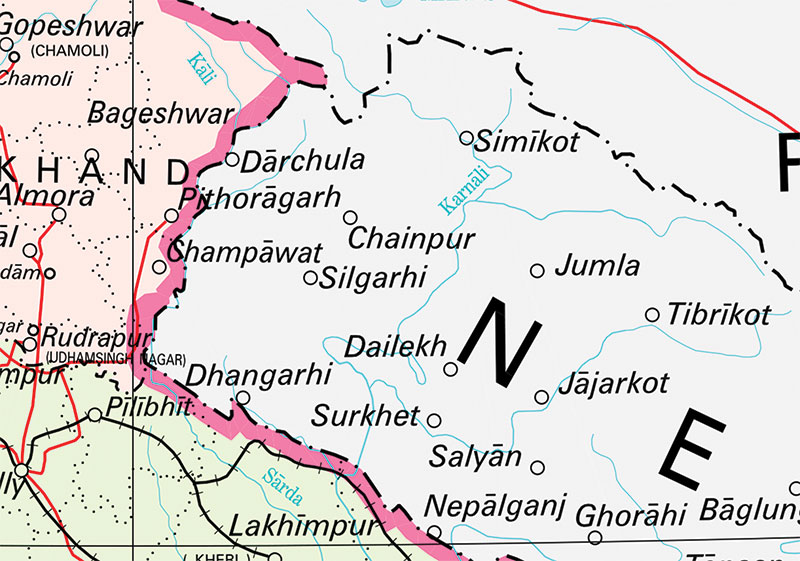
A new map released by New Delhi has placed Kalapani inside Indian borders, drawing widespread condemnation on social media.
- ANIL GIRI
India’s new political map includes the disputed territory of Kalapani. MAP IMAGE via India’s home ministry
KATHMANDU : The KP Sharma Oli administration has remained silent over a new political map released by India that places Kalapani, a disputed tract of land between Nepal and India, within Indian borders. The Post first reported on Monday about the Indian government’s new map, released by the Indian Ministry of Home Affairs, which has since ignited a social media storm. But the ruling Nepali Communist Party, which had contested the 2017 elections as a nationalist force in the wake of the 2015 Indian blockade, and the Ministry of Foreign Affairs have yet to take a public position, although discussions were ongoing late into Tuesday. The Parliament’s State Affairs and Good Governance Committee has taken note of map and will summon concerned officials to discuss the matter, said committee member Pampha Bhusal. A Tuesday meeting of the committee decided to summon officials from the Ministry of Foreign Affairs, Ministry of Home Affairs, Ministry of Land Reform and Management, and Survey Department on Thursday. “We’ve learned that the new Indian map has placed Kalapani in its territory, but we want to know the government’s position and what it is doing,” Bhusal told the Post. A number of political parties and elected representatives from Darchula district, which includes Kalapani have sought the government’s official position on the issue. Ganesh Singh Thagunna, a Member of Parliament from Darchula from the ruling Nepal Communist Party, said he was opposed to the Indian move but that it is the job of the government to raise the issue with New Delhi. “I am concerned as the elected people’s representative. I came to know that our land has been placed in Indian territory,” said Thagunna. “The government should take immediate steps with India and raise the issue through diplomatic channels. We have to put pressure on the government to tell India to correct the map.” The Post repeatedly reached out to Foreign Minister Pradeep Gyawali, Foreign Secretary Shankar Das Bairagi, Spokesperson at Foreign Ministry Bharat Raj Paudyal, and ruling party Spokesperson Narayan Kaji Shrestha but they were unavailable for comment. Shrestha told the Post that he was travelling outside Kathmandu and was not aware of the new Indian map. One Foreign Ministry official, who did not wish to be named as he was not authorised to speak to the media, said that the ministry was trying to verify the new Indian map—it was released after India formally split up the disputed Jammu and Kashmir state into two federal territories—before taking an official position. “Since this is a serious diplomatic issue related to our boundary, there is a mechanism at the foreign secretary-level to look into the matter, so it will deal with the issue accordingly,” the official said. Senior officials at the Survey Department examined the new political map of India on Monday and Tuesday and reconfirmed to the Post that Kalapani has been placed inside Indian territory. Although Kalapani was once comfortably in Nepali territory, since 1962, it has been occupied by the Indian armed forces, according to historians and surveyors. The Survey Department was supposed to brief higher authorities, including the Ministry of Land Reform and Management, and the Ministry of Foreign Affairs on Tuesday but officials were unable to get time with ministry officials, they said. “We hope we will get time for a briefing soon as there is a lot of pressure on us and other government entities,” said a senior Survey Department official who requested anonymity, citing sensitivity of the issue. Bishwa Prakash Sharma, spokesperson for the primary opposition Nepali Congress, said that the party’s attention has been drawn to the new map released by New Delhi. “Kalapani and Lipu Lekh are our inalienable parts. The Nepal government should take immediate steps and make its position public. Questions being raised about our soil from anywhere are objectionable and unacceptable,” he said on Twitter, addressing the prime minister. Two political parties—the Rastriya Prajatantra Party and the Nepal Majdoor Kisan Party—also issued press statements on Tuesday condemning the Indian map and seeking an official explanation from the government and Prime Minister KP Sharma Oli. Dinesh Bhattarai, who served as foreign affairs advisor to the late Sushil Koirala, told the Post that the Koirala government had protested with India and China in 2015 after the two countries decided to develop a bilateral trade route through Lipu Lekh, a tri-juncture between Nepal, India and China, and closed off the Kalapani area. “The decision was made in May 2015 and in June, we protested to both India and China,” said Bhattarai. “But none of the so-called nationalist governments formed after the Koirala government has taken up the issue with India and China.” Bhattarai said the government first has to make its position public and then both the ruling and opposition parties should raise the issue. “What we are waiting to see now is if they have the guts to raise the issue,” he said.
HOME PAGE
Police appear unwilling to take action against officials involved in extrajudicial killing
The human rights commission had asked that criminal charges be filed against officers implicated in the killing but police say they have yet to receive any official communication in that regard.
- BINOD GHIMIRE
Kumar Paudel
KATHMANDU : Two weeks ago, the National Human Rights Commission had recommended that criminal charges be filed against two Nepal Police officials for their involvement in the extrajudicial killing of Kumar Paudel, a member of the Communist Party of Nepal which has been branded a criminal outfit by the government. The police have yet to take any action to that effect, on the grounds that they haven’t received an official letter recommending action. “That letter does not come to us directly. It comes through the Ministry of Home Affairs, which might be taking time,” Nepal Police spokesperson Deputy Inspector General Bishwaraj Pokharel told the Post. As the line ministry, the Ministry of Home Affairs has to direct the Nepal Police for action. “I have no idea about the issue as it is not my department that deals with such directives,” Uma Kant Adhikari, information officer at the ministry, told the Post. Repeated attempts to get a comment from the spokesperson went unanswered. According to Bed Bhattarai, secretary at the commission, the letter was dispatched to the Prime Minister’s Office and the Ministry of Home Affairs on October 22, a day after the commission made the decision. He said the recommendation letter, with the serial number 645, was submitted to the Home Ministry in person. On October 22, the National Human Rights Commission had directed the government to suspend and file criminal charges against three police officials. An investigation by the commission found that Nepal Police Inspector Krishnadev Prasad Sah and senior constables Binod Sah and Satya Narayan Mishra had first arrested Kumar Paudel, Sarlahi district in-charge of the Netra Bikram Chand-led Communist Party of Nepal, and had extrajudicially killed him. The commission also asked for departmental action against police Inspector Kiran Neupane and Sub-inspector Surya Kumar Karki for providing false reports. According to Bhattarai, the commission’s recommendation categorically states the police officers should be immediately suspended even though the National Human Rights Commission Act provides a maximum of two months to respond to directives. But the two-months time only applies to general cases that aren’t severe in nature, said Bhattarai. “Actions must be taken immediately in severe cases like extrajudicial killings,” he said. The police, however, do not appear to be willing to embrace the commission’s recommendation. “We will decide how to respond to the letter once we receive it,” said police spokesperson Pokharel.The Nepal Police’s record when it comes to complying with commissions’ recommendations and taking action against its personnel for extrajudicial killings and other crimes has, however, been dismal. In the 19 years since the commission’s formation, instead of facing criminal charges, numerous police and Army officials implicated in human rights violations have instead been promoted and commended. An investigation by the commission had implicated Senior Superintendent Chuda Bahadur Shrestha, Superintendent Kuber Singh Rana, Major Anup Adhikari and Chief District Officer Rewatiraj Kafle in the extrajudicial killing of five youths in Dhanusha in 2003 during the Maoist insurgency. Though the commission recommended that the government take legal actions against the security officials, none of them were charged with crimes or even disciplined. In 2012, the Baburam Bhattarai-led government even promoted Rana to Inspector General. Paudel was killed on June 20 in Lalbandi, Sarlahi, in what police had claimed was “police action”. According to a report by a team from the Home Ministry, security personnel had opened fire in retaliation after a group of four motorcycle-borne persons fired upon a police patrol. Home Minister Ram Bahadur Thapa had reiterated before the House of Representatives and Parliamentary State Affairs Committee that Paudel was killed after police opened fire in self-defence. However, an investigation by the National Human Rights Commission, launched after complaints from family members, discovered that Paudel died under suspicious circumstances and finally concluded that Paudel had been killed extrajudicially.Every year, the NHRC, after probing cases of human rights violations, asks the government to take action against the culprits. However, on average, barely 14 percent of its recommendations are ever implemented.
HOME PAGE
Tinkune ‘park’ becomes a new haven for drug users, prostitution and hooligans
The grass-and-mud embankments built to shield Xi Jinping from the derelict state of the Tinkune grounds have allowed illicit activities to flourish, police and locals say.
- ANUP OJHA
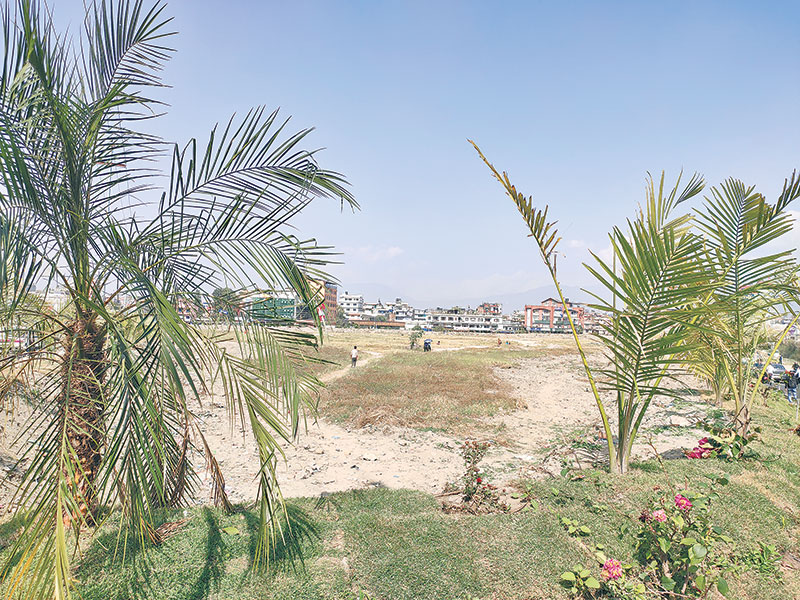
The plot of land, surrounded by mounds of grass-covered dirt, has become an object of public ridicule.Post Photo: Anup Ojha
KATHMANDU : A green facade that the city authorities cobbled together overnight to hide the derelict grounds at Tinkune in Kathmandu during Chinese President Xi Jinping’s visit has become an object of public ridicule. Many lampooned the fact that the facade was a fitting encapsulation of the superficial beautification the city went through during Xi’s visit, only for everything to be abandoned once he had left. But now, weeks after Xi’s visit, for locals, the derision has turned into concern. “The city authority basically built a wall to block the view of the field. But that space now has become a place for drug users, sex workers and ruffians,” said Abinash Parajuli, a local. Even the police admit that Tinkune park, which is barely a mud pit surrounded by mounds of grass-covered dirt, has become a hub for illicit activities. “We have noticed third-gender prostitutes from Durbar Marg and Thamel coming here at night with their clients ever since the green facade was constructed. We’ve been chasing them away,” said Dirgha Bogati, an inspector at the Tinkune Metropolitan Police Circle Tinkune. Kathmandu Metropolitan City, in the second week of October, had surrounded the 50 ropanis of open land in Tinkune with a raised grass embankment with flowers and plants in an effort to make it look like an actual park. The ground, which lies on the road to the country’s only international airport, had turned into a parking lot for trucks and buses for over two decades, mired in competing compensation claims. The embankment continues to serve its purpose—to hide the derelict inner space from outside view. But sheltered from prying eyes, people have taken to defecating and urinating inside, among other less savoury activities. “The inner part has become a haven for illegal activities by drug users and prostitutes, as it is easily accessible to everyone and nobody can see inside the park during the evening,” said Parajuli. The city authorities are aware of the ground’s current usage but there is little they can do, they say. “This is just cosmetic beautification. We could not build a park inside because the landowners have yet to be paid compensation for their land,” said Kedar Neupane, chief executive of Kathmandu city. “I have heard that over half of the landowners have received compensation.” The city spent Rs 3 million for the aesthetic enhancement and every morning, the city office waters the grass and plants with two tankers full of water. According to Neupane, the Agriculture Development Bank, Rastriya Banijya Bank and Nepal Bank were all once interested in building a proper park but nothing has materialised yet. But the large patch of mud and dirt was an eyesore and thus, every time foreign dignitaries visit the country, it gets covered up. In 2014, during the 18th SAARC Summit held in Kathmandu, the grounds were shielded with large zinc plates, all of which were stolen immediately after the summit. Again, in late August, during the 4th Summit for the Bay of Bengal Initiative for Multi-Sectoral Technical and Economic Cooperation, Tinkune was surrounded with plastic siding with pictures of the country’s heritage, mountains, and fauna. Once the summit was over, the siding was ripped apart by hooligans. Again, immediately after Xi had departed Kathmandu, flowers, plants, and even pieces of carpet grass laid on the embankments were stolen. “This makes a mockery of us,” said Rajan Gautam, a resident of Shantinagar, which adjoins Tinkune. The illicit activities taking place inside the grounds are public knowledge but even local authorities appear clueless as to what needs to be done. “As a resident of the area, many locals ask me for a proper solution for Tinkune,” said Nawaraj Parajuli, chairperson of Ward-32, that includes the Tinkune grounds. “All we can do is ask the police to take action. The rest is up to the city.”
Authorities spent Rs3 million for the aesthetic enhancement of the ground.Post file Photo
MEDLEY
Horoscope
ARIES (March 21-April 19) ** Is your ambition taking over your life? Recently, a few catty comments from friends might be leading you to believe that they feel a bit left out of your life. Your drive for success should not leave the people you love by the side of the road. So make sure to include them in what’s going on.
TAURUS (April 20-May 20) ** Being socially active is fun for a while, but it can also make it increasingly difficult for you to understand the real issues in your life. Right now you need to come back down to earth and focus on the business of living, not the business of partying. Stay home and get to work on that project you’ve been putting off.
GEMINI (May 21-June 21) *** If you are trying to get a new relationship started, you might be making things much too hard on yourself. Relax and just be yourself. Tension is contagious, so the more nervous you are, the more the other person will hold back. Conversely, if you are always smiling and ready to start a conversation, then they will be too.
CANCER (June 22-July 22) *** Everyone’s social energies are all over the place right now, so do not expect everybody to have the same idea about what to do tonight. While some people will be dying to paint the town red, some folks in your crew may not feel like coming out—it’s best to let everyone do their own thing.
LEO (July 23-August 22) **** People are looking to you for the enthusiasm that they themselves might lack. Now, before you get uncomfortable with the idea of being responsible for other people’s emotions, think about the bright side of things. This means that you have a great deal of influence over everyone right now, and you should not hesitate to use it.
VIRGO (August 23-September 22) *** People are advancing all around you, and other new exciting opportunities are peppering everyone else’s lives. But what about you? Your time is coming soon, but first, you have to take your already healthy ambition and pump it up a bit! Be more proactive about what you want to do next, and start making more aggressive moves.
LIBRA (September 23-October 22) *** Watch out for friends who are moving at a faster social pace right now. And if they are pushing you to commit to events or parties that you’re not comfortable committing to, ask them if they can hold off for a few days until you are feeling more certain about things. You must always take things at your own pace.
SCORPIO (October 23-November 21) **** The give and take between you and your people has been out of balance for a while, but today things will start getting back to equilibrium. Whether you need to receive or give, you will be ready to keep your closest relationships healthy. There is a chance for you to get something you have been wanting for a long time.
SAGITTARIUS (November 22-December 21) **** Today, make sure all your bills are paid, important errands are run and so forth. By making small but consistent efforts to keep these things in line now, you will save yourself a huge amount of headaches and inconvenience later. The good news is that you are going to get a really great sense of accomplishment.
CAPRICORN (December 22-January 19) *** Today, if you doubt your abilities for just one moment, you will lose all the momentum you’ve built up over the past few days. You can make yourself relax by realizing that less spirited people than you have gone through what you’re going through and succeeded. These big events do not deserve the weight you are giving them.
AQUARIUS (January 20-February 18) **** You don’t always agree with your best friend, but this dissonance puts no restriction on how much you love them. Today, you are cautioned against thinking that an increase in conflict indicates a decrease in the quality of your relationship—it’s simply not true. In fact, if you two are fighting a lot more, it is because you care about each other.
PISCES (February 19-March 20) *** Today, look for people who can help you out of a jam and show you a shortcut to your goal. Saving time is always a good thing, especially when your schedule is likely to be quite unpredictable. Finding the tricks you need to shave precious seconds off your projects is an important investment, so think of the big picture.
NATIONAL
Oli’s tendency to bulldoze decisions riles a section of ruling party leaders
Prime Minister KP Sharma Oli is showing authoritarian traits in a bid to consolidate power, party insiders say.
- TIKA R PRADHAN
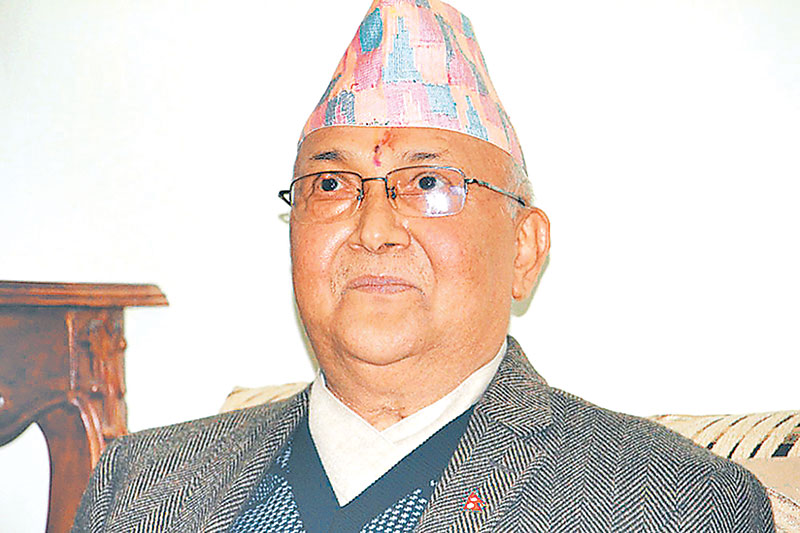
KP Sharma Oli
KATHMANDU : After a secretariat meeting of the ruling Nepal Communist Party picked names for governors for seven provinces on Monday, senior leader Madhav Kumar Nepal registered a note of dissent. This is the third time Nepal has registered his note of dissent against what he calls monopoly of party Co-chair KP Sharma Oli. The Nepal faction had submitted a few names for new governors, but they were rejected. Instead, Oli picked four leaders from his faction for the vacant posts, while three leaders came from the former Maoist party. The names floated by Nepal were not even discussed in the meeting. While the Oli administration’s sudden decision to remove governors appointed by the Sher Bahadur Deuba has been criticised, within the ruling party Oli is facing criticism for being biased and failing to take forward all the factions together. “In general, it is expected that an ailing leader takes decisions acceptable to all. But that did not happen,” said Mani Thapa, a standing committee member. “This incident shows that Oli is not going to step back despite his poor health condition. He is continuously in a bid to consolidate power.” Oli, who had his kidney transplant 12 years ago, underwent dialysis last week twice in 24 hours. Doctors are yet to decide his course of treatment—regular dialysis or another transplant. The sudden deterioration in his health condition had prompted many to think that Oli would now work on power-sharing within the party in a balanced way so that the party functions in a collective manner, according to leaders. However, Ghanashyam Bhusal, a standing committee member close to Nepal, said Oli has once again exhibited his authoritarian tendencies. “This is an example of how people with an authoritarian mindset are not affected by changes in their physical health,” Bhusal told the Post. “His tendency to centralise power has continued. Democracy demands procedure and objective reasons while taking decisions.” Even almost one and a half years after announcing the merger, the Nepal Communist Party is yet to complete the unification process. A crucial committee in a communist party for taking political decisions, the politburo, is yet to be formed. The party’s standing committee has sat just twice, but none of the meetings has taken any crucial decision. The party’s central committee, the most powerful body, has not held even a single meeting. All these indicate the party is largely functioning on how one particular leader wants, party insiders say.While picking governors, Oli, however, has tried to make a semblance of mending fences with his Co-chair Pushpa Kamal Dahal, who has been increasingly unhappy for not getting concrete responsibility in the party. Analysts say Oli wanted to show that he was capable of taking bold decisions—despite his health. On top of that, he also wants to manage his leaders in the party, they say. “Oli is in a hurry now due to his ill health. He wants to help those who had helped him in the past,” said Jhalak Subedi, a political commentator. “This is how he wants to consolidate power by weakening his opponents.”
NATIONAL
Different criteria applied for selection of vice-chancellors at TU and other universities
Education experts suggest adopting a competitive selection process in appointments across all varsities.
- BINOD GHIMIRE
KATHMANDU : Prime Minister KP Sharma Oli, who is also the chancellor of Tribhuvan University, appointed Dr Dharma Kant Banskota as the university vice-chancellor on Sunday. Oli chose Banskota from among three names recommended by a search committee led by Minister for Education Giriraj Mani Pokharel. The search committee had recommended the names without adopting any selection measures. Dr Bhagwan Koirala, a noted cardiac surgeon, and Chandra Mani Poudel, chairman of the National Examination Board, were the other two candidates. To select vice-chancellors for six other universities, search committees, all led by Pokharel, have called applications from the aspirants. The committees will recommend names from among the applicants who have presented their work plans, along with curriculum vitae. This shows that a different yardstick has been adopted for vice-chancellor appointment at the Tribhuvan University, although all universities have the same legal status. “We recommended the three names after brainstorming, although we didn’t call for applications like other committees,” Dilli Raj Sharma, a member of the search committee for Tribhuvan University appointment, told the Post. Sharma is also the dean of the management stream at the university. “It’s true that the selection process in TU was different from the other universities,” he said. The universities’ laws authorise prime minister, as an ex-officio chancellor, to appoint vice-chancellors from among the three names recommended by the search committees. It is up to the search committees how they select the three names. Usha Jha, who represents the search committees formed to select vice-chancellors in three other universities, said they decided to call applications and work plans in an attempt to make appointments on merit basis. “We want to end the earlier practice of handpicking,” Jha had told the Post last week. She said more than 70 aspirants have submitted their applications and work plans. Education experts, however, say since all universities have the same legal status, there should be uniformity in the selection process. The competitive selection process has to be adopted even for the Tribhuvan University which has more than 80 percent of enrolment of university students, they say. Min Bista, a member of the High-Level National Education Commission, said handpicking of the officials at the universities is one of the reasons behind the deteriorating university education system in the country. “Only those who have the vision to reform the universities should be appointed as vice-chancellors, rectors and registrars,” Bista told the Post. He said candidates who want to lead the universities should demonstrate how they plan to take the university forward during their four years’ tenure and that has to be a key qualification for appointments. “Those who are experienced don’t necessarily have the leadership quality,” Bista added.Tritha Khaniya, who retired as the TU vice-chancellor two months ago, was accused by a Turkish professor of plagiarism even before he got appointed. His closeness with Nepali Congress that led the government at the time, was said to be the prime reason that swung his appointment.
NATIONAL
Lalitpur police arrest three men for befouling the air
The accused were caught burning buffalo remains on the bank of Nakkhu river.
- ANUP OJHA
LALITPUR : Over the past few days, complaints of a foul, burning smell in different areas of the Valley have been doing the rounds on social media. On the posts, some people were complaining that the smell was so strong that it was causing them difficulty in breathing. The smell was particularly strong during the nights, and the complaints were mostly registered from Satdobato, Ekantakuna, Kusunti, Chysal, Kumaripati, Tinkune and Boudha areas. Some suspected the smell to be the burning of human remains, while others went on to speculate the air was acrid as a result of the pollution in neighbouring India. As the mystery continued and complaints were continually being lodged, the Lalitpur Metropolitan Police Range on Monday night (at 11:30 pm) arrested three people from Nakkhu river bank, where they were found burning buffalo remains in a small compound surrounded by corrugated zinc plates. The names of the three people were unveiled on Tuesday morning. “We received a complaint of foul smell a week ago from Buddha Yuba Club, Nakhipot,” said Deputy Superintendent of Police Range, Gautam Mishra. “People had come to our office saying that they were not being able to sleep during the night because of the smell.” “It was on the day of Bhai Tika that the air smelled like that, like rotting fish,” said Rupa Joshi, a resident of Bagh Bazar. “I have no idea what it was, but now I see so many others have been getting that smell mainly during night times. I am quite confused.” A Chuchepati resident Hema Gole Tamang told the Post that she has been facing the foul stinking problem since Dashain. “At nights, there has been a foul smell, like gas, in the air. A lot of people from our tole went to check the drainage, we even went to the nearby gas shop, but it was not the gas,” said Tamang. “The issue became viral on social media, and a lot of people called us. But we had deployed police officers to find the cause a week ago, and have successfully made arrests,” said Mishra. “The three people arrested are just working-class people who were making manure from the remains of buffalo meat.” He added that the trio has been sent to Lalitpur Metropolitan City. Officials at the city said it will take action against the accused after completing the required investigation. Among those arrested on Monday, two are from India— Feshal Muslim and Sajit Muslim—and the other is a Nepali, Rajan Sherpa from Jhapa. The trio has been living in Sunakoti in Lalitpur, and had been making manure by burning animal parts for the past six months, according to the police. When the Post inquired how the smell of burnt remains of buffaloes in Nakkhu river reached places as far as Tinkune, Bhaktapur and even Chuchepati, Mishra said that the police believe there could be other people doing the same thing along river banks.
NATIONAL
Health Ministry to study minimum service standards of state-run health facilities
The move aims to improve the quality of healthcare services being provided by state-run health facilities.
- Arjun Poudel
The ministry has allocated Rs 80 million to central hospitals to upgrade standards of their services.POST file PHOTO
KATHMANDU : The Ministry of Health and Population has started studying minimum service standards of state-run health facilities throughout the country. The move aims to improve the quality of healthcare services being provided by state-run health facilities and for evidence-based planning and budgeting, according to Dr Bikash Devkota, chief of Policy, Planning and Monitoring Division at the Health Ministry. “We have directed directors serving at various health divisions to study hospitals run by the federal government,” Devkota, told the Post. “Provincial health directorates and local levels will also study minimum service standards of health facilities of their respective jurisdictions.” The ministry has also allocated Rs 80 million to central hospitals to upgrade standards of their existing services and forwarded the file recommending the Ministry of Finance to release the amount. These hospitals have been asked to purchase equipment and spend on other necessary things to improve service quality. “We will allocate additional funds if the study shows need to improve service standards,” Devkota, added. “Provincial and local health facilities will also get the budget as per their needs.” Improving and strengthening service standards at state-run health facilities is also in line with the National Health Policy, which has stressed the need for quality health services for achieving universal health coverage. Universal Health Coverage means public access to promotive, preventive, curative, rehabilitative and palliative health services of sufficient quality at affordable cost, according to the World Health Organization. The ministry has also prepared checklist tools to find the service standards, equipment and conditions, human resources, patient flow, and the satisfaction of the patients. Director-led teams that comprise several technical staffers of various departments would carry out a thorough study of the governance and management, clinical services and supportive services. Similarly, medical waste management, water supply, power system, safety and security, instrument processing and sterilisation process will be checked. Devkota said that the checklist has also been sent to provincial health directorates and local levels for their study. Dr Bhim Singh Tinkari, director at the Family Welfare Division under the Department of Health Services, said that a detailed study of minimum service standards of the health care facilities would help identify the gap in the existing service delivery.”It will also help the government to allocate the budget and do the planning,” said Tinkari. “Health facilities can also spend the budget as per their needs.” Tinkari, who has also been assigned to study the state-run hospitals, said that the study was needed in the changed context, as the country has embraced federalism from unitary system of governance. With the implementation of the three tiers of government—federal, provincial and local levels, jurisdiction of the health facilities has also been divided into primary, secondary and tertiary levels. Local governments will manage primary level health facilities—health posts, primary health care centres, and up to 15-bed hospitals built at the local level. Likewise, the provincial government manages district hospitals and provincial hospitals. District hospitals will be upgraded to expertise hospitals, which would ensure at least six expert doctors. The central-level hospitals are being run by the Health Ministry.
NATIONAL
Political parties block community school merger and teacher adjustment plan
Rolpa district education unit says efforts to improve community schools have been stymied by political parties.
- KASHIRAM DANGI
The government has hired fewer teachers than required in community schools, compromising the quality of education.Post Photo: KASHIRAM DANGI
ROLPA : Several local bodies in Rolpa district have prepared a framework for the merger of community schools and the adjustment of teachers. However, people’s representatives haven’t yet implemented the policy due to the pressure of political lobbying, says the education unit in the district. The education unit of Rolpa Municipality collected necessary data, prepared a policy regarding the school merger and adjustment of teachers, and put forward the proposal to the elected representatives for implementation. But nothing has come off the proposal yet. “All the necessary preparations have been made. But the elected representatives and higher-level leaders of various parties are yet to reach a consensus on the issue. As a result, our plan to merge community schools with fewer student numbers and adjust teachers’ posts is in limbo,” said Mahendra Parajuli, chief of the education unit. He said it is challenging to work towards enhancing the quality of education in community schools in the present scenario. “There is an acute shortage of teachers in several community schools of Liwang, the district headquarters of Rolpa. But the plan to merge these schools has been on hold,” said Parajuli. One hundred sixty-eight teachers are serving 66 community schools—nine secondary, 14 basic and 43 primary—in Rolpa Municipality. Out of these teachers, only 102 are on the government payroll; the rest have been hired by the schools themselves on a contract basis. Since the government has hired fewer teachers than required in community schools, the quality of education in these schools has been compromised. “The elected representatives understand the need for school mergers and teachers’ adjustment, but they are reluctant to move ahead with the process. They are worried about their vote banks. Their party leaders and activists do not want to merge schools. Or if the schools are to be merged and teachers adjusted, they should be done as per their interest,” said a source working in the education sector in the district. Purna KC, the municipality mayor, however, claimed that the local body has been preparing a policy to uplift the quality of education in its community schools. “We will hold a discussion with stakeholders to formulate education policies and implement them soon,” he added.Tribeni Rural Municipality in the district faces a similar ordeal. The local body had put forth the proposal of school merger and teacher adjustment, but the proposal was not endorsed due to a dispute among the representatives and party leaders. “There are some challenges, but we are making efforts to implement the plans by holding talks with locals,” said Shanta Kumar Oli, chairman of the rural municipality. Oli opines that the authority of school mergers and post adjustments should be granted to the education ministry rather than to the local units. “There is always political party interference when we try to move forward with the plans.” There are 10 local units, including a municipality, in Rolpa.
NATIONAL
Tanahun folk hold puja to prevent leopard attacks
Locals believe they are on the receiving end of the almighty’s wrath.
- SAMJHANA RASAILI
TANAHUN : As leopards continue to enter human settlements, locals in Tanahun have been scrambling to find measures to contain the animal. The locals had even used wooden snares, a traditional measure, to trap wild animals. But this too hasn’t been as effective as expected. The agitated locals have now concluded that the leopard incursion is the result of goddess Devi’s wrath. As a remedy, locals from wards 1, 2, 3, and 4, on Tuesday, performed a puja at the Thakrek Kalika Devi temple in Nareswhartar to appease the Devi. “Since all measures have failed, we figured the Devi was unhappy with us,” said Seeta Adhikari, a local from Bhanu Municipality-2. In the municipality’s ward numbers 1, 2, 3 and 4, leopards have killed six children and 70 cattle and injured seven people in the past two years. Two hundred fifty households participated in the puja for which two goats were sacrificed. “This kind of puja is typical of Chaite Dashain (a festival celebrated in April), but we suspected that the procedures were not proper in last year’s festival,” Adhikari said. “So we are trying to correct that with this puja.” “We are hopeful that this puja will help dissuade leopards from entering our settlements,” said Prem Bahadur Thapa, another local. “It’s done according to our beliefs and religion. But we also believe that advanced measures should be taken to control leopard attacks.” Among other measures, nine traditional wooden cages have been built in community forests around Bhanu Municipality. The cages have trapped two male leopards so far. Officials at the District Forest Office said the exact number of leopards in the forest hasn’t yet been ascertained. Maya Manandhar, another local, said the frequent incidents of leopard attacks have affected the villagers’ lifestyle. “These days, the villages turn silent as soon as five in the evening,” Manandhar said. “And the lights are on throughout the night.” Kedar Baral, chief of the Division Forest Office, said the office has set up various measures such as ‘foot trap’, ‘camera trapping’, and traditional cages to trap leopards. Gandaki Province has allocated Rs3 million to contain leopard menace in Tanahun. “We are preparing to deploy a team to capture leopards,” said Kiran Gurung, acting chief minister of Gandaki province.
NATIONAL
Health post and ward office closed to hold election of a party
The staff were asked to sit outside the office and work for the day.
- ABDHESH KUMAR JHA
RAJBIRAJ : Services at a health post and the ward office of Mahadeva Rural Municipality-2 in Saptari district were disrupted on Monday for a political event. The health facility and the ward office were closed to conduct an election of Samajbadi Party Nepal. The party had used the ward office building, which also houses the health post, as a polling station for the election of its ward coordinator. Dipak Kumar Yadav, who was elected as chairman of the local unit from the Samajbadi Party Nepal, had barred the staff as well as service seekers from entering the building to facilitate the election of his party. He had instructed the employees at the ward office and the health post to work from outside the building. “I reached the ward office at around 10 am, but the chairman asked me to work from outside the office, as the party’s election was underway. So we sat by the paddy field and did our work,” said Laxmi Paikara, secretary of the ward office. “We could not refuse the chairman’s instructions.” Chandan Kumar Rajak, the in-charge of the health post, said police personnel deployed for the election stopped health workers from entering the health post. “We had to turn away patients because the building was closed,” Rajak said. The District Police Office said it was unaware about the closure of the health post and the ward office. “We just deployed police personnel for election security. We did not know that the ward office and the health post were closed for the poll,” said Deputy Superintendent of Police Tilak Bharati. Chairman of the local unit Yadav admitted to closing the office building for the election but denied the claim that daily services were affected. “The ward secretary and other staffers were providing services from outside the office,” Yadav claimed.
NATIONAL
Private schools in Jajarkot defy scholarship provision
According to the Education Act, 10 percent scholarship should be provided to children belonging to marginalised groups and families of martyrs.
- BHIM BAHADUR SINGH
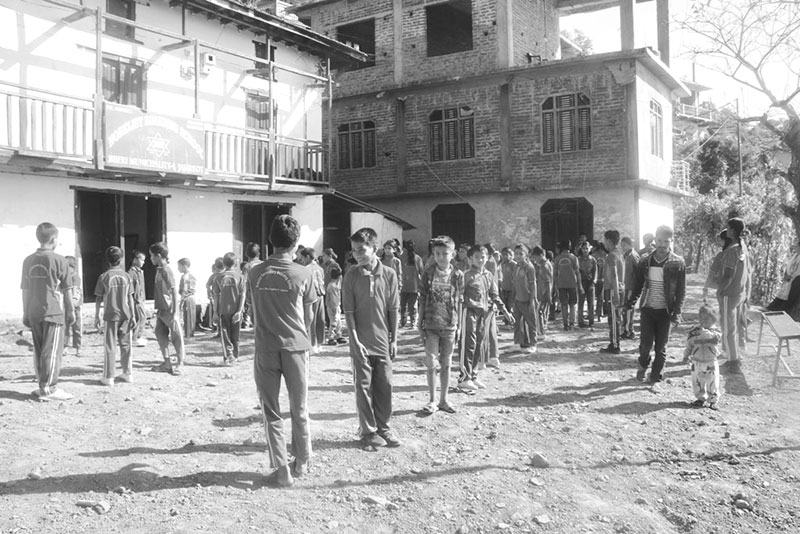
Students of a school in Khalanga, the district headquarters of Jajarkot, line up for their morning assembly.Post Photo: BHIM BAHADUR SINGH
JAJARKOT : Every institutional (private) school should provide at least 10 per cent scholarship to poor, disabled, female, Dalit, Janjati students; to the children of those injured in the people’s movements and martyrs; and to the children of those declared ‘enforced disappeared persons’. However, most institutional schools in Jajarkot have not adhered to the existing legal provisions that dictate scholarships for students from these select groups. “We are six months into the current academic year and none of the private schools has submitted their reports about the scholarships so far,” said Kriti Thapa, chief at the education unit of Bheri Municipality, who is also the chief of the scholarship management committee. There are around 40 private schools in the district. As per the Education Act, an institution should submit its report regarding the 10 percent scholarship provided to different student groups to the education unit of the respective local unit within one and half months of the academic year. The Act also states that a separate scholarship management committee should be formed in the school and the local unit to decide the scholarship criteria. However, such committees have not been formed in most of the schools and local bodies. Jhalak Budha, the provincial secretary of Private and Boarding School’s Organisation Nepal, admitted to not providing 10 percent scholarship to select students as per the existing legal provisions. He, however, said that private schools did provide scholarship to students, but without fulfilling the legal process. He assured he would take initiatives to distribute the scholarship to the students as per the spirit of the legal provisions. Most of the students and guardians are unaware of the scholarship provision. Chief District Officer Janakraj Panta said the institutional schools should provide the scholarship to the deserving students at any cost. “We will take strict action against schools who fail to provide the scholarship as stated by the law.”
NATIONAL
Hydropower project to provide Rs 1.3 million each to families of deceased workers
Briefing
- Post Report
BAJHANG: The bereaved families of four workers, who died in the tunnel of Kalangagad Hydropower Project on Sunday, agreed to receive the bodies of their loved ones on Tuesday after the project pledged to provide Rs 1.3 million to each family. Following the agreement, the bodies were taken to the district headquarters for postmortem.
NATIONAL
A month ultimatum to clear shops across Lumbini Hospital’s premise
Briefing
- Post Report
RUPANDEHI: The Province 5 government has given a month’s ultimatum to traders to clear out shops set up in the ground-floor shutters of Lumbini Provincial Hospital. The Social Development Ministry plans to erect a wall across the space.
NATIONAL
Relatives of Sukute bus plunge victims receive bodies
Briefing
- Post Report
SINDHUPALCHOK: Relatives of the Sukute bus plunge victims received the bodies on Tuesday and performed funeral rites. The relatives have been demanding that the authorities provide compensation to the families of the deceased, provide treatment to the injured and remove old vehicles from the district, among others. Their demands are yet to be addressed.
TAPLEJUNG: Civil aviation officials say that the ongoing renovation of Suketar Airport in Taplejung district won’t affect regular flight schedule. The contract to renovate the airport is undertaken by Krishna Banglamukhi JV Construction at the cost of Rs 89.95million. The project entails arranging a 50m portion of the runway’s grade and blacktopping a 150m space.
NATIONAL
Drug peddlers arrested
Briefing
- Post Report
BIRATNAGAR: Police arrested two persons on the charge of smuggling marijuana from Gaurigunj in Jhapa district on Tuesday. Devnarayan Mahato, 57, and Budhalal Rajbanshi, 50, were arrested for selling marijuana from their houses, said police. Around 3 kg of marijuana was seized from the suspects.
EDITORIAL
Throwing caution to the wind
Safety protocol should be made mandatory at construction sites.
The death of four workers inside a tunnel at the construction site of a hydropower project in Bajhang has raised the possibility of gaps in safety procedures. The project operator and the Armed Police Force’s rescue team gave slightly differing accounts about what exactly caused the deaths. But what can be surmised is that the proper protocol was not followed. The incident began on November 3 when a team of seven workers drove into the 1,600-metre-long tunnel. Their objective was to inspect the condition of the lights and oxygen supply before other workers would enter. When long tunnels are built, guaranteeing a supply of fresh air is essential. The tunnel may be too deep for air to circulate naturally, or the construction work can create large concentrations of toxic gas such as ammonia. In some cases, more likely in mines rather than hydropower tunnels, pockets of toxic gas trapped in the rocks may be released, which can cause a serious hazard. To ensure a fresh supply of breathable air, and to dispel any noxious gases, tunnel makers use tube and fan ventilation systems. With the project restarting after a 35-day hiatus (due to the festival season) the workers who lost their lives had entered the tunnel to inspect the ventilation, to ensure safe and breathable conditions for the entire crew. A joint team comprising of the police, Armed Police, army and local volunteers, carrying oxygen cylinders, attempted a rescue effort on November 3 itself, but they were unable to get to the workers. A special team from the Disaster Management Training Centre of the Armed Police Force in Kathmandu was brought in on Monday to retrieve the four. But they were already dead by then. The project operator blamed the inspection team for not following protocol. Allegedly, the team only turned on the oxygen fans at the entrance, when they should also have turned on the fans attached to the ventilation system that were deeper inside the tunnel. The rescue team noted the presence of a high level of toxic gases inside the tunnel. They speculate that the accumulation resulted from the ventilation system being turned off for 35 days. The precise reason for the mishap will hopefully be found out following an investigation. But what is clear is that it could have been avoided. Tunnelling creates a high-risk environment that is prone to accidents, injury and death. There have been numerous cases globally of workers being trapped inside tunnels due to dry landslides or collapses. But these cases are caused by unavoidable circumstances. In this case in Bajhang, proper safety procedures—checking the ventilation system and entering the tunnel more cautiously after being closed for such a long time—would have saved four lives. Questions need to be asked about whether a safety protocol was in place and whether its importance was drilled into the workers. A review of the safety protocol at high-risk construction sites, and its education and implementation across the workforce, is definitely in order.
OPINION
Myths about climate change
There are several misunderstandings regarding climate change that need to be clarified.
- SNEHA PANDEY
Pixabay
In the first part of the climate change myth series, published two weeks ago, I discussed five misconceptions floating around about climate change that have stalled climate mitigation progress. In this second part to the series, I take on four more myths that need to be broken down for effective global alliance and action.
Randomly planting trees helps with mitigation A lot of mitigation efforts today are focused on sequestering CO2 in trees. The developed world is paying developing nations to engage in forest preservation, reforestation and afforestation efforts through REDD+ (Reducing Emissions from Deforestation and Forest Degradation). And while forest programmes like these do help realise other environmental benefits, we cannot be sure how much they have helped us in our fight against climate change. Recent research findings suggest that the relationship between forests and the atmosphere is much more complex than previously thought. While trees do have the capacity to sequester large amounts of CO2 in their biomass, the conditions have to be right for them to be able to do so: It matters what kinds of trees you plant, where you plant them and for what purpose. Studies suggest that the most efficient carbon storage happens in preserved forests. Meanwhile, forest restoration requires more careful planning that replicates conditions of the pre-existing forest as much as possible. Afforestation, which is the practice of planting trees in landscapes where there were previously none, requires even further caution: For example, planting dark green tree canopy (that absorb heat) on white snowfields (that reflect heat back into space) would generally be a poor idea as it would increase warming rather than decreasing it. Simply put, we cannot take for granted that randomly planting as many trees as we can will generate climate benefits. Without active deliberation and planning, reforestation and afforestation efforts may not be performing as well as we expect it to and in some cases may even be undermining cooling efforts.
Sequestering CO2 and switching energy sources are the only major ways to mitigate Currently, global climate policy discussions focus mostly on forest carbon sequestration and renewable energy switch as legitimate ways to mitigate. However, are these the only solutions that have the capacity to stop, and reverse, climate change? I don’t believe so. Global climate policies, which are still very much influenced by the world’s most powerful—and historically most polluting—countries, ignore the root cause of climate change: their excessive consumption of natural resources. A 2015 study shows how shockingly high the consumption patterns of some countries are: A person in the US, on average, produces 18.6 tonnes of CO2 equivalent in a year, while the world average is only 3.4 tonnes. (Luxembourgers and Australians, populations with the second and third highest per capita emissions, emit 18.5 and 17.7 tonnes respectively). Another 2015 study shows that the world’s richest 10 percent produce half of the planet’s individual-consumption-based fossil fuel emissions. Meanwhile, the poorest 55 percent contribute only 10 percent of such emissions. Despite such discrepancy in per-capita emissions, however, this topic is rarely visited in the global climate policy arena. Addressing this issue, and creating national policies to reduce such excessive consumeristic patterns, however, is central—and perhaps the most promising avenue currently—to fight climate change.
More carbon dioxide in the atmosphere means higher agricultural yields
It was reported this May that carbon dioxide (CO2) levels in the atmosphere had exceeded 415 parts per million—a concentration that the planet has not seen in the last few million years. While this may seem like an alarming development to most of us, there are some that believe that increasing carbon dioxide is likely to increase the photosynthesis potential of plants (and possibly end world hunger in many parts of the world.) However, the relationship between atmospheric CO2 concentrations and crop productivity is more complex than this. Yes, plants do use CO2 to create biomass (what we consider food), but it also requires water and other compounds to complete the process. An increased amount of CO2, therefore, means little when there aren’t proportionate amounts of other required compounds to complete the reaction. But, it is not just that increased CO2 has no discernable benefits on plants. It does have detrimental effects as well. The changing climate (caused by increased CO2 in the atmosphere) is also likely to affect the availability of such compounds—by reducing water availability and soil quality—and straining the process of photosynthesis further. Studies show that an increased amount of CO2 in the atmosphere can also inhibit photosynthesis in some crops and decrease the nutritional quality in others.
IPCC exaggerates to alarm Climate deniers have often in the past claimed that the Intergovernmental Panel on Climate Change (IPCC) is an alarmist. While some claim that the IPCC uses alarming language regarding human’s impact on the environment, others go so far as to claim that it manufactures evidence to support the thesis. This couldn’t be farther from the truth. After a consensus was formed among the world’s leading experts that the humans were altering the climate through greenhouse emissions, the IPCC was formed to aggregate and dispense climate change information from all over the world in a systematic and organised manner. It is worth remembering that the scientists featured in IPCC reports are not paid in any way by the IPCC to do their research. And there is little evidence that the IPCC tends to exaggerate climate facts. In fact, the panel is famously known within the scientific community to be conservative in their estimates. So much so that they are known to frustrate climate scientists with their caution in projections: Up until now, the IPCC has been known to underestimate the CO2 output from burning fossil fuels, the rate of sea-level rise, sea-ice melt etc.
Pandey is a graduate of the Yale School of Forestry & Environmental Studies. She tweets at @SnehaPandey92.
OPINION
Don’t bet on it
In Nepal, the laws related to gambling are primitive and fail to take into account nuances.
- AKSHYA ARYAL
Unsplash
On October 26 while the city of Kathmandu was rejoicing in the Tihar festival, the Nepal Police swooped on a private house at Maharajgunj which was being used as a gambling den. The police seized Rs26.7 million in cash and arrested 25 people. Gambling has been a part of festive activities from time immemorial in Hindu culture. Traditionally speaking, Deepawali marks the beginning of the Hindu fiscal calendar, and as a result, it continues to play an important role in society even today. In 2018-19, the police detained 2,869 individuals for gambling-related offences, the highest number recorded in the recent past. But these arrests have had no deterrent effect. The Gambling Act 1963 defines gambling as ‘any game of chance which is played upon laying a wager for gaining or losing money’. It mandated a maximum penalty of Rs200 for first-time offenders, and imprisonment ranging from one to three months for repeat offenders. Subsequently, with the passing of the Criminal Code 2017, the previous act was subsumed into it as section 125. Gambling has since been defined in a more exhaustive manner as ‘any wager based on luck on the basis of which any property, movable or immovable, can be gained or lost, or resulting in other monetary profits or losses. Further, any wager on the win/loss of other persons would also constitute gambling.’ The code increased the maximum penalty to three months’ jail or a Rs30,000 fine for first-time offenders. As an exception to the aforementioned provision, the law says that no activity shall constitute gambling that is practised during a public festival, fairs (melas), auspicious days, or any function for entertainment purposes, insofar as the stakes are low and prior approval is taken from the government. This provision seems to be quite challenging to understand for several reasons. For starters, given the loose wording of the provision, most games of chance may fall under the exception as either a festive game or a game for entertainment with small stakes. Not only does this render the provision futile, but it also vests absolute discretionary power in law enforcement agencies. Additionally, even though the exception requires that prior approval be obtained from the government, neither the code nor any other ancillary regulation lays down the procedure for obtaining it. Law-abiding individuals who wish to follow the proper procedure are left clueless due to lack of clarity. Moreover, the law has not defined what exactly a ‘high-stakes game’ constitutes. Thus, this vacuum created by law does nothing more than add to the already unfettered discretionary power of law enforcement agencies. Illustratively speaking, the police are equipped with the legal power to detain individuals as per their whim and fancy. Detainees can include individuals involved in high-stakes games like in the recent incident, or those involved in a simple family gaming affair where, in the spirit of the festival, the players get slightly carried away and raise the stakes. Thus, this power may be misused as a tool for extortion or plain vindictive harassment. It is pertinent to note that in other jurisdictions, the law has drawn a distinction between a luck-based game and a skill-based game. According to Black’s Law Dictionary ‘gambling involves not only chance but a hope of gaining something beyond the amount played. Gambling consists of consideration, an element of chance or a reward. Hence, gambling in essence is payment of a price for a chance to win a prize. In gambling, a winner is determined by a lot or chance and the participant has no opportunity to exercise their reason, judgment, sagacity or discretion. In India, in the State of Andhra Pradesh v K Satyanarayana and Ors case, the Supreme Court held that, ‘a game of chance is one in which the element of chance predominates over the element of skill, and a game of skill is one in which the element of skill predominates over the element of chance. It is the dominant element—“skill” or “chance”—which determines the character of the game.’ Therefore, in games of luck, the element of luck overrides the players’ physical and mental abilities. However, in games of skill, the players’ skills are crucial for winning. The outcome of a skill game depends on the players’ gaming skills and the strategies they adopt. In Nepal, the laws related to gambling are primitive and do not take into account all these nuances that have been developed jurisprudentially in other jurisdictions. At the outset, the laws related to gambling are portrayed in black and white. This binary leads to several difficulties in the implementation, and consequently, in the upholding of the rule of law. At a time when many are claiming that the police are acting ultra vires, one cannot help but raise one’s eyebrows in a situation such as this. A habeas corpus petition has been filed before the Supreme Court on behalf of the 25 detainees. Now, the onus is on the judiciary to apply their mind to the facts and circumstances of the case, and deliver a judgment such that the path towards justice is paved, and ensure that all cases related to gambling are not classified under the same umbrella.
Aryal is a law student at Nalsar University, Hyderabad, India.
OPINION
The caste of credit in India
Discrimination in the financial sector prevents India’s Dalits from thriving economically. India must address its legacy.
- Navjot Sangwan
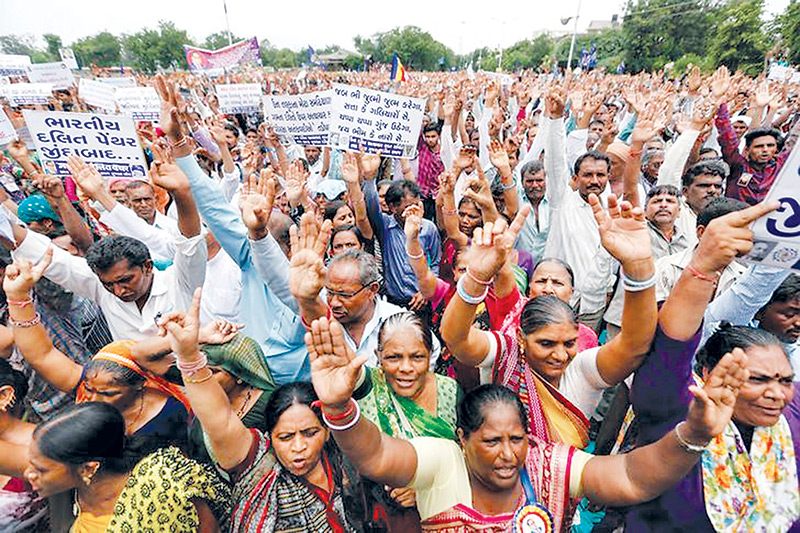
People shout slogans as they attend a protest rally against what they say are attacks on India’s low-caste Dalit community in Ahmedabad, Indiaon July 31, 2016. reuters
In 1950, the newly independent India officially abolished its caste system and outlawed discrimination against the Dalits, known as ‘untouchables’, who had been relegated to the bottom of that rigid social hierarchy. This attempt to right historical wrongs was underpinned by a virtuous capitalist vision of thriving Dalit businesses that lifted their owners to a level of social and economic respectability that eroded prejudice against them. But India’s caste system, buttressed by 3,000 years of history, has proved highly resilient. Despite nearly seven decades of well-meaning government intervention, caste identity continues to pervade every aspect of rural life in India, with Dalits facing deeply entrenched prejudice that impedes their ability to build better lives for themselves and their families, and to contribute significantly to India’s economy. India’s castes are traditionally defined in terms of the jobs their members hold. For Dalits, that has typically meant punishing labour in mines and quarries, in hot-spice farming, or brick kilns. Menial or unhygienic jobs—unblocking sewers, disposing of human waste, stripping animal carcasses—go largely to Dalits. For all their hard work, Dalits frequently receive little or no pay. Though forced labour has been illegal in India since 1976, the government estimates that over 18 million Indians—largely Dalits—are unpaid workers or held in debt bondage. Despite comprising more than one-fifth of India’s population, Dalits control less than 5 percent of the country’s resources. One-third of India’s Dalit population live in absolute poverty, and less than 10 percent of Dalit households can afford safe drinking water or toilets. This cycle of poverty has proved extremely hard to break. India has a free-market economy, in which entrepreneurship is valued and encouraged. But while there have been a few inspiring Dalit success stories, they stand out precisely because of their rarity. Despite a raft of quotas, grants, and subsidies aimed at eradicating the caste divide, Dalit entrepreneurs still lack access to the financing they need. Higher-caste entrepreneurs seeking to start or expand their businesses can generally rely on a legitimate government-backed credit system to extend the needed financing. Dalits cannot. According to a recent study, Dalits are less likely than others to receive credit from formal financial institutions, and those who do receive lower amounts on less generous terms, which may drive them to unscrupulous lenders. Small wonder, then, that Dalit businesses struggle to compete. One might argue that the disparity in access to credit is tied to differences in income, assets, or education. But the evidence suggests that direct caste discrimination also plays a role. Dalits routinely relay stories of being derided, humiliated and bullied in rural banks. The above-mentioned study confirms that banks have discriminated systematically—but subtly—against lower castes, in a range of ‘creative’ ways. Loan applications from Dalits are discouraged, additional references are demanded, only small loan applications are approved, higher collateral requirements and interest rates are imposed, loan extensions are denied, long waiting times are enforced for opening bank accounts, and there is a lack of help when filling out complex application forms. This is not only immoral; it is sapping India of 20 percent of its entrepreneurial potential. The problem extends beyond business loans. Dalits also face a broader lack of financial inclusion, which adds more fuel to this self-perpetuating cycle of prejudice and poverty. In 2016, when Prime Minister Narendra Modi’s government implemented its rapid demonetisation—removing 500- and 1,000-rupee banknotes from circulation, in order to reduce corruption—the poor and financially excluded Dalits suffered far more than any criminal. India’s government must now channel the considerable political will to eliminate caste discrimination toward ensuring that the financial sector improves Dalits’ access to its services. What is required is a multipronged approach that accounts for the factors behind the persistence of caste discrimination. For example, some lenders may be motivated by a deep-rooted aversion to Dalits, born of old cultural norms and beliefs. Others may assume that the Dalits lack the education or experience to use their loan wisely. Some studies suggest that Dalit borrowers themselves may trigger lenders’ prejudices, through a cultural reluctance to broadcast their entrepreneurial activities, to engage in direct negotiation, or to take big risks. India cannot escape history, but it can address its legacy. Unless the government takes concrete steps to ensure that Dalits can thrive economically, the country will never repay its moral debts, and its society will never be whole.
This article was previously published in The Korea Herald, a part of the Asia News Network.
OPINION
Death by dirty cooking
It would cost an estimated $4.4 billion annually to meet the world’s residential clean-cooking needs.
- Kandeh K Yumkella
shutterstock
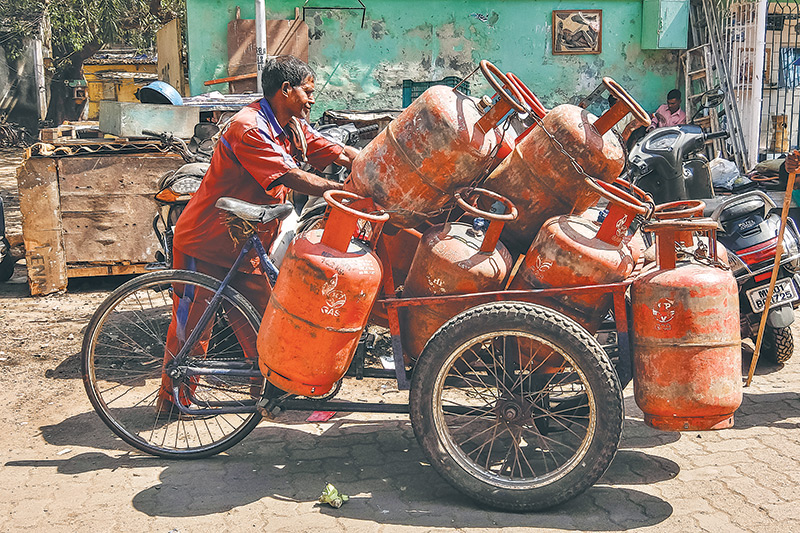
Each year, exposure to household air pollution (HAP) kills 4.3 million people—more than HIV/AIDS, malaria, and tuberculosis combined. HAP is produced when households use antiquated fuels—such as firewood, coal, crop waste, and kerosene—for cooking and heating, so ending HAP-related deaths is as straightforward as delivering clean-cooking solutions. Yet the world hasn’t done it. Across Africa, for example, over 80 percent of people still rely on biomass as their primary source of energy. In my home country, Sierra Leone (one of the five most vulnerable countries to climate change), less than 20 percent of the population has electricity, while over 90 percent rely on charcoal and firewood for cooking. If current trends hold, Africans will still be using such fuels to cook in 2050. It would cost an estimated $4.4 billion annually to meet the world’s residential clean-cooking needs—far more than what is currently available. While that figure is not small, it is dwarfed by the costs of inaction. Beyond its devastating effects on human health—HAP is the second-largest risk factor for death and disability in Sub-Saharan Africa—reliance on non-renewable wood fuels for cooking contributes up to one gigaton of CO2 emissions annually, or about 2 percent of total emissions. Moreover, such cooking methods are a major source of black carbon, the second-biggest driver of climate change after CO2: solid-fuel cooking in Sub-Saharan Africa alone accounts for some 6 percent of global black carbon emissions. Compounding the effect on climate, up to 34 percent of wood fuel in Sub-Saharan Africa is harvested unsustainably, contributing to deforestation. The persistence of outmoded cooking and heating methods amounts to a major drain on economies. In Sub-Saharan Africa, about 3 percent of GDP is lost annually as a result of increased mortality and morbidity from HAP, avoidable spending on solid fuels, time wasted collecting firewood, and environmental damage. Women and children suffer the most. Failure to address the problem does not reflect inadequate technology or even insufficient resources, but a lack of political will. While governments and international actors have worked to expand access to electricity, they have often left clean-cooking solutions—using, say, electricity derived from renewable energy—on the back burner. Efforts to promote clean cooking have been largely uncoordinated, narrow, and piecemeal, with limited consumer buy-in. A new initiative aims to change this. The World Bank’s Clean Cooking Fund, launched at September’s United Nations climate action summit in New York, will mobilise $500 million to help ensure universal access to clean cooking by 2030. This includes scaling up the production of clean-cooking fuels, developing well-functioning supply chains to deliver them to billions of people, and encouraging innovation and diffusion of relevant technologies. To this end, the CCF will leverage the World Bank and other development-bank resources to attract private investment, including by creating new revenue streams and incentives across value chains. It will also develop an impact bond market for the clean-cooking sector. Moreover, the CCF will support a global platform for knowledge and innovation, including the Health and Energy Platform of Action, convened by the World Health Organization, the UN Development Programme, and the World Bank in collaboration with the civil-society organizations Hivos and ENERGIA. All of this should help to produce verifiable results at the outcome level (number of households with access to clean cooking) and the impact level (benefiting health, gender equality, and the environment). But, as promising as the CCF is, achieving its goals will require coherent policy strategies, underpinned by a strong and sustained commitment at the national, regional, and global levels. India is one country that has shown such a commitment. According to the World Bank’s Energy Progress Report 2019—which tracks progress toward Sustainable Development Goal 7 (to ensure access to affordable, reliable, sustainable, and modern energy for all)—the country has raised its electrification rate considerably, from 50 percent in 1994 to 93 percent in 2017. Its clean-cooking access rate remains much lower—45 percent in 2017—but still represents significant progress, having more than doubled since 2000. And the share of the population using biomass for cooking fell from 64 percent in 2010 to 59 percent in 2015. This shift has been driven partly by expanded access to liquefied petroleum gas. In 2016, India became the world’s third-largest LPG importer, behind China and Japan. That year, the government also launched the Pradhan Mantri Ujjwala Yojana program, with the goal of providing LPG access to 50 million households living in poverty by 2019. Last year, it surpassed that target, and expanded the scheme to cover 80 million families. Other countries, such as Cambodia and Indonesia, have also made significant progress in expanding access to LPG and other clean-cooking fuels. The imperative now is to continue building on these gains, while adapting the strategies that powered them to different contexts, especially in Africa. To this end, the UN should lead the way in advancing a multi-stakeholder approach driven by strong public-private partnerships. Such an approach has worked before, mobilising billions of dollars in investment in renewables and energy efficiency. It can work again—and save millions of lives in the process.
— Project Syndicate
LIFE & STYLE
Affordable Nepali watches to amp up your style
Alma Artes hopes to make their traditional timepieces a global brand.
- JUNE KARKEE
photos courtesy: alma artes
Kathmandu, When watches were invented, a wearable timepiece that evolved from portable spring-driven clocks during 16th century in Europe, they were a practical necessity. Their functionality remained unchanged throughout the transition from pocket to wrist watches, but they also became a style and ornamental accessory. By the beginning of the 2000s, technology started taking over many aspects of human life, and the functionality of watches were replaced by smartphones. The wrist accessory, however, again made a comeback by 2013, but as smartwatches. The charm of the traditional watches, which are a technological accomplishment in their own right, has yet to fade away. While smartwatches have also recently evolved from an ultimate smartphone accessory to being standalone gadget, traditional watches, especially luxury ones, are still sought after for with their unique designs and style quotient. “Young people may prefer smartwatches over more traditional watches because they are convenient and do more than just show time,” says Pranaya Chuke, one of the founders of Alma Artes, a designer watch company based in Nepal. “But the traditional watch market continues to exist because those types of watches tend to reflect a person’s history and character.” Chuke and his partner Rothan Gurung were pursuing their undergraduate degrees at Islington College when they discovered their shared passion for watches. Gurung was inspired by his grandfather, who frequently wore and treasured traditional watches like the Seiko 5 watch, a popular Japanese watch brand and model. In 2018, the duo decided to turn their passion for designer timepieces into a business. “When we first told people that we were going to start our own watch company, they were sceptical of us and didn’t believe we could do it,” said 26-year-old Chuke, who is also the head of marketing at Alma Artes. “But we made it possible, and fortunately enough, so far everyone has loved our watches.” Within just a year, Alma Artes’ watches have appealed to and attracted many people. Their watches, which are designed in Nepal, are unique, elegant and affordable—especially when compared to other designer watch brands. With their unique designs and relatively affordable prices, the duo hopes to establish their brand as one that will be recognised globally. Hence, they chose to name the company ‘alma artes’, borrowing from Latin, which translates to ‘pure soul.’ But apart from the name, the founders say that they plan to have designs that are more authentic to Nepal.
“Our customers like the fact that the watches are designed in Nepal,” says Chuke. In their first set ‘The Heritage Series’, depictions of famous heritage sites like Swayambhunath Stupa and Patan Durbar Square are engraved on the back of the watches. Since being established a year ago, the company has sold more than 400 watches. According to Chuke, most have been purchased to be given as gifts to send abroad, Australia being one of the countries where they get sent to the most. But it has been popular among those who love traditional watches. “It’s very classy and elegant,” says Nipun Shakya, who owns an Alma Artes watch. “It is also special to me because it’s designed in Nepal.” Alma Artes watches come in five different colours and the price ranges from Rs17,988 to Rs20,237. But, according to Chuke, many customers are sceptical of their lower prices. “But price is not indicative of the quality of the watches,” says Chuke. “It is a market strategy for us right now, to attract as many customers so we can build our brand.” The founders are very mindful of their product, company and brand because they are very aware of the labouring process of establishing a company. Fresh out of college, both Chuke and Gurung had to figure out the bureaucracy and hassles of company registration and tax provisions on their own. Even in terms of design, they had to ensure theirs was as unique as possible, so that they did not resemble the designs of any other international watch brands, as to avoid legal and patent issues. “A lot of people take ‘the designed in Nepal’ part for granted, thinking it’s an easy thing to do, but there’s a lot that goes into designing a watch,” said Chuke. “There were times when we wanted to quit, but once we saw the prototype, we knew we had to continue.”
According to Chuke, he and his team of five work together to come up with a design for the watches, focusing especially on the inner mechanisms of how a watch should move. For their watches, they use Japanese movement, which is used in popular brands like Seiko. But while they are designed in Nepal, the watches are assembled at a factory in Shenzen, China, for the time being, due to lack of capital. But Chuke says that with the release of a new series of watches in about three months, he expects to be able to import raw materials and assemble the watches here in Nepal, after which the company will also be able to export them to other countries. “After finalising the design, we send them to China, where our agent, who looks after the production, finalises everything and exports the final product to us,” says Chuke. Currently, the watches are sold online, via their website and social media accounts, which Chuke says is a boon, due to the popularity of digital marketing. But in the future, he hopes to sell the watches through local vendors and stores, where customers can see the physical product before purchasing them. But running a company also means facing competition from other businesses, and for Alma Artes, there is a lot of it in Nepal, where foreign brands are still popular, and smartwatches are certainly the new fad. But with the number of queries on their social media pages, even from young customers, they are sure that traditional watches are not going out of style anytime soon.
AGONYAUNT
Adulting is hard
Scott Umstattd/Unsplash
Dear Aunt, I’m a 20-year-old medical student living with my parents and two brothers in Kathmandu. Just last week, my parents went on a business trip to Delhi for two months. Because I’m already 20 and my twin brothers are 18, they decided to leave the house all to ourselves. I and my siblings obviously were thrilled to find that we will have the entire house to us, without anyone else looking after us, or the house. As you can tell, this was a first. Our parents have always been very protective as well as paranoid. They have never left us alone even for a single night. So this excited us a lot. We planned to call our friends home and have a sleepover every other night. We decided that there wouldn’t be any ‘bedtime’ and watched TV until midnight. We would go on bike rides and order food from our favourite restaurants rather than cooking twice or more times a day. On the very first day, we went shopping and brought home a bunch of junk and frozen food that we ate while watching movies or gossiping at the terrace. The first few days went very smooth. We hosted a few parties, had a couple of sleepovers and ate out almost every day. But soon, the vacation ended and our classes started. All of us have early morning shifts in school so we have to make sure that we leave the house at 7am. But since we are up watching TV late every single night, we barely get up on time. My brothers have already missed two days of school because of this. Besides that, eating out every day is getting extremely boring for me. At this point, the thought of eating heavy and greasy food, be it from my favourite restaurant, makes me sick. I miss eating plain, simple food at home. But, the worst part of it all is that my siblings don’t help me one bit with the chores. They don’t even clean up after themselves, let alone cleaning the house. I have also talked to them about helping me in the kitchen to make dinner, but they don’t budge away from their phones at all. Even when I wake them up for school, they go right back to sleep and are always late. This has also affected my schedule, I have not been able to find time to study. I am also tired of lying to my parents every time they call. I have been telling them that everything is going smoothly when it isn’t. I would very much like my brothers’ help with running the house for another month. But I don’t know how to make them realise that they need to be more responsible. Aunt, please tell me what I should do now. —Swaraj
Dear Swaraj, When we are young, we think living alone without parents at home is fun. And it is mostly because we don’t always want to conform to their rules--like waking up early, separating study hours and playtime and helping with the house chores. Sometimes, we want to have our ways but our parents don’t always let us follow our choices. And so, in our minds, we believe that when we live away from our parents, we will get to do everything on our fun list. But there are repercussions to our decisions and learning about them and finding out that being alone is a lot of work, I think is our call to grow up. Your story reminds me of the time when I was left alone at home when I was on my late teens for about a month. With the house to myself, I thought I would have my share of fun--just like you and your brothers did. But soon, I learnt that staying alone and looking after the house is a lot of work. There’s a list of things that you need to always keep on a check, like the water level in the safety tank, groceries at home, dirty clothes and dishes, and then cleaning the house. Only then I realised how my parents had been handling everything without me helping at all. But living alone changes people’s perspective on life, as usually when we look at life we think of achievements outside of our homes. My experience helped me understand the responsibilities that come with adulthood early on in my life and be grateful for what I currently have. When we start living alone, we tend to become introspective, we look within before looking out. We finally start thinking of what makes our home a home. And from what you have mentioned, I think this is where you are--you are figuring out how to make a home. And perhaps, because you are the eldest, this realisation has hit you first. When an older person is around, we tend to be laid back, we let them handle the problems, and that is what your brothers are doing. But if you want some help, you need to set ground rules. And if you don’t set boundaries for your brothers now, the way they have been acting can turn into habits and you know that bad habits die hard. So, you being the eldest, you have to pull up your socks, even if this means being bossy and taking your stand. You need to assign them works and study hours so that you can manage time for your studies as well. Look on the bright side. If you and your brothers are able to do this right, you will be living like responsible adults, and trust me, it is a big deal. You will also learn to make independent choices in life. So if you want that, all you need to do now is set your foot forward and tell your brothers to act like adults. If they still don’t listen to you, then probably you need to talk to your parents. Because it’s a better option than your brothers slacking and lagging behind in their studies. So brace yourself and game up!
CULTURE & ARTS
An intriguing, confusing art festival
There’s much to make meaning out of at the Kathmandu International Performance Art Festival 2019, yet the festival falls short of making the art powerful.
- SRIZU BAJRACHARYA
Kathmandu International Performance Art Festival 2019, a four-day event,brings together 14 performing artists from six countries. Post Photos: srizu bajracharya
Kathmandu, There’s a deafening, awkward silence as Bingqiang Yin, a performance artist from China, starts making graceful rounds inside a black canvas cloth—his stage—at one of the halls of the Taragaon Museum. The round black canvas has five concentric circles while its back is white in colour. Yin too is dressed in a white t-shirt and tight black pants. He walks around the first ring of the circle and then sits down to cut the sphere out. As his scissors touch the crispness of the canvas, the distinct sound of the sharp cutting pierces the silence. Yin then puts on the ring that he has cut and repeats the same drill until he finishes cutting all the circles. While he does, he moves his body into different postures, stands with crossed feet, his two hands reaching out to the sunlight outside the window. Towards the end, he sticks himself to the round window of the museum. It seems as though Yin is trying to show us how he is suffocating inside and wants to be part of the freedom that he sees from inside an empty room. However, the deafening silence that filled the room, full of more than a dozen people, was not just because Yin’s performance was intriguing, but because people were trying hard to understand his actions. Yin’s performance is part of the Kathmandu International Performance Art Festival 2019, organised by Bindu, space for artists at The Taragaon Museum—the second iteration of the performing arts festival in Kathmandu with its first in 2016. When Yin’s performance ended, the audience looked at each other with puzzled faces. One person from the audience even called out to the organisers asking for a title to make sense of the performance. And this is the overview of the entire festival—the audience throughout the performances are left to think hard. It was only later that I found out that Yin was actually trying to explain about being with nature, and the suffocation one feels when one is locked inside a room. The show put up on the second day at the Kathmandu International Performance Art Festival is powerful and compelling, yet confusing and exhausting; exhausting because throughout the performances, audiences are trying to make meaning of the performing arts of the artists. And yet, the small crowd graciously takes time to understand the devotion of the artists. The Kathmandu International Performance Art Festival 2019 brings together 14 performing artists from six countries to discuss climate change, environmental destruction, living with nature and mental health along with familial relationships. One of the most exceptional performances at the festival was from Dhruba Raj Sharma, whose work centred on the theme to educate people about human consumption of meat. At the amphitheatre of the Taragaon museum, Sharma had a bell around his neck, crouched on his knees to rub raw meat on his bare skin. Once done, he approached the audience with turmeric paste, asking them to rub it against his skin. He also gave a handful of raw meat to some front- and second row-audience members. While some viewers refused, some reluctantly and awkwardly participated in his act, holding on to the bloody meat. One could also see how uncomfortable some of the audience was with the sudden attention of the crowd. “I have titled my act as ‘Badhshala’ (Abattoir). I feel as humans, we should voice for the animals who can’t speak for themselves. I wanted to make the audience think about the meat they consume,” said Dhruba Raj Sharma, the performance artist.
While Sharma’s performance bewildered the audience, another artist Kunti Thapa Magar rendered goosebumps on the spectators. Her performance titled, ‘The Meeting Point’ saw her caressing a plant in an earthen pot. Throughout her act, she would place the plant around her body, as though telling the audience about the intimate relationship of humans with the greenery they live with. The performance was horrific and tear-jerking, especially when Magar started eating the raw plant destructively. Some from the audience seemed worried whether the plant was even edible. In performing arts, artists use their bodies as a medium of artistic expression to discuss social issues. These performances are done in front of a live audience so as to persuade viewers to take action on the issues being performed. The history of this artform goes back to 6th century Greece, where poets like Sophocles performed their poetry with gestures. But in Nepal, performing arts is still relatively new and is considered as a modern-day interactive compact art form. Many in Kathmandu have been acquainted with this art form through Ashmina Ranjit, who has over the years enacted many performing arts that discuss politics of gender, sexuality and desires. And the art form through the years has proven to be very influential and provocative. In 2016, a group of Nepali artists, to support Doctor Govinda KC’s hunger strike against corruption, had taken to the road bare-foot with their eyes closed, enacting a performance art action, which helped discuss corruption in Nepal. And gradually, this art form has been taking the interest of people. And this shows in the Kathmandu International Performance Art Festival 2019, where the dedication of the artists and the patience of the audience tells why the artform is intriguing and powerful. “Performance art is powerful because it is provocative and interactive, as the connection with the audience is more intense because people themselves perform the art to talk about a cause. The human connection makes the art more persuasive than 2D paintings,” says Prithvi Shrestha, founder of Bindu, space for artists and a painter himself. Kathmandu International Performance Art Festival demands people’s attention and is powerfully resonant with the issues happening around the world. However, the crowd that saw the event was still very small in number compared to other art festivals that happen around Kathmandu. Perhaps the festival should have chosen a public space rather than an open museum away from the core of Kathmandu. For what is the point of performing arts inside a closed environment, if it can’t tickle the minds of the masses who are part of the problem? Besides the performances, the festival fell short of being great, as it seemed hasty and informal with no proper host. The festival felt like it was running out of time. But no one had a clear idea of the timings of the performance and how much each artist would get time to speak about their performance. And with the quick change of venues inside the compound of the Taragaon museum, it felt even more perplexing to understand what the difference in the environment meant for the various performances. The artists might have shared their ideas about their performance for the festival the day before, at the Artist Talk programme at Tara Art Gallery. However, the same iteration would have made this performance art festival even more powerful. The festival certainly would have been more engaging if the audience had context to build meaning upon; however, that is what makes it more compelling, says Prithvi Shrestha.
The festival closes today with a set of performing artists performing at Panauti from 2 pm.
CULTURE & ARTS
Eco-printing makes an impression on Indonesian women
A number of administrations in the country require their civil servants to wear eco-print clothes every Friday, raising the popularity of eco-printed fabric making.
- SRI WAHYUNI
The Jarkata Post
A group of women waited anxiously in front of a number of steamers. Some opened the lids and peered inside; others simply asked for updates. “How many more minutes, ma’am?” a woman asked Erna Herawati, the instructor of an eco-printing class, as she watched a roll of fabric steam in the contraption. “Okay,” said Erna, “You can take them out now and open them. Let’s see what you got.” She added some instructions about what do to with the fabrics. One by one, the women unrolled the bolts and hung them on clothes lines to dry. Each had two pieces of fabric, cotton and silk. The previously white cotton and silk fabrics were now full of colors and patterns from the fresh leaves and flowers used in the eco-printing class. “Wow, look at mine. It’s beautiful. I love it,” one of the women cried out. “Oh, mine is not that good. I have to give it another try next time,” said another. Eco-printing is a technique that presses leaves, flowers and other plant parts on natural fibers or on other media containing natural fibers. The natural colors and patterns of the leaves and flowers are transferred onto the media. When dye is required in the process, environmentally friendly ones made of leaves, bark or other parts of plants are used.
Eco-friendly In Yogyakarta, eco-printing has attracted a large number of enthusiasts, especially women. The attraction is not limited to wearing the products, which include clothing, leather bags, shoes and ceramics. Some also take the time to make them. Eco-printing instructor and artisan Dewi Dian and her assistant arrange leaves on a piece of fabric in a class at her residence in Depok, Sleman, Yogyakarta. (JP/Sri Wahyuni) Erna, who is from Bantul, Yogyakarta, said that since she began teaching eco-printing classes in the middle of the year, her schedule had been filled almost every week. Most of the participants were women, many of them housewives. Among the participants was Erna Kusmawati, wife of Bantul regent Suharsono. “I fell in love with eco-prints because they are environmentally friendly,” she said. She started eco-printing about two years ago after years of working with a tie-dye technique that involved chemicals. “With chemical dye, I often felt guilty because of the waste I produced,’ she said. She added that her encounter with eco-printing had encouraged her to take care of the environment by planting plants in her neighborhood. Erna said that although the eco-printing technique she chose required the use of plastic sheets, the sheets were reusable. Before a fabric is eco-printable, it has to undergo a series of treatments called pre-mordant and mordanting. These are performed to improve the fabric’s absorption of the colors and shapes of the leaves and flowers. After the fabric is processed, the leaves and flowers are arranged either randomly or in a pattern on top of the fabric. The fabric is then covered with a plastic sheet or another sheet of fabric and folded several times. Afterward, it is rolled up to keep the leaves and flowers in position. Then it goes into the steamer for about two hours. Eco-printing expert Dian Anugerah Dewi said that any leaf or flower could be used in the process, but those containing high level of tannin worked best, such as teak, lanang (oroxylum indicum), castor and kalpataru (ficus religiosa). “Those leaves do not need any treatment before application thanks to their high tannin content,” said Dewi. To lock the colors and patterns into the fabric, it undergoes a fixation process using alum, vinegar or a rust solution, depending on the darkness or lightness of the desired colors. “One of the keys to successful eco-printing is making sure that as little air as possible is trapped between the pieces of fabric or between the leaves and the fabric,” said Dewi, who has been in the business since 2016. She said eco-printing had brought her to countries in Asia, Europe and the Middle East for exhibitions as well as presentations about her work. “Now I’m focusing more on giving classes and sharing my experiences with others,” Dewi said. Lucia Idayani, another eco-print artisan and teacher from Mergangsan district, Yogyakarta, was of a similar opinion. She said she enjoyed sharing her knowledge with others, mainly women, as a means to empower them. She used to gather the women in her neighborhood together and teach them how to make eco-print products with the support of the district administration. Now she runs a community of eco-print artisans producing and marketing eco-print products, mainly fabrics.
Embraced by the city Eco-prints have become increasingly popular as a number of administrations, such as the Yogyakarta administration, require their civil servants to wear eco-print clothes every Friday on even weeks of the month. “This is, of course, very encouraging for us,” said Idayani. She said eco-print classes used to be expensive, making people reluctant to join. Nowadays, joining eco-printing classes in Yogyakarta is fairly easy. In some places, housewives gather in groups of 10 or more and invite instructors to teach them the technique. The price is usually quite affordable, and some instructors offer their classes for free. Participants are required to bring fabrics and certain other materials. In some classes, for the price of US$7.13, participants can bring home an eco-printed scarf, hijab or pashmina after they finish the class. “I find eco-printing full of surprises. You never know what you’re going get at the end of the process,” said Qurota A’yuni of Tegalrejo district, Yogyakarta, who joined an eco-printing class with 14 other housewives in her neighborhood. She said she practiced the technique several times on her own after finishing her class. The results surprised her every time. “You can only guess how the colors will turn out or how the patterns will look. You can never be sure of the final result,” she said.She added that she immediately fell in love with eco-printing when she found out about it from friends. She soon chose to join a class. Eco-printing producer Puthut Ardianto said eco-print fabrics had become more popular as they were environmentally friendly and the colors were soft and muted, making them look elegant. “The fact that it takes a relatively long time to produce an eco-print product makes it expensive, and that gives a sense of pride to its users,” said Puthut, who is also a lecturer at Yogyakarta Muhammadiyah University. A piece of 2-by-1.15-meter cotton fabric with eco-prints fetches about Rp 250,000 (US$17.83) while viscose silk fabric starts at about Rp 500,000. The more complicated the patterns and the richer the colors, the higher the prices get. To support the movement, Economic and Manpower Council of Muhammadiyah’s women’s wing Aisyiyah in Yogyakarta has established a community of eco-print artisans called Sekarlangit Ecoprint. The council’s chairperson Kiptiyah Sudibyakto said the initiative came from Aisyiyah’s members, who hoped to engage in eco-printing entrepreneurship. “Through the community, hopefully, there will be more Aisyiyah eco-print entrepreneurs and people will learn more about the diverse flora of Indonesia,” Kiptiyah said.
—The Jarkata Post
WORLD
US starts withdrawal from Paris climate accord
It will be officially out of the Paris accord on November 4, 2020, a day after the US election in which Trump is seeking a second term on appeals to the white working-class.
- AGENCE FRANCE-PRESSE
Flames from a backfire consume a hillside as firefighters battle the Maria Fire in Santa Paula, California, US. The Trump administration has formally notified the United Nations that it is withdrawing from the Paris climate agreement. The move comes as climate change drives more frequent and severe wildfires, hurricanes and other hazards. AP/RSS
WASHINGTON : The United States on Monday formally notified the United Nations that it was withdrawing from the Paris climate accord, making the world’s largest economy the sole outlier from the agreement. President Donald Trump went ahead with the pullout despite mounting evidence of the reality and impact of climate change, with September the fourth month in the row with near- or record-breaking temperatures. The United States presented its withdrawal letter to the United Nations on the first possible date under the accord negotiated by Trump’s predecessor Barack Obama. It will be officially out of the Paris accord on November 4, 2020, one day after the US election in which Trump is seeking a second term on appeals to the white working-class. Announcing the move, Secretary of State Mike Pompeo reiterated Trump’s rationale in 2017 that the accord would disadvantage US businesses. “It was America that would suffer the straitjacket,” Pompeo told the Fox Business network. “It would be quintessentially unfair to the American people and to the American workers.” Pompeo said in a statement that the United States would advocate a “realistic and pragmatic model” that included renewal energy but preserved a role for fossil fuels. French President Emmanuel Macron, who unsuccessfully tried to persuade Trump to stay in the accord named for his nation’s capital, lamented the decision. “We regret this and it makes the Franco-Chinese partnership on climate and biodiversity even more necessary,” the French presidency said as Macron visited China, the world’s largest emitter of greenhouse gases blamed for climate change. The United States, the number-two emitter, is still planning to attend this month’s COP climate negotiations in Spain, according to a State Department official. Pompeo in ihs statement pointed to a 13 percent US reduction of greenhouse gas emissions from 2005 to 2017 even as the economy grew. But Trump, who took office in 2017, has pledged to turn back environmental regulations as states such as California and New York try to take stronger action on their own. Trump has sought to block California from setting tighter standards on car emissions and moved to let states set their own standards on existing coal-fired power plants. Robert Menendez, the top Democrat on the Senate Foreign Relations Committee, said that the Trump administration has “once again thumbed its nose at our allies, turned a blind eye to the facts and further politicized the world’s greatest environmental challenge.” Former vice president turned climate champion Al Gore deplored Trump’s decision—but said that a new president could re-enter the Paris accord within 30 days. “No one person or party can stop our momentum to solve the climate crisis, but those who try will be remembered for their complacency, complicity and mendacity in attempting to sacrifice the planet for their greed,” Gore said. The Paris accord set a goal of limiting temperature rises to well within two degrees Celsius (3.6 Fahrenheit) from pre-industrial levels, a goal that scientists say is vital to check the worst damage from global warming such as increasing droughts, rising floods and intensifying storms. Mindful of the politics at home, Obama insisted that the goals be loosely enforced, with each of the 197 signatories—from the United States to North Korea to tiny islands—choosing its own actions and informing the United Nations. Contrary to some predictions, Trump’s decision did not trigger a domino effect of withdrawals by countries such as Brazil and Australia. Brazilian President Jair Bolsonaro, an ideological ally of Trump, has belittled environmentalists but has held off on threats to withdraw from the Paris accord, with the European Union requiring adherence as a condition for a major trade deal. Trump has cast the climate accord as elitist, saying when announcing his decision that he was “elected to represent the citizens of Pittsburgh, not Paris.” But a Washington Post poll last month found that even in his own party he faces growing opposition on the issue, with 60 percent of Republicans agreeing with the scientific consensus that human activity is causing climate change. Former New York mayor Mike Bloomberg, who has used his fortune to push for action on climate change, vowed to put the issue front and center in next year’s election. “Until then, we will continue to fight the climate crisis with the urgency required, city by city and state by state. We can’t afford to wait.”
WORLD
Lindsay Hoyle chosen to replace Bercow as UK Commons speaker
- ASSOCIATED PRESS
LONDON : Long-serving Labour Party lawmaker Lindsay Hoyle was elected speaker of Britain’s House of Commons on Monday, taking up the job with a clear message: I’m not John Bercow. Hoyle was chosen by lawmakers from among seven candidates to replace the influential but contentious Bercow. Bercow retired last week after a decade as speaker that saw him become a central player in Britain’s Brexit drama. Hoyle took 325 of the 540 votes in a runoff with Labour colleague Chris Bryant after the seven-member field was winnowed down in three previous voting rounds. After his election, Hoyle was dragged to the speaker’s chair by colleagues with a show of reluctance — a tradition dating back to the days when speakers could be sentenced to death if they displeased the monarch. He vowed to bring a change of tone and temperament to a political system that has been strained by Brexit; to restore Parliament’s battered reputation and to be “neutral” and “transparent.” Hoyle remarked that lawmakers have “got to make sure that tarnish is polished away.” He said the House of Commons will change, “but it will change for the better.” Hoyle, 62, was elected to Parliament in 1997, has served as one of the three deputy speakers since 2010 and is widely popular and respected by colleagues. Like Bercow, he will run the daily business of the Commons. With his northern English accent and blunt manner, Hoyle has a contrasting style to the verbose Bercow. And he is likely to adopt a more cautious approach than that taken by Bercow, who prided himself on making the government answer to Parliament and became a thorn in the side of the Conservative administration. The speaker is supposed to be an impartial arbiter of Parliament’s rules, but critics accused Bercow of favoring anti-Brexit politicians at the expense of those supporting Britain’s departure from the European Union.
WORLD
Turkey says it captured sister of dead IS leader
- AGENCE FRANCE-PRESSE
ISTANBUL : Turkish forces in northern Syria have detained a sister of Abu Bakr al-Baghdadi, the leader of the Islamic State group who was killed in a US raid, a senior Turkish official said Tuesday. “Turkey has captured Abu Bakr al-Baghdadi’s sister” in a raid near the town of Azaz, the official, speaking on condition of anonymity, told AFP. He named the woman as Rasmiya Awad, and said she was born in 1954. The woman was accompanied by her husband, her daughter-in-law and five children. “The three adults are being interrogated at this time”, the official said. He added that the arrest could be “an intelligence gold mine. “What she knows about ISIS can significantly expand our understanding of the group”, help us catch more members and “help Turkey to better protect itself and the rest of Europe from terrorists”, he said, using another acronym for IS. The Syrian Observatory for Human Rights confirmed the arrests.“Turkish forces arrested the sister of Baghdadi last night in a camp in the suburbs of the city of Azaz”, said the head of the organisation, Rami Abdel Rahman. “They arrested her, her husband, her daughter-in law, and her five grandchildren.”He said they also detained four other Iraqis, but it was not immediately clear if they were linked to IS or not. The town of Azaz is located in a region of northwestern Syria that has been under Turkish control since an offensive it staged in 2016. US President Donald Trump announced on October 27 the death of Baghdadi in a US special forces raid in Syria’s northwestern province of Idlib, carried out in coordination with Kurdish militants.Baghdadi had led IS since 2014 and was the world’s most wanted man. The next day Turkey said that its intelligence services and military had had “intense” contact with their US counterparts on the night of the operation.Long suspected of allowing the jihadists to cross its border to join Syria after the start of the conflict that has torn the country since 2011, Turkey, hit by several attacks committed by the IS, joined the anti-jihadist coalition in 2015.But Ankara has been accused in recent weeks of weakening the fight against dispersed IS elements by launching an offensive on October 9 against the YPG Kurdish militia that had been spearheading the fight against the jihadist organisation.
WORLD
US diplomat ‘urged’ to tweet support for Donald Trump
- REUTERS
Former US Ambassador to Ukraine Marie Yovanovitch.AFP/RSS
WASHINGTON : Two US diplomats told lawmakers the State Department was being used for domestic political purposes under President Donald Trump and warned that would hurt American interests, according to transcripts released on Monday in Congress’ impeachment investigation. The transcripts were the first released from the closed-door inquiry by the House Foreign Affairs, Intelligence and Oversight panels. They painted a detailed picture of the distress felt by top US diplomats as Trump allies tried to pressure Ukraine to launch investigations into the Republican president’s domestic political rivals. Marie Yovanovitch, whom Trump abruptly recalled as ambassador to Ukraine in May, told US House of Representatives committees about the attacks against her in conservative media and from close allies of Trump, questioning her loyalty to the president. “I was shocked,” she said of learning from Assistant Secretary of State Philip Reeker that Trump had wanted her to leave her post for months. Rudy Giuliani, the president’s private attorney, and Donald Trump Jr., the president’s son, had also posted criticism of her on social media. “If you have the president’s son saying, you know, we need to pull these clowns, or however he referred to me, it makes it hard to be a credible ambassador in a country,” she said. Yovanovitch said she first learned in late 2018 that Giuliani had been involved in Ukraine policy when Ukrainian officials alerted her to the former New York mayor’s communications with a former Ukrainian prosecutor general. She described how Gordon Sondland, the US ambassador to the European Union, had urged her to use Twitter to express support for Trump in order to save her job. “He said, you know, you need to go big or go home. You need to, you know, tweet out there that you support the president,” she said. Several witnesses have said Sondland, a major Trump donor, played a major role in Ukraine policy, despite the country not being part of the European Union. Sondland also testified in the House probe, and his transcript is expected on Tuesday.
WORLD
Britain’s Johnson presses election rival to explain Brexit stance
- AGENCE FRANCE-PRESSE
Britain’s Prime Minister Boris Johnson holds a meeting of the cabinet inside number 10 Downing Street in central London on Tuesday. AFP/RSS
LONDON : British Prime Minister Boris Johnson pressed opposition Labour Party leader Jeremy Corbyn on Tuesday to tell voters in next month’s election whether he backs leaving the EU. Johnson’s main rival in the snap December 12 poll has struggled with defining his position on Brexit ever since Britons narrowly triggered the divorce in a 2016 referendum. Labour’s new official stance is to negotiate a more EU-friendly withdrawal agreement with Brussels and then let voters decide whether to back it or simply stay in the EU. But Corbyn refuses to say whether he would then campaign for his own deal. Most top members in the party oppose Brexit and have said they would campaign to remain in the bloc. Johnson’s Conservatives are trying to seize on Labour’s divisions on the defining issue of UK politics. “Now the time has come for you to come clean,” Johnson told Corbyn in an a letter released by his office. “Do you believe the results of the 2016 referendum should be respected and the UK should leave the EU?” Johnson asked. “Would you commit to campaign for your ‘deal’ in a second referendum?” Labour’s Brexit spokesman Keir Sarmer told BBC radio that letting Britons decide what to do about Brexit was a “practical way to break the impasse”. “It’s not for the politicians... it’s for the people to decide,” Starmer said.Starmer himself is one of the senior Labour members opposed to Brexit. Corbyn was due to address supporters later Tuesday.Labour is trailing the Conservatives by 11 percentage points in a poll of polls compiled by Britain Elects.But the field also includes smaller pro-EU opposition parties that could potentially form a post-election coalition with Labour—if they ever agree on who should lead the government. The anti-Brexit Liberal Democrats came in second in European Parliament polls in May that Britain was forced to take part in because of Brexit delays.Lib Dem leader Jo Swinson will formally launch her party’s campaign on Tuesday in London. Her party is currently running in third place with around around 18 percent of the vote.
WORLD
Poland ‘broke EU law’ on judges’ retirement age
Briefing
LUXEMBOURG: An attempt by Poland to change the retirement age of its judges broke EU law, the bloc’s top court ruled on Tuesday, intensifying a showdown between Brussels and the conservative government in Warsaw over democratic standards. Rules Poland tried to bring in two years ago, setting lower retirement ages and making them different for male and female judges, were “contrary to EU law,” the Luxembourg-based European Court of Justice said, siding with the European Commission. It also took exception to an associated rule giving Poland’s justice minister sole discretion to decide whether to extend a judge’s service beyond the mandated retirement age.(Agencies)
WORLD
German court’s sanctions against jobseekers
Briefing
KARLSRUHE (Germany): Germany’s top court ruled Tuesday that sanctioning jobseekers deemed uncooperative in the search for work was illegal in some cases, in a blow to the controversial unemployment reforms rammed through by Gerhard Schroeder’s government in 2005. Judges at the federal constitutional court said that the total cut in benefits should never be allowed to exceed 30 percent, and in cases where lower payments would cause “extreme hardship”, no penalties need to be imposed at all. The sanctions allowed under Germany’s so-called Hartz IV benefits system, which combines social welfare and long-term unemployment payments, have long been contested with critics saying they violate the right to a dignified existence.(Agencies)
WORLD
Three Italian firefighters killed in explosion
Briefing
ROME: Three firefighters in northern Italy were killed on Tuesday in a mysterious explosion at an abandoned farm building in what police said may have been a criminal act. The team of firefighters had responded after midnight to an alert about a gas leak in the small town of Quargnento in the Piedmont region of the country, police said. As the firefighters attempted to put out a fire in an abandoned farm building, the explosion occurred, bringing down the entire structure. In a nearby building, authorities found an unexploded gas cylinder, a timer, and electrical wire, the local prosecutor said. (Agencies)
ASIA
Iran to resume uranium enrichment at Fordow plant
EU has warned its support for the N-deal depended on Tehran fulfilling its commitments.
- AGENCE FRANCE-PRESSE
A file photo shows the inside of reactor at the Russian-built Bushehr nuclear power plant in southern Iran, 1200mm south of Tehran, where Iran has began to unload fuel into the reactor core for the nuclear power plant, a move which brings the facility closer to generating electricity after decades of delay. AFP/RSS
TEHRAN : President Hassan Rouhani said on Tuesday that Iran would resume uranium enrichment at an underground plant south of Tehran in its latest step back from a troubled 2015 agreement with major powers. The suspension of all enrichment at the Fordow plant in the mountains near the Shiite holy city of Qom was one of the restrictions on its nuclear activities that Iran accepted in return for the lifting of international sanctions. But Washington’s abandonment of the deal in May last year followed by its reimposition of crippling sanctions prompted Iran to begin a phased suspension of its own commitments in May this year. Rouhani recalled that under the terms of the agreement Iran had retained more than 1,000 centrifuges at the plant which had been running empty since it went into effect. “Starting from tomorrow (Wednesday), we will begin injecting (uranium hexafluoride) gas at Fordo,” Rouhani said in a speech broadcast by state television. Iran said the whole process would be carried out transparently witnessed by inspectors from the UN nuclear watchdog, the International Atomic Energy Agency. The move is the fourth announced by Iran since it began responding to Washington’s abandonment of its commitments. Iran has repeatedly warned the remaining parties to the deal—Britain, China, France, Germany and Russia—that the agreement can only be rescued if they help it circumvent US sanctions. European governments have strived to come up with a mechanism that would allow foreign firms to continue to do business with Iran without incurring US penalties.But to Iran’s mounting frustration, their efforts have so far failed to have any significant impact. The European Union warned Monday that its continued support for the deal depended on Tehran fulfilling its commitments. Maja Kocijancic, spokeswoman for EU diplomatic chief Federica Mogherini, said the bloc “remains committed” to the nuclear deal. “We have continued to urge Iran to reverse such steps without delay and to refrain from other measures that would undermine the nuclear deal,” Kocijancic told reporters in Brussels. “But we have also been consistent in saying that our commitment to the nuclear deal depends on full compliance by Iran.”
ASIA
India’s Supreme Court orders halt to stubble burning as Delhi chokes
- AGENCE FRANCE-PRESSE
A motorist wearing a face mask for protection against air pollution rides past an idol of Hindu god Hanuman in New Delhi on Tuesday. AFP/RSS
NEW DELHI : India’s top court has ordered a complete halt to stubble burning around Delhi, a major contributor to lethal smog that on Tuesday kept the metropolis of 20 million people choking in air rated “very poor”. The Supreme Court said the capital’s residents were “losing precious years” of their lives, adding “people are dying, this just cannot happen in a civilised country”. In a ruling following petitions filed by activists, the court’s judges ordered an immediate halt to the practice of farmers burning crop stubble in the states surrounding the capital. They warned that the entire administrative and police hierarchy—all the way down to local officers—would be held responsible if the practice continued. Burning stubble is already illegal, but many hard-up farmers say they have no choice. Each winter, smog hits northern India as cooler air traps the stubble smoke, car fumes, factory emissions and construction dust close to the ground, creating a noxious cocktail that burns eyes and makes breathing difficult. On Sunday pollution shot up, with levels of particulates measuring less than 2.5 microns—so tiny they can enter the bloodstream—approaching 1,000 micrograms per cubic metre of air, the worst in three years. The World Health Organisation’s recommended safe daily maximum is just 25. Flights were diverted and hospitals reported a surge in patients with respiratory complaints.Concentrations of the tiny particles—which can be lethal with long-term exposure—fell Tuesday, with the government monitoring agency SAFAR rating the air “very poor”, down from “severe” a day earlier. According to the AirVisual website, Delhi remained the most polluted city in the world on Tuesday ahead of Kolkata in eastern India and Lahore in Pakistan. Beijing was in sixth place. Construction was banned temporarily in Delhi late last week, while schools have been closed until Wednesday—with city authorities handing out free anti-pollution masks to children. Authorities also parked a van with an air purifier near the Taj Mahal in a bid to clean the atmosphere that in recent years has damaged the iconic marble mausoleum, some 250 kilometres (150 miles) south of Delhi. “We read in newspapers about pollution in India and bought masks once we landed in Delhi. The air is really bad here and we are worried about our children,” Neelofar, a tourist from Iran at the Taj Mahal, told AFP. On Monday Delhi authorities moved to reduce traffic by rolling out a scheme allowing cars with odd and even registration numbers on the roads on alternate days. Delhi’s chief minister Arvind Kejriwal, who has called the city a “gas chamber”, hailed the first day of the scheme as a success, with 1.5 million cars off the roads and traffic reduced. Two thousand volunteers and more than 465 police and transport officials were deployed at intersections, handing out fines of 4,000 rupees (nearly $60) to 259 transgressors. They included Vijay Goel, of Prime Minister Narendra Modi’s ruling party, who flouted the law in his saffron sports utility vehicle to protest what called a “stunt” ahead of upcoming city elections. Exempt from the restrictions were Delhi’s seven million motorbikes and scooters, public transport vehicles, and cars carrying only women, stoking criticism that the measures were token.Siddharth Singh, a climate policy expert, called the traffic restrictions “ineffective”. “If air pollution was solely due to the vehicular traffic, then this would be a solution. Right now it cannot be a solution because motorised private transport has a very small share in the whole pie,” Singh told AFP.Stubble burning is believed to account for nearly half the pollution.Fourteen Indian cities including the capital are among the world’s top 15 most polluted cities, according to the WHO.
ASIA
Sri Lanka election pledges threaten fiscal targets under IMF
- REUTERS
COLOMBO : Sri Lanka’s two top presidential candidates are offering election giveaways, from free housing to sanitary pads for women as well as big tax cuts that officials and a credit rating agency are warning would push the country deeper into debt. Former wartime defence secretary Gotabaya Rajapaksa and housing minister Sajith Premadasa are in a tight race for the Nov. 16 election at a time when the economy is growing at its slowest in 18 years, and its tourism industry suffering from militant bomb attacks this year. Gotabaya has vowed to cut a 15 percent value added tax by nearly half and abolish some taxes, as a way to reignite consumption, but that would lead to a loss of more than 600 billion rupees ($3.31 billion), finance ministry officials say. Premadasa, the son of a former president, has promised free housing for all, free school uniforms and meals for students, fertilizers for farmers and sanitary pads for women, aiming to strengthen his following among the rural poor. He has also offered to raise the threshold income for the value added tax and to reduce other taxes, raising fears that the fiscal deficit target set under an IMF programme could be imperiled under either of the two candidates. “Unless compensated by significant revenue-raising measures, delivering on the programmes announced so far would delay fiscal consolidation and raise the risk that the government’s debt burden may rise, from high levels,” Anushka Shah, vice president at the Moody’s credit rating agency said in an email. Sri Lanka’s fiscal deficit fell to 5.3 percent of the gross domestic product last year from a six-year high of 7.6 percent in 2015 under the $1.5 billion IMF loan programme. The 2018 target was 4.8 percent. The IMF has urged Sri Lanka to show fiscal discipline. Premadasa is popular among the poor across all the communities for his poverty eradication policies, while Rajapaksa has gained among Sri Lanka’s Sinhala Buddhists, who account 70 percent of its million people.Neither candidate spelled out his revenue proposals in his manifesto. Sirimal Abeyratne, an economics professor at the University of Colombo, said most pledges are unlikely to be implemented. “This is our political culture. This is part of our self-destructive democracy.”But Sarath Amunugama, a former finance minister backing Rajapaksa, said the party had a plan for revenue and if needed, it would renegotiate with the IMF.Harsha de Silva, economic reforms minister, said that under a Premadasa government, hopes would be pinned on greater private investment to drive growth and generate revenue.
ASIA
Used to impunity, Bangladesh elite face corruption crackdown
- ASSOCIATED PRESS
Police officers inspect seized gambling equipment at Victoria Sporting Club in Dhaka, Bangladesh. AP/RSS
DHAKA : As gamblers called out bets around craps and roulette tables at a sports club in Bangladesh’s capital, dozens of black-clad security forces burst inside. Gamblers were ordered to the floor as police and members of Bangladesh’s Rapid Action Battalion, which normally handles major counterterrorism operations, cracked open iron vaults full of cash. By the end of the raid, more than 140 people had been taken out of the makeshift casino in handcuffs. At the same time in another part of Dhaka, commandos were raiding the home of the suspected casino organizer, Khaled Mahmud Bhuiyan, an influential member of Prime Minister Sheikh Hasina’s party. They discovered stashes of liquor, cash and illegal arms. The raids are part of a sweeping anti-corruption campaign Hasina has launched in this Muslim nation where gambling is illegal, alcohol consumption requires a permit and where paying bribes is common not just for lawbreakers but for those seeking normal government services. Emboldened by December’s landslide election victory for her ruling Awami League party, Hasina has declared stamping out corruption as her government’s priority and promised even political allies won’t be spared. “This is an acknowledgement that corruption, extortion and unlawful activities have permeated the ruling party to the grassroots,” said Ali Riaz, a professor of political science at Illinois State University and expert on Bangladeshi politics.It remains to be seen how high up the campaign will be allowed to reach, Riaz said. “Casinos and the unbridled power of the party leaders are just the tip of the iceberg of the corruption and absence of any accountability in the country,” he said.So far the campaign, which was launched in September, has netted several ruling party members charged with running illegal casinos, money laundering and possessing illegal arms. Security forces have recovered millions of dollars’ worth of cash, and stockpiles of weapons and gold. More than 600 bank accounts have been frozen. Hasina has been able to attempt such a crackdown because she wields immense power after 10 years at the helm of government. She’s firmly in charge of her own party and faces no effective opposition in Parliament, with her party controlling 96% of seats. Even her archrival, former Prime Minister Khaleda Zia, is serving 17 years in jail for corruption. And that dominance could be exacerbating the corruption problem. While Bangladesh has a long history of ruling party members manipulating business and government contracts in their favor, experts say the total absence of political opposition has engendered a sense of impunity among some in power. “Investment and politics become synonymous in Bangladesh,” said Ifekhar Zaman, executive director of the Bangladesh chapter of Transparency International. “A collusion of politics, business, and bureaucracy and law enforcement” has created an “infrastructure” of corruption. When she launched the campaign, Hasina seemed to acknowledge that if corruption were allowed to spiral it could set the stage for a repeat of events of January 2011, when a military-backed caretaker government took control of the country. The events are known locally as 1/11, for the date they began. “We’re taking measurers in advance so that no 1/11-like incident can happen again in the country,” Hasina said in September. “The purge must begin from my own house.” One of the people recently arrested, G.K. Shamim, a construction company owner who has ties to the ruling party, is accused by investigators of corruption on government projects, including building the headquarters of the Rapid Action Battalion, the same security force conducting the anti-corruption raids. A government anti-corruption commission is now investigating more than 20 people in Hasina’s inner circle for alleged involvement with illegal casinos, money laundering and other financial crimes, including Omar Faruque Chowdhury, who heads the ruling party’s influential youth wing and is Hasina’s cousin’s husband. In a meeting led by Hasina, Chowdhury was stripped of his post while a criminal investigation continues. Bhuiyan, who is accused of running the casino, Shamim and Chowdhury have all maintained their innocence in court. Hasina’s office declined requests to interview the prime minister about the crackdown, and her press secretary, Ihsanul Karim, gave only a one-sentence comment when asked about the campaign. “Prime Minister Sheikh Hasina is determined to continue the crackdown and no wrongdoers will be spared,” Karim said. Some analysts see the campaign as a response to increasingly brazen corruption that could threaten Hasina’s ambitious development agenda. Bangladesh’s economy has averaged more than 6% annual growth since Hasina came to power in 2009, largely fueled by its garment-exports business, the second largest in the world. That growth has lifted millions out of poverty, helping Bangladesh surpass wealthier neighbors like India on some human development measures such as life expectancy and reproductive health.But anti-corruption campaigners say corruption has cost the country 2-3% annual growth. Hasina herself has blamed corrupt “termites” for eating into her government’s development budget.
ASIA
Philippines’ Duterte appoints drug war critic as ‘drugs tsar’
Briefing
MANILA: Philippine President Rodrigo Duterte has appointed his main political rival, Leni Robredo, his “drugs tsar”, after the opposition leader expressed alarm about the death toll in an anti-narcotics campaign and said it needed a fresh approach. The appointment comes after critical remarks by Robredo during an interview with Reuters, and in subsequent media appearances, which angered Duterte and prompted a torrent of fury by his supporters aimed at Robredo, who is his vice president but has no role in his administration. (Agencies)
ASIA
Drug suspects shoot way out of Thai court
Briefing
BANGKOK: Three drug suspects—including an American—shot and stabbed their way out of a Thai court before brazenly fleeing in a pick-up truck, police said on Tuesday. The three were still on the loose more than 24 hours after breaking out of a Pattaya court holding room on Monday, police said. Officers were combing the seedy beach resort city, located two hours southeast of Bangkok. “If they resist... officials have to carry out decisive measures,” said Krissana Pattanacharoen, national police office spokesman. The escapees are an American and his Thai wife, and a male Thai suspect. The couple was facing death penalty charges for drug trafficking, although sentences are rarely carried out.(Agencies)
ASIA
Israeli court upholds expulsion of rights group official
Briefing
JERUSALEM: Israel’s supreme court on Tuesday upheld a government decision to expel a senior Human Rights Watch official over his alleged support of a boycott of the country, the ruling said. Israel has sought to expel Omar Shakir, director for Israel and the Palestinian territories for the New York-based rights group, for more than a year. It will now be up to the government whether to follow through and deport Shakir, a US citizen, who brands the move a bid by Israel to silence and delegitimise critics of its treatment of the Palestinians. “If it proceeds, I have 20 days to leave & it’ll join ranks of Iran, N Korea & Egypt in blocking access for @hrw official,” Shakir tweeted. (Agencies)
MONEY
At trade show, President Xi pledges steps to open Chinese markets
Beijing is trying to shore up demand after economic growth sank to a multi-decade low of 6 percent in the latest quarter.
- ASSOCIATED PRESS
Chinese President Xi Jinping is seen on a live broadcast speaking at themedia centre during the opening of the China International Import Expo in Shanghai, on Tuesday. ap/rss
SHANGHAI, President Xi Jinping promised more gradual market-opening steps at the start of an import fair Tuesday but no initiatives on technology policy and other irritants that sparked a tariff war with Washington. The second China International Import Expo showcases the country’s vast import market of 1.4 billion people to help deflect complaints that it improperly subsidizes industries and shields them from competition. It offers a marketing platform for foreign suppliers of goods from wine to yachts but does less for companies that already are established in China. “The door that China is opening will only open further and wider,” Xi said in a speech to an audience that included French President Emmanuel Macron and prime ministers of Greece, Jamaica and Serbia. Xi affirmed promises to reduce restrictions on foreign investment and an offer, first made in June, to accelerate work on a China-Europe investment treaty. Beijing has announced plans over the past two years to make its state-dominated economy more productive. They include cutting import tariffs and abolishing limits on foreign ownership in auto manufacturing, finance and other fields. None directly addresses US, European and other complaints about technology policies and other irritants that prompted President Donald Trump to hike tariffs on Chinese imports, setting off a trade war that threatens to chill global growth. Xi made no mention of the battle with Washington but called for building and “open and shared world economy.” Macron said market entry must be “accelerated, made more transparent” and he appealed for equal treatment in subsidies and legal remedies. Macron expressed hope a US-Chinese settlement will “safeguard the interests of China’s and the United States’ other major trading partners, starting with the European Union.” American and Chinese negotiators announced what Trump called a “Phase 1” agreement Oct. 12 after talks in Washington. Envoys are negotiating the details. The two sides have reported no progress on their biggest disputes and economists say a final settlement is unlikely this year. On a conference call Tuesday with reporters, Commerce Secretary Wilbur Ross said he was “reasonably optimistic” the Phase 1 talks would be finished. He said more difficult issues would wait for later rounds. “We’re hoping Phase 1 will be a precursor of later agreements,” Ross said. Xi and Trump were to have met at this month’s gathering of Asia-Pacific leaders in Chile, but the event was cancelled due to protests there. Ross said the two sides are looking for a different location. The European Union is looking for “real, substantial” progress on the investment treaty before an EU-China summit in the second half of 2020, the EU Delegation in Beijing said in a statement. “We want an ambitious agreement that grants wider market access, robust investment protection, greater predictability for our companies and commitments on sustainability,” the statement said. Beijing is trying to shore up consumer demand after economic growth sank to a multi-decade low of 6 percent over a year ago in the latest quarter. The ruling Communist Party is looking to consumers to propel economic growth, replacing trade and investment. But shoppers are uneasy about the trade war and possible job losses. They are spending less, which has battered sales of autos, real estate and other goods. Chinese imports were off 5 percent from a year earlier in the first nine months of the year, down from double-digit growth in previous years. Imports of American soybeans and other goods were down 26.4 percent following Chinese tariff hikes and orders to importers to find other suppliers. Business groups welcome greater access to Chinese consumers but express frustration Beijing is removing market restrictions one at a time instead of throwing open its economy 18 years after it joined the free-trading World Trade Organisation in 2001. Many changes are in industries with entrenched Chinese competitors. Newcomers face high minimum capital requirements and other restrictions. This week’s import fair highlights Beijing’s emphasis on trade in food and manufactured goods, an area dominated by Chinese factories. Its trading partners complain that is antiquated and too narrow. They want more access to finance, health care and other service industries and an end to curbs that block most foreign purchases of Chinese companies and other assets. Opening services, an American strength, would target “a priority for the US government—reducing the bilateral trade deficit,” said Jake Parker, a vice president of the US-China Business Council, in an email. Still, American companies were “pleasantly surprised” by commercial opportunities at last year’s Import Expo, said Parker.
MONEY
India firms, farmers applaud Modi move to reject RCEP trade deal
- AGENCE FRANCE-PRESSE
India’s Prime Minister Narendra Modi arrives for meeting in Bangkok, Thailand. reuters
MUMBAI, Indian farmers and businesses Tuesday hailed Prime Minister Narendra Modi’s decision to opt out of a sprawling Asian trade pact, with the country’s largest dairy producer Amul thanking the premier for “supporting livelihoods”. New Delhi’s 11th-hour rejection of the Regional Comprehensive Economic Partnership (RCEP)—which was meant to account for 30 percent of global GDP and loop in half the world’s population—comes as India battles slowing manufacturing and consumption. The pact would have increased India’s access to other Asian markets, but New Delhi feared its domestic industries would be hit hard if the country was flooded with cheap Made-in-China goods, particularly in key employment sectors such as agriculture and textiles. In a tweet late Monday, Amul applauded Modi’s “exemplary leadership and support” to dairy farmers, who would have been exposed to more competition under the RCEP. “Your vision of supporting their livelihood will help doubling their incomes and make India stronger,” it said. Praveen Khandelwal, secretary general of the leading lobby group, Confederation of All India Traders (CAIT), released a statement to AFP warning the deal would have allowed Chinese manufacturers to overwhelm “the Indian market with Made In China products at very low prices... thereby creating a disequilibrium”. B. M. Singh, convenor of the All India Kisan Sangharsh Coordination Committee, said the rejection of the deal was “a huge victory for farmers”. “We should not go for an open agreement like the RCEP simply because we can’t compete with other big countries,” Singh told AFP. “It’s like throwing someone who is 25 kilogrammes (55 pounds) into a boxing ring and asking him to compete with an opponent weighing 100 kilogrammes.” But experts cautioned that New Delhi, which has a long history of protectionism, may lose out as it tries to become a more globally competitive economy. “In an era in which manufacturing requires the ability to become more—not less—integrated into global supply chains, this decision appears for the moment to make it harder to boost manufacturing in India,” the Council on Foreign Relations senior fellow Alyssa Ayres wrote. “The central issue for the Indian government isn’t in the wording of a trade deal, but in the competitiveness of the Indian economy,” Ayres added in a blog post underlining the need for New Delhi to undertake further reforms to kickstart growth. India’s decision is nevertheless seen as a blow to the deal, which now includes all 10 Association of Southeast Asian Nations states plus China, Japan, South Korea, Australia and New Zealand—but not the United States. The remaining members are aiming to sign it next year after reviewing an agreed draft text.
MONEY
Boeing’s MAX likely to return to European service in first-quarter
- REUTERS
Boeing 737 MAX airplanes are parked on the tarmac at the Boeing Factory in Washington, US. reuters
HELSINKI, Boeing’s grounded 737 MAX airliner is likely to return to service in Europe during the first quarter of 2020, the head of the European Union Aviation Safety Agency (EASA) said on Monday. While the European regulator expects to give its approval in January, preparations by national authorities and airlines may delay the resumption of commercial flights by up to another two months, EASA executive director Patrick Ky indicated. “If there are training requirements (and) coordination to be done with the EU member states to make sure everyone does the same thing at the same time, this will take a bit of time,” Ky said. “That’s why I’m saying the first quarter of 2020.” Boeing has said it aims to return the 737 MAX to service by the end of 2019 after making software changes in the wake of two deadly crashes, which killed 346 people and led the US Federal Aviation Administration (FAA) to ground the plane in March. Besides damaging Boeing, the grounding has hit airline customers due to the hundreds of jets now stuck on the tarmac. Low-cost operator Ryanair, one of Boeing’s biggest MAX clients, said on Monday it expected further delays to MAX deliveries to reduce its growth in 2020. The FAA has primary responsibility for vetting a Boeing-designed fix to avoid situations in which data from a single faulty airflow sensor can cause the flight software to send the plane into a dive. Instead, the so-called MCAS software will monitor data from a pair of the sensors. EASA also plans to carry out its own programme of checks including simulator and flight tests, before allowing flights to resume in Europe. European experts travelled to Rockwell Collins facilities in Cedar Rapids, Iowa, last week to begin an audit of a “reasonably final” software version, the EASA chief told Reuters on the sidelines of the agency’s annual safety conference in Helsinki. Rockwell Collins, a unit of United Technologies, developed the MAX flight control software with Boeing. “There has been a lot of work done on the design of the software,” Ky said. But he added: “We think there is still some work to be done.” Boeing spokesman Gordon Johndroe declined to comment. A spokesman for the FAA also declined to comment. Ky would not elaborate on the likelihood that regulators will require additional simulator training for MAX pilots, which would add more delay and cost for many airline customers. That decision can be taken only after EASA’s own simulator and flight tests, he said. “It’s really at the end of the process because it’s much more operational.” The European watchdog hopes to complete a detailed software review by the end of this month, followed by December flight tests “if everything goes well”, he added.
MONEY
Saudis scramble to raise cash for blockbuster Aramco share sale
The state-owned company has said it plans to sell an unspecified number of shares on the Riyadh stock exchange.
- AGENCE FRANCE-PRESSE
A general view of the Saudi Stock Exchange (Tadawul) in Riyadh. afp/rss
RIYADH, From tapping lenders to selling personal assets, Saudis are scrambling to raise cash to invest in Aramco stocks after the oil giant announced its blockbuster market debut even as it offered few listing details. After years of delay and false starts, the state-owned company said on Sunday it plans to sell an unspecified number of shares on the Riyadh stock exchange, but no date was set and the firm’s valuation remains shrouded in mystery. But retail investors in Saudi Arabia still appear to be salivating at the prospect of owning a piece of the world’s most profitable company, seen as the kingdom’s crown jewel, amid calls to make the initial public offering (IPO) a success. “Some (Saudis) have started to sell other stocks in preparation to buy Aramco (shares),” said Ibrahim Ahmed, a Saudi energy industry analyst who is also considering investing his savings. “People look at it as a sound investment. (But) I’m aware that it is a long-term investment that is good to have in a portfolio and not some kind of lottery ticket.” The IPO, billed by the company as a “historic milestone”, forms the lynchpin of Crown Prince Mohammed bin Salman’s ambitious plan to transform the petro-state by generating much-needed cash to fund mega projects and non-oil industries. The government has reportedly pressed wealthy Saudi business families and institutions to invest in the IPO, and many nationalists have labelled it a patriotic duty. Fahad Hashemi, portfolio manager at the Riyadh-based Middle East Financial Investment Co, told AFP his firm had a “strong intention” to participate despite the lack of listing information. Saudi Arabia has sought to ease lending restrictions for ordinary citizens to buy a stake in the company, a strategy deemed risky by observers. Eid al-Shamri, chief executive of investment bank Ithraa Capital, said some Saudis were considering selling their homes or borrowing money to purchase shares. “This is definitely a serious event that will be recorded in the history of Saudi Arabia,” Shamri told Bloomberg News. “A lot of people are talking about it. But what is the extent of the people’s participation? We are tightening our belts.” Aramco said its final offer price and the number of shares to be sold “will be determined at the end of the book-building period”. In a 21-page document released by the company, the company called the IPO a “unique investment proposition”. Aramco chief executive Amin Nasser said the company was committed to offer shareholders “long-term value creation”. To promote participation by all sections of Saudi society, divorced women or widows with minors will be eligible to receive bonus shares, local media reported. But amid scant information about the listing, it is difficult to determine the pay off. It is unclear whether Aramco will get the $2 trillion valuation Prince Mohammed had hoped for, with investment research firm Bernstein estimating that a “fair value range” for the company is between $1.2 and $1.5 trillion. There are also reports the firm is struggling to get institutional investors on board amid a bearish outlook for the energy sector and questions over the company’s transparency and governance. Norway’s sovereign wealth fund, the largest in the world, has said it does not plan to invest in Aramco, a Norwegian official told AFP. Investors are also concerned about geopolitical risks weighing on the stock. The news of the listing comes just weeks after crippling attacks on the heart of Aramco’s facilities briefly halved its output amid a spike in tensions with Iran. But the company, a cash cow that catapulted the kingdom to become the Arab world’s biggest economy, holds enormous appeal for local retail investors. “I do think there is significant local demand among retail investors, though large family businesses might be more sceptical,” said Steffen Hertog, an associate professor at the London School of Economics. “Aramco will be a blue chip company producing fairly reliable dividends.” Its 2018 net profit of $111.1 billion is higher than the combined profits of Apple, Google and Exxon Mobil. “We are excited and fascinated by the IPO,” said analyst Ahmed. “We always looked at the company as a semi-national company. To see it float on the stock exchange is a new era for us.”
MONEY
Six international firms vying for 821MW Uttar Ganga consulting contract
The Baglung-based hydropower project is one of the 11 strategic schemes prioritised by the government.
- PRAHLAD RIJAL
The water collected from the Uttar Ganga and other rivers will be storedin a reservoir spread over 12.46 square kilometres behind a 200-metre-high dam. SHUTTERSTOCK
KATHMANDU, Six international firms—including four joint ventures of Norwegian, Chinese, German and Indian energy companies—have been shortlisted to bid for a consulting contract to prepare a detailed engineering design and bidding documents for the construction of the Uttar Ganga Storage Hydroelectric Project in Baglung district. According to Uttar Ganga Power Company, a subsidiary of the Nepal Electricity Authority, the six firms were shortlisted on Sunday; and they will be asked to submit further proposals for evaluation and appointment soon. The two Norwegian joint ventures are Multiconsult Norge AS and Changjiang Survey Planning Design and Research and Norconsult AS with COBA Consultores de Engenharia e Ambiente and Dolsar Engineering. The other firms are AF Consult Switzerland, Mahab Ghodss Consulting Engineering Company of Iran, Tractable Engineering of Germany and a joint venture of WAPCOS and Indian state-owned SJVN. The Rs130 billion project, which was revived through this fiscal year’s budget statement after languishing in limbo for seven years, is one of the 11 strategic hydroelectric projects prioritised by the government in its Electricity Development Decade 2016-26 plan. The project hit a roadblock due to a heated political dispute over the inter-basin diversion of water from its reservoir which would be filled with water from the Uttar Ganga River in Dhorpatan and other nearby rivers. According to officials close to the situation, a conflict between former energy minister Janardan Sharma and the former finance minister and Bishnu Poudel stalled the project. Sharma wanted the reservoir water to flow into the Bheri River while Poudel wanted it to be channelled into the Gandaki basin. “It took multiple meetings between communist party leaders before a consensus could be forged on the more economical and technically viable option of diverting water into Gandaki and Narayani basin as proposed by the state-owned power utility,” an anonymous official said. As per a preliminary study, the proposed 821 megawatt plant will be able to generate power five hours a day in the dry season that normally begins from November and lasts until April. The water collected from the Uttar Ganga and other rivers will be stored in a reservoir spread over 12.46 square kilometres behind a 200-metre-high dam. It will be discharged through a 1.1-kilometre tunnel into the Sanghu Khola and Nisi Khola in the Gandaki river basin. The project office has proposed to build two underground powerhouses with an installed capacity of 417 and 404 megawatts with an average annual output of 1,299 gigawatt hours. The electricity generated by the reservoir-type project will be evacuated through a 65-kilometre-long transmission line of 400 kV capacity with interconnection points at the Uttar Ganga hub. According to Kulman Ghising, managing director of the Nepal Electricity Authority, the Uttar Ganga project is one of the highly important storage projects which will help the country achieve its goal of becoming self-reliant in energy during the dry season. “The consultants are expected to finish the detailed design, tender drawing and construction planning besides drawing up the bidding documents for the civil, hydro-mechanical, electro-mechanical and transmission lines within 18 months of their appointment,” said Ghising. “We also plan to work on the financing part of the project along with the preparation of final design to pave the way for the construction of the scheme.” Uttar Ganga is one of the storage projects envisioned to be taken forward in the 2019-20 budget under the plan of operating at least one multipurpose hydroelectric project in each province as per viability.
MONEY
OPEC chief says oil market may have upside potential in 2020
- REUTERS
VIENNA, The oil market outlook for next year may have upside potential, the secretary-general of producer group OPEC said on Tuesday, appearing to downplay any need to cut output more deeply. The Organisation of the Petroleum Exporting Countries and its allies led by Russia meet in December. The so-called OPEC+ alliance, seeking to boost oil prices, has since January implemented a deal to cut output by 1.2 million barrels per day until March 2020. OPEC’s Mohammad Barkindo said he was more optimistic about the market outlook for next year than he had been in October, when he had said all options were open including a deeper cut to oil output amid forecasts of oversupply. “Based on the preliminary numbers, 2020 looks like it will have upside potential,” he told a briefing on Tuesday. “There are definitely brighter spots. The numbers are looking more refined and the picture is looking brighter.” “The other non-fundamental factors like trade issues that have been impacting negatively on the global economy, the news coming out is more optimistic. We have seen the biggest economy in the world, the United States, continuing to defy projections, racing ahead.” OPEC’s figures suggest there will be excess supply next year due to rising production outside the group. This prospect and issues such as the US-China trade dispute have weighed on oil prices, which at around $62.70 a barrel are down from a 2019 high above $75. On whether the market looked oversupplied for next year, Barkindo said: “We are not there yet. We will not be able to at this point pre-empt all the steps that we are working through.” Those steps, he said, include upcoming meetings of OPEC technical committees, such as its Economic Commission Board, and the next OPEC monthly oil market report, which looks at global demand and supply, due on Nov. 14. Earlier, Barkindo also said Brazil would be welcome to join the 14-country oil producer group but had not yet made an official request to do so.
MONEY
European factories at risk in Peugeot-Fiat merger
- REUTERS
Assembly workers fix the chassis of a DS7 Crossback plug-in hybrid SUV to its body, inside the prototypes workshop at PSA Group’s Sochaux plantin eastern France. REUTERS
FRANKFURT, Fiat Chrysler and Peugeot owner PSA’s pledge not to close factories if they merge is likely to come under heavy strain as the combined group would have spare production capacity of almost six million vehicles in a slowing autos market. The companies last week unveiled plans to create a $50 billion group that would leapfrog Hyundai, General Motors, Ford and Honda to become the world’s No.4 automaker, based on their combined 8.7 million vehicles sold last year. The new car and truck making giant would have potential manufacturing capacity of 14 million vehicles, forecasters LMC Automotive told Reuters. But the industry has entered a downturn and the European small car market in particular—where both PSA and Fiat Chrysler (FCA) are heavily exposed—is under pressure. “The utilisation rate would be low at 58 percent, which would leave the group with almost six million units of spare capacity worldwide,” LMC Automotive said. “Europe is likely to bear the brunt of any potential plant closures.” Labour unions and politicians have already voiced concerns about job losses, and both France-based PSA and Italian-American FCA have ruled out factory closures in an attempt to quell fears. But a deadline to meet 2021 and 2025 emissions goals in Europe adds pressure on FCA to adopt PSA’s more efficient engines, calling into question some of FCA’s engine plants in Europe—mainly in Italy, as well as in Poland—in particular. “The focus will be Europe, where sub-scale product lines, powertrains and future EV (electric vehicle) investments could be combined,” Bernstein Research analyst Max Warburton, said in a recent note. A combined PSA-FCA would have a market share of 22 percent in Europe, September registration data from auto industry association ACEA shows, leapfrogging Volkswagen which, with a market share of 20 percent, has been the largest carmaker in Europe. PSA has already helped Opel, bought from General Motors in 2017, to make progress with emissions targets by rolling out the group’s small car platform and engines to the Opel factory in Zaragossa, Spain, where it builds the Opel Corsa. The CMP platform is now used in factories in Poissy, France, Trnava, Slovakia, and Kenitra, Morocco to build Peugeot, Citroen and DS branded vehicles, and could be extended to fit FCA’s Lancia, Alfa Romeo and Fiat models to boost economies of scale. The market for small cars is under pressure because emissions rules are forcing entry level cars to add complex catalytic converters, making them less affordable. “Under the new CO2 targets these cars will need to get several updates that will be expensive. This will force some players to drop some of these models as the level of investment is very high,” according to Felipe Munoz, global analyst at JATO Dynamics, a forecasting firm.
MONEY
Bureau of Standards to grade domestic cement
- KRISHANA PRASAIN
KATHMANDU, The Nepal Bureau of Standards and Metrology will provide grading certification for all cement produced in Nepal from November. Currently, there is no grading system for the product in Nepal, and factories are using quality parameters set by India. Once the grading system is implemented, Nepali cement will be classified into 33, 43 and 53 grades on a par with international standards. The bureau said that the new rule had been approved by the Nepal Council for Standards and would be enforced from November 17. Sanjeev Kumar Thakur, director of the bureau, said that the draft of the policy would be tabled at the Cabinet for approval soon. “After its approval, it will be published in the Nepal Gazette.” According to Manoj Upadhyay, director of the bureau’s Physical Standard Formulation Section, cement factories have started applying for the new standard. Most cement factories in Nepal produce cement of 33 grade. Cement is categorised into grades according to its strength, Upadhyay said. He said that 33 grade cement is used for construction of homes and other small construction projects. Similarly, 43 grade cement is used as required by engineers according to its capacity while 53 grade cement is used for the construction of mega infrastructure. “It took three years to prepare the grading standard for Nepal,” he said. Following the publication of the new rules, manufacturers can assure the quality of their cement, and offer to supply it to large construction projects. Normally, Nepali cement is not preferred for large construction projects like hydropower schemes and airports due to quality issues, and builders import their requirements from India. Under the new rule, along with the standard, cement factories have to state the date of manufacture clearly on the packaging. Upadhyay said that cement can be used for three months from the date of manufacture. Manufacturers print the batch number on the cement bag, but it usually becomes illegible due to handling which creates confusion, he said. Upadhyay also said that the court had directed the bureau to make it mandatory for factories to pack the cement in laminated bags two months ago. The bureau has issued a circular instructing manufacturers to do so, but none of them has followed the directive so far. This may be because the cement was packaged before they received the circular, and it will take time before the new laminated bags are used, he said. According to the Cement Manufacturers Association of Nepal, there are around 61 cement factories operating in the country with a combined production capacity of 15 million tonnes annually. Nepal has become self-reliant in cement production as construction activities have been increasing. New cement factories are being established to meet the country’s growing demand.
SPORTS
Atalanta aim to avoid blow from Man City
The Serie A side were humiliated 5-1 in their away match by the same opponents.
- AGENCE FRANCE-PRESSE
Manchester City’s Nicolas Otamendi (centre left) and Sergio Aguero (centre right) during a training session at the City Football Academy in Manchester on Tuesday. AFP/RSS
MILAN : Gian Piero Gasperini warned that psychology will be key as Italian newcomers Atalanta look to avoid another huge defeat at the hands of Champions League rivals Manchester City in Milan on Wednesday. The Premier League champions can seal their ticket to the knockout rounds with a win over Atalanta, who have lost all three Group ‘C’ games in their first ever foray into the elite European competition. Man City are top of their group with maximum nine points and 10 goals scored, with the Bergamo side bottom after conceding 11 goals conceded and scoring just two. Five of those came last time out, when an 11-minute Raheem Sterling hat-trick helped City to a 5-1 win in Manchester. “The psychological aspect will be fundamental,” said Gasperini. “It’s a tight turnaround, but we’ll prepare as best we can.” Atalanta hit back in Serie A days later with a 7-1 demolition of lowly Udinese, but they have felt the absence of star Colombian striker Duvan Zapata, who has been out with a thigh injury picked up on international duty last month. Without him Atalanta have slipped from third to fifth in Serie A, eight points behind leaders Juventus after a 2-0 defeat to Cagliari at the weekend. Juventus, Inter Milan and Napoli are used to measuring themselves against the European elite, but Atalanta’s only trophy was the Italian Cup back in 1963. The turn around in their fortunes has been orchestrated by former Genoa and Palermo boss Gasperini who took over in 2016. The 61-year-old’s success at Atalanta came eight years after being sacked by Inter Milan after just three months. The northeners sprinted to third in Serie A last season ahead of Inter Milan, their best ever finish, with the most goals scored, and reached the Italian Cup final. This season they have continued on the same path leading the way in the scoring charts with 30 goals scored after 11 rounds. Their success has been largely powered by Zapata, who stayed on after finishing second top scorer in Serie A last season with 23 goals. Fellow Colombian Luis Muriel arrived last summer from Fiorentina, joining Argentine forward Alejandro Gomez and Slovenian striker Josip Ilicic. Zapata (6) and Muriel (8) have accounted for 14 league goals between them this term. And Gasperini expressed his fury when Zapata, on a four-game scoring run, pulled up injured in a “useless” friendly with Colombia. Zapata has been key to Atalanta’s exciting high-pressing and fast paced style of play, which should in theory have carried over to Europe. But they have had a baptism of fire with defeats at Dinamo Zagreb (4-0), Man City (5-1) and letting a 1-0 lead slip against Shakhtar at the San Siro to lose 2-1. Despite their struggles Brazilian defender Rafael Toloi insisted that Atalanta are in their rightful place among the European elite. “We’ve earned to the right to play such opponents,” the 28-year-old said ahead of meeting Man City. “They have super players, Sterling is very fast, so we’ll have to be aggressive and very careful in the markings. We know that with our fans at home we can do well.” Atalanta can still theoretically reach last 16. And their ‘home’ game will be at the San Siro, 56km from Bergamo, deemed more suitable by UEFA than their 21,000-seater Stadio Atleti Azzurri d’Italia. But the odds are stacked as they take on Man City, who are second in the Premier League and on a run of 10 wins from their last 11 matches in all competitions.
SPORTS
Bayern expect to name new head coach by three weeks
- AGENCE FRANCE-PRESSE
Uli Hoeness
BERLIN : Bayern Munich president Uli Hoeness says the German giants will take their time to find Niko Kovac’s successor, but expects them to be able to name a new head coach within three weeks. Kovac was sacked on Sunday after 16 months in charge in the wake of Bayern’s 5-1 drubbing at Eintracht Frankfurt, which left the defending giants fourth in the Bundesliga table. Kovac’s assistant coach Hansi Flick has been named interim boss. Hoeness says Bayern’s senior figures will “think calmly about how to handle” finding a new head coach with a decision expected to be made during the forthcoming international break. “I think that by the time the next away game comes around in Duesseldorf (on November 23), we’ll know how the coach’s issue has been resolved,” Hoeness added. The German media has already speculated who Kovac’s permanent replacement will be, but Dutchman Erik ten Hag, one of the early favourites, has already announced he will not leave Ajax before the end of the season. Massimiliano Allegri, Jose Mourinho and Arsene Wenger, who are all currently without a club, have been mentioned as possible candidates. Flick, Joachim Loew’s assistant coach when Germany won the 2014 World Cup, will be in charge at least for Bayern’s home matches on Wednesday in the Champions League against Olympiakos and on Saturday in a crunch Bundesliga match against Borussia Dortmund.
SPORTS
Smith steers Australia to comfortable win
- AGENCE FRANCE-PRESSE
CANBERRA : Master batsman Steve Smith stroked a faultless unbeaten 80 as Australia edged Pakistan by seven wickets in Canberra to go 1-0 up in their three-match Twenty20 series. Top-ranked Pakistan set a competitive 150-6 off their 20 overs, with skipper Babar Azam hitting his second consecutive half-century and Iftikhar Ahmed clubbing a quickfire 62. But their bowling attack was no match for Smith, who brought up his fourth 50 in the short format off 36 balls, with six fours and one big six, as Australia reached 151-3 with nine balls to spare. It put them 1-0 up after the opening match in Sydney on Sunday was abandoned due to rain. The final game is in Perth on Friday. “Very pleasing. I thought we were pretty good all day,” said skipper Aaron Finch. “To get wickets consistently was key. Everyone is playing their roles really well, and we’ve got guys like Steve, who does what he does best.” Australia is on a hot T20 streak, having not been beaten in their last seven matches. “Credit goes to Smith,” said Azam. “He took the game away with a magnificent innings. We are very disappointed. We didn’t bat well in the powerplay.” David Warner had been in fantastic touch after scoring 219 without losing his wicket in four previous innings, and he ominously smashed 16 off Imad Wasim’s opening over. However, the explosive opener was clean bowled by Mohammad Amir for 20, missing a drive, and when Finch fell for 17 to veteran seamer Mohammad Irfan, Pakistan’s hopes were up. But with Smith at the wicket, it was never going to be easy and the experienced campaigner picked the gaps and found the boundary ropes with impeccabley timed shots, while grabbing quick singles. With Ben McDermott at the other end, he pushed the score to 86 for two off the first 10 overs before his partner fell lbw to Wasim for 21. It left Smith and Ashton Turner with 45 runs to win off 42 balls, which they managed comfortably. Earlier, Azam, the world’s top T20 batsman, again anchored the Pakistan innings with a 38-ball 50 as teammates fell around him until he found support from Ahmed, who notched a maiden, and entertaining, half-century. After Pakistan won the toss and opted to bat, opener Fakhar Zaman, desperately in need of runs, was left floundering against Pat Cummins and was out for two, driving to Warner at mid-off. Haris Sohail came to the crease but only lasted nine balls, gone for six. It took the wind out of Pakistan’s sails, and the runs dried up before Azam and Mohammad Rizwan began to push the scoreboard along — until Ashton Agar dismissed Rizwan and then Asif Ali in quick succession. Azam finally found support from Ahmed before the captain was run out for 50 — his 12th in the short format — after some fantastic fielding by Warner. Ahmed ensured it was a competitive score, smashing 22 off the penultimate over from Richardson.
SPORTS
Hazard’s slow start gathering pace
- AGENCE FRANCE-PRESSE
A file photo of Real Madrid’s Eden Hazard during their La Liga match in Madrid. REUTERS
MADRID : Eden Hazard is beginning to show glimpses of his best form and it cannot come soon enough for Real Madrid. They play at home to Galatasaray in the Champions League on Wednesday, when victory would put them within touching distance of qualification from Group ‘A’. Hazard has endured a disjointed and disappointing start in Spain, where expectations soared following his long-awaited 100-million euro move from Chelsea in June. A week later, 50,000 thousand fans streamed into the Santiago Bernabeu to see Hazard wear the shirt while some even ran to the entrances to grab a better seat. As supporters left, Hazard was giving his first press conference underneath the stadium, telling a packed auditorium he wanted to be a galactico. “I’m not a galactico, not yet, but I hope I will be one day,” he said. But the grand opening fizzled, in part due to events off the pitch, a combination of bad luck and personal circumstances that have spared the 28-year-old harsher critique from fans and journalists alike. On the day before Madrid’s first game of the season away at Celta Vigo, Hazard pulled a muscle in his thigh in training and had to withdraw from the squad. He sat out three matches before making his first start against Paris Saint-Germain, but looked off the pace and it was a night to forget as Madrid were thrashed 3-0. Hazard was left on the bench against Osasuna amid reports he was overweight and then scored his first goal against Granada, a delightful looping finish that promised finally to unleash the Belgian’s best. “We know the quality of player we have and we know he is going to deliver,” said Zinedine Zidane in September. “Everyone expects a lot from him and he knows that. But we support him and as the games go by I am sure he is going to be the player we want him to be in this Real Madrid team.” But the international break checked Hazard’s momentum and he missed Madrid’s first match back, a 1-0 loss away at Mallorca, due to the birth of his fourth child. In the three games since, he has appeared in bursts, delivering exhilirating moments like the glorious flick inside against Galatasaray and a run in behind to win the penalty against Leganes. “He sees things that other players cannot see,” Zidane said. Yet there have been disappointments too, not so much glaring errors as a general hesistance, a tendency to choose the safe option or fail to choose at all when in those attacking positions he usually relishes. Hazard’s most impressive showing so far was arguably against Real Betis last weekend, when Madrid failed to score but he had his exuberance back, not to mention the change of pace that at times has appeared worryingly absent. He was darting through gaps rather than turning away from them, taking risks, and unfortunate to see a superb goal ruled out for offside. “Everyone wants to see Eden playing better,” Zidane said last week. “But I see him getting much better every day. He will get there in the end for sure.” Madrid’s goalless draw against Betis shows why Hazard’s crescendo must find its climax, and quickly, if Zidane’s team are to avoid the same problems up front that proved their undoing last season. Despite the best efforts of Benzema in recent months, the void left by Cristiano Ronaldo is still to be filled and although Hazard has never been a prolific scorer, he can contribute and enhance the numbers of others. Those that know Hazard say he has a relaxed, down-to-earth personality, unfazed by attention and uninterested in the pizazz of modern football. Perhaps it is one of the reasons his move to Madrid was not pushed through sooner. But to succeed, he is likely not only to need that zip again that comes only with full fitness but self-belief, to take ownership of this Madrid side in the same way he once commanded the adoration of Stamford Bridge. Few doubt Hazard will soon rediscover his peak, certainly not Zidane, who insists goals are all he needs. Real Madrid need them too.
SPORTS
Lack of proper facilities puts Nepal on back foot
With South Asian Games less than a month away, the defending champions in football are still waiting for match exposure.
- Prarambha Dahal
Members of the Nepal’s Under-23 football team during a training session in Satdobato, Lalitpur, on Friday. Post Photo: PRAKASH CHANDRA TIMILSENA
Kathmandu : Absence of a robust domestic league structure and inadequate training facilities may haunt the defending champions Nepal at the South Asian Games which will take place in Kathmandu and Pokhara from December 1 to 10. Despite limited match exposure, Nepal Under-23 side surpassed expectations when they faced Myanmar in Doha, Qatar, on October 22. They took the lead twice in the game, only to squander the advantage and settle for a 2-2 draw. Team’s head coach Bal Gopal Maharjan, however, is optimistic about Nepal repeating the heroics of the 12th edition of the regional Games in 2016. Nepal fought back from a goal down to beat hosts India 2-1 to win the football gold. Maharjan himself was part of the Nepal team that won the football gold back in the 1993 Games held in Bangladesh. “It would certainly be very beautiful to win the gold in the SAG, both as player and coach,” he says. But to realise this dream, Maharjan believes his team does not have enough match exposure. So he has been pushing for another international friendly before the Games. “Despite a few players already representing Nepal at the senior level and the provision of accommodating three from the senior squad, others in the team still lack adequate match exposure,” Maharjan says. “I have requested All Nepal Football Association to arrange at least a friendly against a European club as playing against better opponents is always productive. We actually have an invitation from Belgium. I am hopeful of an arrangement being made at the earliest.” Maharjan is also not quite as ease training on artificial turf. “Playing on the artificial turf isn’t the same as playing on a natural grass surface. Bounce of the ball, movement of the players and other technicalities are altered. This goes on to affect the performance during the match and ultimately the result,” he says. Playing a pressing game while maintaining possession are other areas of the game that Nepal needs to improve on, Maharjan pointed out. “Sustaining possession and creating adequate opportunities for the forwards are the aspects where we are still lacking. However, the team is confident of making the best use of set-pieces. I believe that is where our strength lies,” he says. On his assessment of the opponents at the upcoming Games, Mahrajan says Nepal fall woefully short when it comes to the training facility and match exposure. “All the other participating nations have raised their game and standards. Many of them have set up camps in better playing conditions, even in Europe, and have been playing against stronger opponents. Now it is no longer just India who have taken huge strides that we should be aiming to win against.” he says. Maharjan believes that enhancing the quality of domestic platform for age-group teams with international exposure against better sides is the only way to build a stronger and confident team. Arpan Karki, a promising custodian in the side, feels the same. “As the defending champions and hosts, we do have a bit of pressure as well. But as some of the players in the team have been playing at the World Cup and Asia Cup qualifiers, their experience is helping us improve as well,” he says. “However, a bit of more training on a natural grass surface with the senior players and games of the full squad against stronger teams would have certainly served additional advantage. There are vast differences in playing in artificial surface and natural grass.” Both Maharjan and Karki were elated at the fact that the ardent supporters of Nepali football would now get to watch their country contest at an international tournament at their own backyard after a long hiatus, as the only international football stadium of the country, the Dashrath Rangashala was undergoing repair works after having suffered damages in the April 2015 earthquake. The age-group sides in the football tournament of the regional Games are allowed to field three senior players in the competition held along the format of football competition in Olympic Games. Nepal had identified five for the preliminary phase including the national team captain and goalkeeper Kiran Chemjong, defender turned midfielder Rohit Chand, midfielders Bikram Lama and Sujal Shrestha and forward Nawayug Shrestha. Maharjan did not reveal the three senior players who would be playing at the Games.
SPORTS
England dramatic collapse give New Zealand 2-1 lead
- AGENCE FRANCE-PRESSE
New Zealand’s Martin Guptill plays a stroke against England during their third Twenty20 cricket match in Nelson, New Zealand, on Tuesday.AP/RSS
NELSON : A dramatic England collapse which saw five wickets fall for only 10 runs allowed New Zealand to snatch a 14-run victory in their Twenty20 international in Nelson Tuesday. It also put New Zealand 2-1 ahead in the series with two games to play. England were on track to overhaul New Zealand’s 180 when they reached 139-2 in the 15th over, with captain Eoin Morgan in full flight as he cracked sixes off consecutive Mitchell Santner deliveries. But with England needing 42 off the remaining 31 deliveries Santner turned the match when he had Morgan caught by Colin Munro off the final ball of the over. Dawid Malan (55) and James Vince (49) had laid a solid foundation for England at the top of the innings. But Morgan’s dismissal started a collapse which saw Munro run out Sam Billings for one in the following over before Blair Tickner removed Vince. In the space of two deliveries Lockie Ferguson bowled Lewis Gregory without scoring and had Sam Curran caught for two leaving Tom Curran and Saqib Mahmood to struggle through to the end. “That’s one that got away,” England captain Morgan said, pointing to the lack of experience in his squad. “We were in control for the whole chase until we were three or four down, probably that’s a lack of experience. The the guys need to get more games into them at this level.” Ferguson and Tickner both finished with 2-25 while spinner Santner and Ish Sodhi took a wicket apiece. “It could have gone either way at the halfway mark. But we knew if we could keep taking wickets it would be touch for them,” New Zealand captain Tim Southee said. A sound middle-order partnership by Colin de Grandhomme and Ross Taylor laid the basis for New Zealand after Martin Guptill had given them a flying start with 33 off 17 deliveries. Man-of-the-match de Grandhomme smacked 55 off 35 while Taylor produced a more sedate 27 from 24 in a 66-run stand after New Zealand were three down in the eighth over. It was a better performance by England in the field with a much-improved catching effort which accounted for four of the seven wickets. But the bowling discipline dropped as New Zealand benefited from eight wides and two no balls.
SPORTS
Verona hit with one-match partial stadium closure
- Post Report
MILAN : Italian club Verona were on Tuesday given a one-match partial stadium closure for monkey cries from their fans directed at Brescia forward Mario Balotelli during a Serie A game at the weekend. Italian international Balotelli scored in Sunday’s 2-1 Serie A defeat but his performance was overshadowed by his fury at the racist abuse from a section of Verona’s supporters. The Lega Serie A’s disciplinary commission on Tuesday said that the chants “were clearly perceived, in addition to the player, also by the federation representative positioned nearby.” The commission found that “after these cries .. there were also cries of support and long applause”. As a result they ordered that a section known as the “Poltrone Est” in the Bentegodi Stadium, which can host around 3,500 spectators in the 30,000-capacity stadium, be closed for one match. Despite denials of abuse from Verona, a video published on Twitter by a fan showed a number of supporters directing abuse at Balotelli before the forward booted the ball at them in the stands. The match was suspended for a few minutes around the hour mark as Balotelli tried to force himself from the field before a message was read out on stadium loudspeaker threatening that both teams would leave the field if there was a repeat of any abuse. Verona coach Ivan Juric insisted he heard “no racists chants, nothing at all,” adding that “to say otherwise is a lie”. Earlier Verona announced they have banned Luca Castellini, the leader of their hard-core ultras supporters group, until June 2030 for saying that Balotelli would never be “completely Italian”. “Balotelli’s Italian because he has Italian citizenship, but he can never be completely Italian,” Castellini said in a radio interview on Monday. When asked if Verona fans were racist, Castellini added: “We have a negro in our team and he scored yesterday and all of Verona applauded.” Balotelli, 29, who was born in Palermo to Ghanaian parents but was raised just outside Brescia, had to be held back by players from both teams to stop him leaving the pitch. Former Manchester City and Inter Milan striker Balotelli, who obtained Italian citizenship at the age of 18, has been capped 36 times for Italy.
SPORTS
Klopp defends Mane after diving claim
- AGENCE FRANCE-PRESSE
LONDON : Liverpool manager Jurgen Klopp has dismissed Manchester City boss Pep Guardiola’s allegation that Sadio Mane is a diver ahead of next weekend’s clash between the Premier League title rivals. Mane was booked after failing to win a penalty and then provided an assist before scoring the winner in a last-gasp 2-1 victory at Aston Villa on Saturday. Guardiola, whose side also scored late to beat Southampton, said of the Senegal international: “Sometimes he’s diving, sometimes he has this talent to score incredible goals in the last minute.” Klopp, preparing the European champions for their Champions League clash against Genk on Tuesday, brushed it off, saying on Monday: “I am not 100 percent sure if he spoke about Sadio or us in general. I didn’t hear Sadio’s name or know how we could have known so quick about any incident in the game. I can say Sadio is not a diver. There was a situation in the Aston Villa game where he got contact and went down. Maybe it was not a penalty but there was contact, it’s not as if he jumped over a leg and went down.” Klopp also refused to countenance talk about next Sunday’s top-of-the-table clash with City, currently six points behind his side in second place, with the tie at home to Genk to negotiate tonight. “I am absolutely not in the mood today to talk about Man City,” said Klopp. Asked if he was banning the words Manchester City until after Tuesday’s match, Klopp said: “You can say the words Man City, you just cannot think about it. I don’t have to tell them that City is on Sunday, tomorrow is Genk. “I don’t doubt my players at all. I would feel a bit embarrassed if I had to tell them ‘Don’t think about Man City already’.” Liverpool have earned themselves a reputation for scoring late goals. Saturday’s win at Villa Park prompted midfielder James Milner to post a jokey health warning, stating: “If you suffer from anxiety or heart problems it’s not advisable to support LFC.” Klopp apologised for the emotional rollercoaster but stressed things usually worked out fine for the Premier League leaders. “All my family and friends tell me the same, they try to enjoy our games but it is more nervy and exciting in their opinion,” he said. “To be honest it (Villa) was not that intense heart attack-wise. We have to accept if you are really good you should win the game. But I can imagine it is really hard to follow us and I am sorry for that,” he added. “But at least at the end most of the time there is some relief.”
SPORTS
Unfit Bale in Welsh squad for Euro qualifiers fixture
Briefing
LONDON: Gareth Bale, who is struggling with a calf problem, has been included by Ryan Giggs in the Wales squad for their must-win final two Euro 2020 qualifiers against Azerbaijan and Hungary. The 30-year-old Real Madrid star — who has not played since scoring for Wales in their 1-1 draw with World Cup finalists Croatia on October 13 — is nevertheless considered a doubt for both the game in Azerbaijan on November 16 and at home to Hungary on the 19. The Welsh — surprise semi-finalists at Euro 2016 — are presently fourth in their group, six points adrift of table-topping Croatia. (AGENCIES)
SPORTS
Ranieri gets first win as Sampdoria coach
Briefing
MILAN: Claudio Ranieri got his first win as Sampdoria coach on Monday after a last-gasp Gianluca Caprari header sealed a 1-0 victory over fellow Serie A strugglers SPAL. Manolo Gabbiadini had a goal ruled out for offside early in the second half, but substitute Caprari finally connected with a Fabio Depaoli cross in the 91st minute to score his first goal this season and snatch the three points. “One swallow does not make a spring,” said Ranieri, who took over the club last month and had drawn two and lost one in his first three games. Samp-doria, who finished ninth last season, achieved first away win this season with their only other victory coming at home against Torino in September.(AGENCIES)
SPORTS
Neymar escapes with warning over Cup final fan slap
BOBIGNY: Neymar will escape prosecution for an altercation with an opposition supporter after Paris Saint-Germain’s surprise defeat in the French Cup final in April, sources told AFP on Monday. Prosecutors have decided the Brazilian star will receive a written warning and no further action will be taken. A 29-year-old Rennes fan who had been filming Neymar as he climbed the stairs to collect his loser’s medal at the Stade de France appeared to cajole Neymar after they were defeated in a penalty shootout. Neymar stopped, used his hand to lower the phone and then tapped the fan on the chin. Neymar was given a three-match ban for the gesture at the time of the incident. (AGENCIES)
WHEELS
HERO Xpulse 200: Easy on off-roads, easy on the wallet
It is also one of the first bikes in the segment to get turn by turn navigation.
- AJEEJA LIMBU
The Hero Xpulse 200 goes as fast as a Honda and rides like a BMW. Yet it costs less than Rs400,000. If you are looking for a bike that can tackle the rugged terrain one day and take you to work the next day, the Xpulse should be top on your list. It has a surprisingly capable suspension setup and the bike did not falter on the worst road conditions in Kathmandu. The Xpulse eats potholes for breakfast, thanks to its 190mm front suspension travel. Combined with the 10 step rider-adjustable monoshock, it offered a smooth riding experience. It reminded me of the BMW G310 GS which I’d argue is one of the most comfortable bikes to ride. But unlike the BMW, the Hero Xpulse feels utilitarian. And that is actually the bike’s strongest feature. There are no unnecessary fairings and the bike is solidly built. On the front, Hero has gone with a full LED headlight that provides decent illumination at night while an upswept exhaust completes the rear. There is also a small luggage rack. Spoked wheels and knobby CEAT tyres give the Xpulse excellent off-road handling and it does decently in the city as well. If you drop the bike while off-roading, you can easily pick it up as it weighs just a hair over 150kg. Dust yourself off and turn the bike on again. You may hear the birds chirping in the background before you notice the sound of the Xpulse. The exhaust note is so mild that at times I felt like I was riding an electric bike. And I actually liked it. I felt like a ninja on two wheels. You also won’t annoy the neighbours like most dirt bikes often do with their unnecessarily loud exhaust (trying to compensate for something). But that also presents a problem. With the lack of proper traffic safety, you have to constantly use the cute sounding horn to warn jaywalkers and errant drivers.
The Xpulse stays true to its all-terrain design with a massive 21-inch front wheel that tackles bumps and obstacles with ease. Further complementing the look is a high front mudguard and rubber gaiters on the forks. A plastic bash plate protects the underbelly of the engine and it gets an impressive 220mm of ground clearance as well. Typically in most bikes with that much ground clearance, you have to sacrifice low seat height but Hero has managed to keep it manageable for the everyday Nepali male with an average height of 163cm (5ft 4inch). The Xpulse gets a seat height of just 823mm and the slim profile of the bike together with the supple suspension means that even shorter riders can hop on comfortably. However, people taller than 6 ft might feel cramped in the saddle. Powering the Xpulse is an air-cooled 199.6cc single-cylinder engine borrowed from the Hero Xtreme 200R. On paper, it generates 18.4 PS and 17.1Nm which is respectable, but it should be noted that it is one of the slowest in its class. The gearing has been revised for better off-roadability and it shows on the tarmac. It struggles to cross 100kmph as it just runs out of breath very quickly but it does have a good low end. The full digital instrument cluster is one of the better ones with information neatly laid out and is easily legible. It is also one of the first bikes in the segment to get turn by turn navigation. To use the feature, simply download the ‘Hero RideGuide’ app on either your Android smartphone or iOS device and toggle to the navigation menu on the Xpulse using the mode button. The bike will appear on your smartphone and you can pair it. But do bear in mind that you cannot use your favourite map application and have to use Hero's own custom map, which is powered by Google maps. The UI is pretty bad and you can't even drop a pin on the map to select where you are. You will also need an active internet connection for the app to show directions. The Bluetooth navigation is a nice touch but it may make more sense to buy a phone mount and install it on the wide handlebar, use both offline and online maps with ease instead. Hopefully, Hero will update the app to be more user-friendly. But with everything else it has to offer, the new Xpulse is a promising start.