You internet speed is slow. Switch to text view mode

Switch
epaper logo
ST

Last Login:
Logout
+
Page 1
HOME PAGE

Why Nepali football is still failing to make a mark

Players and coaches attribute the men’s national football team’s lacklustre progress to mismanagement, minimal investment and the lack of a domestic league.
- Sailendra Adhikari,PRAJWAL OLI

Bimal Gharti Magar, a product of ANFA’s youth academy, is among the few Nepali footballers who’ve found an international career. Post file Photo

Hari Khadka had been playing for the Nepali national football team for eight years when he flew to South Korea for the 2003 Asian Cup qualifiers. Nepal was about to play against hosts South Korea, a team that had finished fourth in the 2002 FIFA World Cup. Despite playing for around 60 minutes, Khadka, Nepal’s highest goal scorer alongside Nirajan Rayamajhi, said he doesn’t really remember much about the Incheon game.
“It has been over 16 years now so I don’t remember much,” Khadka told the Post. “What I do remember was the mood was dark and our morale was down after the match.”
Nepal had conceded six goals in the first half and another 10 in the second half against South Korea. With 16 goals in, that game remains Nepal’s biggest defeat in any international match. The tournament was even more disastrous—where Nepal conceded a total of 43 goals to no reply.
Football is arguably Nepal’s most popular sport, surpassing even the popularity of cricket and volleyball, Nepal’s national game. Be it the national team playing international fixtures or local clubs playing in Bhale and Khasi Cups—so named after the traditional rewards of a rooster or a goat for the winner—there are almost always huge crowds gathered to support their teams.
Despite so many playing and millions more watching, Nepal has not been able to make significant strides in the game. While the Nepal cricket team has climbed to heights previously unfathomed, Nepali football has remained moribund.
Behind this state of affairs, say former players, coaches and analysts, is mismanagement, a lack of investment and a failure to groom players through domestic leagues.

Nepali football’s first half
Details are sketchy, but football is believed to have taken hold in the country during the Rana regime with a number of clubs, primarily those in the Capital, playing tournaments organised by the state. The Ram Janaki Cup in 1934 and Tribhuvan Challenge Shield in 1948 are two of the oldest official tournaments in the country. Ram Janaki has since been rebranded as the Martyrs Memorial ‘A’ Division League while the Tribhuvan Shield doesn’t exist anymore. With the advent of democracy in the country, the All Nepal Football Association (ANFA) was established, in 1951, and Nepal became a FIFA member in 1970.
As football during the Rana regime was largely limited to the upper and upper-middle classes, ANFA was established with a mandate to promote football from the grassroots. But in the nearly 70 years since its foundation, the association is marked by lethargy and corruption. With the country marred by political changes and a simmering democratic movement, Nepali football did not see much international success in the Panchayat era.
Kamal Thapa, current leader of the royalist Rastriya Prajatantra Party, headed ANFA for nine years, from 1978-1988. Along with his brother Ganesh, Kamal was a member of the national team, which played regular international and domestic games, although without much success. The game was developing but it required much more support than the autocratic Panchayat government of the day was willing to put in.
One notable achievement during this time occured at the first edition of the South Asian Games, in 1984 in Kathmandu. The Nepal men’s football team won gold in the games, the first major victory for Nepal in an international tournament.
It was after 1990, when democracy was restored, that the game really started to take off. In 1993, Nepal once again won gold at the South Asian Games and in 1995, Ganesh Thapa took the helm at ANFA and restarted the stalled domestic league. He also established the ANFA youth academy, a crucial requirement if Nepali football was to advance. A former footballer with a brilliant career, Thapa went on to become one of the most powerful persons in Nepali football.

“Nepali football took concrete shape once I took over ANFA,” he told the Post. “We started grassroots and school football programmes and ran the youth academy with our own resources. We tried to make the Martyrs Memorial League regular and were able to attract big sponsors. We even came up with the concept for a national league.”
Despite these claims, Nepal did not win a single international trophy during Thapa’s tenure at ANFA. But winning trophies takes time, he said.
“Our youth football team left a mark at the international level. Even the competitive level of our senior team rose,” he said. “My dream was to take the youth under-17 team to the World Cup final.”
Thapa’s two decade reign at ANFA was characterised by both praise and criticism. While Thapa attempted to restart the domestic league, it did not manage to go on for very long and came to a halt again. According to Sanjeev Mishra, a football analyst and match commissioner, the power struggle at ANFA during Thapa’s reign took its toll on the game and the players.
“The country’s footballing talent was scattered when there was no league in the country. Even when the league was played, its short period did not help the cause of developing footballing talent,” said Mishra.
While Thapa did attempt to uplift Nepali football, he also became enmeshed in the biggest scandal to hit Nepali football. In 2015, Thapa was banned for 10 years from all national and international football activities for bribery and corruption.
“Being banned from FIFA and corruption scandals in Nepal are different things,” said Thapa in his defence. “I was banned by FIFA not for any football related scam but because my family received money from Mohamed bin Hammam [then chief of the Asian Football Confederation]. It was a personal matter and not related to votes, politics or bribery.”
Thapa’s reign and eventual suspension was a setback for the game, but another, potentially bigger, scandal came in October 2015. Five footballers, including the national team captain Sagar Thapa, were arrested for match-fixing. Suspicions were raised earlier in 2014 when Nepal drew Jordan 1-1 in the World Cup qualifying match at Dashrath Stadium, having lost the away fixture 9-0.
The disgraced footballers, some of whom were the biggest names in the country’s footballing arena, were scorned by fans across the country. Police said the match-fixing had been going on for a long time, with players throwing matches for money. However, when the case went to court, the five players were finally given a clean chit by Special Court in 2018. By then, the damage had been done. The players’ image had been destroyed and Nepali football itself took a hit.

Into the second half
The match-fixing scandal and Thapa’s suspension was followed by another transitional phase for Nepali football. When a new executive body was finally formed, under Karma Tsering Sherpa, Nepali football was finally expected to take off.
Speaking to the Post in August, Sherpa had listed a number of achievements that he considered significant, including the recent successes of the women’s team.
“We are focusing mainly on five different areas: organised training, infrastructure development, systematic tournaments, capacity building and good governance,” Sherpa said. He has promised a domestic men’s league with teams from the districts and ‘A’ division clubs and a women’s league with at least 10 teams—seven from the provinces and three departmental teams.
Today, there are over 30 official football competitions across the country and many more that are played locally. But despite the volume of games and tournaments, football in Nepal has continued to remain stagnant. Sherpa believes that this has a lot to do with the government’s failure to invest in the sport.
“We get a nominal grant of Rs12.2 million from the government per annum: Rs5.5 million for the ‘A’ Division league, Rs2.7 million for women’s tournament, and Rs2 million for school tournaments and players’ felicitations,” said Sherpa. “We could up our game if the government makes an investment of around Rs200 million to Rs250 million per year and constructs at least two more international-standard stadiums. If that happens, we could become a South Asian powerhouse in less than three years.”
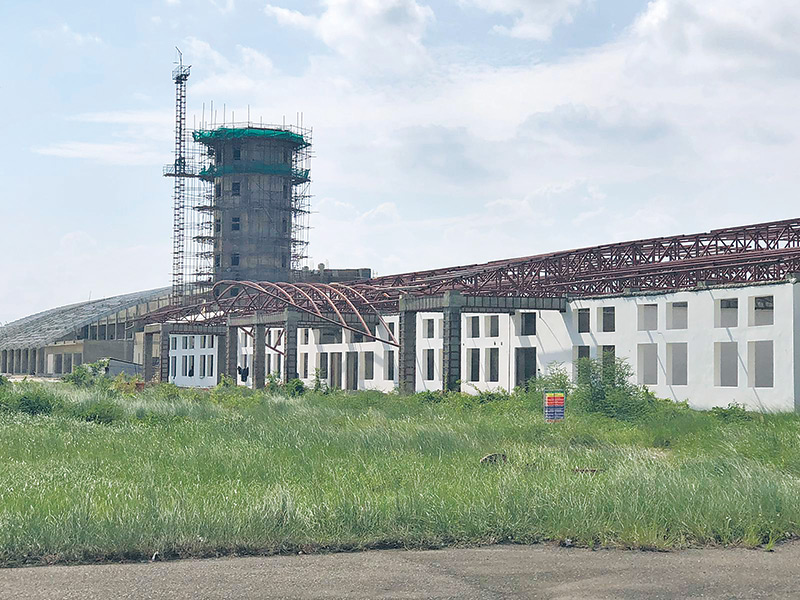
With a cash infusion, ANFA could work towards building better training facilities for players, along with providing them with more trainers, doctors and nutritionists. But the most significant drawback for Nepali football today is perhaps the lack of a proper stadium to play in, as the Dashrath Stadium, the country’s only large international stadium has been under construction for the last four years. In the absence of a stadium, Nepal will be forced to play its upcoming home matches for the ongoing World Cup and Asian Cup joint qualifiers in a neutral venue, losing its home advantage.
While many agree that investment is required, a lack of funding is not the only reason that is holding back football’s progress in Nepal, according to Raju Kaji Shakya, a former Nepali international and former coach of the national team.
Shakya says that the country lags behind in football due to the lack of a proper target for the country to achieve, something that Sherpa has pledged to address. When it comes to setting a target, the country can learn a lot from neighbouring India and Bhutan.
“India is spending heavily and has been organising international standard competitions for years because of their target to participate in the 2026 World Cup,” he said. “Only time will tell if India will succeed or fail in achieving the World Cup target but it has a clear roadmap. We don’t have that. We are lost and we bicker about being lost.”Bhutan too is an example for Nepal to follow when it comes to developing football.
“Bhutan is a country we have defeated in all formats. Our biggest win till date has also been against Bhutan, but things have changed now,” said Shakya.
Bhutan defeated Nepal 3-0 in the recently concluded SAFF U-18 Championship in Kathmandu. It was not only the scoreline but also their performance that left the Nepali side in awe. According to Shakya, Bhutan has learnt from their past experiences and set a target for themselves.
“The 3-0 result was not just the margin of victory, but it is also a reflection of what Nepal missed out on while Bhutan was silently bettering their game,” said Shakya.Former national team striker Hari Khadka agrees.
“We play without any long-term target to achieve,” said Khadka. “We have to set ourselves a target, define the things that we are going to achieve in the first 10 years and in the next 10 years. It takes time but it will pay off.”
When it comes to the actual game, Shakya and Khadka believe that Nepali players can keep up, provided that they receive proper guidance, training and better facilities.
“Wherever I have gone with the squad, be it the national team or youth-level teams, the opposition has always lauded our technique and fighting spirit. But results have always eluded us, and sadly, there have been no concrete efforts to address this,” said Shakya.
Most of these issues can be addressed with one quick fix, say analysts—domestic leagues that run for a majority of the year. According to Mishra, a national league should be played for at least nine months with a three-month break in between, a sentiment that Sujal Shrestha, the national team vice-captain and the stand-in-skipper of the Nepali squad against a Myanmar friendly played on Thursday, agrees with.
“The most important thing is to have a regular league that runs for eight to nine months. New talent can be spotted at such events,” said Shrestha. “But we don’t have a league or tournament on a regular basis and the ones we do don’t run for more than four months. When there is no league, clubs are reluctant to offer contracts to footballers, which is directly related to the survival of the players.”
Birat Krishna Shrestha, another former national team coach, believes that domestic leagues should be supplemented by age-group tournaments that take place throughout the year.
“It is only when a major age-group tournament comes that we begin to prepare, ” said Birat. “What can we expect when we are participating in tournaments without proper preparation?”
Nepali football, both clubs and ANFA, needs to focus on the youth and on identifying and developing talent early, according to analyst Mishra. Football clubs, the majority of which are capital-based, need to expand across the country.
Nepal currently has 14 ‘A’ division clubs, the highest level in the hierarchy of Nepali football. All of them are based in Kathmandu, including the three departmental clubs—Tribhuvan Army, Nepal APF, and the Nepal Police Club.
“Clubs are locally based. They can increase the number of their members and start selling club merchandise. This will help generate revenue and in turn sustain the club and pay the players,” he said. “This will also help players play football around the year. In the present context, there are few clubs that can play football all year round.”

Men miss but women score
The men’s football team might be struggling but the women’s team, although with a shorter history than the men’s, has enjoyed much more success at the international level. Nepali women played their first international tournament in 1986 and since then they only played three tournaments—10 matches—in 24 years, until 2010. In fact, women’s football only gained momentum after it was included in the 2010 South Asian Games. Since then, Nepal has finished as runners-up to India in four of the five editions of the SAFF Women’s Championships while it has gone down twice against the same opponents in the finals of the South Asian Games.
Unlike the women’s team, the men’s team has consistently failed to cross the group stages of the SAFF Championships. Since the beginning of the biennial SAFF Championship, the best result the men’s team has achieved so far was entry into the semi-finals.
But despite the success of the women’s team in the international arena, women’s football has always received less priority domestically. There are hardly two or three domestic tournaments for female footballers, in comparison to the dozens of men’s events.
“This is not only in Nepal. Women’s tournament were less attractive throughout the world until 2000. But women’s football gained momentum once FIFA included a mandatory provision to spend at least 15 percent of its grant to national associations on women’s events,” said analyst Mishra. “Many other developed countries introduced women’s football late. But now the scenario has changed. Women’s international events are getting sponsors as well as audiences.”
Mishra credits the departmental teams—Police, APF and Army—for Nepal’s strong presence in the South Asian region. “Nepal Police formed its women’s team back in 1997-98, the APF formed its in 2003 and the Nepal Army in 2010. The departmental team plays and practices round the year so they became better,” said Mishra. “Nepal also has comparatively more freedom for women than Islamic countries, so this has contributed to their better standard of play.”
Mishra believes that women’s football is capable of much more success than its male counterparts if equal investment is made on both of them.
“Developing a women’s league, which we don’t have, along with more investment would take women’s football to much greater heights. Until now, Nepali women have been playing more passionately than men and they are happy to have earned their bread and butter through football. Around 70 footballers are enrolled with the women’s team,” said Mishra.

Making a comeback
It is not all bleak for the men. After a decade of decline, Nepal has had a fair amount of success since 2015. Nepal’s 22-year wait for a trophy ended when they defeated India 5-4 in the tie-breaker of the first edition of the U-19 SAFF Championship on home soil in 2015. A year later, Nepal won the Bangabandhu Gold Cup defeating Bahrain 3-0 in the final in Bangladesh and that same year, Nepal also won the first edition of the AFC Solidarity Cup, with a 1-0 victory over Macau in Malaysia.
These titles reflect a measure of success but they also set a standard for more to follow, said Shakya. “We waited 23 years for a title. Yes, we should bask in our success but we should think more about why it took us 23 years to win a title. If we don’t think about that now, we may have to wait for another 23 years for another title,” he said.
The failure to learn from past mistakes has not helped the country’s football. The 16-0 drubbing took place 16 years ago. Players can have a bad day and matches can be lost by huge margins.
“Had we learnt from our mistakes and set about addressing them, we might not have lost 7-0 against Kuwait in the recent World Cup qualifiers,” said Shakya.

Nepal’s national men’s side lost to Australia 5-0 in October’s World Cup qualifier, and has yet to win a match in the second round of matches. Post Photo: Hemanta Shrestha

Nepal defeated Bahrain 3-0 in 2016’s Bangbandhu Gold Cup final, in Dhaka, Bangladesh, which ended the county’s drought in the international arena.Post File Photo

]

Nepal beat India in 2016’s South Asian Games final, gaining its first football gold in 23 years. Post File Photo

Nepali national football players stretch before participating in a practice session at Dashrath Stadium, in 2015.Post Photo: hemanta shrestha

Proper training equipment, such as this parachute, is just one of many facets that need to be addressed to help the country’s football succeed. Post File Photo

Niru Thapa, captain of the women’s national team, is one of several women behind the success of the women’s team in the international arena.Post File Photo

Women’s football is relatively new in Nepal, but the country’s national side has already shown promise in several international tournaments.Post File Photo
HOME PAGE

Department of Passports cancels e-passport bid hours before the end of tender deadline

The bid was annulled after the intervention by Prime Minister KP Sharma Oli, officials say.
- ANIL GIRI

KATHMANDU : Hours before the extended deadline for the multi-billion-rupee e-passport tender ended, the Department of Passports on Thursday night cancelled the entire bid.
Issuing a statement, the department, late Thursday night, said that it has cancelled the e-bidding notice for the printing, supply, delivery, installation, testing, and commissioning of equipment and personalisation of electronic machine-readable travel documents.
“We do not know the reasons behind the cancellation but we have annulled the bid as per the Cabinet decision and instructions from higher authorities,” Ram Kaji Khadka, director-general of the Department of Passports, told the Post on Friday morning.
The bid has been cancelled despite the Passport Department having just 800,000 machine-readable passports in stock, as per an agreement with provider Oberthur Technologies, a France-based company.
On August 27, the department had issued a global tender for printing and supplying 5 million e-passports for five years on a competitive basis that would cost the state around Rs 8 to 10 billion.
The deadline for the supply and printing of e-passport was extended twice due to complaints from prospective bidders, who said the tender did not provide a level-playing field for all.
More than 18 international firms had expressed interest and many of them were set to submit tender documents on Friday. The Department of Passports was supposed to open the bid on Friday afternoon after extending the deadline on October 31 by a week.
According to officials, the current stock of machine-readable passports will last at the most until May and the government has no immediate measures to address the demand, which is expected to surge in the coming months in the wake of job openings in Malaysia and Japan.
Multiple officials the Post spoke to said that they had no idea why the bid was cancelled at the last moment.
At least three officials from the Prime Minister’s Office, Foreign Ministry and Ministry of Communication and Information Technology told the Post that the bid was cancelled after the direct intervention of Prime Minister KP Sharma Oli.
On Wednesday, Oli summoned Foreign Minister Pradeep Gyawali and Foreign Secretary Shankar Das Bairagi to discuss the recent boundary row with India, including the Kalapani issue.
“In that meeting, the prime minister communicated that the e-passport tender will be cancelled and that a new arrangement will be made after the installation of security printing,” an official told the Post on condition of anonymity as he was not allowed to speak to the media.
Though the government has planned to set up its own security printing facility, it is expected to take at least two years before it can start printing e-passports.
The official said the prime minister was increasingly unhappy over not getting support from officials in his bid to establish the security printing facility.
Nepal had signed a memorandum of understanding with France to set up a dedicated printing facility, leading a French government undertaking to forward a proposal to the Nepal government. The French company, however, expressed some reservations and later withdrew after various government entities called for separate open bids for passports, stickers and bank-notes.
“We do not know what is next,” said an official at the Department of Passports. “There has been no communication from higher authorities as to why the tender was cancelled.”
This last moment cancellation has shocked prospective international bidders. Dozens of representatives from several international firms in Asia, Europe and the US had assembled in Kathmandu for the tender. One prospective bidder, who did not wish to identify himself, told the Post that the $30,000 deposited as bond is at stake as no one knows what will happen in the wake of the cancellation.
“More importantly, this last moment cancellation has tarnished Nepal’s reputation internationally,” said the bidder.

HOME PAGE

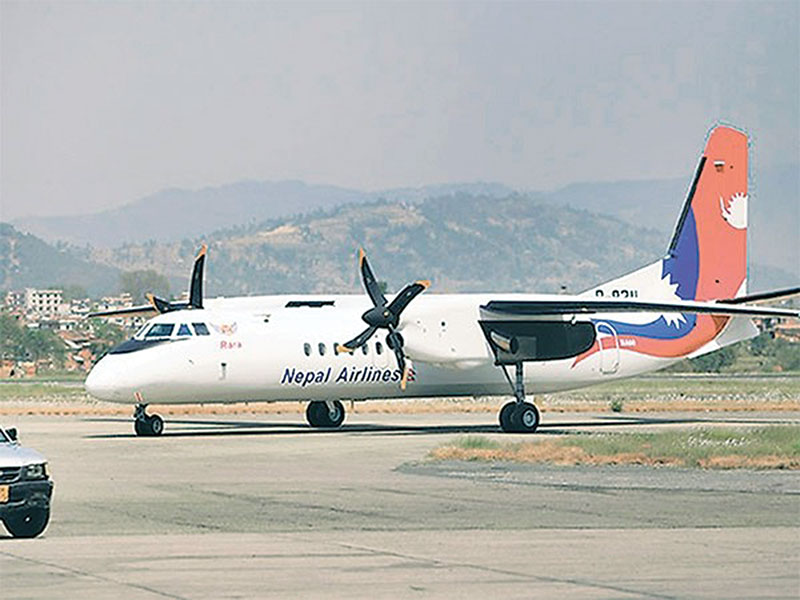
Nepal Airlines’ Chinese planes are flying less and racking up more in operation costs

Starting next year, Nepal Airlines will have to pay more than Rs250 million every year in interest for the six Chinese aircraft acquired in 2014.
- SANGAM PRASAIN

As part of the 2012 agreement, China provided one MA60 and one Y12e as gifts.Post file Photo

KATHMANDU : Come 2020, the cash-strapped Nepal Airlines Corporation will have to fork out more than Rs250 million a year to repay the interest for the Chinese planes it bought in 2014, as the seven-year grace period ends next year. The planes already incur an annual loss of Rs600 million in insurance and operating costs.
The corporation is already paying Rs3 billion annually in interest to its lenders for the purchase of four Airbus planes—two A320s and two A330s.
As the deadline for loan repayment nears, Nepal Airlines said on Wednesday that the Chinese planes have become a “burden” and that it is expecting assistance from the government to get rid of them.
“We have been holding talks with the government to get rid of the Chinese planes,” Madan Kharel, executive chairman of Nepal Airlines, told a press meet on Wednesday. “Since two out of the six Chinese planes came as gifts from China, we cannot directly sell them. We have asked the government to find a permanent solution.”
Kharel said the carrier also wants to revamp its domestic operations completely.
“But that’s not possible by flying the Chinese planes,” said Kharel. “We are optimistic about the government helping us find a solution.”
In November 2012, Nepal Airlines had signed a commercial agreement with the Aviation Industry Corporation of China, a Chinese government undertaking, to procure six aircraft—two 56-seater MA60s and four 17-seater Y12es.
As part of the deal, China provided one MA60 and one Y12e, worth a total of Rs2.94 billion, as gifts in 2014. The other aircraft were bought for Rs3.72 billion—a soft loan provided by China’s EXIM Bank.
The manufacturer completed assembling the 17-seater Y12e for Nepal in early 2015, once the first two were delivered in 2014. But they had been sitting in the factory hangar as Nepal Airlines had refused to take delivery of the planes due to their poor performance in Nepali skies and a lack of pilots trained specifically for the Chinese planes. Two Y12e planes were finally delivered in February last year.
The Nepal government has to pay an annual interest rate of 1.5 percent and a service charge and management expenses amounting to 0.4 percent of the overall loan amount taken by the Ministry of Finance as per the deal. The ministry, in turn, would charge Nepal Airlines an annual interest rate of 8 percent on the disbursed loan amount.
As per the November 2012 agreement, China had given a seven-year grace period under which Nepal Airlines would not have to repay the loan interest and instalment. The payback period of the loan is 20 years.
Nepal Airlines officials admit that the Chinese planes have multiple problems.
“We don’t get spare parts in time, nor are the spare parts available in other countries or with vendors,” said Kharel. “A shortage of pilots to fly these planes is another big issue.”
According to an official at the Civil Aviation Ministry who agreed to speak on condition of anonymity, Nepal Airlines was asked to present a report on Chinese planes—including why it cannot operate the planes and how the problems can be sorted out—during a Nepal Airlines Corporation board meeting five months ago. The board includes the joint secretaries from the Civil Aviation Ministry and the Finance Ministry.
“The report has yet to be tabled at the board,” said the official.
Given the high cost of the Chinese planes, Nepal Airlines has only two options—either sell them or bring them into operation.
Kharel said that the airlines would prefer to sell the Chinese planes. “But if that does not work, we will have to fly them,” he said.
Out of the four Y12e, only one is currently in operation as Nepal Airlines has just two trained captains capable of flying the Chinese planes.
“We plan to bring another one into operation by mid-December and the third one by January next year,” he said. The fourth plane is expected to come into operation by March. “We have two captains to fly the Y12e and one instructor pilot,” said Kharel. “Two more captains will be trained soon.”
The corporation has one MA60 still grounded and plans to bring it into operation by mid-December. Kharel said that they have adopted a new strategy to retain pilots to fly the Chinese planes.
“Young pilots want career growth. If they are hired to fly the Chinese planes, they will do it but only for a certain period. After flying 1,500 hours, they dream of flying bigger planes and we cannot stop them,” he said. “This is the key reason for the shortage of experienced pilots to fly the Chinese planes.”
According to Kharel, the airlines will now hire older pilots, who are above 60 years. “They don’t have many expectations and can fly the planes until they retire,” said Kharel.
The management has thus decided to hire captains Phizonath Nepali and KB Limbu, both of whom are above 62 years old. Nepali has been upgraded to instructor pilot.
However, one aviation expert who wished to remain anonymous questioned the motive of Nepal Airlines to hire old pilots for short takeoff and landing operations or to fly planes to remote mountainous areas.
“They may have vast experience of flying but at critical times, their judgement may fail,” he said. “Besides, they have to retire after 65.”
Sanjiv Gautam, former director-general of the Civil Aviation Authority of Nepal, said that the Y12e version was certified by the US Federal Aviation Administration in 2006.
“It’s not a problem with the plane but the management, as it didn’t have a proper plan to produce sufficient numbers of pilots,” Gautam said. “The management should be clear about hiring. It should have set a mandatory provision that pilots should fly the Y12e for at least five or ten years in order to be promoted to fly the Airbuses.”
According to Gautam, the Y12e performance is not up to par when it comes to flying to airports in high-altitude regions such as Manang and Dolpa, but it can fly reasonably well to airports in the hilly region.
The 56th annual audit report of the Office of the Auditor General, released in April this year, shows that the Chinese-made planes have been incurring heavy losses for the national flag carrier every year since they were purchased.
The audit report said that the Chinese-made MA60 aircraft made an income of Rs206 million last fiscal year, which ended in mid-July. However, its operating costs and other indirect expenses were Rs313 million and Rs212 million respectively, incurring total annual losses of Rs316.4 million.
Similarly, for the Y12e, the corporation earned Rs25 million in income. However, its operating costs and indirect expenditure were Rs188.5 million and Rs96.3 million, respectively. Losses for Y12e stood at Rs289.7 million last fiscal year.

Nepal Airlines officials say the Chinese planes have multiple problems.Post file Photo

Page 2
MEDLEY

HOROSCOPE

ARIES (March 21-April 19)
***
Have the confidence to do what you want today. Don’t be afraid to step into a new situation. Sure, you might not know how everything works at first, but that doesn’t have to put you at a disadvantage. Step out of your comfort zone—there’s just no other way to get that go-getter feeling.

TAURUS (April 20-May 20)
**
Relationships are fluid—people move in and out of the centre of your life all the time. This drifting phenomena is continuing with a troubled friend, who seems farther away than ever. Let them continue on their own path and value what they gave you. you are all individuals who need to take their own journey.

GEMINI (May 21-June 21)
***
The warmth you feel from friends will keep you in a very jovial mood today. You are gaining a whole new level of appreciation for the richness that your friendships bring to your life, and today will offer you a few opportunities to show it. Now is the time to splurge on a gift for a friend.

CANCER (June 22-July 22)
****
Today, you would much rather stay at home than go out. Puttering around and taking care of little chores will be much more tantalizing to you than the prospect of going out. It’s not that you are feeling shy or socially inhibited, it’s just that you are full of much more humble and quiet energy today.

LEO (July 23-August 22)
****
You may never find your exact purpose in life, but that doesn’t mean you should stop looking! Your spiritual side is growing hungry for stimulation, so keep pushing for insights. Avoid anything that is too easy to master, because it isn’t going to engage your brain enough. This is not a day to seek out comfort and ease.

VIRGO (August 23-September 22)
***
Sticking with things, even when they aren’t that much fun anymore, is necessary. If you make choices about what to do that are all about what will entertain you most, you won’t learn too much about yourself, will you? Right now, do something difficult. You have a lot of willpower that you have never fully taken advantage of.

LIBRA (September 23-October 22)
**
Holding on to your good humour and unlimited hope can help you overcome any obstacle today—and bring you closer to someone you have been dying to get to know better. There is a reunion in the works. Try not to overcommit yourself, socially—if you spread yourself too thin, you won’t make an impression on anyone.

SCORPIO (October 23-November 21)
***
If your relationships feel like they’re in a holding pattern, start thinking about the future. Where do you want your friendships and/or romantic partnership to go? The plans you formulate will be powerful reminders of the growth you’ve made and the growth you still want to make.

SAGITTARIUS (November 22-December 21)
**
There is about to be a major change in your routine and it might be very hard for you to get used to it. You will be torn between putting forth the energy to accept the situation and getting comfortable with it, or biding your time and hoping this adjustment is only temporary.

CAPRICORN (December 22-January 19)
****
When it comes to your finances, you cannot let your reputation come before your bank account. If you are afraid of being called cheap, you need to get over it. The people who toss those types of terms around are the same people who are deep in debt. What do they know about money matters?

AQUARIUS (January 20-February 18)
*****
There’s a vibrant whiff of creativity in the air right now, and it is intoxicating you! Take advantage of this inspiring energy and use it to stimulate your day. Take a trip to a modern art museum or an arts and crafts store for supplies. Do whatever you need to in order to let your juices flow.

PISCES (February 19-March 20)
**
Visions are important today. Your imagination, dreams and fantasies offer you insight and confirm a few suspicions. You’ve been in a fog about someone for a while, and a conversation with a mutual friend will illuminate some facts you were previously unaware of. Be up front and crystal clear about what you need.

Page 3
NATIONAL

Malaysia job aspirants are lining up for pre-departure services without pre-work approval papers

Only 5,000 preliminary labour permits have been approved, but more than 100,000 people have already paid for medical tests and obtained security clearance, officials say.
- CHANDAN KUMAR MANDAL

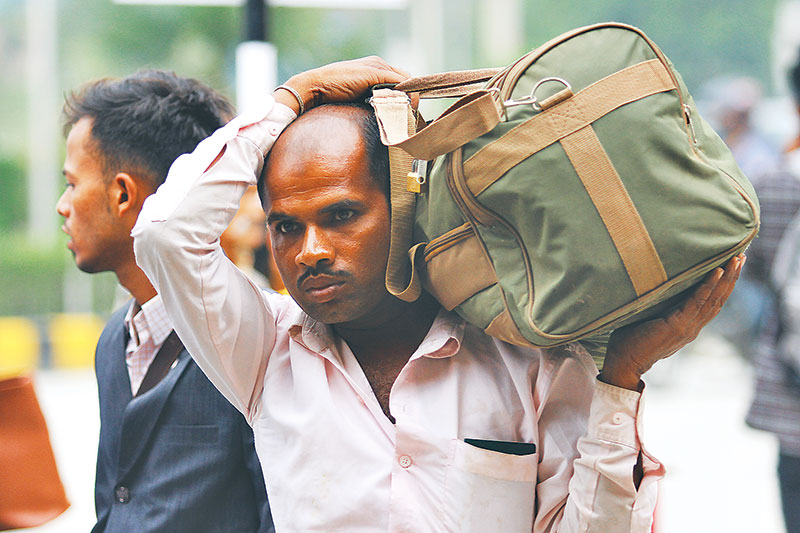
A migrant worker arrives at Kathmandu airport to catch a flight to his job destination.post file photo

KATHMANDU : Migration of Nepali workers to Malaysia, which resumed in September after a gap of several months, is staring at headwinds, with an increasing number of local workers lining up for pre-departure services without getting the preliminary labour permits from the government.
According to the Department of Foreign Employment, more than 100,000 people have already completed their medical tests, commonly known as Biometric and Immigration Security Clearance, but the number of workers who have got the preliminary work approval for Malaysia is only about 5,000.
“We have received information from various sources that tens of thousands of Nepali migrant workers have lined up for their medical examination and security clearance services,” Bhisma Kumar Bhushal, director-general of the department, told the Post. “Our estimate shows that over 100,000 have already paid and completed these processes, but that should not be the case.”
As per standard procedure, aspiring migrant workers apply for these pre-departure services only after getting pre-work approval documents. Pre-work approval broadly refers to the process of accreditation of job demand letters, which is obtained by recruiting agencies for hiring Nepali workers from the department.
Once the labour demand letter is approved by the department, the recruiting agencies conduct interviews of aspirant migrant workers for selecting candidates. Only after their selection do they move ahead with medical examinations and other requirements. The ongoing practice has not only violated existing procedures, but has also left migrant workers at the risk of being cheated.
“These workers should be first selected in the preliminary round before they go on to pay for these services. In some cases, recruiting agencies have not even applied for the jobs of these workers,” said Bhushal. “What if these poor workers never get jobs, even after paying for these services? They will only lose their money.”
Workers aspiring to work in Malaysia have to pay Rs4,500 for a biometric medical test and Rs3,200 for Immigration Security Clearance (ISC), which is provided by GSG Services Nepal. A worker also has to shell out money to pay other fees before landing in Malaysia.
As the department is not mandated to keep a watch over the activities of pre-departure services-providing agencies, it has written to the Ministry of Labour to issue a directive so as to stop providing medical and ISC reports to migrant workers who have not been selected through regular
process, according to Bhushal.
The department has also asked the recruiting agencies to forward the names of only those workers who have been selected through regular
hiring procedure and the letter that confirms their selection for the job.
Nepali migrant workers started departing for Malaysia after a 16-month suspension which had been imposed by Nepal because Malaysia had been imposing exorbitant fees on Nepali workers through various entities outsourced by the Malaysian government. But, despite the long gap, labour migrations to Malaysia have remained sluggish.
Following the long impasse, both countries signed a labour agreement in October 2018, under which the Malaysian government not only promised free jobs for Nepali workers but also said that henceforth, the various fees would be borne by the Malaysian employers.
According to Suresh Joshi, director with the Foreign Employment Office, the body that issues the final labour permits to aspirant migrant workers, only 4,000-5,000 pre-permissions have been approved by the department.
“Recruitment agencies were claiming that tens of thousands of workers are waiting in anticipation of getting jobs in Malaysia and were held back because of the suspension,” said Joshi. “Now, after the government has allowed labour migrations to Malaysia in the last one and a half months, that doesn’t quite appear to be the case.”

NATIONAL

Police arrest businessman Roop Jyoti and his daughter over a fraud charge

- SHUVAM DHUNGANA

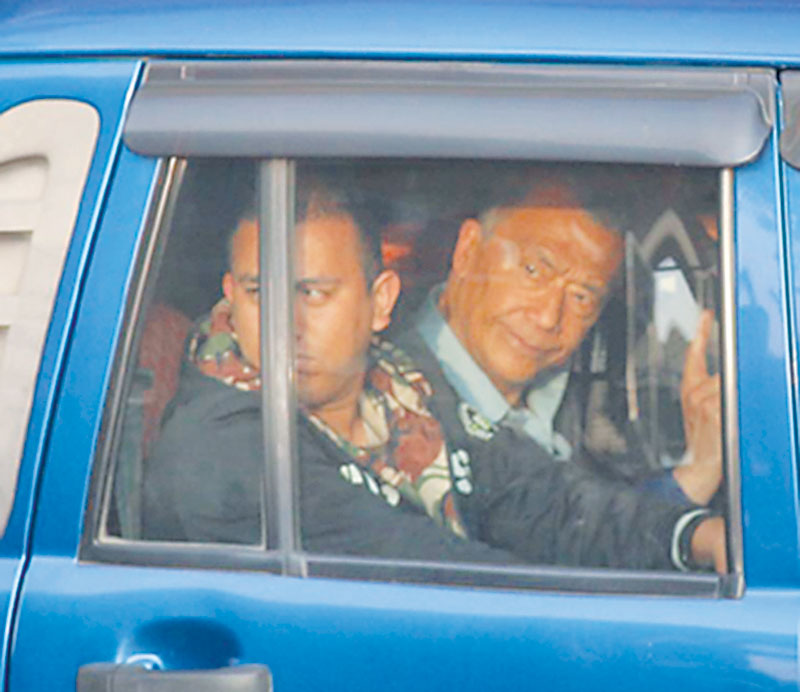
Roop Jyoti was arrested on Thursday night.post photo

KATHMANDU : Police on Thursday evening arrested renowned businessman Roop Jyoti and his daughter Suruchi Jyoti from Tribhuvan International Airport for their alleged involvement in a fraud case.
A team from the Kathmandu Metropolitan Police Range arrested Jyoti, a former assistant minister for finance, and his daughter after they deboarded a Silk Air flight from Singapore at around 8:30pm.
“Jyoti and the other accused were presented to Kathmandu District Court on Friday seeking permission to keep them in custody for seven days to further investigation. However, the court approved only three days of judicial custody,” said Deputy Superintendent of Police Hobindra Bogati, spokesperson for the police range. “Jyoti faces charges of collecting advance payment from homebuyers for houses in a yet-to-be-built housing complex in Kathmandu.”
An FIR was lodged against those involved in the fraud case. However, police have made only two arrests so far. “The investigation is ongoing and we will take appropriate actions against others if they are proved guilty,” added Bogati. “Police arrested Suruchi as she was also one of the operators of the construction company involved in the fraud.”
In December last year, police issued an arrest warrant against Jyoti based on complaints filed by Bikendra Krishna Malla. The complaint stated that Jyoti was involved in a housing fraud worth Rs27.6 million.
However, Jyoti had immediately filed a writ against the arrest warrant and obtained a stay order from the court. He had then issued a statement denying any involvement or connection with the housing and real estate company that has been accused of swindling customers on its housing project.
Almost a year after, a division bench of Chief Justice Cholendra Sumsher Rana and Justice Prakash Dhungana on Tuesday vacated the stay order.
Roop Jyoti is the vice-chairman of Jyoti Group of Companies, a prominent business house of Nepal. The group invests in iron, steel, textile and tourism sector, among others. Roop Jyoti served as the assistant finance minister during the reign of former king Gyanendra Shah.

Page 4
NATIONAL

Experts question decision to take Rs 13b loan for employment programme

Prime Minister’s Employment Programme was criticised last year for shoddy implementation and lack of oversight.
- CHANDAN KUMAR MANDAL

KATHMANDU : The government’s decision to accept a Rs13 billion loan for the implementation of the Prime Minister’s Employment Programme has been heavily criticised, as the programme has been controversial for its shoddy implementation.
A Cabinet meeting this week decided to accept a soft loan of Rs13.62 billion from the International Development Association, a part of the World Bank, in order to promote youth employment under the World Bank’s Youth Employment Transformation Initiative Project.
But labour analysts say this loan can only be justified if the employment programme is improved in the days to come.
“The need for the loan can only be proven right if the whole programme is aimed at asset creation, not just by ensuring social security for the unemployed but by providing jobs,” said Purna Chandra Bhattarai, a former government secretary and labour analyst. “Some infrastructure was definitely constructed last year under the programme but there were also instances when government funds were not utilised properly. The focus should be on properly utilising the money.”
The much-vaunted programme of the KP Sharma Oli administration was rolled out in February and aimed at guaranteeing a minimum 100 days of paid employment to citizens. At the end of last fiscal year, the government claimed to have generated 2,262,269 days of work for a total of 175,909 unemployed applicants.
Registered unemployed youths were mobilised in a total of 6,864 projects across the country. Initially, the government pledged to provide a minimum 100 days of paid employment for registered people. However, the goal was later revised to only 30 days of job opportunities for more than 100,000 people in the past fiscal year with the available budget and limited time remaining to implement the scheme.
The World Bank, on its website,
says that its youth employment project will support the government in improving employment services and labour-market outcomes for Nepali youth. The project, which will be implemented by the Ministry of Labour, Employment and Social Security, aims to benefit 100,000 youths and will be aligned with the employment programme. The loan amount will be spent on providing remuneration for youths working under the programme, toward skill development for unemployed groups, and to conduct various studies.
Last year, the employment programme created 13 days of work on average, after spending Rs2.36 billion allocated for the implementation of the programme.
Ganesh Gurung, a labour and migration expert, said that employment generation should be the priority of the government as it is the root cause of many other problems currently plaguing the country.
“Creating jobs inside the country is important. But how? The important thing is to pay attention to the employment scheme and its final outcomes,” said Gurung. “The loan for the programme will be on everyone’s head. If it benefits the country, we should have no problem in taking loans. But if the programme continues like last year, when mismanagement was reported, then it can be costly.”
The implementation of the flagship employment scheme of the government saw local level deploying registered unemployed citizens for unskilled labour activities like rearing stray animals, gardening, cleaning, and distributing funds.According to Bhattarai, the overall employment programme needs a thorough revision of how it’s implemented.
“I hope the government has reflected on last year’s experience of enforcing the programme and made the required changes to effectively implement the programme this year,” said Bhattarai.
This fiscal year, the government still aims to create a minimum of 500,000 jobs inside the country. More than 1.7 million applicants have registered with the employment scheme for which the government has allocated Rs5.01 billion in the budget for the current fiscal year.
“It was the first year of implementing the programme, so even the authorities responsible for implementing the scheme lacked the experience,” said Gurung. “This year, the programme and the investment should be oriented towards creative and productive sectors. If not, the programme can backfire. Monitoring, especially by a third party, is crucial for its success.”

NATIONAL

Rastriya Janata Party and Samajbadi Party eye electoral alliance for November 30 by-elections

The Janata Party will support the Samajbadi Party for three provincial assembly and a federal parliament seats.
- TIKA R PRADHAN

KATHMANDU : With dialogue for a potential unification between the Rastriya Janata Party Nepal and ruling coalition partner, Samajbadi Party Nepal, taking too long, the two parties have now decided to focus on an alliance for the upcoming November 30 by-elections.
Rastriya Janata Party Nepal failed to file nominations for three provincial assembly and one federal parliament seats, as the party’s only candidate did not have his name on the voter list. As many as 65 candidates filed their nominations for the four open seats on Thursday within the time allocated by the Election Commission.
“We had an understanding that the Samajbadi Party would support us in Dang-3 but we could not file our nomination because our candidate was not on the voter’s list,” said Keshav Jha, general secretary of the Rastriya Janata Party Nepal. “Now we will support the candidates of the Samajbadi Party in the four provincial and federal parliament seats.”
The by-elections are being held on November 30 to elect one federal parliament member, three provincial assembly members, one mayor, three rural municipality chairmen, one rural municipality vice-chair and 43 ward chairs.
The Madhes-based party, which had forged an electoral alliance with the then Sanghiya Samajbadi Forum during the 2017 polls, will now forge an alliance with the newly formed Samajbadi Party in the by-elections at the local levels. The two parties have also been running a coalition government in Province 2.
The two parties have formed separate task forces to discuss their electoral alliance. However, the task force has not finalised the issue of an electoral alliance at the local level yet.
“We have been discussing for the last two days and talks will continue. We will come to a conclusion before the nomination, which is scheduled for November 13,” Jha told the Post.
Janata Party leaders claimed that the party has been waiting for the Samajbadi Party—formed after the merger of the Upendra Yadav-led Sanghiya Samajbadi Forum and the Baburam Bhattarai-led Naya Shakti Party in May—to vacate the Nepal Communist Party-led government.
Bhattarai’s faction in the newly formed party has also been pressing Deputy Prime Minister and Health Minister Yadav to quit the government at the earliest, as the ruling party has not shown any interest in amending the constitution, which was the only condition set by Yadav to join the government.
The Samajbadi Party, of which Yadav and Bhattarai are both chairpersons, has called a central committee meeting on November 15 and 16, which is expected to decide whether the party should quit the government or not.
“We are waiting for the Samajbadi Party to leave the government. Once they decide, the merger process will be expedited,” said Jha.
On the other hand, Samajbadi leaders have been saying that the upcoming central committee meeting of the party will discuss whether the party should remain in government or not.
“The two chairpersons will come up with a political report, which will include all major issues, including the party’s role in government, merger with the Janata Party, alliance for the by-election, and the conclusion of the integration process,” said Prashant Singh, the party secretary and chief of the publicity department.
The Samajbadi Party has already delegated a talks team for the electoral alliance with the Janata Party. The team includes Renu Yadav, Province 2 Chief Minister Lalbabu Raut, Ram Sahay Yadav and Bijay Yadav. General Secretary Jha has been holding talks from the Janata Party.

NATIONAL

Suspected former Chand cadre held for offending police

- SHUVAM DHUNGANA

KATHMANDU : Police on Wednesday arrested suspected former Bhaktapur and Lalitpur in-charge of the Netra Bikram Chand-led party, Tek Bahadur KC, for misbehaving with police.
“During a regular police check, KC, who was riding a bike, misbehaved with officials on duty,” said Superintendent of Police Sabin Pradhan, chief at the Bhaktapur Police Station. “During investigation, we discovered that he was formerly in-charge of Bhaktapur and Lalitpur [districts] of the Biplav-led party.”
KC is in custody of Bhaktapur Police. The District Administration Office, Bhaktapur on Friday approved his custody for seven more days, according to police.
Police in Bhaktapur are said to have confiscated some donation receipts and found them suspicious.
The Chand outfit is an offshoot of the Maoist party that waged a decade-long war against the state.
Six years after the signing of the peace deal that brought the Maoist party to the mainstream, Chand, along with Mohan Baidya and Ram Bahadur Thapa, the incumbent home minister, had walked away in 2012. But two years later, Chand formed his own party to launch what he called a “unified revolution”, saying Nepal’s revolution was not complete. Before masterminding the deadly blasts in the Capital in February, the Communist Party of Nepal had been involved in attacking some foreign-funded companies, including Ncell, a private-sector mobile company. Though the government says it is open to talks, the outfit has not responded but has put forth three pre-conditions—an official invite for dialogue, the lifting of the ban on its activities, and the release of its cadres.

Page 5
NATIONAL

Sisne launches doorstep drive to distribute social benefits

The local unit is one of the remotest corners in Rukum (West) and recipients have to travel hours to reach nearest bank.
- HARI GAUTAM

RUKUM (WEST) : Sisne Rural Municipality in Rukum (West) has launched a drive to distribute social security allowance allocated to the elderly citizens, people with disabilities, single women and Dalit children at their own homes.
Sisne is one of the remotest corners in the district and its residents have
to travel for hours just to reach the nearest bank.
“Today, the representatives and officials came by our homes and
distributed the allowance,” said Man Bahadur Budha, a local. “It feels
good. We now know what local governments are really for.”
Bina Gharti, 75, had to travel for hours to reach the rural municipal office and receive her allowance.
With this new drive, Gharti says it has become easy for her and many other villagers to collect their benefits.
The drive is currently effective in ward numbers 1, 2 and 8 of the rural municipality.
“The three wards are some of the remotest ones in the municipality,” said Jeevan KC, chair of ward number 2. “We are excited by the positive responses from the people.”
Elderly people over 70 years of age get Rs3,000 monthly, elderly Dalit people over 60 receive Rs2,000, single women receive Rs2,000, while people with disabilities get Rs3,000 and Rs1,600, depending upon the extent of their disability, as social security allowance.

NATIONAL

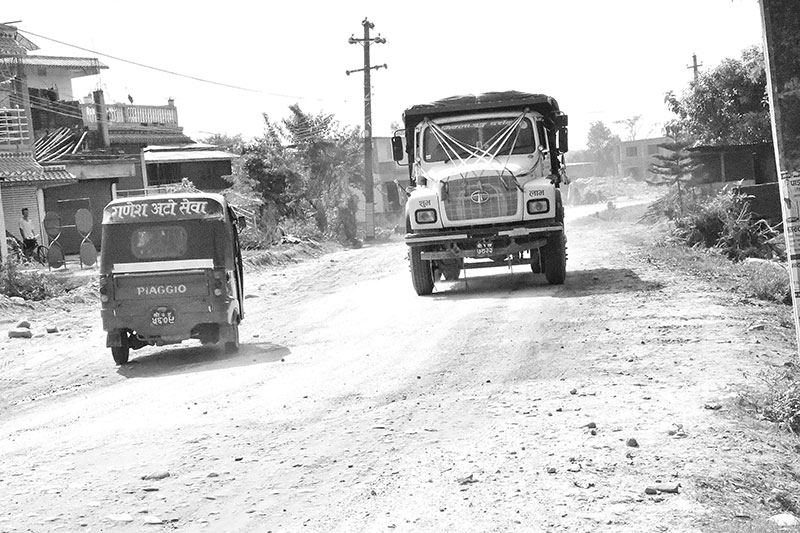
BP Highway riddled with potholes within months of repair

Immense traffic, especially of heavy goods carriers, has taken a toll on the recently repaired road, authorities say.
- RAJ KUMAR KARKI

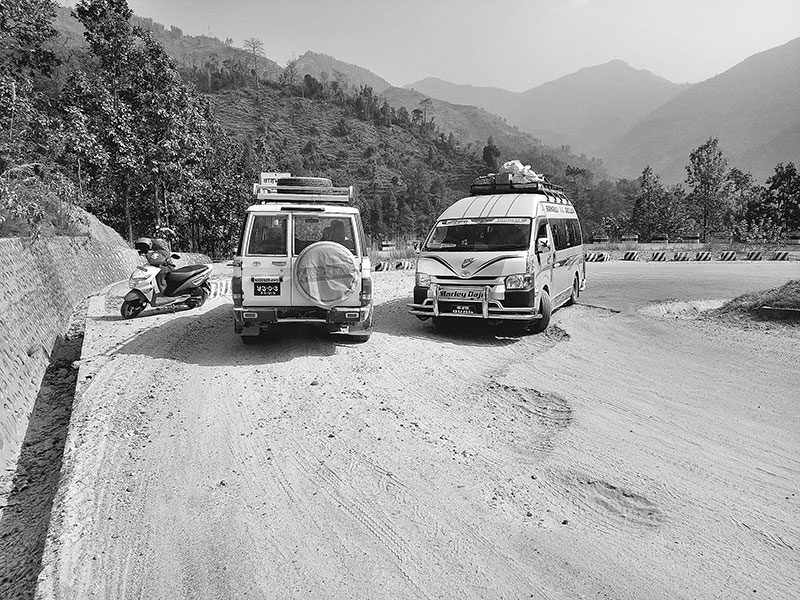
According to the District Traffic Police Office, around 2,000 to 2,500 vehicles, including cargo lorries and buses, use the highway on a daily basis.Post Photo: raj kumar karki

SINDHULI : The Sindhuli section of the BP Highway is riddled with potholes just four months after the Banepa-Sindhuli-Bardibas Road Project repaired the road stretch.
“The Sindhuli section was repaired recently, but it has already developed potholes. It’s become very risky to drive on that section. Because of the state of the road section, it takes us around six hours to reach Kathmandu from Sindhuli; earlier it would take us about four hours,” said Santosh Karki, the driver of a four-wheeler who commutes daily along the highway.
Immense traffic, especially of heavy goods carriers, has taken a toll on the recently repaired road, said Ramesh Acharya, a technician of the road project. According to the road project officials, lack of proper drainage system along the highway and ongoing construction of houses have also caused waterlogging on the surface of the road, which has lead to the formation of the potholes.
“We repaired the road just four months ago, but the road is damaged again. The locals carelessly dispose of soil onto the road from their construction sites, leading to waterlogging. The road project, local units and the locals should work together to keep the road in good condition throughout the year,” said Acharya.
The locals believe that excessive use of excavators while levelling the ground to build houses has worsened the road condition. Though the government has banned tripper trucks on the road section, they are seen carrying sand and pebbles, and their numbers have actually risen with the increase in the number of crusher industries near Sunkoshi river, locals say. “It is a very important highway with heavy traffic. But the authorities repair the road quite carelessly,” said Pushkar Thapa of Sindhuli. “The number of goods carrying tippers should be controlled.”
BP Highway is the shortest route that connects the Kathmandu Valley with the eastern Tarai region. According to the District Traffic Police Office, around 2,000 to 2,500 vehicles, including cargo lorries and buses, use the highway on a daily basis.
The highway, inaugurated by the late prime minister Sushil Koirala in July 2015, was constructed with a Japanese grant of Rs21.5 billion. The 37-metre road had collapsed at Tribenighat in Sindhuli in 2017. Authorities claimed that heavy traffic was the cause behind the severe damage then as well.

NATIONAL

Money laundering unit notifies district police to investigate Alam’s assets

- SHIVA PURI

Alam will be arrested again even if the court releases him on general date, according to the letter sent by the department.Post Photo: shiva puri

RAUTAHAT : The Department of Money Laundering Investigation in Pulchowk, Lalitpur, has notified the District Police Office in Rautahat to present Mohammad Aftab Alam at the department for an investigation into his properties. The Nepali Congress lawmaker has been in police custody since his arrest in connection with an explosion and the subsequent murder of at least 23 people in Rautahat 12 years ago.
Bhupendra Khatri, superintendent of police in Rauatahat, said Alam will be arrested again even if the court releases him on a general date, according to the letter sent by the department. “We notified the court on Thursday to send Alam to the department for an investigation into his properties,” he said. According to police, the department will conduct the investigations under the Money Laundering Prevention Act 2008.
On Thursday, the District Court began a formal trial on Alam’s case. The trial continued on Friday as well. The Rautahat District Attorney’s Office had filed a charge sheet against Alam, demanding his life imprisonment.
Alam was arrested on October 13 for the or his involvement in a bomb blast in Fradahawa, Rajpur, in the district on April 9, 2008. Police had registered ‘attempted murder’ and ‘holding, transporting explosive materials’ charges against him, and he faces charges of burning injured people alive in a brick kiln “to destroy evidence”.
Alam was elected to the federal parliament from Rautahat-2 in the 2017 elections.

NATIONAL

Locals of Urlabari-Ravi road suffer from health problems caused by dust pollution

The road has been under construction for the last seven years with no sign of completion.
- DEO NARAYAN SAH

As a short-term solution, locals have resorted to sprinkling water on the road and the nearby areas. Post Photo: deo narayan sah

MORANG : Construction work on the 12.4km Urlabari-Ravi road started some
seven years ago but it is yet to see completion.
Prera/Jyoti JV Construction in Kathmandu had received a tender from the then Eastern Division Road Office in Biratnagar on May 2012. The contractor had to blacktop the 12.4km of the road within two years, according to the agreement. But till date, there has been little progress on the road.
Buddhiman Chaudhary, a local of Miklajung, says that people living in the area are living in poor health conditions because of the air pollution caused by the construction work. “My village is close to the road and we haven’t been able to
breathe clean air for so many years now. The surrounding area is always covered in billowing clouds of dust because of the construction,” he said. “I have installed solar panels on the roof of my house but they don’t work because of the layers of dust that settles on the panels every day.”
As a short-term solution, locals have resorted to sprinkling water on the road and the nearby areas.
Devi Khadka, a local of Madhumalla, said they have been requesting the concerned authority to complete the construction of the road soon but to no avail. “The residents living near the road construction site are suffering from respiratory diseases and common cold due to dust particles in the air,” she said.
Every day, hundreds of speeding vehicles leave a trail of dust behind. Man Bahadur Shrestha, a local of Urlabari, said, “We have asked the concerned authority to complete the construction work of the road as soon as possible. We are living in hazardous conditions because of
this road project.”
Shailendra Kumar Singh, an engineer at the Infrastructure Development Office under the provincial government, said that his office has tried to contact the representatives of the contractor company to carry out the construction work but they have been able to reach the company representatives.
According to him, the contractor had used substandard materials while constructing the road. “After the Commission for the Investigation of Abuse of Authority (CIAA) started investigation upon the financial irregularities five years ago, the contractor company has fled,” said Singh. The investigation of the CIAA is still ongoing.
The Division Road Office in Biratnagar, which was under the federal government, had handed over the road project to the provincial government last year. But the provincial government has not prioritised the completion of the road project, locals say.

NATIONAL

Polling stations marked sensitive in Makalu for upcoming by-elections

The by-elections are going to be held for the position of chairperson in Makalu Rural Municipality.
- DIPENDRA SHAKYA

SANKHUWASABHA : A total of 10 polling stations in Makalu Rural Municipality, Sankhuwasabha, have been marked ‘sensitive’ for the upcoming by-election, according to the local election office.
“These remote areas have had troublesome security records in the previous elections as well.
That’s why we marked Makalu as sensitive,” said Cholaraj Dangal, chief at the election office in Sankhuwasabha. “There are 9,100 voters.”
The by-election, which is scheduled for November 30, will be held for the position of Makalu Rural Municipality’s chairperson.
A by-election is also going to be held for the post of ward chairman in Khadbari Municipality Ward No. 3.
Jiban Prasad Dulal, chief district officer, said the local administration plans to arrange security for the by-elections after evaluating threats and challenges.
“We plan to mobilise Nepal Army and Armed Police Force for election security,” said Dulal.According to the Election Commission, 101 parties are
participating in the by-elections.
The parties that contested the 2017 elections automatically qualify to participate in the by-elections, while at least 16 new parties or those which came into being following mergers after the 2017 elections are also participating in the by-polls, according to the election office.

NATIONAL

Water project benefits villagers

Briefing
- Post Report

ARGHAKHANCHI: Sixty-one households in Khidim of Padini Rural Municipality have benefited from the construction of a drinking water project at a cost of Rs 2.4 million. The project has been completed with donations from the locals.


NATIONAL

Marijuana plants destroyed in Bhojpur

- Post Report

BHOJPUR: As part of a clean-up drive, police destroyed marijuana plants cultivated at Hatuwagadhi, Aamchok and Pauwadung Rural Municipalities in Bhojpur district. According to the District Police Office, it took six days to destroy more than 98,600 plants in the area.


NATIONAL

In Baitadi, preparations intensify for by-elections

- Post Report

BAITADI: The District Election Office in Baitadi has intensified preparations for the upcoming by-elections. The elections are going to be held in three wards of the local units (Purchaurdi Municipality, Sunarya, Dogadakedar Rural Municipalities) in Baitadi.


NATIONAL

Woman held with bear gall bladder

Briefing
- Post Report

BHOJPUR: A woman was arrested in possession of a bear’s gall bladder from Tamkemaiyung Rural Municipality in Bhojpur district. The District Police Office
in Bhojpur arrested Mitralaxmi Rai, 34, on the charge of smuggling wildlife parts. Rai, along with the seized gall bladder, has been handed over to the Division
Forest Office for further investigation, said police.


NATIONAL

Baitadi folk protest against the new Indian map

Briefing
- Post Report

BAITADI: Members of youth clubs in Baitadi district on Friday took to the streets to protest the new map released by the Indian government which includes the disputed land of Kalapani inside its map. The youths engaged in sloganeering against the Indian government in Purachaudi and Shahilek bazaars.

Page 6
MONEY

China reshapes global meat markets as swine fever rages

Rabobank estimates that China’s hog herd fell by half in the first eight months of 2019.
- REUTERS
A vendor sells pork at Sanyuanli market  in Beijing, China. reuters 

LONDON/BEIJING, 
China is scouring the world for meat to replace the millions of pigs killed by African swine fever (ASF), boosting prices, business and profits for European and South American meatpackers as it re-shapes global markets for pork, beef and chicken.
The European Union, the world’s second largest pork producer after China, has ramped up sales to the Asian giant although it can only fill part of the shortfall caused by ASF. Argentina and Brazil have approved new export plants to meet demand and are selling beef and chickens, as well as pork, to fill the gap. US producers, however, have been hampered due to tariffs imposed by Beijing.
Other Asian countries are also ready to step up imports as they, too, deal with outbreaks of ASF. Vietnam, the Philippines, North and South Korea, Laos, Myanmar and Cambodia are all struggling to contain outbreaks of the disease, which is deadly to pigs although not harmful to humans.
“It is very good news for those involved in processing and have licenses for exports to China,” said Justin Sherrard, global strategist, animal protein at Rabobank.
Major EU pork processors include Danish Crown, Tonnies Group and Vion Food Group although the market is fragmented with many small- and medium-size players.
Shortages in the world’s top pork consumer have been exacerbated by the upcoming Lunar New Year celebrations in late January, when pork, and pork dumplings in particular, play a central role in the food on offer.
One of the biggest European players Danish Crown said there had been a very clear jump in demand from China in the run-up to the Lunar New Year and it was bullish on the outlook for 2020.
China’s state-owned agriculture conglomerate COFCO said this week it had agreed to buy $100 million of pork from Danish Crown in 2020 to help ease the domestic shortage.
Rabobank estimates that China’s hog herd, the world’s largest, fell by half in the first eight months of 2019 and will likely shrink by 55 percent by the end of the year.
Many more meat plants in Argentina and Brazil have recently been approved to export to China including beef and chicken as well as pork.
Nicholas Lafontaine, a cattle rancher from the town of Azul, 300 kilometres (186 miles) southwest of Buenos Aires, said China had traditionally taken cheap cuts with premium steaks destined for the EU.
China is now taking the whole carcass, reducing the amount of meat sold on the local market for Argentina peso, a currency which has lost around a third of its value this year.
As processing margins have improved, plants have reopened.
“The other benefit that comes from growing Chinese demand is the reopening of beef plants, he said, adding that when a factory opens its doors it is thinking about China.
Neighbouring Brazil has also benefited.
According to Brazilian meat trade groups, in one go Beijing authorised Brazil to more than double the number of beef plants with permits to sell directly to mainland China—to 33.
Brazil exported 1.64 million tonnes of beef in 2018 with China buying 19.3 percent of the volume, trailing only Hong Kong.
The South American country’s exports have been forecast to rise to 1.8 million tonnes this year.
“China is the market paying the highest premiums for Brazilian meatpackers,” Luciano Pascon, chief executive of privately-owned meatpacker Frigol, told Reuters in an interview.
Hefty tariffs on American pork imposed by China as part of the ongoing trade conflict are likely to mean that the US industry will benefit less than its rivals.
US-based meat packers such as Smithfield Foods have, however, been able to secure some direct sales.
Tyson Foods expects to benefit from African swine fever by increasing sales to China or other countries as the outbreak redirects global meat trading.
Tyson Foods share price has risen about 50 percent so far this year.
Trent Thiele, a farmer who raises about 60,000 hogs a year in Elma, Iowa, said, however, the trade war is hurting American hog producers.
Thiele said he would prefer selling US pork to Chinese buyers than picking up residual business elsewhere in the world because China is a main buyer of products such as pigs’ feet and organ meat that other countries have little appetite for.
“A lot of our other competitor countries are obtaining the market share that naturally would have been ours if we didn’t have the retaliatory tariffs,” said Thiele, president of the Iowa Pork Producers Association.
Imported pork ribs currently cost around 40,000 yuan ($5,680) per tonne, compared with 17,600 yuan in spring 2019, traders said, while prices for other cuts such as pig front leg and rib meat have roughly doubled in that period.
“Right now, prices are astronomical, and the risk is very high,” said a Beijing-based beef importer, who was struggling to gauge the right volumes to meet demand and avoid being left with expensive stock at the end of the holiday period.
The United Nations Food and Agriculture Organisation’s Meat Price Index is up 12.5 percent so far this year and is at the highest level since January 2015.
The pork component has risen by more than 20 percent.
The high global pork prices are even sparking interest in pig farming in predominately Muslim Kazahkstan.
“Not a week goes by without someone visiting us who wants to get into pig farming,” said Maksut Baktibayev, chairman of Kazakhstan’s Meat Union, an industry lobby group.

MONEY

Japanese companies likely to spurn Saudi Aramco IPO: JXTG president

- REUTERS
Members of media chat before the start of a press conference by Aramco at the Plaza Conference Center in Dhahran, Saudi Arabia. Reuters 

TOKYO, 
Japanese companies are unlikely to invest in Saudi Aramco’s blockbuster initial public offering (IPO) because
it is difficult to evaluate the value of the world’s biggest oil company, the head of Japan’s largest refiner said
on Friday.
The unusually frank remarks from the head of a typically conservative Japanese company underscore potential challenges for the IPO, which Aramco has announced is going ahead although the state-owned oil giant has released few details.
Sources have told Reuters that Aramco could offer 1 percent-2 percent of its shares, raising as much as $20 billion to $40 billion. A deal over $25 billion would top the record-breaking IPO of Chinese e-commerce giant Alibaba in 2014.
“It’s difficult to think that many Japanese investors will make investments,” JXTG Holdings President Tsutomu Sugimori said at an earnings briefing. “Japanese companies have stakeholders and they need good reasons to explain to shareholders why they would make such hefty investments and we need to do strict due diligence.”
He was responding to a question on whether Japanese companies would follow Chinese investors, after Bloomberg reported that Chinese state-owned firms, including Sinopec Corp, were considering investing up to $10 billion in the Aramco share offer.
“We don’t know about Aramco’s crude oil reserves and how their contracts with the Saudi royal family work and so on. Aramco will need to disclose this information, but it is not clear how open Aramco will become,” Sugimori said.
Aramco, the world’s most profitable company, said on Sunday it was kicking off a domestic IPO, with scant details disclosed and expert valuations varying from around $1.2 to $2.3 trillion. JXTG and other Japanese refiners have longstanding relationships with Aramco, having been big buyers of Saudi crude for decades, although Japan’s oil imports have fallen as a declining population uses more efficient automobiles.
Aramco supplied almost 36 percent of Japan’s crude imports in September, which totaled 2.8 million barrels
per day.
The Saudi oil company owns a 7.65 percent stake in Idemitsu Co, Japan’s second-largest refiner, according the Japanese company’s website.

MONEY

Alibaba sets eyes on $15 b Hong Kong listing: Report

- AGENCE FRANCE-PRESSE
reuters

HONG KONG,
Chinese online retail titan Alibaba is hoping to raise up to $15 billion in a Hong Kong IPO, a report said Friday, which would be the city’s biggest listing for nine years.
The share sale by Asia’s biggest company would also come as Hong Kong authorities battle months of sometimes violent protests that have dented the financial hub’s economy and reputation.
Alibaba is looking to scoop up between $10 billion and $15 billion in the initial public offering, Bloomberg News cited unnamed sources as saying, and is looking to hold a hearing into the move—as mandated by the Hong Kong exchange rules—next week.
The firm declined to comment on the report when contacted by AFP.
Alibaba, which is already listed on New York’s Nasdaq, had planned to list in the summer but called it off owing to the city’s long-running pro-democracy demonstrations and the China-US trade war.
If realised, the $15 billion IPO would be the biggest since insurance giant AIA garnered $20.5 billion in 2010. However, it is lower than the $20 billion it had aimed to raise initially.
A second listing in Hong Kong would also curry favour with Beijing, which has sought to encourage its current and future big tech firms to list nearer to home after the loss of companies such as Alibaba and Baidu to Wall Street.
Mainland authorities have stepped up moves to attract such firms including launching a new technology board in Shanghai in July.
The Sci-Tech Innovation Board was launched as a battle with the United States for technological supremacy heated up, with Chinese President Xi Jinping calling on tech leaders to become global champions, while the US has fought back in part by taking steps to clip the wings of Chinese telecom giant Huawei.
Alibaba has capitalised on the Chinese consumer’s love of e-commerce to dominate the sector in China and become one of the world’s most valuable companies.

MONEY

Cyprus signs $9 billion gas deal with energy majors

- AGENCE FRANCE-PRESSE

NICOSIA,
Cyprus announced Thursday it had signed its first natural gas exploitation deal worth $9.3 billion with a consortium comprised of industry giant Shell, US-based Noble and Israel’s Delek.
“Noble Energy, Shell and Delek now have in their hands the first exploitation license granted by the Republic of Cyprus so they can commercialise the deposit,” said Energy Minister George Lakkotrypis, shortly after the agreement was signed.
The 25-year license is for the Aphrodite gas field, the first to be discovered off Cyprus, by Texas-based Noble Energy, in 2011. It is estimated to contain over four trillion cubic feet (over 113 billion cubic metres) of gas.
The signing of the deal comes after the cabinet approved revisions to a production sharing agreement, made at the companies’ request due to a significant fall in hydrocarbon prices since mid-2014. The re-working of the production contract means Nicosia is set to receive an average yearly income of $520 million over an 18-year period.
Lakkotrypis said that under the new deal, the consortium is obliged to keep to a tight deadline to begin extracting the gas reserves—and generating revenues—by 2025.
In February, ExxonMobil and Qatar Petroleum discovered an even bigger natural gas reserve off the coast of Cyprus, holding an estimated five to eight trillion cubic feet.
Italy’s ENI and Total of France are also heavily involved in exploring for oil and gas off Cyprus. The Republic of Cyprus, an EU member state, has pushed ahead with exploring for offshore energy resources despite the collapse in 2017 of talks to end the island’s decades-long division.

MONEY

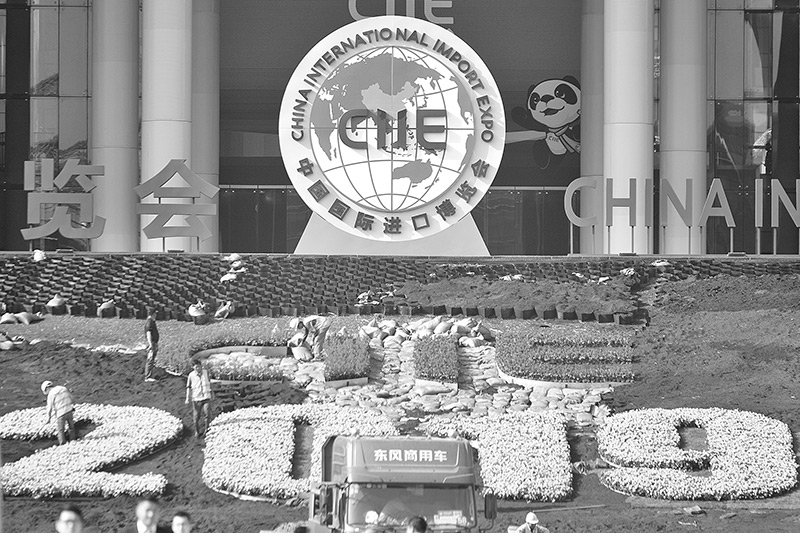
With trade war as a backdrop, US firms walk a line at China expo

- REUTERS
Workers set up the venue for the second China International Import Expo in Shanghai, China. reuters 

SHANGHAI, 
At trade shows in the United States, California-based Champion Power Equipment displays the faces of the tough-looking sportsmen that it sponsors against the backdrop of an American flag.
At an import expo in China this week, the images of a pro bass fisherman, lumberjack, bull rider and NASCAR and off-road drivers were there—but the flag was not.
“Even though we’re proud to showcase we’re a US company, there are some things we’ve just tried to ... tame it down a little bit,” said Greg Pauken, director of product development at the maker of portable generators and other motorised tools. “Why create any more conflict than you need to?”
US companies are walking a tightrope at the Nov. 5-10 China International Import Expo (CIIE) in Shanghai, with the fate of a preliminary deal between China and the United States to defuse the trade war still up in the air.
Strong backing from Chinese leader Xi Jinping has imbued CIIE with political symbolism unmatched by any other trade show in China.
The US government has made a point of skipping it in the two years it has existed. Several other countries have sent leaders or senior officials, and many are hosting lavish pavilions promoting their nation’s wares.
Nevertheless, more American companies have showed up this year—nearly 200—than in CIIE’s inaugural year, propelled by enthusiasm about China’s vast market. In some cases, companies also want to support an event that the Chinese government considers highly significant.
Concern was not far from the surface about prospects for business if the trade war drags on and the world’s no. 2 economy continues slipping.
US companies are not yet being stigmatised, according to Stephen Lien, president of the Aerospace Asia Pacific Division at Honeywell International Inc, but such a thing was “certainly possible.”
“We get Chinese customers walking in and talking to us all day long,” he said. “They’re not going to Philips
just because we’re an American company and Philips is a European company. There continues to be a lot of interest.”
Nearby, Twiggy Zhao, a representative at the WD-40 Co booth, said the California-based maker of lubricants was eager to gain traction in the China market but remained “a little bit worried” about trade war fallout.
“We quite want to separate politics and business. I mean, our product is very helpful and useful, so we want people to focus on products,” she said.
On top of trade uncertainty is the perception that political risks have risen, as highlighted by the troubles the National Basketball Association has faced since the Houston Rockets’ general manager tweeted support for Hong Kong’s protests last month.
For Impossible Foods, the developer of plant-based meat substitutes, the risks are outweighed by the prospect of tapping into a huge country reliant on a environment-straining livestock industry.
Founder and chief executive Pat Brown was taking advice on how to walk the line from his brother, a diplomat in China.
“We don’t intend to impose our own ideology on China or anything like that, but we are not going to be shy about talking about our values,” he said.
“We’re not here to tell China how to run its business,” he added. “We’re here to help solve a huge global
problem and help China solve its own food security and reduce its environmental impact. We’re completely focused on that.”
Li Fang, president and general manager of Corning Inc’s greater China operations, said his company’s success here had been aided by government support. Li said attending CIIE for the first time this year was, in part, a gesture of support for China.
The New York-based company has invested more than $7 billion in China—more than half of it since 2015—and is doing “extremely well,” despite risks, Li said. The impact of the trade war has been “minimal” and Corning plans to continue to invest.
“We still hope the two countries can solve the issue as soon as possible,” Li added.

Page 7
MONEY

Munich Airport close to being named operator of Gautam Buddha airport

Officials said the Germans had been asked to submit a detailed plan including the operation modality.
- SANGAM PRASAIN
Gautam Buddha International Airport will be the gateway to the international pilgrimage destination of Lumbini, the birthplace of Gautam Buddha. Post File Photo

KATHMANDU,
Germany’s Munich Airport appears close to being appointed as operator of Bhairahawa international airport with the government asking it to submit a detailed plan.
The government has formed a six-member team to hold negotiations with the German airport authority.
Rajan Pokhrel, director general at the Civil Aviation Authority of Nepal and a member of the team, said that, following several rounds of talks, they had told Munich Airport to submit its detailed plan including the operation modality and the fee and revenue sharing structure.
“Munich Airport is expected to submit the plan by the second week of November,” said Pokhrel. He added that the operational management period would be fixed after negotiations.
“It may be three months or more. It will depend on the detailed proposal and negotiations,” he said. “The panel will review their proposal and hold further talks,” Pokhrel said. “After that, if both sides reach an agreement, it will be presented to the Cabinet for its approval.”
Pokhrel said that the committee had also been working on launching an incentive package to attract international airlines to fly to Gautam Buddha International Airport in Bhairahawa. In June, the Cabinet gave the Tourism Ministry the go-ahead to appoint international firms for the operational readiness and airport transfer (ORAT) operation of Gautam Buddha International Airport through a government-to-government deal after receiving proposals from Munich Airport and other international firms. Munich Airport is the second busiest airport in Germany after Frankfurt Airport in terms of passenger traffic, and the seventh busiest airport in Europe, handling 44.6 million passengers in 2017.
Located in south-central Nepal, Gautam Buddha International Airport will be the gateway to the international pilgrimage destination of Lumbini, the birthplace of Gautam Buddha. The airport will have a 3,000-metre-long and 45-metre-wide runway.
The much-delayed airport is expected to be completed by December, and officials said they expected to conduct test flights by March next year.
As only finishing construction work will not assure operational readiness, ORAT will play a big role in helping the new facility open on time, according to Tourism Ministry officials.
ORAT is the best way to ensure that every aspect of a new facility functions flawlessly right from day one. ORAT consultants work with airport stakeholders to formulate new processes, train staff, and test every single new system and procedure from passenger and baggage handling to airside operations.
The government is under heavy pressure to improve the efficiency of the sole international airport in Kathmandu that is managed by the Civil Aviation Authority. It plans to test how efficiently Munich Airport will operate the new airport.
Government officials said a timely inauguration of the airport would give a boost to the Visit Nepal 2020 campaign when the country expects to host 2 million tourists.
Construction work at Gautam Buddha International Airport began in January 2015. The Civil Aviation Authority awarded the Rs6.22-billion contract to China’s Northwest Civil Aviation Airport Construction Group in November 2013. The airport was initially slated to be ready in December 2017. The project suffered multiple hurdles that pushed back the completion deadline several times.

MONEY

Paddy farmers complain they are not getting the minimum price

- NIRMALA KHADAYAT

DHANGADHI, 
Farmers in Sudurpaschim Province have complained that buyers are not ready to pay the minimum support price set by the government for their paddy harvest.
The government has fixed the lowest price that can be charged for Mota Dhan at Rs25.32 per kg, and for common paddy at Rs26.73 per kg. The minimum price is intended to protect farmers and ensure that they make a minimum profit should market prices drop.
But rice growers said that buyers were offering them only Rs20 per kg for both types.
The government fixed the minimum support prices of paddy for this year’s harvest a few weeks ago.
“We do not benefit anything from the government’s minimum support price. The price set by the government does not ensure that we will be paid that amount,” said Bhanu Pratap Rana of Rajpur, Dhangadhi. “Every year, the government increases prices of goods and services by a heavy margin, but prices of crops remain the same.”
According to Rana, there is growing discontent among farmers in the region because they are not being paid the government-set prices for their crops despite their investment and hardship.
Many farmers said that the government had failed to implement plans ensuring a fair return on their investments.
“Every year, more and more farmers are giving up their traditional occupation because the government cannot enforce its decision on fair prices,” said Dinesh Rana, a farmer from Matyari.
“The farmers become hopeful when the government announces higher prices, but the rates are never implemented. Farmers are forced to sell their paddy at a lower price.”
Farmers have to sell their paddy for whatever they can get because they need the money to pay off the loans they took to plant their crops, they said.
“We had heard that the government had increased the trading price of paddy, but the traders have not paid us that amount,” said Ram Chandra Chaudhary of Joshipur in Kailali. “We are forced to sell our paddy at a cheaper rate because we have to pay off our debts.”
Traders said that they could not afford to pay the minimum prices set by the government. “The rate is too high and we cannot purchase paddy at that price,” they said.
“Although the price of paddy has been revised by the government, the price of milled rice remains unchanged. We are forced to sell rice at a cheaper rate too,” said Manoj Agrawal, manager of Raj Shree Food Industries.
“We can pay farmers the prices fixed by the government for their paddy if the price of rice increases.” State-run Nepal Food Management and Trading Company has not been able to implement the minimum support price for paddy either as it has not received purchase permission from the government, according to company officials.
“It is not our fault. We have not received permission from the government to buy paddy from farmers,” said Dharma Raj Panta, a company official based in Dhangadhi. “It might take some time for the government to issue permission to buy paddy from farmers.”

MONEY

Foreign tourists arrivals surge 8 percent to 975,557

- Post Report
Tourists pose for a photo on a trekking trail in Myagdi. Post file Photo

KATHMANDU,
Foreign tourist arrivals in Nepal grew 8 percent to 975,557 individuals in the first ten months of this year, helped by a sharp rise in arrivals from China, according to the latest statistics released by Nepal Tourism Board.
Of the total arrivals, 820,499 international visitors came by air and 155,058 came overland.
The figure shows that in October alone, Nepal welcomed 143,870 foreign tourists, up 10 percent as compared to the same month last year.
Arrivals from India increased 9.1 percent to 12,906 individuals in October. Overall, the statistics show that Nepal received 169,952 Indian visitors in the January-October period, up 4.9 percent year-on-year.
Likewise, arrivals from China grew 11.5 percent to 15,037 in the month of October. Nepal received 134,281 tourists from the northern neighbour in the first ten months of 2019, up 9.2 percent year-on-year.
The two-day state visit of Chinese President Xi Jinping to Kathmandu in October has lifted the hopes of the local tourism industry which expect a surge of Chinese tourist arrivals to Nepal in the days ahead. Nepal aims to attract 2 million foreign tourists during the Visit Nepal 2020 campaign next year, including 350,000 Chinese visitors.
The statistics show that tourists from Bangladesh jumped 58.6 percent to 2,786 in the month of October. Overall, arrivals from South Asian countries registered a growth of 7 percent in October as compared to the same month last year. Nepal received 250,243 tourists from South Asian nations in the first ten months of 2019.
Similarly, visitor arrivals from Thailand, South Korea and Japan were 3,698, 3,032 and 2,541 in the month of October.
The European arrivals have also surged with sustained growth from key markets with 42,297 arrivals in October 2019. Arrivals from the United Kingdom, Germany and France in October were 8,672, 7,308, and 6,777 respectively. Total European visitors in the first ten months (January-October) reached 199,003.
Likewise, arrivals from the US dropped 2.5 percent to 12,109 in October. The total US arrivals in the first ten months of 2019 totaled 77,798, up 5 percent over the figure in the same period last year.
Likewise, the number of Australian and Canadian visitors to Nepal was 5,625 and 2,624 respectively in October.
Deepak Raj Joshi, chief executive officer at Nepal Tourism Board said that the growth of international visitors to Nepal was possible only because of the synergy in our efforts along with the private sector, diplomatic missions, media and other stakeholders.
Foreign tourist arrivals in Nepal crossed the coveted one-million mark in 2018 for the first time with 1.17 million tourists streaming into the country.

Page 8
Page 9
CULTURE & ARTS

It is time to save the Terminator for once, and let it rest

The plot is still the same: a time-travelling protector must save an ordinary human from a killing machine sent from the future. But there’s still something missing.
- ABHIMANYU DIXIT
SCREENGRABS VIA YOUTUBE

As a 90’s kid, Terminator was ‘the film’ to watch. When the second installment of the franchise was released, I remember reading the title Terminator 2: Judgment Day out aloud from a hoarding board at Biswajyoti cinema hall from a tempo stand right beside it. The excitement was palpable and the movie didn’t disappoint us either.
With only a few television channels and VCR cassettes as resources for cinema, Terminator 2 was one of the first English films we watched as kids. Arnold Schwarzenegger was our first superstar and ‘Hasta-la-vista baby’ was our first Hollywood slang. For us, for a long time, Terminator was Hollywood. And we loved it.
In Hollywood, the film was equally successful. Writer and Director James Cameron created T-800—the titular
character who was an indestructible cybernetic organism, a  cyborg that was a robot skeleton with human flesh—from the future. He got Schwarzenegger to portray it and the rest, as they say, is history.
From 1984, where it all began, to now, the franchise has been expanded from films to TV shows. But all of the spin-offs revolve around artificial intelligence, time travel, and the fate of humanity.
In the first film, T-800’s only mission is to kill Sarah Connor (Linda Hamilton) because she will birth John Connor, who will eventually become the saviour of all humankind. To counteract the machines, John Connor of the future sends Kyle Reese (Micheal Biehn) to protect his mother.
A love story unfolds between Reese and Sarah as they escape multiple attempts on their lives from T-800. By the end of the film, Reese sacrifices himself to defeat the robot, leaving behind Connor and the hope of the world in her womb.
The film was such a massive success that a sequel was immediately in the works, but even for Hollywood, making sequels can be a little tricky. The audience will almost always expect the film to be superior to its predecessor—both in terms of production and storytelling. The stakes have to be raised, but you can never deviate far from the original’s content.
And Cameron had no problems with making things bigger; in fact, he had to wait seven years until the technology—most specifically, Computer Graphics Imagery (CGI)—caught up to his concept. When the sequel was finally made, it became the most expensive film at the time. Terminator 2: Judgment Day (T2) came to be known as James Cameron’s masterpiece.
The original’s story didn’t change. Ordinary humans were aided by a time travelling protector to escape a killing machine from the future. But Cameron changed the story’s design, the antagonist was not just a cyborg but an indestructible shape shifting robot T-1000 (Robert Patrick) made out of liquid metal. Schwarzenegger returned as T-800 but reprogrammed as the good guy. His mission this time is to save a pre-teen John Connor (Edward Furlong) and his mother Sarah. And perhaps the best redesigning was that of Sarah Connor because she was no longer a damsel in distress. She wielded guns and showed physical prowess. She was never sexualised. She was an action hero of the generation, a role model for many.
The audience found T2’s plot exciting and soulful. The T-800 evoked emotions as a machine learning to become human-like. He was a father figure to little John. Sarah, John, and T-800 made up a family, fighting an external threat. In the end, they not only succeed in escaping the threat, but manage to save the future of the whole world.


The film had everything—carnage, conspiracy and emotions. T2’s storytelling, filmmaking, and acting are praised until today by makers, critics and the audience. The film was the highest grossing film of the year and found global recognition. And this was before multiplexes.
Then, Cameron went on to make Titanic (1997) and Avatar (2009), while the terminator franchise continued without him. Three more films and a TV show followed but nothing came close to the first two films. But that doesn’t mean the makers didn’t try.
Terminator 3: The rise of the machines gave us a female terminator far superior to T-1000. The fourth film, Terminator: Salvation, cast Christian Bale of the Batman fame as John Connor. And in the fifth film, Terminator: Genesis, Emilia Clarke, Khaleesi from Game of Thrones, was hired for the role of Sarah Connor. But sadly, nothing has worked for the franchise. All these films were massive flops.
But this time around, the makers decided to change their strategy—instead of hiring famous cast members, the studio executives called in Cameron as a producer and writer.
Cameron treats Dark fate as a successor to T2. This film ignores everything after T2. although in the beginning, the audience is led to believe this is a different film, with a different set of characters. But alas, it is not!
The plot is still the same: a time-travelling protector must save an ordinary human from a killing machine sent from the future. Daniella Ramos or Dani (Natalia Reyes) is the ordinary human. The protector is not a machine, but an enhanced human, called Grace (Mackenzie Davies). And the killing machine, Rev 9 (Gabriel Luna) is more powerful than any other terminator in the series. Rev 9 is so dangerous that Dani and Grace need help from a significantly older Connor and T-800.
Director Tim Miller tries to balance out the story and the action. But this is an action film, so there’s plenty of it, especially after the second half. The action scenes are neatly done, and the audience always has a grasp of what’s happening, unlike much of the films today that prefer fast cuts and overpowering zoom-ins and zoom-outs. And all this is not suffocating either, because the makers give time and attention to the newer characters. However, this character building is superficial, and we don’t really care for the characters or their journey. There is no compelling reason to be attached to either the new characters, or the much older ones.
Also, the new killing machine, Rev 9, takes breather moments to heal after he is shot. It’s as if he is rebooting. Every time, he is shot, he will reboot to heal, and then come running after the humans. Maybe this is the CGI team showing off their skills, because this is not plot design or foreshadowing.  
Add to that, Dark Fate foregoes its most essential element, it doesn’t have a ‘save the world’ plot!
Now as far as Cameron’s involvement is concerned, you can tell that he is an activist, and you can read that throughout his filmography. His dislike for American imperialism has been quite obvious through his previous films like Avatar, and you can sense strong contemporary politics in this film too. For instance, it touches upon the immigration crisis, especially on the US-Mexico border, but it is neither subtle nor carries any substance.
It is safe to say that the franchise clearly topped with T2. Then, it was an innovative concept and Cameron had something to prove. He certainly left a legacy for future filmmakers, and opened possibilities of integrating CGI into cinema. But that was 1991. Today, CGI is the norm in any action film. We’re saturated with superheroes saving the world and giant robots stomping over cities. With so much content at their disposal, the audiences today are spoilt for choice and if you really want to impress, you will have to come up with something much more than a mediocre Terminator flick.
If reports are correct, it may finally be time to say goodbye to the Terminator. And I, for one, am really happy to let him go. For the sake of my memories, please let the Terminator rest.


Terminator: Dark Fate
* *
Starring    :    Arnold Schwarzenegger, Linda Hamilton, Mackenzie Davies, Natalia Reyes
Director    :    Tim Miller


Dixit is a filmmaker, film educator and film campaigner based in Kathmandu.

CULTURE & ARTS

Nepal literature festival kicks off in Janakpur

‘This is an opportunity to discuss contemporary issues in front of a live audience and solve our disagreements.’
- SHYAM SUNDAR SASHI
Nepal literature festival’s Janakpur edition held in front of the JanakiMandir. (Below) Former President Dr Ram Baran Yadav inaugurating the festival. Post Photos: Shyam Sundar Shashi

JANAKPUR,
The Janakpur edition of Nepal Literature Festival started in Janakpur on Friday, November 8. Nepal’s former president Dr Ram Baran Yadav chaired the inauguration ceremony.
Even though the city has hosted quite a few literary events over the past decade, the ongoing literary festival is the biggest, bringing in dozens of writers, journalists, artists, musicians and politicians from around the country.
Speaking to the Post at the sidelines of the ceremony, journalist and novelist Narayan Wagle dubbed the literary jamboree an “academic satsang”.
“This is an opportunity to discuss contemporary issues in front of a live audience and solve our disagreements,” he said.
The opening day of the event saw speeches by, among others, Yadav, author and critic Hari Sharma, Janakpur-based journalist Anil Mishra and Province 2 coordinator of Visit Nepal Year 2020, Manish Jha.
The opening day concluded with a cultural function that saw renditions of Maithali songs and dance performances.
This iteration of the literary festival, which were previously organised in Kathmandu and Pokhara, has been appreciated by literateurs all around the country.
“The festival is an opportunity to amalgamate the diverse voices from across the country—a platform to discuss the geography, language, literature, culture, and philosophy,” said Chandra Kishore, journalist and columnist who writes about the Madhes. “Literary enterprise like this unite the country.”
The second day of the festival will see seven panels discuss topics ranging from Chure range to Madhesi food culture and literature to the Tarai-Hill political dynamic. Notably, a panel titled ‘Chure ko chinta’ (concern for Chure) will be discussed between Yadav, journalist Chandra Kishore and former Prime Minister Madhav Kumar Nepal.


Another panel ‘Madhes ko Himal’ (the mountain of the Madhes) will see journalist Kanak Mani Dixit, Biraj Bhakta Shrestha, Dr Ram Dayal Rakesh and Dhirendra Premarshi, in a discussion. In yet another session called ‘Pradesh wa para desh’ (province or foreign land), editor-in-chief of Kantipur daily Sudheer Sharma will be in conversation with the Chief Minister of Province 2, Lal Babu Raut.
Another session titled ‘Madhes ko Bhojan’ (Madhes’s food culture) will see Kedar Sharma, Imtiaz Wafa, Gayatri Sharma and Gani Ansari in a discussion. Other sessions on Saturday are ‘Adhyatma ko Rajdhani’ (the capital of spirituality) with Charu Chadhdha, Ramashis Yadav, Ramroshan Das, and Nityananda Mandal; ‘Kasto Sahitya Kasko Sahitya’ (Literature: How should it be and for whom) with Brajesh Khanal, Ram Bharos Kapadi, Anbika Giri and Manu Manjil; and ‘Swabhiman, samman ra abhiman’ (self-respect, honour and pride) with Rani Sharma, Narayan Wagle, Dipendra Jha and Gagan Thapa.
The third and final day of the festival will see discussions regarding Madhesi characters in Nepali literature, eastern philosophy and a session focussed on poetry in various languages.
“Janakpur has a distinct place in Nepali politics and academics, so we wanted to organise the festival in this city,” said Ajit Baral, one of the organisers and founder of Bookworm Foundation.

Page 10
EXPRESSION

Once upon a time, Kathmandu’s Tundikhel was large, wide, free and open

Successive governments encroached and divided Tundikhel, which was almost five kilometres long and 300 metres wide.
A police officer readies to direct traffic at New Road gate, with a view of Basantapur circa 1962-1963.

At the beginning of the 19th century, Kathmandu’s Tundikhel was used for military parades, which first brought the Nepal Army into the massive open space in the heart of Kathmandu. By the late 20th century, the army had become entrenched in its parade grounds, cordoning off most of the main field and  encroaching upon the portion south of Shahid Gate, where it built a recreational area. The army, despite protests, continues to build new structures, while the local community and general public have no access to the area.
Tundikhel once constituted one large undivided open space, almost five kilometres in length and 300 metres in width, from Tindhara all the way to Tripureshwor. But today, it is barely half its original size, as successive governments, from as far back as Pratap Malla and the Rana regime to the present-day federal government, continue to divide up Tundikhel.
Pratap Malla, in 1671, commissioned Rani Pokhari to be built on the northern portion of Tundikhel. The Rana regime in the late 1800s and early 1900s slowly chipped away at the grounds. Then, in the early 60s, Ratna Park and Khula Manch were separated, and Dashrath Stadium was built to the south. The local community and city residents had no say on any of these disruptions. More recently the Khula Manch section made the news after a private builder illegally constructed and rented out over 40 commercial stalls to shopkeepers.
During the Dashain holidays last month, there were efforts to blacktop the temporary bus park in Khula Manch. The clandestine move, backed by Kathmandu’s mayor Bidya Sundar Shakya, was roundly opposed by locals and activists and has once again stirred up calls for “open space, ecology and cultural rights”.
These photos, captured in the 1960s and 70s, show Tundikhel’s former grandeur and how locals and city residents used it for recreation, sports, as a street market, a theatre, and for religious and state events.

This photo essay is a part of our Once Upon a Time series, featuring photographs taken by US Peace Corps volunteers in the 1960s. To see more photo essays in the series, visit tkpo.st/eka-deshma.


PHOTOS: Nepal History Project/US Peace Corps. 


Padma Kanya College girls, in their school saris, awaiting the motorcade of Indira Gandhi during her visit to Nepal in 1966.


A woman takes a walk in Ratna Park in 1970.

Boys play football in Tundikhel in 1970.


A full Rani Pokhari and Tri Chandra College in 1967.


An aerial view looking north of Tundikhel and Ratna Park, towards the Narayanhiti Palace in 1969.


This view looks westward towards Kathmandu’s city centre in 1966. Rani Pokhari can be seen, top right, while the Bagmati river flows top left. The open space of Tundikhel is at the top-centre with Bhimsen Tower (Dharahara) just behind it.


Soldiers perform drills at Tundikhel in the morning fog, in preparation for King Birendra’s coronation ceremony.


The National Stadium under construction in 1975.


King Mahendra, flanked by royal mounted guard, arrives in a Cadillac at Tundikhel


A gate under construction at Tundikhel for the coronation of King Birendra.


Democracy Day celebrations at Tundikhel in 1972.

Page 11
AS IT IS

An irrelevant story

I let the ambiguity hang in the air. There are a thousand ways of saying no.
- Prateebha Tuladhar
Photos courtesy: Prateebha Tuladhar

This is the most irrelevant love story. I spring out of the taxi; and straight into your arms. You’re holding me like I have never been held before.
I only see your face when you release me. You take off your cap and I notice you have gone for a clean shave. There is no way of telling if you have any gray hair. You do not look any different from our last meeting, except, your neck does not appear as long as it is in my memory.
I know these things because my neck has shrunk on my shoulders, too. From what used to be a long neck that made my already prominent jaw bones stand out, I now have a more relaxed looking appearance. It gives me more confidence in the way I carry my head around. I hope you feel the same way with yours.
“It’s been a while.” Seven years. “What do you want to do?” you ask.
“Eat,” I say.
“Eat? What do you want to eat?”
“Anything that doesn’t contain meat.”
“Not easy in Southeast Asia,” you laugh.
I say I know and we start walking. We stop by to buy some fruits from a street vendor.
“I want to show you where I matriculate,” you say. And beginning from the ornate temple where we began our walk, we’re now swiftly entering narrow alleyways. This is what I wanted when I decided to move to this region, you explain. And around us are narrow walls of houses in green and cream and blue and pink; paling, peeling paint. This could have been anywhere in old Kathmandu, if it wasn’t for the design of the houses and the overpowering fragrance of tropical plants.  Each house looks unlike the other. Each, has character.
We pass through the local market, where I buy some dumplings stuffed with chives. They taste like nothing I prefer; I eat anyway. You stop to greet women in a language I do not speak. When I ask what they are saying, you say they are just being racist towards you, and that you’re making small talk. I wonder if it has anything to do with me, but I don’t ask.
I ask you if you miss journalism. And your response surprises me.
“I don’t. Journalism is no longer what it used to be. There is no passion-driven journalism anymore and I prefer the times I worked in. These days, one person does journalism and the rest copy them. There is no originality.”
You bend down to pet a stray cat.
“Also…I realise I’ve become irrelevant.”
“Irrelevant?”
You go into a long explanation of how people no longer have conversations. How everyone is glued to their phones all the time and how you hate those devices and how you would never have carried one if it wasn’t an absolute essential. We go on about how the world is being shaped by the gadgets we carry. It feels like a conversation we have had before. On email.
“It seems like I’m the only one opposed to a smartphone.”
I’m guilty of my social media addiction and so I say nothing and let you continue.
“The reason I decided to be your main editor was because I noticed you were different from the others. You cared about people. You cared about people’s stories. That’s why I chose you.”
I chose you. I want your piece to sing, you would say. And when you had finished editing, you’d have breathed soul into it.
You propose we sit by the river for a while. We’ve found a glass house with a porch on which some homeless men are asleep. We join them under the scorching 37 degree heat. Every single pore of my body has opened up and perspiration is tricking like rain in slow motion. I hold out my bag of fruits to you. When you fork a slice of pineapple with the bamboo spike, I notice your skin is broken. Some of your fingers are wrapped under plaster. I touch it with my index finger.
“What happened?”
“I don’t know. My skin seems to be cracking. I have the same thing on my feet. It is painful. And I have these rashes on my skin that don’t itch but look like scars.”
I think it’s eczema of some sort, I say. And you tell me that’s what the doctor said.
“As we get older, our bodies begin to behave differently,” and I show you my gray hair. You say they become me.
We leave the riverside and head toward the alley. One of our stopovers is an old house with a massive red door where we meet some Chinese tourists doing photoshoots. You explain it used to be the residence of a Chinese tax collector, who collected toll on behalf of the government from trading ships that arrived at the dock. The house has a huge courtyard like the ones in the old Newa homes in Kathmandu. But the centre is a raised swimming pool, almost covering the entire courtyard, flanked by balconies. The house was restored into a restaurant for farangs.
“Someone is trying to encourage tourism in these lanes. It’s not good. The reason I chose this part of the city is because it doesn’t feel like a city. But with tourists, that will be gone. It will change how people here live”. You cannot hide your disappointment. Cyclists pass us by and we lean against the walls to make way for them. They shout sawasdee at us like it’s the friendliest reciprocation after invading space.
It feels like we’ve been walking together forever when we arrive at the foot of a condo in the middle of nowhere. We take the elevator up to the 13th floor to your apartment, and what I see blows my mind. The Chao Phraya river stretches below us; wide, risen from previous days of rain and glinting back at the skyscrapers.
“When I tried to rent this place, I was told it’s nothing more than a floor and a ceiling and I said that’s all I need. That was 35 years ago. If the windows weren’t this wide, the place would feel much smaller.”
The windows stretch all the way from the floor to the ceiling. Beyond it is the river, the city, the buildings, the people. But here, here there’s only silence and the sound of our voices.
Your bed is tiny and neat, like something that would belong to me and not to you. For some reason, I have imagined you would live like a boy. But that’s probably because you still laugh like one.
I cannot hold back my voyeurism and start at the photos on the wall.
“I’ve seen these,” I say to the volcanoes. There are four of them hanging on the wall. I recall a long email from you almost a decade ago now, of how you captured those in El Salvador and how you almost died doing that.
There’s nothing more alive than being next to a volcano and seeing it erupt, you’ve always said. And that, in that is life. You’re so close to living on the edge. Volcanoes and wars in South America. And always the solitude.
Then you show me some photographs of who you call “my girls”. Two of them, your sisters from Guatemala. Another is the one you title the ‘Beauty and the Beast’: a beautiful guerrilla soldier woman with a nondescript armed man in the background.
“This one is a well-armed woman,” you laugh your boy laugh. You’re pointing at a picture of a very handsome woman carrying a gun and a camera, leaning against a wall, the texture of which spells tragedy. My mind swirls with questions. I want to ask if any one of them was a lover. What about the one with the pearl earring who always yelled, “Don’t step on a landmine!”
But I must catch the train soon.
“I have had lots of visits like these. A friend is in town and says can we meet for coffee? We meet and the person is always looking at the watch, and is in a hurry to leave because there is another appointment to keep”. You’re taking a jab at me.
I drift toward your closet and leaf through the black and white shirts hanging there. I touch a formal one with a collar and say I couldn’t imagine you wearing one of them. I’ve only ever seen you in tee-shirts and shorts.
“I wear them when I need a disguise.” We laugh.
I want to lie down on your bed and wait for the moon. But I must go.
“Hey, if we had met in another time, we’d have made a great team.” You say this, as I step across the threshold. I want to ask if you mean that if I was close to your age or if you were closer to mine. Or if you just mean another city and another time. But I let the ambiguity hang in the air. There are a thousand ways of saying no.
You hold me one more time. This time, to say goodbye. This time, we’re under the surveillance of a CCTV camera. But you hold me just the same. Then let go.
 

Tuladhar has worked as a journalist for over a decade, with affiliations to Kantipur TV and German Press Agency.

AS IT IS

Change has many sides, and so does the face of development

Being home felt like meeting an old friend trying hard to impress that things were going great.
- ARJUN BHATTARAI
pixabay

It’s been three years since I moved to Kathmandu for my higher studies, but for every Dashain, I go back home in Nawalparasi to celebrate the festival with my family. It is something that never fails to excite me. But this time around, I found myself sulking at the superficial changes in my hometown, all for ‘development’. Being home felt like meeting an old friend trying hard to impress that things were going great.
The main roads were blacktopped and looked spotless. And there were new concrete houses in the neighbourhood, very distinct because of their loud colours. Remittance money that flows into homes probably is shifting the lifestyle of people. My hometown suddenly seemed to be conscious of environmental cleanliness with dustbins placed in every chowk. It was good to see changes, but then it also felt odd at the same time.
But I soon realised the reason behind the sudden changes was because of the new federal government project ‘Namuna Gau’. A hoarding board at the roadside read about the project and how it aims to be an example for other villages.
The first chowk from my home was decorated with all these novelties—a dustbin, the board, and some flowers planted under the project. I couldn’t be more amused at all those grandeurs.
However, something as minuscule as two words in the large board hoisted up by the federal government caught my attention the most. They were simply the name of the place ‘Newroad tol’. I have spent 16 years of my life here, but I never realised my block actually had a name or was it a new name, I couldn’t tell.
But, regardless, the changes were unsettling.
 Perhaps the village was becoming affluent quickly than I had anticipated. Perhaps the government project had brought some unprecedented progress here. However, it didn’t take me long to encounter a rather unpleasant side of country life. The cosmetic changes were only a facade, while people were still struggling for their livelihood. Life in itself remains the same for people in my hometown.
A little ahead from the chowk, I met one of the neighbourhood elderly, who over the years has become a grandfather to the whole village. Adhikari Buwa was working in his field, collecting straws and grasses to feed cattle. His wife was assisting him in the cowshed, feeding the cattle the last meal of the day. We exchanged a smile, and with a heavy sigh, he asked me about my whereabouts. Just then, some of the aunts from the neighbourhood walked by carrying a bundle of grass on their back. Although it was Dashain, people had to make sure working on their fields—cutting grasses and feeding cattle.
I strolled around, and everyone I met, every place I saw left behind a whiff of memories that were so familiar to me from the time I could remember. I knew what each of them used to do, their lifestyles, and I had vivid memories of how those places looked like. There is a small grocery shop in my village, run by a woman in her late 30s. Everyone calls her by the name ‘Madam’. Her husband used to teach in the primary school of the village. Everyone addressed him as Hira Sir thereby bequeathing his wife with the title.
It has been almost a decade Hira Sir has left teaching and started working in the only community dairy farm in the village. Each day, Madam sits in the small grocery store, while simultaneously finishing off household chores and preparing meals to send off her children to school.
While I was observing all those people and places, my initial excitement at the changes subsided, and I was engulfed by a strange sadness. It wasn’t a usual sadness of missing your birthplace or having to live away from it. It was sadness at the stagnant lifestyle of people, a vicious cycle of daily-life that people in the village embraced hoping that it will someday get them off from the shackles of poverty.
I visited the school where I completed my primary education. There I met Maya didi, who safeguarded the school and maintained cleanliness. Maya didi worked in the school while I was studying there. Now, almost after a decade, she is still there.
Life in a village has a fixed pattern of how things operate, and many people grapple with the adversities of such
lifestyle which demands huge inputs but pays you off very less. The economic pursuit serves you as long as you toil.
Adhikari Buwa has been working as a farmer for almost four decades. His wife has been assisting him for as long as she can remember. Investing 40 years of your life in a profession, yet not being able to sustain a comfortable lifestyle out of that is quite appalling.
Maya didi wakes up early every day and kicks off her routine with work at the school. Even after a decade of doing this, her hope of a better life depends solely on her teenage sons, who she hopes will one day grow up to earn enough money, thereby allowing her to retire.
For occasional travellers and visiting officers, blacktopped roads and concrete houses may seem like development. However, to me, the changes seem to overshadow the real struggle of the people. The facade of development veils the hard life of people who are stuck in between two different worlds. The new infrastructure doesn’t really heed the genuine change people need—one that uplifts people from where they are and eases the way to where they could be.

Page 12
BOOKS

‘A book without inspiration is boring’

Dr Rudolf Hogger on his love for reading religious history books and writing them.
- Post Report

Dr Rudolf Hogger is a writer and historian from Switzerland. In the 1970s, Hogger served as director of the Swiss Association for Technical Assistance, the then Swiss Development Corporation, for five years in Nepal. During his time as the director of the organisation, he travelled to various parts of Nepal to understand the country. He then wrote many essays and books on Nepal and considers the country as his second home. To this day, every Tihar, he comes back to Kathmandu to visit and spend time with his Nepali friends and families. Recently, Hogger’s latest work Presents for Buddha was launched at a small book inauguration function at veteran Nepali writer/historian Satya Mohan Joshi’s house. The book, published by Vajra Books and Tibetan Institute Rikon, is about the eight auspicious symbols in Tibetan Buddhism. In an interview with the Post’s Srizu Bajracharya, Hogger speaks about his love for reading and his writing process. Excerpts:

How did you come to love books?
I read early as a child and I have always enjoyed reading books, and usually, they were history and non-fiction works. I also read novels and books on criminology and autocrat figures. I can’t say specifically when I started to love books but one of the books that really impressed me during my late teens was a book about Mahatma Gandhi, which my father had gifted to me. Reading about the life of Gandhi, his work and philosophy inspired me very much. And that was one of the reasons why I wanted to visit India and other Asian countries. The book made me realise a different world that I had never thought about.

What fascinates you about Nepali culture?
As I spent more and more time in Nepal, I realised that I was more interested in learning Nepali culture than policies. I think I was fascinated with the culture in Nepal, especially by Buddhist teachings that had the message that each individual in their most profound insight can give a lot in their life and reach enlightenment. And this isn’t reserved for any elite, or for Buddha alone. According to Mahayana Buddhism, you and I and everyone has an inner potential to reach enlightenment. That message actually harmonises with the idea of equality, and it is contrasting to the class and caste system that we follow in general. And that is what made me interested in knowing more about the Nepali culture. Also, the fact that here in Nepal, religions are not hostile to each other, everyone respects the diversity they live in is something that fascinated me.
And now I am quite addicted to learning about religions. I am fascinated about how different cultures learn from each other, and that actually is a guiding question in all of my writings.

When did you begin writing?
That too I began very early. I remember writing a script during my time in college and directing the piece for a stage performance. It was a script that was based on the history of the little place I come from in Zurich, Switzerland. I started writing professionally only after I returned from the post of director at SATA in Nepal to Switzerland. I asked the chief of SDC at the time whether I could have an absence of leave for three months to write about my experience during my five-year stay in Nepal. The book was also an initiative to strengthen the relationship between Nepal and Switzerland. This was during the 1970s, and the book was named by the foreign minister himself, who said let’s call it, ‘’Switzerland in Nepal’’.

But why do you think you were always interested in history?
I think it was because I met a fantastic history teacher during a student exchange programme in the US. My teacher Mr Johnson fascinated me. He knew how to teach history in a lively way and to instil a feeling in his students that we must understand the past to build on the present and future. He really changed me as a person and I think that was what inspired me into being a historian.

You mention that your teacher had a significant influence on you to become who you are today. So how important is the role of a teacher in our learning years?
The role of a teacher is critical, as they are guiding young minds. I became a university teacher later on in my life because I understand that teaching is an essential job. And I consider a student-teacher relationship is based on trust that allows them to grow together. The teacher must be open to the ideas of the student and encourage them to follow their own purposes. When teachers can groom the students’ interest, both sides learn from each other.

You have also written a book about Brathamanda, The Sacred Thread. What got you started on that book?
I have been friends with KK Panday for many years now. His wife once asked me if I could take the role of an uncle for their son’s ordination in the Bratamandha ceremony. I was really touched, and during the process of being part of the coming-of-age tradition, I was intrigued by the culture, and so I wanted to write about it. The ceremony allowed me to know the culture and the rituals involved for several days very carefully. I also found out parallel religions that resonated with the idea of the ceremony, and I thought to myself that I had to write a book about it.

What about your latest book. When did you think of writing Presents for Buddha ?
Since 1986, many Tibetan refugees have come to my country and in Nepal too. Years back, to give them a religious centre where they can learn about Tibetan Buddhist cultural heritage in Switzerland, a group of Swiss people who were interested in Buddhism created an institute, Tibetan Institute Rikon. The institution is supported by the Dalai Lama. During my time as the chairman of the trust, I became very close with the Buddhist monks there and their ways of life. I also came to learn about ashtamangala, the eight auspicious symbols in Buddhism, and I started inquiring about it everywhere I went. And that is how the present book was created. Presents for Buddha is about the meaning of ashtamangala. It took me about five years to complete the book.

What would you like to say to young writers who aspire to write books?
I believe writing books has two sides: on the one hand, the research you do for the book must have detailed scientific scrutiny, and on the other you should focus on your intuition that asks why the book you are writing is extraordinary to you. You have to combine your intuition and the facts you collect. A book without inspiration is boring.
Also don’t rush to finish the book. When writing, give yourself some time to understand the information you deal with. Let things mature in yourself. Let your manuscript settle. Do other things and come back to it again. A good book should get time to grow, and therefore you should take time writing it. Writing a book is not something you do in a short period. While working on my books, I made sure to take time to collect information, and as I sat down to write, I paid attention to the questions that arose during the process of writing and the more I took time to answer the questions the more the book received a depth.

But are there specific methodologies that you stick to while writing?
I work on my books in a very old fashioned way, without my computer. When I am observing, reading or talking to people, I take notes. And I make sure to note down my source and page numbers to come back to it again later. And then when I sit down to write, I arrange these papers according to my subjects, and this takes a lot of time because there are thousands of them. I write between reading my notes and reference books. I wouldn’t be able to write without my notes. It’s been 50 years and I have been collecting information for my work the same way as when I first began.

What books would you recommend young readers to read?
I read a lot of books about religion, and therefore my collection is full of theological works. So, if you are interested in the same area as I am, read Ananda Coomaraswamy, who was an outstanding writer of Buddhist and Hindu art. Read the Bible and the Bhagavad Gita. Read Foundations of Tibetan Mysticism by Lama Anagarika Govinda, and any book of Annemarie Schimmel on Islam. These are the books that really shaped me. But these days, I spend my time reading books that are a little out of my interest.

BOOKS

‘Hansa’: Dismantling myths at the Taudaha Lake

If you are looking for something light, refreshing and engaging, then pick up Sanjeev Upreti’s latest work.
- Bibek Adhikari

Sanjeev Upreti’s latest foray into environmental literature, Hansa, juxtaposes realism and surrealism, portraying a myriad of issues—from diaspora experience to anthropomorphism to human sentimentality. Spread over 12 chapters, the novel exploits two narratives to tell the story of two protagonists: Prem and the whimsical duck. The first is a disillusioned poet, who invites misery into his conjugal life through alcoholism; whereas the second is a little duck at Taudaha Lake that eschews community values and wants to go beyond natural forces. The twin narratives are put together in such a way that the book is a real page-turner.
The story unfolds with a dreamlike description of the protagonist’s ‘zaar’, his wife’s second husband, and the narrator’s never-ending desire of beheading him. The hook, the very first sentence, grabs the readers’ attention and hurls them into the centre of the plot. With a skilfully crafted first sentence— ‘That day my zaar’s neck shone brilliantly in the sun’ (my translation)—the narrative picks up its pace right off the bat. Then the plot thickens. One cannot help but wonder what is going to happen next. As Upreti employs a narrative technique called ‘delayed decoding’ (what Herman Melville did in Benito Cereno), the readers are left wanting to know more about what is going to happen to the zaar’s neck; however, the writer adeptly gives the plotline a hiatus, thus infusing another story—a folklore—told by an old woman of a local eatery.
The folk legend revolves around the myths of Taudaha, the first one being the story of the whimsical duck and its love affair with a black goose, one that is supposed to arrive at the lake from a mystical place, Man Sarovar. When the domesticated duck sees the beautiful goose flying, he’s instantly smitten by her. To prove his worth, he too wants to fly. He clambers up a hillock and starts exercising daily in the hopes that he will defy the laws of nature. The Uncle Duck, a rather learned and experienced duck, advises him to give up this foolish endeavour and learn to swim instead.
For Uncle Duck, swimming is the only means of exploring the past. Diving deep into the blackness of the lake, he wants to explore the myths surrounding the lake and find out the truth. All the while, a brooding heron keeps a sceptical eye on the happenings.
This legend is followed by another myth of Nag Raja and Nag Rani, and the snake queen’s illicit affair with a flying snake, Dobre. The legend goes like this: Dobre helps the snake queen recover from a fatal illness, and then the two strike a friendship. Her husband, the helpless King, succumbed to circumstances, becomes a witness of the two snakes growing a friendship. This allegorical microcosm has a bigger connection—a similar kind of story is presented in the human world through the life and times of Prem, Anuj, and Seema.
In this story, Prem is the Nag Raja, Seema is the Nag Rani, and Anuj, the Dobre snake. Moreover, the story of Anuj and Seema revolves around Kathmandu and New York, touching the lives of other (illegal) immigrants like Ram Karki, Sher Singh, and Ashraf Bhai. Imminent diasporic anxiety teems within their lives: they feel like exiles abroad, yet they cannot simply return to their native soils. The EDV lottery and the American Dream, the usual Nepali fiction tropes, are deployed in cue at this point.
Yet something is utterly fresh: the anthropomorphic stories of ducks and snakes, somewhat reminiscent of EB White’s Trumpet of the Swan in the beginning, have a different foundation—they are rooted in the Nepali soil. The yarn is peppered with numerous anecdotes, historical examples, and allegorical significance. Whatever animals do in their world seems to be connected with humankind. Nonetheless, by writing the stories of birds, snakes, and other animals and personifying their experiences, the writer has displaced an anthropocentric narrative and given due importance to marginalised stories. But this is not simply a story of birds and animals.
As Prem narrates the whole story, we are, in fact, looking at the world through his lens. What Seema did to him (or what he did to Seema) or what Anuj narrated—everything comes through the voice of the protagonist, who often-times withholds information, deviates from the main storyline, takes breaks and pauses, and ponders about the possibility of beheading his zaar. That is, the story contains many ‘gaps and fissures,’ the major quality of any postmodern text, and it is the duty of the readers to fill the void. These loopholes in storytelling make the narrator an unreliable one. Whatever we are reading cannot be taken for granted, not even the myths and legends—this Prem recollects in a feverish delirium from the local eatery.
Back in the story, the lovely wife’s exodus from the narrator’s life makes him question his masculinity. Since his mindset is deeply rooted in the bogland of patriarchy, he harbours misogynistic ideas—the legacy of which is passed from one generation to another. Growing up in a family that believed in subduing women’s voices by domestic violence, he becomes a byproduct of that cultural construct. His wife, Seema, albeit meek and mousy at the beginning of the story, evolves as a strong woman—taking one giant step after another. Unlike most other Nepali writers’ way of depicting female characters as mere foils or cardboard cut-outs in their novels, Upreti has done some justice to Seema by giving her some agency. Maya, another woman character, however, suffers the pangs of patriarchy: she is not as audacious as Seema.
Apart from that, the writer has also employed an invented language—onomatopoeic, alliterative, full of puns, stripped bare of consonants—for the dialogue of birds and animals. This heteroglossia makes the novel an interesting read as the diversity of voices gives the narrative a multiplicity of styles. However, the single word ‘quack’ has been used in numerous stances with a variation in its meaning. This seems a tad laborious. The repetitive use of this one pun irks the readers at times. Also, the way the writer has disguised profanity by dropping the consonants of certain words—a thought-provoking instance of defamiliarization—can be a stumbling block for some puritan readers.
The entire book is written in simple, lucid Nepali, and this language becomes too simplistic, almost devoid of any literary nuance, at times. The writer’s penchant for clean, well-honed, Hemingway-esque sentences says a lot: he wants to emphasise the subtext, the underlying meaning. But for someone like me, who cares more about the writing and the cadence of the sentences than the plot, this book turns out to be a breezy page-turner: one that can be read (and enjoyed) in a single sitting. But what about the impression it leaves behind? The novel is trifling, lingering on the verges of mental spaces.
If you are looking for something light and refreshing, something that is speckled with myths and legends, or something that speaks the everyday diasporic despair, Hansa is the right choice. One great thing about this book is the way it decentralises the anthropocentric storytelling and brings the voices of the birds and animals into consideration. But one can easily question—are these animal stories (apart from their spatiotemporal existence) even remotely related to the stories of Prem, Seema, and Anuj? Well, that is open to interpretation.

Adhikari is a student of English Literature.
He tweets as @bibek_writes.

Page 13
WORLD

Hong Kong student who fell during protests dies, fresh unrest likely

Chow Tsz-lok’s death is expected to spark more protests and fuel anger and resentment against the police.
- Jessie Pang

Students attend a ceremony to pay tribute to Chow Tsz-lok, 22, a university student who fell during protests at the weekend and died early on Friday morning, at the Hong Kong University of Science and Technology.REUTERS

A student at a Hong Kong university who fell during protests at the weekend died early on Friday morning, marking the first student death during the anti-government demonstrations that have roiled the city and set the stage for fresh unrest.
Students attend a ceremony to pay tribute to Chow Tsz-lok, 22, a university student who fell during protests at the weekend and died early on Friday morning, at the The Hospital Authority confirmed that Chow Tsz-lok, 22, an undergraduate student at the Hong Kong University of Science and Technology, had died of injuries.
Chow’s death is expected to spark fresh protests and fuel anger and resentment against the police, who are already under immense pressure amid accusations of excessive force as the city grapples with its worst political crisis in decades.
Demonstrators had thronged the hospital over this week to pray for Chow, leaving flowers and hundreds of get well messages on walls and notice boards inside the building. Students also staged rallies at universities across the former British colony.
“Wake up soon. Remember we need to meet under the LegCo,” said one message, referring to the territory’s Legislative Council, one of the targets of the protest rallies. “There are still lots of things for you to experience in your life.”
Students and young people have been at the forefront of the hundreds of thousands who have taken to the streets since June to press for greater democracy, among other demands, and rally against perceived Chinese meddling in the Asian financial hub.
The circumstances of how Chow received his injuries were unclear but police said he was believed to have fallen from one floor to another in a parking lot during weekend crowd dispersal operations in a district east of the Kowloon peninsula.
The protests, ignited by a now-scrapped extradition bill for people to be sent to mainland China for trial, have evolved into wider calls for democracy, posing one of the biggest challenges for Chinese President Xi Jinping since he took charge in 2012.
Protesters have thrown petrol bombs and vandalized banks, stores and metro stations, while police have fired rubber bullets, tear gas, water cannon and, in some cases, live ammunition in scenes of chaos.
In June, Marco Leung, 35, fell to his death from construction scaffolding after unfurling banners against the extradition bill. Several young people who have taken their own lives in recent months have been linked to the protests.


Fresh rallies
Notices circulated on social media prior to Chow’s death said students planned a march on Friday at the Hong Kong University of Science and Technology. Others called for people to rally at 1200 GMT at the site where Chow fell.Schools also plan a rally in the eastern district of Kwun Tong, protesters said in advertisements.
Protests scheduled over the weekend include ‘Shopping Sunday’ centered on prominent shopping malls, some of which have previously descended into chaos as riot police stormed areas crowded with families and children.
Last weekend, anti-government protesters crowded a shopping mall in running clashes with police that saw a man slash people with a knife and bite off part of the ear of a local politician.
Hong Kong returned to Chinese rule in 1997 under a “one country, two systems” formula, allowing it colonial freedoms not enjoyed on the mainland, including an independent judiciary and the right to protest.China denies interfering in Hong Kong and has blamed Western countries for stirring up trouble.


Reuters

WORLD

Brazil’s ex-president could be freed after top court ruling

Luiz Inácio Lula da Silva was jailed in April 2018 after a group of judges upheld his conviction for corruption and money laundering, which left his leftist Workers’ Party rudderless.
- MAURICIO SAVARESE

President of Brazil’s Federal Supreme Court Dias Toffoli arrives for the debate on whether a defendant is to begin serving his sentence after a conviction has been reached by the first appellate court, in Brasilia, Brazil.AP /rss

Brazil’s Supreme Court delivered a ruling that could release almost 5,000 inmates still appealing their convictions, including former President Luiz Inácio Lula da Silva and other powerful figures jailed in a sprawling corruption investigation.
The court decided in a 6-5 vote late Thursday that a person can be imprisoned only after all appeals to higher courts have been exhausted.
The decision appears to cover Da Silva, whose attorneys said they will request his release Friday. That move will initially depend on a judge based in the southern city of Curitiba, where the former president is jailed.
The ruling also covers others convicted in cases arising from the so-called Car Wash investigation, which has ensnared dozens of top politicians and business leaders in Latin America’s largest nation. They will now be able to seek release.
Prosecutors from the Car Wash probe said in a statement the top court’s decision “goes against the sentiment of repudiating impunity and the fight against corruption.”
Supporters of Da Silva celebrated the ruling, holding up signs saying “Lula,” the name by which the president who governed from 2003 to 2010 is universally known here.
The Supreme Court’s debate began in mid-October and its result could throw Brazil’s political landscape into uncertainty. Da Silva had been favoured to win the 2018 presidential election, but his conviction prohibited him from running. He remains a popular figure on the left, whose politicians and voters have ceaselessly called for his release.
The decision marks a sharp change for Brazil’s top court, which in February 2016 accepted that defendants whose convictions are upheld may be jailed even if their other appeals are pending. Brazil’s constitution states that no one can be considered guilty until due process is concluded. “I’m not surprised, politicians rarely stay very long in jail,” said Rivaldo Santos, a 43-year-old waiter in Sao Paulo. Da Silva “spent some time (in jail), which is a change, but not nearly as much as other people that committed crimes but didn’t have judges and lawyers on their side.”
Da Silva presided over a period of rapid economic growth fuelled by a commodities boom that expanded the country’s middle class. His huge Bolsa Familia welfare program helped lift millions from poverty, and he left office with an approval rating above 80%. The former union leader is widely referred to as a “political animal” whose impassioned oratory can just as easily elicit laughter or tears from those among his supporters.
Justice Gilmar Mendes, who voted for the release of inmates who have yet to conclude their appeals, said Da Silva’s case “contaminated” debate on the case.
“That was not good at all for rational debate,” Mendes, an open critic of the Car Wash probe.Da Silva’s hand-picked successor, Dilma Rousseff, was impeached and removed from office in 2016. Then Da Silva was jailed in April 2018 after a group of judges upheld his conviction for corruption and money laundering. That left his leftist Workers’ Party rudderless, and it was further demoralised when routed in the 2018 general elections. Da Silva is still appealing a case related to the alleged purchase of a beachfront apartment in the city of Guaruja, in Sao Paulo state. He was also sentenced by a lower court judge in a case regarding alleged ownership of a farmhouse in Atibaia, outside Sao Paulo.
The 74-year-old politician has denied any wrongdoing in those cases. He accuses then-judge Sergio Moro and Car Wash prosecutors of political persecution.
Left-leaning supporters hailed the decision that could free their standard-bearer, but want more. They hope Da Silva’s sentence is annulled later this month in another Supreme Court debate over whether Moro was unbiased when he delivered his rulings. Meantime, his conviction continues to bar him from running for office.
“Lula is not electable, but that is not needed for him to take center stage,” political analyst Alberto Almeida said. “He can draw more politicians from the centre and end up as a dealmaker for his party’s candidate in the 2022 presidential elections.”
Right-leaning Brazilians have used social media in recent weeks to attack justices who cast votes that could allow Da Silva to walk out of his cell. A protest previously scheduled for this weekend is aimed at showing support for Moro, now serving as President Jair Bolsonaro’s justice minister, and his crusade to root out corruption.
Attacks on the Supreme Court’s ruling will doubtless feature loudly, with the prospect of Da Silva’s release already looming.
“I will pick you up tomorrow! Wait for me,” Da Silva’s girlfriend wrote on Twitter. In addition to the former president, at least 4,895 prisoners stand to benefit from the decision, Brazil’s justice council estimates.
Most analysts say the decision will not benefit violent criminals. Justice Alexandre de Moraes said those convicts will remain behind bars because judges already issued preventive detentions in their cases, meaning a sentence is not required to jail them.
Brazil’s national association of public prosecutors, though, insists the release of dangerous criminals is a possibility.
“I ask God for there to be peace on the streets and protection of our democracy,” Antônio Costa, head of nonprofit organisation Rio de Paz, wrote on Twitter.
—Associated Press

Page 14
SPORTS

Australia crush Pakistan to lift T20 series

An unbeaten opening partnership saw Australia win by 10 wickets. The hosts clinch the three match series 2-0.
- AGENCE FRANCE-PRESSE

David Warner of Australia plays a stroke against Pakistan during their third Twenty20 match of the series at Optus Stadium in Perth, Australia, on Friday.Photo courtesy: icc

PERTH : Ruthless opening pair Aaron Finch and David Warner ran riot as Australia routed Pakistan by 10 wickets in Perth to wrap up their Twenty20 series 2-0 on Friday in emphatic fashion.
After restricting the visitors to 106-8, Finch (52) and Warner (48) whacked five sixes and eight fours between them as they raced to the finish line without loss. The home team won in Canberra by seven wickets, thanks to a brilliant 80 not out by Steve Smith, and were on track to also triumph
in Sydney only for rain to save the visitors.
Their victory in Perth has them on an impressive eight-game winning streak in the short format as they build towards the T20 World Cup on home soil next year. “Really proud of the boys with the way we applied ourselves in the last couple of weeks. Each time we turn up at training, we are improving ourselves and that is very important,” said captain Finch. “We are growing as a team and hopefully some big things to come.”
In contrast, Pakistan are struggling and have now lost five of their last six. Despite the poor run, which included an embarrassing 3-0 home series defeat to an under-strength Sri Lanka that cost Sarfaraz Ahmed the captaincy, they remain number one in the rankings. But their cricket chiefs will be worried about the two Tests against Australia to come, starting this month in Brisbane.
“Very disappointed, but we lost to a good team. We have learnt a lot from this series and we’ll take the positives and come back hard in the next series,” said skipper Babar Azam. “As captain, I learnt a lot personally too, but there’s a long way to go.”
After being sent in to bat at the Perth Arena, Iftikhar Ahmed’s 45 was the only resistance by Pakistan in a repeat performance of poor batting against quality bowling, led by Kane Richardson who took three wickets. On a fast, bouncy pitch, Finch and Warner showed no pity in reply, exposing Pakistan’s young and fragile attack. The explosive Warner hit Mohammad Amir for six in the first over and there was no looking back in a display of power-hitting from the two men.
Pakistan made four changes with Imam ul-Haq and Mohammad Hasnain coming in and debuts handed to batsman Khushdil Shah and bowler Muhammad Musa. Only Azam and Ahmed have shown signs of life in the batting department and, again, no one else stood up. Azam had hit consecutive 50s in the previous games, but he fell early, out lbw to Mitchell Starc for six. The Australian fast bowler then smashed the stumps of Mohammad Rizwan next ball with a searing inswinger, leaving Pakistan at 15-2.
Opener ul-Haq, in for out-of-form Fakhar Zaman, didn’t fare much better. He hit two boundaries in his 14 before mis-hitting a pull shot off Sean Abbott, playing his first international since 2014, for Ben McDermott to take an easy catch. Haris Sohail again failed, mistiming a shot off-spinner Ashton Agar, while Shah lasted 11 balls for his eight runs. Imad Wasim also fell cheaply. When Ahmed — who scored a quickfire 62 in Canberra — finally went looking for a boundary off Richardson, it was left to the tailenders to at least ensure their team made it to three figures.

SPORTS

Michel Platini taking action to recoup back pay, legal fees

- AGENCE FRANCE-PRESSE
Michel Platini

LAUSANNE : Former UEFA president Michel Platini is taking action to obtain substantial amounts of back pay as well as a bonus and legal fees, he told AFP on Friday.
According to sources close to Platini, whose four-year suspension from football ended in October, the former France international is seeking to recoup around 7.2 million euros ($7.9 million), including 5.5 million euros in back pay. Platini did not confirm the amounts. “Through my lawyer, I am asking for the contractual elements to be applied,” Platini said.
A triple Ballon d’Or winner, Platini was expected to succeed Sepp Blatter as FIFA president in 2016 but fell spectacularly from grace a few months earlier. The 64-year-old was suspended by world football’s governing body in 2015 over a controversial payment of two million Swiss francs that he received from Blatter.
The payment, made in 2011 when Blatter was seeking re-election as president, was related to work carried out by Platini between 1999 and 2002. Platini has always insisted he did nothing wrong. His suspension ended on October 6 and he has said he now hopes to find a new role in football.
The former Juventus star said the bonus that he wanted repaid was linked to the organisation of Euro 2016.
Platini’s Swiss lawyer Vincent Solari confirmed that legal proceedings had begun. “We have claimed the remaining amount of the back pay which we believe is owed according to the contract.”

SPORTS

Malan, Morgan secure England’s thumping win over New Zealand

- AGENCE FRANCE-PRESSE
Dawid Malan 

NAPIER : A whirlwind century by Dawid Malan in a record-breaking stand with Eoin Morgan saw England crush New Zealand in the fourth Twenty20 by 76 runs in Napier on Friday to level the series with one game remaining.
Malan was unbeaten on 103 at the close of the England innings with Morgan out in the final over for 91 as England posted an imposing 241-3 and then rolled New Zealand for 165 with 19 balls remaining. The overwhelming victory set up a winner-takes-all finale in the fifth and final game in Auckland on Sunday.
Malan’s 48-ball century was the fastest T20 hundred by an Englishman, his 182-run stand with Morgan is the highest by an England pair and the 241 total is an England record. Morgan’s 21-ball 50 is also an England record. “The message is always the same, play aggressively and back yourself,” Malan said. “It’s not very often you have days like that when every time you have a hack at one it lands safe or goes for six. It’s as good as it gets.”
Between them, the two left-handers hit 13 sixes and 16 fours with Mitchell Santner and Trent Boult the only New Zealand bowlers to escape with a run rate below 10 an over.
New Zealand started their run chase at a fast clip reaching 54 in the fifth over when Martin Guptill was dismissed for 27 and wickets fell regularly after that. Only Tim Southee (39) and Colin Munro (30) offered any further resistance while Matt Parkinson took four for 47 for England and Chris Jordan finished with 2-24.
Malan is only the second England player to score a T20 century after Alex Hales, who needed 60 balls to reach his hundred. He advanced from 61 to 89 in a brutal attack in an Ish Sodhi over when he belted three sixes, two fours and a two, and reached his maiden century pulling Boult over the square-leg boundary for another six. It was a much-need confidence booster for England who won the first match in the series and were then well outplayed in the next two.
After losing the toss, England then lost early wickets with Santner removing Jonny Bairstow for eight and Tom Banton for 31 to have the impressive figures of two for five from his first two overs. But that changed dramatically as Morgan and Malan took charge and blasted 20 off Santner’s next over. Of the New Zealand bowlers, Blair Tickner finished with none for 50 off his four overs, while Sodhi had none for 49 off three overs and Southee bowled his full complement to finish with one for 47.

SPORTS

Manchester United, Celtic through to last 32 in Europa League

- AGENCE FRANCE-PRESSE

Manchester United’s Marcus Rashford (right) in action during their Europa League match against Partizan Belgrade in Manchester on Thursday.REUTERS

PARIS : Teenager Mason Greenwood scored as Manchester United cruised into the Europa League last 32 with a 3-0 win over Partizan Belgrade at Old Trafford on Thursday, while Celtic stunned Lazio with a last-gasp goal in Rome to progress.
Ole Gunnar Solskjaer’s United knew that a third victory in four Group ‘L’ games would be enough to send them through. The 18-year-old Greenwood broke the deadlock in the 22nd minute with a cool finish to score his third goal of the season and second in this competition. Anthony Martial doubled the advantage after the half-hour mark with a brilliant individual goal, before Marcus Rashford lashed home the third four minutes after the interval. The comfortable victory saw United bounce back after a 1-0 loss at Bournemouth last weekend had ended a three-game winning run.
AZ Alkmaar thrashed Astana 5-0 in Kazakhstan to keep control of the race for second place in Group ‘L’ behind United, eliminating their hosts and moving four points clear of Partizan. Olivier Ntcham scored a dramatic injury-time winner to grab Celtic a 2-1 victory at Lazio. Neil Lennon’s outfit remain top of Group ‘E’ with two games remaining, seven points clear of third-placed Lazio after their second straight win over the Romans.
“It’s great to have qualified with two games to spare,” Celtic manager Lennon told uefa.com. “It’s too early to say how far we can go in this competition but we can be a difficult opponent for anyone.”
Ciro Immobile volleyed the hosts into a seventh-minute lead, but James Forrest drew Celtic level before half-time. But substitute Ntcham latched onto Odsonne Edouard’s pass in the fifth minute of added time and dinked a cool finish over Lazio goalkeeper Thomas Strakosha. “Realistically we have very little chance of qualifying. But never say never in football,” said Lazio coach Simone Inzaghi.
The other game in the group saw CFR Cluj move to within a point of qualification by beating Rennes 1-0 in Romania. Celtic’s Old Firm rivals Rangers gave their hopes of reaching the knockout stage for the first time since 2011 a massive boost with a 2-0 victory over Porto at Ibrox. Second-half goals from Alfredo Morelos and Steven Davis fired Steven Gerrard’s men second in Group ‘G’, three points ahead of Feyenoord after the Dutch side’s 1-1 draw with Young Boys.
Bundesliga leaders Borussia Moenchengladbach grabbed their first win of the Europa League campaign as Marcus Thuram’s 95th-minute strike sealed a 2-1 triumph against Roma. The German club moved second in Group J, ahead of Roma on head-to-head and two points behind leaders Istanbul Basaksehir, who saw off 10-man Wolfsberger 3-0 in Austria.
Wolves made it three straight Europa League wins despite Ruben Neves missing a penalty as Raul Jimenez’s 92nd-minute goal grabbed a 1-0 success over Slovan Bratislava at Molineux. Nuno Espirito Santo’s men now sit five points clear of Slovan in second in Group K, with Braga a point ahead of the Premier League side at the top after beating Besiktas 3-1.
Former Barcelona winger Munir El Haddadi starred with a hat-trick as Sevilla thrashed Dudelange 5-2 to also reach the knockout rounds. Record five-time winners Sevilla knew victory in Luxembourg would send them through from Group A and their one-sided win also sealed top spot. Dudelange are still in contention to progress despite sitting bottom of the group, one point behind APOEL and Qarabag after the Cypriot side’s 2-1 win in Nicosia.
PSV Eindhoven, the 1978 winners, suffered a humbling 4-1 defeat by Austrian team LASK Linz to slip to third in Group D behind their opponents and Sporting Lisbon, who won 2-0 at Rosenborg.

Page 15
SPORTS

Lack of experience and poor batting see hosts Nepal lose first-class match

- Prarambha Dahal

Marylebone Cricket Club players celebrate after defeating Nepal during the three-day match at the TU cricket grounds in Kirtipur on Friday. Post Photo: Hemanta Shrestha

Kathmandu : Day three of Nepal’s only first-class match in the Nepal Legacy Tour saw visiting Marylebone Cricket Club thump the home team by 208 runs on Friday. Nepal struggled to bat against a more experienced and disciplined bowling performance by MCC in both their innings. Nepal were playing a three-day match after a 14-year hiatus.
MCC started the day at 91-2 before declaring their second innings at 181-6 in 36 overs. Chasing a daunting target of 393 runs to win, after Nepal were bowled out for 153 in reply to MCC’s first innings total of 364, the hosts never really appeared in command. They were eventually bowled out at a paltry 184 after tea. Nepali batsmen yet again failed to deliver in front of a home crowd at the TU grounds in Kirtipur.
“It was a new experience for us,” said Nepal skipper Gyanendra Malla, who made his first-class debut in the match. “We lost quick wickets in both the innings, which made it difficult for us to make a comeback.”
Malla who was out for a duck in the first innings was the first wicket to fall for Nepal in the last day as well. He had scored six runs before being trapped leg-before wicket by Chris Wright in the fifth over. Nepal’s top and middle-order did not have any answer to the medium-pace bowling of Oliver Hannon-Dalby as the English all-rounder picked five wickets to dismantle Nepal cheaply.
After opener Raju Rijal’s departure at 31 runs, Nepal found themselves at 52-2 in 10.4 overs. The hosts then lost their next five wickets adding only 26 runs and struggling at 78-7. After the quick departure of Sharad Vesawkar (15), Dipendra Singh Airee, Binod Bhandari and Pawan Sarraf — all three— were out for a duck. Aarif Sheikh contributed 19 runs while Sompal Kami and Karan KC added 46 runs for the eighth wicket.
When KC made his long way back to the pavilion after scoring 18 runs in the 31st over, Nepal still needed 269 runs to win. Kami and Sandeep Lamichhane then saved Nepal’s blushes from defeat by a larger margin as the pair added 50 runs for the ninth wicket.
Lamichhane (25) who clubbed two sixes and hit a four was found leg-before wicket in the 39th over. Kami, who top-scored for Nepal with 51 runs, was the last wicket to fall for Nepal as the hosts’ innings wrapped up at 184 runs.
On the other side, Hannon-Dalby was well supported by Alex Thompson who picked three wickets while Miles Hammond and Wright had one each to their names.
Earlier, continuing the day at 91-2, MCC declared their second innings as Yasir Arafat (12) and Alexander Spencer (6) remained unbeaten. Will Rhodes, who has been amongst the runs for the visitors throughout the tour, scored 30 while Billy Godleman added 39. Hammond (11), Tom Westley (34), William Vanderspar (6) and Ed Young (31) were the other contributors for MCC. Karan KC was the pick of the Nepali bowlers as he grabbed three wickets with Kami and Sarraf sharing a wicket apiece.
MCC had put on 364 runs after being put to bat in their first innings but Nepal failed to meet the requirement of 173 runs to avoid a follow on as they were bowled out 20 runs short.
The visitors chose not to impose the follow on card and decided to bat again. It was Nepal’s first loss in the first-class arena as they had won two and drawn two in their previous four matches.
Despite the defeat, Malla appreciated Nepal’s improved bowling performance in the latter stages of the match.
“Fast bowlers did well in the second and the third day in comparison to the first. However, as our top-order collapsed, we could not bat well. The tailenders supported all-rounder Sompal well today. There are a lot of positives,” he said.
Arafat, a key member of the ‘home of cricket’ club, was also very appreciative of the Nepal crowd.
“As it is my first tour of Nepal, it was a memorable experience. I’m sure with the passage of time, Nepal will improve and get better in the longer format of the game,” said Arafat. “In addition to the spinners, Nepal’s fast bowlers are really good as well. We saw that they can bowl long
spells and in the right areas consistently.”
Arafat, who was a member of the Pakistan squad that won the Twenty20 World Cup in 2009, recommended a lot of out-door training and club cricket.Nepal skipper Malla said that the entire match could be taken as part of a learning process.
“The result could have been better but we saw gradual improvement in the second and the third day in comparison to the opening day of
the match,” he said. “Our takeaway is in terms of patience and temperament.”

SPORTS

Sterling the prime threat to Liverpool’s title charge

- AGENCE FRANCE-PRESSE

LONDON : Manchester City and Liverpool’s ascension to the two top dogs in the Premier League has seen every meeting in recent seasons met with increasing animosity, ahead of Sunday’s latest battle for supremacy. No player bears the brunt of that bad blood more than Raheem Sterling on his return to Anfield.
Sterling shot to fame as a teenager in the 2013/14 season as a rollercoaster ride took Liverpool agonisingly close to ending their long wait to win a league title. Two years later, he left in acrimonious circumstances with Liverpool going backwards on the field and disputes over his contract off it. Four-and-a-half years on, there is no doubt who got the better end of the £50 million deal that took him to City.
Sterling has flourished under Pep Guardiola, becoming a vital part of City’s two title-winning campaigns in the last two seasons, while Liverpool’s wait for a league crown has now stretched to 30 years. The England international is one of many tales of what might have been for Liverpool over the past three decades, but is also symbolic of how times have changed at Anfield. Sterling left just three months before Jurgen Klopp arrived to revitalise the Reds after a season in which they finished sixth, 17 points behind City.
Liverpool have still yet to finish above the English champions in Klopp’s four seasons in charge, but the gap was down to a single point as City edged a titanic title race last season.And it is Liverpool who will start Sunday’s top-of-the-table clash with an early six-point lead over City in the title race. Sterling cannot be faulted for a sloppier start to the season by Guardiola’s men after two near-perfect campaigns.
For club and country, Sterling has already scored 18 goals in 20 appearances, including his first against Liverpool as City won the Community Shield in August. “All the credit is for him,” said Guardiola after Sterling’s recent Champions League hat-trick against Atalanta.
“His physicality is incredible. He’s strong the day after the game, he could play another game. He can play on both sides, is fast, defensively help us a lot, so is an extraordinary player.”
Sterling’s input at both ends of the field will be key if City are to somehow halt Liverpool’s momentum and inflict a first league defeat at Anfield for the hosts since April 2017.
City’s defence has been decimated by a long-term injury to Aymeric Laporte, while goalkeeper Ederson is a doubt. Attack is likely to be the best form of defence for the visitors, but Sterling will also be forced to keep an eye on one of Liverpool’s most potent attacking outlets in right-back Trent Alexander-Arnold.
“He’s crucial for us, you need this type of player, a game-changing player, and he is probably the one player who can change everything for us,” said City midfielder Ilkay Gundogan on Sterling’s influence.
“Just now it’s about consistency but he has shown in the last 12 to 18 months that he is able to be that consistent. He is among the five best attacking players in the world, definitely.”
Sterling has won five major trophies and plenty more plaudits since moving to Manchester, but is yet to score or win in a City shirt at Anfield. End that drought and City will be well back in the hunt to inflict more title pain on his former employers.

Page 16
DESTINATIONS

Dharan, a multi-cultural hub of the East

A city of many faces flanked by the Tarai plains and the Eastern hills welcomes you for an experience of a lifetime.
- Pradeep Menyangbo

A view of Bhedetar, one of the most popular spots among Dharan locals and tourists visiting Dharan.shutterstock

DHARAN : Dharan is long known as a “fashion city” for it is commonly held that most youths in the city are connoisseurs of fashion. For a long time, this was almost the city’s sole identity. But among outsiders, there’s little knowledge that Dharan has many places of religious and cultural importance that may attract tourists in droves—from the mythical Budhasubba to Namje Gaun, which was listed by the American news site CNN as one of the 12 “best places you've never heard of” in 2011. There are more, out of which we have listed seven below that you should visit.

Budhasubba
Have you ever imagined a temple without statues in Nepal? Or that there is a temple where people offer alcohol, cigarettes and tobacco to the gods? Budhasubba Temple in Bijayapur, Dharan, is one of such unique temples. Those who come to pay homage to the gods here sometimes also come
carrying a pig’s head. It’s because of these peculiar sights that people visit Budhasubba, which many believe grants wishes. Even those who never drink or smoke come to Budhasubba loaded with alcohol, cigarettes and tobacco. The bamboo clump that lies in front of the temple is popular among lovers, who believe that carving the couples’ names in the bamboo barks lends immortality to their love. But once the temple administration reckoned there were just too many names in the trees, they encased the trees with a fence lest the trees die down. One can get to Budhasubba, located at 1,145ft from the sea level, after a 45-minute walk from downtown Dharan. If you opt to take a vehicle, then it’s just a ten-minute ride.

Dantakali
As the legend goes, this is where Satidevi, Lord Shiva’s lover, lost a tooth when the latter, overcome by unspeakable grief, walked the earth carrying Satidevi’s body after she walked into a holy pyre ending her life. Hence the name: Dantakali (danta translates to teeth in English). Though there are
no physical evidences naming the founder of the temple, scriptures note that a king of Bengal had repaired the temple.
Dantakali is located about 1.5km from Budhasubba and 1km from Pindeshwor, another temple (more about it below). Dantakali was a pagoda-style temple until 1934, when the earthquake brought the temple down. The temple was then remodeled to Gumbaj style. In 1988, another earthquake brought down the gumbaj-style roof of the temple. It was later restored into the earlier pagoda style. The temple is considered a major Shakti peetha by the Hindus and sees pilgrims from India, Bangladesh, and Bhutan all year around.

Pindeshwor Baba Dham
This temple is believed to be even older than the Pashupatinath Temple in Kathmandu, but who founded it and when is not ascertained. The temple is extensively described in Hindu scriptures such as Veda, Upanishad, and Skanda Mahapurana. The temple sees Hindu pilgrims in droves during the month of July, especially Bolbam pilgrims coming from India and other South Asian countries.

Bhedetar
Bhedetar lies in the border point of Sunsari and Dhankuta districts. One of the most famous destinations in the east, Bhetedar, at 1,420m from sea level, experiences a cool climate year-round, contrasting the tropical climate of Dharan in summer. Close by, there’s the Shailung Danda, often also called the Charles’ Point, after the British Prince Charles visited the hill in 1981. The hill overlooks verdant hills towards the south and snow-capped hills towards the north. Today, the place boasts as many as 80 hotels and restaurants. About 25-minute ride from Bhedetar is the famed Namaste Waterfall, an excellent detour to consider while you’re there.
Since Bhedetar is one of the most popular tourist spots in Dharan, there are a variety of options for accommodation here. The hotels here cater to all budget bracket with Hotel Buddha Inn, Bhedetar Village Resort, Lawati Corner among others prepared to accommodate you on your visit.

Namje Village
Namje is close to Bhedetar. The village, in Dandabazaar, a short distance away from Bhedetar, is noted for its excellent view of sunrise and sunset, and is well-facilitated with hotels and homestays. About 5km away, there’s the Rajarani Lake which is also famous for local foods. There are many homestays here run by the locals which serve organic fruits and vegetables grown by the farmers. While here do try local chicken soup, teen pane kodo ko raksi (millet alcoholic brew), pork sekuwa (pork barbeque) and dry buff meat.
This village is mostly inhabited by folks from
the Magar community and the vibrancy of their culture is at display during their festivals and
ceremonies.

Dandabazaar
After roaming around the aforementioned venues, one can go to Dandabazaar in the evening, just before the sun begins to set. Excellent view of sunset is the main feature of this hilltop bazaar. Situated 2,250m above sea level, the hill makes for a vantage point to get a glimpse of popular snow peaks such as Sagarmatha, Makalu, Lhotse, Kanchenjunga and Kumbhakarna, among others. One can observe the sunrise and sunset from this spot at eye level.

Gurkha Memorial Park
The lahures in the east has set up this park hoping to provide the new generation knowledge about the history of their ancestry. It is located in Bishnupaduka in Dharan and is spread across 12 bigaha land. The park has a Gurkha soldier’s statue commemorating soldiers who fought for the British. The park also has a helipad and a couple of homestays for visiting tourists.The park is still being developed with new additions including paragliding service, botanical garden, a children’s park, and Dharan View Tower, among others.

Dharan, in the foothills of the Mahabharata range, is a cultural melting pot of Nepali communities with Rais, Limbus, Newars, Magars, Gurungs, Brahmins and Chhetris, among other native tribes coming together to add to the vibrancy of this city. Visitors will be treated to cultural exuberance all around the year with Newars celebrating Gai jatra which commemorates the death of loved ones through worship of the cow; Limbus standing out in their Dhan naach celebrating the harvest of paddy, Rais evoking the ancient spirits through Chandi naach; Tamangs celebrating life through Selo accompanied by musical instruments—Damphu, Madal and Tungna, and Gurungs lighthearted play at wit through Rodi ghar. Rodi ghar held special significance in the Gurung community in the past. It was essentially a house in the village where the community gathered after a full day's work to sing, dance and make merry. Today this community gathering has manifested into an evening of celebrations which welcomes everyone with open arms. And, you have Dashain and Tihar, the biggest festivals where Nepalis from all communities come together to celebrate the victory of good over evil.
A meeting point between the Tarai plains and the Eastern hills of Nepal, Dharan offers the best of both worlds in terms of climate and people which makes it one of the must-visit destinations in Nepal.

Budhasubba Temple in Bijayapur, Dharan. Devotees throng the temple with alcohol, cigarettes and tobacco offerings.  

Youths from the Limbu community performing Dhan naach celebrating the harvest of paddy.

Gurkha Memorial Park in Bishnupaduka in Dharan. The park is built to commemorate the Gurkhas and celebrate their history.


TOP TIPS
HOW TO GET THERE
A 40-minute flight from Kathmandu to Biratnagar and an hour’s drive, and you’ll be in Dharan bazaar. Or, you can opt for around nine hours road trip via BP Highway from Kathmandu to Dharan.
Where to stay
There are several hotels and homestays in Namje, Chhotimorang, and Kokaha, among others. In Dharan town, check out Gajure Palace.
What to eat
Teen pane kodo ko raksi, tongba, pork sekuwa, sukuti.
Detours
Visit Chataradham, a Hindu pilgrimage site about a 45-minute drive from Dharan bazaar. You can also drive up to a scenic hill station, Hille, about 65km south of the main town.
Budget
Rs 5,000 per person for a day.