You internet speed is slow. Switch to text view mode

Switch
epaper logo
ST

Last Login:
Logout
+
Page 1
HOME PAGE

Once gushing with water, Nepal’s springs are rapidly drying up
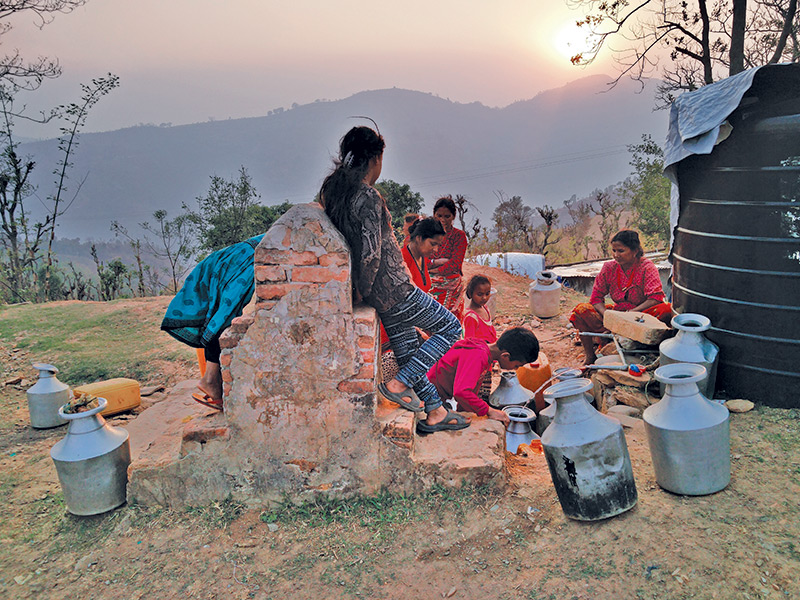
Springs across the mid-hills have been losing water for decades, but things have gotten worse since the twin earthquakes four years ago.
- Marissa Taylor
Women and children spend hours every day filling their jars with water in Sangachok, Sindhupalchok. Post Photo: Arpan Shrestha

SINDHUPALCHOK,
Padam Bahadur BK has been farming his whole life. In the monsoons, his paddy and maize fields would be lush green. The rainwater was enough and the springs emerged duly. His harvest would be sufficient to feed his family and his livestock, and for him to save.
Today, his fields are failing.
“Water started becoming scarce a long time ago here but it’s been more severe in the last three years,” said BK, a resident of Korthok, a Dalit community in Sindhupalchok. “My fields are so dry that it has developed deep cracks. But there’s no water; the nearest river is at least a few hours’ walk away.”
In these dry fields, BK has now planted millet, as the crop does not need much water or tending to. To make ends meet, BK, now 78, welds iron all day despite his aging body and cloudy eyes.
Korthok is a small hamlet just 10 minutes from the main bazaar in Sangachowk. Like BK, many of the residents are subsistence farmers. But fields have been lying barren for lack of water for years, locals say.
In villages like Korthok, which are perched high in the mid-hills, stories like these are an everyday reality—but even more so in remote districts like Sindhupalchok. The big rivers are far away at the bottom of deep valleys and springs become their only lifeline.
Despite their importance, the springs across the country’s mid-hills are drying and disappearing, causing distress to people and geographical regions, and forcing some villages to relocate entirely. Experts believe haphazard road development, increasing population, and erratic rainfall patterns influenced by climate change are adding stress to groundwater reserves, causing springs to dry—a phenomenon that could destabilise the country, even the entire Himalayan region. Yet, springs are insufficiently mapped and hardly researched, and there are few efforts to understand and address the issue.
“The drying of springs signals a much larger problem: a natural system that’s failing,” said Madhukar Upadhya, a
watershed management expert who has been researching springs in the hills
for more than three decades. “Right now, the problem is not affecting larger communities, only small pockets, and that is why it’s not becoming more visible.”
Upadhya says because the springs have been drying rapidly for the past two decades, the sooner we can give the issue our attention, the better. “Because springs are connected with everything: the economy, agricultural
production, sanitation, health, and development,” he said.

Immediately after the quakes, survivors faced a new problem as springs dried and disappeared across the mid-hills. In Sindhupalchok alone, 150 water sources were reported to have vanished. Post file Photo


The effects of drying springs
To understand just how important springs are and how much of an impact they have on the lives of the people in the mid-hills, Korthok can be taken as a case in point.
Here, villagers have access to just one communal tap, which almost 80 families rely on. But as winter begins to set in, the tap starts drying.
“When the tap dries up in peak winter, we have to get up all night and queue in front of it,” said 32-year-old Laxmi BK. Neighbours stop speaking to each other and fights break out for water, she said.
In past winters, this source of water
has dried up completely, said Laxmi. At times like these, she has to walk at least two hours to bring home one jar of water from a spring in Thulo Danda, Korthok, or down from the Bhadaure river.
The situation is so dire that a majority of people in Korthok say they have stopped keeping livestock due to a lack of water.
“After the earthquakes, the shortage of water became more acute. Until then, I was feeding my cattle the water I
would save from washing vegetables and clothes,” said Sunita Giri, a 41-year-old resident.

“But it became too tough to sustain doing even that: it was either use the water in the vegetable garden to feed my family or use it to feed the cattle.”
Others have tried adapting by adopting measures like harvesting rainwater. “But this only works when it rains,” said Sita BK, who has built a system that collects rainwater from the roof into a water drum, and which can last her at least a week to feed her family of four.
This is not the only community suffering from water scarcity. Four years ago, after the earthquakes struck, in Gaurigaun at Bahrabise, 30 km further north on the Araniko Highway, 12 springs dried up and another two moved.
“Before the quakes, we could fill a 9,000 litre tank with water from two springs every day,” said Ram Chandra Basnet, a local resident. “But now, one has dried and the other barely gives water. Suddenly, we have no water.”
According to an individual study carried out in 2016, 150 water sources vanished in Sindhupalchok after the 2015 earthquakes.

Padam Bahadur BK (left) says his fields have deep cracks due to water scarcity. Post Photo: marissa taylor


The National Climate Change Impact Survey 2016, submitted by the National Planning Commission of Nepal to the Intergovernmental Panel on Climate Change, states that 74.29 percent of total households
across the mid-hills have observed changes in water sources and
84.47 percent observed a decrease in the amount of surface water. Almost all households (99.33
percent) reported that they have observed an increase in drought as a “climate induced disaster” in the past 25 years.
According to a 2013 report by the National Planning Commission, water sources in Panchthar district, an eastern hilly region in Province 1, and Gulmi district, in Province 5 in the west, have been drying up
rapidly in the past decade. The government report had also declared 11 villages in Kavre drought-affected.
In some areas, the problem is so acute that people have abandoned or moved their villages. According to the same report, over the last 10 years, more than 850 households in Panchthar and 180 families in Gulmi have relocated. More alarming examples of relocation can be found in Upper Mustang, where a deepening water crisis pushed two villages—Dhey and Samnjong—to uproot themselves and move in search of water.
Then there are some villages that have enough water but inefficient management, like Kalleri and Bhudungey in Balephi, 13km north of Sangachok, in Sindhupalchok.
“The water source in Kalleri, which has around 40 families, is around two kilometres away
from the settlement area,” said Chabilal Neupane, the chairman of Ward No.2 in Balephi. “Then there is Bhudungey, where the case is similar. There is enough water there too, but not enough budget to purchase pipes to supply water from the sources.”

For the people across the mid-hills, springs are a lifeline. Post Photo


Why are the springs drying
A 2016 report by ICIMOD says an approximate 80 percent of the 13 million people who live in the
hills and mountains of Nepal depend on springs as their primary source of water. These springs, according to water experts, are largely fed by groundwater that accumulates in underground aquifers during the monsoon. When the rain falls in the monsoon, the landmass of any watershed area collects the water. The water is gradually released in the form of springs and seepage, which then add up to become streams, which fall into rivers.
“The ultimate source of the springs is rainwater, which
infiltrates the soil and seeps through cracks in the rocks before accumulating underground. Water is stored both in the soil and in the rock fissures, making a hill a ‘water tower’,” said Upadhya. But this water takes years to make it down to the rock fissures to become reserves, and whatever ends up making it down is just a fraction of the rain that falls; most of the rainfall escapes as surface runoff. All of this makes spring water very precious.
But as rainfall pattern continues to fluctuate, water retention has become more problematic.
“Rain that would fall over a week’s time now could fall in a day. There’s only so much water a watershed area can retain at a time, and when it receives more than it can absorb, most of the water does not get infiltrated,” says Archana Shrestha, senior meteorologist at the Department of Meteorology and Hydrology. The rate of retention of any watershed area depends on factors like soil type, forest cover and road mapping, she says.
Also, the exact connection between precipitation and recharge, and actual extraction rates, remain unknown across Nepal. “The problem of over-extraction and failure to recharge groundwater appears to be almost completely overlooked, which is very concerning. None of the institutions involved in water supply in Nepal are concerned with the problem of groundwater in the hills—whether it is the government, the non-government sector, or development agencies,” said Upadhya.
There are other factors that have exacerbated the drying of springs, like the increase in population and unsustainable land use. The biggest factor, however, has been road development, according to experts.
“The haphazard construction of roads has disrupted the preferential path of groundwater flow and lopsided the natural drainage channels on slopes,” said Narendra Shakya, a professor of water resource management at the Pulchowk Institute of Engineering.
All this has affected springs, multiple researches show, lessening their flow, turning the perennial springs into seasonal, and forcing the seasonal springs to dry up completely.
“Traditionally, Nepalis have names for three types of springs in the mountains: the more or less permanent muls are at the foot of the hills, the one that emerge in July called asaare mul and then the shrawane mul that bursts in August,” said Upadhya. “The timing of the springs indicates the extent to which the monsoon has replenished groundwater reserves in the hills. But in many parts of the hills, this shrawane mul has not emerged for the past two decades.”

In Korthok, where Laxmi BK (front) lives, scarcity of water affects agriculture. Post Photo: marissa taylor


Lack of focus on preservation
Immediately after the earthquakes, springs received a lot of attention, particularly in the 14 districts, including Sindhupalchok, that were worst hit by the disaster and witnessed acute water shortage. But four years later, this awareness too has disappeared. Over the years, many small projects have been undertaken by the government and non-governmental organisations, but not much progress has been made in terms of reviving springs.
“Every year, people come, take our pictures, make promises,” said Sita, from Korthok. “But we still don’t have water in our homes. The government should supply water to all its people—even if it is by drawing it from rivers down below the valley.”
But conservationists, like Upadhya, say that focusing on short-term stopgaps is not a solution.
“That will be another mistake. We draw water from the springs; then we draw water from the rivers. In trying to find a short-term solution, we forget that we are missing out on the bigger picture,” he said.
The questions Upadhya says people ought to ask are simple: Why are the springs drying and where did the water go?
“The problem is that our environmental problems are not defined by us; they are defined by the West,” he said. “Problems that affect people in this part of the world are not considered problems unless they are legitimised by developed countries.”
Across the mid-hills, there are approximately 60 climatological observatories maintained by the Department of Hydrology and Meteorology that collect information on localised rainfall patterns. This information is used to get a preliminary understanding of spring systems, but these systems are very complex; just the sheer number of springs—estimates say there are around five to seven springs per square kilometre across the mid-hills—is overwhelming.  

Even in places that do have water, there is lack of proper management. Post file Photo


Experts say the system that is in place is not enough. “We have data of up to 30 years or so, but not beyond that. To establish anything that could be of statistical significance from that information would just be speculation,” says Shrestha, who works at the department.
This means the possibility of developing a springs revival plan with such limited information is bleak, especially when there are so many variables that come into play.
“Only after a nationwide thorough study of the water table is carried out and the path of groundwater flow is mapped can an approach towards conservation and revival of springs be decided,” said Shakya.
Upadhya says there’s a simpler solution, but it requires whole communities to come together. “You have to pepper these hills with ponds. The ponds will collect the water that would otherwise flush down hills as runoff and over a duration of time refill the groundwater reserves,” he said.
Back in Korthok, Laxmi sits out in front of her two-room house, constructed from government aid after hers collapsed during the quake. She is drying her hair in the sun. Winter hasn’t set in completely, and the communal tap near her home is not dry—yet. Bathing, for now, is not an issue.
“Everyone says the world is changing by the minute. Every time I go to Kathmandu, it is a different city, always developing,” she said. “And here we are in this corner, where some days it’s tough to bring back home even one jar of water.”

A woman in Bidur, Nuwakot, washes dishes with water that comes from a spring. Post Photo: bhrikuti rai

HOME PAGE

Contrary to former Indian envoy’s claims, Nepal has consistently raised Kalapani issue with Delhi

Shyam Saran, who served as India’s ambassador to Nepal, said Nepal has been uninterested in seriously pursuing negotiations on resolving border disputes.
- ANIL GIRI

KATHMANDU,
Former Nepali foreign ministers and diplomats have dismissed the recent claim made by Shyam Saran, former Indian foreign secretary and Indian envoy to Nepal, that the Nepali side raises the issue of the disputed territory of Kalapani for rhetorical purposes, but isn’t interested in serious negotiations.
In an op-ed for the Indian Express published earlier this week, Saran wrote that Nepal doesn’t follow through after raising the issue.
“This is what happened with Nepali demands for the revision of the India-Nepal Friendship Treaty,” he wrote.
The Indian side agreed in 2001 to hold talks at the foreign secretary level to come up with a revised treaty—one that, in the Nepali eyes, would be more “equal” with reciprocal obligations and entitlements, Saran claimed, only one such round of talks has taken place.
Since the piece started making the rounds on social media, several Nepali officials have pushed back and challenged Saran’s assertions.
“To put the record straight on Sharan claiming Nepal to have dropped the 1950 agenda from bilateral discussion, it was Sharan himself who lobbied for dropping the Kalapani and 1950 treaty from the joint statement during the 2003 visit of [Prime Minister Sher Bahadur] Deuba to India [sic],” Madhu Raman Acharya, a former foreign secretary who was involved in negotiations with Saran, wrote on Twitter.
Acharya goes further, saying Saran sent two influential Nepali political figures to try to convince him to drop the 1950 treaty and Kalapani from the joint statement issued that year.
“We insisted and managed to keep the agenda alive, thanks also to the wisdom of Prime Minister Deuba not to change Nepal’s position on that,” he said.
In interviews with the Post, several former ministers and diplomats said that Nepal has been consistently raising the boundary dispute in Kalapani since 1963, when Nepal learned that Indians had occupied Nepali land.
Kriti Nidhi Bista, prime minister at the time, was the first Nepali leader to voice concerns over India’s occupation of Kalapani and the abrogation of the 1950 Treaty of Peace and Friendship. After the Indo-Chinese war in 1962, Nepal removed 16 Indian military check posts from various points along its northern border, and from Kathmandu.
“We later came to know that India did not remove its military presence from Kalapani,” said Bhekh Bahadur Thapa, a former Nepali ambassador to India.
Thapa also objected to what he said was Saran’s “threatening language” in his Indian Express article.
“At the moment, raising these issues as means of hoisting their nationalistic colours is of little risk to the Nepali political parties,” Saran said in the article.
Another Nepali diplomat, who served a long stint at the India desk of the Ministry of Foreign Affairs, told the Post that Nepal had sent another letter to India in 1968, reminding them that Kalapani belongs to Nepal.
“We have been raising the issue several times through subsequent governmental channels, but they’ve never taken our requests seriously,” said the diplomat, who asked to remain anonymous. Nepal’s claim over Kalapani hinges on two maps, from 1816 and 1860, jointly agreed and signed by the Nepal government and the then East-India Company.
“Whether it was during the visit of then Prime Minister Manmohan Adhikari to India in 1994 or during the visit of Indian Prime Minister IK Gujaral in 1997, we have been consistently raising the issue of Kalapani,” said PB Shah, a former diplomat who also worked at the India desk in the Foreign Ministry.
In more recent times, according to foreign ministers who have served in the last decade, Nepal has consistently raised the issue of Kalapani, Susta and demarcation of the boundary between Nepal and India.
“When India and China agreed to build a trade corridor via Lipu Lekh, we sent two separate diplomatic notes to New Delhi and Beijing,” said Prakash Sharan Mahat, who served as foreign minister in 2016. “Prime Minister Sushil Koirala himself called up Indian Prime Minister Narendra Modi to express Nepal’s displeasure over the Indian-Chinese agreement on Lipu Lekh.”
Both Nepal and India had agreed to form a foreign secretary-level mechanism to resolve boundary disputes, including on Kalapani, during the Nepal-India Joint Commission meeting in 2014.
Two years later, Nepal and India also agreed to form an eight-member Eminent Persons’ Group on Nepal-India relations that was mandated to suggest ways to replace the 1950 Peace and Friendship Treaty. Although the report has already been completed for over a year, it has yet to be submitted to the Indian prime minister.
“This essentially shows that Saran’s assertions that Nepal is uninterested in holding discussions are not genuine,” said another former diplomat, who served in the Foreign Ministry. “If Nepal was not serious and did not push the agenda continually, why did New Delhi agree to form two separate mechanisms over our concerns?”

HOME PAGE

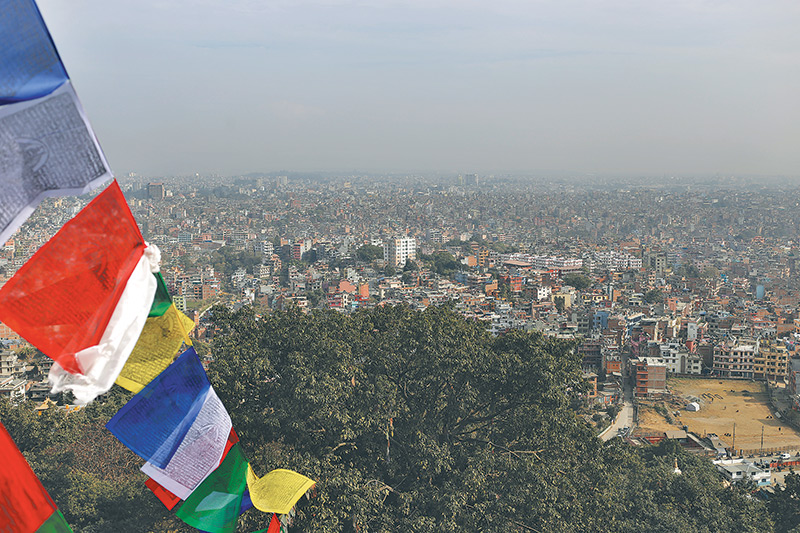
As pollution peaks, unsafe air could have detrimental effects on athletes

With over 6,000 athletes and officials arriving for the South Asian Games, concerns about Kathmandu’s air pollution are very appropriate, say environmentalists.
- CHANDAN KUMAR MANDAL
As air pollution grows with an advancing winter, there’re concerns over athletes’ performance. Post file Photo

KATHMANDU,
After two decades, the South Asian Games has returned to Nepal with three cities—Kathmandu, Pokhara and Janakpur—witnessing rapid makeovers to welcome over 6,000 athletes and officials from seven countries for the 10-day event. With the Games beginning on Saturday, everything is all set--except for the air.
In the 20 years since the games were last held in Nepal, a lot has changed in Kathmandu—the capital city that will be hosting a majority of events. Rampant construction, along with an exponential increase in vehicles, has meant that Kathmandu consistently ranks among the most polluted cities of the world.
According to AQ AirVisual, a Swiss group that collects air-quality data from around the world, the annual average count for PM 2.5, the most dangerous particulate matter in the air, has been in “unhealthy” category for sensitive groups since 2017. PM2.5 levels rise even higher during the winter months of November, December and January.
With so many athletes in Kathmandu for the Games, the air pollution levels are a significant concern, especially since they tend to train in the mornings and evenings, when pollution is often at its highest, say environmentalists.
According to Bhushan Tuladhar, an environmentalist who closely follows urban environmental issues, no thought has been given to improving the city’s air quality while preparing to host the sporting event.
“The timing of the event collides with the deteriorating quality of the air. It’s not that we should postpone the event, but no one even thought about air pollution,” Tuladhar told the Post. “Nothing seems to have been done to improve air quality.”
While the government has introduced odd-even rules for vehicles for the inaugural and closing days of the event, it has more to do with facilitating the movement of VIPs, rather than controlling air pollution, said Tuladhar.
As the winter sets in, air quality in major cities, including the capital, turns unsafe as there is no wind and pollutants tend to sink to the surface with the morning dew. Various studies have shown that outdoor activities should be avoided.
“We witness a rise in cases of pneumonia and Chronic Obstructive Pulmonary Disease (COPD) in hospitals at this time of the year,” said Meghnath Dhimal, chief research officer at the government’s Nepal Health Research Council. “Morning and evening time has peak air pollution levels so outdoor activities at this time should be avoided.”
However, Dhimal doesn’t think there is reason for visiting sportspersons and officials to panic.
“Our pollution levels are still relatively lower than in other South Asian countries, as we have not yet reached unhealthy levels. Also, most games will be in the afternoon when air pollution levels are comparatively lower,” said Dhimal.
According to Dhimal, the pollution in Kathmandu is mostly due to dust, unlike industrial pollution, which emits harmful chemicals in the air.  
Air pollution has increasingly become a major concern for cities across the world, taking its toll on major sporting and entertainment events.
Air pollution’s impact on sports was a cause for concern as far back as 1984, during the Olympic Games in Los Angeles, which was clouded in smog. Steve Ovett, a former track athlete from England, collapsed with
respiratory problems after the 800 metres final, citing air pollution as a major trigger for his exercise-induced asthma.
The 2008 Beijing Olympics earned the infamous tag of the “most polluted games ever” as athletes were seen wearing face masks while some countries made arrangements for their players to train in neighbouring nations and only arrive in Beijing for the opening ceremony.
Irrespective of air quality and the nature of the games, the health consequences of poor air quality remain a concern for players, especially those participating in athletics events, according to Tuladhar.
“Marathon runners need to inhale more air. Unlike sprint runners, marathon runners are exposed to bad air for at least two hours, as they also run along the main roads,” said Tuladhar. “Poor quality of air can have an effect on their stamina and performance. Even indoor games players breathe the same polluted air, although it might be worse along the main streets.”
The 13th edition of the Games will feature 26 events, most played indoors. However, games like football, cricket, beach volleyball, cycling, and athletics events will be performed outside.
According to Bikram Neupane, a physiotherapist with the Nepali national cricket team, environmental pollution like poor air can lead to breathing problems and various allergies for players on the field.
“Not every player has the same level of immunity and cannot deal with pollution in the same manner,” said Neupane. “We cannot see pollutants with the naked eye but they are there all the time.”
Cricket has returned to the Games after a gap of eight years. Nepal will be playing its first match against Sri Lanka on December 3 and Neupane worries that pollution will play its part in the players’ performance.
“Air pollution definitely affects players’ performance. As they are inhaling poor quality oxygen, they can get tired early,” said Neupane. “The morale of the same players is higher when they play in countries with clean environments.”
According to Neupane, various studies have shown that air pollution can have a detrimental effect on players’ performance.
In 2017, a cricket match between India and Sri Lanka hosted in Delhi made headlines when Sri Lankan players fell ill, as air pollution exceeded the World Health Organisation’s ‘safe limit’ by 12 times because of the notorious ‘Delhi smog’. Sri Lankan players donning face masks led the Indian cricket authority to consider pollution level as a deciding factor before fixing future matches.
A separate study, which analysed soccer players in the German Bundesliga and hourly information on the concentration of particulate matter in spatial proximity to the stadium at the hour of kickoff, concluded that the concentration of particulate matter has a negative effect on players’ productivity.
In this regard, the location of Dashrath Stadium, which is hosting a majority of events, at the centre of the city with massive vehicular movement is significant.
“Although Nepali athletes have not been able to practise on the home track because of delays in preparation, air pollution will not have a significant impact,” said chief coach Chandra Gurung.
“Other countries also have similar levels of pollution. It might have a small effect but is unlikely to affect their performance. These are young and well-trained athletes. Air pollution mostly affects the elderly and sick.”
Sports has significant health benefits but only when conducted in environments where the air quality is safe. These same sports, which are physically draining, can be counterproductive if played under unsafe levels of pollution.
In order to tackle pollution, Tuladhar suggests that vehicular movement can be diverted away from major sporting arenas and the marathon track.
“If they really wanted to control the air pollution, they could have simply repaired the service lanes of the main streets,” said Neupane. “We all know dust from the roads is one of the major sources of pollution in the country.”

Page 2
MEDLEY

Horoscope

ARIES (March 21-April 19)
**
An outgoing friend or family member might suddenly become unusually introverted, or an unusually introverted person might suddenly be unable to keep their mouth
shut. This erratic behavior might be confusing for you, but your personality will maintain its clarity.


TAURUS (April 20-May 20)
****
There is something you’ve been meaning to say to someone, and it’s a very delicate subject. Luckily, today will provide a wonderful opportunity to speak your mind freely. You will be able to be honest without hurting anyone’s feelings or coming off as a know-it-all. Your empathy is keen right now, so you should rely on it.


GEMINI (May 21-June 21)
***
The most important thing for you to focus on right now is your health—both physical and emotional. So remove yourself from any situations that will tax your body or create confusion. This is not a day to initiate any conflicts, perform any strenuous new activities, or start a new relationship. Keep your life quiet today.


CANCER (June 22-July 22)
***
Paradoxically, the biggest decisions will be the easiest ones to make today—your mind is clear, and the path toward achieving your goals is obvious. However, you’ll have a heck of a time figuring out the simple things. Where should you go for lunch? What kind of music do you want to listen to?


LEO (July 23-August 22)
****
A renewed sense of confidence will come over you this morning, and it will enable you to enjoy an exhilarating feeling of possibility today. Things are picking up in your romantic life—and you’re in the perfect position to take advantage of this momentum. Build a partnership that will last.


VIRGO (August 23-September 22)
***
Things that used to intimidate or frighten you will hold a strange and powerful interest for you today. You’re intrigued where once you were afraid. There’s a stronger element of courage inside you right now, and today you’ll start to see it have much more control over how you live your life.


LIBRA (September 23-October 22)
**
Today will start off like a cuddly lamb, but it could evolve into a growling lion before you realise it. Unpredictable changes will pop up throughout the day, which could send you down a much different path than you’ve mapped out. Luckily, these changes will create some amusing moments in your day.


SCORPIO (October 23-November 21)
**
There is a lot of intense activity going on today—everyone is moving at a mile a minute, and this fast pace, as well as the changes that are revealing themselves, is making you feel invigorated. Things are happening so quickly right now that you’re able to skip over the boring stuff.


SAGITTARIUS (November 22-December 21)
***
Uncertain outcomes are keeping you
distracted—you are so wrapped up in finding out what will happen next that you can’t really live in the moment. But until you do, you will keep on feeling moody and slow. So today you need to try to figure out why future unknowns are so much more important to you.


CAPRICORN (December 22-January 19)
****
Don’t be surprised if you have a strong desire to look inward today. It will help you sort out some things at work or school, and get you back on the right track with a peer. But don’t worry about what you might find—being introspective will be fun and educational for you right now.


AQUARIUS (January 20-February 18)
****
Sometimes you don’t have to work too hard to keep your career growing in the right direction. So today, when an opportunity falls right into your lap, don’t question it. Just take it! The more time you spend making sure that it is meant for you, the less time you have to show everyone what a rock star you are.


PISCES (February 19-March 20)
**
You can’t take anything for granted today—you have to be skeptical and ask questions until you know for sure what is going on around you. This is not the time to take people’s words at face value, even if they are powerful people with a lot of credibility. They’re not trying to trick you.

Page 3
NATIONAL

Kathmandu speeds up its cleanliness drive ahead of 13th South Asian Games

The city has earmarked a budget of Rs10 million for the games to be held from December 1 to 10.
- ANUP OJHA
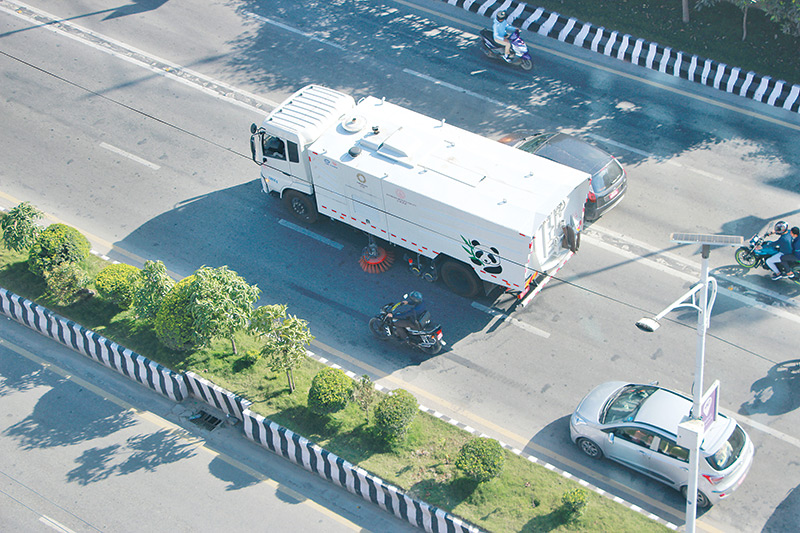
The city office will be mobilising its 750-strong cleaning staff and seven broomer machines to rid streets of dust and dirt. Post file Photo

KATHMANDU,
Kathmandu Metropolitan City has intensified its efforts to make the Capital clean and tidy for the 13th South Asian Games. The games will be held in Kathmandu and two other cities from December 1 to 10.
An estimated 6,000 participants, including more than 3,000 athletes from seven countries, will be arriving for the games. Most of the guests and athletes have already arrived.
To make sure that there are no garbage piles and dust on the streets, the city office will be mobilising its 750-strong cleaning staff and seven broomer machines.
“Our cleaning staff will be deployed even during the day time so that the roads in Kathmandu are clean,” said Hari Bahadur Shrestha, chief of the environment division at KMC.   
The cleaning staff and broomer machines will mainly focus on core city areas and the roads at Gaushala, Sinamangal, Tinkune, New Baneshwor, Maitighar, Tripureshwor, Ratna Park and Durbarmarg.  
Various beautification works are also being carried out for the sporting event. The city office has appointed Ram Krishan Shreshta for the job.
“We are building decorative gates and boards in different parts of the city to welcome the athletes and the guests for the games,” Ram Krishna told the Post.    
The roadside walls and buildings are also being painted for the occasion.
Ishwor Man Dangol, spokesperson for the KMC, said the city office wants to make the event a success and offer warm hospitality to the visiting guests.    
“Our main focus is to make the city clean, beautiful and free of potholes. We want to send a good message to our guests,” said Dangol.
To add zest and spirit to the games, the city office also plans to install LED screens at various open spaces in Kathmandu to telecast the proceedings of the games.
KMC has set aside Rs 10 million to prepare the city for the games.


Odd-even rule for vehicles   
Meanwhile, to ensure hassle-free mobility for players and other participants, the Kathmandu Metropolitan Traffic Police Division has decided to implement odd-even rule on the inaugural and concluding days of the games.  
On December 1, only those vehicles whose licence number ends in odd digit will be allowed to ply the roads inside the Ring Road. The even rule will apply for the vehicles on the concluding day of the games on December 10.
The rule will not apply for the participants and guests of the games, VVIPs, emergency vehicles, water tankers and vehicles carrying journalists, according to the division.
Roads in some parts of the city will be off-limits for vehicles and the traffic will be rerouted to facilitate the games.
The division has also announced that two lanes of the road from Balkhu to Suryabinayak for a cycling event on December 6 and 7.  
The division will be deploying more than 900 traffic personnel on the streets of Kathmandu to ensure smooth traffic flow, particularly in areas close to the sporting venues, including Tripureshwar, Satdobato, Lagankhel, Sahidgate, Kirtipur, Halchwok, Lainchwor and Gokarna areas, Senior Superintendent of Police Bhim Prasad Dhakal, chief of the division, told the Post
Around 200 volunteers from the Kathmandu School of Law will be mobilised to manage Kathmandu’s traffic for the event.
For further traffic details and updates, the division has requested the public to either call at 103 or tune in to Metro Traffic FM 95.5.

NATIONAL

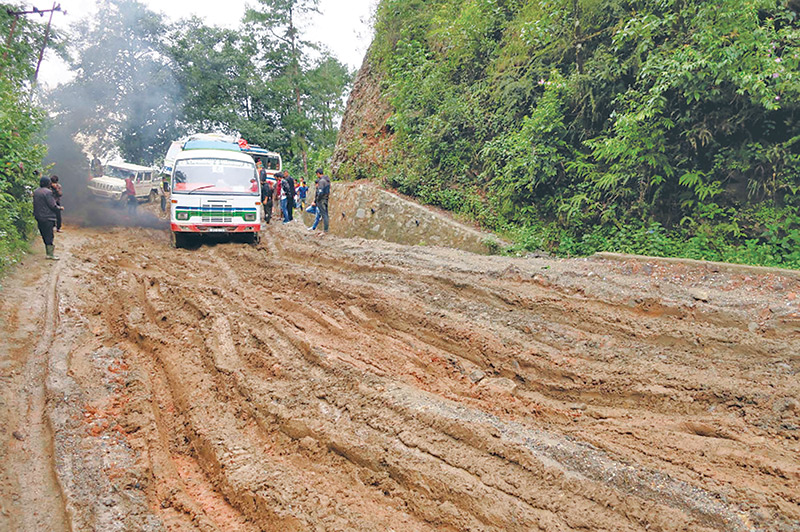
After public shaming, road authority warns contractors to rush remaining work

Of the 17 contracts awarded for road projects under the second phase of line of credit, work has only been completed on five contracts, according to officials.
- PRITHVI MAN SHRESTHA
Road upgradation work along Lamosanghu-Jiri has remained incomplete for four years. Post file Photo

KATHMANDU,
When the people of Dolakha protested against the prolonged delay in blacktopping the Mudhe-Charikot section of the road by plastering the images of the contractor on public vehicles, trees and electricity poles, it finally drew the attention of the government agency responsible for the implementation of the project.
Earlier this week, the Department of Roads issued a notice to the contractor—Shakeel Haider-Shankarmali-Sunaula Khimti JV—asking it to resume construction work immediately and submit resource mobilisation and work completion plans within seven days or face termination of the contract.
According to the project office, the contractor—Deepak Sapkota, who owns Shankarmali  Mali Nirman Sewa—has stopped working on the project since April.
The project is one of the four contracts among the dozen road contracts currently under construction or upgradation with the funding provided by India’s Exim Bank.
“Despite repeated requests from the office to resume work, the contractor had neither responded nor showed any intentions to resume the work,” said Sushil Dhakal, a Road Department official overseeing a series of projects funded by Exim Bank.
Of the 17 contracts awarded for road projects under the second phase of the bank’s Line of Credit, work has only been completed on five contracts, according to the Department of Road. Deadline for all the remaining 12 contracts has been extended or is in the process of extension.
But officials said some of them are in a very poor state and it will be difficult to complete them within the extended deadline.
As per the latest amendment to Public Procurement Regulations, the contract can only be extended until June 4 next year last time.
In an interview with the Post, Sapkota said he could not continue work because the government delayed payment of around Rs75 million for several months. According to him, his firm was only paid around Rs45 million.
But Dhakal, the Road Department official, said the contractor had no right to complain about payments from the government.
“As per the contract, he has the option to claim compensation for delayed payment but it cannot stop work,” he said.
Dhakal further said that even after the money was released, Sapkota’s firm didn’t resume work on the
project, forcing it to issue a warning. The  Shakeel Haider-Shankarmali-Sunaula Khimti JV had won the
contract for the 30km road in August 2015, with a completion deadline of two years.  
Another contractor whose photographs were plastered on public
vehicles is Sharda Prasad Adhikari, owner of Shailung Construction, whose firm was awarded two contracts for the roads under the Road Improvement and Development Project, in a joint venture with AIPL Construction (India).
However, both of the projects have not been completed by the deadline.
According to the project office, only 75 percent of work has been completed on Bhaktapur-Nagarkot-Sipaghat Road, and the contract deadline was recently extended until April next year. “The contractor has expedited the work in this project after the contractor’s images were displayed in public places for not working timely,” said Dhakal. “As the contractor has committed to completing this project by April, we have not categorised it as a chronic contract.”
Another project handed to Shailung is Balaju-Ranipauwa section of Balaju-Trishuli Road. Physical progress of this road project is just 47 percent as the extended deadline of this contract already expired in May this year. The project office has categorised it as chronic contract and has also fined the contractor for delayed works.
Experts say that due to political connections, contractors often avoid termination of contracts and other punishment such as blacklisting by the Public Procurement Monitoring. Most of the road projects handled by Shailung in Kathmandu Valley are in dire straits but, according to officials at the Road Department, the company has not yet been blacklisted.

Page 4
NATIONAL

Sindhupalchok is not ready for tourism year

- ANISH TIWARI

SINDHUPALCHOK, 
For the upcoming Visit Nepal 2020, the government last year had designated a hundred tourist destinations, which included three of Sindhupalchok’s most popular sites and activities—rafting in Bhotekoshi and Sunkoshi rivers, bungee jumping, and trekking to Panchpokhari.
But here too the government’s lacklustre showing continues: the reconstruction and renovation works in the district’s destinations are still in the preliminary phase, with 2020 just a month away.
Tatopani is just getting up on its feet after the border with China reopened earlier this year. Long beset by earthquakes, floods, and landslides, the country’s major border point with China is today a shadow of its former self. The number of tourists has dipped considerably, say tourism entrepreneurs. There used to be homestays in Dugunagadhi, Tatopani’s neighbouring village, that catered to the thousands who
flocked there. Today, locals are still reconstructing their quake-ravaged houses.
Rafting services in Bhotekoshi and Sunkoshi rivers suffered a blow after the major flood in 2014, which was further worsened by pollution and illegal sand mining in the riverbanks. Tourism entrepreneurs are left with little hope. “There are many challenges for water tourism,” confessed Mahendra Singh Thapa, who runs Sukute Beach Adventure Resort. “The future of tourism in the district is wobbly, given sand mining and pollution.” Sindhupalchok is renowned around the world for adventure sports such as rafting, canyoning and bungee jumping.
Construction of large-scale hydropower projects in the rivers is also worrying tourism entrepreneurs. “We don’t mean hydropower generation is wrong, but when we concentrate on that, we neglect water tourism,” said Ganga Prasad Nepali, chair of Nepal rafting association.
Trekking destinations like Panchpokhari, which used to see thousands of visitors, sees only about 40 tourists daily. The pond and Helambu, the popular religious shrine, are slowly getting back on their feet after the quakes. Even though the local units have allocated budgets to renovate the gumbas and temples in Helambu, they lie in shambles. There are several other destinations such as Tarkeghyang, Chiri gufa, Melamchighyang, among others, that used to be popular among tourists. Today, these villages are struggling to survive.
 “The government hasn’t taken any concrete step to make tourists return to these destinations,” said Nima Gyalzen Sherpa, chair of Helambu Rural Municipality. “Even though the roads are being renovated, much is left to be done. The tourism year 2020 sounds increasingly like a rumour.”

Page 5
NATIONAL

Curbing drug abuse in Dhanusha a challenge

Drug-related cases have doubled in the past three years. Police say not much has changed despite crackdown.
- SANTOSH SINGH
Forty-eight people have been charged with drug abuse in the first four months of this fiscal year, according to police data. Post Photo: santosh singh

DHANUSHA,
Chandreshwore Mahato, 23, enrolled to study medicine because his parents forced him to. The pressure of the course took a toll on him, says Mahato—after all, it was not a subject he was interested in. As the days went by, Mahato, currently a second-year MBBS student, found solace in the sedative lull of Nitravet, a drug prohibited to use except when prescribed by a physician.
Mahato is a local of Umaprempur in Dhanushadham Municipality and had taken up rent in Kadam Chowk in Janakpur. On November 19, the police confiscated 1,500 files of Nitravet that he had hidden in packets of dalmoth and his shoes. Mahato was arrested and a case was filed against him at the Dhanusa District Police Office. In his court statement, Mahato said he started taking the drugs to cure his depression, and that he frequented clinics across the border to India to get the drugs.
Due to an open border with India, it’s easy for people to get hold of drugs that are banned in Nepal and that many youths from Dhanusha visit the bordering town of Harine to fetch drugs daily, say police. Even though the police have intensified surveillance, not much has changed, said Ranjit Tiwari, an inspector at Dhanusa District Police Office. A few times, however, the police have managed to arrest the abusers in coordination with Indian police, like in the case of Mahato. According to police, 86 percent of total drug abusers and traffickers are youths, between the ages of 20 and 30. “Most of those youths have little guidance from the family,” said Shekhar Khanal, superintendent of police in Dhanusha.
The district has seen a sudden rise in the number of people arrested on drug abuse charges in the past
three years. Fifty-one people were charged in the fiscal year 2016-17, 81 in 2017-18, and 131 in 2018-19.
Forty-eight people have been charged with drug abuse in the first four months of this fiscal year, according to police data.
Khanal said that the major cause of drug abuse among Dhanusha youths is proximity with the open border and easy availability of prohibited drugs across the border.
“Sixty percent of the inmates in jail are there for drug abuse,” he said. “But what is surprising is that the parents don’t want to believe their children are drug abusers.”
The relationship between drug abusers and traffickers is like “a metal chain”, said Milan Poudel, who
operates a rehabilitation centre in Janakpur. “It’s difficult to break this chain. It’s a vicious circle,” he said. “The cause of 70 percent addictions is peer pressure. Sixty-five percent of traffickers also use some or the other form of drugs.”
Poudel added that Janakpur is becoming a “transit” for drug trafficking. “Nepalis traffic marijuana to India and they bring back tablets and injections. Those who get arrested are ‘small fish’, those low in the racket’s hierarchy. The main people who engage in the transactions get away easily.”
Gyanendra Yadav, Province 2 minister for law and internal affairs, said the government is preparing to “intensify surveillance” on the youths, declaring ‘addiction-free’ zones.
“A total of 36 police posts will be added as part of the campaign,” Yadav said. “We are in conversation with the Indian side as well. We are preparing a ban on alcohol within the one-and-a-half kilometre radius in both towns on the border.”
Yadav added that the police will be provided with modern security equipment, one of which will have the ability to detect if anyone has used drugs within five minutes. “Controlling widespread drug abuse is our priority,” said the minister. “We will raise awareness, formulate new laws, and rehabilitate the addicted.”
Despite the minister’s vow, it’s challenging to curb the widespread problem, said Raj Kishore Karna, who runs Relief Nepal Rehabilitation Centre in Janakpur. Many youths may get treatment at the centres but it’s hard for them to return to their normal selves, he said.
“If the society treats them bad once they come out of treatment, they might turn back to addiction,” said Karna. “If it is to be curbed, there has to be a bigger effort from the family, community and the state.”

NATIONAL

Khanigaun settlement in Gorkha at risk of landslide, erosion

- HARIRAM UPRETY
Out of the 113 houses built in the settlement post-earthquake, 58 families have already left. Post Photo: hariram uprety

KHANIGAUN (GORKHA),
Kanchha Kami, a resident of Khanigaun in Gorkha, is a worried man these days. After the Dongsyang stream changed its course towards his house, Kami fears that the land his house stands on might cave in any day now. Even his courtyard has developed cracks, he said.
Kami had constructed his house two years ago after his previous home was destroyed in the 2015 earthquake. The housing reconstruction aid he had received was not sufficient, so he had to take a loan of Rs100,000 to complete his one-storey house.
Two years ago, the stream was quite a distance away from my house, Kami recalls. “The stream has cut into the embankment. There were many houses in front of my home when I began construction two years ago. But all of them were swept away, and now the stream is inching closer to my house,” said Kami. “We live in a constant threat of erosion.”
Out of the 113 houses built in the settlement post-earthquake, 58 families have already left.
Locals blame the National Reconstruction Authority (NRA) and other concerned authorities of failing to conduct a geological survey before building the settlement. Khanigaun, a mostly Gurung village, lost seven people and 70 cattle in the 2015 earthquake.
The Dongsyang stream started changing its course in July 2017, and is now headed towards the settlement. Punram Gurung, a local, said he has already built five houses since the earthquake destroyed his old home.
“Three houses were swept away by erosion whereas two others are on the verge of collapse,” said Gurung.
Continuous soil erosion along the Donsyang stream has also swept away part of the Yamgaun-Soti foot trail. The trail was the only path for the children in Khanigaun to reach Kalratri Secondary school in Lapu. With the foot trail now swept away, students have been facing difficulties going to school.
Tismaya Gurung, a local woman, says the children have been forced to make a perilous journey to reach school. “It’s been two years since the foot trail was swept away and this has affected our children’s studies. We have been requesting the local unit to build a suspension bridge where the foot trail previously was, but nobody paid heed to our requests.”
In February, a team of geologists from the National Reconstruction Authority conducted a survey in Khanigaun and verified that the settlement is at risk of landslides. The team had recommended the local unit to shift the entire village to Koldanda, which is 300 metres from Khanigaun.
Ram Sharan Acharya, chief at the District Project Implementation Office, said his office is waiting for the Cabinet to purchase land plots for the people of Khanigaun. “We plan to relocate the settlement to a safer location as soon as we get a decision from the Cabinet.”
Santosh Gurung, the chairperson of Dharche Rural Municipality, said, “Besides Koldanda, we are looking at other locations as well.”

NATIONAL

Waste management is a major problem in Achham district

- MENUKA DHUNGANA

ACHHAM,                                             
Waste management in Achham district has become a major problem due to a lack of proper landfill sites.
Mangalsen, Sanfebagar, Kamalbazaar and Binayak, among other bazaar areas, are the most affected by the waste problem. Even the district’s headquarters, Mangalsen, does not have a proper landfill site.
Residents of Siradi, around seven km away from Mangalsen, complain of garbage piling up in the bazaar area and by the riversides. Khagendra Bhandari, a local, said that the villagers have to suffer from the unbearable stench emanating from garbage littered near their settlement.
“There are around a dozen villages in the area. People are facing problems using water for household purposes because garbage overflows near the water sources,” Bhandari said.
Five years ago, locals had donated land plots in Siradi to build a landfill site, but the site was never constructed. In its place came a dumping ground without proper waste management mechanisms. The locals are now demanding authorities to move the dumping ground since the overflow of garbage is affecting villages.
Padam Bohara, mayor of Mangalsen Municipality, said that his office is searching for appropriate land plots to construct a proper landfill site.
“Siradi dumping site is a temporary provision. That’s why we request the locals not to panic,” said Bohara.
Meanwhile, the Budhiganga river in Sanfebagar and other rivers and streams in the vicinity are also being polluted because of the haphazard garbage disposal. Prabhali and Chhepekhola (streams) have turned into a dumping ground for the locals.
“These rivers and streams are filled with plastic bottles, broken glasses and other household garbage,” said Rup Bahadur Kunwar, a resident of Sanfebagar Municipality.
According to officials of Sanfebagar Municipality, the municipality is also looking for land plots to construct a landfill site in Sanfebagar.
Mina BK, a local, said, “In the past, we used to take our cattle to the rivers and streams for drinking purpose,
but the rivers are so polluted now that we don’t take our animals there anymore.”

NATIONAL

Every winter, the poor in Tarai are left to battle the cold alone

Although the authorities provide help, it comes too little too late, say locals.
- NABIN PAUDEL
There are more than 3,000 Musahar, Dalit and other poor families in Nawalparasi (West). Post Photo: Nabin Paudel

PARASI,
A Musahhar settlement in Pratappur in the plains is comprised of a hastily put together shanty village. Around 50 families live in the settlement, who, come winter, are seen scrambling for warm clothes, blankets, and food.
“We have neither warm clothes to wear nor blankets to beat the biting cold. I have a family of six and my income as a daily wage worker is not enough to buy us warmth for winter,” said Bamati Musahar.
Almost all the adults in the settlement eke out their living as labourers.
The past one week has seen dense fog enveloping the settlement in the morning and the bleak afternoon sun provides little relief. Come nightfall, the families huddle around a fire to keep themselves warm.
“The weather is turning colder by the day. We face the same ordeal every winter; that of not enough clothes and shelter,” said Bamati.
The local units and various organisations run a distribution drive every winter but it starts only in the last week of December and sometimes in January. “It’s already cold but the distribution materials are yet to come,” laments Bamati.
The data of the District Natural Disaster Rescue Committee showed that there are more than 3,000 Musahar, Dalit and other impoverished families living in Nawalparasi (West). Many impoverished households are going to face a difficult time this winter.
Raj Kumar Sharma, chairman of Pratappur Rural Municipality, however, said the local body has allocated budget to provide warm clothes and blankets for the needy people from poor communities. He, however, did not specify the budget that had been issued for the same.
Chief District Officer Shambhu Prasad Marasini directed the chief of the local units, head of the government offices, representatives of the political parties, chamber of commerce and industry and various social organisations regarding the preparedness for the cold wave. “We have held discussions over the management of relief materials and preparedness strategies recently,” said Marasini.
The cold wave affects life mainly in Tarai districts every winter and the authorities are criticised for their poor preparedness every year. Ramji Gyawali, a rights activist working on social justice in the district, said that the authorities should take initiatives to protect the poor communities, old people, postpartum mothers and children from the cold conditions on time.
“Every year, the concerned authorities take initiatives to help needy people after the end of winter. If the victims do not receive relief on time, such programmes become meaningless,” Gyawali said. According to him,  the people’s representatives should take prompt measures to distribute warm clothes and bedding before the cold sets in in earnest.

NATIONAL

One overseer supervises more than 200 projects in Shikhar Municipality

Briefing

DOTI: An overseer of Shikar Municipality in Doti has been overloaded with work due to shortage of employees in the municipal office. Amar Rawat, an overseer of the municipality, said that he has been compelled to look after more than 200 projects in the current fiscal year. Dharmaraj Binadi, chief administrative officer of the municipality, accepted that they are facing difficulties to handle projects due to lack of technical staff.

NATIONAL

Six fugitives held in Bara

Briefing

Police in Bara arrested six fugitives convicted in drugs abuse, forgery, and public offence. A special police team deployed by the Area Police Office in Nijgadh and Police Station in Ganjabhawanipur arrested the fugitives. Police said the fugitives were sent to Birgunj Prison to complete their jail term.

NATIONAL

35 injured in bus accident

Briefing

BARA: At least 35 people were injured in a bus accident at Unasi on the Nijgadh-Pathlaiya road section along the East-West Highway. The speedy bus was heading towards Butwal from Janakpur. According to police, the bus plunged 40 feet down from the bridge.

NATIONAL

Ban on extraction of riverbed materials in Bardiya

Briefing

BARDIYA: The local administration in Bardiya has imposed a ban on transporting riverbed materials out of the district after reports of crusher industries excavating sand, stones and pebbles haphazardly from rivers surfaced. There are five crushers operating in the district.

NATIONAL

3 killed, 15 injured in microbus accident

Briefing

DAILEKH: Three people died and 15 others were injured when a microbus crashed at Ghodabas along the Surkhet-Dailekh road section on Friday. DSP Hari Bahadur Oli said that the microbus plunged around 500 meters down the road. Police said the driver of the microbus is at large after the accident.  

Page 6
MONEY

Top US retailers absorb tariff pressure ahead of holiday shopping season

On average, the prices the retailers charged for electronics were 2.3 percent higher than the year-ago period.
- REUTERS
A shopper buys a TV at a Best Buy Inc store on Thursday in Chicago, Illinois. afp/rss 

WASHINGTON, 
Prices for electronics sold online at top US retailers were up slightly heading into the critical US shopping season, but sites including Walmart Inc and Amazon.com Inc have held prices steady for many other popular holiday products despite the pressure from tariffs on Chinese imports.
The analysis is based on a pricing study conducted for Reuters by retail analytics firm Profitero, which examined online prices from seven large retailers for 21,000 products.
The firm compared product prices during October and November last year to those this year in key holiday categories including appliances, electronics, toys and video games across Walmart, Walmart-owned Jet.com, Amazon, Target Corp, Best Buy, GameStop and Staples.
On average, the prices the retailers charged for electronics were 2.3 percent higher than the year-ago period, while across all the categories, prices were 0.9 percent higher, said Keith Anderson, senior vice president for strategy and insights at Profitero.
That’s lower than the average rate of inflation during the same period, which stood at 2.4 percent in 2018 and about 1.8 percent in 2019 so far.
In categories such as toys, prices dipped 0.2 percent and video games fell 2 percent, according to Profitero, which has not looked at year-over-year changes in pricing across the sampling of retailers and categories in the past.
Walmart and Target did not comment on the study but pointed Reuters to past comments from executives about how they have managed tariffs by working with vendors and diversifying their supply chain. Amazon did not immediately comment on the study. Best Buy declined comment and GameStop did not respond to requests for comment. Staples asked to see the study but did not comment.
America’s trade war with China threatens to push up product prices, which could hurt consumer spending this holiday season, a period which makes up nearly 40 percent of annual revenue for many retailers. The two countries are currently struggling to strike a preliminary trade deal.
About $539 billion worth of goods came into the United States from China in 2018, making the country the largest supplier of imported goods, the US Trade Representative said. US President Donald Trump has imposed tariffs and threatened more as leverage in trade negotiations with Beijing.
But while tariffs have driven up costs of goods for many retailers, at least the large firms have so far refrained from passing that cost pressure to shoppers, according to interviews with researchers, consultants and retail companies.
EBIT margins for all retailers excluding Walmart have been declining since October 2018 and at 6.7 percent are at their lowest since 2010, according to an analysis by Oxford Economics.
“Right now, nobody wants to be grinchy and steal Christmas so they are passing on as little as possible,” said Jeff Unze, a president at BorderX Lab—an e-commerce platform, which connects American retailers with Chinese consumers, and tracks pricing changes in both markets.
On Sept. 1, the US imposed a 15 percent tariff on many consumer goods from China that increased the cost of goods sold for most retailers. For example, Dollar Tree said tariffs will increase its cost of goods sold by about $19 million in the fourth quarter if tariffs are fully implemented.
In the Profitero analysis, Walmart’s products were only 0.4 percent more expensive compared to a year ago on a sample of over 6,000 popular holiday products. Amazon was 0.6 percent pricier on 9,200 products. A sampling of 1,200 items sold online by Target were 0.9 percent less expensive than during the year earlier period.
By contrast, chains such as Staples were over 4.7 percent more expensive, and the goods sold by Best Buy were priced at 1.1 percent more.
The study did not include popular categories such as apparel and accessories, which have largely not been subject to the Trump administration’s latest tariffs but are likely to face a 15 percent tariff in a new round scheduled for Dec. 15.  
Consumer price index data, through October, shows that televisions, phones, computer accessories, video and audio products accounted for four of the top five largest year-over-year price declines by category.
The data is based on sampling by the Bureau of Labour Statistics only through October, however. In contrast, Profitero looked only at online pricing at seven retailers during October and November.

MONEY

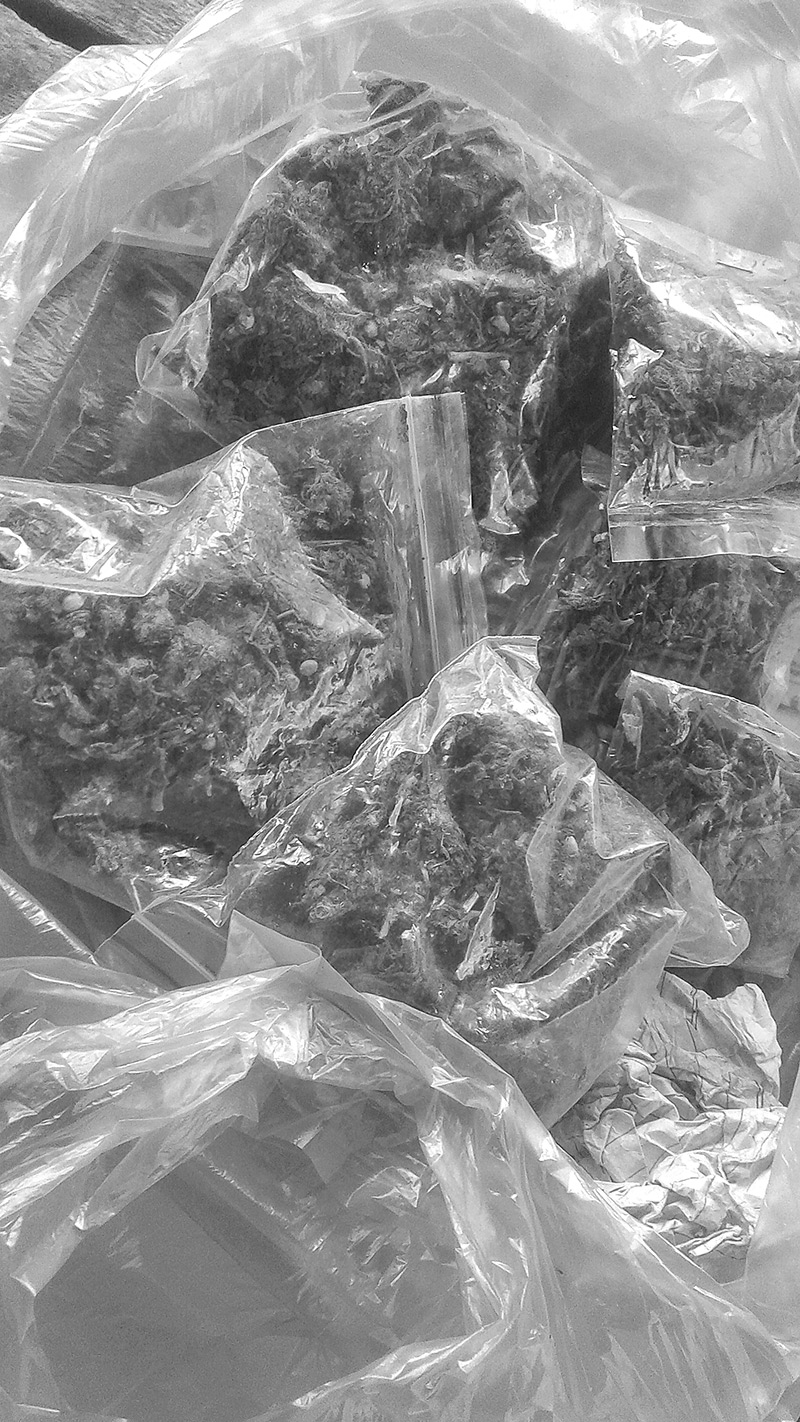
Wave of European Cannabis firms to list in 2020, analyst says

- REUTERS
Medical cannabis plant specimens are displayed at the Greek Agricultural Organisation ‘Demetra’ in Athens, Greece. reuters 

LONDON, 
Up to five companies active in the cannabis industry could go public in 2020 in Europe, a continent whose stock markets have largely missed out on the North-American “pot stocks” frenzy, a leading industry analyst said on Thursday.
The legalization of cannabis, including for recreational use in Canada and a number of US states, fueled a speculative “green rush” on Toronto and New York stock markets in early 2019, but this has faltered due to oversupply fears and uncertainties on US regulations.
Shares in the sector are down more than 50 percent from their March highs, according to the alternative harvest ETF fund, which tracks cannabis-related stocks.
“I think there will be 4 or 5 companies quoted in twelve months time”, Nikolaas Faes, an analysts for Bryan Garnier told Reuters on the sidelines of a cannabis industry conference.
Bryan Garnier and its competitor Canaccord Genuity are among the few investment houses actively seeking to become key players in the fast-growing industry and win mandates to advise on merger and acquisitions or rights issues.
There has been speculation that London-based medicinal cannabis company Emmac could go public. In 2019, Emmac took over GreenLeaf, a French hemp-based and cannabis healthcare company and Swiss cannabis-based health company Blossom.
A spokesman for Emmac said an IPO remained an option but no longer for the current calendar year.
Listings of cannabis firms in Europe are very rare and currently limited to the small capitalization segment.
Public offerings are made difficult due to a patchwork of regulations and policies regarding the medical and recreational use of cannabis, including CBD, a derivative of the plant reputed to ease anxiety without the high associated with THC, the main psychoactive agent in marijuana.
Faes argues that London’s lightly regulated AIM is a market place of choice for such listings.
“I think that AIM is doing great efforts to attract some of those companies”, he said.
AIM declined to comment.

MONEY

South Korea cuts growth forecast to lowest in decade

- AGENCE FRANCE-PRESSE

SEOUL,
South Korea’s central bank on Friday cut its growth forecast for this year to two percent, which would be the weakest rate in a decade as the economy is battered by trade disputes.
The world’s 11th-largest economy is highly dependent on international commerce but is grappling with the fallout of a prolonged China-US trade dispute and embroiled in a spat of its own with neighbouring Japan.
The Bank of Korea cut its 2019 growth forecast from 2.2 percent to two percent, governor Lee Ju-yeol, told reporters, also trimming its prediction for next year to 2.3 percent from 2.5 percent.
The two percent figure would be the slowest expansion since 2009, when the country posted 0.8 percent growth in the wake of the global economic crisis.
In a statement the BOK said exports were facing continuing “sluggishness”, while domestic consumption growth had also weakened.
The central bank kept its key interest rate at a record low 1.25 percent in an effort to prop up growth, having announced two cuts already this year.

MONEY

BMW to build electric Mini in new China plant

- AGENCE FRANCE-PRESSE
A Mini Copper SE electric car is displayed at the LA Auto Show in Los Angeles, California. reuters 

FRANKFURT AM MAIN,
Luxury German carmaker BMW on Friday said it would build fully electric models of its Mini cars at a new plant in China, as it kicked off a joint venture with Chinese partner Great Wall Motor.
Some 160,000 cars a year are set to roll off the assembly line at the planned factory in the city of Zhangjiagang in Jiangsu province, which will eventually employ 3,000 people.
Construction of the plant is slated to last from 2020 to 2022, BMW said in a statement.
Both partners are together investing 650 million euros ($715 million) in the project.
Alongside BMW’s all-electric Mini, the Chinese company will also build some of its own brand models at the plant.
“This is another important step towards the Mini brand’s electrified future,” the statement said.
The BMW group had already announced it would start manufacturing the first fully electric version of the iconic compact car at its Mini plant in Oxford, England this month.
Those first Mini E models are set to come to market early next year.
The Chinese tie-up comes as BMW joins other global carmakers in accelerating the shift to electric and hybrid vehicles, spurred by environmental concerns.
The costly pivot to the cleaner, smarter cars of tomorrow is hitting automakers hard at a time when the global industry is battling headwinds from a darkening economic outlook.
China is the world’s largest car market but after years of strong growth, car sales there fell last year for the first time since the 1990s.
A slowing economy, US-China trade tensions, and a Chinese crackdown on shady credit practices have all weighed on demand.

MONEY

Black Friday frenzy goes global and not everyone’s happy

- ASSOCIATED PRESS

PARIS, 
People don’t celebrate Thanksgiving in France, or Russia, or South Africa—but they do shop on Black Friday.
The US sales phenomenon has spread to retailers across the world in recent years with such force that it’s prompting a backlash from some activists, politicians and even consumers.
Workers at Amazon in Germany went on strike for better pay on one of the busiest days of the year. Near Paris, climate demonstrators blocked one of the retail giant’s warehouses to protest over-production they say is killing the planet. Some French lawmakers want to ban Black Friday altogether.
Consumer rights groups in Britain and some other countries say retailers use Black Friday as a slogan to lure in shoppers, but it’s not always clear how real or big the discounts are. Other critics say it hurts small businesses.
Globalised commerce has brought US consumer tastes to shoppers around the world, from Halloween candy to breakfast cereal and peanut butter, sometimes even supplanting local traditions.
To French activists, Black Friday is the epitome of this shift, a purely commercial event designed to boost US retailers ahead of the Christmas holidays, the symbol of capitalism run amok.
“The planet burns, oceans die, and we still want to consume, consume, and therefore produce, produce - until we eradicate all living things? ... We will not betray our children for a 30 percent discount!” reads a manifesto by groups holding “Block Friday” protests around Paris.
In Britain, where the big winter sales have traditionally been held on the day after Christmas, companies have been adopting Black Friday marketing campaigns since about 2010. After a rise in business on the day in the first years, the volume of shopping has leveled off, with most of it happening online over multiple days.
Research by a UK consumer association found that 61 percent of goods advertised in Black Friday deals last year were cheaper or about the same price both before and after the event.
That echoes similar warnings in other countries. Russia’s consumer watchdog issued a long statement with tips on how to avoid getting fooled, like checking whether prices were raised before Friday to make deals look good or whether delivery costs are inflated.
The Black Friday advertising push has extended beyond the one day to Cyber Monday, with retailers in several countries spreading them across what’s often called “Black Week.”
In the Czech Republic, one electronics chain encourages shoppers—in English, of course—to “Make Black Friday Great Again,” in an ad featuring a suited man wearing the distinctive red cap used by US President Donald Trump’s election campaign.
While the phenomenon is less widespread in Asia, some major companies like Japan Airlines use it as a slogan.
Broadcasters in South Africa showed people waiting in line to shop in one of the world’s most socially and economically unequal nations. The respected weekly Mail & Guardian newspaper decried in a scathing editorial how Black Friday is used to enrich big retailers.
“Like no other day, this Friday shows how broken the world we have built is,” it said.
Among other concerns is that Black Friday could hurt small businesses that do not have the vast marketing budgets and online sales presence of big retail chains or multinationals.
In Italy, for example, Black Friday falls outside the season’s strictly defined schedule for when the winter shop sales can be held. This year, sales cannot be held from Dec. 5 until Jan. 4, when stores are allowed to clear out stock. The fashion industry has warned that can hurt smaller retailers in a country that relies on them heavily.
A French legislative committee passed an amendment Monday that proposes prohibiting Black Friday because it causes “resource waste” and “overconsumption.” France’s e-commerce union, whose members are aggressively marketing Black Friday sales throughout November, has condemned the measure.
Dozens of French activists blocked the Amazon warehouse in Bretigny-sur Orge on Thursday, spreading hay and old refrigerators and microwaves on the driveway.
They held signs in front of the warehouse gates reading “Amazon: For the climate, for jobs, stop expansion, stop over-production!”
The activists were later dislodged by police.

Page 7
MONEY

Trade deficit down 8.9 percent to Rs 414 billion on plunging imports

Imports fall for fourth straight month, but economists say this is no cause for celebration.
- SANGAM PRASAIN
This is the fourth consecutive month that imports have recorded a drop, resulting in a reduction in trade deficit. SHUTTERSTOCK

KATHMANDU,
Nepal’s trade deficit fell 8.9 percent year-on-year to Rs414 billion in the first four months of the fiscal year, helped by a sharp drop in imports of petroleum products, iron and steel, aircraft and aircraft parts and vehicles, according to the latest trade statistics.
This is the fourth consecutive month that imports have recorded a drop, resulting in a reduction in the trade deficit.
But economists say that there is no cause for celebration as shrinking imports of steel and iron, fuel and aircraft merely indicate sluggish construction activities and a slowdown in business spending.
The statistics of the Department of Customs show that imports dropped by 6.92 percent to Rs450.29 billion between mid-July and mid-November of the fiscal year. According to the department, exports swelled by 23.90 percent year-on-year to Rs36.27 billion. Total foreign trade amounted to Rs486.57 billion in the first four months of the fiscal year.
Economist Posh Raj Pandey said that a sharp drop in the import of iron and steel does not augur well for the economy as it shows that construction activities in the country are slowing down. “The government may be rejoicing at the drop in imports, but that was not due to import substitution,” he said.
Imports of iron and steel, the key construction materials, dropped sharply by 33 percent to Rs52.65 billion in the first four months. Imports of fuel and bitumen also fell by more than 15 percent during the review period. Nepal imported fuel and bitumen worth Rs65.21 billion in the first four months.
Another key reason behind the plunge in imports is reduced imports of aircraft and parts this year. According to customs data, imports of aircraft and parts fell steeply by 39 percent to Rs10.68 billion. In the last fiscal year, domestic airlines bought at least a dozen aircraft.
Automobile imports also dropped by more than 6 percent to Rs34.74 billion. Vehicle dealers say they are seeing a decrease in demand, particularly due to the government’s unfriendly policy towards auto imports.
The central bank has fixed the down payment for vehicle loans at 50 percent of the car value. In the past, the down payment on a car was as low as 10 percent. According to the central bank, imports of vehicles and parts decreased by 18 percent during the first quarter.
Sunil Rijal, general secretary of NADA Automobiles Association of Nepal, said in a recent interview to the Post that the government’s policy of discouraging vehicle imports and decreasing remittance inflow had resulted in a decline in sales.
“While the government is happy that imports are falling every month, it also indicates falling consumer confidence and a slowdown in the economy,” said Pandey. He added that the growth in exports was a result of increased palm oil shipments which Nepal does not produce.
“Palm oil is imported and then re-exported to India as traders are cashing in on the tariff difference between Nepal and India.”


Imports of key products (Mid-July to Mid-November)
Item                               2018-19                 2019-20
Fuels and bitumen         Rs77.32billion       Rs65.21billion
Iron and steel                 Rs52.65billion       Rs35.14 billion
Vehicles                          Rs37.08 billion      Rs34.74 billion
Cereals                           Rs14.90billion        Rs12.56billion       
Aircraft and parts           Rs17.53billion        Rs10.58billion

(Source: Department of Customs)  

MONEY

India quarterly growth falls to 4.5 percent, worst in six years

- AGENCE FRANCE-PRESSE

MUMBAI,
India’s economy grew at its slowest pace in more than six years in the July-September period, down to 4.5 percent from 7.0 percent a year ago, according to government
figures released Friday that piled more pressure on Prime Minister Narendra Modi.
The expansion in Asia’s third-largest economy fell from 5.0 percent in the previous quarter.
The falling growth, now well below the level needed for India to provide the millions of jobs required
each year for new entrants to the labour market, poses a major headache for Modi.
His government is struggling to kickstart what was once the world’s fastest growing major economy as consumer demand shrinks and unemployment surges to a four-decade high.
Finance minister Nirmala Sitharaman has announced reforms, easing restrictions on foreign investment in key sectors, slashing corporate taxes, and launching a privatisation drive aimed at reviving moribund state-run firms.
The country’s central bank, the Reserve Bank of India (RBI), has cut interest rates five consecutive times this year in a bid to boost lending.
But none of the measures have raised consumer confidence. Demand for everything from cars to cookies has plummeted.
The slump has already seen India lose its position as the fastest-growing major economy to China this year.

MONEY

Renault-Nissan to reboot alliance with new overseer

- REUTERS

PARIS, 
Renault, Nissan and Mitsubishi plan to appoint a general secretary at the helm of their partnership to boost cooperation and reboot joint operations after the departure of former alliance supremo Carlos Ghosn.
France’s Renault is trying to repair relations with its Japanese partners after they were shaken by Ghosn’s arrest in Tokyo a year ago on financial misconduct charges, which the alliance’s founder denies.
The scandal disrupted efforts to roll out industrial projects together and find cost savings—increasingly vital as global auto demand falters—as Renault and Nissan shook up their teams in an effort to stabilise their business.
“This alliance executive will be key for coordinating and facilitating several major alliance projects that are to be launched to accelerate business efficiencies for the respective companies,” the groups said in a joint statement.
A source close to Renault said the future general secretary had already been recruited, describing him as francophone, but declined to give more details.
The new head of the three-pronged partnership will report to the Alliance Operating Board and the group
CEOs in a departure from the structure in which Ghosn was an all-powerful figure.
Set up in April, the new Alliance Operating Board is a key element of a revamped corporate governance structure set in motion by Renault and alliance president Jean-Dominique Senard, who arrived at the French carmaker in January.
The Alliance Operating Board alternates its monthly meetings between France and Japan.
A source at Renault said that a future common platform for electric vehicles will be one of the alliance board’s key targets.
Renault is also looking for a new chief executive. Financial chief Clotilde Delbos has taken on the job on an interim basis.

MONEY

Six years on, Middle Bhotekoshi project is only half complete

The latest completion deadline for the 102 megawatt run-of-the-river plant is November 2020.
- PRAHLAD RIJAL
A general view of the Middle Bhotekoshi Hydroelectric Project construction site in Sindhupalchok district.  PHOTO COURTESY: NEA

KATHMANDU,
Six years and three deadline extensions later, the construction of the Middle Bhotekoshi Hydroelectric Project is barely half finished with its Chinese contractor struggling to achieve a breakthrough on the 7.1-kilometre head tunnel.   
Construction work on the 102 megawatt plant in Sindhupalchok began in 2013, and it was expected to start churning out electricity by 2016. But the project missed a succession of completion deadlines due to natural disasters, land compensation issues and delays by the civil and hydro mechanical contractor Guangxi Hydroelectric Construction Bureau.
The latest completion deadline for the run-of-the-river project is November 2020, but officials are not sure if work will be finished by that date too. Madhya Bhotekoshi Jalavidyut Company is developing the scheme.
“Workers still have to dig 1,200 metres of tunnel, and it might take six more months to achieve a breakthrough,” said project chief Sunil Lama. “The contractor must mobilise more workers as we have a good work window during the dry season if it wants to meet the 13-month deadline.”
The Chinese company, hired under an engineering, procurement and construction contract, had stopped work for over six months citing lack of equipment and building materials and funding issues.
Work resumed in May only after project officials warned the contractor that it could be fired. The contractor then replaced its project manager and resumed work at the construction site.
According to Lama, the contractor is yet to bring equipment and hire more workers as per the terms of the procurement contract. Lack of crucial equipment is expected to create a setback leading to further delays.
The project is built with 50 percent debt financing by the Employees Provident Fund, equity investment by Chilime Hydropower Company and public shares.
Due to delays in completing the project, the estimated cost of Rs12 billion has swelled by more than Rs2 billion, and that’s without adding interest payments.
The project will have a minimum contribution to the national grid during the dry season and has reported a higher than average cost per megawatt of Rs137 million, as per 2018 cost reports.
Middle Bhotekoshi has three turbines each generating 34 megawatts. The units have a capacity to churn only 15.43 percent of the annual salable energy of 542.2 gigawatt hours in the dry season.   
Poor work execution is also expected to result in further cost overruns.
On the electro mechanical front, work is progressing smoothly with the contractor Andritz Hydro preparing to install equipment in the powerhouse which is yet to assume full shape.
The project will evacuate electricity through a 4-kilometre transmission line from the plant’s switchyard to Barhabise substation. Work on selecting a contractor to erect 13 pylons along the route began in June, and is slated to be completed in 18 months.

MONEY

Farmers, agri-entrepreneurs honoured at award ceremony

Bizline

KATHMANDU: Farmers and agri entrepreneurs were honoured at the KRISHI TARA award ceremony on Thursday in Kathmandu. The event was organised by the Embassy of Israel together with Avsar Foundation, an NGO initiated by Khetan Family. The first of its kind award ceremony was held to honour deserving Nepali farmers and agri entrepreneurs who have been purposefully contributing in the agriculture sector through the use of innovations, technologies and skills learnt in Israel after returning from ‘Learn and Earn’ (L&E) programme, states the press release. The Embassy of Israel in cooperation with Small Farmer Development Microfinance Financial Institute Limited started this yearlong advanced agricultural training programme in 2013. Since 2013, around 2700 Nepali youths have participated and this year, 540 students are partaking in the same programme. Aiming to encourage local farmers to continue their profession in agriculture by recognising and rewarding their hard work and passion for agriculture, the application was open to the L&E returnees. Among the many applications received, the 10 best youth farmers were selected. At the event, the agro products of the nominated farmers were kept on display. Dipendra Karki of Surkhetwas was adjudged ‘Krishi Tara’ by the selection committee on the basis of his innovation, technologies, skills, impact and sustainability. Karki was awarded a cash prize of Rs500,000 along with a winner Certificate. The other top nominees were also honoured with ‘Felicitation Certificate’ by Dr. Yubak Dhoj GC, Secretary of the Ministry of Agriculture and Livestock Development. Dipendra Karki, owner of Karki Cow Farm, said, “I feel the responsibility has doubled after this award. I will leave no stone unturned to do the best in agriculture with the finest and applicable practices of Israeli agriculture. After receiving this award, I am feeling a strong urge to do better work in the agro sector in the days to come for my community and the nation.” Acknowledging the contribution of the farmers to the agriculture prosperity, Benny Omer, Ambassador of Israel to Nepal said, “I really appreciate all the farmers who were stimulated by the knowledge, skills and experience they gained from Israel and have started implementing their knowhow here in Nepal with the significant amount of money they saved in Israel. This is a great contribution to the moderniastion of agriculture. Besides, it helps to shape their future and is an important element in national economy too. He further said, “We should encourage more females to participate in the L&E Programme and to work in the farm upon their return.”

Page 9
CULTURE & ARTS

After a short hiatus, misogyny is back in Nepali theaters

‘Cha Cha Hui’ is a film about perverts chasing their perversions with an especially perverted item song.
- ABHIMANYU DIXIT
screengrab via youtube

Imagine you’re celebrating your 23rd birthday with your friends. You blow out the candles on your cake when out of nowhere, a pot-bellied middle-aged stranger barges into your party, and hands you a rose and a sticky note with ‘Name?’ written on it. For most of us, this situation would be creepy and bizarre. But for the delusional filmmakers of Cha Cha Hui, this is how the romantic leads meet.
And that is not the only cringe-inducing moment in the film. The filmmakers glorify perversion, romanticise harassment, and somehow manage to get more regressive at every opportunity.
Migrant workers Prem (Aryan Sigdel) and Bhola (Bhola Raj Sapkota) are friends. Prem is a middle-aged pervert who says he gets off by ogling at ‘sukila tigra’ (women’s thighs). Bhola, also middle-aged, doesn’t really have any defining character trait. He just follows Prem around.
Prem goes to the beach for a vacation and there, they meet Shyamlal Pandit (Maotse Gurung), who, in a drunken stupor, inspires Prem and Bhola to return to Nepal. Prem decides it’s a good idea so he can reconnect with his estranged father, and as a parting gift, Pandit gifts the duo a book.
When Prem and Bhola reach Nepal, we learn that everyone in the country is after that book. The taxi driver Robert (Praku Pandey), the hotel manager (Samrant Thapa) and even the local inspector Bhatta (Janak Khakurel) all seem to want the book. We don’t quite know what is in the book but in one scene, Bhola reads out from it—‘Maile nachhoyeko premika ko pet kasari bhukka bhayo’ (How did my girlfriend’s belly grow, when I haven’t even touched her). Both of them praise the writer for this kind of perversion.
Amidst all of this, Prem happens to have a glimpse of Sangita (Meruna Magar) celebrating her 23rd birthday, in the aforementioned scene. What follows is the item song—‘Jawani’ where Prem mouths this line—‘Magera dinchau ki timro tyo jawani, chhinera laijamki bhana yo jawani’, which basically translates to “Will you give me your youth (which is code for sex) or should I take it from you?” In case anyone missed it, they’re talking about rape.
Prem and Bhola escape with the book to Pokhara. On the same bus, Prem notices Sangita. Prem now switches into eve-teasing mode as he first attracts attention to himself by talking loudly. Then, when he sees Sangita is alone, he makes passes at her. This is a Nepali film, and since this is a hero courting the heroine, the scene is designed to be romantic. But the scene can be read as: ‘young girl politely rejects old pervert’s unwanted advances’.
When Prem and Bhola reach Pokhara, Sangita is gone. Prem then decides to go to Jomsom, because he suddenly realises that his father’s address on his citizenship card is Jomsom. So, they board a bus for Jomsom and again, on the bus, they meet a random passenger who mentions that his life’s mission is to impregnate his enemy’s sister. Prem and Bhola egg him on. This passenger is never seen or heard from again.
When Prem and Bhola reach Jomsom, things get even more regressive, if that was possible. The whole town is gearing up for elections and a lot of new characters are introduced. All of the males—and I literally mean all—lust after Sangeeta, whether it’s the local policeman or the political party leaders. There’s one scene, which is also in the trailers, where both Prem and Bhola talk about Sangeeta like she’s a prize to be won.
The film has two writers—Sijan Dahal and Sandesh Aryal. Dahal’s name is mentioned by several characters in the film as an “accomplished poet” and he’s also the writer of the book that’s central to the film. Since he is so desperate to take credit, I hope he is ready to take the blame as well.
That people are lustful is not the problem and neither is the fact that the film displays a patriarchal society. None of this would’ve been a problem if the female character was just stronger, if she wasn’t so docile, had an arc of her own, or if she had any real desires. But, the female lead is a flawless innocent woman who has no aim or purpose. She is there simply to smile, look pretty, be objectified, and support the male lead. There’s only conclusion you can reach from this film—misogyny is back in Nepali theaters.  
The film is more troubling because the torch bearers are veterans. Samten Bhutia, the director and editor, has been in Nepali cinema for a decade now while his lead actor, Aryan Sigdel, has been around even longer. Bhola Raj Sapkota’s claim to fame is from the Hindi film Barfi! And all of them have contributed to make this nothing of a film.  
The film has too many loose ends and too many underdeveloped instances. The film spends a lot of time in establishing the names of all the parties and their speeches, but nothing comes of it. There is a whole scene at ‘Interpole’ (sic) but nothing ever comes of this scene.
Aryan Sigdel as an actor is also the undoing of this film. You can tell that he’s trying hard, and that’s never a good sign for any actor. The way he is dressed—in sleeveless t-shirts and weird colours—only amplifies his perversion. Sigdel has had a long career and it’s time he treated his craft with more respect, instead of stooping to dancing awkwardly in an item song. Even more disappointing is Sapkota. The man has nothing to show in terms of acting chops. All he does is smile. You could replace him with a smiling puppet in the film and it would’ve served just fine.
The only commendable thing about this film is the art direction by Kishor Nepal. The item dance, despite all its perversion, is very well crafted. Nepal is also successful in creating the ambiance of an election in Jomsom. And, there’s a drug-making scene with chemistry sets and even though the setup looks like a discount version of Breaking Bad, it’s believable. Susan Prajapati, the cinematographer does his job—there’s nothing great but nothing to complain about either.
This film is part of a developing trend in Nepali cinema. While the male actors get older, their female counterparts get younger. Filmmakers are taking flawed notes from hit series like Kabaddi and the Cha-films, which star aging Dayahang Rai and Deepak Raj Giri, respectively. And by including younger female characters for them to have their way with, misogyny is becoming a norm in Nepali cinema.


Cha Cha Hui
*
Starring:    Aryan Sigdel, Bhola Raj Sapkota, Meruna Magar
Director:    Samten Bhutia
Writers:    Sijan Dahal, Sandesh Aryal
Art :    Kishor Nepal


Dixit is a filmmaker, film educator and film campaigner based in Kathmandu.

CULTURE & ARTS

No industry for women: Bollywood #MeToo accused back at work

In the US, the campaign triggered the downfall of powerbrokers including Harvey Weinstein, Kevin Spacey, and Brett Ratner.
In Bollywood, women have faced a backlash, campaigners say.
- AMMU KANNAMPILLY
Actress Tanushree Dutta first accused Bollywood star Nana Patekar of touching her inappropriately while filming a song in 2008, when she was 24 and he was 57, and according to her, the incident effectively ended her career. AFP/RSS

A year after Bollywood followed Hollywood by naming male predators accused of sexual harassment, many women say they have suffered while alleged perpetrators are back in the limelight.
In the US, #MeToo triggered the downfall of powerbrokers including Harvey Weinstein, Kevin Spacey, and Brett Ratner. Victims were hailed as trailblazers for speaking out, and millions of dollars were raised to support their cases.
In Bollywood, women have faced a backlash, campaigners say.
When singer Sona Mohapatra accused composer Anu Malik of sexual misconduct she was told to vacate her judge’s seat on TV talent show, “Sa Re Ga Ma Pa”.
“I was marked as a troublemaker and asked to leave. Overnight,” Mohapatra said last month. Programme producers Zee TV denied her claims, telling AFP her departure had “no connection” with #MeToo.
The maelstrom forced Malik, who also had a molestation case filed against him in the 1990s, to stand down last year as a judge on the Sony TV show “Indian Idol”.
He was later reinstated. But after campaigners fought back, Malik, who has dismissed the allegations as “false and unverified”, announced his departure for a second time last week.
It was a rare victory for #MeToo in Bollywood, where many high-flyers accused of harassment and even rape have revived their careers after lying low for a few months.
Director Vikas Bahl, whose name was initially removed from the credits of the hit movie “Super 30” following a sexual misconduct complaint, was reinstated after being cleared by an internal committee, which reportedly did not involve the victim.
Filmmaker Subhash Kapoor, on trial for molestation, was initially dropped from a movie produced by Aamir Khan, one of Bollywood’s most-feted actors.
But the superstar backtracked, saying only a court could establish whether or not he is guilty—a process likely to
take years in India’s overburdened legal system.
Veteran actor Alok Nath, under investigation for rape, has sued the complainant for defamation. His film “Main Bhi” (“Me Too”), in which he plays a judge overseeing sexual harassment cases, is awaiting release.


‘Rehab without remorse’
“I imagine the advice many of the men got was ‘just go underground for a year and people will forget’,” said singer Shweta Pandit, who was 15 when composer Malik, then 40, allegedly asked her to kiss him in exchange for work.
A classically-trained vocalist, Pandit told AFP the 2001 incident made her “shut down” and become a recluse.
“I stopped trusting people,” she said, tearing up. “Singing was the only way I could express myself.”
She never discussed the incident until the #MeToo campaign jolted her into speaking out last year. Since then, she has faced online trolling and a backlash.
“Some men are like, ‘if we hire her, then she might say something, better be careful.’ For some people, the moment a woman speaks, she is trouble,” she said.
“Many well-wishers had warned me against saying anything but I have to stand my ground.”
Anusha Khan, a consultant who conducts workshops against sexual harassment in the entertainment industry, told AFP: “Bollywood is still grappling with the fact that this problem exists.”
“The protection system for predators is very strong.”
As a result, many accused men have resurrected their careers with relative ease, she said.
“It’s rehab without remorse.”


‘Not backing down’
Even the case credited with kickstarting India’s #MeToo movement has hit roadblocks.
Actress Tanushree Dutta first accused Bollywood star Nana Patekar of touching her inappropriately while filming a song in 2008, when she was 24 and he was 57.
At least two people—a journalist and an assistant director—have publicly corroborated her version of events.
The incident effectively ended her career, the former Miss India told AFP. Police refused even to register her harassment complaint.
“I lost friends, I lost work, I went through periods of depression.
“When your work is taken away from you, you feel like you have no reason to wake up sometimes,” she said. Dutta repeated the claims in an interview a decade later, triggering an outpouring by women across India.
Police agreed to accept her 2008 complaint but closed the case in June, citing insufficient evidence.
Dutta accused them of deliberately botching the investigation.
Patekar, who has repeatedly denied the allegations, did not answer AFP interview requests.
For Dutta, who plans to appeal the police decision, #MeToo is only a beginning.
“I never set out to be a revolutionary,” she said.
“But they already destroyed my career so what have I got to lose? I am not backing down.”


—Agence France-Presse

Page 10
AS IT IS

Between the pages—of books and of life

Learning to love books was a slow, torturous process but understanding their perceived lack of value is soul-crushing.
- Bibek Adhikari
pixabay

I have been a book person all my life. If I try finding the genesis of reading, the first impetus, I think it was in high school when I accidentally stumbled onto one of those Chetan Bhagat books and started feeding myself on its pages. It was only after a year or two, I believe I developed some kind of ‘literary taste’ and grew out of cheap potboilers. I cannot tell you what an exciting adventure it was in the beginning—during lonesome nights, pulling books from the rickety shelf, scanning the pages, reading a line over and over again until its meaning got soaked into my bones. My two years of high school were filled with the early memories of reading: cheap commercial trash and mushy poems about love and loss.
It was during my time as an undergrad student that I devoured what is generally known as ‘serious’ literature. Reading the classics was not a joy in the beginning. Unlike the pulp fiction by Indian writers, I could not relate to all those clownish people talking in alien tongues. Brontë sisters, Dickens, and Conrad were a hard nut to crack. Nonetheless, I trudged along, wishing that one day the words in their books would make some sense to me. That painful labouring lasted for about two years—only then I could make sense of what I was reading, but still, I could not relate; I could not find myself in Pip or Heathcliff or Marlow.
I remember marking every page of these hallowed classics, scribbling the meaning, the endless annotations, searching the web over and over again. It was a slow, torturous process. Even then, I would not be able to articulate what I had just finished reading.
Now as I keep wondering about the painful process, I cannot help but blame the early schooling that utterly failed to expose students like me to the rich history of English Literature. Instead, we were force-fed books by vernacular authors, translated and abridged words that were molded to suit the Nepali readers. Not an hour was spent on literature during my school time; under the horror and terror of math and science, the whole schooling shunned and restricted the reading of great books of literature.
This kind of system makes me wonder if I was living in a world as predicted by Ray Bradbury in his most famous sci-fi, Fahrenheit 541. In his world, books are forbidden—they are the sources of dissonance and discontent. People live in conformist hells, surrounded by widescreens mounted on each wall. To read a book, or even to keep one in the house, is to invite destruction. If the state finds someone guilty of this treachery, firemen barge into the houses and burn everything, not sparing the dissidents who defy society by preserving and reading books.
The more I think about it the more I feel I was living in this kind of inferno. Once I was out of that dungeon of a school, I enjoyed my freedom, and the first thing I did was buy a novel from a second-hand bookshop. It must have been one of those cheap romantic thrillers which I devoured in a few hours. The process was repeated over and over again until I made that leap.
I was living alone in Patan, away from my friends and family—loneliness and boredom pulping my brain. It was during that time I picked up Dickens and read about the life and time of the orphan Pip. During the next four years, I would read as many novels and short stories and poetry as possible. From Hawthorne to Chopin to Kafka to Joyce to Camus, I wolfed down hundreds of books, not understanding the whole thing, not being able to connect the words to the larger world. Sometimes, I read a book a day, and by the end of the month, I’d confuse the plot, alter the heart-wrenching climax, and forget the sudden denouement.
But there came a time when I stopped reading altogether. With much shame and a tinge of remorse, I recall the day when I exchanged 10 kilos of books with 10 kilos of potatoes. After that incident, reading became an infrequent diversion from the humdrum life. Failing to become a published author even after six years of constant struggle, I stopped picking up books and refused to lose myself in its dreamlike fictional world. Reading carried no meaning; there was no utilitarian advantage of it—I was still ill-fed and ill-clothed, tutoring students and barely managing to pay the bills. Reading brought home no money, not even an ounce of happiness. My family wanted me to stop chasing illusions and do something productive. They saw no future in my idle pursuit. My mother once remarked that ‘reading novels would rot [my] brain.’ Only the aimless slackers wasted their hours away by picking up a book and daydreaming into it.
When you have schools like the one I went to, or families like I was born in, or the communities like I grew up, you don’t need people like Beatty, the Fire Chief from Fahrenheit 451, to burn the books. The former will gladly and proudly do the job for you without matches or fire. From mothers complaining about ‘too many books in the house’ to fathers worrying about your future and dismissing your love of literature with Oscar Wilde’s flamboyant aphorism—‘all art is quite useless’—you are surrounded by circumstances that will let you down, make you feel dismal, and crush your dying dregs of hope of picking up a yet another book.
No matter how much I struggle to satiate my appetite for reading, the love and hate relationship is still there. There are days when I read continuously for sixteen hours, and there are months when I don’t even turn a page. In between reading and not reading, I turn one of my mother’s sayings— ‘rich people have souvenirs of their travels in their houses; poor people, the books’—over and over again in my mind until I am crushed by the impending guilt of being born poor or allowing myself to be poor by reading and scribbling and daydreaming.
“All is not lost, of course,” Bradbury writes, “if every child in every country stays in libraries to learn, almost by osmosis.” But the question is, will our non-reader families, non-learner schools, and non-knowers communities allow this digression?


Adhikari is a student of literature. He tweets @bibek_writes.

AS IT IS

Time for Liglig race to make a comeback?

If you want to steal government funds, then you must be part of the government.
- Guffadi

First of all, let us wish our PM a good recovery so that he will at least be able to attend the closing ceremony of the 13th South Asian Games.  We have to give it up for our folks at the Nepal Sports Council and the Ministry of Youth and Sports for doing their best to host this event despite all the problems in this land of ours.  Let us not only blame our Oli government but all successive governments since we became a multi-party democracy, who have been ignoring the youth and development of sports in this country.
We only have one national stadium, that too, built during the days of the Pancheys. In the past 30 years, our government could have built at least one larger venue big enough to fit half a lakh people but I guess all the money meant for youth and sports only went to our civil servants, cadres and cousins of our clowns. We may still hate the Pancheys for everything that went wrong then, but we can’t keep on blaming them or the monarchy for all the problems since 2006. Our netas should own up to their mistakes and work together to make it right instead of blaming it on each other or even the public for all the chaos in this land. Maybe, our netas can show us that they are also human by going to a club at midnight and having some good old fun rather than drinking whiskey and going after government employees.
We hosted the first SAG in 1984 and then the second one in 1999 and now, twenty years later, we are hosting the 13th SAG and we are still using the same old Rangasala for our opening and closing act. And instead of our own government building stadiums in all seven provinces, we have a comedian who is doing all he can to build an international standard stadium in Chitwan. I think we should just let a few hundred comedians run this country while our politicians can participate in comedy shows across the land. That way, our politicians can at least be proud of the fact that they are making an honest living rather than using their brains to engage in more corruption than ever.
Our government allocates a few billion rupees for sports development in this land and so far we are still waiting for the cricket ground in Mulpani. We all know that most of the venues will probably need repair and renovation in a matter of months after the SAG. This is the land which sends more officials than athletes to international sporting events. There are hundreds of sports associations and most of them are headed by folks who have never even played dandi biyo in their lives. And the heads of these sports association go overseas more than once a year to attend conferences and sporting events while the real athletes are forced to pay their own airfare even in the events they have qualified for and are entitled to free tickets and other perks.
Our athletes have been getting the shaft forever. It’s time we honour the athletes who have made this country proud. Baikuntha Manandhar won us three SAG gold medals in marathon. The guy is 66 years old and he gets nothing. But the guys who have stolen from our state treasury get free health care, free vehicles, free security and boras of freebies just because they are stupid netas who have managed to trick us all into voting for them. We can’t just blame our chors either, because we are the ones who voted for them. So, all we can do now is admit our mistakes and vote for another chor the next time around because the current chor in the kurchi will have made enough in the next three years.
If Manandhar was an Amrikan, then he would be at every Independence Day Parade or all big parades in that country. He would have made millions of dollars from endorsements, book deals, movie rights and whatnot.  Let us honour the man and all those athletes, men and women who have made us all proud as athletes. Our Sports Council and the ministry and the so-called Olympic Committee wallahs should be ashamed of themselves. Our athletes get paid peanuts and our coaches do it for the love of the game. Our officials are the ones who are having all the fun because most of them are affiliated with our major political parties. That’s how the system works in this land. If you want to steal government funds, then you must be part of the government.
It’s about time sports in this land be under the President’s authority or we have our athletes under the government’s payroll and help them play their sport while providing enough for their families as well. I think we can just go ahead and tax our alcohol and tobacco products to the max and make it the most expensive in the world. Yes, let us be number one for once. Let’s beat Bosnia and be the number one country in the world with the highest tax on cigarettes.
We can put that tax money to the development of sports and our youth. But of course, we have already seen the good use of our vehicle taxes in this land. I think it’s time to bring the Liglig race back. Yes, whoever wins the race can be our king or queen for a year. After all, aren’t our buffoons who now sit on the kurchi think of themselves more than kings and queens?


Guffadi is a grumpy old man who blogs at guffadi.blogspot.com. You may contact him at [email protected].

Page 11
EXPRESSION

Complexities of injustice

Devotion to superstition upholding the rampant witch trails.
During one of the rituals, a dhami uses force during interrogation to make a woman tell the name of the ghosts or witches that he says possessher.

When I was still a kid, my mother fell severely ill. In the course of seeking treatment, she encountered a jhakri, who blamed an old neighbour for all her health. He branded the woman a witch and instead of seeking medical help, my family and community believed the witch-doctor. In 1991, my mother committed suicide and I blamed it on the same woman.  Now looking back, I realise how wrong I was to hold a grudge against a person for the tragedy that fell upon us. But we knew so little—with superstition so prevalent in society and lack of awareness, or even access to proper health services, we became part of that injustice.
The woman had to endure cruel mistreatment from the community. My mother, who on the hindsight was suffering from some kind of mental illness, was not able to access appropriate health services.
Deep-rooted beliefs like witchcraft are still embedded in the social and cultural structures of society. Oftentimes, these conservative beliefs lead to violence, physical and mental, with most victims being poor, single or marginalised women, and particularly, Dalits.
One of the examples of the superstition’s prevalence is the ‘ghost festival’ which takes place during the full moon of the month of Kartik, the eighth month on Hindu calendar. The annual festival is celebrated on the banks of Kamala river in Dhanusa district. Thousands of pilgrims visit with their dhamis who claim to have the power to eradicate any misfortune. The devotion of these pilgrims renews their faith in superstition—every year. This blind faith then becomes a part of society and allows for more injustice to continue. This photo series documents the dire need for these conditions to change.

The photo story will be exhibited on December 6-7 at Boudhi Mata Mandir in Janakpur, as part of Women of the World (WOW) Madhesh festival organised by the British Council.

Text & Photos: NABIN BARAL


A woman taking a dip in Kamala river.


A dhami practices divination to determine the reason of an entranced woman.


A dhami in trance while interrogating a woman.


People walking towards Kamala river.


Kanti Yadav, a 103 year old widow from a village of Dhanusa dristrict. The dhami of the same village blames a villager’s illness on her.


Women are often made to believe ghosts and witches are the cause for their family’s bad
economic conditions, illnesses or deaths.


Dhamis usually use ‘beth’ sticks to ward off evil spirits from women’s body.


Chanamati Magrati shows one of her scars as a result of her beating.


Thousands of pilgrims bathe in  Kamala river on the eve of the Kartik full moon.


A woman in a hypnotic state during a dhami’s interrogation.


A woman is led to the divination ritual.

Page 12
BOOKS

Accepting the transformations of time

Amitabha Bagchi’s ‘Half the Night is Gone’ is an ode to life— its infinite layers and mysteries.
- Richa Bhattarai

When news of his only child’s death in faraway America reaches him in India, acclaimed writer Vishwanath starts coping with this tragedy the only way he knows: through words. His grief is channelled in a story that begins in the early twentieth century in rural India.
In this fiction that is soon established as personal history, Mange Ram, the son of a tenant farmer, achieves celebrity status after he is mentored as a wrestler by a neighbour. Soon, this talented sportsman is spirited away to Delhi to work as a domestic helper. This sets into motion a chain of events and a succession of heirs that will eventually tangle with Vishwanath and his present-day life.
Interspersed among this engrossing harkening to the past are his confessional letters, and exquisite ‘dohas’ and ‘chaupais’ from the Ramcharitmanas and Hanuman Chalisa, beloved texts dedicated to Gods that add startling sweetness and melody to the pages. In his third novel, Bagchi has embarked upon an ambitious project of explaining the history and socio-politics of India through the lives, essentially, of two families, master and mastered.
The novel is a pleasant reminiscence of Indian novels of yore, it is almost like coming home to a comforting childhood blanket. It obtains a pure state of nostalgia that requires a special skill to achieve, and yet, surprisingly, the novel itself downplays the notion of ‘happy memories’ and the ‘good old days’. It has no rancour for the present and instead displays an acceptance of time and the transformations it brings about. “I realised I don’t have any serious problem with the time we live in,” Vishwanath muses, “I just wish the past didn’t have to go away.” So this past recurs again and again in the novel, as Mange Lal grows up to serve Lala Motichand, and his son follows the same path. Up to the third generation, this story extends, as his grandson is decked up as a god to appeal to the religious bent of the master’s family. Religion, which enters so unobtrusively in the novel, soon expands into an empire and an obsession with at least two of the characters.
The other characters are busy reflecting the frenzy of the fight for independence in India, the allure of Bhagat Singh, the dissatisfaction of the riled-up youth. The domestic story soon takes on a larger significance, carrying with it the disappointment of the Indian public unable to experience a change, though the rule has passed from the British to their own. An analysis of this frustration offers a sad getaway to the petty nature of human beings, the greed for power, the lust for wealth, riches and status far beyond mere money. The cyclical nature of history and oppression, revolt and disenchantment is shown touchingly through the lives of the most disadvantages of citizens.
At this point, when the novel is deliberating on human nature and emotions, it turns into meditation and readers need to enter this state of pondering to be able to reach that state of trance. The side story of Vishwanath’s brother serving as a cook to a Punjabi owner is an exhortation for tolerance and harmony; his letter to his wife is a reminder to be kind and compassionate to loved ones; while a replaying of religious politics in the country and around the world helps us realise how truth in discourses is blurred and redrawn; and how the seeds of fanaticism are sown.
Bagchi’s writing is supple and malleable, an outpouring of meanings and directions that a reader is free to explore. Human relationships are at the core of these meanings, and often evoke feelings quite strong and emotional, in their observations of the undying love that exists between brothers; the repressed sadness and affection of an illegitimate son, the unwavering loyalty of an employer, the attachment to characters in religious tales, and their impersonation.
The stamp of nationalism is noticeable in many pages, sometimes veering to the jingoistic and ultra-simplistic explanations reserved for tantalisation. When Vishwanath’s brother leaves to find greener pastures in the US, Vishwanath blames him thus: “My aim, of course, was to hold you personally responsible for the destruction of Nehruji and Gandhiji’s dream of India as a place where people of all religions could live and work together to build a better future for us Indians, for all of us whose ancestors had suffered from poverty and foreign rule.”
The sentences themselves are quite noteworthy—they are a breathless
exhortation, often five lines or longer, beginning with one thought and ending with something else. Behold this sentence as an example: “Finding its way in through the space vacated by a single slat that had come detached from the cane blinds shading the loggia where Lala Motichand sat, a ray of the afternoon sun bounced off a link of the Lala’s golden watch-chain and into the right eye of its owner just as he had begun to float away from wakefulness in his post-prandial languor.” Just as an aside, ‘loggia’ is one of Bagchi’s favoured words, appearing six times, as is bon mot, repeated five.  
The novel would have been, perhaps, even sharper and resonating if its boundaries had not been cast so far and wide. It branches into plots and sub-plots and minutia which—while often charming as the rest of the novel is—veer too far from the central plot to be of any consequence. The women, also, are not portrayed with much depth, they are either dispensable or coquettish, or wives slapped around too much and too casually. In some places, the novel loses its grip and firmness, sliding into the realm of intense thought and reflection, where not all lovers of the plot will necessarily follow.  
In fact, it is tough to decipher exactly why this novel filled with many mundane and sometimes dramatic days of people, the likes of whom existed a long time ago, is so alluring. But alluring it certainly is, an ode to the infinite layers and mysteries that reside in this simple yet inexplicable thing called life.


Half the Night is Gone
Author    :    Amitabha Bagchi
Publisher    :    Juggernaut
Price    :    Rs 732


Bhattarai is a writer based in Kathmandu.

BOOKS

The plot twist of success

Author Janet Evanovich on her journey as a writer.
- HILLEL ITALIE
AP/rss

More than 30 years and many millions of salesa later, the story of her first book deal still makes Janet Evanovich cry.
“I collected rejections for 10 years,” recalls Evanovich, best known for her Stephanie Plum crime novels. “At the end, they were in a big cardboard packing crate. It was full of rejections. I had a rejection that was on a bar napkin, written in lipstick.”
With her children nearing college age, and her husband’s salary as a college professor not enough to support them, she found a job as a secretary, burned all the rejection notices and resigned herself to a traditional working life.
Then came the tearful plot twist.
“My daughter was taking ice skating lessons and I was standing there after school, watching. And my husband and my son came and they put their arms around me and they said, ‘Your editor just called.’ And my life changed,” she says. “I was in my 40s and thought my dream was done, and it wasn’t.”
The 76-year-old author was in Manhattan recently to promote her 26th Stephanie Plum novel, Twisted Twenty-Six, which features New Jersey’s most famous bounty hunter. The story heightens the role of Stephanie’s beloved Grandma Mazur, who has the bad fortune to marry a gangster.
Twisted Twenty-Six debuted at No 1 on The New York Times’ hardcover fiction bestseller list, practically a second home for Evanovich. The Naples, Florida, resident has more than 20 No 1 bestsellers overall and worldwide sales topping 75 million copies.
“It seems that Janet was ahead of her time with Stephanie, who is a foul-mouthed hilarious figure who doesn’t take stuff from anyone,” says Otto Penzler, an editor and publisher of crime fiction and owner of the Mysterious Bookshop, in New York City.
Evanovich started out as a romance writer and received $2,000 for the book that was unexpectedly accepted back in the 1980s, Hero at Large.
Speaking in the restaurant of an upscale mid-Manhattan hotel, the kind of fancy place that would make Plum long for the plainer confines of Trenton, the auburn-haired Evanovich has a cheerful, witty style that readers know well from her books. “The funny stuff is easy for me,” she explains. “The serious is hard.”
In her early years as a writer, she worked on books whenever parenthood permitted. Now, she has a steady, uninterrupted routine: She wakes around 5 in the morning, makes herself a coffee, and, joined by her dog, a Havanese named Ollie, steps into her home office and “enters that little world,” building upon a set of notes she wrote the night before.
Her books are a family project, Evanovich Inc, with son Peter and daughter Alexandra pitching in on everything from marketing to web design. Her extended family of readers stays in close touch, through emails and traditional mail, and at the readings, she gives around the country. Here are other highlights from her interview.


On #MeToo:
When I started the (Plum) series there was no #MeToo, and men played a very different role in women’s fantasies. Actually, I think they still play the same role in women’s fantasies—aggressive. You want to know that that man is attracted to you. You want to know that he wants to put his arm around you, kiss you, go further than that. That was how you felt attractive.
Things have gotten a little confusing now. I think I’m much more sensitive about that. I think I’ve stepped back from the macho guy, (although) not entirely. There are some lecherous guys out there; you don’t want to make them into heroes.


On how stage acting years ago made her a better writer:
I started doing improv theatre because I knew one of my weakest points was this wooden dialogue. And when you do that, you’re on stage and you’re walking around and you’re creating this character for your audience—by gestures, mannerisms, the way they smile, the way they walk, the way they dress, the nervous things that they do, voice inflexion. This is what actors do and this is what we do as writers. I’m still on stage with Stephanie, walking around and talking. And I think dialogue now is one of my strong points.


—Associated Press

Page 13
WORLD

Trump makes surprise Afghanistan trip, voices hope for ceasefire

There are currently about 13,000 US forces as well as thousands of other NATO troops in Afghanistan, 18 years after an invasion by a US-led coalition.
- Humeyra Pamuk,Idrees Ali
U.S. President Donald Trump eats dinner with U.S. troops at a Thanksgiving dinner event, during a surprise visit to Bagram Air Base inAfghanistan. REUTERS

President Donald Trump made a surprise Thanksgiving visit to US troops in Afghanistan on Thursday and said he believed Taliban insurgents would agree to a ceasefire in America’s longest war.
Trump’s visit was his first to Afghanistan since becoming
president and came a week after a prisoner swap between Washington and Kabul that has raised hopes for a long elusive peace deal.
“The Taliban wants to make a deal and we are meeting with them,” Trump told reporters after arriving in Afghanistan after an overnight flight from the United States, kept secret for security reasons.
“We say it has to be a ceasefire and they didn’t want to do a ceasefire and now they want to do a ceasefire, I believe. It will probably work out that way.”
Taliban leaders have told Reuters that the group has again been holding meetings with senior US officials in Doha since last weekend, adding they could soon resume formal peace talks.
The Air Force One presidential plane touched down at Bagram Airfield late in the evening on Thursday, with White House national security adviser Robert O’Brien, a small group of aides and Secret Service agents. Two surveillance blimps flew overhead.
Trump met with Afghan President Ashraf Ghani and served turkey to some US troops before sitting down to eat Thanksgiving dinner with them. He chatted and had his picture taken with some of the US forces deployed there.
“What a great job you do. It’s an honour to be here,” he said.

 
Rare war zone visit
It was only the second trip to a war zone by a US president who never served in the military and has often derided US engagement in foreign conflicts as costly blunders. He traveled to Iraq in 2018 for a Christmas holiday visit with troops.
Trump was greeted upon his arrival by US Army General Mark Milley, chairman of the Joint Chiefs of Staff. Milley said on Wednesday that a successful outcome from peace talks on ending the 18-year war in Afghanistan could happen in the “near term.”
Trump has wanted to end US involvement in Afghanistan since his days as a presidential candidate.
But talks between the Taliban and the United States collapsed in September after Trump called off a planned meeting with Taliban leaders at the US Camp David presidential retreat, citing a surge in Taliban violence. The US military says it has ramped up strikes and raids on the Taliban since then, in a bid to pressure the insurgents back to the negotiating table. Hopes for peace rose earlier this month, when the Taliban released American and Australian hostages. But Ghani underscored the need for a halt in the fighting, saying on Twitter after
meeting Trump: “If the Taliban are sincere in their commitment to reaching a peace deal, they must accept a ceasefire.”


Trump eyes deal ‘or total victory’
There are currently about 13,000 US forces as well as thousands of other NATO troops in Afghanistan, 18 years after an invasion by a US-led coalition following the September 11, 2001, al Qaeda attacks on the United States.
About 2,400 US service members have been killed in the course of the Afghan conflict.
A draft accord agreed in September would have thousands of American troops withdrawn in exchange for guarantees that Afghanistan would not be used as a base for militant attacks on the United States or its allies.
Still, many US officials doubt the Taliban could be relied upon to prevent al Qaeda from again plotting attacks against the United States from Afghan soil.
The US military has said it can go down to 8,600 troops and still carry out an essential counter-terrorism mission in a country where both al Qaeda and Islamic State fighters would continue to pose a threat even after any Taliban peace deal.
Trump acknowledged US troop levels were “substantially” coming down but did not provide a specific number.
At the same time, however, Trump suggested he was willing to have US forces stay in Afghanistan for the long-term, if needed.
“We’re going to stay until such time as we have a deal or we have total victory. And they want to make a deal very badly,” Trump said.


—Reuters

WORLD

Hong Kong police end 12-day siege of university

The standoff at the university was one of the most dramatic episodes in six months of unrest that began in June.
- KEN MORITSUGU,EILEEN NG
Hong Kong Police say they have arrested 700 people and recorded the details of 300 minors who could face charges later. AP/rss

Hong Kong police reopened public access to a university campus Friday after blocking it for 12 days to try to arrest anti-government protesters holed up inside.
A cordon around the university has been lifted and investigators have left Hong Kong Polytechnic University, a statement posted on the police Facebook page said.
About 100 officers first entered the campus Thursday to collect evidence and remove dangerous items. The statement said that over two days, they seized 3,989 gasoline bombs, 1,339 explosive items, 601 bottles of corrosive liquids and 573 weapons.
Police did not encounter any protesters. One masked protester told media the night before police came in that about 20 people were still hiding to avoid arrest.
They were the holdouts from roughly 1,000 protesters who had retreated inside the campus after battling police on nearby streets. A few escaped a police cordon, but police say they arrested 700 people and recorded the details of 300 minors who could face charges later.
The standoff at the university was one of the most dramatic episodes in six months of unrest that began in June with protests over an extradition bill seen as an erosion of freedoms promised when the former British colony returned to Chinese control in 1997.
Protesters have since expanded their demands to include fully democratic elections and an investigation into police use of tear gas, rubber bullets and other force to suppress the demonstrations. More than 5,000 people have been detained since June.
In Thailand, city leader Carrie Lam said that Hong Kong is undergoing a difficult period but that the fundamentals of the Asian financial center, including its strengths under the “one country, two systems” framework, remain strong.
“I and my government are listening to our people with a view to resolving some deep-seated problems in Hong Kong through dialogue,” she said. “I have every confidence that Hong Kong can bounce back, as we always do.”
Thousands of people rallied in Hong Kong on Thursday night to thank America, on its Thanksgiving Day holiday, after President Donald Trump signed into law two bills supporting the protesters.
Chanting “fight for freedom, stand with Hong Kong,” they urged the world to join the US in supporting human rights in the semi-autonomous Chinese territory. Waving US flags, they vowed to continue with their fight.
Rally organiser Ventus Lau urged the US to implement the laws swiftly and penalise police and government officials who suppressed democracy.
One of the laws prescribes sanctions on officials found guilty of human rights abuses and requires an annual review of a special trade status for Hong Kong. The other bans the export of certain nonlethal munitions to Hong Kong police.
Joshua Wong, an activist who went to Washington to lobby for the new US laws, said it was remarkable that human rights had triumphed over crucial US-China trade talks.
In Beijing, China called in US Ambassador Terry Branstad on Thursday and told him that the move constituted “serious interference in China’s internal affairs and a serious violation of international law.”
Hong Kong’s government also denounced the US legislation as “unreasonable” meddling, saying it sends the wrong signal to protesters and won’t help to ease the crisis.


—Associated Press

WORLD

North Korea says rocket launcher tests under leader’s guidance

The series of military moves came amid stalled nuclear negotiations between the United States and North Korea.
- The Korea Herald
North Korea fired two projectiles from what is presumed to be a super-large multiple rocket launcher. afp/rss

North Korea said Friday it successfully tested a super-large multiple rocket launcher’s successive firing system under leader Kim Jong-un’s guidance in the launch of two projectiles the previous day.
On Thursday, South Korea’s military said the North fired two projectiles from what is presumed to be a super-large multiple rocket launcher from Yeonpo in the country’s eastern South Hamgyong Province toward the East Sea.
The North’s official Korean Central News Agency said the Academy of Defence Science conducted the drill to “finally examine the combat applicability” of the launcher. Kim expressed “great satisfaction” over the test results.
The test-fire “proved the military and technical superiority of the weapon system and its firm reliability,” the report said.
The commanders of the North’s military expressed gratitude to the leader “who saw to it that lots of arms and equipment of powerful performance were developed and perfected this year for the military and technical strengthening of the Korean People’s Army,” it said.
Thursday’s firings marked the 13th major weapons test North Korea conducted this year, and the fourth test of its super-large rocket launcher system, which is presumed to be a 600-millimeter diameter one. The North previously tested the weapon on Aug. 24, Sept. 10 and Oct. 31.
The latest projectiles were fired within a 30-second interval and flew around 380 kilometers, reaching a maximum altitude of around 97 km, according to the Joint Chiefs of Staff.
The JCS has expressed “strong regret” about the launches, saying they will not help efforts to ease tensions on the Korean Peninsula.
North Korea resumed its major weapons tests in May after an 18-month hiatus. In previous tests, it launched new types of short-range missiles, including its version of Russia’s Iskander, as well as an upgraded version of a submarine-launched ballistic missile, the Pukguksong-3.
Further heightening tensions on the Korean Peninsula, the communist country conducted firing drills involving coastal guns on its border islet of Changrin in the Yellow Sea on Saturday under the guidance of leader Kim.
The series of military moves came amid stalled nuclear negotiations between the United States and North Korea since the collapse of the Hanoi summit in February.
The two countries held their last working-level talks in October in Stockholm, but the meeting also ended without much progress, with Pyongyang accusing Washington of failing to come up with a new proposal.
North Korea has been ramping up pressure on the US, saying it won’t talk about denuclearisation until Washington drops its “hostile policy” against Pyongyang.

Page 14
SPORTS

Wolves, Wolfsburg through to last 32

Despite a 3-3 draw, both Wolves and Braga secure Europa League knockout berths. Manchester United lose 2-1 at Astana.
- REUTERS
Sporting Braga’s Ricardo Horta (left) vies with Wolverhampton Wanderers’Leander Dendoncker during their Europa League match at the Municipal stadium of Braga on Thursday. AFP/RSS

STOCKHOLM,
Wolverhampton Wanderers, Braga, Vfl Wolfsburg, Sporting and AZ Alkmaar all booked places in the Europa League knockout stages on Thursday but struggling Arsenal must wait after losing at home to Eintracht Frankfurt at a half-empty Emirates.
Gent, LASK and APOEL Nicosia also reached the last 32 but Arsenal’s woes continued as Frankfurt’s Daichi Kamada scored twice to secure a 2-1 win over Unai Emery’s team in their Group ‘F’ clash on a night when places in the last 32 were up for grabs. The North London side are still likely to go through but won’t be able to confirm their spot until their last game at Belgian side Standard Liege, who drew 1-1 at Vitoria SC.
Arsenal had taken the lead in the first half through Pierre-Emerick Aubameyang, but Japanese midfielder Kamada’s double after the break increased the pressure on under-fire Emery.
Arsenal have now played seven games in a row without a win in all competitions for the first time since 1992. Frankfurt’s winning goal saw home fans holding up cards saying “Emery Out”. Their 48-year-old Spanish manager cut a lonely figure on the sidelines as his sorry side failed to conjure up an equaliser.
Sporting had no such problems as they hammered visiting PSV Eindhoven 4-0 to qualify from Group ‘D’ and will be joined by LASK of Austria who beat Norwegians Rosenborg 2-1 in Trondheim. APOEL Nicosia cruised to a 2-0 win at Dudelange and got a helping hand from Group ‘A’ winners Sevilla, who beat Qarabag by the same scoreline to put the Cypriots through as runners-up. Lazio got the 1-0 win they needed over CFR Cluj to keep their hopes alive, while Scottish champions Celtic secured top spot in Group ‘E’ with a 3-1 win at home to Stade Rennes.
Group ‘B’ is still up for grabs after FC Copenhagen eliminated Lugano with a 1-0 away win and Malmo beat Dynamo Kiev 4-3 with a last-gasp Markus Rosenberg goal as the 37-year-old scored his second goal of the night in his last home game for the club.
In the early games, Wolverhampton Wanderers and Braga played out a thrilling 3-3 draw to book their
last-32 spots.
Wolves were pegged back by Braga after taking a 3-1 halftime lead on a poor pitch in the Portuguese rain but both sides qualified from Group ‘K’ as Besiktas, who were already out of contention, ended Slovan Bratislava’s hopes with a 2-1 win.
Ten-man Alkmaar had substitute Ferdy Druijf to thank for two late goals as they recovered to draw 2-2 at home to Partizan Belgrade in Group ‘L’ and join leaders Manchester United, whose second-string side lost 2-1 at Astana, in the knockout phase.
Wout Weghorst’s penalty put Wolfsburg through with a 1-0 win against Ukrainians Oleksandriya and were joined by Group ‘I’ leaders Gent, who drew 0-0 at French side Saint Etienne.

SPORTS

Latham ton puts New Zealand in solid position

- AGENCE FRANCE-PRESSE

HAMILTON,
Tom Latham’s unbeaten hundred and his century stand with Ross Taylor laid a solid foundation for New Zealand before rain brought an early end to day one of the second Test against England in Hamilton on Friday.
Latham was on 101 when the rain swept in, just three deliveries after tea with New Zealand 173-3. While Latham played down his 11th Test century as “nice”, England were left to regret dropping the left-hander on 66 and not meeting expectations after winning the toss and bowling first.
England toiled for little reward, saw Ross Taylor benefit from a dubious decision during a century partnership with Latham and lost the use of Ben Stokes as a bowling weapon.
Stokes, who was also responsible for dropping Latham, felt pain in his left knee after bowling two overs and will be assessed.
Latham has now scored five centuries in the last 10 Test innings but preferred to talk about “a reasonably good day” for New Zealand rather than focus on himself. His 11th century lifted him to equal sixth on the New Zealand century-makers list headed by Kane Williamson with 20. Williamson, was off his best this innings when he was dismissed for four in a rocky start for New Zealand after Jeet Raval was removed for five.
But from 2-39, Latham and Taylor put on 116 for the third wicket when Taylor went for 53 to have New Zealand 3-55. All three wickets were to catches by England captain Joe Root at first slip. Taylor also received a let-off which proved costly for England when he was hit on the pads by Stuart Broad and given out. After conferring with Latham, Taylor sought a review which saw the dismissal overturned.
A relieved Taylor batted on to bring up his 32nd Test half-century with a four and was dismissed on the next ball.
After New Zealand had lost the wickets of Raval and Williamson cheaply, Latham and Taylor dominated for nearly 34 overs to rescue the innings. Latham has 15 fours in his 101 off 164 deliveries while Taylor faced 100 balls for his half-century which included eight boundaries. Woakes finished the day with 2-41 while Broad had 1-33.

SPORTS

Emery fired after Arsenal’s worst run in decades

The Spaniard was sacked after a 2-1 home defeat to Eintracht Frankfurt in Thursday’s Europa League match.
- AGENCE FRANCE-PRESSE
Unai Emery. AFP/RSS

LONDON,
Unai Emery was sacked as Arsenal manager on Friday after less than two years in charge and with the club without a win in seven games, their worst run since 1992.
The 48-year-old Spaniard was fired following the 2-1 home defeat to Eintracht Frankfurt in Thursday’s Europa League match. His assistant Freddie Ljungberg takes over as interim manager during the search for a permanent replacement. Arsenal fans had demanded “decisive action” from directors with the club’s run of five draws and two defeats just one match off equalling George Graham’s run of eight without a win in 1992. Club directors responded by axing the man appointed in May 2018 to revive a club stagnating after two decades under Frenchman Arsene Wenger.
“We announce today that the decision has been taken to part company with our head coach Unai Emery and his coaching team,” read the statement. “We have asked Freddie Ljungberg to take responsibility for the first team as interim head coach. The search for a new head coach is underway and we will make a further announcement when that process is complete.”
Ljungberg will be the first Swedish manager to take charge of a Premier League game since Sven-Goran Eriksson, whose last game in the competition came in May 2008 in charge of Manchester City. Among those in the mix for the permanent job include former Gunners star Mikel Arteta, Pep Guardiola’s assistant at champions Manchester City, ex-Juventus handler Massimiliano Allegri — Sky Sports reported there had been contact between the two parties — and Portuguese manager Nuno Espirito Santo, who is at Wolves.
Napoli’s coach Carlo Ancelotti is another name that has entered the reckoning — he won the domestic double in the 2009/10 campaign when in charge of Chelsea — but Nuno is the early bookies favourite at 11/10. However, Nuno, 45, has had two spells in charge of relatively high profile clubs at Valencia and Porto and did not enjoy success.
Emery’s cause has not been helped by the controversy over Granit Xhaka. The Swiss international swore at Gunners fans when Emery took him off against Crystal Palace last month. Emery responded by stripping Xhaka of the captaincy. Pepe, Arsenal’s record signing, has been a huge disappointment since his £72 million ($93 million) move from French Ligue 1 outfit Lille in the close season. Under Emery the club has spent at least £200 million.
Emery’s position had looked shaky enough when north London rivals Tottenham Hotspur sacked Mauricio Pochettino last week only months after he took Spurs to the Champions League final. Emery’s first season ended in disappointment. Arsenal blew two chances for a return to the Champions League, winning just one of their last five games to finish fifth in the Premier League and then losing the Europa League final 4-1 to Chelsea.
“Our most sincere thanks go to Unai and his colleagues who were unrelenting in their efforts to get the club back to competing at the level we all expect and demand,” read the club statement. “We wish Unai and his team nothing but future success. The decision has been taken due to results and performances not being at the level required.”
Supporters see the board, and especially unpopular American owner Stan Kroenke as part of the problem. The influential Arsenal Supporters’ Trust, the official supporters’ club, issued a statement welcoming the departure of Emery but calling for further changes. “Emery’s departure is the easy part,” read their statement. “The more difficult challenge is to recruit a suitable successor. We are far from certain that Arsenal has the right personnel to lead this process.”

SPORTS

Warner, Labuschagne hit centuries in day-night Test

Australia finish the rain interrupted first day at 302-1. Pakistan require a win to square the two-match series.
- AGENCE FRANCE-PRESSE

ADELAIDE,
David Warner and Marnus Labuschagne both plundered back-to-back centuri.es as Australia stamped their authority on the opening day of the day-night second Test in Adelaide Friday.
At the close on a rain-interrupted day, the home team were a dominant 302-1 with the pair building an ominous 294-run partnership, leaving Pakistan with a huge battle to stay in touch. Warner was not out 166 and Labuschagne unbeaten on 126, following on from their 154 and 185 respectively in the first Test at Brisbane. Their Adelaide partnership was the highest ever in a day-night Test.
“It’s a bit surreal at the moment. It was just amazing to be out there with Davey and to just put on a really big partnership,” said Labuschagne. “Really happy. We were running hard, I love the intensity of the crease.” Warner paid tribute to the maturity of his partner, who is playing in only his 11th Test. “Credit to Marnus for the way he came out and took the bowlers on again, he picked up where he left off at the Gabba,” he said. “We’re just thrilled to get through that tonight and want to come out tomorrow and put some more runs on the board.”
Pakistan need to win to square the two-match series. The odds were heavily stacked against them before the game began, having lost 13 consecutive Tests in Australia, and their chances are even slimmer now. Over the years, taking wickets in Australia has been a challenge for Pakistan and they shuffled their bowling attack for the pink-ball Test in a bid to make the most of the conditions.
Veteran seamer Mohammad Abbas, who tormented Australia when he took 17 wickets in two Tests in the UAE last October, returned in place of Imran Khan while 16-year-old pace sensation Naseem Shah was rested. That handed a debut to 19-year-old medium-fast right-armer Muhammad Musa, but, like in the first Test at Brisbane, none of them could tame Warner and Labuschagne, with the ball hardly doing anything under the lights to trouble them.
After Australian skipper Tim Paine won the toss and chose to bat, Pakistan had a flicker of hope when Joe Burns was out for four, but a stubborn Warner and Labuschagne dug in and they went to tea at 70-1. The players were forced to remain in the dressing room for an extra two hours from the scheduled resumption due to persistent light drizzle, but when they returned Warner quickly brought up his 31st half-century.
The opener got an inside edge for two runs, with his 50 coming courtesy of four careless overthrows — the first time in five day-night Tests he has passed the mark. He continued to pick off runs, reaching his 23rd Test century with a single off spinner Yasir Shah in a near faultless innings that included 12 fours. It has been a big turnaround for the former Australian vice-captain, who managed just 95 runs in 10 innings during this year’s Ashes series in England.
At the other end the impressive Labuschagne quietly went about his business, notching his sixth 50 in his 11th Test with a boundary off Musa. The South African-born right-hander showed solid form during the Ashes, benefitting from a stint with English county side Glamorgan, but he has really come of age against Pakistan.
The 25-year-old bagged his second Test ton with a two off Yasir, punching the air in joy after reaching three figures from 169 balls with 14 fours. Earlier, on an overcast afternoon and with the floodlights on from the first ball, Shaheen Afridi, Pakistan’s standout bowler, bagged the wicket of Burns.
With the ball moving off the seam, he got an edge to Mohammad Rizwan behind the stumps and was out
for four, with that breakthrough proving to be the only ray of sunshine for the visitors.

Page 15
SPORTS

Nepal bow out of men’s volleyball tournament with a straight-set defeat

Vice-captain Kul Bahadur Thapa calls on the Volleyball Association to address the lack of match exposure against stronger sides and absence of a proper calendar.
- Prarambha Dahal
Nepal’s Saran Samari Chhetri’s spike is blocked by India players during their volleyball match at the Dashrath Stadium covered hall on Friday.  Post Photo: Elite Joshi

Kathmandu,
Nepal have crashed out from the league stage of the men’s volleyball tournament at the 13th South Asian Games following a straight-set defeat against India at the Dashrath Stadium covered hall in Tripureshwor on Friday. Nepal, who had suffered a loss against Bangladesh in a thrilling five-setter on Wednesday, lost 25-15, 25-13, 25-16 to India.
Despite playing in front of the home crowd, Nepal never really appeared at par with the visitors. On the failure in realising the objective of securing a semifinal berth, Nepal vice-captain Kul Bahadur Thapa said, “India had the advantage with their height. The way they played got us nervous. However, we should have won against Bangladesh, as we are on the same level as them. But it was because of our own errors that we lost, and now they are in the semis and we are not.”
Having lost the first two sets 25-15, 25-13, Nepal appeared rejuvenated in the third set and were tied at 7-7. However, they failed to give continuity to the momentum and ended up losing 25-16.
“It is clearly evident that we lack match exposure. We need to have a proper calendar in place to ensure progress in our performance,” Thapa lamented. He further stressed on the government and other sports governing bodies’ indifference to volleyball in the country. “We cannot expect to win against strong sides like India right off the bat. The attention of the government and other stakeholders must be drawn in regards to remunerations and other benefits for the players. To be honest, we did not even have proper kits to train or play with.”


Nepal head-coach Lesley de Jonge said, “There is a big gap between India and Nepal in terms of experience. India are a strong side with physical advantage. Despite the loss, it was good exposure for Nepal. They need to play more against stronger sides.”
On being booked by the referee in the third set when Nepal was trailing by just a point at 9-8, De Jonge said, “I like being involved in a match. It is all about the energy. At times when situations get intense, we cannot control our nerves. However, there were some calls by the match referee that got us concerned. But I’m glad that we had a match rich with sportsmanship spirit.”
After winning both their group stage matches, India captain Jerome Vinith said, “Nepal gave us a good fight, especially in the third set. But we did not let that pile any pressure on us. We are yet to play against better sides in the tournament. It will be exciting to play against teams like Sri Lanka and Pakistan.”
India have progressed to the last four as the winners of Group ‘A’ and they will play against the runners up of Group ‘B’ in the first semifinal slated for Sunday. Meanwhile, Bangladesh, who secured their berth in the semifinals as the group runners-up, will play against the winners of Group ‘B’ in the second semifinal also on Sunday.

SPORTS

Women cricketers to play their first international tournament at home turf

The team, currently preparing for the Games at Pokhara Stadium, stand confident of winning gold.
- DEEPAK PARIYAR
Jagat Tamata. espncricinfo

Pokhara,
The Nepali women’s cricket team is all set to play their first international tournament on home ground since the team’s inception 12 years ago. They will be playing at the 13th South Asian Games, which has included cricket for the first time in the history of the regional sports spectacle.
The women’s cricket tournament will be played in the round-robin format at the Pokhara Stadium, where Nepal will be playing against the Maldives, Sri Lanka and Bangladesh.
In their first match, Nepal will take on the Maldives on December 2, followed by a match against Bangladesh two days later. The last league-stage match will see Nepal clash against Sri Lanka on December 6. The teams that come in third and fourth place in the league stage will compete for the bronze on December 7 while the top two teams will contest for the gold on December 8.
Head-coach Jagat Tamata has been assigned with the responsibility of managing Nepal’s final squad of 18 players. A total of 35 players were selected for the closed camp, which was trimmed to 25 players before the final team to contest at the tournament was announced.
Team Nepal will be led by skipper and allrounder Rubina Chhetry, and includes ace player Sita Magar. Meanwhile, coach Tamata has identified Kabita Kunwar, Dolly Bhatta, Roma Thapa and Apsari Begam as players to watch out for when the tournament kicks off.
Nepali women’s cricket team first made headlines after they finished as runners up at the Women’s Twenty20 Smash in Bangkok, Thailand, in January earlier this year.
Coach Tamata says, “The team has significantly improved after the four-month-long closed camp. Our target is to win gold and we are confident because the team has improved its batting skills to match with its bowling prowess.”
“We see Bangladesh as our major competition for gold at the tournament,” said Tamata, while adding, “We have lost against them in previous tournaments, but as we have studied their game, we are confident of avenging past defeats.”
“No team is guaranteed a victory in Twenty20 cricket. The team making the best use of their opportunities emerge as winners,” he added.
Team Nepal are currently practising at Pokhara grounds, the venue which is set to host the women’s cricket tournament. “Playing at the venue before the tournament gives the players an advantage, as they get familiar with the outfield conditions,” said Tamata. “Success in the tournament is not too far for them, considering their dedication and the effort they have put in their game.”
A temporary parapet is being installed on the cricket grounds while temporary changing rooms and toilets are being built as well. However, the practice pitch remains to be completed. District Cricket Association President Sanjay Kant Sigdel has assured that all preparations for the tournament will be completed by Saturday.


Nepal Squad

Rubina Chhetry (captain), Sita Rana Magar (vice captain), Indu Barma, Kajal Shrestha (wicketkeeper), Karuna Bhandari, Apsari Begam, Sonu Khadka, Saraswati Chaudhary, Mamta Chaudhary, Anjali Chand, Sarita Magar, Shanti Khatiwada, Roma Thapa, Dolly Bhatta, Kabita Kunwar
Reserve players: Jyoti Pandey, Sangita Rai, Asmita Karmacharya

Page 16
DESTINATIONS

Pattale: The perfect destination for Everest sight-seeing

Having already hosted two famous ultra trail races, this famous tourist hub in the Everest region is set to welcome visitors.
- KUMBHA RAJ RAI
Trekkers pitch their tents in an open field in Jantardhap. Numbur mountain stands tall in the background. Post Photos: Kumbha Raj rai

OKHALDHUNGA,
Basanta Maharjan’s first visit to Pattale was by happenstance. It was four years ago when he was in Salleri, in Solukhumbu, for official work that he first visited Pattale; the purpose was nothing more than having a good time. The Bhaktapur native was instantly bewitched, he recalls. Ever since, he has been revisiting Pattale every year. The place has something unusually beautiful about it, he says.
“Pattale offers the best view of the Everest and the ambience is simply incomparable,” Maharjan said. “There is no other place quite like this.” Anybody who visits Solukhubu should visit Pattale, according to Karma Sherpa, who runs a hotel in Pattale. “It is the perfect destination for those who can’t trek to Pikey danda and want to see Everest in front of their eyes.”
Pattale is a settlement that borders Okhaldhunga and Solukhumbu in Solu Dudhkunda Municipality. It is situated at an altitude of 2,800m from the sea level. The hills outlining Pattale takes a red hue in April, thanks to Rhododendron flowers, and white during the winter, thanks to incessant snowfall.
With the increment in the number of visitors over the years, Pattale is soon getting adorned with giant sculptures of Lord Shiva and Buddha.
“Besides its natural beauty, we have decided to give Pattale a religious look as well,” said Namgyal Jangbu Sherpa, mayor of Solu Dudhkunda Municipality. “Our focus is on developing essential infrastructure for tourists. A trekking route is in the pipeline as well.”
It has not been long since Pattale began to see tourists throng, so the municipality hasn’t kept a record of the number of visitors yet, but it will soon, informs Sherpa. Pattale opened its doors to visitors after the Okhaldhunga to Solukhumbu road was blacktopped.
In October and November, Pattale played host to two famous ultra trail race competitions—Everest Trail Race, which has a 170km long racing route, and the 310km Solukhumbu Trail Race, which many claim is the longest ultra trail race in the world. Locals and tourism entrepreneurs expect this will mean a rise in the number of guests.
“Ultra trail races help spread the word about Pattale’s glory, so we opened one starting from here,” said Kami Sherpa, who is the executive director of Annapurna Treks and Expedition, the organisers of Everest Trail Race. “In terms of natural beauty and geography, our country is no less than Switzerland,” Sherpa added matter-of-factly.
Four kilometres close to Pattale is a village called Thade, in Okhaldhunga. A settlement of Magars and Sherpas, the village is popular for its homestay services. Many visitors stay here for the night before they move towards Pattale the next morning. As soon as the first sun rays strike the snowed landscape, Pattale opens its arms with mountain vistas flanking it on all sides.
Thade Homestay has been in service for just three months, but the turnover has been exciting, said chair of the homestay operation committee Paras Magar. Currently, seven houses are designed for homestay that can host up to 50 guests a night. “In these three months, the guests have been mostly domestic tourists, but we are soon planning on ways to attract foreigners,” Magar said. Homestay services in Thade are popular not just for the accommodation they provide but also for the food they serve—potato dhindo, popularly called Rilduk; bread made out of buckwheat; and sisno (nettle leaves) curry, among others. Many domestic tourists relish the organic “bung” potatoes available here. One can also buy hand-made baskets made by the Magar community.
Pattale is the best and nearest destination to go for Everest sight-seeing from the Capital. It’s also the most affordable. One can just take a bus from Koteshwore in Kathmandu and travel about 220km distance for about 8 hours to reach Okhaldhunga’s district headquarters. Pattale lies about 25 kilometres from Okhaldhunga. Between Okhaldhunga and Pattale is Jantardhap, the border point to Solukhumbu. One can take a jeep from here since the road is muddy. It’s a given that the area gets very cold during winter, so one is recommended to take warm clothes along.
For a wholesome trip to Pattale, one has to allocate at least three days. The first day, should you start early, you’ll reach Thade, and as recommended, you can stay in one of the homestays there. If you take a bus at six in the morning, you’ll reach Thade at about 3pm. Thade comes alive at night when the locals perform cultural shows.
The following morning, one can either roam around Thade or see some of its popular attractions or head straight to Pattale, which is just four kilometres away, so you can either take a jeep or opt for a trek yourself.
If you’re a religious person, you can pay a visit to Changesthan Devi temple nearby Jantardhap, on the way to Pattale.
The way the hosts welcome their guests is the same in Thade and Pattale. They first offer a special kind of tea, called Su Chiya, which has a slightly salty taste and is prepared with barley flour and yak ghee. The locals believe this concoction to be good for health. Then, if you wish, you can also ask for a glass of local raksi made of apple.
For the best view of the Everest, reach Pattale as early as possible to capture the best view. The first fresh rays of the sun paint the mountains golden. The view looks great at dusk as well.
Pattale is well-equipped with internet and electricity. Hotels and lodges that can host upto 300 guests a night are in abundance.
Between Thade and Pattale, one can visit places such as Laureshwore Baba Mandir, Changesthan and numerous forests around. The forests get covered with rhododendron flowers in spring and make a habitat for danfe birds. Local species of apple trees are also found in the forests. While during winter, there are several areas where one can ski.
It is this variety of experiences one gets in Pattale that had Maharjan in thrall. “Pattale is where nature meets culture, offering the best mix,” he said, promising himself another visit to Pattale soon.


Guests sit down for a meal at Magar Homestay in Thade.


Sheep left to graze by shepherds in the forests surrounding Pattale.


Early morning sunrays touch the Numbur mountain peak as seen from Jantardhap.