You internet speed is slow. Switch to text view mode

Switch
epaper logo
ST

Last Login:
Logout
+
Page 1
HOME PAGE

Most traffickers are relatives of victims, officials say

Police in the past four years have rescued 2,333 trafficked persons, statistics show.
- SHUVAM DHUNGANA

KATHMANDU,
On November 24, the Nepal Police Anti-Trafficking Bureau received a message on its Facebook page from a distraught father whose daughter had been trafficked to India.
The bureau contacted the family of the fifteen-year-old girl the next day and assured them that it would bring the teenager home safe.
The bureau discovered the girl at a brothel in Rani Bagh, New Delhi, with the help of Indian police. She was finally reunited with her family.
The girl had left for India nearly three years ago with her sister-in-law, who had promised her a well-paying job.
“We learned from the girl that her sister-in-law had sold her to a brothel operated by a Nepali woman,” said Deputy Superintendent of Police Sudheer Raj Shahi, an investigating officer at the bureau.
The girl’s sister-in-law, Simran Tamang, and the brothel operator, Junu Khadka, are now in police custody.
“The two women are being held for further investigation, and they will be charged with human trafficking,” Superintendent of Police Gobinda Thapaliya, spokesperson for the bureau, told the Post.
It was the latest case in a series of incidents where the trafficker and victim knew each other.
“We get many cases where the traffickers are family friends or relatives of the victims,” Deputy Inspector General of Police Bishwaraj Pokharel, spokesperson for Nepal Police, told the Post.
Pokharel explained that when the trafficker is a family friend or a relative of the victim, no one is going to suspect that person’s intention.
“When victims wholeheartedly trust their traffickers, they could travel anywhere with hardly anyone raising any suspicion. They could cross the border right under the nose of the border police,” Pokahrel said.
Trafficking cases where the trafficker and the victim are either related or seem to know each other well are difficult to prevent, authorities say.
Most of such cases remain under the radar for a long period because the victims’ families—most of whom are poor—are under the impression that their loved ones are working or studying, safe and better off than in their own homes.
In one such recent incident, the Anti-Trafficking Bureau on November 13 arrested a woman from Kathmandu’s Budhanilkantha based on a complaint filed by a young woman who had been sold into the sex trade in India in 2012.
An investigation later revealed that the accused woman, fifty-year-old Krishna Maya Lama, was a distant relative of the victim who was only fifteen when she was trafficked.
Lama had lured the girl, who was then working at a hotel in Kathmandu, with money and the promise of schooling. Once they reached India, Lama allegedly drugged the girl and sold her to brothel agents.
For seven years, the incident had gone unnoticed. Police believe there could be hundreds of such stories untold, unreported or unknown.
In the past four fiscal years, Nepal Police in coordination with various social organisations rescued 2,333 trafficking victims. Out of them, 520 were girls under eighteen.
Authorities arrested 227 people on human trafficking charges in the fiscal year 2015/16. The arrest numbers rose to 274 the following fiscal year and to 376 in the next. In the fiscal year 2018/19, 245 human traffickers were arrested.
The authorities do not have any specific data on how many trafficking victims were either related or knew their traffickers well. But a number of investigating officers and the people working in the anti-trafficking
field that the Post contacted said such cases are commonplace not just in Nepal, but in other parts of the world as well.
According to the Transitional Organized Crime Threat Assessment conducted by the UN in the Czech Republic, Poland and Romania, the majority of trafficking victims are recruited through acquaintances, friends or relatives.
Balkumari Rana, president of the anti-trafficking nonprofit Shakti Samuha, says even if traffickers are strangers, they gain the trust of their victims and their families through mutual friends or social media.   
“Many times the traffickers turn out to be relatives and acquaintances because it is easy for them to win their victims’ trust,” Rana told the Post.

HOME PAGE

Nepal’s labour migration policy: by men, for men

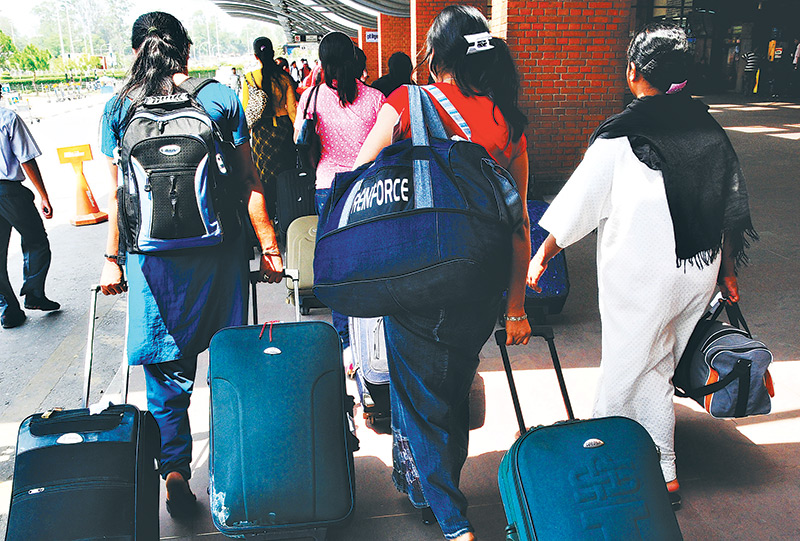
Years of protectionist mindset towards women migrant labourers has only made them more vulnerable to seeking dangerous routes for work abroad, while risking trafficking and exploitation.
- Post Report
Post file Photo

BHRIKUTI RAI
KATHMANDU,
The Department of Foreign Employment has been on a roll.
In the past two years, it pushed a slew of reforms, from hearing complaints from migrant workers every day—not just once a week like it used to earlier—to issuing work permits from outside the Kathmandu Valley. Last week, the department announced that it had collected more than Rs45 million from recruiting agencies and sub-agents over the last six months to pay compensations to the migrant workers who had filed fraud complaints. For comparison, the amount it collected last week is six times what it collected in the same period last fiscal year.
However, these headline-making reforms don’t account for the suffering of Nepali women migrant workers, according to rights activists. The state’s restrictive migration policies are not just forcing women into greater exploitation but are leading them to become ineligible to the Department of Foreign Employment’s new policies and benefits.
Take the case of Sabina Rai, for example. The 24-year-old woman died in Baghdad over a year-and-a-half ago, and her body remains unclaimed at a hospital in the Iraqi capital. She had entered Iraq to work as domestic help through many sub-agents and several stops across Nepal and India.
Since 1998, Nepal government has, on and off, banned women from migrating to foreign countries for work in the informal sector, primarily as domestic help. Earlier this year, it resumed renewing labour permits for those who had older permits to work in the informal sector in the Gulf, but stopped short of reforms that would allow first-timers to seek employment as domestic help. So like Rai, thousands of women continue to leave the country with the help of unscrupulous agents.
Of the thousands of fraud complaints lodged at the Department of Foreign Employment, the vast majority are from men, as they make up an overwhelmingly large chunk of documented Nepali migrant workers. Last fiscal year, of the 208,352 labour permits issued from the department, less than 10 percent were for women.
But the government says that its hands are tied when it comes to making sure Nepali women working abroad, who may have been deceived just like their male counterparts, have access to the existing grievance mechanism.
“Helping migrant workers without labour permits falls outside our jurisdiction,” said Bhola Nath Guragain, spokesperson for the Department of Foreign Employment. “Without document or evidence, we can’t act, and how do we trust them?”
Migration experts say the negligible number of documented female migrant workers is because of the government’s erratic bans on women from taking up jobs in the informal sector, mostly as domestic help in countries across the Middle East, which have a high demand for such labour and are also the most lucrative. As a result, most female Nepali migrant workers who seek underground ways to secure jobs in the informal sector and are not documented in the state’s system are excluded from the recent reforms.
“The lack of access to the state’s grievance mechanism is just the tip of the iceberg for women, who continue to face the brunt of decades of Nepal’s discriminatory labour migration policies,” said Sharu Joshi Shrestha, a gender and migration expert who sits on the task force team for reforms on foreign labour migration.
***
Getting a passport wasn’t always easy in Nepal. One had to come to Kathmandu to apply in person and submit several kinds of paperwork at the Ministry of Foreign Affairs. It was only when Nepal began formulating pro-labour migration policies in the mid 1980s that passports became accessible to those who sought employment abroad.
But even when successive governments began prioritising foreign labour migration, Nepali men and women didn’t have equal access to foreign employment.
The Foreign Employment Act-1985 had prohibited recruitment agencies from providing “foreign employment to children and women without the consent of her guardian”. The Second Amendment to the Act in 1998 expanded the permissions required for women and children to take “permission of His Majesty’s Government and guardians”. A guardian was defined as the mother or father of an unmarried woman, or the husband of a married woman.
Shortly after the amendment, the government, in 1998, imposed a complete ban on the migration of women to the Gulf countries in response to the mysterious suicide of Kani Sherpa, who worked as a domestic worker in Kuwait. She was allegedly abused by her employer, which then pushed her to take her life. This marked the beginning of the state’s aggressive protectionist push towards Nepali women seeking employment abroad for their own “safety and security”, say migration experts. Since then, the ban has been partially lifted, only to be implemented again with a host of other varying bans with restrictions and conditions.
In 2012, Nepal imposed a ban on women less than 30 years of age from migrating as domestic workers to certain countries in the Middle East. Two years later, the ban was extended to a global scale, preventing Nepali women from seeking employment as domestic help anywhere in the world. The ban was expanded on the grounds that there was a need for stronger regulations to protect women from widespread abuse and exploitation.
The ban eventually got lifted partially but regulations were never formulated to benefit Nepali women, who have the same aspirations as men to work abroad. The list of restrictions on women only keeps getting longer. The age-specific ban on women from seeking jobs abroad moved from 30 years of age to 25 and then to 24, before a complete blanket ban on women seeking jobs as domestic help across all Gulf countries. This ban went into effect after a parliamentary committee ordered the government to ban all Nepalis, both men and women, from travelling to the Gulf countries as domestic workers.
According to migrant rights experts, these bans, even though they’ve been formulated to apply to the informal sector on a whole, disproportionately affect women because the majority of domestic workers tend to be women. The flip-flops of successive governments on these bans over the past three decades are a reflection of the state’s apathy towards ensuring equal access to foreign employment, say experts.
“The government needs to make strong policies to improve the working conditions of Nepali women abroad. Policies shouldn’t be incident-based, like they have been for all these years,” said labour and migration expert Ganesh Gurung, a former member of the National Planning Commission. “Labour policies need to be formulated by looking at things in totality.”
Gurung says inconsistent and discriminatory labour policies make women more vulnerable to trafficking and sexual and labour exploitation.
That is exactly what happened to Rita two years ago when she landed in Oman for work. Rita, who hails from Salyan and asked only to be identified using a pseudonym, said she was initially told she’d be sent to Kuwait directly via Kathmandu But instead, it took more than a month of perilous journey across India, China and Sri Lanka before he landed in Muscat. Like most women who end up in countries on the ban list, Rita too said she didn’t have any idea about the existing bans or the documents required for employment abroad.
“The agent in Salyan told me he would get all my papers, and promised me a well paying job as domestic help,” she told the Post.

Experts say inconsistent and discriminatory labour policies make women more vulnerable to trafficking and sexual and labour exploitation. Post file Photo


But later, when she was subjected to unforgiving working hours and repeated sexual assaults and rape at her workplace, she wasn’t able to get in touch either with her family or the agent who sent her there. In the end, she returned to Nepal with a toddler born out of rape, and no money. Her family in Salyan has since shunned her, she said. Since her return, she’s taken refuge at a shelter home run by Pourakhi, an NGO which rehabilitates migrant workers like her.
Besides trying to find a work in Kathmandu to take care of her infant son, Rita says she has been trying to get in touch with the agent who promised her a lucrative job in Kuwait. On his suggestion, she left her pair of gold earrings and marriage certificate with him. But more than a year since her return, she hasn’t been able to get either of them back.
“I trusted him and handed him my things and now I have nothing,” she said.
Unlike male migrant workers who work in the formal sector and are thus documented, Rita doesn’t even have the option of lodging a fraud complaint at the Department of Foreign Employment.
Satra Gurung of Pourakhi says that the state’s “protectionist mindset” has hampered Nepali women’s mobility and also crippled them financially. The varying bans haven’t stopped people from going to countries where Nepalis are forbidden to take up work in the informal sector; they have only marginalised women further.
“A ban is not the solution, because there is nothing an empty stomach won’t do. It will find ways,” she said. “If you close the door, it will break the window to escape. If you lock the window, people will escape by digging a tunnel. They will either die or try everything to escape.”
Earlier this year, Indian Police rescued 179 Nepalis, of whom 147 were women, from its Myanmar border and sent them to Nepal. Of them, 41 women said they were on their way to Iraq. Activists say that this incident shows how women make up a large portion of those seeking job opportunities in countries that have been deemed dangerous and banned.
Satra says that Nepal needs to act urgently and learn from the policies of other countries, like the Philippines, to ensure that the government has bargaining power with the receiving country. Nepali activists say that in the Philippines, unlike in Nepal, different ministries and state agencies work in coordination without a rigid hierarchy when it comes to dealing with the concerns of its citizens working abroad.
***
Not all women necessarily face abuse when they work in the informal sector, like domestic help. But in the absence of a governmental policy that allows them to work freely, they are forced to live in constant fear, stay apart from their families for an extended period of time, and face hassles if they decide to come home.
Kriti, who also asked not to be identified by her real name, moved to Hong Kong to work as domestic help three years ago on forged documents, presenting herself as an Indian citizen. Raised by an illiterate single mother in the hills of eastern Nepal, she said she didn’t have much hope of finding a well-paying job in Nepal, despite holding a bachelor’s degree. Since Nepalis are barred from working in Hong Kong, she had to take multiple trips to India to get her forged papers, and pay nearly a Rs100,000 in ‘setting  fees’ at the Tribhuvan International Airport before flying out.
“It’s nice here in Hong Kong,” she said. “The only issue is visiting family in Nepal because of the restrictions.” During her last and only visit to Nepal after leaving in 2016, she had to fly in and out of Delhi and then travel to Nepal.
Government officials who have been part of migrant labour law reform committees say that unless there are policies to address the concerns of Nepali workers, both men and women, in the informal sector, their plight will continue.
“Domestic workers need to have a recourse too. They can’t let isolated incident-driven decisions hamper their lives,” said Purna Chandra Bhattarai, a former government secretary and labour analyst. “We need to initiate memorandums with countries where there is a high demand in the informal sector so we are in a better position to negotiate.”

HOME PAGE

Gridlock fears grip Valley residents as Kathmandu gears up for South Asian Games

The organisers of the Games have promised a mega show, but for many on the streets, the event could end up being more of a hassle.
- Post Report
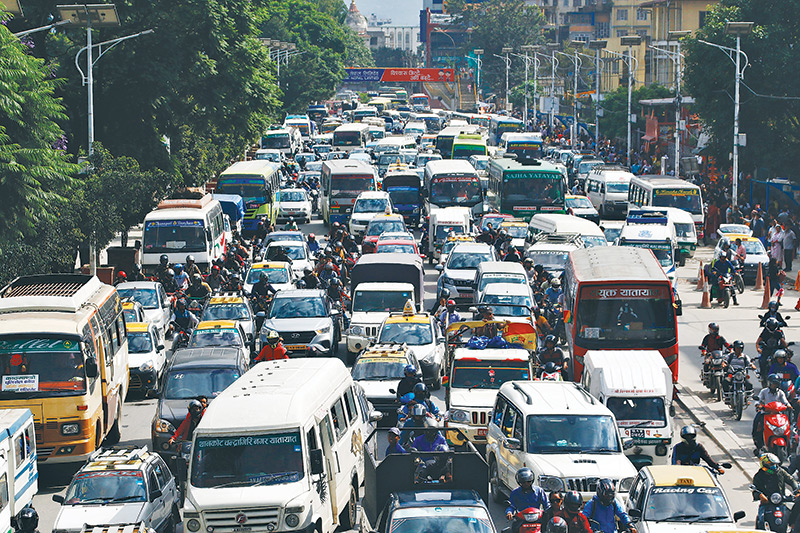
Traffic jams are notorious in Kathmandu. On specific occasions, roads are clogged with vehicles. Post Photo: KESHAV THAPA

SUMAN MALLA
KATHMANDU, NOV 30
A day before the 13th South Asian Games’ official opening, sounds of rivet guns reverberated through the Dashrath Stadium as workers were frantically fixing seats and canopies on the VIP parapets.
As officials and workers race against time to wrap up the renovation of the sports complexes across Kathmandu, it’s hard to ignore the sea change the city has undergone since the last time the Games were held—20 years ago. The most notable change is the city’s traffic volume, which has grown exponentially.
According to the latest data of the Metropolitan Traffic Police Division, more than one million vehicles, including 154,433 cars, run daily on the streets of Kathmandu Valley. While the organisers claim they will pull off the Games without a major hitch, the signs so far haven’t been good.
“If you were to hear people discussing the Games in our business, they were probably talking about the traffic,” Ganga Bahadur Gurung, a taxi driver, told the Post, as he waited at Tripureshwor for his next passenger.
“There will be a lot of traffic chaos on the streets for the next ten days.
If it is difficult to drive now, it will be impossible then,” he said, referring to the menacing traffic snarls in the Valley.
The organisers’ bid to keep some people away from the Games venues has drawn a lot of criticism.
“We advise commuters, if possible, to avoid travelling along the routes in the vicinity of the Games venues to keep from being stuck in traffic,” said Senior Superintendent Bhim Prasad Dhakal, chief of the Metropolitan Traffic Police Division.

Construction of Dashrath Stadium, the main event venue, was rushed at the last minute. Post Photo: Hemanta Shrestha


Around 6,000 athletes and officials from seven South Asian countries are taking part in this year’s event. The Games’ Transportation Management Committee is spending around Rs100 million and plans to use 400 vehicles to shuttle athletes and officials between sports venues and hotels to ensure they don’t get caught in traffic jams.
The sporting events will be held at venues in Tripureshwor, Lainchaur, Kirtipur, Halchowk, Satdobato and Gokarna in the Capital. Pokhara and Janakpur are other host cities.
The athletes and officials are lodged in 75 hotels across the Valley, from Bhaktapur in the east to Godavari in the south to as far north as Budhanilkantha, according to Arjun Bahadur KC, coordinator of the committee.
“Kathmandu is going to be much busier than normal, and we would urge people going about their usual business to take extra care,” said KC, calling on residents to plan for congestion and delays and to adapt by staggering commutes.
But there are concerns that these measures will create misery for residents in a city with a poor road system already struggling to meet demands.
“There is an incredible lack of detail about the transport plan. It’s veering from severe to extreme chaos,” said Ashish Gajurel, a transport and traffic engineer. “They had three years to plan for this and they’ve messed it up completely.”
While the authorities running the Games have repeatedly sought to reassure, many low-income workers will be unable to change their working hours to avoid peak congestion.
Roshan Bhattarai, a waiter who commutes daily from Panchkhal in Kavre to his job in Teku, says he finds the thought of imposing restrictions on buses from entering the city centre is scary. “It’s normally crowded anyway, and nothing works properly,” Bhattarai said. “It’s going to be terrible for the next couple of weeks. I don’t know how to get around this.”
Authorities have asked commuters not to get alarmed, pointing to solutions that they say worked well during SAARC and BIMSTEC summits in the past.
Stop-and-go traffic schemes will be enforced on major roads and intersections to allow faster mobility for
the athletes when transferring to different venues that will affect the general public less, according to the Metropolitan Traffic Police Division.
“Besides, we will be providing motorcycle and mobile car escorts,” Dhakal said.
Traffic Police officials said around 700 additional personnel will be deployed in key areas in the Valley to manage traffic and assist motorists on the road during the Games.
Considering an expected large crowd during the opening and closing of the Games, the traffic police office has announced an odd-even scheme for the two days.
Under the scheme, vehicles with odd numbers will be allowed inside the Ring Road on the Games’ opening on December 1. Similarly, those having even numbers can operate on the closing day on December 10.
“Fans heading to watch the opening ceremony on Sunday should leave plenty of time and prepare for major delays,” Dhakal said, warning parking has been severely restricted or non-existent at many of the sites. Spectators going to the Dashrath Stadium will have to park their vehicles at Tundikhel.
“It’s a big challenge to tackle the traffic issue in Kathmandu,” he said. “But I am sure we can make this event a success if everybody cooperates.”

Page 2
MEDLEY

Horoscope

ARIES (March 21-April 19)
***
You might be feel slow today, although your emotions will be quick to act up. It might seem as though everyone is miles ahead of you. Try not to let your jealousy or fears cause you to get a bit down. The best thing is to remove yourself from the situation and check in another day.


TAURUS (April 20-May 20)
***
Some smart folks have been telling you you must put yourself into everything, but today you need to remove your emotions from the equation. Your perspective is important and valid, but it isn’t relevant to right now. It may also cause you to focus on stuff only important to you.


GEMINI (May 21-June 21)
**
It’s time to be more calculating about life. Going with the flow is fine, but you need to form a strategy. The stars are laying a lot of opportunities for you, but you’ll have to research to take advantage of them. When you get involved in a new venture, don’t do it because it sounds fun. Do it because it will give you experience.


CANCER (June 22-July 22)
***
Things are going well for you now, but don’t get too comfortable where you are. There are still a few potential pitfalls, and you need to stay on your toes. Go out of your way to avoid anything you are unsure of, especially any type of official or legal commitment.


LEO (July 23-August 22)
***
Listen to the most controversial speakers with care today, there is more to what they are saying than you think. It’s in everyone’s interest to find out what’s really going on, and you will have to be the person to do it. Your insight could make the difference between guessing at the truth and knowing it.

VIRGO (August 23-September 22)
****
There’s a restless confidence inside you, waiting for a bright spark to bring it out. You’re itching to show everybody what you are made of! Today has the potential to be a turning point for you—if the right trigger comes along, you will move into a new and exciting space very soon. Be on the lookout for a chance to step up.


LIBRA (September 23-October 22)
***
You’ll know when you need to step back today—listen to your gut when it tells you to run. It’s important for you to be able to find a place where you can be alone when people aren’t on your wavelength. And don’t succumb to pressure to be social when you don’t want to be. Please yourself, not others.


SCORPIO (October 23-November 21)
****
Right now you’re powerful—just in time to make some long-awaited changes. This will be a very rewarding day; you will be able to take something you don’t like and turn it into something you’ll cherish. Important transformations and innovations are easier than they have ever been.


SAGITTARIUS (November 22-December 21)
***
Experiencing some bizarre dreams lately? Don’t worry—they aren’t premonitions. They’re signs you have an extremely active subconscious right now. While you’re living your day-to-day life and dealing with things
as they come, your mind is working on back-burner issues.


CAPRICORN (December 22-January 19)
**
It’s time for you to organise your life coherently scheduled. Your obligations, friendships, and romantic relationships are pulling you in different directions, and the problem will only increase if you put off getting things sorted. Be more structured about how you plan your days—get it down to the minute if you have to.


AQUARIUS (January 20-February 18)
**
When you think about where one of your relationships is going today, ignore logic and tune in to your feelings about who this person is. Ask whether you are keeping them in your life because they bring out the best in you—or because you’re used to them being around.


PISCES (February 19-March 20)
*****
You’ll be full of an endless supply of good feelings today. If you let them lead you through the day, you’ll improve one of your newer relationships. Reach out with a smile and a hug when you see them—even if you aren’t sure whether they’re a hugger. By being overt with affection, you’ll make it okay for them to do the same.

Page 3
NATIONAL

Officials, ministers face contempt case for not enforcing court order to ban visual pollutants

Four years into the Supreme Court’s order, government authorities have failed to save the city from unsightly advertisements.
- CHANDAN KUMAR MANDAL
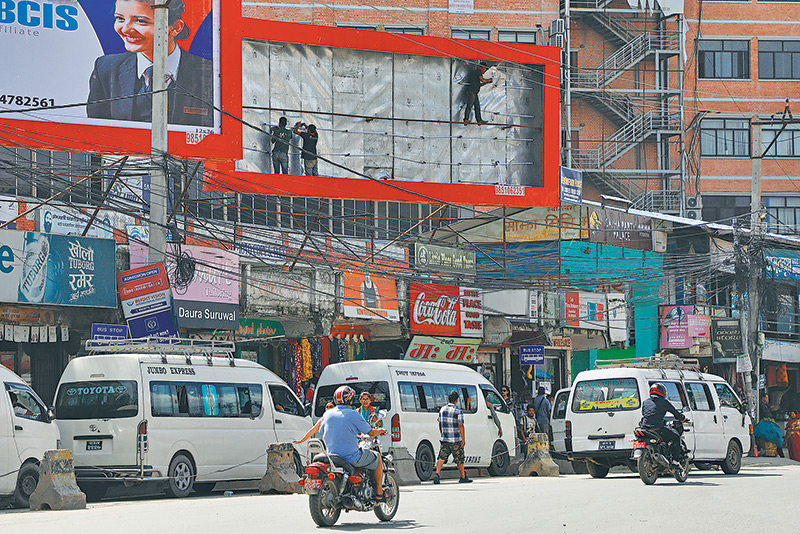
Hoarding boards, wall paintings and posters still pollute Kathmandu Valley visually. Post file Photo

KATHMANDU,
A contempt of court case has been filed against government officials and ministers over their failure to implement a 2015 Supreme Court ruling for clearing Kathmandu of visual pollutants, including hoarding boards, wall paintings and posters.
Four years ago, the Supreme Court had asked authorities, including the Kathmandu Metropolitan City (KMC), to rid the capital city of all forms of visual pollutants that ruin the city’s aesthetics.
But four years since the court’s order, the ruling remains far from enforced despite several notices from Judgment Execution Directorate, the body that ensures the court’s verdict is implemented.
Padam Bahadur Shrestha, a senior advocate who filed the writ petition at the Supreme Court in 2015, said he was left with no option than filing a contempt of court case after government agencies and officials paid no heed to the decision.
“It has already been four years since the country’s highest court passed its verdict,” said Shrestha. “Even the directorate had sent several notices. But nobody took it seriously.”
Walls, rooftops, and streets across the Kathmandu Valley are plastered with banners, pamphlets, and hoarding boards, which are generally described as elements of visual pollution. Visual Pollution is defined as anything that blocks the natural view or aesthetic beauty of a specific site, landscape, or city.
The officials against whom the case has been filed include KMC mayor Bidya Sundar Shakya, its chief administrative officer Kedar Neupane, KMC Environment Division chief Hari Kumar Shrestha and City Police chief Dhanpati Sapkota. Likewise, government ministers Shakti Bahadur Basnet, Hridayesh Tripathi, Ram Bahadur Thapa, and Mohammad Ishtiaq Rai have also been made defendants in the case.
“I had to file the case because they have not done their job effectively as office bearers,” said Shrestha. “They have not even responded to the correspondence of the directorate. Defying the verdict of the Supreme Court is a serious offence but these agencies and officials have continued to do just that.”
Since the court verdict in 2015, the directorate has dispatched five letters to authorities, questioning the
status of the court’s decision and the progress.
In the latest letter sent by the directorate on November 13, it asked the KMC to submit a progress report within seven days. But officials in the city office never submitted the report.

Page 4
NATIONAL

Lalitpur metropolis inaugurates first bicycle lane in the Valley

The city wants to promulgate New Cycle Law 2020 to guarantee safety to cyclists.
- ANUP OJHA
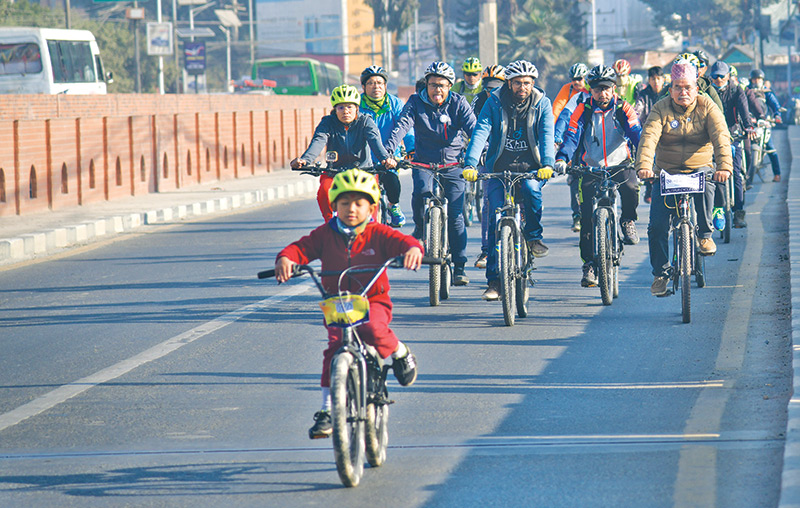
Mayor Chiri Babu Maharjan (right) and dozen others ride bicycles at the inauguration of a cycle lane in Kupondole, Lalitpur, on Saturday. Post Photo: deepak kc

LALITPUR,
In an attempt to make itself an eco-friendly city, the Lalitpur Metropolitan City on Saturday inaugurated the construction of a 4.7km cycle lane from Kupondole to Mangalbazaar.  
At the inauguration, Mayor Chiri Babu Maharjan reached Kupondole from the city office riding his 33-year-old bicycle along with dozens of cyclists.
“The lane will come into operation from January,” said Maharjan. The main motive of the campaign is to demotivate the use of petrol-run vehicles in the city, he said, adding the move was “historic”. Talking to the Post, Maharjan also vowed to cycle to his office every day from his home in Bakhundole.
“When I don’t have an emergency, I will ride the bicycle. I am planning to make a new rule that makes it
mandatory for officials at the city to come to the office on a bicycle once a week,” said Maharjan. He thinks
this initiation will help change the attitude of the people. He further vowed to buy bicycles instead of motorcycles and four-wheelers for LMC officials as well.
Mayor Maharjan currently drives a Toyota Rav-4, a vehicle used by the former mayor of the city Buddhi Raj Bajracharya for two decades. He used the budget (10 million) allocated to purchase a vehicle to buy two water tankers instead.
The first phase of the cycle lane will start from Kupondole, Pulchowk, Jawalakhel, Lagankhel, Mangalbazar for which the city has allocated Rs 5 million.  
The city has allocated an additional 5 million for the second phase of the cycle lane, which is set to connect Lagankhel with Godawari.     
To formulate the Cycle Act 2020, the city has cooperated with the Nepal Cycle Society, a nonprofit comprising a new generation of urban planners and transport engineers.  
“Neither the central nor the federal government has talked about a cycle lane or safety for cyclists till date. By enforcing this law, we want to assure our citizens that cycling is safe in Lalitpur and to encourage everyone to cycle,” said Maharjan.
The city has plans to construct 110 cycle stands in 10 different places. Cycle stands have already been constructed in the Central Zoo, Patan Durbar Square, Patan Hospital and Chaugal.
Nivesh Dugar, 29, environmental engineer and a technician with Nepal Cycle Society, said the new cycle lane will cover 1.2 metre on each side of the road, except on the slope in the Himalayan Hotel, where there will only be one dedicated lane.
“It was in November 2009 that we had started the drive to build cycle lanes in the city. Lalitpur city is finally working to make this a reality,” said Dugar. The group estimates that there are over 150,000 cycle riders in Kathmandu Valley, and they hope that dedicated cycle lanes will help increase the number of cyclists in the city.

Page 5
NATIONAL

Greater urgency required to detect hidden HIV cases

Index testing or HIV tests for children, spouse, sexual partners, siblings and parents is crucial, doctors say.
- Arjun Poudel

KATHMANDU,
When Suntali from Sunakothi of Lalitpur visited Patan Hospital five days ago, her chief complaint was continued fever. A wound on her back was also bothering her for quite some time, she said.
After a series of tests, doctors found that the 65-year-old woman, who wished to be identified only by her first name, was infected with HIV. Suntali’s husband died when she was pregnant with her son.
“I thought my husband died of a disease that could not be diagnosed,” she said. “Now my son is 22 years old and I am diagnosed with HIV.”
Had she not visited the hospital, there were chances her HIV status would not have come to her and the authorities’ notice. She is currently receiving treatment at Sukraraj Tropical and Infectious Disease Hospital in Teku.
Mahalaxmi, 48, of Kavrepalanchok has been admitted to the same hospital.
Her husband Dhan Bahadur has been receiving antiretroviral treatment for the last six years. She was diagnosed with HIV infection only recently. She got the virus from unprotected sex. “She knew my HIV status and the type of treatment I have been receiving,” said Dhan Bahadur. “I did not take her for HIV infection check-up as we were concerned that we could face discrimination if she was dignosed with HIV.”
Like Suntali and Mahalaxmi, according to estimates, there are around 8,000 people across the country who have been infected with HIV but are either yet to be diagnosed or yet to come in contact with hospitals.
Such hidden cases are a cause of concern, say officials, as it could mean Nepal could miss the UNAIDS 2020 goal of 90-90-90.
UNAIDS 90-90-90 is an ambitious treatment target to help end the AIDS epidemic, for which, by 2020, 90 percent of people should know their HIV status; 90 percent of people with diagnosed HIV infection should receive sustained antiretroviral therapy; and 90 percent of all people receiving antiretroviral therapy should have viral suppression.
“The deadline is very close and thousands of people are still hidden,” Dr Anup Bastola, chief consultant at ART clinic at the Sukraraj Tropical and Infectious Hospital, told the Post. “Had we carried out the index testing, these two cases would have been diagnosed years ago.”
According to the National Center for AIDs and STD Control, 29,944 people are estimated to be living with HIV in Nepal. Among them, 21,388 people have been diagnosed so far.
Bastola said concerned authorities should focus on index testing, which means family members—children, spouse, sexual partners, siblings and parents—all should undergo HIV tests.
“We have to work on war footing to find out all the cases which are hidden if we want to meet the UN target,” said Bastola.
Even if the first two 90-90 goals are meat, Nepal will struggle to meet the third target of viral suppression, as of the five viral load testing machines throughout the country, only one is in operation.
Similarly, people living with HIV have also been deprived of CD-4 count service, for a long time.
Of the 33 CD-4 count centres across the country, only 18 are in operation.  
CD4 count is a test to measure the number of CD4 cells—a type of white blood cell called T-cells-that move throughout the body to find and destroy bacteria, viruses, and other invading germs. CD4 count is a must to start antiretroviral medicines for people living with HIV and to check the effectiveness of the medicines they are taking. An HIV patient must undergo a CD4 test for the doctor to be able to prescribe antiretroviral
medicines.
Dr Anuj Bhattachan, director at the National Center for Aids and STD Control, concedes the lacking and challenges when it comes to meeting the UNAIDS targets.
“Yes, meeting the UNAIDS goals seems challenging in the present context,” Bhattachan told the Post. “But we have been working to bring targeted intervention measures to meet the targets.”
He said that his office would coordinate with all the stakeholders to launch effective programmes targeting risk groups—migrant workers, sex workers, drug users and other vulnerable groups.

NATIONAL

Encroachment along Chandranigahpur road section continues unabated

- SHIVA PURI

RAUTAHAT,
Chandrapur Municipality has done little to clear illegal vendors from the roadside in Chandranigahpur, four months since the local unit made a decision to evict them.Chandranigahpur is one of the busiest towns along the East-West Highway and is a rest stop for most vehicles.
Following widespread criticism, the municipality four months ago made the decision to stop the encroachment of roadside land in Chandranigahpur. The decision was made in chairpersonship of Mayor Ramchandra Chaudhary, representatives from the area police, division road department, district traffic police, and other stakeholders.
But four months on, the encroachment continues, and criticism keeps on mounting. The highway and
sidewalks are still peppered with food and vegetable stalls.
Deputy Mayor Ramrati Chaudhary said the municipality is committed to enforcing the decision to clear the roadside properties. “An upcoming municipal meeting will make a concrete decision towards solving the problem,” she said. “There are other problems as well, such as parking. We are trying to solve them all at once.”
Prior to this, the area police, district police and traffic had banned vendors from setting up stalls along the highway six years ago. There have been repeated attempts since then, but the vendors haven’t budged. The encroachment goes into overdrive during festivals. Chief Inspector of District Traffic Shailesh Neupane said unchecked stalls and haphazard parking are among the major causes of road accidents in the section. “We can’t do anything unless the municipality takes a concrete step,” he said.
The street vendors the Post talked to said that they have no option than put up their shops on the roadside.
“We can’t afford to rent space for a shop, and we don’t have a job either,” said Pandit Prasad, a street vendor who sells fruits.
In Chandranigahpur, it’s not only the street vendors who have breached the rules. Many buildings have been erected on the highway’s roadsides. Some have built a barn for cattle on the roadsides. According to the Division Road Office’s criteria, there should be a 25 metres of open space on each side of the highway, and 15 metres on auxiliary roads.

NATIONAL

A women-run factory producing sustainable goods in Mahendranagar

- BHAWANI BHATTA
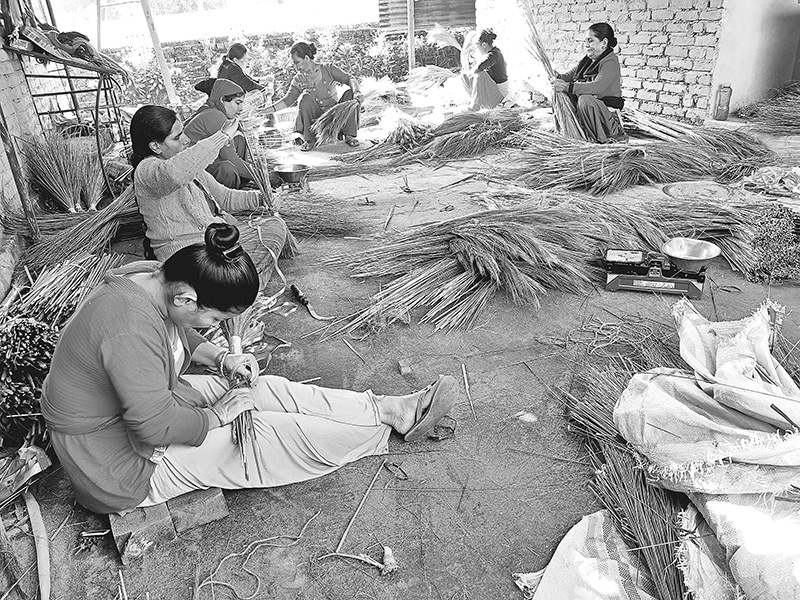
The women make brooms and bamboo-based products, earning around Rs 600 a day. Post Photo: bhawani bhatta

KANCHANPUR,
Fifty-year-old Lakshmi Mahata from Mahendranagar was a full-time housewife a year ago. Once she was done with household chores, she would while away her days, she says.
Today, things have taken a turn for the good since a factory was established in her neighbourhood. She is now employed and earns a decent income. The factory produces hand-made brooms and other products made of bamboo.
“I come early, after I cook food for the family, and return to make supper. It’s a good use of my free time, said Lakshmi,  adding that she earns about Rs600 daily. “More importantly, I have learned a new skill,” she said.
The women who work with Lakshmi prepare up to 150 brooms a day, and get paid Rs4 for each product.
“With the money, we can now contribute to buy daily essentials,” said Basanti Bam, who lives in a rented flat in Mahendranagar.
Since they get paid according to the pieces they produce, the workload is not so burdening, they say.
Basanti and Lakshmi each work for six hours daily.
The factory, Bindhabasini Bamboo Cottage Industry, was established a year ago and trained its employees before hiring them, said Lal Bahadur Gharti, the owner. “We are proud of what we do,” he said.
“We make use of local resources and have been able to produce materials such as chairs, sofas, tables, cupboards out of them.” Gharti said that he has invited artisans from India to train the women further.

NATIONAL

In Baitadi, an acute water shortage hits operations at health facilities

To provide services to the people, health workers have been carrying water from distant sources to the health posts daily.
- TRIPTI SHAHI
At Bhumeshor Health Post, which also provides maternity services, health workers say it is tough to perform deliveries due to water shortage. POST PHOTO: TRIPTI SHAHI

BAITADI,
In accordance with the set government standards, health facilities—including birthing centres—should have running water round-the-clock. But most of the health facilities in Baitadi run dry, as the district is reeling under water shortage.
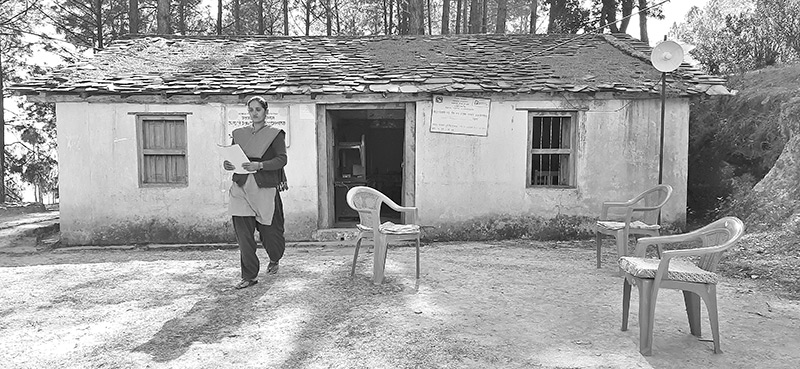
Bhumeshor Health Post in Patan Municipality Ward No. 4 is one example of how severe the crisis is. Auxiliary Health Worker Jagadish BK said that health workers have to carry water from a distant water source to maintain daily needs. He said, “Our office assistants have to wait in a long queue to fetch a vessel of water in the morning.”
Bhumeshor Health Post also provides maternity services. Jyoti Sunar, an auxiliary nurse midwife of the health post, said that they are facing difficulties to perform most deliveries due to water shortage. She said, “Because of the lack of water, it has become challenging to maintain sanitation after completing a delivery.”
The problem is similar in Barakot Health Post, Dasarathchand Municipality in the district headquarters. Auxiliary Health Worker Suraj Bhatta said water supply is irregular here as well. “Our office assistants carry water in vessels to carry out daily operations. Sometimes, at the end of the day, we don’t even have water to wash our hands after completing our work,” said Bhatta.
There are 65 health posts, two primary health centres and one hospital in Baitadi. A majority of those health facilities are reeling under water shortage.  Bhim Singh Air, health assistant of Thakada Health Post in Sigas, said that they have been facing a shortage of water in the health post for a long time.
He said, “The concerned authority should manage the supply of water in the health posts otherwise health posts cannot provide effective services.”
Bhuwan Joshi, information officer of the Health Office in the district, said that local units should be responsible to maintain regular water supply in the health facilities.
After the country went into the federal set up, local units became responsible to oversee the problems of health posts and solve them. “Local government allocates budget to the health posts and they should be responsible to solve this problem too,” said Joshi, adding that people’s representatives are staying mum despite knowing the gravity of the situation.
People’s representatives say that they are indeed working to solve the water scarcity problem. Keshav Bahadur Chand, mayor of Baitadi’s Patan Municipality, said construction work of various drinking water projects is underway to solve the problem. According to him, the problem will be minimised soon.

NATIONAL

Staff shortage in Manthali Livestock Services Section

Briefing

RAMECHHAP: There’s a shortage of employees in the Livestock Services Section in Manthali Municipality, Ramechhap district. According to the municipal office, services have been affected, as there are only three
technicians to oversee 14 wards.

NATIONAL

Locals protest against contractor company

Briefing

BARDIYA: Locals of Gulariya have protested against Ganapati Nirman Sewa, a contractor company, saying that the company has been using substandard materials to construct the Gulariya road along the Postal Highway. Bijaya Devkota, a local, said they found shoddy materials being used in the construction of the road. “We have requested Chief District Officer to take stock of the situation,” he said.

NATIONAL

Women-led cooperative introduces communal farming

Briefing

SYANGJA: Farmers in Waling, Syangja, have resorted to communal potato farming due to an increasing shortage of human resources. The effort is spearheaded by the Sana Kishan Agricultural Cooperative, which has leased four ropanis of land for farming. The cooperative is run exclusively by women.

NATIONAL

Mugu Hospital to be fully facilitated

Briefing

MUGU: Mugu District Hospital will soon be upgraded to a fully facilitated hospital, officials say. According to the hospital administration, the health facility has invested Rs 230 million for construction and Rs 200 million for medical equipment. The hospital will be upgraded to a 25-bed hospital within March 2020. 

NATIONAL

Man held with 1.8 kg hashish

Briefing

(EAST): Police arrested a man in possession of 1.8 kilograms of hashish from Bhume Rural Municipality in Rukum (East) on Friday. DSP Yogendra Kumar Khadka said Purna Bahadur Pun Magar was arrested with the contraband from his house.

Page 6
OPINION

Deploying midwives to prevent deaths

Training midwives for home visit care is fundamental to reducing maternal deaths.
- MUKESH ADHIKARI
Shutterstock

The tragic death of young mother Kalpana Gurung due to easily preventable postpartum haemorrhage in a Gorkha village is an example of the deprivation women in Nepal’s remote areas are facing. Recent findings revealed through investigative journalism show that there were eight maternal deaths in Taplejung in the past fiscal year, about which major stakeholders were unaware.
  While working as a district public health officer in Achham three years ago, I witnessed eight maternal deaths in one year. There are about 1,500 maternal deaths in Nepal annually, most of which are avoidable. The number of unreported deaths might be higher. Although we brought down the maternal mortality ratio by almost 55 percent in 10 years from 1996 to 2016, and received the Millennium Development Goal award for the speedy accomplishment, the figure is still much higher than our neighbouring countries.  

Maternal mortality ratio
In line with the Sustainable Development Goal, Nepal has targeted to reduce the maternal mortality ratio to 70 per 100,000 live births by 2030. This means we will need to reduce the maternal mortality ratio by at least 7.5 percent annually, which is a highly ambitious target. Conducting fragmented and vertical programmes, such as airlifting mothers and distributing misoprostol to pregnant women for preventing postpartum haemorrhage, are short-term approaches that will not reduce maternal deaths in a sustainable manner. An integrated approach focusing on strengthening the overall health system is highly essential.
  Examining the causes of maternal deaths, we see that a number of them are caused by postpartum haemorrhage which can be easily prevented by institutional delivery or delivery by skilled birth attendants. According to the Nepal Demographic Health Survey 2016, the proportion of institutional delivery is 57 percent, and the proportion of delivery by skilled birth attendants is 58 percent. These figures bolster the importance of intervention of health workers during childbirth.
  This is not the whole story, however. In order to prevent maternal deaths and promote the overall health of women, a continuum of care approach is needed which is glaringly missing in our health system. For instance, we can save a mother by airlifting her to a hospital when she is in a critical condition following childbirth in a remote health facility, but can we guarantee the life of the mother who delivered her baby at home? Can we reach every remote place by helicopter in a timely manner if needed? Furthermore, a set of misoprostol tablets taken timely after home delivery can prevent the mother from postpartum haemorrhage, but can we protect her from other complications? The answers to these questions are a simple no. That’s why a holistic continuum of care approach is a must where a woman gets care from the preplanning period of pregnancy to the postpartum period; and to achieve this, there is no option other than strengthening the overall health system.
  The health system, similar to the market, can be broadly divided into demand and supply sides. To increase demand for antenatal care and institutional delivery, financial incentive packages are available; however, at present, almost four out of 10 mothers deliver at home. This is majorly due to poor access to health facilities, like in the case of the dead mother Kalpana Gurung where the nearest health post is a five-hour walk. Geographical hardships hinder women from reaching health facilities. At the same time, the supply side of the health system is also creating challenges in ineffective health service delivery. Many of the remote public hospitals lack trained doctors to perform Caesarean section. The health posts at the community level lack skilled nurses and midwives. In such a scenario, intervention in one side of the system will save a few lives, but that is not a permanent solution.
  If we want to bring down the maternal mortality ratio to 70 per 100,000 live births by 2030, such a unilateral approach will not work. The story of Sri Lanka, where the maternal mortality ratio is about 30 per 100,000 live births, is an inspiration for us. The midwifery approach proved to be instrumental for Sri Lanka where the notion of care in the form of ‘womb to tomb’ is encouraged. In low resource settings like Nepal, this approach will not only enhance maternal and child health, but also improve the health of the people at large if prudently applied.

Timely deployment
Realising this fact, Nepal has initiated a Bachelor in Midwifery Programme to produce competent midwives, but this is limited within a few colleges in the capital city. Further, the production of intermediate level midwives has not been initiated yet, neither is there an appropriate plan for the deployment of midwives. Therefore, intensive production of competent midwives and their timely deployment to rural areas where they can provide home visit care is very important to bridge the gap of inaccessibility. And they should be provided with the necessary equipment so that they can use their skills effectively.
  If we had started the midwifery approach in Gorkha district, Kalpana Gurung would be alive today. A midwife could have saved her life by simply administering a dose of injection oxytocin after home delivery. It’s already late, and if we still wait to intervene, we will hear more tragic news of maternal deaths in the future.


Adhikari is a public health officer at the Ministry of Health and Population.

OPINION

There’s a new ride in town

The government should adapt to changing times and accept app-based ridesharing services.
- MANISH RAJ KHAREL
Shutterstock

Smart-phone applications now allow people to travel quickly and comfortably with the touch of a button. Thanks to innovations like Uber, Grab, Lyft and others, it has transformed the way people travel. In Kathmandu, finding a public with a seat is a real struggle on most days. If one has to ride a taxi, finding one which is willing to go to the destination without haggling often turns out an exercise in futility.  But it was a ground-breaking move against traditional public transportation practices in Nepal when Sarathi and Tootle initiated the mobile app-based platform to bring travellers and motorists together. Being available easily and at an affordable price, ridesharing on two-wheelers has been a hit due to the narrow roads of Nepal overflowing with traffic and the inconvenient schedules and stops of public transportation. Since then, two-wheeler ridesharing services like Tootle and Pathao have been quite popular in Kathmandu.
The government started raising concerns over the legality of such mobile app-based platforms in January when Tootle and Pathao riders were penalised citing the non-legality of such business modules as per the Motor Vehicles and Transport Management Act 1993. The government had issued a notice to immediately stop any type of unregulated public transportation using vehicles bearing red number plates, saying they are only meant for private use. After that, nothing further was done as Prime Minister KP Sharma Oli seemed reluctant to take any action against Tootle and Pathao when the public criticised the government’s move saying that the services were helpful and innovative.
Since then, the government has not done any homework or introduced new laws to regulate such transportation services. It has done nothing about the safety and insurance issues either, which were its primary concerns from the very beginning. Instead of working on a system to manage and regulate the ridesharing service and determine its legality, the Department of Transport Management issued another notice on November 20 banning the use of public vehicles for public transportation.
The government has not been able to decide how innovation and changing ideas can be integrated into public transportation despite being aware of tax evasion and the rider tracking system. A prudent strategy would have been to step in and update laws—not restrict innovation
The new app-based platform has played an important role in filling the gap in public transportation. It is competing against the traditional mode of transportation by offering better choices. The platform provides easy access to the rider’s background and information and offers a choice to continue or look for other options--making it more consumer-friendly. Consumers are in much safer hands when ridesharing than when travelling on traditional means of transportation. When using conventional public transportation, it is not recorded where someone was picked up, neither does anyone know where you are going or where you are dropped off. But with our movement being tracked, these ride-sharing apps are much safer and transparent.
The tracking system being used can play an important role in controlling public transportation if basic standards are set. The Vehicle and Consignment Tracking System is a recent example where the software has played a major role in tracking shipments, thus minimising tax leakage with secured data. The government can approach ridesharing in a similar way, tracking each rider and setting minimum standards to be followed. The accurate data under the mobile app-based platform can also be helpful in tracking tax evasion and safety issues including insurance. These issues are mostly seen in the public transportation business in Nepal.
No doubt, ridesharing also provides an answer to rising traffic congestion in cities, and supporting such innovation will further protect individuals, make rides efficient and fulfil changing needs. With regard to the economy, the government should not focus on just innovation to create new things but concentrate on fostering consumer participation and experience. Instead of making these companies comply with old regulations, it needs to be updated to reflect the change in society for it is much easier to get in touch with a rider using an
app on their phone, hop in, and get to the destination relatively faster and at a much cheaper rate.
Consumers always desire competition in the transportation industry which the two-wheeler mobile app-based platforms are providing. Tootle and Pathao are great examples of leveraging technological innovations and empowering entrepreneurship. Regulations promoting the safety and security of consumers should be a major concern of the government. It should be tilted towards consumer welfare instead of being diverted from reality and the needs of society. Implementing yesterday’s regulation in today’s high-speed technology will only limit pro-consumer innovation.
The mode of the service business is constantly evolving, and it is best for the state, business and consumers to allow ridesharing services with new reasonable standards for affirmative growth. There has to be swift changes in policymaking to solve the question of long-term driver--and rider--welfare. When growth like this receives general acceptance and has secure platforms for consumers to enjoy the service, the government should never be reluctant to adapt to such changes.


Kharel is an advocate and practices commercial law at Associates Hub.

Page 7
OPINION

The makings of a ‘geopolitical’ European Commission

The incoming European Commission President will need to address issues ranging from climate change to cybersecurity.
- MARK LEONARD
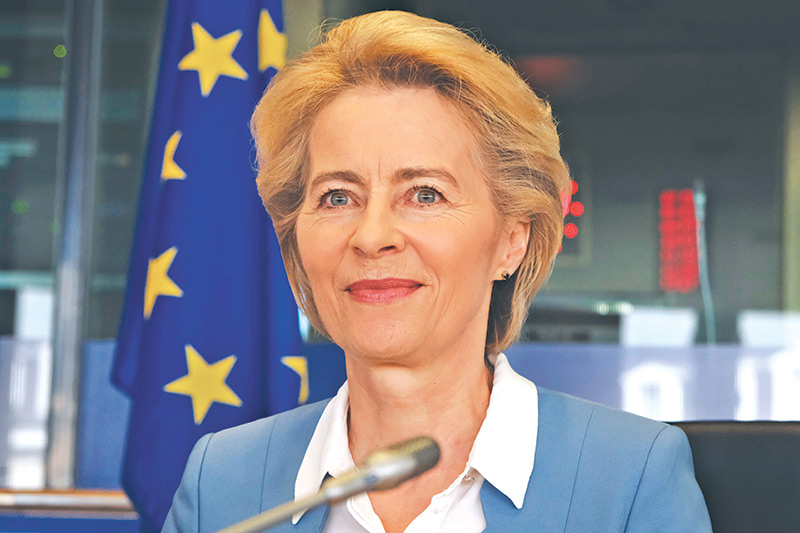
Incoming Ursula von der LEYEN talks to members of S&D group in European Parliament in Brussels, Belgium in July 2019. Alexandros Michailidis/Shutterstock

On December 1, Ursula von der Leyen will finally take office as president of the European Commission. She has promised to lead a commission that will avoid a scenario in which, as French President Emmanuel Macron recently warned, Europe might ‘disappear geopolitically’ amid an escalating Sino-American rivalry.
To be sure, the European Union has the largest market in the world, the second-highest defense spending (after the United States), 55,000 diplomats, and the world’s largest development-assistance budget. But these strengths are constrained by the fragmentation of European power both between and within member states and EU institutions. While China and the US are both adept at integrating geopolitics with their economic interests, the EU stubbornly acts as if these were separate agendas.
If von der Leyen is to succeed in building an effective ‘geopolitical commission,’ she will need to pass seven big tests. The first will be to build unity behind her proposed European Green Deal, which she has made one of her central priorities. The question is not just whether she can direct an effective European response to climate change, but whether she can prevent the issue from becoming another front in the culture war between the EU’s western member states and the cohort in Central and Eastern Europe.
Voters in the Czech Republic, Poland, and Slovakia are ambivalent about whether climate change needs to be addressed at all. If von der Leyen’s Commission does not take steps to bring these populations on board, the European Green Deal could reprise the politics of the euro and refugee crises, when marginal EU constituencies felt neglected by more powerful actors in the EU core (many of whom were clearly convinced of their own moral superiority).
Second, von der Leyen’s Commission will have to be open to potential counter-measures against America’s weaponization of the dollar. Since US President Donald Trump withdrew from the Iran nuclear deal, his administration has effectively been deciding with whom Europeans may trade, by threatening secondary sanctions against any company that does business with Iran. The challenge for a geopolitical commission, then, is to identify areas where US companies are asymmetrically dependent on Europe, and where European sanctions (or the mere threat of sanctions) could be deployed to maximum effect. This strategy has already proved effective in the standoff over auto tariffs.
Third, von der Leyen’s Commission will have to take up the issue of European defense. There are three discernible camps. The first includes the French, who want to achieve European strategic autonomy and end the bloc’s dependence on the US. The second camp, epitomized by Poland, favours ‘strategic servitude,’ and wants to double down on the transatlantic relationship by purchasing more US equipment and establishing ‘Fort Trumps’ to keep the US engaged on the continent. The third, represented by Germany, advocates ‘strategic patience,’ based on the hope that Trump’s eventual departure will allow for a return to normality. The only way to reconcile these views is to strengthen Europe’s contributions to NATO, so that it is seen as a better partner to the US.
Fourth, von der Leyen’s Commission must reconsider the EU’s competition policy, which currently focuses only on state aid and other unfair practices within Europe, while ignoring unfair competition from abroad. Fifth, and on a related note, the new Commission will need to develop a screening mechanism for foreign investments that both protects sensitive sectors and compensates EU member states that are asked to turn down foreign capital. In addition to establishing common screening procedures, the EU should empower the Commission to veto foreign investments on security grounds, with the European Council retaining the final say (through qualified majority voting).
Sixth, von der Leyen’s Commission will need to develop a European cyber defense agency worthy of the name. Specifically, the EU’s new leaders should transform ENISA (the EU Agency for Cybersecurity) into a well-staffed and well-financed institution with centralized computer emergency response teams (CERTs), cyber forensic squads, and legislative representatives to push for stronger security protocols across the bloc.
Finally, von der Leyen will be tasked with repositioning the European Investment Bank and the European Bank for Reconstruction and Development as credible counterweights to China’s Belt and Road Initiative. So far, the EU has not taken a strategic approach to reshaping the global financial architecture, and its response to China’s global investment and development activities has been timid at best. Giving the EIB and the EBRD a global remit to fund projects outside of Europe would help to reverse this failure. Moreover, it would allow Europe to bail out countries facing fiscal or financial crises in the event that the US or China tie the hands of the International Monetary Fund or other institutions.
Each of these seven tests is in an area where the EU could potentially become a key global player, capable of holding its own with other great powers. But each challenge will require genuine unity among Europeans, with EU institutions and member-state governments working together seamlessly.
Rather than dealing with these issues in a piecemeal fashion, von der Leyen should pursue a grand bargain that gives real meaning and shape to the next five years of EU policymaking. Among other things, that will require creative thinking about the next seven-year budget framework, which should be used to marshal the resources that Europe needs to establish itself as a global player and to advance innovative measures like green bonds, digital taxation, and carbon pricing. Only then will ‘geopolitical commission’ be a turning point, not a sound bite.

OPINION

Digital deeds in disruptive technology

An open approach toward digital disruption has to focus on the challenges of developing digital data security systems.
- Albert Richi Aruan
Shutterstock

The notion of whether authentic deeds made traditionally can be maintained or replaced with digital deeds (electronic deeds) became an important issue in the 29th International Congress of Notaries in Jakarta this year.
In civil law (Latin law) countries, authentic deeds serve as evidence that can be submitted before the court. Involving 88 civil law country members, the congress will focus on the influence of Industry 4.0 on clerical work amid the rapid changes in the way of doing business in Indonesia.
In the process of improving our ease of doing business (EODB) rank, the role of the notary has evolved to not only making authentic deeds for businessmen and investors but also being one of the government’s public relations tools in the accomplishment of business ease in this country. Indonesia is considered to have the highest number of notaries among civil law countries. With this hidden potential, how can an electronic deed be able to provide legal certainty for investors in digital disruption?
An authentic deed must be made (by a notary) in the traditional way. The traditional method refers to requirements, such as the presence of business owners or clients, the process of reading out the entire contents of the deed and closed by signing the deed by clients, notary and witnesses.
Since it first emerged more than a decade ago, the notion of electronic legal documents has been accommodated into Law No. 11/2008 as amended by Law No. 19/2016 — the Electronic Information and Transactions (ITE) Law. The regulation of electronic signature use on legal documents opened the discourse of the application of electronic signatures to transform an authentic deed into a digital one. This is a challenge for practitioners who still adhere to the traditional principle of authentic deeds. Nevertheless, while the ITE Law still limits the enactment of electronic signatures for notarial deeds or deeds made by deed officials, the impact of Industry 4.0 on clerical work is inevitable.
The judge has the obligation to use authentic deeds as a legal witness in a trial if needed. A deed acts as strong evidence to guarantee legal certainty for the parties in the deed. Unlike common law countries, which only require the ratification of documents (called legalization in Indonesian provisions), authentic deeds are documents that are kept as state archives.
Unfortunately, the basic principles of authentic deeds that are traditionally made will continue to experience great pressure by shifting to a more simplistic yet modern electronic form.
This will raise the issue of whether electronic deeds serve the same legal certainty as traditional authentic deeds. Do clauses of a deed that has been transformed into a digital format weaken the legal elements of the document?
Among all the complex investment problems in the ease of doing business, it cannot be denied that a trouble-free issuance of licenses in the early stages of establishing a company will attract investors. Up to now, we are still holding on to a paradigm of investment that requires foreign investors to establish a business entity that must have partners. It is unjust to say that some cases of local partner and foreign investor disputes represent the legal problems of national investment. According to the Investment Coordinating Board (BKPM), Indonesia ranks 146th in enforcing contracts out of 190 countries in the EODB index.
While common law countries are quickly absorbing digital changes in the Industry 4.0 scheme, civil law countries like Indonesia need to be more open and adaptable. Reform on ease of doing business, which measures the success of a government in improving its EODB rank, has not yet touched on issues that are intrinsic to investors.
The use of online media has become the main media for transforming business ease. In deed-making nowadays, legal action is still required in the form of the presence of business actors before a notary to convey the purpose and objectives of the deed, to sign the deed directly by business owners, notary and witnesses.
If the use of video conferences can be treated the same as face-to-face meetings, then this situation will lead to the elimination of traditional requirements for authentic deed-making. In addition, if an electronic signature on a contract has the same legitimacy as a written signature, then the authenticity of the document does not need to be questioned. In this respect, digitalization has fulfilled the requirements of authentic document-making.
The purpose of utilizing technology in clerical work is to facilitate the process and accelerate the completion of the work. In the aspect of creating authentic documents, the element of legal certainty becomes the main objective of providing protection for those who carry out these legal actions.
The strongest argument for maintaining the continuity of traditional authentic deed- and document-making is to prevent future financial losses from the vulnerability of claims to a contract. There is also the thought that the traditional nature of making authentic deeds provides multiple layers of protection because it undergoes a process of direct verification of the legal persons and their supporting identities, as well as determined formal conditions.
Thus, a more open mind toward digital disruption has to focus on the challenges of developing digital data security systems and strengthening preventive regulations.


This article was previously published in Jakarta Post, a part of the Asia News Network.

Page 8
13th South Asian Games

Nepali women spikers enter final with Sri Lanka win

The home team take on defending champions India in the gold medal match on Tuesday.
- Prarambha Dahal
Members of the Nepali volleyball team wave to the crowd after defeating Sri Lanka in the semi-final of the women’s volleyball tournament at the Dashrath Stadium Covered Hall in Tripureshwor, Kathmandu, on Saturday. Post photo: keshav thapa

Kathmandu,
Nepali women’s volleyball team entered the South Asian Games final for the first time after quelling the challenge of Sri Lanka in straight sets at the Dashrath Stadium Covered Hall on Saturday.
The home team beat Sri Lanka 25-14, 25-18, 25-21 to set up a summit clash with India on Tuesday. The semi-final victory over the island nation means Nepal have ensured themselves a silver medal—their first at the Games. Prior to this, Nepali women spikers had won bronze medals on three occasions in 1999, 2006 and 2016.
An elated Nepal team captain Aruna Shahi dedicated the team’s win to the vociferous home crowd. “The crowd was magnificent, which acted as the seventh player in the match,” she said after the win. “Sri Lanka actually played better than they did in their previous matches at the league stage. But we played better tonight.”
And Shahi now sets her sights on the final against India. “When we lost to India in the group stage, we were under pressure. But now that we are in the final at home, with the crowd cheering us on, we can only believe!”
With Saturday’s win, Nepali women spikers avenged their defeats in 2010 semi-final and 2016 league stage at the Games against the Sri Lankans. Nepal’s only previous success against Sri Lanka was a hard-fought five-set win at the Invitation Women’s Volleyball Championship five years ago.
“Today’s result was an outcome of the hard work we have put in for the past four months,” Nepal coach Jagadish Bhatta said.
“We have been constantly working on
team-building with a long term vision. Nepal is a very young side with an average age of only 23. We
were under fire for selecting this team. But these are promising signs.”
“Our stress on the fitness, with adequate training and exposure against better sides overseas, has been vindicated,” Bhatta added. “We were prepared for Sri Lanka. We had done our homework and closely evaluated their games.”
Bhatta is now planning something bigger. “We are trying to find a few taller players for the team. If we have a couple of players above 6 feet, I believe we will be a force in Asia,” he said.
Bhatta said the team had already put their league defeat to India behind them. “Our graph is increasing and we will work on the micro-mistakes that we made in the previous match [against India],” he continued. “We will have to emphasise on the placement of our players, and improve on the services and blockings. Our spikes have to be fast.”
Having won the first set 25-14, Nepal raced to 13-4 lead in the second. A couple of errors gave Sri Lanka an opportunity to make a brief comeback as they came within three points of Nepal at 16-13. But Nepal regained their composure to wrap it 25-18.
An intense team talk saw Sri Lanka take a lead for the first time in the match as they went 5-2 up. But Nepal, going for a kill, rallied back to level the scores at 11-11. Despite throwing everything into the game Sri Lanka failed to unnerve the home team who went on to seal the third set 25-21 to book their place in the final.

13th South Asian Games

These are the Nepali athletes to watch

With Nepal hosting the regional sporting extravaganza, these national athletes are expected to make the most of home advantage.
- PRAJWAL OLI,Prarambha Dahal

Prince Dahal | Badminton

16-year-old Dahal is one of the brightest prospects in Nepali badminton. He is competing in the men’s doubles pairing with Praful Maharjan, and in the team event. The left-hander so far has won almost all the national-level age-group tournaments while also being a thorn in the eyes of many senior national players in the open category. National team coach Sudip Yonjan sees him as Nepal’s No. 1 in future.

Nabita Shrestha | Table Tennis

Bold on and off the table tennis board, Shrestha is the eight-time national table tennis champion whose list of accolades is unparalleled in the sport’s history in the country. Shrestha is set to contest at the singles, doubles, mixed doubles and team event categories at the Games. She will be teaming up with Elina Maharjan in doubles and Santoo Shrestha in mixed doubles categories. Shrestha identifies India as the strongest side but is determined to play at her best to do the nation proud.

Sukra Bahadur Rai | Golf

Rai became only the third golfer to clinch the pro title as an amateur when he lifted the Surya Nepal Eastern Open in December last year. Rai also won the 28th Bhutan Open Amateur Golf Championship held in Thimphu in October. He is set to participate at the individual and team events at the Games. As Rai knows the courses in the city well, golf officials expect him to reap the benefits of the home advantage at the Games.

Prerana Koirala | Tennis

Prerana Koirala has not lost a single domestic tournament since May last year. The 16-year-old has recently returned after six-month training from Alexander Waske Tennis University in Ahmedabad, India. Though India and Pakistan are strong sides in the game, hopes are pinned on Koirala to break medal drought on the South Asian Games. “We are very much hopeful that the international medal duck will end in the Games,” said coach Surya Bhusan Bajracharya.

Gaurika Singh | Swimming

The youngest athlete at the Rio Olympics, 2016, Gaurika Singh had won three bronze and one silver medal at the 12th edition of the regional sporting spectacle in Guwahati. Singh, who stole the limelight by winning 12 gold medals at the 8th National Games earlier this year while setting six national records, is all set to feature at 12 events at the SAG. “We expect Singh to win more medals this time as the Games is being held at home. We are hopeful of gold medals from her,” said Shankar Karki, Nepal head-coach.

Indra Bahadur Shrestha | Judo

The 20-year-old started judo at the age of 10 at the Prisoners Assistance Mission, an organisation that takes care of prisoners and their children. Shrestha, who recently returned after three-week training in Japan, will be competing at Under-66kg in the men’s category. He was the bronze medalist at the previous edition of the Games in India in 2016. Hopes are pinned high on him as he claimed a gold medal in the South Asian Judo Championship in 2018 in Kathmandu.  


Sushmita Nepal | Shooting

18-year-old Nepal got into shooting only three years ago. Despite her young age and relatively little experience, she has gone on to become one of the brightest prospects in the sport. She has represented Nepal at multiple international tournaments, including the 2018 Asian Games in Jakarta, Indonesia. Gold winner at the Eighth National Games in Nepalgunj, Nepal is contesting at the 10-metre air rifle at the Games. Nepal holds a national record to her name.

Juni Rai | Wushu

Rai is out to erase the painful memory of the 12th South Asian Games in 2016, when she lost the sanshou title bout to an Indian opponent. Rai will compete in the 56kg division when Nepal hosts the sub-continent sports meet. “As the 56kg category was not included in the last Games, I had to compete above my division,” said the athlete from Ilam. “I am working really hard to finally realise my dream. I have also now matured as a player than what I was in 2016.”

Manita Shrestha Pradhan | Judo

Shrestha Pradhan became the first Nepali woman judoka to win a bout in the Asian Judo Championships in Hong Kong two years ago. Nepal head-coach Birendra Ranjit identifies her as the top contender for gold at the Games. “Her level of dedication during the training sessions in Nepal and abroad has filled us with aspirations of the top podium finish. Now that she has adequate experience at the international stage as well, we are certain that she will make us proud,” he said. She will contest at Under-57kg in the women’s category at the Games.

Kamal Bahadur Adhikari | Weightlifting

When it comes to weightlifting, Adhikari has reached heights no Nepali has yet. The 42-year-old lifter, who won the country’s first and only weightlifting gold at the 2006 South Asian Games in Colombo, is set to contest at the 73kg category, likely to be his last international participation. A dominant figure in Nepali men’s weightlifting, Adhikari has won bronze medals in the Asian Inter-club Weightlifting Championships and the Asian Cup Weightlifting Championships, both of which were held in South Korea in 2017.

Rajib Pudasaini | Karate

Pudasaini has won three consecutive gold medals at the South Asian Karate Championships since 2016. He will be vying in the men’s 60kg division. His gold medal haul in the South Asian Championships last month in Dhaka has added to his confidence ahead Games. “He is tall and hardworking player. His ability at kick sets him apart from the rest of the players. We are very much hopeful of winning gold from him,” said karate coach Kushal Shrestha.

Prarambha Dahal | Karate

Adhikari is among one of the most experienced players in the national squad. The silver medalists of the 2010 Games in Dhaka has been in the national squad for the last 10 years. She lost in the bronze medal clash in the Asian Games in Indonesia last year. But coach Kushal Shrestha is hopeful of a tough show from Adhikari in the Games. “She is good at punches and counter punches and her fitness level is better than others,” said Shrestha.  

Bir Bahadur Mahara | Taekwondo

Having marginally missed out on a gold medal at the 12th regional event, Mahara has left no stone unturned to better his achievement at home. Mahara will be competing at the Under-68kg category at the Games. Nepal coach Deepak Bista identifies Mahara’s attacking prowess as his strength and says he can come on top if he focuses on his blocking.

Page 9
13th South Asian Games

Ramesh Silwal: Despite last-minute work, everything will go smoothly during the Games

The member secretary of the National Sports Council on why, despite plenty of preparation time, some of the sports facilities are still incomplete.
Post Photo: Angad Dhakal

Even as workers scramble to finish preparations for the 13th South Asian Games a day ahead of the opening ceremony, officials have said they will leave no stone unturned to make the event a mega spectacle.
For Ramesh Kumar Silwal, the member secretary of the National Sports Council, nothing is more important at the moment than to hold the Games on time and without any visible hiccups. The Post’s Prajwal Oli caught up with Silwal on Friday to discuss the expectations of the host nation, and why, despite plenty of preparation time, some of the infrastructure is still incomplete.


Are we ready to host the Games now?
Yes, now we are all set to go and the only task remaining is opening of the Games on Sunday.


But some of the sports facilities are still incomplete.
No, everything is in place. The construction of Dashrath Stadium is finished. The heating system swimming pool is in the last phase of completion and Pokhara Stadium, with 13,000 seating capacity, is ready. So there is no major work left regarding infrastructure.


The statements regarding heated swimming pool keep changing. What’s the truth?
As of Thursday, the construction work is over. But the floor and fences of the pool have not dried completely. That could create problems in future if we fill the water in the pool before it is entirely dry. We have already processed 35,000 liters of water, which has been tested at the laboratory. Half of the water will be transferred to the pool on Saturday and Nepali swimmers would be able to practice on Sunday.


It has been nearly four years since Nepal shouldered the responsibility to host 13th South Asian Games. We’ve had sufficient time to complete the infrastructure works for the Games. So why are we still doing last-minute work?
I’ve said time and again that we should have started the preparation once we took the flag as hosts in 2016. Those who came to the leadership after India Games should have thought about that. The Games would not have postponed had the leadership at the time thought about the Games. It has only been four months since I came to the leadership position and despite my hard effort, all the work related to the Games have not been
completed.
As per the international norms, all infrastructure must be ready at least three to six months before the Games kick off. Japan have recently announced that they have completed all the infrastructure of the 2020 Tokyo Olympics. We should also have finished infrastructure at least a few months before kick-off. But it’s not that I did not do my duty; the problem came after the person responsible before my arrival did not take their job seriously.


What’s been the reaction of visiting teams when it comes to our sporting infrastructure?
They have given a positive response. I was at the Dashrath Stadium premises till late on Thursday night. Around 50 to 60 foreign delegates were enjoying the new stadium. They said it was fantastic. Volleyball has already kicked off and they haven’t had any complaints. I don’t expect a negative reaction in upcoming days because the technical teams have been monitoring all the venues.


What does the management part for the Games look like?
We have made sound management for the Games. There are four-five areas of our major concern—hospitality, hotel management, transportation, security, sports venue preparation and organisation. There are also some technical issues, including medical and disaster management. But we have completed all the preparations.


How is the preparation of the national team?
Our preparation is result oriented. We took 21 different games for training abroad with qualified coaches. We tried to give them more international exposure and quality training. We are very much hopeful that good training and exposure will be helpful in getting us results. We have also discussed with the respective sports associations’ president, general secretary and chief coach to formulate plans and have implemented them. So I don’t think there is any problem in our preparations.   


It’s still unclear how many games we are participating in and the number of medals the event will have. When will the final figures be published?
This is the problem of the entire South Asian region. Most of the countries did not register for the Games by the deadline we set. We extended our previous deadline and set November 20 as the last date for by name registration. Even until November 26, all the countries have not registered. We now have completed the registration process. The event will have 317 golds in total after paragliding was scrapped. I don’t remember the exact number of players, but I believe there will be more than 3,000 players.

What are your expectations from the Games regarding Nepal’s medal prospects?
We have set the target of winning around 50 gold medals. Eight of them were from paragliding, but the event was scrapped due to insufficient registrations from other countries. But that hasn’t changed our target. We are hopeful of winning 30 to 40 medals from events like taekwondo, karate, wushu, judo, weightlifting and wrestling. Our expectations are based on the training and international exposure.


As we are also marking Visit Nepal 2020 beginning next month, are there any plans to connect the Games with Visit Nepal?
The event will be broadcast live globally and we are expecting the event to reach over two billion people. The opening ceremony will feature our ancient arts and cultures and around 6,000 visiting delegates will witness our culture directly, and hopefully take home a positive message about our country.

13th South Asian Games

Dreams of Nepali gold in paragliding shattered

The adventure sport, on which the country was pinning gold medal hopes after winning silver at the Asian Games last year, was excluded from the regional event due to inadequate participation.
- DEEPAK PARIYAR
A paraglider flies in the skies above Pokhara. Post file Photo

Pokhara,
Nepal’s aspirations for gold at the 13th South Asian Games suffered a major dint after the adventure sport was excluded from the regional sports extravaganza due to inadequate participation. Based on the initial schedule of the Games, paragliding event was supposed to commence a day prior to its official inauguration but was removed from the Games altogether on December 25.
Lamenting about the absence of the sport from the mega spectacle, Nepal paragliding captain Bimal Adhikari said the team’s dreams met with a cruel fate. “We were confident of winning all eight gold medals in the paragliding event,” he said. “Now that we will not be playing, we are left as mere spectators.”
Paragliding was the only discipline where Nepal earned medals at the 18th Asian Games in Jakarta and Palembang. The adventure sport had made its debut at the Asiad last year.
The Nepal Olympic Committee had decided to include paragliding at the SAG to promote the adventure and competitive sport. Using the right of the host nation to include two sports, Nepal had picked paragliding along
with cricket for the Games. The decision had excited the gliders, coaches and paragliding enthusiasts.
Nepali gliders say they were confident of making the best use of their Asian Games’ experience to contest for eight gold medals in men’s and women’s individual and team events in accuracy and cross-country categories.
They were optimistic until the very end also because of several assurances by Nepal Olympic Committee President Jeevan Ram Shrestha and National Sports Council member secretary Ramesh Kumar Silwal that the sport will be included in the event.
Both sporting bodies had reiterated their efforts to fund accommodation, food, transport and training for the participating foreign teams. Despite their commitments, nations including India did not register for the events even after promising their participation. By November 20, Pakistan was the only country to file for their participation alongside Nepal.
Nepal’s paragliding association had proposed to provide training facilities for Bangladesh and Bhutan but the two neighbours chose not to participate.
The event was finally scrapped because at least three participating nations were required for it to be held.
Nepali gliders had been preparing for the Games since earlier this summer. A total of 14 men and eight women were picked and the final Nepal team was trimmed to five men and three women.
“Both India and Pakistan have good gliders. But India hesitated to participate considering Nepal’s prowess and medal potential,” said Adhikari, the national captain who led the nation to glory last year.
Not many South Asian nations have official paragliding associations. Most paragliding events are held at club levels. “Nepal would have had a better ranking in the medal tally if paragliding was included. India understood this and decided not to participate,” said Shailendra Raut, general secretary for Nepal Paragliding and Handgliding Association.
Indian pilot Ajay Sharma, who has been gliding in Pokhara for the past decade, even travelled to New Delhi to convince Indian Olympic Committee officials about the country’s participation in the paragliding event. But despite his effort, it fell short.
Nepali gliders have their own plight to share. With no support from the government, they had to fund themselves for their training. The NSC had promised that it would provide two sets of gears if the sport had been included at the Games. Preparations were underway for a foreign training for the gliders as well.
But a delay in the release of necessary funds for paragliding had obstructed the construction of infrastructures for the sport. As the sport was ruled out from the Games, works for building the required structures did not even see the light of the day.
Yogesh Bhattarai, the national coach for the sport, says lapses in coordination with the Olympic Committees of the South Asian nations was the main reason for the exclusion of the sport.
“Nepal is a force in the sport in South Asia,” Bhattarai said. “Paragliding probably would have earned the highest number of medals for the country.”

Page 10
WORLD

US panel sets deadline for Trump to decide participation in impeachment hearings

- REUTERS

WASHINGTON,
A US congressional panel on Friday gave President Donald Trump one week to say whether his legal counsel intends to introduce evidence and call witnesses in upcoming impeachment proceedings that could lead to formal charges of misconduct within a few weeks.
The Democratic-led House Judiciary Committee, which is
due to begin weighing possible articles of impeachment against Trump next week, sent a two-page letter to the president setting a deadline of 5 p.m. EDT (2200 GMT) on Dec. 6 for the president’s counsel to specify intended actions under the committee’s impeachment procedures.
The procedures set out rules by which the president can call witnesses, introduce evidence and make presentations.
Panel Democratic Chairman Jerrold Nadler set the same deadline for Republican lawmakers on the committee to notify him about intended witnesses and evidence and scheduled a Dec. 9 meeting to consider the matter.
The Judiciary panel is expected to hold a series of impeachment proceedings, including an initial hearing on Wednesday at which legal experts are due to testify about the constitutional grounds for impeachment.
The committee invited Trump to participate in the hearing and gave him until 6 pm EST (2300 GMT) on Sunday to say whether he or his legal team would attend.
The impeachment probe is looking into whether Trump abused his power to pressure Ukraine to launch investigations of political rival Joe Biden and a discredited conspiracy theory promoted by Trump that Ukraine, not Russia, interfered in the 2016 U.S. presidential election.
After weeks of closed-door witness depositions and televised
hearings, three investigating panels led by the House Intelligence Committee are due to release a formal report soon after lawmakers return to Congress on Tuesday from a Thanksgiving recess.

WORLD

Johnson to Trump: Keepa out of UK election

Tories are nervous that the US president could upset the campaign when in London, just over a week before the Dec 12 poll.
- REUTERS
A combination of pictures shows Labour Party leader Jeremy Corbyn (left)and Prime Minister and Conservative Party leader Boris Johnson (right) and US President Donald Trump. US President Donald Trump flies into Britain next week, just days before its general election—and if earlier visits are any guide, fireworks are expected. AFP/RSS

LONDON,
Prime Minister Boris Johnson has said it would be “best” if US President Donald Trump does not get involved in Britain’s election when he visits London for a NATO summit next week.
Trump waded into the election in October by saying opposition Labour Party leader Jeremy Corbyn would be “so bad” for Britain and that Johnson should agree on a pact with Brexit Party leader Nigel Farage.
On Friday, a senior Trump administration official told reporters that Trump is “absolutely cognizant of not, again, wading into other country’s elections.”
But senior Conservatives are nervous that Trump could upset the campaign when in London, just over a week before the Dec. 12 election, which polls indicate Johnson is on course to win.
“What we don’t do traditionally as loving allies and friends, what we don’t do traditionally, is get involved in each other’s election campaigns,” Johnson, 55, told LBC radio.
“The best (thing) when you have close friends and allies like the US and the UK is for neither side to get involved in each other’s election.”
Johnson has said that, if he retains power, he will deliver Brexit by Jan. 31—after nearly four years of political crisis following a 2016 referendum in which Britons voted to leave the European Union.
He said he wanted to keep in place government preparations for a possible no-deal Brexit—under which Britain would leave without agreement on the terms with Brussels and potentially expose itself to more economic uncertainty—but that he expected to secure a trade deal with the EU by the end of 2020.
“Many of those preparations will be extremely valuable as we come out of EU arrangements anyway,” he told reporters.
The US president, who is due to arrive on Monday, has cast Johnson as “Britain’s Trump,” and during a previous visit criticised Johnson’s predecessor Theresa May over her Brexit policy.
Labour’s Corbyn has said Johnson will sell off parts of Britain’s widely cherished health service to US businesses after Brexit, which Johnson has denied. Trump previously said everything including health should be on the table in trade talks, though he later said health would not be.
Johnson said he would use Brexit to introduce new state aid rules, change state purchasing policies and reform farming so that public bodies aim to “buy British” goods.
“The NHS is not for sale,” he said.
Taking questions from LBC listeners, Johnson declined to say how many children he had or whether he would have any more.
Johnson, 55, is living at the prime minister’s Downing Street residence with his partner Carrie Symonds after separating from his wife last year.

WORLD

Tens of thousands rally before UN climate summit

- AGENCE FRANCE-PRESSE
Demonstrators gather with placards during a protest called by the Fridays for Future movement for climate protection in Berlin, as part ofglobal action day for climate. AFP/RSS

BERLIN, 
Tens of thousands of protesters, primarily in Europe and Asia, hit the streets on Friday to make a fresh call for action against global warming, hoping to raise pressure on world leaders days before a UN climate summit.
Carrying signs that read “One planet, one fight” and “The sea is rising, so must we”, thousands flocked to Berlin’s Brandenburg Gate for the latest “Fridays for Future” protest inspired by 16-year-old activist Greta Thunberg.
In total, about 630,000 people demonstrated across more than 500 cities in Germany, the Fridays for Future movement said.
In Hamburg alone, some 30,000 mainly young people gathered and another 17,000 congregated in Munich to voice alarm at rising temperatures, police said.
Thunberg, meanwhile, was on a boat sailing across the Atlantic, but tweeted a photo of herself holding a sign that said “School strike for climate.”
Rallies took place across Europe, although on a smaller scale than during September’s wave of “climate strikes” when organisers said some four million people filled city streets around the world.
Approximately 1,700 turned out in Madrid, the host city of next week’s 12-day COP25 conference, which aims to encourage governments to increase their commitments to cut emissions and combat climate change.
In France, climate activists focused their anger on the “Black Friday” sales bonanza with protesters blocking a distribution centre of online retail giant Amazon outside Paris and others near Lyon and Lille.
Protesters in Paris also formed a human chain at La Defense shopping mall that prevented people from reaching stores, to highlight the climate costs of consumerism.
The Dutch branch of “Fridays for Future” said demos were taking place in around 15 cities, culminating in
an evening march in Amsterdam where protesters would observe a moment’s silence for victims of the climate crisis.
Several hundred young people also took to the streets of Lisbon, where Thunberg is expected to arrive shortly before making her way to Madrid.
Turnout was low in the United States and Canada, with the protest taking place during the American Thanksgiving holiday weekend. A demonstration in Washington drew about 50 people, another in New York had 100.
“It’s important to keep showing up, keep being out there and talking to people about how this is not a problem that can go away, unless we address it head-on,” said 24-year-old Frank Fritz in Washington.
New York police arrested 23 anti-consumerism protesters who staged a sit-in outside Macy’s department store.
In Montreal, environmental groups distributed second-hand clothing.
“We are trying to create an eco-responsible movement against mass consumption, so we are giving away clothes for free to encourage people to consume less,” protester Germain Desloges told AFP.
The latest round of global climate demonstrations kicked off in bushfire-ravaged Australia, where hundreds rallied outside the Sydney offices of the Liberal party.
The target of their ire was Prime Minister Scott Morrison, who said earlier this month the suggestion that “individual actions of Australia” had an impact on the fires “doesn’t bear up to credible scientific evidence”.
“Our government’s inaction on
the climate crisis has supercharged bushfires,” said school strike leader Shiann Broderick, as Sydney was once again enveloped in toxic smoke from the fires.
Australia, with a population of almost 25 million, has low carbon emissions compared with the planet’s biggest polluters but is one of the world’s leading coal exporters.
Protests also took place in Tokyo, where hundreds marched through the teeming Shinjuku district.
“I feel a sense of crisis because almost no one in Japan is interested,” said 19-year-old student Mio Ishida.
“I was really inspired by Greta’s actions.”
In Delhi, about 50 school and college students marched to the environment ministry in the world’s most polluted capital, carrying placards and chanting slogans demanding that the government declare a climate emergency.
“This is about doing something that you believe in,” said 23-year-old Saumya Chowdhury. “We want the government to acknowledge this and have a conversation on this issue with people.”
India is one of the biggest sources of greenhouse gases and has 14 of the 15 most polluted cities in the world, according to a UN study.
Some 200 nations are meeting in the Spanish capital from Monday for talks on finalising the “rulebook” for the 2015 Paris climate treaty, which becomes operational in 2021.
Scientists have warned that efforts to cap warming to 1.5 Celsius are failing and that carbon emissions—which are on the rise—would need to fall 7.6 percent a year to meet the target.
The United Nations has reported that greenhouse gas levels in the atmosphere, the main driver of climate change, hit a record high last year.
The UN has also warned that global temperatures are on track to rise almost 4 degrees Celsius by the end of the century, which could make some places virtually uninhabitable.

WORLD

London attacker released last year after terrorism offences, prompting recriminations

- REUTERS

LONDON,
The 28-year-old British man who killed two people in a stabbing spree on London Bridge before police shot him dead had been released from prison after a previous conviction for terrorism offences, prompting recriminations ahead of an election.
Wearing a fake suicide vest and wielding knives, Usman Khan went on the rampage on Friday afternoon at a conference on criminal rehabilitation beside London Bridge. He was wrestled to the ground by bystanders and then shot dead by police.
Prime Minister Boris Johnson, who has called a snap election for Dec. 12 and is due to host NATO leaders including U.S. President Donald Trump next week, said it was a terrorist attack and that Britain would never be cowed.
Khan, whose family is from Pakistan-controlled Kashmir, was convicted in 2012 for his part in an al-Qaeda-inspired plot to blow up the London Stock Exchange. He was released in December 2018 subject to conditions.
“This individual was known to authorities, having been convicted in 2012 for terrorism offences,” Britain’s top counter-terrorism police officer, Neil Basu, said in a statement. “Clearly, a key line of inquiry now is to establish how he came to carry out this attack.”
Two people—a man and a woman—were killed in the attack. In addition, a man and two women were injured and remain in hospital, Basu said.
Britain’s opposition Labour Party, which trails the ruling Conservatives in opinion polls, criticised the government’s record on crime on Saturday as police continued their investigation.
“There are big questions that need to be answered,” London Mayor Sadiq Khan, the most senior opposition politician in Britain in a position of power, told Sky News.
“One of the important tools judges had when it came to dealing with dangerous, convicted criminals...
was their ability to give an indeterminate sentence to protect the public,” he said.
“(That) was taken away from them by this government.”

WORLD

Over 160 nations agree to speed landmine clearing

Briefing

OSLO: The 164 signatory countries to the Mine Ban Treaty (MBT) agreed Friday to accelerate the work to achieve the goal of a “mine-free” world in 2025, Norway’s foreign ministry said. “Countries have now agreed that it is necessary to speed up mine clearance over the next five years,” Norway’s Minister of Foreign Affairs Ine Eriksen Soreide said in a statement following a meeting in Oslo. According to Landmine Monitor, an annual report by the Landmine and Cluster Munition Monitor, 6,897 people were killed or injured by mines and other explosive remnants of war in 2018 and the report noted that it was the fourth year in a row with “exceptionally high numbers of recorded casualties.” (Agencies)

WORLD

NATO’s birthday overshadowed by top-level feuding

Briefing

BRUSSELS: NATO marks its 70th birthday at a summit next week but the celebration could well turn into an arena of political combat between the alliance’s feuding leaders. Heads of state and government will descend on London Tuesday bracing for a scrap over spending and how to deal with Russia, in a huge test of unity within NATO—billed by its own officials as the “most successful alliance in history”. US President Donald Trump has repeatedly accused European countries of failing to pay their way and will be looking for evidence they are stepping up defence spending. (Agencies)

WORLD

Albania quake toll hits 50 as search for survivors ends

Briefing

TIRANA: The death toll from a powerful Albanian earthquake rose to 50 as the search for survivors was called off, Prime Minister Edi Rama said on Saturday. The 6.4 magnitude quake that hit the Balkan country before dawn on Tuesday was the most deadly and destructive in decades, and left about 5,000 people homeless. “The number of the earthquake victims reached 50 and rescue operations have ended,” Rama told a cabinet meeting while struggling to hold back tears. Entire families were crushed in their homes while they were sleeping, forcing relatives and neighbours to watch in agony as rescue teams pulled bodies from the ruins this week. (Agencies)

Page 11
ASIA

Pensioners and students gather for Hong Kong protest

- REUTERS

HONG KONG,
Secondary-school students and retirees joined forces at a protest in Hong Kong on Saturday, the first of several rallies planned across the China-ruled city a day after police withdrew from a university that had been rocked by a two-week siege.
Police in neighbouring Guangzhou city have arrested a Belizean citizen for allegedly meddling in Hong Kong affairs, the local Communist party newspaper said.
Lee Henley Hu Xiang, a Belizean businessman who lives in China, had funded “hostile forces” in the United States and supported activities that led to chaos in Hong Kong, the Southern Daily said. Authorities in Guangzhou were not immediately available for comment.
After more than five months of increasingly violent demonstrations, Hong Kong has seen relative calm since local elections last week delivered an overwhelming victory to pro-democracy candidates.
Despite the calm, demonstrators are pressing to keep up the momentum of their movement.
They are incensed by what they see as Chinese interference in freedoms promised when Britain returned Hong Kong to Beijing in 1997.
China denies interfering, and says it is committed to the “one country, two systems” formula put in place at that time. It has blamed foreign forces for fomenting unrest.
“I came out for the peaceful protest in June when there was more than one million people, but the government did not listen to our demands,” said a 71-year-old woman in Hong Kong’s Central district, who only gave her name as Ponn.
She brought her own plastic stool to a cross-generational protest at the city’s Chater Garden, where a modest crowd of a few hundred people gathered to listen to pro-democracy speakers. She came with her daughter and son-in-law.
“I have seen so much police brutality and unlawful arrests. This is not the Hong Kong I know. I came today because I want the government to know that we are not happy with what they have done to our generation.”

ASIA

Anti-regime demos continue despite PM Mahdi’s vow to quit

More than 420 people have died since the protests began in October.
- AGENCE FRANCE-PRESSE
Iraqi anti-government protesters carry away an injured comrade amidst clashes with security forces by the capital Baghdad’s Rasheed street near al-Ahrar bridge on Friday. AFP/RSS

NASIRIYAH (Iraq),
Iraqis kept up anti-government protests in Baghdad and the south on Saturday, unsatisfied with the premier’s vowed resignation and insisting on the overhaul of a system they say is corrupt and beholden to foreign powers.
Protesters have hit the streets since early October in the largest grassroots movement Iraq has seen in decades, sparked by fury at poor public services, lack of jobs and endemic government graft.
The decentralised demonstrations were met with violence from security forces and armed groups, leaving more than 420 people dead and 15,000 wounded according to an AFP tally compiled from medics and an Iraqi rights commission.
The toll spiked dramatically this week, when a crackdown by security forces left dozens dead in Baghdad, the Shiite shrine city of Najaf and the southern hotspot of Nasiriyah—the birthplace of Prime Minister Adel Abdel Mahdi.
Facing pressure from the street and the country’s top Shiite cleric Grand Ayatollah Ali Sistani, Abdel Mahdi announced on Friday that he would submit his resignation to parliament, due to meet on Sunday.
But demonstrations have not subsided, with crowds in the capital and across the Shiite-majority south sticking to their weeks-long demand of complete regime change.
“We’ll keep up this movement,” said one protester in the southern hotspot of Diwaniyah, where thousands turned out early on Saturday. “Abdel Mahdi’s resignation is only the first step, and now all corrupt figures must be removed and judged,” he said.
Hundreds converged in the main protest camp in Nasiriyah’s city centre and set tyres ablaze on three bridges spanning the Euphrates River, according to AFP’s correspondent.
Iraq’s second holy city Karbala was rocked by overnight clashes with young protesters and security forces trading fire bombs until the early hours of the morning.
Najaf was relatively calm on Saturday, according to AFP’s correspondent, but protests there usually swell in the afternoon and evening.
This week’s stunning turnaround was set off when protesters stormed and burned the Iranian consulate in Najaf late Wednesday, accusing Iraq’s neighbour of propping up the Baghdad government.
Tehran demanded Iraq take decisive action against the protesters and hours later, Abdel Mahdi ordered military chiefs to “impose security and restore order”.
Men in civilian clothes opened fire on demonstrators and tribal fighters deployed in the streets to defend them in standoffs that sparked fears of open clashes.
Over two days, 42 people were shot dead in Nasiriyah, 22 in Najaf and three in Baghdad.
Iraq’s Supreme Judicial Council announced Saturday it had formed a committee to investigate the events, pledging to “punish those who attacked protesters”.
The chief justice, Faeq Zeidan, is among a list of names circulated as possible replacements for Abdel Mahdi.
The rising death toll sparked a dramatic intervention from Sistani, the 89-year-old spiritual leader of many of Iraq’s Shiites.
He had called for restraint and urged parties to get “serious” about reform for weeks but ramped up his rhetoric on Friday, calling on parliament to drop its support for the government.

ASIA

Suu Kyi fans join VIP tours for Rohingya genocide trial

- AGENCE FRANCE-PRESSE

YANGON,
Ardent fans of Aung San Suu Kyi are snapping up spots on $2,000 tours to The Hague, in a display of moral support as Myanmar faces charges of genocide over the Rohingya crisis at the UN’s top court in December.
Supporter rallies, billboards and outpourings of praise online followed the shock announcement by the country’s civilian leader last week that she would personally represent Myanmar at the International Court of Justice (ICJ). The once-lauded democracy champion will be defending the 2017 military crackdown against the Rohingya minority.
One travel operator is organising a five-day tour to The Hague that includes visa and transportation as part of a $2,150 package, said employee Ma July—a prohibitive rate for most in the developing nation.
Social influencer Pencilo and well-known TV presenter Mg Mg Aye are among the 20 or so people to have already signed up. “I believe this is our duty as citizens,” Pencilo, 29, told AFP Friday, urging any of her 1.1 million Facebook followers who have the means to do the same.
“It’s important the world knows her compatriots are fully behind her.”
West African nation Gambia will open its case at the ICJ on December 10 on behalf of the 57 member states of the Organization of Islamic Cooperation (OIC).
The mainly Muslim country alleges Myanmar breached the UN’s Genocide Convention through bloody “clearance operations” against its Rohingya community two years ago.
Some 740,000 Rohingya fled into sprawling camps in Bangladesh, bringing with them accounts of widespread murder, rape and arson—violence UN investigators branded as genocide.
The crisis has left Nobel Laureate Suu Kyi’s reputation in the West in tatters—the UN team accused her of complicity—although allies China, India, Russia and Japan have been largely silent on the issue.
But she remains highly revered in Myanmar where there is little sympathy for the Muslim minority, who are regarded as illegal immigrants from Bangladesh.

ASIA

Months after abrupt halt, Trump gives blessing for Taliban deal

- AGENCE FRANCE-PRESSE

WASHINGTON,
 Nearly three months after he abruptly ended talks with the Taliban, President Donald Trump has given his blessing to fresh diplomacy, but major obstacles stand in the way of a deal to end the Afghanistan war.
Chief among the questions is how to address the soaring violence in Afghanistan—which the Taliban sees as leverage but which Trump has hinted that the insurgents were willing to halt.
Trump flew to Afghanistan on Thursday for a surprise trip to see US troops on the Thanksgiving holiday and dropped the news that talks with the Taliban were back on—a process the president declared dead in September. “The Taliban wants to make a deal and we’re meeting with them,” Trump said.
US officials offered little evidence that full-fledged negotiations had resumed. But observers said that Trump was at least signaling support for further negotiations after the success last week of a captive swap with the Taliban, who freed two Western professors held hostage for three years. “US diplomats have been quietly exploring how to get the talks restarted,” said Laurel Miller, who served as the US special representative on Afghanistan and Pakistan under both Trump and his predecessor Barack Obama. “Until now it was unclear if those quiet efforts were enough to reverse his public claim that the talks were dead. Now he’s publicly validated them,” said Miller, now the Asia director at the International Crisis Group.
She nonetheless questioned if fresh talks would be seamless after Trump in September said he had invited and then disinvited a Taliban delegation after the death of one US soldier.
“I think that would give any party that you’re negotiating with some pause about how reliable you’re going to be in meaning what you say and sticking to it,” she said.
Trump, who faces re-election in less than a year, has been eager to end America’s longest war and wind
down what he sees as a waste of blood and treasure.
A November study by Brown University found that the United States has spent $6.4 trillion on wars globally since the September 11, 2001 attacks which prompted the Afghanistan intervention.
In one of Trump’s most startling remarks, he said on Thursday that the Taliban had come around and “want to do a ceasefire” and that “it will probably work out that way.”
President Ashraf Ghani—who, taking a page from other world leaders, profusely praised Trump during their joint appearance—has long demanded a ceasefire as a precondition for Taliban talks with his internationally recognized government.

ASIA

Slow and steady hope for near-extinct Bangladesh tortoises

- AGENCE FRANCE-PRESSE
A worker holds a baby of an Asian giant tortoise at the Turtle Conservation Centre at a forest reserve in Rajendrapur, some 40 km northof capital Dhaka. AFP/RSS

RAJENDRAPUR (Bangladesh), 
Newly hatched tortoises take their first steps at a Bangladesh conservation park, their feet barely visible under hard shells that carry the weight of the species on their backs.
These tiny newborns—41 in all—belong to a species thought to have gone extinct in the country until seven years ago, when they were rediscovered by conservationists with the help of locals in the southeastern Chittagong hills.
Once abundant across dense tropical forests in Bangladesh, Myanmar, and Thailand, the population of Asian Forest Tortoises has fallen sharply after widespread habitat destruction and rampant poaching.
With their local population estimated at less than 50 before the recent births, wildlife experts and forestry officials have worked hard to boost their numbers.
Two years ago they brought two male and five female adults to a forest reserve north of the capital Dhaka in an effort to breed them in captivity.
To their delight, the appropriately-named Casanova, around 15 years old, and Big Boy, aged between 50 and 100, mated with four females giving birth to 46 babies.
The 41 to have survived are growing at a “healthy pace”, conservationist Shahriar Caesar Rahman told AFP.
“It is a huge achievement because without this intervention they would have gone extinct from the country,” Rahman said.
“We are giving them a realistic chance now for them to get back from the brink. And we hope that in future they will survive and thrive in Bangladesh.”
Across the region, the population of Asian Forest Tortoises has plummeted by at least 80 percent in the past 135 years and the species is critically endangered, according to the International Union for Conservation of Nature.
Environmentalists say the success of the breeding programme is no guarantee the species will survive once the newborns are released back into the wild.
Logging and slash-and-burn agriculture are eating into their natural habitat, Rahman says.
The human population in the lush Chittagong hills has soared, with the area’s tribal minority groups pushed further into the jungle by the encroachment of settlers from elsewhere in Bangladesh.
Hills have been stripped bare of vegetation for new roads and development, and the tortoises are also popular in tribal cuisine.
World Bank conservationist Ishtiak Sobhan said environmental activists are working to encourage the indigenous population to cut tortoise meat from their diets.
Some tribespeople are also being trained to rescue the animals from poachers, with around two to three saved each year.
Meanwhile, a decades-long local insurgency has hampered efforts by authorities to protect the wild creatures and other endangered animals in the forest.
Senior forest department official Imran Ahmed told AFP the government will roll out new projects to conserve the fauna in the hilly area.
“Our plan is now to involve the local tribal people to conserve these rare animals. We want to co-manage the project with them. I think that’ll bring sustainable success,” Ahmed told AFP.

ASIA

Iran disputes ‘exaggerated’ protest death tolls

Briefing

TEHRAN: Iran on Saturday disputed death tolls issued abroad for bloodshed that erupted during protests in the country over fuel prices, after a rights group said over 160 demonstrators were killed. The demonstrations flared in mid-November, after the price of petrol in the Islamic republic went up overnight by as much as 200 percent. Officials in Iran have yet to say how many people died in the ensuing violence that saw banks, petrol pumps and police stations set on fire. London-based human rights group Amnesty International said in a tweet on Friday that the crackdown claimed the lives of 161 demonstrators. But Iran’s deputy interior minister, Jamal Orf, disputed such figures. (Agencies)

ASIA

Vietnam ‘bans’ activist priest from attending Pope’s mass

Briefing

HANOI: Vietnam blocked a Catholic priest from travelling to Japan to attend a mass by the Pope, he said Thursday, accusing the government of targeting him because of his environmental activism. Communist Vietnam has long been .uneasy about organised religion, and has a touchy relationship with the country’s Catholic churches which yield significant influence in some areas. That includes central Vietnam, where priests led lawsuits and protests after a toxic chemical spill in 2016 killed tonnes of fish and decimated livelihoods in central Vietnam. Priest Nguyen Dinh Thuc was among those helping fishermen after the environmental disaster, and on Wednesday was barred from travelling to Tokyo to attend a mass led by the Pope. (Agencies)

ASIA

Fury in India over new rape-murder case

Briefing

HYDERABAD: Hundreds of people on Saturday laid siege to a police station where four men are being held over the latest gruesome rape-murder to shock India. Baton-wielding police pushed back crowds from the building in the southern city of Hyderabad where they said the 27-year-old veterinary doctor was gang-raped, killed and then her body burned. While the suspects were quickly detained, the killing sparked new outrage in a country that has been in the international spotlight over its handling of sex assaults since the brutal gang-rape and murder of a student on a Delhi bus in 2012. “How anyone could subject another human being to such terrible, unprovoked violence is beyond imagination,” said former opposition Congress party leader Rahul Gandhi on Twitter. (Agencies)

Page 12
MONEY

Saudi Aramco IPO oversubscribed so far, but not by big margin

Although the IPO has received more than enough bids, the level of interest is relatively muted compared to other emerging market IPOs.
- REUTERS
A billboard display an advert for Saudi Aramco in the streets in Riyadh, Saudi Arabia. reuters

RIYADH/LONDON, 
Saudi Aramco’s initial public offering (IPO) was on course to be oversubscribed but not by a huge margin, according to figures released so far by the lead manager before a
Dec. 4 close for institutional investors to submit offers.
Bids received by Friday from institutional and retail investors totalled $44.3 billion, lead manager Samba Capital said, about 1.7 times the value Saudi Arabia aims to raise from selling a 1.5 percent stake in the state-owned oil giant.
Although the IPO has received more than enough bids, the level of interest is relatively muted compared to other emerging market IPOs and subdued even when compared to the listing of a top Saudi bank in 2014 that was oversubscribed many times over.
If Riyadh hits its target of raising 96 billion riyals ($25.6 billion) or more it would still be a world record IPO, valuing the company at about $1.7 trillion.
But this is lower than the $2 trillion valuation originally touted by Saudi Crown Prince Mohammed bin Salman, who has put the sale at the heart of his program to raise cash for ambitious plans to diversify the kingdom’s oil-reliant economy.
Riyadh scaled back its original IPO plans, scrapping an international roadshow to focus instead on pushing the offering among wealthy Gulf Arab allies. It has stayed quiet on when or where it might list the stock abroad, which had been central to the plans that were first announced in 2016.
Bankers said roadshows in New York and London were cancelled after international investors baulked at the proposed valuation.
In the first update on institutional interest, Samba said the value of bids had reached 118.86 billion riyals ($31.7 billion), with the bulk coming from Saudi companies and funds, while foreign investors accounted for just 10.5 percent of offers.
Sources told Reuters this week the sovereign wealth funds of Abu Dhabi and Kuwait, both OPEC oil producers like Saudi Arabia and close political allies, planned to invest.
The retail tranche, which closed to subscribers on Thursday, attracted bids worth 47.4 billion riyals ($12.64 billion), around 1.5 times the amount of shares offered to them.
The level of interest is relatively modest when compared to the listing of Saudi Arabia’s National Commercial Bank in 2014 when the retail portion was 23 times oversubscribed.
Alibaba’s listing in Hong Kong this month had bids for 40 times as many shares to those on offer.
Saudi banks have been offering citizens easy loans to bid for shares in Aramco, the crown jewel of the Saudi economy and the world’s most profitable company.
Some financial institutions offered loans four times their usual limits and others set no ceiling on the amount clients deemed creditworthy could borrow, two financial sources told Reuters.
The government had been encouraging rich Saudis to invest, promoting such investment as a patriotic duty, particularly after Aramco’s oil facilities were attacked in September. Riyadh and Washington blamed Iran, although Tehran denied the charge.

MONEY

China’s factory activity returns to growth in November

- REUTERS
Employees work on the production line of a television factory in Shenzhen, China. reuters

BEIJING, 
Factory activity in China unexpectedly returned to growth in November for the first time in seven months, as domestic demand picked up on Beijing’s accelerated stimulus measures to steady growth.
But gains were slight, and export demand remained sluggish. More US tariffs are looming within weeks
and Beijing and Washington are still haggling over the first phase of a trade deal.
With China’s economic growth cooling to near 30-year lows and industrial profits shrinking, speculation is mounting that Beijing needs to roll out stimulus more quickly and more aggressively, even if it risks adding to a pile of debt.
The Purchasing Managers’ Index (PMI) bounced back to 50.2 in November, its highest since March, China’s National Bureau of Statistics (NBS) said on Saturday, above the 50-point mark that separates growth from contraction on a monthly basis.
The result compared with 49.3 in October. A Reuters poll showed analysts expected the November PMI to come in at 49.5.
The official factory gauge pointed to an improvement in China’s vast manufacturing sector last month. Total new orders bounced back to expansionary territory with the sub-index rising to 51.3, the highest level seen since April.
That indicates domestic consumption firmed up after Beijing repeatedly urged local governments to kick stimulus up a gear to meet economic goals before year-end. Factory output also rose to 52.6 in November, marking the strongest pace since March.
“In the short term, we may have already passed the low point where the economy hit the bottom,” Zhang Deli, a macro analyst with Lianxun Securities, wrote in a note.
Beijing has front-loaded 1 trillion yuan ($142 billion) of a 2020 local government special bonds quota to this year and has urged that they be issued and used as early as possible to boost infrastructure investment. Some analysts say that could be aa sign that the government is worried about downward economic pressure.
Zhang attributed to the better-than-expected November PMI to a government push on infrastructure investment, less property market control, and a de-escalation in US-China trade tension in October, when both sides said they had substantially reached a “Phase 1” agreement and the United States delayed a tariff increase scheduled to take place on October 15.
But recent developments underscore rising uncertainties in the trade conflict, which bodes ill for the outlook for external demand. New export orders fell for an 18th straight month in November, albeit at a slower pace, with the sub-index rising to 48.8 from 47.0 in October.
US President Donald Trump said this week that the world’s largest economies are close to reaching agreement on the first phase deal. But trade experts and people close to the White House said it could slide into the new year, given China is pressing for more extensive tariff rollbacks.
An additional 15 percent in US tariffs are scheduled to take effect on about $156 billion of Chinese products on Dec. 15. Trump has also highlighted Washington’s support for protesters in Hong Kong, potentially a huge sore point for China.
The PMI survey also indicated factories continued to cut jobs in November despite slightly improved business confidence, while it signalled a further deterioration in profits for Chinese manufacturers, with output prices falling into a three-month low.

MONEY

More pain for German car industry as Daimler axes 10,000 jobs

- AGENCE FRANCE-PRESSE
Hubertus Troska, Daimler’s China chief, speaks at a launching event for Mercedes-Maybach GLS SUV ahead of Guangzhou auto show in Guangzhou, China. reiters

FRANKFURT AM MAIN,
Luxury automaker Daimler said Friday it would scrap at least 10,000 jobs worldwide, the latest in a wave of layoffs to hit the stuttering German car industry as it battles with a costly switch to electric.
The Mercedes-Benz maker said it wanted to save 1.4 billion euros ($1.5 billion) in staff costs by the end of 2022 as it joins rivals in investing huge sums in the greener, smarter cars of the future.
“The total number worldwide will be in the five-digits,” Daimler personnel chief Wilfried Porth said in a conference call about the job cull.
He declined to give a more detailed breakdown.
The group said in an earlier statement that “thousands” of jobs would be axed by the end of 2022, after clinching a deal with labour representatives.
The cull includes slashing management jobs “by 10 percent”, Daimler said, reportedly amounting to some 1,100 positions around the world.
“The automotive industry is in the middle of the biggest transformation in its history,” Daimler said.
“The development towards CO2-neutral mobility requires large investments,” it added.
Along with other manufacturers, Daimler is scrambling to get ready for tough new EU emission rules taking effect next year, forcing it to accelerate the costly shift to zero-emissions electric cars and plug-in hybrids.
The group, which employs 304,000 people globally, said the job cuts would be achieved through natural turnover, early retirement schemes and severance packages.
Daimler’s announcement comes as the mighty German car industry is buffeted by trade tensions, weaker Chinese demand and a darkening economic outlook.
Other major car companies have in recent months already unveiled plans to cut some 30,000 jobs in the sector over the next years.
Germany’s Audi said it wants to axe 9,500 jobs, followed by more than 5,000 at Volkswagen, some 5,500 at car parts supplier Continental, while Bosch aims to cut more than 2,000 roles.
US car giant Ford plans to scrap some 5,000 jobs in Germany alone.
Electric engines require fewer parts and are less complicated to assemble than internal combustion engines, needing fewer hands.
But auto bosses have said thousands of new, hi-tech jobs will also be created in the electric era to make cars more autonomous and connected.
German automotive expert Ferdinand Dudenhoeffer has said he believes the German car sector—which currently employs 800,000 people—will shed 250,000 jobs over the next decade.
A total of 125,000 new ones will be created, he predicted.
Daimler returned to profit in the third quarter and said it was expecting 2019 revenues to be “slightly above” last year’s, while operating profit would be “significantly below” the 11.1 billion euros in 2018.
Adding to Daimler’s woes this year were expensive recalls linked to faulty Takata airbags and to diesel cars allegedly fitted with software to dupe emissions tests.
While the company has staunchly denied cheating, it nevertheless agreed to pay an 870-million-euro fine in Germany for having sold vehicles that did not conform with legal emissions limits.

Page 13
MONEY

Nepal’s telecom giants see dwindling profits as internet service providers proliferate

Both Nepal Telecom and Ncell said that the decline resulted from the growing use of over-the-top applications such as Viber, WhatsApp and Facebook Messenger over long distance and domestic voice calls.
- PRAHLAD RIJAL
shutterstock

KATHMANDU,
Two weeks after the state-owned Nepal Telecom announced a fall in revenue in the third quarter of 2019, another telecom giant, Ncell has also reported a 5 percent drop in quarterly earnings.
The report published by Ncell’s parent company, Axiata shows that Ncell earned the lowest quarterly revenue in the last five years standing at Rs 13.58 billion, around Rs3 billion more than Nepal Telecom, between July and September this year.
Last year, the company earned Rs 14.12 billion in the corresponding period.
According to the company, the fall can be attributed to a decline in income from data services because of competition with internet services providers.
The internet services providers have expanded their reach in majority of the districts in the last few years.
Ncell, which has a subscriber base of 1.65 million users with 48 percent of them availing data service, reported that earnings from data stood at 23 percent of the total earnings.
According to Ncell, it witnessed a three percent drop in income from mobile voice service and a 10.5 percent decline in earnings from international calls.
Both Nepal Telecom and Ncell said that the decline resulted from the growing use of over-the-top applications such as Viber, WhatsApp and Facebook Messenger over long distance and domestic voice calls and subscribers preferring to use data packages which are less costly than normal data tariffs.    
In the last fiscal year, the state-owned telecom saw its profits tumble 42 percent year-on-year because of steep licence fees, foreign exchange losses, and earning downfall caused by changing consumer tastes and preferences.
According to Nepal Telecom, the industry is witnessing a tough competition, rapid development in technologies and slack foreign employment migration while consumers seek and subscribe to discounted data packages. The report published by Axiata has termed the telecommunications market of Nepal and Malaysia as challenging and states that Nepal has a negative regulatory environment, hinting at the provisions of Capital Gains Tax.
And Nepal telecom is mired in licence fee clearance.
A consolidated interim financial report released by the state-owned telecom giant in July shows that the net profit plunged to Rs10.20 billion in fiscal 2018-19 from Rs17.48 billion in fiscal 2017-18 after it was obligated to shell out Rs4.02 billion for the second renewal of its licence which had expired in 2014.
It still has to pay around Rs16 billion in pending licence fees to the regulator, the Nepal Telecommunications Authority.
When asked about the fall in income and challenges faced by telecom companies, Purushottam Khanal, chairperson of Nepal Telecommunications Authority said that there was an industry-wide slowdown but internet service providers (ISPs) have witnessed booming business.
“The telecom companies should shift their focus on enterprise expansion and invest in infrastructure and new technologies,” said Khanal. “A business at the height of maturity does not remain the same and looking at the growth of ISPs, telecom companies should provide data at lower rates and expand their business to increase revenue.”
According to Khanal, the issue of the licence fees and tax faced by telecom companies is not different as large corporations have to bear large expenses and adjust it with income.

MONEY

Berlin airport to open in 2020 after nine-year delay

- AGENCE FRANCE-PRESSE

BERLIN,
Berlin’s new international airport is set to open on October 31, 2020, its operating company said Friday, after an embarrassing nine-year delay owing to structural problems and corruption.
“The date is set,” said Engelbert Luetke-Daldrup, chief executive of the Flughafen Berlin Brandenburg (FBB) group.
“We still have 11 months of hard work ahead of us,” he added during a press conference.
If all goes well, companies including low-cost carrier EasyJet are to transfer their operations to the new site, known by its international initials BER, on October 31, with a second wave of airlines to follow on November 3-4.
Mismanagement of the project in the Brandenburg region that
surrounds Berlin has dented Germany’s pride in its engineering prowess and reputation for honesty in business.
The airport was planned in the 1990s and construction began in 2006.
It was originally to open in 2011 but the date has been repeatedly pushed back over a series of issues, including fire safety.
In 2016, a former manager was jailed for accepting a bribe.
Meanwhile, the airport’s initial budget of 1.7 billion euros ($1.9 billion) has swollen to around 6.5 billion as the delay dragged on.
Brandenburg regional chief Dietmar Woidke hailed Friday’s announcement, saying “this time it’s going to work”.
Green leader Anton Hofreiter was more cautious, saying: “The date announced is very ambitious if you consider the problems that must still be resolved.”
The airport is intended to replace Berlin’s two existing airports -- Schoenefeld and Tegel.
But, in a referendum in 2017, Berliners voted to keep Tegel, arguing that with the growing number of arrivals the new airport may already be too small when it opens.
Berlin officials nonetheless maintain that BER will be at term the capital’s only airport.

MONEY

Contentious Uganda hydro project back on the table

- AGENCE FRANCE-PRESSE

KAMPALA,
Uganda will approve a feasibility study into building a hydro power station near the awe-inspiring Murchison Falls, the tourism ministry said Friday, three months after vowing to scrap the project.
The about-turn has infuriated tourism operators who fear the 360-megawatt project on the Victoria Nile in Murchison Falls National Park could irreversibly scar one of East Africa’s natural wonders.
“Cabinet decided that there must be a feasibility study and that scientific study will form the basis on whether the proposed hydro power project should go on in Murchison Falls National Park or not,” the country’s state minister for tourism, Godfrey Kiwanda told AFP.
He said the study would establish whether it was “tourism or electricity generation that benefits the country more.”
Earlier this year Uganda’s Electricity Regulatory Authority said that a South African firm, Bonang Power and Energy Pty (Ltd), had applied for a licence to build a hydro-electric dam at Uhuru Falls, upriver from Murchison.
The proposal sparked an outcry and a spirited campaign by Uganda’s hoteliers, environmentalists, researchers and tour operators under the “Save Murchison Falls” banner.
In August, Tourism Minister Ephraim Kamuntu said the cabinet had agreed to scrap a project that would “affect the scenery, ecosystem and subsequently tourism.”
“Government intends to advance the study findings as justification for building the power dam, which will negatively affect tourism in the park and the country,” said Everest Kayondo, chairman of the Uganda Tour Operators Association.
Amos Wekesa, a tourism entrepreneur and one of the petitioners to save Murchison Falls said: “This is a very disturbing development. With Murchison Falls’ planned destruction, we shall experience fewer tourists coming to Uganda.”
Uganda’s economy is growing by more than six percent annually, with similar expansion forecast for 2020 in the landlocked nation of 42 million, according to the World Bank.
More than three-quarters of its installed energy capacity comes from hydropower, the International Hydropower Association says, but less than 15 percent of its inhabitants have access to electricity.

MONEY

Liquidity crunch continues to haunt stock market

- HIMENDRA MOHAN KUMAR

KATHMANDU,
The Nepal Stock Exchange (NEPSE) index closed again in
the negative territory last week as bears outpaced the bulls in the market amid lack of liquidity and absence of a catalyst, brokers said.
The index closed on Thursday at 1,1112.79, down from 1,120.60 a week ago. The total turnover was worth Rs243,391,320 during the day while the total traded shares stood at 1,271,006. There were 4,541 transactions in all and as many as 166 scrips were traded. At the end of last week, the total market capitalisation stood at Rs1,411,953.22 million.
“The overall volumes have continued to disappoint investors with average trading per day ranging between Rs20 crores to Rs25 crores during the week,” a portfolio manager from ARKS Capital Adviser’s Ltd told the Post.
Like last week, NMB and Nepal Bank continued having the highest turnover among the traded scrips. Global IME Bank and Janata Bank finalized their merger during the week.
“This, hopefully will set an example for other banks to follow suit as Nepal Rastra Bank is hoping to bring the number of commercial banks below 10 from the existing 27 commercial banks at the moment,” said a market participant.
Among the sub indices, hydro power continued to perform the worst with more than a dozen of hydro power
company stocks trading below Rs100. For an economy betting big on hydro projects, it sends a negative sentiment among investors.
During the course of the week, Sanakisan Lagubitta declared 27.25 percent bonus and Rs1.44 cash dividend, Prime Commercial Bank declared a 16 percent stock dividend while Kailash Bikas Bank, which is being acquired by
Prime, declared a 16 percent stock and 2.77 percent cash dividend. Likewise, Swabhalambhan Lagubitta also declared a 26 percent stock dividend and 14 percent cash dividend to its shareholders.
However, bonuses and cash dividends failed to lift the overall negative market sentiments.
“In the coming weeks, the market will continue to under-perform despite handsome dividends being declared by various listed companies. The credit crisis in the banking system continues to be a stumbling block that’s preventing the market from heading north,” said the ARKS Capital manager.

MONEY

US ‘Black Friday’ crowds getting thinner

- AGENCE FRANCE-PRESSE
Black Friday shoppers wait to purchase goods at a Best Buy store in Emeryville, United States. AFP/rss

NEW YORK,
The US holiday shopping season officially opened with a deluge of “Black Friday” promotions but the frenzied crowds of the past have thinned out with the rise of e-commerce.
Companies in the retail, entertainment and tourism industries once again tried to entice shoppers after Thanksgiving with a bevy of offers on a day synonymous with American consumer culture and notorious “doorbuster” sales that start at the crack of dawn.
But US consumers aren’t buying Black Friday the way they once did.
Only 36 percent of US consumers plan to shop this year on Black Friday, down one percent from last year and a decline of 23 percent from 2015, according to a PricewaterhouseCoopers survey.
“Just a few years ago, Black Friday had the aura of a FOMO (fear of missing out) event,” PWC said. “Now it seems more symbolic than significant in the pantheon of retail holidays.”
Black Friday will be followed in three days by “Cyber Monday,” a second highpoint of spending early in the season.
Friday’s sales have prompted copycat versions throughout Europe, an effort that has generated no small amount of friction.
This year’s events prompted protest in parts of France, Germany and the Netherlands that included environmentalist rallies outside Amazon distribution centres and human chains blocking malls.
There has been little sign of that sort of subversiveness in the United States. Rather, the bigger emerging challenge for Black Friday has been shifting consumer patterns.
The PWC survey said that for the first time in 2019 more consumers (54 percent) said they’ll do more of their shopping online than in stores. Economists and retail industry insiders are broadly confident about the outlook for the 2019 season, owing to a strong labour market.
Consumer spending accounts for about 70 percent of US economic growth and has stayed strong throughout 2019 even as manufacturing has stagnated and business investment has been lacklustre.
“Consumers are in good financial shape and willing to spend a little more on gifts for the special people in their lives this holiday season,” said Matthew Shay, Chief Executive of the National Retail Federation.
The NRF has projected that US consumers will spend an average of $1,048 this year, up about four percent they said they would spend last year.
But increasingly more of those sales are migrating online.
This trend includes Amazon of course, but also traditional brick-and-mortar chains like Walmart and Macy’s that have evolved into “multichannel” retailers, as well as companies and organizations hawking everything from pet food to hotel stays to political merchandise.
President Donald Trump’s “Make America Great Again” merchandise was being once again discounted on the US president’s political website at 35 percent off.
Democratic presidential candidate Elizabeth Warren of Massachusetts was offering 25 percent off merchandise orders of $75 or more. Due to the lateness of Thanksgiving, this year’s holiday shopping season is about six days shorter than last year, prompting more retailers to push up promotions even earlier in the season than usual, according to analysts.
Online consumer spending on Thanksgiving day came in this year at $4.2 billion, up 14.5 percent from a year ago and the first time above $4 billion, according to Adobe Analytics.

Page 14
THE BLACKBOARD

The anxious prisoner

- Bibek Khanal

Yes, they were wrong. Very much wrong! They were doing it the wrong way—very, very wrong way, leaving me here in prison, all alone. What the prison guards had not known is I am wiser than the rest of the prisoners. I can escape this prison cell in a matter of minutes. I will, in fact, escape this cell. Ha-ha-ha-ha, my laugh reverberates across the small cell.
My cell is very dark, so dark that I can’t see anything. My eyes have no use here. The last time I saw a moon was the last monsoon. I wonder what colour the cell’s walls are painted. There used to be a window in the cell. It was through that window that I saw the moon. But I don’t know if the window is still there. It should be there. Tonight, I am going to escape this cell and the prison through the window.
Oh, I almost forgot to tell you how cold the floor is. Even though I do have a blanket, which I spread on the floor, it is of no use. The cold seeps through the blanket, and most nights, I just shiver. But I won’t have to sleep on this cold floor anymore. I better start devising my escape plan. First, I’ll have to find the window, and then begin loosening the screws that hold the window to the cell wall. It’s that easy. These foolish prison guards will be shocked. They should have known that I am not dumb like the other prisoners.
I notice that my nails have grown very long. Sometimes when I don’t get my meals on time, I suck my nails, and most of the time, I end up tasting the salty dirt that my nails carry. When they don’t feed me for a very long time, and sucking my nails no longer do the job, then I get really, really mad. I start yelling, hoping to be heard by somebody. Nobody usually hears me, though.
It’s good I have long nails. They’ll come in handy when I make my escape. I touch the wall to locate the window. I find it and start scraping the window’s hinges with my nails. Faint sounds of scratches fill the cell, and very soon, my nails start to hurt. I am very hopeful. If I keep scraping for a few hours, my escape plan will be a success.
My work is suddenly disturbed by a faint sound. I don’t know where the sound is coming from or who or what is making the sound. It sounds like two objects rubbing against each other. I can hear the sound coming closer to me.
Maybe it’s the swaying of trees. Then I start hearing loud sounds of thunder. I ask myself if it going to rain. Then suddenly I see the moon from the window. The sight makes me happy. I realise I have stopped scraping the window. I start doing it again. My hands start to feel wet. I lick my hands and taste blood. Both my hands are covered in blood. I can feel the blood drip on my thighs and then strike the floor.
I start feeling cold and decide to wrap myself in a blanket and continue scraping. After scraping for what must have been a few hours, I notice that the window has become loose. It shouldn’t take long, I tell myself.
Soon I start hearing noises. I listen carefully. They are human sounds. Maybe it’s coming from the other side of the prison. Or are the sounds made by returning guards? They must be guards. They have left me here all alone for a long time. I better hurry now.
I now hear chatting and walking. I also hear the sounds of their boots crushing the dried leaves. Why are they walking so slow? The sounds of them talking is getting nearer. I can hear them running now. Why are they running? Have they seen my hands on the window? I better hurry.
I start panicking. I am filled with fear. But then I ask myself, what’s there to fear? There’s nothing worse than being locked in an isolated prison cell. I am living in hell. There’s nothing scarier than this. I can hear footsteps approaching my prison cell. I can now hear keys unlocking the cell’s door.
One of them tells me that he is planning to enter the cell and orders me to stay away from the door. I reply, “alright”. I feel my heart racing. The door opens, and bright light fills my dark cell.
One of the guards says, “What are you doing?” One of them sees my bloody hands and says, “What did you do to your hands?”
Anger fills me up, and I reply, “I have spent many months and weeks in this dark cell. If I stay one more night, I’ll lose my sanity. I was trying to escape from this hell by breaking the window.”
They both start laughing.
“There’s no window in your cell,” one of them says.
I look around, and he is right. There is no window, it’s a windowless cell. And one of the walls have smudged red marks all over it. I look at my bloody hands, and I scream.


Khanal is a class 12 student at St. Xavier’s College, Maitighar.

FICTION PARK

The proposal

- Pratik Mainali

It was a glorious morning. The hilltops glimmered as the sunlight poured into the vast land, melting the billions of dewdrops trembling upon the millions of trees, romantically rousing the wildlife kindly from their sleep, adding a touch of resplendent joy to the blue misty world. The golden carpet floated along the leafy woods and damp grass. The birds twittered, the insects droned, the ants scattered.  It was the kind of morning where fresh tides of thoughts roll into the brains of the general public, that they wake up keen and alert, stirring them into their days adventure. The scent of the morning air brought a message of hope with it, being sucked into the noble nostrils of the people. It whispered a message into their stiff ears—all was well in the world. The sun heaved up the huddle of hills and folding its arms, beamed down with silent dignity into the sweet valley.
The higher ranking members of the animal kingdom were rubbing the mist of sleep from their eyes, dragging their languid legs into the Naxal Park for gentle morning exercise. Mr Santulan Gwaymaru, who was almost always nobley cloaked in thought, had actually left that cloak in the third drawer of his bedside desk, and had stepped into the sunlit pavement with relatively ignoble disposition. He was about to dash along the cobbled pavement of the park, when a sad, sober figure arrested his attention. The crouching man sat with crushed sorrow in a cold, sunless seat. Mr  Gwaymaru’s stony face softened—his sympathetic spirit got the better of him—he leaned into the crouching figure, with a paternal touch on the shoulder awoke the man from his melancholy repose. The head that craned back and eyes that lifted to meet Mr Gwaymaru’s belonged to that genial fellow, Mr Paribesh Shrestha. Sadness clung to his weary face, like a dewdrop to a rose.  It is curious but rarely does humanity peep in to see if nature’s genial offsprings have hidden sorrow beneath their sweet, tender exterior.
Mr Shrestha looked up at Mr Gwaymaru sternly. Mr Gwaymaru looked back awkwardly.  A tense silence followed. Mr Gwaymaru wanted to break the silence and lift the man’s spirit from sorrowful resignation and provide him cooling refreshment.
 “What ho, Mr Shrestha, you look tired and weary. Anything the matter, my dear fellow?”
These gentle words had a softening influence on Mr Shrestha’s sternness and a faint glimmer of cheerfulness played on the corner of his eyes.
“Nothing really”, he waved his hands in front of his face. “It’s just that...I.”
Mr Gwaymarus now seated gracefully besides Mr Shrestha, spoke the words of encouragement—“Go on, dear fellow, let it out.”
The urge to pour out his sorrow to a sympathetic ear overpowered Mr Shrestha, and from his trembling lips, the words of confession wobbled out. “I say,” said Mr Shreshtha, with a voice choked with pain. “I was hopelessly, miserably, desperately in love with that girl Kriti Sitaula. The one with big, dreamy aqueous eyes, laden with frisk and an expression of beautiful tenderness, with kiss-provoking lips, high cheekbones that flushed rose, perfect nose and dainty chin. I followed her with worshiping eyes.  I twisted and turned in my bed dreaming about her. I lost weight. I lost sleep. I walked around with slouched shoulders, dropped head, dragging my legs miserably, with pouches under my eyes. “
“That’s dashed unfortunate,” Mr Gwaymaru butted in, stroking his bushy beard. “Pray, proceed”
“I would’ve never got the courage to propose to her, if it hadn’t been for that Complete Works of Lord Byron. I leafed through the mossy pages, flitted through the oily sheets, and by the time I was done with it, I felt gallant and suave. I looked in the mirror; a fine limbed, dapper gentleman looked back. It was with my confidence shooting up my hat, that I entered Gahana Pokhari, and seeing the angel in human form absorbed in her thick book. I coughed softly. As soon as her eyes lifted up, I gave her a warm affectionate look, which no doubt strummed her tender heartstrings,” relented the sullen man.
“I say, my dear girl. You see, I’ve been thinking about you a lot lately, and after serious deliberation, I’ve decided to  ask you to marry me. Say, fling your arms around me, and give me a warm, soft kiss, will you?”
“I said it under one breathe, and it no doubt took some time for it to sink in her pretty little head. Her expression shifted from mild surprise, to extreme confusion, to a flat stare of horror.”
“You insect,” she snapped. “You worm that wriggles around the hills of garbage. You slinking reptile, you raise your hopes so high. You shall be responsible when they crash down and crush your soft brain.”
“I felt bad, but hope lingered in,” he told Mr Gwaymaru, before continuing in his account. He told the woman, “Don’t drift away from the topic, angel in human form, tell me yes or no.”
At this point, she frothed, turned red like a tomato and swelled with rage. She boomed at Mr Shrestha: “No, you fiend in human shape. I shall never sink so low as to marry you. Blast away.”
Mr Shrestha looked at Mr Gwaymaru, but didn’t find the sympathetic eyes he was searching for. The eyes were cold, and unforgiving.
Mr Gwaymaru, who had left the cloak of nobility in the third drawer of his bedside desk, naturally said the ignoble thing “You should’ve never have gone out of your little league, you ugly little worm. It serves you right. I hope you die alone in your cold, hard bed, you blighter.” He turned sharply, and exited Naxal Park with furiously offended strides.
Naxal Park was brimming with cheerful spirit. The sun had poured down on the smooth lawn like honey. The pavement was warm and pleasing to walk on. The atmosphere was filled with golden sunshine and chirping of birds, but in Mr Shrestha’s heart there was a darkness of sombre melancholy.

Page 15
CULTURE & ARTS

Taiwan’s wheelchair athletes find love on the dance floor

Their dance partners are non-disabled volunteers who either perform standing up—a style known as ‘Combi’—or also using a wheelchair, called ‘Duo’.
- SEAN CHANG
About 50 wheelchair dancers across Taiwan regularly meet to exercise and socialise. Their partners are non-disabled volunteers. AFP/rss

Taiwanese athletes Vincent Kuo and Ivy Huang each discovered an electric talent for wheelchair dancing on their own—but it was when they were paired up together that the sparks really flew.
Part of the island’s last generation of polio survivors, they have spent years perfecting their dance routines.
Currently ranked world number two, the recently-married couple are in Germany this weekend to compete in the World Para Dance Sport Championship.
“I have always been interested in sports even if I can’t play them because of my disabilities,” Kuo told AFP during a break from practicing Latin dance moves with his wife in New Taipei City.
Around 50 wheelchair dancers across Taiwan meet regularly to exercise and socialise, including Kuo and Huang, both 48 years old.
Their dance partners are non-disabled volunteers who either perform standing up—a style known as “Combi”—or also using a wheelchair, called “Duo”.
“Through dance, we got to know a lot of good friends,” said Huang. “Especially after a performance we’ll get together and have a feast, and be very happy.”
Huang and Kuo, who can walk with the help of crutches but use wheelchairs for dancing, attended these meetings for more than a decade before they started performing together and eventually fell in love. Huang said it was Kuo’s sense of humour that caught her attention.
“He was always funny when he spoke,” she said.
“My first impression of Ivy was that she was very cute because she walks like a penguin,” Kuo added, the pair bursting into laughter at the description.

Tough competition
The couple have been practising for months after work for the impending competition in Bonn, where they will join 230 athletes from 26 countries in the sport’s marquee event.
Kuo and Huang will both compete in the Duo category while Kuo will also compete in Combi with Lydia Chang, a non-disabled dancer and the team coach. Many of their opponents are from teams with far more funds.
“Europe has the best dancers, and in Asia there is South Korea,” Chang said. “But we owe it to ourselves to go, to see what we can achieve.”
Huang, who works for Taipei’s city government by day, says she fears a future when dancing may not be possible. “For us polio patients, physical deterioration can happen quite quickly,” she said. “We are hoping while we can still dance... to hold on to our good rankings.”
Sweden first developed wheelchair dancing as a recreational and rehabilitation sport in 1968, and hosted its first international competition nine years later.
The first World Championship was held in Japan in 1998, while Taiwan hosted the first ever Asian championship in 2016.
Since then, the annual Beigang Para Dance Sport Open in central Taiwan has attracted competitors from more than 18 countries and raised Taiwan’s profile in the international arena.
“Technique-wise, we are on par with the rest of the world,” said Tsai Hsiu-Hui, who was one of the island’s first wheelchair dance instructors.
“But we tend to be more reserved in showing our emotions... especially Latin dance (where) we need to display our feelings,” Tsai added.


—Agence France-Presse

CULTURE & ARTS

Unraveling the mystery of kimchi

At World Institute of Kimchi, scientists work to determine what makes the Korean fermented cabbage dish tasty and healthy.
- Lee Sun-young

The unmistakable smell of spicy cabbage greets visitors at Gwangju’s Kimchi Town, where everything exudes Koreans’ love for that fermented dish ubiquitous on dining tables in the country.
The grandiosely named World Institute of Kimchi occupies a building next to the kimchi museum in a corner of the complex.
There, scientists and experts from various disciplines of research have gathered for a national mission: unraveling the science behind kimchi.
“We study everything about kimchi,” said Choi Hak-jong, director of the research and development division. “We work to make kimchi tastier, healthier and more hygienic for everyone—not just in Korea but elsewhere in the world—to enjoy.”
WiKim for short, the institute was launched in 2010 under the auspices of the Science Ministry.
“About 70 percent of our staff are researchers whose field of study ranges from kimchi microbiology to fermentation science, food packaging and the food culture,” Choi said.
Kimchi, as a lacto-fermented food, is full of beneficial bacteria, vitamins and enzymes. It has gained worldwide fame as one of the “superfoods.”
WiKim’s main task is to provide scientific explanations for the dish’s health effects, whether it is the work of microbes—notably the lactic acid bacteria found in abundance in kimchi—or kimchi itself as food.
“Our researchers have shown that kimchi can help ward off obesity and improve brain functions, while its microbes have properties suitable for the treatments of atopic skin conditions and hair loss,” Choi said.
Some of their work is expected to result in the creation of health supplements or medicines through the center’s technology transfer deals with private parties. For instance, the possible kimchi-based medicines might deal with Parkinson’s disease and cancer.


Choi, a kimchi scientist himself, has led a project to find a kimchi-based remedy for atopic dermatitis.
WiKim also offers technological support for the local kimchi industry, such as kimchi packaging.
As kimchi is non-pasteurised and continues fermenting, it emits carbonic acid gas. This means that if kimchi is packed in regular plastic bags, the packaging could inflate or even pop while being shipped or in stores.
WiKim’s researchers have introduced new packaging materials that absorb gas while completely sealing the pungent smell in and preventing it from leaking out.
“Oxygen is another key factor. There has to be as little oxygen as possible so kimchi packaging has moved in that direction as well,” said Choi.
There is still so much to be studied, he added.
As kimchi gains popularity overseas, much work needs to be done to standardise recipes as well as develop more kimchi starters and ready-made sauces.
In the long run, the institute hopes to one day be able to unravel the delicate and complex process of kimchi fermentation.
“We know only very little about the many microorganisms found in kimchi. We don’t know yet exactly how kimchi becomes kimchi,” said Choi.

Here are some tips from the veteran scientist, if you want to make and enjoy tasty and healthy kimchi at home:


-     Make kimchi to suit your taste. If you want to enjoy kimchi at its best as soon as possible, leave it for one or two days at room temperature to speed up the fermentation process. For long-term preservation, put it in the refrigerator right away.

-    The less oxygen in the container, the tastier and healthier the kimchi. Food ferments when there is insufficient oxygen. When there is oxygen, unwanted airborne micro-organisms will thrive.

-    Probiotics-wise, kimchi is at its best from the fifth to the 14th day, which is when people consider it to be tastiest. After the two-week point, the probiotics start to dwindle. When it has aged to a point where it doesn’t even taste sour, less than one-hundredth of the probiotics are left.


—The Korea Herald

CULTURE & ARTS

British YouTuber and youngest BAFTA award winner fights prejudice online

The 15 year old is using YouTube to de-stigmatise her condition, for which she is being celebrated.
- Rosa Furneaux
Screengrab via YouTube

Nikki Lilly used to wish the marks on her face were just make-up. Born with arteriovenous malformation, a life-threatening medical condition which causes dangerous nose bleeds, facial swelling and migraines, she sometimes found it difficult to fit in.
“Some nights I used to get a flannel, and wet it and scrub my face,” she recalled. “I couldn’t believe it was not going to come off.”
Now the 15-year old is using her popular YouTube channel to de-stigmatise her condition. On Dec. 1, she will be honoured for her work as a mental health advocate, becoming the youngest person to receive a British Academy of Film and Television Arts(BAFTA) Special Award.
Today over a million subscribers tune in to watch Lilly’s upbeat “vlogs”, in which she talks about teenage interests like school, make-up and baking, as well as weightier topics including disability, cyber bullying and mental health.
Growing up online, Lilly is acutely aware of the possibilities and pitfalls of social media. Although the internet has given her a voice, it has also pitted her against an unforgiving influencer culture.
“When you’re having a good day, if you go on social media and you scroll for too long it does affect your mood,” she said. “It totally affects how you view yourself.”
The airbrushed quality of Instagram, especially, can take a toll on young women, Lilly said. “They can’t help but to look at those images and feel less worthy. “Although I look different, I still do worry about the same things every teenager does,” she said. “I used to feel pressured to wear make up to school.”
Although she says she has never experienced bullying at school, Lilly has had to contend with hateful comments on her YouTube and Instagram channels. In one video, she lists some of the insults: “freak”, “disgusting”, “monster”.
The platforms could be doing more to combat cyber-bullying, she said. “I don’t feel that they are very proactive. I have to remove a lot of (the comments) and they don’t really see them.”
Lilly said platforms should consider trialing a 24-hour text service for teens to access counselors. Strengthening their policies on abusive behavior and removing offending accounts should also be a priority, she said. “It is hard because there are so many accounts out there,” she said. “But I think that there is a long way to go, especially for YouTube and Instagram.”
Lilly has been the subject of two documentaries, and last year began presenting her own show on Britain’s public broadcaster, the BBC. She plans to expand her advocacy work, educating teens on issues such as body image and climate change, and to keep spreading the message that “you’re enough, and you’re not alone.”
“I’m the way I am for a reason,” she said. “I hope I can uplift people and … bring them a bit of hope when they’re going through hardships.”


—Thomson Reuters Foundation

CULTURE & ARTS

Thailand’s ‘floating’ crosswalk makes drivers stop and look

A 2016 survey found 90 percent of people felt unsafe, even when using a zebra crossing.
- Prapan Chankaew
Reuters

BANGKOK,
The Thai children walking on the zebra crossing look as if they are stepping from one white board, floating well above the road, to the next—but it is just an optical illusion, created by a volunteer group aimed at making roads safer for pedestrians.
Up close the trick of perspective is lost, but for any driver approaching the crossing the sight of people apparently walking on free floating white boards should make them slow to a stop.
The zebra crossing outside the main entrance to Wat Bueng Thong Lang school on the outskirts of Bangkok, was painted by students and volunteers, with funding from Thailand’s Government Savings Bank. During the past few months they have painted six near schools and temples, where there is always a heavy footfall, Natthapong Jiravijit, the project manager said.
Parent Uthit Sak-Udom, who drives his daughter to school each day, thinks it is a good idea.
“When I look at it, it looks like people are levitating above the road. It attracts my attention,” the 42-year-old dad said. “And I think the kids like to walk over it, as it makes them feel like they are walking on air.” According to statistics from the past four years published this month by the National Health Security Office (NHSO) there were 10,672 accidents involving pedestrians in Thailand, and over 900 people died.
A survey done by Super Poll in 2016 reported that about 90 percent of 1,204 people asurveyed said they felt ‘unsafe’ crossing a road, even when using a zebra crossing.
The group behind the novel approach to zebra crossings has at least three projects to complete in the next six weeks before the venture will be reviewed by the government bank to assess whether to extend further support.


—Reuters

Page 16
BRUNCH WITH THE POST

Prabal Gurung: Nepal needs women and minorities at the decision-making table

The New York-based fashion designer on what he owes to women, how he comes up with his creations, and why identity—not attention—should drive our work.
- PRANAYA SJB RANA
Post illustration: RABINDRA manandhar

It is 10.30am when Prabal Gurung arrives at the Hotel Padma in Boudha. We are overlooking the grand stupa where the faithful, tourists and idlers all circumambulate, following the path of the rising sun.
Gurung introduces himself, as if I wouldn’t know who he is. When we sit down, he picks up the menu and without even glancing at it, asks if he can have momos. Two decades of living in the US and dressing some of the world’s most powerful women—Michelle Obama, Kate Middleton and Oprah Winfrey—has apparently not numbed Gurung’s very Nepali hunger for momos. But that’s just him. Despite being one of the most talked-about fashion designers in the world, he’s never really lost sight of where he’s come from.
And he’s never been someone to keep his opinions to himself. After all, he’s worn his heart on his sleeve at every fashion shows he’s done, quite literally by putting on a t-shirt that reads: “This is what a feminist looks like”. He’s sent out models with sashes that ask: “Who gets to be an American?”
“It’s because of what is happening in America right now that I’ve been very vocal about the idea of identity,” he says, referring to the rise in racism and anti-immigrant sentiment since the election of Donald Trump. “Growing up in Nepal with a single mother, we always talked about doing the right thing. When I went to the US, I realised I have been influenced so much by my upbringing.”
Although he was born in Singapore, Gurung grew up in Nepal and he’s made no secret of it. His shows, his designs, his sensibility and his activism—they’re all inspired in some way by Nepal, he says.
“Nepal’s diversity is an asset,” says Gurung. “I’m not oblivious to the discrepancies between castes and classes, but when you think about the divisive nature of politics across the world, the beautiful coexistence here is important for the world to know.”
Gurung has consistently been a champion for Nepal, raising over $1 million when the 2015 earthquake struck, and making it a point to talk about the country in his interviews. Nepalis too have leapt to embrace him, which is why quite a few had a gripe when a full page ad appeared in the New York Times, identifying Gurung as someone from Singapore.
“They were simply going off of my birth place,” he says. “Yes, I was born in Singapore but I am Nepali. No one is going to be able to take that away from me.”
Gurung is very generous, not just with his sentiments but also with his momos. He offers me some, but I politely decline, sticking to my masala omelette—it is only 11 in the morning and perhaps I’m just not that Nepali.
But Gurung is a little miffed at the way Nepali media chooses to cover him. Everyone seems to share in the adulation when he dresses Priyanka Chopra or Michelle Obama. But just a few weeks ago, he was made honorary designer of the Smithsonian’s National Portrait Gallery, a position that had never existed until now. He’s very proud of this honour but a little perplexed at the lack of coverage back home.
“I don’t crave attention; I know very well who I am,” he says. “But forget about me for a moment. We really need to think about who and what we’re celebrating.”
Gurung’s point is that Nepal might celebrate Prabal Gurung the fashion designer, but it rarely celebrates him for the right reasons—as an artist, a creative person.
“We also need to celebrate feminist writers and artists, people who are pushing culture forward,” he says. “We can’t just be celebrating Miss Nepal.”
As someone in the fashion industry, he has his own beef with how some Nepalis are obsessed with Miss Nepal.
“I understand that it provides access and that it’s the women’s choice to participate. I don’t want to take away from the hard work they do, but what are we telling our young girls?” says Gurung. “What I find problematic is
that there is one idea of beauty. People ask me why haven’t I dressed any Miss Nepals and I say, I will, when it’s run by women or minorities.”
It’s a belief that he’s put into practice, regularly sending out models who are size-inclusive, ethnically diverse and nonbinary. His staff consists of a majority women and he constantly makes it a point to talk about how much he owes to women.
“I wanted to study fashion after watching Oprah Winfrey. After I came to the US, Anna Wintour, the editor of Vogue, became my biggest supporter and all the celebrities who are wearing my stuff happen to be women,” he says. “The only reason for my existence is women.”
He’s said this before—that he cannot continue to benefit from women without standing up for them. It is a refreshing attitude. Gurung expresses himself through fashion, but he would like everyone to do it in whatever way they can.
“The world will not survive if it’s business as usual. The future of Nepal depends on women and minorities being at the decision-making table,” he says. “It may not happen in our lifetimes but it is our responsibility through our body of work.”
Gurung has been called the “most woke man in fashion” by Robin Givhan, the Washington Post’s Pulitzer Prize-winning fashion critic, and he’s never let his success get in the way of his beliefs. He made headlines
after he pulled out the 10th anniversary celebration of his fashion house from New York’s Hudson Yards after finding out that one of its investors was conducting a fundraiser for Trump. He can afford to take that kind of risk. After all, his beliefs are his brand.
But lest anyone think he’s just a lucky Nepali on New York’s Seventh Avenue, he makes it a point to stress all the work he’s put in.
“I get DMs all the time saying I want to be a fashion designer like you, I want to be glamorous like you,” he says. “But I want to tell them that if you’re lucky, 10 percent is glamour, the rest 90 percent is gruelling hard work.”
His advice to young Nepali designers is to do it only if you love it, not for the fame and not for the glamour.
“I don’t want people to say I want to be a famous designer,” he says. “I want them to say, I want to make beautiful clothes, clothes that people want to wear and create an impact.”
I ask him how he feels about Nepali designers.
“It’s really amazing and exciting to see a thriving community of designers,” he says, before launching into a critique. “Their work is heavily influenced by our neighbouring country, which I understand. It’s also important for a lot of these designers to focus on quality and workmanship by investing in local artisans. I also want to see an identifiable brand, an identity that is their own.”
On the runway, Gurung’s own work is difficult to describe, something that Givhan attests to. This is how she attempts to sum up Prabal Gurung: “It isn’t minimalist but it isn’t extravagant. It’s not gender-neutral or athleisure. None of the industry buzzwords apply. His work is unabashedly feminine in the traditional sense. He favors joyful colors, lighthearted prints, a ruffle or two, an hourglass shape. As the French say, his work has flou—a romantic, fluid, floating quality.”
I know it, Gurung is describing his process to me.
“Most of the time I see a collection in my head, before I even sketch,” he says. “Then I sketch it out, do a pattern and before the runway, I try everything on a fit model. When I zip up, look at it and it is perfect, I feel that everything is worth it—all the hard work, all the gruelling hours. When the runway show happens, I’m already checked out. I’m there to do a job. When Gigi [Hadid] walks out or Bella [Hadid] walks out, it’s a great moment for the brand but for me the real moment happens in the process of making the clothes. That, for me, is better than sex.”
Every artist identifies with that moment. For many writers, holding a published book in your hands is all well and good but the real satisfaction comes from having written something that came out just the way you’d imagined it. But that kind of success, when the most popular models in the world are wearing your clothes, that can go to anyone’s head.
“If everyone keeps telling me that I’m fabulous then I’m going to start thinking that. And the worst thing for a creative person is to believe their own hype,” says Gurung. “What keeps me grounded are my family and friends. Nepal. And more than anything, the [Shikshya] Foundation. It has really given me a sense of purpose.”
But a lot of it also has to do with how Gurung grew up, particularly going to an all boys’ school.
“I was bullied crazily because I was an effeminate kid,” he says. “As much as it affected me mentally, it really prepared me for the world. Because I was told that I was different, it taught me to do things differently.”
That’s also where his love of Bollywood comes from, as anyone who follows Gurung on Instagram knows. He’s buddies with Karan Johar, Priyanka Chopra, and Deepika Padukone, and he has a reputation for suddenly breaking into song.
“When I was going to school, my escape was sketching and movies. It really allowed to forget the misery that I was going through,” he says. “Bollywood also shaped how I learned to look at colour.”
In the shadow of Boudha stupa, it is easy to get contemplative and reflect on our own lives. Towards the end of our conversation, as we’re wrapping up, Gurung gets aptly philosophical.
“We all have to go one day. I don’t want to sit here and watch history pass me by,” he says. “When this particular moment becomes history, I just want a line. I want to be able to touch at least one life.”
When history is written, Gurung may get more than a line, given what he’s done and continues to do. In some giant existential way, that is perhaps what most of us want—a line in history, something that will attest to the fact that we were here.
“We are all similar, we are all working towards something because we want to be validated,” says Gurung. “We want the world, and ourselves, to say that we matter, our existence matters.”


Hotel Padma, Boudha
ON THE MENU
Chicken Steam Momo:    Rs 400
Cheese Masala Omelet:    Rs 375
Green tea:    Rs 210
Americano X3:    Rs 630
Grilled spicy chicken sandwich:    Rs 460