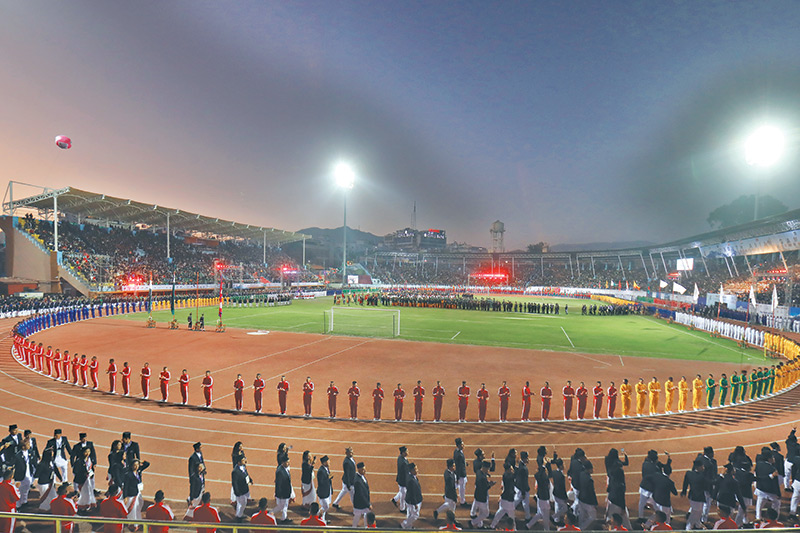
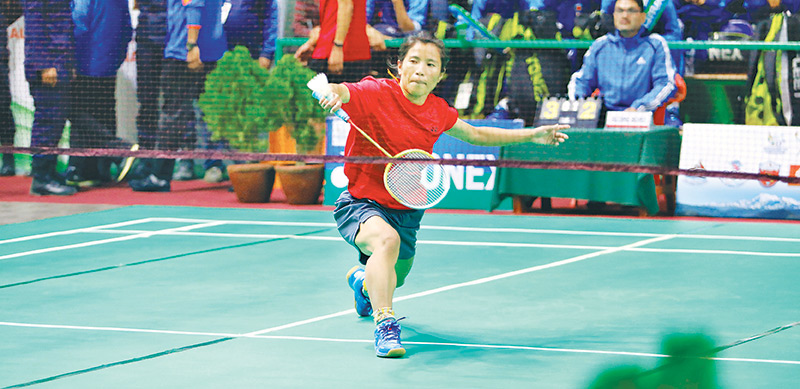
A colourful opening draws thunderous applause as South Asian Games begin
A three-hour ceremony, showcasing music and dance drawing on Nepal’s diverse culture, put a chaotic build-up to the event on the backburner.
- Suman Malla
KATHMANDU, The 13th South Asian Games got underway officially on Sunday, inviting thunderous applause from thousands of enthusiasts who had gathered to watch the colourful opening ceremony. A crowd of around 14,000 spectators packed into the Dashrath Stadium, which was spruced up just in time for the event. The build-up to the Games had been chaotic, with the organisers coming under fire for construction delays. But a three-hour ceremony, showcasing music and dance drawing on Nepal’s diverse culture, put all the bad headlines on the backburner. President Bidya Devi Bhandari declared the Games open amid a ceremony marked by laser shows and fireworks display. Addressing the opening ceremony, Deputy Prime Minister and Defence Minister Ishwar Pokhrel expressed satisfaction over the progress made by South Asia in sports in the last 35 years and thanked the organising committee. “More than the sporting competition, the event is successful in fostering the relationship among the seven South Asian nations,” said Pokhrel. “I believe the Games will further enhance unity and friendship.” The regional Games were first put on board in Kathmandu in 1984. A total of 2,715 athletes from seven countries will be competing for 1,115 medals, including 317 gold, in 26 disciplines in the 10-day event. Pokhrel said that the 13th South Asian Games will not only provide newer thinking for the Games in the next millennium, but the Games’ success will also provide the much-needed boost for Visit Nepal 2020. Member Secretary of the National Sports Council, Ramesh Silwal, sounded a relieved man on Sunday. “The biggest challenge is to ensure all Games facilities are completed on schedule,” said Silwal. “There is no doubt it has been stressful.” Silwal was indicating to construction delays at some of the venues. “I’d like to thank everyone involved for their hard work and cooperation to make the Games possible on time,” said Silwal, who also chairs the event’s Executive Committee. Jeevan Ram Shrestha, president of the South Asian Olympic Council and Nepal Olympic Committee, expressed hope that all the participants would use the occasion to “give their best performance to light up the Games and make their country proud.” The ceremony began with a march-past as President Bhandari arrived at the stadium, and it ended with a captivating performance by pop singer Deepak Bajracharya. Deepak Bista, the four-time South Asian Games taekwondo gold winner, lit the Games’ cauldron. He was handed over the torch by legendary Nepali marathon runner Baikuntha Manandhar after the final leg of the run around the athletics track at the stadium, which also involved fellow Olympians Rajendra Bhandari, Umesh Maskey and Nayana Shakya. International cricketer Paras Khadka and international badminton referee Deepak Thapa took the oath on behalf of the participating athletes and match officials respectively. Acclaimed singers Ananda Karki, Kunti Moktan, Indira Joshi, Milan Newa and Satyaraj Acharya then rendered the 13th South Asian Games’ theme song. Around 15,000 schoolchildren, singers, dancers from various cultural troupes and personnel from Nepal Police, Armed Police Force and Nepal Army performed breathtaking shows in a meticulous display that was greeted by thunderous rounds of applause. One of the major attractions on Sunday evening was a mass calisthenics show by 1,500 Armed Police Force personnel. After thundering fireworks, the ceremony came to a close.
HOME PAGE
Kathmandu’s Newars watch cautiously after government hints at reviving the Guthi Bill
Although officials said the new land bill will include suggestions from indigenous communities, local leaders say no one has reached out to them yet.
- TIKA R PRADHAN
Thousands of people protested against the Guthi Bill earlier this summer. Post file Photo
KATHMANDU, Six months after one of the largest ever turnouts in protest of Guthi Bill, there are fears that the offending provisions could be included in a new bill currently being drafted by the Ministry of Land Management, Cooperatives and Poverty Alleviation. Last week, the Cabinet gave the go-ahead to the ministry to draft a new land bill that will include provisions regarding guthi management. On Thursday, Minister for Communication and Information Technology Gokul Baskota told reporters during a weekly press conference that the government had, in principle, agreed to draft the integrated bill on land management. “The bill will also include provisions to manage guthis,” Baskota told reporters. Earlier this summer, the government was forced to withdraw the Guthi Bill less than a month after it was registered at the National Assembly after it drew immense criticism from Kathmandu Valley locals who subsequently took to the streets to oppose the bill. Opponents of the Guthi Bill say it had proposed repressive provisions that would nationalise both private and public trusts, regulate all religious sites, and replace the Guthi Sansthan, the body that currently oversees guthis, with a powerful commission. After the bill was proposed, members of the Newar community in Kathmandu Valley were among its most vocal critics, arguing that the bill was the final straw in the systematic erosion of indigenous Newar culture and rights by the state. This time around, the government has approached the issue with caution, consulting with the indigenous Newar community. Officials at the ministry told the Post that they plan to hold “a grand interaction” with all stakeholders in the next few days. “The new bill will incorporate all the concerns that were raised by those who opposed it earlier,” said Janak Raj Joshi, joint secretary at the ministry. “We have already started consultations with them.” However, Newar community members who took part in the June protests told the Post that they were not aware of any outreach from the government so far. “We are meeting with some 13 different ethnic groups within the Newar community and those groups affiliated to different parties to discuss issues, including the Guthi Bill,” said Maila Babu Dyola, general secretary of Newa Dey Daboo, an umbrella organisation of all Newar communities of the country. “We were planning to hold a guthi conference but we didn’t think the government would come up with a new bill so early.” After the government withdrew the controversial bill, Newa Dey Daboo had planned a conference to finalise issues that could be incorporated into a new Guthi Bill. Members said they hadn’t yet been able to hold a gathering because of logistical issues. “We are going to revive the Rastriya Pahichan Samyukta Sangharsha Samiti following the government’s decision to draft a new bill related to guthis,” said Manish Shrestha, one of the protest leaders. The Samiti, which loosely translates to ‘national identity joint struggle committee’ was behind the protest programme in June, which was attended by several thousands from the Newar community. Local leaders say they won’t allow government authorities to dictate policy this time as well. “If our concerns are not properly addressed,” Dyola said, “we will have no option but to get out on the streets once again.”
HOME PAGE
New parties face drubbing as Nepalis vote along party lines
‘They failed to convince the voters what they would bring to the table if they were given a chance.’
- TIKA R PRADHAN
KATHMANDU, Nepalis once again displayed traditional voting patterns as they continued to choose the established parties—Nepal Communist Party and the Nepali Congress—while casting their ballots in Saturday’s by-election, as they snubbed newer parties like Sajha and Bibeksheel. Despite their untiring efforts, focussing primarily on Kaski Constituency-2 in a bid to get a seat in the federal parliament, both Sajha and Bibeksheel, cut no ice with voters. Both parties have had to fight hard to even secure their deposits, as candidates must garner at least 10 percent of the total votes cast to get back their deposit; a failure to do so is considered humiliating. By-elections were held on Saturday for 52 positions, including a vacant seat in the House of Representatives, three provincial assembly seats, one mayor, three rural municipality chairpersons, one rural municipality vice-chair, and 43 ward chairs. As results filtered in, with the ruling Nepal Communist Party (NCP) clearly leading and the Nepali Congress trailing, analysts pointed at a number of factors for the poor show of the new forces. Rajendra Maharjan, a political commentator, said that parties like Bibeksheel and Sajha had nothing new to offer and that they continued to stick to their old refrain that the country needs a change. “The only thing that’s new about them is their names,” Maharjan told the Post. “They failed to convince the voters as to what they would bring to the table if they were given a chance.” Sajha Party is led by Rabindra Mishra, a former BBC journalist, while Bibeksheel Party is headed by Ujwal Thapa, who made his foray into politics after identifying for long as a social campaigner. Both parties had contested the 2017 local elections separately, but buoyed by the votes they had gathered in Kathmandu and Lalitpur, they decided to contest general elections together and merged. However, their merger did not last long as they decided to split on January 11 after 17 months. Analysts say the two parties were upbeat about garnering some votes in Kathmandu and Lalitpur but that they would largely have been unable to expand beyond the urban centres. Their presence is largely on social media and elections are decided in ballots, not in virtual space, said CK Lal, a political analyst who is also a columnist for the Post. “Whatever votes the Sajha Party has been able to garner in Kaski is because of its presence on social media,” said Lal. “These days, voters take decisions through hard-headed calculations.” Both Sajha and Bibeksheel have often faced censure for constantly criticising the traditional parties and their leaders, blaming them for all the ills in the country. They, however, have failed to come up with a clear strategy of their own to clean up the mess. The results show that Nepali voters are still not ready for an alternative to traditional forces, according to Jhalak Subedi, a political observer who has followed Nepal’s leftist politics for decades. “The fundamental problem with these new parties is they have failed to build an organisational base,” said Subedi. According to Subedi, unless the parties have a strong organisational base right down to the grassroots level, people will refuse to recognise them. “Voters alone cannot be blamed,” said Subedi. “In the case of Sajha and Bibeksheel, they function more like social organisations than political outfits and their leaders are more like campaigners and social workers.” When it comes to the ruling communist party and the main opposition Congress, they have their own history and can always cash in on the sacrifices their leaders have made in the past for democracy. Hence, they have political capital, which pays off during election time, say commentators. “Why would a voter waste their vote,” said Lal. “For an average voter, what would be the basis to vote for the new parties? I don’t see any. There should be three major reasons for voters to vote for a party—past performance and track record; personal or national prospects, and future prospects. The new parties have none of these.”
HOME PAGE
NCP’s popularity declines but Congress fails to capitalise
- ANIL GIRI
KATHMANDU, With the by-election results coming in, the ruling Nepal Communist Party and the opposition Nepali Congress have begun to take stock of how their candidates performed to gauge the political temper. The results have sent a mixed message to both the ruling party and the opposition, according to analysts. The by-elections have been largely seen as a mid-way litmus test for the parties. The Nepal Communist Party (NCP) needs to work extra hard to maintain its credibility and popularity while the Nepali Congress needs to transform itself if it wants to maintain its relevance, leaders from both parties told the Post. When the 2017 elections were held, the Nepal Communist Party had not yet been formed and the UML and the Maoists both contested the elections separately, though as an alliance. These by-elections are the first polls that the newly unified Nepal Communist Party is contesting. “Since the by-elections are being conducted after the unification of the two communist parties, they must own more seats,” said Shyam Shrestha, a political analyst who follows leftist politics in Nepal. “But they were unable to retain all their seats, which means that the performance of the government is not satisfactory.” The Nepal Communist Party did fairly well in Kaski, Dang, Panchthar, Mahottari, and Sankhuwashabha but lost its provincial seat and some of its wards to the Nepali Congress in Bhaktapur. It retained its Kaski-2 seat in the House of Representatives, with Bidhya Bhattarai, the widow of the late Rabindra Bhattarai, winning with a significant margin over the Nepali Congress’ Khemraj Poudel. The Nepali Congress took a provincial seat in Bhaktapur and three wards in Chitwan from the Nepal Communist Party. Out of 43 ward seats, the ruling party secured 24, the Nepali Congress 12, Samajbadi Party four, and Rastriya Janata Party three seats. In the Madhes, both the Samajbadi Party Nepal and Rastriya Janata Party Nepal continued their dominance at the local level. “The election results in Bhaktapur surprised us and we will convene a meeting to evaluate the results,” said Nepal Communist Party General Secretary Bishnu Poudel. “But we have retained several seats at the ward level and some new rural municipalities so the results are encouraging.” Poudel maintained that the ruling party’s popularity had not waned and that it had managed to secure the popular vote. “If the government was unpopular, the opposition would have won more seats but the results did not favour the opposition party either,” he said. However, some ruling party insiders do not agree with Poudel’s assessment. “We lost the elections in Baitadi, Dang, Chitwan, Sarlahi and Arghakhachi where the ruling party lost seven wards,” said Surya Thapa, ruling party leader and Prime Minister KP Sharma Oli’s press advisor. “We owned those seats when we contested separately, but today, despite being united, we lost. I don’t know what went wrong.” Some ruling party leaders said that factionalism within the ruling party could have manifested in the election results. Former Maoist leader Devi Prasad Dhungel’s loss in Bhaktapur is a manifestation of this internal division, said some leaders. “One faction thinks it is superior to the other,” said Ram Prasad Sapkota, a central committee member. “This hierarchical tendency clearly shows in the elections.” While the opposition Nepali Congress won some seats at the ward level and in Bhaktapur, its results were not stellar either. “To us, the message is clear,” said party spokesperson Bishwa Prakash Sharma. “We have to transform and correct ourselves.” Sharma said that they had managed to reduce the vote margin in several areas and had won seats in leftist banks like Chitwan and Dang. This shows that the popularity of the government is diminishing, he said. Although the Nepal Communist Party and the Nepali Congress continued to dominate the elections, the smaller, regional parties managed to carve out niches for themselves. However, these parties did not manage to achieve a significant hold in the system, which, analysts say, shows that the country is increasingly heading towards a two-party system.
MEDLEY
Horoscope
ARIES (March 21-April 19) ** No matter what kind of conversation you get involved in today, you need to make sure that you come off in a good light. Your reputation is your top concern right now, so it’s essential for you to take care of it. Attention to detail is more important than ever, too—you don’t want to send any emails.
TAURUS (April 20-May 20) * Eavesdrop much? An overheard conversation will likely make your blood boil. A preachy type of person thinks they know all the answers—but you know better. If their comments trigger your anger, that’s too bad, as there is no point in picking a fight with someone who clearly has their mind shut tighter than a drum.
GEMINI (May 21-June 21) ** Keep your agenda hidden today, because there are a couple of people around you who would try to change your mind if they knew what you were really up to! Sure, they’re just trying to help you out and steer you straight, but they aren’t the boss of you. If you are going to make a mistake, at least it’s your mistake to make.
CANCER (June 22-July 22) **** You’ll have the graceful balance of an Olympic gymnast today, able to handle anything that comes your way with aplomb. This is a wonderful time in your life—you are full of more can-do energy than ever before. In your career life, you should consider taking a bigger step toward a goal by volunteering for a task.
LEO (July 23-August 22) *** Is someone’s confidence striking you as just a bit too much like arrogance for you to admire? Big personalities are likely to feel just a little bit too big for you today, so try to avoid the more colorful people if you want to keep your cool. Instead, spend your time with the shy kids in the corner.
VIRGO (August 23-September 22) **** To have the most fun possible today, try to go out and meet someone new. It doesn’t have to be a new love interest or a new friend. Just having a conversation with someone you’ve never talked to before will be a blast. And if this person has a lot to, the two of you will have a wonderful time.
LIBRA (September 23-October 22) *** Mistakes happen, and assumptions are made from time to time—there’s no harm in that. You made an assumption, and you were not correct. But don’t let your honest mistakes get you down in the dumps! Letting yourself get depressed about your current situation will only paralyze you, and keep you from taking positive action.
SCORPIO (October 23-November 21) *** You will definitely have to take the initiative today if you want the day to go smoothly. The folks in charge don’t know as much about things as you do, and they could use a little help. They would also appreciate a little discretion, so try to offer your services without letting the whole world know about it.
SAGITTARIUS (November 22-December 21) *** You have quite an original mind, which can be equal parts blessing and curse. It’s good that you have such a unique take on things, but it might be difficult to maintain your objectivity when everyone around you disagrees with you. Time is of the essence right now, so if there is a decision that needs to be made take it.
CAPRICORN (December 22-January 19) ** Today, your plans for the near future might have to be revised quite a bit—a wrench will get thrown into the works by someone who holds a lot of power over you. There is little you can do other than react. Try to be prepared for some juggling or creative scheduling. Put together a backup plan just in case.
AQUARIUS (January 20-February 18) *** There is a lack of discipline in your life right now, which might make it difficult for you to know what to do! Without the structure you are used to following, the sheer number of your choices risks becoming overwhelming. Get advice from someone who has been through all of this before to navigate confusing waters.
PISCES (February 19-March 20) **** Despite the fact that you have been running around, all your projects are humming nicely along and your relationships are doing quite well. Spinning plates is your specialty today, when a few more items will get added to your list. The great part is, you’re already in the zone—and so you will complete everything.
NATIONAL
Series of setbacks beset Pappu Construction after its owner was suspended as lawmaker
- PRITHVI MAN SHRESTHA
KATHMANDU, The suspension of Hari Narayan Rauniyar, founder of Pappu Construction, from the position of lawmaker last year over corruption charges, has appeared to be a turning point for his waning influence in getting contracts and saving the contracts won by his firm. In October last year, the Commission for Investigation of Abuse of Authority filed a corruption case at the Special Court against Rauniyar and his son Sumit along with ten other government officials over the construction of a sub-standard bridge over Babai River at Jabbighat in Bardiya. As per the Corruption Prevention Act-2002, it led to automatic suspension of Rauniyar from the lawmaker’s post. Pappu Construction has been denied at least one almost sure contract while some of the contracts it had won were terminated after Rauniyar’s suspension. The government officials who dealt with Pappu Construction point out a number of factors that led to the company losing its influence lately. “Waning political influence is one factor,” said Rabindra Nath Shrestha, secretary (Irrigation) at the Ministry of Energy, Water Resources and Irrigation. “Other factors such as the new provision of setting a certain milestone to accomplish even before the contract deadline expires, concerns about its performance raised by the media and the strong instruction from Prime Minister KP Sharma Oli for decisive action on under-performance also broke Pappu’s dominance in the construction sector.” Shrestha had served as director-general of the Department of Roads last year. A former secretary of the Ministry of Physical Infrastructure and Transport recollected recently to the Post about the influence of Pappu when he was the director-general of the Department of Roads some years ago. “Our project office requested the Public Procurement Monitoring Office to blacklist the Pappu. But under the influence of Rauniyar, the immediate secretary of the procurement monitoring office continued to delay the blacklisting process. Only after that secretary left the procurement monitoring office, the company was blacklisted.” Given the political influence he had, Rauniyar got a ticket from erstwhile Sanghiya Samajbadi Party (now Samajbadi Party Nepal) for the parliamentary seats and also won the elections in 2017. He used to secure an interim order from court whenever his company ran into trouble, according to the road department officials. But now the situation has changed. After Kathmandu Valley Road Expansion Project terminated Pappu’s contract for a Bagmati river bridge project in Tinkune last week, the latter sought an interim order from the Supreme Court. Instead of issuing an interim order, the court has asked both parties to be present at the court this time. According to Bishow Bijaya Lal Shrestha, spokesperson for Kathmandu Valley Road Expansion Project, the contract was terminated after Pappu failed to complete even the foundation of the bridge in five years since the signing of the contract. Besides, Pappu had also rejected the project office’s instruction to correct the mistake and build the bridge as per the approved design. Now, the project office has asked the procurement monitoring office to blacklist the firm. Rauniyar claimed that despite his firm’s willingness to work as per new design, it was not allowed to work. “It is due to the prejudice of former Physical Infrastructure Minister Raghubir Mahaseth, who didn’t like me joining the Samajbadi Party Nepal,” Rauniyar told the Post on Sunday. On Sunday, Pappu’s other contract regarding building two bridges in the Mid-Hill Highway was also terminated. The Mid-Hill Highway project said that contractor had failed to give a convincing clarification on why the contract should not be terminated. The project has also instructed the contractor to pay a fine of Rs 66 million after its performance guarantee could not cover the increased cost for the project implementation. The project was awarded to Pappu/Nepal Pragati JV in July 2011, and its extended deadline was until January 2014. Earlier in March, Coastal/Pappu JV was blacklisted by procurement monitoring office for poor progress in the construction of the main and link canals and rehabilitation of headworks of the Dunduwa Irrigation System—of Sikta Irrigation Project. Amid ongoing bad publicity and strong reservation from the Nepal Rastra Bank, SRBC Pappu JV was also denied the contract of building central bank’s building in Baluwatar, Kathmandu. After passing the technical qualification and coming first in financial evaluation, it was almost sure to get the contract of the central bank. Rauniyar admitted that he has become an easy target of the government agencies after his suspension from lawmaker’s post. He also claimed that his firm was facing action against the procurement laws. “If I were in Parliament, I would not allow the government agencies to take action against my company by going against existing laws and regulations,” Rauniyar said. He said that he would now go to the court for his reinstatement as a lawmaker, as parliamentary regulation and anti-corruption law have a contradictory provision regarding suspension.
NATIONAL
Musikot takes services to people’s doorsteps
- HARI GAUTAM
RUKUM (WEST), Hundreds of people in Musikot Municipality benefited from a door-to-door campaign organised by the municipal office to provide government services, according to officials. The five-day campaign, which started from November 5 till 10, included services such as health check-ups, livestock treatment and tax collection, among others. “Officials from the local unit came to our homes to collect taxes. We did not have to walk for hours to reach the municipal office to pay our taxes,” said Karna Bahadur Budha, a resident of Musikot Municipality Ward No. 9. According to the data of the ward office, 296 people paid taxes from their homes during the campaign. Dilliraj Bohara, a member of the mobile camp and also the in-charge of Holtara Health Post, said the ward office collected Rs 128,549 of tax amount within this period. “Two hundred forty-six people received health services and medicines, 60 women received temporary family planning services and 13 senior citizens received warm clothes,” Bohara said.
NATIONAL
Central Bureau of Statistics says next census will be the most comprehensive ever
The entire process, which is estimated to cost Rs 4.5 billion, will include households, livestock, and physical infrastructure at all levels.
- PRITHVI MAN SHRESTHA
The bureau will conduct a pilot census in one district in each province starting February next year. The final census is set to take place fromJune 7 to June 21. Post file Photo
KATHMANDU, In a first, the Central Bureau of Statistics will be accumulating data on livestock, housing facilities for the animals, and community infrastructure in what it says will be the most comprehensive survey ever done in the country. The bureau conducts a survey on population and housing every 10 years. The last census, held in 2010-11, showed the total population of the country is 26.49 million, with 5,427,302 residential households. Data showed that of the total number of households, there were 5,423,297 individual homes and the rest were institutional infrastructure, such as schools, police stations, government buildings, among others. According to officials at the bureau, they did not reach out to all the households during the last census. In some locations, it collected data through a sample survey, according to Nebin Lal Shrestha, director-general at the Central Bureau of Statistics. “This time, we will reach every household in the country,” he said. “There is a strong demand for micro-level data from all three tiers of the government--from the wards to the national levels,” said Shrestha. The provincial and local governments have particularly sought such data to make better-informed plans and programmes. The statistics bureau also plans to collect data on both residential and non-residential houses, as opposed to collecting data on only residential houses in the past. The data will also include extra information such as whether one or more families live in one house, what purposes the houses have been utilised for, etc. Currently, the government does not have exact data on how many houses there are in the country. According to Shrestha, officials will also count cattle in the next census. Officials at the statistics bureau said they will plan to prepare a separate questionnaire for each ward to note down the physical and social infrastructure available as well, such as access to drinking water, electricity, health post, road, schools among others. “The data will give information about where basic infrastructure facilities are available and where they are not,” said Shrestha. Based on these questionnaires, the bureau will conduct a pilot census in one district in each province starting February next year. Officials told the Post they will make necessary improvements in the questionnaires after looking at the results of the pilot census. The final census is planned to be held from June 7 to June 21 next year. Unlike in the past census, the bureau said it won’t use teachers to counting the population; instead, they will use teachers across the country to create awareness about the census. The government will deploy unemployed youths at the local levels to keep a count of the population as well as the households. Given the comprehensive nature of the upcoming census, the central statistics body says it has projected cost of Rs4.5 billion from preparations, field works, and the final report launch.
NATIONAL
Slow internet affects government services in Jumla, locals say
- LP Devkota
There have been glitches since the Jumla District Land Revenue Office started its online services two months ago. Post Photo
JUMLA, Locals in Jumla complain local units are delaying operations and blaming it on slow internet. The district’s land revenue office has been carrying out operations online for the past two months. Panchakali Pariyar, from Tatopani, said she’s been frequenting the office for the past four days to complete a land transaction. Her work is pending owing to complications related to the internet, she said. Officials said it is due to “slow system”. Manna Pariyar, another customer, said the system was better earlier. “At least, the system was dependable when it was written longhand,” she said. Pariyar said she suspects negligence by the officials. Min Bahadur Rawal, an officer at land revenue, admitted the system hasn’t been running as expected of late. “It’s because of complications related to the internet and electricity,” he said, adding that his office has asked the government to upgrade the connection, but have heard nothing so far. Rawal said that the office’s software is connected to a Kathmandu-based central server. “We are currently archiving old files online,” Rawal said. “We also lack human resources, and the internet gets interrupted frequently.” Meanwhile, locals in Mugu are ecstatic to be finally connected to the internet. Till about a year ago, the locals of Nera Gaun in Soru Rural Municipality Ward No 5 in Mugu had to climb up a hilltop for a phone call, to catch a better range. Things changed when the ward office subscribed to internet service and made it accessible to the villagers across the ward. Today, Haribhakta Budha, a Nera Gaun local, video calls his friends from his house. So does his neighbour Chin Bahadur Malla, and hundreds of locals from Libru, Rawaldanda, Taaja and Bhadgaun. “The internet service has been a boon for us,” said Malla, satisfied the days of hassles to find a range are long behind him. Anchan Budha, chief of Ward No. 5, said the internet connection has made running of the office easy. “The operations these days are swift,” he said. “The locals are happy to get connected with their relatives settled outside.” Budha said his office is now gearing up to provide the connection to public schools in the ward as well. Lok Bahadur Shahi, chair of the rural municipality, said that the service has been extended to all of its 11 wards. “Soon there will be internet in schools and health posts,” he said. “All of the rural municipality’s work will be operated digitally.” There’s internet service in four wards of the Chhaya Nath Rara Municipality as well. Both the state-owned Nepal Telecom and private internet service provider Worldlink are extending the service to villages around Gamgadhi, Mugu’s district headquarters. Raj Bahadur Shahi contributed reporting from Mugu.
NATIONAL
Locals complain of lackadaisical service at the judicial committee in Nepalgunj
Lack of legal knowledge, budget and working guidelines is the major cause of the ineffective service delivery.
- MADHU SHAHI
BANKE, Hira Thapa, a resident of Gulmi district, wants to transfer a patch of her father’s land in Nepalgunj to her name. Her parents have refused to pass on ownership of the land, and she has sought to use the rights enshrined to her in the constitution to acquire her parents’ property. According to Thapa, she went to Nepalgunj Sub-metropolis from Gulmi in August 2018 to get legal support from the judicial committee for her case, but she could not meet Uma Thapa Magar, Nepalgunj’s deputy mayor who leads the three-member committee. “I had to return home without meeting her, as she was out of the district. I revisited Nepalgunj a few months later and finally met with her, but she told me that she was in a hurry,” said Hira, adding that the judicial committee did not extend her any support. “I felt that the judicial committee was reluctant to hear my complaint.” She then filed a case in the Gulmi District Court since she could not get legal service from the Nepalgunj’s judicial committee, she says. Krishna Shah, a woman from Kanchanpur who was married to a man from Nepalgunj, also faced a similar ordeal. She complained that she too paid multiple visits to the judicial committee in Nepalgunj but no help ever came. She had gone to the judicial committee to get help with property matters, after she separated from her husband. “Whenever I meet the deputy mayor she says she is very busy. I talk to the legal officer of the committee and return with no help. The judicial committee and its coordinator are apathetic to my problem,” said Shah. Aside from these two women, many service seekers have complained that the judicial committee does not provide any legal help. According to the existing legal provision, the three-member judicial committee is formed under the chairmanship of deputy mayor. A separate bench is also arranged in the municipal office. However, the bench is almost defunct. Maya Sharma, the legal officer at the sub-metropolis, admits that the judicial committee has been ineffective in implementing its work. “Hearings and giving verdicts are not under my jurisdiction. I can just give legal suggestions and advice,” said Sharma. According to her, the judicial committee is supposed to hold the bench every Thursday but that it rarely happens. “The deputy mayor is often busy and she has not given due priority to the judicial committee.” Besides the deputy mayor’s hectic schedule, lack of legal knowledge, budget and working guidelines are the major causes behind the ineffective service delivery from the judicial committee. Deputy Mayor Thapa Magar admitted that she hasn’t been able to give much time to the judicial committee. “But we are working on plans to make the committee and its functions more effective,” she said.
NATIONAL
Landslide in a construction site kills five in Pokhara
- LAL PRASAD SHARMA
Workers were constructing a retaining wall along the Manipal-Sikles-Manang road section in Mauja when the landslide swept away the wall, burying them at around 8:05 am on Sunday. Post Photo
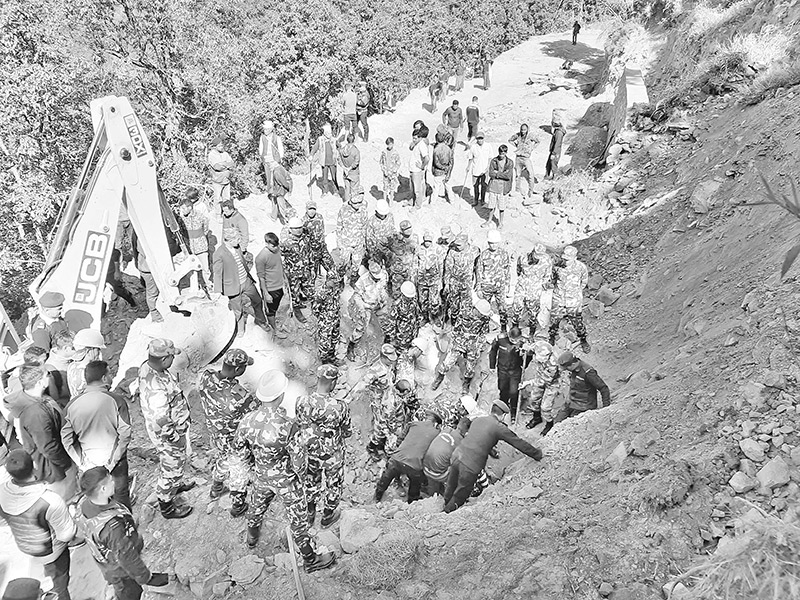
POKHARA, Five people died in a landslide in Pokhara on Sunday. They were constructing a retaining wall along the Manipal- Sikles-Manang road section in Mauja when the landslide swept away the wall, burying the workers at around 8:05 am. The workers had resumed work in the construction site two days after the wall’s foundation was dug out, said Sobit KC, an engineer at the Royal/Shanidev JV, the contractor company. “The workers were given days off on Friday and Saturday for the by-elections.” On Sunday morning, seven workers had reached the site to carry out construction work. “Of them, five were buried under the landslide debris,” KC said. The two other workers, Khimlal Basnet and Suk Bahadur Basnet, saved themselves by running away just when the landslide occurred. According to Sim Gurung, chairman of Ward No. 20, all five workers who lost their lives in the incident were from Pedikhola in Baagchaur Municipality of Salyan district. The deceased have been identified as Tovan Basnet, Khimlal Oli, Ganesh Oli, Jit Bahadur Basnet and Jogendra Budhathoki. Personnel from the Nepal Army, Nepal Police, APF and the locals began rescue work soon after the incident occurred. It took around two hours to recover the bodies, which are being kept in the Western Regional Hospital of Pokhara Academy Of Health Science for postmortem. The road section was being upgraded with a budget of Rs82.5 million allocated by the Pokhara Metropolis, Chairman Gurung said.
NATIONAL
Seven die as ambulance collides with a truck in Sunsari district
- SUMNIMA CHAMLING
ITAHARI, Seven people were killed when an ambulance collided head-on with a truck in Haripur of Sunsari district around midnight on Saturday. According to the Provincial Traffic Police Office, all the victims died on the spot. The Udayapur-bound ambulance (Ko 1 Cha 9364) collided with a truck (Na 2 Kha 9082) that was heading east along the East-West Highway. The incident occurred when the ambulance was returning to Udayapur with Shivamaya Rai, 85, from the Biratnagar-based Golden Hospital. The family members were taking the critically ill Shivamaya home to Triyuga in Udayapur district after the doctors said that her treatment was not possible. The deceased have been identified as Shivamaya, her son Tula Bahadur Rai, grandsons Durgadhan Rai, Tekendra Rai, nephew Dinesh Rai and son-in-law Uddhav Rai and ambulance driver Rajesh Sunuwar. The truck driver is on the run after the accident. Deputy Superintendent of Police in Sunsari Binod Sharma said the search is on to nab the absconding truck driver. “We think the accident happened due to poor visibility caused by dense fog in the area,” he said.
NATIONAL
Embankment project creates jobs for Mahakali Municipality residents
- BHAWANI BHATTA
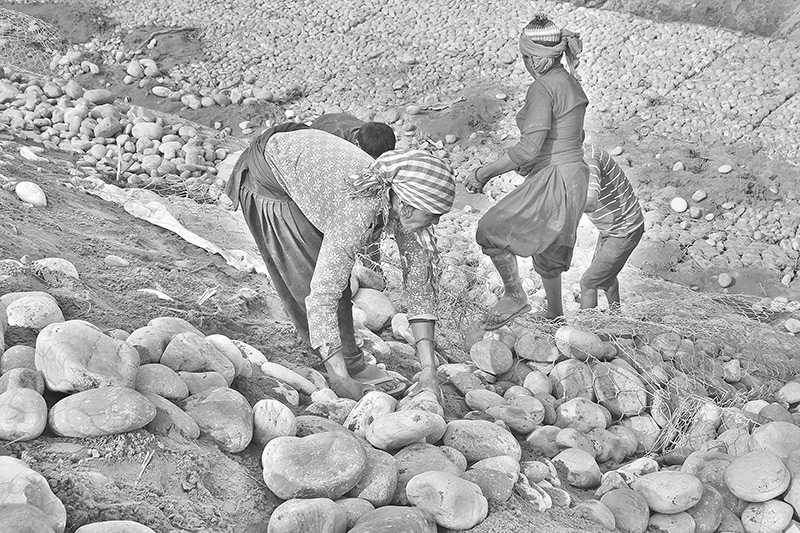
Workers are making up to Rs 1,200 per day filling nets with stones on the river bank. Post Photo: bhawani bhatta
KANCHANPUR, Every year, Jogbuda River causes floods and erosion in Mahakali Municipality, turning swathes of arable land into sand-beds and settlements into islands. But three years ago, the municipality started constructing embankments on either side of the river in an effort to prevent flood water from spilling out. The construction of the embankments has now reached a phase wherein the locals have been encouraged to be a part of it. Hiradevi Jaishi, a local, has been working at the construction site for the two months. She says she makes up to Rs1,200 per day filling the nets with stones. “I come to the river right after my morning meal,” she said. “I get paid according to the work I do; the more I perform, the more I get paid.” In the name of land, all Jaishi has is three kathas which is barely arable. Her husband and two of three sons are in India for employment. “It’s a good opportunity for me to earn a little,” she said. “It’s near my home, so it’s easy for me.” Bhagirath Bhatta, another labourer at the construction site, said, “This river gave us a lot of pain. But now it’s given us employment. We hope the embankments will help prevent floods and erosions as well.” Like Hiradevi and Bhagirath, the construction has provided employment for 30 people in the locality. Ram Singh Dhami, the contractor who has taken up the job, said that he is happy in that the traditional embankment is being built to prevent flood waters from entering settlements and also providing employment for long-suffering locals. “We expect that the job will be done better with active participation from the locals,” he said. Jogbuda river is flanked by Chandani and Baduwal Tole villages on either side. The embankment is being built in a total of four kilometres length along both sides.
NATIONAL
Woman thrashed for ‘practising witchcraft’
Briefing
BAITADI: A 40-year-old woman was severely beaten by two people who accused her of practising witchcraft in Talladehi of Baitadi on Saturday evening. Uttara Dhungal lodged a complaint at the police station on Sunday stating that her brother-in-law Dambar Dhungal and his wife Pabitra thrashed her. “Investigation is underway into the case. We will take action against the accused if they are found guilty,” said DSP Dillinarayan Pandey.
NATIONAL
Unidentified group torches four excavators in Khotang
Briefing
KHOTANG: An unidentified group torched four excavators that were being used for road upgradation work on the Chakhewa-Diktel road in Khotang on Saturday night. The excavators belonging to Golden Good JV Construction were destroyed in the arson. Search is on to nab the arsonists, said police.
NATIONAL
Idols stolen from a temple in Dullu Municipality
Briefing
DAILEKH: Three idols—two idols of Ganesh and a statue of a tiger—have been stolen from Paduka Temple in Dullu Municipality of Dailekh district. The temple’s priest Devinath Yogi informed the police about the theft on Sunday morning. A bell was also stolen from the temple.
NATIONAL
Biratnagar metropolis starts construction of rest spots
Briefing
BIRATNAGAR: Biratnagar Metropolitan City has started the construction of 48 roadside rest spots with digital display. According to the metropolitan office, the rest spots are being constructed to manage traffic and beautify the city. The metropolitan is also constructing about 20 traffic islands.
NATIONAL
Fire destroys four houses in Salyan district
Briefing
SALYAN: Four houses were burnt to a cinder when fire broke out in Simalpur of Darma Municipality, Salyan, on Saturday. The fire victims could not salvage their belongings in the incident. The victims are now taking shelter in the houses of their neighbours and relatives.
EDITORIAL
Blame the system, not the athletes
It doesn't pay well to be an athlete in Nepal.
Nepal has somehow managed to pull off the 13th South Asian Games—so far. This is saying a lot, since the organisers had fallen short of even securing the necessary equipment and revamping the necessary infrastructure on time. Questions remain whether the entire games will be successfully held—important infrastructure, such as the swimming pool, is yet to be complete. But it seems the sports authorities have gotten a respite from their own blunder and embarrassment due to the failure to plan. Some of the attention, at least, has been taken away by Tulsa KC, previously a SAG gold medal hopeful and now the subject of social media buzz. But rather than swallowing the narrative the authorities are attempting to peddle—that KC has ‘betrayed’ the country by leaving for Qatar—we ought to ask why she chose to leave the chance of attaining glory to go work in another country. The answer is closely tied to Nepal’s incompetence in promoting sport, providing for athletes and securing the necessary infrastructure. The reason behind KC’s departure, at the 11th hour before the South Asian Games, also resonates with another important question: Why are Nepalis forced to go abroad for work? The negative criticism KC has received from some quarters of the media and civil society is unwarranted. Instead of attempting to vilify her for leaving, the same should have asked why she thought going to work in a foreign country would be a better option for her future over representing Nepal and winning medals. Nepal tends to celebrate winners with passion, but a consistent livelihood is an unachievable dream for most athletes. While some athletes can stretch it for longer, the average career span for an athlete is 10 years. This means that, if not in their early thirties, almost all athletes retire by the time they hit 40. During their relatively short career, the athlete is supposed to give their all to their sport—training, planning, resting and sacrificing personal lives to better their performance. The dedication is such, and the schedules so demanding, that most cannot afford the time to develop a secondary skillset to apply after retiring. This means that the athlete has to financially secure their and their family’s future and livelihood in the decade they have. Nepal underpays its athletes, but what makes matters worse for most is that besides the few sportspersons that receive major coverage, the majority does not have sponsorships to fall back. This is especially true of athletics and sports that do not receive constant media attention. The recent feature by The Guardian covering mountaineer Lhakpa Sherpa’s predicament is a glaring example. For every Sandeep Lamichhane, who rightly and deservedly gets an opportunity at sponsorship (along with opportunities to work hard and earn enough from athletic endeavours), there are many Tulsa KCs and Lhakpa Sherpas who struggle with earning enough to survive the present—let alone secure their future. And while increasing the wages and incentives of sportspersons to reflect their short career spans would give such athletes a breather to focus on succeeding, the problem runs deeper. Take, for instance, Nepal’s paragliding team. After assuring the team that there would be a spot for the adventure sport in the Games, the authorities could not secure support from enough nations to make it happen. Now, the paragliders have been left dejected, after training for months on their own dime without institutional support; Nepal is short a potential eight medals. If anything, it is not the athlete but the system itself which has betrayed sports and athletics in Nepal.
OPINION
Of millenials and ‘mangled’ Nepali on social media
Nepali grammar nazis need to ease up and let the new generation communicate in the lingo of the times.
- Dinesh Kafle
Shutterstock
In Nayan Raj Pandey’s novella Ulaar, Rajendra Raj Sharma, a cunning local leader, has considerable political clout partly because, ‘If need be, he could even speak English.’ The ability to speak English, the narrator thus tells us, is a sign of power and privilege. There are obvious advantages of knowing this global language: it gives you an edge over others during job competitions; it connects you to the world beyond your cultural cocoon; and it gives you a few extra points during verbal fights in a ‘civilised’ setting if you shout in English. For the longest time, we have known that English ability correlates with status in Nepal. That is perhaps why many of us took pains to polish our English and use ‘perfect’ English whenever we could. We would be extra careful when deploying English also because we didn’t want to get caught out the grammar prescriptivists—the grammar nazis waiting to puncture our pomposity. Today, however, almost as a backlash to our English aspirations, we are coming under flak from prescriptivists of another sort—grammar nazis who police our use of Nepali. English once landed me into trouble when I unwittingly resorted to it to respond to a friend’s question on Facebook messenger. Oye, Angrejibaaj! Speak in Nepali, she said. She added in nearly these terms: I know you studied English literature, but you don’t need to switch to English when chatting with me. But how many of us who came of age during the advent of the Internet age claim to be able to stick to just one language during our chats? Isn’t switching between languages second nature to the millennials who know two or more languages? My friend found my switch to another language a sign of rudeness. But for me, it was a necessity, as I can’t type in Nepali Unicode. Having never mastered Unicode typing, I uninstalled it from my phone and use the web version when absolutely necessary. And since I’m used to chatting with friends in English, I find it difficult to chat in Nepali—be it in Roman or Unicode. And when difficult questions are asked, it is only natural for me to turn to a language that I can type quickly and confidently. This must be true for a large population of millennials who grew up on a staple diet of the Internet and social media. If much of the information we consume today comes in English, how is it rude to express ourselves in English, especially with those who you know how to speak English well? The younger generation of Nepalis is so used to texting in English that they consider those typing in Nepali an aberration. My young friends report to me that they have been called pakhey for speaking or texting in Nepali. For example, kids routinely shorten bhanchha to van6, mostly for speed and expediency. Maybe my friend would like to admonish the youth for plotting to desecrate the Nepali language, but they are simply using an Internet-age dialect of Nepali just as she was using Romanised Nepali to chat with me. Speaking of Romanised Nepali, little would my friend know that she would fare worse than me if we were to be taken to the courts of self-styled Grammar nazis—those who compulsively correct the grammar of other people—in the Nepali Twittersphere. There is a small but influential section of Grammar nazis who take Nepali language a bit too seriously and chastise those who use Romanised Nepali in social media. In their little utopia of linguistic purity, there is no space for Romanised Nepali. If you’re found using it to comment on their posts, you will first be chastised, then asked to either revise or delete your comment, and even be blocked if you are a habitual offender. Global Twittersphere has a hashtag for them: #GrammaNazi. The presence of the Nepali Grammar nazi often spills over the real world, casting an eagle’s shadow over those who speak without giving much thought to the language. Those of us who have been their victims laugh at them and bitch about them, but we are eternally scared of them. Such is their influence that last year, a famous writer-cum-raconteur stayed mostly silent throughout a Kathmandu-Pokhara bus journey for fear of his jokes being corrected by the Grammar nazis present in the bus. Since language is intrinsic to our personality, it is annoying to have our grammar corrected each time we speak or write. It is equally annoying to be self-restraining in our expressions knowing that there are Grammar nazis out there with their linguistic dagger out of its scabbard. English-baiters and Grammar nazis alike belong to the same spectrum of conservatives who see language not as a conduit of human communication but as a fossilised entity built on a fixed set of rules. It is about time they started appreciating the technological changes around and leaving people with different typographical and linguistic abilities alone when it comes to the usage of language in social media. As a great democratic space, social media allows us to publish our thoughts even if we have bad grammar, language, pronunciation and spelling or the inability to adapt well to technological changes. The last thing we would want to see is the disapproval of others who don’t share the same problems.
OPINION
Hong Kong says no to the China dream
Hong Kong’s citizens want to continue living in a free society under the rule of law.
- CHRIS PATTEN
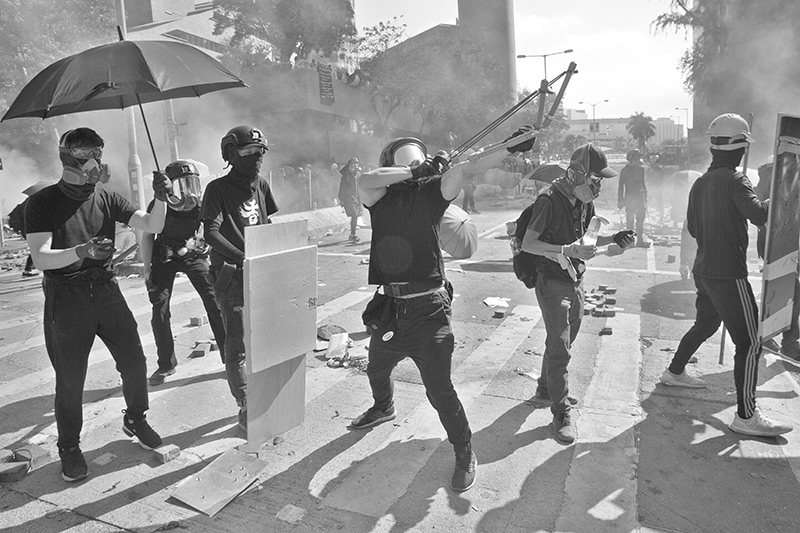
Student protesters using slingshot against police in Hongkong during the Poly U siege. Shutterstock
At the beginning of his satirical novel China Dream, which has a cover designed by the dissident Chinese artist Ai Weiwei, Ma Jian expresses his gratitude to George Orwell, author of 1984 and Animal Farm. Orwell, he says, ‘foretold it all.’ Ma, whose work is banned in China and who lives in exile in London, is, of course, reflecting on Orwell’s warnings about the threat of a totalitarian future in which dictatorships brainwash people. Today, in China’s Xinjiang region, the regime is incarcerating about a million Muslim Uighurs in ‘re-education’ camps. The target of Ma’s book is the Communist Party of China (CPC), which, he argues, has ‘imprisoned the minds and brutalized the bodies of the Chinese people.’ In particular, his satire targets President Xi Jinping’s signature ‘China Dream.’ A communist official in the novel believes the policy will ‘go global’; the CPC will become ‘the ruling party of humanity.’ But before the China Dream can convert humanity to its wonders, it will first have to be accepted by the Chinese people, including those who live in Tibet, Xinjiang, Hong Kong, and Taiwan. For five months, Hong Kong has been in a state of turmoil, as initially peaceful protests have subsequently often degenerated into violence on the part of both the police and the demonstrators. At first, the protests centred on the city government’s proposal to allow the extradition of criminal suspects to mainland China. Arguments that this posed no problem because sovereign nation-states had similar extradition agreements with China could not be taken seriously. Hong Kong is self-evidently not a sovereign country: that is a fundamental part of the city’s special position. Hong Kong’s citizens feared that the extradition bill would deprive them of the security of the rule of law, and in effect legalise the abduction of individuals deemed to be ‘enemies’ of the Chinese state. But as the weeks rolled by, and Hong Kong’s government initially refused to budge regarding the proposed law, other grievances emerged, particularly concerning high housing costs and squeezed incomes. I have some sympathy for those police officers (and their families) who behaved properly but found themselves required to act as substitutes for good and responsive government. Alas, as many human-rights organisations have documented, some officers did not follow the norms of good policing. One distinguished surgeon in Hong Kong wrote an article in The Lancet about violations of humanitarian norms after doctors and nurses were arrested for rioting while providing emergency care. They were treated like terrorists, and made to kneel with their arms behind their backs while handcuffed with zip cord. Not surprisingly, but very regrettably, police abuse sometimes provoked a violent response, which cannot be condoned even if it can be understood. More than 5,000 demonstrators have been arrested; only one police officer has been relieved of his duties. As long ago as June, many people—including a respected former chief justice of Hong Kong—were calling for the establishment of a commission of inquiry to look into the reasons for the demonstrations, how they have been policed, and demonstrators’ behaviour. With their hands clearly tied by Xi’s government in Beijing, Hong Kong Chief Executive Carrie Lam and her government have refused to create such a panel, though doing so probably would have ended the unrest months ago. China’s leaders and their mouthpieces in Hong Kong have repeatedly claimed that a silent majority of the local community opposed the demonstrators, and that foreign ‘black hands’ were behind the protests. But the city’s district council elections on November 24 told a different story. More people than ever before registered to vote, and turnout was the highest in the city’s history. Pro-democracy forces secured a sweeping victory, winning 347 of the 452 seats. Independent candidates, many of them pro-democracy, won a further 45, while the pro-Beijing establishment picked up just 60 seats. Before the election, all 18 of Hong Kong’s district councils were controlled by supporters of China. Now, the pro-democracy camp is in charge of 17 of them. Little wonder, then, that one local newspaper used the word ‘tsunami’ to describe the result. The Chinese authorities’ insulting suggestion that Hong Kong’s citizens were being manipulated was plainly ludicrous. The not-so-silent majority made its views known. The China Dream does not seem to have many takers in Hong Kong. Some observers believe that the Chinese authorities now will aim to curtail the rule of law in Hong Kong, control the independent judiciary, introduce laws against sedition and subversion, and brainwash the city’s children. And this may well happen: in Beijing, policy is too often decided in an atmosphere of ignorance laced with paranoia. Yet, if China’s leaders were wise, they would reject this course of action. Instead, they would allow the Hong Kong government to start a dialogue with its citizens, and to use a commission of inquiry as a sort of truth and reconciliation body. Hong Kong’s citizens want to continue living in a free society under the rule of law. That is their dream. As the recent elections showed, few of them are attracted to Xi’s.
OPINION
What it takes to get rid of plastic
The ultimate determiner will be the budget allocation for waste management and industrial support for alternatives.
- Siddhartha Mainali
Shutterstock
Plastic was once touted as a wonder substance for its versatility. But slowly, as its environmental impacts have come to the fore, people are having second thoughts. Although plastic owes its invention and early adoption in the developed world, the hazards of plastic pollution cannot be viewed as a problem of the richer world alone. With decreasing poverty and the resultant disposable income, developing countries are also experiencing a consumption-fuelled increase in plastic waste. What makes the situation dire in most developing countries is the lack of waste management infrastructure. Once known to be the largest importer of American plastic waste, even advanced developing nations like China are struggling. China took the bulk of scrap plastic from around the world for the longest time. But in 2018, it put a ban on accepting the world’s used plastic. The gravity of the situation is also depicted by the Indian government’s recent decision to backtrack on a blanket ban on single-use plastic citing the crippling effect it could have on the supply chain and industry in an already slowing economy. India has now changed strategy to a gradual phase-out. Least Developed Countries (LDC’s) like Nepal are even more vulnerable as most plastic waste here is either burnt in the open or ends up in landfill sites. With an unconcerned population presented with no other choice but to accept plastic packaging, plastic pollution is now a menacing problem. In Nepal, it is estimated that the share of plastic waste amongst total waste produced is about 16 percent. According to a 2018 study by the German development agency GIZ, Nepal produces an estimated 15,000 tonnes of polyethylene terephthalate (PET) waste per year. There is also a dearth of laws and regulations pertaining to waste management and recycling, compounded by the lack of an adequate budget for the same. Domestically, waste management infrastructure is composed of loosely organised teams of waste collectors assigned to localities. These companies are known to utilise public land or river banks to sort and salvage plastic and other useful solid waste. With limited local recycling and upcycling infrastructure, a huge pile of what can be salvaged is sold to local waste collectors and the waste eventually finds its way to recycling facilities in India. The rest is transported to landfill sites. However, India’s ban on such imports effective from 2016 has meant that local collectors face more hassle as they now have to rely on informal routes. A conversational interview with a contractor, employing people that work under precarious conditions on the banks of Dhobi Khola, confirmed that the prices of scrap materials including plastic have reduced due to oversupply. Like in the West, the rhetoric regarding plastic pollution in developing countries has focused on consumers rather than producers. This is partly due to the stellar work of industry lobbyists. It is indeed easier to blame the habits of collective individuals rather than to be singled out for blame. Also, industries have formed a habit of funding research for plastic alternatives as a way of getting around the negative press. Some major players are also known to claim outright that they have helped create jobs by supporting a recycling industry. Hence, recycling has received more attention than curtailing production at the source. Also, industries in developing nations are known to exploit weak regulations and casually introduce packaging strategies that involve plastic materials. Given this, it is important to first devise a clear waste strategy and to decide whether Nepal should focus solely on recycling or also on reducing the use of plastic materials in the supply chain. The amount of plastic Nepal produces is not considered significant enough for large scale investment in recycling. Also, it will be some time before plastic alternatives are feasible. Hence, one idea is to derive sustainable revenue opportunities from recycled waste. Innovative ideas to encash waste do exist. For example, ‘waste to energy’ plants process solid waste including plastic to produce non-intermittent electricity. The waste collected through this method is stored in bunkers to get rid of moisture and burnt at about 1,000 degrees Celsius to produce heat, which in turn rotates steam turbines to produce electricity. The process also captures pollutant gases and turns them into inert material without causing major pollution. The burnt residue can be converted into bricks and bitumen. This technology seems well suited in that it makes productive use of waste that would have otherwise headed to landfill sites and is also a viable substitute for heavily polluting diesel and coal-burning thermal plants. However, recycling infrastructure in itself is a logistical nightmare and requires an expensive and complex waste management infrastructure. It also demands commitment from the public, as sorting waste often begins from the household level. Instead, it would be suitable to work with a two-pronged approach. It is necessary to change consumer attitude by discouraging single-use plastic. Eateries are gradually replacing plastic straws and stirrers with alternatives made of paper and metal. Cities around the world are installing water fountains to discourage single-use water bottles. Moreover, the current focus in Nepal seems to be on plastic bags. Customers also need to be made aware of plastics that appear different such as the polyester, nylon and acrylic commonly used in clothes and shoes. What’s more, a less expensive and simultaneous solution would be to target packaging strategies and supply chains. This should be done gradually; industries should be supported with ample time to transition. However, the onus lies on industries to gradually embrace plastic alternatives and biodegradables to assist in the rapid reduction of waste at its source.
Mainali is a doctoral student at Peking University.
OPINION
The youth challenge
As ‘politics’ has become a dirty word, it is also considered forbidden territory for the young.
- MUHAMMAD AMIR RANA
Shutterstock
The perception has been growing for a while now that Pakistan’s power elites believe in an apolitical society and thus tend to engineer young people’s thoughts for that purpose. As ‘politics’ has become a dirty word, it is also considered forbidden territory for the young. Others assert that the perception may be only partly true, as the power elites believe in politics but want to keep it exclusive. In Pakistan, the domain of politics has plenty of room for different ideological, religious, and political brands that suit power elites’ interests. But there has been little space for political tendencies with alternative, progressive and critical views. For the power elites, politics is a source of seeking authority and control that has little to do with people’s political rights and empowerment. For them, the ‘politics of rights’ is the enemy’s domain, which is used for nurturing multiple generational warfare against the state. All sources of rights-based politics, from trade to student unions, have been depleted, and the controlled media have been assigned the task to promote controlled narratives. The power elites hope this exercise will make the people think alike and positive. After the media, controlling educational campuses is the second priority of the power elites in Pakistan. One can observe that at every policy forum or discussion platform in Islamabad or provincial capitals, the talk of student unions is taboo. From bureaucrats to administrations and teachers at educational institutions, all seem scared of students’ power. Interestingly, they feel comfortable with the student wings of religious and political parties, and banned outfits, which freely operate on campuses. For one, such students’ wings have backing from like-minded administrative and faculty staff on the campuses. Secondly, the power elites, too, have no issue with such groups, because the latter have learned the art of survival while protecting—or at least not hurting—the former’s interests. The nexus of radical religious groups has nurtured extremism on educational campuses. Properly functioning student unions, steered by certain consensus guidelines, could, instead, have helped in preventing radicalism among the youth. Similarly, the provincial governments should devolve power to the local governments, which can cater to the need of the youth in their respective areas. The arguments of the power elites against student politics are very well known, in which violence and the disturbance of the atmosphere on campuses are the main ones. The counter-arguments are also valid, and vary from the weaponisation of the 1980s to the military dictators’ approaches towards politics. However, remedies are also available. Several organisations have been working to improve political participation and engagement with youth on the campuses. They have prepared new codes of conduct for student unions to ensure a free and secure political environment on campuses. But the power elites are not interested at all in allowing student politics to function. The securitisation of public universities and the commercialisation of private educational institutions have made it difficult for sane voices to initiate a debate on political participation of the youth in the country. In such an environment, the student solidarity march was a courageous step and reflected the youth’s anxiety. It is not certain how far the [students’ solidarity march][2] will go, but it has provided an opportunity to look into one of the critical issues the country is facing. The power elites’ attempt to nurture a controlled political culture in the country has generated at least three major political trends amongst the Pakistani youth. First, it has disillusioned the young about public-sector education. During the last three decades, they remained the easiest ‘target’ of the extremist and militant parties. They felt extensively consumed by the false narratives of militancy and nationalism, which benefited neither them nor the state. This perhaps encouraged the religious, political parties to try to build their political capital on a disillusioned youth. The Jamaat-i-Islami launched the youth movement Pasban in the early 1990s to engage the youth on the basis of the mantra of struggling against injustice, but it failed to convert it into electoral success. Tahirul Qadri’s Pakistan Awami Tehreek is another example. Still, the narratives these parties fed their youth was useful political capital for the establishment. Many of the top leaders of such religious parties joined establishment-backed political parties in the 1990s. The second trend linked with the madressah generations has not yet revealed its full political potential. These generations have remained under the direct influence of militant, extremist, and sectarian groups. The present madressah generation is attracted to political spaces and opportunities. They may not be much concerned about who provides these spaces but the JUI-F has its fingers on their pulse. The third political trend can be seen among the youths of the 2000s or late 1990s, who are students or have graduated from private educational institutions. Their parents were the beneficiaries of the expansion of the services sectors in post-9/11 Pakistan, and lived in posh localities and cantonments. This generation had little political exposure or opportunities on campus, but their changing social class and access to cyberspace transformed their political behaviour. This was the sort of political awakening desired and designed by the power elites. The ruling PTI was the primary beneficiary of this trend. Imran Khan became the political romance of the new middle class whose political views resemble modern-day populism. They desire a politically sovereign and assertive Pakistan, with all the benefits of international engagement but without any compulsion or reciprocity. For instance, they will desire economic self-reliance with the advantageous support of globalisation, but will remain emotionally reactive and inclined to put the onus on others, including through externalisation. Pakistan’s recent political history moves around these three major trends. Student politics has contributed somehow in the first trend, but by and large all these three trends suited the power elites from time to time, and helped in their nourishment. The power elites have mastered the art of dealing with these political trends. However, they get nervous when rights-based movements arise. They know only one way to deal with such movements, and this is through muscle power. One can only hope that the political aspirations of Pakistan’s are dealt with politically.
This article was previously published in Dawn, a part of Asia News Network.
ESCALATE
Is freelancing the future of employment?
Freelancers constitute a diverse population of worker —their educational backgrounds, motivations, ambitions, needs, and willingness to work differ from one worker to the next.
- Anthony Hussenot
pixabay
Today, freelancers represent 35 percent of the United States workforce. In the European Union, the rate is 16.1 percent. Both figures demonstrate the same global trend: from creative entrepreneurs to those paid by the task, freelancing is on the rise worldwide. So, too, are analyses of this phenomenon, as journalists, sociologists, human resources specialists, life coaches, even freelancers themselves try to uncover “the truth” about freelancing. That’s because of the “gig economy”, as it is sometimes called, is a Janus-faced—and relentlessly evolving—phenomenon. Freelancing is often portrayed as liberating, empowering, and even glamorous, but the reality is far more complex. In OECD countries, studies show that these individuals work chiefly in the service sector (50 percent of men and 70 percent of women). The remainder are everything from online assistants to architects, designers and photographers.
From the creative class to the precariat A 2017 study found that the majority of freelancers in OECD countries are “slashers”, meaning that their contract work supplements another part-time or full-time position. These additional earnings can vary considerably. Those who spend a few hours a month editing instruction manuals from home may earn a few hundred euros a month. Freelance occupational therapists may pull in ten times that working full-time in this growing industry. Perhaps the most glamorous face of freelancing is the so-called creative class, an agile, connected, highly educated and globalised category of workers that specialise in communications, media, design, art and tech, among others sectors. They are architects, web designers, bloggers, consultants and the like, whose job it is to stay on top of trends. The most cutting-edge among them end up playing the role of social “influencers”. In London, this group has been partially responsible for what the economist Douglas McWilliams has dubbed the “flat-white economy”, a flourishing, coffee-fuelled market based on creativity, which combines innovative approaches to business and lifestyle. Such hipsters, who are also referred to as “proficians”, may be relatively successful in their self-employment, with numerous gigs and a wide portfolio of clients. For McWilliams, they just might represent the future of British prosperity. Also working hard, though in a much less exalted fashion, are the “precarians”. These task-tacklers work long hours carrying our repetitive tasks, often for a single online platform like Amazon’s Mechanical Turk. Most of their gigs do not require a high level of expertise and creativity, and are thus easily interchangeable. Job security is not assured for these online helpers, and though they likely work for a single company, as employees do, benefits are almost certainly nonexistent. Between the creative class and those struggling to juggle enough gigs to get by, there are plenty of in-betweeners: bloggers driven by their passion to write but struggling to earn a decent living; online assistants satisfied with their jobs who had previously faced unemployment; students earning a few extra euros by working a handful of hours a week as graphic designers. Freelancers constitute a diverse population of workers—their educational backgrounds, motivations, ambitions, needs, and willingness to work differ from one worker to the next, and it is accordingly difficult for commentators to accurately represent their diversity without resorting to caricature.
The search for freedom…and an income Freelancing is increasingly a choice that people make in order to escape the 9-to-5 workday. Many freelancers, whatever their job, may have originally opted for this employment model because it offers (or seemed to offer) freedom—the freedom to work anytime and, in some cases, anywhere. Only 37 percent of current US freelancers say they resort to gig work out of necessity; in 2014, that figure was higher, at 47 percent. Of course, this is not the end of the salariat. Full-time, company-based work is still the standard for employment in most Western countries, as it is in Russia. Nevertheless, with the rise of telecommuting and automation and the unlimited potential of crowdsourcing, it stands to reason that more and more firms will begin running, and even growing, their businesses with considerably fewer employees. This does not necessarily mean an increase in unemployment. Instead, it likely means more freelancers, who will form and reform around various projects in constant and evolving networks. The rise of freelancing may be a key visible indicator of the future of work, notably in terms of collaboration practices. Freelancers are already facilitating the co-management of projects. Soon enough, they will also be producing, communicating, and collaborating with firms, customers, and with society at large. Given that they are not a homogeneous class of workers, managing these new managers will not be simple. Currently, there is not a single social protection system that cleanly corresponds to all freelancers, from house cleaners and taxi drivers to architects and news editors. How can these individuals group and work together to promote and defend their diverse employment interests? Surely, some ambitious freelancer is on the case right now.
—Associated Press
ESCALATE
Culture change is the cutting edge of mental health benefits at work
Experts say a culture shift toward openness, from the C-suite on down, is effective for employee mental health.
- Beth Pinsker
REUTERS
When Hartmut Braune comes to work in security communications at SAP, he never knows what emergency will land in his inbox. It is a challenging job, compounded by the fact that Braune also coordinates the company’s global Lighthouse Core Team, which provides peer assistance to struggling employees, as well as a shoulder to cry on. “It’s the difficult part, but sometimes tears help clear the situation,” said Braune, who is based in Germany. Many companies offer employee assistance programs, mindfulness apps or in-office counselling. But experts say a culture shift toward openness, from the C-suite on down, is most effective. That translates to peer counselling, colleagues sharing their experiences and open dialogue. Companies take a myriad of approaches to this challenge. At SAP, considered a thought leader on employee mental health, the company calls its system the Employee Care Cycle. That starts with prevention and destigmatization, said Torsten Paul, SAP’s director digital health & well-being. Indeed, Braune coached one woman who returned to work at SAP after a mental health leave, but had not been open with her manager and colleagues about why she took time off. “People have a tendency to hide what was happening—they feel shame,” Braune said. Braune walked the woman through some tiny steps she could take, and eventually, she met with her manager. A week later, when Braune saw the woman, she was smiling. Overall, depression causes an average of 40 days of absenteeism per sufferer at SAP, Torsten said. Serious cases might involve short- or long-term disability. But if a person returns to work and the same stress factors exist, they will just get sick again. One key offering for employees is a two-day immersive mindfulness program, so popular it has a waiting list of 9,000. The company also shares video testimonials on its internal website from colleagues who have overcome challenges. In addition, SAP encourages workers to do frequent self-assessments, and managers assess the organization itself. At Microsoft, individuals at all levels share their own mental health experiences, in person, on social media and via podcasts. “We didn’t ask, but it has happened that many of our leaders stepped up and started telling their stories, their personal struggles or ones they’ve witnessed,” said Sonja Kellen, senior director of global health and wellness at Microsoft. “And it has naturally become pervasive in the culture.” One employee who shared her story was 25-year-old program manager Beth Anne Katz, who detailed her battles with depression on YouTube videos and a company website (here). “Being open about my suffering was the hardest thing I’ve done, but I am not afraid of who I am anymore. Depression isn’t something to be ashamed of,” Katz tells her colleagues. Last May, Microsoft hosted several movie screenings about anxiety and suicide, followed by conversations with the people who volunteered their stories. A counsellor stood by. “It’s been gratifying to see the sheer volume of people to speak up,” said Kellen. Cost savings are not the key driver, even though mental healthcare is a top spend, Kellen added, noting that mental health breaks are one of the top reasons people go on leave at Microsoft, beyond parental leave.
An app for that Of course, there are apps for helping culture change. Technology is particularly good at crunching data from employee self-assessments to help companies figure out what services they need. London-based Unmind, for example, provides a workplace mental health platform, used by companies in 47 countries, including British Airways and Live Nation. Employers get data, such as how many people are stressed or feel ill because of stress, and information on how managers can help them be less stressed. Workers can access targeted educational material. Many companies also turn to web-based mindfulness apps, one of which is Raw Mind Coach, and app-based therapy delivery like Talkspace. These are helpful to those without access to in-person counselling. Consultants help companies develop a tailored strategy, such as Mind Share Partners, a non-profit consultancy, which recently published a report on mental health at work in partnership with SAP (here). “We’re not a benefits provider. We see our training as what’s needed to reduce stigma,” said Kelly Greenwood, Mind Share Partner’s founder and CEO. Ken Dolan-Del Vecchio, a workplace mental health consultant, preaches the following message to companies, urging them to take action on mental health: “The health of employees is correlated positively to business outcome. It would be foolish to leave that to chance.”
—Reuters
CULTURE & ARTS
They rejected her because she is a transwoman. Now she is on top.
Anjali Lama is talented, confident, brave but most importantly she has been breaking gender barriers in the glamour industry.
- ANKIT KHADGI
Photos courtesy: Anjali lama via instagram
Kathmandu, Earlier this year, in September, Anjali Lama was named ‘Model of the Year’ at the Vogue Beauty Awards held in Mumbai, India. The Vogue title is a feat that takes models in the industry years to achieve, but Anjali was able to bag the title in just two years. Her first show in the Indian fashion scene had taken place just two years prior, in 2017, when she walked at the Lakme Fashion Week. In the two short years, she’s been part of the Indian fashion industry, she has slowly become part of every big name Indian designer’s runway. She is also the face of international fashion brands like Puma, Levis and Calvin Klein. But success didn’t come easy for this transgender model, who originally hails from Nuwakot. “If rejections were to drag me down, I couldn’t even have asserted my true identity,” says Anjali. The struggles of the queer community in Nepal are deeply rooted, and they were brought to light only after the country underwent a massive socio-political change in 2006, in terms of individual freedom and identity. But even though the LGBTIQ community has fought for equality for years, discriminations based on identity and sexual orientations are still rife. Anjali says she has had to encounter such prejudice since the time she came to terms with her identity. She was asked to leave her family home when she came out to her parents—that was the first of many rejections she had to face. As she eventually moved to Kathmandu, she did find solace in the company of others who were going through the same struggles as her. But when she decided to enter the modelling industry in 2009, she had to fight a lonely battle. “Many fashion event organisers used to tell me directly that they had to reject me because of my identity,” says Anjali. “Even when they acknowledged that I was deserving.” This used to be the staple response from the fashion industry, says another model Meghna Lama, who used to audition for fashion shows alongside Anjali. “The biggest fashion shows in the country rejected us, but Anjali proved all of them wrong.”
While Meghna went on to open Pink Tiffany, Kathmandu’s first openly LGBTIQ-friendly restaurant and bar, while still taking sparse modelling jobs in Nepal, Anjali tried realising her dreams of becoming an international model, auditioning for international fashion events. It came with its own hurdles, for even to land a spot in the prestigious Lakme Fashion Week, one of the most sought-after fashion events in South Asia, Anjali had to audition twice before she was finally selected in 2017. She was the first transgender model to walk the runway for Lakme. “Every rejection is a lesson for me,” says Anjali. “I have faced many rejections, but I have never let them affect my confidence and determination.” Through her work, Anjali has managed to break the glass ceiling for transgenders in both Nepal and India, yet equal rights for the queer community have yet to be acknowledged—both socially and politically, she says. During a recent press meet in Hotel Akama in Dhumbarahi, Anjali particularly shared her reservations over a provision in a bill registered by the Home Ministry demanding proof of gender transformation to obtain new citizenship. The vaguely worded provision, she says, can result in further discrimination against gender and sexual minorities. “Not everyone can afford sex change operation and not everyone wants to do it,” she says. “This provision puts unnecessary mental pressure on transgender individuals who are already facing a lot of struggle and discrimination.” Anjali attributes these regressive attitudes and laws to the queer narratives being led by cis-gender individuals in policy level as well as in popular media. While the media plays an important role in shaping the mindset of society in the de-stigmatisation of gender and sexual minorities, Anjali says that it is also important the media cover these issues in a responsible and sensitive manner. “Many of the issues regarding the queer community are evolving,’ she says. “And the media needs to be aware of them.” Like Anjali, many young queer individuals have expressed their concerns over how the state has been perceiving the rights of the queer community. On December 21, 2007, the Supreme Court of Nepal recognised transgender individuals as ‘third gender’ under the public interest litigation filed by Sunil Babu Pant, the first openly gay legislator in Nepal, against the government of Nepal. This was regarded as a landmark victory for the entire LGBTIQ community in Nepal, which also made international headlines. But the queer community believe this provision limits individuals to a certain criteria rather than acknowledging them on a spectrum. “Being put into the ‘other’ or ‘O’ category in citizenships and passports is insensitive and outdated,” says Anjali. “Every individual should have the right to choose one’s sexual identity on the basis of self-identification.”
This cycle of rejection that queer individuals face, Anjali says, can be minimised if these kinds of provisions in the law are revised and the state takes suggestions and recommendations from the LGBTIQ community itself. But in order to amplify their voices, the community needs to band together and have more success stories, she says. From her personal experience, she shares that people who used to avoid her during her struggling days wants to be associated with her after gaining professional success. “Don’t be scared,” advises Anjali young queer individuals. “There is nothing wrong about your identity and orientation. Self-identification is very important.” It is definitely easier said than done. Even after being acknowledged as a supermodel and taking on the covers of big fashion magazines like Vogue India, GQ and Grazia, Anjali has been constantly struggling—even for simple things in life, like finding a place to live. But being no stranger to rejections, Anjali believes in pushing forward. For now, she is looking forward to progressing her modelling career, but in the long run, she plans to open a modelling school in Nepal and advocate for queer rights.
CULTURE & ARTS
Why Coke Studio still matters
Even the criticism of the Studio’s current season shows that expectations continue to be sky high.
- PEERZADA SALMAN
It is hard to define Pakistani culture. The moment you start developing arguments to describe linguistic, sartorial, artistic and culinary dissimilarities between Bangladesh, India and Pakistan, you will invariably stumble upon elements that connect the three in more ways than one. Aren’t Barray Ghulam Ali Khan and Roshan Ara Begum a shared musical heritage of the subcontinent? And it’s a good thing. So there has been a lingering question of identity, which has nothing to do with identity politics, which has never found a credible answer in the post-independence cultural environment of Pakistan. In 2008, Coke Studio surprised everyone, pleasantly one might add, with its ingenuity and its uninhibited approach to conjuring up a creative atmosphere that allowed musicians to further explore what was already theirs. In doing so, it went on to define Pakistani music as essentially unique and unencumbered by the happy burden of tradition. This was an organic phenomenon. To begin with, the induction of Rohail Hyatt was an intelligent move made by those who came up with the idea for the Studio (it could be Rohail himself, one doesn’t know). Many believe he had a major part to play in pop band Vital Signs’ phenomenal success primarily because of his excellent composition skills and the ability to create melodies that had Western instrumental influences but eastern or, let’s say, the subcontinent’s melody structures. This meant the best of both worlds: contemporary pop tunes rooted in Pakistan’s land. Many of Vital Signs’ songs, such as Saanwli Saloni, are a testimony to this observation, where lyrics and vocals smacked of eastern sensibilities but with chord progressions, riffs and percussions that had a 20th century European flavour. Rohail had grabbed the opportunity with both hands because he knew he was the one who could make Coke Studio a modern-day wonder without losing sight of conventional Pakistani music. However, in the initial couple of editions, the emphasis was more on showcasing pop bands to get the ‘live’ music feel in order for the younger audience to get hooked. But what kind of pop bands? Strings and Atif Aslam. This was an important juncture. Strings were a group that used synthesisers and a light, pop-ish mood with lyrics that were innately ‘literary’ in their phraseology. Similarly, when Atif first sang for the Studio he meshed the groovy track Jalpari with a delectable Nusrat Fateh Ali Khan number Tu mera dil. This was an experiment that Rohail seemed to enjoy and excel in. A star, known as Coke Studio, was born.
It didn’t take much for the show to get attention and traction across the border in India and in those parts of the world where expatriate Pakistanis and Indians lived in huge numbers. India had been making great film music for decades. Pakistan, film-wise, was equally good up until the late 1970s when Ziaul Haq’s vision was imposed on the country and the film industry was reduced to a factory of shabbily-made movies, mostly in Punjabi. Now, a couple of decades later, Pakistan was making music which was being noticed not just because it was top-notch but also because it was distinctly unique in its form and presentation. Coke Studio influenced shows in India participated in by the country’s top most musicians and composers. But none could enjoy the magic of their Pakistani progenitor. Here’s a tiny evidence of the Pakistani show’s popularity. In 2016, in one of the sessions at the Karachi Literature Festival (KLF), Indian comedian Sanjay Rajoura, when pushed to respond to a question about Kashmir, said: “Kashmir le lo, Coke Studio de do [Take Kashmir, give us Coke Studio].” After six or seven years of its inception, as always happens with any product, the standard of the programme began to drop a bit. Rohail left the show and the reins of the show were given to Bilal Maqsood and Faisal Kapadia (of Strings). They did a fine job, but they were not the initiators of the idea and Rohail’s was a hard act to follow. Voices of concern were raised that the quality of the songs being produced was no more worth writing home about. Strings did a few seasons and left, followed by Ali Hamza and Zohaib Kazi taking over for a year. And now Rohail is back in the saddle. The show is again in the spotlight. The moment Atif Aslam’s version of a hamd—originally presented by Nusrat Fateh Ali Khan—went on air, people began to talk about it. Many loved it. Some didn’t. But check out how many views it has had so far on YouTube, and you’ll know ‘what just happened’. In terms of a purely musical yardstick, it is easily Atif Aslam’s best live performance. The first episode of Season 12 was appreciated. And the second had Abrarul Haq sing his famous Billo with the kind of the ‘feeling’ that’s the hallmark of Coke Studio. Then came the groovy Saiyaan by Shuja Haider and Rachel Viccaji. There have been duds as well. But if there’s criticism, you know it’s because the expectations continue to be sky high from Coke Studio and from Rohail. There’s few things on Pakistan’s cultural scene that still matter like that to people.
—Dawn
WORLD
Justices take up gun case, though disputed law has changed
- ASSOCIATED PRESS
WASHINGTON, The Supreme Court is turning to gun rights for the first time in nearly a decade, even though those who brought the case, New York City gun owners, already have won changes to the regulation they challenged. The justices’ persistence in hearing arguments Monday despite the city’s action has made gun control advocates fearful that the court’s conservative majority could use the case to call into question gun restrictions across the country. Gun rights groups are hoping the high court is on the verge of extending its landmark rulings from 2008 and 2010 that enshrined the right to have a gun for self-defence at home. For years, the National Rifle Association and its allies had tried to get the court to say more about gun rights, even as mass shootings may have caused the justices to shy away from taking on new disputes over gun limits. Justice Clarence Thomas has been among members of the court who have complained that lower courts are treating the Second Amendment’s right to “keep and bear arms” as a second-class right. The lawsuit in New York began as a challenge to the city’s prohibition on carrying a licensed, locked and unloaded handgun outside the city limits, either to a shooting range or a second home. Lower courts upheld the regulation, but the Supreme Court’s decision in January to step into the case signalled a revived interest in gun rights from a court with two new justices, Neil Gorsuch and Brett Kavanaugh. Officials at both the city and state scrambled to find a way to remove the case from the justices’ grasp. Not only did the city change its regulation to allow licensed gun owners to transport their weapons to locations outside New York’s five boroughs, but the state enacted a law barring cities from imposing the challenged restrictions. “There is no case or controversy because New York City has repealed ordinance and New York Legislature has acted to make sure it remains repealed,” said Jonathan Lowy, chief counsel and vice president of gun control group Brady’s legal action project.
WORLD
UK PM vows to act as terrorist is named in London attack
Members of the public were hailed as heroes for preventing even greater loss of life.
- AGENCE FRANCE-PRESSE
A forensics officer works outside a tent on Cannon Street near London Bridge on Saturday, following the November 29 terror incident. AFP
LONDON, Prime Minister Boris Johnson vowed on Saturday to review Britain’s sentencing system after a convicted terrorist released early from prison stabbed two people to death and wounded three in a London Bridge attack. Members of the public were hailed as heroes for preventing even greater loss of life by tackling Usman Khan—one armed with a five-foot (1.5-metre) narwhal tusk and another with a fire extinguisher—before police shot him dead. Video footage of the confrontation showed Khan, 28, being challenged by a man, reportedly a Polish chef, wielding the tusk—believed to have been grabbed from the historic hall where the stabbings began—as another person sprayed him with the extinguisher. Khan had been conditionally released from jail last December after serving less than half of a 16-year prison sentence for terrorism, and was wearing a fake explosive device. On Saturday, the Islamic State group released a statement claiming responsibility for the attack. “The person who carried out the London attack... was a fighter from the Islamic State, and did so in response to calls to target citizens of coalition countries,” IS said, referring to a multi-country alliance against the group. The incident comes two years after Islamist extremists in a van ploughed into pedestrians on London Bridge before attacking people at random with knives in nearby Borough Market. On that occasion, eight people were killed and 48 wounded before the three attackers, who were wearing fake suicide devices, were shot dead by police. Metropolitan Police Assistant Commissioner Neil Basu said five people had been stabbed inside Fishmonger’s Hall by London Bridge before members of the public pursued the attacker. The three survivors remain in hospital. Basu added that Khan had been released under “an extensive list of licence conditions” with which he had previously been complying. Police on Saturday searched two properties in Stoke-on-Trent, Khan’s home city, and Stafford in central England. The latest attack came less than two weeks before Britain’s general election, and thrust the issue of terrorism into the heart of the campaign. Johnson pledged to introduce minimum 14-year sentences for serious terrorist offences, while some convicted might never be released, and to scrap early release if he wins a majority. “It’s absolutely clear that we can’t carry on with the failed approaches of the past,” said Johnson, who became leader of the Conservative Party—which has been in power since 2010—in July. He also spoke to US President Donald Trump on Saturday, who “expressed his condolences” over the attack, according to the White House. But Labour leader Jeremy Corbyn appeared to raise doubts about the Tories’ handling of the parole and wider justice system in light of the attack. “We need to investigate fully the way all aspects of the criminal justice system operate,” he said, branding the London Bridge incident “a complete disaster”.
WORLD
Malta PM holds talks as pressure to quit mounts
- AGENCE FRANCE-PRESSE
Protesters hold pictures of Daphne Caruana Galizia during a demonstration to demand justice over the journalist’s murder, outside the Office of the Prime Minister at Auberge de Castle, in Valletta, Malta, on Friday. REUTERS
VALLETTA, Malta’s prime minister convened an emergency meeting on Sunday as pressure mounted for him to quit over his handling of the murder probe of journalist Daphne Caruana Galizia. The meeting came a day after the main suspect in the 2017 car bomb killing, tycoon Yorgen Fenech, was charged with complicity in the murder and had his assets frozen by a court. The investigation has rocked the southern Mediterranean island and reached the highest rungs of politics. Critics have accused Labour premier Joseph Muscat, 45, of protecting those involved in Caruana Galizia’s murder. The scandal has already claimed the scalps of Muscat’s top aide Keith Schembri and two ministers. Police sources said Fenech identified Schembri as the “real mastermind” behind the killing. Muscat’s departure date was likely to be the focus of Sunday’s emergency meeting of ministers and MPs, a senior Labour source told AFP. “The prime minister has said from the outset that he will leave no stone unturned to solve this despicable murder under his watch and he delivered exactly that with the arraignment of someone who is believed to have commissioned the murder,” the source said. “His exit has been on the cards for a while and he feels that now is the best time to bow out and allow fresh blood to take up on the extremely positive results delivered by Joseph Muscat in the six years at the helm.” On Saturday, party insiders told AFP that Muscat would step down at the latest on January 18 when the Labour Party is set to hold an election for his successor. Caruana Galizia’s family and protesters have taken to the streets and called for Muscat to resign. However, he repeatedly insisted he would remain in power until the case was “closed”. Caruana Galizia, a popular journalist and blogger described as a “one-woman WikiLeaks”, exposed cronyism and sleaze within the country’s political and business elite.
WORLD
Relic thought to be from Jesus’ manger arrives in Bethlehem
- ASSOCIATED PRESS
Custodian of the Catholic Church in the Holy Land, Francesco Patton holds a wooden relic believed to be from Jesus’ manger in the Church of the Nativity. AP/Rss
BETHLEHEM, West Bank, A tiny wooden relic that some Christians believe to be part of Jesus’ manger arrived Saturday in its permanent home in the biblical city of Bethlehem 1,400 years after it was sent to Rome as a gift to the pope. Cheerful crowds greeted the ornately encased relic with much fanfare before it entered the Franciscan Church of St. Catherine next to the Church of the Nativity, the West Bank holy site where tradition says Jesus was born. The return of the relic by the Vatican was a spirit-lifting moment for the Palestinians, a small minority of whom are Christian. It coincides with Advent, a four-week period leading up to Christmas. Troubled Bethlehem in the Israeli-occupied West Bank is preparing for the occasion, where pilgrims from around the world flock to the city. Young Palestinian scouts played bagpipes and the crowd snapped pictures as a clergyman held the silver reliquary and marched toward the church. Brother Francesco Patton, the custodian of the Franciscan order in the Holy Land, said Palestinian President Mahmoud Abbas had asked Pope Francis to borrow the entire manger, but the pope decided to send a tiny portion of it to stay permanently in Bethlehem. “It’s a great joy” that the piece returns to its original place, Patton said, according to Wafa, the official Palestinian news agency. A wooden structure that Christians believe was part of the manger where Jesus was born was sent by St Sophronius, the patriarch of Jerusalem, to Pope Theodore I in the 640s, around the time of the Muslim conquest of the Holy Land. On Friday, the thumb-sized wooden piece was unveiled to worshippers at the Notre Dame church in Jerusalem for a day of celebrations and prayer. On Saturday evening, Palestinian Prime Minister Mohammad Shtayyeh and other officials attended the a Christmas tree lighting in Manger Square outside the Church of the Nativity. Hundreds of faithful and residents also gathered for the festive annual event, which included fireworks and songs. Crowds cheered as the giant tree was illuminated. Revelers and worshippers alike will pack the same square for Christmas Eve festivities later in December.
WORLD
At least 14 dead in Mexico gunbattle near Texas border
Briefing
MEXICO CITY: Mexican security forces fought an hour-long gun gunbattle Saturday with suspected cartel gunmen in Villa Union, a town in Coahuila state about an hour’s drive southwest of Eagle Pass, Texas, leaving at least 14 people dead, officials said. Coahuila state Governor Miguel Angel Riquelme told local media four of the dead were police officers killed in the initial confrontation, and that several municipal workers were missing. He said the armed group stormed the town of 3,000 residents in a convoy of trucks, attacking local government offices and prompting state and federal forces to intervene. Ten alleged members of the Cartel of the Northeast were killed in the response. Videos of the shootout posted on social media showed burned out vehicles and the facade of Villa Union’s municipal office riddled with bullets. Rapid gunfire could be heard in videos along with frantic people telling loved ones to stay indoors. (Agencies)
WORLD
Freed Australian says US made multiple rescue attempts
Briefing
SYDNEY: An Australian man who spent three years in Taliban captivity said Sunday that he believes US special forces tried to rescue him and an American colleague on half-a-dozen-occasions. Speaking in Sydney for the first time since he was freed in a prisoner swap deal, 50-year-old Timothy Weeks said he never lost hope, but the captivity “had a profound and unimaginable effect” on him. Detailing a hellish life spent moving between windowless cells in Afghanistan and Pakistan Weeks said “after almost 1,200 days, our ordeal ended as abruptly as it had begun.” Weeks and American colleague Kevin King were freed on November 20 as part of deal between the Taliban, US, Australian and Afghan governments. (Agencies)
WORLD
Burkina Faso armed forces kill extremist leader, five others
Briefing
OUAGADOUGOU: Burkina Faso’s armed forces say soldiers have killed an extremist leader and five supporters in Nahouri Province in an operation to dismantle the group operating in the country’s south-central region.The statement Friday by the armed forces’ chief of staff said forces also seized a large cache of weapons. It identified the leader as Abdoul Hadi, who is known to have helped extremist group Ansarul Islam establish a presence in the area. Extremist groups have been increasing attacks in the West African nation in recent months. (Agencies)
ASIA
Iraq parliament approves prime minister’s resignation; protesters mourn dead
Demonstrators have been demanding the ouster of a government they accuse of being corrupt and inefficient.
- AGENCE FRANCE-PRESSE
Students take part in a march to mourn protesters killed in anti-government rallies in the southern Iraqi city of Basra on Sunday. AFP/RSS
BAGHDAD, Iraq’s parliament approved the resignation of the embattled cabinet on Sunday, after two months of violent unrest that have left more than 420 people dead and thousands mourning them in nationwide marches. Prime Minister Adel Abdel Mahdi said on Friday he would submit his resignation to parliament following a spike in the death toll among protesters who accuse the entire ruling elite of being inept, corrupt and beholden to foreign powers. The demonstrations spread from their epicentre in Baghdad and the mostly Shiite south to the northern, majority-Sunni city of Mosul, where hundreds of students dressed in black organised a mourning march for fallen activists. Parliament opened its session on Sunday afternoon and within minutes had approved Abdel Mahdi’s resignation, which according to the constitution renders him and the entire cabinet a “caretaker government.” The speaker of parliament said he would now ask President Barham Saleh to name a new prime minister. Just before the session began, another protester was shot dead in the capital, medical sources said. The protest movement is Iraq’s biggest since the US-led invasion of 2003 toppled Saddam Hussein and installed a democratic system in the oil-rich but poverty-plagued nation. The demonstrators have vented their anger at neighbouring Iran, which is seen to wield huge influence in Iraq, with protesters last week burning down an Iranian consulate. “Abdel Mahdi should leave, so should parliament and the parties, and Iran,” said a young demonstrator on Baghdad’s Tahrir [Liberation] Square, the centre of the protest movement that started in early October. In other developments, an Iraqi court sentenced a police officer to death on Sunday after convicting him of killing demonstrators, the first such sentence in two months of deadly civil unrest. The Kut criminal court sentenced the police major to be hanged and jailed a police lieutenant colonel for seven years for their roles in the deaths of seven protesters in the southern city on November 2, judicial sources said. In Mosul, protesters were marching in solidarity with activists elsewhere in the country. “It’s the least Mosul can give to the martyrs of Dhi Qar and Najaf,” said Zahraa Ahmed, a dentistry student, naming the two provinces where most of the recent deaths took place. “The protesters are asking for their basic rights so the government should have answered from the beginning.” Previously, most Sunni-majority areas had refrained from protesting, fearing that opposing the central government would earn them the labels of being “terrorists” or supporters of Saddam Hussein. For three years, Mosul was the heart of the Islamic State group’s ultra-conservative “caliphate”, and much of it still lies in ruins today. Another student in Mosul, Hussein Kheder, carrying an Iraqi flag, said the whole country was now on the same page politically and told AFP that “now the government needs to heed the protesters’ demands”. In Salaheddin, a Sunni-majority province north of Baghdad where rallies were held for the first time, authorities had already declared on Friday three days of mourning for the victims. And eight Shiite-majority provinces announced a day of mourning on Sunday during which government offices would remain shut. More than 20 people were killed in the Shiite shrine city of Najaf, 40 people in the hotspot of Nasiriyah and three in the capital Baghdad in three consecutive days of violence.
ASIA
Sri Lanka president warns West investment needed to keep China at bay
- AGENCE FRANCE-PRESSE
NEW DELHI, Sri Lanka’s new president Gotabaya Rajapaksa has warned India and Western nations that his country will be forced to seek finance from China again if they do not invest in the island. Rajapaksa told the Hindu newspaper in an interview published on Sunday that other Asian nations would also turn to China’s giant Belt and Road infrastructure project without alternative help. Sri Lanka has traditionally been allied to India but became close to China, securing about $7 billion in loans and investment, when Rajapaksa’s brother Mahinda was president from 2005 to 2015. “I want to tell India, Japan, Singapore and Australia and other countries to also come and invest in us,” said the president, who was in India this weekend on his first foreign trip since winning a presidential election on November 16. “They should tell their companies to invest in Sri Lanka and help us grow, because if they do not, then not only Sri Lanka, but countries all over Asia will have the same [problem]. “The Chinese will take the Belt and Road initiative all over unless other countries provide an alternative.” India has been at the forefront of nations wary of Belt and Road, fearing it will reinforce China’s military and strategic clout in the Indian Ocean region that New Delhi considers its backyard. China has alloted hundreds of billions of dollars on the network of ports, railways, roads and industrial parks spanning Asia, Africa, the Middle East and Europe. India’s foreign and defence ministers held talks with counterparts from Japan on Saturday in a bid to step up military cooperation. Gotabaya Rajapaksa also confirmed that he wants to renegotiate the agreement with China about the strategic Hambantota port south of Colombo that serves the key shipping lanes between Europe and Asia. “I believe that the Sri Lankan government must have control of all strategically important projects like Hambantota,” he said in the interview.
ASIA
China introduces mandatory face scans for phone users
- AGENCE FRANCE-PRESSE
Oversight of social media has ramped up in recent years as part of the Chinese government’s push to promote the healthy, orderly development ofthe internet and protect state security. afp
BEIJING, China will require telecom operators to collect face scans when registering new phone users at offline outlets starting Sunday, according to the country’s information technology authority, as Beijing continues to tighten cyberspace controls. In September, China’s industry and information technology ministry issued a notice on “safeguarding the legitimate rights and interests of citizens online”, which laid out rules for enforcing real-name registration. The notice said telecom operators should use “artificial intelligence and other technical means” to verify people’s identities when they take a new phone number. A China Unicom customer service representative told AFP that the December 1 “portrait matching” requirement means customers registering for a new phone number may have to record themselves turning their head and blinking. “In next steps, our ministry will continue to...increase supervision and inspection...and strictly promote the management of real-name registration for phone users,” said the September notice. Though the Chinese government has pushed for real-name registration for phone users since at least 2013 — meaning ID cards are linked to new phone numbers — the move to leverage AI comes as facial recognition technology gains traction across China where the tech is used for everything from supermarket checkouts to surveillance. Online, Chinese social media users reacted with a mix of support and worry over the December 1 facial verification notice, with some voicing concerns their biometric data could be leaked or sold. “This is a bit too much,” wrote one user on Twitter-like Weibo, commenting under an article about the new rules. “Control, and then more control,” posted another. While researchers have warned of the privacy risks associated with gathering facial recognition data, consumers have widely embraced the technology — though China saw one of its first lawsuits on facial recognition last month. In early November, a Chinese professor filed a claim against a safari park in Hangzhou, eastern Zhejiang province for requiring face scans for entry, according to the local court. In addition to mobile users, Chinese social media site Weibo was forced to roll out real-name registration in 2012. Oversight of social media has ramped up in recent years as part of the Chinese government’s push to “promote the healthy, orderly development of the Internet, protect state security and public interest”.
ASIA
‘Still angry’: Hong Kong protesters return to streets
- AGENCE FRANCE-PRESSE
Riot police block an area as people take part in a pro-democracy march from the Tsim Sha Tsui district to Hung Hom in Hong Kong on Sunday. AFP/RSS
HONG KONG, Police fired tear gas and pepper spray in Hong Kong on Sunday as tens of thousands of black-clad protesters flooded into the streets a week after pro-democracy candidates scored a landslide local election victory. The rally heralded an end to a rare lull and a return to the large-scale demonstrations that Hong Kongers have staged for nearly six months, fuelled by growing fears that authoritarian China is stamping out the city’s liberties. It also marked a resumption of the increasingly violent confrontations between protesters and police, with officers firing pepper spray and volleys of tear gas at crowds that included children. The day’s main rally in the Tsim Sha Tsui neighbourhood was one of three called Sunday, as protesters seek to keep pressure on the government after the November 24 district council elections. “The government are still not listening to us so the protests will go on, they will not stop,” said a 20-year-old student who gave only his surname, Chen. “It is hard to predict what will happen. But the people are still very angry and want change.” The rally started peacefully, with people flooding to the waterside neighbourhood by ferry and train. “Never forget why you started,” read a banner carried by protesters taking part in the march. A little girl with her hair in pigtails led chants reiterating the movement’s demands for direct elections of the city legislature and leadership. But as part of the march ran into a phalanx of police, protesters were told to move back and warned they were straying from the permitted route. First pepper spray and then tear gas was fired at several locations, in one case catching in the crossfire an older man selling drinks and ice creams from a converted moped. “I’ve sold all my drinks but it seems that I can’t leave now,” he told reporters, his eyes streaming. But he quickly recovered, tucking into a red ice lolly pulled from his stocks. “I have nothing to be ashamed of or guilty about,” he said with a smile. Hong Kong’s Beijing-backed chief Carrie Lam has offered no additional concessions in the wake of the elections, and protesters said they felt compelled to return to the streets. “The government has given no real response, it’s unacceptable,” 19-year-old student Edmund told AFP. “We have to keep going. We are fighting for our freedom, not just our own freedom but the next generation too. If we give up now all will be lost.” Earlier, a smaller rally marched peacefully to the US consulate to thank American lawmakers for passing legislation backing the protest movement.
ASIA
Israel planning new Jewish settlement in Hebron
Briefing
JERUSALEM: Israel’s new hard-right defence minister on Sunday ordered officials to start planning a new Jewish settlement in the heart of the divided West Bank city of Hebron. The announcement came as the prospects of a third snap election since May loomed larger, with Defence Minister Naftali Bennett’s New Right party leaning heavily on settlers for support at the polls. The Defence Ministry said Bennett had instructed ministry departments responsible for the Israeli occupied West Bank “to notify the Hebron municipality of planning a new Jewish neighbourhood in the wholesale market complex”. (Agencies)
ASIA
Nearly 70 dead in Syria regime clashes with Idlib militants
Briefing
SURMAN: Two days of clashes between regime forces and armed groups in Syria’s last major opposition bastion have killed nearly 70 on both sides, a war monitoring group said Sunday. The battles in the northwestern province of Idlib are the most violent there since a Russian-brokered ceasefire agreement went into effect in late August, said the head of the Syrian Observatory for Human Rights. On Sunday morning, clouds of smoke rose over the Maaret al-Numan region as warplanes pounded jihadists and allied rebels in positions they had recently recaptured from regime forces, said an AFP correspondent. (Agencies)
ASIA
Iran says may ‘reconsider’ atomic watchdog commitments
Briefing
TEHRAN: Iran warned Sunday it may “seriously reconsider” its commitments to the UN atomic watchdog if European parties to a nuclear deal trigger a dispute mechanism that could lead to sanctions. The 2015 nuclear accord has been unravelling since last year when the United States unilaterally withdrew from it and began reimposing sanctions on Iran. The three European countries still party to the deal—Britain, France and Germany—have been trying to salvage it but their efforts have so far borne little fruit. “If they use the trigger mechanism, Iran would be forced to reconsider some of its commitments to the International Atomic Energy Agency,” said parliament speaker Ali Larijani. (Agencies)
MONEY
Black Friday shoppers stay away from stores, make $7 billion-plus splurge online
Top brick-and-mortar retailers have continued to spend billions of dollars trying to expand their e-commerce operations.
- REUTERS
Shoppers walk past a store promotion during the Black Friday sales in Los Angeles, California. AFP/RSS
WASHINGTON, US shoppers made more purchases online on Black Friday than in the mall—hurting traffic and sales at brick-and-mortar stores, according to data that offered a glimpse into what is still one of the busiest shopping days of the year. For the first time in several years, however, store traffic on Thanksgiving evening grew—indicating a shift in when consumers are leaving their homes to shop. It is also a sign of how Thursday evening store openings have continued to hurt what has traditionally been a day that kicked off the US holiday season. The importance on the shopping calendar of Black Friday, or the day after the US Thanksgiving Day holiday, has waned in recent years. This is due to the choice by many retailers to open their stores on Thursday evening, as well as to early holiday promotions and year-round discounts. However, it is increasingly turning into a day when shoppers do not necessarily flock to stores but spend heavily online. Also, for most retail chains, Black Friday store traffic and sales data is not necessarily grim as consumers continue to spend, consultants said. Winning the transaction, whether online or in-store, has now become more important for retailers than where it occurs. Top brick-and-mortar retailers like Walmart Inc, Target Corp and Best Buy have continued to spend billions of dollars trying to expand their e-commerce operations to capture that growing online revenue. Also, spending patterns over the weekend are not as indicative of the entire holiday shopping season as they were a few years ago, with purchases spread over November and December. Online sales rose more than 19.6 percent, reaching $7.4 billion on Black Friday, slightly shy of estimates of $7.6 billion, according to data from Adobe Analytics, which tracks transactions at 80 of the top 100 US retailers. On Thanksgiving, it estimated sales grew 14.5 percent to $4.2 billion. Numbers from ShopperTrak, which is part of retail data firm Sensormatic Solutions, showed that visits to stores fell a combined 3 percent during Thanksgiving and Black Friday compared with the same days in 2018. Shopper traffic on Thanksgiving evening increased by 2.3 percentyear-over-year but was dragged down by Black Friday, which fell 6.2 percent from a year ago. Brian Field, senior director of global retail consulting for ShopperTrak, said the traditional pattern of shoppers visiting stores has been disrupted not only by online shopping but by offerings like “buy online and pick up in store,” a growing category, which is not included in store traffic count on Black Friday. “What all of this really boils down to is the customer journey has changed, now it can start anywhere online, in-store and end anywhere ... and it is about making sure the customer makes the purchase and stays loyal to the brands more than where it happens,” he said. Preliminary data from analytics firm RetailNext showed net sales at brick-and-mortar stores on Black Friday fell 1.6 percent, which the firm said is slower than in previous years. No data was yet available for actual spending in stores. The National Retail Federation had forecast US holiday retail sales over the two months in 2019 will increase between 3.8 percent and 4.2 percent from a year ago, for a total of $727.9 billion to $730.7 billion. That compares with an average annual increase of 3.7 percent over the past five years.
MONEY
China wants US tariffs rolled back in phase one trade deal
- REUTERS
Containers are seen at the Yangshan Deep Water Port in Shanghai, China. REUTERS
BEIJING, Beijing is insisting US tariffs must be rolled back as part of any phase one trade deal with Washington, China’s Global Times newspaper said on Sunday citing unnamed sources, amid continued uncertainty on whether the two sides can strike a deal. “A US pledge to scrap tariffs scheduled for December 15 cannot replace the rollbacks of tariffs,” the newspaper said in a tweet, referring to an additional round of tariffs on Chinese imports to be implemented in the absence of a trade deal. The Global Times is published by the People’s Daily, the official newspaper of China’s ruling Communist Party. On Tuesday, US President Donald Trump said Washington was in the “final throes” of a deal aimed at defusing a 16-month trade war with China, a few days after Chinese President Xi Jinping had expressed his desire for a trade agreement. Top trade negotiators for both countries also spoke again and agreed to continue working on the remaining issues. Trade experts and people close to the White House told Reuters last month, however, that signing of a phase one agreement may not take place until the new year as China pressed for more extensive rollbacks of tariffs. An agreement was initially expected to be completed by the end of November. US Senate Finance Committee Chairman Chuck Grassley told reporters on Tuesday that Beijing invited US Trade Representative Robert Lighthizer and Treasury Secretary Steven Mnuchin for in-person talks in Beijing. Grassley said Lighthizer and Mnuchin were willing to go if they saw “a real chance of getting a final agreement”. A source familiar with the trade talks also told Reuters that US officials could travel to China after Thursday’s Thanksgiving holiday in the United States.
MONEY
Nissan, Renault, Mitsubishi Motors agree to form new venture for advanced R&D: Kyodo
- REUTERS
TOKYO, The Nissan Motor Co, Renault SA and Mitsubishi Motors Corp alliance has agreed to form a new company focused on research and development of advanced automotive technologies, Kyodo News said. The three companies will announce a concrete plan in January, Kyodo reported on Sunday, citing people familiar with the matter. The new venture also aims to strengthen the alliance, in which relationships have frayed since the arrest and ouster of former supremo Carlos Ghosn, according to the report. Renault, Nissan and Mitsubishi plan to appoint a general secretary to the helm of their partnership to boost cooperation and reboot joint operations. A new leadership team was installed at Nissan from Sunday, headed by 53-year-old Makoto Uchida, who ran the automaker’s China business. Renault is also looking for a new chief executive, with the head of finance, Clotilde Delbos, in charge on an interim basis.
MONEY
(Almost) nothing can stop bacterium decimating Florida’s oranges
- AGENCE FRANCE-PRESSE
Orange trees are seen at a Arapaho Citrus Management grove in Fort Pierce, Florida. AFP/RSS
FORT PIERCE (United States), Peter Spyke has two types of oranges in his groves: those that are the colour orange—and those that are green, unsaleable and responsible for the collapse of Florida’s orange crop over the past 15 years. Florida farmers have observed, almost powerless, the spread of the huanglongbing bacterium (“yellow dragon disease” in Chinese), known worldwide as “HLB” and native to China. It was first reported in Florida in 2005, and has been conquering groves ever since. The bacterium causes one of the most devastating citrus diseases called “greening”: the leaves of the infected trees turn pale, the fruit fails to ripen and remain green, and eventually fall to the ground. The bacterium is transmitted by a small insect called citrus psyllid. Compared to the 2003-2004 season, Florida’s orange production will be down by 80 percent this season (harvests last from November to April depending on the citrus variety). Grapefruits are the most affected. “We’ve lost a great deal of our productive capacity and along with that we’ve lost juice plants, we’ve lost jobs, we’ve lost packing houses,” said Spyke, a third-generation citrus farmer. “At this point we haven’t identified any way to make the trees immune to HLB,” he said during a tour of his orchard. Florida citrus farmers have generally been reluctant to destroy contaminated trees, and as a result 90 percent of their groves are infected—compared to only 19 percent in Brazil, while Europe so far has been spared the blight. Sprays used to treat trees in Florida have been ineffective. Of 7,000 citrus growers in the state in 2004, 5,000 have thrown in the towel, according to The Washington Post. Spyke is taking a long-term approach to the problem by searching for citrus varieties that are naturally more resistant to HLB. On his 30-acre farm he has planted two dozen varieties of citrus including lemons, oranges, mandarins and grapefruit. The 68-year-old farmer knows it will take years, but is resigned to the idea that there is no miracle solution. He has also changed the way he looks after the trees. “We have to use appropriate cultural practices that will help it deal with the disease,” he told AFP. One solution is to feed the plants “slow release” fertiliser, so that the nutrient supply is regular and continuous. This apparently helps some trees fight against the effects of HLB, which literally “starves” them to death. This is one of the recommendations given by a research laboratory that focuses on citrus just a 10-minute drive from Spyke’s farm. The University of Florida’s research center employs 40 scientists including researcher Johnny Ferrarezi. “Everyone really wants to see a deadline for solving that, unfortunately we scientists don’t have it,” Ferrarezi said. “What’s very important to say is that—after 15 years handling this disease in Florida, we did acquire a lot of knowledge that can allow us to manage the groves in a way better way.” The laboratory, under pressure from the industry and based on their research, has made available new varieties of oranges and mandarins that can produce more fruit despite the bacteria. The lab has even suggested a simple and effective but expensive solution: covering the citrus trees with huge protective nets that block HLB-carrying insects, called Citrus Under Protective Screen or CUPS. In an industry already suffering from a downturn, the question of dollars often comes up, as was the case at a late November meeting organised by the state. “We still need the research dollars to go towards research and development of future developing new products, the big word, GMOs,” said a citrus grower named Frank Youngman. Researchers are hard at work searching for a genetically modified alternative, but these mutant oranges are far from being ready to be planted.
MONEY
Nigerian farmers hope to spread shea butter wealth
- AGENCE FRANCE-PRESSE
KODO (Nigeria), Surrounded by four children, Ladi Usman scoops shea nut paste from a plastic container into a metal pot on the stove in her cramped kitchen. Squinting to keep charcoal fumes out of her eyes, she stirs it with a bamboo stick, completing the final stages of eking out the valuable shea butter oils. For the past two decades Usman, 39, has relied on shea nuts—and the oil they contain—to provide a livelihood for herself and her family in central Nigeria. “I cook with it, I sell it and the money I get from it I use to take these children to school, to hospital and everything else,” she told AFP. Together with 50 other women in a cooperative in the village of Kodo she extracts value from shea nuts that grow abundantly in Nigeria. Shea butter is consumed worldwide in chocolate, margarine and cooking oil, and cosmetic giants are using it more and more as a natural moisturiser. The global shea butter market is expected to be worth $3.5 billion by 2028, according to Transparency Market research. Experts say the huge number of shea trees in Nigeria could be a major source of income. But potential profit is being lost as it exports just 10 percent of the 350,000 tonnes of shea nuts produced annually as finished products to lucrative world markets. Nigeria could satisfy up to 60 percent of global demand for shea, “and with many companies in Europe and America using shea butter as an alternative to cocoa butter the potential is enormous,” said Aderemi Akpatira of the National Shea Products Association “We as a nation just need to get ourselves organised and take that leadership place.” For women working in the Kodo collective, extracting oil from shea nuts takes several stages and a lot of work. First Usman and the other women collect the nuts and remove the sweet pulp either to be eaten or fermented into a wine that is consumed locally. The nuts are then washed and boiled to prevent germination before being roasted on charcoal ovens. Most of the nuts are sold at that point by Usman and the rest of the collective for the oils to be extracted industrially.
MONEY
Kathmandu Airport is reviewing its master plan as final expansion cost expected to touch $1 billion
Airport authorities say its cost-effective to build a new domestic terminal at the eastern side of the runway.
- SANGAM PRASAIN
A view of a construction site at Tribhuvan International Airport. Post File Photo
KATHMANDU, Nepal’s civil aviation body has decided to review the blueprint for the final expansion of Kathmandu’s Tribhuvan International Airport as its cost is estimated to hit the billion dollar mark and will take years to complete the project. Originally, the government had planned to implement the final expansion of the airport at a cost of $600 million that would have started in 2019. But the project did not move forward as the existing first phase upgradation project has yet to be completed. As per the existing master plan of the Tribhuvan International Airport project, a new international terminal will be erected where a golf course currently stands. The present international terminal will be used to handle domestic flights. The hangars of Nepal Airlines Corporation and Nepal Army and the barracks of Nepal Army will be relocated as per the master plan. Likewise, a parallel taxiway will be constructed on either side of the runway. The master plan envisages completing the final phase of the project by 2028. “Our internal review showed that relocating Nepal Army barracks alone would cost Rs20 billion,” said Rajan Pokhrel, director general of the Civil Aviation Authority of Nepal. “We have estimated that the final expansion of the Kathmandu’s airport may cost $1 billion. It’s not a wise move to pour such a big amount into this airport, which cannot be expanded due to geographical constraints.” According to Pokhrel, it would be far cheaper to build a second domestic terminal or Terminal 2 at the eastern side of the runway, which is close to Buddha Air’s hanger. “We have already planned to construct at least 22 domestic parking bays there.” The Terminal 2 in Kadaghari or Pepsi-Cola side will be connected by roads from three sides—from Thimi, Bhaktapur; Boudha and Judibutti, Koteshwor. Pokhrel said that more than 20 international parking bays will be constructed at the northern side of the runway, or Pashupatinath side, after filling the ravine. Nepal Oil Corporation will also set up its aviation fuel plant at this site. “We have requested the Asian Development Bank to study whether it is feasible to construct Terminal 2 at the eastern side of the runway,” Pokhrel said, adding that based on the report, the government will decide whether the Kathmandu’s Tribhuvan International Airport master plan to begin final phase expansion should be revised or not. The soil filling works in the northern side of the runway is part of the $92-million airport improvement project, which has been delayed after the Spanish contractor was fired for non-performance in December 2016. The Asian Development Bank is currently preparing the project report and the Manila-based multilateral funding agency said it could release around $200 million for the expansion of the airport, which is the continuation of the first phase as well. A source from the Asian Development Bank who wished to remain anonymous told the Post that the bank’s 2020’s airport expansion programmes include injecting additional $200 million, while the government will inject $50 million in the project. “The bank’s consultant has been studying the area of funding that particularly will be on improving the airside capacity.” The completion date for the first phase of the Tribhuvan International Airport improvement project has been pushed back to 2022 due to the tardiness of the previous contractor. It was originally scheduled to be finished by March 2016. The $92-million project, jointly funded by the government ($12 million) and the Asian Development Bank ($80 million in loan and grant), and implemented on December 6, 2010, is one of the projects of the Asian Development Bank having a longest duration of contract. The bank has closed its funding for the first phase after the project crossed a 10 year period and has been studying for a fresh funding modality for 2020, according to officials at the civil aviation body. According to figures released by the airport, 4.34 million international passengers travelled through the airport last year. That marked an 11.70 percent increase over 2017. The figure shows that Tribhuvan International Airport handled 11,898 international travelers daily in 2018. The Asian Development Bank has forecast that international passenger movement at Tribhuvan International Airport will swell to 7.29 million in 2028. By 2035, international passenger movement is expected to reach 9.92 million. Similarly, domestic airlines flew 2.84 million passengers in 2018, up 19.22 percent from the 2017 figure. The bank has forecast that domestic passengers will increase to 3.8 million by 2035.
MONEY
From armchairs to iPhones, India’s millennials rent it all
- AGENCE FRANCE-PRESSE
Vandita Morarka, 25, interacts with her colleagues as they sit around rented furnitures, in Mumbai. AFP/rss
MUMBAI, At 29, Spandan Sharma doesn’t own a flat, a car, or even a chair—one of a growing number of Indian millennials bucking traditional norms and instead opting to rent everything from furniture to iPhones. “Millennials in my age bracket want freedom and earlier what was seen as stability is now seen as a sign of being tied down,” Sharma told AFP. “My parents don’t understand the concept of renting furniture at all. They have never been completely on-board with the idea,” he said. “They said it would be much better to buy rather than rent furniture in the long term.” For 4,247 rupees ($60) a month, the Mumbai-based executive furnished his entire home, sourcing furniture for his bedroom, living room and dining area as well as a refrigerator and microwave. Sharma isn’t alone. Tens of thousands of young Indians are switching from buying to renting so they can live life with few strings attached. Even businesses are renting their office furnishings, said budding entrepreneur Vandita Morarka. When Morarka set up her feminist non-profit One Future Collective in 2017, she rented nearly everything she needed and funnelled the savings from not having a one-off outlay into paying salaries to her staff of 25. “From study tables and chairs to even a laptop, I have rented them all as the prices are reasonable,” the 25-year-old told AFP. “This system allows me to take more risks... And in case things go south, we can wrap up without losing a large tranche of investments and begin elsewhere.” From ride-hailing apps to communal office spaces, the sharing economy is a global phenomenon that is expected to generate annual revenues of $335 billion by 2025, according to PricewaterhouseCoopers. In the US, websites such as Rent the Runway and Nuuly offer fashion-conscious customers the option to try rather than buy clothing, while in China, consumers can rent BMWs via a tap on their smartphone. In India, the boom has fuelled the rise of new furniture and appliance-renting businesses such as Furlenco, RentoMojo and GrabOnRent—and even jewellery rental apps—in recent years. The sector is a bright spot amid a severe slowdown as weakening consumer demand has led to tumbling sales including in the bellwether auto sector. The country’s furniture rental market alone is expected to be worth $1.89 billion by 2025, according to consulting firm Research Nester. “We expect to grow by a million orders in under 30 months,” RentoMojo founder Geetansh Bamania told AFP. The Bangalore-based firm rents out furniture as well as appliances, gym equipment, iPhones and smart home devices such as Google Home and Amazon Echo. “Renting smartphones works out well for the youngsters as they can keep upgrading to the latest launch at a cheaper price without burning through their finances,” Bamania added. Launched in 2012 by former investment banker Ajith Karimpana, Furlenco has catered to more than 100,000 customers and expects revenues to cross $300 million by 2023. “Overall consumer behaviour is shifting from owning to renting among millennials due to the flexibility and non-commitment it offers,” Karimpana told AFP. In an indication of the trend’s staying power, Swedish furniture giant Ikea has said it plans to test a subscription-based model in 30 markets in 2020. For many millennials, choosing the rental option is as much about taking a road less travelled as it is about saving money. When Sharma’s father was 29, he was married, working in a public sector bank and setting aside funds to purchase a flat and buy a car. Sharma envisions a different life for himself, one focused on “investing in experiences”. “Living in five different cities in two countries over a span of seven years would be unthinkable for my father... but it is my reality,” Sharma said, adding that some furniture rental apps offered free relocation services. “It is a badge of pride for millennials that we can pack up and move within weeks.”
SPORTS
South Asian Games open with a spectacular ceremony
A total of 2,715 athletes will be vying for 317 gold medals in 26 sports disciplines in the 13th edition of the sporting event.
The 13th South Asian Games were postponed thrice after Nepal shouldered the responsibility to host it in 2016. On Sunday, the stadium was illuminated for the inauguration ceremony.
The 13th South Asian Games formally began with a grand opening ceremony at the Dashrath Stadium in Kathmandu on Sunday. President Bidya Devi Bhandari declared the formal beginning of the 10-day sporting carnival. Altogether 2,715 athletes will be vying for 317 gold medals in 26 sports disciplines. This is the third time Nepal is hosting the Games. Besides the inaugural edition in 1984, Nepal had hosted the eighth edition of the regional games in 1999. The sporting events will be held in Kathmandu, Pokhara and Janakpur. Though the biennial event is the biggest sporting festival of South Asia, the preparations were carried out at a snail’s pace and postponed thrice after Nepal shouldered the responsibility to host it in 2016. The Nepal government also delayed reconstruction of the Dashrath Stadium, the venue to feature the opening and closing ceremonies besides football and athletics events. The stadium was severely damaged in the 2015 earthquake. Amid such mismanagement, the stadium was illuminated and decorated for the inauguration ceremony. Here are some of the highlights of the opening ceremony.
Photos by Keshav Thapa, Hemanta Shrestha, Elite Joshi, Sanjog Manandhar and Deepak KC
Deepak Bista lights the cauldron during the inauguration ceremony.
Nepal’s flag bearer Kamal Bahadur Adhikari leads the Nepali contingent.
Members of Nepal football team after march-past.
An artist performs traditional Lakhe dance.
Nepali athletes during their march-past.
The bands of security personnel perform during the inauguration ceremony.
Armed Police Force personnel perform calisthenics.
Former Nepali Olympians led by Nayana Shakya acknowledge the spectators.
Bearers carry the flags of the International Olympic Committee.
Fireworks during the inaugural ceremony.
A calisthenics show welcomes the athletes and spectators at the Games.
13th South Asian Games
Nepal enter semi-final in men, women team events
Nepal will vie against Sri Lanka while India take on arch rival Pakistan in the semi-finals of badminton team events in Pokhara.
- DEEPAK PARIYAR
Nepal’s Nangsal Devi Tamang returns to Shalpa Akhtar of Bangladesh in the singles match of the women’s team event at the Pokhara covered hall on Sunday. Post Photo
POKHARA, Nepal reaches semis in both men’s and women’s team events in badminton on Sunday, ensuring spots for bronze medals on the opening day of the 13th South Asian Games in Pokhara. Shuttlers from both the men’s and women’s teams won their respective quarter final matches in identical 3-0 sets against Bhutan and Bangladesh respectively. In the men’s team event, Ratnajit Tamang beat Bhutan’s Anish Gurung in straight sets 21-6, 21-9. In another match, Dipesh Dhami defeated Nidup Dorje 21-13, 21-14. Teenage prodigy Prince Dahal led a comfortable win against Norbu Dradup 21-12 and 21-5. “The performance of the entire team was solid. I am also happy with the way I performed. It wasn’t tough,” said 16-year-old Dahal whose side will meet Sri Lanka in the semi-final on Monday. “Sri Lanka are strong opponents. We will give our best.” In the women’s team event, Nangsal Devi Tamang beat Shalpa Akhtar of Bangladesh in the third set. The competitive match saw Tamang edge Akhtar 21-18, 15-21, 21-17. Similarly, Rashila Maharjan emerged victorious by defeating Bangladeshi shuttler Alina Sultan in a tight two-set match 28-26 and 21-19. In the third match, Jessica Gurung beat Bistri Khatun of Bangladesh 21-19 and 22-20 to book a spot in the semis. Talking briefly to reporters after the match, Nepal badminton coach Sudeep Yonjan said Nepal’s victories were possible because the shuttlers played outstandingly in the competitive games. “We will reach the finals if the players continue to play their best,” said Yonjan. The Bangladeshi coach, however, lamented the line judge’s drawbacks. “The line judge repeatedly called out although the shuttlecocks were in. Our women’s team performance was good in badminton,” said Gautam Chandupal, the Bangladeshi coach. In the other pool, both men’s and women’s badminton teams from India and Sri Lanka directly entered the semi-finals after they received a bye. On Monday, both men’s and women’s teams of Nepal will play against Sri Lanka. Shuttlers from India and Pakistan will play the semi from the other pool. The single and double of the men’s and women’s as well as the mixed doubles matches will be held on Tuesday. A total of 94 badminton players from seven countries in the region are competing for seven gold medals.
13th South Asian Games
Nepal’s men, women team off to winning starts in kho kho
- Sports Bureau
Kathmandu, Nepal made a winning start in both men’s and women’s kho kho under 13th South Asian Games in Kirtipur on Sunday. Nepal edged Bangladesh 21-19 in the men’s event while Nepali women registered a narrow 11-9 win over the same opponent. The win meant Nepal added three points to their account in the round-robin league of both categories that features four teams—Nepal, India, Bangladesh and Sri Lanka. Dhana Prasad Chaudhary, Kushal Meche and Ganesh Bishwakarma added four points each in Nepali men’s team victory. Nepal’s men’s team will take on India, who edged Sri Lanka 21-8 in their second match on Monday. In the women’s category, India thumped Sri Lanka 32-4. The women’s team will also vie with India. Pakistan to vie with India for volleyball goldPakistan have set up a gold medal clash against India in the men’s volleyball tournament under the South Asian Games. In the second semifinal played at the Dashrath Stadium covered hall on Sunday, Pakistan stormed past Bangladesh in straight sets 25-15, 25-21, 26-24. Earlier in the day, South Asian giants and defending champions India brushed aside Sri Lanka in the first semi-final match. India edged Sri Lanka in four sets as they won 3-1. A hard-fought first set win at 27-25 for India was followed by a relatively easier 25-19 win in the second. However, Sri Lanka found their rhythm in the third set as they made a brief comeback by winning 25-21. Despite their spirited performance in the fourth set, India poured cold water on the island nation’s hopes, as they secured their berth at the tournament final with a 25-21 win in the fourth set. Hosts Nepal had crashed out of the group stage of the tournament following their defeats to Bangladesh and India.
13th South Asian Games
Last-minute revisions in football fixtures draw strong criticism
Matches will be played in a round-robin format without enough rest in between.
- Prarambha Dahal
Kathmandu, Last-minute changes in the tie-sheet for football matches of the 13th South Asian Games has drawn strong criticism from coaches of participating nations. In the earlier tie-sheet, six nations were divided into two groups with the best two teams progressing to the semifinals. However, the tie-sheet was revised after India chose not to participate. Based on the current format, the football tournament will be played in a round-robin league structure with the top two teams contesting for gold, while the teams finishing third and fourth will compete for third place. Head coach of Maldives, Petar Segrt slammed the tie-sheet revision as “absurd”. “Changing the tie-sheet just because India chose not to participate is not acceptable for us. Playing a game every day is not possible. It is unprofessional from the organising committee,” he said. “The health of our players and the quality of the tournament will be severely affected. We cannot risk our players—who also have other tournaments to participate in—getting injured,” said Segrt. “I will speak with our federation because this is just not right. I hope the organising committee will make amends.” Captain of the Maldives team, Akram Abdul Ganee echoed his coach’s sentiments, “Playing a game every day is crazy. Our players cannot play like this.” The Maldivian coach says he is seeking support from other coaches to file a protest regarding the change in tie-sheet. Based on the revised tie-sheet, the Maldivian team only have a single rest day. They play against Sri Lanka on Monday and Bangladesh on Tuesday, followed by a break on Wednesday. They take on Bhutan on Thursday before playing against hosts Nepal on Friday. “We feel disrespected by the organisers; this just does not happen anywhere in the world,” said Segrt. “We want them to revert to the previous tie-sheet.” Sri Lanka head coach MN Packeer Ali shared Segrt’s opinion. “The tie-sheet is simply against the laws of the game,” he said. “We have to consider the injury and fitness aspect for the players. Everybody should consider this.” Ali said his team includes experienced players, and they’ve come to Nepal to play good football. “But the format has got us concerned. We can only have 20 players in the squad, which means injuries will be a major issue.” In sharp contrast, Bhutan Captain Chencho Gyeltshen said they had no complaints with the tie-sheet, “We are the underdogs. We are ready to fight against other nations. We have nothing to say about the fixtures.” Bhutan coach Pema Dorji, although had some frustration with the fixtures, said they were ready to play. “Hosts Nepal have the home advantage while Bangladesh are a strong side. But we are not bad ourselves,” said Dorji, while adding, “The conditions in Kathmandu are similar to that of Bhutan, so we feel at home.” Bangladesh’s coach Jamie Day also criticised the revised tournament fixtures. Nepal head coach Bal Gopal Maharjan and captain Sujal Shrestha did not show up for the pre-tournament press conference. Hosts Nepal take on Bhutan in their first match of the tournament on Tuesday followed by a clash against Sri Lanka on Wednesday. With a day’s break on Thursday, Nepal will play against the Maldives on Friday. The hosts enjoy another day off on Saturday followed by their last match against Bangladesh on Sunday.
SPOTLIGHT
Washmandu: Online laundry service aims to ‘hurt the dirt’
The startup handles a payload of 200 kgs of dirty clothes daily.
- PRAHLAD RIJAL
An employee checks the day’s delivery orders on his smartphone. Post Photos: Hemanta Shrestha
KATHMANDU, On a cold weekend morning, 24-year-old Nag Narayan Chaudhary is busy jotting details from a smartphone into a logbook at a facility in New Baneshwor. Chaudhary, a service handler at Washmandu, an online laundry service provider, is transcribing wash-orders from households, hostels, apartments and dry cleaning service providers from Imadol and Bhaktapur. Three back-to-back loud honks from a Maruti Omni van parked outside the facility with a floor full of laundry, blanket bags and carpets add to the humming of four large washing machines and three medium-sized dryers. Two of the eleven employees, including Chaudhary and the business owner, share a quick glance acknowledging that the day’s first consignment of dirty clothes has arrived from multiple households and it was now time to do what they call ‘hurt the dirt.’ It is only 9 in the morning but the delivery employees have already made trips halfway across the city in a pickup van and two motorbikes collecting dirty laundry. “Laundry always tops the list of most hated home chores and is a never-ending story,” says Mrigendra Karn, founder of Washmandu. “Here, we make people’s life simple by picking up their laundry, doing their washing, ironing and folding and delivering the clothes for them.” What started with an investment of less than a million rupees and a single washing machine and a pickup bike is now valued at 10 million rupees with average monthly revenue of over half a million. Two years ago, Washmandu was a non-existent entity and 29-year-old Karn, a chartered accounting drop-out, was trying to crack the philosophical question bothering many youths like him, “How do we get somewhere in life?’ “I came back from Delhi and started living in Radhe Radhe, Bhaktapur where I saw residents struggling with a shortage of water for household chores including the dreaded task of doing laundry,” said Karn. “Although I had faced the laundry problem myself and knew that the problem required a modern solution, it took me two years to figure out the business model and arrange finances to start the business.” Karn then leased a plot spreading a little over 8 aanas at Prayag Marg in Shantinagar and transformed the once wasteland and dumping site for locals into the headquarters of Washmandu. He raised a washing, drying and ironing centre which seems like a makeshift shelter but handles a payload of 200 kgs of dirty clothes daily. In the initial days, Karn operated the service with one motorbike and one washing machine. After gaining a base of over 10,000 loyal customers including tourists and foreigners working for non-governmental organizations, he has set his sights on making the business bigger and better. “At present, we are witnessing good profits and are operating at maximum capacity with the existing manpower and machines not able to handle wash load of over 200 kilograms and the quantity is still not even one percent of Kathmandu’s daily laundry requirement,” said Karn. “We plan to open 10 collection centres in major areas of the Valley and expand our capacity to 1,000 kilograms per day within a year.” The facility which operates at maximum capacity has 11 employees working in three shifts — day, night and part-time. The part-time employees iron and fold the ready to be delivered consignments while the majority of the washing happens during the day and night shifts. Washmandu has subscription plans for households and the rates differ depending on the size of the family. At the same time, it runs two models of service delivery, normal and express. According to Karn, if an express order is placed before 10 in the morning, Washmandu will treat, dry and deliver the clothes within eight hours of pickup. Apart from handling online orders, the facility also sees a steady stream of foot traffic from nearby residents who walk right in with their laundry instead of sending a request online, skipping the pickup process. As Karn was laying out the construction and expansion plans, 20-year-old Mukunda Khadka, a 12th-grade pass out walked in with a friend and a rugged down jacket. “I have been here countless times and the service is above par and the cost is also not that high,” said Khadka. Another regular customer, Anil lama who runs a printing business followed the 12th grader and corroborated the aforementioned statement before walking out happily with a large bag of treated clothes. “We have received minimum complaints on quality as we use high-quality detergent and cross-check every piece of tagged clothes out of the dryer before delivering it,” said Karn while scrolling his phone to show a letter of appreciation placed inside a consignment from one of Washmandu’s regular customers, who he and Chaudhary know by name, Lisa, a foreigner. The letter read, “Washmandu, we think you are amazing, those who are washing our clothes today we bless you and thank you for doing such an amazing job.” However, customer reactions are not always rainbows and butterflies with some irate customers slamming the facility in its facebook page for not clarifying service terms, missing orders and even staining and misplacing clothes. “I took an appointment for the pickup of my clothes for the time slot of 9-12 this Friday, however, I neither got the confirmation mail nor the rejection mail/information,” wrote one unsatisfied customer. “One of your employees today told me that we could give pick up service if you have 20+ clothes. Have u specified these things in your advertisement?” Another disgruntled regular customer wrote, “Since I have a lot of laundry daily, I called Washmandu like any other laundry service but when I got my laundry, it had stains and some of my clothes were missing. They still haven’t brought my missing clothes...You didn’t hurt the dirt but you ‘hurt my imported shirt’.” When asked about the negative comments which surfaced over 30 months ago, Karn admitted that there were operational efficiencies due to multiple factors including, size and scope of the business, water quality, and Kathmandu’s perennial traffic. “We lost many customers because of the high iron content in water staining the clothes. But when we identified the problem, we installed large water filters to prevent future incidents,” said Karn. “Also we were operating in only a 5-kilometre-radius as we had less manpower or pickup vehicle at the time. But now, we have expanded the coverage and provide delivery free of any additional surcharge. These days we notify faraway customers that we can only make bulk pickups to adjust for gas expenses to haul the clothes back and forth.” As for the missing item problem, the business has now come up with a paper tagging system for each piece of individual clothing. However, timely delivery and pickup still bug the company thanks to the unpredictable traffic in the city. “We hope to tackle the traffic issue once we begin our expansion and open the planned collection centres and also take more orders after increasing the capacity of the facility with the addition of large washing and drying machines along with a three-phase electricity connection,” said Karn.