You internet speed is slow. Switch to text view mode

Switch
epaper logo
ST

Last Login:
Logout
+
Page 1
HOME PAGE

As ruling party readies to elevate Gautam to vice-chair, not everyone is on board

While Gautam’s supporters argue he is key for the party, others ask why one person is getting so much importance.
- ANIL GIRI

KATHMANDU : The ruling Nepali Communist Party is set to amend its statute to elevate senior leader Bamdev Gautam to the post of vice-chairman but many insiders are questioning the rationale behind giving undue importance to one individual. The leadership—particularly co-chairs KP Sharma Oli and Pushpa Kamal Dahal—even appears ready to send Gautam to the National Assembly, say insiders.
Gautam, who lost the 2017 parliamentary elections from Bardiya, has of late emerged as a key player in the party, as the significant clout he exercises can change party dynamics.
Oli, at a secretariat meeting in the third week of August, tabled a proposal to make Gautam vice-chairman, a post not included in the party’s current statute. Once the party’s standing committee meeting, which has been called for Sunday, and the central committee approve an amendment to the party statute, the deck will be cleared for Gautam’s elevation.
Party members, however, are divided over Gautam’s proposed elevation.
A section of leaders says that the party “desperately needs” to give Gautam a concrete role, given his seniority and the instrumental role he played in the merger of the CPN-UML and the Maoist Centre. However, others say amending the party statute just to favour one individual will set a wrong precedent. The party has already defied the established norms of communist parties around the world by having two chairpersons.
General Secretary Bishnu Poudel said that the party has realised the need for a vice-chairman to facilitate effective work delegation.
“After searching for the right candidate for some time, we zeroed in on Gautam,” Poudel told the Post. “The decision was taken unanimously at the secretariat meeting.”
According to Poudel, the party needs to recognise the contributions Gautam has made over the years.
But there’s more to it than meets the eye, say insiders.
Gautam was on the best of terms with some party leaders, including Oli, but after his election defeat, he blamed them for the loss, souring relations.
About a year after the party merger, Dahal, who was getting increasingly concerned about his lack of responsibility, started to cultivate Gautam. Dahal simultaneously also tried to woo Madhav Kumar Nepal, who had been sidelined by the Oli faction.
With Gautam and Nepal on his side, Dahal was in a comfortable position, said ruling party leaders. But this concerned Oli, who proposed that Gautam be elevated to vice-chairman in order to wean him away from Dahal.
According to one party leader, Gautam’s elevation suits Oli, as he will be able to maintain checks and balances when Dahal chairs party meetings in his absence.
Dahal loses hardly anything by having Gautam as his deputy, the leader said. Last month, a secretariat meeting decided to let Oli run the government for the full term and Dahal to lead the party as executive chairman.
But not everyone is comfortable with the arrangement.
“This whole arrangement is bizarre,” said Lekhnath Neupane, a central committee member. “We are going to amend the party statute
just for one leader. We do not even know the rationale behind his appointment [as vice-chairman].”
Gautam, for his part, has started portraying himself as a senior leader. In a recent interview with Rastriya Samachar Samiti, the national
news agency, Gautam said that he would become prime minister if “the country needs me”.
“For that, an amendment to the constitution is required and the party should be ready to do it,” Gautam told the news agency.
The constitution only allows a member of the House of Representatives to become the prime minister.
As Gautam isn’t an elected Member of Parliament, he will most likely be inducted into the National Assembly, and for a National Assembly member to become prime minister requires an amendment to the constitution.
Another senior Nepal Communist Party (NCP) leader said that Oli and Dahal probably want to give Gautam some role in the party
to recognise his contributions to party unification, but he is not essential to the party.
“I know the secretariat has proposed Gautam as vice-chairman, but I don’t know the actual reason behind it,” said Beduram Bhusal,
a standing committee member.
“I have not seen any difficulties the party is facing without a vice-chairman.”
Bhusal maintained that a leader does not need a position in the party if they really want to work.
“I don’t see any special reason for his appointment,” he said. “And I don’t see what problem he has without the vice-chair post.”
Gautam’s elevation to vice-chair might not be necessary and some leaders fear that it will only serve to set the wrong kind of precedent in the ruling communist party.
“We do not know what kind of political culture we are setting up,” said Neupane, the central committee member.

HOME PAGE

Rewards for medal-winning athletes draw praise—and some grievances

While many appreciated the increased size of the purse, others were upset at the disparity between rewards for individual and team events of the South Asian Games.
- Prarambha Dahal

Prime Minister KP Sharma Oli with top medallists in Baluwatar, Kathmandu on Wednesday.Post Photo: ANGAD dhakal

Kathmandu : Prime Minister KP Sharma Oli on Wednesday announced cash rewards for Nepali athletes who won medals at the recently concluded 13th South Asian Games.
Each gold medal winner in individual events will receive a purse of Rs900,000 while the silver medal winners will walk away with Rs600,000, followed by Rs300,000 for bronze medal winners. Athletes winning more than one gold will receive Rs 1.1 million for each of their gold medals, said Oli.
Oli’s announcement means that Nepali swimming sensation Gaurika Singh, who won four gold and two silver medals in individual events, will walk away with the heaviest purse of at least Rs5.6 million. Singh also won three bronze medals in team events.
While Oli’s announcement was hailed by many for providing just rewards for athletes who are more often neglected, there was some confusion regarding the prize money for other categories, and for coaches.
“All the athletes are happy with the announcement of the increased prize amount. In the past, gold medal winners used to receive Rs500,000, so the increment of Rs400,000 has delighted everyone,” said karateka Deepak Shrestha, president of the Nepal National and International Players’ Association.
Shrestha appreciated that the state was finally cognizant of the hard work and years of dedication that athletes put into their performances and said that the prize money is certain to send a positive message to aspiring athletes and their parents as well.
“We are very optimistic that these rewards will be provided on time, unlike in the past where we had to wait for years,” said Shrestha, who had won gold medals at the 8th and 9th edition of the Games. “The delay in providing the announced reward kills the enthusiasm.”
While Oli said gold winners in the team events would receive Rs500,000 each, he did not mention the prize money for silver and bronze in team events. Oli’s announcement also made no mention of sports associations and members of the coaching staff.
This has upset players from team sports like basketball and volleyball.
“We came here with a lot of expectations, but rewards were not announced for silver and bronze medal winners in team events. This has left us deeply disappointed and we are demotivated,” said Sadish Pradhan, men’s basketball team captain, in response to Oli’s announcement. The Nepali men’s basketball team finished with a bronze medal at the Games.
Pradhan said that there was a danger of the players on his team now switching to individual events as the rewards are higher.
“The disparity in reward for medal winners in individual and team events is saddening,” he said. “We all put in the same effort despite the nature of the sport we compete in.”
Women’s volleyball team captain Aruna Shahi, who led Nepal to their first silver at the regional sports meet, echoed Pradhan.
“Whether it be individual or team events, all athletes put in an equal effort,” said Shahi. “Our camp is certainly feeling sour.”
Ramesh Kumar Silwal, National Sports Council member secretary, defended the rewards, saying they were in keeping with established norms.
“We are following the international practice in rewarding athletes,” he said. “Even at the Olympics, winners in the individual and team events do not receive equal rewards.”
Silwal, however, said that the government had yet to formulate a regulation that will decide all rewards.
“Following today’s announcement, we will formulate regulations to include rewards for those who were not mentioned today,” he said. “The next Cabinet meeting will hold discussions on the remaining aspects.”
Despite grievances from team sports, most athletes appeared pleased with the increased size of the purse.
“We were only expecting about Rs700,000, so the announcement has exceeded our expectations,” said Sushmita Tamang, who won a gold in changquan thaulo of wushu. “I believe the state has recognised our effort, dedication and sacrifices in doing the nation proud.”
Nepal finished second, behind India, with 51 gold, 60 silver and 95 bronze medals at the regional sporting event, which concluded at the Dashrath Stadium on Tuesday.

HOME PAGE

Tired of monkey menace, Gandaki Province locals turn to drastic measures

People are setting up traps, hiring trappers, blasting music, and even domesticating monkeys to prevent them from running amok.
- LAL PRASAD SHARMA

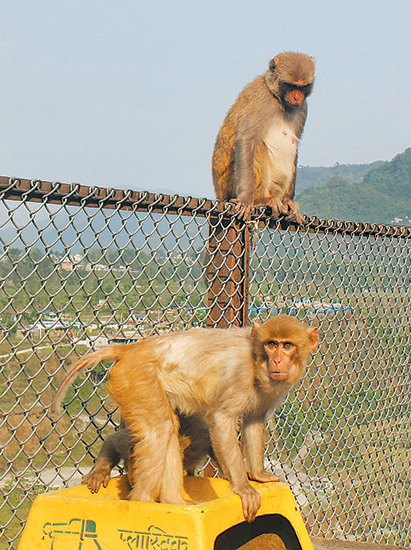
Monkeys invade fields and houses for food and tend to attack people when confrontedPost Photo.

POKHARA : In July, a troop of monkeys invaded the cornfield of Sudarshan Paudel in Kundule, Baglung. Paudel, while chasing after the primates, fell off a cliffside and died. Again, earlier this year, four women from Khoriyapani in Kaskikot, Pokhara, were injured while trying to fend off a barrel of monkeys. In November last year, Laxmi Jaishi of Dhairing, Parbat, was critically injured when monkeys entered her home and attacked her.
In recent years, the districts of Gandaki Province are increasingly coming under siege from a growing population of monkeys, according to Manohar Kadarya, an agriculture development officer at Pokhara Municipality.
“Given the rise in the number of complaints filed by locals from various districts at their respective ward offices, we have concluded that there has been an increase in the monkey population,” said Kadarya.
The primates invade fields and houses, looking for food and tend to attack when confronted by humans, forcing locals to resort to drastic measures, like setting traps and hiring trappers.
According to Satyaraj Subedi, a farmer from Hansapur in Kaski, monkeys are becoming more than just a nuisance, as they are destroying his crops.
“It is becoming increasingly difficult to protect vegetables and crops from monkeys,” said Subedi. “Earlier, they left chilli peppers alone but these days, they destroy that too.”
The situation has become worse now, as unlike in the past, the monkeys aren’t easily scared away, say farmers.
“There was a time when all we had to do was create a ruckus and they would run away into the forests but these days they don’t budge,” said Krishna Prasad Poudel, a farmer from Kushma Municipality in Parbat.
“I don’t know if the monkeys’ activities have escalated due to fewer people in the villages or they’ve grown in number.”
Experts attribute the growing monkey invasion to the shrinking forest cover, which is making it difficult for the primates to find food, leading them to enter human habitats to scavenge for food.

Mukesh Kumar Chalise, a retired Tribhuvan University professor and primate researcher, points out a lack of food and an increase in fallow land, especially closer to forests in rural areas, as some of the primary reasons behind the monkey menace.
“They enter people’s houses in search of food since the lands near the forests are now uncultivated. Outside the forests, the primary source of food for monkeys was crop fields but cultivated lands are also shrinking now,” said Chalise.
Kedar Baral, chief of the Tanahun Division Forest Office, Tanahun, agrees with Chalise but also points to the sparse population in villages.
“Earlier, if one monkey entered the settlement, the entire village would turn up to chase them away,” said Baral. “But now, with decreasing population in the villages, the monkeys freely move about, leaving destruction in their wake.” Baral further noted that shortage of fruits preferred by monkeys, including bayar (Indian plum), katus (dwarf chestnut), and ainselu (golden Himalayan raspberry), is driving them towards humans.
“It’s unfair to just blame the monkeys,” he said. “Locals collect fruits for their own consumption or to sell in the market. This leaves monkeys with few options for food in the forests.”
A monkey in its natural habitat spends 10 to 14 hours foraging for food but when they are near human settlements, finding food takes only about 10 minutes, said Chalise. The change in food habits is also affecting reproduction, triggering an explosion in monkey numbers.
“Primates usually give birth between one-and-a-half and three years in the wild, but near settlements, they are reproducing biannually, as there is plenty of food,” said Chalise, who conducted an extensive research on the rhesus macaque from 1995-2012.
Primates were giving birth to twins, which Chalise first recorded in 1995, and in 2012; he even documented quadruplets. These active changes in reproductive patterns that have also significantly contributed to their population, said Chalise.
Locals are now urging their local representatives to take measures to control the monkey menace. However, no plans have been put in place so far at the province level, leading local units to take the matter into their own hands.
Rupa Rural Municipality in Kaski brought in trappers from India to capture the monkeys. They managed to trap 525 monkeys, which were then released in forests far from settlements. Locals tried other measures as well, like playing loud music and planting molasses grass in their fields. Molasses grass releases a strong odour similar to that of cumin, which irritates monkeys. But these efforts have had little effect—the monkeys appear unstoppable.
Syangja’s Galyang Municipality even decided to trap the monkeys and domesticate them, allocating at least one monkey to each household as a pet. But they soon discovered that keeping monkeys as pets was not easy, said ward chairman Dhruva Pangeni.
“Feeding them wasn’t the problem but giving them a bath was a different story. We just couldn’t keep up,” said Pangeni. The villagers were eventually forced to release the monkeys.
Syangja’s Waling Municipality is now considering an ultrasonic machine to chase away monkey, according to mayor Dilip Pratap Khand.
Others from the province are proposing more drastic measures. “About 30 percent monkeys should be left in the forests while 70 percent should be killed,” said Kalidas Subedi, Gandaki Province chairman of the Federation of Community Forestry Users Nepal. “We can dry their meat to make sukuti and export it to foreign countries. This will have a two-pronged effect—the government will be able to collect some revenue and the monkey menace will also be controlled.”
Ramkaji Shrestha, chief at the division forest office in Pokhara, admitted that there was a problem but that solutions needed to more practical.
“Neutering the monkeys after capturing is one of the best ways to control their population,” said Shrestha.

(Pratikshya Kafle, Bina Thapa, Samjhana Rasaili and Hariram Upreti contributed reporting.)

Page 2
MEDLEY

HOROSCOPE

ARIES (March 21-April 19)
***
You have got so much energy today that getting started on new things won’t be a problem. But it’s the finishing up that you will have a bit of a struggle with! And the uncertainty around you will prevent you from being able to put a period on the end of any sentence. Luckily, people in your life will keep you from getting frustrated.


TAURUS (April 20-May 20)
***
The changes you’ve been dealing with in an older, more established relationship aren’t feeling comfortable right now, but they will feel better soon enough—just wait a little while longer. Things will get better slowly and steadily. In the meantime, to keep yourself feeling positive, take a walk down memory lane.

GEMINI (May 21-June 21)
****
Your newest friend is still in the process of revealing themselves to you right now, and the stuff you have yet to learn is going to shape your future in a profound and very healthy way. They have some wonderful advice that you must hear today, so try to meet up with them as soon as you can so you two can discuss it.


CANCER (June 22-July 22)
**
Your opinions have extra weight right now, so be careful how you voice them. You tend to say things before you think, which is usually terrifically charming to all of the people around you. But today some new folks on the scene might not see the humour in your remarks, so be mindful of where you are when you speak.

LEO (July 23-August 22)
****
You can make fun out of anything today—a long meeting, jury duty, a traffic jam, you name it! The key is that you have an imagination that just won’t quit. There is literally nothing that can bore you, which makes today a wonderful day to take care of those tedious errands or tasks you’ve been putting off for so long.


VIRGO (August 23-September 22)
***
Other people are not as prepared as you are today, and you should be careful about sharing your resources with them. Only give out extras that you can get along without. Don’t give away the things that you absolutely need. After all, if you lend someone your only pen, what will you write with?


LIBRA (September 23-October 22)
***
You do not need another person to complete you. You only need to truly love the person you are. And if you are in a relationship right now, remember not to lose yourself in it. Your identity is important! After all, it is why this person cares about you so much—so cherish yourself by maintaining your identity.


SCORPIO (October 23-November 21)
***
There’s a lot of drama going on in the life of one of your co-workers, and things could get ugly, soon. You can expect some of the tensions they’re experiencing to spill over into the workplace, and they’re going to be less reliable than they usually are. Give them a few days to get refocused on what they need to do.


SAGITTARIUS (November 22-December 21)
****
Just because someone says that no one is interested in what you have to say does not mean that that’s true! If you hear this kind of talk from anyone today, you should be suspicious. Because they are playing major mind games with you. Third hand information is nothing but gossip—and it should be treated as such.


CAPRICORN (December 22-January 19)
****
Listen when that little voice in your head tells you to power through lunch or stay late to finish it all up. A postponement at this point will just let all that wonderful momentum go to waste. Do whatever it takes to finish things up. Don’t go to bed with it hanging over your head. Wake up to a nice, blank slate.

AQUARIUS (January 20-February 18)
**
If you want some alone time today, that’s fine—but don’t just drop off the face of the earth and leave people guessing about what happened to you. You owe it to your closed ones to let them know where you are. If you want to have the freedom to come and go as you please, you need to provide the respect that other people deserve.


PISCES (February 19-March 20)
***
If the past few days have been emotionally overcast, you can turn that all around today—if you want to. Sometimes, staying in a blue mood can help you process your feelings more effectively. You don’t always need to run away from sadness. But if you are done with being in the doldrums, call up a friend and see what’s up with them.

Page 3
NATIONAL

Negotiations begin with Germany and France for setting up security printing press

With less than 700,000 copies of passports in stock, the government is in a hurry to reach a deal at the earliest.
- ANIL GIRI
Post file Photo

KATHMANDU : As the stock of passports is depleting fast, the Ministry of Communication and Information Technology has started fresh negotiations with German and French firms to set up a dedicated printing facility.
A technical team headed by Joint-secretary at the ministry Radhika Dhakal—which includes representatives of various government agencies—tasked with assessing the proposals and recommending a government-to-government deal has already submitted its report to Minister for Communication and Information Technology Gokul Prasad Baskota, according to officials.
Both Germany and France resubmitted their financial and
technical proposals to the ministry on Friday, a member of the technical team told the Post on condition of anonymity.
Both the proposals were forwarded after the team found both German and French firms qualified for setting up the security printing press.
But given the global outreach, company’s financial condition, technical capability, experience, and other requirements, the German firm has bagged more points than the French one, a joint-secretary, who is also a member of the task force, told the Post.
“So we have made a fair recommendation to the government about our evaluation,” said the joint-secretary.
However, there should have been a global competition, which has been already violated by the government, according to the official.
“After we could not call a global competition, we have to make a fair deal based on whatever we found in the two proposals. And we have made a fair recommendation,” he said.
Establishing a security printing press through a government-to-government deal is the biggest procurement process initiated by the KP Sharma Oli government and has generated huge interest among political leaders and officials.
Though its initial budget for the press, including the banknote printing facility, was estimated to be Rs32 billion, now the government has dropped the plan of printing banknotes at home and downsized the budget.
Veridos, a special purpose vehicle of the German government-owned Bundesdruckerei, Giesecke and Devrient, have submitted their proposals backed by the federal finance ministry of Germany. Another proposal was submitted by the French foreign ministry on behalf of IN Gropue, a French government undertaking.
Earlier, Germany’s Bundesd-ruckerei had offered a soft loan of 260 million euros to set up a security printing in Nepal, which would have paper, card and banknote printing facilities.
France’s Groupe Imprimerie Nationale had offered 200 million euros in a soft loan for only paper and card printing facilities.
The interest rate of both these soft loans is around 2.5 to 3 percent, according to Finance Ministry officials.
After reservations from the Finance Ministry, the plan to include banknote printing facilities has been shelved, according to Finance Ministry officials.
Though officials in the evaluation team refused to share details, government sources said that Germans have offered a soft loan of 175 million euros.
The French soft loan offer is a little higher at 185 million Euros, said a source who also requested anonymity.The source refused to disclose the interest. But in technical terms, the German proposal looks better, he said.But the Finance Ministry has expressed reservations about the interest rates of both the firms and urged the Ministry of Communication and Information Technology to negotiate for bringing it down before signing the deal with any of the countries.
The Germans have a century-long history in printing facilities so there is no doubt their technical proposal is stronger than the French, at least two other officials familiar with the process since the beginning told the Post.
“The German company has the world’s largest paper mill called Luisenthal while the French company needs to buy paper,” said one official. “That’s why Germans have assured Nepali officials that they could deliver passports fast and, in case of emergency, they can provide one million interim passports free of cost.”
After the plan to set up the banknote printing facility was dropped, both countries have revised the budget and technical strength.
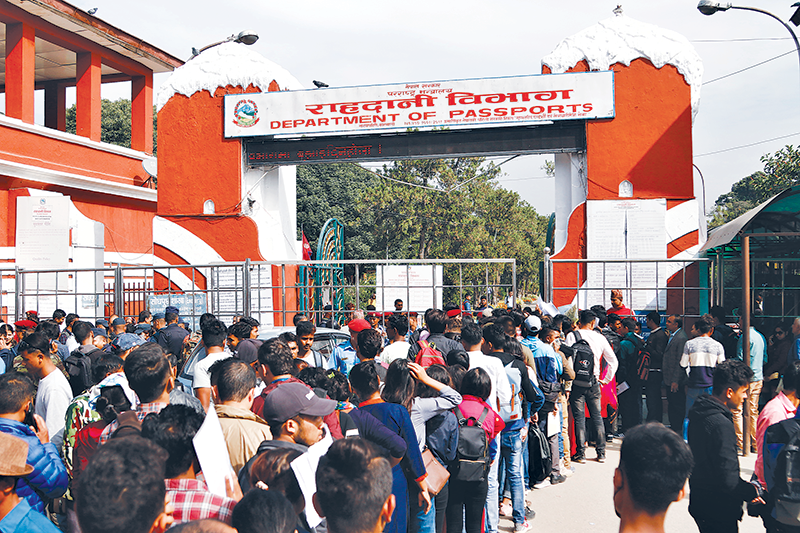
The government is in a hurry to sign a deal for establishing secure printing after cancelling the global bidding for e-passports.
The Department of Passports says its stock is depleting fast with less than 700,000 copies remaining.

NATIONAL

Kathmandu metropolis announces yet another ‘beggar-free’ programme

- SHUVAM DHUNGANA

KATHMANDU : After several failed attempts at rehabilitating beggars, the Kathmandu Metropolitan City has once again announced a plan to make Kathmandu a beggar-free city.
As the city office is preparing to celebrate its 25th anniversary on December 15, it is also planning to make Kathmandu free of beggars.
To this end, the city office on Tuesday issued a circular to all its ward offices, instructing them to work towards making the plan a success.
A meeting of the KMC executive on November 19 had decided to launch a programme of rescuing and rehabilitating the people who have been forced to beg to survive.
However, this is not the first time the authorities have come up with such a campaign.
The KMC had announced a beggar-free programme two years ago as well. Then, too, the plan was to collect beggars from the temple and tourist areas of Kathmandu and place them in homeless shelters. The city office had allocated Rs 30 million for the programme, which eventually failed.
Similarly, In April last year, the Pashupati Area Development Trust, in coordination with the Ministry of Culture, had announced that the area would soon be a beggar-free zone. The trust had unveiled a plan to relocate around 180 people from the temple area to a shelter home. The plan, however, failed to materialise as the shelter home was unable to accommodate all the people.
Basanta Acharya, communication officer at the KMC, says this time the city office is well-prepared to see the campaign through.
“We are collaborating with the Ministry of Women, Children and Senior Citizens, the District Administration Office and the Nepal Police this time,” Acharya told the Post.
He added there won’t be any problems concerning the accommodation of rescued people, as the KMC will be using its office building in Balaju as a shelter home.
The authorities will start rescuing and rehabilitating the down-and-out people without any means of living and shelter from December 13.
According to Acharya, individuals who have families would be handed over to their concerned families while those without families would be taken to rehabilitation centres run by the state as well as non-governmental organisations.
“We decided to run beggar-free city campaign because we believe that no person should go hungry or die of hunger,” said Ishwor Man Dangol, spokesperson for KMC.
“The city office has formed a task force to study the living condition of beggars around the city and to ascertain their population. The task force will also make recommendations to rehabilitate the rescued people.”

Page 4
NATIONAL

Exploitation continues at Kathmandu’s dance bars and dohori restaurants

As such informal entertainment venues are not regulated by the government, there is ample room for labour exploitation and physical and sexual harassment.
- ELISHA SHRESTHA

KATHMANDU : Ramila migrated to Kathmandu from Rolpa in 2018 in the hopes of pursuing a singing career. She had learned about an opening in a dohori restaurant from a friend and signed up for the job.
“I am passionate about singing, so I thought if I try my luck in Kathmandu, I can fulfil my dream of becoming a singer,” said 20-year-old Ramila. “When I got a job, I felt empowered.”
When she was hired, Ramila wasn’t given an appointment letter by her employer, and she was paid a monthly salary of Rs 5,000, even though the government has set the minimum wage at Rs 13,400. The final straw for Ramila was when she was sexually assaulted by her colleague. She quit after working there for two weeks.
“The dohori could have been a good singing platform for me, but I didn’t feel safe working there,” she said.
There are thousands of women like Ramila working in Kathmandu’s entertainment sector, primarily singing and dancing in dohori restaurants and dance bars, and according to rights organisations, most of their stories resemble Ramila’s. Such informal entertainment venues are not regulated by the government, which provides ample ground for labour exploitation and physical and sexual harassment.
Like Ramila, 25-year-old Sita was excited to get a job as a bar dancer in a restaurant. As the sole provider for her family, Rita thought that her financial woes were finally over. However, problems started when her employer didn’t pay her any wages for three months.
“With the help of an NGO, I went to file a complaint at a police station where the officer asked me for evidence,” said Rita. “Since I didn’t have an appointment letter from my employer, I couldn’t do anything.”
According to the Alliance Against Trafficking In Women And Children In Nepal (AATWIN), an organisation working to combat trafficking, it is difficult to estimate the exact number of women working in this sector as not all entertainment venues are registered under the same entity.
“Some are registered at the metropolitan office while some are at the sub-metropolitan office. Some entertainment venues are even registered as cottage and small-scale industries,” said Balmaya Bishwakarma, project officer at AATWIN. Informal estimates by activists enumerate around 40,000-50,000 women working in this sector.
A vast majority of these women work without appointment letters, as they are paid below the government-mandated minimum wage with no fixed working hours.
Many employees even suffer sexual harassment at their workplaces.
Although the Kathmandu District Administration Office had, in 2008, formulated guidelines under the direction of Supreme Court for business owners in the entertainment industry to maintain a safe work environment, cases of sexual harassment from within the entertainment sector continue to be reported.
According to a report from the Women’s Rehabilitation Centre, in 2019, 55 cases of violence against women were filed with the Women Forum for Women in Nepal, another organisation advocating for the rights of women working in the entertainment sector. According to the report, 18 cases were related to physical and sexual assault, 14 to mental abuse and 6 to deprivation of legal documents.
“Many women are working in dohoris and dance bars of their own free will. But as this sector isn’t recognised as a formal work profession by the government, these women are often vulnerable to sexual and labour exploitation,” said Srijana Pun, chairperson of Women Forum for Women in Nepal.
DSP Rajendra Pokharel at Kathmandu Metropolitan Police Station, Teku acknowledges that sexual and labour exploitation is rampant within the entertainment industry. However, he says that arresting the business owners isn’t a solution.
“Many women who file complaints about labour exploitation don’t have appointment letters. In such cases, it is difficult for us to proceed with the investigation,” Pokharel said. “Working women should themselves be aware of their rights so that they can protect themselves from being exploited.”
But according to Pun, many women who choose these professions are poor and illiterate, which means that they are often unaware of their rights.
“The restaurant owners don’t ask for legal documents for employment, and for uneducated women, it seems like a great opportunity to earn money,” she said.
But because they are uneducated, they are also unaware of avenues to seek legal redress when they face harassment and exploitation at the hands of employers and customers.
“These women don’t know their rights and even if some do, they are either too scared to complain, for fear of losing their jobs, or think they won’t get justice,” said Pun, who herself worked in a cabin restaurant for six years.
The travails of these women don’t just depend on legal provisions; there is a great social stigma towards women who work in such institutions. According to Pun, the state should work towards providing identity and respect to these women so that they can fully exercise their right to choose employment without any obstacles.
Towards this end, the Ministry of Labour and Employment needs to recognise women as formal workers and monitor the entertainment sector, especially when it comes to contracts, minimum wage and working hours, according to Bimala Khadka Darlami, case manager at the National Women’s Commission.

NATIONAL

Bhaktapur to start ‘night heritage walk’

- ANUP OJHA

KATHMANDU : In a bid to promote the historic city of Bhaktapur and its heritage sites for the upcoming Visit Nepal 2020, the Bhaktapur Tourism Development Committee in association with Visit Nepal Year 2020 Secretariat has taken a new initiative to start ‘night heritage walk’ beginning Thursday evening.
The night-walk is the first of the initiatives taken by the tourism development committee in anticipation of the tourism year starting in a few weeks time. The Nepal government is expecting to welcome some two million tourists in the Visit Nepal Year 2020.
“We have chosen Bhaktapur for this new drive because there are many new and unique things to offer the tourists during night time. Gradually, we will be launching this programme in Lalitpur and Kathmandu as well because all of them are historic and cultural cities,” said Deepak Raj Joshi, chief executive officer at the Nepal Tourism Board.
For the night-walk, the committee has especially hired 10 city tour operators who will be informing the visitors regarding the lifestyles of people and their cultural processions. The city hosts numerous cultural activities during the night time.
“This is going to be a hassle-free walk for tourists because during night time there will be less traffic and they will have more time to contemplate. This is going to be a new practice in the tourism sector to attract more tourists,” added Joshi.
Bhaktapur Mayor Sunil Prajapati welcomed the drive terming it a milestone to promote the historic city of Nepal. He said the municipality is working to install street lamps in all the alleys. “We are almost in the last phase of laying stones in each and every alley, this will obviously be helpful for tourists,” said Prajapati.
Officials at the committee say the night heritage walk will help tourists understand the lifestyle and activities of local Newar communities and would help the locals boost their financial status by showcasing and selling their local items to foreigners.
Bhaktapur, also known as the ‘city of devotees’ is located in the eastern corner of the Kathmandu Valley and is a stronghold of the Newar community. The city is one among the seven most famous Unesco World Heritage sites in the Valley. The open museum city is known for traditional arts, architecture, wooden craftworks, pottery, culture, stone-carved temples dating back to the Malla era.

NATIONAL

Police arrest three men for defrauding around Rs 150m through lottery scam

- SHUVAM DHUNGANA

KATHMANDU : The Metropolitan Crime Division, Teku, has arrested three men for their alleged involvement in duping around Rs150 million from over a dozen people through an online lottery scam.
Ramesh Khadka, 52, of Dolakha, Bisheshwar Prasad Tiwari, 37, and Sandip Kalwar, 19, of Nawalparasi, were arrested on different dates
following complaints from the victims, SP Ishwar Karki of the division said on Wednesday.
“The suspects used to lure people by sending lottery winning notice using social media platforms and convince them to deposit money in a bank account to claim their lottery prizes,” said Ishwar Karki, superintendent at the division.
After more than a dozen victims filed complaints with the police, the division had initiated an investigation which led to the arrest of the three men from inside and outside the Kathmandu Valley.
“The scammers were found extracting sum ranging from Rs50,000 to Rs150,000 from individuals on the pretext of giving them lottery winnings, parcels and expensive gifts,” said Karki. “Around 15 victims are in contact with the police, but we think, they may have duped many more people as they have been found to be running this illicit operation for a long time.”
Preliminary investigation has revealed that Peter Herman, a Nigerian national who police suspect is currently residing in India, is the mastermind behind the lottery scam. Herman had also masterminded the theft of more than Rs48.5 million by hacking into the accounts of the Agriculture Development Bank in Lahan, Siraha, and Panas Remittance in Baneshwor, Kathmandu.
“Even now, more than 40 people are suspected of working as agents of Herman. However, we have arrested only 15 so far. Further investigation into the case is underway,” said Karki.
According to police, the Nepali agents had used 17 bank accounts, including accounts in Bank of Kathmandu, Prabhu Bank, Mega Bank, Himalayan Bank, Sunrise Bank and the Citizens Bank for illegal monetary transactions.
“It is suspected that the illegally transacted amount, which was Rs14,67,91,000 could have been stolen by hacking some bank accounts. However, it is yet to be confirmed as we have not received any complaints from the banks,” said Senior Superintendent of Police
Sahakul Thapa, chief at Metropolitan Crime Division.

Page 5
NATIONAL

Natural lakes in Kailali are on the verge of drying up

The district is blessed with around 200 natural lakes but many of them are at risk due to environmental degradation, say conservationists.
- Ganesh Chaudhary

Puraina Lake in Bhajani Municipality used to be one of the largest lakes in the district, spreading over 80 bighas. Today, the lake is a vast expanse of fields.Post Photo: ganesh chaudhary

TIKAPUR : Degradation of natural resources, such as drying up of lakes, at a rapid pace has conservationists in Kailali questioning the future of the region. “Mudslides that are occuring due to deforestation are killing many lakes in the Kailali. If this continues, there will be no lakes in the district in the near future,” said Hirulal Dagaura, a conservationist.
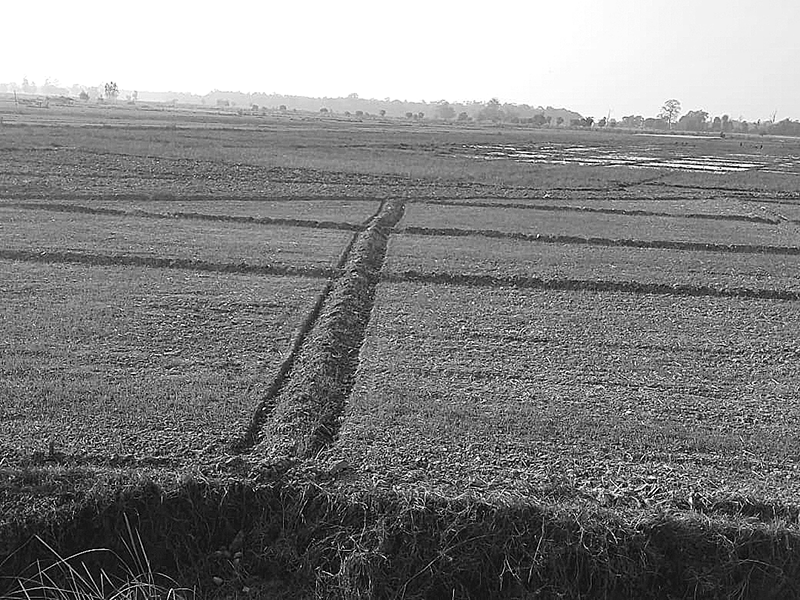
Puraina Lake in Bhajani Municipality used to be one of the largest lakes in the district covering 80 bighas of land. Today, however, there are no signs of the lake: it has dried up and the locals have turned the land into a vegetable field.
The district that is blessed with around 200 natural lakes is gradually losing all its water bodies. Like Puraina, most lakes in Kailali district are on the verge of drying up. These lakes support various species of fish and are home to aquatic birds and Ghongi (mud-water snails). Manasari Chaudhary, a local, said, “In the past, there were plenty of fish in Puraina Lake. We would go fishing in the lake and come across ducks and cranes. But the birds have abandoned the area. The lake has dried up.”
Bijayaraj Shrestha, also a conservationist, says that Puraina Lake used to host migratory birds during the migration season but now the birds have changed their route due to lack of water bodies. “Aquatic birds long stopped coming to Puraina Lake. The mudslides dirtied the water eventually drying it up.” He said, “There are 20 natural lakes in Bhajani Municipality alone. But most of these lakes are on the verge of drying up due to lack of conservation.”
Nainamati Kathariya, a local, says that the Puraina lake did not just support aquatic life but was also suitable for the growth of edible greens. “We used to collect green leafy vegetables (Pani Saag, Dhodi Saag) from the lake area. But, now that the lake has dried up, so have the vegetables,” said Kathariya.
Bhajani is mostly inhabited by farmers who rear livestock.
The drying up of the Puraina Lake has also gone on to affect the livelihood of farmers, as farmers from five villages bring their cattle to the lake area to graze. Aaitabari Chaudhary, a local farmer, said, “These days we have to take our cattle to Mohana or Charra lake, which is one kilometre away from Puraina.”
Locals have also realised their mistake in turning the lake area into an agricultural patch of land, and have asked the local unit’s help to revive it. “When the water in the lake began to recede, most villagers saw an opportunity to turn the lake area into farmland. But that was done in haste. Since the lake area is public land, the municipality should make efforts to revive the lake and maintain biodiversity,” said Kathariya.
Sher Bahadur Chaudhary, mayor of Bhajani Municipality, said that they had allocated Rs 800,000 for the reconstruction of Puraina Lake last year. “We had tried to fence the lake area to keep locals out, but they obstructed the construction work,” he said, adding that the municipality office has been trying to conduct talks with the locals to allow the municipality to rebuild the lake.
According to him, 40 families are cultivating paddy and wheat in the area where the lake used to stand. He said, “If we are to preserve what’s left of the lake and to resuscitate it, we need the locals’ support. It’s a good thing that some of them are understanding the importance of preserving the lake.”
Meanwhile, the local units have started fisheries in most of the lakes in Kailali. They have hired contractors to run the fisheries but conservationists fear that the contractors have not paid attention to maintaining the ecology of these water bodies. “The contractors are cutting down trees on the pretext of cleaning the lakes,” said Dagaura. The Post tried to contact the contractors of the fisheries but they were not available for comment.
Some big lakes like Semarhuwa, Kahiarhuwa, Tedi Praseni in Ghodaghodi area have already dried up whereas Rakhauna and Chamaraiya lakes in Kailari Rural Municipality are also on the verge of drying up.

NATIONAL

A school in Palpa adopts technical education for the first time

The school has introduced courses to make students employment-ready when they complete school.
- MADHAV ARYAL

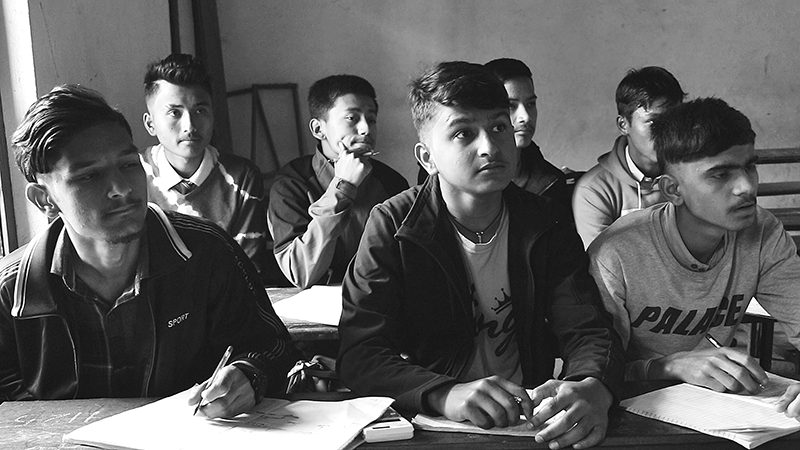
Students of Tilottama Secondary School attend a technical education and vocational training class in Palpa.Post Photo: madhav aryal

JHUMSA (PALPA) : Sunil Dhungana, a student of Tilottama Secondary School in Tinau Rural Municipality, says he enjoys going to school these days. The reason being that his school has started conducting classes on a new subject that Dhungana finds very interesting. The school has introduced the Council for Technical Education and Vocational Training (CTEVT), an 18-month course, to make students employment-ready when they complete their school education. It is the second school in Province 5 and the first in the district to start technical education.
Dhungana, who is from Bagnaskali Rural Municipality, is learning automobile repair works. “The subject is very interesting. It will also provide us with practical knowledge,” said Dhungana.
Like Dhungana, there are 22 students, including those from neighbouring Bagnaskali and Rainadevi rural municipalities, who are taking theoretical classes on automobile repair for the time being.
The school has specifically chosen automobile repair as a subject for the technical course since the area sees a massive traffic flow, said Pramod Karki, a trainer at the school. “We will start practical classes in a month. These students will be able to find jobs easily, as they will be skilled enough to repair small and large vehicles,” said Karki.
In the current fiscal year, Tinau Rural Municipality has allocated 13.3 million for the school’s infrastructure development. Jhabindra Gyawali, the school headmaster, said the school decided to run technical education classes after consulting with guardians and the rural municipal office.
“The students who have passed their Secondary Education Examination have been admitted to the programme. They will learn skills to get a job after the course’s completion,” said Gyawali, adding that the objective of the school is to make students economically independent.
The technical class runs from 6 am to 9 am every day. After 10 am, students join their regular classes, he said. According to the school administration, the school charges an admission fee of Rs 5,000 and a fee of Rs 65,000 for the 18-month course. “75 percent of our classes have practical lessons; therefore, this course is expensive,” said Gyawali.

NATIONAL

Staff shortage in Jajarkot affects development projects

- BHIM BAHADUR SINGH

JAJARKOT : Five months into the current fiscal year and several government offices in Jajarkot have little to show for progress. Officials say the acute shortage of human resource in every department has led to a lull in productive spending of the development budget.
The data of the Infrastructure Development Office also does not reflect any progress so far this fiscal year.
“Detailed project reports and surveys of various development projects are yet to be conducted.
So, we haven’t been able to invite tenders or sign contracts. This
shortage of employees can lead to a freeze in the development budget
this fiscal year,” said Takendra Rokaya, acting office chief at the infrastructure development office.
The office has eight posts, including that of an engineer, but has only two staff—a sub-engineer and an assistant sub-engineer.
The office has received Rs 360 million this fiscal year to build roads, bridges and public buildings across the district. An additional Rs 20 million has been provided by the office to the People’s Housing Programme to build homes for the underprivileged and poor communities.
The office plans to construct 15 road sections, seven motorable bridges and six suspension bridges in the current fiscal year.
Rokaya said that development works of such projects are yet to be initiated. The construction of around five dozen houses under the People’s Housing Programme for the impoverished Badi families in various parts of the district has also been left incomplete.
The situation of Drinking Water, Irrigation and Energy Development Office is also the same. The office, which received a budget of Rs 140
million this fiscal year, has selected around three dozen drinking water, irrigation and embankment projects. But none of the projects has started till date.
“We haven’t even conducted the preliminary survey design of the selected development projects,” said Jwalaram Shahi, the office chief. “There has been a delay in implementing the budget due to the shortage of employees. There is a high chance of the budget freezing this year since the capital expenditure in the first four months of the fiscal year is zero,” he added.
The Drinking Water, Irrigation and Energy Development Office has only two employees. Six positions are vacant.
According to Chief District Officer Janak Raj Panta, the average progress of development projects in Jajarkot is less than 30 percent so
far this fiscal year.
“Human resource shortage has greatly affected the budget expenditure in various local units as well,” said Panta.

NATIONAL

Makwanpur’s Chepangs, who sustain on roots and fruits, brace for harsh winter

- PRATAP BISTA

MAKWANPUR : Despite major political changes in the country over the decades, there’s been little that has changed for the indigenous, semi-nomadic Chepang communities in Makwanpur. A majority of the Chepangs still subsist on root vegetables that they collect from the forests. And for the lack of a decent habitat, they are compelled to endure the biting cold that winter brings.
Makwanpur, the hilly district that shares its border with the Capital, has the second-highest population of Chepang people, with around 19,000 people, out of about 70,000 across the country, according to 2011 census.
Dhirang at Raksirang Rural Municipality in the district’s western belt is a predominantly Chepang settlement. Chepangs here have to depend on root vegetables for nine months a year, according to Bhim Bahadur Chepang, a local.
These days, there’s not a single grain of corn in his house, says Bhim Bahadur, a father of 11. “The corn shortage started with the end of Tihar, the festival,” he said. “On good days when we get work, we exchange flour with our wage.” From a day’s work, Bhim Bahadur says he earns up to Rs200.
Bhim Bahadur’s son, 20-year-old Shyam, is conscious that this is not enough wage and that their labour is being exploited. “If we ignore the work we are offered, we risk not getting work again,” he said. “So we are compelled to work however much the wage may be.”
On bad days, however, Bhim Bahadur’s family enters the wild in hunt of fruits and vegetables. “We eat geetha and bhyakur (the most popular and accessible wild vegetables) mostly,” Bhim Bahadur said in his mother-tongue. Bhim Bahadur has a sizeable family—18 in total, including his grandchildren—all of whom live in a low-ceiling, thatched house made of mud and bamboo; one has to stoop a bit to enter it. There’s a single room for all the members to sleep in.
“Traditionally, we don’t have rooms in our house,” said Bhim Bahadur. “During winter, we burn the firewood in the fireplace at the centre and all of us sleep around it. During summer, however, we have the liberty to sleep wherever we want—outside or in.” Binumaya, Bhim Bahadur’s wife, chimed in, while she was peeling the layers of geetha. “We are poor people,” she said. Binumaya was married when she was 12; at 14, she gave birth to her first child, a girl who died of cholera when she was five months old.
The family doesn’t own a single acre of land anywhere; they don’t have a land ownership certificate for the house, either.
Neither does Ram Kumar Chepang, another local whose family took shelter in Shankhare cave after the earthquake brought down his house. About a year ago, his family moved in to a new house, constructed in support from local media persons. But his family too struggles for food. “This is what we eat,” he said, pointing to a small mound of root vegetables. “This is what God has provided us. Without it, we would die.”
A remote corner of remote Makwanpur, Dhirang doesn’t have access to motorable road. To reach Dhirang, one has to walk for about nine hours from Lothar, in the east-west highway. Many Chepangs here grow crops like millet and maize in the rugged land around the forest. But the produce hardly lasts three months, Ram Kumar said. “There’s not a single family that can produce enough crops for three months,” said Babulal Tamang, principal of Dhirang Basic School. “All of them depend on root vegetables.” The school wouldn’t see a single Chepang child since a while back, but that has changed since the school provides lunch for free, sponsored by an NGO.
Dhirang has about 100 Chepang households, while Raksirang, the rural municipality, has about 1,500 households. “Most of the Chepangs in Raksirang reel under a food crisis,” said Raj Kumar Malla, chair of the rural municipality. “It’s hard to help them improve their lifestyle because they prefer to live around the forests.” Malla added that the rural municipality, however, has plans to construct roads, and provide skill-based training.
But Gobinda Ram Chepang, a former lawmaker, said that local units have failed to come up with measures to improve the lifestyle of Chepang people. “The local units don’t have any programme that could possibly improve the lives of Chepangs,” he said.

NATIONAL

Two held with heroin in Sunsari district

Briefing
- Post Report

SUNSARI: Police arrested two persons in possession of heroin from Dharan in Sunsari district on Tuesday. According to the Area Police Office in Dharan, Sangbu Sherpa of Sankhuwasabha and Suraj Rai of Dharan were held with 80 milligrams heroin and other controlled
pharmaceutical drugs.


NATIONAL

Indian man held with pistol and three rounds of bullets

Briefing
- Post Report

SARLAHI: An Indian national was arrested with a pistol from Bishnu Rural Municipality in Sarlahi district on Tuesday evening. Police said Ajaya Singh of Sitamarhi in India was held with the pistol and three rounds of bullets while he was entering Nepali territory on a motorcycle.

NATIONAL

Locals demand police post in Ramechhap not be moved

Briefing
- Post Report

RAMECHHAP: Locals of Betali in Ramechhap staged a demonstration demanding the local administration not to shift the police post from
Betali area. The administration is going to shift the police post in Rasnalu near Gokulganga Rural Municipality.


NATIONAL

Two women killed and four injured in elephant attack

Briefing
- Post Report

KANCHANPUR: Two women were killed and four others injured in an elephant attack in Mahakali Municipality Ward No. 2 on Wednesday. The women had gone to Mayapuri Buffer Zone Community Forest to collect fodder and firewood, police said.


NATIONAL

Ward chair detained on charge of attempted rape

Briefing

SAPTARI: Police on Tuesday detained Laxmi Sah, chair of Shambhunath Municipality Ward No. 12, on charge of an attempted rape. The ward chair was detained after a 35-year-old woman from the same ward filed a police complaint against Sah, according to DSP Tilak Bharati. The woman has said that Sah abused her at a chicken farm in her village and attempted to rape her.

Page 6
EDITORIAL

Balancing act

Nepal has made progress in areas such as life expectancy but there is still a long way to go.

The briefing note for countries on the 2019 Human Development Report maintains that ‘policies matter for inequalities. And inequalities matter for policies.’ This is as true as it can get. Although there is really no need for a report to establish the fact that gender inequality exists in Nepal, the 2019 Human Development Report has yet again revealed that the country has a deep chasm to fill when it comes to levelling the playing field for females. With a Gender Inequality Index value of 0.476, Nepal ranks 115th out of 162 countries. True, Nepal has made progress in other areas such as life expectancy, literacy rate and so on; but there is still a long way to go before it attains gender equality. In fact, so deep is the gap that according to Ayshanie Medagangoda-Labe, resident representative of the United Nations Development Programme, ‘If we started working to reducing the gap now, it will take us 202 years.’
This year, the report showed that Nepal moved up two spots to rank 147th out of 189 countries on the 2019 Human Development Index. The index rose from 0.380 to 0.579, an increase of 52.6 percent. Meaning, people are living longer, are more educated and have greater incomes. The improvement looks huge in terms of percentage, but Nepal’s Human Development Index at 0.579 is a slight improvement. When the value is discounted for inequality, the index falls to 0.430, a loss of 25.8 percent due to inequality in the distribution of the human development index dimension indices.
Gender inequality has always been an issue plaguing the country. The literacy rates of men and women in Nepal differ by 17.7 percent if we look at the National Census 2011. Women also suffer more cases of sexual violence than men. Even when it comes to healthcare, there are still cases of women dying due to lack of basic healthcare facilities during pregnancy—pre or post.
This is not to say that no action has been taken as yet. On the legislative front, the constitution guarantees 33 percent seats to women to enhance their participation in political life and policymaking. This applies to the government at the federal, provincial and local levels. These are affirmative changes that is bound to have solid effects in the long run. But there is much to be desired. Most places are rife with hierarchy. Patronising women and their success is still as common as it was a few decades ago. What’s more, policymakers often turn a deaf ear to women’s plight.
The Ministry of Women, Children & Social Welfare was being run by a woman until some weeks ago. Following a cabinet reshuffle, the ministry which is dedicated to women has two men running the show—the minister and the secretary. It is being cognisant of these things that makes it possible to bring about change in the long run. Men cannot be sensitive about women’s issues like the latter can. And this sensitivity will ultimately reflect or not reflect in any kind of policies being drafted.

OPINION

Nepal’s athletes, not its government, won gold at the South Asian Games

The country's great performance at the Games came from the athletes’ pushback against adversity.
- DEEPAK THAPA

Judoka Poonam Shrestha, who won gold at the South Asian Games. Post Photo: Angad Dhakal 

The last live football match I watched in Kathmandu was a fixture between Nepal and Afghanistan in the early 2000s. The experience was hardly uplifting. This was because there has always been a section among my city’s football-watching crowd who find different ways to demonstrate their boorishness. At the aforementioned game, someone soon began the chant of ‘Taliban! Taliban!’ that got carried around the stadium. Where we should have all stood up to applaud a team just freed of the yoke of a mediaeval theocracy that prohibited all kinds of sports, they were instead taunted as being the self-same religious extremists.
One more reason why I felt justified in not being particularly enamoured of sporting events that pit countries against each other. Sports are really a lot of fun to watch and the skills on display something to marvel at. Games are also touted for its ability to bring people together, with the Olympic movement being the most prominent example. The downside, though, is that it also manages to rouse our latent tribalism and often succeeds in bringing out the basest of our instincts—as we showed our Afghan visitors back then.
Personal preferences aside, however, over the last few days it would have been quite difficult to escape the collective euphoria that swept Nepal in the wake of the South Asian Games. Coming in the backdrop of a sports bureaucracy that appeared woefully unprepared till the very last moment, there can be no doubt that the games were a success as an event. The crowning achievement though would have to be Nepal’s richest haul of gold medals in the history of this regional meet.
The darling of the nation was obviously Gaurika Singh, the teenage sensation with her multiple golds in swimming. Having held national records for years and being trained in England by coaches ‘who have produced world-class swimmers’, as her Wikipedia page says, it was only a matter of time before she made it internationally. That she did it in such style was a bonus.
Somewhat lost in the celebrations though were the stories of numerous other sportspersons who also made it. And they were the ones who faced all kinds of adversities that continues to be the lot of a large number of Nepalis. In the rest of my column, I highlight the struggles of some of these sports heroes—as a tribute to their perseverance against all odds.

Official indifference
First, let me deal with examples of the callousness of officialdom. Nepali shooters had guns that did not work. Hence, they had to make do with pistols borrowed from the Pakistani competitors while bullets were provided by the Indians. It was certainly in the spirit of regional cooperation but hardly the kind of situation any athlete would want to be in.
Soni Gurung won gold in triathlon and this was despite the sports officials. Although promised one, a new bicycle never materialised. That did not deter Soni from giving her best. In fact, she said the indifference from the authorities actually spurred her to go for gold. She said: ‘In running, swimming and cycling in a triathlon, the most effort is expended in cycling. But, since my cycle was old, I put in 80 percent effort in the others and 120 percent in cycling.’
Kamal Bahadur Adhikari had won gold in weightlifting at the 2006 Games. This time he failed partly because his weightlifting shoes arrived just three days before the games and that, too, of the wrong size. He had to be content with a bronze, although he could share that achievement with his wife, fellow-weightlifter Rajya Laxmi Adhikari, who also won a bronze.

True heroes
It was the report of a plaintive wail from Kajal Shrestha after winning gold in taekwondo that spurred me to write this piece. Before choking with emotion, Kajal had cried: ‘We are not rich. We are poor. My father has been struggling in the Gulf for the sake of our family. That’s why I remember him so vividly now.’
Another story that made headlines was about national champion Tulasa Khatri, who went to Qatar as a labour migrant. That an athlete with an army job and who had just broken the national 400-metre record at the Military World Games in China one month earlier, should quit on the eve of a major sporting event at home speaks volumes about the conditions our sportsperson have to perform under. We later found out that Tulasa’s father has been toiling in Malaysia for years and her mother has a heart condition. As the eldest of five siblings, she felt she had no choice but to kill her athletic ambitions and help with family finances.
There was the endearing story of Nima Gharti Magar, who won her second South Asian gold in wushu. Despite his daughter having reached the finals, Nima’s father nearly did not make it in time since the pick-up he drives broke down.
Gold medallist in downhill cycling Rajesh Magar is apparently somewhat of a legend despite his young years. Raising him and his sister, his mother did the rounds as domestic help while his casual alcoholic of a father worked in construction. The first cycle Rajesh bought was disposed of for peanuts by his mother worried about his studies. Not having any money, he crafted his own mountain bike, including from a motor scooter. If you have not watched it yet, the film about him, RJ Ripper, is definitely worth it.
Sangita Dhami’s father abandoned her, her mother and two sisters because they were not sons. Raised by a single mother who raised buffaloes and sold milk for a living, Sangita’s dedicating her gold medal in wrestling to her mother should be a well-deserved slap to her father’s face.
Another athlete abandoned by her father is judoka Poonam Shrestha. After winning gold, she said that her sister had to quit studies to go abroad for work and had bought a piece of land in Chitwan. ‘I hope to build a house with the money the government will give me for my gold medal,’ said Poonam.
Sanju Chaudhary’s father works in a hospital, presumably as a lowly staff. Feeling great pressure to make a living, after winning gold in wrestling, she wished she could get a part-time day job so that she could continue training in the mornings and evenings.
‘Syowambhu, Teendhara. One room. A gas stove near the doorway. Two beds. A small space in between where two people cannot pass…’ Thus began the description of the dwelling of Mangal Tharu—Mangal, the three-time national wushu champion. He has a job with the Armed Police Force but that is hardly enough for anything else apart from sustenance. He was hoping for a gold medal at the Games, but a fracture in his left leg after a third-round victory left him distraught. Distraught also because he missed his daughter’s birth because he had to be under training at the time.
A salute to all these heroes and others like them.

OPINION

The political dimension of COP25

There remains a divide between the needs and wants of developed and developing countries.
- Saleemul Huq

The 25th Conference of Parties (COP25) of the United Nations Framework Convention on Climate Change (UNFCCC) being held in Madrid, Spain is now halfway through with the technical level negotiations having been completed and the ministers now arriving in to lock the final political agreements.
There are two major politically sensitive issues which will have to be addressed by the ministers. The first is about Article 6 of the Paris Agreement which focuses on the option of using market mechanisms to trade climate change actions across countries and companies.
In theory, it makes much sense to incentivise the private sector companies to align their profit-making business models with tackling climate change so that they can make money by doing good. Although this sounds nice in theory, the result of previous experience under the Kyoto Protocol where there was a Clean Development Mechanism (CDM), which allowed trading of Carbon Emission Reductions (CERs), was not so positive. The first problem with the CDM was that only a few developing countries benefited from it, with China and India generating and getting paid for the largest amount of CERs.
The second problem arose as the CDM market collapsed when the Kyoto Protocol was not adhered to by countries like the US, which resulted in the price of CERs to collapse to almost zero.
Hence, many developing countries are suspicious that they may have to face a similar situation again. Also, a lack of clarity on how the new mechanism—which will be different from the Kyoto Protocol—would work is increasing concern. The developed countries who like this market mechanism are pushing to reach an agreement in Madrid. We will see what happens during the political negotiations this week.
The second politically sensitive issue that the ministers have to address is the review of the Warsaw International Mechanism (WIM) on Loss and Damage (LnD) which is an important decision to be made here during COP25 in Madrid.
The most vulnerable countries have formed a strong common stand at the beginning of the COP demanding that the WIM be allowed to
have both an implementation arm as well as a new financial arm going forward. The good news at the end of the first week of COP is that their demands have been strongly supported by the G77 and China group which is the coalition of all developing countries. Gaining the support of countries like China and India as well as other developing countries is a big achievement for us, as this is not always the case.
So, the end of the first week has been positive for Bangladesh and the other vulnerable developing countries as we now have a united position. However, the real political pushback from the US has already started with a rejection of these demands. The European Union, however, seems more open to discussing ways to reach an agreement. This will require the ministers (not just the negotiators) of the developing countries to remain steadfast and united until the end. If they compromise too early than we will lose the fight. We would only be able to win the argument by sticking to our guns until the very end and not accepting any agreement that does not address our demands.
This will certainly be a major political issue over the next few days. In other news, Greta Thunberg has arrived in Madrid and joined a massive crowd of over half a million young people on the streets of Madrid to raise their voices for the leaders in the COP to raise their ambition to tackle Climate Change as a genuine emergency. However, it is unfortunate that government officials inside the COP premises seem to remain deaf to the youths’ demands.
Also, the Climate Vulnerable Forum (CVF) of leaders currently chaired by President Hilda Heine of Marshall Islands (who will hand over the position to Prime Minister Sheikh Hasina next year) has launched a major public campaign called Madrid Ambition Drive (#MAD4Survival) which is being strongly supported by other developing countries and civil society. It is meant to put pressure on the big emitters to raise their ambition before COP26 to be held in Glasgow, UK in December 2020.It remains to be seen who will win by next week.

This article was previously published in The Daily Star, a part of the Asia News Network.

Page 7
OPINION

Understanding the performance of the NEPSE

Emphasis should be put on enhancing economic activities to strengthen the stock market’s performance.
- JAGADISH PRASAD BIST

The Nepal Stock Exchange (NEPSE) index was wallowing below 1200 points during the first quarter of the current fiscal year. An interesting thing to note is that although the economic indicators as provided by the government are in a good condition, the NEPSE looks like it is moving independently of them. For example, the liquidity problem, one of the critical factors affecting the performance of the stock market, in the banking industry is at a satisfactory level, the country’s trade shows some improvements with decreasing imports and increasing exports, remittance is increasing, economic growth is reckoned to be above 6 percent, and more importantly, the country is on a stable political footing. In fact, no season in history has enjoyed political stability as the current period is doing.
Despite such a favourable environment, the stock market has not been able to rise which is making investors nervous by the day. The same situation can continue this economic year, given that the regularity bodies have not been able to push the stock market back into a bullish trend and meet customers’ expectations. For instance, the monetary policy for 2019-20, which has a direct influence on the financial market, has failed to revive the stock market. As a matter of fact, the NEPSE has been in consistent free fall since the policy was enforced in July 2019. Within this period only, the NEPSE index dropped by 165 points.

Different opinions
These statistics are bringing forth different opinions from stakeholders: Economists have been arguing that lack of economic activities, trade deficit, and lack of appropriate policies are the major causes of the recent bearish mood in Nepal. Likewise, arguments have surfaced that lack of technological innovation and problems in the online trading system are further reducing transactions on NEPSE. Investors, on the other hand, are arguing that the stock market is operated by a handful of people, and they are manipulating it for their benefit. Some even argue that Finance Minister Yuba Raj Khatiwada’s reluctance is also playing a role in maintaining the status quo at the stock exchange.
What is lacking in their arguments is operationalisation of the bearish NEPSE. The point is that since the NEPSE has been hovering between 1300 and 1100 points for two years, it has to be analysed whether we are arbitrarily expecting the index to soar. Therefore, given the current economic facts, the NEPSE index remaining below the 1200 mark may not necessarily mean a bearish NEPSE. Nobody has calculated the benchmark for the NEPSE to be construed as being in serious freefall. Therefore, it is time to analyse if we are expecting the NEPSE to go up unnecessarily. In other words, are we sure the NEPSE was in a bearish mood for the last two years?
For this, we have to analyse the performance of both the Nepal Stock Exchange and the listed companies during the past years. Statistics show that the NEPSE has had some unusual upheavals. The NEPSE index was below 1300 points until the third quarter of fiscal 2015. However, as the fiscal year 2016 started, the NEPSE was unstoppable and reached an all-time high of above 1800 points. But that didn’t last long; and by the end of 2016, it had plunged to 1200 points. Now, the point of the argument is what caused such an anomaly in the Nepal Stock Exchange given that the economy was stifled by an earthquake and a trade embargo by India?
Here, the key was the monetary policy of 2015-16 which was decisively targeted at reducing the number of banks and financial institutions by increasing their paid-up capital requirement fourfold. This was also the period when shares of banks and financial institutions were popular for their high prices and earnings on the NEPSE. Taking this fact as an advantage, banks and financial institutions, mainly commercial banks, raised their paid-up capital by issuing more rights shares, bonus shares and further offerings instead of going for merger and acquisition. And the stock market, filled with naïve investors, soared.
The same trend continued until the first quarter of 2017 with some ups and downs. Since then, the NEPSE has been falling and fluctuating between 1100 and 1400 points. Therefore, this one-year period from 2016-17 changed the view which Nepali stakeholders have of the stock market. And this is where the problem started: When the stock market was skyrocketing for only one reason, the infestation of the market by shares of banks and financial institutions, nobody was wondering; but when the stock
market started falling for some reason, decreasing the return on investments, everybody is worried. This is nothing but immaturity of both investors and policymakers in Nepal.
The point to note is that the NEPSE could not be expected to vault over 1300 points in the current economic situation. Given a prolonged and severely widening trade deficit which is resulting in remittance going back overseas, consistently negligible foreign direct investment, and a decreasing tradable sector of the economy, the stock market cannot be expected to go up rapidly. On top of it all, Nepal is an agriculture and service-based economy. And among the service industries, the retail sector is a significant contributor to the economy (about 25 percent of the GDP) but it is not listed on the exchange market.

Domination of banks
The manufacturing industry is also shy of getting listed on the stock exchange. The contribution of the manufacturing industry to the NEPSE is negligible (its market capitalisation is as low as 3 percent of total capitalisation). So, the banking industry is the major player in the NEPSE, holding more than 60 percent of market capitalisation. However, their performance has not been as expected. Frequent liquidity problems, unhealthy competition due to a large number of institutions, and lack of investment areas due to the small size of the economy are the reasons behind the banks not performing as well as expected. For example, Nepal Rastra Bank’s statistics show that although profits are increasing for banks, the return on equity of commercial banks is below 15 percent. With this kind of return, we cannot expect this industry to have a bullish trend in the stock exchange. And unless the banking industry gets impetus, the NEPSE will not go beyond what it has been operating with for the last two years.
Therefore, what investors, policymakers and the general public have to understand is that the current trend in the stock exchange is a natural phenomenon given the current economic indicators. We should not expect an unusual rise in the NEPSE in the current situation. A policy, of course, can change its course (such as the monetary policy 2015-16), but what they have to understand is that such manoeuvres will cause upheavals in the market instead of bringing stability. And this, for a developing country like Nepal, is not a good alternative. Therefore, in the present context, emphasis should be put on enhancing economic activities in the country to strengthen the stock market’s performance. Due attention should also be given to reducing market imperfections such as information asymmetry, cartelling, technical inefficiencies and the woes of small investors. This will help Nepal build a stable stock market. Similarly, expanding the capital market throughout and outside Nepal is also essential for the Nepali economy in the current situation.

Bist is a faculty member at The British College, Kathmandu.

OPINION

Is Malaysia’s healthcare system in crisis?

The reemergence of polio in the country shows that the government doesn’t get healthcare.
- Dr Khor Swee Kheng

I’m a trained doctor. Ordinarily, we’re not excitable people prone to panic. However, two very recent news in Malaysia caused me concern that our health system could be fraying. The first is the polio case in Sabah, which is Malaysia’s first in 33 years. The second is the sudden and unexpected announcement that the Cabinet has approved the decision to stop regulating the consultation fees of private doctors and dentists.
Crises and dangers often announce themselves quietly. The three-month-old Sabahan boy currently in Hospital Tuaran has a diagnosis of polio, the first in Malaysia since 1986. The three cases in 1992 were imported ones and not of local origin. This is a quiet announcement of a very real crisis for Malaysia, and we cannot ignore it.

Dangerous times
We don’t have enough information now to accurately determine how this infant contracted the disease. We’re unsure about his vaccination status, his living conditions, access to healthcare services and so on. These facts are important for this infant, but can be trivial compared to the solutions for an entire population of 32 million Malaysians.
What’s certain is that this strand of polio only happens when populations are under-immunised. Unfortunately, Sabah is also the state with some of the worst health outcomes, as well as fewest medical professionals and facilities, in Malaysia. This means that Sabah could be the frontline of Malaysia’s latest communicable diseases outbreak.
We can win this fight, but it’s against the backdrop of some poverty and statelessness, and an under-resourced health system. One part of that fight is a more aggressive stance against the anti-vaccination movement wherever they may be in Malaysia.
It may be necessary that emergency mandatory polio vaccinations be instituted in Sabah to get the population up to the herd immunity levels of more than 95 percent vaccinated. We will have to win the social media war and build an unlikely coalition of health professionals, religious scholars, community leaders, parents, teachers, politicians, media celebrities, and even grandparents to fight this battle.
The anti-vaccination movement can no longer be treated with too much respect or distance. Building clinics, enhancing access or education campaigns are all well and good, but we must take the fight to the anti-vaccination movement. Beyond addressing this movement, we must also consider that the health rights of non-citizens of Malaysia are crucial, for humanistic, ethical, legal and public health reasons.These difficult topics must be a part of our national discourse, because our health depends on it.

Too much deregulation too fast
The second decision that concerns me is the deregulation of consultation fees in the private sector. The decision could be directionally correct, but is definitely too much, too fast and too sudden. One, this is a sudden decision that appears to have caught almost everyone off-guard and did not involve enough stakeholders. Two, the Government appears to have chosen deregulation as an easy way out, rather than undertaking the hard work of amending Schedule 7 and 13 of the Private Healthcare Facilities and Services Act 1998 (which was the original, perfectly reasonable request from the medical profession). Three, this appears to be the latest reactive short-term tactical decision by the Health Ministry (MOH), because it doesn’t seem to be part of any coherent long-term strategy. Four, the MOH continues to disengage from the private sector, leaving Malaysia’s health system without a coherent ideology for how the public and private sectors can co-exist.
How can this move reduce healthcare cost? What is the masterplan for integrating the public and private healthcare sectors? What is the government’s ideology and position for the role of private sector healthcare in Malaysia? These are questions for our Health Minister.

An imperfect market
There are two important facts hidden behind the reactions of doctors, consumer associations and the public. Firstly, the implementation date is not announced, because it still requires formal approval by Parliament. Secondly, the procedure fees of private doctors and dentists remain regulated, making it the only remaining fee category to be regulated by the Government.
I’m pro-market, but healthcare is full of market failures requiring government intervention. As two examples, if you’re sick, you’re at the mercy of the nearest
hospital or clinic (captive market). And even if you have lots of time and can understand medical jargon, you’ll still defer to a trained doctor (information asymmetry) and pay anything to get healthy again. These market failures exist not because doctors are unethical, but because of the way the world works. There is no enemy at all, so we can focus on fixing the problem.
This sudden deregulation of consultation fees without a proper check-and-balance mechanism of price transparency is more likely to lead to increasing healthcare costs, rather than reduced costs through increased competition. Here’s what’s most likely to happen, in a sequence of unintended consequences.
Pressure will build on the Government to deregulate the final category of doctors’ procedure fees. This is reasonable because the Government has already set a deregulatory precedent. In 12-24 months, all fee categories could be solely determined by market forces.
We imagine the consumers and insurers can fight against rising charges, but the New York Times article ‘Where the Frauds Are All Legal’ shows the different ways in which healthcare charges can rise, without being fair or logical. Without price transparency in Malaysia, consumers and insurers can’t check any rising costs.
What we need is a new health financing system that helps integrate public and private facilities, and a restructuring exercise in the public healthcare system. What we also need is for MOH to be more predictable and to make policies for all of Malaysia.

Keeping alert
In Ernest Hemingway’s novel The Sun Also Rises, one of his characters was asked how he went bankrupt. His answer was: ‘Two ways. Gradually, then suddenly.’Malaysia’s health system remains strong, but we must be alert to small signals of incoherence from the political leadership and be thoughtful of the unintended consequences of short-term reactive decisions.We cannot be complacent about the anti-vaccination movement and the health of non-citizens in Malaysia, and we cannot let our children down.

This article was previously published in The Star, a part of the Asia News Network.

Page 8
HEALTH & LIVING

Low-carb alternatives to your favourite food

The low-carb, high-fat and -protein diet might be difficult for Nepalis obsessed with dal-bhat and momos, but these recipes could be help you follow your diet plan without compromising on taste.
- ANKIT KHADGI


Rome wasn’t built in a day, nor can anyone’s perfect body be. Losing weight is difficult. It takes dedication, substituting processed foods for healthy alternatives and making an effort to revamp a sedentary lifestyle for an active one.
Many wanting to lose weight may agree the most difficult thing is staying away from not-so-healthy foods which are mostly rich in refined carbohydrates, the ones we are often accustomed to eating. A plate of crispy, golden French fries, fresh from the frier, may fulfill cravings, but you don’t need to be a dietician to know it’s not healthy. In that vein,
however, there are too many misconceptions regarding healthy food being an exclusive diet of boiled vegetables and fresh fruit.
While the ketogenic diet in recent times has gained popularity in the Nepali fitness crowd, who are intending to shed weight or maintain it, low-carbohydrate diets seems to have been around for a while—Dr Robert Atkins’ namesake diet in the ‘70s was one of the first. From keto to intermittent fasting, many are opting for a low carbohydrate diet, even without a proper research and consultation from a dietician and nutritionist.
Rashmi Bajimaya, a dietician and nutritionist, says that she has seen a rise in patients inquiring about low-carb diets like keto. Though there are immediate weight loss results, Dr Praniti Singh, clinical and bariatric nutritionist, says diet trends like keto are not sustainable and suggests that regular exercise and eating healthy is the best way to lose or maintain weight.
But the problem with the contemporary Nepali diet is the proportions.
“Though our traditional meal is wholesome, we need to work on proportions; we can’t be always eating huge portions of rice with little vegetables and meat,” says Bajimaya.
As rice, which is rich in carbs, has become our staple, it can be difficult to find a low-carb diet as a substitute. But, taking inspiration from different recipes, I adapted a couple of traditional Nepali recipes that can be a great replacement to your go-to regular meals.

Cauliflower rice chicken biryani
Dal-bhat is undoubtedly the staple diet for Nepalis. But many argue that white rice has the least amount of nutrients than traditionally-consumed grains like buckwheat, millet and barley. Singh suggests cauliflower as a good replacement for rice. “It can be the best food for someone who eats rice on a regular basis,” she says.
For people accustomed to white rice, finding alternatives may be a tough. But it isn’t as difficult as it seems. If you don’t want to compromise on taste, cauliflower rice can be a good substitute. By mixing the marinated meat and infusing with a flavoursome biryani masala, you can eat a wholesome and tasty meal, without the guilt.

Ingredients

250 grams of chicken with bone
1 ½ tbsps salt
1 tbsp of red chi lli powder
½ tbsp turmeric
2-3 bay leaves
½ tbsp of minced ginger
½ tbsp of minced garlic
½ tbsp of cumin seeds
1 tbsp of ghiu
½ an onion (because they have a huge amount of carbs and are expensive)
Medium cauliflower
2 tbsps sugar-free yoghurt
1 tbsp biryani masala (optional)
1 tbsp lemon juice
¼ cup coriander chopped


Directions:
The golden rule for biryani is marinating chicken beforehand. In a bowl add ginger, garlic, salt, red chilli powder, yoghurt and lemon juice. Add the chicken and coat well. Refrigerate it, the longer, the better.
To make cauliflower rice, first cut the head into florets. Drop them into a blender, blitz until rice-like consistency is achieved.
In a separate pan, heat a tablespoon of ghiu. Once hot, add onions and fry until golden brown. Add cumin seeds and bay leaves. After a minute add marinated chicken and cook for a few more minutes. Once the chicken is cooked, add cauliflower and mix well. Add biryani masala if desired. Garnish with coriander leaves and the biryani is ready.

Cabbage chicken momo
A plate of momo can always lift anyone’s mood. With a variety of filling options—veg, buff, chicken, khuwa—we Nepalis are obsessed with these morsels. But for those who want to include low-carb food in their diet, they may have to forgo these beloved dumplings. Due to the amount of carbs present in the wrappers, substituting the outer layer—generally made from plain white flour—with cabbage leaves is a good way to cut carbs, says Dr Singh. While they’re low-carb, it is an interesting twist to the traditional momos and everyone should try this regardless of their diet preference.

Ingredients

1 medium cabbage
250g of minced chicken
¾ tbsp of minced ginger
3/4 tbsps minced garlic
1 tbsp salt
½ onion
2 tbsps butter
2 small tomatoes
1 red chili
2 walnuts


Directions
Don’t overdo the marinade—just mix salt, garlic, ginger and a bit of momo masala. In a pot, boil some water with a pinch of salt. Remove some whole leaves of cabbage and blanch for 30 seconds.
Wrap small balls of meat with par-cooked cabbage. Grease steamer with butter and steam for eight minutes. Your low-carb momos are ready.
For the achaar, fry tomatoes and red chili in a pan with butter. After a few minutes, blend the two together. Add some walnuts into the blender. And, without any sort of hesitation, eat with low-carb achaar.


Almond bara with choila
Wrangling one’s self control when eating low-carb is hard, especially when someone offers you delicious Newari food. As much as it is difficult to resist, they are equally rich in carbs. But what if you can make a low-carb bara and choila? This recipe is a must for Newari food lovers.As red meat has more fat than white meat, Dr Singh says it is preferable moderately. Using almond flour, though it has some carbs, is common as it is comparably rich in good fats.

Ingredients

75 grams of almonds for the flour
2-3 tbsps butter
Salt, to taste
½ tbsp minced ginger
½ tbsp minced garlic
200g buffalo meat
2 tomatoes
1 tbsp salt
1 tbsp red chilli
¼ cup coriander leaves


Directions
Grind 75 grams of almonds in blender. Once a flour-like texture is achieved, add 4 to 5 tablespoons of it to a bowl. Mix with water and a tablespoon of butter and make a batter out of it. Rest the mixture for a few minutes.
Heat a tablespoon of butter in a pan. Pour the batter thick, in the shape of bara, and start cooking. Flip it after you start seeing tiny bubbles in the crust on the uncooked side and your keto bara is ready.
For choila, fry your meat with butter in a pan. Once the meat develops a nice colour, remove it from pan. Fry tomatoes in the same pan with red chilli. Use mortar and pestle or mixer to grind the tomatoes, add ginger, garlic and salt. Coat the meat with the mixture. Garnish it with coriander leaves.

HEALTH & LIVING

From depression to Parkinson’s disease: The healing power of dance

Dance movement therapy uses dance and movement to promote insight, integration and well-being, as well as to diminish undesirable symptoms in various clinical populations.
- Adrianna Mendrek

A growing movement of somatic and dance therapies are gaining scientific credibility.UNSPLASH

Why do we stop dancing when we grow up? Why do we disconnect and alienate ourselves from the body? It is surprising to me that dance/movement therapy (DMT) is not more popular within the fields of psychology and psychotherapy globally.
For a couple of decades, I devoted my attention as a researcher in behavioural neurobiology and psychiatry almost exclusively to the brain and mental health, neglecting the rest of the body.
I was trained in the late 1990s, the decade of the brain. I have been mesmerized by the complexity of the brain, completely forgetting that it is part of the entire organism, intimately connected and reciprocally interacting with the entire body.
Interestingly, in my personal life my body has played a central role. My way to deal with any mental health problems has been through long walks, dancing and yoga.
This is partly why in the past few years, as a professor in psychology at Bishop’s University, I have started incorporating bodywork in my teaching and research, and why I entered a dance/movement therapy training program in Canada this summer.

Understanding the body in motion
Dance/movement therapy goes beyond simply dancing. DMT uses dance and movement to promote insight, integration and well-being, as well as to diminish undesirable symptoms in various clinical populations.
Unlike mainstream talk therapies, DMT uses the entire body to approach the client primarily on a non-verbal and creative level. The body in motion is both the medium and the message. DMT recognizes the moving body as the centre of the human experience, and that body and mind are in constant reciprocal interaction.
Just like with more traditional psychotherapies, DMT can be applied in a wide range of ways. It may involve talking, different types of music or no music at all. It can be done in groups, with individuals or with couples. Therapists sometimes dance with their clients and at other times observe.
A group therapy session may involve a warm-up and check-in as to where we are at emotionally, mentally and physically. It may be followed by the development of a theme, which emerges spontaneously or has been prepared by a therapist (for example, working with difficult emotions). It ends with grounding (reconnecting with our bodies and our selves in the present moment) and closure (for example, a gesture, a sound, a word).
All of this is done with our bodies in motion or stillness, but some verbal sharing, journaling, drawing and other elements may be added.
Dance/movement therapy has been around for several decades but it has never become widely popular, possibly due to a lack of well-designed research studies. This has changed and I would like to highlight here a few recent studies supporting the benefits of dance and DMT on emotional regulation, cognitive function and neural plasticity.

A positive effect on depression
One of the main reasons people dance is to modify their emotional state; typically, they strive to feel more joy and happiness and to reduce stress and anxiety. Since its inception dance therapy, similar to somatic psychotherapies, has emphasized the reciprocal interaction between body and mind, and the ability to regulate emotions via changes in body postures and movements.
The exploration of new movements can evoke novel perceptions and feelings. It may also facilitate seeing a wider range of possibilities in a given situation. Some new or old movement patterns may evoke repressed material and enhance better understanding of oneself and one’s environment and history.
One of the most compelling studies supporting this idea examined complex improvised movements, and identified unique sets of movement components that can elicit the feelings of happiness, sadness, fear or anger. The associations between emotions and specific motor components have been used in the past for diagnosis or emotion recognition. This study goes further and proposes specific techniques for modifying emotions.
A recent systematic review of research on dance/movement therapy specifically found it to be effective in the treatment of adults with depression.

Improvements in Parkinson’s disease
Dance typically involves learning sequences of steps and movements in space, in coordination with music. In other words, it requires substantial physical and cognitive engagement and, as such, it should improve not only muscle tone, strength, balance and coordination, but also memory, attention and visuospatial processing.
When comparing relatively long-term dance interventions (of six and 18 months) to conventional fitness training, several studies have found improvements in attention and verbal memory and neuroplasticity in healthy older adults. Researchers also found improvements in memory and cognitive function for older adults with mild cognitive impairment after a 40-week dance program. In addition, a recent meta-analysis of seven randomized controlled trials comparing the effects of dance therapy to non-dance interventions in Parkinson’s disease found that dance was especially beneficial for executive function, the processes that help us plan, organize and regulate our actions.

Changes in brain structure
Dancing engages extensive areas of the cerebral cortex as well as several deep brain structures.
A recent descriptive systematic review included eight well-controlled studies, all of which demonstrated changes in brain structure following dance intervention. These changes included: increased hippocampal and parahippocampal volume (involved in memory), increased gray matter volume in the precentral gyrus (involved in motor control) and white matter integrity in the corpus callosum (involved in communication between the two hemispheres).
Overall, these studies are compatible with the idea of using dance and DMT in various neurological and psychiatric disorders—such as Parkinson’s disease, Alzheimer’s disease and mood disorders—as well as in the general population.

New possibilities for feeling and perceiving
It is clear that dance has a powerful effect on the human body and psyche.
DMT from its inception emphasized that the body is inseparable from, and in constant reciprocal interaction with, the mind. As such, sensations, perceptions, emotions and thinking affect our body and the way we move. By observing the body we can deduce mental states. Conversely, our posture and our movements have the power to transform our mental states, to evoke repressed memories, to release spontaneity and creativity, to reorganize our brains. New ways of moving and dancing may produce new ways of feeling and perceiving the world.
This is one of the most exciting and profound aspects of DMT and it is shocking that the body, movement and dance have been almost entirely ignored by mainstream psychotherapy. It is time to change that!
—Associated Press

Page 9
CULTURE & ARTS

The growing appetite for yomaris

Over the years, owing to its popularity, the traditional yomaris have evolved to become a commercial commodity of sorts.
- Shashwat Pant

Women make yomari, a Newar delicacy, during Yomari Punhi on December 25, 2015. post PHOTOs: SANJOG MANANDHAR

Every year as Yomari Punhi approaches, Niru Maharjan runs on a tight schedule, preparing batches after batches of yomari. A native of Bungamati, Maharjan is one of the many deft hands at the Village Café in Jhamsikhel working days prior the Newar festival to make hundreds of the steamed cone-shaped dumplings.
“It’s the same every year. We get so many orders before Yomari Punhi;
it’s crazy,” says Maharjan. “We never thought yomaris would be so popular when we started.”
Yomaris are a Newar delicacy traditionally made with rice flour with a sweet filling. Earlier, Newar families use to make yomaris only on special occasions or on Yomari Punhi. But in recent years, the dish has become popular among the masses and made it to the regular menu of many eateries, especially those that specialise in Newar cuisine. Over the years, owing to its popularity, yomaris are slowly growing to become a commercial commodity of sorts in the Capital.
There are no written records available to trace when exactly the delicacy was made for the first time or when the festival started, but many believe that the tradition dates back to the Licchavi era.
“While growing up, we were told that Yomari Punhi is a day to celebrate a good harvest before the start of the winter,” says heritage activist and documentary filmmaker Alok Siddhi Tuladhar. “It was done to thank God for a good harvest and also as a reward for the farmers.”


The Newar community believes that the delicacy—filled with khuwa, chaku, teel—is rich in Vitamin A. The ingredients also have heat-producing properties, which is why there is even an old saying that says that one will not feel cold until Fagu-purnima, another festival that comes after three full moons, if they consume yomari during Yomari Punhi.
Besides being devoured on Yomari Punhi, yomaris still hold a special purpose during a Newar child’s second and fourth birthday, where the child is made to wear a garland of yomaris, the number of which coincides with their age.
Lately, however, consumption of yomaris go beyond traditional rituals. The dish is a preferred dessert option for foodies outside of the community as well. This has also led to some people making a living by producing this delicacy specifically during Yomari Punhi or all year round. And according to them, the business is ever increasing.
Village Café is one such establishment where yomaris are on the menu all year round, but the charm of the yomari during Yomari Punhi is incomparable, according to restaurant employees.


In the Village Café, the sale of yomaris during the festival spiked to 13,000 pieces last year from 1,000 when they first started in 2011.
“I think it’s also the element of nostalgia that attracts customers towards yomaris. For those who are new to the dish, its unique taste is what appeals to them,” says Rajee Dhital, head of department of Sabha Nepal’s Food and Value Chain Production, that owns Village café.
Sharmila Phuju, a resident of Wonde, also agrees with Dhital. She is a part of a woman’s group in her neighbourhood, who attend various events around the Valley to put up stalls to sell yomaris. To say they sell like hotcakes is an understatement, she says.
“We’ve been busy with this for the past few years,” she says. “We even get many invitations to come to events to set up our yomari stall, especially around the time of Yomari Puhni.”
According to the locals, the women setting up stalls hasn’t just helped in popularising the delicacy but helped them earn some extra income. And to attract more people to try yomari, many have also experimented with the fillings, from chocolate to even meat.
Dhital says innovation has helped revive the dish in Kathmandu valley. While she agrees that the essence of the traditional yomari is lost in the absence of its original ingredients, many of her younger customers love yomaris with chocolate and mushroom fillings.
“Initially we thought, ‘who will eat chocolate yomaris?’ and were quite sceptical about it,” says Maharjan, who has been part of the Cafe since its inception. “But as we saw that the customers liked the product, we were happy to continue making them.”
Suresh Kumar Shrestha, a local from Wonde, although agrees that variation and innovation is a positive step towards reinventing the delicacy to appeal to the masses. “In the Newar community, people offer this dish to gods,” he says. “Buddhist Newars also consider the pointy part of the yomari as a pinnacle of a chaitya.”

CULTURE & ARTS

Nepal Literature Festival to start tomorrow

The festival will bring together 110 speakers from different social sectors.
- Post Report

Speakers at one of the panel discussions during last year’s festival. Post photo: Deepak pariyar 

The eighth edition of the Nepal Literature Festival is all set to take place in Pokhara from Friday. The four-day festival is being organised by Bookworm Foundation and Random Readers Society in Lakeside.
More than 110 speakers are scheduled to take part in the festival, among which 12 are international writers. Similarly, more than 40 sessions will be held on various issues at the festival.
“This year 98 percent of our speakers are fresh faces,” says Ajit Baral, director of Bookworm Foundation. “We had planned to give the platform to new speakers keeping in mind previous suggestions.”
The literature festival, which used to take place in the Capital during its formative years, shifted its base to Pokhara since the 2015 earthquakes.
“The festival also has about 20 percent of speakers who are from Pokhara. It will be interesting to see the locals use the platform,” said Keshav Sharan Lamichhane, chairperson of Random Readers Society. Meanwhile, the winner of the DSC Prize for South Asian Literature will also be announced in the festival. The winner will receive a cash prize of $25,000.

CULTURE & ARTS

Merriam-Webster declares ‘they’ its 2019 word of the year

Merriam-Webster recently added a new definition to its online dictionary to reflect use of ‘they’ as relating to a person whose gender identity is nonbinary.
- Leanne Italie

A common but increasingly mighty and very busy little word, “they,” has an accolade all its own.
The language mavens at Merriam-Webster have declared the personal pronoun their word of the year based on a 313 percent increase in look-ups on the company’s search site, Merriam-Webster.com, this year when compared with 2018.
“I have to say it’s surprising to me,” said Peter Sokolowski, a lexicographer and Merriam-Webster’s editor at large, ahead of Tuesday’s announcement. “It’s a word we all know and love. So many people were talking about this word.”
Sokolowski and his team monitor spikes in searches and “they” got an early start last January with the rise of model Oslo Grace on top fashion runways. The Northern Californian identifies as transgender nonbinary, walking in both men’s and women’s shows around the world.
Another look-up spike occurred in April, when US Representative Pramila Jayapal, D-Washington, got emotional while talking of her gender-nonconforming child during a House committee hearing as she advocated for LGBTQ rights legislation.
Merriam-Webster recently added a new definition to its online dictionary to reflect use of “they” as relating to a person whose gender identity is nonbinary. In October, the American Psychological Association endorsed “they” as a singular third-person pronoun in its latest style guide for scholarly writing.
“We believe writers should try to use a person’s self-identified pronoun whenever feasible,” said Jasper Simons, chief publishing officer for the APA. “The singular ‘they’ is a way for writers to avoid making assumptions about gender when it is not known.”
The American Dialect Society, which is dedicated to the study of the English language in North America, named “they” its word of the year for 2015, in recognition of its emergence among people who reject “he” and “she.”
In September, Merriam-Webster experienced another big increase in look-ups for “they”when pop star Sam Smith wrote on social media that their preferred pronouns were “they” and “them.” Smith said the decision came after a “lifetime of being at war with my gender.”
Sokolowski told The Associated Press that “they,” one of a handful of nonbinary pronouns to emerge in recent years, is “here to stay.” Nick Adams, director of transgender representation for the LGBTQ advocacy group GLAAD, said Merriam-Webster’s choice is a positive step in acknowledging nonbinary people.
“There is a long road ahead before language, policy and culture are completely affirming and inclusive,” Adams said.
The AP Stylebook allows the use of “they”as a singular or gender-neutral pronoun in some cases.
And the Merriam-Webster runners-up to word of the year?
They include “quid pro quo,” “impeach” and “crawdad,” the latter a word in the title of Delia Evans best-selling novel, “Where the Crawdads Sing.” The Top 10 also included “egregious,” “clemency” and “the,” a shocker of a look-up spike when Ohio State University attempted to patent the word to protect its turf. It failed. Also in the mix: “snitty,” which emerged on the lips of Attorney General William Barr in reference to a letter by Robert Mueller about a summary Barr wrote of the Mueller report.
We have Washington Post columnist George Will to thank for “tergiversation.” The word, meaning an evasion or a desertion, was Merriam-Webster’s top look-up on Jan. 24 after Will used it in a column in reference to Lindsey Graham.
The words “camp” and “exculcate” rounded out the Top 10 list.
—Associated Press

Page 10
WORLD

Polls tighten on eve of UK’s Brexit election

Prime Minister Boris Johnson vows to implement a radically left-wing programme to overhaul public services.
- AGENCE FRANCE-PRESSE

Britain’s Prime Minister and Conservative party leader Boris Johnson (centre) moves a box in a fulfilment centre for The Hut Group in Warrington, in north-west England on Tuesday as campaigning in the general election enters its final days. AFP/RSS

GUISELEY (UK) : Prime Minister Boris Johnson vowed on Wednesday to “fight for every vote” after polls predicted a close finish to Britain’s general election aimed at settling the Brexit crisis.
Britons head to the polls for the third time in four years on Thursday, against a backdrop of political deadlock since a 2016 referendum which saw a majority opt to leave the EU.
Parliament repeatedly refused to accept divorce terms that former prime minister Theresa May agreed with Brussels, forcing her out and bringing Johnson into the fray with a vow to deliver.
The former London mayor and foreign minister has been hammering home his “Get Brexit Done” message, to win a majority which would enable him to get the deal approved.
He has vowed to take Britain out of the bloc by January 31.
But a closely watched poll released late Tuesday showed his Conservative party’s lead over the main opposition Labour party had narrowed.
The YouGov study said the Tories were on course for a 28-seat majority in the 650-seat House of Commons under Britain’s first-past-the-post system.On November 27, it forecast a 68-seat majority.
“The margin of error here could put the final number of Conservative seats from 311 to 367,” YouGov said.
The lower end of that range would leave Britain with another hung parliament, where the biggest party does not have a majority, and the very real possibility of Brexit being delayed for years or even cancelled in a second referendum.
It could also end the political career of Johnson—a sharply polarising figure whose appeal to core Tory voters made him the logical choice to replace the increasingly hapless May.
“This could not be more critical. It could not be tighter,” Johnson said while helping to load milk bottles onto delivery vehicles on the campaign trail in northern England.
“We’re fighting for every vote.”
- ‘Money in your pocket’ -Labour leader Jeremy Corbyn, 70, is a passionate campaigner who confounded pollsters by coming within a whisker of winning the last election in 2017.
He has vowed to implement a radically left-wing programme to overhaul public services that have been hit by a decade of austerity caused by the global financial meltdown of 2008-09.
But his vague stance on Brexit and repeated accusations of anti-Semitism in Labour under his watch have weakened his appeal to voters, according to opinion polls.
Corbyn, who like Johnson is criss-crossing the country in a frantic bid for last-minute votes, told the undecided that they could vote for “hope” on Thursday.
“We will put money in your pocket because you deserve it. The richest and big business will pay for it,” he said.
Corbyn’s proposal for Brexit is for Labour to strike a more EU-friendly agreement with Brussels, then put it up to a fresh referendum that includes the option of staying in the bloc.
He has spent much of the campaign attacking the Conservatives over its plans for the taxpayer-funded National Healthcare System (NHS).
Labour accused Johnson of abandoning the principle of free treatment for all by opening up the NHS to “Big Pharma” in a post-Brexit trade deal with US President Donald Trump.
Both Johnson and Trump deny the claims.
Polling suggests Corbyn stands almost no chance of winning the election outright and would need smaller opposition support to become first Labour prime minister since Gordon Brown in 2010.
These include the pro-EU Scottish National Party (SNP) and the Liberal Democrats, which has promised to cancel Brexit altogether.
But SNP support for a Labour coalition government could come at the cost of a promise to back a second referendum on Scottish independence.
The YouGov poll said the SNP was gaining momentum and on course to win 41 seats. But it projected just 15 seats for the Liberal Democrats.
Analysts believe the party made a mistake by initially promising to simply cancel Brexit, with polls indicating that many pro-European Britons view such a step as undemocratic.
The Lib Dems now promise to back a second referendum. But this stance makes them almost indistinguishable from Corbyn’s Labour.
Leading pollster John Curtice, from the University of Strathclyde in Glasgow, said Labour has been able to “squeeze” the Lib Dem vote in the past two weeks.
“The crucial question now is whether or not Labour can raise its boat just that little bit further such that we might get in a hung parliament territory,” Curtice told BBC radio.

WORLD

Climate activist Greta Thunberg is Time’s Person of the Year

- REUTERS

Greta Thunberg .  reuters

new york/madrid : Greta Thunberg, the teen activist from Sweden who has urged immediate action to address a global climate crisis, was named Time Magazine’s Person of the Year for 2019 on Wednesday.
Thunberg, 16, was lauded by Time for starting an environmental campaign in August 2018 which became a global movement, initially skipping school and camping out in front of the Swedish Parliament to demand action.
“In the 16 months since, she has addressed heads of state at the UN, met with the Pope, sparred with the President of the United States and inspired 4 million people to join the global climate strike on September 20, 2019, in what was the largest climate demonstration in human history,” the magazine said.
“Margaret Atwood compared her to Joan of Arc. After noticing a hundredfold increase in its usage, lexicographers at Collins Dictionary named Thunberg’s pioneering idea, climate strike, the word of the year,” Time said. Thunberg, who turns 17 in January, continues to beat the drum, saying in Madrid last week that the voices of climate strikers are being heard but politicians are still not taking action.
The activist addressed the latest round of UN climate talks in Madrid on Wednesday morning, bluntly criticizing world leaders for “negotiating loopholes https://www.reuters.com/article/us-climate-change-accord/activist-thunberg-denounces-clever-accounting-in-climate-fight-idUSKBN1YF0XC “ and using creating PR to make it appear they are achieving bold climate targets.
But the reluctant celebrity, who has been chased by cameras and attracted large crowds at the Madrid conference, has urged the press to hear from other activists and indigenous youth instead.
Former Vice President Al Gore, a longtime environmentalist, said the magazine made a “brilliant choice.”
“Greta embodies the moral authority of the youth activist movement demanding that we act immediately to solve the climate crisis. She is an inspiration to me and to people across the world,” Gore said.

WORLD

Eruption fears halt plans to get bodies off New Zealand volcano

- AGENCE FRANCE-PRESSE

WHAKATANE (New Zealand) : Fears of another eruption at the New Zealand volcano believed to have killed 15 people made it too dangerous for emergency teams to recover bodies, police said Wednesday, as doctors fought to save survivors who suffered horrific burns.
The official death toll after Monday’s explosion on White Island stands at six, with police listing another nine as missing, up from the previous figure of eight. Their bodies are thought to be on the island, but it remains too hazardous for rescuers to travel there, and for forensic pathologists, odontologists and other victim identification experts to begin their work.
“Every day that passes with those bodies unrecovered is a day of anguish for their loved ones... but right now, the science tells us that the risk is just too high,” Civil Defence emergency director Sarah Stuart-Black said.
Health officials said 22 survivors still being treated in hospital burns units around the country remained in critical condition requiring airway support. They said an extra 1.2 million square centimetres (1,300 square feet) of skin for grafts was being sent from Australia and the United States to treat burns victims.
When the volcano exploded it is believed to have sent superheated steam, ash and cannonball-like rocks hurtling from the caldera at supersonic speed. Police Minister Stuart Nash said some injuries were so severe that victims could not identify themselves.
“There are a number of people in hospital who cannot communicate, they have significant burns not only to skin but internal organs,” he told Radio New Zealand.
A total of 47 day-trippers and guides were on the island when the blast occurred, hailing from Australia, the United States, Britain, China, Germany, Malaysia and New Zealand.

WORLD

As US House marches towards impeachment, Senate questions next move

The impeachment articles, however, do not draw on other contentious aspects of the Republican president’s tenure.
- Post Report

A copy of the Democratic House of Representatives articles of impeachment resolution to impeach US President Donald Trump drafted by House Judiciary Committee Chairman Jerrold Nadler (D-NY) is seen after its release in Washington, US, on Tuesday.  REUTERS

WASHINGTON : As the US House of Representatives moves closer to impeaching President Donald Trump, larger questions loom in the Senate, where Trump’s Republican allies may not give him the extended trial he would like.
Democrats who control the House unveiled formal charges on Tuesday that accuse Trump of abusing his power by trying to force Ukraine to investigate a political rival and obstructing Congress when lawmakers tried to look into the matter.
The House Judiciary Committee is due to begin considering those charges at 7pm on Wednesday (0000 GMT) and is expected to approve them on Thursday. A vote by the full chamber next week is likely to make Trump the third US president to be impeached by the House.
Judiciary Chairman Jerrold Nadler said Democrats had to take action because Trump had endangered the US Constitution, jeopardized national security and undermined the integrity of the 2020 election.
The impeachment articles do not draw on other contentious aspects of the Republican president’s tenure, such as his efforts to impede former Special Counsel Robert Mueller’s Russia probe. Democratic lawmakers who represent more conservative districts have argued that the focus should stay on Ukraine.
“I think you’ll see virtually all the Democrats support these articles,” said Representative David Cicilline, who chairs a House Judiciary
subcommittee.
Republicans say Democrats have yet to prove that Trump tried to pressure Ukrainian President Volodimir Zelenskiy to investigate Democratic presidential candidate Joe Biden in a July telephone call.
“It’s just as likely the president had good reasons to say what he did on the phone call as nefarious reasons that the Democrats think,” Republican Representative Debbie Lesko said.
Trump has maintained that he did nothing wrong and that Democrats are trying to undo his victory in the 2016 election.
He will be on friendlier terrain in the Republican-controlled Senate, which will likely consider the matter in January in a trial presided over by US Chief Justice John Roberts.
Democrats are not expected to pick up the 20 Republican votes they need at a minimum in that chamber to drive Trump from office. But Republicans have yet to decide how to handle the matter.
Trump has called for a full trial, featuring testimony from witnesses, including Biden, House Speaker Nancy Pelosi and others, that would flesh out the case for and against impeachment and eat up weeks of time shortly before the first Democratic presidential nominating contests in Iowa and New Hampshire.
But Senate Majority Leader Mitch McConnell suggested on Tuesday that his chamber may opt for a quicker trial that would allow lawmakers to return to their regular business.
McConnell will need a majority of the Senate’s 100 members to agree to either plan. That could put a handful of Republican moderates, like Susan Collins and Lisa Murkowski, in the position of deciding how much time the chamber would devote to the prospect of removing Trump from office.
During Democratic President Bill Clinton’s 1999 impeachment trial, no witnesses testified on the Senate floor. Instead, videotaped depositions were done with just a few witnesses, which senators could screen privately. Clinton was acquitted in the Senate on charges arising from his sexual relationship with a White House intern.

WORLD

Turkey court keeps US consul staffer in jail

Briefing
- Post Report

ISTANBUL: A Turkish court rejected a request Wednesday to release a US consular staffer jailed since 2017 on espionage charges as he told the judge no credible evidence had been submitted against him. The case of Metin Topuz, a Turkish citizen and liaison for the US Drug Enforcement Administration, has added to growing tensions between Ankara and Washington. Topuz has been in jail since his arrest in October 2017, accused of ties to US-based Muslim preacher Fethullah Gulen, who Ankara says ordered an attempted coup the year before. His next court appearance was set for March 10.(Agencies)


WORLD

Russian TV to air comedy starring Ukraine president

Briefing
- Post Report

MOSCOW: Russian TV was set Wednesday to start airing a popular comedy series starring Ukraine’s actor-turned-president Volodymyr Zelensky as new efforts were underway to de-escalate a conflict in east Ukraine. The Russian premiere of “Servant of the People”, to screen on the entertainment channel TNT, comes two days after Russian President Vladimir Putin and Zelensky met in Paris for their first face-to-face talks. Zelensky, 41, is a former comedian and TV actor who shot to fame in ex-Soviet Ukraine after portraying a schoolteacher in “Servant of the People” who becomes president when his expletive-laden tirade goes viral.(Agencies)


WORLD

Foreign experts quit Hong Kong police probe

Briefing

HONG KONG: Foreign experts said they had quit advising a Hong Kong police watchdog on Wednesday due to doubts over its independence and ability to conduct an investigation into police conduct during months of anti-government protests. The panel of five experts from Australia, Britain, Canada and New Zealand was recruited in September by the Independent Police Complaints Council (IPCC) to help ensure its probe into allegations of police brutality was credible and free of bias. “We ultimately concluded that a crucial shortfall was evident in the powers, capacity and independent investigative capability of IPCC,”
the foreign experts panel said in a statement. (Agencies)

Page 11
ASIA

India passes contentious Citizenship Amendment Bill amid violent protests

The legislation was passed 125-105 by the upper house, after the lower house voted in support of it just after midnight on Tuesday.
- AGENCE FRANCE-PRESSE

A demonstrator kicks a teargas shell fired by police to disperse them while protesting against the governments Citizenship Amendment Bill (CAB), in Guwahati on Wednesday. AFP/RSS

GUWAHATI (INDIA) : India’s parliament Wednesday passed a contentious bill that seeks to grant citizenship to non-Muslim immigrants from some countries, as hundreds of troops were deployed in the northeast which has been hit by violent protests.
The bill will let the Indian government grant citizenship to millions of illegal immigrants who entered India from three neighbouring countries before 2015—but not if they are Muslim.
The legislation was passed 125-105 by the upper house, after the lower house voted in support of it just
after midnight on Tuesday. It will be sent to the president to be signed into law, with his approval seen as a formality.
“A landmark day for India and our nation’s ethos of compassion and brotherhood!,” Prime Minister Narendra Modi tweeted. “This Bill will alleviate the suffering of many who faced persecution for years.”
Opponents of the legislation have threatened to challenge it in the Supreme Court, saying it violates the principles of equality and secularism enshrined in the constitution.
For Islamic groups, the opposition, rights groups and others this is part of Modi’s Hindu-nationalist agenda to marginalise India’s 200 million Muslims—something he denies.
Besides stoking concern among Muslims, the proposed changes have also led to demonstrations in the northeastern states where residents are unhappy about an influx of Hindus from neighbouring Bangladesh who stand to gain citizenship under the Citizenship Amendment Bill (CAB).
In a third day of protests in the far-flung region, several hundred troops were deployed in Tripura state and in Guwahati, Assam’s biggest city, a senior army official said.
Police fired tear gas in different parts of Guwahati as several thousand demonstrators attempted to barge past security barriers to converge on the adjoining state capital Dispur. Tripura and parts of Assam suspended mobile internet services, with Assam wanting to avoid social media posts that could “inflame passions”. Gatherings of more than four people were banned for 24 hours.
“We appeal to all the students, civilians, tea garden workers and all sections of the society to come out to the streets again tomorrow to protest,” local activist Akhil Gogoi said ahead of the upper house vote.
Derek O’Brien, an opposition lawmaker in the upper house, on Wednesday said the legislation bore an “eerie similarity” to Nazi laws against Jews in 1930s Germany.
“In 1935 there were citizenship laws to protect people with German blood ... today we have a faulty bill that wants to define who true Indian citizens are,” he said.
Modi’s government -- re-elected in May and under pressure over a slowing economy -- says Muslims from Afghanistan, Bangladesh and Pakistan are excluded from the legislation because they do not face discrimination in those countries.
Also left out are other minorities fleeing political or religious persecution elsewhere in the region such as Tamils from Sri Lanka, Rohingya from Myanmar and Tibetans from China.
Many Muslims in India say they have been made to feel like second-class citizens since Modi stormed to power in 2014.
Several cities perceived to have Islamic-sounding names have been renamed, while some school textbooks have been altered to downplay Muslims’ contributions to India.
In August, Modi’s administration rescinded the partial autonomy of Jammu and Kashmir, India’s only Muslim-majority state, and split it into two.
A citizens’ register in Assam finalised this year left 1.9 million people, many of them Muslims, facing possible statelessness, detention camps and even deportation.
Modi’s government has said it intends to replicate the register nationwide with the aim of removing all “infiltrators” by 2024.
Amit Shah, Modi’s right-hand-man and home minister, has likened illegal immigrants to “termites”.
“The Indian government is creating legal grounds to strip millions of Muslims of the fundamental right of equal access to citizenship,” Human Rights Watch said Wednesday.
The US Commission on International Religious Freedom on Monday termed the bill as a “dangerous turn in the wrong direction”.

ASIA

Myanmar’s Suu Kyi denies ‘genocidal intent’ in Rohingya case

- AGENCE FRANCE-PRESSE

THE HAGUE : Nobel peace laureate Aung San Suu Kyi on Wednesday denied “genocidal intent” as she defended Myanmar’s military operation against Rohingya Muslims in the UN’s top court.
Addressing judges in The Hague, Myanmar’s civilian leader admitted that the army may have used “disproportionate force” but said that did not prove it was trying to wipe out the minority group.
The African state of The Gambia has taken Myanmar to the International Court of Justice (ICJ) over a bloody 2017 military crackdown in which thousands of people were killed and around 740,000 Rohingya fled to neighbouring Bangladesh.
Once hailed internationally for her defiance of Myanmar’s junta, Suu Kyi was this time on the side of the southeast Asian nation’s military when she took the stand.
“Regrettably The Gambia has placed before the court a misleading and incomplete picture of the situation in Rakhine state,” Suu Kyi, wearing traditional Burmese dress and flowers in her hair, told the court.
She argued that the army was responding to an attack by hundreds of Rohingya militants in 2017.
“It cannot be ruled out that disproportionate force was used by members of the defence services in some cases in disregard of international humanitarian law, or that they did not distinguish clearly enough between fighters and civilians,” she said.
But she said that Myanmar was undertaking its own investigations, adding: “Surely under the circumstances genocidal intent cannot be the only hypothesis.”
- ‘Allegations are rubbish’ -
The Gambia, which is mostly Muslim, accuses Myanmar of breaching the 1948 genocide convention and has asked the court to take emergency measures to stop further violence.
UN investigators last year concluded that Myanmar’s treatment of the Rohingya amounted to genocide while rights groups have detailed a catalogue of alleged abuses.
Suu Kyi however said that the court, set up in 1946 to rule on disputes between member states, had not confirmed genocide in cases of mass expulsions of civilians in the 1990s Balkans war.
Around 250 pro-Myanmar protesters gathered in front of the International Court of Justice, carrying placards with Aung San Suu Kyi’s face reading “We stand with you” and carrying pictures of the leader.
“These allegations against Myanmar and Suu Kyi are rubbish,” said Chomar Oosterhof, 53, a Burmese living in the Netherlands. “We just want our country to prosper and Suu Kyi is the person to do it.”
Meanwhile, a small group of pro-Rohingya supporters were also gathered at the court, shouting: “Aung San Suu Kyi, shame on you!” Another lone protester was holding up a poster of one of Myanmar’s generals, saying “Wanted for Mass Murder.”
The 74-year-old Suu Kyi sat impassively through graphic accounts of mass murder and rape on Tuesday as Gambia set out its case against Myanmar.
Gambian Justice Minister Abubacarr Tambadou, who opened his country’s case, said it would be “extremely disappointing” if Suu Kyi repeated her previous denials of wrongdoing by Myanmar.
He urged the court to tell he to “stop the genocide”.
ICJ judges have only once before ruled that genocide was committed, in the 1995 Srebrenica massacre in Bosnia.
Suu Kyi’s decision to personally lead her country’s case at the court has proved popular at home, where the Rohingya are widely regarded as illegal immigrants.
Flag-waving supporters joined rallies in support of Suu Kyi in several Myanmar cities on Tuesday and rally organisers in Yangon told AFP they had permission from authorities to live stream Wednesday’s ICJ hearing on a big screen outside the City Hall.
Huge billboards of Suu Kyi and three smiling generals have also appeared around the country.
Aung San Suu Kyi was once mentioned in the same breath as Nelson Mandela and Mahatma Gandhi, having won the Nobel in 1991 for her resistance to Myanmar’s brutal junta.

ASIA

Malaysia police quiz Anwar over sex assault claims

- AGENCE FRANCE-PRESSE

KUALA LUMPUR : Malaysia’s leader-in-waiting Anwar Ibrahim will be questioned by police over allegations he sexually assaulted a male former aide, officials said Wednesday, the latest such scandal to tarnish his career.
Anwar has vehemently denied the claims by his former research assistant Muhammed Yusoff Rawther, who says he was assaulted last year.
The 72-year-old Anwar, seen as the likely successor to Prime Minister Mahathir Mohamad, spent almost a decade in jail after being convicted of sodomising a young male aide, allegations that supporters say were aimed at ruining his political career.
Sex between men remains illegal under colonial-era laws in the Muslim-majority country. He was released from prison and pardoned last year after his alliance stormed to a shock victory against a corruption-plagued coalition that had ruled the country since independence from Britain in 1957.
But political tensions have escalated sharply, with Anwar’s nemesis-turned-ally Mahathir refusing to say exactly when he will hand over power, and vicious infighting erupting in his People’s Justice Party (PKR).
The latest allegations emerged last week—just before the start of PKR’s annual congress—with Yusoff claiming that Anwar assaulted him and attempted to force him to have sex, and lodging a police report.
The former aide was questioned this week over the allegations and police confirmed that Anwar had also been summoned, without saying when he too would be brought in for questioning.

ASIA

Israel parliament moves for third election

- AGENCE FRANCE-PRESSE

Yisrael Beitenu’s party head Avigdor Lieberman delivers a statement to the press on Wednesday in Jerusalem. AFP/RSS

JERUSALEM : Israel’s parliament began rushing through a bill on Wednesday to call a third general election within a year as talks between embattled premier Benjamin Netanyahu and his centrist rival broke down ahead of a midnight deadline.
A deal to avert a new election must be reached before 11:59 pm (2159 GMT), following a deadlocked vote in September.
But Netanyahu and his rival Benny Gantz, both of whom have repeatedly failed to build a governing majority in the Knesset, or parliament, have spent days trading blame for failing coalition talks.
On Wednesday morning the Israeli parliament passed 50-0 a preliminary reading of a bill immediately dissolving parliament and setting a new election for March 2.
It must face three more plenary readings and votes during the day before being passed.
New elections would add to the political challenges facing Netanyahu—Israel’s longest serving premier, now governing in a caretaker capacity—at a time when, weakened by corruption charges, he must fend off internal challengers in his right-wing Likud party.
Netanyahu and Gantz, a former armed forces chief who heads the centrist Blue and White party, had been discussing a potential unity government, but disagreed on who should lead it.
Last month, when Netanyahu was indicted on corruption charges, Gantz called on him to step down.
On Tuesday night Netanyahu called on Gantz to stop “spinning.”
“After 80 days, it’s time that for one day, for the citizens of Israel, we sit and have a serious discussion about forming a broad unity government. It’s not too late,” he said on social media.
Gantz said his party was making “efforts to find a way to form a government without us giving up the fundamental principles that brought us into politics.”

ASIA

China biggest jailer of journalists, as press dangers persist: Watchdog

- AGENCE FRANCE-PRESSE

The press freedom watchdog said it counted at least 48 journalists jailed in China, one more than in 2018, as President Xi Jinping ramps up efforts to control the media.AFP  

WASHINGTON : At least 250 journalists are jailed around the world, with the largest number held in China, amid a growing crackdown by authoritarian regimes on independent media, a press watchdog group said Wednesday.
Many of those imprisoned face “anti-state” charges or are accused of producing “false news,” according to the report by the New York-based Committee to Protect Journalists which also cited Turkey, Saudi Arabia, Egypt, Eritrea, Vietnam, and Iran for their jailing of journalists.
The press freedom watchdog said it counted at least 48 journalists jailed in China, one more than in 2018, as President Xi Jinping ramps up efforts to control the media.
That put China ahead of Turkey, which has 47 imprisoned journalists—and the largest number over the previous three years.
But Beijing defended its press freedoms on Wednesday and said the Chinese government was simply carrying out the rule of law.
“No one is above the law,” said foreign ministry spokeswoman Hua Chunying at a press briefing, before advising reporters to consider what “illegal things” the 48 jailed journalists did.
The report also said the situation in Turkey, which had 68 journalists jailed last year, is not really an improvement but “reflects the successful efforts by the government of President Recep Tayyip Erdogan to stamp out independent reporting and criticism.”
The CPJ said the Turkish government has shut down more than 100 news outlets and lodged terror-related charges against many of their staff, putting many reporters out of work and intimidating others.
“Dozens of journalists not currently jailed in Turkey are still facing trial or appeal and could yet be sentenced to prison, while others have been sentenced in absentia and face arrest if they return to the country,” the committee said.
The report said authoritarianism, instability and protests in the Middle East led to a rise in the number of journalists locked up in the region, with Saudi Arabia on a par with Egypt as the third worst jailer worldwide, each with 26 imprisoned.
In Saudi Arabia, no charges have been disclosed against 18 of the journalists behind bars, and CPJ expressed concern over reports of “beating, burning and starving political prisoners, including four journalists.”
Several of the arrests in Egypt came ahead of protests against corruption in September, which included calls for President Abdel Fattah el-Sisi to resign.
Campaigners say the global total of 250 remains disturbingly high even if it is slightly below the 255 counted in 2018 and the record 273 in 2016.
“CPJ believes that journalists should not be imprisoned for doing their jobs,” the group said in its report.
It cited the case of Chinese freelance journalist Sophia Huang Xueqin, arrested in October after writing about marching with pro-democracy protesters in Hong Kong.
It also highlighted the case of Iranian economics reporter Mohammad Mossaed, detained after tweeting during an internet shutdown intended to suppress news of protests against high fuel prices.
Globally, the number charged with “false news” rose to 30 compared with 28 last year. This charge is used most frequently in Egypt but has also been leveled against journalists in Russia and Singapore.

ASIA

Train kills two elephants in India

Briefing

KOLKATA: Two elephants were hit and killed by a passenger train on Wednesday in eastern India, officials said, with the animals’ bodies decorated with flowers before being cremated at the spot. In the past five years, at least 26 elephants have been killed and scores more injured by trains on this stretch of track near the Nepal border, according to wildlife officials. The animals—one of which was pregnant—were hit at 4:30am while crossing the railway line, said North Frontier Railway spokesman Subhanan Chanda. “We think that the accident took place due to poor visibility in the area caused by the dense fog,” Chanda added. Forestry workers and wildlife officials have repeatedly asked rail authorities to stop running trains at night because of such incidents.(agencies)


ASIA

Legal bid begins to dissolve Thailand’s anti-army party

Briefing

BANGKOK: Thailand’s election authority on Wednesday launched a bid to knock-out the country’s main anti-army opposition over alleged illegal loans by the party’s leader, a billionaire who has harangued the military-backed government since seizing the political limelight. The Future Forward Party (FFP) rode a youth-propelled wave to become Thailand’s third largest grouping in March elections, scooping up over six million votes - an unprecedented number for an upstart party. Its emergence—and sharp takedowns of the military-aligned establishment—has rattled the army and its allies in a kingdom that has seen at least a dozen coups since 1932.(agencies)


ASIA

Blast damages hospital near Bagram airbase in Afghanistan

Briefing

KABUL: A bomb exploded close to the largest US military base in Afghanistan on Wednesday, injuring at least five people and damaging a hospital that was under construction near the entrance to Bagram Airfield, officials said. The attack—which has not yet been claimed—comes as Washington resumed talks with the Taliban on Saturday, three months after President Donald Trump abruptly halted diplomatic efforts that could end America’s longest war. “The explosion happened in front of the gate of the Korean hospital which is almost adjacent to Bagram airfield,” Parwan governor spokeswoman Wahida Shahkar said, referring to the US airbase in eastern Parwan province. (agencies)

Page 12
MONEY

Saudi Aramco shares rocket on debut after record IPO

The listing of Aramco, with its huge capital value, boosts the Saudi bourse—known as Tadawul—to the ranks of the world’s top ten.
- AGENCE FRANCE-PRESSE

A Saudi broker monitors the stock market at the Arab National Bank in the Saudi capital Riyadh, on Wednesday.afp/rss

RIYADH : Saudi Aramco’s shares soared on their debut on the domestic stock exchange Wednesday, becoming the world’s biggest listed company worth $1.88 trillion after a record-breaking IPO.
Aramco had priced the initial public offering at 32 riyals ($8.53) per share, raising $25.6 billion and eclipsing Alibaba’s $25 billion IPO of 2014 to become the world’s largest.
Aramco shares rose 10 percent to 35.2 riyals just seconds after trading began on Riyadh’s Tadawul exchange, the maximum allowed on any trading day, further boosting the energy giant’s valuation.
“Today is a day of immense pride for Aramco,” company chief executive Amin Nasser said at a glitzy launch ceremony.
“Today we make history as Saudi Aramco marks the beginning of an important new chapter in our company’s journey of prosperity,” he added.
The stock sale is the bedrock of de facto ruler Crown Prince Mohammed bin Salman’s ambitious strategy to overhaul the oil-reliant economy.
Wealthy Saudi families are reportedly under pressure from the government to invest in the Aramco stock, with nationalists calling it a patriotic duty.
Aramco also dangled sweeteners for local investors, including promises of higher dividends and the possibility of bonus shares if they hold on to the stock.
The IPO process had put the energy giant’s value at $1.7 trillion, far ahead of other firms in the trillion-dollar club including Apple and Microsoft.
The listing of Aramco, with its huge capital value, boosts the Saudi bourse—known as Tadawul—to the ranks of the world’s top ten.
But the scaled-down offering is still a far cry from the blockbuster originally planned by Prince Mohammed who had eyed a $2.0 trillion valuation.
The much-delayed stock sale, first announced in 2016, was initially expected to raise as much as $100 billion from the listing of up to five percent of the company.
The government’s plans to raise additional funds by listing on a major international market are also on hold.
The government is now trying to persuade wealthy families and institutions to buy Aramco shares after trading begins, in a last-ditch effort to reach the $2 trillion mark, the Financial Times reported on Tuesday.
The Saudi government itself has pumped in huge funds to boost the IPO, which was originally intended to raise external funding for the kingdom’s diversification plan.
Two-thirds of the shares were offered to institutional investors. Saudi government bodies accounted for 13.2 percent of the institutional tranche, investing around $2.3 billion, according to lead IPO manager Samba Capital.
“It’s likely that we will see Aramco bid up to $2 trillion or higher in the first days of trading, and potentially to trade limit up on the first day,” Zachary Cefaratti, chief executive officer at Dalma Capital Management—which bought shares in the IPO—told Bloomberg News.
The IPO is a crucial part of Prince Mohammed’s plan to wean the economy away from oil by pumping funds into megaprojects and non-energy industries such as tourism and entertainment. But sceptics say the proceeds will barely cover the kingdom’s budget deficit for a year.
The IPO was heavily focused on Saudi and other Gulf traders. International investors have remained sceptical about the secretive company’s targeted valuation.
The market debut also comes with oil prices under pressure due to a sluggish global economy hit by the US-China trade war and record output by non-OPEC crude exporters.

MONEY

BMW strikes five-year lithium deal for electric car batteries

- AGENCE FRANCE-PRESSE

FRANKFURT AM MAIN : German high-end car giant BMW said Wednesday it had struck a deal with a Chinese supplier covering all its lithium needs for electric vehicle batteries for the coming five years.
The 540-million-euro ($599 million) contract with China’s Ganfeng Lithium will provide “100 percent of (BMW’s) lithium hydroxide needs” from 2020-24, Andreas Wendt, BMW’s board member in charge of purchasing, said in a statement.
Faced with tough new emissions regulations in the EU from next year and growing public disquiet about climate change, BMW—like other German carmakers—plans a slew of all-electric and hybrid models in the coming years.
It is set to offer 25 “electrified” vehicles across its line-up by 2023, with more than half completely battery-powered.
“Our need for raw materials will grow accordingly. By 2025, for lithium alone, we expect to need about seven times the amount we do today,” Wendt said. Sourcing of metals vital to battery production, like cobalt and lithium, has come under increased public scrutiny as carmakers around the world ramp up their electric vehicle offerings.
BMW said Ganfeng’s lithium is mined in Australia under the “strictest sustainability standards”.

MONEY

Trade turbulence pushes airline profits lower

- AGENCE FRANCE-PRESSE

GENEVA : Global trade tensions have sent airline profits into a descent, the industry’s trade association said Wednesday, and while profitability is expected to rebound next year it will unlikely match the level hit in 2018.
The global airline industry is expected to earn $25.9 billion (23.4 billion euros) in 2019, down 14 percent from the $30 billion in net profits it recorded last year.
The figure is also considerably lower than the $28 billion in net profits that IATA forecast for the industry in June, and more than a quarter less than its original 2019 forecast last December.

“Slowing economic growth, trade wars, geopolitical tensions and social unrest, plus continuing uncertainty over Brexit all came together to create a tougher than anticipated business environment for airlines,” said IATA chief Alexandre de Juniac.
Restructuring and cost-cutting nevertheless helped the airline industry extend its streak of profitability to 10 years, and 2019 should prove to be the bottom of the economic cycle, he added.
IATA expects airlines’ net profits to rise to $29.3 billion in 2020, helped by an expected rebound in global trade growth and dip in fuel prices.
Demand for air travel is also expected to grow by 4.1 percent, down marginally from 2019, and below historical trends.
Meanwhile airline capacity is forecast to accelerate to 4.7 percent, up from 3.5 percent this year.
“The big question for 2020 is how capacity will develop, particularly when, as expected, the grounded 737 MAX aircraft return to service and delayed deliveries arrive,” de Juniac noted. Airlines have ordered massive numbers of new, more fuel-efficient aircraft in recent years, but the competitive pressures have remained high and a number of operators have gone bust this year.
The disruption caused by the grounding of Boeing’s 737 MAX over a technical problem has added financial pressure on some airlines, and many more face higher costs as Airbus and Boeing step up delivery of new aircraft.

MONEY

Standard Chartered announces 22.50 percent cash dividend

bizline
- Post Report

KATHMANDU: The 33rd annual general meeting of Standard Chartered Bank Nepal on Monday approved cash dividend of 22.50 percent to its shareholders from the profit of the last fiscal year ending mid-July. The meeting was chaired by Jitender Arora, chairman of the bank. The bank said in a press statement that its operating profit and net profit for the last fiscal year 2018-19 stood at Rs3.48 billion and Rs2.43 billion respectively. The bank said it was able to post a healthy growth of 19 percent on its risk assets over the previous year to reach Rs56 billion. The bank also achieved a deposit growth of over 13 percent vis-à-vis previous financial year to reach Rs76.24 billion. “Our key businesses are growing well, and we are encouraged by our start to the financial year 2019-20. There are still significant untapped opportunities in Nepal and we believe that our franchise is capable of much more here,” said Arora. “Our major focus, however, remains in revenue growth, improving our efficiency through the cost management process and exploring digital solutions.”

MONEY

LG Electronics to launch AI powered washing machines

bizline
- Post Report

KATHMANDU: LG Electronics (LG) said it is expanding the availability of its innovative front-loader washing machines with ThinQ AI powered by the company’s proprietary Direct Drive to most European markets by the end of the year. With the benefits of AI DD™, the new washers are able to deliver a thorough yet gentle cleaning by determining the weight and fabric characteristics of each load to deliver faster and better laundry results, the company said in a press statement. LG’s AI DD technology leverages big data on twenty thousand pieces of information related to washer usage and applies settings based on the volume and delicateness of the garments in each load of laundry to provide the most optimized washing cycle. This guarantees exceptionally clean laundry every time with the added benefit of an 18 percent reduction in damage to the clothes, prolonging the life of every wardrobe, it said. LG’s TurboWash™ 360 feature delivers the convenience of a shorter laundry day without compromising cleanliness, requiring just 39 minutes completing a full wash cycle.


MONEY

Himalaya Airlines resumes flights to Kuala Lumpur, Malaysia

bizline
- Post Report

KATHMANDU: Himalaya Airlines, a Nepal-China joint venture international airline, resumed its much awaited flights to Kuala Lumpur, Malaysia on Monday. The airline had discontinued its flight due to labour visa permit issues to Malaysia. The flight will depart from Tribhuvan International Airport (TIA) at 21:35 hours (local time) and touched down at Kuala Lumpur International Airport (KLIA) at 04:18 (local time) the next day. “We are excited to re-launch the direct flights between Kuala Lumpur. We hope this resumption will boost the significant commercial opportunity that exists for travelers in both the nations enhancing trade, manpower and tourism. There is a strong demand from both markets on the route and with the revised MOU between the two governments; passenger traffic is bound to increase,” said Vijay Shrestha, Vice President – Administration. “This connectivity is expected not only to cater to a large number of Nepalis working in Malaysia but also to increase the inflow of the leisure travelers. We hope to provide convenient, economical direct connection with Nepalese hospitality to all our valued passengers.”

MONEY

Shree Airlines completes test landings at Janakpur, Simara

bizline
- Post Report

KATHMANDU: Shree Airlines on Wednesday completed test landing at two airports in Janakpur and Simara with its recently acquired Bombardier Dash 8-Q400 aircraft. According to the airline, they will soon begin commercial flights on these two sectors with the 80-seater turboprop aircraft. The flight to Simara with Dash 8-Q400 aircraft is 15 minutes. The airline is currently flying Dash 8-Q400 in Dhangadhi, Nepalgunj, Biratnagar and Bhadrapur sectors. The private carrier is also planning to procure two additional Dash 8-Q400 planes in the near future.


MONEY

Subisu Cable Net inks deal with Pokhara Premier League

bizline
- Post Report

KATHMANDU: Subisu Cable Net, one of the leading Internet, network and television service providers has participated in the second edition of Pokhara Premier League as an Internet Partner. Mohan Saud, CEO of Subisu; Chhumbi Lama, managing director of Queens Event Nepal and Former Captain of Nepali cricket Parash Khadka signed the MOU for cooperation. The company said in a press statement that cooperation is part of their effort for the development of Nepal’s sports and to encourage the players. Under ‘Clear TV clear catch’ and ‘fastest fifty’, one player from each game will receive one year free subscription of Subisu Internet and Clear TV, the company said.


MONEY

Laxmi Bank releases animated ‘Viber-Sticker pack’ in Nepal

bizline
- Post Report

KATHMANDU: Laxmi Bank has released its 16-set sticker pack on Viber with an objective of making money-talks more enjoyable in Viber chat world. This release also sets its mark for being the first-ever ‘Nepali Animated sticker pack’ to be released on Viber. Stickers are a fun, colourful way to express in Viber and “Greetings from Laxmi” definitely does that. To be trendy, to say something to someone, say thank you in monetary ways now can be communicated through Laxmi Bank Viber Stickers and it is appealing. Bharti Pande, Head – Strategy and Marketingof Laxmi Bank said, “We are quite excited to introduce our new sticker-pack to complement Laxmi Bank’s Banking Bot on Viber. With customer engagement becoming increasingly challenging, through this sticker pack we wish to engage with our existing and new customers while introducing them to our Public Account.”

Page 13
MONEY

Paddy output in Province 2 down 17 percent to 1.04 million tonnes

Experts cite delayed monsoon, fertiliser shortage and pest attacks for the fall.
- AJIT TIWARI

All eight districts in the province witnessed a decline in the paddy acreage.Post Photo: om prakash thakur

JANAKPUR : Paddy production in Province 2 dropped sharply this year owing to a delayed monsoon, shortage of chemical fertiliser and persistent pest attacks.
According to the Agriculture Knowledge Centre, output declined by 17.15 percent to 1.04 million tonnes from 1.25 million tonnes in the previous year.
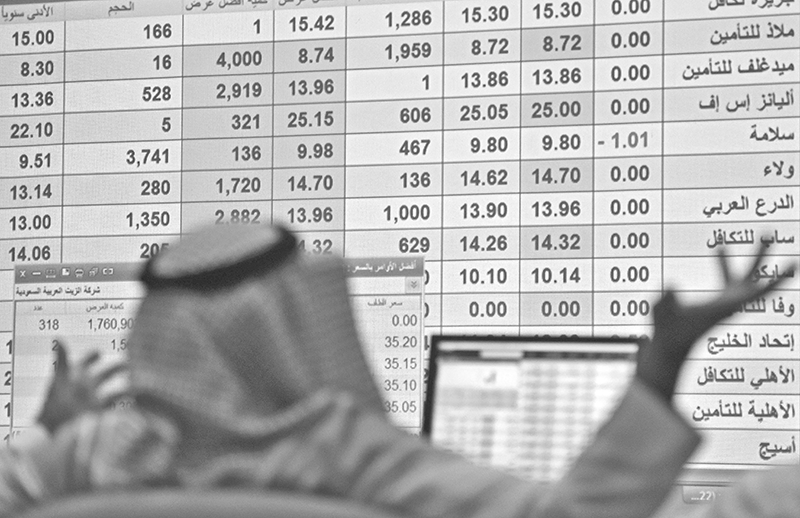
“The paddy acreage hit by pest and disease infestation has increased,” said Farhat Ali, an expert at the National Rice Research Programme, “The fall in production can also be attributed to planting the same variety of paddy time and again, and droughts and floods during the growing season.”
All eight districts in the province witnessed a decline in the paddy acreage.
Last year, Dhanusha district produced 251,187 tonnes of paddy on 63,000 hectares of land. Farmers planted paddy on 59,000 hectares this fiscal year and harvested 206,200 tonnes of the staple grain.
Farmers in Parsa brought in 225,840 tonnes of paddy from 45,000 hectares this fiscal year, compared to 227,250 tonnes grown on 47,050 hectares last year.
According to Ali, paddy output is determined by the application of chemical fertiliser, but farmers have not applied fertiliser as recommended. Use of heavy fertiliser increased the acidity of the soil, resulting in reduced production, he said.
The provincial Ministry of Land Management, Agriculture and Cooperatives established a Soil and Fertiliser Testing Laboratory after seeing a consistent drop in paddy output. The laboratory tested soil samples collected from all eight districts and found that 70 percent of the paddy fields showed an increase in soil acidity.
According to Ramchandra Yadav, chief of the Agriculture Knowledge Centre in Parsa, paddy output fell because of floods immediately after the sowing season, lack of rain during the growing season, lack of essential fertilisers, and consistent planting of the same variety of paddy.
Planting the same variety of paddy seeds every year makes the crop vulnerable to pests and disease, besides reducing soil productivity as it is unable to store essential elements because of multiple sowing and harvest periods.
“Farmers in Parsa have been planting the sona mansuli variety for over a decade,” said Yadav. “This type of paddy accounts for 70 percent of the total acreage in Parsa.”
In the past few years, sheath blight infestation of sona mansuli crops has increased, prompting the government to urge farmers to plant other varieties like hardinath, lalka basmati, chaite and sama mansuli.
According to Yadav, the centre distributed 86 tonnes of these seeds at a 50 percent discount to farmers this year.
Amid concerns over the gradual decline in paddy output, experts said that productivity could be increased by a balanced use of fertiliser, proper irrigation, use of varieties of paddy, measures to eliminate infestations and regular soil testing.

With contributions from: Abdesh Jha (Saptari), Bharatjarda Magar (Siraha),Om Prakash Thakur (Sarlahi), Shiva Puri (Rautahat) and Shankhar Acharya (Parsa).

Paddy output

District       2018-19         2019-20
Parsa         227,250          225,840
Bara           252,352         137,626
Rautahat     10,083         10,000
Sarlahi       190,650         174,800
Dhanusha  251,189         206,200
Siraha        145,600         132,000
Saptari      180,000         155,000

MONEY

European Commission maintains ban on Nepali airlines

- SANGAM PRASAIN

KATHMANDU : The European Commission maintained its ban on Nepali airlines for not meeting international safety standards. They remain on the updated EU Air Safety List which means they are still barred from EU skies.
The EU has been off-limits to Nepali carriers for the last six years. In December 2013, the European Commission imposed a blanket ban on all airlines from Nepal from flying into the 28-nation bloc.
On Monday, the European Commission updated the list stating that the EU Air Safety List seeks to ensure the highest level of air safety for Europeans and all other passengers travelling in the EU.
The European Commission said that the update of the list was based on a unanimous decision of aviation safety experts from the member states who met from November 20-21 under the auspices of the EU Air Safety Committee. According to officials at the Civil Aviation Authority of Nepal, the European Commission had asked that the Civil Aviation Authority be fragmented with a clear demarcation of its powers and responsibilities because its dual functions gave rise to a conflict of interest.
Last February, the Tourism Ministry informed the ambassadors of different European countries, including the ambassador of the European Union Delegation to Nepal, about the progress achieved in breaking up the Civil Aviation Authority into two entities, which they said was a prerequisite to removing Nepal from the EU Air Safety List.
“The Tourism Ministry has submitted a draft of the Civil Aviation Bill that envisages separation of Nepal’s civil aviation body into two entities—service provider and regulator—to the Cabinet for approval to be tabled in Parliament,” said Rajan Pokhrel, director general at the Civil Aviation Authority of Nepal.
“The European Commission is waiting for institutional reform. If Parliament endorses the bill, we will be able to invite a mission from the commission for Nepal’s aviation assessment,” he said.
According to Pokhrel, they plan to invite the mission of the European Commission or the European Union Aviation Safety Agency by March if the law is passed by Parliament.

Page 14
SPORTS

Liverpool, Chelsea through to Champions League last 16

Naby Keita and Mohamed Salah score in Liverpool’s 2-0 win over Salzburg to finish on top of Group ‘E’. Chelsea edged Lille 2-1 to progress as runners up behind Valencia.
- AGENCE FRANCE-PRESSE

Liverpool's Mohamed Salah (left) in action against Salzburg during their Champions League match at the Red Bull Arena in Austria on Tuesday.Reuters

PARIS : Holders Liverpool safely negotiated Tuesday’s trip to Salzburg to take their place in the last 16 of this season’s UEFA Champions League while Chelsea are also through, but Ajax suffered a shock group-stage exit.
Six clubs secured spots in the draw for the first knockout round in their final group games, with Ajax and Inter Milan the big names to miss out. Jurgen Klopp’s side just needed to draw in Austria to keep alive their bid to retain the European Cup, and they duly beat Salzburg 2-0 thanks to two goals in two second-half minutes, by Naby Keita and Mohamed Salah.
Keita headed in Sadio Mane’s cross against his former club to put Liverpool ahead in the 57th minute, and Salah then rounded goalkeeper Cican Stankovic to score from an improbably tight angle. The result allowed Liverpool to progress as Group ‘E’ winners, with Napoli going through in second place, while Salzburg are out and drop into the Europa League instead.
“What a team,” Klopp told BT Sport. “What an effort. It was a tough game. We scored two wonderful goals. We could have scored six or seven which is crazy. We won the group, we won the game, all good.”
Napoli made sure of their progress by trouncing Genk 4-0 in Italy with Arkadisuz Milik scoring a first-half hat-trick, the third goal coming from the penalty spot. Dries Mertens converted another spot-kick in the second half to seal the win, but the Italian side still sacked coach Carlo Ancelotti in the wake of the game. There was high drama in Group ‘H’ as Valencia beat Ajax 1-0 in Amsterdam, Rodrigo Moreno’s strike taking the Spaniards through to the last 16 at the expense of last season’s semi-finalists, and leaving their hosts stunned.
Ajax had again been impressive this season but were left to rue their inability to win either of their two matches against Chelsea, as Frank Lampard’s team progressed in second place, a point ahead of the Dutch giants, thanks to a 2-1 victory against Lille. Tammy Abraham and Cesar Azpilicueta netted first-half goals for Chelsea, who held on after Loic Remy pulled one back for Lille.
Chelsea, the 2012 Champions League winners, finish level on points with Valencia but come second due to their inferior head-to-head record. “The Champions League is where Chelsea belong. We knew it was a tough group. We had to fight and recover after losing against Valencia at home in our first game,” Azpilicueta told BT Sport.
Ajax drop into the Europa League along with Inter, as Antonio Conte’s team contrived to lose 2-1 at home to a makeshift Barcelona. A win would have taken Inter through, and they were fancied to get the result they required as Barcelona left out a host of senior players, including Lionel Messi, with top spot in Group ‘F’ already secured.
Carles Perez gave Barcelona the lead midway through the first half, but Romelu Lukaku fired in the equaliser. Inter then missed chances to score a second and Ansu Fati showed them the way, the substitute netting an 86th-minute winner to stun the home side and become the youngest ever goalscorer in the Champions League at 17 years and 40 days. That record had been held since 1997 by Ghana’s Peter Ofori-Quaye.
Borussia Dortmund needed to better Inter’s result and they did so, beating Slavia Prague 2-1 to progress in second. Julian Brandt got their winner after Jadon Sancho’s opener was cancelled out by Tomas Soucek, with Dortmund holding on after Julian Weigl was sent off. Meanwhile, Lyon went through in dramatic fashion in Group ‘G’, coming from behind to draw 2-2 with RB Leipzig.
The Germans were two goals ahead at half-time thanks to two penalties, one scored by Emil Forsberg and the other by Timo Werner. However, Houssem Aouar’s curler gave Lyon hope just after the break and Memphis Depay levelled matters with eight minutes left. Leipzig win the group, while the draw proved enough for Lyon to finish second because Zenit Saint Petersburg lost 3-0 to Benfica in Lisbon. Franco Cervi gave Benfica the lead before a Pizzi penalty and a Sardar Azmoun own goal, as the Portuguese side finish third.

SPORTS

Aleem Dar set to break umpiring record for most Tests

- AGENCE FRANCE-PRESSE

LONDON : Aleem Dar is set to break Steve Bucknor’s record of most Tests as an umpire in the first match of the series between Australia and New Zealand, which starts in Perth on Thursday.
The 51-year-old, who took up umpiring after playing first-class cricket in Pakistan, is standing in his 129th Test match as an on-field umpire.
He stood in his first Test in Dhaka in 2003 during England’s tour of Bangladesh. Starting his international career in 2000 during Pakistan’s home ODI series against Sri Lanka, Dar has officiated in 207 one-day internationals and is only two matches shy of the record of 209 matches in that format held by Rudi Koertzen of South Africa.
“This is one milestone I had never thought of when I began my umpiring career,” said Dar, who has also officiated in 46 Twenty20 Internationals.
“It is a truly amazing feeling and a high point of my life when I take the field here in Australia, thousands of miles from where I started my international career at home in Gujranwala,” Dar said in an interview released by the International Cricket Council (ICC).
“Steve Bucknor (from the West Indies) was my idol and it is only sinking in now that I will have officiated in more Test matches than him. In the nearly two decades of my international career, I have had the good fortune of watching some memorable matches and achievements like Brian Lara’s Test knock of 400 not out and South Africa’s epic chase of Australia’s score of 434 in an ODI in Johannesburg in 2006,” he said.

SPORTS

FIFA to take legal action to recover $ 2m from Platini

- AGENCE FRANCE-PRESSE
Michel Platini

LAUSANNE : FIFA is to take legal action by the end of the year to force Michel Platini to return two million Swiss francs ($2 million) he received “illegally” during Sepp Blatter’s reign at world football’s governing body, according to a document seen Wednesday.
FIFA banned Platini, its then vice president, in 2015 over the payment. It said in the document seen by AFP it would take action “to recover the money illegally paid by the former President of FIFA to the former Vice President of FIFA.” The document explained that FIFA also planned to target Blatter and that, under Swiss law, FIFA has until December 31 to file a claim in court.
FIFA said it planned to sue Blatter at the same time and would be seeking “interest at the appropriate rate” and “disciplinary fines and costs... both ordered but not paid.” Blatter authorised the payment in 2011. The Swiss authorities started investigating in 2015. FIFA’s ethics investigators branded the payment “disloyal” and banned Platini for six years.
The Frenchman appealed to the Court of Arbitration for Sport (CAS), which reduced his suspension to four years but said that it “was not convinced by the legitimacy of the payment, which was only recognised by Mr. Platini and Mr. Blatter.”
Platini has always maintained the money was a legitimate payment and he did nothing wrong. FIFA said in the document that the “undue payment...had no basis in law, and that fact has been established in various courts and tribunals up to the level of the Swiss Supreme Court.”

Page 15
SPORTS

Pakistan in command as Test returns after a decade

Visitors Sri Lanka feel the heat while finishing 202-5 at stumps on day one. 16-year-old paceman Naseem Shah took two wickets for the hosts.
- AGENCE FRANCE-PRESSE

Sri Lanka’s Dimuth Karunaratne (right) plays a shot during the first day of their first Test match against Pakistan at the Pindi Cricket Stadium in Rawalpindi on Wednesday.AFP/rss

RAWALPINDI : Test cricket made its long-awaited return to Pakistan after a deadly attack in 2009, with the home team led by fast bowler Naseem Shah dominating Sri Lanka on Wednesday.
Naseem, who is just 16, grabbed 2-51 on the opening day of the first Test which marked a momentous occasion in Pakistan cricket at Rawalpindi stadium. Sri Lanka won the toss and batted and closed the day at a precarious 202-5 after bad light stopped play 20.5 overs early. At close Dhananjaya de Silva was unbeaten on 38 and Niroshan Dickwella not out 11 as Sri Lanka spoiled a good 96-run start given by skipper Dimuth Karunaratne (59) and Oshada Fernando (40).
Pakistan struggled for wickets in the first session as Sri Lanka reached 89-0 at lunch. Shaheen Shah Afridi trapped Sri Lankan skipper Karunaratne leg-before soon after lunch to trigger a collapse which saw the visitors lose four wickets within just 31 runs in the post lunch session. Karunaratne hit nine boundaries in his 110-ball knock.
Naseem then had Fernando caught at slip for 40, an innings laced with six boundaries and a six. It was Naseem’s first Test wicket after he came away empty-handed from his debut in Brisbane against Australia last month. He also had Angelo Mathews caught in the slips for 31. Mathews added 62 runs for the fifth wicket with De Silva.
Usman Shinwari also claimed his first wicket when Kusal Mendis edged him to wicketkeeper Mohammad Rizwan for 10, while Mohammad Abbas bowled Dinesh Chandimal for two with a beautiful delivery. Pakistan, who in a surprise decision left out their key spinner Yasir Shah, had struggled for a breakthrough in the first session.
Naseem was the stand-out bowler in the morning as he generated pace, hitting Karunaratne on the helmet in the 19th over. Sri Lankan skipper, then on 42, fell down but showed no further signs of discomfort, hitting Shaheen Shah Afridi for his eighth boundary to reach his 24th Test fifty.
Around 8,000 fans chanted slogans and sang national songs as home team captain Azhar Ali tossed the coin to open proceedings. Sri Lanka are on the first Test tour of Pakistan since a gun-and-rocket attack in March 2009 killed eight people and wounded visiting players and officials, plunging Pakistan into sporting isolation.
With foreign teams refusing to visit, Pakistan have since played their “home” fixtures in the United Arab Emirates. All of their current team are now playing their first Test on home soil. However, as security has improved, Pakistan has gradually revived international cricket at home with limited-overs matches against Zimbabwe, World XI, the West Indies and Sri Lanka over the last four years.
“Of course, a historic day in Pakistan cricket and we all are excited,” said Azhar. “We want to make this occasion memorable by winning.”
Karunaratne, whose team was presented with special caps to mark the occasion, agreed. “Exciting day so we are all excited and once the game starts the focus will be on cricket.” And the fans were over the moon. “Thank you Sri Lanka for coming to play Tests in Pakistan,” said 21-year-old Shaista Naveed, a university student from neighbouring city Islamabad. The second Test starts in Karachi from December 19.

SPORTS

Carlo Ancelotti’s reign ends amid feuding as Napoli turn to Gattuso

Napoli have been in turmoil this season amid a row between owner and players after a series of disappointing performances and results.
- AGENCE FRANCE-PRESSE

MILAN : Carlo Ancelotti’s reign at feuding Napoli came to an abrupt end on Tuesday as the veteran coach was sacked despite a 4-0 win over Genk sealing their spot in the Champions League last 16.
The 60-year-old is set to be replaced by his friend and former AC Milan player Gennaro Gattuso, 41, later on Wednesday. Napoli finished second in Group ‘E’, one point behind Liverpool, to break a nine-match winless run that came amid dressing room unrest and friction between the club, Ancelotti and the players.
“Napoli has decided to relieve Carlo Ancelotti of his role as first team coach,” the Italian side said in a brief statement on twitter two hours after the game. The former Real Madrid, Chelsea and Paris Saint-Germain coach had been defiant after the game.
“Resignation? I have never resigned in my life and I never will,” he said. The club have been in turmoil this season amid a row between club owner Aurelio De Laurentiis and the players after a series of disappointing results. The players refused to go on a training camp after a 1-1 draw with Red Bull Salzburg in their Champions League group.
De Laurentiis responded by freezing payments of players’ wages, with stars including Kalidou Koulibaly, Dries Mertens, Jose Callejon, Allan and Lorenzo Insigne reported to be linked with January exits. The club sit seventh in the Italian top flight on 21 points, 17 points behind league leaders Inter Milan and, more worryingly, eight behind fourth-placed Cagliari, who hold the final spot for next season’s Champions League. In 18 months Napoli have gone from Maurizio Sarri’s slick style of football to a team scrambling to save their season.
Hopes had been high with the arrival of the much-travelled and trophied Ancelotti on a reported salary of six-million-euros ($6.6 million). He joined in July 2018 boosted by three Champions League titles as a coach, two with AC Milan and one with Real Madrid. “I would like Ancelotti to stay here for many years, like (Alex) Ferguson at United. He is a winner and stability is good for our project,” De Laurentiis had said.
The southern giants are trophyless since the days of Argentina great Diego Maradona, when they won their only Serie A titles in 1987 and 1990 and the UEFA Cup in 1989. Ancelotti guided the team to a runners-up finish in Serie A last season, missing out on the Champions League last 16 on goal difference to eventual winners Liverpool. But they are without a win in seven Serie A games since October 19.
For Ancelotti, who finished with a record of just 37 wins in 73 matches at Napoli, it was another failure after being sacked by his last club Bayern Munich. A 1-1 draw against Udinese last weekend sealed Ancelotti’s fate. “With your head held high,” was the first reaction from the Ancelotti camp from his daughter Katia on Instagram.
Captain Lorenzo Insigne, who had clashed with Ancelotti several times, wrote this on Instagram: “Thank you mister, it was an honour to have worked with you and your staff. In these two years I have known a special person. I wish you all the best!”
Gattuso should lead his first training sessions on Tuesday afternoon, according to media reports. Ancelotti had paid tribute to Gattuso in a letter in Gazzetto Dello Sport to mark his former player’s 40th birthday last year. “There is a need for your passion, your character, your spirit of sacrifice, to overcome the obstacles,” Ancelotti wrote. “You were my warrior on the pitch and I’ve never see you give up, you’ve never left the pitch with a clean shirt and that’s what I’ve always admired of you.”
In his playing days, Gattuso spent just over a year at Rangers before winning two Serie A and two Champions League titles in 13 years at AC Milan. He also won the World Cup with Italy in 2006. Gattuso missed out on the Champions League places on the final day last season to Inter. But his successor Marco Giampaolo was sacked after just seven games.
For Napoli the future remains uncertain. They do not have the financial resources of Juventus or Chinese-owned Inter Milan. Ancelotti, meanwhile, has been linked him to a return to England to either Everton or Arsenal. During his two years at Chelsea, he won the Premier League and FA Cup.

SPORTS

Former FIFA boss Sepp Blatter ready to testify in France over 2022 World Cup

- AGENCE FRANCE-PRESSE
Sepp Blatter

ZURICH : Sepp Blatter, the former president of FIFA, told AFP on Wednesday that he had opposed awarding the 2022 World Cup to Qatar, but that he has a “clear conscience.”
Blatter said he is willing to testify to French prosecutors about the 2010 vote in favour of Qatar. “If they ask me formally then I think I will go to France because I have a clear conscience,” said the 83-year-old who already testified in Switzerland in April, 2017, at the request of the French authorities.
Qatar beat Australia, Japan, South Korea and the United States to win the vote. However, the result has been consistently questioned. A three-year-old French investigation, was recently entrusted to a Paris investigative magistrate charged with looking specifically for “active and passive corruption”. Six months ago, Michael Platini, who was vice-president of FIFA and UEFA president at the time, was questioned about his decision to vote in favour of Qatar.
The investigators are particularly interested in a meeting at the Elysee Palace in Paris on November 23, 2010, just over a week before the vote, between French President Nicolas Sarkozy, Qatari prince Tamim ben Hamad al-Thani—who became Emir in 2013—and Platini who subsequently voted for Qatar.
“When Platini said that he would have voted for Qatar anyway, especially for the development of football, it is not true,” said Blatter. “We had a consensus within the Executive Committee of FIFA, which planned to award the 2018 World Cup to Russia and the 2022 World Cup to the United States. Everything went well until eight days before the election when there was this famous dinner at the Elysee.
“Platini phoned me immediately after. He told me: ‘Sepp, it’s not going to work, we will have a problem for the election. President Sarkozy had asked him, suggested, to vote for Qatar,” said Blatter, who reported this telephone conversation to the Swiss judge in April 2017. “I said to Platini ‘Did he force you?’ He said ‘Not at all, but when a head of state asks you to do something, you do it so I will follow and I will take my friends with me’.”
“His friends were the Cypriot Marios Lefkaritis, the Belgian Michel D’Hooghe who would have voted for Qatar anyway, his son having already had a post in Qatar, and the Spaniard Angel Maria Villar. So it made four voices that tipped the vote.”

SPORTS

Sampaoli quits Santos after second-place finish

Briefing

SAO PAULO: Former Argentina and Chile manager Jorge Sampaoli has resigned as coach of Santos after guiding the club to a second-place finish in the Brazilian league, the club announced Tuesday. The 59-year-old was under contract until the end of 2020, but according to the Brazilian press, he decided to leave because of his poor relations with the club’s president and the shortage of money to strengthen his squad. “Once the coach communicated the resignation, the case was forwarded to the club’s legal and human resources departments,” wrote the Sao Paulo State Club in a statement. (Agencies)


SPORTS

Former football manager Jim Smith dies aged 79

Briefing

LONDON: Former Queens Park Rangers, Derby and Portsmouth manager Jim Smith has died aged 79, English Championship club QPR announced Tuesday. Smith also guided Birmingham City into the old First Division and had several stints at Oxford. Nicknamed ‘the Bald Eagle’, he also managed Newcastle from 1988-1991 before steering Portsmouth to a 1992 FA Cup semi-final where they took Liverpool to a replay before losing on penalties after extra-time. Smith became a member of England’s League Managers’ Association’s Hall of Fame 1,000 club and served for a time as the organisation’s chief executive.(Agencies)


SPORTS

Dhawan ruled out of West Indies ODIs

Briefing

NEW DELHI: India batsman Shikhar Dhawan has been ruled out of the one-day internationals against the West Indies after sustaining a “deep cut” to his left knee, a statement said on Wednesday. Opener Mayank Agarwal will replace Dhawan, who injured himself while batting during the domestic Syed Mushtaq Ali Trophy T20 championship, the
Board of Control for Cricket in India said. “The BCCI medical team feels that while Dhawan’s stitches are off and his wound is healing
gradually, he still needs some more time before he regains full match
fitness,” the governing body said. India will play three ODIs against
the West Indies on December 15, 18 and 22. (Agencies)

Page 16
EXPLAINED

Why women are still banished to period huts

Legal actions and social campaigns have failed to make people in Nepal’s remote western regions understand the urgency of abolishing Chhaupadi.
- ELISHA SHRESTHA

Menstruation, a biological process among women, is inextricably linked to social taboos and, often stigma, in Hindu tradition. Although social taboo against menstruation is prevalent throughout the country, it is most visibly harsh in the remote western villages of Nepal, where the practice of Chhaupadi has been killing women and girls.
According to a report by the National Human Rights Commission, there have been 18 reported cases of women and girls dying in chhau goths, 13 of them in Achham district alone, since 2005. In December, 21-year-old Parbati Budha became the latest victim to the deadly practice that simply won’t go away.
To understand the practice and why it is stubbornly observed by so many families, you have to understand its roots. Here’s what you need to know.

What is Chhaupadi?
Chhaupadi is derived from words used in the Raute dialect in Achham—chhau means menstruation and padi means women. It is a traditional practice prevalent especially in the villages of Achham, Bajura, Doti and Bajhang. During each menstruation cycle every month, women and girls are secluded and banished outside their homes to a makeshift hut or even livestock shed. For a week, menstruating women and girls, who are deemed impure, are banned from touching the rest of the family members or things in the house.
Moreover, girls experiencing menses for the
first time are expected to remain in chhau
sheds for at least 14 days. Under this practice,
menstruating women are forced to refrain from participating in daily activities. A family member offers food to women practising Chhaupadi, without touching them.
Chhaupadi is not only limited to the time of
menstruation, it is also observed during childbirth. This practice is deeply associated with Hindu belief which regards secretions during menstruation and childbirth to be religiously impure.
Thus, Chhaupadi is also forced on women in their postnatal state whereby delivery must take place in the shed.
Women and their newborns are bound to stay in exile for 10-14 days after delivering the child.
Why do people practise Chhaupadi?
People living in the districts where Chhaupadi is actively practised have deeply ingrained superstitions associated with menstruation. They believe women to be impure during their periods and that if they don’t follow the Chhaupadi ritual, “the god might get angry” and that they will be followed by a bad omen.
Nirmala Bista, a village council member of Thalara Rural Municipality in Bajhang, says since she does not want to go against the beliefs of her in-laws, she stays in a shed during her periods.
Tejana Khana, an 18-year-old girl from Achham, told the Post she wants to break free from this practice but she feels that due to societal pressure, she is still unable to defy the tradition. “If something bad happens in the village, people will blame me and my defiance to not stay in a chhau goth,” said Khanal in an interview with the Post earlier in March.
There are beliefs that if the menstruating women and girls touch cattle, they will die; if they cross a water source, it will dry up; if they touch a plant, it will wither, and so on. As a result, these women and girls are not only banished from their home to live in sheds but are also restricted from touching male members of the family, cattle, plants, drinking water sources and idols of deities and temples.

How is this affecting women and girls?
Chhau sheds are usually small unventilated and windowless huts made of mud or rocks. Many women and girls are forced to spend days inside the unhygienic cattle sheds. According to news reports, most of them die from suffocation, especially during the winter when they light a fire inside to keep themselves warm. There have also been cases of women dying from diarrhoea, pneumonia and hypothermia. Other causes of deaths include snake bites and wild animal attacks. According to reports on reproductive health, Chhaupadi also leads to genital infections from a lack of menstrual hygiene, undernutrition due to food barriers such as dairy products, and uterus and cervical problems due to heavy works that are assigned to menstruating women and girls.
The practice of Chhaupadi also has psychological impact on women who are left to feel abandoned and insecure in an isolated hut, resulting in
depression, low self-esteem and disempowerment. There is also a constant fear of sexual assaults and abuses since such sheds are dark, exposed and often lack secure door lock. A 2011 UN report suggested that cases of physical abuse and rape, especially in chhau sheds, are greatly under-reported due to stigma.

What are the legal provisions against Chhaupadi?
In the wake of a large number of deaths, Nepal’s Supreme Court issued a directive in 2005, asking the government to come up with laws to eliminate Chhaupadi. In 2008, the Ministry of Women, Children and Social Welfare introduced guidelines to eliminate Chhaupadi. Two years ago, the Parliament enacted a law criminalising the Chhaupadi practice and imposing Rs3,000 fine and/or three-month jail sentence on anyone subjecting women to the practice. There was also a social initiative in the form of Chhaupadi-free campaign, launched by various non-governmental and social organisations with government support. Under the campaign, chhau sheds were demolished and villages declared as “Chhaupadi-free.”
According to reports, between 2011 and 2015, as many as 31 of the 75 village development committees in Achham were declared Chhaupadi-free.

Then why is the ritual still in practice?
Despite the legal provisions formulated to eradicate Chhaupadi, more than 70 percent of women in the remote western mountain districts of Achham, Bajura, Doti and Bajhang still practise the tradition. According to experts involved in cluster surveys in the region, an ineffective legislation and a lack of commitment from local leaders are primary reasons for the continuation of chhaupadi. That means despite an investment of time and resources from both government and non-governmental organisations to declare villages “chhaupadi free,” the declaration is limited to the paper and has not led to much behavioural change.
According to news reports, after the Chhaupadi sheds in Saipal Rural Municipality in Bajhang were pulled down in 2018, women were forced to rebuild the sheds so they wouldn’t have to be banished to caves during menstruation. In an interview with the Post in February, writer and activist Radha Paudel said destroying chhau sheds alone will not get rid of this practice. “There should be a more comprehensive approach that helps uproot the beliefs and superstitions surrounding menstruation being impure and unholy,” she said.
For any superstition to be eradicated from its root, education and awareness play an important role. In districts like Achham, Bajura, Doti and Bajhang, which are among the poorest in Nepal, the literacy rate is less than the national average. In Achham, women’s literacy rate stands at 37 percent. In Bajura, it is 22 percent. A lack of education means many women and their families are blindly following the superstition, risking lives.
Another reason why Chhaupadi continues is a lack of support for women who want to discontinue with the practice but don’t receive support from the family and the society. For almost all women, they’d first have to go against their family’s wishes, and then there’s no guarantee they’ll receive help from members of the local community, where they will have to live. In several instances, police have refused to register a complaint even after local villagers go to report on the deaths of women inside sheds.

So what can the government and private organisations do to uproot the deadly practice?
Unless the community actively engaging in Chhaupadi realises that the practice needs to be eliminated to secure the lives and dignity of women, imposing laws and destroying sheds won’t stop families from sending women to period huts.
Health campaigners say the only way to abolish Chhaupadi is by taking a proactive approach and focusing on educating and organising awareness programmes, continuously, at the local level. Subeksha Poudel, senior communication and GESI manager at Possible Health Nepal, a non-government organisation working in the healthcare sector in Achham, believes that imparting appropriate health education to community members, and emphasising on reproductive health are effective ways to create an awareness on menstruation and safe menstrual hygiene practices.
“Although it may take time to completely change the attitude of a person regarding the deeply-rooted practice, both government and non-governmental organisations shouldn’t stop their awareness and education programmes,” said Poudel.


Unless the community actively engaging in Chhaupadi realises that the practice needs to be eliminated to secure the lives and dignity of women, imposing laws and destroying sheds won’t stop families from sending women to period huts, analysts say. Post Photos: Menuka Dhungana