You internet speed is slow. Switch to text view mode

Switch
epaper logo
ST

Last Login:
Logout
+
Page 1
HOME PAGE

‘They turned me into a living corpse’
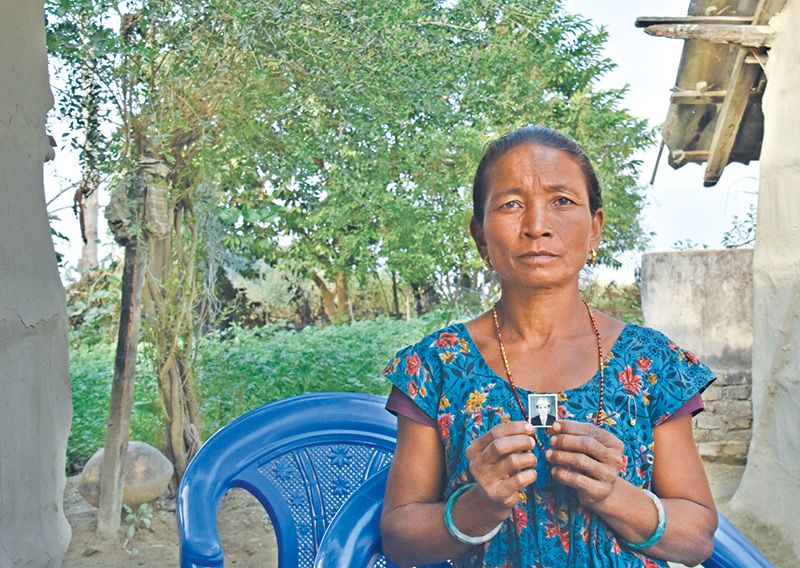
The transitional justice process has largely been held hostage to partisan interests, with both political parties and the Army playing for time.
- BINOD GHIMIRE
Dharma Dasni Tharu from Kothiyaghat in Bardiya holds up a photo of her husband Durga Prasad who was killed by the Nepal Army on November 15, 2002. Post Photo: binod ghimire

It was October 24, 2002. On a crisp autumn afternoon, security forces from Nepal Army and Armed Police Force stopped a bus Tanka Prasad Tharu was riding on for what was supposed to be a routine check. It was the height of the Maoist insurgency, and Tharu was on his way home to Shreepur, in Bardiya, from Nepalgunj. For reasons he still cannot fathom, Tharu said the soldiers singled him out. He was dragged out of the bus and taken into custody, suspected of having connections with the Maoist rebels.
The country was in a state of emergency and the Terrorist and Disruptive Activities Ordinance, issued in November 2001, authorised the security forces to take anyone suspected of being ‘terrorists’ into custody for 60 days. Preventive detention could be extended to 90 days without a court order.
In those 90 days, hundreds were tortured and brutalised in the security forces’ detention centres. Tharu was one of them. It has been 17 years since Tharu was taken into custody and 13 years since the war ended, but victims of torture, rape, extrajudicial murder, disappearance and human rights abuses have received no truth, no reconciliation and no justice. All they have are painful memories.
Tharu was taken to the Gulariya District Police Office, where he was asked to admit to being a Maoist. When he denied any connections with the revolutionaries, the torture began.
Police personnel first trod on his hands and kicked him repeatedly in the chest and head. Then, they beat him with bamboo sticks for hours until he fell unconscious.
“When I regained consciousness, I heard a bell in the detention centre striking midnight,” Tharu recalled in an interview with the Post last month. Once the police learned that he had come to, the torture restarted. He was hung upside down and beaten. At night, he would be woken from sleep by a bucketful of freezing water. He was forced to jump barefoot on sharp rocks until he left behind bloody footprints.
The Post met Tharu on November 22, a day after the country marked the 13th anniversary of the Comprehensive Peace Agreement, the landmark accord that ended the 10-year insurgency and pledged to provide justice to victims of torture and crimes against humanity. In a detailed interview, he recounted a horrific story of physical and mental torture, of living in fear for nearly a month in captivation, afraid that he could be killed any moment.
Each day that he was in custody, the police asked him the same question: are you a Maoist?
“Forget being a Maoist, I didn’t even know a single person who was in the party,” he said. “I was ready to bear the pain, but I wasn’t going to lie.”

Indra Rati Tharu, whose husband Kanhaiya was disappeared by the Maoists in September 2004, with her daughter Kabita, who was two-and-a-half years old when her father went missing. Post Photo: BINOD GHIMIRE


Tharu wasn’t the only arrestee in the detention centre. Within a week, 64 people, mostly from Bardiya district, were brought in for suspected Maoist ties. Everyone was tortured at some point or the other, said Tharu.
At night, two detainees would be randomly selected and taken out of the detention centre, never to return. Tharu initially thought that they had been released but he soon learned the truth.  
“I overheard the policemen say that they were taken to their villages to reveal where the Maoists were. If they cooperated, they were released. Otherwise, they were shot dead and buried on the banks of the Karnali or Babai rivers. Sometimes, they were even buried alive,” he recalled. “I started to see my own corpse lying on the banks of a river.”
But Tharu was lucky. Before he was taken away, a team from the International Committee of the Red Cross arrived at the detention centre.

After an hour’s inquiry, officials told Tharu that while they couldn’t tell him when he would be released, they could guarantee that he wouldn’t be murdered. The torture stopped that very day, said Tharu, and he was released a month later.
“I wasn’t the same Tanka Prasad anymore,” he said.
In the 17 years since he was released, Tharu says he hasn’t slept peacefully a single night. His body tends to get numb when he sits or stands in one place for too long, and he is on pain medication.
“The police told me that they would turn me into a living corpse, and they did,” he said. “But at least I am alive.”
Tharu is just one among hundreds of torture victims in Bardiya, the district with the highest numbers of disappearances and the second-highest deaths during the insurgency. In 2008, the UN Office of the High Commissioner for Human Rights had published over 200 cases of disappearance in the district. Subsequently, the Commission of Investigation on Enforced Disappeared Persons has received 274 complaints regarding disappearance; among them, it has found 255 to be eligible for detailed investigation. A report by victims’ organisations shows that 499 people from the district lost their lives between 1996 and 2006.

 A woman whose family member was disappeared demonstrates in front of the Bhairabnath Battalion. Post File Photo


Caught in the middle
In Bardiya, locals, primarily Tharus, were caught between the security forces and the Maoists. While the police and army accused them of being Maoists, the rebels accused them of being informants.
Kanhainya Tharu from Thakur Baba Municipality in Bardiya was 22 when he joined the Maoist rebels, who promised freedom from discrimination and a class-less society, in September 2002. Within a year, he was made platoon commander. So it came as a shock to his wife Indra Rati when, in September 2004, she was told that her husband had been arrested by the People’s Liberation Army for violating the Maoists’ moral code.
“There were already threats from the state security forces but then he was arrested by the party where he served selflessly,” she said. “We tried our best to find his whereabouts, but to no avail.”
Their daughter was two-and a-half years old while their son hadn’t even been born when Kanhaiya disappeared.
“Even today, when someone knocks at the door, I think it’s him,” Indra Rati said, her eyes brimming with tears. “If he’s alive, the party needs to produce him. If he’s dead, we need his body.”
Like Bardiya, Sindhupalchok too was among the districts most affected by the insurgency, where reports of disappearance and death stand at over 200 each. And just like in Bardiya, it was civilians and family members who were caught in the middle.
Tulasa Nepal, who is from Kubhinde, lost both her sons in the insurgency. Home to Maoist leader Agni Sapkota, the party had a lot of influence in Kubhinde, which prompted her son Prem Prasad to join the rebels in early 2000. Three years later, she learned that Prem had been killed in a clash with the security forces in Okhaldhunga. She never got to see the dead body, as party members said Prem’s last rites had already been performed because it was impossible to bring his corpse to Sindhupalchok.
Tulasa hadn’t gotten over Prem’s death when her youngest son Dil Prasad, who was just 18, was abducted by the police from Thamel eight months later. He was arrested because his brother was a Maoist fighter. Dil Prasad was never seen again.
“Who can understand the pain of the mother who has witnessed her two children disappear before her eyes?” said Tulasa.
For people like Indra Rati and Tulasa, the disappearance of family members has left them with wounds that refuse to heal. Without a dead body to perform final rites, there is no closure. And without proof of death, family members often end up with other problems. Without a death certificate, property cannot be transferred to spouses or children. Some victims’ families have even asked the local level to issue them death certificates, just so they can move ahead with their lives. But this doesn’t mean that they have come to terms with the disappearance.
“It was a legal compulsion to get the death certificate,” said Sita Basnet, whose husband Krishna Bahadur was disappeared by the Maoists on February 24, 2005. “I won’t accept he is dead until I see his dead body.”

Victims' families stage a demonstration outside the Bhairabnath Battalion in Maharajgunj, Kathmandu, on February, 2014, demanding information about the whereabouts of their relatives who were disappeared by the state during the Maoist insurgency. Post File Photo


Two-and-a-half decades of waiting
On November 21, 2006, the political parties and the Maoists signed a historic Comprehensive Peace Agreement, ending the decade-long insurgency. Among the agreement’s stipulations, one remains unsatisfied—transitional
justice.
The agreement stipulates that both sides—the state and the Maoists—agree to make public, within 60 days of signing, information about the real name, caste, and address of the people disappeared or killed during the war, and inform family members. Thirteen years later, neither the state nor the Maoists have abided by their commitments.
According to an updated Red Cross report, 1,333 people are still missing in connection with the conflict. There are more than double this number of complaints at the disappearance commission, which received 3,157 complaints from victims, with 2,520 classified as genuine after a preliminary probe.
In the name of justice, the government has provided little besides an interim relief of Rs1 million to the families of persons who were victims of enforced disappearance and death. Those who faced torture, sexual violence and forceful displacement haven’t gotten any relief even after 13 years since the peace process began.
According to the agreement, the transitional justice process was to begin within six months and conclude in a few years. However, it took eight years, in 2014, for the government to issue an ordinance for the formation of the truth and disappearance commissions. The commissions themselves were formed a year later.
“The commissions were formed not because parties were willing,” said Ram Bhandari, advisor of the Conflict Victims National Network. “Pressure from victims’ groups, civil society and the international community compelled the government and the parties.”
But in their four years of operation, the Truth and Reconciliation Commission and the Commission of Investigation on Enforced Disappeared Persons have done little except receive complaints from victims and their families. This is because the act that formulated the commissions is flawed and the commissions have largely been staffed on the basis of political consensus. In 2014, the Supreme Court had ruled that the Enforced Disappearances Enquiry and Truth and Reconciliation Commission Act be amended in line with Nepal’s commitments to human rights and international standards. And yet, five years later, the government continues to drag its feet.
Earlier this year in April, in an effort to propel the process forward, the government removed the chairpersons and commission members for failing to perform their duties. However, the commissions have remained vacant since then, as the political parties vie to find people who align with their political agendas to fill up the vacancies.
For instance, the parties have made attempts to appoint former attorney general Raman Shrestha and associate professor Ganesh Datta Bhatta to lead the Truth and Reconciliation Commission and reappoint Lokendra Mallick to the disappearance commission. But each time, they encountered strong opposition from conflict victims, civil society and international human rights organisations.
The government in June last year had also prepared a ‘zero draft’ of the amendment bill to collect suggestions from different quarters. But the draft bill was heavily criticised by victims’ groups and human rights organisations and has not moved forward.
Human rights activists who are closely observing Nepal’s transitional justice process say impunity has become a legacy.
Time after time, perpetrators seem to get away with their crimes. In 1990, a committee was formed to investigate the atrocities committed by the state during the first people’s movement, but no perpetrators were ever booked. In 2006, another commission was formed to probe atrocities by the royal government during the second people’s movement. But again, no one was ever prosecuted, despite the fact that the commission identified a number of people as guilty.
The present government, too, is reluctant to make public a probe report prepared by former Supreme Court justice Girish Chandra Lal after investigating cases of human rights violations during the Madhes Movement.
“The government and parties feel that insurgency-era cases can be ignored,” said Nirajan Thapaliya, director of Amnesty International Nepal.
According to Thapaliya, the political parties have put an end to tasks that did not demand accountability—like the army integration. But transitional justice demands the criminal liability of political figures who were either leading the government during the insurgency or the revolutionary forces, said Thapaliya.

Tanka Prasad Tharu, who tortured in police custody for 46 days during the insurgency, works in his small furniture workshop in Rajapur, Bardiya. Post Photo: Binod Ghimire


Who are the stakeholders?
There are three primary stakeholders in the transitional justice process: the political parties, the security forces (mainly the Nepal Army), and the victims. Though the Maoists, Nepali Congress and security forces fought each other during the insurgency, when it comes to transitional justice, they all stand together. On the other side are the victims.
According to political leaders, it is unfair to single out the political parties for the delay in concluding the transitional justice process, as the Army was the agency that carried out the orders. The Nepal Army says that it is precisely because they only carried out orders that they cannot be held accountable for human rights violations.
However, there has recently been a change in the way the Nepal Army approaches transitional justice. Previously it employed backdoor negotiations to stall the process while making no public comments, but ever since Chief of the Army Staff Purna Chandra Thapa took charge last year, the national defence force has publicly said that it has never been a barrier to the transitional justice process.
“If there are any remaining tasks of the transition, the Nepal Army won’t be a barrier,” Thapa said in a nearly three-hour address to the rank-and-file at Army Headquarters in September. Talking to the Post just after Thapa’s remarks, Brigadier General Bigyan Dev Pandey, the Army spokesperson, said that Thapa is committed to conclude the peace process and the Army will cooperate fully with the transitional justice process.
“A section of people has been spreading the message that the Nepal Army is creating obstacles in the transitional justice process, which is not true,” Pandey said. He further claimed that the Nepal Army had no problems complying with judicial decisions.
However, Geja Sharma Wagle, a security analyst who closely follows the Army, said that Thapa’s statement is just empty rhetoric. The position of the national defence force in the transitional justice process hasn’t been as flexible as Thapa made it out to be.

According to an updated Red Cross report, 1,333 people are still missing in connection with the conflict. Post File Photo


“The Army claims that human rights violations are issues of individual accountability, not institutional,” said Wagle. “It has been looking for assurance that the leadership itself won’t be prosecuted.”
However, activists and victims believe that there are more than these three stakeholders. Because the 10-year conflict was a civil insurgency, it is the responsibility of everyone—from rights organisations, civil society and the donor-diplomat community—to speak out against continuing impunity and the failure of the state actors to provide a discernible end to the transition.
Though national and international human rights organisations regularly advise and caution the government and the parties, their voices are rarely heard. It is only when they threaten legal action that the government makes piecemeal approaches to mollify them, in the hopes of buying more time, say activists.
However, the voices of civil society and the diplomatic community are rarely heard anymore. According to rights activists, civil society has increasingly become divided along political lines, which has led to a failure to speak out, said Gauri Pradhan, a former member of the National Human Rights Commission.
“It could have also been frustration after repeatedly being dismissed by successive governments,” said Pradhan.
The diplomatic community too has been silent. It was only in January, when the United Nations, together with nine embassies of Western countries, issued a statement urging the Nepal government to clarify its plan for transitional justice.
“I think the diplomatic community doesn’t want to antagonise this powerful government,” said Wagle, referring to the two-thirds majority government of KP Sharma Oli. “But pressure from the international community can be very important in getting the government to take action.”
Thirteen years is a long time to continue to pile pressure on governments that are unwilling to listen, let alone take action. Those who are continuing to do so are primarily victims’ groups and human rights organisations. In the last few months, victims’ groups, in collaboration with the National Human Rights Commission, have been holding interaction programmes with cross-party leaders, gaining verbal commitments from many.
Former Maoist commander Pushpa Kamal Dahal, in one such interaction, said that he was ready to take responsibility for all the positive and negative implications of the insurgency and that he is ready to face action for his mistakes. Similarly, Congress President Sher Bahadur Deuba has also said that he wants to conclude the transitional justice process soon.
“As the only living signatory to the peace agreement, I am committed to concluding the transitional justice process as demanded by the victims,” Dahal said during a programme held on the 13th anniversary of the Comprehensive Peace Agreement, which was signed in 2006 between Dahal on behalf of the rebel Maoists and Girija Prasad Koirala on behalf of the government.
But this is something that Dahal and Deuba have both said before, so there is room for doubt, say victims.
“We have yet to see their verbal commitments translate into action,” said Bhagiram Chaudhary, chairperson of the Conflict Victims’ Common Platform. “But I also feel the leaders have now understood that they cannot dictate the transitional justice process.”
Chaudhary believes that in the next few months, the amendment to the transitional justice act will finally land before the federal parliament and the two justice commissions will finally have new teams. However, there is no guarantee that the teams will be non-partisan or even effective.  
Activists, however, caution against delaying the process for too long.
“Human rights have universal jurisdiction and the world is watching,” said former human rights commission member Pradhan. “Once cases go international, nothing will remain in the hands of the parties.”  

POST PHOTO: BINOD GHIMIRE Sita Basnet's husband was abducted and disappeared by the Maoists on February 24, 2005.


HOME PAGE

With over 50 bills to endorse, Parliament looks at a busy winter session

- BINOD GHIMIRE

KATHMANDU,
As many as 56 bills, some crucial and some controversial, will heat up the winter session of federal parliament when it commences next week.
Once a new Speaker is elected, the House of Representatives will begin deliberations on the bills, including those from the backlog, which will mean a busy winter session, also called the bill session.
Officials at the Parliament Secretariat say that the first meeting of the session will start the process to elect a new Speaker, a post that’s been vacant since Krishna Bahadur Mahara resigned in early October following allegations of attempted rape. If Deputy Speaker Shiva Maya Tumbahangphe also resigns, the House will have to elect her replacement as well.
Roj Nath Pandey, spokesperson for the Parliament Secretariat, said that a meeting of the Business Advisory Committee would finalise the agenda for the first winter session meeting within a few days.
“Apart from the election of the House Speaker, the upcoming session will focus on deliberations and endorsement of new as well as pending bills,” Pandey told the Post.
At least 25 bills, including some crucial ones that are directly related to the functioning of the federal system, from the last session need to be endorsed. Of them, two are at the National Assembly while eight others are being studied by lawmakers.
According to Pandey, 15 bills tabled by the government during the budget session are under consideration at different House committees.
The previous session was prorogued on September 19 without endorsing bills necessary for both the federal and provincial governments to fully implement federalism as envisioned by the constitution.
The Federal Civil Service and Federal Public Service Commission Bill, which are necessary for the provincial governments to hire civil servants, couldn’t get through the House.
According to the constitution, provincial laws, including the Civil Service Act, should be in line with federal Acts. Provincial governments thus cannot draft their own laws unless the federal Act is in place.
Lacking federal laws, the provincial governments have not been able to exercise the authority delegated by the Constitution of Nepal, promulgated more than four years ago.
The last session also failed to endorse amendments to the Citizenship Act, Forest Act, National Human Rights Commission Act, and Media Council and Information Technology Act after some provisions drew criticism from both the public and the political parties, including the ruling Nepal Communist Party (NCP). Public protests had even forced the government to withdraw the Guthi Bill, which was at the National Assembly.
The budget session also couldn’t ratify the $630-million “compact programme” designed by the Millennium Challenge Corporation, an independent foreign aid agency of the US government, as a section of the ruling party had opposed it. Prime Minister KP Sharma Oli, in an interview with Kantipur, the Post’s sister paper, had blamed then Speaker Mahara for failing to move the bill forward.
In addition to the backlog, there are 29 bills, including bills on Establishment, Registration and Operation of the Civil Society Organisations, Mass Media, and Public Service Broadcasting, awaiting Cabinet’s approval. The bills, after being cleared by the Ministry of Law, Justice and Parliamentary Affairs, need to be approved by the Cabinet before they are registered at the Federal Parliament for endorsement.
“We are working on some other bills as well. The Parliament has enough bills to keep it busy during the winter session,” Dhana Raj Gyanwali, spokesperson for the law ministry, told the Post.
If all the bills under consideration in the Cabinet are approved, Parliament will need at least two months to clear them, even if one bill is endorsed a day.

HOME PAGE

Nepal is pedalling towards new form of tourism

Visit Nepal 2020 hopes to capitalise on the country’s potential of becoming a prime destination for adventure mountain biking.
- Thomas Heaton
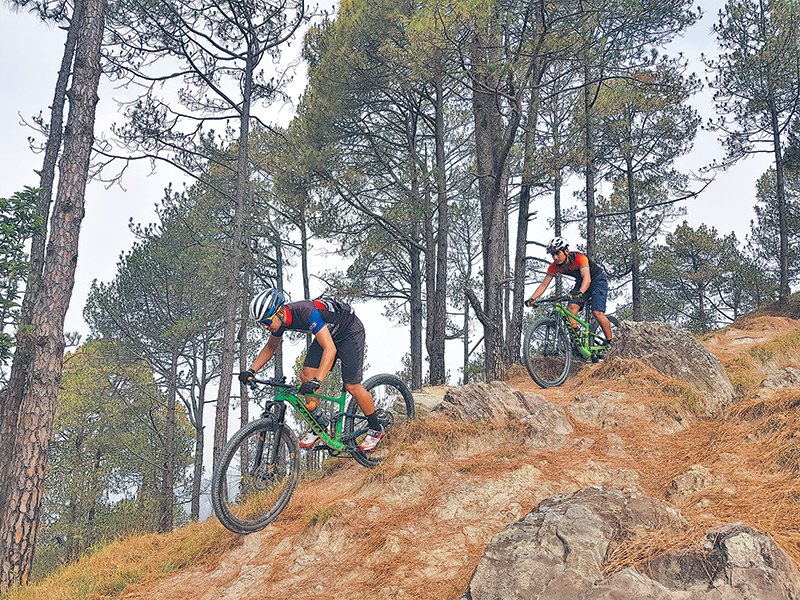
It is estimated that 2,000 to 3,000 bikers visit Nepal every year. Photo courtesy: Ajay Chhetri

KATHMANDU,
While most trails around the Himalayas are pounded by foot or hoof, hikers and riders will soon have to share space with one more form of locomotion--the bicycle. With new trails opening up and roads reaching previously inaccessible areas, adventurous mountain bikers are increasingly taking to Nepal’s hills and mountains.
The KaliX Mountain Biking Festival was wheeled out on Friday as an official Visit Nepal 2020 event, in recognition of mountain biking’s tourism. The KaliX festival joins established biking events like Yak Attack, YakRu,
Pokhara IV, and the Grand Himalayan Enduro, which is part of the Enduro World Series. Nepal, and the world, appears to be slowly waking up to the country’s potential as a premier adventure biking destination, with features on Red Bull TV and National Geographic.
“Mountain biking was always there, but somewhere on the sideline,” said Raj Gyawali, founding director of the Kathmandu Kora Cycling Challenge and the travel company Social Tours. “Right now, more and more people are getting into sustainable ways of tourism. Mountain biking is one of those.”
Gyawali officially announced the KaliX festival on Friday at the Visit Nepal 2020 offices. The event will be held along the Kaligandaki gorge, said to be the deepest in the world, and follows a Visit Nepal 2020 directive to develop offerings for mountain bikers.
The portal nepalbycycle.com, which was also launched on Friday, will provide information on trails and the KaliX festival, which will have both competitive and recreational events for different styles of riding like enduro and cross-country. Alongside the event, associated trails will also be demarcated and dedicated mountain biking trails explored, said Gyawali.

The potential of mountain biking in Nepal has not yet been fully trapped, said Shyam Gyan Limbu, managing director of Gravity Nepal and race director for Grand Himalayan Enduro. Limbu, who started cycling in 2009, said that he’s seen a meteoric rise in the domestic popularity of the sport, but wanted to see it pushed as part of Visit Nepal 2020.
“One of the challenges we face is that mountain biking [in Nepal] is not as well known around the world, compared to other countries,” he said.
Mustang is one of the most popular destinations for visitors, he told the Post, but there is a swathe of other opportunities around the country.
Cycling tours have been benefiting from increased access in recent years. While trekkers may lament road construction in areas like Annapurna, Manang and Gorkha, it has actually favoured cyclists, according to Limbu. As soon as a path is cleared for a road, it almost instantly becomes rideable for cyclists, he said.
“On the Annapurna circuit, we used to carry our bikes 60 percent of the time, and ride 40 percent,” said Limbu.
Five-time Yak Attack winner Ajay Chettri calls it the “hike and bike”, something that tourists actually look for—he took a group over Gorkha’s Larke Pass via mountain bike. But with a new road, the Annapurna Circuit is easier to access while Manaslu may become a mountain biking destination in the coming decade.
Gyawali doesn’t necessarily agree that “rampant” road construction has been good for cyclists. The benefits of construction mostly came in the form of being able to access places previously unreached, such as Mustang.
The growing popularity of mountain biking has meant that there are between 2,000 and 3,000 bikers visiting Nepal every year, Gyawali estimates, but that’s not enough for the industry to survive. Events like KaliX could go some way towards bringing in more bikers but it would be best for Nepal to target Asia, rather than Europe or the Americas, says Chhetri.
“It’s expensive to come here and it’s far away for many,” he said. “The government should be targeting Asia as there are lots of mountain bikers here.”
Gyawali agrees, as there is growing interest in mountain biking in Asia, particularly in China, Indonesia and Thailand, which poses potential for growth.
But mountain biking is not just for tourists; there is a lot of domestic interest and potential. There are cycle rallies in Kathmandu that attract up to 3,000 people and that number is only likely to increase, bolstered by Lalitpur’s cycle lanes and Kathmandu’s proposed plans.
No matter what part of town one lives in, there is an available trail or two not far away. If one lives in the north, there’s Shivapuri; in the south, there are places such as Phulchowki, Hattiban and Chobhar; towards Bhaktapur, people can venture into the hills, to places like Nagarkot, said Chhetri. There are also tours that span from Chitwan to Tansen, to Pokhara.
“Those are good for people who don’t want to do hardcore stuff at high altitudes,” said Chhetri.
Although there are hopes that Visit Nepal 2020’s newfound acknowledgement of the sport could lead to a mountain biking boom, Gyawali remains circumspect.
“I never know with these things because there are so many factors that go into it,” he said.
“But there’s no doubt about it—the sport is on the rise.”

Page 2
MEDLEY

Horoscope

ARIES (March 21-April 19)
***
Your values are precious to you, and that’s good. But you also have to remind yourself that what is right for you is not necessarily right for everyone else. Do not try to force others to believe in what you believe in. If they are going to be in your life, you need to respect them for who they are.


TAURUS (April 20-May 20)
***
Enthusiasm alone is not going to help you get everything done that you need to get done, but it certainly makes the experience more pleasant! So choose to be happier today, and happier you will be. Put a smile on your face, even if you feel angry or upset. Think the best of other people, not the worst.


GEMINI (May 21-June 21)
**
The hours today will trickle by at the pace of molasses, but that isn’t a bad thing. A slow day is a great way to learn how to have more patience. There won’t be much change or movement in any direction today, but that doesn’t mean you can’t have a perfectly fine time anyway. Accept the day for what it is.


CANCER (June 22-July 22)
**
It would do your attitude good if you were to start socializing a little bit more. Downtime is good, and it’s necessary to stay centered and in touch with yourself. But friends are starting to wonder if it’s even necessary to invite you. Even if you don’t feel like being social, you should give it a go.


LEO (July 23-August 22)
**
There is a strong current of compassion running through your life right now, and it will reawaken your nurturing instincts. You’re much more apt to give other people the benefit of the doubt, so it’s a perfect day to start forgiving. Issues that you used to see black and white terms are suddenly much more complicated.


VIRGO (August 23-September 22)
****
An interesting travel opportunity is coming your way today, although at first it might not seem like a trip you’ll want to take. But you should. Let go of your expectations and pre-conceived notions about where will be a fun place to go to. If you have the time and the money, you should give this new adventure a try.


LIBRA (September 23-October 22)
**
You will have to be honest about what you think when you are asked to give your opinions, today—whether it might hurt someone’s feelings or not. There is no point in sharing your thoughts unless you share all of them, completely unedited. Tell them the good and the bad and don’t candy-coat anything.


SCORPIO (October 23-November 21)
**
Despite what you might think, being aggressive is not the same thing as being abrasive—you can push harder to get what you want without turning anyone off. Being a little bit more forceful might not win you any new friends, but it is certainly not going to scare away any of the people who know and love you best.


SAGITTARIUS (November 22-December 21)
***
You have the potential to be a very positive force in someone’s life today. So in order to tap into this potential, you should get involved with helping others as much as possible. From surrendering a good parking spot to loaning someone some money, what you give to people will mean much more to them.


CAPRICORN (December 22-January 19)
***
You’ll be moving around so quickly today that if anyone tried to keep their eyes on you they would get whiplash! But while you are going off in a million directions at once, be careful—you could get so wrapped up in your energy that you neglect to get anything actually done! You need to discipline yourself and get organised.


AQUARIUS (January 20-February 18)
***
Are you bored with someone and not sure how to break it to them? Then don’t. They don’t necessarily need to know that they are becoming tedious to you—it will only hurt their feelings and make you look uncaring, which is not who you are. Instead, just take some time away from them.


PISCES (February 19-March 20)
**
Ultimatums are not usually the right approach for you—you like to have people want to do things with you, not be forced to give in. But today, time is of the essence and you might have to push a little bit harder than you usually do in order to get the answers you need. Don’t give up!

Page 3
Page 4
NATIONAL

Lack of parking spaces gives rise to auto theft cases

Thieves sell stolen two-wheelers at prices ranging between Rs50,000 and Rs150,000, depending on the vehicles’ condition.
- SHUVAM DHUNGANA
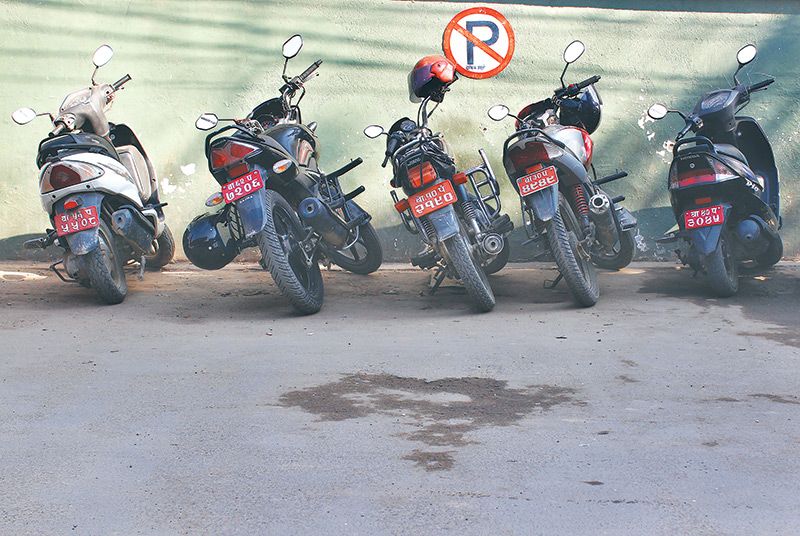
Over 500 complaints of vehicle theft were recorded in the first four months of the current fiscal year. Post file Photo

KATHMANDU,
On November 23, Sanjay Bista’s two-wheeler got stolen from Sanepa, Lalitpur. Bista had parked his Pulsar 220 motorcycle at an open space after not getting a slot in the nearby parking lot.
Bista, after losing his newly purchased bike, immediately filed a complaint at the Metropolitan Traffic Police Division (MTPD). Police recovered Bista’s stolen motorcycle after two days and apprehended the alleged thief, Pramod Kumar Manohar.
“Upon interrogation, Manohar revealed that he had stolen the bike as it was not parked properly, making it easy for him to break the bike’s lock,” said Ramesh Bajgain, sub-inspector and chief of the Victim Support Unit of the MTPD.
The unit, which mostly looks into vehicle theft cases, receives hundreds of complaints every year. In the last four months of the current fiscal year, it received 554 complaints of vehicle theft. The unit has so far recovered 118 vehicles and returned them to their respective owners.
Ishwar Man Dangol, spokesperson of the Kathmandu Metropolitan City, concedes that the parking lots in Kathmandu are not safe.
“Not just theft, vehicles parked in public places also face the risk of getting scratched or vandalised,” said Dangol. “Considering this, we have initiated ‘smart parking’ facility in Kathmandu. Currently, there are five such facilities which have security surveillance.”
There are 83 spaces in Kathmandu for the parking of two-wheelers and four-wheelers in addition to those five smart parking facilities. However, they are still inadequate to fulfil the city’s parking needs.
“We need an additional 50 smart parking slots to assure the safety of vehicles and fulfil the existing parking demand.”
According to Bajgain, hospitals, cinema hall premises and busy markets are more vulnerable to vehicle thefts.
“Almost all two-wheelers lifted from the city are sold in rural areas where the presence of law enforcement officials is low. Racketeers are found selling a stolen bike for Rs 50,000 to Rs 150,000, depending on its condition,” he added.
A majority of the stolen vehicles are never found and the number of vehicle thefts is rising, shows data of the traffic MTPD.
In the fiscal year 2015-16, 733 cases of vehicle theft were registered, out of which 131 were retrieved. The number of vehicle theft rose to 1,030 in the fiscal year 2016-17. Only 168 of these stolen vehicles were recovered.
Similarly, in the fiscal year 2017-18, the number of vehicle theft cases stood at 1,385, out of which 251 were recovered.
In the following fiscal year 2018-19, the number of vehicles theft rose to 1,611. Only 189 vehicles were retrieved.
Officials attributed the rise of vehicle thefts to lack of safe parking spaces in the Capital and unsafe parking habits of the city residents.
“We have seen some cases where the vehicles were stolen even after being properly parked in the parking area. So, having more parking places is not enough. Every parking area must have CCTV cameras and guards to ensure the security of the vehicles,” said Senior Superintendent of Police, Bhim Dhakal, chief of the MTPD.

NATIONAL

Tanahun lift water project left in limbo

- SAMJHANA RASAILI

TANAHUN,
The Satiswara-Mirlung ‘lift drinking water project’, which aims to benefit 1,300 households in the Bhanu and Byas municipalities, was expected to reach completion by April. But nine months since the deadline, the project is far from complete, worrying locals.
The project targets to ‘lift’ water from three rivers in Bhanu municipality—Kharsyang, Sisne and Deurali—to the water tanks constructed about two kilometres upstream and distribute it to the locals.
One of the reasons for the project failing to meet the deadline, according to Ram Kumar Baniya, Ward 13 chief of Bhanu Municipality, is a lack of funds to purchase distribution pipes and water taps. “The first phase of the project’s infrastructure construction is almost final,” he said. “The distribution pipes and connection of water to the taps remain to be done.”
The project aims to supply water to 1,000 households in Bhanu Ward 13 in the first phase and 300 households in Byas in the second phase.
As things stand, about 70 percent of the first phase is complete and 40 percent of the second phase, according to Rafik Miya, the water project consumers’ committee. Eight water tanks of various capacities have been constructed so far, Miya said. “Moreover, pipes from the source to the tanks are also connected, the electric wires have been expanded and the transformer is installed.”
When the project was initiated, it was expected to be completed with Rs115.6 million. So far, only Rs30 million has been spent. To raise the funds, Rs3,000 was collected from each beneficiary household while the Bhanu Municipality 13 ward office contributed Rs 500,000. But no budget has been disbursed after the government’s drinking water and cleanliness division office was transferred to the jurisdiction of the provincial government.
Ward chief Baniya said that the project hit a snag early on due to a lack of manpower. Miya said that they are currently confused as to how to collect the remaining funds. “The project remains incomplete because of the government’s negligence,” he said.
Meanwhile, locals lament that their hope of ending the decade-long water crisis remains unfulfilled. “A year has passed since the project’s deadline, but now we are unsure whether we’d get the water at all,” Nanda Kumari Gurung, a resident of Thulodhunga in Bhanu 13, said. “The water crisis is severe here. We have to walk about two kilometres downhill to fetch water. Our last hope is the lift project.”
While water crisis hits its peak during winter, the rainy season brings no relief either, said Gal Gurung, another local. “Even during the monsoon, we have to walk up to an hour to fetch water,” he said. “The situation turns dire during April-March.” Gurung added that the project hasn’t moved ahead as expected because the authorities didn’t coordinate with the locals in the beginning.
But Hari Prasad Timalsena, chief of the drinking water and cleanliness division office, insisted that the project is incomplete in the lack of funds. “This is a project that depends on contributions from the government,” he said. “But the project hasn’t received the budget.”
The project will have an estimated 8.2km main pipeline and a 33.2km distribution network, to be shared among 887 private water taps and seven public taps.

Page 5
NATIONAL

Mahakali embankment at risk due to haphazard excavation

Entrepreneurs, locals and even government offices extract riverbed materials from the riverbank for the construction of buildings and other infrastructures.
- MANOJ BADU
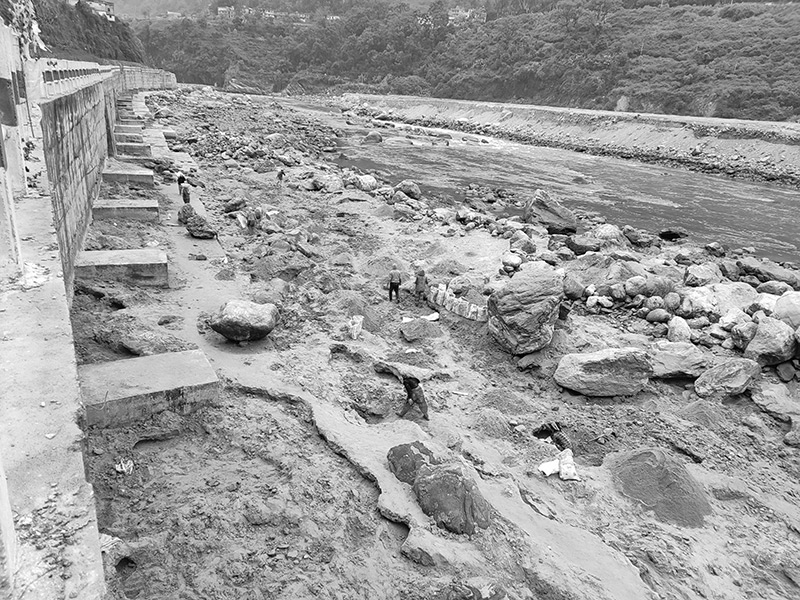
The construction of the embankment started in the wake of the devastating floods in 2013. Post Photo

DARCHULA,
Although the Mahakali River Control Project has imposed a ban on the excavation of riverbed materials from Mahakali river and its banks, sand, stone and other river products are being extracted in a haphazard manner in Khalanga, the district headquarters of Darchula.
Because of the mining, the newly made permanent embankment in Khalanga is at risk of erosion and flooding. Rana Bahadur Bam, chief at the project, said that there’s a risk of internal erosion due to the haphazard excavation of sand and pebbles from the foundation area of the embankment. “We had issued a public notice not to extract riverbed materials from the embankment area, but the locals and outsiders who are involved in the extraction have not paid attention to our request.”
Large scale business entrepreneurs, locals and even government offices excavate riverbed materials from the riverbank for the construction of buildings and other infrastructures.
Most of the locals in Khalanga depend on daily wage work to make a living, like extracting riverbed materials from the river. But the rate at which the extraction is taking place is detrimental to the health of the river, said Bam.
Mata Lohar, a local woman of Mahakali Municipality Ward No. 5, said she has been extracting sand from the riverbank for the last 12 years. “If we don’t extract sand from the river, we will go hungry. There are hundreds of people working as labourers to extract riverbed materials from the river,” said Lohar. Most of them, who reach Khalanga in search of jobs (mainly daily wage employment), find their way to the river and engage in extracting sand and pebbles.
Mahakali Municipality had conducted Initial Environmental Examination or Environmental Impact Assessment at the beginning of this fiscal year. The assessment was done to kickoff collection of river products from Mahakali, Lasku, Nijangadh, Dhauligad, Kimtadi Hola, Thaligad and Kakada stream.
Nara Singh Badal, the officiating chief administrator at the municipality, said, “We have prepared a working guideline to excavate riverbed materials after receiving several complaints. But the municipal office is yet to implement it,” he said. “A working guideline controls haphazard excavation and works as a guide that gives scientific methods to the extraction process.”
Six years ago, the Mahakali floods had swept away 56 homes and killed at least 12 people. The construction of the permanent embankment was initiated in the wake of the devastating Mahakali flood. Officials of the project claimed that they have already constructed 8km of the embankment along the river bank. In Khalanga, the construction of 4,250 metres of permanent embankment has been completed so far. According to project officials, they are yet to complete construction of some 280 metres more. Bam said, “Some of these areas also fall under the Nepal-India border and are at high risk because of haphazard excavation of riverbed materials. We have repeatedly requested the local administration and local units to pay attention to the illegal extraction, but to no avail.”

NATIONAL

A local unit in Syangja initiates campaign to reform community schools

Under the campaign, chief of the rural municipality is listening to students’ grievances.
- PRATIKSHA KAFLE

POKHARA,
In a bid to reform the education sector, Phedikhola Rural Municipality in Syangja district has initiated a campaign in various community schools.
Under the campaign, the chief of the rural municipality listens to complaints the students have and directs the subordinate offices to solve them. The rural municipality has 31 schools and the chief of the municipality, Ghanshyam Subedi, aims to reach out to every student.  
Recently Subedi reached Janapriya Secondary School in Ward No. 3 to take stock of the school’s situation. On that day, Janapriya Secondary School also hosted students from Deurali Basic School, Janamukhi Basic School and Sharada Ramaniyadanda Basic School to be a part of the programme.
During the programme, a majority of students complained of lack of safe drinking water and healthy food options on the school premises. Sharmila Ranabhat, a 9th grader of Janapriya Secondary School, said that the school canteen serves unhealthy, unhygienic food and water but for lack of better options students such as herself have been eating at the canteen. “Our classroom is near the toilet. It’s difficult to study because there’s always a foul smell emitting from the toilet,” she said.
Bijaya Adhikari, another 9th grader, highlighted the need to have separate toilets from junior and senior students in the schools. “Small children need to use the toilet more often. We have one common toilet and the infrastructure is not suitable for young children.”
Sanjita Adhikari, an 11th grader, said that the school has also failed to manage sanitary pads for girl students. She said, “We need sanitary pads but we have to wait for hours before we can get one from the school facility.”
Som Bahadur Mijar, a grade 3 student of Deurali Basic School, lamented about the lack of extracurricular activities such as sports in his school. “Our school does not have any extracurricular activities. It’s so dull,” he said.
Ram Poudel, the headmaster of Janapriya Secondary School, said that the campaign initiated by the rural municipality has helped bring students’ problems to the fore. “The students hesitate to talk about such issues with the school administration. But they feel comfortable sharing their problems with the chief so we support this campaign wholeheartedly,” he said.
Most of the representatives of the school management committees said that the schools don’t have the necessary budget required to upgrade the schools. Tulasi Poudel, a teacher at Sitala Secondary School, said that a majority of schools do not have the budget to upscale their infrastructures. “The local unit should help community schools to develop infrastructures.”  

In the current fiscal year, the rural municipality has allocated 38 percent of the total budget from the rural municipality to the education sector. The municipality has allocated Rs 500,000 for this campaign alone.
After listening to the students share their grievances, Subedi directed the Ward Education Committee to shut down the school canteens if the canteen operators fail to reform their ways within two weeks. “The rural municipal office will immediately allocate the necessary budget to provide safe drinking water and healthy food to the students,” he said. Subedi also urged the teachers to adopt a child-friendly teaching-learning process for clarity and ease of reading and writing.

NATIONAL

Karnali Province sees rise in corruption cases

- JYOTI KATUWAL

BIRENDRANAGAR,
Complaints against the local governments of Karnali Province at the Commission for the Investigation of Abuse of Authority (CIAA) are surging in recent times. The residents of the province have lodged several complaints with the anti-graft body claiming that the local units were involved in irregularities while carrying out development projects.
The data available at the CIAA provincial office in Surkhet shows that 331 cases against the local units were filed in the first four months of the current fiscal year. “The cases against the local bodies and the people’s
representatives have increased by about 24 percent in the first four months of the current fiscal year compared to the last fiscal,” said Meghraj Sapkota, information officer at the CIAA provincial office.
Most of the complaints were on the inferior quality of development projects and the practice of disbursing payments to contractors before completing projects. Service seekers and consumers have filed cases demanding action against their representatives.
 According to the CIAA office, multiple cases of irregularities were reported from Bheriganga, Junichande, Mahabu and Naumule local units of Karnali Province.
As per the data available at the office of the anti-corruption watchdog, 75 such cases were filed in Dailekh and 45 in Surkhet in the current fiscal year. The number of cases against the local government is 41 in Kalikot, 38 in Jajarkot, 29 in Jumla, 28 in Salyan, 27 in Humla, 27 in Rukum (West), 12 in Mugu and nine in Dolpa.
Shesh Narayan Paudel, chief at the CIAA provincial office, said most of the complaints filed against the people’s representatives were related to the substandard work of the local development projects and disbursement of fake bills.
“In some cases, the contract agreement was signed with the consumers’ committee and later sold to private contractors,” said Paudel.
Meanwhile, day-to-day administrative works and development activities have been hugely affected in several local bodies, as the elected representatives have to frequent the offices of the CIAA and other authorities to defend the allegations against them.
The accused people’s representatives claim that most of the cases were filed due to political reasons.
“The local leaders and activists of political parties have filed cases with the CIAA with the intent to hurt the party image of their rivals,” said Junga Bahadur Shahi, chairman of Mahabu Rural Municipality in Dailekh.

NATIONAL

The only school in the Raji community in Bhajani is on the verge of collapse

- Ganesh Chaudhary
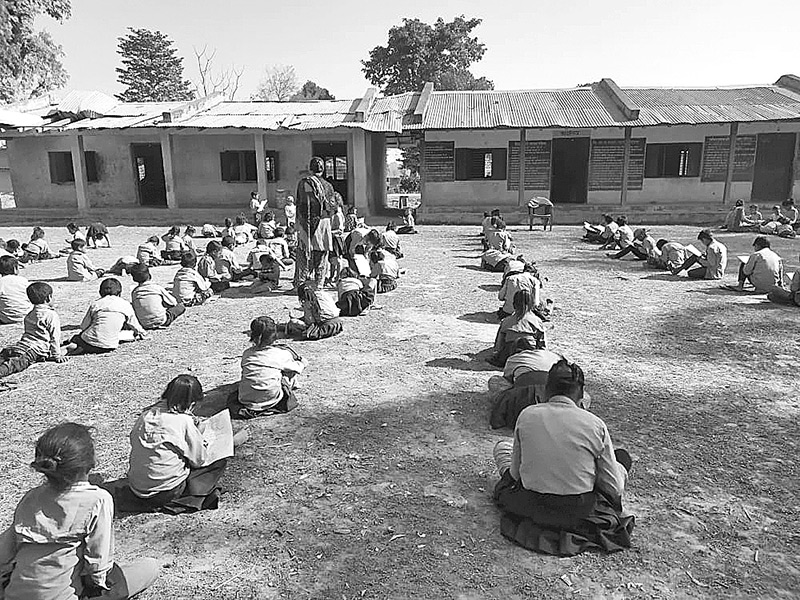
Children study outdoors at Sonpal Basic School, which has around 150 students. Post Photo

TIKAPUR,
Bhuruwa in Kailali is a settlement of Raji people, an ethnic community found scattered in several districts of the mid- and far-western-regions of the country.
The settlement that falls inside the Bhajani Municipality Ward No. 9 has around 300 households with around 150 children of school-going age. However, the only school—Sonpal Basic School—which most Raji children attend is on the verge of closing down, for a lack of resources.
“The school is in shambles. It does not even have a proper drinking water facility for the children,” said Dhaniram Raji, headmaster of the school.
The school was established around 12 years ago, with the effort of the locals, after they realised the importance of formal education for their children.
Although the school enjoys the status of a community school, it does not enjoy the facilities that come with the status. The school that runs classes till grade five has five teachers—only two of them are commissioned by the
government with three of them working under the private quota. According to the law, the local units are responsible for hiring teachers for community schools.
The municipality, however, provided Rs 120,000 grant to the school last year as support and is yet to hire the required number of teachers in the school, said Dhaniram. “The amount the municipality gave us, we used to pay the salary of the teachers. We haven’t been informed whether we will get the budget for the same this year or not,” he added.
The school currently has 151 students among whom five are from the non-Raji community. Highlighting the importance of running the school despite shortcomings, Sukaram Raji, chairman of the school management committee, said, “We have innumerable problems. We don’t have enough teachers and we haven’t been able to give the best education to our children but if we don’t carry on, the school will shut down. Our children will have nowhere else to go to receive an education.”
Sher Bahadur Chaudhary, mayor of Bhajani Municipality, said that the municipality would support Sonpal School as it does other community schools in the municipality. “We have allocated budget to the school this year as well. The assistance will be sent to the school soon,” said Chaudhary. He, however, did not tell the exact amount of grant. “They (Raji people) have just only started opting for formal education and it is our responsibility to support them,” he added.
Raji is one of the most endangered and economically deprived indigenous communities in Nepal. According to the national census conducted in 2011, there are total 4,235 Raji people in Nepal.
They are believed to be originally from Surkhet district and over the years have settled near Basanta Bio-corridor in Kailali district.

NATIONAL

4,500 students receive school bags in Bheri Municipality

Briefing

JAJARKOT: Nepali people living in Japan have sent around 4,500 bags for students in Bheri Municipality. Mahendra Bahadur Shahi, chief minister of Karnali Province, distributed bags to the students in a programme organised at Khalanga, on Thursday.

NATIONAL

Construction of bridge left incomplete for nine years

Briefing

MAKWANPUR: The construction work of a bridge over the Bagmati river (which connects Makwanpur and Sindhuli districts) has been incomplete for the last nine years. Rajesh Paudel, chief of the Dharan-Chatara-Sindhuli-Hetauda Road Project, said that only 60 percent of the construction work has been completed so far. The contractor company has agreed to complete the construction work within the next five years.

NATIONAL

Arrest warrant issued against ward chairman

Briefing

NUWAKOT: The Division Forest Office has issued an arrest warrant against three persons, including ward chairman of Belkotgadhi Municipality Ward No. 12. According to the forest office, ward chairman Dilliram Silwal, Bharat Silwal and Kisan Chitrakar were found guilty of felling down sal trees and selling them.

NATIONAL

Overhead bridge being constructed in Pokhara

Briefing

KASKI: In view of the increasing traffic congestion, an overhead bridge is being constructed in Sirjana Chowk in the lake city. Chief Minister of Province 4 Prithvi Subba Gurung laid the foundation stone of the bridge on Friday. The bridge is expected to complete in 15 months, according to an engineer with the Pokhara Metropolis.

NATIONAL

Fire engines in Itahari don’t work, worrying locals

Briefing

ITAHARI: One of the two fire engines with the Itahari Sub-metropolis remains damaged, eight months since the vehicle stopped working. While incidents related to fire have been on the rise in the city, the sub-metropolis’s indifference to repair the engine has worried locals.

Page 6
MONEY

China says trade deal with US must be ‘mutually beneficial’

Repeated rounds of negotiations had failed to achieve even a preliminary agreement.
- ASSOCIATED PRESS
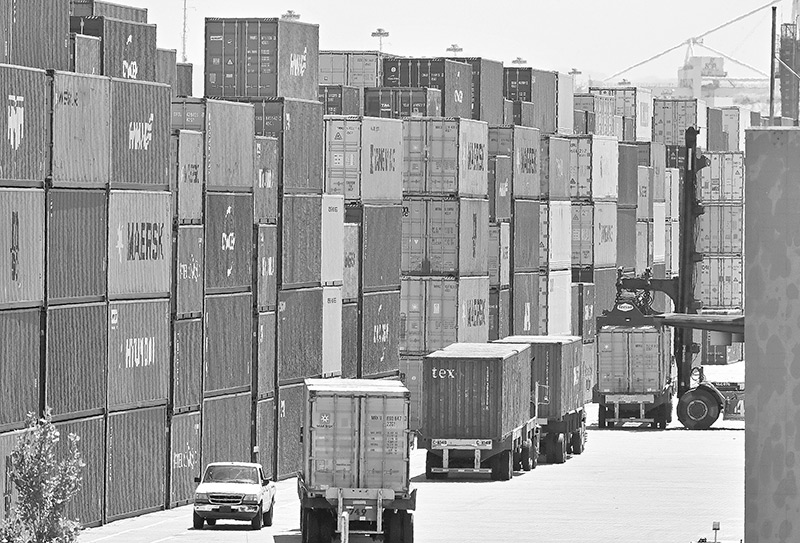
Containers wait to be loaded on to trucks at the Port of Oakland in Oakland, California. af/rss 

BEIJING, 
Expectations for a US-Chinese trade truce rose Friday, though Beijing accused Washington of unfairly attacking its economy and said a settlement to their costly, 17-month-old conflict must be “mutually beneficial.”
A senior Trump administration official said an announcement
regarding China would take place Friday. The official spoke on condition of anonymity to discuss internal planning.
A “deal is close,’’ said Myron Brilliant, the US Chamber of Commerce’s head of international affairs, who was briefed by both sides.
Brilliant said the Trump administration agreed to suspend a planned tariff increase on $160 billion of Chinese imports due to take effect Sunday and to reduce existing tariffs, though it wasn’t clear by how much.
In return, Beijing would buy more US farm products, increase Americans companies’ access to the Chinese market and tighten protection for intellectual property rights.
The interim “Phase 1” deal, which doesn’t appear to cover major US-Chinese disputes, awaits final approval from President Donald Trump. Trump did not comment to reporters on the talks late Thursday when returning to the White House.
Trump declared on Twitter early Thursday: “Getting VERY close to a BIG DEAL with China. They want it, and so do we!”
Chinese officials gave no confirmation of a possible deal in comments that highlighted how far apart the two sides still are. There is no indication the “Phase 1” agreement extends to major disputes including US complaints Beijing steals or pressures companies to hand over technology.
“Negotiations must be based on the principles of equality and mutual respect,” said a foreign ministry spokeswoman, Hua Chunying, repeating Beijing’s long-held position. “The deal must be mutually beneficial, a win-win.”
Meanwhile, Foreign Minister Wang Yi complained at a separate government-organized forum in Beijing that Washington is unfairly attacking China.
“The US side has successively imposed unjustified restrictions and crackdowns on China in economy and trade, science and technology and personnel exchanges,” Wang said. “As far as China is concerned, what we are pursuing is our justified rights of development.”
Trump’s comments triggered a rally on Wall Street that carried over to Asian trading.
The Dow Jones Industrial Average surged 220 points, or 0.8 percent on Thursday. In Friday trading, Japan’s Nikkei 225 index jumped 2.6 percent while the Shanghai Composite index advanced 1.5 percent.
Beijing has threatened to retaliate if Sunday’s tariff hike goes ahead.
Trump announced the “Phase 1” agreement following talks in Washington in October but neither side has disclosed details.
Three Democratic senators—Minority Leader Charles Schumer of New York, Ron Wyden of Oregon and Sherrod Brown of Ohio—sent a letter to the White House on Thursday, urging Trump to “stand firm’’ in the negotiations with China. They called on the president to hold out for “commitments from the Chinese government to enact substantive, enforceable and permanent structural reform.’’
The administration accuses Beijing of cheating in its drive to develop advanced technologies as driverless cars and artificial intelligence.
The administration alleges—and independent analysts generally agree—that China steals technology, forces foreign companies to hand over trade secrets, unfairly subsidizes its own firms and throws up bureaucratic hurdles for foreign rivals.
Beijing rejects the accusations and contends that Washington is simply trying to suppress a rising competitor in international trade.
Despite the plans for an announcement, it’s not a done deal, noted Jeffrey Halley of Oanda.
“After such an interminable wait and having being led to water before, I would like to see something official in writing officially. Further to that point, although the in-principle agreement may have been agreed, the legally binding text has yet to be drawn up,” he said.
Since July 2018, the Trump administration has imposed import taxes on $360 billion in Chinese products. Beijing has retaliated by taxing $120 billion in US exports, including soybeans and other farm products that are vital to many of Trump’s supporters in rural America.
On Sunday, the administration was set to start taxing an additional $160 billion in Chinese imports, a move that would extend the sanctions to just about everything China ships to the United States.
Repeated rounds of negotiations had failed to achieve even a preliminary agreement.
The prolonged uncertainty over Trump’s trade policies has curtailed US business investment and likely held back economic growth. Many corporations have slowed or suspended investment plans until they know when, how or even whether the trade standoff will end.
A far-reaching agreement on China’s technology policies will likely prove difficult. It would require Beijing to scale back its drive to become a global powerhouse in industrial high technology, something it sees as a path to prosperity and international influence.
Efforts to acquire foreign technology are a theme that runs through Chinese law and government.
Security researchers have asserted that Beijing operates a network of research institutes and business parks to turn stolen foreign technology into commercial products.
The Trump administration has been seeking a way to enforce any significant trade agreement with China, reflecting its contention that Beijing has violated past promises. One way to do is to retain some tariffs as leverage.

MONEY

Boeing delays plans for record 737 production until 2021

- REUTERS
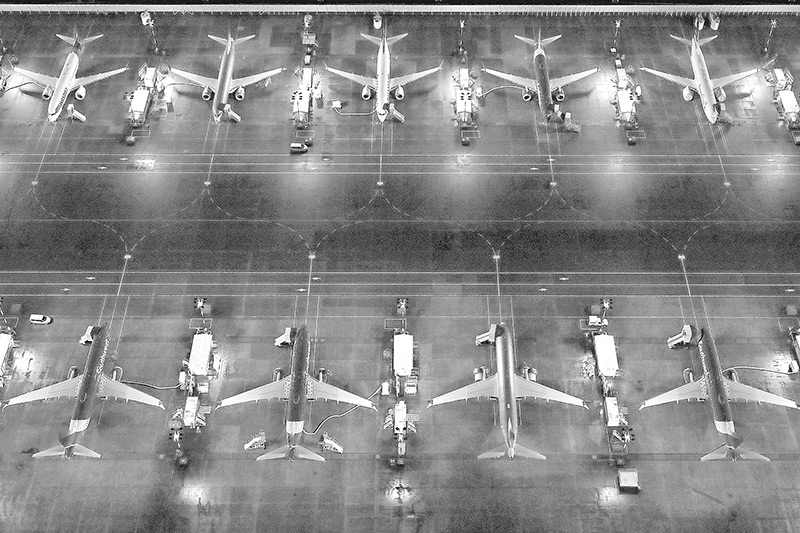
Boeing 737 Max airplanes parked at Boeing Field in Seattle, Washington, US.  REUTERS 

SEATTLE/PARIS, 
Boeing Co has delayed plans to reach a record production rate of 57 737 jets per month next year, industry sources said on Thursday, even before the US FAA announced a new delay in the 737 MAX’s return to service which raised uncertainty over production plans.
The world’s largest planemaker has also delayed plans to step up from the current rate of 42 jets per month to 46 jets this year until March 2020, as the company struggles to win regulatory approvals for its best-selling jet after two deadly crashes.
The US Federal Aviation Administration said on Wednesday that the agency will not approve the grounded commercial jet for flight before year end, and said it was investigating production issues at the Boeing factory in Renton, Washington.
FAA chief Steve Dickson, who met with Boeing Chief Executive Dennis Muilenburg on Thursday, is concerned that the US airplane maker is pursuing a 737 MAX return-to-service schedule that is “not realistic,” according to an email seen by Reuters.
A Boeing spokesman declined to comment on the company’s specific production plans. He said Boeing would continue to assess production decisions based on the timing and conditions of the 737 MAX’s return to service, which will be based on regulatory approvals and may vary by jurisdiction.
In October, Muilenburg told analysts that Boeing expects to be able to maintain its current monthly production rate of 42 aircraft, followed by incremental rate increases that would bring the production rate to 57 in late 2020.
Industry sources said this plan has been delayed by months.
After getting to 47 jets monthly in March 2020, Boeing will make its next increase to 52 jets per month in September 2020, according to one person familiar with the plans.
It will then not reach a record stride of 57 per month until April 2021, the person and a second industry source said.
A third industry source confirmed the general timeline but cautioned the plan could be further delayed by the 737 MAX approval process.
Boeing mainly builds the latest version of its cash-cow single-aisle family at its Seattle-area factory, but also builds a small number of earlier or military variants of the 737.
In April, Boeing cut the number of 737s it produces monthly to 42 from 52 after halting deliveries to airline customers, cutting off a key source of cash and hitting margins.
Because the grounding happened when Boeing was going up toward record production levels, and each move of the sprawling supply chain has to be planned far in advance, Boeing and its suppliers are now caught between two conflicting pressures: preparing to get back on the upward path as soon as the 737 MAX is flying but also ratcheting downwards if regulators stall and the grounding continues for longer than expected.

MONEY

Ivory Coast farmers push back against cocoa output cap

Farmers say a lack of business options outside the cocoa industry leaves them with little choice but to expand output.
- REUTERS
A farmer opens a cocoa pod at a cocoa farm in Ivory Coast. REUTERS 

SAN PEDRO (Ivory Coast),
Cocoa farmers in Ivory Coast say they plan to ramp up production and establish new plantations, potentially jeopardising a new policy to cap output and boost prices from next year.
The West African country’s cocoa regulator (CCC) said in October it would cut production from 2.2 million tonnes to 2 million tonnes from next season in a bid to deter farmers from overproducing after Ivory Coast and neighbouring Ghana introduced a plan to raise farmers’ income.
The world’s top two cocoa producers set a fixed $400 a tonne ‘living income differential’ (LID) in July on all their cocoa contracts for the 2020/21 season.
They also pledged to use the money raised to guarantee farmers 70 percent of a $2,600 a tonne target price.
This should equate next season to a price for farmers of at least 1,000 CFA francs ($1.70) per kilogramme, versus 825 for this season, though it could be well above that if international prices rise.
Benchmark cocoa futures on ICE hit their highest in a year and a half in November, helped in part by the LID announcement, but they could fall again if output in West Africa surges.
Seventeen farmers who spoke to Reuters this month said a lack of business alternatives outside the cocoa industry leaves them with little choice but to expand output and make the most of improved prices.
The farmers’ comments raise questions about whether the world’s No. 1 cocoa producer can implement production cuts in a country that relies on a million small producers who operate independently and have little incentive to cut back.
“I’ve already cleared 4 hectares of forest in July that my family can plant with cocoa in the April rainy season and I’m not going to stop that,” said Sylvain Daple, who tends three hectares in San Pedro, the heart of Ivory Coast’s new cocoa belt.
His view was echoed by other farmers in Daloa, Issia, Divo, Gagboa, Soubre and Meagui - territories which account for nearly 70 percent of the Ivorian crop.
Most of them said the authorities needed to do more to encourage diversification.
“If we have alternatives, options as profitable as cocoa, then we will limit our fields and our production, otherwise it is not possible,” said father-of-four Donald Assie in the village of Bobia near Gagboa.
The CCC declined to comment. When it announced the output cap in October it did not say how it would be implemented and enforced.
“I really don’t see how they can do it, I don’t see any sort of plan (and) I question whether they have one,” said an industry expert, who did not wish to be identified.
“If they were prepared to expel hundreds of thousands of women and children from (protected) forests that would impact production but what do you do with tens of thousands of refugees?” the expert said.
He said Ivory Coast has in the past expelled people on a small scale, but that never significantly curbed production.
Ivory Coast’s protected forests produce 500,000 tonnes of cocoa annually, according to official data.
“The solution is to destroy all the plantations that are in the protected forests and in the parks,” said Salif Diomande, who purchases beans from farmers to sell to exporters.
Ivory Coast has more than 2.5 million hectares of cocoa. The sector accounts for 15 percent of GDP and 40 percent of exports.

MONEY

Mexico ratifies modified North American trade deal

- AGENCE FRANCE-PRESSE

MEXICO CITY,
The Mexican Senate ratified the modified North American free trade agreement with the United States and Canada on Thursday after more than two years of arduous negotiations.
New additions introduced Tuesday to the United States-Mexico-Canada Agreement (USMCA)—which notably toughen the deal’s labour enforcement provisions—were rubber stamped by 107 votes to one, making Mexico the first country to sign on.
“We’re already done it in Mexico: the president has signed it and the Senate has ratified the USMCA,” Mexican President Andres Manuel Lopez Obrador tweeted. “Now it is up to the US and Canadian legislatures to do the same. It’s good news.”

The path to ratification for the other two countries, expected in early 2020, also looks clear for USMCA.
It replaces the 25-year-old North American Free Trade Agreement (NAFTA), which President Donald Trump complains has been “a disaster” for the US.
First signed in November 2018, USMCA got bogged down in political complications, particularly in the United States, where opposition Democrats questioned whether it would really force Mexico to deliver on labour reforms meant to level the playing field between Mexican and American workers.
But another year of talks produced a series of additions—notably including tougher enforcement of labour provisions—that won the blessing of House Speaker Nancy Pelosi, the key Democrat needed to move the agreement forward, as well as the largest US labour federation, the AFL-CIO.
The deal was signed by US Trade Representative Robert Lighthizer, Canadian Deputy Prime Minister Chrystia Freeland and Mexican Undersecretary for North America Jesus Seade during a ceremony in Mexico Tuesday.
During Thursday’s debate in Mexico’s Senate, lawmakers said the new trade accord will stimulate the Mexican economy—which is forecast to contract this year—and instill confidence in investors.
The deal is a “historic act” for Mexico, Senator Ricardo Monreal of the Senate majority Moreno party said, for its potential to create jobs.
Some opposition senators, while voting in favour of the accord, said there should have been more time for debate on it while others said free trade had made economic inequality more acute. Gustavo Madero of the conservative opposition National Action Party (PAN) welcomed the new agreement, saying its ratification “will send a signal of confidence (to Mexico) in a delicate moment.”
But he complained of having to take the vote “in a hurry” thanks to the “political times,” a reference to the quickly approaching 2020 presidential election in the US.
The only Mexican legislative vote against the USMCA Thursday came from independent Senator Emilio Alvarez Icaza, who described the deal as a giant “contradiction” to Lopez Obrador’s mandate and represented a “neoliberal triumph”—an ideology the leftist president promised to leave behind when he took office a year ago.

Page 7
MONEY

Nepali and Chinese officials stress road links to boost arrivals from China

Nepal was able to attract a meagre 0.1 percent out of the total Chinese visiting abroad.
- PRAHLAD RIJAL
A view of the Kerung market in China, near the Nepal border.  POST PHOTO: BAL RAM GHIMIRE

KATHMANDU,
A Belt and Road Initiative lobby in Nepal has urged the government to invest in cross-border road connectivity to boost Chinese tourist arrivals to Nepal.
The proposed Kerung-Kathmandu railway is a distant dream that may be realised in a few decades, but for the near future, road connectivity is essential, a Nepali and Chinese think tank said on Friday.
They said that Nepal-China road connectivity would not only ensure improved Chinese tourist inflow for a certain year, but could be a sustainable way to bring visitors from the northern neighbour.
China remains the world’s biggest outbound tourism market with Chinese travellers making nearly 150 million foreign trips in 2018, according to a report by the China Tourism Academy and Ctrip.
Nepal was able to attract a meagre 0.1 percent out of the total outbound despite proximity and improved air connectivity. According to the Tourism Ministry, 153,633 Chinese tourists visited Nepal in 2018, becoming the country’s second largest source market. Among the arrivals, more than 26,000 came overland through Rasuwagadhi on the northern border. The government has aimed to bring 350,000 Chinese tourists next year which has been declared Visit Nepal 2020.  
Nepal’s tourism industry has also been lobbying to open up restricted regions adjoining the Chinese border.
Zhang Fan, economic chancellor of the Chinese Embassy, said that in the last five years, the countries included in the Belt and Road Initiative witnessed 77 percent growth in the number of Chinese tourists, and the numbers are growing at the rate of 15 percent annually.
Speaking at a workshop entitled ‘Drive tourism initiative and tourism transport safety’ organised by the Belt and Road International Transport Alliance, a think tank for the Belt and Road Initiative
founded by the China Highway and Transportation Society on Friday, he said, “There is a need for increased collaboration between Nepal and China on the framework of BRI projects as part of a cross-Himalayan connectivity network.”
Honghua Zhang, deputy director of the International Cooperation Department of China Highway and Transportation Society, said that Nepal’s tourism sector could contribute 10 percent to the country’s gross domestic product if challenges related to tourism infrastructure were resolved.
The comments from Chinese officials have come at a time when Nepal has failed to make headway on infrastructure project negotiations under the Belt and Road Initiative framework which will expire in May 2020.
Nepal and China signed the framework agreement on BRI on May 12, 2017.
Ashish Gajurel, general secretary of the Nepal Automobile Association, said that Chinese officials including representatives of Chinese road construction firms had hinted growing interest in what they called a trans-Himalayan network, particularly road connectivity.
“Although there is scope of bringing in Chinese tourists or enhancing trade through road networks, the government has not taken the initiative to finalise such projects as part of the Belt and Road Initiative,” said Gajurel.
“There are investment opportunities in Nepal’s transport and tourism sector, and if we could bring direct investments to build roads on the northern border, we can host Chinese tourists in greater numbers.”
Most villages in Taplejung, Sankhuwasabha, Solukhumbu, Dolakha, Rasuwa, Gorkha, Mustang, Manang, Dolpa, Mugu and Humla districts that share a border with China were declared out of bounds to foreign visitors in the 1970s.
Foreigners are required to get special permits from the Department of Immigration to travel to these areas. Also, permits are not given to individual trekkers. Only trekkers travelling in a group through a government authorised trekking agency can apply for permission. Permit fees range from $10 per week to $500 for 10 days depending on where you go.
Trekking agencies and tour operators have been lobbying with the government to open up such areas that have an immense potential to contribute to the country’s tourism and the local economy.
In the 1970s, the government imposed restrictions on the movement of foreigners in a number of northern villages bordering China’s Tibet region as Khampa rebels were found using Nepali territory to mount cross-border raids. In 1974, the Nepal Army succeeded in completely disarming the Khampa rebels, but the travel restrictions remained.
Nepal’s travel entrepreneurs say that lack of government initiative to open up northern border regions and develop proper road connectivity has hindered growth prospects.
“Chinese visitors opting to travel to Lo Manthang have to fly to Kathmandu first and take the bus from here which makes their travel costlier when compared to travelling to their destination by bus via the Korala border point,” said Govinda Bhattarai, the chairperson of Mountain Sports Federation Nepal, which is associated with the Alliance.
“We are constantly lobbying to promote drive tourism as a product based on-road travel offering trans-Himalayan tours, but issues of road connectivity, safety and legal restrictions have put a dent in the plan.”
Chinese stakeholders and lobbyists pushing for building high-quality roads linking Nepal and China have hinted at the prospects of the much-hyped cross-border railway frittering away.
Chinese officials have time and again referred to the Kerung-Kathmandu railway as a ‘long-term project’ which entails overcoming immense geographical complexities.
According to the International Road Assessment Programme, ensuring more than 75 percent of travel is on the equivalent of three-star or better roads for all road users by 2030 will be critical for Nepal to achieve the Sustainable Development Goals, and the BRI can make important contributions to the targets.
“In Nepal, achieving greater than 75 percent of travel on three-star or better roads for all road users by 2030 stands to save over 2,000 lives each year with an economic benefit to the country of over $6 billion,” said the International Road Assessment Programme.

MONEY

Qantas selects Airbus over Boeing for world’s longest flights

- REUTERS

SYDNEY, 
Australia’s Qantas Airways picked Airbus SE over Boeing Co as the preferred supplier for jets capable of the world’s longest commercial flights from Sydney to London, dealing
the US planemaker its latest setback this year.
The choice of up to 12 A350-1000 planes fitted with an extra fuel tank for flights of up to 21 hours cements Airbus as the leader in ultra-long haul flying globally at a time when
Boeing is battling delays on its rival 777X programme and a broader corporate crisis following two deadly 737 MAX crashes.
The Qantas flights would begin in the first half of 2023, but remain subject to the airline reaching a pay deal with pilots, who would need to extend their duty times to around 23 hours to account for potential delays and switch between flying the A350 and the airline’s current A330 fleet.
Qantas Chief Executive Alan Joyce said the airline “had a lot of confidence” in the market for non-stop services from Sydney to London and to New York based on two years of flying non-stop from Perth to London, where it has achieved a 30 percent fare premium over one-stop rivals in premium classes.
Singapore Airlines Ltd operates the world’s current longest flight, nearly 19 hours from Singapore to New York.

MONEY

Draft Civil Aviation Bill submitted to the Cabinet

- SANGAM PRASAIN

KATHMANDU,
A decade-old initiative to break up Nepal’s civil aviation body into two entities is alive once again, as officials make a fresh bid to get Nepal removed from the EU Air Safety List by fulfilling the few remaining conditions.
A draft Civil Aviation Bill that envisages splitting the Civil Aviation Authority of Nepal into regulator and service provider was submitted to the Legislative Committee of the Cabinet on Thursday, Tourism Ministry Secretary Kedar Bahadur Adhikari told the Post. “We are hopeful that the Cabinet will give its green signal to register the draft bill in Parliament.”
President Bidya Devi Bhandari has summoned the winter session of the Federal Parliament on December 20.
An official at the Civil Aviation Authority of Nepal said that if the legislation was passed by December, Nepal’s case could be put on the agenda of the next EU Air Safety Committee meeting scheduled for April.
The committee, which normally sits twice a year, will decide whether Nepal should be kept on the air safety list or not based on the progress made by its civil aviation body in the past several years.
Adhikari said they were not certain whether Parliament would pass the legislation. “But we are doing our best to get the new law enacted as soon as possible.”
The government has been working on the proposed legislation for the last nine years, but it has been plagued by bureaucracy at every step. Following pressure from a number of global aviation watchdogs, the Cabinet gave the go-ahead to the Tourism Ministry last July to draft two separate aviation bills to break up the Civil Aviation Authority of Nepal.
Due to the delay in passing the legislation, several international aviation safety agencies have even slammed Nepal’s poor progress in ensuring air safety.
The legislation envisages integrating previous acts to eliminate conflicts and contradictions at the Civil Aviation Authority of Nepal, which is currently functioning as both regulator and service provider from the same office, and there is no clear demarcation between its duties and organisational structure.
The proposed law is expected to replace two existing acts, the Civil Aviation Act 1959 and the Nepal Civil Aviation Authority Act 1996.
Rajan Pokhrel, director general at the Civil Aviation Authority of Nepal, told the Post that they could meet the April deadline to put Nepal on the agenda of the European Commission if Nepal’s Parliament passed the new legislation.  
On Monday, the European Commission maintained its ban on Nepali airlines for not meeting international safety standards. They remain on the updated EU Air Safety List which means they are still barred from EU skies. The European Union has been off-limits to Nepali carriers for the last six years.
In December 2013, the European Commission imposed a blanket ban on all airlines from Nepal from flying into the 28-nation bloc after the September 2012 crash of Sita Air Flight 601 in the Manohara River that killed 19 people, including seven British citizens.
No Nepali airline flies to the EU, but the commission became concerned enough to prevent them from entering the continent after a spate of air crashes in Nepal. Between 2008 and 2012, there were at least at least two air crashes annually.
In December 2013, the European Commission put Nepal on its air safety list, banning all carriers certified in
Nepal from flying into the EU because of significant safety deficiencies requiring decisive action.
“We have done major improvements on the operational and other aspects of air safety. But institutional reform has not moved ahead. Every year, the commission keeps asking us about the reform process,” said Pokhrel.
“If Parliament endorses the bill, we can invite a mission from the commission to do an aviation assessment,” he said. “But even after the law is passed, the commission will observe how the functional separation of Nepal’s civil aviation body will work.”
Based on the current development, they plan to invite the mission of the European Commission by April, according to Pokhrel.
In July 2017, the International Civil Aviation Organisation removed the ‘significant safety concerns’ tag it had put on Nepal four years ago after assessing that safety standards had improved on a par with global standards.
Under the new civil aviation law, the government plans to overhaul the prevailing hire law and allow any Nepali citizen to apply for the post of director general of the Civil Aviation Authority of Nepal.
Previously, potential candidates had to be a deputy director general of the aviation authority or joint secretary in the Aviation Department of the Tourism Ministry.
The ministry had proposed creating three pieces of legislation to run the country’s aviation body--Civil Aviation Authority of Nepal Act, Nepal Aviation Service Act and Civil Aviation Act.
The Nepal Aviation Service Act will govern the service provider that will oversee air services and the country’s airports, and a chief executive officer or general manager will be its head. The Civil Aviation Act will govern aviation security.
In 2014, Spanish consultancy INECO prepared the first draft with a $4.2 million funding from the Asian Development Bank following approval from the board of the Civil Aviation Authority of Nepal in 2010.

MONEY

Europe’s new central banker aims to put her stamp on the job

- ASSOCIATED PRESS

FRANKFURT (Germany),
Christine Lagarde is wasting no time in putting her stamp on the European Central Bank.
The bank’s new president said at her first news conference Thursday that she will lead a top to bottom review of how the institution sets monetary policy, looking at everything from how it defines success in fighting inflation to whether it can play a role financing the fight against global warming.
The policy review will “turn each and every stone,” she said. She said the review would “take its time but not
too much time,” starting January and finishing by the end of 2020.
The ECB left unchanged the stimulus package that was decided under Draghi on Sept. 12. That put the focus on Lagarde and her plans on how to steer the powerful central bank whose decisions affect 342 million people in the 19 countries that use the euro as their currency.
She is well known on the world stage from her previous jobs as French finance minister and then head of the International Monetary Fund, where she was deeply involved in efforts to rescue Greece and other indebted countries during the eurozone debt crisis.
Those jobs, however, did not require her to give detailed views on the highly technical subject of monetary policy, where a misplaced word can jolt financial markets. She declined to fill in that blank extensively on Thursday, saying “”I’m neither a dove, nor a hawk”—financial jargon for stimulus supporters and opponents—and that “my ambition is to be an owl,” implying the wisdom associated with that particular bird.
She told journalists that she would have “my own style” in communicating with the financial community and not to compare her too much to her predecessors. She is the first woman to head the ECB and the fourth president since it was founded in 1998, following Wim Duisenberg, Jean-Claude Trichet and Draghi. She said, for instance, that the estimated 1.7 percent inflation rate at the end of 2022 was unsatisfactory, implying more stimulus, but also noted that growth should rise to near the eurozone’s potential, which would imply stimulus is less likely.
Caution like that led economist Carsten Brzeski at bank ING Germany to say that “for ECB watchers and financial market participants... learning how to read Christine Lagarde will take some time.”
Among the topics for the review could be how the bank defines its mission to keep prices stable, given by the European Union. The ECB currently expresses that as keeping annual inflation below, but close to 2 percent. The 2 percent goal is aimed at giving the economy a margin of safety to ward off deflation, a crippling downward price spiral that hit Japan in the 1990s.

MONEY

Investors get early Christmas on trade, Brexit optimism

- AGENCE FRANCE-PRESSE

HONG KONG,
Christmas came early Friday as equities and the pound surged on reports China and the US had reached a trade agreement, while British Prime Minister Boris Johnson won a landslide victory that will allow him to push through Brexit.
Investors flocked back into stocks around the world on news that Donald Trump had signed off on a long-awaited pact between the world’s economic superpowers that will see the cancellation of fresh US tariffs due at the weekend and the rolling back of previous measures.
After months of high-level talks, negotiators presented the president with a deal that will see China ramp up its purchases of agricultural goods, Bloomberg News reported.
The mood was already buoyant after Trump said an agreement was close on the first part of a wider pact.
“Getting VERY close to a BIG DEAL with China. They want it, and so do we!” Trump tweeted earlier in the day, which helped fuel a rally on Wall Street that saw the S&P 500 and Nasdaq hit new records.
While the pact has yet to be finalised, the news will come as a massive relief to investors after weeks of toing and froing, with both sides offering sometimes positive, sometimes downbeat comments on the talks’ progress.
Trade tensions between the world’s biggest economies
have been a huge drag on global growth, with most countries being sucked into the stand-off, sending some into or close to recession.
“Does it mean we get a comprehensive deal in 2020? Hard to say, but it this has created the necessary Christmas cheer for a decent Santa Rally,” said Neil Wilson at Markets.com.
The trade headlines came as Johnson’s ruling Conservative party won a huge majority in a crucial general election.
He now has sufficient power to finally drive his EU Brexit deal through parliament, the stuttering passage of which has caused years of uncertainty in Britain.
Commentators also suggested that his large majority meant Johnson was not beholden to the extreme anti-EU members of his party and would give him the ability to push for a softer Brexit, which would be better for the economy.
EU Council President Charles Michel said the bloc was ready to hold trade talks with Britain.
The election news sent the pound briefly soaring to as much as $1.3514—its highest since mid-2018—from $1.3163 before the poll was released. It also rallied to 82.80 pence per euro—a level not seen since just after the Brexit referendum in 2016.
“The market is getting two Christmas presents early,” said Tai Hui at JP Morgan Asset Management.
The one-two of positive news for markets sent equities surging in Asia and Europe.
Tokyo and Hong Kong each soared 2.6 percent, Shanghai clocked up 1.8 percent, Seoul surged 1.5 percent and Sydney rose 0.5 percent. There were also big gains in Mumbai, Singapore, Taipei, Manila and Jakarta. London rallied one percent, while Paris and Frankfurt both surged by even more.

Page 8
Page 9
Page 10
CULTURE & ARTS

Crime doesn’t pay—unless it’s in a movie

‘Machha Machha’ follows the same old ‘money in the bag’ formula, and there’s nothing to salvage it.
- ABHIMANYU DIXIT
screengrabs via youtube

Back in 2012, Loot, a film with relatively new faces, and a new director did something no other film had. It made money, lots of it. This made the makers greedy, they wanted to make more money and since then, they’ve been attempting to emulate the success, but have been continuously failing. In their attempt to recreate Loot’s success, there’ve made so many films that are so similar to it that its become a genre in itself.
I had previously categorised these films as ‘money in the bag’ films, where almost all of the characters are running after a bag full of money, but the filmmakers of Machha Machha have their own definition, they call their film a ‘crime-comedy’. The film’s poster boldly claims itself to be ‘the best crime comedy of the year’. Spoiler alert: it’s not!
This film is full of the generic tropes, developed by the Loot wannabes. The story revolves around men in their 30s. They are down on their luck and are played out by Nepali theatre actors. These characters are loud, badmouthing bullies who’re always insulting each other. They have financial problems and live in a poor neighbourhood within Kathmandu. One of them, usually the most popular actor, is assigned a female love interest, who keeps reminding us that she is his reward if everything goes well.
A big opportunity comes knocking, but with a caveat—they’ll have to commit a crime. They tussle around the idea for a while and eventually agree. Somewhere, there is a random song sequence set in a dance bar, or a pub, where a popular female actor is objectified. The scene can be deleted from the final film, and the outcome wouldn’t differ; but the producers like to promote the film with said song. I’m sure they also put forth the argument that it’ll help to titillate the audience. And the makers really think about the audience in this genre. To engage their audience, there’ll be a few sexist remarks, racist jokes, and a dose of homophobic content.
Machha Machha fulfills all of the above preconditions. Like all other Loot wannabes, the lead characters run into trouble with a bigger goon, and a series of unfortunate events later, stumble upon a bag full of money. By the end, the bad guy gets the money. The characters learn that crime actually pays. The film is over, with a hint of a sequel.
In 2019 alone, films like Jai Shree Daam and Changa Chet followed the same exact formula. Financially, the latter hardly managed to recover its costs, but the former was a huge flop. These should have warned the makers that the audience is losing interest in the film’s redundancy, but it’s a farfetched cry to expect them to learn from others’ mistakes.
Machha Machha doesn’t just follow the aforementioned trope beat-by-beat, it also follows everything wrong with the Nepali crime comedy genre. Pradip (Saugat Malla), Baburam (Bijay Baral), and Kishor (Anoj Pandey) are economically challenged men who live in the same room in a poor neighbourhood in Kathmandu. Mama (Praveen Khatiwada) eventually gives them an opportunity to become rich, but they will have to do something criminal. They agree, and receive some advance payment, and celebrate in a nightclub—cue for the mandatory item song. In the song “Madam Madam”, the men ogle at the behind of the item girl, played by a woman who once proudly represented Nepal at a global event. But she is not a primary character in the film.
The film features two prominent female characters. And the misogyny is inherent here as both the characters are not just bad, but selfish. Rashmi (Namrata Shrestha) is introduced as Pradip’s girlfriend. Pradip keeps asking her to tell her parents (who is also Pradip’s landlord) about their affair, but she keeps pestering him to get a job first. Later, she is betrothed to a new character Gaurav (Gaurav Pahari). And, in the third act, without any motivation or buildup, she’s seen falling in love with Gaurav, leaving Pradip heartbroken.
Another woman, played by Sarita Giri (character unnamed) is bizarrely promiscuous. First, she is introduced as having an affair with Ghanashyam (Bhola Sapkota). Then, she’s introduced as the Baula’s (Kamal Mani Nepal) girlfriend. But she is with him only for his money and she’s actually Mama’s partner.
This film isn’t just misogynist, it’s also racist. A character, a local goon played by Maotse Gurung, is shown to be from the northern part of the country, who stereotypically cannot speak in clear Nepali. He talks with a heavy accent. But this instance is made worse when Baburam, a Pahadi character, mimics his accent and makes fun of him.

 screengrabs via youtube


The film comes with its dose of homophobia too. When Gaurav comes to see Rashmi for the first time, Pradip barges into the room and begins cleaning the carpet. Then, from Gaurav’s point of view, we see Pradip’s bare chest from under his shirt and Pradip attempts to hide his chest from Gaurav’s view. All of this again is played out as a joke.
The film is written by Sijan Dahal and Suraj Gurung, who is also the director. The writing is inconsistent—we are introduced to too many characters, given detailed background, but their existence is never justified. We never know what happens to them, or if they even exist in the hemisphere of the story. Dayahang Rai (also a producer) and Basanta Thapa appear in one scene each as law enforcement officers. Thapa even asks the three main characters for bribes and that’s about it for them. This never gets mentioned again.
We’ve already seen Malla, Baral, Khatiwada, Pahari, and Sapkota give similar performances in most of their films in the last decade. It’s always the same acting style, same dialogue delivery, even the same facial expressions. And in this film, when they’re placed in similar situations and locations, you’re confused about the film you’re watching. It’s amazing how these actors are able to do the same thing over and over again—scream out dialogues and overreact to literally everything. Anoj Pandey, a beginner, stands out from the veterans but that’s only because his character is quiet and demure.
Visually, the film stands apart. Cinematographer Shivaram Shrestha’s lighting team should be commended for maintaining a low key lighting, and consistently working with shadows throughout the sequences. Also, Rajan Shrestha’s background score deserves a special mention. He uses a plethora of musical instruments to provide creative twists into classic Nepali songs. In one scene, a character gets hit with an iron, at that moment, an intense background score shifts its form to sound like a tape stuck inside a cassette player.  Shrestha seems to be the only one having some fun in this awful film.
And the film is especially awful because of its intended purpose. This film was made for one reason and one reason only, and that is to make money. The producers, Dayahang Rai, and Rambabu Gurung didn’t want to make anything else of the film. They’re claiming the film to be the ‘best crime comedy of the year’, but what they’ve ended up doing is recycling the same story, reusing the same actors, and even using locations from other films. The alleyways and houses are identical to another film of this genre, Changa Chet. And while recycling ideas from the Loot genre, they ended up reusing all of the regressive attitudes too.
In one of the scenes, a character says, ‘Film bhaneko samaj ko aina ho…’ (Cinema is a mirror of society), but sadly even with this understanding they don’t think twice before writing and producing films like these. I’d like to claim back my society because these men, or this film, is no mirror of our people. Women here are not just objects of sexual desire, or property of men, neither the greedy, evil seductress, they are actual people and stand as equals to men. Men aren’t just lusty, loud bullies; they’re complex human beings with real emotions.  
If only the filmmakers took their own craft a little more seriously, and worked with a little more honesty—we have hundreds of potential stories hiding in the same alleyways these money chasers use as sets.  


Machha Machha
Starring: Saugat Malla, Bijay Baral, Namrata Shrestha, Sarita Giri
Producers: Dayahang Rai, Rambabu Gurung
Director: Suraj Gurung


Dixit is a filmmaker, film educator and film campaigner based in Kathmandu.

CULTURE & ARTS

AI puts final notes on Beethoven’s Tenth Symphony

Machine-learning software has been fed all of Beethoven’s work and is now composing possible continuations of the symphony in the composer’s style.
- MATHIEU FOULKES
AFP/RSS

A few notes scribbled in his notebook are all that German composer Ludwig van Beethoven left of his Tenth Symphony before his death in 1827.
Now, a team of musicologists and programmers is racing to complete a version of the piece using artificial intelligence, ahead of the 250th anniversary of his birth next year.
“The progress has been impressive, even if the computer still has a lot to learn,” said Christine Siegert, head of archives at Beethoven House in the composer’s hometown of Bonn.
Siegert said she was “convinced” that Beethoven would have approved since he too was an innovator at the time, citing his compositions for the panharmonicon—a type of organ that reproduces the sounds of wind and percussion instruments.
And she insisted the work would not affect his legacy because it would never be regarded as part of his oeuvre.
The final result of the project will be performed by a full orchestra on April 28 next year in Bonn, a centrepiece of celebrations for a composer who defined the romantic era of classical music.
Beethoven, Germany’s most famous musical figure, is so loved in his homeland that a duty to prepare for the anniversary was written into the governing coalition’s agreement in 2013.
The year of celebrations begins on December 16—believed to be his 249th birthday—with the opening of his home in Bonn as a museum after extensive renovation.

‘Scope for improvement’
Beethoven began working on the Tenth Symphony alongside his Ninth, which includes the world-famous “Ode To Joy”.
But he quickly gave up on the Tenth, leaving only a few notes and drafts by the time he died aged 57.
In the project, machine-learning software has been fed all of Beethoven’s work and is now composing possible continuations of the symphony in the composer’s style.
Deutsche Telekom, which is sponsoring the project, hopes to use the findings to develop technology such as voice recognition.
The team said the first results a few months ago were seen as too mechanical and repetitive but the latest AI compositions have been more promising.
Barry Cooper, a British composer and musicologist who himself wrote a hypothetical first movement for the Tenth Symphony in 1988, was more doubtful.
“I listened to a short excerpt that has been created. It did not sound remotely like a convincing reconstruction of what Beethoven intended,” said Cooper, a professor at the University of Manchester and the author of several works on Beethoven.
“There is, however, scope for improvement with further work.”
Cooper warned that “in any performance of Beethoven’s music, there is a risk of distorting his intentions” but this was particularly the case for the Tenth Symphony as the German composer had left only fragmentary material.
Similar AI experiments based on works by Bach, Mahler and Schubert have been less than impressive.
A project earlier this year to complete Schubert’s Eighth Symphony was seen by some reviewers as being closer to an American film soundtrack than the Austrian composer’s work.


—Agence France-Presse

CULTURE & ARTS

A celebration of art

The Art Club Nepal is hosting a fund-raising art event to engage in meaningful conversation of art.
- Post Report

Kathmandu,
The Art Club Nepal is organising an art celebration, ‘The Art Party 2019’ today at Nepal Art Council, Babermahal. The non-profit organisation based in Kathmandu works to promote Nepali art to reach a wider audience in more influential art spaces. The event will host various artists from Nepal and will be a networking opportunity for artists from all circles of life.
“The idea of our art club is to promote works that tell why art is important in our society. In 2012, we also made a sculpture out of the trash that we collected in Everest,” says Prakash Shrestha, one of the organisers. He believes the event will be an essential get-together for artists and
attendees to engage in conversations about art’s influence on society.
The event is divided into two parts; one is a free entry exhibition that will showcase artworks of more than 25 artists. Some of whom are Sudarshan Bikram Rana, Sunita Rana, Asha Dangol, Erina Tamrakar, Ishan Pariyar, Gopal Kalapremi Shrestha, Sabita Dangol and Saurganga Darshandhari. The second part of the event will be a social gathering among artists and art aficionados, and tickets cost Rs1,000.
The fundraising event will support upcoming art workshops related to nature conservation and creating artworks from the waste collected in the mountainous regions.

Page 11
AS IT IS

Amidst concretes and trees, I find a home

During distraught and lonely moments, I think of how lucky I am to experience a house of my own—in a world where women and girls are denied the right to personal or public space.
- Prateebha Tuladhar
Prateebha Tuladhar

Nanthawant,


August 11, 2019
For much of my life, I have hoped I’m nothing like Mamu. But away from her, here in ChiangMai, most days and many moments, I have hoped that I’m a little like her. Today was one of those days.
I made my first attempt to fix myself some lunch. I decided to cook bhyataa kein and some rice. It turns out, I didn’t buy very good rice, so eating it was an ordeal. I cannot read Thai, and I picked a packet which had a photo of a happy and healthy-looking family. But the rice didn’t live up to the photo when I served it to my lone self. Mamu has often said I’m just like Baa when it comes to rice. If it doesn’t taste right, it’s not rice. Anyway, I couldn’t salvage the bhyataa kein, even with its history of contempt, and it made me miss Mamu sorely. I wish I was as good a cook as her.

August 12, 2019
It started to rain as I sat down to write and, now, I’m distracted by what I see. I see a frangipani tree in my neighbour’s yard. It’s branches stoop over my side of the wall and the flowers fall into my backyard. The wall is covered in creepers on this side. And very close to my window are hummingbird plants. I call it the hummingbird plant because Mona called it that when she first saw it. I don’t know what it’s really called. But these plants are the reason I chose this house, out of half a dozen I looked at as soon as I arrived here. It seemed to me that no matter how bad things got, while I’m here, this plant would watch over me. They look like nurturers. Like guardian angels. Fierce in their massive leaves and beautiful in the fiery, fleshy flowers.
So, that’s the scene from my writing desk. This is the desk I’ve set up for my stories in the smaller bedroom. This room feels cosy and right. I sleep well too . I think I’m the kind of person who can be happy in small, cosy spaces. I hate large bedrooms. I can’t sleep in them, because they have a way of making me feel vulnerable. But I also
like wide open spaces; without them, I’d feel claustrophobic. Such a bag of contradictions I am.
Anyway. What I like about this house is that it feels like it knows me. Yes, that’s what it is! It feels like this house knows me. It’s quiet. It carries a warmth. Most days, I walk from room to room, just surveying the house, admiring it and loving its presence around me. This is the house of my own that I always dreamt of. A house of my own, with my porch and my pillow. Sometimes, when I say I don’t understand what brought me here, Bea reminds me that it is because I had to experience a house of my own. Maybe she is right.
During moments when I’m miserable and when I want to cry over a hundred things, I think of how lucky I am to experience this—a house of my own in a world where women and girls are denied the right to personal or public space. For a woman to have a space of her own is still a privilege, eons on from the days of Virginia Woolf.
Actually, I was reading Mrs Dalloway this morning and more than immersing myself in the book, it seemed like I was looking for a way to while away. I was pausing between reading to make images of the book for my Instagram. I have too much time here. In total contrast to how little time I had in Kathmandu and how I was running around the house all the time, if not around the city. Maybe it’s life’s way of asking me to rest. And yet, women-kind have been pressured by this world into internalising guilt so much, that I’ve become conditioned to think of even resting as a burden.


August 13 2019
There’s nothing here except the sound of my typing and the rain against the leaves. It’s a perfectly beautiful moment, watching it rain like this. Sometimes, I think I’m beginning to see the truth in Bea’s words. She says things are falling into place for me and everything moving in order to make my living alone a possibility.
I paused to look out the window at the rain again, just now. I can see my immediate neighbour’s house. They have wooden windows like the old houses in Nepal, which makes their house stand out.. Then there’s a pink house at some distance on the other avenue. And next to mine are two houses, one a modern solid house and another one, an Italian cottage, exactly like the one I live in. No idea who lives in them. But the Italian one has a mango tree—it’s branches spreading out under my roof. When the fruits ripen, they fall into my yard, and if I look out, I can always see bees and several species of birds picking at the fallen mangoes. It’s a bit like waking up to a dream, when I come upon these things some afternoons after a nap.
On the front, across the street are big family houses. The one opposite mine has two children and their extended family occupies the house next door, so the two big houses have their gates wide open all the time—as though welcoming all the children in the neighbourhood. There are a couple of other houses on that row, all occupied by Thai families. It looks like I’m the only non-Thai person in this neighbourhood. I imagine this is the middle-class community.
A woman from the house across asked me on my second day if I wanted to borrow a bicycle. Other than that, no one has spoken to me. We have no means of speaking to one another because of the language barrier, so I just smile (I’ve bought a book on Thai language, however).


August 16, 2019
I came home this evening to find that someone had removed and stuffed my prayer flags into the tree trunk. Maybe it looked weird to my neighbours. Maybe I need to start locking my gate. It upset me a little and so I’ve moved the flag behind the house. I can see it from the kitchen now.
Yesterday, I came home to a cat. A beautiful black cat, asleep on the washing machine. But the sound of my arrival frightened it away. I tried to be quiet and later left it some food, hoping to lure back some company, but it hasn’t returned.


August 17, 2019
This house is so perfect. It’s off-white. The walls, the curtains. The furniture is light brown. It’s exactly what I’d have designed if I could. Mamu would like this house just as much as I do. But she would not approve of my minimalist lifestyle. She would fuss over how many spices and how many household items are lacking to make my house a home. And in some sense, I guess I have turned out to be very different from Mamu. I’ve done everything in life that she didn’t get a chance to do. But in her own way, maybe choosing a life inside the home was her way of making it possible for me to come thus far. I could never be her. I’m not made up of sacrifices and selflessness like she is.


August 18, 2019
Maybe it has been Mamu’s greatest fear too, that I should turn out to be like her. And maybe she’s spent her life trying to avert it.


Tuladhar is a writer, currently based in Chiang Mai.

AS IT IS

Now SAG is over, let’s get back to our national game

Our netas spend karods of rupees on medical treatment here and abroad. Our athletes do all the hard work while our sports officials make all the moolah.
- Guffadi

The SAG is done and let us congratulate our Nepal Sports Council folks and the people at the Ministry of Youth and Sports for getting the job done. Let us hope that our athletes will get better perks, facilities and will be able to take care of their families as they devote their time, energy and everything else to make us all proud. Though I think our organisers spent more money on drones and firecrackers rather than taking care of our athletes. We did hear stories about how our athletes had to borrow guns for their shooting events. Well, that’s how it is in this land of ours. When you start putting aside chiya kharcha from the total budget then it’s always the thulo mancheys who get to pocket the dough while the real workers or, in this case, athletes have to be happy with peanuts. Let us all be happy for our vendors and thekedaars who made quite a bundle from the 500 karod budget. Let us leave something for our athletes as well.
Our government has announced Rs900,000 for our SAG gold medallists, Rs600,000 for silver ones and Rs300,000 for bronze winners. We really must find out who came up with this figure and give him a million rupees prize instead.  Why not 1 karod for the gold medallist, 50 lakhs for the silver and 25 lakhs for the bronze? We won 206 medals this time. Don’t tell me that this government doesn’t have funds to award at least 100 karods in cash prizes to our medalists while it spends billions of rupees for political cadres in the name of development funds for youth and other nataks?
We are not going to win any Asian Games medals anytime soon and the Olympics might take another century. The last time we won an Olympic medal was in South Korea and we got a bronze and it was an exhibition event then. But still, a bronze at the Olympics is a great achievement in itself.
So, less than a million rupees for a gold medallist is a slap on the face of our athletes. A political cadre gets a million rupees for burning tyres and destroying public property and then getting shot by the police. I think we should just ask our athletes to take party membership of whoever is in power so that they can get access to better facilities and pay since our netas only seem to favour their cadres when it comes to sarkari funds.
Our netas spend karods of rupees on medical treatment here and abroad. Our athletes do all the hard work while our sports officials make all the moolah. It’s been the same story since the 90s. Now, SAG is over and we have to go back to the daily grind. We may not have to deal with road closures for the SAG or odd and even nataks for a while but we have to go back to our national game, ‘politics’.
The price of onions is not going to go down anytime soon. Chinese onion doesn’t taste as good as the Indian ones and the desis are in no mood to lift the onion ban anytime soon. Maybe it’s time our PM Oli won some brownie points from all of us by at least providing one onion to each household all Nepalis while he stays in Baluwatar. Our emperor is waiting patiently for his stay in Baluwatar but it’s not happening anytime soon because Oli ba is a fighter. He really is like Rocky Balboa. When you think he is done and out, he just comes back into the ring and gives us a little bit of action. We wish Oli well and hope he will be in good health soon but our Oli government needs to relax and maybe take a break for a week and go to a resort nearby and look back since they came to power. Yes, maybe our government should hire real consultants who can give them at least a few solutions to our country’s problems. We really need to focus on how to reduce the trade deficit with our chimekis not by cutting down on how many dollars we can take abroad for studies, vacation and medical treatment but by promoting our small businesses that offer jobs to millions of Nepalese instead of only favouring tax-evading big business houses.
Will we ever know who was behind the 33kg gold smuggling nataks? We might never find the killers of Nirmala, but our Oli government needs to get on the right track and do what it was elected to do. We voted for them because we wanted stability but the party itself is not stable. We don’t even know when our emperor will just decide to ditch his present lover and embrace another one just to stay in power. It has happened before and we are pretty sure it will happen again. But until the break ups and make ups happen, let us pray our PM will remain in good health and we can at least be able to afford a kilo of onion so that we all can be in good health as well.


Guffadi is a grumpy old man who blogs at guffadi.blogspot.com. You may contact him at [email protected]

Page 12
BOOKS

Melancholy, nostalgia, and an attempt at valiant patriotism

Numair Atif Choudhury’s maiden ‘Babu Bangladesh!’ unfurls into a cornucopia of symbols, motifs and metaphors.
- Richa Bhattarai
unsplash

Bangladesh, 1971. At the roots of a venerable tree, a bot, a young couple press against each other, sobbing in desperation, to create a new life in a country that awaits a direction. A few decades later, Babu Abdul Majumdar emerges as a highly promising political leader, enthralling all he meets. One day, sometime around 2021, he disappears.
The narrator of Babu Bangladesh! then takes it upon himself to write about the life and times of this ardent environmentalist, segmenting them into five sections—building, tree, snake, island, bird. Each more mysterious than the other, with one simple entity unfurling into a cornucopia of symbols, motifs, and metaphors. It is a story that depends on the allegories of nature, a desperate plea to save the world of the environmental and social hellhole it has fallen into.
Babu Bangladesh! is not so much a novel as a historical maze, and not a particularly easy one, either. Nothing is as it seems, everything is enmeshed in the long, tumultuous history of the country. It needs the construction and understanding of a bigger picture, the birth and growth of Bangladesh in its entirety, to actually make sense to the reader. There lie its beauty and its trickery, its pull and its allure. It is an ambitious project, efficiently executed on paper, to give a voice to the intricate workings of a country.
This is done with the help of the eccentric character introduced earlier, with whom our narrator is besotted. He makes half-hearted attempts to point out Babu’s flaws, and repeatedly tries to assure us in his avowal that his intention is not to “adulate or elevate (Babu) as an icon”. But the rest of his time is spent in singing paeans of great Babu character, who was on his way to lead Bangladesh to a new era before his spirits collapsed midway.
For Babu’s demotion, our narrator blames the political scenario, the hunger and greed of a nation’s leaders to seize prosperity while denouncing citizens that do not help them in their mad ascent. Readers will feel a connection to this disrespect for people’s sentiments that happens, again and again, the “abundant treacheries” on a nation and its inhabitants that leave a country hollow and bereft. The novel is, specifically, gratitude towards the numerous brave who laid their lives for the birth of a new country, and then a lamentation of how poorly the blood has been repaid. There is a distinct sympathy for the forgotten and downtrodden, with details and revelations, like sex workers abusing steroid to appear “robust and plump” to clients, shocking readers and helping them know Bangladesh all the better. It stands in solidarity with the psychology of the oppressed
community in Bangladesh and beyond, that turns to violence to vent their fury over being butchered and trampled on.
In the midst of these mangled national aspirations that sashay in and out of time and space, the novel could easily have become staid, just another raw and dry decrial against politics. But Babu Bangladesh! turns out to be much more, a major reason being Numair’s affair with words and sentences, literature and language. He has a formidable vocabulary, bringing words into usage seldom heard of or known, and weaving them expertly into the most beautiful of sentences. Read this, for instance: “Once again, numbers were doomed to repeat themselves, antique mammoths rose wearily, and the integers of time dances deadly to old tunes.” The very preface of the novel is a delight, hinting at the exciting thing to come but not giving too much away; a nifty trick to keep readers hooked.
Just like the narrator is impressed by his hero’s “mastery over environmental research debates, soul sciences, geological and marine biology, and ethno-geographic meditations,” so too are readers taken aback by the writer’s “spiffy verbiage and the vigour and depth of his convictions.” At one point the narrator and writer and Babu merge into one character. Larger than life, carrying a nation’s whorled past within him, and armed with a truly scary vocabulary.
In fact, there is always the danger that a sizeable portion of Numair’s text goes over the audience’s head, as it does in the book for Babu’s disciples. For that reason alone, the novel needs careful attention and rigorous fact checks and references, not unlike a Bangladesh 101. And yet not all is serious, there are bouts of humour that show a wicked side to things. Sometimes that writer has fun at the reader’s expense, and at other times at the protagonist’s.
It is the only novel from Numair we will read—after working for 15 years on it and completing the draft, he tragically passed away. The novel was published posthumously. There are so many questions to ask the author, of his intentions and attempt, of his lack of distinction between reality and fantasy, of his impulsive rewriting of history, the hint of bilocation, of magic realism, of the surreal.
We receive a few answers, but perhaps it does not matter any more. For, as Choudhury reminds us, throughout the meandering account, we have “rotated like a dervish, with one finger pointing towards the azure and another pointing towards the ground.” Even after this trance-like whirling stops, there are a hundred forms of griefs, wasted opportunities, and regrets oozing through the words. None of them is as ominous and foreboding as the last thing our narrator says to us—farewell, my friend.
Farewell, Numair Atif Choudhury. 


Babu Bangladesh!
Author    :    Numair Atif Choudhury
Publisher    :    Fourth Estate (Harper Collins)
Price    :    Rs 597


Bhattarai is a writer based in Kathmandu.
She tweets @15n3quarters.

BOOKS

Great day for losers: Wimpy Kid author gets French medal

The geeky loser was quickly adopted as a hilarious anti-hero by a generation of children and teenagers.
- FIACHRA GIBBONS,NATALIE HANDEL

The Wimpy Kid has finally done good—and his creator Jeff Kinney has even got a medal from France to prove it.
The American creator of the bestseller Diary of a Wimpy Kid books was made an officer of France’s Order of Arts and Letters, an honour also conferred on Nobel laureates TS Eliot and Seamus Heaney as well as music megastars such as Bono and David Bowie.
As the medal was pinned to his chest, Kinney, 48, said he never expected his stories to become such a cult children’s hit, selling more than 200 million copies worldwide and spawning four movies.
In fact, the cartoonist said that the misadventures of 12-year-old weakling Greg Heffley was initially aimed at adults nostalgic for their middle-school years.
But the geeky loser was quickly adopted as a hilarious anti-hero by a generation of children and teenagers.
“I always wanted to be a newspaper cartoonist,” Kinney confessed. “But I didn’t have the artistic talent.”
His eureka moment came “one day when I realised if I drew at my talent level, which was at the level of an 11- or 12-year-old boy,” it might work.
“The biggest surprise to me is being published at all, because the format was so unusual I didn’t think it would be published.

The kids are cool
“I fully expected Diary of a Wimpy Kid would be rejected. So I think it’s crazy it’s in 64 languages now and I’m thrilled that it’s translated into French,” he told reporters.
Three million copies of the books have been sold in France alone.
“I think this is really incredible. I grew up in Maryland and I studied French when I was in 7th grade and I never could have imagined coming here and being honoured in this way,” Kinney added.
The father-of-two said he is convinced that children are much more rounded than they were when he was growing up.
“I think that kids self-identify with being a nerd or a wimp in a way that they didn’t when I was growing up.
“I think that kids are much more comfortable in their own skin these days, and that’s a really good thing,” he added.
Kinney, who has become an advocate for limiting screen time for children, has opened a community bookshop called An Unlikely Story in his adopted hometown of Plainville, Massachusetts, where he also has his studio. “I feel a huge responsibility to encourage literacy,” he said.
“The more people read, the higher their quality of life,” he argued, saying that he was shocked to discover that many children in the US have no books in their homes.
But Kinney, who is also a game designer and is now working on an animated series of the books, admitted that he has his work cut out for him—especially with boys.
He said he struggles to get his own children off the video game Fortnite.
“We are victorious if they spend less than five hours a day on screens at the weekend,” he told the BBC.


—Agence France-Presse

Page 13
WORLD

UK’s Johnson claims Brexit mandate as Tories secure majority

Results poured in early Friday showing a substantial shift in support to the Conservatives from Labour.
- JILL LAWLESS,DANICA KIRKA,MIKE CORDER
Bobby Smith, a political and fathers’ rights activist and founder and leader of the ‘Give Me Back Elmo’ party watches as Britain’s Prime Minister and Conservative Party leader Boris Johnson speaks after the Uxbridge and South Ruislip constituency count declaration at Brunel University in Uxbridge, London, on Friday. AP/RSS

Prime Minister Boris Johnson’s Conservative Party has won a thumping majority of seats in Britain’s Parliament—a decisive outcome to a Brexit-dominated election that should allow Johnson to fulfil his plan to take the UK out of the European Union next month.
With 642 of the 650 results declared on Friday, the Conservatives had 358 seats and the main opposition Labour Party 203.
Johnson said it looked like the Conservatives had “a powerful new mandate to get Brexit done.”
The victory makes Johnson the most electorally successful Conservative leader since Margaret Thatcher, another politician who was loved and loathed in almost equal measure. It was a disaster for left-wing Labour leader Jeremy Corbyn, who faced calls for his resignation even as the results rolled in.
Corbyn called the result “very disappointing” for his party and said he would not lead Labour into another election, though he resisted calls to quit immediately.
Results poured in early Friday showing a substantial shift in support to the Conservatives from Labour. In the last election in 2017, the Conservatives won 318 seats and Labour 262.
The result this time delivered the biggest Tory majority since Thatcher’s 1980s’ heyday, and Labour’s lowest number of seats since 1935.
The Scottish National Party won almost 50 of Scotland’s 59 seats, up from 35 in 2017, a result that will embolden its demands for a new referendum on Scottish independence.
The centrist, pro-EU Liberal Democrats took only about a dozen seats. Lib Dem leader Jo Swinson stepped down after losing in her own Scottish constituency.
The Conservatives took a swathe of seats in post-industrial northern England towns that were long Labour strongholds. Labour’s vote held up better in London, where the party managed to grab the Putney seat from the Conservatives.
The decisive Conservative showing vindicates Johnson’s decision to press for Thursday’s early election, which was held nearly two years ahead of schedule. He said that if the Conservatives won a majority, he would get Parliament to ratify his Brexit divorce deal and take the UK out of the EU by the current Jan 31 deadline.
Speaking at the election count in his Uxbridge constituency in suburban London, Johnson said the “historic” election “gives us now, in this new government, the chance to respect the democratic will of the British people to change this country for the better and to unleash the potential of the entire people of this country.”
That message appears to have had strong appeal for Brexit-supporting voters, who turned away from Labour in the party’s traditional heartlands and embraced Johnson’s promise that the Conservatives would “get Brexit done.”
“I think Brexit has dominated, it has dominated everything by the looks of it,” said Labour economy spokesman John McDonnell. “We thought other issues could cut through and there would be a wider debate, from this evidence there clearly wasn’t.”
The prospect of Brexit finally happening more than three years after Britons narrowly voted to leave the EU marks a momentous shift for both the UK and the bloc. No country has ever left the union, which was created in the decades after World War II to bring unity to a shattered continent.
But a decisive Conservative victory would also provide some relief to the EU, which has grown tired of Britain’s Brexit indecision.
Britain’s departure will start a new phase of negotiations on future relations between Britain and the 27 remaining EU members.
EU Council President Charles Michel promised that EU leaders meeting Friday would send a “strong message” to the next British government and parliament about next steps.
“We are ready to negotiate,” European Commission President Ursula von der Leyen said.
The pound surged when an exit poll forecast the Tory win, jumping over two cents against the dollar, to $1.3445, the highest in more than a year and a half. Many Investors hope a Conservative win would speed up the Brexit process and ease, at least in the short term, some of the uncertainty that has corroded business confidence since the 2016 vote.
Many voters casting ballots on Thursday hoped the election might finally find a way out of the Brexit stalemate in this deeply divided nation. Three and a half years after the UK voted by 52%-48% to leave the EU, Britons remain split over whether to leave the 28-nation bloc, and lawmakers have proved incapable of agreeing on departure terms.
Opinion polls had given the Conservatives a steady lead, but the result was considered hard to predict, because the issue of Brexit cuts across traditional party loyalties.
Johnson campaigned relentlessly on a promise to “Get Brexit done” by getting Parliament to ratify his “oven-ready” divorce deal with the EU and take Britain out of the bloc as scheduled on Jan. 31.
The Conservatives focused much of their energy on trying to win in a “red wall” of working-class towns in central and northern England that have elected Labour lawmakers for decades but also voted strongly in 2016 to leave the EU. That effort got a boost when the Brexit Party led by Nigel Farage decided at the last minute not to contest 317 Conservative-held seats to avoid splitting the pro-Brexit vote.
Labour, which is largely but ambiguously pro-EU, faced competition for anti-Brexit voters from the centrist Liberal Democrats, Scottish and Welsh nationalist parties, and the Greens.
But on the whole, Labour tried to focus the campaign away from Brexit and onto its radical domestic agenda, vowing to tax the rich, nationalise industries such as railroads and water companies and give everyone in the country free internet access. It campaigned heavily on the future of the National Health Service, a deeply respected institution that has struggled to meet rising demand after nine years of austerity under Conservative-led governments.
It appears that wasn’t enough to boost Labour’s fortunes. Defeat will likely spell the end for Corbyn, a veteran socialist who moved his party sharply to the left after taking the helm in 2015, but who now looks to have led his left-of-centre party to two electoral defeats since 2017. The 70-year-old left-winger was also accused of allowing anti-Semitism to spread within the party.
“It’s Corbyn,” said former Labour Cabinet minister Alan Johnson, when asked about the poor result. “We knew he was incapable of leading, we knew he was worse than useless at all the qualities you need to lead a political party.”
For many voters, the election offered an unpalatable choice. Both Johnson and Corbyn have personal approval ratings in negative territory, and both have been dogged by questions about their character.
Johnson has been confronted with past broken promises, untruths and offensive statements, from calling the children of single mothers “ignorant, aggressive and illegitimate” to comparing Muslim women who wear face-covering veils to “letterboxes.”
Yet, his energy and determination proved persuasive to many voters.
“It’s a big relief, looking at the exit polls as they are now, we’ve finally got that majority a working majority that we have not had for 3 1/2 years,” said Conservative-supporting writer Jack Rydeheard. “We’ve got the opportunity to get Brexit done and get everything else that we promised as well. That’s an investment in the NHS, schools, hospitals you name it—it’s finally a chance to break that deadlock in Parliament.”


  —Associated Press

WORLD

Police kill two protesters defying the curfew in Assam

Those protesting in Assam are opposed to the citizenship bill because of worries it will allow more migrants regardless of their religion, others consider the measure as discriminatory for not applying to Muslims.
- WASBIR HUSSAIN
Police arrested dozens of people and enforced a curfew Thursday in several districts in India’s northeastern Assam state where thousands protested legislation that would grant citizenship to non-Muslims who migrated from neighbouring countries. ap/rss

Police shot and killed two protesters who defied a curfew and arrested dozens of others Thursday in India’s northeastern Assam state, where thousands protested against legislation that would grant citizenship to non-Muslims who migrated from neighbouring countries.
Hundreds of protesters defied the curfew in Gauhati, the state capital, and burned tires before police dispersed them. They later regrouped and lit bonfires and blocked streets, leading to clashes with police who fired at them, killing two in two separate incidents, police said.
Soldiers drove and marched through the streets to reinforce police in violence-hit districts, including Gauhati and Dibrugarh, state police chief Bhaskar Mahanta said.
Train and air services were disrupted, leaving people stranded at rail stations and airports.
The protesters in Assam oppose the legislation out of concern that migrants will move to the border region and dilute the culture and political sway of those who already live there. The legislation was passed by Parliament on Wednesday and now needs to be signed by the country’s ceremonial president, a formality, before becoming law.
Prime Minister Narendra Modi appealed for peace and in a tweet said: “I want to assure them—no one can take away your rights, unique identity and beautiful culture. It will continue to flourish and grow.”
Protesters uprooted telephone poles, burned several buses and other vehicles and also attacked homes of officials from the governing Hindu nationalist party and the regional group Assam Gana Parishad, the Press Trust of India news agency said.
While those protesting in Assam are opposed to the bill because of worries it will allow more migrants regardless of their religion, others consider the measure as discriminatory for not applying to Muslims.
The Citizenship Amendment Bill seeks to grant Indian nationality to Buddhists, Christians, Hindus, Jains, Parsis and Sikhs who fled Pakistan, Afghanistan and Bangladesh because of religious persecution before 2015. It does not, however, extend to Rohingya Muslim refugees who fled persecution in Myanmar.
Home Minister Amit Shah rejected criticism the legislation was anti-Muslim, saying it did not affect the existing path to citizenship available to all communities.


Human rights watchdog Amnesty India said it legitimised discrimination on the basis of religion and stood in clear violation of India’s Constitution and international human rights law.
“Welcoming asylum seekers is a positive step, but in a secular country like India, slamming the door on persecuted Muslims and other communities merely for their faith reeks of fear-mongering and bigotry,” the group said in a statement.
Several opposition lawmakers who debated the bill in Parliament said it would be challenged in court.
The bill’s passage follows a contentious citizenship registry exercise in Assam intended to identify legal residents and weed out those in the country illegally. Shah has pledged to roll it out nationwide, promising to rid India of “infiltrators.”
Nearly 2 million people in Assam were excluded from the list—about half Hindus and the other half Muslims—and have been asked to prove their citizenship or else be rendered stateless.
India is constructing a detention centre for some of the tens of thousands the courts are expected to ultimately determine came to the country illegally.
But for many Hindus who were left off Assam’s citizenship list, the bill could provide protection and a fast track to naturalisation.
In curfew-bound Gauhati, police on Thursday escorted a team of Japanese security officials to their hotel to prepare for a likely visit of Japanese Prime Minister Shinzo Abe on Sunday for a summit with Modi.
Abe’s visit has yet to be officially announced by India and media reports suggest the summit may shift from Gauhati to another city because of ongoing protests.
Assam, one of the Indian states where foreign journalists require permission to visit, was likely chosen as a venue for Abe’s visit because it is the site of several Japanese aid projects.
Indian External Affairs Ministry spokesman Raveesh Kumar said he had no update on Abe’s visit.


—Associated Press

Page 14
SPORTS

Football governing body suspends four players for their ‘inappropriate behaviour’

- Prarambha Dahal
Suspension follows a month-long investigation after they were found partying ahead of a match against Kuwait in Bhutan last month.

KATHMANDU,
The disciplinary committee of the All Nepal Football Association on Friday suspended four players for what it called their inappropriate behaviour during the national team camp for FIFA World Cup Qualifiers 2022 match against Kuwait.
The national football governing body said it had launched an investigation into the four players on November 16 after they were caught drinking and partying in Thamel area on November 15.
“Players must be disciplined and professional. The action decided by the committee must be a lesson for all the players,” ANFA General Secretary Indra Man Tuladhar told the Post. “ANFA maintains zero tolerance for such actions.”
Bimal Gharti Magar and Dinesh Rajbanshi have been suspended for 90 days while Anjan Bista and Santosh Tamang will face suspension for 45 days with effect from December 13, according to a statement issued by ANFA on Friday.
All the four players have also been slapped with a fine of Rs50,000 each.
“Gharti Magar and Rajbanshi have been given longer suspension because the disciplinary committee found them to be the main culprits,” said Tuladhar. “The national football governing body will hand over suspension letters to all four players on Sunday.”
The players, however, will get an opportunity to appeal if they wish.
“Players have their right reserved to make an appeal once we hand over the suspension letters to them,” said Tuladhar.
The four players were dropped from the team that went to Bhutan on November 17 to play the World Cup and Asian Cup joint qualifier against Kuwait two days later, on November 19. Nepal lost the match 1-0.
Friday’s suspension will mean the four players will have no involvement in any of the activities recognised by the ANFA, including the Martyrs’ Memorial ‘A’ Division league organised by the apex football body, which commences on Saturday.

SPORTS

Clubs look confident ahead of ‘A’ Division League that begins today

Coaches and players set their sights on the most coveted silverware.
- Prarambha Dahal
Machhindra Club captain Biraj Maharjan (left), coach Prabesh Katuwal (right) and others unveil their jersey for the Martyrs’ Memorial ‘A’ Division League in Kathmandu on Friday. Post Photo: Angad Dhakal

Kathmandu,
The brand new season of the Martyrs’ Memorial ‘A’ Division League is set to kickstart at the Dashrath Stadium and the All Nepal Football Association complex in Satdobato from Saturday.
The organiser ANFA (All Nepal Football Association) has re-introduced the relegation system in the league which was absent in the preceding season. However, only the team finishing at the bottom of the points table will find themselves eliminated from the top division.
Machhindra Club take on Brigade Boys Club led by former Nepal captain Anil Gurung in the inaugural match of on Saturday. They themselves boast former captain Biraj Maharjan, Under-23 captain Sujal Shrestha who led Nepal to defend their gold medal at the 13th South Asian Games on Tuesday and Under-19 captain Rejin Subba in their squad.
The Janabahal-based club also have the joint top scorer of the Games for Nepal, Abhisek Rijal, and foreign recruits Peter Segun and Adelaja Somide of Nigeria and Andres Nia of Cameroon. Both Rijal and Shrestha had scored three goals for Nepal at the regional sporting spectacle.
Managed by Anil Shrestha, AFC ‘A’ license holder Prabesh Katuwal will shoulder the responsibility of the team coach. Machhindra had finished second from bottom in the previous edition of the tournament but later emerged as the major contenders of the title this season with their star-studded squad.
While Machhindra have strengthened their squad, winning the title will certainly not be a cakewalk for them as the Nepal Police Club, Tribhuvan Army Club, Three Star Club and Manang Marsyangdi Club have always been the powerhouses in the country’s domestic football tournaments.
Speaking at the pre-tournament press conference on the eve of the league’s first day at the Dashrath Stadium on Friday, Army coach Nabin Neupane said, “Our objective is to win the title, and we have been preparing well. However, not all of our players have trained together because of their engagements with the national team for the South Asian Games and the World Cup and Asian Cup joint qualifiers.”
“We played a lot of draws last season which hurt our title aspirations. With a strong bench and starting XI, I think we will make amends and emerge as serious contenders as the tournament progresses,” said Neupane.
Army captain and Nepal forward Bharat Khawas said, “As the league is yet to begin, we have not assessed the other clubs. As we train throughout the year, boys in the team are all fit and prepared for the tournament. We will formulate our strategies depending on our analysis of the oppositions.”
Machhindra coach Katuwal who had previously managed Jhapa XI said, “Most of the players from my time at Jhapa are in this squad, and therefore it has been easy for me to work. We have been training for the past three weeks.”
On the players at his disposal, Katuwal said, “The club has heavily invested in providing me with top players. They have also been provided with good facilities, boys are all high on spirit and motivation.”
Their captain Maharjan echoed Katuwal. “Our squad in itself is a statement. We will play to win the league,” said Katuwal. “Three of our players have yet to train with the squad as they were involved in the Games, but this is not an excuse. We are confident and the spirit is good.”
Brigade Boys Club manager Arbin Gurung said, “We have given continuity to our young players from last season. More than 90 percent of our players are under 18.”
“Lack of experience in the squad was a major issue for us in the previous season and therefore we have added three experienced players to the squad,” said Gurung.
Former Nepal captain Anil Gurung is returning to Brigade Boys while the club has also signed Uttam Gurung and Bijay Gurung. Anil had begun his professional career from Brigade 14 years ago. “We want to finish in the top six,” added Gurung.
Despite losing a few players to their opponents in the league, defending champions Manang Marsyangdi coach Fuja Tope had no complaints.
“Anjan Bista, Ranjan Bista, Bimal Gharti Magar are in the team, and the boys are in good shape. Jagajit Shrestha who is adored as Nepal’s Messi has returned from Australia, his presence in the team is great for us,” said Tope. “We are a committed side as always and want to add another silverware to our trophy cabinet.”
Former Nepal coach Raju Kaji Shakya who is looking after the New Road Team (NRT) said, “Despite my achievements with the national side, my teams have not been able to produce great results in the domestic circuit. I want to get over with the tag of being an unlucky coach this season. NRT will play with the objective of securing a spot in top six this season.”
While the other clubs in the league include national players, the Armed Police Force do not have much firepower in their squad.
Despite the absence of established players, Coach Rajendra Tamang is still optimistic about the tournament: “We do not have national players in the team but the boys are very
motivated. Despite our failure in winning tournaments outside the valley, we recently won the Chandragiri Gold Cup, so the team is in good shape.”
Sharing his pre-tournament thoughts, Nepal Police Club manager Bharat Shah said, “As we are a departmental team, our players train around the calendar. We do not have any foreign players, but the squad is strong and balanced. Our objective is to win the tournament.”
Police player and coach Bhola Nath Silwal said, “Our head coach Ananta Thapa is not with us as he is currently taking the course for AFC ‘A’ license for coaches. His absence has certainly hurt us a little.”
Silwal added, “New players hesitate to join us as we are a departmental team. We once used to be a force in the domestic tournaments, and our aim this season is to reinstate the club as serious contenders.”
Set to debut at the top division as a coach, Bal Gopal Saukhala who will oversee Chyasal Youth Club said, “We do not have many top players, but we still have a lot of aspirations. Santosh Saukhala is returning from Japan to join us and we also have three Japanese players. Despite our boys not being at the same physical level as the other teams, the squad is technically sound.”
Himalayan Sherpa manager Ashok Shrestha lamented, “There are not many grounds in Kathmandu for
us to train. Our team trained in Pokhara until a few days back. As the club chaired by the ANFA President, we must do well in the tournament.”

SPORTS

United, Arsenal enter knockout round

Greenwood scoreds twice as United thump Alkmaar 4-0 to top Group ‘L’. Arsenal stage fightback to draw 2-2.
- AGENCE FRANCE-PRESSE
Manchester United’s Mason Greenwood in action with AZ Alkmaar’s Owen Wijndal during their Europa League match at the Old Trafford in Manchester on Thursday. REUTERS

PARIS,
Teenager Mason Greenwood again grabbed his chances for Manchester United, scoring twice in a 4-0 thrashing of AZ Alkmaar in the Europa League on Thursday.
Earlier Arsenal came back from 2-0 down to draw 2-2 at Standard Liege and also make sure of a place in the last 32 as Group ‘F’ winners. With Wolves, who crushed Besiktas 4-0, also advancing, English clubs ended with a full house in Europe with the three Europa League entries following the Premier League’s four Champions League teams into the knockout rounds.
Spanish clubs also completed a full set when Getafe joined already-qualified Sevilla and Espanyol by scoring three times in the last 14 minutes to beat Krasnodar 3-0 in a showdown for second place in Group ‘C’. However, Bundesliga leaders Borussia Moenchengladbach and Italian power Lazio made surprising exits.
At Old Trafford, in a battle for top spot in Group ‘L’, Alkmaar matched a youthful United side until the 53rd minute when veteran Ashley Young smashed the home team ahead. Greenwood pounced on a loose ball to snap the second into the corner of the net. After Greenwood was fouled, Juan Mata converted a penalty.
Then the Spaniard set up Greenwood for another crisp low left-footer inside the post.
“Mason’s a different class as a finisher,” said United boss Ole Gunnar Solskjaer.
Alexandre Lacazette and Bukayo Saka were on target in the space of three second-half minutes as Arsenal survived a scare to win their group. They lived on their nerves as Eintracht Frankfurt were poised to knock them off top spot when the Germans led Guimaraes 2-1. However, the Portuguese side, already eliminated, scored twice in the last five minutes to claim a 3-2 win. “Saka was amazing, he’s a tremendous talent,” said Arsenal caretaker coach Freddie Ljungberg.
Liege took the lead just after half-time when a speculative Samuel Bastien shot took a huge deflection. The goal meant Arsenal had failed to keep a clean sheet in their last 13 matches in all competitions. It got worse after 69 minutes when Selim Amallah made it 2-0 off another deflection as Liege looked for the unlikely scoreline of 5-0 which would put them through and Arsenal out. However, Lacazette calmed Arsenal nerves after 78 minutes when he headed in a cross from Saka. Three minutes later, the impressive Saka levelled with a fine finish from the edge of the box.
On a night of late drama, Gladbach conceded in the 91st minute to lose 2-1 to Istanbul Basaksehir and drop from first to third in Group ‘J’ and out of the competition.

SPORTS

Japan Football League team humble Nepal Blue 4-0

Briefing

KATHMANDU: Nepal Blue suffered a 4-0 defeat to Japan Football League’s assembled team in a friendly match played at the Dashrath Stadium on Friday. Masahiko Sugita scored a brace in either half while Satoshi Sunomata and Toshiki Sasaki were also on the scoresheet for the visitors. Majority of the players from Nepal Blue were domestic stars as several national and Under-23 players were rested. The Japanese team will now play against Manang Marsyangdi Club on Sunday. The rain-affected match also witnessed leakage of water from the roof of the VIP parapet which was completed on the eve of the 13th South Asian Games. (SB)

SPORTS

Bayern winger Coman expected to return in January

Briefing

BERLIN: Bayern Munich’s team doctor expects French winger Kingsley Coman to be able to play again soon after the January winter break despite suffering a knee injury against Tottenham. Coman had to be helped off in Wednesday’s 3-1 win over Tottenham when his left knee buckled while he was running for the ball, prompting fears of another long spell on the sidelines for the injury-prone star. However, tests showed Coman tore the capsule around the joint—a less severe injury than feared—and he should be able to take part in Bayern’s training camp in Doha, which starts on January 4. “Tests have shown that he will only miss the last three games of the year and will be back with the team for the winter camp in Doha,” Bayern’s doctor Hans-Wilhelm Mueller-Wohlfahrt told the club’s website. (AFP)

SPORTS

Murray’s pre-season training interrupted by groin injury

Briefing

LONDON: Britain’s Andy Murray has cancelled his training block in Miami because of a groin injury that has left him unable to practise on the court, according to a report on Thursday. The former world number one suffered a bruise to his pelvic bone during Britain’s Davis Cup campaign in Madrid last month, The Times newspaper said. He played one singles match before missing the rest of the event. Murray’s Grand Slam comeback at next month’s Australian Open, which starts on January 20, is apparently not in doubt, however. The three-time Grand Slam champion, ranked 126 in the world, will likely receive a wild card to compete in Melbourne. (AFP)

Page 15
Page 16
DESTINATIONS

Seven places to visit while you’re in Jhapa

One of the most diverse destinations in Nepal in terms of people it houses to the food it offers.
- PARBAT PORTEL
Devotees throng Arjundhara Dham in Jhapa.

JHAPA,
Jhapa might just be the most diverse of Nepal’s districts. Out of the total 126 castes/ethnic groups across the country, Jhapa is home to 110 ethnic groups, including the endangered Santhal and Ganesh (Gangai) tribes. The majority of marginalised indigenous tribes reside in the
southern part of the district while Rajbanshi, Meche and Muslim communities live in the bordering local units of Kachankawal and Kichakvadh.
Each community found in Jhapa is as diverse and culturally colourful as the next. Festivals such as Dadikado, Siruwa and Fagu are exclusive to Rajbanshis, Dashayen while Sorahaya and Faguwa are exclusive to the Santhals. As you move to the northern belt of the district towards Bahundangi, Arjundhara and Shivasatakshi areas, you’ll find a cultural mix of people ranging from Kirats
to Magars to Brahmins to Tamangs to Chhetris and so on.
It’s a given that a place with such ethnic diversity in its people has an equally diverse palate to showcase. Dishes like Bhakka (rice flour cake) and Machha-Murai (puffed rice with fish) that are native to the Rajbanshi
community are some of the must-have dishes when in Jhapa. Food sourced from the numerous rivers and streams are the mainstay for the locals so expect to find river crabs, snails and a whole lot of fish on your plate.
One of the ethnic communities to have had a major influence on the food habits of the locals here is the Limbu community. Since pork plays a major role in a Limbu kitchen, it is highly advisable to try the famous pork curry dish prepared with Yangben (wild edible lichen). Dipin Rai, a local, talks highly of the foods that dominate the region—foods that while carrying different identities come together seamlessly in the locals’ acquired taste for experimental foods. “Some of the Kirati dishes one can try in Jhapa are Sargemba (blood sausage) and Wachipa (a potpourri of rice, minced chicken and chicken feather burnt to powder),” he said.  
Jhapa’s vibrant culture, its people and food is what the district is all about. But there’s more it offers with its historic temples and vast wetlands.

Two figures seen crossing a suspension bridge in Bhadrapur, Jhapa.

Here are seven interesting visits you can make in Jhapa for a wholesome experience.


Satakshi Dham
Satakshi Dham is often called the “second Janakpurdham”. This religious site comes most alive during the Hindu festival of Bala Chaturdashi wherein people pay homage to their family members and relatives who’ve died the preceding year.
The site has ponds, gardens and caves—Pandav Bagaicha, Pandav Yagyakunda, Draupadi Talau, and Parbati Gufa. Satakshi Dham lies in Shivasatakshi Municipality, 38km northwest of Bhadrapur Airport in Chandragadi.


Arjundhara Dham
This place is regarded as the Pashupatinath of the east. Nabin Gattani, chairman at the Dham, said that people from Darjeeling, Sikkim and north-east India are regular visitors to the Dham. Binaya Pradhan, an Indian national, said that he came to know about Arjundhara Temple through social media. “Pashupatinath in Kathmandu is too far for us and is also expensive to travel to,” he said. “Arjundhara Dham takes the place of Pashupatinath for us.” Arjundhara is around 29km north of Bhadrapur Airport.


Biratpokhar
Biratpokhar is a historic tourism destination in Jhapa. There are seven ponds of various sizes here. Legend has it that these ponds have been in place since the time of the Mahabharata. King Birat would come to the ponds here to quench his thirst, it is said.
Biratpokhar also plays an important role in maintaining the ecology of the region, locals say. This noted site in Birtamod Municipality lies just about 4km from the town of Birtamod.

Women from the Meche community, a marginalised community native to Jhapa, in their cultural attire. Post Photos: Parbat portel


Kichakavadh
Kichakavadh, which lies 10km from Bhadrapur Airport, is also one of Jhapa’s major tourist destinations carrying religious and historical importance.
Dil Bahadur Thebe, chairman at the Kichakawadh Conservation Committee, said that there are famous ponds, temples, and statues of various gods and goddesses in Kichakavadh area. “A demon named Kichak was killed here, it is said,” he said. “That’s why this place has been named Kichakavadh.”
According to legends, it is also the place where King Birat had constructed Natya Ghar (a theatre) during his
reign. The Department of Archaeology has been carrying out excavation works every year here. During a recent excavation, a team of archaeologists had found an 8-room building and other artefacts. According to archaeologists, these remains and artefacts were around 2,000 years old.


Krishnathumki
Krishnathumki is enveloped in rich enticing legends. Locals talk about the tales passed down through generations about how Lord Krishna used to graze his cows here. Mahendra Malla, a local, said that the place was named after a hill Krishna was particularly fond of.
Krishnathumki makes for a great vantage point to see Mirik and Kurseong in the Darjeeling district in West Bengal, India. There are other five hills adjoining Krishnathumki. These peaks together are known as Pandavthumki.


Jamunkhadi Wetland
Every day more than 5,000 domestic tourists visit Jamunkhadi. The locals of the area and the ones living around the vicinity favour this wetland as a picnic spot. The wetland is home to deer, leopards, porcupines, pangolins, among others. A leisurely boat ride on the Jamunkhadi lake will give you a peek into the natural habitat of the wildlife.
Khyam Sitaula, chairman of Jamunwari Community Forest, said, “The area is so famous that on any given holiday, the locals pack the picnic baskets and head out here.” The area was developed as a wetland area some 11 years ago.


A scenic view of Hiledhap wetland.


Hiledhap Wetland
There are 17 ponds (with more than 1.7 million fish) in Hiledhap Wetland. There are also flocks of turkeys, roosters, and ducks living in the wetland.
Manjil Dewan, a local, said that they plan to start a homestay in the area in the near future. He said, “We are also thinking of operating boats on the lake here. It will help the visitors take in the scenery better.”