You internet speed is slow. Switch to text view mode

Switch
epaper logo
ST

Last Login:
Logout
+
Page 1
HOME PAGE

Slump in bank lending suggests slowdown in the economy

Government’s growth target of 8.5 percent will be difficult to meet with fall in government and private sector spending, experts say.
- PRITHVI MAN SHRESTHA
post file photo

KATHMANDU,
It is the right time to build a house, says Pashupati Murarka, director of Arghakhanchi Cement, referring to the reduced price of cement in the market.
The price of Ordinary Portland Cement in Kathmandu Valley has fallen to Rs750 per sack, from over Rs900. But despite the reduced price, sales are not picking up as expected, said Murarka. With cement companies struggling to sell off their existing stock, they’re not asking for more bank loans, which, say experts, reflects a slowing economy.
An increase in loans contributes to economic activities and helps the economy grow. As the government is targeting an economic growth rate of 8.5 percent this year, a marked increase in credit is necessary to boost the economy, say experts. According to banks, demand for loans has not just decreased from the construction industry—overall demand has come down, as reflected in the central bank’s data.
During the first four months of this fiscal year, banks and financial institutions lent Rs136 billion, against Rs201 billion during the same period last fiscal year, according to the central bank.
Banks’ credit expansion has also been affected by decreased imports. Banks issue trust receipt loans for the import of goods, but bankers say that there has been a significant drop in such loans, as imports decreased by 6.9 percent during the first four months of this fiscal year, according to the Trade and Export Promotion Centre.
“We are issuing far fewer letters of credit for the import of industrial raw materials, vehicles and other goods this fiscal year,” said Ashoke Rana, chief executive officer of Himalayan Bank.
During the first four months of this fiscal year, banks and financial institutions provided a total of Rs11.45 billion in trust receipt loans, down from Rs16.53 billion during the same period last year.
Industrialists say that demand for goods like packaged foods and liquor have also decreased. According to the Inland Revenue Department, it is collecting far less excise duty than expected from the liquor industry. Excise duty collection decreased to Rs43.07 billion during the first four months of this fiscal year, compared to Rs43.84 billion during the same period last fiscal, according to the Finance Ministry.
The government has set an annual target of collecting Rs170 billion in excise duty for this year, a significant jump from Rs124.88 billion in the last fiscal year.
“If people have extra money, they spend more on liquor,” said Murarka. “The weak liquor sales reflecting people’s weakening spending power.”
While market demand is one reason why demands for loans from industries are decreasing, businesspersons also point to the country’s business environment as another factor in why they are not investing.
Although Nepal’s ranking in the Doing Business Index prepared by the World Bank moved up several steps this year, industrialists say that problems on the ground has not changed much. Red tape and corruption continue to hamper business sentiments, they said. Nepal jumped to an all-time high of 94 out of 190 economies in the World Bank’s ease of doing business rankings.
“I had to abandon plans for the expansion of a cement plant as the Ministry of Industry didn’t approve our proposal to issue bonus shares for more than a year, forcing us to distribute cash dividends,” Murarka said.
Bankers and economists say that a number of government policies is also affecting overall loan demands in the market.
“One reason for the decrease in loan demands could be the government’s policy of ensuring that businesspersons get loans based on transactions submitted to the tax authority,” said Bhuvan Dahal, CEO of Sanima Bank who is also the newly elected president of the Nepal Bankers’ Association.
The government introduced this policy to discourage businesses from submitting details of one transaction to the tax authority to pay lower taxes and submitting another detail to banks to get more loans.
According to economist Raghubir Bista, the government’s policy of discouraging lending in the share market and in the automobile sector has also contributed to a decrease in lending.
“However, banks too have failed to increase lending in productive sectors such as agriculture, hydropower and industries,” said Bista.
Loans are also being affected by the government’s low capital spending, which, say experts, is affecting private sector spending too.  
“Demand for construction materials increases if the government expands infrastructure development,” said Bista. “The construction industry will seek more loans for additional production if the government’s capital spending picks up.”
As of December 17, only 9.19 percent of the total capital budget had been spent, according to the Financial Comptroller General’s Office, a government body which keeps a record of the government’s income and expenditure.
The central bank has taken a number of measures to boost liquidity in the banking sector, including allowing banks to borrow from abroad so that they are able to increase lending to help the economy grow. But, according to Bista, reduced lending will definitely affect the growth prospect of the economy.

HOME PAGE

Dahal’s proposal to set up mechanism for transitional justice raises alarm

Conflict victims and human rights defenders say it is wrong to have a political body that influences the commissions.
- BINOD GHIMIRE

KATHMANDU,
Amid confusion over how the transitional justice process moves ahead, Pushpa Kamal Dahal has proposed setting up a political mechanism—a body with leaders from the ruling and opposition parties—to support the Truth and Reconciliation Commission and the Commission of Investigation on Enforced Disappeared Persons.
In his political paper presented for discussion at the Nepal Communist Party’s Standing Committee meeting, Dahal, who is also the executive chairman of the NCP, has argued that forming the body is necessary for concluding the process that has dragged on for over a decade.
“In order to strengthen political stability, special attention should be paid towards concluding the remaining works of the peace process,” reads the second point of the paper. “It is necessary to decide on forming a suitable political mechanism to support the commissions.”
The party could move towards forming the mechanism if Dahal’s proposal passes the Standing Committee, according to ruling party leaders. The idea about forming a credible high-level mechanism, represented by all concerned parties of the peace process, was floated by the Conflict Victims Common Platform in November last year. The platform, one of the two umbrella bodies of organisations advocating justice for conflict victims, has said the new body would help forge consensus in finding ways to conclude the process in a credible manner.
Suman Adhikari, former chairman of the platform, told the Post that they didn’t propose the mechanism that would intervene in the work of the commissions. “We want a  mechanism that decides the course of the transitional justice process before the commissions get their leadership,” he said. “We stand against any mechanism that dictates the commissions’ work.”
Conflict victims say it would be unfortunate if the parties form the political mechanism that directs the functioning of two commissions. Ram Bhandari, an adviser to Conflict Victims National Network, another umbrella body of the victims’ organisations, said the hidden interest in the political mechanism is to drive the transitional justice process the way the parties want.
“This is unacceptable. There will be no credibility of the transitional justice process that works under political influence,” he told the Post. Bhandari said Dahal incorporated the proposal in his political paper only after an agreement with the Nepali Congress.
The leaders of the main opposition agree that they had discussed forming the mechanism but no decision to this effect had been made. Ramesh Lekhak, who has been assigned to look after the transitional justice process from the Nepali Congress, said the mechanism could be formed once the commissions get their new leadership and the Enforced Disappearance Enquiry and Truth and Reconciliation Commission Act-2014 is amended.
“We can think about such mechanisms if the commissions cannot function. However, it is early to comment on this,” he told the Post. He said political parties have agreed to proceed with the appointments to the two
commissions, together with an amendment to the Act. Lekhak said they have finalised six areas to collect feedback from the concerned parties before drafting the legal amendments.
 The two commissions have been without their chiefs since April 14, after the government relieved chairpersons and the members of their duties by revising the transtional justice law.
Human rights defenders say since transtional justice is not solely a judicial process, it cannot move forward without political consensus. They say the mechanism can be formed if it facilitates the works of the commissions, but that shouldn’t encroach upon their jurisdictions.
“Every attempt to influence the works of the commissions, be it by forming the mechanisms or without them, is unacceptable,” Gauri Pradhan, a former member of the National Human Rights Commission, told the Post. “I believe the parties won’t take any steps that put the credibility of the entire process at stake.”

HOME PAGE

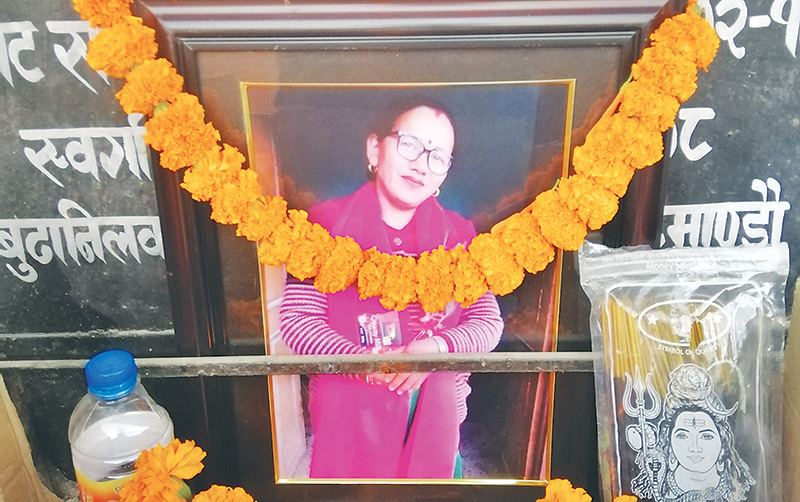
She was returning from a temple. Then a drunk driver killed her.

On Saturday morning, a 38-year-old woman was run over by a car with four passengers who were returning after a night of heavy drinking.
- SHUVAM DHUNGANA
Leela Devkota was killed while returning from a temple on Saturday morning. Post Photo: shuvam dhungana

Kathmandu,
Most Saturday mornings, Leela Devkota would be at a temple, circumambulating the gods and offering prayers. When she had finished, she would return home to Budhanilkantha before going about her Saturday.
This past Saturday, as she was walking along the footpath in Budhanilkantha on her way back from Sankata Temple in New Road, a grey Suzuki car careened onto her path. The car struck Devkota, before losing control and ramming into a utility pole.
According to locals who witnessed the accident, two men and two women emerged from the car as 38-year-old Devkota lay prostrate on the sidewalk. The two women went to a nearby shop to buy recharge cards for their phones while the two boys attempted a bizarre excuse.
“The two boys were trying to escape, saying they did not drive the car and that the driver had already fled,” said a neighbourhood butcher who witnessed the entire incident.
“However, when we confronted them, they confessed that one of them was the driver.”
The driver was 21-year-old Prithvi Malla, who locals said was so drunk that he could barely walk straight. The car was full of beer bottles and reeked of alcohol.
“The men were not even able to stand properly. We were wondering how he had even driven the car,” said a tailor who was also an eyewitness. “Police arrived after about 10 minutes and took the two men into custody. However, until then, the two women had already disappeared.”
The Post was unable to independently verify the identities of the two women who were in the car.
While police arrested Malla and 20-year-old Karish Maskey, one of the co-passengers, Devkota was rushed to the nearby Neuro Hospital. Moments later, she was pronounced dead.
Over the next 48 hours, the incident would explode over social media. While many were outraged at the irresponsibility of drinking and driving, others expressed fears that the perpetrators, who are from influential, wealthy families in Kathmandu, would get away with the crime.
On the morning of the incident, Malla and his friends were returning from a night of partying. Friends and acquaintances who know Malla from Kathmandu and his time in the United States describe him as a heavy drinker with an aggressive personality—and express no surprise at what happened on Saturday morning. Malla had a penchant for drinking and driving, two of his friends told the Post.
Malla had been in Kathmandu for just a few days, to spend winter vacation from his college in Florida. The night before the incident, Malla and his friends were photographed at an upscale nightclub in Thamel. An employee at Lord of the Drinks confirmed to the Post that Malla and Maskey were at the club between the hours of 11 pm and 12 am with two women. The women have been identified as Paramita Rana, a model, and Manisha Maharjan, who is a friend of Rana.

Prithvi Malla, 21, was driving the car that killed Devkota. A photo obtained by the Post shows Malla (second from right) and Maskey (left) at LOD nightclub on Friday night. Paramita Rana (third from right) and Manisha Maharjan (right) were seen with the two men that night.


According to police, Malla and three friends—police wouldn’t confirm the identities of the two women—arrived at the Green Valley Resort in Shivapuri at around 8.15 in the evening. It’s unclear whether the group left for the club after checking into Shivapuri. The park rules do not allow entry after 5 pm unless you are staying at the resort.
But when the Post approached the manager at Green Valley on Wednesday, he denied that the group had stayed at the resort.
“Malla, along with others, came here on Saturday morning and were heavily drunk,” said the manager who refused to provide his name.
“They were loud and using foul language and we were worried it would disturb other guests, so we offered them an outside table. They left within 20 minutes.”
But the police’s recorded statements from Malla and Maskey contradict the resort staff’s statement. Green Valley Resort is located inside the Shivapuri National Park and all vehicles that enter the park need to sign in at the entrance. According to the log, Malla entered the park on December 13 and checked out on December 14. Both men admitted during police interrogation that they spent the night at the resort.
“Records show that Prithvi Malla, accompanied by three others, entered the park at 8:15 pm on December 13,” said Sundar Thapa, a Shivapuri National Park officer. “Even if they were drunk, we are not authorised to take action against them, so we allowed them to enter after filling in all the required information.”
Since the incident on Saturday, people have posted hundreds of comments on social media, highlighting the contrast between Malla’s high-profile and well-connected family background and Devkota’s humble life.
Devkota, who had moved to Kathmandu from Gorkha nearly a decade ago, had been working at a pashmina factory in Dulal Gaun, earning Rs20,000 a month.
“She has been working in the factory alongside her husband for around 10 years,” said Rashmi Karki, one of Devkota’s colleagues. “She was always a very cheerful person.”
Devkota, who has three daughters and a son, lived in a rented apartment in Budhanilkantha with her family. Her eldest daughter is married while two others are in college, one in Japan and the other in Kathmandu. Her son is currently in the eighth grade.
“Everything was going so well,” Ram Kumar Devkota, her husband, told the Post. “Both of us worked as it was difficult for me to provide for the family and pay the rent by myself. When I got the call from the police, I was shocked.”
On Wednesday afternoon, Ram Kumar and other family members were in mourning at a temple in Machha Pokhari. Ram Kumar was visibly angry as he recalled his wife and her death at the hands of reckless young men.
“People like Malla should be in jail for life as the incident could happen to any other person in the future,” said Devkota’s elder brother.
“Pedestrians don’t feel safe walking on the road due to people like Malla. We are hoping that the police will take strict action against him.”
According to police sources, Malla does not hold a Nepali driving licence. Police said it did not obtain other forms of driver’s license from Malla on Saturday.
“Malla is in custody while his friend has been released as we can only charge the driver, not passengers,” Deputy Superintendent Umesh Lamsal, chief of the Maharajgunj Metropolitan Police Circle, told the Post. “Although his friends and family visit him often, there’s been no pressure from the Malla family to release him. We are conducting further investigations into the case.”
The police are pursuing a case of vehicular homicide, which according to Article 161 (2) of the Motor Vehicles and Transport Management Act, carries a jail term of two to 10 years.
“We have been in mourning since the accident,” said Ram Kumar, “and so far, we have not received any offers of compensation.”

Page 2
MEDLEY

Horoscope

ARIES (March 21-April 19)
**
Do you have a full load to carry today? Have no fear! The best way to get a lot done today is by asking other people for help. Sure, it seems like an obvious idea, but reaching out for a helping hand is not exactly something you enjoy doing. You’re a bit too proud sometimes, aren’t you?


TAURUS (April 20-May 20)
****
Right now, the colourful cast of characters in your life is incredibly entertaining—so why not put together some sort of fun social event? Skip the idea of hosting a party—instead, put together a group picnic or a dinner out. Socializing over food will help everyone get to know one another in a relaxed, unhurried way.


GEMINI (May 21-June 21)
***
Your finances might be a bit up in the air right now, but there is little you can do to control the situation. Rather than letting yourself get nervous about your money situation, just play it safe. It’s good to get in the habit of tightening your belt because there’s a chance that you will come across a great opportunity.


CANCER (June 22-July 22)
***
You know more than you think you know, so don’t let anyone keep you from saying what you think about a certain political situation today. They can’t intimidate you anymore, because the universe is going to wake up your inner warrior. This is a good day to be assertive about what you think, what you want, and what you expect.


LEO (July 23-August 22)
***
Most of what you were planning to get done today is already done, so keep your day at an easy, controlled pace. You’ll get into a nice rhythm and be able to get in some quality time with a couple of your favourites. There are a few new developments in a loved one’s life that you are not aware of yet.


VIRGO (August 23-September 22)
***
Striving to attain a perfect balance in your life is a good idea, but in the end, it may be futile. Certain things will always come before certain other things, and there is no getting around that. Sometimes, whether you like it or not, you have to prioritise. Separate your personal life from your career.


LIBRA (September 23-October 22)
**
Small but numerous scheduling conflicts will push you very close to the edge today—but not over it. Your flexibility will come to the rescue yet again, enabling you to roll with all the punches and juggle the various demands that come your way. You won’t even mind giving a little bit more than everyone else.


SCORPIO (October 23-November 21)
****
Today is a very good day for you to get the results you try to achieve. So, early this morning, you should pick a goal and stick to it—by tonight, you will come as close as you possibly can to reaching it. It can be as simple as getting that new person to smile at you, or as complex as finding the love of your life.


SAGITTARIUS (November 22-December 21)
***
When did you get the idea that having doubt in your life was a bad thing? Sure, it might cause you to pause your progress right in the middle of a nice groove, but questioning where you are going is always a healthy thing to do. So don’t hesitate to check yourself today. Do a bit of a review of how you’re feeling about things.


CAPRICORN (December 22-January 19)
**
Before the late afternoon, a rather shocking announcement will stop everyone in their tracks. And while other people may be overreacting to the situation, you might be under-reacting—and you do need to take this seriously. You’ll need to talk things out with people in order for everyone to regain balance.


AQUARIUS (January 20-February 18)
***
Getting more exercise is a lot easier than you might think—and it can be a lot of fun. All you have to do is get started, and then keep on going! The universe is sending some motivation your way, in the form of either a burst of can-do energy or an unbelievably cheap deal at your local gym.


PISCES (February 19-March 20)
***
Highbrow types of art and literature are much more accessible to you right now, and your mind is intrigued by the idea of flowery prose and intricate poetry. Take some time today to check out some poetry—whether by visiting a couple of poetry websites or re-reading song lyrics without the music in your mind.

Page 3
NATIONAL

Nepali migrant workers continue to remain exploited and ill-informed about their jobs

Survey finds people are still paying hefty sums for foreign jobs against the government policy of Free Visa and Free Ticket.
- CHANDAN KUMAR MANDAL
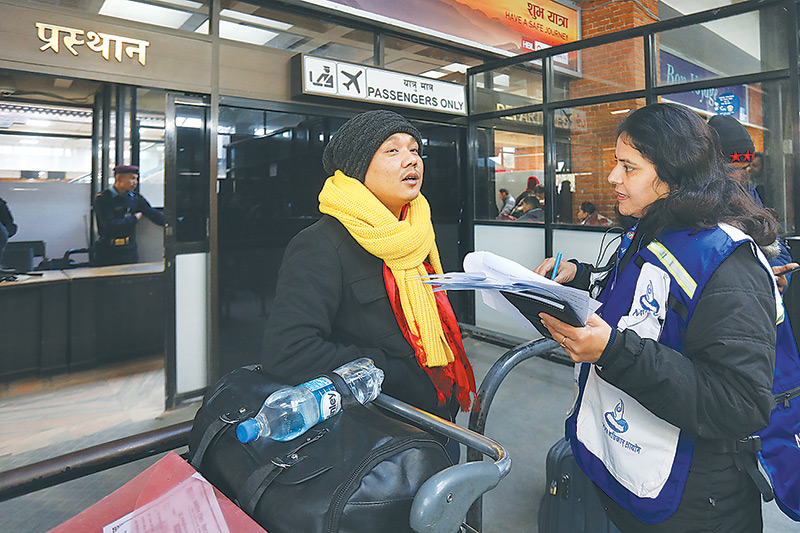
A National Human Rights Commission worker poses survey questions to a migrant worker at the Tribhuvan International Airport in Kathmandu on Wednesday. Post photo: Elite Joshi

KATHMANDU,
Kul Bahadur Gurung recalled paying Rs 225,000 for a taxi driver job in Abu Dhabi. However, it was in 2014 when Gurung, originally from Nawalparasi district, migrated to work abroad.
After five years, when he was in Nepal, he hoped that things for migrant workers might have changed for the better. But he found things were still mostly the same for the tens of thousands of Nepali workers like him, who leave the country for jobs.
“I had paid a hefty amount for my job five years ago,” Gurung told the Post at the Tribhuvan International Airport while returning to work in Abu Dhabi, the capital of the United Arab Emirates. “Many of the friends who have been working with me are still paying huge amounts of money for the jobs which are freely available. Hardly five percent has changed in reality in the last five years.”
The random monitoring by the rights watchdog, coinciding with the International Migrants Day, at the country’s sole international airport once again revealed everything wrong and prevalent in the country’ foreign employment sector, plagued by mismanagement and exploitation of workers.
Nepali workers, going for overseas jobs, continue to remain exploited and ill-informed about foreign employment.
During the survey on Wednesday morning, most of the workers were found paying hefty sums of money to manpower agencies and their sub-agents against the government policy of Free Visa and Free Ticket, barring recruiting agencies from charging more than Rs10,000 for their services.
“I had to pay Rs100,000 to a recruiting agency for a job in Saudi Arabia,” said Ramesh Gurung, who is from Chitwan.
Many of these workers, who were en route to various labour destination countries, admitted that they did not currently have the job contract paper that they had signed with the employer. Nor many of them were informed about the facilities they were promised in the agreement and agencies to reach out in case of help needed or left stranded abroad.
“I neither know where to seek help in case of a breach of contract nor will I complain,” said Suresh Sah, a migrant worker from Sabaila Municipality in Dhanusha. “I will simply continue working because I have invested money for the job, and I need to earn so that I clear my loans.”
Cheating of Nepali migrant workers by recruiting companies and their agencies by overcharging for jobs abroad, and providing different jobs, remuneration and facilities than that promised in the original work contracts are rampant. However, their ordeal does not end at home.
Once they take up jobs in foreign countries, unsafe and exploitative working conditions await workers, leaving them injured, vulnerable to occupational diseases and at times dead.
A majority of the workers screened at the airport before departure also lacked enough information on local laws, language, religion, culture and other rules of the countries where they would be working for the next few years.
The human rights body conducted the monitoring to see how aware migrant workers are about their rights, whether they were hired under ethical recruitment practices, possess the documents and how the airport authority behaves with migrant workers.
The Commission found that while the majority of the workers were migrating without any skill training, the free visa and free ticket policy was far from being implemented.
“Management and security have significantly improved at the airport in comparison to previous years,” said Sudip Pathak, a member of the National Human Rights Commission, Nepal. “The rest of the things regarding workers’ awareness of their rights, security and hiring process remains mostly unchanged.”

NATIONAL

Three years of inaction raises doubts if the transit deal with China will ever materialise

Despite Nepal notifying the Chinese about the readiness of its transit preparations in July, China has yet to respond.
- ANIL GIRI
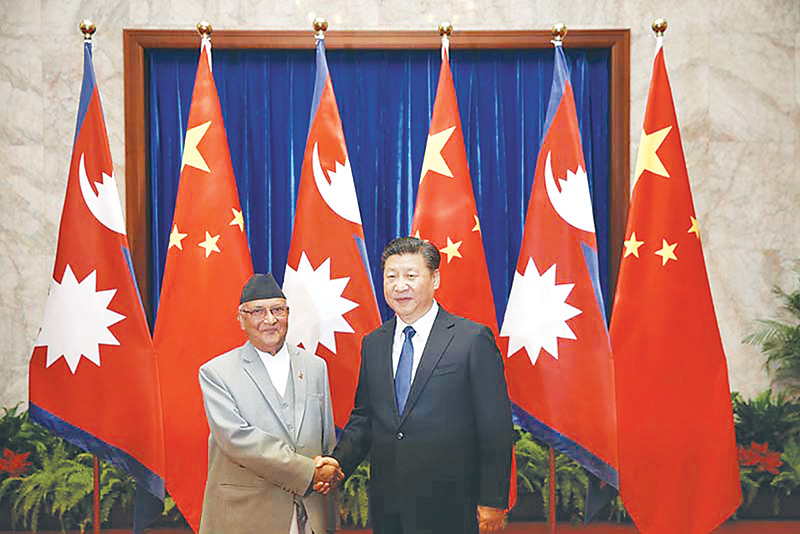
Prime Minister KP Oli shakes hands with Chinese President Xi Jinping in Beijing, China, in 2016, the year Nepal and China signed the Trade and Transit Agreement. AP

KATHMANDU,
When Prime Minister KP Sharma Oli signed the Trade and Transit Agreement with China in 2016, it was heralded as a major step in Nepal’s attempts to break free of its dependence on India. The agreement, when it came into effect, would provide Nepal with access to four seaports and three land ports in China for third-country trade.
More than three years later, there has been no movement regarding the agreement, giving rise to concerns that the agreement might never be implemented.
In order to implement the agreement, Nepal and China had signed the protocol on Nepal-China transit, during President Bidya Devi Bhandari’s visit to the northern neighbour in April. The protocol requires both sides to ready their infrastructure and officially notify each other. Nepal duly notified China in July that all preparations were complete but China has yet to respond.
“We have yet to receive confirmation from China regarding the protocol,” Baikuntha Aryal, secretary at the Ministry of Trade and Commerce, told the Post over the phone from New Delhi, where he is taking part in a trade and transit meeting. “Once China notifies us, we are prepared to receive some cargo from Chinese seaports up to the Nepal border.”
According to two Nepali officials based in Beijing and Kathmandu, China’s delay can be attributed to the involvement of multiple Chinese agencies who need to coordinate to provide clearance for Nepal to use the Chinese sea and land ports. The Chinese are also concerned about the status of infrastructure on the Nepal side, said the officials.  
But according to Nepali diplomats and experts who negotiated the transit agreement with China, there are numerous problems with the agreement itself, especially the lack of clarity in its text.
“If Nepal and China really want to implement the protocol, they will first have to amend the protocol,” said former commerce secretary Purushottam Ojha. “The protocol fails to describe the modality of export and import of goods from third countries via Chinese sea and land ports. A lot of issues have been left up to the Chinese customs to handle.”
A lack of clarity over these preconditions means Nepal has been unable to bring in a sample consignment from Chinese seaports. And without a sample consignment, importers do not know how much time it will take to bring goods from the nearest Chinese border, the cost of the consignment and what procedure and modality Nepali importers need to follow.
The transit agreement has also been overshadowed by other bilateral issues, including projects under the Belt and Road Initiative (BRI), especially the cross-border railway.
The protocol was listed as part of the Nepali agenda during Chinese President Xi Jinping’s visit to Nepal in the second week of October and Chinese Foreign Minister Wang Yi’s visit in September, said officials. The Ministry of Trade, Commerce and Industry has also been taking up the issue with the Chinese side ever since Nepal notified China regarding the protocol.
Former Nepali Ambassador to China Mahesh Maskey, who did extensive work on the Transit Agreement with China in 2016, said that several important issues like transit protocol, petroleum imports from China,
and establishing a cross-border economic zone along the border have all been overshadowed by projects under the BRI.
“The agreement could have political significance but what will we gain? What measures have we taken to reduce the widening trade gap with China?” said Maskey. “We convinced China to sign the agreement, we pushed them. But we haven’t built a blueprint for the future course of our ties.”
The protocol, once it comes into effect, will allow Nepal to access four Chinese seaports—Tianjin, Shenzhen, Lianyungang and Zhanjiang—and three land ports—in Lanzhou, Lhasa and Shigatse—for third-country trade.

NATIONAL

Already struggling to cope with malnutrition, Nepal now faces a new burden: Obesity

Nepal Demographic Health Survey of 2016 found that 36 percent of children under the age of five years were suffering from chronic malnutrition.
- Arjun Poudel
shutterstock

KATHMANDU,
A few weeks ago, six-year-old Kushal Ghale and eight-year-old Kajal Ghale were discharged from a nutrition rehabilitation home in Lalitpur.
The Ghale siblings, who come from a small village of Rorang Rural Municipality in Dhading, were referred to the rehab home after they were diagnosed with moderate acute malnourishment by doctors.
Kushal, who was supposed to be at least 15.2 kg to 16.5 kg as per his age and height, was 13.4 kg and his sister, who was supposed to be weighing 19.9 to 22 kg as per the World Health Organization’s protocol, was only 16.8 kg.
“It was too tough for us to feed homemade food to the siblings in our rehab home,” Sunita Rimal, coordinator of malnutrition prevention and treatment programme of Nepal Youth Foundation, told the Post. “We discharged them after 20 days, when Kushal weighed 14.7 kg and his sister Kajol weighed 18.7 kg.”
According to the World Health Organization, many low- and middle-income countries like Nepal are now facing a “double burden”—under-nutrition as well as a rapid upsurge in obesity-related cases, particularly in the urban areas.
The UN health agency said children in low- and middle-income countries are more vulnerable to prenatal, infant, and young child inadequate nutrition. At the same time, it said that children are being exposed to high-fat, high-sugar, high-salt, energy-dense, and micronutrient-poor foods, which tend to be not only lower in terms of cost, but also in nutrient quality. These dietary patterns, in conjunction with lower levels of physical activity, result in sharp increases in childhood obesity. Meanwhile, the undernutrition issues remain largely unsolved.
According to Rimal, the father of the siblings is employed abroad for the past several years. Their mother runs a small grocery shop. Both father and mother give the children money to spend on food. The mother did not object when her children insisted on processed foods, which made them dependent on unhealthy food items.
“Finally, the children stopped eating food cooked at home, which made them malnourished,” said Rimal. “On the other hand, the number of obese children is rising significantly due to their excessive consumption of unhygienic and junk food.”
The country, which has long been struggling to mitigate malnourishment problems, now has to deal with obesity and junk food problems simultaneously, as the use of junk and processed food has become rampant across the country.
“Children are either malnourished (due to lack of food to eat) or overnourished (obese) due to overeating of unhealthy food,” Dr Atul Upadhyay, project coordinator at Helen Keller International told the Post. “People relate obesity to being healthy, which is wrong. These are symptoms of nutrition-related problems.”
A recent study carried out by Helen Keller International shows that Nepali children are getting a quarter of
their calories from junk food. While over-consumption of junk food is often associated with obesity, the study found links to malnutrition and stunting as well.
Researchers from Helen Keller International did a study on families of 745 children throughout the Valley,
testing nutritional effects of snack consumption. Published in the Journal of Nutrition last week, it found a host of factors strongly associated with stunted growth and malnutrition.
The study found that junk food contributed to nearly half of some youngsters’ diets, and those with higher intake of unhealthy snacks were less nourished than those with lower intakes, and they were more likely to be shorter in terms of height.
Experts blamed easy access of processed foods, their cheaper prices, enhanced taste, rise in the number
of working mothers, which prevents them from cooking healthy food at home, for the rise in the number of
malnutrition and obesity cases.
Similarly, the behavioural factor—such as excessive consumption of cakes and pastries, not doing physical labour in urban areas—is equally responsible for the rise in obesity-related problems.
“Earlier we used to think that malnutrition problems are associated with poverty, but it is rampant in children of well-off families,” said Upadhyay. “People often relate obesity with good health, which is a misconception. Obesity leads to chronic diseases.”
Upadhyay said that the government has to relay a strategic message to the public about the excessive consumption of junk food and its consequences. “At the same time, a regulatory authority should be set up to
regulate unhealthy food items,” he added. “The time to take action has come.”
Kedar Prasad Parajuli, chief of the nutrition section at the Family Welfare Division under the Department of Health Services, said the coordination among several government ministries and other stakeholders is needed to deal with the nutritional issues.
“Separate agencies work on the import, production, quality monitoring, marketing and others,” said Parajuli. “Without coordination of all stakeholders, we can do nothing. We have been working on the awareness part.”
Malnutrition is brewing into a silent crisis for Nepal. According to the Nepal Demographic Health Survey of 2016, 36 percent of children under the age of five years were suffering from chronic malnutrition, while 10 percent suffered from acute malnutrition. Another 27 percent of the children were underweight and one percent overweight, the study found.

Page 4
NATIONAL

Local units face shortage of office space, but federal help not forthcoming

The federal government is still in the planning phase of developing building designs and standards.
- PRITHVI MAN SHRESTHA
Eighty percent of rural municipalities across the country do not have their own office buildings, according to the National Association of Rural Municipalities in Nepal. post file photo

KATHMANDU,
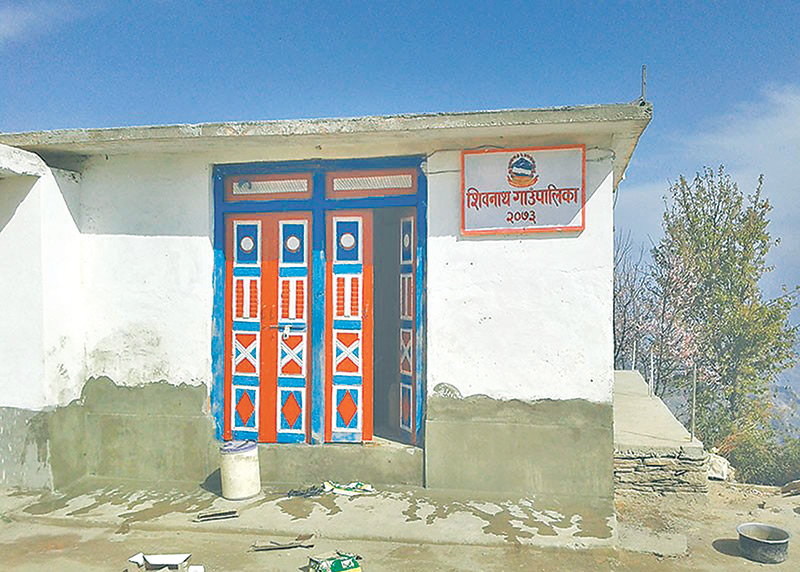
Mangsebung Rural Municipality in Ilam has been facing a shortage of office space. The rural municipality carries out all its operations from a single building, which is barely enough to accommodate all office departments, according to the officials.  
Several departments under the office are carrying out their duties from inside the same room even though the office building of the erstwhile village development committee was recently upgraded into a three-storey building.  
“We are operating from eight rooms of the building to run the administrative works of the rural municipality. We do not have enough space to accommodate all the offices,” said Dilli Ram Subedi, chief administrative officer of the rural municipality. “We have even rented an old house to set up some of the offices, and yet we need more space to accommodate several other departments.”  
The rural municipality has been looking for an office space to rent, but there are no decent buildings around.
The lack of office space is a problem that most of the rural municipalities across the country are facing at the moment, according to Bimal Pokharel, executive director of the National Association of Rural Municipalities in Nepal.  
According to the association, around 80 percent of the rural municipalities do not have their own office buildings.
“Those rural municipalities with their own buildings are also facing the shortage of office space,” Pokharel told the Post.  
Only 54 percent of the local governments have their own buildings to run administrative works, according to Nepal Federal Capacity Needs Assessment Report published in August.
The assessment was carried out by the Ministry of Federal Affairs and General Administration in collaboration with the World Bank and the United Nations Development Programme.  
Following the report’s findings, the federal government had announced a plan to help the local governments build their administrative buildings, but not much has come of it so far.    
“We are still in the planning phase and we have developed some building designs and standards,” said Bhupal Baral, spokesperson for the ministry.  
He added that the federal government will also share the cost of the adminstrative buildings on partnership modality.  
For this, a working procedure is being drafted which will determine how much burden the centre will share in building the office buildings for local governments.
Though the ministry had drafted the working procedure last year, it has not been finalised yet.
In the working procedure, the federal government has proposed sharing the financial burden of 70 percent to build the administrative buildings for local governments.
As per the draft,  a maximum of Rs150 million could be spent to construct an office building for a metropolitan city and Rs 50 million for a rural municipality.
Similarly, a maximum of Rs15 million could be spent to construct a ward office building of municipality and maximum Rs 10 million for a rural municipality.
Baral said that the ministry was finalising the working procedure which would soon determine the construction cost.
Last year, the ministry had said that around 350 of the 753 local governments require new office buildings to perform their routine administrative works smoothly.

Page 5
NATIONAL

Elderly, people with disabilities, women deprived of state grants

They have been protesting in front of rural municipality office for the past two days.
- BHARAT JARGHAMAGAR
More than 1,200 people in the district have been deprived of the social security allowance for the last 12 months. Post Photo: bharat jarghamgar

SIRAHA,
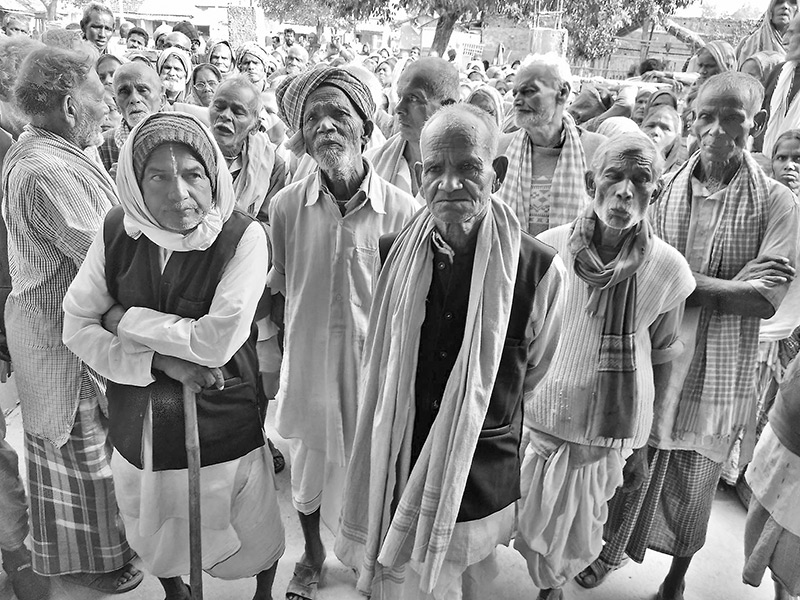
More than 1,200 senior citizens, people with disabilities and single women in Bhagawanpur Rural Municipality in Siraha district have been deprived of the social security allowance owing to the sheer negligence of the local unit.
The elderly people, people with disabilities and single women of the entire local unit have not received the monthly allowance for eight months of the last fiscal year of 2018/19. The budget was frozen because the rural municipality failed to distribute the amount to the beneficiaries on time.
“They have not given us our allowance for eight months of the last fiscal year. The local unit has to give us allowance for 12 months in total by the end of Kartik (mid-November). We have received an allowance of only four months,” said Siltu Yadav, 76, of Naraha. Demanding that they be provided with the allowance of the missed eight months immediately, senior citizens, single women and the people with disabilities have been staging a sit-in in front of the rural municipality office in Bhagawanpur.
On Wednesday, around 300 senior citizens and single women attended the protest programme. They also submitted a week-long ultimatum at the office of the rural municipality. They warned of padlocking the office of the local unit if their demand was not addressed.
The government, through the annual budget, increased the elderly allowance to Rs 3,000 per month from the current fiscal year. Earlier, senior citizens, those above 70 years of age, were entitled to Rs 2,000 as monthly social security allowance.
Dhyani Paswan, 73, of Thadi was at the protest venue. He said he was compelled to join the protest because it has become difficult for him to meet his expenses without the allowance. “We are poor. My wife and I live with our grandson. We somehow eke out a living with the allowance. But since the employees held back our eight months of allowance, we are in a rut,” said Paswan.
Sujit Kumar Yadav, chief administrative officer of the local body, said the budget allocated under the social security allowance was frozen as it was not distributed within the last fiscal year. “The rural municipality could not distribute the allowance due to a shortage of employees. The delay in holding the village council was also one of the reasons for our inability to distribute the budget,” he claimed. According to him, the rural municipality has requested higher authorities to allocate the necessary budget for the same.

NATIONAL

Impoverished families in Sarlahi depend on hay to combat the cold

The westerly wind and the cold wave have adversely affected impoverished settlements in Sarlahi.
- OM PRAKASH THAKUR
Some Musahar families have resorted to using hay-stacked mattresses to keep themselves warm in the winter. Post Photo: Omprakash Thakur

SARLAHI,
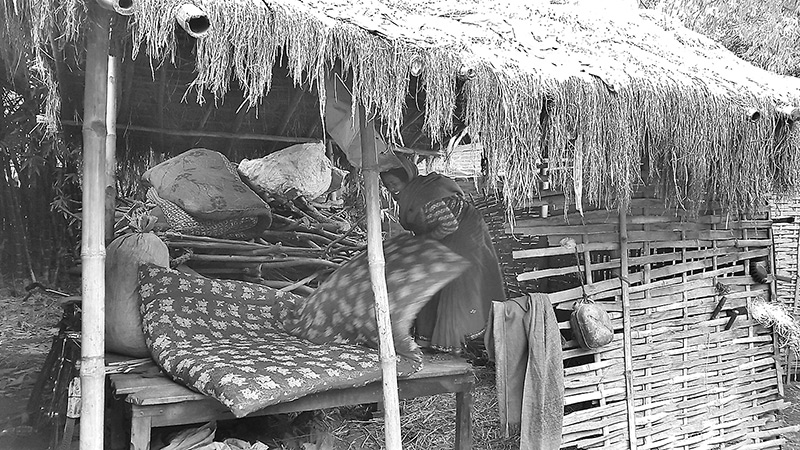
For 45-year-old Sevatiya Malli, letting a bundle of hay to dry in the sun has become her routine these days. With the winter deepening, Malli’s family has been using hay for bedding to insulate the sleeping area in their home. But after a night’s use, the hay gets damp and has to be dried in the sun before it is re-used.
Many marginalised Musahar families like Malli’s are not
financially secure to be able to prepare for the winter so they make blankets out of the most easily available resource—hay. “To beat this year’s cold we have devised a trick, to store the hay in jute sacs and use it for blankets and bedding.”
Every year, the winter, and the westerly wind and cold wave that it brings,  adversely affects the most impoverished settlements in Sarlahi, like the Musahar and Dom communities. As in previous years, the most worrying aspect of winter for these people is the lack of warm clothes and shelter. So like last winter, this year too they are relying on hay beds to stave off the cold off, as their bamboo-fenced houses do not do much to keep the howling cold wind out, according to Malli.
“While we somehow see through December-January first week, the cold wave and westerly wind will get harder when January comes to a close,” said Malli, whose family lives in a small hut made in a public space by the Lakhandehi River. “The cold has increased surprisingly in the past couple of days. Our only remedy for the cold is hay.”
Last year a few organisations had distributed blankets but for a lack of space to keep them, they have been damaged by mice, Pushani Devi Majhi, another local, said. “We can’t buy proper clothing and don’t have a house that resists cold,” she said. “For the time being, we need to make the best use of hay.”

NATIONAL

Local unit goes without chief administrator

- JYOTI KATUWAL
The office, which was reeling under pressure for lack of technical staff, has become severely affected since the departure of the last chief administrative officer. Post Photo: Jyoti Katwal

DAILEKH,
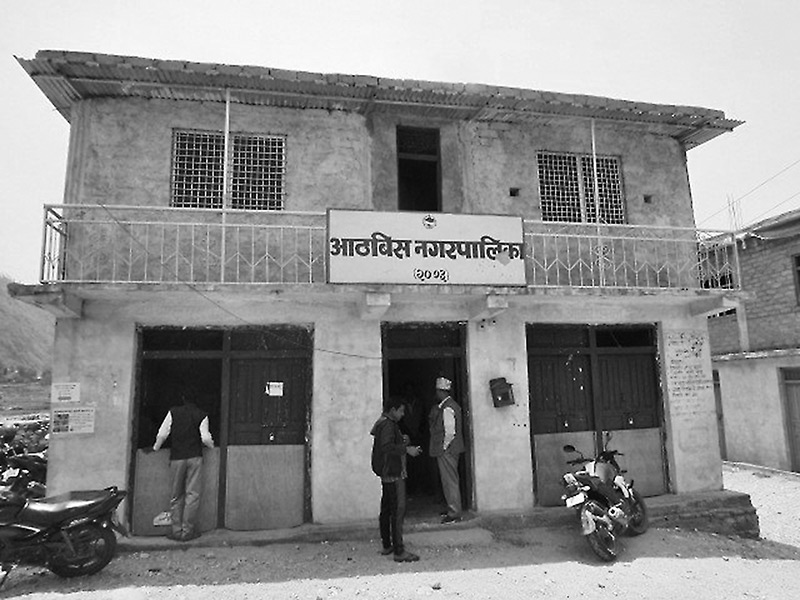
Daily administrative and development works of Aathabis Municipality in Dailekh have come to a halt in the absence of the Chief Administrative Officer for the last one and a half months.
The locals say that the office, which was reeling under pressure for a lack of technical staff, has become severely affected since the departure of the last Chief Administrative Officer, Kulraj Subedi.
Man Bahadur Shahi, a local, said that the people’s representatives instead of seeking solutions to the vacuum created by several vacant administrative posts in the office are engaged in disputes among themselves. “The local representatives are busy in political bickerings, and haven’t put any effort into helping solve the crisis the municipality faces,” he asked.
According to him, locals such as himself are facing hardships while receiving government services due to the absence of ward secretaries in ward offices.   
“Even the employees who arrived in the local unit after employee adjustment have not started their works citing the absence of the chief administrative officer,” said Gokarnanath Yogi, acting chief administrative officer, who is also the chief at the education department of the municipality.  
Since the transfer of Subedi, the government has not sent another official to fill the vacant post. There are 47 posts for permanent employees and 14 for temporary employees in the municipality. “But currently there are only 27 employees (who have been appointed on contract basis) and 14 permanent employees. Most of the works have come to a halt, as there’s no one to execute the work,” said Yogi. The Chief Administrative Officer is responsible to handover authority to his subordinates.
In the current fiscal year, the municipality has allocated a budget of around Rs 430 million for administrative and development works. The municipality has spent Rs 9.3 million under general expenditure whereas the capital expenditure budget remains untouched even five months into the current fiscal year. Yogi said that they haven’t been able to utilise the budget on time due to the vacant post of the Chief Administrative Officer. “The Chief Administrative Officer is the only one who has the right to mobilise the budget,” he said.
The municipality has selected around 300 development projects in the current fiscal year. But all of those projects have been unattended.
The municipal office has seen multiple instances of padlock due to interference from people representatives affiliated to different political parties who use the office as a means to push their political agenda forward, said Yogi. Khadkaraj Upadhayay, mayor of the municipality, however, said “We cannot work as expected due to the employees’ non-cooperation. We are tired of their behaviour. There are no ward secretaries in most of the wards. Because of this, locals are facing hardships while receiving government services and development projects have been left unattended.”

NATIONAL

Child mortality rate is still alarming in Palpa

- MADHAB ARYAL

PALPA,
Chandra Bahadur and his wife Laxmi lost their 49-day-old son on November 29. The residents of Somadi Tangsial in Palpa had taken their baby for vaccination to a nearby health camp.
“He cried all the way back home after receiving vaccination and a polio drop,” said Laxmi. “He died the same night.”
The parents did not make much of the baby crying, thinking that it was “normal” for babies to cry out in pain after vaccination. “We did not take him to a health post because we thought he was doing fine,” said Chandra Bahadur.
According to Laxmi, a health worker at the camp had administered four different vaccinations—BCG, PCV, FIPU and DPT—and polio drops to the infant.
Laxmi had her delivery in Mission Hospital in Tansen. Her 49-month old child was her eighth and was born prematurely. The newborn had been kept in the Neonatal Intensive Care Unit at the hospital for 28 days before he was discharged.
Dilip Prasad Mahato, chief at Somadi Health Post, said the infant’s death was unusual. “A newborn has to be monitored carefully for 24 hours after receiving a vaccination. Laxmi’s son was born prematurely, which could mean that he might have been born with medical problems,” said Mahato.
Despite launching various programmes, including immunisation, safe motherhood and nutrition, the child mortality rate is still alarming in Palpa district.
According to the data available at the Health Office in Palpa, 19 children below the age of 28 days died in 2016/17 while the total death of children under five years of age in the same fiscal year was 44. The figure was 22 and 35 respectively in 2017/18. In the fiscal year 2018/19, nine infants under the age of 28 days died while the total death of the children below the age of five was 15.
The child mortality rate in the first three months of the current fiscal year 2019/20 has raised concerns among health officials in the district. According to Om Prakash Panthi, the immunisation officer in the district, nine infants died within 28 days of birth while the total death of children below five years of age was 12 in the first three months.
According to him, respiratory problems, pneumonia, heart ailments, malnutrition, amentia and diarrhoea are the major reasons behind the death of infants in the district.  
Bishwanath Neupane, acting chief at the Health Office in Palpa, admitted that efforts have fallen short when it comes to controlling infant mortality rate in the district. “People in remote villages are not educated and therefore are not aware of public health issues. We haven’t been able to penetrate remote areas, and our
drives haven’t been effective in controlling infant mortality rate,” said Neupane.
Villagers in the remote areas of Palpa do not have easy access to health care services. They have to walk as long as five hours to reach the nearest health facility, which might have contributed to the alarming rate of infant mortality in the district. “We will coordinate with the local units and launch various programmes in remote areas,” Neupane said.
According to the National Demographic Health Survey-2016, the neonatal mortality rate in the nation is 21; the infant mortality rate is 32; and the under-five mortality rate is 39.

NATIONAL

Three held with arms

Briefing

RAUTAHAT: An Armed Police Force team arrested three persons, including a former policeman, in possession of arms from Rajpur in the district on Tuesday night. Umeshwor Yadav, Chhotelal Sah and Ramadhar Sah were held with a pistol and two bullets, said police. Yadav is a former police personnel.

NATIONAL

NRA to build 21 health posts

Briefing

DHANKUTA: The District Project Implementation Unit of the
National Reconstruction Authority has started construction of 21 health posts with a total budget of Rs 610 million in various parts of Dhankuta, Sankhuwasabha and Bhojpur districts. For the first phase, the construction of nine health posts has been initiated, said Thirendra Dahal, chief at the unit.

NATIONAL

Five held on charge of abduction

Briefing

MAKWANPUR: The District Police Office arrested five people on the charge of kidnapping Naresh Thapa Magar, 21, of Doramba in Ramechhap from Hetauda.
According to police, the group of kidnappers had abducted Magar on Wednesday morning and demanded Rs 100 million ransom from the victim’s family. One of the kidnappers is at large, said police.

NATIONAL

Rukum section of Rapti Highway to be upgraded

Briefing

RUKUM (WEST): Division Road Office in Chaurjari is going to upgrade the Rukum section of Rapti Highway. Travelling along the highway was risky due to multiple potholes and cracks along the road section. The office had allocated Rs 210 million for the upgradation of the 31km of the road.

NATIONAL

Man held for offering bribe to police officer

Briefing

POKHARA: Police arrested Jaharuddin Miya who attempted to bribe a police officer to smuggle oxen in Waling of Syangja district. Miya, a permanent resident of Rupandehi district, offered Rs 15,000 to the police inspector of Ward Police Office in Waling on Tuesday asking him to help smuggle the oxen.

Page 6
EDITORIAL

Sobering thoughts

It’s time to make our drink driving laws tougher.

On Saturday morning, a 38-year-old woman died when a drunk driver struck her with his car. The incident, which occurred in the early hours of Saturday in Budhanilkantha, has once again brought to the fore Nepal’s struggle with disincentivising drinking and driving. Even as the Nepal Police continues to nab people for driving under the influence—40,000 Nepalis have been booked for the offence in the first five months of this fiscal year alone—it is clear that people have not been discouraged from doing so. What is needed is a change in punitive measures—sturdier punishments that actually deter people from attempting to drive under the influence.
The biggest concern is that many Nepalis still believe it is acceptable to drive after drinking. A large number of people who are caught for drink driving—no matter the limit—shows how normalised this has become. In October, police caught 1,121 drivers (and riders) for the offence in five days preceding Dashain. The fact that many of them were travellers coming into or going out of the Valley, including public transportation drivers, points to how dangerous, far-reaching and casual driving under influence has become.
The killing of Leela Devkota on Sunday allows room for introspection and analysis. The driver and passengers had begun drinking at least from Friday evening. It was on the drive back from a resort the next morning that the driver ran over Devkota, who was walking on the footpath, before slamming the car into a pole. This tragic episode could have been entirely avoided had the other three passengers not been complicit in allowing the person to drive. While most who choose to drink and drive are adults, and therefore entirely culpable for their actions, far too often, family members and friends don’t intervene either.
This, once again, goes back to our culture of apathy. Nepalis have embraced the penalty attached with driving under the influence, locally called MaPaSe, and have also resolved to continue doing so. People, in public and private, brag about how they managed to trick the breathalyzer or skirt the rules. That is, until something like Saturday’s incident happens.
Beginning Friday night and going through Saturday, it is clear that the car drove through the Valley without encountering a single MaPaSe checkpoint. Herein lies the other problem. While MaPaSe checks are a ubiquitous part of Kathmandu’s nightlife, it is easy to skip them altogether. For one, checks usually occur between 8 pm and 11 pm, and only occasionally outside these times. For another, seasoned drunk drivers know the areas where the police lie in wait—and they take alternative routes. Several nightclubs in the Kathmandu Valley open till dawn, and there are no MaPaSe checks during the day time. There is nothing wrong with club culture—plenty of countries around the world have clubs that operate till early morning. But there is everything wrong with being able to get away with drink driving.
Ever since the MaPaSe campaign was launched in 2011, only 439 licenses have been suspended. The penalties for getting caught—a Rs1,000 fine and an hour-long lecture by the traffic police—are a slap on the wrist. What’s worse is that the same penalties apply for repeat offenders—for up to five times. Only after the sixth offence is the licence suspended, that, too, for a limited time. From a law enforcement standpoint, this is a trivial response to a very serious problem.
It is obvious that Nepal’s attitude towards drinking and driving needs uprooting. The change will be most effective with disincentives from the state. A three-strike system with progressively tougher sanctions, including jail time and driving bans, would make people think twice before they start their vehicles after a drink. Moreover, if the police want to put an end to drink driving, and not just use checkpoints as a cash cow, the checks must be random—both in time and geography.

OPINION

Poush 1: Day of ignominy and infamy

It should be a day of not just remembering the loss of democracy, but also of assessing its consequences.
- PRAMOD MISHRA
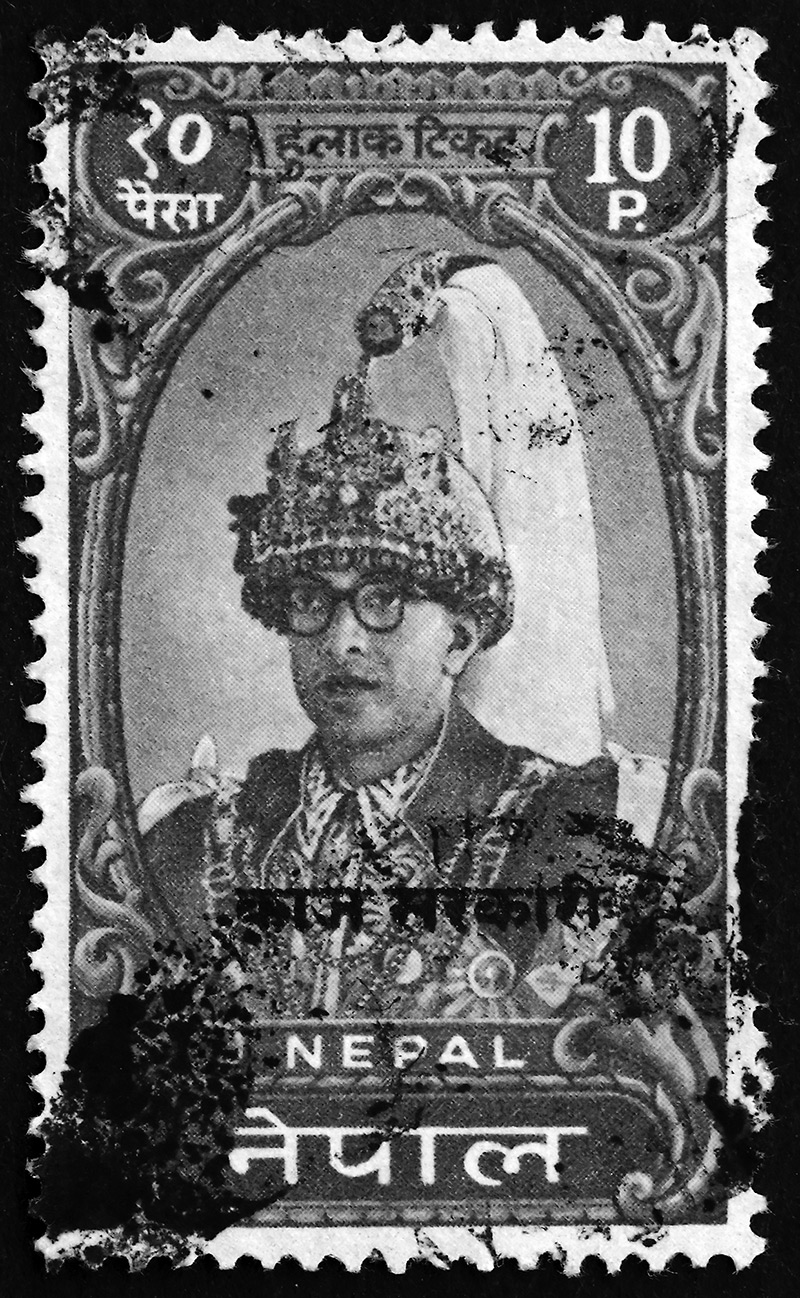
A stamp released in 1962, during the Panchayat Era, featuring then king Mahendra. Boris 15/Shutterstock.com 

Poush 1 comes and goes every December as a day of condemnation, complicity and euphemism. During the Panchayat years (1960-90), inaugurated by Nepal’s then king Mahendra on Poush 1, 2017 BS (1960) by dismissing the democratically elected government and Parliament, arresting the elected leaders and imprisoning them for years (or else co-opting others) and, most perniciously, imposing the one-dress, one-language nationalism on an extraordinarily diverse country. Well, after 30 years of struggle, Nepalis ended the Panchayat autocracy in 1990.
The culture of arrogance and modernised hill caste feudalism that the system developed over three decades culturally produced the Palace Massacre of June 2001, proving the adage ‘what goes around, comes around’ or that the chicken ‘comes home to roost’. The bloodshed that annihilated the royal family occurred because the palace thwarted the crown prince’s decade-long love to maintain a pure bloodline, and he nearly finished off his clan. The Panchayat system also produced the Maoist insurgency by suppressing the cultures and languages of the myriad ethnicities of a diverse country, thus cutting off structural access of these groups to the state and its power and privileges.


Abolition of monarchy
The end result of all this was the abolition of the monarchy. We can, therefore, say that king Mahendra committed political suicide by his autocratic move. But even more importantly, he ushered in a system of ethnic nationalism of hill castes whose language became the national language, relegating other languages to second class status; whose dress became the national dress, relegating other dresses to a derogatory status; and engineering mass migration of the hill population to the plains through planned deforestation, thereby skewing the demographics of the plains all over, but especially in the eastern- and western-most districts. This planned migration and imposing of language and dress has created enormous inter-ethnic toxicity between the hill castes and the rest of the population.
So, every year, the media either doesn’t say much or remembers the day as a day of ignominy and infamy for the killing of democracy and imposition of autocracy. But what the media doesn’t highlight is the structural and ideological consequences of those three decades on the people whose languages and cultures were marginalised.
So, when I was invited to speak at Martin Chautari, one of the oldest non-governmental research and discussion centres, on the state of education in the plains (Tarai-Madhes) on December 10, I accepted because education, its possibilities and failures, have been my lifelong academic preoccupation. What motivates families, parents and children to be educated? What impedes education? Why are some hell-bent on being educated and others drop out?
From Plato to ED Hirsch, educators and thinkers have grappled with these questions. While Plato believes in prescriptive and mandatory education, Rousseau and John Dewey advocate letting inclination and instinct (nature) take their course when it comes to education. But everyone, including Thomas Jefferson, one of the founding fathers of the United States, believes that democracy cannot survive without a literate population.
In Nepal, the Rana oligarchy (1846-1950) outlawed education for the public. The Panchayat imposed one-language education in a multi-lingual country, which continues today. In the short period between the end of Rana rule and today, literacy has increased enormously in Nepal. Yet, statistics collected in the 2011 census revealed that while the literacy rate of the geographically challenging hill districts increased tremendously, the literacy rate of the accessible plains districts has gone down. Why? This was the question I grappled during my presentation on December 10.
By citing Paul Willis and Richard Hoggart (both founder-members of Birmingham Cultural Studies along with Stuart Hall) in their works, Learning to Labour: How Working Class Kids Get Working Class Jobs (1977) and The Uses of Literacy (1957) explore the truancy and predicament of working-class kids in schools. Using their theories, I said that from a Marxist perspective, the low literacy rate in the plains is a form of collective resistance of the Other of the Nepali monolingual state to its one-language, one-dress structure and ideology because the collective unconscious of the plains knows that even if a token few may get into the state structure, there is no room or provision for the whole plains people in the Nepali state under the present dispensation.
In fact, village after village, the traditionally wealthy non-Nepali speakers of the plains have educated their kids and themselves in college, but after college graduation have found no entry into the state structure—some becoming school teachers but most sitting unemployed. The ideology and the structure that Mahendra imposed in 1960 may have finished his clan, but they have stood as a wall for the linguistically excluded people. Consequently, the more the illiterate in the population, the more the possibility for revolution. But, personally, I side with Dewey and Jefferson that in order for democracy to succeed, the voters need to be not only literate but educated.
But what we see instead happening every year in December is mourning the day when Mahendra’s Panchayat was imposed, but basking in the consequences that his system produced, that is skewed access to the resources and power of the state of the people.
What’s more, since last year, some topi-clad Nepalis have begun to celebrate Poush 1 as national flag day, using the national symbol to drown out the condemnation of the day of ignominy and infamy—the same way they have euphemised Prithvi Jayanti as national unity day, whereas king Prithvi remains a contested figure in contemporary Nepal.


Role of caste
In my presentation, I also mentioned that caste has played an enormous role along with the state because the Tarai Brahmins and Kayasthas still have a very high literacy rate, and was even higher than that of the hill Brahmins before 1970; but with the one-language discriminatory Panchayat ideology and structure taking root and producing its effect, the plains upper caste, too, have lost their edge.
So, in my view, the December day of ignominy and infamy should be a day of not just remembering the loss of democracy, but also of assessing its consequences—how more than two-thirds of the country’s population was marginalised systematically, and what consequences all this might bring for the future. In my walk around Durbar Marg in Kathmandu, I saw king Mahendra’s statue, damaged during the uprisings of 1990 and 2006, instead of being safely relocated to the Palace Museum, restored and standing tall, symbolising the present state of affairs of Nepal. As intellectuals, if we close our eyes to all this, we fail in our duties.

OPINION

How to prevent medical errors

Quality is an essential principle of a competent health care system.
- MUKESH ADHIKARI
Shutterstock

A few months ago, an ambulatory lady visited a reputed hospital in Chitwan for nasal surgery. She died right after the operation, prompting irate people to vandalise the hospital and manhandle the doctors accusing them of medical malpractice. Such incidents have now become common in Nepal. About two months ago, a serious example of medical error was observed at one of the reputed hospitals during the treatment of Rihan—a normal newborn baby—who had five head operations, hospital-acquired infection and a high dose of paracetamol followed by irreparable damage. If key stakeholders keep silent when such types of incidents occur, trust between doctor and patient will be seriously jeopardised, and the doctor’s dedication and motivation to treat a patient will diminish, hampering the overall quality of care.  
Every day, medical errors occur around the world. Medical errors are unintended results due to acts of omission or commission in the planning or execution of medical procedures. It is estimated that medical harm is the third leading cause of death in the United States. Moreover, a systematic review revealed that the overall prevalence of preventable patient harm was found to be 6 percent, out of which 12 percent was severe or leading to death. In Nepal, we severely lack data related to medical errors. Only fatal incidents are published in the media sporadically.
Some types of patient harm are unavoidable or inevitable for which almost nothing can be done with the available technology. For instance, a patient can get a severe anaphylactic reaction due to the intake of paracetamol—a commonly used medicine to control fever. The only thing we can do is reduce preventable medical harm to the utmost.
Going deeper into the reasons, the immediate causes are drug-related, diagnostic, medical procedure-related and healthcare-acquired infections; however, their underlying causes are more system-related: the people,
technology and tools involved, organisational values, and the structure in which the system operates. For example, the burnout of healthcare providers is one of the major causes of medical errors in the United States. Another potential aspect is miscoordination and miscommunication between patients and doctors and among healthcare providers. In the case of Rihan, the Nepal Medical Council proved the doctor’s failure in counselling, briefing and coordinating.
Although the patient and the family are the primary victims in case of medical error, doctors also suffer
significant mental stress and damage to their reputation, hampering their career. A study in the United States and Canada revealed that medical errors led to significant mental stress among the doctors who committed them. These effects, if not prevented, ultimately hamper the quality of care.   
Being multifactorial, the approach to mitigating preventable harm to the patient should be integrated. Throughout the world and especially in the context of Nepal, we have a severe shortage of records related to medical errors. To address this problem, it is imperative to collect and monitor data regularly. Proper recording and reporting can reveal the root causes of medical errors, prevent recurrence of similar events by using appropriate preventive measures and help to generate long-term strategies to improve patient safety. Recently, Nepal Medical Council issued a notice telling doctors to follow standard treatment protocol strictly and telling the public to seek legal remedy in case of medical error. This action is not sufficient to reduce medical errors. A proactive role is required to empower patients, healthcare providers, and health institutions.  
The provision of pharmacists at every hospital and proper counselling about medicines is crucial as medication-related errors are most common. Further, hospital-acquired infections can be prevented by strict adherence to infection prevention guidelines. From the perspective of doctors, work-life balance is equally important, especially to those working under high work pressure. To reduce burnout among healthcare providers, periodic breaks, refreshments, and skills to reduce stress can play a significant role.
Patients should be equally cautious about medical harm. Informing people about the hazardous effects of unnecessary use of medicines, diagnostic procedures and treatment interventions are highly needed. For this, the government and the concerned agencies should conduct awareness programmes at different levels. It is also necessary to educate patients about their right to redress when medical errors occur. Further, a conducive environment should be created so that patients can easily report to the concerned agency about medical errors followed by an unbiased investigation and legal action.   
It is the responsibility of patients, healthcare providers, the concerned agencies and the community to reduce medical errors. Quality is an essential principle of a competent health care system. This can only be maintained when an integrated approach is applied. Otherwise, medical errors and vandalisation of hospitals will be a regular feature rather than an exception.


Adhikari is a public health officer at the Ministry of Health and Population.

Page 7
OPINION

An ignoble nobel laureate

Aung San Suu Kyi’s refusal to stop ethnic cleansing begs the question: how noble are the peace laureates?
- QUAMRUL HAIDER
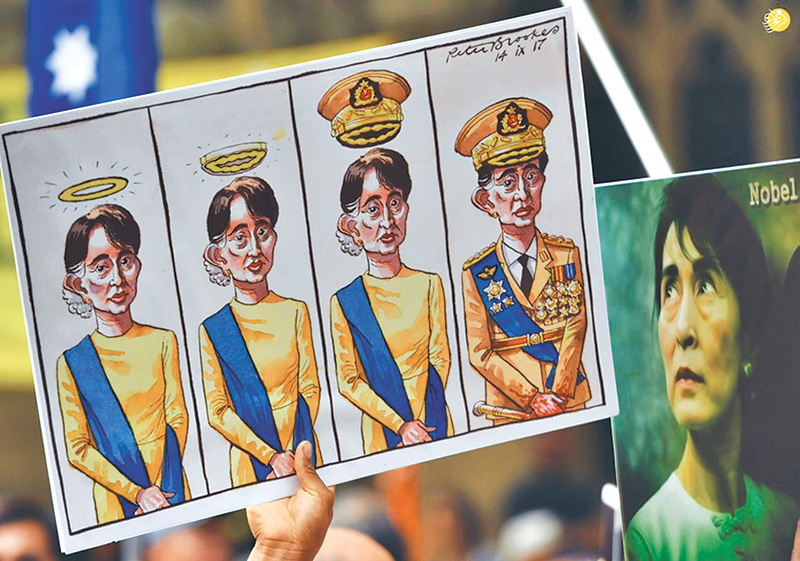
Aung San Suu Kyi, once garlanded as a global rights champion, has seen a sharp fall from grace. AFP/rss

After his death in 1896, the will of Alfred Nobel, the Swedish inventor of dynamite, established the Nobel Prize in the fields of Physics, Chemistry, Medicine, Literature and Peace. The prize is awarded annually to individuals and/or organisations (peace only) whose work ‘during the preceding year, shall have conferred the greatest benefit on mankind.’ Although it is considered to be the most prestigious award in the world, the noble purpose of the prize creates an odd juxtaposition with the source of the prize money, sometimes referred to as ‘blood money,’ because Nobel’s claim to fame and fortune came mainly from making and selling arms.
Since the first Nobel Prizes were awarded in 1901, peace prizes have been the most controversial of all the Nobels. The endless controversies surrounding the prizes stem not only from the ambiguity of the concept of peace, but also from the political motivations behind the selection of the recipients.
However, the 1991 Nobel Peace Prize winner Aung San Suu Kyi’s refusal to stop the genocide and ethnic cleansing of the Rohingya Muslims by her proxy government, the Myanmar army, begs the question: how noble are the Nobel peace laureates?
The list of peace prize recipients whose eligibility for the honour was questionable is long. Leading the pack of not-so-noble peace laureates is the former US Secretary of State Henry Kissinger, who spearheaded a series of secret aerial bombings in Southeast Asia that either killed, wounded, or made homeless an estimated six
million people. He also condoned the 1971 genocide in Bangladesh and was instrumental in toppling the Chilean President Salvador Allende in favour of the military dictator Augusto Pinochet. Nevertheless, he shared the 1973 prize with North Vietnam’s Le Duc Tho for ending the Vietnam War.
By honouring Kissinger with the peace prize, the Nobel Committee essentially rewarded a war criminal. Tho declined the award, accusing Washington of violating the truce, while two members of the Nobel Committee, who voted against Kissinger’s selection, resigned in protest.
Four years after sharing the Nobel Peace Prize with Egypt’s Anwar Sadat for their Camp David peace accord, Israeli leader Menachem Begin, once a member of the terrorist organisation Irgun, ordered the invasion of Lebanon in 1982. Begin’s terrorist compatriot Yitzhak Rabin and nuclear hawk Shimon Peres shared the 1994 prize with the Palestinian leader Yasser Arafat, for signing the Oslo Accords. Two years later, Peres was responsible for the Qana Massacre in Lebanon. Needless to say, the Oslo Accords have not brought a lasting settlement to the Israeli-Palestinian conflict, which still persists with Benjamin Netanyahu using weapons of mass destruction to kill women, children and unarmed civilians.
It was rather strange that the 1993 peace prize was awarded jointly to two opposite extremes—a great peace activist and a staunch defender of apartheid—Nelson Mandela and FW de Klerk, respectively. What criteria were used to award the 2009 peace prize to Barack Obama just months after taking office as the President of the United States? Did his work in the previous years benefit mankind? Arguably, awarding the prize to Obama is equivalent to rewarding the Most Valuable Player of the season, and not wait until the player has been inducted into the Hall of Fame.
One of the biggest blunders in the history of Nobel Prize is the prize that never was. Mahatma Gandhi, the epitome of non-violent struggle, has not been awarded the peace prize, although he was nominated five times. According to a former director of the Nobel Institute, the committee’s Euro-centric viewpoint kept Gandhi from receiving the award.
Coming back to Aung San Suu Kyi, at the time of the award, she was portrayed by the Nobel Committee as the champion of ‘non-violent struggle for democracy and human rights.’ In 2015, her election to the post of state counsellor, making her the de facto head of government, was hailed as a watershed moment for Myanmar.
But four years on, the one-time intrepid champion of human rights and democracy has become one of the worst violators of human rights. She is now a global pariah shielding a marauding army from scrutiny, defending its genocidal campaign against the Rohingyas, jailing journalists and locking up critics, thereby leaving the international community aghast as Myanmar remains as repressive as ever. In fact, Suu Kyi is now a major player in the army generals’ very own Game of Thrones.
As the South African Nobel laureate Bishop Desmond Tutu wrote in his letter to Suu Kyi in September 2017, ‘If the political price of your ascension to the highest office in Myanmar is your silence, the price is surely too steep.’ She is willing to pay the steep price because there is no evidence that the appeal from Tutu and other peace laureates had any effect on her actions. Instead, she has become Myanmar’s chief apologist for ethnic cleansing of the Rohingyas and she denounces them as terrorists and illegal immigrants.
In 1991, Suu Kyi was applauded for her ‘courage in the face of tyranny.’ Today, because of her complicity with the top brass of the military, she is loathed even by her former admirers. She finally laid bare her true colours by defending the indefensible charges of genocide against the generals at the International Court of Justice (ICJ) in The Hague. Lest she forget, these are the people who once imprisoned her for her struggle for human rights and democracy. Yes, she forgot her own mantra: ‘The only real prison is fear and the only real freedom is freedom from fear.’  
By dancing to the tunes of the devil to whom she sold her soul, Aung San Suu Kyi has become an ignoble Nobel laureate, ousting Kissinger from the top of the pack of ignobles. Together with other controversial peace prize winners, she gave the Nobel Peace Prize a contentious image. To remove some of the darker stains in the medal that bears Alfred Nobel’s name, the least Nobel Committee can do is amend the charter of the Nobel Peace Prize and rescind the honour bestowed on Suu Kyi and other recipients who belong to the refuse heap of history.   


This article was previously published in The Daily Star, a part of the Asia News Network.

OPINION

Narendra Modi’s second partition of India

The new amendment to the citizenship law is one more brick in an edifice of official Islamophobic bigotry.
- SHASHI THAROOR
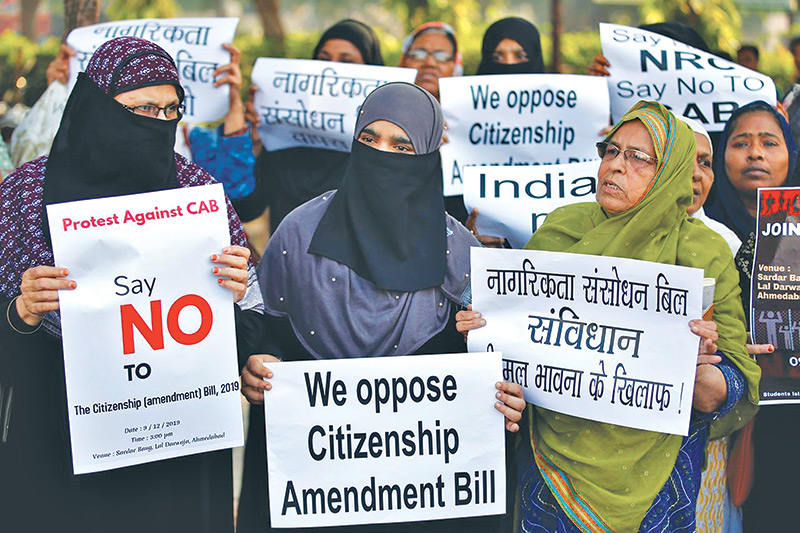
Demonstrators display placards during a protest against the Citizenship Amendment Bill in Ahmedabad India on December 9, 2019. REUTERS

At a time when India’s major national priority ought to be cratering economic growth, Prime Minister Narendra Modi’s government has instead plunged the country into a new political crisis of its own making.
With its penchant for shock-and-awe tactics, the government pushed through parliament a controversial Citizenship Amendment Bill that fast-tracks citizenship for people fleeing persecution in Pakistan, Afghanistan, and Bangladesh—provided they are not Muslim. By excluding members of just one community, the bill, which was quickly signed into law by President Ram Nath Kovind, is fundamentally antithetical to India’s secular and pluralist traditions. As I argued in parliament, it is an affront to the fundamental tenets of equality and religious non-discrimination enshrined in our Constitution and an all-out assault on the very idea of India for which our forefathers gave their lives.
As India’s freedom struggle neared its goal, Indian nationalists split over the question of whether religion should be the determinant of nationhood. Those who believed that it should, led by Mohammed Ali Jinnah and his followers, advocated the idea of Pakistan as a separate country for Muslims. The rest, led by Mahatma Gandhi and Jawaharlal Nehru, argued passionately that religion had nothing to do with nationhood. Their idea of India led to a free country for people of all religions, regions, castes, and languages.
The implications—constitutional, political, social, and moral—of the Modi government’s betrayal of this core idea are profound. Under the approved bill, Muslim immigrants may be declared illegal. Coupled with the government’s plan to create an even more problematic National Register of Citizens, the authorities will be able to disenfranchise any Indian Muslim who is unable to prove his or her provenance in India. Many Indians, especially the poor, lack documentary evidence of when and where they were born; even birth certificates have become widespread only in recent decades. While non-Muslims would, thanks to the approved bill, get a free pass, similarly undocumented Muslims would suddenly bear the onus of proving that they are Indian.
This marks a breathtaking departure from seven decades of practice in managing an astonishing degree of cultural diversity. Foreigners—including President George W. Bush—admired the fact that India had produced hardly any Islamic State (ISIS) or al-Qaeda members, despite being home to 180 million Muslims. Indians proudly pointed out that this was because Indian democracy gave Muslims an equal stake in the country’s wellbeing. We can no longer say that.
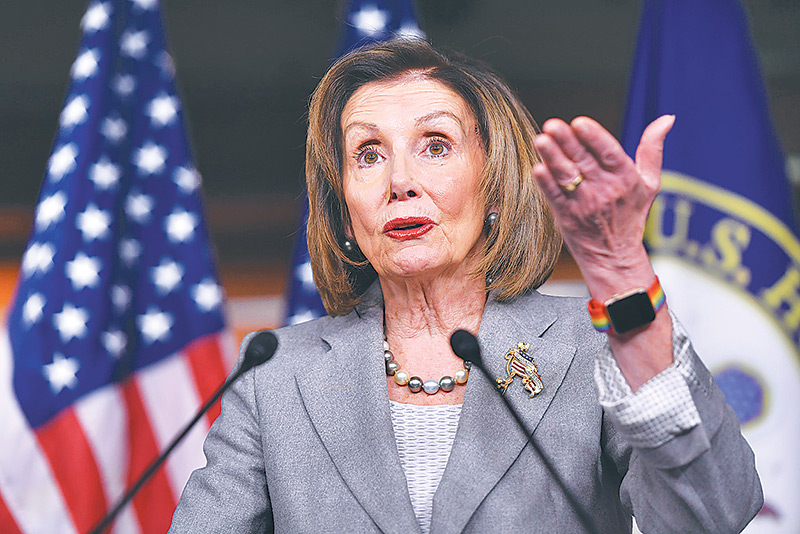
Democratic India has never had a religious test for citizenship. Muslims have served as presidents, generals, chief ministers and governors of states, ambassadors, Supreme Court chief justices, and captains of national sports teams.
The religious bigotry that led to partition and the establishment of Pakistan has now been mirrored in pluralist India. As I told my fellow parliamentarians, that was a partition of India’s soil; this has become a partition of India’s soul.
Inevitably, mass protests have erupted, particularly in the North-Eastern states bordering Bangladesh, where locals fear being swamped by Bangladeshi Hindu migrants with fast-track citizenship; in West Bengal and Delhi, where Muslims fear that they will be subject to a worsening climate of suspicion; and among Muslims and secularists nationwide. Though the protests have been mostly peaceful, the authorities have responded with force. Four demonstrators have been shot dead in Assam (and two more killed in the chaos), curfews have been imposed, police have invaded universities, and Internet and telephone services have been suspended in some areas. Over 100 people have been injured. This self-inflicted wound will take a long time to heal.
In his first term in office, Modi attempted to create a more unabashedly Hindu India, but one that was still attractive to global investors. Six months into his second term, he seems to have given up on the latter goal. As foreigners recoil with horror at the blatant Islamophobia on display from the highest echelons of Modi’s Bharatiya Janata Party, he has focused on criminalising the triple-talaq form of Islamic divorce, pushing for a Hindu temple on a site where a 470-year-old mosque was demolished in 1992 by Hindu protesters, and changing the constitutional status of Muslim-majority Jammu and Kashmir and detaining its political leaders. The new citizenship law is just one more brick in an edifice of official bigotry.
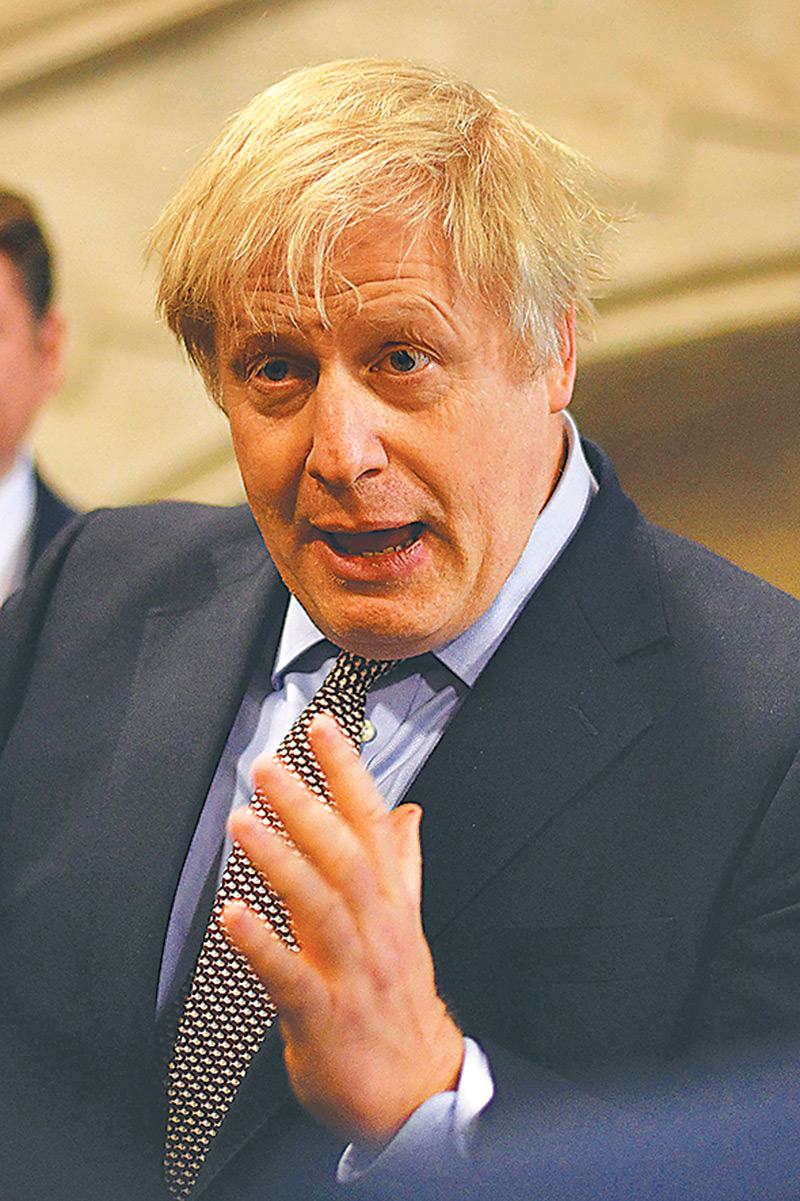
It is an edifice that is leaving India increasingly isolated. Japanese Prime Minister Shinzo Abe promptly cancelled a visit to India following the citizenship bill’s enactment, as have two Bangladeshi ministers. Foreign investors have already been withdrawing, thanks to Modi’s mismanagement of the economy, which has never recovered from the disastrous blows of an irresponsible demonetisation exercise and the botched implementation of a nationwide Goods and Services Tax. Banks are weighed down by bad debt, the public sector is haemorrhaging money, automobile factories are closing, unemployment is at a 46-year high, and farmers are committing suicide in record numbers.

Now, the Modi government has compounded its economic fecklessness with political recklessness, plunging India into turmoil. The combination of ineptitude and bigotry that has laid the country low has left long-time admirers of the Indian model speechless in disbelief. With the government on the warpath against the fundamental assumptions of the Indian republic, the unspoken fear among the country’s democrats is that the worst is yet to come.


— Project Syndicate

Page 8
HEALTH & LIVING

Female researchers are less likely to frame their work with positive words, study finds

Clinical articles with male first or last authors have been found containing terms such as ‘excellent’, ‘unprecedented’ and ‘unique’ in their titles or abstracts.
- ELIZABETH COONEY
shutterstock

Are men more impressed with their own scientific research than women? Or are women warned off “overstating” their work?
A new analysis suggests it might be a little of both.
Women were 12.3 percent less likely than men to frame their work with positive words like “novel” or “excellent” in abstracts, according to a new study of 15 years of clinical research publications. In the case of only top-tier journals—there are numbered rankings for this in the arcane world of scientific publishing —the gap widened to 20.4 percent.
These differences may be more than semantic, according to the authors of the study, which was published Monday in BMJ. Publication in one high-impact journal leads to citations in articles appearing in other journals, eventually snowballing into a measure of a researcher’s influence. And not just in theory: Cumulative citations count explicitly in recruitment, promotion, pay, and funding.
“Promotion is primarily measured by impact in your field, so the words that are listed here—“novel,” “unique,” “promising”—these are the type of things in letters people write that determine whether someone gets promoted or gets tenure,” said Dr Vineet Arora, assistant dean of scholarship and discovery at the University of Chicago’s Pritzker School of Medicine. She studies gender differences in the way that physicians in training are evaluated but was not involved in the research. “This is more than just a random assortment of words. These are words that actually matter in terms of career potential.”
To reach their conclusions, three researchers from Harvard, Yale, and the University of Mannheim, in Germany, scanned titles and abstracts from more than 100,000 clinical research articles found among more than 6 million life sciences papers indexed by the archive PubMed from 2002 to 2017. They looked for the first and last authors of a study, typically a junior scientist and a mentor, respectively. After running those names through an algorithm called ‘Genderise’ to assign male or female to the names, they used natural language processing to comb through abstracts, searching for 25 positive words taken from a standard list vetted in prior research.
What if the findings really were novel (by far the most common positive word) or “excellent” (middling on the list)?

unsplash


The researchers accounted for that possibility by comparing apples to apples, adjusting for specific areas, keywords, and types of research in similar journals. A gold-standard randomised clinical trial, for example, would be more likely than an observational trial to be groundbreaking, so they used trial design to narrow comparisons. They also compared publications in similar time frames, because there were fewer female authors—and fewer papers overall—in 2002 than in 2017.
They concede there is still one black box. The BMJ article’s authors could see only the published abstract, not the draft a scientist submitted or suggestions made during the  peer review and editing process. Marc Lerchenmueller of the University of Mannheim and first author of the BMJ paper, noted that recent research in economics shows journal editors and reviewers comment on manuscripts written by women more often than they remark on work by men. That can make the review process longer and change what eventually appears in the paper.
“If women are held to different standards and editors or reviewers opine in a gendered way, then you end up with an end product that is more timid,” he said.
There is ample research to support this interpretation. Not only are women less likely than men to promote themselves, they are also less likely to consider themselves qualified for a position unless they meet every criterion for it, said Dr Esther Choo of Oregon Health & Science University. She said the latest study adds to a growing body of research that captures the many barriers, large and small, for women advancing in health care and research.
“Savvy women learn to rein it in compared to men in order to satisfy stereotypical communal traits,” she said. “I think this phenomenon probably applies to how people are free or not free to tout their own work, and wonder what this study reflects in terms of women pulling back from stronger language out of conscious or unconscious acknowledgement of this censure, or the reviewers or decision editors being quicker to accuse female authors of overstating their study or being overly assertive in the title and censuring the messaging.”
In previous research, Dr Anupam Jena, senior author of the BMJ paper and professor of health care policy at Harvard Medical School, reported that patients treated by female physicians were more likely to survive than patients treated by male physicians. Mortality, of course, can be easy to measure. Bias in science and medicine is not, but analysing positive language in scientific abstracts is one way to address a lack of evidence.
 “There’s an indication in this one specific behaviour that we can measure that language is being used in this way,” he said. “We don’t have any insight into what’s happening in social media yet.”
In the BMJ abstract, none of the 25 positive words makes an appearance.
“We were obviously very careful not to, in our own abstract,” Jena said. “That irony would not be lost.”


The article was originally published on STAT, a Boston-based health news publication. Find more stories on statnews.com.

HEALTH & LIVING

What makes something truly addictive?

The ‘gaming disorder’ classification from the World Health Organization revives a debate in the medical community about whether behaviours can cause the same kind of addictive illness as drugs.
- LINDSEY TANNER
pixabay

Now that the world’s leading public health group says too much Minecraft can be an addiction, could overindulging in chocolate, exercise, even sex, be next?
The short answer is probably not.
The new “gaming disorder” classification from the World Health Organization revives a debate in the medical community about whether behaviours can cause the same kind of addictive illness as drugs.
The strictest definition of addiction refers to a disease resulting from changes in brain chemistry caused by compulsive use of drugs or alcohol. The definition includes excessive use that damages health, relationships, jobs and other parts of normal life. Brain research supports that definition, and some imaging studies have suggested that excessive gaming might affect the brain in similar ways.
Under a looser definition, addiction is considered “a disease of extreme behaviour. Any behaviour carried to extreme that consumes you and keeps you from doing what you should be doing becomes an addiction as
far as life is concerned,” said Dr Walter Ling, a UCLA psychiatrist.
In its widely used manual for diagnosing mental illness, the American Psychiatric Association calls excessive video gaming a “condition” but not a formal diagnosis or disease, and says more research is needed to determine if it qualifies as an addiction.

   
Drugs and the brain
Certain drugs including opioids and alcohol can over-activate the brain’s reward circuit. That’s the system that under normal circumstances is activated when people engage in “behaviours conducive to survival” including eating and drinking water when thirsty, explained Dr Andrew Saxon, chairman of the association’s addiction psychiatry council. The brain chemical dopamine regulates these behaviours, but narcotic drugs can flood the brain with dopamine, encouraging repeated use and making drug use more rewarding that healthy behaviours, Saxon said. Eventually increasing amounts are needed to get the same effect, and brain changes lead to an inability to control use.


What about other substances?
Caffeine is a stimulant and also activates the brain’s reward system, but to a much lesser degree than addictive drugs. The “reward” can make people feel more alert, and frequent users can develop mild withdrawal
symptoms when they stop, including headaches and tiredness. Caffeine-containing chocolate may produce similar effects. Neither substance causes the kinds of life problems found in drug addiction, although some coffee drinkers develop a tolerance to caffeine and need to drink more to get the same “buzz” or sense of alertness.
The World Health Organization recognises caffeine “dependence” as a disorder; the American Psychiatric Association does not and says more research is needed.
“The term ‘addiction’ is tossed around pretty commonly, like ‘chocoholic’ or saying you’re addicted to reality TV,” said Dr Ellen Selkie, a University of Michigan physician who studies teens’ use of digital technology. But addiction means an inability to control use “to the point where you’re failing at life,” she said.


What about behaviour?
The only behaviour classified as an addiction in the American Psychiatric Association’s diagnostic manual is compulsive gambling. To be diagnosed, gamblers must have several symptoms including repeatedly gambling increasing amounts of money, lying to hide gambling activity, feeling irritable or restless when trying to stop, and losing jobs or relationships because of gambling. Research suggests excessive gambling can affect the brain in ways similar to addictive drugs. Since the diagnostic manual was last updated, in 2013, studies have bolstered evidence that excessive video gaming may do the same thing, and some experts speculate that it may be added to the next update.
The manual doesn’t include sex addiction because there’s little evidence that compulsive sexual behaviour has similar effects on the brain.
Many excessive gamblers, gamers and sex “addicts” have other psychiatric conditions, including anxiety, attention deficit disorder and depression, and some mental health specialists believe their compulsive behaviours are merely symptoms of those diseases rather than separate addictions.
Excessive use of the internet and smartphones is also absent from the psychiatric manual and World Health Organization’s update. Psychiatrists disagree on whether that is a true addiction—partly because overuse is hard to measure when so many people need to use their smartphones and the internet for their jobs.


Does the term matter?
The World Health Organization’s decision to classify excessive video gaming as an addiction means “gaming disorder” will be added to this year’s update to the organisation’s International Classification of Diseases. Doctors worldwide use that document to diagnose physical and mental illnesses. Insurers, including Medicaid and Medicare, use billing codes listed there to make coverage decisions. The American Psychiatric Association’s manual is widely used for defining and diagnosing mental disorders. If conditions aren’t listed in these documents, insurance coverage for treatment is unlikely.


—Associated Press

Page 9
CULTURE & ARTS

Going back to board games

It may take some time for urban Kathmandu to go back to playing tabletop games, but Settlers of Patan is already rolling the dice.
- SRIZU BAJRACHARYA
While Nepal is very much focused on phone-based games and sports, board games are making a resurgence. Photos Courtesy: Settlers of Patan  facebook page

Lalitpur,
Get talking about board games, and Sergiu V Campeanu’s enthusiasm is apparent. One of the founders of Settlers of Patan, a board game group formed in 2017, the 33-year-old Romanian does little to hide his avidity towards the group and their communal affinity for tabletop games. In fact, even his visiting card reads ‘Chief Enthusiasm Officer’.
“I love how these games can immerse you in their narratives. The games we play are different from the classic games people know. They are modern, innovatively complicated and require time, and exercise real-life dialogues for resource building and networking,” says Campeanu.
Campeanu formed the group and started these board game sessions a year after he moved to Nepal in 2016. Among the belongings he brought to Nepal were a number of board games—some of which were Ticket to Ride, Carcassonne, Eldritch Horror, Dead of Winter, Bang the Dice Game, Memoir ‘44, Isle of Skye. But being new to the place, he didn’t have many friends to play them with. “And that is the pretext of the idea behind forming the group. I wanted to meet people and make friends here, you could say it was for a selfish reason,” he says. “But now, we aim to try as many new games as possible. We also want to engage with more people, who may be interested to try out these games.”
In Kathmandu, the most popular board games in the 90s were chess, ludo, snakes and ladder, Scrabble and Monopoly. Before smartphone and computer games became a routine for people of all ages, it was these board games that were present in every household, where friends and families gathered around to have a fun time together. But now, both the games and the tradition have become almost obsolete.
But, around the world, tabletop games are making a comeback. People are going back to them as they are offering something that is majorly missing in electronic mediums—genuine human interaction and quality time with family and friends. They have also become great for team-building exercises and as an engaging way to pass time during work breaks. That is why Campeanu’s gaming group is swiftly gaining popularity in the city.
“I started looking forward to these board games sessions to break away from my monotonous routine, going from home to work and vice-versa,” says Shirshak Dangol, a freelance graphic designer, who has been a regular at the weekly board games sessions organised by Settlers of Patan. For Dangol, the gaming sessions are great socialising opportunities. “I am an introverted person. I don’t really interact with people. But playing board games helps me build connections and friendships. Plus, it’s also fun,” he says.


In the three years since it started, Settlers of Patan’s community has grown significantly. “We have around 20 to 30 people coming to play board games every week,” says Campeanu. Settlers of Patan, which is named after the board game Settlers of Catan, a popular German board game, has become an avenue through which people get to know each other. It is also popular among the expats in Kathmandu.
“I came to know about Settlers of Patan through Kathmandu expat group’s Facebook page in August 2018. I joined one of the sessions hoping to make new friends,” says Stacey Cassar, a teacher at The British School. According to her, these games not only help in bringing people together, but due to their format, eases the gamers into having fun and good conversations. “I enjoy how these sessions are intimate and how it keeps my mind active,” says Cassar.
Campeanu, who estimates he spends an average of seven to eight hours a week playing board games, the weekly gaming sessions were a mode of recreation that also helped him realise his passion for his vocation in teaching and community building. “Board games are interesting, as they allow you to share an experience together. And that is how you make connections that become building blocks to making friendships. This is what has helped us grow as a community,” says Campeanu.

By playing games children make friends, and as adults, the same remains, says Campeanu. “Even as adults, games help us to break the ice,” says Campeanu.
Settlers of Patan plays various modern games like Ticket to Ride, Banking, Tiny Epic Galaxies, Coup, Carcassonne, Azul, Smash Up, Architects of the West Kingdom with a mix of diverse people. One of  Campeanu’s favourites is Dead of Winter, a game set in a post-apocalyptic, zombie-infested colony. “I like games that tell a story, games that transport you to places and makes you go on a journey. The kind that gives you a domino experience,” says Campeanu.

For their collection, however, the group depends on friends coming to Nepal. “It’s usually people who have been to our gaming sessions prior who introduce the group to new games that they come across during their travels outside Nepal,” says Campeanu. “But there aren’t any marketplaces for modern games in Kathmandu yet.”
His board game group has also arranged gaming sessions in the last two Com Cos Con events organised by Otaku Next, which were well received by many youngsters. A lot of people visited their booth and spent meaningful time, strategising wins. “People were curious about the games we had and a lot of people showed up at our table,’ he says. “It was a nice feeling to see our group’s comradery. The members came together to organise these gaming sessions, even though we were all just volunteering.”
The atmosphere of the gaming sessions organised by Settlers of Patan is always lively. “There’s laughter everywhere and friendly jokes—just a lot of joy,” he says.


Settlers of Patan organises weekly meet-ups at Baked n’ Fresh in Bakhundole, Lalitpur.

CULTURE & ARTS

As the going gets tough, Indians get going ... to the movies

Despite the market entry of global video streaming players such as Netflix and Amazon Prime, Bollywood retains a powerful hold on the Indian imagination.
- Vishal Manve
Business in Bollywood has never been better, as it offers audiences an escape from an increasingly grim daily grind. AFP/rss

As a prolonged economic slowdown forces Indians to curb spending on everything from underwear to automobiles, business in Bollywood has never been better — offering audiences an escape from the increasingly grim daily grind.
And the cash registers are likely to keep ringing, with high-profile films such as superstar Salman Khan’s Dabangg 3 (Fearless 3) scheduled for release this week as a blockbuster season comes to a close.
Ankita Maneck will be among the millions queueing to see Khan beat up bad guys, break into song-and-dance numbers and ride off into the sunset for the customary happy ending.
In the last 12 months, Maneck lost her job, moved back home and then had to scrounge for funds to pay for her father’s surgery. Her only respite came in the form of a movie ticket, she said, describing her cherished Friday night routine that always includes a trip to the cinema.
“The current economic situation is very frustrating,” said the 29-year-old who now works as a marketing executive in the western city of Baroda.
“Watching movies is a great way to escape reality,” she told AFP. She is not the only one who thinks so. As New Delhi struggles to kickstart the limping economy, with quarterly growth recently falling to a six-year low, the movie business has been pushing ahead at full throttle.


Escapism
With some 1,800 releases in 2018, India is home to the world’s biggest film-making machine and Bollywood is arguably its most highest-profile star.
Despite the market entry of global video streaming players such as Netflix and Amazon Prime, the homegrown industry retains a powerful hold on the Indian imagination.
“In 2019, Bollywood has been performing exceptionally well in the last three quarters and has grown by 15 percent in comparison to last year,” Mumbai-based film trade analyst Girish Johar told AFP.
The Bollywood boom even prompted a government minister to claim that India’s economic slowdown was overstated, sparking a flood of criticism. Nevertheless, industry figures indicate that even as Indians cut back on buying essential items including fruits and vegetables, movie ticket sales have only increased.
“Films are the lowest hanging fruit for many to access entertainment without spending much during a slowdown,” said Kamal Gianchandani, CEO of PVR Cinemas, the country’s largest operator of multi-screen theatres.
For the relatively affordable sum of 75 rupees (NPR 120), a moviegoer living in India’s most expensive city Mumbai can venture to a single-screen cinema and spend three hours in air-conditioned comfort, distracted from their troubles.
Dinner at a casual restaurant costs significantly more.
In 2018/19, as India’s economy worsened, PVR’s annual earnings jumped by nearly a third to $435 million. This year is set to be even better, Gianchandani told AFP, as more and more people seek cheap escapist fare.
A similar trend appeared to be under way during the 2008 global financial crisis, when movie revenues grew as India’s economy stumbled.


‘Lipstick index’
There is no single official source for film revenues due to India’s complex distribution system covering thousands of independent exhibitors.
But figures from widely respected trade portal Box Office India show a nearly 19 percent increase in earnings between 2006 and 2009.
Conversely, when the economy picked up steam in 2014 on optimism surrounding the election of Prime Minister Narendra Modi, movie revenues actually fell to $511 million from $525 million the year before, according to the website.
The trend evokes comparisons to the oft-quoted “Lipstick Index”, a term coined by Leonard Lauder, chairman of the US cosmetics giant Estee Lauder, in the early 2000s to explain why lipstick sales go up during a downturn.
The reasoning is that consumers apparently hold back on making big-ticket purchases during a slowdown and instead splurge on smaller indulgences.
With the exception of high-end multiplexes, ticket prices are very low in India compared to other markets, undercutting profits but making movies an accessible luxury for many film-crazy Indians.
For graphic designer Shruti Kulkarni, the cinema offers an opportunity to leave a cramped house and unwind. Downloading a film on her smartphone or laptop is simply not the same, she told AFP.
“There is something about watching a movie in a theatre where you are alone, yet surrounded by hundreds of strangers and sharing the same experience. I enjoy it,” the 26-year-old said.


—Agence France-Presse

Page 10
WORLD

Demonstrators take to the streets to rally for Trump impeachment

On eve of expected impeachment, President Donald Trump lashes out at House Speaker Nancy Pelosi, Democrats.
- REUTERS
US Speaker of the House Nancy Pelosi speaks during her weekly press conference in Washington, DC last week. An enraged US President Donald Trump said he was being
subjected to an ‘attempted coup’ and a witch trial as Democrats set an impeachment vote. AFP/RSS

NEW YORK/WASHINGTON, 
Demonstrators rallied in New York on Tuesday night to call for US President Donald Trump’s impeachment and removal from office on the eve of the House of Representatives’ expected vote to impeach him.
Organisers said they were expecting thousands at a rally and march through midtown Manhattan, one of more than 600 events calling for Trump’s impeachment that were scheduled to take place across the country.
“I’m here today because I see this as a chance for a pivotal point, a turning point in our future,” said 19-year-old student Serena Hertzog. “My main issue that I’m most passionate about is environmental justice and I see our president as posing a huge threat to our environment.”
Demonstrators who were gathered in Times Square chanted slogans like “Impeach Trump” and held signs that read: “Trump is not above the law” and “Rise and resist.”
Trump faces one charge of abuse of power for asking Ukraine to investigate former Vice President Joe Biden, a leading Democratic contender to oppose him in the 2020 presidential election. The Republican president also faces a charge of obstructing the congressional investigation into the matter.
“This is a really crucial moment for citizens to come out and engage,” said Shannon Stagman of Empire State Indivisible, one of the rally’s lead organizers. “We think it’s really important just to come out and say we recognize that crimes were committed here, that this president has abused his power and we’re not OK with letting that slide.”
The House will vote on Wednesday on two articles of impeachment against the president, which if approved, will send the matter to the Republican-led Senate to hold a trial on whether to remove him from office. The Senate is unlikely to vote to convict the president.
Trump has denied wrongdoing and accused Democrats on Tuesday of pursuing an “illegal, partisan attempted coup” and declaring “open war” on American democracy.
Meanwhile, on the eve of his expected impeachment in the US House of Representatives, Trump accused Democrats of pursuing an “illegal, partisan attempted coup” and declaring war on American democracy as they seek to remove him from office for pressing Ukraine to investigate political rival Joe Biden.
Trump’s remarks came in a signed letter addressed to House Speaker Nancy Pelosi, released as House lawmakers set the rules for debate ahead of Wednesday’s planned vote on two articles of impeachment—formal charges—against the Republican president.
At the same time, the Senate’s top Republican, Mitch McConnell, signaled he would not allow the expected upcoming Senate trial on impeachment charges to involve more fact finding about Trump’s conduct. The Republican-led Senate is unlikely to vote to convict the president.
The rambling, six-page letter from Trump to Pelosi on White House letterhead largely restated the president’s objections to the impeachment probe, but did so in accusatory and sometimes spiteful language that attacked Pelosi, congressional Democrats, Biden and institutions such as the FBI.
Pelosi, Trump wrote, “is turning the House of Representatives from a revered legislative body into a Star Chamber of partisan persecution” while “scarcely concealing your hatred of me.”
The impeachment probe, the president said, was an “an illegal, partisan attempted coup that will, based on recent sentiment, badly fail at the voting booth,” alluding to the November 2020 US presidential election in
which he is seeking another four years in office.
The US Constitution gives the House the power to impeach a president for “high crimes and misdemeanors,” part of the document’s checks and balances among the executive, legislative and judicial branches of the federal government.
The Democratic-led House is expected to pass two articles of impeachment charging Trump with abuse of power and obstruction of Congress for his dealings with Ukraine“By proceeding with your invalid impeachment, you are violating your oaths of office, you are breaking your allegiance to the Constitution, and you are declaring open war on American Democracy,” Trump wrote.
“You view democracy as your enemy!” he wrote.

WORLD

Britain’s Johnson vows to work ‘flat out’, outlaw Brexit transition past 2020

- AGENCE FRANCE-PRESSE
Boris Johnson. AFP/RSS

LONDON, 
Britain’s government has said it will legislate to ensure a post-Brexit transition period does not extend beyond 2020, sending the pound sinking as the European Union warned of a race against time to agree new trade terms.
Prime Minister Boris Johnson won a big majority in Thursday’s general election on a promise to “get Brexit done” by taking Britain out of the European Union by January 31.
A transition period will follow until December 31, 2020, during which London and Brussels hope to negotiate a new economic and security partnership to replace 46 years of integration.
Britain has an option to extend the transition but Johnson refuses to, and intends to enshrine the 2020 date in legislation, his office said Tuesday.
At his first cabinet meeting since the election on Tuesday, Johnson pledged to work “24-hours-a-day,
flat out” to deliver on his election promises.
The EU’s chief Brexit negotiator Michel Barnier said the bloc would “do the maximum” to try to agree a new partnership by the 2020 deadline, and avoid a highly disruptive “no deal” divorce.
But European Commission Vice President Valdis Dombrovskis warned that a “very rigid timeframe... reflects that certain things will be out of reach”.
“It will be indeed rather problematic to hold negotiations and reach agreement on a comprehensive trade deal,” he said.
The pound rose after Johnson’s election on hopes of an end to years of political turmoil over Brexit, but fell Tuesday on fresh fears of a disorderly split.
By the late London afternoon, the currency was down by 1.7 percent against the dollar.
Johnson welcomed back his ministers after what he called a “seismic” result, telling them: “You ain’t seen nothing yet.”
As the House of Commons returned, he told MPs: “This parliament is not going to waste the time of the nation in deadlock, and division and delay.
“We are going to get Brexit done... and we are going to get on with delivering on the priorities of the British people.”
Johnson won by taking a swathe of traditionally working-class seats in northern England, and has promised to address public concerns about health and education spending.
His self-styled “People’s Government” said it would boycott next month’s meeting of the world’s global and political elites in Davos, Switzerland.

WORLD

Rocket carrying planet-hunting satellite blasts off from Earth

- AGENCE FRANCE-PRESSE
A Soyouz rocket lift-off from Europe’s launchpad in Kourou, French Guiana with Europe’s CHEOPS planet-hunting satellite on board, on Wednesday. AFP/RSS

PARIS,
Europe’s CHEOPS planet-hunting satellite left Earth on Wednesday a day after its lift-off was delayed by a technical rocket glitch during the final countdown.
The 30-centimetre (12-inch) telescope has been designed to measure the density, composition, and size of numerous planets beyond our solar system—so-called exoplanets.
According to the European Space Agency (ESA), CHEOPS will observe bright stars that are already known to be orbited by planets.
The mission “represents a step towards better understanding the astrophysics of all these strange planets that we have discovered and which have no equivalent in our solar system”, 2019 Nobel Physics Prize winner Didier Queloz told AFP on Tuesday.
Around 4,000 such exoplanets have been discovered since Queloz and his colleague Michel Mayor identified the first one, called “51 Pegasi b”, 24 years ago. The satellite took off at 0854 GMT from Europe’s launchpad in Kourou, French Guiana, according to live footage broadcast by launch company Arianespace.
It was the third launch this year for the Russian-built Soyuz rocket.
On Tuesday, the launcher’s automated sequence was interrupted during the final countdown at 1 hour 25 minutes, due to what was described as “an anomaly” in the launch set-up.
CHEOPS “will focus on planets in the super-Earth to Neptune size range, with its data enabling the bulk density of the planets to be derived—a first-step characterisation towards understanding these alien worlds”, the ESA website states.
Scientists today estimate that there are at least as many galaxies as there are stars—approximately 100 billion.
“We want to go beyond statistics and study them in detail,” mission chief David Ehrenreich told AFP ahead of Wednesday’s launch.
CHEOPS, which stands for CHaracterising ExOPlanet Satellite, will seek to better understand what these planets are made of.
It is an important step in the long quest to unravel the conditions required for extraterrestrial life, but also to unlock the origins of our own home planet.
The satellite will orbit the Earth at a distance of 700 kilometres (435 miles), studying rocks orbiting stars several light-years away.
The aim is to compose “a family photo of exoplanets”, Guenther Hasinger, ESA’s director of science, told AFP Tuesday.
Nobel winner Queloz said CHEOPS was unlikely to solve the holy grail of astrophysics—is there life on other planets?
“However, in order to understand the origin of life, we need to understand the geophysics of these planets,” he said.
“It’s as if we’re taking the first step on a big staircase.”
He added that the mission would allow experts to measure the quantity of light reflected from the planets, which in turn could reveal new insights about their atmosphere or surface. “The launch is an important moment, an emotional step, but the real magic moment for us will be when the first results arrive,” Queloz said.
According to ESA, this should happen within several months of the satellite’s launch.

WORLD

Russia rubbishes report of French Alpine spy base

- AGENCE FRANCE-PRESSE

MOSCOW,
Russia dismissed on Wednesday a French newspaper report claiming its spies had operated from a base in the French Alps, saying it was a conspiracy theory aimed at smearing Moscow.
Le Monde reported this month that 15 Russian spies had passed through Haute-Savoie region, close to the Swiss and Italian borders.
The paper said they were members of the 29155 unit of Russia’s GRU military spy agency—the unit accused of carrying out operations including the attempted poisoning of defector Sergei Skripal in Britain.
“We are compelled with regret to note that the total lack of any proof did not serve as an obstacle for publishing openly Russo-phobic material,” the Russian foreign ministry said in a statement.
“We consider the article as disinformation aimed at supporting the myth of the Russian threat in the minds of the European public.”
Le Monde had published a list of 15 Russian members of the unit, which it said added five more names to those already published by online investigative outlets such as Bellingcat and The Insider.
It said Western intelligence services began an investigation retrospectively after the attempted poisoning of Skripal in the English town of Salisbury in March 2018.
Britain and its allies accuse the Kremlin of seeking to assassinate Skripal, a charge vehemently denied by Russia.
Those who stayed in the Haute-Savoie included Alexander Petrov and Ruslan Boshirov—the cover names of the two GRU agents accused of carrying out the attack on Skripal, Le Monde reported.
Western intelligence services have not so far found any material left behind by the agents during their stays in France, Le Monde said.
But their presence has been confirmed by where they ate, stayed and also shopped in Haute-Savoie, it said.
But the Russian foreign ministry said the timing of the report—coming on the eve of a December 9 summit in Paris between President Vladimir Putin and Ukrainian counterpart Volodymyr Zelensky—was “not accidental”. “It had the clear aim of damaging the reputation of Russia and discrediting the policy taken by French President Emmanuel Macron to normalise relations with Moscow,” it added.

WORLD

Garbage truck delay saves newborn in Greece

Briefing

ATHENS: A newborn boy left in a waste chute in the western Greek city of Kalamata was saved by chance on Wednesday when the garbage truck was late in making its daily rounds, the local mayor said. “The baby was fortunate in its misfortune...there was a delay in the day’s collection,” Kalamata mayor Thanassis Vassilopoulos told Alpha TV. “The garbage trucks do not just load waste, they compress it,” he added. The days-old newborn had been left in a garbage chute several metres deep in the centre of town, the television station said. Found by a woman feeding strays, the baby was taken to a local hospital with breathing difficulty, and is expected to make a full recovery, the station said. (Agencies)

WORLD

Turkey warns of ‘escalation’ if US ends Cyprus arms embargo

Briefing

ANKARA: Turkey has warned that US moves to lift a decades-old arms embargo on Cyprus would be a “dangerous escalation”, as relations deteriorated further between the NATO allies. The US Congress voted Tuesday to end the embargo on the island, which was imposed in 1987 to avoid an arms race and encourage the conflict’s resolution. Cyprus has been divided since 1974 when Turkey invaded in response to a coup engineered by the then military regime in Athens. The US decision “will have no outcome other than hampering efforts towards a settlement on the island and creating a dangerous escalation,” the Turkish foreign ministry said in a statement late Tuesday. (Agencies)

WORLD

Russia seizes UN methadone as contraband drugs

Briefing

DUSHANBE (Tajikistan): Russian customs authorities have seized a consignment of methadone bound for the UN’s HIV prevention programme in Tajikistan as contraband drugs due to a labelling misunderstanding, the UNDP said on Wednesday. The mix-up happened earlier this month when the cargo of methadone was seized at Moscow’s Vnukovo airport while in transit from Germany. Russia’s customs service announced it had seized 5.8 billion rubles ($92.7 million) worth of methadone in a major swoop and the judicial authorities opened a criminal investigation into drug smuggling “on a large scale”. (Agencies)

Page 11
ASIA

Japan journalist wins high-profile #MeToo case

- AGENCE FRANCE-PRESSE
Former TV reporter Noriyuki Yamaguchi attends a press conference in Tokyo on Wednesday. A Tokyo court awarded 3.3 million yen ($30,000) in damages to journalist Shiori Ito, who accused Yamaguchi of rape in one of the most high-profile cases of the #MeToo movement in Japan. AFP/RSS

TOKYO,
A Tokyo court on Wednesday awarded 3.3 million yen ($30,000) in damages to journalist Shiori Ito, who accused a former TV reporter of rape in one of the most high-profile cases of the #MeToo movement in Japan.
The civil case made headlines in Japan and abroad, as it is rare for rape victims to report the crime to the police—according to a 2017 government survey, only four percent of women come forward.
Ito, 30, has become an outspoken symbol for #MeToo in Japan, where the movement against sexual harassment and abuse has struggled to take hold.
She had sought 11 million yen ($100,000) in compensation from Noriyuki Yamaguchi, a former TV reporter with close links to Prime Minister Shinzo Abe, alleging he raped her after inviting her to dinner to discuss a job opportunity in 2015.
Yamaguchi continues to deny any wrongdoing and had filed a counter-suit against Ito, seeking 130 million yen in compensation. “We won. The counter-suit was turned down,” said Ito outside the court, holding up a banner that read “victory” as supporters cheered and clapped.
“Honestly I still don’t know how I feel,” she told reporters, struggling to hold back the tears. “However, winning this case doesn’t mean this (sexual assault) didn’t happen... This is not the end,” she added.
She said she hoped the case would change what she called the “under-developed” legal and social environment surrounding rape in Japan.
Japan hiked minimum jail terms for rapists from three to five years and widened the definition of sexual assault victims to include men for the first time in 2017.
Lawmakers decided unanimously to update the 1907 statute to impose tougher penalties on sex attackers and make prosecutions easier, as they look to boost Japan’s low number of convictions.
The latest World Economic Forum report on the gender gap published on the eve of the case ranked Japan 121st out of 153 countries, slipping even further down the list from 110th the previous year.
Yamaguchi announced he would appeal “immediately” against the ruling, saying: “I have not done anything that goes against the law.”
He claimed the court had failed to acknowledge inconsistencies and “falsehoods” in Ito’s argument while ignoring his own arguments.
He said the significant international media attention around the case might have clouded the judgement of the court and vowed to be more vocal in future.
Ito spoke out in 2017, shortly before the #MeToo movement, and this was “viewed as odd, especially in Japan”, she said.
When the #MeToo movement emerged, “I thought ‘It wasn’t only me!’ and I believe there were others who thought so too,” she said.
But things in Japan moved slowly.
“I saw women in Europe or the United States actively discussing it and standing up together but I didn’t think that happened in Japan at the same time,” she said.
Ito said that a major problem in Japanese media is the high proportion of men in decision-making positions but she added that the situation has begun to change with overseas harassment stories appearing in Japan and her story being told overseas.
Ito suspects her alleged attacker drugged her and claims police failed to test for substances.
“When I regained consciousness, in intense pain, I was in a hotel room and he was on top of me. I knew what had happened but I couldn’t process it.”

ASIA

India’s Supreme Court delays hearing citizenship law pleas

Protests and widespread condemnation are growing against the Citizenship Amendment Act.
- ASSOCIATED PRESS
Residents erect a barricade in front of a mosque during a protest against a new citizenship law, in Seelampur area of Delhi, India. REUTERS

NEW DELHI, 
India’s Supreme Court on Wednesday postponed hearing pleas challenging the constitutionality of a new citizenship law that has sparked opposition and massive protests across the country. The court said it would consider the pleas on Jan. 22.
Protests and widespread condemnation have been growing against the Citizenship Amendment Act, with demonstrations erupting in India over the last week.
The new law applies to Hindus, Christians and other religious minorities who are in India illegally but can demonstrate religious persecution in Muslim-majority Bangladesh, Pakistan and Afghanistan. It does not apply to Muslims.
Critics say that the new law is part of Prime Minister Narendra Modi’s Hindu nationalist-led government’s agenda to marginalize India’s 200 million Muslims, and that it goes against the spirit of the country’s secular constitution. Modi has defended it as a humanitarian gesture.
The law’s passage last week follows a contentious process in northeastern India’s Assam state intended to weed out people who entered the country illegally known as the National Register of Citizens, or NRC. Nearly 2 million people in Assam were excluded from the list, about half Hindu and half Muslim, and have been asked to prove their citizenship or else be considered foreign. India is building a detention center for some of the tens of thousands of people the courts are expected to ultimately determine have entered illegally. Modi’s home minister, Amit Shah, has pledged to roll out the exercise nationwide.
Some Indian Muslims fear it’s a means by which Hindu nationalists can put them in detention or deport them from the country.
“Overthrow NRC!” protesters chanted Wednesday outside New Delhi’s Jamia Millia Islamia University.
The citizen law was also passed as an unprecedented crackdown continued in Kashmir, India’s only Muslim-majority area, after the region was stripped of special constitutional protections and its statehood in August. Since then, movement and communications have been restricted in the region.
Students have led a week of protests since the law’s passage, including at predominantly Muslim Jamia Millia University, where a march on Sunday descended into chaos when demonstrators set three buses ablaze. Police responded with rubber bullets and tear gas. Video showed officers chasing unarmed protesters and beating them with sticks.
Scores of students were injured. Police say they acted with restraint.
The police response to the protests has drawn widespread condemnation. It has also sparked a broader movement against the Citizenship Amendment Act. Demonstrations have erupted across the country, with thousands rallying in West Bengal, Tamil Nadu and Karnataka states on Tuesday.
On Wednesday, authorities tightened security restrictions, implementing a curfew in Assam, where ongoing protests have disrupted daily life in Gauhati, the state capital. They also restricted assembly in a Muslim neighborhood in New Delhi where demonstrators on Tuesday torched a police booth and several vehicles.

ASIA

Backlash against migrant workers in Asia-Pacific sparks slavery concerns

- REUTERS
Reuters

BANGKOK,
Public support for migrant workers in Malaysia, Singapore and Thailand is decreasing, a United Nations poll found on Wednesday that campaigners said raised concerns about the risk of slavery.
Most people in the three nations have limited knowledge about and increasingly negative attitudes towards migrant workers, and do not think they should receive the same benefits or pay as local workers, showed the survey by two U.N. agencies.
Such attitudes can condone discrimination, exploitation and violence against migrant workers, and influence policies on labour migration, according to the U.N. International Labour Organisation (ILO) and U.N. Women.
As many as 10 million migrants are estimated to work across Malaysia, Singapore and Thailand, and campaigners say debt bondage, limited state oversight, and unscrupulous employment practices leave them vulnerable to labour abuses and slavery.
Many are undocumented, meaning they are not only exempt from state benefits but at greater risk of being exploited or enslaved and less likely to speak out for fear of reprisals.
“While the research did not determine why attitudes towards migrant workers are declining, it does demonstrate that we are not successfully countering racism, xenophobia and hate,” ILO advisor Anna Engblom told the Thomson Reuters Foundation.
“It is likely that discriminatory practices are allowed to flourish if the general public sympathises with such values and behaviours,” Engblom said on International Migrants Day on Dec. 18 - set by the United Nations to raise awareness on the issue.
The research - a follow-up to a 2010 poll - was based on interviews with about 4,100 people in the three countries as well as Japan, which did not feature in the previous survey.
More than half the respondents in Malaysia and Thailand, and a quarter in Singapore, said there was a need for more migrant workers in their countries but over a third of those polled in each nation agreed that migrants were “a drain on the economy”.
About half of the people surveyed in Singapore, 77 percent in Thailand and 83 percent in Malaysia said they thought crime rates had increased in their countries because of migration.
“There is a belief that migrant workers are taking away our social, economic and political resources,” said Glorene Das, head of the Malaysian migrant workers rights group Tenaganita.
Adisorn Kerdmongkol, a coordinator at the Migrant Working Group, a network of charities promoting migrant rights, said such negative attitudes would result in further exploitation.
“Governments will take less action to protect migrant workers because they will be concerned with public perception.”
“Workers will also be afraid to speak out due to concern they will be disliked by locals, which will cause problems.”

ASIA

Xi visits gambling hub Macau as nearby Hong Kong seethes

- REUTERS
Chinese President Xi Jinping speaks at Macau International Airport in Macau, China, on Wednesday.  REUTERS

MACAU/HONG KONG,
China’s President Xi Jinping arrived in Macau on Wednesday to celebrate the 20th anniversary of its handover to China, and is expected to announce economic perks as as a reward for its stability and loyalty as protests rock nearby Hong Kong.
Security was tight in the gambling hub, especially for people arriving from Hong Kong. Among the polices Xi is expected to announce are steps to diversifying the former Portuguese colony’s economic base beyond its casinos.
“We will join hands to draw the blueprint for Macao’s future development,” Xi said after arriving at Macau’s airport, according to China’s official Xinhua news agency.
Among the measures Xi is expected to unveil are plans to develop it into a financial centre, including a new yuan-denominated stock exchange.
Xi’s visit, his longest official trip to Macau, will include meetings with government officials and business representatives, as well as the swearing-in of Macau’s newly chosen Beijing-backed leader, Ho Iat-seng, on Friday.
Macau returned to Chinese rule on Dec. 20, 1999, with the same “one country, two systems” formula aimed at preserving autonomy under which Hong Kong is governed.
While protesters in Hong Kong, across the mouth of the Pearl River, are infuriated by what they see as Beijing encroaching on their freedoms, Macau has seen little dissent.
Protests are very rare in the territory with more than half of Macau’s 620,000 population immigrating from China in recent decades.
“The central government and the Chinese people are proud of the achievements and progress,” Xi said, according to Xinhua.
Flags and red congratulatory banners fluttered along roads and over buildings around the city in preparation for the anniversary celebrations on Friday.
“Macau is the best, better than Hong Kong. Hong Kong has been taken over by those rioters and we are all affected,” said a 73-year-old woman surnamed Cheung.
Some journalists arriving from the former British colony of Hong Kong, which has been rocked by anti-government protests for six months, were not allowed entry to Macau, including a reporter for RTHK, blocked for security concerns, the Hong Kong broadcaster said on its website.
Many other media people faced lengthy questioning and had their identification cards photographed as they arrived in the city, according to a Reuters reporter.
Macau’s government did not immediately respond to requests for comment.
The heads of the American Chamber of Commerce in Hong Kong have also been barred from entering the city in the run-up to Xi’s visit, the chamber heads reported, adding that authorities did not give a reason.
Beijing has also clamped down on visas since November for mainland residents going to Macau until after the Dec. 20 anniversary, as part of the security restrictions, according to Vitaly Umansky, an analyst at Sanford C. Bernstein in Hong Kong.
The restrictions would put additional pressure on sliding gambling revenues, he said. Macau’s casinos contribute about 80 percent of government income.
Macau ferry operator Turbo Jet said it was reducing the number of ferry sailings to and from Hong Kong by about half due to security checks. Ferries this week are only operating every 30 minutes compared with every 15 minutes normally.
The changes were made because of “instructions by Macau authorities”, the company said on its website.
The city’s light rail transit system which opened to the public on Dec. 10, will be suspended for three days from Wednesday due to security measures, the operator said.

ASIA

Six dead, dozens injured in Hong Kong bus crash

Briefing

HONG KONG: Six people were killed and dozens injured in Hong Kong on Wednesday when a double-decker bus smashed into a tree, police said. Live footage showed firefighters trying to reach victims on the vehicle’s top deck, which had been turned into a tangled mess of twisted metal and shattered glass, leaving some passenger seats dangling to the side. Victims were seen being removed in black body bags and placed next to a sign reading “Temporary Mortuary” at the roadside in Kwu Tung, a region close to the border with China. Police said six people were certified dead at the scene — three men and three women — with dozens injured. (Agencies)

ASIA

Seoul, Washington fail to agree on cost of US troops

Briefing

SEOUL: South Korea and the United States failed on Wednesday to reach an agreement over Seoul’s contribution towards hosting some 28,500 US troops, ending two days of talks that were the last before their existing deal expires on Dec 31. South Korean lawmakers have said Washington is seeking up to $5 billion a year, more than five times the amount Seoul agreed to pay this year. As part of his ‘America First” policy, US President Donald Trump has demanded that many US allies, including NATO members and Japan, pay more towards defence. He has frequently accused South Korea of being a rich nation that is profiting off the US military forces, which are stationed in the country as a legacy of the 1950-1953 Korean War and continued threats from North Korea. (Agencies)

ASIA

Two killed in attack on Pakistan polio vaccination security team

Briefing

PESHAWAR: Gunmen killed at least two policemen in an attack on a polio vaccination security team in northwest Pakistan on Wednesday, the latest setback in the nation’s campaign to eradicate the disease. The personnel were part of a nationwide anti-polio drive launched this week, aiming to inoculate tens of millions of children in Pakistan — one of only two countries where the crippling disease remains endemic. Two gunmen on a motorcycle carried out the attack in the Lal Qila area of Khyber-Pakhtunkhwa province, near the border with Afghanistan, as police were gathering at a health centre before heading out with polio vaccinators, said police official Arif Shahbaz. “The vaccinators were unhurt,” added Shahbaz. (Agencies)

Page 12
MONEY

Saudi Arabia, UAE swayed Russia for OPEC+ cuts at Abu Dhabi F1 race

Global oil prices would likely have fallen without Russia’s participation, according to OPEC sources.
- REUTERS
(From left) Venezuela’s Oil Minister Manuel Quevedo, Saudi Arabia’s Minister of Energy Prince Abdulaziz bin Salman Al-Saud and Russia’s Energy Minister Alexander Novak are seen at the beginning of an OPEC andNON-OPEC meeting in Vienna, Austria. reuters

DUBAI/LONDON,
Saudi Arabia turned to its Gulf ally the United Arab Emirates when it needed help convincing Russia to sign on to deeper oil supply cuts at this month’s OPEC meeting.
The UAE’s de-facto ruler, Sheikh Mohammed bin Zayed, hosted crucial talks between Saudi Arabia and Russia in Abu Dhabi, where the three nations ironed out what would become one of the deepest supply cuts in a decade, four sources familiar with the negotiations told Reuters.
Details of the negotiations ahead of the official announcement of cuts by OPEC and non-OPEC producers
on Dec. 6 have not been previously reported.
The UAE’s role in the talks marks a change from years past and highlights Russia’s rising clout in the region. Since Russia started cooperating with OPEC on supply agreements in 2016, Riyadh and Moscow have led oil supply decisions in advance of OPEC meetings without much involvement from other producers. This time, Riyadh wanted Abu Dhabi to help add pressure on Moscow to agree to the cuts, two sources said.
Russia saw the agreement as a way to strengthen key relationships in the region.
“The message Russia wanted to send is that it is supporting Saudi Arabia at a crucial moment and that the alliance is solid,” one of the sources said. “The UAE’s role shouldn’t come as a surprise. Russia has very strong ties with the UAE.”
Russia and Saudi Arabia are the world’s top exporters, together accounting for 20 percent of global production. The involvement of the UAE, which produces 3 percent of global oil supply, came after Moscow signalled opposition to extending new supply cuts in advance of the OPEC meetings in Vienna on Dec. 5 and 6, three of the sources said.
Russia’s Direct Investment Fund and the Russian energy ministry, which play key roles in the OPEC talks, declined to comment. Media offices for the Saudi Arabia and UAE governments did not respond to a request for comment.
Saudi Arabia’s Energy Minister Prince Abdulaziz bin Salman orchestrated the deeper oil cuts and had been discussing them with Russian officials since October, when Russian President Vladimir Putin visited Riyadh, according to three of the sources. Since then, Saudi and Russian officials have shuttled between Riyadh, Moscow and Abu Dhabi to negotiate the oil-supply deal, the sources said.
On Nov. 27, Saudi Crown Prince Mohammed bin Salman, also known as MbS, met with Abu Dhabi Crown Prince Sheikh Mohammed, known as MbZ, in the UAE.
The Saudis briefed Sheikh Mohammed that day on the proposal for deeper cuts, sharing the details of the reductions which would be distributed mainly among Saudi Arabia, Russia, the UAE, Kuwait and Iraq, two of the sources said.
On Dec. 1, the Saudi leader MbS and his brother, energy minister Prince Abdulaziz, met Russia’s Kirill Dmitriev—an influential Kremlin advisor and head of the government’s $10 billion sovereign wealth fund—on the sidelines of a Grand Prix Formula One race in Abu Dhabi, the UAE capital, the four sources told Reuters. Dmitriev flew to Riyadh the following day to tell MbS and Prince Abdulaziz that Moscow was on board with the cuts, one of the sources said.
Saudi Arabia needed production cuts to support higher oil prices ahead of the initial public offering (IPO) of shares in its state-owned oil firm, Saudi Aramco, one of the four sources said. In addition, Saudi Arabia needs a price higher than $80 per barrel to balance its budget, according to the International Monetary Fund. Moscow needs only a price of $42, according to 2019 budget figures and the Russian finance ministry.
The UAE is a close ally of Saudi Arabia and also had a stake in the IPO going well. The nation’s Abu Dhabi Investment Authority is investing more than $1 billion in the Aramco IPO after Riyadh reached out to its allies to support the offering, Reuters reported in November.
Russia had ample reason to resist cuts. Many Russian oil firms have long opposed scaling back production because they fear losing market share to the growing output from the United States, which does not cooperate with OPEC. Pressure on the Russian government mounted in recent weeks as firms including state-owned giant Rosneft and private major Lukoil publicly said that previous production curbs had already delayed new oilfield start-ups for too long.
Putin signalled his hesitance to make deeper cuts on Nov. 14 when he said that it was “an open secret” that Saudi Arabia has taken a “tough stance” on output reductions because of the IPO.
In the days before the Vienna meeting, OPEC delegates worried that Moscow might exit the agreement and raise its output before mid-2020, several OPEC sources said.
Global oil prices would likely have fallen without Russia’s participation, according to OPEC sources and estimates by analysts such as Energy Aspects. Russia has been key to global oil supply cuts by OPEC and non-OPEC producers allied with Moscow, together known as OPEC+. The latest cuts had supported oil prices near $65 per barrel.
Moscow has accrued power in the Middle East since 2015 by sending troops to Syria, where Russia and Iran have been key backers of President Bashar al-Assad in a civil war—while Saudi Arabia sided with Syrian rebels and the United States pulled back from the conflict.
Russia has managed to strengthen ties with both Iran and Saudi Arabia, which are locked in a decades-old contest for influence that raised worries of an open conflict after a recent spate of attacks on Saudi oil assets. Riyadh and Washington blame Tehran for the attacks. Iran denies any involvement.

MONEY

Russia to complete gas pipeline despite US sanctions: Kremlin

- AGENCE FRANCE-PRESSE
An aerial view of the ship ‘Audacia’, from where parts of the Nord Stream 2 pipeline are laid in the Baltic Sea off the coast the island of Ruegen, northeastern Germany. Afp/rss

MOSCOW,
Russia expects to complete construction of the major Nord Stream 2 pipeline under the Baltic Sea despite approval by the US Senate of sanctions against companies working on the project, the Kremlin said Wednesday.
The pipeline between Russia and Germany, a key part of Moscow’s export strategy for state energy giant Gazprom, aims to deliver Russian gas to Europe via the Baltic.
“We expect that this project will be completed,” Kremlin spokesman Dmitry Peskov told reporters, slamming the sanctions as a “flagrant violation of international law”.
“Moscow does not like such actions, and neither do the European capitals. Berlin does not like this and neither does Paris,” he said, suggesting that sanctions would only lead to higher gas prices for European consumers.
The sanctions, which were inserted into Washington’s huge annual defence spending bill, easily passed both the US Senate and House of Representatives.
The bill now goes to President Donald Trump, who is widely expected to sign the legislation.
US lawmakers have warned the Nord Stream 2 pipeline would bring Russia billions of dollars and vastly increase President Vladimir Putin’s influence in Europe at a time of heightened tensions between Moscow and the West.
The 9.5-billion-euro ($10.6-billion) pipeline will run under the Baltic Sea and is set to double shipments of Russian natural gas to Germany.
The European Union and Germany have strongly warned the US not to impose sanctions, saying that European energy policy should be decided in Europe.
One major contractor that could be hit by the sanctions is Swiss-based pipeline laying company Allseas, which has been hired by Gazprom to build the offshore section.
Russia had hoped to launch the pipeline in late 2019 but the completion has been delayed by difficulties in obtaining permits from Denmark.
Russian officials have said they expect the pipeline to become operational in 2020.

MONEY

PSA, Fiat Chrysler agree on terms of mega-merger

- AGENCE FRANCE-PRESSE
A combination photo shows a Chrysler logo and the logo of Italian auto maker Fiat. afp/rss

PARIS,
French carmaker PSA and US-Italian rival Fiat Chrysler said Wednesday they had agreed on the terms of a merger to create the world’s fourth largest automaker as the sector
grapples with the difficult and costly transition to cleaner and more sustainable mobility.
“Fiat Chrysler Automobiles and Peugeot SA (Groupe PSA) have today signed a binding combination agreement providing for a 50/50 merger of their businesses to create the fourth largest global automotive original equipment manufacturer by volume and third largest by revenue,” the statement said.
It added there would be “no plant closures resulting from the transaction.”
Ranking behind global rivals Volkswagen, Renault-Nissan-Mitsubishi and Toyota, the combined group will have a workforce of more than 400,000, total revenues of close to 170 billion euros ($190 million) and annual unit sales of some 8.7 million vehicles.
Its brands will include Fiat, Alfa Romeo, Chrysler, Citroen, Dodge, DS, Jeep, Lancia, Maserati, Opel, Peugeot and Vauxhall.
The joint entity will have “the leadership, resources and scale to be at the forefront of a new era of sustainable mobility,” PSA and Fiat Chrysler said.
The tie-up—which the two sides had originally agreed to at the end of October—will “deliver approximately 3.7 billion euros in estimated annual synergies” or cost savings.
The merger was expected to be completed in 12-15 months, the statement said.
“Our merger is a huge opportunity to take a stronger position in the auto industry as we seek to master the transition to a world of clean, safe and sustainable mobility,” PSA’s Carlos Tavares said in a statement.
Fiat Chrysler CEO Mike Manley saw it as “a union of two companies with incredible brands and a skilled and dedicated workforce. Both have faced the toughest of times and have emerged as agile, smart, formidable competitors.”
The combined group—which has yet to be given a name—would be headquartered in the Netherlands, and continue to be listed on the Paris, Milan and New York stock exchanges.
Fiat Chrysler chief John Elkann will be chairman and PSA’s Tavares chief executive.
The lion’s share of the savings will be generated in the joint development of technology, products and platforms, as well as in purchasing, but also in marketing, IT systems and logistics, the statement said.
“Those synergies will enable the combined business to invest significantly in the technologies and services that will shape mobility in the future while meeting the challenging global CO2 regulatory requirements.”
Analysts nevertheless argue that the two companies are still too dependent on the declining European market and lack a strong presence in China, the world’s largest car market.
CMC Markets analyst Michael Hewson suggested there was “certain to be a sizeable overlap between the two businesses, with the business in the UK perhaps the most vulnerable given the politics at play, and the labour laws in France and Italy which make it much more difficult to reduce the size of the workforce there.”
The US regulatory authorities could still block the deal, the expert said.
Jasper Lawler at London Capital Group agreed.
“The next hurdle is getting the deal through regulators. We think given the negative ramifications for European—and especially German economic growth from the downturn in the car industry—this deal has a good chance of passing the EU’s typically very interventionist regulators,” the analyst said.
“The bigger challenge could come stateside if the Trump administration gets any inkling that homegrown brand Chrysler is becoming European.”
For its part, the French government welcomed the deal.
The announced was “very good news,” said economy and finance minister Bruno Le Maire.
“It marks an important stage in the creation of a European champion,” he said.

MONEY

Google settles tax dispute with Australia

- REUTERS
REUTERS

SYDNEY, 
Alphabet Inc’s Google has settled a “longstanding” tax dispute with Australia’s tax office, it said on Wednesday, after paying an extra A$481.5 million ($326.75 million) on top of its previous tax bill.
The settlement comes after an audit that looked into the tech giant’s tax practices between 2008 and 2018, a Google spokeswoman said.
In a separate statement, the Australian Taxation Office (ATO) said it has now netted A$1.25 billion after also settling tax disputes recently with other tech giants such as Microsoft, Apple and Facebook under the Multinational Anti-Avoidance Law (MAAL).
“Thanks to the efforts of our ATO officers under the Tax Avoidance Taskforce and the introduction of the MAAL, Australian sourced sales by these digital giants will now be returned to Australia’s tax base,” the ATO said in a statement, calling the settlement “another e-commerce victory.”
Facebook, Google, Amazon and other large technology companies have faced criticism globally for reducing their tax bills by booking profits in low-tax countries regardless of the location of the end customer. Such practices
are frowned upon by many countries as unfair.
A Google spokeswoman said the settlement with the ATO will provide certainty for future tax treatment.
Australian Treasurer Josh Frydenberg said in a statement the establishment of the tax avoidance taskforce in 2016 has helped strengthen tax compliance of multinationals and large corporations.
“Ensuring large companies and multinationals pay the right amount of tax means we can continue to deliver the essential services Australians rely on,” Frydenberg said.

MONEY

US launches initiative to spur investment in Latin America

- ASSOCIATED PRESS

WASHINGTON, 
The Trump administration launched an initiative Tuesday seeking to foster investment by the US private sector in energy and infrastructure in Latin America and the Caribbean, describing the effort as a “complete re-calibration” of US policy.
Mauricio Claver-Carone, deputy assistant to the president and senior director for Western Hemisphere affairs, told Latin American diplomats gathered at the White House
that it is not as easy for the United States to marshal support for its allies because it is not a state-controlled government.
That was likely an allusion to China, which is seeking to expand its influence in the region.
China has provided more than $141 billion in loan commitments to Latin America and the Caribbean since 2005. Still, the United States was the main source of the $147 billion that the hemisphere received last year, according to the United Nations Conference on Trade and Development.
“Our goal here is to let the region know we are the best of friends,” Claver-Carone said.
He said that if countries are able to offer the right business environment, the US private sector has the potential to totally finance the $100 billion to $150 billion needed by the region for annual infrastructure spending.
The Inter-American Development Bank estimates the infrastructure investment gap in the region is around 2.5 percent of GDP. It says the shortfall hurts the poor the most, because they spend more of their income on infrastructure services.
Claver-Carone said the goal of facilitating job creation and economic growth in the Americas by promoting the private sector as the primary engine of growth for infrastructure projects is a major adjustment in US foreign policy.
“You have to show it not only being tough on our foes, but with the 30-plus countries that are friends, by showing them we are their best friend, and by making sure we are their choice partners,” he said.
Commerce Secretary Wilbur Ross called on US business to be more active because currently they are involved in only 2 percent of the construction projects in Latin America, compared to 19 percent by companies from Spain and 7 percent from China.

Page 13
MONEY

Nepal Tourism Board’s age limit for recruitment challenged in court

The vacancy announcement says applicants for the post of CEO should be between 35 and 60 years old.
- SANGAM PRASAIN
From the beginning, some private sector representatives had questioned the rationale behind setting the minimum and maximum age bars for the CEO. Post file photo

KATHMANDU,
The Nepal Tourism Board’s age limit for recruitment for the post of CEO has been challenged in court.
A retired government joint secretary filed a public interest litigation at the Supreme Court on December 16 seeking a rationale for imposing lower and upper age limits for hiring.
The vacancy announcement published by the CEO selection sub-committee of the tourism promotion body on December 4 said that applicants should be between 35 and 60 years old.
“The issue of lower and upper age limits is not only my concern, but also a broad public concern,” said the plaintiff Khadananda Dhakal. “The court may issue a show cause notice to the CEO selection sub-committee,” said Dhakal who formerly served at the Office of the President and the Tourism Ministry.
According to him, neither the Nepal Tourism Board Act nor the Nepal Tourism Board Rules has any set of rules defining the upper and lower age limits. The Nepal Tourism Board Bylaws, however, have set the upper age limit at 58 but there is no limit for the CEO.
“There is no justification why the CEO selection sub-committee has imposed the age limits,” Dhakal told the Post.
The prospective CEO should have 10 years’ experience in the tourism sector, at least a Master’s degree, and should not possess permanent resident status in any country.
A member of the CEO selection sub-committee said that they had not received any notice from the court. “It was the Nepal Tourism Board’s board decision to impose the age limit while appointing the new CEO,” the anonymous member told the Post. “We cannot comment on the issue until we get the court’s notice.”
Some officials at the country’s tourism promotion body said the controversy may delay the appointment process, a longstanding hallmark of the Nepal Tourism Board.
From the beginning, some private sector representatives had questioned the rationale behind setting the minimum and maximum age bars for the CEO. The last date for submitting applications is December 24.
While the hunt for a new CEO of the Nepal Tourism Board has begun, its board of directors has extended the incumbent chief’s term by another three months fearing that the selection process may be delayed on the eve of much-hyped Visit Nepal 2020.
The government has planned to inaugurate the campaign that aims to bring 2 million tourists next year on January 1.
The four-year term of CEO Deepak Raj Joshi is due to end on December 24.
The process of appointing the new chief takes at least two months even in the best of times. Industry insiders say they don’t believe the appointment process will be completed on time, considering the history of rampant political manoeuvring at the cash-flushed Nepal Tourism Board.
CEO Joshi has not said whether he will serve his extended term with only a week remaining for him to retire, according to a board member.
A three-member CEO selection committee led by Biplab Paudel, executive director of the Hotel Barahi in Pokhara, who also sits on the board of directors of the Nepal Tourism Board representing the private sector, has been entrusted with the task of appointing the CEO.
Other members are Ghanshyam Upadhyaya, joint secretary at the Tourism Ministry, and Krishna Bahadur Mahara, proprietor of the Hotel Devotee in Dhangadhi who sits on the board representing the private sector.
The Nepal Tourism Board’s 11-member board consists of five representatives each from the government and the private sector besides the CEO. The tourism secretary chairs the board.
The Nepal Tourism Board was established in 1998 under a public-private partnership model with the mandate to promote Nepal in domestic and international markets.
The CEO appointment process at the board has run into controversy in the past too. In 2011, the board shortlisted 12 CEO hopefuls; but it took four years for the successful candidate to be named.
The period between 2011 and 2015, when the chief was finally selected, was marked by two dozen writ petitions asking to halt or postpone the appointment process.

MONEY

Ncell named successful bidder for mobile frequency

- PRAHLAD RIJAL

KATHMANDU,
The Nepal Telecommunications Authority has named Ncell as the highest bidder for the remaining mobile frequency under its 1800 megahertz band, but it will award the frequency only after the private telecom giant clears its outstanding capital gains tax to the government, the regulator said.
The Supreme Court in November said Ncell could pay Rs21.10 billion in capital gains tax against the Rs39.06 billion determined by the tax authorities.
“We have named Ncell as the successful bidder, but the process has not been concluded,” said Purushottam Khanal, chairperson of the Nepal Telecommunication Authority. “Other actions before the company is awarded the frequency will only be initiated after it clears its back taxes as per the court order.”
The unprecedented auction for 16 megahertz of cellular frequency took place on Wednesday, where Ncell outbid state-owned Nepal Telecom and bagged additional transmission capacity for Rs58 million per megahertz.
State-owned Nepal Telecom had quoted Rs50.1 million per megahertz in the final round of the auction.
This has come after multiple directions to the Communications Ministry and the telecom regulator from the parliamentary Development and Technology Committee that unwarranted stockpiling of cashable frequency and poor management had led to loss of revenue and hindered the expansion of telecommunications services.
Out of the available 75 megahertz bandwidth under the 1800 spectrum, 59 megahertz is currently assigned to five telecommunications companies, and the Nepal Telecommunications Authority has now auctioned the residual frequency of 16 megahertz.
However, Ncell can only utilise additional bandwidth of up to 9 megahertz because of regulations imposing a ceiling to allow a company to use a maximum of 20 megahertz under the 1800 band.
Ncell currently utilises 11 megahertz under 1800 band to relay cellular and data 4G Long Term Evolution (LTE) services, and 8 megahertz under the 900 band to provide 3G services in remote and rural areas.
According to the telecom regulator, the residual frequency has been auctioned to ensure quality telecommunications services and create an environment for maximum utilisation of limited available frequency and cellular technology such as 4G while contributing to the economic development of the country. The auction has also come amid a writ filed by CG Telecom at the Supreme Court demanding an interim order to halt the public sale.
The Chaudhary Group subsidiary filed the writ on Sunday stating that the regulator had not provided it with a GSM licence despite its eligibility to obtain one, and set the terms of the auction preventing it from participating in the bidding.
The regulator while announcing the auction, a year ago, had said that only those companies with permits to operate GSM services and without arrears would be eligible to take part in the auction.
A court decision on the writ by the single bench of Justice Prakash Kumar Dhungana on Wednesday has asked the government to clarify why CG has not been given a permit to operate GSM services, and why it was not allowed to take part in the bidding.
But the decision did not come before the bidding process concluded and as per the company’s plea to halt the auction.
When asked whether Ncell and Nepal Telecom had accounts in arrears and what if the court in its final verdict renders the auction invalid, Khanal said the companies had no arrears and that the regulator would have to abide by the court orders.
Last year, the telecom regulator initiated the process to auction residual frequencies under the 900, 1800 and 2100 megahertz bands. The auction has taken place for frequencies under the 1800 band as only one company each applied for the other two bands.
Upon successful completion of the acquisition process, it is expected that Ncell will be able to expand and add to the quality of its voice and data services in urban areas.

MONEY

Sanctions-hit Huawei plans components plant in Europe

- AGENCE FRANCE-PRESSE

PARIS,
Chinese telecommunications group Huawei is working on a plan to build its own components at a site in Europe, its chairman told AFP, after it was hit by US sanctions.
President Donald Trump has ordered American firms to cease doing business with Huawei, but Liang Hua reiterated denials that the company was a tool of Chinese intelligence.
“We are planning to manufacture our own components at a production site in Europe in the future,” he said in an interview at AFP’s headquarters.
“We are conducting a feasibility study to open a factory in Europe for this. The choice of country will depend on that study,” he said. While there is no timetable for the choice, Liang said “it could happen very quickly”.
The chairman added: “In the area of 5G technology, we are already no longer dependent on the supply of chips and other components from American companies.”
Trump’s offensive has deprived Huawei of access to chips and other technology from US leaders Micron, Qualcomm and Intel, so the company has had to diversify its supply base, notably from elsewhere in Asia.
US intelligence chiefs claim that Huawei cannot be trusted and that its equipment is a threat to US national security -- an accusation the company has dismissed.
Trump has offered a series of temporary reprieves for Huawei to allow service providers covering remote rural areas time to comply with the ban.

MONEY

Halting 737 Max production will hit suppliers

- ASSOCIATED PRESS

WASHINGTON,
As Boeing prepares to shutter much of a huge factory near Seattle that builds the grounded 737 Max jet, the economic hit is reverberating across the United States in places such as Wichita, Kansas, Stamford, Connecticut, and Cincinnati.
Those cities are home to some of 900 companies worldwide that supply parts for the troubled plane, which analysts say is the largest manufactured product exported from the US Boeing does not currently plan to lay off any of the 12,000 workers at its factory in Renton, Washington. But smaller parts companies like Wichita-based Spirit AeroSystems might not have that luxury. They could be forced to cut employees, and some might even get pushed out of business.
With 13,500 workers, Spirit is the largest employer in Kansas’ biggest city. It gets half of its revenue from making fuselages for the 737. Even though Max production had slowed earlier in the year, Spirit and other suppliers continued to crank out parts, putting many of them in storage. As of Friday, Spirit had 90 fuselages on a ramp adjacent to nearby McConnell Air Force Base.
The Max was grounded worldwide in March after the second of two deadly crashes in Indonesia and Ethiopia that killed a total of 346 people. For months, Boeing used the parts to build about 400 Max planes that it could not deliver to airlines.
On Monday, the aerospace company announced that it would halt Max production in January with no date for it to resume, a realisation that regulators will not clear the plane for takeoff anytime soon.
Getting the jet back in the air depends largely on the Federal Aviation Administration, which is evaluating Boeing’s effort to fix flight-control software that was a major factor in the crashes. Investigators have found that software designed to stop an aerodynamic stall was a huge problem for pilots, and Boeing is updating the code to make it less aggressive.
The FAA will not give a date for when the Max can return to the skies, and last week the agency said Boeing had an unrealistic expectations for putting the plane back into service. New FAA Administrator Stephen Dickson has said the decision will be on the agency’s timetable, not Boeing’s, indicating that it will take longer than Boeing had expected.
CFM International, a joint venture between General Electric and France’s Safran SA, which makes the Max engines, also faces uncertainty. The Cincinnati-based company said Tuesday it’s working with customers and other suppliers “to mitigate the impact of the temporary shutdown of the 737 Max production.”
The company, which has more the 80 manufacturing sites worldwide with about 50,000 workers, said it can move people and manufacturing across multiple engine programmes. That may hold off any layoffs. CFM produces other engines for commercial and military aircraft.
Stamford-based Hexcel, which makes composite materials used on the 737 Max frame and engines, already was reporting lower sales after Boeing slowed the rate of Max production. On Tuesday, the company tried to sound hopeful, saying it’s confident in the airplane’s long-term success and looks forward “to its return to flight and gradual ramp-up in production during 2020.”
The 737 Max is such a big product that by itself, the production hiatus will shrink the US gross domestic product by around 0.5 percent in the first three months of 2020, predicted JP Morgan Economist Michael Feroli.
That could cut the US economy’s growth rate by a roughly a quarter, to 1.5 percent.
Joseph Brusuelas, chief economist for RSM, a tax advisory and consulting firm, predicted layoffs by suppliers and wrote in a note that some may have trouble staying in business. At an event his firm hosted in Wichita last summer, one executive from a midsize company indicated that if the Max grounding turned into a production halt, “it would be an existential risk” to that firm.
“It cannot be overstated just how important the domestic and global supply chains associated with Boeing are to the small- and medium-sized firms,” Brusuelas wrote.
If parts supply companies stop production, it will be difficult for them to quickly restart their factories, and that could further delay any startup of Boeing’s assembly lines.

MONEY

Oil falls as US inventories rise

- REUTERS

LONDON, 
Oil prices fell on Wednesday after US industry data showed a surprise build up in crude inventories but losses were kept in check by expectations for an uptick in demand next year on the back of progress in resolving the US-China trade row.
Brent dropped 34 cents, or 0.5 percent, to $65.76 a barrel by 1315 GMT on Wednesday. US West Texas Intermediate (WTI) fell 41 cents, or 0.7 percent, to $60.53 per barrel.
Prices had risen more than 1 percent in the previous session after the announcement last week of the so-called Phase One US-China trade deal, which lifted global economic prospects and improved the outlook for energy demand.
“The sizzling oil market rally came to a grinding halt after an unexpected climb in the weekly US crude inventory report,” said Stephen Innes, market strategist at AxiTrader, although he said figures for stocks were “unlikely to be a game-changer.”
“Investors have transcended the trade deal-inspired relief rally euphoria, and are now banking on a fundamental demand-driven shift that could quicken the pace of the oil market rebalancing in the first quarter of 2020,” he said.
US crude inventories climbed 4.7 million barrels in the week to Dec. 13 to 452 million, compared with analysts’ expectations for a draw of 1.3 million barrels, data from industry group the American Petroleum Institute showed.
Data from the US Energy Information Administration (EIA) is due later on Wednesday.
“As much as the API has taken the wind out of bulls’ sails, the lull in upside is expected to be short-lived. After all, recent positive developments have given oil fundamentals for next year a supportive shot in the arm,” said Stephen Brennock of oil broker PVM.
Deeper production cuts coming from the Organization of the Petroleum Exporting Countries and its allies, such as Russia, which make up a group known as OPEC+, continued to offer some support and prevented a further slide in prices.
OPEC+, which has cut production by 1.2 million barrels per day (bpd) since Jan. 1 this year, will make a further cut of 500,000 bpd from Jan. 1 to support the market.
RBC Capital Markets said prices could stagnate if trade progress did not translate into concrete economic growth.

Page 14
SPORTS

Schick salvages point for leaders Leipzig in high-scoring Dortmund thriller

Timo Werner scores a brace as leaders Leipzig came from behind twice to settle for a 3-3 draw.
- AGENCE FRANCE-PRESSE
Borussia Dortmund’s Julian Brandt (left) in action with Leipzig’s Lukas Klostermann during their Bundesliga match at the Signal Iduna Park in Dortmund on Wednesday. REUTERS

BERLIN,
Patrik Schick snatched a draw for RB Leipzig in a pulsating 3-3 draw at title rivals Borussia Dortmund on Tuesday that moved them three points clear at the top of the Bundesliga.
Timo Werner also struck twice as Leipzig came from behind twice in a fiery encounter played out in torrential rain at Signal Iduna Park. The draw means third-placed Dortmund missed the chance to move second ahead of Borussia Moechengladbach, who can join Leipzig on 34 points with a win over bottom side Paderborn on Wednesday.
While Dortmund at times showed a level of skill and quality to worry their upcoming Champions League opponent Paris Saint-Germain, at other times they showed clear signs of the mental frailty and defensive softness that has come to define their season. Dortmund dominated the opening period, with Leipzig lucky to be behind by only two at the break.
Julian Weigl opened the scoring in the 23rd minute with a screamer from outside the box that completely bamboozled Leipzig keeper Peter Gulacsi with its power and flight. Julian Brandt added Dortmund’s second 11 minutes later, showing superb skill to turn past two Leipzig defenders and smash home his finish. Leipzig only needed seven minutes after half-time to bring the score back to 2-2, with Timo Werner gifted two goals through unforgivable errors from keeper Roman Burki and Brandt respectively.
The two goals were Werner’s 17th and 18th of the season and were two of the easiest the German striker will ever score. Dortmund were back ahead just two minutes later when Marco Reus found Jadon Sancho unmarked in the penalty box, and the England international shoved his shot past Gulacsi. However Schick pounced 12 minutes before the end, capitalising on Burki rushing out of his goal to hammer the ball home from close range and ensure the draw.
Robin Quaison’s first half hat-trick saw dominant Mainz increase Werder Bremen’s relegation fears n 5-0 thumping on Tuesday evening. Bremen, who were hammered 6-1 at Bayern Munich on Saturday, are just two points away from the drop zone after being blown away in the opening period by a Mainz team who started the match just one place above them. The home side were 3-0 behind after just 19 minutes, with the visitors showing a relentless energy that has escaped them for much of this campaign.
Quaison struck twice either side of an own goal from Bremen keeper Jiri Pavlenka, who was unlucky to concede after a clearance struck the woodwork and hit him on the back. He completed his treble in the 38th minute, converting lose ball from a corner to make it 4-0 at the break. Claudio Pizarro thought he had got one back for Bremen in the second half, however his goal—which would have meant his 22nd consecutive Bundesliga season with at least one goal—was ruled out for handball. Jean-Philippe Mateta added a fifth in the 81st minute to compound Bremen coach Florian Kohfeldt’s woes.
Elsewhere, Augsburg put three past Fortuna Duesseldorf to leave the visitors in the relegation playoff spot. Hoffenheim won 2-0 at Union Berlin through second half goals from Ihlas Bebou and Christoph Baumgartner.

SPORTS

Serie A apologises for its anti-racism campaign

- AGENCE FRANCE-PRESSE

ROME,
The head of Serie A on Tuesday apologised for using art featuring monkeys in an anti-racism campaign.
The Italian top flight had initially said the work aimed to defend the values of “integration, multiculturalism and fraternity”, but was forced to backpedal after widespread criticism and ridicule. Serie A’s managing director Luigi De Siervo said he “apologises to everyone offended by the work by artist Simone Fugazzotto”, which showed three monkeys in close-up, but with slightly different colours over the basic brown.
“Although the artist had explained that the meaning was specifically a message against racism, many have found the work questionable,” De Siervo said in a statement. “What is not in question is Serie A’s strong and unwavering condemnation of all forms of discrimination and racism, phenomena we are committed to eradicating from our championship.”
De Siervo said the league was working on another anti-racism campaign to be unveiled by the end of February. Fugazzotto almost always paints monkeys, in a variety of artistic styles, usually wearing human clothes and representing different cultures and historical periods. “I only paint monkeys as a metaphor for human beings,” he said in interviews with the media ahead of the campaign. “We turn the concept back on the racists, as we are all monkeys originally. So, I painted a Western monkey, an Asian monkey and a black monkey.”
The triptych by the Italian artist had been presented Monday at the league’s headquarters along with an anti-racism plan which included the signing of a charter by a player representing each of the 20 Serie A clubs. Italian stadiums are the scene of recurrent racist incidents, including monkey chants aimed at black players. Earlier this month an audio from a league meeting was leaked in which De Siervo told club bosses that he had asked for microphones near the areas in stadiums where hardcore fans stand to be turned off so racist chants wouldn’t be heard.

SPORTS

Tsitsipas targets top-three breakthrough

- AGENCE FRANCE-PRESSE
vbetnews.com Stefanos Tsitsipas

ABU DHABI, 
Greek star Stefanos Tsitsipas is eyeing a top-three finish next season as he hopes to break the rankings stranglehold of Rafael Nadal, Novak Djokovic and Roger Federer.
The 21-year-old concluded his 2019 season with a bang, lifting the ATP Finals crown in London on his debut in the tournament to end his year at No 6 in the world. Tsitsipas toppled defending champion Alexander Zverev and 20-time Grand Slam winner Federer, en route to the final at the O2 Arena, before edging past Dominic Thiem in a three-set thriller.
Tsitsipas struggled to sleep in the days after his momentous victory. He says he kept getting flashbacks of the match point that earned him the biggest trophy of his young career. “I’m currently living in the best period of my life, with the best people around me. I really feel like this is very important for my balance and for my thinking,” Tsitsipas told reporters in Abu Dhabi, where he is contesting the Mubadala World Tennis Championship exhibition starting Thursday.
One of just two players to beat each member of the ‘Big Three’ in 2019, Tsitsipas has set himself lofty goals for next season, as he looks to challenge Nadal, Federer and Djokovic at the majors. The trio have 55 Grand Slam titles between them, and have won the last 12 consecutive majors. But with all of them aged 32 and over—Federer is 38—Tsitsipas feels his generation will soon be able to knock the ‘Big Three’ off their perches. “I understand that our tennis era is changing in a way, the top-three are getting older obviously, we are the ones come from behind. So for me, I do have as a goal to win a Grand Slam title next year, that’s for sure, but it’s not a matter of life or death for me,” explained Tsitsipas, who takes on Andrey Rublev in Abu Dhabi on Thursday, with the winner moving on to play Djokovic on Friday.
“One of my goals for next year would be a Grand Slam title, finishing in the top-three by the end of the year, making the Nitto Finals again and winning a Masters 1000.” He added: “We have Nadal, Djokovic, Federer, who are there, and have always been there. And what I need to do is go the extra mile and surpass them and that’s going to be the biggest challenge for next year, I need to surpass one of them in order for me to finish in the top-three next year.”
Tsitsipas’ best Grand Slam result to date was reaching the semi-finals of the Australian Open last January.

SPORTS

Aston Villa too hot to handle for Liverpool youngsters

Jonathan Kodjia scores a brace as Villa thump Liverpool 5-0.
The Reds fielded five debutants with average age of less than 20 years.
- AGENCE FRANCE-PRESSE
Aston Villa’s Jonathan Kodjia (left) in action with Liverpool’s Pedro Chirivella (right) during their League Cup match in Birmingham on Wednesday. REUTERS

BIRMINGHAM,
Liverpool’s youngest ever team suffered a harsh lesson on Tuesday as Aston Villa ran out 5-0 winners to reach the League Cup semi-finals, with Jonathan Kodjia scoring twice.
An unrecognisable Liverpool line-up contained five debutants and an average age of 19 years, six months and three days with the European champions’ first team and coaching staff, including manager Jurgen Klopp, in Qatar for their Club World Cup semi-final against Monterrey on Wednesday. That inexperience showed defensively despite a much better performance from the visitors than the scoreline suggests.
“I thought we were magnificent,” said Liverpool’s stand-in manager Neil Critchley. “We were really unfortunate to concede from a free-kick and a cruel deflection and find ourselves 2-0 down. It was an incredible night and no-one wanted it to end.”
Villa made 10 changes themselves with Premier League survival their priority and could have had a much tougher night had Liverpool taken advantage of a bright start. “It was a bit of a weird game, probably the weirdest one I’ve been involved in for a quarter-final of a major competition,” said Villa boss Dean Smith. “I came through coaching those sorts of age groups. It was great to see them on that stage tonight, so we had to be very professional.”
Harvey Elliot became the youngest player to ever play in the Premier League just a month after his 16th birthday last season when at Fulham before a summer move to Anfield. And he was the standout performer of Liverpool’s young crop as his driven effort produced a good early save from Orjan Nyland. However, the floodgates opened 14 minutes in when Conor Hourihane’s free-kick evaded everyone and flew under Caoimhin Kelleher’s grasp.
“It was a lose-lose for us,” Hourihane told Sky Sports. “Everyone expected us to win and we just had to do our jobs.” The Irish under-21 international goalkeeper was unfortunate again moments later when Ahmed Elmohamady’s attempted cross deflected off Morgan Boyes and looped in at the far post for an own goal. Kodjia had not scored this season prior to kick-off with his chances in Smith’s first team severely restricted by the signing of Brazilian striker Wesley in the summer. However, he made the most of the chance for a confidence boost by slotting past Kelleher and then turning home another Elmohamady cross from the right.
Villa showed some mercy by easing up on the youngsters after the break, but could still easily have scored more than five. Wesley came off the bench to round off the scoring in stoppage time with his first goal in 10 games. Liverpool’s decision to play two games in two days in two different continents and with two very different squads was criticised in some quarters for showing a lack of respect to the League Cup.
But amidst a run of 15 games in 50 days across five competitions, it was well down the list of Liverpool’s priorities as they attempt to win a first league title for 30 years and hope to defend the Champions League. Villa, meanwhile, can look forward to a first cup semi-final in five years with the other three quarter-final ties taking place on Wednesday.

Page 15
SPORTS

Rana’s double strike lifts Manang over Armed Police Force

Having lost several key players in the transfer market, Manang looked a depleted side as they bid for a record ninth title.
- Prarambha Dahal
Manang Marsyangdi Club’s Ranjan Bista (left) and Armed Police Force’s Nabin Lama vie during their Martyrs’ Memorial ‘A’ Division League match at the Dashrath Stadium on Wednesday. POST PHOTO: KIRAN PANDAY

Kathmandu,
A first-half brace from Bimal Rana powered the defending champions Manang Marshyangdi Club to a 2-0 win over Armed Police Force in the Martyrs’ Memorial ‘A’ Division League at the Dashrath Stadium on Wednesday.
Despite better passing and possession, the departmental side had a little to exhibit in terms of converting their opportunities. Buddhi Man Rai could have put the Armed Police Force ahead in the ninth minute but he was denied by the bar.
APF’s pressing game produced a couple of more chances, but Ram Kumar Kumal wasted on both the occasions. After narrowly missing the target in the 16th minute, Kumal wasted a measured pass from Nabin Lama five minutes later, with only Manang custodian Deep Karki to beat.
However, APF were forced back to their territory as the defending champions showed urgency as they approached the half-hour mark. Manang forward Jagajeet Shrestha set teammate Rana free with a clear ball inside the area. Rana got the better of his markers to put Manang 1-0 up with a header in the 28th minute.
Three minutes later, Rana centred the ball into the area from the left corner to find Ranjan Bista. But Bista mistimed his volley as the ball sailed over the bar.
Manang’s continued pressure cracked open the APF defence again to double their lead in the 34th minute. Manang’s Ivorian defender Koara Larba Florent K, after a blistering run through the midfield, could have made an attempt himself but chose to put Rana through. Rana, after collecting the pass from Florent inside the area, sent APF goalie Amrit Kumar Chaudhary the wrong way.
The APF had a chance to narrow the deficit towards the close of the opening half, but Prabin Kumar Syangtan spooned his shot over the bar.
After the change of ends, the departmental side pushed hard from the flanks, but could not capitalise on their moves. The Manang defenders held firm to frustrate the rival forwards to drive home their 2-0 lead.
“The boys’ lack of experience was evident and there was a clear communication gap,” said APF coach Rajendra Tamang, referring to his defenders’ poor communication with the teammates. But he is not
losing hope just yet. “We’ll sort out this problem with improve showings as the tournament progresses,” he said.
Despite setting their tent at the back for much of the second half, Manang Marsyangdi coach Dhanesor Prajapati said he was content with his side’s performance. “We played to our strategy and happy to walk away with three points,” he said.
But Prajapati noted a few chinks in his team’s armour, most notably at the back. “We’ve got to resolve that if we are to successfully defend the title,” he continued. “Having lost a lots of players to other clubs this season, we are working with a young squad. However, with a few experienced players on hand the side retains a balance.”
Manang Marsyangdi, the winners of a record eight league titles, are without a single player from the current national team in their squad this season. Anjan Bista is currently serving 45-day suspension after the country’s football governing body, ANFA, found him violating players’ code.
Heading into the new season, MMC had lost their key players in former Nepal captain Biraj Maharjan, Nepal Under-23 captain Sujal Shrestha and Nepali internationals Bishal Rai, Bishal Shrestha and Avishek Rijal, who all joined Machhindra Club.
Earlier, Three Star Club and Jawalakhel Youth Club shared points as the derby game ended scoreless. The league resumes on Friday after a break on Thursday.

SPORTS

Malla’s century guides Kathmandu Golden Warriors to their first win

A resounding batting display helped the Kathmandu outfit thrash Expert Dhangadi by 106 runs in the match reduced to 17 overs per innings.
- Sports Bureau
Kathmandu Golden Warriors’ Gyanendra Malla plays a stroke against Expert Dhanagadi at Pokhara grounds on Wednesday. post Photo: Hemanta shrestha

Kathmandu,
Skipper Gyanendra Malla led by example scoring a 37-ball century as the Kathmandu Golden Warriors registered their first victory at the Pokhara Premier League with a 106 run win against Expert Dhangadi in the match reduced to 17 overs per innings due to weather conditions at Pokhara grounds on Wednesday.
Chasing a mammoth target of 186 runs after winning the toss, the Dhangadi outfit were never really in the hunt as they lost wickets at quick intervals with only two of their batsmen scoring in double figures. They were bowled out for just 79 runs in 16 overs.
Basant Regmi was the pick of the Kathmandu bowlers with three wickets giving away only 17 runs in his four overs. Pawan Sarraf and Suboth Bhati grabbed two scalps each while Amrit Bhattarai and Sushan Bhari shared a wicket apiece.
Earlier, Kathmandu Golden Warriors did not have a good start to their innings as they lost their opener Gaurav Tomar without a single run on the board. However, Jaykrishan Kolsawal and Amit Shrestha added 50 runs for the second wicket partnership.
After Shrestha’s departure, the pair of Kolsawal and skipper Malla built on a solid partnership adding 131 runs for the third wicket. Kolsawal, missing his half-century by only four runs, was caught by Sundeep Jora off Kamal Singh Airee in the 16.2 overs leaving Kathmandu at 182-3.
Skipper Malla, who had clubbed nine sixes and hit the fence in eight occasions to score a 37-ball 100, was caught the very next delivery, with the same opponents involved. Suboth Bhati, out for a duck, was the next wicket in the penultimate ball of the innings as he was caught by Rodrigo Thomas. Sarraf and Aadil Khan remained unbeaten without troubling the scorecard as Kathmandu finished their 17 overs with 185-5.
Previously, Kathmandu had suffered a nine-wicket defeat to defending champions Pokhara Paltan which followed a super-over loss against Butwal Blasters. With today’s win, Kathmandu have kept their hopes of progressing to the finals alive.
In the other match on Wednesday, Pokhara suffered a 45 run defeat to Titans. Rhinos play against Blasters in the only fixture slated for Thursday.

SPORTS

Korea defend East Asian title

- REUTERS
Hwang In-beom. REUTERS

HONG KONG,
Hwang In-beom’s first-half goal ensured South Korea retained the East Asian Championship title with a 1-0 victory over Japan in Busan on Wednesday.
The win was the third in a row for Paulo Bento’s side following victories over China and Hong Kong earlier in the competition and means the Koreans have successfully defended the title they won in Japan two years ago. South Korea went into the tournament as favourites after Bento picked a strong squad, despite the absence of key Europe-based players such as Son Heung-min.
Japan coach Hajime Moriyasu picked a line-up that featured several of the home-based players expected to represent the country at next year’s Olympic Games in Tokyo and the lack of experience told. The visitors’ defence struggled to handle the aerial prowess of Kim Min-jae and Kim Young-gwon at set-pieces, although it was from open play that the Koreans took the lead in the 28th minute.
Ju Se-jong’s run towards the penalty area drew in the Japanese and, as he laid the ball off to Hwang, the Vancouver Whitecaps striker had the time and space to beat Japan goalkeeper Kosuke Nakamura from the edge of the area. Hwang’s goal was enough to earn the Koreans all three points and seal a record fifth East Asian title since the competition began in 2003 and their third in a row.
Earlier in the day, China secured third place as Li Tie’s side beat Hong Kong 2-0 having lost to both Japan and South Korea earlier in the tournament. Ji Xiang gave China the lead eight minutes into the game when he headed home from close range after the Hong Kong defence failed to clear a corner by Zhang Xizhe.
Beijing Guoan midfielder Zhang added the second from the penalty spot 19 minutes from time following a foul by Helio on Dong Xuesheng.

SPORTS

Azhar seeks memorable win after 10-year drought

- AGENCE FRANCE-PRESSE
Sri Lanka’s Niroshan Dickwella at nets during a training session in Karachi on Tuesday. AFP/rss

KARACHI,
Pakistan skipper Azhar Ali said Wednesday he wants the return of Test cricket to the country to be a memorable one as his team seeks victory over Sri Lanka in Karachi starting Thursday.
Their series is the first in Pakistan since a militant attack on the Sri Lankan team bus killed eight people in March 2009, leading to the suspension of international cricket in the country as foreign sides refused to visit over security fears. The return of Test cricket to Pakistan last week was something of a washout, with their first encounter badly hit by the weather in Rawalpindi before stuttering to a tame draw.
After 10 years playing away, Azhar said Pakistan desperately wanted to make the most of playing at home. “We are playing a home series and need to capitalise on that home advantage,” he told reporters. “We want to win this series and make the occasion memorable.”
Despite the Rawalpindi washout, Pakistan gained a psychological edge against the Sri Lankans with Abid Ali and Babar Azam notching hundreds to steer their team to 252-2 in reply to Sri Lanka’s 308-6 declared. It was extra special for Abid, who became the first batsman to follow a one-day debut century—against Australia in Dubai in March this year—with a hundred in his first Test.
Pakistan will likely make one change from the first Test, with leg-spinner Yasir Shah replacing fast bowler Usman Shinwari, who has been ruled out with typhoid. Azhar will also hope to regain his own batting form, having managed just 36 at Rawalpindi following his miserable 62 in four innings in Australia and 59 in six innings in South Africa earlier this year.
Sri Lanka are aiming to spoil Pakistan’s homecoming following a string of strong performances. Earlier this year, they became the first Asian team to win a Test series in South Africa (2-0) before drawing 1-1 at home against New Zealand. Skipper Dimuth Karunaratne said the team is looking to continue their winning ways as part of the World Test championship. “We look forward to giving good competition to Pakistan, but know that it will be tough to beat them,” he said.
The visitors will be without their pace spearhead Kasun Rajitha, who pulled a hamstring during the Rawalpindi Test and is likely to be replaced by uncapped fast bowler Asitha Fernando. The Sri Lankans are in third place on the Test championship table with 80 points. World number one India sit atop the nine-team table with 360 points while Australia are second with 216.
Pakistan—currently sixth—lost 2-0 to Australia recently, but got 20 points from last week’s draw in Rawalpindi. Launched in August, the championship involves the top nine Test teams in the world. The top two will contest the final at Lord’s in June 2021.

SPORTS

Khashoggi fiancee heartbroken over Italy Super Cup

Briefing

ROME: The Turkish fiancee of murdered Saudi journalist and dissident Jamal Khashoggi said Tuesday she was “heartbroken” that the Italian Super Cup was being played in Saudia Arabia. Khashoggi, a Washington Post contributor and US resident, was killed in October 2018 by Saudi agents while at Saudi Arabia’s consulate in Istanbul to obtain paperwork ahead of his wedding to Hatice Cengiz. The former royal insider turned dissident was strangled and his body dismembered inside the consulate. “It is heartbreaking that a country that has an allegedly state-sponsored murder that is still unresolved be given the gift of having Italians play football on its soil,” Cengiz said. (Agencies)

SPORTS

Boateng wants Flick as permanent Bayern boss

Briefing

MUNICH: Veteran Bayern Munich defender Jerome Boateng said on Tuesday he would like interim coach Hansi Flick to be appointed on a full-time basis. Flick, 54, took over at the Allianz Arena in November after Niko Kovac was sacked and club president Karl-Heinz Rummenigge has said he would wait until the winter break to make a decision. “I believe each one of us would be happy to continue with Hansi,” he said. Under Flick’s stewardship, Bayern have already qualified for the last 16 of the Champions League. (Agencies)

SPORTS

Kallis joins South African coaching staff

Briefing

JOHANNESBURG: Jacques Kallis was on Wednesday named as South Africa’s batting consultant as the host nation continued to strengthen their coaching staff ahead of the first Test against England, starting at Centurion on December 26. Kallis, 44, is South Africa’s most-capped Test player. He played in 165 Tests for South Africa as well as one for a World XI. Cricket South Africa said that Kallis would join the national squad for their pre-Test camp starting in Pretoria today. He will remain part of the team set-up for the rest of the South African season. Kallis, who retired from international cricket in 2013, is third on the all-time Test run-scorers list with 13,289 runs at an average of 55.37. (Agencies)

Page 16
EXPLAINED

Nepal needs another international airport. So why is Nijgadh being held up?

Local residents want the project to take off, hoping for economic returns. But there are also nationwide protests against the plan, mainly over the number of trees that have to be felled to create space for the airport.
- LAXMI SAH

BARA,
Twenty-four years ago, the government initiated discussions to construct a second international airport in Bara, a Tarai district, as an alternative to Nepal’s only international airport in Kathmandu.
The decision followed the deadliest aviation disasters of Thai Airways and Pakistan International Airlines in 1992. This gave momentum to the discussions of an alternate airport and how the difficult topography of Kathmandu poses a challenge for even experienced pilots to land.
Although the project has been in discussion for more than two decades, the plan gained traction after a Turkish Airlines flight skidded off the runway in March 2015, causing the Kathmandu airport to close down for four days.
But the project for Nijgadh International Airport got embroiled in a controversy after the environment impact assessment showed that more than 2 million trees would have to be cut down to build the facility.
For the past year, environmentalists have been campaigning,
arguing that the damage the project will cause to the environment and biodiversity would be irreparable.
On December 6, a single bench of Supreme Court Justice Tanka Bahadur Moktan issued a stay order asking the government to put the construction on hold. Nine individuals, including Ranju Hajur Pande, an environmentalist, and former secretary Dwarika Nath Dhungel had filed the writ petition.
Here’s everything you should know about the Nijgadh Airport, and what’s being done to implement the long-overdue project.


Why is Nijgadh an alternative airport?
In Kathmandu, the country’s sole international airport has reached its saturation point as it handles more than 7 million domestic and international passengers with nearly 130,000 take-offs and landings annually.
Tribhuvan International Airport stands at an elevation of 1,338 metres above sea level in the bowl-shaped Kathmandu Valley surrounded by four hills: Shivapuri, Phulchoki, Nagarjun, and Chandragiri. That means the airport has a single approach system for international airlines putting a limit on the airspace leading to air congestion and delays.
According to an Asian Development Bank estimate, international passenger movement in Kathmandu will swell to 7.29 million in 2028. By 2035, the volume is expected to reach 9.92 million.
The Nijgadh international airport is planned to be the largest in South Asia in terms of area, covering 8,045.79 hectares when completed. The airport will be developed in three phases. The first phase of works is expected to take 10 years to complete. Post completion, the airport will be able to handle 15 million passengers annually and accommodate Airbus A380 super jumbo. By the end of the third phase, the facility will have a parallel runway enabling it to handle 60 million passengers annually. A 76-km Kathmandu-Tarai expressway will link the Capital with Nijgadh.


Why is Nijgadh a strategic airport?
“The new airport will facilitate India’s heavily populated states of Uttar Pradesh and Bihar. It will give rise to a new economic boom in the region,” said Eka Bahadur Shrestha, the coordinator of Nijgadh Concern Committee.
In July 2015, a four-member delegation from the Airport Authority of India visited Nijgadh for a site inspection. The delegation had informed Nepali officials that they were ready to invest in the project, either through the private sector, government funding or both—as deemed fit by the Nepal government.
As an international airport close to the border would be more accessible to the large populations of the Indian states of Uttar Pradesh and Bihar, India has shown interest, according to officials.
Earlier, during the International Conference on Nepal’s Reconstruction, India’s former external affairs minister Sushma Swaraj had first disclosed India’s interest in constructing the airport in Nijgadh. Swaraj had said at the conference: “Work on construction of the Kathmandu-Nijgadh fast-track road and the Nijgadh airport with India’s participation should be expedited.”


What is the environmental and social impact of the project?
According to an environmental and social impact assessment carried out by the Tourism Ministry in February 2017, more than 2.4 million small and large trees will have to be felled to build the international airport in three phases.
In the first phase, the project will be developed on 2,500 hectares of the total proposed area. For this, 769,691 trees will have to be cut down. This environmental degradation of the area has drawn criticisms from various quarters, says Chandra Kishore Jha, a commentator who writes on environmental and socio-political issues.


What will be the consequences for the environment and wildlife?
Given the proposed airport’s proximity to the Parsa National Park, which protects endangered wildlife, conservationists say, the construction stands to destroy the natural corridor used by the wildlife. “Developing this large-scale project will have adverse environmental impact, causing irreversible damage to the ecology,” said Chandra Kishore.
The government should look at alternatives in order to minimise harm to the environment and to protect biodiversity, he said. Conservationists propose moving the project to a more feasible site or downsizing the airport area.
“A majority of streams in Bara originate from the proposed site for the airport. These streams irrigate hundreds of bighas of land in the southern belt. The airport construction stands to affect these water sources,” said Chandra Kishore.
The national park is home to hundreds of spotted deer, 18 to 20 tigers, four to six rhinos and more than 60 wild elephants. The construction stands to affect the wildlife in the region, said Baburam Gopali, former warden of the national park.
“If the biodiversity is disturbed, it will have a direct effect on native elephants. The elephants use the same migratory route every year and destroying the route will affect the annual migratory pattern of the wild elephants,” said Gopali, warning that the tigers could also leave the sanctuary because of increased human activities.
Park officials want two kilometres of the forest land to the west of the Bakeya stream and three kilometres of forest area to the south of the East-West Highway to be left untouched to conserve the wildlife.
Despite the concerns and constraints, the government has zeroed in on Bara as a site for the construction of the international airport with the tourism minister declaring in August this year that the airport “will be built where it has been proposed to be built”.


How will the damage be compensated for?
The Forest Ministry has presented a condition to the Tourism Ministry that the project executing
agency will plant 25 saplings for every tree that is cut down. The Forest Ministry has also sought the economic cost of the impact on biodiversity. It has demanded an action plan on the types of saplings, where they will be planted, the time required for planting them and the body that will be responsible for it. On the social front, the project has identified 1,476 squatters in Tangia Basti who need to be relocated.


What is the progress so far?
Bijaya Yadav, an engineer at the Project Implementation Unit, said they are currently working on land acquisition, selection of consultants, a detailed project report, an environmental impact assessment, and other fieldwork.  
In the past four years, the government has invested Rs590 million to fix the boundary and measure land plots, compensate landowners, fence the area and construct embankment in the streams, among other construction-related work.
In the southern part, a wire fence (around 14 km) has been installed. The construction of an eight-kilometre embankment along the Pasaha stream and Lalbakaiya river is in the final stage. The government had allocated Rs 1 billion for land acquisition.


Is the local community opposed to the project?
In the past, work came to a halt for a few months due to the locals’ protest demanding suitable compensation. So far, 54  percent of the families have received compensation.
The Airport Concern Committee has been asking the government to construct the airport at the earliest arguing that the facility is vital for the country’s prosperity. Representatives of the committee, and civil society and political leaders have appealed for the work to continue without obstructions.
Dhundiraj Uprety, coordinator of the Airport Concern Committee, said local residents want the project to take off and are not obstructing the plan as is widely believed. “It’s one of the government’s pride projects that will generate much income for the locals. The locals look at this as an opportunity for them. The reported obstructions concerned the compensation due to them from the government and not because they are against the project itself.”
In fact, the locals of Tangiyabasti have been protesting against the delays in work. “We have been staging demonstrations time and again. We want to see the project take off,” said Suman Thokar, a local.
Purushottam Paudel, another local, believes that conservationists should not create roadblocks to the success of this ambitious project. “They should let the construction works resume. We believe that this project will bring prosperity to the region.”
Bharat Bhandari, mayor of Kolhawu Municipality, agrees that the new airport will create job opportunities for the locals. “We support the project because we know it is beneficial for the local economy and also important for the country’s economic stability in the long run.”


What are the residents’ concerns?
Around 6,000 people (1,476 families) live in Tangiyabasti in Jitpur Simara Sub-metropolis Ward 16. The settlement is eight kilometres south of the East-West Highway. The Tangiyabasti residents have been demanding the government to relocate them to a safer and suitable location from the project site.
Government officials, however, say there are challenges in relocating the residents of Tangiyabasti immediately. Bijaya Yadav, an engineer at the Project Implementation Unit, said they are searching for a suitable area to move the settlement.


How will the airport benefit Nepal’s economy?
The airport will be an air hub joining 27 Asian cities and generate over 100,000 direct and indirect jobs, according to the detailed feasibility study.
According to aviation experts, the special air route planned for the airport passes over Mt Everest and every flight landing at the airport or flying over Nepal’s airspace would be able to see the world’s highest peak closely. This should be Nepal’s marketing strategy to attract foreign airlines connecting East Asia with the West to use the route. Nepal can earn by charging airlines for their flights in its airspace.
Experts said that flights connecting east to west can be shortened by around 30 minutes, saving huge amounts of fuel if airlines use Nijgadh airport for transit instead of the airport in New Delhi that is currently used.
Sanjiv Gautam, former director general of the Civil Aviation Authority of Nepal, says that based on the current traffic growth, after 15 years the Kathmandu airport will be fully saturated. “While the government plans to double or triple tourist arrivals and make tourism a key pillar of economic growth, a full-fledged airport near Kathmandu is vital,” he said.
Due to growing traffic, the monthly accumulated holding hours of international airlines before landing at Kathmandu’s airport is 125 hours. “This holding pattern will increase and that means airlines will burn more fuel and emit more emissions,” said Gautam.


Why does it make sense to build the airport in Bara?
According to the Airport Concern Committee, Bara was selected to host the new international airport because of its location. Birgunj, a trade hub in Parsa is only half-an-hour from the proposed site. The area is also close to Birgunj Dry Port and Special Economic Zone in Simara.
Uprety, the coordinator of the concern committee, said land in Bara is cheaper than most other areas that were shortlisted for the airport. Prices for the land plots at the site range from Rs 241,000 to Rs 460,000 (per kattha). “Since the land price is cheap here, it is easier for the government to acquire land,” said Uprety.